Historical Wonders of Ashford Castle and Its Natural Surroundings

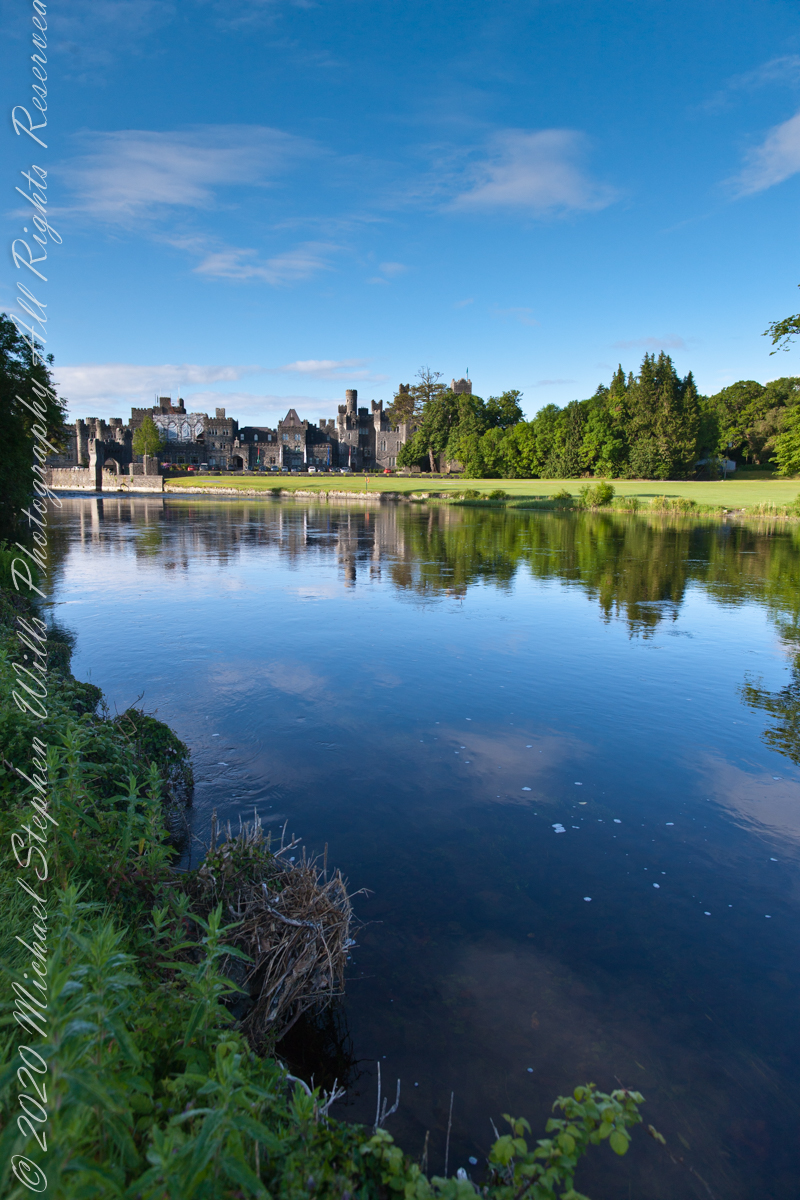
At Ashford Castle, swans glide on the Cong River’s glassy waters, weaving together myth, history, and cinema in a timeless reflection of Ireland’s enduring spirit.

Headed south from Cong Village, past the venerable Cong Abbey then Saint Mary’s Church of Ireland, the road bends into the Ashford Castle estate. Time seems to shift here. The stonework of the abbey lingers in memory, only to give way to manicured parkland, ancient trees, and the shimmer of water. The road itself, aptly named Ashford Castle, carries the traveler to a place where history, nature, and imagination meet.

I do not recall passing a guard box on my first visit, though one now stands firmly on the roadside, manned and proper, as though the estate were never meant to be entered without ceremony. In truth, Ashford Castle has always carried the air of a threshold—between village and wild, past and present, myth and reality.

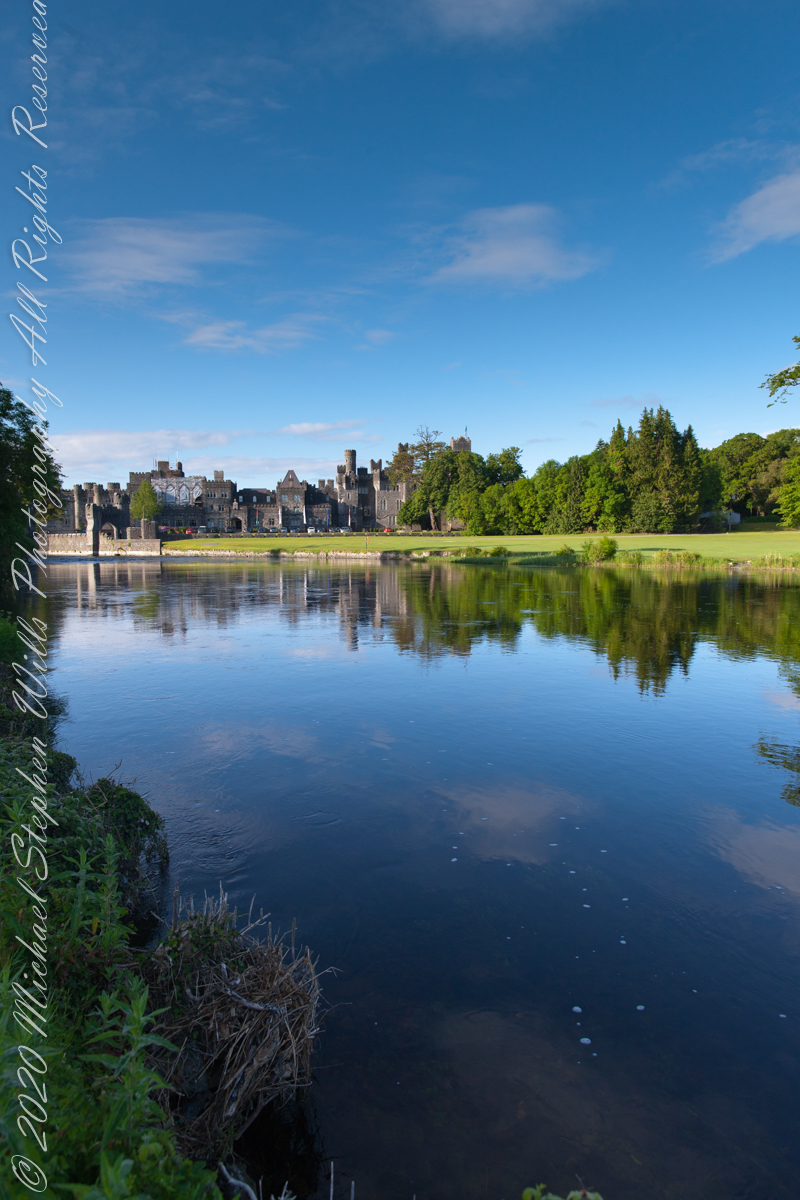
Soon the road brings one to the banks of the Cong River. Here the water widens, flowing calm and sure, and across it rises the battlemented silhouette of Ashford Castle itself. Its towers, turrets, and stony walls seem to grow from the riverbank like something inevitable, a fortress transformed into elegance. The castle’s mirrored reflection on the water doubles the grandeur, as though the real and imagined castle exist side by side.

It is no wonder filmmakers found inspiration here. Scenes from the classic 1952 film The Quiet Man—the tale of Sean Thornton, played by John Wayne, and the fiery Mary Kate Danaher, embodied by Maureen O’Hara—were shot on the far bank of this very river. To watch them walking by these waters is to see Ashford Castle woven into Hollywood’s Irish dreamscape, a backdrop both romantic and enduring.

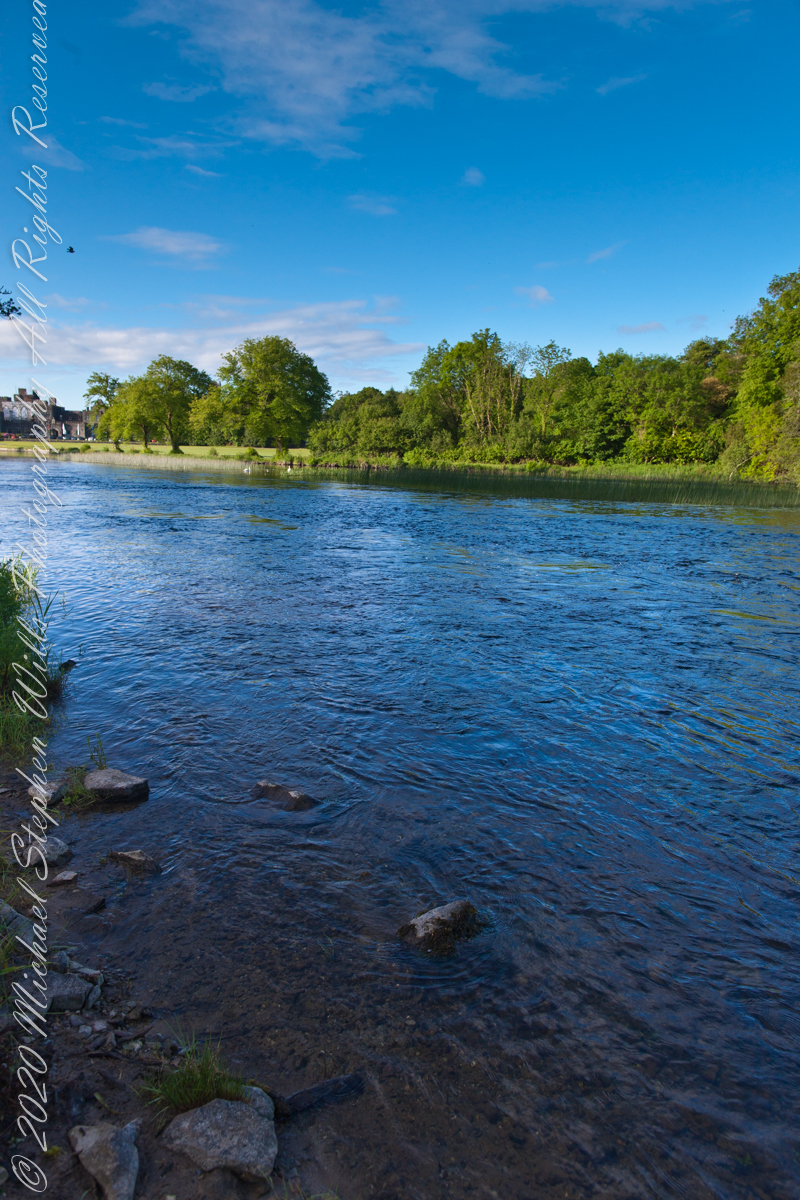
Yet long before cinema, the river was already a stage. The Cong River is a natural marvel. It emerges from the same Carboniferous limestone that shapes the Burren of County Clare—an austere landscape of limestone pavements etched with fossils and caves, where rare alpine and Mediterranean plants thrive among ancient tombs. Through fissures in this ancient bedrock, the waters of Lough Mask find their way underground before rising again at Cong. This subterranean journey, through stone filters laid down some 350 million years ago, leaves the water clarified, luminous, and cold. By the time it slides past Ashford Castle, it has the purity of glass.

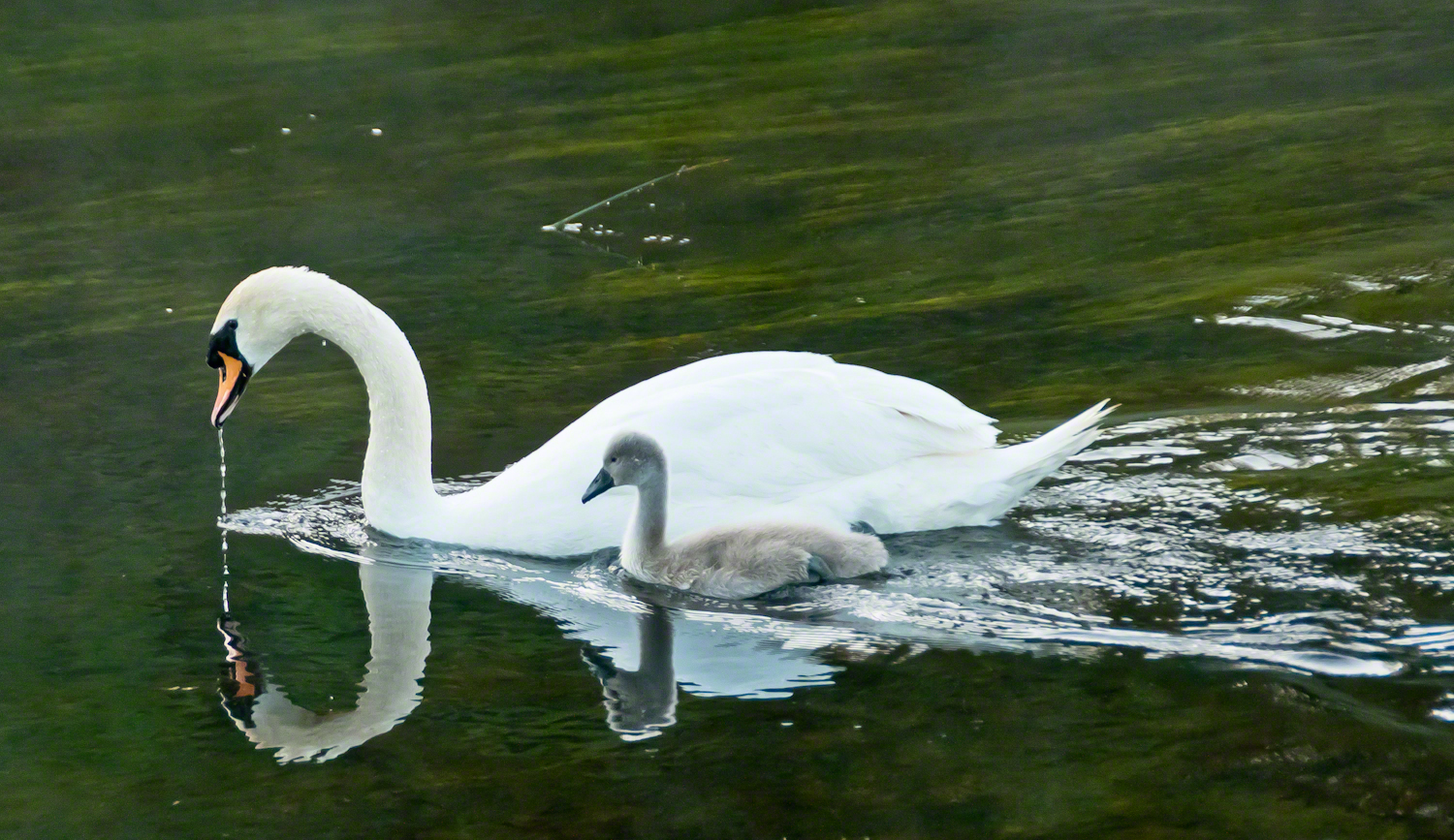
It is in this clarity while walking the opposite bank on a different morning I found a parent swan and its cygnet feeding. The adult glided, immaculate, its long neck bowed as drops of river fell from its beak. At its side, the cygnet paddled with earnest strokes, gray down still clinging, a fragile shadow of what it would one day become. Together they traced a quiet path across the water, ripples fanning behind them.

Few images so perfectly match their setting: a medieval castle, guardian of centuries, reflected in the same waters where these swans carried on their timeless rhythm of nurture and growth. It was as if the river itself composed the scene—a blending of stone, water, bird, and sky that belonged nowhere else but here.

The swan has long been a symbol in Irish lore. The Children of Lir, cursed to live as swans for nine hundred years, are among the most haunting figures of Celtic mythology. To see the white bird with its offspring before Ashford Castle was to glimpse that myth breathing still, alive on the Cong River.

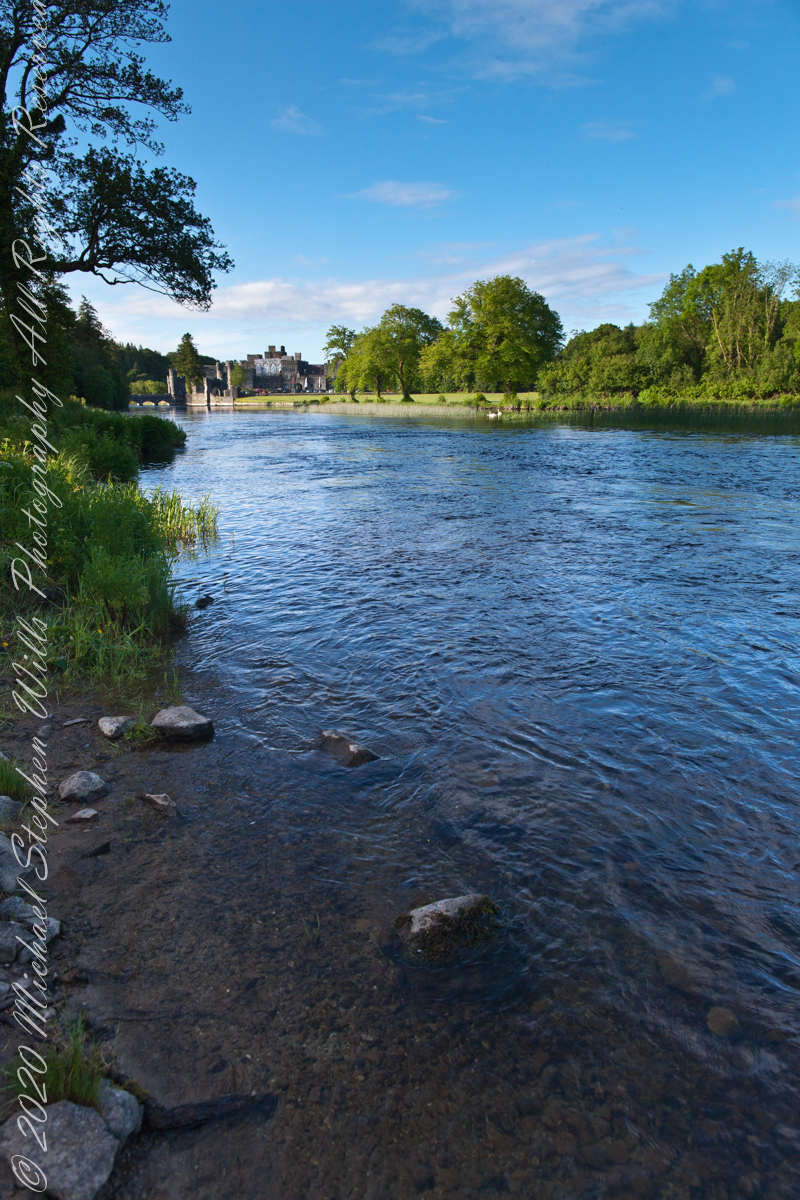
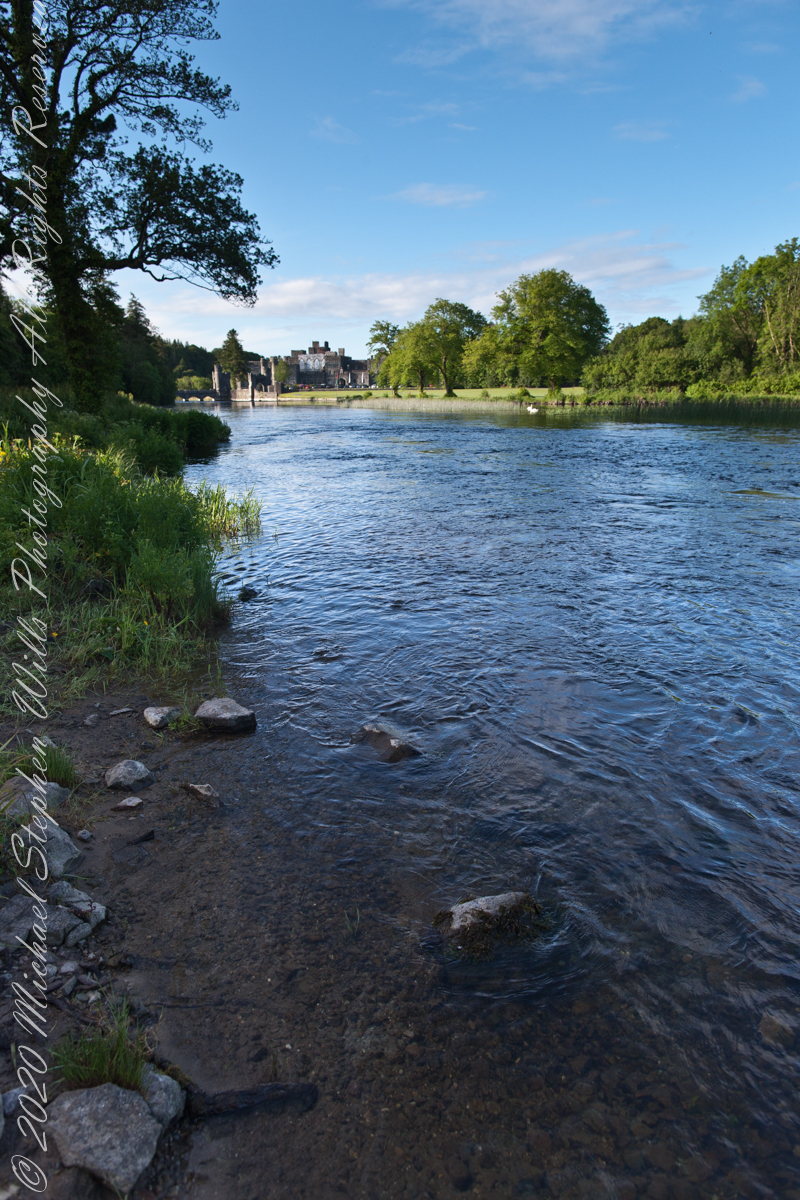
Photographers know the difficulty of capturing water and stone without losing the life between them. On that morning, however, the river gave freely—its surface alternately smooth as glass and dappled with breeze. Stones at the water’s edge appeared like stepping-stones into history. Each frame revealed another face of the estate: the wide reach of the Cong, the castle framed by trees, the play of cloud shadows across the current.

The castle itself, though reshaped as a luxury retreat, still speaks of older times. Founded in the 13th century by the Anglo-Normans, Ashford passed through centuries of conquest and change before becoming, in the 19th century, a romantic Victorian pile. Today its battlements remain picturesque rather than defensive, but the sense of continuity—of lives unfolding along these banks—has not faded.

Standing there, camera in hand, I was struck by the layered meaning of this place. The Cong River flows from unseen caverns, purified by limestone older than memory. It nourishes swans, reeds, and trout alike. It reflects both a castle and a sky. Along its opposite bank, legends of cinema and Celtic lore alike find footing.

As the swan and cygnet drifted slowly downstream, I thought of them as part of the same enduring thread. Parent and child mirrored castle and village, past and future, permanence and change. The ripples they left widened until they touched both banks, an unbroken gesture across centuries.

Click this link to read another Ireland story “The Cloigtheach of Glendalough.”

Click this link to read another Ireland story “Killeany Bouy.”
Enter your email to receive notification of future postings. I will not sell or share your email address.

A Visit from Rose-Breasted Grosbeaks

On a serene May morning, a small flock of Rose-breasted Grosbeaks graced the author’s yard, showcasing their vibrant plumage and bringing beauty to the tranquil scene of nature.


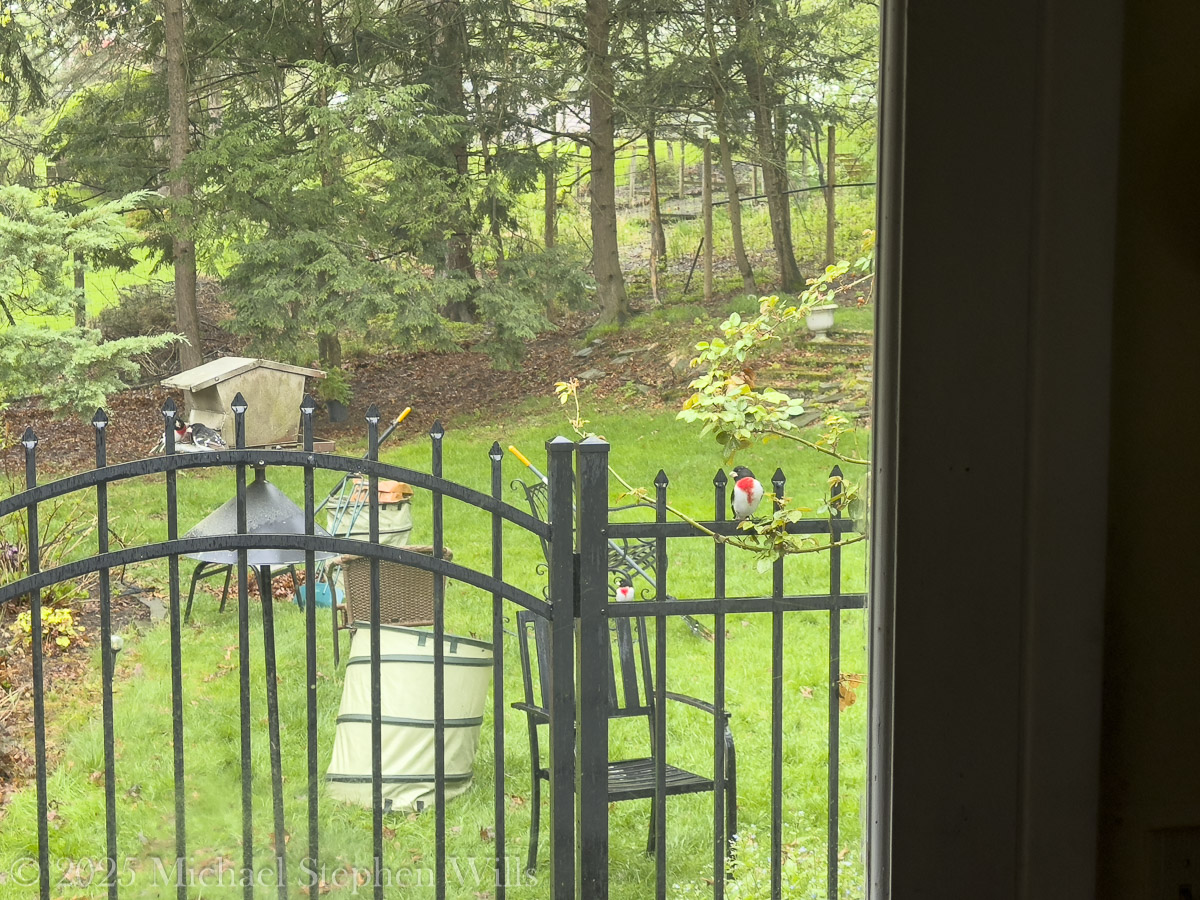
It was a gentle May morning, the kind that seems to hush even the wind, as though nature were holding its breath for something wonderful. Through the kitchen window, just past the black iron gate entwined with the fresh green of climbing rose, I spotted them—feathered heralds of spring’s deepening promise—perched like jeweled notes on a musical staff.


The Rose-breasted Grosbeaks had arrived.

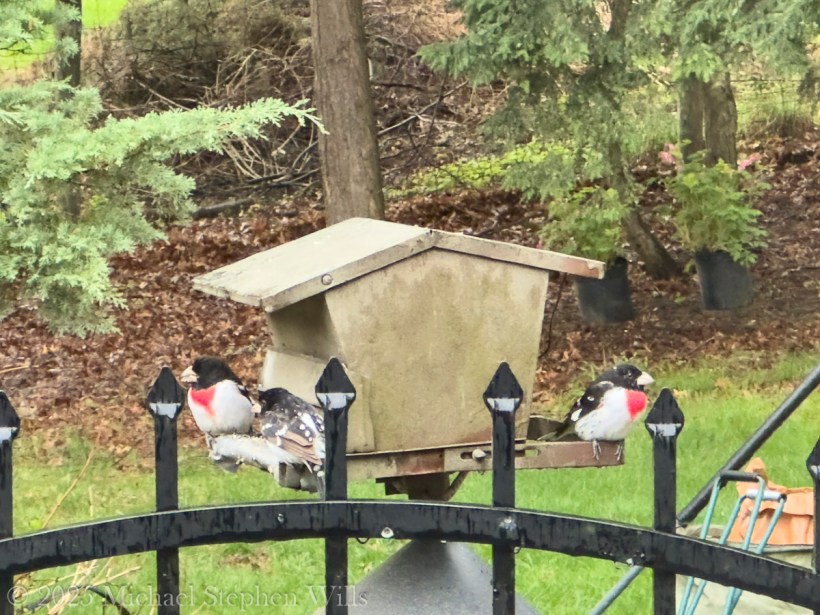
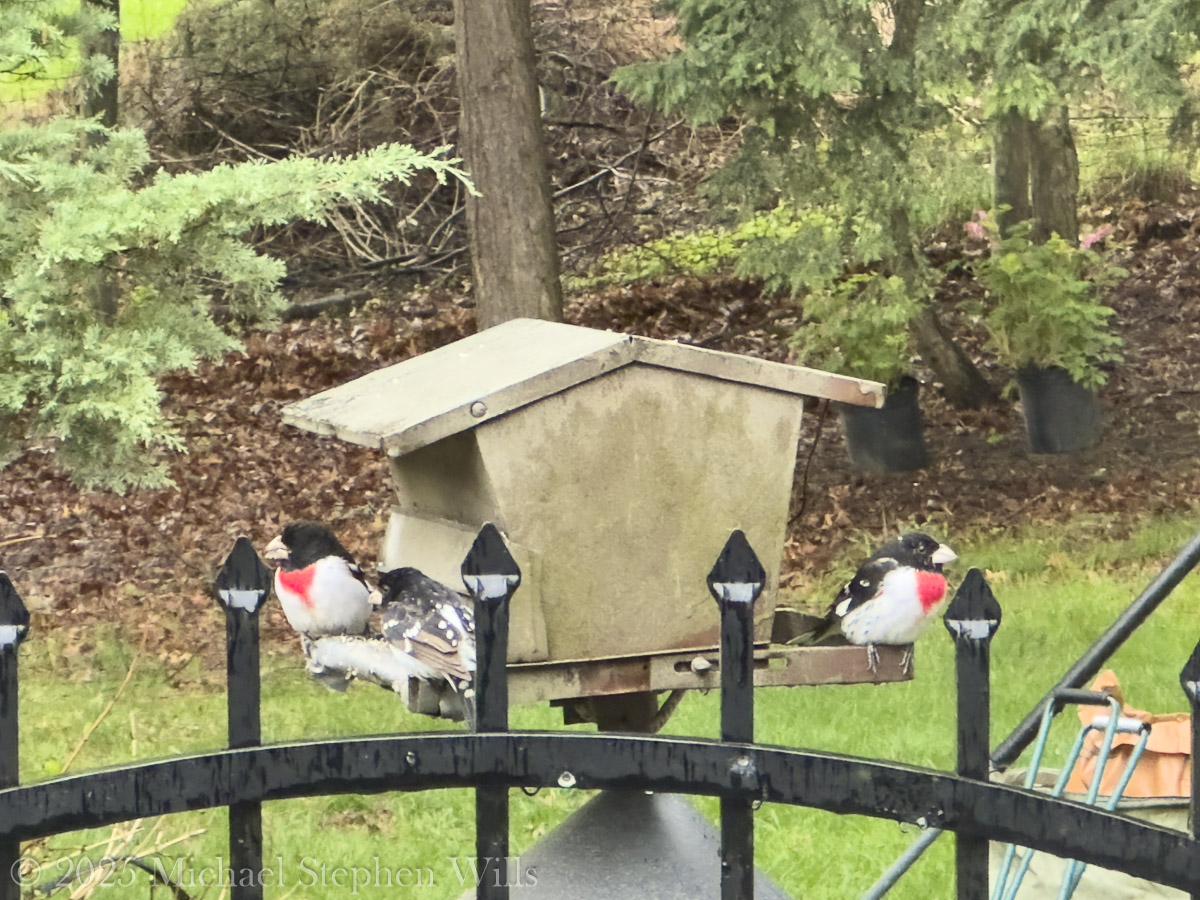
May 3, 2025 Four Male Rose Brested Grosbeaks visited our backyard bird feeder during spring cleanup.


Not one or two, but a small flock, draped in raindrops, feathered in contrast and charm. They gathered around our backyard feeder like guests invited to a familiar table. At 5:56 a.m., the camera captured the first image: two males on the feeder and one each on fence and chair, a bold bib of crimson splashed across snowy chests, huddled against the gray of the feeder, their plumage brilliant even in the diffused dawn light. I couldn’t help but smile. This was a scene of quiet splendor, a symphony for the eyes and soul.

The males, unmistakable in their attire, wore tuxedos of black and white, with the defining rose-red marking on the breast that gives the species its common name. Their scientific name, Pheucticus ludovicianus, is less poetic but equally telling. “Pheucticus” comes from the Greek pheuktikos, meaning “shy” or “avoiding,” reflecting their reclusive habits in forested nesting grounds. “Ludovicianus” refers to Louisiana, an early French colonial name for a vast region including their breeding range—a nod to their North American roots.


At 5:58 a.m., the lens captured more details: a male with slightly mottled wing feathers, suggesting he was a younger bird, still dressing up in adult finery. The trio clung to the feeder’s edge, their heavy, conical beaks—perfect for cracking seeds—clearly visible. That oversized bill gives them the name “grosbeak,” from the French gros bec, literally “large beak.” Functional beauty, you might say.

May 3, 2025 Three of the Four Male Rose Brested Grosbeaks visited our backyard bird feeder during spring cleanup.


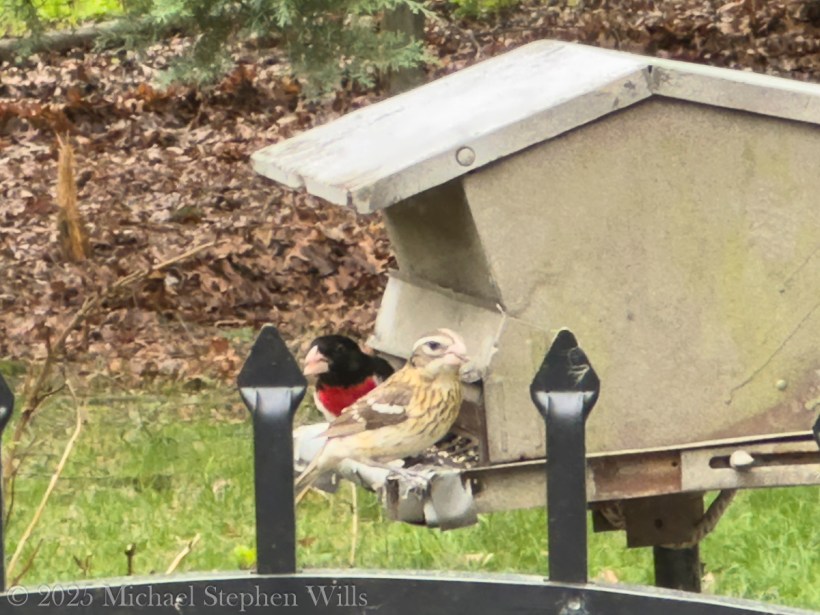
Then, at 6:08 a.m., came the contrast—the female. Subtly adorned in warm browns, with creamy streaks and a wash of yellow near the wings, she perched beside her flamboyant mate, as if to say: elegance need not shout. The two birds looked momentarily toward each other, and I was struck by their balance—his flair and her grace. Her eyebrow stripe, called a supercilium, lent her a composed, alert expression. While the male might catch the eye, the female commands attention in her own, quieter way.

May 3, 2025 Male and Female Rose Breasted Grosbeaks visited our backyard bird feeder during spring cleanup.


Rose-breasted Grosbeaks are migratory, long-distance travelers who winter in Central and South America and return each spring to North America’s deciduous and mixed woodlands to breed. Here in upstate New York, our yard is a brief rest stop on their northward journey—or, if I’m lucky, a summer home. They often nest in dense foliage, and their song, a melodic, whistled warble—like a robin who’s taken voice lessons—is often the first clue to their presence.


This morning, no song was needed. Their silent presence was enough.


Watching them, I felt time slow, the kind of moment when the ordinary yard becomes cathedral. Watching them, I felt time slow, the kind of moment when the ordinary yard becomes cathedral. The wet fence and chair under the feeder, even the crumpled leaf bag—everything was blessed by the company of these birds. Rain softened the world, and the birds brought color to its hush.


Later that day, reviewing the photos with metadata timestamps from my iPhone—each image like a verse in a poem—I marveled at what I had witnessed. These weren’t just birds. They were stories in flight, living punctuation marks in the sentence of my morning.


Nature gives us these moments, brief as birdsong and just as sweet. You only have to be still, and ready to receive them.

Enter your email to receive notification of future postings. I will not sell or share your email address.

References

  1. Pheucticus ludovicianus (Rose-breasted Grosbeak). Cornell Lab of Ornithology – All About Birds.
  2. Jobling, James A. The Helm Dictionary of Scientific Bird Names. London: Christopher Helm, 2010.
  3. Merriam-Webster Dictionary: Etymology of “Grosbeak.”
  4. iPhone 14 Pro Max image metadata (May 3, 2025; 5:56 a.m. to 6:08 a.m.; Ithaca, NY).

Exploring Lime Hollow: Nature Walks with My Grandsons

Enjoy a memorable visit to Lime Hollow Nature Preserve by a grandfather and his grandsons, exploring nature, observing wildlife, and connecting through shared experiences, fostering curiosity and appreciation for the environment.

The October sunlight was gentle as we entered Lime Hollow Nature Preserve from Gracie Road, my grandsons, Sam and Rory, bursting with excitement beside me. Sam, the eldest, took the lead, confidently striding ahead along the Sunset Trail while Rory, his younger brother, stayed close to my side, his eyes wide with wonder at the forest around us.

Descent to the Pond


The trail wound through the woods, dappled with the golds and reds of early autumn. Sam spotted a squirrel darting between trees, and Rory pointed to the sky, “Look, Grandpa, a woodpecker!” I smiled at their enthusiasm, feeling grateful for these moments of connection to nature and family.

We descended toward the pond via the Pond View Trail, the sound of trickling water drawing us closer. As we approached, the landscape opened up, revealing the calm, reflective surface of the water, bordered by reeds swaying in the light breeze. I remembered bringing the boys here last spring, how different the pond looked then—brimming with life as frogs leapt from the banks and dragonflies zipped across the water’s surface. Today, the scene was quieter, but no less magical.

Rory, ever the adventurer, crouched by the pond’s edge, watching for frogs. Sam, too, paused to observe but soon grew restless, his curiosity pushing him onward. “Come on, Grandpa! Let’s see what’s next!” His voice echoed through the trees as he darted back onto the trail, Rory quick to follow.

Encounter with the Giant Fungus


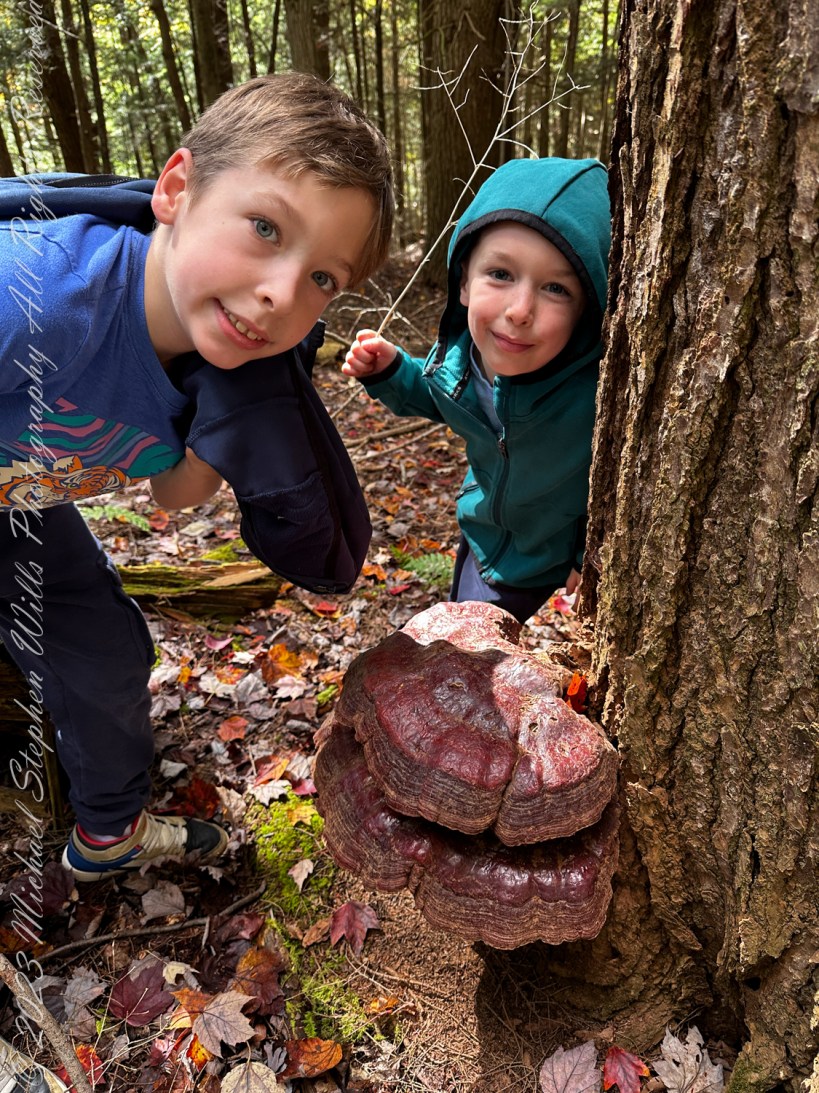
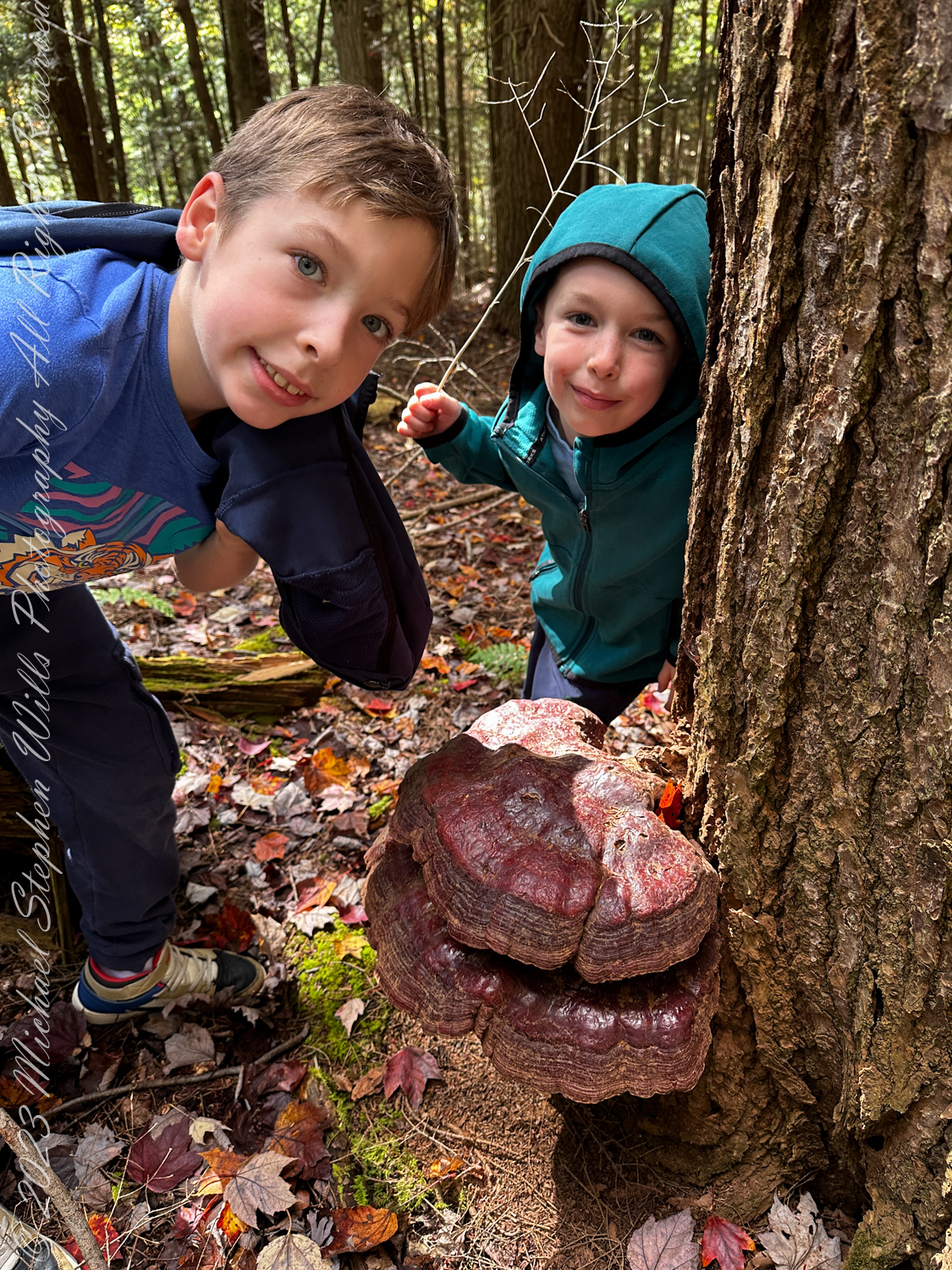
The path led us deeper into the forest, and soon we turned onto the Brookside Trail, which merged with the High Ridge Trail. Here, the air grew cooler under the dense canopy of trees, and the forest floor softened beneath our feet with layers of leaves. It was then that we stumbled upon the most magnificent sight of the day: an enormous bracket fungus, its wide, layered shelves clinging to the trunk a hoary snag.

Rory gasped in delight, running over to inspect it more closely. “Look how big it is!” he exclaimed, his small hands hovering just above its ridged surface. Sam, never one to be outdone, knelt beside it, carefully touching the spongy layers. “It’s a staircase for squirrels,” he said, grinning up at me.

Turkey Tail bracket fungus (Trametes versicolor) is a common wood decay fungus found on dead and decaying hardwoods. Named for its concentric, colorful bands resembling a turkey’s tail, it plays a vital role in forest ecosystems by breaking down lignin, facilitating nutrient recycling. It’s also valued for its medicinal properties. Lime Hollow Nature Center, Cortland, Cortland County, New York State. Finger Lakes Regions

As I watched them, I couldn’t help but think back to all the times I had wandered these trails alone before they were born. Now, these woods had become a classroom for them—full of discoveries that sparked their curiosity and wonder. It was a beautiful moment of generational connection, this passing on of my love for the natural world to Sam and Rory.

Fascinating Beech Tree Roots


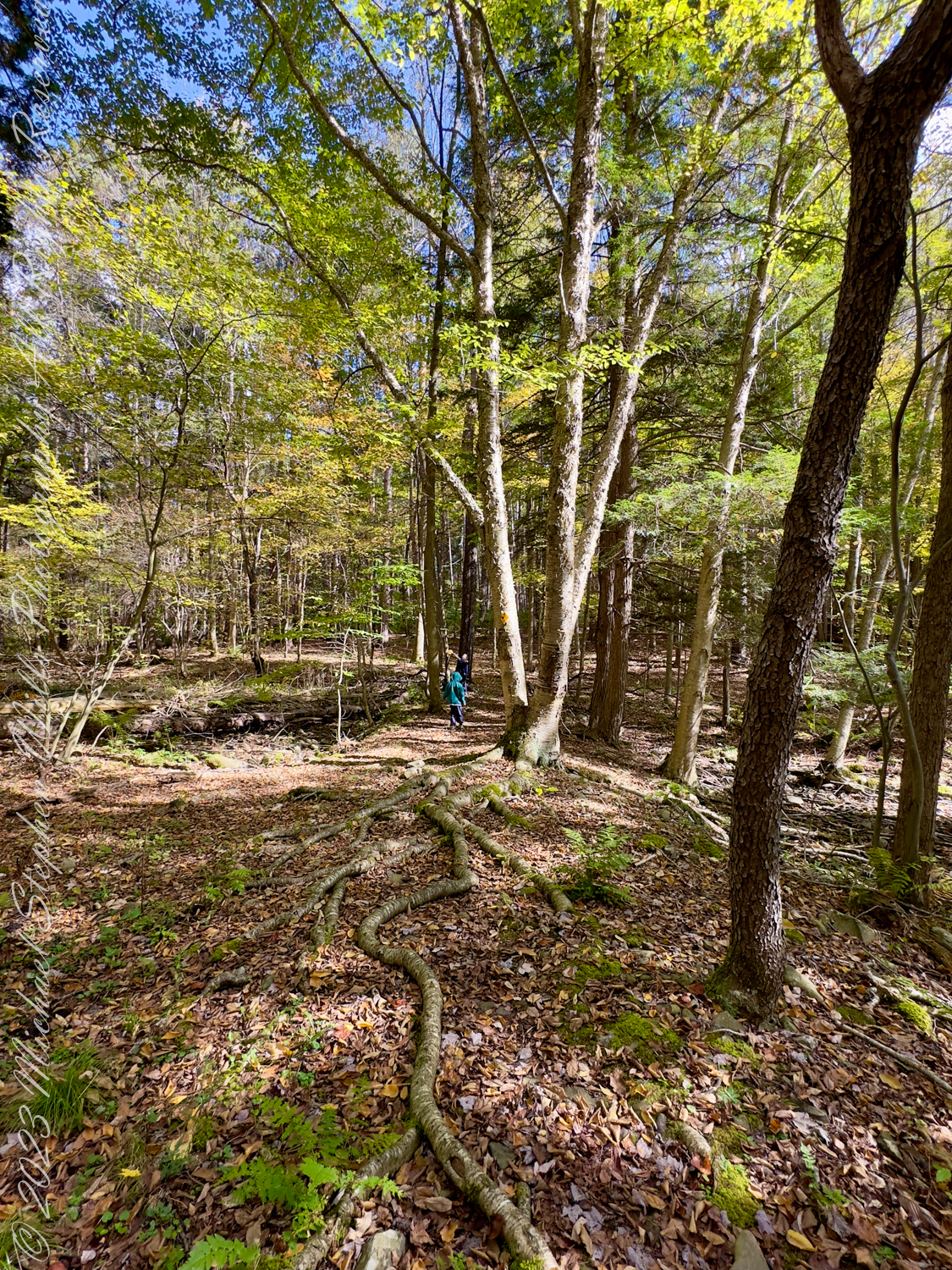
On the way out, we took the Brookside / Pond View / Sunset trails once again, but this time, this intricate network of roots from a massive beech tree fascinated us. The roots twisted and coiled across the path like veins, in our imaginations the gnarled shapes snagged our feet. Sam, ever the explorer, stepped cautiously along the roots, balancing himself as if walking a tightrope. Rory followed suit, his giggles filling the air.

An American beech (Fagus grandifolia). These trees are quite common in northeastern forests.
The beech tree is known for its smooth smooth, gray bark, which can become marked with scars or etchings as the tree ages. Additionally, its leaves are typically dark green, with serrated edges, and turn yellow to bronze in the fall, often staying on the tree through winter. Lime Hollow Nature Center, Cortland, New York State

“These roots are older than us,” I told them. “Beech trees can live for hundreds of years. Just think, this tree has seen many more seasons than we ever will.”

Sam’s eyes widened at the thought, while Rory gave the tree a gentle pat, as if to thank it for its wisdom. I marveled at how something as simple as a root system could captivate their imaginations and bring the lesson of time and growth to life.

Reminiscing on the Chicago Bog

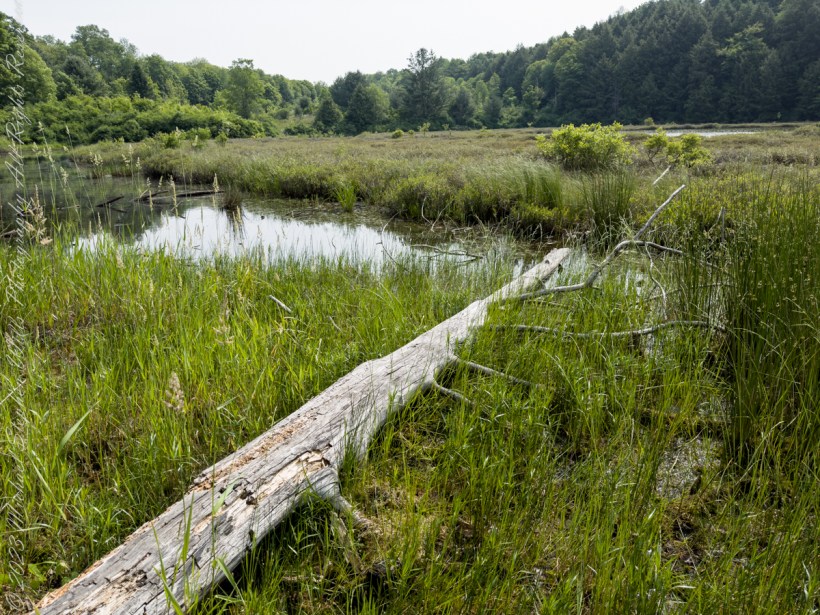
In the 1830’s there was a village named Chicago along Gracie Road, which gives it the name we have today. The Chicago Bog is home to many carnivorous plants, including sundew, the pitcher plant, and more. The deepest depth of the bog is about 7.2 ft. The bog is along the Phillips Memorial Trail, which can be found on Gracie Road. Lime Hollow Nature Center, Cortland, New York


As we walked, my mind wandered back to a visit we had made to the Chicago Bog just a year before. I remembered the day clearly—how we had trekked through the wetland on a warm June afternoon, the ground soft beneath our feet, alive with the buzzing of insects and the vibrant green of new growth.

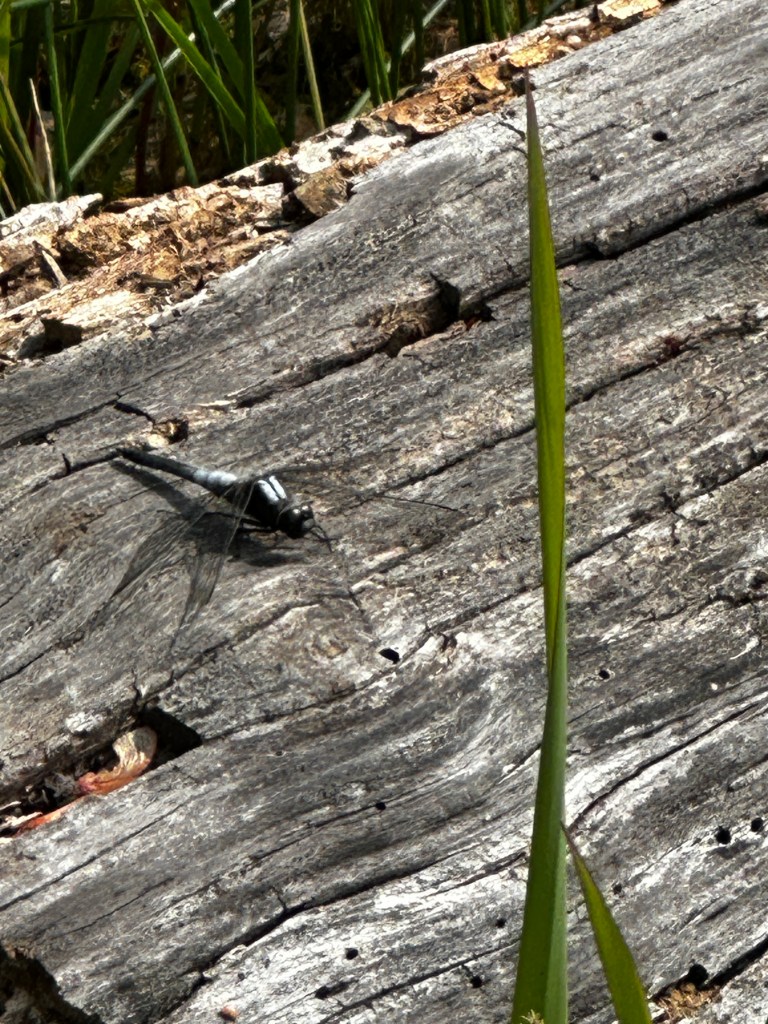
The chalk-fronted corporal (Ladona julia) is a skimmer dragonfly found in the northern United States and southern Canada.
Juveniles of both sexes are light reddish brown, with white shoulder stripes and a black stripe down the middle of the abdomen. As they mature, males develop a white pruinescence on the top of the thorax and at the base of the abdomen, while the rest of the abdomen turns black. Females become almost uniformly dark brown, with a dusting of gray pruinescence near the base of the abdomen; a few develop the same color pattern as the males.
Chalk-fronted corporals often perch horizontally on the ground or on floating objects in the water, flying up to take prey from the air. They are gregarious for dragonflies, and are commonly seen perching in groups. They readily approach humans to feed on the mosquitoes and biting flies that humans attract.

It was there, by the edge of the bog, that we had encountered a dragonfly, a Chalk-fronted Corporal, resting on a fallen log. Its dark, iridescent wings shimmered in the sunlight, and Sam had been mesmerized by its delicate beauty. He had asked so many questions that day—about how dragonflies flew, what they ate, and where they lived. I had done my best to answer, but truth be told, I learned as much as he did in that moment.

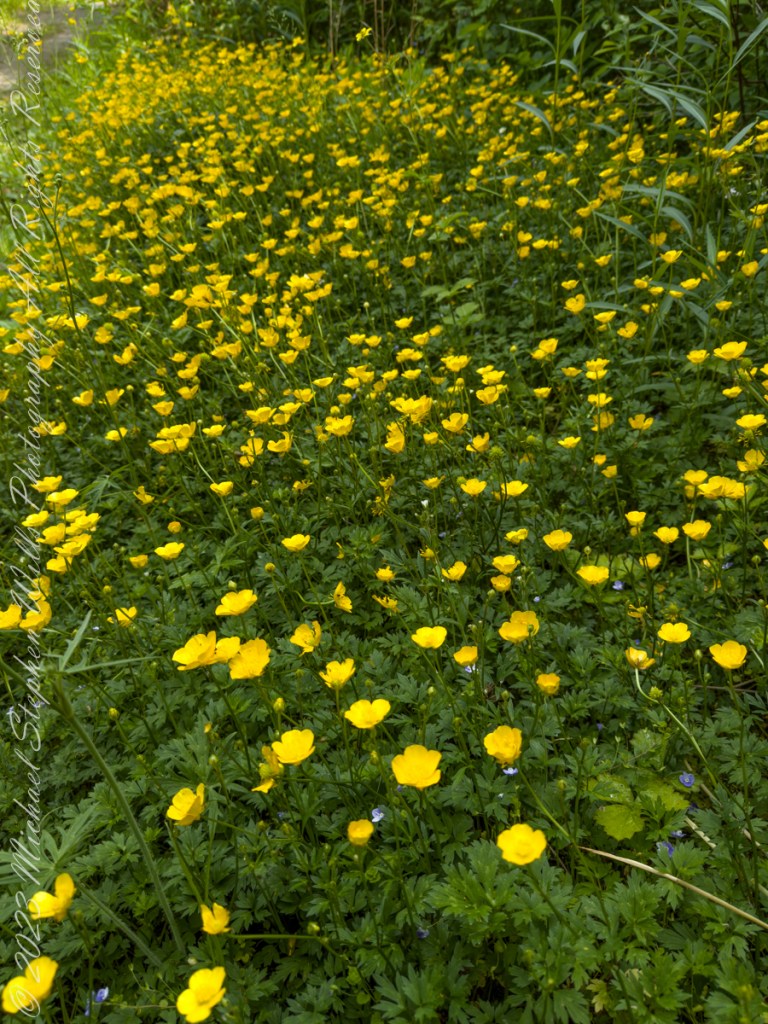
Nearby, a meadow of buttercups had stretched out before us, their yellow blooms dancing in the breeze. Rory had run through them, his laughter ringing out as he tried to catch a butterfly that flitted between the flowers. The memory of that field of gold still brought a smile to my face as we made our way through Lime Hollow today.

A Day to Remember


As we neared the end of our hike, the afternoon light filtering through the trees, I couldn’t help but feel a sense of contentment. These outings with Sam and Rory had become more than just walks in the woods—they were opportunities to share, to learn, and to make memories that I knew would last a lifetime.

“Grandpa, can we come back?” Rory asked, his face flushed with excitement.

“Of course,” I said, smiling. “We’ll always have time for another adventure.”

Nesting Chronicles: The Life of A Cayuga Lake Osprey

Imagine you’re soaring with ospreys over Cayuga’s shimmering waters, preparing the nest, embracing the ritual of spring—a majestic cycle of life awaits you.

As the first warm breezes of early spring ruffle the chilled waters at the south end of Cayuga Lake, anticipation rises in me. I am a female Osprey, returning alone from far to the south along the old sky-roads. We do not migrate as a pair; my mate often reaches the nest ahead of me to reclaim the site and begin repairs. Still, this is the place we claim again, season after season.

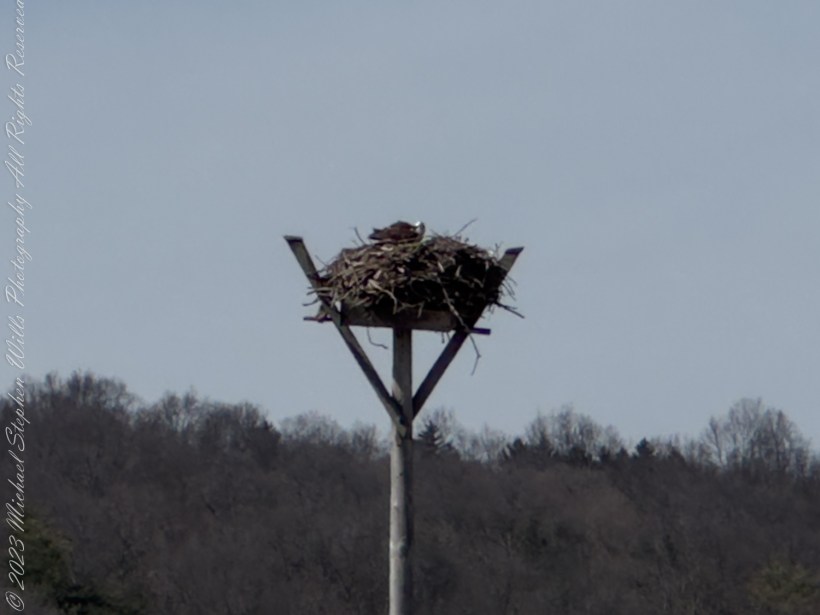
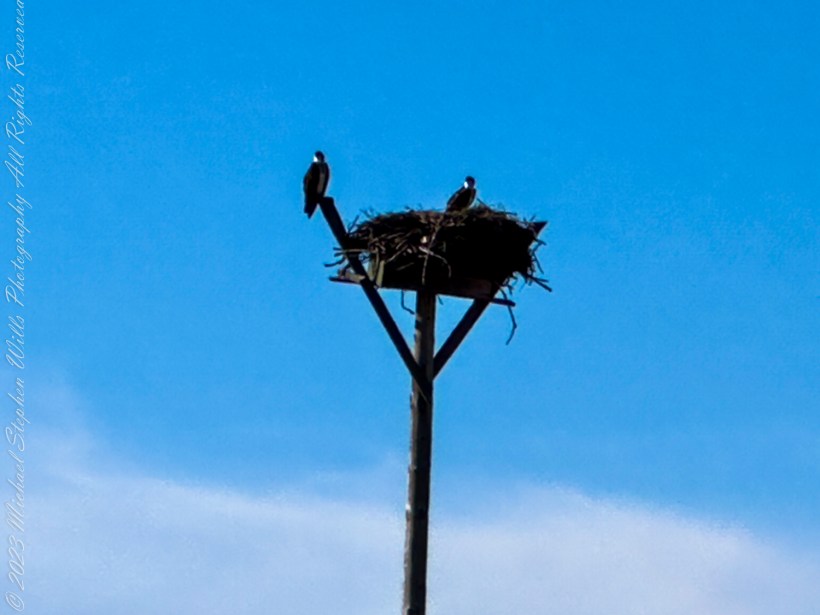
Two Osprey perched on the nest near the Birding Trail of Cass Park. Cayuga Lake in the distance.

On arrival I wheel high above the shoreline, searching for the platform we left to winter. There it stands—the tall sentinel above the lake. He is there, too, calling once as he lifts, and the rim already shows the first fresh sticks of the year. Against the bright sky the nest looks rough-hewn, yet every branch lies to a purpose.

Two Osprey perched on the nest near the Birding Trail of Cass Park.

As I settled onto the platform, tthe familiar tilt of the timbers and the dry rattle of last year’s sticks steady me. I meticulously inspected our creation, the repository of our hopes and future lineage. My mate and I ferry fresh twigs and weeds, wedging them into the rim and lacing the walls tight against the spring winds.

In due time, beneath the sheltering rim, I laid a small clutch of mottled eggs—the culmination of our bond, the promise of continuity. Through the weeks that follow I keep them warm and dry, turning them with my beak and settling the heat of my breast upon them. My mate does the heavy work of provision—fish after fish to the rail—and stands guard, calling when intruders drift close. Now and then he eases onto the eggs while I feed, but the watching and warming are chiefly mine.

Two Osprey perched on the nest near the Birding Trail of Cass Park.

The world around us burgeoned with life. The lake’s surface now rippled with the activity of fish – a bounty for our growing family. Days turned into weeks, and our vigilance was rewarded as the first cracks appeared in the eggs. The chicks emerged, delicate yet voracious, their mouths agape for the nourishment we unceasingly provide.

Click Me for another Osprey Post

Thank you Candace E. Cornell of the Cayuga Lake Osprey Network for your helpful advice.

For further information: —–Poole, Alan F. ; 2019, “Ospreys: The Revival of a Global Raptor”; Johns Hopkins University Press —Mackrill, Tim; 2024; “The Osprey”; Bloomsbury Publishing

Enter your email to receive notification of future postings. I will not sell or share your email address.

Tuxedos on Tour: Three Majestic Mergansers

Join the escapade as you witness three majestic Mergansers, donning nature’s finest tuxedos, in a graceful ballet on the springtime stage of Cayuga Lake.

As you gaze upon these three fine feathered fellows, all members of the exclusive Common Merganser men’s club, they seem to glide upon the watery stage of Cayuga Lake with all the confidence of Broadway stars on opening night. They are the aquatic equivalent of a sharply dressed barbershop quartet, minus one, in their matching tuxedos, ready to sing the springtime serenade of their species.
The chap at the forefront is Captain Black-Crest, sporting a glossy noggin that shimmers with an inner light, undoubtedly the envy of every duck on the pond. He’s streamlined and debonair, with a white body that’s as crisp as the first snowfall and a dark back that’s as sleek as a shadow in moonlight. If ducks had monocles and top hats, he’d be first in line.
In the middle, there’s Sir Dapper-Diver, a mirror image of his companion, with a neck as white as the driven snow and a dignified black back that gleams like polished onyx in the dappled sunlight. He’s the quiet achiever of the group, poised and ready to make the plunge into the depths below, proving that style need not be sacrificed for substance.
And to the right, meet Admiral Feather-Finesse. His poise on the water suggests a mastery of the waves, a commander of the current. He carries his elegant attire with an air of grace that only comes with a natural pedigree. In synchronized perfection, he and his brethren form a regatta of refinement, a display of nature’s own black-tie affair.
These are male Common Merganser (Mergus merganser) in breeding plumage, characterized the body white with a variable salmon-pink tinge, the head black with an iridescent green gloss, the rump and tail grey, and the wings largely white on the inner half, black on the outer half. Like the other mergansers, these piscivorous ducks have serrated edges to their bills to help them grip their prey, so they are often known as “sawbills”. In addition to fish, they take a wide range of other aquatic prey, such as molluscs, crustaceans, worms, insect larvae, and amphibians; more rarely, small mammals and birds may be taken. As in other birds with the character, the salmon-pink tinge shown variably by males is probably diet-related, obtained from the carotenoid pigments present in some crustaceans and fish. When not diving for food, they are usually seen swimming on the water surface, or resting on rocks in midstream or hidden among riverbank vegetation, or (in winter) on the edge of floating ice.

Together, these three Common Mergansers (Mergus merganser) in their prime are a trifecta of elegance, a testament to the timeless beauty found in nature’s simplicity. They paddle forth with purpose, their matching plumage a striking contrast to the rippling blues and grays of the water, a parade of poise and plumage that delights the observant eye.

So, dear reader, as you observe this photo, take a moment to appreciate the charming uniformity and the subtle quirks that make each bird, despite their shared wardrobe, uniquely magnificent. It’s a snapshot of life at its most graceful, a picture worth far more than a mere thousand words.

Copyright 2024 Michael Stephen Wills All Rights Reserved

Dueling Songbirds

Witness a duel not of might, but of vibrant melodies between the cardinal and song sparrow. This 14-second video captures a fleeting yet profound moment in the Finger Lakes’ springtime chorus. Join us in unraveling the significance behind this avian serenade.

In the serene backdrop of the Finger Lakes in upstate New York, an enchanting encounter unfolds as the first whispers of spring touch the air. It’s March 14th, a day that marks the gentle shift from the silent, introspective winter to the lively, expressive season of spring. On this day, a captivating spectacle takes place — a duel not of might, but of melody. Two distinguished songbirds, a male cardinal (Cardinalis cardinalis) with its vibrant red plumage that seems to capture the very essence of life itself, and a male song sparrow (Melospiza melodia), modest in color yet profound in voice, engage in an early springtime symphony.

This 14-second video, garnished with brevity, captures a fleeting moment in nature’s grand concert, where these feathered musicians compete, not for supremacy, but for the sheer joy of song and the chance to herald the new season. The cardinal, with its rich, whistling tunes, fills the air with a repertoire of songs that resonate with the promise of new beginnings. Meanwhile, the song sparrow, with its intricate melodies that vary dramatically from bird to bird, offers a counterpoint that is both complex and captivating.

This auditory duel, set against the tranquil beauty of the Finger Lakes, is more than just a display of vocal prowess. It’s a ritual that speaks to the heart of nature’s cycle, a testament to the resilience and adaptability of these species. As these songbirds vie for the attention of mates and assert their presence in the spring landscape, they also remind us of the enduring beauty and mystery of the natural world. You’ll also catch the call of a crow and, in the distance, another Cardinal.

This moment, brief yet infinitely rich, invites us to pause and listen, to lose ourselves in the simple yet profound joy of birdsong. It’s a reminder that, even in the quietest corners of the world, life thrums with vibrancy and the promise of renewal. Join us as we delve into the story behind this melodic encounter, exploring the significance of song in the lives of these birds and the heralding of spring in the Finger Lakes.

Copyright 2024 Michael Stephen Wills All Rights Reserved

Avian Exploration

Join us in the tranquility of Merritt Island National Wildlife Refuge as we observed avian life, reflecting on nature’s beauty and resilience.

As my wife, Pam, and I entered the breezy expanse of the Merritt Island National Wildlife Refuge, the world seemed to slow down, allowing us to savor every moment of my journey along Blackpoint Drive. The sky, a sprawling canvas of muted greys, reflected in the wind ruffled waters, enhancing the tranquility of this haven.

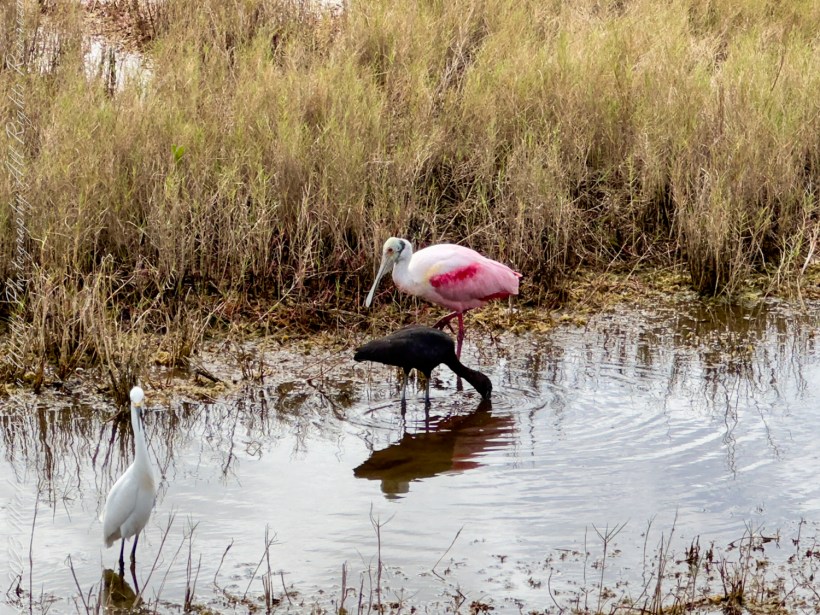
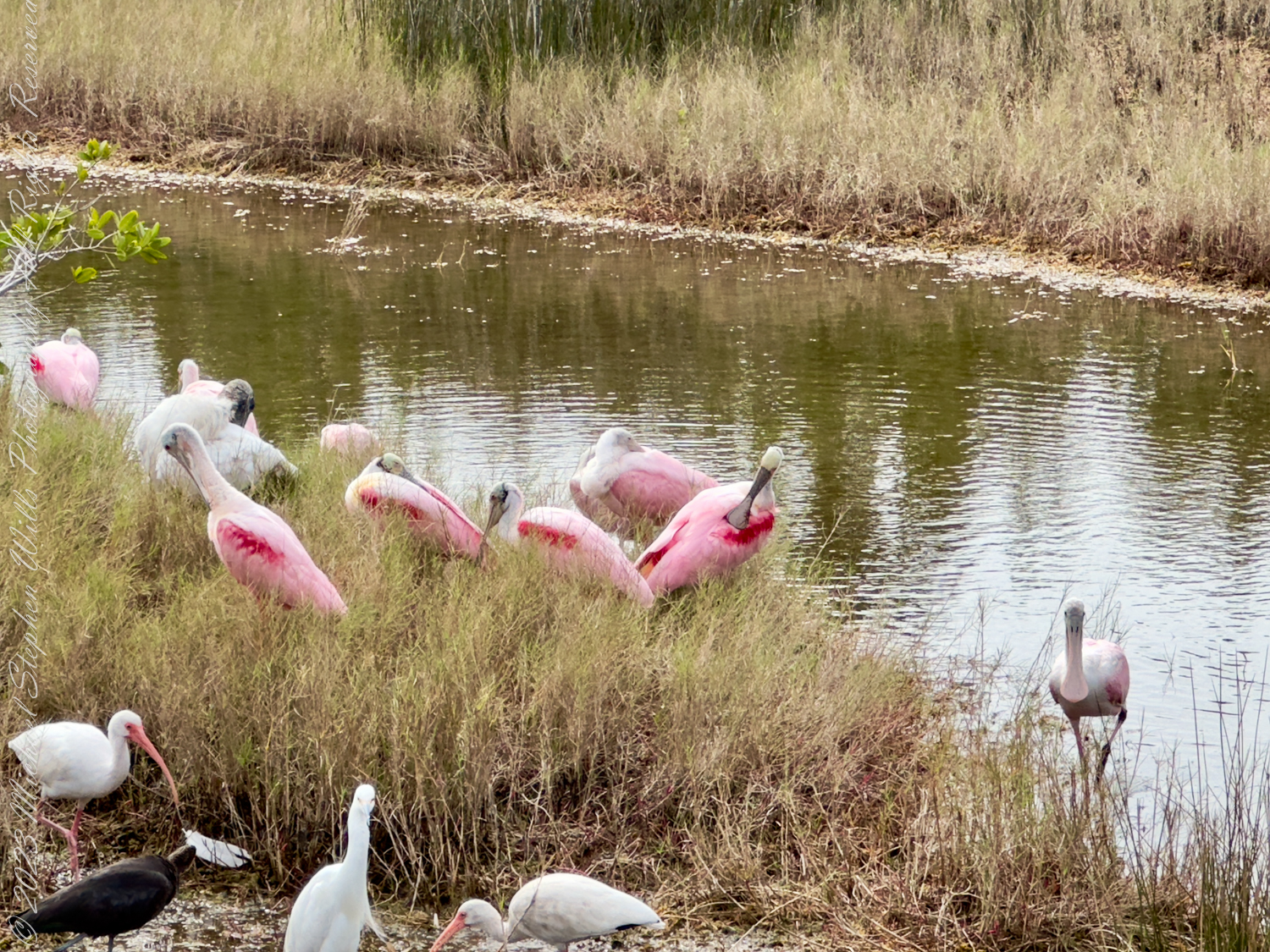
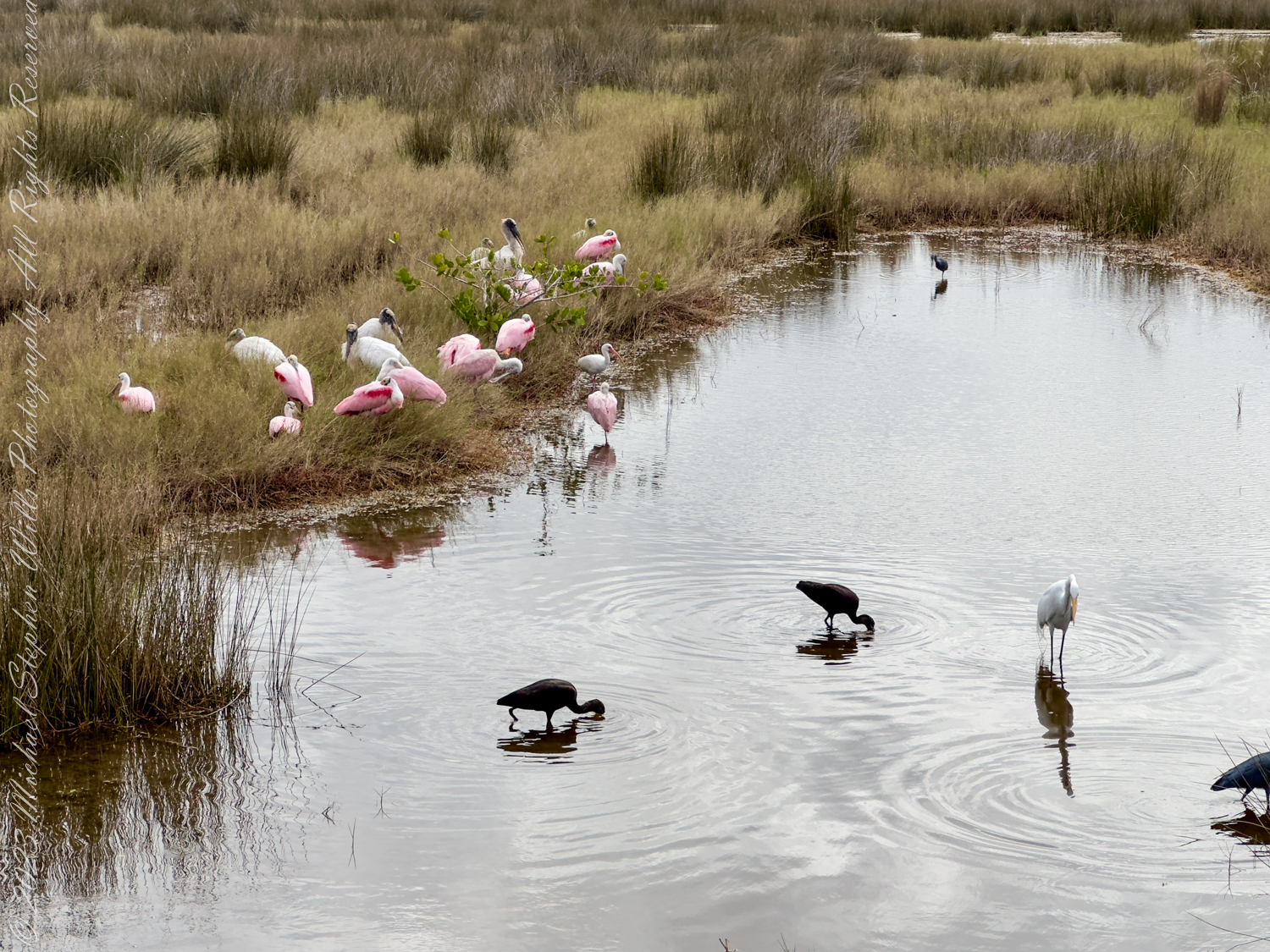
Our first encounter was with the elegant Roseate Spoonbills (Platalea ajaja), their vibrant pink feathers a stark contrast against the earthy tones of the marsh. They waded with purpose, their spoon-shaped bills sifting through the water, a dance of survival that was both methodical and beautiful.

In the company of the spoonbills were the stoic Great Egrets (Ardea alba), statuesque in their white plumage. They stood motionless, like sentinels guarding the water’s edge, only to strike with lightning speed when prey ventured too close.

We watched as the Glossy Ibises (Plegadis falcinellus) dipped their curved bills into the water, each movement a study of precision, their dark feathers glistening with an iridescent sheen when caught by the light.

Amongst these avian aristocrats, the unassuming American White Ibises (Eudocimus albus) went about their business. Their red beaks probed the shallows, unperturbed by the presence of their more colorful neighbors or by my watchful eyes.

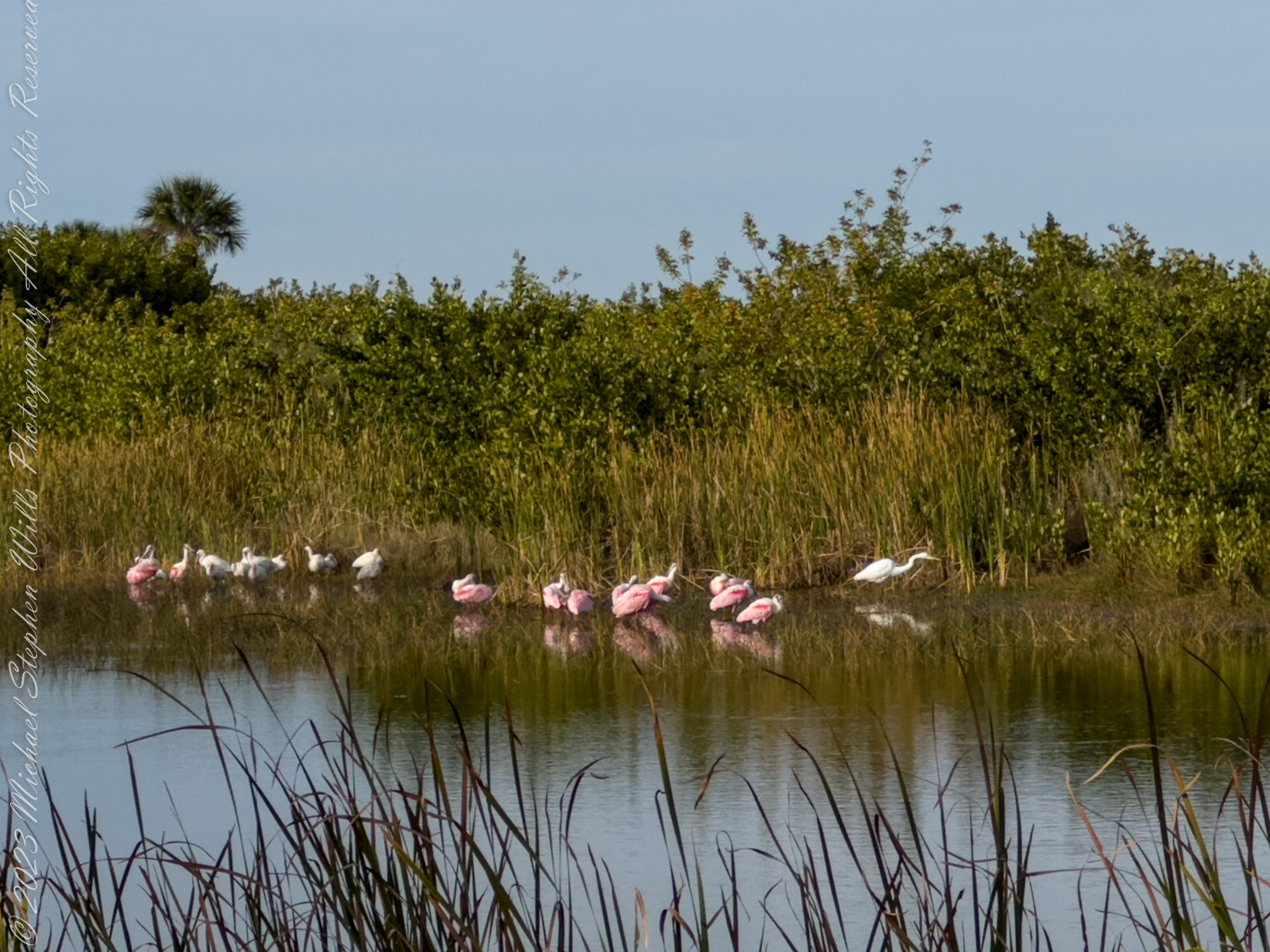
As we ventured further, the landscape shifted, the water opening up to reveal a gathering of Spoonbills and White Ibises, a community united by the need to feed and the safety of numbers. The occasional flap of wings and contented calls created a symphony that celebrated life in these wetlands.

Isolation took on a new meaning when I spotted a solitary Roseate Spoonbill, its reflection a perfect mirror image on the water’s surface. It was a moment of quiet introspection, the bird and I alone in our thoughts.

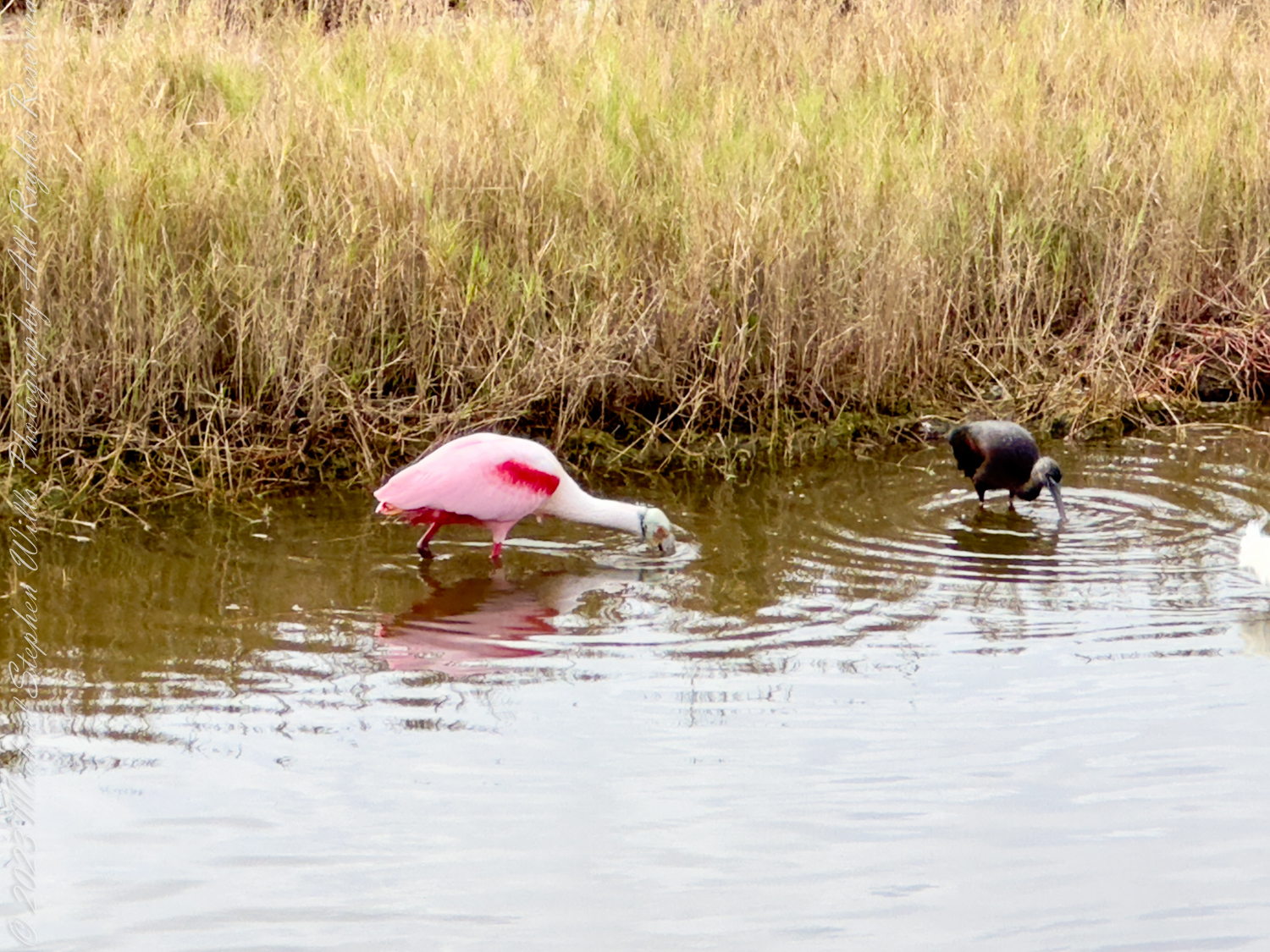
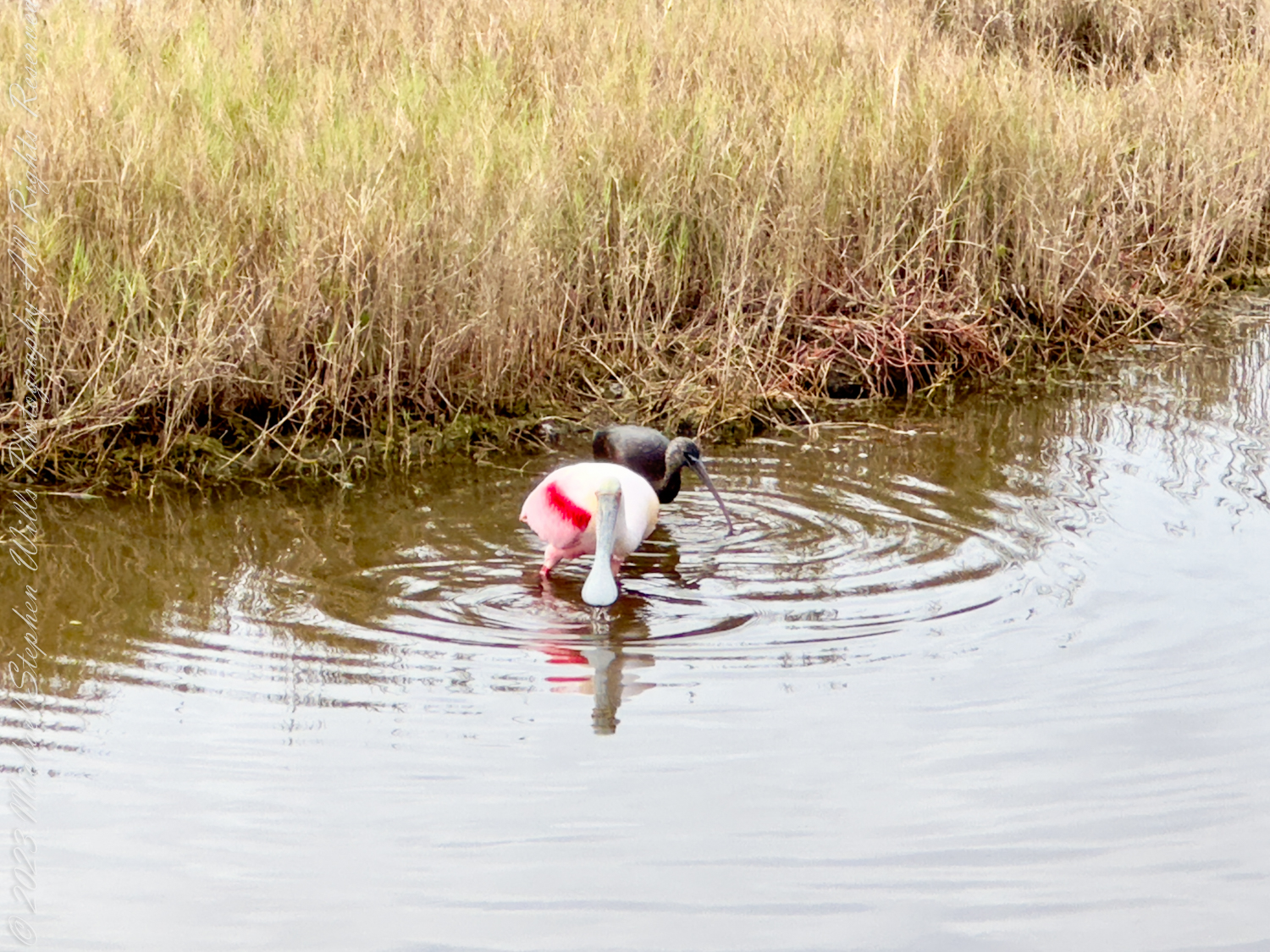
Another scene captured my attention as a single spoonbill foraged alongside a Glossy Ibis. The two species, different in appearance and yet similar in their quest for sustenance, shared the space in harmonious coexistence.

Further along, the vista opened up, and we were greeted by a panoramic view of spoonbills dotted along the distant shoreline, the greenery forming a lush backdrop to their pink hues. The expanse of the refuge unfolded before me, a reminder of the vastness and the wild beauty that had drawn us here.

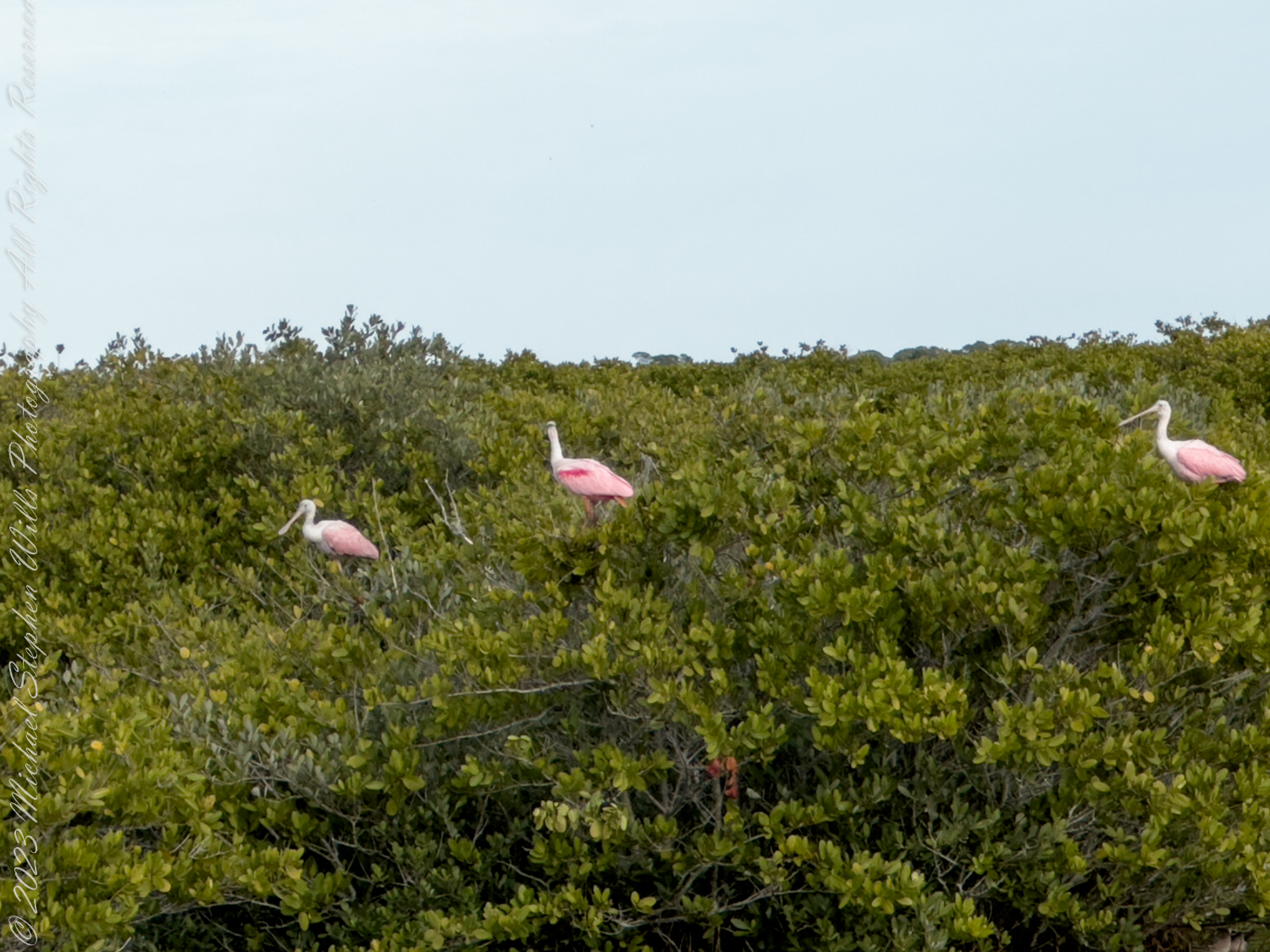
On another stretch, the spoonbills perched in the green embrace of the mangroves, their pink feathers a burst of color among the leaves. It was a scene of natural artistry, the birds blending yet standing out against their verdant stage.

In the final leg of our journey, I found spoonbills perched high in the shrubbery, a testament to the refuge’s diversity. Even in the dense foliage, life thrived, and these birds, usually seen wading, now adorned the treetops like living ornaments.

This drive along Blackpoint was more than a mere observation; it was a passage through a world where time held little sway, and nature was the sole architect. Each bird, each ripple on the water, and each whisper of the grass told a story of existence, resilience, and the intricate web of life. Here, in this secluded corner of the world, we found a connection to the earth and its inhabitants that would stay with us long after.

Copyright 2024 Michael Stephen Wills All Rights Reserved

A Visit with Tom and Hen Turkey

Happy Thanksgiving

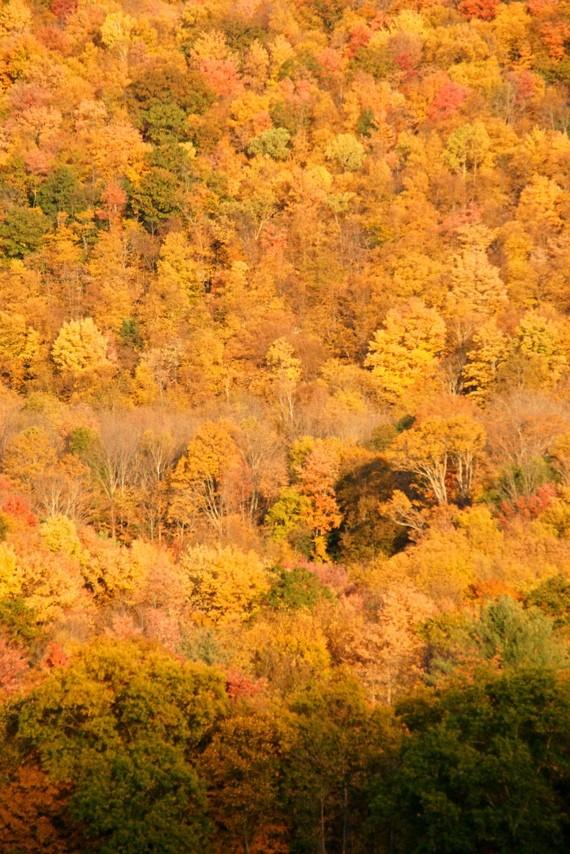
The Catskill Mountains are not mountains. The Catskills started as a high plateau. Over eons, before the first humans, water, the sun, and wind carved high steep peaks: rounded, forested and teeming with life.


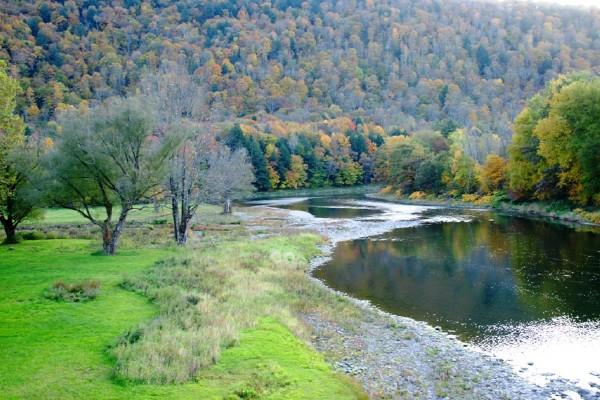
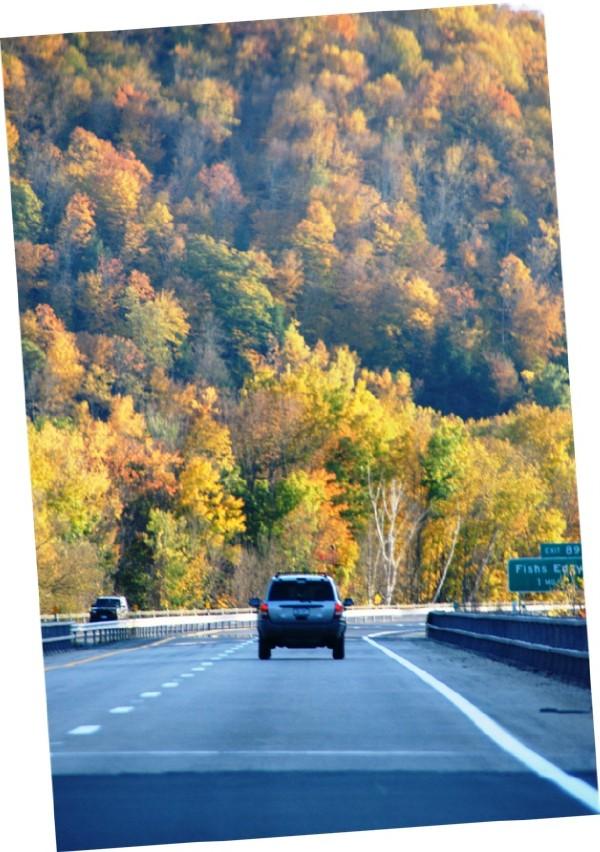
October 2008, on a return trip from family on Long Island, we traveled the winding road called “Route 17”, through the high autumn hillsides.

Route 17_FishsEddy_throughTheWindshield– CLICK ME!!!!

Click me for more Autumn Magic from my Online Gallery

Fishs Eddy

As the sun passed over the western hills we stopped to explore a place called “Fishs Eddy”, a town on the banks of the Delaware River.

On the east side, facing sunset is a formation that would be a cliff if it was not for the hardwood trees growing from every available nook, crevice. Everywhere a root could be sunk, roots fed trees that, one late October afternoon, made a hill bright with autumn.

Turkey Habitat

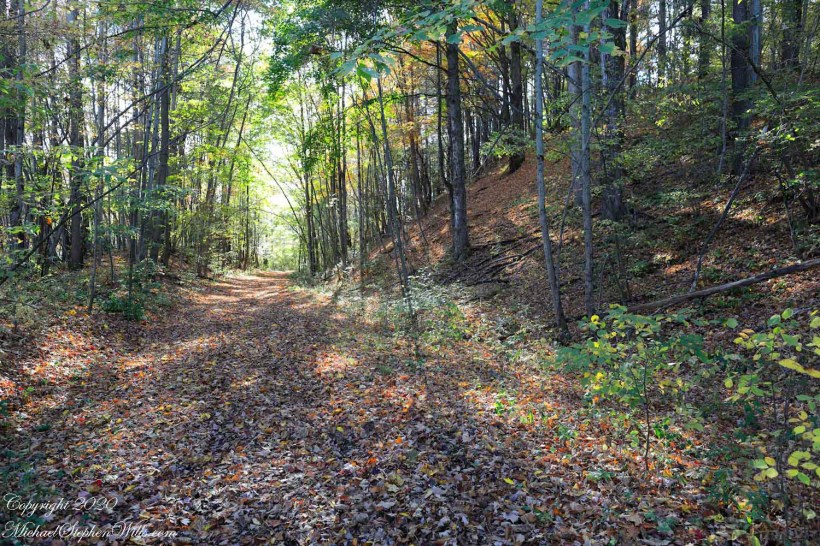
Turkeys live in this type of habitat. We took a trail, barely a road that climbed past failed farms and hunting shacks.

Click me for more Autumn Magic from my Online Gallery

The Hens Flee

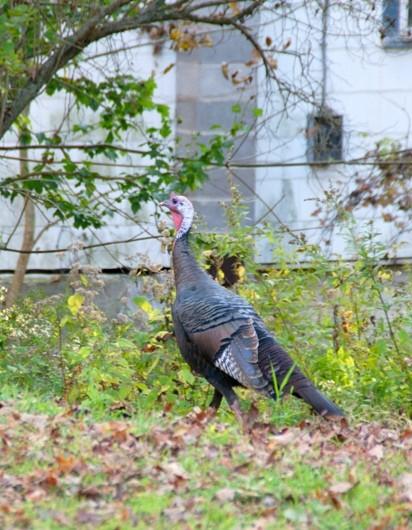
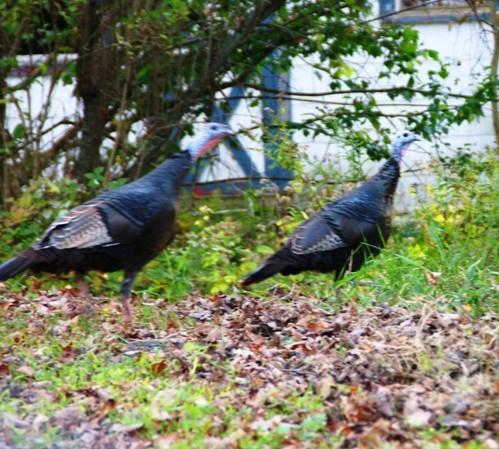
On a level place, in front of a ruined home, we came upon a Tom (male) turkey and his four hens. The hens fled at the sight of us.
With barely time to raise the camera I caught Tom and the last hen as she fled into the bushes.

Tom Turkey Defiant

I say she, because Tom stayed behind. He stood erect, all three feet of him, defiant and strutting in a direction opposite from the hens.


This is the bird Benjamin Franklin proposed as the national emblem of the new United State of America (the bald eagle won that competition).


Hunted into almost oblivion, across the United States the wild turkey is making a dramatic comeback in many places, including the forests and farmland of rural New York State

This fellow made no noise. His strutting posture and head bobbing said it all.


We left Tom Turkey in peace to his domain and hens.

Click Me to view my photographs on Getty.

Copyright 2023 Michael Stephen Wills All Rights Reserved http://www.MichaelStephenWills.com

Dappled Sunlight

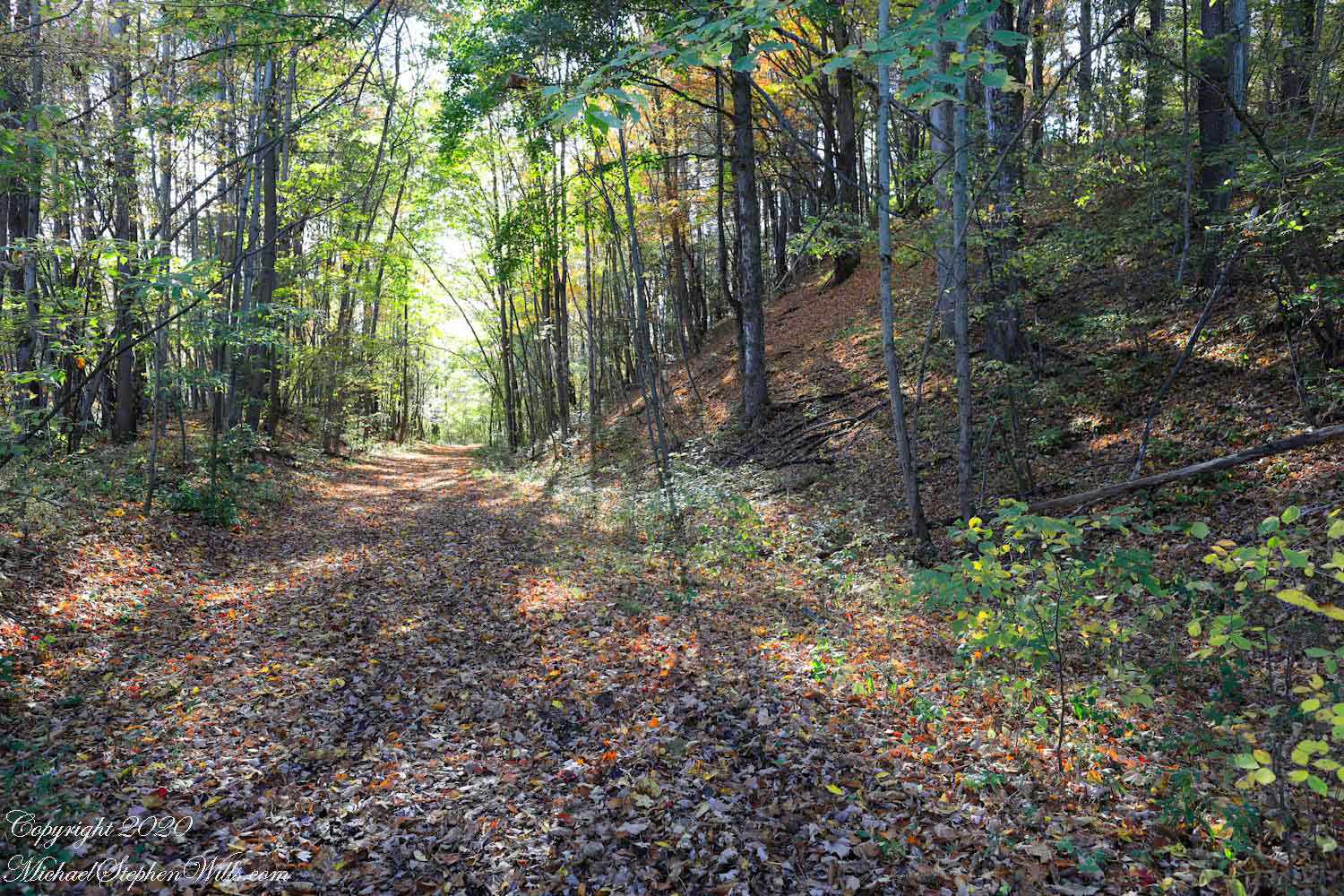
The Malloryville eskers near Freeville, New York, highlight the region’s glacial history and contribute significantly to biodiversity and local ecology.

Walking here, I enjoy telling the grandchildren of the immense, mile-high ice sheet that once covered this land 10,000 years ago, creating these hills and hollows.

Click Me for another Malloryville post, “Formed By Water.”

Eskers are geological features that tell a rich tale of the glacial history of an area. In the landscape near Freeville, New York, the eskers of Malloryville stand as prominent reminders of the last Ice Age and the profound effects glaciers have had on the North American terrain. These elongated ridges, composed primarily of sand and gravel, not only offer a visual spectacle but also provide crucial insights into the glacial processes that shaped the region.

Eskers are formed by the deposition of sediment from meltwater rivers flowing on the surface of or within glaciers. As these glaciers recede, the sediment accumulates in the paths previously carved by the meltwater streams, eventually forming ridges. The Malloryville eskers are particularly notable for their well-preserved structure, giving geologists and enthusiasts alike a clear vision of the patterns of glacial meltwater flow from thousands of years ago.

Located just a few miles from Freeville, the Malloryville eskers are an intriguing natural attraction. The topography of the area, largely shaped by the Laurentide Ice Sheet during the last glacial maximum, is characterized by various glacial features, but the eskers are undeniably some of the most distinct. Their serpentine-like appearance, weaving through the landscape, immediately captures one’s attention and beckons further exploration.

From an ecological perspective, the eskers of Malloryville contribute to the area’s biodiversity. The unique microenvironments created by these ridges offer habitats that differ from the surrounding landscape. This differentiation allows for a variety of plant species to thrive, some of which are specially adapted to the well-drained soils of the eskers. Additionally, these ridges act as corridors for wildlife, facilitating movement and offering vantage points for species like deer and birds of prey.

Historically, the eskers near Freeville have also had an impact on human activity. Native American communities, recognizing the strategic advantage of these high grounds, are known to have used them as pathways or even settlement sites. In more recent history, the gravel and sand composition of the eskers have made them targets for mining activities. While this has led to the alteration or destruction of some sections, it has also highlighted the importance of preserving these unique geological features for future generations.

Efforts to study and preserve the Malloryville eskers have grown in recent years. Local educational institutions, in collaboration with geological societies, have undertaken detailed studies to understand the formation and significance of these features better. Such initiatives not only contribute to the scientific understanding of glacial processes but also raise awareness about the importance of conserving unique geological formations. Given the potential impacts of climate change on glacial landscapes worldwide, the eskers serve as a poignant reminder of the dynamic nature of our planet and the traces left behind by the ebb and flow of ice ages.

In conclusion, the eskers of Malloryville near Freeville, New York, stand as testaments to the glacial history of the region. These winding ridges, with their intricate patterns and rich ecological contributions, weave a story of natural processes that have spanned millennia. They remind us of the ever-changing nature of our planet and underscore the importance of understanding and preserving its geological wonders. Whether one views them with the eyes of a scientist, historian, or nature enthusiast, the Malloryville eskers offer a captivating glimpse into the ancient forces that have shaped the world around us.

Copyright 2020 Michael Stephen Wills All Rights Reserved

Skellig Puffins

The Lovable Puffin

Each of the 603 steps between the Skellig Michael dock and the monastery evoked contemplation, caution, wonder and gratitude.

  • Contemplation: how did the monks manage to survive while placing the steps?  It can only be by a careful division of labor once a survival tripod was build.  By tripod I mean the basics food, shelter, warmth.
  • Caution: as with any steps, for a 60+ person I have learned the hard way falls take a long time to recover from.
  • Gratitude: for the opportunity, growth and knowledge afforded by travel.
  • Wonder: every step offered a new vantage and discovery.

Puffins were on my mind for most of the lower steps being immediately at hand, almost underfoot, constantly.  Underfoot, not in a obnoxious way.  Underfoot in being right there, unabashed, going about the business of life.  Pam and I were lucky, Puffin wise, for the weather.  Sensible birds, when the visibility is low Puffins stay close to the burrow, making improvements and socialize with neighbors.

Puffins of Michael Skellig

Bad News: Atlantic Puffin populations are on a precipitous decline across Ireland and British Islands.  There are talks of a population collapse.  Researchers enlisted assistance from wildlife photography enthusiasts with outstanding results released in 2017.  The photographs showed parents returning with less nutritious fish.  The stress on Puffin populations follows the decline of fish stocks from over fishing.  I listed two references at the end of this post.

The disturbing element to our experience was not one of the birds flew in with a catch.  On second thought, this is not unexpected.  Late May the eggs are laid and under incubation.  The individuals in these photographs were feeding only themselves.  If we returned mid-June there would be chicks to feed.

Puffins of Michael Skellig
Puffin with an inquisitive attitude

Why do we love Puffins?  We see reminders of ourselves.  The expressive large eyes, over a striking beak and there is something expressive about the birds’ body movements.  Don’t you almost know what’s on the mind of this fellow?  “What’s going on, over there?”

Puffins of Michael Skellig
A colony of nesting puffins on a flowering cliff of green.

Puffins are small birds, the size of a human hand.  This colony returned in late March or early April, each breeding pair claiming a nesting site.  The coloring of the beak happens during breeding.  The bird molts while at sea during the winter, the beak and other brightly colored facial characteristics are lost.

Social Puffin
Michael Skellig puffins in social setting on cliff with burrows and flowers.

Puffin sexual differentiation is unique among birds.  The coloring and markings are identical between males and females.  Males are somewhat larger than females is all.

Puffins of Michael Skellig
Soft soil covering the flanks of Skellig Michael is the site of age old Puffin colonies.

Here is Puffin nesting behavior up close.  I did some research on the flowering plants surrounding the burrows and am not sure.  I believe the white flowers are a mixture of Sea Campion and Sea Mayweed.

As far as my photographic technique.  There are two sets of Puffin shots from Skellig Michael.  For the the walk to the top, the monastery site, I used the lighter Sony Alpha A700 dslr with a Sony variable lens, DT 18-200 mm F3.5 – 6.3.  On top, I switched to the Canon EOS 1Ds Mark III and, for the descent, fitted a Canon EF 200mm f/2.8L USM lens.

The shot above and following are the Canon, taken on descent.  Prior shots are the Sony, taken on ascent.

Puffins of Michael Skellig
Puffin Entering Burrow

Puffins have striking black and white plumage and leg color some describe as “tangerine.”  Tangerine?  I guess.  Here an individual ducks into the burrow.

Puffins of Michael Skellig
A grouping of Michael Skellig puffins, the foremost with an attitude of regard.

I did not spend a great deal of time in any one spot, being time limited and needing to get back to the boat.  Don’t recall very much social interactions between individuals, other than this perching together on the rocks.  The foreground Puffin seems to take the behavior of another bird to task.

Puffins of Michael Skellig
Puffins are capable, if awkward, fliers.
Click for another Ireland Posting, “On the River Cong.”
 
References
Puffins and Technology
Clues to the Puffin Population Decline

Copyright 2022 Michael Stephen Wills All Rights Reserves