The symbolic power of the numeral three, reflected in various cultural, religious, and secular contexts, underscores its universal significance. From the mystical trinities of gods to the practical applications in rhetoric and storytelling, and the fundamental structure of our physical world, the number three resonates with a sense of completeness, balance, and harmony. Its pervasive presence in different aspects of human thought and culture attests to its enduring and profound symbolism.
Discover the rich history and ecological significance of the American Basswood, a majestic tree that intertwines nature, culture, and human history. Uncover its beauty, versatility, and the fascinating pollinators that bring it to life.
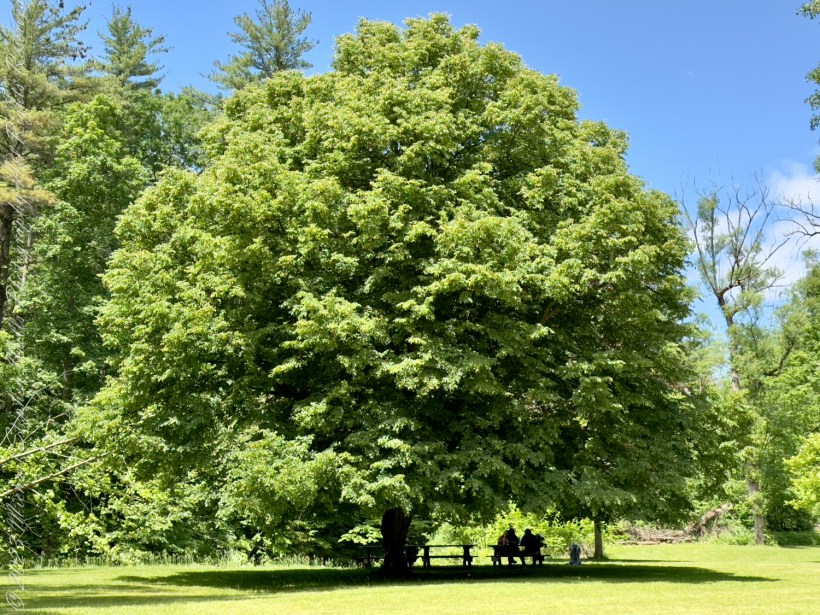
As I strolled through the sun-dappled glade, my eyes were drawn to a magnificent tree standing sentinel at the edge of the clearing. Its broad canopy spread like a green umbrella, casting a generous shade over the picnic bench below. Intrigued by its commanding presence, I approached, eager to unravel the secrets of this arboreal giant. Little did I know that this encounter would lead me on a journey through history, etymology, and the myriad uses of the American Basswood.
This photograph features the growth pattern for which the Basswood is known. Buttermilk Falls State Park, Ithaca, Tompkins County, New York State. The Finger Lakes Region.
The American Basswood, or Tilia americana, is a tree steeped in history and lore. Its name, “Basswood,” is derived from the word “bast,” referring to the inner bark of the tree, which is known for its fibrous and pliable nature. This etymology hints at the tree’s historical uses, which I would soon discover are as rich and varied as the foliage above me.
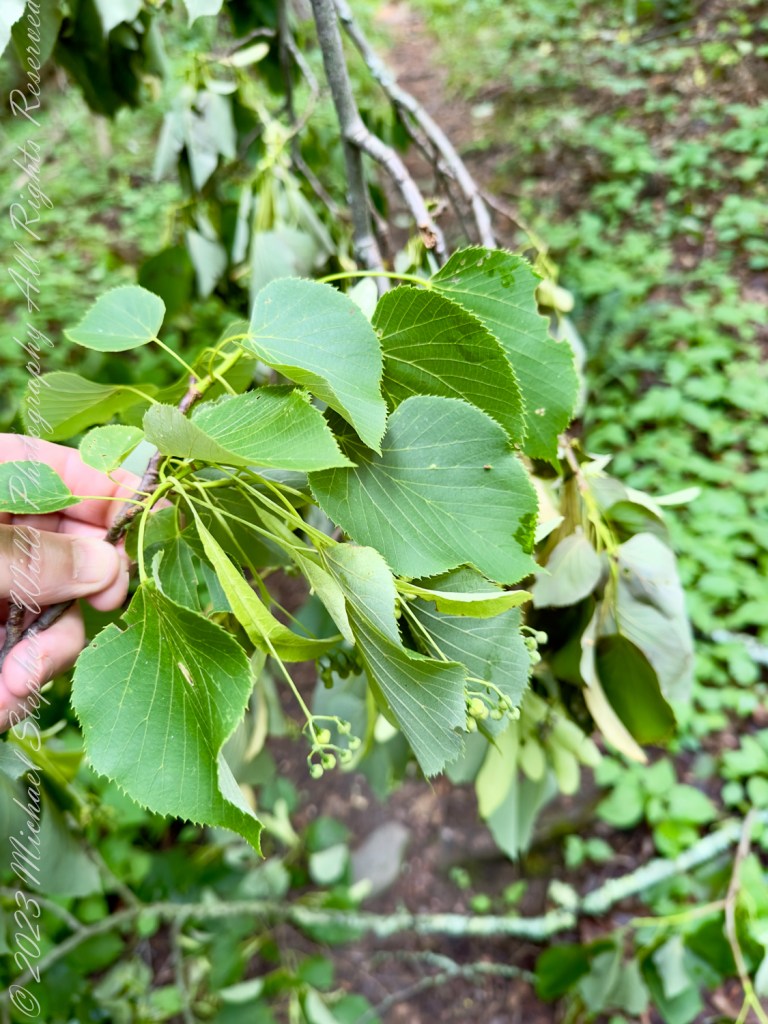
As I examined the leaves, I was struck by their heart-shaped form, a feature that has made the Basswood a symbol of love and romance in various cultures. The leaves were smooth and slightly serrated at the edges, with a deep green hue that seemed to capture the essence of summer. Hanging delicately from the branches were clusters of small, round buds, hinting at the tree’s flowering potential. These flowers, I would later learn, are not just beautiful but also aromatic, attracting bees and other pollinators with their sweet fragrance.
These are leaves from a branch broken by spring storms and fallen across the Finger Lakes Trail that follows the southern side of Treman Park above the South Rim Trail. Robert H. Treman New York State Park, Tompkins County, Ithaca. June 27, 2024
The history of the American Basswood in America is intertwined with the lives of indigenous peoples and early settlers. Native Americans valued the Basswood for its soft, easily worked wood and its inner bark, which they used to make ropes, mats, and other essential items. The tree’s wood, known for being lightweight and finely grained, was perfect for carving and crafting tools, utensils, and even ceremonial masks. This versatility made the Basswood an integral part of daily life and cultural practices.
With the arrival of European settlers, the uses of Basswood expanded. Settlers quickly recognized the tree’s potential, using its wood for a variety of applications. The soft, yet sturdy wood was ideal for making furniture, musical instruments, and even crates and boxes. Its workability and smooth finish made it a favorite among craftsmen and artisans. I imagined the hands of these early Americans, shaping and molding the wood, breathing life into their creations.
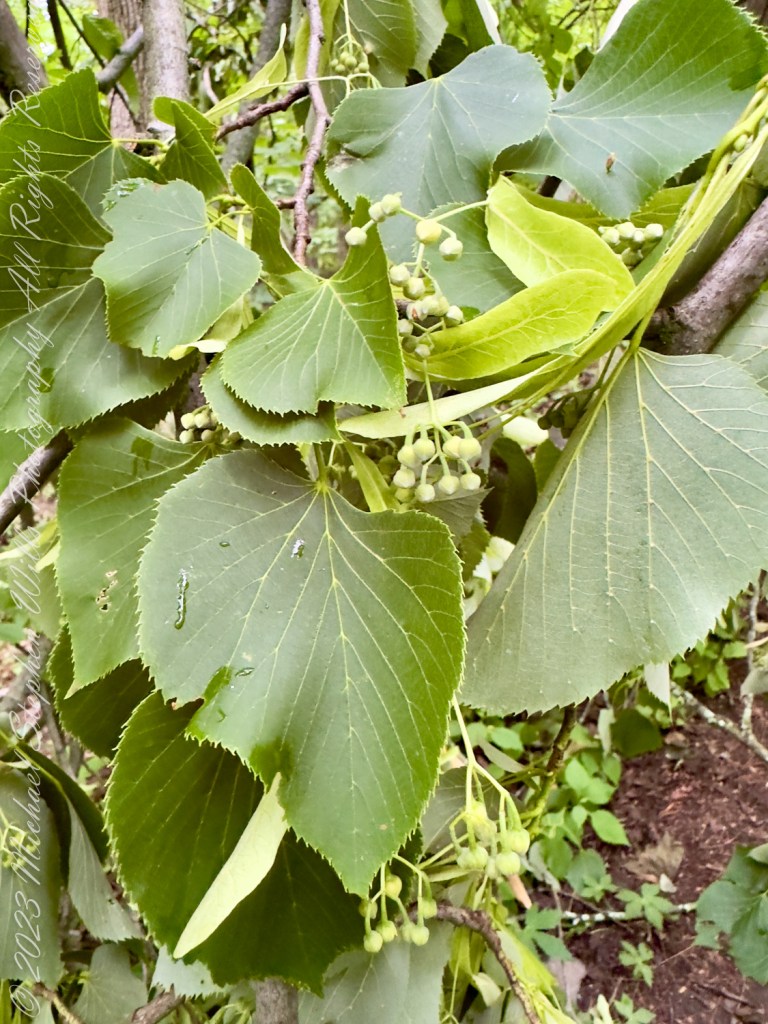
As I continued to explore the tree, I was drawn to the small, green fruits hanging from slender stems. These fruits, known as nutlets, are encased in a leafy bract that aids in their dispersal by wind. This ingenious natural design ensures the propagation of the species, allowing new generations of Basswoods to take root and flourish.
Curious about the tree’s name, I delved into its etymology and discovered an interesting linguistic journey. In England and Ireland, the Basswood is commonly referred to as the “Lime Tree.” This name does not relate to the citrus fruit tree but instead comes from the Old English word “Lind,” related to the German word “Linde.” Both terms historically referred to trees of the Tilia genus. Over time, “Lind” evolved into “Lime,” influenced by phonetic changes and regional dialects, solidifying the term “Lime Tree” for Tilia species in these regions. Despite sharing the same common name, the Tilia “Lime Tree” and the citrus “Lime Tree” belong to entirely different plant families.
The American Basswood’s significance extends beyond its practical uses. The tree has found a place in American culture and literature, often symbolizing strength, resilience, and longevity. Its towering presence and expansive canopy make it a popular choice for parks and public spaces, where it provides shade and beauty. I thought of the many people who must have sought refuge under its branches, finding solace and inspiration in its quiet strength.
In addition to its cultural and historical significance, the Basswood also plays a crucial ecological role. Its flowers are a vital source of nectar for bees, making it an essential component of local ecosystems. Beekeepers, in particular, value the Basswood for the high-quality honey produced from its nectar, known for its delicate flavor and aroma. The tree’s leaves and bark also provide habitat and food for various wildlife, contributing to the biodiversity of the area.
Pollination is a critical aspect of the American Basswood’s lifecycle, and a variety of insects are drawn to its fragrant, nectar-rich flowers. Honeybees (Apis mellifera) are among the most significant pollinators, their presence around the Basswood a testament to the tree’s importance in the ecosystem. These industrious bees not only gather nectar but also facilitate the pollination process, ensuring the production of seeds. Bumblebees (Bombus spp.) also play a crucial role, utilizing their unique buzz-pollination technique to effectively transfer pollen within the flowers.
These are leaves from a branch broken by spring storms and fallen across the Finger Lakes Trail that follows the southern side of Treman Park above the South Rim Trail. Robert H. Treman New York State Park, Tompkins County, Ithaca. June 27, 2024
Additionally, native bees such as sweat bees (Halictidae), mining bees (Andrenidae), and leafcutter bees (Megachilidae) are frequent visitors, drawn by the abundant nectar and pollen. Butterflies, while not as significant as bees, contribute to the pollination process, adding a touch of grace as they flutter from flower to flower. Moths, particularly those active in the evening, are another group of pollinators, their nocturnal activity complementing the daytime efforts of bees and butterflies. Hoverflies (Syrphidae), also known as flower flies, are attracted to the nectar and aid in the pollination, showcasing the diverse array of insects that rely on the Basswood.
Reflecting on my discovery, I realized the American Basswood is a living testament to the interconnectedness of nature and human history. Its presence in the landscape is a reminder of the many ways in which plants and trees shape our lives, providing resources, inspiration, and a connection to the natural world.
As I left the shade of the Basswood and continued my walk, I felt a deep sense of gratitude for the opportunity to learn and connect with this remarkable tree. Its story is a reminder of the importance of preserving and cherishing the natural world, ensuring that future generations can continue to discover and appreciate the wonders of the American Basswood.
Copyright 2024 Michael Stephen Wills All Rights Reserved
Discover the enchanting world of Treman Gorge through its ancient ferns. Step into a living tapestry where nature’s resilience paints a story of survival and beauty. Dive deeper into this magical realm by reading our latest blog post.
As I step into the lush expanse of Treman Gorge, I am enveloped by a verdant cathedral of nature. The gentle murmur of flowing water blends with the chorus of birds, creating a symphony that resonates deep within me. The air is fresh, filled with the earthy aroma of damp foliage, inviting me deeper into its serene embrace.
“The Gallery” entrance to Tremen Gorge from the upper park.
Among Ancient Rocks
The gorge is a geological marvel, sculpted from layers of Devonian shale and sandstone. These sedimentary rocks, formed over 400 million years ago, tower around me, formidable and steeped in history. The stratified patterns on their surfaces tell tales of ancient rivers and seas that once dominated this landscape, leaving behind sediments that would compact into the shale and sandstone seen today.
The Flourish of Life on Stone
Along the damp trails, vibrant mosses and ferns adorn the rock walls, thriving in the moist, shaded nooks. The mosses, lush and green, form thick carpets that breathe life into the stone. Among them, patches of Dicranum moss are notable for their robust, upright growth. Ferns, too, make their home here, with Polystichum acrostichoides, or Christmas fern, prevalent for its evergreen fronds that add year-round color to the grey stone backdrop.
Ephemeral Pools and Nature’s Adaptation
Small pools of water collected in the rock crevices create microhabitats buzzing with life, from aquatic insects to amphibians seeking refuge. These clear, cool pools mirror the verdant foliage and blue skies above, creating tranquil tableaus of the gorge’s hidden depths.
The Role of Ferns and Mosses in Human History
Ferns and mosses, beyond their beauty and ecological roles, have practical applications that have been recognized since ancient times. Ferns have been used in traditional medicines for their anti-inflammatory and pain-relieving properties. Certain species, like the bracken fern, were used by Native Americans for food, medicine, and even bedding during travel.
Mosses also hold significance in human history. Their excellent insulation properties made them a popular choice for lining chinking in log cabins or as a packing material to keep food fresh. In modern times, the absorptive properties of moss are harnessed in ecological projects such as biofiltration, to clean contaminants from water.
Native American Heritage in Treman Gorge
The history of Native Americans in areas like Treman Gorge is rich with culture and deep respect for the natural world. They utilized the gorge’s resources sustainably, understanding the intrinsic value of each plant and animal. For example, the gorge’s abundant moss and fern-covered landscapes provided not only material resources but also spiritual significance. These plants were often used in ceremonial practices, symbolizing life and fertility, and were integral in storytelling and oral traditions that passed vital knowledge through generations.
Enfield Creek in Treman Gorge
Reflections on Resilience and Beauty
With each step through Treman Gorge, I feel a deep connection to the past—each rock, moss patch, and fern frond speaks of endurance and adaptability. In the grand timeline of Earth, my presence is but a fleeting moment, yet it is intertwined with the eons of history embedded in this place.
Devil’s Kitchen Waterfall above Lucifer Falls
Treman Gorge, with its ancient rocks and thriving plant life, stands as a testament to the resilience and beauty of nature. It reminds us of the world’s perpetual motion, of life’s ability to adapt and thrive in the face of time’s relentless passage. Here, amidst the moss-covered rocks and fern-laden paths, I find a sense of peace and continuity, a connection to the Earth that is both humbling and uplifting.
Concluding Thoughts
As I leave Treman Gorge, the echo of the water and the rustle of leaves linger in my mind, a reminder of the timeless dance between nature and those who walk its paths. This place is a living library, holding the secrets of millennia, reminding us of our place in nature’s vast narrative and the enduring legacy of those who walked these paths before us.
Copyright 2024 Michael Stephen Wills All Rights Reserved
Discover the elegance of the American Coot through our journey at Merritt Island, where these unsung avians dance across the water, crafting nature’s own symphony of survival and grace.
There we were, Pam and I, standing before the serene waters of the Merritt Island National Wildlife Refuge, when a cluster of American Coots (Fulica americana) caught our eyes. Locally known as mud hens, marsh hens, or pond ducks, these coots were anything but mundane. Their dark plumage blended with the ripples, while their ivory bills gleamed like beacons, leading our gaze across the liquid expanse.
The Coot’s Constellation
As a throng, they moved with purposeful grace, a constellation of birds, each a star in their own right. With lobed toes spread like aquatic fans, they paddled through the water, their movements an embodiment of nature’s ingenuity. These “poule d’eau,” as the French settlers once called them, displayed a mastery over their domain, both in water and on land.
Social Weave
A Raft of American Coots
The coots assembled not as a random flock but as a deliberate collective, a raft in both name and function. They maneuvered with a collective intelligence, each bird’s action rippling through the group, exemplifying the coots’ penchant for community. Their group dynamics, a blend of cooperation and competition, painted a picture of the delicate balance within ecosystems.
An Ecological Perspective
In the tapestry of the refuge’s ecology, the American Coot stitched its niche with precision. Whether known as “baldpate” or “crow duck,” these birds were critical to the habitat they frequented, acting as both consumers and contributors. They pruned the vegetation, controlling its growth, and served as prey, connecting the food web in a cycle that spanned generations.
The Taxonomic Twist: Coots vs. Ducks
As the coots continued their ballet on the water, I turned to Pam, ready to demystify the common misconception that coots and ducks are close relatives. “Though they share the wetland stage,” I began, “these two are cast in different roles by nature’s hand.”
Orders Apart
Coots are members of the order Gruiformes, which includes rails and cranes, characterized by their elongated bodies and short wings. Ducks, on the other hand, belong to the order Anseriformes, which also encompasses swans and geese, known for their broad, flat bills and webbed feet.
Distinct Lineages
This taxonomic separation marks a deep evolutionary divide. The Gruiformes, with their lobed toes and distinctive calls, represent a lineage adapted for a life traversing the marshy edges of the world. Anseriformes, with their specialized bills for filtering and dabbling, reveal a lineage fine-tuned for exploiting the aquatic resources more extensively.
The Cultural Mosaic
Despite their commonality, coots have etched a place in cultural folklore, often overshadowed by more colorful avian neighbors. Yet, their ubiquity across North American wetlands has made them a familiar sight, a symbol of the wild’s persistent pulse. To us, they were the embodiment of the unsung wilderness, a chapter in the storybook of natural history.
Embracing the Ensemble
As the day waned, the water transformed into a canvas of orange and purple hues, with the coots as its subjects. “Behold the marsh’s musicians,” I mused to Pam, “each note they play is a beat in the heart of the wild.” Our encounter with the American Coot—a bird of many names but one singular, remarkable essence—was a harmonious reminder of nature’s interconnected ballet.
Copyright 2024 Michael Stephen Wills All Rights Reserved
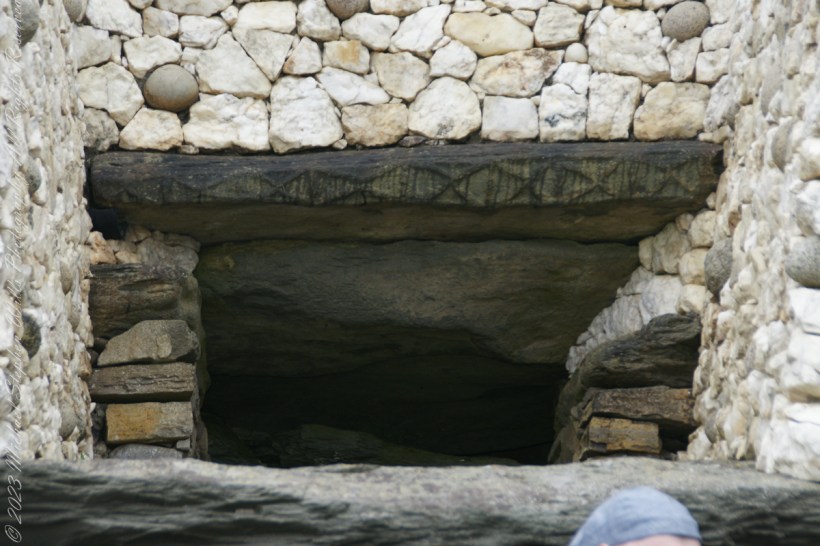
Step into the ancient world of Neolithic monuments and discover the astounding astronomical knowledge of our ancestors. Explore the Newgrange Lightbox in Ireland and similar marvels across Europe, revealing a deep connection between ancient peoples and the cosmos. Join me in unveiling these architectural wonders.
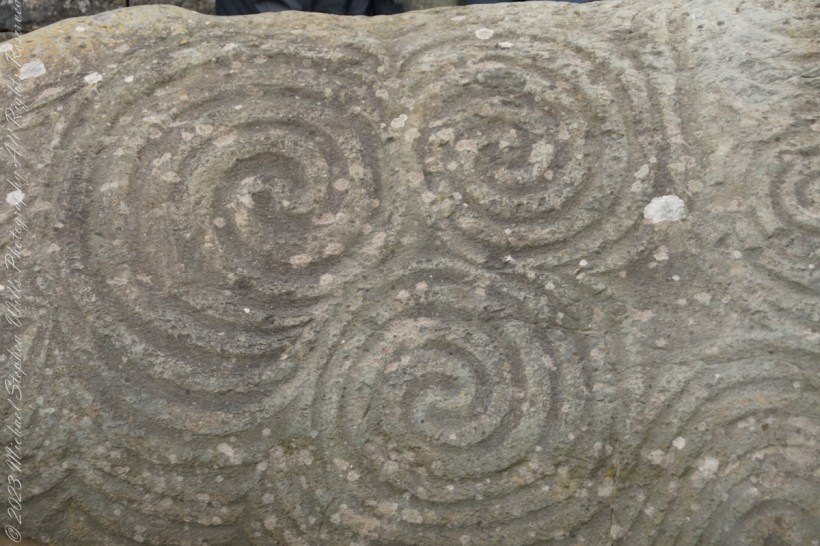
Discover the mysteries of the Newgrange monument’s Entrance Stone, a showcase of exquisite Neolithic rock art. Explore spirals, lozenges, and geometric designs that define European megalithic art and delve into their potential meanings and cultural significance. Join me in uncovering the secrets of this ancient Irish wonder.
The Erie Barge Canal significantly influenced New York’s history, particularly impacting Cayuga Lake and Ithaca. The canal, which extended to the Cayuga-Seneca canal, transformed Ithaca into a prosperous community due to shipping and salt production industries. Today, despite its shift from industrial uses to a leisure and educational haven, the canal’s cultural and economic legacy remains indelible on the town and lake.



 Michael Stephen Wills Photography