Cornell Botanic Gardens’ Monkey Run: History, Geology, and Scenic Fall Creek

A contemplative walk along Monkey Run where Fall Creek writes the valley’s history—sycamores, bridges, and Devonian stone speaking across seasons in Cornell’s living classroom.

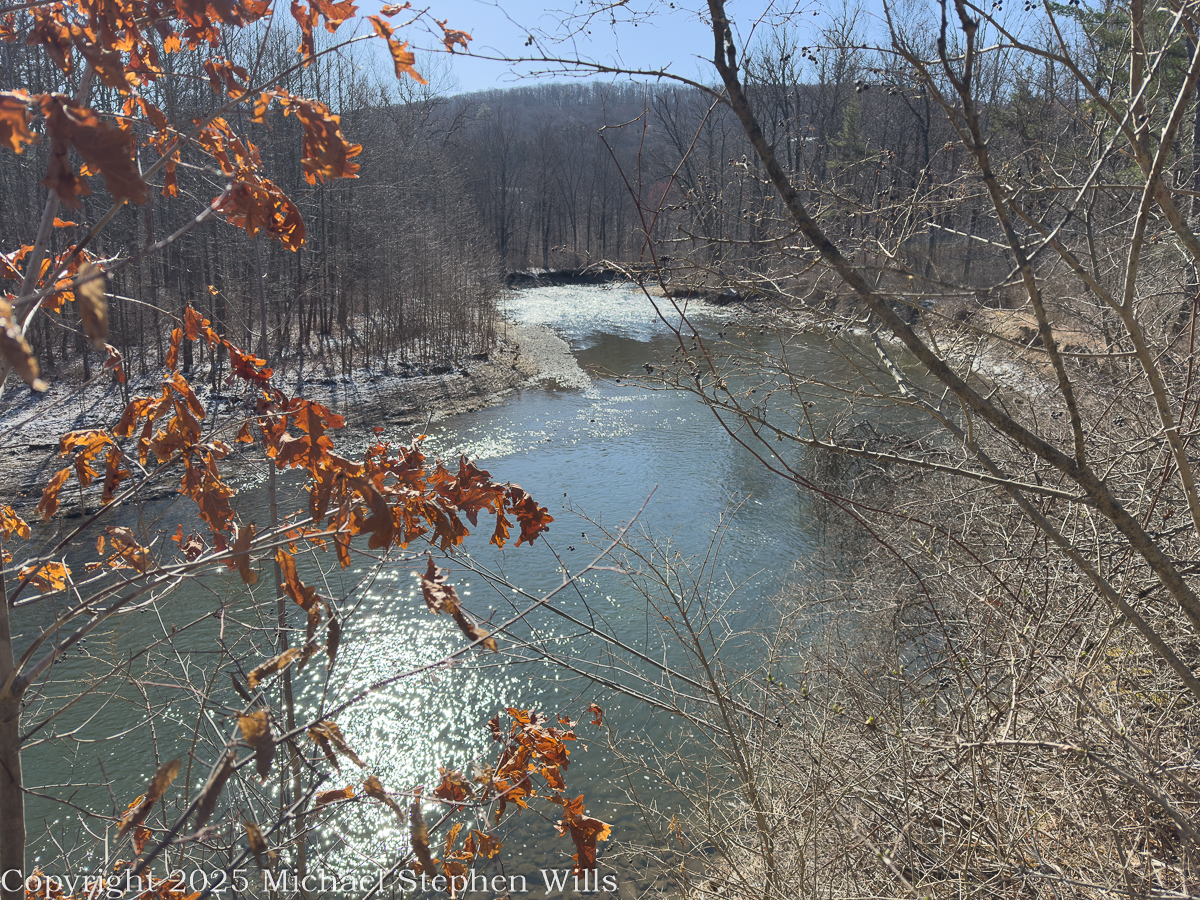
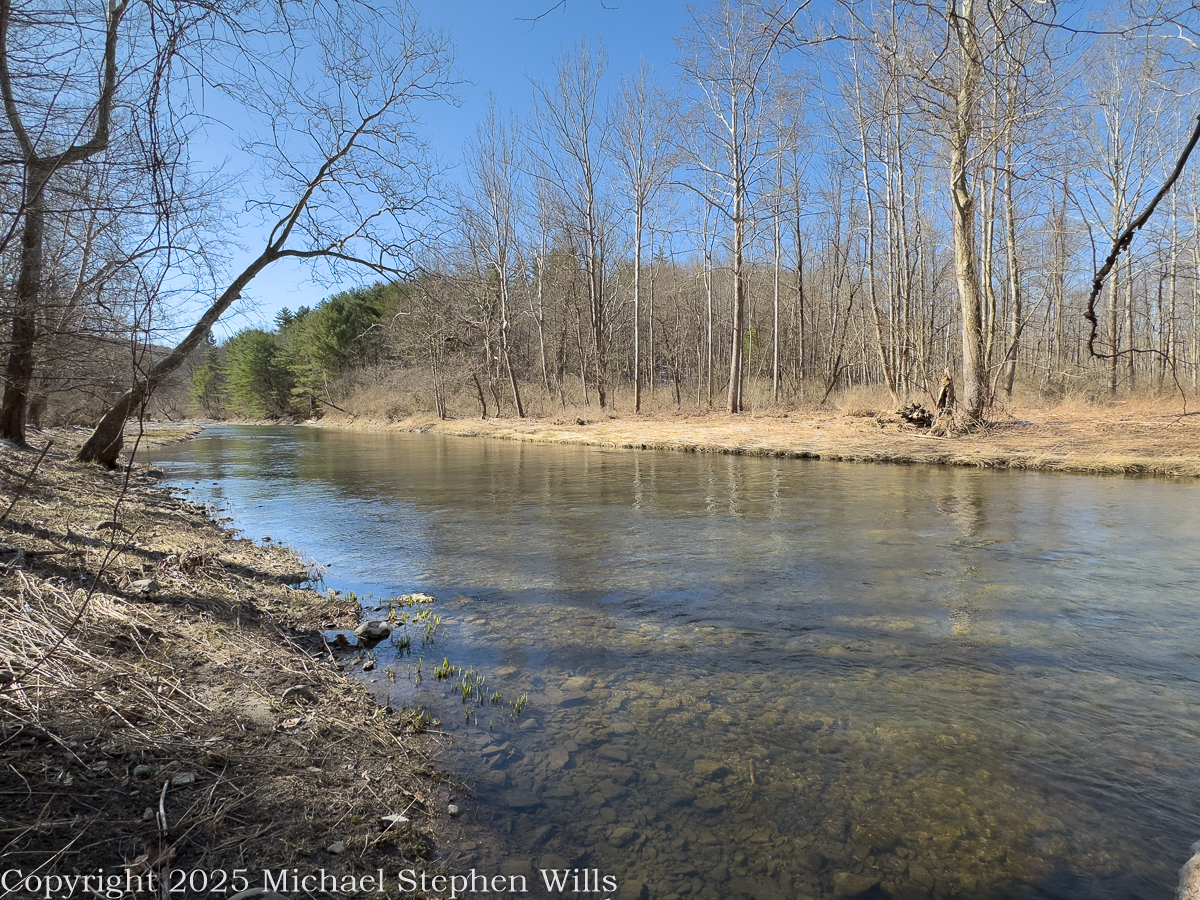
On a morning in late March, when the hills about Ithaca still hold the night’s frost in their shaded folds, I took the path called Monkey Run and went to see how Fall Creek spends its winter earnings. The air had the bright sting of thaw, a kind of vernal austerity that keeps a man honest in his steps. Along the high bank the sun spilled its coin onto the water, where it broke and flickered like a school of silver minnows. A rim of snow clung to the shale ledges, and the leaves of last year’s oaks—curled, fox-red, and faithful—whispered as if to keep the woods awake until spring fully claimed them.

Sunlit bend of Fall Creek viewed from a high bank at Monkey Run in early spring.

Monkey Run is one of the outlying parcels tended by Cornell Botanic Gardens—once called the Plantations, and now, more fittingly, named for the living charge it keeps. These gardens do not end at beds and borders; they encompass the wilder rooms of the county, more than a thousand hectares of glens, pastures, and ravines where the university’s first and oldest teacher—nature herself—still holds class. Fall Creek is one of her principal lecturers. Rising beyond the high country of Cayuga Heights and slipping under stone and snow, it shoulders its way across the campus, idles a while in Beebe Lake, and turns turbines of memory at Triphammer Falls before shouldering on toward the lake that receives nearly everything here—Cayuga—long, deep, and glacial in its thinking.

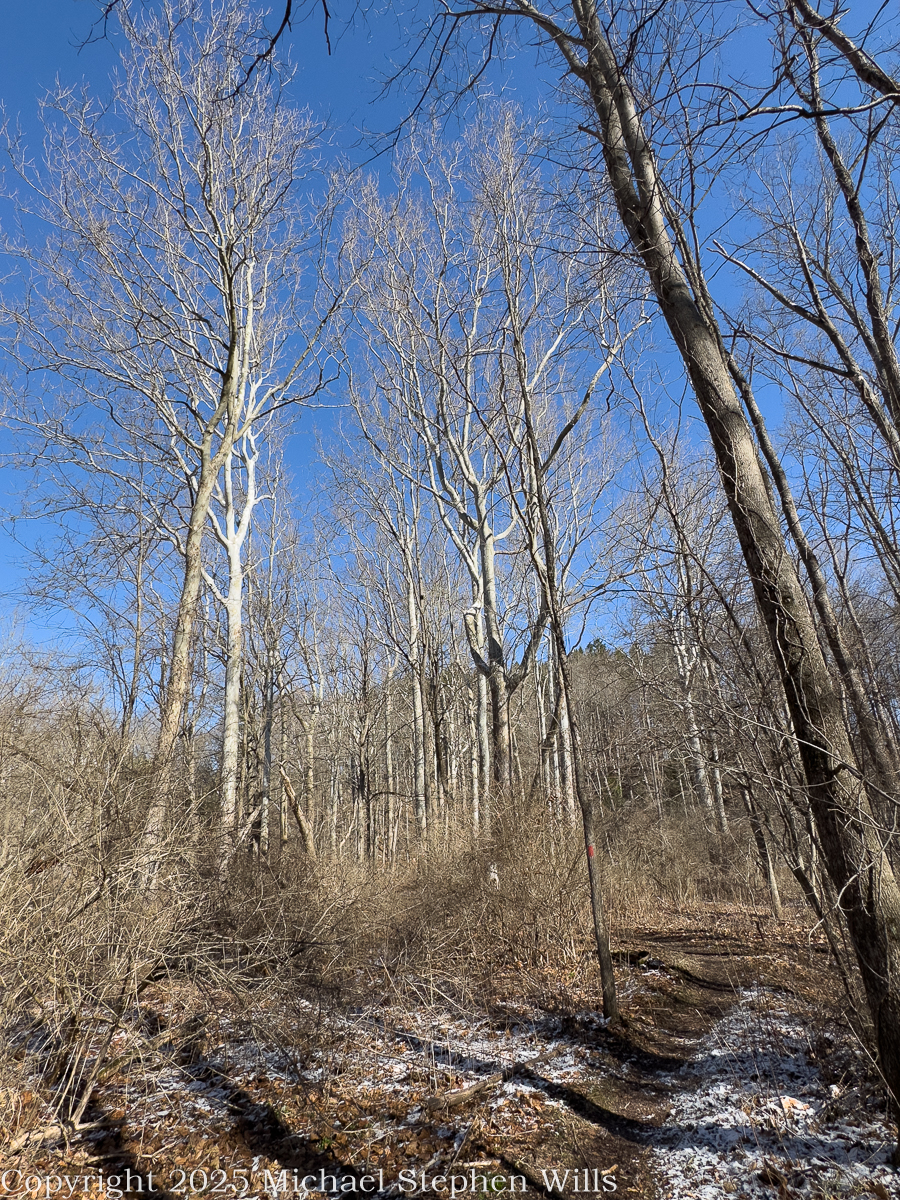
Tall white-barked sycamores leafless against a blue March sky at Monkey Run.

If you would learn a valley’s mind, walk a meander. The creek here composes with easy cursive, laying down a bar of gravel, nibbling at a bank of clay, then sweeping back to consider its work from the opposite shore. The geologist says the rock is Devonian, pages laid flat and damp with time, and the ice of ten thousand winters ago scoured them into the open. A creek is a patient mason, working without rest and never in anger. I admired these sycamores—their clean bones shining through the leafless canopy like the ribs of an old cathedral. Winter reveals their whiteness; summer grants them shade. A stand of white pines keeps a dark counsel in the background; on the muddy edge, green tongues of skunk cabbage push up, pledges made by the swamp to keep faith with the sun.

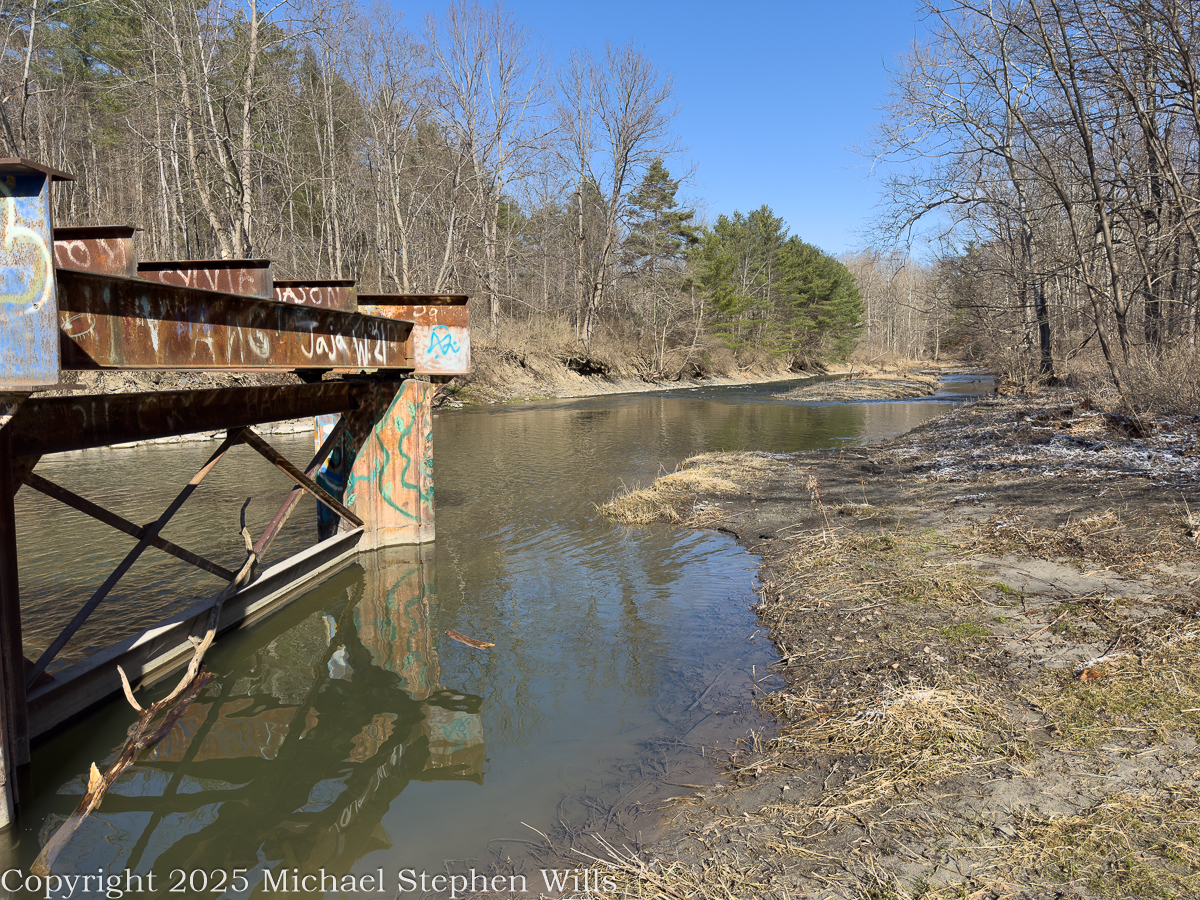
Rust-stained steel pier above calm water on Fall Creek along Monkey Run trail

I came down to the water near an old steel pier, a bridge remnant, hanging on each end without purpose. It wears graffiti the way a boulder wears lichen; human wishes, briefly rooted, coloring what they can. The river accepts it all, the pilings and the scribbles, the cast limb and the bottle’s glint, and continues its one unarguable gesture downstream. That is the old instruction of Fall Creek: use, refuse, endure. Before the university drew students from every quarter, the creek turned wheels and powered the small ambitions of a frontier town. Even the name Triphammer speaks of iron struck to purpose. Now the water powers something quieter: the studies of herons, the almanacs of kingfishers, the quick arithmetic of minnows over limestone.

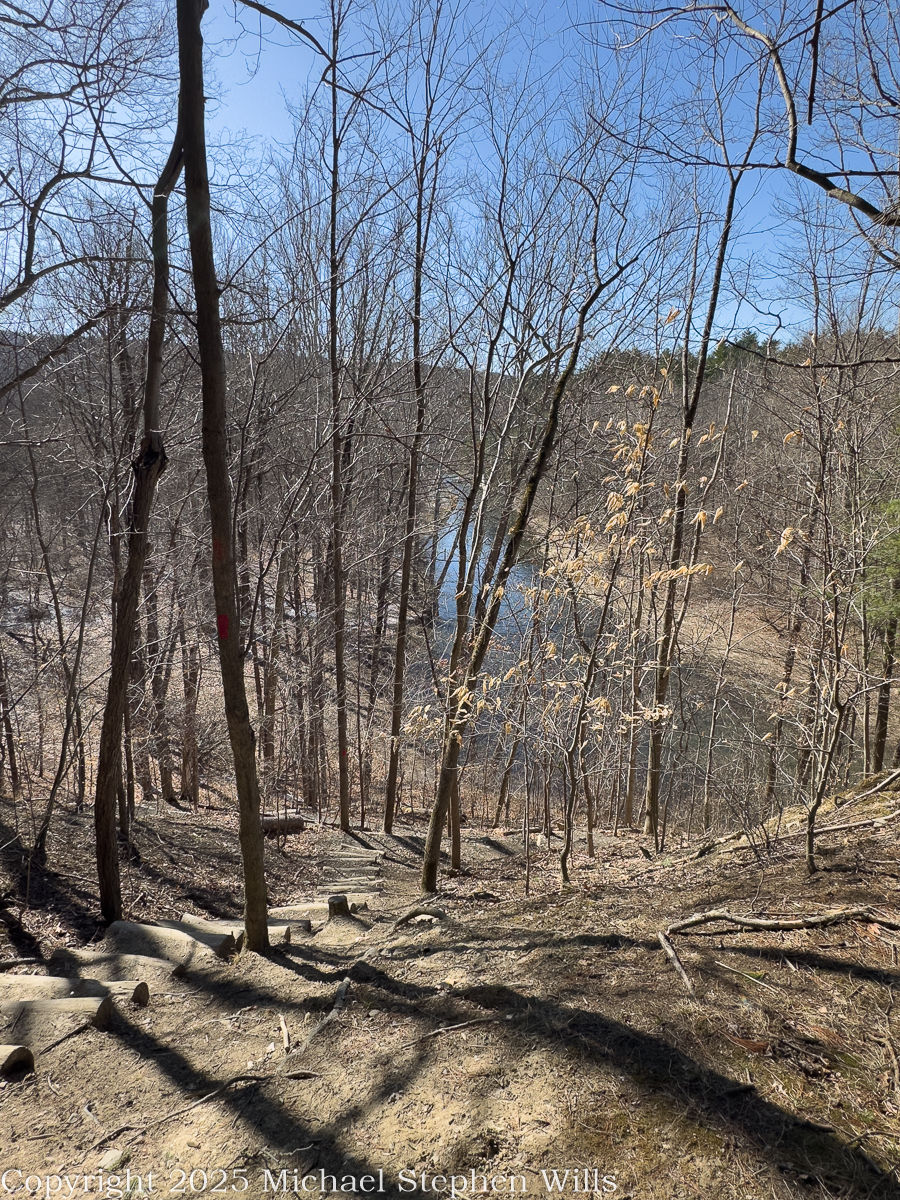
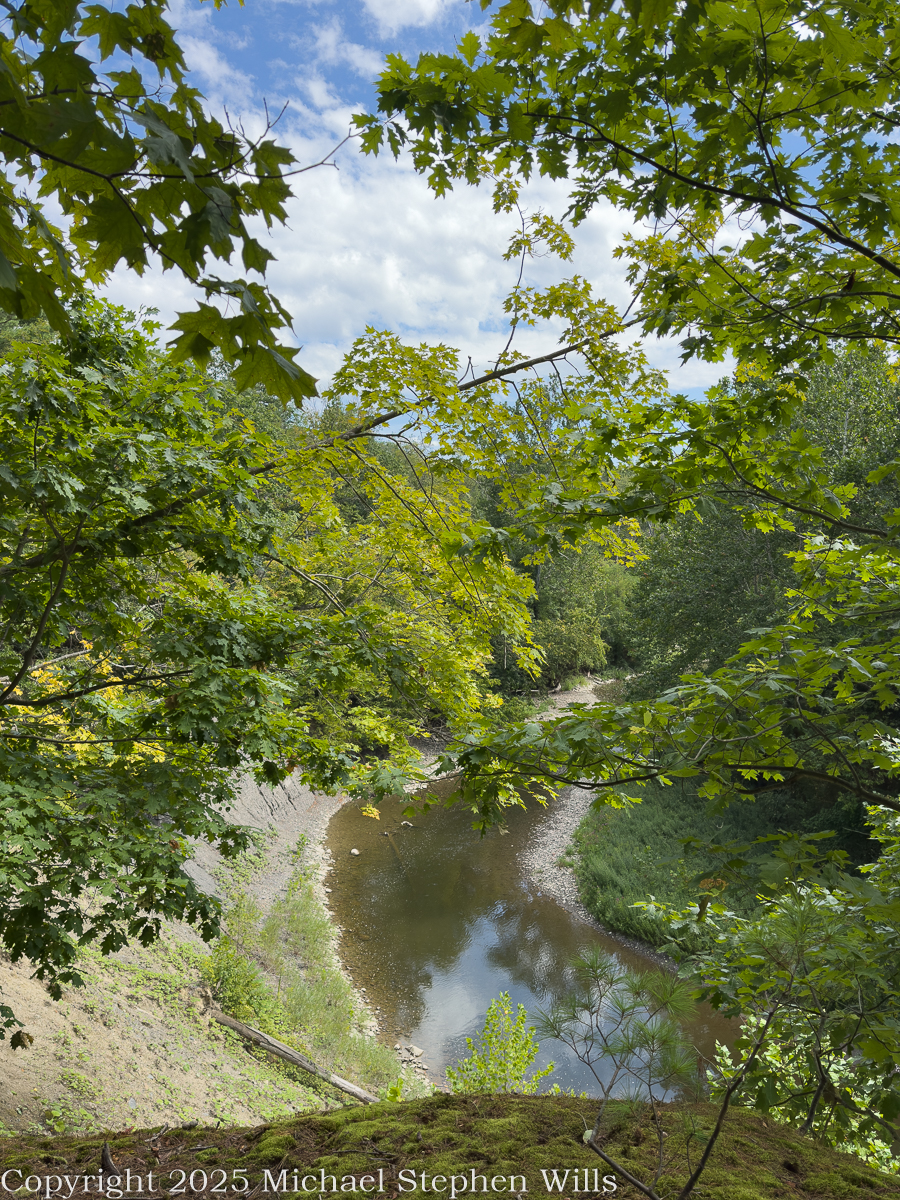
Looking back while climbing the steep bluff

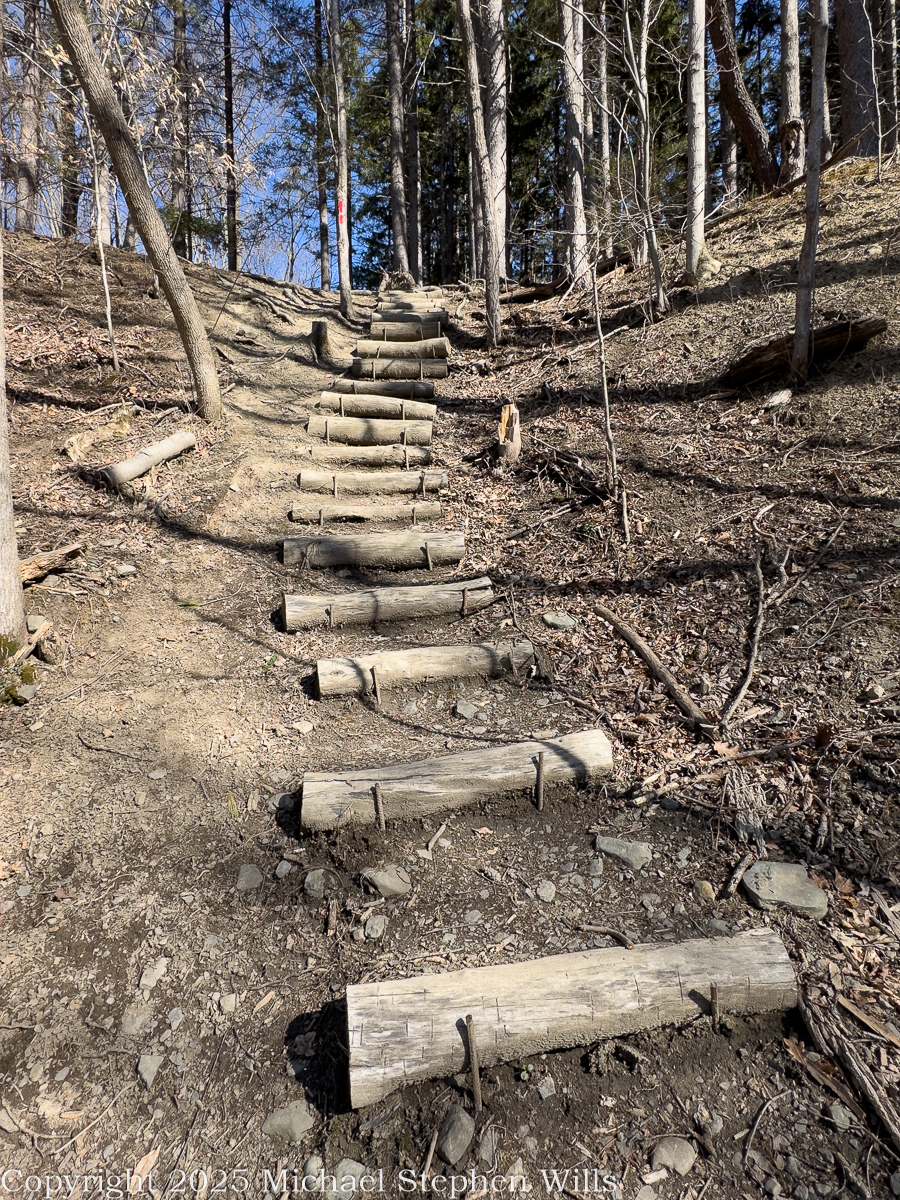
Steps cut from logs ascend the bluff, each tread pegged with iron, each rise a short confession of breath. I climbed to the ridge, paused halfway, and through the gray lace of March branches saw the creek shining at a bend far below. A man cannot help but measure his own life against such a course. The path goes up and down in obedient red blazes, but the water keeps its own counsel. Where the bank slumps the river shoulders through; where the bottom rises it lays down a mirror. In my youth I wanted the straight run, the short work. Now the curve pleases me. To go with the current and not be carried away—that is a lesson suitable to the grey in my beard.

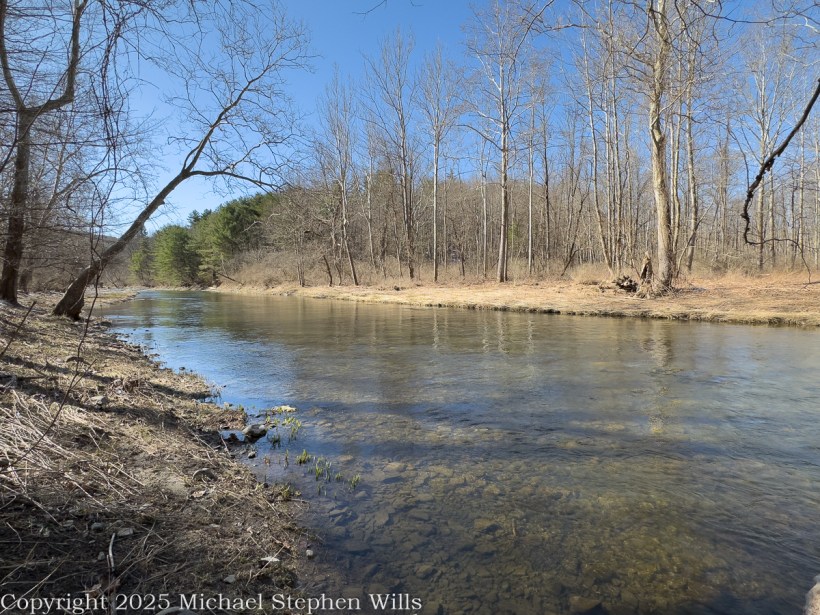
Clear, shallow run of Fall Creek with shale bottom and pine stand in distance
Bluff overlooking Fall Creek in summer

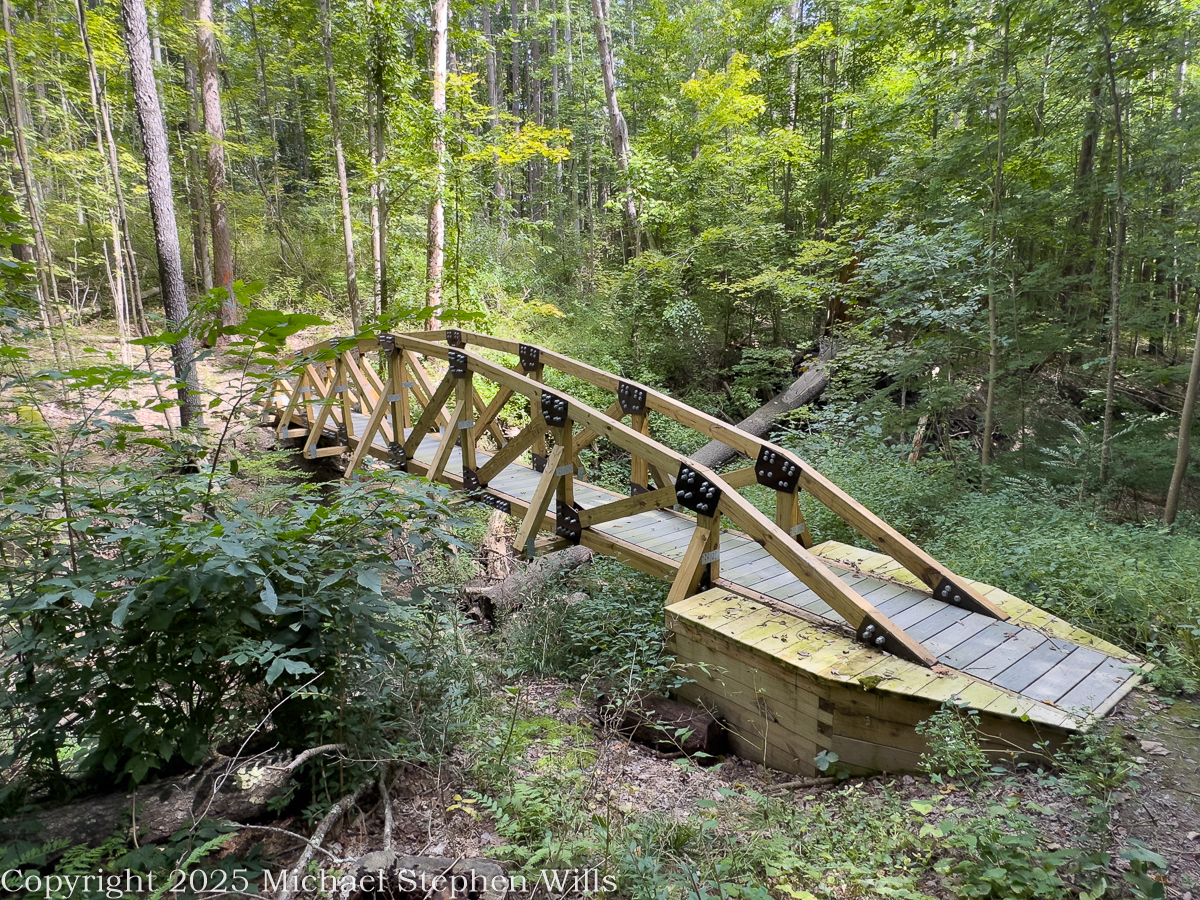
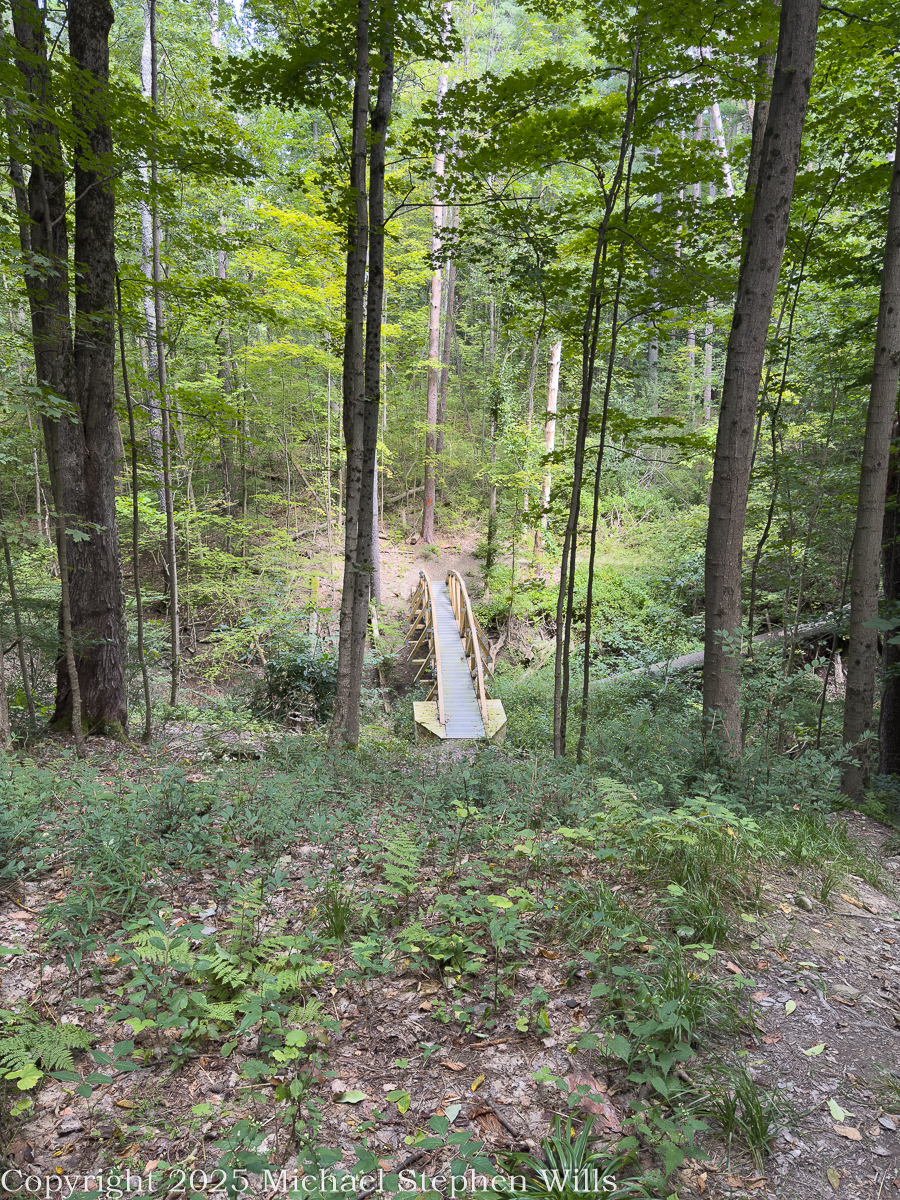
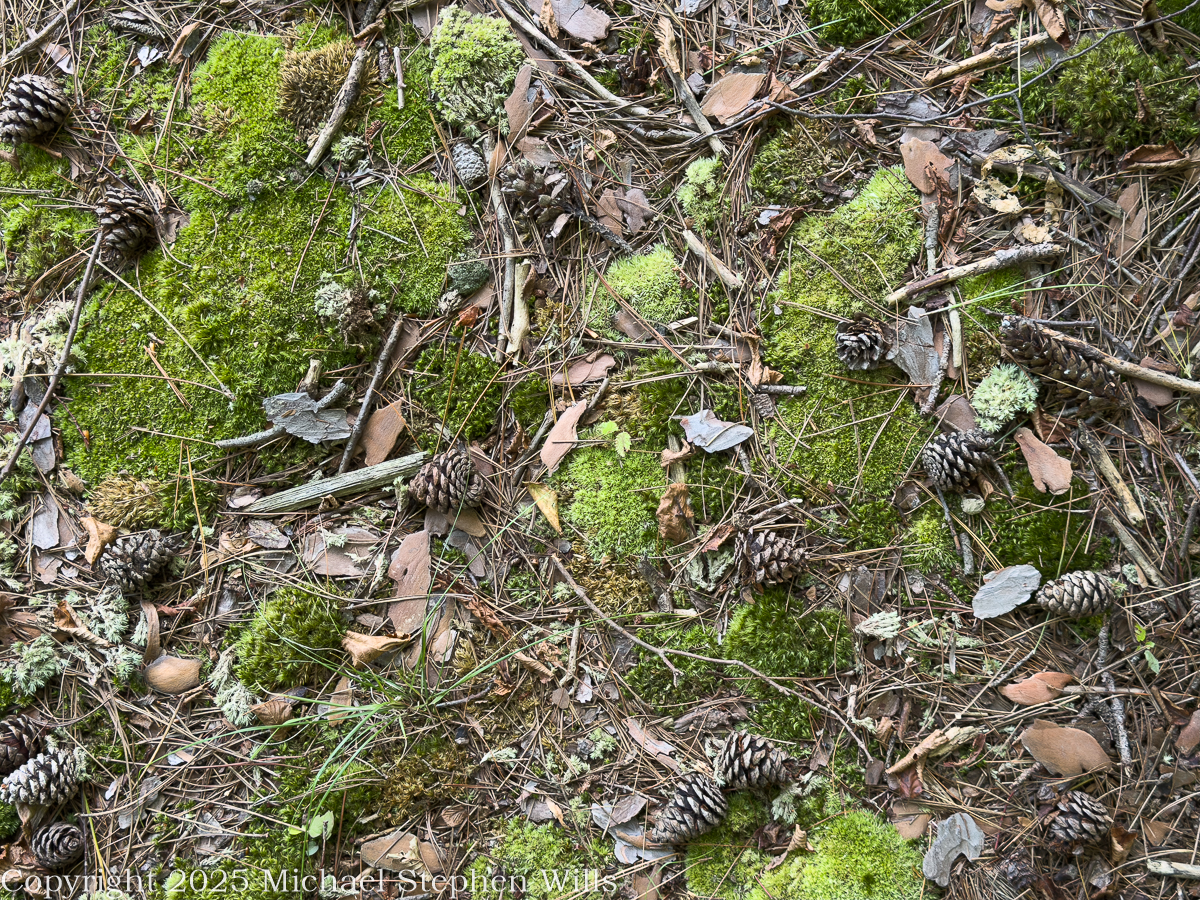
When I returned five months later, on August 23, the same path had forgotten the word austerity. The cathedral of sycamore was fully leafed, the white pillars now vanished behind a nave of shade. The pines perfumed the air without trying. A new footbridge—clean timber arching like a bent bow—spanned one of the wet flats. Its braces, black-bolted and handsome, looked as if they would hold the weight of an ox team or a file of schoolchildren. Such crossings are a kind of promise from the present to the future: we found a way through here; may you, too. Below, the floor was upholstered with moss, oak leaves, and a scatter of pinecones—the slow currency of the woods accumulating interest.

Arched wooden footbridge in summer forest on Cornell’s Monkey Run trail.

Summer makes a confidant of every plant. Ferns unrolled their scripture at the bridge abutment; jewelweed held its tiny lanterns along the seeps; a kingfisher rattled downstream, blue lightning with a bill. The creek, glassy over its shale pavement, showed every wrinkle of its stride. I waded a little, feeling with the sole what the eye could not—where the current took an extra thought around a stone, where it forgot itself in a warm eddy. Trout lingered in the dimmer reaches, quick as commas; a great blue heron lifted off with that surprising tidiness of wing, ungainly only in our imagination.

In all seasons the trail carries two histories: one written in rock and water, the other in the footfall of people. Cornell’s founders, Ezra and Andrew White, believed the university should place the hand near the thing studied; here that principle is plain. Botany students take their lectures in leaf and bark; geologists read the creek banks as if the pages might soon turn by themselves; children learn the oldest calculus—how long a stick will float before it catches in the weeds. The caretakers from the Botanic Gardens mark, mend, and interpret, but they do not overtalk. The woods speak enough.

Moss, grass and pinecones on an overlook of Fall Creek

As the afternoon eased toward evening, I climbed once more to the bluff. The light had gone honey-colored and the leaves of the maples, those careful accountants of September, were just beginning to weigh their green against gold. I looked down on the bend where I’d stood in March—cold, bright, expectant—and felt the year’s circle gently close. As John Burroughs wrote, “The power to see straight is the rarest of gifts… to be able to detach yourself and see the thing as it actually is, uncolored or unmodified by your own… prepossessions… that is to be an observer and to read the book of nature aright.” Monkey Run obliges that humility. The creek moves as it always has—glacially taught, mill-forged, campus-wise, and freedom-loving—and the trail, with its modest stairs and honest bridges, invites us to walk beside it, to match our breath to its turnings, and to leave, if we can, a lighter trace than we found.

References

Ways of Nature (1905), “Reading the Book of Nature,” pp. 275–276 (The Writings of John Burroughs, Riverside ed., vol. XIV, Houghton Mifflin)

Enter your email to receive notification of future postings. I will not sell or share your email address.

The Mathematical Beauty of Autumn Leaves

Here I reflect on the mathematical beauty of falling leaves from two trees, revealing order amidst perceived chaos in nature’s patterns.

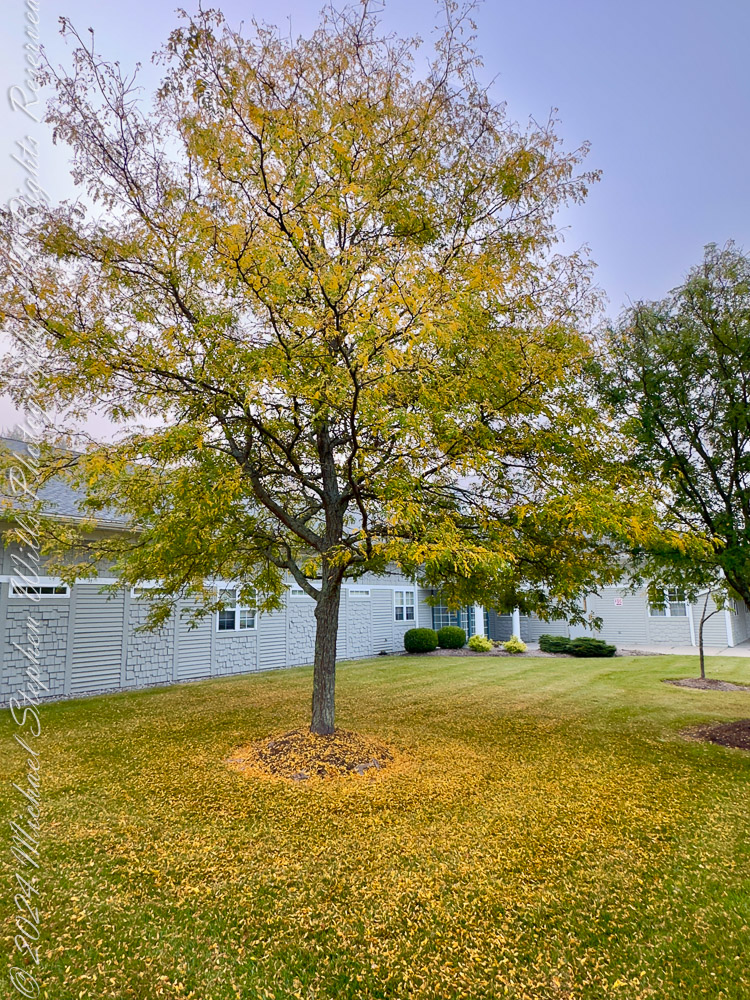
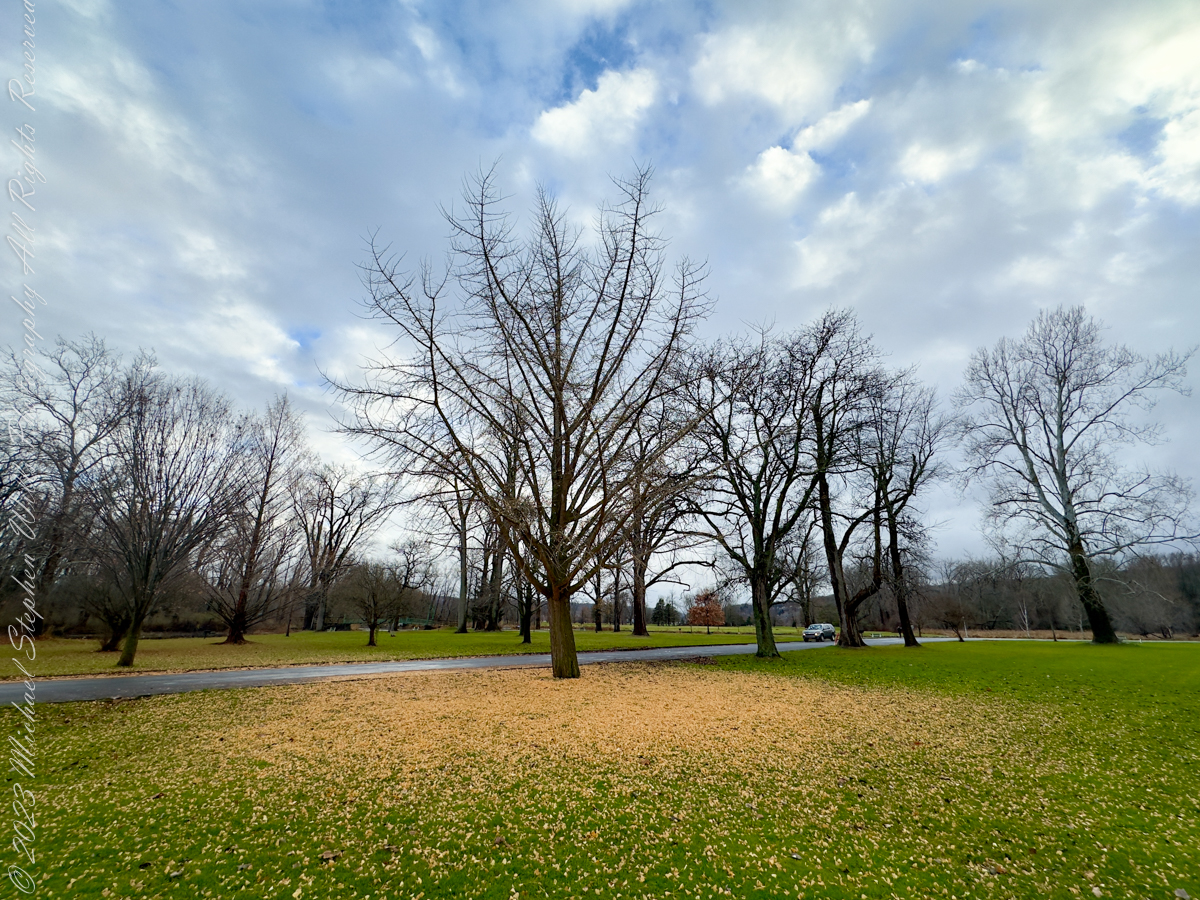
Standing before these two trees on a unseasonably warm autumn day, I am struck by the intricate patterns of their fallen leaves. Against the vibrant green of the grass, the golden leaves form halos around the trunks, as if nature herself were sketching mandalas. There’s something profoundly mathematical about these arrangements—a quiet order amidst what might initially seem like chaos.

The first tree, its barren branches reaching skyward, stands on a carpet of yellow that radiates outward in near-perfect symmetry. The leaves have fallen in such a way that their density decreases as the distance from the trunk increases. It reminds me of the inverse square law—a principle in physics that governs how light, gravity, and sound diminish with distance. Here, instead of energy dispersing, it’s the leaves thinning out, their graceful scatter dictated by the wind’s whims and gravity’s pull. There’s an undeniable harmony in this seemingly random process, a convergence of natural forces creating an elegant gradient.

Stewart Park, Ithaca, New York

The second tree presents a different story, yet one equally mesmerizing. Its leaves, still clinging in part to the branches, form a looser ring at the base. The distribution is uneven, hinting at prevailing winds or the sheltering influence of nearby buildings. But even in this asymmetry, I see fractals—the self-similar patterns that repeat at different scales throughout nature. Look closely, and you’ll notice clusters of leaves mimicking the broader structure of the canopy above. It’s as if the tree’s essence is echoed in the ground below, a reminder of how deeply interconnected every part of a system can be.

Robinia pseudoacacia, commonly known as the black locust

These patterns invite reflection on the mathematical principles governing our world. Fibonacci sequences, golden ratios, and fractals—abstract concepts are not confined to textbooks. They are etched into the fabric of existence, visible in the spiral of a sunflower’s seeds, the curve of a nautilus shell, and the fall of leaves beneath a tree. Even the chaos of autumn is underpinned by order, a dance choreographed by countless variables: the angle of the branches, the strength of the wind, the moisture in the air.

I find myself wondering about the unseen forces at play. How many leaves fell straight down, obeying only gravity? How many were carried aloft by a breeze before settling farther afield? Could we model these patterns with algorithms, tracing the arc of each leaf’s descent? Would the data reveal a perfect equation, or would it remind us that some mysteries resist full comprehension?

As I stand here, I feel a deep gratitude for these natural equations. They ground me in the present moment while also connecting me to the infinite. The pattern of leaf fall is a reminder of life’s balance: chaos and order, randomness and structure, fleeting moments and timeless principles. The trees, now shedding their golden crowns, invite me to pause, observe, and marvel at the beautiful mathematics of autumn.

Enter your email to receive notification of future postings. I will not sell or share your email address.

Buttonbush: The Secret Geometry of Wetlands

Discover the Buttonbush (Cephalanthus occidentalis), a wetland shrub of spherical blooms, sustaining pollinators, birds, and waterfowl while reminding us of life’s enduring cycles

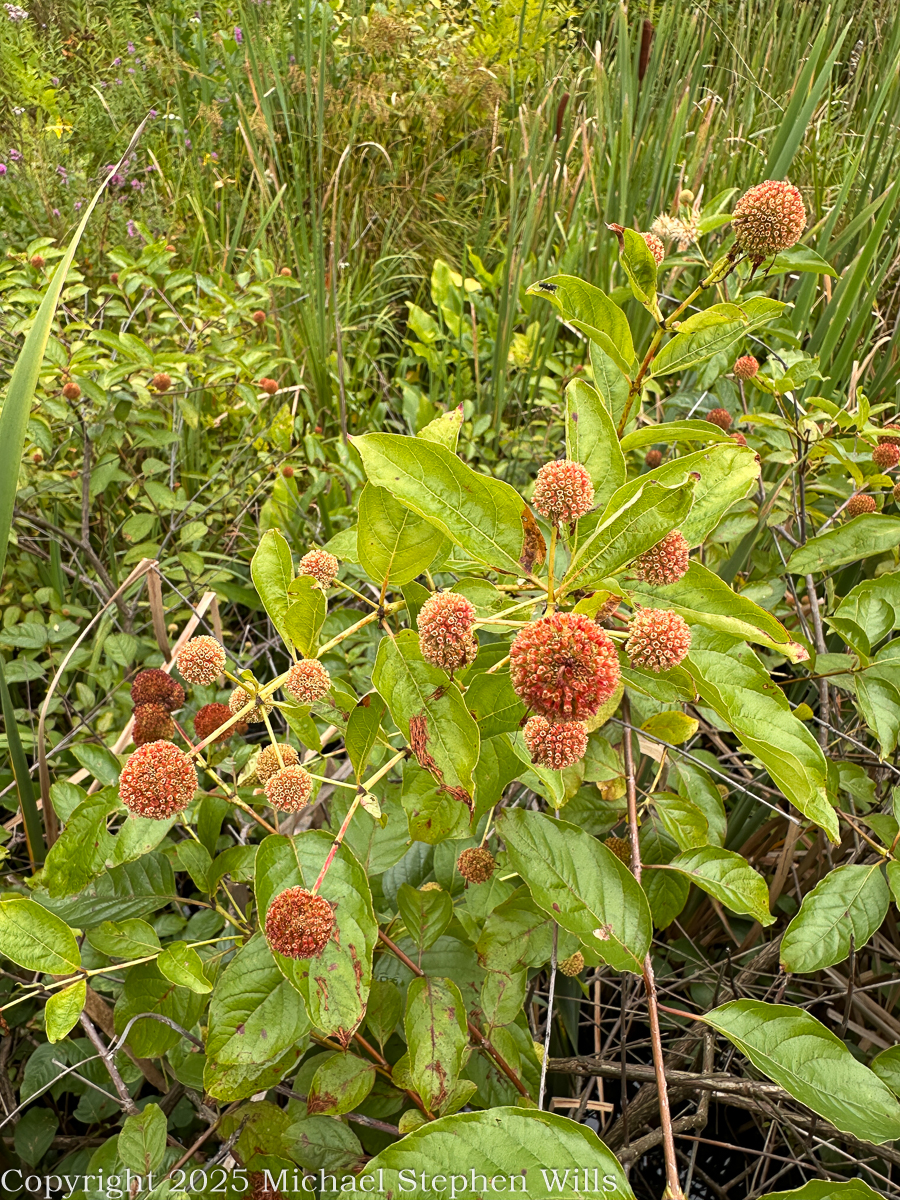
In the quiet wetlands of late summer, when cattails lift their brown torches above the reeds and dragonflies skim the still water, there is a shrub that speaks in spheres. Its language is not the pointed spear of grass or the broad fan of lily pads, but the perfect symmetry of globes—round, intricate, and startling in their precision. This is the Buttonbush, Cephalanthus occidentalis, a native of swamps, pond margins, and the soft, yielding soils where water shapes the land.

At first glance, its clusters might be mistaken for something fashioned by human hands: spiky balls arrayed along slender stems, each one a small planet bristling with tiny cells. Only in memory can we recall their summer incarnation, when each ball was a constellation of snowy blossoms, white tubular flowers extending like delicate pins from a spherical center. Bees and butterflies crowded them then, drunk on nectar, wings glinting in the sun. Hummingbirds darted in as though drawn by an unseen magnet, their beaks fitting perfectly into the narrow blossoms, a partnership written long ago in the shared script of evolution.

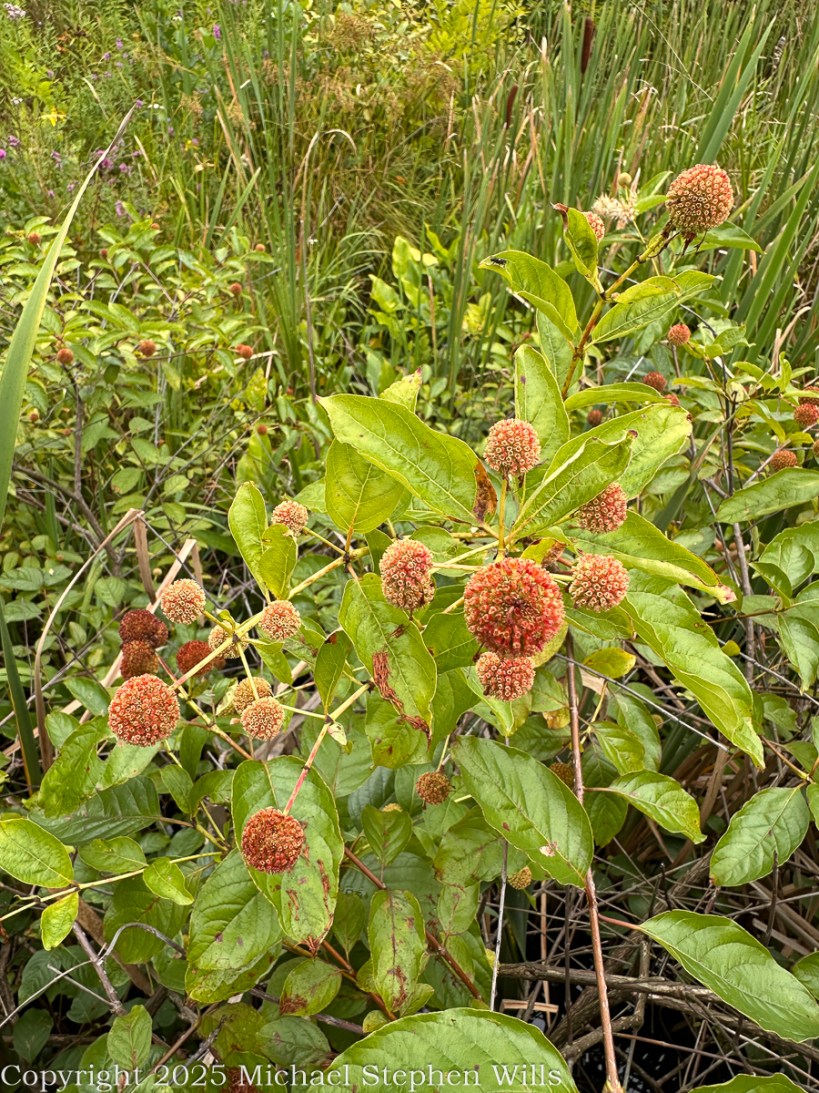
Buttonbush (Cephalanthus occidentalis) at Sapsucker Woods, Cornell Lab of Ornithology

Now, in August’s waning light, those blossoms have folded back into seed, transforming into the russet orbs captured in the photograph. What was once nectar is now promise—food for ducks, shorebirds, and the small lives that depend on wetlands for sustenance. In the hands of buttonbush, time itself is circular. Flower becomes fruit, fruit becomes seed, seed becomes shrub, and the cycle spins quietly on, just as the spheres themselves suggest: complete, unbroken, eternal.

A Wetland Companion

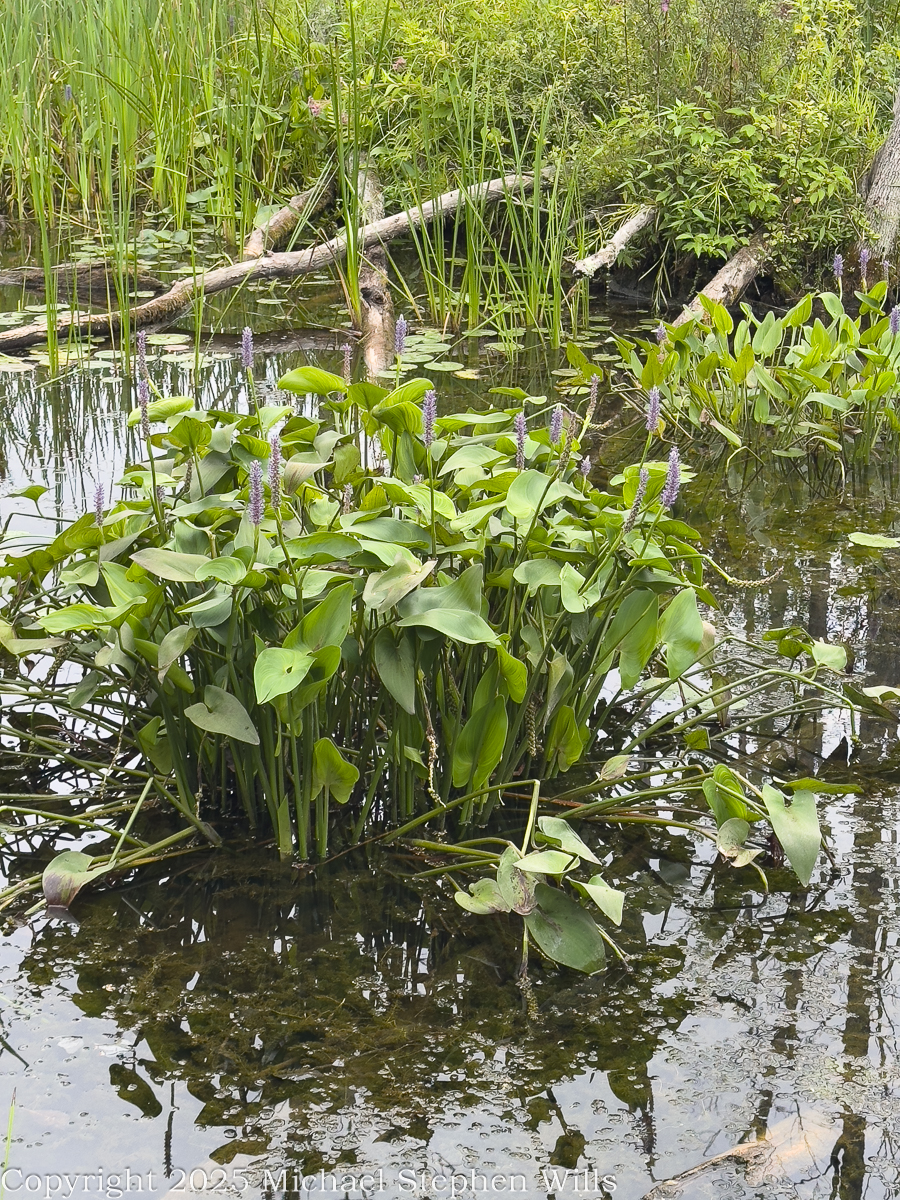
Buttonbush is rarely alone. It thrives where cattails whisper, where pickerelweed thrusts up spikes of purple bloom, where the air holds the scent of waterlogged earth. Its roots grip the muck at the edges of ponds and rivers, holding soil against the restless tug of currents. In doing so, it becomes part of the unseen architecture that holds wetlands together, slowing erosion, filtering water, providing shelter for fish in the shade of its stems.

Pickerelweed (Pontederia cordata) at Sapsucker Woods, Cornell Lab of Ornithology

This shrub, unassuming in stature, is an engineer of stability. It creates thickets where red-winged blackbirds perch, where frogs crouch in shade, where turtles bask on half-submerged branches. The wetlands of North America would be poorer without its presence, for it provides not just beauty but the scaffolding upon which entire communities of life depend.

The Human Thread

To the human eye, the buttonbush’s spherical blooms are so striking that they demand metaphor. Some have called them pincushions, others tiny planets, others fireworks arrested in mid-burst. Native American peoples, however, looked beyond metaphor to medicine. The bark and roots were used in remedies for ailments ranging from headaches to fevers, though with caution, for the plant holds mild toxicity when consumed raw. It is a reminder that many gifts of the natural world are edged with danger, and that wisdom lies in balance.

Today, gardeners and conservationists plant buttonbush intentionally. It is welcomed into rain gardens, where its thirst for moisture makes it a perfect ally for absorbing stormwater. It is used in wetland restoration projects, where its deep roots anchor new life. And it is cherished by those who walk the edges of ponds and discover in its round blossoms a geometry that feels both wild and deliberate, a gift of design from the living earth.

Fourth of July, 2019, Stewart Park

The Sphere as Symbol

Rachel Carson once wrote that in nature, “nothing exists alone.” The buttonbush embodies this truth with clarity. Its spheres are invitations, junctions where plant and pollinator meet, where flower and bird share a moment of mutual necessity. They are offerings to the eye as well, challenging us to see patterns where we might otherwise see only happenstance.

Standing before a buttonbush in bloom, one feels an almost childlike wonder: how could such symmetry arise unbidden from soil and sunlight? Yet this is the miracle of evolution, that order may spring from chance, that beauty may serve survival, that what pleases our senses also sustains life.

A Closing Reflection

In the wetlands, where water mirrors the sky, the buttonbush offers its own reflection of completeness. Its seed heads persist through autumn and winter, small orbs clinging even when leaves fall, reminders that the cycles of life turn steadily beneath the stillness.

To linger with buttonbush is to be reminded of nature’s quiet insistence on wholeness. It speaks in forms: round, repeating, enduring. To walk away from it is to carry a sense of connection, to know that in the pattern of its blooms we glimpse a truth both humble and profound—that life is not a line but a circle, and in every turning there is renewal.

For Further Reading

USDA NRCS. Plant Guide: Buttonbush (Cephalanthus occidentalis L.). United States Department of Agriculture, Natural Resources Conservation Service. Available online: https://plants.usda.gov
– Provides detailed information on identification, habitat, and ecological role.

Lady Bird Johnson Wildflower Center. Cephalanthus occidentalis (Common Buttonbush). Native Plant Information Network. Available online: https://www.wildflower.org/plants/result.php?id_plant=ceoc2
– Covers botanical features, bloom time, wildlife value, and landscape use.

Dirr, Michael A. Manual of Woody Landscape Plants: Their Identification, Ornamental Characteristics, Culture, Propagation and Uses. 6th Edition. Stipes Publishing, 2009.
– Authoritative horticultural reference on Buttonbush and other shrubs.

Peterson, Roger Tory, and Margaret McKenny. A Field Guide to Wildflowers: Northeastern and North-central North America. Houghton Mifflin, 1968.
– Classic field guide covering buttonbush’s wetland habitat.

Carson, Rachel. Silent Spring. Houghton Mifflin, 1962.
– Source of the quoted passage: “In nature nothing exists alone.” (Chapter 2, “The Obligation to Endure”).

Moerman, Daniel E. Native American Ethnobotany. Timber Press, 1998.
– Comprehensive reference documenting traditional medicinal uses of Buttonbush among Native American peoples.

Enter your email to receive notification of future postings. I will not sell or share your email address.

Among the Trout Lilies in Sapsucker Woods

On April 22, 2025, a wanderer discovers a trout lily, representing nature’s cycles, patience, and the interconnectedness of life through blooming, pollination, and nutrient cycling.

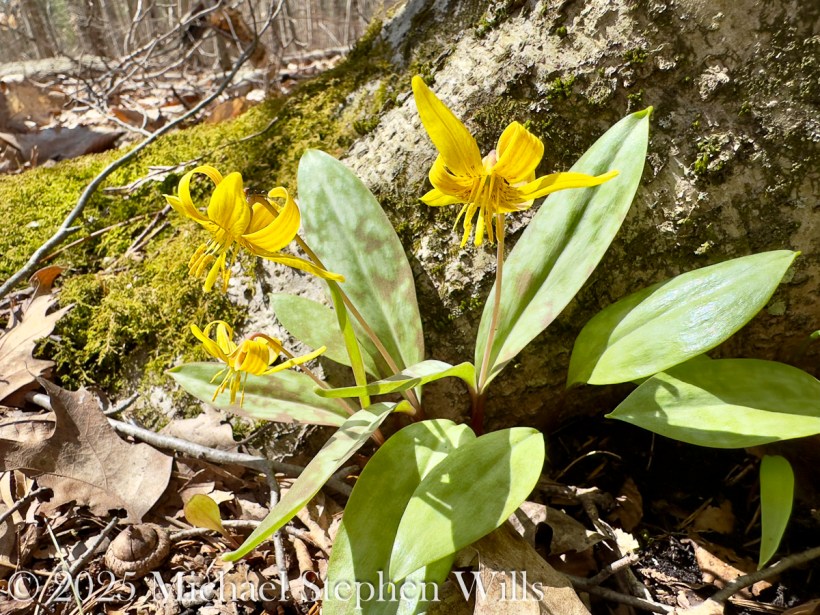
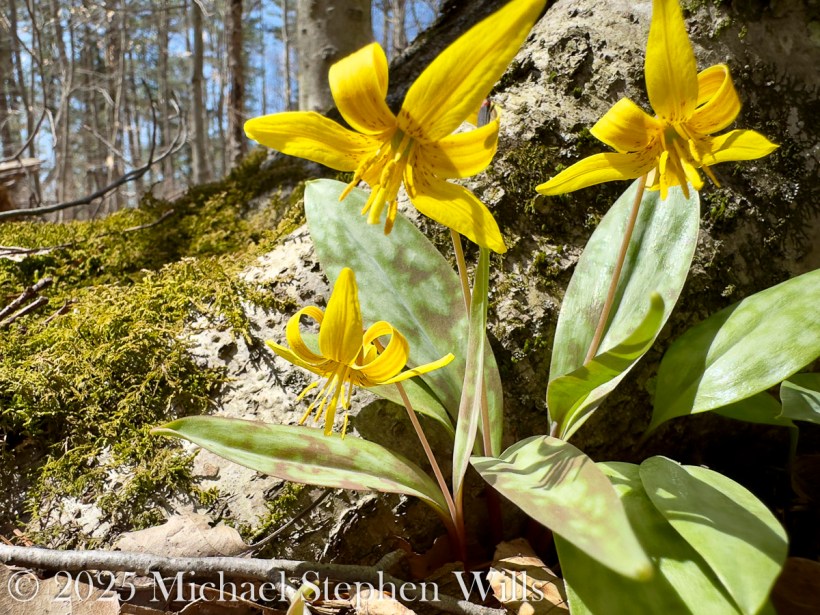
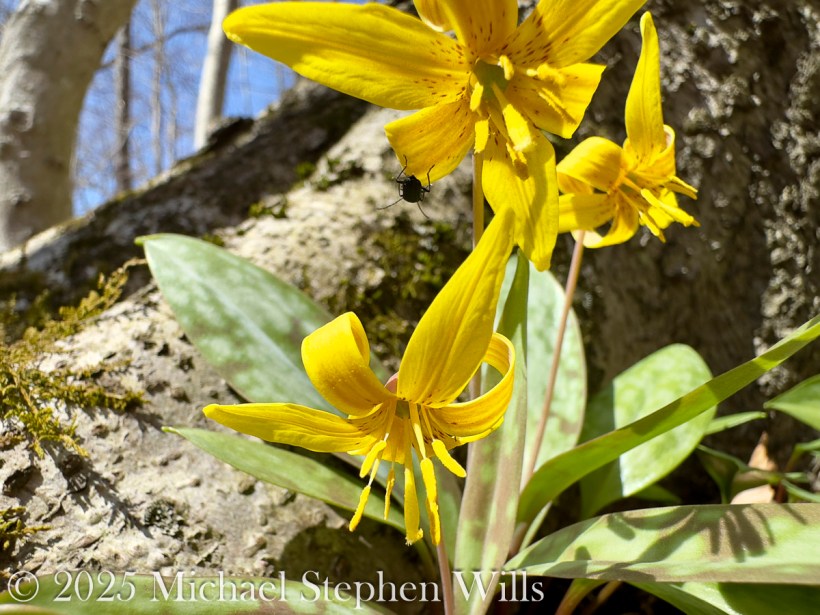
On the bright afternoon of April 22, 2025, I wander slowly through Sapsucker Woods, last year’s oak leaves soft underfoot and the smell of damp earth in the air. The trees stand bare, and somewhere a woodpecker drums as I search the ground for any sign of spring. A flash of gold catches my eye at the mossy base of a tree. Kneeling down, I find among the leaf litter a small wildflower glowing yellow.  It is a trout lily – Erythronium americanum – a solitary, nodding bloom on a slender stem. Six delicate petals flare backward, golden with a few reddish freckles near the throat; long stamens dangle beneath. Two lance-shaped leaves hug the ground, green marbled with burgundy-brown. Their mottled pattern looks like a brook trout’s flank. This flower is known by many names: “trout lily” for its fish-like leaves, “dogtooth violet” for its pointed white bulb 1, and “adder’s tongue” for its tongue-shaped leaf tip.

Its formal name, Erythronium americanum, comes from the Greek for “red”2—odd for a yellow bloom until one remembers the purple dogtooth violets of Europe. Americanum simply marks it as native here. I soon realize these trout lilies are not alone – dozens of dappled leaves carpet the damp earth around me. Most show no blossom at all, only a single freckled leaf standing alone. Only the older plants with two leaves manage to lift a yellow flower. In fact, they often form extensive colonies on the forest floor. I’ve learned a trout lily may wait seven years to bloom its first time3. Seasons of patience pass unseen underground, and then one spring it earns the chance to unfurl a golden star. That slow, patient rhythm of growth fills me with wonder.

A tiny black bee—or maybe a fly—lands on the trout lily’s bloom, drawn by its promise of pollen. It disappears into the flower’s downturned bell, brushing against the dusting of pollen inside. In early spring, few other blossoms are open, so this little lily is a lifeline for hungry pollinators4. There is even a solitary “trout lily bee” that times its life to these flowers5. Flower and insect share an ancient pact: the lily feeds the visitor, and the visitor carries the lily’s pollen onward to another bloom.

Within a week, the trout lily’s golden star will wither. By the time the canopy closes overhead, the flower will have curled into a green seedpod that splits open by early summer, releasing its seeds6. Each seed carries a tiny parcel of food irresistible to ants7. Ants haul the seeds to their nest, eat the morsel, and abandon the seed in their tunnels—unwittingly planting the next generation. The name for this circular ecological dance is myrmecochory. Over time, the colony inches across the forest floor, guided by these tiny gardeners. During its short life above ground, this little lily helps the forest. Its roots soak up nutrients from the damp soil, keeping them from washing away in spring rains8. When the plant dies back, those nutrients return to the earth as the leaves decay, nourishing other life. In this way, a patch of trout lilies forms a quiet bridge between seasons—capturing nutrients in spring and returning them by summer’s end. I touch one cool leaf, feeling connected to this cycle.

I rise and take a final look at the little yellow lily. Its brief bloom reminds me that life’s most beautiful moments are fleeting yet return each year. This blossom will vanish in a few days, a blink of the season, but it will come back next spring as faithful as hope. In its patience and generosity, I sense kinship. Like the trout lily, we too have long periods of waiting and rare moments of blooming. We also rely on small kindnesses to help us thrive—like a friend in hard times or a community that carries our dreams to fertile ground. And we are part of a larger cycle, giving and receiving, leaving something of ourselves to nurture the future. As I continue down the trail, I carry the image of that humble flower with me—a gentle assurance that even the smallest life can leave a lasting impression, and that hope will always return with the spring.
Enter your email to receive notification of future postings. I will not sell or share your email address.

Footnotes

  1. wildadirondacks.org Trout lily’s common names: “Trout lily” refers to the trout-like mottling on its leaves, while “dogtooth violet” refers to the tooth-like shape of its underground bulb (despite not being a true violet). It is also sometimes called “adder’s tongue.” ↩
  2. en.wikipedia.org The genus name Erythronium comes from the Greek erythros, meaning “red,” originally referring to the red-purple flowers of the European dogtooth violet (Erythronium dens-canis). The species name americanum denotes that it is native to America. ↩
  3. peacevalleynaturecenter.org Trout lilies often grow in large colonies and most individuals in a colony are non-flowering. A plant typically needs about seven years of growth before it produces its first bloom. ↩
  4. peacevalleynaturecenter.org Spring ephemeral wildflowers like the trout lily provide crucial early nectar and pollen for pollinators (bees, flies, butterflies) emerging in early spring. ↩
  5. appalachianforestnha.org The trout lily miner bee (Andrena erythronii) is a solitary bee whose life cycle is closely tied to the trout lily; it forages primarily on trout lily flowers, making it a specialist pollinator of this species. ↩
  6. wildadirondacks.org After pollination, trout lily flowers are replaced by seed capsules that ripen and split open to release the seeds in late spring. ↩
  7. atozflowers.com Erythronium americanum seeds have a small fleshy appendage called an elaiosome, which attracts ants. The ants carry the seeds to their nests, aiding in dispersal in exchange for the food reward, a mutualism known as myrmecochory. ↩
  8. pubmed.ncbi.nlm.nih.gov By growing and taking up nutrients during the brief spring season, trout lily plants help retain important nutrients (like potassium and nitrogen) in the ecosystem. When the plants die back and decay, those nutrients return to the soil, contributing to the forest’s nutrient cycle. ↩

Monarch Chrysalis: A Symbol of Nature’s Resilience

On a September day, a Monarch chrysalis symbolizes resilience amidst environmental threats, prompting reflection on stewardship and hopeful change.

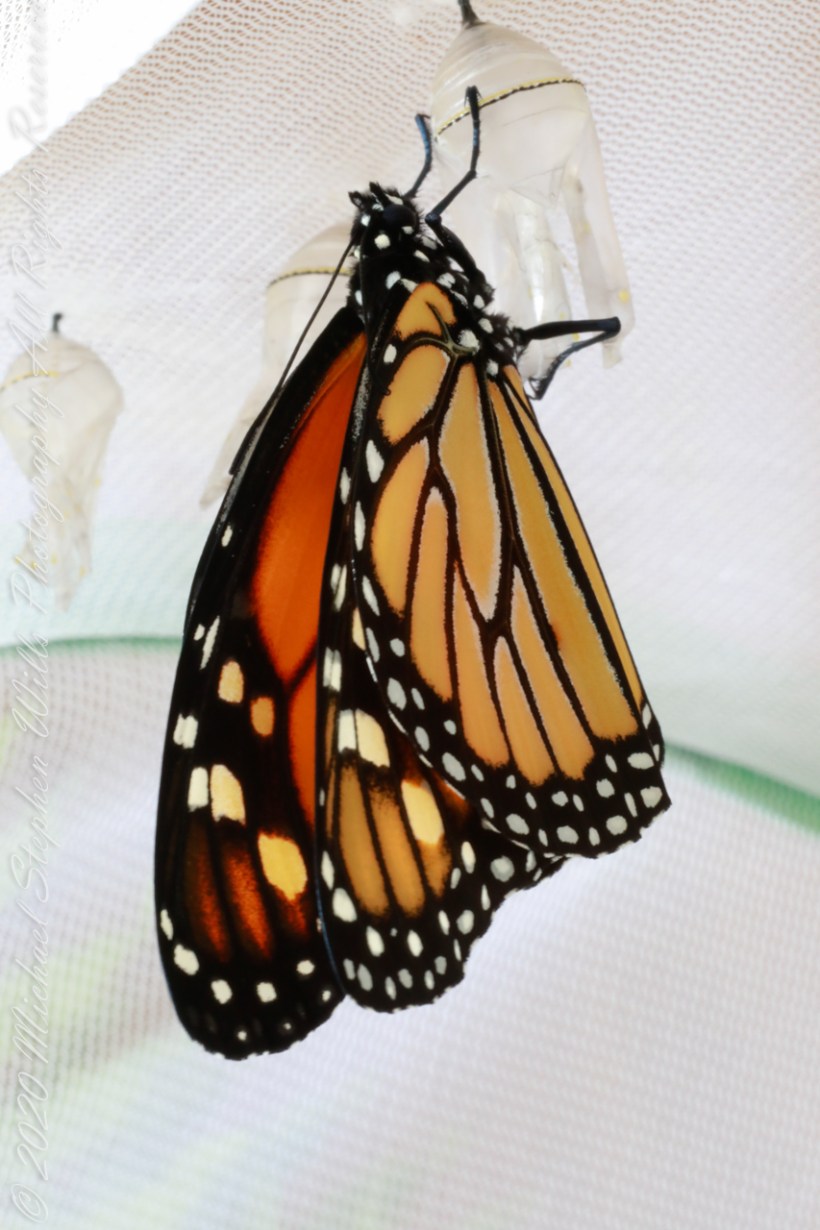
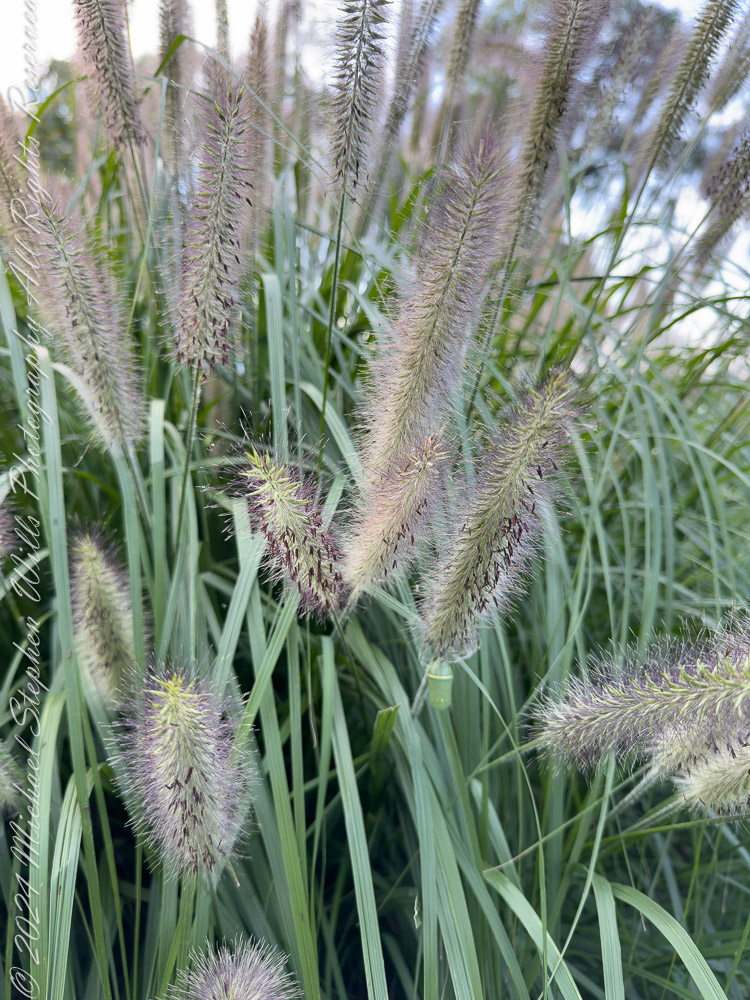
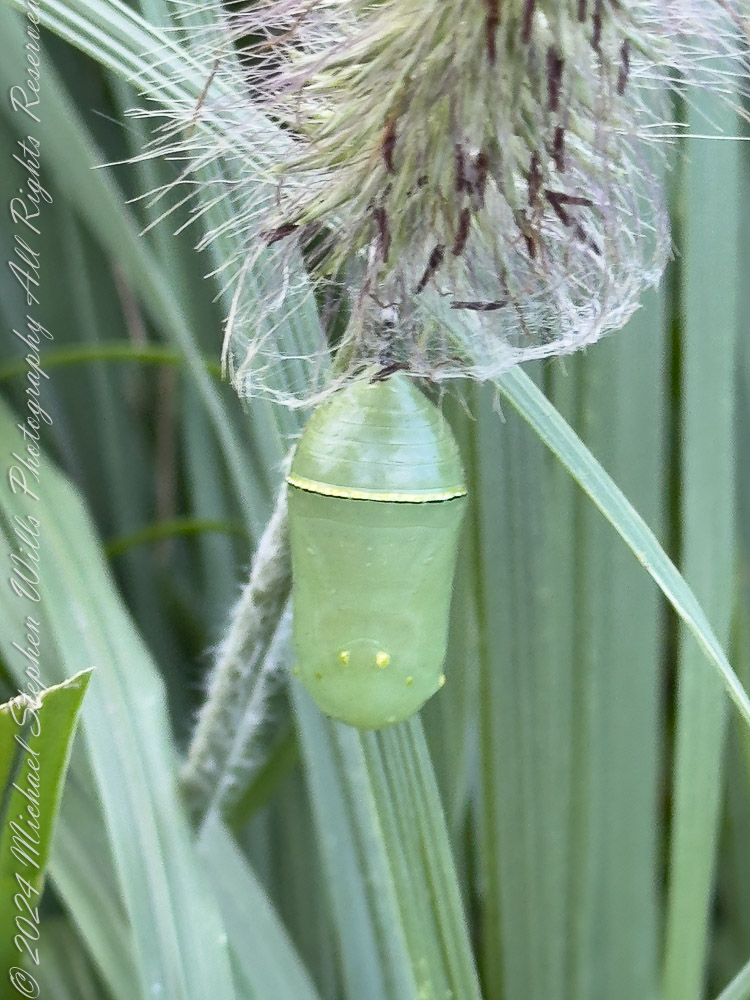
On a warm September afternoon, 2024, Pam and I passed a planting of shimmering grasses along the Cayuga Lake shore, the tips of their feathery plumes swaying in a gentle breeze. Amidst the verdant tapestry, my eyes caught a flash of delicate green—a Monarch chrysalis, hanging like a precious jewel beneath one of the seed heads. It was an unexpected encounter, a moment of grace that felt almost otherworldly. The chrysalis, pale jade with gold accents, looked like something born of magic rather than biology. For a moment, time paused.

The only Monarch chrysalis we found in 2024, notable for the absence of caterpillars around our home. Tompkins Park, Ithaca, New York, Finger Lakes Region

I knelt carefully, mindful not to disturb the fragile life suspended before me. As I leaned in closer, I marveled at the perfection of its design. The intricate gold dots along its casing seemed impossibly precise, as though a divine hand had painted them there. Yet, this chrysalis was also a paradox: it was a shield of stillness, promising the coming transformation of a creature known for motion and migration.

The significance of this discovery didn’t escape me. Just two years ago, the International Union for Conservation of Nature officially classified the Monarch butterfly as “endangered.” Habitat destruction, pesticide use, and climate change have decimated their numbers. Monarchs, once so plentiful they seemed a seasonal certainty, now teeter on the edge of disappearance. To find this chrysalis was to witness a quiet rebellion against those odds, a solitary emblem of resilience in a world fraught with loss.

I thought of their epic journey—a migration that spans thousands of miles, linking Canada to the forests of central Mexico. For generations, these butterflies have followed ancestral paths with unerring precision, defying every obstacle in their way. How can something so small carry the weight of such immense journeys? And how, in a world that seems to grow harsher each year, do they still persist?

This chrysalis, tucked in the grasses of Stewart Park, felt like an answer to those questions. It was a reminder of the resilience of life, the determination of nature to continue despite all that works against it. And yet, it also felt like a fragile promise. The Monarch’s survival is no longer assured; its future, like the butterfly within this chrysalis, hangs by a thread.

As I rose and continued our walk, I carried the image of the chrysalis with me, letting its quiet beauty settle in my mind. I thought of the interconnectedness of all things: the milkweed plants that sustain Monarch caterpillars, the winds that guide their migrations, and the people whose choices shape the landscapes they traverse. Stewardship is not just a responsibility; it is a privilege—an opportunity to ensure that these miraculous creatures continue to grace our skies.

By the time I left the park, the sun had sunk toward the west, its light no longer graced the grasses. I looked back one last time, hoping that this chrysalis would complete its transformation safely. In its stillness, I saw not just hope, but a call to action. The Monarch’s story is not just about survival; it’s about the courage to evolve and adapt, even when the odds seem insurmountable. And perhaps, in witnessing this moment of metamorphosis, we too are reminded of our capacity to change—to become better stewards of the world we share.

Enter your email to receive notification of future postings. I will not sell or share your email address.

A Bonnethead’s Final Moments on Cocoa Beach

The narrator discovers a dying bonnethead shark on Cocoa Beach, reflecting on its ecological role and the cycle of life and death in the ocean.

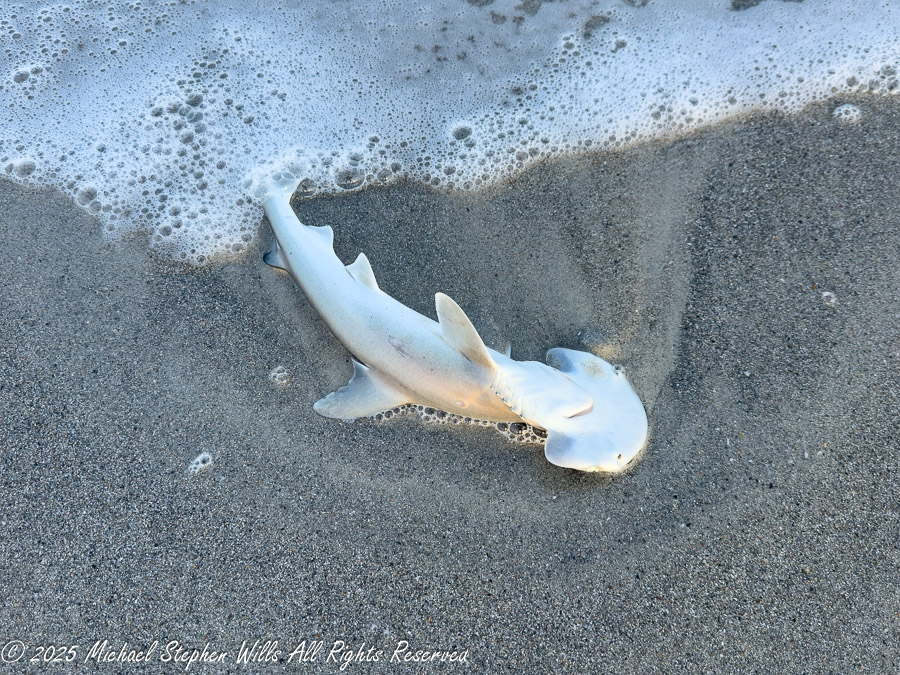
The evening ebb tide had left behind more than just a fresh line of seaweed and broken shells. As I walked along Cocoa Beach, the cool sand beneath my feet, a small shape caught my eye near the water’s edge. At first, it looked like detritus tossed ashore by the restless ocean. But as I stepped closer, I saw the unmistakable outline of a shark—its pale, twitching body lay on the damp sand.

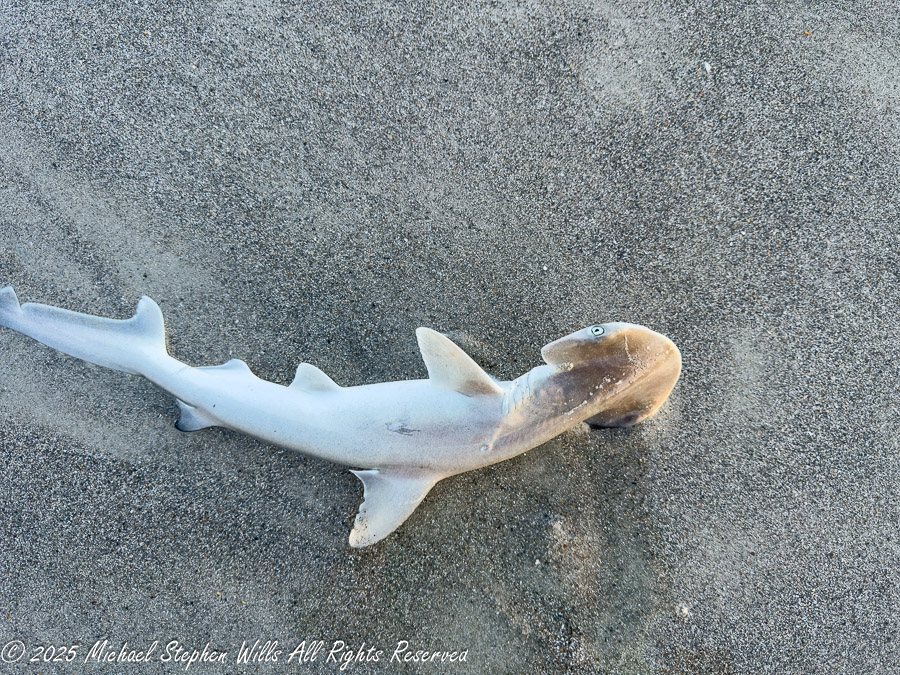
Stopping to bend and examine it, my breath caught as I recognized its flattened, shovel-shaped head. This was a bonnethead shark (Sphyrna tiburo), one of the smallest members of the hammerhead family. Its eyes, positioned far apart on either side of its head, stared blankly at the sky. A thin film of seawater still clung to its sleek, streamlined body, reflecting the golden light of the rising sun.

Its scientific name, Sphyrna tiburo, reveals much about its nature and form. Sphyrna comes from the Greek σφῦρα (sphyra), meaning “hammer,” a fitting reference to the distinct shape shared by all hammerhead sharks. The species name, tiburo, is thought to have originated from an indigenous or Spanish term for small sharks found in the Caribbean and Gulf of Mexico. Together, these words encapsulate the bonnethead’s identity—a hammer-shaped predator of the shallow seas, yet one that stands apart from its larger, more formidable relatives.

Named for its distinctive cephalofoil—the flattened, bonnet-like shape of its head—Sphyrna tiburo plays an essential role in maintaining the balance of marine ecosystems. As a mid-level predator, it helps regulate populations of crabs, shrimp, and small fish, preventing any one species from overpopulating and disrupting the delicate food web. Unlike most sharks, the bonnethead is also partially omnivorous, consuming seagrass along with its usual diet of crustaceans and mollusks. This unique feeding behavior contributes to the health of seagrass beds, which serve as crucial habitats for many marine creatures.

Bonnetheads are harmless to humans, known for their non-aggressive nature and their surprising diet—unlike most sharks, they eat not just crustaceans and fish, but seagrass as well. Gentle foragers of the shallows, they are common in Florida’s coastal waters, where they glide just beneath the surface, their unique head shape helping them detect prey buried beneath the sand.

But this one would swim no more. It was too late. Whether it had fallen victim to a fisherman’s discarded catch, an injury, or something unseen—disease, pollution, or fluctuating ocean temperatures—it was impossible to tell. All I knew was that this creature, so perfectly adapted to the rhythms of the sea, had been cast ashore by forces beyond its control.

A wave surged forward, washing over the shark’s still body, as if the ocean itself fruitlessly nudged it to life. The rising tide swirled, lifting the bonnethead and carrying it back into its world.

As I stood watching the tide pull it away, I felt a strange mix of sorrow and reverence. The sea is full of life, but it also takes life in its endless cycle. The bonnethead had played its part in that vast, unknowable story.

And now, it was gone.

Enter your email to receive notification of future postings. I will not sell or share your email address.

Cayuga Lake’s Daylilies: A Symbol of Survival and Adaptation

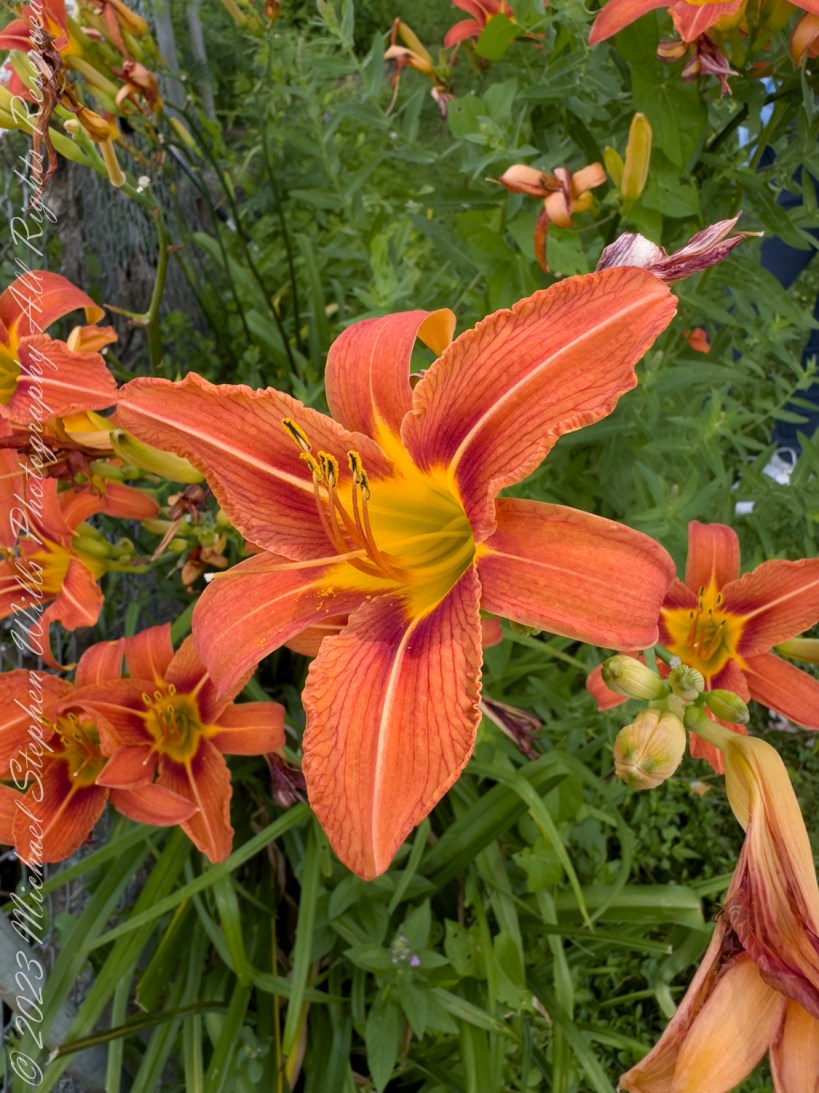
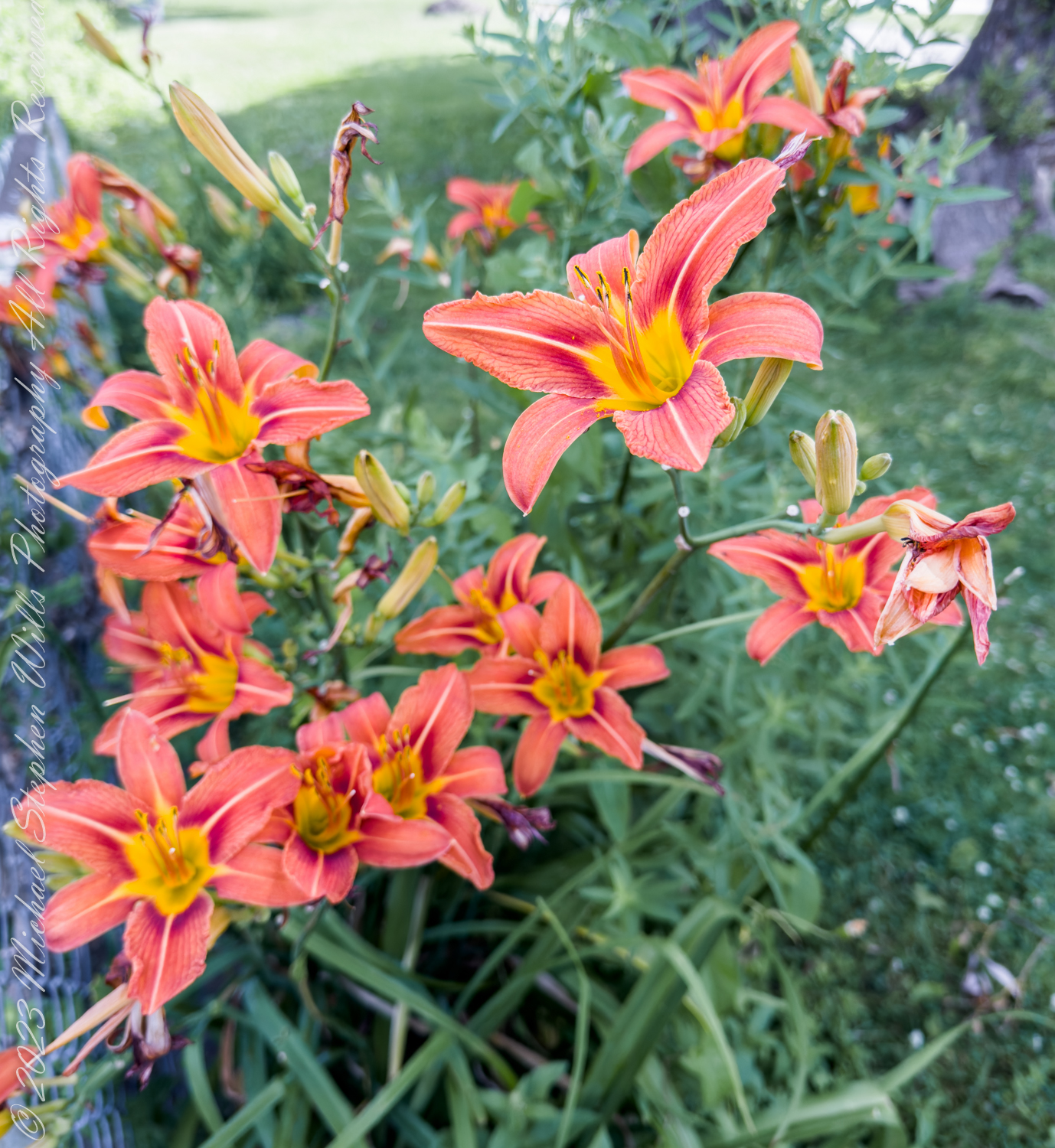
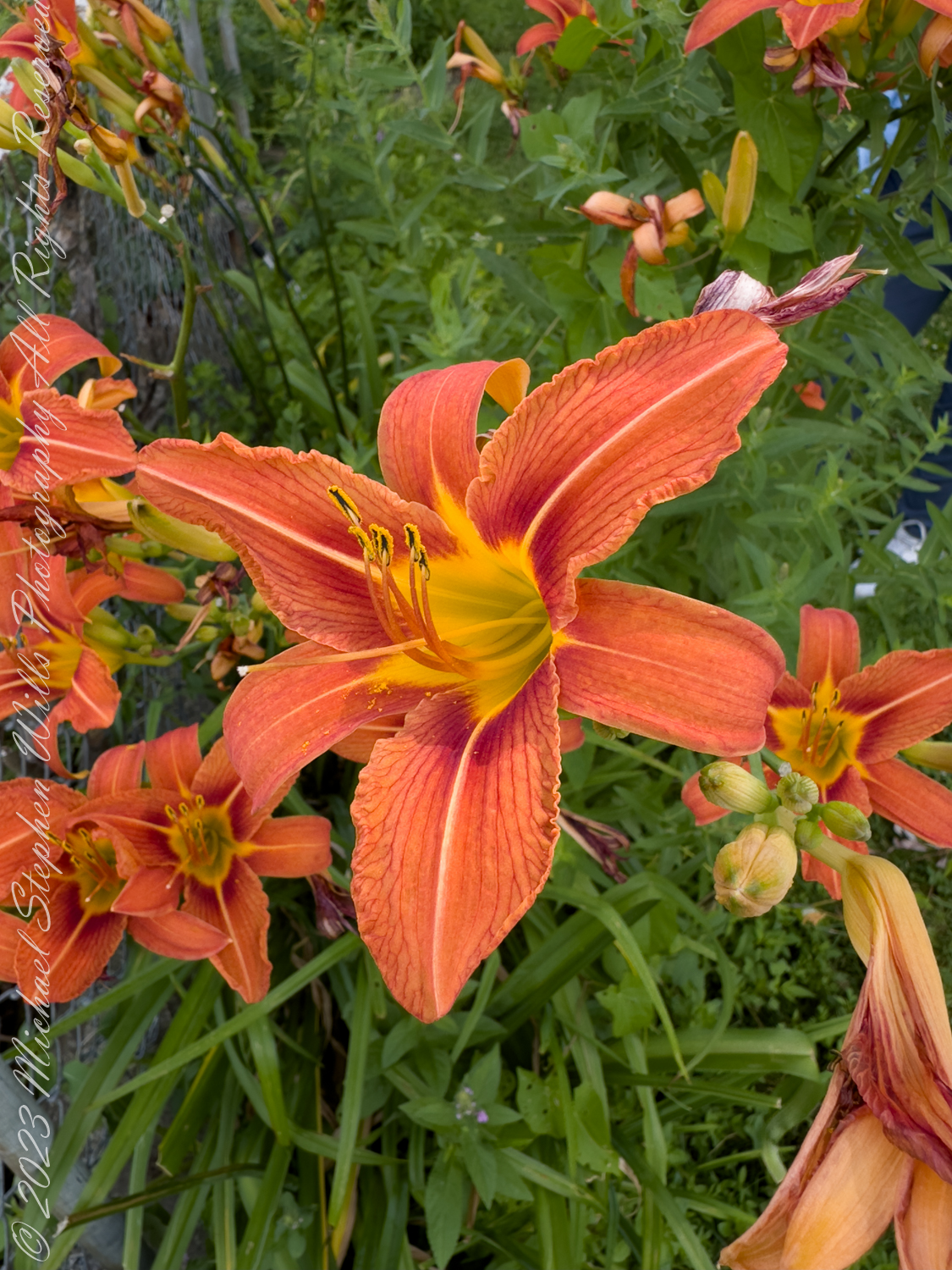
In Stewart Park, the Hemerocallis fulva, or Tawny Daylily, blooms vibrantly.


Stewart Park, Cayuga Lake, Ithaca, New York

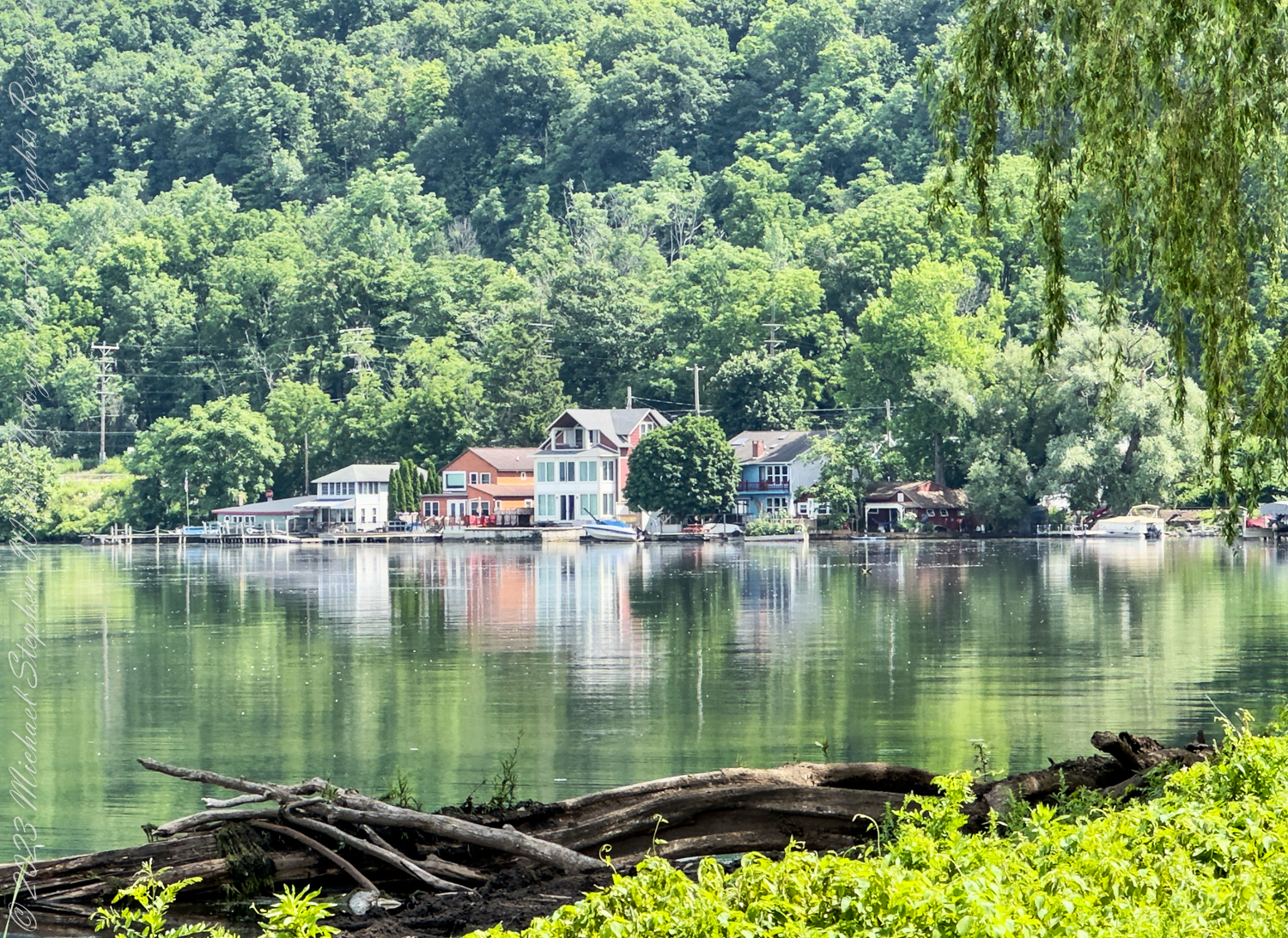
Seen from Stewart Park, these lakefront homes line the southern shore of Cayuga Lake. Tompkins County, Ithaca, New York State. The Finger Lakes Region

On a warm June morning, with the early summer sun casting a golden glow across the shores of Cayuga Lake, Pam and I set out for a walk around Stewart Park. The soft lapping of the water against the shore mixed with the calls of distant birds, and the familiar hum of life in the park settled into a rhythm that has long been a part of this place. As I strolled along a familiar path, a flash of orange caught my eye—the unmistakable brilliance of the Hemerocallis fulva, the Tawny Daylily, in full bloom.

A Glimpse of the Familiar


At first glance, the orange petals of the daylily seemed like small flames scattered across the green of the park, their brightness undimmed by the heat of the day. The sight was both familiar and captivating, for these daylilies are common in garden, parks and roadsides around Ithaca and much of New York State. Despite their prevalence, each encounter feels fresh, like meeting an old friend who always has something new to share.

I knelt closer, letting my eyes follow the curve of the petals, which unfurled gracefully from a vibrant yellow throat. The delicate lines streaked down the petals like rays of sunlight. Though each flower lives only a day, I felt the quiet confidence of this plant, as though it knew its bloom was fleeting, yet still essential in the tapestry of summer.

The Resilience of a Traveler


The daylily’s ubiquity belies its status as a traveler from distant lands. Hemerocallis fulva is not native to New York, nor to any part of North America. It came to these shores from Asia, introduced by gardeners who admired its hardiness and vibrant color. Over time, the daylily escaped the bounds of cultivated gardens, spreading to roadsides, fields, and yes, even here, to the edges of Stewart Park.

I find myself reflecting on the journey of this plant, which began in the faraway lands of China, Korea, and Japan. In its homeland, daylilies have long been symbols of devotion and motherhood, their roots used in traditional medicine, their blooms celebrated in art. Now, as I stand in Stewart Park, I marvel at how far the Hemerocallis fulva has come, adapting to new lands and naturalizing in the wild corners of the American landscape.

The irony of its “wild” appearance does not escape me—this orange beauty, so deeply associated with our rural and parkland settings, is still very much an outsider. And yet, in the soft breeze of the morning, it feels as though this plant has always belonged here, as much a part of the park’s landscape as the willows by the lake or the ducks bobbing in the water.

Nature’s Balancing Act


As lovely as they are, daylilies are not without their complications. The very same traits that make Hemerocallis fulva such a beloved garden plant—its resilience, its ability to thrive in poor soil, and its spreading rhizomes—also make it an unintentional invader. Without careful tending, these plants can spread aggressively, pushing out native species and altering the ecological balance of the areas where they take root.

Here in Stewart Park, where cultivated gardens meet the untamed edges of the lake, the daylilies are a reminder of nature’s delicate balance. They offer nectar to bees and butterflies, providing sustenance to the creatures that flit through the morning air and also represent challenge to the native wildflowers that have long called this place home.

I wonder what plants might have once thrived in this very spot before the Hemerocallis fulva arrived. Perhaps native species, like the delicate Asclepias tuberosa—Butterfly Weed—or the sturdy Rudbeckia hirta, the Black-eyed Susan, held court here, their blooms attracting the same bees now drawn to the daylilies.

The Fleeting Bloom


Despite its role as a naturalized non-native, the daylily has a fleeting grace that draws me in. By tomorrow, these orange blooms will have withered and fallen, replaced by new blossoms that will unfurl in their place. Each bloom’s brief life is a reminder of the ephemerality of beauty, and I find myself appreciating the daylily all the more for its transient nature.

We continue our walk, leaving behind the patch of daylilies but taking with me a sense of quiet reflection. As invasive as they may be, these plants offer a meditation on the impermanence of life and the ways in which non-native species can become a part of the landscape’s fabric, for better or worse. The Hemerocallis fulva may not belong here by birthright, but it has made a place for itself, a symbol of survival and adaptation in the ever-changing world around it.

A Lesson from the Daylily


As I near the edge of the lake, watching the sunlight dance across the water’s surface, I think about the lessons that the daylily offers. Life is fleeting, yes, but also full of color and vibrancy, no matter how brief the bloom. And in that brief bloom, there is the possibility of resilience, growth, and belonging, even in a place far from home.

Much like the daylily, we too find ourselves in unfamiliar places at times, learning to adapt, to thrive, and to leave our mark on the world—if only for a day.

Copyright 2024 Michael Stephen Wills All Rights Reserved

Winter Serenity at Cocoa Beach

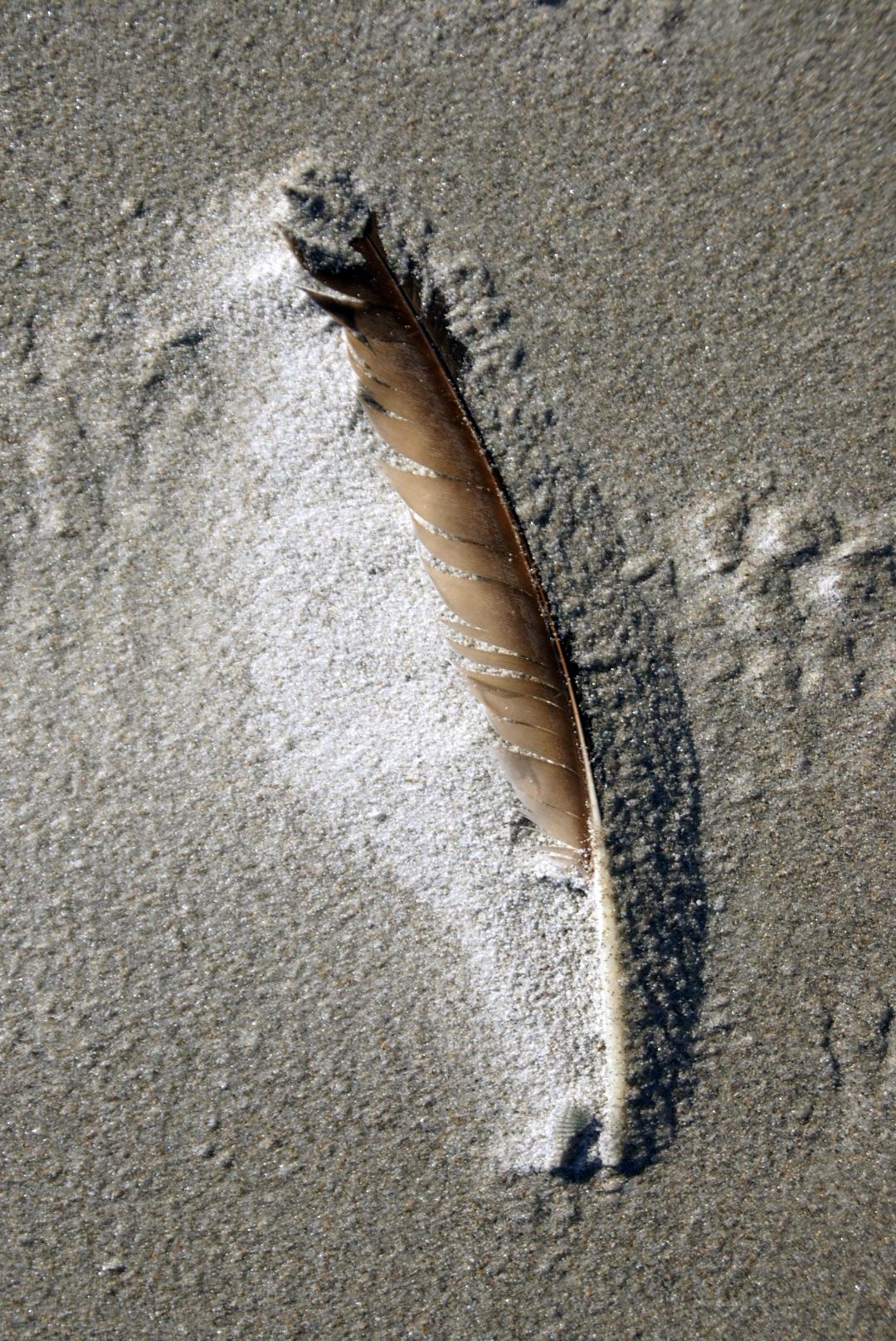
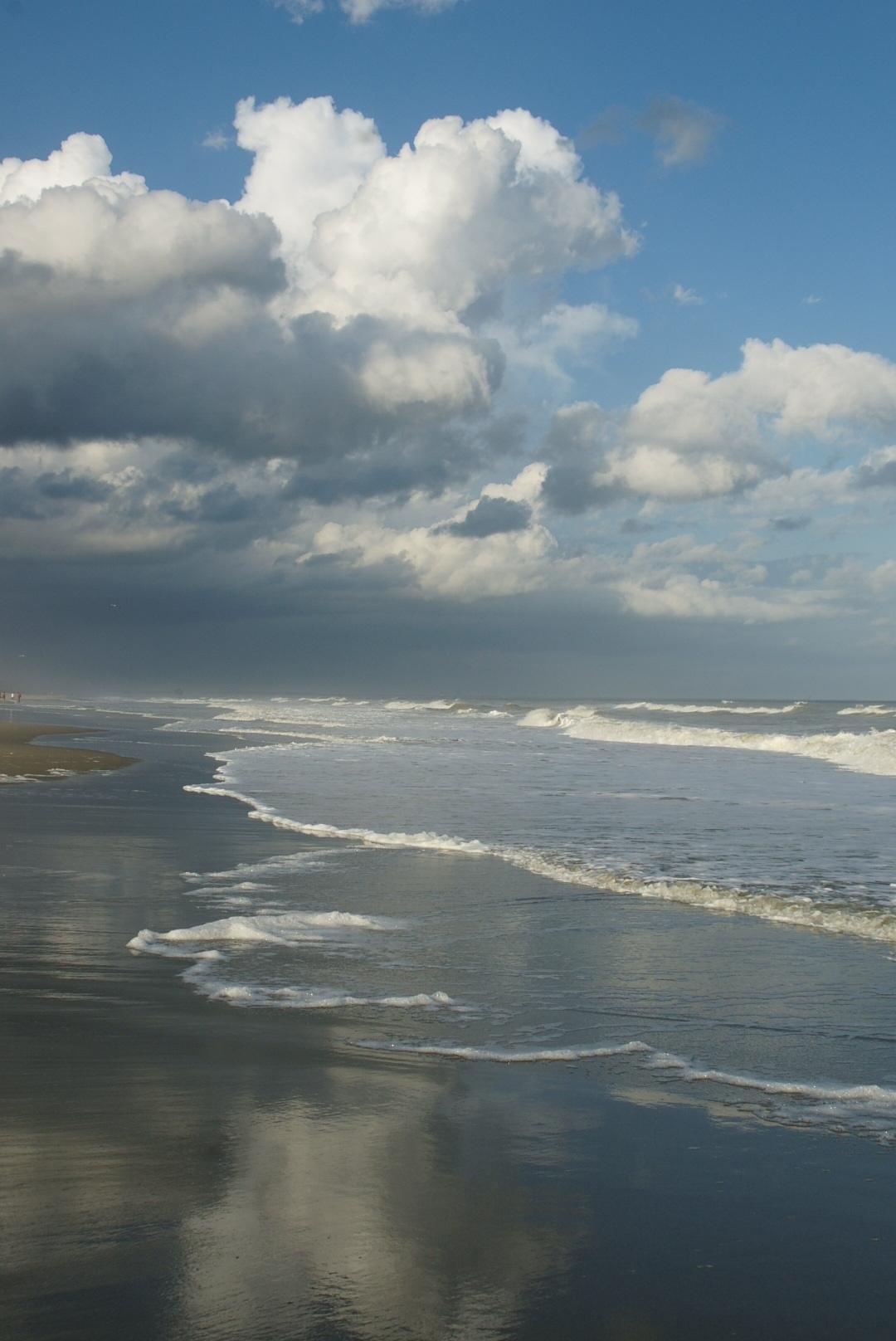
The wind carries the rhythm of the waves as clouds drift across the sky, their reflections shimmering on the sand. A lone feather lies half-buried, a quiet reminder of nature’s gentle yet untamed beauty. In the midst of winter’s rawness, there’s a peaceful stillness, inviting you to pause and take in the moment.


There’s a magic in the embrace of a winter afternoon at Cocoa Beach, where cold northern winds rush down, meeting the Atlantic’s gentle roar. A brush has stroked the heavens; a sky painted with clouds, each towering and shifting, soft yet mighty. With weight and grace, they hang in the sky; some laden with the promise of rain, others light and carefree, echoing the ever-changing rhythm of the sea below. As the sun dips, its rays break through, illuminating the clouds and casting reflections on the wet sand, where the ocean’s kisses linger before retreating back to the deep.

DSC05744Small

The wind tugs at my clothes, my hair, my thoughts. It whispers its secrets, telling stories of distant places, of journeys. With patterns chaotic yet somehow harmonized; waves, frothing and white, crash in sync with the wind’s song. They stretch their fingers onto the shore before retreating, playing an endless game of tag with the land. The sand, smooth and glistening, mirrors the clouds above, creating an ephemeral connection between earth and sky. Both are locked in a fleeting dance, destined to dissolve with the tide.

Amid the sound of wind and water, the sight of a lone feather caught my eye. Half-buried in the sand, its delicate barbs were still intact, though weathered by the elements. It was a remnant of life, a testament to the flight of some seabird now long gone. This feather, in its stillness, speaks volumes—of resilience, of the endless passage of time, of moments lost to the wind yet immortalized in the quiet present. Its grooves, like fine lines etched in sand, tell the story of its journey through the air, carried by forces unseen yet deeply felt.

DSC05792BeachFeathre

The feather, lying motionless yet deeply expressive, becomes a symbol of the paradoxes that fill this beach: the immensity of the ocean, infinite in its expanse, and the simplicity of a single object, caught and held for just a moment. The windswept beach feels vast, stretching endlessly before me, yet each step I take reveals intricate details, like the delicate curves and patterns of shells half-buried in the sand, or the ephemeral foam left behind by retreating waves. Each part of this landscape tells a story—the grand and the intimate, the eternal and the fleeting, all coexisting in perfect harmony.

Standing here, enveloped by the wind and the sea’s whispers, I am reminded of the power of nature to humble and uplift. It strips away the noise of everyday life, leaving only the raw, untamed elements that have been here long before us and will remain long after. There is something deeply spiritual about this place, this moment—where the only sounds are the natural rhythms of the world, unbroken by human intervention. The beach, with its vast openness, encourages introspection, a reflection not only on the external beauty but also on the inner landscapes of the mind.

The wind, relentless and free, stirs a sense of renewal in me. It is a force that clears the air, both literally and figuratively, sweeping away stagnant thoughts and opening space for new ones to emerge. The crispness of the cold air invigorates, reminding me that even in the depths of winter, life continues—whether in the ceaseless movement of the ocean or the endurance of the small feather resting in the sand. There is beauty in the starkness, in the way the beach in winter feels both desolate and alive, silent yet full of sound.

As I walk along the shore, I realize that this windy January afternoon on Cocoa Beach is an experience to feel deeply. The wind, the waves, the sky, the sand—all are part of a larger, connected whole, a living tapestry that, though ever-changing, remains constant in its presence. There is comfort in knowing that no matter how many times I return to this beach, it will always offer something new, yet familiar.

In the end, the beauty of this moment lies in its simplicity and grandeur, in the way it invites contemplation while remaining indifferent to whether or not we notice. The ocean will continue its dance with the shore, the wind will carry its stories, and the feather will eventually be swept away. But for now, in this moment, it is all here, waiting to be seen, felt, and cherished.

Click this link for my Fine Art Photography.

Copyright 2024 Michael Stephen Wills Photography All Rights Reserved.