Glacial Echoes: Dryden Lake Park’s Mirror-Calm Morning in Upstate New York

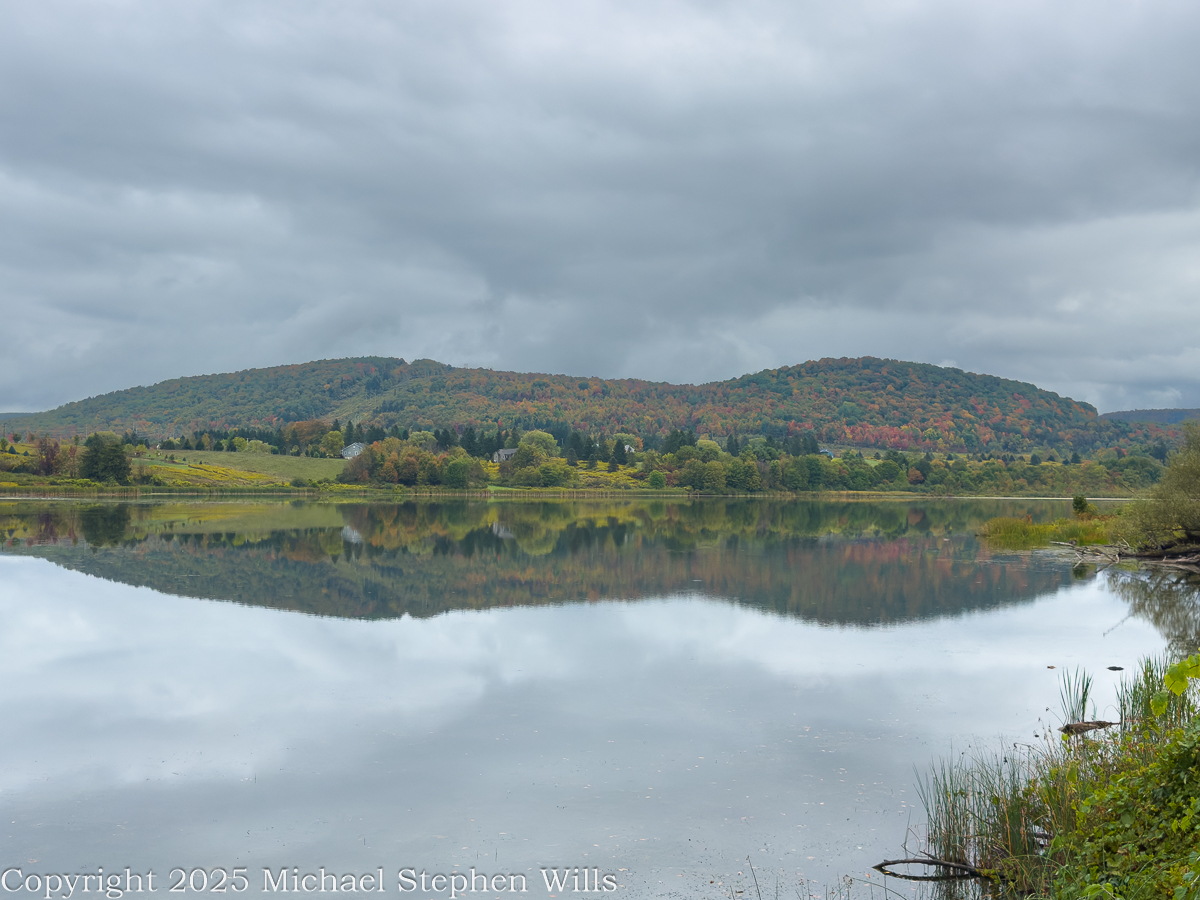
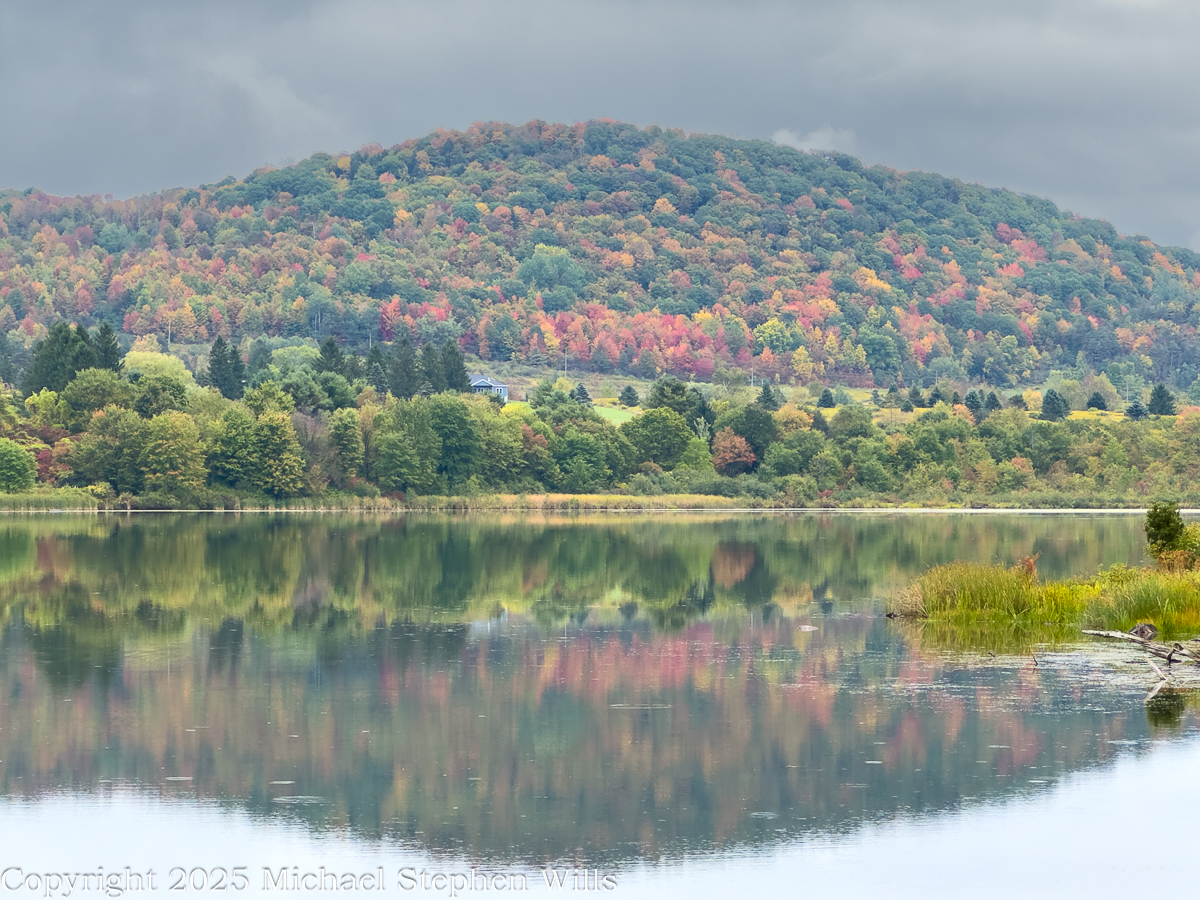
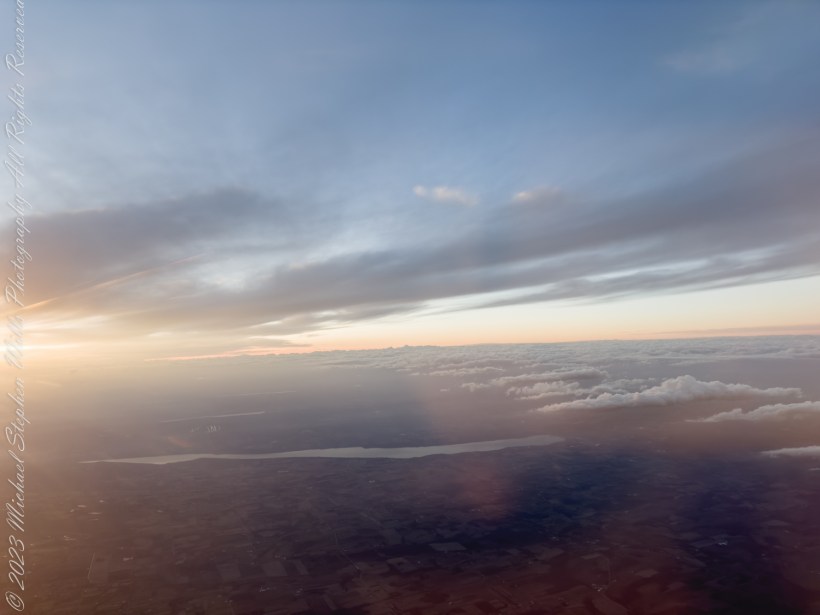
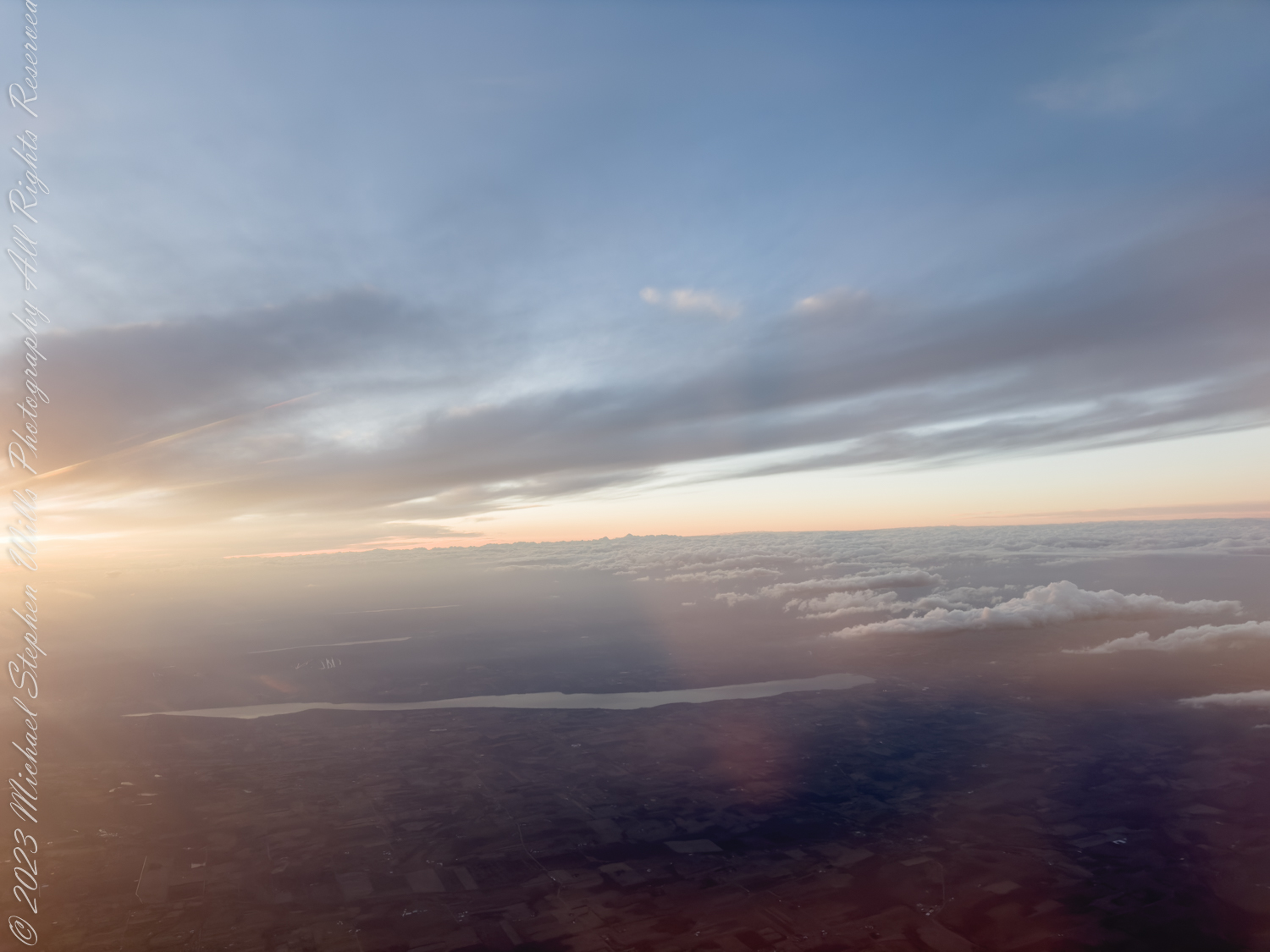
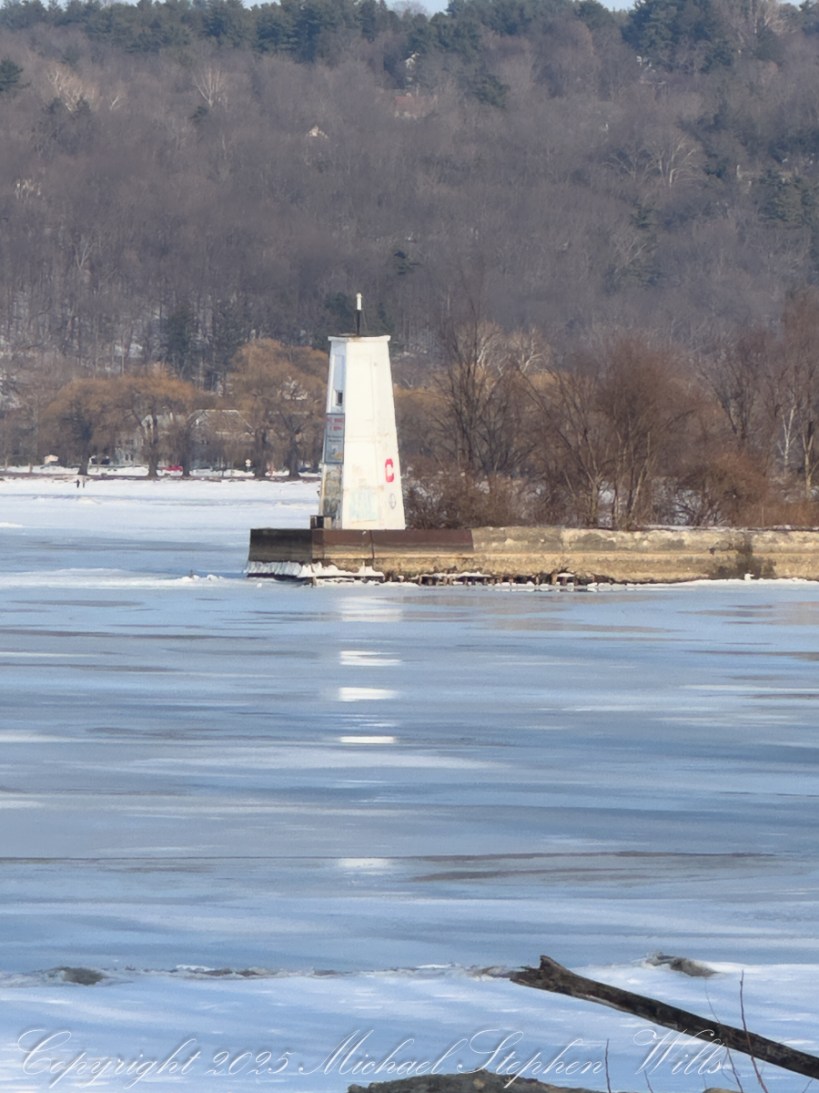
Morning clouds hang over Dryden Lake as hills kindle first color; reflections hold breath while a lone walker reads the valley’s glacial and human-written past.

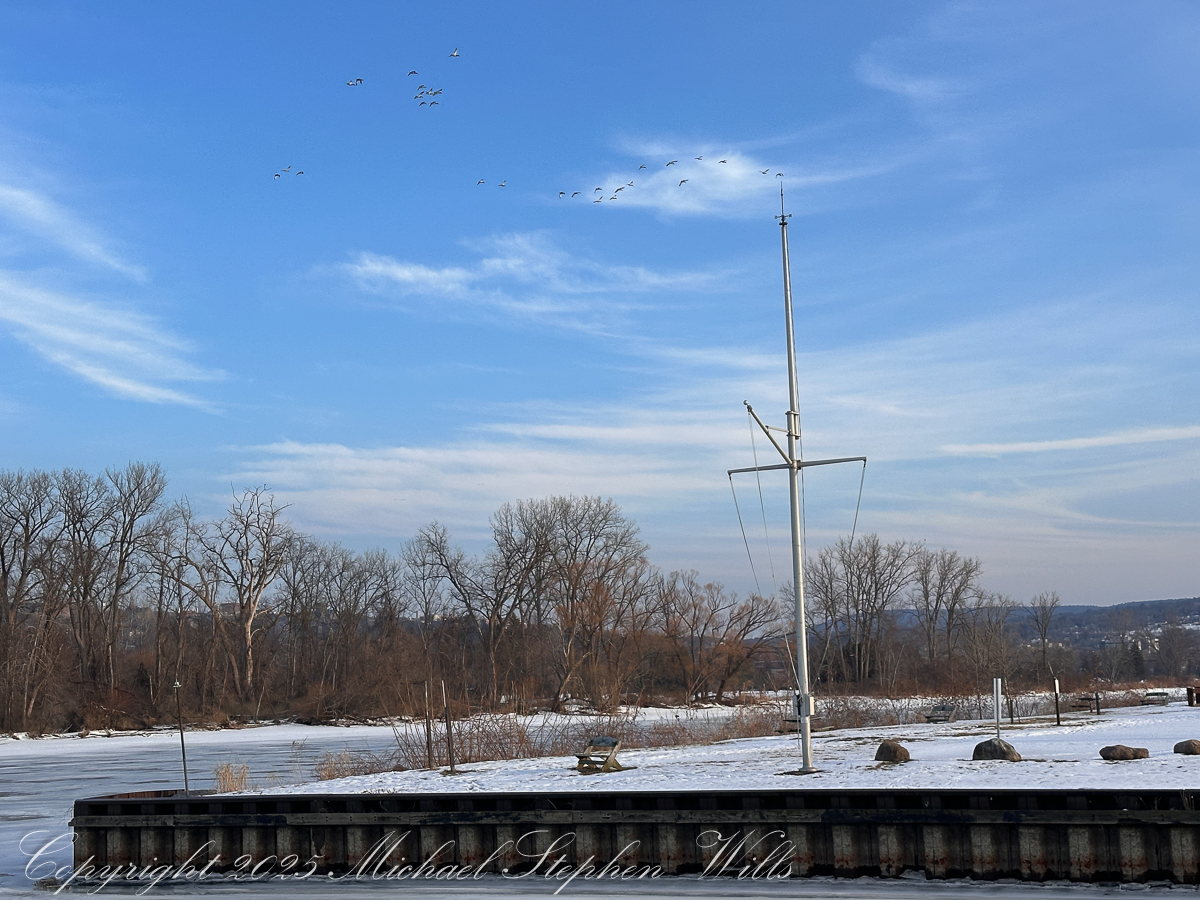
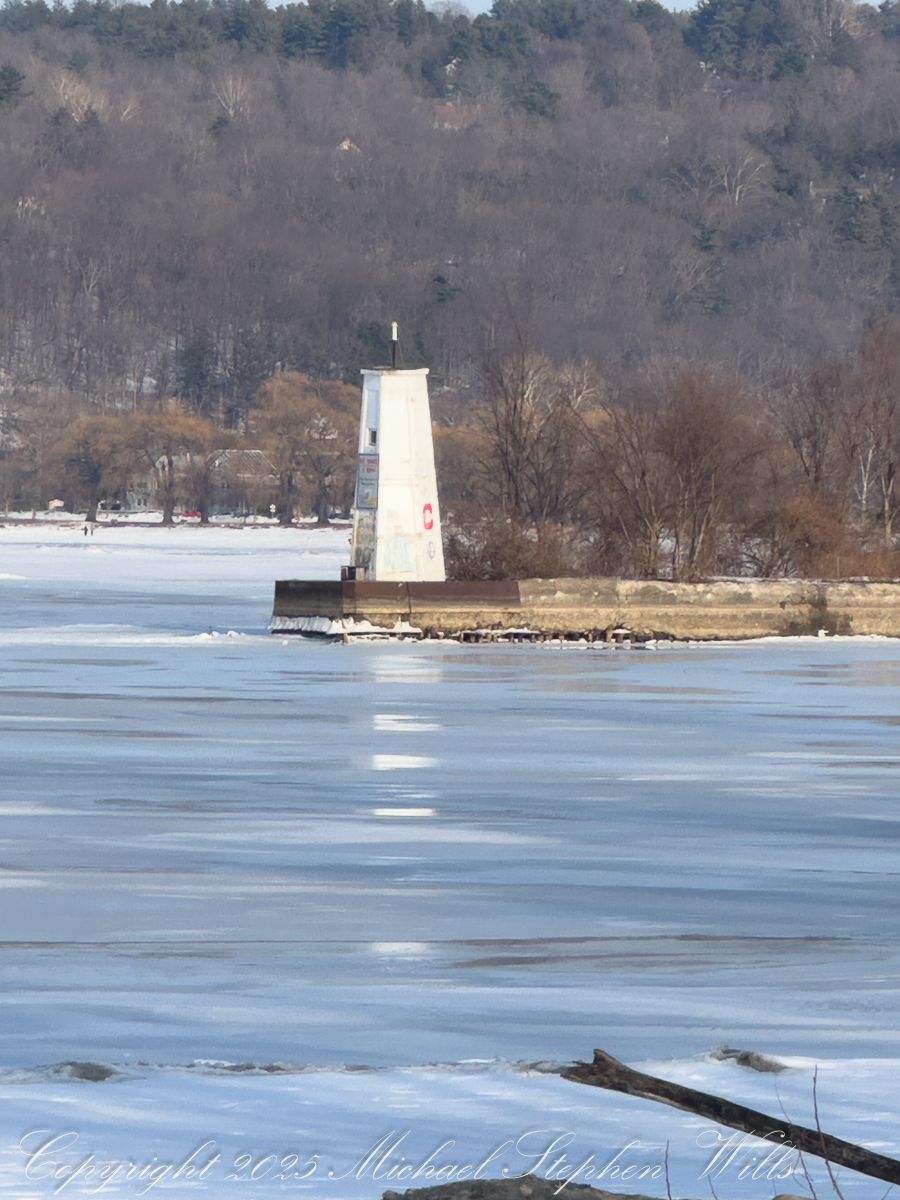
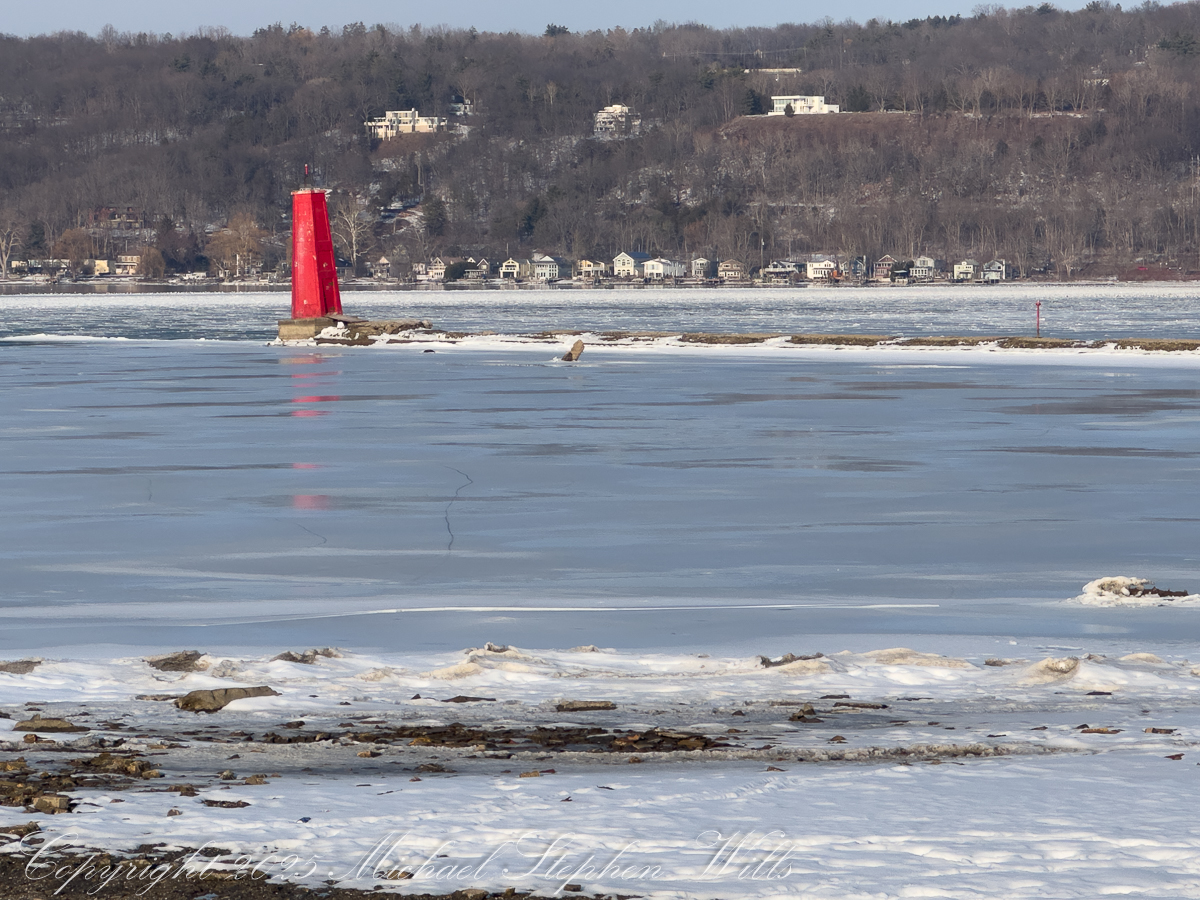
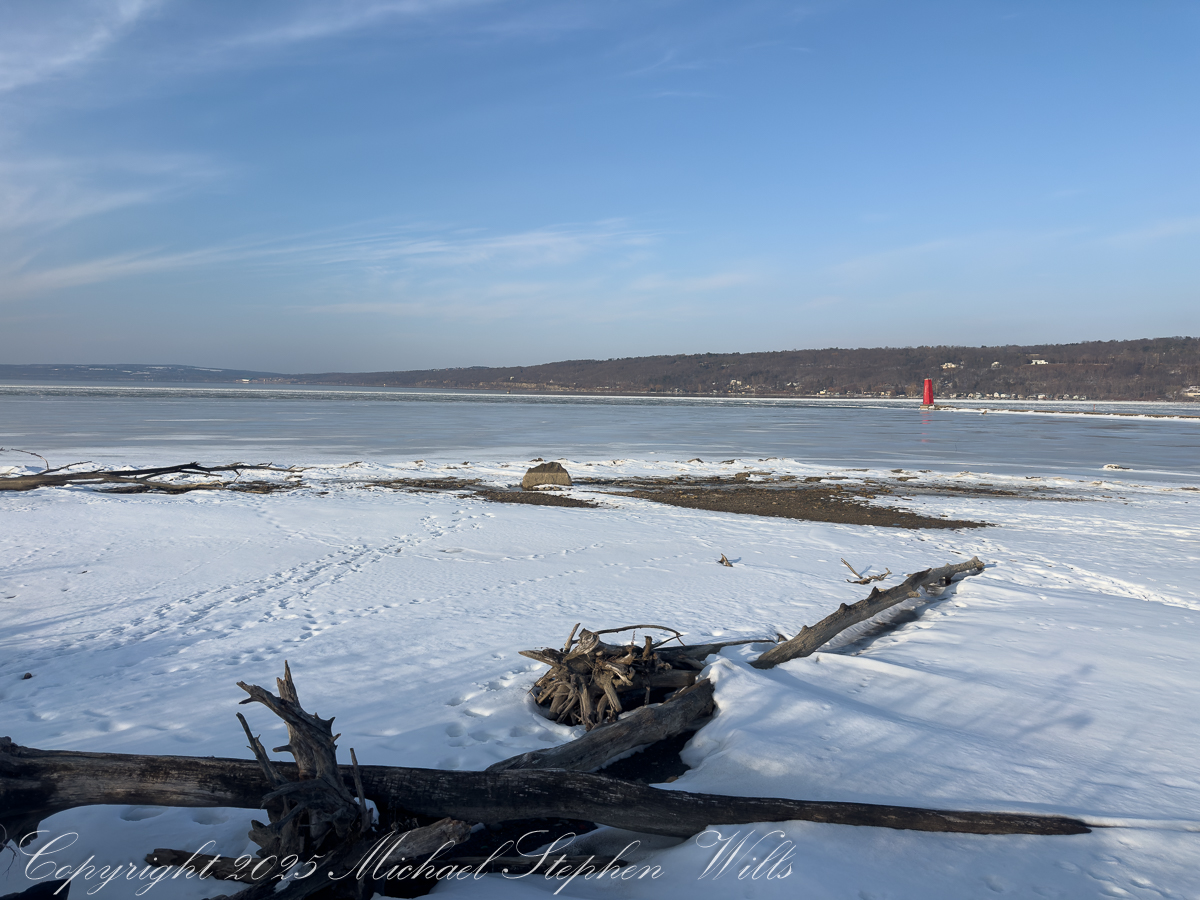
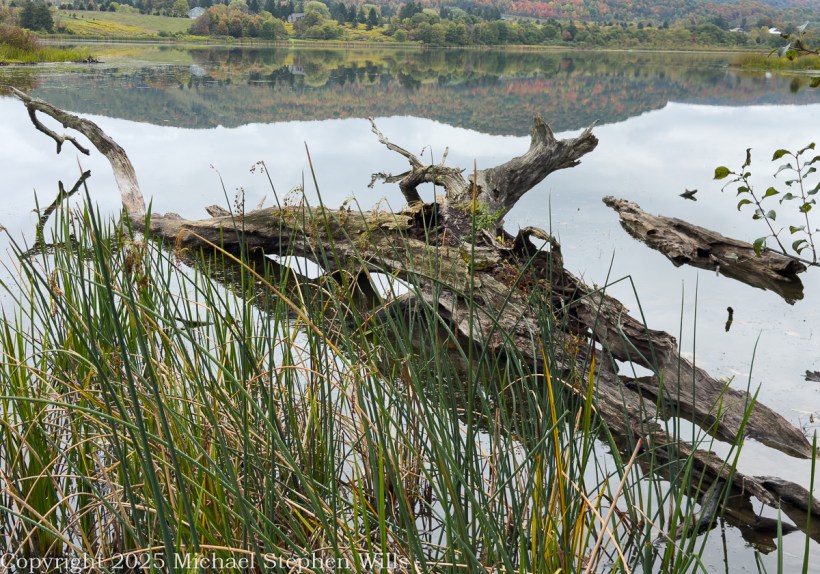
He came to the water before the people woke, the road a still ribbon of cold tar snaking beneath the low hills. Mattocks of cloud hung over the valley and the lake took in the sky like a mirror dropped yet not broken. The trees were beginning to color. A patient fire working from within the leaves. He parked where the grass ran down to the shore and stood a long while without moving. Birds made small sounds in the reeds. Somewhere a single truck labored up the grade and was gone. The surface held the hills with a steadiness the hills themselves could not keep. He thought how the quiet of a place can be the loudest thing it owns.

He went along the margin along the damp sedges where old drift lay silvered and light as bones. A drowned trunk angled from the shallows. The lake was old in the way of things made by ice and time. A kettle in the outwash of the last glacier, some men said, a bowl left when the buried ice eased away. He pictured the ice receding into the valley heads, the meltwaters choked with gravel, a hand larger than memory scribing the floor of this country. The earth never told it plain but the lay of it was witness enough. Across later centuries men cribbed a dam across the outlet and drew the water to a shape that pleased them and served their work.

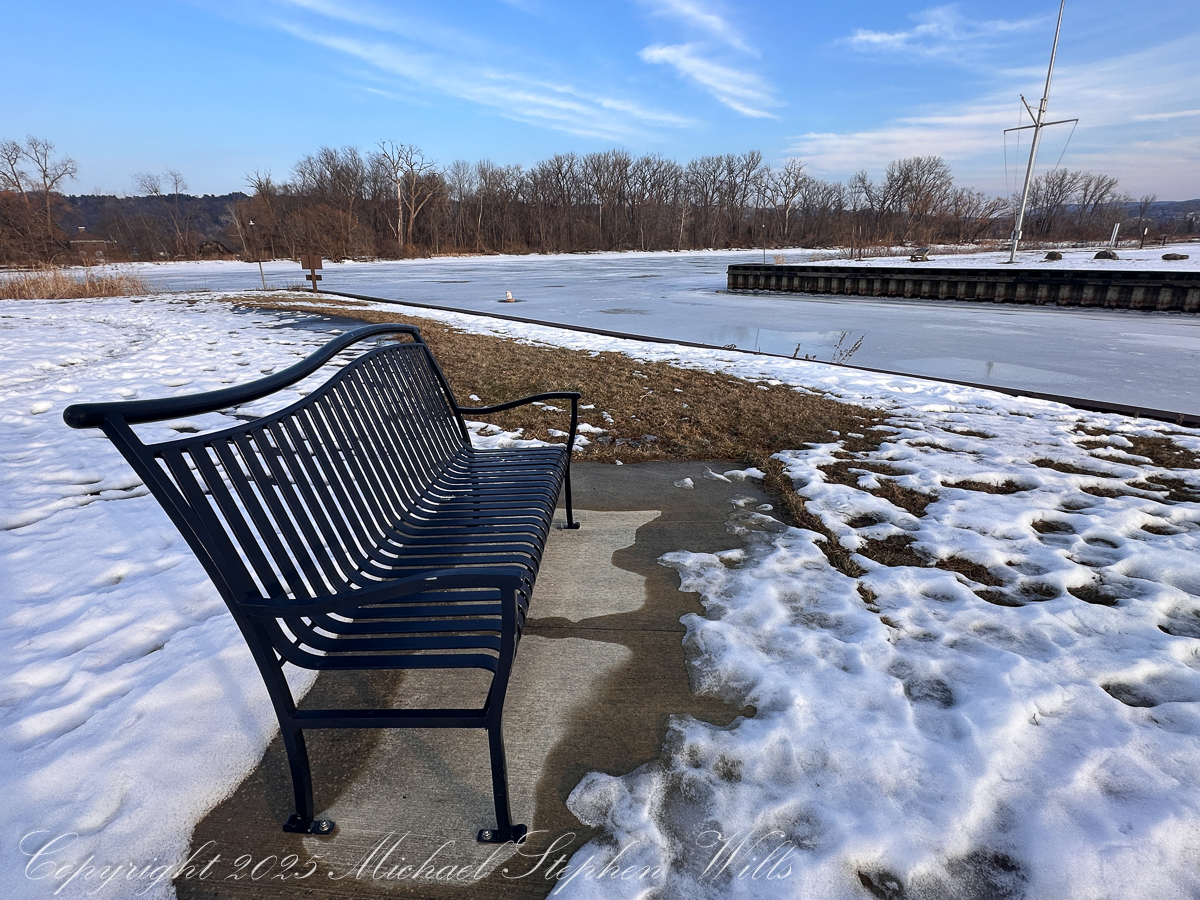
A trail ran the length of the water on the old rail bed. The ties were long gone and the iron and cinders buried under years of leaf fall and gravel. He had walked it as a boy beside his father and now he walked it alone. Benches stood at half-mile intervals like waystations in a country of small pilgrimages. The signs told what once was here and what remains. They had renamed the path for a townman who argued it into being after the railroad had passed from the world and the right-of-way grew up with sumac and rumor. It was an easy trail and he carried nothing. His hands hung at his sides as if the day might place something in them when it was ready.

In another era the lake was a workshop. Men whipsawed timber in the wet air and fed small mills with the grove’s dark boards. Winter flowed over the flats, and they built icehouses and set the blocks within like blue stone, an industry that died when cold could be called from a switch. The hills have learned to forget the noise of it, though on certain mornings the fog takes a shape and you could believe rising from the ponded sawdust and the lading of sleds. He thought of the labor of those gone hands and of how work is a scripture every place keeps in its own tongue.

Before any of that, the ground here was a summer camp. People came with the season and went with it, laying their fires in the lee of the knoll and taking fish where the cattails thin. He could feel them in the open places, not as ghosts but as the first understanding the land ever had of itself. The words used for them now are museum words, yet the wind still crosses the water as it did and empties the same smell of iron and leaf into the lungs of whoever stands to breathe.

The town took its name from a poet long dead, a scholar’s choosing in the years after the war for independence when this tract of country was parceled out to soldiers of that same war. Virgil lay to the east as if they were shelving Latin across a map. The creek that bears that name threads the villages and finds Fall Creek at Freeville, and the combined waters go their own slow way toward Cayuga where the glacial hand scooped deeper yet. He said these names under his breath and they tasted of chalk and river stone.
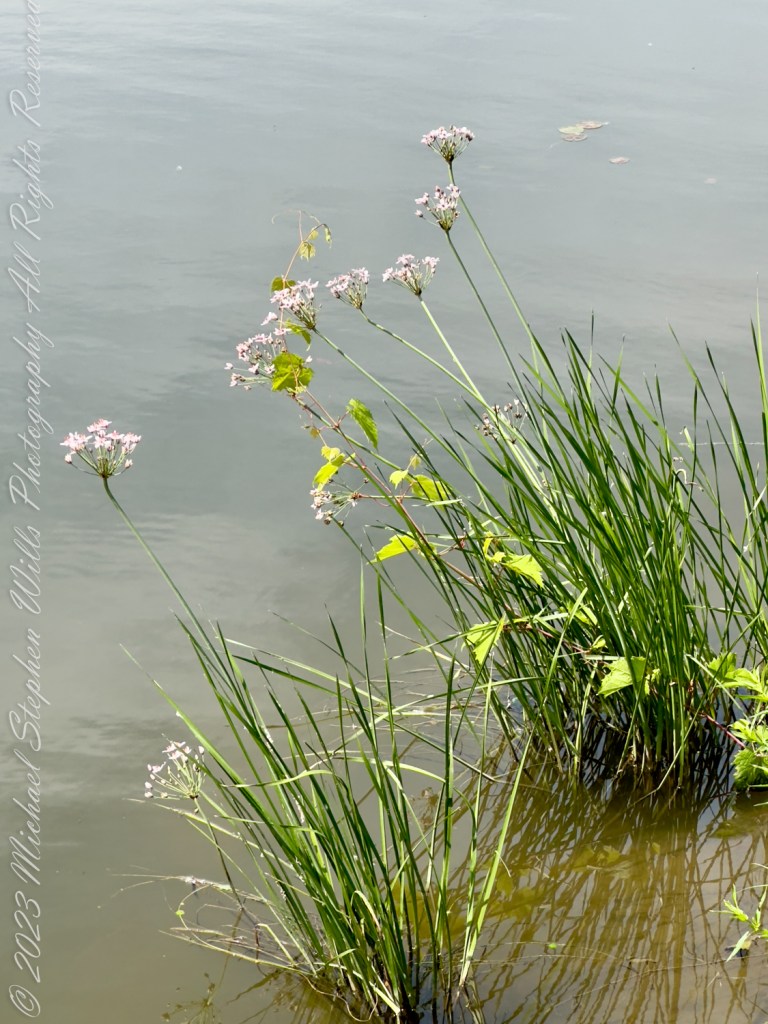
A kingfisher rattled across the cove. The fish rose in rings that spread and vanished like time seen from above. Out on the water an old man pushed a skiff with an electric motor that hummed like a trapped bee, for the lake allows no gas engines now. The wildlife area ran around the shore in a ragged collar of field and wetland and alder, near two hundred acres under the state’s keeping, and the lake itself a little over a hundred. He watched the man aim for the lily line and thought how rules arise from the wish that a thing endure, though nothing does. Still we make the rules and we keep them as if the earth were listening.

Wind came down the slope with a smell of rain. He turned back and the hills lay again in the water, entire, and for a moment he could not tell which world had claim to the other. He thought of the rails pulled up and the mills gone to weeds and of the icehouses fallen into their own shadows and he thought of the people before all that and of the long winter pressing its thumb into the land and lifting it away. He thought of his father walking the rail bed beside him a lifetime ago and saying nothing. There are places where the past crowds close and will not be argued with. He stood until the first drops dimpled the surface and the reflection shattered and reformed. A train no longer runs here. The only sound was the soft percussion of rain on water and the slow turning of the earth beneath both. He put his hand to the damp trunk of a fallen tree and felt the grain and the coolness and the old patient labor of rot. Then he went up from the reeds, his pockets full of acorns, and out to the road where his truck waited and the day, austere and sufficient, came along with him.
References

Geological History and Glacial Formation of the Finger Lakes

Jim Schug Trail

The Dryden Lake area in the 19th century

Indian Campsite on west side of Dryden Lake

Dryden New York (wikipedia)

Dryden Lake (New York State DEC)

Geohydrology, Water Quality, and Simulation of Groundwater Flow in the Stratified-Drift Aquifer System in Virgil Creek and Dryden Lake Valleys, Town of Dryden, Tompkins County, New York

Enter your email to receive notification of future postings. I will not sell or share your email address.

Autumn Reflections: The Majesty of Acer Rubrum

On a serene autumn afternoon by Beebe Lake, a solitary red maple stood out against the backdrop, showcasing its vibrant colors and resilience, symbolizing autumn’s fleeting beauty.

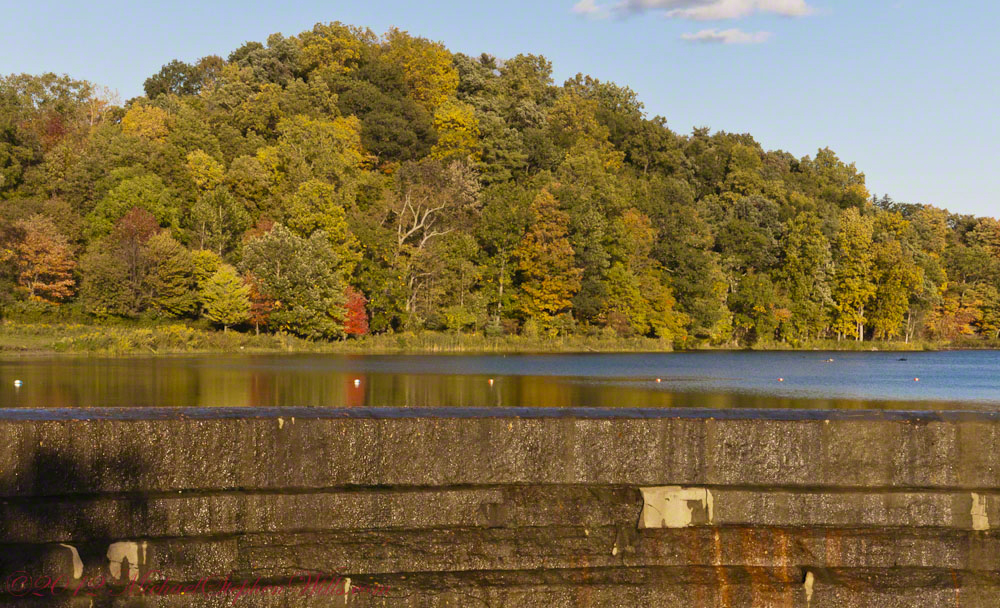
It was one of those serene autumn afternoons that linger in memory, the kind where the sky seems impossibly clear, the air crisp and gently scented with fallen leaves. I stood at the edge of Beebe Lake, my gaze first drawn to the textured concrete dam holding back the water, its weathered facade contrasting sharply with the soft reflections shimmering across the lake’s calm surface. Beyond, the wooded hillside rose gently, a tapestry woven with the warm hues of autumn—golds, greens, oranges, and reds mingling like brush strokes on a canvas.


An October Glory, turning before all others

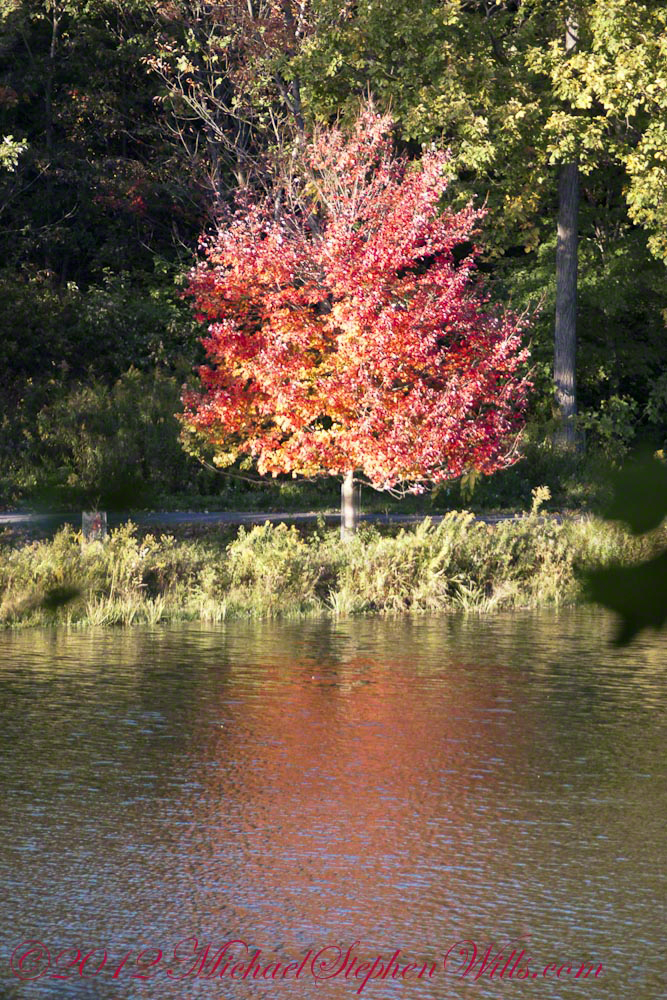
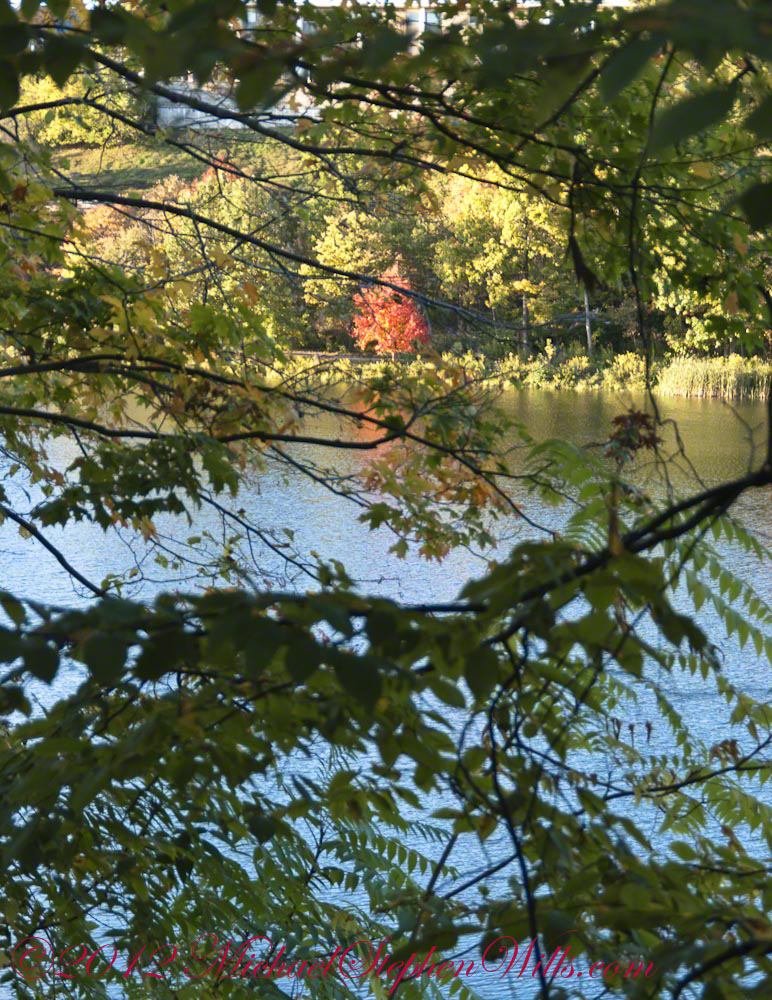
Yet amidst this collective beauty, one tree captured my attention, singular in its brilliance—a solitary red maple standing proudly on the lakeshore. Its leaves had turned a vivid crimson, blazing brightly as though defying the muted earth tones surrounding it. Even from a distance, framed and partially obscured by larger trees, its vibrant reflection cast a fiery echo on the water, rippling softly in the afternoon breeze.

The maple, Acer Rubrum, seemed perfectly at home here, thriving robustly at the water’s edge. I remembered reading how adaptable red maples are, able to flourish in conditions ranging from dry uplands to swampy shores. This spot, near the edge of the tranquil Beebe Lake, seemed to showcase its resilient character perfectly.

Up close, the maple’s glow was even more striking. Its leaves cascaded in fiery clusters, hues deepening from bright scarlet at the tips to a darker maroon closer to the branches. This dramatic gradient seemed symbolic of autumn itself—beautiful, fleeting, and subtly tinged with the melancholy reminder of winter’s approach.

The Red Maple (Acer Rubrum) to tolerant of diverse conditions, making it a perfect choice for this spot on the short of Beebe Lake.

A memory surfaced of early spring in the Finger Lakes region, a time when maples, including this red maple, generously share their sap. Though not traditionally tapped like its sweeter cousin, the sugar maple, this species’ sap can indeed be boiled down into syrup, a surprising sweetness hidden within its sturdy trunk. Standing in its shadow, imagining those early spring days, it seemed astonishing that the same tree could offer both the delicate sweetness of syrup and the fierce beauty now on display.

Curiously, the transformation of the tree appeared methodical yet whimsical—it changed colors from the top down, its upper branches already bare, exposing slender twigs pointing skyward. Like an artist carefully removing layers to reveal something deeper beneath, the maple unveiled its upper bare bones first, as though reminding observers of the quiet strength supporting its autumn splendor.

This Red Maple (Acer Rubrum) turns from the top down and has already bare for most top branches.

As I lingered, taking in this turning tree, joggers passed by along the path, their rhythmic footsteps a gentle percussion beneath the rustling leaves. Briefly, they glanced toward the vivid maple, perhaps drawn, like me, by its striking contrast to the surrounding foliage. It felt like we shared a secret admiration for this singular tree, recognizing in it a quiet assertion of individuality amidst conformity.

Eventually, I viewed the maple once more from afar, framed now by broader sweeps of branches and leaves, partially obscured but no less vivid. Through layers of leaves and dappled sunlight, it glowed like a distant flame, a beacon that seemed to encapsulate the entire mood of the season—warm yet cool, bright yet transient.

The Red Maple (Acer Rubrum) is the first to flower in spring and the first to turn in autumn.

Walking away, the image of that maple lingered, its reflection shimmering gently in the afternoon sun, a moment suspended between summer’s lush vitality and winter’s bare stillness. Beebe Lake had offered scenic beauty, a quiet meditation, a reflection mirrored not only on its tranquil surface but in the heart of an observer captivated by a single tree’s fleeting glory.

Enter your email to receive notification of future postings. I will not sell or share your email address.

A Finger Lakes Afternoon: An Ode to October Splendor

The Finger Lakes’ autumn beauty is vividly captured in photographs showcasing vibrant foliage, intertwining nature and human presence in October 2024.

The Finger Lakes region, renowned for its natural beauty and changing seasons, put on a stunning performance on October 24, 2024. From the vibrant reds of a Japanese maple (Acer palmatum) to the golden hues of oak leaves (Quercus spp.), this photographic journey through our home captures the essence of autumn in upstate New York.

A Panoramic Tapestry

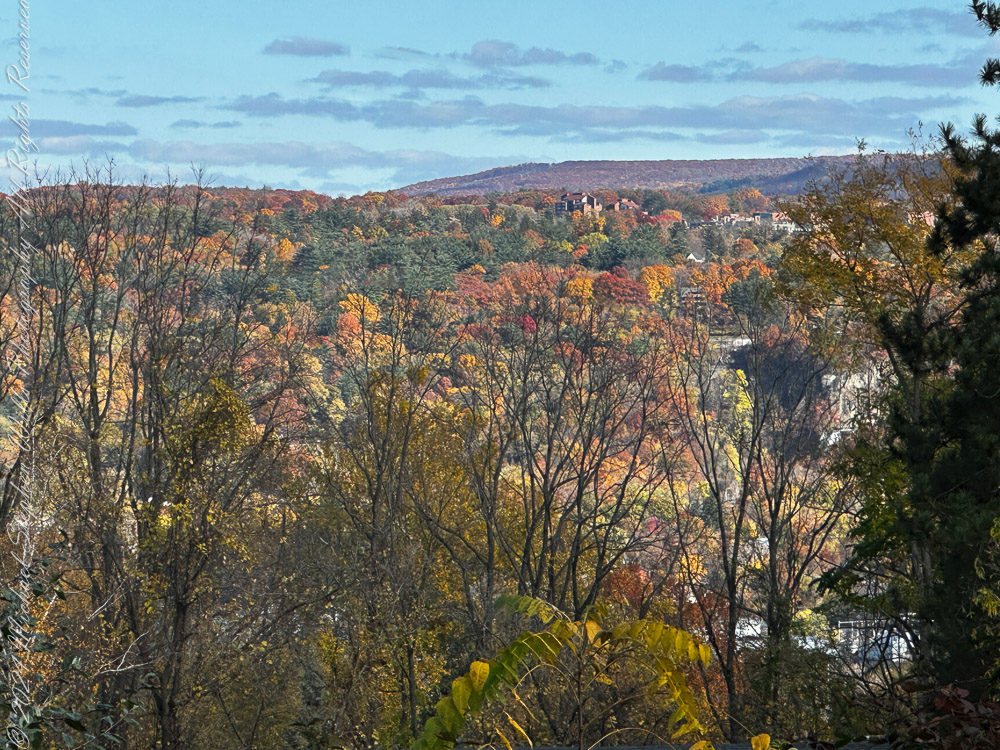
In the first photograph, the landscape unfolds like a watercolor painting. Hills dressed in fiery oranges and golds stretch across the horizon, with hints of evergreen pines (Pinus spp.) providing contrast. The sky, dotted with wispy clouds, serves as a serene backdrop, while the foreground frames the scene with bare tree limbs—a reminder that autumn is both a celebration of life and a prelude to winter’s dormancy. This image evokes a sense of timelessness, connecting us to the rolling hills that have witnessed countless seasons of change.

View from our porch across Ithaca to East Hill, Cornell University, Ithaca Falls on an October 2024 afternoon. Tompkins County, Finger Lakes Region, New York State

Japanese Maple: A Crimson Jewel

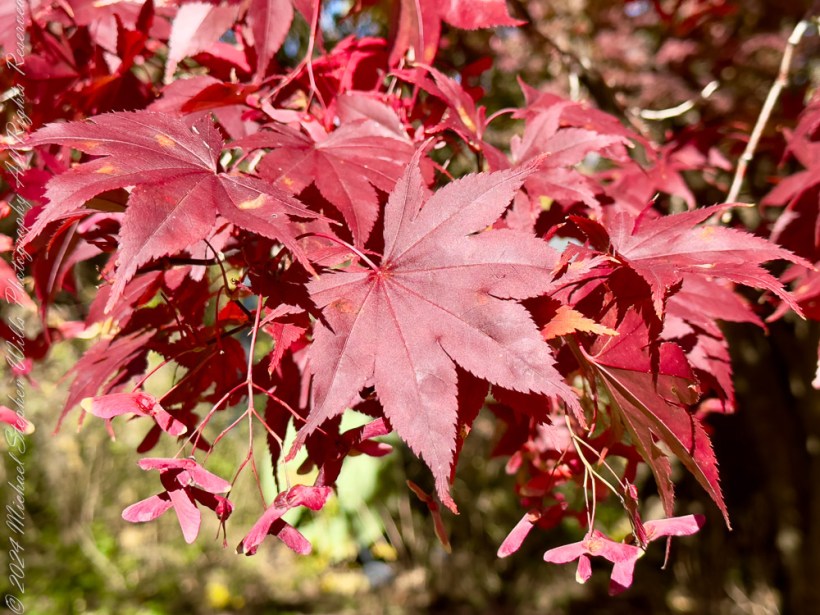
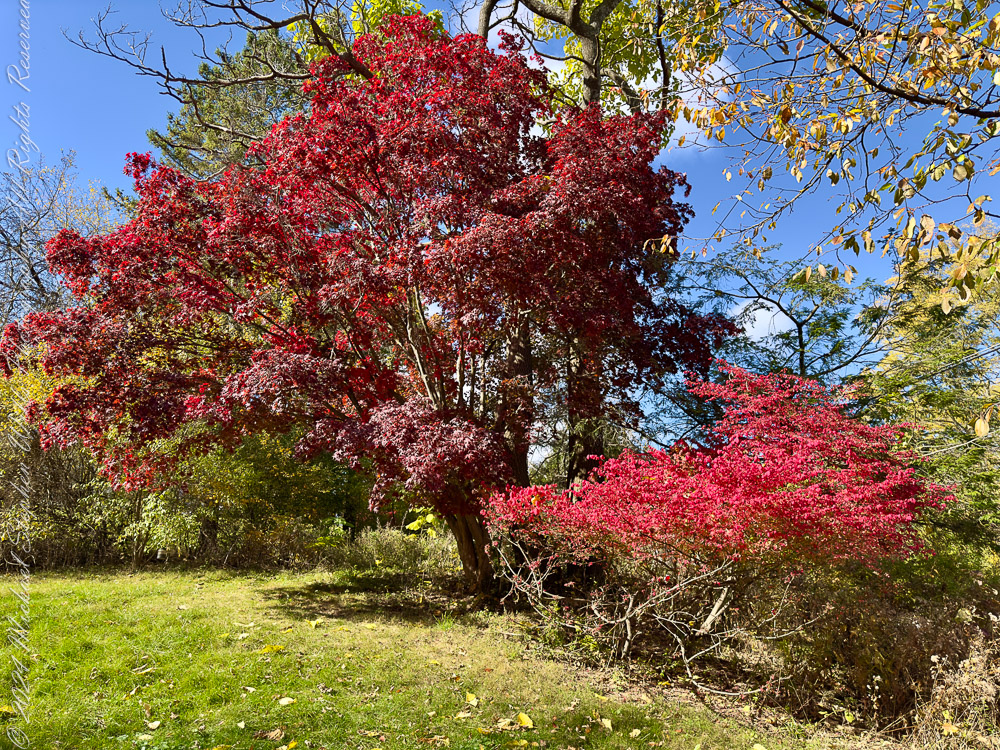
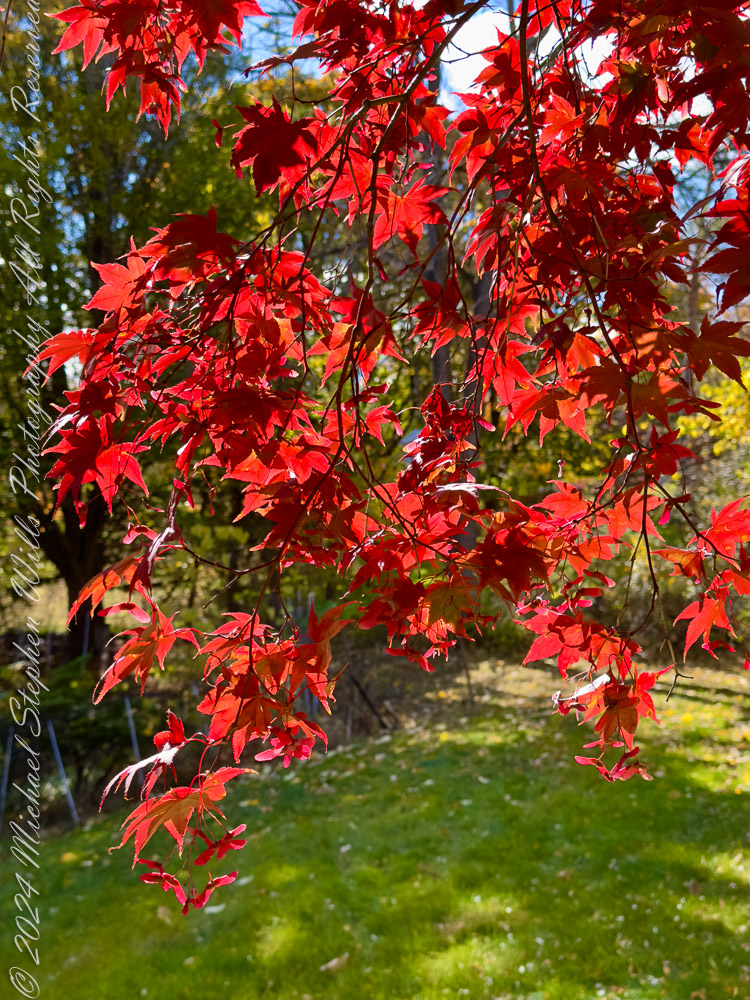
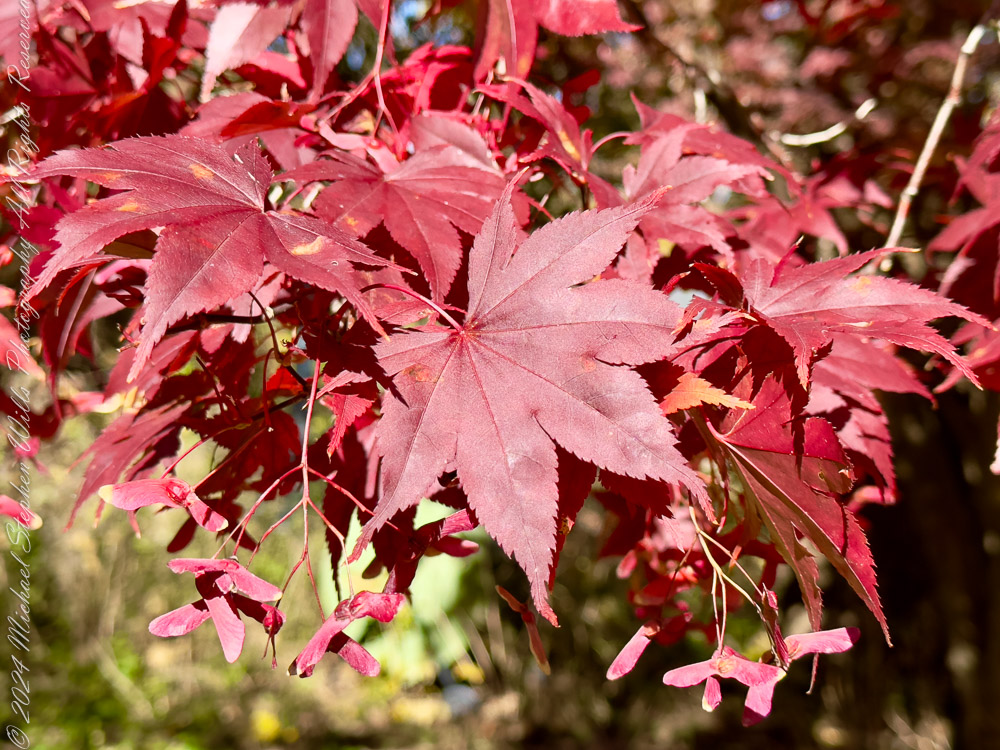
The next series of images focuses on the Japanese maple (Acer palmatum), a tree whose vibrant red foliage becomes a magnet for admiration in autumn. One close-up reveals delicate leaves, their intricate lobes illuminated by the afternoon sun. The interplay of light and shadow transforms each leaf into a tiny stained-glass window. Another photograph showcases the tree in its entirety, a commanding presence against the verdant lawn. It is a poignant reminder of nature’s artistry, where every branch and leaf contributes to the symphony of color.

Home Amid the Foliage

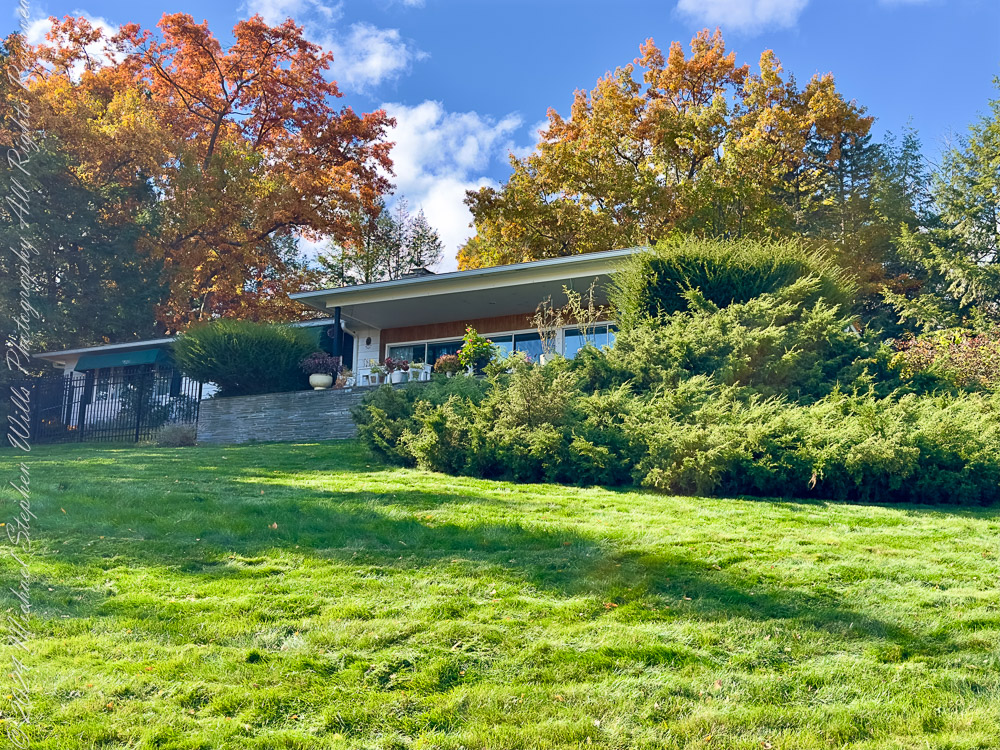
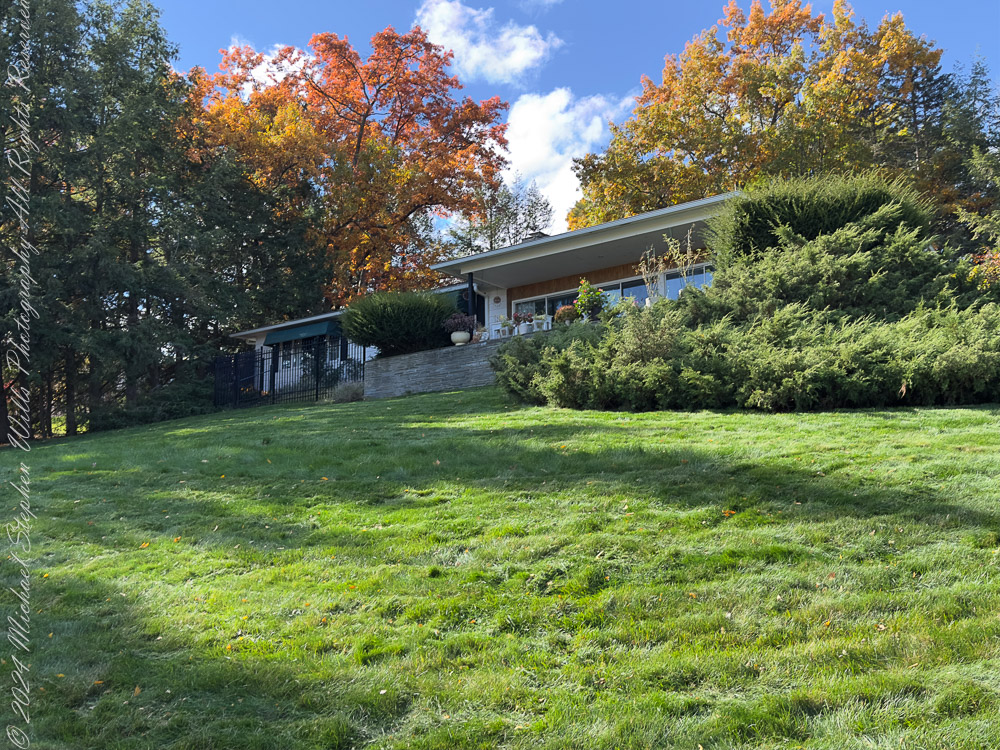
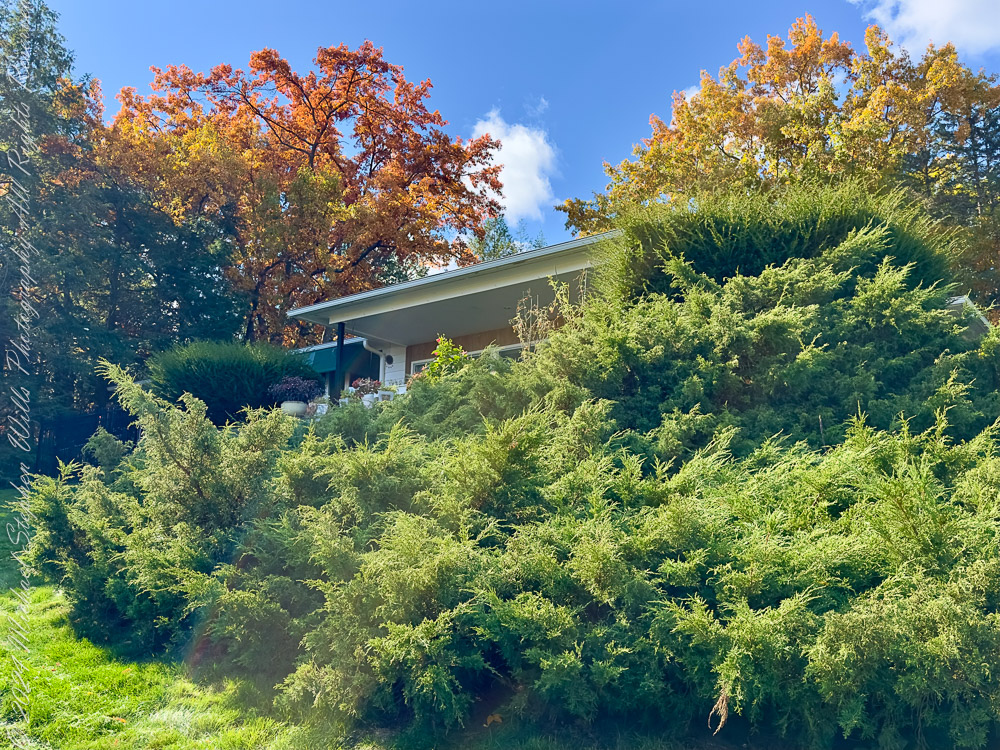
Nestled within this autumnal palette is our home, a mid-century structure that seems almost inseparable from its surroundings. The expansive lawn, a lush carpet of green, contrasts with the fiery colors of nearby oak (Quercus spp.) and maple trees (Acer spp.). In one angle, the house appears almost tucked away, sheltered by Eastern Hemlock (Tsuga canadensis) and junipers (Juniperus spp.) that add a sense of permanence to the scene. This juxtaposition of human habitation and natural splendor underscores how our lives are intertwined with the land we call home.

Oak Leaves: A Study in Texture

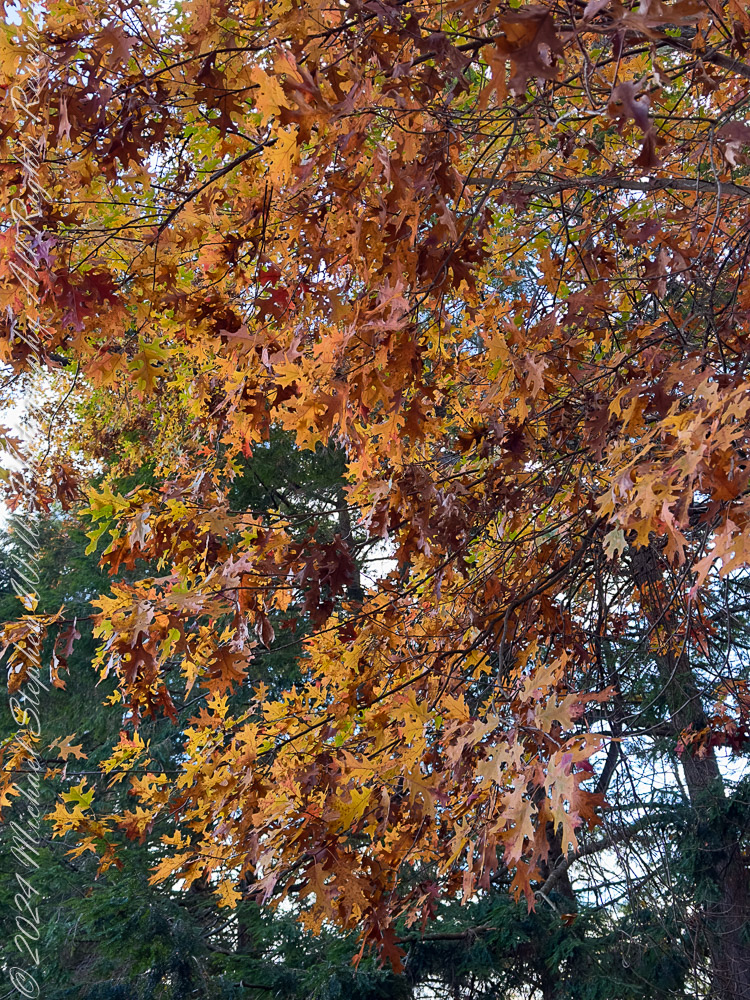
A close-up of oak leaves (Quercus spp.) showcases their rugged beauty, with jagged edges and deep veins that seem etched by time itself. Their colors—ranging from deep amber to burnished copper—are a testament to the richness of autumn’s palette. These leaves, clinging tenaciously to their branches, remind us of resilience and the fleeting beauty of the season.

Our oak tree in autumn colors. Helmock backdrop

Hydrangeas in Transition

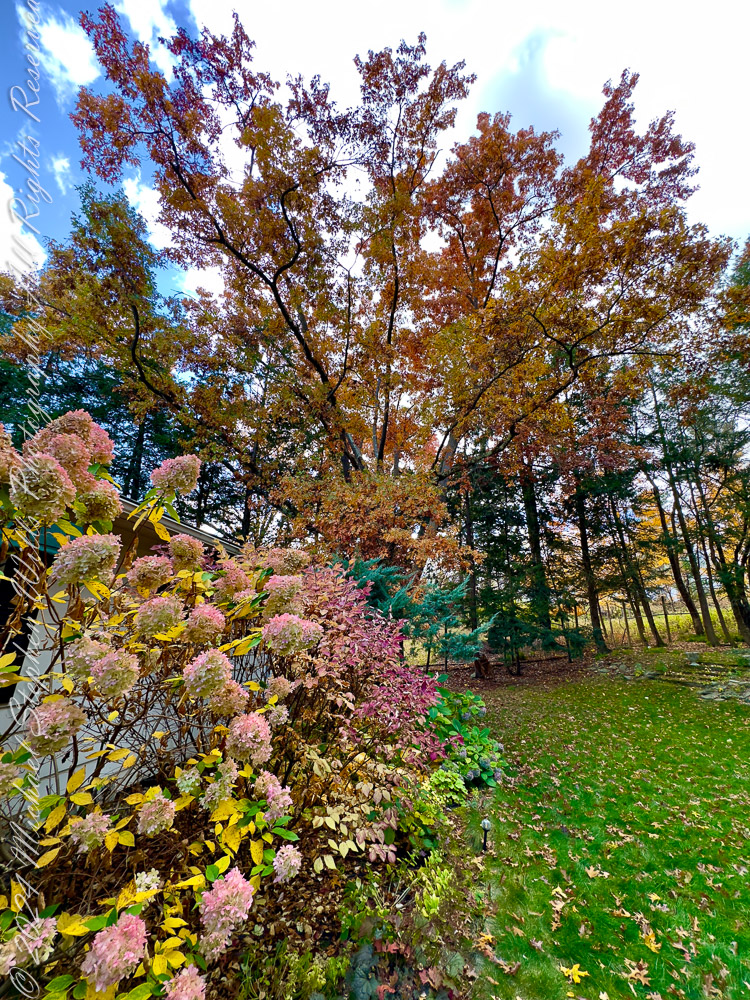
The hydrangea bushes (Hydrangea paniculata) by the house present a softer side of autumn. Their once-vivid blooms have faded to pastel pinks and creams, lending an air of nostalgia. These flowers, in their gentle decline, mirror the transition of the season, where vibrancy gives way to a quieter beauty. The hydrangea blooms seem to whisper the story of the summer past, offering a delicate contrast to the bolder hues of the surrounding trees.

Our oak tree in autumn colors. Pam’s hydrangia.

The Resilient Shrubs

Creeping Juniper (Juniperus horizontalis), here in the foreground, provides a grounding element in the composition, with a steadfast green the reminder of life persisting even as deciduous leaves fall. The dense shrubbery near the house creates a protective cocoon, framing the building with a sense of natural security. The dynamic interplay between these evergreens and the changing foliage of maples and oaks reflects the layered complexity of this landscape.

Reflections on an Afternoon

As I wandered through these scenes with camera in hand, I was struck by the interplay of light, color, and texture. Each photograph captures a fleeting moment, a slice of a season that, despite its predictability, never fails to surprise and inspire. Autumn in the Finger Lakes is a time of reflection, a reminder to pause and appreciate the world around us.

These images, taken on a single afternoon, tell a story of a landscape alive with color and character. From the steadfast junipers to the delicate hydrangea blooms, from the fiery maples to the enduring oaks, they invite us to celebrate not just the beauty of nature but also our place within it—a home nestled among trees that have stood for decades, witnessing the rhythms of the earth.

Enter your email to receive notification of future postings. I will not sell or share your email address.

The Enchantment of Autumn Over Cascadilla Gorge

Join me for a serene autumn walk in Ithaca, appreciating nature’s beauty, impermanence, and the calming rhythms of life.

A few days before Halloween, I found myself on the rim of Cascadilla Gorge, Ithaca’s autumnal crown jewel. The air had that crisp October quality, each breath carrying a hint of the colder days to come yet still tempered by the lingering warmth of early fall. A breeze carried a scent of damp earth and decaying leaves, a rich, organic aroma that signaled the turning of the seasons. The path beneath my feet was a tapestry of fallen leaves—russet, gold, and burnt orange—a natural carpet leading me through a world suspended between vibrancy and rest.

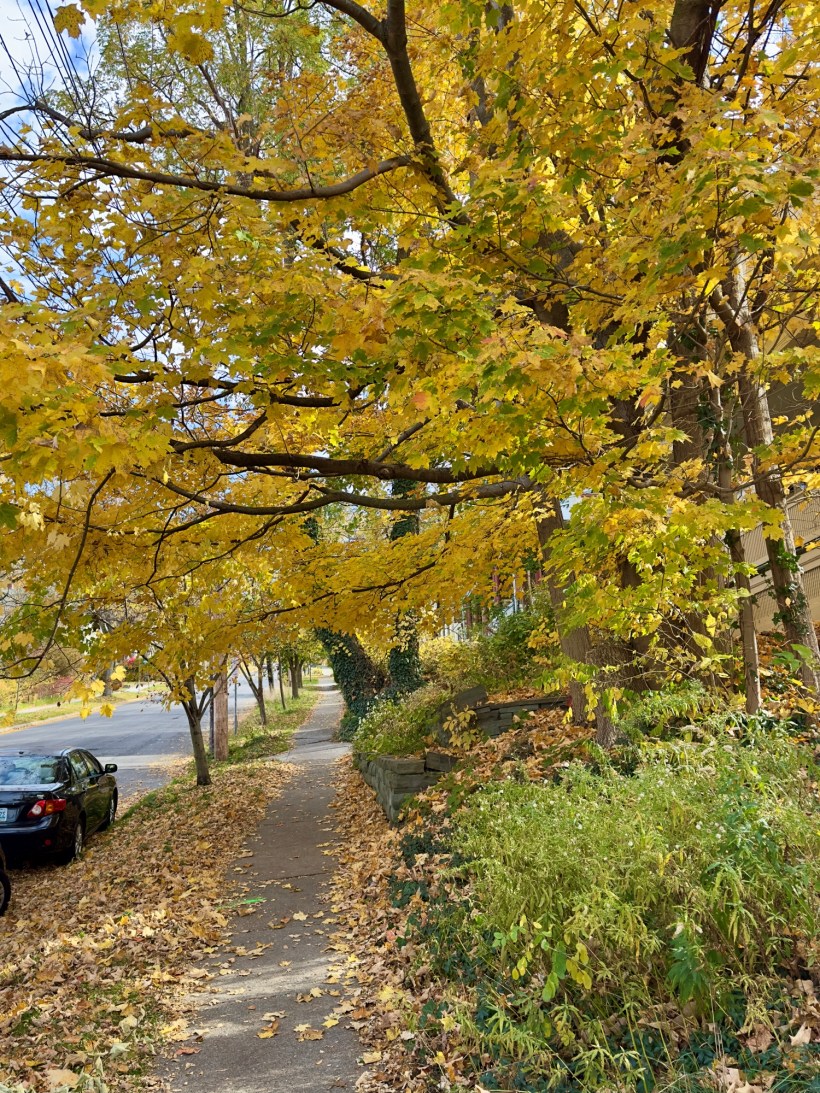
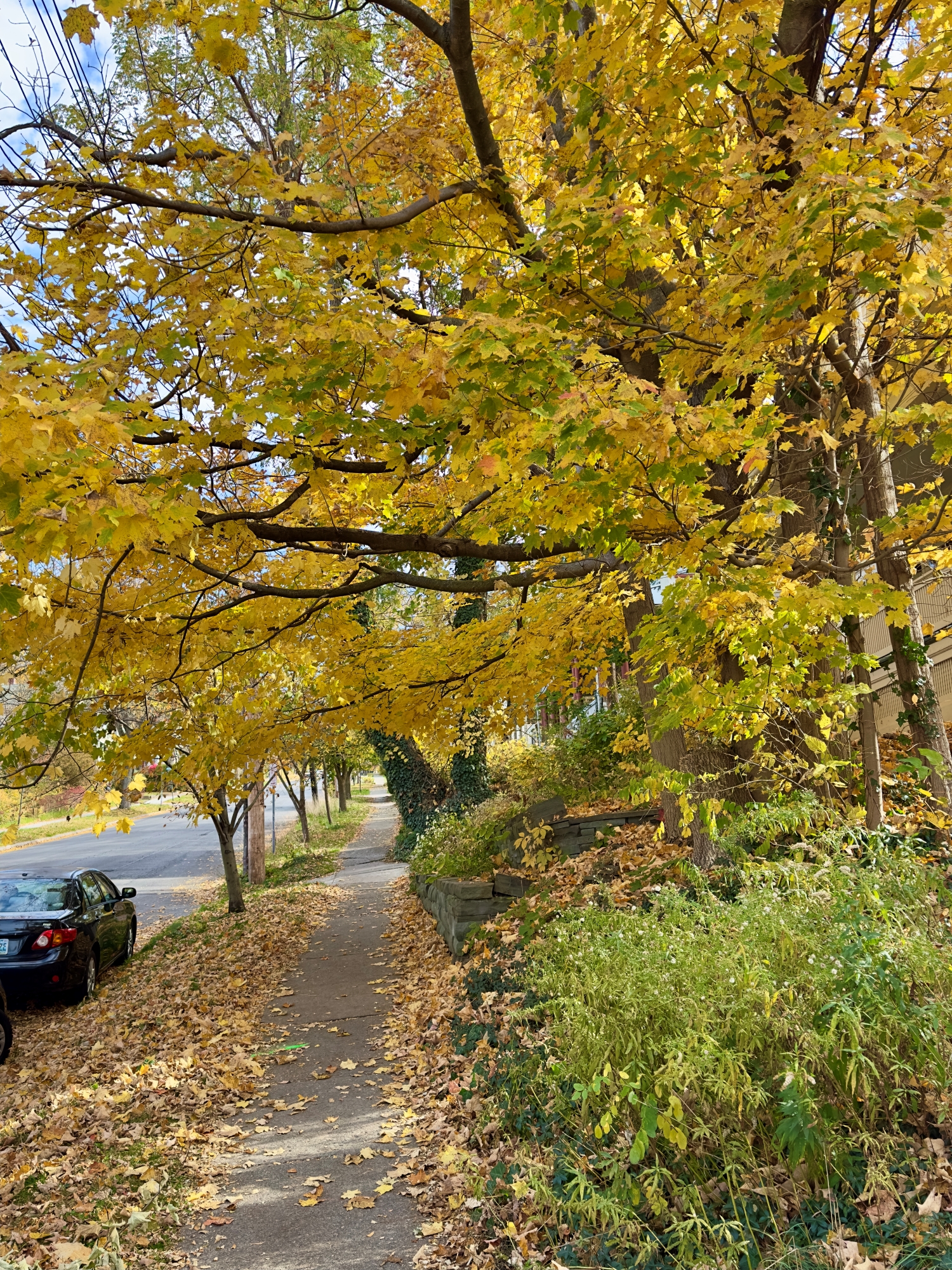
Golden Canopy over Buffalo Street Sidewalk

Continuing up Buffalo Street, I marveled at the trees, their branches thick with yellow and gold leaves, creating a canopy above. The leaves shivered with every gust, whispering the ancient secrets of the forest. The air was infused with the sweet, woody fragrance of maple and oak, mingling with the faint scent of chimney smoke from nearby houses. The sunlight filtered through, casting a dappled pattern on the sidewalk, a fleeting mosaic as the leaves danced in the wind. A sense of impermanence struck me; soon, these leaves would be gone, leaving bare branches silhouetted against a winter sky.

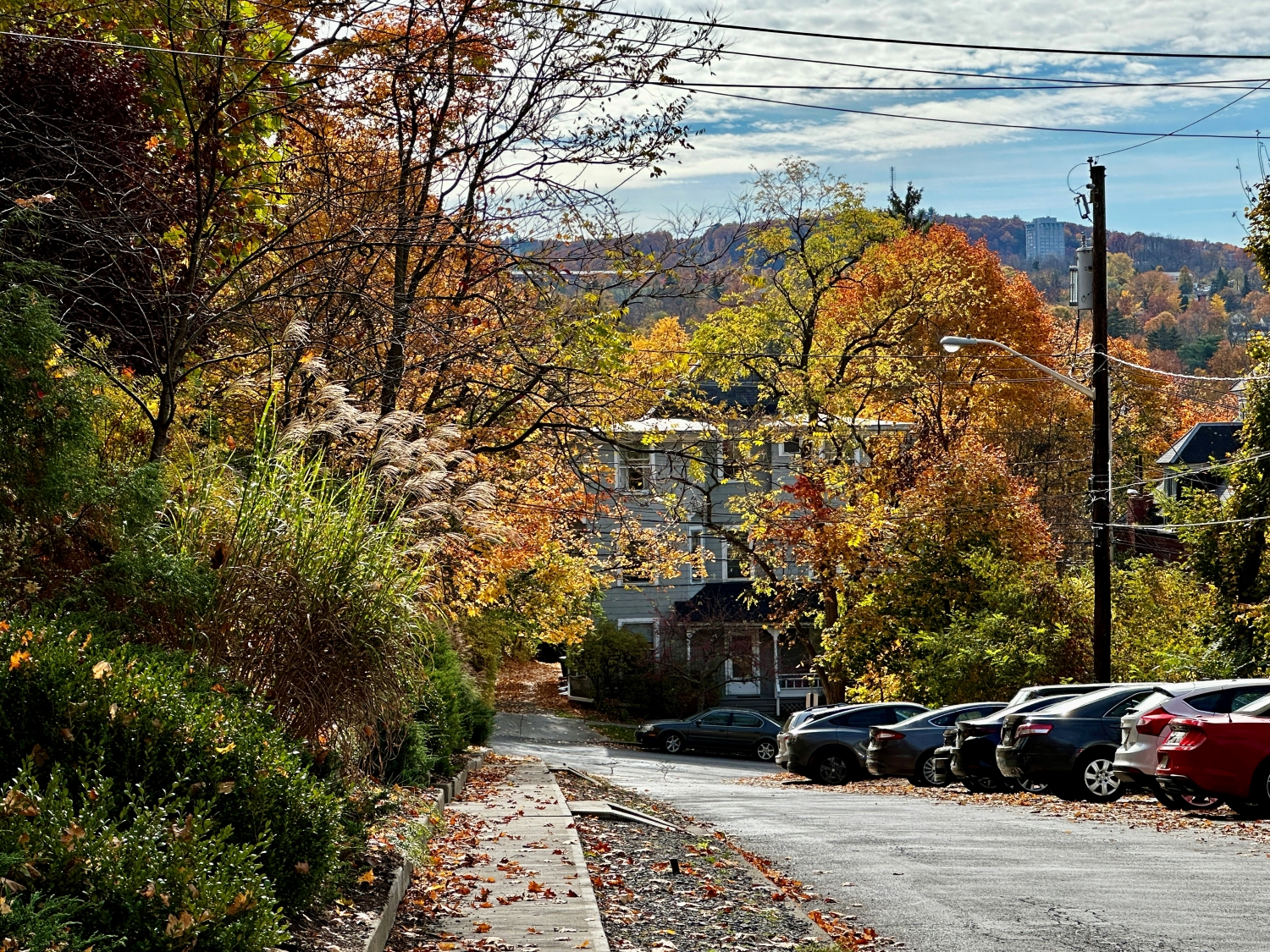
Scene from Dewitt Place toward South Hill and Ithaca College

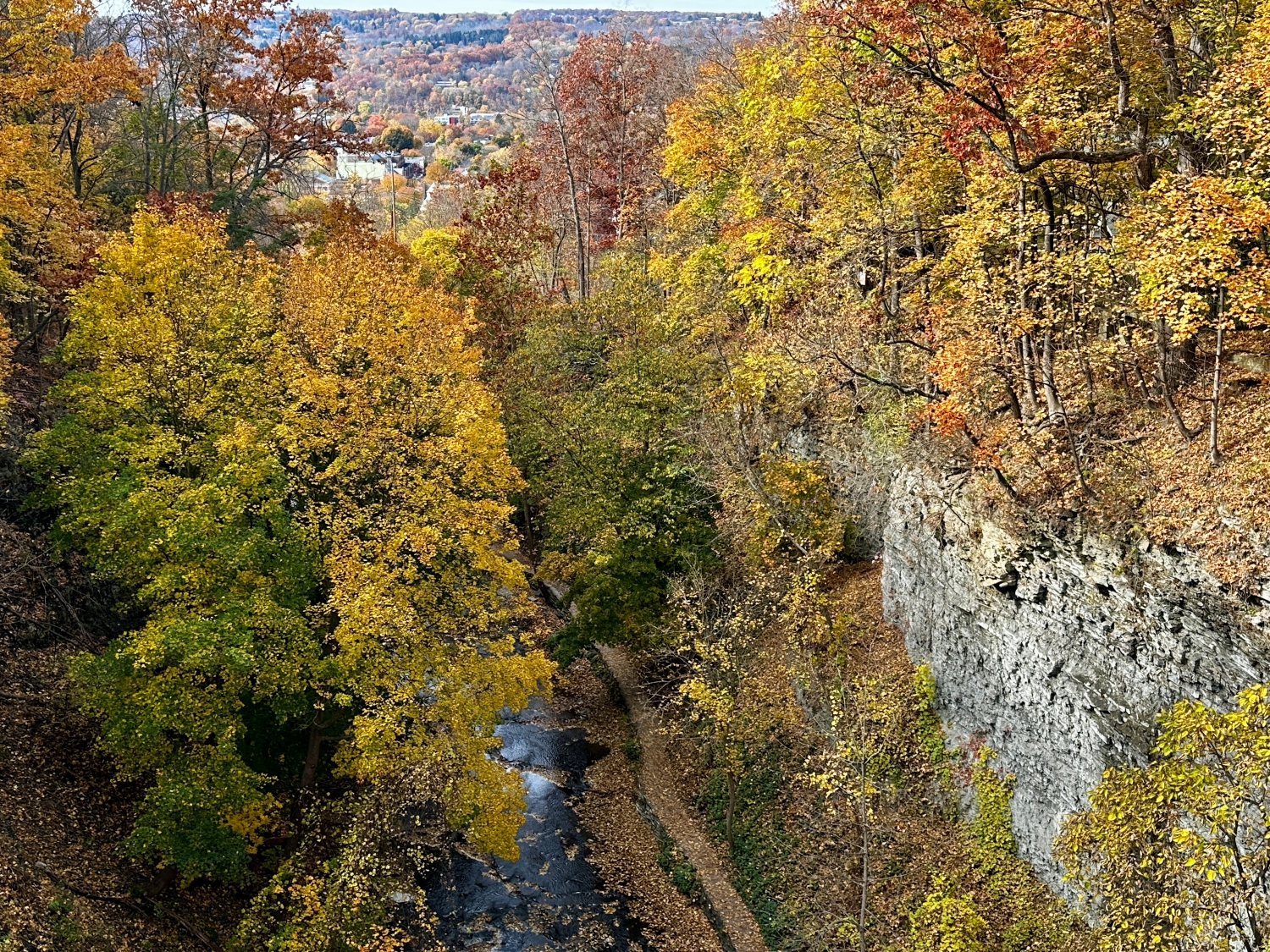
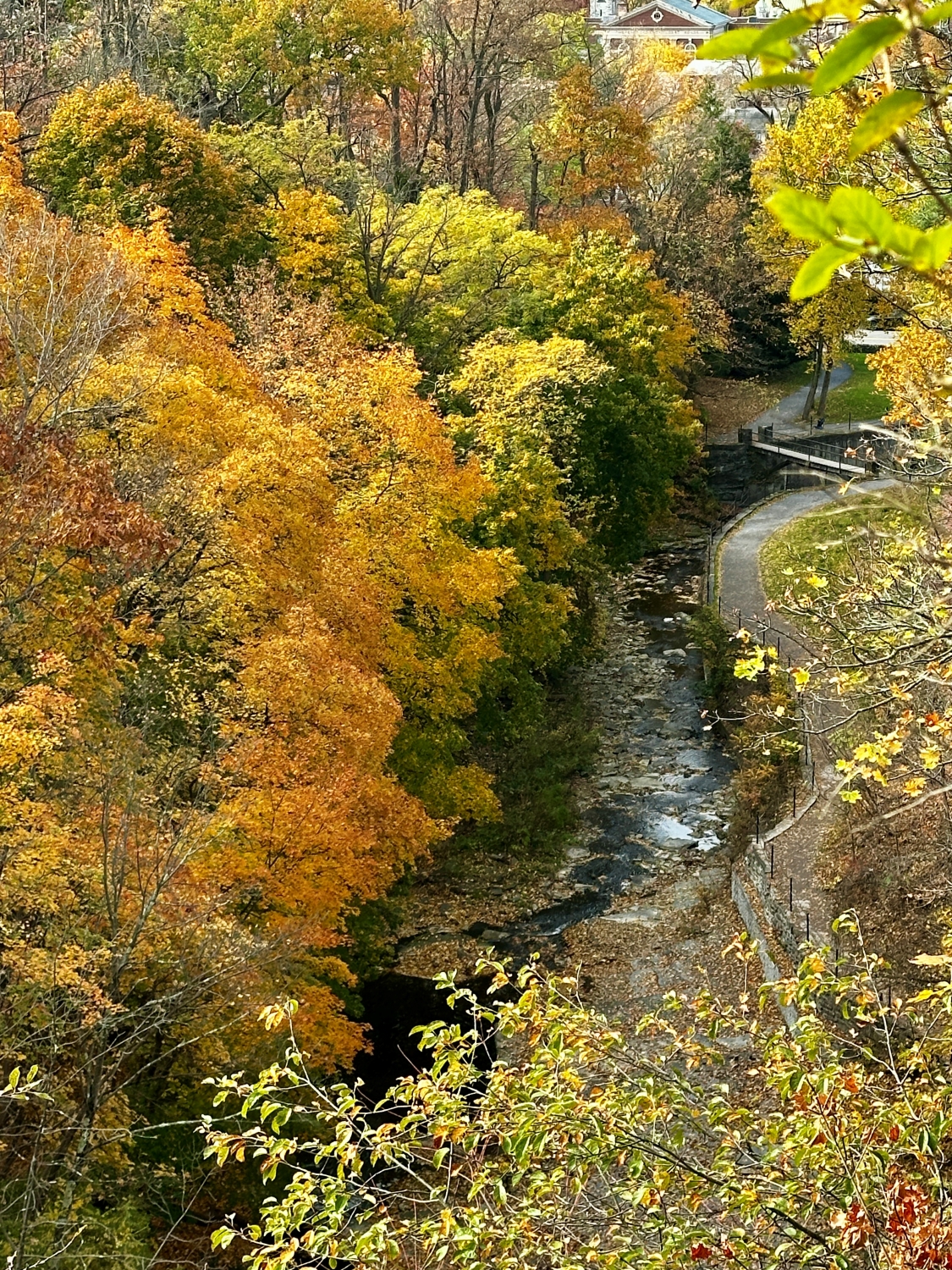
Crossing the Stewart Avenue bridge, the Cascadilla Gorge came into view, a steep wall of stratified rock layers standing guard over the gently flowing stream below. The contrast between stone and foliage was breathtaking—the hard, unyielding rock juxtaposed with the softness of leaves in full autumnal bloom. The earthy scent of wet stone mixed with the crisp aroma of the flowing water, creating a sensory tapestry unique to the gorge. The colors seemed to intensify against the gray and brown of the cliff, each leaf like a brushstroke on nature’s canvas, celebrating the season’s final flourish before surrendering to winter.

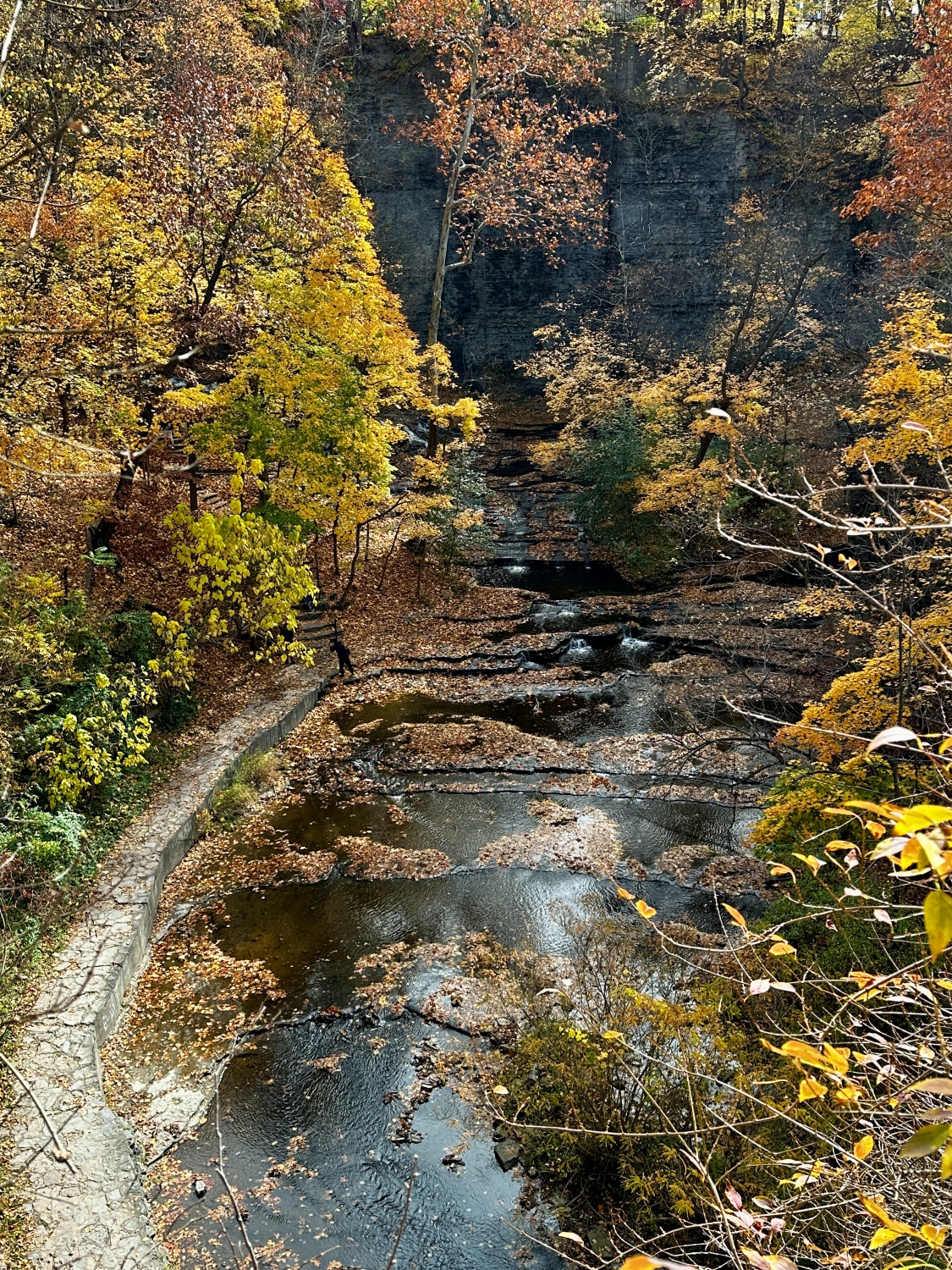
Below footpath along the gorge rim, the creek wound through, its banks littered with leaves that had completed their journey from branch to earth. They floated on the water’s surface, spinning gently in the current as though reluctant to leave this last dance. The sound of the water was a steady undercurrent, soothing and rhythmic, as it tumbled over stones and carved its way through the gorge. I paused to watch, entranced by the way water and rock, ephemeral and eternal, seemed to coexist in a kind of harmony.

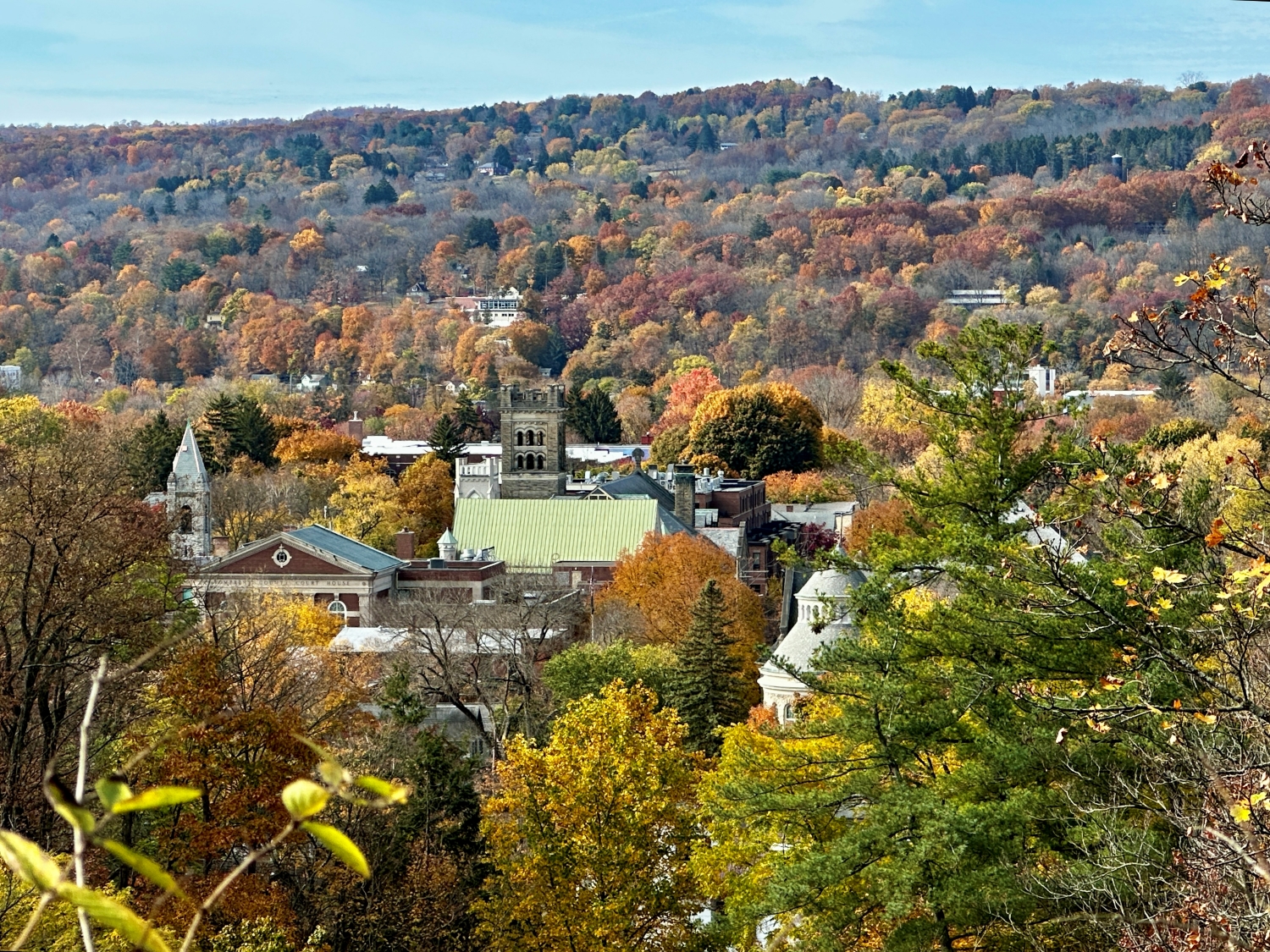
I stopped at a lookout point and surveyed the town sprawled out below, nestled amidst the fiery colors of the surrounding hills. The architecture of Ithaca’s buildings peeked through the trees, each roof and spire framed by the season’s palette. This was a town embraced by nature; its rhythm dictated as much by the seasons as by human hands. The sight stirred a sense of gratitude within me; here was a place that reminded you to slow down and observe, to notice the subtle shifts in light, in color, in the way a single gust of wind could change a landscape.

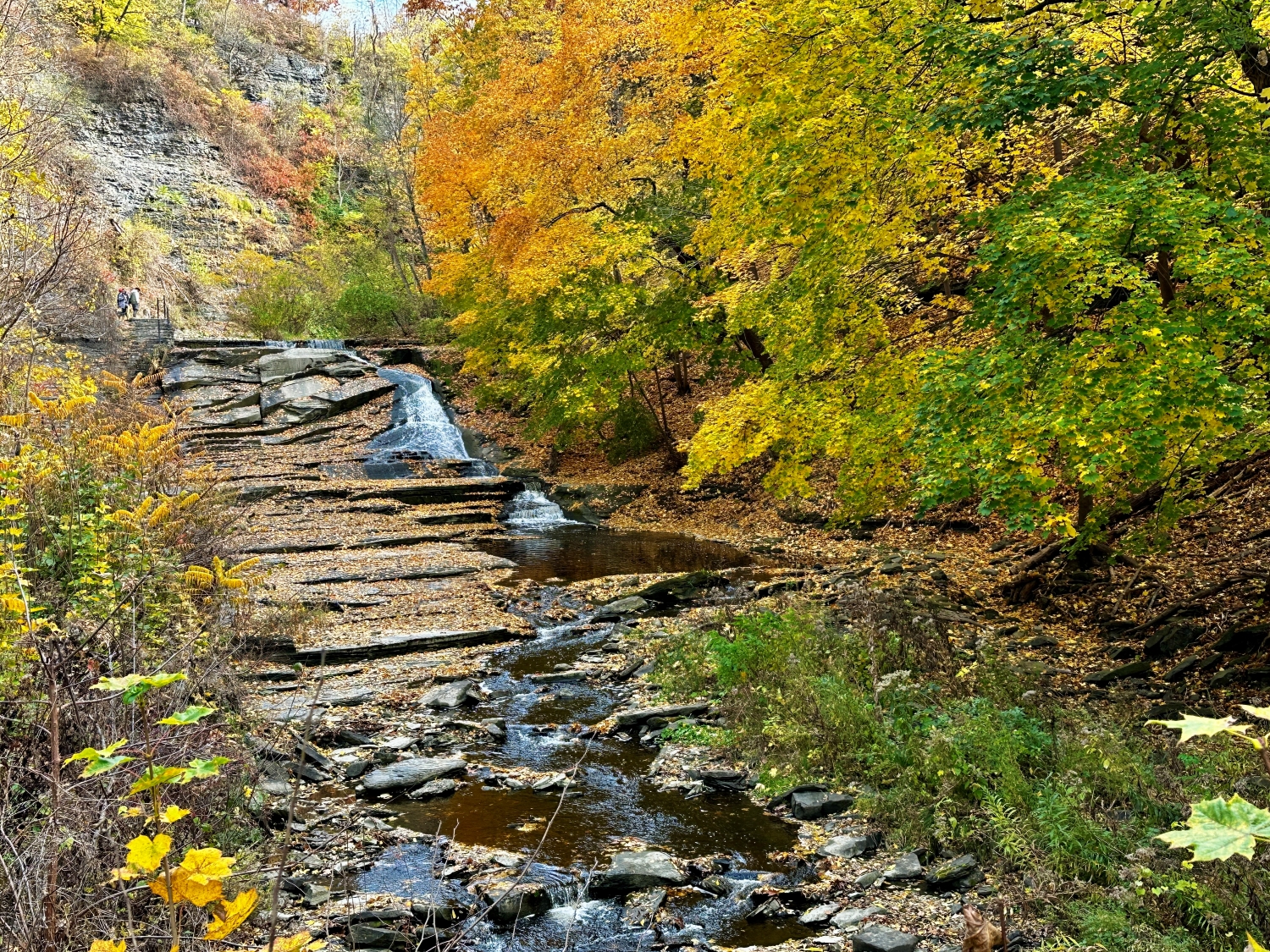
I continued along the rim, passing a small waterfall that spilled over the rocks with a quiet insistence. The water had carved smooth pathways in the stone, evidence of its long journey and persistent power. The sunlight hit the spray just right, casting a fleeting rainbow that shimmered and then disappeared as I moved. I felt a sense of companionship with the water—both of us moving forward, shaped by the paths we traverse, yet always adapting to whatever lay ahead.

The last part of the trail led me through a dense thicket of trees, their branches hanging low, forming a natural archway. The air was heavy with the musky scent of fallen leaves and the spicy aroma of pine needles underfoot. Here, the light was softer, muted by the thick canopy overhead. The quietness enveloped me, broken only by the occasional rustle of a squirrel in the leaves or the distant caw of a crow. It was the kind of silence that feels sacred, where each sound, no matter how small, becomes profound.

Entering Cascadilla Gorge from Linn Street

Emerging from the shaded path, I took one last look back at the gorge. The scene was both familiar and new—a blend of natural beauty and the nostalgia of seasons past. I felt a sense of peace, grounded by the cycles of the earth, by the ebb and flow of life around me. In this moment, on the brink of Halloween, the world felt both hauntingly beautiful and reassuringly steadfast, a reminder that even as the leaves fall and the days grow shorter, there is a promise of renewal in the quiet persistence of nature.

Enter your email to receive notification of future postings. I will not sell or share your email address.

Beauty and Struggle: Flowering Rush in Stewart Park

Crossing the footbridge in Stewart Park, I encountered the graceful yet invasive Flowering Rush. Its delicate beauty hides a deeper story about nature’s resilience, human impact, and the fragile balance of our ecosystems.

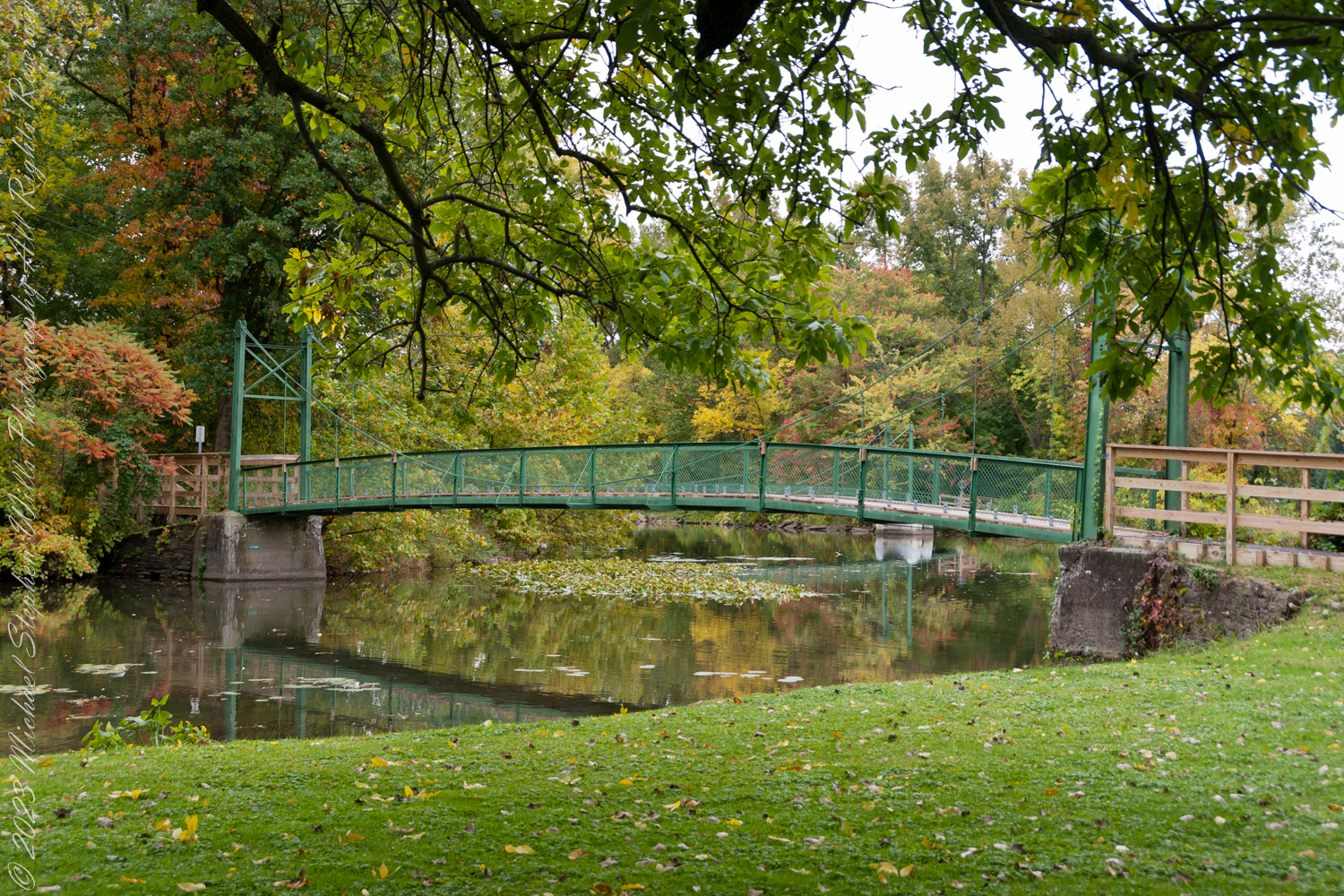
While crossing the suspension footbridge over Fall Creek in Stewart Park, there’s a sense of stepping into a world that’s more peaceful and attuned to nature. The bridge is familiar to me—a steady, quiet companion—but each visit feels new, as though the park has secrets it only reveals in small whispers. In this photograph the green steel beams rise like sentinels, standing tall against the backdrop of shifting autumn colors. Below, the water reflects the vibrant reds, golds, and greens of the trees, creating an illusion of depth that draws me in.

Footbridge to the Fuertes Bird Sanctuary, Stewart Park, Ithaca, New York, October 2012

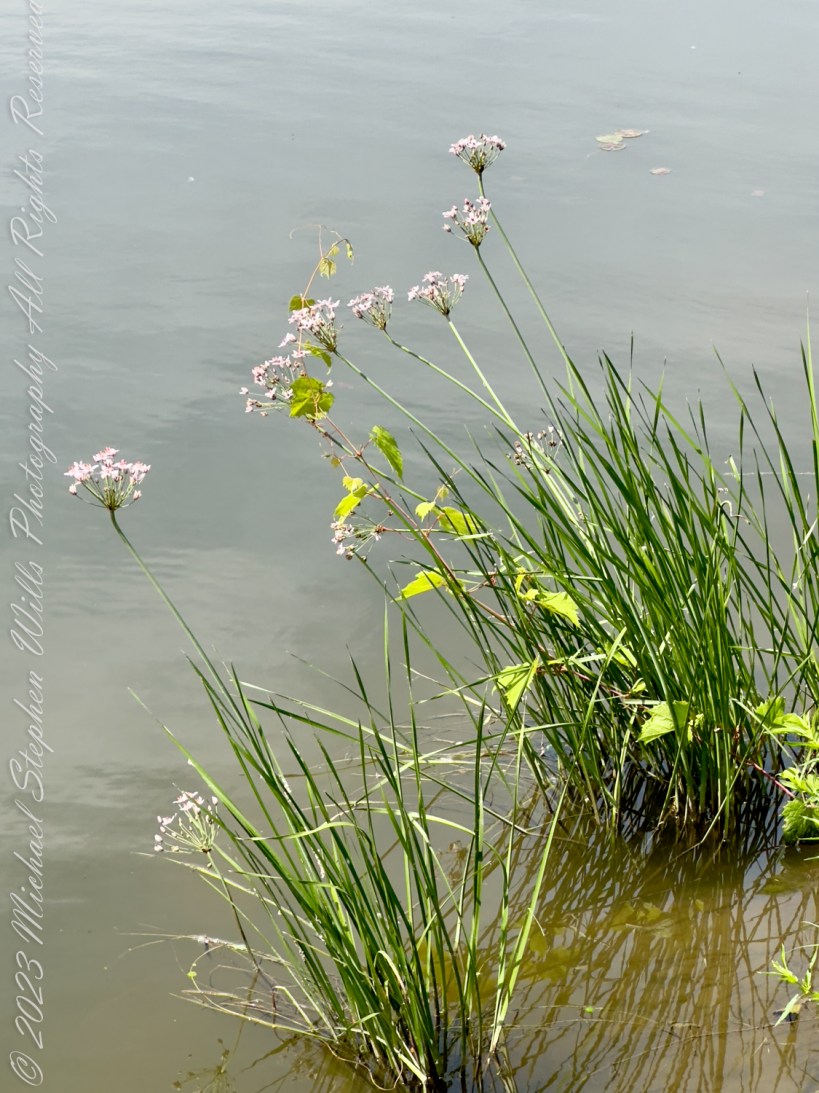
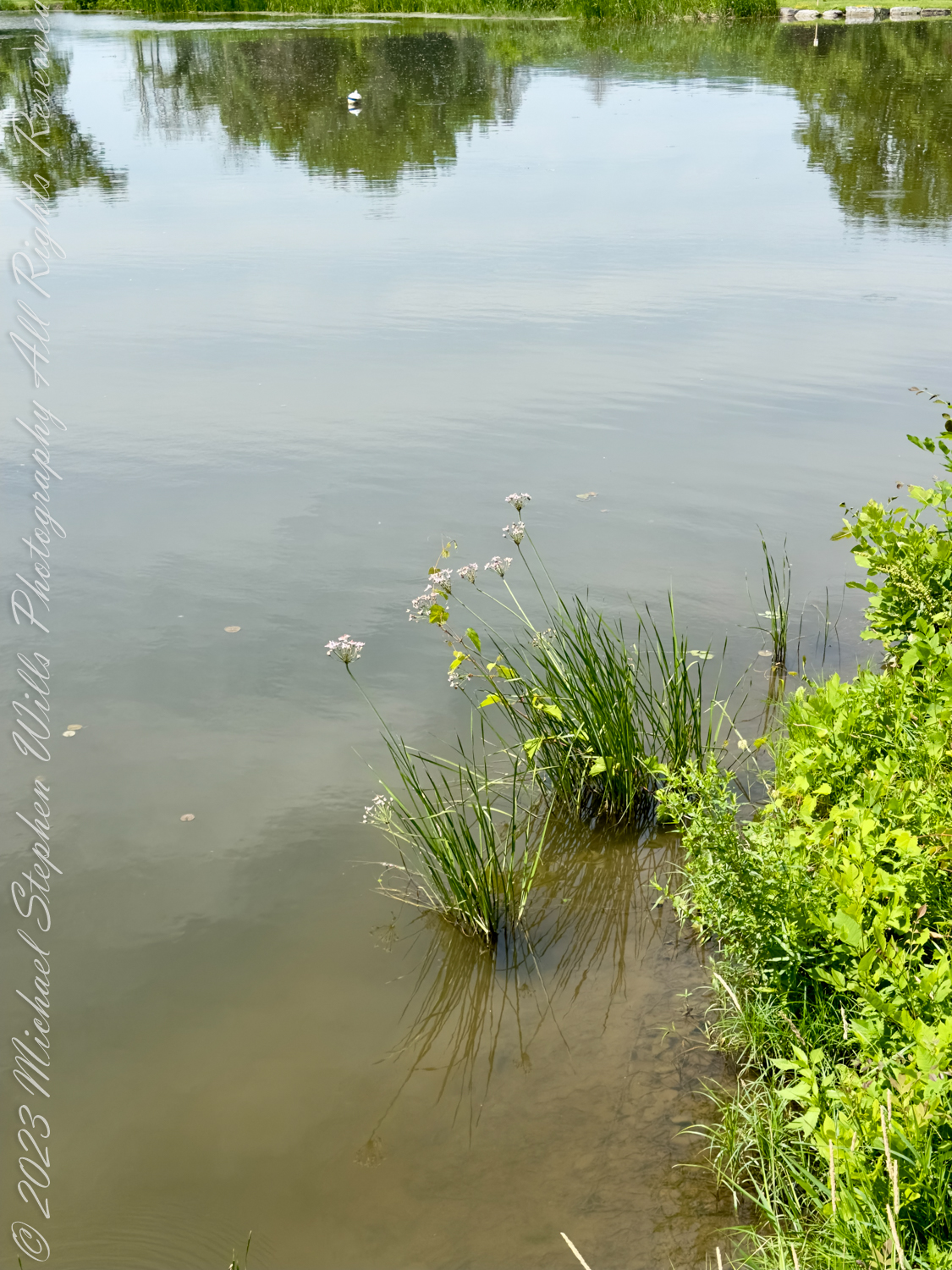
This past summer I stopped midway across, leaned against the railing, just listening. The creek moved slowly, like time itself decided to pause here for a while. That’s when I saw them: delicate pink blooms rising up from the water’s edge, their petals small and star-shaped, catching the light as they sway in the gentle breeze. There’s something striking about these plants—graceful, elegant, almost otherworldly in their simplicity. They reach up, as though trying to escape the confines of the water and the muddy banks.

My subsequent research revealed these to be Flowering Rush, or Butomus umbellatus. I often see them now, their soft pinks and slender leaves creating a quiet beauty that’s hard to ignore. They’re beautiful, but I have come to know they don’t belong here. This is one of those moments in nature that gives me pause—a reminder that not everything lovely is innocent.

Flowering Rush Growing in Fall Creek, Stewart Park, June 2024

Flowering Rush, a European import from centuries ago, was not meant to take root here. Brought to North America for ornamental ponds, its allure quickly became its danger. It spread, silently, like a secret carried on the wind, slowly overtaking the native species that have long called these waters home. And yet, standing here now, I cannot help but admire its tenacity, its quiet determination to thrive. Nature, in all its forms, has this incredible will to survive, even if that survival sometimes comes at a cost.

My mind drifts to the plant’s history. In its native lands Flowering Rush, or Grass Rush, was useful—its roots, though bitter, were harvested for food, and its fibrous stems woven into mats and ropes. How interesting that something as delicate as this has a rugged, practical side. This contradiction makes perfect sense when I think of the plant’s journey across continents, carried over oceans by human hands and curiosity. We are responsible for its presence here, and now, like so many other invasive species, it’s become a fixture of this landscape.

I think about the dual nature of this invasion. Flowering Rush is beautiful—there is no denying that. Its soft, pink flowers contrast sharply with the darker tones of the water and the dense green of the grasses that surround it. But its beauty masks a quiet destruction. It chokes out the native plants that once thrived here, altering the ecosystem in ways we cannot always see. I wonder what fish and aquatic life struggles beneath the surface, their food sources slowly disappearing. What birds find fewer insects and fewer safe places to nest?

And yet, is this plant a villain? Flowering rush is doing what it was meant to do—grow, spread, survive. That is what everything in nature does, after all. It does not have malice or intent; it just is. It is humans who have changed the balance, who introduced this species to a place where it didn’t belong, setting off a chain reaction we’re still trying to fully understand.

Today, as I walk across the bridge, heading toward the Fuertes Bird Sanctuary, path ahead invites quiet reflection, the chirping of birds and the rustle of leaves providing a peaceful soundtrack. But the Flowering Rush lingers in my mind. It reminds me of how interconnected everything is, how one small action—a plant brought from a distant land—can ripple out and affect entire ecosystems. It’s a lesson in responsibility for those willing to listen.

As I step into the sanctuary, the air feels lighter, filled with the sound of birds that dart between the trees. I think of the delicate balance of life here, and how easily it can be disrupted by the presence of something foreign, something invasive. Yet, there is a strange comfort in knowing that nature, for all its fragility, has its own resilience.

The Flowering Rush, with its roots deep in the muddy banks of Fall Creek, is a testament to that resilience. It may not belong here, but it has found a way to adapt, to make this place its home. And in that, I find both a warning and a kind of hope—hope that we, too, can learn to live more thoughtfully, more in tune with the world around us, before we upset the balance any further.

For now, though, I simply walk, grateful for the beauty around me, even if it comes with complications. Each step takes me deeper into this world, and I am reminded once again of the profound connection we have to the land, the water, the plants, and the creatures that share this space.

Copyright 2024 Michael Stephen Wills All Rights Reserved

To receive email notification of new blog posts enter your email and click the subscribe button.

I will not share or sell your email address.

Nature’s First Green….

…is gold, / her hardest hue to hold, / her early leaf’s a flower; / but only so an hour… Robert Frost

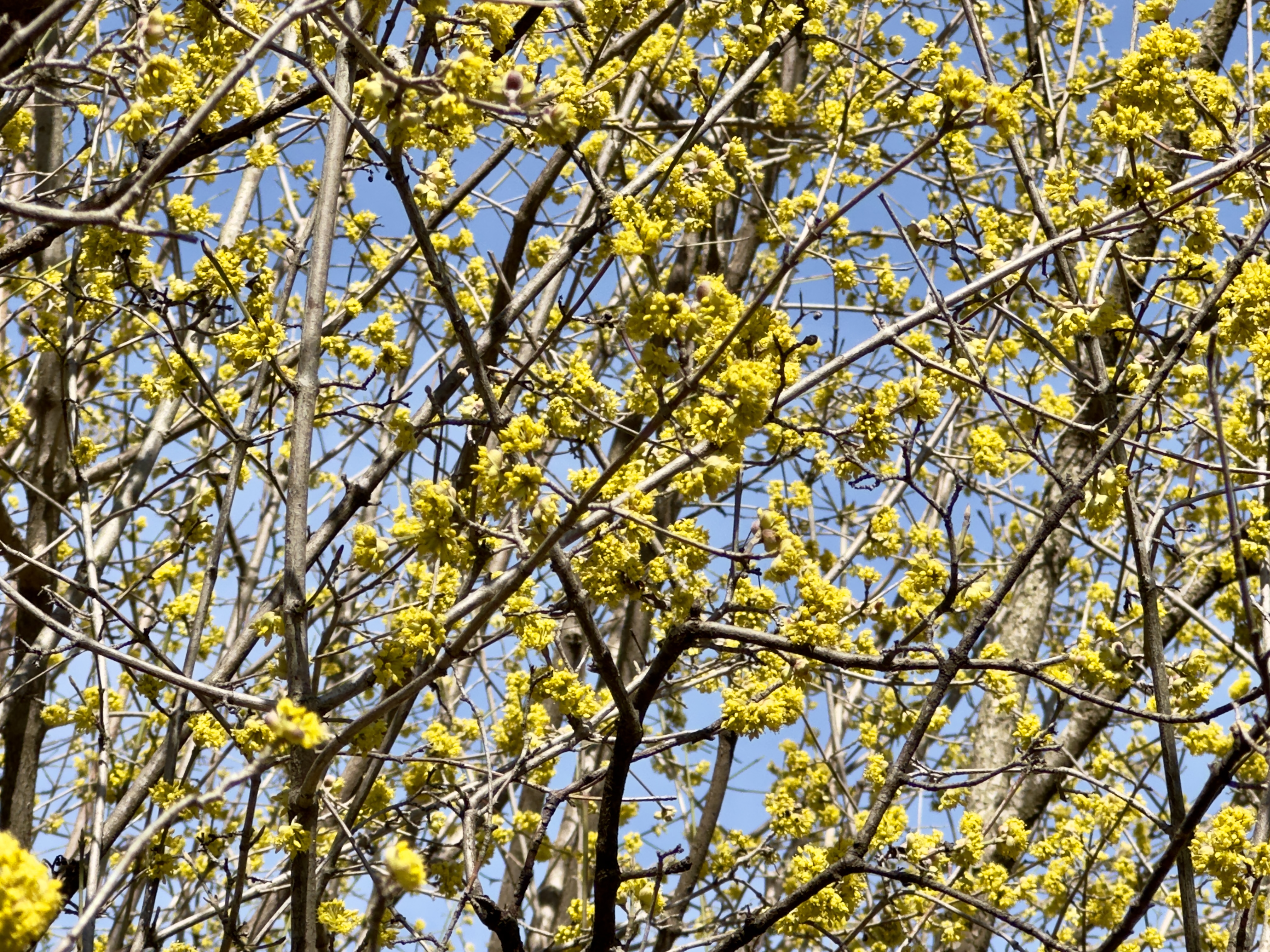
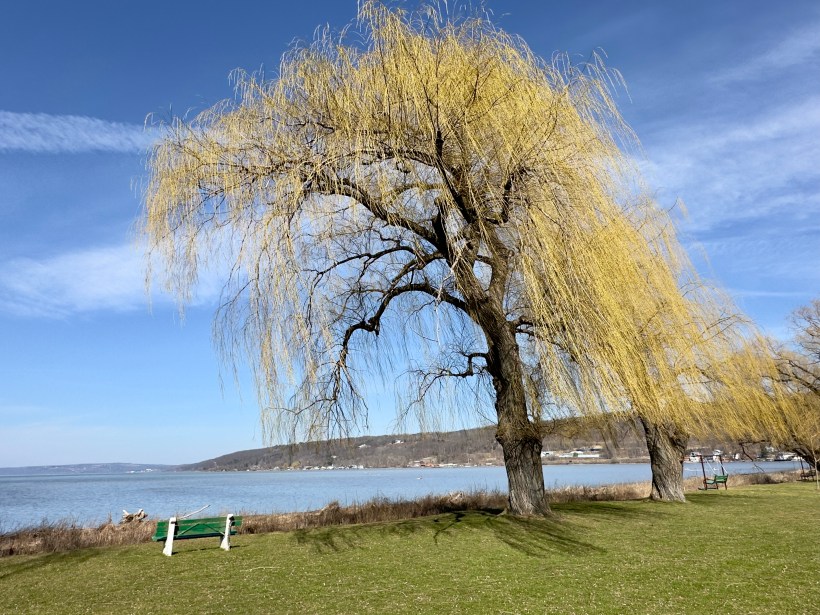
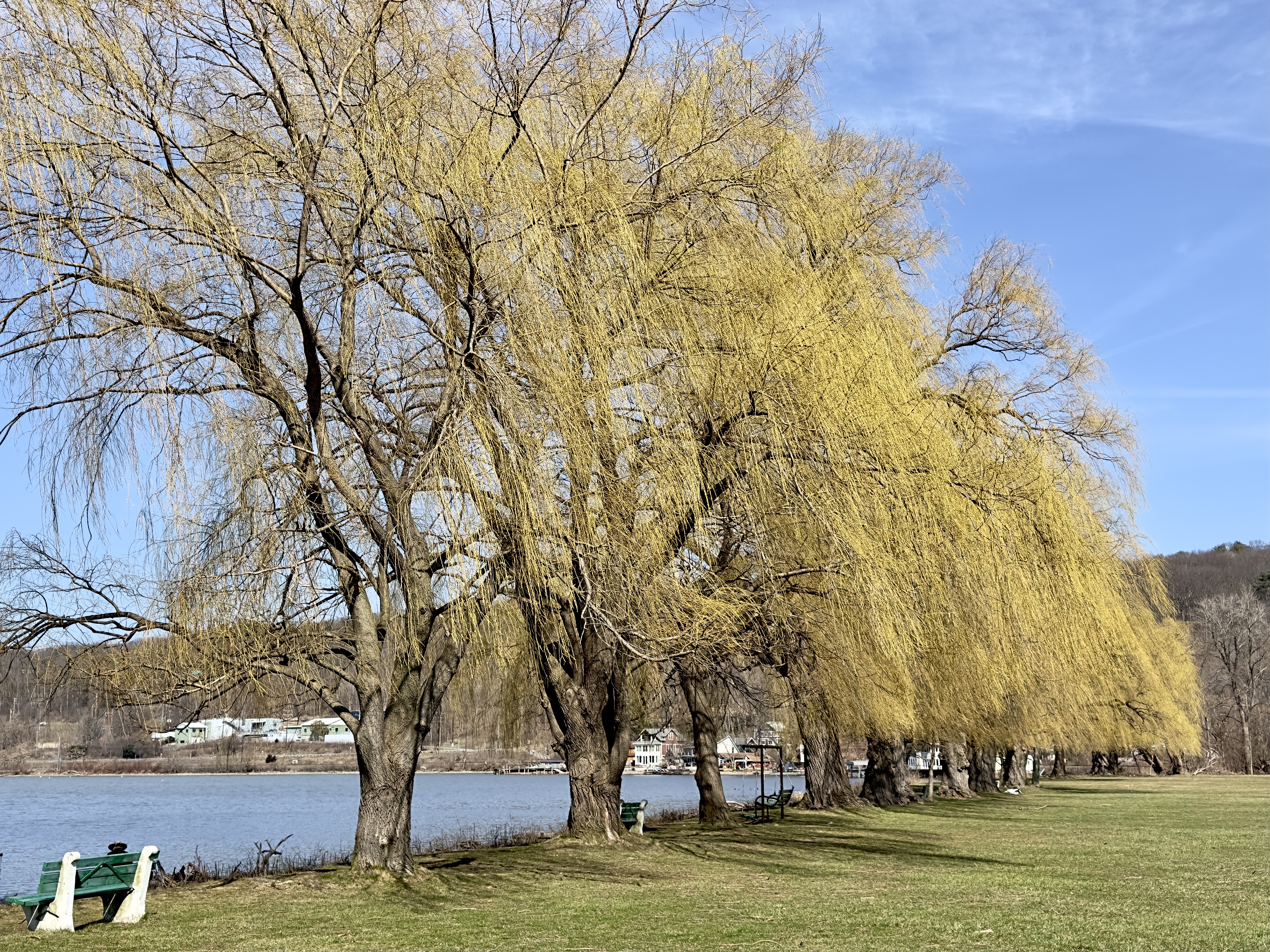
You walk alone by the waters of Cayuga Lake in Stewart Park, nestled in the heart of Ithaca’s Finger Lakes, where Salix alba, the white willow, stands proudly along the shoreline. You’re immediately drawn to the flurry of yellow flowers, a stark contrast to the still chilly early March air.

The white willow (Salix alba), with its rough, gray bark, is beginning to dress in its spring finery, its branches teeming with tiny, starburst-like flowers. Each one is a miniature sun, casting a glow against the intricate lattice of branches. These aren’t the soft catkins of the pussy willow but the yellow inflorescences that are characteristic of the white willow’s early bloom, a signpost that winter’s grip is loosening.

These trees, you learn, are dioecious, with separate male and female trees. The blossoms you see are likely the male flowers, their stamens dusting your fingers with pollen as you brush against them. It’s this pollen that will soon beckon the bees, urging them to emerge from their hives and begin the work that sustains the ecosystem. You can almost hear the faint buzz, a prelude to the symphony of life that summer will bring. Return in midsummer to find the female catkins comprise numerous small (4 mm) capsules, each containing numerous minute seeds embedded in silky white hairs, which aids wind dispersal.

As you wander further, you note the presence of the white willow’s kin, other deciduous companions some still bare and stretching into the sky and others leafing out. You stand there, at the cusp of seasonal change, where the slumbering trees are on the verge of awakening, and you feel a kinship with them. Like these trees, you have weathered the cold, dark months, and now you stand poised to greet the renewal that comes with spring.

The stark, knotted forms of the white willow branches against the clear sky speak to you of endurance and resilience. These trees have weathered storms and droughts; they have been companions to the lake, mirrors to its moods, and now they are beginning to celebrate the cycle of rebirth and growth.

You take a seat on a bench, the cool wood through your clothes a reminder of the lingering winter. You gaze out across the lake, the water reflecting the brilliance of the sun like a vast, rippling mirror, framed by the elegant silhouettes of the white willows. You feel the peace of the park seep into you, the slow, rhythmic lapping of the water syncing with your breath.

This is a moment of transition, from the sleeping to the awakening world. You think about the Salix alba, how its presence here is a testament to nature’s adaptability, thriving in the moist soil by the lake, offering shade in summer and shelter in winter, its branches a playground for the winds.

As you leave Stewart Park, you take with you the memory of the white willows in early March, the quiet guardians of Cayuga Lake. They remind you of the enduring beauty of nature, the seamless flow from one season to the next, and the quiet joy of standing witness to the first whispers of spring on the shores of the Finger Lakes.

Copyright 2024 Michael Stephen Wills All Rights Reserved

Above the Finger Lakes: A Winter’s Eve Flight

Joint me to gaze out upon a mesmerizing view of winter’s embrace over the Finger Lakes, where the setting sun paints an ephemeral masterpiece of ice, water, and twiligh

As I soared into the heavens, bound for Syracuse on the 9th of February in the year 2024, I found myself cradled in the gentle embrace of the port side of our metal chariot. The world unfolded beneath me; a tapestry of natural splendor painted in the golden hues of the setting sun. The view to the west, a grand panorama, beckoned my gaze, luring my senses into the wild embrace of Upstate New York’s finest landscapes.

Flying into Syracuse, February 9, 2024 we sat on the left (port) side of plane, this view to the west took in Canandaigua Lake, Bristol Mountain Ski Area, Honeoye Lake, Hemlock Lake (Canadice Lake is not visible).

Below, Canandaigua Lake lay stretched out like a slumbering giant, its waters glistening with the last kisses of daylight, a mirror to the sky’s fiery canvas. How wondrous it was to perceive the world from such heights, to witness the lake’s serenity from the abode of the gods. It seemed as if Canandaigua herself was remembering whispered tales of ice fishermen and quiet boathouses locked in the winter’s frosty grasp.

Off to the south, the proud shoulders of Bristol Mountain Ski Area rose in defiance against the winter’s chill. The mountain’s snow-laden slopes, carved with the meticulous precision of skiers and snowboarders, reflected the sun’s dying light, a beacon of winter’s joy amidst the sprawling lands. I could almost hear the muffled laughter of families and the swish of skis carving their ephemeral signature upon the mountain’s white canvas.

Nestled in the mountain’s shadow, Honeoye Lake revealed itself, a slender and unassuming sliver of tranquility. Its presence was like that of a quiet companion amidst the grandeur, a reminder of the simpler pleasures—frozen waters awaiting the spring thaw, the promise of lush greenery peering from beneath the white shroud of winter.

Beyond, where the earth kissed the sky, Hemlock Lake offered its secluded beauty, a hidden gem amongst its more renowned siblings. Though Canadice Lake remained shyly concealed from view, I knew it too slumbered there, a silent sentinel guarding the land’s secrets. Together, these lakes stood as custodians of a silent world, the guardians of a tranquility that seemed untouched by the passage of time.

As the plane banked gently, the clouds above me caught fire, ablaze with the colors of the dying day. Wisps of vapor painted streaks of orange, purple, and pink across the expansive canvas, a celestial masterpiece unfolding before my very eyes. The clouds seemed to dance with the joy of existence, a choreographed performance to the symphony of the setting sun.

I found myself lost in the moment, a solitary figure suspended between heaven and earth, caught in the embrace of an ephemeral beauty. The world below whispered of untold stories, of winters past and springs to come, of the endless cycle of life that pulsed beneath the frost. It was a moment of profound connection, a fleeting communion with the heartbeat of the planet.