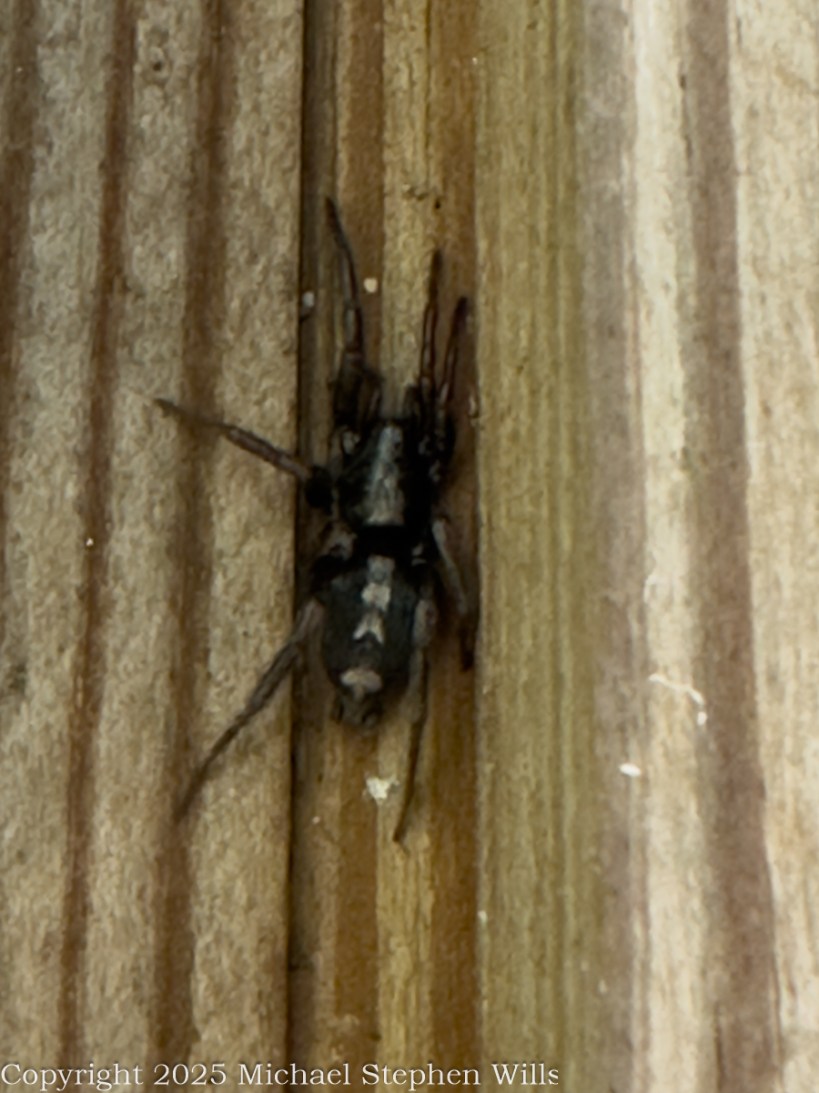
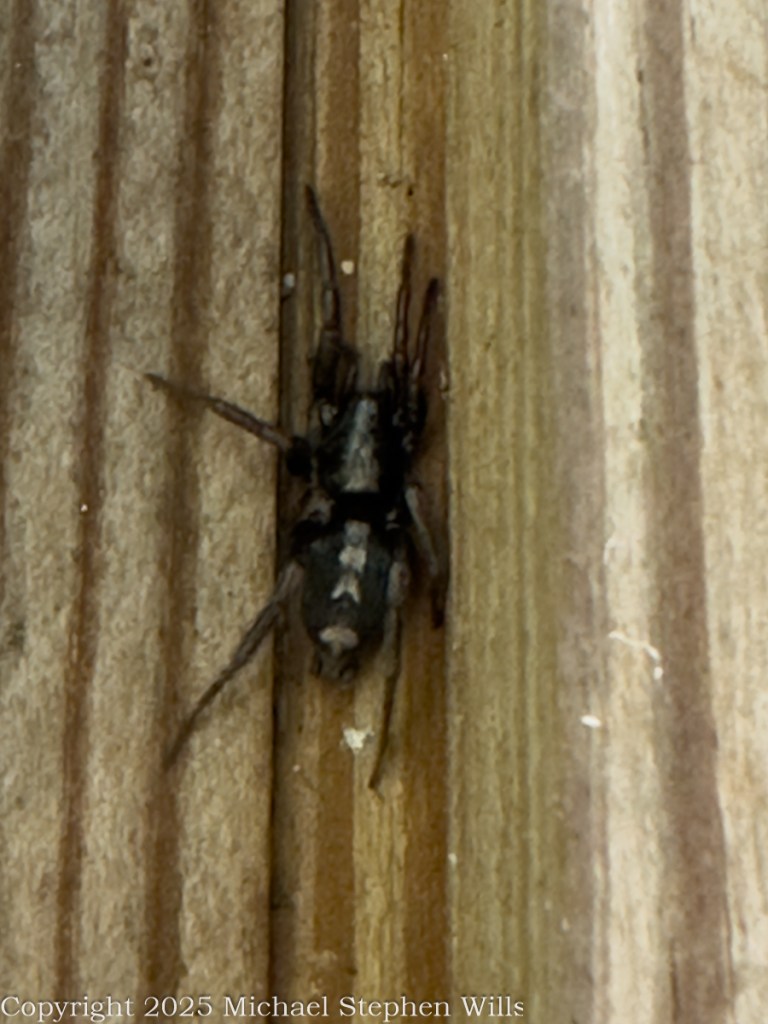
There, pressed into the grain of the boardwalk like a dark fleck of forest lint, the Bold Jumping Spider (Phidippus audax) waits—motionless, yet alert. To the untrained eye, it may seem insignificant, even nondescript. But a closer look reveals a creature of fine design and surprising charisma: a compact body cloaked in velvety black, adorned with pale markings like runes, and forward-facing eyes that gleam with eerie intelligence.
Unlike the orb weavers and net-spinners of spider lore, Phidippus audax does not rely on traps. It is a hunter in the truest sense—an animal that lives by leaping toward its future. With eight powerful legs and a muscular abdomen, it can launch itself many times its own body length, arcing through the air toward an unsuspecting moth or beetle. Yet it does not leap blindly. It trails a single silken thread behind it—a safety line, a commitment to survival. It is an act of courage tethered to caution.
Most remarkable are its eyes. A quartet of simple lateral eyes scan for motion, but the two large, front-facing principal eyes are something more—a rarity among arthropods. They grant it acute vision, with the ability to detect detail, movement, and even depth. When it turns its gaze toward you, you feel seen—not just registered, but regarded.
Found lurking in a joint of wood frame enclosing a trail map. Sapsucker Woods, Cornell Lab of Ornithology, on a summer afternoon\.
These spiders are active thinkers, decision-makers. They test their environment with movements that can almost be described as exploratory. They do not walk so much as prowl, stepping into shadow and light with an awareness that seems out of scale for their size.
And though they are often met with fear or disdain, Phidippus audax poses no threat to humans. It asks only for a few square inches of wood or leaf to stake its claim. In return, it offers a glimpse into a different kind of grace—an agile, silk-spinning daredevil, leaping with acute precision.
To observe one is to witness the meeting of design and instinct, form and function, in perfect miniature. In the vast, humming network of woodland life, the Bold Jumping Spider may be a small player, but it performs its role with flair. If the trees are the spires of the forest cathedral, and the ferns its leafy congregation, then Phidippus audax is a kind of sacred rogue—silent, swift, and utterly unconcerned by our towering presence.
Enter your email to receive notification of future postings. I will not sell or share your email address.
Copyright 2025 All Rights Reserved Michael Stephen Wills
Experience the joy of small-town tradition as three generations celebrate cows, community, and colorful floats at the 2025 Dryden Dairy Day Parade in upstate New York.
On a glorious Saturday morning—June 14, 2025—the small village of Dryden, New York, once again came alive with one of its most beloved traditions: the Dairy Day Parade. I had the joy of attending this year’s festivities with my daughter-in-law, Jennifer, and my two grandsons, Sam and Rory. We set up along Main Street, folding chair ready and anticipation high, surrounded by a growing crowd of families, neighbors, and out-of-town visitors drawn by the charm of this time-honored event.
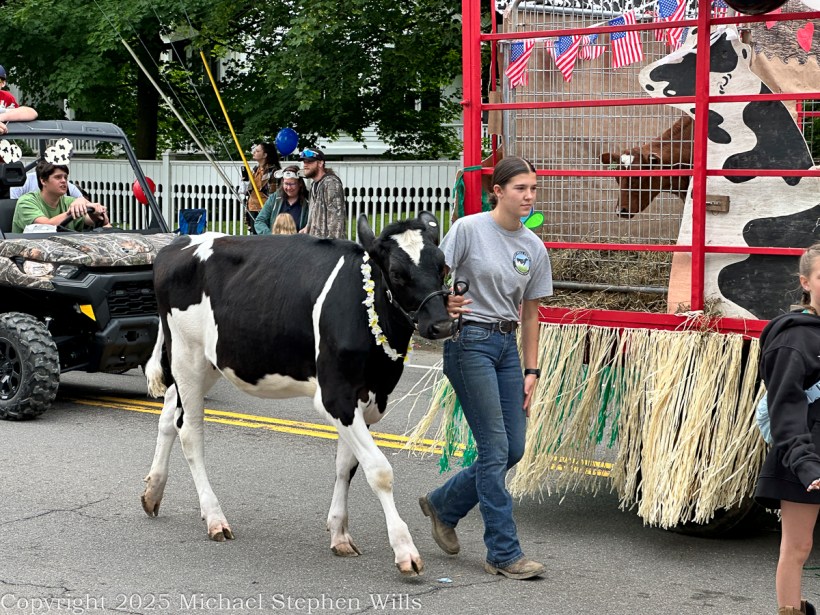
Dryden Dairy Day, first held in 1980, has long celebrated the area’s agricultural roots—particularly the dairy farms that once dotted the Finger Lakes region in greater number. Though the rural landscape has changed, the community spirit endures, embodied each year in this cheerful, inclusive parade. And what a parade it was.
Sam and Rory, who started out quietly nestled together in a red camp chair, quickly leaned forward in excitement as the opening marchers passed. Veterans in pressed blue shirts and caps bore the flags solemnly, stepping to the rhythm of distant drumbeats. The boys gladly collected candy thrown to the crowd by the paraders.
Then came the color and music—floats festooned with balloons, hay bales, streamers, and, of course, cows. The Jerry Dell Farm float, labeled “LegenDAIRY Superheroes,” stole the show with its red metal rails, a large cutout Holstein suspended in mid-leap, and enthusiastic kids handing out “Got Milk?” flyers. The float’s theme—half play, half tribute—offered a nod to the hardworking farmers past and present who’ve kept local dairies running despite national challenges.
Behind them, children waved from trailers turned farmyard dioramas. In one, rabbits and baby chicks nestled on pastel blankets inside red and gray wagons, drawing audible “awws” from the crowd. Another float featured kids feeding baby goats from white pails, an irresistible scene that reminded us of the joys of hands-on farm life.
Marching groups followed, each bringing their own spark. A contingent from Tompkins Cortland Community College, all in matching green shirts, smiled and waved. Their banner and cheetah logo brought cheers from alumni in the crowd. Girl Scouts from Troop 427 of Golden Meadows brought peace signs, love hearts, and Girl Scout green to life as they passed, handing out candy and smiles with equal generosity.
We clapped for the “Wreaths Across America” semi-truck—a rolling tribute to fallen soldiers. Its stars-and-stripes exterior and the wreath-emblazoned motto “Remember. Honor. Teach.” was a solemn visual counterpoint to the general jubilation, grounding us in gratitude amid celebration.
One of the most magical sights for Sam and Rory came next: a medieval knight on horseback, gleaming in armor, carrying a long lance. This was no Renaissance Fair actor but a local reenactor embodying chivalry and pageantry for the kids. Rory, eyes wide, whispered, “Is that a real knight?” and I nodded with a smile. The horse, a proud palomino with flowing mane, trotted as regally as any steed from storybooks.
At one point, we found ourselves surrounded by people wearing cow-print headbands and passing out themed goodies—a detail that would feel odd anywhere else but felt perfectly at home here. Even the Girl Scouts managed to mix tradition with whimsy, some donning glittering horns and cow ears for the occasion.
I selectively captured photos, while Jen and the boys soaked in the sights and sounds: the distant whinny of ponies, the rustle of candy wrappers on the pavement. Parades like this are entertainment and intergenerational bridges, connecting the past with the present, the seasoned farmer with the wide-eyed child, and the local with the visitor.
As the parade wound down and the last float passed, we lingered a while longer. The boys were still buzzing with excitement, eager to share their favorite parts—“the knight!” said Rory, “the baby goats!” said Sam. For me, the most treasured moment was watching my grandsons engage so deeply with the richness of local heritage, waving to friends in the parade feeling part of something bigger than themselves.
Dryden Dairy Day reminds us that community is people lining the street on a Saturday morning. It’s floats handmade with care. It’s generations walking side by side—and sometimes sitting in the same chair—laughing, learning, and loving the place they call home.
Enter your email to receive notification of future postings. I will not sell or share your email address.
Copyright 2025 All Rights Reserved Michael Stephen Wills
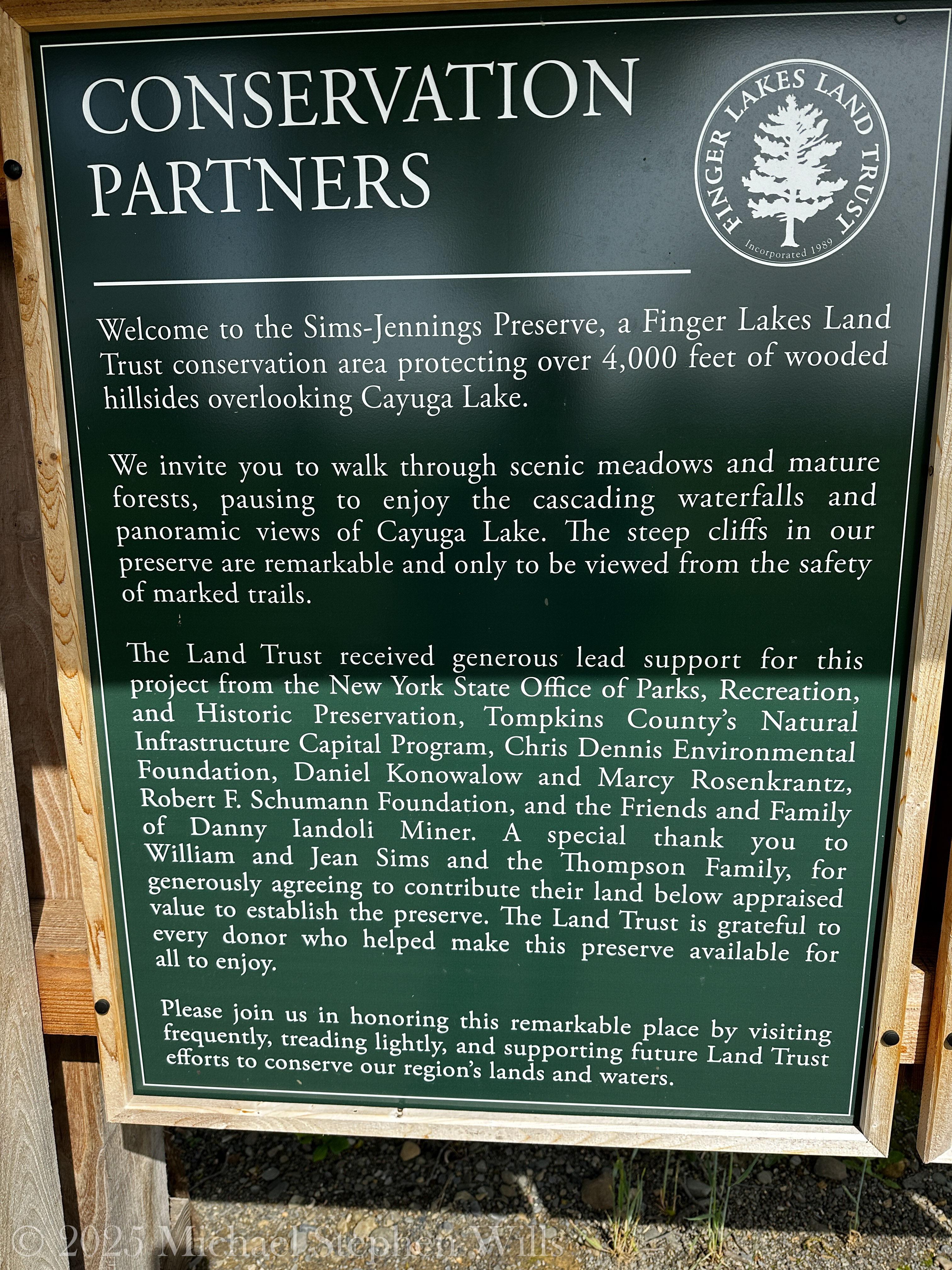
A walk through Sims-Jennings Preserve unveils ancient cliffs, vibrant bird calls, and the quiet wisdom of maples and waterfalls along Cayuga Lake’s forested edge.
I arrive early, the sun still climbing its slow arc, brushing the eastern sky in pastels as I step into the Sims-Jennings Preserve at Cayuga Cliffs. The trailhead, tucked neatly along NYS Route 34B, is a doorway into an ancient chapter of the Finger Lakes—one rich with the scent of moss, the hush of leaf-dappled silence, and the layered echoes of stone and birdsong.
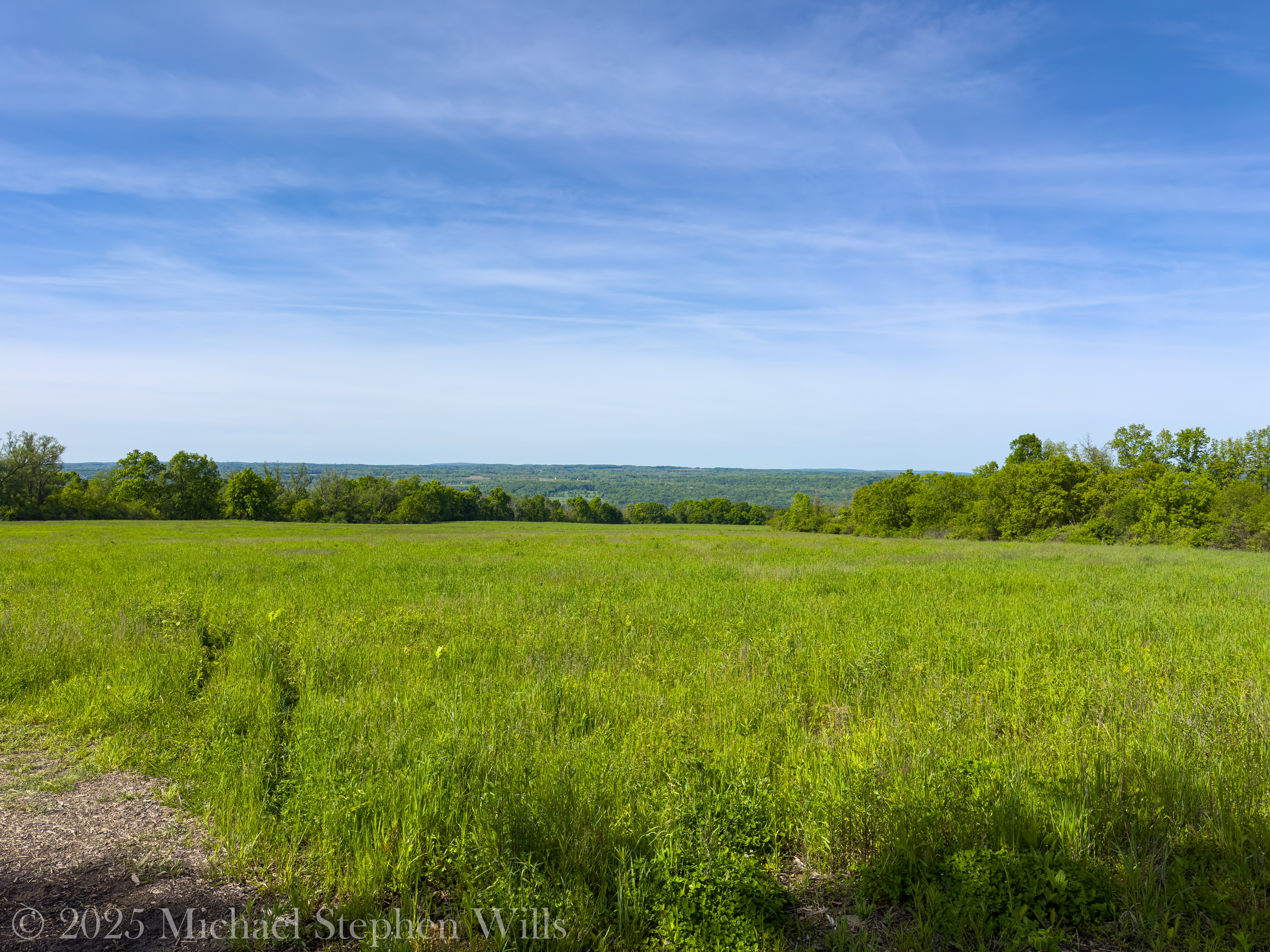
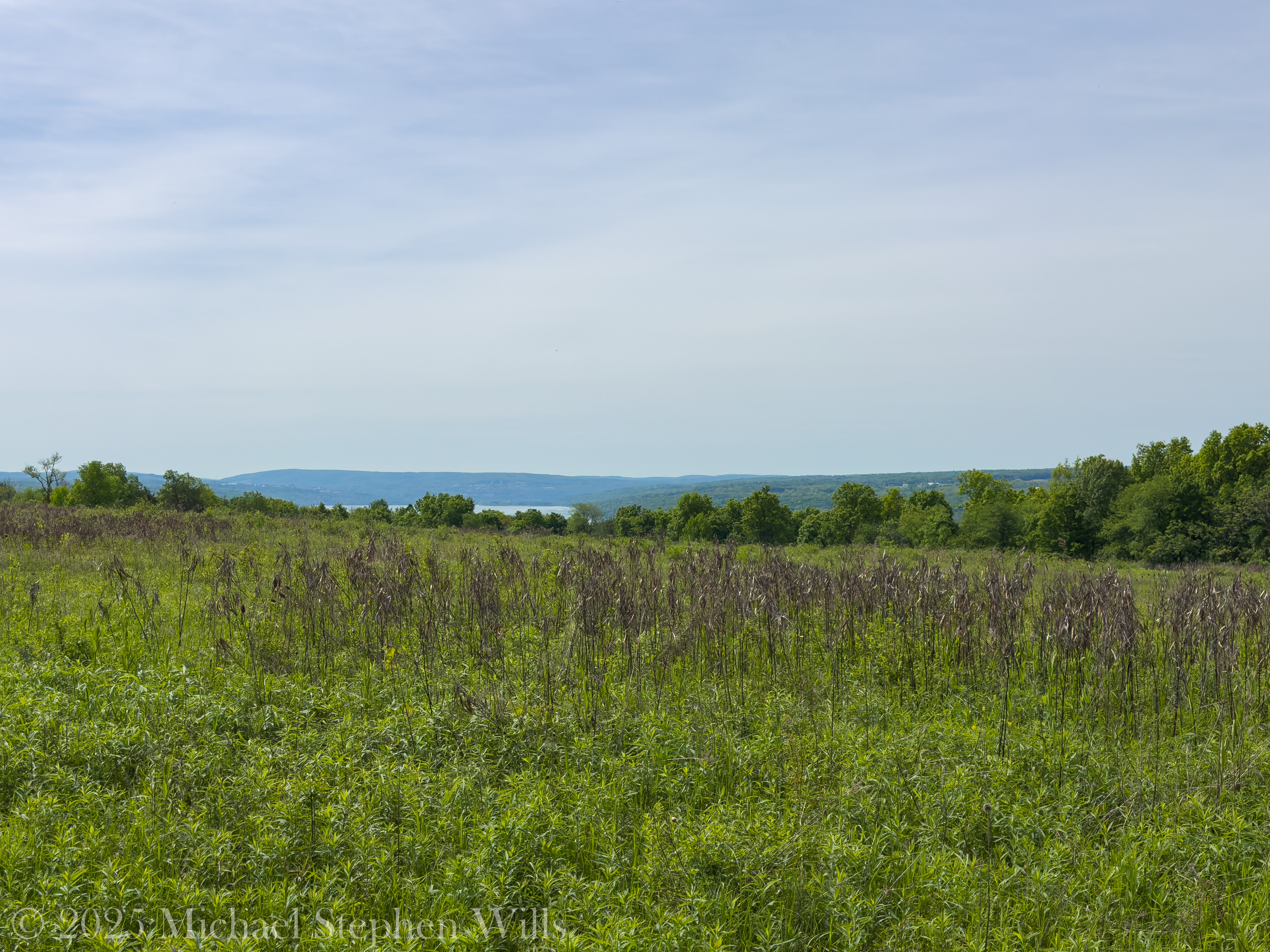
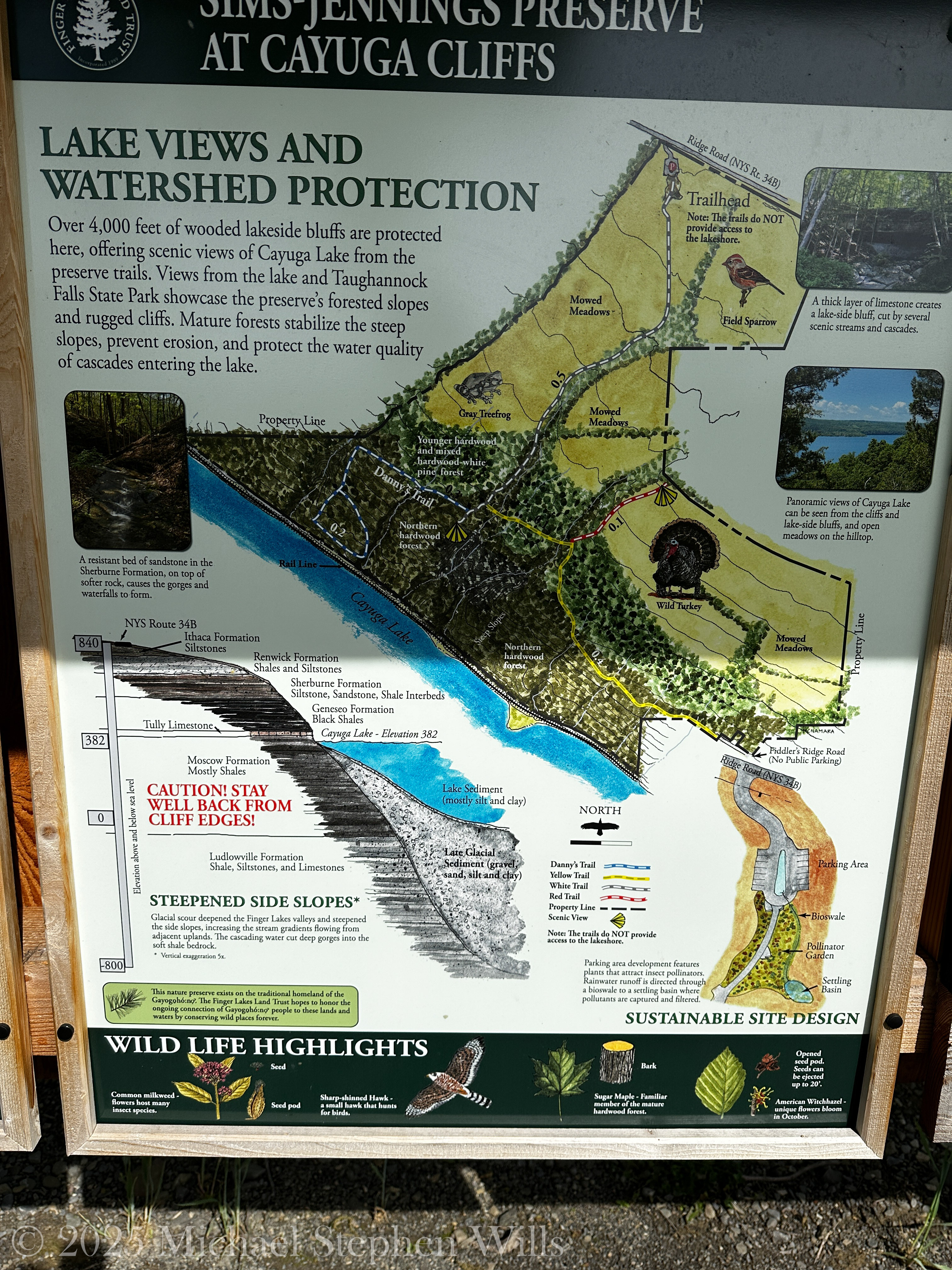
The first thing that strikes me is the expanse of mowed meadow, rimmed with goldenrod and patches of milkweed. From here, the land rolled gently westward until it ends abruptly in cliffs that plummeted toward Cayuga Lake. A map at the entrance speaks of the Sherburne and Renwick Formations, shale and siltstone laid down when the land was covered in warm Devonian seas. The cliffs themselves stand like watchmen over time, protecting 4,000 feet of lakeshore from erosion, whispering tales older than mammals.
A side trail leads to this mowed meadow and Cayuga Lake overlook
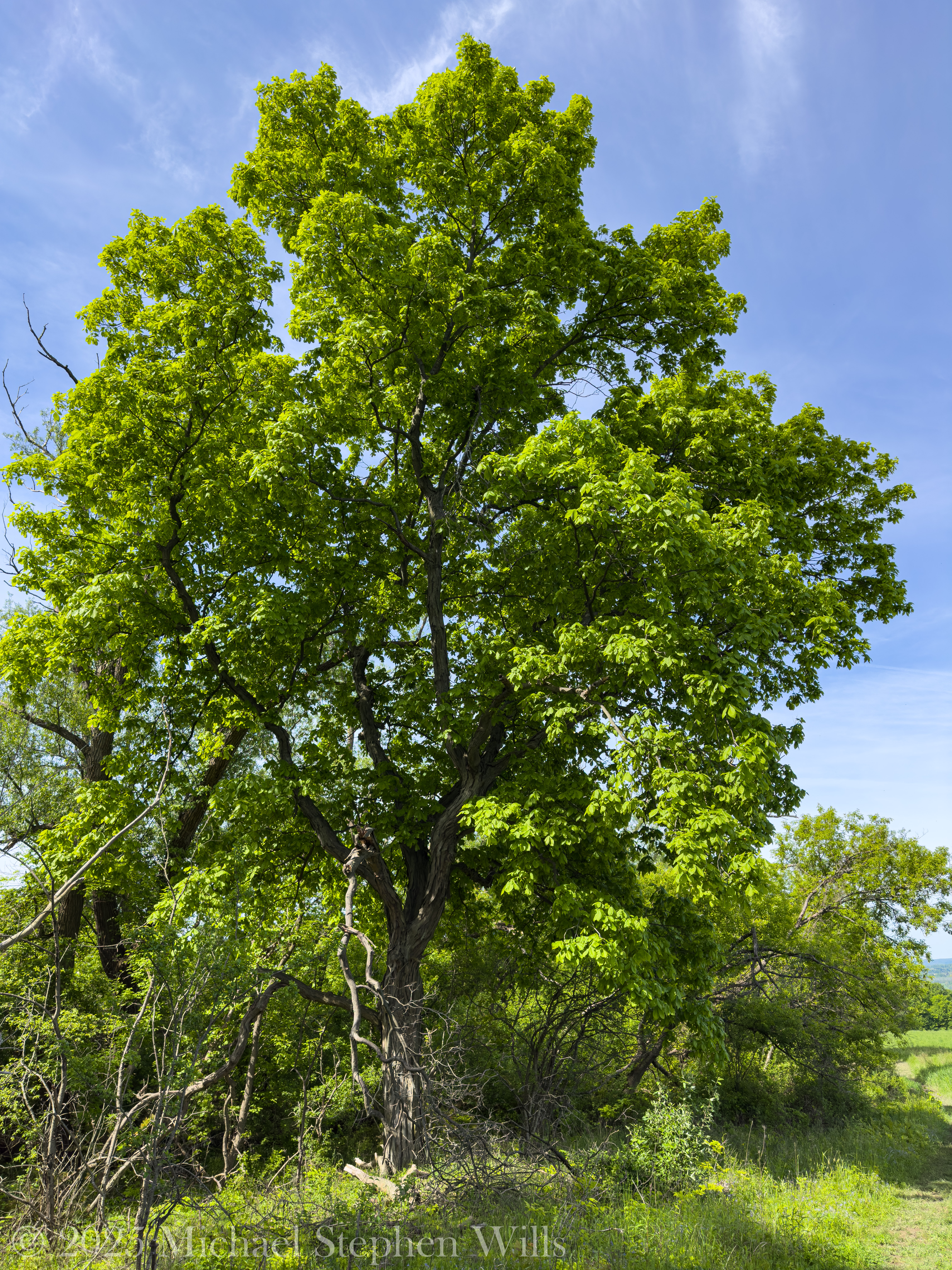
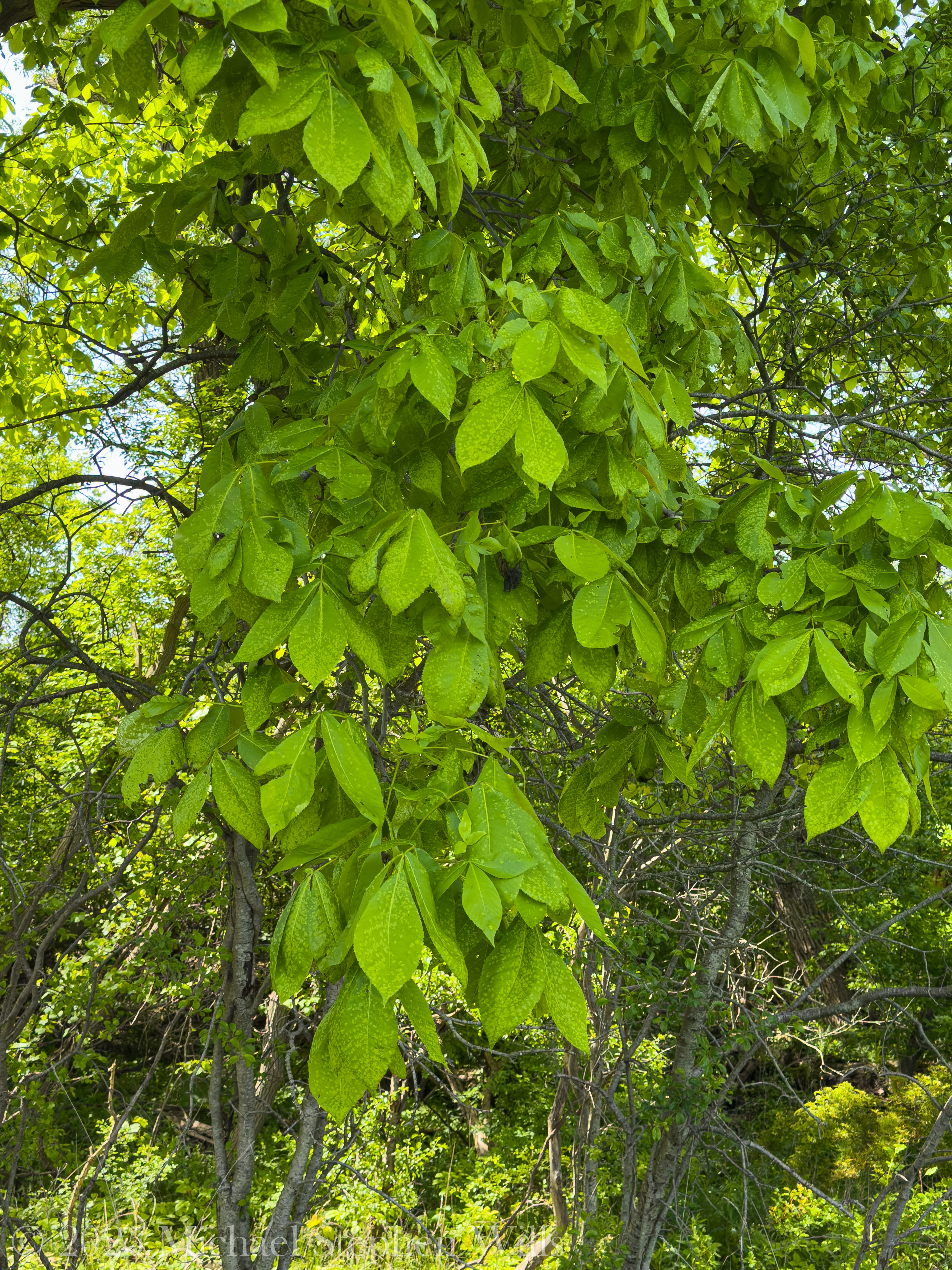
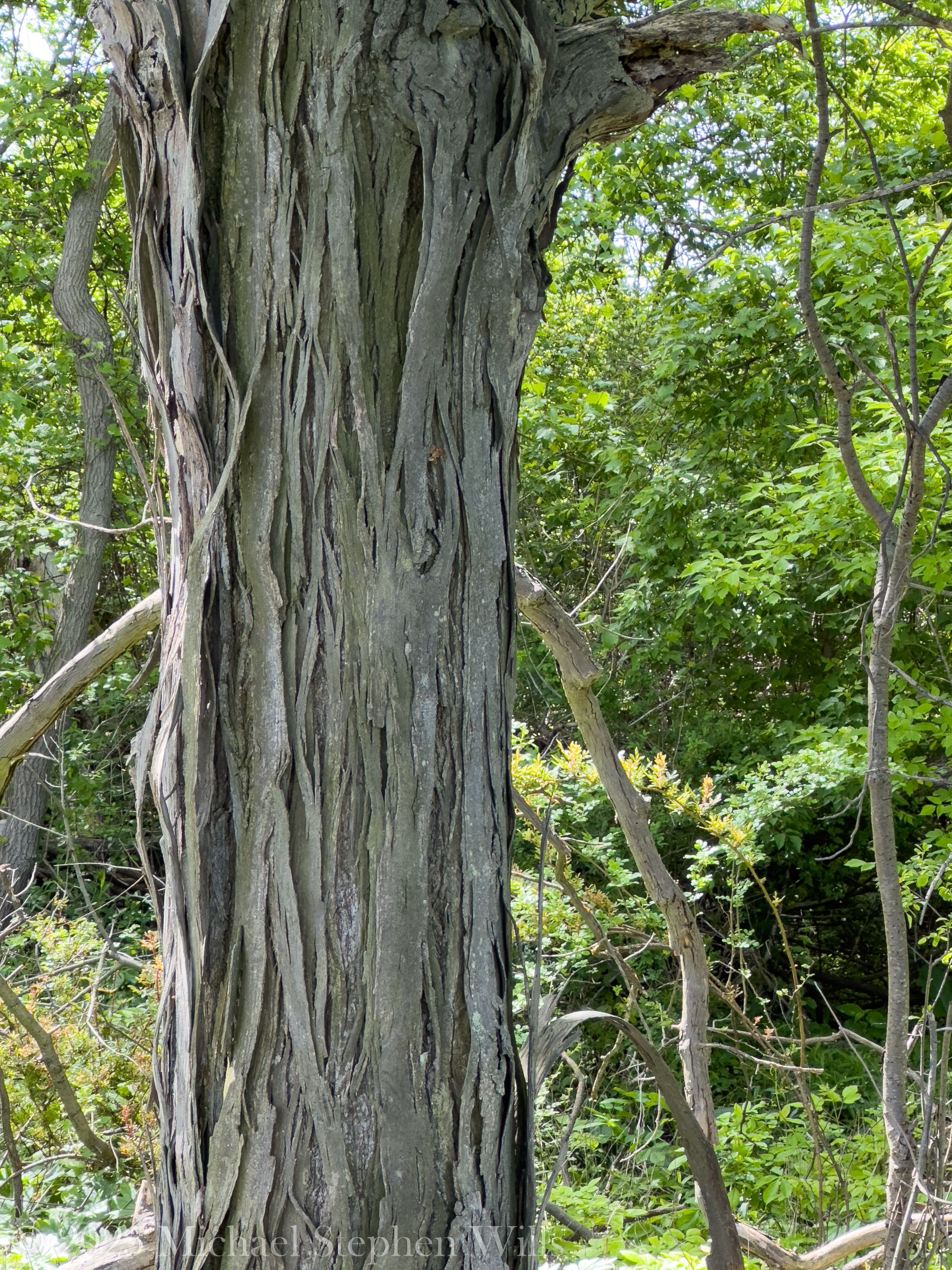
On the meadow edge is this Carya ovata, or shagbark hickory, unmistakable from its elongated leaflets and distinctive bark that peeled in long, curled strips. The leaves shimmered in the breeze, their green etched with pale speckles of recent rain, as if nature herself had hand-painted them.
Shagbark Hickory on the edge of meadow.Leaves of the Shagbark HickoryShagbark Hickory bark / trunk
I follow the yellow-blazed trail into a thicket where tall sugar maples—Acer saccharum—arched overhead. Their leaves caught the morning light, each palm-sized blade glowing like a shard of stained glass.
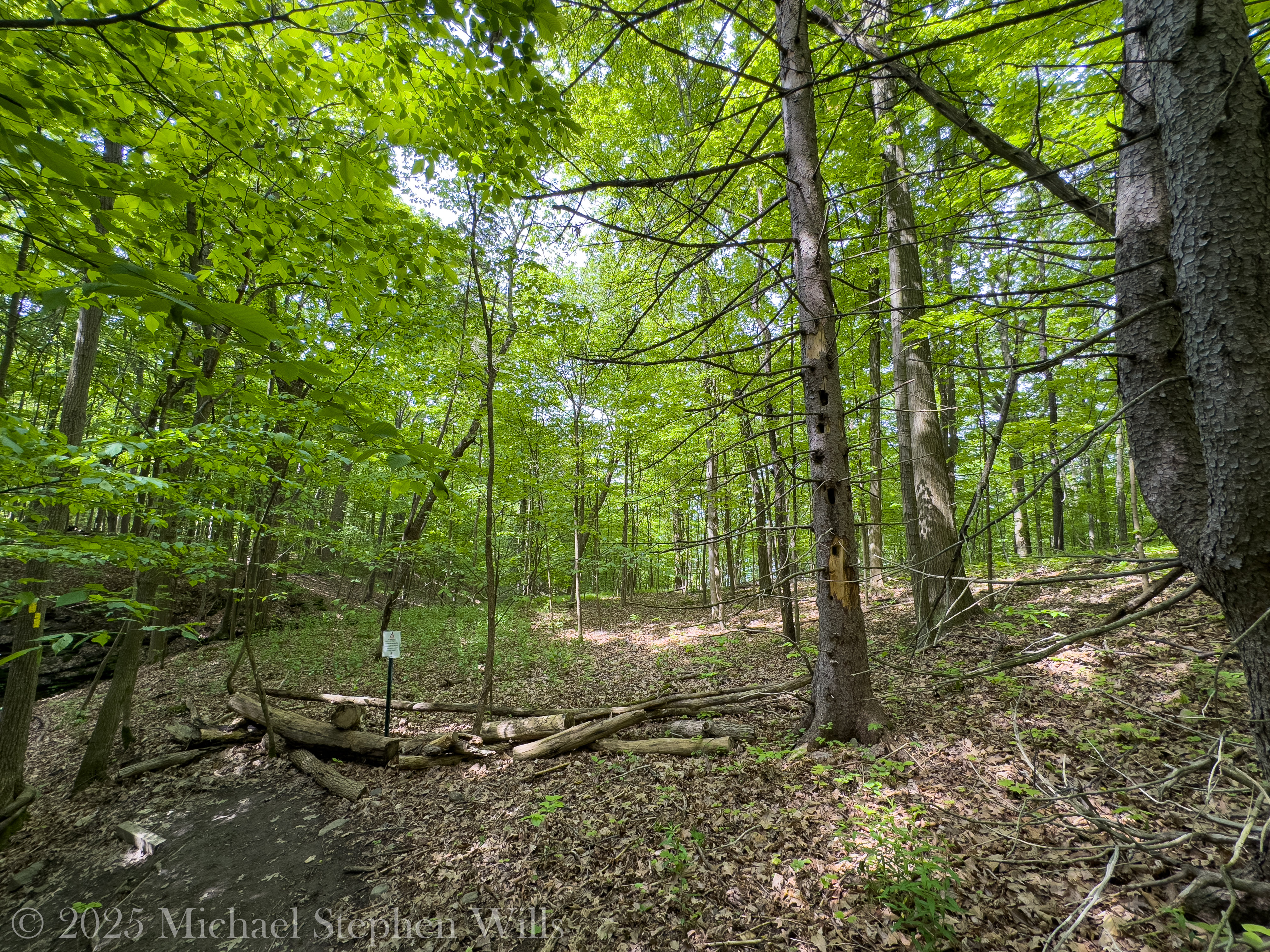
Throughout the preserve I find large holes like these in a pine tree snag, the work of a Pileated Woodpecker.
A sudden fluting note from the trees stops me in my tracks. “Ee-oh-lay,” the Wood Thrush sang, its call cascading through the forest like water over stone. Moments later, the rapid, accelerating trill of an Ovenbird joins in—a sound like “teacher-teacher-teacher” echoing from the understory. The forest is alive.
Watch on YouTube for the best experience.
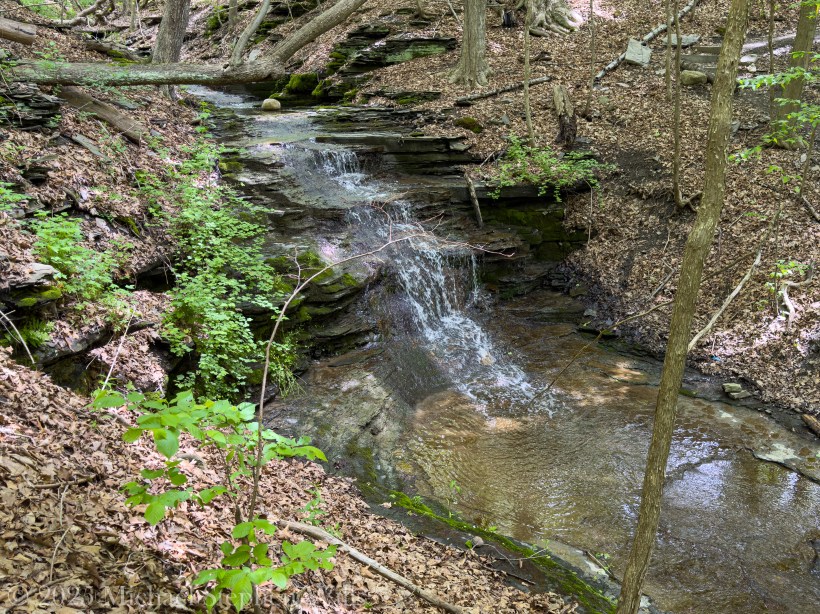
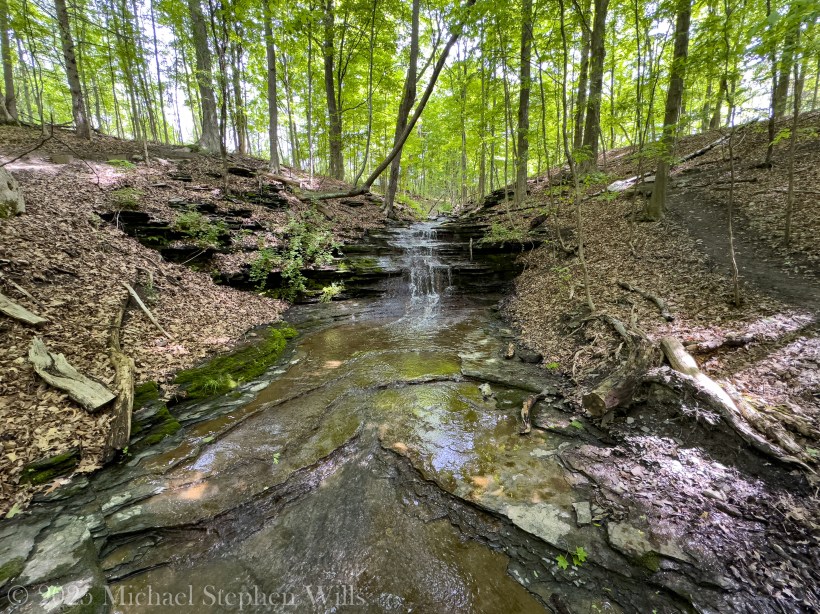
I descend into the shade. A narrow stream runs over the flat gray ledges of the Ludlowville Formation, forming delicate waterfalls no taller than a man but intricate as lace. One fall, framed by a colonnade of black cherry and beech trees, poured over stone like a ribbon of silk. The water’s voice changed with each ledge—first a murmur, then a chuckle, then quiet confidence as it wound through the woods.
Here, a Scarlet Tanager flashes like flame through the canopy, its red feathers shocking against the sea of green. Above, the Eastern Wood-Pewee calles its own name from a high perch—“pee-a-wee”—a humble herald of summer. Lower down, a Tufted Titmouse flits from branch to branch, a gray blur with a whistle like curiosity incarnate.
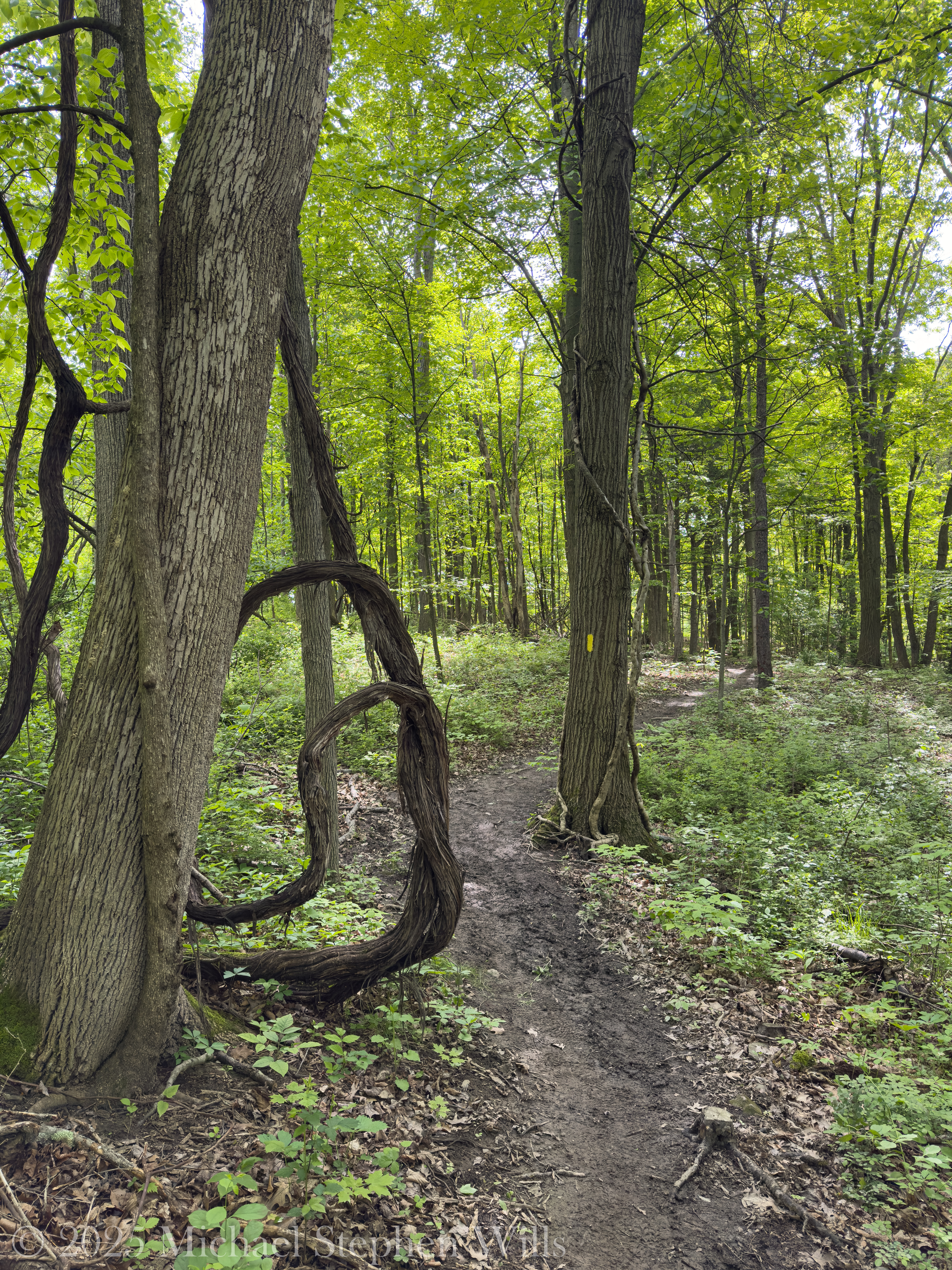
Further along, a looping vine coils around a pair of trees like an ancient signature. Possibly a native bittersweet, its woody stem thick as a child’s arm. It reminds me of how all life here is entangled—flora, fauna, stone, and stream woven into one vast web.
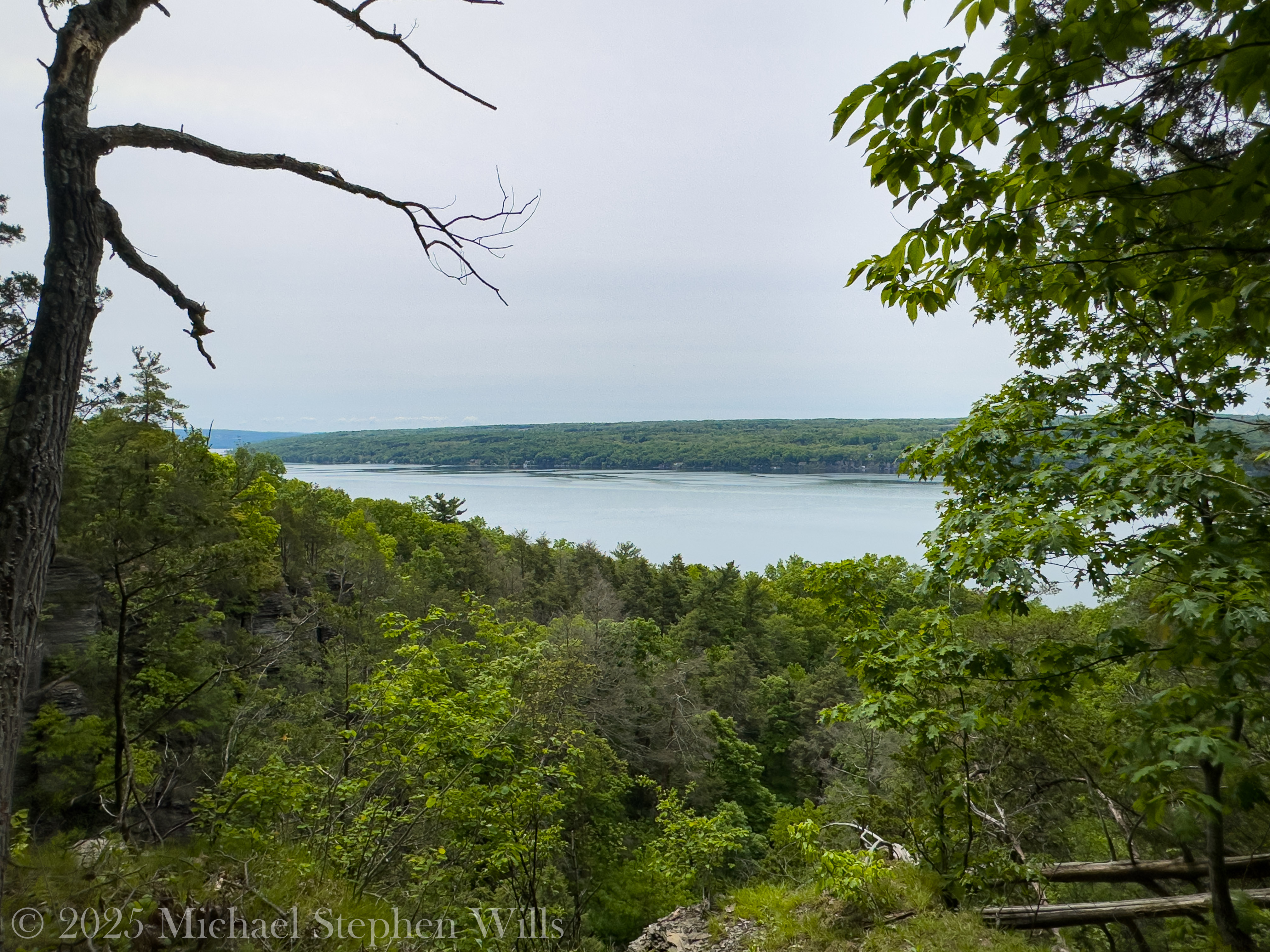
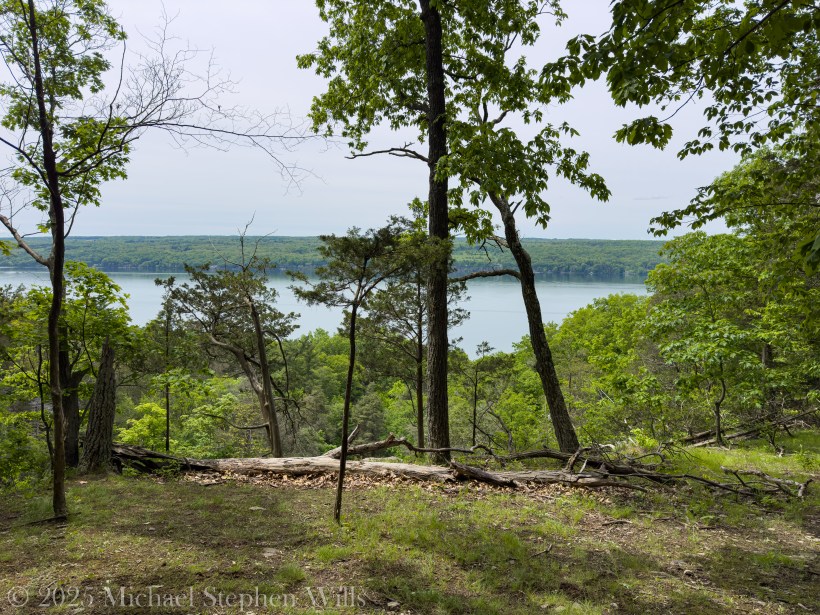
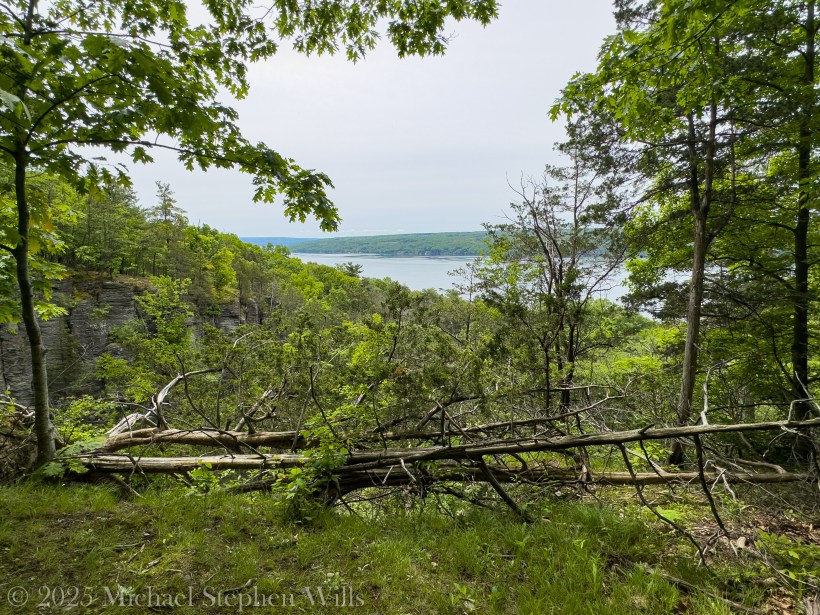
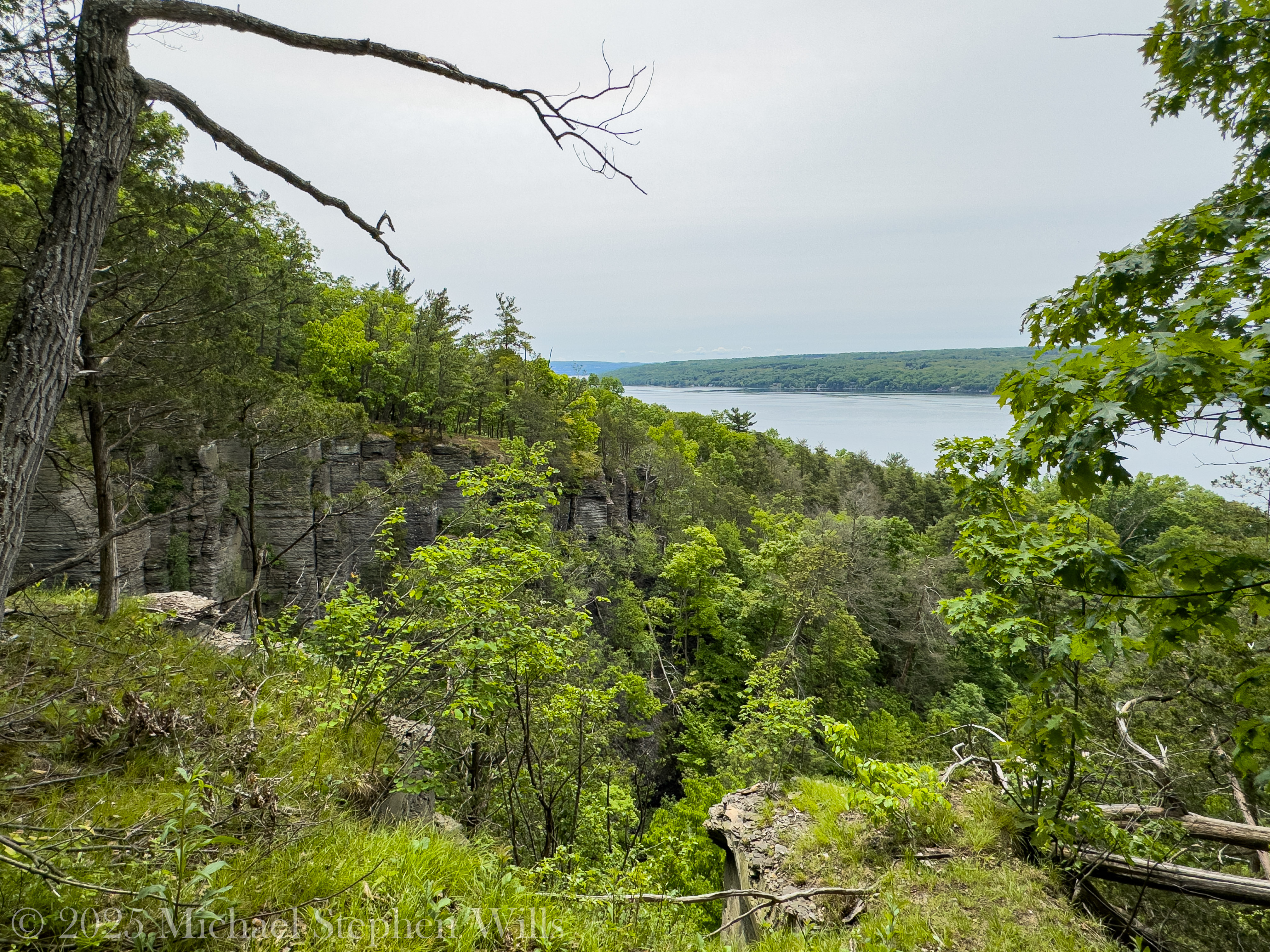
I pause at the overlook, where the trail skirts the cliffs. From this height, the view opened to Cayuga Lake, vast and gleaming in the morning light. Across the water, the hills of the western shore softened into a watercolor horizon.
Crowbar Point on the west lake shore is visible, partially hidden by trees. Sims-Jennings Preserve at Cayuga Cliffs, Finger Lakes Land Trust on a May morning 2025, Lansing, Tompkins County, Finger Lakes Region
On the walk back, a robin sings its measured phrases from a nearby hawthorn, and I think how common birds often hold the deepest solace. The robin’s voice rises above the silence, not grand, not rare, but reassuring in its familiarity—like a good friend’s greeting.
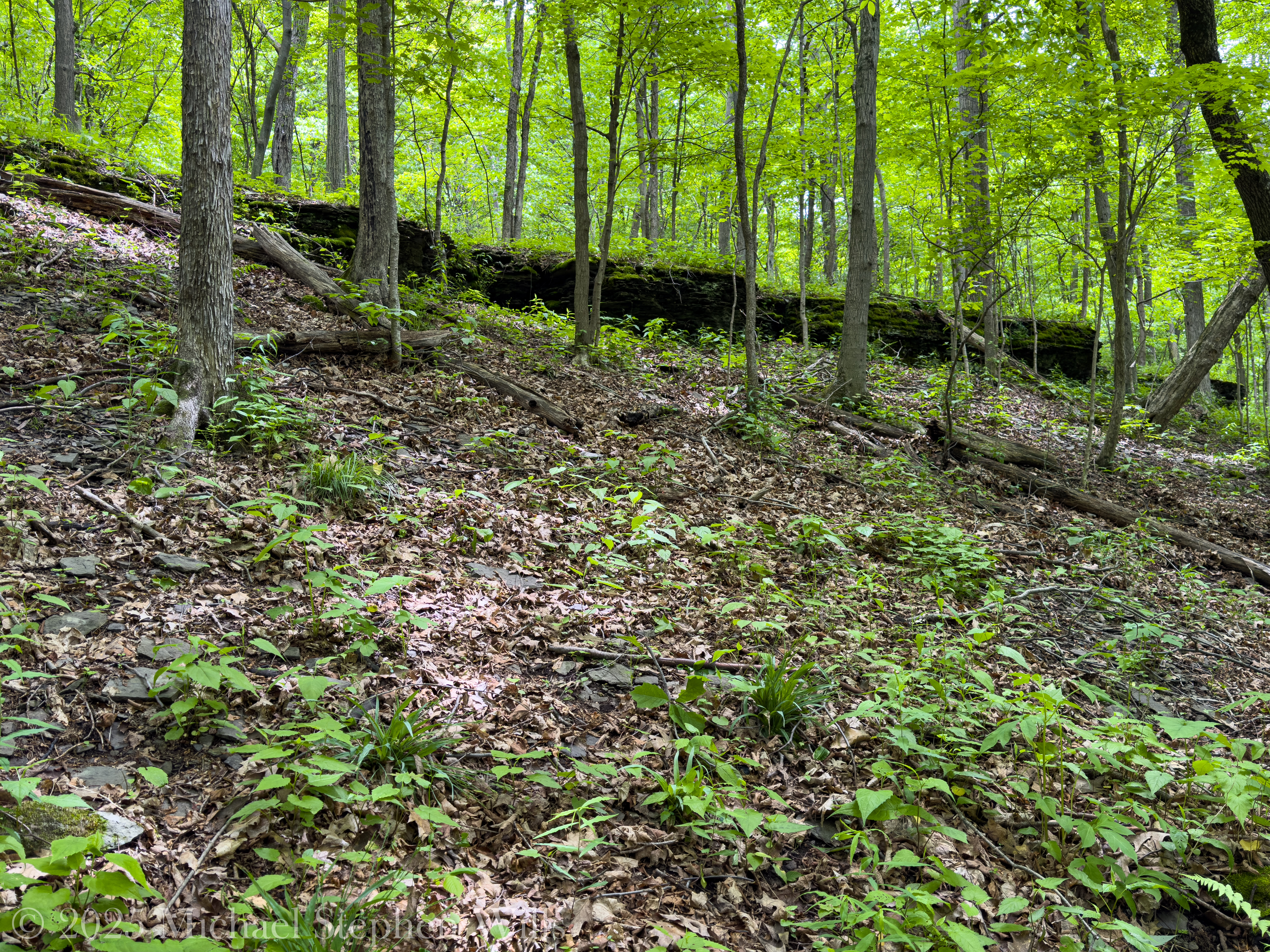
A shale ledge, Renwick Formation (?)
I leave the preserve changed gently, like the soft indent of a footstep in moss. The Sims-Jennings Preserve at Cayuga Cliffs is a place that reminds you to listen. To the birds, to the trees, to your own breath. And in listening, you remember what it means to be wholly present in the world.
Enter your email to receive notification of future postings. I will not sell or share your email address.
Copyright 2025 All Rights Reserved Michael Stephen Wills
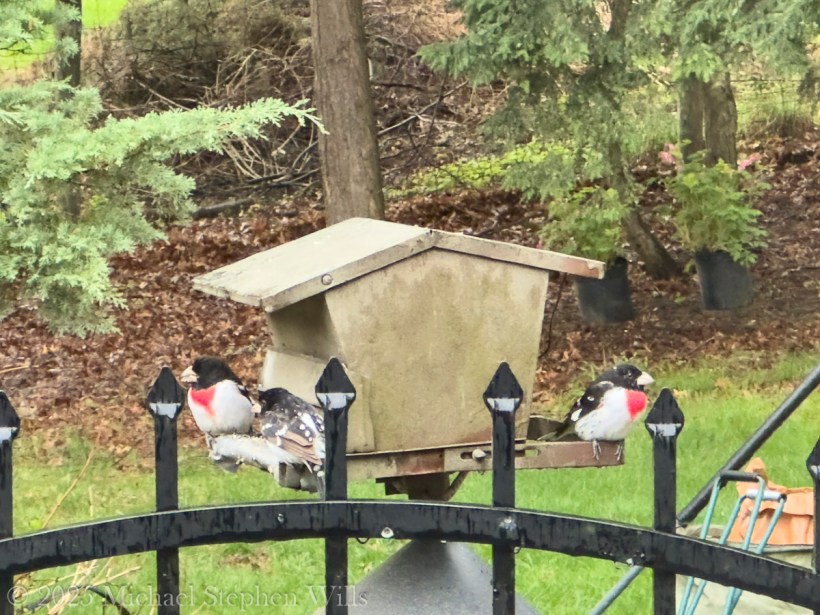
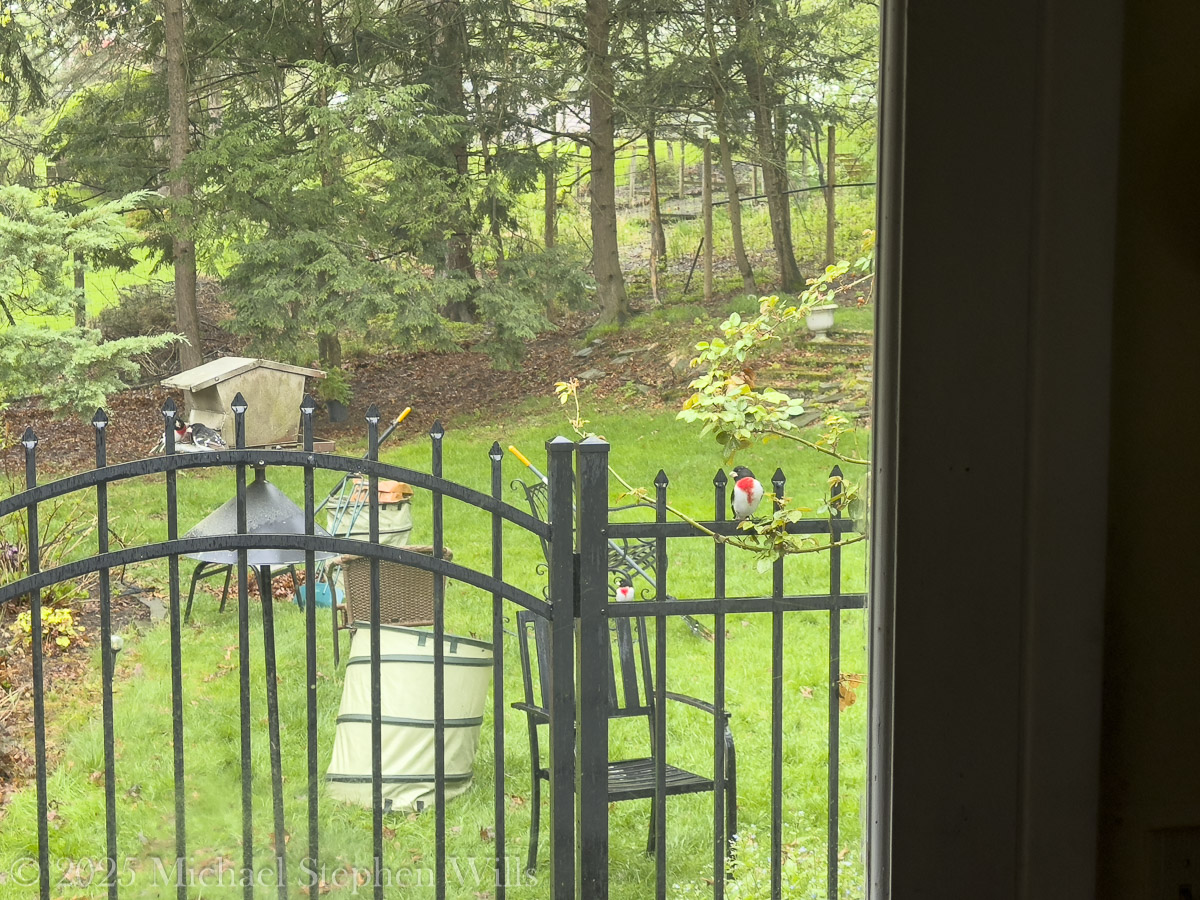
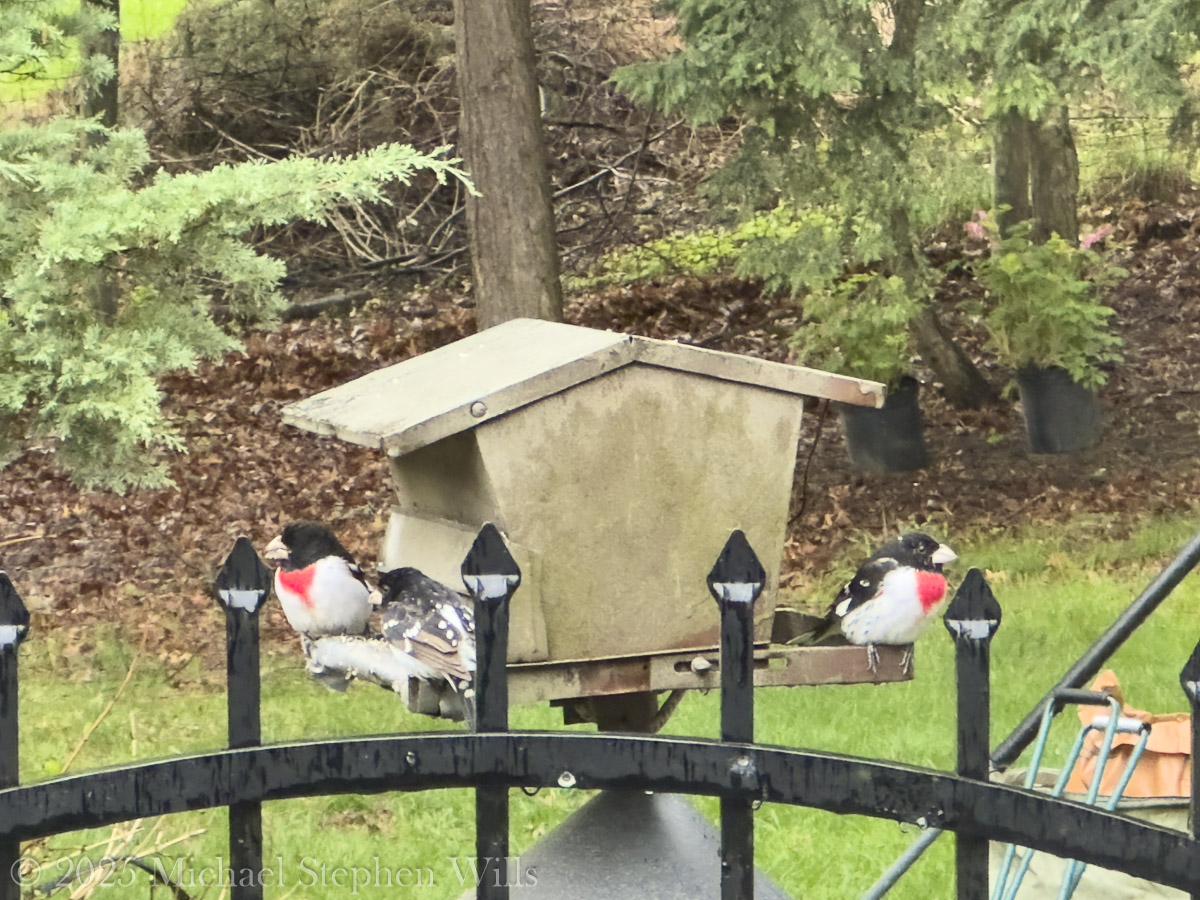
On a serene May morning, a small flock of Rose-breasted Grosbeaks graced the author’s yard, showcasing their vibrant plumage and bringing beauty to the tranquil scene of nature.
It was a gentle May morning, the kind that seems to hush even the wind, as though nature were holding its breath for something wonderful. Through the kitchen window, just past the black iron gate entwined with the fresh green of climbing rose, I spotted them—feathered heralds of spring’s deepening promise—perched like jeweled notes on a musical staff.
The Rose-breasted Grosbeaks had arrived.
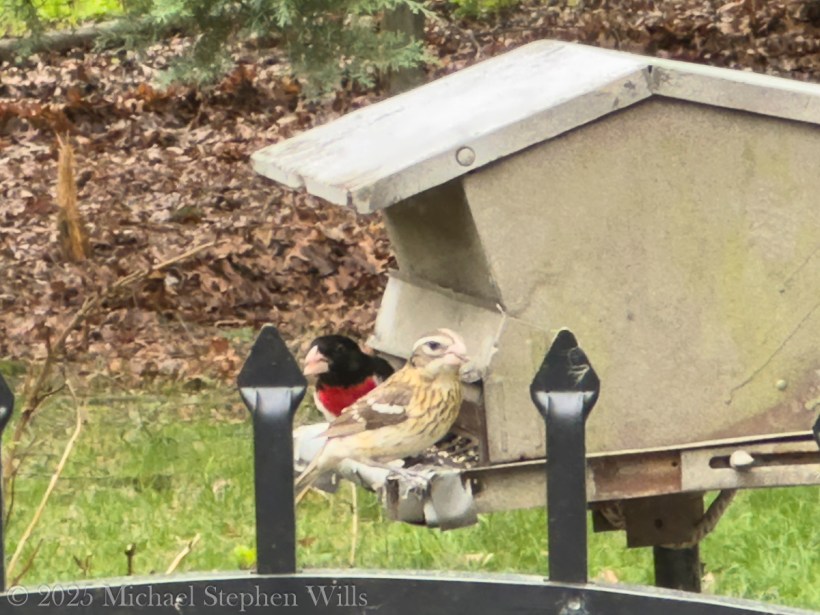
May 3, 2025 Four Male Rose Brested Grosbeaks visited our backyard bird feeder during spring cleanup.
Not one or two, but a small flock, draped in raindrops, feathered in contrast and charm. They gathered around our backyard feeder like guests invited to a familiar table. At 5:56 a.m., the camera captured the first image: two males on the feeder and one each on fence and chair, a bold bib of crimson splashed across snowy chests, huddled against the gray of the feeder, their plumage brilliant even in the diffused dawn light. I couldn’t help but smile. This was a scene of quiet splendor, a symphony for the eyes and soul.
The males, unmistakable in their attire, wore tuxedos of black and white, with the defining rose-red marking on the breast that gives the species its common name. Their scientific name, Pheucticus ludovicianus, is less poetic but equally telling. “Pheucticus” comes from the Greek pheuktikos, meaning “shy” or “avoiding,” reflecting their reclusive habits in forested nesting grounds. “Ludovicianus” refers to Louisiana, an early French colonial name for a vast region including their breeding range—a nod to their North American roots.
At 5:58 a.m., the lens captured more details: a male with slightly mottled wing feathers, suggesting he was a younger bird, still dressing up in adult finery. The trio clung to the feeder’s edge, their heavy, conical beaks—perfect for cracking seeds—clearly visible. That oversized bill gives them the name “grosbeak,” from the French gros bec, literally “large beak.” Functional beauty, you might say.
May 3, 2025 Three of the Four Male Rose Brested Grosbeaks visited our backyard bird feeder during spring cleanup.
Then, at 6:08 a.m., came the contrast—the female. Subtly adorned in warm browns, with creamy streaks and a wash of yellow near the wings, she perched beside her flamboyant mate, as if to say: elegance need not shout. The two birds looked momentarily toward each other, and I was struck by their balance—his flair and her grace. Her eyebrow stripe, called a supercilium, lent her a composed, alert expression. While the male might catch the eye, the female commands attention in her own, quieter way.
May 3, 2025 Male and Female Rose Breasted Grosbeaks visited our backyard bird feeder during spring cleanup.
Rose-breasted Grosbeaks are migratory, long-distance travelers who winter in Central and South America and return each spring to North America’s deciduous and mixed woodlands to breed. Here in upstate New York, our yard is a brief rest stop on their northward journey—or, if I’m lucky, a summer home. They often nest in dense foliage, and their song, a melodic, whistled warble—like a robin who’s taken voice lessons—is often the first clue to their presence.
This morning, no song was needed. Their silent presence was enough.
Watching them, I felt time slow, the kind of moment when the ordinary yard becomes cathedral. Watching them, I felt time slow, the kind of moment when the ordinary yard becomes cathedral. The wet fence and chair under the feeder, even the crumpled leaf bag—everything was blessed by the company of these birds. Rain softened the world, and the birds brought color to its hush.
Later that day, reviewing the photos with metadata timestamps from my iPhone—each image like a verse in a poem—I marveled at what I had witnessed. These weren’t just birds. They were stories in flight, living punctuation marks in the sentence of my morning.
Nature gives us these moments, brief as birdsong and just as sweet. You only have to be still, and ready to receive them.
Enter your email to receive notification of future postings. I will not sell or share your email address.
Copyright 2025 All Rights Reserved Michael Stephen Wills
References
Pheucticus ludovicianus (Rose-breasted Grosbeak). Cornell Lab of Ornithology – All About Birds.
Jobling, James A. The Helm Dictionary of Scientific Bird Names. London: Christopher Helm, 2010.
Merriam-Webster Dictionary: Etymology of “Grosbeak.”
iPhone 14 Pro Max image metadata (May 3, 2025; 5:56 a.m. to 6:08 a.m.; Ithaca, NY).
Two men experience the breathtaking beauty and vastness of Monument Valley, reflecting on nature’s timelessness while feeling small against the grandeur of the landscape at dusk.
They drove on through the late November light with the road falling away toward the valley. In the west the sun hung low, a copper disk above the red land. The two men squinted through the windshield. Before them, Monument Valley unveiled itself in towering silhouettes and stone ramparts where the world opened to an ancient scene held in amber light. A long black ribbon of highway led onward, straight and true, toward those looming buttes etched against the sky. The older man eased the truck to the shoulder and killed the engine. In the newfound quiet, they sat as the wind ticked against the cooling hood. Ahead, the valley’s monuments stood waiting in the orange glow of sundown.
“Hell of a sight,” the driver said softly.
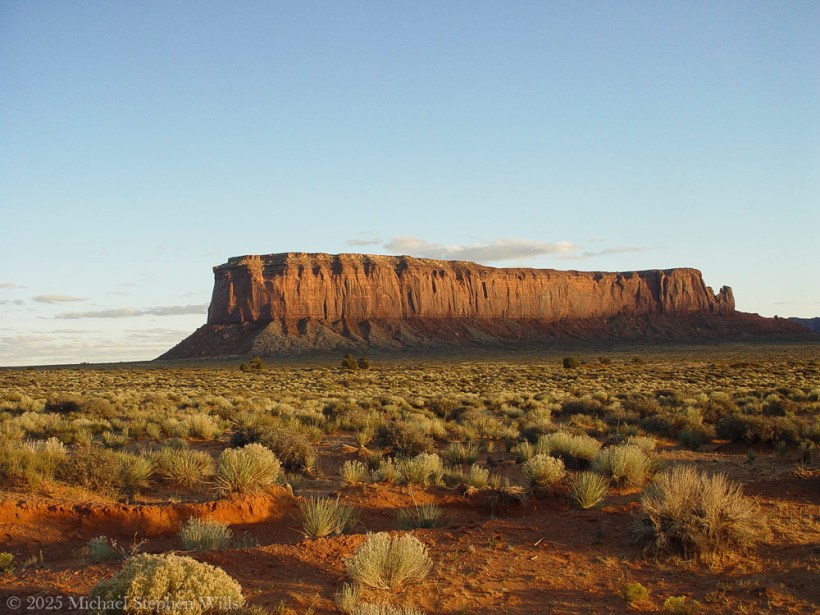
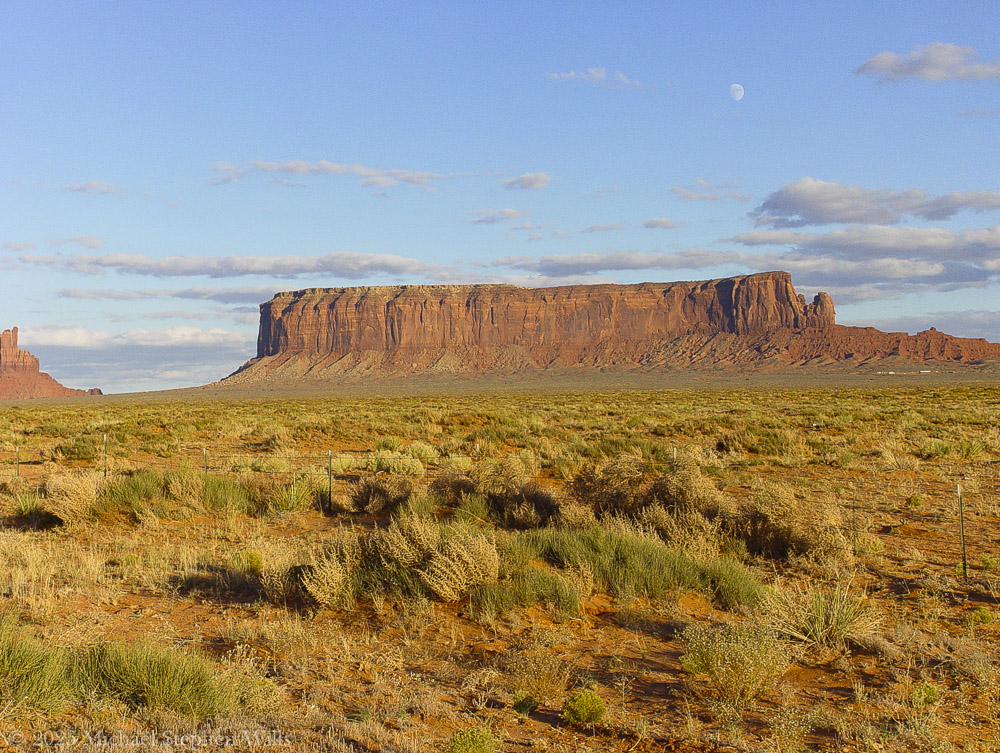
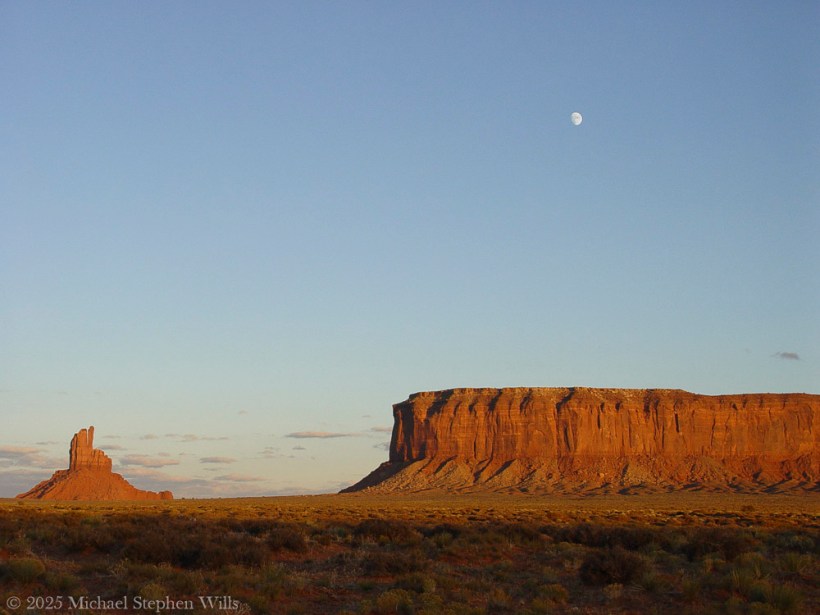
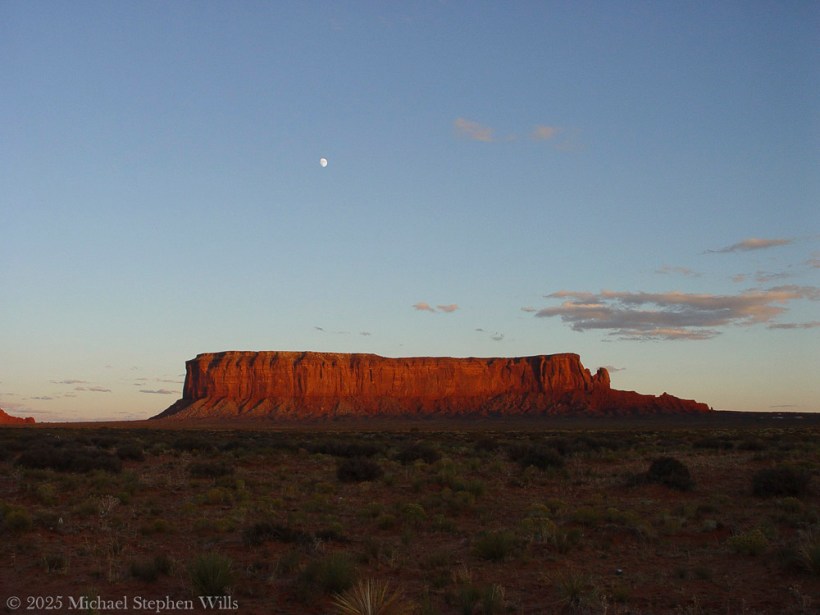
Sentinel Mesa and a slice of Big Indian peak to the left. A risen moon above all.As the day progressed here is Big Indian to the left, a portion of Sentinel Mesa with the risen moon above all
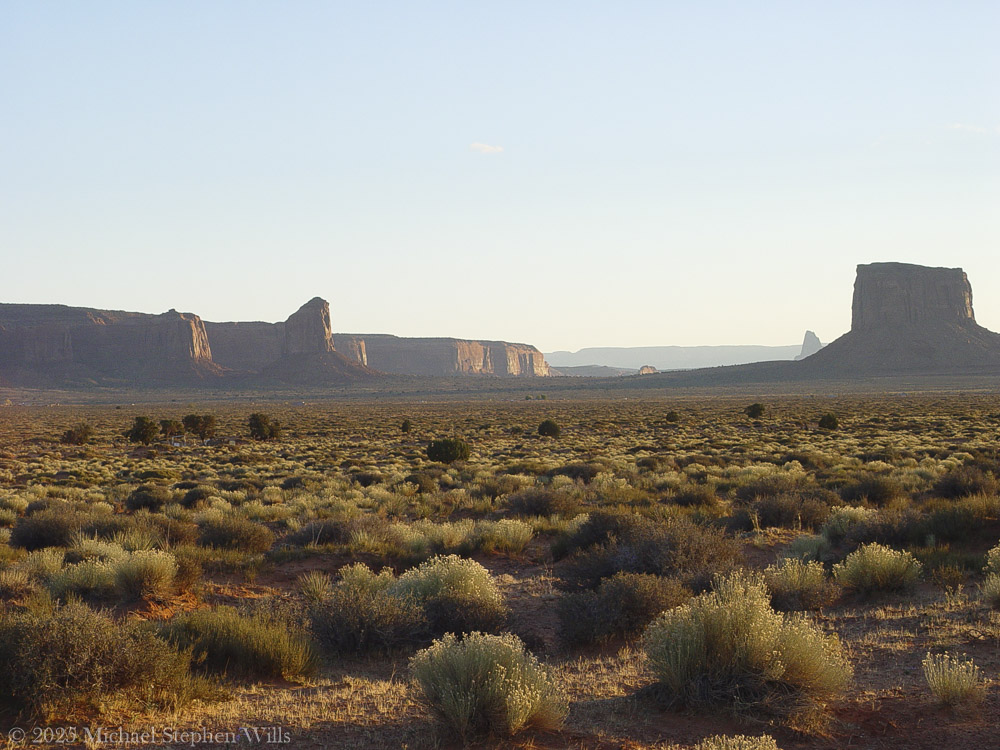
To the east, Sentinel Mesa rose broad and dark, its flat summit catching the last aureate light. The mesa loomed like a great natural battlement guarding the valley’s entrance. Aside, a solitary pinnacle known as the Big Indian stood in muted vermilion hues. In profile it did resemble a weathered face—a monumental visage gazing eternally south over the sacred lands. Farther south, Mitchell Butte jutted upward, its sheer walls burnished red-gold on one side where the sunlight still lingered. A mile or so southeast, the land climbed again to the massive bulk of Mitchell Mesa, now mostly in shadow. The sun was dropping behind it, outlining that mesa’s far rim in a halo of pale fire. Near to Mitchell Butte, a tall slender Gray Whiskers Butte rose like a lonely watchman. Its pinnacle was streaked with dusk, the stone fading from blood-red at its base to a somber gray at its crown. One of the men pointed toward it silently, and the other simply watched, understanding the unspoken thought: how small they were below these giants of rock.
Mitchell Butte, Grey Wiskers Butte and Mitchell Butte
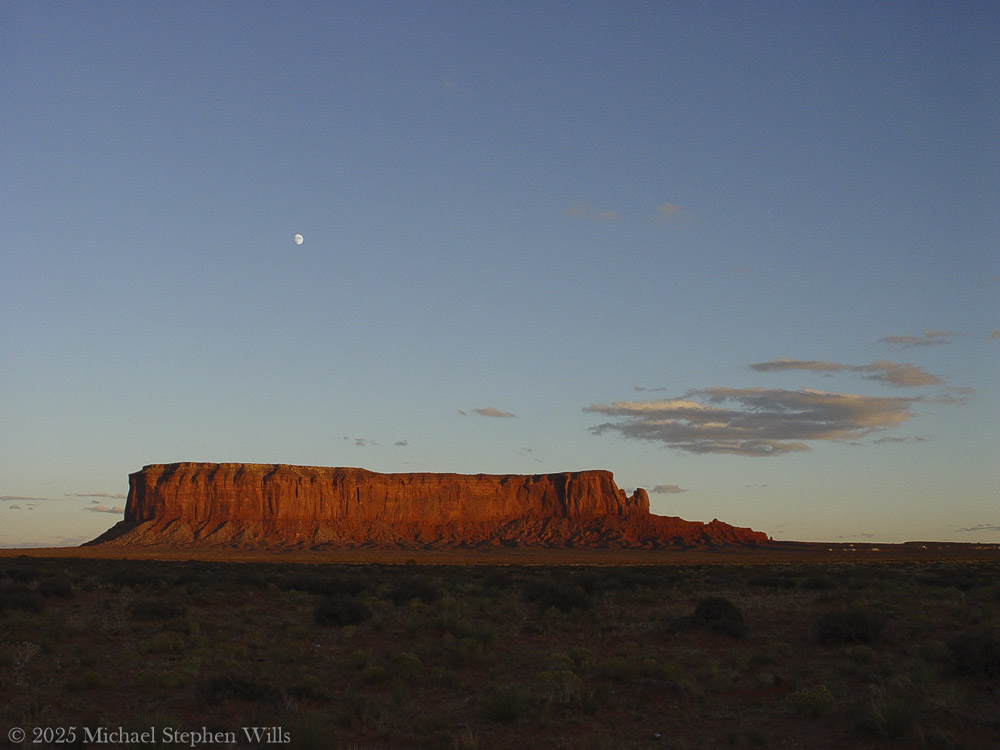
High above Sentinel Mesa, the evening swan of this desert had already appeared — a waxing moon, nearly full and ghostly white. It floated just over the mesa’s dark crown as twilight gathered, like an omen or a blessing. The sky behind the landforms had begun to take on the deep indigo of coming night. In the east, opposite the dying sun, the heavens were lavender and faintly banded with pink. The moon climbed in silence, gaining strength as the sun bled out in a final flare of vermilion along the horizon. In that half-light the mesas and buttes became blackened shapes, cut from the twilight itself, their identities merging with the land’s dusk. November’s chill crept in with the dark. The younger man drew his jacket closed. Neither of them had thought to speak for minutes now. They simply wandered a few yards from the truck, eyes turned outward and upward, silhouettes of their own against the dimming day.
Sentinel Mesa with risen moon
His companion nodded. He opened the door and stepped out. “Never seen anything like it,” the younger man said. His voice was reverent, almost a whisper. The driver climbed out too, boots crunching on red grit. They walked a few paces from the road, drawn forward as if on a tide. The evening air was cool and carried a dry, dusty scent tinged with sage. In the far distance, the monuments cast long blue shadows over the valley floor. The travelers stood for a long moment without speaking, each alone with the scale of it.
The land was vast and inscrutable. In the silence it felt holy. It was easy to believe no one else in the world existed at this hour — only these two and the ancient valley spread before them. The wind came from the west in a long sigh, carrying the dust of the desert. It whispered through dry bunches of brush at their feet and stirred a lonely tumbleweed across the cracked earth. The younger man removed his hat and ran a hand through his hair as if to assure himself this was real. The older man stood with thumbs hooked in his belt, head tilted back to drink in the view. His face was lined and still, the dying light painting one side in gentle umber. If either man harbored any burdens or regrets from the road behind, the land seemed to dwarf those worries into nothing. They felt themselves small as insects on an endless painted floor.
After a time, the driver cleared his throat. “We’ll lose the light soon,” he said. His voice was low. He seemed unwilling to break the spell with anything louder.
The younger man nodded again but did not take his eyes off the valley. “Just a few more minutes,” he replied.
“All right.” The driver smiled thinly and pulled out a cigarette. He struck a match and cupped it against the breeze, the brief flame reflecting in his narrowing eyes. In the glow of the match the canyons of his face showed for an instant, then vanished into shadow again. He drew in and exhaled a plume of smoke that the wind instantly seized and unraveled. Sentinel Mesa crouched out there like a great shadow, crowned now by a silver moon that grew brighter by the minute. The older man followed that mesa’s outline with his eyes, tracing the crenellated cliffs and the slope of rubble at its base. “They named that one right,” he said, mostly to himself.
“What’s that?” the other asked softly.
“Sentinel. Standing guard.” The driver gestured with the glowing tip of his cigarette. “Feels like it’s been watching this place forever.”
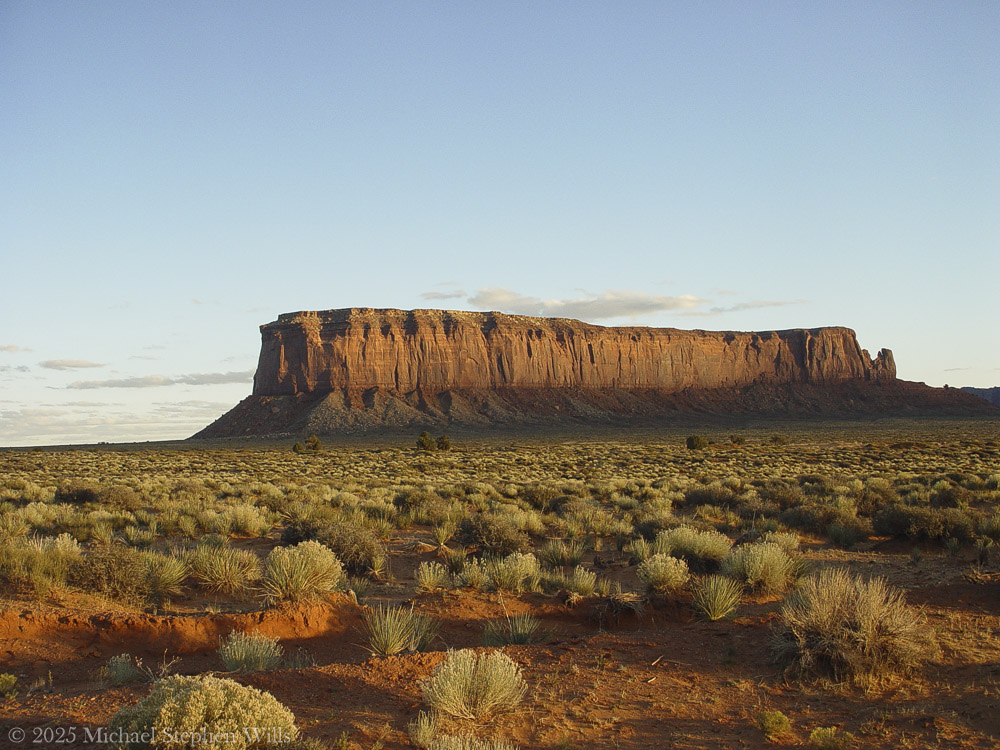
Sentinel Mesa standing guard with the red desert floor and fauna in the last light of sunset
The young man considered the hulking form of the mesa. In the twilight it did have the aspect of a watchtower keeping vigil over the valley. “It probably has,” he said. “Long before we ever came.”
On the road behind them a faint glint of chrome from the hood caught a stray moonbeam.
The younger man broke the long quiet. “You ever been down here before?”
The older man nodded. “A time or two.”
“You see all this then?”
A chuckle from the older man, low in his throat. “Not quite like this. First time I come through here I didn’t see a damn thing.”
The younger man looked over, puzzled. “What do you mean?”
“Well,” the old man said, “I’d been driving since Durango, and I’d run out of good sense somewhere near Shiprock. Rolled in with the rain. Thought I’d catch a nap and wake up to a postcard.”
He paused, lighting another cigarette, letting the flame flicker in the cooling breeze.
“Only I parked across from a big ridge in the moonless dead wet dark, didn’t think much of it. Woke up next morning to what I thought was the edge of a landfill. Just a big wall of brown rock. Figured I took a wrong turn and ended up behind a gas station.”
The young man laughed. “You’re kidding.”
“Nope. Got out, stretched, cursed the road and the view and the whole damn state. Got out to take a leak, figured I’d head on. And just as I’m zippering up, I look to the right—and there it is.”
He waved his hand toward the black outline of Mitchell Mesa, vast and solemn in the moonlight.
“The whole valley,” he said. “Caught me sideways. I parked blind to all of it. Missed the whole show.”
He shook his head, the cigarette ember glowing orange.
“Spent the next half hour cussing myself out. Sat there red-faced with a thermos of cold coffee like a man at the symphony who showed up deaf and late.”
The younger man laughed, full-throated now. “You mean to tell me you slept in Monument Valley and thought you were behind a gas station?”
The old man shrugged. “In my defense, it was cloudy.”
They both laughed then, the sound rolling out over the scrub and rocks and into the vastness.
He walked a little farther from the road, and the older man paced beside him. Ground crunching underfoot, fine dust kicking up around their boots. They ascended a slight rise where the terrain leveled off in a broad expanse leading toward the valley proper. Beneath their feet the earth was soft and powdery—red earth, lit now by the dim purple of dusk and the growing lunar light. The younger man scuffed the toe of his boot in it, and a little crimson cloud rose and drifted away. By daylight this soil was a vivid rust-red, the color of dried blood. It was as if the ground itself had a memory of violence or sorrow, but the truth of that color was simpler and older: the iron in the earth, left behind by ancient oceans, oxidizing over eons in the sun and airen.wikipedia.org. The land bled red because the very minerals of its making had rusted in the long passage of time. In places the valley floor was cracked clay, in others loose sand, all part of the same great story of stone turned to dust.
The two men walked out a bit further into the open, where scattered plants clung to life in the hardpan. There were low shrubs of sagebrush exuding a faint herbal scent, and clumps of purple sage with gray-green leaves, their summer blooms long spent. Here and there jutted the spiky forms of yucca, bayonet-tipped leaves fanning out from the base of each plant. Most everything that grew here hugged the ground and wore the dusty colors of the soil. In the failing light, the sage and grass tuft looked almost colorless, pale as ash. Only when lightning storms rolled through would the desert briefly bloom green; in these dry weeks of autumn the vegetation lay dormant, patient. A scraggly juniper tree crouched in a shallow gully nearby, twisted by wind and drought, its bark bleached where it faced the sun. These were the survivors of an unforgiving climate – rabbitbrush, snakeweed, hardy shrubs that lived on almost nothing. The young man knelt and pinched a bit of sage between his fingers, releasing its sharp fragrance. This smell, to him, was the perfume of the desert itself.
In the sand at the base of the sagebrush, he noticed a faint track. He brushed aside some dust to reveal the imprint of tiny claws: the delicate spoor of a lizard that had passed earlier when the ground was warm. It wound off between the rocks and vanished. Other tracks crisscrossed subtly in the dirt – a jackrabbit’s long-toed prints, nearly indistinguishable amid scuffs, and the delicate imprints of some small bird that had hopped about pecking for seeds. Life was here, though it was seldom seen. A red-tailed hawk wheeled silently high above, cutting black circles into the dim sky. Perhaps it was hunting one last time before full dark. The younger man stood again and looked out over the valley with new wonder, realizing that countless creatures lived and moved in this terrain largely unseen. In the daytime heat they sheltered in burrows and shadow. At dusk they came forth. He imagined a coyote trotting through a distant wash on soft paws, nose to the ground; a mule deer picking its way among these rocks somewhere beyond sight; a mountain lion watching from high up on a ledge as it had watched all afternoon. This desert did not easily give up its secrets, but they were there.
The older man stepped out onto a broad flat of rock and ground his cigarette butt under his heel. In the silence his companion could hear the scrape of boot leather on stone. The rock was part of an exposed slab that had broken off from a greater outcrop. It sloped gently down into the valley and was strewn with fine gravel from its own slow decay. The driver pressed his bootsole into a brittle crust of the rock’s surface, and it crumbled with a dry sound. These monoliths around them were not as immutable as they looked. Wind and rain had been gnawing at them for ages uncounted. Every thunderstorm that swept these flats cut new gullies in the shale, undercutting the bases of the cliffs. Every hot summer day the rock expanded, and every cold night it contracted, fissures growing by imperceptible degrees. Water trickled into cracks and ice pried them wider in winter. In time, great slabs would calve off with a roar and a billow of red dust, adding another heap of boulders to the talus at a butte’s feet. The valley was strewn with such piles like fallen ramparts. Erosion was the master sculptor here, patient and inexorable, chewing away the softer rock beneath and leaving the harder stone standing in great towers and tablelands. Each butte, each spire, had endured unthinkable ages to remain in this moment as a seemingly permanent fixture—and yet they too were slowly disappearing grain by grain. In a thousand years the difference might be subtle; in a million, perhaps these forms would be gone entirely, ground down to the flatness of the surrounding plain. The land was alive in geological time, though to human eyes it appeared frozen in a grand and silent repose.
They wandered farther, and now the truck was a small shape behind them on the roadside pullout. Neither man minded. The road was empty; no other vehicle had come along for a while, and only a lone set of headlights glimmered many miles away, moving slowly, probably a rancher or a late tourist heading home. The two travelers were alone with the land and sky. Overhead, the first stars were coming out in earnest, timid specks appearing in the dome of night. The moon was higher now and bright enough to cast shadows. The tall profile of Big Indian was cut into the moonlit sky, unmistakable and solemn, and on the valley floor the leaning spire of Gray Whiskers stood lit on one side by the cold glow. Away to the east, the open desert beyond the valley was falling into darkness, a great stretch of unknown country into which the highway disappeared. And still the west flared with afterlight — a band of deep red on the horizon, fading to gold, then greenish and up into the endless blue-black. It was a sky that seemed too vast for the world.
The younger man found a boulder at the edge of the flat and sat down. He removed his hat and set it beside him. The stone felt cool now under his legs. The heat of the day had fled so quickly that the air itself seemed to crackle with cold. He drew a deep breath and let it out. The land gave back only silence. A great and ageless solitude reigned here, the kind that makes its home in deserts and high places where man has no authority. He could feel it pressing in, not unkindly. It was the solitude of a world largely unchanged long before humans and likely long after. Under that eternal sky and the gaze of those stony sentinels, their own lives felt momentarily trivial. Yet the feeling was not bitterness or despair. Rather, it was humbling and strangely reassuring, as if all the griefs and triumphs that had ever marked a human life were nothing next to the calm presence of these rocks. The earth endured. The earth would always endure. Time and wind would wear down even mountains, but until then these mesas would keep witness over the days and nights, the storms and still mornings, the generations of men who came wandering through seeking something larger than themselves.
The older man walked over and eased himself down on the same boulder. He groaned softly as he sat, rubbing one knee. They both looked out over the emerging night. For a long while, neither spoke. Far in the distance, a coyote yipped — a brief, high sound, then silence again. The younger man smiled in the dark.
“The cold is coming fast,” the older man said after a time.
“Yeah. It does that quick out here.” He picked up his hat and dusted it off, though no dust truly could be kept off in this country. Dust was the true sovereign of the valley — red dust that coated boots and clothes, that hung in the air at midday, that settled on skin like a fine powder. It would ride back with them in their vehicle no matter how well they shook their coats. It had a way of clinging on, a reminder of where one had been.
“You ready?” with a tilt of his head back toward the truck.
The younger man took one last sweeping look over Monument Valley. The forms of Sentinel Mesa and its neighbors were nearly indistinguishable from the dark of the sky now, save where the moonlight etched a line or two along a cliff. The valley floor was lost in shadow. In the east, a few scattered clouds caught a faint silver luminescence from the risen moon. The beauty of the scene was stark and almost aching — a kind of beautiful emptiness that a man carries away inside him, knowing he has witnessed something that can never properly be told. He opened his mouth as if to speak, but no words came. Instead, he simply nodded and got to his feet. They began walking back toward the truck, side by side.
Behind them, the desert night continued its slow unfurling. One by one, stars pierced the darkness. The moon climbed higher on its silent arc. The great stone silhouettes stood unchanged, as they had through countless nights. In a few hours the dawn would come and paint them in rose and gold once more. But for now the valley slumbered under the pale glow of the moon. As the two men reached their vehicle and the engine turned over, its headlights flaring to life, they took one last look across the plains of Monument Valley. Then the truck pulled back onto the highway and receded down the lonesome ribbon of asphalt, two red taillights diminishing and finally vanishing into the boundless Navajo night. The land remained as it was, vast and indifferent to their departure. Sentinel Mesa and Mitchell Mesa stood like opposing pillars at the great gateway of the valley, keeping their eternal watch. The wind sighed over the road and across the sleeping rocks. The footprints the men had left were already beginning to blur with settling dust. Above, the indifferent stars traveled their courses. And the red earth of the desert stretched away in all directions—ancient, patient, and still, beneath the enduring sky.
Enter your email to receive notification of future postings. I will not sell or share your email address.
Copyright 2025 All Rights Reserved Michael Stephen Wills
The Louisa Duemling Meadows celebrate conservation and biodiversity, showcasing vibrant flora and honoring Louisa Duemling’s legacy as a steward of nature.
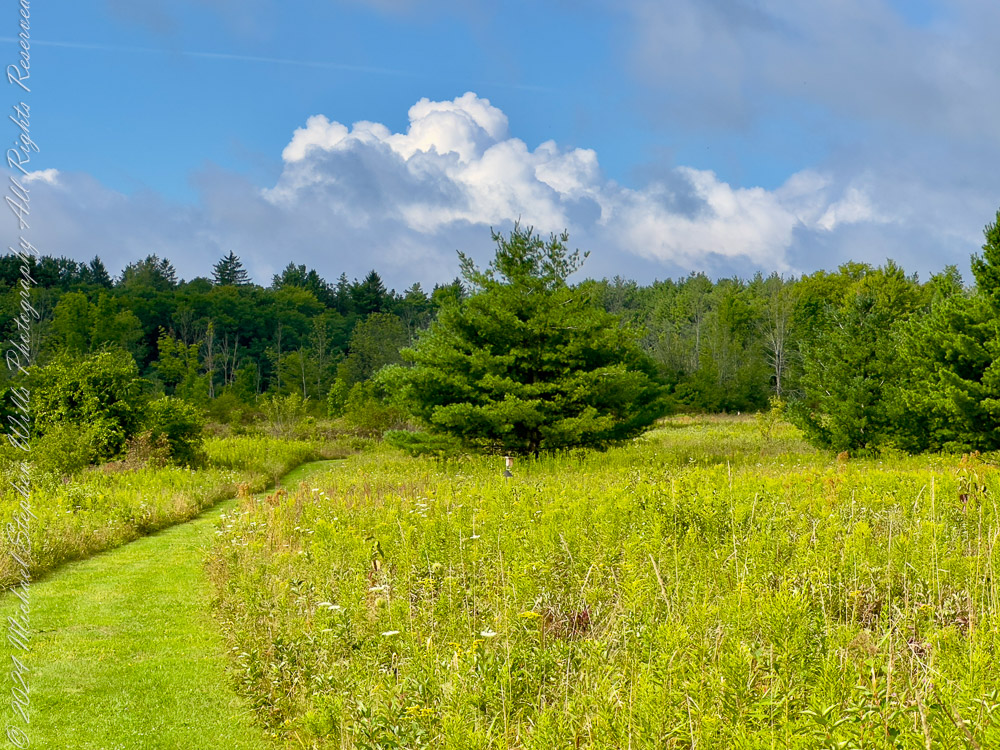
The Louisa Duemling Meadows, nestled within the expansive embrace of Sapsucker Woods, offers a vibrant tableau of life, brimming with opportunities for exploration and a sense of wonder. This new trail, winding through golden fields and punctuated by bursts of wildflowers, whispers tales of the land’s natural and cultural heritage.
Louisa Duemling: A Steward of Nature Louisa Duemling, the meadows’ namesake, was a dedicated conservationist and philanthropist who supported the Cornell Lab of Ornithology’s mission to protect birds and their habitats. Her legacy lives on in these serene fields, where her commitment to preserving the environment is reflected in every thriving plant and songbird.
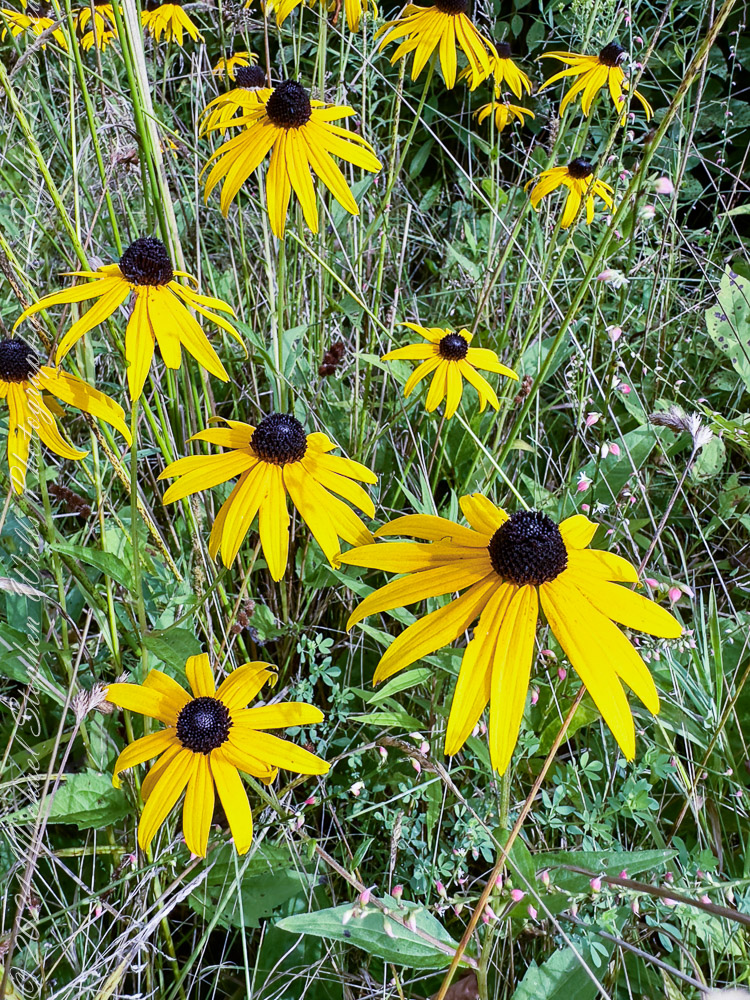
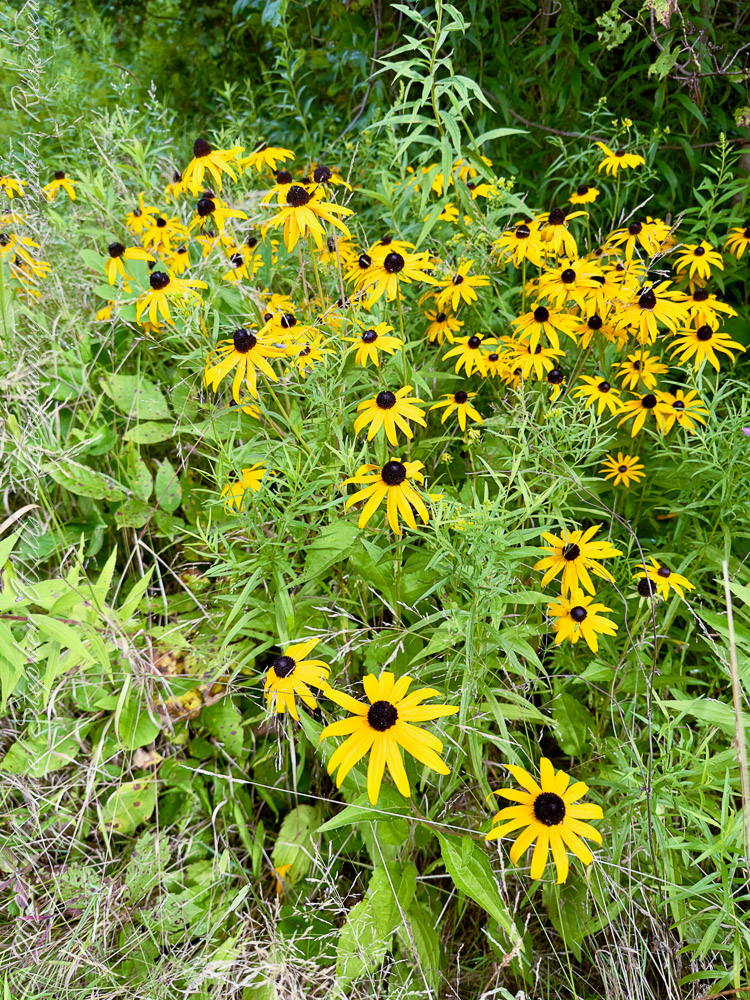
Black-eyed Susans: The Meadow’s Golden Treasure Dominating this summertime landscape with their radiant yellow petals and dark central disks, Black-eyed Susans (Rudbeckia hirta) are a hallmark of the meadows. These cheerful blooms are a delight to the eye, a cornerstone of meadow ecosystems. As members of the Asteraceae family, their composite flowers serve as a rich nectar source for pollinators like bees and butterflies, ensuring the vibrancy of these fields.
Historically, Black-eyed Susans have been used in traditional medicine by Native American tribes for their putative anti-inflammatory properties. Their ability to thrive in diverse conditions also makes them a symbol of resilience and adaptability.
A Symphony of Green and Gold Walking through the trail, one is greeted by the harmonious interplay of goldenrods (Solidago spp.), milkweeds (Asclepias spp.), and asters (Symphyotrichum spp.). Goldenrods, with their feathery clusters of yellow blooms, are often mistaken as allergenic culprits, though it is the inconspicuous ragweed (Ambrosia artemisiifolia) that deserves this reputation. Milkweeds, with their milky sap and delicate pink or white flowers, are vital to monarch butterflies (Danaus plexippus), serving as the sole food source for their larvae.
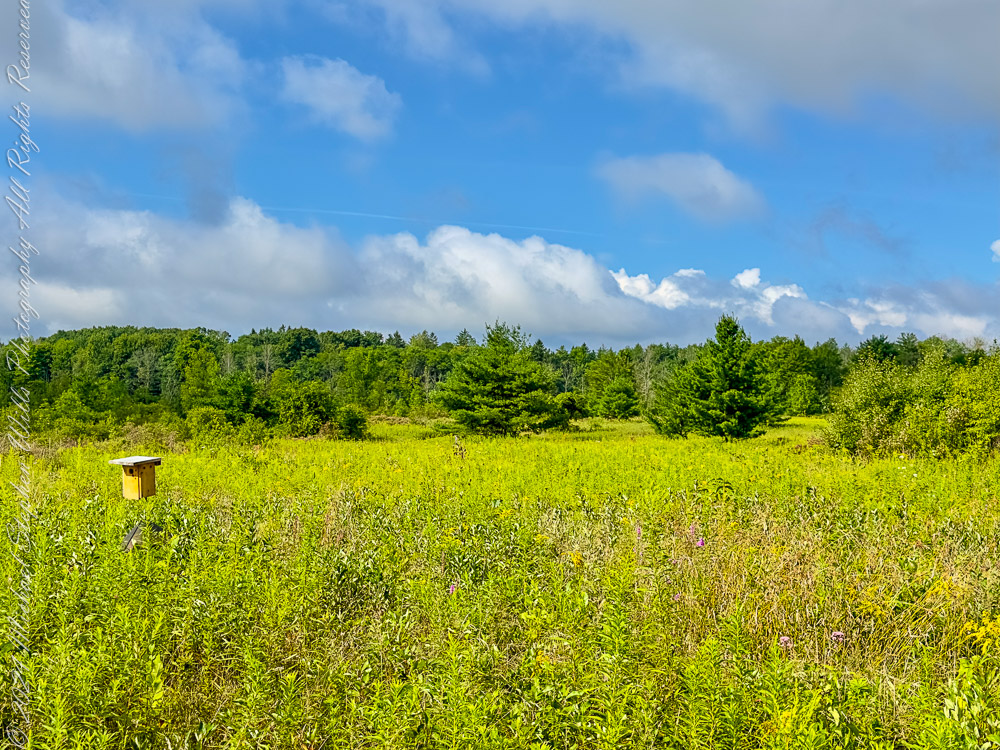
Among these botanical wonders, the birdhouse stands as a sentinel, a reminder of the intricate relationship between flora and fauna. These wooden structures provide safe havens for cavity-nesting birds like Eastern Bluebirds (Sialia sialis) and Tree Swallows (Tachycineta bicolor), fostering biodiversity within the meadow.
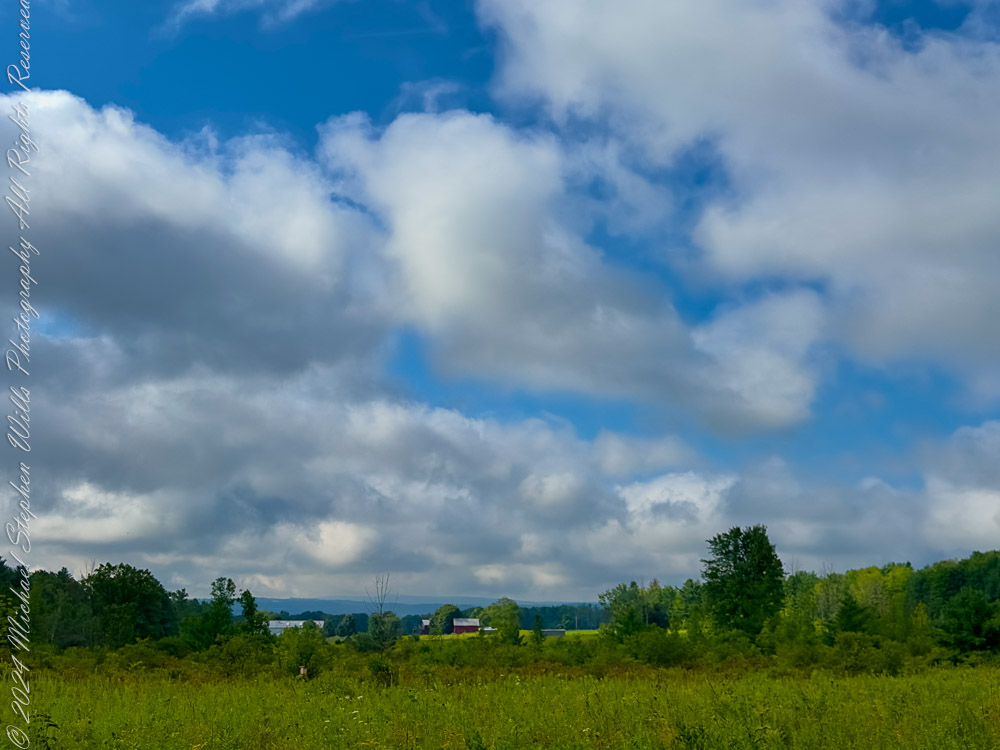
A Horizon Framed by Pines and Clouds The open meadow trails, flanked by clusters of Eastern White Pines (Pinus strobus) and punctuated by the azure sky, invite reflection and renewal. This is a place where the human spirit can align with the rhythms of nature, where each step reveals new layers of beauty and discovery.
Embracing the Spirit of Discovery To wander the Louisa Duemling Meadows is to immerse oneself in the timeless dance of life. The trail, carefully marked yet wild in essence, invites visitors to lose themselves in its beauty while finding solace in its quietude. This is not just a path through nature—it is a journey into the heart of conservation and a celebration of the life that thrives under Louisa Duemling’s enduring legacy.
As you leave the meadow, carry with you not just the memory of golden flowers and vibrant skies but the inspiration to cherish and protect the natural world. The Louisa Duemling Meadows are not only a gift to those who walk its trails but a reminder of the profound impact one can have in preserving our planet’s fragile beauty.
Enter your email to receive notification of future postings. I will not sell or share your email address.
Copyright 2025 All Rights Reserved Michael Stephen Wills
San Xavier del Bac in the Sonoran desert embodies a fusion of indigenous and Spanish symbolism, showcasing devotion through art and imagery that evokes faith, beauty, and spiritual connection.
In the Sonoran Desert near Tucson, Arizona, San Xavier del Bac rises like a vision out of time. Within its adobe walls and domed ceilings lie layers of symbolism—an indigenous inheritance and Spanish colonial fervor merged into a singular living devotion. The photographs presented here, saturated with morning light, guide us through a meditative journey into this mission’s spiritual and aesthetic soul.
The crucifix dominates the first image—the depiction of Christ crucified, emaciated, bruised, crowned with thorns. His suffering is not abstract but visceral, carved in every wound and strained muscle. This figure of Christ, so brutally human, is draped in a tattered loincloth, a humble covering amid divine sacrifice. At his feet rests an offering: a blue artificial flower, incongruent in its brightness yet perfectly placed, a modern votive that expresses both reverence and continuity. It reminds us that humble devotion endures.
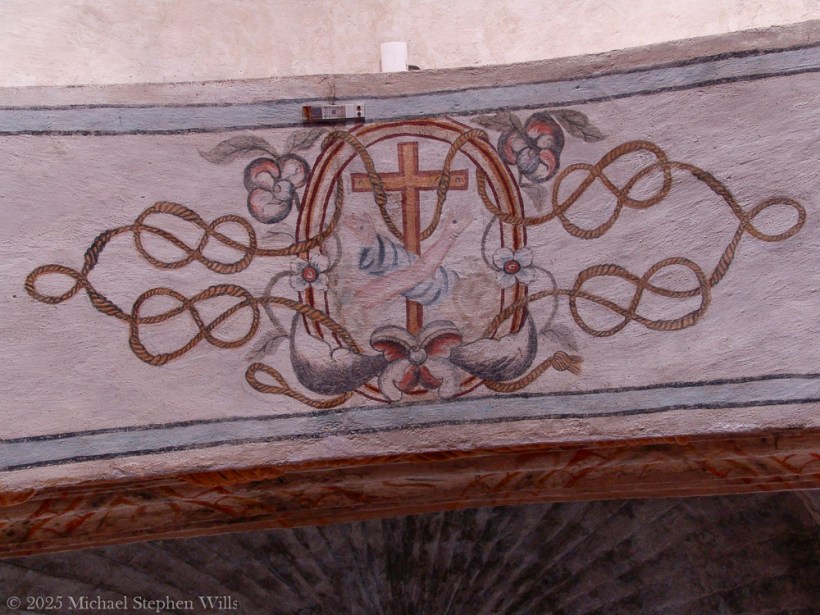
The fresco, with its cross flanked by stylized doves and roses, extends the Passion’s symbolism into sacred geometry. Doves—universal emblems of peace and the Holy Spirit—face one another in symmetrical grace, drawing the eye into the cross they flank. The single length of curling, intertwined golden ropes bind all elements in unity, perhaps reflecting divine infinity. The floral elements speak to rebirth and resurrection, a soft counterpoint to the harshness of the Crucifixion. Here, pain and peace coexist in a visual hymn.
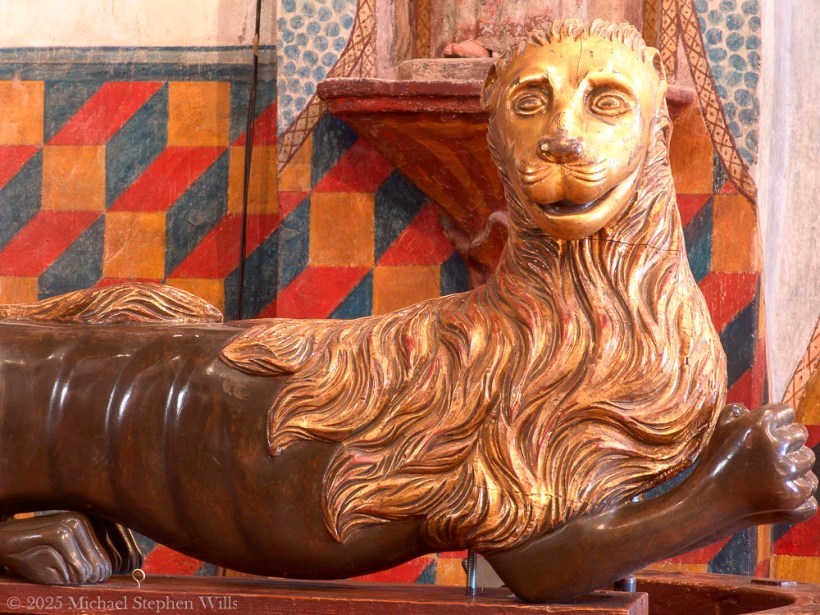
The lion sculpture, oddly cheerful in its golden face, seems at first a puzzle. Yet within Christian iconography, the lion often represents Saint Mark, the Evangelist, or the power and vigilance of God. This lion, rendered with stylized curls and a strong, reclining pose, guards the sanctuary. Its gilded mane mirrors the opulence of heaven, even in this humble desert mission. The lion’s curious gaze invites us to move past fear, toward the mysteries within.
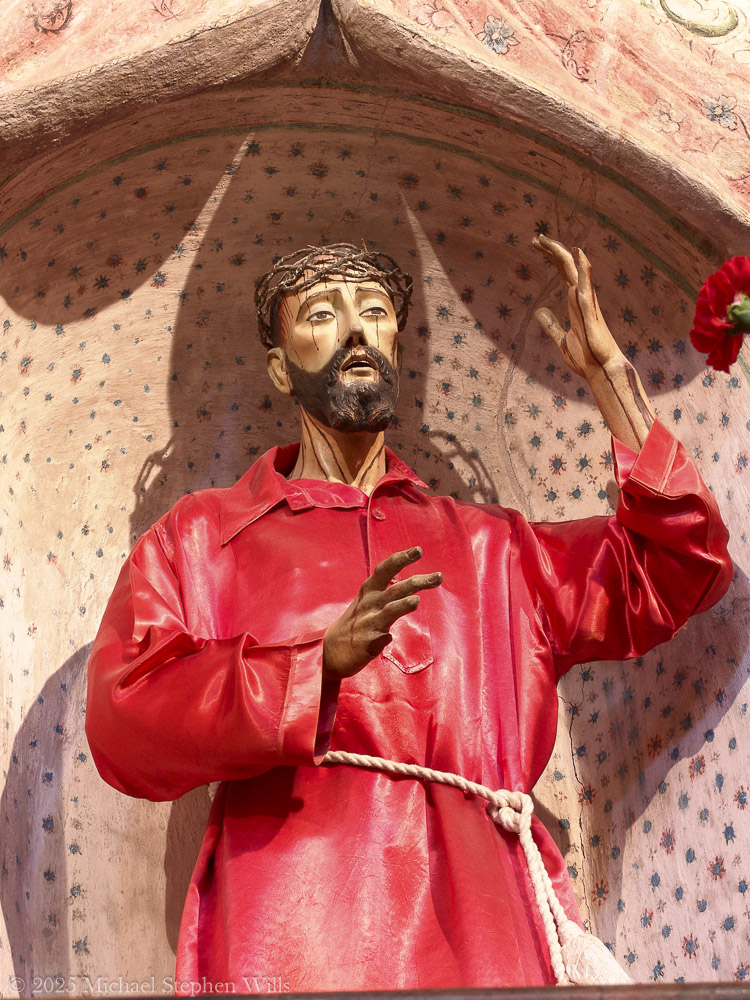
We then meet a robed figure in red—another portrayal of Christ, this time during the Passion, perhaps as the Ecce Homo (“Behold the Man”). His upraised hands and expressive face embody pathos and divine forbearance. The red robe evokes both martyrdom and kingship. He does not plead; he offers. The backdrop is simple but speckled with blue floral motifs, creating a visual bridge to the Virgin’s image nearby.
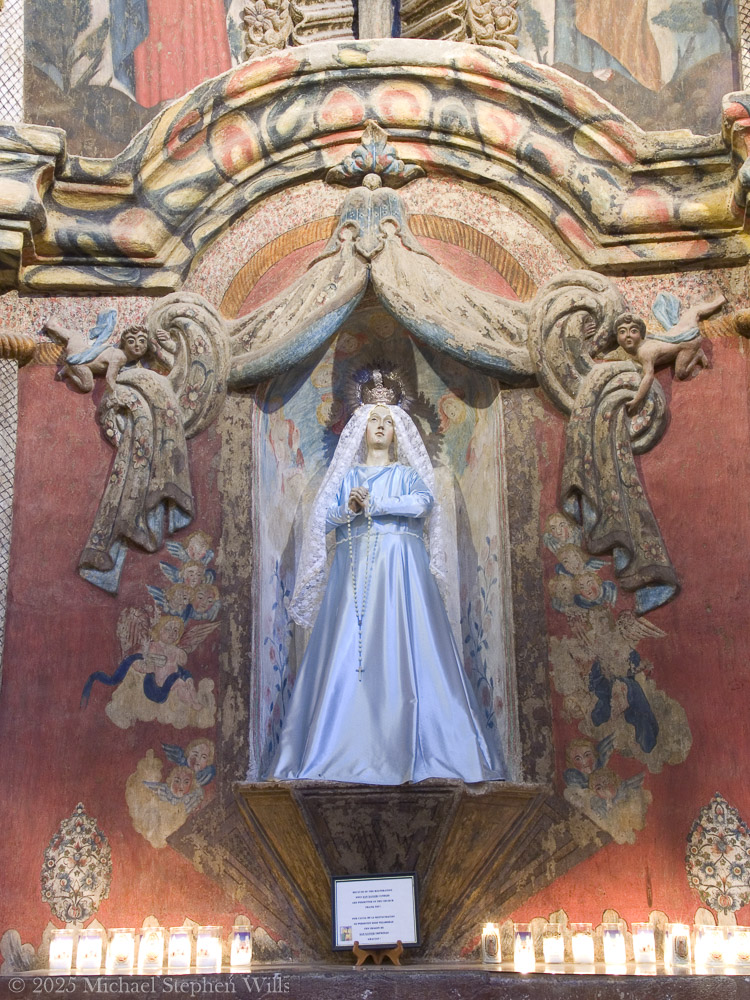
The Virgin Mary appears in blue and white—colors of purity, serenity, and devotion. She stands among votive candles and gazes gently ahead, hands joined in prayer. Her dress flows around her, anchored by a rosary that loops downward like an anchor to the earth. Angels and cherubs flank her in painted stucco, echoing heaven’s embrace. This is not the triumphal Mary of high cathedrals but a deeply human one, a mother, accessible and protective. The candles flickering below affirm that faith is alive here, not simply preserved.
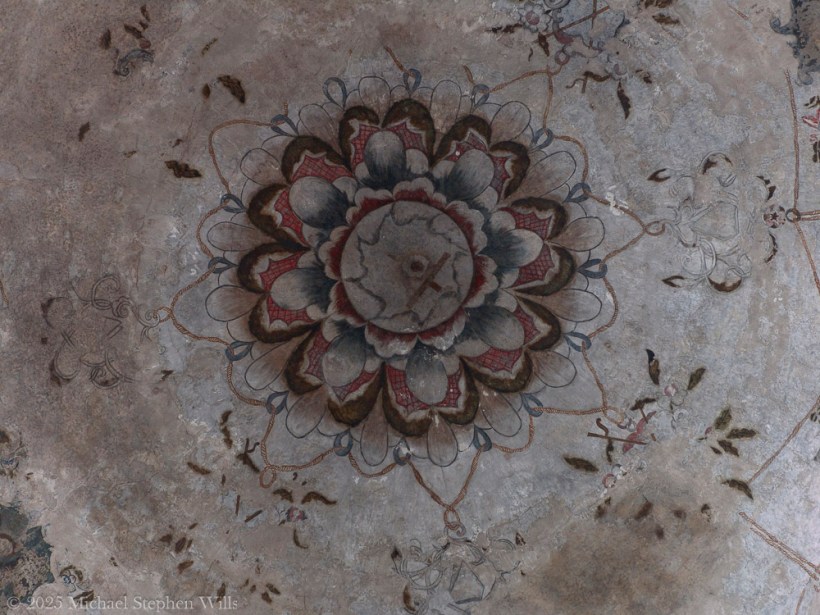
A ceiling medallion next draws us into a more abstract vision. A floral rosette centers on the cross and tools of Christ’s Passion—the nails, spear, and ladder arranged in contemplative symmetry. These instruments of torture are enclosed in beauty, as if the heavens themselves have sanctified the suffering. It is a paradox of faith, this transformation of pain into purpose, death into eternal life.
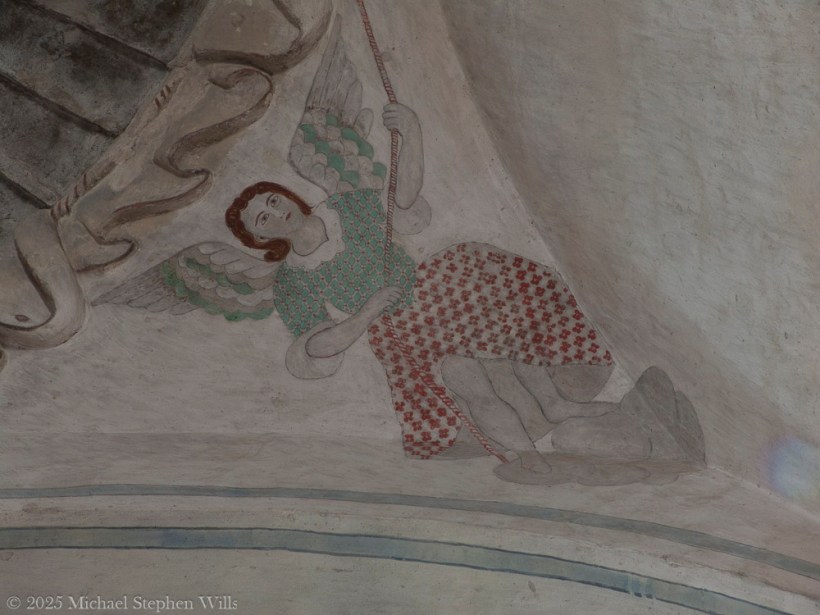
And in the arch’s corner, an angel descends—painted simply, yet with care. The figure pulls at a rope, perhaps to ring a bell or lift a curtain, a symbolic act of revelation or invitation. With wings green and soft, a skirt patterned in red flowers, suggesting femininity, grounding the divine in local textile tradition. The angel bridges the earthly with the divine, echoing the mission’s purpose: to guide and accompany.
Finally, a carved wood panel—plain, aged, and sacred in its wear. The texture of centuries rests in its grain, the indentations of faithful hands passing by. This is the tactile memory of San Xavier: not only what is seen, but what has been touched, prayed over, believed.
Taken together, these images form a tapestry of devotion, colonial artistry, indigenous fusion, and enduring reverence. San Xavier del Bac is a place where symbols still speak, where color and form do more than please the eye—they lift the spirit. In this space, belief is remembered to be continually reborn.
Enter your email to receive notification of future postings. I will not sell or share your email address.
Copyright 2025 All Rights Reserved Michael Stephen Wills
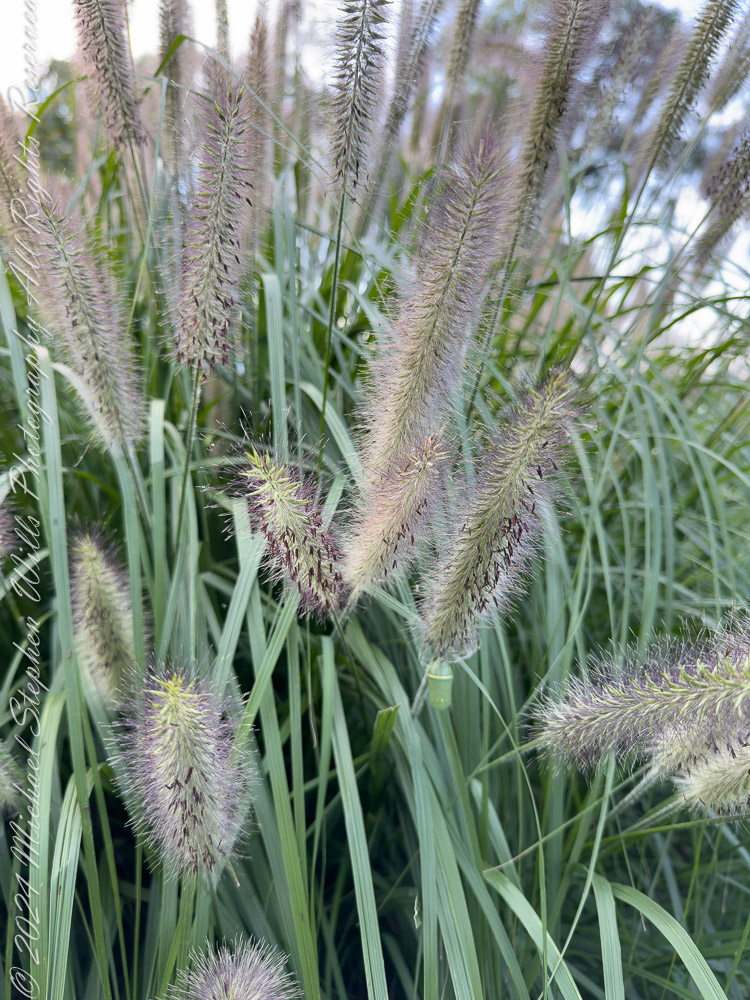
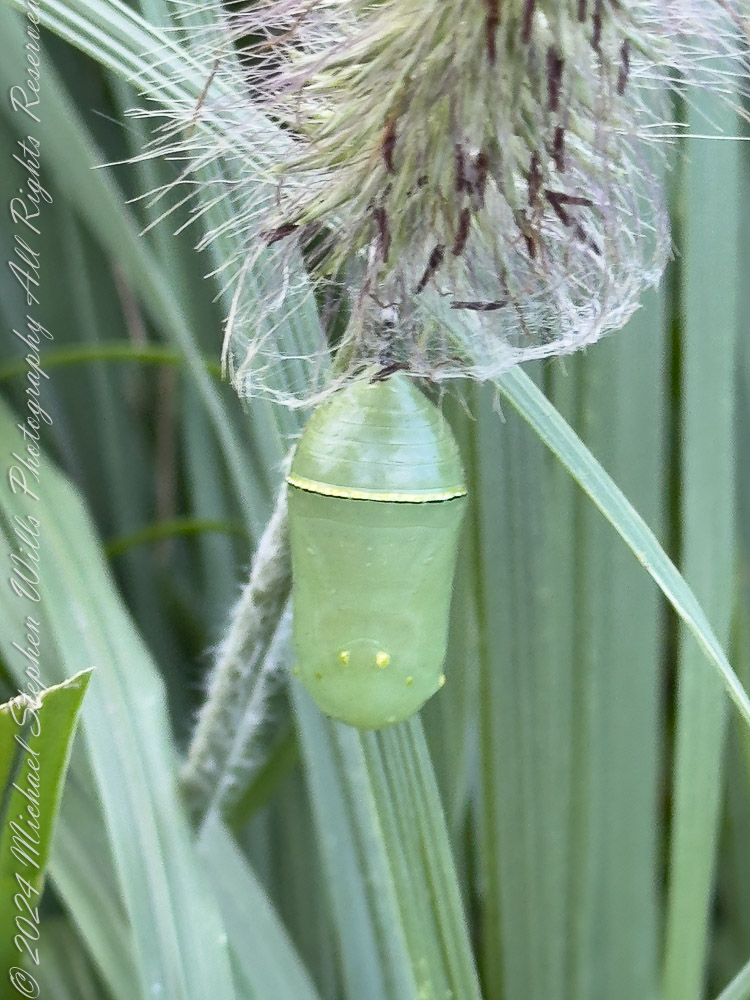
On a warm September afternoon, 2024, Pam and I passed a planting of shimmering grasses along the Cayuga Lake shore, the tips of their feathery plumes swaying in a gentle breeze. Amidst the verdant tapestry, my eyes caught a flash of delicate green—a Monarch chrysalis, hanging like a precious jewel beneath one of the seed heads. It was an unexpected encounter, a moment of grace that felt almost otherworldly. The chrysalis, pale jade with gold accents, looked like something born of magic rather than biology. For a moment, time paused.
The only Monarch chrysalis we found in 2024, notable for the absence of caterpillars around our home. Tompkins Park, Ithaca, New York, Finger Lakes Region
I knelt carefully, mindful not to disturb the fragile life suspended before me. As I leaned in closer, I marveled at the perfection of its design. The intricate gold dots along its casing seemed impossibly precise, as though a divine hand had painted them there. Yet, this chrysalis was also a paradox: it was a shield of stillness, promising the coming transformation of a creature known for motion and migration.
The significance of this discovery didn’t escape me. Just two years ago, the International Union for Conservation of Nature officially classified the Monarch butterfly as “endangered.” Habitat destruction, pesticide use, and climate change have decimated their numbers. Monarchs, once so plentiful they seemed a seasonal certainty, now teeter on the edge of disappearance. To find this chrysalis was to witness a quiet rebellion against those odds, a solitary emblem of resilience in a world fraught with loss.
I thought of their epic journey—a migration that spans thousands of miles, linking Canada to the forests of central Mexico. For generations, these butterflies have followed ancestral paths with unerring precision, defying every obstacle in their way. How can something so small carry the weight of such immense journeys? And how, in a world that seems to grow harsher each year, do they still persist?
This chrysalis, tucked in the grasses of Stewart Park, felt like an answer to those questions. It was a reminder of the resilience of life, the determination of nature to continue despite all that works against it. And yet, it also felt like a fragile promise. The Monarch’s survival is no longer assured; its future, like the butterfly within this chrysalis, hangs by a thread.
As I rose and continued our walk, I carried the image of the chrysalis with me, letting its quiet beauty settle in my mind. I thought of the interconnectedness of all things: the milkweed plants that sustain Monarch caterpillars, the winds that guide their migrations, and the people whose choices shape the landscapes they traverse. Stewardship is not just a responsibility; it is a privilege—an opportunity to ensure that these miraculous creatures continue to grace our skies.
By the time I left the park, the sun had sunk toward the west, its light no longer graced the grasses. I looked back one last time, hoping that this chrysalis would complete its transformation safely. In its stillness, I saw not just hope, but a call to action. The Monarch’s story is not just about survival; it’s about the courage to evolve and adapt, even when the odds seem insurmountable. And perhaps, in witnessing this moment of metamorphosis, we too are reminded of our capacity to change—to become better stewards of the world we share.
Enter your email to receive notification of future postings. I will not sell or share your email address.
Copyright 2025 All Rights Reserved Michael Stephen Wills
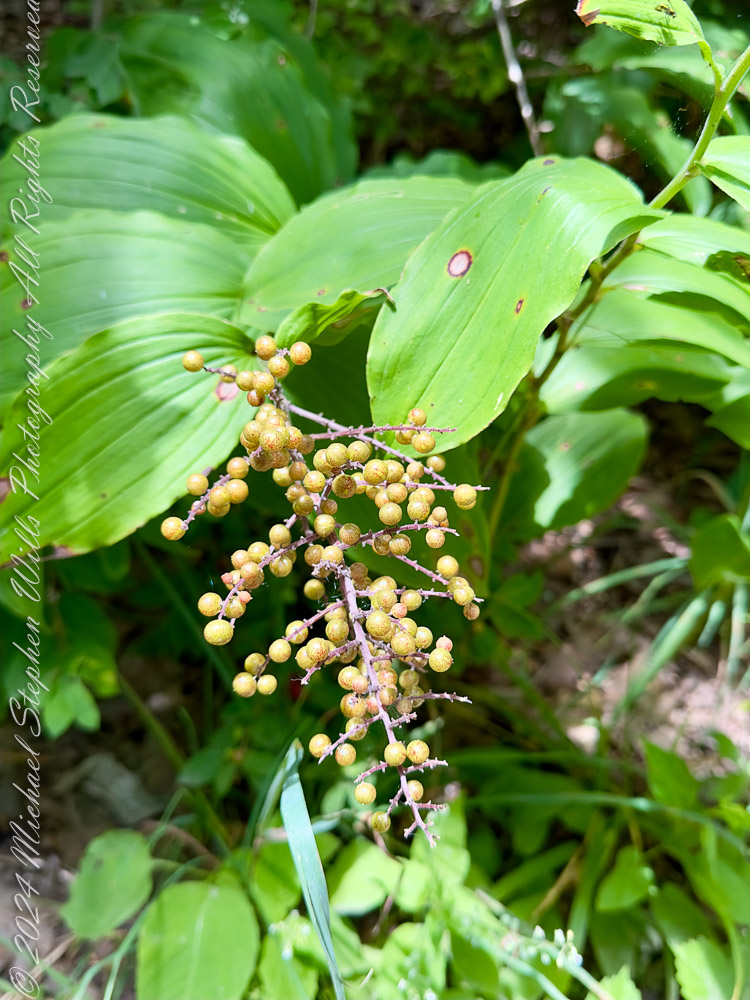
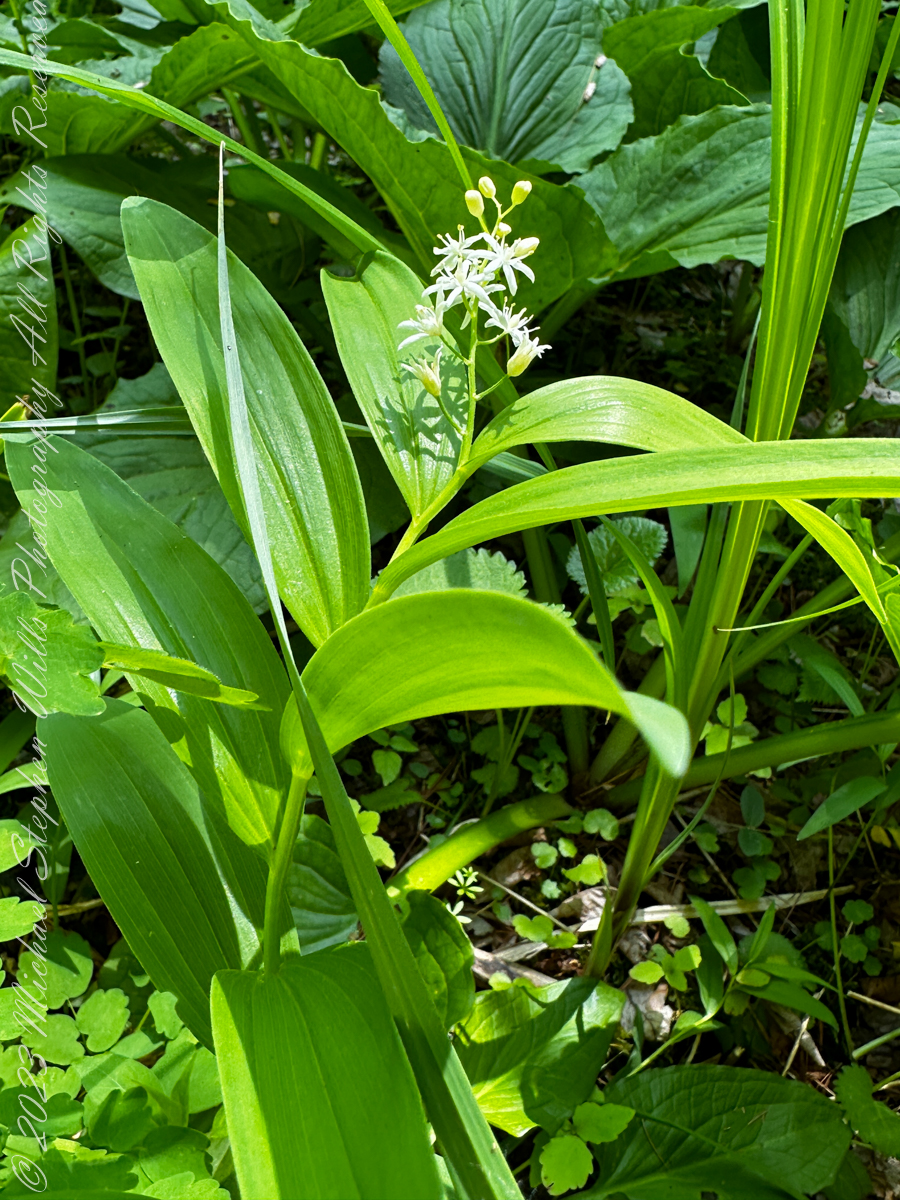
The trails of Taughannock Falls State Park always hold surprises, and on that July day, they did not disappoint. As I paused to take in the tranquility of the woods, my gaze fell upon a plant whose graceful arch and clusters of berries demanded attention. Its broad, lance-shaped leaves alternated along the stem, framing the stem’s terminal cluster of small green berries. Recognizing the plant as Maianthemum racemosum, commonly known as False Solomon’s Seal, I took a moment to admire its understated elegance.
False Solomon’s Seal, scientific name Maianthemum racemosum, is common in the Finger Lakes Region. I found this specimen during a walk with the grandchildren in a local fen among the post-glacial terrain of the Finger Lakes Region. Eames Memorial Natural Area, Cornell Botanic Gardens, Town of Dryden, Tompkins County, Finger Lakes Region, New York State
Characteristics of the Plant
False Solomon’s Seal is a perennial herbaceous plant belonging to the asparagus family (Asparagaceae). It can grow up to three feet tall, its arching stems giving it a unique and recognizable silhouette. The leaves are broad and lance-shaped, with prominent veins running their length, arranged alternately along the stem. At the tip of each stem is a cluster of tiny, spherical green berries, which later in the season ripen to a speckled reddish hue. The plant blooms in late spring to early summer, producing delicate, star-shaped white flowers before transitioning to its fruiting phase.
Found throughout much of North America, Maianthemum racemosum thrives in moist, shaded woodlands, making the lush forests of Taughannock Falls State Park an ideal home. Its ability to grow in the dappled light beneath the forest canopy highlights its adaptability to varying light conditions.
Etymology of the Name
The genus name, Maianthemum, comes from the Greek words “mai” (May) and “anthemon” (flower), reflecting the plant’s tendency to bloom in late spring or early summer. The species name, racemosum, refers to the plant’s inflorescence, which forms a raceme—a cluster of flowers or berries along a single stem. Its common name, False Solomon’s Seal, derives from its superficial resemblance to Solomon’s Seal (Polygonatum spp.), though the latter has bell-shaped flowers hanging beneath its stems, in contrast to the terminal clusters of Maianthemum racemosum.
History and Folklore
False Solomon’s Seal has long been valued for its medicinal and culinary uses by Indigenous peoples and early settlers. The young shoots were harvested and cooked as a vegetable, while the ripe berries were sometimes used in jellies or preserves, though their slightly bitter flavor limited their appeal. Medicinally, teas made from the roots and leaves were used to treat a variety of ailments, including digestive issues, coughs, and sore throats. The roots were also applied as poultices for cuts and bruises, reflecting the deep understanding of natural remedies held by those who lived in harmony with the land.
The plant’s name has sparked legends. While the “false” in its name denotes its distinction from Solomon’s Seal, some folklore suggests that the plant was used to counterfeit the medicinal properties of its namesake. Others believe that its graceful arch and persistent berries symbolize resilience and adaptability, qualities often attributed to those who lived in its native habitats.
Uses and Ecological Role
Although not widely cultivated, Maianthemum racemosum is a valuable plant in its native ecosystems. Its flowers provide nectar for pollinators such as bees and butterflies, while the berries are a food source for birds and small mammals. Its rhizomatous roots also play a role in stabilizing soil in forested environments, preventing erosion and supporting the health of the woodland floor.
For those contemplating harvesting these plants be advised that collection of plants from New York State Parks is prohibited to protect natural resources and maintain ecological balance. According to the New York State Office of Parks, Recreation and Historic Preservation (OPRHP) regulations, “No person shall… remove… any… plant life” within state parks without proper authorization. Therefore, collecting plants in state parks without explicit permission is not allowed. If you have a specific research or educational purpose, you may contact the park administration to inquire about obtaining the necessary permits. However, for casual visitors, it’s best to enjoy the flora from a distance. False Solomon Seal ecological contributions are significant. In addition to its pollinator support and soil stabilization, the plant’s presence is an indicator of a healthy woodland ecosystem.
A Moment of Reflection
As I rose from my crouched position, having taken in the details of Maianthemum racemosum, I felt a quiet gratitude for the opportunity to encounter such a plant. False Solomon’s Seal, with its graceful leaves and unassuming berries, serves as a reminder of the interconnectedness of life in the forest. Its role in the ecosystem, its history with humans, and its understated beauty all speak to the richness of the natural world.
Walking onward, I carried with me a sense of awe for the intricate web of life that thrives in the woods. The False Solomon’s Seal, standing quietly among the ferns and leaf litter, seemed to embody the resilience and balance of the forest—a gentle presence in a vibrant community.
Enter your email to receive notification of future postings. I will not sell or share your email address.
Copyright 2024 All Rights Reserved Michael Stephen Wills
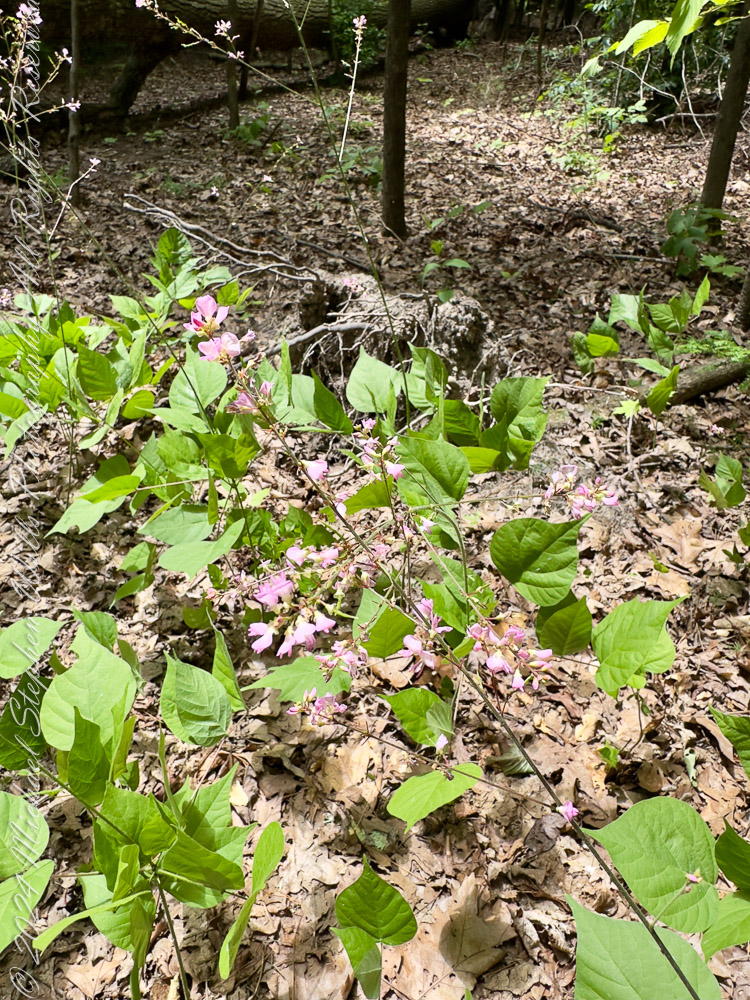
It was a high summer day as I enjoyed a customary hike around of Taughannock Falls State Park on the South and North Rim trails. Here sunlight filtered through the dense canopy, dappling the forest floor with shifting patches of light. Along the trail, my attention was drawn to a cluster of pink blossoms rising on slender, upright stems. Intrigued by their delicate beauty, I crouched down for a closer look. The plant rose above the forest floor, its trifoliate leaves broad and prominently veined, each leaflet slightly larger than I would have expected. These leaves seemed to anchor the plant to the shaded understory, while its flowers reached upward, as though eager to catch the fleeting rays of sun. I captured the plant in this photographs, later used it to identify Hylodesmum glutinosum, or Large-Flowered Tick Trefoil.
Characteristics of the Plant
The Large-Flowered Tick Trefoil is a striking member of the pea family (Fabaceae). Its pink, pea-like flowers are arranged in graceful racemes along the upper portions of its stems, their vibrant color contrasting beautifully with the green foliage around them. The leaves, broad and trifoliate, lend the plant its distinctive appearance. The name “tick trefoil” refers to the plant’s seed pods, which are flat and segmented, equipped with tiny hooks that cling stubbornly to passing animals or hikers, hitchhiking their way to new locations.
The plant is native to eastern North America, including the forests and trails of New York State. Its preference for rich, well-drained soils in partially shaded woodlands makes it a common sight in places like Taughannock Falls State Park. Blooming from mid to late summer, it provides an essential nectar source for bees and other pollinators, playing its part in the intricate web of the forest ecosystem.
Etymology of the Name
The genus name, Hylodesmum, was established only twenty-five years ago when the plant was reclassified from the genus Desmodium to a new genus within the tribe Desmodieae. The name reflects its forested habitat, with “hylo” derived from the Greek word for “wood” or “forest.” Previously described in 1802 as Hedysarum glutinosum and later placed in Desmodium, the species name glutinosum remains unchanged, meaning “sticky” in Latin. This aptly describes the plant’s seed pods, which adhere to anything that brushes past them. Together, these names encapsulate both the botanical structure and the unique dispersal strategy of this plant.
History and Folklore
Native Americans and early settlers were intimately familiar with tick trefoils. The plant’s seeds, notorious for clinging to clothing and fur, earned it a reputation as a nuisance, but its resilience and utility could not be overlooked. Indigenous peoples utilized various parts of the plant for medicinal purposes. The roots and leaves were brewed into teas to treat fevers and digestive ailments, while poultices made from the leaves were applied to wounds to promote healing. Such uses highlight the depth of knowledge early inhabitants had about their environment.
The plant’s sticky seed pods also became the subject of folklore. Children in rural communities would playfully call it “hitchhiker’s weed,” competing to see who could collect the most seeds on their clothing during outdoor adventures. These seeds, so adept at attaching themselves to passersby, were seen as symbols of persistence and adaptability, traits that many admired.
Uses and Ecological Role
While Hylodesmum glutinosum is not commonly cultivated, its ecological contributions are significant. As a member of the Fabaceae family, it has the ability to fix nitrogen in the soil through a symbiotic relationship with rhizobia bacteria in its root nodules. This makes it a valuable plant in maintaining soil fertility in its native ecosystems. Its flowers attract pollinators like bees and butterflies, ensuring that the forest remains vibrant and full of life.
In addition to its ecological importance, the plant’s seeds have a curious modern use: they’ve been studied for their ability to help detect movement in the environment. Researchers have examined the sticky pods’ structure as a natural model for creating adhesives and tracking devices, proving once again that even the smallest details in nature can inspire human ingenuity.
A Moment of Reflection
As I rose to my feet, brushing the leaf litter from my hands, I felt a renewed sense of wonder for the intricate lives of the plants surrounding me. The Large-Flowered Tick Trefoil, with its vivid pink flowers and ingenious seed pods, seemed to embody the essence of the forest: a harmonious blend of beauty, resilience, and interconnection.
Walking away, I carried with me not just the memory of its vibrant blooms, a deep respect for its role in the natural world. In the quiet of Taughannock’s wooded trails, Hylodesmum glutinosum had shared its story, a tale of persistence, adaptation, and the hidden wonders that flourish when we take the time to notice.
Enter your email to receive notification of future postings. I will not sell or share your email address.
Copyright 2024 All Rights Reserved Michael Stephen Wills





 Michael Stephen Wills Photography