My photographic style centers on the use of natural light to visualize emotion and evoke memory. The evolution of my style began early in the year 2002, with an imperative to capture personal and fleeting memories.
My son and I traveled to New York City, to view the first Saint Patrick's Day parade after September 11, 2001. My work from that parade was so successful and satisfying (see "New York Fire Department, Saint Patrick's Day 2002") I just never stopped.
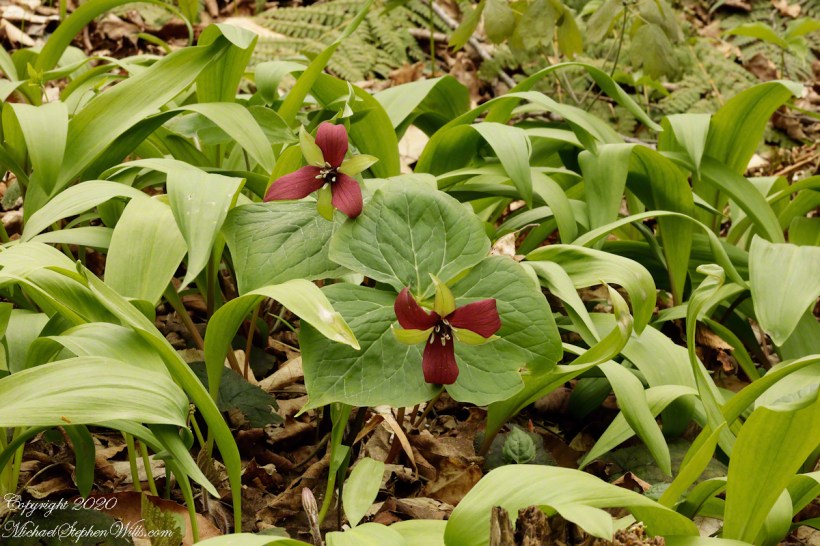
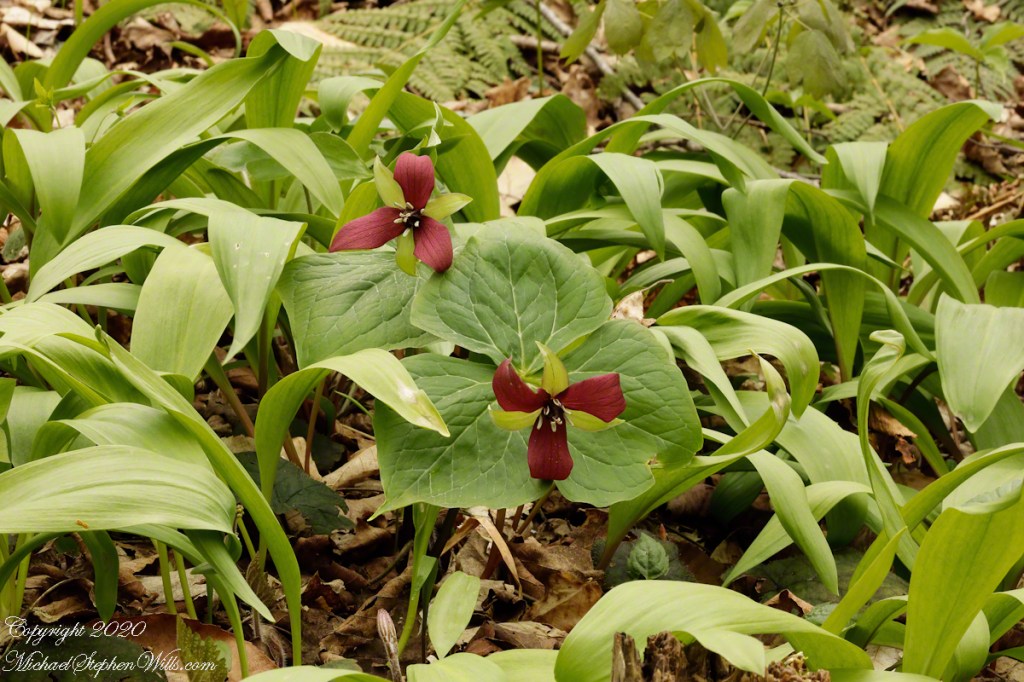
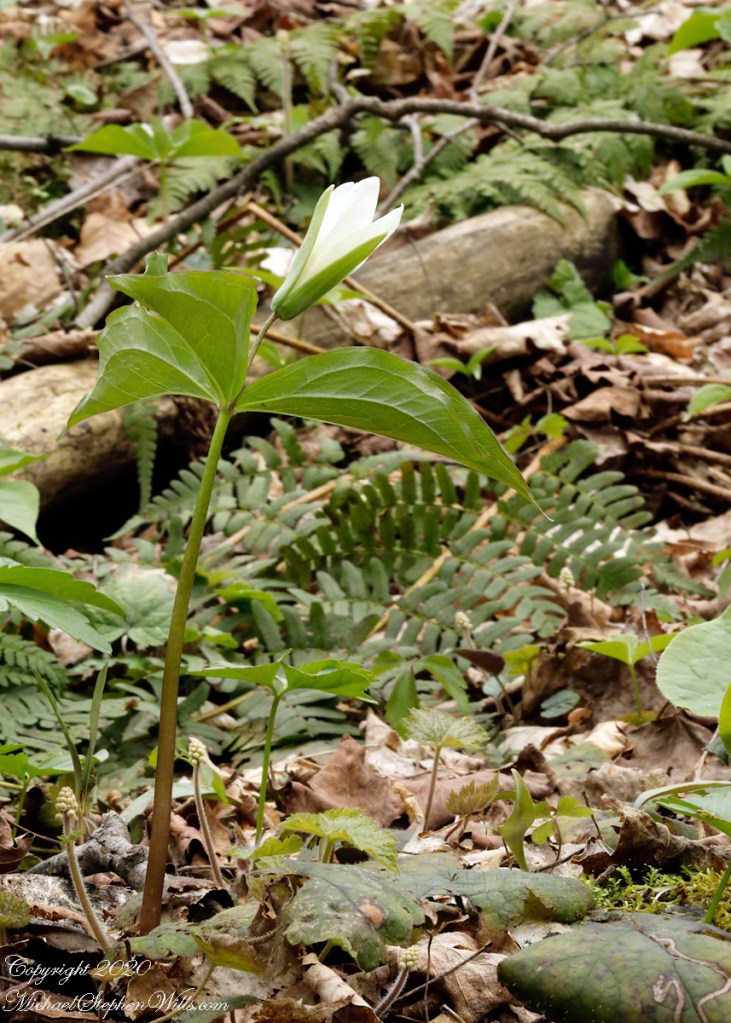
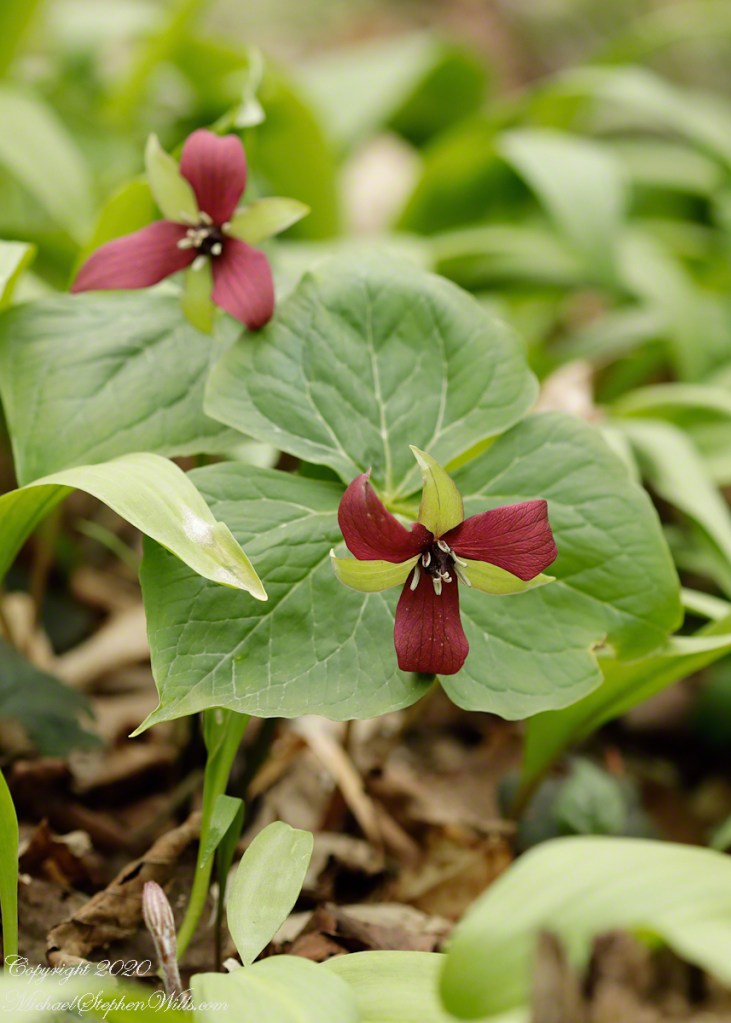
Purple Trillium, a different species from the white, present different challenges. The purple blooms tend to dip down toward the ground. White flowers face upward toward the sky. My successful photographs of purple (Click me for another Purple Trillium posting) have the camera lower than the plant, say where there is a bank above the trail.
Shot from beneath, White Trillium project a hopeful air. Here is a comparison of the two species in the environmental and individual treatments.
Click photograph for larger image. To do this from WordPress Reader, you need to first click the title of this post to open a new page.
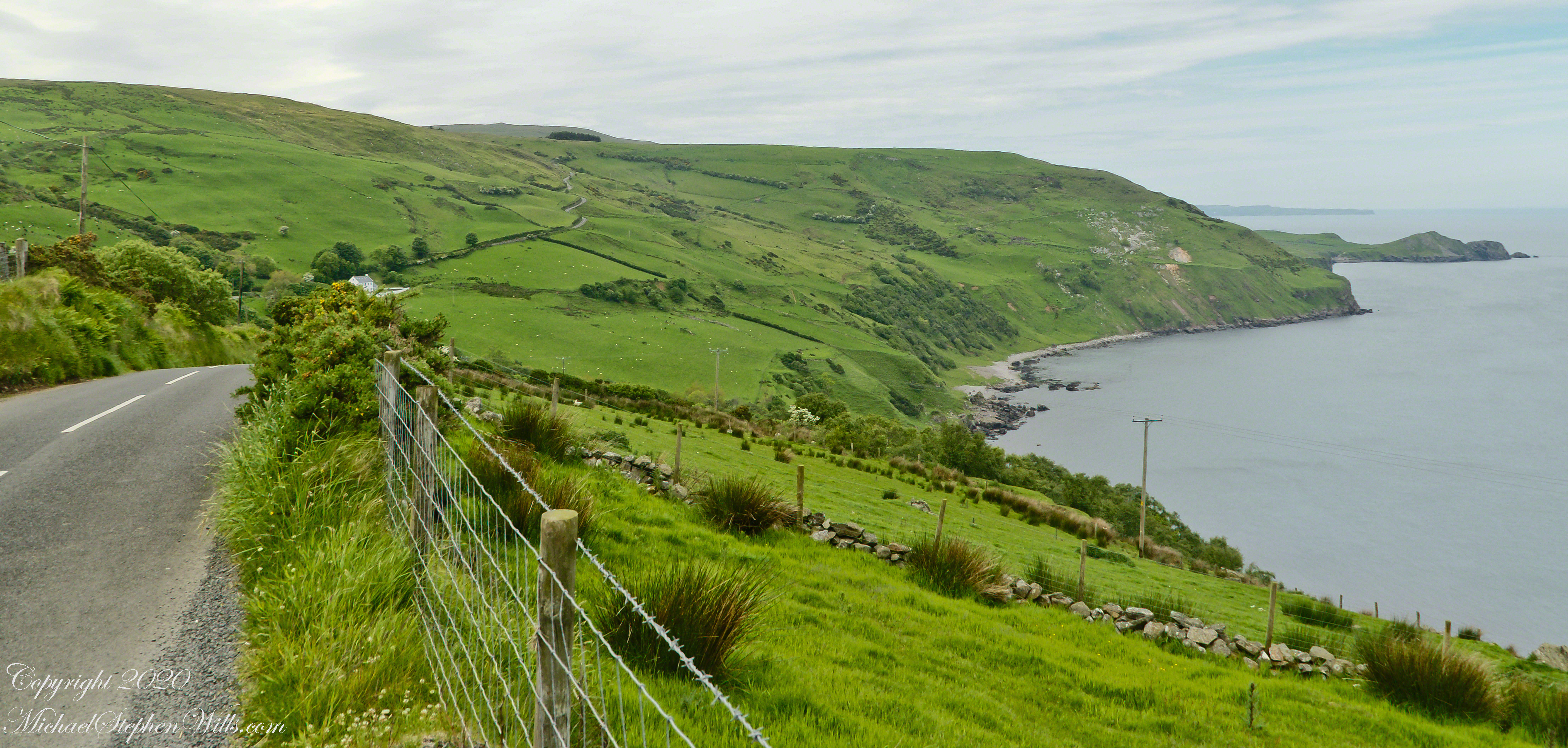
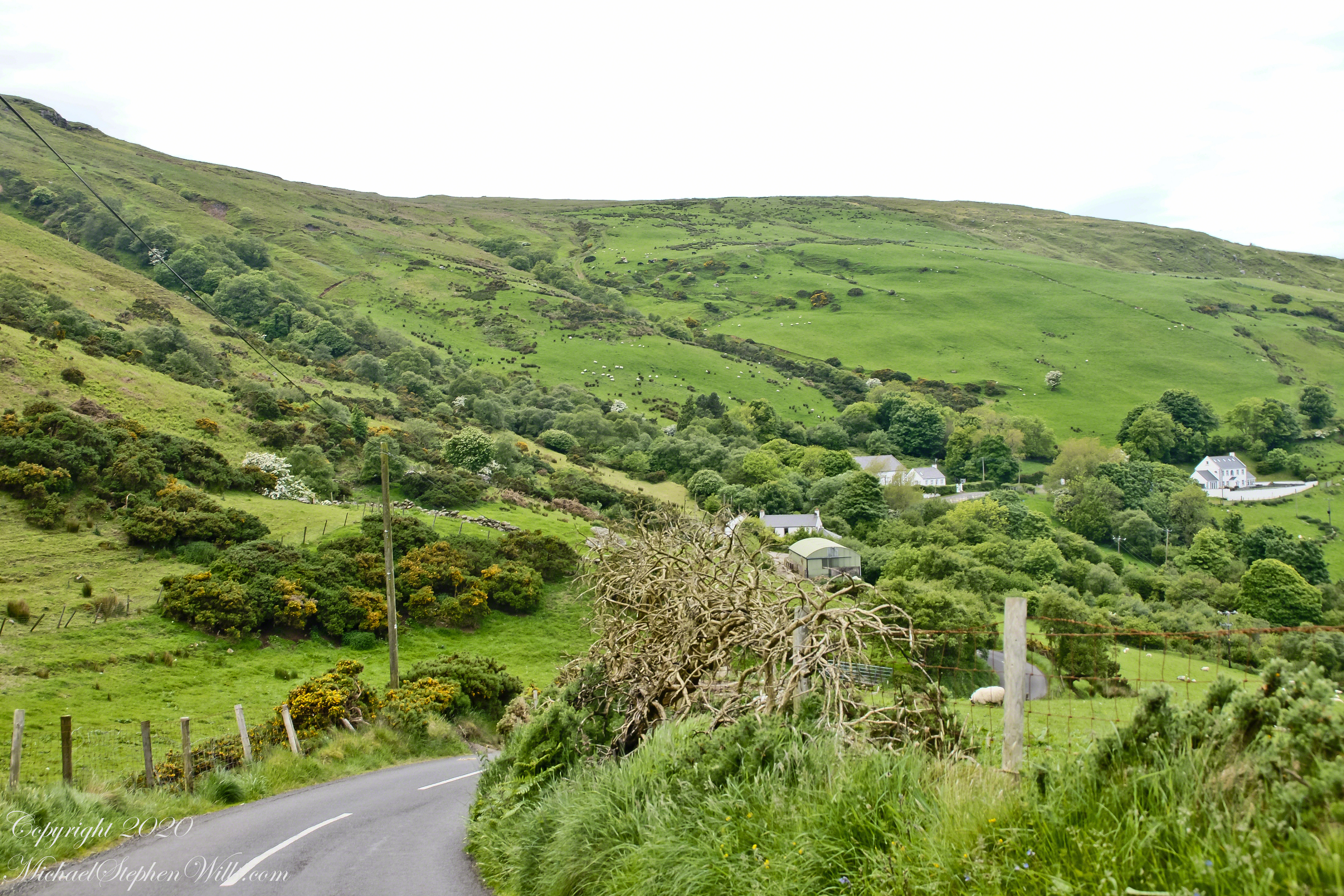
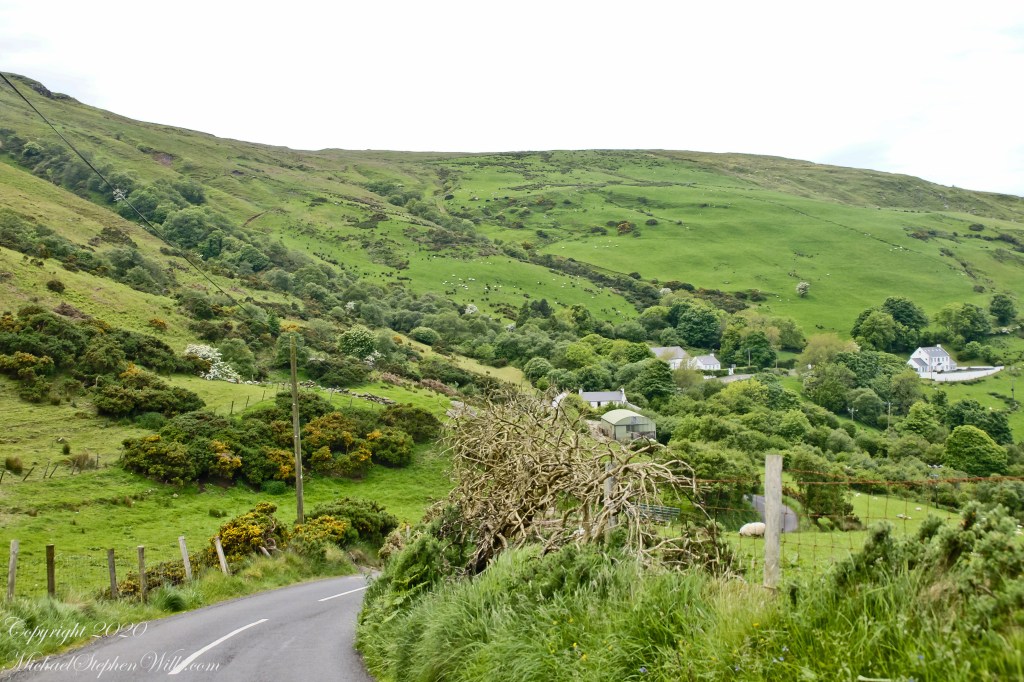
This photograph from the bottom of the Torr Road hill takes in Coolranny Townland. a slice of land running from the ridge to Loughan Bay. We see a number of hawthorne trees in flower, yellow flowering Whin Bush, houses and the Roman Catholic church Saint Mary’s Star of the Sea.
Tor in Irish is a steep rocky height. Likewise, Corr means odd, uneven, rounder, convex, curved, peaked, projecting, smooth. Combined Torcorr is the townland where we stopped on the Torr Road, halted by our wonder at this sight. In the distance, Torr Head projects into North Channel, the closest land to Scotland. Following the coast, the cliffs in front of Torr Head is home to numerous sea birds. The curved bay is named Loughan, the rocky sand beach are ruins of cottages emptied by Irish emigration. The white building is Saint Mary’s Star of the Sea Roman Catholic Church. County Antrim, Northern Ireland.
View of Coolranny townland with Saint Mary’s Star of the Sean Roman Catholic Church from Torcorr townland, Torr Road . County Antrim, Northern Ireland.
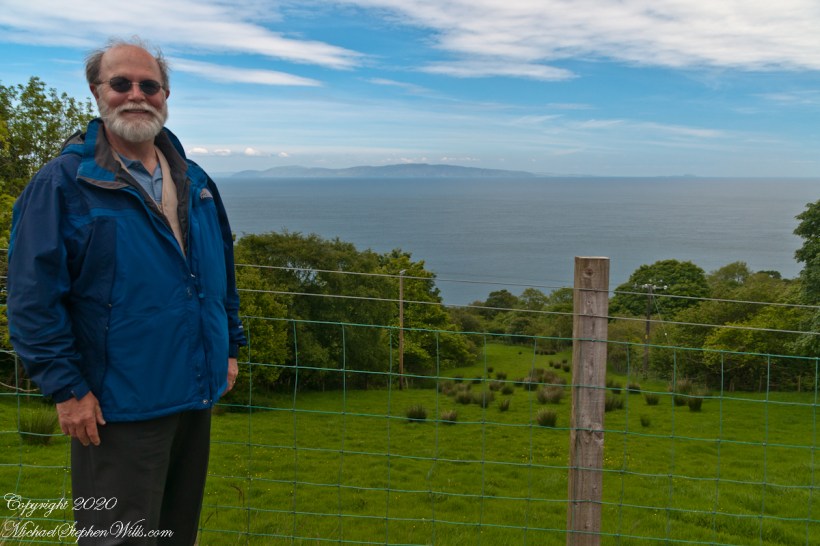
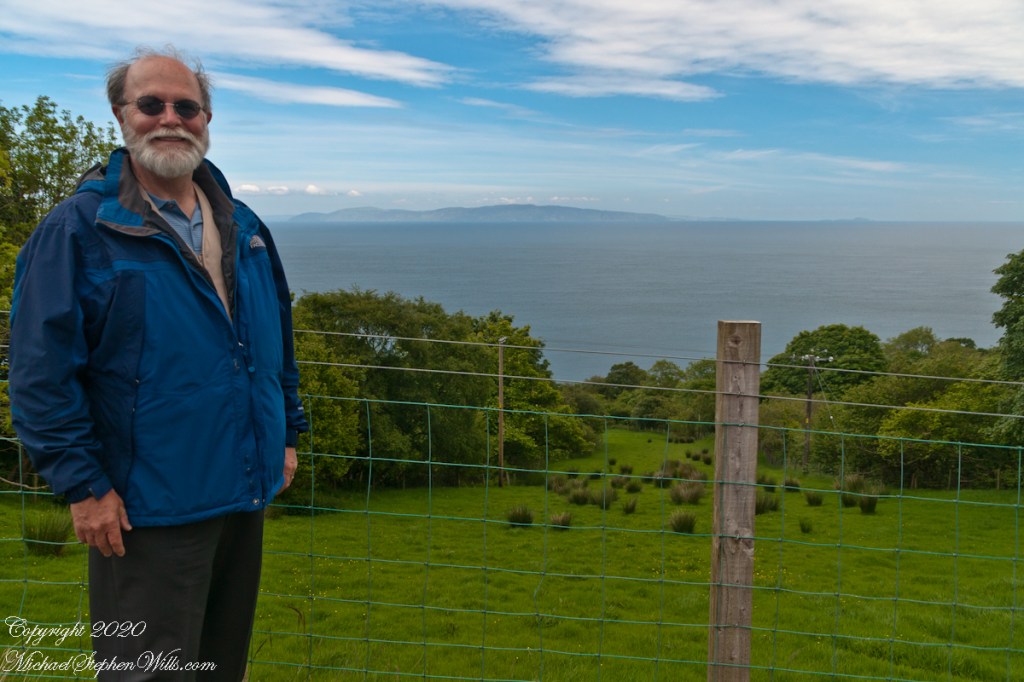
The photograph of the header, taken by Pam, is from either Coolranny or Loughan Townland, looking across a sheep pasture, the North Channel of the Irish Sea toward the Mull of Kintyre, Scotland just twelve miles distant.
Here is a slideshow of this post’s images. To visit from WordPress Reader, you need to first click the title of this post to open a new page.
Tor in Irish is a steep rocky height. Likewise, Corr means odd, uneven, rounder, convex, curved, peaked, projecting, smooth. Combined Torcorr is the townland where we stopped on the Torr Road, halted by our wonder at this sight. In the distance, Torr Head projects into North Channel, the closest land to Scotland. Following the coast, the cliffs in front of Torr Head is home to numerous sea birds. The curved bay is named Loughan, the rocky sand beach are ruins of cottages emptied by Irish emigration. The white building is Saint Mary’s Star of the Sea Roman Catholic Church. County Antrim, Northern Ireland.View of Coolranny townland with Saint Mary’s Star of the Sean Roman Catholic Church from Torcorr townland, Torr Road . County Antrim, Northern Ireland.On the way to Torr Head we stopped at this spot in Coolranny Townland to take in this view of the Irish Sea. The land overlooks Loughan Bay toward the Mull of Kintyre and Sanda Island, Scotland. County Antrim, Northern Ireland.
Copyright 2023 All Rights Reserved Michael Stephen Wills
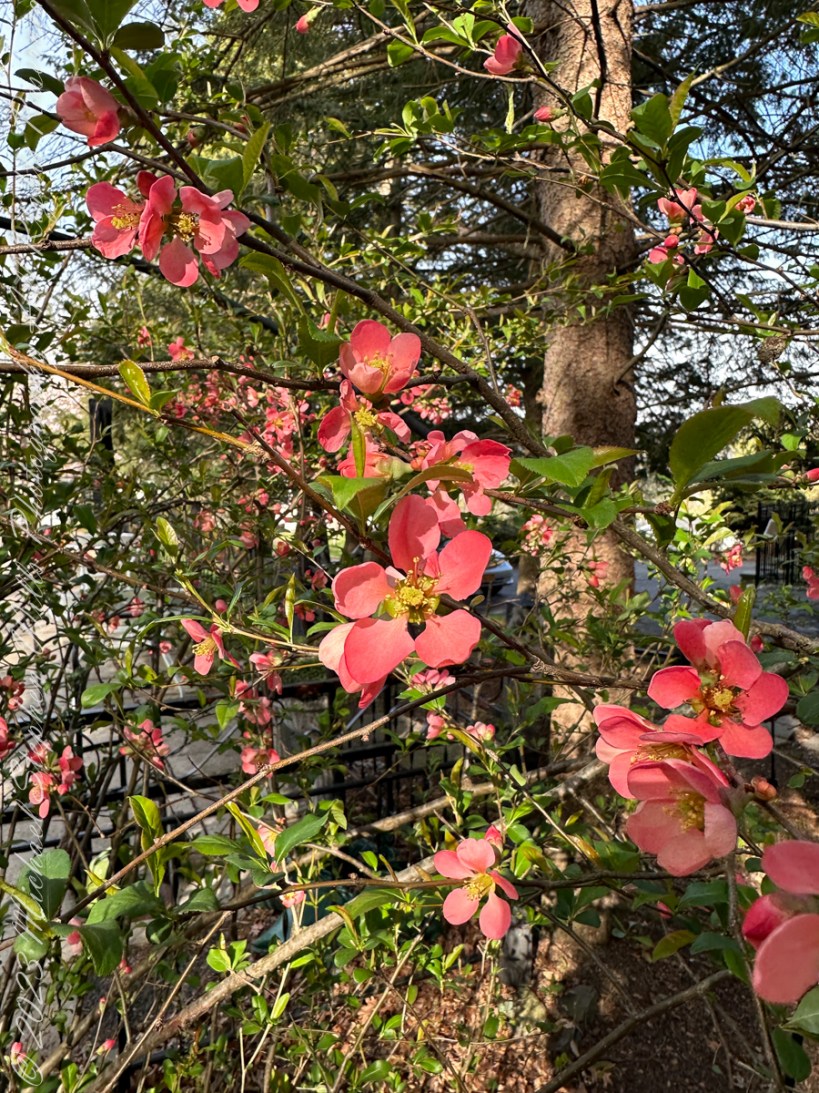
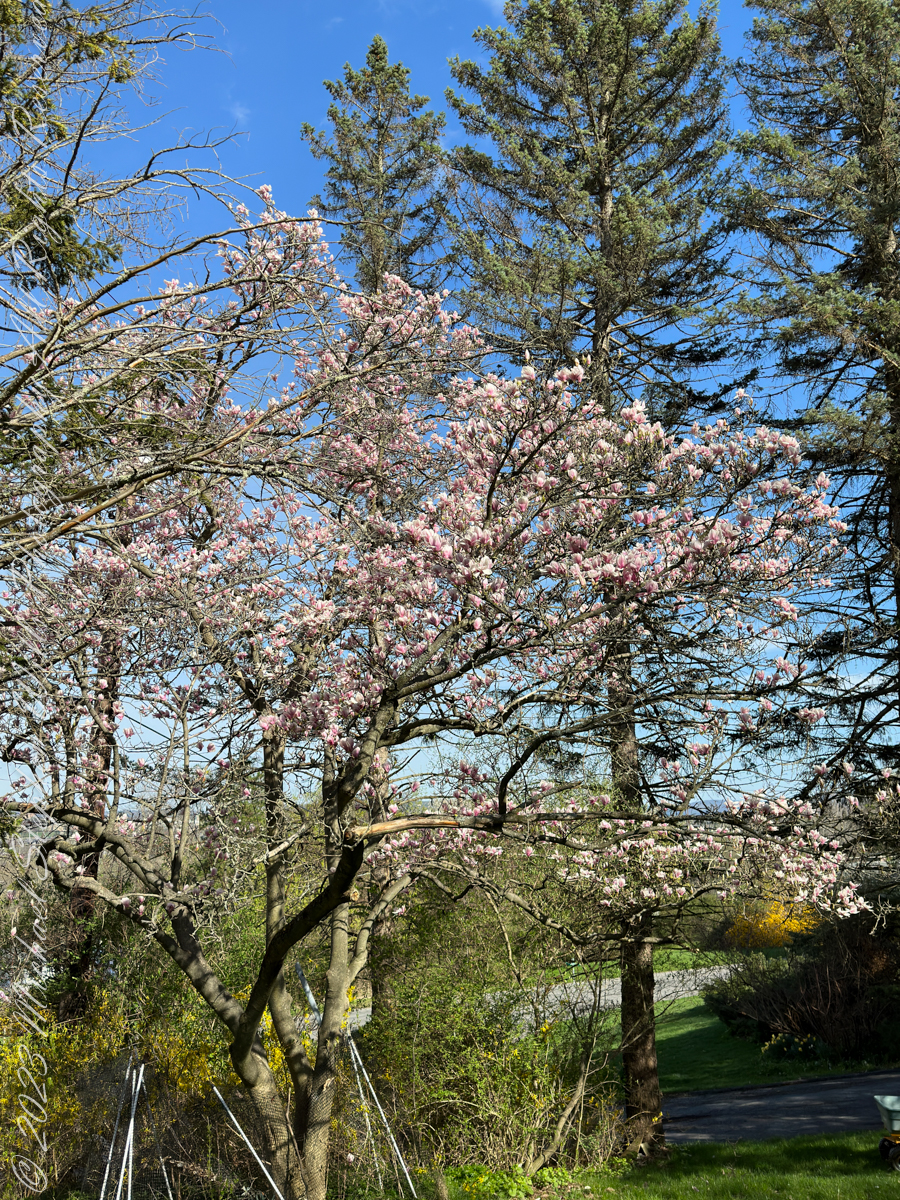
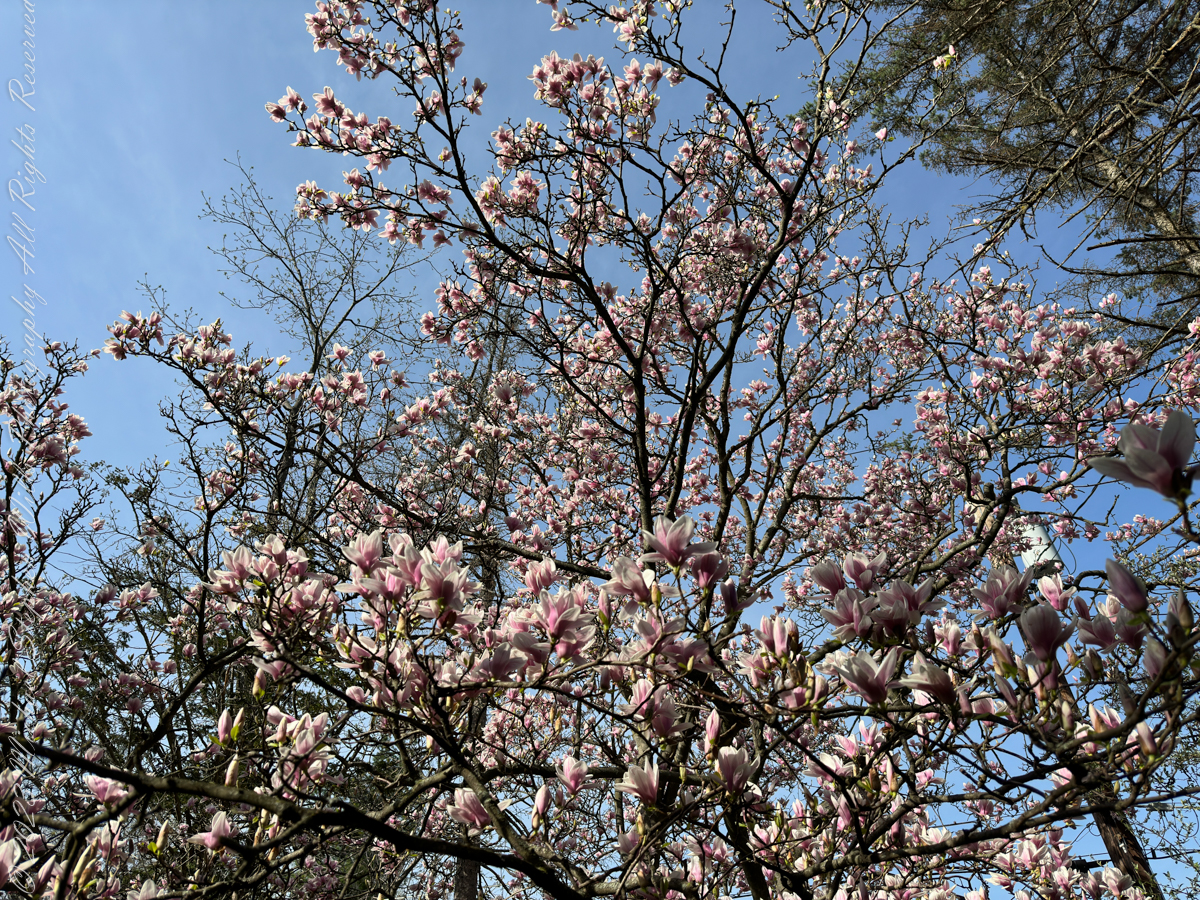
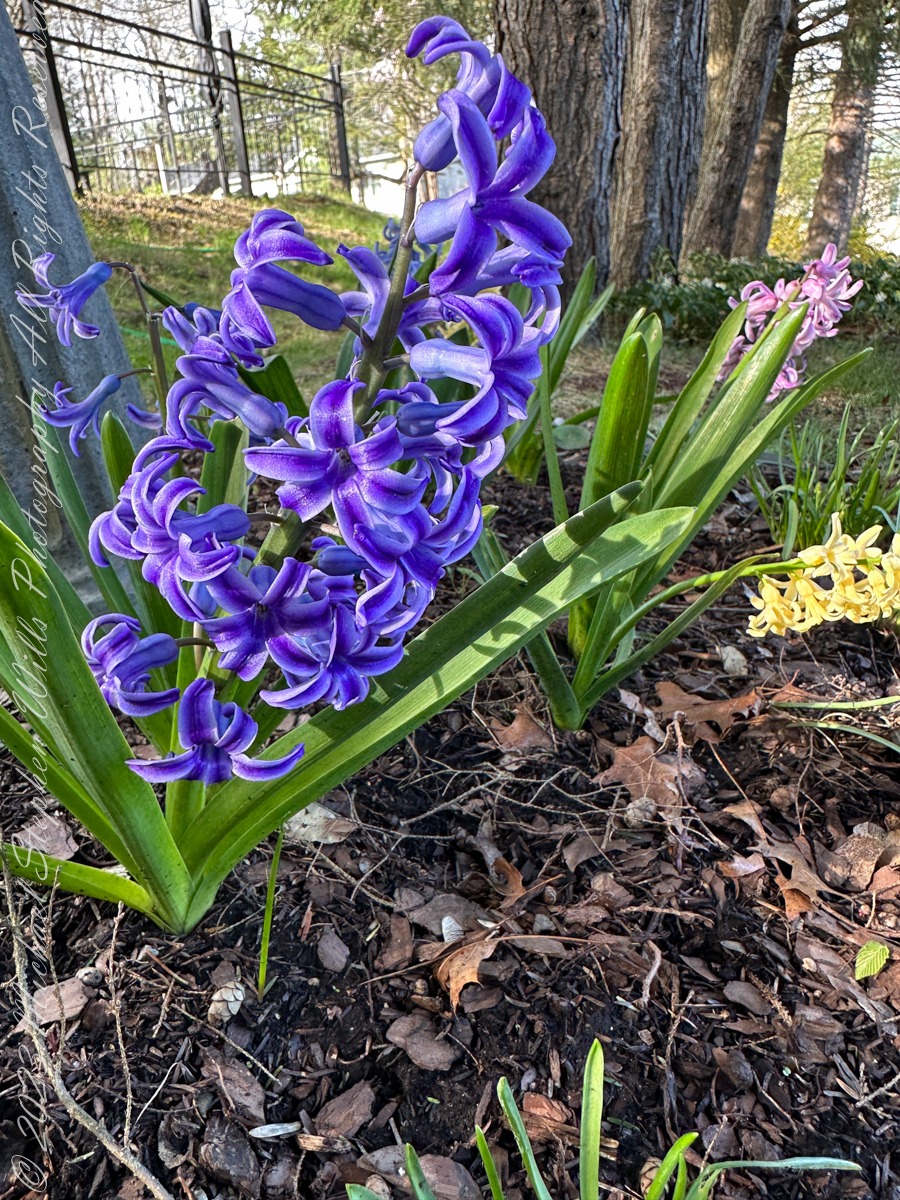
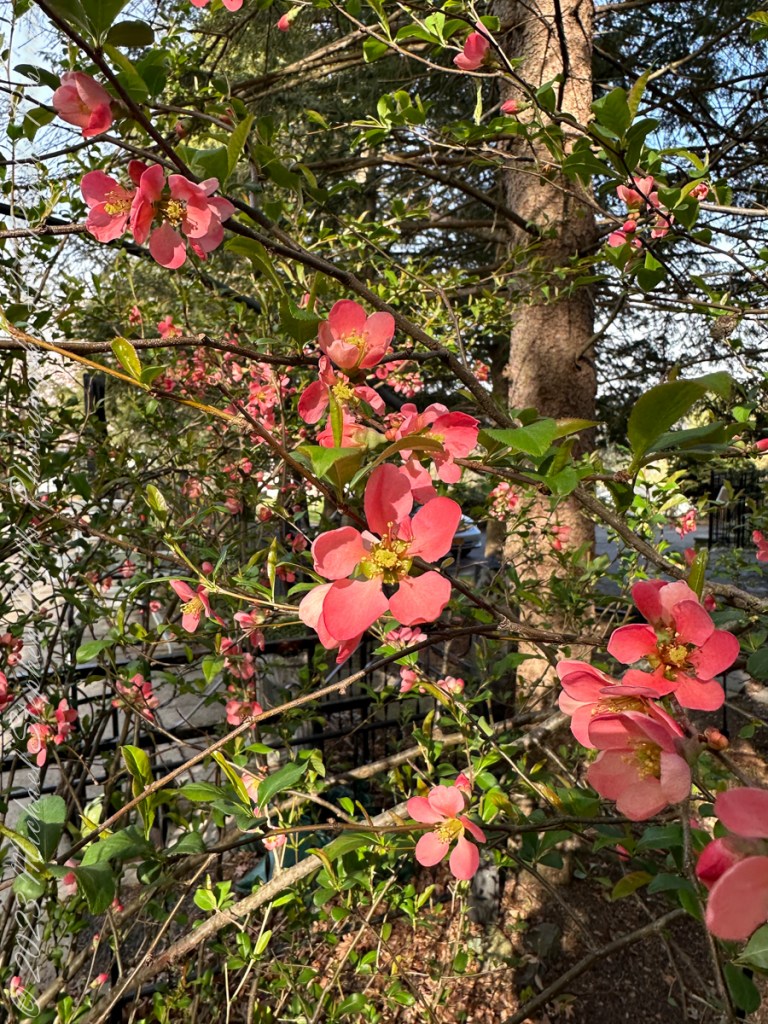
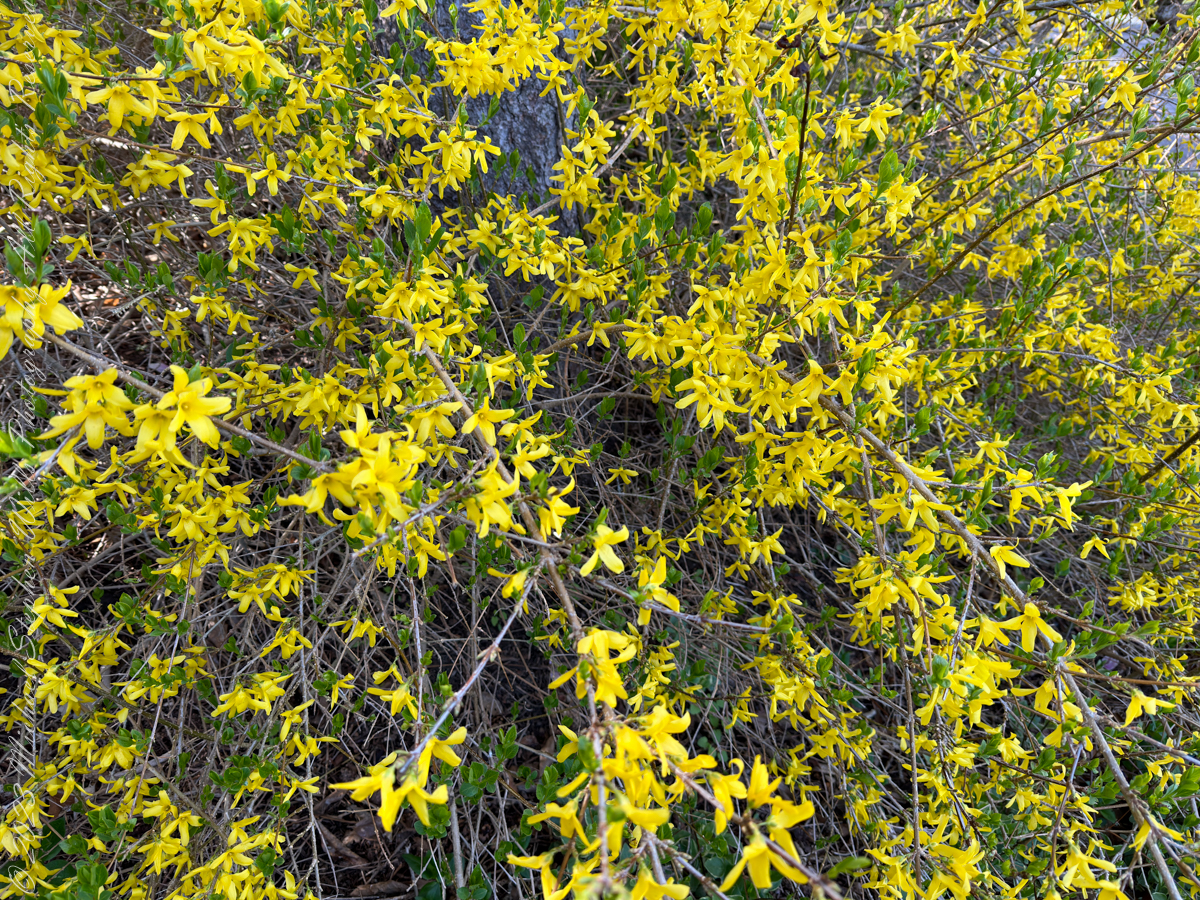
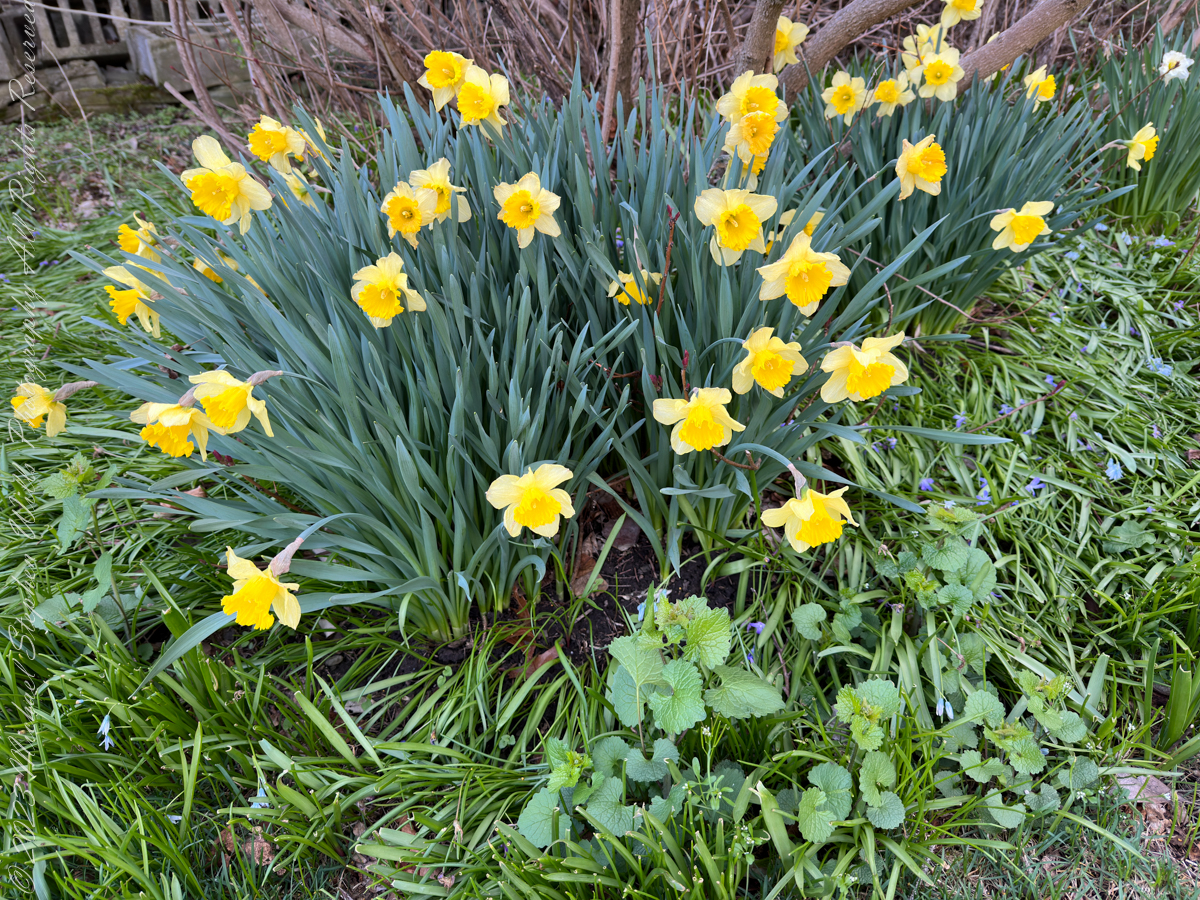
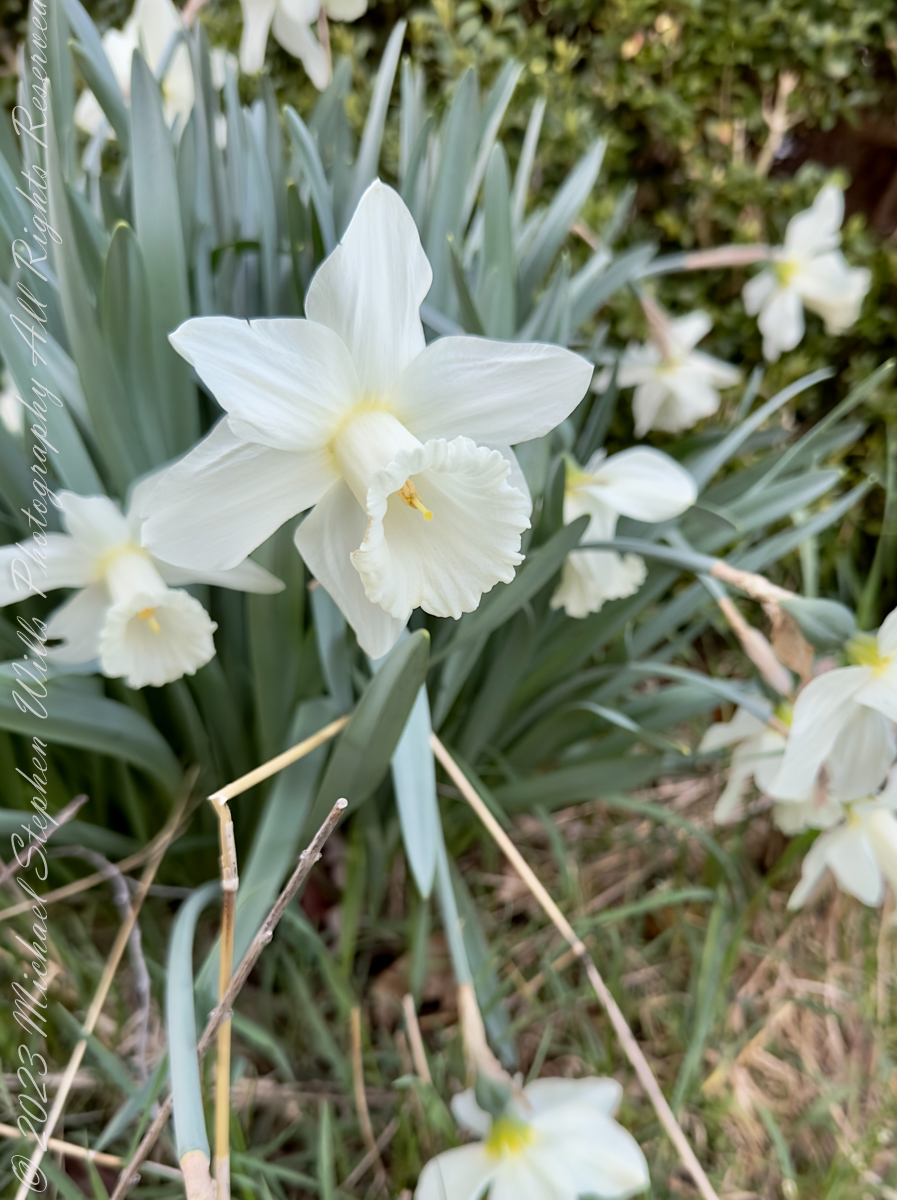
After spreading 15,000 square feet of crabcrass/fertilizer and before attending a frigid first baseball game of a grandson, I capture eight photographs of five different flowers from our home.
More about the Magnolia, from Wikipedia: The name Magnolia first appeared in 1703 in the Genera of Charles Plumier (1646–1704), for a flowering tree from the island of Martinique (talauma). It was named after the French botanist Pierre Magnol.
More about the Hydrangea, from Wikipedia: Hydrangea is derived from Greek and means ‘water vessel’ (from ὕδωρ húdōr “water” + ἄγγος ángos or αγγεῖον angeîon “vessel”), in reference to the shape of its seed capsules.
More about these Quince, from Wikipedia: Although all quince species have flowers, gardeners in the West often refer to these species as “flowering quince”, since Chaenomeles are grown ornamentally for their flowers, not for their fruits.
More about Forsythia, from Wikipedia: The genus is named after William Forsyth (1737–1804), a Scottish botanist who was a royal head gardener and a founding member of the Royal Horticultural Society.
More about Forsythia, from Wikipedia: Narcissus is a genus of predominantly spring flowering perennial plants of the amaryllis family, Amaryllidaceae. Various common names including daffodil, narcissus, and jonquil are used to describe all or some members of the genus. Narcissus has conspicuous flowers with six petal-like tepals surmounted by a cup- or trumpet-shaped corona. The flowers are generally white and yellow (also orange or pink in garden varieties), with either uniform or contrasting colored tepals and corona.
Copyright 2023 Michael Stephen Wills All Rights Reserved
I read the New York Times on our porch on a spring Sunday afternoon, taking a moment to capture these fair weather cumulus clouds. Visible are Ithaca’s East Hill, downtown, and a forsythia bush in flower.
More about the flowers, from Wikipedia: Forsythias are popular early spring flowering shrubs in gardens and parks, especially during Eastertide; Forsythias are nicknamed the “Easter Tree”, the symbol of the coming spring.
More about this view, from Wikipedia: Cumulus clouds can form in lines stretching over 480 kilometers (300 mi) long called cloud streets. These cloud streets cover vast areas and may be broken or continuous. They form when wind shear causes horizontal circulation in the atmosphere, producing the long, tubular cloud streets. They generally form during high-pressure systems, such as after a cold front.
Copyright 2023 Michael Stephen Wills All Rights Reserved
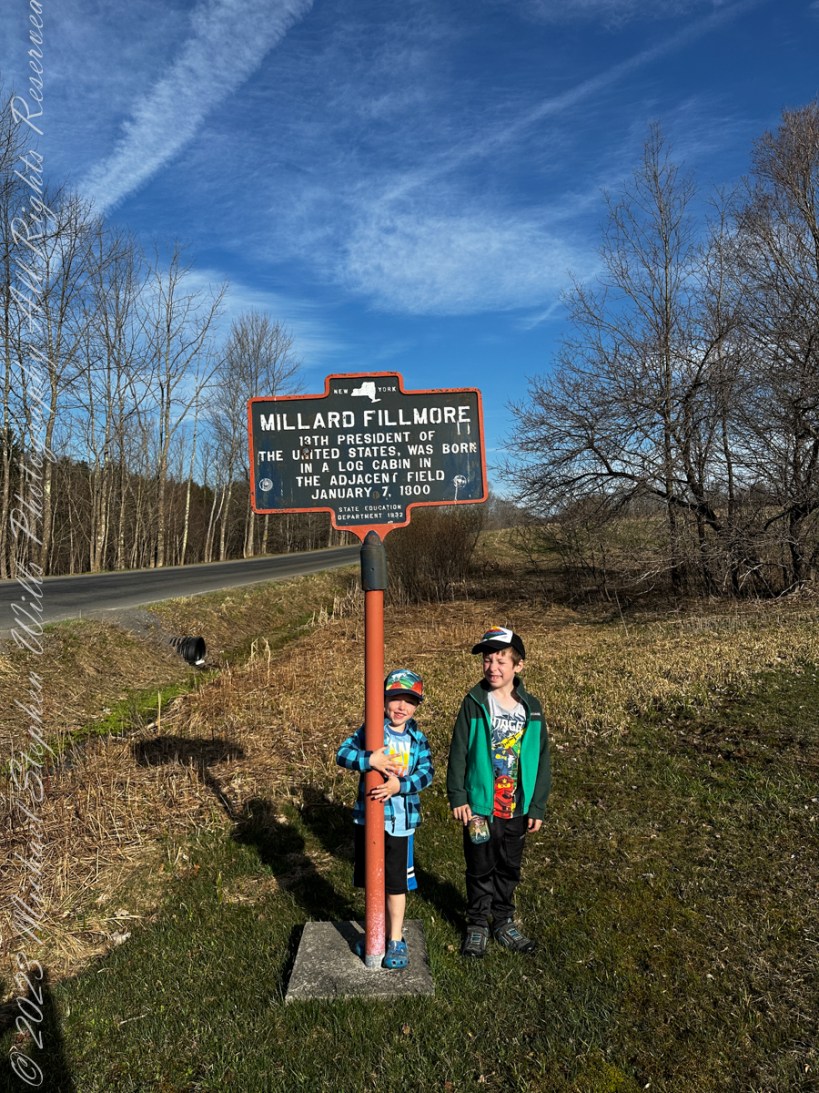
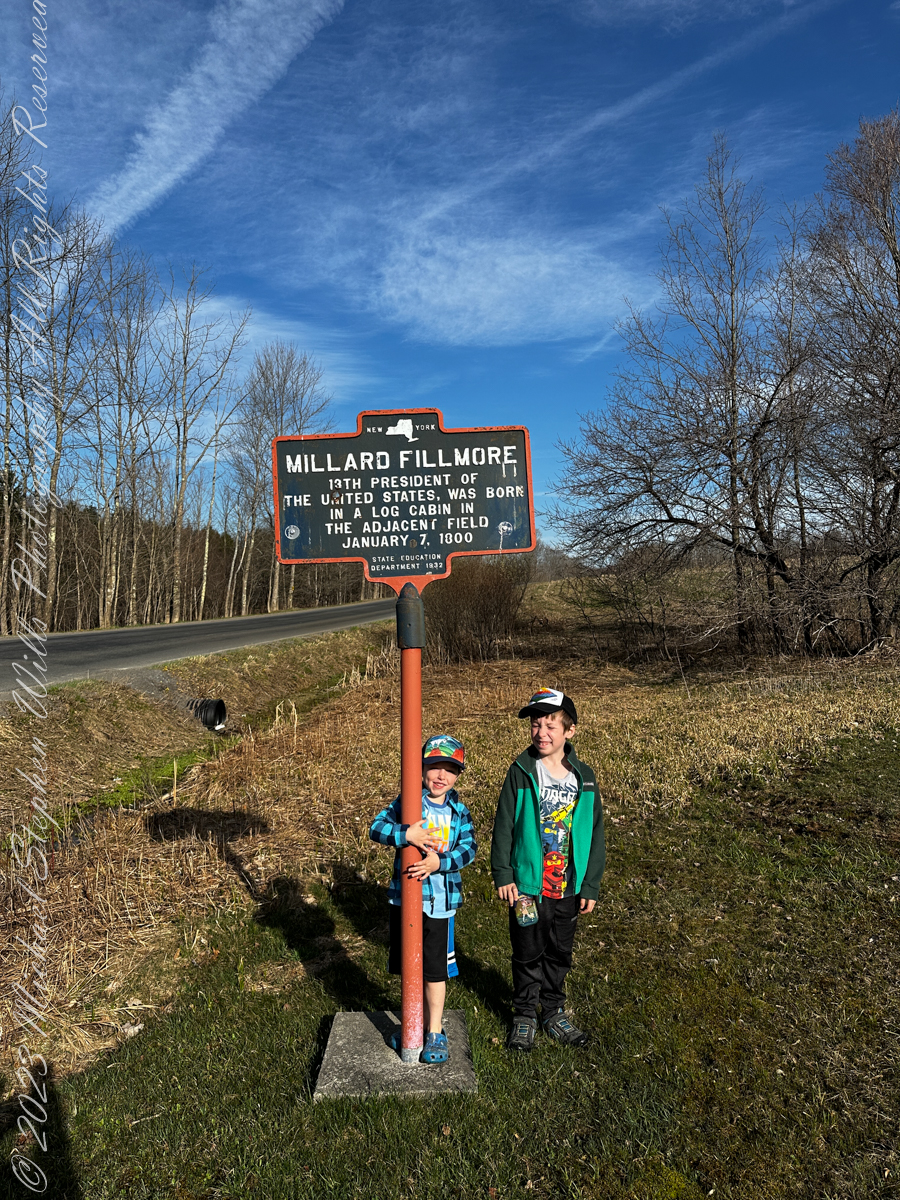
Last Friday the grandsons and I had an outing to the hills above Moravia in Cayuga County, there we visited the birthplace of Millard Fillmore. The site is a rather steep, rocky hillside near where the future President was born in a log cabin. He was not the last future President thus born, James Garfield in 1831 was born fatherless in Ohio in a log cabin. The future 20th President and the last to be so born. Nine years after Millard Fillmore, Abraham Lincoln was born, February 12, 1809 in the same residential circumstance and was the first future President born west of the Appalachian Mountains at Sinking Springs Farm, Kentucky. At least seven (7) future USA Presidents were born in log cabins, the others are: Andrew Jackson, James K. Polk, James Buchanan, Andrew Johnson, Chester A. Arthur.
There is quite a bit to do at this open air museum: educational signs, split rail fencing from that time, a pavilion build from concrete, steel I-beams and a metal roof with picnic tables where we played games.
On the way to Fillmore Glen New York State Park to visit an actual log cabin from that time, we stopped at the Lickville Cemetery on Lick Street. Opened a few years after Fillmore’s birth, 1807, 180 headstones are still standing. We practiced sounding out words from the large carved letters on the stones.
After visiting the log cabin our day was interrupted by symptoms of a stomach flu that has been terrorizing all our families. Fortunately, I escaped. Our plan is to continue to explore Fillmore Glen at a later time.
More about Millard Fillmore from Wikipedia
Millard Fillmore was born on January 7, 1800, in a log cabin, on a farm in what is now Moravia, Cayuga County, in the Finger Lakes region of New York. His parents were Phoebe Millard and Nathaniel Fillmore, and he was the second of eight children and the oldest son.
Nathaniel Fillmore was the son of Nathaniel Fillmore Sr. (1739–1814), a native of Franklin, Connecticut, who became one of the earliest settlers of Bennington, Vermont, when it was founded in the territory that was then called the New Hampshire Grants.
Nathaniel Fillmore and Phoebe Millard moved from Vermont in 1799 and sought better opportunities than were available on Nathaniel’s stony farm, but the title to their Cayuga County land proved defective, and the Fillmore family moved to nearby Sempronius, where they leased land as tenant farmers, and Nathaniel occasionally taught school. The historian Tyler Anbinder described Fillmore’s childhood as “one of hard work, frequent privation, and virtually no formal schooling.”
Over time Nathaniel became more successful in Sempronius, but during Millard’s formative years, the family endured severe poverty. Nathaniel became sufficiently regarded that he was chosen to serve in local offices, including justice of the peace. Hoping that his oldest son would learn a trade, he convinced Millard, who was 14, not to enlist for the War of 1812 and apprenticed him to clothmaker Benjamin Hungerford in Sparta. Fillmore was relegated to menial labor, and unhappy at not learning any skills, he left Hungerford’s employ.
His father then placed him in the same trade at a mill in New Hope. Seeking to better himself, Millard bought a share in a circulating library and read all the books that he could. In 1819 he took advantage of idle time at the mill to enroll at a new academy in the town, where he met a classmate, Abigail Powers, and fell in love with her.
Later in 1819 Nathaniel moved the family to Montville, a hamlet of Moravia. Appreciating his son’s talents, Nathaniel followed his wife’s advice and persuaded Judge Walter Wood, the Fillmores’ landlord and the wealthiest person in the area, to allow Millard to be his law clerk for a trial period. Wood agreed to employ young Fillmore and to supervise him as he read law. Fillmore earned money teaching school for three months and bought out his mill apprenticeship. He left Wood after eighteen months; the judge had paid him almost nothing, and both quarreled after Fillmore had, unaided, earned a small sum by advising a farmer in a minor lawsuit. Refusing to pledge not to do so again, Fillmore gave up his clerkship. Nathaniel again moved the family, and Millard accompanied it west to East Aurora, in Erie County, near Buffalo, where Nathaniel purchased a farm that became prosperous.
Copyright 2023 Michael Stephen Wills All Rights Reserved.
On our way back from “The Train at the End of the World” and sailing the Beagle Channel, these two young people came into view. Sitting at the foot of the a tower welcoming airport arrivals, who must transit this roundabout, is a pair of young people. In my imagination they were brothers waiting for a ride. In the first long wide shot the older is taking their selfie with the Ushuaia.
Here we at at the “center” of this city set spectacularly against the Fuegian Andes, the southern continuation of the Andes mountain range immediately south of the Strait of Magellan. with a West-East orientation. They occupy the mountainous and mountainous portion of the southern archipelago of Tierra del Fuego.
In this second, close photo, he is talking to the ride on his smart phone, after sending the selfie. The roundabout is named “Hipólito Yrigoyen” after an Argentine politician twice elected President.
Here is more information about the man:
Juan Hipólito del Sagrado Corazón de Jesús Yrigoyen (Spanish pronunciation: [iˈpolito iɾiˈɣoʝen]; 12 July 1852 – 3 July 1933) was an Argentine politician of the Radical Civic Union and two-time President of Argentina, who served his first term from 1916 to 1922 and his second term from 1928 to 1930. He was the first president elected democratically by means of the secret and mandatory male suffrage established by the Sáenz Peña Law of 1912. His activism was the prime impetus behind the passage of that law in Argentina.
Known as “the father of the poor”, Yrigoyen presided over a rise in the standard of living of Argentina’s working class together with the passage of a number of progressive social reforms, including improvements in factory conditions, regulation of working hours, compulsory pensions, and the introduction of a universally accessible public education system.
Yrigoyen was the first nationalist president, convinced that the country had to manage its own currency and, above all, it should have control of its transportation and its energy and oil exploitation networks.
Between the 1916 general election and the 1930 coup d’etat, political polarization was on the rise. Personalist radicalism was presented as the “authentic expression of the nation and the people” against the “oligarchic and conservative regime”. For the ruling party, the will of the majorities prevailed over the division of powers. The opposition, on the other hand, accused the Executive Branch of being arrogant and demanded greater participation from Congress, especially in matters such as the conflictive federal interventions.
Reference: Wikipedia “Andes fueguinos” and “Hipólito Yrigoyen.”
Copyright 2023 Michael Stephen Wills All Rights Reserved
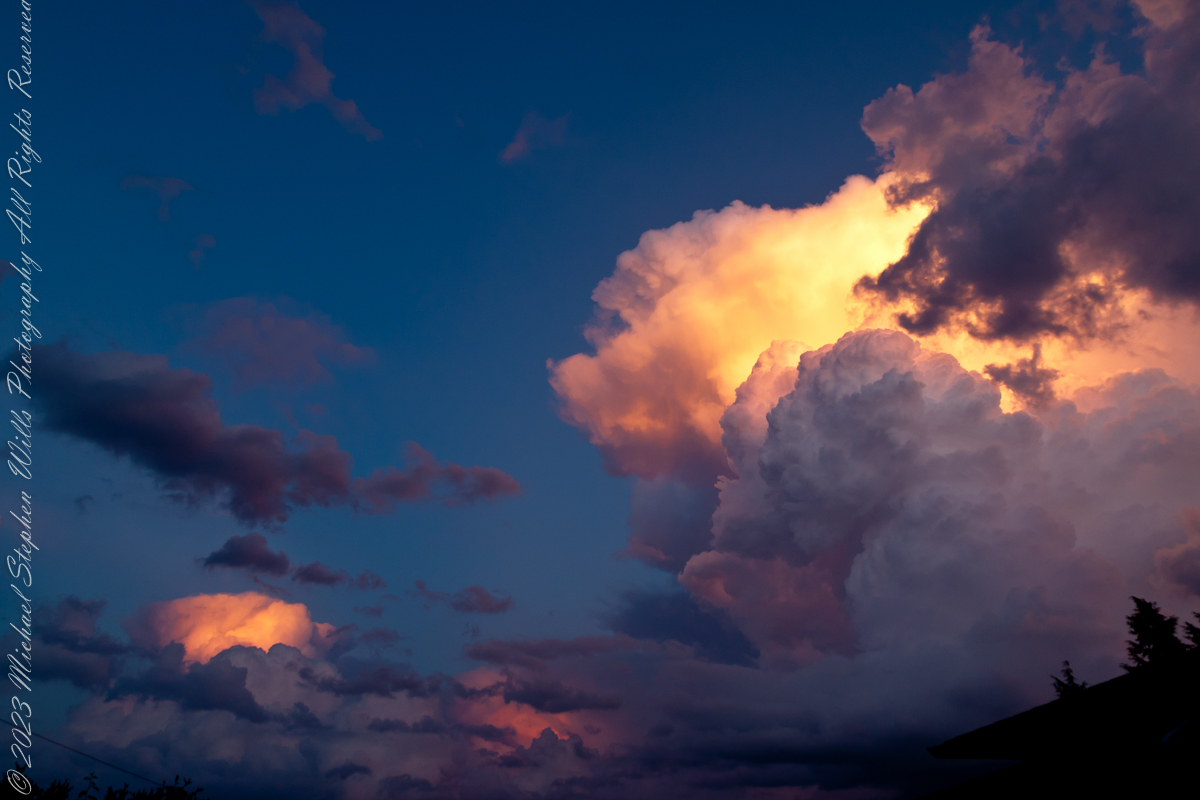
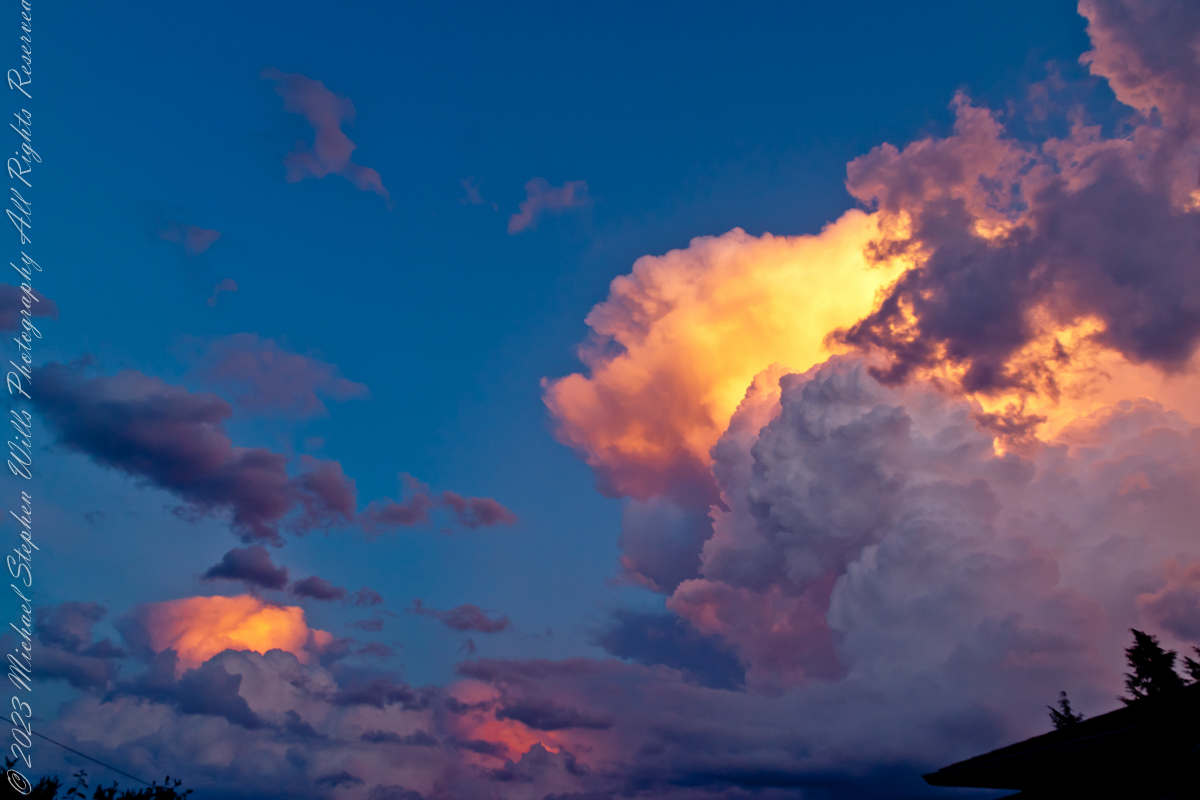
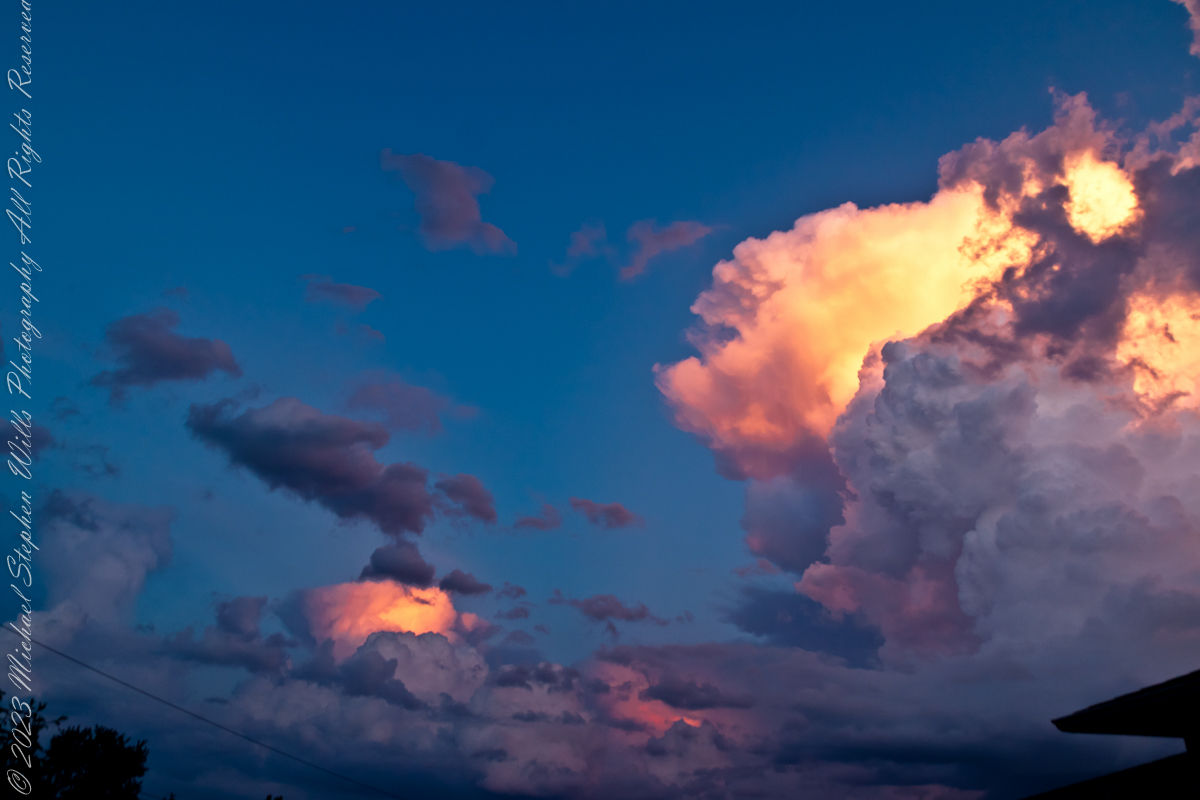
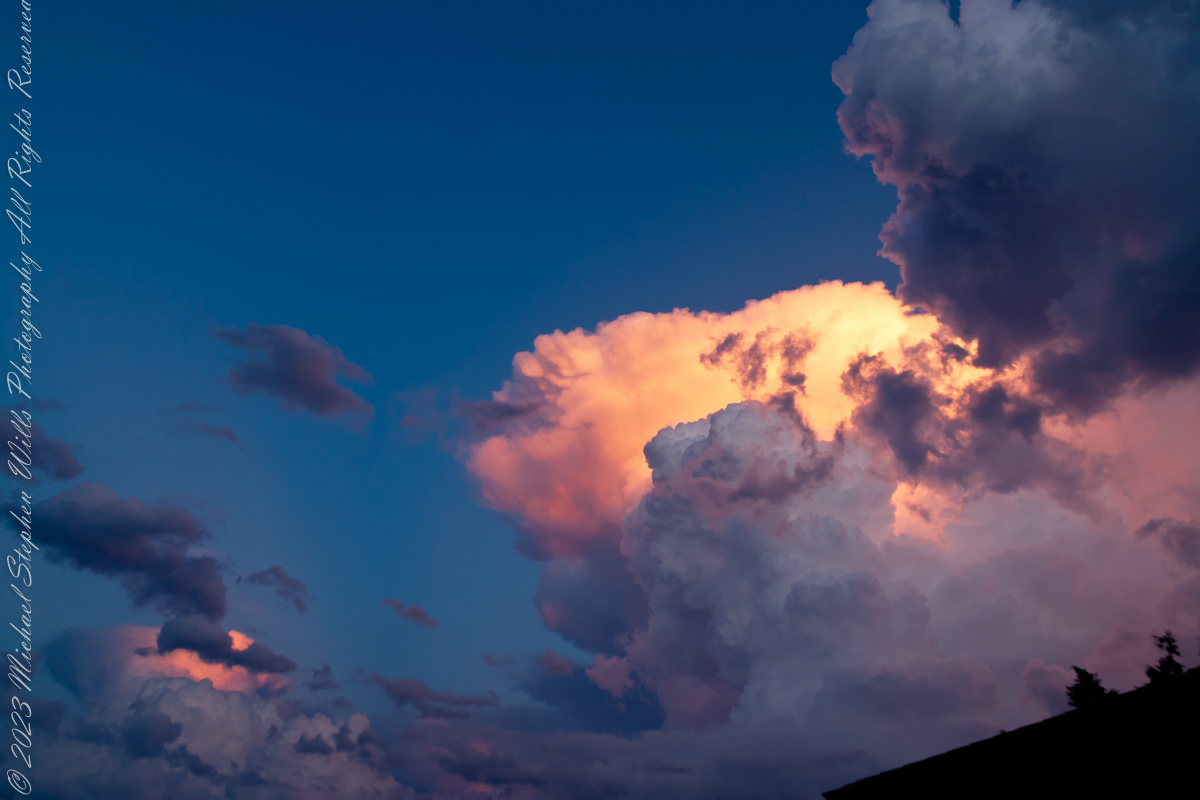
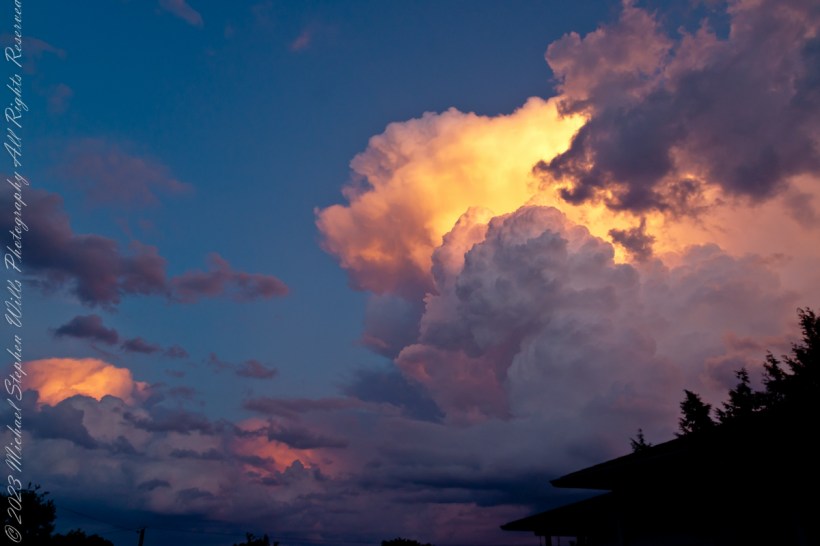
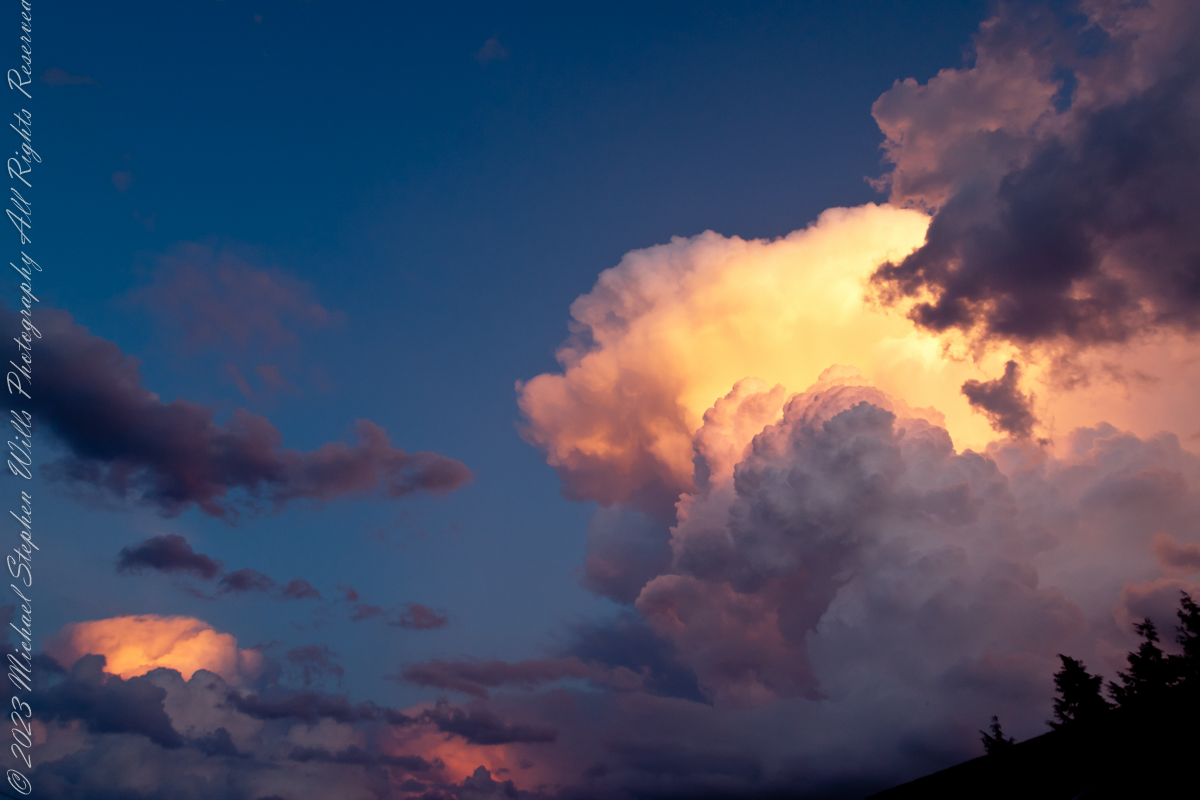
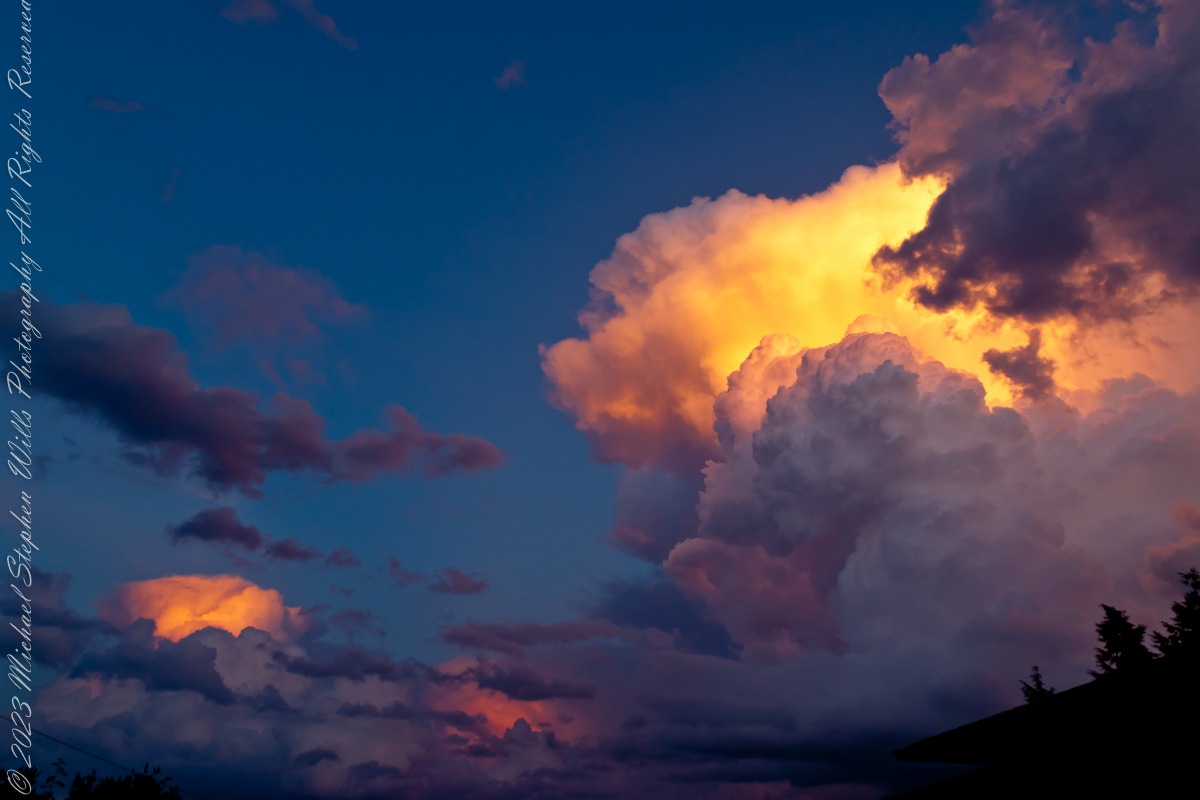
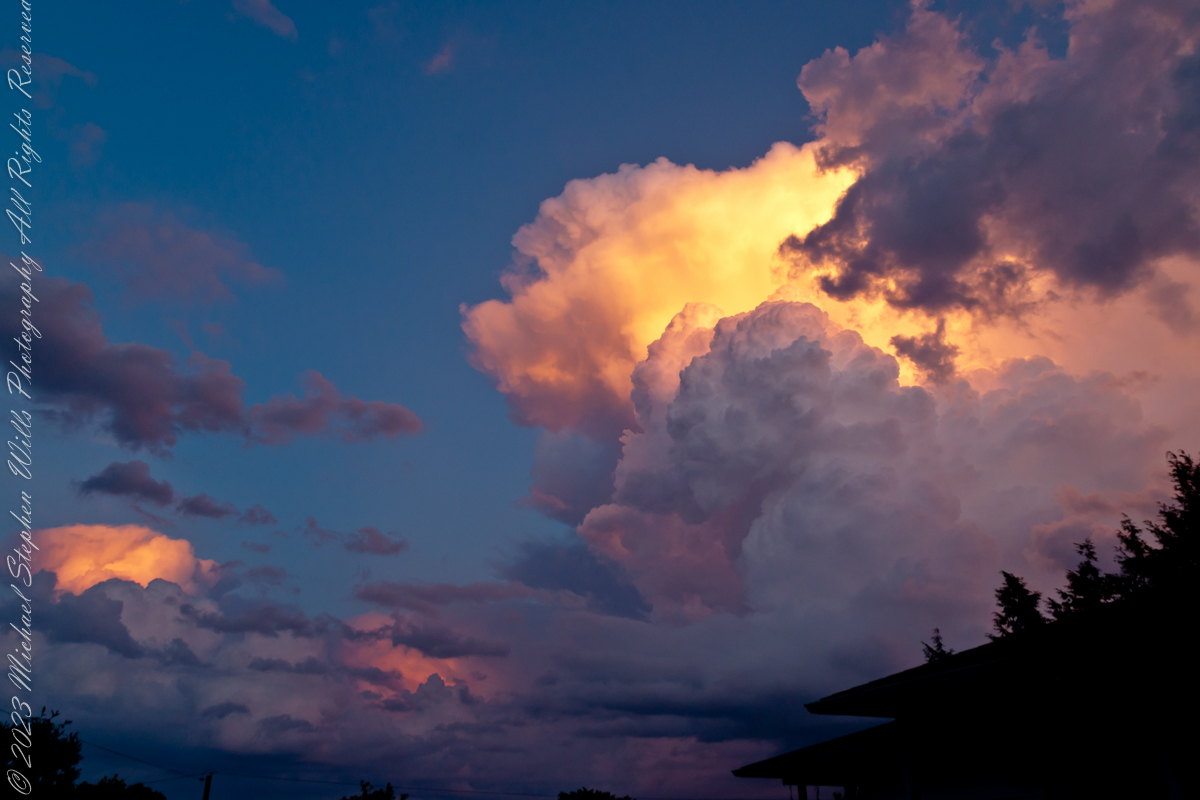
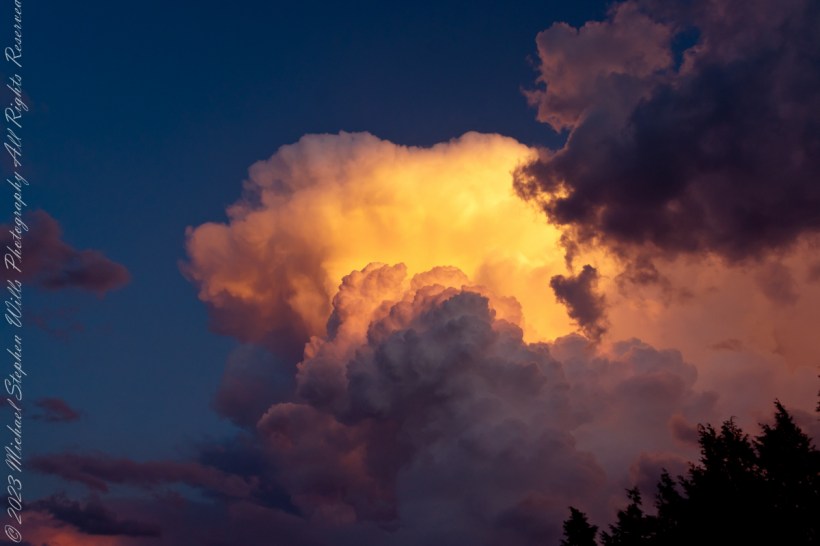
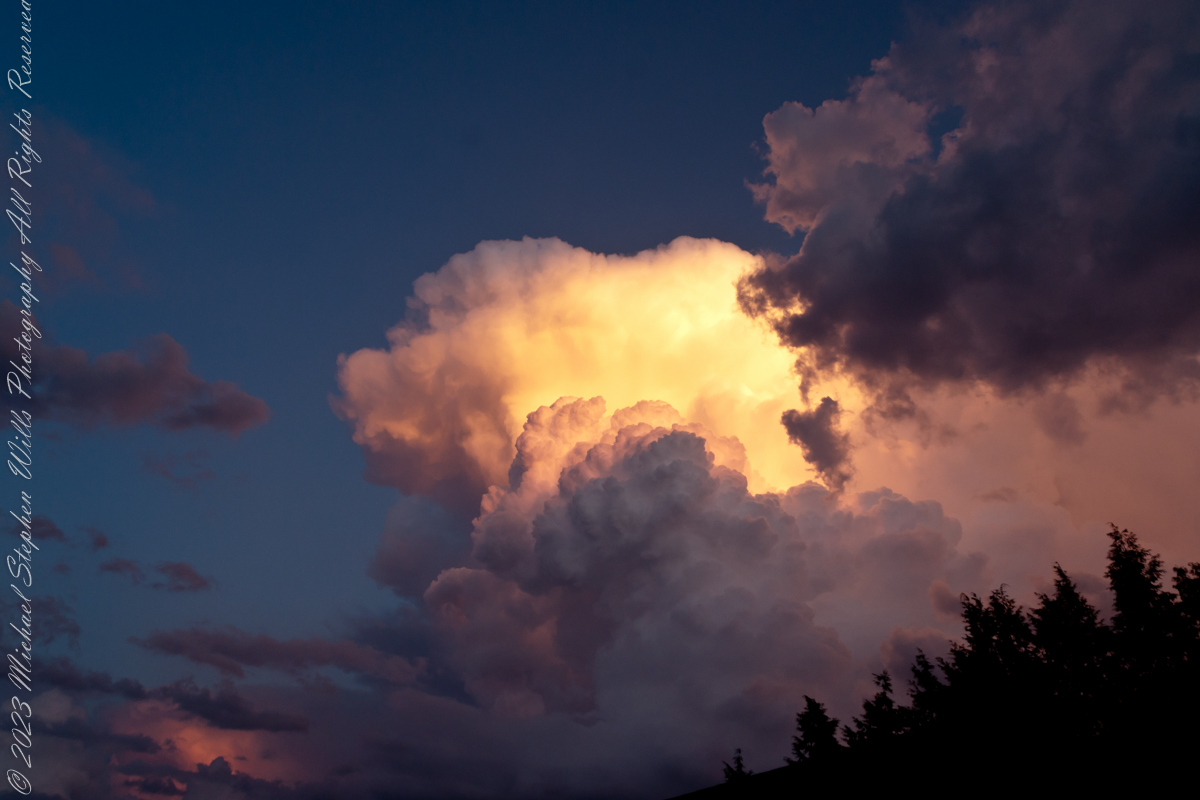
The combination of water vapor in all its forms and the sun dipping below the horizon combined to form these magical images.
Maxfield Parrish refined his art to duplicate these effects in oil.
Parrish’s art is characterized by vibrant colors; the color Parrish blue was named after him. He achieved such luminous color through glazing. This process involves applying layers of translucent paint and oil medium (glazes) over a base rendering. Parrish usually used a blue and white monochromatic underpainting.
His paintings/illustrations were unique in that they depicted a highly idealized fantasy world that was accessible to the public. Although you will rarely see a glimpse of that color in reality, he was and still is linked with a particularly bright shade of blue that coated the skies of his landscapes. And it was not an easy task for him to complete. He invented a time-consuming process that involved a cobalt blue base and white undercoating, which he then coated with a series of thin alternating coatings of oil and varnish. When exposed to ultraviolet light, the resins he employed, known as Damar, fluoresce a shade of yellow-green, giving the painted sky its distinctive turquoise tint.
Reference: “Maxfield Parrish” from Wikipedia
Copyright 2023 Michael Stephen Wills All Rights Reserved
Cumulonimbus (from Latin cumulus ‘heaped’, and nimbus ‘rainstorm’) is a dense, towering vertical cloud, typically forming from water vapor condensing in the lower troposphere that builds upward carried by powerful buoyant air currents.
Above the lower portions of the cumulonimbus the water vapor becomes ice crystals, such as snow and graupel, the interaction of which can lead to hail and to lightning formation, respectively. When occurring as a thunderstorm these clouds may be referred to as thunderheads. Cumulonimbus can form alone, in clusters, or along squall lines.
Graupel also called soft hail, hominy snow, or snow pellets, is precipitation that forms when supercooled water droplets in air are collected and freeze on falling snowflakes, forming 2–5 mm (0.08–0.20 in) balls of crisp, opaque rime.
Graupel is distinct from hail and ice pellets in both formation and appearance. However, both hail and graupel are common in thunderstorms with cumulonimbus clouds, though graupel also falls in winter storms, and at higher elevations as well.
These clouds can produce lightning and other dangerous severe weather, such as tornadoes, hazardous winds, and large hailstones. Cumulonimbus progresses from overdeveloped cumulus congestus clouds and may further develop as part of a supercell. Cumulonimbus is abbreviated Cb.
Reference: “Cumulonumbus Cloud” and “Graupel” from Wikipedia
Copyright 2023 Michael Stephen Wills All Rights Reserved
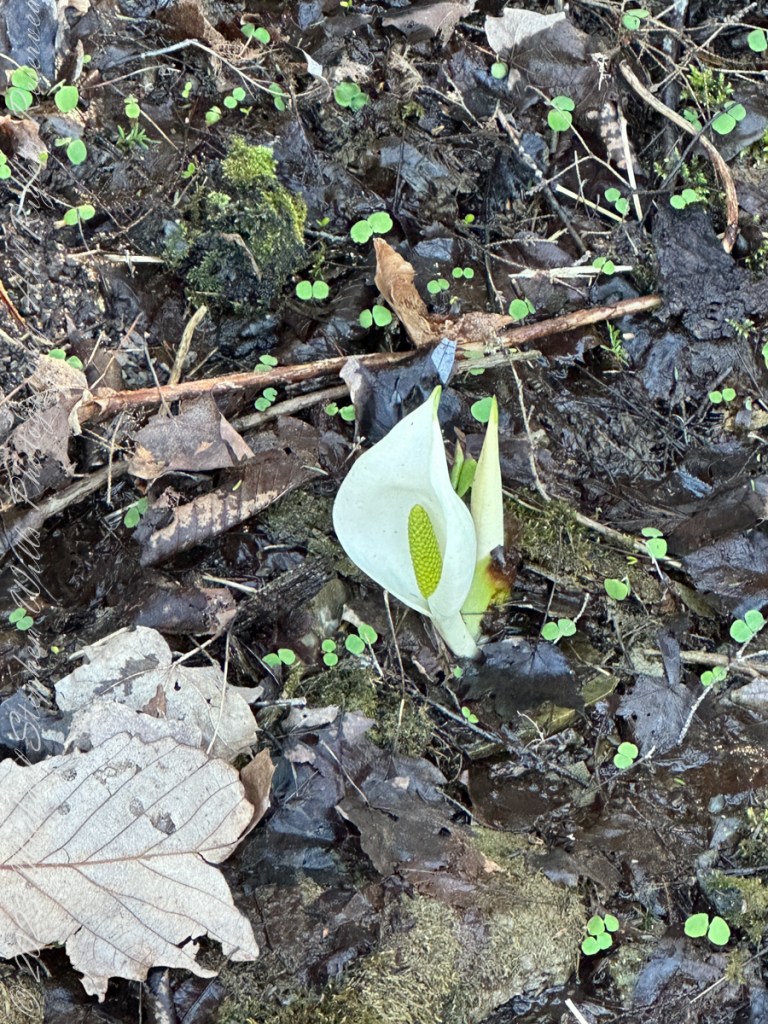
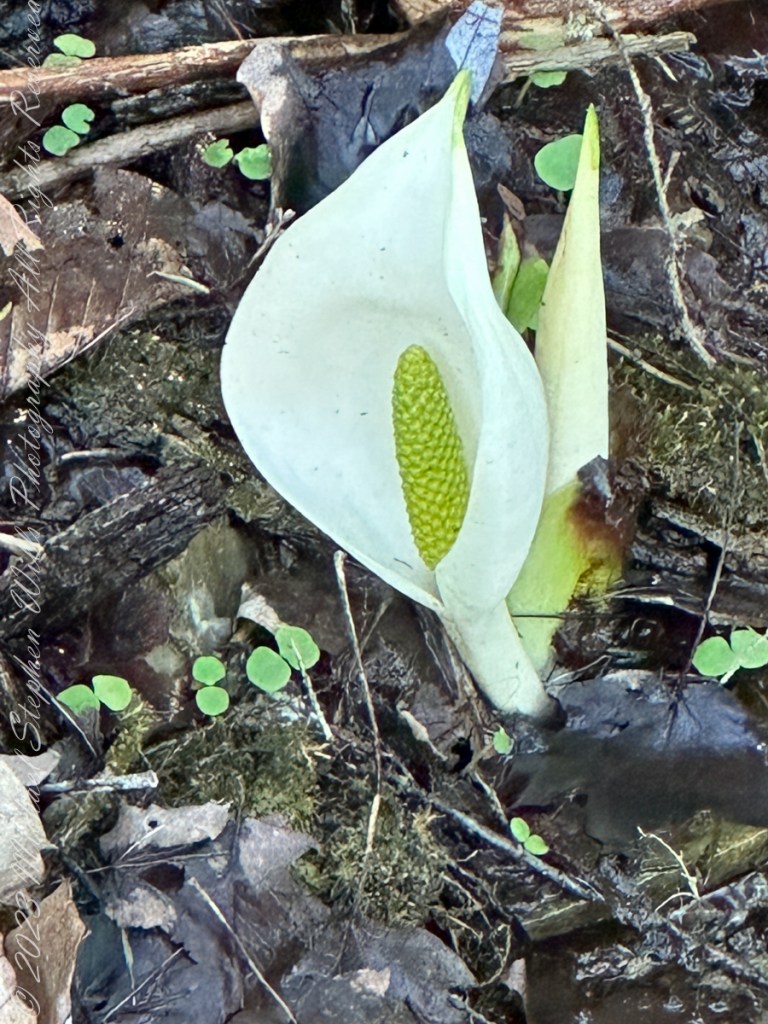
Pam and I ambled around the Arboretum for our Easter 2023 outing. We discovered this seeming lily growing from the muck along the Treman Woodland Walk. Scientific Name: Lysichiton camtschatcensis. Common names: Asian skunk cabbage, white skunk cabbage, Far Eastern swamp lantern or Japanese swamp lantern.
This is a plant found in swamps and wet woods, along streams and in other wet areas of the Kamchatka Peninsula, the Kuril Islands, Sakhalin and northern Japan. The common name “skunk cabbage” is used for the genus Lysichiton, which includes Lysichiton americanus, the western skunk cabbage, noted for its unpleasant smell. The Asian skunk cabbage is more variable: plants have been reported in different cases to smell disgusting, not at all, and sweet.
All photography using the IPhone 14 ProMax triple camera, raw format, edited on the phone.
In Japanese it is known as mizubashō (lit. “water-banana”) from a supposed similarity to the Japanese banana, a name with poetic rather than malodorous associations. It is not closely related to the true cabbage.
Copyright 2023 Michael Stephen Wills All Rights Reserved














 Michael Stephen Wills Photography