Continue reading “Native American Dance Demonstration”
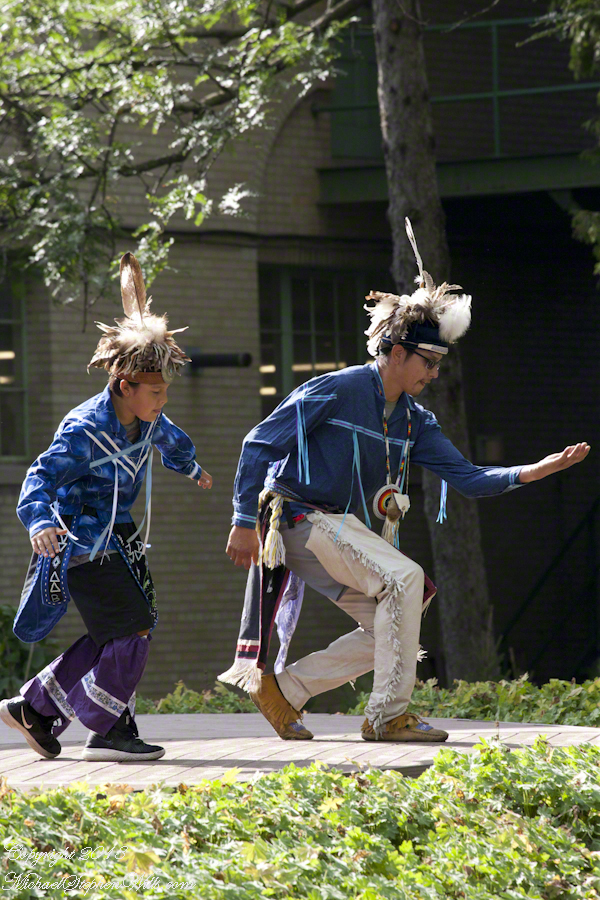
Native American Dance Demonstration
A native American village among the crowds
A native American village among the crowds
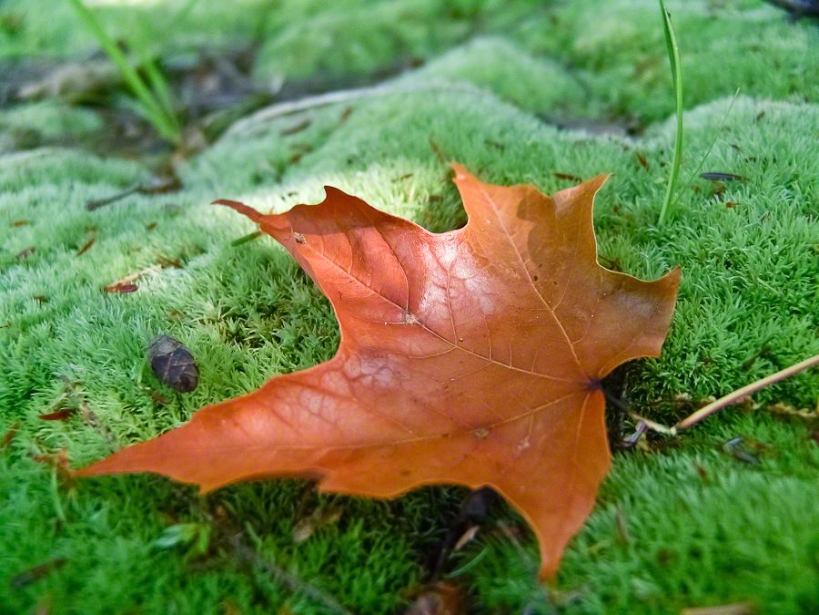
Fallen Leaf on a Moss Carpet
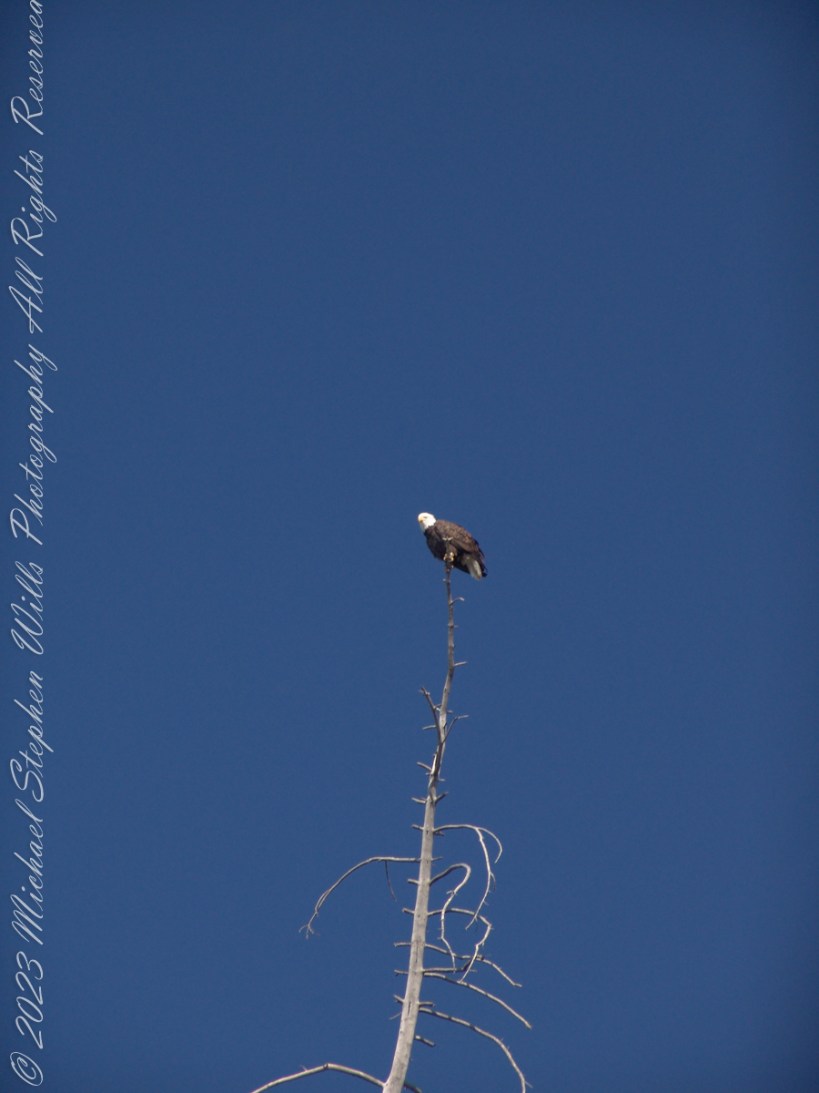
Step into our blog and immerse yourself in the untamed beauty of the Snake River, where majestic eagles soar and nature’s wonders await.
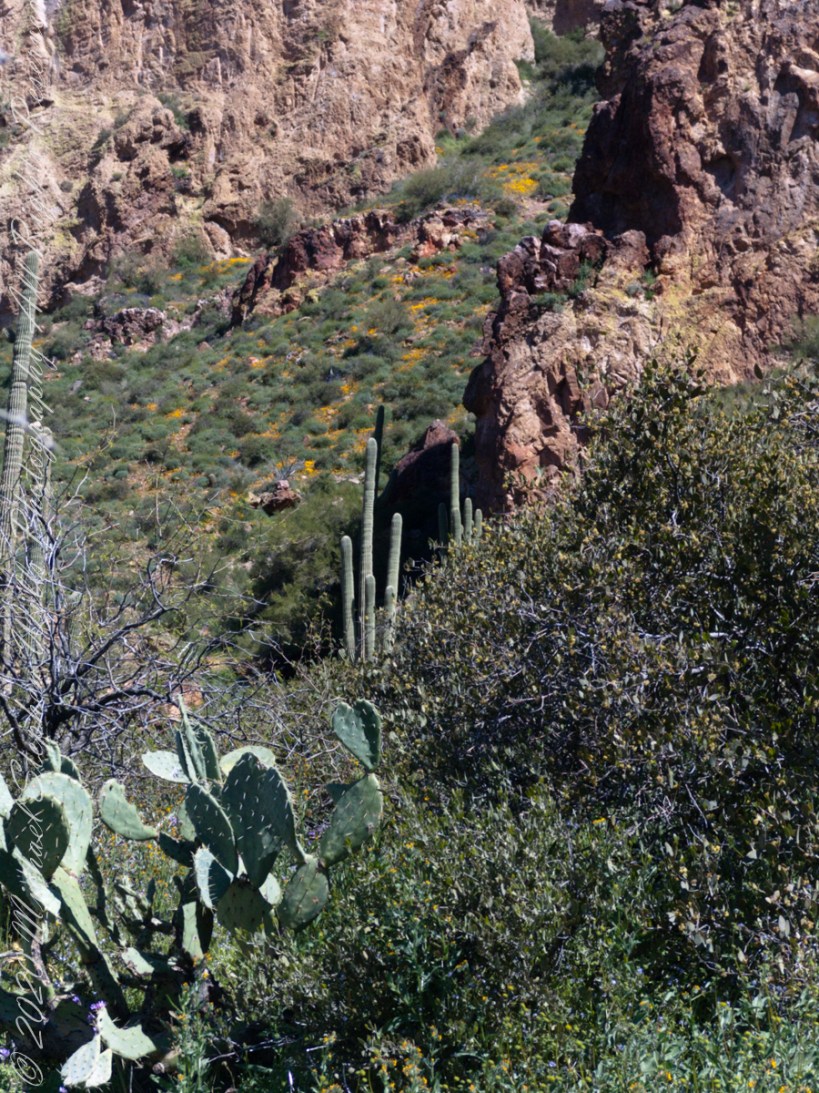
Step into the heart of the Sonoran Desert with me, where the saguaro cactus stands as a timeless giant, a symbol of resilience and beauty. This majestic sentinel of the Southwest is not just a plant; it’s a vibrant ecosystem and a cultural icon, embodying the spirit of endurance. Let’s explore its centuries-long journey, its role as a haven for desert wildlife, and its deep significance to the indigenous peoples. Join me in celebrating the saguaro’s enduring legacy, a narrative of survival and the profound beauty of life in the harshest conditions.
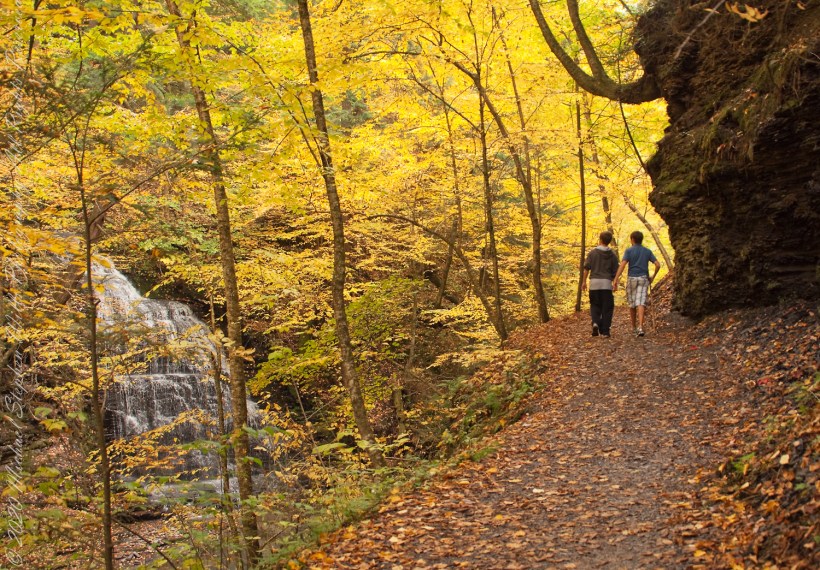
Fillmore Glen State Park in Moravia, New York, offers a changing landscape that serves as a living canvas, with the ironically named Dry Creek feeding its lush greenery. The ebb and flow of water from the creek creates a dynamic setting. Seasons dramatically alter the scenery, from tranquil springs to vibrantly colored autumns, beautifully captured through fine art photography.

In 2003 and 2008, the author visited and photographed White House Ruin in Canyon de Chelly, observing changes in landscape.
In November 2003, my son Sean and I journeyed up Route 191 from Petrified Forest National Park, arriving in Chinle on a crisp autumn afternoon. My photography equipment at the time was modest: a Sony Point and Shoot 5 MP camera with filters, a purse-like over-the-shoulder bag, and a basic tripod from Kmart.
We reached the White House trailhead in Canyon de Chelly and began our hike. The trail was quiet, and as the sun set at 5:20 pm, we found ourselves virtually alone. A dense growth of Russian Olive trees dominated the wash at that time. In the dimming light, I captured a distant shot of the White House Ruin, whitewashed, set against the backdrop of autumn-hued Russian Olive foliage. Nearby, a grove of Cottonwoods, still green, stood near the canyon wall.

By the time Pam and I returned in July 2008, four years and nine months later, the landscape had changed. The invasive Russian Olives had been removed, and the White House Ruin was no longer painted white.
The same Route 191 that Sean and I had taken in 2003 led us through the Four Corners region of Northern Arizona. Pam and I had traveled from Colorado, arriving in the late afternoon. This time, the Navajo Reservation’s adherence to daylight savings time meant the sun wouldn’t set until 8:33 pm. My aim was to photograph the White House Ruin that I had missed years earlier.
That July day the sun set 8:33 pm as the Navajo Reservation observes daylight savings time. My goal was to photograph the White House Ruin I missed in 2003. We arrived at the trail head. My photography kit was expanded from 2003, now included a Kodak DSC Pro slr/C, the “C” meaning “Canon” lens mounting, a Sony 700 alpha slr (I only use a variable lens), Manfrotto tripod with hydrostatic ball head, and the backpack style Lowe camera case. With the tripod it is over 25 pounds.
With this on my back I was prepared to boogie down the trail. At the height of tourist season there were many more people at the trailhead. Pam, being a friendly person, started a conversation while I ploughed ahead along the flat canyon rim. It is solid red sandstone, beautiful, generally level with enough unevenness to require attention. When Pam saw how far ahead I was she tried to catch up, tripped, fell hard.
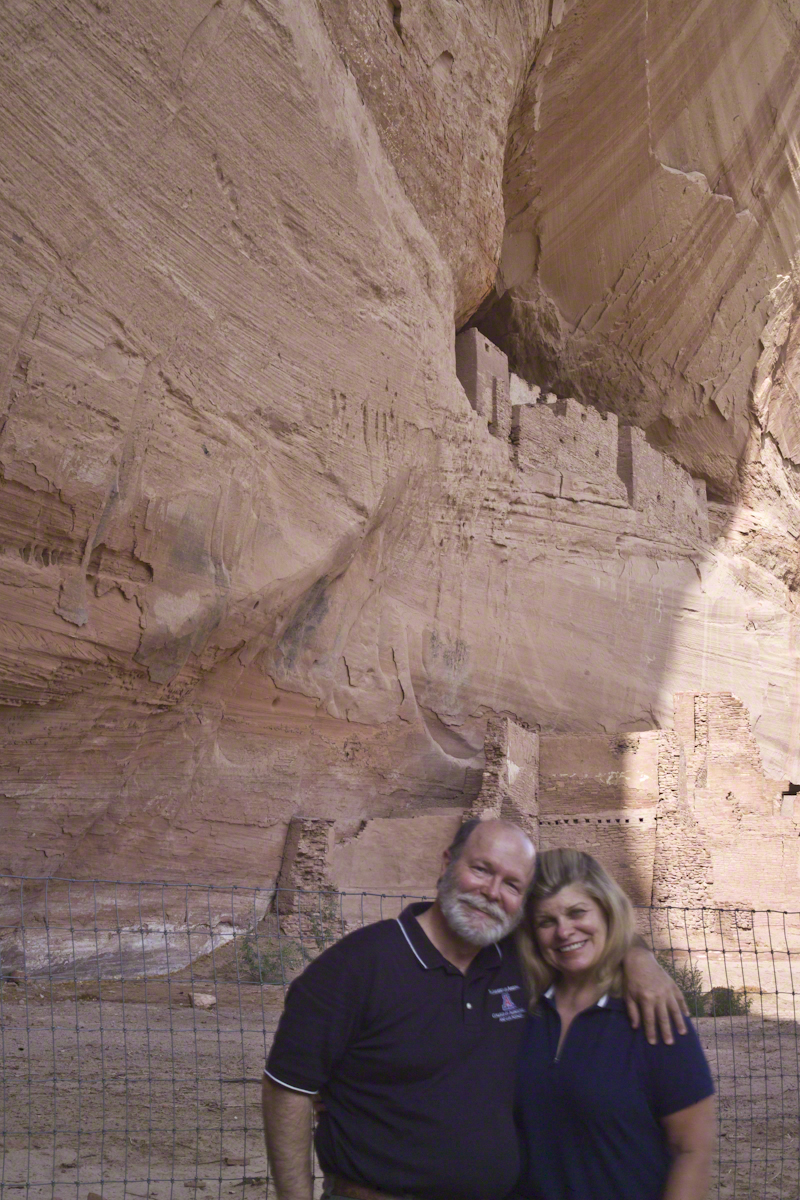
I backtracked to Pam and we decided what to do. She thought, maybe, the fall broke a rib. We decided to proceed and descended, slowly, together. Here we are in front of the ruin. The sun, low in the sky, is moving below the south canyon wall. This is a perfect time, and I used both cameras.
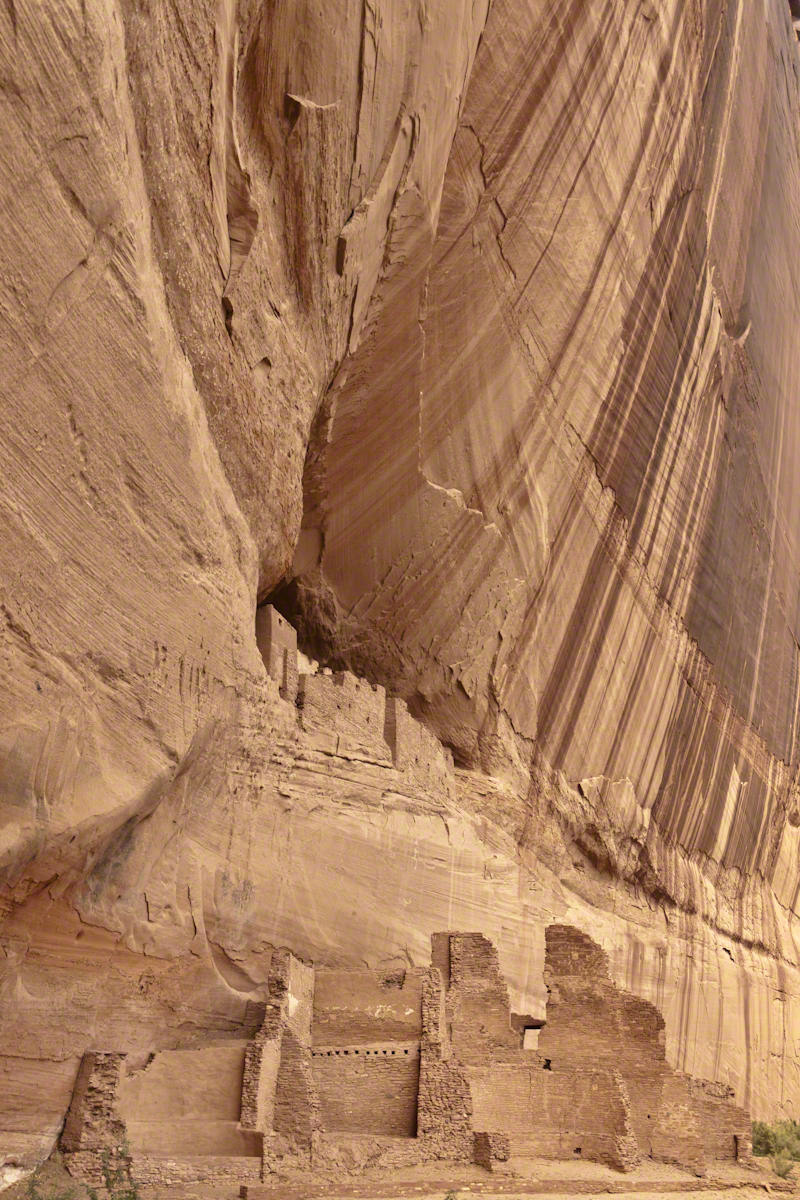
The sweep of cliff and desert varnish was my intent to capture. Here it is through the Canon 50 mm lens.
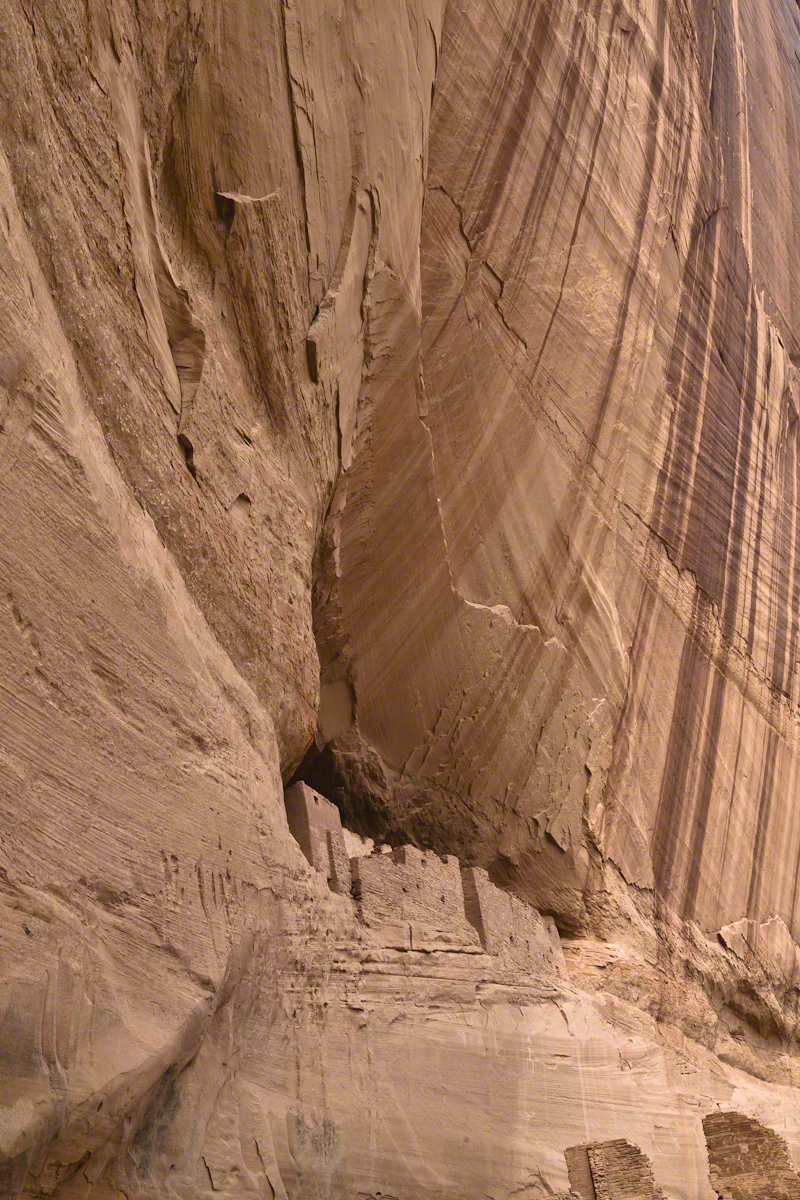
I captured this version with the Sony Alpha 700 slr, the variable lens set to widest angle.
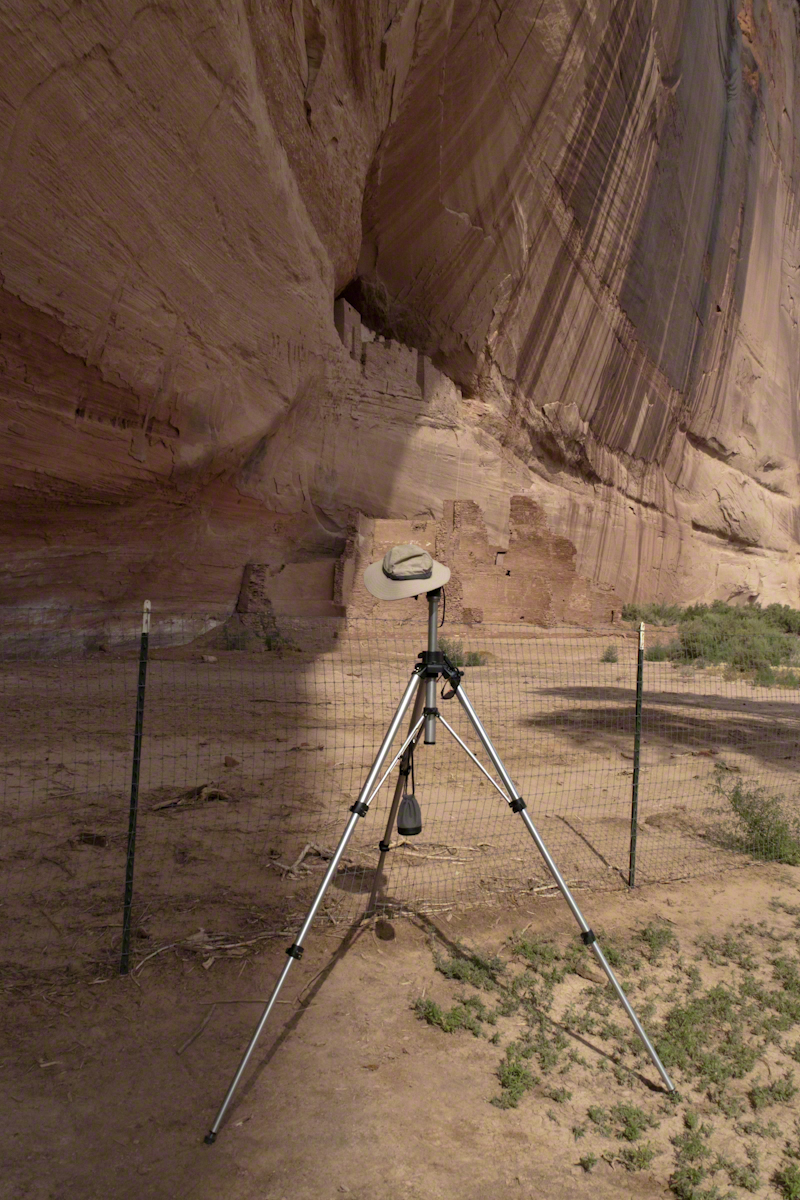
Here the camera setup waits out the sun…..
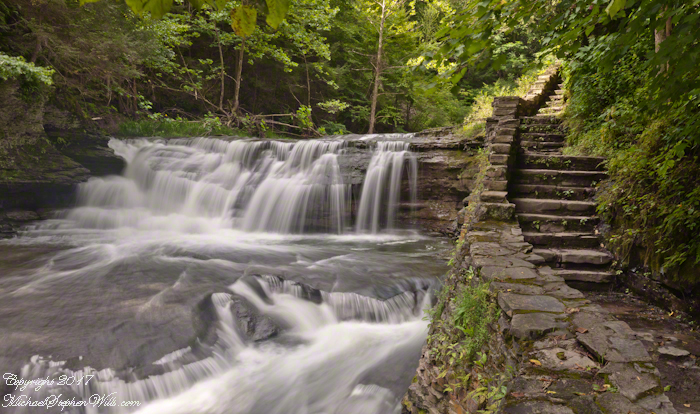
through Devil’s Kitchen to Lucifer Falls
In this third part, we continue hiking Treman gorge, approaching Lucifer Falls, viewing another waterfall further downstream and returning to the trailhead.
I have never achieved a satisfactory capture of the waterfall in the Devil’s Kitchen, a place where the creek flow is diverted south by a projecting ridge. Less than 100 feet later the easterly direction is regained where the water plummets over Lucifer Falls.
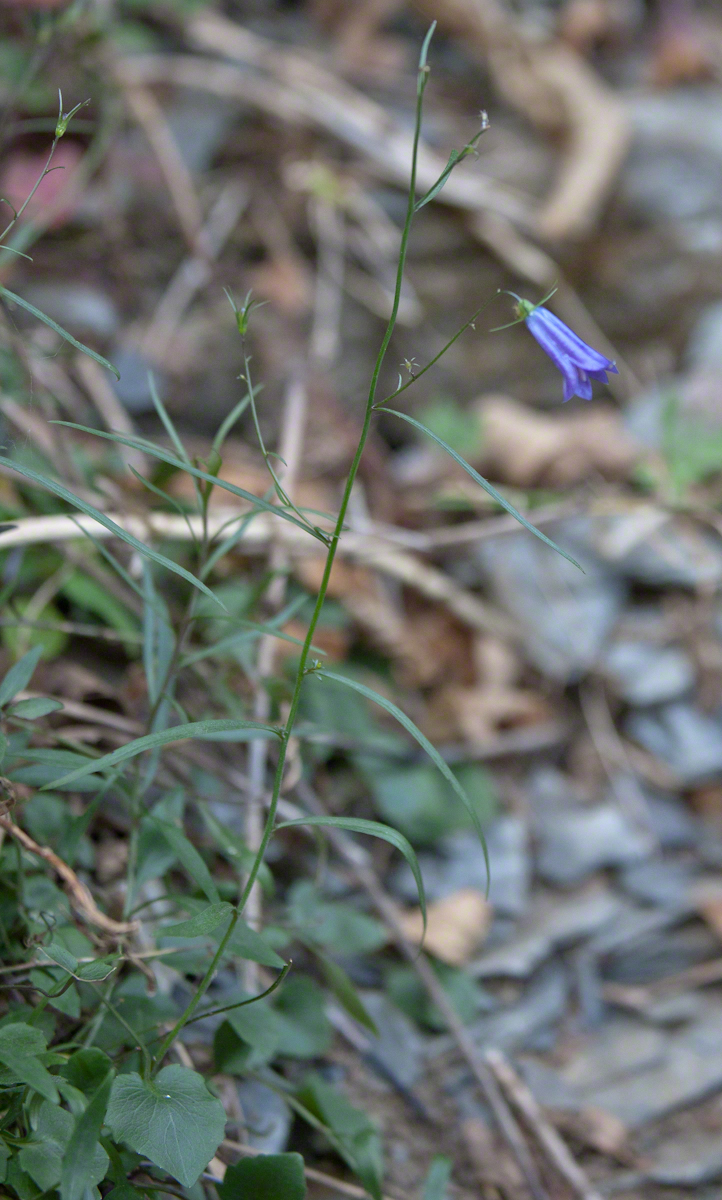
The annual in fall of rock in Devil’s Kitchen uproots and crushes plants growing there. There is scant soil, the roots of this shiny purple trumpet bloom took hold in a microscopic crack. The plant is so thin, the flower so tiny it is lucky my gaze found it.
Click link for my fine art print “After the Rain: Showy Lady Slippers.”
After searching all my plant identification references, this plan is unknown to me. Please help with identification. The bloom is 1/4 inch long.
Not far away, these asters grow from a slightly wider crack. Pam pointed them out to me. I was drawn by the striking color difference of the heads growing from a single stalk.
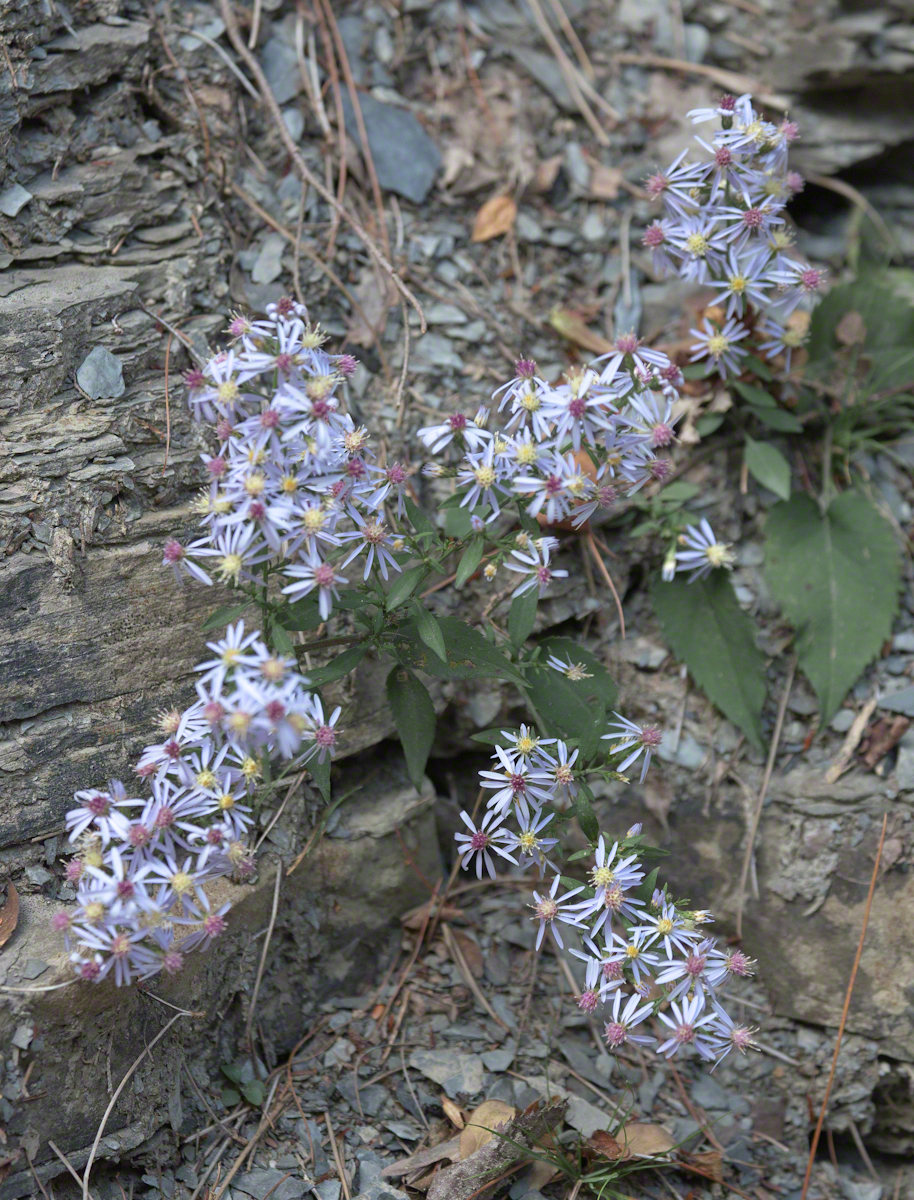
Click link for my fine art print “Purple Asters.”
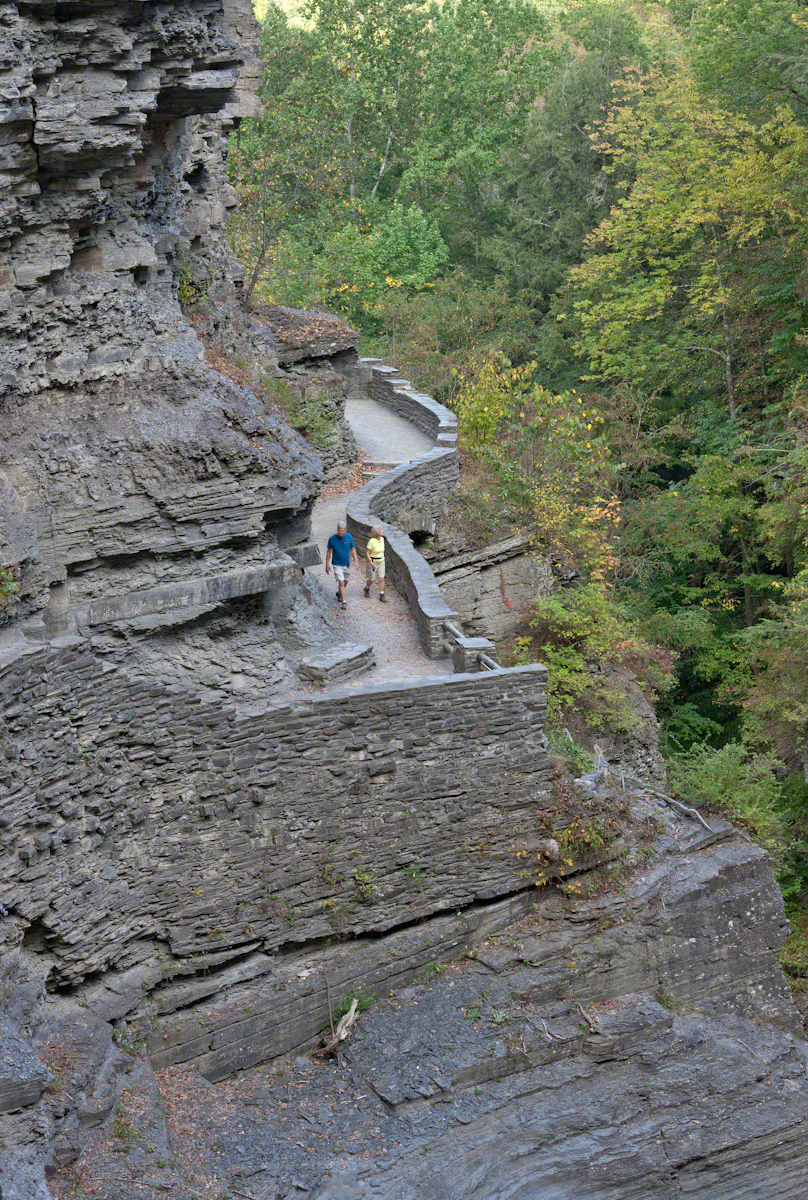
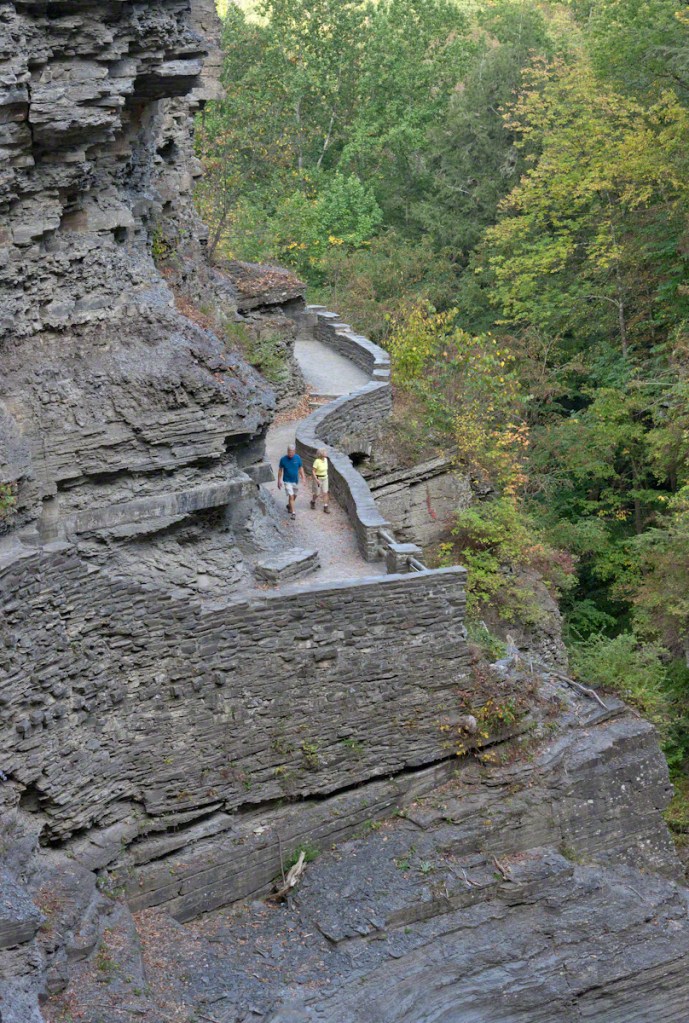
As trail winds around the ridge a stone wall rises on the right and for good reason. The stream shortly reaches the brink of Lucifer Falls, 115 feet high. Gorge walls fall away, the trail steepens. Here is the view from the trail next to the brink.
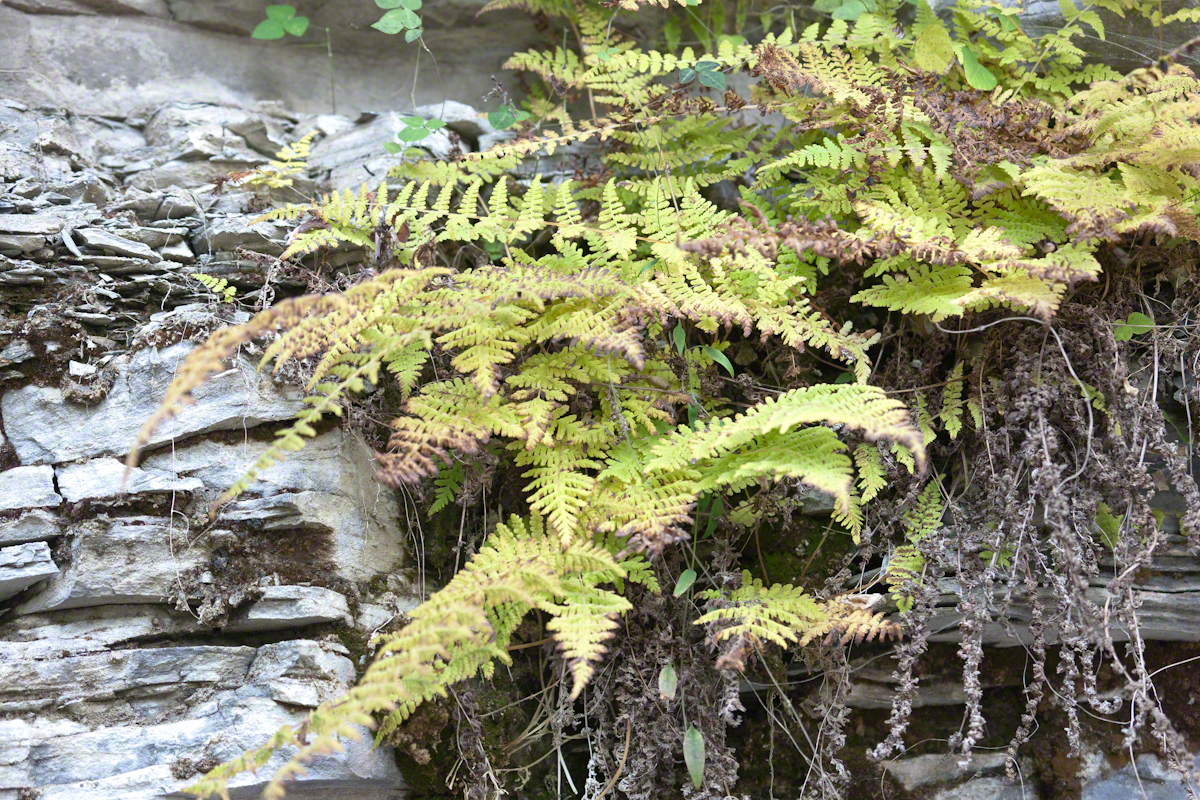
At hand, on the right, a growth of ferns has survived many seasons. Flowering plants are, in geological time (across billions of years), a relatively recent development compared to these non-flowering ferns. The first flowering plants appears 120 million years ago compared to the first ferns, 360 million years ago. Oddly enough, the spread of flowering plants affected evolution of ferns, an increase of fern speciation in parallel to the rise of flower plants.
While descending the stairs next to the falls brink, look to the right to see this ecosystem, a result of water seeping from the sedimentary rock stratification.
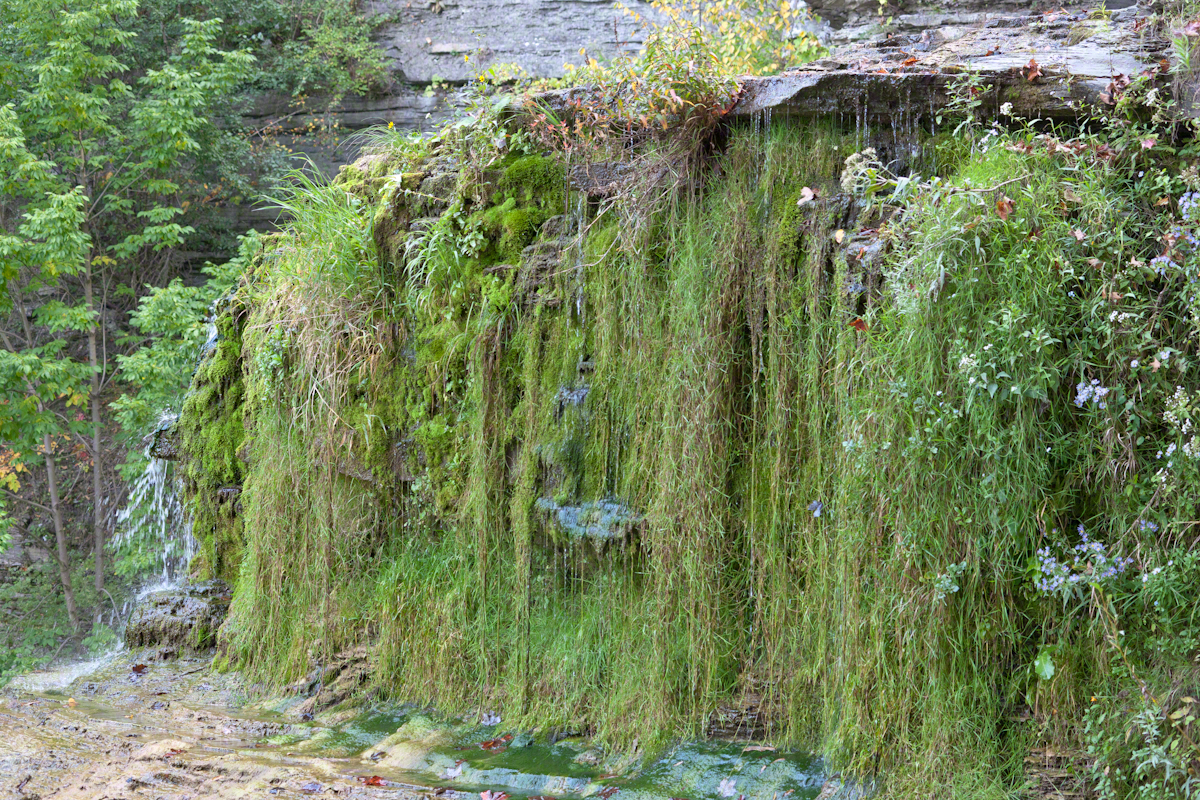
Here you can see how, at lower flow levels, the inactive sections of the fall lip become a garden. In our climate, the entire brink is active for rare and brief intervals during spring thaws. Note how, closer to the active brink, the grasses give way to mosses. Where grasses grow the brink is almost never active.
The trail wall is a lighter color than the cliff, this is how you can see, on the right, the steep trail descent.
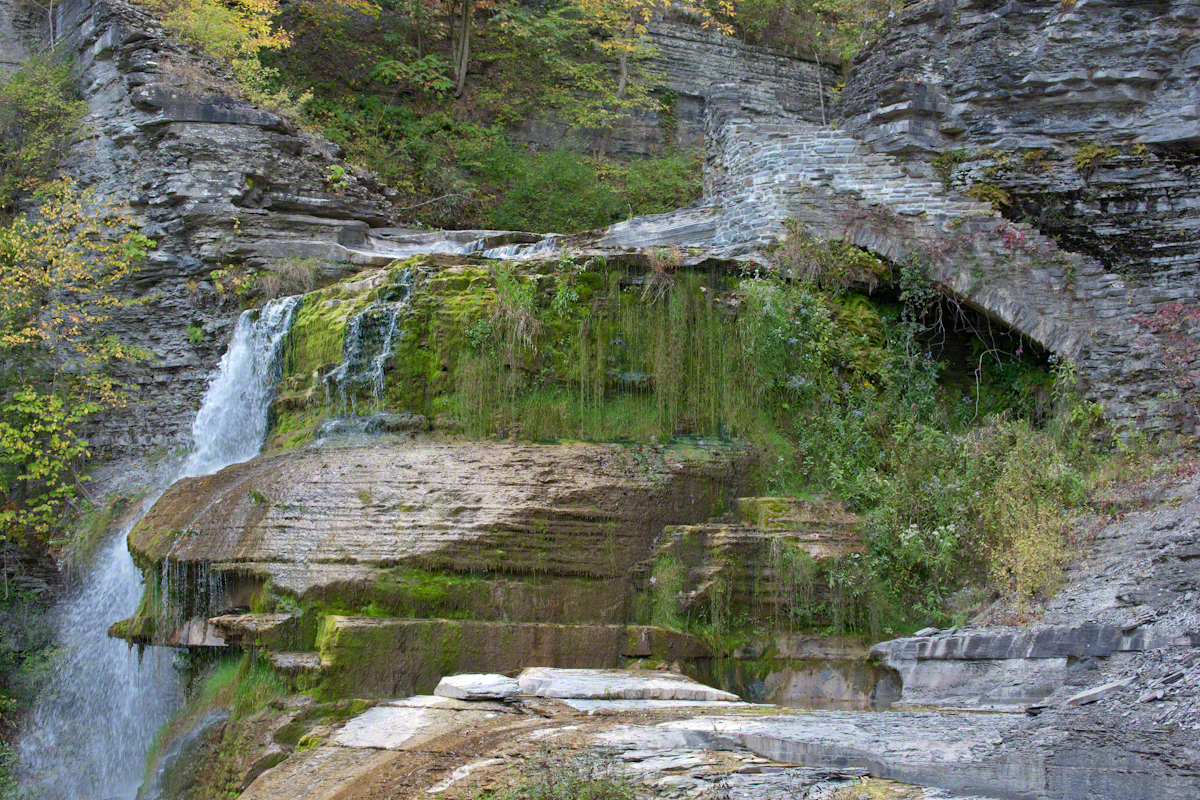
Pam and I turned around here. This is some work I did August 2014 of a notable fall downstream from Lucifer. I used the 24 mm Canon lens here, cropping the image. My goal was to include the stair, for interest, with sunlight on the upper stairs; the water in shade.
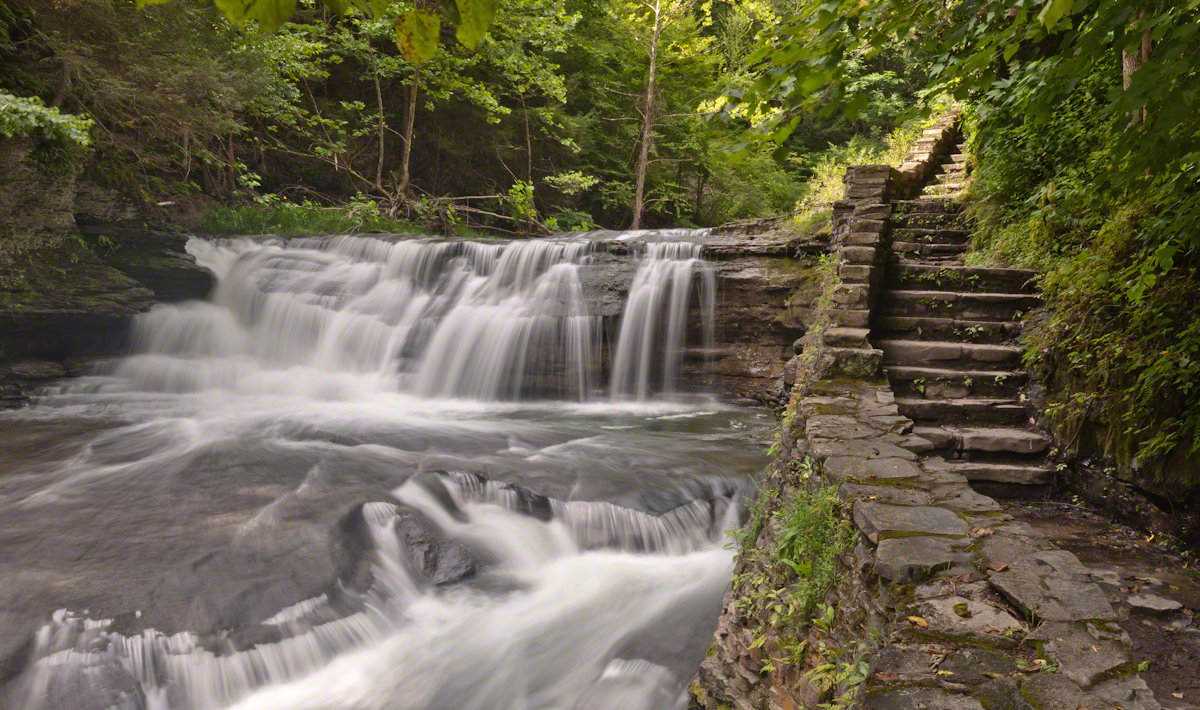
Click link for my fine art print “Woodland Falls.”
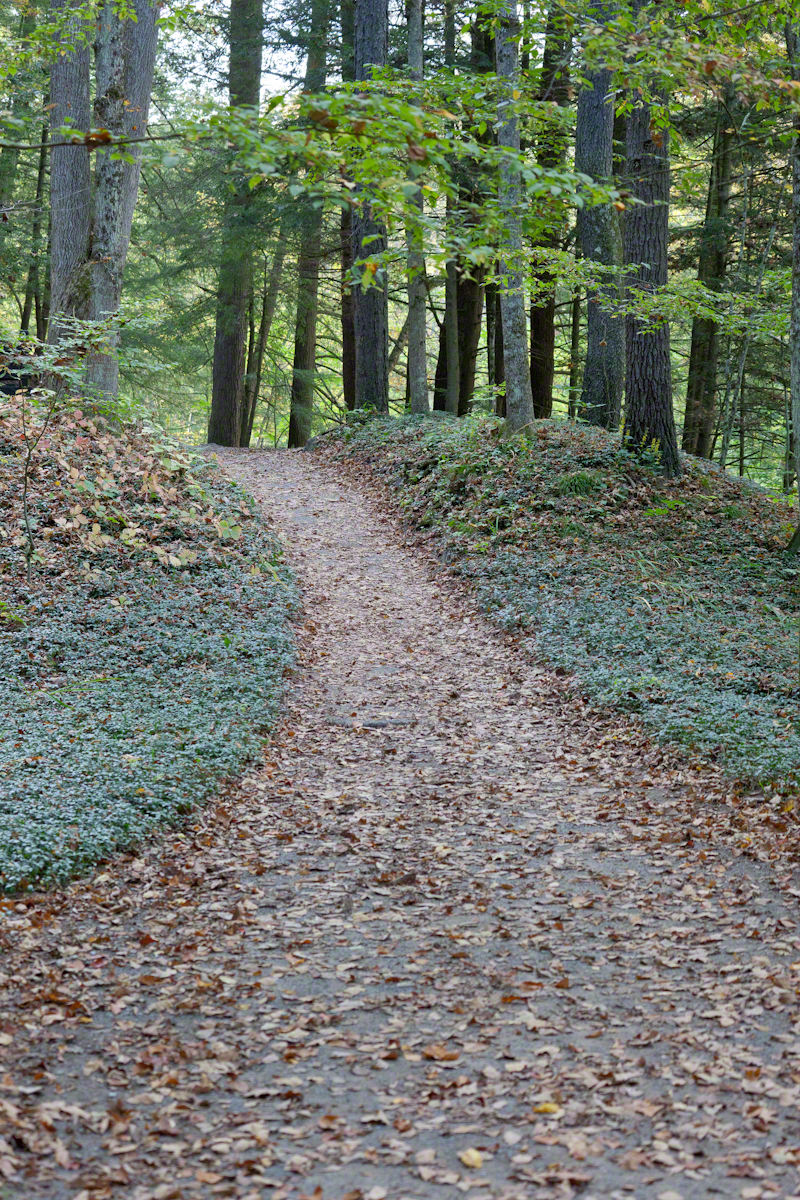
Myrtle borders the trail as it rises from the gorge entrance.
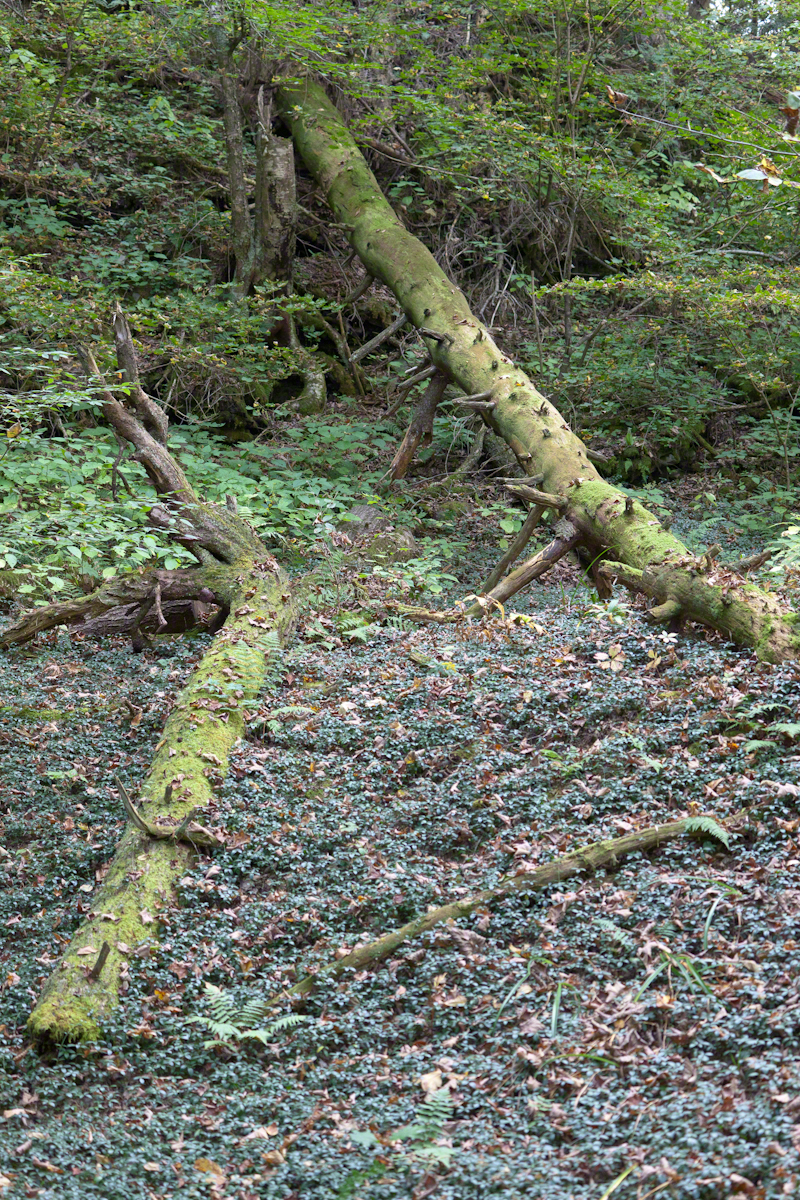
Tree trunks fallen from the gorge walls are left to decay, restoring the soil. The trunks are covered by moss among a thick growth of myrtle and a few ferns.
To finish, here is an image that may broaden your understanding of sunflowers. These smaller, ornamental sunflowers are, at first, difficult to place. Look carefully at the center, composed of many tiny flowers (florets). In crop sunflowers each of these becomes a seed. In this image, shiny beetles are feasting.

Click me for more postings of Autumnal Beauty
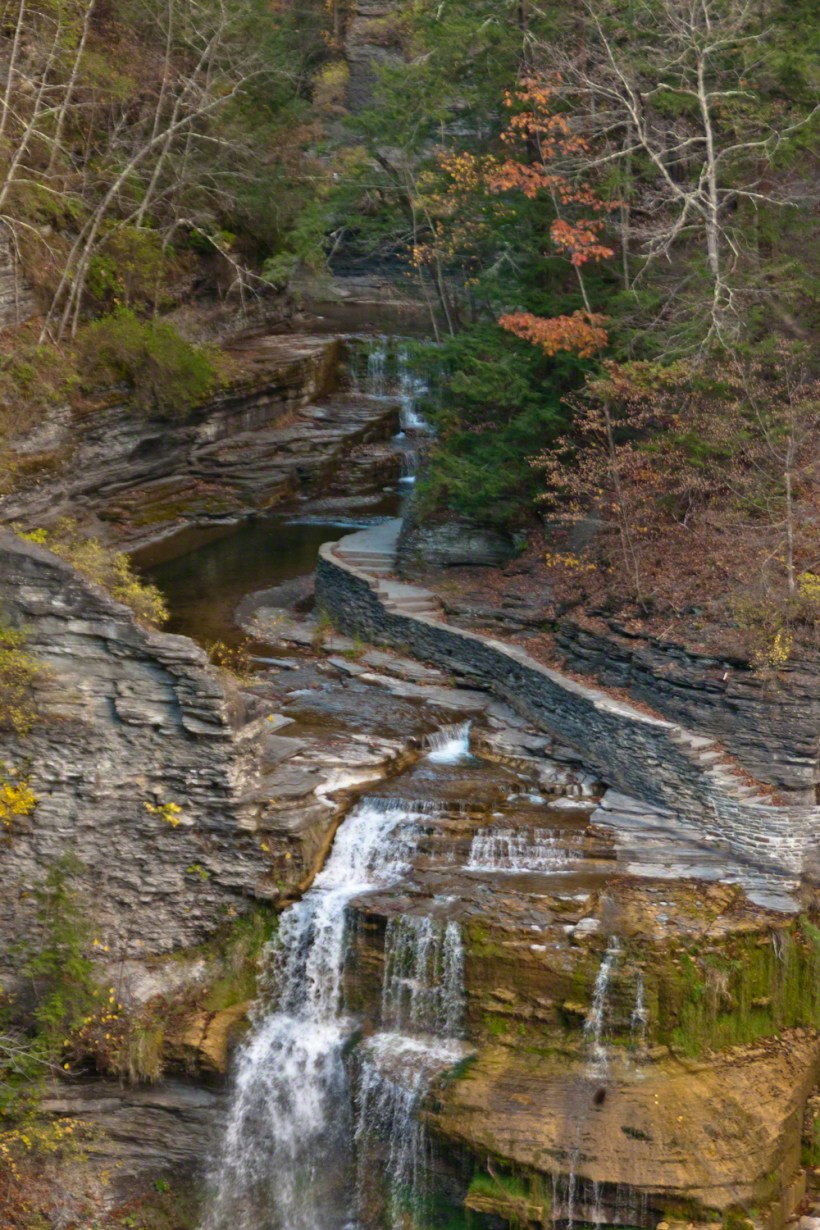
The post explores the symbolism of Lucifer and the Tiger Lily, suggesting that beauty and pride can lead to downfall, reminiscent of Lucifer’s narrative.
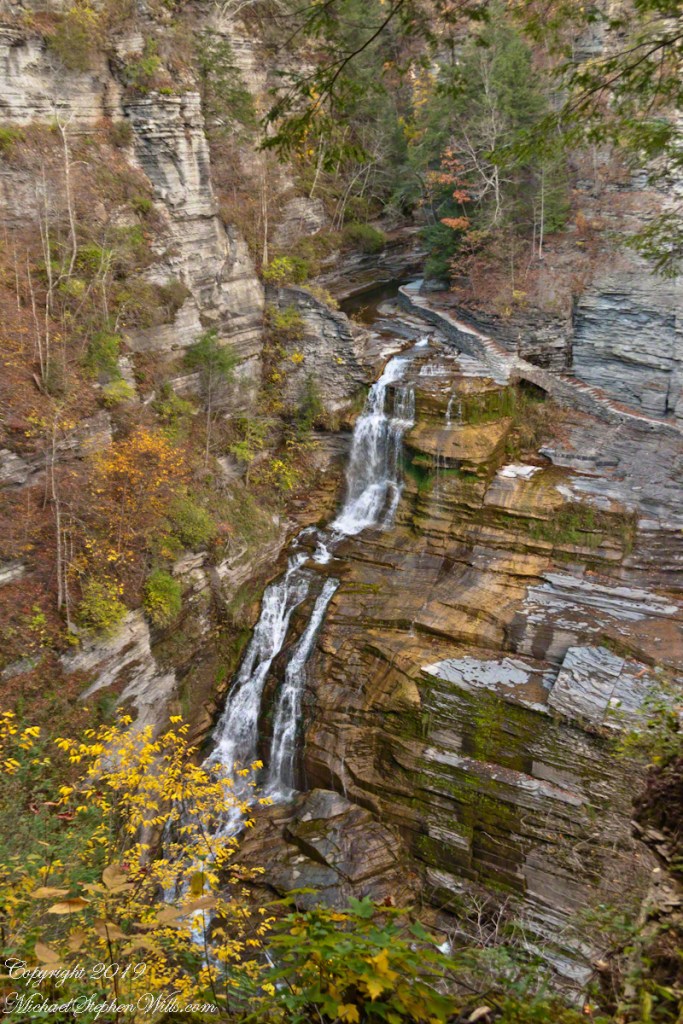
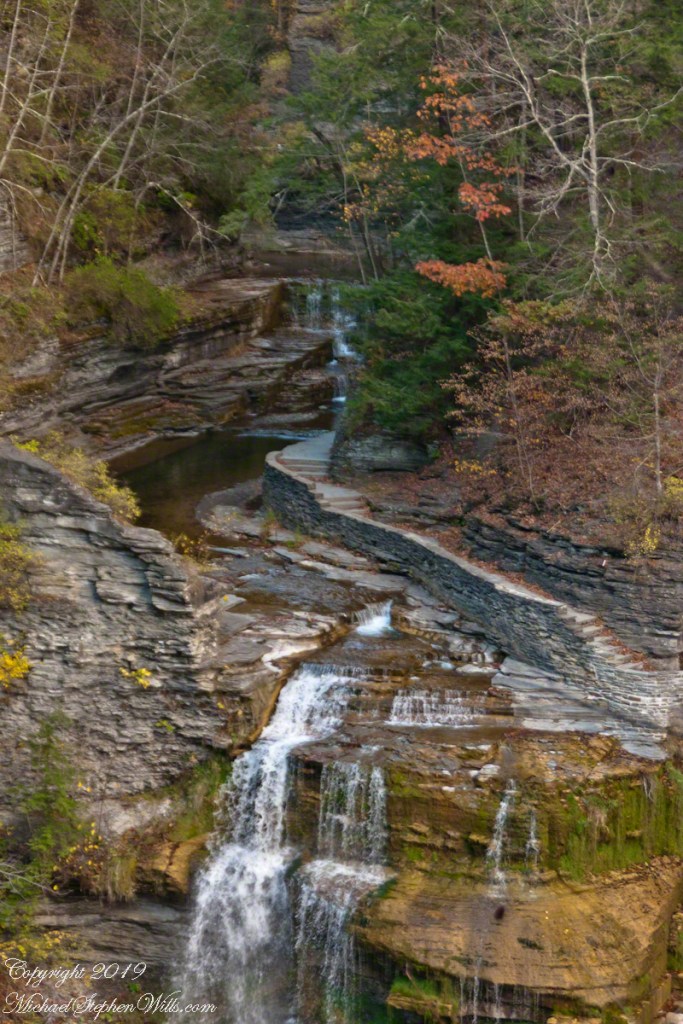
A reader’s comment to this blog, thank you “Urban Liaisons,” prompted me to explore the word, Lucifer. “Lucifer”, in Christian tradition, refers to the devil as it was in a time of glory before the fall from grace. The original, ancient meaning of Lucifer is the planet Venus as it rises just before the sun at dawn. In this sense, the name refers to the bright beauty of the spot. The effect is heightened at midday when the hiker passes from the relative gloom of Devils Kitchen to the full light and sweep of the waterfall chasm.
Standing next to the falls on the Gorge Trail, the stone wall of the Rim Trail Overlook is overpowered by the grandeur of the 300+ foot cliff. The falls photographs were taken from behind the wall.

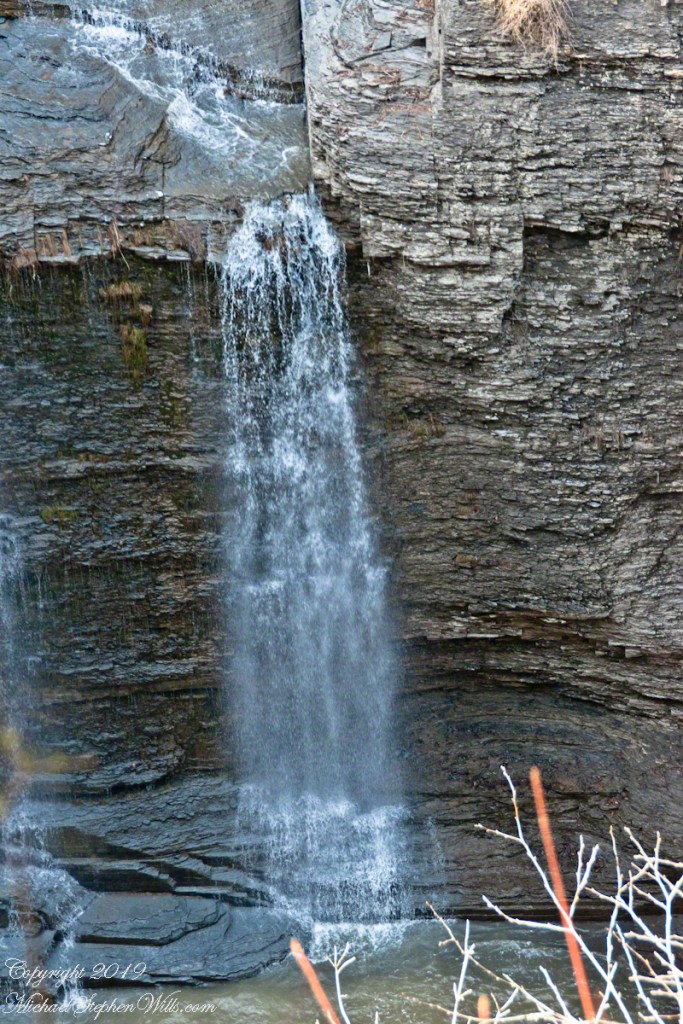
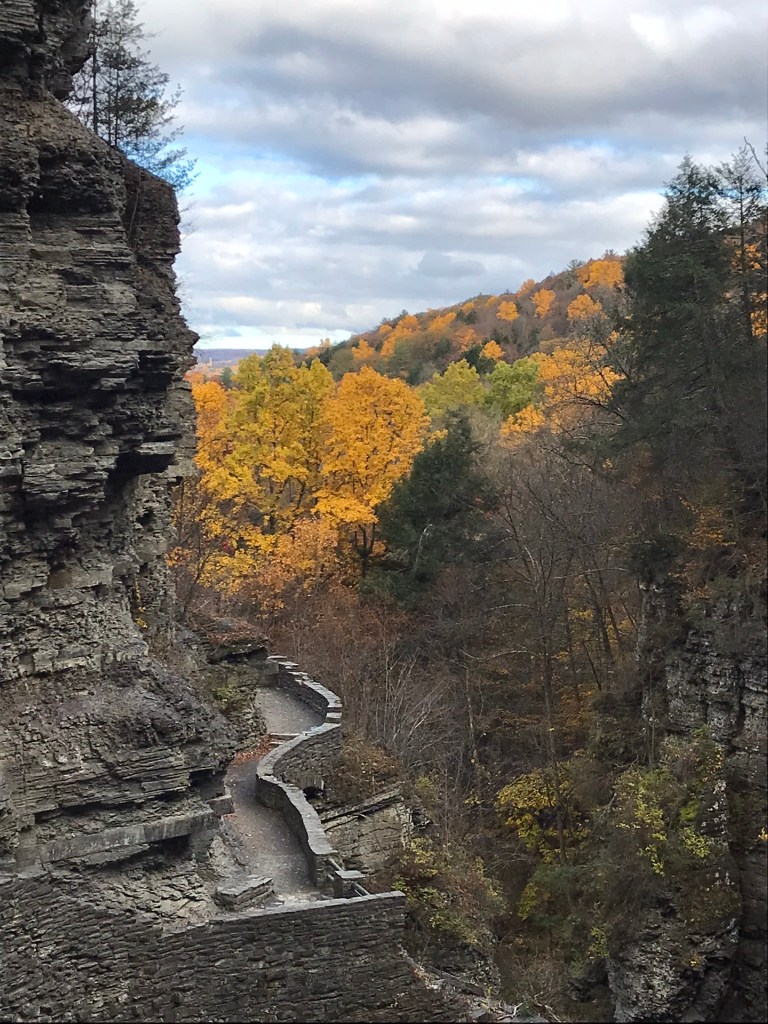
Occasionally, we have experienced individuals climbing over the wall to stand on the other side. “Why?”
Summertime thick stands of tiger lilies flourish on the cliff face. Can you find the withered leaves?
I must delve into symbolic interpretations to explore the connection between Lucifer and the Tiger Lily. Lucifer, traditionally associated with rebellion and the fallen angel in Christian theology, symbolizes a break from divine order and beauty tainted by pride. On the other hand, the Tiger Lily is often seen as a symbol of wealth, pride, and prosperity in various cultures. The connection lies in the shared symbolism of pride and beauty. Just as Lucifer was a beautiful angel before his fall, the Tiger Lily is a strikingly beautiful flower, often associated with pride. This juxtaposition creates a metaphorical link, suggesting that beauty and pride, while alluring, can lead to downfall, mirroring Lucifer’s story.
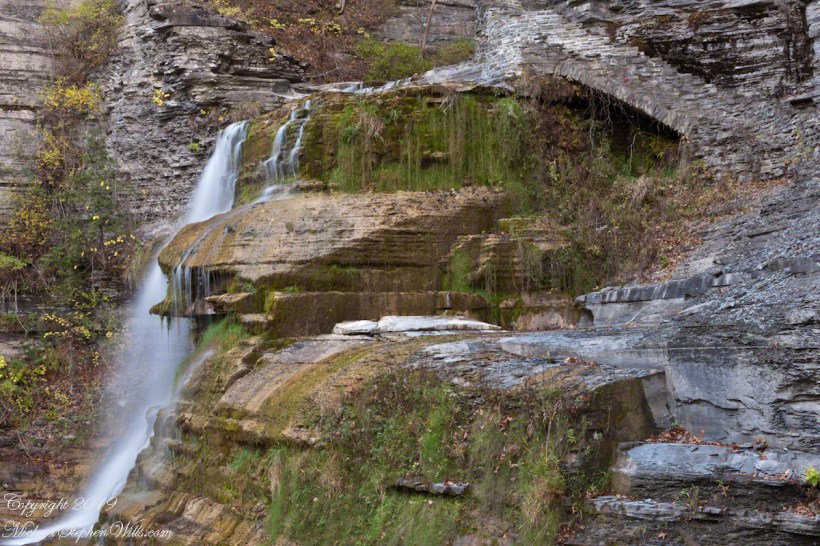
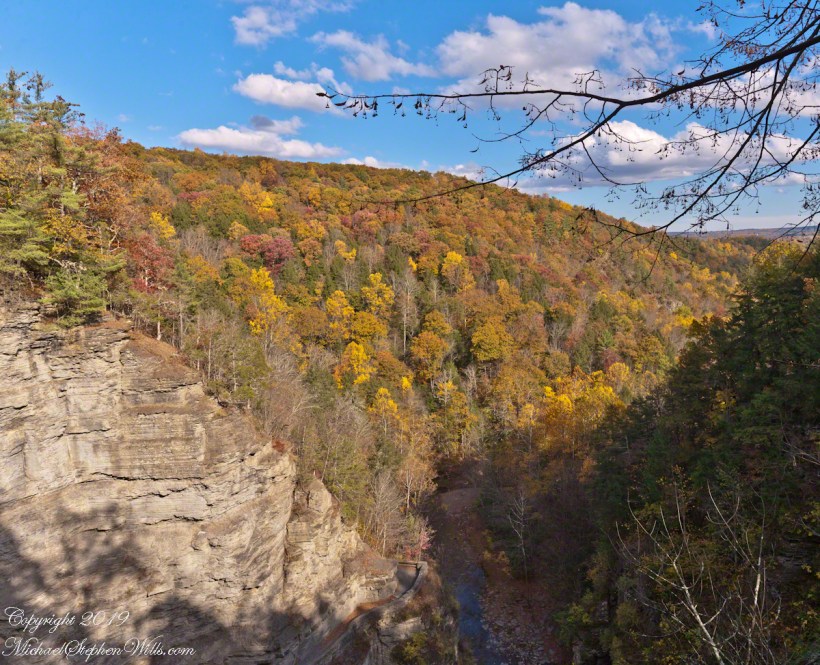
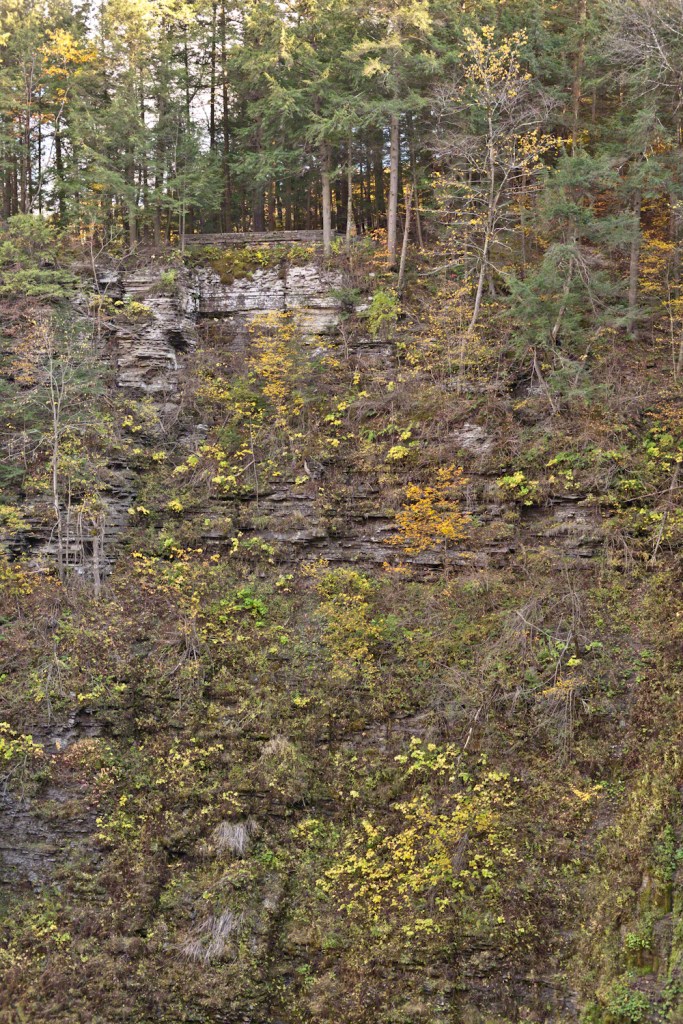
This session I finally “cracked” the puzzle of the Devil’s Kitchen Waterfall. I posted the results to the online gallery yesterday, for your enjoyment. Click the link to go there.
Click link for my fine art print “Devils Kitchen.”
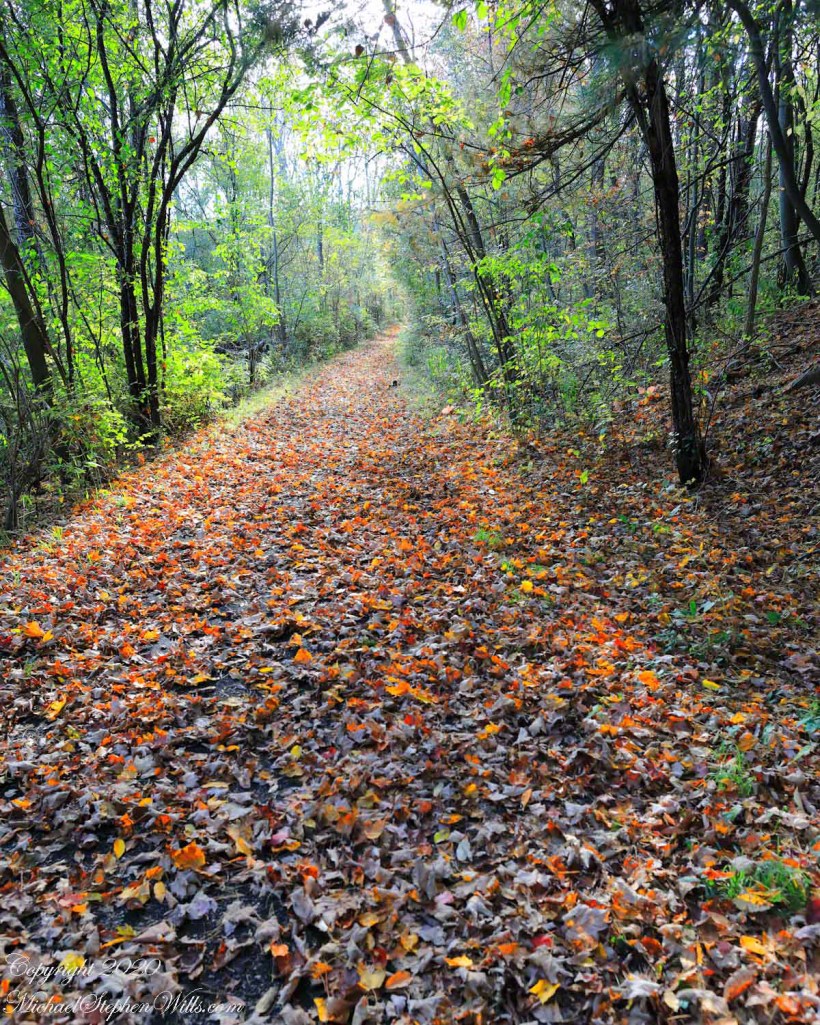
All Souls’ Day, observed on November 2, is a Christian tradition of praying for the deceased, originating from ancient practices and shaping cultural rituals like Mexico’s Día de los Muertos.
Shuffling through the hot coals of autumn on All Souls Day.

All Souls’ Day, observed on November 2nd, is a day of prayer and remembrance for the souls of the deceased. Stemming from ancient traditions and solidified within the Christian liturgical calendar, this day serves as a solemn occasion to commemorate the departed. Its roots are deep, with a rich history that intertwines with both religious and cultural practices over centuries.
Origins
The concept of dedicating a day to remember the dead predates Christianity. Many ancient civilizations, such as the Egyptians and the Celts, held ceremonies and festivals to honor the deceased. The Celts, for instance, celebrated Samhain, which marked the end of harvest and the beginning of winter. This was believed to be a time when the veil between the living and the dead was thinnest.
As Christianity spread across Europe, there was an attempt to integrate pagan practices into the Christian framework, leading to the establishment of days dedicated to the deceased. By the 7th century, monastic communities in Europe had begun to designate a day to pray for the departed members of their communities.
Establishment
All Souls’ Day was formally institutionalized by St. Odilo of Cluny in 998 AD. He declared November 2nd as a day for all the monasteries associated with his Benedictine congregation to pray for the souls in purgatory. This practice quickly spread, and by the 11th century, it was widely celebrated throughout Christian Europe.
Theology Behind the Celebration
Central to All Souls’ Day is the belief in Purgatory – an interim state where souls undergo purification before entering Heaven. It’s believed that the prayers of the living can aid these souls, expediting their journey to paradise.
Modern Observations
Today, All Souls’ Day is observed with varying levels of prominence across Christian denominations. In Roman Catholicism, it retains significant importance, with masses dedicated to the departed. In other Christian traditions, it may merge with other observances, like All Saints’ Day (November 1st) or be passed over entirely.
Cultural Influences
Over time, All Souls’ Day has influenced and been influenced by local customs and traditions. In Mexico, for instance, Día de los Muertos (Day of the Dead) coincides with All Souls’ Day but has its distinct flair, involving vibrant parades, elaborate altars, and specific foods.
Bullet Points Summary:
Ancient Foundations: All Souls’ Day has its roots in ancient civilizations that honored the dead.
Samhain: The Celts observed Samhain, marking a time of close proximity between the living and the dead.
Christian Integration: Early Christians attempted to integrate existing pagan rituals into their religious framework.
Monastic Observances: By the 7th century, monastic communities began designating days for the departed.
St. Odilo of Cluny: He formalized All Souls’ Day in 998 AD for his Benedictine congregation.
Spread: By the 11th century, the observance had spread throughout Christian Europe.
Purgatory: Central to the day’s theology is the belief in purgatory and the power of prayers to aid souls.
Variation in Observance: The day’s significance varies across Christian denominations.
Cultural Mergers: Local traditions, like Mexico’s Día de los Muertos, have both influenced and been influenced by All Souls’ Day.
Modern Practices: Today, the day may involve attending masses, lighting candles, and visiting graves of loved ones.
In essence, All Souls’ Day is not just a day on the liturgical calendar; it’s a reflection of humanity’s timeless effort to understand, honor, and find meaning in the cyclical nature of life and death. Through rituals and observances, we bridge the gap between the past, present, and the profound mystery of the hereafter.
Click Me for another Malloryville post, “Formed By Water.”
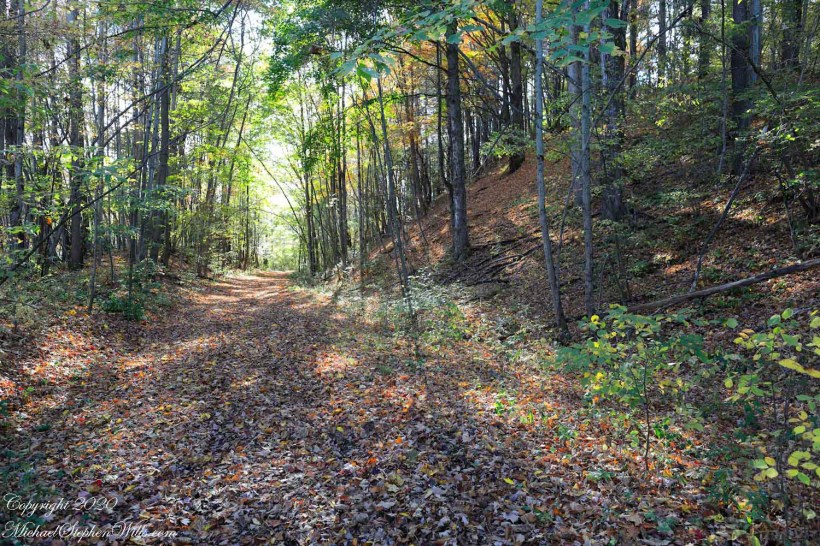
The Malloryville eskers near Freeville, New York, highlight the region’s glacial history and contribute significantly to biodiversity and local ecology.
Walking here, I enjoy telling the grandchildren of the immense, mile-high ice sheet that once covered this land 10,000 years ago, creating these hills and hollows.
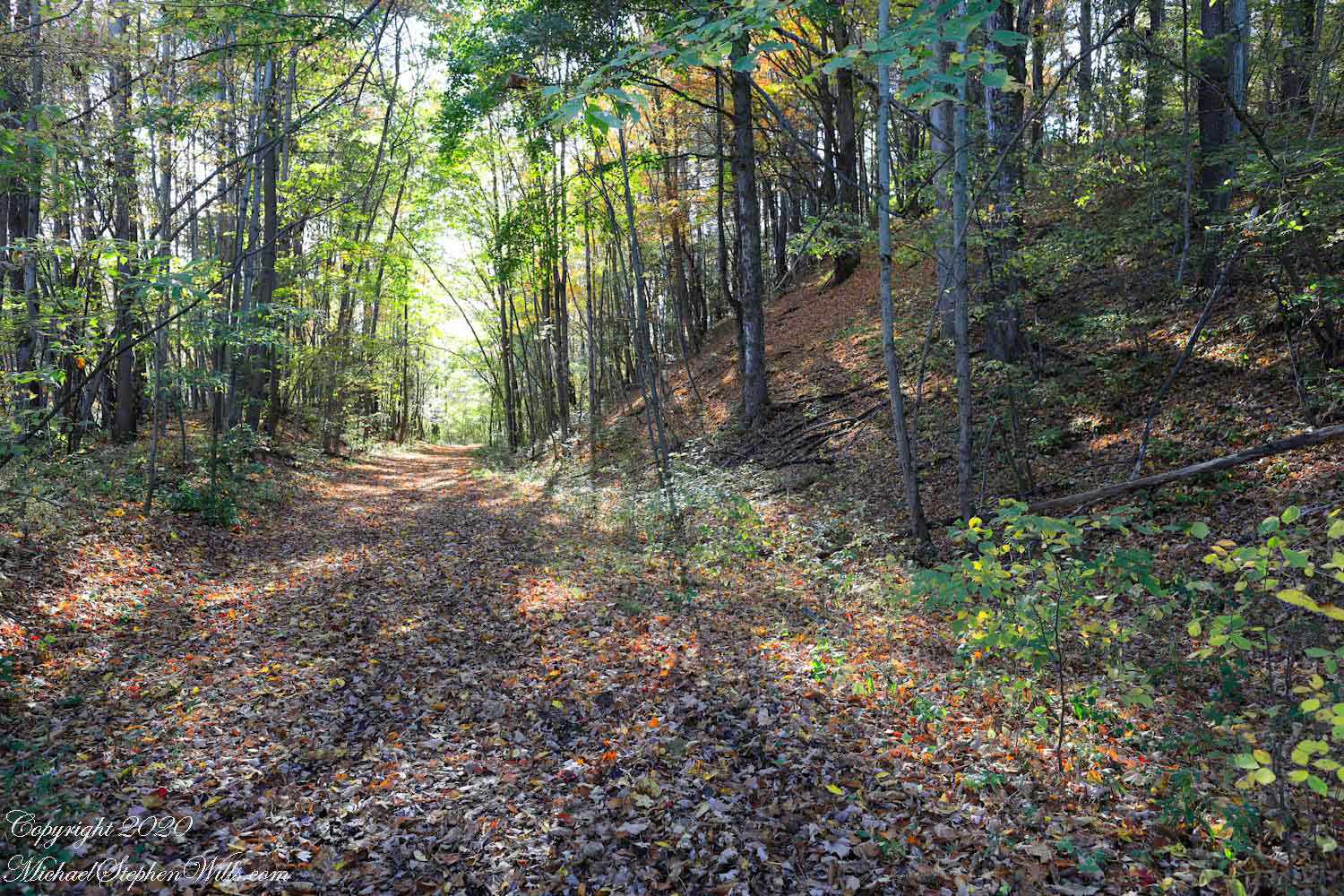
Click Me for another Malloryville post, “Formed By Water.”
Eskers are geological features that tell a rich tale of the glacial history of an area. In the landscape near Freeville, New York, the eskers of Malloryville stand as prominent reminders of the last Ice Age and the profound effects glaciers have had on the North American terrain. These elongated ridges, composed primarily of sand and gravel, not only offer a visual spectacle but also provide crucial insights into the glacial processes that shaped the region.
Eskers are formed by the deposition of sediment from meltwater rivers flowing on the surface of or within glaciers. As these glaciers recede, the sediment accumulates in the paths previously carved by the meltwater streams, eventually forming ridges. The Malloryville eskers are particularly notable for their well-preserved structure, giving geologists and enthusiasts alike a clear vision of the patterns of glacial meltwater flow from thousands of years ago.
Located just a few miles from Freeville, the Malloryville eskers are an intriguing natural attraction. The topography of the area, largely shaped by the Laurentide Ice Sheet during the last glacial maximum, is characterized by various glacial features, but the eskers are undeniably some of the most distinct. Their serpentine-like appearance, weaving through the landscape, immediately captures one’s attention and beckons further exploration.
From an ecological perspective, the eskers of Malloryville contribute to the area’s biodiversity. The unique microenvironments created by these ridges offer habitats that differ from the surrounding landscape. This differentiation allows for a variety of plant species to thrive, some of which are specially adapted to the well-drained soils of the eskers. Additionally, these ridges act as corridors for wildlife, facilitating movement and offering vantage points for species like deer and birds of prey.
Historically, the eskers near Freeville have also had an impact on human activity. Native American communities, recognizing the strategic advantage of these high grounds, are known to have used them as pathways or even settlement sites. In more recent history, the gravel and sand composition of the eskers have made them targets for mining activities. While this has led to the alteration or destruction of some sections, it has also highlighted the importance of preserving these unique geological features for future generations.
Efforts to study and preserve the Malloryville eskers have grown in recent years. Local educational institutions, in collaboration with geological societies, have undertaken detailed studies to understand the formation and significance of these features better. Such initiatives not only contribute to the scientific understanding of glacial processes but also raise awareness about the importance of conserving unique geological formations. Given the potential impacts of climate change on glacial landscapes worldwide, the eskers serve as a poignant reminder of the dynamic nature of our planet and the traces left behind by the ebb and flow of ice ages.
In conclusion, the eskers of Malloryville near Freeville, New York, stand as testaments to the glacial history of the region. These winding ridges, with their intricate patterns and rich ecological contributions, weave a story of natural processes that have spanned millennia. They remind us of the ever-changing nature of our planet and underscore the importance of understanding and preserving its geological wonders. Whether one views them with the eyes of a scientist, historian, or nature enthusiast, the Malloryville eskers offer a captivating glimpse into the ancient forces that have shaped the world around us.

