Harvest Views

One October Evening

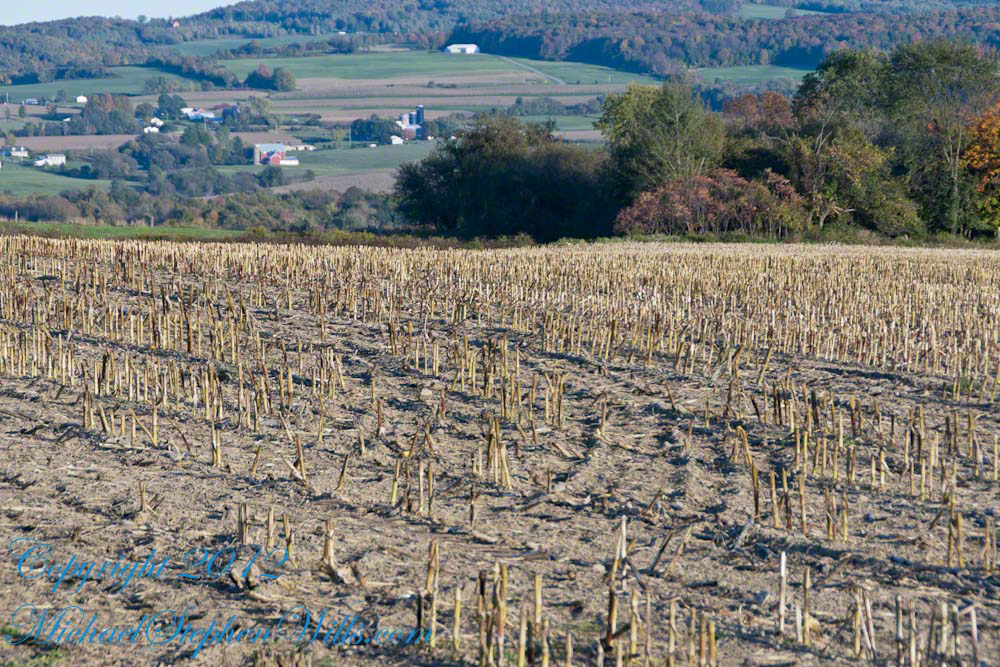
When Pam and I lived in an converted mill house on Malloryville Road one walk we’d take with cameras was out the front door, turn right and walk the road to the hilltop to take in the views.

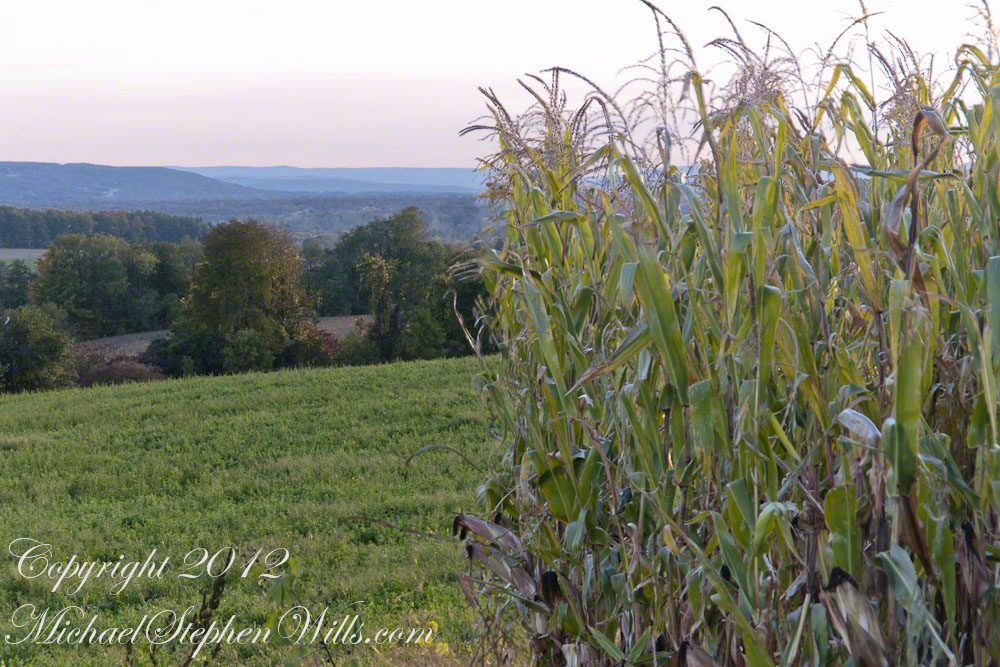
“October Evening on Fall Creek Farmland”

Ripe corn on Malloryville Road from a hill above the Fall Creek valley.

Click any photograph to visit my OnLine Gallery “Finger Lakes Memories.”

“Into the Distance”

Fall Creek Valley view from Malloryville Road looking southwest.  In the far distance is Connecticut Hill.  You can see the towers of Ithaca College from here, but not in this photograph.

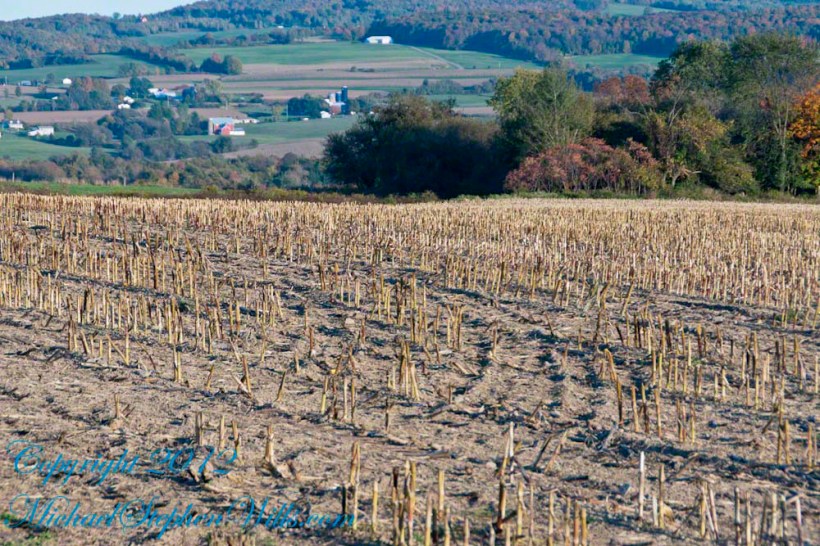
“Harvested Field”

Here are more views from this Harvest View evening.  Click the link to go there.

“Celestial Geese”

“Antique Silo Apple Harvest?”

Copyright 2024 Michael Stephen Wills All Rights Reserved

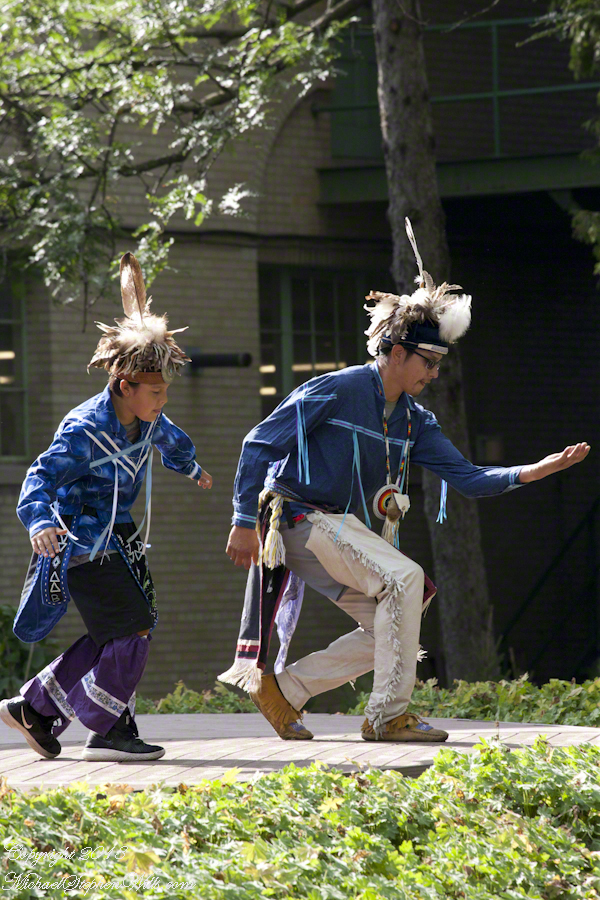
Native American Dance Demonstration

A native American village among the crowds

Continue reading “Native American Dance Demonstration”

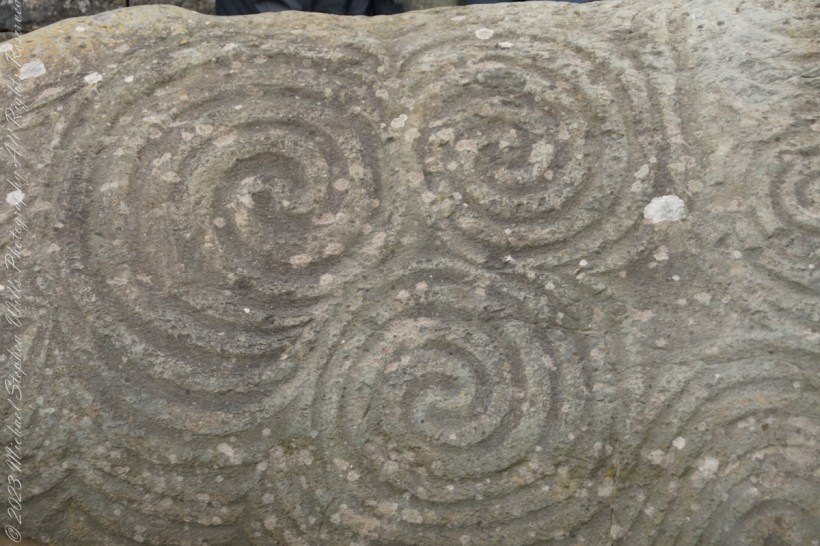
Newgrange IX

Discover the mysteries of the Newgrange monument’s Entrance Stone, a showcase of exquisite Neolithic rock art. Explore spirals, lozenges, and geometric designs that define European megalithic art and delve into their potential meanings and cultural significance. Join me in uncovering the secrets of this ancient Irish wonder.

Continue reading “Newgrange IX”

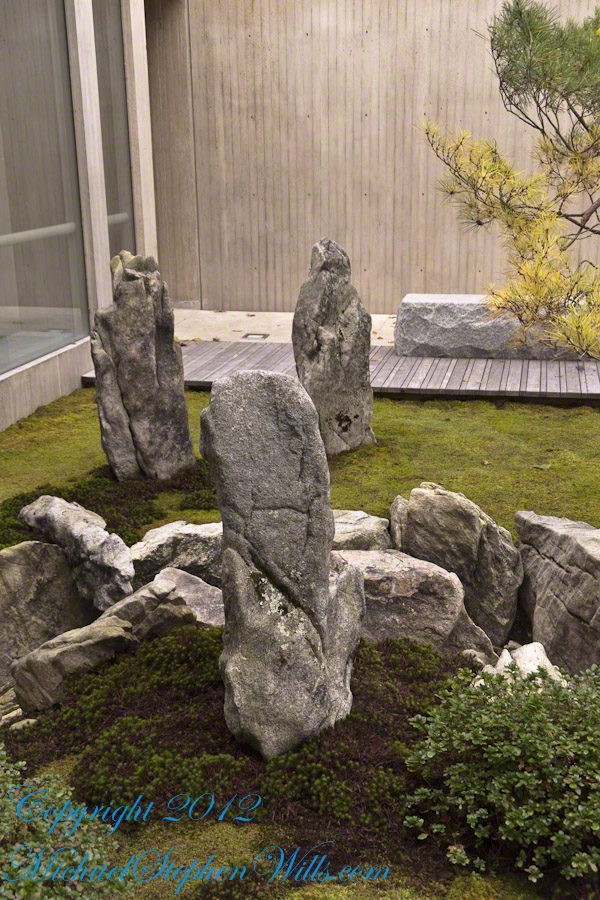
The Three Laughers of Tiger Glen

The Sound of Laughter Among Friends

In the midst of a pine forest

Continue reading “The Three Laughers of Tiger Glen”

Juniper Sunrise

crack of dawn

In this post we start the day of my posting “Family Trek, July 19, 2008, when, well before the sun rose at 6:23 am Mountain Daylight Time (the Navajo Reservation observes daylight savings, the rest of Arizona does not), Pam and I were at the Spider Rock Overlook.

Most visitors to the canyon make use of a system of roads and parking lots next to strategic views.  There is the White House Overlook we visited our first day, July 18, to hike from the trailhead into the canyon.  There are also, on the south side of the canyon:

  • Tsegi Overlook, taken from a Navajo word that translates directly to “between the rocks” and usually refers to a deep canyon with steep cliffs.
  • Junction Overlook above the point where Canyon Del Muerto (see my posting “Sun and Shade, Canyon Del Muerto”, and Canyon De Chelly intersect.  There is an Anasazi ruin in the south-facing cliff across the canyon.
  • Sliding House Overlook, another Anasazi run across the canyon.
  • Face Rock Overlook, to view the eponymous formation.
  • Spider Rock Overlook, the most stunning rock formation. 
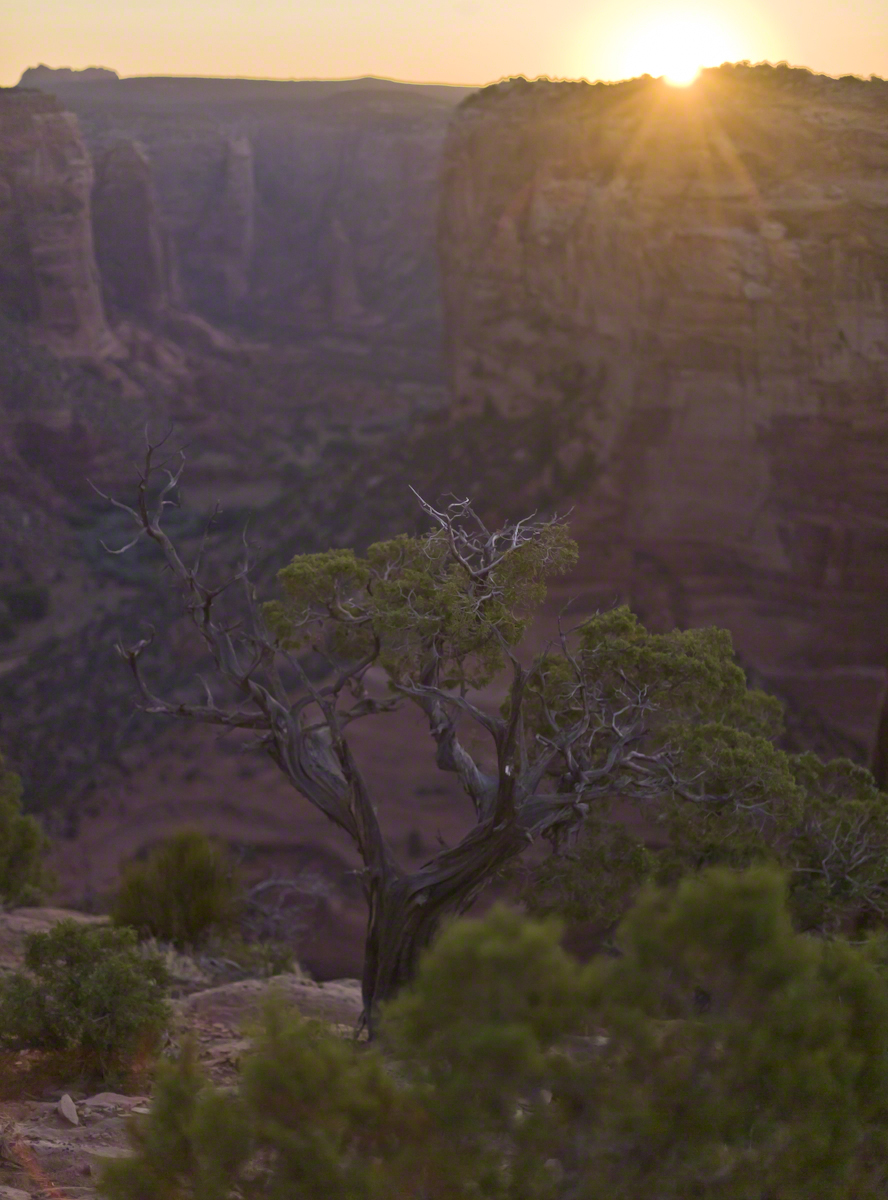
Sunrise Canyon De Chelly
Looking east from the Spider Rock overlook, Canyon De Chelly.

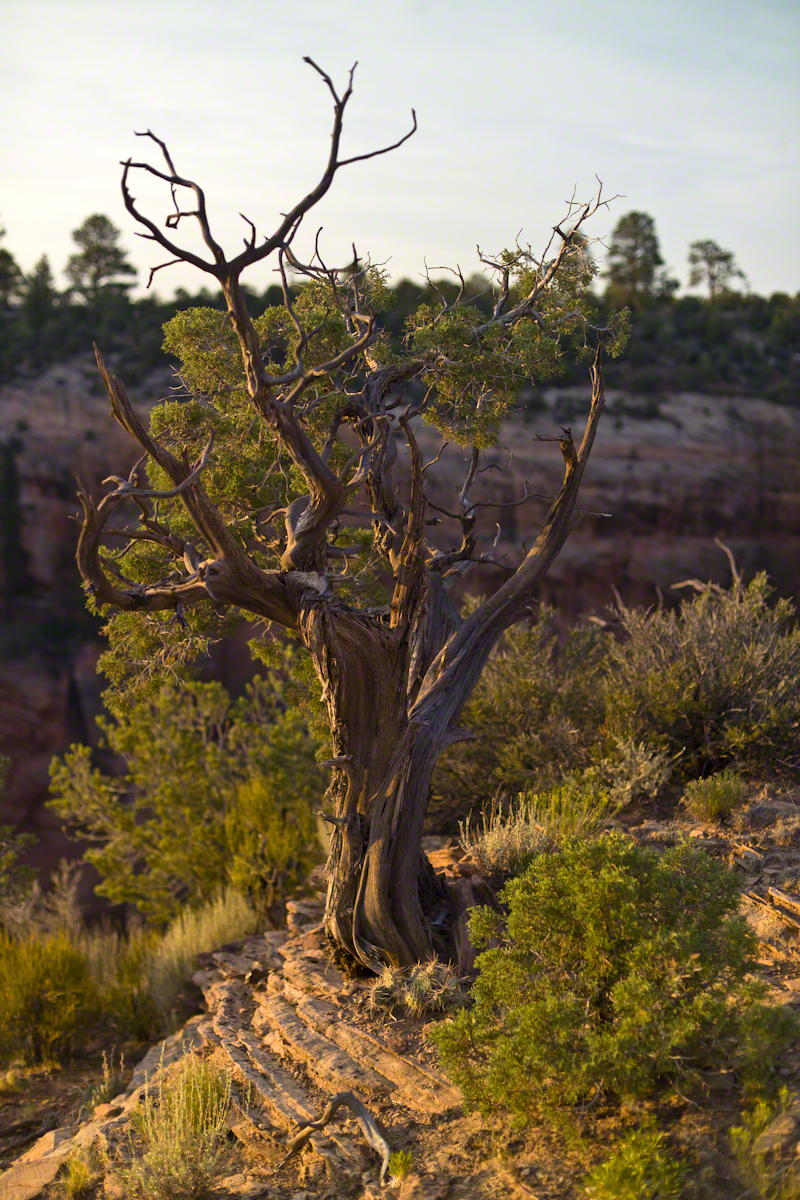
While getting ready I scoped out the location for interesting visual tropes.  Utah Junipers are exceptionally hardy shrubs, stressed individual plants grow into compelling forms shaped by hardship.  As the sun rose, this specimen emerged from the gloom and caught the first sun rays.

Juniper Sunrise
A distressed Utah Juniper on the edge of Canyon De Chelly overlooking Needle Rock a few moments after sunrise.

Enjoy!!

Click for the first posting of this series, “Portrait of a Navajo Guide.”
 

Long Island Sakura (Cherry Blossoms)

Clouds of Blossoms

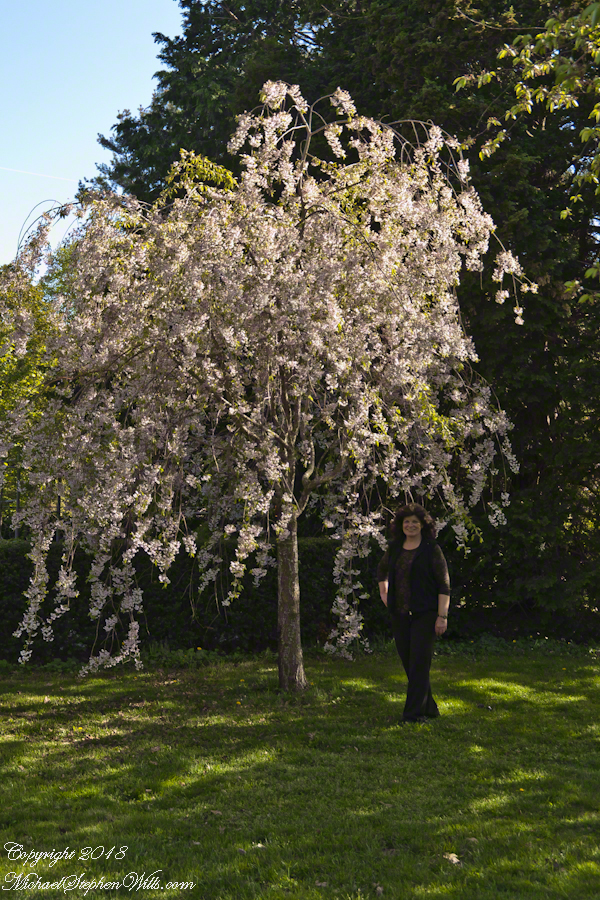
A Japanese flowering cherry tree in bloom on an early May day. Called a Shirofugen (Secientific name: Prunue serrulata, of the Rosaceae family this is the species planted around National Tidal Basin, Washington D.C. and around which the National Cherry Blossom Festival is celebrated commemorating the 1912 gift of Prunus serrulata Japanese cherry trees from Tokyo to the city of Washington.

The tree over Pam is called a Shirofugen (Scientific name: Prunus serrulata, of the Rosaceae family) and is one species planted around National Tidal Basin, Washington D.C. Shirofugen blossoms are described “Flowers double, deep pink at first, fading to pale pink.”


Click any photograph for my Getty portfolio.Pam with a Shirofugen Flowering Cherry in bloom – CLICK ME for my Getty Portfolio.

In Japan, since the 8th century, “Hanami” is the centuries-old practice of picnicking under a blooming sakura or ume tree. Here in the United States, the National Cherry Blossom Festival is celebrated commemorating the 1912 gift of Prunus serrulata Japanese cherry trees from Tokyo to the city of Washington.

Traditionally cherry blossoms remind the Japanese of clouds, the blooms come out en mass, the tree changes shape with the breeze.  Viewing sakura brings to mind thoughts of the transience of existence, the fragility and transience of the exquisite blooms leads one to appreciate the moment.  The following photograph of Pam was taken a month before my Mother’s sudden decline and passing in 2013.  We’d travel to Long Island several times a year to visit her, then take in familiar sights.

Growing up, our family visited the Planting Fields, a state park, several times in the spring and summer. As an adult with a growing family in Glen Cove, right around the corner, the Planting Fields were a welcome outing and visited several time times a year. The following photograph, taken that same May 2013 day, was a favorite park scene.

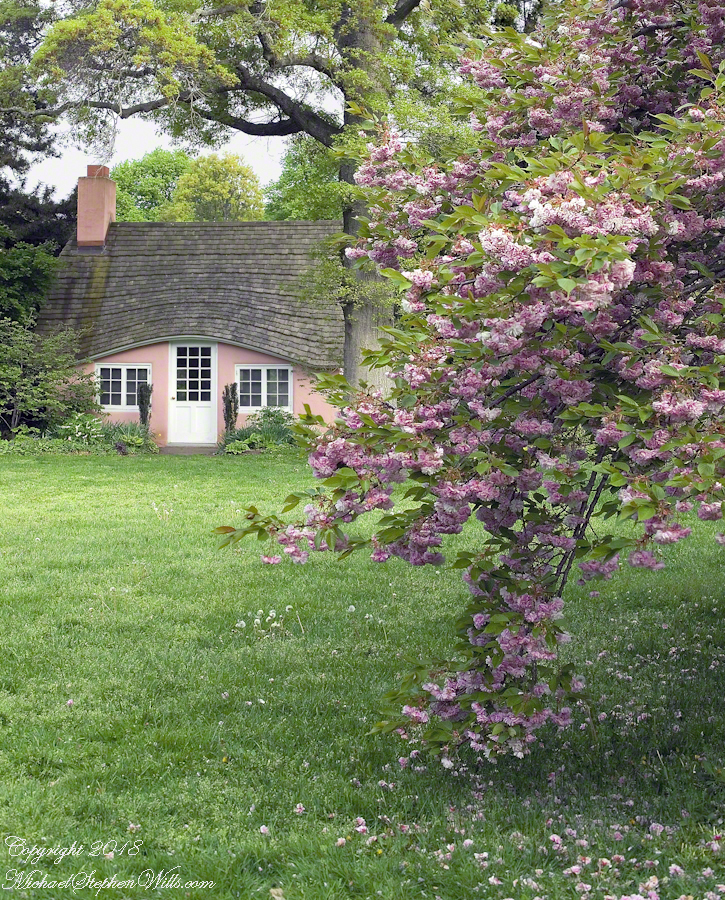
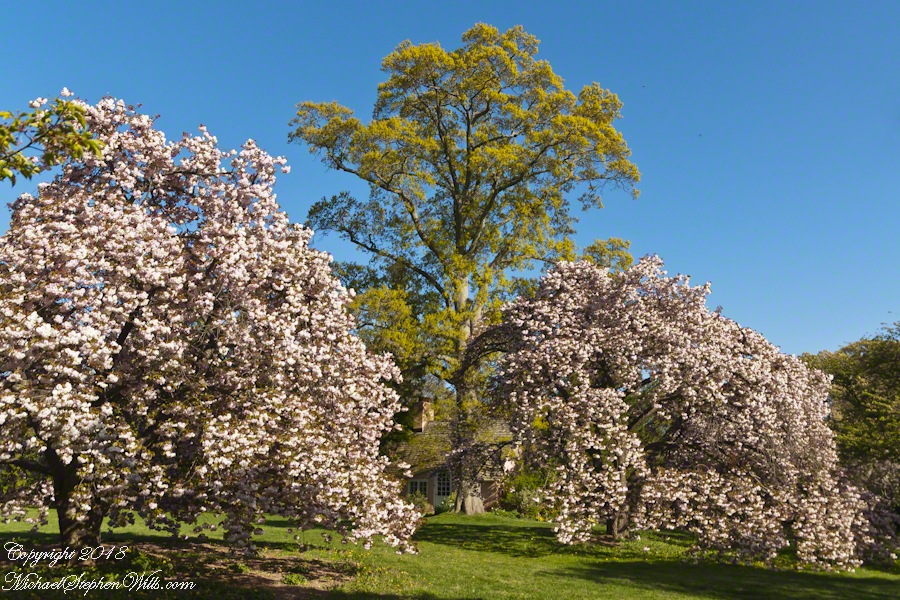
The two flowering cherry trees in the foreground are a type of Japanese sakura called Yoshino, one the most popular flowering cherries in temperate climates worldwide. All Yoshinos are clones from a single grafting and propagated throughout the world. The scientific name outlines the cross breeding of this variety, Prunus X Yeaoensis. Behind the cherries is an Oak tree, new leaves a bright green, and a pink child’s playhouse cottage.

A changing scene of the park is the now frequent visits by wedding parties and photographers, groups of Asian people, the bride and groom posing under the clouds of blossoms. By frequent I mean a steady stream, one after the other, when the blossoms are full.

Click any photograph for my Getty portfolio.Playhouse with Flowering Cherry and Oak trees – CLICK ME for my Getty Portfolio.

In 2007 I spent hours framing and capturing the following photograph on a Saturday, the day before Mother’s Day, during a visit to my Mother, who was widowed December, 1995. I used an inexpensive tripod, a Kodak DCS Pro slr/c camera body with the Canon 50mm f 1.4 USM lens, a UV filter and lots of time. There were no interruptions that day, at 5:30 pm I had the area to myself.

This child’s garden playhouse, framed by an ancient oak, pink Japanese cherry blossoms and gracious lawn was awarded a Photographic Society of American, Pictorial Print Division, Print of the Month award, published in the society magazine for that month.

Click any photograph for my Getty portfolio.Playhouse – CLICK ME for my Getty Portfolio.

Please browse my reasonably priced stock photography.  License a photograph, download and use it for your website or blog.  Click this link to browse all my Getty IStock Photography offerings.

Or click this link to purchase a print of “Playhouse” with optional custom framing from my Fine Art Gallery.

Copyright 2023 Michael Stephen Wills All Rights Reserved

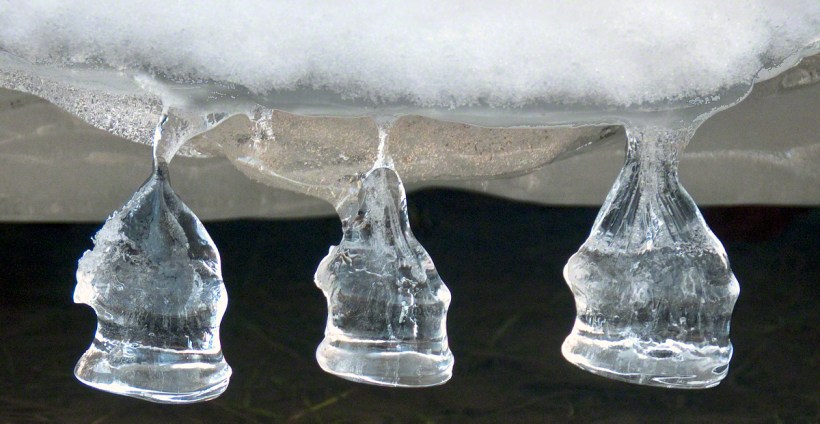
Ice Bells on Fall Creek

from multiple thaw-freeze cycles

Captured outside our former Malloryville home on Fall Creek of the Finger Lakes Region of New York.

I used a Canon 100mm “macro” lens.

SONY DSC

Cheers on this January morning.

Click this link to check out “Ice Bells” on my Fine Art Photography gallery.

Lady Feeding Gulls, Cocoa Beach Dawn

unflappable lady hand feeds seagulls

When Pam read my post “Black Skimmers Feeding” she asked, “Where is the photo of resting Skimmers?”

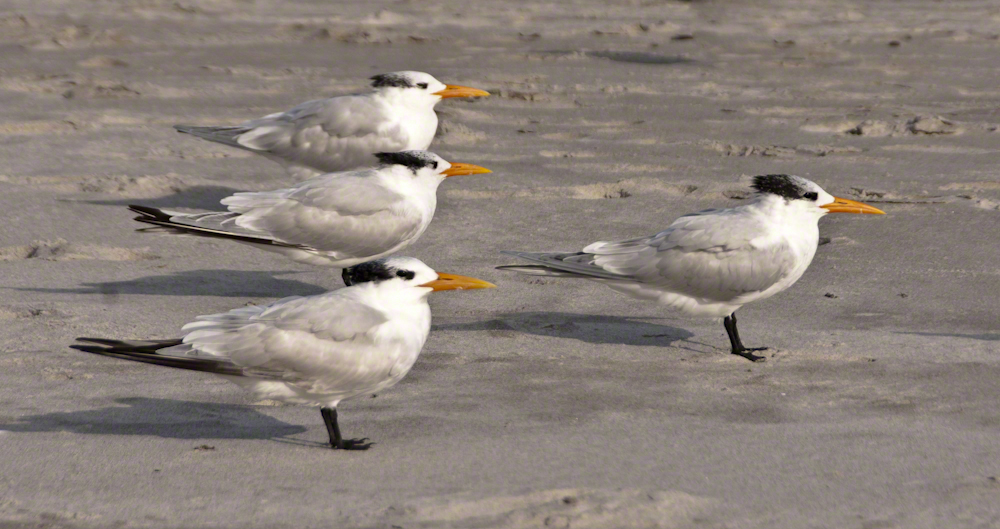
To answer her question, I looked through Cocoa Beach photographs and discovered I did NOT capture the Skimmers resting.  Instead, here are a related species, the Royal Tern (scientific name: Thalasseus maximus), whose behavior is similar in that it exclusively feeds from the water. There was a wind that morning and these individuals face into it.  These birds are, from a human point of view, well behaved, unlike the opportunistic gull.

Royal Terns at rest

I searched around the web for identification of this gull without success.

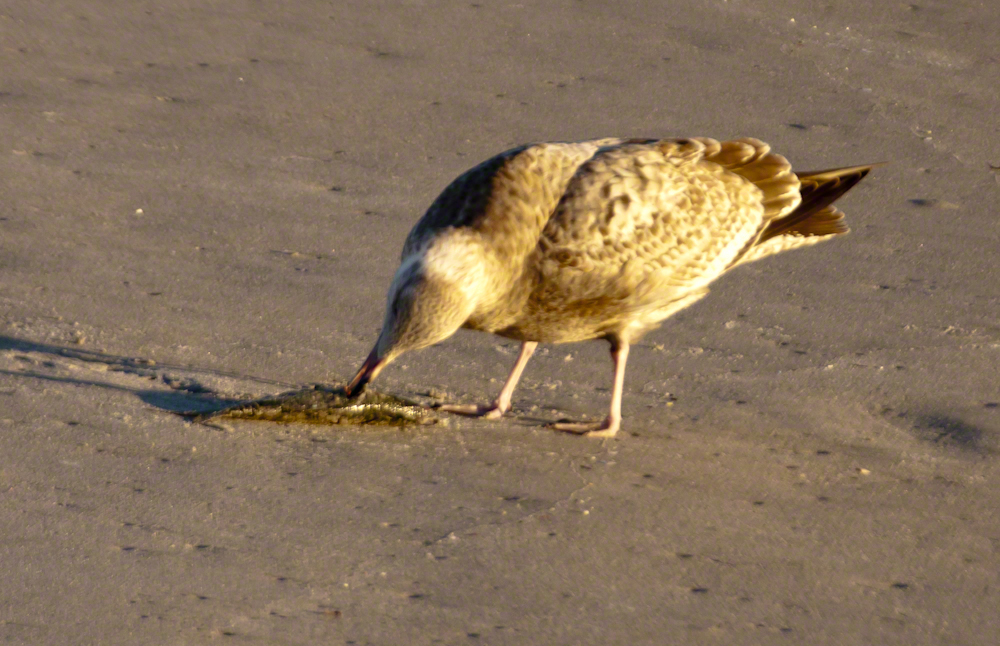
Scavenging Gull – CLICK ME for more Florida photography.

It dines on a dead fish washed up by the surf.  In my previous posting I used the word “grifting” to describe gull behavior, again this is from the human point of view.  Gulls are notorious for stealing food from unwary beach goers, brazening walking over to unguarded chips (any kind), for instance, grabbing them and flying off.  If the chip stash is large, this sets off a nasty feeding frenzy when tens of gulls swoop in and grab.

Here is a series of photographs, demonstrating this behavior.

Click Me for more Florida photos from my IStock offerings.
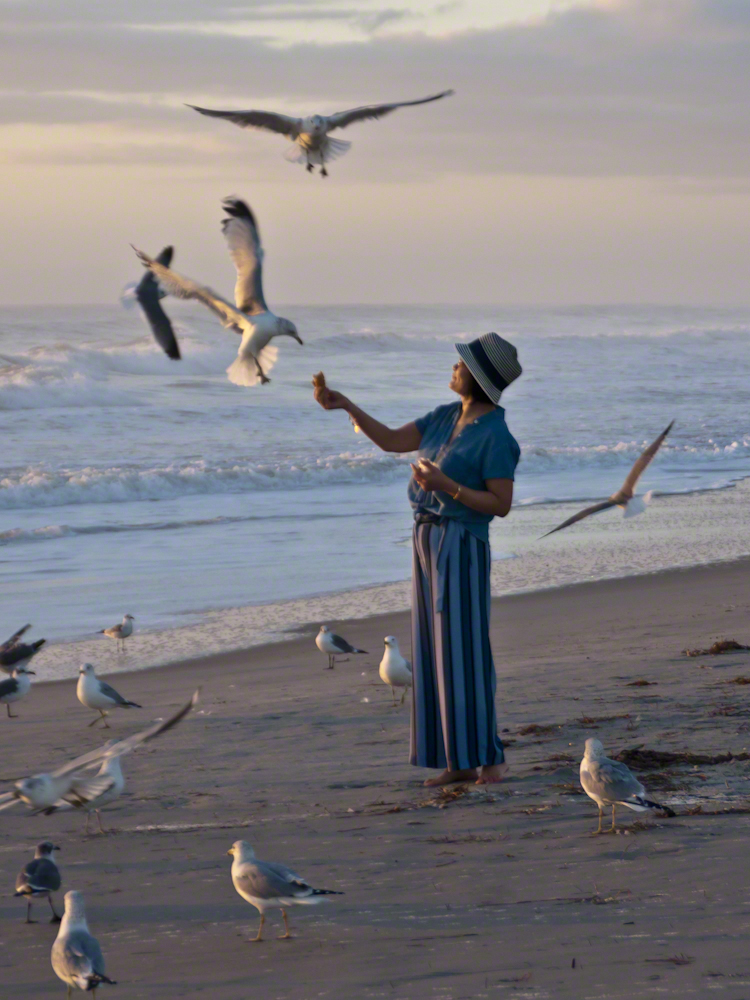
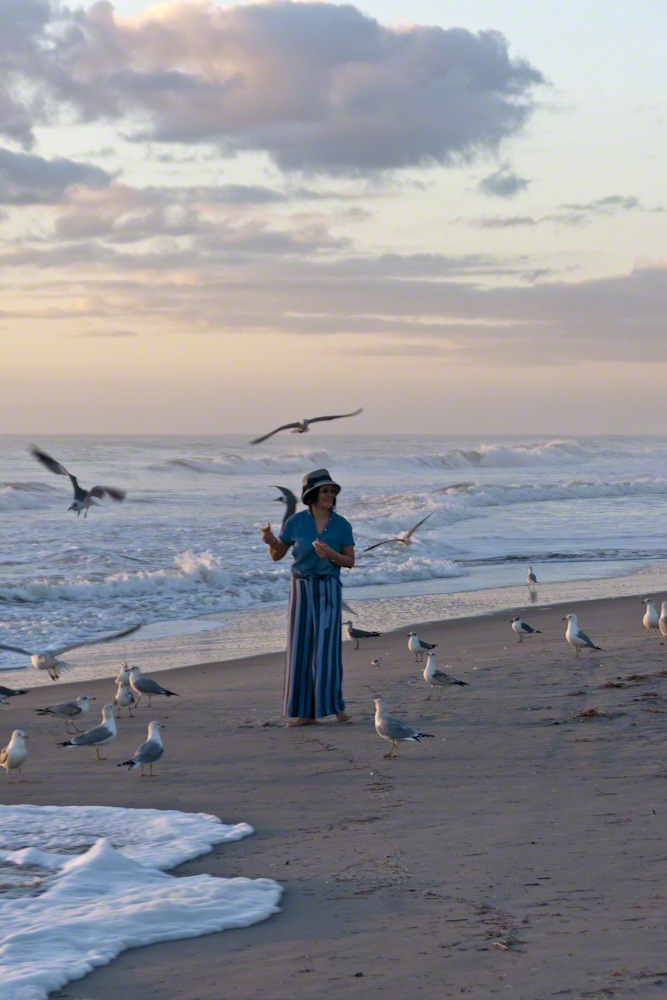
The dawn flowed over Cocoa Beach as a lady attracted a crowd of hungry gulls, reminiscent of scenes from Hitchcock’s “The Birds.”

Lady and Gulls

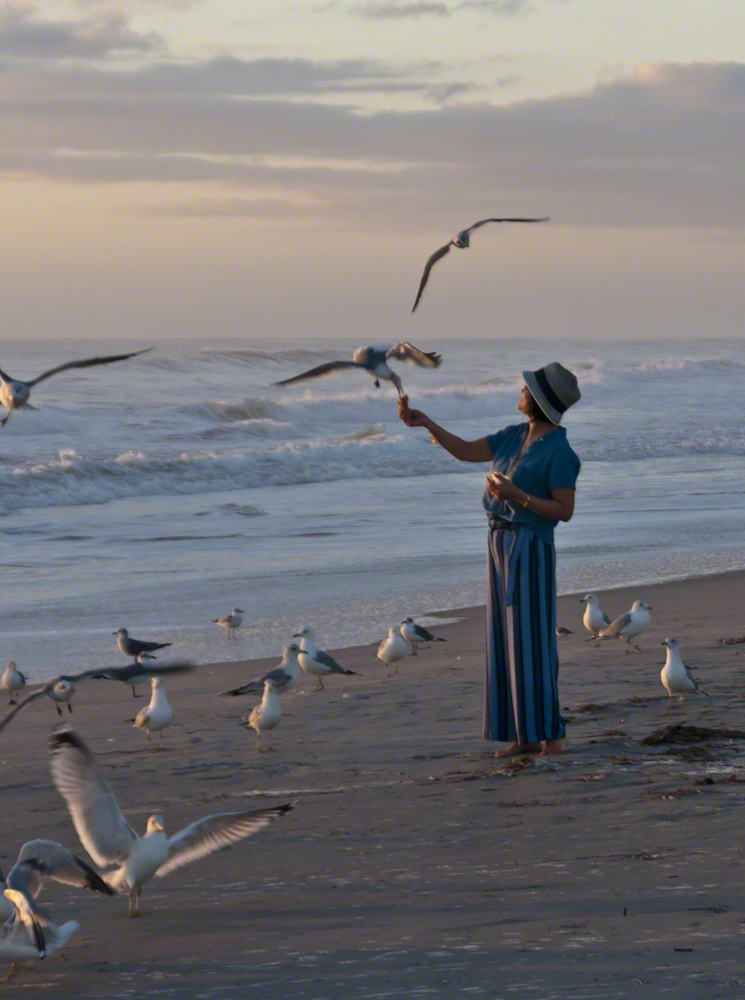
She is obviously an experienced gull feeder, unflappable with a steady hand

Lady and Gulls – CLICK ME for more Florida photography.

She had come to the shore at dawn for a photo shoot.  Her male companion (husband?) was there with a camera.

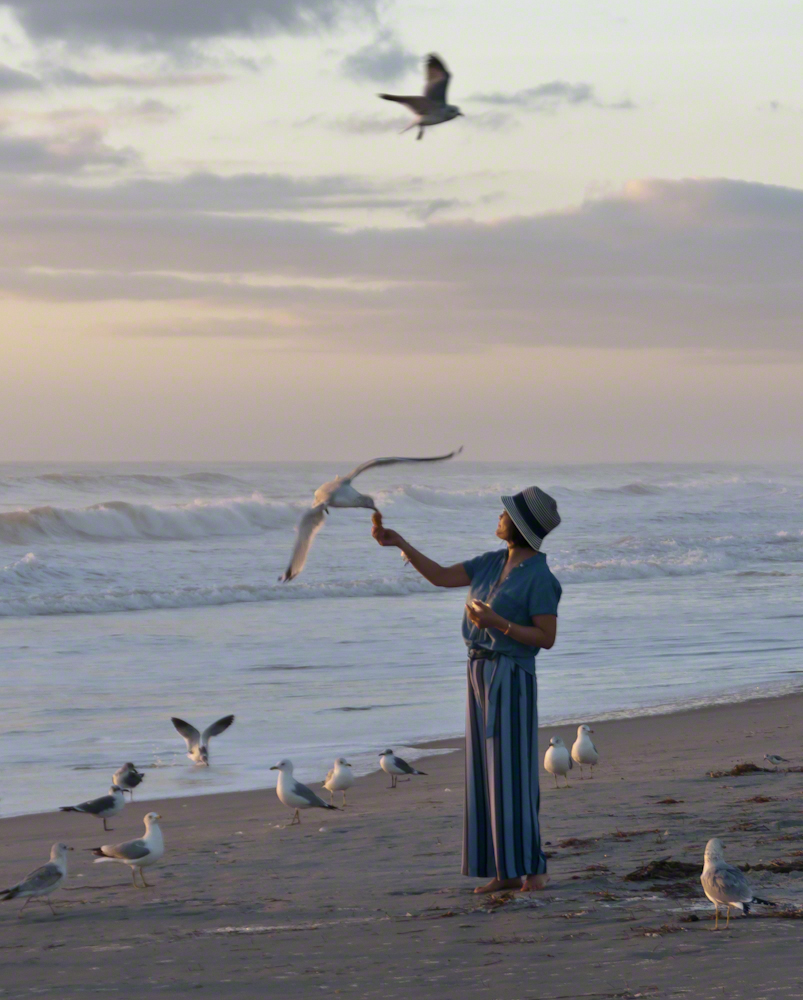
Lady and Gulls – CLICK ME for more Florida photography.

Pam and I were there for the dawn, me with the Sony camera.

Lady and Gulls – CLICK ME for more Florida photography.

At first, I stood there amazed at the spectacle.  She was in such control of the situation, not a victim, more like a lion tamer.

Then, Pam said, “You have to get this.”  And I did.

Enter your email to receive notification of future postings. I will not sell or share your email address.

Island Romance

Happy Valentine’s Day with the original Moby Dick

Thinking about the Aran Islands for my posts, “Killeany Bouy” and “Inisheer Welcomes the 2014 Gaeltacht Irish Football champions” brought me back to Isla Mocha.

Herman Melville’s thoughts were in and around this island off the central Chilean coast when he penned “Moby Dick” in the mid-nineteenth century while sitting in the city of Boston.  He was brought Moby Dick not only by his own experiences on a whaling ship, almost certainly Melville owned a copy of Jeremiah N. Reynolds’ “Mocha Dick: Or The White Whale of the Pacific: A Leaf from a Manuscript Journal,” an true-life account of adventures around Isla Mocha.  Sometime around 1810 Reynolds personally experienced encounters with Mocha Dick after the crew of an Antarctic expedition mutinied, stranding him at Valparaíso, Chile where he remained for two years.

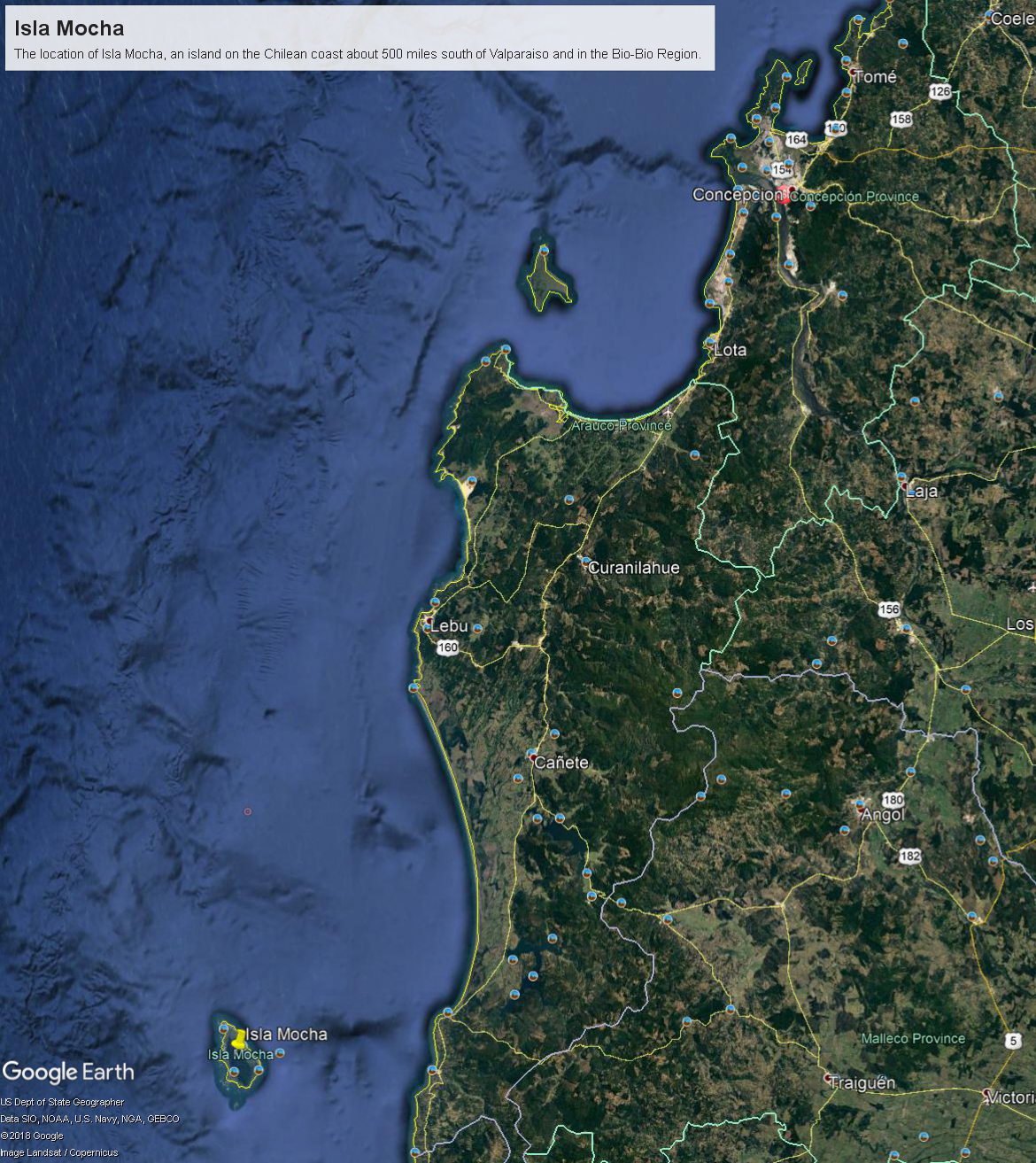
Located  38°21’45.62″S,  73°55’6.91″W, around 8 miles in size north to south, 3.5 miles east to west Isla Mocha is surprisingly simple to find.  A ridge of mountains run the north south axis, just 20 miles off the coast, a ship following the coast will find it easily, as I did from the balcony of the Oceania Regatta during a “sea day” of travel between Valparaiso and Puerto Montt.

MochaIslandGoogleMpasNarrow

Since waking that day I was on the lookout for Isla Mocha.  In preparation for our month-long cruise around South America every mile of our itinerary was scoured for interesting sights, experiences and information.  When I first learned of Isla Mocha (Mocha Island in English) and the connection with Melville reading about it in Boston, just as I was in Ithaca, one of my goals for that day was to catch sight of Isla Mocha as it rose from the horizon.

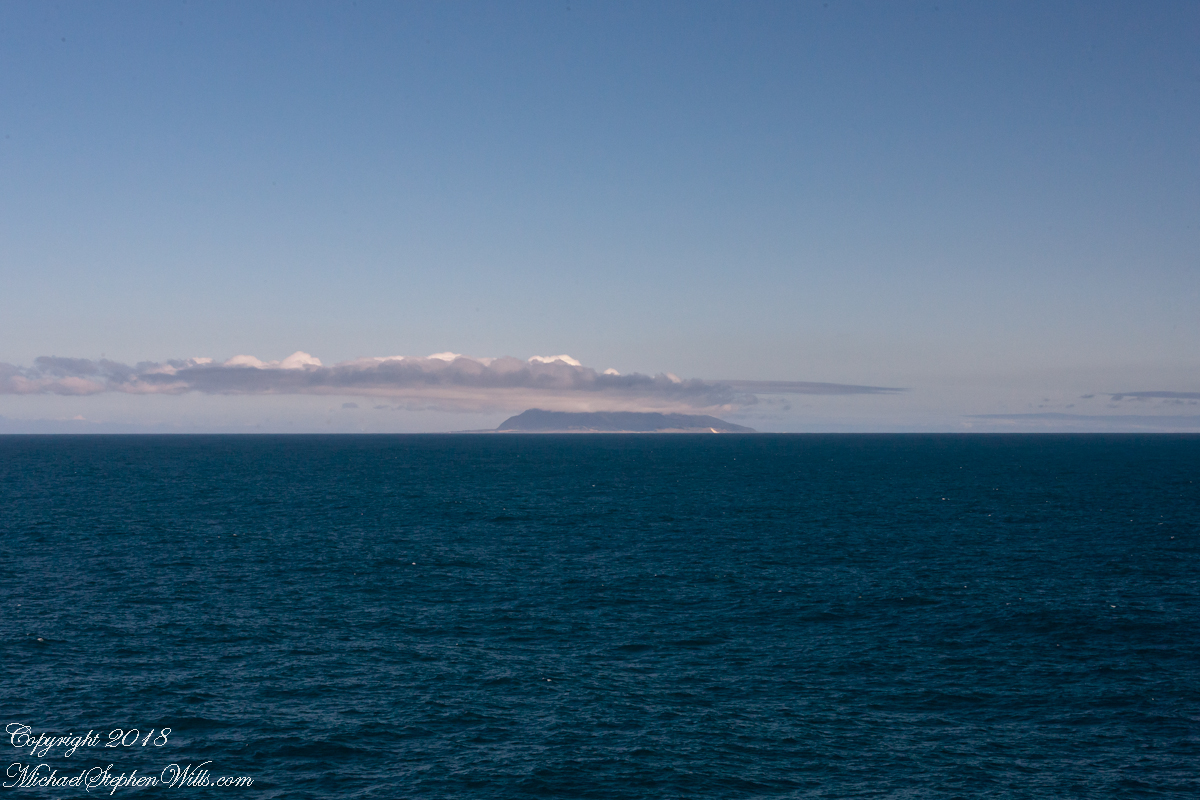
My goal was made easier for the cloud formation from the island mountains.  Here is my first photograph, taken from our balcony on the port side.  I chose the port side just for the landward view as the ship progressed southward on the western coast of South America.  The Canon EOS-1Ds Mark III was tripod mounted with an EF 70-300 f4-5.6L variable lens set to 70 mm.  We are northwest of the island with the coast just visible.

Isla Mocha First Sighting

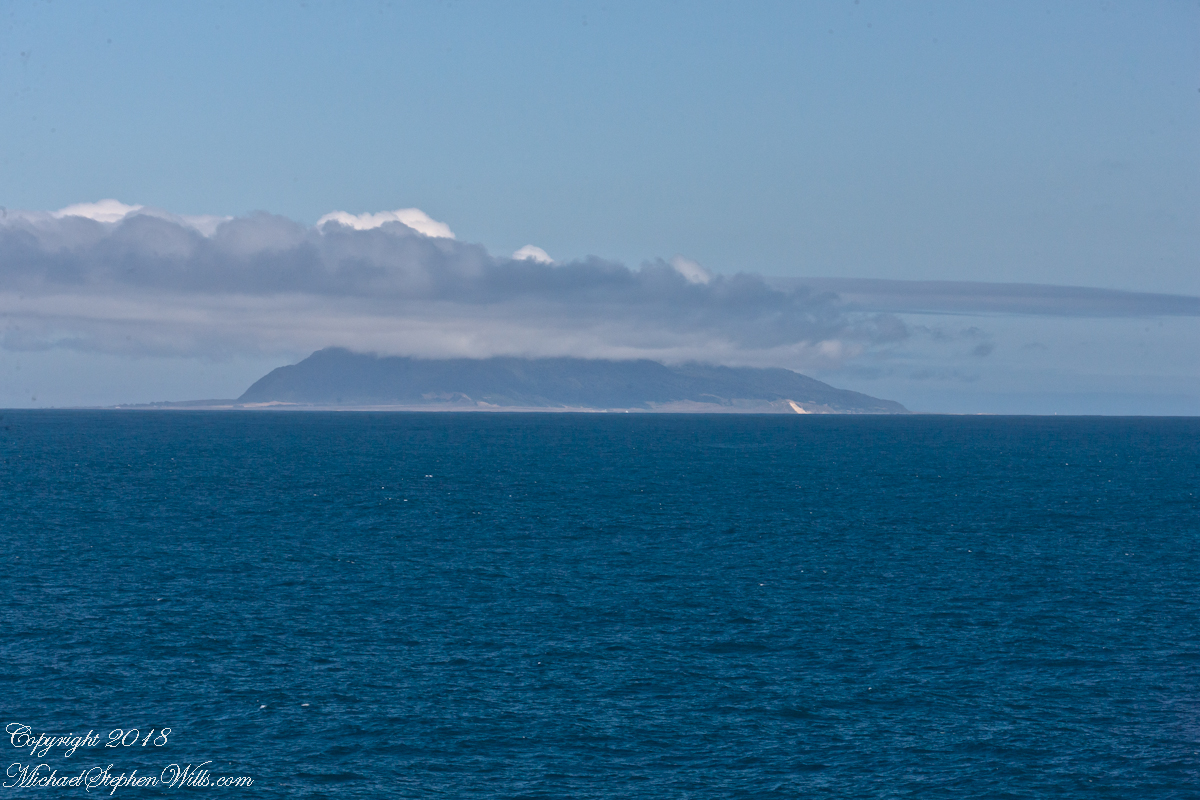
Another view with 188 mm focal length.  The ship must have turned eastward, as the view progressed the island came closer.  It was a fantastic thought to cruise above the subduction zone where the Nazca plate dives beneath the South American Plate.  In the distance, on a clear day, the volcanic cones Villarrea and Quertrupillan are visible.

RomanceOfIslandsMochaIsland2016-2

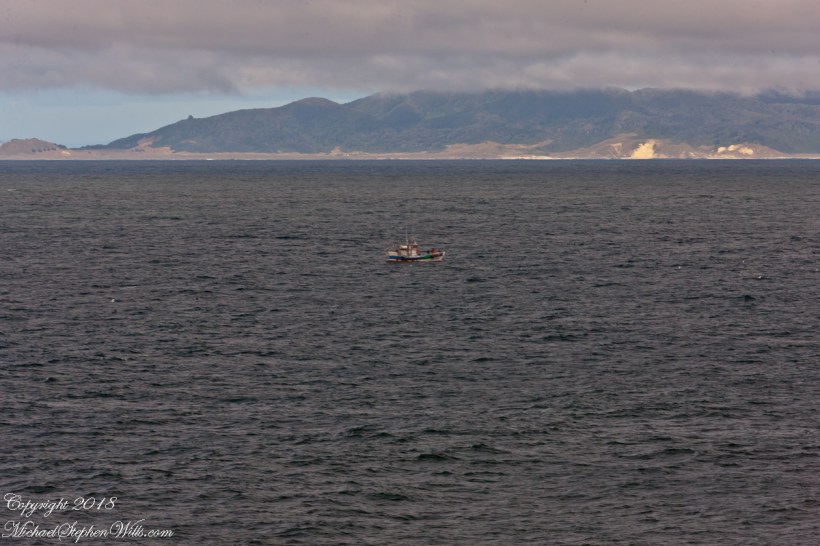
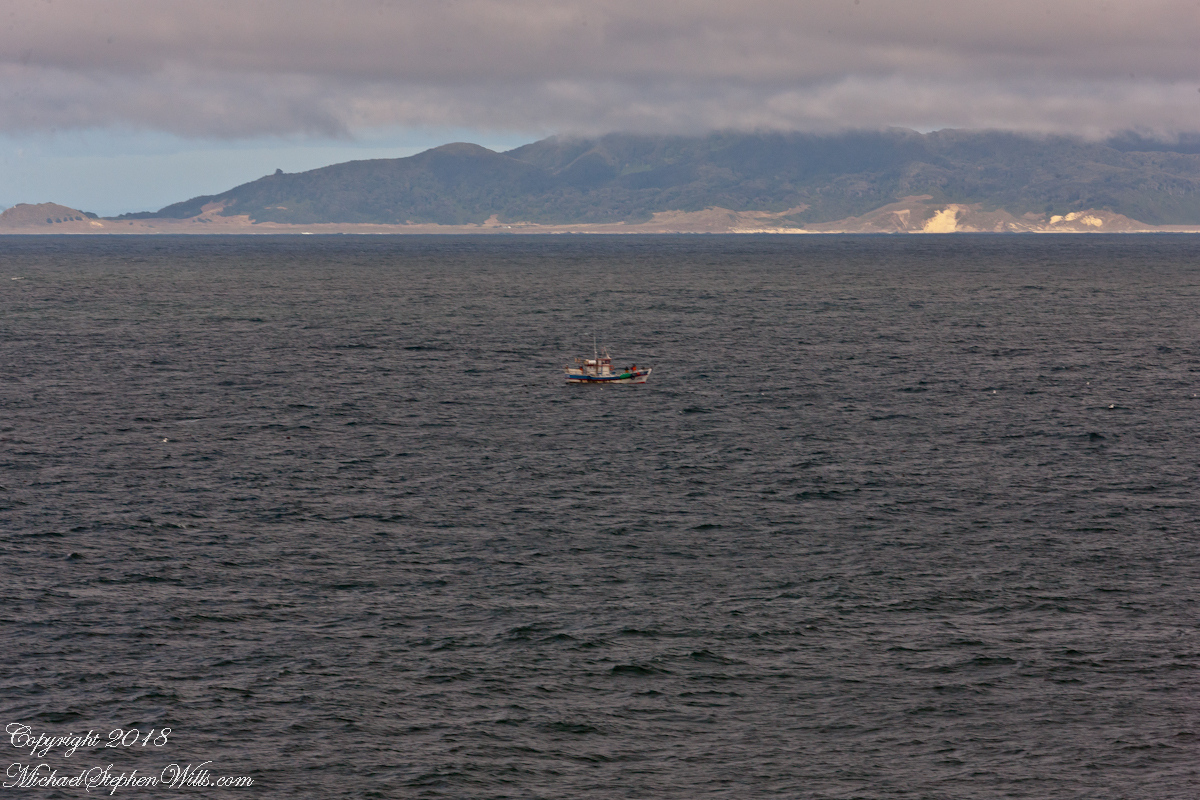
With the island due east, only a few miles away, the lens at 221 mm focal length.  A fisherman is having an easier day in a calm sea.  The indigenous people told stories of the souls of the dead travelling west to Isla Mocha.  Pirates used the island as a resupply base.  The fishing boat was the only sign of life.

RomanceOfIslandsMochaIsland2016-3

That was February 14th Valentine’s Day.  With Isla Mocha passing into the distance I changed for an evening with Pam.  Here we are headed to dinner, somewhere off the coast of Chile’s Lakes (and volcano) region.

Valentines Day 2016

Valparaiso Connections V

A Deeper Understanding

Monuments Then and Now

Trundled along within our bubble, the Mercedes tour bus proceeded up Avenue Montt when Ricardo pointed out this statue for ridicule.  A depiction of the Chilean national bird, the Condor, porteños derisively call it “The Chicken,” and in truth the wingspan is undersized.  From the vantage of the above photograph, the statue form does capture an impression of soaring among the hills of Valparaiso.  Keep in mind, beyond those hills is Aconcagua, the highest mountain of the western hemisphere, home to Condors.  

A reason for writing multiple Varparaiso “connection” posts is to better understand the jumbled impressions from that day.  In a previous post I coined the term Varparasians for natives of the city.    I found in researching this post the residents, as for Buenos Aires, call themselves porteños (people of the port).  This cast iron statue speaks to the contributions of French immigrants to the city and nation.

Gift of the French Colony for the Centennial of Chile – Valparaíso, 1810 – 1910.

Here the view is south towards (what I believe is) Cerro Florida (Florida Hill).  France Avenue continues, beyond the monument, following a steep and winding path up the hills, at the crest intersecting with German Avenue.  Adjacent, on the right, is Park Italia where we’ll visit in part VI.  Above a cast iron basin, at each corner of the commemorative column base is a female mask, above them a gold band inscribed (from the) “The French of Valparaiso” with 1810 – 1910 to denote the centennial.  A condor with outspread wings surmounts the column.

The artist, Nicanor Plaza, born in Santiago, Chile was living in Florence, Italy at the time of this commission.  He was a natural choice for the commission.  Trained in Chile and Paris, Plaza taught for the Academy of Fine Arts of Santiago.  It is of cast iron, produced by the French company Val Osne, an art foundry dating back to 1835.  The owner, Jean Pierre Andre Victor, invented a cast iron ornamental technique originally used to produce street furniture.  

 From 1854 to 1895 immigration from France burgeoned, from a country total of 1,654 to 8,266.  This cohort is credited with developing the vineyards of the Central Valley, still famous today.  The Chilean president Augusto Pinochet descended on his father’s side from an 18th-century French Breton immigrant from Lamballe and his mother was a descendant from 17th century immigrants, partially Basque.  Pinochet’s legacy can only be attributed to himself and the ruling Junta.  What is of concern is (1) Pinochet was protected against prosecution throughout his life. (2)  The same people who protected him still hold power.  A case in point is the Esmeralda, still in service.

The Naval Training Vessel Esmeralda

 I took this photograph at dawn from our stateroom balcony, it is the
Esmeralda, a four-masted  top sail schooner, from Spain, christened May 12, 1953.  From 1973 to 1980 it was a floating torture chamber where up to 100 persons were subjected to hideous treatment by the Pinochet regime.  Protests erupt wherever it docks in a foreign port yet it remains in service.  A relatively small part of the puzzle, yet it serves as an unacknowledged monument to the failure of Chile’s ruling elite to come to terms with the recent past.

Click for my Fine Art Gallery.