A quiet encounter with Elfriede Abbe’s Yarb Woman reveals the enduring wisdom of herbal traditions, inviting reflection in the intimate stillness of Cornell’s Herb Garden.
We did not come upon her the way you come upon a monument. On a late winter morning my sister and I chose to walk through the pergola alongside the Richard M. Lewis Education Center and there she was.
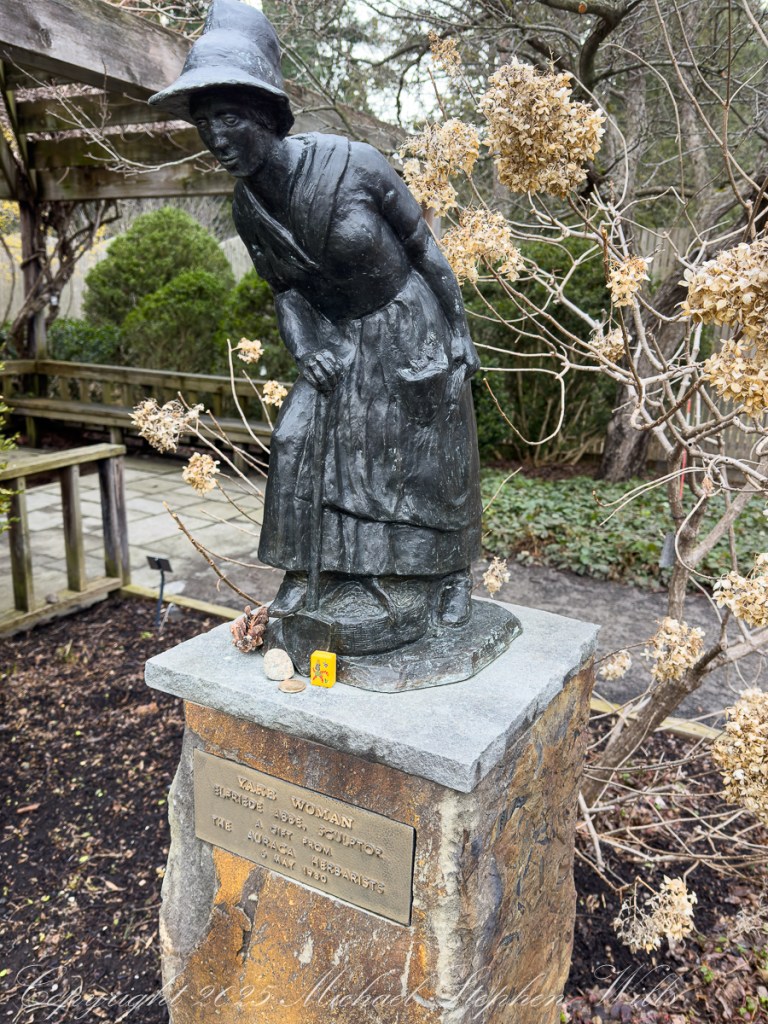
There is no plaza, no axial approach, no insistence. Instead, the Yarb Woman statue waits in a corner of the Robison New York State Herb Garden, where paths narrow and attention shifts from spectacle to detail. The pergola frames the space, the beds lie dormant or fragrant depending on the season, and there—almost at eye level with the plants—is the woman herself, bent into her work.
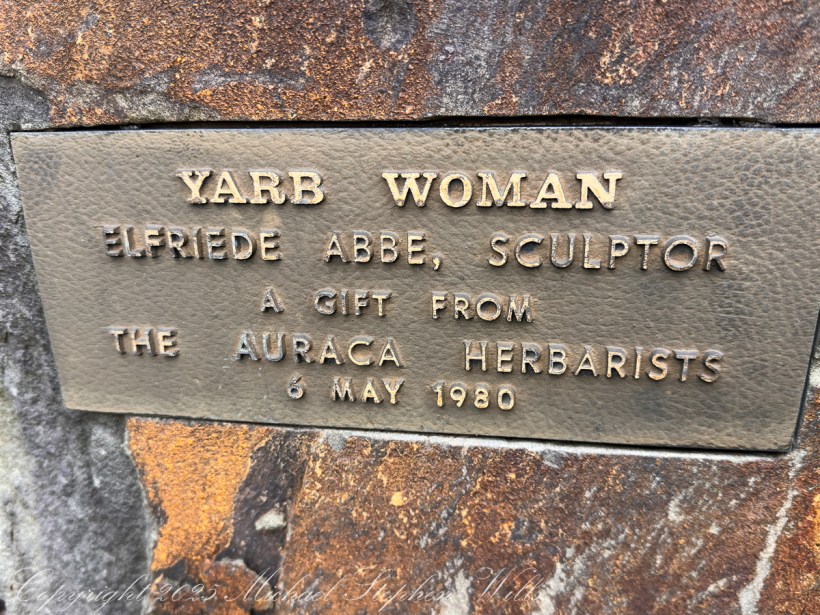
Yarb Woman, Elfriede Abbe, sculptor, The Auraca AHerbarists, May 6, 1980. Robison New York State Herb Garden, Cornell Botanical Gardens, Cornell University, Ithaca, Tompkins County, New York State.
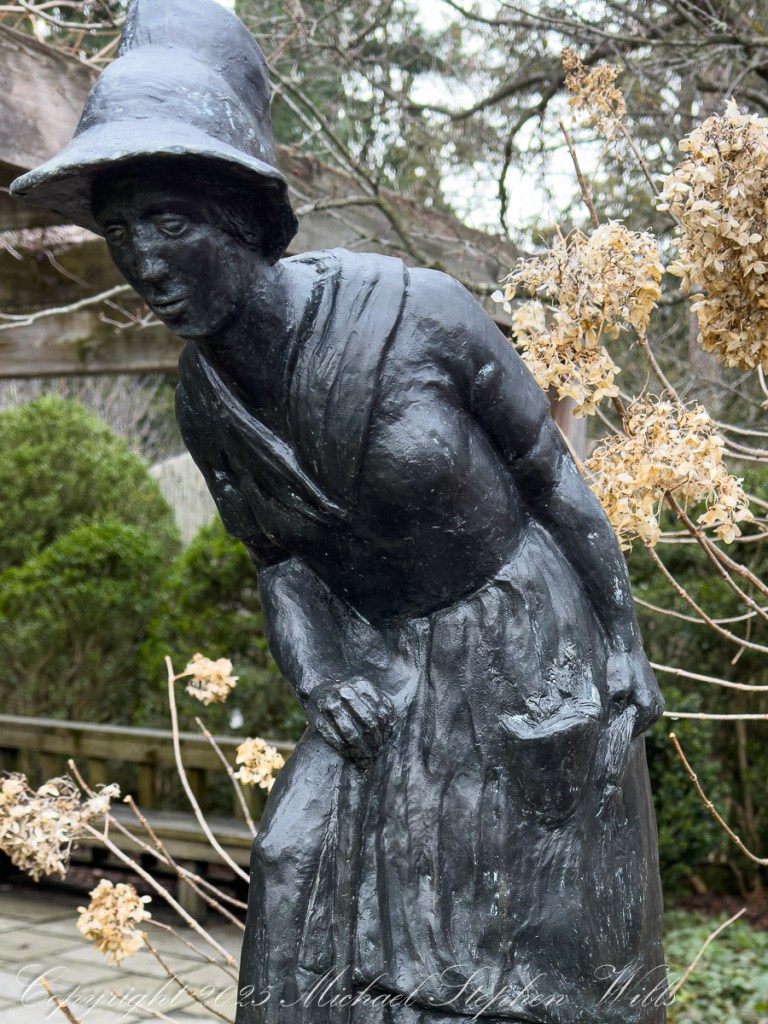
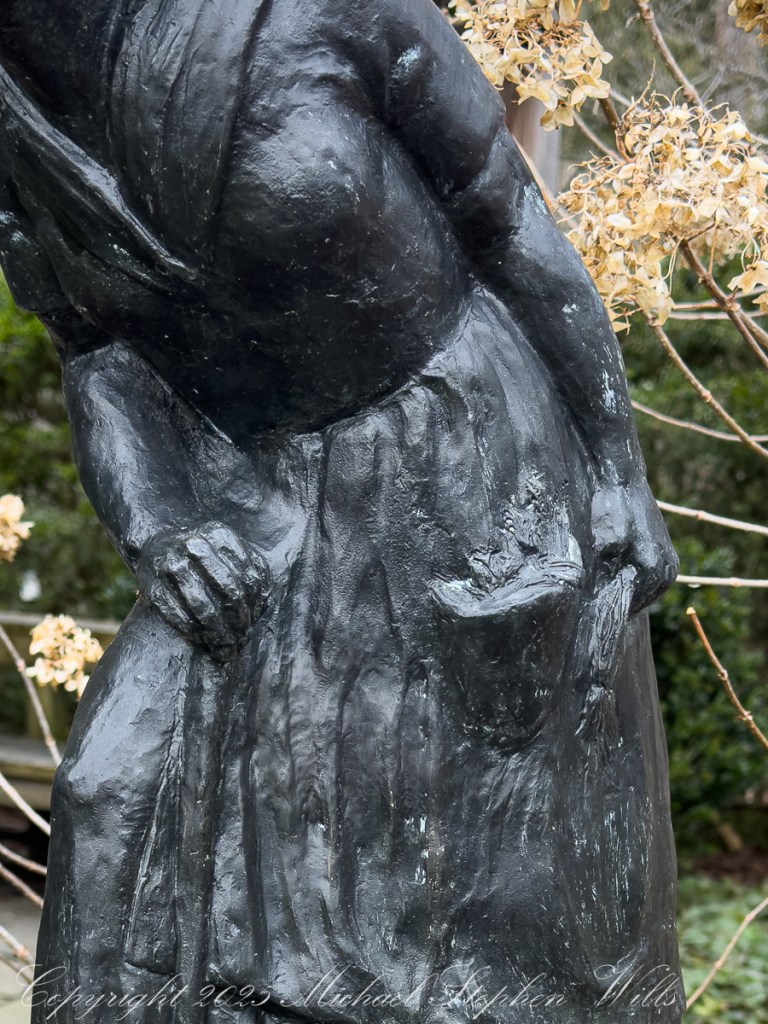
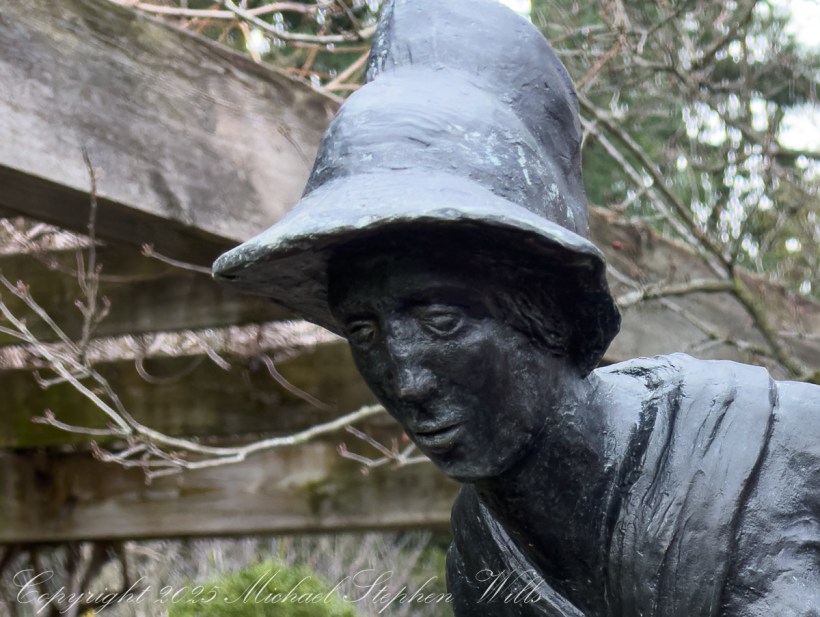
Her posture is one of reguard. That is the first instruction. Her posture is a study in intention: forward-leaning, balanced, attentive. One hand gathers, the other steadies. She is caught mid-action, not posed. This is a figure practicing herbal knowledge.
Right hand on spade handle
And because of that, she alters the space around her. Standing there to regard the statue the garden becomes a workplace—a field of quiet labor. Each plant is no longer merely labeled but noticed. The dried hydrangea beside her, the winter stems, the low green groundcover—everything begins to feel like it belongs to her attention.
Left hand grasping plants, pockets full
We began to notice the small offerings at her feet—stones, a tiny object left by a passerby—that suggest that others have felt this shift. Not worship, exactly, but recognition. A kind of informal acknowledgment that this figure gathers more than herbs; she gathers meaning from the overlooked.
There is something deliberate in her scale. She is not monumental. She does not dominate the garden. Instead, she invites you downward—to stoop, to look, to consider what is beneath your habitual line of sight.
This is consistent the sculptor, Elfriede Abbe’s, larger artistic life. She was not drawn to grand gestures but to process: carving wood, printing pages, observing the minute structures of plants. In “Yarb Woman”, that ethic becomes embodied. The sculpture is less about a person than about a way of being in the world.
To gather. To attend.To work with care.
Standing there, you may feel the subtle inversion: the garden becomes something you enter into, as she has. The distance between observer and participant narrows.
And time shifts slightly. The date on the plaque—1980—anchors the piece historically, but the figure herself resists that anchoring. Herbal practice stretches backward through centuries of unnamed practitioners, most of them women, most of them unrecorded. She could belong to any of them. Or to all.
Yarb Woman, Elfriede Abbe, sculptor, The Auraca AHerbarists, May 6, 1980. Robison New York State Herb Garden, Cornell Botanical Gardens, Cornell University, Ithaca, Tompkins County, New York State.
Even the word “yarb” participates in this temporal layering—an old word surviving in a modern garden, just as old knowledge survives in new forms.
Yarb Woman, Elfriede Abbe, sculptor, The Auraca AHerbarists, May 6, 1980. Robison New York State Herb Garden, Cornell Botanical Gardens, Cornell University, Ithaca, Tompkins County, New York State.
What we encountered, then, was not simply a sculpture. It was a quiet proposition:
That knowledge can be gathered slowly. That attention is a form of reverence. And that in the midst of a university—of speed, abstraction, and analysis—there remains a place where understanding begins with kneeling close to the ground.
And noticing what grows there.
Enter your email to receive notification of future postings. I will not sell or share your email address.
Copyright 2026 All Rights Reserved Michael Stephen Wills
On a March afternoon at Cornell University, I encounter Rona Pondick’s surreal sculpture Untitled Tree, where scattered aluminum “fruit” reveal unsettling human teeth beneath bare branches.
An encounter with Rona Pondick’sUntitled Tree (1997)
One March afternoon on the lawn near the Herbert F. Johnson Museum of Art at Cornell, you might notice a small, leafless tree rising from a circle of red gravel. At first it seems merely dormant, another tree waiting for the long Ithaca winter to loosen its grip. But as you approach, the scene grows quietly unsettling. Around the trunk lie dozens of smooth gray forms—small, rounded objects like stones or fruit that have fallen from the branches.
Then you see the teeth.
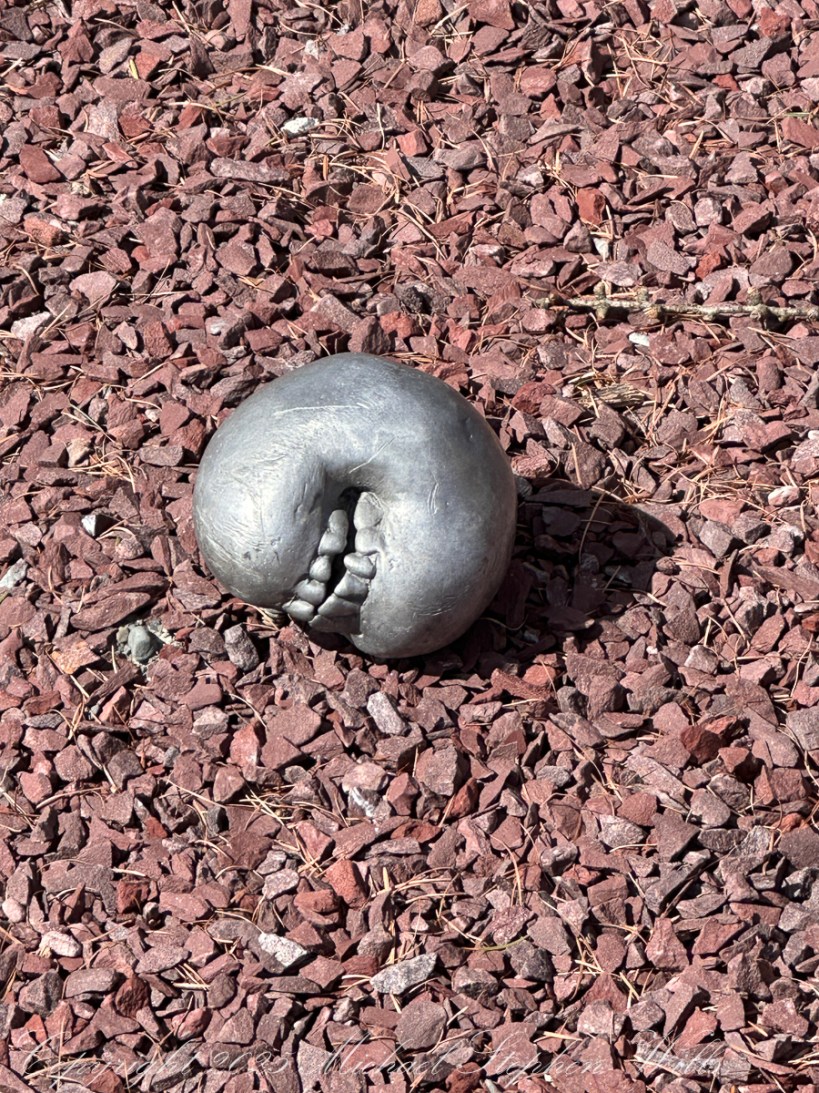
The objects scattered beneath the tree are cast aluminum forms bearing unmistakably human molars. They appear to have dropped from the tree like strange metallic apples, a harvest that belongs less to botany than to anatomy. This disquieting grove is Untitled Tree (1997) by the American sculptor Rona Pondick.
The Artist of Hybrids
Pondick, born in Brooklyn in 1952 and trained at Queens College and the Yale School of Art, has spent decades exploring the language of the body in sculpture—often literally. Her work frequently uses casts of body parts, particularly teeth or her own head, creating forms that merge human anatomy with animals, plants, or everyday objects.
The result is a sculptural vocabulary that feels simultaneously ancient and uncanny. Critics often describe her work as “hybrid”—a blending of the human body with other forms, echoing mythic creatures such as sphinxes or centaurs while remaining distinctly contemporary.
Teeth have been a recurring motif in Pondick’s art since the 1980s, when she began casting them and embedding them in unexpected contexts. These fragments of the body carry a peculiar emotional charge: they evoke childhood, appetite, vulnerability, and mortality all at once.
A Sculpture That Feels Like a Dream
Created in 1997, Untitled Tree belongs to a group of works where Pondick began experimenting with trees as sculptural forms. She has explained that she sometimes uses actual branches or trunks as starting points for casting in metal, translating natural textures into aluminum or steel.
The Cornell sculpture is monumental yet restrained:
a cast-aluminum tree,
surrounded by dozens of small aluminum objects,
each about the size of a stone but bearing human teeth.
Seen from a distance, the scene reads like a quiet landscape intervention. Up close, however, it feels like a fragment from a surreal dream—a tree that has shed something disturbingly human.
The Poetry of the Fallen Teeth
Standing before it on that March afternoon, one might think of the sculpture as a botanical riddle.
Trees drop fruit. They drop leaves. In autumn they drop seeds.
But this tree has dropped teeth.
The idea is both playful and faintly macabre. The small aluminum forms resemble seeds, yet their teeth suggest the human mouth—the place of speech, hunger, laughter, and loss. The sculpture seems to whisper that the natural world and the human body are not separate realms but entwined systems of growth and decay.
In the red gravel circle beneath the tree, the objects appear almost archaeological, as though a curious species once grew here and shed fragments of itself into the soil.
Cornell’s Quiet Surrealist Grove
Placed on the lawn near the Johnson Museum’s striking I. M. Pei building, the sculpture forms a gentle conversation between art, architecture, and landscape. In winter the bare branches echo the skeletal trees around it. In summer the aluminum trunk gleams among living foliage.
And the scattered teeth remain—silent, patient, and oddly humorous.
They remind us that nature, like art, can be unsettling and beautiful at the same time.
Enter your email to receive notification of future postings. I will not sell or share your email address.
Copyright 2026 All Rights Reserved Michael Stephen Wills
A Valentine’s Day reflection spanning childhood, family, and partnership—where a homemade cake, a living room, and an ocean voyage reveal love’s enduring thread.
Our culture insists that Valentine’s Day is about hearts and chocolates, about gestures that can be wrapped, written, or eaten. My memories tell a longer and more intricate story. Valentine’s Day is thread that runs through decades—binding childhood, family, and shared journeys into a single, evolving narrative.
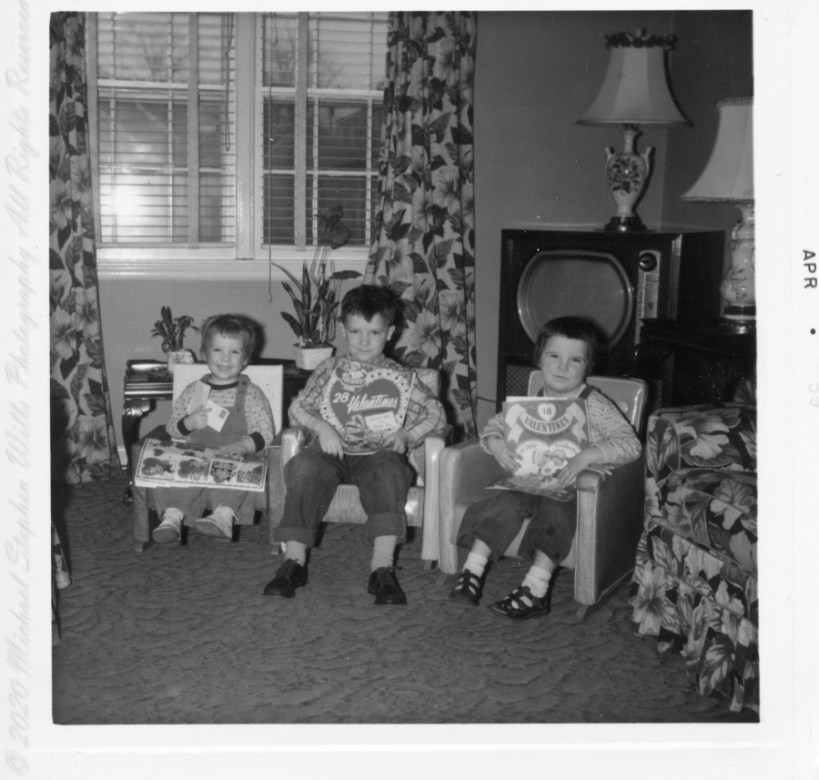
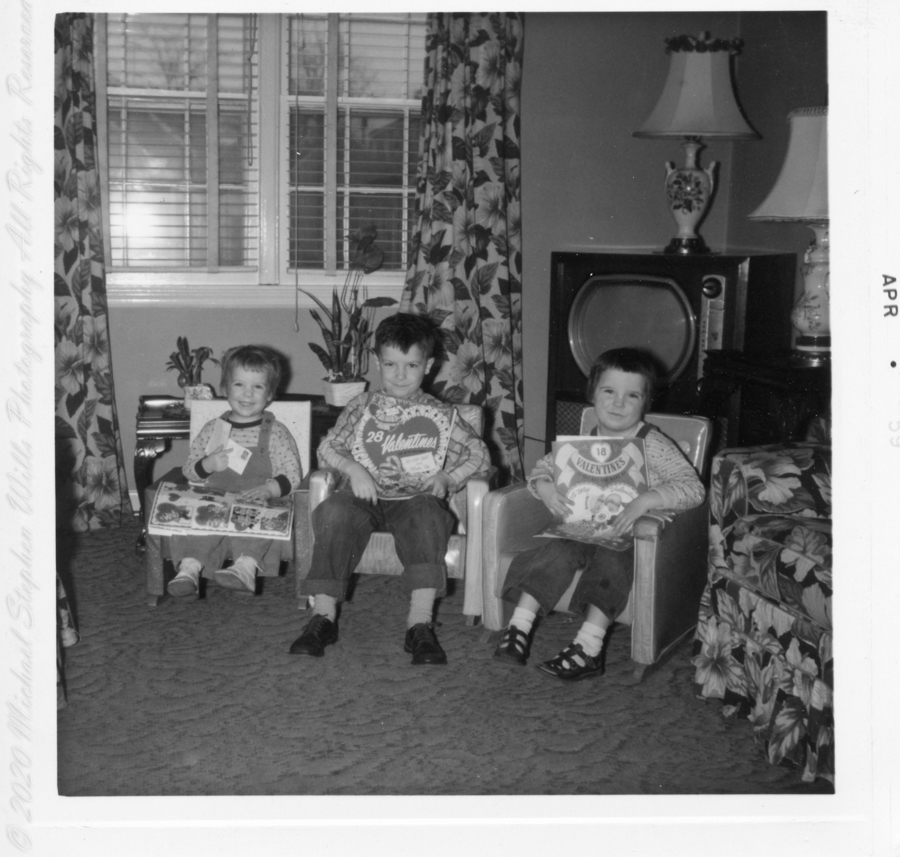
An early Valentine’s Day memory of mine is anchored in a living room at 107 Deepdale Parkway in Albertson, New York. It is 1959. The room is familiar and ordinary, yet in memory it glows with a particular warmth. My sister Theresa is two, Christine is four, and I am five. We are gathered together, small figures in a modest suburban home, unaware that this fleeting domestic moment will outlast nearly everything else in the room. What I remember most is not an event, but a feeling: the sense of being held within something stable and loving, a family rhythm that proved enduring.
Theresa (2), Michael (5), Christine (4) in the livingroom of 107 Deepdale Parkway, Albertson, New York on Valentines Day 1959
As the years passed, Valentine’s Day shifted its shape, as it does for everyone. Childhood gave way to adolescence, and later to adulthood, when the holiday began to carry expectations and interpretations shaped by romance and partnership. Yet even then, my earliest associations lingered beneath the surface. Valentine’s Day was was beyond an exchange between two people; it was about continuity, about the quiet reassurance that one was part of a larger story.
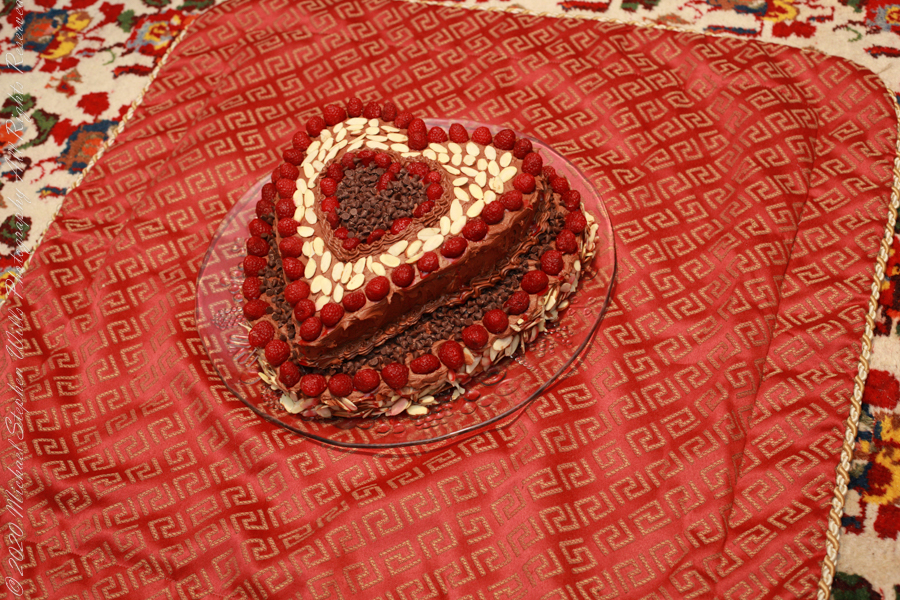
A part of our celebration this Valentine’s Day cake—chocolate, homemade, and unapologetically generous. Baked by my wife, Pamela, whose acts of care often expressed themselves through the kitchen. The cake was not elaborate by modern standards, but it does not need to be. Its value lay in what it represented: time taken, effort given, and love made tangible. Long after the plates are washed, the memory of that cake remains inseparable from the idea of Valentine’s Day itself. Love, I learned early, could be simple, nourishing, and shared.
Chocolate Valentines Day cake by Pamela Wills
That understanding deepened over time, especially through my life with Pam. One Valentine’s Day memory stands apart not for its extravagance, but for its improbability. Pam and I found ourselves aboard the Oceania ship “Regatta”, sailing the Pacific Ocean off the coast of Chile. The vastness of the water, the steady rhythm of the ship, and the sense of being suspended between sky and sea created a striking contrast to the small living room of my childhood. Yet the emotional register was remarkably similar. Once again, Valentine’s Day was marked not by spectacle, but by presence.
The following day we reached Puerto Montt, a port city framed by water and volcanoes. The journey itself became a metaphor for the way love matures. Where childhood love had been rooted in home and routine, this later expression unfolded through shared experience and mutual trust. Standing on the deck together, watching the coastline emerge, I was struck by how Valentine’s Day had come to encompasses where we had been and where we were going.
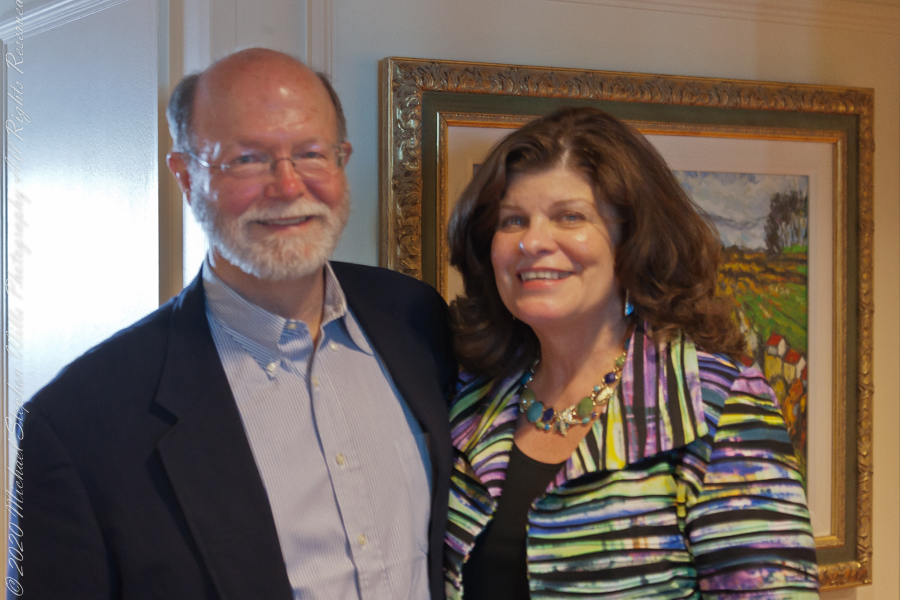
Pam and I aboard the Oceania Regatta sailing the Pacific Ocean off Chile. The following day we reached Puerto Montt.
In that sense, Valentine’s Day functions much like memory itself. It selects certain moments and holds them fast, allowing others to fade. A cake, three young children in a living room, two partners standing together on the open sea. These are not scenes one could have predicted would endure, yet they do, because they are threaded with care, attention, and shared time.
Now, looking back across the span of years, I understand Valentine’s Day as a recurring prompt that asks us to remember where love first took root, how it was tended, and how it has carried us forward. The details change, but the essence remains remarkably constant.
In the end, Valentine’s Day does not demand grand gestures or perfect words. It asks only that we recognize the quiet continuity of love as it moves through our lives—sometimes in a childhood living room, sometimes on the open ocean, always leaving its mark in ways we only fully understand in retrospect.
Enter your email to receive notification of future postings. I will not sell or share your email address.
Copyright 2026 All Rights Reserved Michael Stephen Wills
An ancient esker redirects Fall Creek at Malloryville Preserve, revealing how Ice Age meltwater shaped the land and still quietly governs water and wandering feet.
The esker rises like a glacier’s spine, a long-backed remnant left behind where an ice mountain learned how to leave quietly. It is not loud geology—no cliffs shouting their age, no cataracts announcing force—but a patient, sinuous fact. A frozen river’s footprint, pressed into the land and then abandoned, it lies there still, grading itself gently on both sides, as if unwilling to offend gravity or time.
At first glance, it could pass for a human thing: a railroad berm, a raised roadbed, an engineer’s solution. Yet this ice-scribe ridge was shaped without blueprints, drafted by meltwater racing beneath a retreating glacier, carrying gravel like a hoard of stories. The stones settled where the ice allowed them, stacked by pressure and patience, forming a ridge long enough—nine-tenths of a mile—to tell a stream where it must turn.
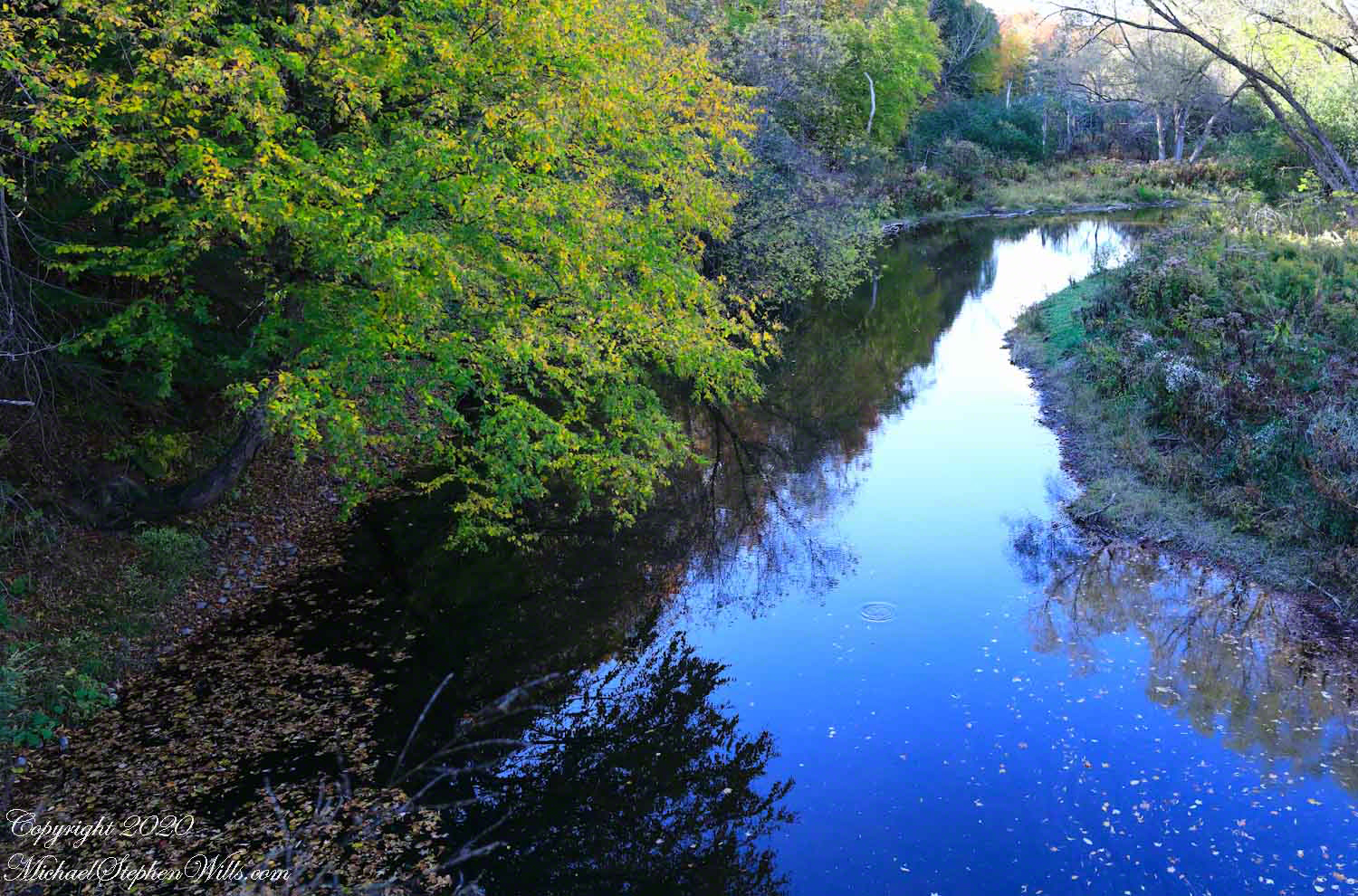
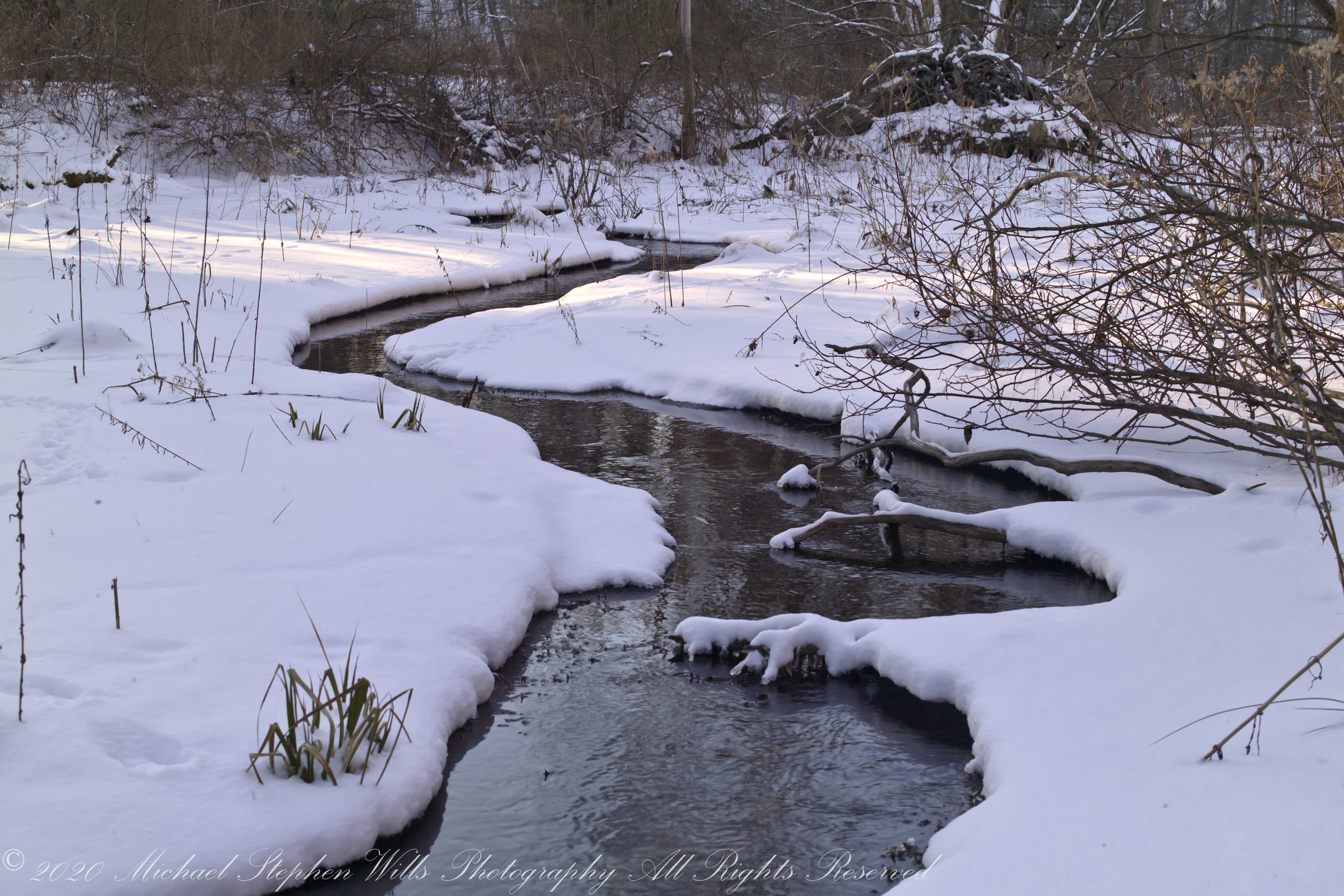
Fall Creek meanders through the esker fields of the Malloryville Preserve. Here is the view from an abandoned railroad bridge. The preserve is near Freeville in the Finger Lakes Region of New York State.
Fall Creek arrives with purpose, confident in its descent, until it meets the esker and must reconsider. Here the water performs bows, an abrupt acknowledgment of authority. The creek becomes a liquid negotiator, redirected by the ridge’s quiet insistence. This is the esker’s work: not domination, but persuasion. Land teaching water a new sentence.
This video provides a better feeling for the esker. To do this from WordPress Reader, you need to first click the title of this post to open a new page.
Standing at the foot of the esker, the slope to the right reveals itself slowly. It does not announce, I am important. Instead, it waits to be noticed. A swamp settles nearby, the water-mirror lowland, collecting what seeps and lingers. Together, ridge and wetland form a conversation: height and hollow, drain and gather, spine and lung.
Before there was signage, before placards translated glacial grammar into public language, the land already knew itself. Knowledge preceded explanation. My son and I pitched a tent atop a kame at our front door — another ice-left hill, a deposit of ancient momentum. That night, the ground beneath us was older than memory and younger than myth. Camping there was not recreation so much as apprenticeship.
A kame is a meltwater’s knuckle, rounded and abrupt, shaped by collapse rather than flow. To sleep upon it is to rest on uncertainty made solid. The tent fabric whispered in the breeze, a thin membrane between human breath and glacial aftermath. Fireflies stitched brief constellations above the grass, while the earth held fast, remembering ice that no longer needed remembering.
Walking along Fall Creek later, watching it turn west where the kame insists upon geometry, one begins to sense the land’s authorship. This is not random scenery. It is edited terrain. Each ridge, each bend, each saturated hollow is a sentence left behind by ice that once covered everything and then, mercifully, withdrew.
The esker itself is a time-ladder, inviting slow ascent. Step by step, gravel shifts underfoot—rounded stones, carried far from their origins, now loyal to this place. Each stone is a traveler without a passport, naturalized by pressure and pause. Together they hold their line, resisting erosion not by hardness alone, but by collective agreement.
From above, the ridge reveals its length, its deliberate curve. It does not hurry. It does not apologize. It simply is, a memory ridge, reminding the present that absence can be as powerful as presence. The glacier is gone, yet its handwriting remains legible.
Overflow from a Kettle Pond threads through a meadow before feeding Fall Creek. The O.D.von Engeln Preserve at Malloryville.
In the nearby swamp, water pools in dark reflection. Frogs tune their throats. Sedges write vertical poetry. This is the after-ice sanctuary, where meltwater’s descendants linger and life reclaims the margins. The esker drains; the swamp receives. Between them flows a balance older than names.
To walk here is to practice a different kind of attention. The land does not reward speed. It rewards listening. The ridge asks you to follow its curve, to feel how it shapes movement, how it choreographs water, wildlife, and wandering humans alike. It is a path-without-intention, yet it guides all who encounter it.
Long after the tent is folded, after the creek continues its bent course, after the placards fade and are replaced, the esker will remain. It will continue directing water, lifting footsteps, and teaching geometry to anyone willing to notice.
Eskers and kames are the glacier’s farewell letter, written in gravel, signed by time, and left open for reading.
A new Cornell building settles into its hillside, glass and weathered metal catching sky and trees—less a declaration than an invitation to pause, wander, and think together.
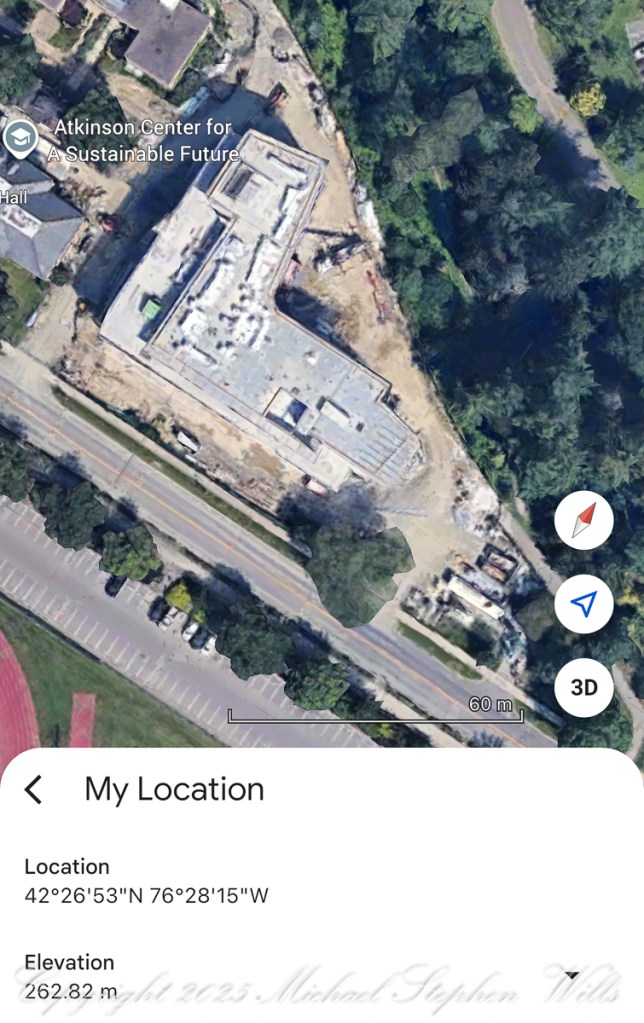
Not in person—on my screen, late at night, when I should have been revising a draft and instead opened Google Earth the way some people open a window. There it was, just off Tower Road, close to Stocking Hall, pale and newly settled into the slope. From that height it looked careful rather than confident, as if it had arrived recently and was still deciding how much of itself to show.
Atkinson Hall, Google Earth from August 2023, 350 Tower Rd, Ithaca, NY 14850
I remember thinking: good placement on a former triangular parking lot. Enough distance from the older buildings to breathe, close enough to feel included. The hill does most of the work. You can see that even from an overhead height.
The next morning I walked there.
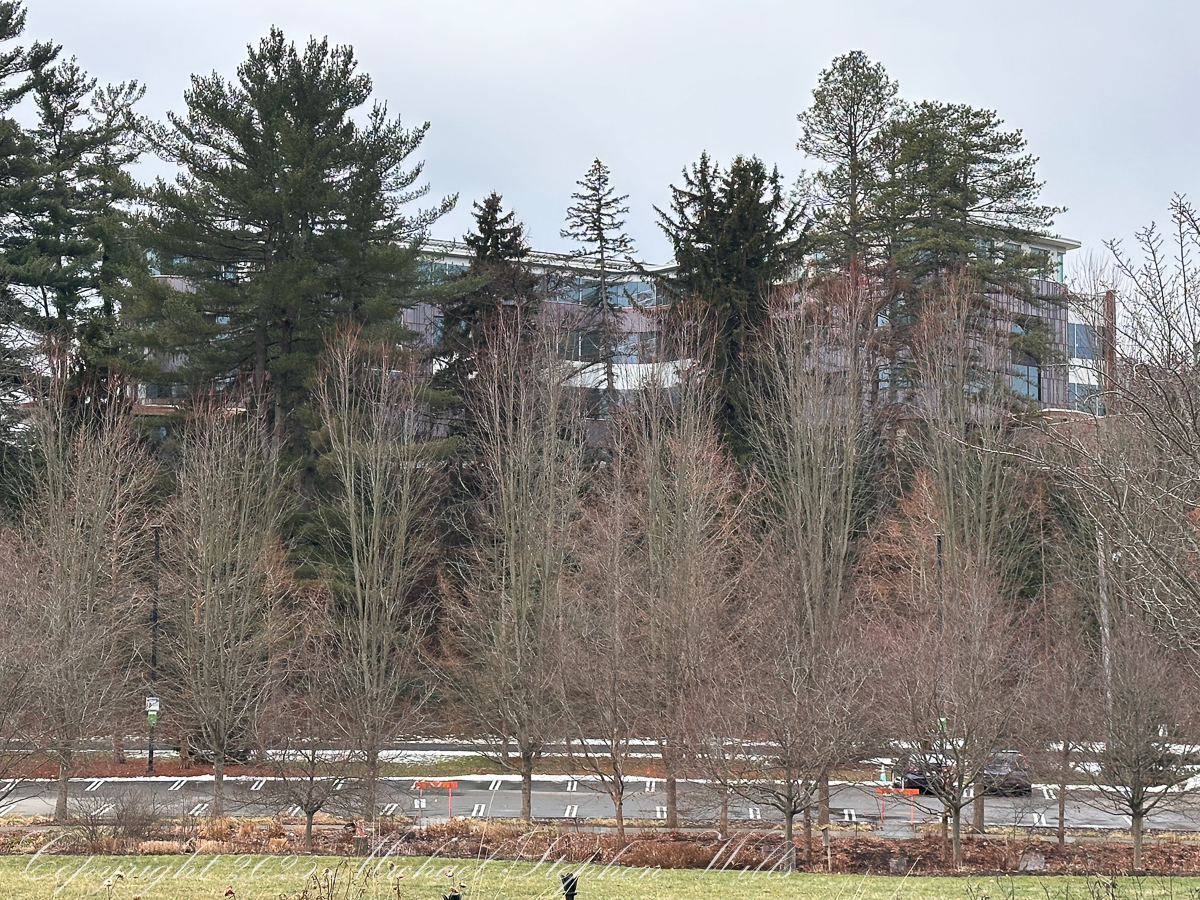
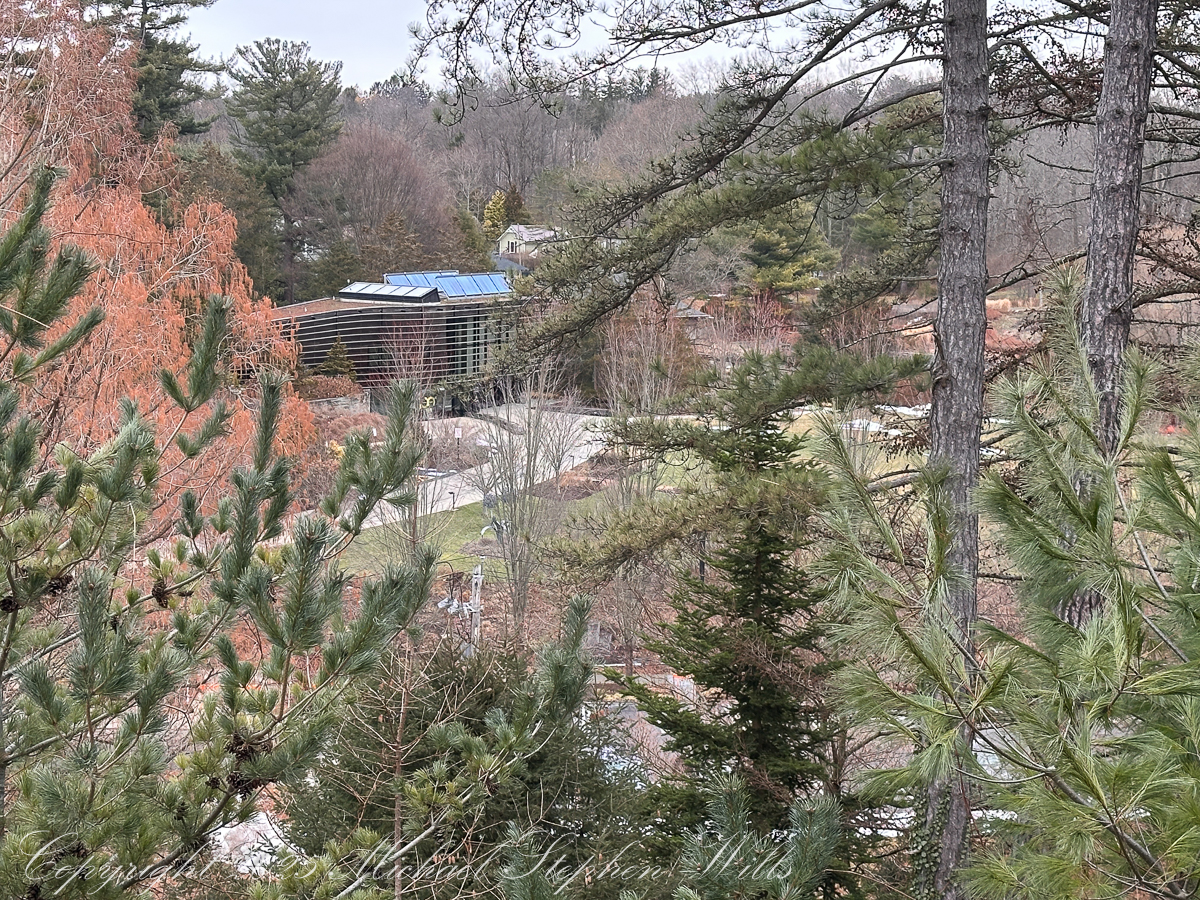
Atkinson Hall as viewed from the open field south of the Nevin Welcome Center of Cornell Botanic Gardens
Across the open field the building didn’t announce itself. Trees intervened—pines, bare hardwoods—so that it came into view in pieces: a curve of metal, a long line of glass, brick holding the ground. It felt less like approaching a destination than like gradually realizing you were already there. I liked that. Buildings that reveal themselves all at once tend to exhaust me.
The slope matters. You feel it in your legs as you walk, and the building seems to acknowledge it, stretching rather than standing tall. It does not pretend the land is flat. It follows the descent toward the creek, toward the older geological story underneath all of us.
Up close, the materials settle my attention.
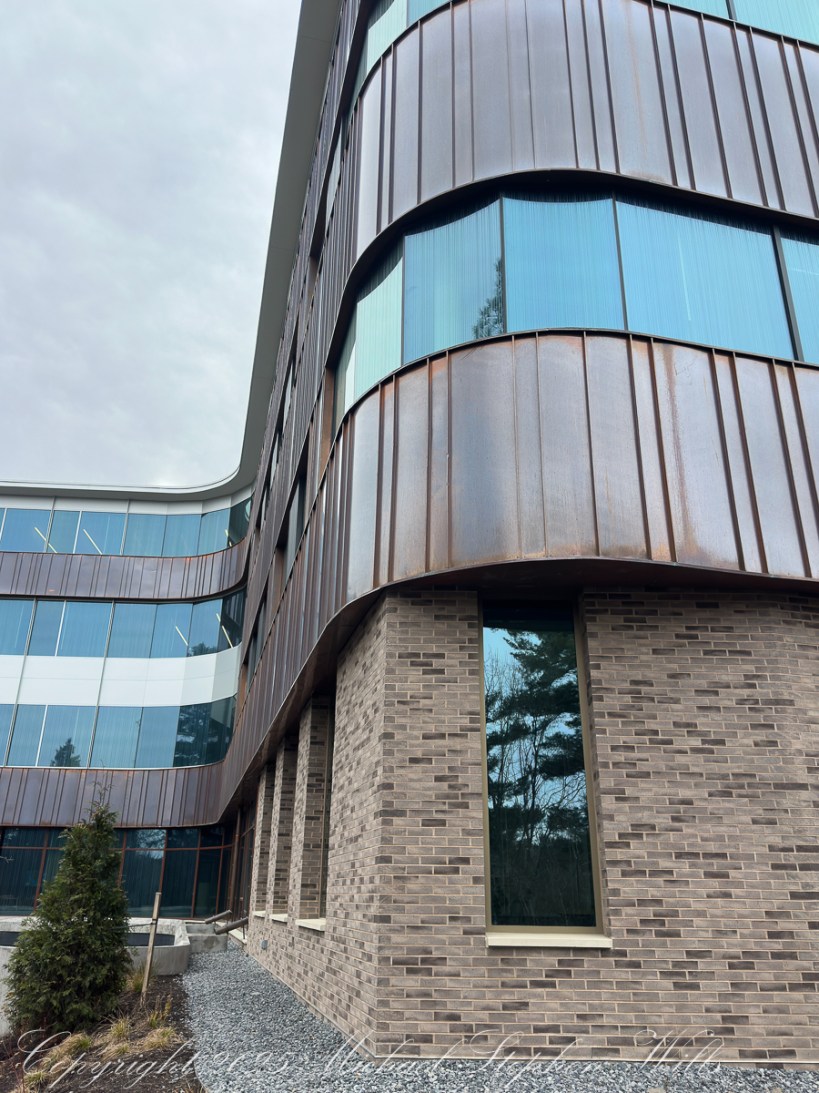
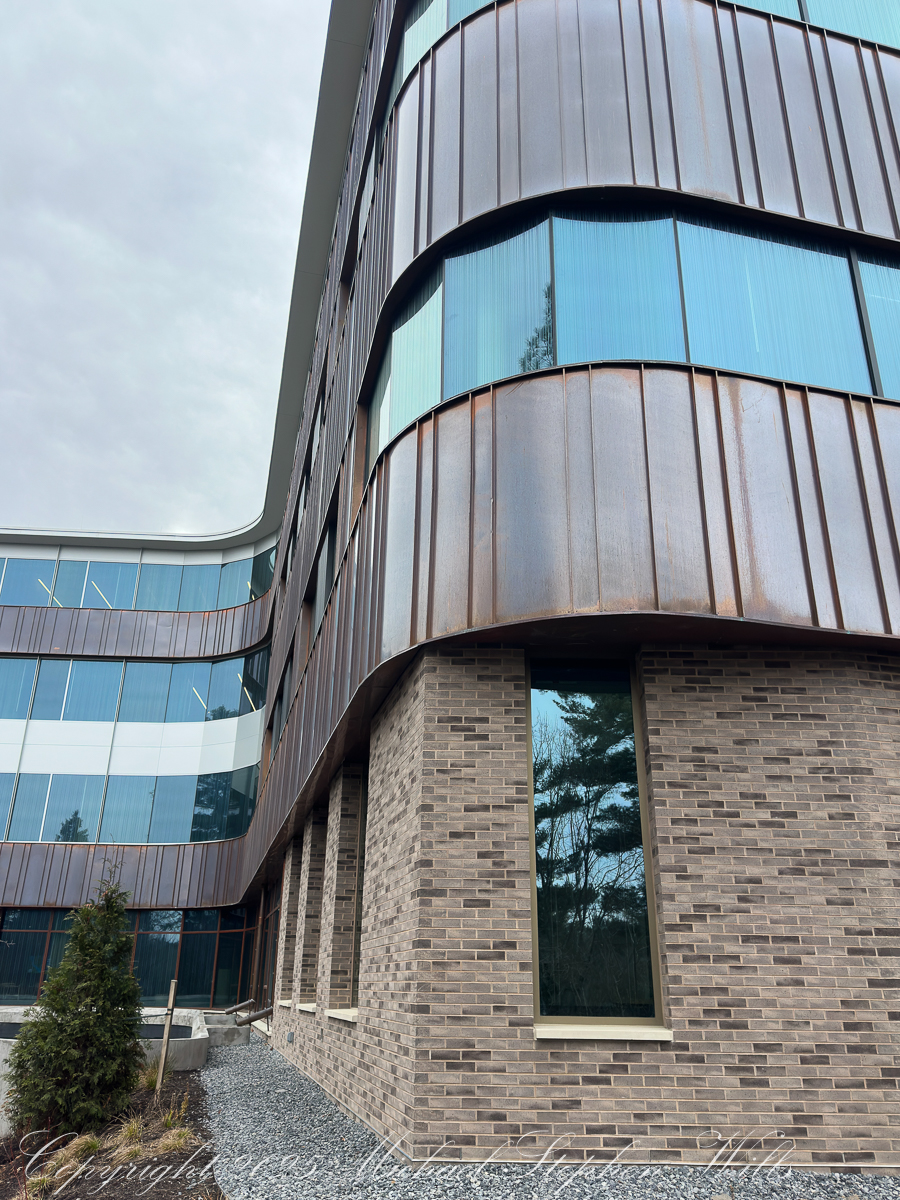
North Side of Atkinson Hall, 350 Tower Rd, Ithaca, NY 14850
Brick at the base—solid, Cornell-familiar, not trying to reinvent anything. Above it, bands of weathered metal curve gently, already carrying the muted browns of fallen leaves, old stone, and stream-worn shale—colors long familiar to the slopes and ravines that shape this campus. They look as though they have agreed to age, which feels like an underrated design choice. The glass holds the sky without insisting on transparency. Some days it reflects trees so clearly that the building nearly disappears into them.
Compare the facade brickwork of Warren Hall, one of the earliest buildings on the Cornell University campus, completed 1868. This is the southwest corner with facade signage, Cornell University, Ithaca, New York
I stop near the windows longer than I intend to. The view steadies me. The hillside, the trees, the quiet persistence of winter light. My notebook stays closed for a few minutes. No one seems to mind.
View near Atkinson, Nevin Welcome Center, Cornell Botanical Gardens, 124 Comstock Knoll Dr, Ithaca, NY 14850
Inside, the building does not behave like a department.
That is the first thing I notice once I begin using it regularly. No single discipline claims the space. Offices and meeting rooms feel provisional, lightly held. Conversations drift. Someone from engineering crosses paths with someone from policy. A food systems researcher borrows a chair from a planner. No one looks lost.
It helps to remember who gathers here. The building hosts people from many parts of the university, each arriving with partial expertise, incomplete questions.
Cornell College / Unit
Areas of Engagement
College of Agriculture and Life Sciences (CALS)
Food systems, agroecology, climate resilience
College of Engineering
Energy systems, materials, infrastructure
College of Arts and Sciences
Earth systems, ecology, human dimensions
SC Johnson College of Business
Sustainable enterprise, supply chains
College of Architecture, Art, and Planning (AAP)
Urban resilience, adaptive design
Cornell Law School
Environmental law and governance
Public & Global Affairs
Climate policy, diplomacy
I keep this list taped inside my notebook. It reminds me that no one here is meant to arrive fully formed. The building expects us to be unfinished.
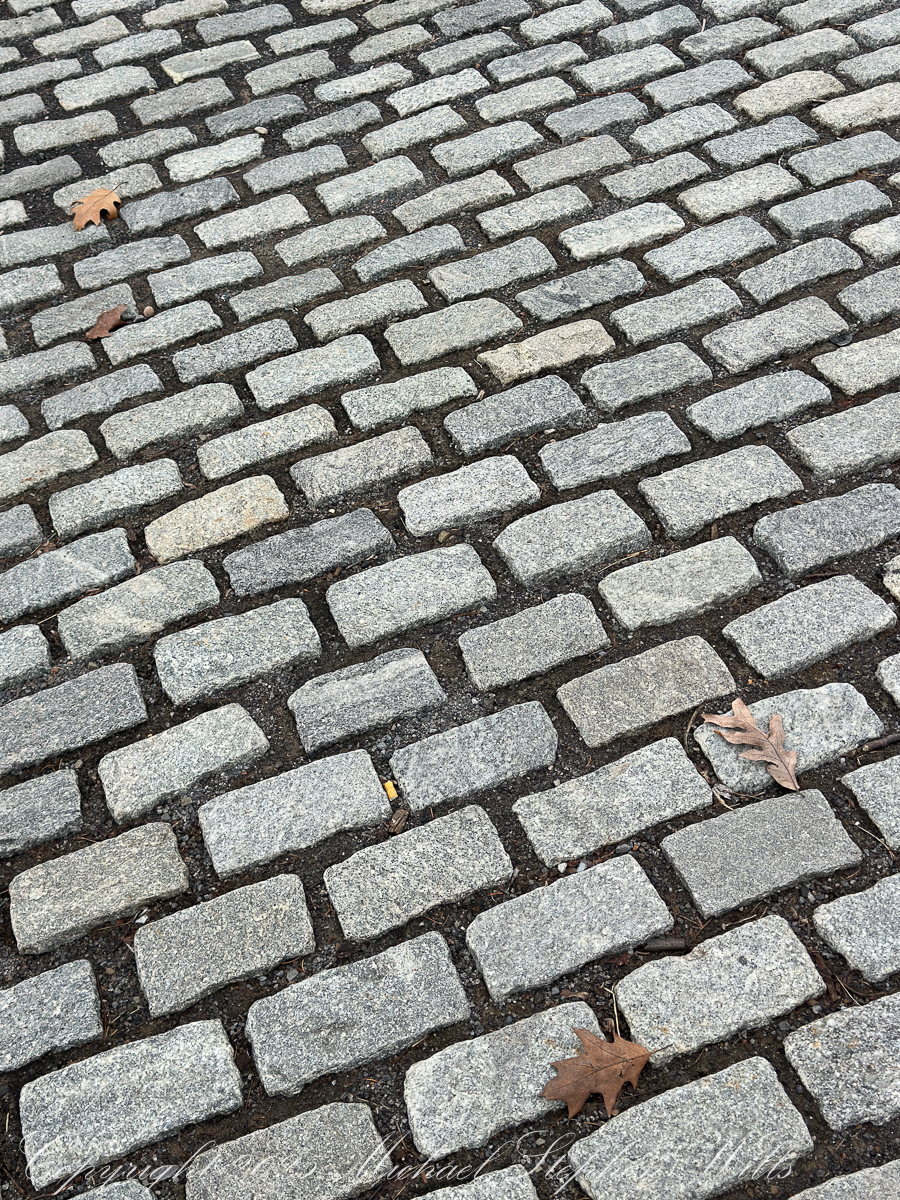
Cobblestones with fallen oak leaves along Feeny Way, Cornell University, Ithaca, New York
There is a quiet confidence in how the place is run. Systems hum discreetly. Heat holds steady even when the weather rips. Somewhere nearby, unseen, a generator waits, a reassurance. Work continues. Conversations do not end mid-sentence. I think about this more than I expected to. Stability has become a form of generosity.
On certain afternoons I walk the exterior again before heading home.
The curves soften what could have been institutional. Corners ease into one another. Nothing feels sharp. The building does not posture or instruct. It listens. It seems content to let weather, foot traffic, and time finish the job.
I have overheard visitors describe it as “restrained.” I think that is right. It does not wear sustainability as an emblem. It does not ask to be admired. It offers something quieter: space to think without being hurried, to talk without being territorial.
From some angles it nearly disappears into the hillside. From others it asserts itself just enough to be useful. That balance feels intentional, and also rare.
When I sit near the glass and look out, I sometimes imagine the building learning us in return—our habits, our pauses, the way we linger in doorways when a conversation matters. It seems designed for that kind of noticing.
If I were forced to describe it the way a realtor might, I would say it is well built in all the ways that matter. The structure is sound. The site is excellent. The materials will age well. But what I would mean is something less technical.
It is a building willing to wait.
Seen from above, it is still new. Seen from the field, it is already settled. Seen from inside, it feels patient.
That patience makes room—for uncertainty, for collaboration, for the long work that does not resolve quickly. I think that is why I keep returning, even on days when I do not strictly need to be there.
The building does not ask what I am producing. It asks only that I stay awhile.
And for now, that is enough.
Enter your email to receive notification of future postings. I will not sell or share your email address.
Copyright 2026 All Rights Reserved Michael Stephen Wills
The symbolic power of the numeral three, reflected in various cultural, religious, and secular contexts, underscores its universal significance. From the mystical trinities of gods to the practical applications in rhetoric and storytelling, and the fundamental structure of our physical world, the number three resonates with a sense of completeness, balance, and harmony. Its pervasive presence in different aspects of human thought and culture attests to its enduring and profound symbolism.
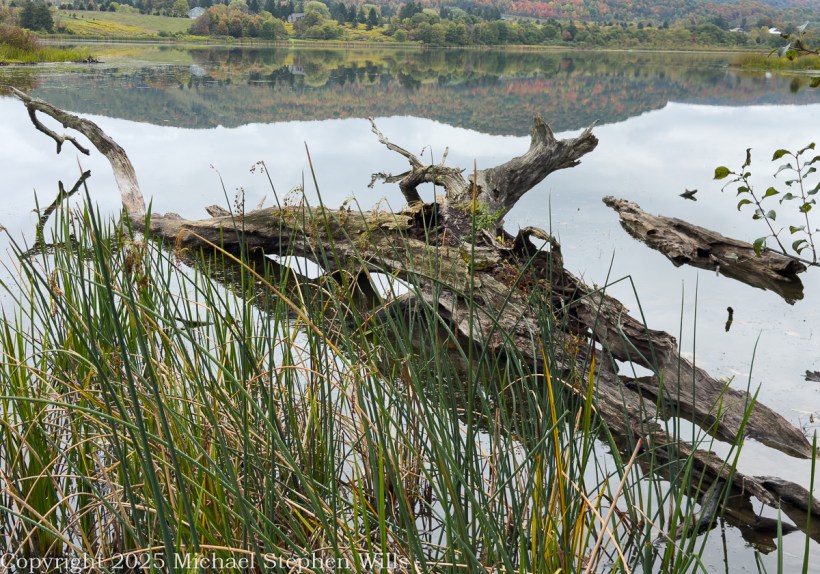
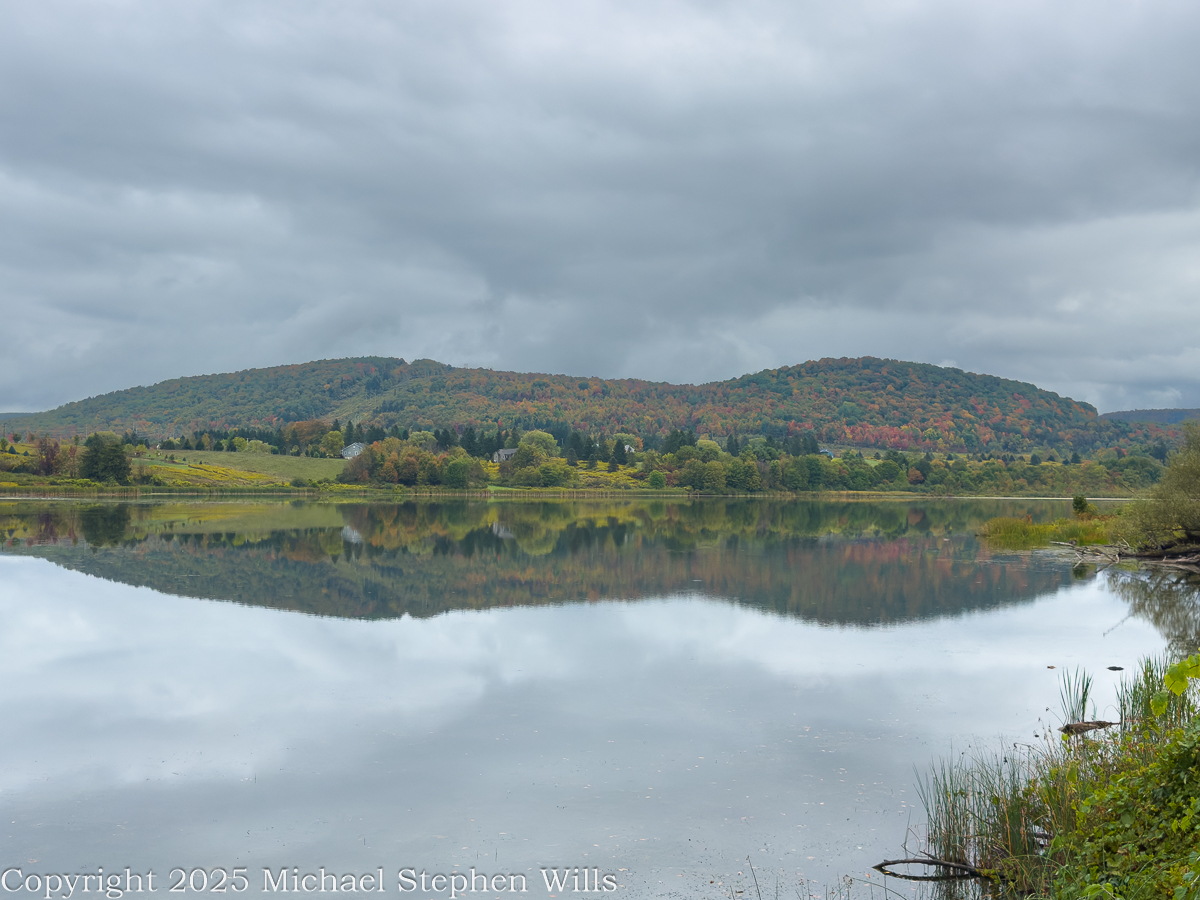
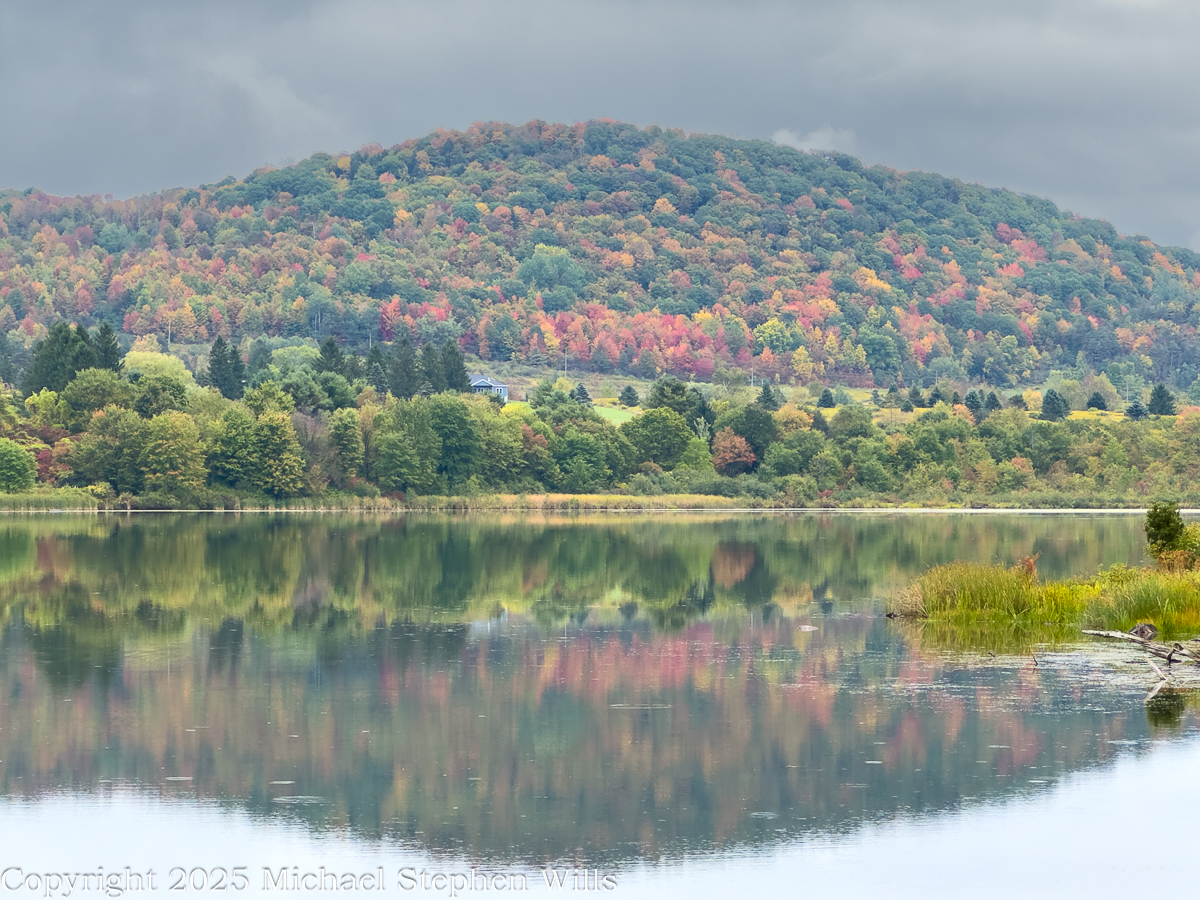
Morning clouds hang over Dryden Lake as hills kindle first color; reflections hold breath while a lone walker reads the valley’s glacial and human-written past.
He came to the water before the people woke, the road a still ribbon of cold tar snaking beneath the low hills. Mattocks of cloud hung over the valley and the lake took in the sky like a mirror dropped yet not broken. The trees were beginning to color. A patient fire working from within the leaves. He parked where the grass ran down to the shore and stood a long while without moving. Birds made small sounds in the reeds. Somewhere a single truck labored up the grade and was gone. The surface held the hills with a steadiness the hills themselves could not keep. He thought how the quiet of a place can be the loudest thing it owns.
He went along the margin along the damp sedges where old drift lay silvered and light as bones. A drowned trunk angled from the shallows. The lake was old in the way of things made by ice and time. A kettle in the outwash of the last glacier, some men said, a bowl left when the buried ice eased away. He pictured the ice receding into the valley heads, the meltwaters choked with gravel, a hand larger than memory scribing the floor of this country. The earth never told it plain but the lay of it was witness enough. Across later centuries men cribbed a dam across the outlet and drew the water to a shape that pleased them and served their work.
A trail ran the length of the water on the old rail bed. The ties were long gone and the iron and cinders buried under years of leaf fall and gravel. He had walked it as a boy beside his father and now he walked it alone. Benches stood at half-mile intervals like waystations in a country of small pilgrimages. The signs told what once was here and what remains. They had renamed the path for a townman who argued it into being after the railroad had passed from the world and the right-of-way grew up with sumac and rumor. It was an easy trail and he carried nothing. His hands hung at his sides as if the day might place something in them when it was ready.
In another era the lake was a workshop. Men whipsawed timber in the wet air and fed small mills with the grove’s dark boards. Winter flowed over the flats, and they built icehouses and set the blocks within like blue stone, an industry that died when cold could be called from a switch. The hills have learned to forget the noise of it, though on certain mornings the fog takes a shape and you could believe rising from the ponded sawdust and the lading of sleds. He thought of the labor of those gone hands and of how work is a scripture every place keeps in its own tongue.
Before any of that, the ground here was a summer camp. People came with the season and went with it, laying their fires in the lee of the knoll and taking fish where the cattails thin. He could feel them in the open places, not as ghosts but as the first understanding the land ever had of itself. The words used for them now are museum words, yet the wind still crosses the water as it did and empties the same smell of iron and leaf into the lungs of whoever stands to breathe.
The town took its name from a poet long dead, a scholar’s choosing in the years after the war for independence when this tract of country was parceled out to soldiers of that same war. Virgil lay to the east as if they were shelving Latin across a map. The creek that bears that name threads the villages and finds Fall Creek at Freeville, and the combined waters go their own slow way toward Cayuga where the glacial hand scooped deeper yet. He said these names under his breath and they tasted of chalk and river stone.
A kingfisher rattled across the cove. The fish rose in rings that spread and vanished like time seen from above. Out on the water an old man pushed a skiff with an electric motor that hummed like a trapped bee, for the lake allows no gas engines now. The wildlife area ran around the shore in a ragged collar of field and wetland and alder, near two hundred acres under the state’s keeping, and the lake itself a little over a hundred. He watched the man aim for the lily line and thought how rules arise from the wish that a thing endure, though nothing does. Still we make the rules and we keep them as if the earth were listening.
Wind came down the slope with a smell of rain. He turned back and the hills lay again in the water, entire, and for a moment he could not tell which world had claim to the other. He thought of the rails pulled up and the mills gone to weeds and of the icehouses fallen into their own shadows and he thought of the people before all that and of the long winter pressing its thumb into the land and lifting it away. He thought of his father walking the rail bed beside him a lifetime ago and saying nothing. There are places where the past crowds close and will not be argued with. He stood until the first drops dimpled the surface and the reflection shattered and reformed. A train no longer runs here. The only sound was the soft percussion of rain on water and the slow turning of the earth beneath both. He put his hand to the damp trunk of a fallen tree and felt the grain and the coolness and the old patient labor of rot. Then he went up from the reeds, his pockets full of acorns, and out to the road where his truck waited and the day, austere and sufficient, came along with him.
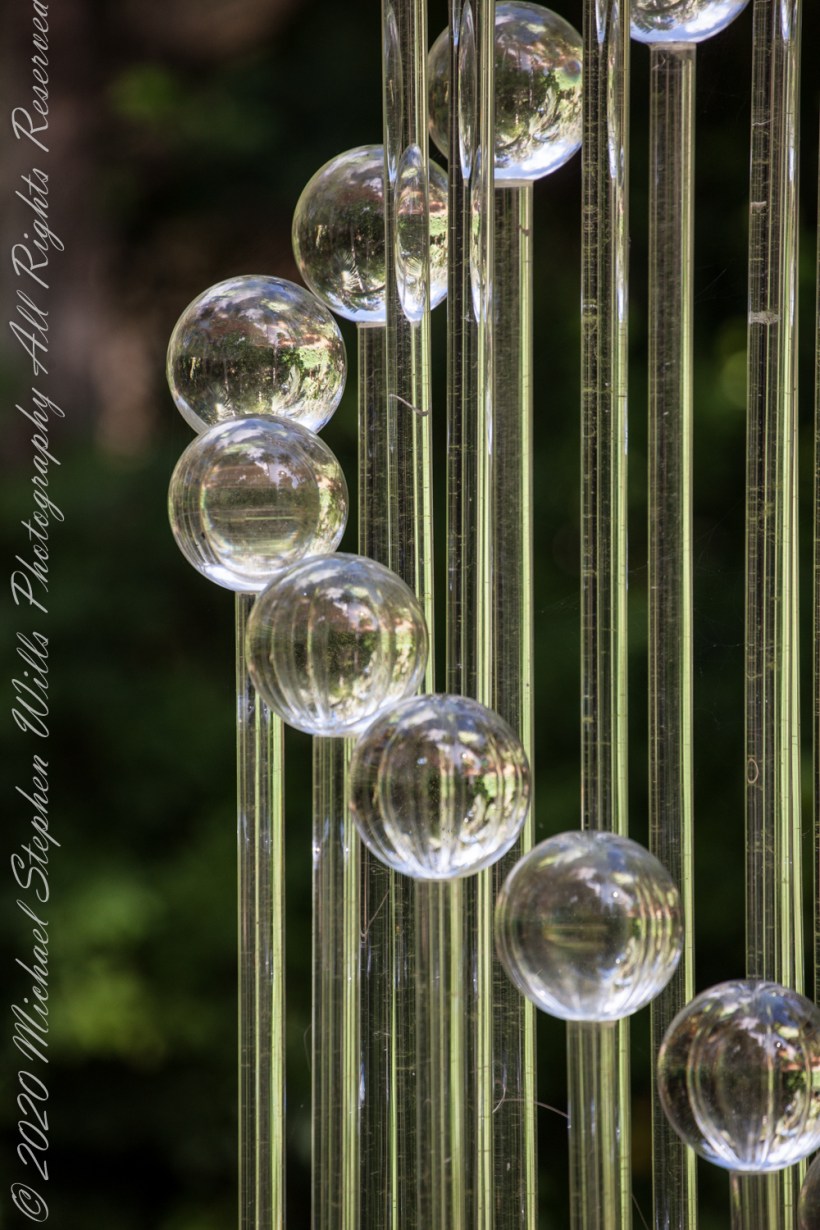
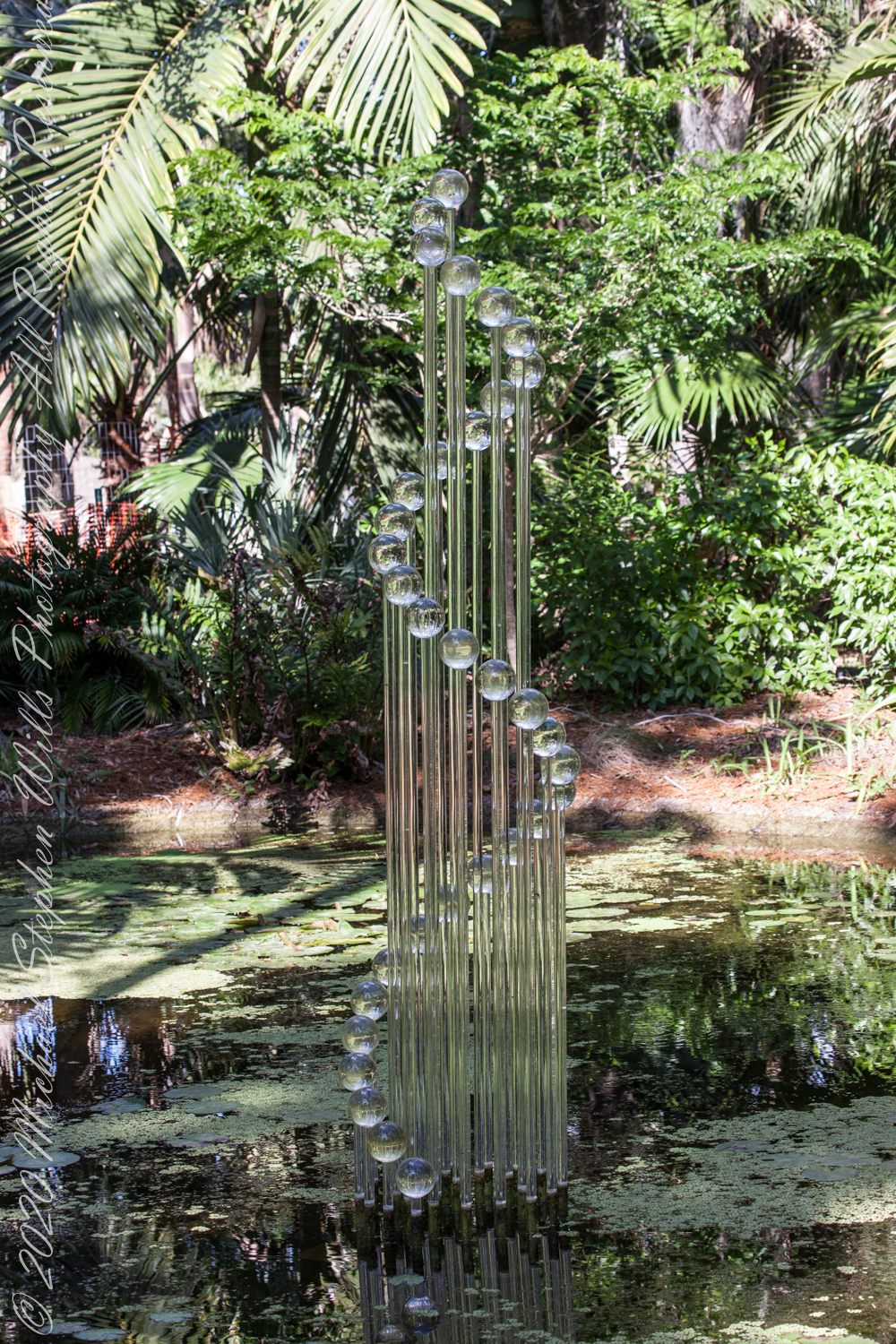
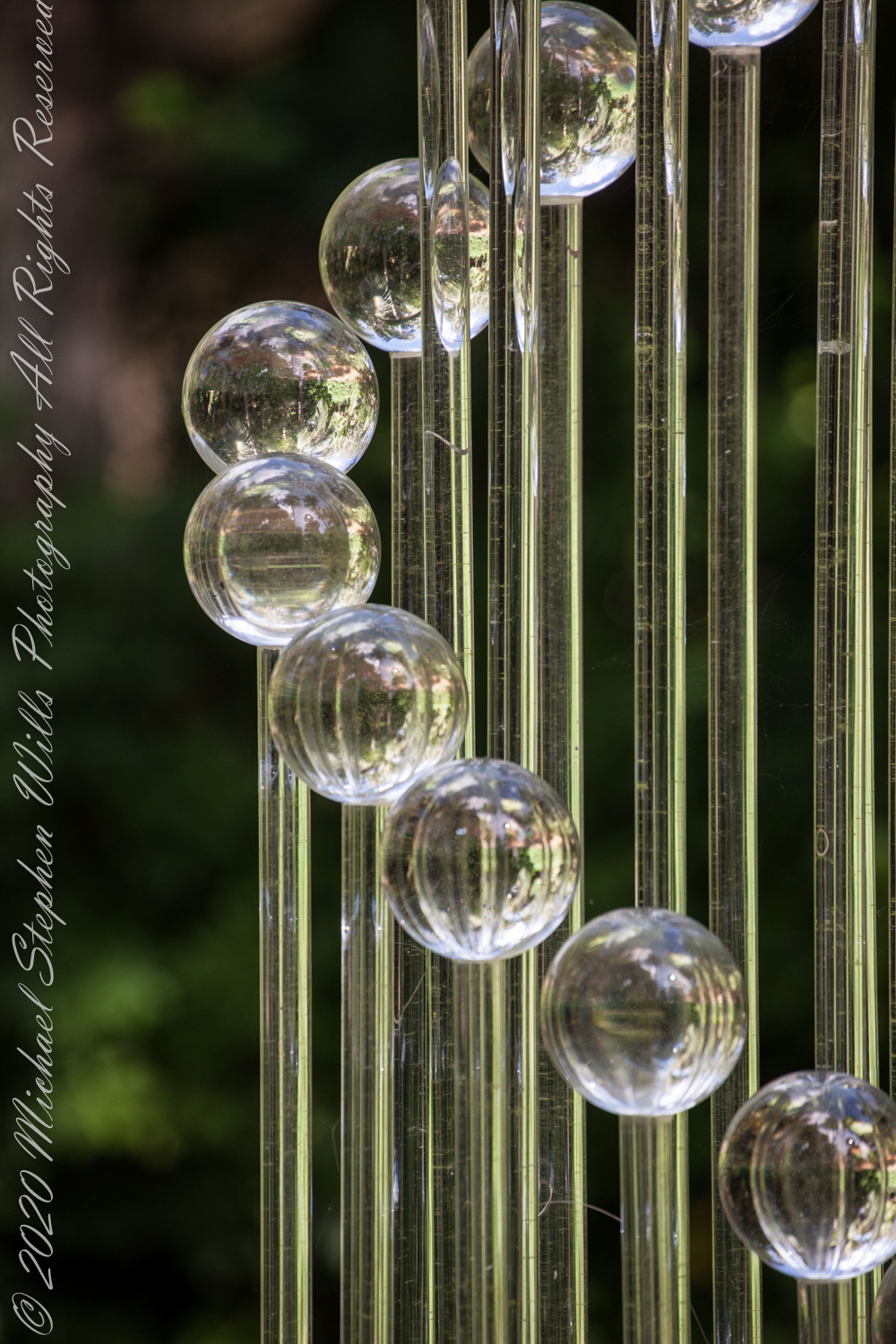
The air was crisp yet warmed by the steady rays of the January sun as I wandered through McKee Botanical Garden. The interplay of light and shadow danced across the palm fronds, creating an enchanting ambiance that whispered serenity. My pace slowed as I approached a reflective pond tucked away within this verdant sanctuary. There, shimmering like a fragment of the heavens brought to Earth, stood a glass sculpture titled Tower.
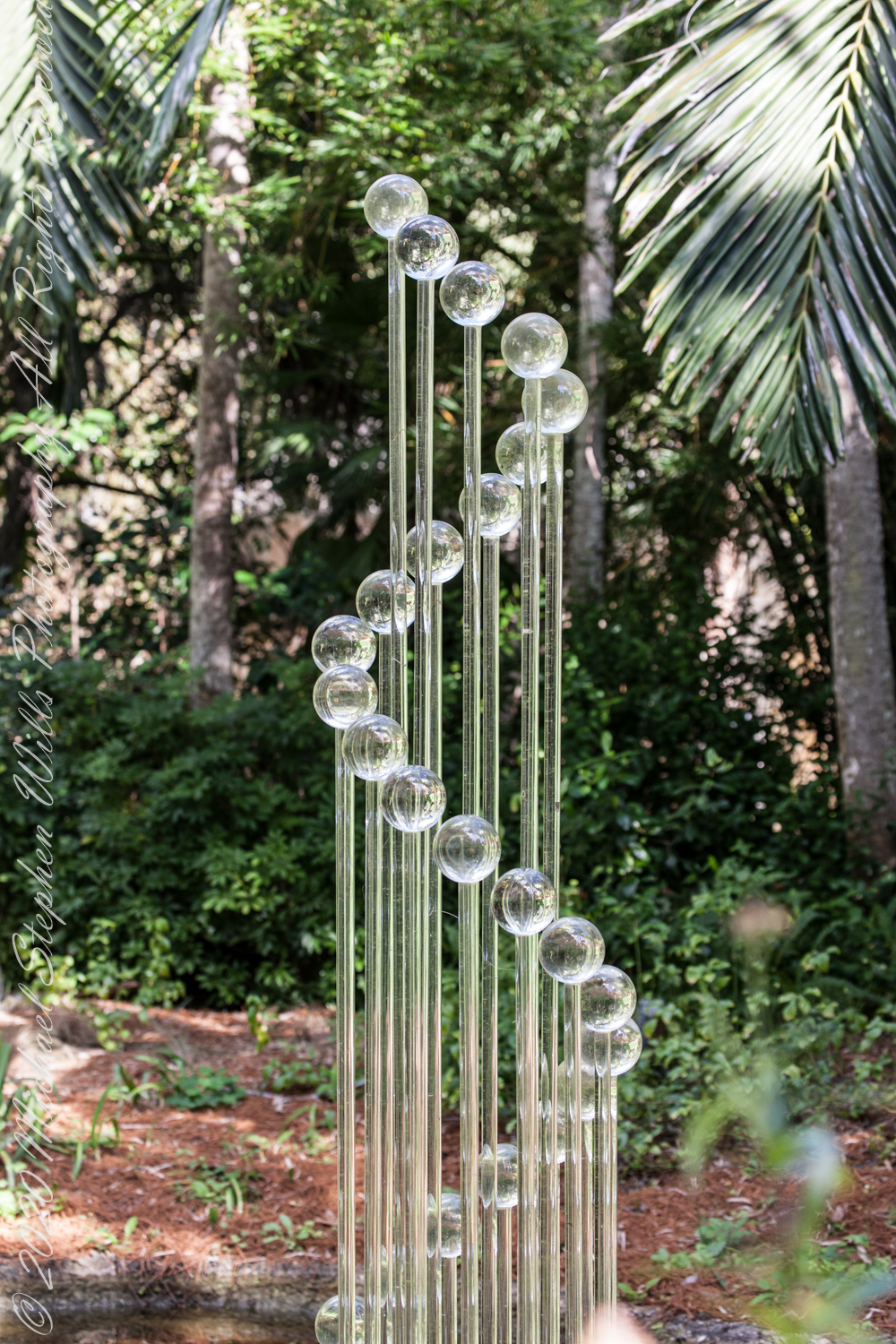
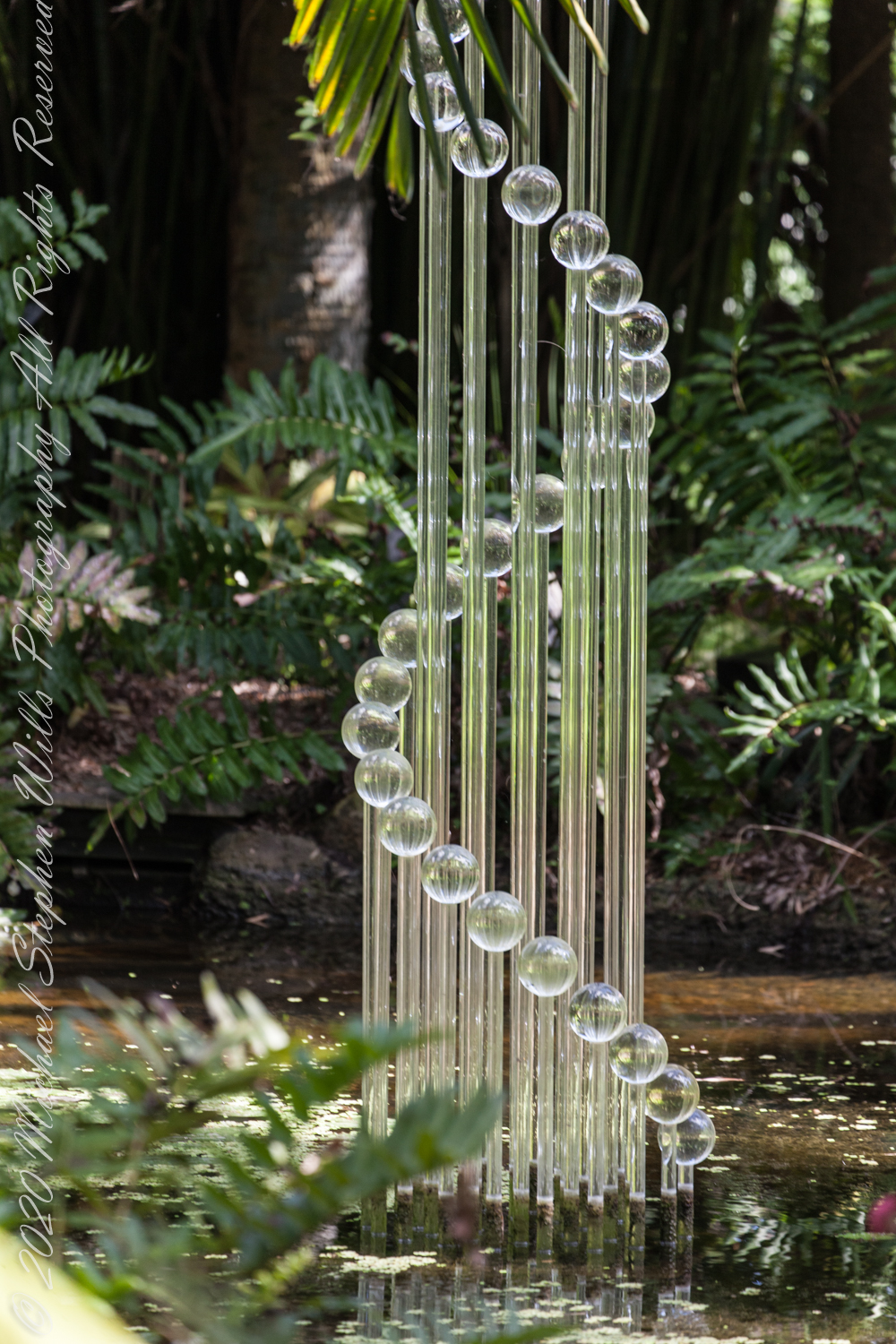
At first glance, the sculpture seemed ethereal, almost unreal—a spiral staircase to the skies crafted of crystalline spheres and slender rods. Its reflection on the water below doubled the dreamlike quality, as if the sculpture extended into an unseen realm. Upon closer inspection, I noticed the intricate craftsmanship of Hans Godo Fräbel, the sculptor whose genius birthed this luminous creation.
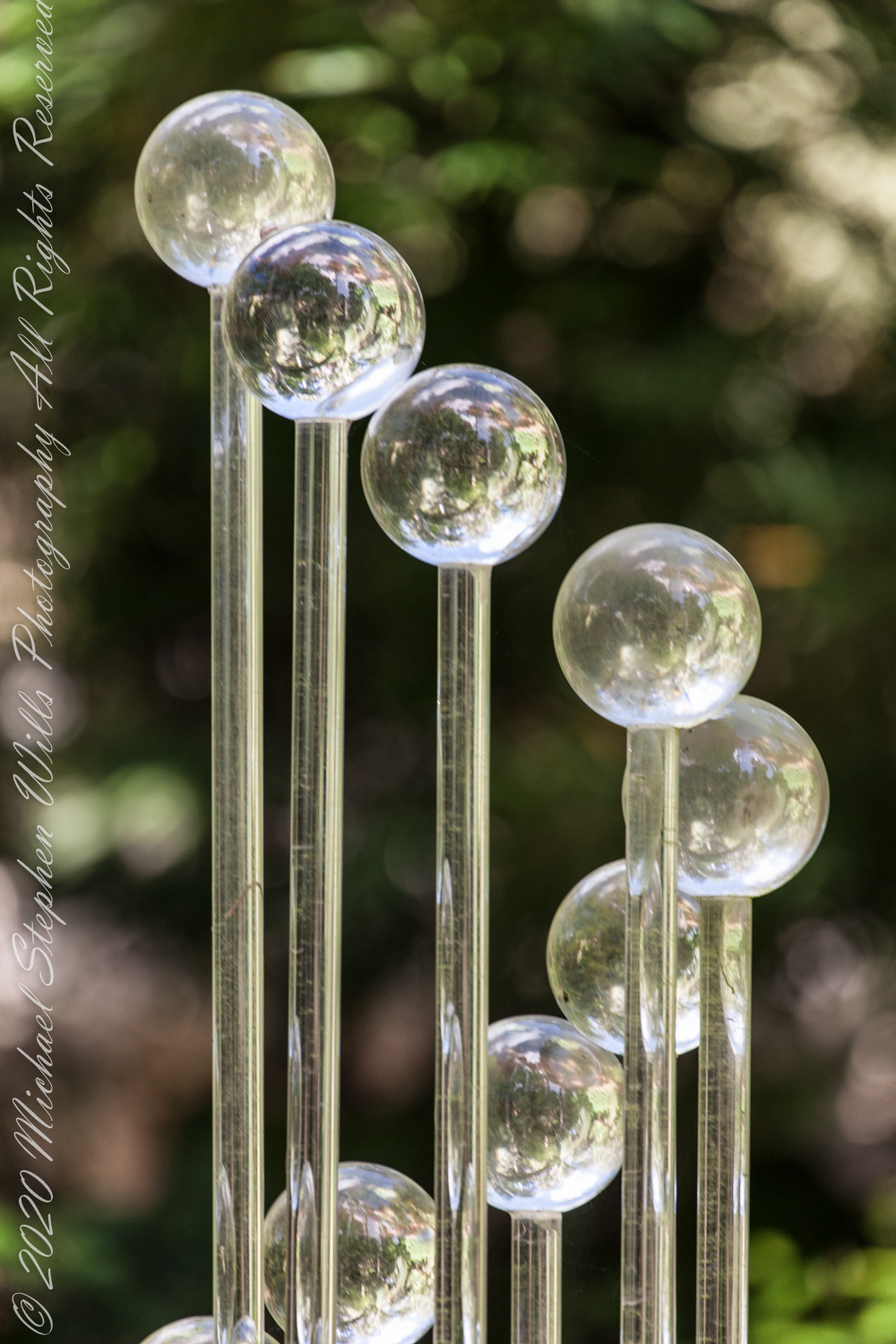
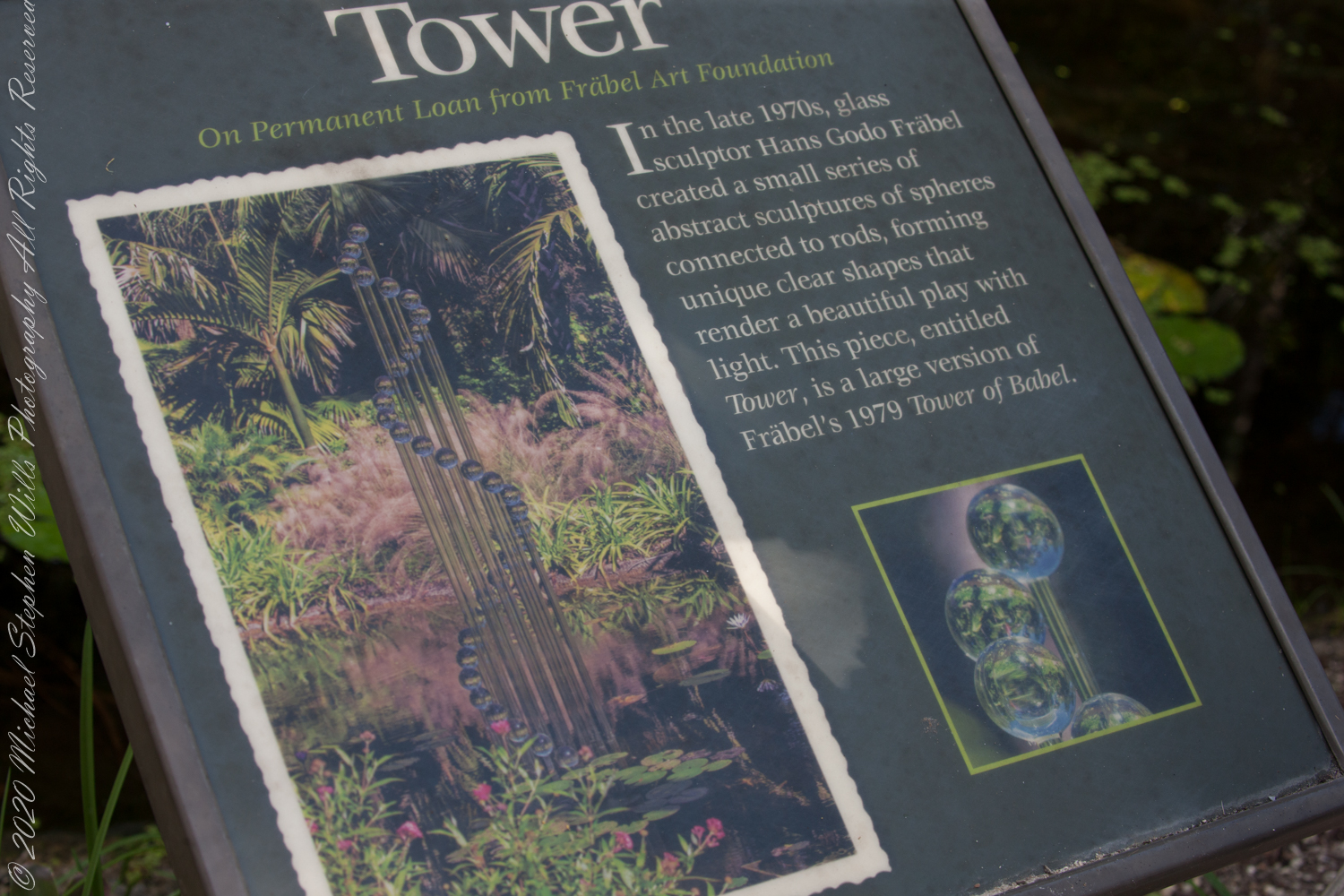
A nearby sign informed me that Tower is a larger version of Fräbel’s 1979 work Tower of Babel. It described how the sculpture’s glass rods and spheres were meticulously arranged to create abstract, clear shapes that play with light. Indeed, as the sun shifted overhead, the sculpture sparkled, refracting sunlight into tiny rainbows and revealing textures hidden within its transparent façade.
The setting amplified its majesty. Towering palm trees framed the sculpture, their dark green leaves offering a contrasting backdrop to the glass’s brilliance. Water lilies floated lazily on the pond’s surface, and an occasional ripple sent the reflection dancing. The combination of nature and art created an environment that felt both grounding and transcendent.
Standing before this masterpiece, I felt a profound connection to its narrative. The reference to the Tower of Babel resonated deeply. Here was a modern interpretation of an ancient story, one of human ambition and divine mystery, yet here it existed harmoniously in nature, not in defiance of it. The clear glass, fragile yet resilient, seemed to symbolize transparency and unity—a stark contrast to the biblical tale’s discord.
I lingered, watching how the sunlight flirted with the sculpture, how it cast prismatic shadows onto the surrounding foliage. Each sphere held reflections of the garden, tiny worlds encapsulated in glass, reminding me of the interconnectedness of all things. This moment, this meeting of human ingenuity and the natural world, felt timeless.
As I turned to leave, I glanced back one last time. The Tower stood resolute, a testament to creativity and a gentle reminder of the beauty that arises when humanity and nature coexist in harmony. It was an encounter that left me both inspired and at peace, grateful for the opportunity to witness such a sublime union of art and environment.
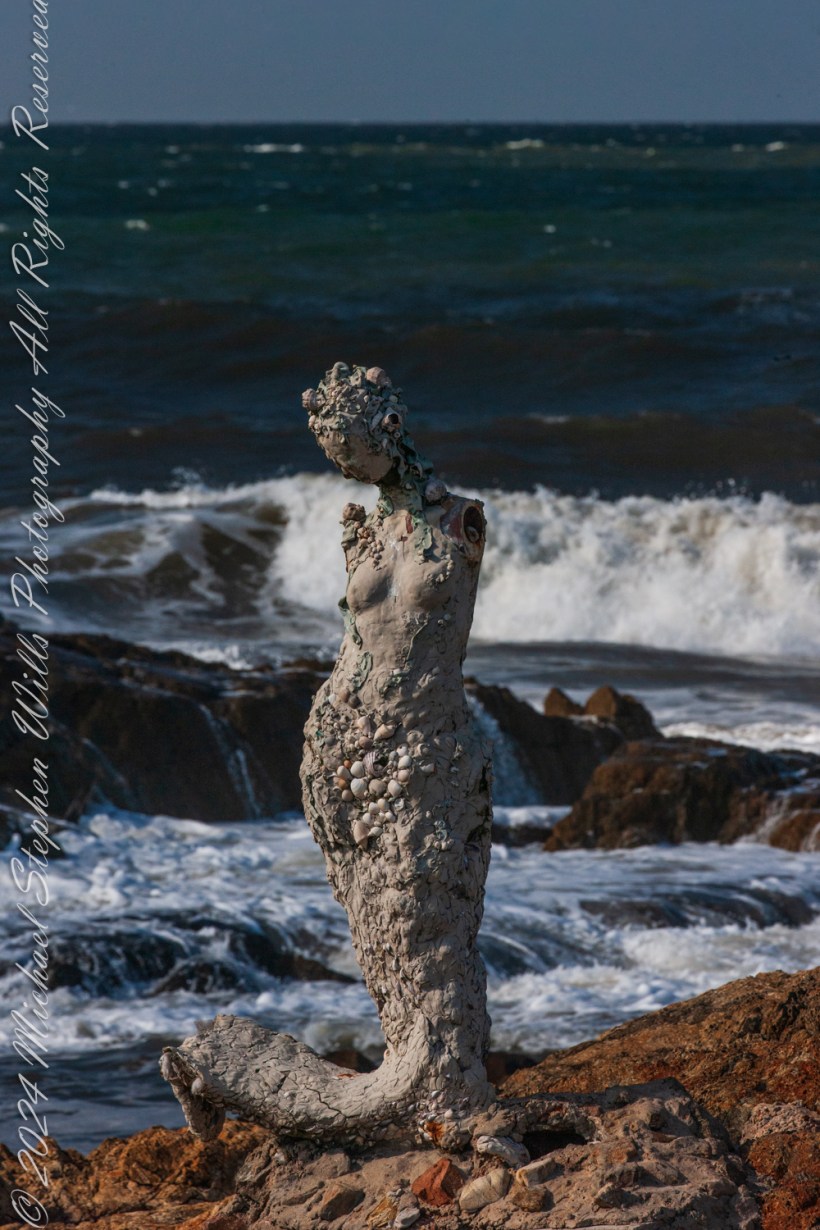
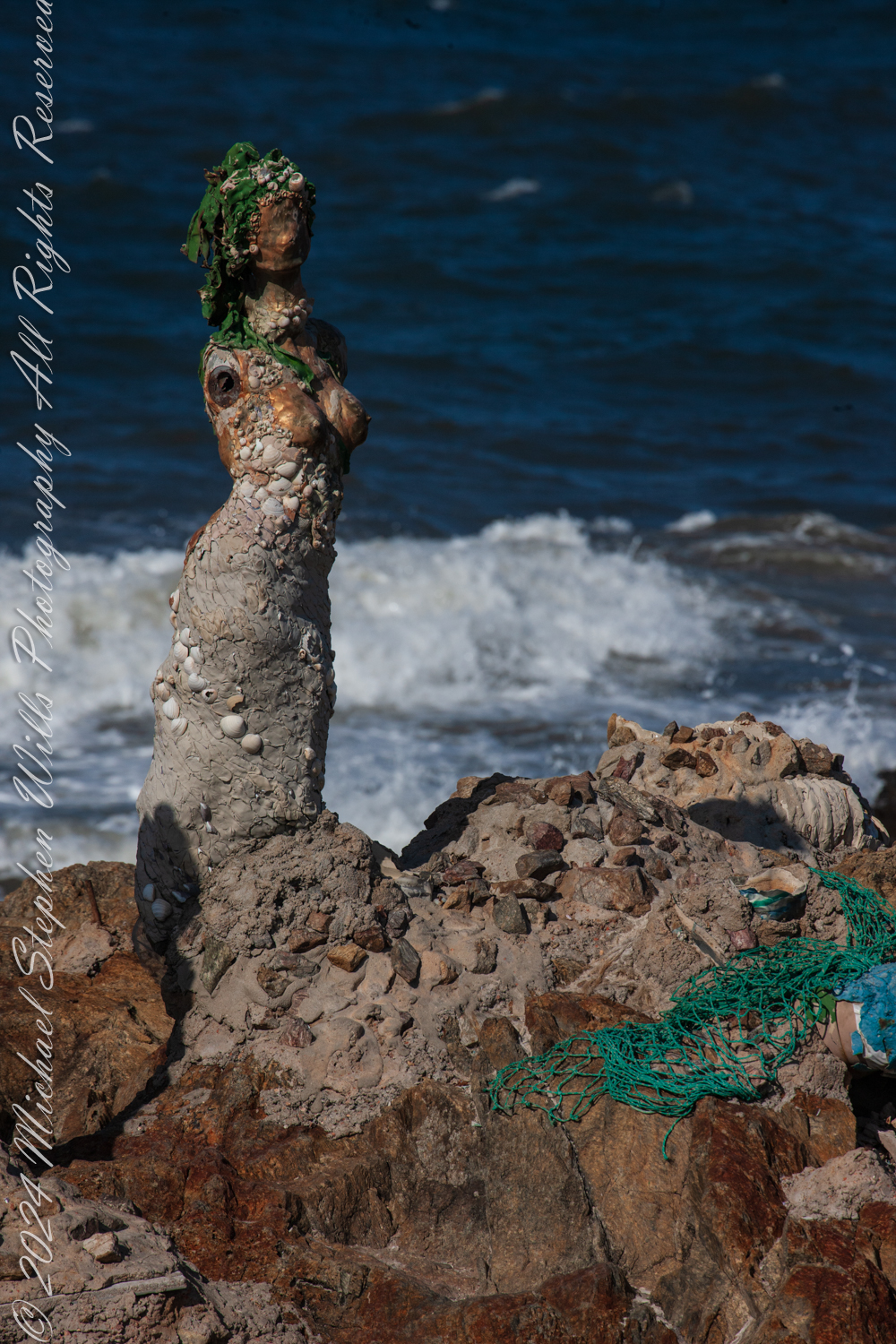
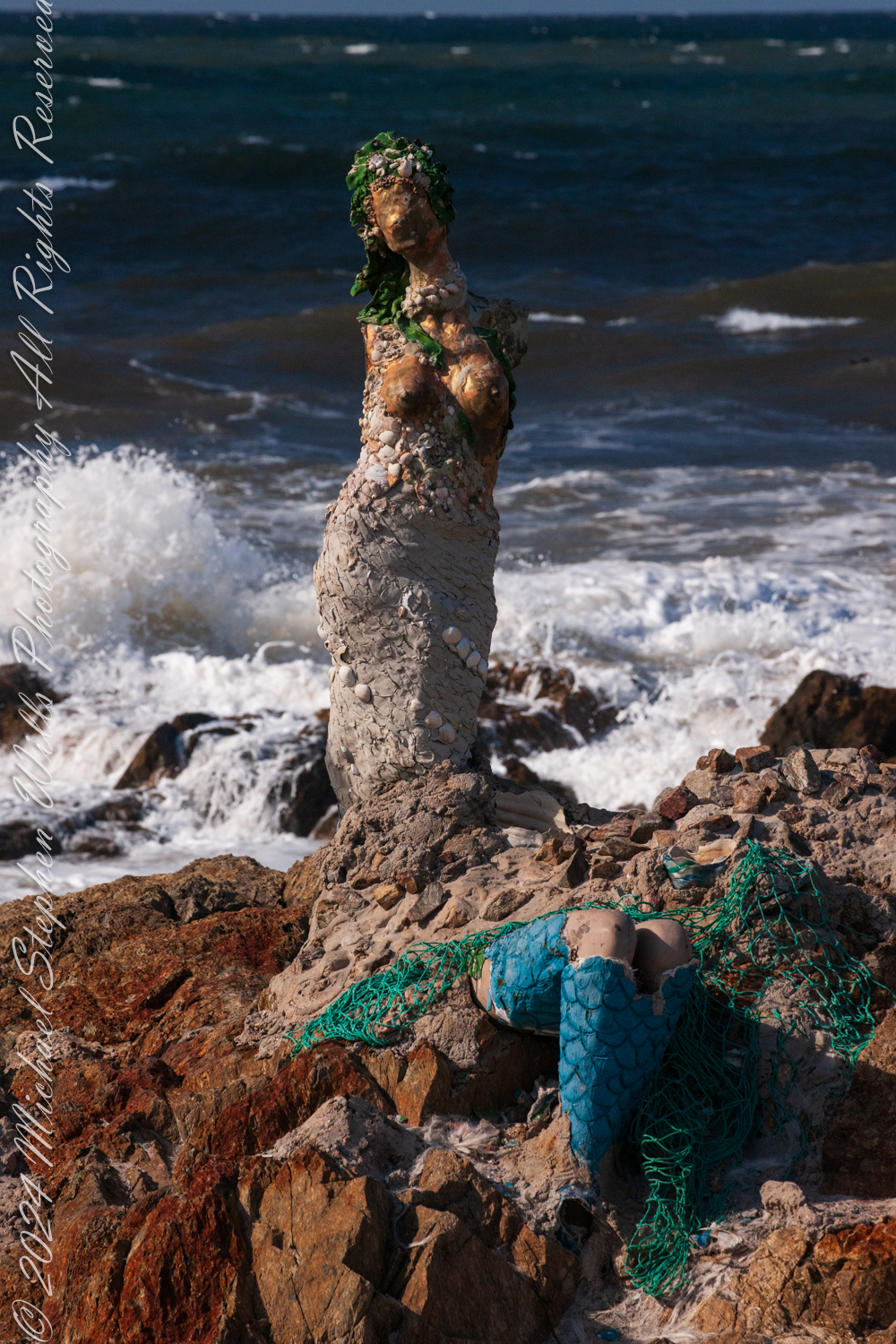
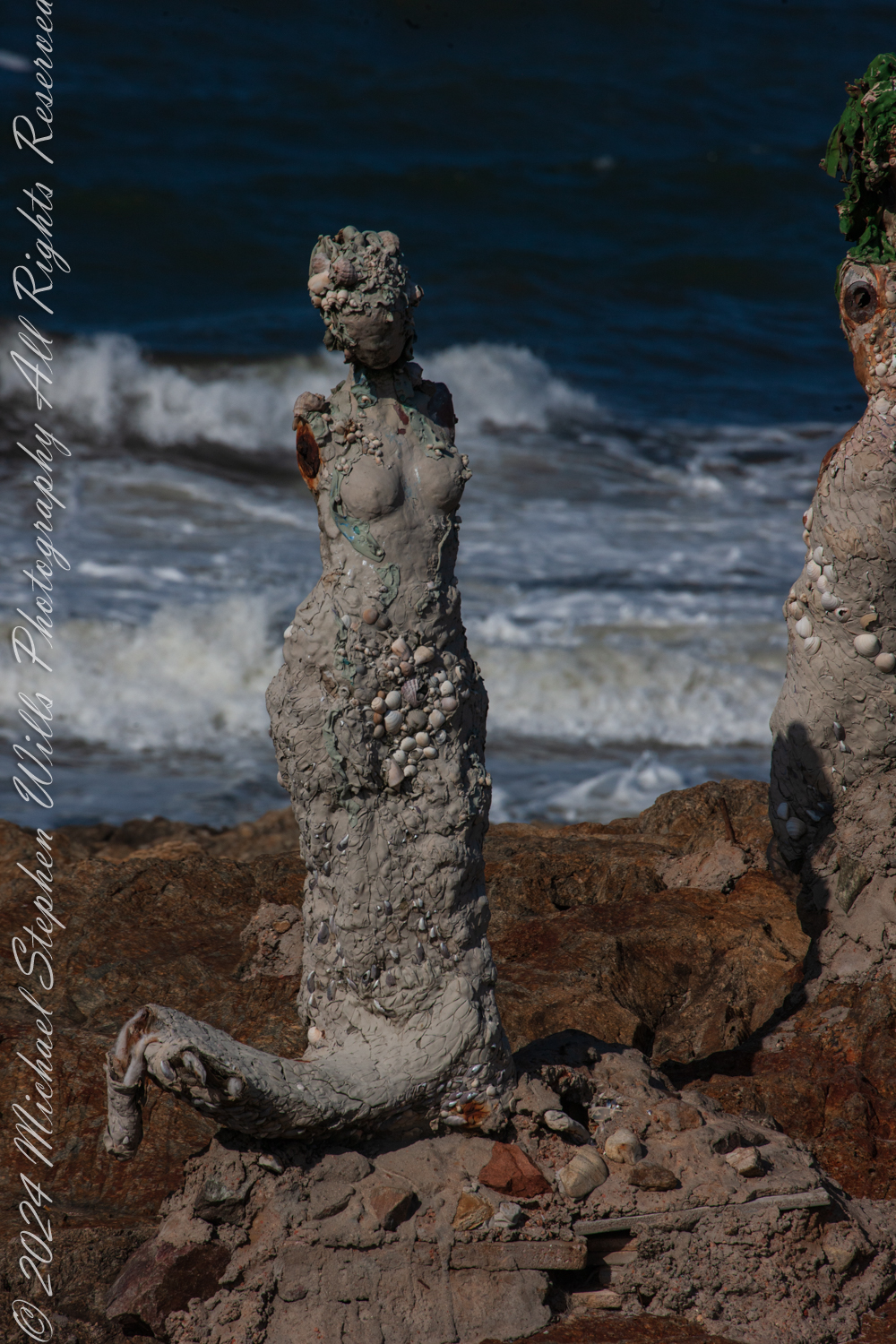
The wind carried the scent of the sea as we stood at Punta de las Salinas, the furthest tip of Punta del Este, Uruguay. This was a place of myth and mystery for us, where the Atlantic Ocean merged with the Río de la Plata, and where the rocks bore witness to the timeless interplay of water and stone. Here stood “El Canto de las Sirenas” (The Song of the Mermaids), an evocative art installation by Lily Perkins, first completed in 2012. The sculptures seemed perfectly at home here, their placement deeply intertwined with the mythology they evoked.
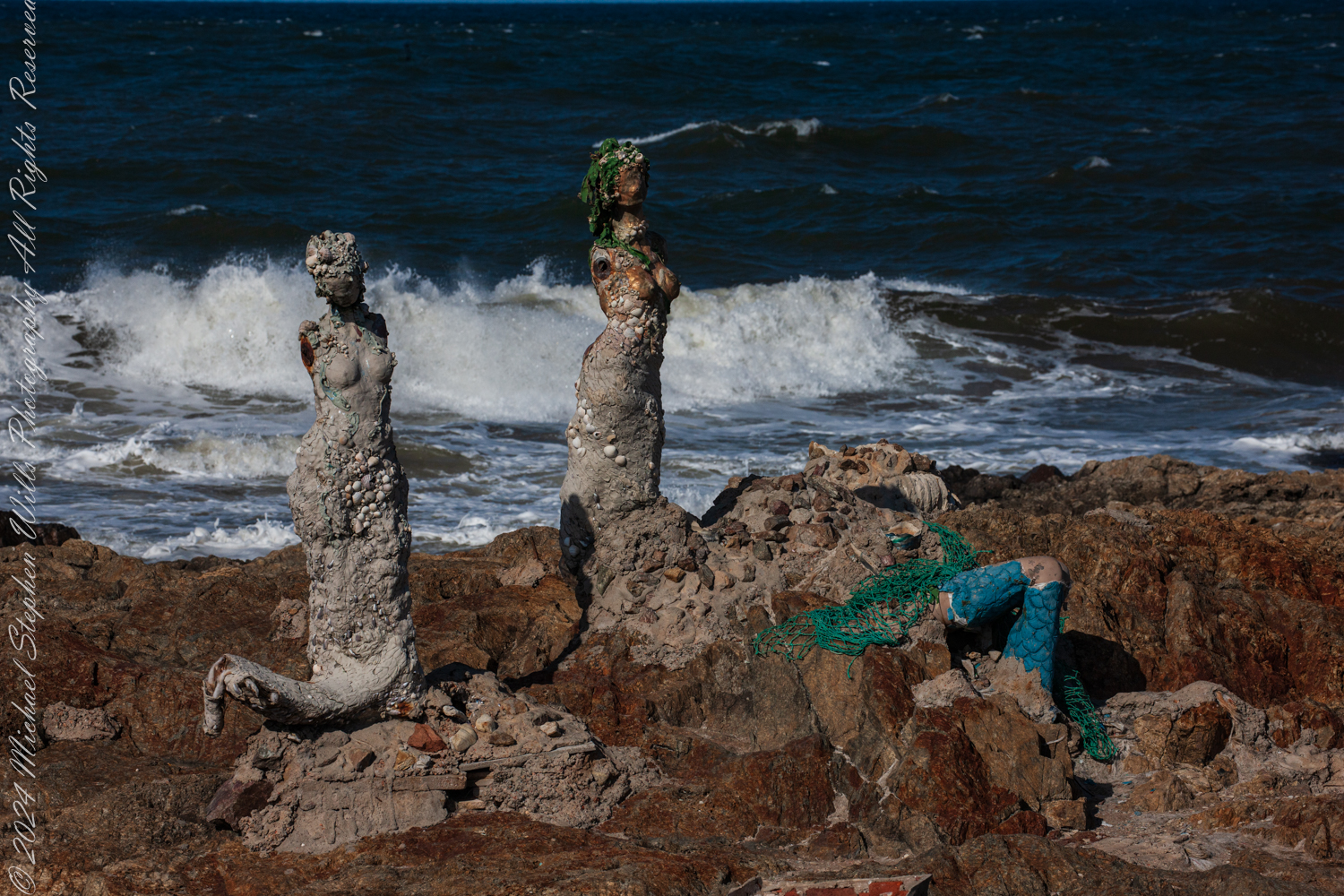
This is at Great Britain Square, Punta de las Salinas of Punta del Este. We are at the tip of the peninsula, the easternmost point of Uruguay. This is the art installation El Canto de las Sirenas” (The Song of the Mermaids) (2012) by the artist Lily Perkins. Punta del Este, Departamento de Maldonado, Uruguay
The sirens of ancient lore were said to dwell at perilous points where land met the untamed sea, luring sailors to their doom with haunting songs. These rocky outcrops, both a boundary and a threshold, have long held symbolic power as places where the natural world is at its most raw and elemental. Punta de las Salinas is such a place. Its jagged rocks and churning waves create an environment as beautiful as it is treacherous. It is easy to imagine mythical sirens choosing this very spot to weave their spellbinding melodies.
This is at Great Britain Square, Punta de las Salinas of Punta del Este. We are at the tip of the peninsula, the easternmost point of Uruguay. This is the art installation El Canto de las Sirenas” (The Song of the Mermaids) (2012) by the artist Lily Perkins. Punta del Este, Departamento de Maldonado, Uruguay
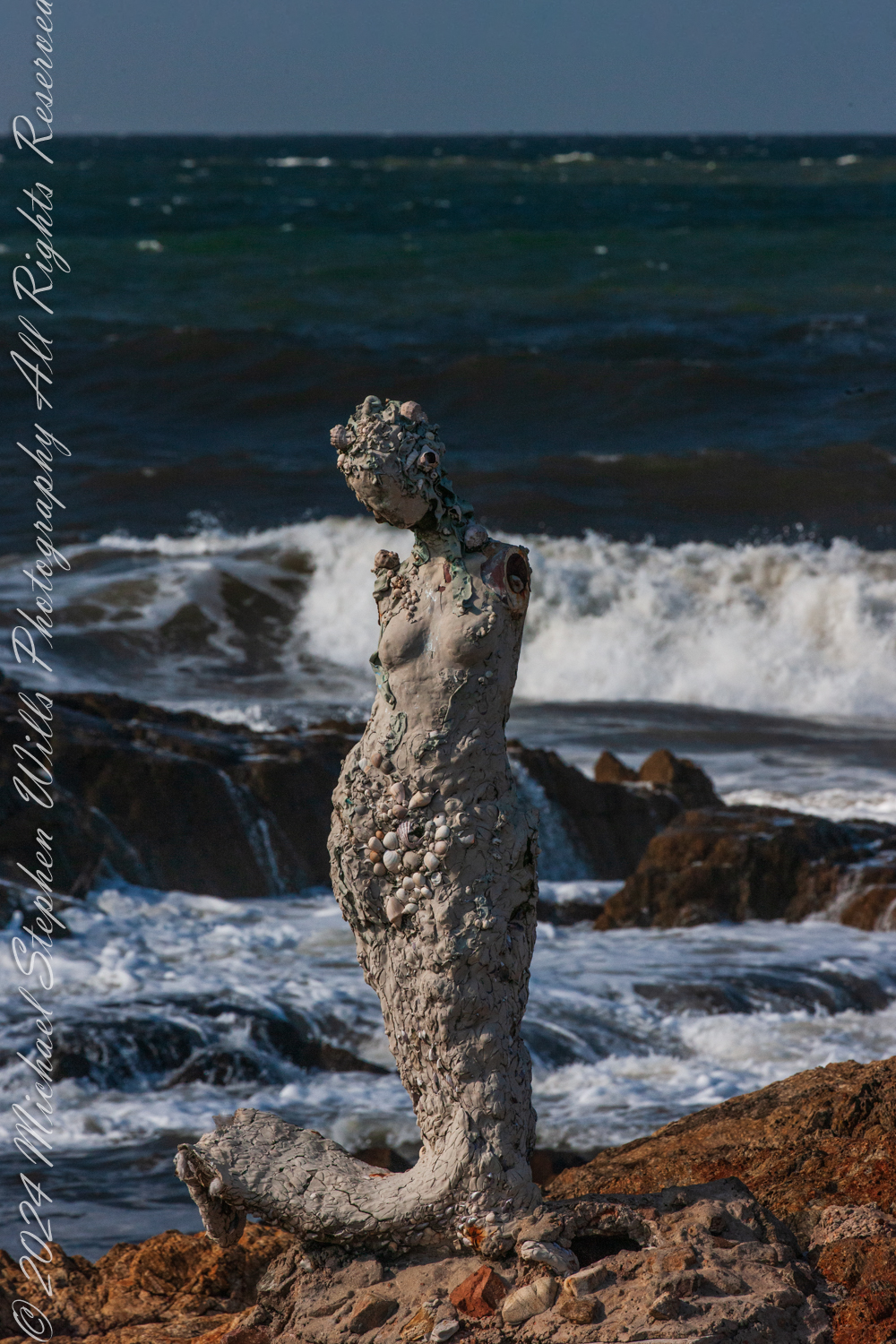
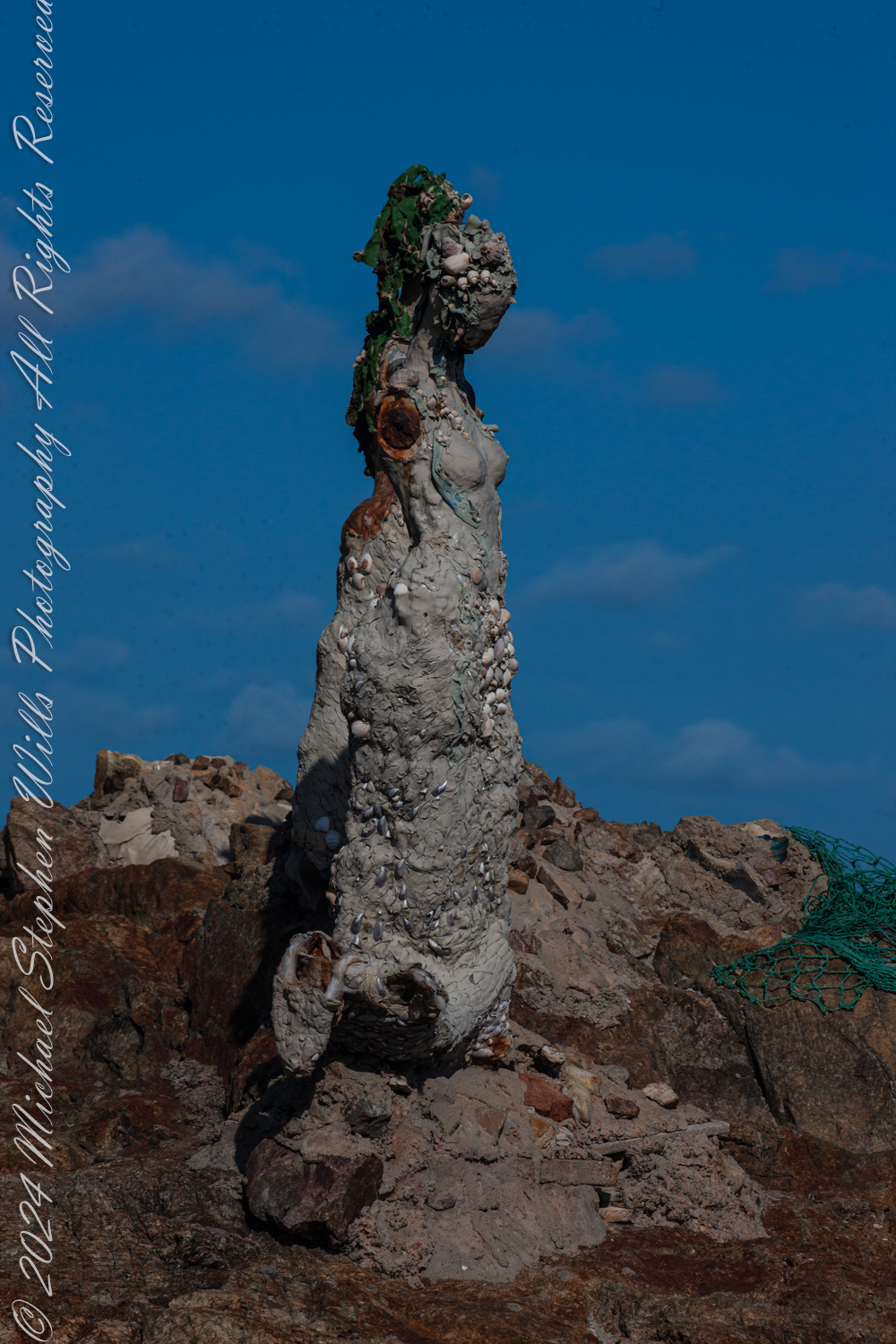
Lily Perkins’ installation captures this essence. The sculptures are not idealized depictions of mermaids; they are rugged and raw, encrusted with shells, stones, and marine debris. Their weathered forms mirror the harsh, untamed beauty of their surroundings. It is as if they have emerged from the ocean itself, born of the waves and the salt-laden air, to stand as sentinels at the edge of the world.
The central figure, with her face turned skyward, evokes the myth of the siren’s song—a melody so enchanting that it drove sailors to risk their lives against the rocks. Her posture suggests longing, perhaps for a connection beyond the horizon, or perhaps for the very mortals she is fated to ensnare. Nearby, a broken figure reclines against the rocks, her form partially encased in green netting and mosaic-like tiles. She seems more grounded, her siren’s call muted, as if weighed down by the realities of the modern world. The use of marine materials in her construction—a blend of natural and human-made debris—suggests an awareness of humanity’s impact on the seas.
The third figure, slightly apart, is the most enigmatic. Encrusted with barnacles and weathered by the elements, she seems lost in thought. Her gaze is directed not toward the sea but toward the land, as if contemplating her place at this meeting of worlds. In mythology, sirens were liminal creatures, existing between realms—the sea and the shore, the mortal and the divine. This figure embodies that in-between state, rooted in the rocks yet shaped by the sea.
The placement of these sculptures at Punta de las Salinas is no accident. This headland is the easternmost point of Uruguay, a natural boundary and a crossroads where two vast bodies of water meet. For centuries, sailors navigated these waters, their journeys fraught with danger. The rocks here are unforgiving, and the waves crash with relentless power. To stand at this point is to feel the raw energy of the ocean and to understand why myths of sirens arose in such places. The sirens symbolize both allure and peril, a reminder of the ocean’s capacity to inspire and to destroy.
As I walked among the sculptures, the mythology seemed to come alive. The sound of the waves crashing against the rocks could easily be imagined as the sirens’ song—a hypnotic rhythm that draws you in and holds you spellbound. The figures, though silent, seemed to hum with an energy that echoed the sea’s eternal motion.
I feld these sculptures were not merely placed at Punta de las Salinas; but had emerged from it, their forms shaped by the same forces that shaped the rocks beneath our feet. The shells and stones embedded in their surfaces tied them physically to the sea, while their mythical resonance tied them spiritually to the place.
The mythology of the sirens speaks to the duality of the sea—its beauty and its danger, its capacity to give and to take away. Standing at Punta de las Salinas, surrounded by Perkins’ sculptures, I felt that duality in a profound way. The ocean stretched endlessly before us, a vast, unknowable expanse, while behind us lay the solid ground of the peninsula—a place of safety, but also a place that ended here, at this edge.
Lily Perkins sculptures are restored…..
As we left, the figures seemed to watch us go, their silent song lingering in my mind. The sirens of Punta del Este are more than art; they are a dialogue between myth and reality, between the natural world and the human imagination. In their weathered beauty, they remind us of the stories the sea has always told, and of the enduring power of those who give those stories form.
Enter your email to receive notification of future postings. I will not sell or share your email address.
Copyright 2025 All Rights Reserved Michael Stephen Wills
San Xavier del Bac in the Sonoran desert embodies a fusion of indigenous and Spanish symbolism, showcasing devotion through art and imagery that evokes faith, beauty, and spiritual connection.
In the Sonoran Desert near Tucson, Arizona, San Xavier del Bac rises like a vision out of time. Within its adobe walls and domed ceilings lie layers of symbolism—an indigenous inheritance and Spanish colonial fervor merged into a singular living devotion. The photographs presented here, saturated with morning light, guide us through a meditative journey into this mission’s spiritual and aesthetic soul.
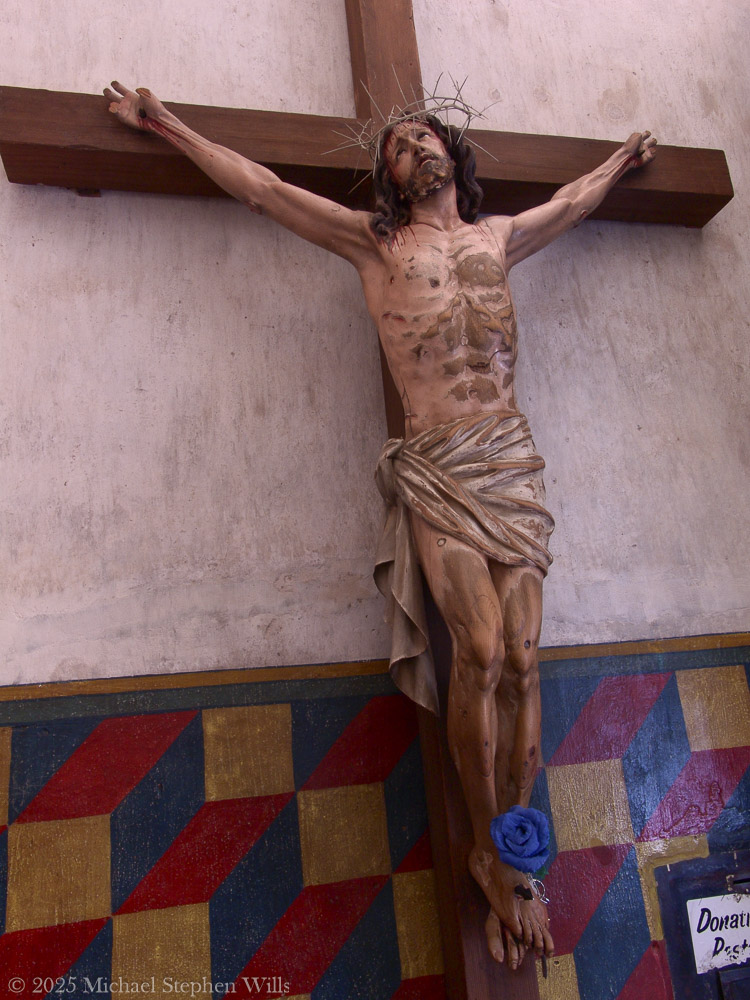
The crucifix dominates the first image—the depiction of Christ crucified, emaciated, bruised, crowned with thorns. His suffering is not abstract but visceral, carved in every wound and strained muscle. This figure of Christ, so brutally human, is draped in a tattered loincloth, a humble covering amid divine sacrifice. At his feet rests an offering: a blue artificial flower, incongruent in its brightness yet perfectly placed, a modern votive that expresses both reverence and continuity. It reminds us that humble devotion endures.
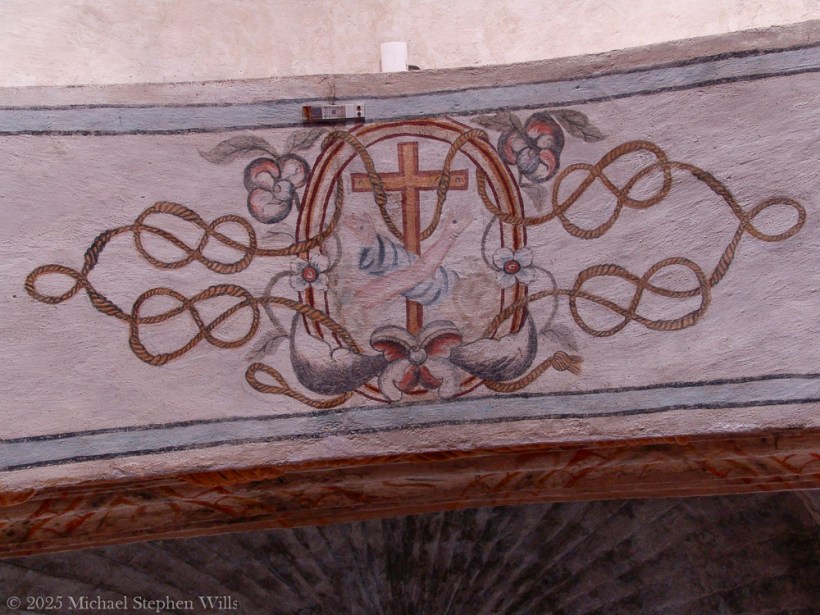
The fresco, with its cross flanked by stylized doves and roses, extends the Passion’s symbolism into sacred geometry. Doves—universal emblems of peace and the Holy Spirit—face one another in symmetrical grace, drawing the eye into the cross they flank. The single length of curling, intertwined golden ropes bind all elements in unity, perhaps reflecting divine infinity. The floral elements speak to rebirth and resurrection, a soft counterpoint to the harshness of the Crucifixion. Here, pain and peace coexist in a visual hymn.
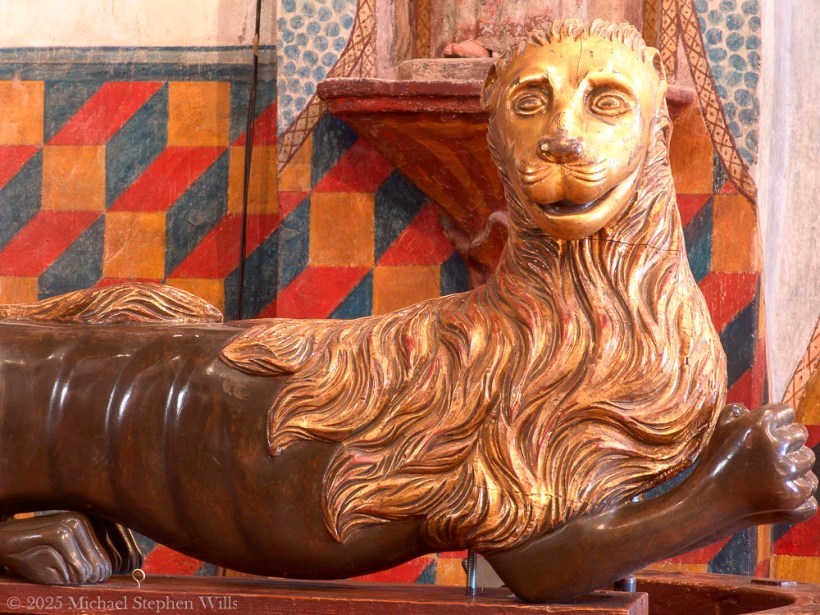
The lion sculpture, oddly cheerful in its golden face, seems at first a puzzle. Yet within Christian iconography, the lion often represents Saint Mark, the Evangelist, or the power and vigilance of God. This lion, rendered with stylized curls and a strong, reclining pose, guards the sanctuary. Its gilded mane mirrors the opulence of heaven, even in this humble desert mission. The lion’s curious gaze invites us to move past fear, toward the mysteries within.
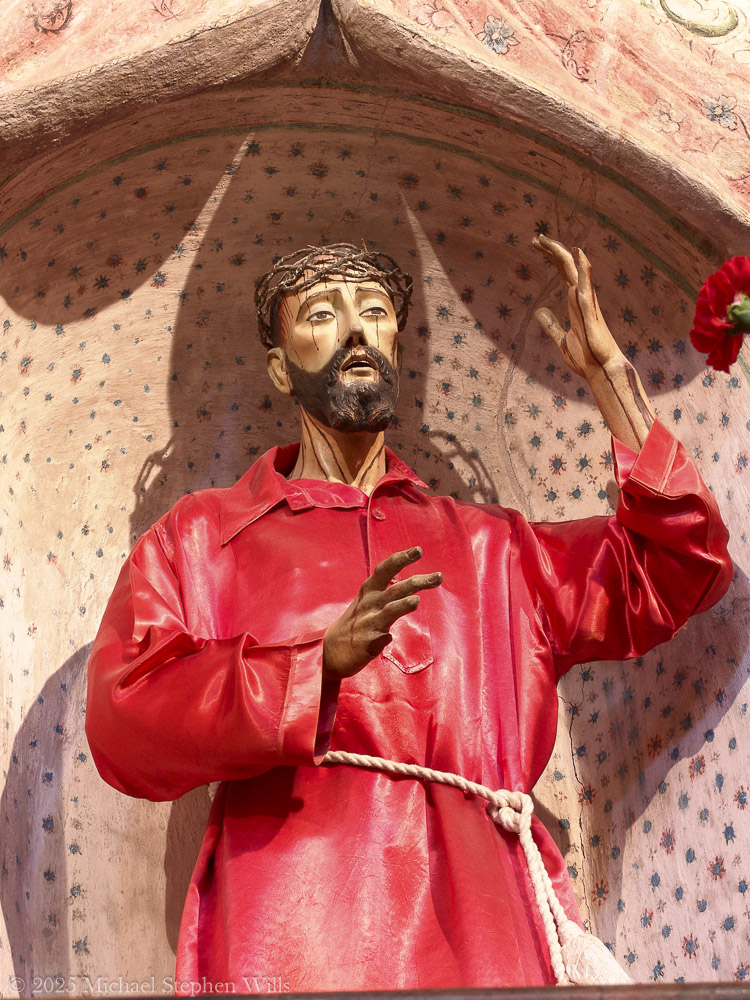
We then meet a robed figure in red—another portrayal of Christ, this time during the Passion, perhaps as the Ecce Homo (“Behold the Man”). His upraised hands and expressive face embody pathos and divine forbearance. The red robe evokes both martyrdom and kingship. He does not plead; he offers. The backdrop is simple but speckled with blue floral motifs, creating a visual bridge to the Virgin’s image nearby.
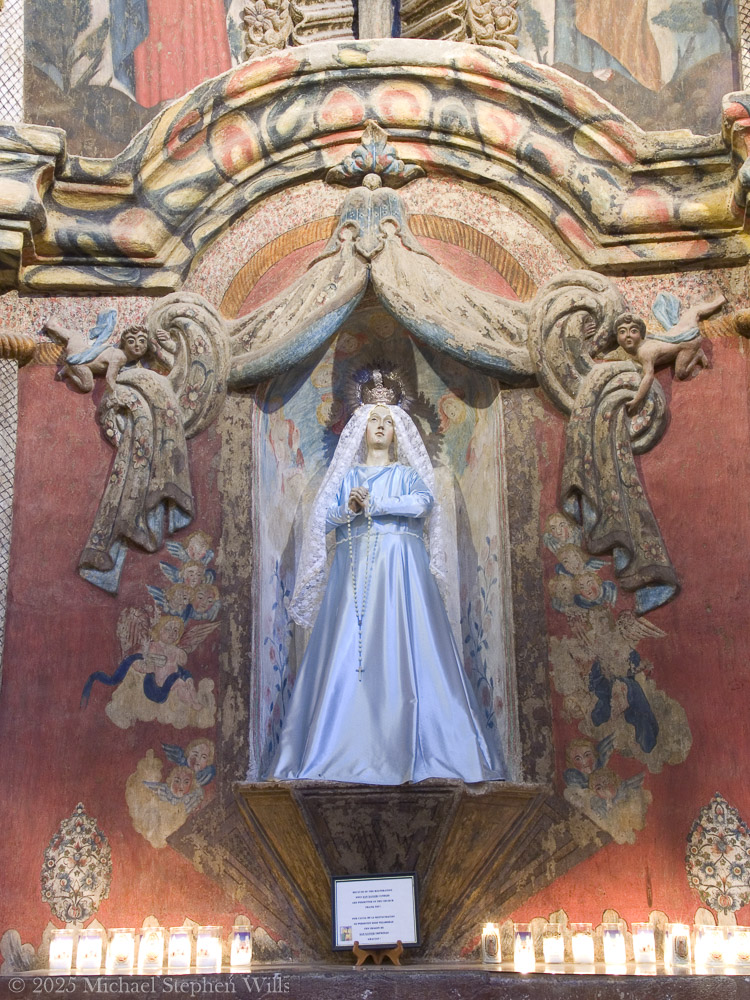
The Virgin Mary appears in blue and white—colors of purity, serenity, and devotion. She stands among votive candles and gazes gently ahead, hands joined in prayer. Her dress flows around her, anchored by a rosary that loops downward like an anchor to the earth. Angels and cherubs flank her in painted stucco, echoing heaven’s embrace. This is not the triumphal Mary of high cathedrals but a deeply human one, a mother, accessible and protective. The candles flickering below affirm that faith is alive here, not simply preserved.
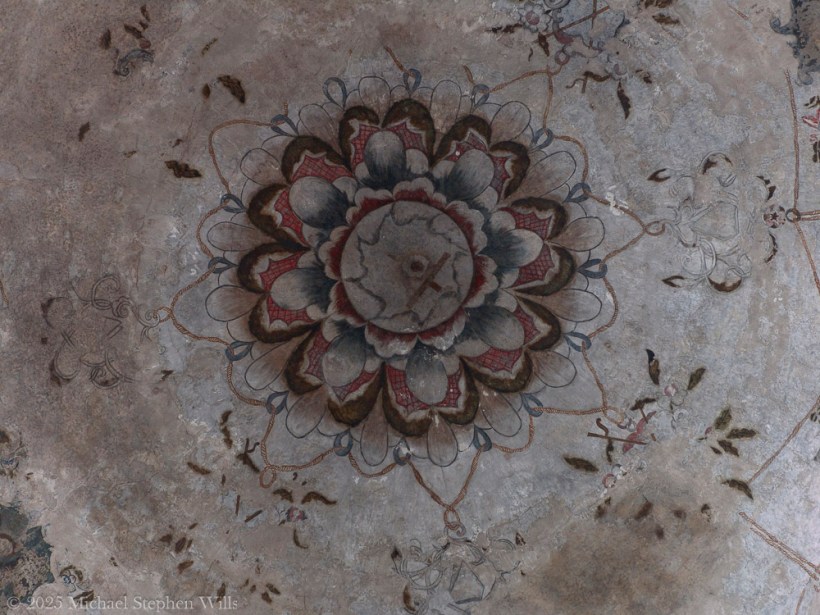
A ceiling medallion next draws us into a more abstract vision. A floral rosette centers on the cross and tools of Christ’s Passion—the nails, spear, and ladder arranged in contemplative symmetry. These instruments of torture are enclosed in beauty, as if the heavens themselves have sanctified the suffering. It is a paradox of faith, this transformation of pain into purpose, death into eternal life.
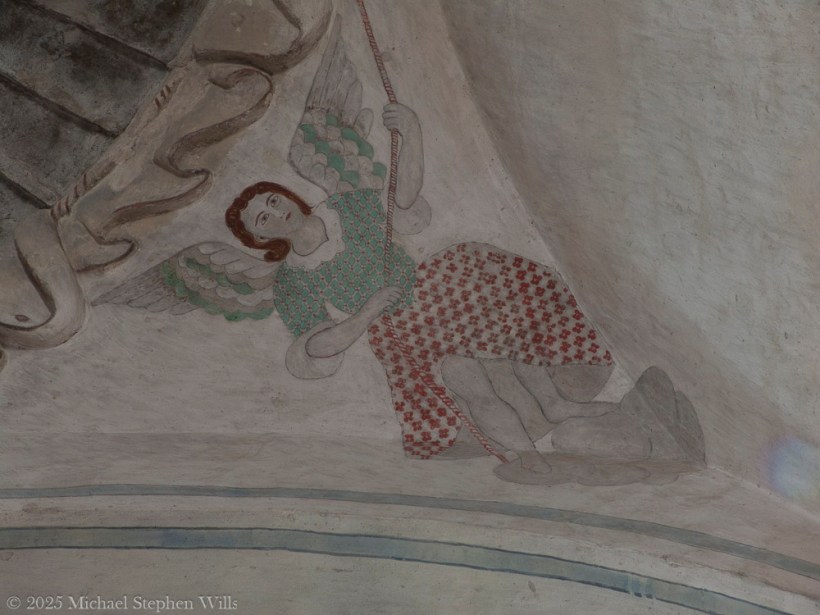
And in the arch’s corner, an angel descends—painted simply, yet with care. The figure pulls at a rope, perhaps to ring a bell or lift a curtain, a symbolic act of revelation or invitation. With wings green and soft, a skirt patterned in red flowers, suggesting femininity, grounding the divine in local textile tradition. The angel bridges the earthly with the divine, echoing the mission’s purpose: to guide and accompany.
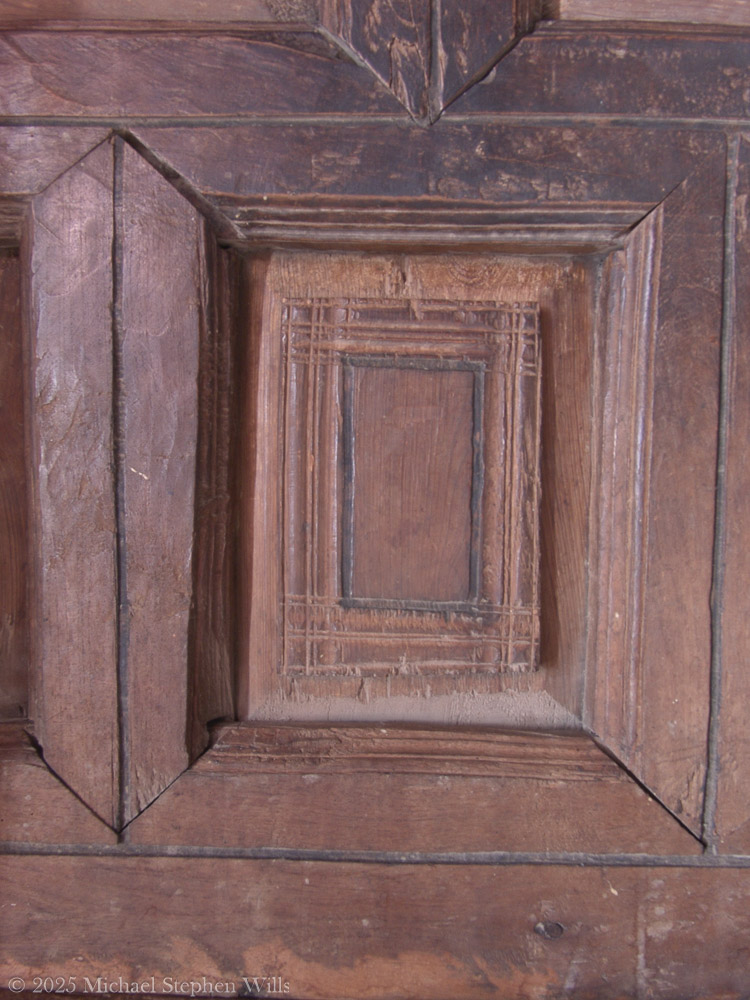
Finally, a carved wood panel—plain, aged, and sacred in its wear. The texture of centuries rests in its grain, the indentations of faithful hands passing by. This is the tactile memory of San Xavier: not only what is seen, but what has been touched, prayed over, believed.
Taken together, these images form a tapestry of devotion, colonial artistry, indigenous fusion, and enduring reverence. San Xavier del Bac is a place where symbols still speak, where color and form do more than please the eye—they lift the spirit. In this space, belief is remembered to be continually reborn.
Enter your email to receive notification of future postings. I will not sell or share your email address.
Copyright 2025 All Rights Reserved Michael Stephen Wills





 Michael Stephen Wills Photography