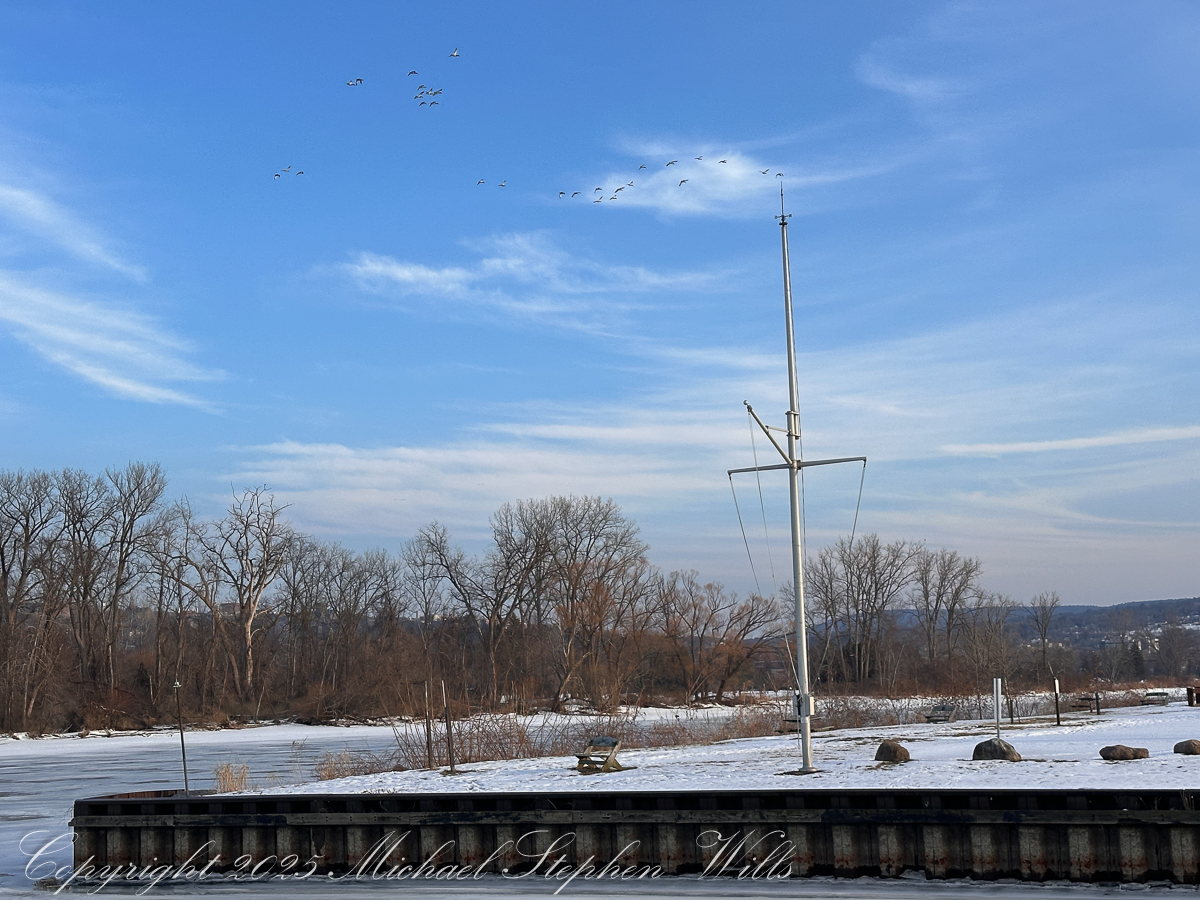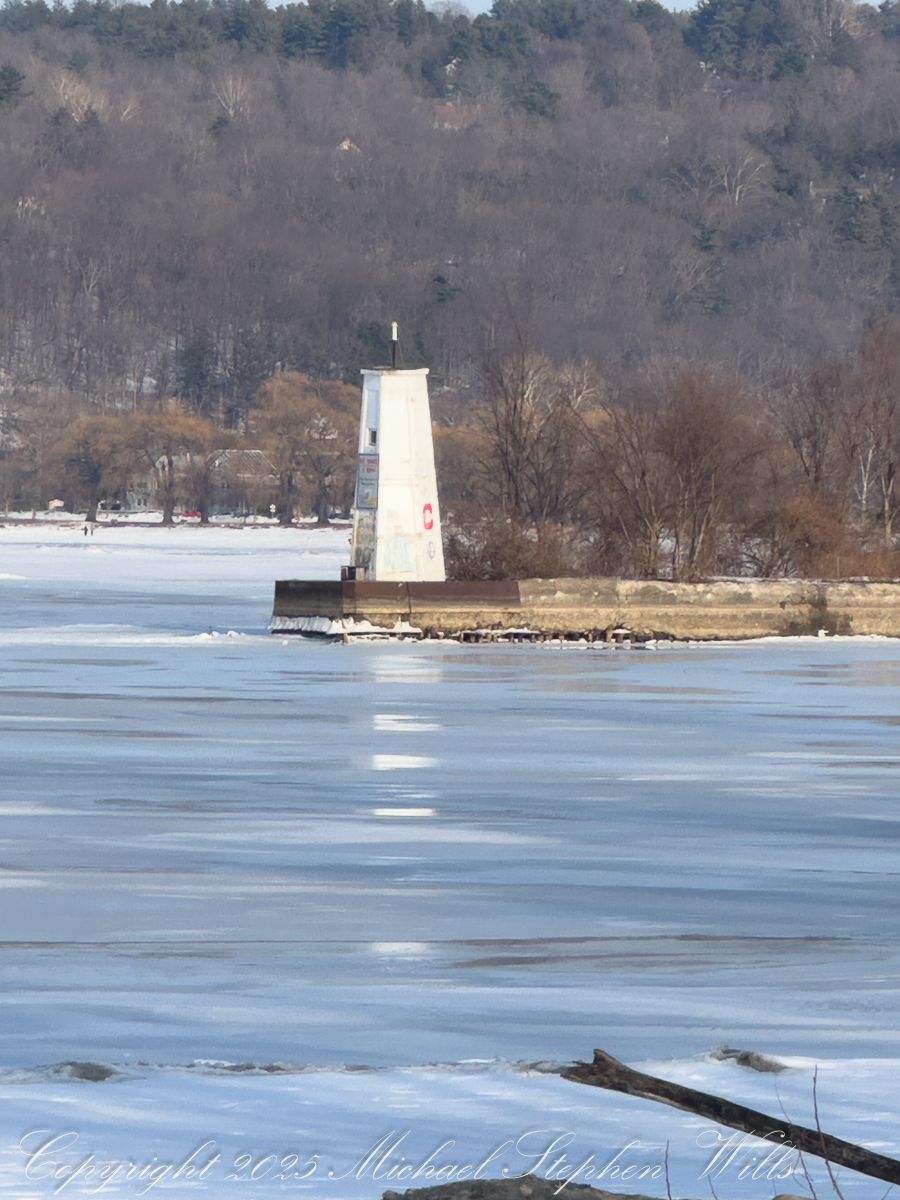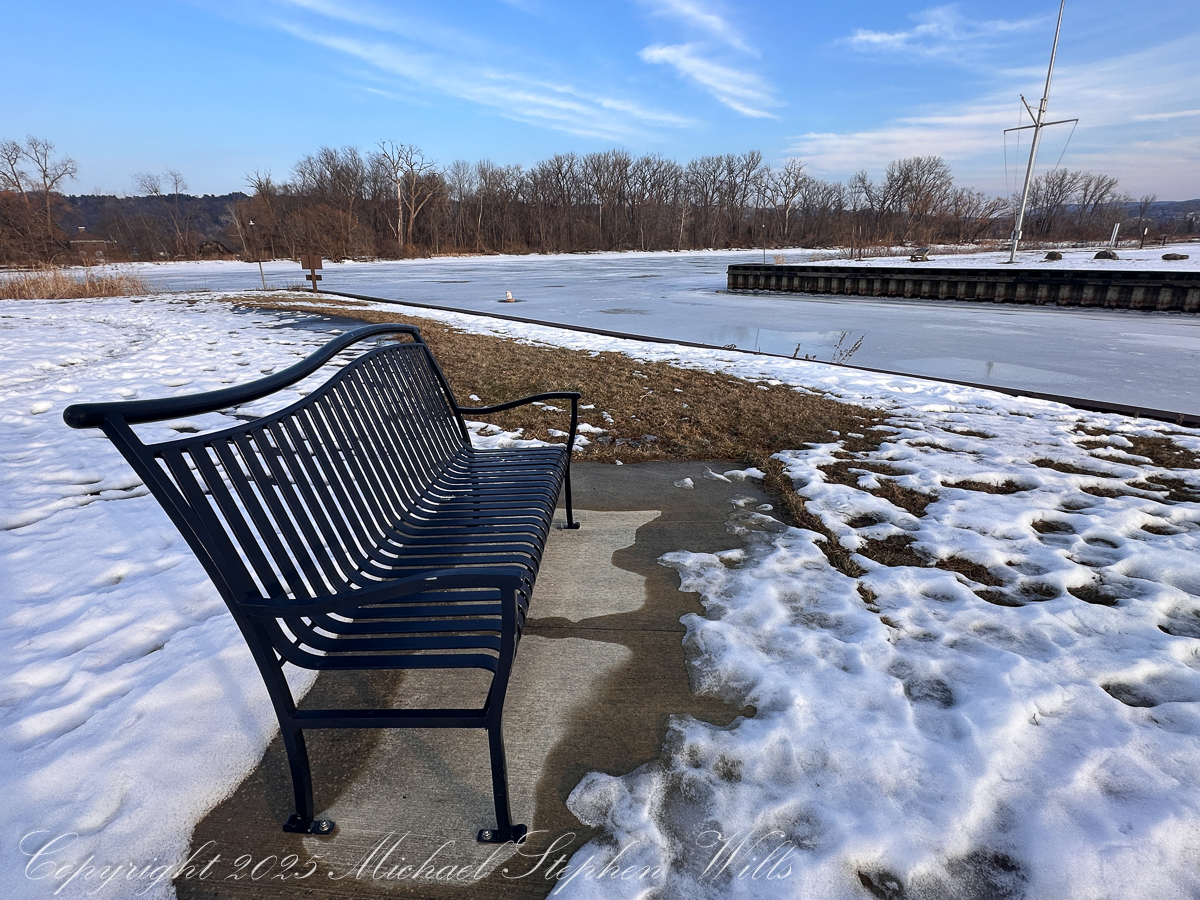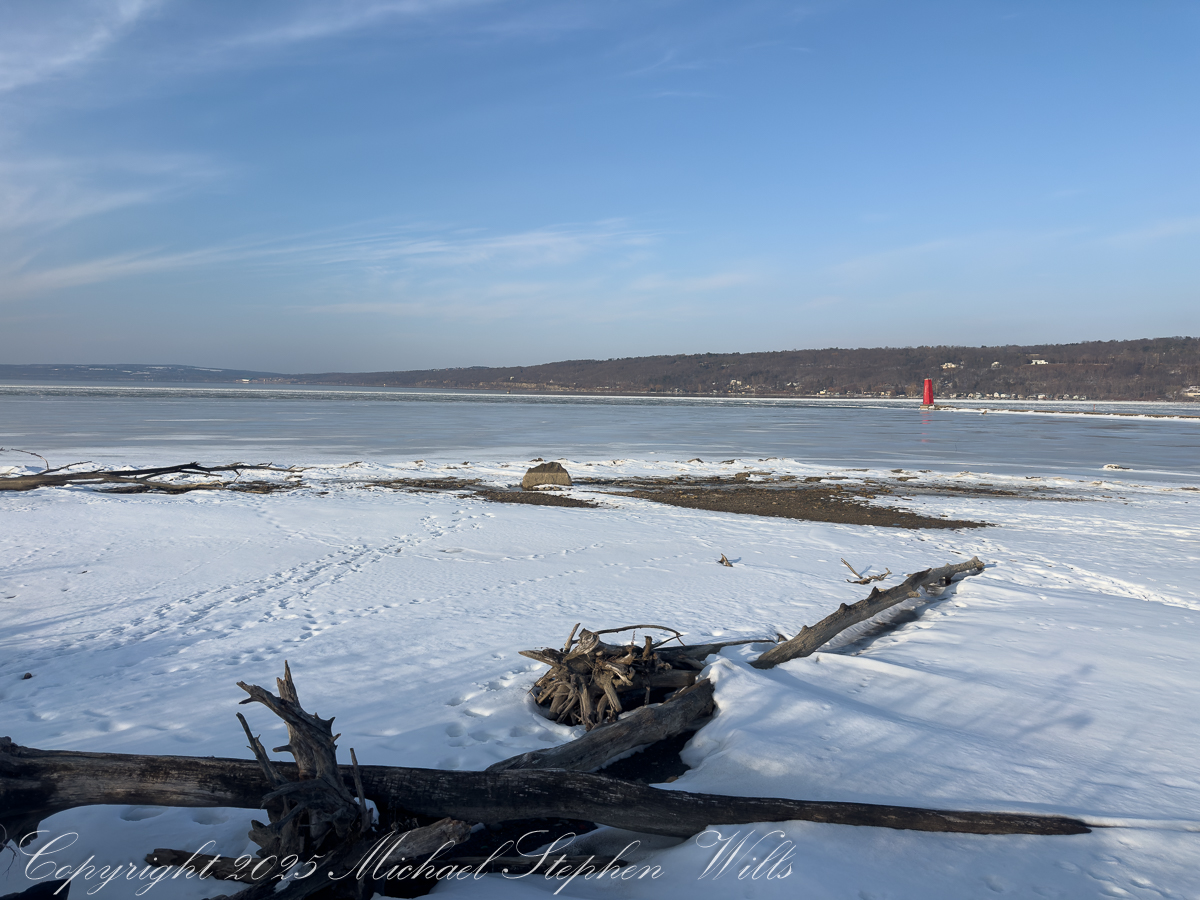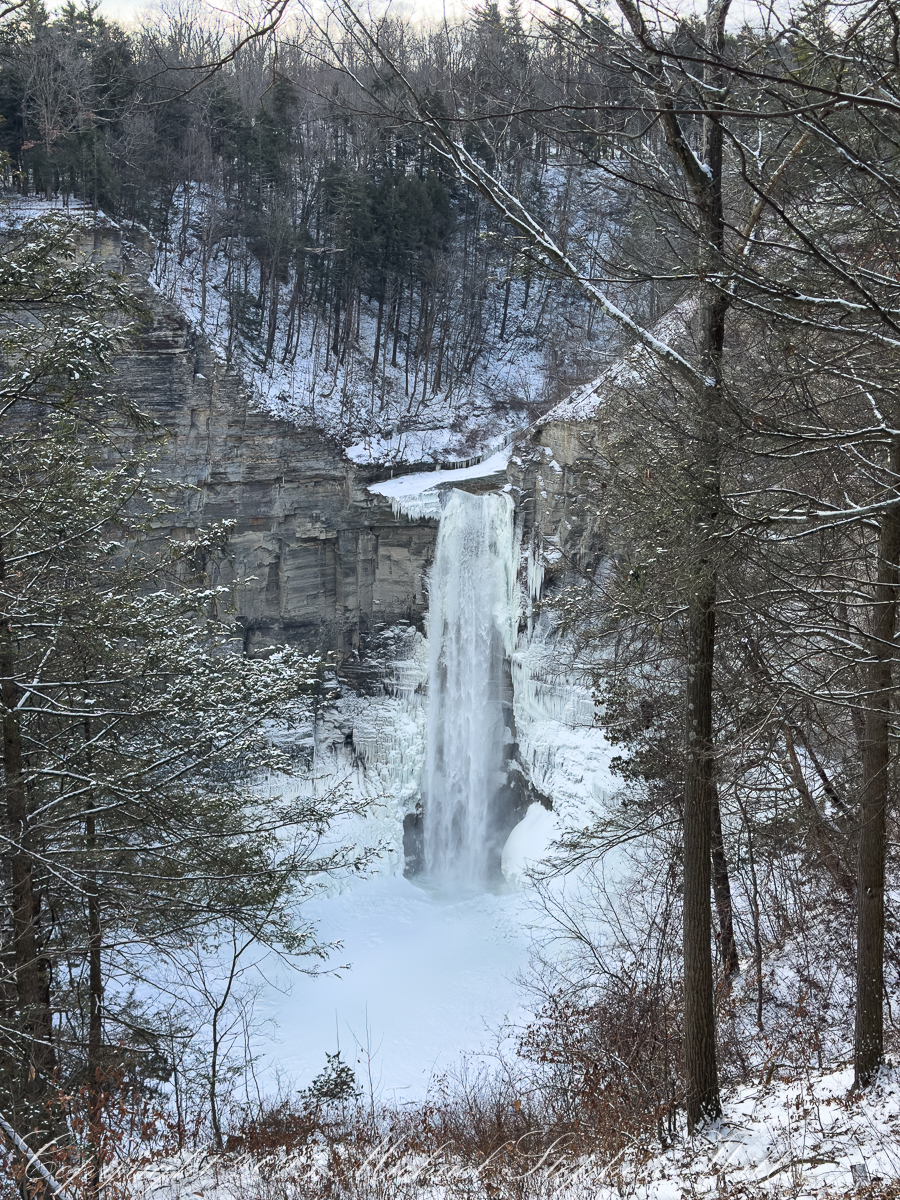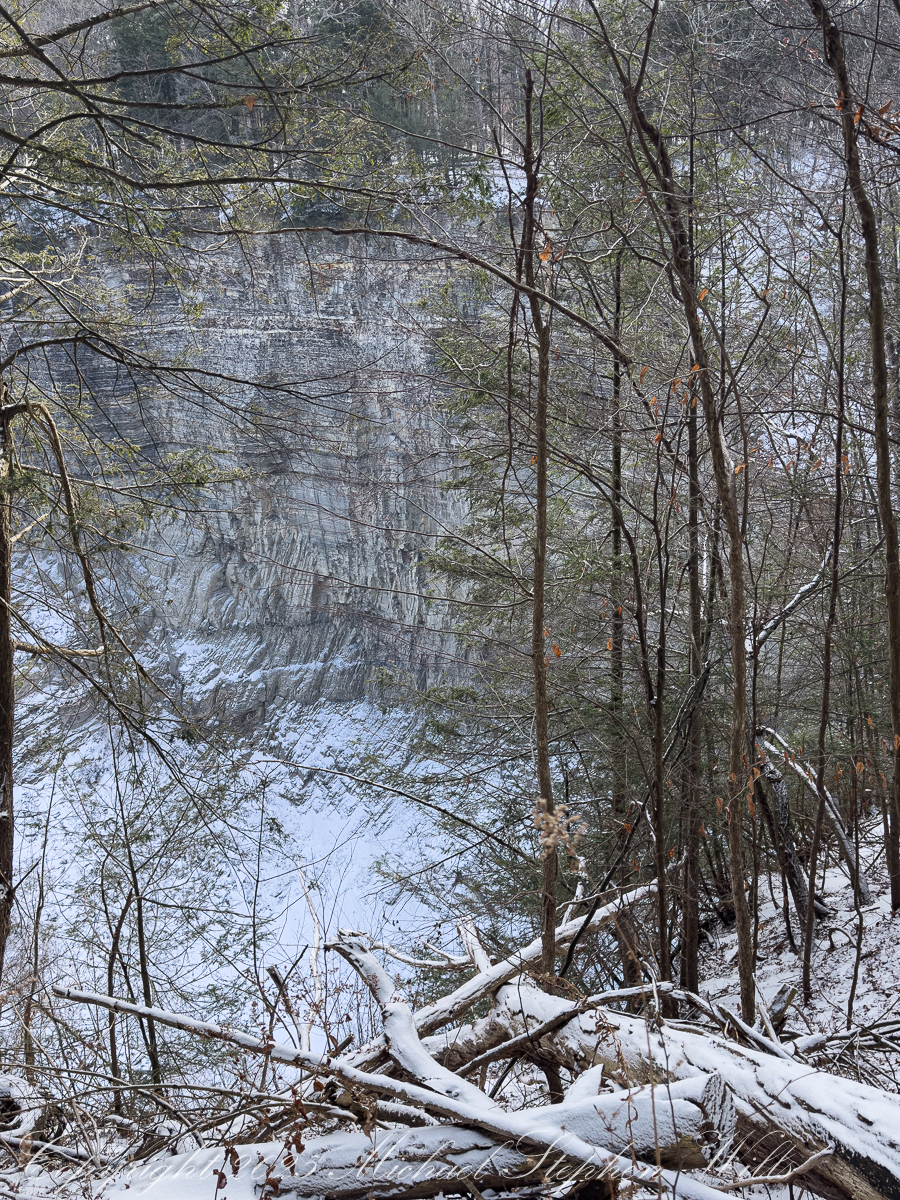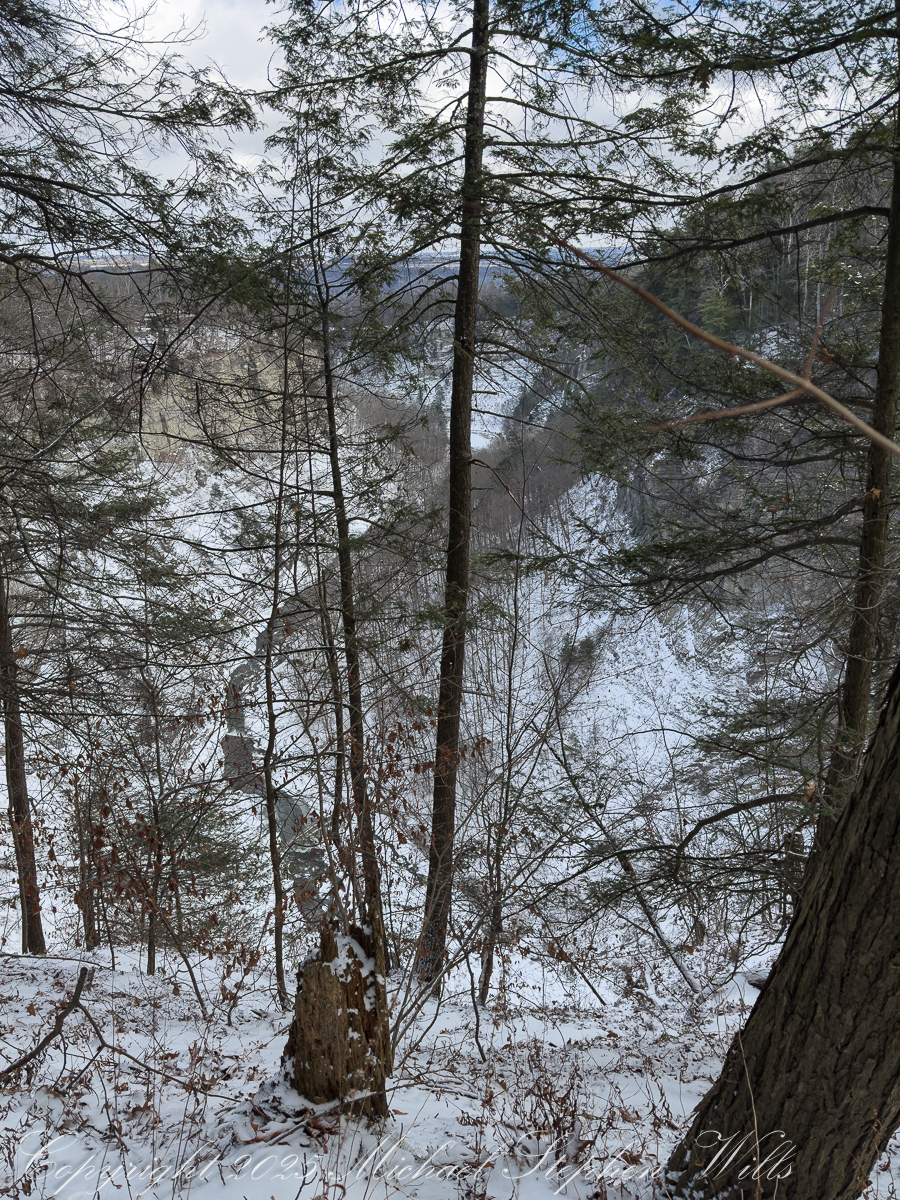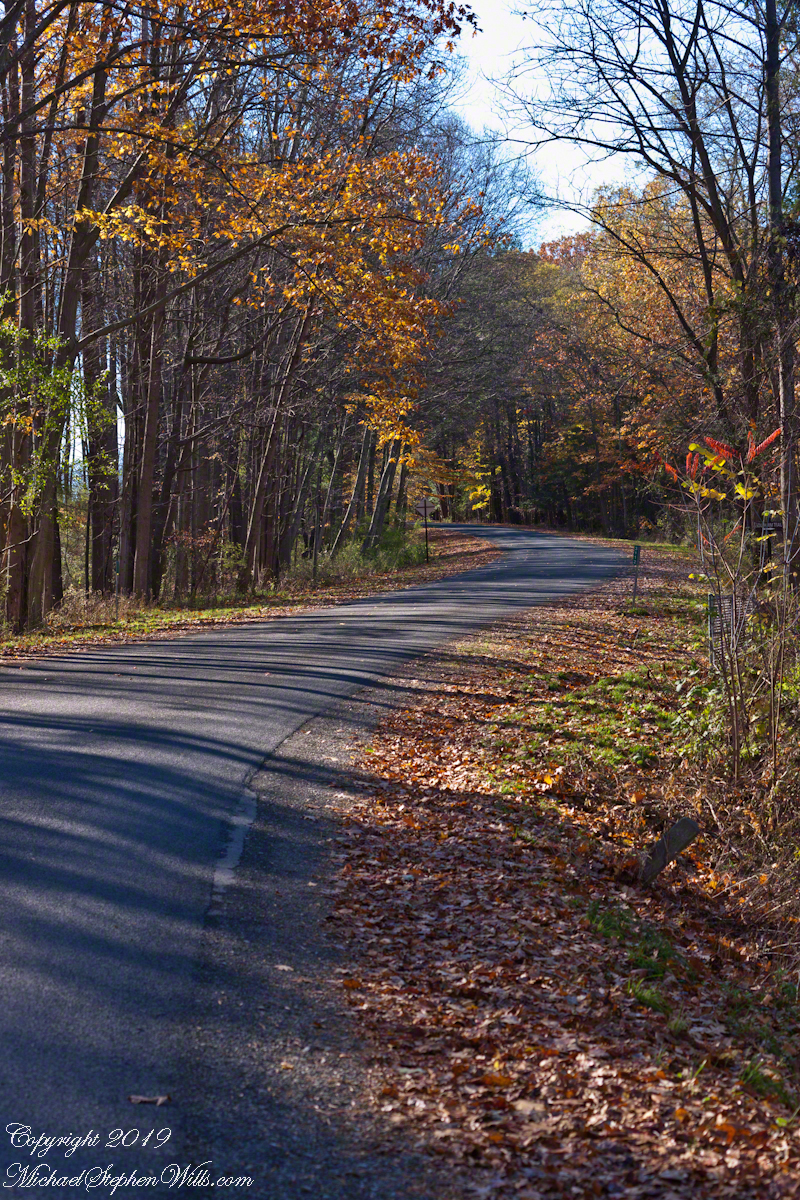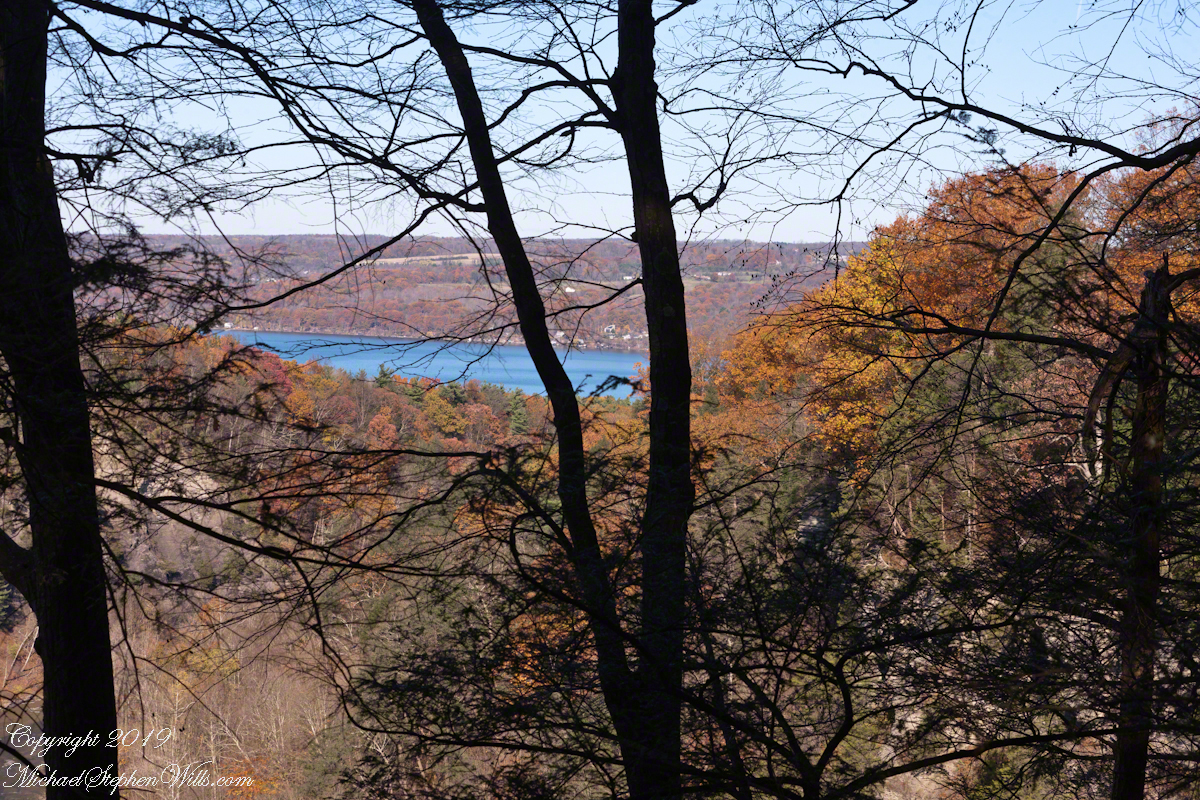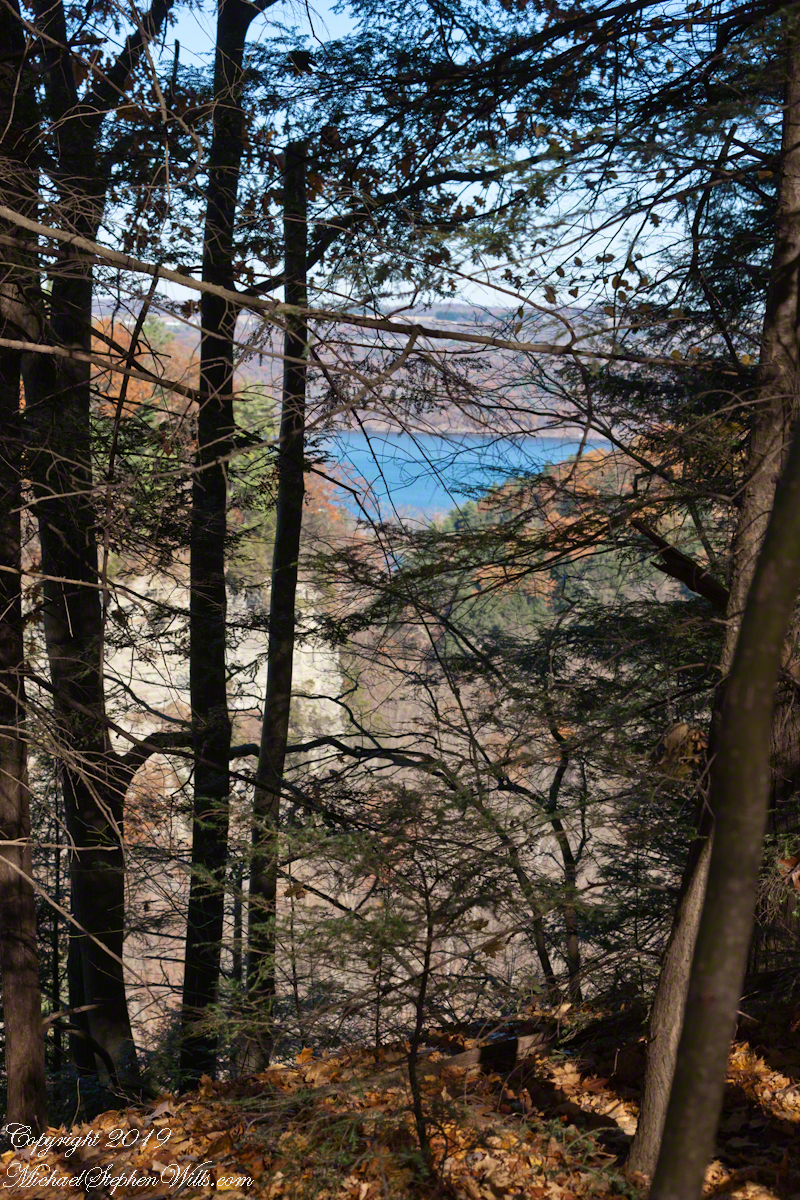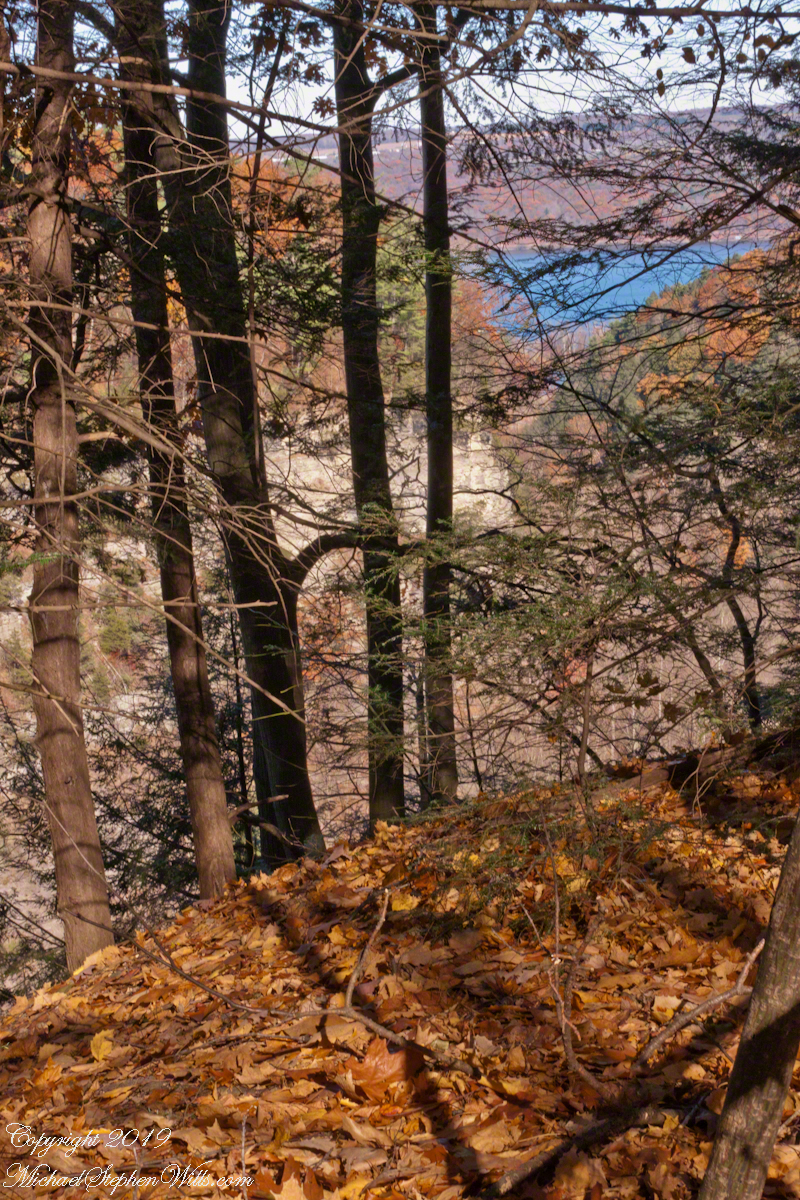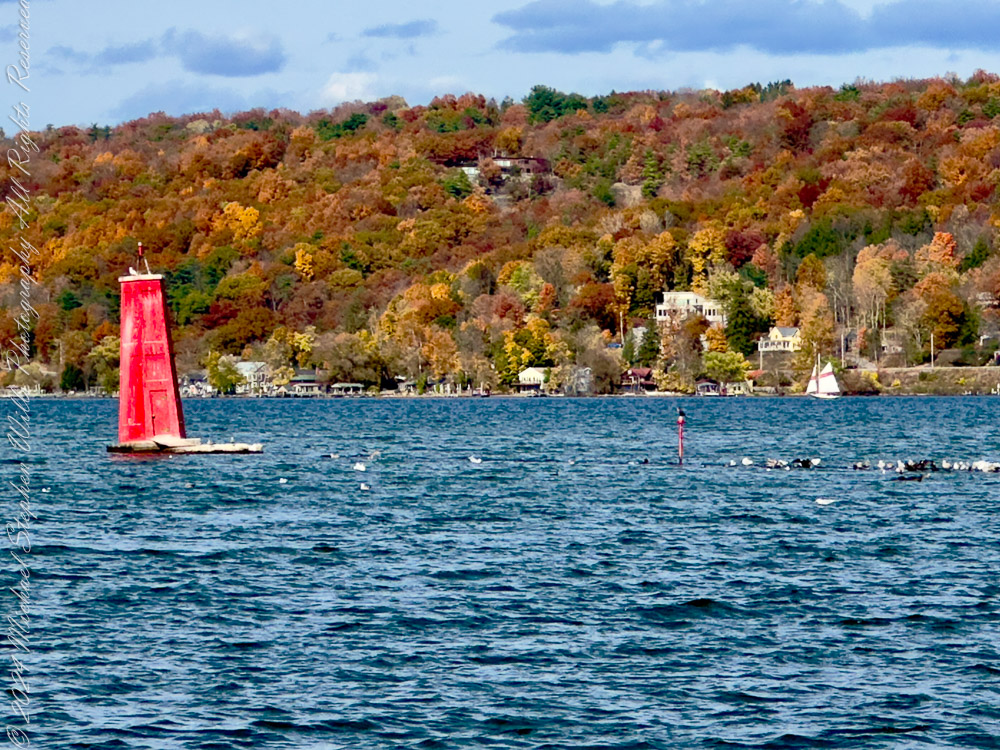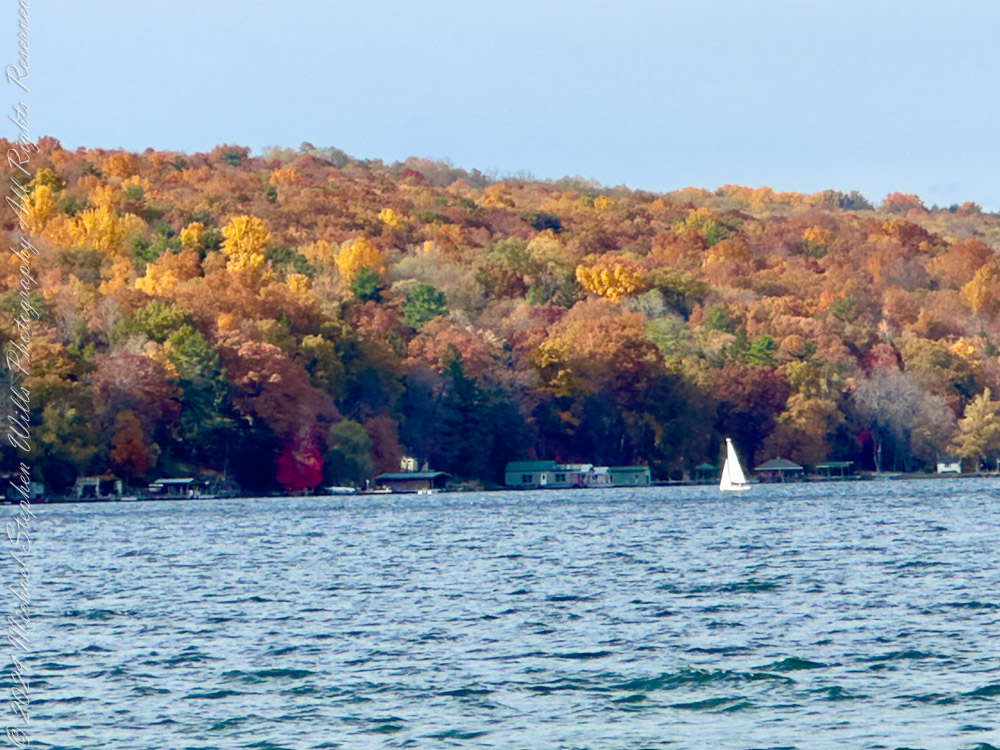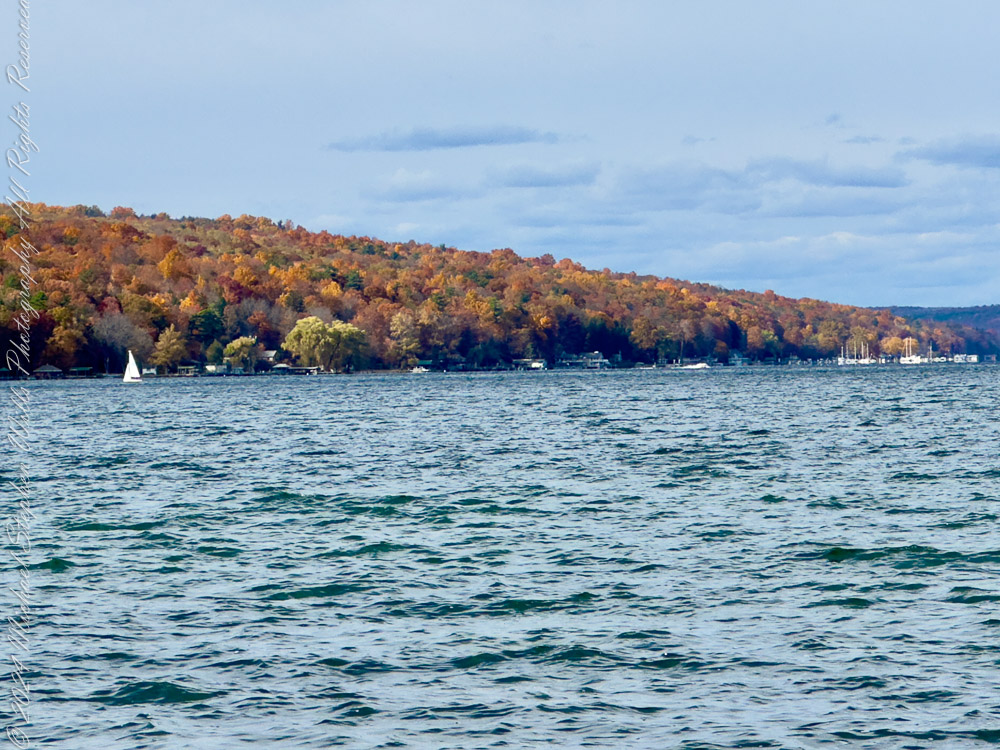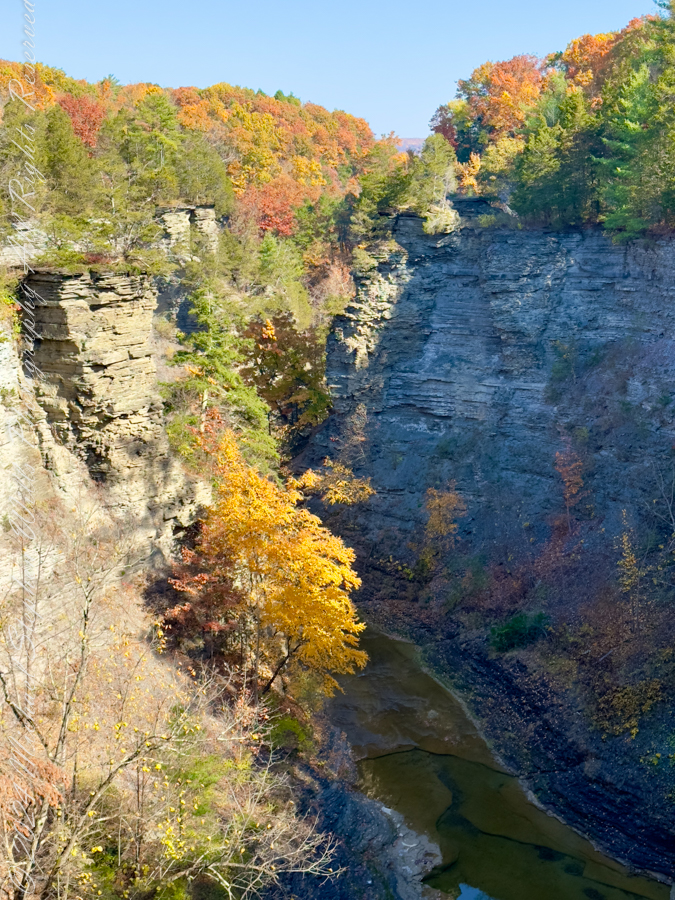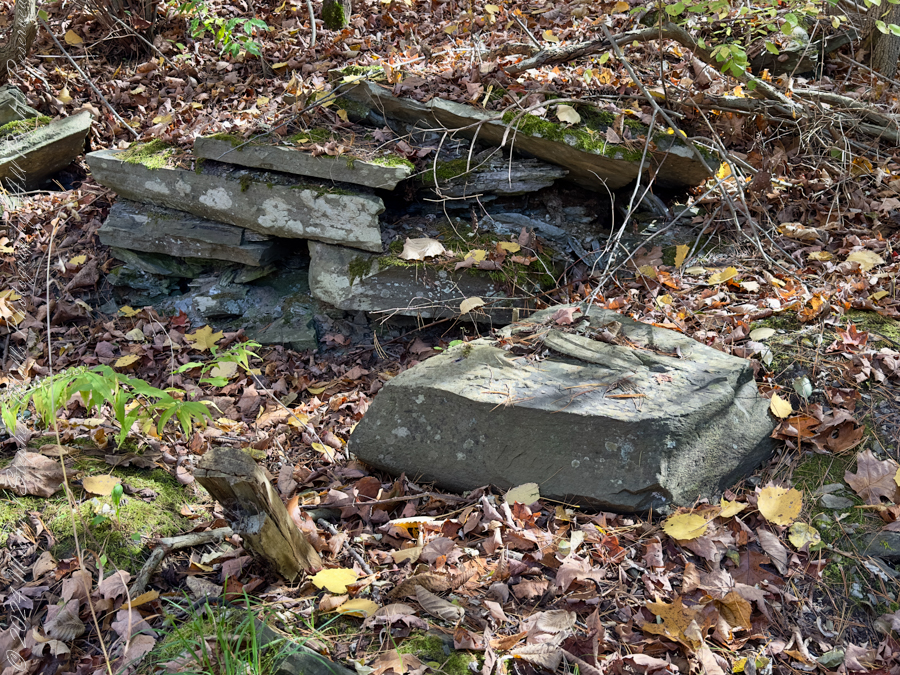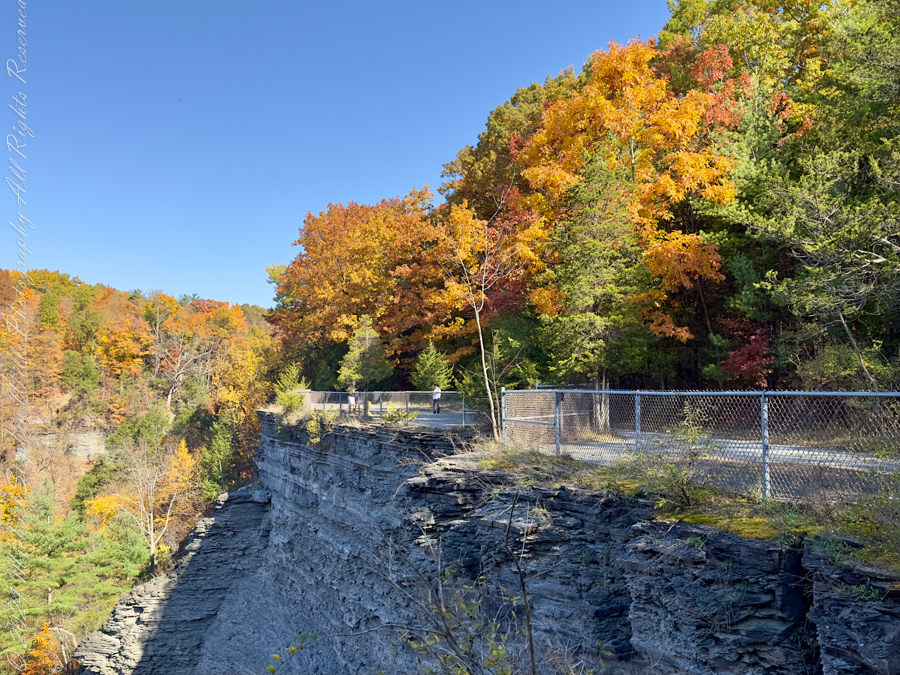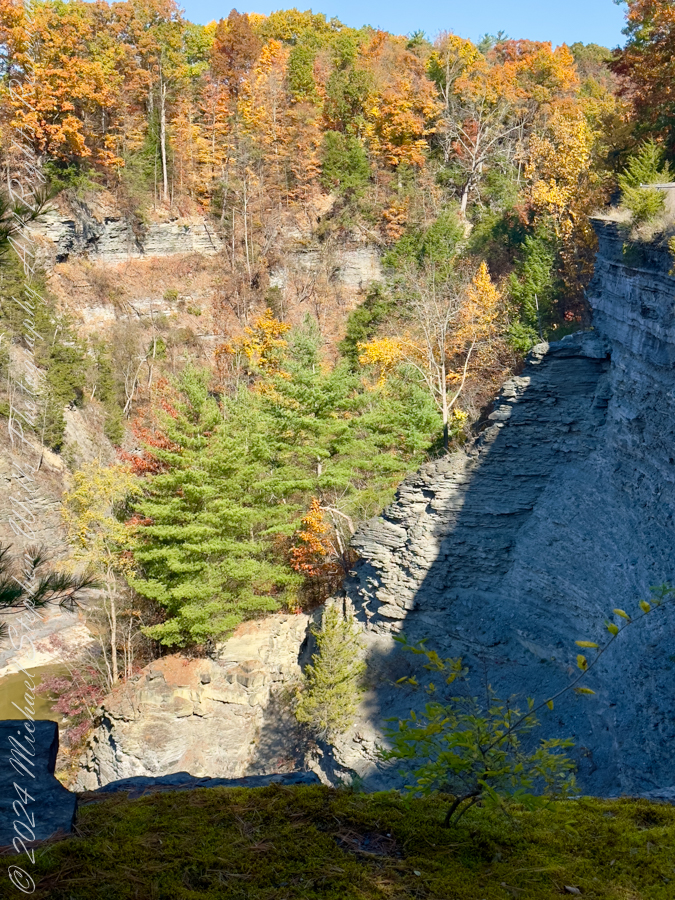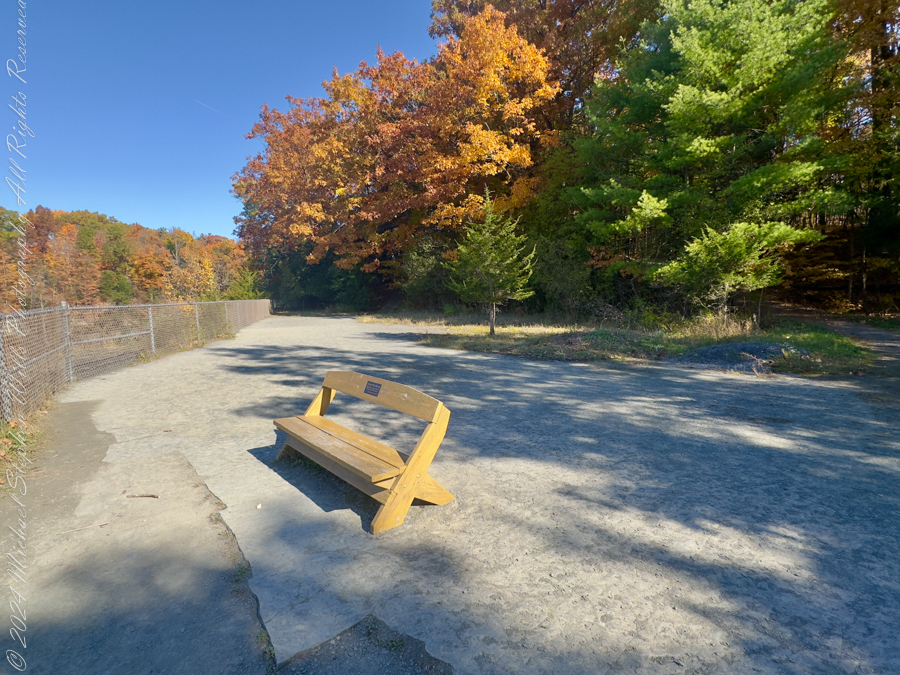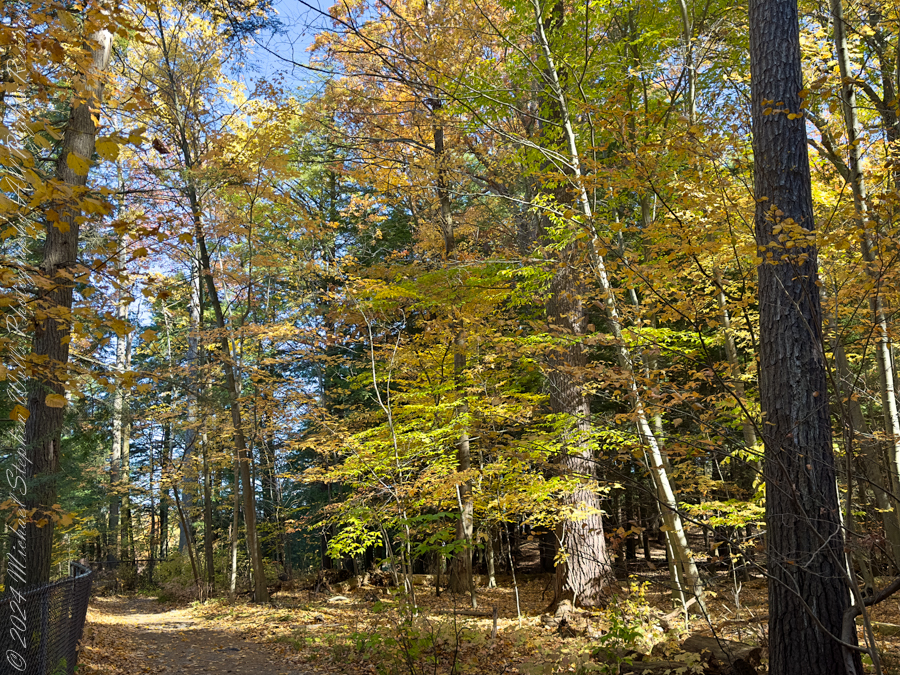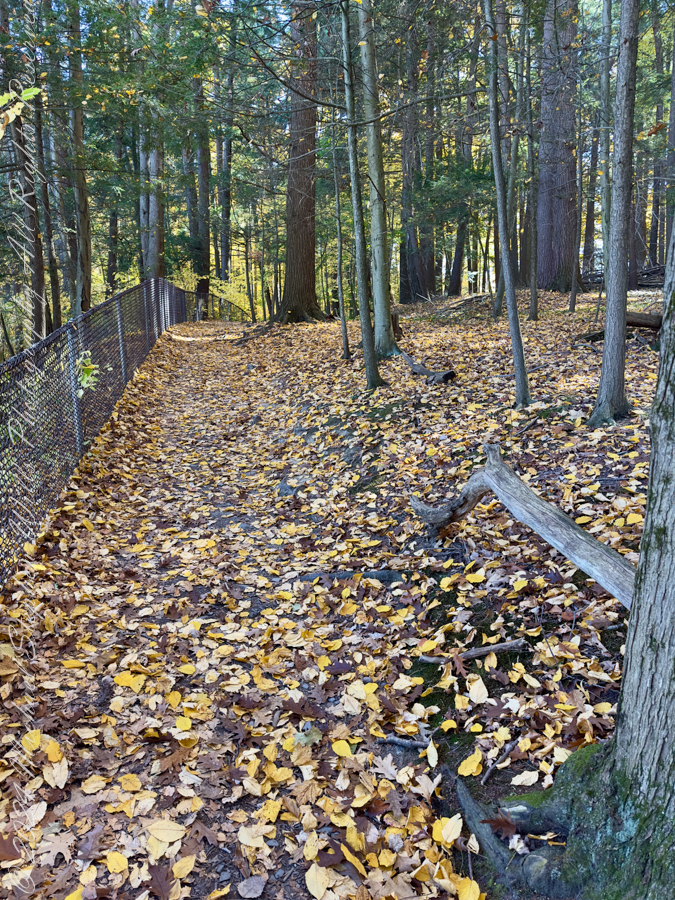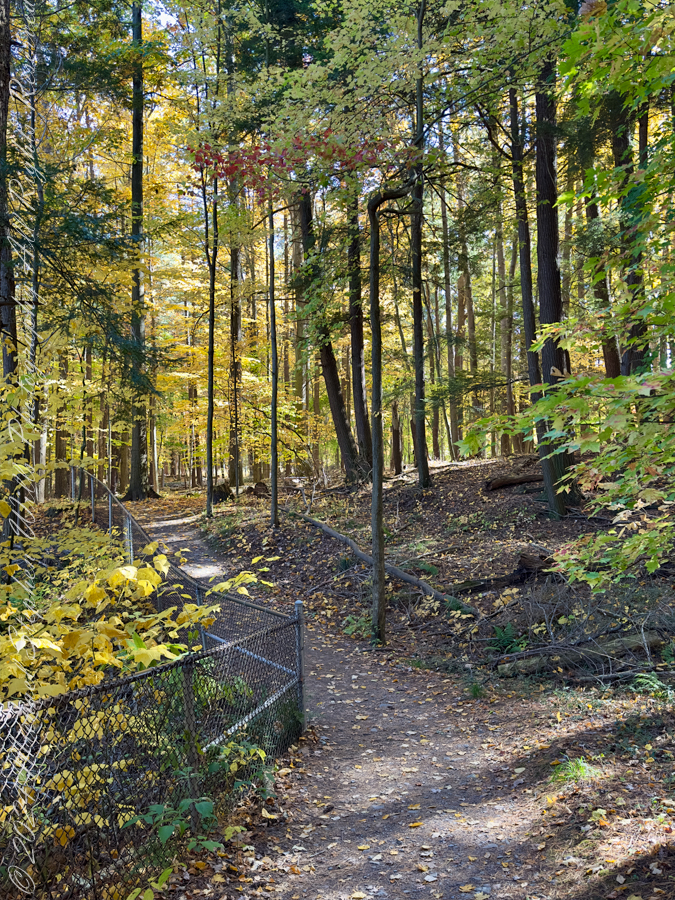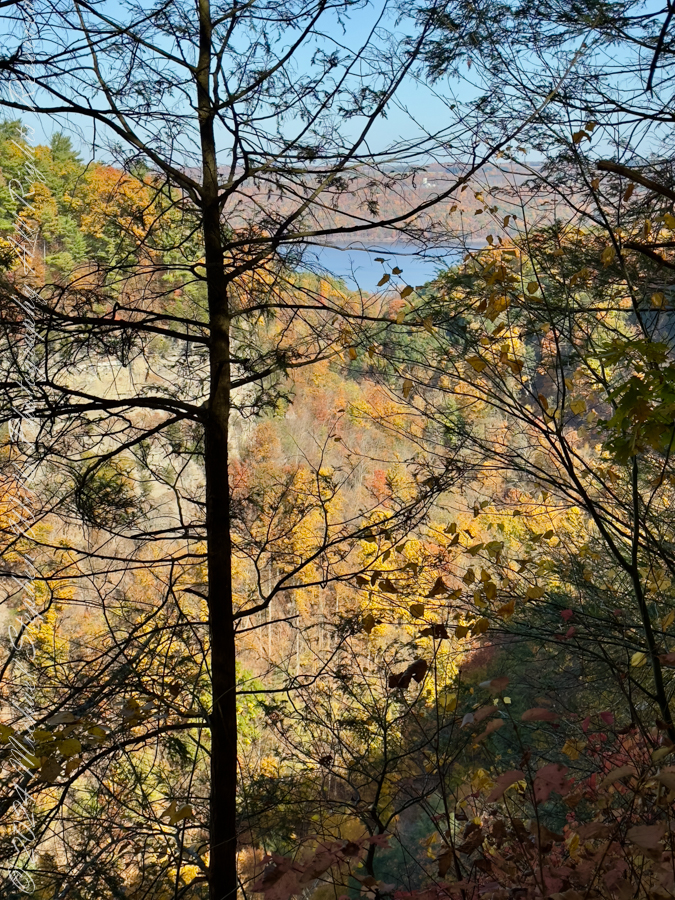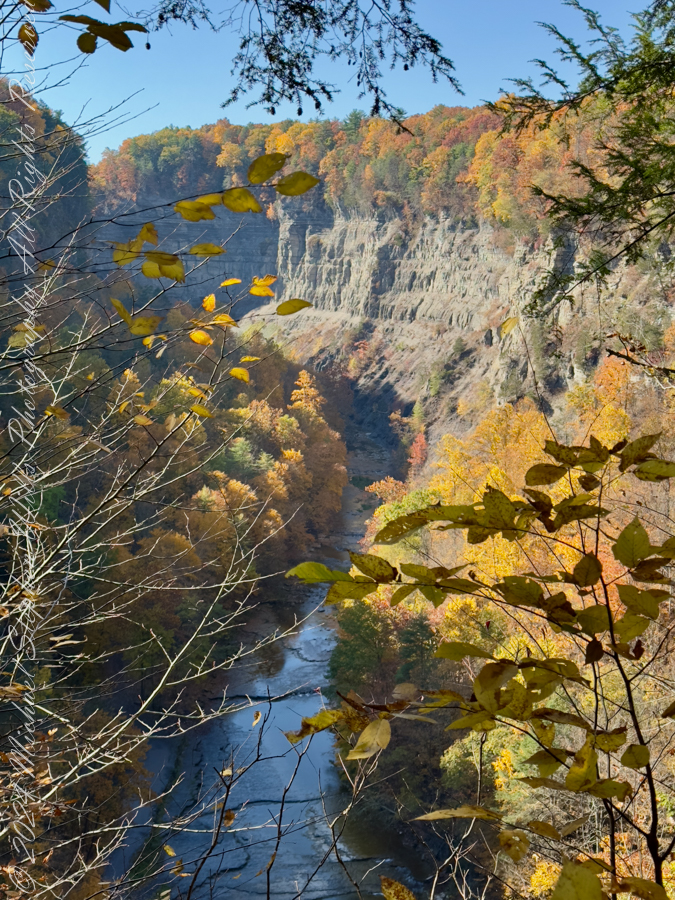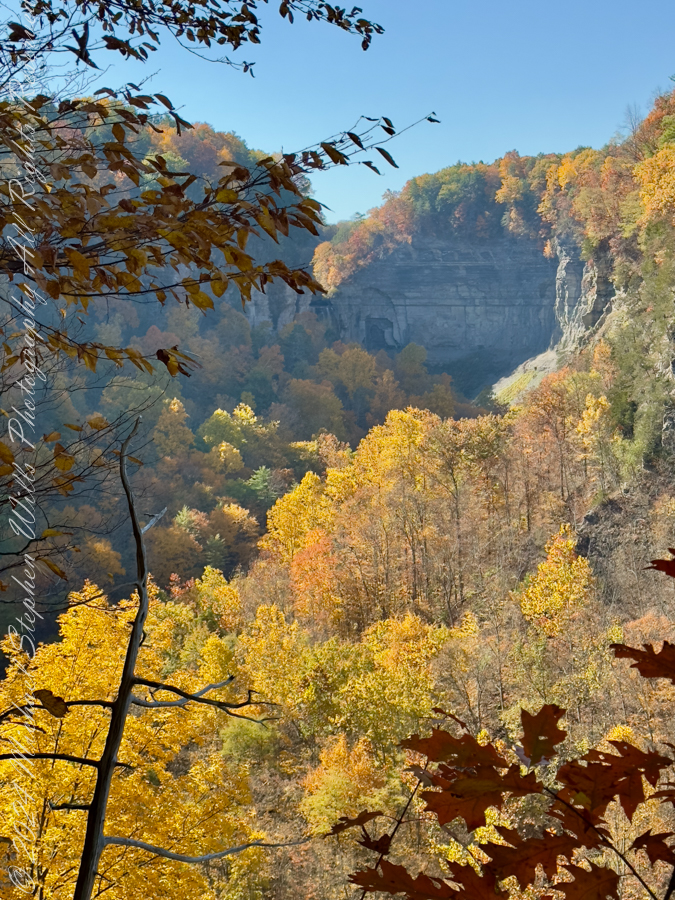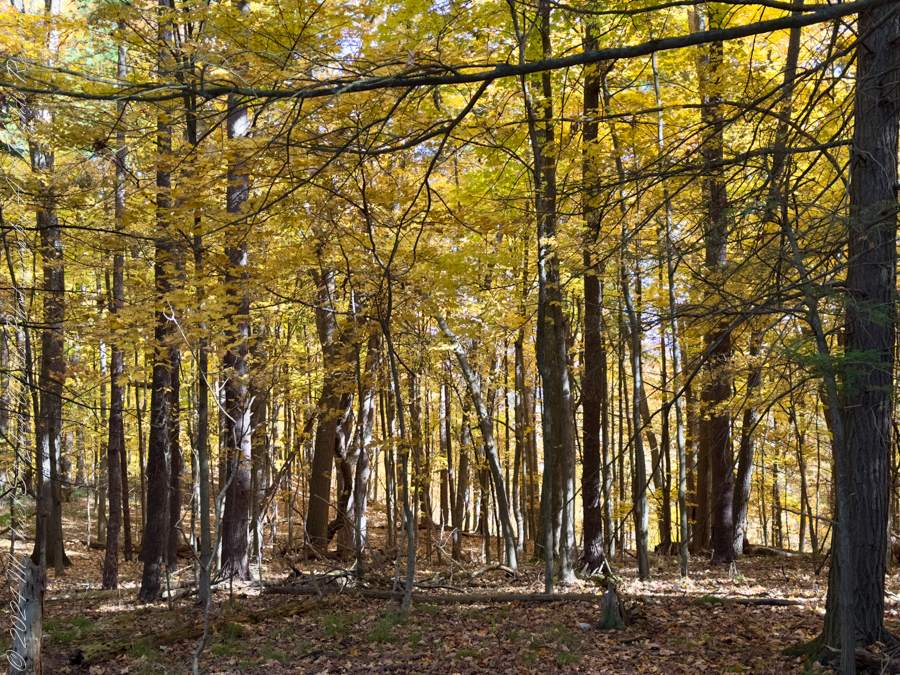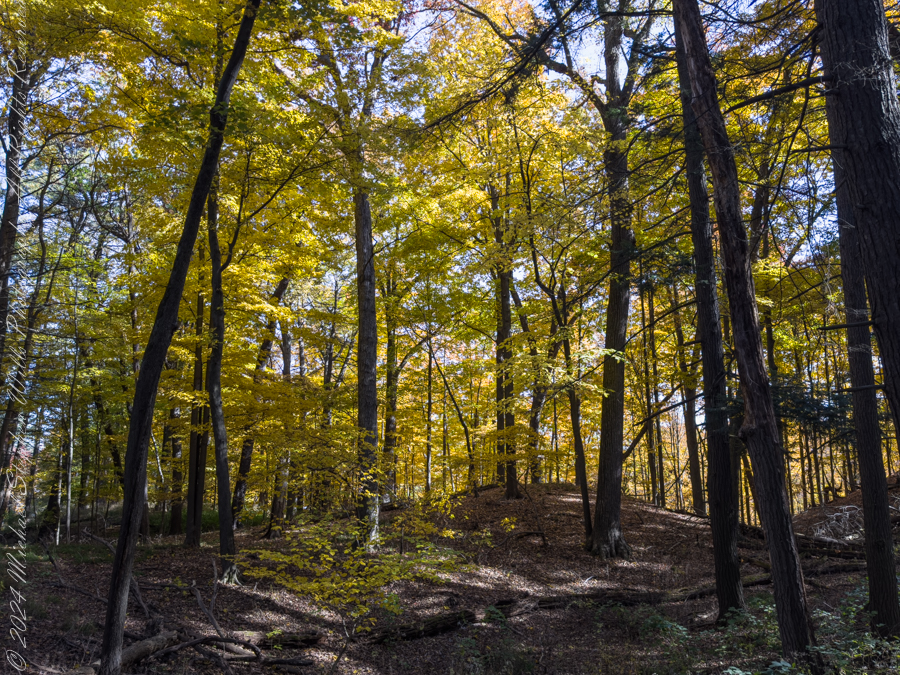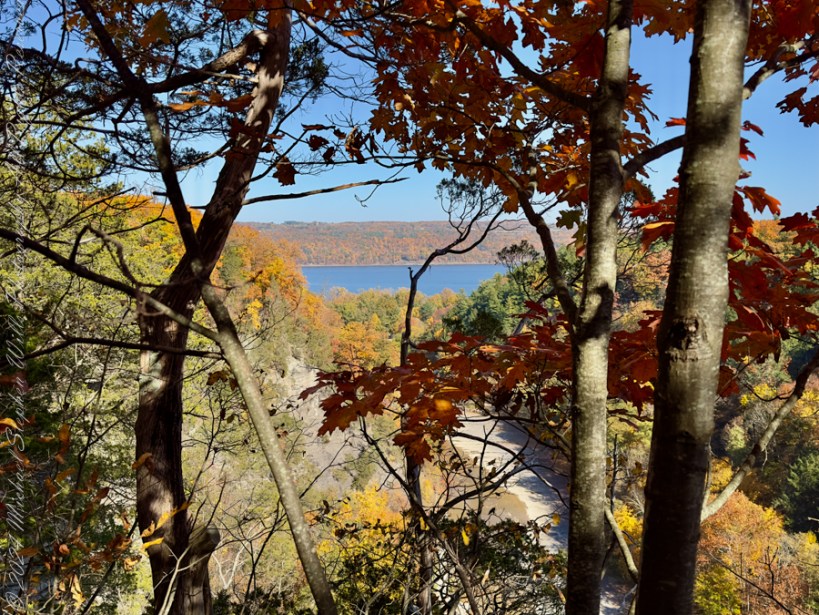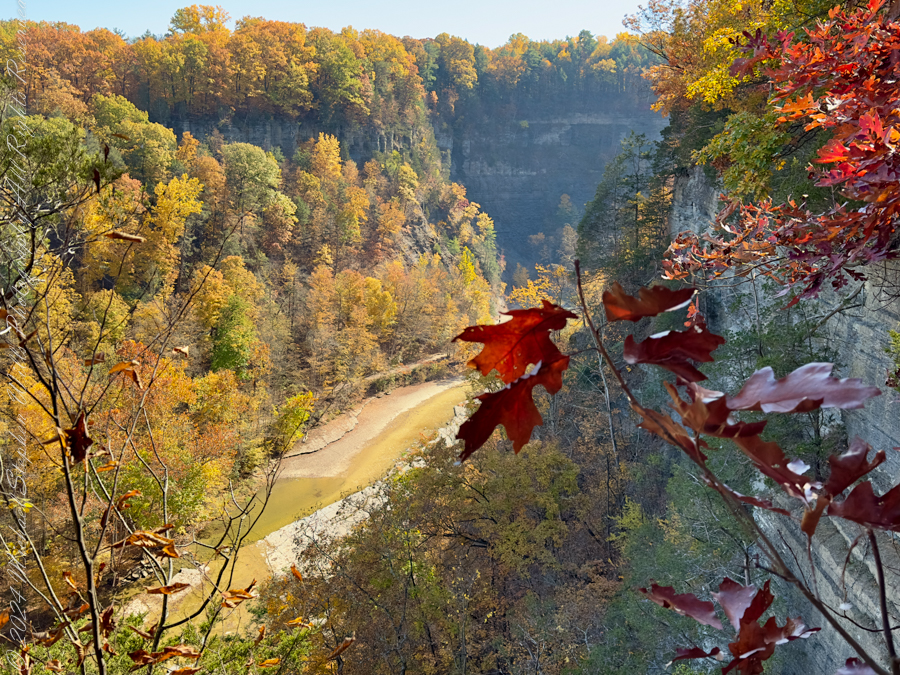
From a modest bench above Taughannock Gorge, Cayuga Lake shifts from distant glimmer to presence—a quiet invitation to pause, breathe, and follow the water down.
From the south rim of Taughannock Gorge, Cayuga Lake appears like a distant strip of sapphire, framed today by a soft veil of hemlock and oak. The overlook here is modest—a fence, a bit of open sky—but someone wisely added a comfortable bench, an invitation to pause between gorge and lake, rock and water.
I stood in front of that bench, resting the camera body on the fence, fingers braced against the wood to steady the shot. This is not the grand, sweeping vista of a postcard. Instead, it is a quieter, more human vantage point, the way a person actually encounters the lake after walking the rim: emerging from the trees, breath easing, eyes adjusting to the light on water.
From here, the trail descends toward Cayuga’s shore, each turn bringing you lower and closer, trading the lofty perspective for the intimate sounds of waves and stone. In Distant Sapphire I and II, the lake was a glimpse—caught between branches, distant beyond the gorge. Now, in this “Bench View,” the water feels nearer, almost within reach, as though the landscape itself is drawing you gently down.
Click photograph for a larger view. To do this from WordPress Reader, you need to first click the title of this post to open a new page.
Cayuga Lake Bench View
I’ve gathered the three photographs—Glimpse of Cayuga Lake, Gorge View with Oak Leaves, and this Cayuga Lake Bench View—into a small gallery, a progression of approach. Each frame is a step closer: from suggestion, to invitation, to the quiet promise of the bench, waiting for whoever needs to sit and look a little longer.
A gallery of the three Cayuga Lake photographs for comparison.
Glimpse of Cayuga LakeGorge View with Oak LeavesCayuga Lake Bench View
Enter your email to receive notification of future postings. I will not sell or share your email address.
Copyright 2025 All Rights Reserved Michael Stephen Wills
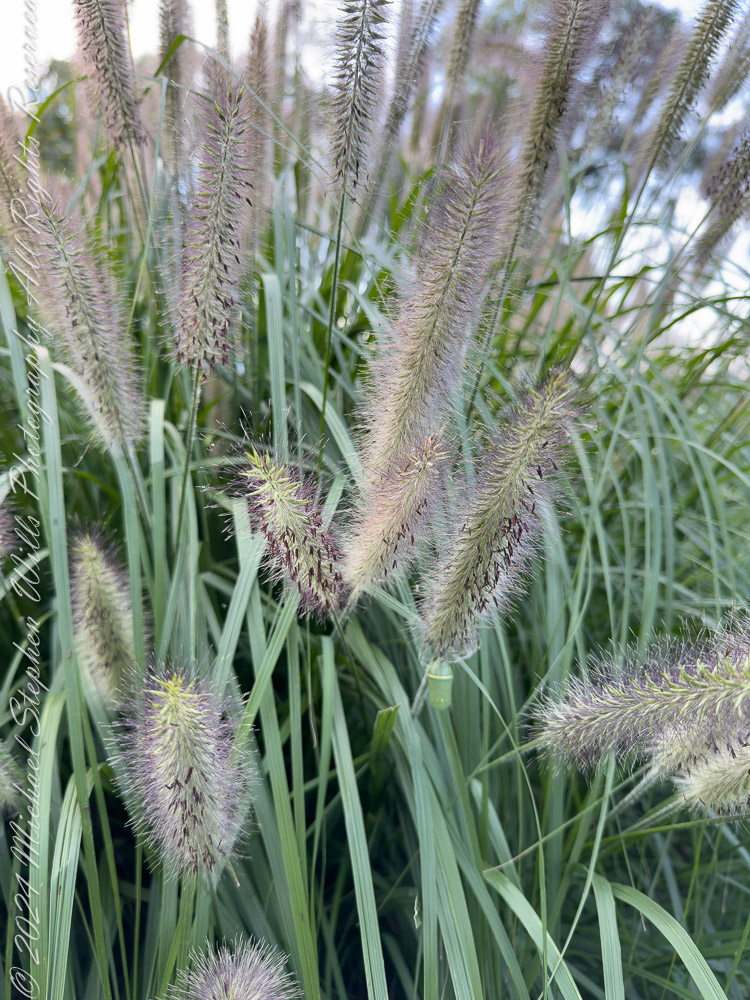
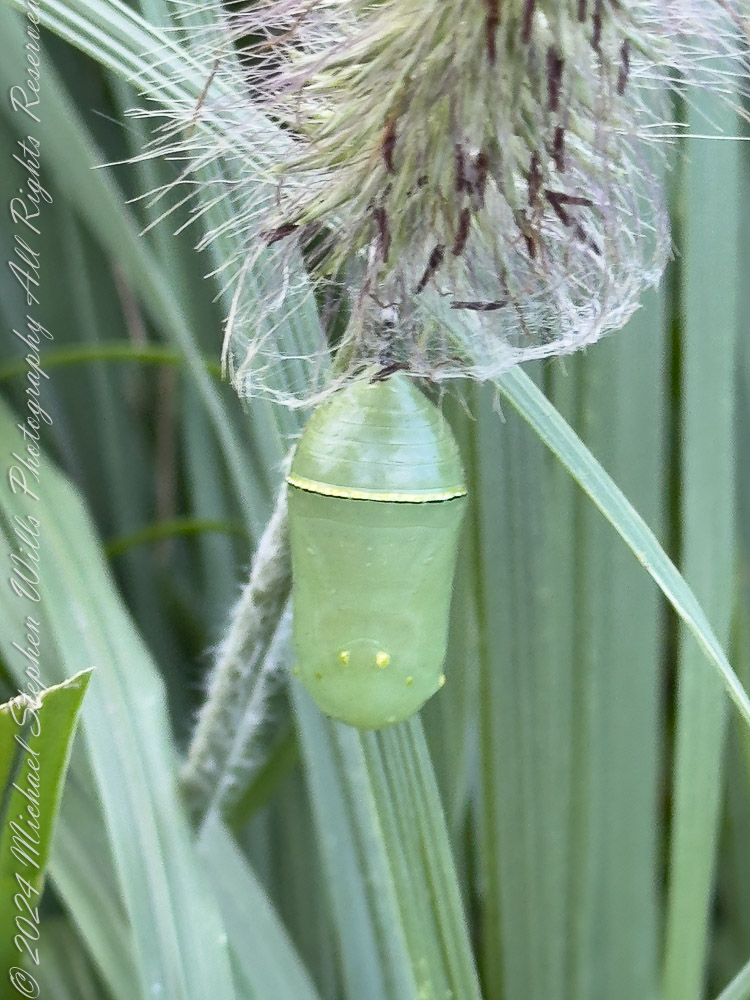
On a warm September afternoon, 2024, Pam and I passed a planting of shimmering grasses along the Cayuga Lake shore, the tips of their feathery plumes swaying in a gentle breeze. Amidst the verdant tapestry, my eyes caught a flash of delicate green—a Monarch chrysalis, hanging like a precious jewel beneath one of the seed heads. It was an unexpected encounter, a moment of grace that felt almost otherworldly. The chrysalis, pale jade with gold accents, looked like something born of magic rather than biology. For a moment, time paused.
The only Monarch chrysalis we found in 2024, notable for the absence of caterpillars around our home. Tompkins Park, Ithaca, New York, Finger Lakes Region
I knelt carefully, mindful not to disturb the fragile life suspended before me. As I leaned in closer, I marveled at the perfection of its design. The intricate gold dots along its casing seemed impossibly precise, as though a divine hand had painted them there. Yet, this chrysalis was also a paradox: it was a shield of stillness, promising the coming transformation of a creature known for motion and migration.
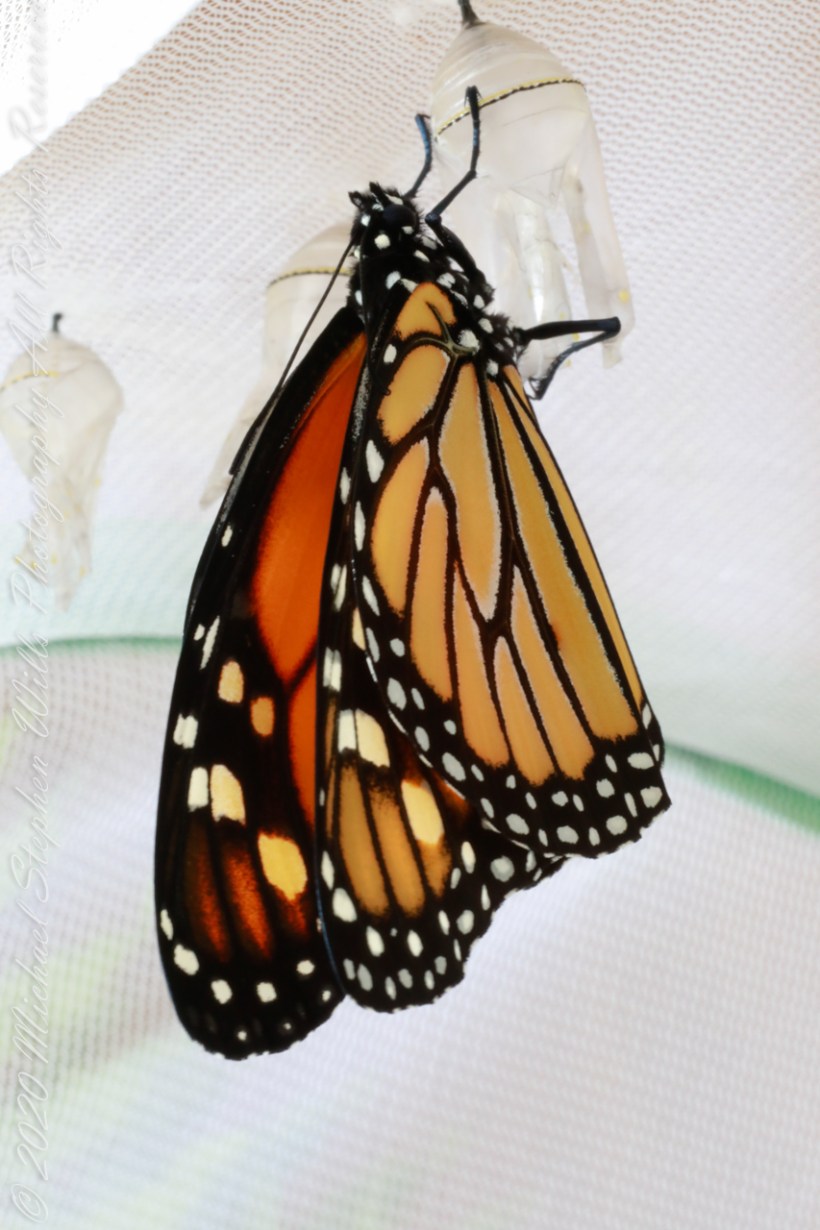
The significance of this discovery didn’t escape me. Just two years ago, the International Union for Conservation of Nature officially classified the Monarch butterfly as “endangered.” Habitat destruction, pesticide use, and climate change have decimated their numbers. Monarchs, once so plentiful they seemed a seasonal certainty, now teeter on the edge of disappearance. To find this chrysalis was to witness a quiet rebellion against those odds, a solitary emblem of resilience in a world fraught with loss.
I thought of their epic journey—a migration that spans thousands of miles, linking Canada to the forests of central Mexico. For generations, these butterflies have followed ancestral paths with unerring precision, defying every obstacle in their way. How can something so small carry the weight of such immense journeys? And how, in a world that seems to grow harsher each year, do they still persist?
This chrysalis, tucked in the grasses of Stewart Park, felt like an answer to those questions. It was a reminder of the resilience of life, the determination of nature to continue despite all that works against it. And yet, it also felt like a fragile promise. The Monarch’s survival is no longer assured; its future, like the butterfly within this chrysalis, hangs by a thread.
As I rose and continued our walk, I carried the image of the chrysalis with me, letting its quiet beauty settle in my mind. I thought of the interconnectedness of all things: the milkweed plants that sustain Monarch caterpillars, the winds that guide their migrations, and the people whose choices shape the landscapes they traverse. Stewardship is not just a responsibility; it is a privilege—an opportunity to ensure that these miraculous creatures continue to grace our skies.
By the time I left the park, the sun had sunk toward the west, its light no longer graced the grasses. I looked back one last time, hoping that this chrysalis would complete its transformation safely. In its stillness, I saw not just hope, but a call to action. The Monarch’s story is not just about survival; it’s about the courage to evolve and adapt, even when the odds seem insurmountable. And perhaps, in witnessing this moment of metamorphosis, we too are reminded of our capacity to change—to become better stewards of the world we share.
Enter your email to receive notification of future postings. I will not sell or share your email address.
Copyright 2025 All Rights Reserved Michael Stephen Wills
On a crisp October morning in 2017, I was on the cusp of retirement with leisure time to explored the Johnson Museum of Art at Cornell University, with my grandson Sam and his grandmother, Pam, my wife. We were attending a “Let’s Look Baby” event—a wonderful opportunity to introduce young children to art and the world around them. Sam was a toddler at the time, curious and full of energy, and I was eager to share this moment of discovery with him.
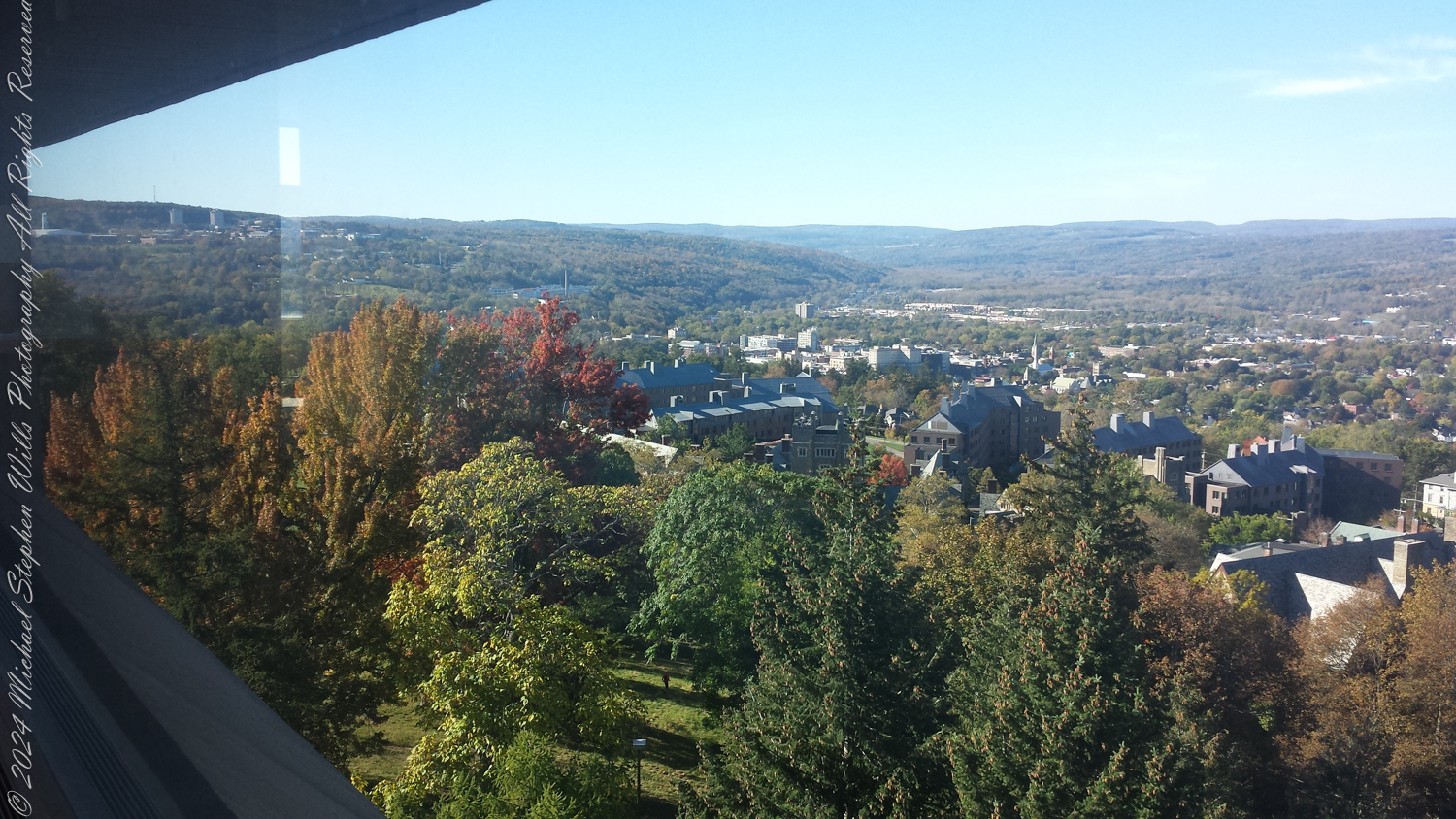
The day started on the museum’s upper level, where expansive windows offered breathtaking views of Ithaca, Cayuga Lake, and the surrounding hills. I lifted Sam so he could take it all in, his little hands gripping my arm as he gazed out at the vibrant autumn landscape while Pam captured the moment. The trees were in early stages of autumn—fiery reds, golden yellows, and rich browns—while Cayuga Lake shimmered in the distance, its deep blue surface reflecting the clear October sky. Sam pointed out toward the horizon; his eyes wide with curiosity. I told him about the lake, the hills, and the valley, trying to capture the beauty of it all in words simple enough for him to understand.
The architecture of the Johnson Museum itself framed the experience perfectly. Designed by I.M. Pei, the building’s clean, modern lines allowed the landscape to take center stage. Standing there with Sam, I felt a profound sense of gratitude—for the view, for the moment, and most of all, for the chance to share it with Sam.
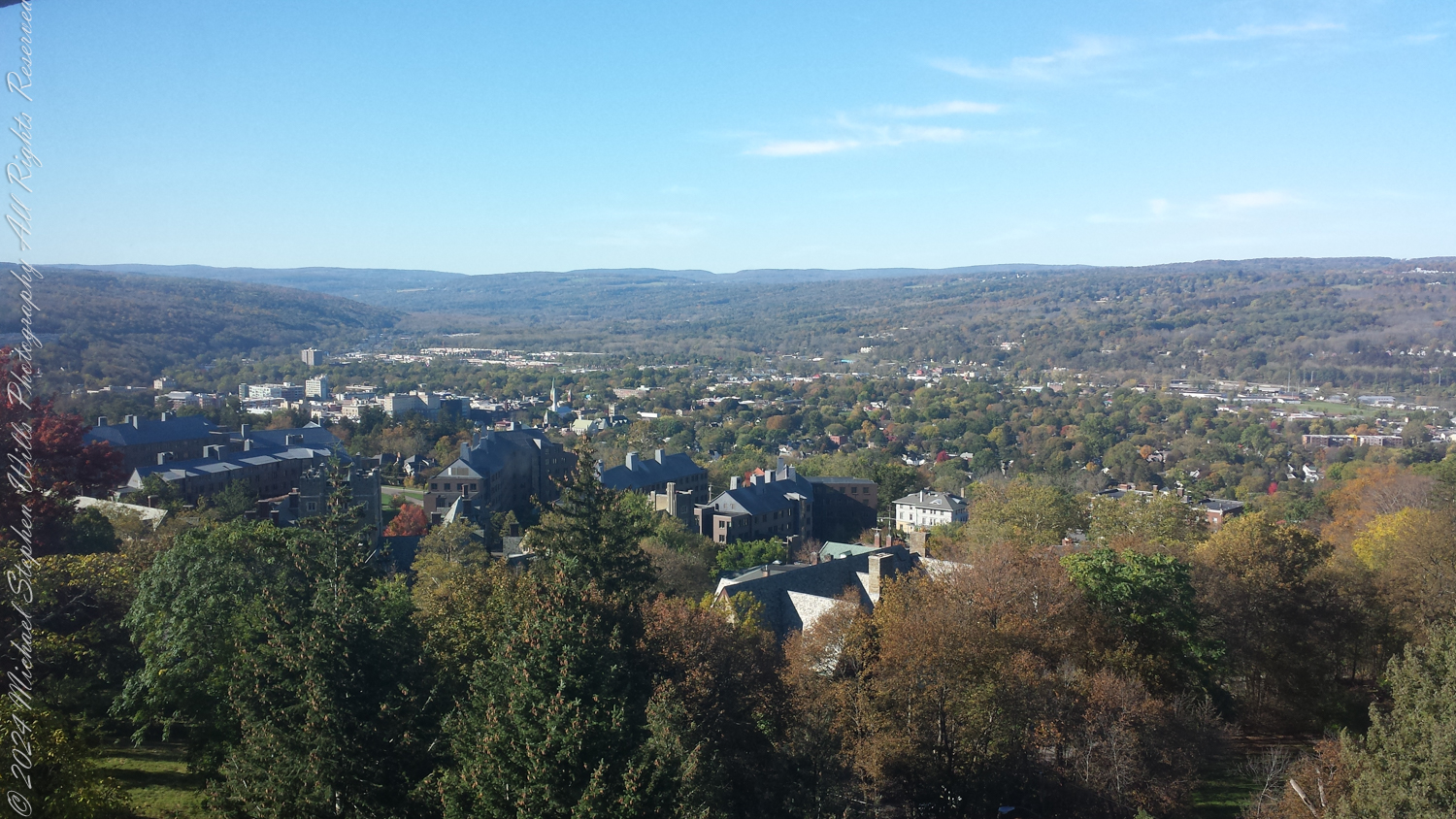
Looking southwest over Cornell University and Ithaca, down the Cayuga Lake Valley. West Hill is to the right. Tompkins County, Finger Lakes Region of New York State
As part of the event, we explored the museum’s galleries, moving from one exhibit to the next. The “Let’s Look Baby” program was designed with young children in mind, blending art appreciation with sensory exploration. While Sam was too young to fully grasp the meaning behind the pieces, he was fascinated by the vibrant colors and the textures of the displays. At one point, we stopped by a ceramic vase. Its elegant curves caught Sam’s attention, and I used the moment to talk to him about shapes and forms, pointing out how it was similar to the roundness of a pumpkin or the arc of a rainbow.
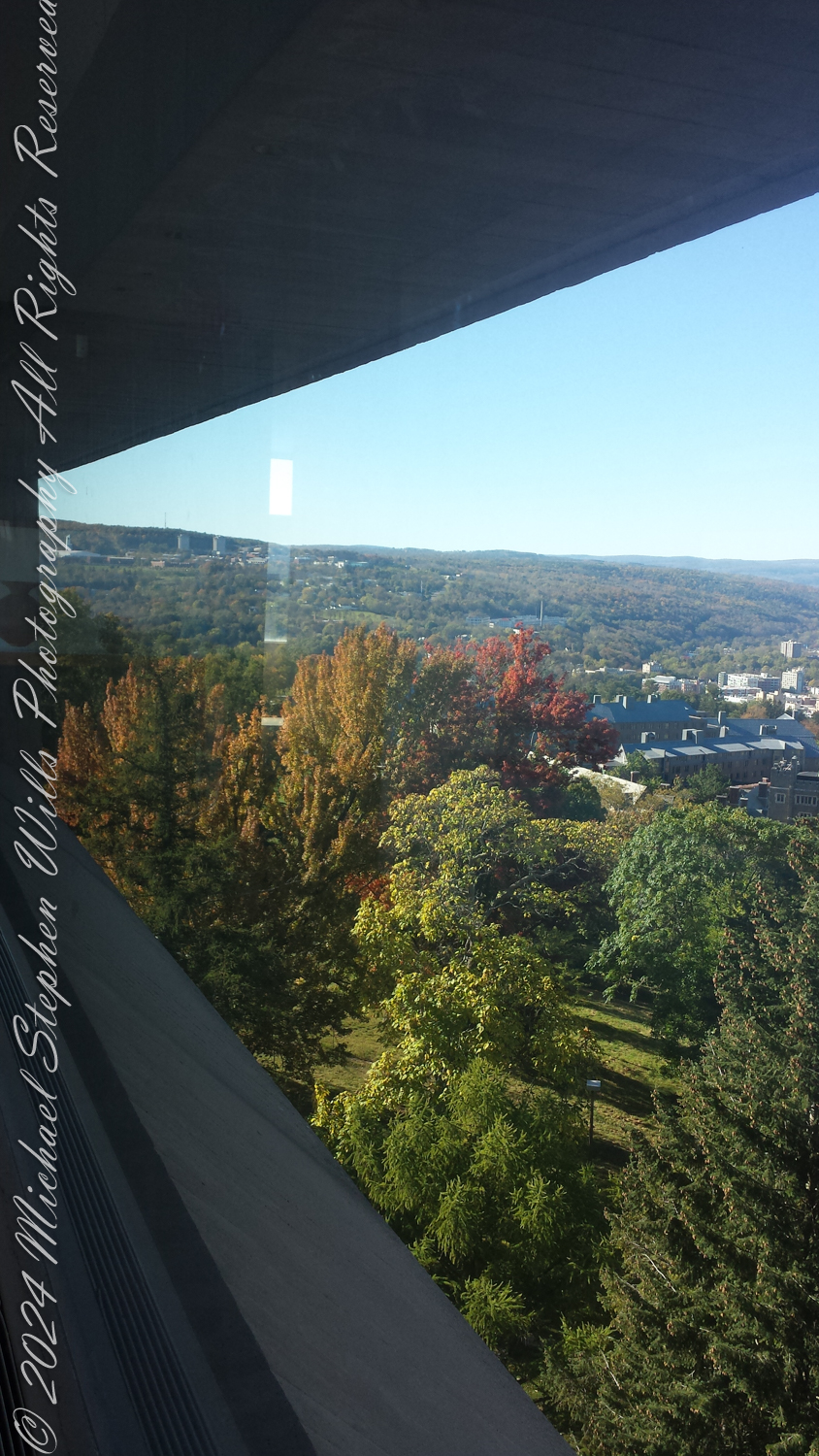
Looking South / Southwest over Cornell University and Ithaca, down the Cayuga Lake Valley. Ithaca College is to the left on South Hill. Tompkins County, Finger Lakes Region of New York State
Throughout the visit, I found myself narrating the world to Sam, drawing connections between what we saw in the museum and the beauty of the natural world outside. It reminded me how much there is to learn and how much joy there is in teaching, even if the lessons are as simple as noticing the colors of leaves or the shape of a cloud.
Looking southwest over Cornell University’s Lib Hill and Ithaca, down the Cayuga Lake Valley. West Hill is to the right. Tompkins County, Finger Lakes Region of New York State
We returned to the large windows overlooking Ithaca more than once. From there, I pointed out the landmarks of the city—downtown Ithaca with its steeples, the rolling hills, and the peaceful expanse of Cayuga Lake stretching toward the horizon. Sam listened quietly, his small fingers pointing to whatever caught his attention. I wondered what he was thinking, but I knew this experience, even if he wouldn’t remember it fully, was shaping his view of the world.
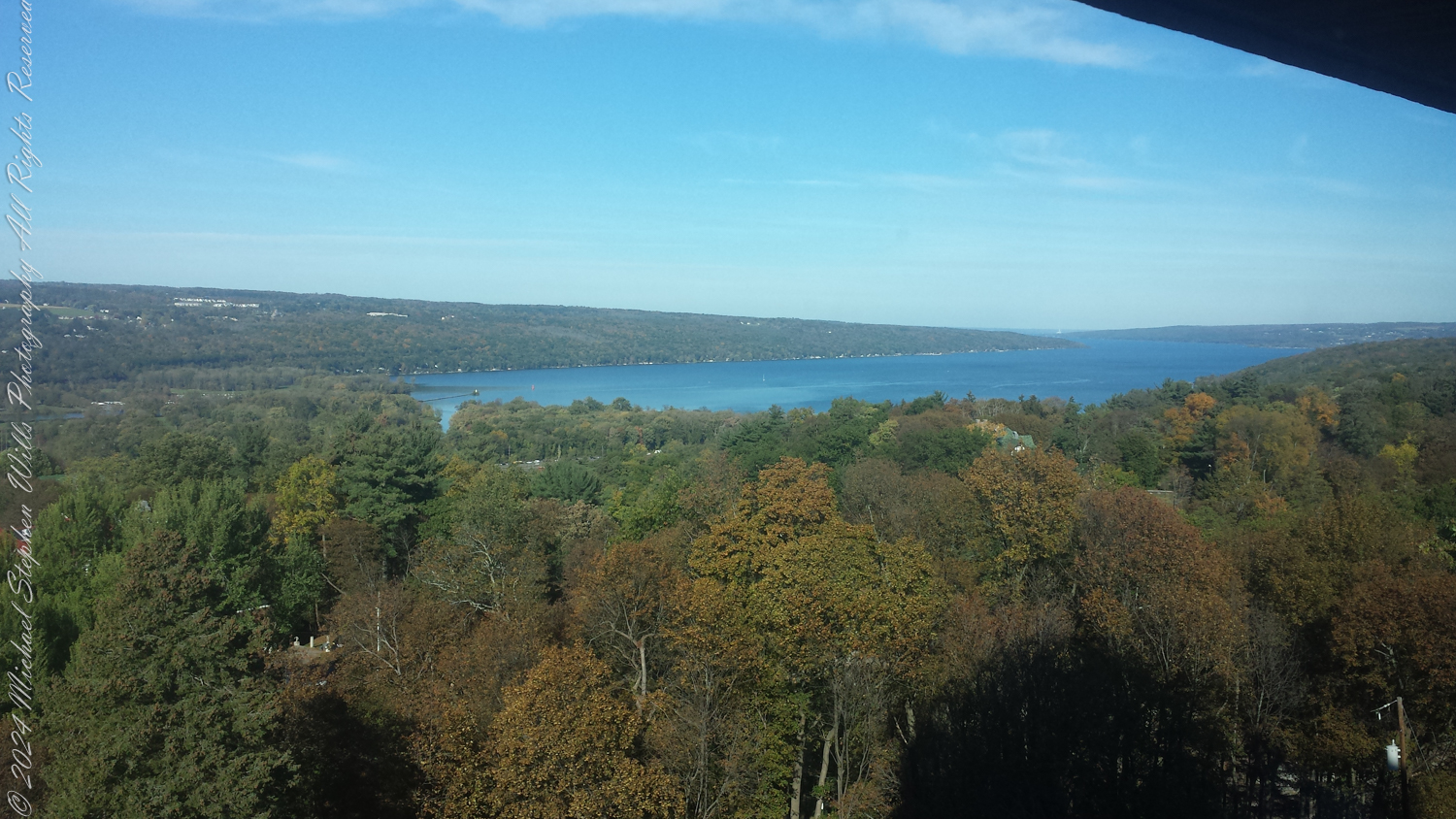
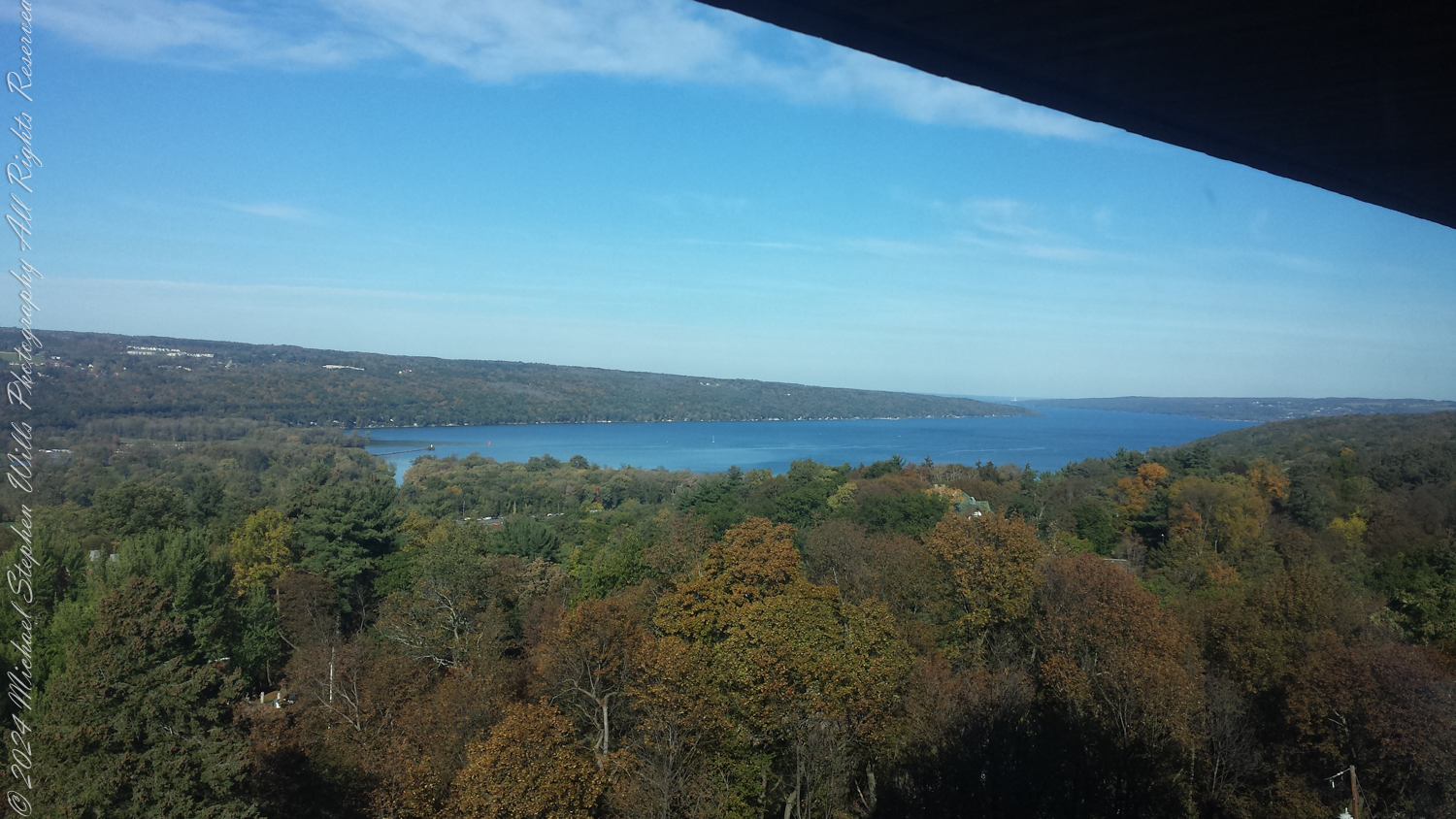
Looking to the North / Northwest over Cornell University and Cayuga Heights to Cayuga Lake. West Hill is to the far left. Along the southern lake shore is Stewart Park, the lighthouse, New York State Marina and Cass Park. Tompkins County, Finger Lakes Region of New York State
The day wasn’t just about what we saw—it was about the connection we shared. Holding Sam in my arms, I felt the simple, deep joy of being present in the moment. This was a chance to see the world through his eyes, to notice the details I might otherwise overlook, and to marvel at the way something as simple as a vase or a view could spark his curiosity.
Looking to the North / Northwest over Cornell University and Cayuga Heights to Cayuga Lake. West Hill is to the far left. Along the southern lake shore is Stewart Park, the lighthouse, New York State Marina and Cass Park. Tompkins County, Finger Lakes Region of New York State
As the October sun swept over the landscape, casting warm golden light, we left the museum. Sam was getting sleepy, his little head resting on my shoulder Pam and I shared a quiet contentment. That day at the Johnson Museum is a memory to treasure, a reminder of the beauty in both art and the natural world, and most importantly, the joy of sharing it with someone you love.
Enter your email to receive notification of future postings. I will not sell or share your email address.
Copyright 2025 All Rights Reserved Michael Stephen Wills
In Autumn 2024, the Treman Park Lake Loop of the Cayuga Waterfront Trail in Ithaca, New York, unfurled a vibrant display of seasonal transition. The natural landscape, adorned with fiery hues of reds, oranges, and yellows, reflected in the rippling waters of Cayuga Lake, creating a harmony of color and light. This is a scenic journey through stories of plant and animal life that call this place home—including the majestic Osprey (Pandion haliaetus) that nests along the shore.
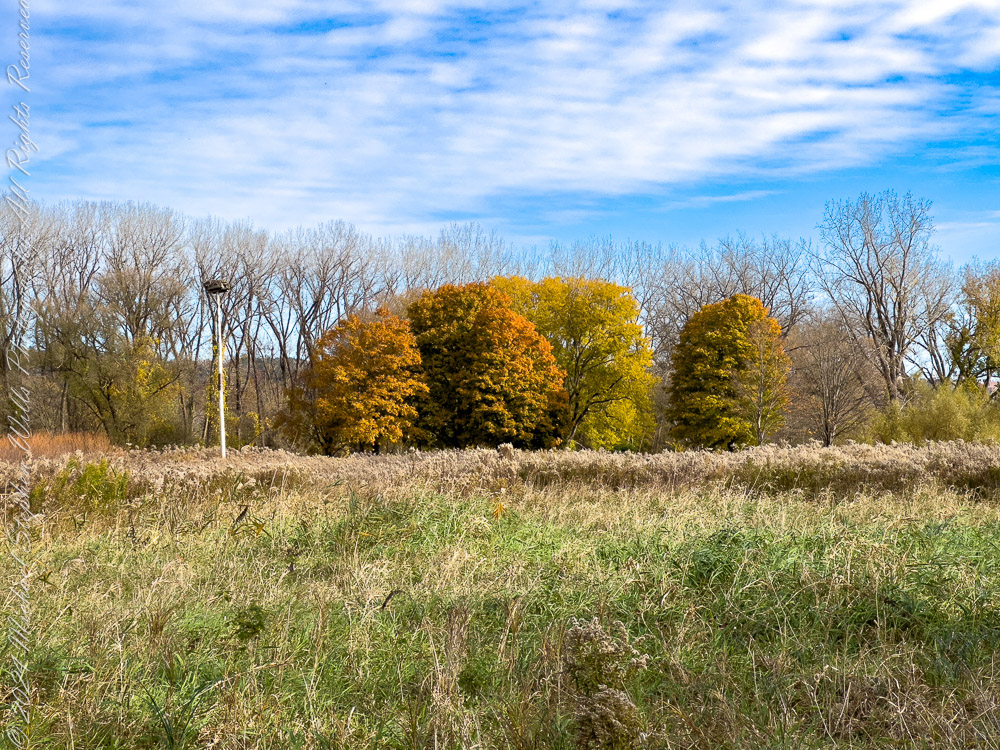
The Osprey’s Watchtower
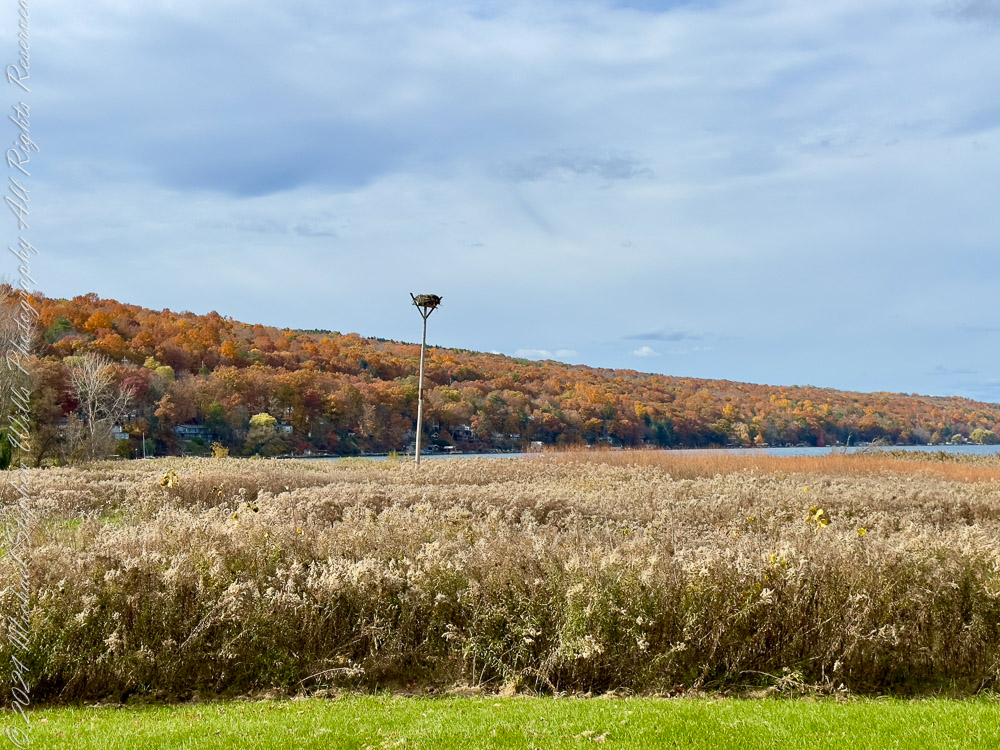
A sight to greet visitors is the solitary osprey nest perched high on a pole. Used by Osprey families during their breeding season, this nest stands as a testament to their remarkable recovery in the Finger Lakes region. Ospreys, once declining due to pesticide use, have rebounded significantly following conservation efforts.
With a wingspan of up to 6 feet, these raptors are expert fish hunters, often seen diving talons-first into the lake to snatch their prey. During autumn, as their young take flight, the nest remains an empty marker of the summer’s success—a reminder of the cyclical nature of life along the lake.
Did You Know? Ospreys are often referred to as “fish hawks” because fish make up 99% of their diet.
The Meadow and Its Golden Touch: Reedbeds and Goldenrod
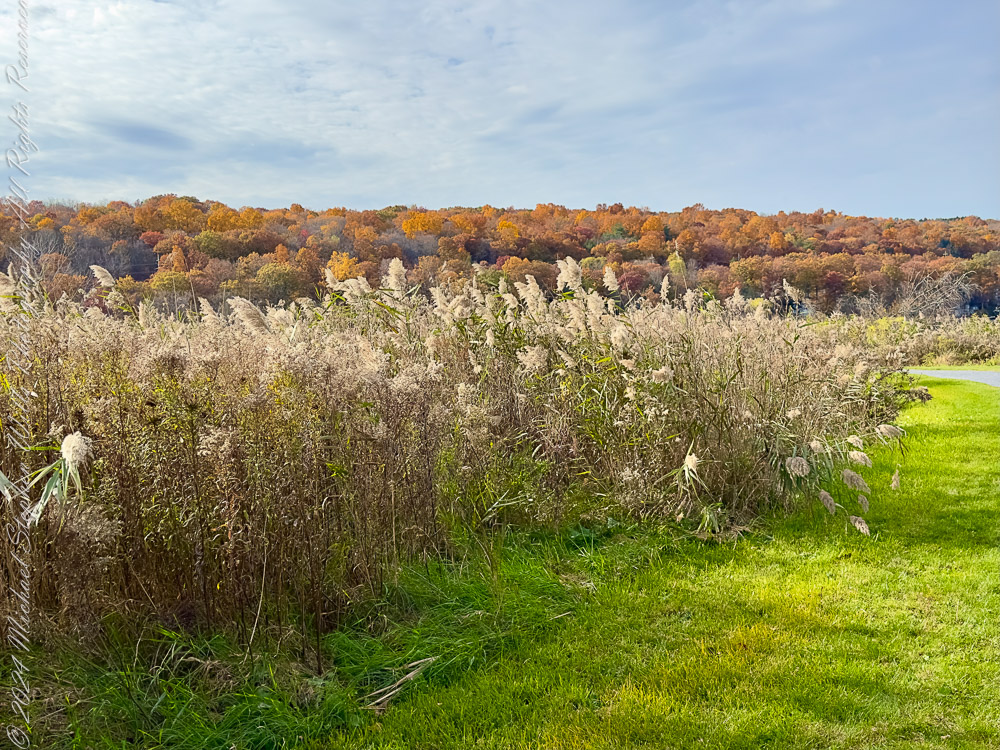
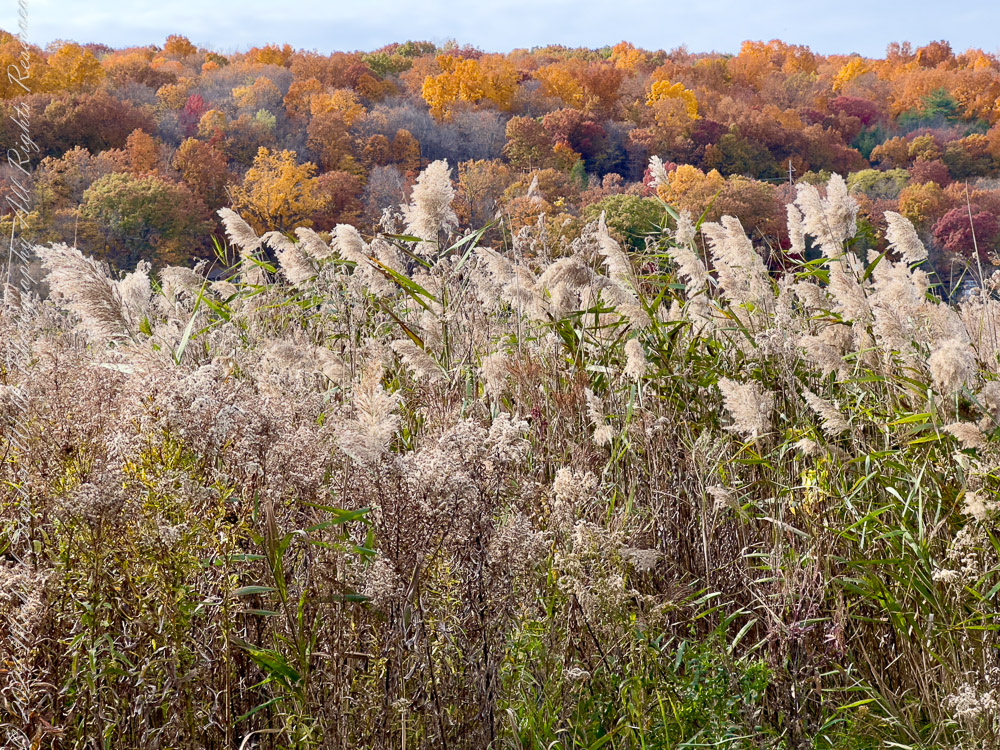
Surrounding the osprey pole, expansive meadows of grasses and reeds sway with the breeze. Among these are stands of Common Reed (Phragmites australis), a tall grass with feathery plumes that catch the sunlight. While Phragmites can sometimes be invasive, they provide crucial shelter and food for various species of birds and insects.
Intermixed with the reeds are patches of Goldenrod (Solidago spp.), whose bright yellow flowers are a signature of late summer and autumn in the Northeast. Goldenrods are critical for pollinators, offering nectar to bees, butterflies, and migrating insects like the Monarch butterfly (Danaus plexippus).
Ecological Note: Goldenrods are often mistakenly blamed for allergies; the real culprit is ragweed (Ambrosia artemisiifolia), which blooms at the same time but releases airborne pollen.
A Lake Alive with History and Beauty
The shimmering blue waters of Cayuga Lake form the centerpiece of this trail. The lake, stretching nearly 40 miles, is the longest of the Finger Lakes and steeped in geological and cultural history. Its name is derived from the Cayuga Nation, part of the Haudenosaunee Confederacy, who inhabited the region for centuries.
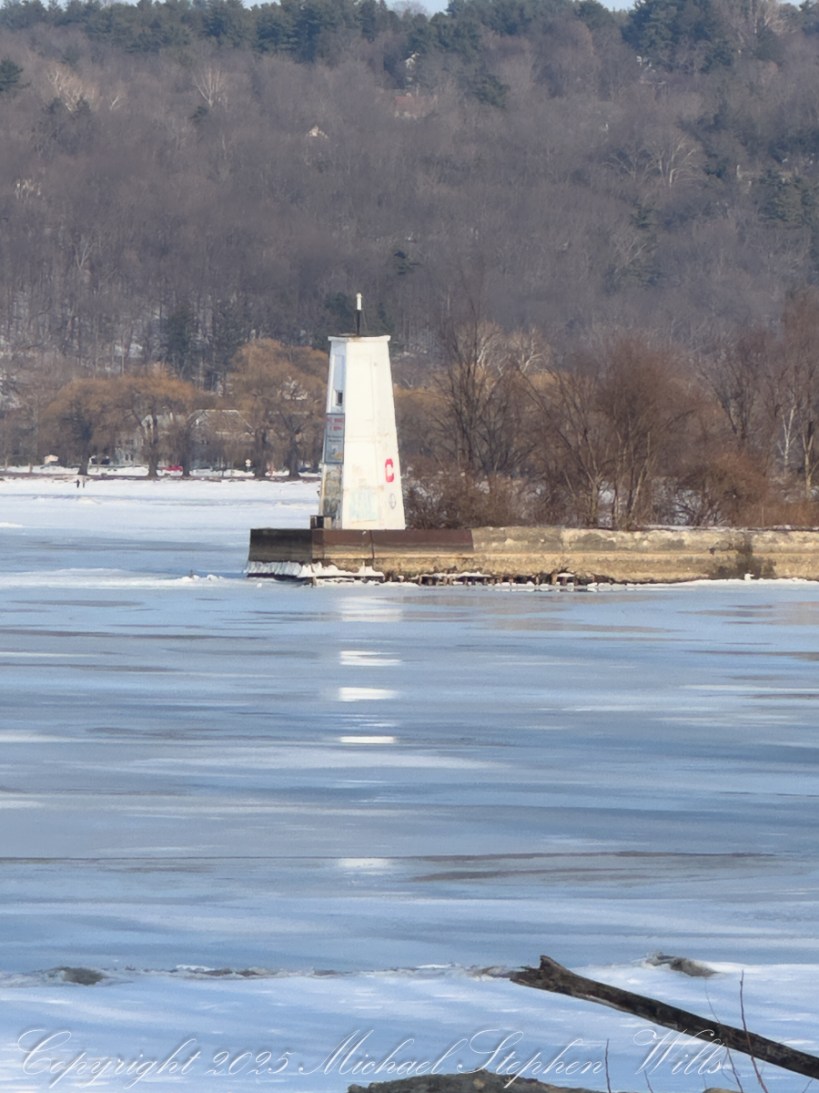
The striking red lighthouse in the water serves as a vivid counterpoint to the natural surroundings. Built to aid navigation, it now stands as a picturesque focal point for photographers and nature enthusiasts alike.
Cayuga Inlet Light Beacon
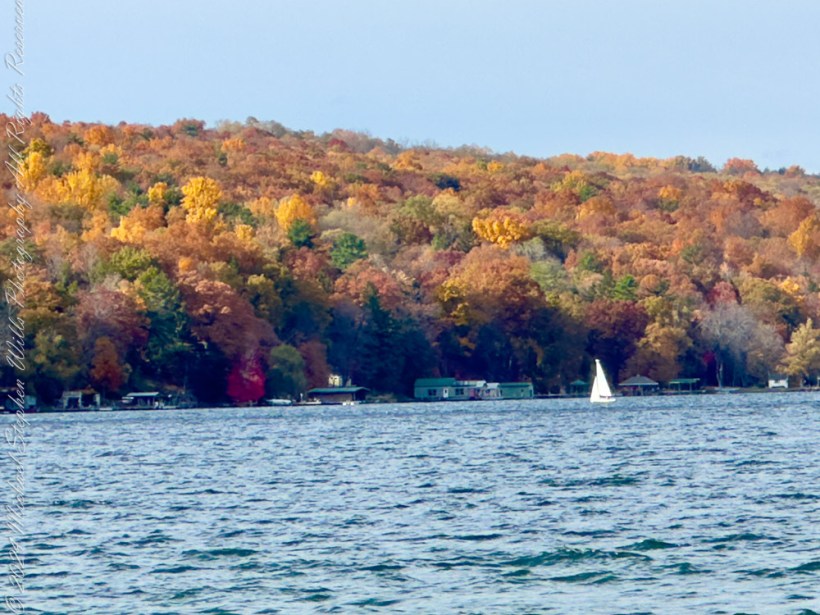
In the distance, a sailboat glides across the lake—a serene reminder of the recreational draw that Cayuga Lake holds year-round.
West shore with sailboat and lake houses
The Forest Fringe: A Kaleidoscope of Color
The forests that fringe the meadow and the lake present an explosion of autumn color. Trees such as Sugar Maple (Acer saccharum), Red Oak (Quercus rubra), and Black Cherry (Prunus serotina) dominate the canopy, their leaves transforming into brilliant oranges, scarlets, and deep burgundies. The Sugar Maple, in particular, is renowned for its vibrant golden-orange foliage, a hallmark of the northeastern fall.
The Ithaca Yacht Club lies south of Maplewood Point
Closer to the ground, the understory hums with the activity of migrating birds and foraging mammals. Squirrels can be seen gathering acorns, preparing for the winter months ahead, while chickadees flit among the branches, calling their cheerful “fee-bee” notes.
Historical Fact: The Finger Lakes were carved out by retreating glaciers over 10,000 years ago, leaving behind these deep, elongated lakes and fertile soil that supports rich biodiversity.
A Path Through Time and Nature
Walking the Treman Park Lake Loop is a sensory journey—the crispness of the autumn air, the rustling of reeds, and the rhythmic lapping of waves against the shore combine to evoke a timeless tranquility.
From the vibrant meadows to the osprey’s lofty perch and the quiet expanse of Cayuga Lake, this section of the Waterfront Trail encapsulates the beauty and diversity of the Finger Lakes ecosystem. Whether for quiet reflection or active exploration, it remains a treasured destination in every season.
Closing Thoughts
As autumn deepens, this landscape prepares for the dormancy of winter. Yet the stories it holds—from the osprey’s nest to the goldenrod’s bloom—remain alive, waiting to be rediscovered with each new season. The Treman Park Lake Loop is not just a trail; it is a canvas of life, change, and history painted by nature’s hand.
Reflection: To walk this trail is to connect with a land shaped by glaciers, nurtured by waters, and home to countless species that continue to thrive amid the ever-turning wheel of the seasons.
Enter your email to receive notification of future postings. I will not sell or share your email address.
Copyright 2024 All Rights Reserved Michael Stephen Wills
The Cayuga Waterfront Trail beautifully showcases autumn’s colors, history, and ecological significance through its landscapes and trees like Sugar Maples.
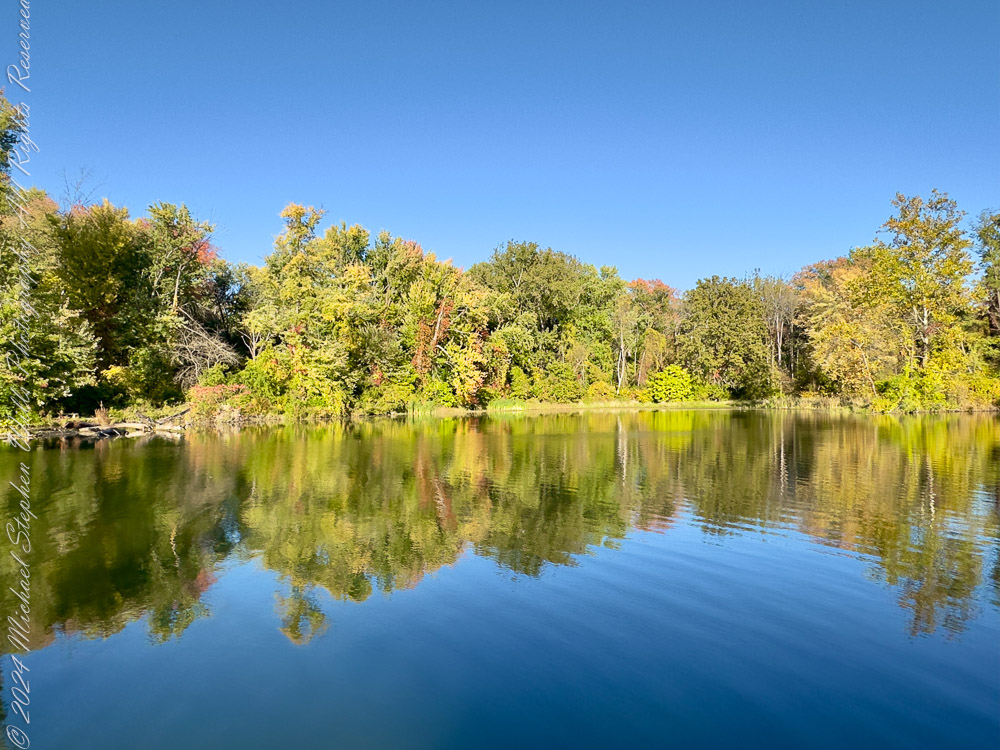
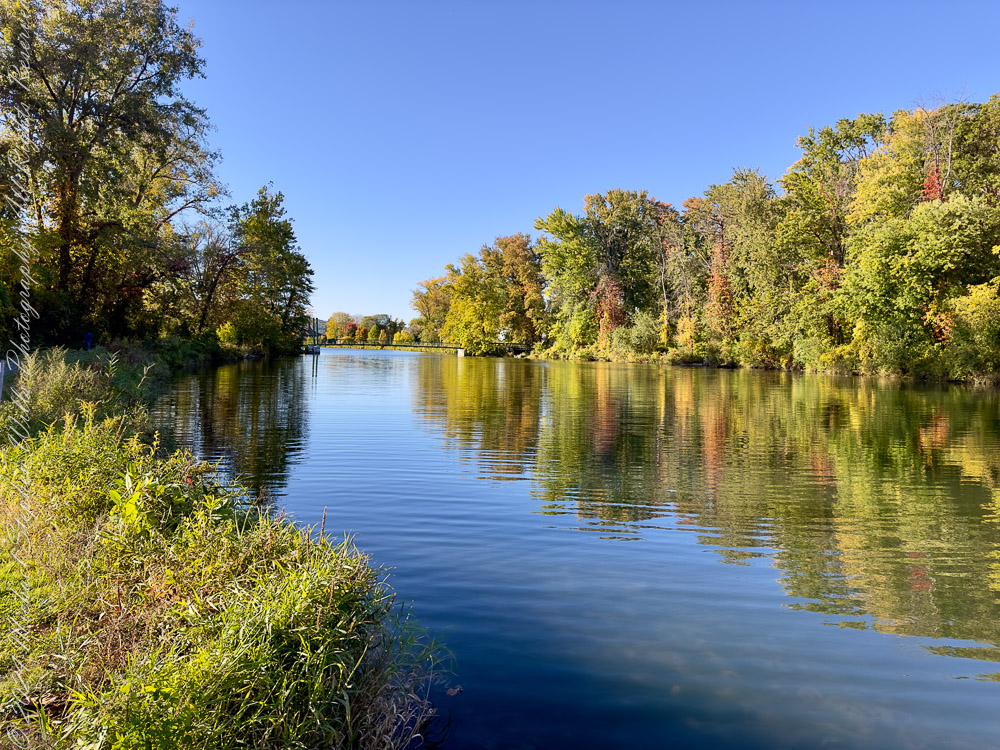
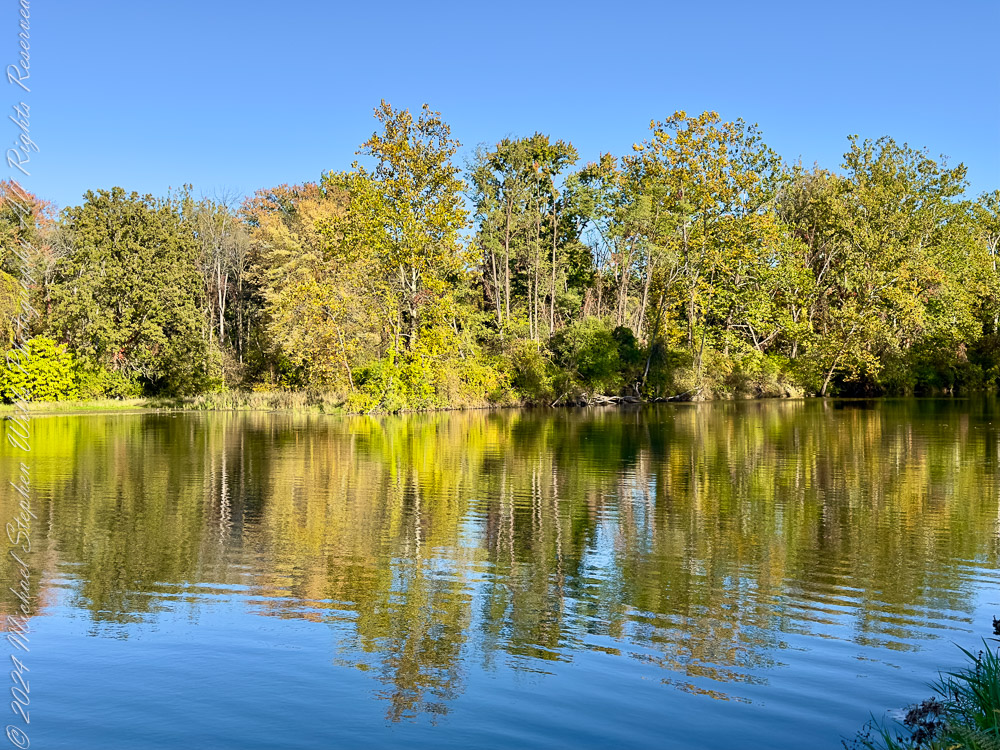
Where Fall Creek Meets Cayuga Lake Here, where Fall Creek flows gently into Cayuga Lake, the merging waters reflect the season’s colors like a painter’s palette. Across the shimmering surface, Renwick Woods of Stewart Park stands as a quiet sanctuary of mixed hardwoods and wetlands. The reflections capture our trees together with the essence of autumn’s stillness.
Dominating the shoreline, you can spot Silver Maple (Acer saccharinum) and Cottonwood (Populus deltoides), trees that thrive in damp soils. Silver Maples, with their elegant, deeply lobed leaves, are perfectly suited for this riparian environment. The cottonwood, recognizable by its broad, triangular leaves, plays a vital role in stabilizing streambanks.
Quick Fact: Cottonwoods are among the fastest-growing trees in North America, capable of sprouting leaves within weeks of being washed ashore as driftwood.
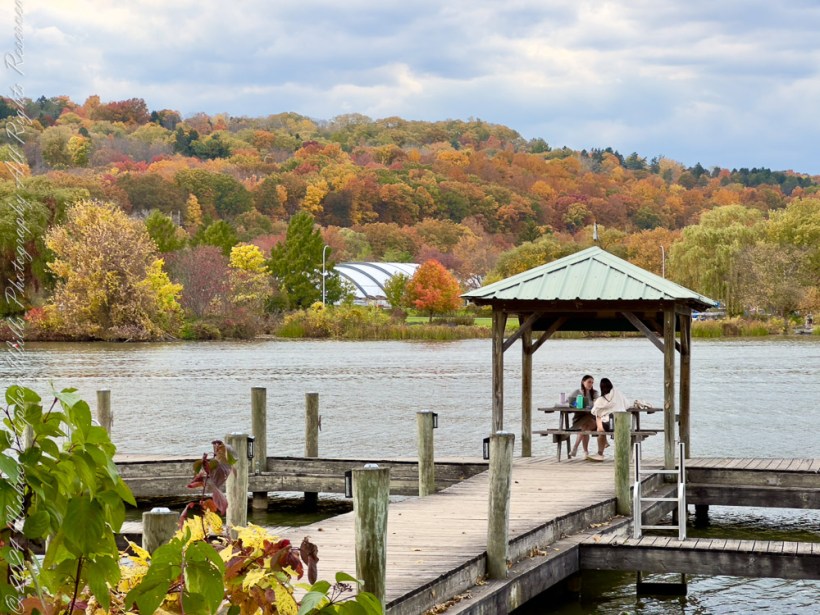
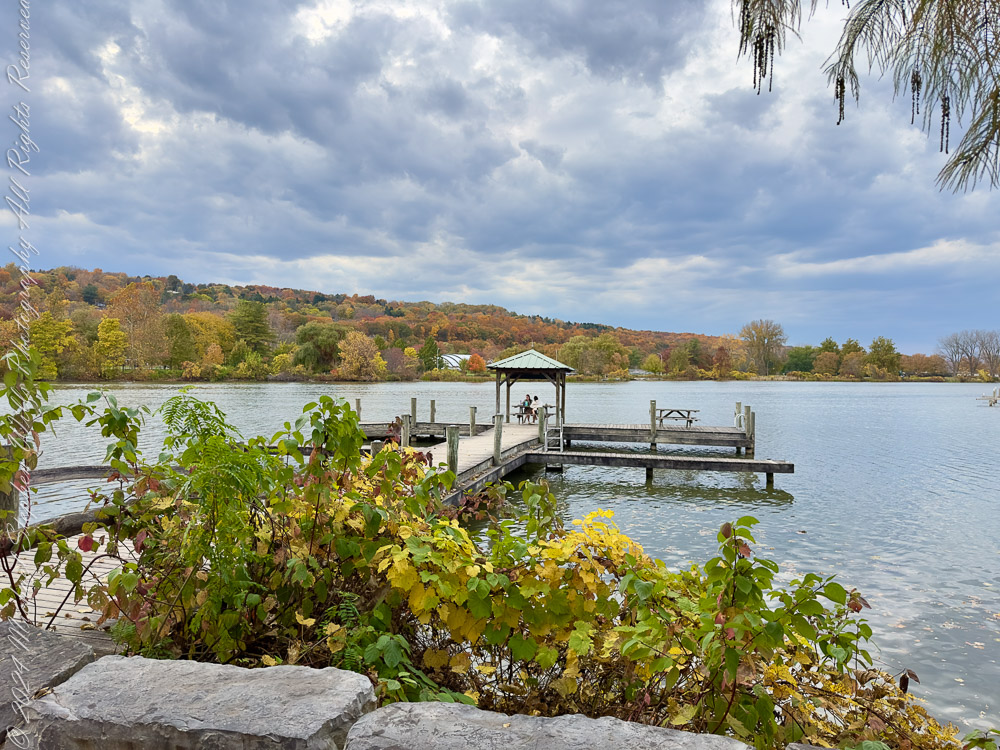
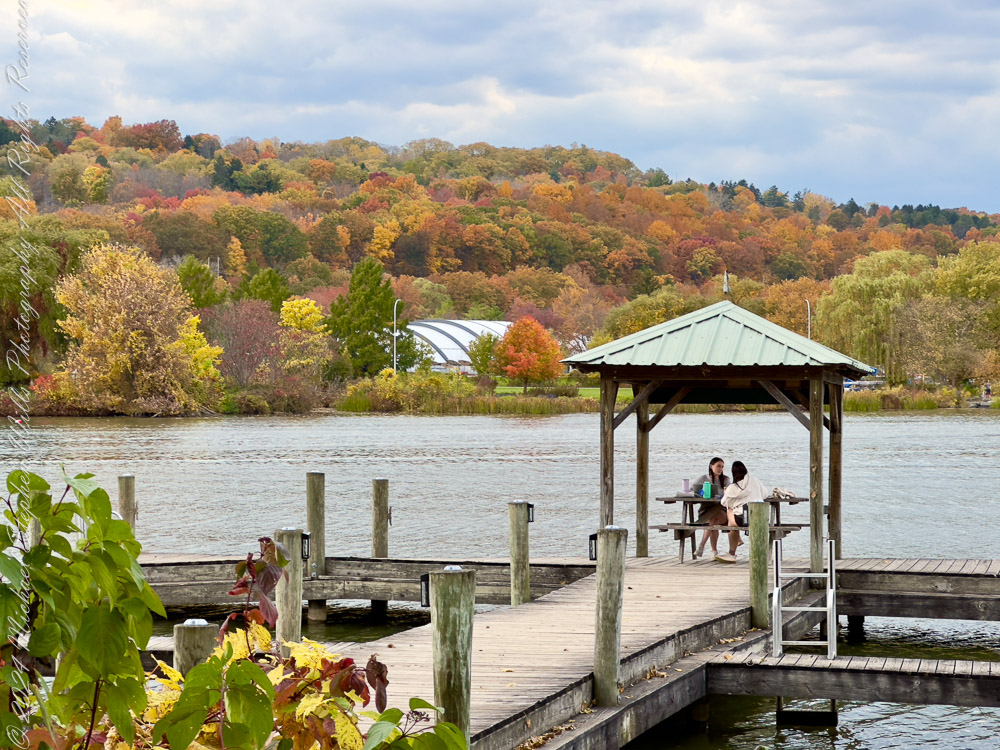
Steamboat Landing: A Glimpse of History The wooden docks at Steamboat Landing, now home to the bustling Ithaca Farmer’s Market, speak of bygone eras when steamboats ferried goods and people across Cayuga Lake. Today, as golden foliage cloaks the hills in the distance, this spot remains an anchor for community and connection.
A meeting place for friends and conversation
Foregrounded in the photos are plants like Grape Vine (Vitis spp.), with their sprawling, hardy stems turning yellow as temperatures drop. Grapevines, both wild and cultivated, thrive along the lakeshore and remind us of their agricultural importance in the Finger Lakes.
Also visible are some shrubs of Virginia Creeper (Parthenocissus quinquefolia) turning crimson, their vibrant hues climbing posts and fences as they embrace autumn’s spotlight.
Did You Know? Steamboat Landing was part of Ithaca’s rich lake commerce history during the 19th and early 20th centuries, connecting travelers to destinations far and wide.
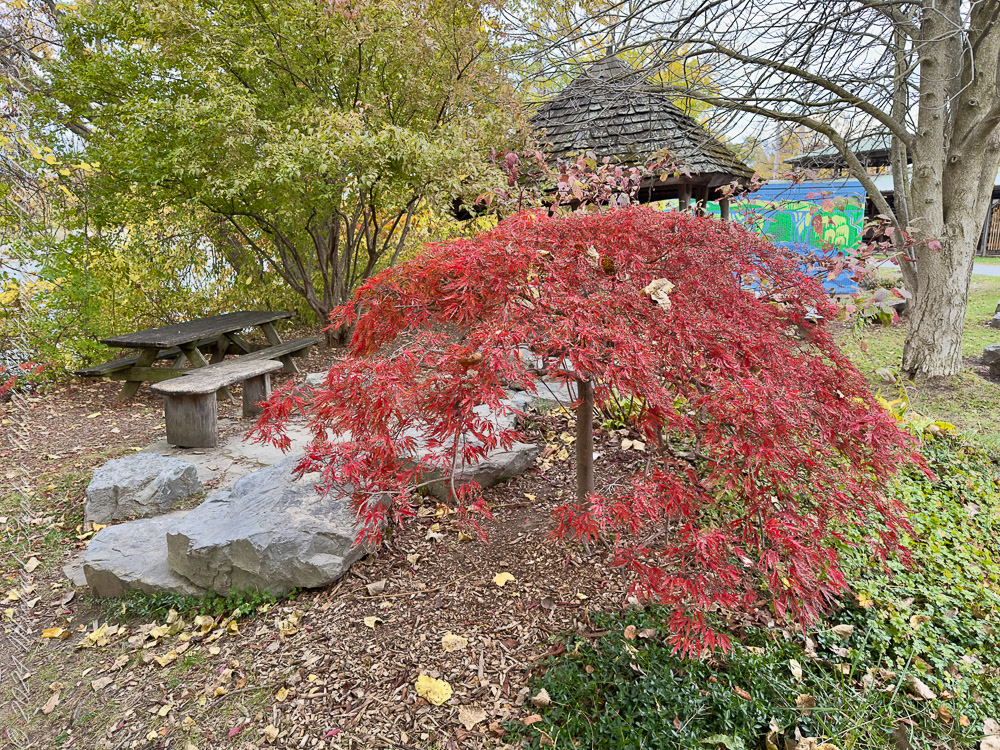
The Crimson Canopy: Japanese Maple This photo highlights a stunning Japanese Maple (Acer palmatum), its feathery, scarlet foliage cascading delicately in front of the pavilion. Native to East Asia, Japanese Maples have found a beloved place in landscapes across the world for their graceful form and brilliant seasonal displays.
Alongside its boughs, weathered benches and stone pathways invite rest and reflection — a beautiful marriage of human craftsmanship and nature’s artistry.
Fun Fact: Japanese Maples are often pruned meticulously in Japanese gardens to emphasize their architectural shape, turning them into living sculptures.
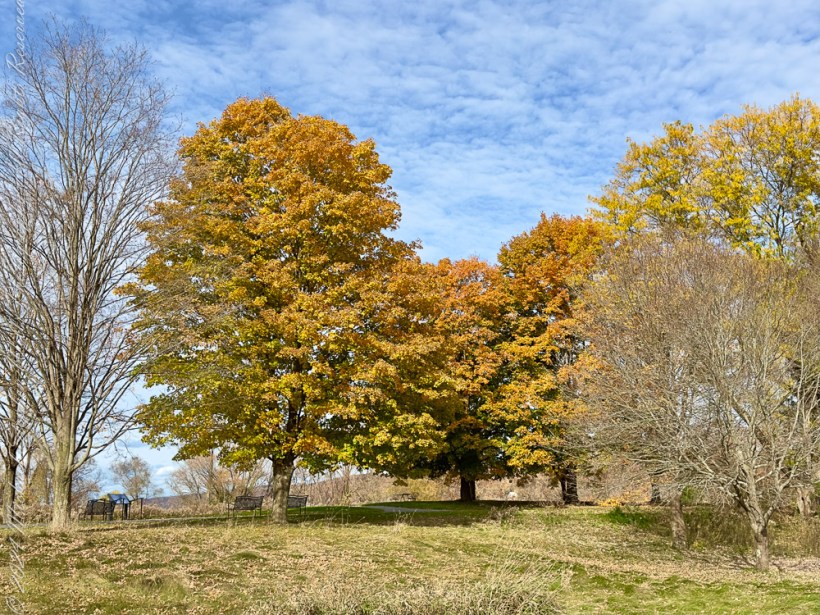
The Treman Park Lake Loop: Autumn’s Golden Finale Our journey concludes with this sweeping landscape from the Treman Park Lake Loop. The towering Sugar Maples (Acer saccharum) dominate the view, their crowns now a rich, golden orange — a signature of northeastern forests. Known as the tree that gives us maple syrup, Sugar Maples are quintessential symbols of autumn in the Finger Lakes.
To the right, bare branches of earlier-shedding trees stand in contrast, whispering the arrival of winter. The sky above, painted with soft clouds, completes the scene of a serene seasonal transition.
Interesting Note: Sugar Maples can live for over 300 years, their wood prized for furniture and instruments, and their sap a sweet gift of the forest.
Closing Thoughts From the quiet confluence of Fall Creek and Cayuga Lake to the historic docks of Steamboat Landing and the golden maples of Treman Park, autumn on the Cayuga Waterfront Trail is a symphony of color, history, and ecological wonder. Whether you’re strolling, photographing, or simply pausing to take it all in, these moments capture both the grandeur and subtlety of the season.
Enter your email to receive notification of future postings. I will not sell or share your email address.
Copyright 2024 All Rights Reserved Michael Stephen Wills
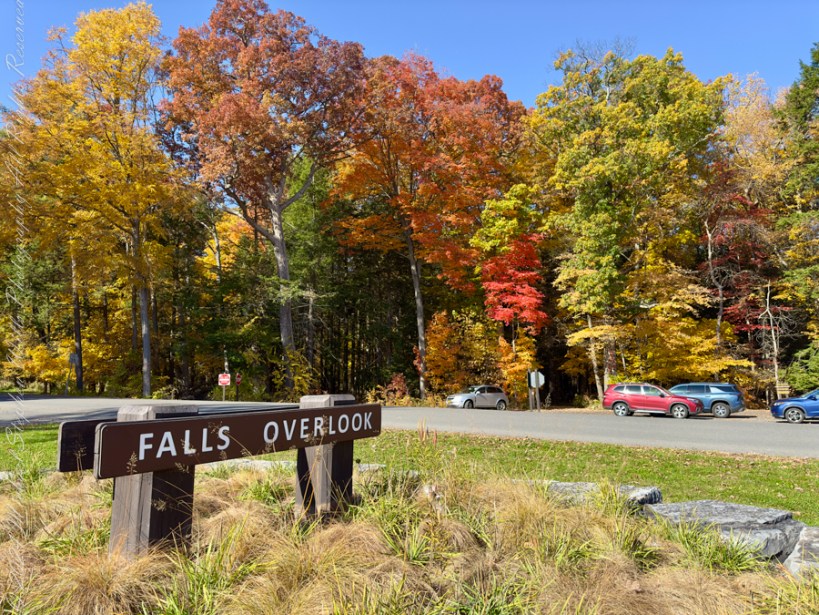
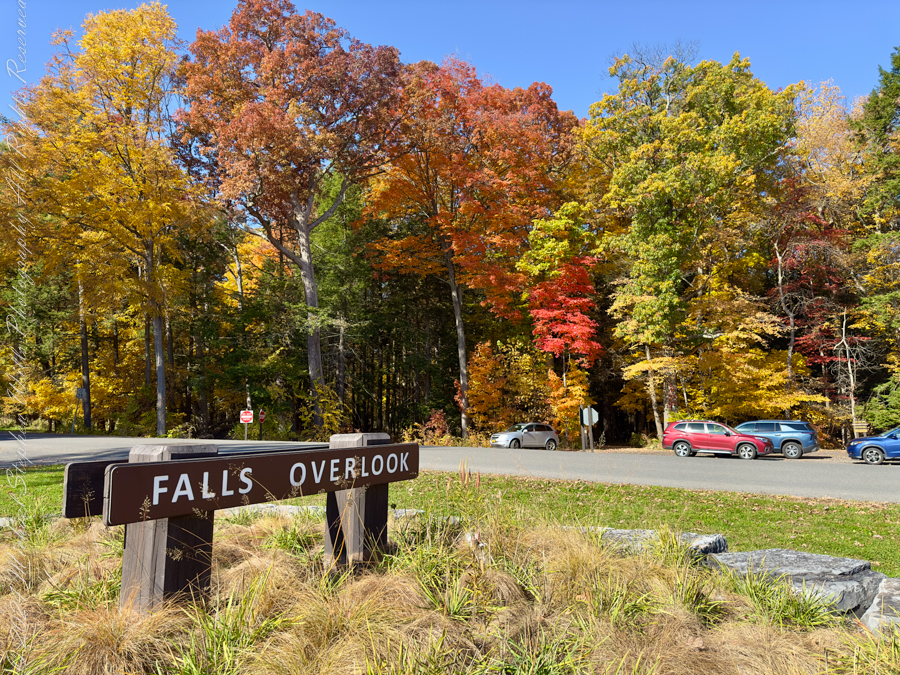
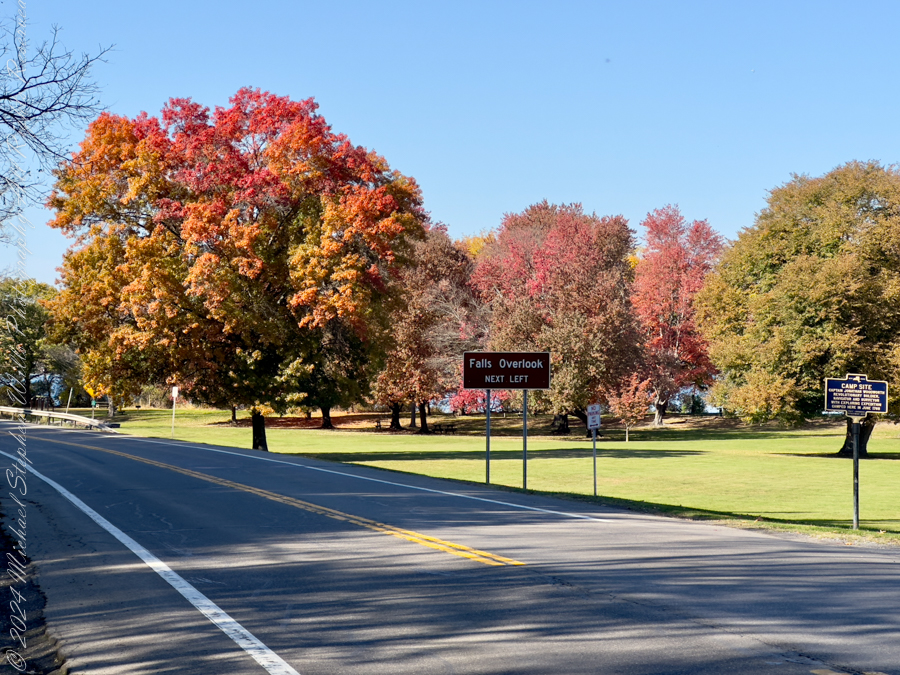
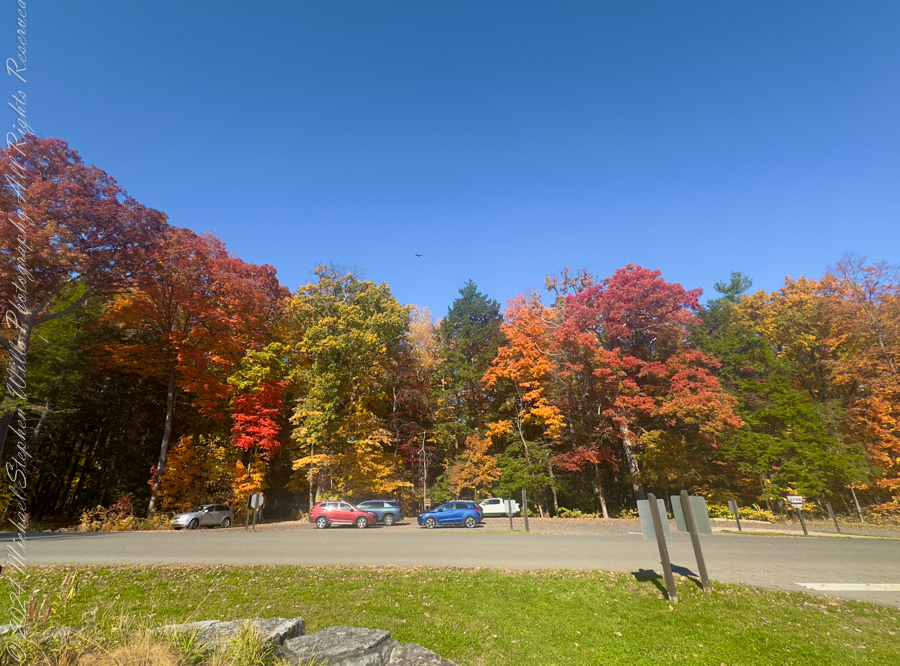
As I set foot on the Falls Overlook at Taughannock Falls State Park, I was greeted by a symphony of autumn colors in their full glory. The vibrant oranges, reds, and yellows of the trees framed the scene, setting the stage for a perfect fall day. I lingered, taking in the view of cars nestled among the foliage, their colors almost merging with the rich autumn hues surrounding them. The sign for the “Falls Overlook” hinted at the journey ahead.
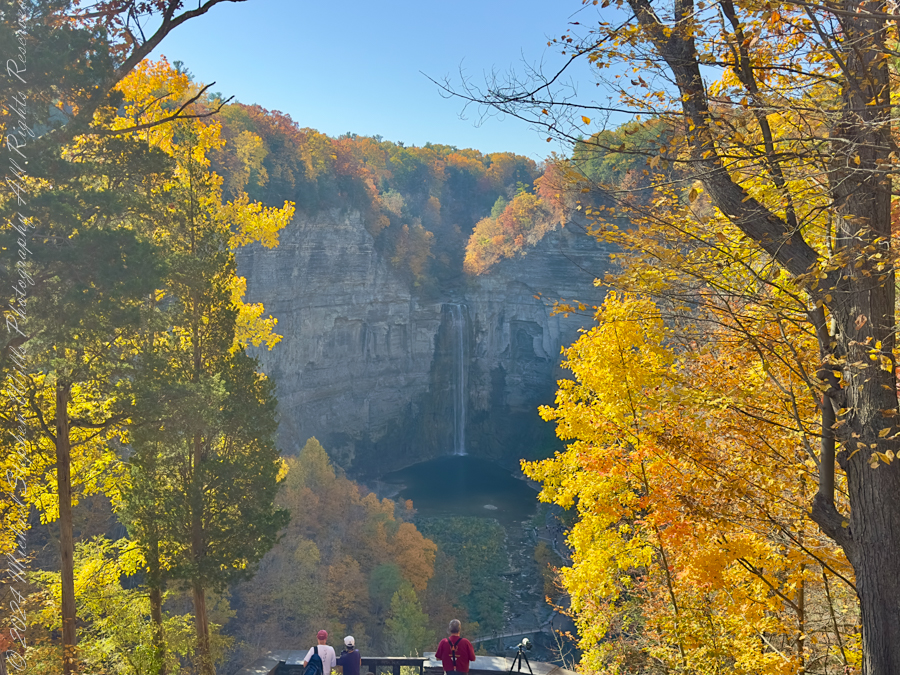
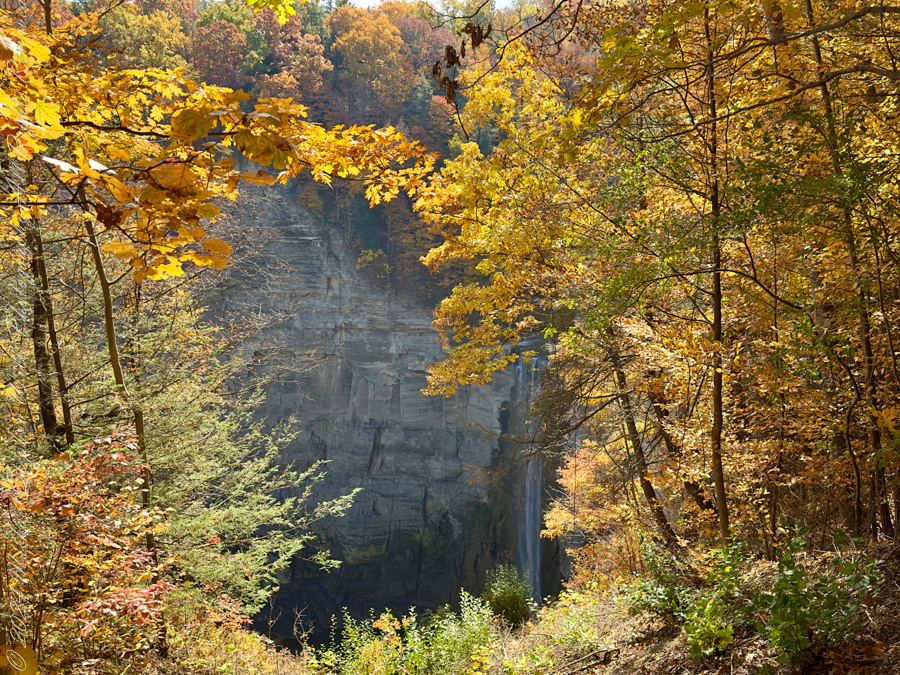
The overlook offered a breathtaking view, a gentle reminder of nature’s power as Taughannock Falls cascaded far below, framed by rugged cliffs and vibrant trees. Through gaps in the golden leaves, I could catch glimpses of the waterfall, a delicate white ribbon against the slate-gray rock. The sunlight filtered through the canopy, casting dappled shadows and illuminating leaves like stained glass, painting the landscape in a thousand shades.
I began my ascent up the North Rim Trail, where the path twisted beneath a tunnel of golden branches. The trail was carpeted with leaves, crunching underfoot with each step. The air was crisp, filled with the earthy scent of decaying leaves and moist earth. Sunlight poured through gaps in the canopy, lighting up patches of ferns and casting long shadows on the rocky path. Here and there, the yellow and brown hues gave way to a burst of crimson, the leaves vivid and almost glowing in the sunlight.
The trail led me along the cliff’s edge, where the river carved its path below. Pausing on the footbridge to the south rim, a former railroad, I looked out over the gorge, admiring the mosaic of colors stretching as far as the eye could see. In the distance, the sound of the falls drifted up to me, a soft, continuous roar that lent the forest an almost mystical air. It was hard not to feel a sense of awe at the raw beauty of the scene.
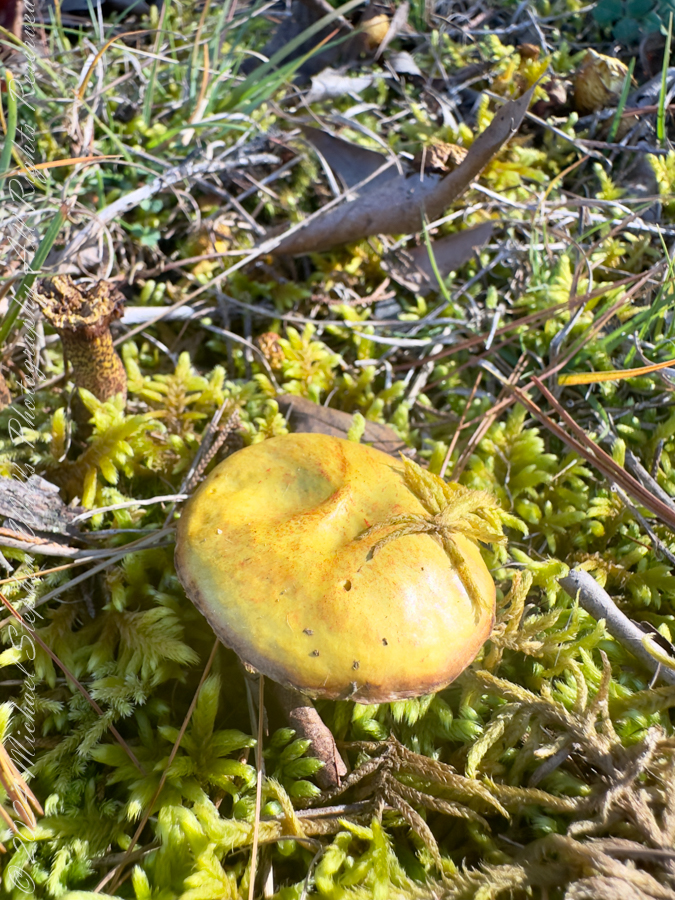
Eventually, I made my way down the South Rim Trail. There were ample distractions from the glorious foliage. A lone mushroom, golden and nestled in a bed of moss, caught my eye—a small reminder of the forest’s quiet life. I bent down to examine it, marveling at its delicate cap and the way it seemed to glow against the lush green moss. The trees here were denser, casting cool shadows that contrasted with the sun-drenched north side. The leaves here were thicker underfoot, their earthy scent more pronounced, grounding me in the moment.
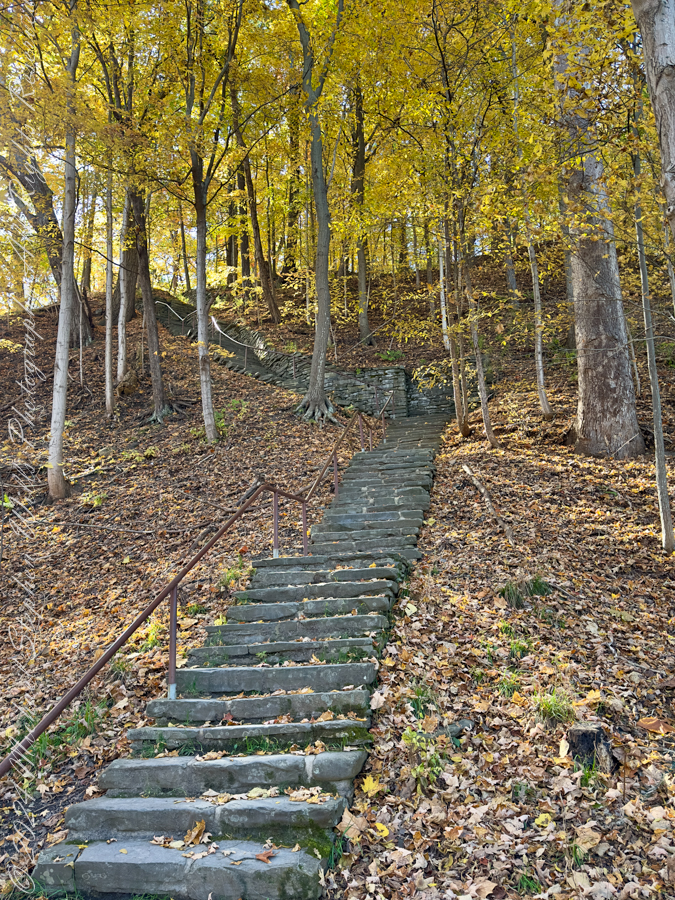
As I reached the lower section of the trail, I noticed an old stone staircase winding up through the trees to the north rim—a relic from another time, adding a touch of mystery to the path. Each step was worn smooth by countless feet, each one a reminder of the generations that had walked these trails before me. The stairs climbed through a cathedral of trees, each trunk tall and straight, as if standing guard over the trail.
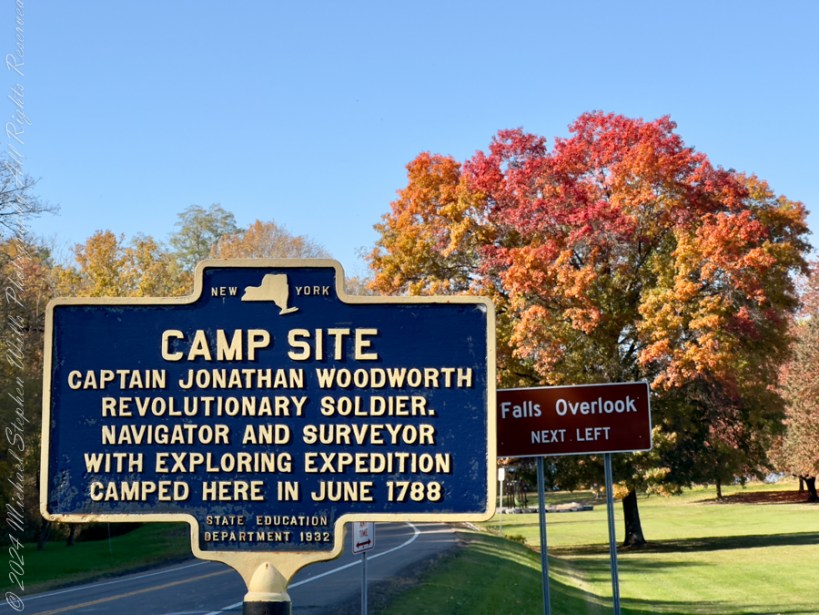
On my way around I passed by a historical marker, a blue and yellow sign commemorating the camp site of Captain Jonathan Woodworth, a Revolutionary soldier who camped here in June 1788. It was a reminder that these trails, this land, had been cherished long before my steps fell upon it.
After reaching the base of the South Rim Trail, I looped back up the North Rim. The trail now felt familiar, yet the changing light gave it a new character. The sun was lower, casting a golden glow across the tops of the trees.
As I returned to my starting point, the sun cast a soft, warm light across the landscape, bathing the park in an ethereal glow. With one last look over the falls and the vivid tapestry of trees, I felt a sense of gratitude. Taughannock Falls State Park in autumn is an experience, one that leaves an indelible mark, reminding us of the beauty and timelessness of the natural world.
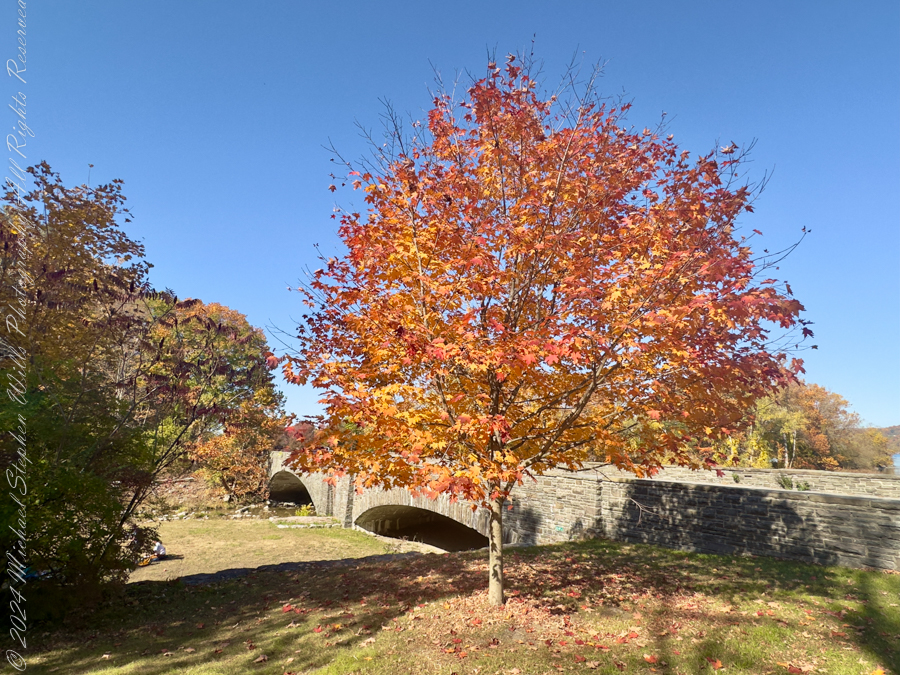
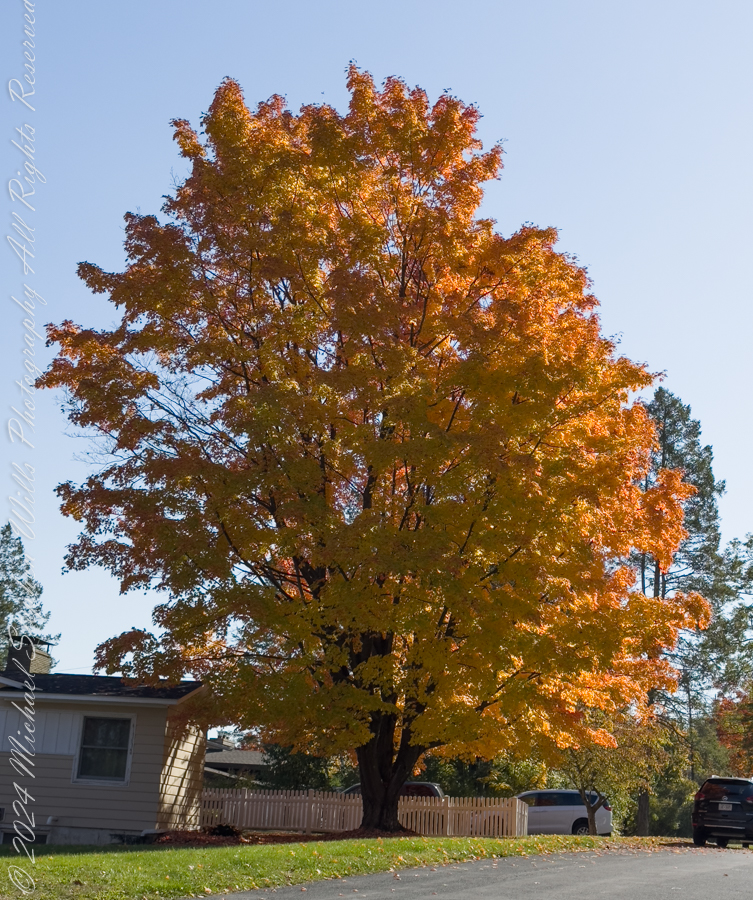
On the drive home I paused to admire a neighbor’s maple tree’s full autumn glory.
Enter your email to receive notification of future postings. I will not sell or share your email address.
Copyright 2024 All Rights Reserved Michael Stephen Wills
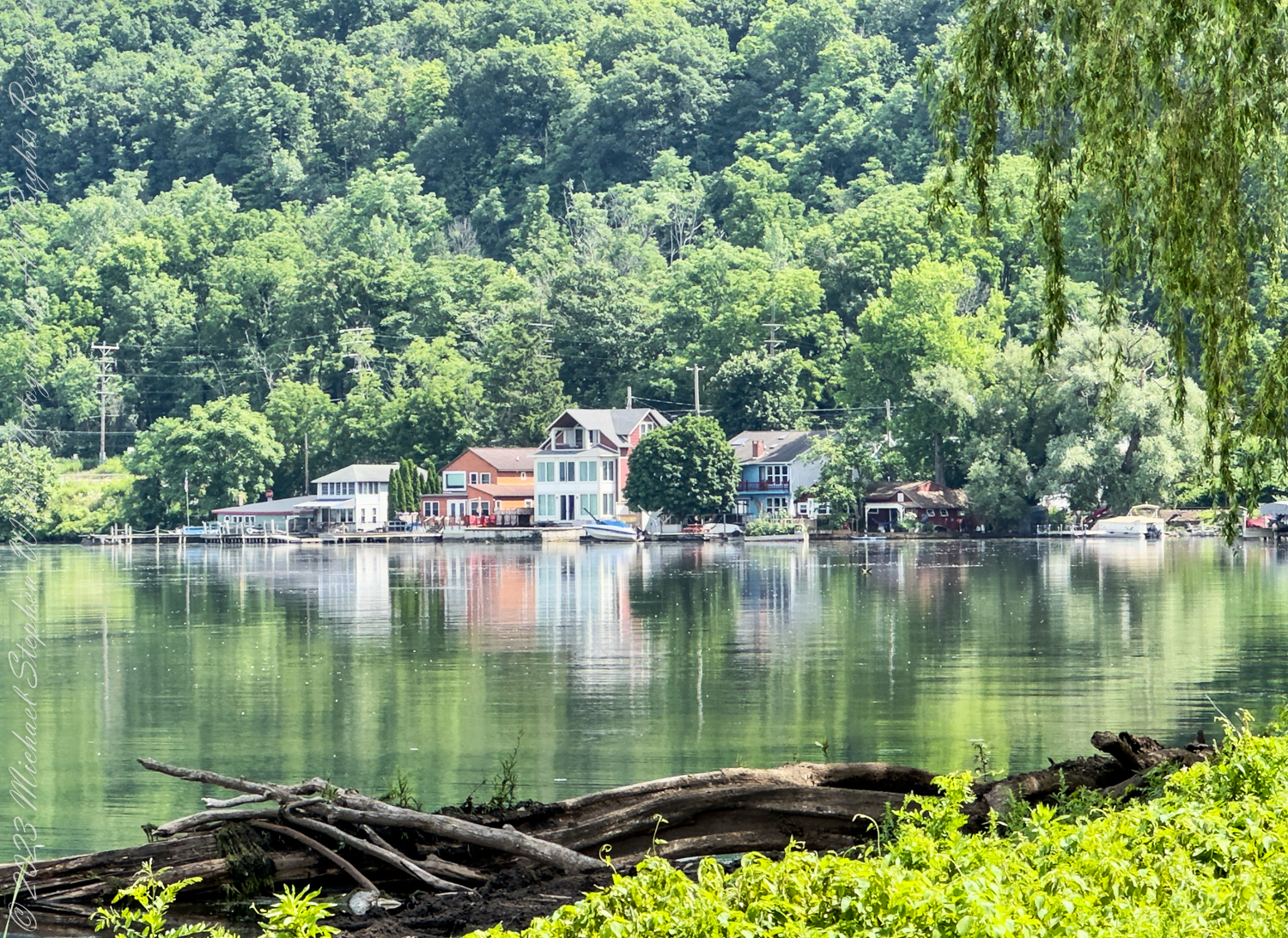
Seen from Stewart Park, these lakefront homes line the southern shore of Cayuga Lake. Tompkins County, Ithaca, New York State. The Finger Lakes Region
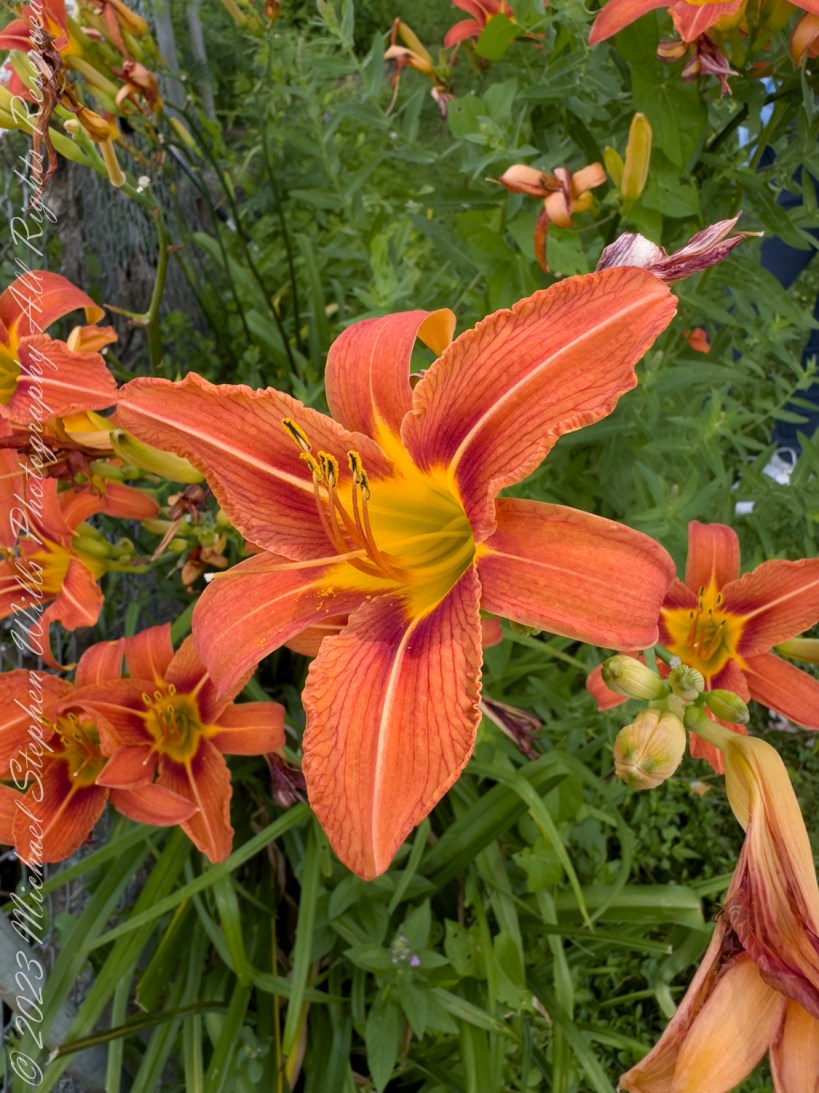
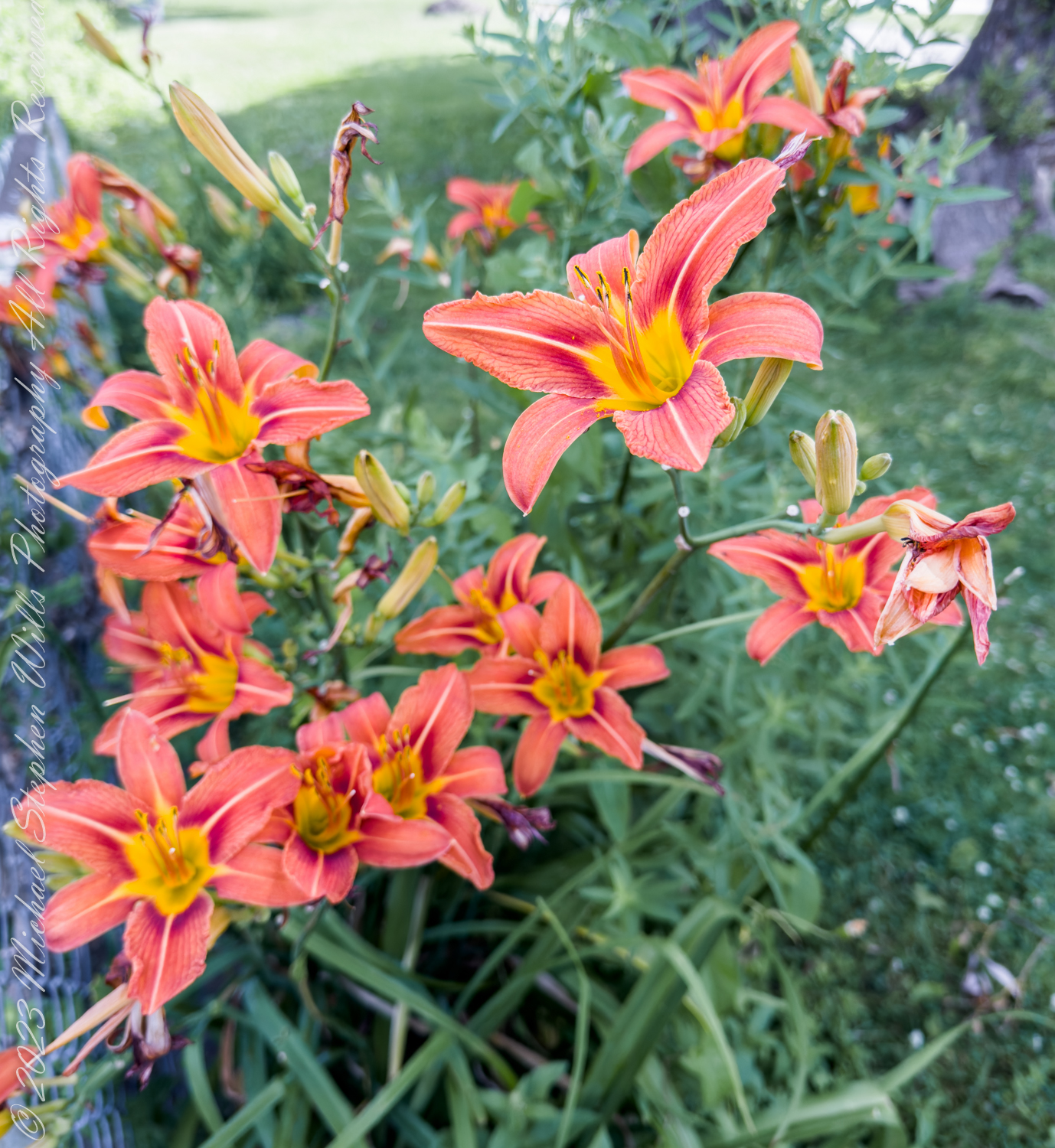
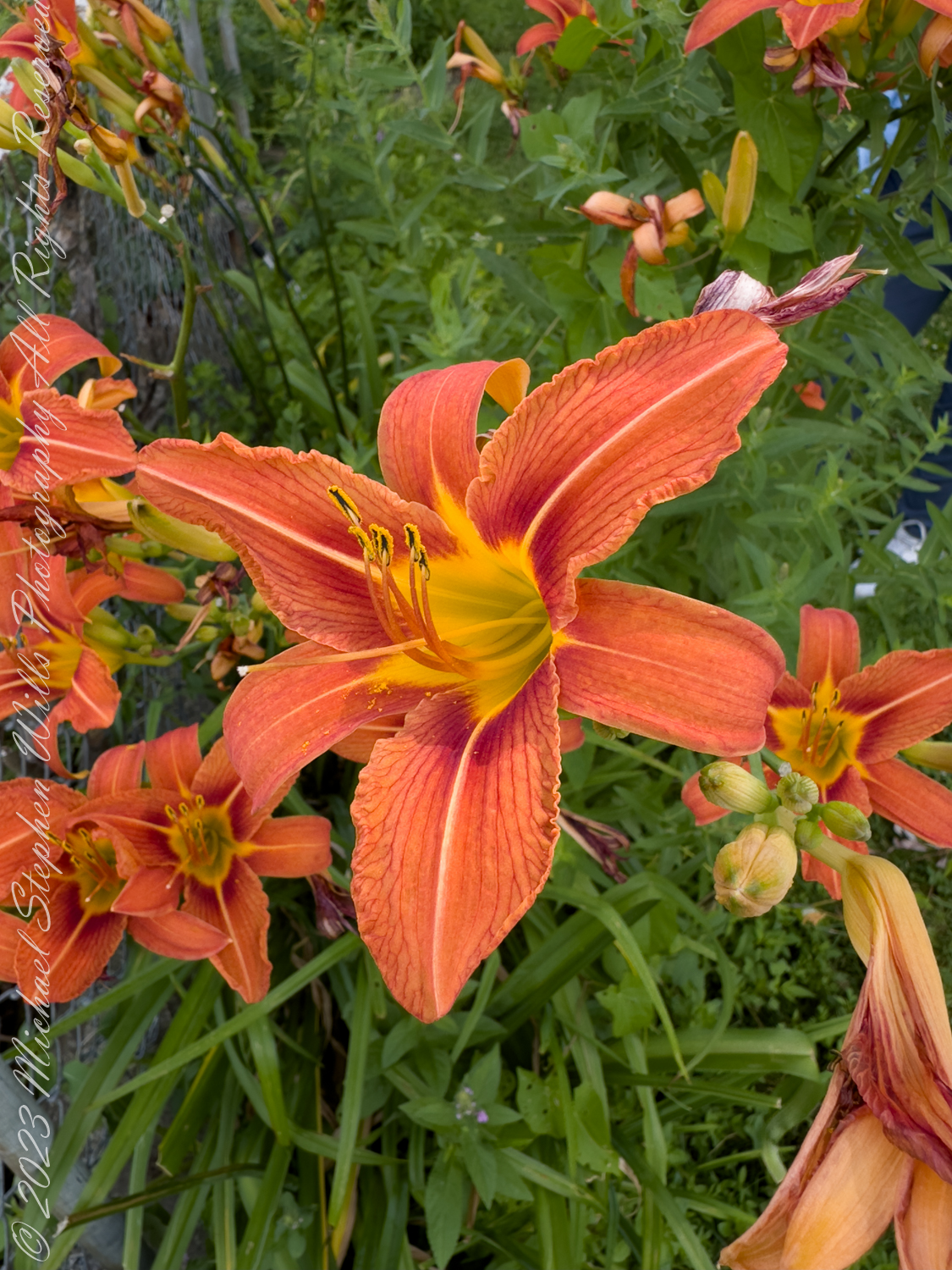
On a warm June morning, with the early summer sun casting a golden glow across the shores of Cayuga Lake, Pam and I set out for a walk around Stewart Park. The soft lapping of the water against the shore mixed with the calls of distant birds, and the familiar hum of life in the park settled into a rhythm that has long been a part of this place. As I strolled along a familiar path, a flash of orange caught my eye—the unmistakable brilliance of the Hemerocallis fulva, the Tawny Daylily, in full bloom.
A Glimpse of the Familiar
At first glance, the orange petals of the daylily seemed like small flames scattered across the green of the park, their brightness undimmed by the heat of the day. The sight was both familiar and captivating, for these daylilies are common in garden, parks and roadsides around Ithaca and much of New York State. Despite their prevalence, each encounter feels fresh, like meeting an old friend who always has something new to share.
I knelt closer, letting my eyes follow the curve of the petals, which unfurled gracefully from a vibrant yellow throat. The delicate lines streaked down the petals like rays of sunlight. Though each flower lives only a day, I felt the quiet confidence of this plant, as though it knew its bloom was fleeting, yet still essential in the tapestry of summer.
The Resilience of a Traveler
The daylily’s ubiquity belies its status as a traveler from distant lands. Hemerocallis fulva is not native to New York, nor to any part of North America. It came to these shores from Asia, introduced by gardeners who admired its hardiness and vibrant color. Over time, the daylily escaped the bounds of cultivated gardens, spreading to roadsides, fields, and yes, even here, to the edges of Stewart Park.
I find myself reflecting on the journey of this plant, which began in the faraway lands of China, Korea, and Japan. In its homeland, daylilies have long been symbols of devotion and motherhood, their roots used in traditional medicine, their blooms celebrated in art. Now, as I stand in Stewart Park, I marvel at how far the Hemerocallis fulva has come, adapting to new lands and naturalizing in the wild corners of the American landscape.
The irony of its “wild” appearance does not escape me—this orange beauty, so deeply associated with our rural and parkland settings, is still very much an outsider. And yet, in the soft breeze of the morning, it feels as though this plant has always belonged here, as much a part of the park’s landscape as the willows by the lake or the ducks bobbing in the water.
Nature’s Balancing Act
As lovely as they are, daylilies are not without their complications. The very same traits that make Hemerocallis fulva such a beloved garden plant—its resilience, its ability to thrive in poor soil, and its spreading rhizomes—also make it an unintentional invader. Without careful tending, these plants can spread aggressively, pushing out native species and altering the ecological balance of the areas where they take root.
Here in Stewart Park, where cultivated gardens meet the untamed edges of the lake, the daylilies are a reminder of nature’s delicate balance. They offer nectar to bees and butterflies, providing sustenance to the creatures that flit through the morning air and also represent challenge to the native wildflowers that have long called this place home.
I wonder what plants might have once thrived in this very spot before the Hemerocallis fulva arrived. Perhaps native species, like the delicate Asclepias tuberosa—Butterfly Weed—or the sturdy Rudbeckia hirta, the Black-eyed Susan, held court here, their blooms attracting the same bees now drawn to the daylilies.
The Fleeting Bloom
Despite its role as a naturalized non-native, the daylily has a fleeting grace that draws me in. By tomorrow, these orange blooms will have withered and fallen, replaced by new blossoms that will unfurl in their place. Each bloom’s brief life is a reminder of the ephemerality of beauty, and I find myself appreciating the daylily all the more for its transient nature.
We continue our walk, leaving behind the patch of daylilies but taking with me a sense of quiet reflection. As invasive as they may be, these plants offer a meditation on the impermanence of life and the ways in which non-native species can become a part of the landscape’s fabric, for better or worse. The Hemerocallis fulva may not belong here by birthright, but it has made a place for itself, a symbol of survival and adaptation in the ever-changing world around it.
A Lesson from the Daylily
As I near the edge of the lake, watching the sunlight dance across the water’s surface, I think about the lessons that the daylily offers. Life is fleeting, yes, but also full of color and vibrancy, no matter how brief the bloom. And in that brief bloom, there is the possibility of resilience, growth, and belonging, even in a place far from home.
Much like the daylily, we too find ourselves in unfamiliar places at times, learning to adapt, to thrive, and to leave our mark on the world—if only for a day.
Copyright 2024 Michael Stephen Wills All Rights Reserved
Discover the timeless beauty of two towering Cottonwood trees along the shores of Cayuga Lake. Explore their natural history, cultural significance, and how they’ve shaped the landscape of Stewart Park for generations.
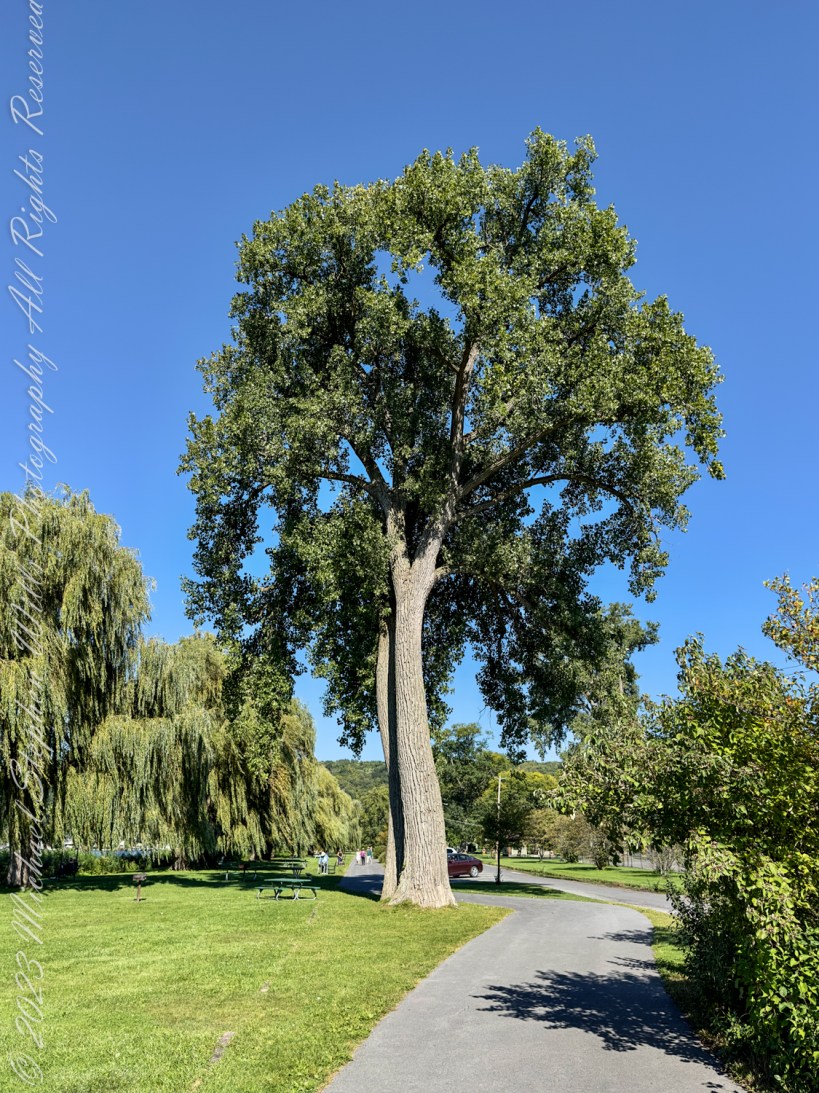
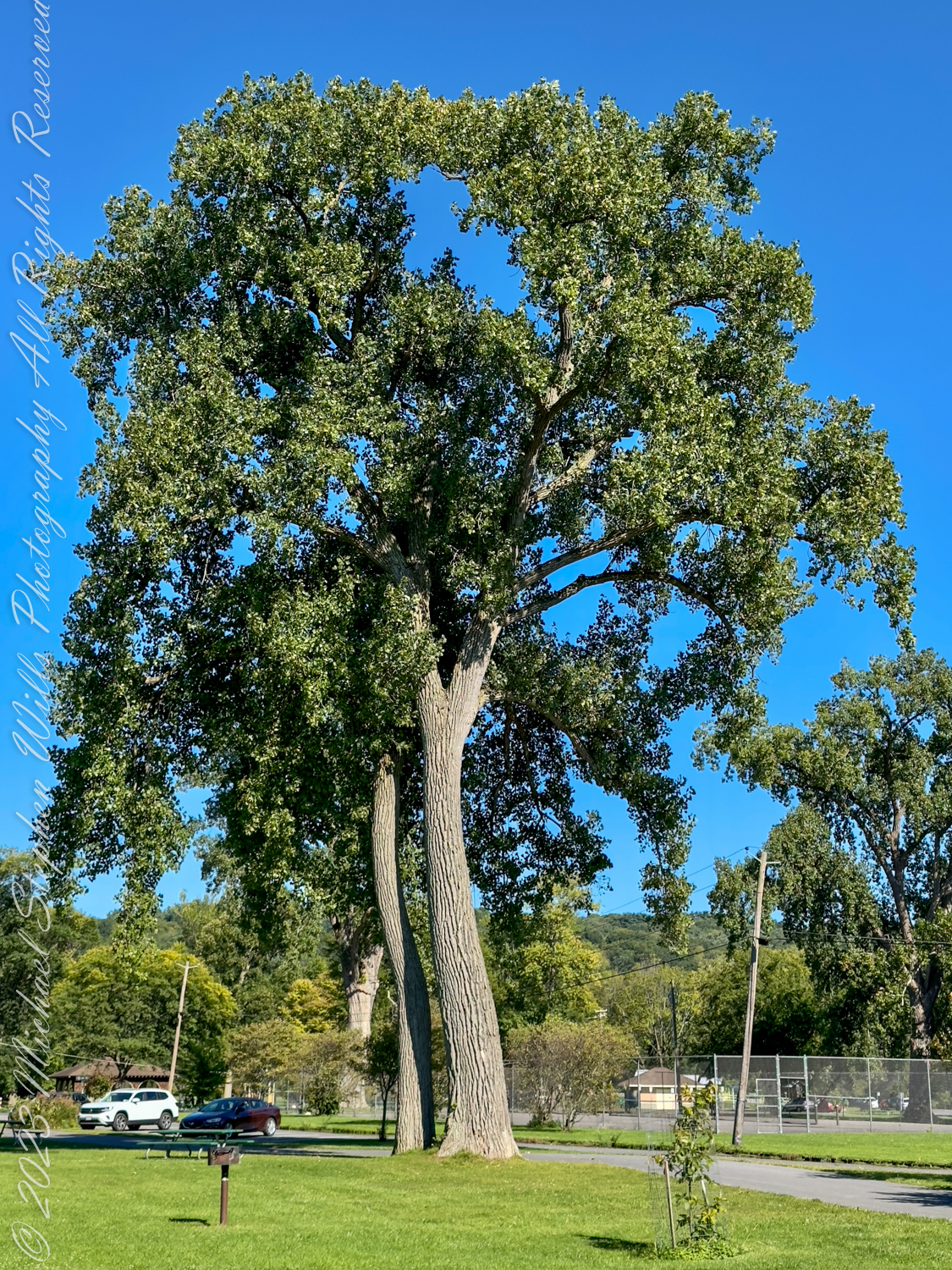
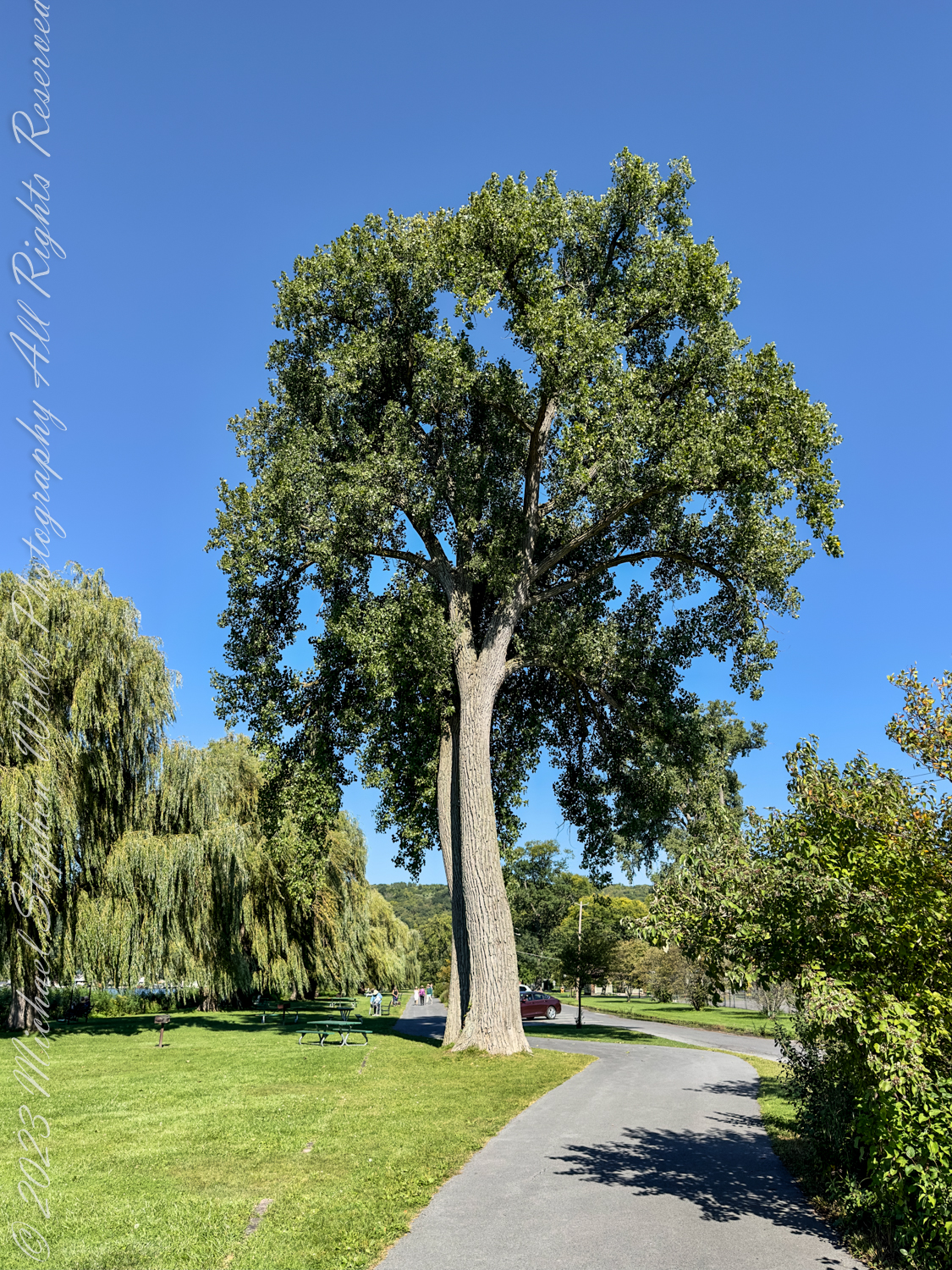
Walking with Pam in Stewart Park, the shores of Cayuga Lake shimmer under the bright September sun, offering a serene setting for reflection. Ahead, two towering Cottonwood trees stand in quiet majesty, their branches spreading wide, casting long shadows over the grass and walkway. Drawn toward them, I find myself in awe of their presence—these two trees, ancient sentinels by the water, who have silently borne witness to the changing world around them.
View Facing East/Southeast, September 10, 2024
Cottonwoods, scientifically known as Populus deltoides, are members of the poplar family and are among the tallest trees in North America. The ones before me have thrived for decades, their thick, furrowed trunks a testament to the endurance of life on the edge of the lake. It’s remarkable to think of all the storms and seasons they’ve weathered—their roots digging deep into the moist earth, nourished by the lake’s constant ebb and flow. I feel as though these trees, standing side by side, companions, connected through the unseen networks of roots beneath the soil. Their relationship to one another seems profound, they have grown up together, providing support and strength as they aged. Their canopies overlapping as though embracing one another.
There’s an undeniable symmetry to their relationship, both in form and function. One can imagine them as silent witnesses to the changing landscape around them—the gradual expansion of the park, the families that come and go, the laughter of children playing nearby, and the quiet conversations of couples walking hand in hand. These trees have become part of the fabric of Stewart Park, deeply entwined with the human history that unfolds here every day.
View Facing East, September 10, 2024
The branches reach skyward, their leaves shimmering in the breeze, producing the characteristic fluttering sound of Cottonwoods. There’s something deeply soothing about this rustling—the way the wind seems to dance through the leaves, creating a rhythm that feels eternal. It reminds me that these trees have long been part of human experience, a backdrop to countless strolls, picnics, and quiet moments of contemplation here at Stewart Park.
Cottonwoods are fast-growing, often found near bodies of water where their shallow roots can tap into consistent moisture. And yet, their rapid growth comes with a trade-off; their wood is soft and brittle, prone to breaking in high winds. But in Stewart Park, these two trees have found a perfect balance, their large, sweeping canopies offering shade and shelter without suffering too much damage from the storms that blow through the Finger Lakes. Their resilience is remarkable—a reminder of nature’s ability to thrive in challenging conditions.
Historically, Cottonwoods have played a significant role in the lives of the people who encountered them. Native Americans once used the bark for medicinal purposes and fashioned the wood into canoes. Early settlers appreciated the trees for their rapid growth and ability to provide shade and timber in otherwise open expanses of the Midwest and Northeast. Even today, their legacy endures as they continue to offer shade and shelter, albeit more for leisure than for survival.
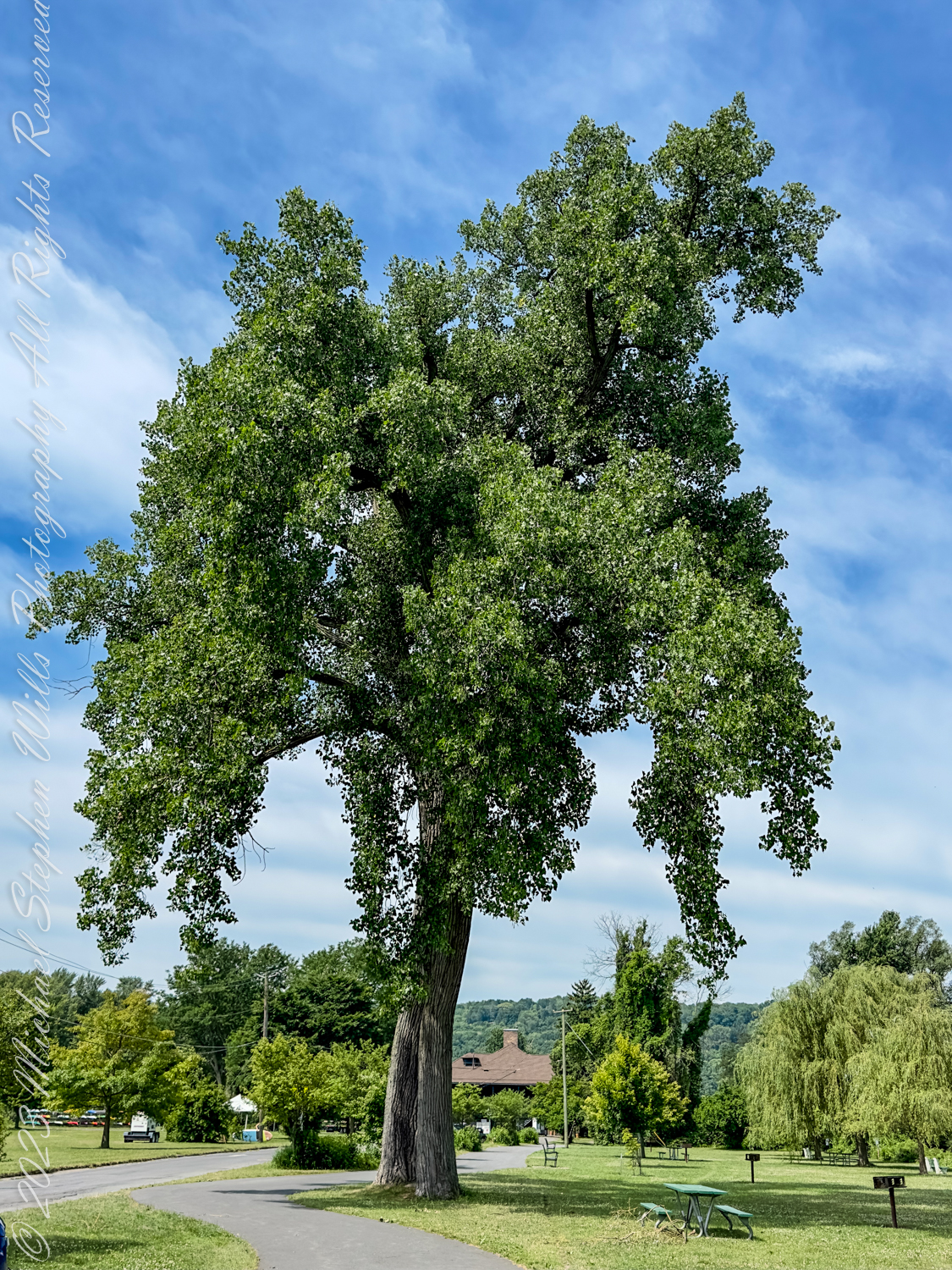
I notice how the pathway itself bends gently to accommodate the Cottonwoods. The paved trail, so clearly designed with these majestic trees in mind, arcs around their broad bases as if to honor their presence. In a world where nature is so often bent to human will, it’s refreshing to see this small, quiet gesture of deference—a reminder that in our modern parks, nature can sometimes lead the way.
View Facing West, June 25, 2024
The path doesn’t cut through or impose upon these trees. Instead, it respects their claim to the land, curving around them in a way that feels organic, almost reverent. The roots of these Cottonwoods must reach far beyond what I can see, extending outward in all directions beneath the soil, beneath the path itself. It’s as though the trees and the human-made elements of the park have reached a compromise—a harmonious balance where both can coexist without either having to sacrifice too much.
In their wisdom, the planners of this park understood that these trees had already laid their claim long before the park’s paths were laid out. It’s a small but profound testament to the enduring power of nature and the foresight of those who designed this space. As I walk along the path, I feel the subtle shift in the landscape—the way the curve of the trail encourages a more leisurely pace, inviting visitors to pause for a moment and take in the grandeur of these ancient trees.
The curve itself creates a sense of flow, as if the path is gently nudging us toward a deeper appreciation of the Cottonwoods. There’s no rush here. The trees stand in their place, rooted and steadfast, while we are invited to move around them, to change our course slightly in order to make space for something larger than ourselves. The path becomes a metaphor for our relationship with nature—we must sometimes bend and yield to its greater forces, rather than insist on our own straight and rigid lines.
This curved path speaks to the broader theme of adaptability—how both nature and humanity have learned to accommodate one another. The Cottonwoods have withstood the test of time, their roots dug deep into the soil, while we have found ways to move alongside them, adjusting our course to allow for their growth. It’s a quiet but powerful reminder of the importance of coexistence and respect, of making space for the natural world rather than always seeking to dominate it.
As we pass by, I notice the texture of their bark—deeply furrowed and rough, a tactile reminder of the passage of time. Each ridge and crevice holds the story of countless seasons—of dry summers, harsh winters, and everything in between. I reach out and touch one of the trunks, feeling the coolness of the bark under my hand. There’s a vitality here that can only be sensed up close, a quiet hum of life that pulses just beneath the surface.
Yet, despite their imposing size and age, the Cottonwoods remain humble in their role. They do not demand attention like a flowering dogwood or a brightly colored maple. Instead, they offer something more enduring—a quiet, steady presence that provides shelter and shade without fanfare. Their leaves turn a brilliant yellow in autumn, adding to the kaleidoscope of colors that make up the Finger Lakes’ fall landscape. But even in winter, when the leaves are gone, their bare branches stand against the cold sky, offering a stark beauty all their own.
As I step back to take in the full view of these two Cottonwoods, I am filled with a sense of gratitude. Their lives, so intimately tied to this place, remind me of the interconnectedness of all living things—the way nature, time, and humanity overlap in ways both seen and unseen. These trees, growing together on the shores of Cayuga Lake, are not just part of the landscape—they are part of the story of Stewart Park and, in a broader sense, the story of this region. They remind me that, like them, we are all shaped by our surroundings, by the people and places that stand beside us as we grow. And in that way, we are never truly alone.
Copyright 2024 Michael Stephen Wills All Rights Reserved
On a sunny September morning along the shores of Cayuga Lake, I encountered the vibrant Chicken of the Woods fungus. Its striking colors and intriguing history make it a fascinating discovery in nature’s ongoing cycle of life and decay.
It was a crisp, sunny September morning when Pam and I set out for a leisurely walk along the shore of Cayuga Lake in Ithaca, New York. The lake shimmered in the morning light, framed by the early hints of fall colors on the surrounding hills. We had been walking for some time, enjoying the peaceful rhythm of nature, when something unusual caught my eye—a cluster of bright yellow-orange growths on the trunk of an apparently hale White Willow tree.
Curious, I approached the tree, and upon closer inspection, I realized these growths were something special, took these photographs of the vibrant clusters and later researched them to be Laetiporus sulphureus, commonly known as Chicken of the Woods. The striking colors of the fungus, a combination of deep orange and golden yellow, stood out in stark contrast to the gnarled, dark bark of the willow. It was a discovery that sparked a deeper interest in learning about the fascinating history and characteristics of this unique fungus.
The Vibrant History of Chicken of the Woods
Laetiporus sulphureus has been known to mycologists and naturalists for centuries, and its distinctive appearance has earned it a place among the most recognizable fungi in the world. Its common name, Chicken of the Woods, stems from the texture and flavor of its flesh, which, when cooked, is said to resemble that of chicken. This has made it a popular edible mushroom among foragers, particularly in Europe and North America, where it often grows on hardwood trees such as oak, cherry, and, as I found, occasionally on willows.
The fungus was first scientifically described by German mycologist August Batsch in 1789. Since then, it has been the subject of numerous studies, particularly due to its unique ability to grow on living trees, decaying wood, and sometimes even on dead trunks. This dual nature makes it both a decomposer and a potential pathogen, depending on the health of its host tree.
Historically, Chicken of the Woods has had various uses, ranging from culinary to medicinal. In traditional folk medicine, it was used for its antibacterial properties, and some cultures believed it could help heal wounds or infections when applied as a poultice. Today, research continues into its potential medicinal applications, including its possible role in supporting immune function and its antioxidant properties.
A Friend to Some, a Foe to Trees
While Laetiporus sulphureus may delight foragers and mushroom enthusiasts, it is not always welcomed by the trees it inhabits. The fungus is classified as a saprotroph, meaning it feeds on dead or decaying organic matter. However, it is also capable of acting as a parasite, attacking the heartwood of living trees. Over time, the fungus can cause brown rot, a form of decay that weakens the tree from the inside out. For trees already compromised by age or environmental stress, an infestation of Chicken of the Woods can be the final blow, leading to their eventual death and collapse.
The willow tree I encountered by Cayuga Lake had clearly seen many seasons, its twisted trunk and sprawling limbs a testament to decades of life along the shoreline. The presence of the fungus, while beautiful and intriguing, could also be an indicator that this tree was in decline. Still, the symbiotic relationship between the tree and the fungus was a reminder of nature’s cycles—of life, decay, and renewal.
Culinary and Medicinal Uses of Chicken of the Woods
One of the most interesting aspects of Chicken of the Woods is its edibility. Foragers and chefs alike prize the young, tender fruiting bodies for their chicken-like texture and mild flavor. When prepared properly, the fungus can be sautéed, fried, or even used in stews, providing a nutritious and flavorful addition to a variety of dishes. However, caution is required, as some individuals may experience allergic reactions or gastrointestinal upset after consuming it. Additionally, older specimens of the fungus can become woody and less palatable.
Beyond the kitchen, Chicken of the Woods has a history of medicinal use. In some cultures, it has been used to treat ailments ranging from respiratory infections to digestive issues. Modern research is beginning to explore the bioactive compounds present in the fungus, with preliminary studies suggesting that it may have antibacterial and antioxidant properties. These potential health benefits add yet another layer of intrigue to this already fascinating species.
An Essential Role in the Ecosystem
As well as serving human needs, Chicken of the Woods also plays a vital role in the ecosystems it inhabits. As a decomposer, the fungus breaks down dead and decaying wood, returning valuable nutrients to the soil and promoting the growth of new plant life. In this way, it contributes to the cycle of life and death that sustains forest ecosystems. Various insects and animals, including beetles and birds, may also use the fungus as a food source or shelter, further highlighting its ecological importance.
A Lasting Impression
As Pam and I continued our walk along Cayuga Lake, I couldn’t help but feel a sense of gratitude for the serendipitous discovery I had made that morning. The sight of the Chicken of the Woods clinging to the willow tree was a vivid reminder of nature’s endless capacity for surprise and wonder. Though this fungus may be humble in its origin, its history, uses, and ecological significance elevate it to a position of great interest and value in the natural world.
In that quiet September morning light, standing beside the lake with the colors of early autumn beginning to emerge, I realized that moments like these—moments of connection with nature—are what keep me returning to the trails and shores of Ithaca, always eager for the next discovery.
Copyright 2024 Michael Stephen Wills All Rights Reserved
As Pam took her first therapeutic steps through Stewart Park after hip surgery, the wind off Cayuga Lake carried memories of our sailing days. This walk, a milestone along a journey of strength and reflection.
The breeze off Cayuga Lake was lively, stirring the willows and creating waves that rippled across the water’s surface as we arrived at Stewart Park. For Pam, this day marked a significant milestone: her first therapeutic walk since undergoing total hip replacement surgery. The park, located on the outskirts of Ithaca, New York, had long been a place of peaceful walks and scenic reflection for us, but on this day, it took on new meaning. The pathways and views we had enjoyed over the years now served as the backdrop for Pam’s journey of recovery.
As Pam began her walk, using her walker for support, the air felt crisp with the late-summer breeze. She moved carefully along the paved path, her steps steady but measured. The sight of her, framed by the grand trees lining the park, was a testament to the resilience and strength she had displayed throughout the weeks following her surgery. The park’s beauty offered a sense of calm that seemed to support her determination, as though nature itself was encouraging her every step.
Stewart Park, with its sweeping views of Cayuga Lake and towering willows, had always been a special place for us. Over the years, we had spent afternoons such as this sailing the lake’s expansive waters. We ventured out to let the wind carry us across the lake. As Pam walked, we reminisced about those times—how we would navigate the gusty winds that filled our sails, steering into the waves with a sense of adventure. “This wind reminds me your calls to ‘control the jib!!’,” Pam said, smiling as we remembered the thrill of maneuvering the boat to dock.
On days like those, the lake was unpredictable, much like Pam’s journey through recovery had been. Yet, whether on the water or facing the challenges of healing, Pam had always shown a quiet, steadfast determination. Just as we had learned to adjust the sails to accommodate the changing wind patterns, Pam had adapted to her new circumstances, tackling each step of her rehabilitation with grace.
We paused at one of the informational signs along the path. The sign detailed the park’s history, noting that it sits on the ancestral lands of the Gayogo̱hó꞉nǫ’. Originally developed in 1894 for the Cascadilla School’s boathouse, the park had undergone many transformations before becoming the public space it is today. The sign spoke of Mayor Edwin Stewart, who had donated $150,000 to help purchase and renovate the park’s facilities, only to pass away weeks before its official opening in 1921. In 2021, the park was listed on the National Register of Historic Places, a testament to its enduring role in the community.
City of Ithaca Parks
Welcome to Stewart Park!
This historic park is Ithaca’s most popular waterfront destination with around half a million visitors each year. Stewart Park’s natural beauty, scenic views, diverse amenities and accessibility appeal to people of all ages, races, economic backgrounds and abilities.
The park is located on the traditional ancestral and contemporary lands of the Gayogo̱hó꞉nǫʼ nation. In 1894, the Cascadilla School bought a tract of the land to build the Cascadilla Boathouse which is still in use as a boathouse today. Soon after, the remaining land was purchased and run as Renwick Park, a privately owned trolley park where people rode trolleys from downtown to the lakeshore for weekend leisure. Wharton Inc. Studios leased a building and fifty acres of the park, and produced hundreds of silent movies in Ithaca between 1915 and 1920. At the same time, Cayuga Bird Club successfully appealed to the City of Ithaca to preserve the Renwick Wildwood and Fuertes Bird Sanctuary, both still popular birding spots today.
In 1921 Ithaca Mayor Edwin Stewart vowed to open Stewart Park to the public and he personally donated $150,000 to help purchase and renovate park facilities. Sadly, Mayor Stewart died just weeks before the park opened to all on July 4, 1921, and the park was soon renamed in his honor. In 2021 Stewart Park was listed on the National Register of Historic Places.
Take a walk, look for interesting and rare birds, rent a paddleboard or kayak; play on the accessible playground, rent a pavilion for a gathering, have a picnic, take a spin on the restored 1952 Carousel, stroll, run or bike along the Cayuga Waterfront Trail, relax under the willows and take in the lovely lake views. Stewart Park has something for everyone and is free to all, open dawn to dusk, 365 days a year. Visit the Friends of Stewart Park website to learn more about Stewart Park!
CAYUGA LAKE AND THE ERIE CANAL: ITHACA’S WATERWAY TO THE WORLD
Did you know you can take a boat west from Stewart Park all the way to Duluth, Minnesota? Or southeast to New York City and the Atlantic Ocean? On ancient canoes to steam ships to modern paddlecraft, people have traveled these water routes for millenia.
Before the Erie Canal
Indigenous people lived along these waters long before the Erie Canal was completed in 1825. In 1790, a dugout canoe was found near Elmira, NY, demonstrating the importance of waterways to the early people.
The Cayuga/Seneca Gayogo̱hó꞉nǫʼ who lived here for nearly a thousand years used the lake and rivers to transport people and goods. In the 1600s, French explorers reported meeting the Gayogo̱hó꞉nǫʼ as they traveled east along these waterways. Canoes and later watercraft helped settlers move people, goods, and ideas, transforming upstate New York. With only one lock, the lake’s water level would rise and fall, but goods still needed to be portaged, or moved over land. As the first commercial waterway in the US, the Erie Canal used river systems, canal channels, and lakes to connect New York’s inland towns to world markets.
ITHACA ON THE ERIE CANAL
The canal established the first modern all-water route between the Great Lakes and the Atlantic. Completed in 1825, the canal opened Upstate New York and the upper Midwest to settlement, commercial agriculture, and industry.
The southernmost port of the canal was at Cayuga Lake, near present-day Route 90, where steamboats ferried passengers and freight to and from Ithaca. Products like salt from Syracuse, wood from the region, and coal from Pennsylvania were loaded onto canal boats for shipment to New York City or via Buffalo, to the upper Midwest.
After more than 200 years of service, the canal has evolved into a water route that is primarily used by small boats for recreation. In 2017, the NYS Canal Corporation rebranded the canal as a recreation destination.
As Pam read the sign, she reflected on how the park’s evolution mirrored her own journey. Like Stewart Park, which had undergone multiple transformations over the years, Pam was in the midst of her own renewal. Her new hip, like the park’s renovations, represented a fresh start, a return to activity, and a promise of more days spent outdoors, enjoying the natural beauty that had always brought us peace.
Continuing along the path, we passed several benches nestled beneath the graceful willows, their branches swaying gently in the breeze. Pam took a moment to rest on one of the benches, her eyes focused on the vast expanse of Cayuga Lake. The view stretched toward the distant hills, where the clouds and sun played together, casting ever-shifting patterns of light across the water. For a brief moment, it felt like we were back on our sailboat, riding the waves and allowing the wind to guide us toward new horizons.
As we made our way back along the path, the tall willows swaying and the sound of the waves lapping at the shore, I couldn’t help but feel gratitude. Stewart Park had always been a place of calm and reflection, but on this day, it became a place of healing. Pam’s steps, though slow and deliberate, were filled with the same strength and grace she had shown throughout her life.
The park’s beauty, the history we had shared here, and the memories of our time spent sailing on Cayuga Lake all came together to create a sense of peace. Pam’s recovery journey was far from over, but her progress was undeniable. As we looked out over the lake one last time before heading home, the water shimmered in the sunlight, promising more adventures to come.
Stewart Park, with its windswept trees and timeless views, would forever be tied to this day—Pam’s first steps toward reclaiming her mobility, set against the backdrop of a place that had long been part of our shared story. It was a day filled with hope, strength, and the quiet knowledge that, like the wind, life would continue to move us forward, no matter the challenges.
Copyright 2024 Michael Stephen Wills All Rights Reserved