Stones That Traveled: Glacial Erratics, Deep Time, and the Stories They Leave Behind

Glacial erratics are immigrant stones—carried south by ice, dropped without explanation, and left behind to challenge our sense of permanence, place, and deep time.

There are rocks that merely sit where gravity has placed them, and then there are rocks that arrive with stories already embedded—foreign syllables carried south on ice, dropped without explanation, and left for us to puzzle over. Glacial erratics belong to the second category. They are migrants with no passports, refugees of deep time, whose presence quietly contradicts the landscape that hosts them.

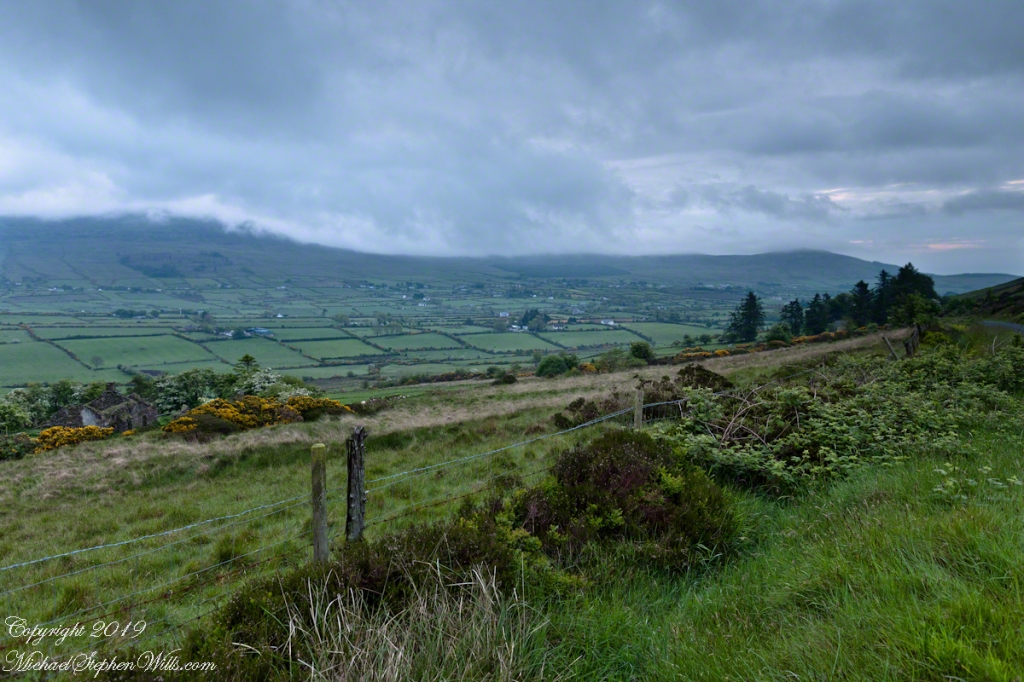
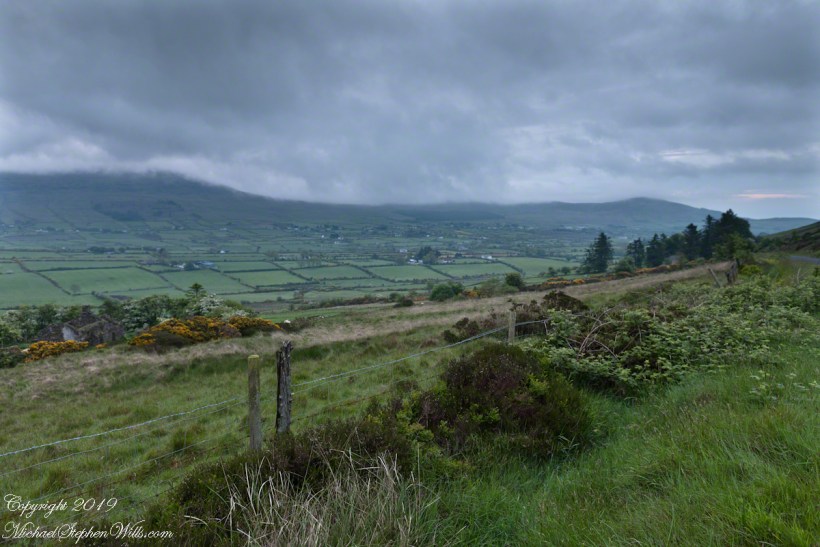
Long before anyone reached for a hand lens or an ice-flow diagram, people answered such contradictions with imagination. In Ireland, a boulder perched just so on a mountain side is not a geologic problem but a resting place. Leprechauns, we are told, favor such stones—high enough to observe human intrusion, solid enough to outlast it. Skepticism, as folklore reminds us, is not always a stable position. Kevin Woods—better known as McCoillte—found that out the hard way when doubt collided with experience on the slopes of Slieve Foye. What followed was not merely a conversion story, but an act of modern mythmaking: folklore translated into bureaucracy, imagination petitioning regulation, and “The Last Leprechauns” entering the unlikely language of conservation. Stone, story, and belief hardened together into something oddly durable.

Rocks such as this are a favorite perch for leprechauns to rest and contemplate the works of man who have invaded their world. Inhabitants of Carlingford who wander Slieve Foye have come upon them often enough, their stories and certitude in the existence of the Little People are resistant to manifold doubters with their reasons and arguments. Kevin Woods, aka McCoillte, was a doubter until worked on a stone wall on property he owned on Ghan Road, Carlingford. His belief did not arise on the discovery of the leather purse, covered with ages of dust and lime, nor with the gold coins inside. McCoillte pocketed the coins for luck. As luck would have it, McCoillte loved to walk on Slieve Foye. It was on one such walk he and his dog encountered Little People who paralyzed them to escape. His unexplained absence led to troubles with the wife. This experience brought McCoillte around to enough of a belief that he, with lots of help, succeeded in petitioning the E.U. European Habitats directive to recognize leprechauns a protected species. A reserve was establish on Slieve Foye to protect the “Last Leprechauns” and you can google this phrase to learn more about McCoillte’s stories.

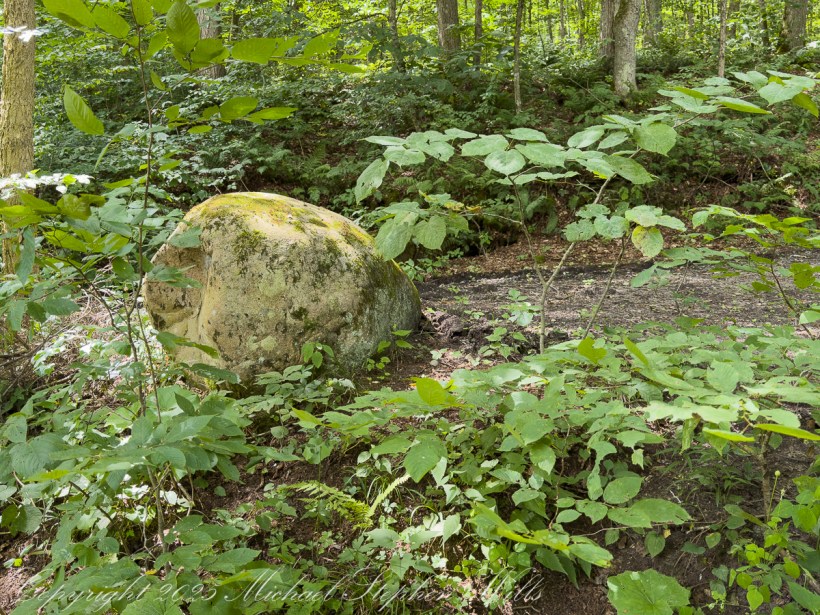
Back in the Finger Lakes, we tend to use a different grammar when confronted by an out-of-place rock. We name it, classify it, and trace its lineage northward. Erratics scattered across Tompkins County are geological sentences that begin somewhere else entirely. The bedrock beneath Ithaca—Devonian shale and sandstone—cannot account for crystalline intruders left behind like forgotten punctuation marks. These stones speak of ice sheets thick enough to erase valleys and decisive enough to transport mountains in fragments.

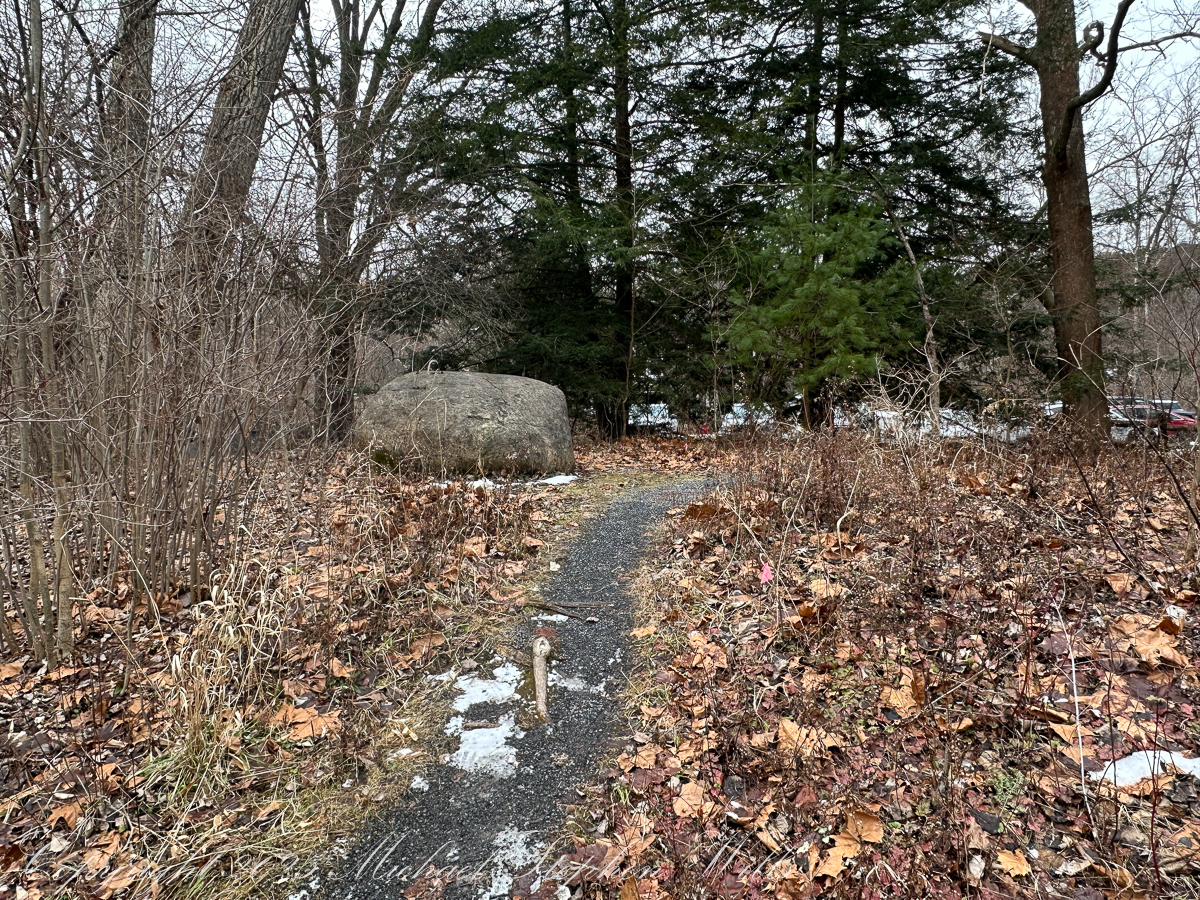
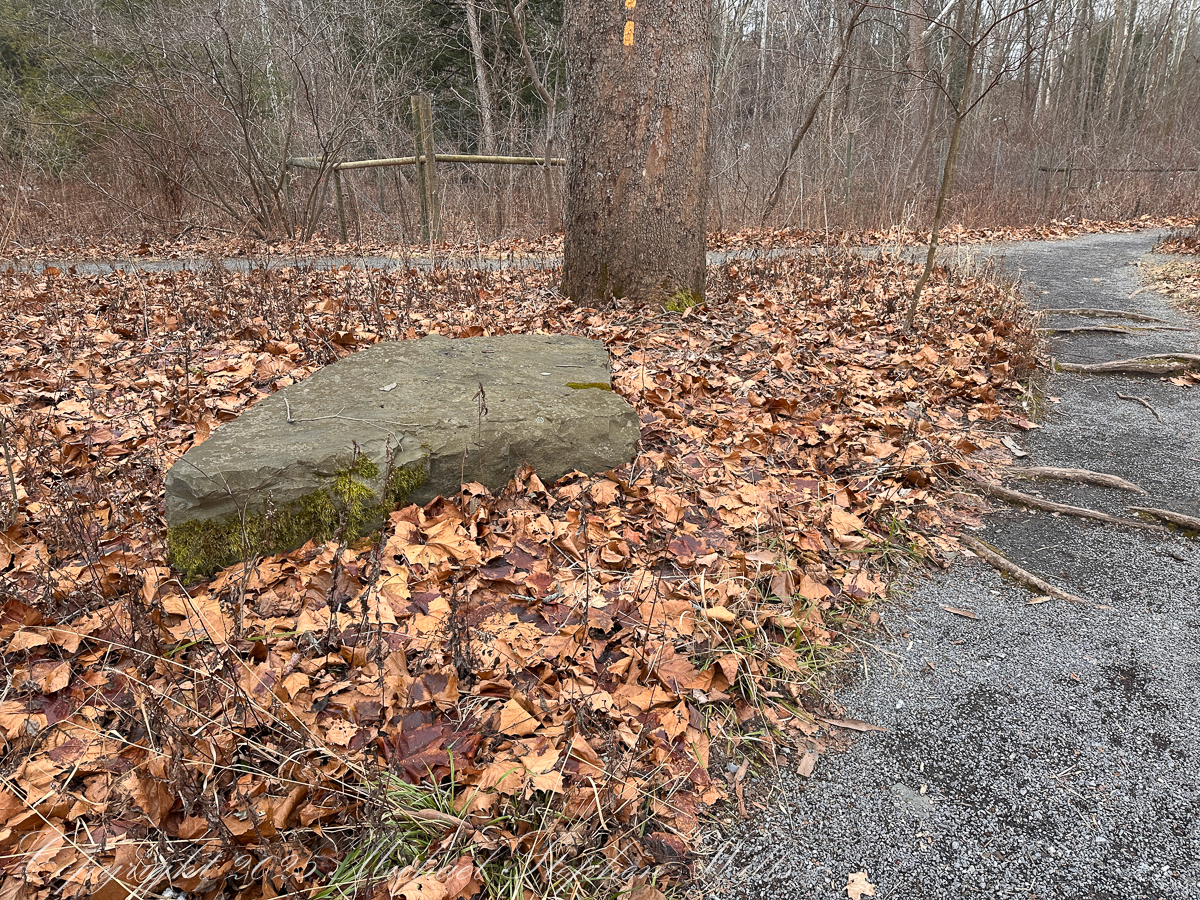
Some of those fragments have been domesticated. Cornell, for example, has never been shy about rearranging its stones. An unremarked erratic along the Allen Trail may once have been shrugged off as inconvenient rubble, while another—dragged from the Sixmile Creek valley—was carved into a seat and made eloquent. The Tarr memorial boulder, resting near McGraw Hall, transforms erratic stone into deliberate monument. It invites rest, contemplation, and perhaps gratitude for those who taught us how to read landscapes written by glaciers.
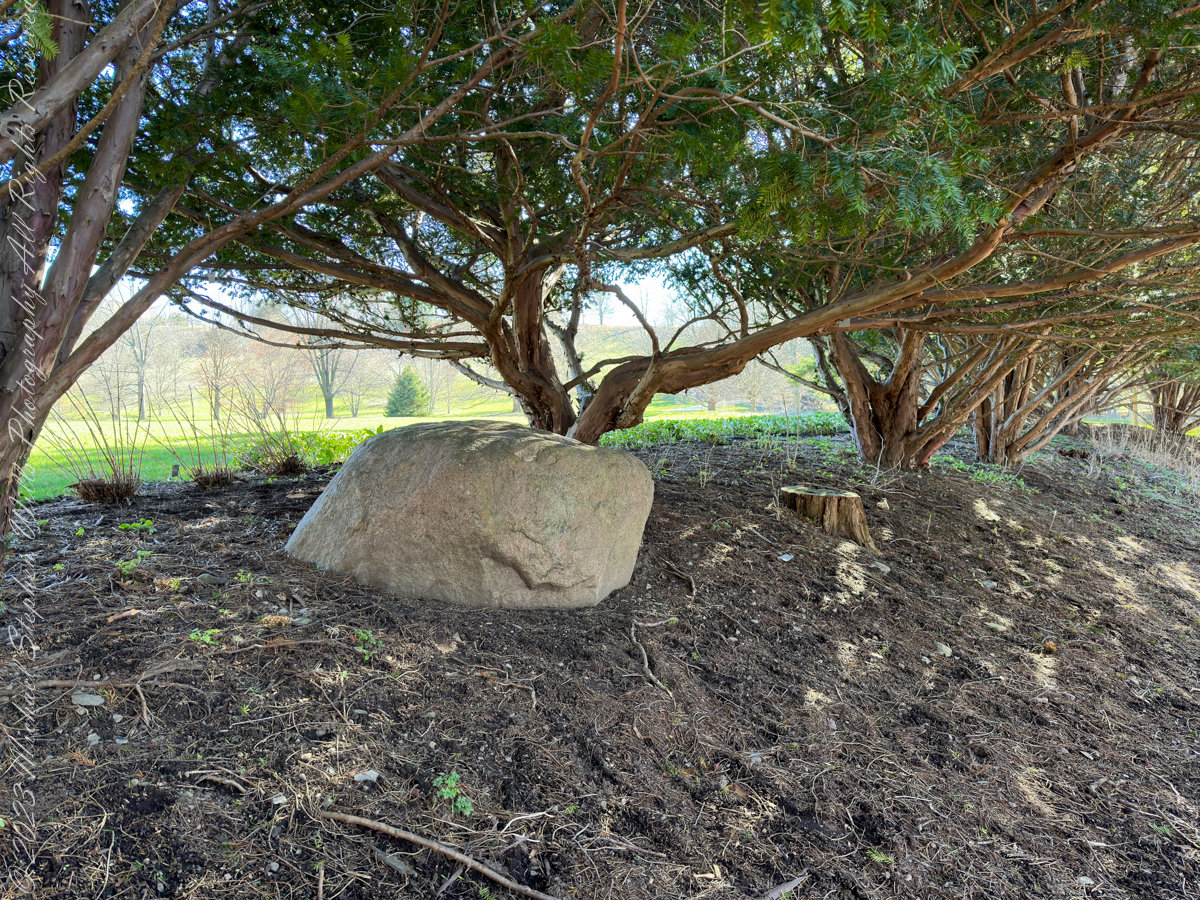
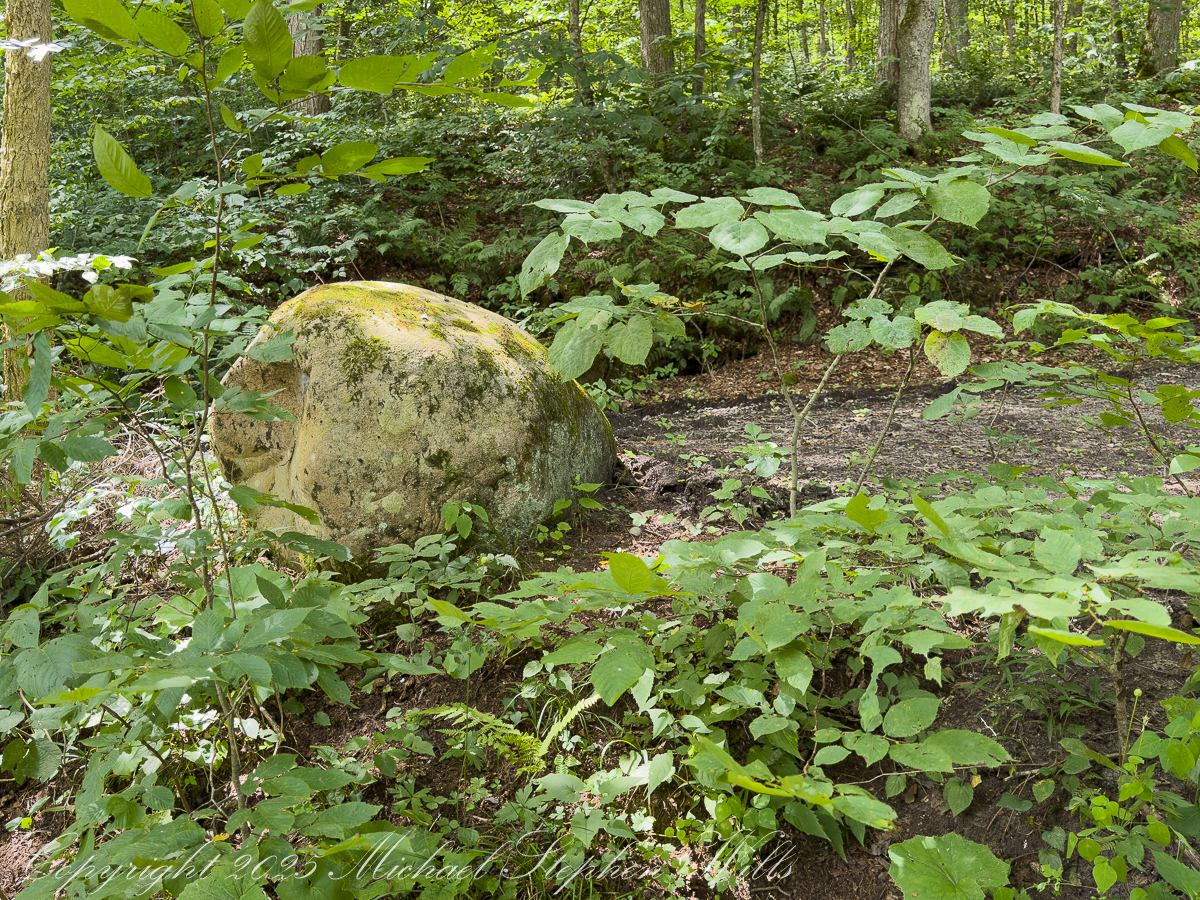
We find boulders of crystalline rock, commonly derived from Adirondack sources, left behind on the surface of ablation moraine, in the Finger Lakes Region. Cornell finds some and move them, maybe the case for this unremarked erratic found along the Allen Trail of FR Newman Arboretum. Another enormous erratic, brought in from the Sixmile Creek valley, was carved into a seat as a memorial to Professor R.S. Tarr who deciphered much of the glacial history of the Finger Lakes Region. Find it at the southwest corner of McCraw Hall on the Cornell University Campus. Reference: “The Finger Lakes Region: Its Origin and Nature,” O.D. von Engeln, Cornell University Press, 1961 page 106

Glacial Erratic, Fillmore Glen

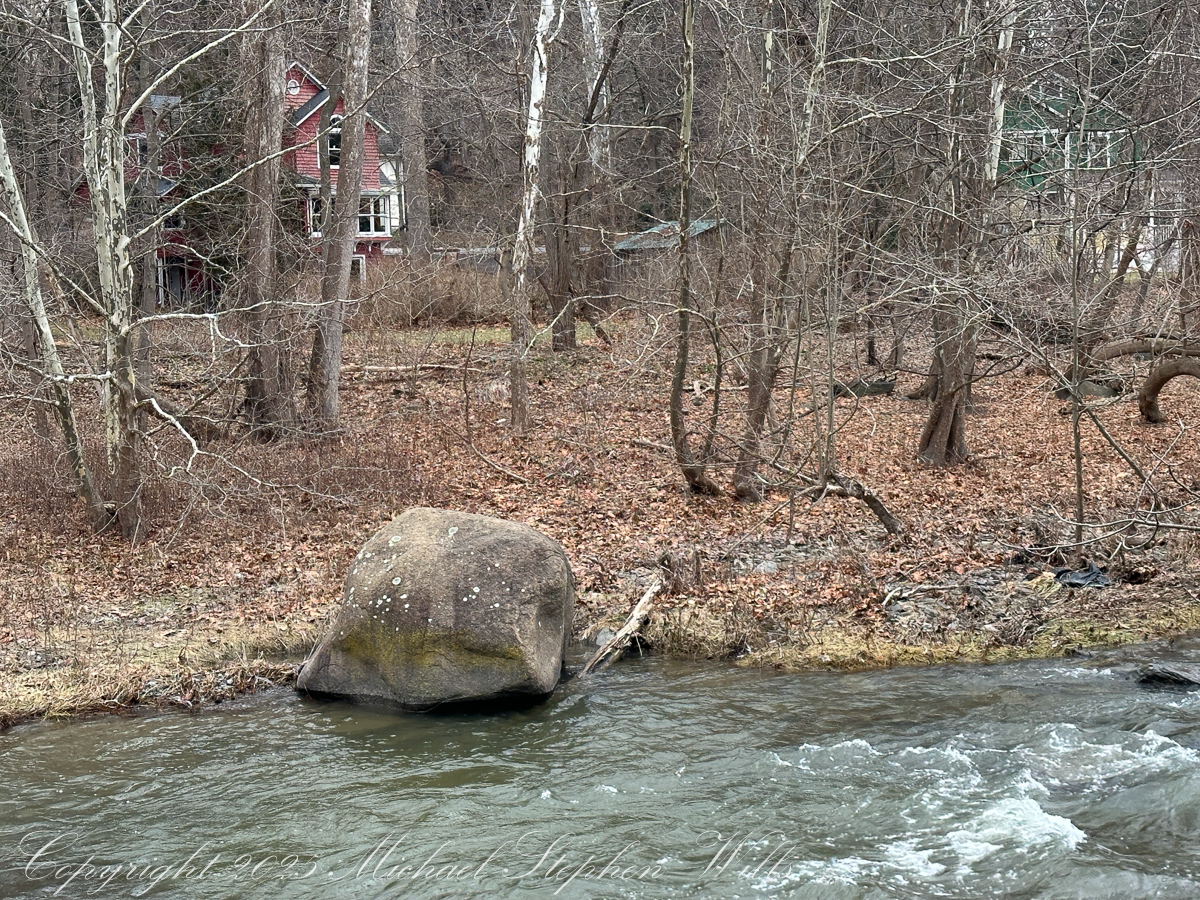
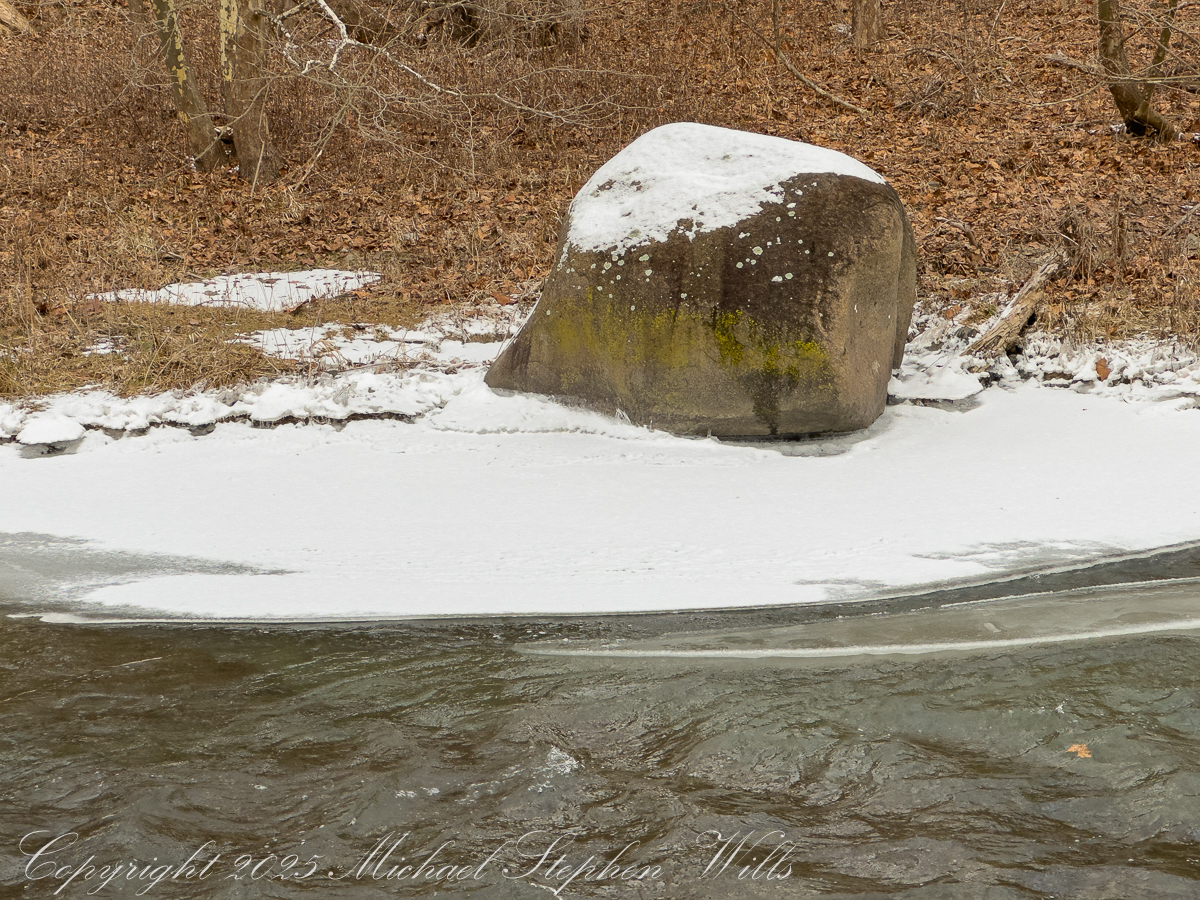
Elsewhere, erratics remain defiantly themselves. In winter, one along Fall Creek alternates between anonymity and revelation, depending on whether snow smooths its surface or retreats to expose lichen constellations. Bridges pass overhead, traffic flows, semesters turn over, yet the rock remains unimpressed. It has already endured pressure sufficient to rearrange its crystals; a passing academic calendar is not likely to trouble it.
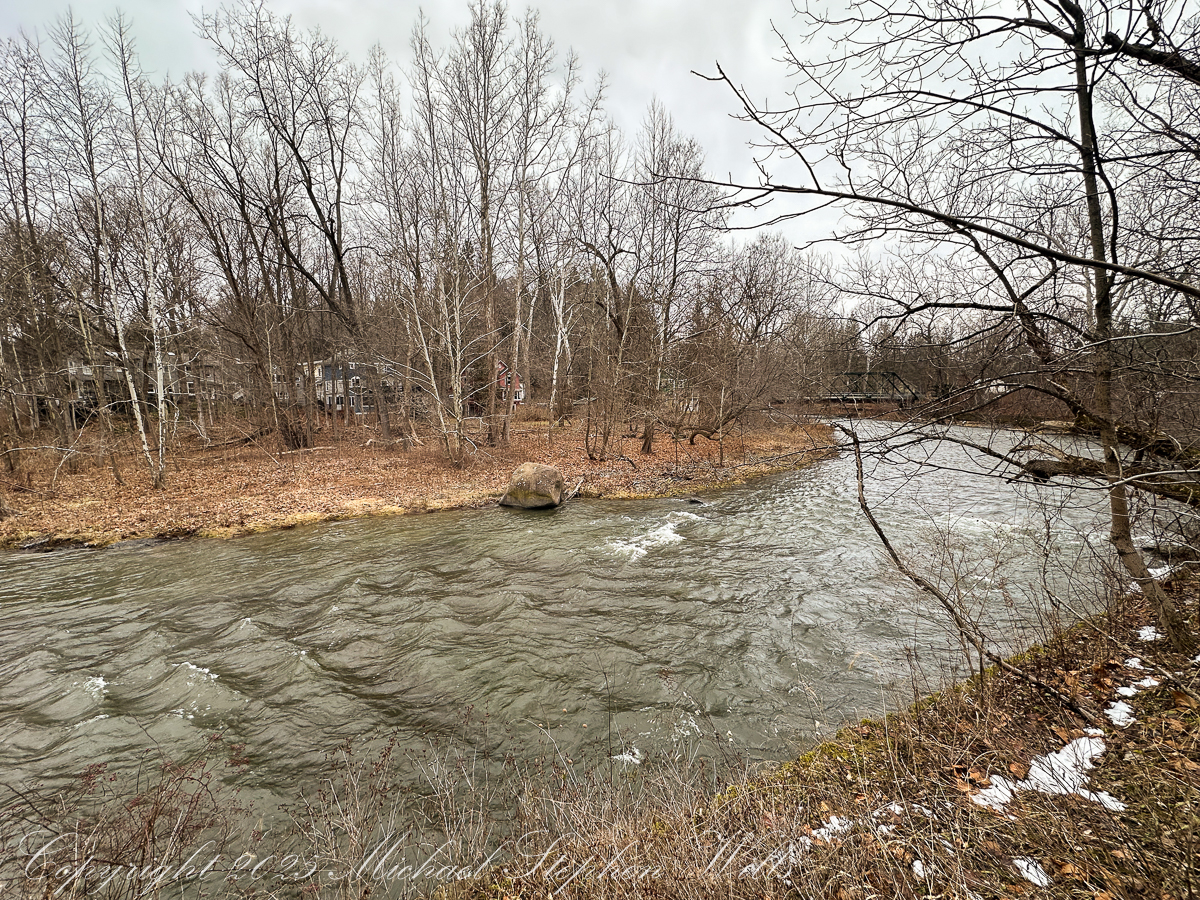
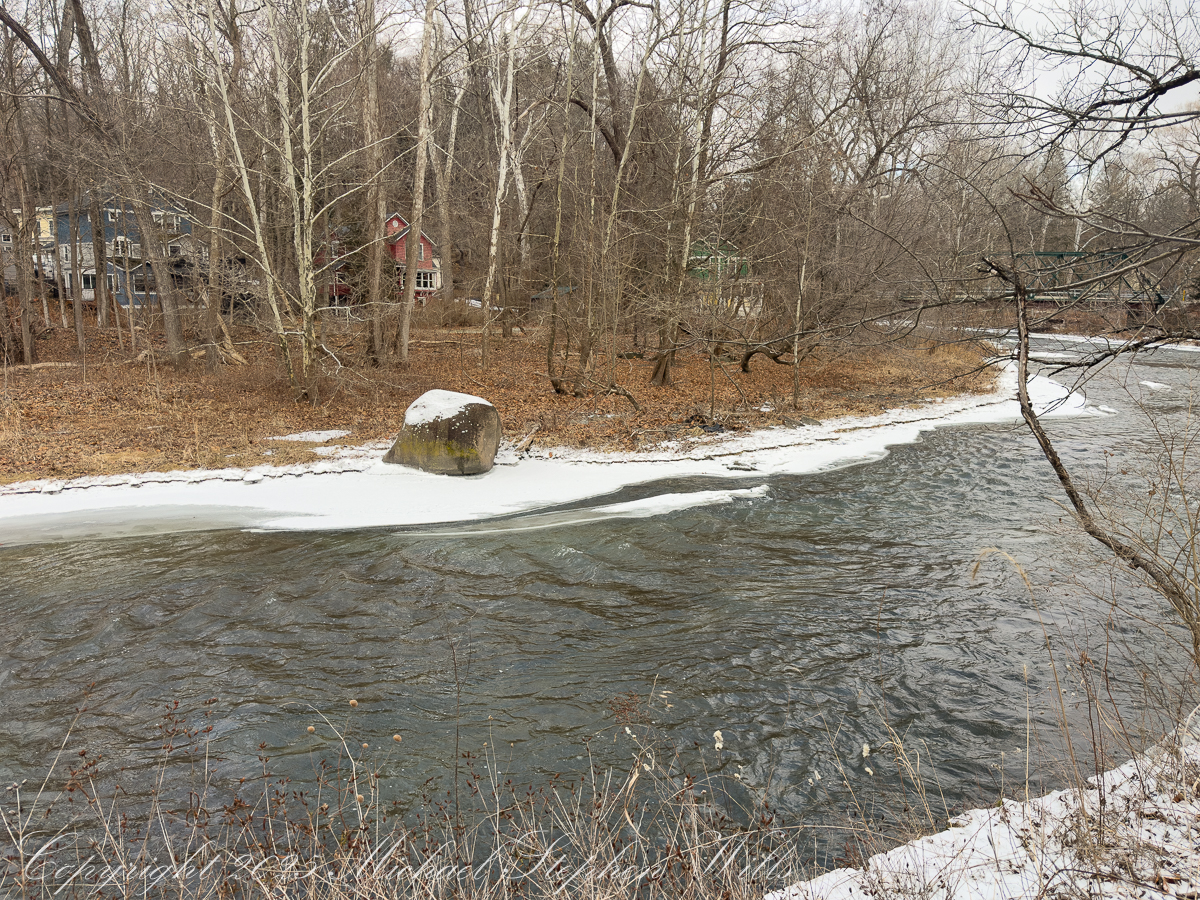
This boulder, a glacial erratic, was found near Fall Creek and the Cornell Botanic Gardens Horticulture Building. Cornell University, Ithaca, Tompkins County, New York State

This rock, a glacial erratic, was found near Fall Creek and the Cornell Botanic Gardens Horticulture Building. Cornell University, Ithaca, Tompkins County, New York State

Then there are the stones that confront us most directly—those we stumble upon in fields, pulled from soil by plow or frost, demanding explanation. A white, iron-stained marble boulder in a Tompkins County field is not subtle about its foreignness. It does not belong to the local vocabulary of shale and sandstone. Its pale surface, crystalline texture, and mineral scars point insistently north, toward the Grenville terrane of the Adirondack Lowlands. The Balmat–Edwards–Gouverneur marble belt offers the most persuasive origin story: metamorphosed carbonate rock carried south by Laurentide ice, released when climate and physics finally lost patience with one another.
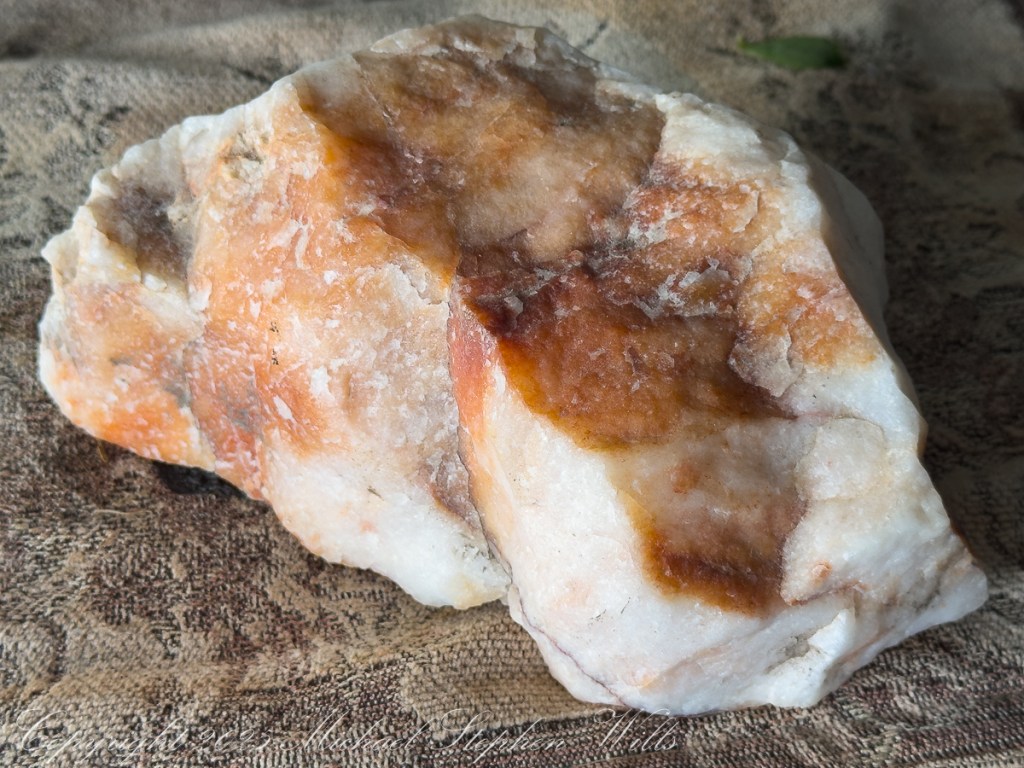
I found this white marble erratic in a Tompkins County field. The highest-probability source is Grenville marble from the NW Adirondack Lowlands / St. Lawrence County (Gouverneur/Balmat–Edwards marble belt), delivered by southward-flowing Laurentide ice. I say the most probable source is metamorphosed carbonate (marble) from the Grenville terrane to the north—especially the northwest Adirondack Lowlands / St. Lawrence County marble belt (the “Gouverneur Marble” and related Grenville marbles), transported south by the last Laurentide ice sheet. Why that’s the best bet: Ice-flow geometry favors a northern source. In the Finger Lakes, glacial ice advanced with a flow direction that was very close to due south, guided by the north–south bedrock valleys. Tompkins County erratics are “exotic” imports. Local bedrock around Ithaca/Tompkins is Devonian shale/sandstone, but the region contains many nonlocal (“exotic”) glacial erratics carried in from much farther north (including southern Canada and beyond). Marble isn’t local to the Ithaca area, but it is abundant in the NW Adirondack Lowlands. The Balmat–Edwards/Gouverneur area in St. Lawrence County is a classic Grenville Lowlands district with marble belts (the same province that yields cream/white building marble around Gouverneur).

What makes this particular erratic compelling is not just its provenance, but the improbability of its journey. Ice moved with purpose here, flowing south along bedrock valleys like Fall Creek and Cayuga troughs, turning the Finger Lakes region into a conveyor belt for distant geology. When the ice melted, it left behind evidence that refuses to blend in. Erratics are geological truth-tellers. They announce that this place was once unrecognizable, that what seems permanent is merely provisional.

Perhaps that is why folklore clings so naturally to stone. Whether leprechauns or Laurentide ice are credited, erratics insist on a larger frame of reference. They ask us to imagine landscapes in motion and beliefs under revision. A boulder can be a seat, a marker, a perch, or a puzzle—but never merely background. It waits, quietly confident, for us to catch up to its story.
Enter your email to receive notification of future postings. I will not sell or share your email address.

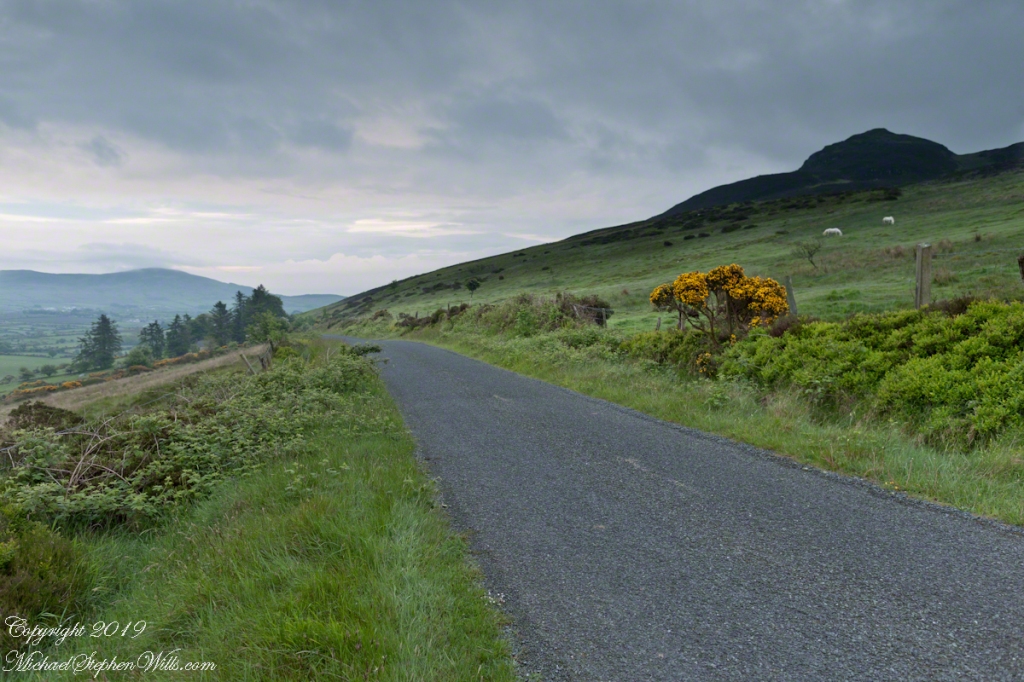
On the Road to Killen

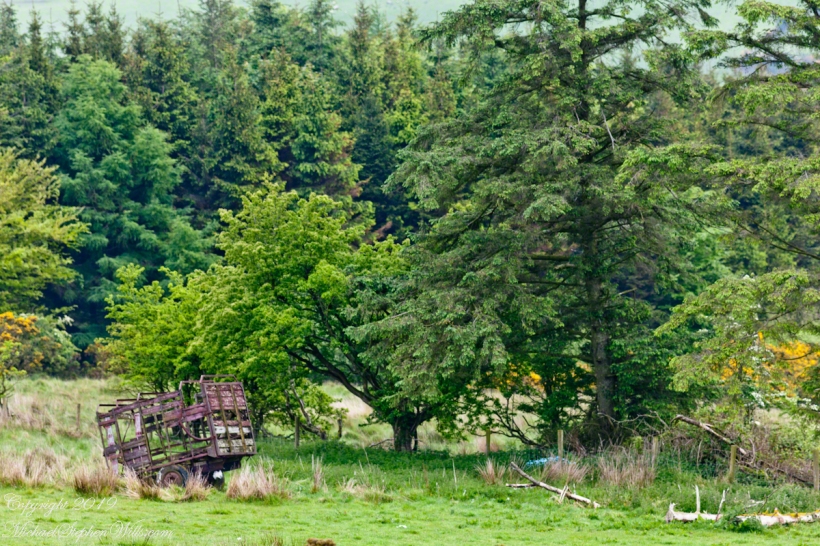
In the early dawn, I walked the path to Killen, drawn by the legacy of my mother’s Irish youth. An abandoned hay wagon stood, a relic amidst the whispers of history and myth. Join me in uncovering the roots that intertwine family and the enduring Irish land.

Continue reading “On the Road to Killen”

On the slopes of Slievenaglogh

One white horse

Continue reading “On the slopes of Slievenaglogh”

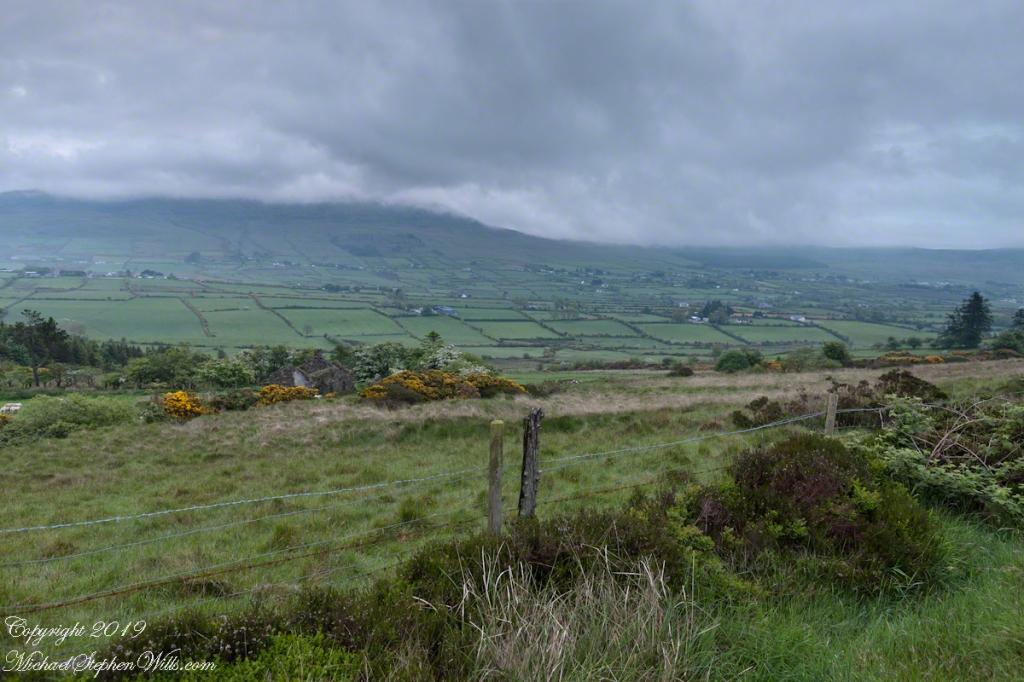
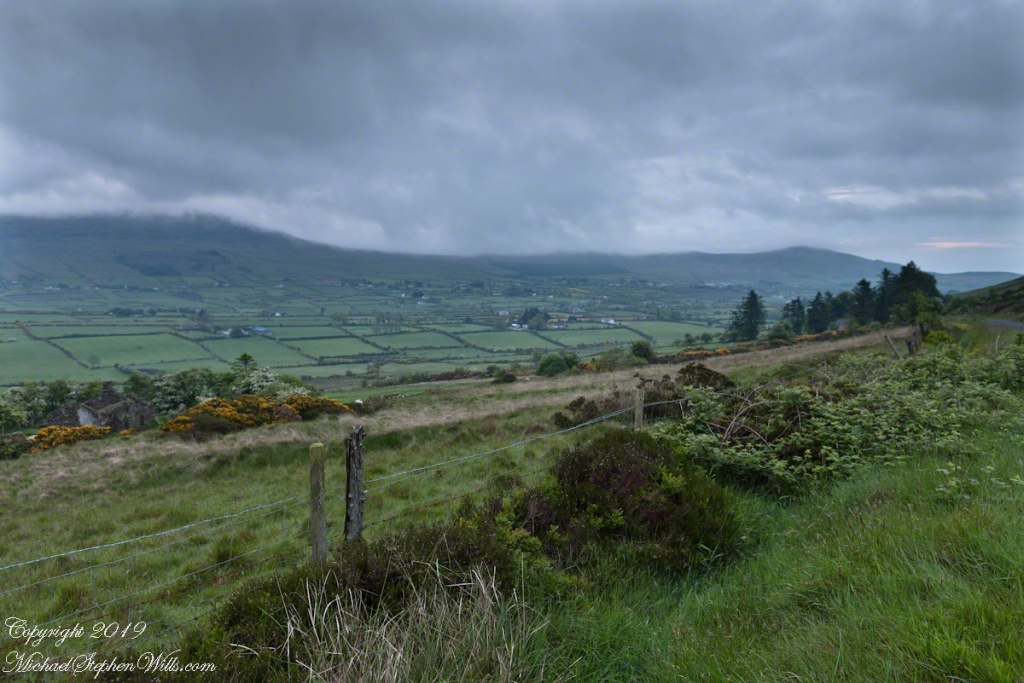
Farmhouse Ruin, Slievenaglogh

Two views

Continue reading “Farmhouse Ruin, Slievenaglogh”

Newgrange X

Step into the ancient world of Neolithic monuments and discover the astounding astronomical knowledge of our ancestors. Explore the Newgrange Lightbox in Ireland and similar marvels across Europe, revealing a deep connection between ancient peoples and the cosmos. Join me in unveiling these architectural wonders.

Continue reading “Newgrange X”

Newgrange VIII

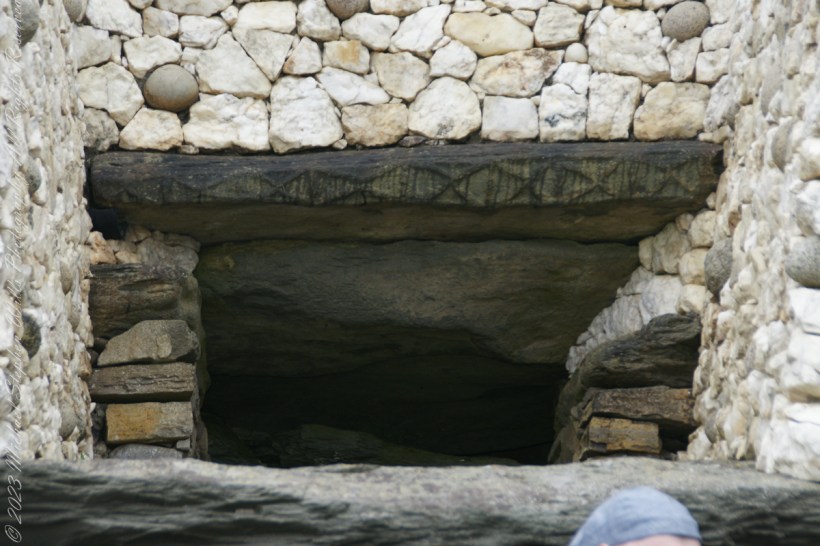
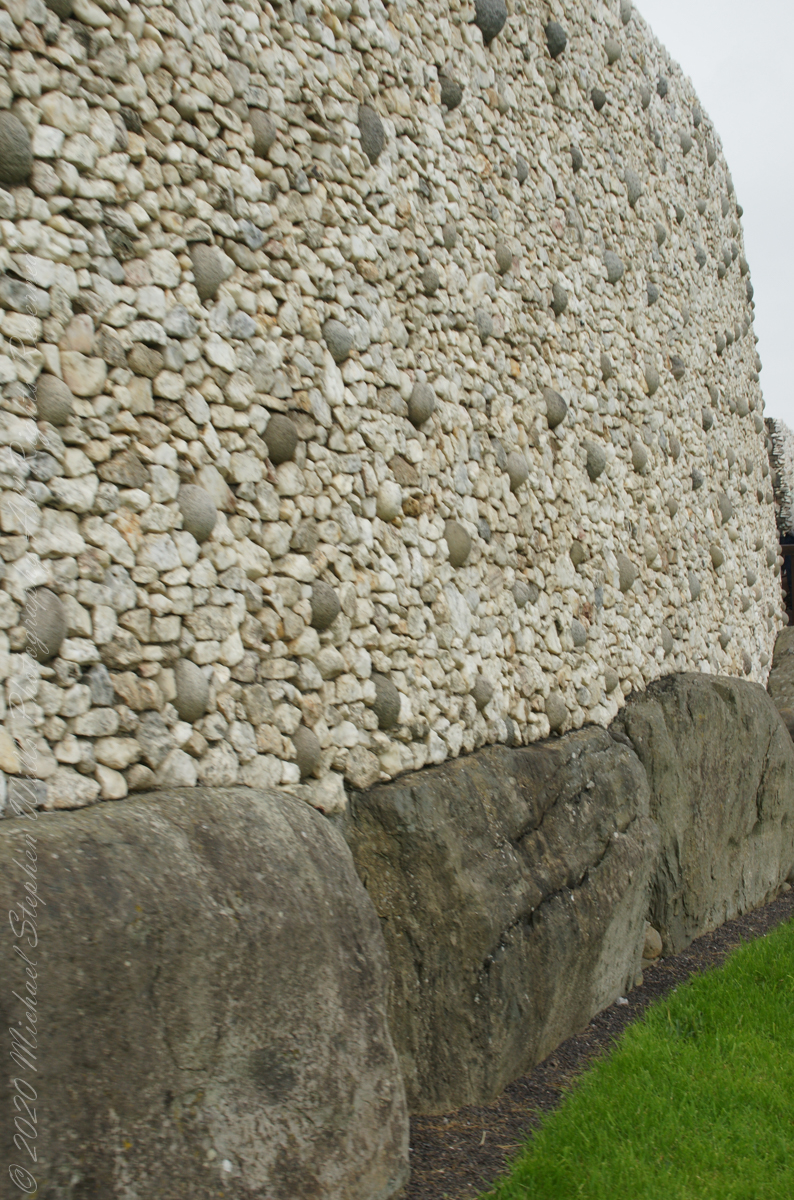
The Newgrange facade and kerbstones consists of stones from various locations, believed to be transported by sea and river.

The Newgrange façade and entrance of today is a creation from the large quantity of small stones unearthed and conserved during excavation given form by a steel-reinforced concrete retention wall. 

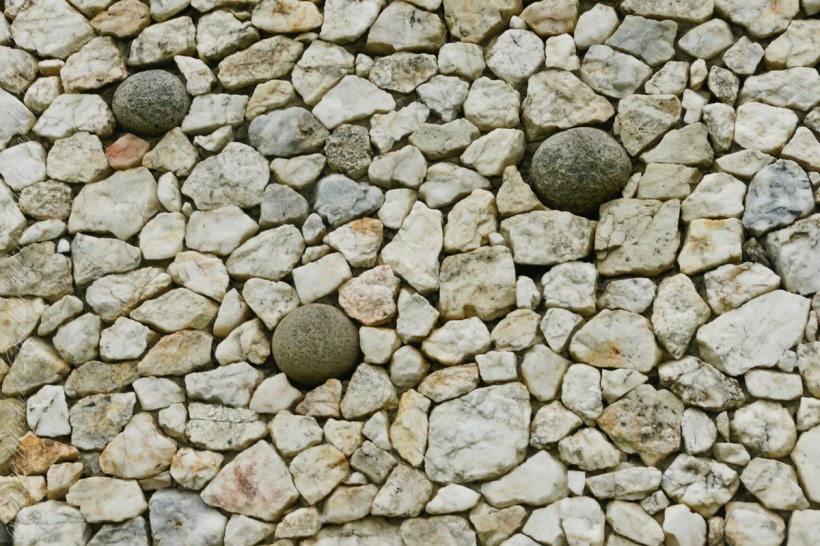
The brilliant white quartz cobblestones were collected from the Wicklow Mountains, 31 miles to the south.  Our guide called them “sunstones” for the way they reflect sunlight. In the following photograph is white quartz, the same excavated 1967-1975 from the Newgrange site and incorporated into the facade, I collected from “Miners Way” along R756 (above Glendalough).

You can also see in these photographs dark rounded granodiorite cobbles from the Mourne Mountains, 31 miles to the north.  Dark gabbro cobbles from the Cooley Mountains and banded siltstone from the shore at Carlingford Lough both locations on the Cooley Peninsula where my mother’s family still has farms.

The stones may have been transported to Newgrange by sea and up the River Boyne by fastening them to the underside of boats at low tide. None of the structural slabs were quarried, for they show signs of having been weathered naturally, so they must have been collected and then transported, largely uphill, to the Newgrange site. The granite basins found inside the chambers also came from the Mournes.

Geological analysis indicates that the thousands of pebbles that make up the cairn, which together would have weighed about 200,000 tons, came from the nearby river terraces of the Boyne. There is a large pond in this area that is believed to be the site quarried for the pebbles by the builders of Newgrange.

Most of the 547 slabs that make up the inner passage, chambers, and the outer kerbstones are greywacke. Some or all of them may have been brought from sites either 3 miles away or from the rocky beach at Clogherhead, County Louth, about 12 miles to the northeast.

Click Me for the first post of this series.

Copyright 2023 Michael Stephen Wills All Rights Reserved

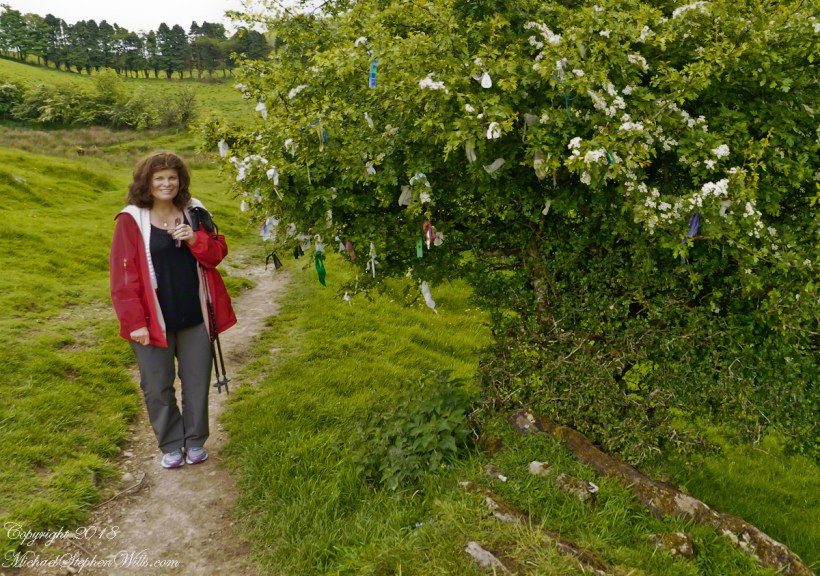
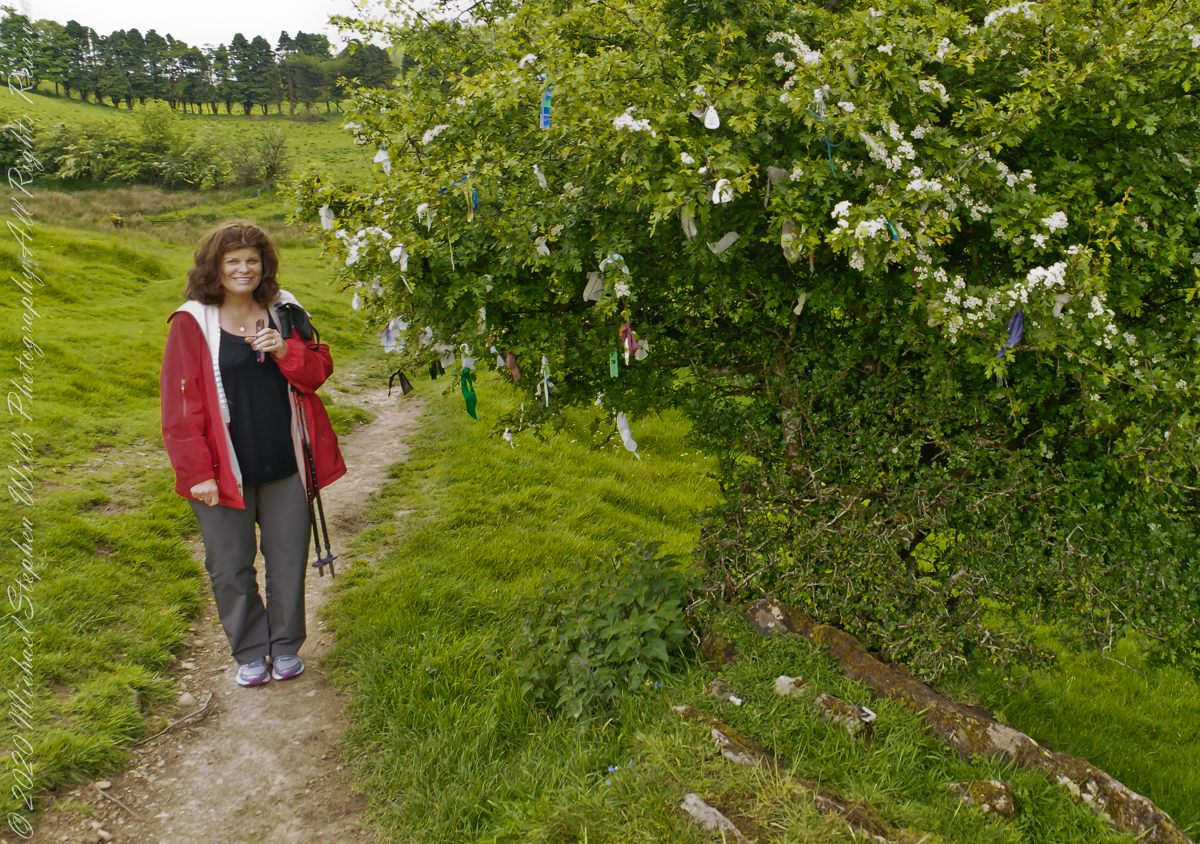
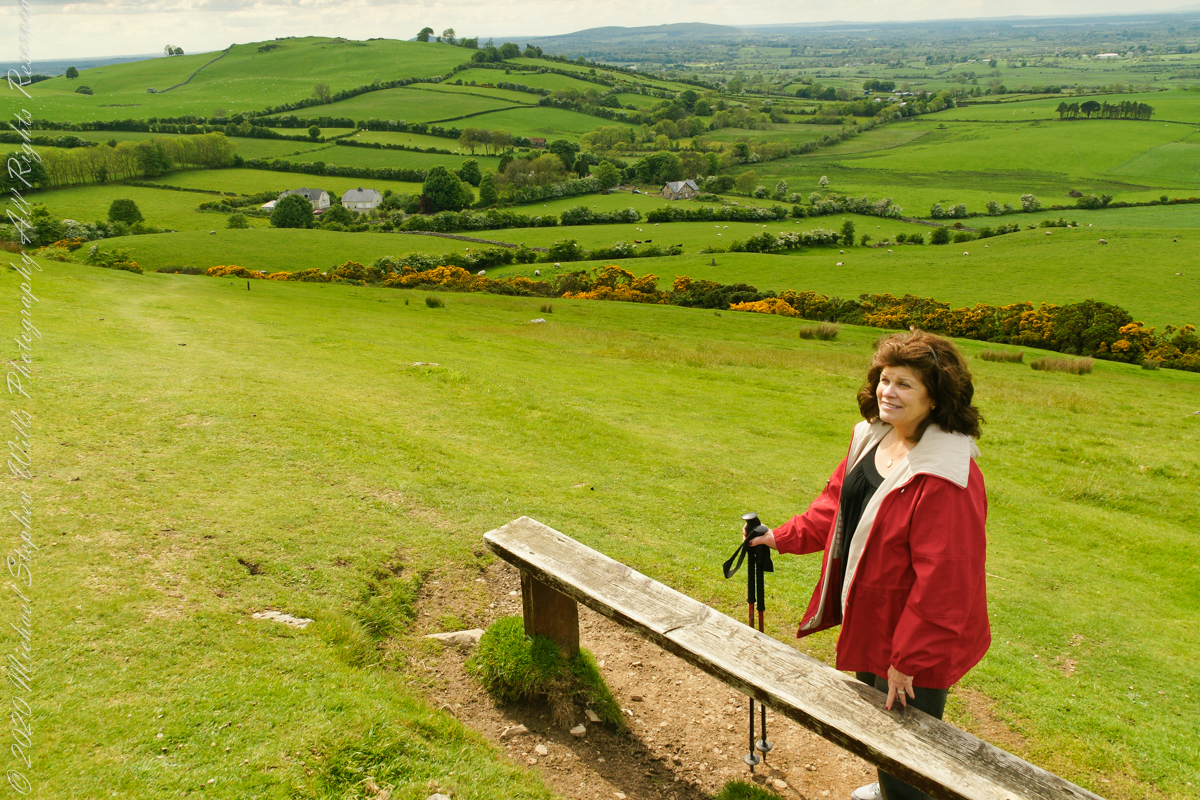
Pam Wills at Loughcrew, County Meath, Ireland

Pam and I were lucky enough to plan our tour of Ireland for May and June when the Hawthorne trees are in bloom.  Named sceach gheal in Gaelic, the white clusters of blossoms symbolize hope.  Hawthorns are plentiful throughout the island.  The Irish revere the tree and associate each Hawthorn with the Little People.  There are roads in Ireland that curve around a Hawthorn tree because the local people convinced the engineers to do so, to save the tree.

This specimen, covered with offerings (to the Little People?), is on the trail to Loughcrew.  Even with her knee trouble, Pam made it to the top of the Hag’s Mountain to visit Cairn T of the Loughcrew Passage tombs.

The steep path to Loughcrew passes a hawthorn covered with flowers and may offerings.

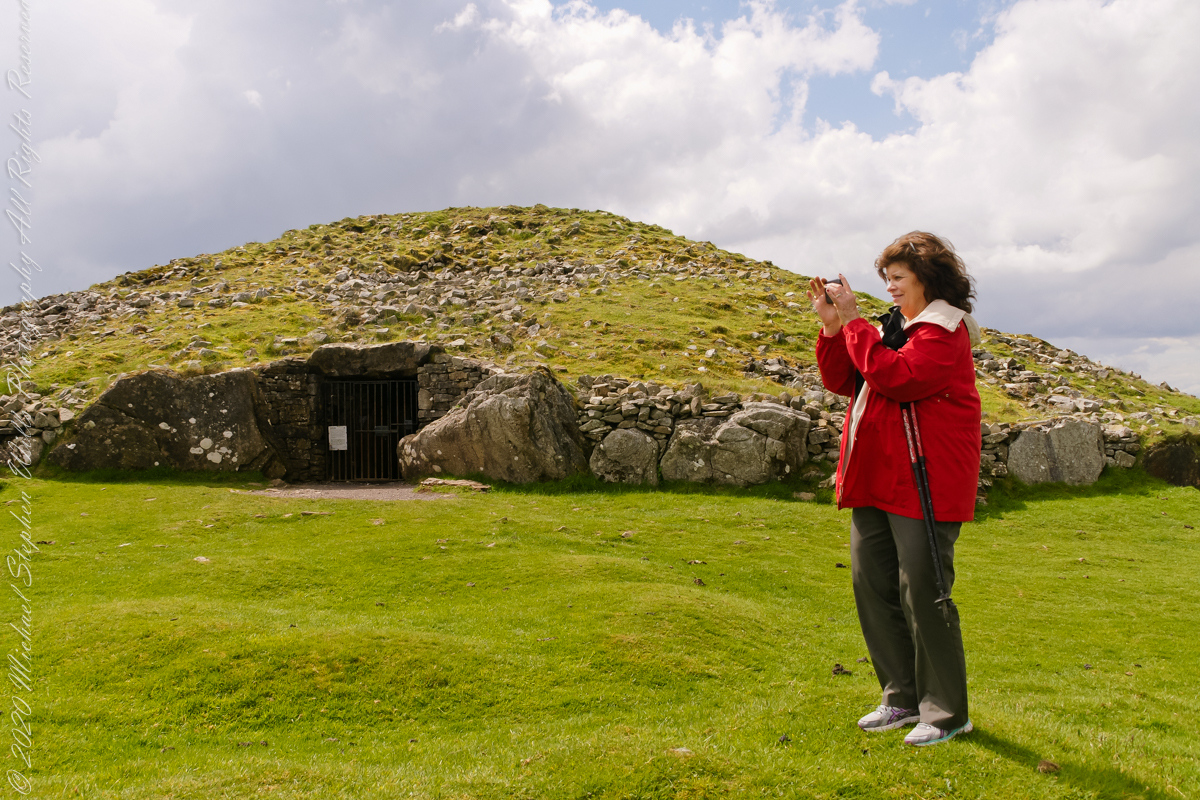
Pam loves to capture images and returned from Ireland with a large collection.  Most of the photos of me at work are by Pam.  Here Pam is capturing the summit view of Hag’s Mountain with the Cairn T entrance gate in the background.  Lucky for us, a fellow visitor made the trip to Loughcrew Gardens and picked up the  gate key from the café.  In a later post I will share my work from inside this passage tomb.

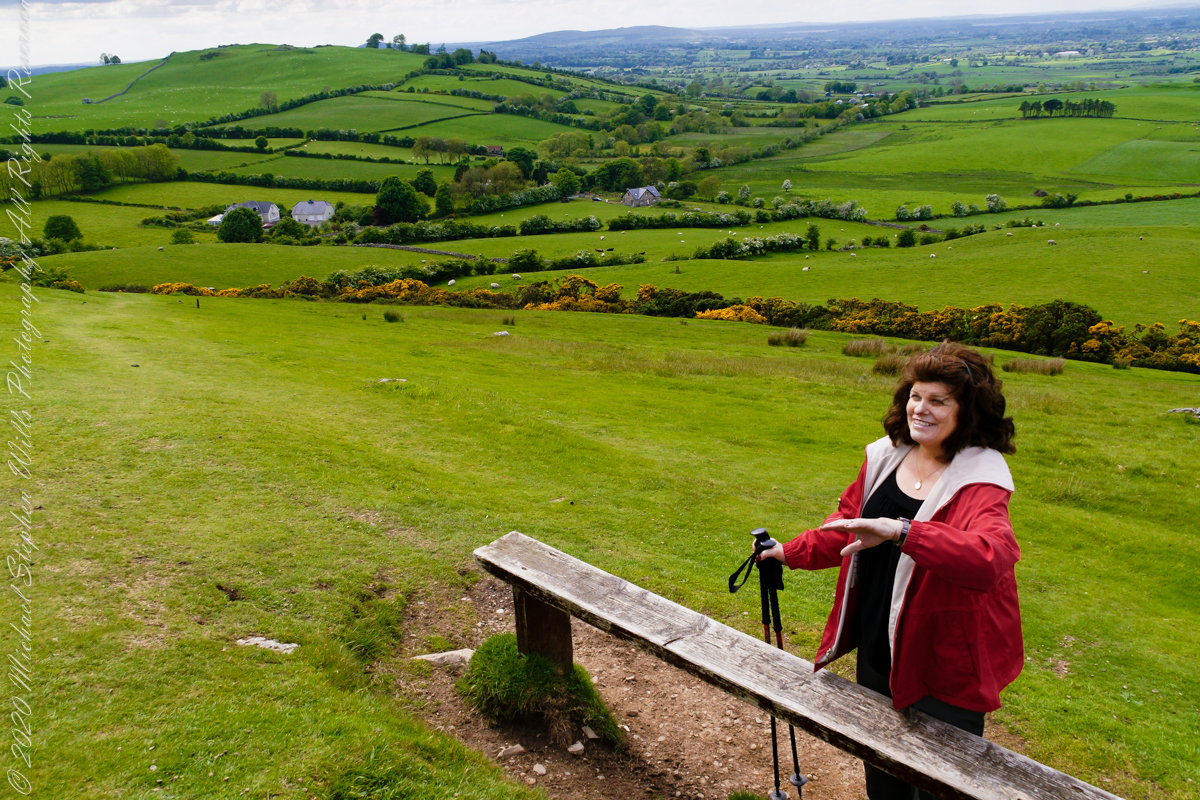
Pam makes friends wherever we go.  She started down the mountain before me to take it easy on her knees.  When I caught up, Pam and a young Irish family were deep in conversation.  I took the opportunity to capture Pam with that gorgeous view to the northwest, Irish countryside with Lake of the Branches in the far distance.

Copyright 2023 Michael Stephen Wills All Rights Reserved

Slievenaglogh View, east, V

Looking east

This the fifth and final of a series of landscape photographs taken from this position.

Click photograph for a larger view. To do this from WordPress Reader, you need to first click the title of this post to open a new page.

The peak is named, in the English language, Slievenaglogh. It is so strange as it’s not English, being instead a transliteration of the Irish name “Sliabh na gCloch.” This is “Rock Mountain” translated literally. Slievenaglogh is carried to the townland, a long thin swath of land being the peak and associated ridge-line.

The rocks up there are called “gabbro,” a type of magma slowly cooled under ground. Slievenaglog, Slieve Foy across the valley, and the Morne mountains all formed within volcano magma chamber(s) of the Paleocene, 66 million years ago, a time associated with extensive volcanism and the Cretaceous–Paleogene extinction event that gave rise to the current age.

Our younger cousin has been up there, optimistically we left it for a later trip.

Click for another interesting post and story from County Louth.

Here is a slide show of this landscape series.

A link with interesting reading on County Lo uth geology.

Copyright 2022 All Rights Reserved Michael Stephen Wills

Slievenaglogh View, northeast, IV

View of Slieve Foy

This the fourth of a series of landscape photographs taken from this position.

Click photograph for a larger view. To do this from WordPress Reader, you need to first click the title of this post to open a new page.

The distant ridge, Slieve Foy, is the site of a mythic battle from the epic “The Cattle Raid of Cooley” (Irish: Táin Bó Cúailnge).

Pam and I did a circuit of the island, returning to the home of my Mom’s first cousin. Our last full day on Ireland a cousin took us on the Tain Trail, over Maeve’s Gap of Slieve Foy and into Carlingford town.

Our route is partly visible to the right of the ridge, hidden in low clouds.

Click for another interesting post and story from the Cooley Peninsula.

Here is a slide show of this landscape series.

Copyright 2022 All Rights Reserved Michael Stephen Wills

Slievenaglogh View, northeast, II & III

Rural Scenery

These are the second and third of a series of landscape photographs taken from this position. See the previous post for the first.

Click photograph for a larger view. To do this from WordPress Reader, you need to first click the title of this post to open a new page.

I visited here early morning of the Monday Pam and I embarked on a trip around the island of Ireland.

Arrived the previous Saturday when, after some sites between Dublin airport and the Cooley Peninsula, we met my Mom’s first cousin who had invited us for a visit. We had a grand time meeting them.

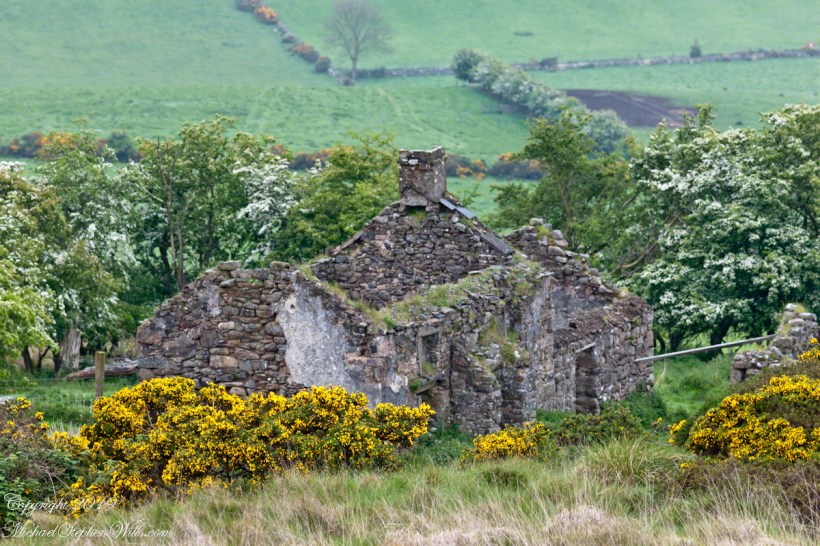
The ruin in this view is on the slopes of the peak. Some of these ruins are former homes with the replacement nearby. This appears to be an abandoned farm.

Click Me for the first post of this series.

Click me for the next post of this series.

Copyright 2022 All Rights Reserved Michael Stephen Wills