Reaching Reavis Falls, once you find the canyon mouth, is three-fourths of a mile of boulder hopping and bushwacking over and around landslides, deep pools and fallen trees. Odds are you will be the only person in the canyon for weeks, if not months. Expect to be surprised. In this chapter you will (finally) visit the falls themselves.
A Camp in the Canyon
Click me for the chapter about the environment around the mouth of Reavis Canyon below the falls.
The Last Mile
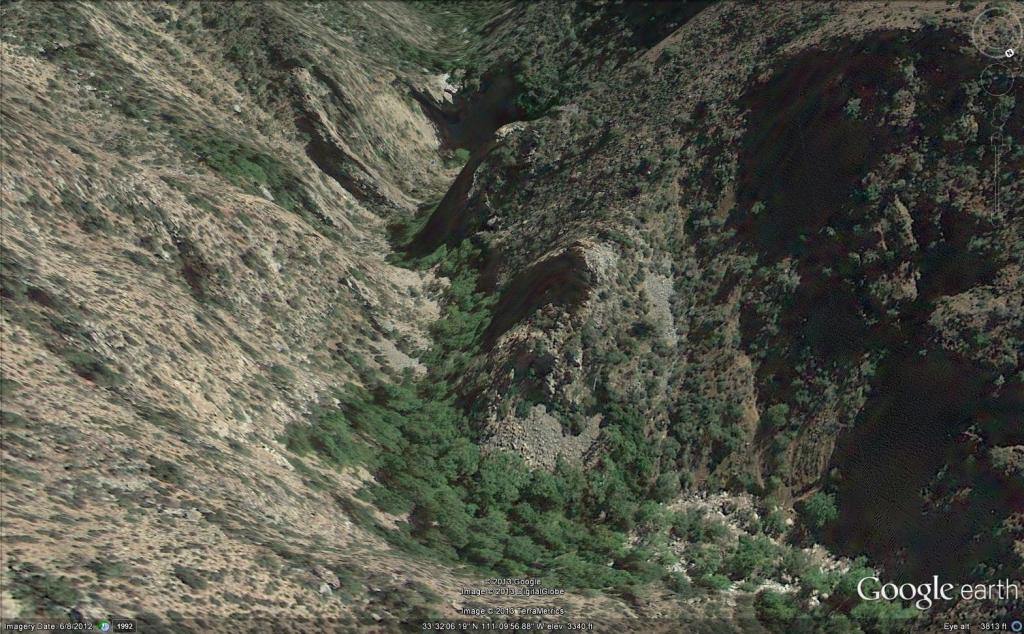
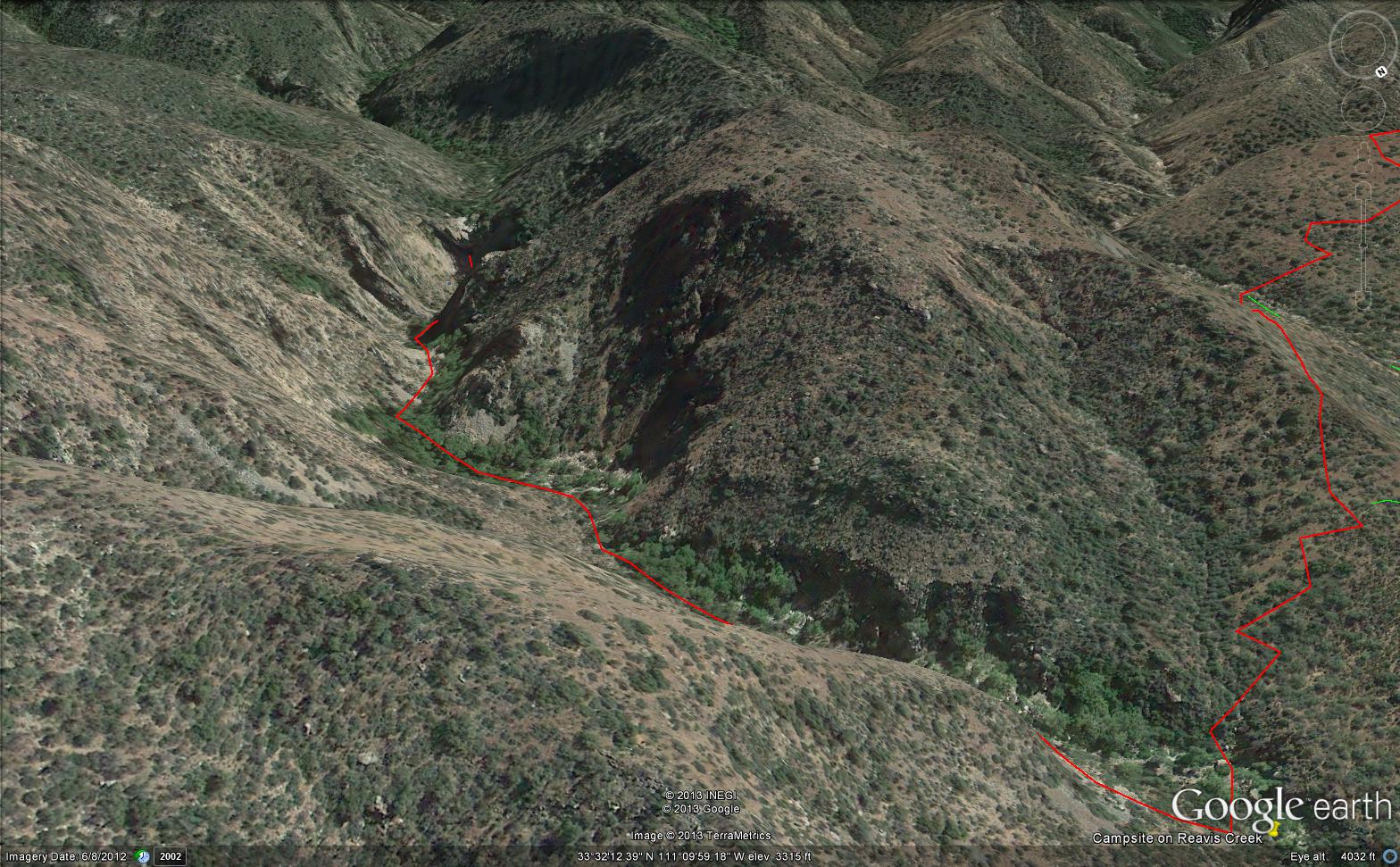
Here is an overview of the last third mile of Reavis Canyon. You can see the wall of the falls nestled in the folds of ridges towards the top, just off center.
On the lower right is a large landslide and, below there, it is complete chaos.
The vegetation grows shoulder to shoulder with interleaved branches. You will not get through there. The solution is to find a way around, usually over and around house-sized boulders.
The image was captured from Google Earth
After almost two hours of picking my way, there was a flicker of light. The fall waters were sparkling in the sunlight high above the cottonwood trees, in full Mach bloom, and the still leafless Arizona Sycamores.
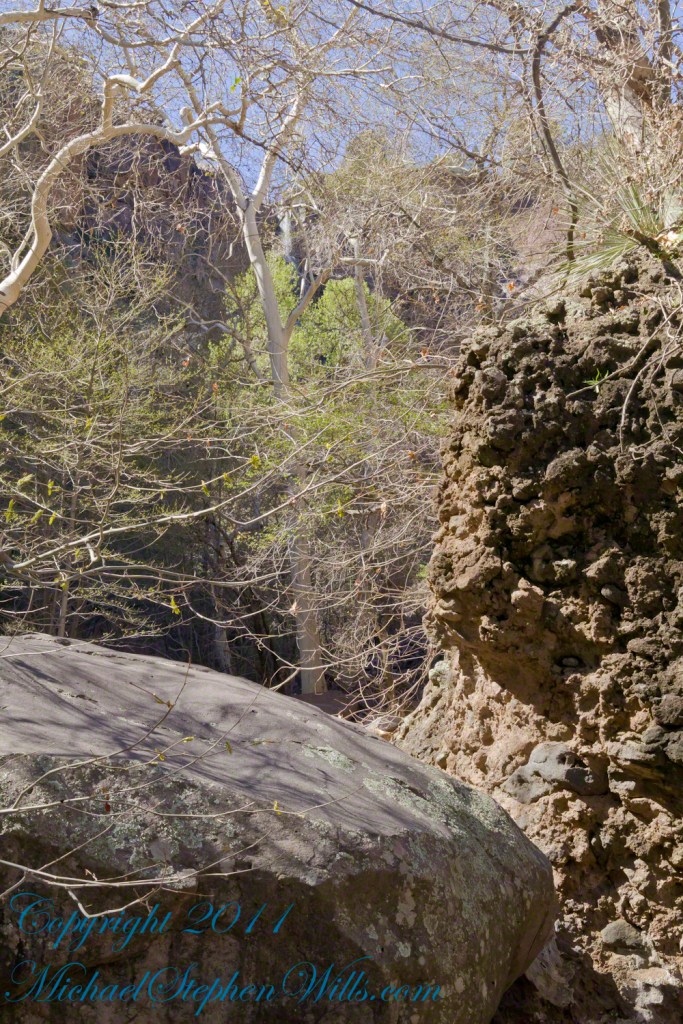
This was my view of Reavis Falls from the canyon on a March day before the Arizona Sycamores have leaved. The falls are the tiny patch of white to the left of midline where the earth meets the sky. Jumbles of infallen boulders and thick growth of sycamores, oaks and fully leaved cottonwoods cloak the falls.
Another 30 minutes of canyoneering brought me to the foot of the falls.
At the Foot of Reavis Falls
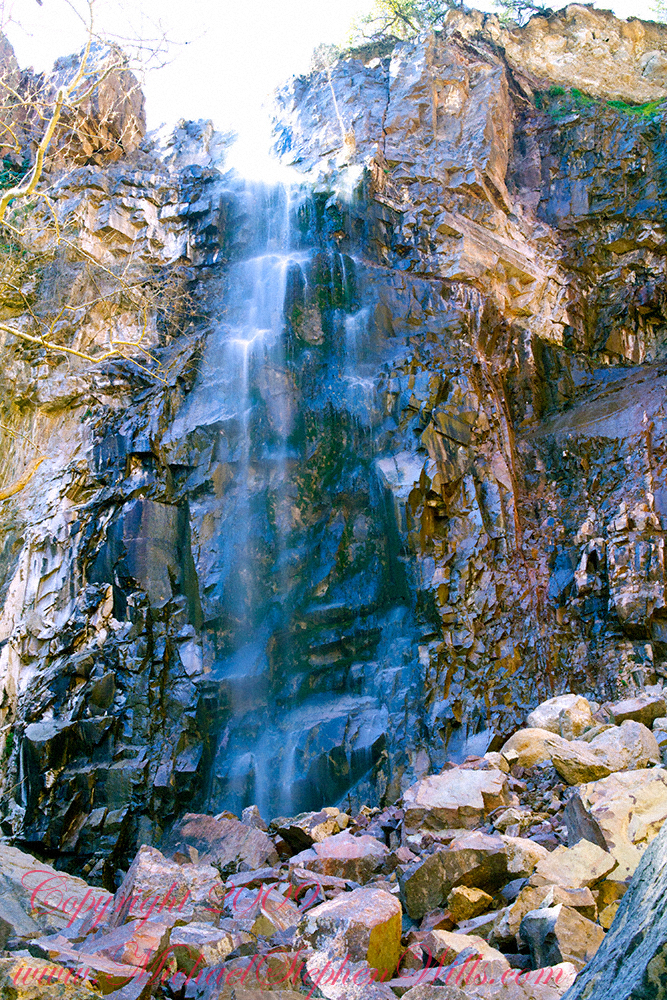
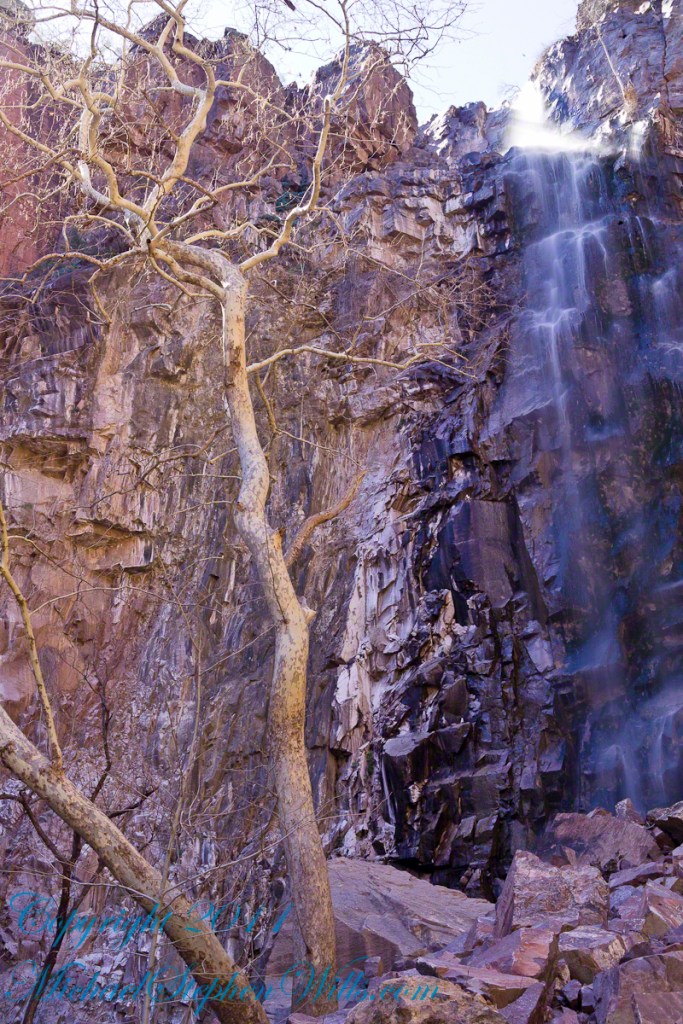
Looking up at Reavis Falls from a 20 foot tall mound of talus.
These are boulders washed down at flood time.
The rock wall is thick with microorganisms, fungi and mosses.
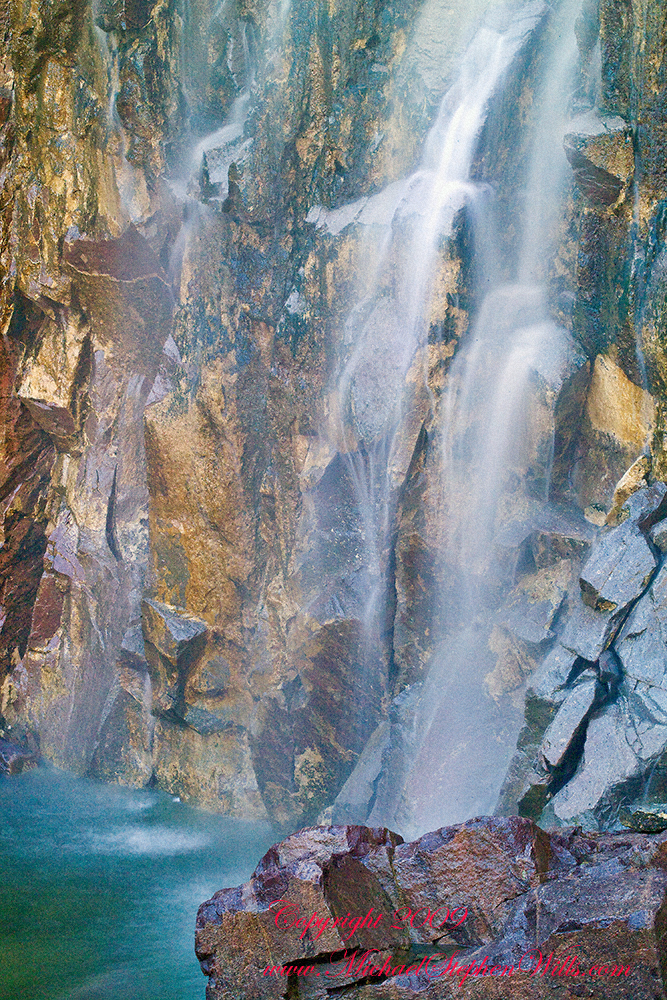
After clambering around the talus pile I found this angle….
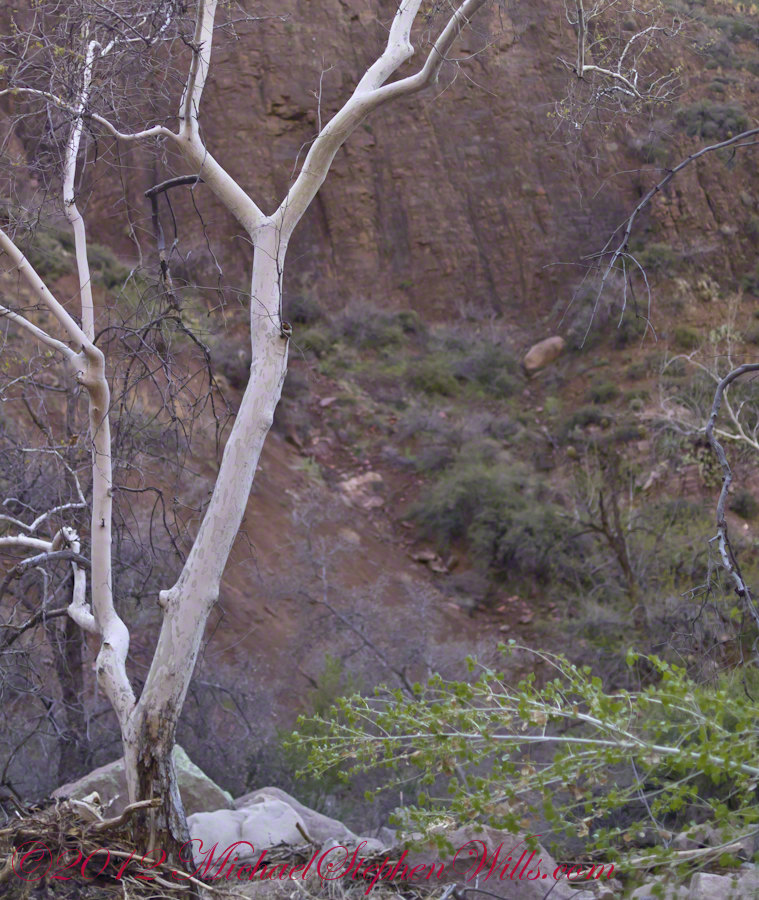
An Arizona Sycamore, before the spring leafing, at the Foot of Reavis Falls
Talus at the Foot of Reavis Falls
The Reavis Falls talus is large boulders carried down Reavis Creek and washed over the falls at flood time as well as blocks fractured from the cliff face. You can see the base of the Sycamore from the previous photograph.
The falls are formed where Reavis Creek flows over a solid mass of rock. The talus is composed mostly of this red rock. From the edge of this cliff to the base, where the falls hit the canyon floor, is all of 140 feet. This is a far as you can proceed into the canyon without some serious climbing skills.
It is possible to climb around the canyon by climbing up the ridge from which I captured the Cedar Basin Hoodoos. See my posts below for this location (you need to work it our for yourself).
This is NOT the last post of the series. From here I will focus on the beauty of Reavis Falls and the canyon that holds them.
It was a four-day expedition so there are a few chapters covering the approach to the Falls:
The Superstition Wilderness was born from volcanic eruption and in some places (Peters Mesa) the earth still rumbles.
Here in Reavis Canyon it is the huge spring runoff that builds the environment, grinding and scouring the canyon. In my chapter The Mouth of Reavis Canyon is the story of this aspect of the canyon.
The history of this spot is written on these volcanic and igneous rocks and boulders, the uprooted tree roots and fresh water.
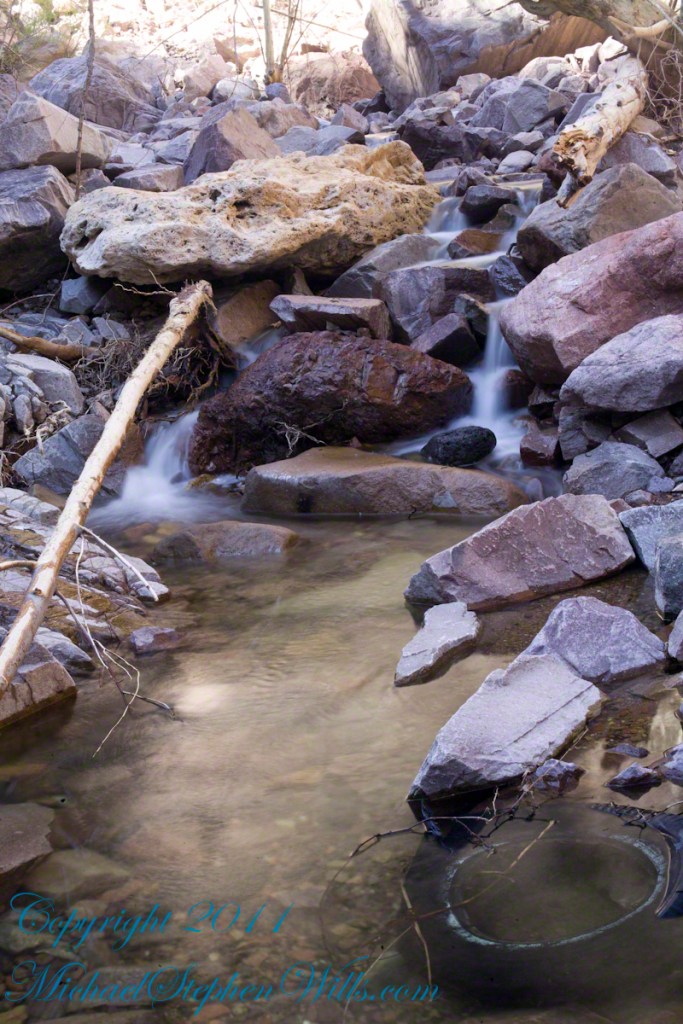
The tire must have washed down from Reavis Ranch.
A Canyon of Wonder and Beauty
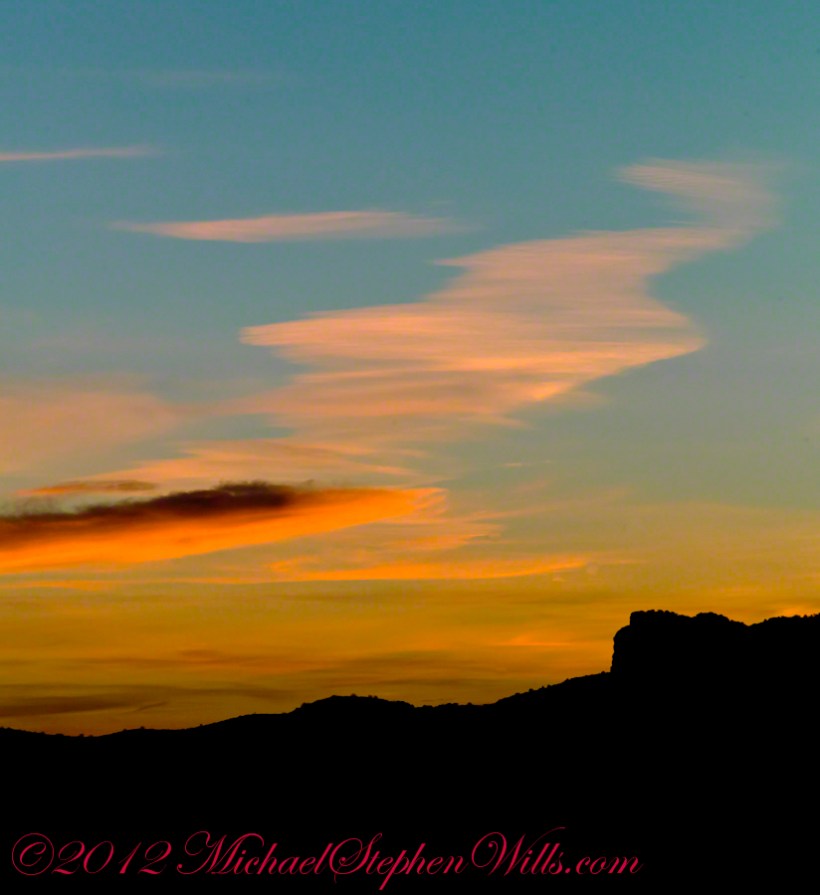
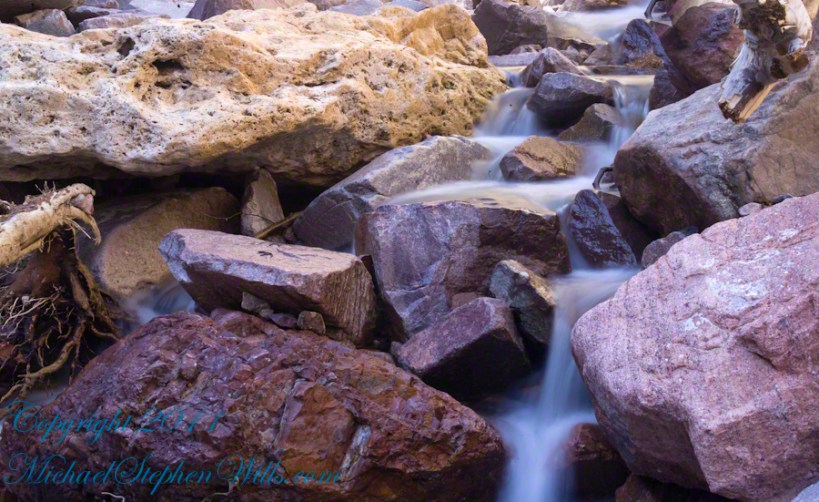
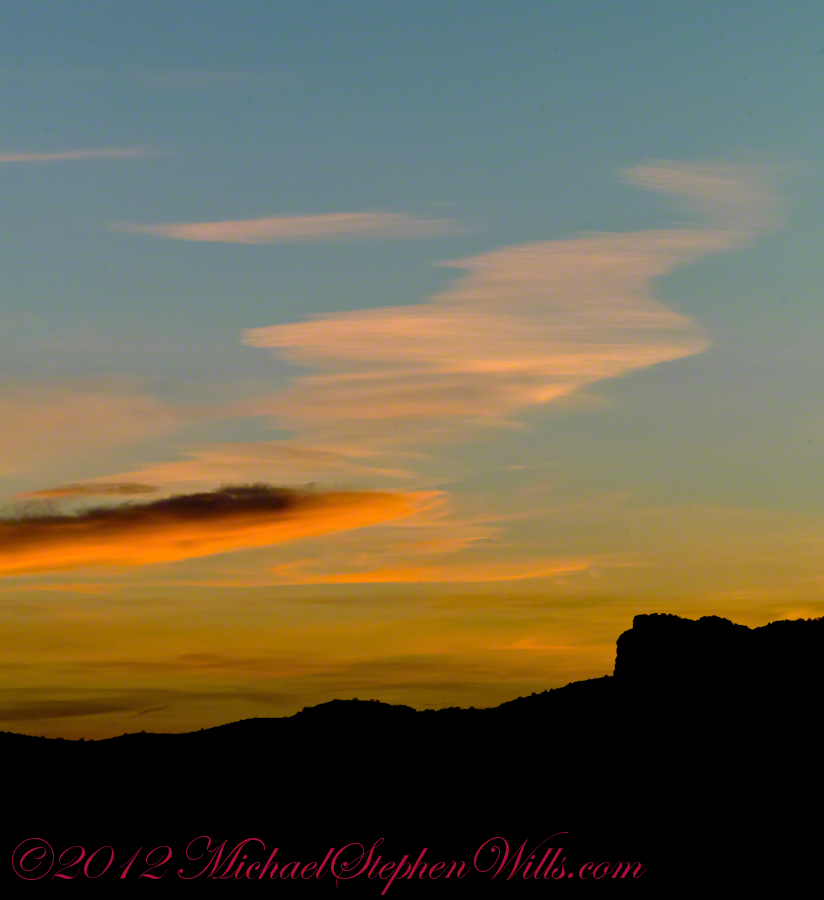
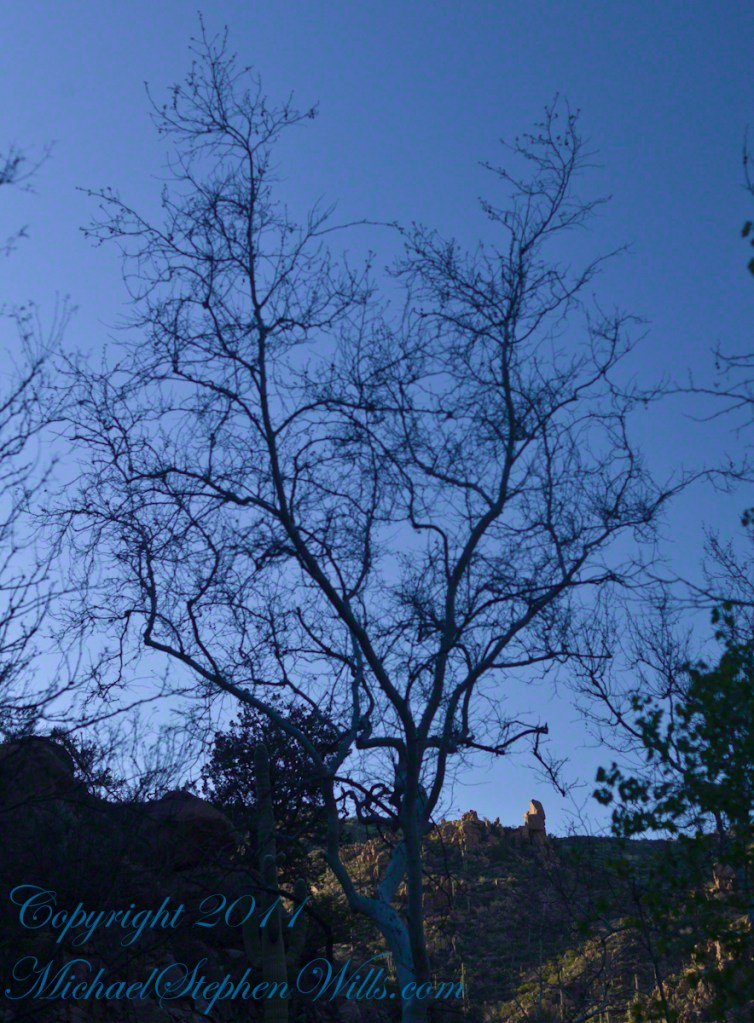
In this chapter I present, in the header, the lovely dawn sky of that day, and a tiny corner of a rock jumble in Reavis Creek. There is a large format version of the sky in my previous post, “The Mouth of Reavis Canyon.”
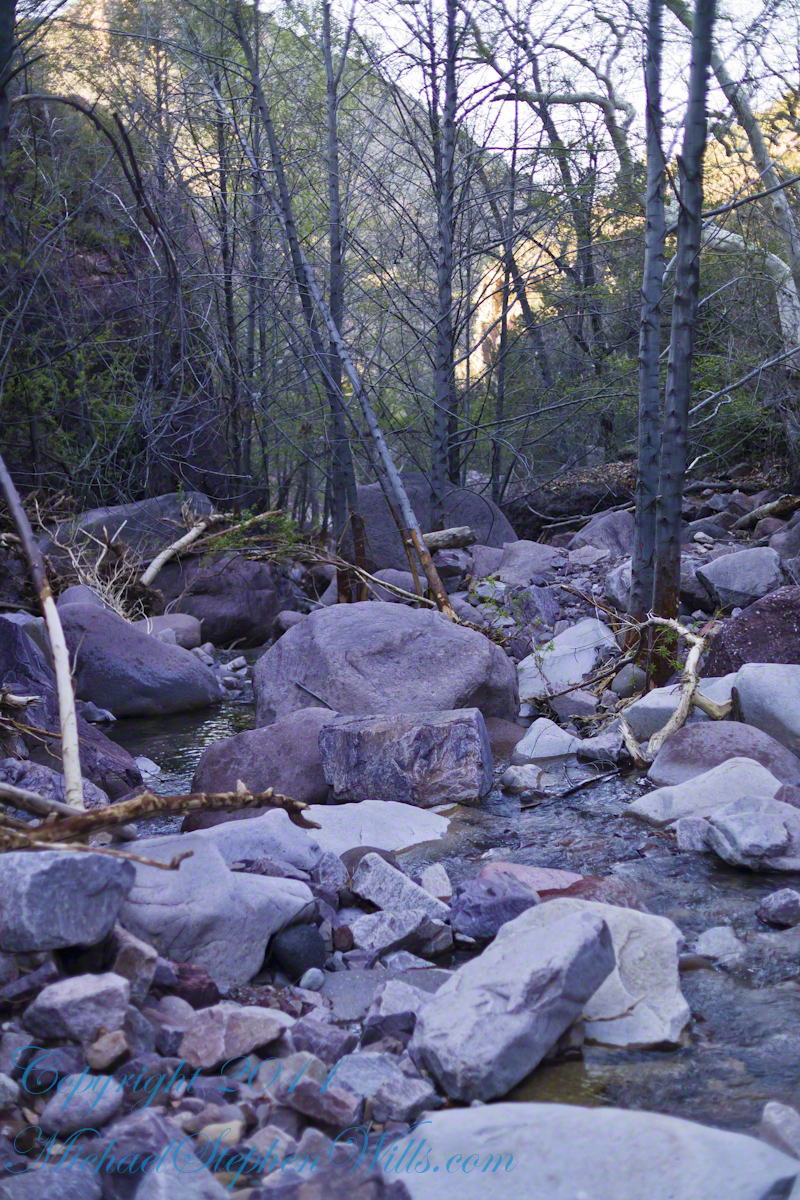
Rivulets and Rocks
Copyright 2023 Michael Stephen Wills All Rights Reserved
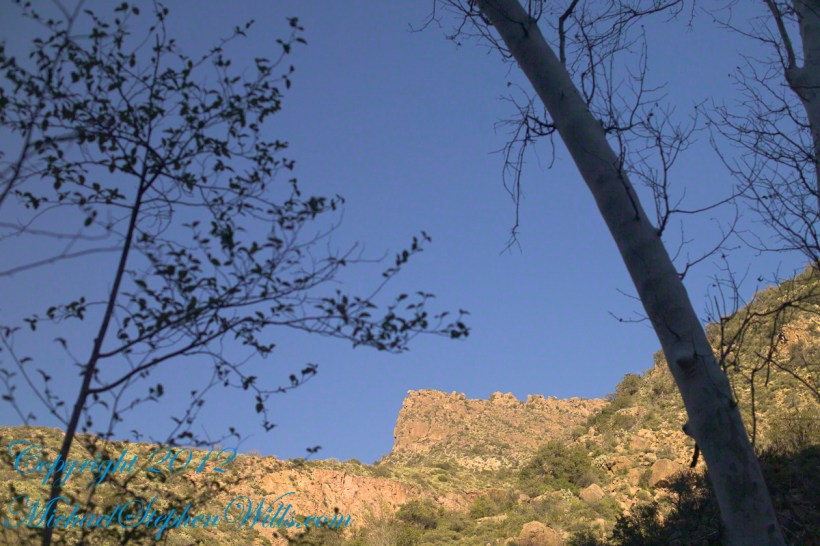
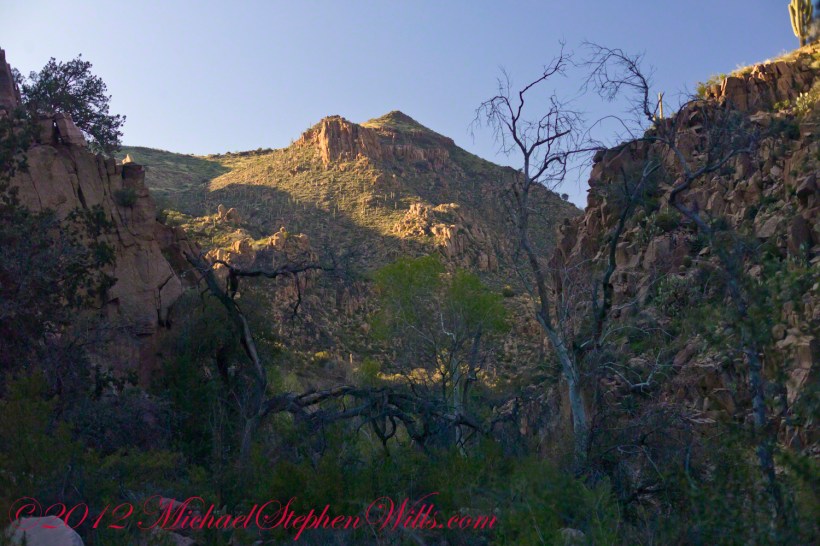
Here is the same view, in daylight. As I hiked toward the canyon mouth below Reavis Falls, looking up I saw this prominant cliff against the sky.
Here is the path I took toward the falls. The campsite is to the lower right, the falls are toward the center and left. My approach to the camp is on the right, moving toward the top. For another view of this location see Reavis Canyon Camp.
The mouth of Reavis Canyon below the falls is choked with vegetation and infallen rocks and boulders. The far slopes are thick with the poles of young saguaros. There are hoodoos, as well. In the photograph, below, one hoodoo is catching morning light. See the chapters Hoodoos on the Descent to Reavis Falls and Cedar Basin Hoodoos for more views of the hoodoos around Reavis Falls.
Hoodoos visible from the mouth of Reavis Canyon below the falls. Look toward the far slope.
Flood damage in Reavis Canyon below the falls. Note the scouring at the base of these trees and the broken limbs. This is NOT a place to be in spring thaw.
Massive spring flooding scours the canyon floor.
Flood damage in Reavis Canyon below the falls.
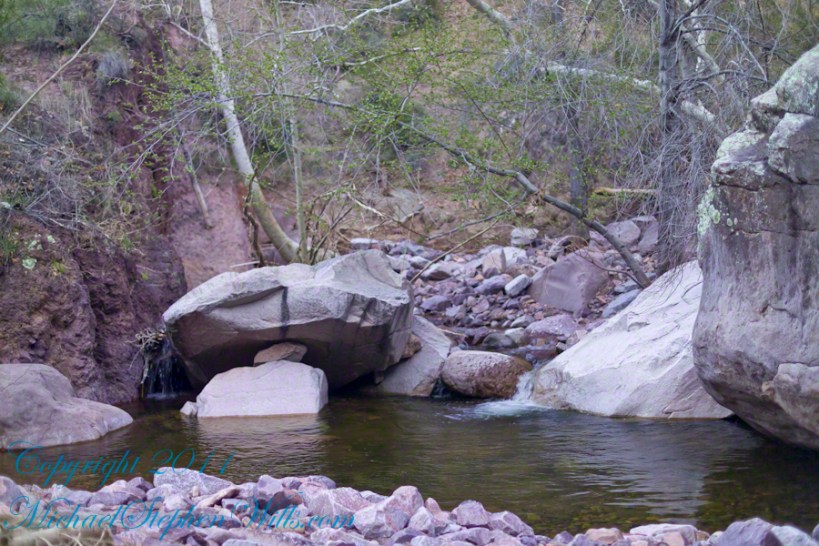
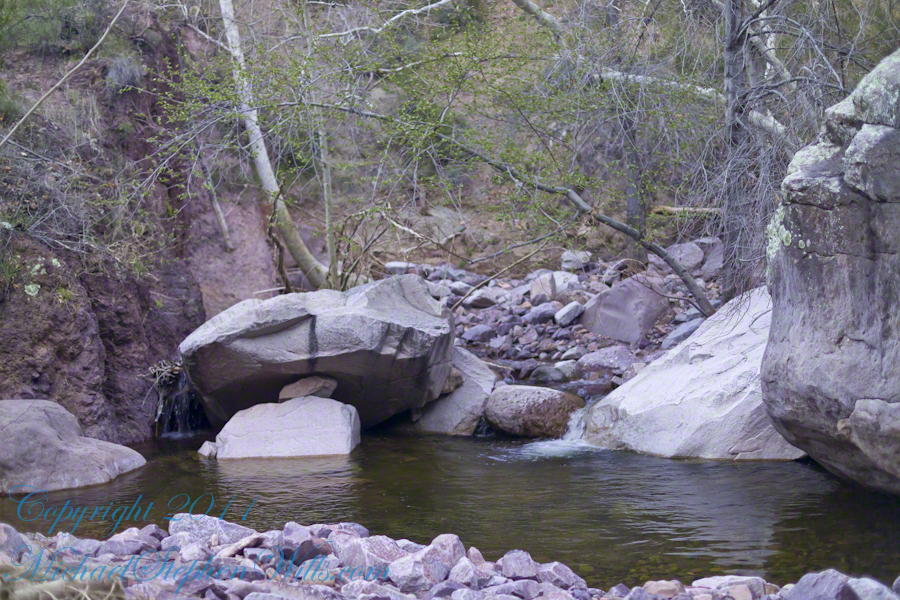
There is beauty to be found, as well. Freshly fallen rough rocks contrast with water smoothed boulders and the water surface.
Copyright 2023 Michael Stephen Wills All Rights Reserved
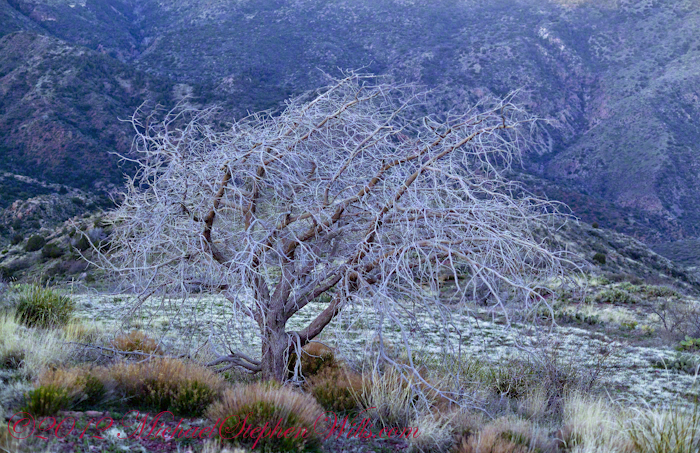
On my fourth morning, after I awoke to am immense silence, my first photography subject was the lone dry juniper you see below.
Then the dawn lit up the far mountains. You can view a larger image these mountains at dawn in my previous blog, “Superstition Wilderness Dawn.”
A Lone Dry Juniper
This is a photograph of that juniper tree, dryer than most, being dead. I take it to be a One-seed Juniper from the thick growth of branches and the strong rounded aspect of the crown. I captured this photograph from a tripod mount using a Kodak DCS slr/c with a Canon EF 50mm f/1.4 USM lens.
Looking into Reavis Creek Canyon from Lime Mountain
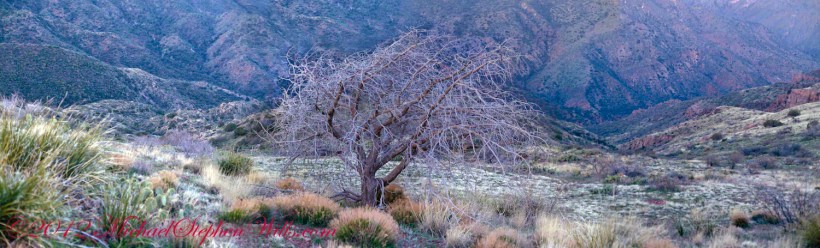
I used the tripod to bracket this shot on the left and right for the following panorama.
The Reavis Creek Canyon from Lime Mountain while still in shadow, morning
The Spirit of Elisha Reavis
From this vantage you can see my route into Reavis Creek Canyon and Reavis Falls taken on the first afternoon of the expedition. That first morning I loaded up 65 pounds of food, supplies and photography equipment and headed out from the Reavis Trailhead on the Reavis Ranch Trail. This was one of the trailed used by Elisha Reavis to ride a favorite burro and a string of 8 to 15 burros loaded with vegetables he sold to various communities throughout central Arizona. See my blogs “A Ride to Reavis Ranch” and “Apple Orchard in the Wilderness“for views of the paradise (as of the early 21st century) where Elisha Reavis, lived and prospered in the latter part of the 19th century where he lived his 70’s.
This his mountain valley, using a perennial creek, Reavis cultivated and irrigated about fifteen acres of land by himself with chickens, turkeys, hogs, burros, two horses and several dogs. The horses, teamed together, pulled a shear plow, disc and leveler. On April 9, 1896 Reavis was preparing of another trip to Mesa, to buy seed potatoes, and was found by a friend a month later on what is now the Reavis Ranch trail, to the south and west of his valley, near what is now called Grave Canyon were friends buried him.
Past the Dry Juniper and Down
102 years later, I headed up the Reavis Ranch Trail, over the ridge of Lime Mountain and past this dry juniper in the same spirit as Elisha Reavis if for a different purpose.
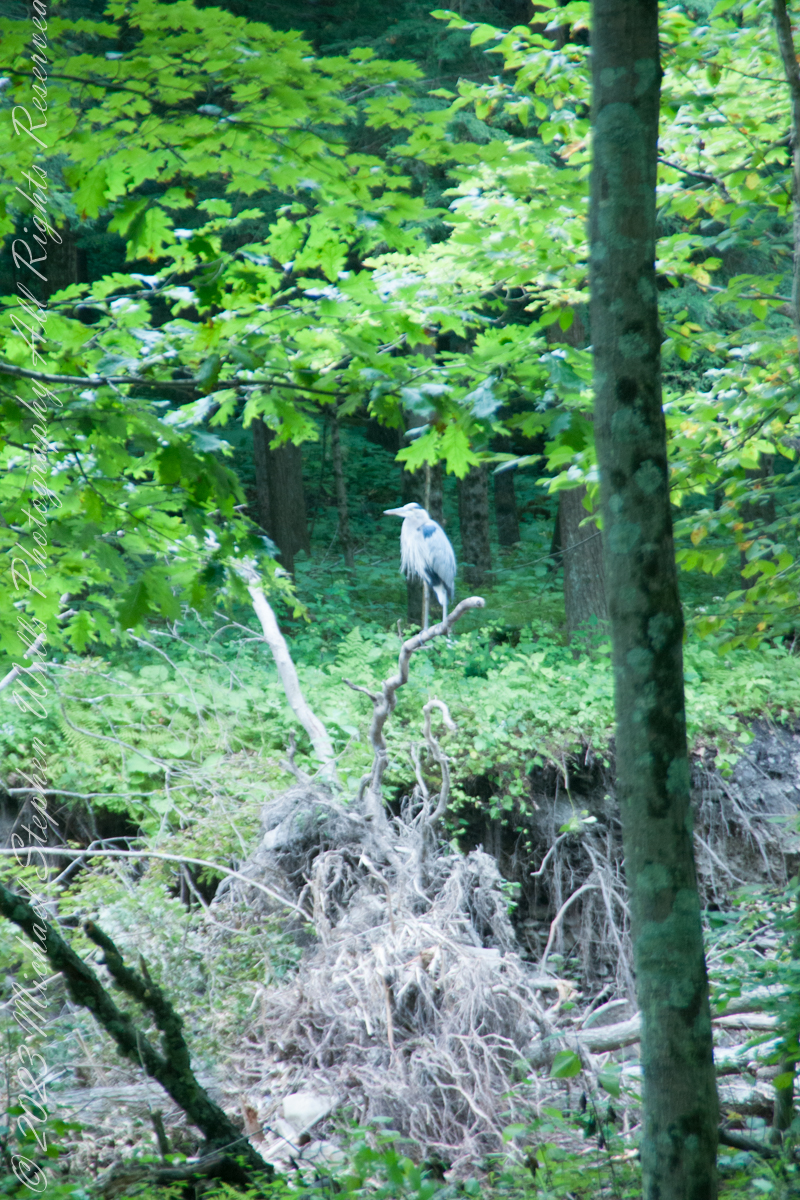
A Great Blue Heron spotted from Bear Trail during a family hike, perched on a splayed root of a tree undercut by flooding, fallen into Buttermilk Creek bed.
A heron recurves its long neck while perched. Adult herons have few natural predators and are rarely preyed upon due to their large size and sharp beak, but bald eagles (Haliaeetus leucocephalus) are known to attack great blue herons at every stage of their lifecycle from in the egg to adulthood.
Copyright 2023 Michael Stephen Wills All Rights Reserved
Treman lake is formed by a dam on Buttermilk Creek, the trail around the lake is less frequented and popular with the locals, climbing up and down the glacially formed hills. Some popular resorts maintain trails that feed into the park.
A footbridge framed by hemlock trees traverses Buttermilk Creek where the East and West Treman Lake Trails meet. This season, 2019, this bridge was overwhelmed by driftwood piled up by spring flooding, impassable. We pick our way across the creek bed and over the water. Little ones needed a carry. An adult fisherman, to right of driftwood, provides perspective.
August 20129, Buttermilk Falls New York State Park, Ithaca, Tompkins County, New York.
Copyright 2023 Michael Stephen Wills All Rights Reserved
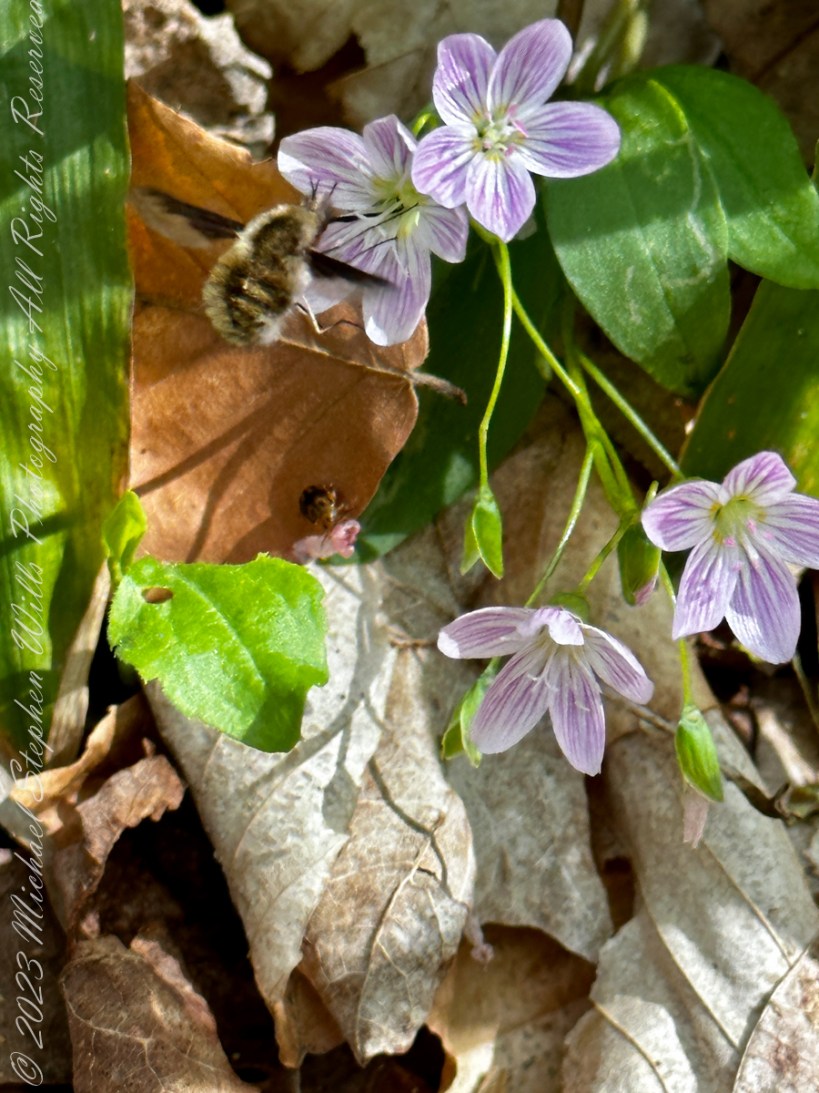
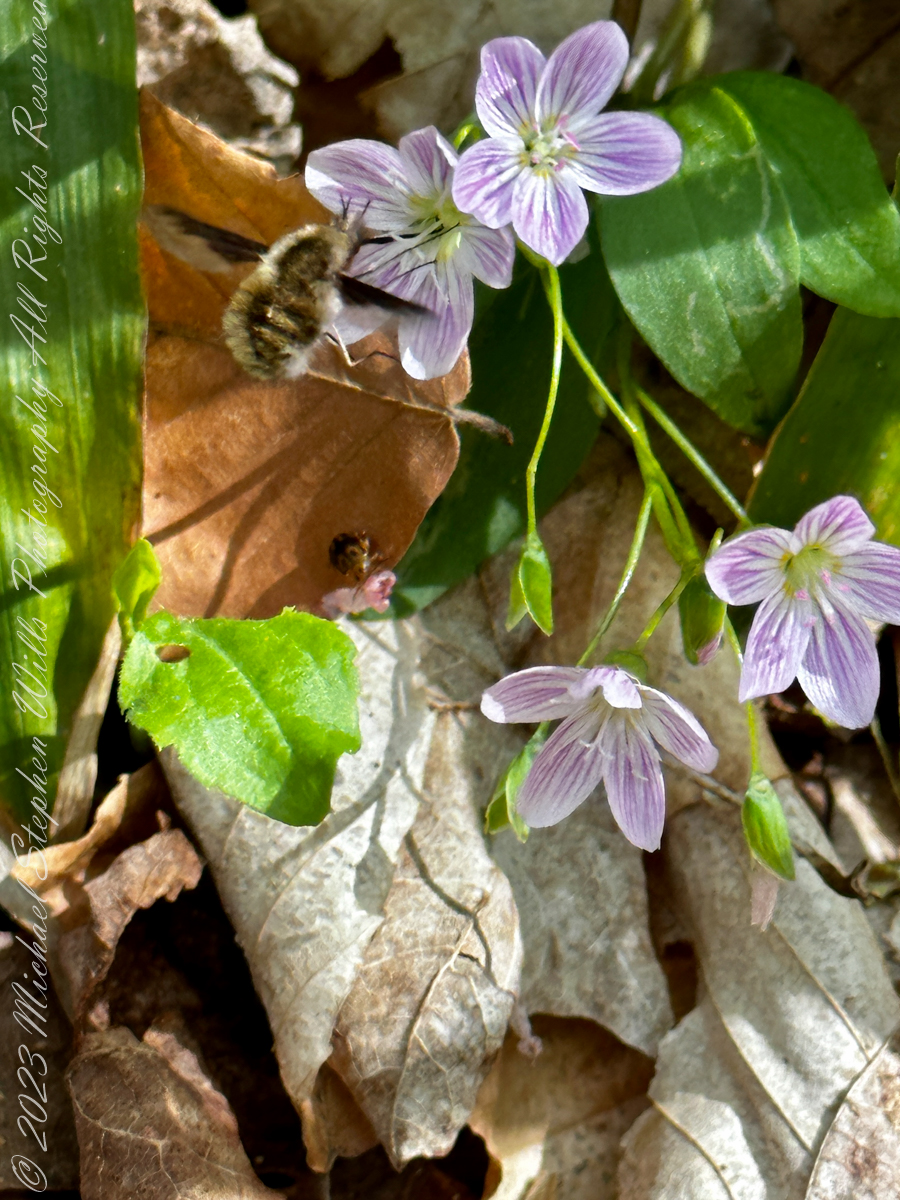
Bombylius major (commonly named the large bee-fly, the dark-edged bee-fly or the greater bee fly) is a parasitic bee mimic fly. Bombylius major is the most common type of fly within the Bombylius genus. The fly derives its name from its close resemblance to bumblebees and are often mistaken for them.
Bombylius major exhibits a unique flight behavior known as “yawing” and plays a role in general pollination, without preference of flower types. The fly does not bite, sting, or spread disease. However, the fly uses this mimicry of bumblebees to its own advantage, allowing close access to host solitary bee and wasp nests to deposit its eggs. After hatching, the larvae find their way into the nests to parasitically feed on the grubs.
Flight
It has been discovered that the fly is capable of a unique behavior, which was discovered with the use of a high speed camera. In this behavior, the flies are seen to rotate around a vertical axis as they fly (this action is known as “yawing”). However, it is still unknown what can cause this behavior to be triggered and what purpose it serves, but a proposed explanation includes mating habits. Here is an illustration of “Yaw” in the context of an airplane…substitute the fly body with head facing forward (to left).
The Bombylius major bee-fly is a common, generalist floral pollinator, meaning that it does not give preference to one flower over another, instead pollinating a wide variety of plant families and species. The fly uses its proboscis to carry and transfer the pollen. The species is a dominant pollinator within its community, sometimes even pollinating up to two thirds of the local flowers. In addition, Bombylius major will visit and pollinate plants that attract few other species. Some types of flowers, for example Pulmonaria officinalis, will be almost exclusively pollinated by Bombylius major, with other species contributing a negligible amount to that plants pollination. Some flower species, such as Delphinium tricorne, are even specifically adapted to the fly in terms of color, shape, and form. If given the choice, Bombylius major will have a consistency in plant choice.
Flower Attraction
Long distance floral attraction is governed by optical sense, with color being the most important factor. The flies are typically more attracted to blue and violet colors, and occasionally yellow, over orange and pink. However, short distance floral attraction is based on the fly’s olfactory sense.
Sunbathing Activity
The fly is mostly active during day hours when the weather conditions are warm and sunny. Bombylius major is attracted to sunnier places and is more likely to pollinate these areas, with a larger average of flower visits in areas of higher amounts of sunshine. The fly will hide in the trees during the night and usually dart away from a cast shadow and occasionally hide in clean washing brought in fresh from the washing line and fly out causing unsettled behavior in the discoverer.
Flower Description
Claytonia caroliniana is a flowering, woodland perennial herb. It grows from March though June and is one of the earliest spring ephemerals. The plant grows from spherical underground tubers in light humus. They sprout and bloom before the tree canopy develops. Once the area is shaded, the plants whither leaving only the tuberous roots underground.
The plant is edible, but its usability is limited due to difficulty harvesting and the small quantities each plant produces. Its tuberous roots are edible and rich in starch and can be cooked or eaten raw. The leaves can be eaten as well. The tuberous roots are eaten by eastern chipmunks and white-footed mice.
Source: Wikipedia “Bombylius major ” and “Claytonia caroliniana. Direct quotations are in italics.
Copyright 2023 All Rights Reserved Michael Stephen Wills
All photography using the IPhone 14 ProMax triple camera, raw format, edited on the phone.
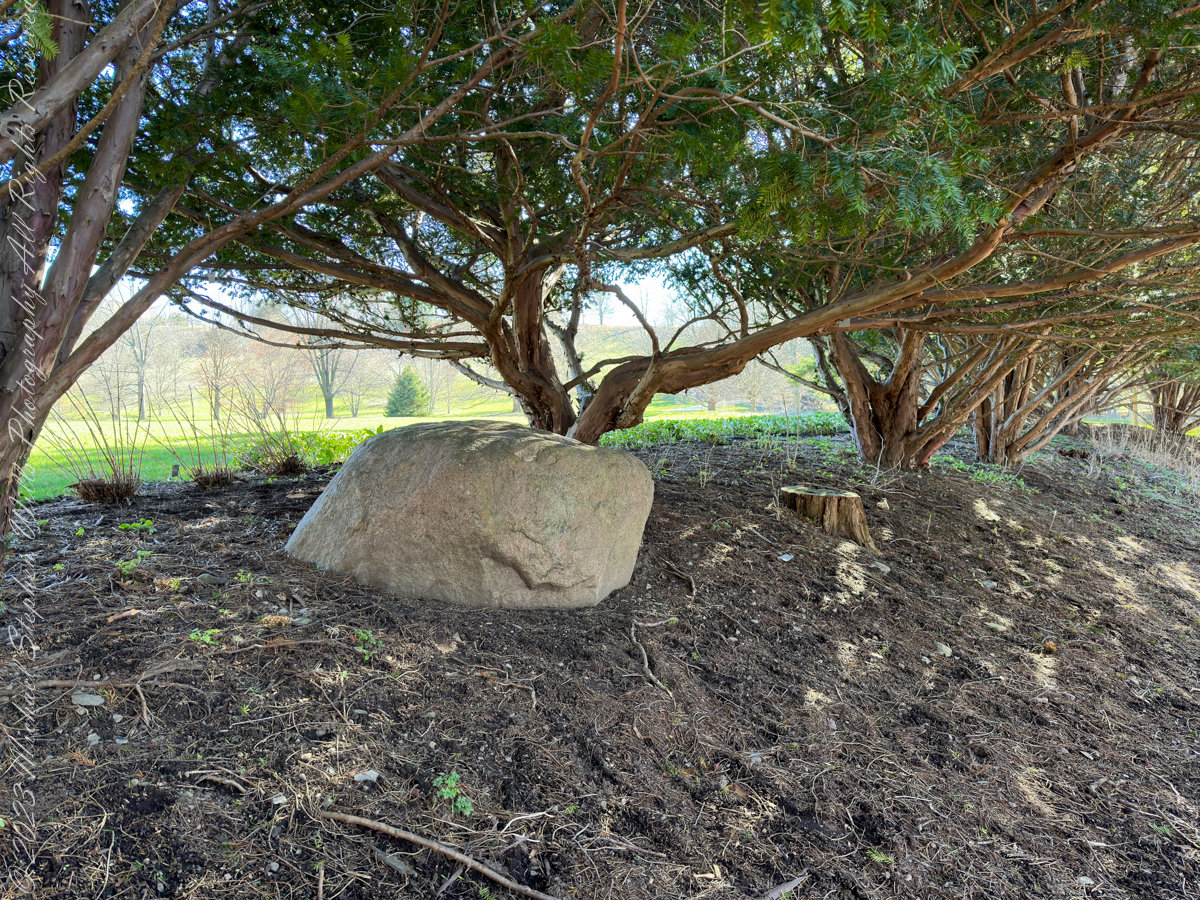
We find boulders of crystalline rock, commonly derived from Adirondack sources, left behind on the surface of ablation moraine, in the Finger Lakes Region.
Cornell finds some and move them, maybe the case for this unremarked erratic found along the Allen Trail of FR Newman Arboretum.
Another enormous erratic, brought in from the Sixmile Creek valley, was carved into a seat as a memorial to Professor R.S. Tarr who deciphered much of the glacial history of the Finger Lakes Region. Find it at the southwest corner of McCraw Hall on the Cornell University Campus.
History (from wikipedia)
During the 18th century, erratics were deemed a major geological paradox. Geologists identify erratics by studying the rocks surrounding the position of the erratic and the rock of the erratic itself. Erratics were once considered evidence of a biblical flood, but in the 19th century scientists gradually came to accept that erratics pointed to an ice age in Earth’s past. Among others, the Swiss politician, jurist, theologian Bernhard Friedrich Kuhn [de] saw glaciers as a possible solution as early as 1788. However, the idea of ice ages and glaciation as a geological force took a while to be accepted. Ignaz Venetz (1788–1859), a Swiss engineer, naturalist and glaciologist was one of the first scientists to recognize glaciers as a major force in shaping the earth.
In the 19th century, many scientists came to favor erratics as evidence for the end of the Last Glacial Maximum (ice age) 10,000 years ago, rather than a flood. Geologists have suggested that landslides or rockfalls initially dropped the rocks on top of glacial ice. The glaciers continued to move, carrying the rocks with them. When the ice melted, the erratics were left in their present locations.
Charles Lyell’s Principles of Geology (v. 1, 1830) provided an early description of the erratic which is consistent with the modern understanding. Louis Agassiz was the first to scientifically propose that the Earth had been subject to a past ice age. In the same year, he was elected a foreign member of the Royal Swedish Academy of Sciences. Prior to this proposal, Goethe, de Saussure, Venetz, Jean de Charpentier, Karl Friedrich Schimper and others had made the glaciers of the Alps the subjects of special study, and Goethe,[15] Charpentier as well as Schimper had even arrived at the conclusion that the erratic blocks of alpine rocks scattered over the slopes and summits of the Jura Mountains had been moved there by glaciers.
Charles Darwin published extensively on geologic phenomena including the distribution of erratic boulders. In his accounts written during the voyage of HMS Beagle, Darwin observed several large erratic boulders of notable size south of the Strait of Magellan, Tierra del Fuego and attributed them to ice rafting from Antarctica. Recent research suggests that they are more likely the result of glacial ice flows carrying the boulders to their current locations.
References:
“The Finger Lakes Region: Its Origin and Nature,” O.D. von Engeln, Cornell University Press, 1961 page 106.
Wikipedia, “Glacial Erratics”
Copyright 2023 Michael Stephen Wills All Rights Reserved
All photography using the IPhone 14 ProMax triple camera, raw format, edited on the phone.
Betula papyrifera, common names Paper Birch, (American) White Birch, Canoe Birch, is a short-lived species of birch native to northern North America. Paper birch is named for the tree’s thin white bark, which often peels in paper like layers from the trunk. Paper birch is often one of the first species to colonize a burned area within the northern latitudes and is an important species for moose browsing. The primary commercial uses for paper birch wood are boltwood and sawlogs, while secondary products include firewood and pulpwood. It is the provincial tree of Saskatchewan and the state tree of New Hampshire.
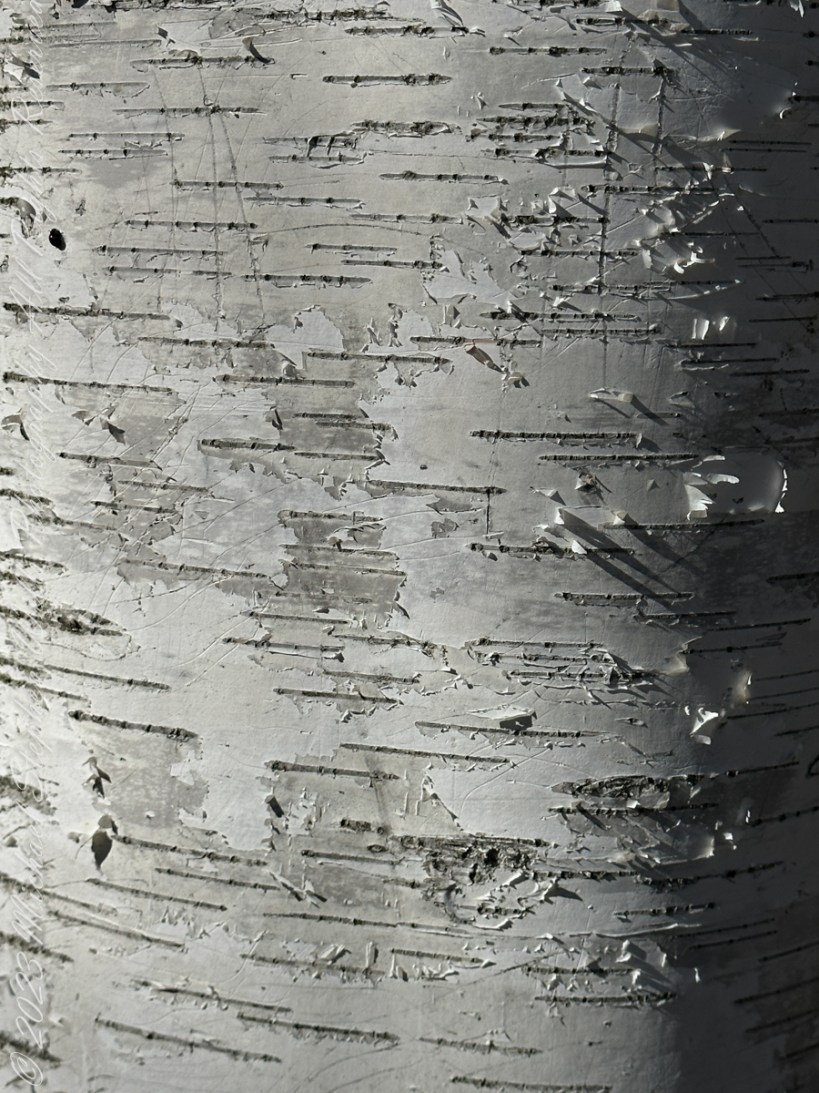
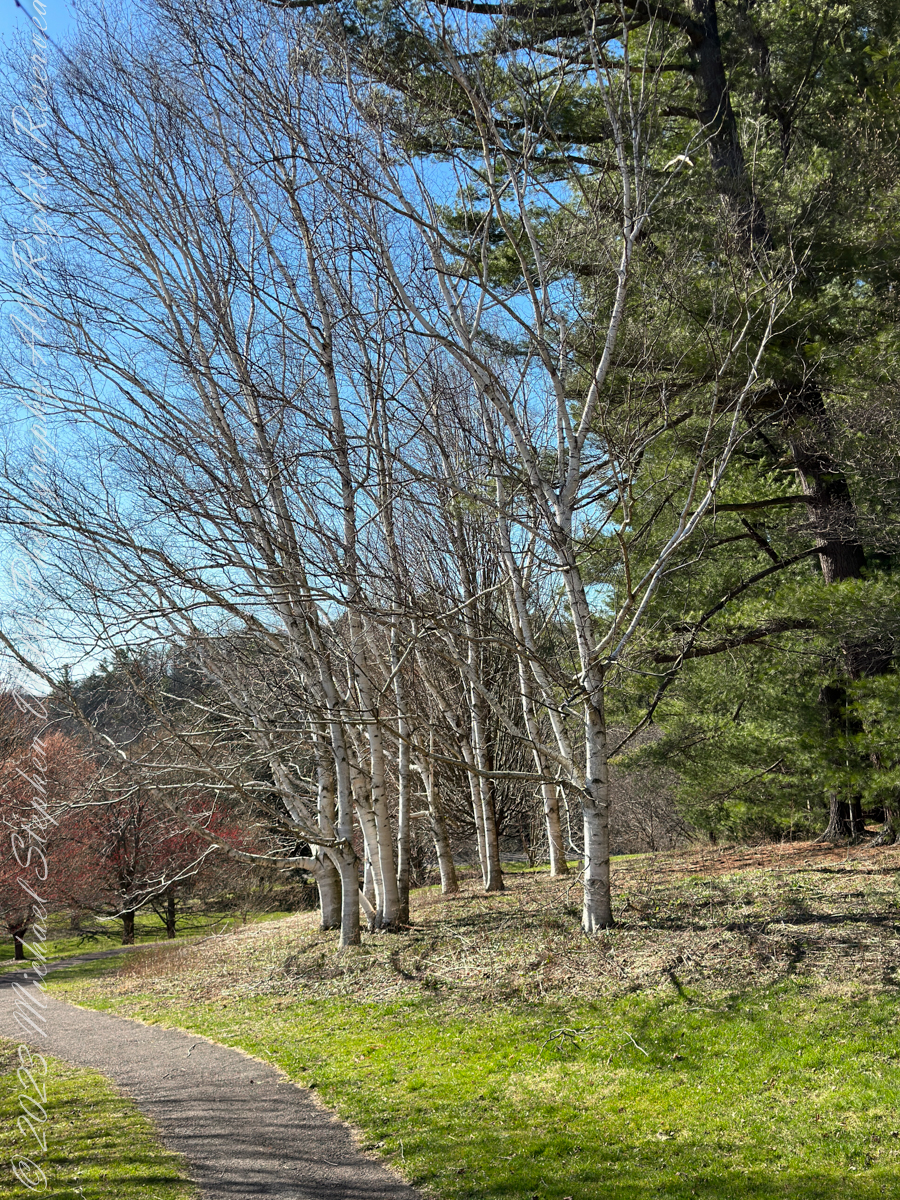
As you can see in the following photoghraph, Betula papyrifera is a medium-sized deciduous tree typically reaching 20 meters (66 feet) tall, and exceptionally to 40 m (130 ft) with a trunk up to 75 centimeters (30 inches) in diameter. Within forests, it often grows with a single trunk but when grown as a landscape tree it may develop multiple trunks or branch close to the ground.
Paper birch is a typically short-lived species. It handles heat and humidity poorly and may live only 30 years in zones six and up, while trees in colder-climate regions can grow for more than 100 years. Betula papyrifera will grow in many soil types, from steep rocky outcrops to flat muskegs of the boreal forest. Best growth occurs in deeper, well drained to dry soils, depending on the location.
White Birch is a pioneer species, meaning it is often one of the first trees to grow in an area after other trees are removed by some sort of disturbance. Typical disturbances colonized by paper birch are wildfire, avalanche, or windthrow areas where the wind has blown down all trees. When it grows in these pioneer, or early successional, woodlands, it often forms stands of trees where it is the only species, a feature emulated in this Cornell Botanical Garden planting. Paper Birch is considered well adapted to fires because it recovers quickly by means of reseeding the area or regrowth from the burned tree. The lightweight seeds are easily carried by the wind to burned areas, where they quickly germinate and grow into new trees. Paper birch is adapted to ecosystems where fires occur every 50 to 150 years for example, it is frequently an early invader after fire in black spruce boreal forests. As paper birch is a pioneer species, finding it within mature or climax forests is rare because it will be overcome by trees that are more shade tolerant as secondary succession progresses.
For example, in Alaskan boreal forests, a paper birch stand 20 years after a fire may have 3,000–6,000 trees per acre (7,400–14,800/ha), but after 60 to 90 years, the number of trees will decrease to 500–800 trees per acre (1,200–2,000/ha) as spruce replaces the birch. After approximately 75 years, the birch will start dying and by 125 years, most paper birch will have disappeared unless another fire burns the area.
Paper birch trees themselves have varied reactions to wildfire. A group, or stand, of paper birch is not particularly flammable. The canopy often has a high moisture content, the understory is often lush green. As such, conifer crown fires often stop once they reach a stand of paper birch or become slower-moving ground fires. Since these stands are fire-resistant, they may become seed trees to reseed the area around them that was burned. However, in dry periods, paper birch is flammable and will burn rapidly. As the bark is flammable, it often will burn and may girdle the tree.
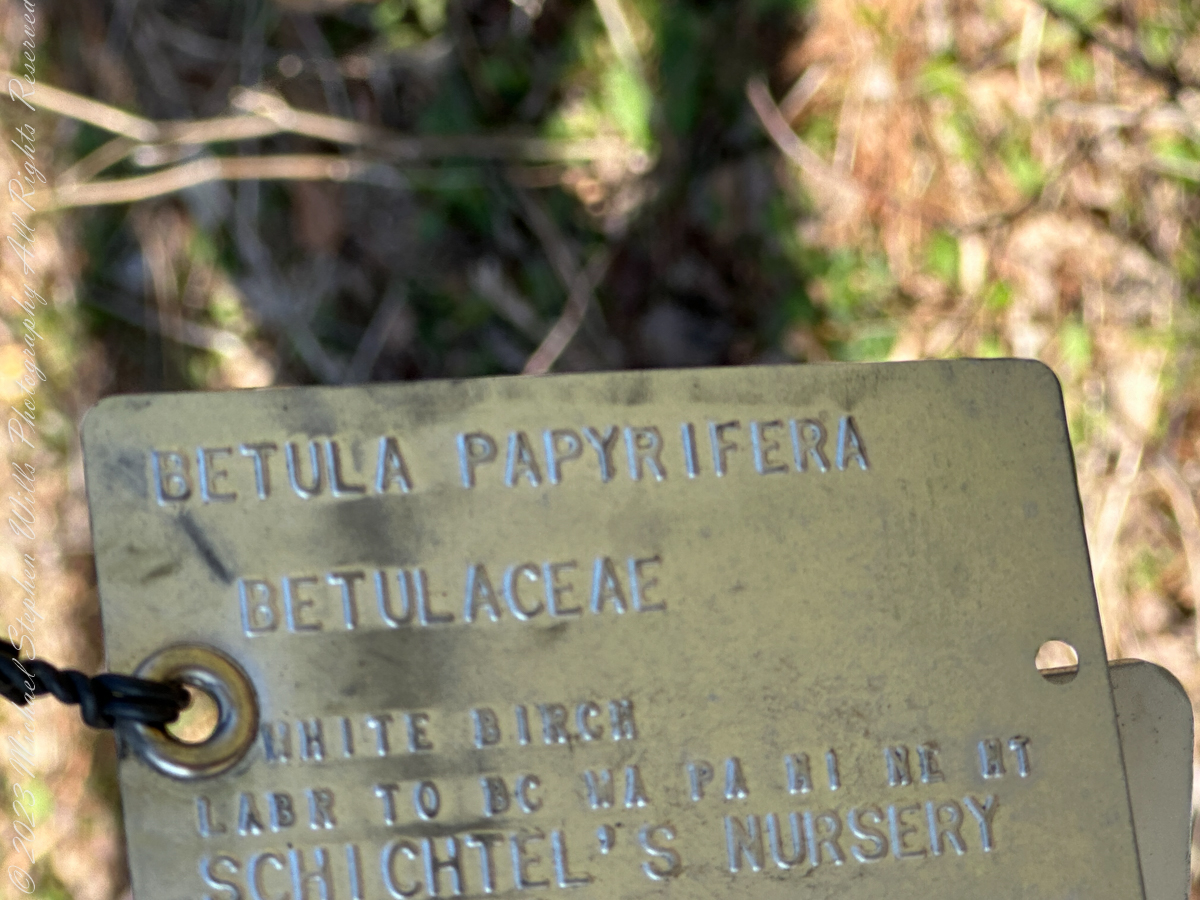
These metal tags are excellent signposts hanging from the branches on coated wire. Paper birch is a typically short-lived species. It handles heat and humidity poorly and may live only 30 years in zones six and up, while trees in colder-climate regions can grow for more than 100 years. Betula papyrifera will grow in many soil types, from steep rocky outcrops to flat muskegs of the boreal forest. Best growth occurs in deeper, well drained to dry soils, depending on the location.
In older trees, the bark is white, commonly brightly so, flaking in fine horizontal strips to reveal a pinkish or salmon-colored inner bark. It often has small black marks and scars. In individuals younger than five years, the bark appears a brown-red color with white lenticels, making the tree much harder to distinguish from other birches. The bark is highly weather-resistant. It has a high oil content; this gives it its waterproof and weather-resistant characteristics. Often, the wood of a downed paper birch will rot away, leaving the hollow bark intact.
Birch bark is a winter staple food for moose. The nutritional quality is poor because of the large quantities of lignin, which makes digestion difficult, but is important to wintering moose because of its sheer abundance. Moose prefer paper birch over aspen, alder, and balsam poplar, but they prefer willow (Salix spp.) over birch and the other species listed. Although moose consume large amounts of paper birch in the winter, if they were to eat only paper birch, they may starve.
Although white-tailed deer consider birch a “secondary-choice food,” it is an important dietary component. In Minnesota, white-tailed deer eat considerable amounts of paper birch leaves in the fall. Snowshoe hares browse paper birch seedlings, and grouse eat the buds.
Porcupines and beavers feed on the inner bark. The seeds of paper birch are an important part of the diet of many birds and small mammals, including chickadees, redpolls, voles, and ruffed grouse. Yellow bellied sapsuckers drill holes in the bark of paper birch to get at the sap; this is one of their favorite trees for feeding on. As a species, Birches are commonly cultivated as fast-growing, graceful trees with ornamental bark.
The wood of Betula pendulas Roth. Is light and an excellent thermal insulator, so is used for the inside of saunas in Finland. The wood of Betula alleghaniensis is use for furniture, paneling, and plywood in North America.
Birch sap, collected in spring when it pours from the tree, can be used to make beer. Various species have been used medicinally, and Betula lenta was used as a source of oil of wintergreen, or methyl salicylate; American Indians used it to treat many ailments. Betulinic acid from the bark is reported to trigger cell death in melanomas in culture.
The bark of B papyrifera Marsh. Is waterproof and used for birch-bark canoes by American Indians, as well as for roofing in some parts of the world. Several species were used as paper, including Betula utilis, which has been found in the form of 1800-year-old Buddhist manuscripts in Afghanistan.
References:
“White Birch” Wikipedia
“Betula” from “The Botanical Garden I: Trees and Shrubs,” By Roger Phillips and Martyn Rix, Firefly Books, 2002 p123
Copyright 2023 Michael Stephen Wills All Rights Reserved
All photography using the IPhone 14 ProMax triple camera, raw format, edited on the phone.
Acer rubrum is one of the most abundant and widespread trees in eastern North America. It can be found from the south of Newfoundland, through Nova Scotia, New Brunswick, and southern Quebec to the southwest west of Ontario, extreme southeastern Manitoba and northern Minnesota; southward through Wisconsin, Illinois, Missouri, eastern Oklahoma, and eastern Texas in its western range; and east to Florida. It has the largest continuous range along the North American Atlantic Coast of any tree that occurs in Florida. In total it ranges 2,600 km (1,600 mi) from north to south. The species is native to all regions of the United States east of the 95th meridian. The tree’s range ends where the −40 °C (−40 °F) mean minimum isotherm begins, namely in southeastern Canada. A. rubrum is not present in most of the Prairie Peninsula of the northern Midwest (although it is found in Ohio), the coastal prairie in southern Louisiana and southeastern Texas and the swamp prairie of the Florida Everglades. Red maple’s western range stops with the Great Plains where conditions become too dry for it. The absence of red maple from the Prairie Peninsula is most likely due to the tree’s poor tolerance of wildfires. Red maple is most abundant in the Northeastern US, the Upper Peninsula of Michigan, and northeastern Wisconsin, and is rare in the extreme west of its range and in the Southeastern US.
On the arboretum northeast side is a collection of native maples, this Red Maple is represented caught our eye.
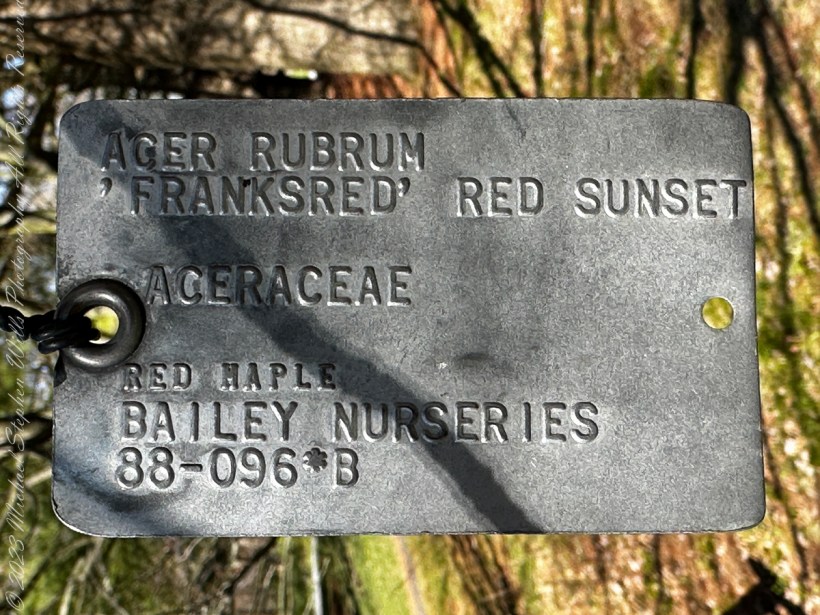
These metal tags are excellent signposts hanging from the branches on coated wire. Red maple’s maximum lifespan is 150 years, but most live less than 100 years. The tree’s thin bark is easily damaged from ice and storms, animals, and when used in landscaping, being struck by flying debris from lawn mowers, allowing fungi to penetrate and cause heart rot.[8] Its ability to thrive in many habitats is largely due to its ability to produce roots to suit its site from a young age. In wet locations, red maple seedlings produce short taproots with long, well-developed lateral roots; while on dry sites, they develop long taproots with significantly shorter laterals. The roots are primarily horizontal, however, forming in the upper 25 cm (9.8 in) of the ground. Mature trees have woody roots up to 25 m (82 ft) long. They are very tolerant of flooding, with one study showing that 60 days of flooding caused no leaf damage. At the same time, they are tolerant of drought due to their ability to stop growing under dry conditions by then producing a second-growth flush when conditions later improve, even if growth has stopped for 2 weeks.
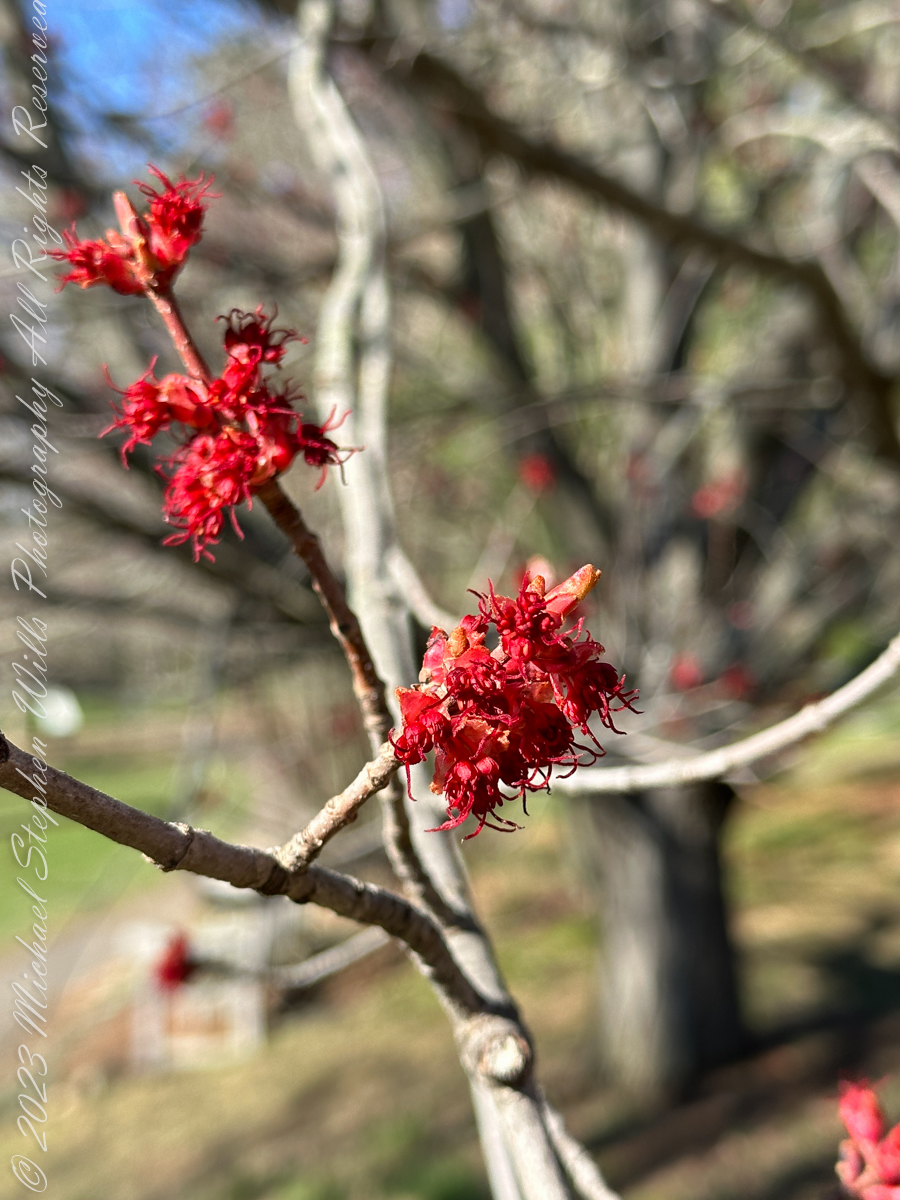
Acer rubrum is one of the first plants to flower in spring. A crop of seeds is generally produced every year with a bumper crop often occurring every second year. A single tree between 5 and 20 cm (2.0 and 7.9 in) in diameter can produce between 12,000 and 91,000 seeds in a season. A tree 30 cm (0.98 ft) in diameter was shown to produce nearly a million seeds. Red maple produces one of the smallest seeds of any of the maples. Fertilization has also been shown to significantly increase the seed yield for up to two years after application. The flowers are generally unisexual, with male and female flowers appearing in separate sessile clusters, though they are sometimes also bisexual. These pistillate (female) flowers have one pistil formed from two fused carpels with a glabrous superior ovary and two long styles that protrude beyond the perianth. These flowers were formed on the tree labeled “Frank’s Red.”
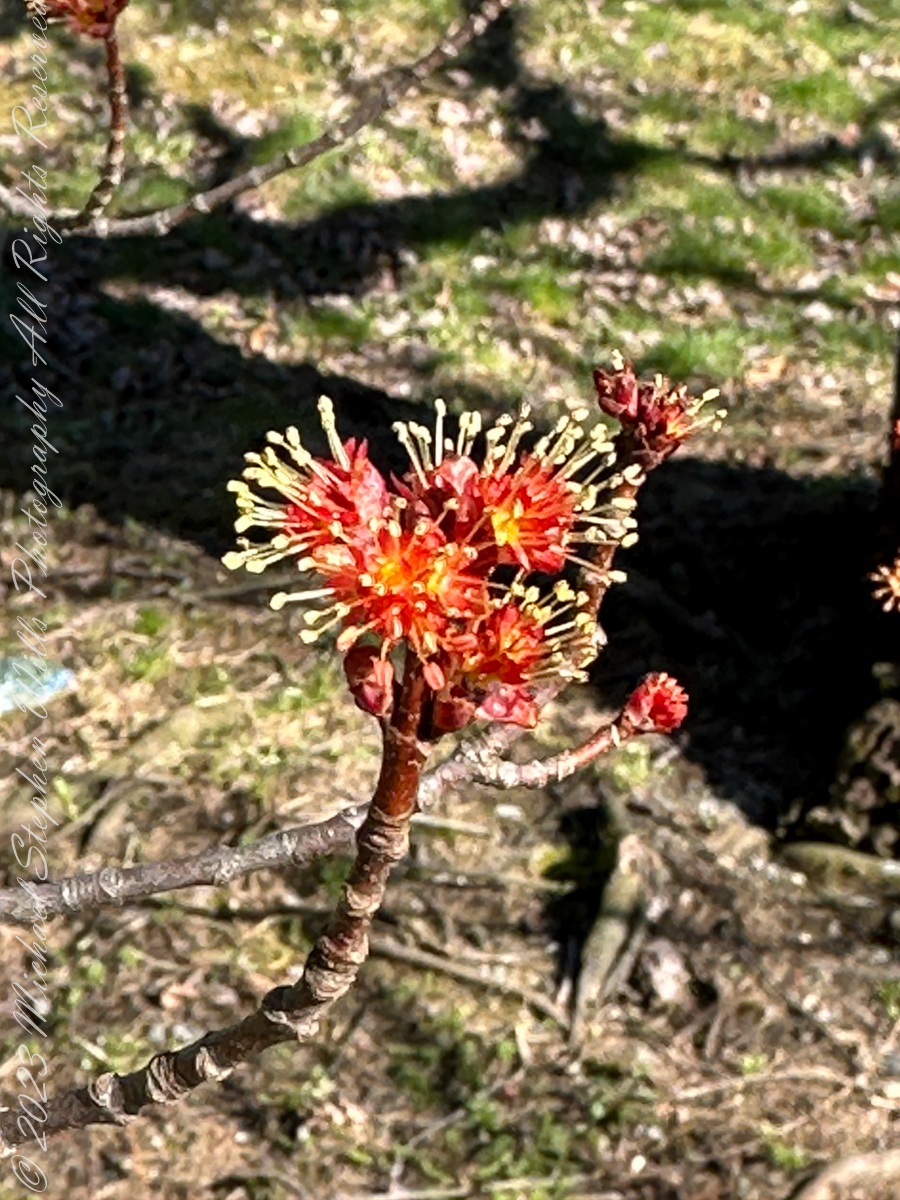
These staminate (male) flowers are sessile (grow direct from tip of branch without a stalk) containing between 4 and 12 stamens, often with 8. These seem to have 12 stamens.
The above flowers were formed on a “Schlesinger I” Red Maple Tree (see following lable).
Reference: “Red Maple” Wikipedia
Copyright 2023 Michael Stephen Wills All Rights Reserved








 Michael Stephen Wills Photography