Newgrange VIII

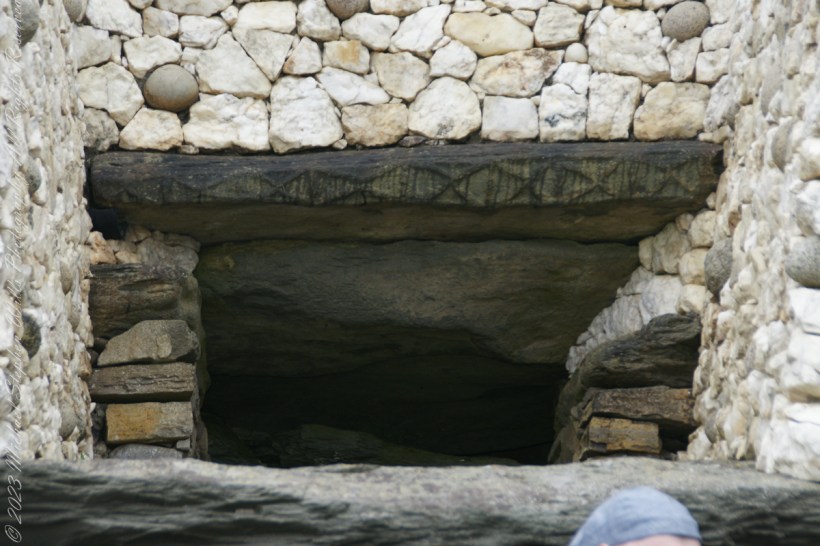
The Newgrange facade and kerbstones consists of stones from various locations, believed to be transported by sea and river.

The Newgrange façade and entrance of today is a creation from the large quantity of small stones unearthed and conserved during excavation given form by a steel-reinforced concrete retention wall. 

The brilliant white quartz cobblestones were collected from the Wicklow Mountains, 31 miles to the south.  Our guide called them “sunstones” for the way they reflect sunlight. In the following photograph is white quartz, the same excavated 1967-1975 from the Newgrange site and incorporated into the facade, I collected from “Miners Way” along R756 (above Glendalough).

You can also see in these photographs dark rounded granodiorite cobbles from the Mourne Mountains, 31 miles to the north.  Dark gabbro cobbles from the Cooley Mountains and banded siltstone from the shore at Carlingford Lough both locations on the Cooley Peninsula where my mother’s family still has farms.

The stones may have been transported to Newgrange by sea and up the River Boyne by fastening them to the underside of boats at low tide. None of the structural slabs were quarried, for they show signs of having been weathered naturally, so they must have been collected and then transported, largely uphill, to the Newgrange site. The granite basins found inside the chambers also came from the Mournes.

Geological analysis indicates that the thousands of pebbles that make up the cairn, which together would have weighed about 200,000 tons, came from the nearby river terraces of the Boyne. There is a large pond in this area that is believed to be the site quarried for the pebbles by the builders of Newgrange.

Most of the 547 slabs that make up the inner passage, chambers, and the outer kerbstones are greywacke. Some or all of them may have been brought from sites either 3 miles away or from the rocky beach at Clogherhead, County Louth, about 12 miles to the northeast.

Click Me for the first post of this series.

Copyright 2023 Michael Stephen Wills All Rights Reserved

Treman Early Autumn Walk XIV

The post discusses the Hepatica acutiloba plant, highlighting its characteristics, growth, historical medicinal use, and its natural habitat in central eastern North America. It also includes an observation made in Robert H. Treman Park.

These characteristic leaves are Hepatica plants growing on the sun dappled southern rim of Robert H. Treman Park captured on a bright late September morning.

“Hepatica acutiloba, the sharp-lobed hepatica, is a herbaceous flowering plant in the buttercup family Ranunculaceae. It is sometimes considered part of the genus Anemone, as Anemone acutiloba, A. hepatica, or A. nobilis. Also generally known as Liverleaf and Liverwort.”


“The word hepatica derives from the Greek ἡπατικός hēpatikós, from ἧπαρ hêpar ‘liver’, because its three-lobed leaf was thought to resemble the human liver.”


“Each clump-forming plant grows 5 to 19 cm (2.0 to 7.5 in) tall, flowering in the early to mid spring. The flowers are greenish-white, white, purple or pinkish in color, with a rounded shape. After flowering the fruits are produced in small, rounded columned heads, on pedicels 1 to 4 mm long. When the fruits, called achenes, are ripe they are ovoid in shape, 3.5–4.7 mm long and 1.3–1.9 mm wide, slightly winged and tend to lack a beak.”

Hepatica Flowers in early spring on the Rim Trail

“Hepatica acutiloba is native to central eastern North America where it can be found growing in deciduous open woods, most often in calcareous soils. Butterflies, moths, bees, flies and beetles are known pollinators. The leaves are basal, leathery, and usually three-lobed, remaining over winter.”

“Hepatica was once used as a medicinal herb. Owing to the doctrine of signatures, the plant was once thought to be an effective treatment for liver disorders. Although poisonous in large doses, the leaves and flowers may be used as an astringent, as a demulcent for slow-healing injuries, and as a diuretic.”

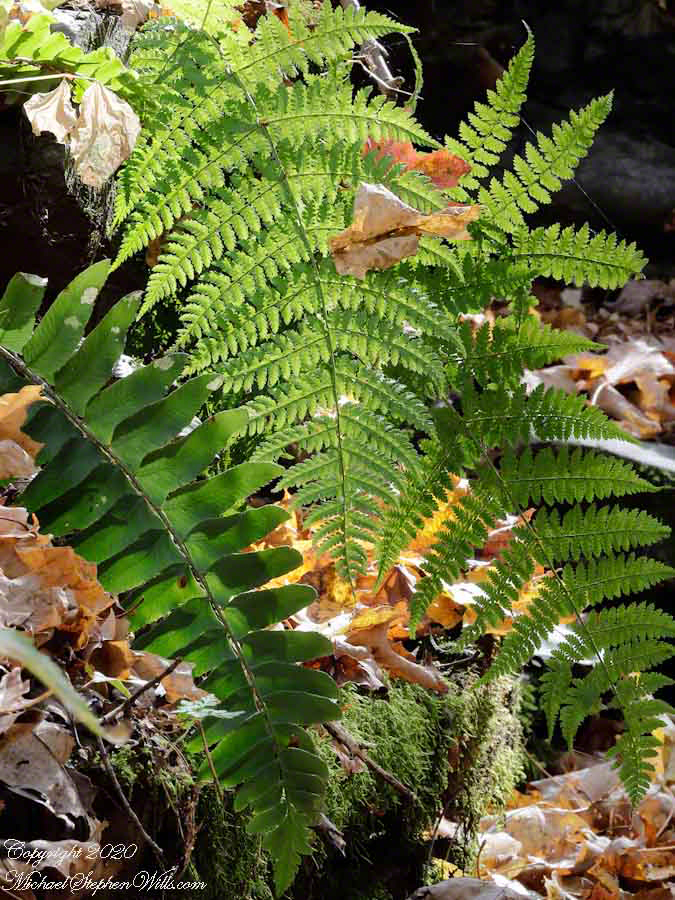
Ferns and Mosses growing beneath Red Pines

View of the lower falls and swimming hole from the Rim Trail

Click Me another post featuring Hepatica flowers

References
–text in italics and quotes is from Wikipedia, “Hepatica” and “Hepatica acutiloba.”
–“The Botanical Garden Vol II Perennials and Annuals,” Roger Phillips and Martyn Rix, Firefly Books, 2002.

Copyright 2023 All Rights Reserved Michael Stephen Wills

Fruit of the Starflower

A member of the primrose family

These dark blue berries at the end of a slender naked stalk that arises from the leaf joint at the top of the plant were encountered on a late August day in Fillmore Glen, Moravia, Cayuga County, New York State.  Lysimachia borealis is a perennial wildflower commonly known as Starflower.  After blooming in the spring, as a member of the primrose family these are some of the first flowers to appear, the fertilized flowers develop into this round purple fruit.  To confuse identification, the plant is also known as Trientalis borealis.

“Lysimachia species are used as food plants by the larvae of some butterflies and moths, including the dot moth, grey pug, lime-speck pug, small angle shades, and v-pug.”   Chipmunks eat these fruits as a minor portion of their diet.

“Bees of the genus Macropis are specialized to pollinate oil-producing Lysimachia plants. These bees use exclusively Lysimachia floral oils for building their nests and provisioning cells. Lysimachia floral-specific chemicals are strong attractors for Macropis nuda and Macropis fulvipes bees that are seldom found in other plant genera.”

Do not confuse this with another “starflower,” Borago officinalis, from which an oil is produced commercially.

Reference: text in italics and quotes is from the Wikipedia, “Lysimachia.”

Copyright 2023 Michael Stephen Wills All Rights Reserved

Yellow-legged Wasp?

A case of mistaken identity.

After reading a New York Times article with the sub-title “A beekeeper in Savannah, Ga., found what turned out to be a yellow-legged hornet. State and federal officials, along with academic experts, are working to eradicate the species” I spotted this wasp foraging our flowers in Ithaca, New York. Its yellow legs caught my eye, although the apparent size (seemed larger in article photograph) and face and body markings seemed different. Using an Apple Iphone 14 ProMax I captured three macros from different angles, I attached them to an email to the local Cooperative Extension office. They gave me a quick response, confirming my suspicion this was a different “yellow-legged wasp.” The agent suggested it might be a “paper wasp” and directed me to a Cornell site were, for a $25 fee, an identification could be made.

Instead, this morning I found “insectidentification.org” with an excellent search capability. Under “Bee, Ant, Wasp and Similar insects that can be found in the state/territory of New York,” the third row from top spotted an exact match being the only Yellow-legged native wasp. I am going to respond to the agent with this identification as others in the area may have the same question, given the name of the invasive wasp.

“It is the Yellow-legged Mud-dauber Wasp (Sceliphron caementarium), also known as Black and Yellow Mud Dauber, Black-waisted Mud-dauber. Of the Latin species name, Sceliphron caementarium, caementarius means mason or builder of walls.”

“These are solitary parasitoid wasps and build nests made of mud. The family of sphecid wasps collect mud balls at puddle and pool edges for constructing nests comprised of up to 25 vertically arranged, individual cylindrical cells. Frequently, nests are built in shaded areas inside formations that are sheltered from the weather or from other environmental elements. These sites may be naturally-occurring, or man-made structures. Some examples are: under and inside various types of bridges, barns, garages, open-air porches, or under housing eaves. A female might take only a day to construct a cell requiring dozens of trips carrying mud. Females will add new cells one by one to the nest after each cell is provisioned. They provision these nests with spiders, such as crab spiders, orb-weaver spiders and jumping spiders in particular, as food for the developing larvae. Each mud cell contains one egg and is provided with several prey items. The wasp then seals the cell with a thick mud plug. After initial creation and covering of the clutch, this sphecid wasp uses more mud as a means covering and protecting the whole cluster of cells, thereby forming a smooth appearance, and a uniform nest. The entire nest may attain an area equal to, or larger than, the size of an average human fist.”

“After finishing a series of cells, she leaves and does not return. While consuming the prey and increasing in size, the larva molts several times, until it molts into a pupa. Once the pupa has developed into an adult wasp, the adult emerges from its pupal case and breaks out of its mud chamber.”

“Various parasites attack these nests, including several species of cuckoo wasps, primarily by sneaking into the nest while the resident mud dauber is out foraging.”


“Adults can be seen in mid-summer feeding on nectar at flowers, especially Queen Anne’s lace (Daucus carota), parsnips and water parsnips (Sium suave, Sium latifolium, Berula erecta). They have a low reproductive rate. Stings are rare due to their solitary and usually nonaggressive nature; however, nests are aggressively defended.


“Like other solitary wasps, Sceliphron species are not aggressive unless threatened. They are sometimes regarded as beneficial due to their control of spider populations, though the spiders themselves may be beneficial in controlling pest insects.”


This species is found in a wide variety of habitats, such as rock ledges, man-made structures, puddles and other water edges, cypress domes, in long leaf pines (Pinus palustris), and in turkey oaks.


“S. caementarium is widespread in Canada, the United States, Central America and the West Indies, and has been introduced to many Pacific Islands (including Australia, Hawaii, and Japan), Peru and Europe, where it has become established in some countries of the Mediterranean Basin (Croatia, France and Corsica, Italy, Cyprus,Malta, the Canary Islands, and Madeira) and Austria, and Ukraine.


“Sceliphron caementarium can reach a length of 24–28 mm (15⁄16–1+3⁄32 in). Their petiole is generally black and is about half the length of the entire abdomen, however the population in the desert southwest often has a yellow petiole. The thorax shows various yellow markings, while the abdomen is normally black, with yellow propodeum (typical of females). The eyes are black, the antennae are black, and the legs are yellow with black trochanters and femurs. Within the United States, it is the only species with yellow-marked legs. The wings are a tawny color.”

“In 1996, Birgenair Flight 301 crashed near Puerto Rico. The most probable cause of this Boeing 757 crash was a blockage in a pitot tube by a mud dauber’s nest.”

Around our home these mud-daubers favor hollows within our aluminum fencing.

Reference: text in italics and quotes paraphrased from Wikipedia “Sceliphron caementarium” and “Sceliphron.”

Copyright 2023 Michael Stephen Wills All Rights Reserved

August Scenes

Grandfathering Around Tompkins County

Copyright 2023 Michael Stephen Wills /all Rights Reserved

Spring Ritual

Feeding Apple Trees

A spring rite of ours is caring for three apple trees. We provide each, a Cortland, a McIntosh, a Delicious, with 15 fertilizer spikes ; 45 in all.

I am way past using a hammer to pound in each. The preferred method is to drive a space into the ground beneath the drip line (the other reach of the branches), lift the handle and drop the spike into the ground, remove the spade and tamp down the ground.

These helpers are now experts in the dropping and counting. Then, enough is enough, time for play.

And lunch….

Copyright 2024 Michael Stephen Wills All Rights Reserved

Ghost Pipes that grow in the dark

chlorophyll free

I found these popping up from leaf litter, a mixture of last year’s maple and elm, on an August morning. The dappled light, varied from bright to very dark, exceeded the dynamic range of my equipment, so I set up the Sony dslr Alpha700 with the Sony lens DT 18-200mm f3.5-6.3 on a tripod and, using the remote feature, placed the flash at an optimal angle.

Monotropa uniflora, also known as ghost plant, ghost pipe, or Indian pipe, is an herbaceous perennial plant native to temperate regions of Asia, North America, and northern South America, but with large gaps between areas. The plant is sometimes completely waxy white, but often has black flecks or pale pink coloration. Rare variants may have a deep red color. The name “Monotropa” is Greek for “one turn” and “uniflora” is Latin for “one flowered” as there is one sharply curved stem for each single flower. It flowers from early summer to early autumn, often a few days after rainfall. The fruit, an oval capsule-like structure, enlarges and becomes upright when the seeds mature, at this point stem and capsule looking desiccated and dark brown or black. The seeds of Monotropa uniflora are small, ranging between 0.6–0.8 mm (3⁄128–1⁄32 in) in length.

Unlike most plants, it is white and does not contain chlorophyll. Instead of generating food using the energy from sunlight, it is parasitic, and more specifically a mycoheterotroph. Its hosts are certain fungi that are mycorrhizal with trees, meaning it ultimately gets its food from photosynthetic trees. Since it is not dependent on sunlight to grow, it can grow in very dark environments as in the understory of dense forest. The complex relationship that allows this plant to grow also makes propagation difficult.

The flowers of Monotropa uniflora are visited by various bee and fly species, most commonly bumblebees. Bumblebees are an important pollen dispersal agent for the plant.

Like most mycoheterotrophic plants, Monotropa uniflora associates with a small range of fungal hosts, all of them members of Russulaceae.

It is often associated with beech trees.

The plant contains glycosides and may be toxic to humans.

In addition to various reported medical uses, the plant has been used as an anxiolytic in herbal medicine since the late 19th century.

Reference: in italics is from “Monotropa uniflora,” Wikipedia

Copyright 2023 Michael Stephen Wills All Rights Reserved

Mesquite Flowers and Seeds

desert survival

Mesquite is the Sonoran Desert smell carried by distant rain, omnipresent and humble, a survivor with tap root extending 190 feet down to draw on the water table.

Click Me for my Online Gallery

Prosopis is the scientific name for about 40 species of leguminous trees. Present in North America since the Pliocene era, mesquite wood has been dated to 1300 BC.

I found this flowering mesquite bush in Finger Rock Canyon of the Catalina Mountains outside Tucson, Arizona.

They are thought to have evolved with megafauna in the New World. The loss of North American megafauna at the end of the Pleistocene era gave way to one theory of how the Prosopis spp. were able to survive.

One theory is that the loss of the megafauna allowed Prosopis spp. to use their fruit pods to attract other organisms to spread their seeds; then, with the introduction of livestock, they were able to spread into grasslands.

The plentiful legumes that develop from these flowers are edible when cooked. The shape and color of the seeds can be understood from this empty seed pod that happens to lie near a tarantula burrow.

Click me to read more about the uses of mesquite.

References:
“Mesquite,” Wikipedia

Copyright 2023 Michael Stephen Wills All Rights Reserved

Disappeared

Very Rare

I was lucky enough to live near the site of these wild orchids back in the early 2000’s, close enough to enjoy serial visits, enough to find this perfect moment titled “After the Rain.” In recent visits there were no specimens to be found. The reasons for the disappearance are not clear.

Click me to view “After the Rain” from my Online gallery.

Showy lady’s slipper, scientific name Cypripedium reginae, is also known as pink-and-white lady’s-slipper, and queen’s lady’s-slipper, is a rare lady’s-slipper orchid native to northern North America. Although never common, this plant has vanished from much of its historical range due to habitat loss. It is the state flower of Minnesota.

Cypripedium reginae grows in wetlands such as fens, wooded swamps, and riverbanks.  Cypripedium reginae thrives in neutral to basic soils but can be found in slightly acidic conditions. The plants often form in clumps by branching of the underground rhizomes. Its roots are typically within a few inches of the top of the soil. It prefers very loose soil and when growing in fens it will most often be found in mossy hummocks.

It can tolerate full sun but prefers partial shade for some part of the day. When exposed to full sun, the flower lip is somewhat bleached and less deeply colored. It is occasionally eaten by white-tailed deer.

Cypripedium reginae can be found in Canada from Saskatchewan east to Atlantic Canada, and the United States from North Dakota east to the Atlantic and south to Arkansas and Tennessee.

Cypripedium reginae is quite rare. Its increasing rarity is attributable to destruction of a suitable alkaline habitat; it is sensitive to hydrologic disturbances, and is threatened by wetland draining, water contamination, habitat destruction and horticultural collectors. Browsing by an exploding deer population stunts or eliminates the plant’s growth.

Cypripedium reginae contains an irritant, cypripedin, a phenanthrenequinone. The plant is known to cause dermatitis on the hands and face. The first report of the allergy reaction was in 1875 by H. H. Babcock in the United States, 35 years before the term “allergy” was coined. The allergen was later isolated in West Germany by Bjorn M. Hausen and associates.

Reference: “Cypripedium reginae” wikipedia

Images and captions Copyright 2023 Michael Stephen Wills All Rights Reserved

Common and Beautiful

Happy June First!!

False Solomon’s Seal, scientific name Maianthemum racemosum, is common in the Finger Lakes Region. I found this specimen during a walk with the grandchildren in a local fen among the post-glacial terrain of the Finger Lakes Region.

False Solomon’s Seal is a common, widespread plant with numerous common names and synonyms, known from every US state except Hawaii, and from every Canadian province and territory (except Nunavut and the Yukon), as well as from Mexico. What name do YOU know it by?

Because it resembles plants of the highly toxic Veratrum genus, this species should not be consumed unless identification is positive. The plant becomes fibrous and bitter after it completes flowering and seed-setting, but the tender young shoots can be stripped of their leaves, simmered in water and eaten. Their delicate flavor is somewhat reminiscent of asparagus. The ripe fruits are edible raw or cooked but may be poor in taste. They can be laxative if consumed in large quantities.

Ojibwa harvested the roots of this plant and cooked them in lye water overnight to remove the bitterness and neutralize their strong laxative qualities. Native Americans boiled the roots to make tea for medicinal purposes, including to treat rheumatism, kidney issues, and wounds and back injuries.

Reference: “Maianthemum racemosum” wikipedia

Images and captions Copyright 2023 Michael Stephen Wills All Rights Reserved