For Tiny Feet

Happy June First!!

Yellow Lady’s Slipper, scientific name Cypripedium parviflorum, is also known as “Moccasin Flower.” I found these on a walk with the grandchildren in a local fen among post-glacial terrain. “All this swamp cabbage, phew!!,” said the youngest.

This is a wild orchid that grows all over, though picky as to habitat.

–Newfoundland to British-Columbia, south to Georgia, Arizona, and Washington; Europe.
–Newfoundland to Alaska and south to Oregon in the West.
–In the East along the Atlantic Coast, it is in every state except Florida and extends across to Louisiana and eastern Texas.
–New Mexico state: Catron, Colfax, Grant, Los Alamos, Otero, San Miguel, San Juan and Santa Fe Counties.
–Arizona state: Apache, Graham, and Greenlee Counties.

Habitats and requirements: A more upland plant preferring subacidic to neutral soils. Primarily in mesic to dry-mesic upland forests, woodlands with deep humus or layers of leaf litter, shaded boggy habitats, but also in hill prairies and occasionally in wetlands with organic, well-drained, sandy soils. Moderate shade to nearly full sun in fir, pine, and aspen forest between 6000 and 9500 feet (1830 and 2900 meters). Mountain meadows and on timbered slopes. Dripping seeps on steep to moderately sloped canyon walls.

Reference: “Cypripedium parviflorum” wikipedia

Images and captions Copyright 2023 Michael Stephen Wills All Rights Reserved

Malloryville Apple Blossoms

A Memory from 2010

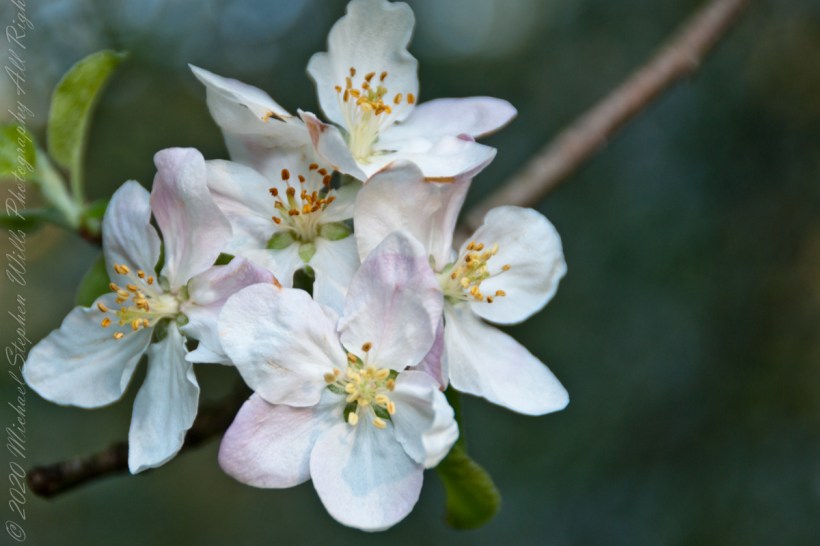
Our home at Malloryville, New York has an orchard of three apple trees, seen here on early one spring morning in the year 2010. The varieties are Delicious, Cortland and McIntosh. Freeville, Tompkins County, New York State

The original wild ancestor of Malus domestica was Malus sieversii, found growing wild in the mountains of Central Asia in southern Kazakhstan, Kyrgyzstan, Tajikistan, and northwestern China. Cultivation of the species, most likely beginning on the forested flanks of the Tian Shan mountains, progressed over a long period of time and permitted secondary introgression of genes from other species into the open-pollinated seeds.

Chinese soft apples, such as M. asiatica and M. prunifolia, have been cultivated as dessert apples for more than 2000 years in China. These are thought to be hybrids between M. baccata and M. sieversii in Kazakhstan.

Among the traits selected for by human growers are size, fruit acidity, color, firmness, and soluble sugar. Unusually for domesticated fruits, the wild M. sieversii origin is only slightly smaller than the modern domesticated apple.

At the Sammardenchia-Cueis site near Udine in Northeastern Italy, seeds from some form of apples have been found in material carbon dated to around 4000 BCE.[20] Genetic analysis has not yet been successfully used to determine whether such ancient apples were wild Malus sylvestris or Malus domesticus containing Malus sieversii ancestry. It is generally also hard to distinguish in the archeological record between foraged wild apples and apple plantations.

There is indirect evidence of apple cultivation in the third millennium BCE in the Middle East. There was substantial apple production in the European classical antiquity, and grafting was certainly known then. Grafting is an essential part of modern domesticated apple production, to be able to propagate the best cultivars; it is unclear when apple tree grafting was invented.

The proverb, “An apple a day keeps the doctor away”, addressing the supposed health benefits of the fruit, has been traced to 19th-century Wales, where the original phrase was “Eat an apple on going to bed, and you’ll keep the doctor from earning his bread”. In the 19th century and early 20th, the phrase evolved to “an apple a day, no doctor to pay” and “an apple a day sends the doctor away”; the phrasing now commonly used was first recorded in 1922.

Reference: Wikipedia “Apple”

Copyright 2023 Michael Stephen Wills All Rights Reserved

Cottonwood Shade in Pima Canyon

The cottonwood’s deep roots draw water from a mountain stream.

Looking back down Pima Canyon on a spring morning plenty of green under the unrelenting sun.

Click me for more Arizona photographs from my online gallery

A large Fremont’s Cottonwood Offers shade and protection along the Pima Canyon Trail.

In the shade, a grapevine, offers a vain promise of grapes.

The cottonwood’s deep roots draw water from a mountain stream.

Native Americans in the Western United States and Mexico used parts of Frémont’s cottonwood variously for a medicine, in basket weaving, for tool making, and for musical instruments. The inner bark of Frémont’s cottonwood contains vitamin C and was chewed as an antiscorbutic – treatment for vitamin C deficiency. The bark and leaves could be used to make poultices to reduce inflammation or to treat wounds.

The Pima people of southern Arizona and northern Mexico lived along Sonoran Desert watercourses and used twigs from the tree in the fine and intricate baskets they wove. The Cahuilla people of southern California used the tree’s wood for tool making, the Pueblo peoples for drums, and the Lower Colorado River Quechan people in ritual cremations. The Hopi of Northeastern Arizona carve the root of the cottonwood to create kachina dolls.

Reference: Wikipedia “Fremont’s Cottonwood.”

Copyright 2023 Michael Stephen Wills

Cactus Blossoms in Pima Canyon

Delicate buds develop into a flower, and then, into a cactus tuna

A set of photographs of buds and blossoms of the Prickly Pear Cactus taken in Pima Canyon of the Pusch Ridge Wilderness of the Catalina Mountains.

Click Me for more information from my Online Galleries.

Eight New  Blossoms

Here are 8 flower bud growing from one cladode (pad).  There is a 9th bud on a second cladode.  What is interesting about these pads are the needle shadows.  Although thin, each provides some protection from the sun.

Cactus Closeup

This delicate bud will develop into a flower and, then, into a cactus fruit (in spanish, tuna).  The fruit retains those tiny spines, called glochids, which detach on the smallest contact.  The pads are also covered with them.

Prickly pears are known for growing into thickets.  The Cuban government created a “cactus curtain” of prickly pears around the Guantanamo naval base in the 1960’s, to prevent Cubans from escaping to refuge in the United States.

Cactus Flowers

Look closely at the anthers of these flowers.  Each curls over when touched, depositing its pollen.  The habit of prickly pears to grow together in thickets mean there are clusters of blossoms in springtime.

Copyright 2023 Michael Stephen Wills

Abstracts: desert light and water

A Series of Nature Abstracts, macros of Reavis Creek below the falls

These four shots are of afternoon desert light playing on limpid water flowing over colorful rocks.

All are macro shots of the falls taken with a Canon 100mm f/2.8L lens.

From my solo expedition to this location in the remote eastern Superstition Wilderness of Arizona.

CLICK ME to learn more about my work and to purchase prints.

I chose portions of Reavis Creek stream bed carefully

The time of day was essential. This was late afternoon and before the sun disappeared behind the canyon walls.

Not all sections of the stream bed were suitable. I chose elements of strong compositions.

Variation between the shots is essential for holding the viewers attention.

Click Me to visit my previous post, “Canyoneering to Reavis Falls” for more of this story.

Copyright 2023 Michael Stephen Wills All Rights Reserved

Nature Abstracts from Reavis Falls

Basalt and Water

A Series of Nature Abstracts, macros of Reavis Falls

These are six shots of Reavis Falls from my solo expedition to this location in the remote eastern Superstition Wilderness of Arizona.

All are macro shots of the falls taken with a Canon 100mm f/2.8L lens.

“Reavis Falls Abstract V”

I took these while perched on a pile of talus beneath the falls.

Click Me To learn more about my work and to purchase prints

Reavis Falls Abstract XIV

Reavis Falls are 114 feet high in a canyon hidden in the folds of mountain ridges in the remote eastern Superstition Wilderness of Arizona.

Reavis Falls Abstract VI

Reavis Creek falls from a sheer basalt cliff, remnants of a volcanic eruption, cool a million years ago, a little colder today by this running water.

Reavis Falls Abstract VIII

Reavis Falls Abstract XI

Reavis Falls Abstract XV

Click Me to visit my previous post, “Canyoneering to Reavis Falls” for more of this story.

Copyright 2023 Michael Stephen Wills All Rights Reserved

Not a Bee

…and an edible plant

Bombylius major (commonly named the large bee-fly, the dark-edged bee-fly or the greater bee fly) is a parasitic bee mimic fly. Bombylius major is the most common type of fly within the Bombylius genus. The fly derives its name from its close resemblance to bumblebees and are often mistaken for them.

Click for my “Finger Lakes Memories” Fine Art Photography Gallery.

Bombylius major exhibits a unique flight behavior known as “yawing” and plays a role in general pollination, without preference of flower types. The fly does not bite, sting, or spread disease. However, the fly uses this mimicry of bumblebees to its own advantage, allowing close access to host solitary bee and wasp nests to deposit its eggs. After hatching, the larvae find their way into the nests to parasitically feed on the grubs.

Flight


It has been discovered that the fly is capable of a unique behavior, which was discovered with the use of a high speed camera. In this behavior, the flies are seen to rotate around a vertical axis as they fly (this action is known as “yawing”). However, it is still unknown what can cause this behavior to be triggered and what purpose it serves, but a proposed explanation includes mating habits. Here is an illustration of “Yaw” in the context of an airplane…substitute the fly body with head facing forward (to left).

ZeroOne, CC BY 3.0 https://creativecommons.org/licenses/by/3.0, via Wikimedia Commons

Pollinator Role


The Bombylius major bee-fly is a common, generalist floral pollinator, meaning that it does not give preference to one flower over another, instead pollinating a wide variety of plant families and species. The fly uses its proboscis to carry and transfer the pollen. The species is a dominant pollinator within its community, sometimes even pollinating up to two thirds of the local flowers. In addition, Bombylius major will visit and pollinate plants that attract few other species. Some types of flowers, for example Pulmonaria officinalis, will be almost exclusively pollinated by Bombylius major, with other species contributing a negligible amount to that plants pollination. Some flower species, such as Delphinium tricorne, are even specifically adapted to the fly in terms of color, shape, and form. If given the choice, Bombylius major will have a consistency in plant choice.

Flower Attraction


Long distance floral attraction is governed by optical sense, with color being the most important factor. The flies are typically more attracted to blue and violet colors, and occasionally yellow, over orange and pink. However, short distance floral attraction is based on the fly’s olfactory sense.

Sunbathing Activity


The fly is mostly active during day hours when the weather conditions are warm and sunny. Bombylius major is attracted to sunnier places and is more likely to pollinate these areas, with a larger average of flower visits in areas of higher amounts of sunshine. The fly will hide in the trees during the night and usually dart away from a cast shadow and occasionally hide in clean washing brought in fresh from the washing line and fly out causing unsettled behavior in the discoverer.

Flower Description


Claytonia caroliniana is a flowering, woodland perennial herb. It grows from March though June and is one of the earliest spring ephemerals. The plant grows from spherical underground tubers in light humus. They sprout and bloom before the tree canopy develops. Once the area is shaded, the plants whither leaving only the tuberous roots underground.

The plant is edible, but its usability is limited due to difficulty harvesting and the small quantities each plant produces. Its tuberous roots are edible and rich in starch and can be cooked or eaten raw. The leaves can be eaten as well. The tuberous roots are eaten by eastern chipmunks and white-footed mice.

Source: Wikipedia “Bombylius major ” and “Claytonia caroliniana. Direct quotations are in italics.

Copyright 2023 All Rights Reserved Michael Stephen Wills

Early Spring V

Purple vs. White Trillium

Purple Trillium, a different species from the white, present different challenges. The purple blooms tend to dip down toward the ground. White flowers face upward toward the sky. My successful photographs of purple (Click me for another Purple Trillium posting) have the camera lower than the plant, say where there is a bank above the trail.

Shot from beneath, White Trillium project a hopeful air. Here is a comparison of the two species in the environmental and individual treatments.

Click photograph for larger image. To do this from WordPress Reader, you need to first click the title of this post to open a new page.

Click for my “Finger Lakes Memories” Fine Art Photography Gallery.

Copyright 2020 All Rights Reserved Michael Stephen Wills

A large and varied genus

“Water Banana”

Pam and I ambled around the Arboretum for our Easter 2023 outing. We discovered this seeming lily growing from the muck along the Treman Woodland Walk. Scientific Name: Lysichiton camtschatcensis. Common names: Asian skunk cabbage, white skunk cabbage, Far Eastern swamp lantern or Japanese swamp lantern.

This is a plant found in swamps and wet woods, along streams and in other wet areas of the Kamchatka Peninsula, the Kuril Islands, Sakhalin and northern Japan. The common name “skunk cabbage” is used for the genus Lysichiton, which includes Lysichiton americanus, the western skunk cabbage, noted for its unpleasant smell. The Asian skunk cabbage is more variable: plants have been reported in different cases to smell disgusting, not at all, and sweet.

Click Me for “Finger Lakes Memories” my online gallery.

All photography using the IPhone 14 ProMax triple camera, raw format, edited on the phone.

In Japanese it is known as mizubashō (lit. “water-banana”) from a supposed similarity to the Japanese banana, a name with poetic rather than malodorous associations. It is not closely related to the true cabbage.

Copyright 2023 Michael Stephen Wills All Rights Reserved

A Personable Tree

Gifts from the past

Pam and I ambled around the Arboretum for our Easter 2023 outing. Found here growing outside native range, being the Appalachian Mountains from Georgia to southern Pennsylvania, the Table Mountain Pine is named after the landform, not a particular mountain.

Click Me for “Finger Lakes Memories” my online gallery.

All photography using the IPhone 14 ProMax triple camera, raw format, edited on the phone.

Its pinecones drew me to this scraggly, ungainly, poorly formed tree. All general mankind finds useful in the, scientific name, Pinus pungens, otherwise known as Hickory Pine, Prickly Pine and Mountain Pine, is to grind it up for pulp or chop it for tinder.

Last of the Mohicans

That said, the final scene of the 1992 film The Last of the Mohicans takes place in a nice Pinus pungens stand on a rocky mountaintop in North Carolina.

Personality

The tree has personality. Pinus pungens is the Lonesome Pine of the 1908 novel The Trail of the Lonesome Pine by John Fox, and popularized in the Laurel and Hardy film Way out West: “On the Blue Ridge Mountains of Virginia On the Trail of the Lonesome Pine” Several “Lonesome Pine” hiking trails have been waymarked in the Blue Ridge Mountains and elsewhere in the Appalachians.

Pinecone Bud

Pinus pungens prefers dry conditions and is mostly found on rocky slopes, favoring higher elevations, from 300–1,760 meters (980–5,770 ft) altitude. It commonly grows as single scattered trees or small groves, not in large forests like most other pines, and needs periodic disturbances for seedling establishment. The three tallest known ones are in Paris Mountain State Park, South Carolina; they are 26.85 to 29.96 meters (88 ft 1 in to 98 ft 4 in) tall.

Reference: “Pinus pungens” Wikipedia.

Copyright 2023 Michael Stephen Wills All Rights Reserved