Hoverflies: Nature’s Mimicry Experts

Hoverflies, harmless pollinators often mistaken for bees, possess distinctive features and mimicry patterns that aid in their survival.

A hoverfly buzzing with cheer,
Lands softly, no sting to fear.
With wings all a-glitter,
It’s no wasp, just a critter,
Whose mimicry tricks year to year.

The photo shows the hoverfly on a smooth surface, possibly resting or feeding. Hoverflies are abundant in the fall as they are drawn to late-blooming flowers for nectar and pollen.

A hoverfly stopped for a snack,
On a table, just taking a crack.
It posed for a shot,
Not moving a lot,
Then flew off to plan its next act.

A hoverfly thought it was sly,
As it zipped ‘round, too quick for the eye.
“Are you a bee?” folks said,
With confusion widespread,
“Just a poser!” it said with a sigh.

Some useful facts about this relatively harmless visitor

This insect is a Hoverfly (family Syrphidae). Hoverflies are often mistaken for bees or wasps due to their yellow and black striped body, but they are harmless and lack the ability to sting. They are beneficial pollinators and are common in gardens, meadows, and near flowers.

Some key identifying features include:

Large compound eyes that meet at the top of the head in males.


Two clear wings (unlike bees/wasps, which have four wings).


A short, stubby antennae.


Mimicry coloration (yellow and black stripes) that helps them avoid predators.


A Finger Lakes Afternoon: An Ode to October Splendor

The Finger Lakes’ autumn beauty is vividly captured in photographs showcasing vibrant foliage, intertwining nature and human presence in October 2024.

The Finger Lakes region, renowned for its natural beauty and changing seasons, put on a stunning performance on October 24, 2024. From the vibrant reds of a Japanese maple (Acer palmatum) to the golden hues of oak leaves (Quercus spp.), this photographic journey through our home captures the essence of autumn in upstate New York.

A Panoramic Tapestry

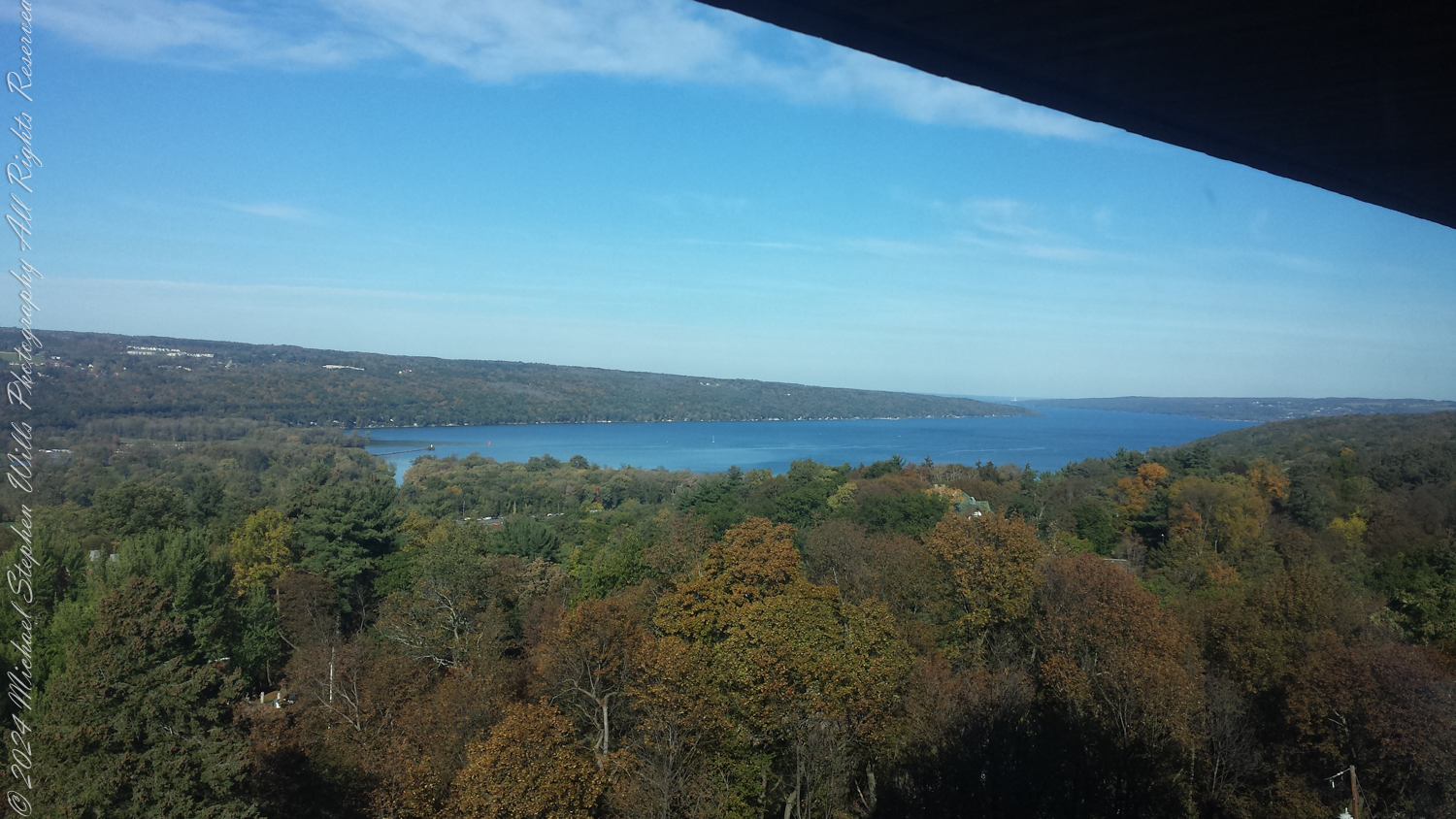
In the first photograph, the landscape unfolds like a watercolor painting. Hills dressed in fiery oranges and golds stretch across the horizon, with hints of evergreen pines (Pinus spp.) providing contrast. The sky, dotted with wispy clouds, serves as a serene backdrop, while the foreground frames the scene with bare tree limbs—a reminder that autumn is both a celebration of life and a prelude to winter’s dormancy. This image evokes a sense of timelessness, connecting us to the rolling hills that have witnessed countless seasons of change.

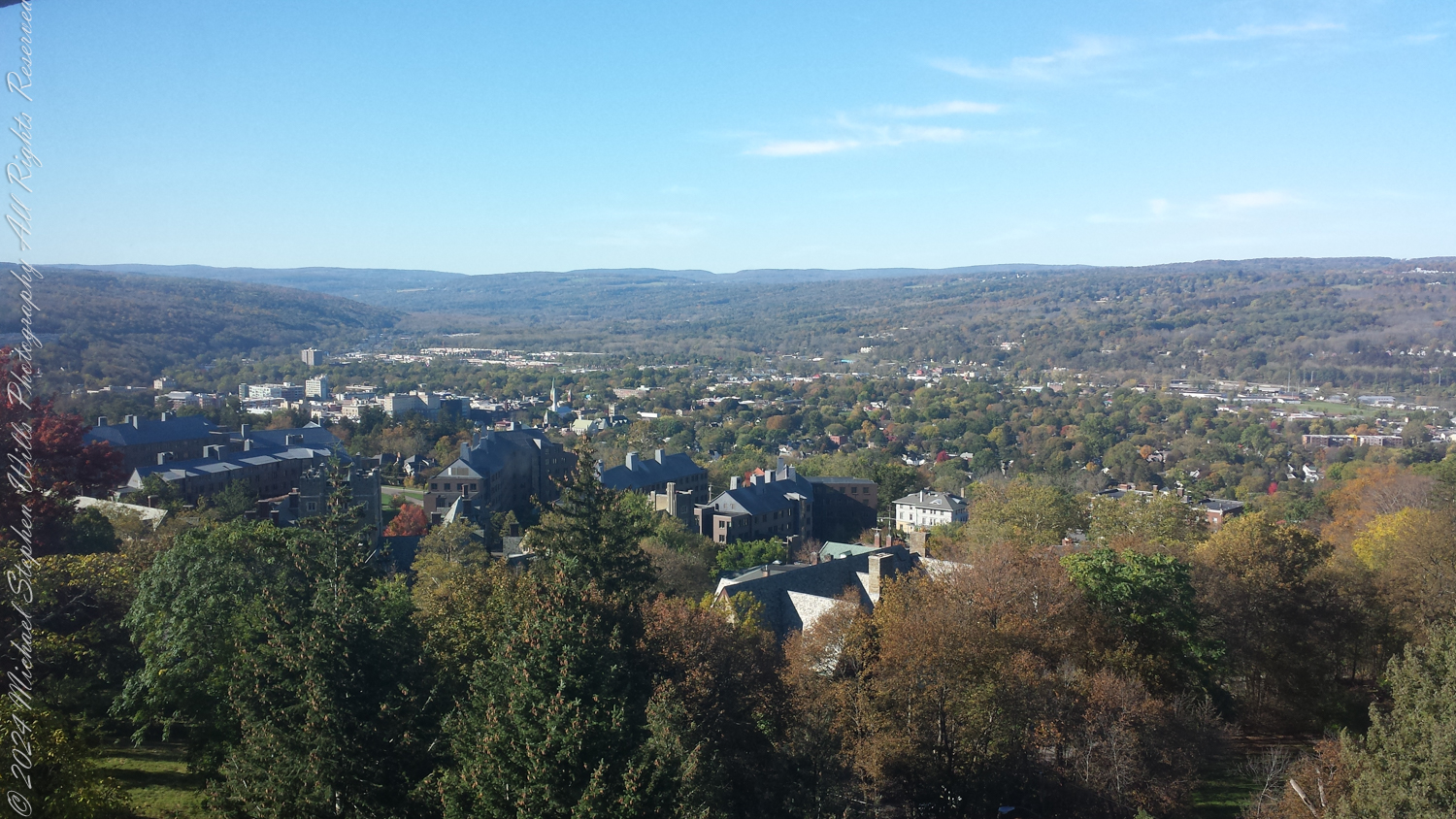
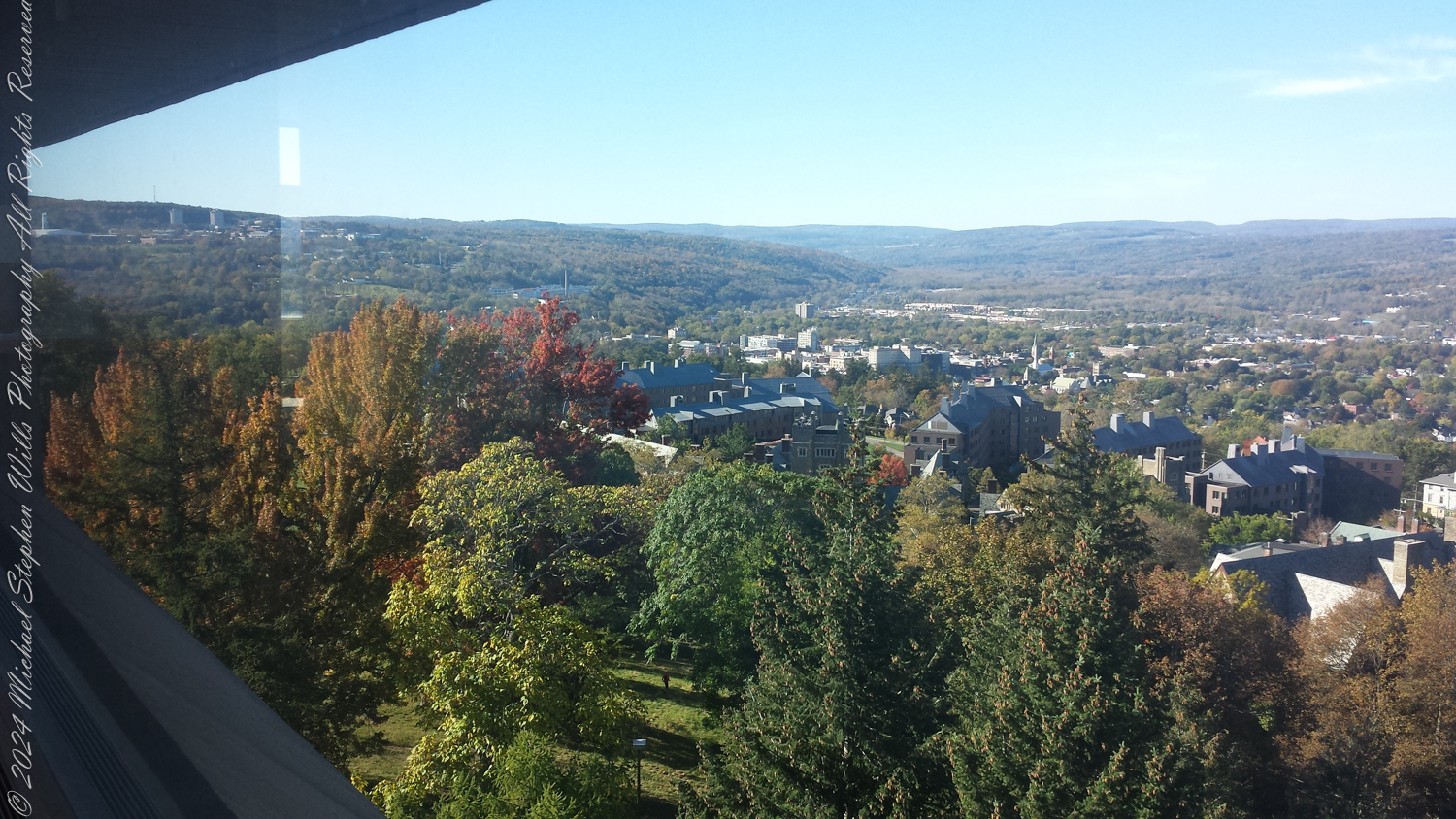
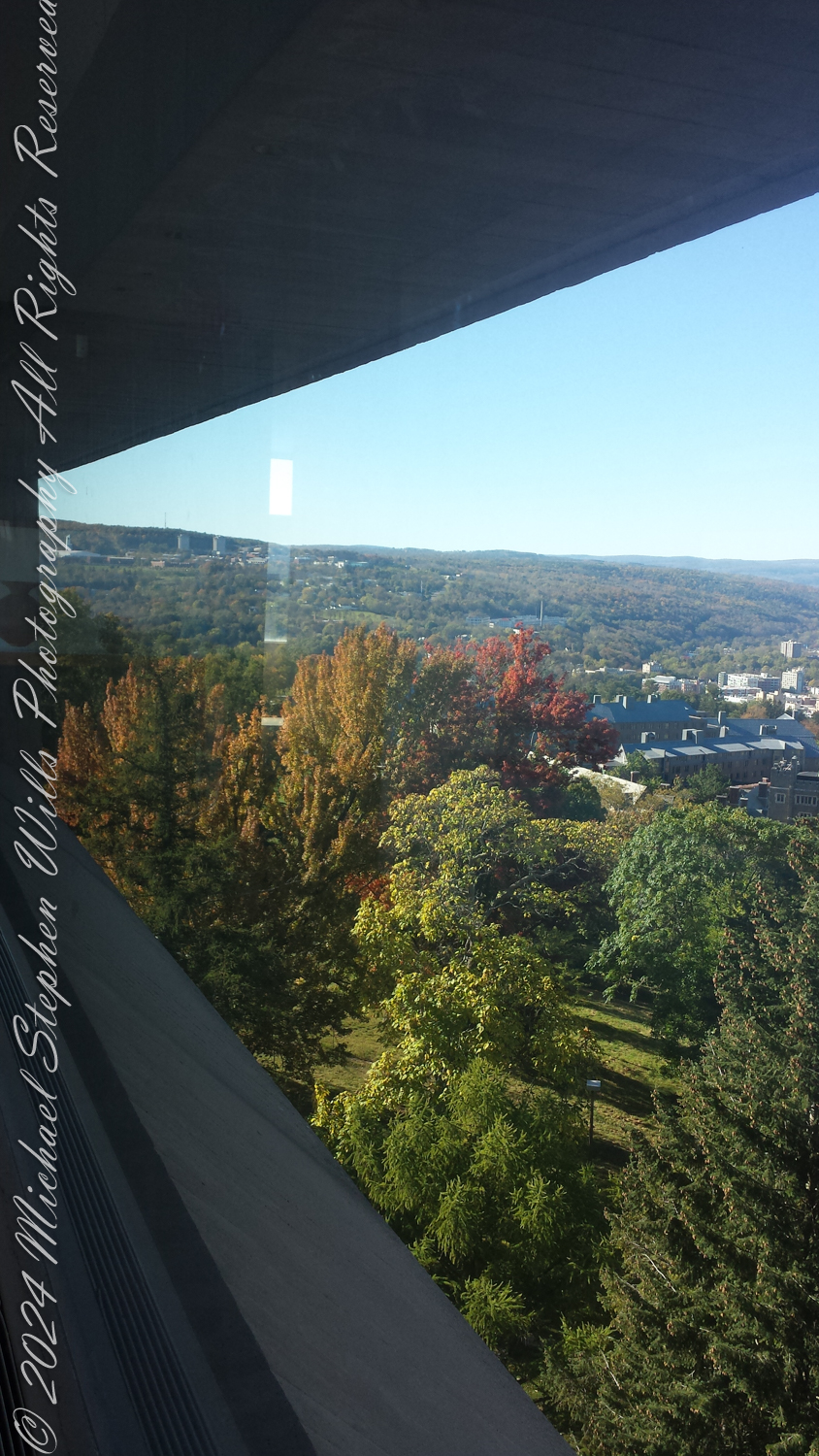
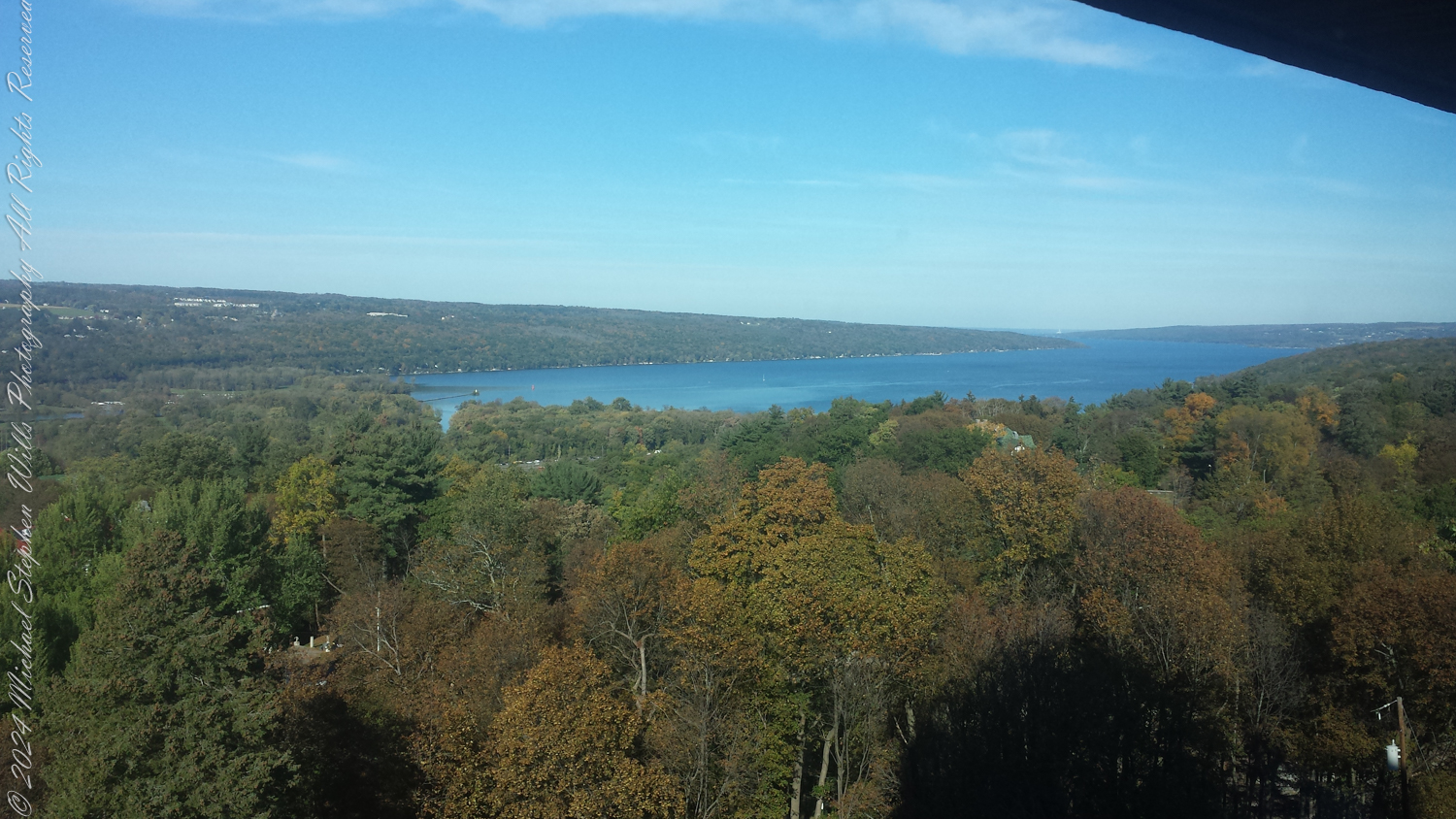
View from our porch across Ithaca to East Hill, Cornell University, Ithaca Falls on an October 2024 afternoon. Tompkins County, Finger Lakes Region, New York State

Japanese Maple: A Crimson Jewel

The next series of images focuses on the Japanese maple (Acer palmatum), a tree whose vibrant red foliage becomes a magnet for admiration in autumn. One close-up reveals delicate leaves, their intricate lobes illuminated by the afternoon sun. The interplay of light and shadow transforms each leaf into a tiny stained-glass window. Another photograph showcases the tree in its entirety, a commanding presence against the verdant lawn. It is a poignant reminder of nature’s artistry, where every branch and leaf contributes to the symphony of color.

Home Amid the Foliage

Nestled within this autumnal palette is our home, a mid-century structure that seems almost inseparable from its surroundings. The expansive lawn, a lush carpet of green, contrasts with the fiery colors of nearby oak (Quercus spp.) and maple trees (Acer spp.). In one angle, the house appears almost tucked away, sheltered by Eastern Hemlock (Tsuga canadensis) and junipers (Juniperus spp.) that add a sense of permanence to the scene. This juxtaposition of human habitation and natural splendor underscores how our lives are intertwined with the land we call home.

Oak Leaves: A Study in Texture

A close-up of oak leaves (Quercus spp.) showcases their rugged beauty, with jagged edges and deep veins that seem etched by time itself. Their colors—ranging from deep amber to burnished copper—are a testament to the richness of autumn’s palette. These leaves, clinging tenaciously to their branches, remind us of resilience and the fleeting beauty of the season.

Our oak tree in autumn colors. Helmock backdrop

Hydrangeas in Transition

The hydrangea bushes (Hydrangea paniculata) by the house present a softer side of autumn. Their once-vivid blooms have faded to pastel pinks and creams, lending an air of nostalgia. These flowers, in their gentle decline, mirror the transition of the season, where vibrancy gives way to a quieter beauty. The hydrangea blooms seem to whisper the story of the summer past, offering a delicate contrast to the bolder hues of the surrounding trees.

Our oak tree in autumn colors. Pam’s hydrangia.

The Resilient Shrubs

Creeping Juniper (Juniperus horizontalis), here in the foreground, provides a grounding element in the composition, with a steadfast green the reminder of life persisting even as deciduous leaves fall. The dense shrubbery near the house creates a protective cocoon, framing the building with a sense of natural security. The dynamic interplay between these evergreens and the changing foliage of maples and oaks reflects the layered complexity of this landscape.

Reflections on an Afternoon

As I wandered through these scenes with camera in hand, I was struck by the interplay of light, color, and texture. Each photograph captures a fleeting moment, a slice of a season that, despite its predictability, never fails to surprise and inspire. Autumn in the Finger Lakes is a time of reflection, a reminder to pause and appreciate the world around us.

These images, taken on a single afternoon, tell a story of a landscape alive with color and character. From the steadfast junipers to the delicate hydrangea blooms, from the fiery maples to the enduring oaks, they invite us to celebrate not just the beauty of nature but also our place within it—a home nestled among trees that have stood for decades, witnessing the rhythms of the earth.

Enter your email to receive notification of future postings. I will not sell or share your email address.

Discovering Fogbows: A Coastal Wonder

I had a haunting experience at Cocoa Beach, witnessing a rare fogbow—a ghostly arc formed by fine mist—evoking emotions and reflections on nature’s beauty.

The fog haunted Cocoa Beach for days, softening the edges of the afternoon. I had been walking along Cocoa Beach, feeling the cool ocean breeze on my face, when I noticed a change in the light. It was a little after four, the sun drifting lower in the western sky, its warmth fading into a hazy glow. The air smelled of salt and mist, and waves lapped gently at the shore, their rhythm unbroken by the deepening fog.

And then I saw it.

A pale arc stretched across the horizon, a ghost of a rainbow bending above the waves. At first, I wondered if my eyes were playing tricks on me—where were the usual bright bands of red, orange, and violet? But no, the arc was real, a fogbow, forming where sunlight met the fine sea mist. Unlike the rainbows that appear after summer storms, this one was almost entirely white, as if the ocean had conjured it from air and silence.

Sailors once whispered of such things—a white rainbow at sea, a sign of hidden land or wandering souls. Some believed it to be a bridge between realms, a fleeting passage where the living and the lost might momentarily brush against one another. Others saw it as an omen, a spectral warning of treacherous fog ahead. I wondered what the mariners of old might have thought, standing at the bow of a ship, watching a pale arc rise from the mist, its edges dissolving like breath against glass.

I stood still, watching, as the science of the moment unfolded before me. Unlike traditional rainbows, which form when light bends through large raindrops, fogbows are born from infinitesimally smaller droplets, often less than 0.1 millimeters in diameter. Their size diffuses the light, scattering it so finely that the colors blend together into a spectral whisper rather than a vibrant shout. The physics of it fascinated me—this was diffraction in action, nature bending light in a way that rendered it nearly colorless.

The effect was surreal. The fogbow arched over the breaking waves like something out of a dream, a halo of sea and sky, momentary yet timeless. It seemed to pulse in the shifting mist, visible one moment, fading the next, as if deciding whether to reveal itself fully or slip back into the fog’s embrace.

For several minutes, I just stood there, taking it in. The world felt different inside that mist, quieter, more reflective. The fog dampened the usual sounds of the beach—the calls of shorebirds, the laughter of distant walkers—leaving only the hush of the waves and the distant hum of the ocean’s breath.

I knew that fogbows were rare, requiring just the right balance of thin fog, moisture, and a low-angled sun. I was lucky to be in the right place at the right time, a witness to something subtle yet profound.

And just as silently as it had appeared, the fogbow began to dissolve. The mist thickened, swallowing its arc, the sky shifting back to its usual muted gray. But the memory of it lingered—a white rainbow over the sea, ephemeral and elusive, like a secret the ocean had briefly chosen to share.

Enter your email to receive notification of future postings. I will not sell or share your email address.

Cocoa Beach’s Unique Nine-Armed Sea Star Encounter

In Cocoa Beach, I encountered a Nine-armed Sea Star, which I returned to the ocean, reflecting on its ecological role and the wonders of marine life.

Walking along the shoreline of Cocoa Beach in the early morning light, I encountered a remarkable sight—a Nine-armed Sea Star (Luidia senegalensis) sprawled on the damp sand. Its long, slender arms stretched outward in a perfect starburst pattern, each limb tapering to a fine point. The sandy beige coloration of its body blended with the surrounding beach, accentuated by a darker stripe running down the center of each arm. Scattered around it were small shells and fragments, remnants of the ocean’s ebb and flow, testifying to the high tide that had deposited this fascinating creature ashore.

The scientific name Luidia senegalensis provides insight into the taxonomy and classification of this intriguing sea star. The genus Luidia is named after the 18th-century Portuguese naturalist Francisco Luid, who contributed significantly to marine biology. The species name senegalensis refers to its first recorded discovery along the coast of Senegal in West Africa. As a member of the phylum Echinodermata and the class Asteroidea, the Nine-armed Sea Star shares lineage with other starfish, sea urchins, and sand dollars, distinguished by their radial symmetry and water vascular system used for movement and feeding.

As I paused to observe it more closely, I marveled at the intricate details of its structure. Unlike the more familiar five-armed sea stars, this specimen had nine arms radiating from a small central disc. The surface of its body appeared smooth, with tiny tube feet lining the underside of each arm—a biological marvel designed for locomotion and feeding.

This starfish washed up on high tide. I seemed alive so I returned it to the surf during ebb tide, hoping the ebb current would return it to deeper water.

The Nine-armed Sea Star, common along Florida’s coastline, is a voracious predator within the benthic ecosystem. It primarily preys on bivalves such as clams and mussels, using a fascinating feeding strategy. Unlike most predators that rely on speed and strength, this sea star employs patience and ingenuity. It wraps its flexible arms around a bivalve, exerting a slow and steady force to pry the shell open. Once a small gap is achieved, the sea star everts its stomach through its mouth and into the prey’s shell, secreting digestive enzymes that liquefy the soft tissues within. This external digestion allows the sea star to consume its prey without the need for teeth or jaws—a perfect example of nature’s ingenuity.

Despite its delicate appearance, the Nine-armed Sea Star plays a crucial role in the marine ecosystem. By preying on bivalves, it helps regulate their populations, preventing overgrazing of seagrass beds and maintaining a balanced food web. Additionally, it serves as a food source for larger marine predators, such as fish and sea turtles. Its presence signifies a healthy intertidal environment, where nutrient cycles and predator-prey relationships are in dynamic equilibrium.

As I considered the sea star’s role in the ecosystem, I wondered about its journey to this point. These creatures undergo a fascinating life cycle, starting as tiny, free-swimming larvae that drift with ocean currents. Over time, they undergo metamorphosis, settling onto the seabed and gradually developing into their iconic star shape. The resilience and adaptability of these creatures are truly astounding, capable of regenerating lost arms and thriving in diverse habitats.

Realizing that this sea star likely found itself stranded by the receding high tide, I felt a sense of responsibility to help it return to its natural environment. Picking it up gently, I carried it toward the water’s edge, where the ebb tide was beginning to pull the sea back into its vast domain. With a final look at its striking form, I placed it carefully into the shallow waves, hoping that the ebb current would carry it back to the sandy seabed where it belonged.

As the waves lapped around my feet, I imagined the sea star resuming its journey, gliding along the ocean floor in search of its next meal. The interconnectedness of all marine life became evident in that moment—each creature playing its part in an intricate and delicate dance of survival.

Walking back along the shoreline, I reflected on the experience. My fleeting encounter with the Nine-armed Sea Star was a reminder of the wonders hidden beneath the ocean’s surface and our role in preserving them. Every tide brings new discoveries, and every ebb offers a second chance—for the sea star, and perhaps for us as well.

Cocoa Beach, with its gentle waves and abundant life, had once again provided an unforgettable encounter with nature. The starfish, now safely returned to the ocean, would continue its unseen work beneath the waves, a quiet but essential denizen of the underwater world.

Enter your email to receive notification of future postings. I will not sell or share your email address.

Erosion and Beauty: Cocoa Beach’s Sand Sculptures

At Cocoa Beach, sand castles succumb to time, showcasing beauty in decay, while desert monoliths endure. Both narratives reveal nature’s artistry through impermanence and transformation.

On the shores of Cocoa Beach, where the January winds dance freely, the once-proud towers of sand now stand humbled. What was sculpted by human hands—carefully packed and shaped with laughter—has become a relic of its former grandeur. The wind, with its gentle yet relentless touch, carves away at their edges, smoothing and softening their once-crisp lines. The castles, now mere echoes of their original form, hold a quiet dignity in their decay. Impermanence is their fate.

Cocoa Beach, Brevard County, Florida, Space Coast, January 2025

In the first photograph, the remnants of a sand fortress curve in a gentle arc, protecting a lone pillar—perhaps the last bastion of a crumbling empire. The textures of wind-blown ridges ripple across the sand like waves frozen in time, whispering of the invisible forces that shape the land. The delicate striations of the eroded peak, captured in close detail in the second image, reveal the layers of creation and destruction, each grain bearing witness to the ceaseless march of time.

Cocoa Beach, Brevard County, Florida, Space Coast, January 2025

The third image brings a sense of companionship to this landscape of change. Like silent sentinels, the remaining sand pillars stand together, weathered but resolute. One wears a crown of a single shell—a reminder that even in the face of erosion, beauty persists. These fleeting structures, built in joy, now bow to nature’s artistry, embracing the inevitable with quiet grace.

Cocoa Beach, Brevard County, Florida, Space Coast, January 2025

And yet, beyond the gentle shores of Cocoa Beach, in the vast and timeless expanse of the Sahara Desert, wind-carved monoliths stand as testament to the power of patience. The fourth photograph—an imposing formation shaped by millennia of desert winds—towers over the golden dunes, its shadow stretching far into the sands. Where the beach’s castles fall in a day, the desert’s sculptures endure for centuries, silent witnesses to the ebb and flow of time on a grander scale.

Wind carved geological formation, Sahara desert. Credit “scraped from the web”

But are they so different? Whether in the fleeting impermanence of Cocoa Beach or the enduring vastness of the Sahara, the hand of the wind shapes all things. Each formation tells the same story—of creation, of erosion, and of transformation. They whisper to us that beauty is not defined by permanence, but by the dance between time and the elements.

As the sun sets over the beach, casting long shadows across the sand, one cannot help but marvel at the artistry of nature. Whether lasting an afternoon or an age, the sculptures of wind and sand remind us that all things are in motion, and every grain, every ripple, every fleeting moment holds a story waiting to be told.

Enter your email to receive notification of future postings. I will not sell or share your email address.

Exploring the Vision of Arcosanti

In the Arizona desert, structures harmonize with nature, embodying creativity and purpose while inviting reflection on balance and coexistence.

Approaching Arcosanti from afar, a cluster of forms rising from the Arizona desert like a mirage of human imagination. Against the cobalt sky, the buildings seemed to breathe with the land itself, their curves and edges echoing the undulations of the hillside. From this distance, the structures were both distant dream and solid reality, their symmetry a whispered promise of order amidst the chaos of the wild.

As I moved closer, the buildings revealed their intricate secrets. Circular windows stared like unblinking eyes, portals to a world shaped by creativity and purpose. Towers and cubes jutted confidently into space, their bold geometry softened by the earthen hues of concrete and weathered wood. These materials, neither foreign nor intrusive, seemed born of the very soil beneath my feet. There was an undeniable rhythm to the place—a harmony where art, function, and the timeless desert converged.

I walked among the structures, their forms towering above me like sentinels of some ancient philosophy reborn for a modern age. The elevated walkways beckoned with a quiet invitation, connecting one sanctuary of thought to another. Circular motifs repeated like a mantra, reminding me of the cycles of life, of the sun and the moon, of the unbroken circles that hold us together. Here, design was not merely a tool but a hymn, sung in concrete and glass.

Then, I turned my gaze outward, to the land that cradled this creation. The desert was alive, though its voice was quiet and deliberate. Rocks, worn smooth by the patient hand of time, rested among tufts of sage and grasses that swayed in the breeze. The light played its own game, casting shadows that danced across the ground, a choreography as old as the sun. Paths meandered through this terrain, their curves a gentle suggestion rather than a command, inviting me to wander but not to conquer.

Arcosanti

The trees stood tall and still, their presence both steadfast and serene. The cypress trees, their slender forms reaching toward heaven, seemed like exclamation points on the landscape, their verdant green cutting through the sky’s azure expanse. Beside them, olive trees spread their silvered arms, their gnarled trunks telling stories of endurance and quiet strength. One cypress, in particular, caught my attention—so perfectly straight, so impossibly regal, as if it had been planted by the hand of a god.

Beneath the olive trees, I paused, tracing my fingers along the bark’s intricate patterns. The sunlight filtered through the leaves in golden shards, dappling the earth beneath with shifting shapes. The air carried the scent of something ancient and vital—a blend of dry earth, sun-warmed bark, and the faintest hint of blooming life. It was a reminder that even in this place of human creation, nature reigned supreme.

I wandered to the edge of a canyon, its rugged walls carved by time’s relentless flow. The raw power of the landscape stretched out before me, a tapestry of stone and shadow that humbled and awed. Here, the boundaries between human vision and natural grandeur blurred. The olive and cypress trees, so carefully placed, seemed less an intrusion and more a part of the desert’s rhythm. They were a bridge, a whispered conversation between what is made and what simply is.

Finally, the paths called me back, their winding lines leading me deeper into reflection. Each step felt deliberate, as though I were tracing the lines of a poem etched into the earth. The trails curved gently, like the desert’s own breath, and I followed, not as an intruder but as a guest. The buildings now stood behind me, a testament to the balance we strive for—between the ephemeral dreams we build and the eternal landscape that cradles them.

This place is a meeting of stone and sky, a meditation: reminding us that, if we listen, the land will teach us how to live in harmony. Here, in the desert’s embrace, I found space to ask better questions, my heart as open and unbroken as the endless horizon before me.

Enter your email to receive notification of future postings. I will not sell or share your email address.

Saint Fin Barre’s Cathedral: A Marvel of Victorian Architecture

Saint Fin Barre’s Cathedral, a Gothic Revival masterpiece by William Burges, symbolizes artistry and faith in Cork, Ireland.

Approaching from the east, we see the polygonal apse at the eastern end houses the high altar and is a key liturgical and architectural feature. Each angular bay is delineated with tall lancet windows filled with stained glass, adding to the richness of the design. Saint Fin Barre’s Cathedral, a masterpiece of Gothic Revival architecture, stands as a beacon of faith and artistry in the heart of Cork, Ireland. Designed by the renowned Victorian architect William Burges, the cathedral is both a testament to the spiritual fervor of its time and a bold statement of artistic vision.

Approaching from the east, we see the polygonal apse at the eastern end houses the high altar and is a key liturgical and architectural feature

Commissioned in 1862, the cathedral replaced an earlier structure, marking a new chapter in Cork’s ecclesiastical history. William Burges, known for his theatrical approach to design, was the perfect choice for this ambitious project. His vision for Saint Fin Barre’s Cathedral blended medieval inspiration with Victorian ingenuity, creating a building that is as much a work of art as a place of worship.

Burges, a figure of eccentric brilliance, was deeply influenced by the principles of the Gothic Revival movement, which sought to recapture the grandeur of medieval European architecture. Drawing from this aesthetic, he designed the cathedral with meticulous attention to detail. Its three spires dominate the Cork skyline, with the central spire rising to an impressive height of 73 meters. These spires are not merely structural; they are symbolic, reaching heavenward in a gesture of devotion.

The exterior of the cathedral, constructed from Cork limestone and Bath stone, is adorned with intricate carvings and sculptures. These include depictions of biblical scenes, saints, and gargoyles, all painstakingly crafted under Burges’s watchful eye. Every detail reflects his belief that architecture should educate as well as inspire. Bishop Street, The Lough, Cork City, County Cork, Ireland

Enter your email to receive notification of future postings. I will not sell or share your email address.

The Autumn Tapestry of Cayuga Lake: A Journey on the Treman Park Lake Loop

Autumn’s Arrival Along Cayuga Lake

In Autumn 2024, the Treman Park Lake Loop of the Cayuga Waterfront Trail in Ithaca, New York, unfurled a vibrant display of seasonal transition. The natural landscape, adorned with fiery hues of reds, oranges, and yellows, reflected in the rippling waters of Cayuga Lake, creating a harmony of color and light. This is a scenic journey through stories of plant and animal life that call this place home—including the majestic Osprey (Pandion haliaetus) that nests along the shore.

The Osprey’s Watchtower

A sight to greet visitors is the solitary osprey nest perched high on a pole. Used by Osprey families during their breeding season, this nest stands as a testament to their remarkable recovery in the Finger Lakes region. Ospreys, once declining due to pesticide use, have rebounded significantly following conservation efforts.

With a wingspan of up to 6 feet, these raptors are expert fish hunters, often seen diving talons-first into the lake to snatch their prey. During autumn, as their young take flight, the nest remains an empty marker of the summer’s success—a reminder of the cyclical nature of life along the lake.

Did You Know? Ospreys are often referred to as “fish hawks” because fish make up 99% of their diet.

The Meadow and Its Golden Touch: Reedbeds and Goldenrod

Surrounding the osprey pole, expansive meadows of grasses and reeds sway with the breeze. Among these are stands of Common Reed (Phragmites australis), a tall grass with feathery plumes that catch the sunlight. While Phragmites can sometimes be invasive, they provide crucial shelter and food for various species of birds and insects.

Intermixed with the reeds are patches of Goldenrod (Solidago spp.), whose bright yellow flowers are a signature of late summer and autumn in the Northeast. Goldenrods are critical for pollinators, offering nectar to bees, butterflies, and migrating insects like the Monarch butterfly (Danaus plexippus).

Ecological Note: Goldenrods are often mistakenly blamed for allergies; the real culprit is ragweed (Ambrosia artemisiifolia), which blooms at the same time but releases airborne pollen.

A Lake Alive with History and Beauty

The shimmering blue waters of Cayuga Lake form the centerpiece of this trail. The lake, stretching nearly 40 miles, is the longest of the Finger Lakes and steeped in geological and cultural history. Its name is derived from the Cayuga Nation, part of the Haudenosaunee Confederacy, who inhabited the region for centuries.

The striking red lighthouse in the water serves as a vivid counterpoint to the natural surroundings. Built to aid navigation, it now stands as a picturesque focal point for photographers and nature enthusiasts alike.

Cayuga Inlet Light Beacon

In the distance, a sailboat glides across the lake—a serene reminder of the recreational draw that Cayuga Lake holds year-round.

West shore with sailboat and lake houses

The Forest Fringe: A Kaleidoscope of Color

The forests that fringe the meadow and the lake present an explosion of autumn color. Trees such as Sugar Maple (Acer saccharum), Red Oak (Quercus rubra), and Black Cherry (Prunus serotina) dominate the canopy, their leaves transforming into brilliant oranges, scarlets, and deep burgundies. The Sugar Maple, in particular, is renowned for its vibrant golden-orange foliage, a hallmark of the northeastern fall.

The Ithaca Yacht Club lies south of Maplewood Point

Closer to the ground, the understory hums with the activity of migrating birds and foraging mammals. Squirrels can be seen gathering acorns, preparing for the winter months ahead, while chickadees flit among the branches, calling their cheerful “fee-bee” notes.

Historical Fact: The Finger Lakes were carved out by retreating glaciers over 10,000 years ago, leaving behind these deep, elongated lakes and fertile soil that supports rich biodiversity.

A Path Through Time and Nature

Walking the Treman Park Lake Loop is a sensory journey—the crispness of the autumn air, the rustling of reeds, and the rhythmic lapping of waves against the shore combine to evoke a timeless tranquility.

From the vibrant meadows to the osprey’s lofty perch and the quiet expanse of Cayuga Lake, this section of the Waterfront Trail encapsulates the beauty and diversity of the Finger Lakes ecosystem. Whether for quiet reflection or active exploration, it remains a treasured destination in every season.

Closing Thoughts

As autumn deepens, this landscape prepares for the dormancy of winter. Yet the stories it holds—from the osprey’s nest to the goldenrod’s bloom—remain alive, waiting to be rediscovered with each new season. The Treman Park Lake Loop is not just a trail; it is a canvas of life, change, and history painted by nature’s hand.

Reflection: To walk this trail is to connect with a land shaped by glaciers, nurtured by waters, and home to countless species that continue to thrive amid the ever-turning wheel of the seasons.

Enter your email to receive notification of future postings. I will not sell or share your email address.

Where Waters Meet and Leaves Turn: A Journey Along the Cayuga Waterfront Trail

The Cayuga Waterfront Trail beautifully showcases autumn’s colors, history, and ecological significance through its landscapes and trees like Sugar Maples.


Where Fall Creek Meets Cayuga Lake
Here, where Fall Creek flows gently into Cayuga Lake, the merging waters reflect the season’s colors like a painter’s palette. Across the shimmering surface, Renwick Woods of Stewart Park stands as a quiet sanctuary of mixed hardwoods and wetlands. The reflections capture our trees together with the essence of autumn’s stillness.

Dominating the shoreline, you can spot Silver Maple (Acer saccharinum) and Cottonwood (Populus deltoides), trees that thrive in damp soils. Silver Maples, with their elegant, deeply lobed leaves, are perfectly suited for this riparian environment. The cottonwood, recognizable by its broad, triangular leaves, plays a vital role in stabilizing streambanks.

Quick Fact: Cottonwoods are among the fastest-growing trees in North America, capable of sprouting leaves within weeks of being washed ashore as driftwood.

Steamboat Landing: A Glimpse of History
The wooden docks at Steamboat Landing, now home to the bustling Ithaca Farmer’s Market, speak of bygone eras when steamboats ferried goods and people across Cayuga Lake. Today, as golden foliage cloaks the hills in the distance, this spot remains an anchor for community and connection.

Foregrounded in the photos are plants like Grape Vine (Vitis spp.), with their sprawling, hardy stems turning yellow as temperatures drop. Grapevines, both wild and cultivated, thrive along the lakeshore and remind us of their agricultural importance in the Finger Lakes.

Also visible are some shrubs of Virginia Creeper (Parthenocissus quinquefolia) turning crimson, their vibrant hues climbing posts and fences as they embrace autumn’s spotlight.

Did You Know? Steamboat Landing was part of Ithaca’s rich lake commerce history during the 19th and early 20th centuries, connecting travelers to destinations far and wide.

The Crimson Canopy: Japanese Maple
This photo highlights a stunning Japanese Maple (Acer palmatum), its feathery, scarlet foliage cascading delicately in front of the pavilion. Native to East Asia, Japanese Maples have found a beloved place in landscapes across the world for their graceful form and brilliant seasonal displays.

Alongside its boughs, weathered benches and stone pathways invite rest and reflection — a beautiful marriage of human craftsmanship and nature’s artistry.

Fun Fact: Japanese Maples are often pruned meticulously in Japanese gardens to emphasize their architectural shape, turning them into living sculptures.

The Treman Park Lake Loop: Autumn’s Golden Finale
Our journey concludes with this sweeping landscape from the Treman Park Lake Loop. The towering Sugar Maples (Acer saccharum) dominate the view, their crowns now a rich, golden orange — a signature of northeastern forests. Known as the tree that gives us maple syrup, Sugar Maples are quintessential symbols of autumn in the Finger Lakes.

To the right, bare branches of earlier-shedding trees stand in contrast, whispering the arrival of winter. The sky above, painted with soft clouds, completes the scene of a serene seasonal transition.

Interesting Note: Sugar Maples can live for over 300 years, their wood prized for furniture and instruments, and their sap a sweet gift of the forest.

Closing Thoughts
From the quiet confluence of Fall Creek and Cayuga Lake to the historic docks of Steamboat Landing and the golden maples of Treman Park, autumn on the Cayuga Waterfront Trail is a symphony of color, history, and ecological wonder. Whether you’re strolling, photographing, or simply pausing to take it all in, these moments capture both the grandeur and subtlety of the season.

Enter your email to receive notification of future postings. I will not sell or share your email address.

Celebrating God’s Love This Christmas

Merry Christmas

As the year draws to a close, our home is filled with the glow of lights, the shimmer of cherished ornaments, and the spirit of the season. Each decoration holds a memory, from angels watching over us to the Nativity scene that reminds us of the humble birth of Christ, our Savior.

This Christmas, we celebrate the greatest gift of all: God’s love made manifest through the birth of Jesus Christ. May the peace of His presence fill your hearts and homes, bringing comfort, joy, and hope that transcends all seasons.

As we gather with loved ones, let us remember the message of the angels: “Glory to God in the highest, and on earth peace, goodwill toward men.”
From our family to yours, may this holy season be a time of deep gratitude, boundless love, and renewed faith in the light that shines in the darkness.

Enter your email to receive notification of future postings. I will not sell or share your email address.