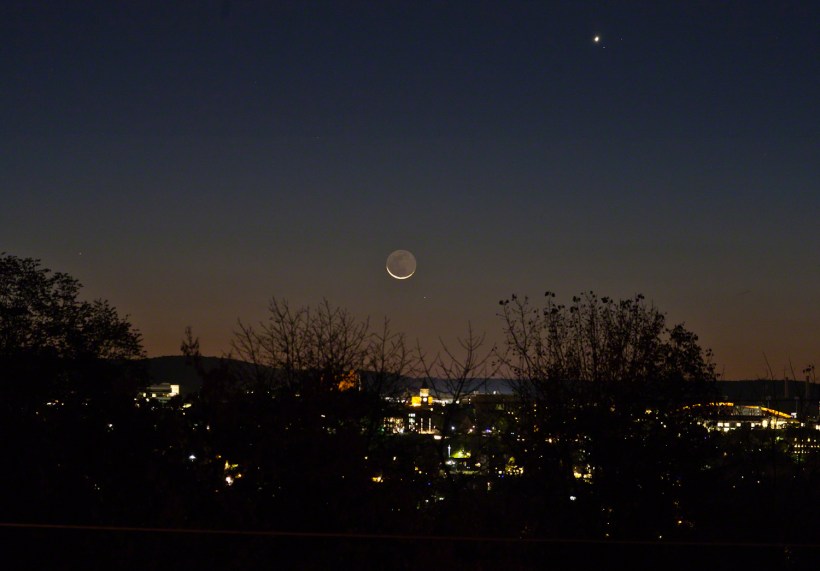
Join me on a journey through the realms of science and imagination, where Earth-like planets orbit gas giants under sun-like stars. From science fiction to scientific possibility, we explore the intriguing potential for life in such unique solar systems, blending the lines between fantasy and reality. Let’s unravel these cosmic mysteries together.
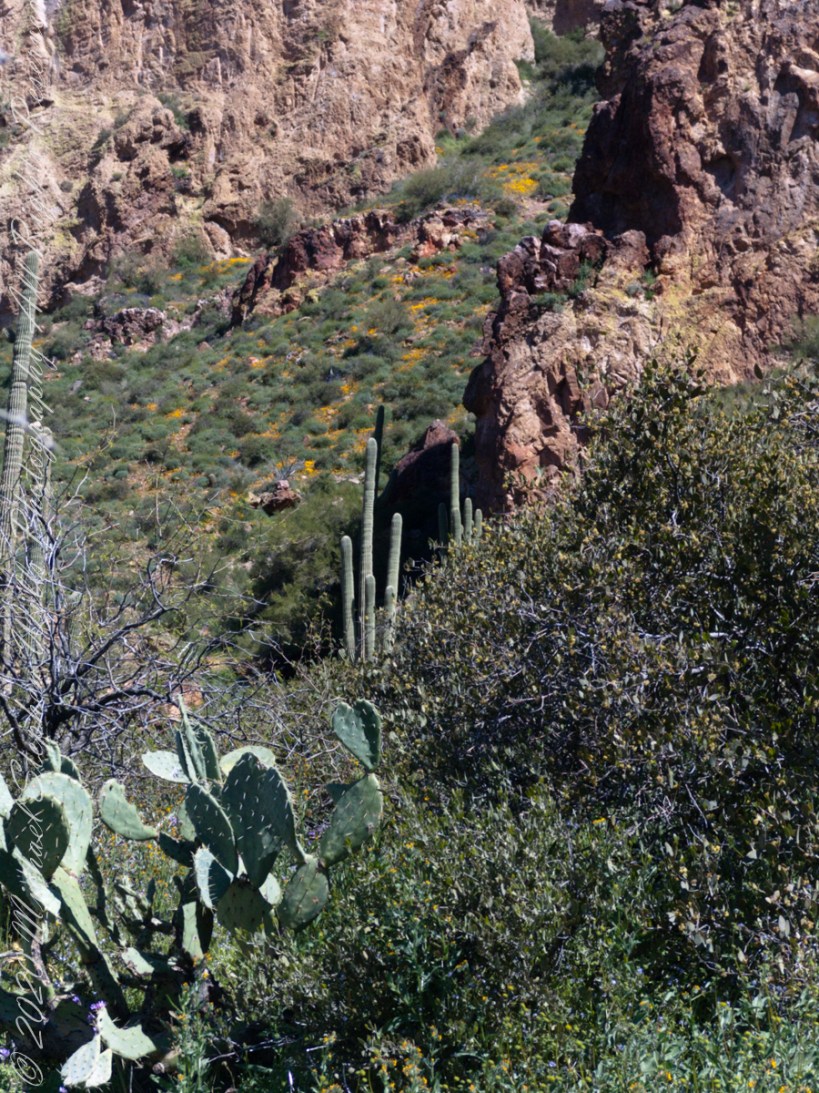
Step into the heart of the Sonoran Desert with me, where the saguaro cactus stands as a timeless giant, a symbol of resilience and beauty. This majestic sentinel of the Southwest is not just a plant; it’s a vibrant ecosystem and a cultural icon, embodying the spirit of endurance. Let’s explore its centuries-long journey, its role as a haven for desert wildlife, and its deep significance to the indigenous peoples. Join me in celebrating the saguaro’s enduring legacy, a narrative of survival and the profound beauty of life in the harshest conditions.
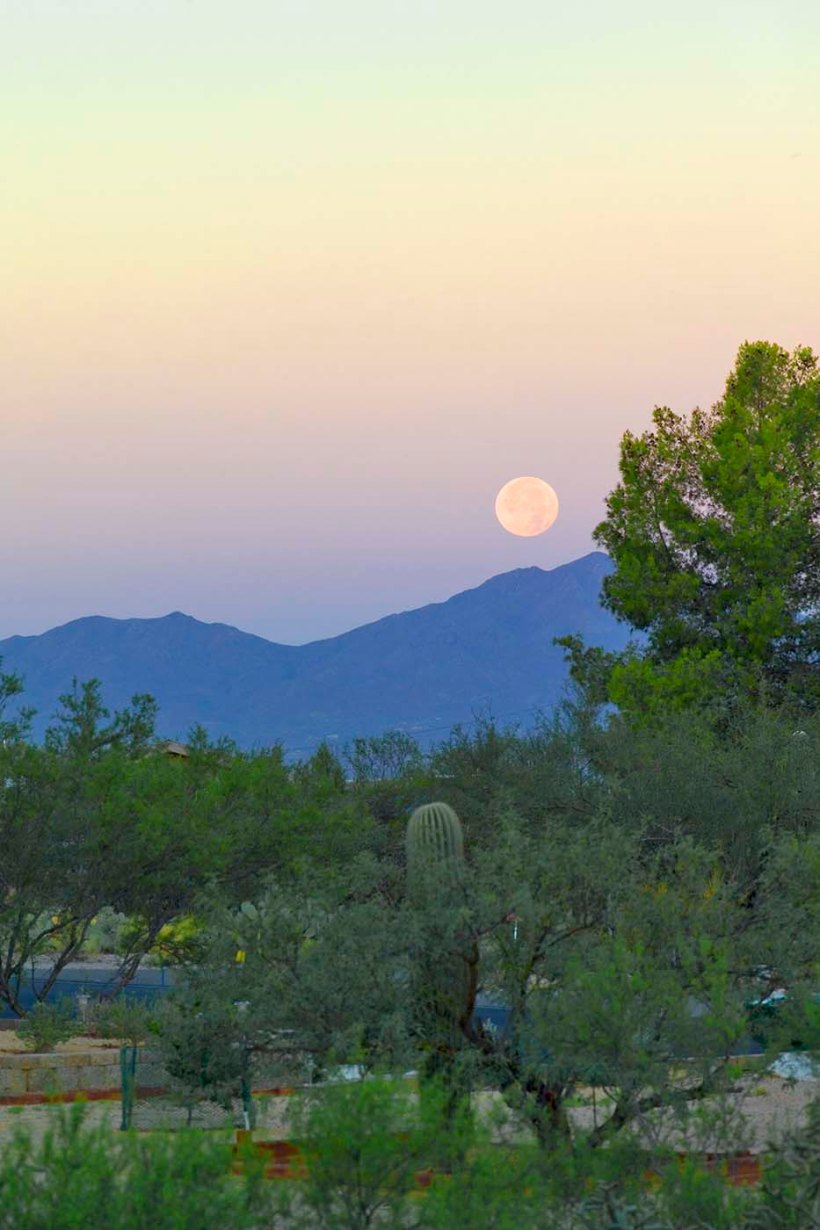
Join me in exploring the depths of “Hamlet,” where the phrase “revisits thus the glimpses of the moon” unveils a world where the supernatural meets the mysterious moonlight. Let’s unravel this imagery together, reflecting on life’s transient beauty, seeking understanding, and contemplating the cycles of change under the moon’s spell.
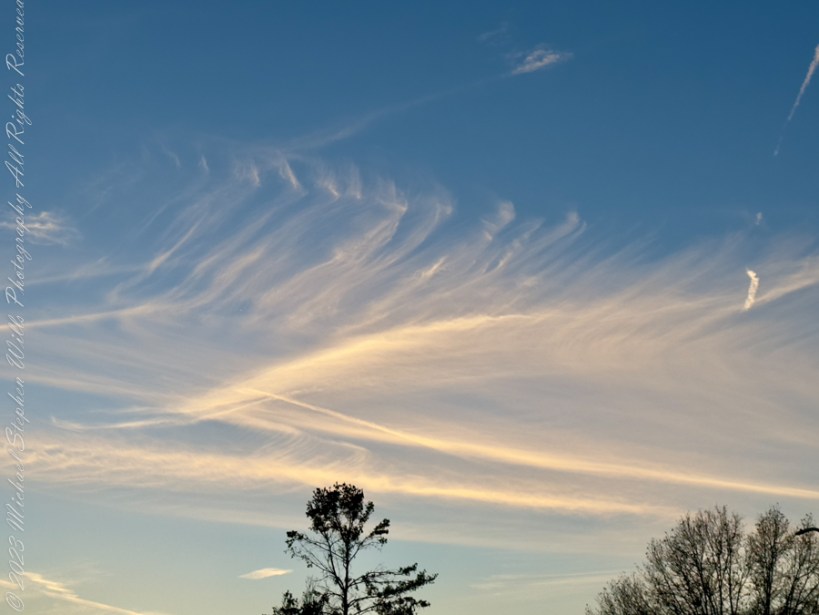
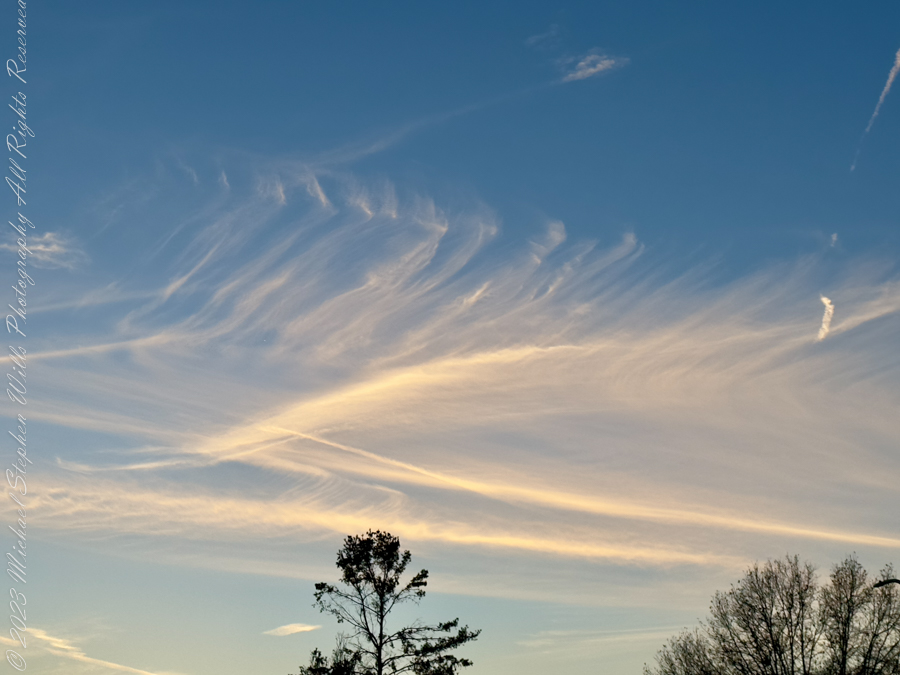
As the sun dipped lower, casting its farewell in hues of amber and soft gold, Pam and I stood beside the serene Cayuga Lake Inlet, gazing westward. The stillness of the evening was a quiet symphony, punctuated only by the gentle lapping of water against the shore. It was November 5th, and the world seemed to hold its breath in the golden hour, that perfect moment minutes before the sun would bid its final adieu for the day.
Above us, the sky was a canvas of nature’s delicate brushwork – the Cirrus fibratus. These high-altitude clouds, ethereal and wispy, stretched across the sky like strands of silken thread. The cirrus clouds, the feathery remnants of far-travelled storms, are the poets of the atmosphere, telling tales of weather yet to come. Their presence was both a testament to the day’s tranquility and a harbinger of change looming on the horizon.
Taken with the Apple IPhone 14 ProMax, raw format
Cloud Lore
Cirrus fibratus clouds, in their striated splendor, often signal the approach of a warm front and are associated with the shifts in weather patterns. As we stood there, the clouds seemed to be etching the sky with messages in a cryptic script, hints of the coming days. These clouds, so high in the sky, are formed from ice crystals, and their very existence speaks of the coldness of the upper atmosphere, as the days down here by the lake inlet lengthen towards the winter solstice.
The days of early November, with their crisp air and the promise of winter, bring a change in the light, a deepening of colors, and a certain clarity to the world. The skies seem grander, a vast dome of ever-changing artistry, and the Cirrus fibratus are our guides to the imminent transformation. They remind us that the earth is tilting away from the sun in our hemisphere, pulling us into the cooler seasons.
Eternal Change
These cirrus formations, while signaling the shifts in weather, also play with the light of the lengthening days. The sun’s rays, ever lower on the horizon, catch the ice crystals, creating a prism effect that can result in sundogs, those bright spots of light that occasionally grace the sky at solar dawn or dusk. They add a mystical quality to the already enchanted time of day.
As the twilight deepened, the Cirrus fibratus began to glow with the sun’s final touch, turning from white to shades of pink and fiery orange. This spectacle was a gentle reminder of the passage of time, the cycles of nature, and the endless dance between the earth and the sun. The clouds foretold of cooler weather, perhaps a sign that we should cherish these last vestiges of autumnal warmth.
As night began to embrace the sky, the clouds slowly faded from our sight, but the memory of their beauty and the secrets they carried lingered. They are not just ice and air; they are messengers, carrying the stories of the atmosphere from one part of the world to another, connecting us with the rhythms of the earth in their ceaseless journey.
Signs and Wonders
In the coming days, we would watch the sky, taking note of the cirrus and the subtle cues they offered. Would there be rain, a storm, or perhaps a clear day that belies the cold snap in the air? Only time would tell, but for now, we stood in silent appreciation of nature’s grace, feeling the profound connection to the world around us that only a sunset watched together can bring.
Hartung–Boothroyd Observatory is a leading educational facility, aiding in the study of astrophysics, tracking asteroids, and fostering diverse academic collaborations.
Perched on Mount Pleasant in the town of Dryden, New York, the Hartung-Boothroyd Observatory (HBO) stands as a testament to the celestial curiosity that Cornell University has nurtured for decades. It is a gateway to the stars, a place where the heavens unfold in wondrous detail to the eyes of astrophiles and the lenses of powerful telescopes.
The observatory is home to a reflecting telescope, one of the largest in New York State dedicated to both education and research. This remarkable instrument, housed under a retractable dome, has provided students and researchers with direct experience in astronomical observations since its establishment in 1974.
HBO isn’t just an observatory; it is a bridge between the terrestrial and the cosmic. It represents an educational philosophy that values direct engagement with the subject of study. Undergraduates, graduates, and faculty members flock to the facility to engage in projects that range from studying variable stars and exoplanets to tracking asteroids. Here, theoretical astrophysics meets the tactile world, allowing for an integrated understanding of the universe’s complexities.
Are images are from a handheld Apple Iphone 14 ProMax, raw files edited on camera and then from Adobe Lightroom.
It is used mainly as a Cornell University (Ithaca, New York) teaching facility for upper-level astronomy classes. The observatory is named financial contributions of M. John Hartung ’08 (chemical industrialist and donor) and in honor of the labor of Samuel L. Boothroyd (founding professor and chairman of astronomy 1921–1942). The telescope construction began in the 1930s and the observatory was dedicated in 1974. It contains the James R. Houck 60 centimeter telescope and various instruments.
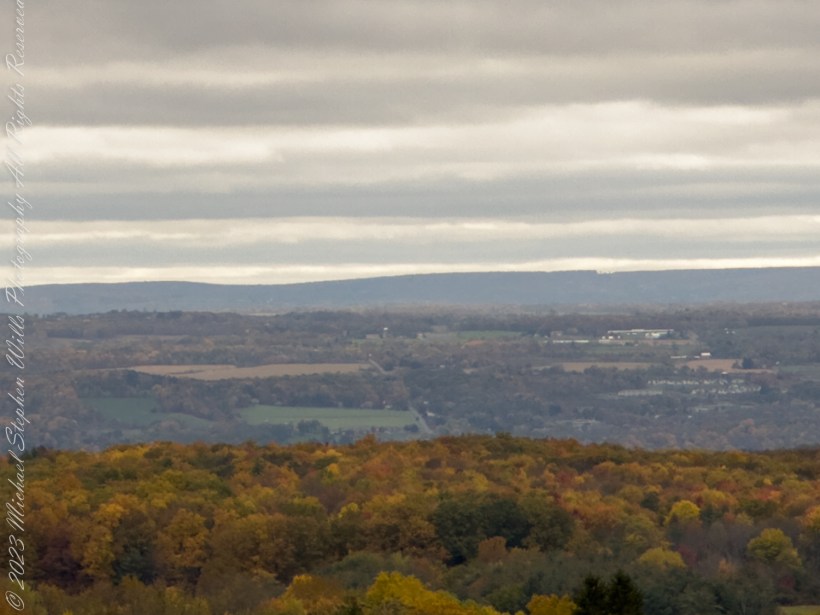
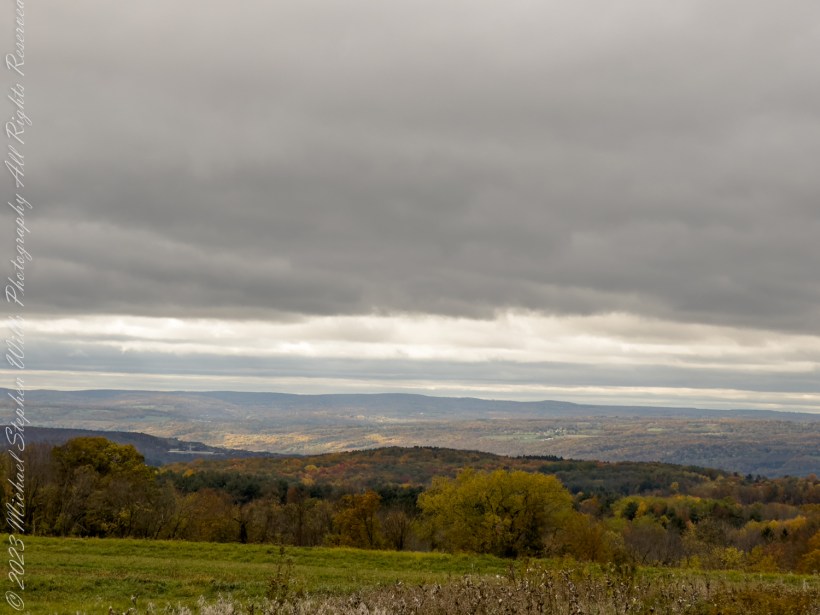
View east from Cornell University’s Hartung–Boothroyd Observatory
The James R. Houck telescope at HBO was a project initiated by its namesake in 1972, using optics and a lightweight tube which had been fabricated in the late 1930s by Samuel T. Boothroyd, Cornell’s first astronomer, and a mounting constructed by George Gull ’72 as his senior design thesis in Mechanical Engineering.
View southwest toward Ithaca College
The telescope, control electronics and instruments are largely the result of work done by undergraduates since 1970. It was manufactured by the students at the Tompkins, Tioga and Seneca BOCES and by Therm, Inc., with mirror coatings by Evaporated Metal Films corporation, all in Ithaca. The latter corporation was founded by members of Boothroyd’s scientific team, as he pioneered the use of evaporated metal coatings in astronomical optics. The telescope and observatory were dedicated in 1974.
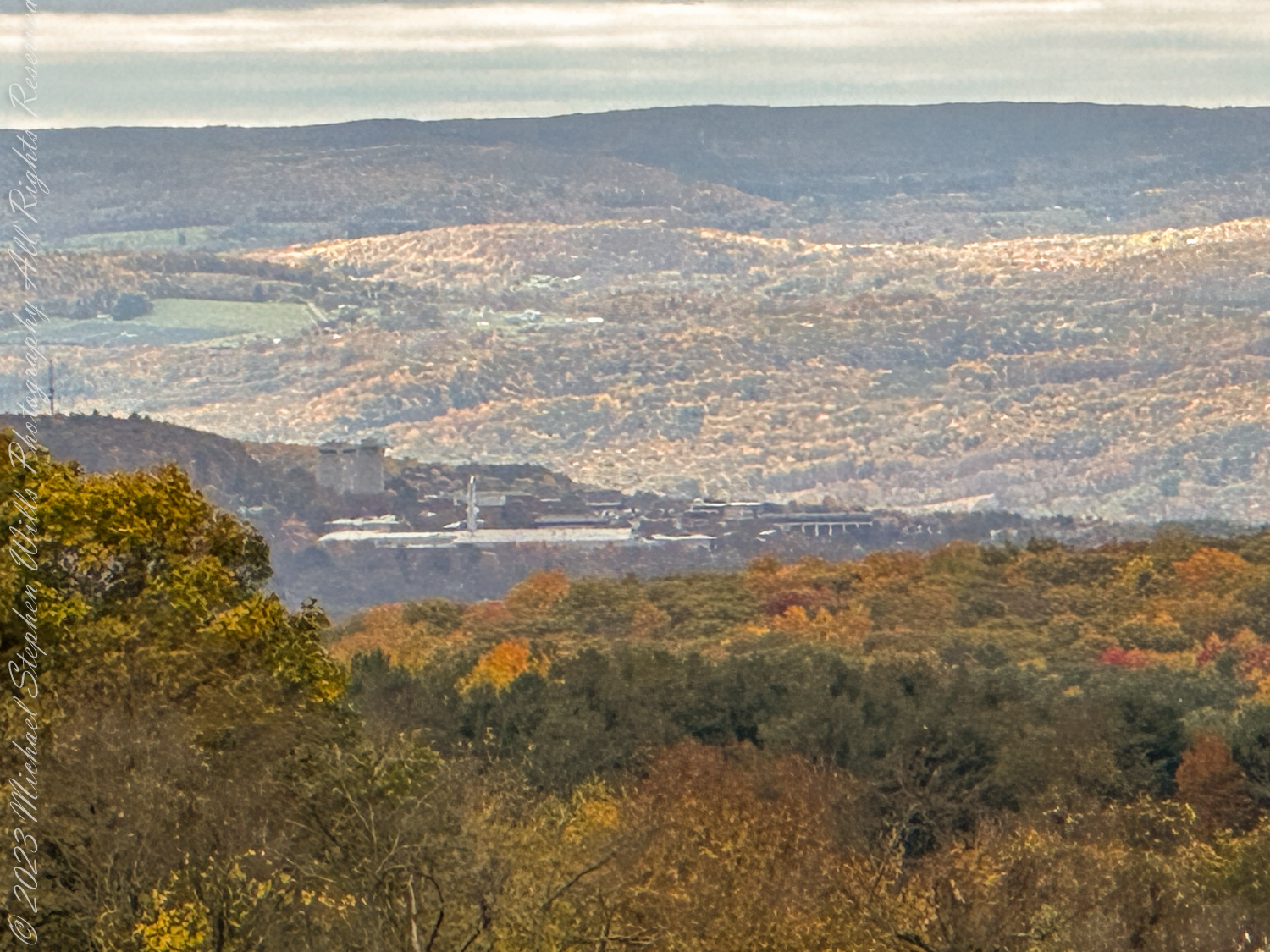
View southwest toward Ithaca College I zoomed in to see the residential towers.
The primary mirror is made of Pyrex from the Corning Glass Works and is in fact from a 1/8-scale test pour by the Corning company in preparation for the making of the 200″ Palomar mirror. It is 0.635 m (25 inches) in size, but the outer half inch is masked. The focal length of the mirror is 2.5m (100″) or f/4.
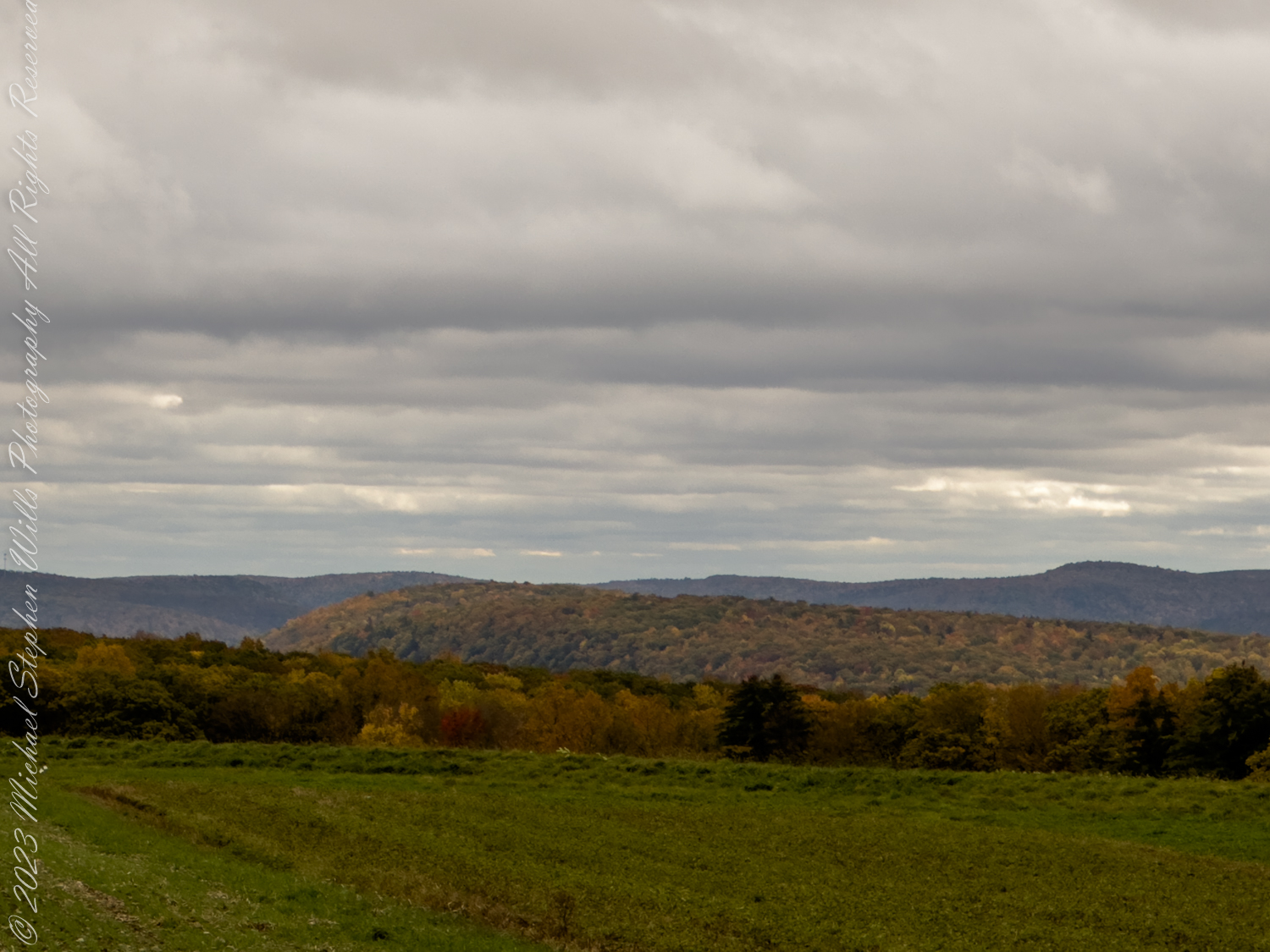
View southeast toward Hammond Hill
The Cassegrain design of the James R. Houck telescope is a combination of a primary concave mirror and a secondary convex mirror, often used in optical telescopes, the main characteristic being that the optical path folds back onto itself, relative to the optical system’s primary mirror entrance aperture. This design puts the focal point at a convenient location behind the primary mirror and the convex secondary adds a telephoto effect creating a much longer focal length in a mechanically short system.
View south
The secondary is an 8″ mirror made of Cervit (a low thermal coefficient material). In combination with the primary, it yields a final f/13.5 beam to the nominal focus, which lies 18.5″ behind the primary mirror’s vertex. At nominal focus, the plate scale is about 24 arcsec/mm, with an effective focal length of 8.57 m.
View southwest toward Ithaca College
The telescope, control electronics and instruments are largely the result of work done by undergraduates since 1970. It was manufactured by the students at the Tompkins, Tioga and Seneca BOCES and by Therm, Inc., with mirror coatings by Evaporated Metal Films corporation, all in Ithaca. The latter corporation was founded by members of Boothroyd’s scientific team, as he pioneered the use of evaporated metal coatings in astronomical optics.
The dome itself, like all professional observatories, is unheated. The telescope and instrumentation can be controlled from a neighboring control room which is heated and offers standard amenities plus several computers for simultaneous data reduction.
The observatory was founded by James Houck and managed by him through 2006. The principal contact is Don Barry, who managed the facility from 2006-2015, and taught Experimental Astronomy using the facility.
“Graduates” of the HBO project are now senior engineers and technical managers as well as graduate students, research associates and faculty at major universities.
Moreover, the observatory is a beacon for interdisciplinary collaboration. It’s not uncommon to find astronomers working alongside computer scientists, engineers, and educators. This cross-pollination of ideas enhances the potential for innovation, fostering new techniques in data analysis, instrument design, and educational methods. The observatory’s role extends beyond its primary function; it is a hub of convergence for diverse academic disciplines, all under the umbrella of exploring the unknown.
HBO also contributes to the global astronomical community through its research. The data collected here feed into larger networks of observation and analysis, aiding in the collective endeavor of mapping and understanding the universe. Its strategic location in upstate New York, away from the light pollution of large urban centers, grants it relatively clear night skies, making it an invaluable resource for both optical astronomy and astrophotography.
In an era where space exploration has captured the public imagination like never before, observatories such as the Hartung-Boothroyd are more crucial than ever. They serve as terrestrial launchpads, propelling minds into the realm of scientific inquiry. Here, the vastness of space becomes approachable, the mechanics of the cosmos decipherable, and the mysteries of the universe a little less mysterious.
As the night falls and the stars emerge, the Hartung-Boothroyd Observatory continues its silent vigil over the heavens. It stands as a beacon of knowledge and discovery, an educational catalyst, and a gateway to the stars. For the students and astronomers who work from this dome on Mount Pleasant, HBO is more than an observatory—it is a vessel navigating the infinite ocean of the night sky, a journey that begins in the heart of Cornell University and extends to the edges of the observable universe.
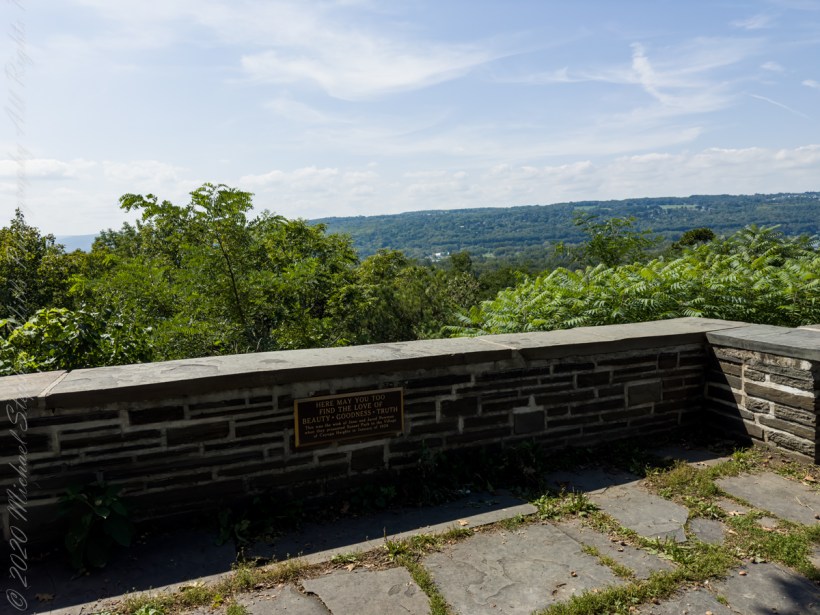
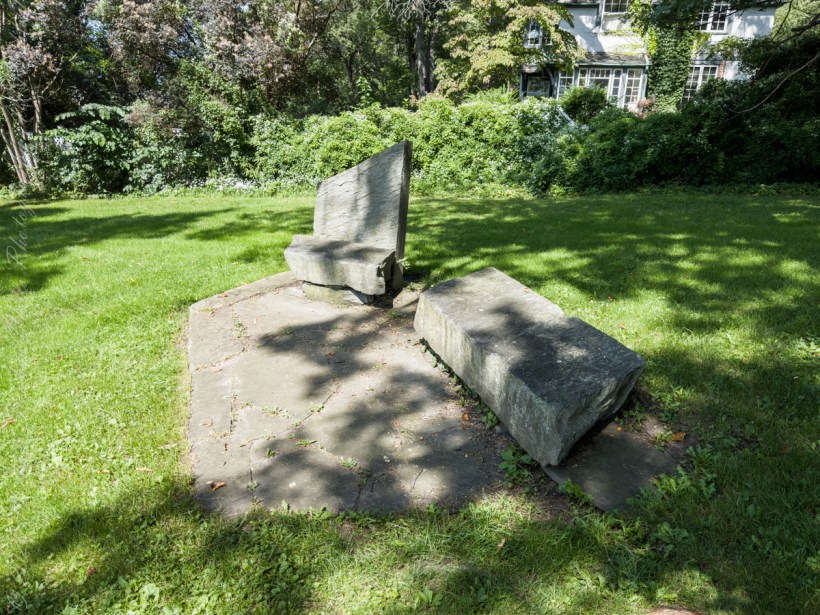
After living here since 1986 I discovered this Cayuga Heights park on a warm early September day, 2023.
Looking across Cayuga Lake, not visible in the valley, to West Hill.
Plaque inscription: “Here may you too find the love of beauty, goodness, truth. This was the wish of Jane and Jared Newman when they presented Sunset Park to the village of Cayuga Heights in January of 1938.”
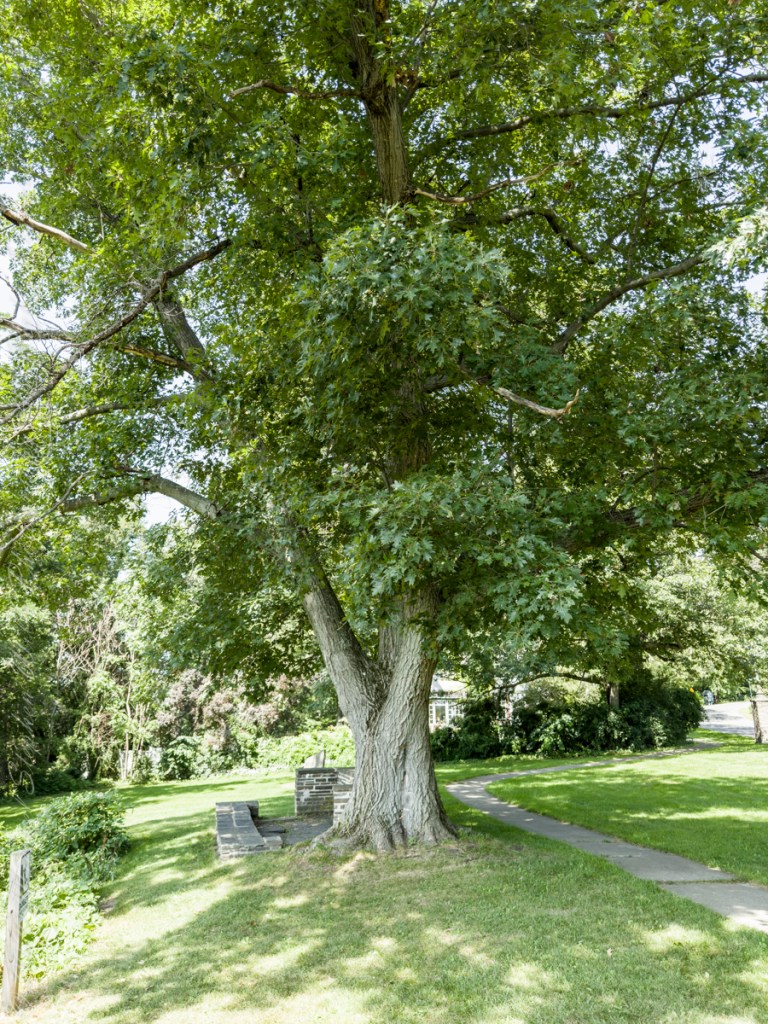
Rest on a limestone bench beneath a mature oak tree.
Limestone benches
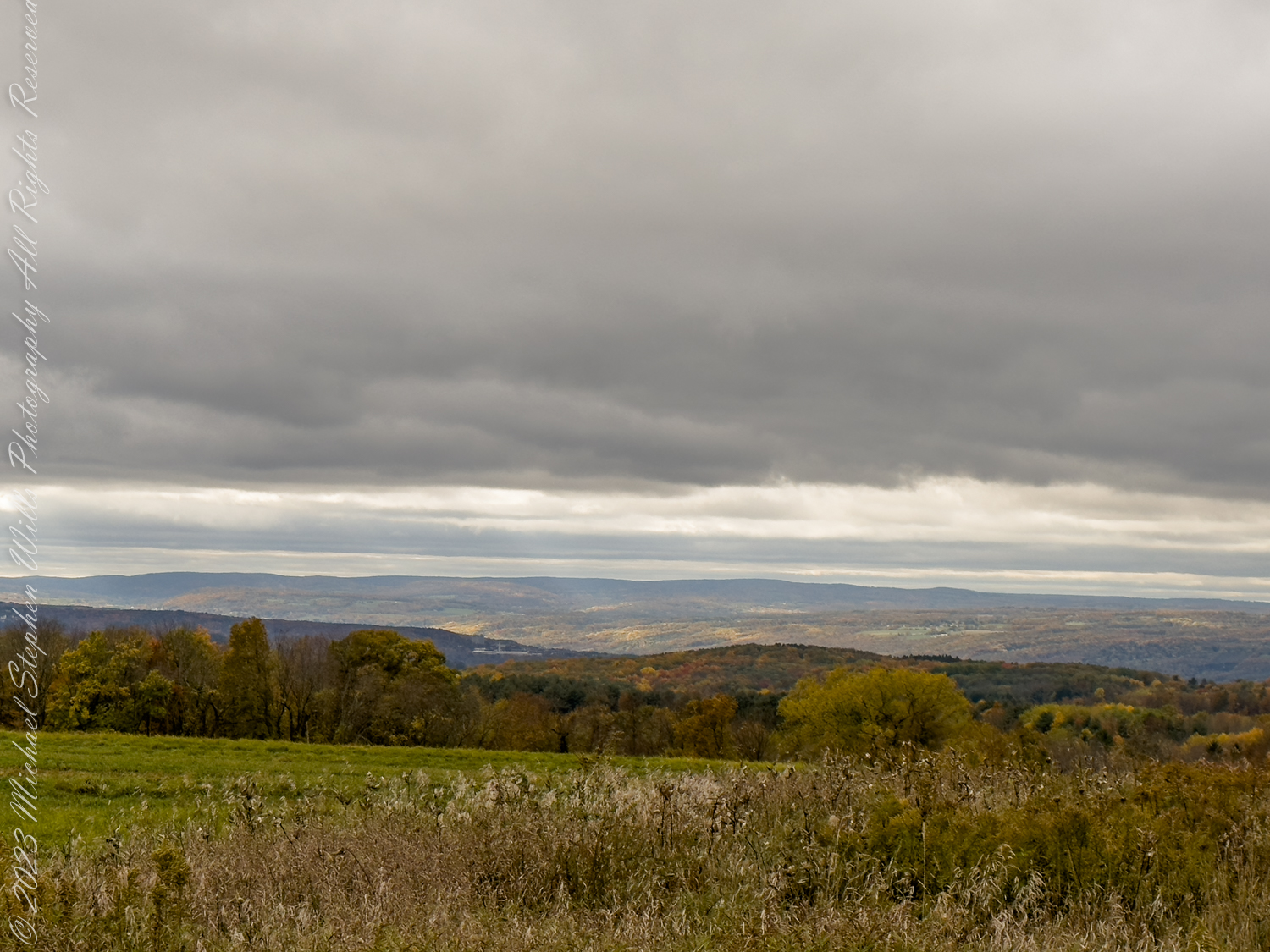
View across Ithaca towards West Hill and, in the far distance, Connecticut Hill.
Copyright 2023 Michael Stephen Wills All Rights Reserved
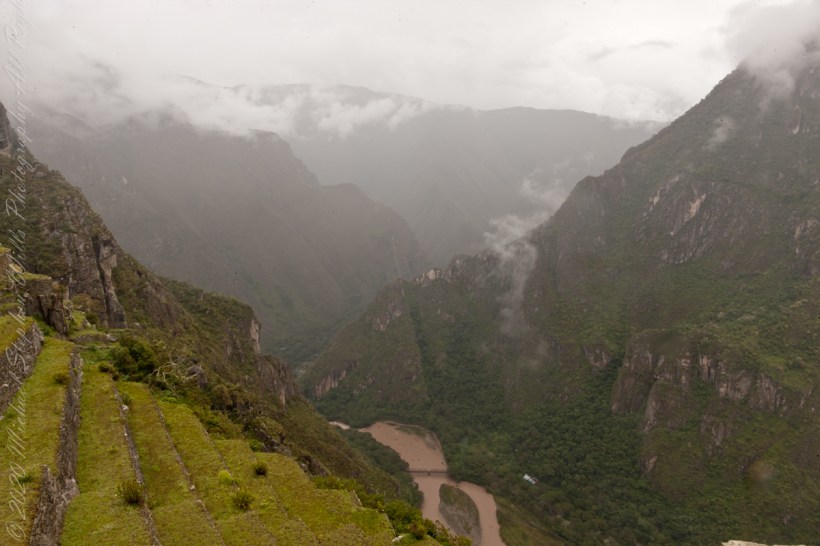
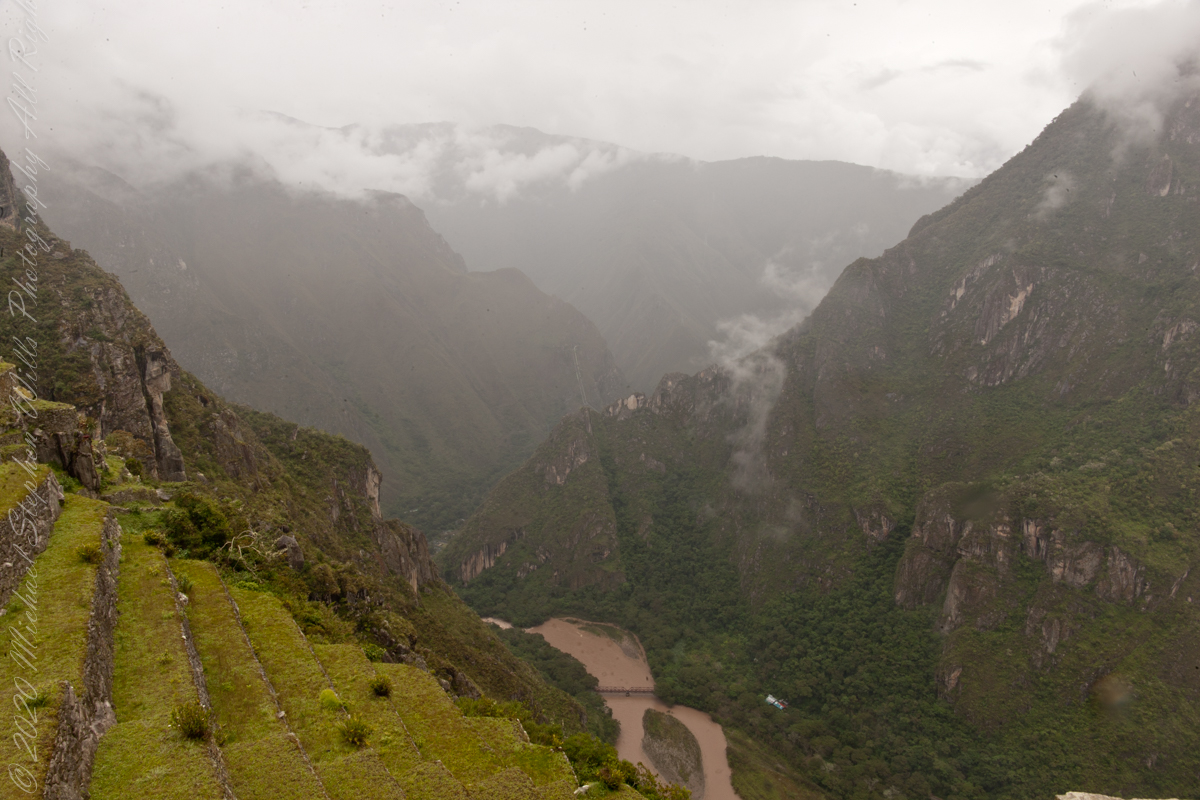
I set up a Manfrotto BeFree tripod with the Canon EOS 1DS Mark III mounted with the Canon EF 70-300 f/4-5.6 L IS USM lens to capture our experience while entering Machu Picchu.
The eastern shoulder of Huayna Picchu is left and the Urubamba river curves around it. Leading the eye to the distance is an uninhabited andean valley covered in rain forest.
Copyright 2023 Michael Stephen Wills All Rights Reserved
“The central buildings of the Machu Picchu Sanctuary use the classical Inca architectural style of polished dry-stone walls of regular shape. The Incas were masters of this technique, called ashlar, in which blocks of stone are cut to fit together tightly without mortar.”
The site itself may have been intentionally built on fault lines to afford better drainage and a ready supply of fractured stone. ‘Machu Picchu clearly shows us that the Incan civilization was an empire of fractured rocks’.
Inca quarried the rock for Machu Picchu from the mountain ridge itself.
“The section of the mountain where Machu Picchu was built provided various challenges that the Incas solved with local materials. One issue was the seismic activity due to two fault lines. It made mortar and similar building methods nearly useless. Instead, the Inca mined stones from the quarry at the site, lined them up and shaped them to fit together perfectly, stabilizing the structures. Inca walls have many stabilizing features: doors and windows are trapezoidal, narrowing from bottom to top; corners usually are rounded; inside corners often incline slightly into the rooms, and outside corners were often tied together by “L”-shaped blocks; walls are offset slightly from row to row rather than rising straight from bottom to top.”
Main Temple survived multiple earthquakes
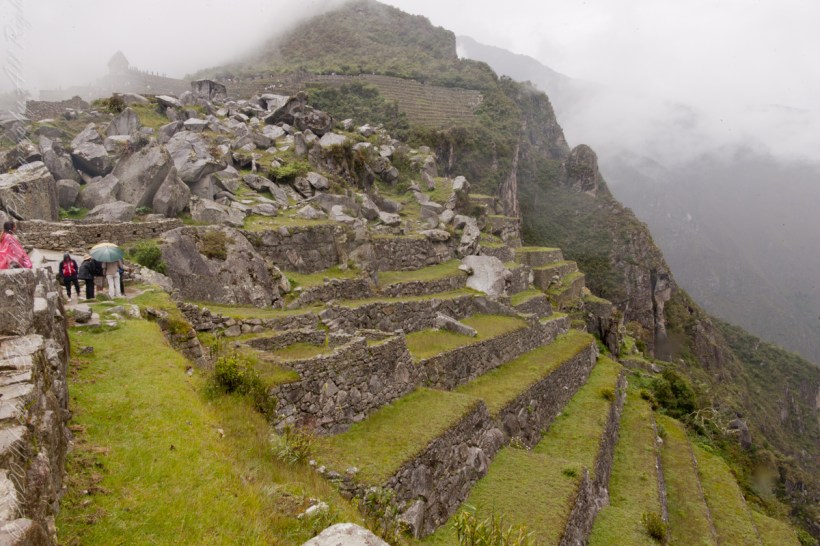
“Heavy rainfall required terraces and stone chips to drain rainwater and prevent mudslides, landslides, erosion, and flooding. Terraces were layered with stone chips, sand, dirt, and topsoil, to absorb water and prevent it from running down the mountain. Similar layering protected the large city center from flooding. Multiple canals and reserves throughout the city provided water that could be supplied to the terraces for irrigation and to prevent erosion and flooding.”
Agricultural Terraces
“The Incas never used wheels in a practical way, although their use in toys shows that they knew the principle. The use of wheels in engineering may have been limited due to the lack of strong draft animals, combined with steep terrain and dense vegetation. The approach to moving and placing the enormous stones remains uncertain, probably involving hundreds of men to push the stones up inclines. A few stones have knobs that could have been used to lever them into position; the knobs were generally sanded away, with a few overlooked.”
Reference: text in italics and quotes is from the Wikipedia “Machu Picchu”, web page.
Copyright 2023 Michael Stephen Wills All Rights Reserved