Slieve Gullion Forest Road

Visit a viewpoint in southern County Armagh, Northern Ireland

Yesterday, I simultaneously published nine photographs on my ImageKind Ireland Gallery and Getty IStock (click the links to visit): nine views taken from the slopes of Slieve Gullion.

Sunday, May 25, 2014 was a happy day for Pam and I.  It was the first full day of an eighteen (18) we filled with Ireland, travelling in a loop of the island following the coast from, naming the counties where we spent time on the ground, Louth, Armagh, Dublin, Meath, Wicklow, Cork, Kerry, Claire, Mayo, Antrim, Down and back to Louth.  The counties of Northern Ireland are in italics.  Indeed, at this time the politics allowed us to travel freely between the Republic and the North.  That day, our morning was spent in Louth attending mass, enjoying our first meeting with the family over a substantial mid-day meal (click the link for my Facebook album of the meeting).  We split off that afternoon to visit the home of my cousin, Mary and her husband Joseph in County Armagh, just over the border.  When Joseph offered to drive us over to Slieve Gullion it was totally new to us, we had no conception of the place or what to expect.

It was such a gift, we are grateful to Joseph for this experience.  Only in 2018 when, at 64 years of age and retired”, was I able to research the place and spend time developing the photographs for publication.  Two of the photographs illustrate this posting, to view the others in my online gallery, click either photograph.

Slieve is the Irish language word for “mountain.”  Slieve Gullion is a lone eminence, one remnant of volcanic eruptions about 60 million years ago during the rifting of continents that produced the Atlantic Ocean.  Around the mountain is the Ring of Gullion, a string of hills, 26 miles by 11 miles, surrounding the mountain and formed from the ancient collapse of a volcanic caldera.  The technical name for it is a Ring Dyke and it was the first of its kind to be recognized and mapped, well before the nature of the formation was understood of be volcanic.  The name Gullion is derived, in one formulation, from the name of the metalsmith, Culann.  In Irish Myth, Culann’s home and workshop was on the slope of Slieve Gullion.  A wealthy and respected personage, Culann invited  Conchobhar mac_Neasa, king of Ulster to feast.  During his approach to the mountain, passing through the surrounding plain, the king stopped to watch boys play hurling.  Among them was the future hero of Ulster, the young Sétanta.  Impressed with Sétanta athletic abilities, the king invited him to join in the feasting at Culann and the boy promised to follow after the game.  Later, while climbing the mountain to fulfill his promise Sétanta was attacked by the guard dog of Culann.  The myth says the dog was killed by Sétanta in self-defense.  Never the less, in compensation to Culann, Sétanta committed to rearing a replacement and to act as guard dog in the meantime.  In this way he became known as Cu Culann, “the dog of Culann.”  Click for more about Cu Culann.

On the summit two cairns north and south of a small lake, tangible proofs of ancient peoples and beliefs.  The north cairn is a more ancient passage grave, 90 feet wide, 16 feet high, the opening aligned with the setting sun on the winter solstice.  The cairn north of the lake is less ancient containing two cist burials.  For our visit Joseph drove us along the 8 mile drive.  The following is an image of a viewing platform and the road.  Just beyond, on the right, where the ridge meets the road, is the trail to the 1,880 foot summit of Slieve Gullion.  Our arrival disturbed sheep resting on the asphalt.  I’d have loved to spent a day climbing the summit, but it was not to be this trip.
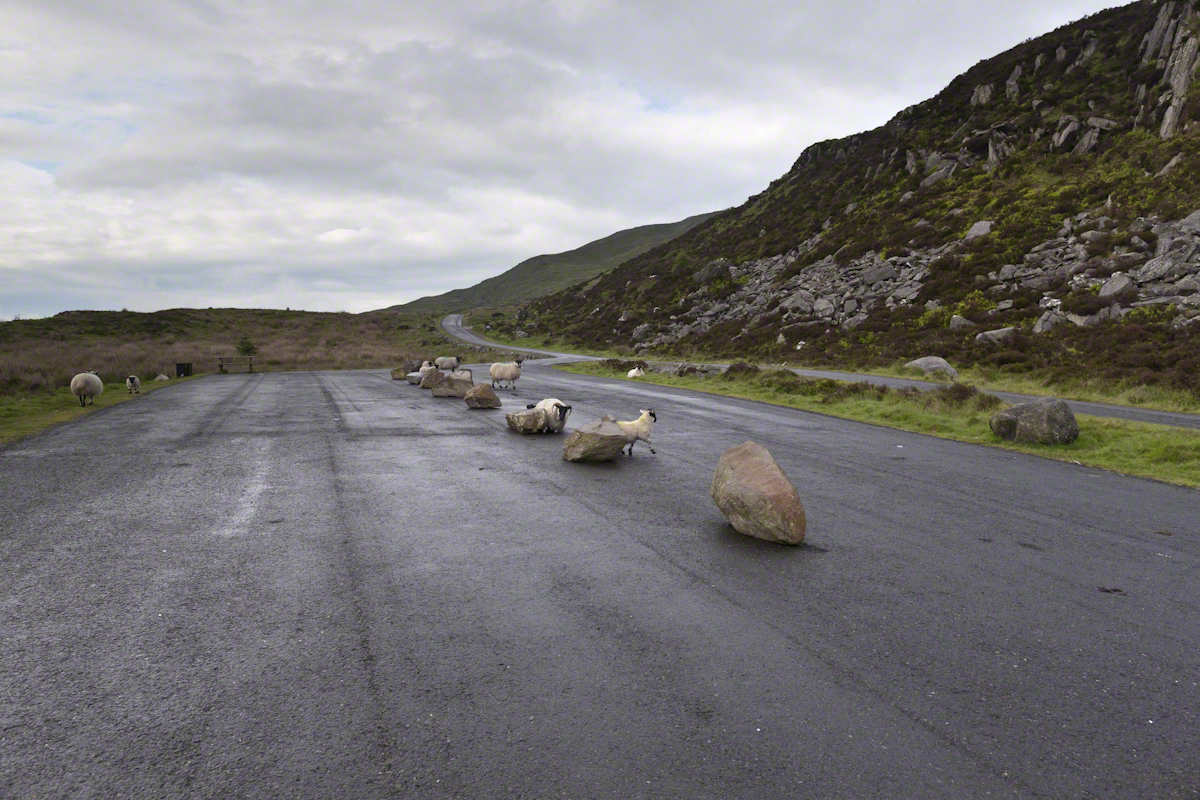
Viewing Platform with Sheep – CLICK ME for more Ireland photography.

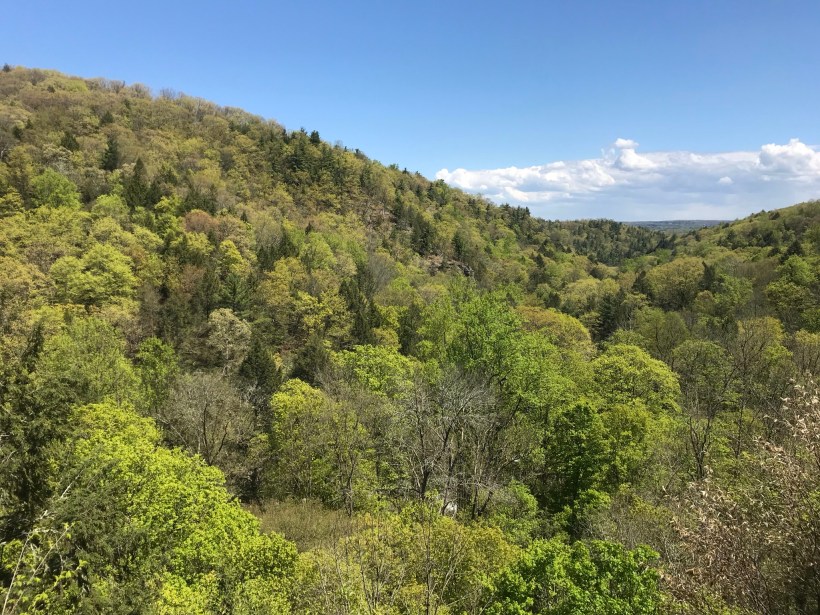
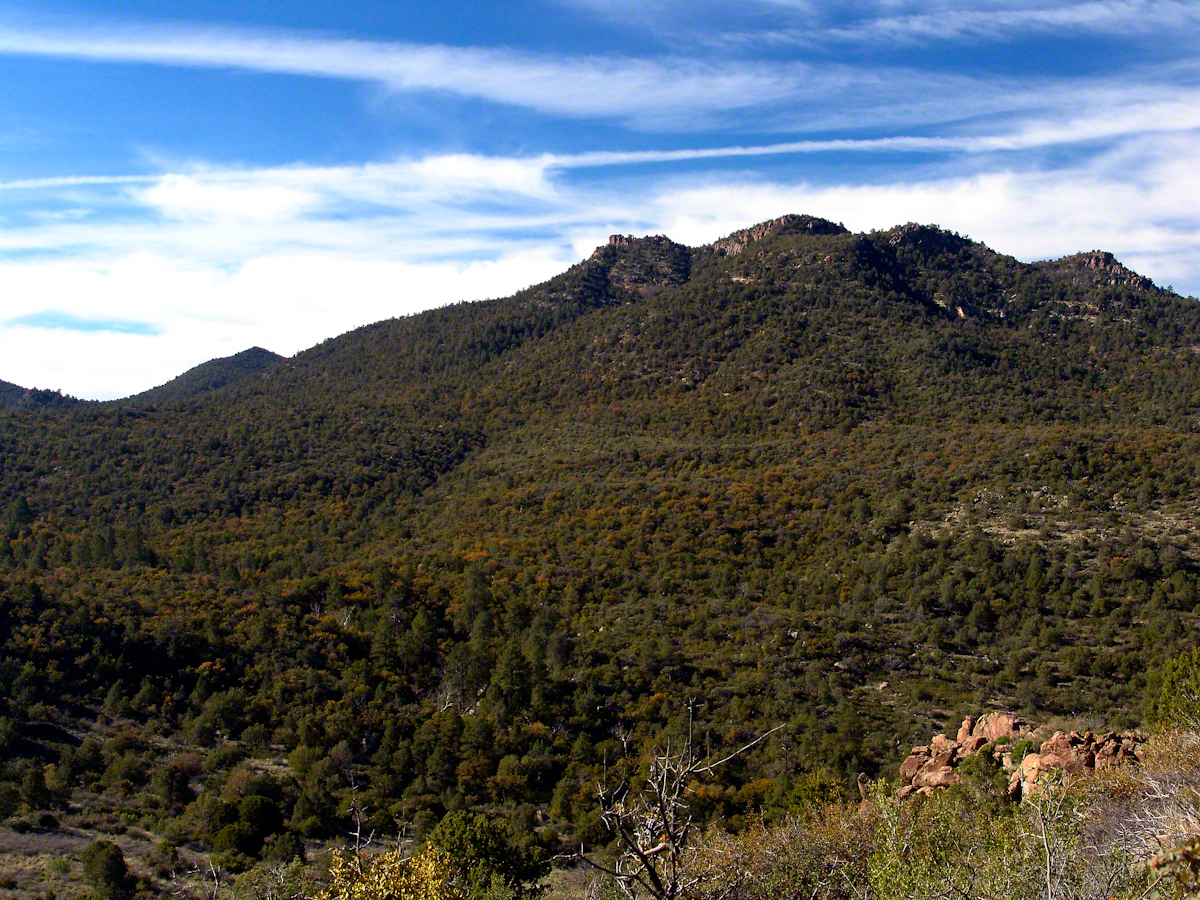
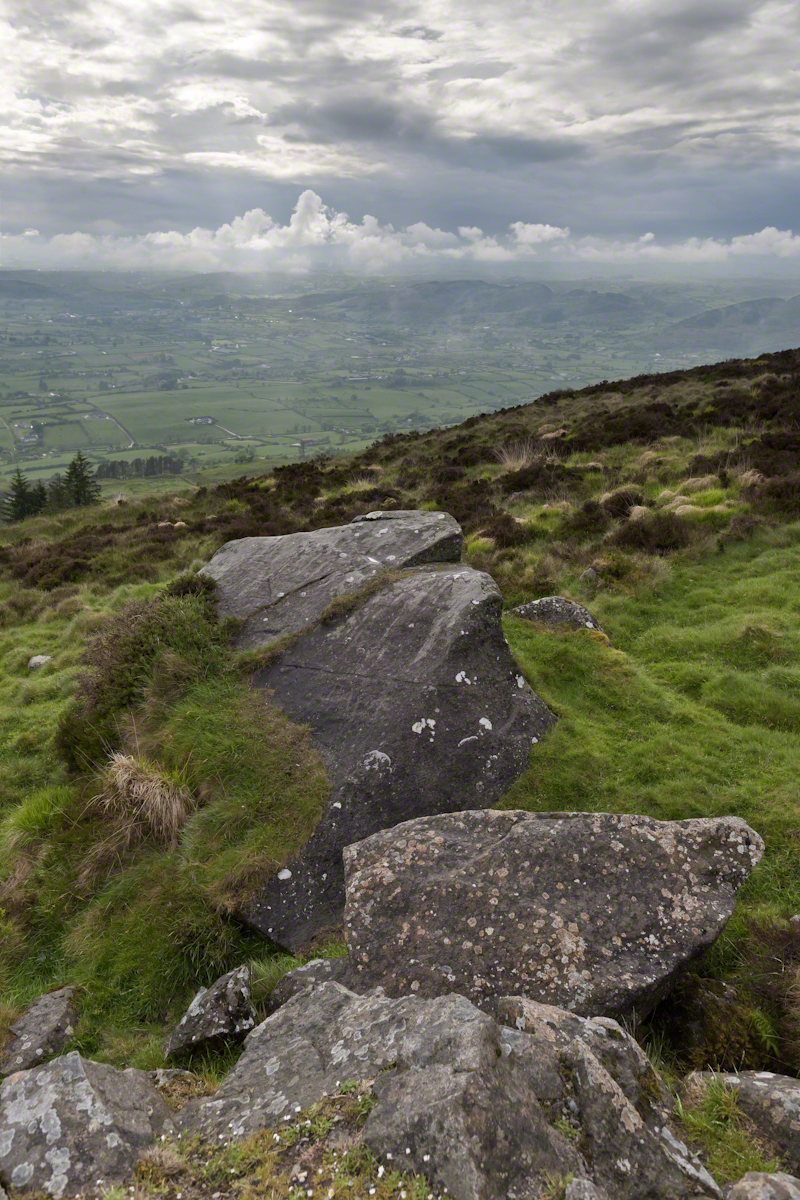
The way is part of the Slieve Gullion Forest Park.  Throughout are turnoffs to admire the view.  It was during our frequent stops I pulled out the photography gear to grab the views.  Here is one, looking southwest.  For the other views, click either photograph to visit my Online Gallery of Ireland.
North View from Slieve Gullion– CLICK ME for more Ireland photography.
Copyright 2021 Michael Stephen Wills All Rights Reserved

Sycamores and Riparian Space

a Preview of Reavis Ranch

….continued from the chapter “A Peaceful Day at Pine Creek.”

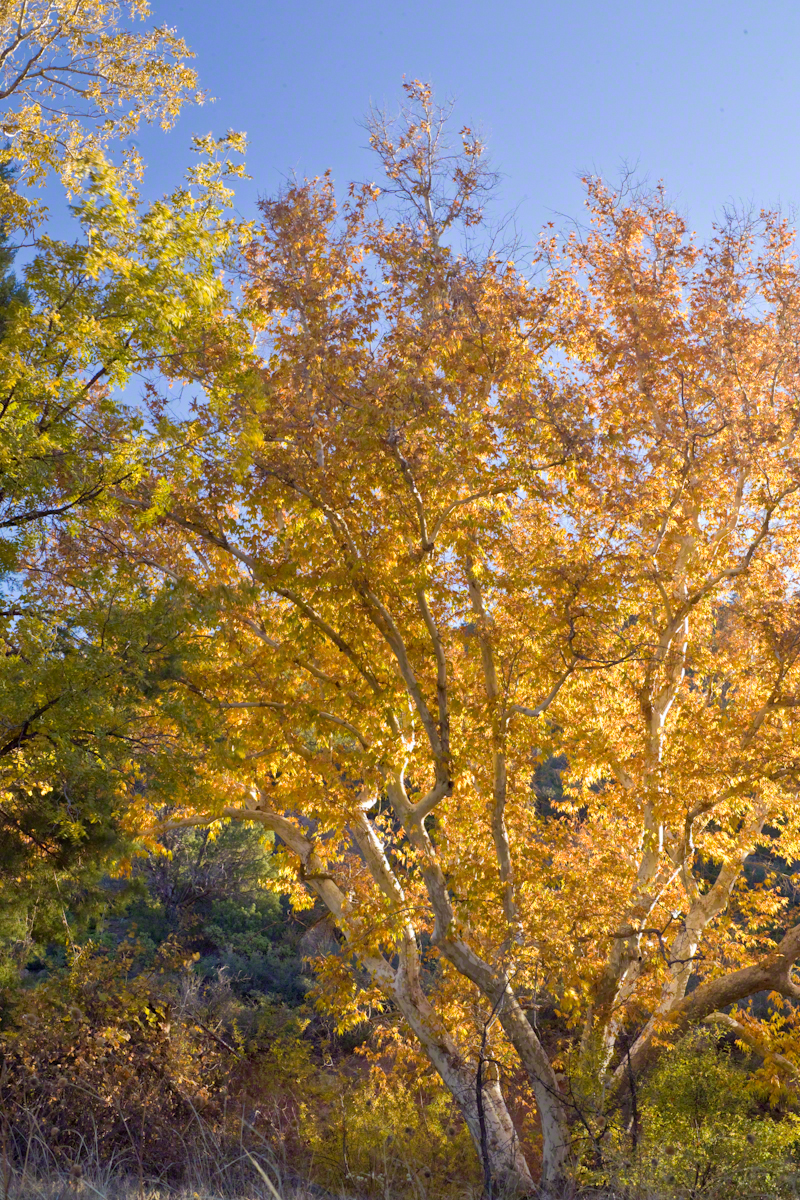
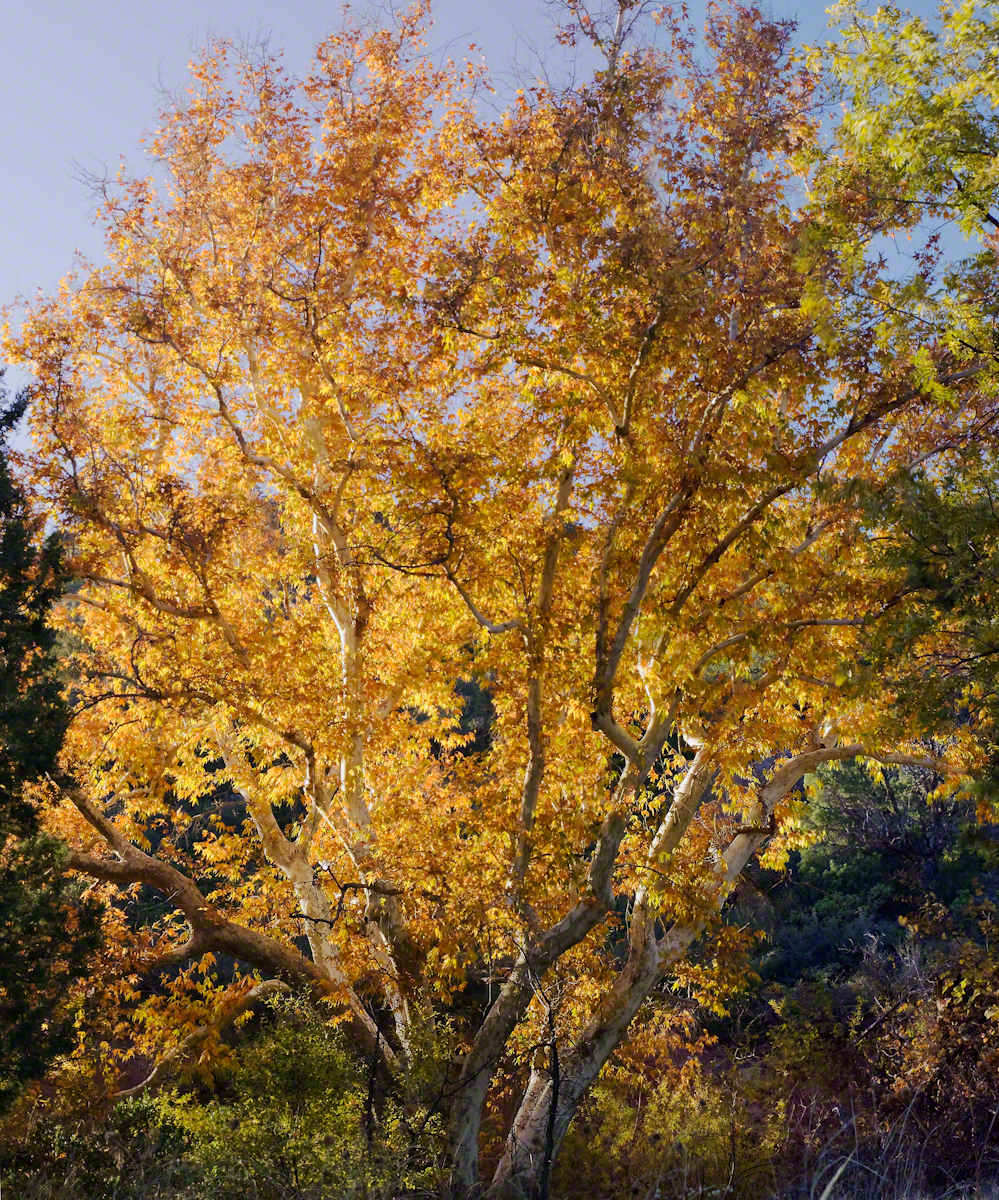
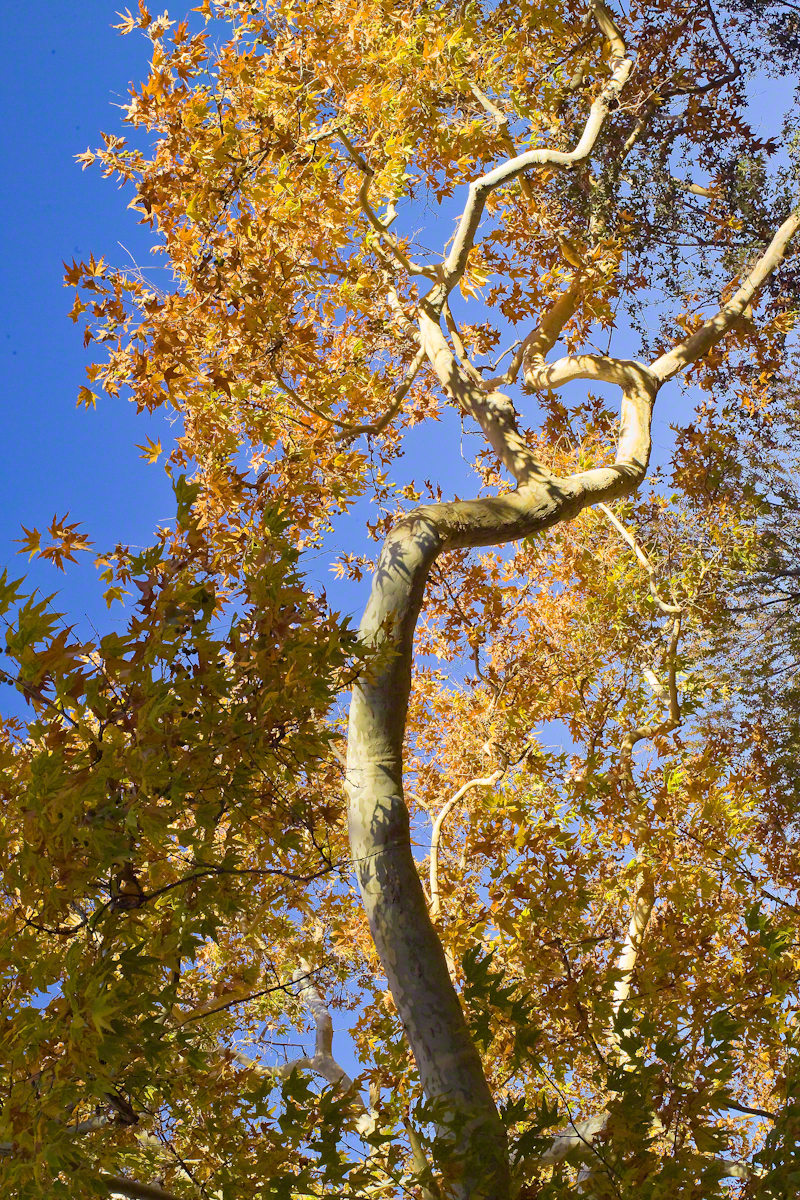
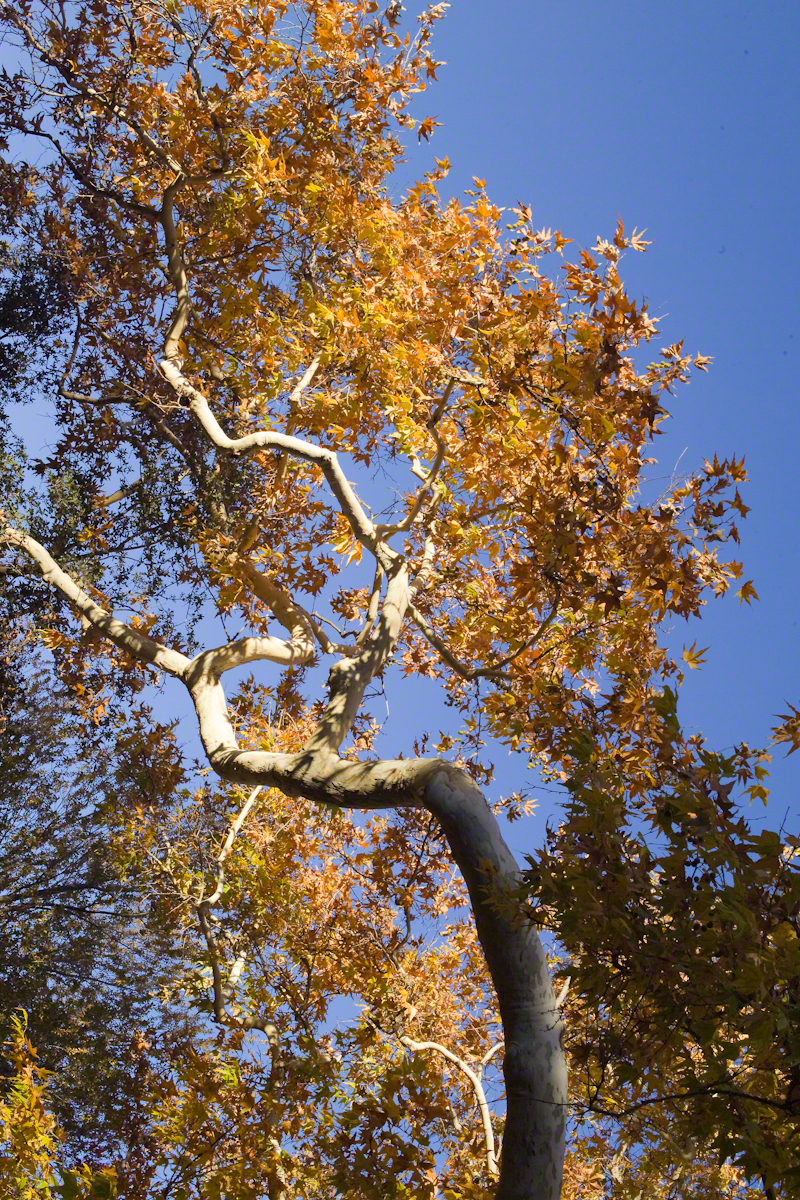
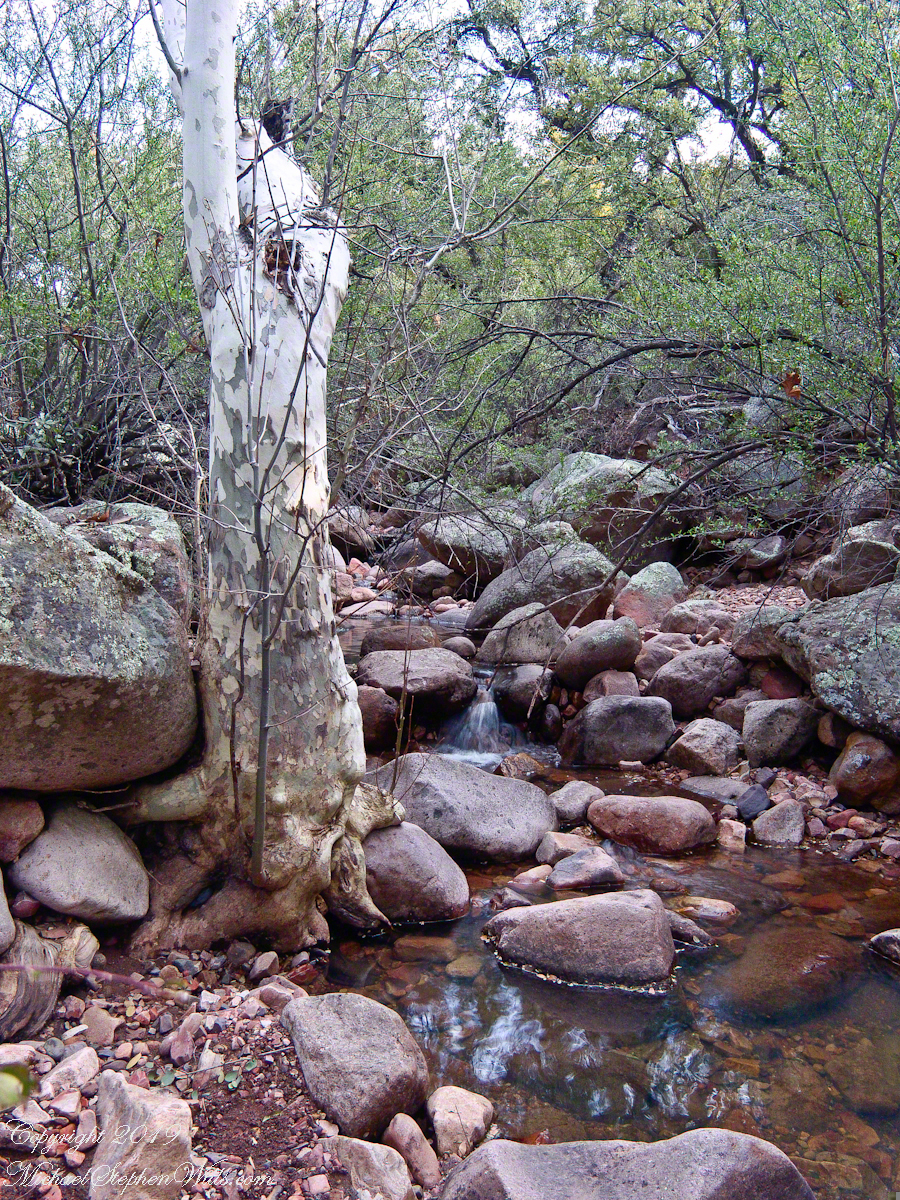
Compare these Arizona Sycamores with the struggling specimen from the last chapter, “A Peaceful Day at Pine Creek.” Many Sycamores such as this one flourish along Reavis Creek, a perennial stream of the eastern Superstition Wilderness. The drainage that feeds Pine Creek is far less acreage than that of Reavis Creek and, when the Pine Creek flow fades in the driest seasons, plants go into survival mode and halt growth and may even slough off limbs to conserve water.

These Sycamores grace a stream that seldom stops flowing, even in the driest of seasons. I had the good fortune to visit the Reavis valley of the Superstition Wilderness in November 2007, when these trees were at peak autumn foliage.

The tree requires a supply of water to thrive. This specimen demonstrates the species growth habit growing multiple trunks with a shape driven by water availability and the environmental context. The multiple trunks may be a desert survival mechanism. In dry periods a trunk or trunks are sloughed off to reduce moisture loss. This is why the Sycamore of “A Peaceful Day at Pine Creek” has a single trunk.”

To encounter a riparian space of the Arizona desert is a revelation, to progress from Sonoran desert spaces assailed by the breath of dry wind, to see the first signs of water in the distance as a welcome fluttering of leaves, to feel a welcome odor of water.

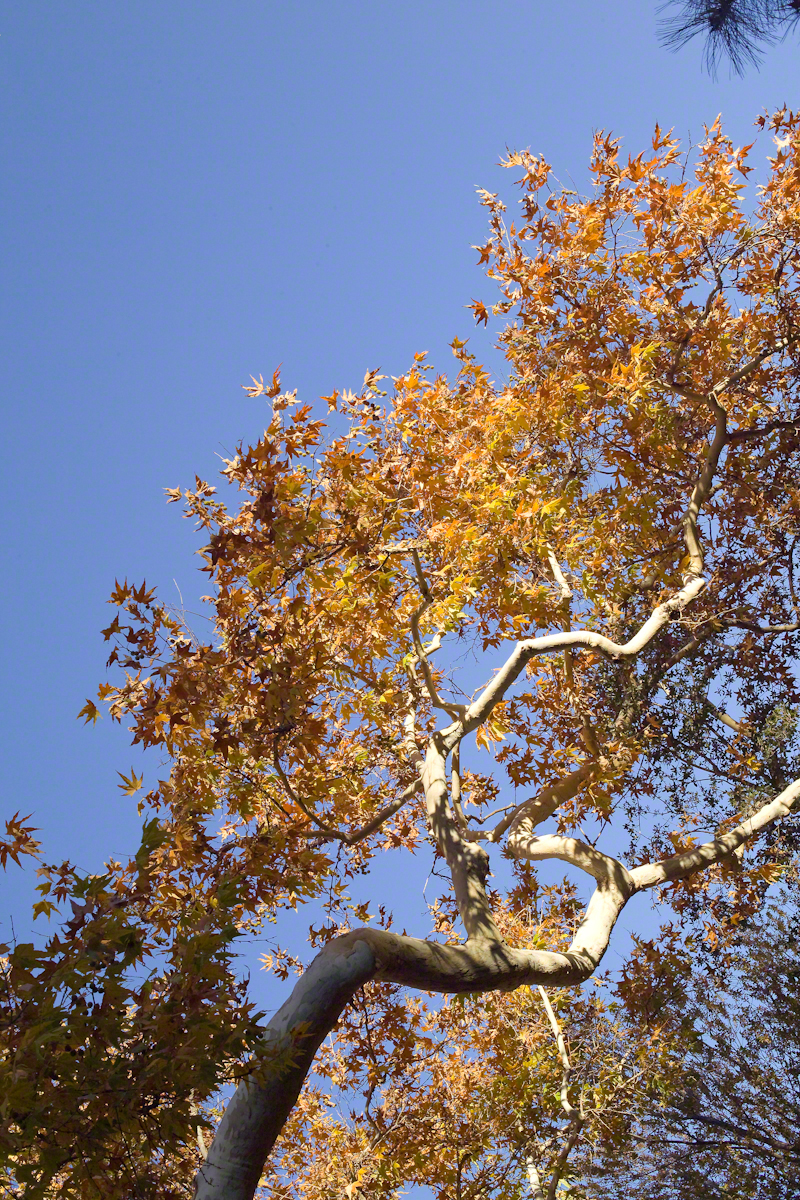
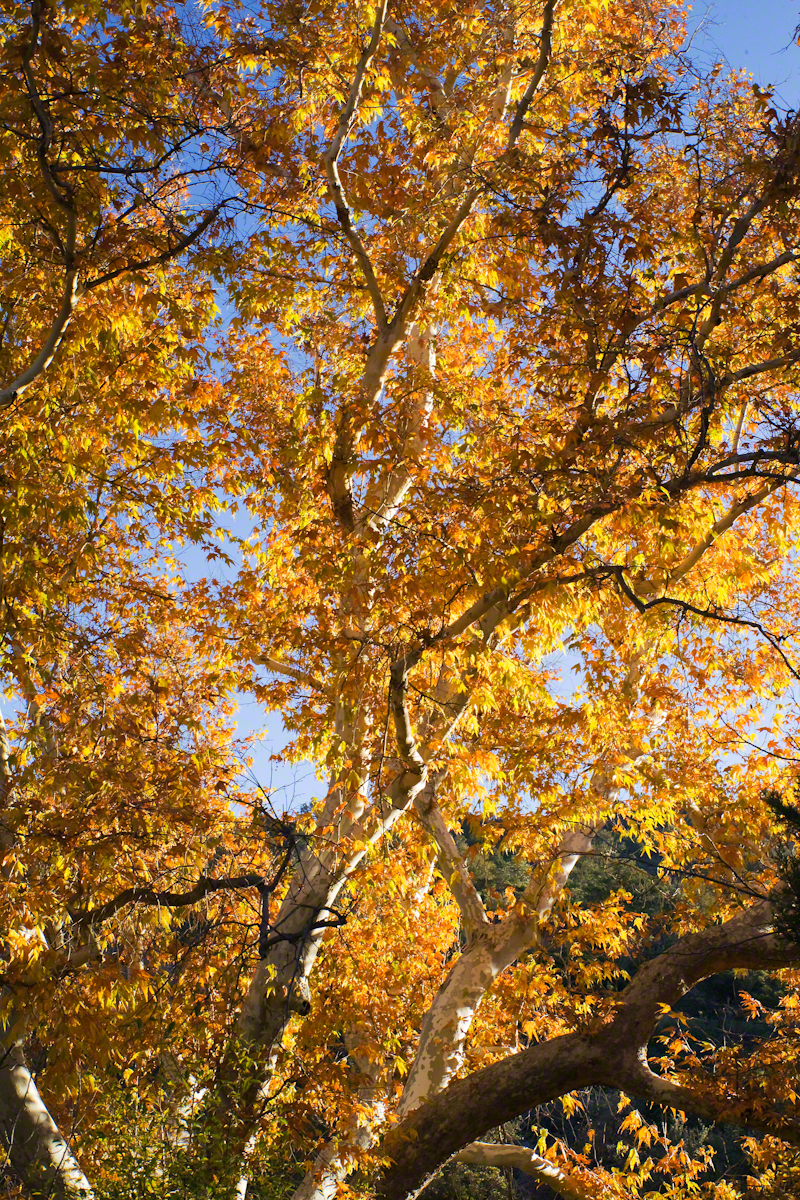
Yes, the first effect of a riparian space on the senses is the smell of water. Let’s finish this post with limbs of the Reavis Creek Arizona Sycamore reaching for the sky.

Click me for the next episode, “Desert Luxuries.”

Click me to visit Michael Stephen Wills Online Arizona Gallery.

Copyright 2021 All Rights Reserved Michael Stephen Wills

May Nature Walk

Our first post COVID outing

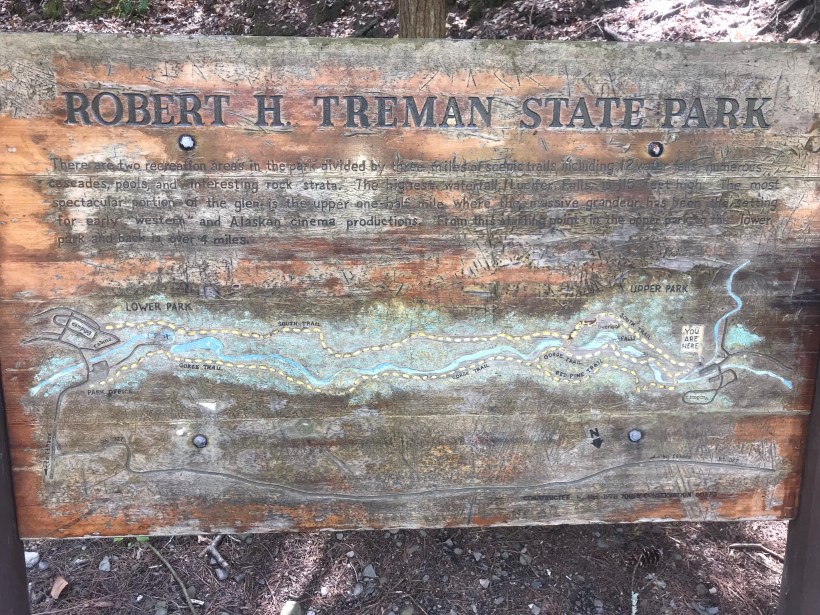
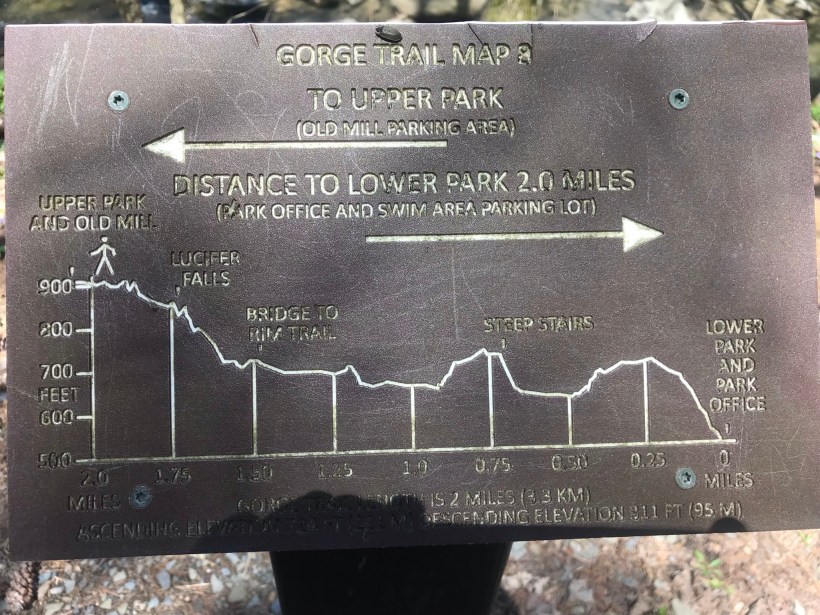
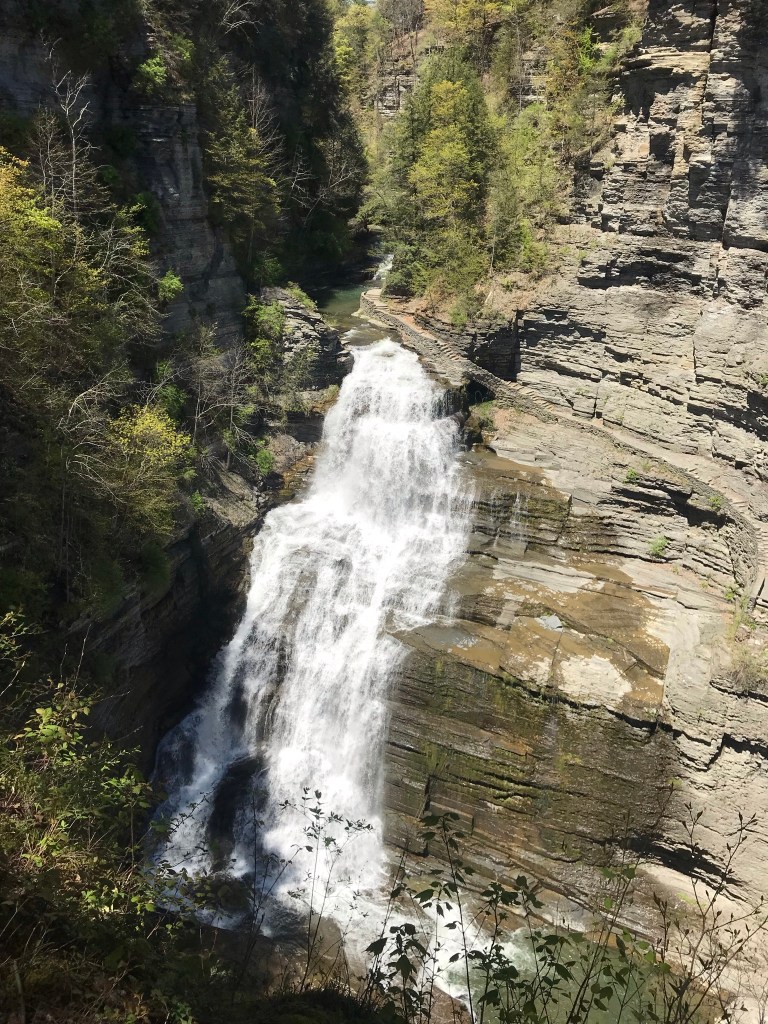
Pam and I headed out to Treman Park for a walk to the Lucifer Falls overlook. The Gorge Trail is not yet open due to the danger of rock falling from the gorge walls — the park maintenance staff needs to survey winter damage and knock down material in danger of falling.

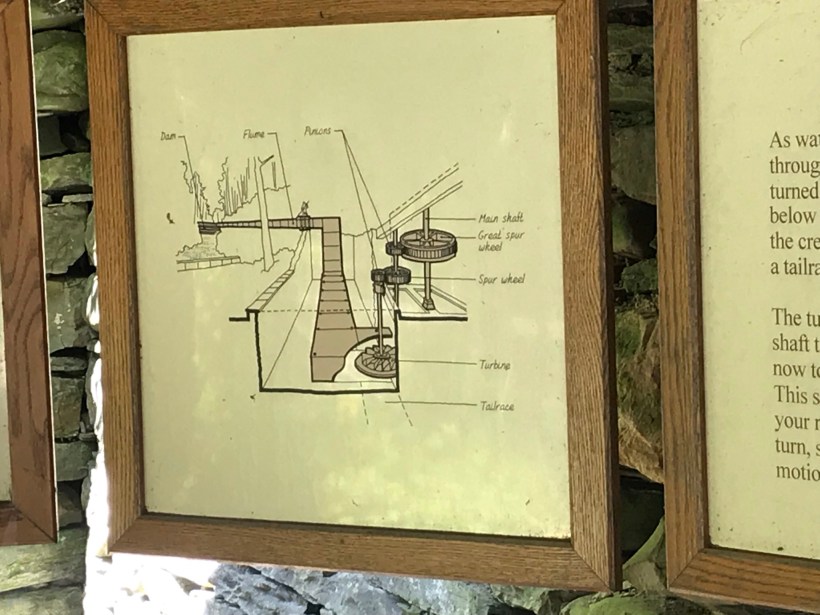
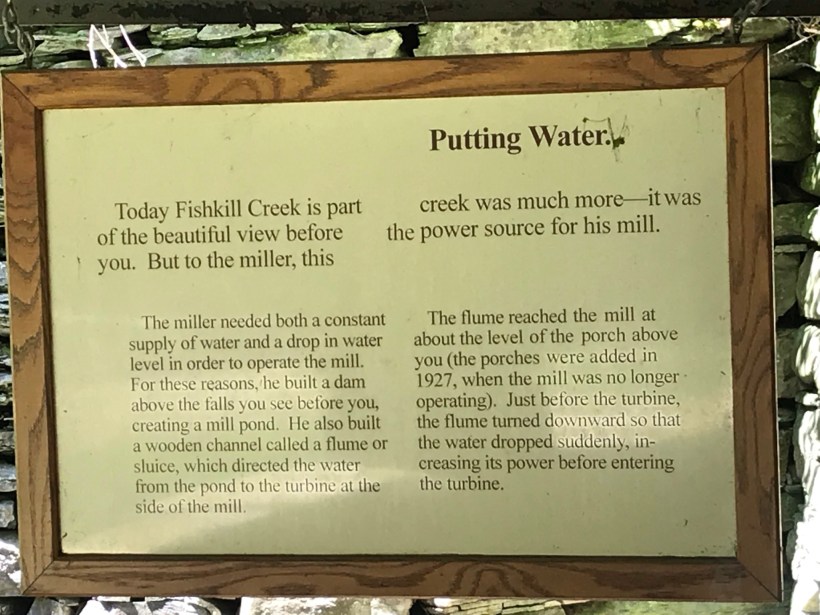
Our first stop was the mill waterfall. This was was directed to the mill stream to power the mill where grain was ground to order.

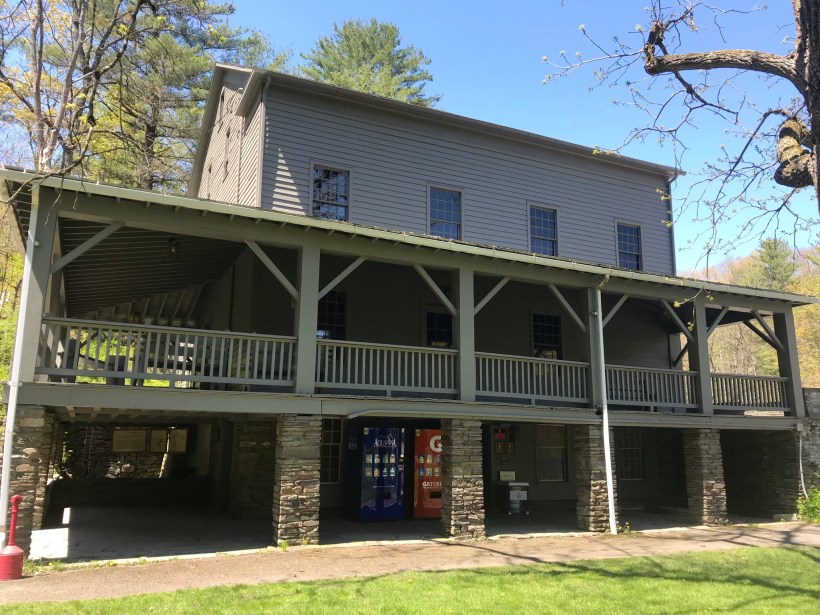
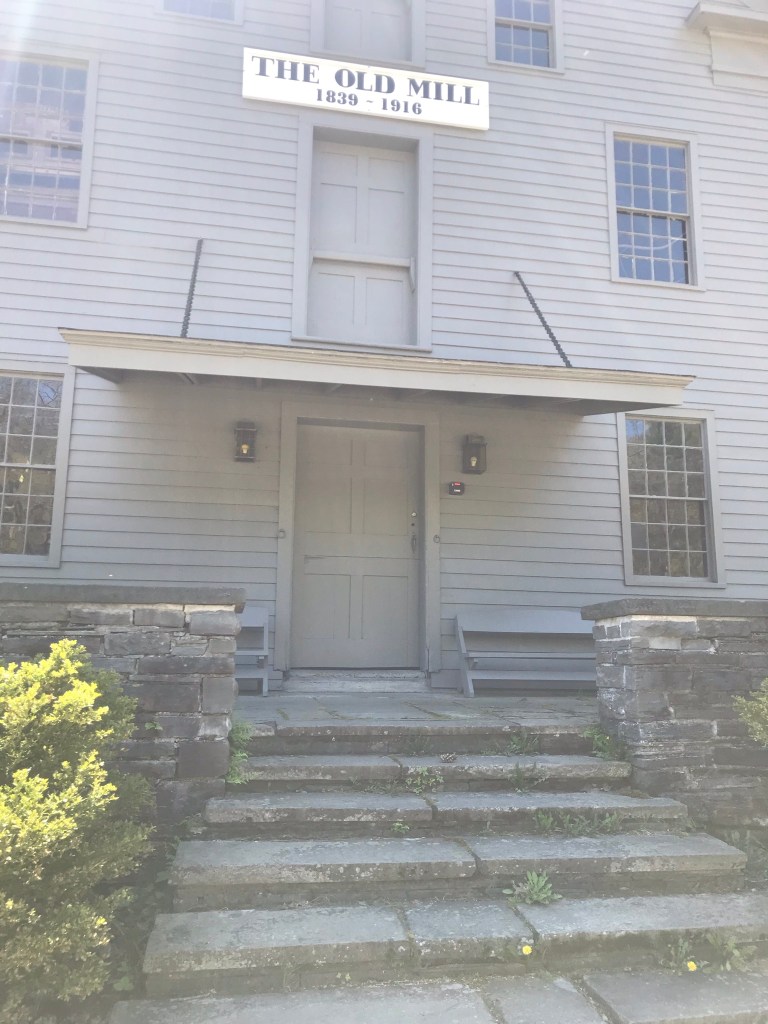
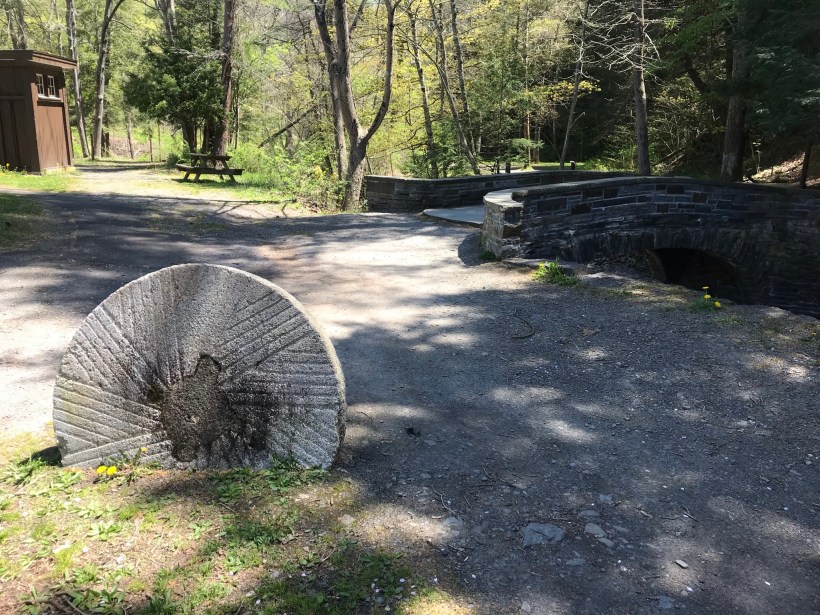
Here is an overview of the Mill, now a museum not yet opened post-Covid. The millstone stands at the start of the foot trails. All media on this post is from my IPhone 7, lightweight equipment for this hike. The automatic upload to ICloud is convenient.

Round trip is four-plus miles, with several hundred feet elevation change. Pam and I discussed a car caravan for our next visit, to support a one-way downhill hike (still plenty of uphill hiking). We need to work up to the round trip after our winter inactivity.

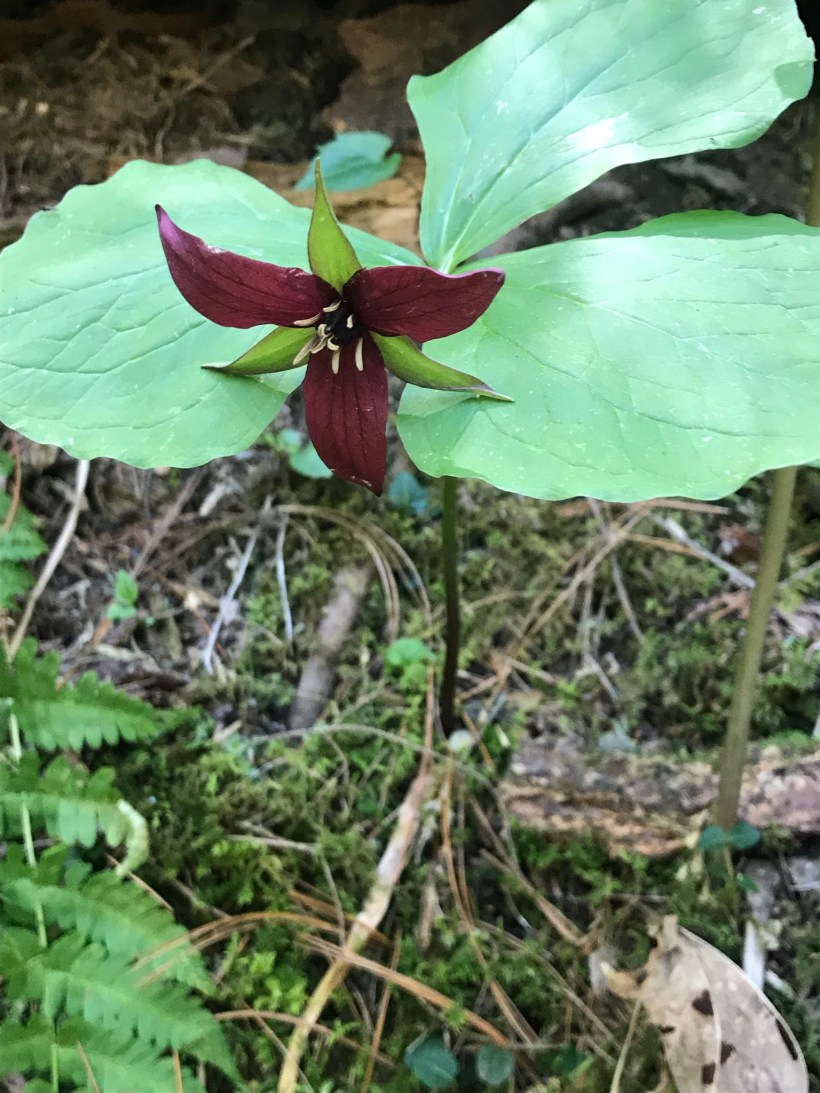
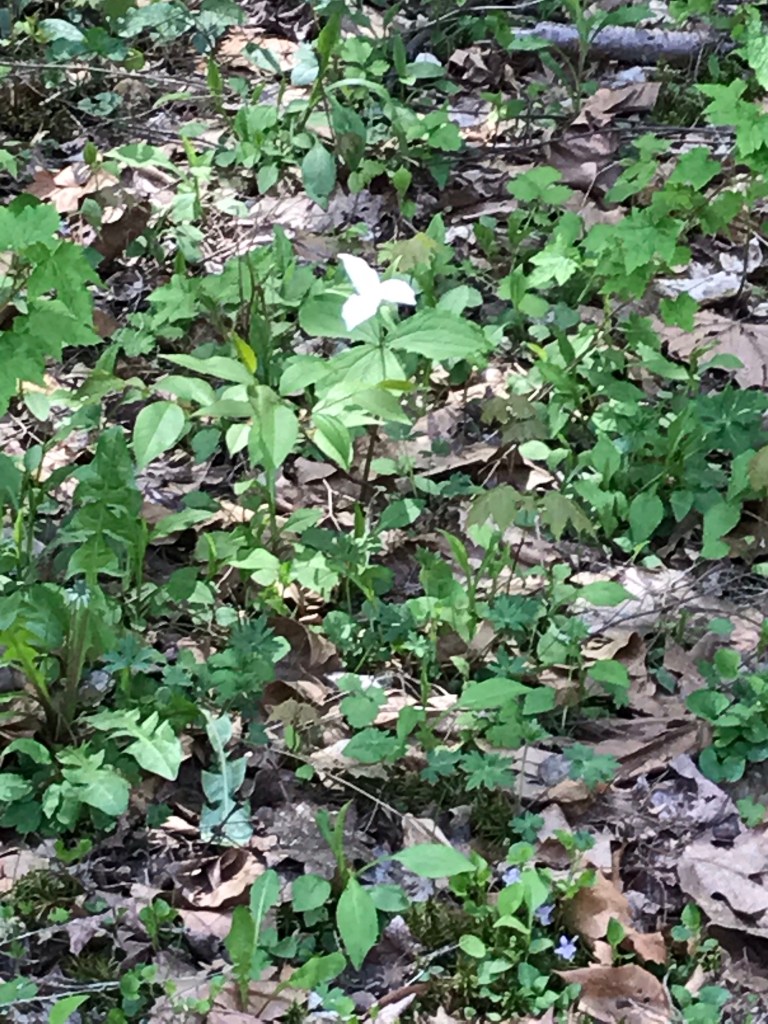
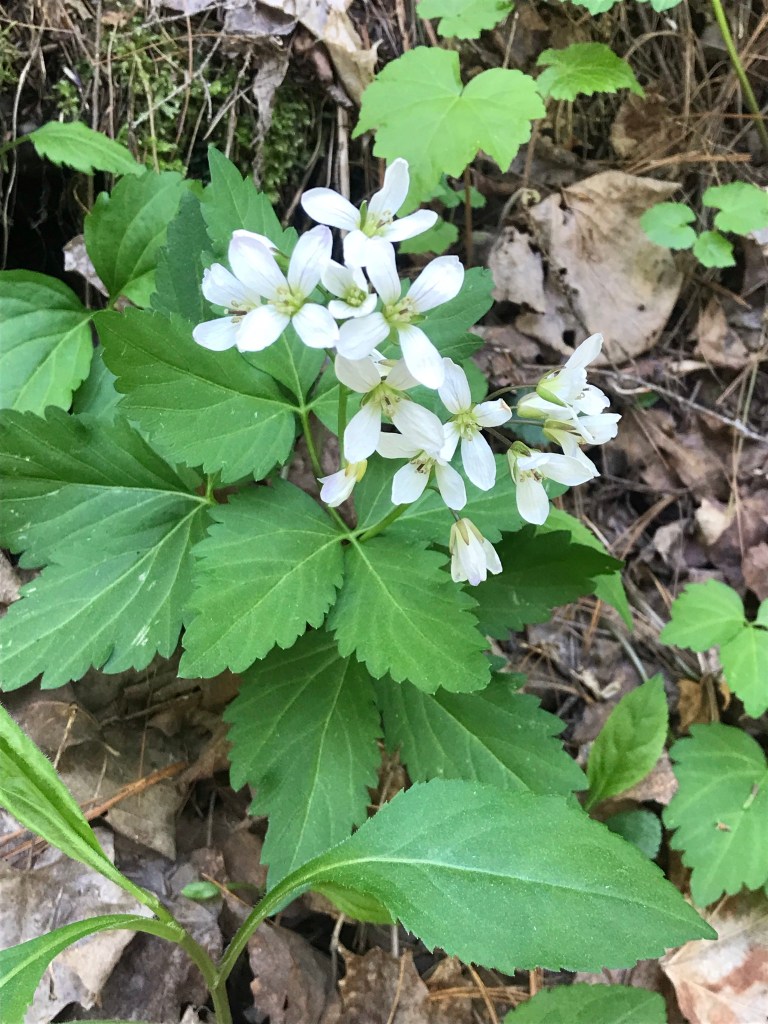
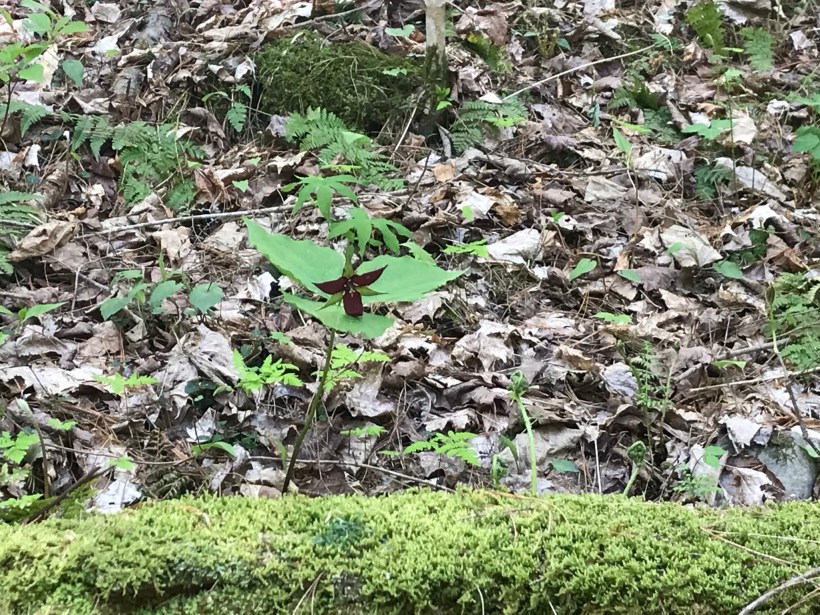
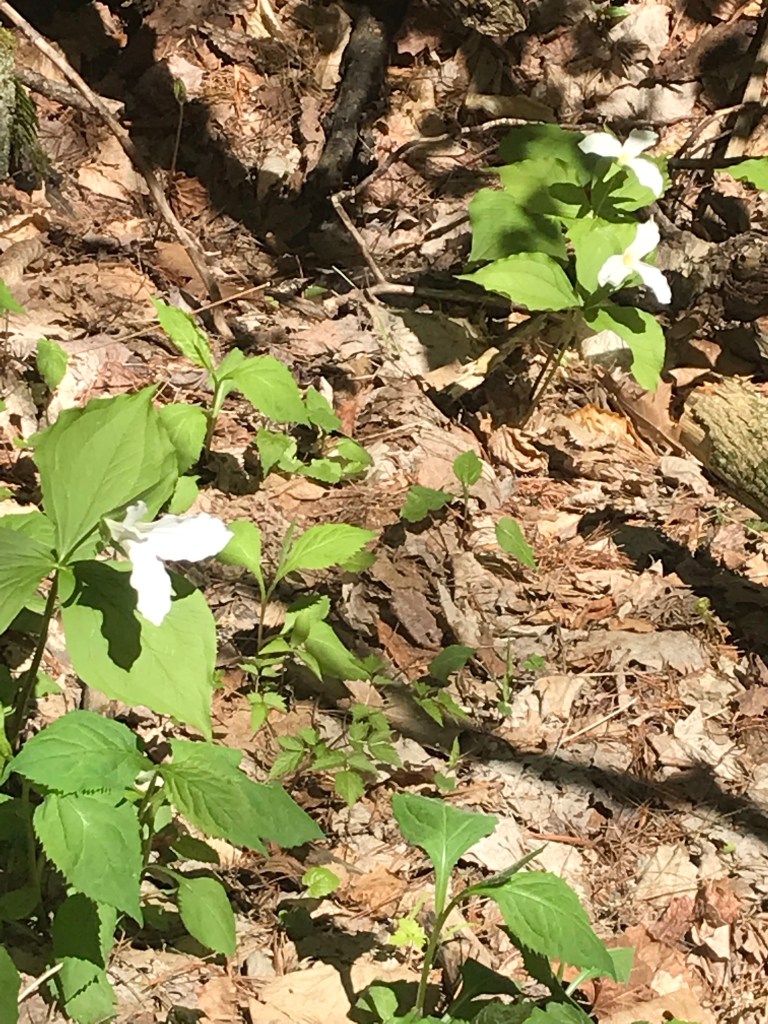
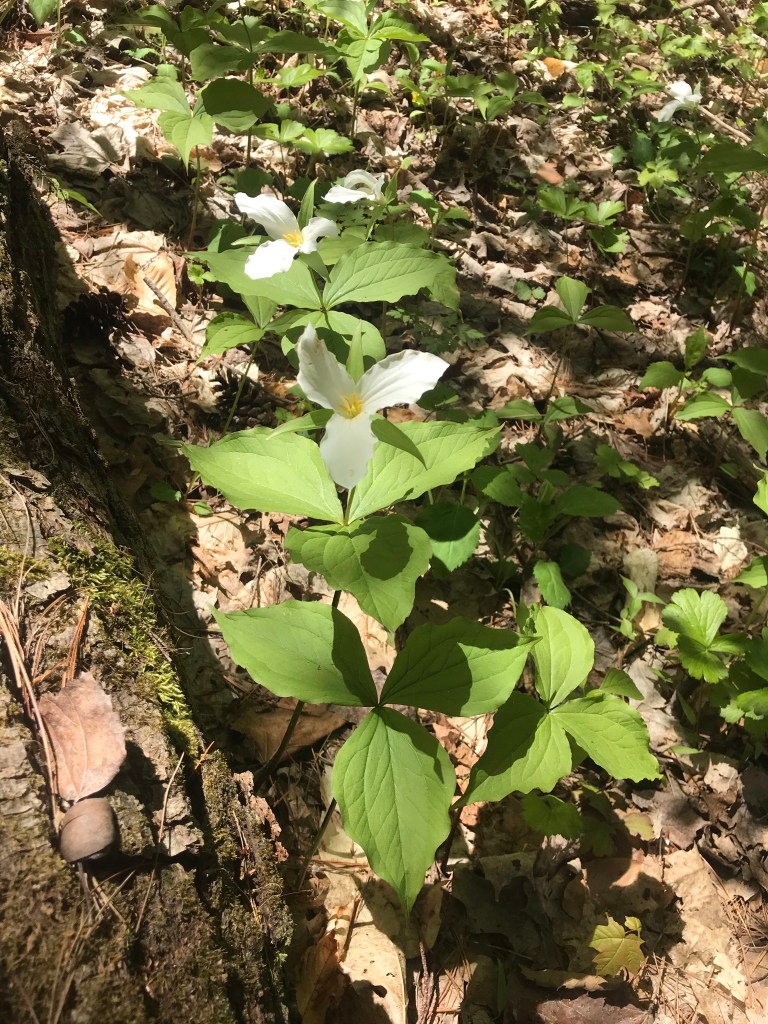
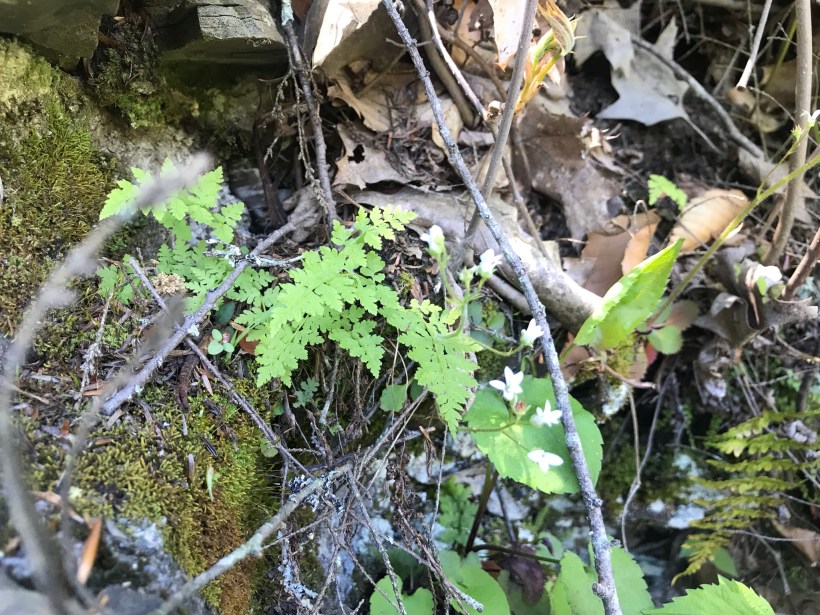
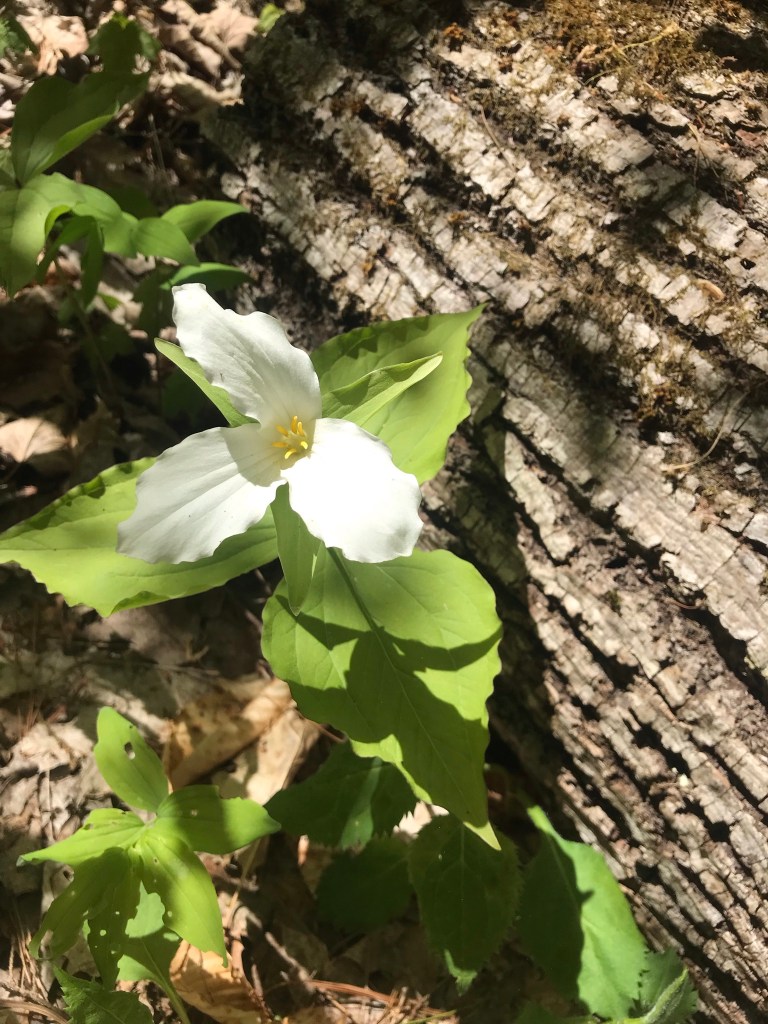
Trillium are in bloom!!

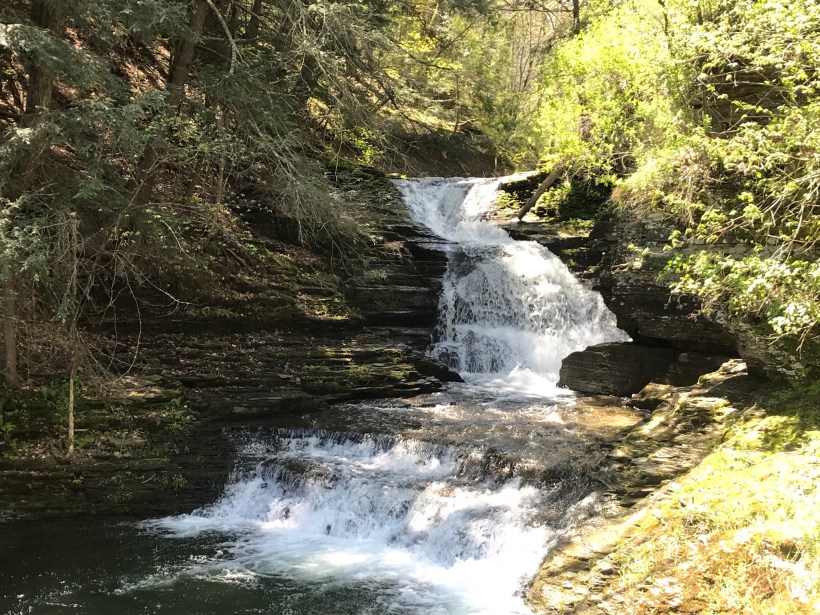
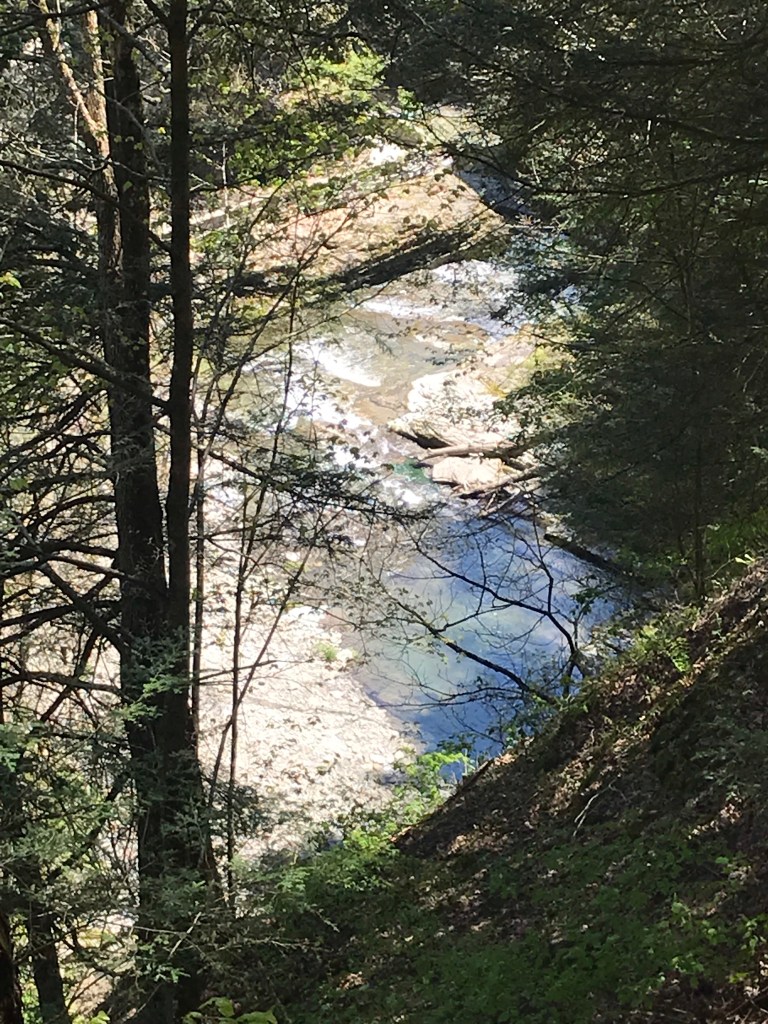
Multiple overlooks into the gorge grace this trail.

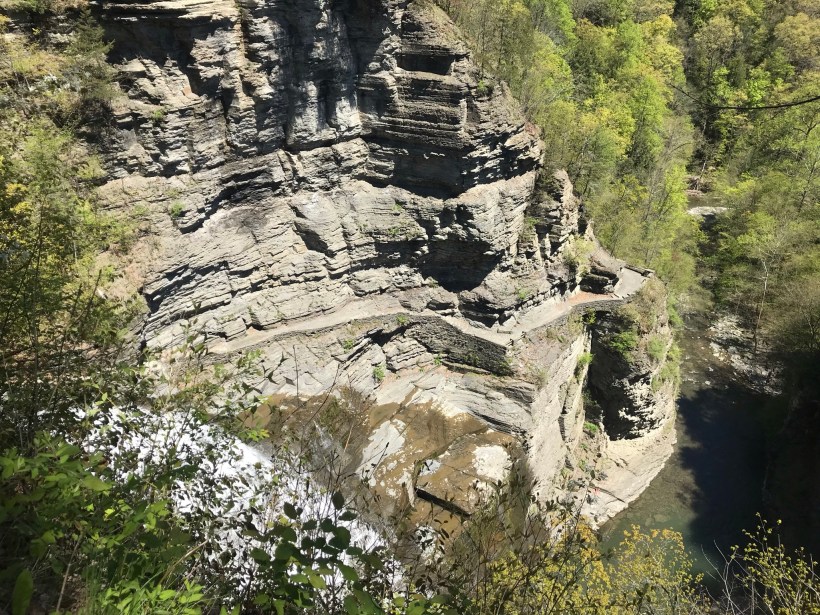
More trillium before we reached the overlook. Lucifer falls and the incredible path etched into the cliff by the Civilian Conservation Corps (Roosevelt’s Tree Army during the Depression).

After the Lucifer Falls overlook is this stupendous view from the top of the Cliff Stairs, 224 steps continue to link to the Gorge and South Rim trails.

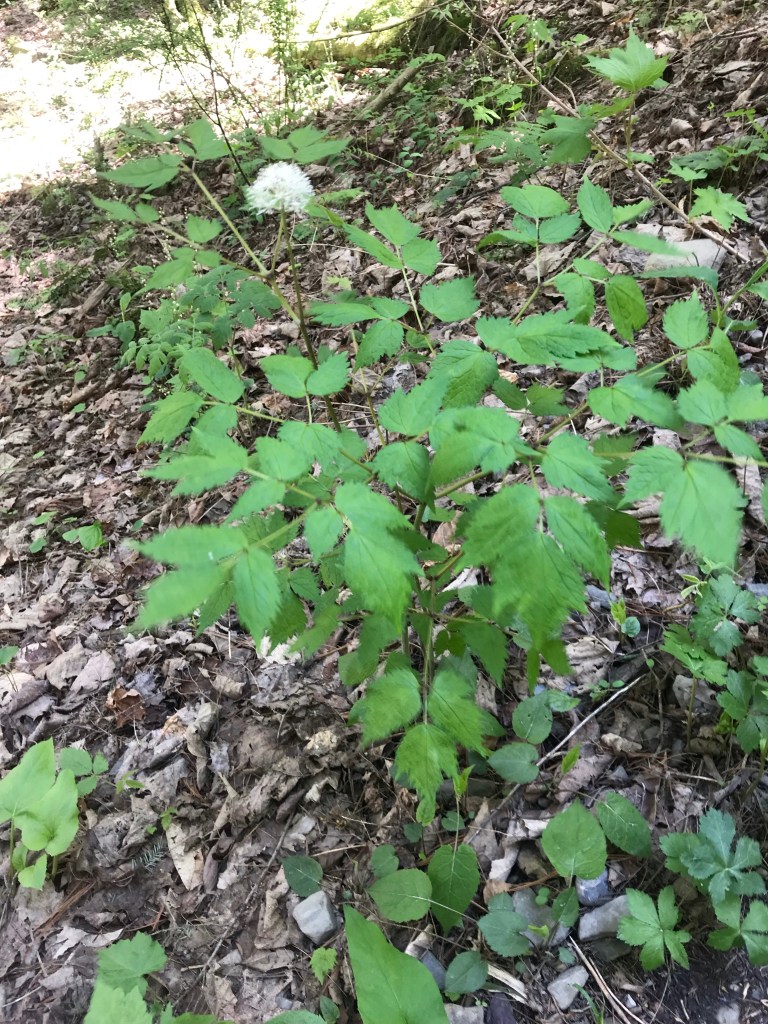
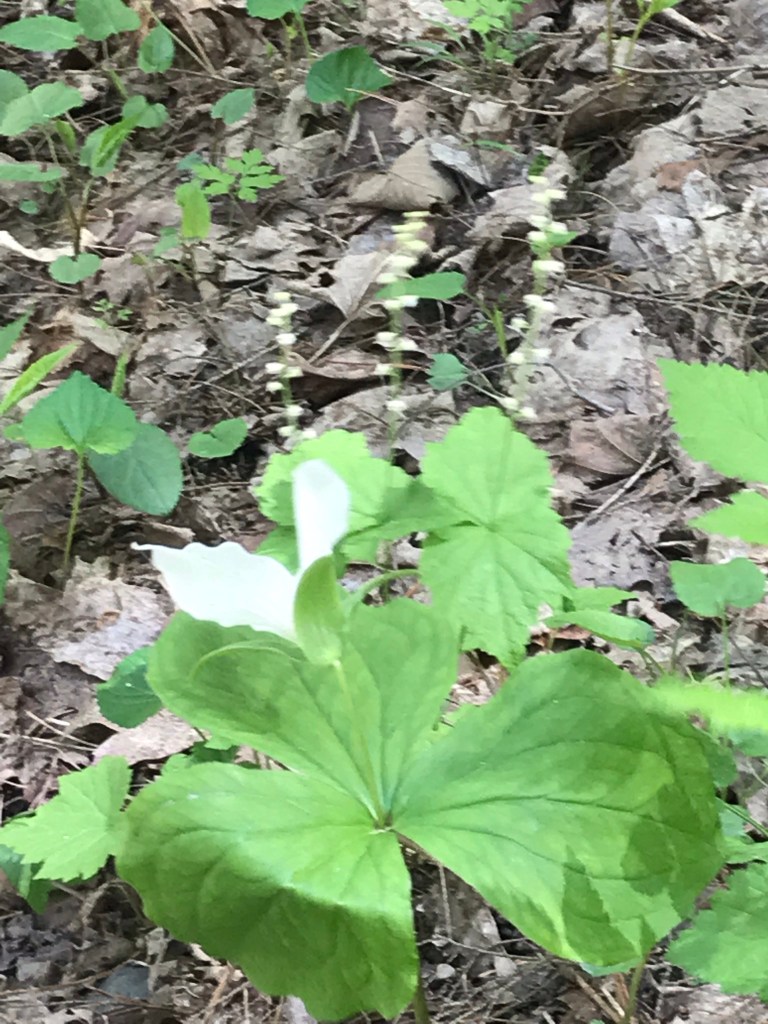
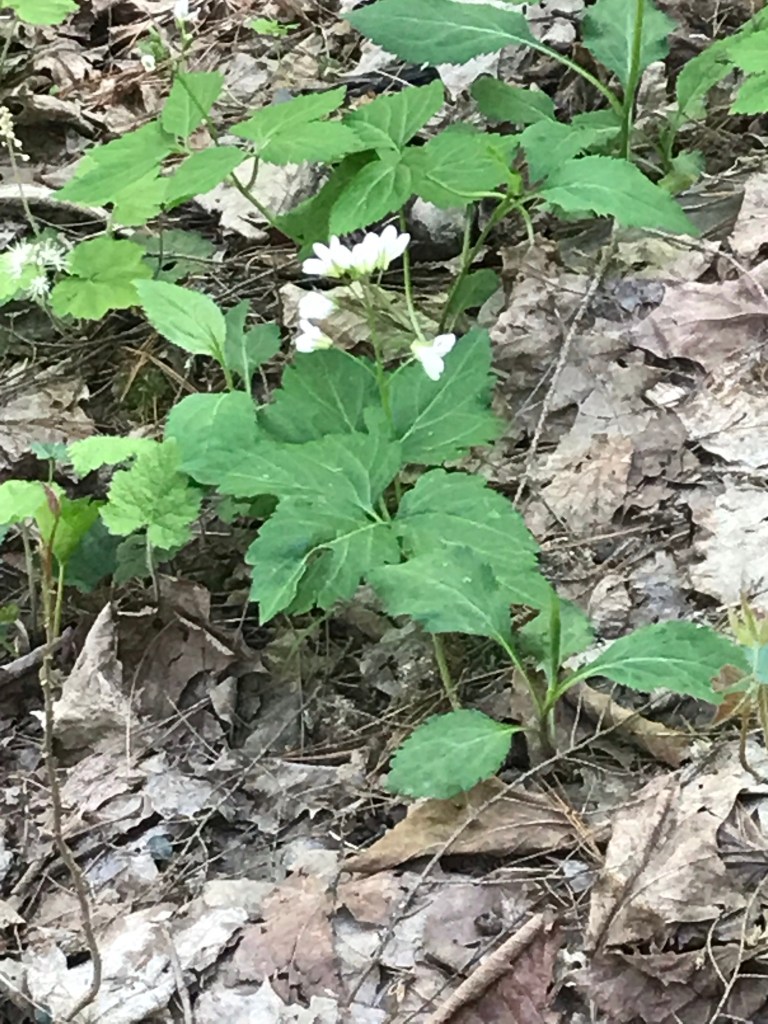
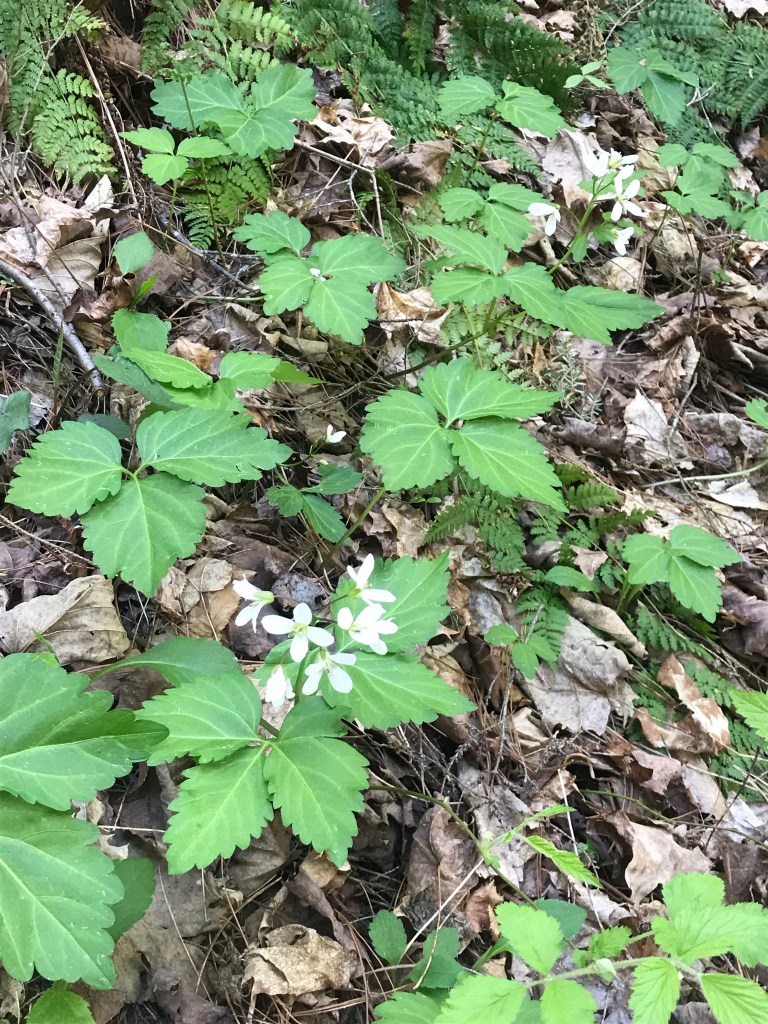
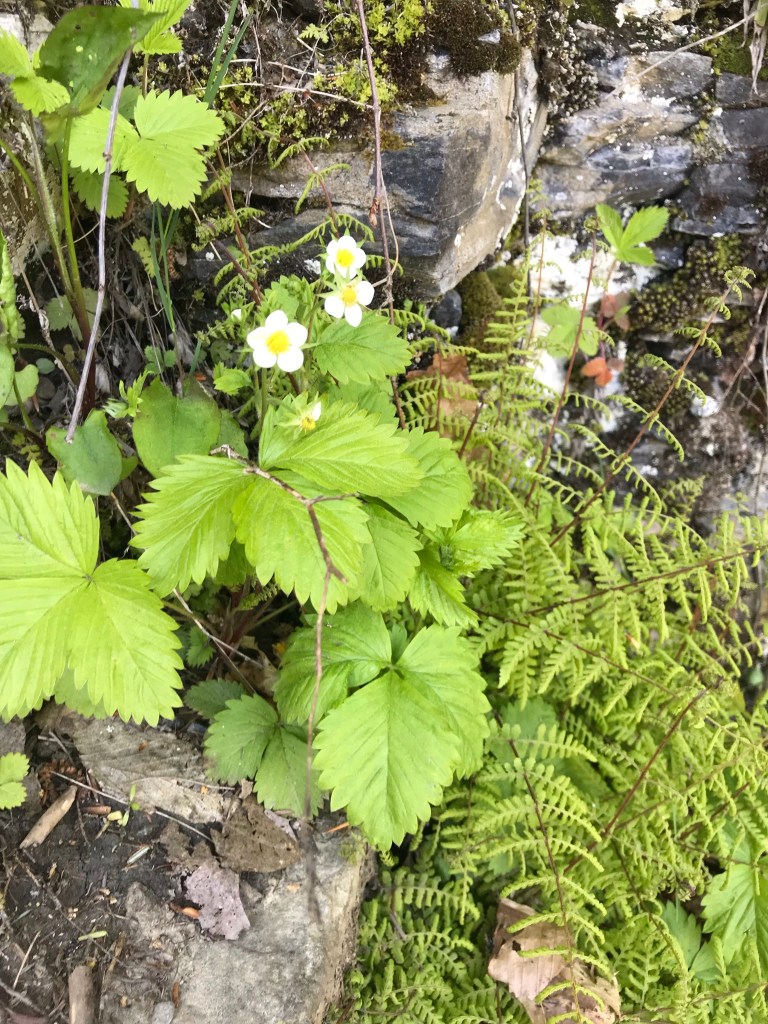
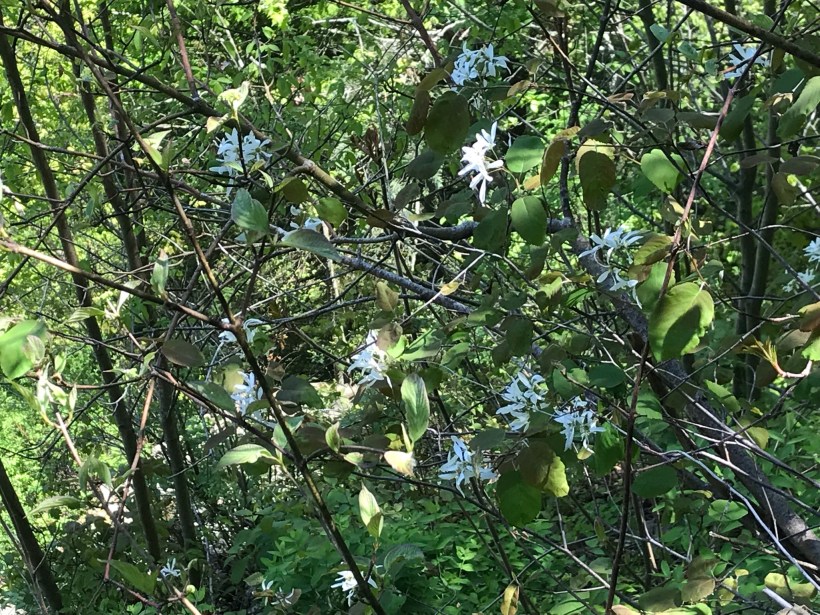
As we lingered on the top steps the flowering plants slowly revealed themselves.

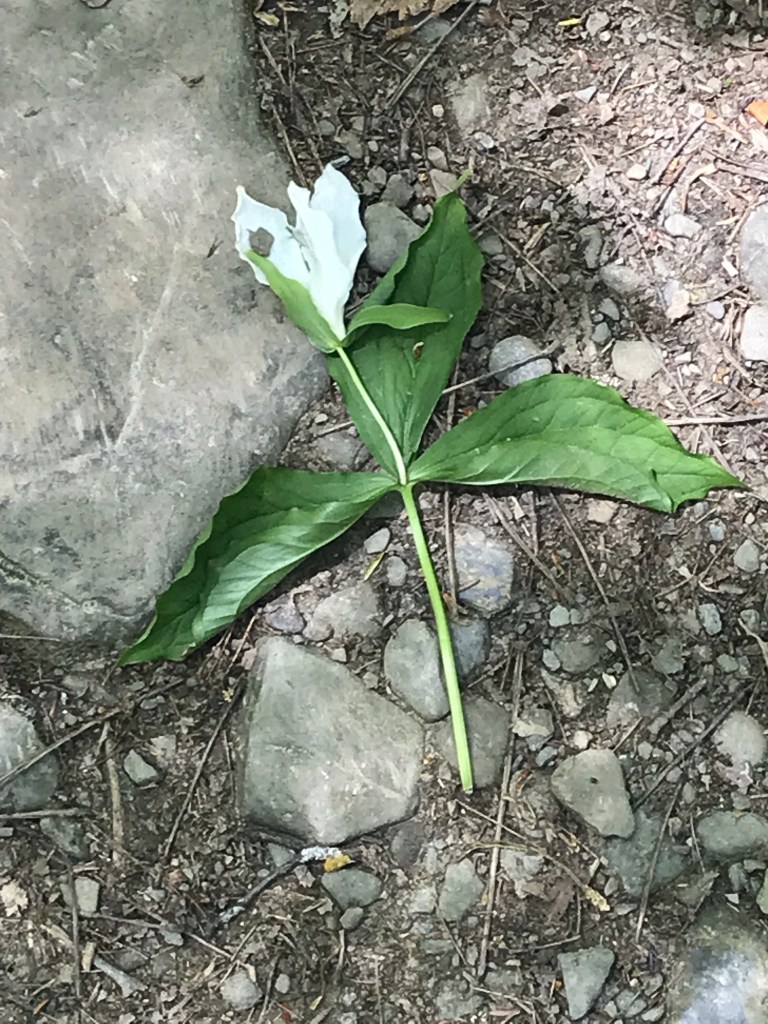
I captured this tragic image on the return trip….a trillium discarded on the trail. Stiff fines await anyone caught doing this.

Copyright 2021 Michael Stephen Wills All Rights Reserved

Attack on the Lusitania

Rescue operations and memorials

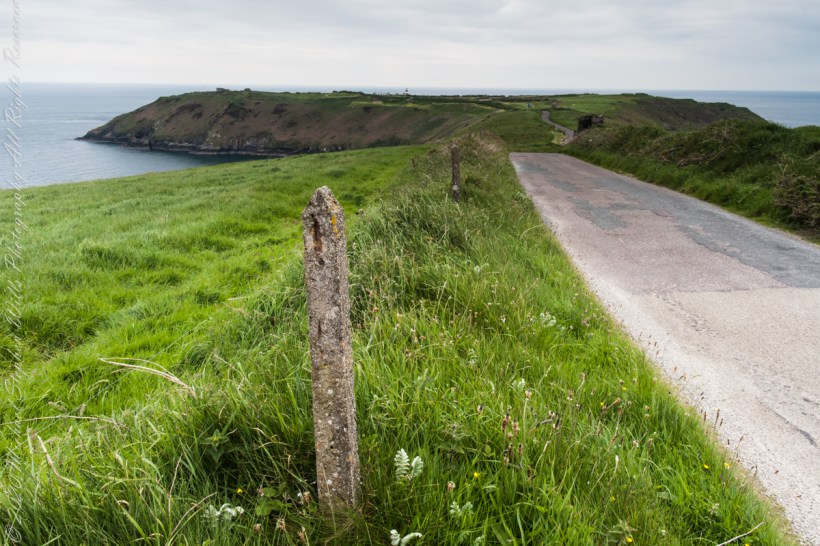
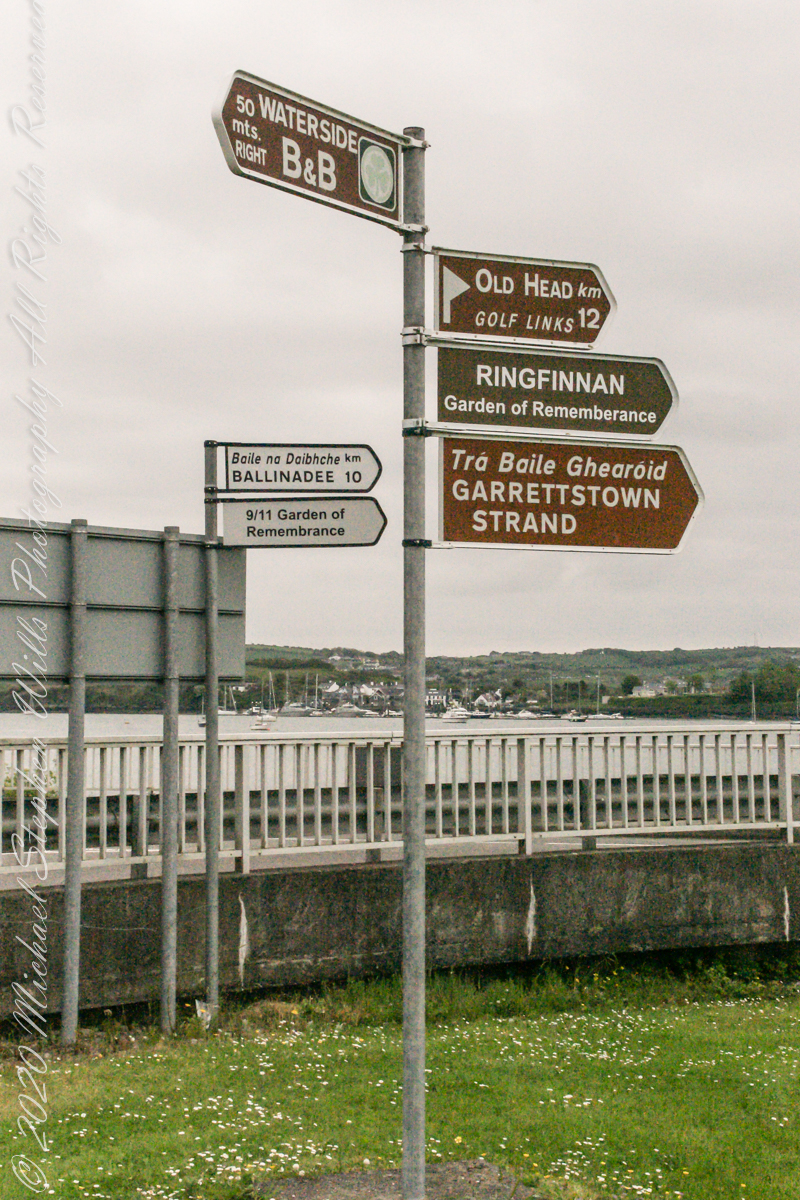
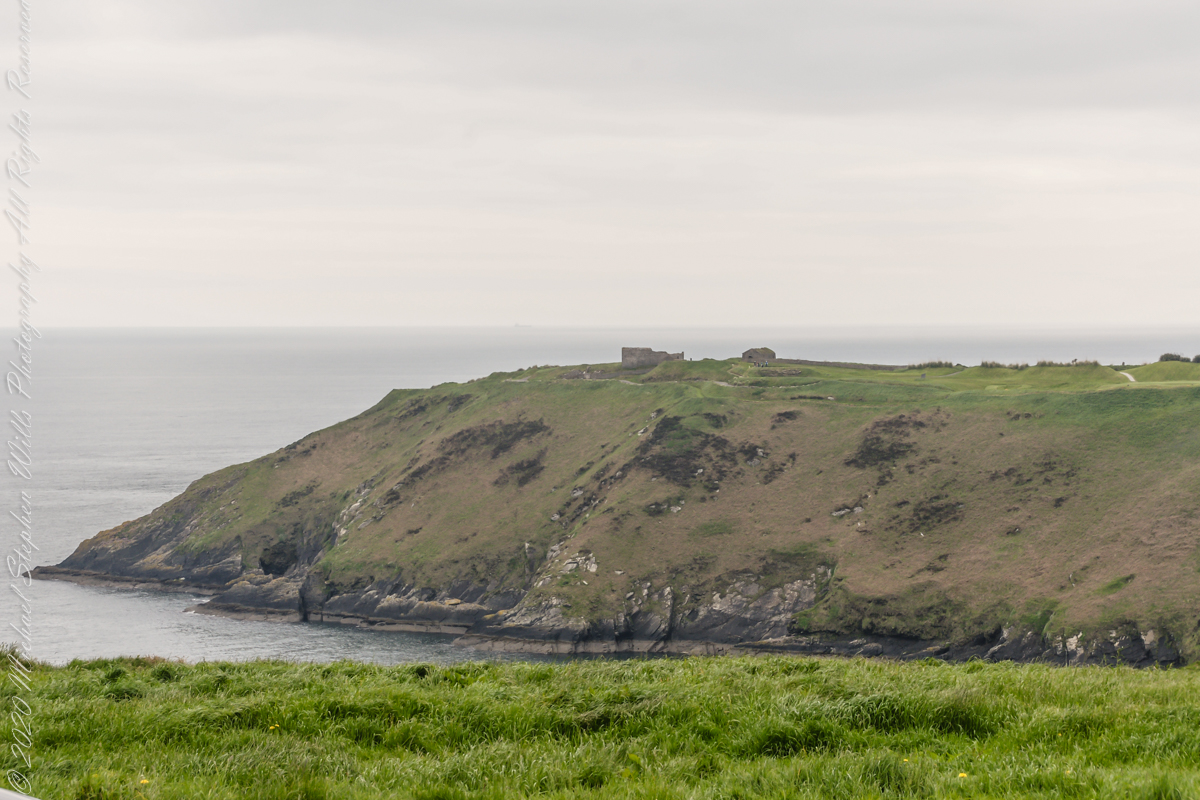
Our day of touring Kinsale and environs, the last day of May 2014, continues with our morning visit to the “Old Head of Kinsale.” Head is short for headland, a narrow strip of land projecting into the sea.

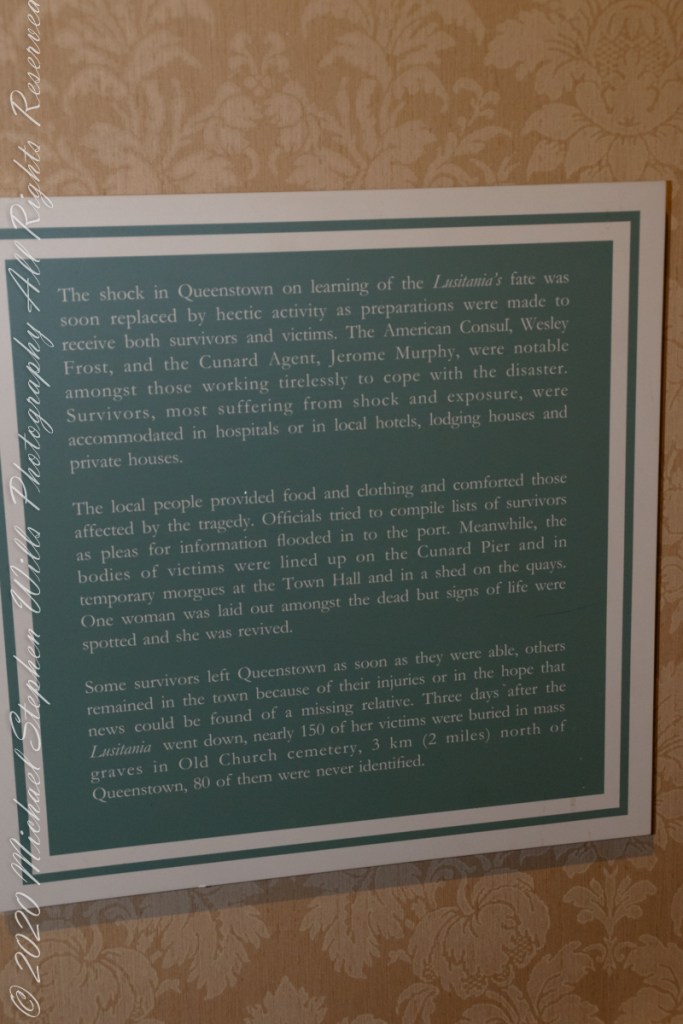
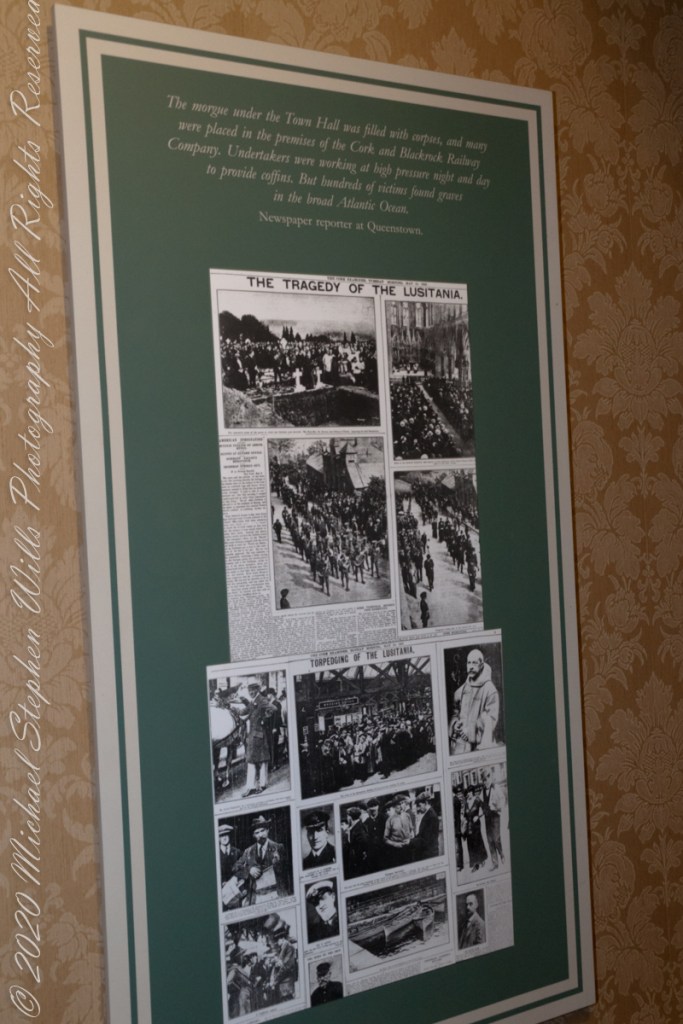
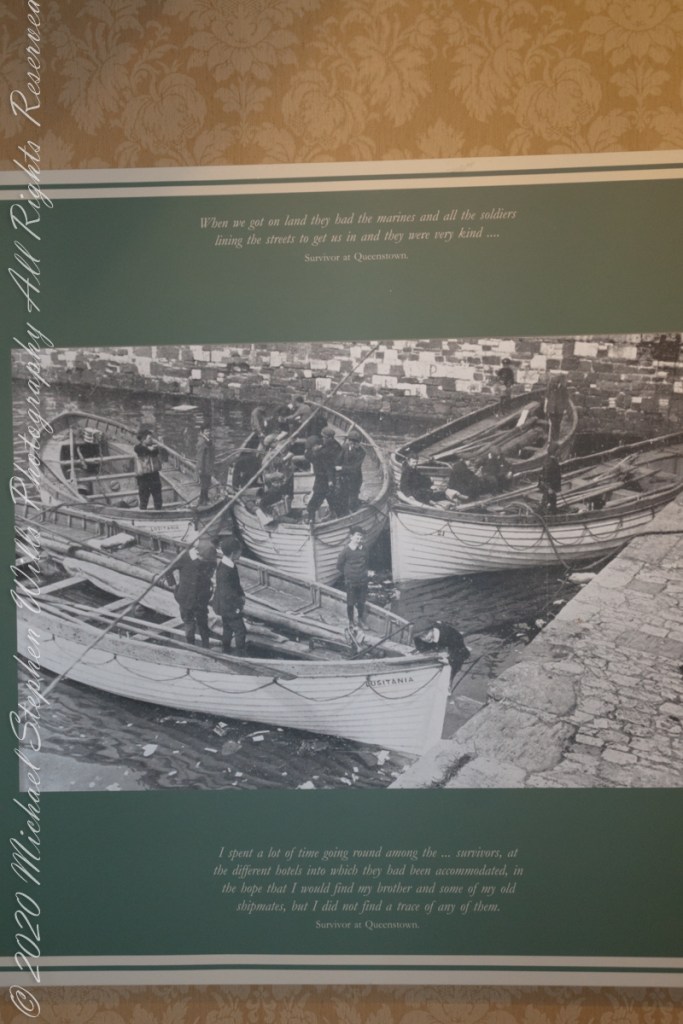
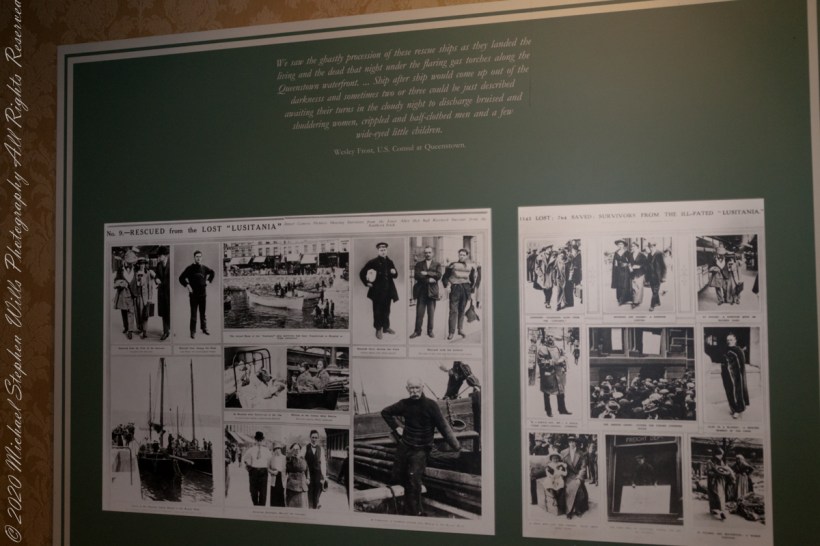
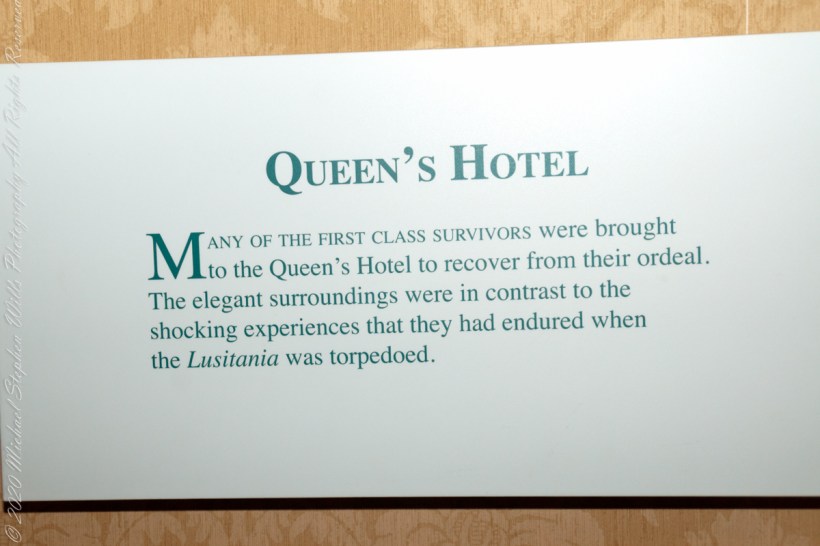
On May 7th, 1915 the Cunard liner Lusitania was torpedoed 16 km (10 miles) off the Old Head of Kinsale, 40 km (25 miles) west of Queenstown. Of the 1,959 people on board, 1,198 died. Those who survived were brought to Queenstown and Kinsale by rescue vessels and cared for in local hotels and hospitals. Many of those who died were buried at Old Church cemetery, 3 km (2 miles) north of Queenstown. The first class Queen’s Hotel cared for some of the survivors. The elegant Edwardian atmosphere of the hotel was shattered by the horrific news of the loss of the ship. This is the setting for the story of Queenstown’s role in the Lusitania disaster. –text from Cobh Heritage Center poster, see image below.

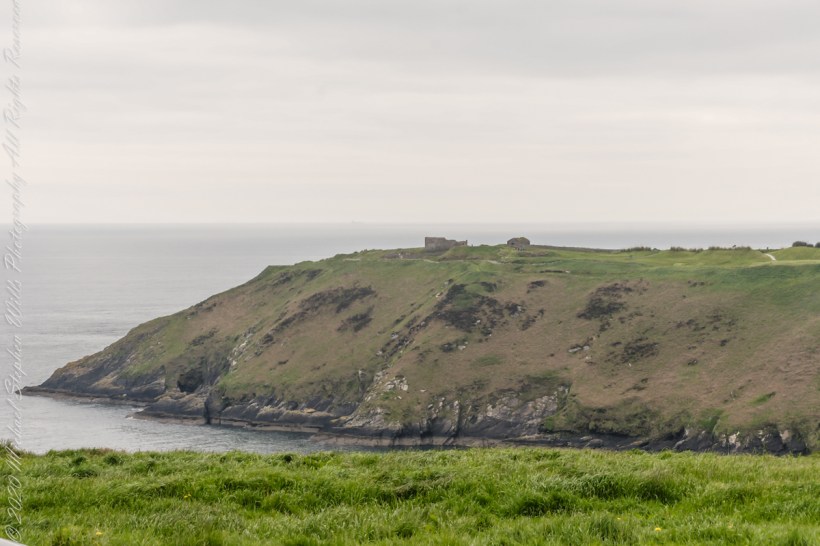
The Old Head is notable, in the contest of the Lusitania attack, for being the land closest to the incident. Cobh, then named “Queenstown”, was the focus of rescue operations. See text below, from a display of the Cobh Heritage Museum.

The Kinsale tower is just over nine meters high, with walls up to 80 cm thick. Records show a signal crew was in place in 1804 and the tower finished the following year, though severely affected by dampness. When Napoleon was defeated by Wellingtons forces at Waterloo, 1815. With the diminished threat these expensive installations were neglected. The 1899 Ordnance Survey map lists the site as being in ruins. During our 2014 visit the local community was renovating the tower and the work appears complete sometime before 2021.

I did not see and/or recall much emphasis in the museum for pillorying Germany, after all a German U-boat was responsible. Curious, I did a Wikipedia search and found this text. The topic of Ireland, Germany and World War I is complicated.

On the afternoon of 7 May, a German U-boat torpedoed Lusitania 11 miles (18 km) off the southern coast of Ireland inside the declared war zone. A second internal explosion sank her in 18 minutes, killing 1,198 passengers and crew. The German government justified treating Lusitania as a naval vessel because she was carrying 173 tons of war munitions and ammunition, making her a legitimate military target, and they argued that British merchant ships had violated the cruiser rules from the very beginning of the war. The internationally recognized cruiser rules were obsolete by 1915; it had become more dangerous for submarines to surface and give warning with the introduction of Q-ships in 1915 by the Royal Navy, which were armed with concealed deck guns. The Germans argued that Lusitania was regularly transporting “war munitions”; she operated under the control of the Admiralty; she could be converted into an armed auxiliary cruiser to join the war; her identity had been disguised; and she flew no flags. They claimed that she was a non-neutral vessel in a declared war zone, with orders to evade capture and ram challenging submarines.
However, the ship was not armed for battle and was carrying thousands of civilian passengers, and the British government accused the Germans of breaching the cruiser rules. The sinking caused a storm of protest in the United States because 128 American citizens were among the dead. The sinking shifted public opinion in the United States against Germany and was one of the factors in the declaration of war nearly two years later. After the First World War, successive British governments maintained that there were no munitions on board Lusitania, and the Germans were not justified in treating the ship as a naval vessel. In 1982, the head of the Foreign Office’s American department finally admitted that, although no weapons were shipped, there is a large amount of ammunition in the wreck, some of which is highly dangerous and poses a safety risk to salvage teams.

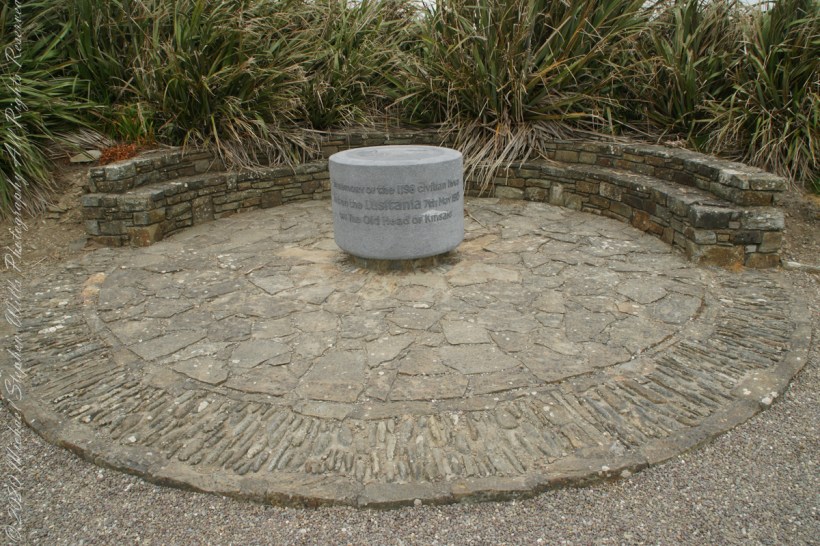
The original memorial to the Lusitania was unveiled on the 80th anniversary of the May 7th, 1915 sinking (May 7, 1995), Old Head of Kinsale, County Cork Ireland. The imemorial nscription reads “In memory of the 1198 civilian lives lost on the Lusitania 7th May 1915 off the Old Head of Kinsale.”
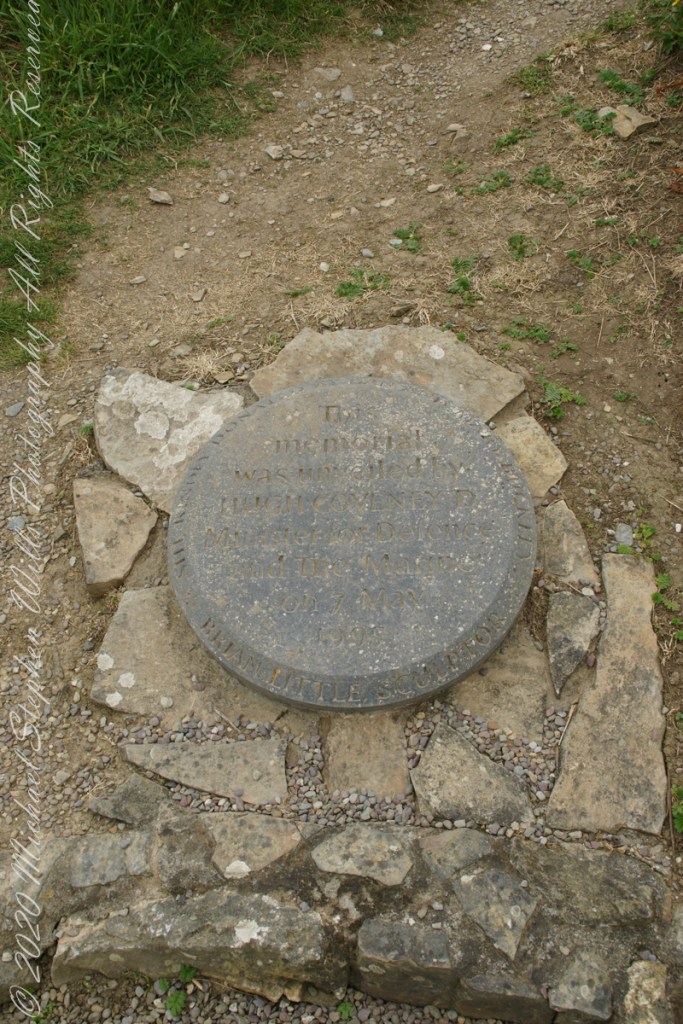
The inscription of the commemoration plaque accompanying the memorial reads, “This memorial was unveiled by Hugh Coveney D Minister of Defense and The Marine on 7 May 1995.” Around the edge of the medallion reads, “Brian Little Sculptor” “This (cannot read) donated by Lan and Mary Buckley”

Reference
Wikipedia, “RMS Lusitania.”
Copyright 2021 Michael Stephen Wills All Rights Reserved

A Peaceful Day at Pine Creek

Explore a remote location of the eastern Superstition Wilderness

….continued from the chapter “Two Meetings.”

The spring gales persisted through my late afternoon arrival in Pine Creek, into the night and next morning. Protected from the west wind by the rising land, the tent was not buffeted like I described in the chapter “A Dry Piece of Paradise.” The song of soughing pines was my last impression of the evening and the first of the next morning.

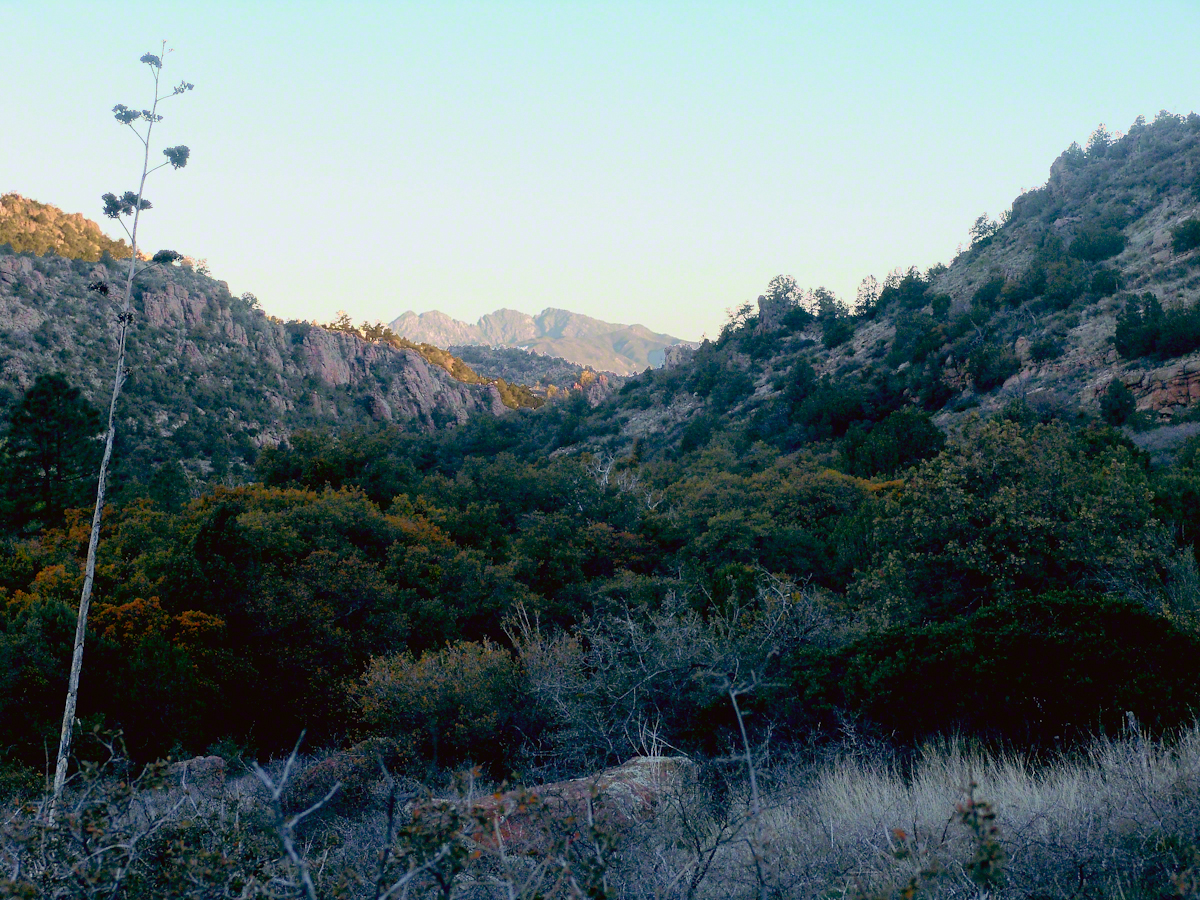
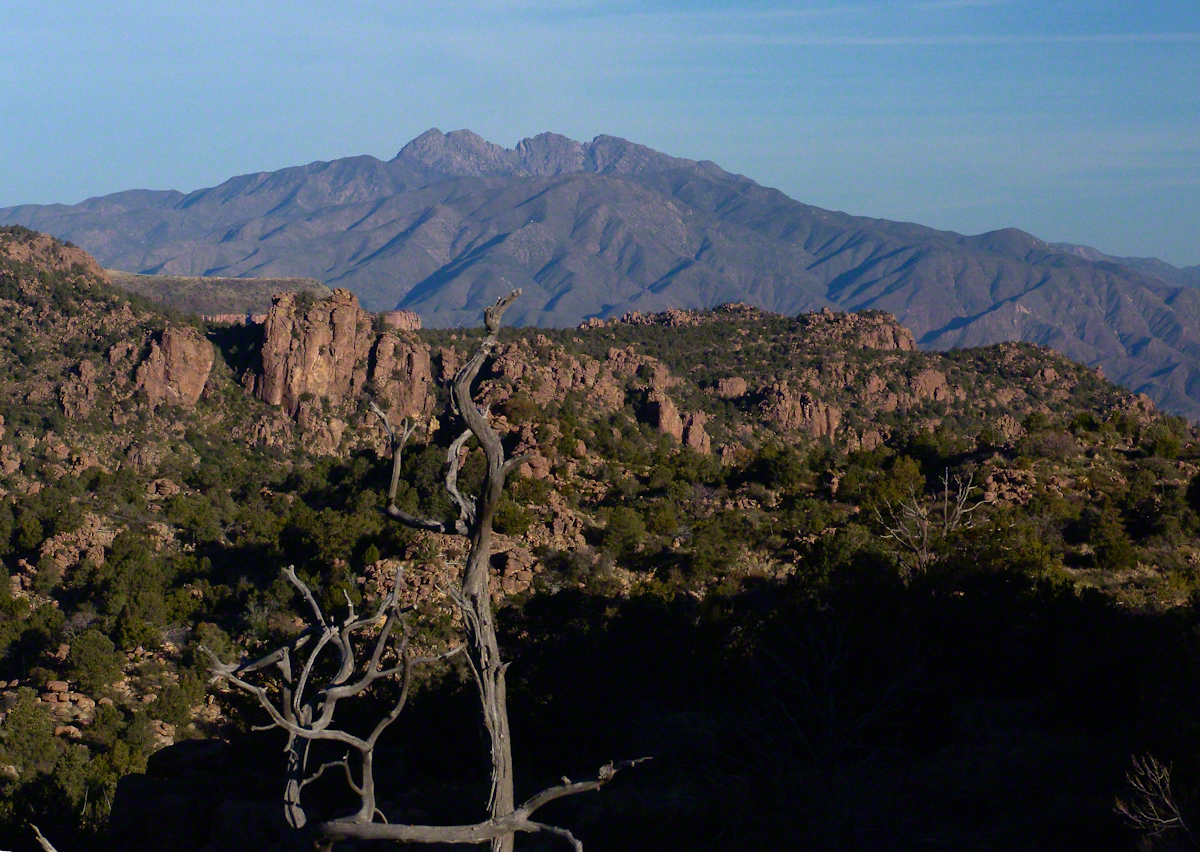
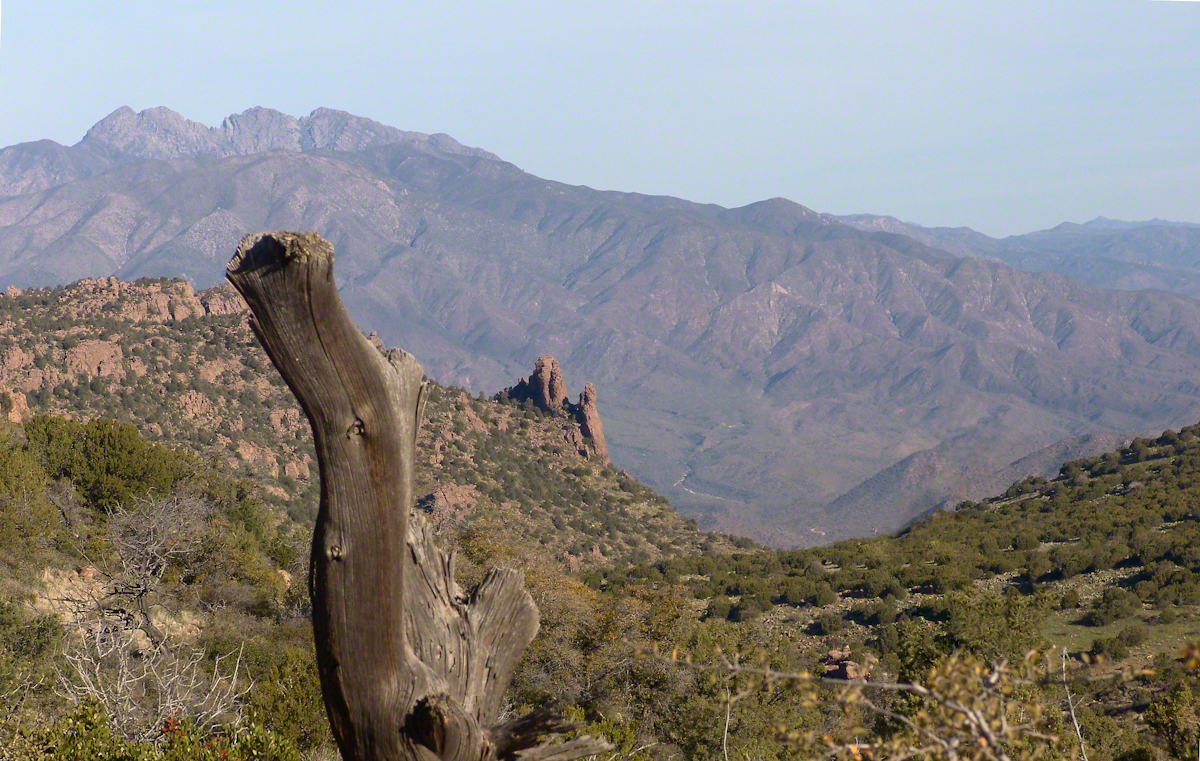
Where the Arizona trail crosses, Pine Creek flows at 4,600 foot elevation through a canyon of broadly sloping sides. The flow originates at the foot of Mound Mountain to the southwest, at 6,253 feet the highest elevation in the Superstitions. There are 5,500 foot peaks to the east and west. The land falls away to the north giving great views of the Four Peaks Wilderness.

I chose a flat site to camp above the creek among Arizona White Oak, Arizona Sycamore, Ponderosa Pine and Manzanita. Of these, it’s Manzanita fruit for which the bears come in the summer. Manzanita thickets made approach to the camp site difficult from all directions but the path. Bear sign was thick among this growth. Go to my chapter, “Racing the Sun,” to see the red barked Manzanita and pink blossoms from which grow tiny green fruits that ripen summertime into a bright red, like tiny apples. Indians used this bland tasting fruit containing five hard seeds for food and a cider beverage.

Well before dawn I grabbed warm clothes, hat, camera to head out for a full day of leisure.

On a shallow rise above Pine Creek I took the two shots of agave (Century Plant) stalks in dawn light. These start the chapter, “A Dry Piece of Paradise.” One dry agave flower is to the left in this North view, looking down the creek not far from the creek crossing.

Click any photograph for a larger view
North View from Pine Creek, early morning

In the photograph notice how the canyon narrows as the creek flows north, the walls rising above it for hundreds of feet.

When I climbed about 200 feet above the creek to a ledge that provided great views, the protective canyon walls fell away and wind gusts threatened to up end the light tripod. It was necessary to anchor it with the daypack and I tied down my hat as well.
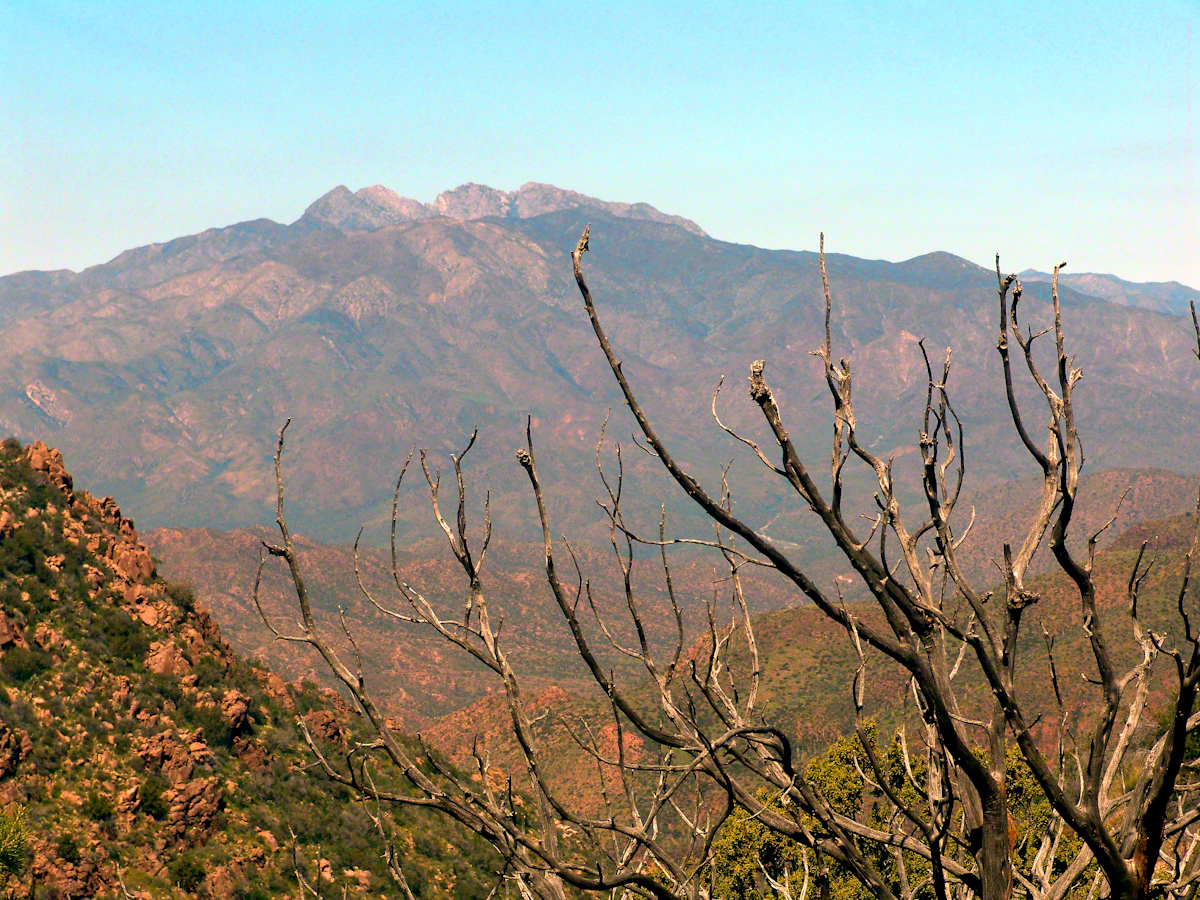
Shadows of night lie below, dominated by Four Peaks Wilderness. A unique long flat ridge is behind the near dramatic ridge above Pine Creek. This view leads me to daydreams. The long ridge is clearly visible in two photographs titled “Nameless Canyon in the Dawn” and “Nameless Canyon Morning” of my post “A Dry Piece of Paradise.”  A view from the west is available in my post “Racing the Sun.” Look at the photograph captioned, “Overview of my path to the Nameless Canyon behind Two Bar Mountain,” the flat ridge is just above the shadow of Castle Dome. The view from that spot must be incredible across the lower Reavis Creek valley. From here it is a day trip 4+ mile roundtrip bushwhack over the cliffs above Pine Creek.

North View from Pine Creek

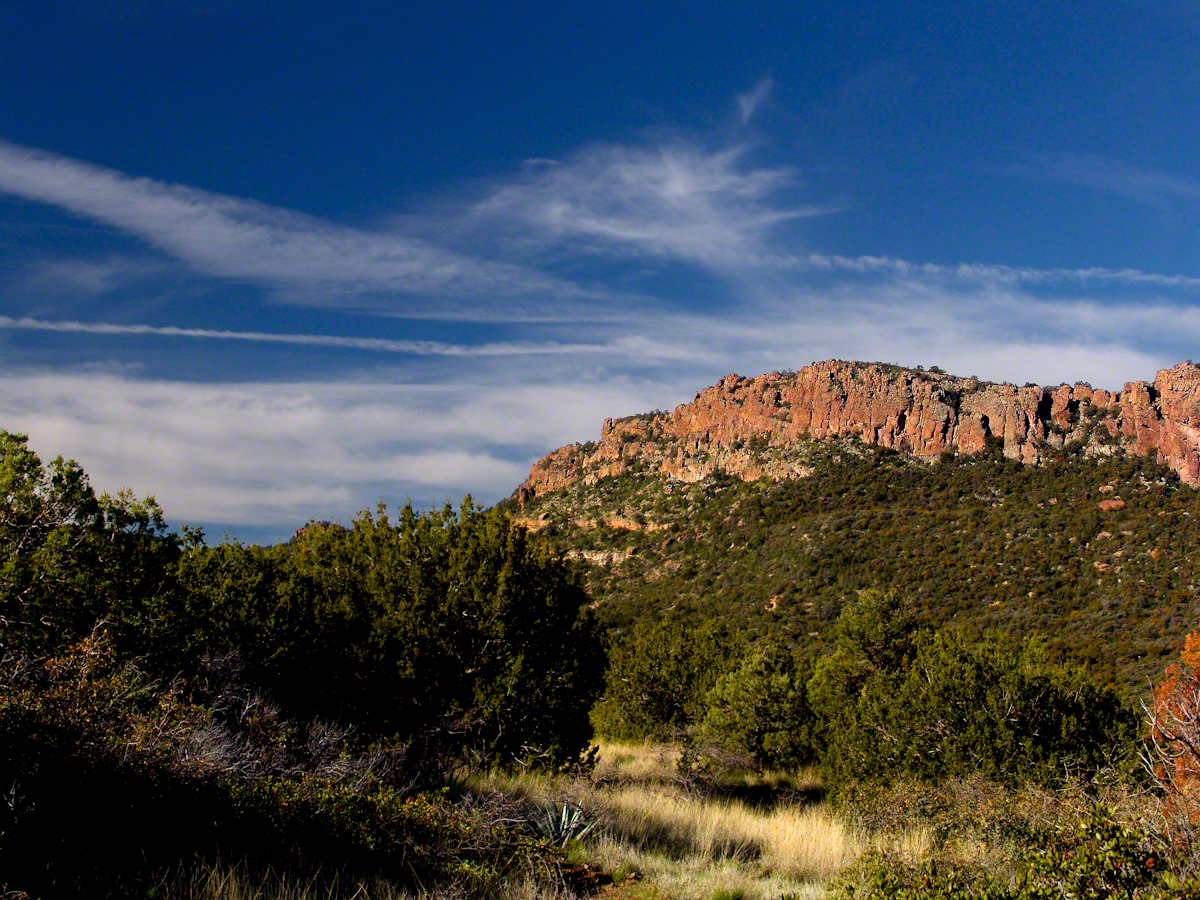
Those evergreens in the following photograph are Oneseed Juniper (“Shagbark Juniper”) of the three species common to the Superstitions, this has this spherical, bushy appearance. Here the elevation is just high enough for junipers because there are none down below. The trail crosses Pine Creek to ascend the lower slopes of these red cliffs, following it around to the west and over to the next valley, Reavis Ranch, a distance of 3.5 miles. In my “Two Meetings” blog is a sweeping view of Pine Creek Canyon, from the southern approach.

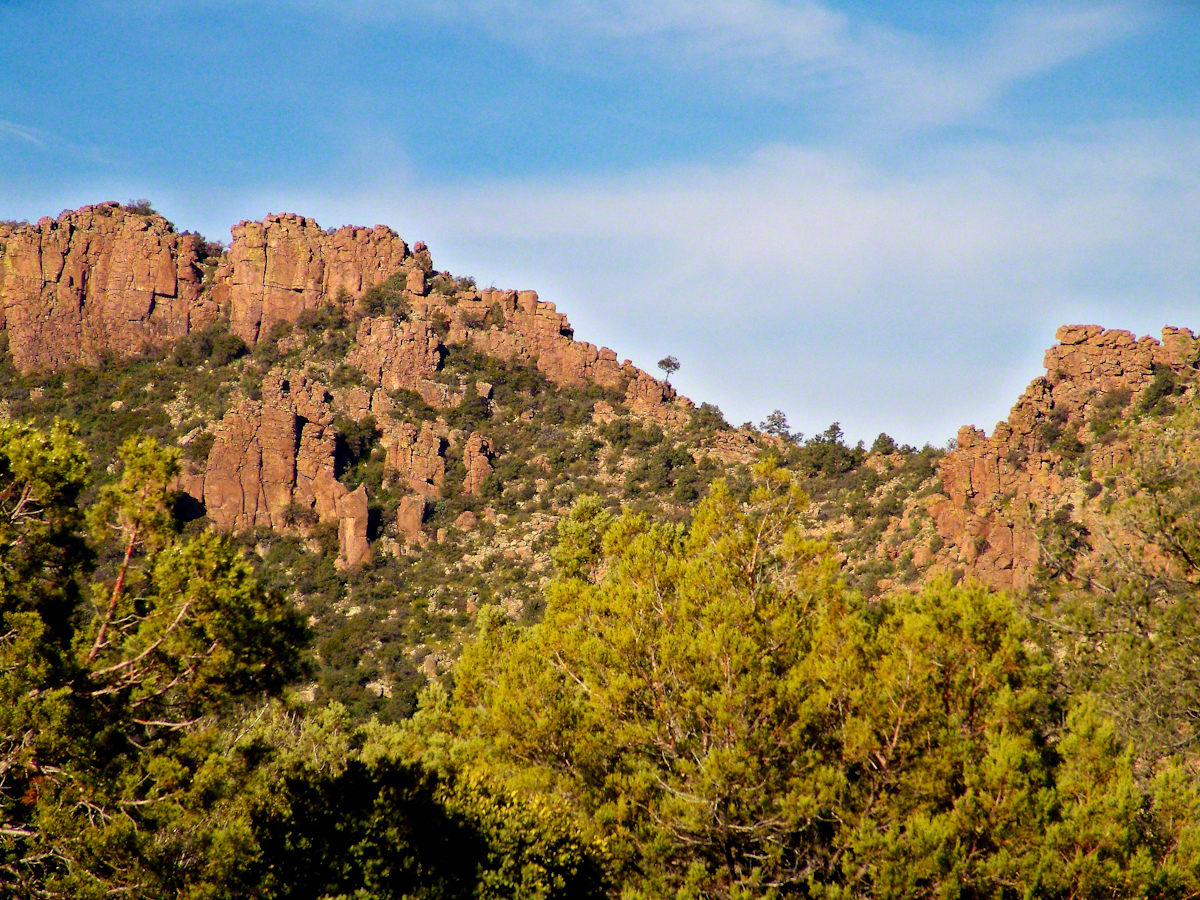
For most people a 400+ foot climb over these steep cliffs is impossible. Fortunately, a saddle to the right of this photograph is a possible route.

Southwest View from the Arizona Trail above Pine Creek

The saddle is 100 feet lower without cliffs. Still, this entrance to remote, fascinating locations is a steep 300+ climb.

A Saddle breaks a line of cliffs

“The Searcher” arrived around this time riding the buckskin gelding and leading a pinto. He saw me and my camera equipment and stopped for a chat. His plan was to follow the trail I came up yesterday to find a rumored camp with good water. The howling wind made conversation difficult. I wondered where his camp of last night was located, since there was no sign of him. Before I could ask, his cowboy hat flew away with a wind gust. He hopped off the gelding, “That’s my best beaver hat.” After a quick brush and tie-down they were off.

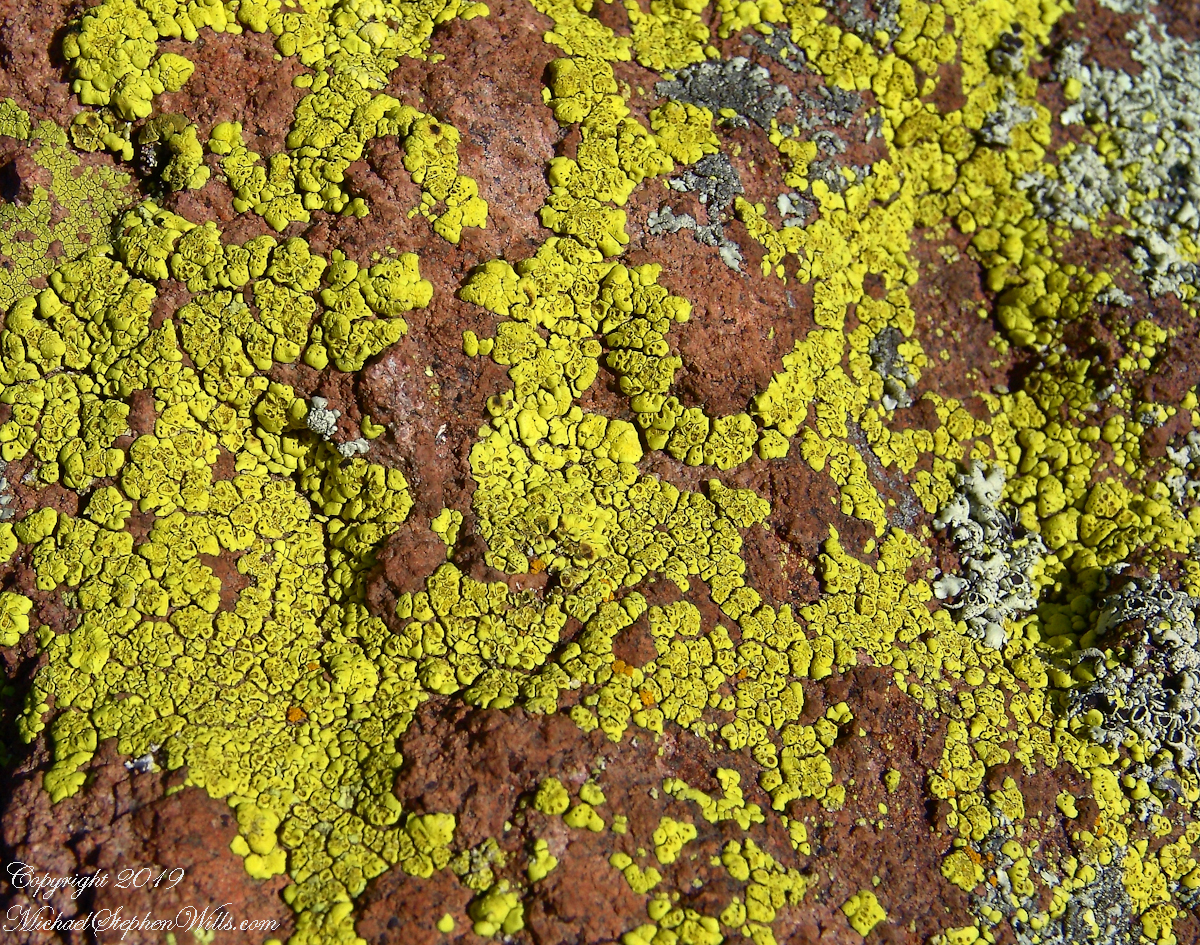
Heading back down to the creek, here is a macro of lichen that covered the crumbling surfaces of boulders that littered the slope.

Nature’s Abstract

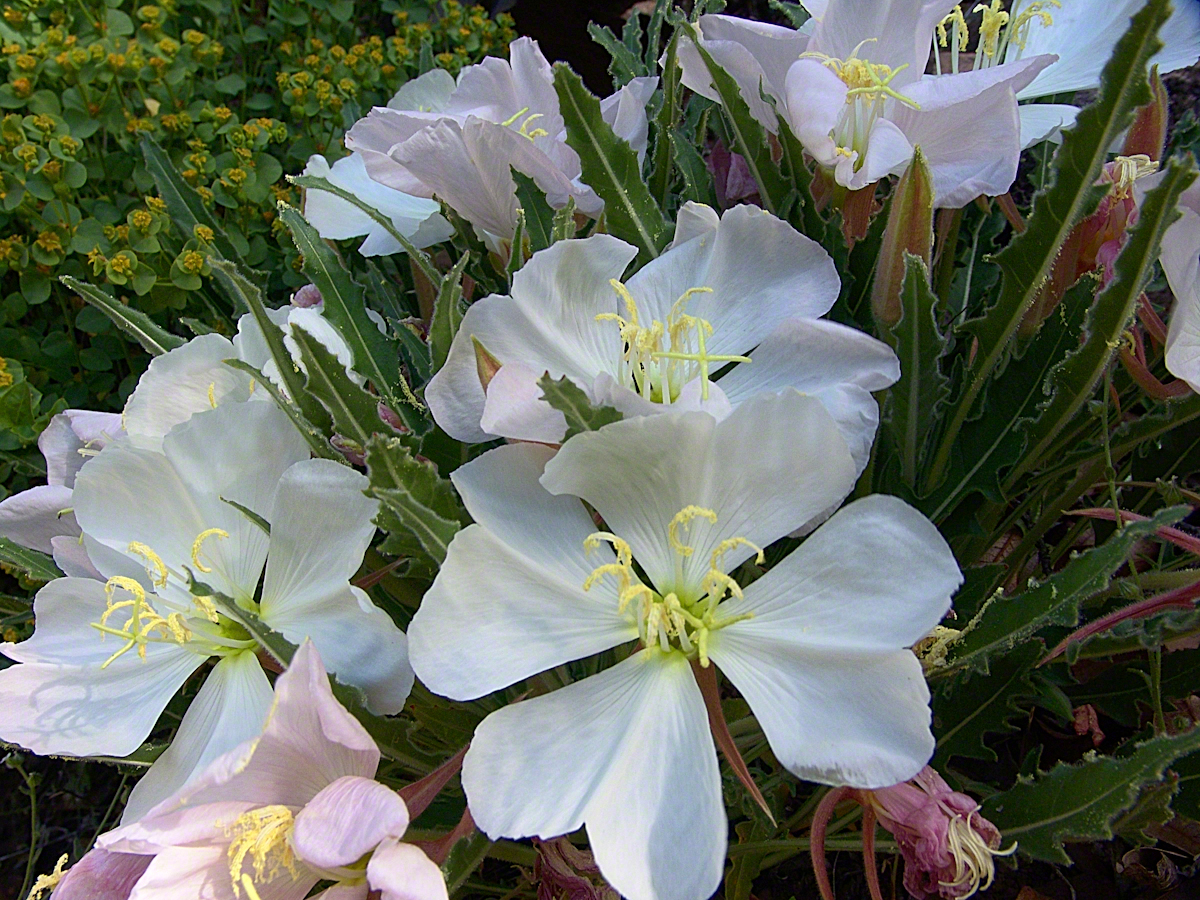
During the previous night fresh primrose blossoms opened, this one flourishing in the earth of a south facing slope. There is a reddish spent blossom at lower left. The soil here formed over eons by the action of the creek water, atmosphere and plant life. I have more about the Primrose and these yellow flowers in the background in my “Two Meetings” blog.

Pine Creek of the remote eastern Superstition Wilderness hosts this wild Tufted Evening Primrose.

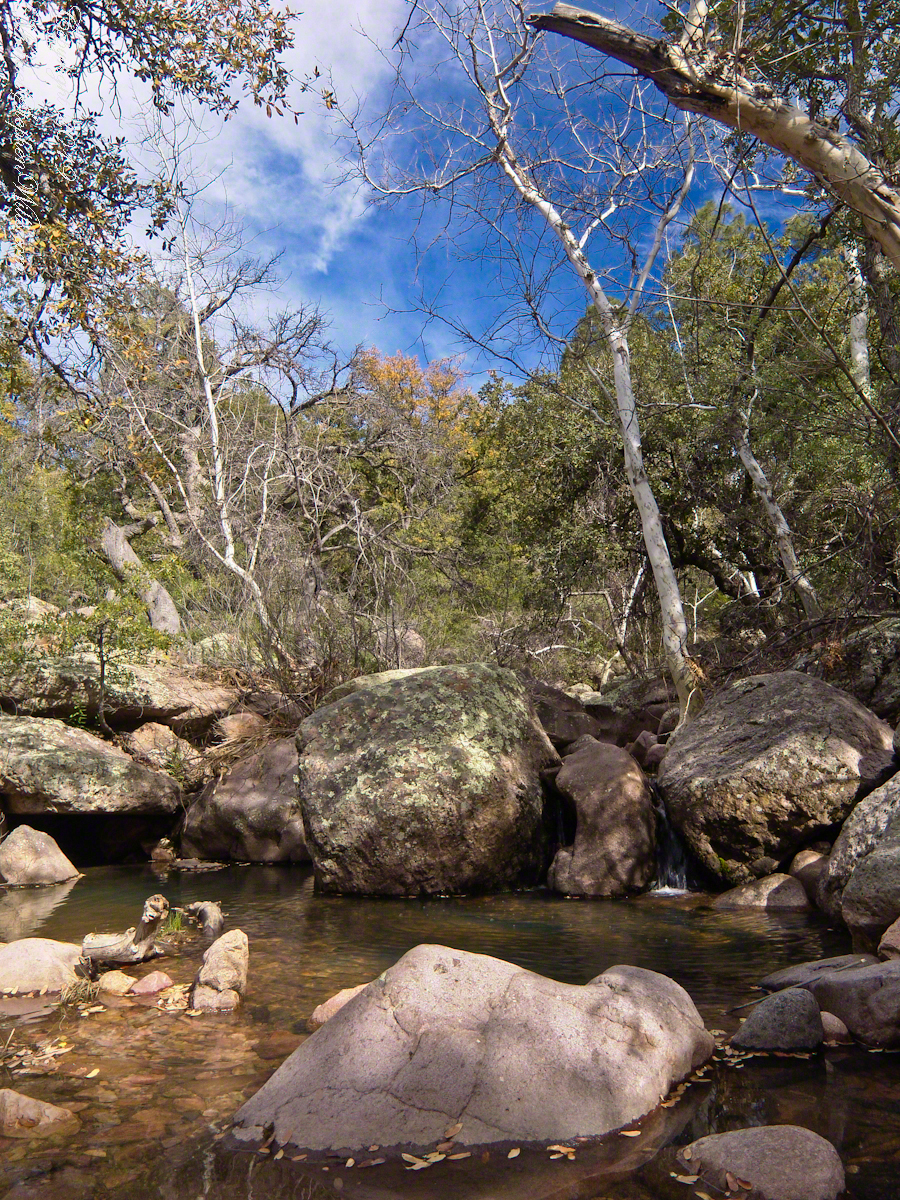
Turn left (up stream) where the Arizona Trail crosses Pine Creek and jump boulder to boulder for a hundred feet or so and you come to this view. The creek bank, covered by vegetation, rises on both sides and makes it difficult to leave the creek. Those are Arizona White Oak leaves floating along the large foreground boulder.

Pine Creek Pool with Young Arizona Sycamores

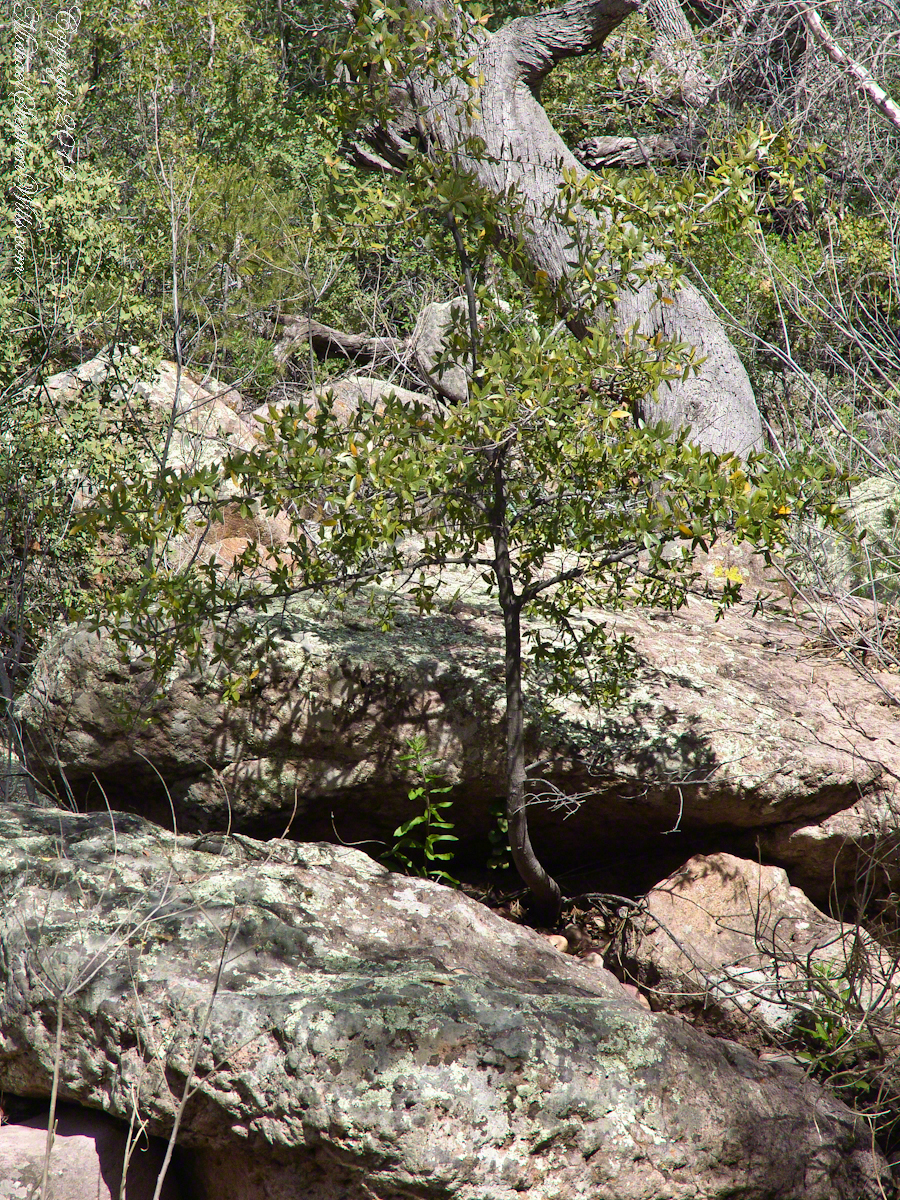
This is a very young Arizona White Oak, common species growing along the creek. The leaves are not what you’d expect from an oak, being 2 – 3 inches long in the shape of a lance blade and without obvious lobes Mature Arizona White Oak has a rough bark and, at most, 24 inch trunks.

Arizona White Oak

There are better examples of grand Arizona Sycamores along the perennial Reavis Creek. Pine Creek does not flow in the driest seasons, this tree sloughed its branches in order to survive. You can see from the many young Sycamores in the Pine Creek Pool photograph the previous photo the sycamores are successful in this environment.

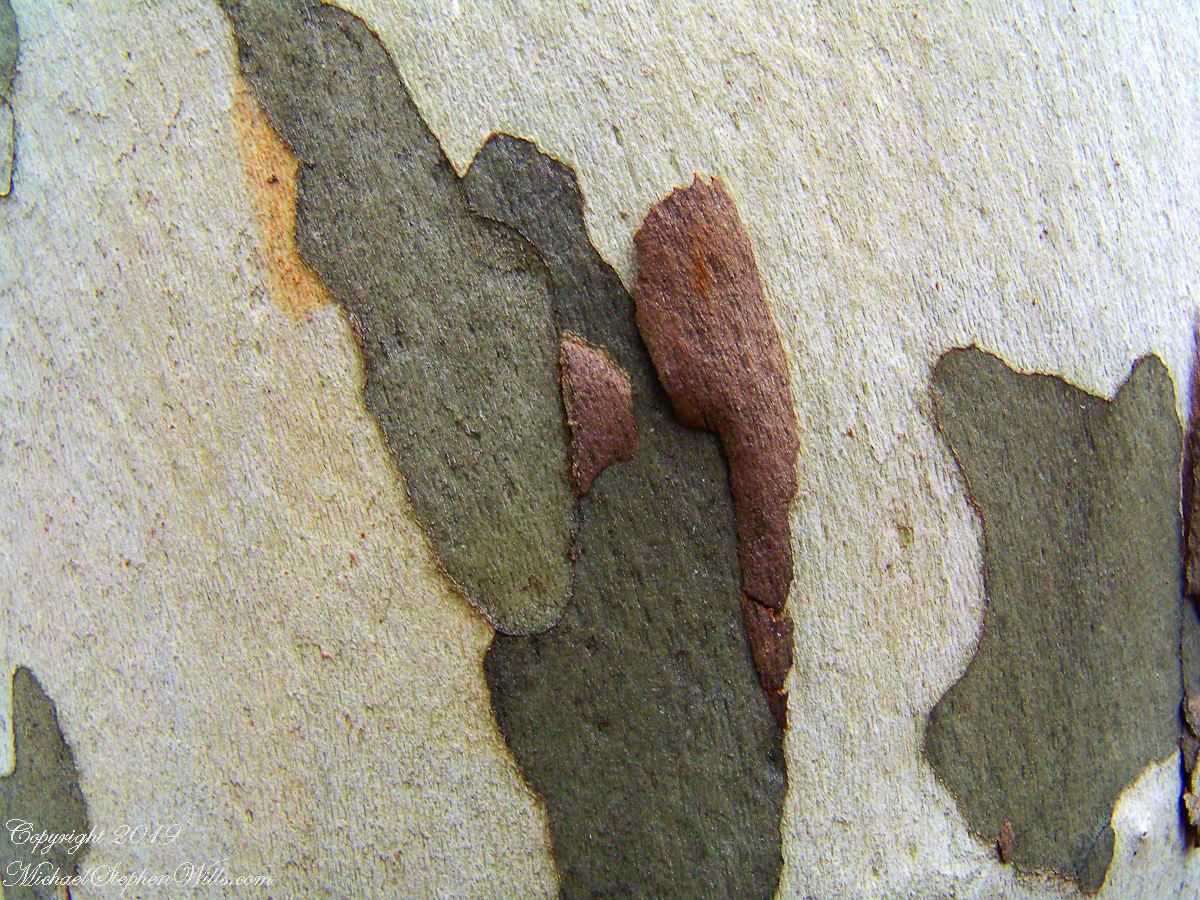
I spent some time with this Sycamore, capturing abstract patters of the bark.

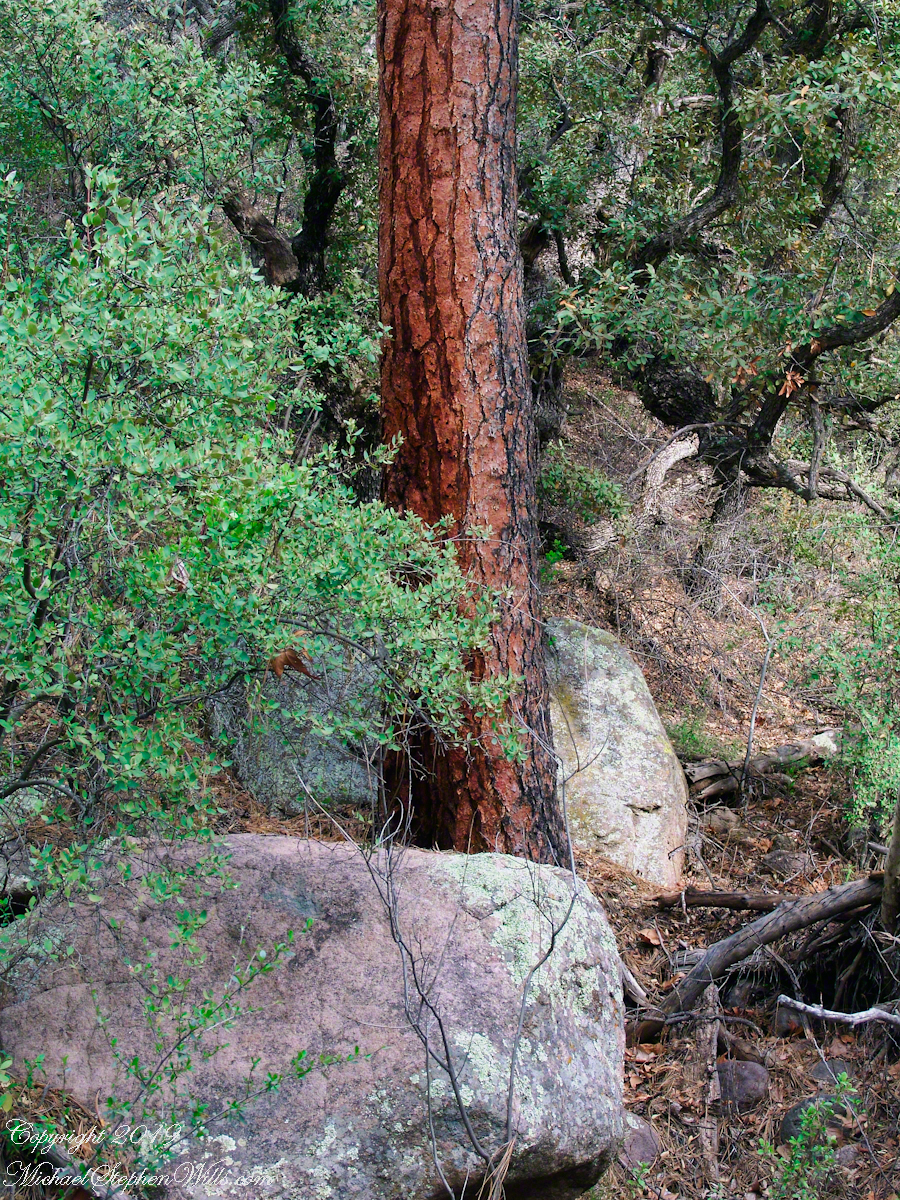
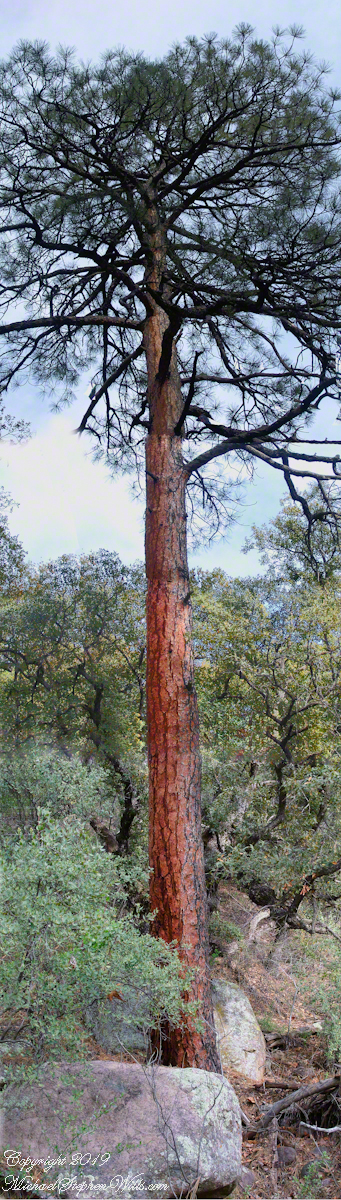
The abundance of Ponderosa Pines here demonstrate the species thrives at this altitude and dry environment. This specimen grows on the creek bank. Those are shrubby Arizona Oaks around the trunk.

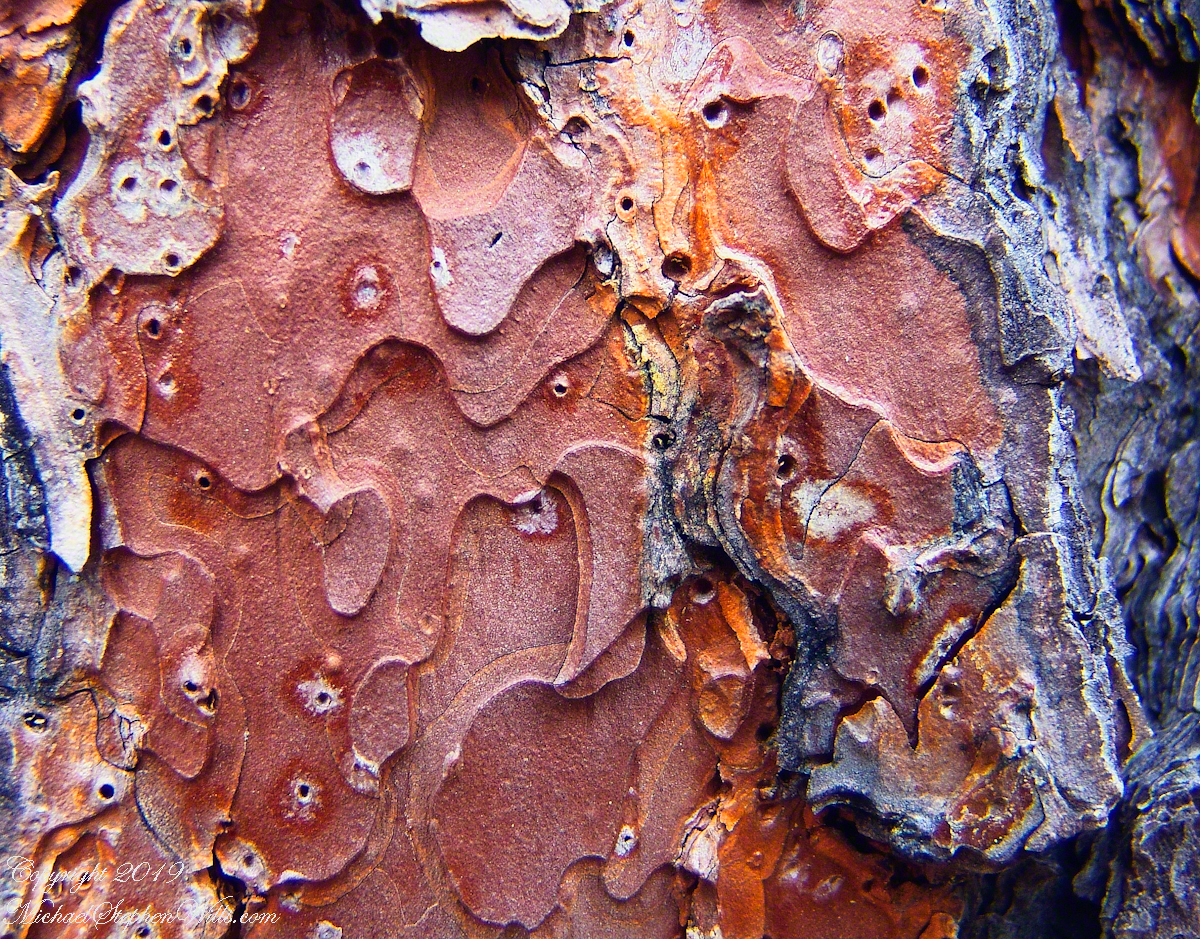
Abstract patterns in the bark of this Ponderosa. The popular and scientific name (Pinus ponderosa) for this species is from the dense weight of the wood.

The tree is over 100 feet tall. I patched together four shots for this view.

In the afternoon I explored the Arizona Trail to Reavis Ranch. It crosses the creek to ascend the cliff in broad switchbacks. Eventually it follows a contour below a cliff with fine views of Pine Creek Canyon. I turned back to leave the hike to Reavis Ranch for another day.

Click me for the next episode, “Sycamores and Riparian Space.”
Click me to visit Michael Stephen Wills Online Arizona Gallery.

Copyright 2021 All Rights Reserved Michael Stephen Wills

Thin Leaved Sunflower

Farm Journalist

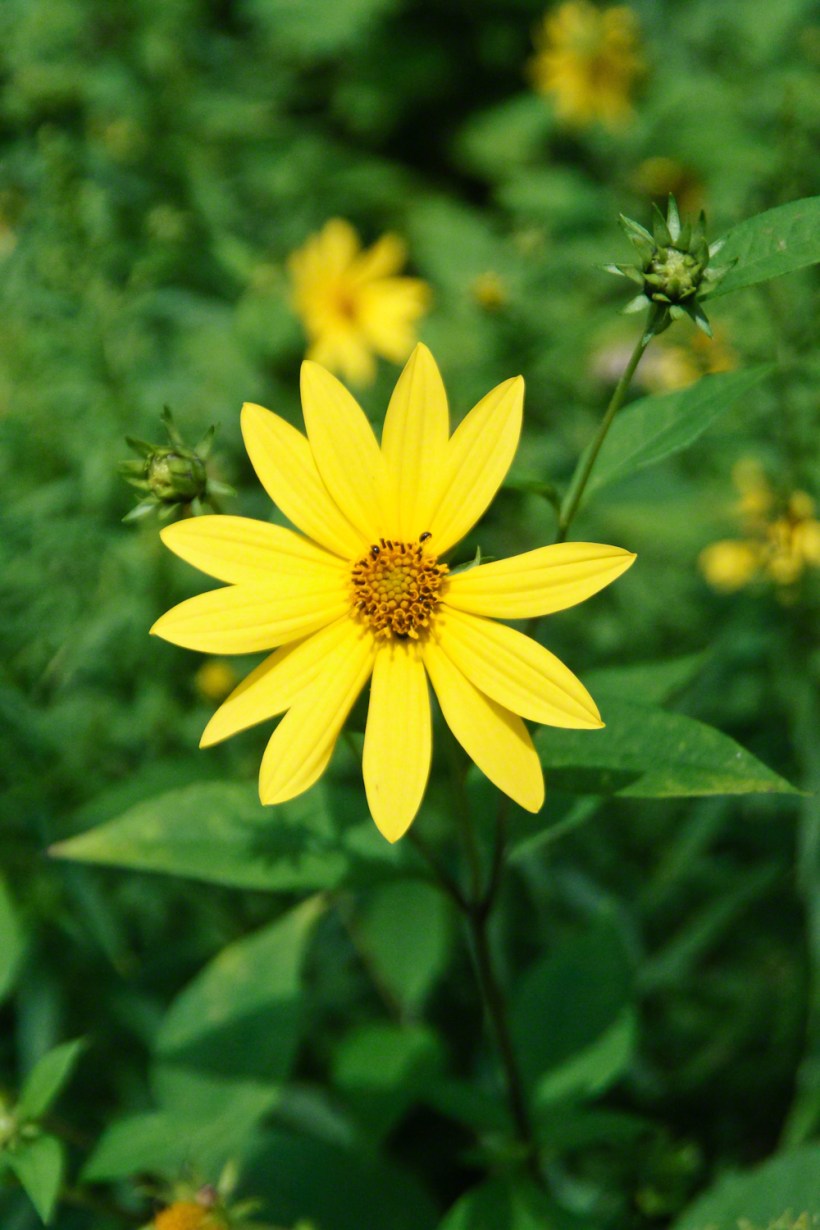
“Out in the meadow, I picked a wild sunflower, and as I looked into its golden heart,such a wave of homesickness came over me that I almost wept.  I wanted Mother, withher gentle voice and quiet firmness; I longed to hear Father’s jolly songs and to see his twinkling blue eyes; I was lonesome for the sister with whom I used to play in the meadow picking daisies and wild sunflowers.”

from “Laura Ingalls Wilder, Farm Journalist, Writings from the Ozarks” edited by Stephen W. Hines”

Photography Copyright 2021 Michael Stephen Wills All Rights Reserved

Dennis-Newton House National Historic Place

first photographs for a recent National Registry of Historic Places listing

Wiki Loves Monuments 2017 is a contest that closed September 30, 2017.

Click for Wiki Loves Monuments 2017 contest

The National Register of Historic Place # 16000590, the Dennis-Newton House of Ithaca, New York is a recent listing, dated September 6, 2016.  In researching potential for the Wiki contest, I discovered this place was absent a photograph.  Seizing the opportunity, I grabbed these photographs the same session as the suppressed Ithaca Pottery Site, published in my blog in April.

The location was a revelation, around the corner and a few blocks down from our son and daughter-in-law’s house where they are raising three (of our 12) grandchildren, across the street from where the children take swim lessons.  Parking in downtown Ithaca is incredibly coveted and I was not motivated to shoot during the golden hour where cars would, maybe, not be parked out front and the light perfect for the west-facing façade.

Dennis-Newton House Street Frontage

Click this link for my On Line gallery, “Finger Lakes Memories.”

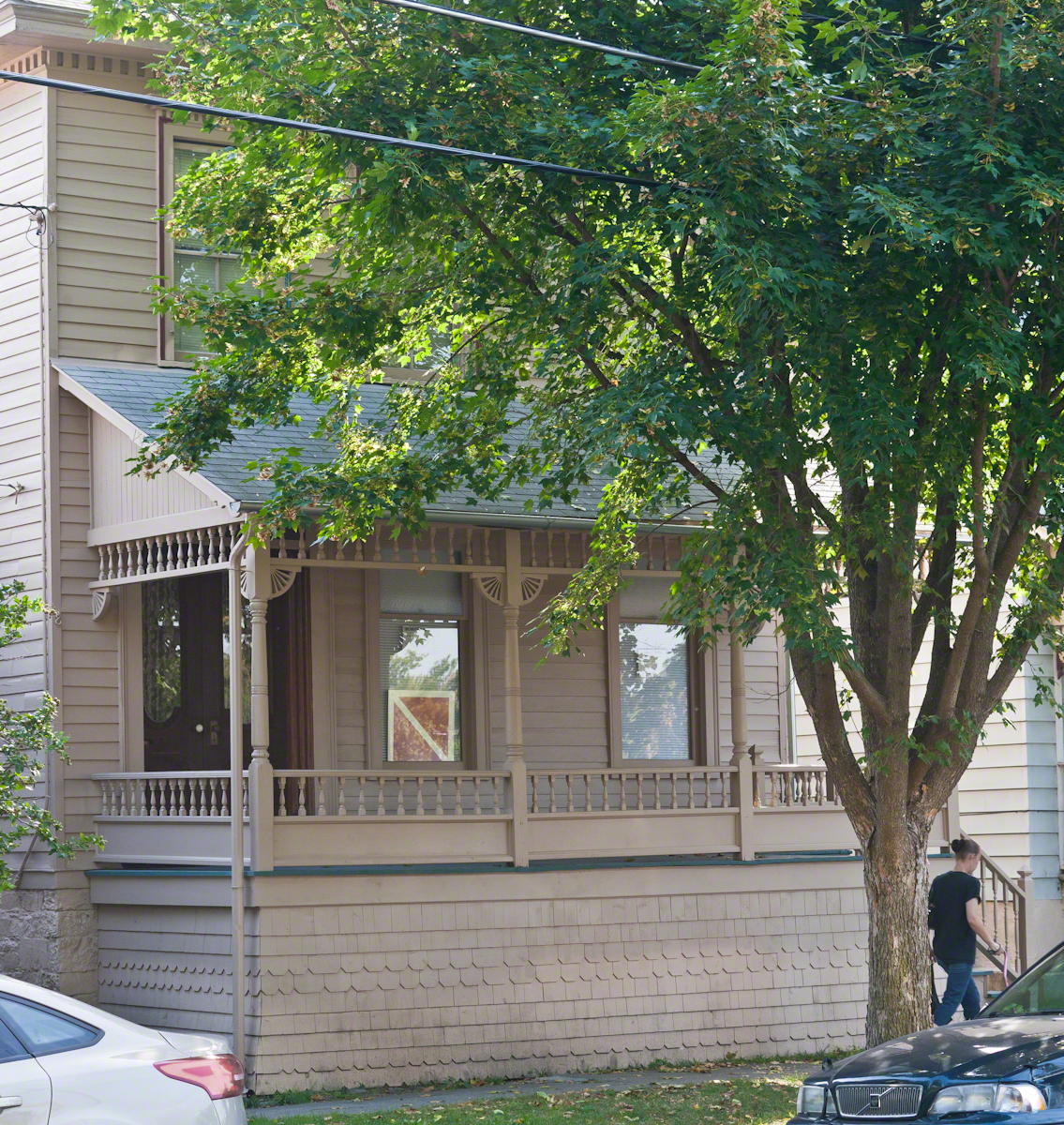
Above is the street frontage of 421 N. Albany Street, Ithaca, New York, a home privately owned.  The house is as originally constructed and considered the birthplace of Cornell’s Alpha Phi Alpha, the first Greek letter, African-American collegiate fraternity established from this location in 1907.

Named for the original owner, Norman Dennis who built it around 1870 and a later owner, Edward Newton, who is directly connected with the early years of Alpha Phi Alpha; the house was recently renovated with a building permit still posted in the porch window, partially obstructed by glare.

The frontage view is partially obstructed by a Black Maple (Acer nigrum) and provides shade from the afternoon sun.

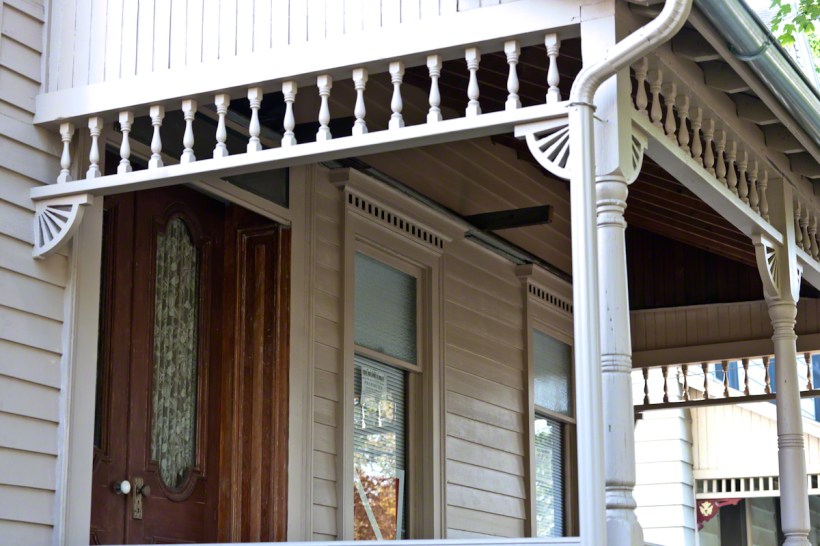
Dennis-Newton House Door, Porch

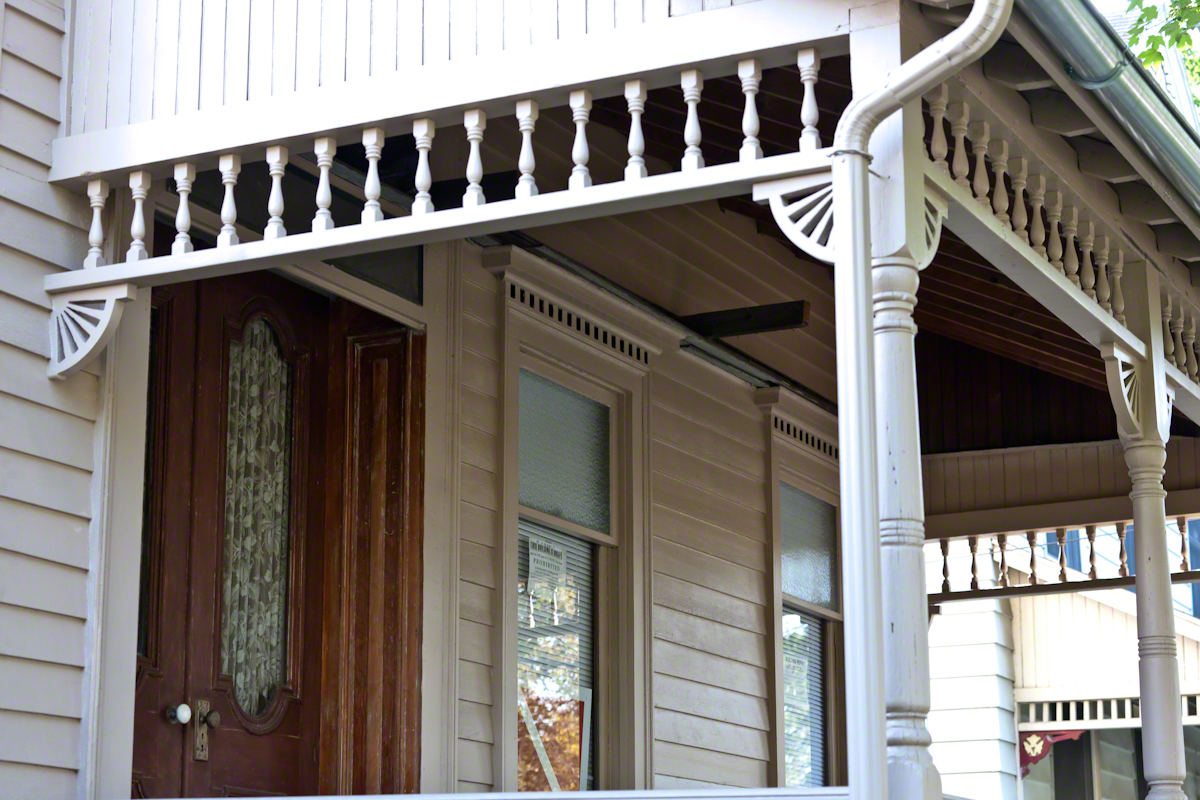
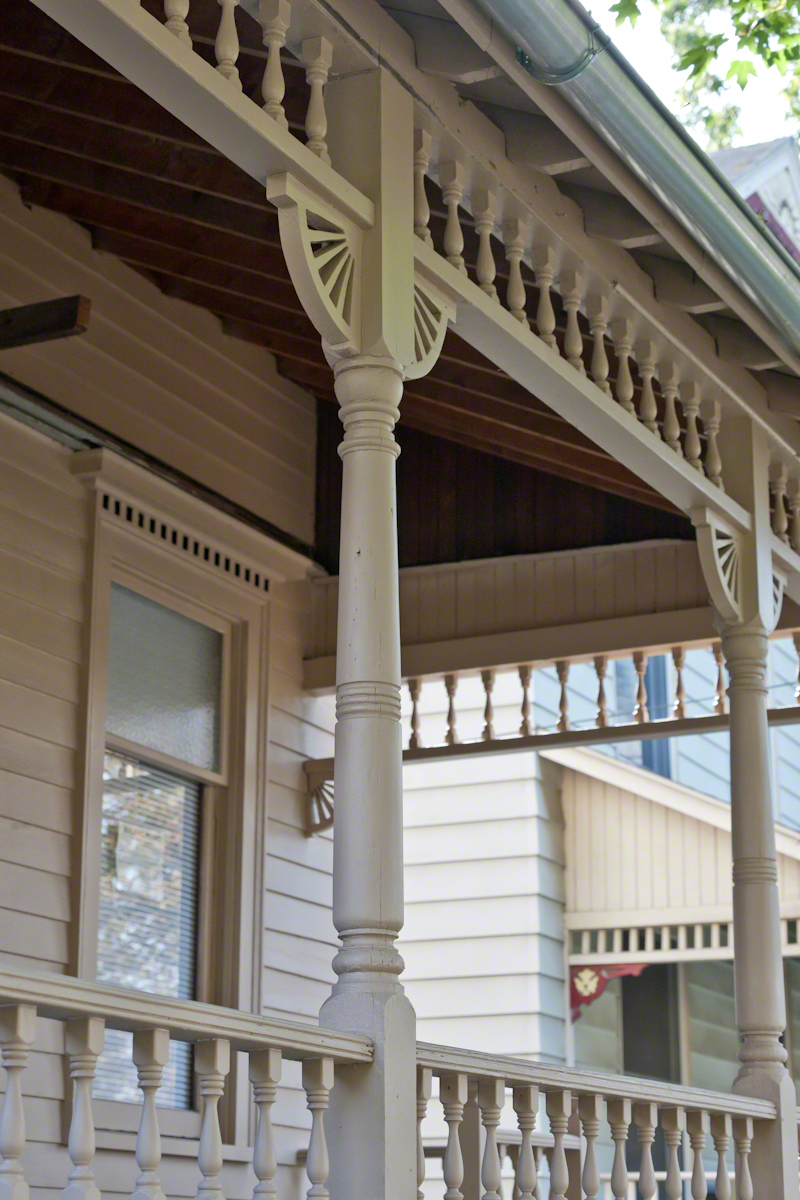
To compensate for the time of day, the tree and parked cars I captured interesting details of the front porch.  The time was day was perfect for photographing these and, in the golden hour, will be unevenly illuminated.  Note the elegant door glass panels, solid wood door and trim with original porcelain and metal door knobs and lock.  Porch trim includes decorative brackets, spandrels, posts.

Dennis-Newton House Porch, Window

Click this link for my On Line gallery, “Finger Lakes Memories.”

Here is a different angle on the porch trim to include the porch’s fancy balusters and rails.  The decorative head on the window is wonderful. The private owner recently renovated the property, there is a building permit still posted in the window.

Much of the information for this blog came from this web page.

In preparation for shooting, I mounted the Canon EF 70-300mm f/4-5.6L IS USM lens on the Canon EOS-1Ds Mark II body.  The frontage and second porch shots were at 70mm, 1/200 second, ISO 1,000, f/7.1.   The middle shot, of the door, was 1/250 second at f/5.0.

Copyright 2021 Michael Stephen Wills All Rights Reserved

Two Meetings

First view of Pine Creek

Continued from the chapter “A Dry Piece of Paradise.”

Imagine a bowl with steep sides, rough and sharp in places.

Look along the bottom and see a silver stream, sparkling and singing through rocks.

A figure is clinging to the upper side, almost to the rim.

The figure is me in the setting of my blog, “A Dry Piece of Paradise”. Here is my view from that spot.

View from the rim of Nameless Canyon

Hiking along this bowl rim I came to a clearing in the juniper and Manzanita bushes, with a fire ring and pile of roughly broken wood with outstanding views on all sides. This tradition of leaving wood is a welcome intrusion of human kindness and sympathy in this wilderness. We gather wood for total strangers, people we will never meet, to potentially save them in a rainy, cold darkness.

At noon Pine Creek was two miles ahead as I looked into a steep descent, a wide canyon and open range of low oaks, almost shrubs, and small juniper trees. Later, well along the trail, I stepped over Walnut Spring, a silent thread of water through a thin blaze of trees, yellow flowers and continued toward Reavis Gap and Pine Creek on Oregon Ed’s recommendation.

Even a blind man could find water there this year,” Ed claimed.

Ed’s van was parked at the Superstition Wilderness Tule trailhead when my sister dropped me off the morning before. She noted the van thickly coated with dust over grey primer with an Oregon license plate and changed her plan to accompany me the first mile or so for fear the van’s owner was lurking inside.
It was just as well Diane stayed behind because I met Ed two miles up the trail that first day. From the start, Ed was too outgoing and his pack more empty than light. He chatted me up on how “blue my shirt was”, seen from above, about his trips from Oregon to Arizona a few times a year, about his claim to be returning from a five day round trip to Tortilla Flats.

Ed’s good news about how the usual springs were flowing was welcome. Then, Ed expected me to give him some water for this information. This expectation of his was irrational, given his reports of good water sources. Plus, Ed was only a few miles from his van showed no physical signs of needing water.
I was to discover, a few hours in the direction he claimed to have walked, a flowing stream.

Ed’s attitude changed upon his spotting my .45 in a tactical holster strapped to my leg. Thirty seconds later he was heading down the trail. I had no water to spare and was relieved I didn’t need to escort Diane back to her car. Maybe Ed was an anti-gun advocate, but my conclusion was he had some lurking to do, back at the van.

While planning this trip I imagined “Reavis Gap” to be a narrow trail between towering peaks. While walking under the water heavy pack I elaborated on this expectation, but coming on the gap I walked through and into the reality of this photograph, taken from a point looking over the gap and down into Two Bar trail. This was the site of my first meeting with “The Searcher.”

North from Reavis Gap

“The Gap” itself is a high, narrow ridge over a 7,000 foot high valley with peaks, ridges and the occasional hoodoo. That rock formation in the mid-distance includes a hoodoo. It was this hoodoo that introduced me to the gap, being what I saw first high above in the distance from Walnut Spring, a silent thread of water through a thin blaze of cottonwood trees and yellow flowers.

Here’s a link to a video I did of a vast field of Wild Oats which covered Reavis Gap that season.

I first saw the “The Searcher” on that high, narrow ridge above Two Bar trail. I guessed he was a mounted park ranger; from the wide brimmed hat he was holding and the loose fitting shirt. From a half mile away his golden brown mount was standing steady, apparently at rest. Walking up that long, moderate grade my feet hurt and the 70+ pound pack, heavy with water, was chafing. Eager to climb the steep ridge ahead, between me and Pine Creek, I passed the signpost marking the juncture of Two Bar and Reavis Ranch trails and headed up that rocky ridge.

The clatter of horse hooves came up behind much sooner than expected. Turning, I came upon the unexpected site of two horses. The mounted stranger was not a park ranger, but a well dressed cowboy on a western saddle, riding a buckskin gelding.

Behind them, on a lead, was a brown and white pinto loaded with panniers.

I was polite and climbed up on the rocks, off the path, to let them by.

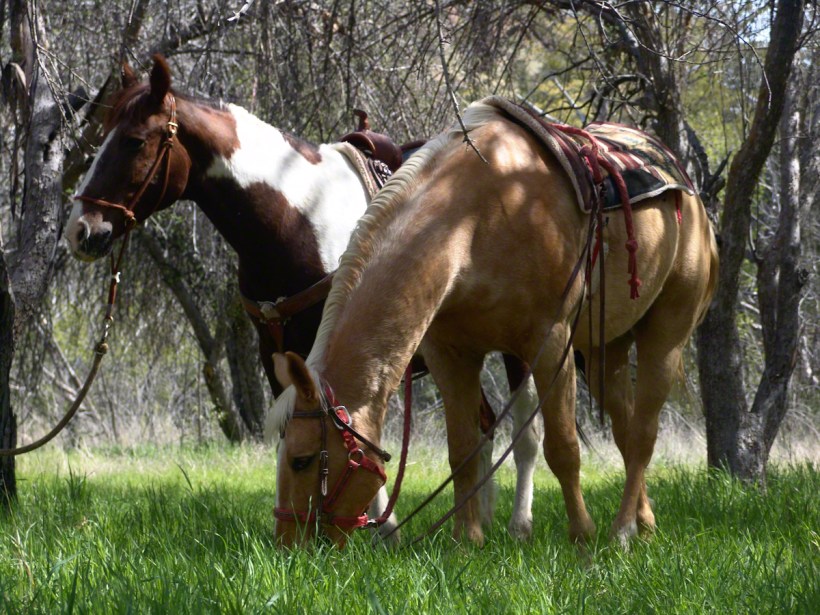
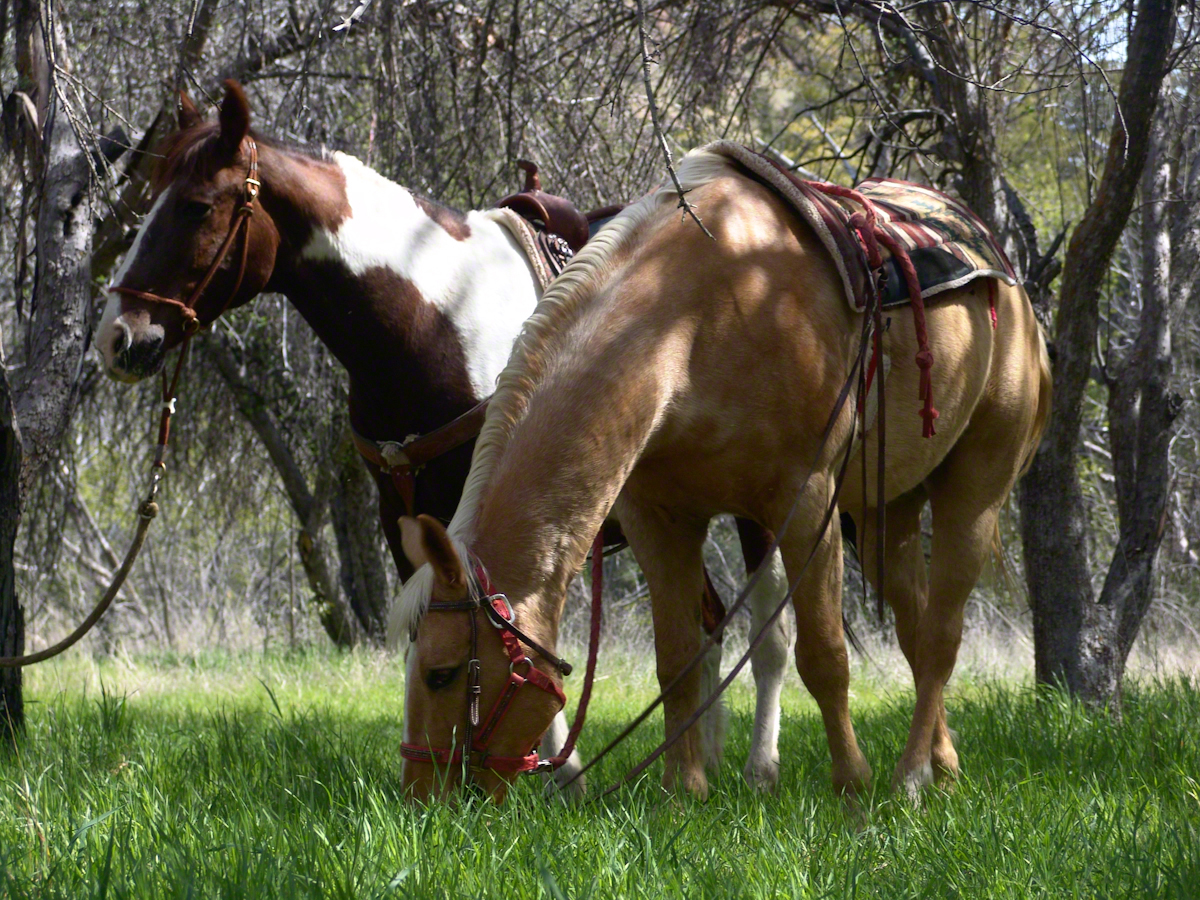
Here’s a photograph of these horses, taken a few days later.
“Colorado and Nugget, grazing at Reavis Ranch”

Enjoying the lush grass of the Reavis Ranch apple orchard, Colorado and Nugget graze.

Our chat was brief, but practical and meaningful: where we came from and conditions along the way. The stranger, who I came to call “The Searcher”, inquired about conditions in the very steep bowl behind Two Bar Mountain. He planned to camp overnight and do a Two Bar Mountain daytrip the next day, but would not if the trail was washed out by that spring’s heavy rains.

I replied the trail was obliterated in spots and even though I could pass his horses might not get by. His reply, “If you got up, so can they.” And with that he gave the buckskin a nudge and they were soon out of sight, over the ridge.

Fifteen minutes later this was my view of Pine Creek, a valley of steep sides sloping to a stream of cool water with mountains and sheer cliffs on all sides. Part of The Arizona Trail.

From a vantage point overlooking Reavis Gap tot he north. This is the view of Pine Creek, to the south.

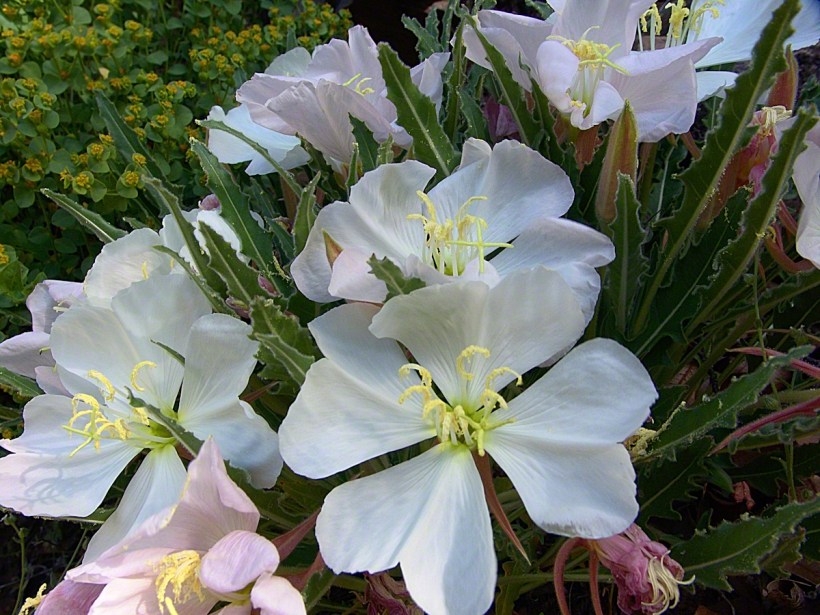
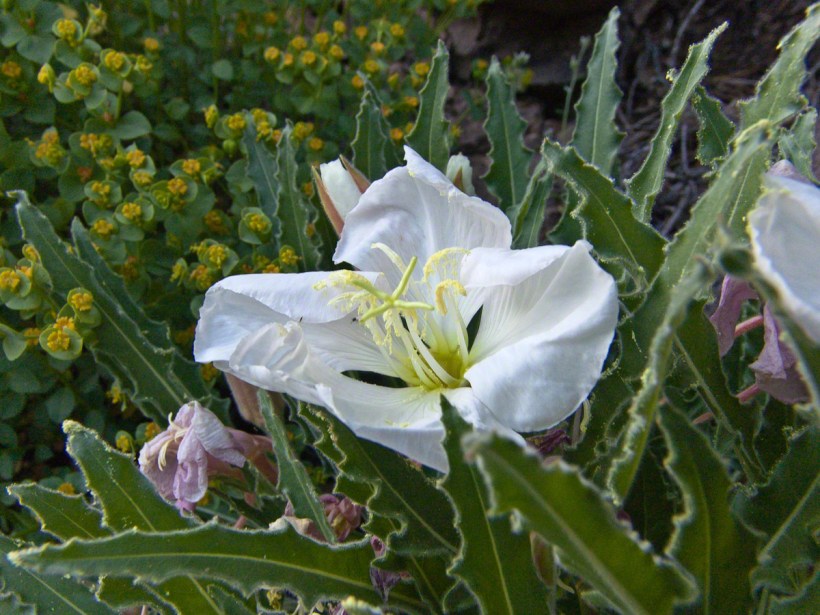
Just before reaching Pine Creek I passed a southeast facing bank sheltering a garden of tufted evening primrose and a member of the crassulaceae family both in flower. The white flower is the primrose and the yellow the crassulaceae. I was so moved by the beauty of this patch, after trekking for seven hours through endless rocks, cactus, juniper and oak, I unloaded my pack and captured this shot. As the name suggests, the flower is an evening bloom that wilts in the day’s heat. That’s why the flower is a bit floppy in this late afternoon photograph.

Note flower b

The crassulaceae is a succulent, similar to a kalanchoe, with tiny flowers composed of tiny yellow balls.

In future chapters you’ll see more of Pine Creek, visit the wilderness apple orchard at Reavis Ranch, learn more about The Searcher and an ancient, circular, rock wall on a peak overlooking Reavis Gap.

Here is a gallery of photographs from this post for you to flip through. Enjoy!!

Click me for the next episode, “A Peaceful Day at Pine Creek.”
Copyright 2021 All Rights Reserved Michael Stephen Wills

Napoleonic Era Signal Tower

19th Century Technology

Our day of touring Kinsale and environs, the last day of May 2014, began with this elegant breakfast by Marantha House near Blarney, our base for County Cork.

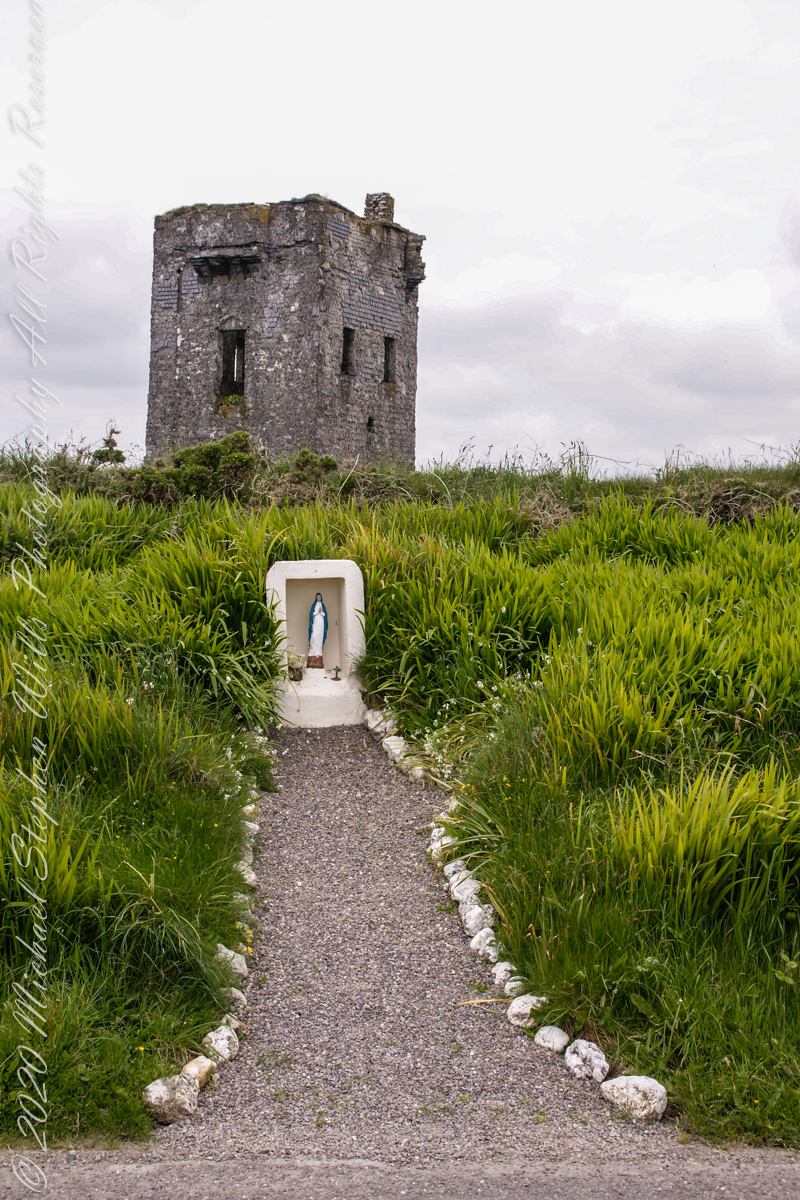
On the way to the Old Head of Kinsale. Located in Knocknacurra on the Kinsale side of Bridge Kinsale on R600. Looking toward the peninsula of Castle Park Village and James Fort. Coordinates 51°41’40.1″N 8°31’42.0″W

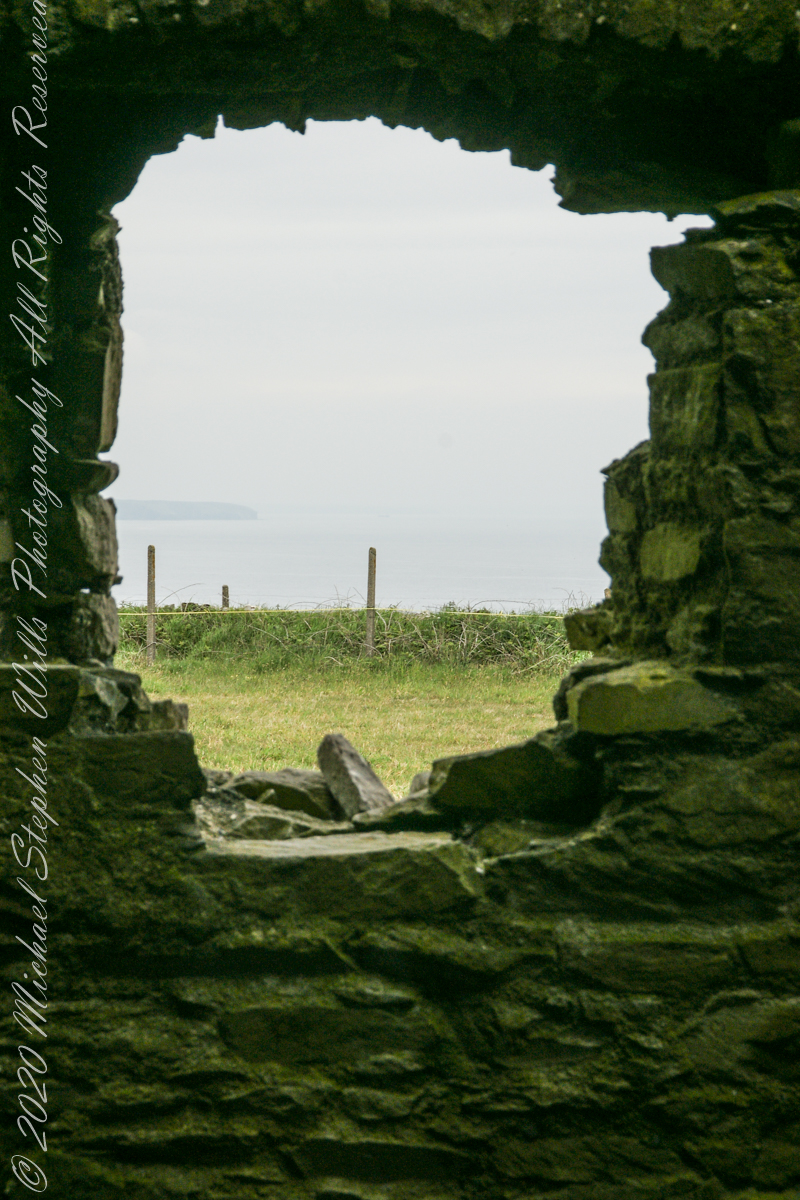
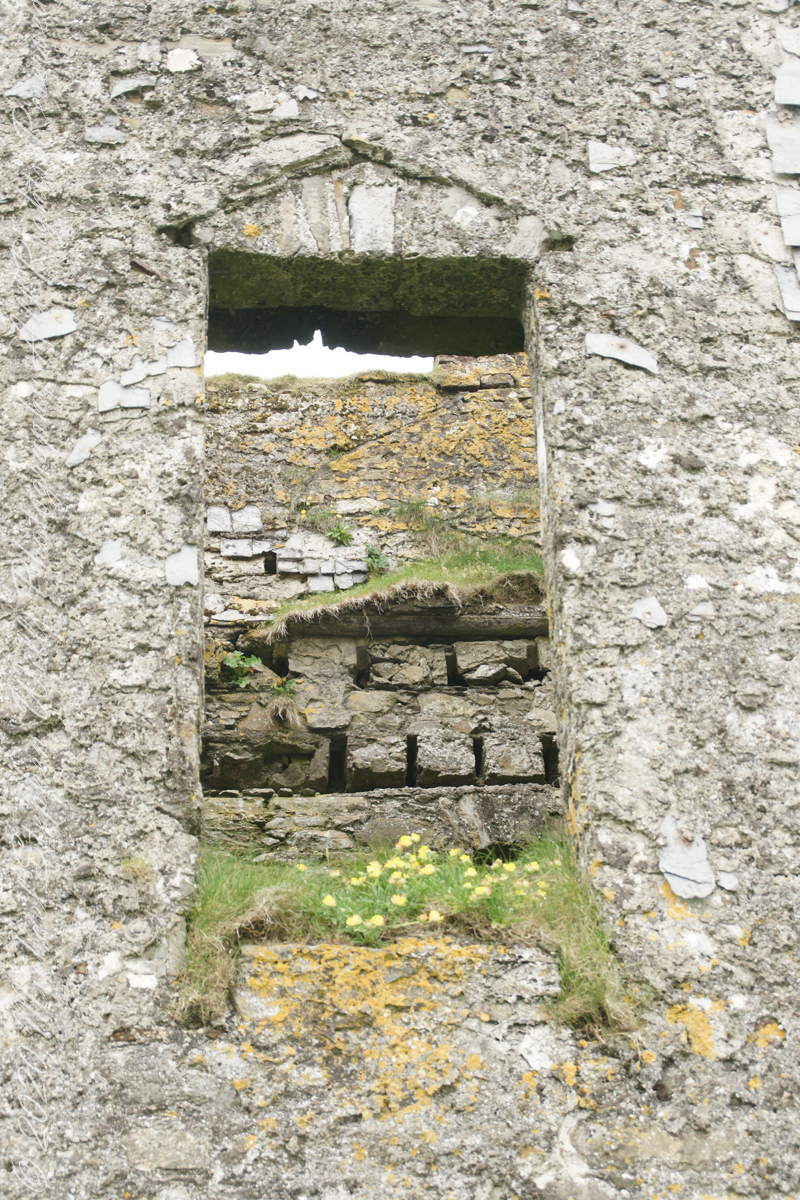
This tower, at the apex of the Old Head ring route, has extensive views. The next station at Seven Heads, to the southwest, is visible against the skyline on a clear day. These are two of the 81 stations planned for this signaling system implemented in the first years of the 19th century when a French naval invasion was a possibility.

The Kinsale tower is just over nine meters high, with walls up to 80 cm thick. Records show a signal crew was in place in 1804 and the tower finished the following year, though severely affected by dampness. When Napoleon was defeated by Wellingtons forces at Waterloo, 1815. With the diminished threat these expensive installations were neglected. The 1899 Ordnance Survey map lists the site as being in ruins. During our 2014 visit the local community was renovating the tower and the work appears complete sometime before 2021.


References
Click me for Irish Times 2013, “Ireland’s Napoleonic-era signal towers.”

Copyright 2021 Michael Stephen Wills All Rights Reserved

Leprechaun Rock along the Tain Way

The Last Leprechauns

Rocks such as this are a favorite perch for leprechauns to rest and contemplate the works of man who have invaded their world. Inhabitants of Carlingford who wander Slieve Foye have come upon them often enough, their stories and certitude in the existence of the Little People are resistant to manifold doubters with their reasons and arguments.

leprechaunRockCarlingford-02245
Click this link for my Ireland gallery of Fine Art Photography.

Kevin Woods, aka McCoillte, was a doubter until worked on a stone wall on property he owned on Ghan Road, Carlingford. His belief did not arise on the discovery of the leather purse, covered with ages of dust and lime, nor with the gold coins inside. McCoillte pocketed the coins for luck. As luck would have it, McCoillte loved to walk on Slieve Foye. It was on one such walk he and his dog encountered Little People who paralyzed them to escape. His unexplained absence led to troubles with the wife.

EuHabitatsDirective-02267
Click for Leprechaun Rock in my Fine Art Gallery. Enjoy!!

This experience brought McCoillte around to enough of a belief that he, with lots of help, succeeded in petitioning the E.U. European Habitats directive to recognize leprechauns a protected species.  According to a page on the Celtic Times web site, “The E.U. sent Madame Isobel Jeanne from Fecamp in Brittany France to Carlingford with the official letter declaring Carlingford Mountain (Note: otherwise known as Slieve Foye) protected, on the grounds that they could not prove or disprove their existence.”  The page is titled “The Carlingford Leprechaun.”  Google “Last Leprechauns” learn more about McCoillte’s stories.

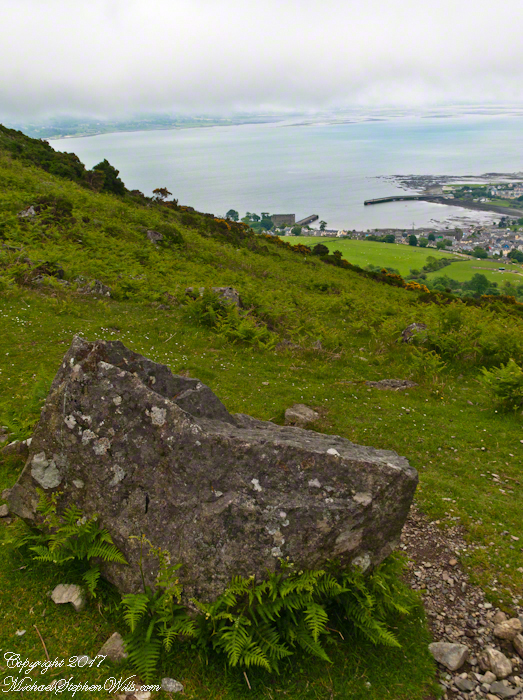
I came upon this rock on June 9, 2014 on a day my cousin Sean Mills invited us to walk the Tain Way over Slieve Foye. It was such a finely shaped piece of what I suppose to be granite, the view of Carlingford, the lough and farmland so compelling, I spent time composing this landscape.

You can make out “King John’s Castle” just over the ridge and its yellow flowering gorse, on the margin of the blue lough. It is the boxy, grey structure; crenellations are visible on high resolution versions of the image. Carlingford is known for the castle, the popular name is for the English monarch who spent time there, although it was built by another.

Visit the opening chapter of our time on the Tain Way

Copyright 2021 Michael Stephen Wills All Rights Reserved