Wind Riders: A Seven-Year Saga of Beach and Ocean Kiteboarders

Embark on a journey with kiteboarders who harness the wind and surf, mastering both beach and ocean. Witness the evolution of this thrilling sport over seven years, from the sandy shore to the open waves.

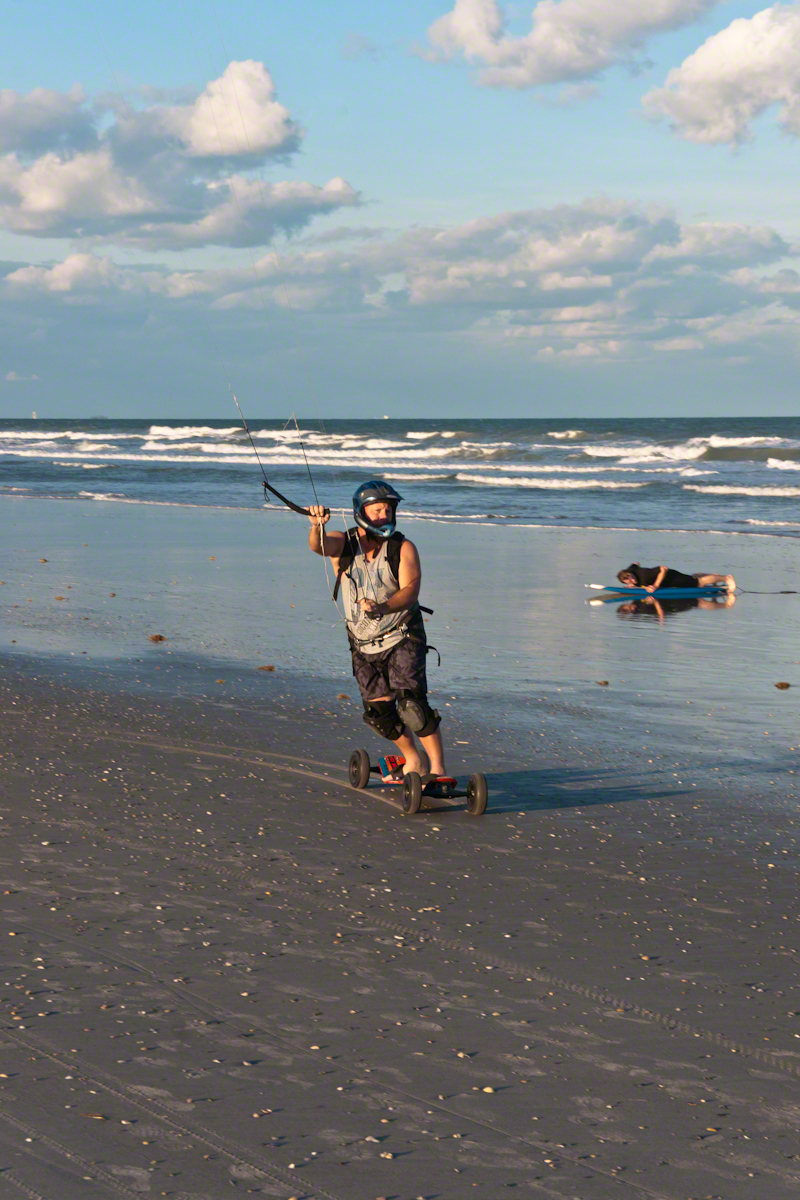
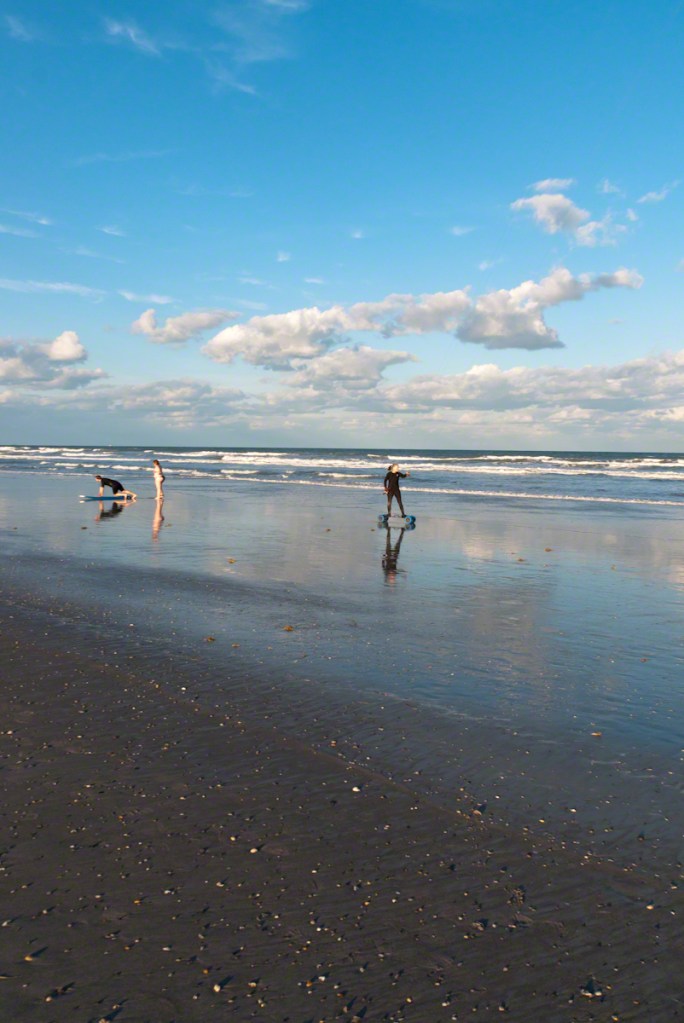
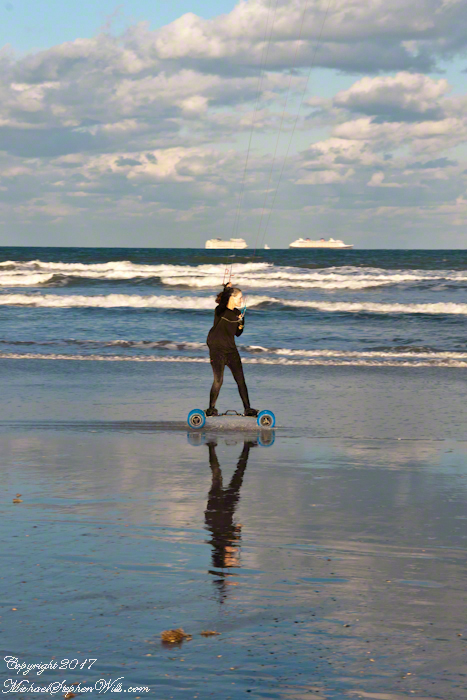
Cocoa Beach, with its rhythmic waves, is a destination that stirs a sense of adventure. Seven years ago, March 2017, as I strolled along its sandy shores, my attention was captured by a curious sight: several people gliding effortlessly across the beach, seemingly with the wind at their command. These weren’t your typical surfers or skateboarders—they were kiteboarders, harnessing the power of the wind with large kites that stretched high into the sky. I was transfixed by the sight of their wheels skimming along the wet sand, leaving tracks like an artist’s brushstroke on a canvas.

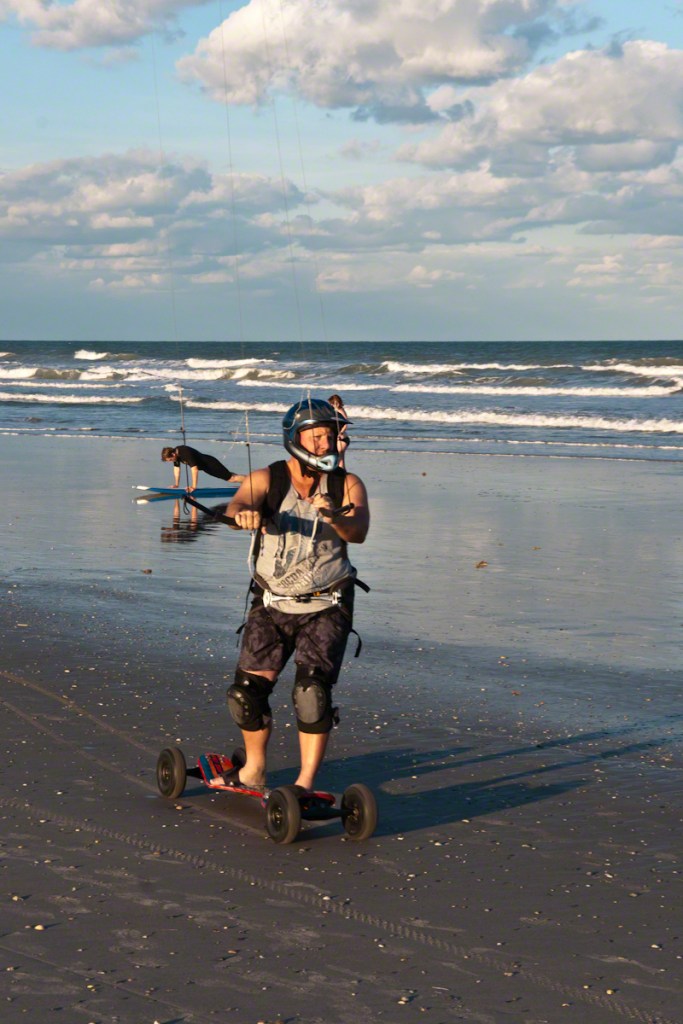
The beach was alive with energy. The wind, the driving force behind the kiteboarders, was gusty, rippling the surface of the ocean and creating perfect waves for surfers. But the kiteboarders were on a different mission. They had wheels attached to large boards, akin to skateboards but bulkier. They wore helmets and pads, visibly prepared for a sport that seemed to demand not just skill but a dose of courage.
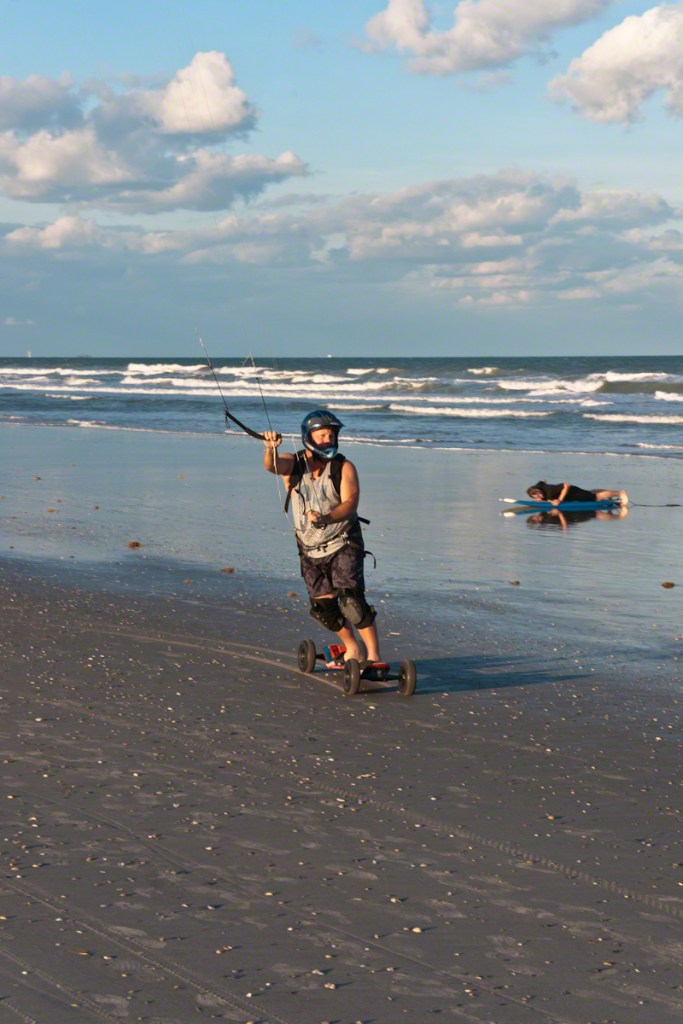
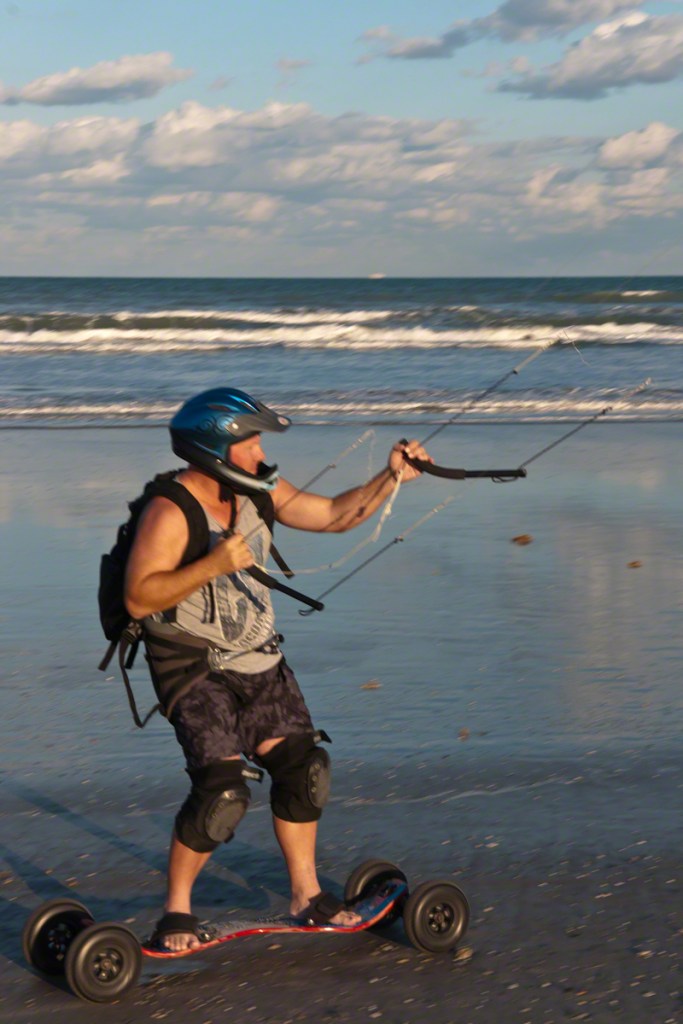
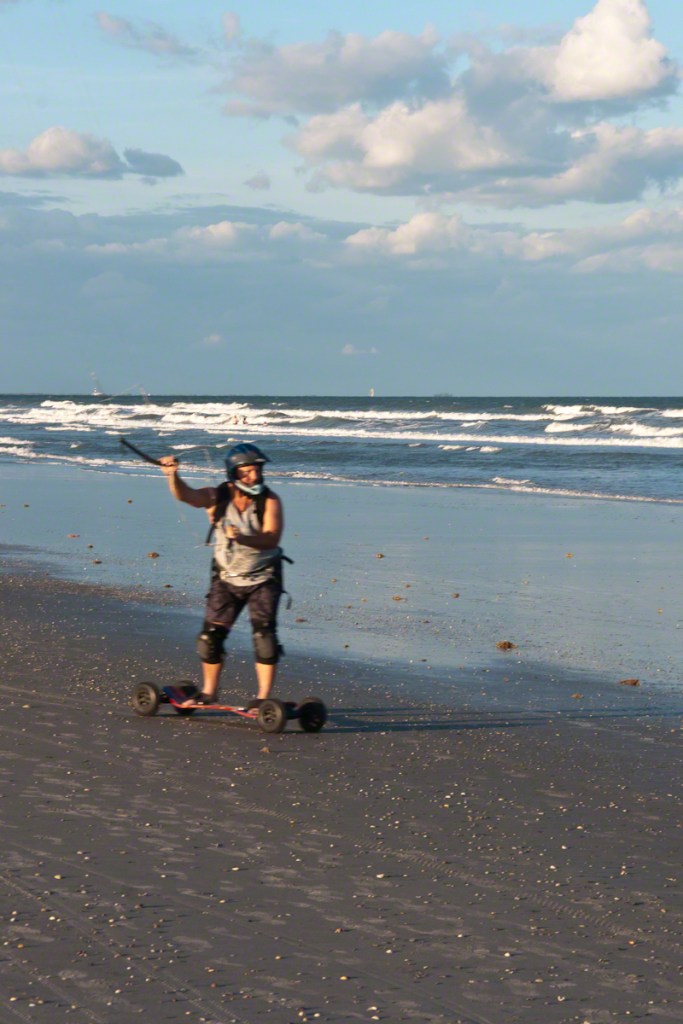
One rider caught my eye, with his bright blue helmet and focused gaze. He adjusted the lines of his kite like a master puppeteer, maneuvering himself with precision as he glided along the shore. The kite seemed an extension of his own limbs, responding seamlessly to his every movement. It was exhilarating to watch, the kite’s taut lines tracing invisible patterns in the sky as he shifted his weight, steering the board with expertise. With each gust of wind, he picked up speed, racing along the shore with a grin that spoke of pure joy.

Not far from him, a second kiteboarder, a woman, was testing her skills. Her kite had a distinct red pattern, vibrant against the backdrop of the sky. She handled it with ease, her body swaying in rhythm with the kite’s movements. It was like a dance, where the wind was both partner and lead, guiding her across the beach in wide arcs. Occasionally, she would glance over at the other riders, sharing nods of camaraderie that suggested a tight-knit community.

The sight reminded me of the joy of childhood, of riding bicycles down a hill, the wind whipping through your hair, feeling like you could conquer anything. But this was a more refined thrill, one that demanded an intimate understanding of nature’s forces. The kiteboarders were more than just athletes; they were artists painting their own masterpieces against the sky.

In the distance, I noticed a third rider. He was still finding his rhythm, his movements a little less sure, but the determination on his face was unmistakable. He kept his focus on the kite, battling the wind to gain control. Even as he stumbled a few times, his spirit didn’t falter. Each time he fell, he would rise, dust off the sand, and try again. It was a scene of persistence that spoke to the spirit of the sport—a reminder that mastery is not achieved without effort.
The sun began to dip toward the horizon, casting long shadows on the sand. The wind grew cooler, and the kiteboarders began to pack up their equipment. I found myself lingering a little longer, reflecting on what I had just witnessed. Kiteboarding seemed to embody the spirit of Cocoa Beach itself—a blend of adventure, community, and a deep connection with nature.

Walking away, I couldn’t help but feel inspired by their spirit of adventure. The kiteboarders had painted a vivid picture of resilience, joy, and the thrill of chasing the wind. They were, in a way, explorers charting a path on the very edge of land and sea, powered by nothing but wind and will.

Seven years later, this past winter of 2024, there was a kicking wind powering a group of three kiteboarders tackling the waves offshore, embracing the ocean waves in a spectacular display of skill.

Their kites stretched high against a steely sky, creating vibrant contrasts with their colorful patterns. One kiteboarder had a kite adorned in shades of turquoise, like a burst of sunlight riding the wind. He maneuvered deftly on the waves, rising high on the crest of each swell before swooping down into the troughs. His movements were fluid, and he rode each wave with a mastery that suggested years of experience.

The second rider, with a vivid blue kite, showed off his own skill set, to ride the waves with finesse, carving arcs through the water, creating a wake of white foam. He seemed almost weightless, gliding effortlessly, catching air whenever he hit a particularly high crest.

The third kiteboarder was the most daring of the trio, his kite blending with the overcast skt. He launched himself off the waves, soaring high into the air before coming down with a splash. Each leap seemed to defy gravity, and he twisted and turned in mid-air like an acrobat, displaying a level of athleticism that left the onlookers on the beach in awe. The wind and waves provided the perfect playground for his tricks, and he used every bit of it to his advantage.

The three kiteboarders moved in sync, communicating through gestures and nods, sometimes even shouting encouragement to each other over the sound of the crashing waves. They pushed one another to reach greater heights, to attempt more daring moves, and to revel in the shared joy of their sport. It was as if they were performing a choreographed routine, set to the rhythm of the sea.

Onlookers gathered along the shore, drawn by the mesmerizing sight of these kiteboarders taking on the ocean waves. The kiteboarders, with their vivid kites and breathtaking maneuvers, were like seagulls riding the wind, an exhilarating reminder of the power of nature and the joy of embracing it.

As the day wore on, the kiteboarders continued to ride the waves, their energy seemingly endless. The sea and sky were their canvas, and they painted across it in broad, sweeping strokes. Watching them was a thrilling reminder of the freedom and adventure that the ocean brings.

Copyright 2024 Michael Stephen Wills All Rights Reserved

Spring Outing IV

Turn to Light

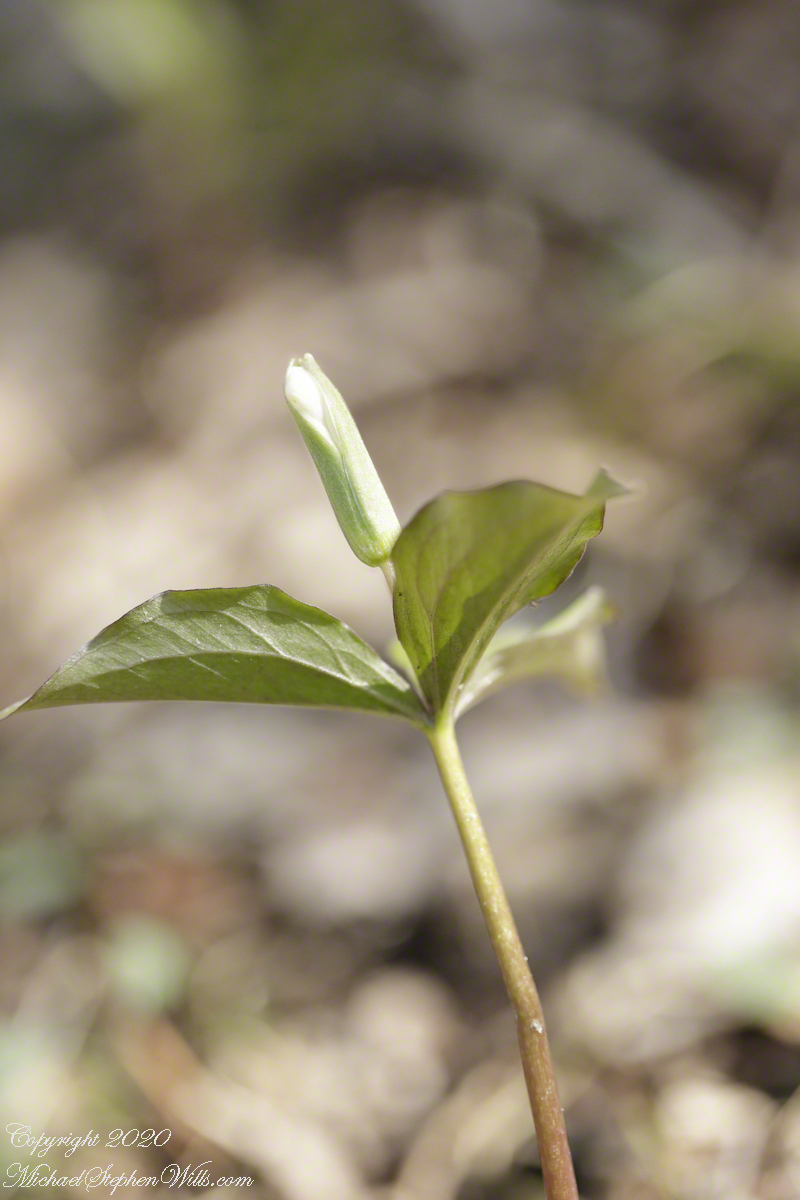
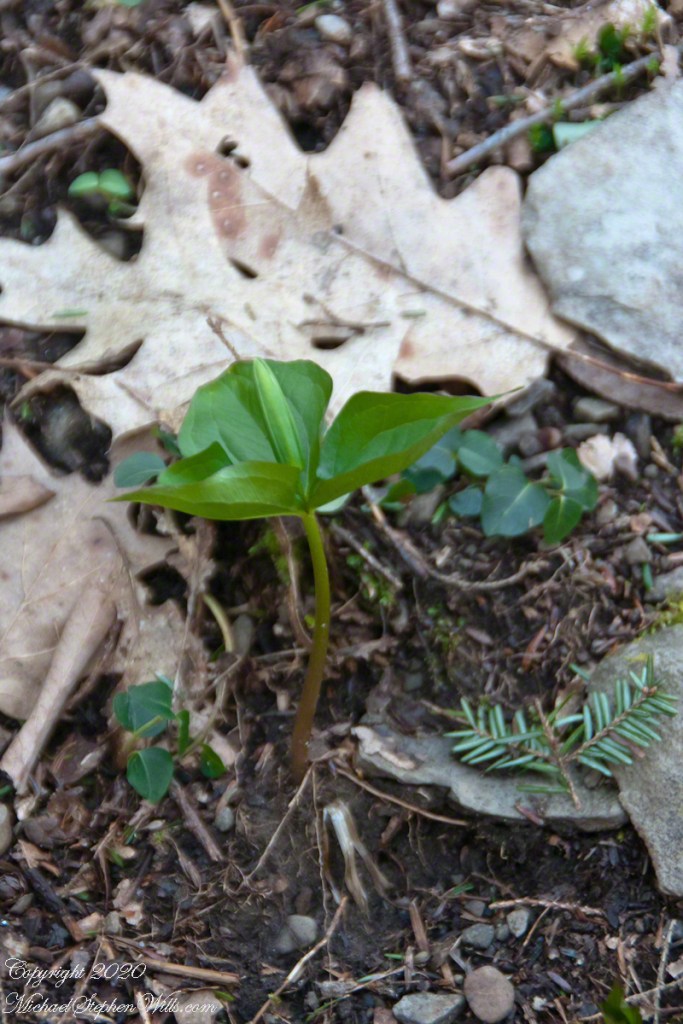
Wildflowers flourished where the slope turned to the north and late afternoon light spread across the small ravine created by a small stream. This early in the season White Trillium buds were forming between three green bracts.

Click photograph for a larger view. To do this from WordPress Reader, you need to first click the title of this post to open a new page.

The above photograph taken handheld with a variable zoom lens captures the plant and environment. On the forest floor is twig of hemlock, probably knocked off by squirrels feeding on the tiny cones. Oak leaves from last season frame the dark green bracts. We also see a few wintergreen leaves and the rich soil.

With the low light ISO is 2000, the f-stop of 5.6 allowed crisp details of the hemlock and wintergreen, the focus is soft on the oak leaves. Where is topography allowed sunlight, the White Trillium were a bit further along. Here is a bud opening.

Here I used a travel tripod and a macro lens with f-stop opened up to 3.2, not lens maximum, and all but the forward bract tip are in focus. A lower camera angle places surroundings in distance, allowing all to be blurred unrecognizable: the plant is the star of this shot. ISO 800 with the ample light. I was struggling with the spring breezes, having to wait for a break to take each exposure.

Copyright 2024 All Rights Reserved Michael Stephen Wills

Spring Outing III

Red Pine on the level

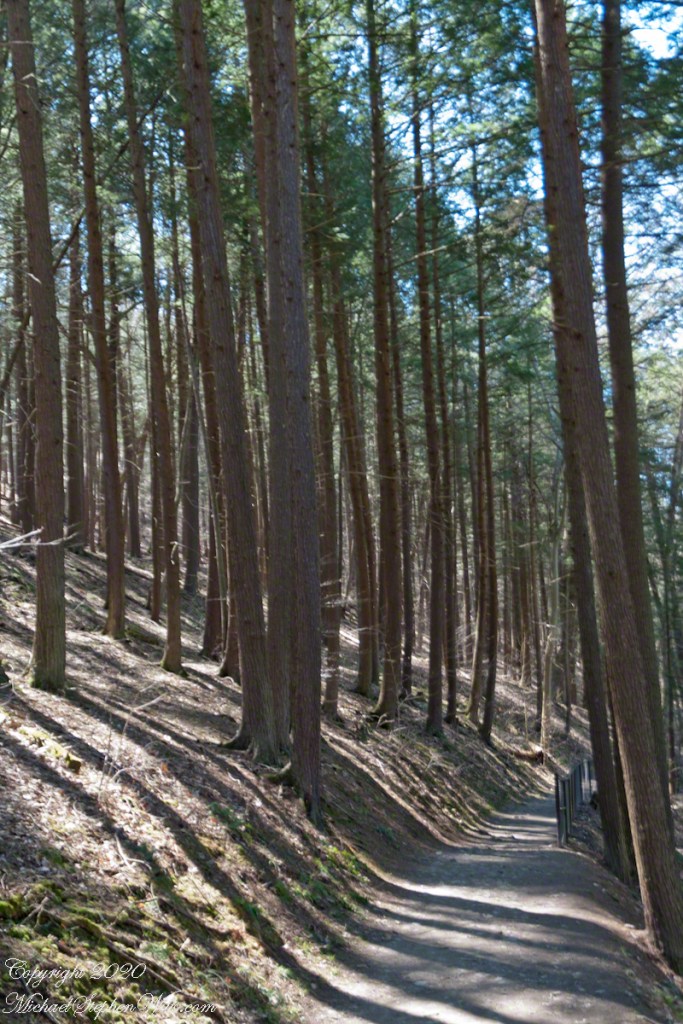
One hundred and fifty feet in a series of steep climbs is the effort expended to reach the relatively level portion of South Rim Trail where the tall Red Pines briefly reign. Here the trees thrive on the northeast facing slope. They grow in this way in one other location, in the upper park, on an eponymous trail.

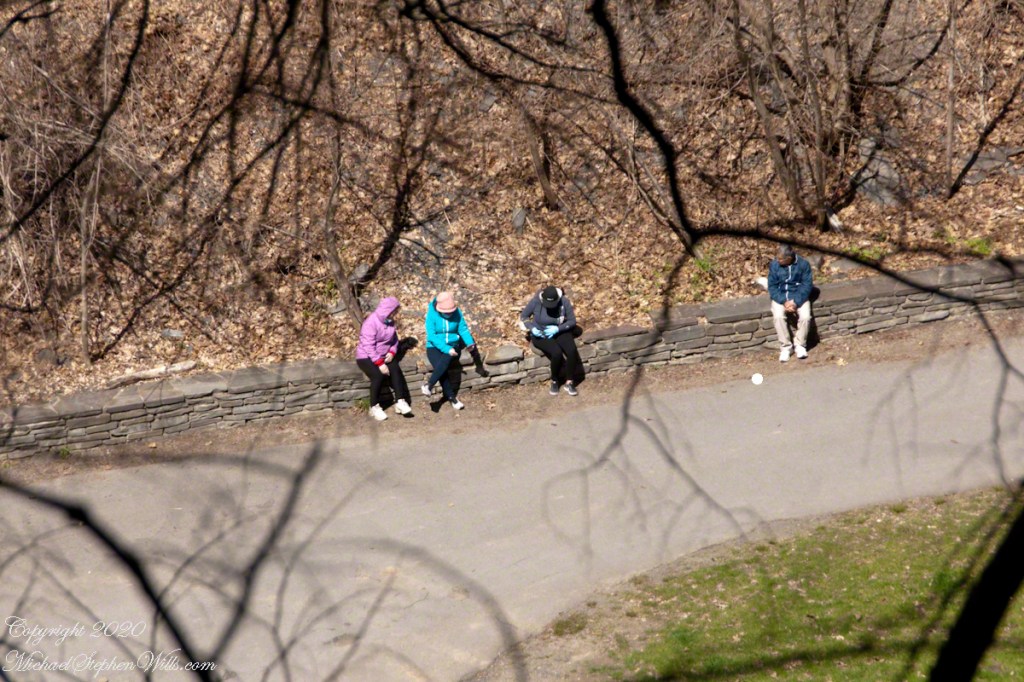
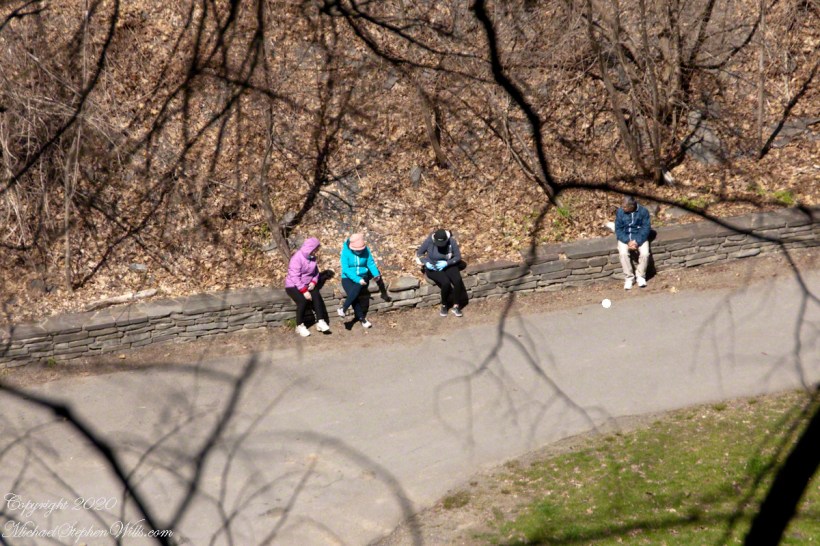
Encounters with groups of people descending always demanded I step off the trail to allow social distancing. Everyone work a flimsy face covering, although Governor Coumo’s order covers situations where social distancing is not possible. As of you, we do not have the loose masks; but only the N95 or a full respirator (both acquired very early on, our respirators were purchased for spreading lawn chemicals and spray painting).

Click photograph for a larger view. To do this from WordPress Reader, you need to first click the title of this post to open a new page.

Red Pine (Pinus resinosa), also know as Norway Pine, shed pollen prolifically. Some Aprils my boots are covered with it, a dusting of yellow. Not today.

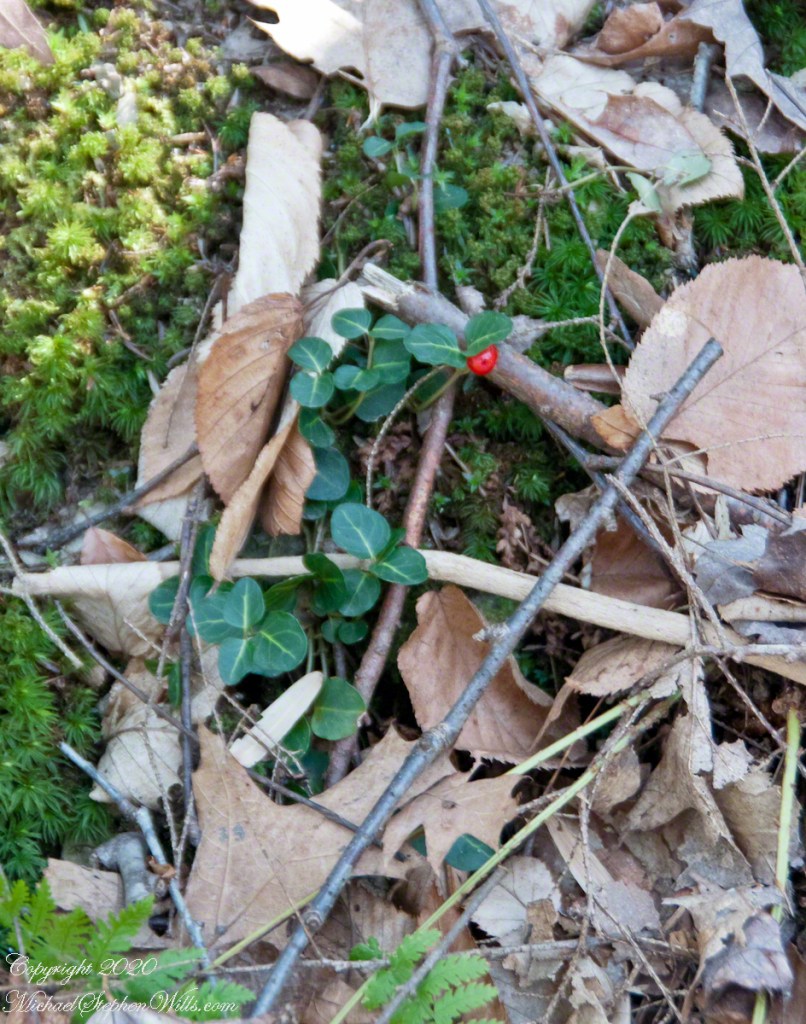
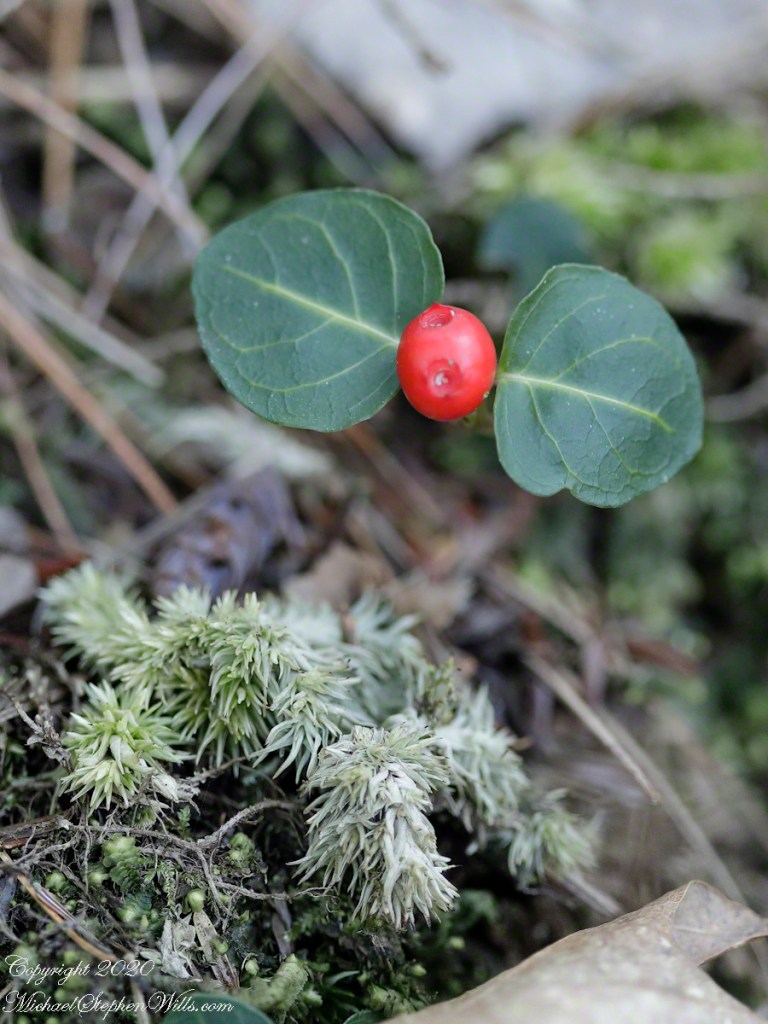
A species easy to spot among the green, an example of a shrub of the genus Gaultheria, though a very small specimen. The common name is wintergreen and I have never found larger specimens in Treman park. It is growing among the mosses on the wall of Enfield Glen South Rim.

The tough wintergreen leaves endue the cold seasons, the name is synonymous with evergreen.

Both shots are handheld, the macro is from a 100 mm “macro” fixed focus lens. ISO 2500, the f-stop to be wide open at 2.8 to gather the sparse light and present the subjects, blurring the immediate background. The overview shot is also a high ISO, 2000, the f-stop 5.8 on a variable focus lens set to 60 mm.

Copyright 2024 All Rights Reserved Michael Stephen Wills

Spring Outing II

Lower Waterfall

This series of posts opens with the ascent to where the wildflowers grow.

Click photograph for a larger view. To do this from WordPress Reader, you need to first click the title of this post to open a new page.

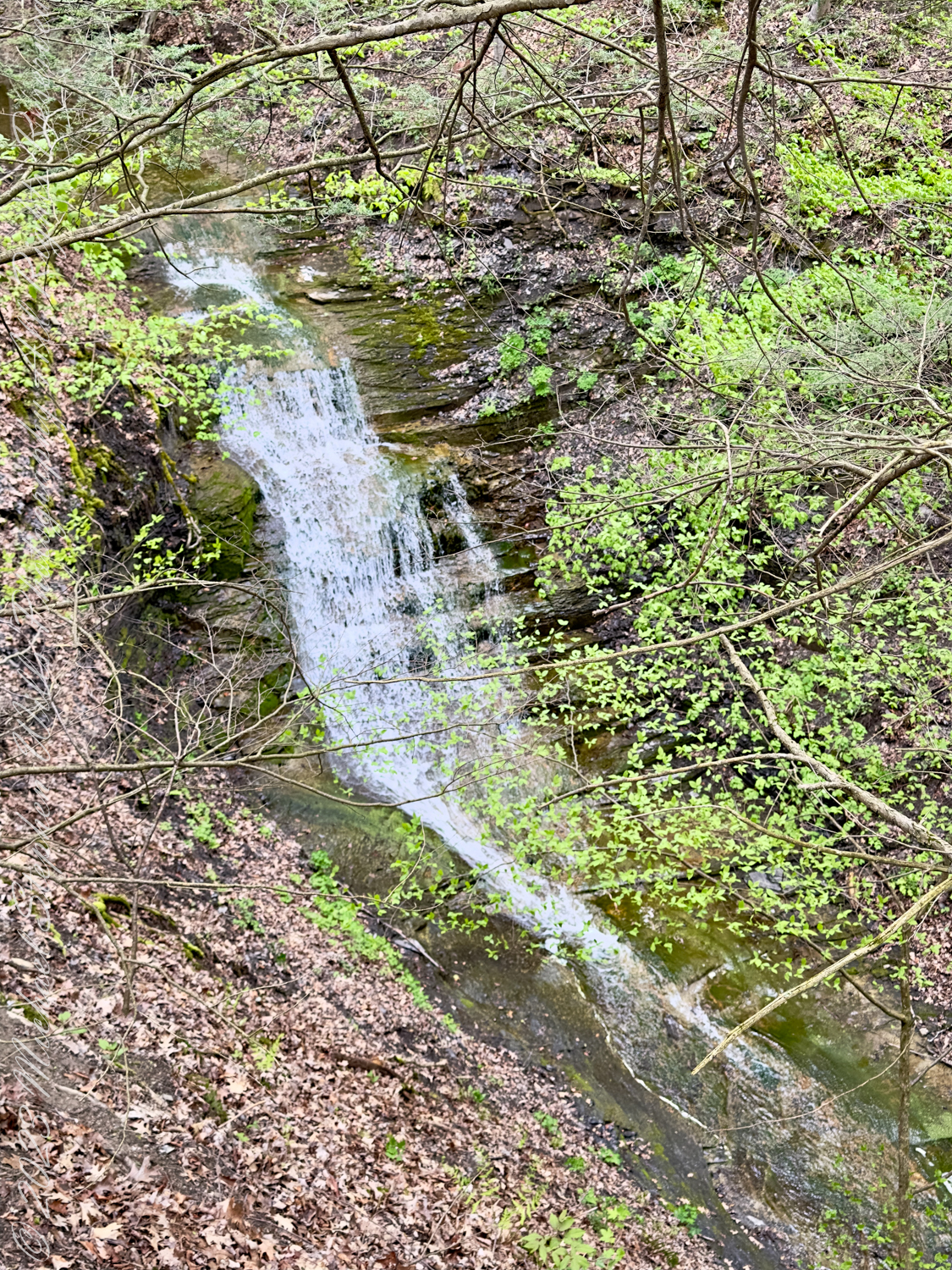
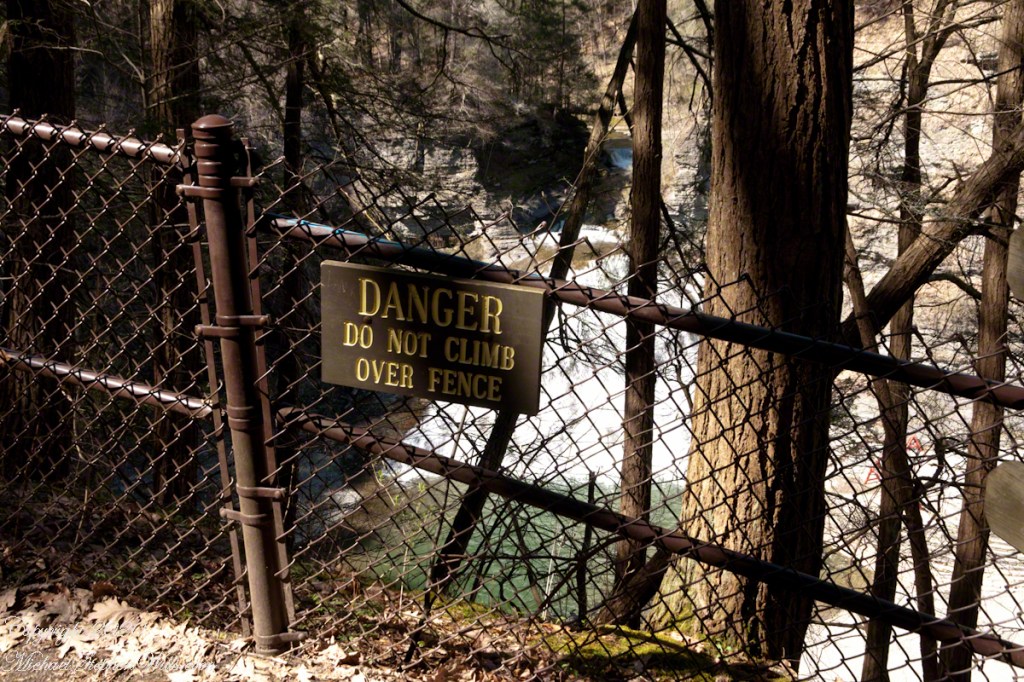
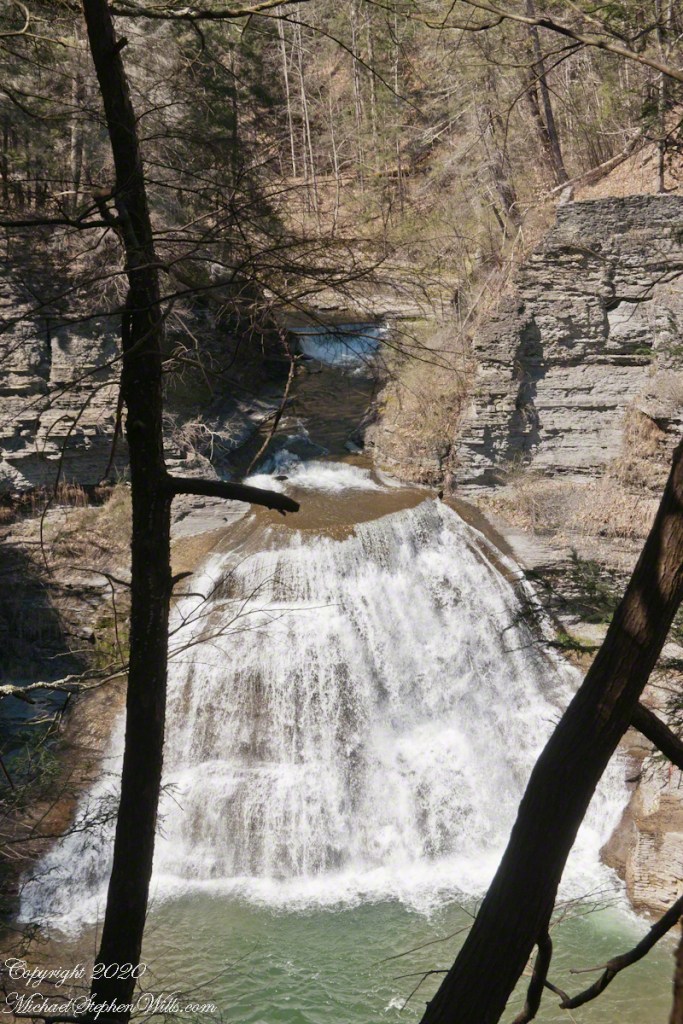
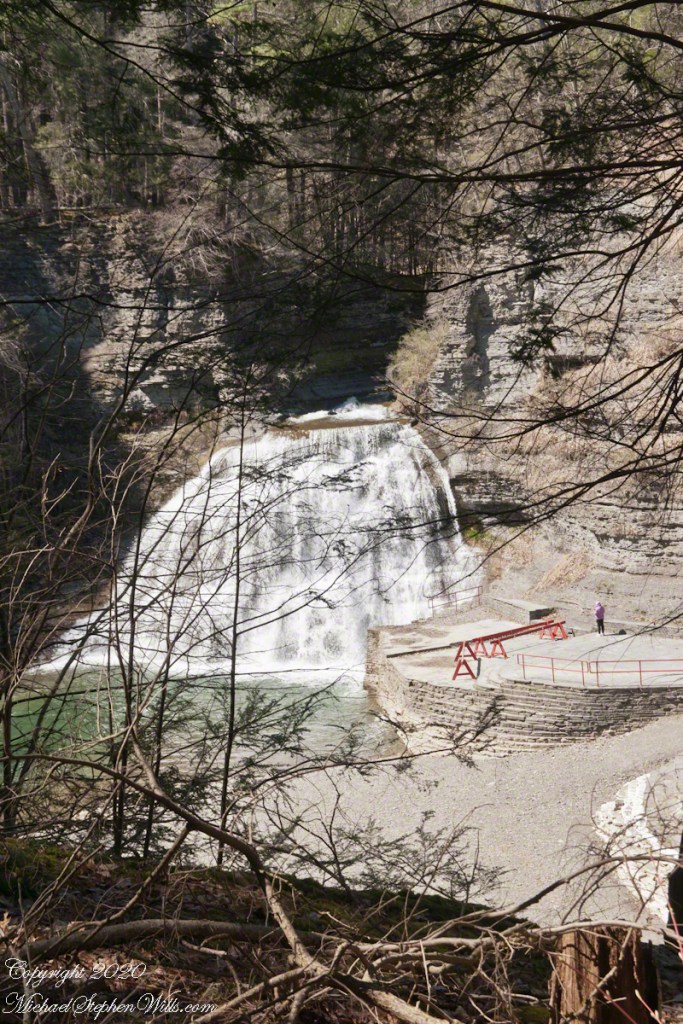
After just a taste of the climb to come, hikers are treated to an view of the Lower Falls of Enfield Creek. I call them the Wedding Cake. Summertime, a dam is erected, the water is deep enough to dive into the very cold creek water, lower than 70 degrees.

The trail is on a beetling crag.

Looking up Enfield Glen above the falls. Up to the trail, keeping distance was no problem. It is nowhere near as crowded as the trail to Taughannock Falls in February.

Copyright 2024 All Rights Reserved Michael Stephen Wills

Spring Outing I

Revisiting a Socially Distanced outing

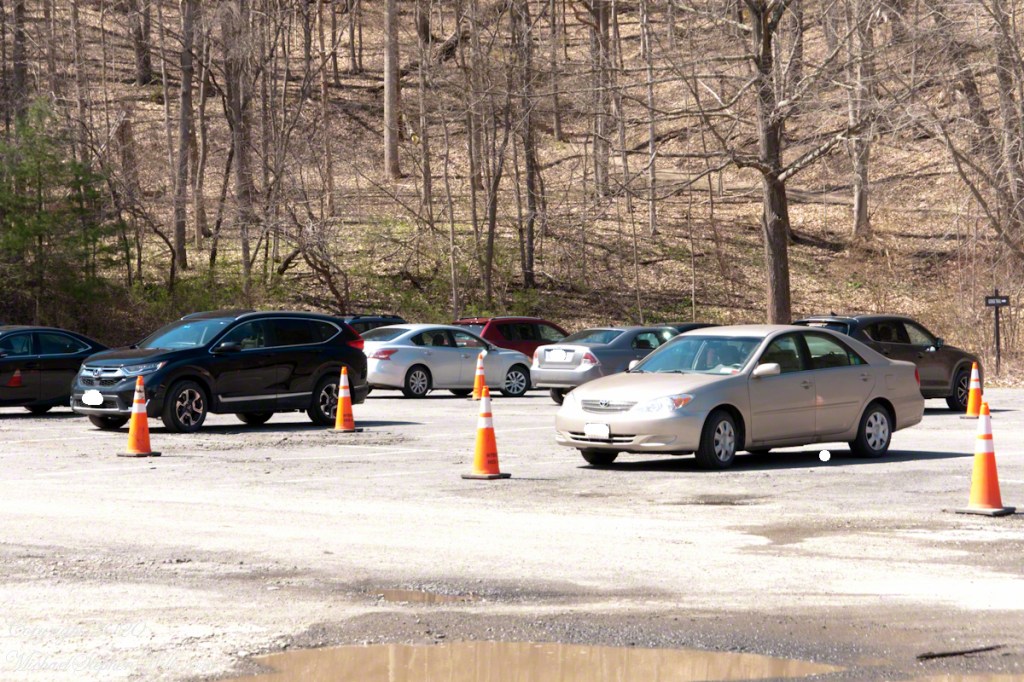
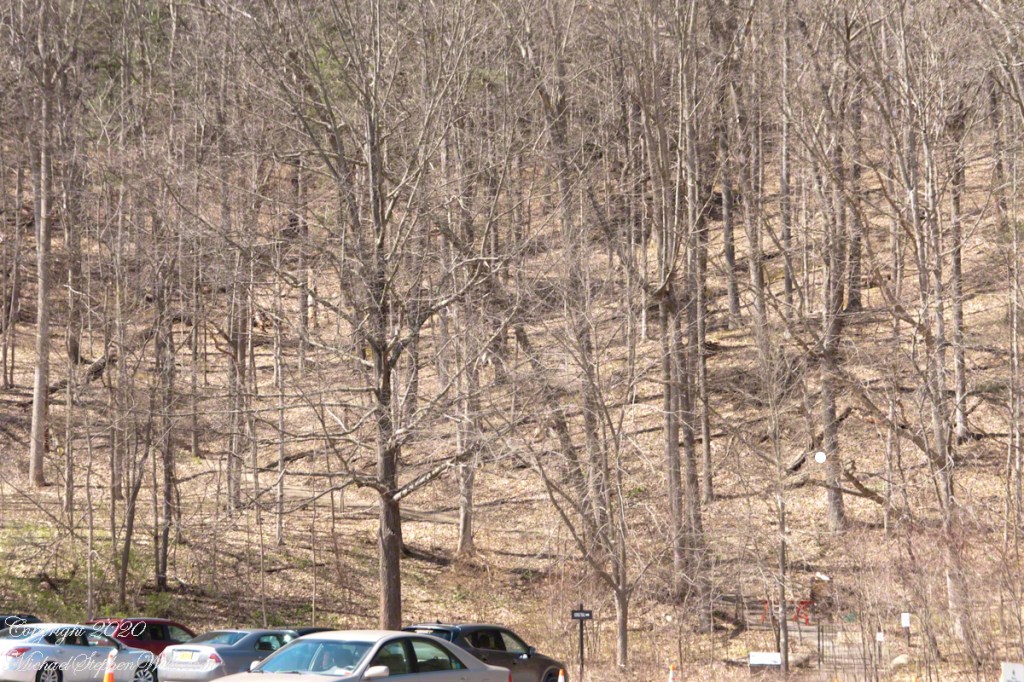
Parks were open during Govenor Cuomo’s “New York State on PAUSE.” Still, as a member of the at-risk group I was reluctant to visit, unsure of how crowded it will be. On a Monday afternoon, bright with sun, I drove over to Robert H. Treman lower park to check out the situation.

Click photograph for a larger view. To do this from WordPress Reader, you need to first click the title of this post to open a new page.

I carried the Sony in hand and packed in a Canon with macro lens and a Manfrotto travel tripod.

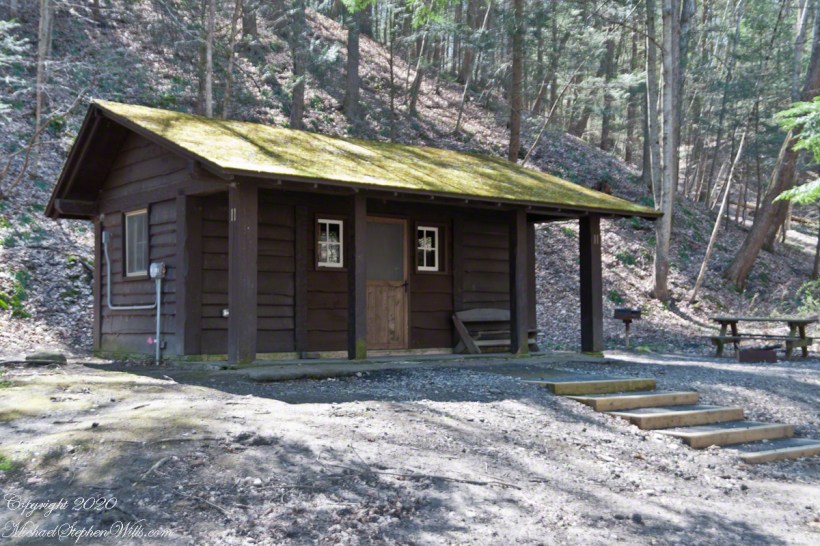
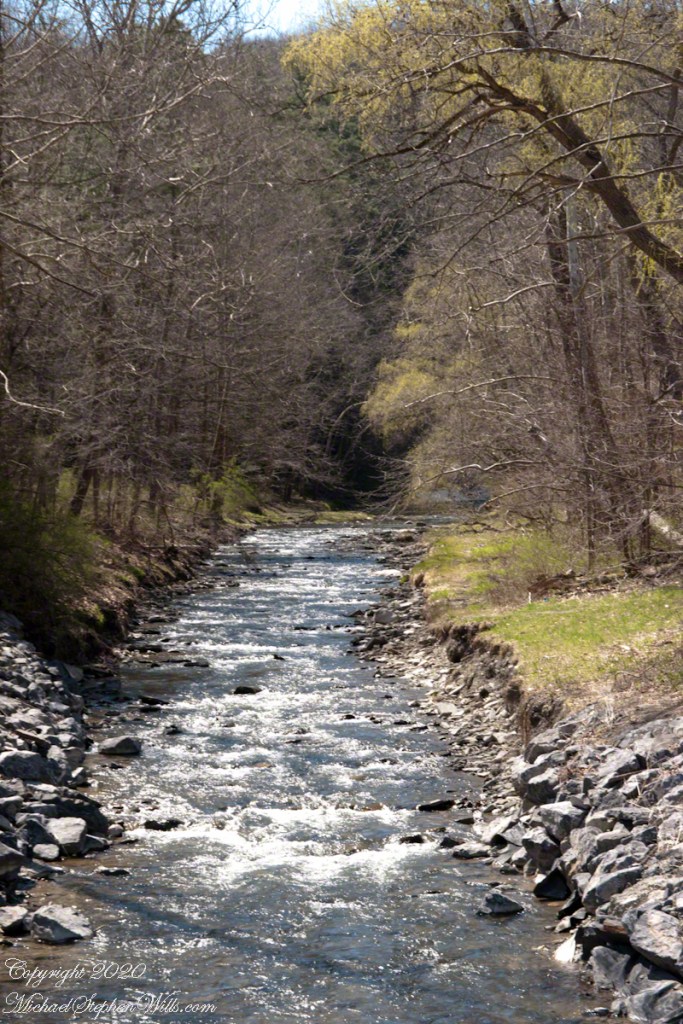
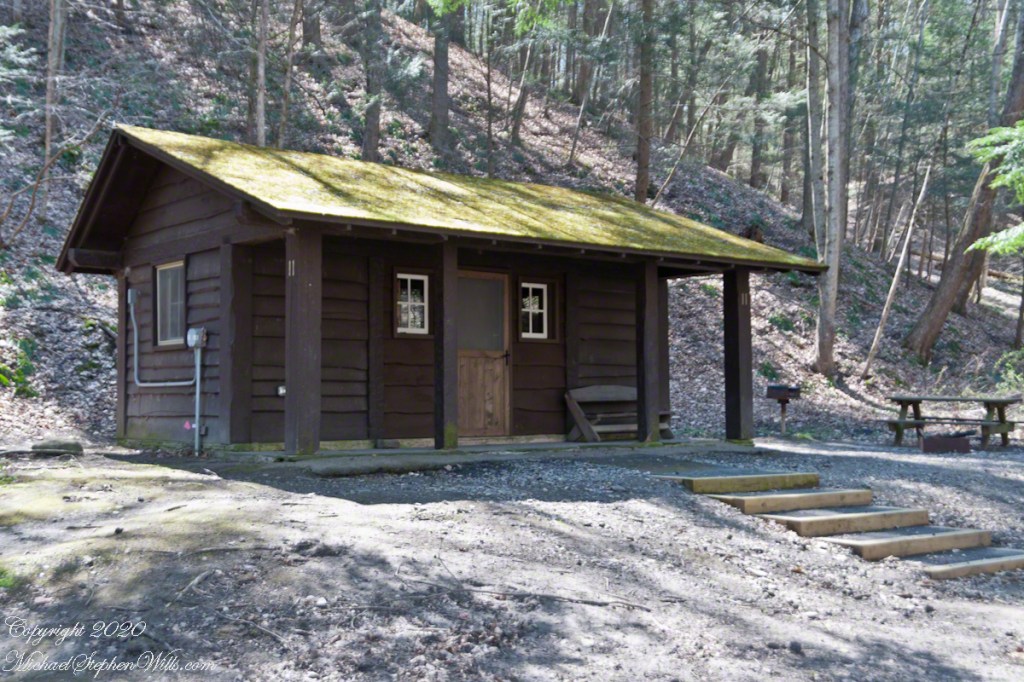
The path to a trail that climbs up the south side of Enfield Glen crosses Enfield Creek via a bridge, wends through cabins……

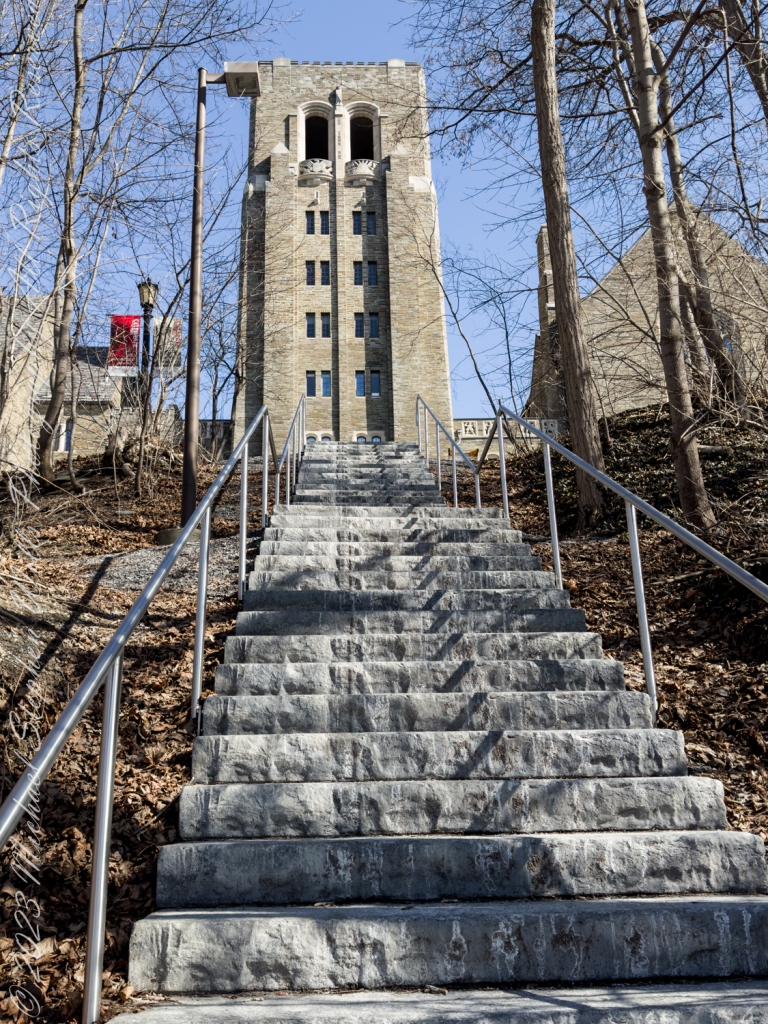
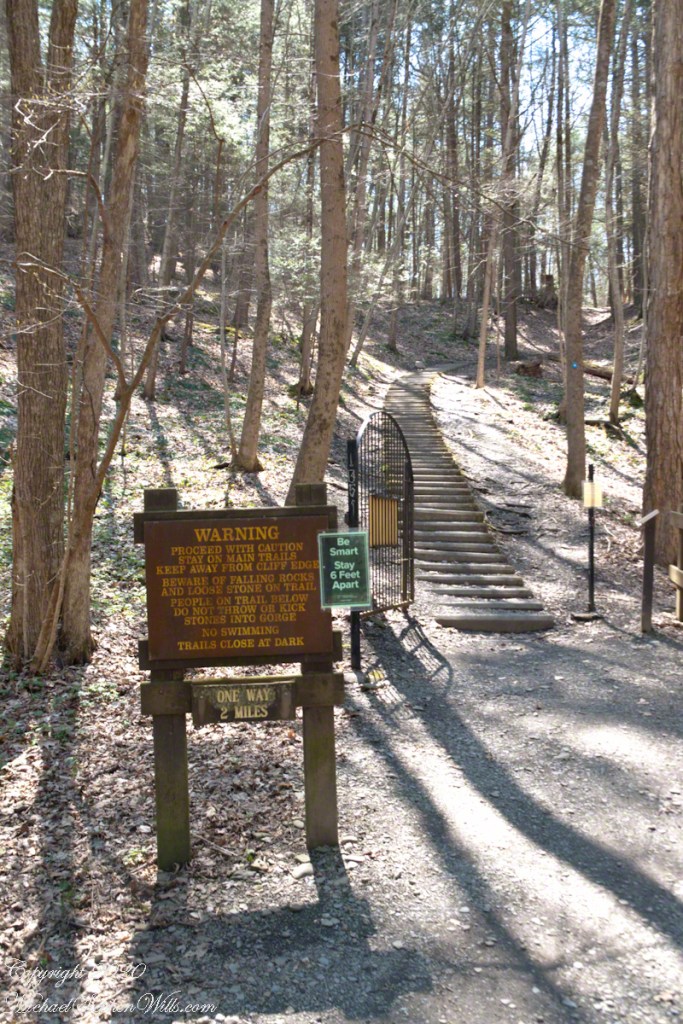
…..then heads up stairs that can seem to be forever. The green sign with white letters is new. This the South Rim Trail avoids the cliffs that make the Gorge trail so dangerous November through May.

Copyright 2024 All Rights Reserved Michael Stephen Wills

Up the Rim Trail

Key words: steep, icy

It is the Gorge Trail that’s closed for the cold months, November through April. The Rim Trail remains open for those who dare icy, steep paths Unlike Gorge Trail, Rim Trail climbs above the dangerous cliffs from which rocks are wedged free by ice to fall on the trail. On an early spring day, after a sudden frost, we walked the Rim Trail to capture the moment.

Here is the steep start, climbing up from the Upper Park where a footbridge crosses Fish Kill. Kill is the old Dutch word for creek. Fish Kill mergers with Enfield Creek a few hundred feet downstream.

Click photograph for a larger view. To do this from WordPress Reader, you need to first click the title of this post to open a new page.

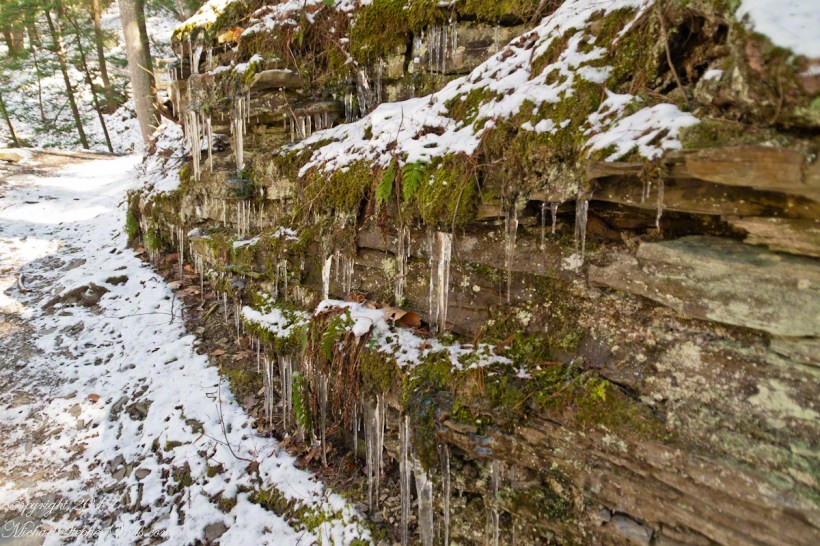
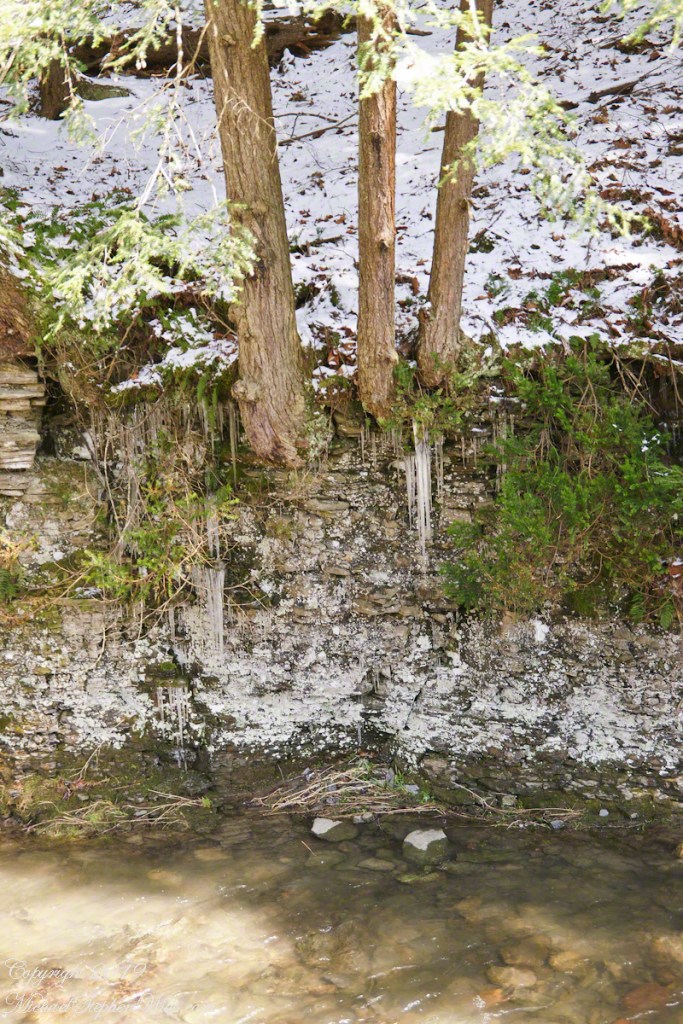
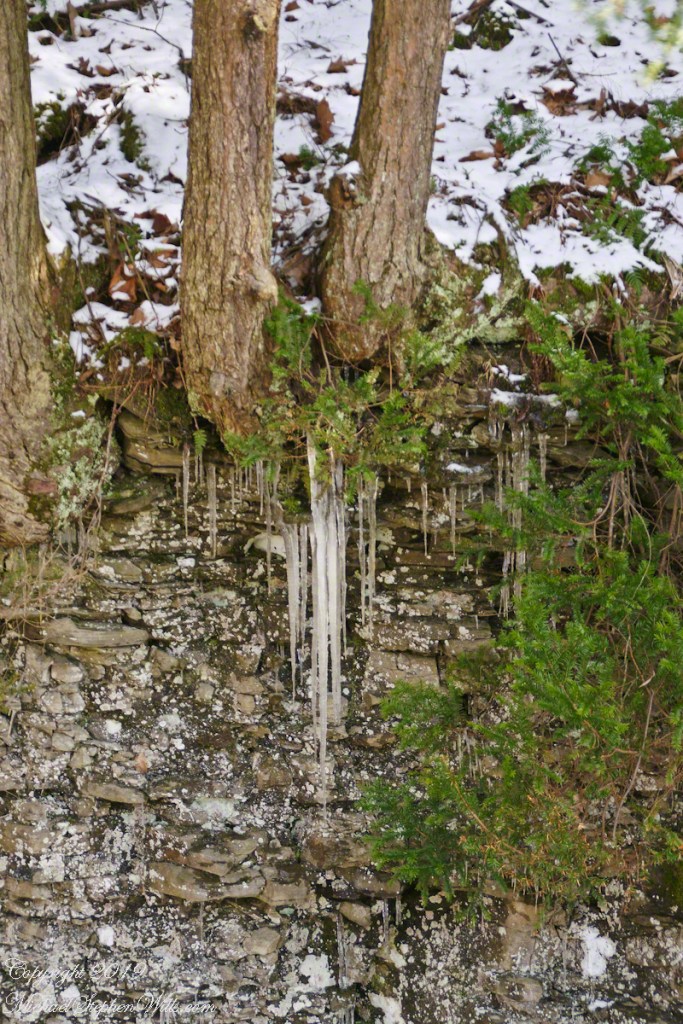
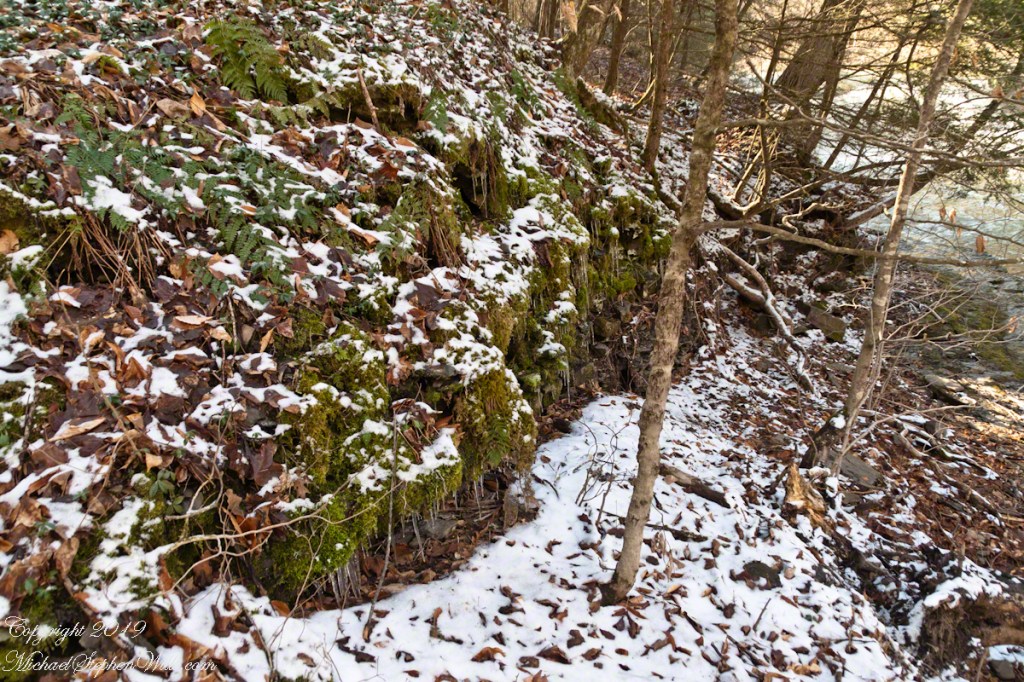
This north facing slope stays frozen into May. Here layers of the sedimentary rock shale, laid down in a shallow warm sea over 350 million years ago, are slowly pried apart. Hemlock tree roots wedge between rock layers, slowly growing. The action of ice, water expands in volume at the point of freezing, aids the process.

In places the rock face appears to be a hastily made dry stone wall, the rock layers are so disrupted by plant and frost.

These shots were hand held. I used a Sony Alpha 700 dslr with a variable “zoom” lens, great for framing compositions.

Robert H. Treman New York State Park.

Click for a slideshow of this Waterfall of the Old Mill sequence
Copyright 2024 All Rights Reserved Michael Stephen Wills

Ascent

Andrew Wyeth effect

Here the Rim Trail climbs out of the flats beneath the Cliff Stairs, away from Enfield Creek, onto the upper slopes of the gorge.

Click photograph for a larger view. To do this from WordPress Reader, you need to first click the title of this post to open a new page.

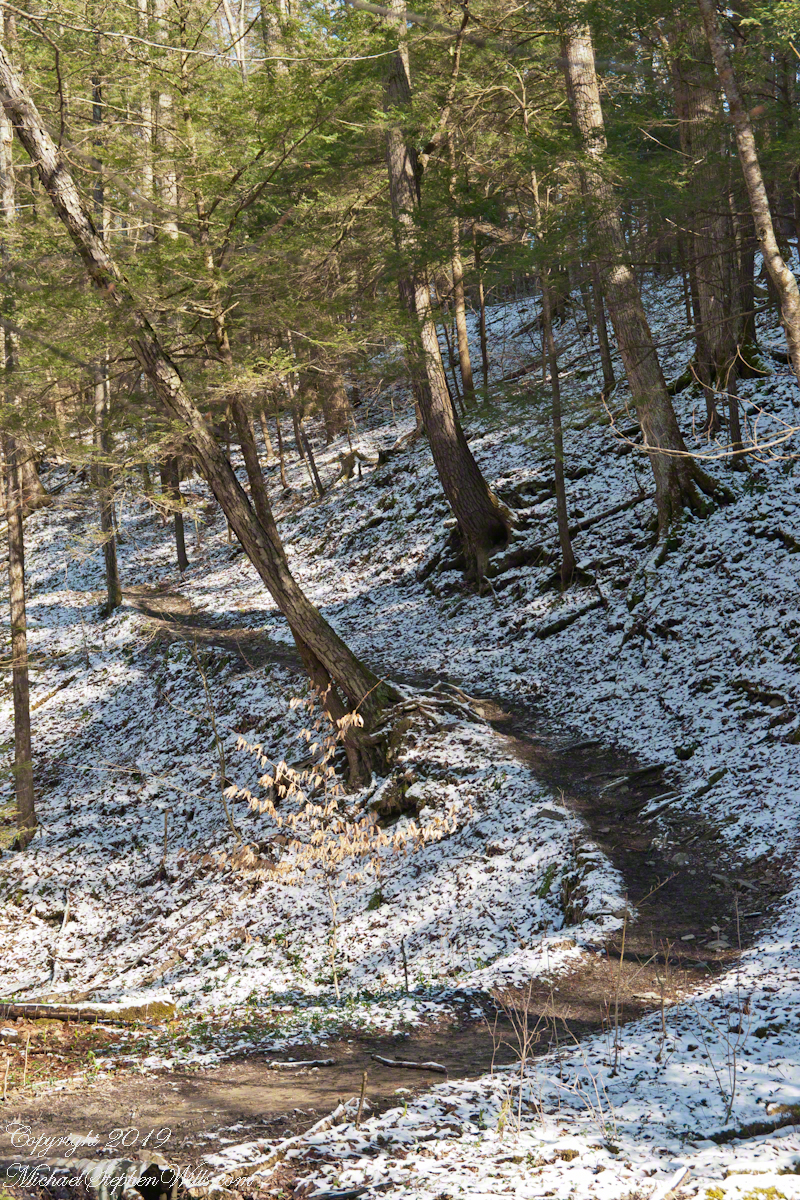
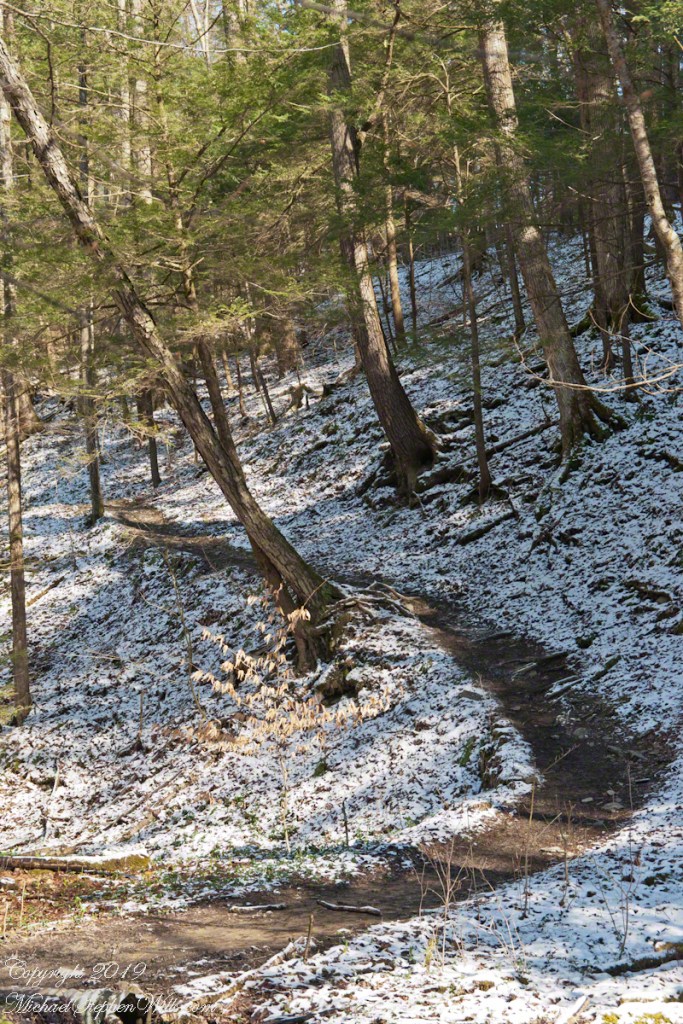
Early spring snow highlights the path, threading between hemlocks. The American realistic painter Andrew Wyeth comes to mind with I see the mottled texture of this light snow. He captured some of this in landscape paintings such as “Snow Flurries.”

Here is more of this effect……

These shots were hand held. I used a Sony Alpha 700 dslr with a variable “zoom” lens, great for framing compositions.

Robert H. Treman New York State Park.

Click for a slideshow of this Fertile Flats sequence.
Copyright 2024 All Rights Reserved Michael Stephen Wills

Periwinkle

Source of life-saving drug

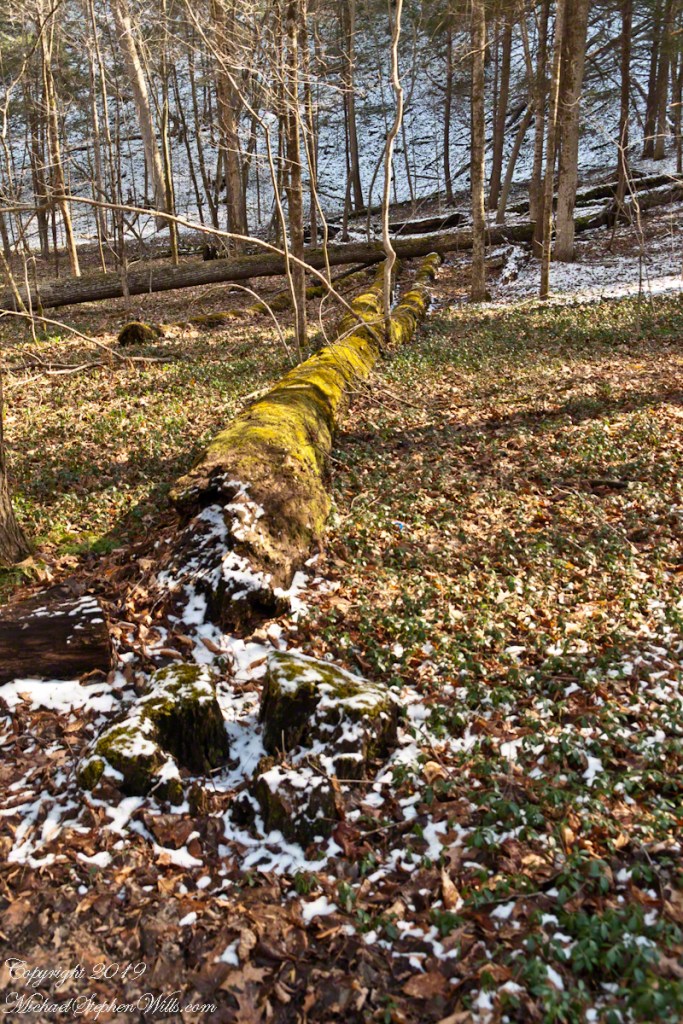
A broad, fertile flat between gorge walls supports a dense growth of invasive creeping myrtle. Springtime there is a sprinkling of small blue flowers, this may be the source of another name, periwinkle, or lesser periwinkle.

Click photograph for a larger view. To do this from WordPress Reader, you need to first click the title of this post to open a new page.

Periwinkle is an evergreen and in early times vinca vine (another name we call it, from the scientific name Vinca Minor) was planted in graveyards and cemeteries. The isolated growth of vinca vine in this section of the gorge maybe from such a planting on a lost grave.

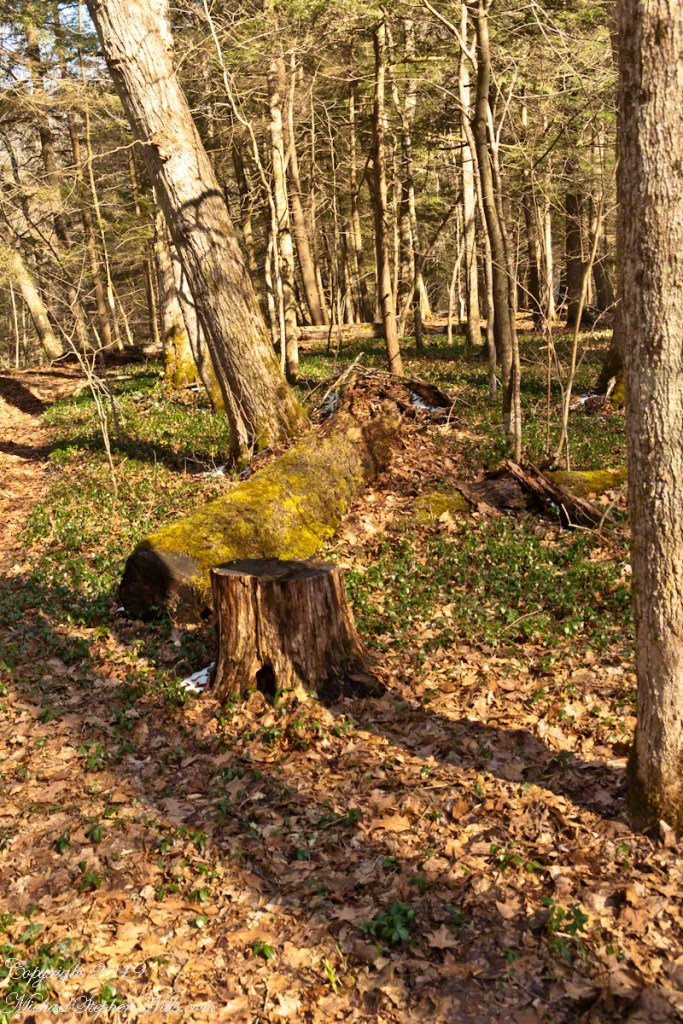
Today, the park practices leaving fallen trees in place, here they are covered in years of moss, a memory of headstones. Lesser Perriwinkle is significant for the living as the source of vincamine, from the leaves. A synthetic form of this compound is a potent vasodilator, a therapeutic treatment for stroke and other brain disorders.

These shots were hand held. I used a Sony Alpha 700 dslr with a variable “zoom” lens, great for framing compositions.

Robert H. Treman New York State Park.

Source: Wikipedia, “Vinca Minor.”

Click for a slideshow of this Fertile Flats sequence.
Copyright 2024 All Rights Reserved Michael Stephen Wills

Ephemeral

Amphibian haven, breeding place

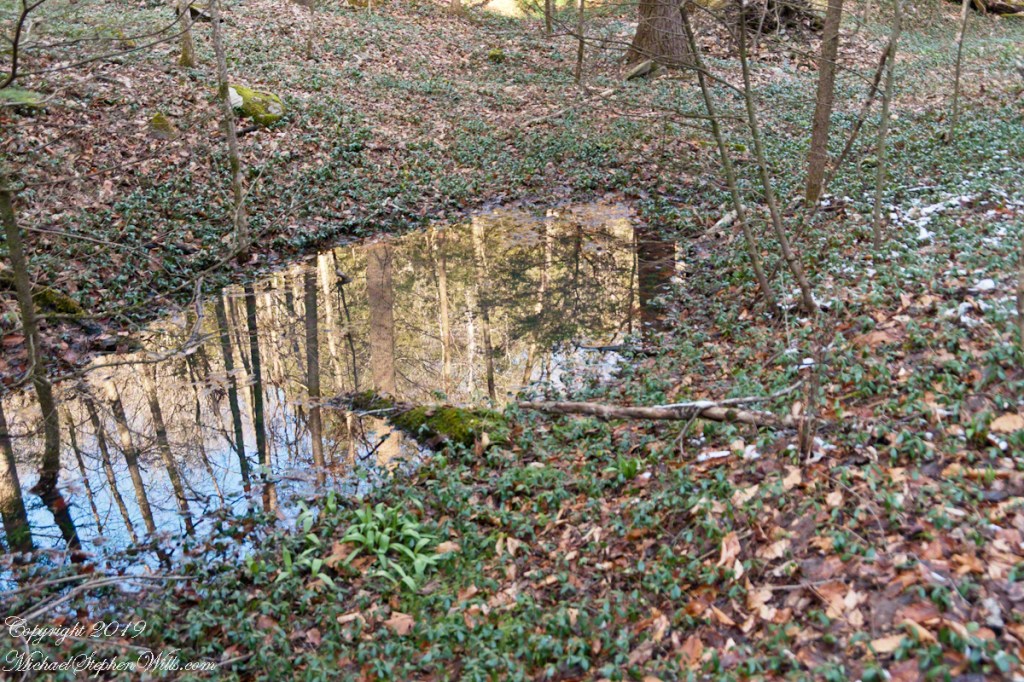
Melting snow, spring rains, gather in hollows of the forest floor to form ephemeral pools important for the development of amphibian life.

Click photograph for a larger view. To do this from WordPress Reader, you need to first click the title of this post to open a new page.

Also named vernal pools, from the Latin word for spring or the time of the equinox. The pools are ephemeral in the sense of being temporary, disappearing in the warmer, dryer late spring and summer months, a characteristic important for amphibian live in being devoid of predatory fish.

Here the pool forms on a flat beneath the walls of Enfield Gorge. Here is another photograph featuring the ephemeral winter theme, “The Cave.”

These shots were hand held. I used a Sony Alpha 700 dslr with a variable “zoom” lens, great for framing compositions.

Robert H. Treman New York State Park.

Sources: Wikipedia, “Vernal Pool” and Merriam Webster online.

Click for a slideshow of a few photographs published recently.
Copyright 2024 All Rights Reserved Michael Stephen Wills

Gully vs. Ravine

I love the early spring light filtering through the hemlocks.

Rim trail traverses gullies. These creases in the gorge walls were formed by small streams flowing to Enfield Creek.

Click photograph for a larger view. To do this from WordPress Reader, you need to first click the title of this post to open a new page.

Some passages require a wade, others have elaborate walkways with bridges. I initially wanted to call these ravines. Upon researching the term discovered while ravines are formed by erosion, the scale here is much smaller. I could rename Enfield Gorge, to Enfield Ravine.

These shots were hand held. I used a Sony Alpha 700 dslr with a variable “zoom” lens, great for framing compositions.

Robert H. Treman New York State Park.

Click for a slideshow of this Waterfall of the Old Mill sequence
Copyright 2024 All Rights Reserved Michael Stephen Wills