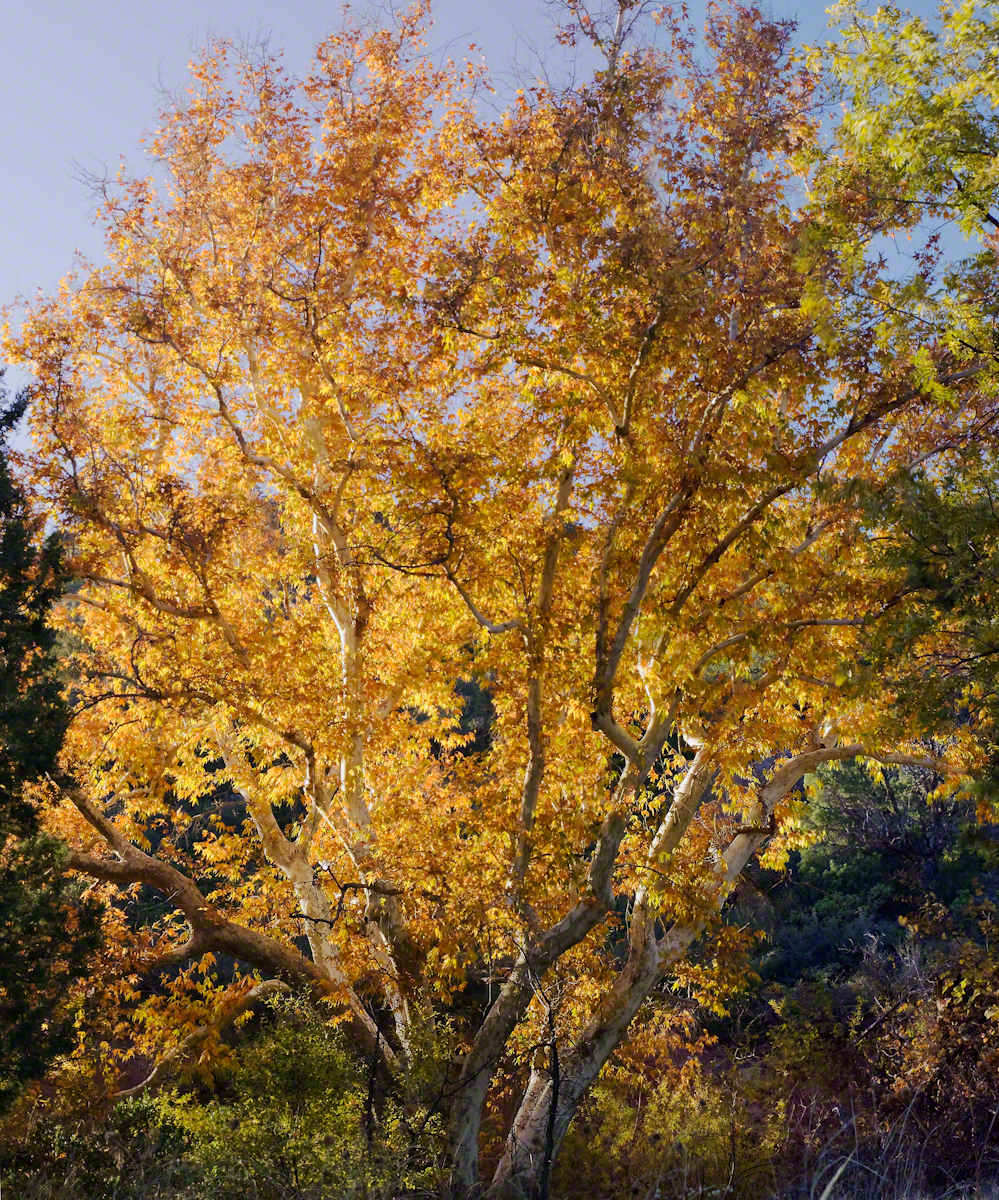
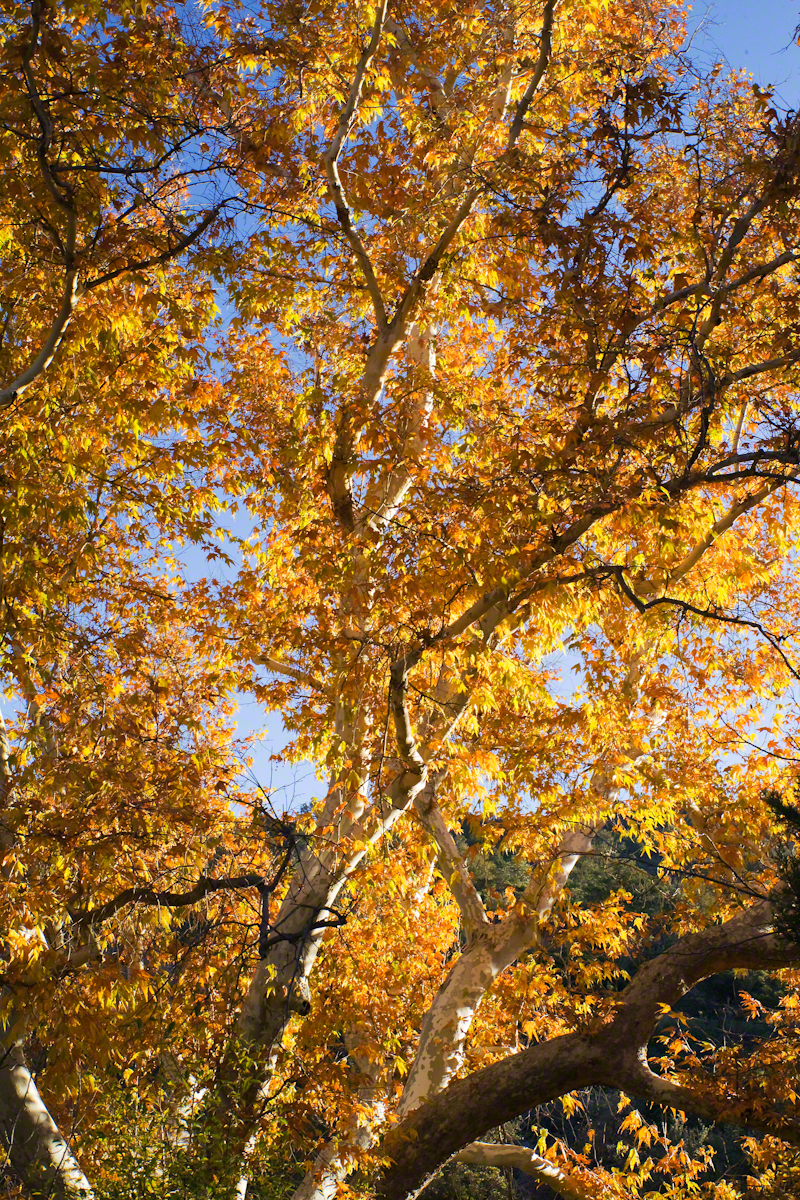
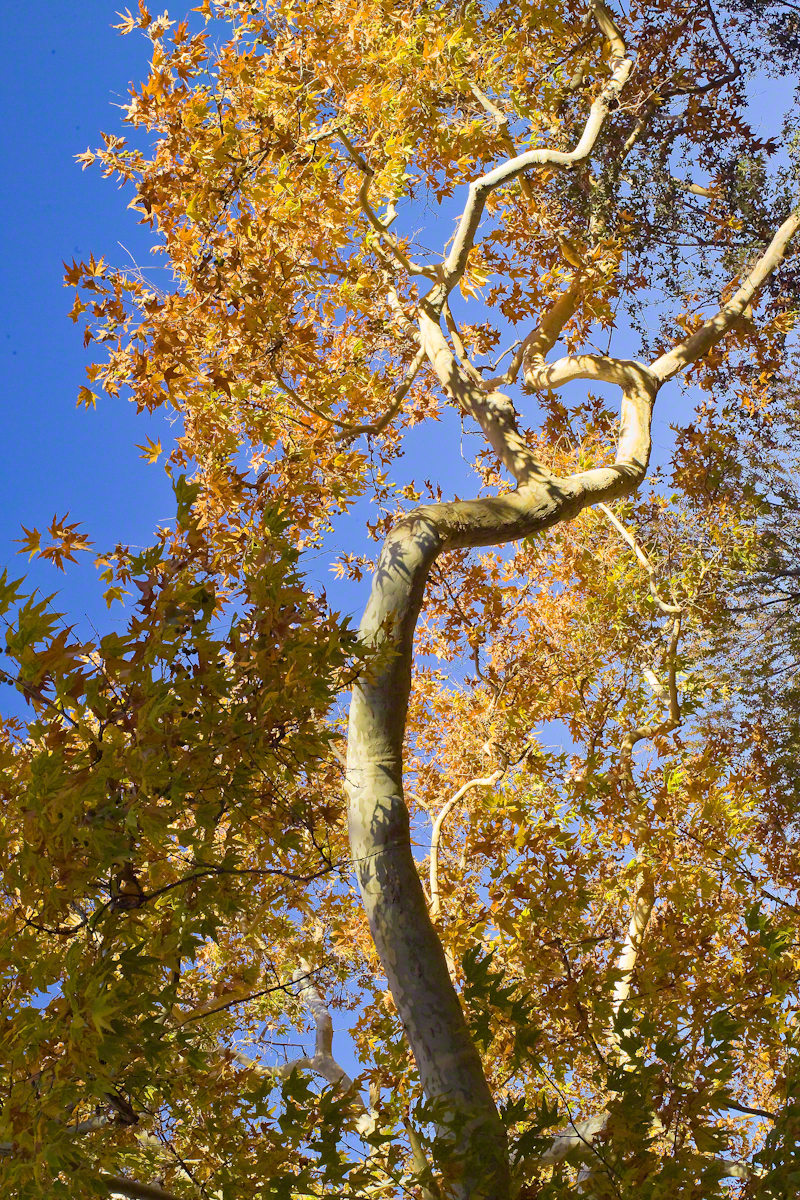
A Peaceful Day at Pine Creek

Explore a remote location of the eastern Superstition Wilderness

….continued from the chapter “Two Meetings.”

The spring gales persisted through my late afternoon arrival in Pine Creek, into the night and next morning. Protected from the west wind by the rising land, the tent was not buffeted like I described in the chapter “A Dry Piece of Paradise.” The song of soughing pines was my last impression of the evening and the first of the next morning.

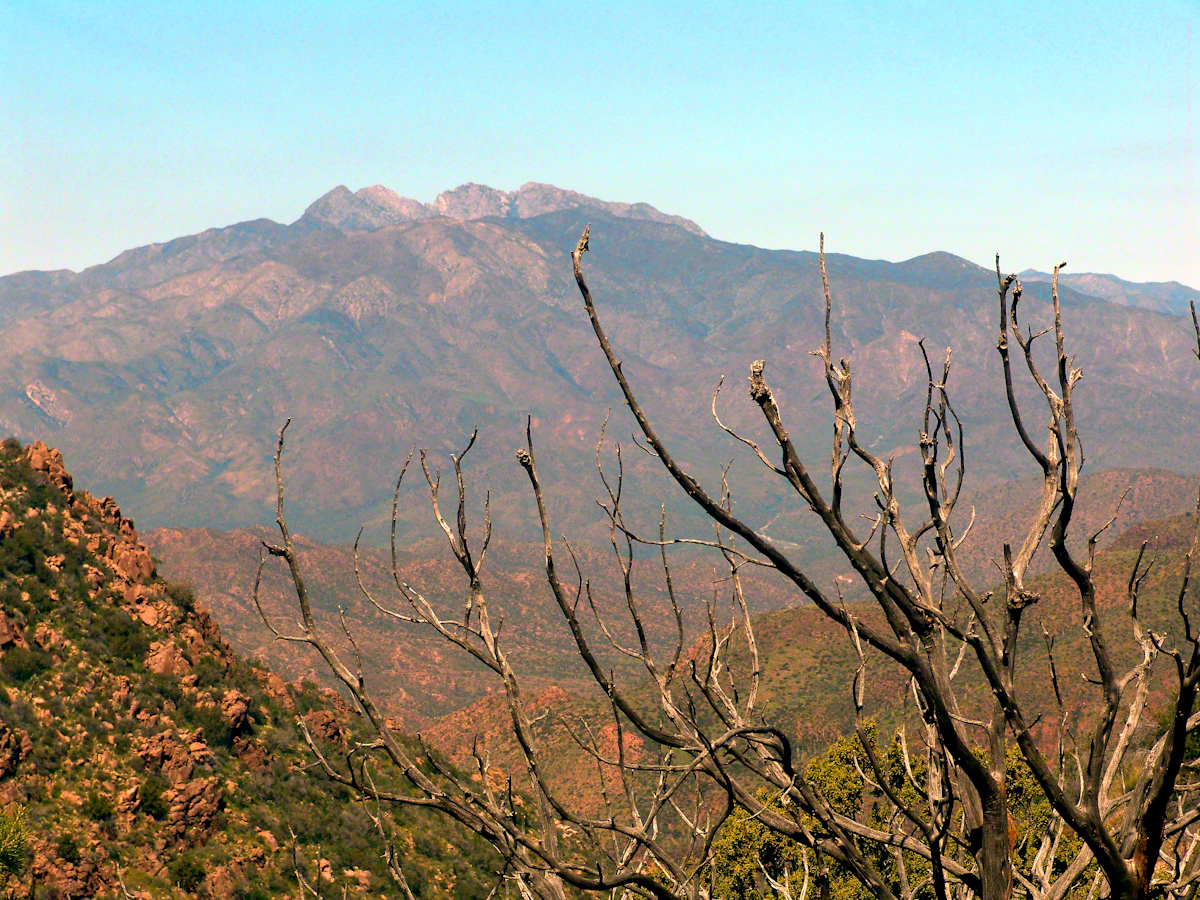
Where the Arizona trail crosses, Pine Creek flows at 4,600 foot elevation through a canyon of broadly sloping sides. The flow originates at the foot of Mound Mountain to the southwest, at 6,253 feet the highest elevation in the Superstitions. There are 5,500 foot peaks to the east and west. The land falls away to the north giving great views of the Four Peaks Wilderness.

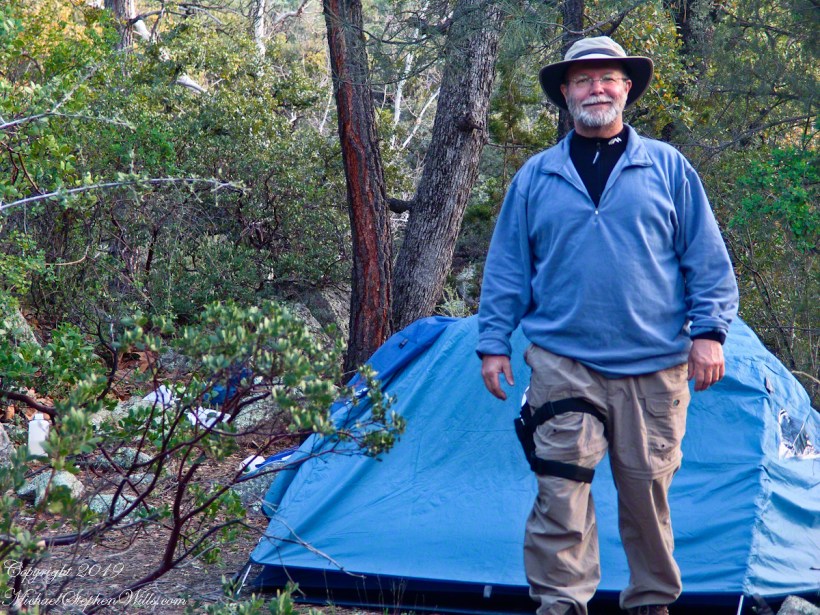
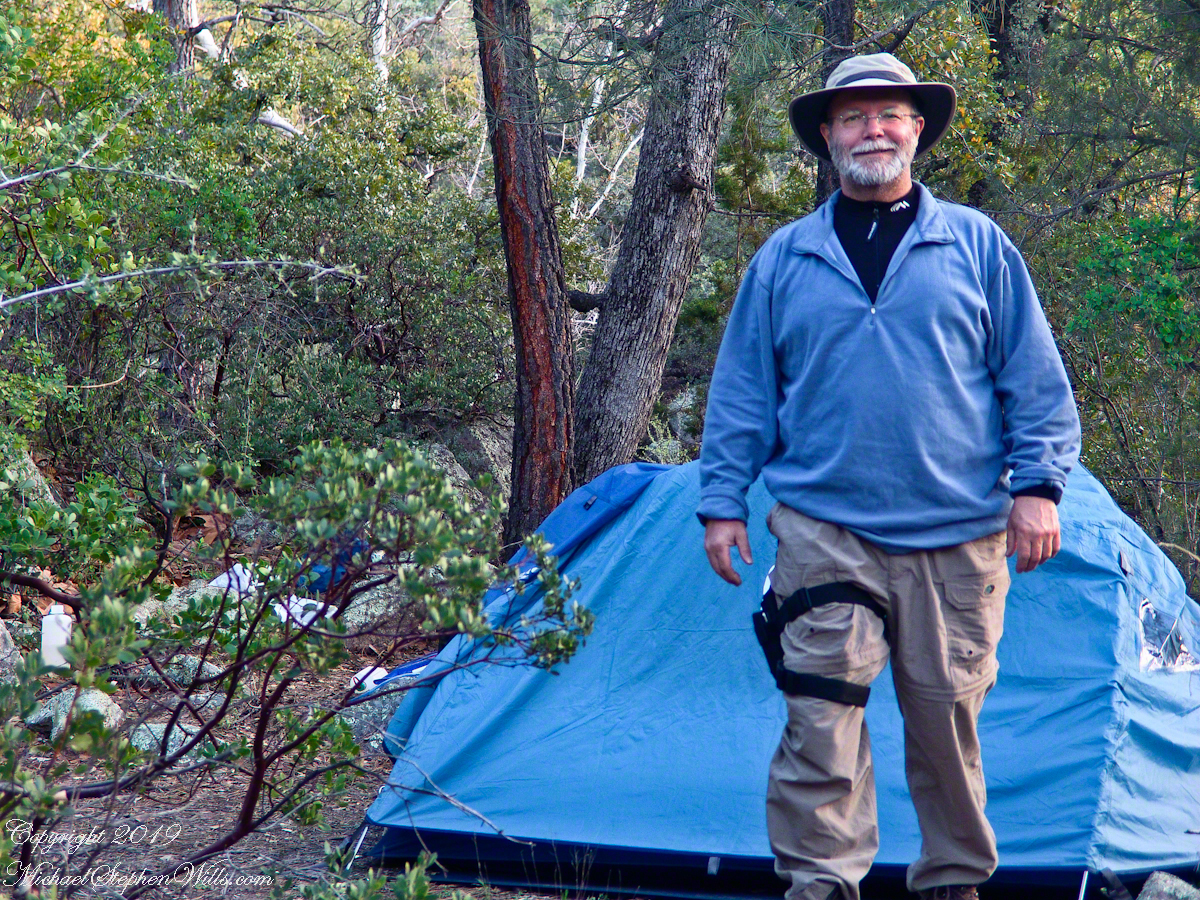
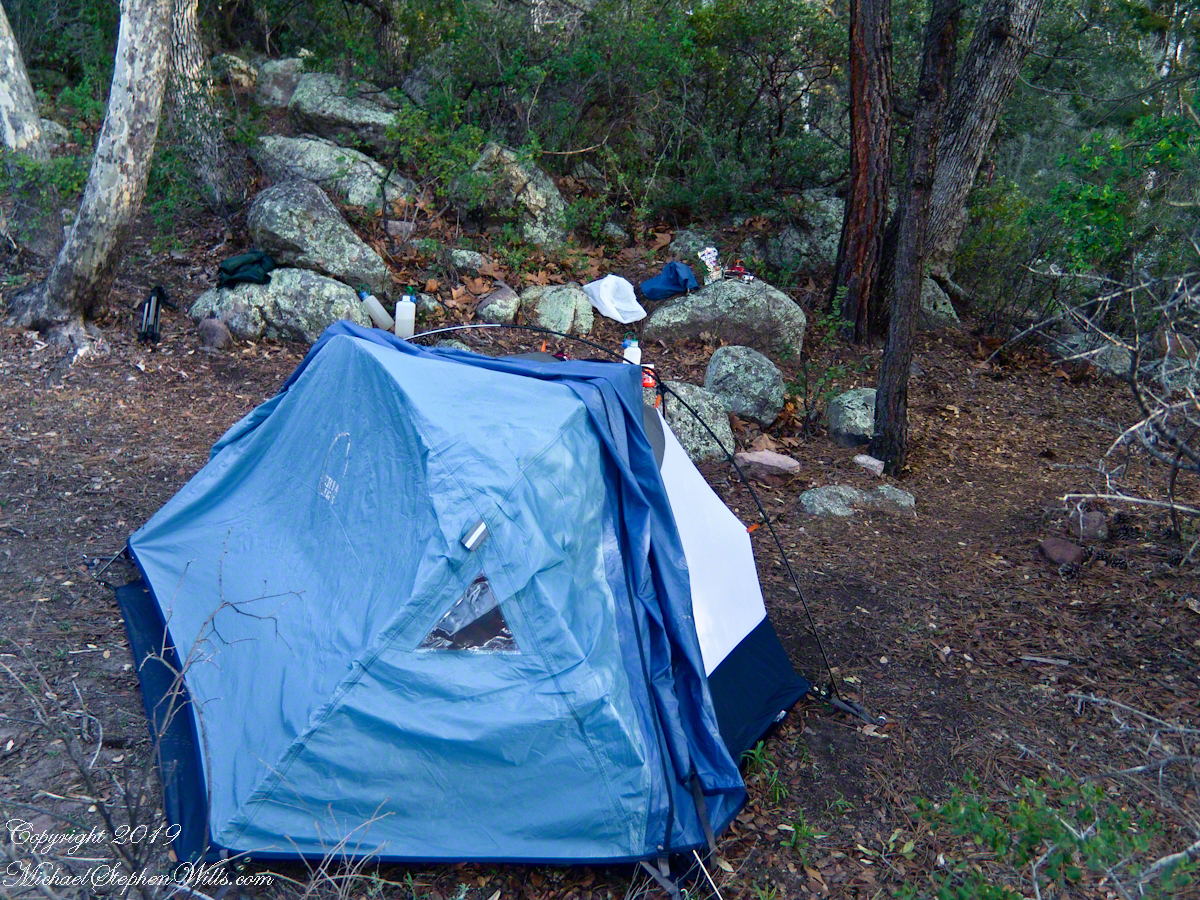
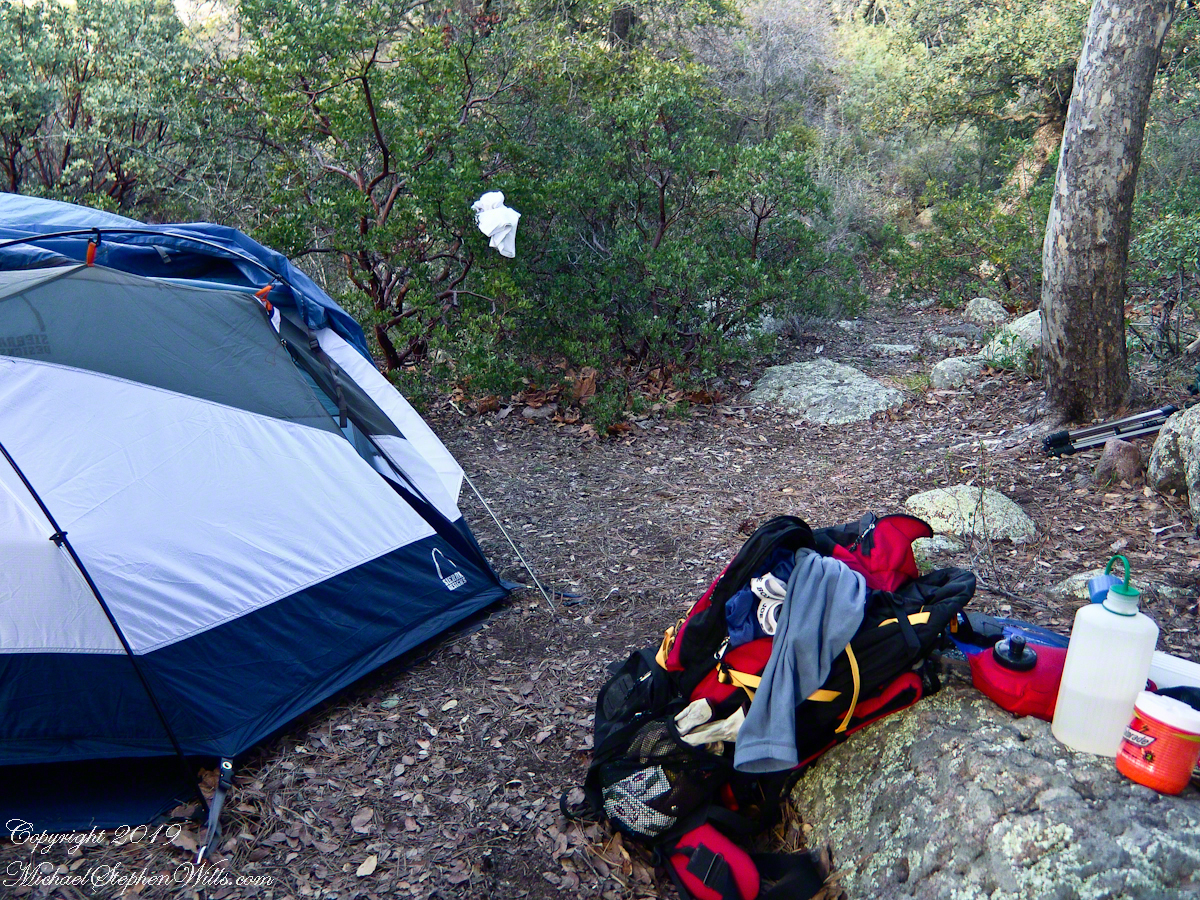
I chose a flat site to camp above the creek among Arizona White Oak, Arizona Sycamore, Ponderosa Pine and Manzanita. Of these, it’s Manzanita fruit for which the bears come in the summer. Manzanita thickets made approach to the camp site difficult from all directions but the path. Bear sign was thick among this growth. Go to my chapter, “Racing the Sun,” to see the red barked Manzanita and pink blossoms from which grow tiny green fruits that ripen summertime into a bright red, like tiny apples. Indians used this bland tasting fruit containing five hard seeds for food and a cider beverage.

Well before dawn I grabbed warm clothes, hat, camera to head out for a full day of leisure.

On a shallow rise above Pine Creek I took the two shots of agave (Century Plant) stalks in dawn light. These start the chapter, “A Dry Piece of Paradise.” One dry agave flower is to the left in this North view, looking down the creek not far from the creek crossing.

Click any photograph for a larger view
North View from Pine Creek, early morning

In the photograph notice how the canyon narrows as the creek flows north, the walls rising above it for hundreds of feet.

When I climbed about 200 feet above the creek to a ledge that provided great views, the protective canyon walls fell away and wind gusts threatened to up end the light tripod. It was necessary to anchor it with the daypack and I tied down my hat as well.

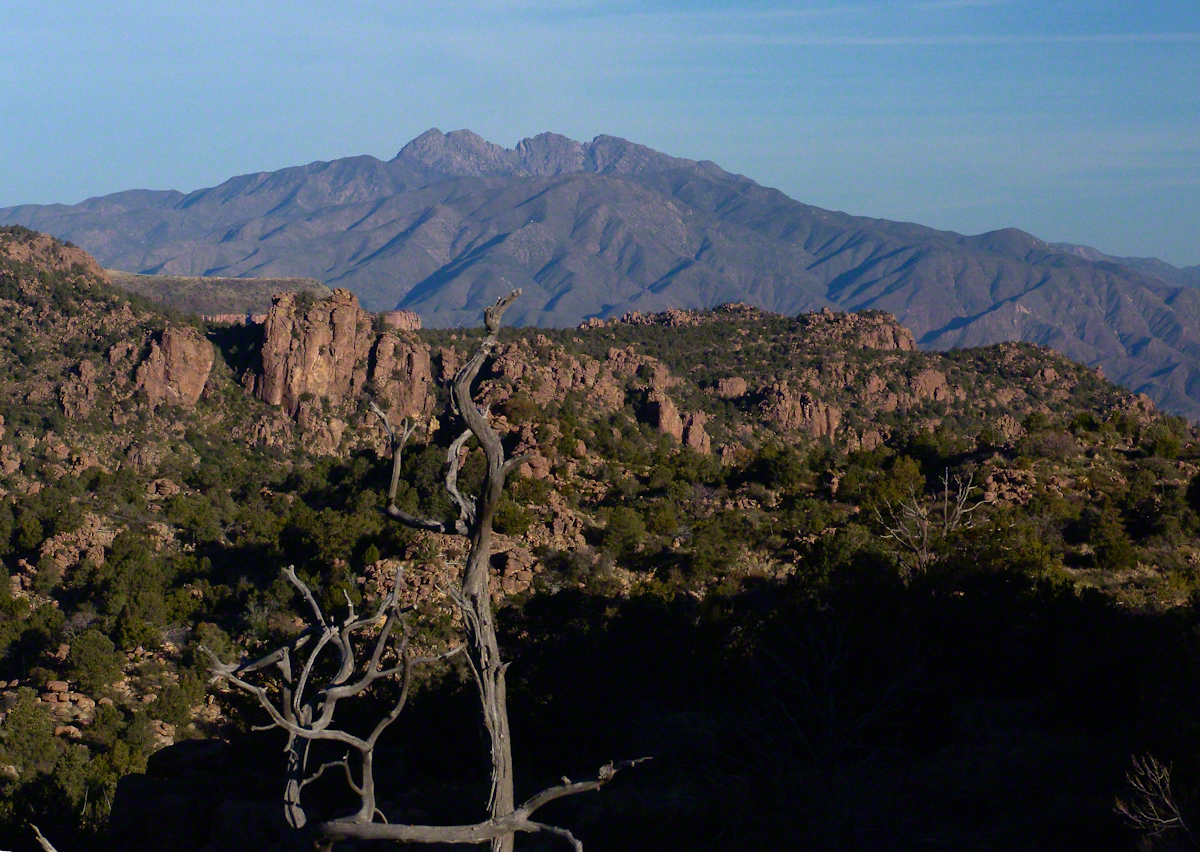
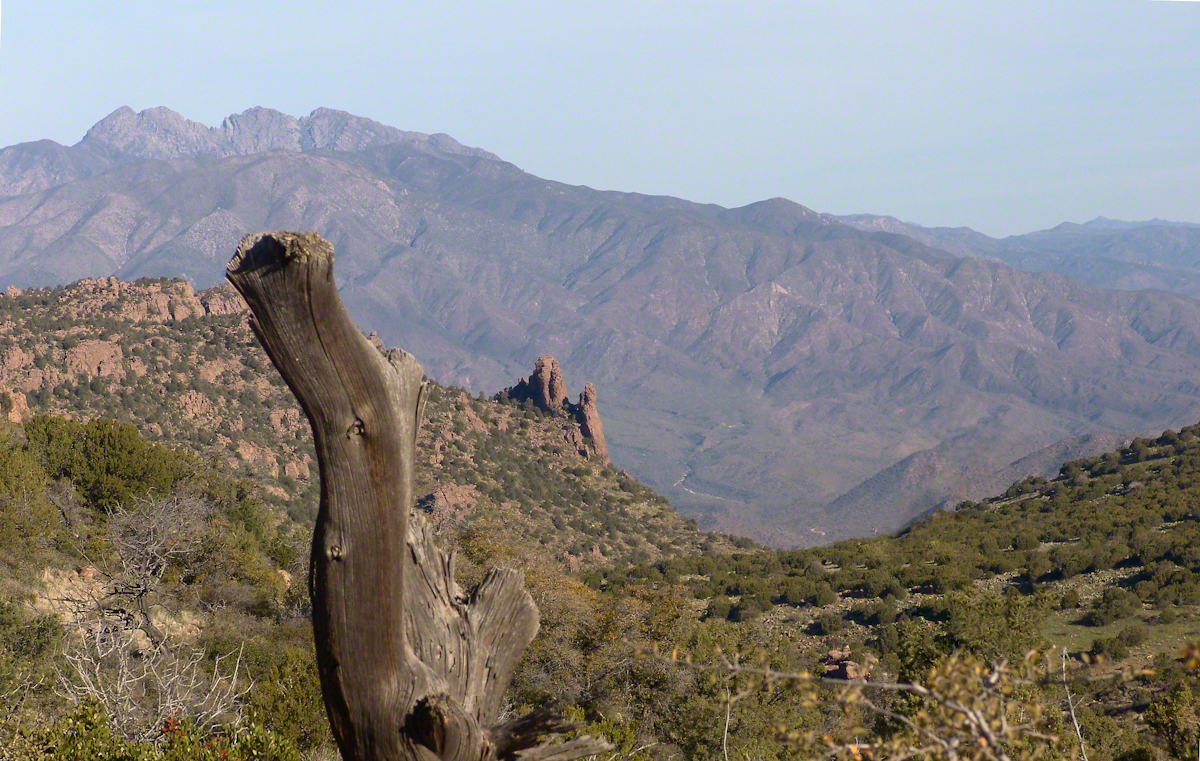
Shadows of night lie below, dominated by Four Peaks Wilderness. A unique long flat ridge is behind the near dramatic ridge above Pine Creek. This view leads me to daydreams. The long ridge is clearly visible in two photographs titled “Nameless Canyon in the Dawn” and “Nameless Canyon Morning” of my post “A Dry Piece of Paradise.”  A view from the west is available in my post “Racing the Sun.” Look at the photograph captioned, “Overview of my path to the Nameless Canyon behind Two Bar Mountain,” the flat ridge is just above the shadow of Castle Dome. The view from that spot must be incredible across the lower Reavis Creek valley. From here it is a day trip 4+ mile roundtrip bushwhack over the cliffs above Pine Creek.
North View from Pine Creek

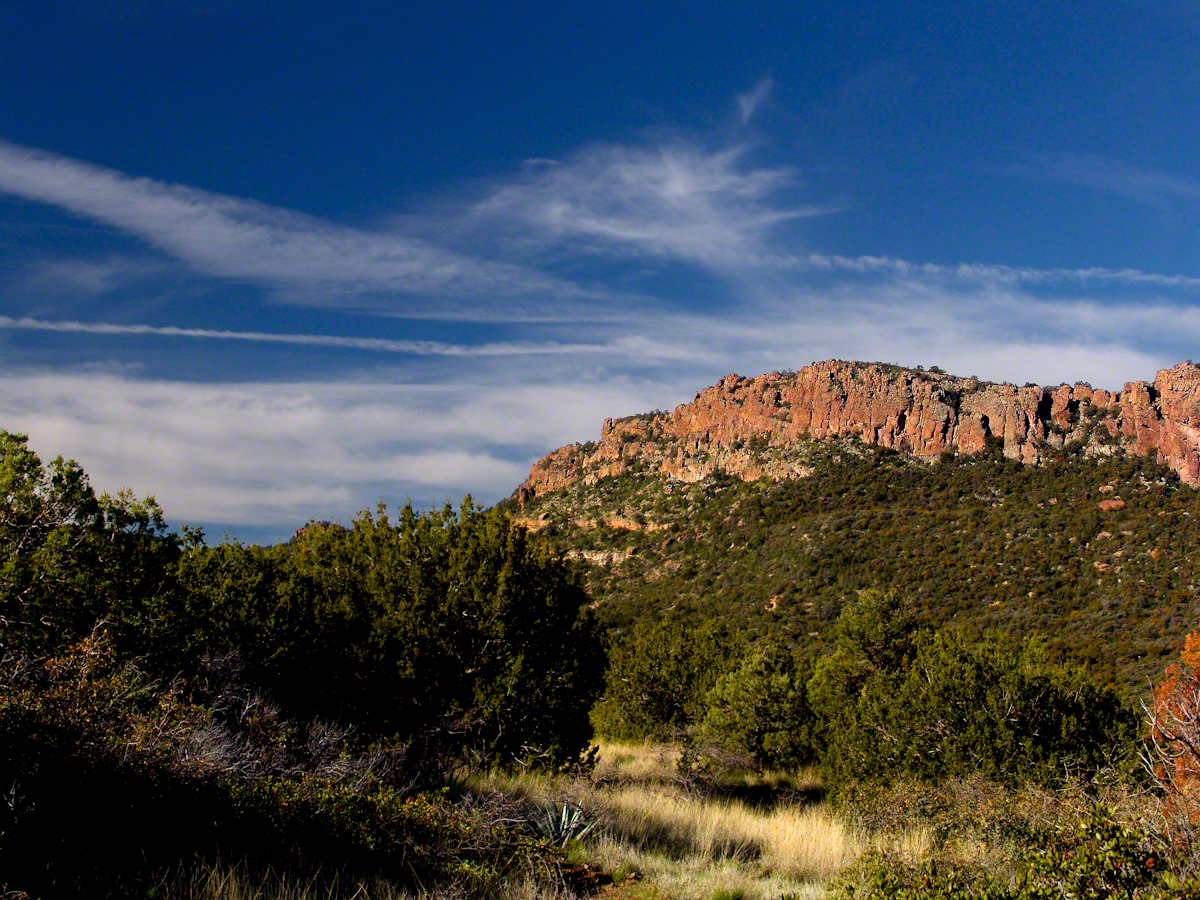
Those evergreens in the following photograph are Oneseed Juniper (“Shagbark Juniper”) of the three species common to the Superstitions, this has this spherical, bushy appearance. Here the elevation is just high enough for junipers because there are none down below. The trail crosses Pine Creek to ascend the lower slopes of these red cliffs, following it around to the west and over to the next valley, Reavis Ranch, a distance of 3.5 miles. In my “Two Meetings” blog is a sweeping view of Pine Creek Canyon, from the southern approach.

For most people a 400+ foot climb over these steep cliffs is impossible. Fortunately, a saddle to the right of this photograph is a possible route.

Southwest View from the Arizona Trail above Pine Creek

The saddle is 100 feet lower without cliffs. Still, this entrance to remote, fascinating locations is a steep 300+ climb.

A Saddle breaks a line of cliffs

“The Searcher” arrived around this time riding the buckskin gelding and leading a pinto. He saw me and my camera equipment and stopped for a chat. His plan was to follow the trail I came up yesterday to find a rumored camp with good water. The howling wind made conversation difficult. I wondered where his camp of last night was located, since there was no sign of him. Before I could ask, his cowboy hat flew away with a wind gust. He hopped off the gelding, “That’s my best beaver hat.” After a quick brush and tie-down they were off.

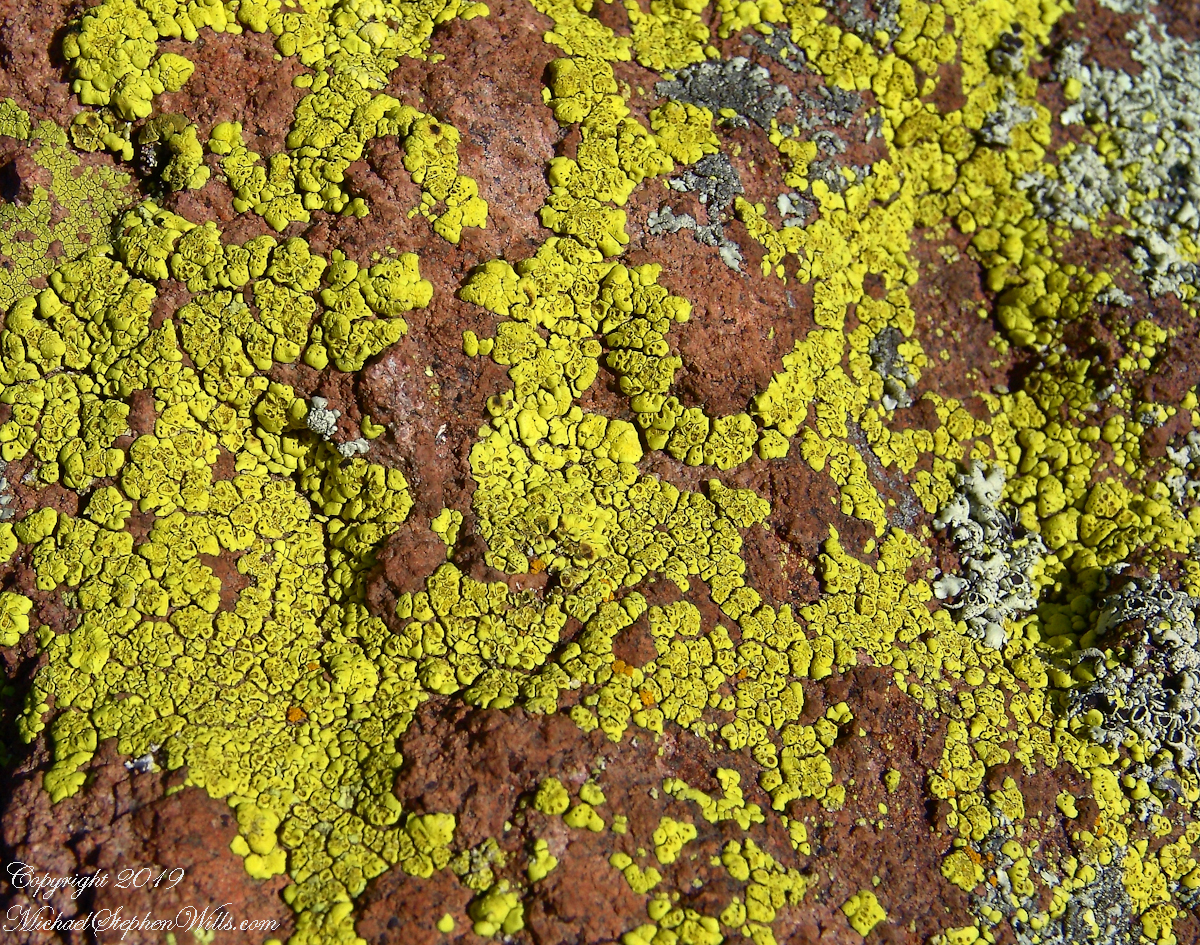
Heading back down to the creek, here is a macro of lichen that covered the crumbling surfaces of boulders that littered the slope.

Nature’s Abstract

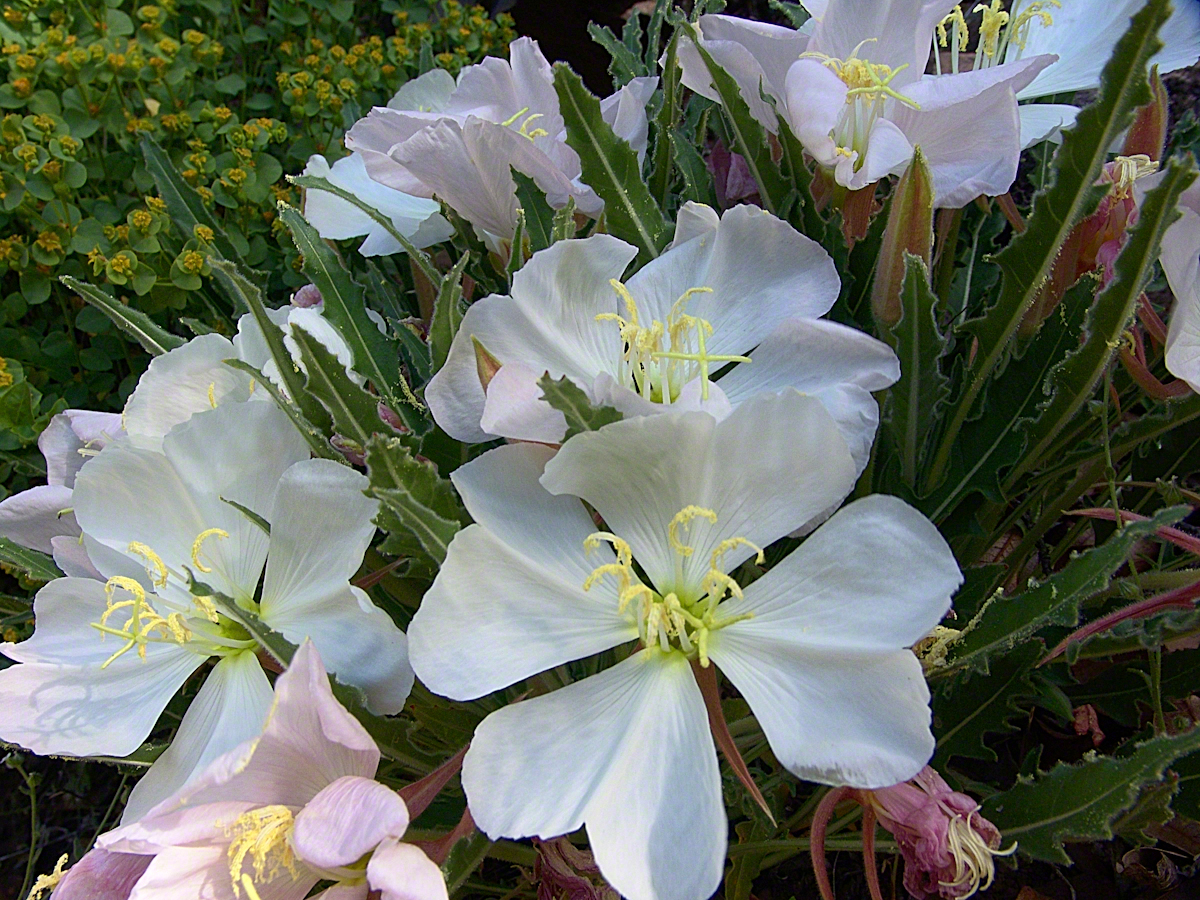
During the previous night fresh primrose blossoms opened, this one flourishing in the earth of a south facing slope. There is a reddish spent blossom at lower left. The soil here formed over eons by the action of the creek water, atmosphere and plant life. I have more about the Primrose and these yellow flowers in the background in my “Two Meetings” blog.

Pine Creek of the remote eastern Superstition Wilderness hosts this wild Tufted Evening Primrose.

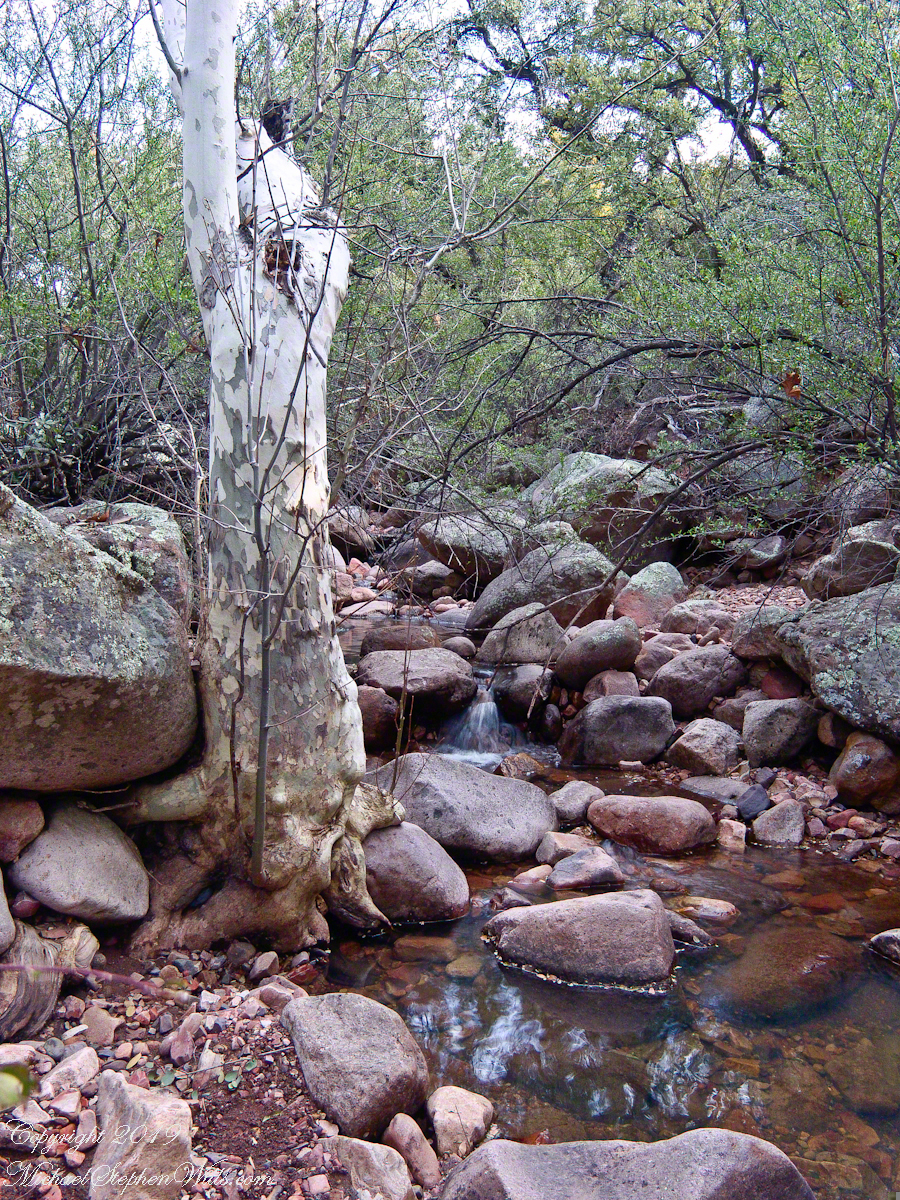
Turn left (up stream) where the Arizona Trail crosses Pine Creek and jump boulder to boulder for a hundred feet or so and you come to this view. The creek bank, covered by vegetation, rises on both sides and makes it difficult to leave the creek. Those are Arizona White Oak leaves floating along the large foreground boulder.

Pine Creek Pool with Young Arizona Sycamores

This is a very young Arizona White Oak, common species growing along the creek. The leaves are not what you’d expect from an oak, being 2 – 3 inches long in the shape of a lance blade and without obvious lobes Mature Arizona White Oak has a rough bark and, at most, 24 inch trunks.

Arizona White Oak

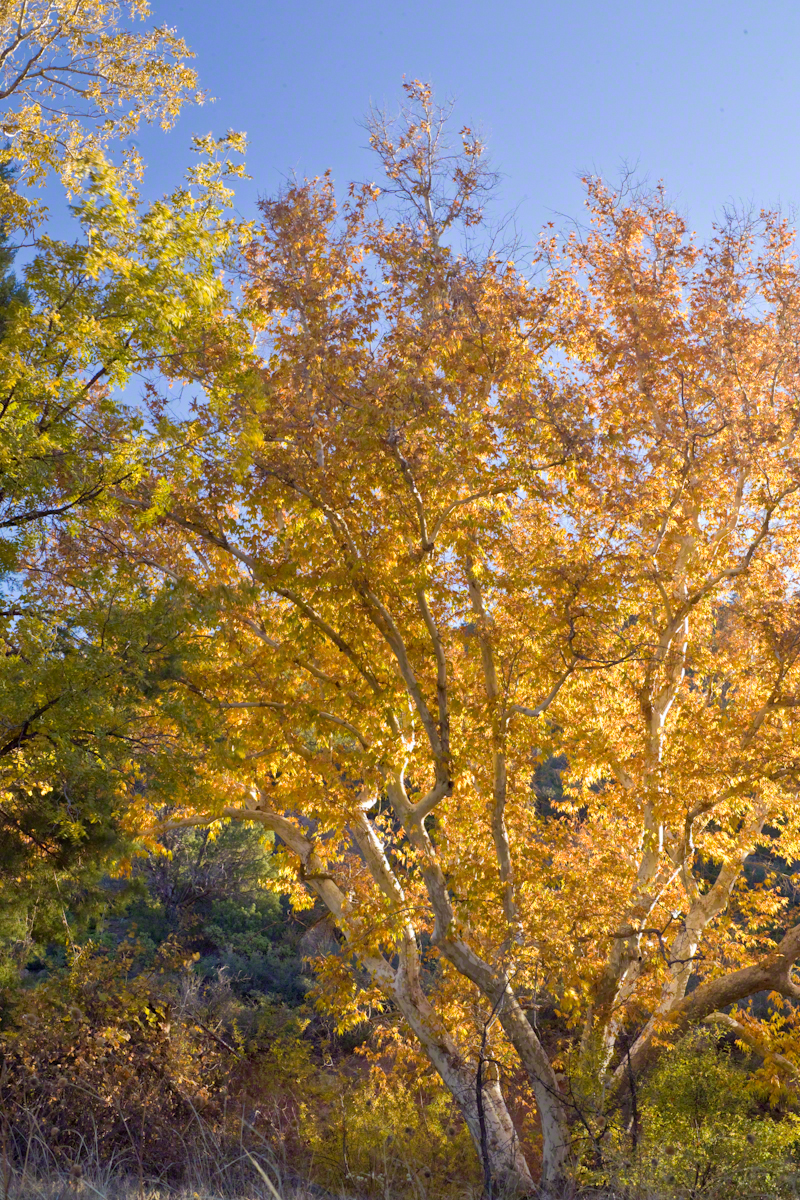
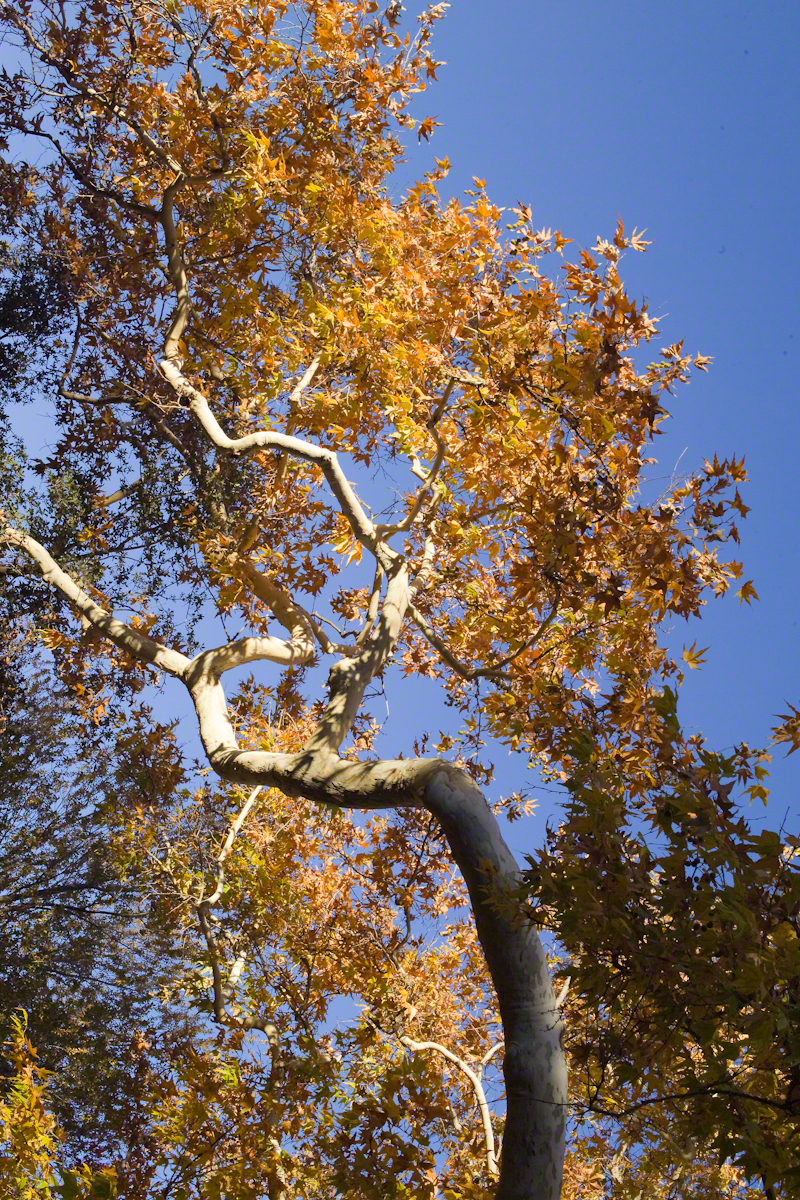
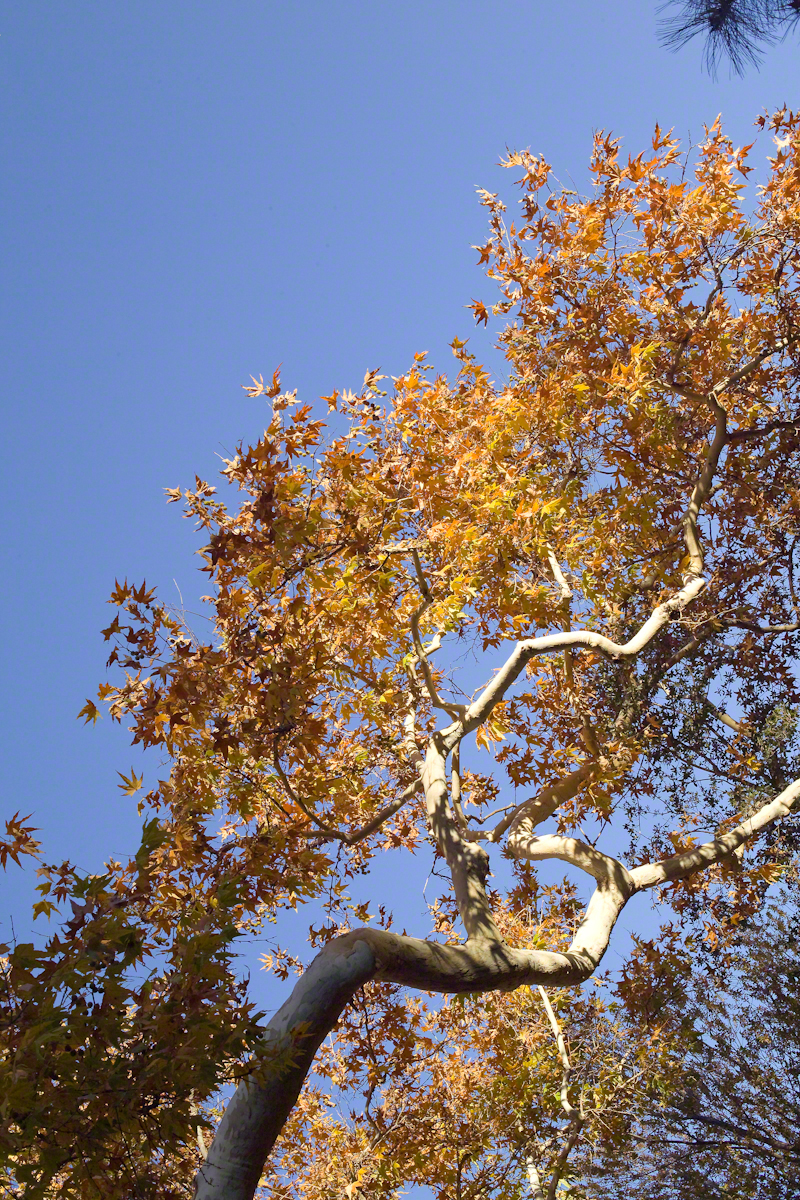
There are better examples of grand Arizona Sycamores along the perennial Reavis Creek. Pine Creek does not flow in the driest seasons, this tree sloughed its branches in order to survive. You can see from the many young Sycamores in the Pine Creek Pool photograph the previous photo the sycamores are successful in this environment.

I spent some time with this Sycamore, capturing abstract patters of the bark.

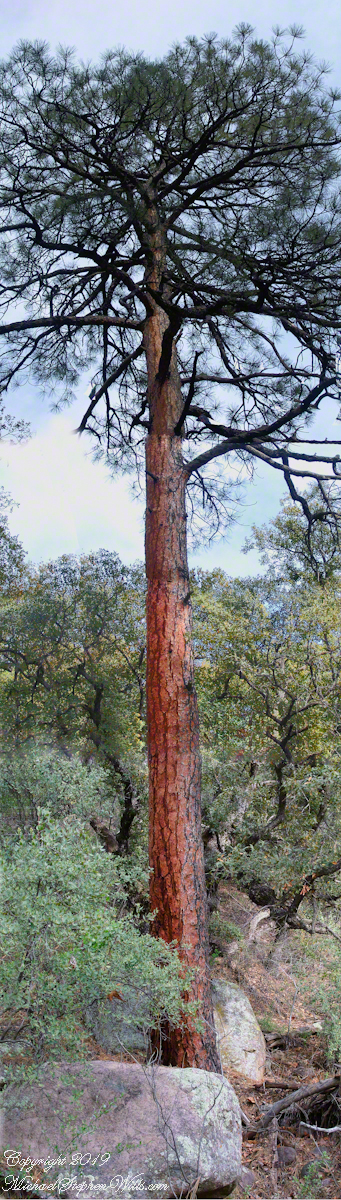
The abundance of Ponderosa Pines here demonstrate the species thrives at this altitude and dry environment. This specimen grows on the creek bank. Those are shrubby Arizona Oaks around the trunk.

Abstract patterns in the bark of this Ponderosa. The popular and scientific name (Pinus ponderosa) for this species is from the dense weight of the wood.

The tree is over 100 feet tall. I patched together four shots for this view.

In the afternoon I explored the Arizona Trail to Reavis Ranch. It crosses the creek to ascend the cliff in broad switchbacks. Eventually it follows a contour below a cliff with fine views of Pine Creek Canyon. I turned back to leave the hike to Reavis Ranch for another day.

Click me for the next episode, “Sycamores and Riparian Space.”

Click me to visit Michael Stephen Wills Online Arizona Gallery.

Copyright 2026 All Rights Reserved Michael Stephen Wills

Thin Leaved Sunflower

Farm Journalist

“Out in the meadow, I picked a wild sunflower, and as I looked into its golden heart,such a wave of homesickness came over me that I almost wept.  I wanted Mother, withher gentle voice and quiet firmness; I longed to hear Father’s jolly songs and to see his twinkling blue eyes; I was lonesome for the sister with whom I used to play in the meadow picking daisies and wild sunflowers.”

from “Laura Ingalls Wilder, Farm Journalist, Writings from the Ozarks” edited by Stephen W. Hines”

Photography Copyright 2021 Michael Stephen Wills All Rights Reserved

Dennis-Newton House National Historic Place

first photographs for a recent National Registry of Historic Places listing

Wiki Loves Monuments 2017 is a contest that closed September 30, 2017.

Click for Wiki Loves Monuments 2017 contest

The National Register of Historic Place # 16000590, the Dennis-Newton House of Ithaca, New York is a recent listing, dated September 6, 2016.  In researching potential for the Wiki contest, I discovered this place was absent a photograph.  Seizing the opportunity, I grabbed these photographs the same session as the suppressed Ithaca Pottery Site, published in my blog in April.

The location was a revelation, around the corner and a few blocks down from our son and daughter-in-law’s house where they are raising three (of our 12) grandchildren, across the street from where the children take swim lessons.  Parking in downtown Ithaca is incredibly coveted and I was not motivated to shoot during the golden hour where cars would, maybe, not be parked out front and the light perfect for the west-facing façade.

Dennis-Newton House Street Frontage

Click this link for my On Line gallery, “Finger Lakes Memories.”

Above is the street frontage of 421 N. Albany Street, Ithaca, New York, a home privately owned.  The house is as originally constructed and considered the birthplace of Cornell’s Alpha Phi Alpha, the first Greek letter, African-American collegiate fraternity established from this location in 1907.

Named for the original owner, Norman Dennis who built it around 1870 and a later owner, Edward Newton, who is directly connected with the early years of Alpha Phi Alpha; the house was recently renovated with a building permit still posted in the porch window, partially obstructed by glare.

The frontage view is partially obstructed by a Black Maple (Acer nigrum) and provides shade from the afternoon sun.

Dennis-Newton House Door, Porch

To compensate for the time of day, the tree and parked cars I captured interesting details of the front porch.  The time was day was perfect for photographing these and, in the golden hour, will be unevenly illuminated.  Note the elegant door glass panels, solid wood door and trim with original porcelain and metal door knobs and lock.  Porch trim includes decorative brackets, spandrels, posts.

Dennis-Newton House Porch, Window

Click this link for my On Line gallery, “Finger Lakes Memories.”

Here is a different angle on the porch trim to include the porch’s fancy balusters and rails.  The decorative head on the window is wonderful. The private owner recently renovated the property, there is a building permit still posted in the window.

Much of the information for this blog came from this web page.

In preparation for shooting, I mounted the Canon EF 70-300mm f/4-5.6L IS USM lens on the Canon EOS-1Ds Mark II body.  The frontage and second porch shots were at 70mm, 1/200 second, ISO 1,000, f/7.1.   The middle shot, of the door, was 1/250 second at f/5.0.

Copyright 2021 Michael Stephen Wills All Rights Reserved

Leprechaun Rock along the Tain Way

The Last Leprechauns

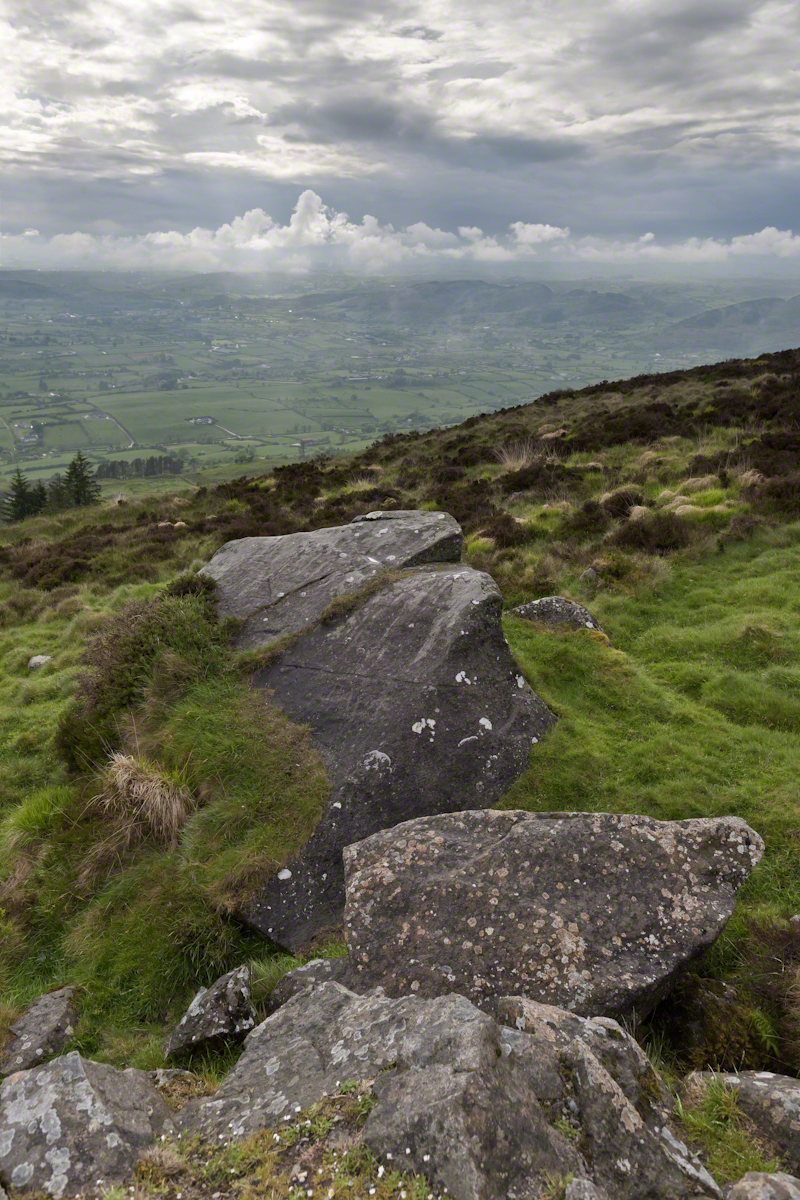
Rocks such as this are a favorite perch for leprechauns to rest and contemplate the works of man who have invaded their world. Inhabitants of Carlingford who wander Slieve Foye have come upon them often enough, their stories and certitude in the existence of the Little People are resistant to manifold doubters with their reasons and arguments.

leprechaunRockCarlingford-02245
Click this link for my Ireland gallery of Fine Art Photography.

Kevin Woods, aka McCoillte, was a doubter until worked on a stone wall on property he owned on Ghan Road, Carlingford. His belief did not arise on the discovery of the leather purse, covered with ages of dust and lime, nor with the gold coins inside. McCoillte pocketed the coins for luck. As luck would have it, McCoillte loved to walk on Slieve Foye. It was on one such walk he and his dog encountered Little People who paralyzed them to escape. His unexplained absence led to troubles with the wife.

EuHabitatsDirective-02267
Click for Leprechaun Rock in my Fine Art Gallery. Enjoy!!

This experience brought McCoillte around to enough of a belief that he, with lots of help, succeeded in petitioning the E.U. European Habitats directive to recognize leprechauns a protected species.  According to a page on the Celtic Times web site, “The E.U. sent Madame Isobel Jeanne from Fecamp in Brittany France to Carlingford with the official letter declaring Carlingford Mountain (Note: otherwise known as Slieve Foye) protected, on the grounds that they could not prove or disprove their existence.”  The page is titled “The Carlingford Leprechaun.”  Google “Last Leprechauns” learn more about McCoillte’s stories.

I came upon this rock on June 9, 2014 on a day my cousin Sean Mills invited us to walk the Tain Way over Slieve Foye. It was such a finely shaped piece of what I suppose to be granite, the view of Carlingford, the lough and farmland so compelling, I spent time composing this landscape.

You can make out “King John’s Castle” just over the ridge and its yellow flowering gorse, on the margin of the blue lough. It is the boxy, grey structure; crenellations are visible on high resolution versions of the image. Carlingford is known for the castle, the popular name is for the English monarch who spent time there, although it was built by another.

Visit the opening chapter of our time on the Tain Way

Copyright 2021 Michael Stephen Wills All Rights Reserved

A Dry Piece of Paradise

A hellish shriek assaulted the cold 3 am darkness.

A hellish shriek assaulted the cold 3 am darkness.

The scream was instantly recognizable. Anything but terrified, after a confused scramble I reinserted the pin into a personal security device hung from my backpack. Wrapped in a silly waffle weave blanket, tossing restless in the cold, the pin lanyard hung up then pulled free. Several minutes had passed with that sound flowing out over the canyon, calling all carnivores to breakfast.

I had drifted off with the wind shaking my tent like a drunken prankster and now all was totally and absolutely quiet. In spite of the cold, the inadequate blanket and the imaginary creatures looking for the source of that scream, the next two hours sped by in a fitful doze.

Agave Heart

At 5 am I crawled out to find the thinnest crescent moon imaginable gracing the eastern sky, kept company by a century plant silhouetted against the early dawn light.

Click any photograph for a higher resolution image.
Century Plant Dawn
Century Plant Dawn

Click this link to see my photograph “Superstition Spring”

These stalks raise the golden flowers of this agave 10 to 15 feet above the green prickly rosette. Century plant stalks can be seen throughout the Superstitions, even at the high elevations among towering Ponderosa Pine.

Here is an agave in predawn light I caught on the next day, in Pine Creek canyon.

Agave
Agave in PreDawn Light

The leaves are used as needle and thread with the very sharp tip as the needle and the long leaf fibers, when properly dried and shredded, as thread. These leaves guard the agave heart from the harvest. A poke from an agave spike can be deep and painful.

The young shoots of the stalks are a succulent delicious treat raw. Roasted, the agave heart is a fresh, somewhat sweet delight. The earliest residents of this desert left numerous roasting pits on the mountain slopes, located where the agave still grows.

Dawn and the Pretty Hedgehogs

Although cold, the still dry air felt marvelous and even distant objects appeared absolutely clear. In this environment the spread of sun with its rising is a ritual. Here’s a photograph of the canyon walls a few minutes before the sun reached them.

SlopesOf2BarMountainPreDawn
Slopes of Two Bar Mountain in PreDawn Light

And, a few minutes later, as the sun passed the ridges of Two Bar Mountain.…

SlopesOfTwoBarMtnAtDawn
Dawn on the Slopes of Two Bar Mountain

By the way, that’s a desiccated agave stalk to the lower right, on the rocks.

At my feet, spread at intervals on the brown red broken rock, small Hedgehog cacti bloomed lavender.

Lavender Hedgehog, overview
Lavender Hedgehog Blossoms
Lavender Hedgehog Blossoms with Buds

Cacti, such as the blossoming lavender Hedgehog seen above, require a space which enjoys full sunlight for most of the day. The thick grown of juniper trees limited sunlight and compete with the cacti for water. This image will give you an idea of the extent of the juniper growth.

Nameless Canyon in the Dawn

Looking into Nameless Canyon

In the above photograph you are looking west over a canyon that is unnamed on maps. The dramatic flat ridge bathed in light is a landmark marking the canyon of Reavis Falls, on the far side in this view. Make your way down the canyon where is joins Reavis Creek, turn left and the falls are a few miles upstream. This is NOT the easiest path to the falls.

As the sun rose I needed to prepare for the day’s trekking, but took one more portrait of this lovely nameless canyon traversed by an almost non-existent path.

Nameless Canyon Morning

This season, a cold stream ran at canyon bottom. Flowing among the rocks the water produced peals of a crystal bell, but this was not my last memory of this place.

In the “Nameless Canyon Morning” image, on the left there is the almost vertical (no exaggeration) canyon wall I climbed in 4.5 hours that morning. It traversed 800 feet altitude in less than a mile. The path was substantially longer because it followed the contour lines of the land in long loops called switchbacks. As I proceeded up the canyon wall, to the southeast, above the opposite canyon wall, the memorable Four Peaks gradually appeared. Here’s the view from my lunchtime perch…..

Four Peaks from Nameless Canyon

This view looks over the basin of Reavis Creek and includes the, out of sight, 140 foot high Reavis Fall, the highest free fall in Arizona.

Click me for the next episode, “Two Meetings.”

Click me for the previous episode, “Racing the Sun.”

Copyright 2021 Michael Stephen Wills All Rights Reserved

Racing the Sun

Through that afternoon the wind gusts hit me as a physical force like a cat playing with her next meal.

superstitionspring_copyright_640
Mexican Poppies bloomed in profusion throughout the Superstitions after the plentiful winter rains of 2008.
Want more? Click for my OnLine Gallery

The four mile climb up the 2,000 foot eastern Superstition Wilderness bajada and escarpment consumed the morning and much of the afternoon.  It was the 80 pound backpack that did it.  Ten days of supplies, tent, equipment and 3.5 gallons (28 pounds) of water; enough food for a trek across the Superstition Wilderness, water enough for two days.  One day in, one day out if the water could not be replenished.  Mine was a water commitment, enough water storage to allow two days to trekking to another source.

Two Bar Mountain
Two Bar Mountain from Tule Canyon trail with corral made from mesquite trunks and barbed wire. Yucca and prickly pear in foreground.

Here the canyon rim view from atop the escarpment…..

viewtoeasttrail122copyright
Here I found the huge mountain lion track in the dry mud from the spring rain, where water pooled and the cat drank.

…over trail 122, the Tule Canyon Trail, looking out from the wilderness.  Tule Canyon trail is very lightly used and only present in the form of occasional cairns.  There is a red rock cairn in the midground.  Theodore Roosevelt Lake of the Salt river is in the distance, as is the dirt road to the trail head.  A settlement is visible, on the right.

A rancher formed a cattle watering hole by damming an ephemeral stream and that day the pool held some water. Shortly after a rain a large mountain lion had approach the pool for a drink, leaving a footprint in the now dry mud.

I knew a mountain lion attack was improbable: I ran more risk of being run down on a New York City sidewalk by a madman or, even more so, of having a heart attack.  Still, during my brief lunch I faced east, looking over Apache Lake for the possibility of a cat leaping up from the canyon.  On all other sides was an open area until, a quarter-mile uphill, there was a thick growth of Manzanita reaching to the ridge.

After that climb to the escarpment rim I was in a race to reach a safe campsite at an unknown location, the other side of Two Bar ridge, before sunset at 6:46 pm mountain time.  Yes, the time was exact to the minute.  If sunset found me on the mountain side or ridge, rapid fall of darkness would force me to set camp.

The following photograph was taken the winter of February 2006 from a campsite below Castle Dome on Reavis Ranch Trail.  A red line, starting to the left, is Trail 119, my path along Two Bar mountain ridge, beneath the mountain peaks, with switchbacks into a nameless canyon.

ff6h3323_twobarmountain_cropped_enhanced001_annotated_resized_copyright
Overview of my path to the nameless canyon behind Two Bar Mountain.

Ahead of me was a 400 foot ascent in a half mile to Two Bar Ridge, two miles along the glorious ridge providing endless views to the west and northwest.  An 800 foot descent to a nameless canyon below Two Bar Mountain.  This left no time for photography!!

This photograph, taken 4 miles to the west and 10 months later, is similar to what I enjoyed, and dreaded, that day.  A flowering century plant stalk grows at the end of the plant’s long life, usually 10 – 30 years.  After death, the plant is reborn through suckers from its roots.

sunsetfromcastledomemarch2006copyright-3372
A Superstition Wilderness Sunset from a February 2006 backpack.

My hope was to find some flat terrain in that canyon, for a camp site. If only there was time enough to reach it. My progress was bedeviled by sudden gusts of wind, grabbing like a large cat, throwing off-balance.  

The west wind was whipping the bushes as I entered the Manzanita.  Here is a photo of the plant from a later backpack to the Rincon Mountain Wilderness.  Yes, the trunk is a dark, rich red.  “Manzana” is apple is spanish, the plan is named “Little Apple” for the small green fruits much loved by bears.

Manzanita.
A mature Manzanita growing along the Miller Trail of the Rincon Mountain Wilderness. There is an enlargement of the flowers, to the right.

Manzanita leaves were thick around me snapping in the wind, making it seem at all moments a large creature was moving. The trail was difficult and several times I needed to turn back to find it, all the while climbing continuously.

On ridge was the highest point for a hundred or more miles to the west, so the wind was free to run which it did in huge gusts.  You can get an idea of the openness from the Superstition sunset photo.  For awhile the Manzanita acted as protection, then I descended along the west face of the Two Bar Mountain ridge.

Evening from Lime Mountain to East with Risen Moon
Two Bar Mountain and Ridge from Lime Mountain with rising moon.

My hat tie-down were tested on that two miles of ridge, the brim was molded around the right side of my head. The backpack acted as a sail so that it was taken in the wind gusts, affecting my balance.

On mountain trails the path is full of stones of all sizes and,  aside from the occasional rattlesnakes, critter scat or, at lower elevations, Gila monsters, it is the rock that forces hikers to look four steps ahead, planning moves carefully to avoid falls.  The 80 pound backpack, wind, rocks, high perch and, not forgetting the prickly pear cactus and jumping cholla, all slowed me to less than a mile an hour.  I was jumpy walking through that Manzanita and this slowed me down more.

Trail 122 joins Trail 119 on Two Bar Ridge.  On the ridge a substantial barbed wire fence separates federal land from the working ranch.  Where the trails crosses, the fence has a break.  The hiker needs to wend through a simple maze impassable to cattle.

Of all the trail, this is the most clearly marked.  Fences have deep historical significance for the western United States.  Range wars were fought between men who had different beliefs about land use and ownership.  Many historians associate the building of barbed wire fences with the passing of the Old West.

Up until the fence, cattle grazing visibly damaged the land and plants.  After the fence, the land was free to become as it was since the beginning of time.  Up here, there’s wonderful grass that was, in this season after heavier than normal winter rains, was lush and green.

The trail followed the fence for a ways, then descends steeply into a fold of the land, leaving me in shade as the sun, low in a cloudless sky, raked over the mountainside with a brilliant golden light.  The Two Bar Mountain and Ridge with Moon photograph, above, gives an idea of the effect.

Below, the canyon floor seemed a mass of prickly pear cactus groves.  I decided the lower canyon wall was the best choice for camp…as unlikely as that sounds.

Here, the trail was anything but straight and almost invisible, descending in looping curves called switchbacks.

Here’s a photo from the following morning.  I found a small shelf on a ridge overlooking the canyon floor, amongst wonderful shrubby Juniper trees.  Tiny hedgehog cactuses were covered in lavender blooms.  There is a decrepit stalk of a Century (yucca) plant lying over the rock.

ontheslopesoftwobarmountaincopyrightmichaelstephenwills08
Morning view from my camp in a nameless canyon below Two Bar Mountain.

On approaching the shelf, the air turned suddenly cold as the sun fully set and the wind gained even more in strength flowing up the canyon and over Two Bar Mountain.  Stony ground made it impossible to stake the tent, instead I used small boulders to fix the corners and sides of the tent.  Once inside, I was grateful for an excellent mat to protect me from the small jagged stones at one with the ground.  The tent walls held back the wind.  I forgot to back an excellent sleeping bag for the trip.  Instead of buying one in Phoenix, my sister lent me a light waffle weave blanket.  “What was I thinking???”  It was a restless, cold night.  The sun was very welcome the following day.

Lavender Hedgehog Cactus Blooms
Lavender Hedgehog Cactus Blooms in pre-dawn light

Click me to visit Michael Stephen Wills Online Arizona Gallery.

Copyright 2026 All Rights Reserved Michael Stephen Wills

A Story Risen from the Mist

The Resurrection of Táin Bó Cúailnge

We did not climb so much as ascend, with effort, the flank of Slieve Foy, a peak of the Cooley Mountains, County Louth, Ireland. The group being cousin Sean, my wife, Pam, and myself.

The ridge of Golyin Pass loomed in the mist where the path dissolved in low cloud. Sean pointed above, to the right to Barnavave, also know as Maeve’s Gap for the queen who came from the west of Ireland to take Donn Cúailnge, the Brown Bull of Cooley, by force of arms with an army behind her.

My Online Gallery– CLICK ME!!!!
A modern rendering of Donn Cúailnge. See link at the bottom of this posting for more information.
Click this link or a photograph to visit my Online Gallery

When cousin Sean named Cú Chulainn, the champion of Maeve’s opponents, the Ulstermen, he recalled a story once lost, Táin Bó Cúailnge. A hospitable siege different from Maeve’s and mist are part of the story of the recovery of this tale.

A gathering of 150 poets, 100 pupils, and attendants strained the patience and wealth of Guaire Aidne mac Colmáin, King of Connacht, when it extended to a year and four months.

Southwest View from Hags Mountain– CLICK ME!!!!
Our first and only encounter with fellow hikers. In the distance two figures appear over the next ridge, a mother and young daughter. She greeted us and challenged Sean to his knowledge of the area. Sean acquitted himself well and we continued.

On that 16th month, the king challenged the leader of his guests to the telling of a tale. Guaire demanded Seanchan Torpest, the chief poet of Connacht, to recite the whole of Táin Bó Cúailnge, known in English as the Cattle Raid of Cooley or The Táin (Cattle Raid).

Click a gallery pic for a larger view.

In this way the king was relieved of his guests: the book of the Táin was lost before their lifetimes, rumored to be abroad. Abashed at his failure, Seanchan Torpest withdrew. Fellow poets and followers trailed out from the castle.

Seanchan Torpest regrouped the host (an opened question is who then supported them) in conference to construct Táin Bó Cúailnge. It was a false hope as the gathering discovered while each poet knew a part of the whole, most of the story was lost. His honor, reputation and self-esteem in tatters the Chief Poet of Connacht, set off with Murgen, his son, and second cousin Eimena to return the Táin to Ireland.

Into mists such as those Pam, Sean and I ascended, the travelers soon were lost and separated.

Magically, Murgen finds the grave of the Uncle of Cú Chulainn in the mists, there to meet the shade of that enormous man, Fergus mac Róich is his name. In the Táin, as related in whole by Fergus to Murgen, Fergus was led by circumstances to ally with Maeve, to guide her army against the Ulstermen. As a deposed king, traitor to Ulster and Uncle to the champion Cú Chulainn, Fergus knew the tale entire.

My Online Gallery– CLICK ME!!!!
View as we approached Goliyn Pass

It was from the mists that Murgen emerged, found his father and cousin, and returned together without the book, but with possession of the substance of the Táin.

Click this link or the above photograph to visit my Online Gallery

Views of Carlingford

Visit the opening chapter of our time on the Tain Way

Visit the next posting in this Ireland series, “Farmland Southeast of Carlingford”

A thank you to Wikipedia, my information source on the resurrection of the Táin.

Copyright 2021 Michael Stephen Wills All Rights Reserved

Loughcrew Hill View

On the Ground in County Meath

The popular name of the Loughcrew megalithic site is, “The Hill of the Witch” (In Irish, Sliabh na Caillí). In lore sites such as this are associated with The Others (“fairies”), living lives parallel and invisible to ours, touched now and then with resolutely ill effect to our side though sometimes theirs as well. Resolute as in these meetings are fated to end poorly unless…..unless the mortal knows the rules. “If you are ever in an Other’s mansion for a party never, ever eat or drink anything. Eating or drinking will condemn you to an eternal round of parties. You will dance till dropping every night.” Rules such as that, and others, can be used to turn the tables, gain an advantage, of beings from the Other Side.
The story of my wife, Pam, how our lives came to be touched by this afternoon of May 27, 2014, is parallel to the tales of mortals benefiting from contact with The Others. The immediate source was the passing of my mother, Catherine Ann Wills (McCardle), at the age of 90. Mom’s passport gave her place of birth as Proleek, a place in Louth. My maternal grandmother, Mary Catherine McCardle (Mills) spoke with a brogue, less a lilt than a down to earth and kind warmth. I remembered the stories of Mom’s passage to Canada with her mother and father in 1926 at the age of three. The Ireland connection with my father was less direct as I never met his mother as an adult and we seldom spoke of her. It was left to me in the time between my Mom’s passing, an invitation for a visit from our cousin’s in County Louth, and our arrival May 2014 to understand more about Elizabeth (Duffy) Wills, my paternal grandmother.
In this way, I discovered Elizabeth came from a family of Dunderry, County Meath, Ireland, her parents Matthew and Teresa (Plunket) Duffy; our tour of Ireland came to start from a bed and breakfast near Trim, County Meath, with Dunderry up the road. May 27th, we planned as an exploration of all things County Meath, to include Loughcrew, the highest point of the county in the west.
Along the steep path to the hilltop a hawthorn tree covered with flowers and offerings welcomes visitors. May is the month for decorating hawthorns, the blossoms are also known as “Mayflowers” as in the ship the pilgrims sailed to Plymouth Rock.

Click the photograph to open a new window/tab of my Online Gallery.
Pam and Hawthorn– CLICK ME!!!!

As if we entered a gateway, when pausing and turning high on the hill, this view was revealed, otherworldly in its fullness, scope and wonder as though we passed to the other side to the fairies.
Cairnbane East of the Loughcrew Cairns site, County Meath Ireland, is also known as Hag’s Mountain. We are looking south, southwest from the north side toward Cairnbane West. Flowering yellow whin bush, also known as gorse, is in foreground; white flowering hawthorn trees in distance. No elements of this photograph hint at the year 2014.

Hag's– CLICK ME!!!!

A solitary standing stone below the trail to the Loughcrew site surrounded by whin bush in yellow flower and white blooms of hawthorn hedge rows. A fieldstone fence, farmhouses, a patchwork quilt of fields completes the view.

Hag's– CLICK ME!!!!

Meanwhile, in the real world, when Pam and I complete our round of the island to return to my cousins in County Louth, they told us, on this day, two young men were discovered parked next to a nearby lough, murdered during a drug deal gone bad.

Click for another Ireland posting

Copyright 2021 Michael Stephen Wills All Rights Reserved

On the Tain Way

A place of myth and wonder on foot and approachable

On Monday, June 9, 2014, cousin John Mills dropped his son, Sean Mills, myself and Pam Wills off at the foot of the western slopes of Slieve Foy on the Tain Way.  Sean, Pam and I walked the way over the mountain and into Carlingford in the footsteps of epic Irish heroes.

Our guide, Sean Mills, proposed the walk and it fell on our last full day in Ireland. Sean’s father and our host for this visit, John Mills, transported the group including my wife Pam to the starting point at the foot of Slieve Foy.

Click this link to visit my Online Gallery

On the Tain Way– CLICK ME!!!!

Yes, if there is any part of the Tain Way the the mythic Irish heroes trod it is this one over Slieve Foy mountain. The saga, in Irish “Táin Bó Cúailnge” and “The Cattle Raid of Cooley” in English, features this bull, “Donn Cuailnge” “The Brown Bull of Cooley”, here as a statue erected 2011 by the Grange and District Residents Association.

Walking the Tain Trail to Carlingford

Donn Cuailnge raged over the very slopes we walked this day. The myths themselves fill a volume and I am unable to do them justice here.

On the way, John stopped at the Old Aghameen School he attended in the late 1930’s early 1940’s 70 years before and we pass through the country soon to grace our views.

Many thanks to the Glenmore Athletic Club, the Cooley Walking Forum and land owners who provide access to the Tain Way.

We had our leave taking with John, who planned to stay near the phone for our call from Carlingford, if all went according to plan. That same year Pam had the first of two total knee replacements. This was our longest hike in Ireland and Pam was not likely to miss it, regardless of any pain. Pam is always ready to smile.

Walking the Tain Trail to Carlingford

At start, the Tain Way is broad, green and welcoming.

Walking the Tain Trail to Carlingford

The western slopes of Slieve Foy hold views of a valley among the Cooley Mountains with Dundalk Bay of the Irish Sea to the south / southeast. It was not long before the view started to open and, then, opened and opened the entire walk to the top. We were graced with a lovely, cloudy, June day. Mist only, no rain. Plenty of wind, not strong.

Walking the Tain Trail to Carlingford

Farms are all about. Here a farmer attends to the flock. They know who he is.

Walking the Tain Trail to Carlingford The lower slopes hold many small stream among granite stones. Walking the Tain Trail to Carlingford Walking the Tain Trail to Carlingford Walking the Tain Trail to Carlingford Walking the Tain Trail to Carlingford Walking the Tain Trail to Carlingford

I will continue with our walk on the Tain Way soon enough.

Click for the next chapter of our time on the Tain Way

Here’s a previous Ireland posting……

Copyright 2021 Michael Stephen Wills All Rights Reserved

Skellig Peek

A Trinity of Skellig Images

Now’s time to share a trinity of images from a morning spent about the Skellig Islands May 2014.

Pam and I have many stories from that day, a favorite is from the parking lot of Portmagee where we met the fast boat to the island. I prepared for the day by making a reservation for our ride. We traveled from Killarney, where an early morning breakfast feast spread by The Killarney Royal Hotel fortified us for the adventure. Throughout our tour, experiencing Ireland was like taking blinders off, this first experience on The Ring of Kerry was no exception, driving on a tight timeline to reach Portmagee with minutes to spare, every turn of the road presented a new delight.

Grateful to have made it to Portmagee, we quickly pulled our kit together. As I closed the bonnet, Pam exclaimed “our umbrellas.” At this point of the story we laugh together. Umbrellas indeed. I had a dim clue of what lay in store for us and insisted the umbrellas be left behind, a counter-intuitive decision for a rainy Irish day the Wild Atlantic Way. Regardless of the time, we needed a bathroom break as there will be no facilities on the fast boat or the World Heritage Site where there is no space for human waste products.

Click any photograph for my Online gallery.
Skelligs from Valentia Island
I was here perched on a cliff of Valentia Island across from Portmagee looking southwest across Valentia Sound.

The humor is in our welcome aboard the fast boat, like a fishing boat with a small cabin and small deck dominated by the engine hatch. We crowded on, handed a full set of fisherman slickers. This is a heavy coat with hood and pants, all waterproof. Our close timing guaranteed the worse seat, away from the cabin in the open. It was a new experience for us and we felt a sense of dread as the craft left the protection of Valentia Sound into the open Atlantic Ocean.

We faced a west wind, driving 12+ foot waves, as the boat breached each wave the crest went over the cabin in a waterfall of salt water. Up and down, up and down. Thankfully neither of us lost breakfast as some did. I do not have photographs of the trip out or the approach to the island, my equipment was safely packed away.

In the above photograph you see the entire course of our approach to the island, a bit more than 10 (land) miles from Portmagee. We toured Valentia Island that afternoon.

Click any photograph for my Online gallery.
Skellig Steps
Climbing the side of Skellig Michael, approach to the peak and monastery.

There is a fair climb to the top to view the former monastery buildings. The steps are uneven and, when wet as it was that day, slippery.  I wore a waterproof North Face shell with hood for the low threatening clouds.  There was no rain as such, a constant fog on the top kept all exposed surfaces wet.

From the point on, until the top, was the most exposed and uncomfortable (frightening, chilling…you get the idea).  Spare yourself the experience if you are afraid of open spaces and heights.  Here was a stiff wind blowing from the right, on the left the cliff falls away to the ocean.  Ahead, the path narrows to about 10 inches with a cliff wall on one side, the precipice on the other.  Then come the monastery entrance and rock wall safety.

Click any photograph for my Online gallery.
Monk Cell
Monk Cell, Grave and Cross

This single image gives a succinct impression of the monastery setting.  The bee hive shaped stone monk cell requires a stooped crawl to enter.  Inside, the space is small and, thankfully, dry.  The structure keeps out the rain and wind, a marvel of stone construction. This cell is off to the side, on a cliff balcony, over the wall an ocean precipice.

My closing advice is to plan your time wisely.  The ship boards in less than an hour, in that time you climb the 700 steps and explore.  There are people all over the place, in waves. To capture the structures without humans, you need to wait until the cohort become bored and leaves.  There will be a space before the next wave of tourists breaks. Leave enough time to descend the steps safely.  People have suffered fatal falls on the steps and cliffs, it is easy to do.  Make your personal safety a priority.

Click for another Ireland Posting, “On the River Cong.”

Copyright 2021 Michael Stephen Wills All Rights Reserves