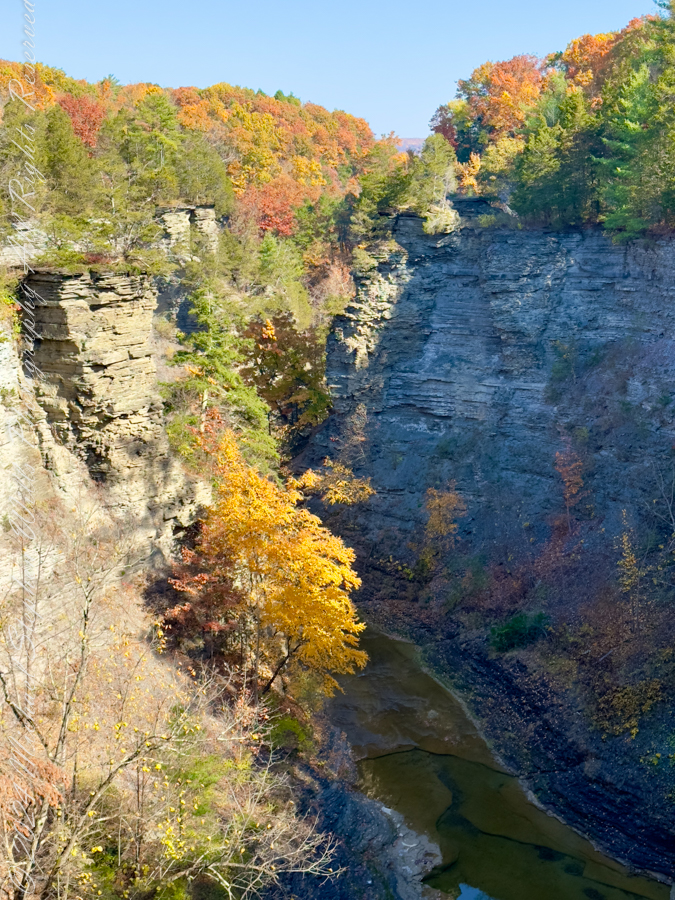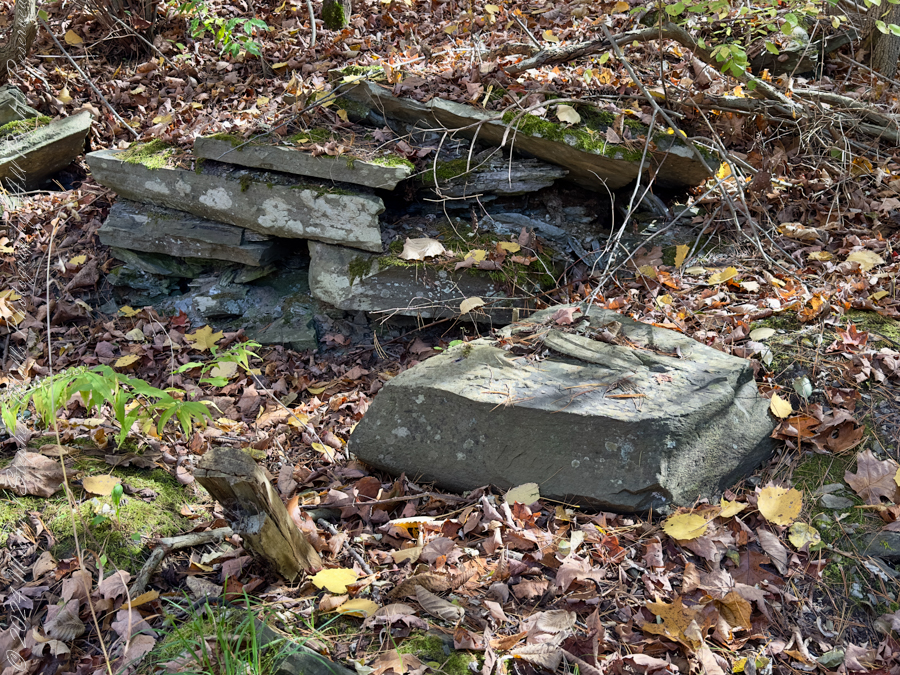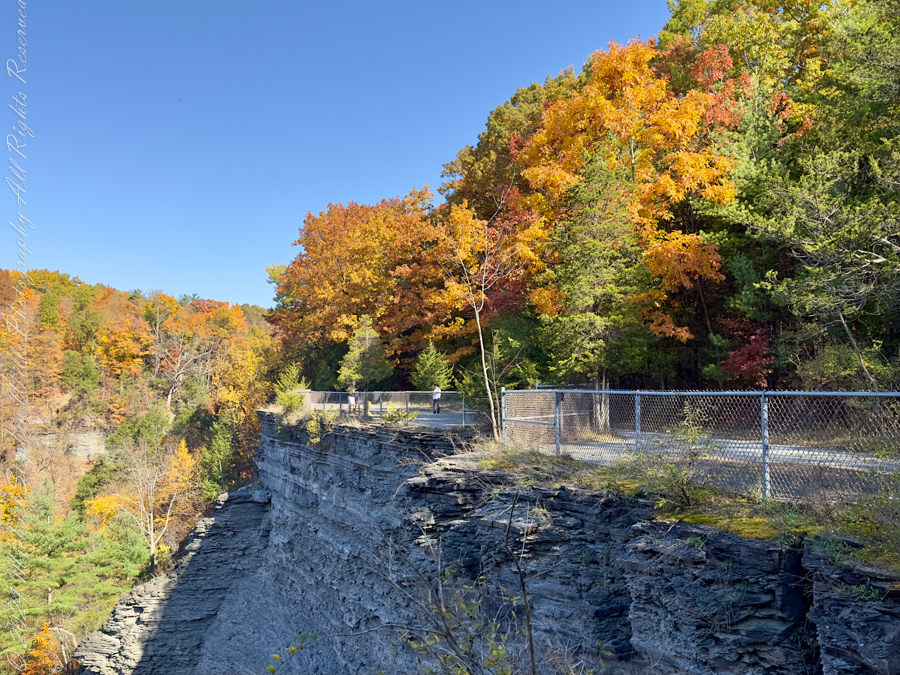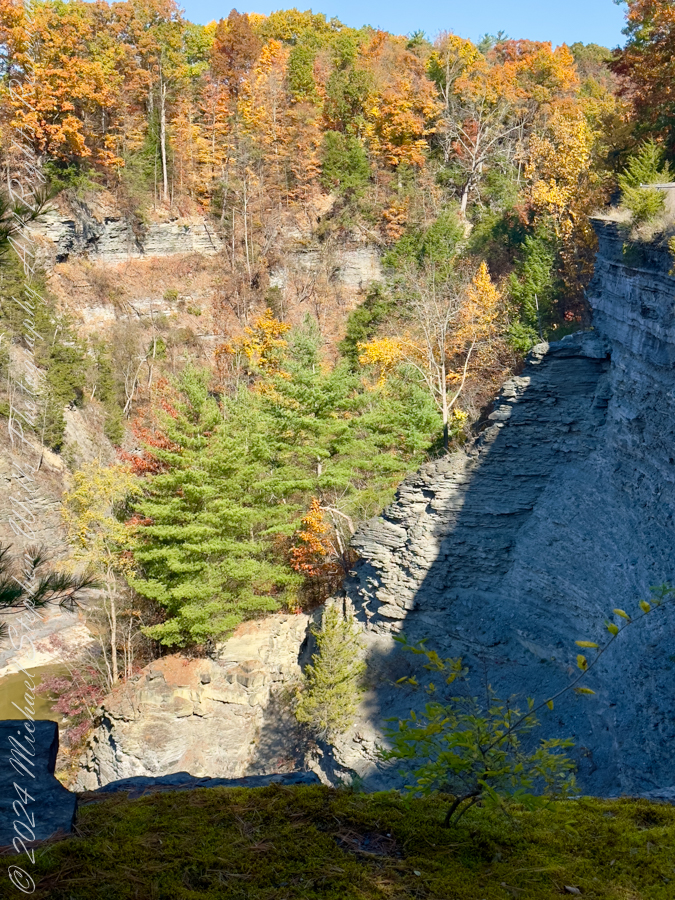
Fens, Bogs, and Flowing Water of Malloryville Preserve of Freeville, New York

Discover Malloryville Preserve in Freeville, New York—a hidden Finger Lakes wetland of fens, bogs, and flowing water where glacial history and rare plants meet.

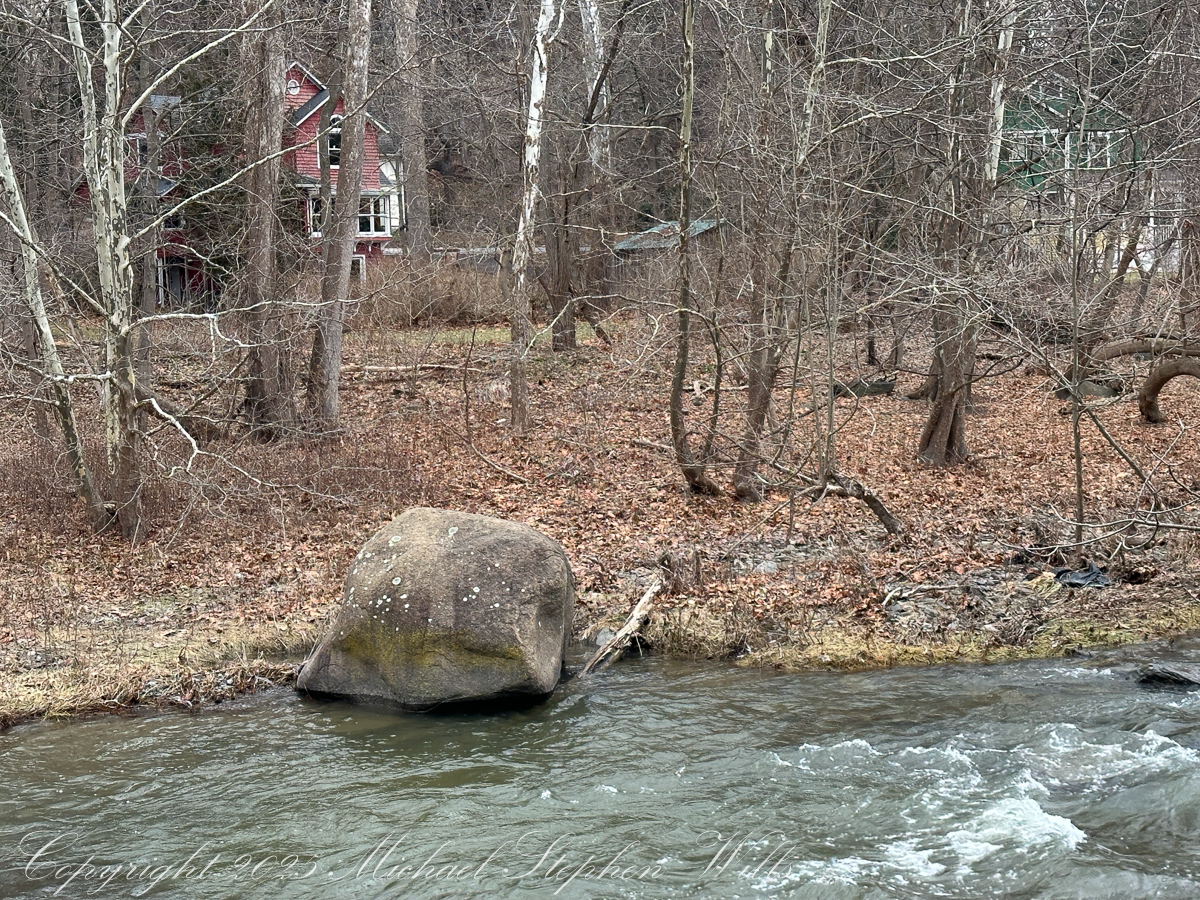
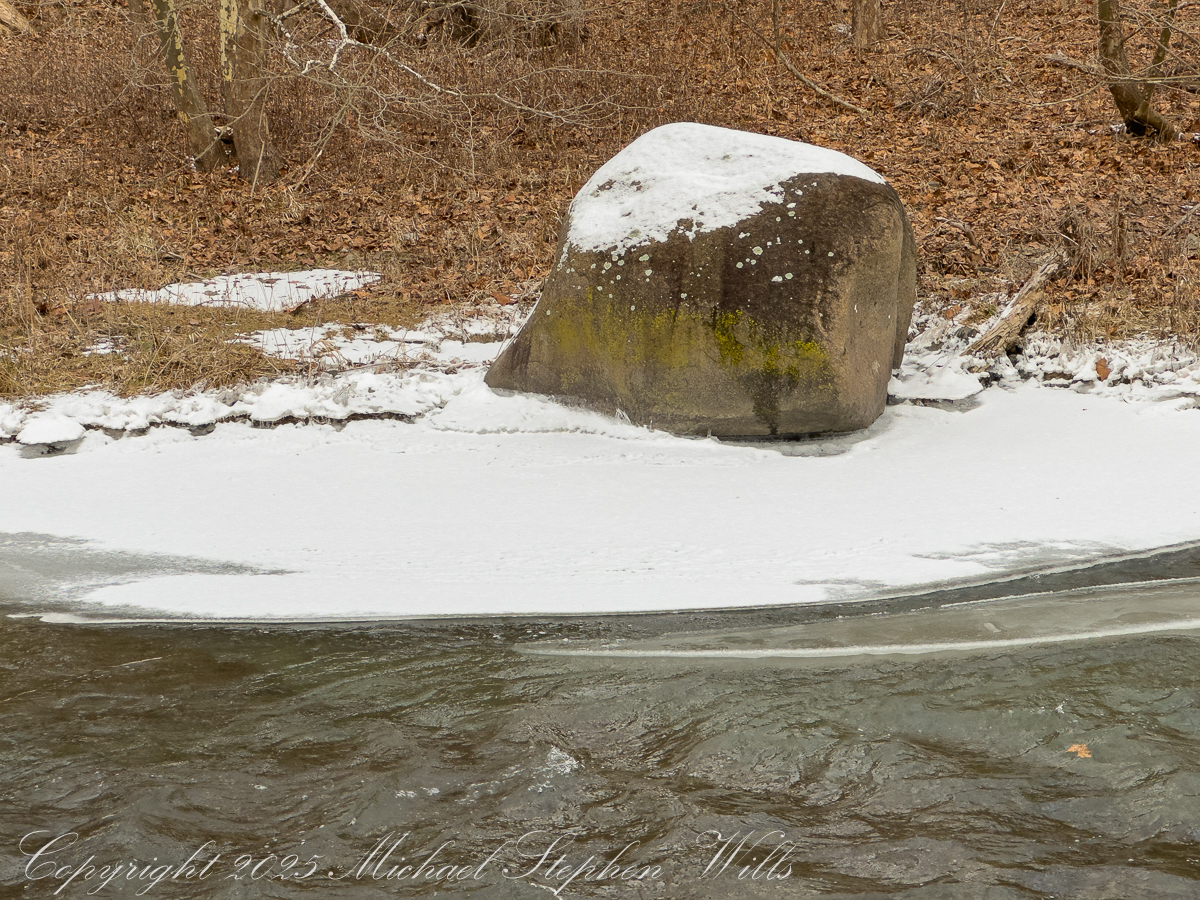
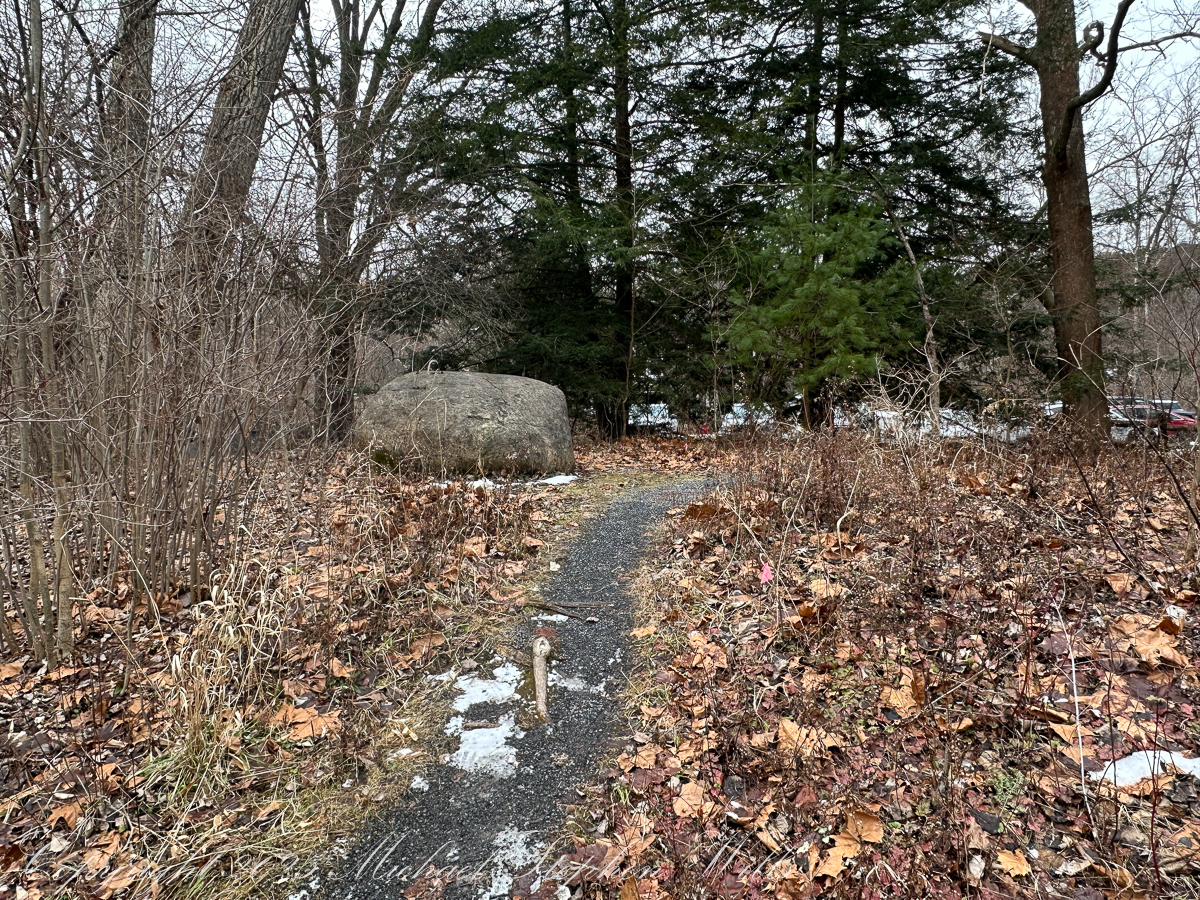
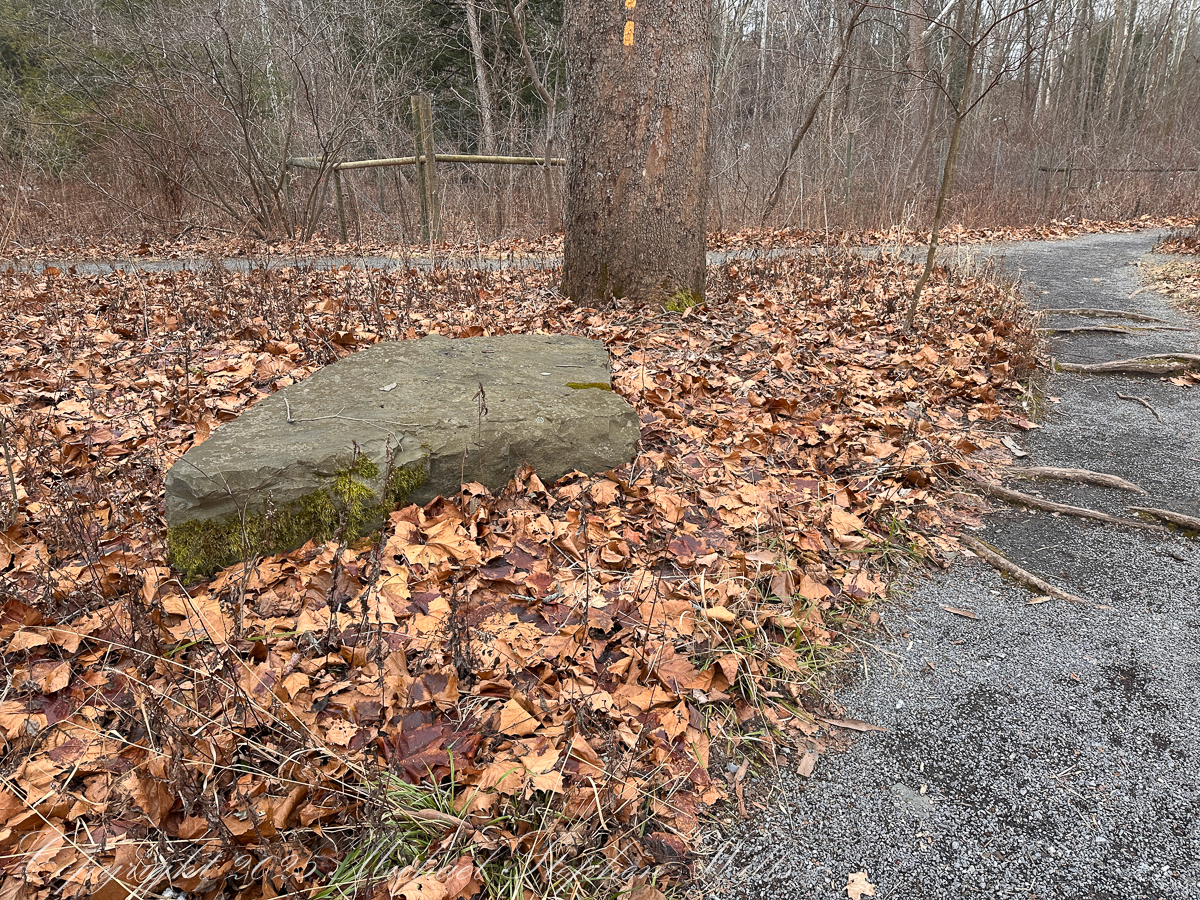
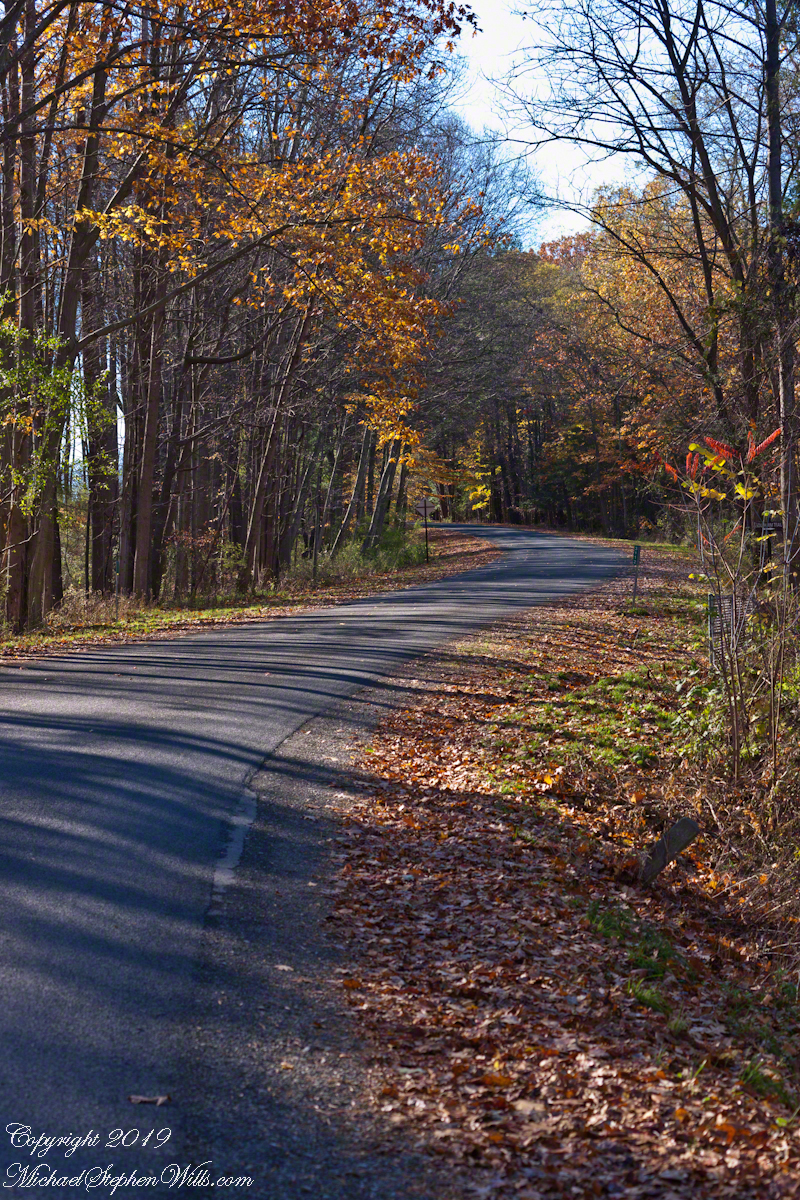
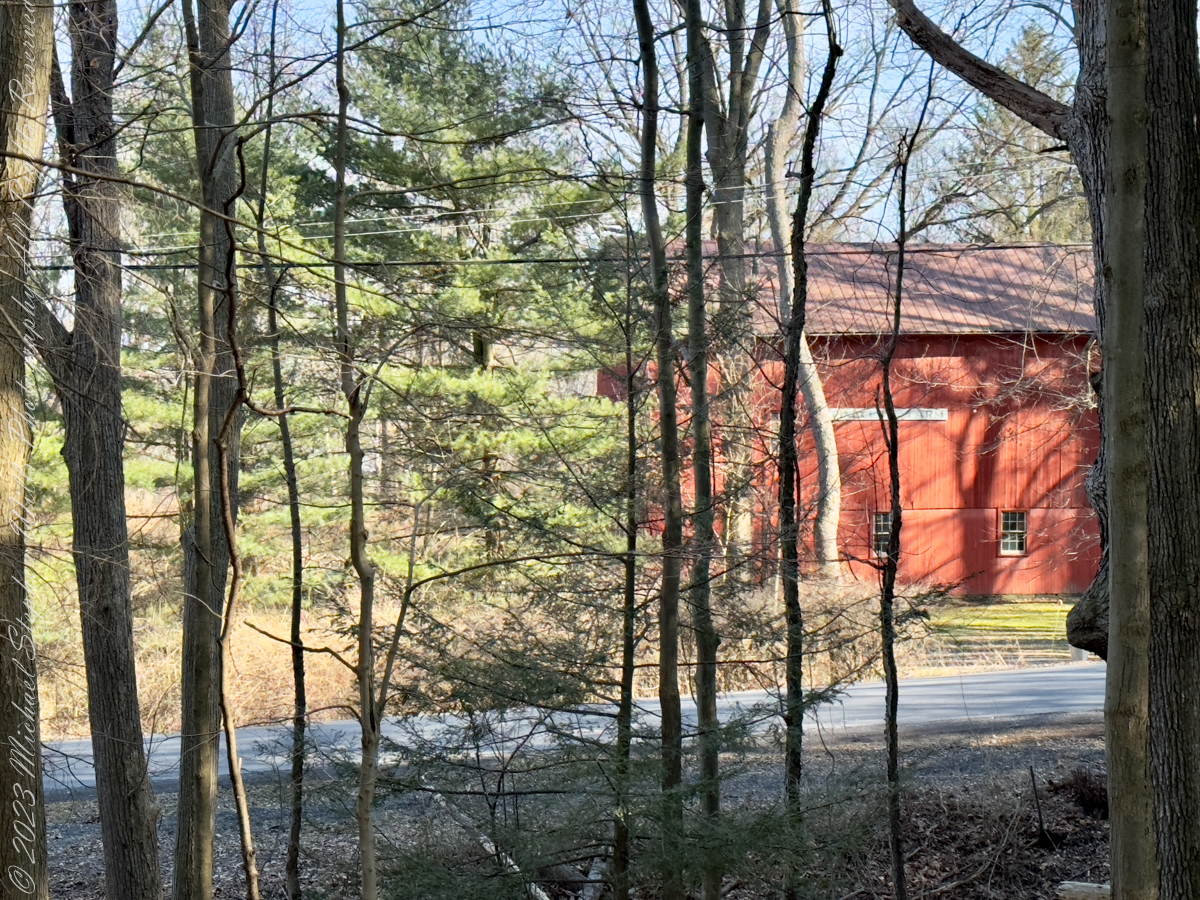
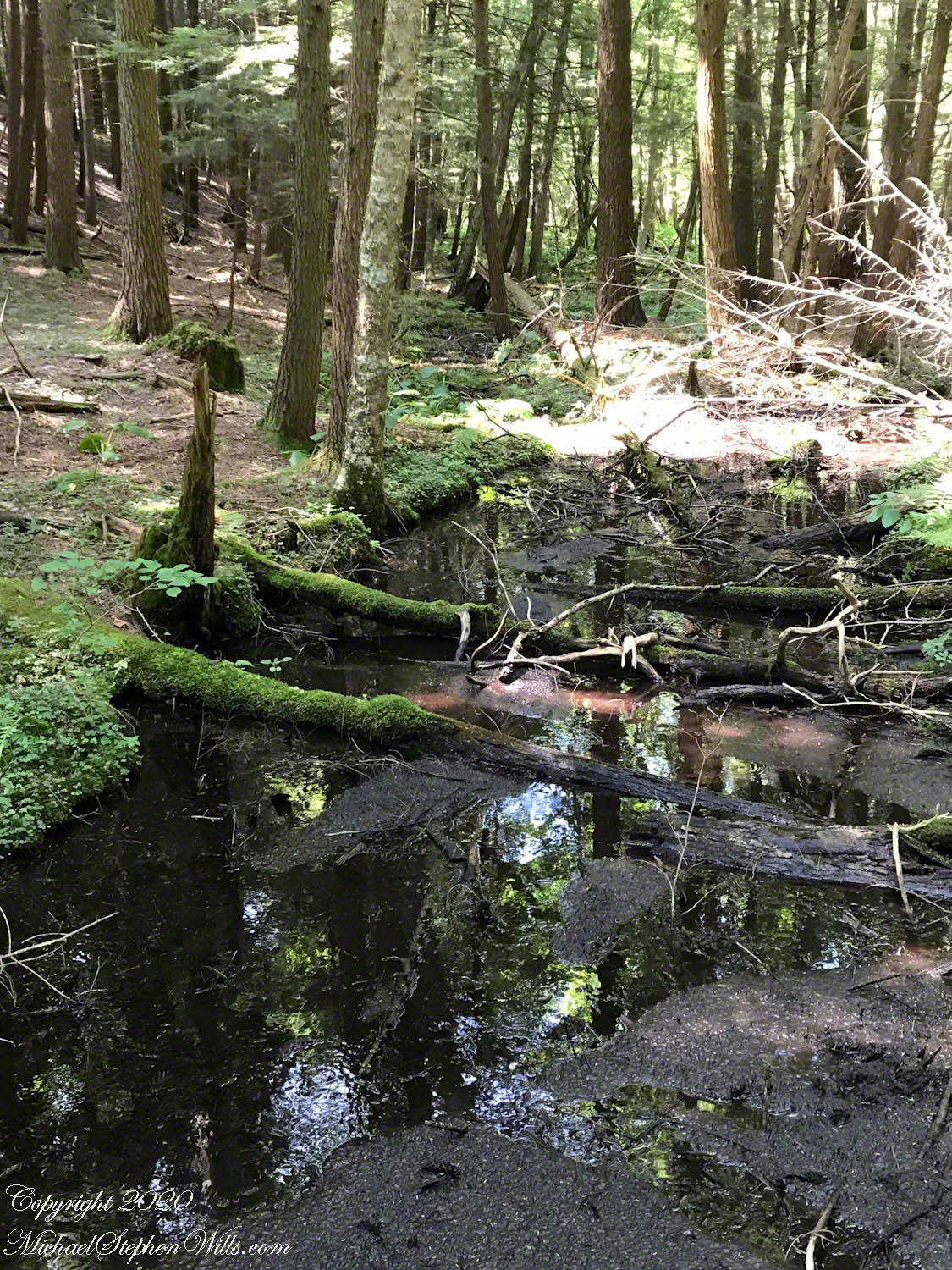
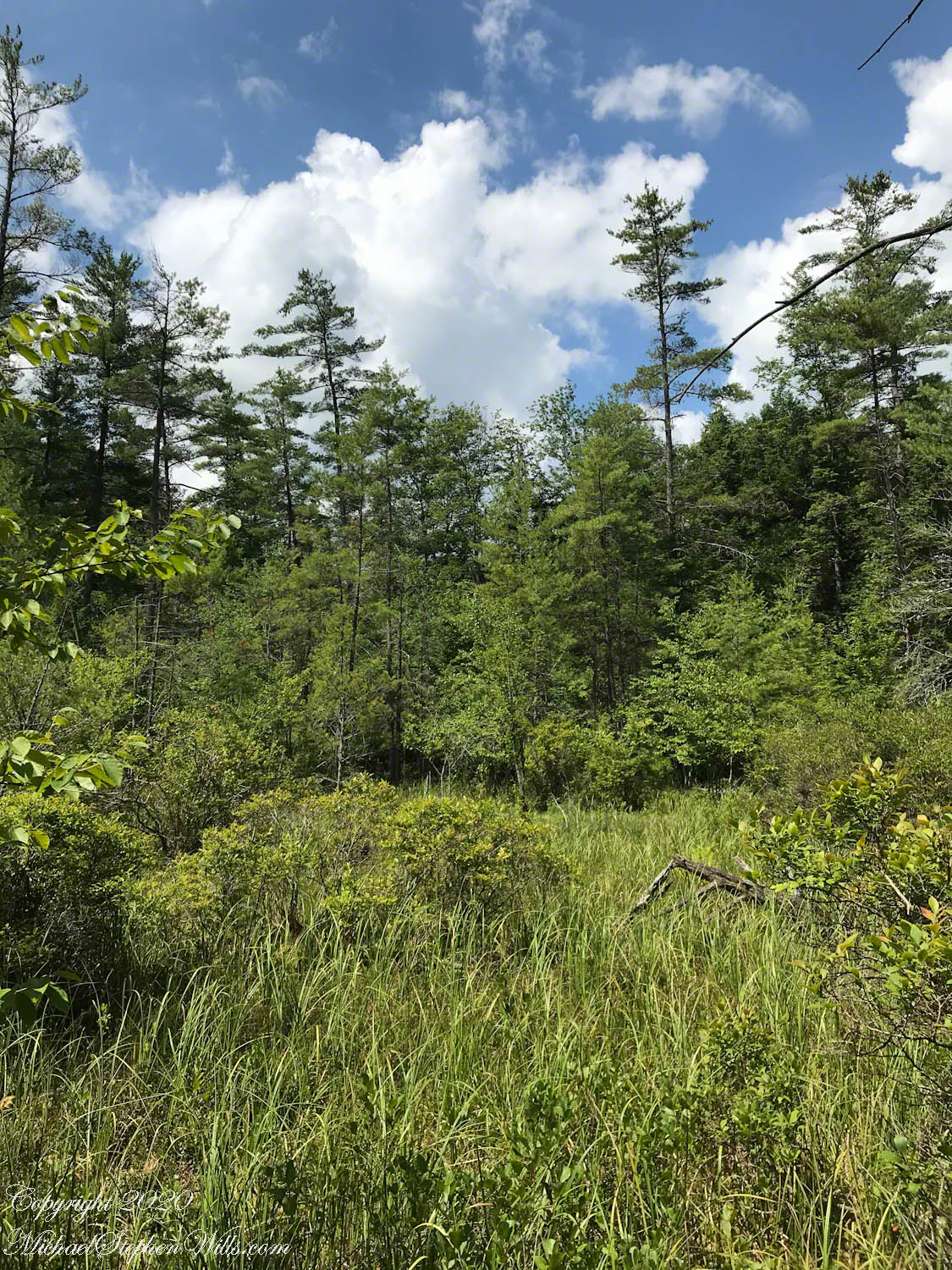
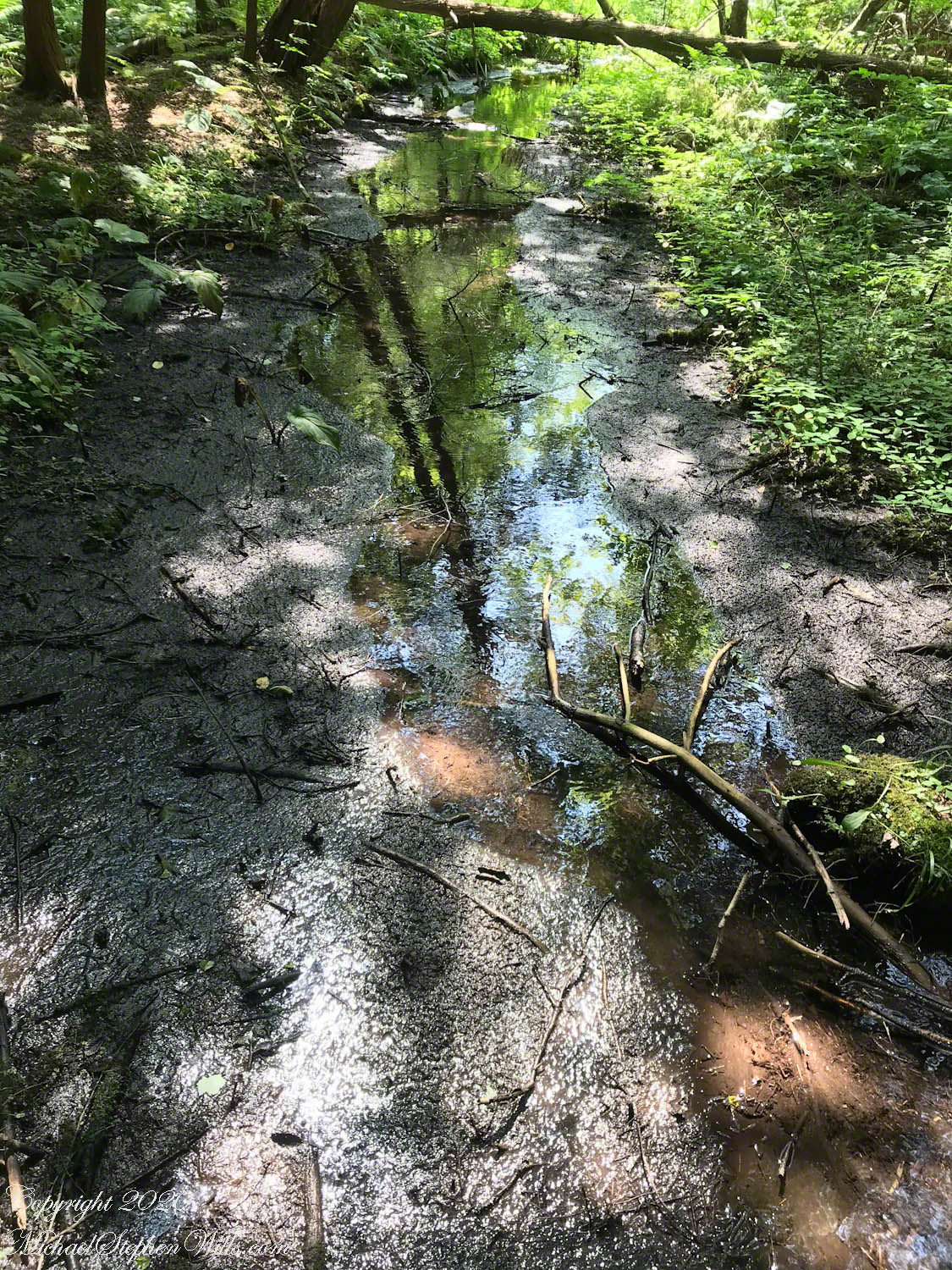
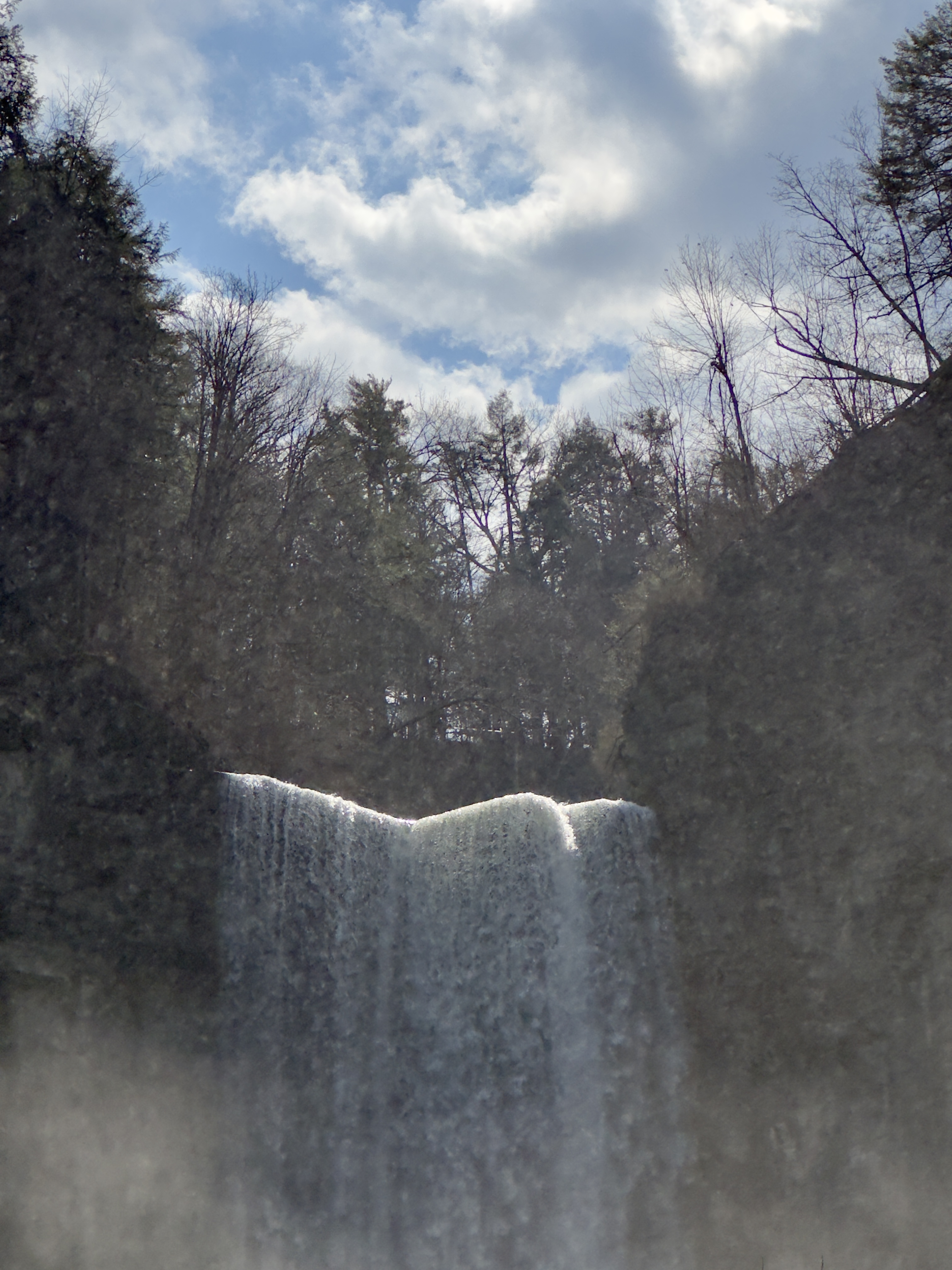
Water defines the O.D. von Engeln Preserve at Malloryville long before we see or hear it. At first, it is only a dampness in the air, a coolness at ankle level, a dark sheen between sedge tussocks. In the space of a half-hour walk, we pass through fen, bog, marsh, and swamp, each distinct, yet bound together by the same slow, persistent flow.

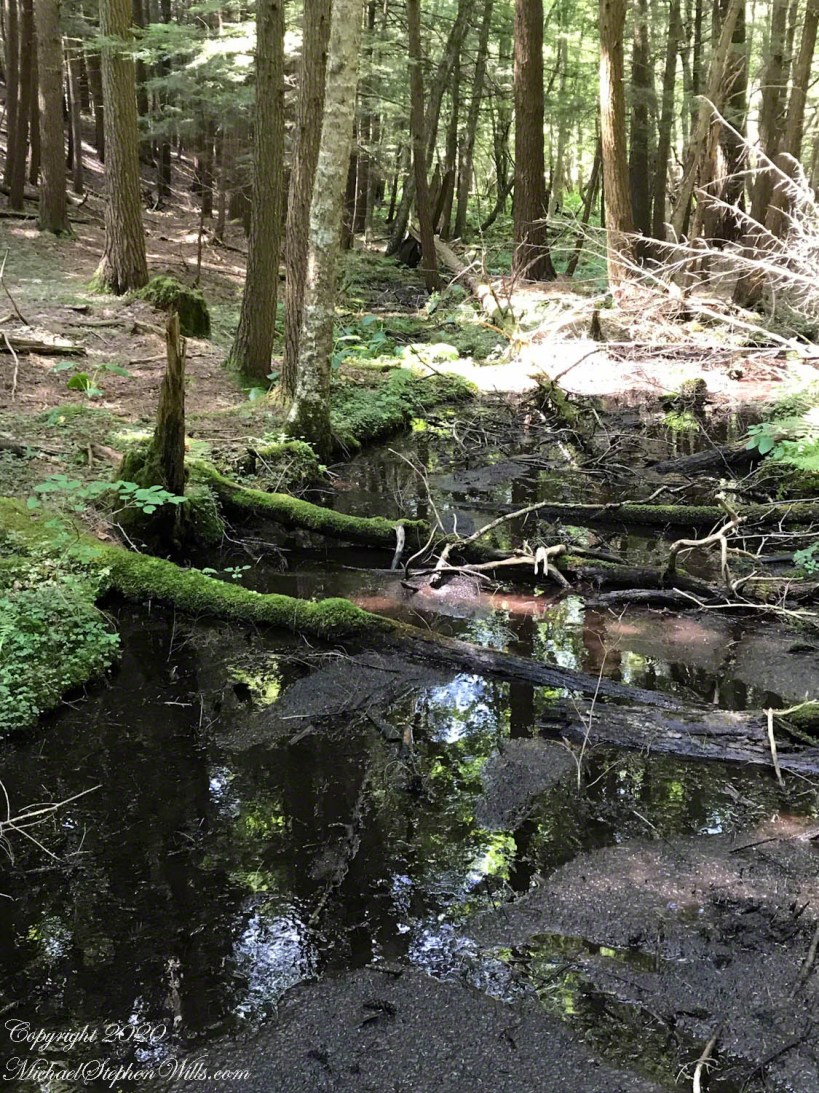
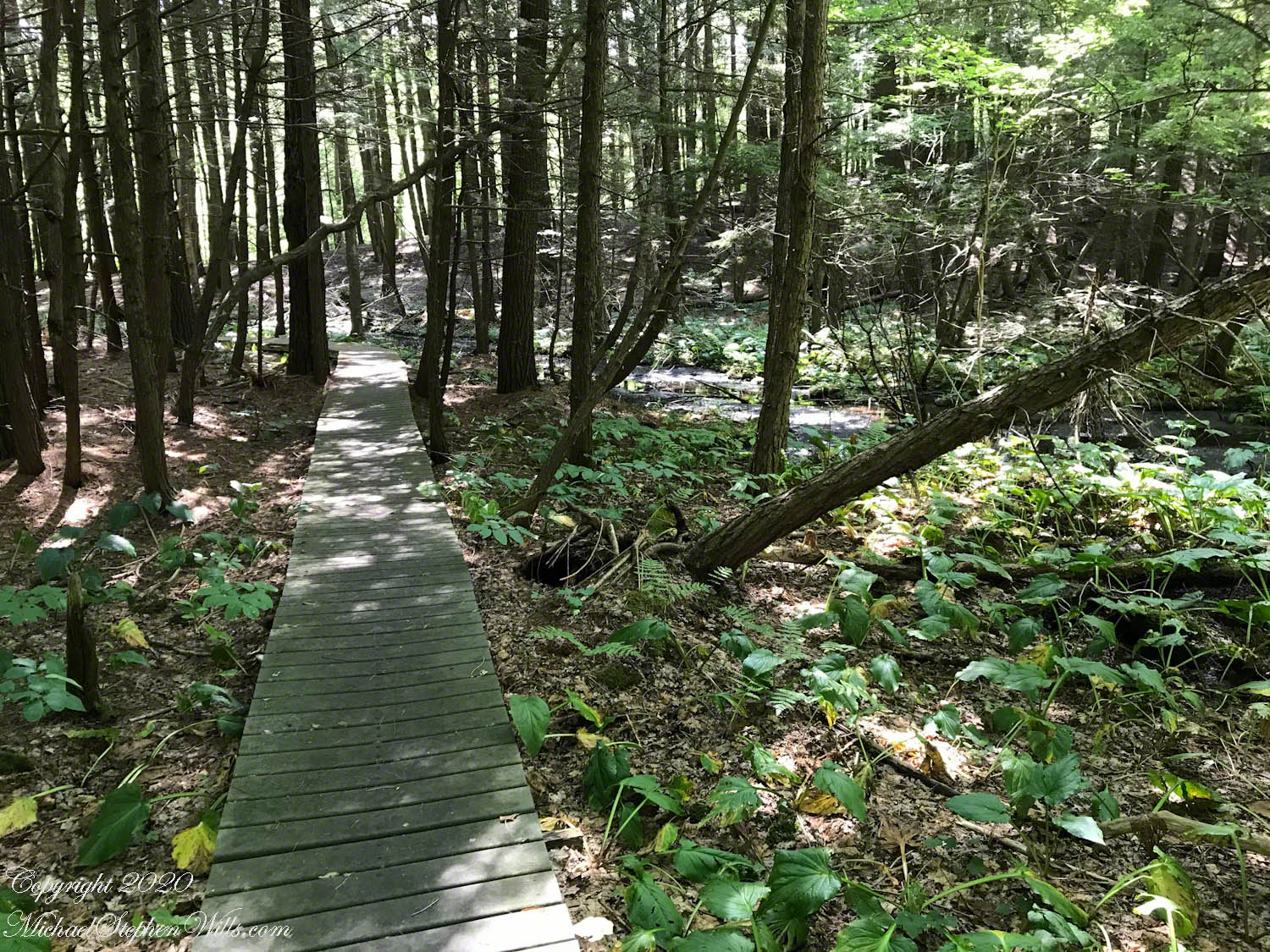
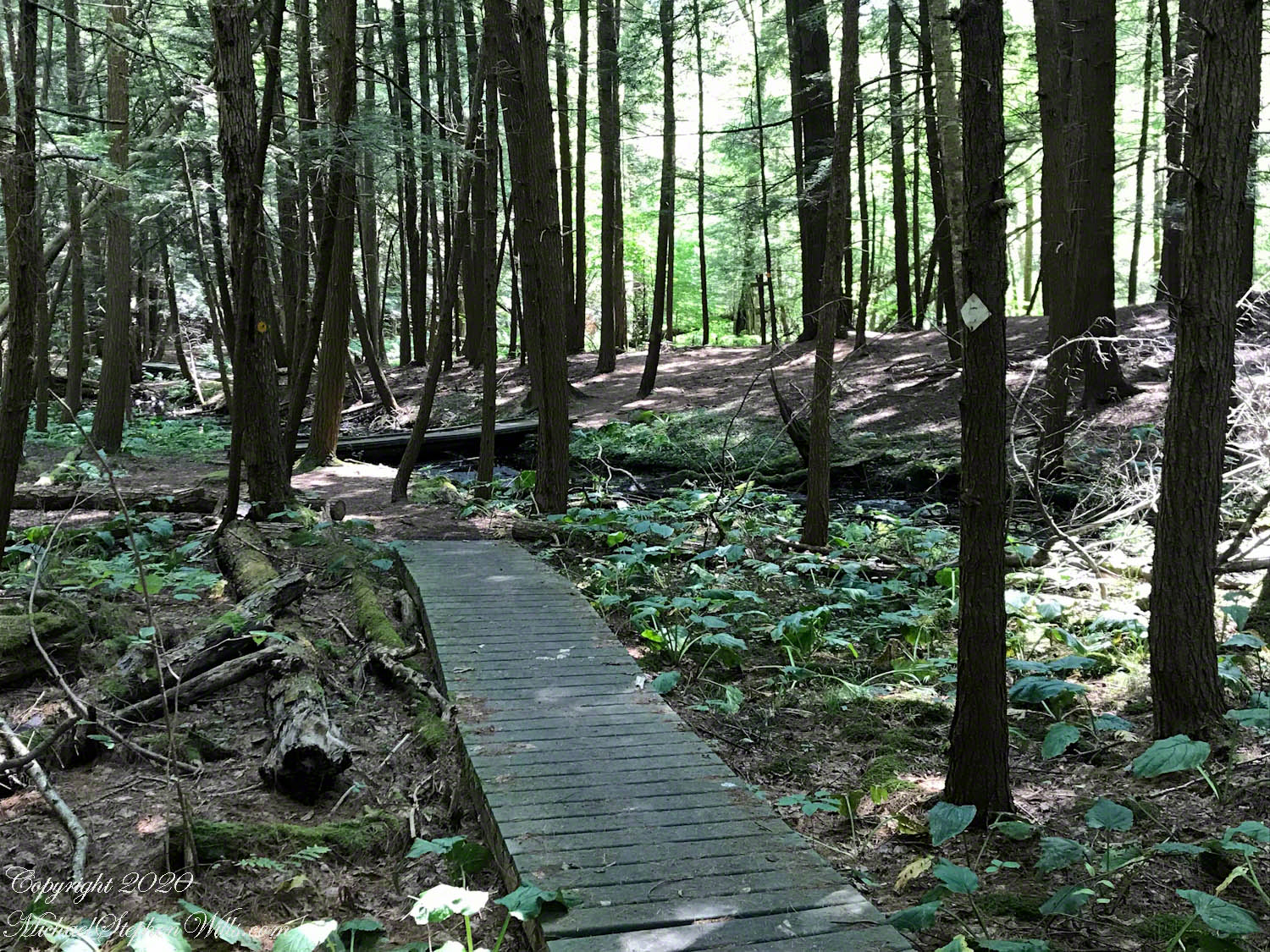
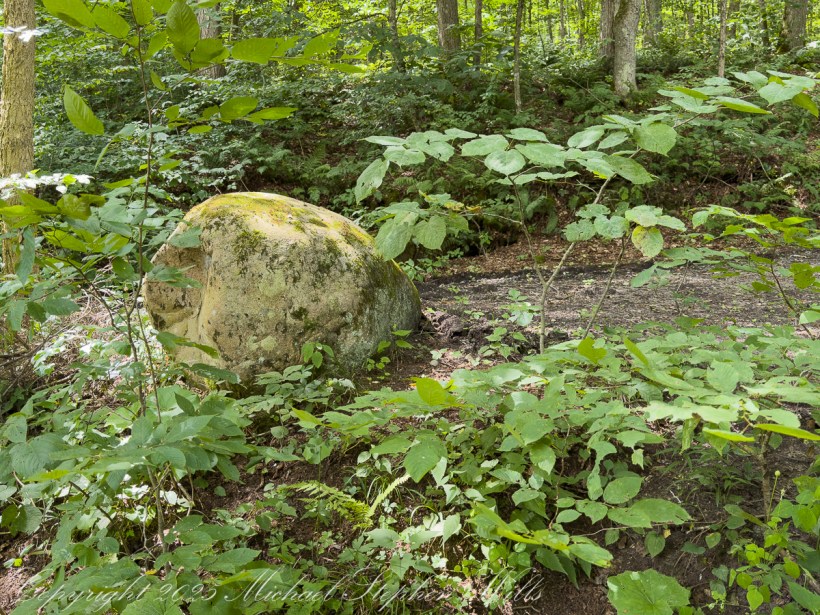
Here we are traversing a swamp, our steps buoyed along on planking made from recycled plastic. The boardwalk floats visually above pools the color of tea, edged with moss and skunk cabbage. It’s easy to imagine what this crossing would have been like before the planks were laid—boots sinking, knees splashed, delicate plants crushed. The modern walkway is a quiet compromise: we may enter this saturated world without trampling it, a human gesture that matches the preserve’s ethos of protection and restraint.

The Malloryville wetlands lie in a low pocket along Fall Creek, a landscape shaped by the last ice age. As the glacier that once covered this region melted, torrents of water tunneled through the ice, depositing braided ridges of sand and gravel known as eskers. Today, more than a mile of these ancient riverbeds winds through the preserve, narrow wooded spines rising above the surrounding wetlands. From an esker crest, the pattern of water reveals itself: dark channels of open flow, pale pools rimmed with sedge, patches of sphagnum floating like cushions, and, farther off, the straight silver of Fall Creek.

But the story of Malloryville’s water begins far from these pools. Rain falls on the uplands as cool, slightly acidic water. It sinks through glacial till—a jumble left by the ice—and begins a long, blind journey underground. As it moves, the water reacts with the minerals it encounters. Where it brushes limestone or other carbonate-rich layers, it is slowly neutralized and picks up dissolved calcium and magnesium. By the time it resurfaces in low spots, it may be transformed from sour, soft rain to mineral-rich groundwater.

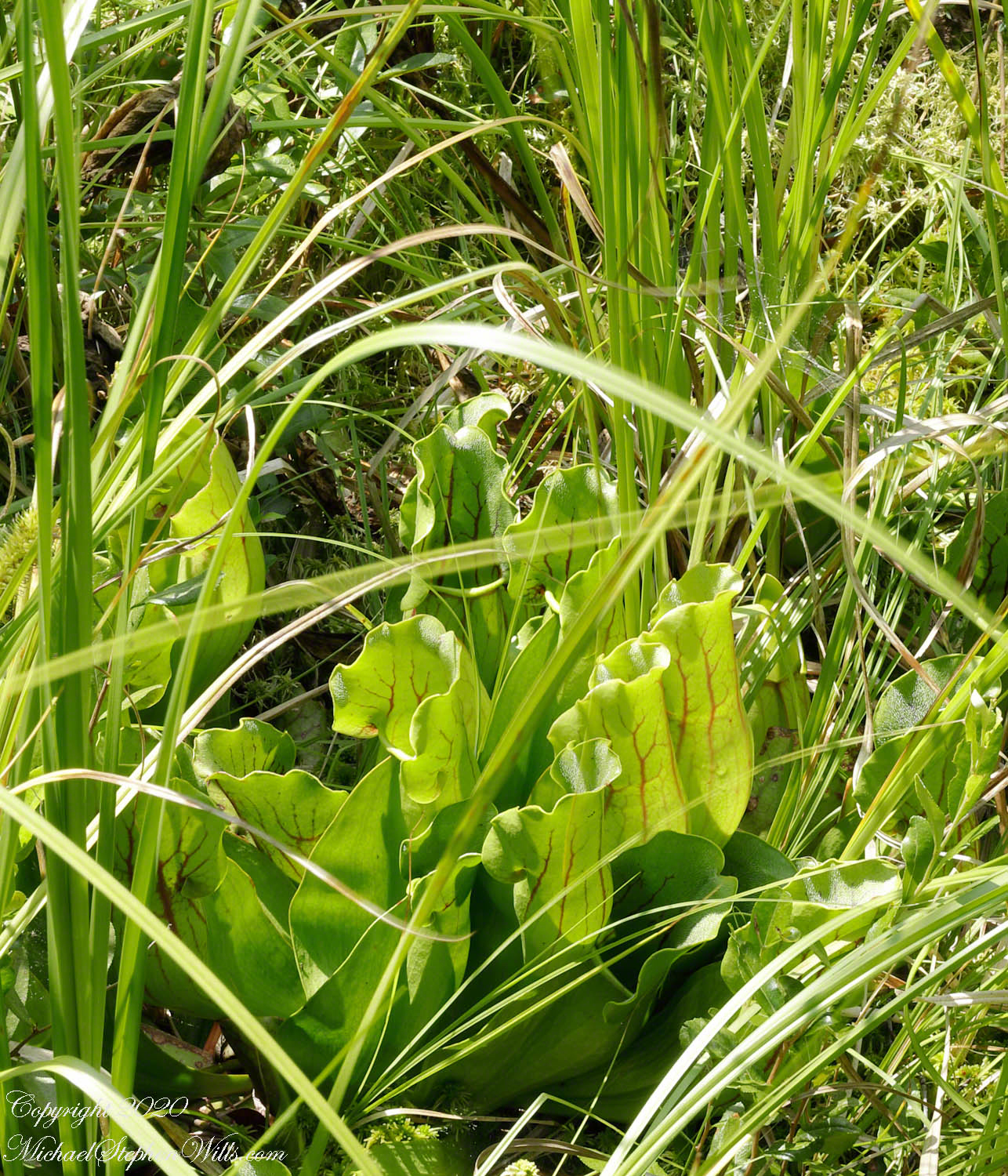
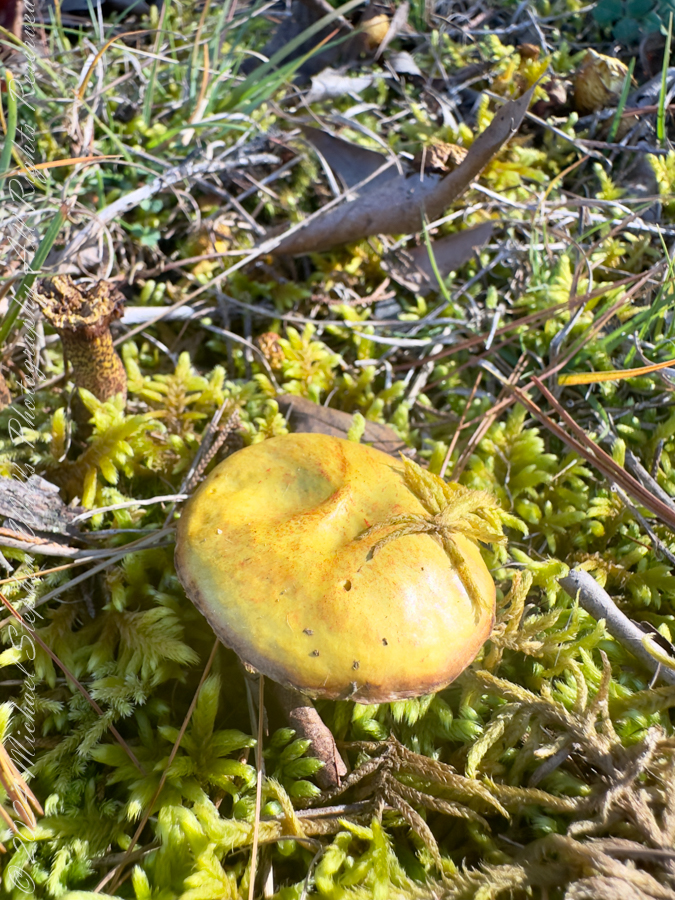
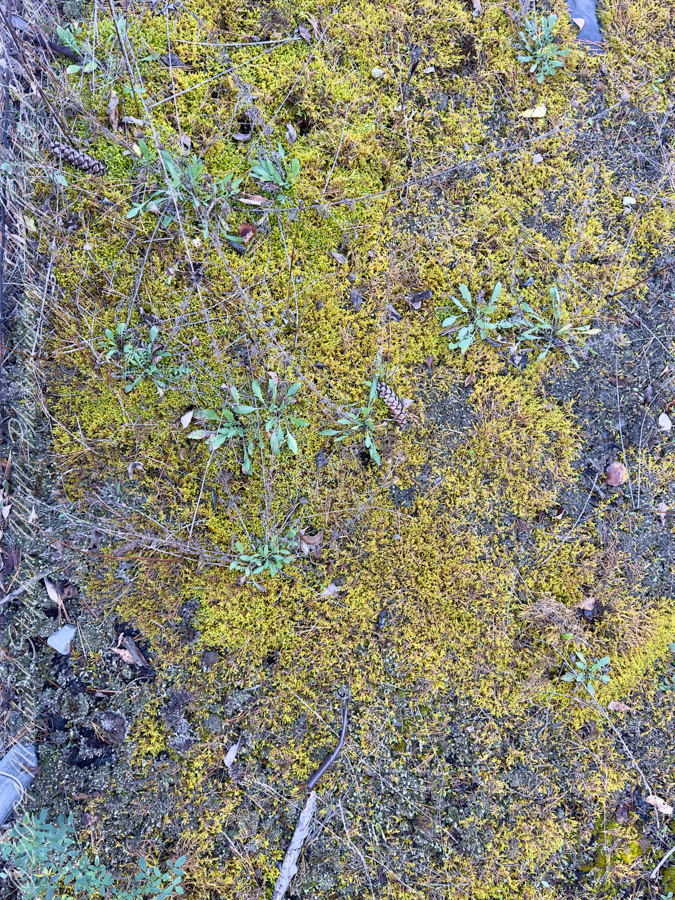
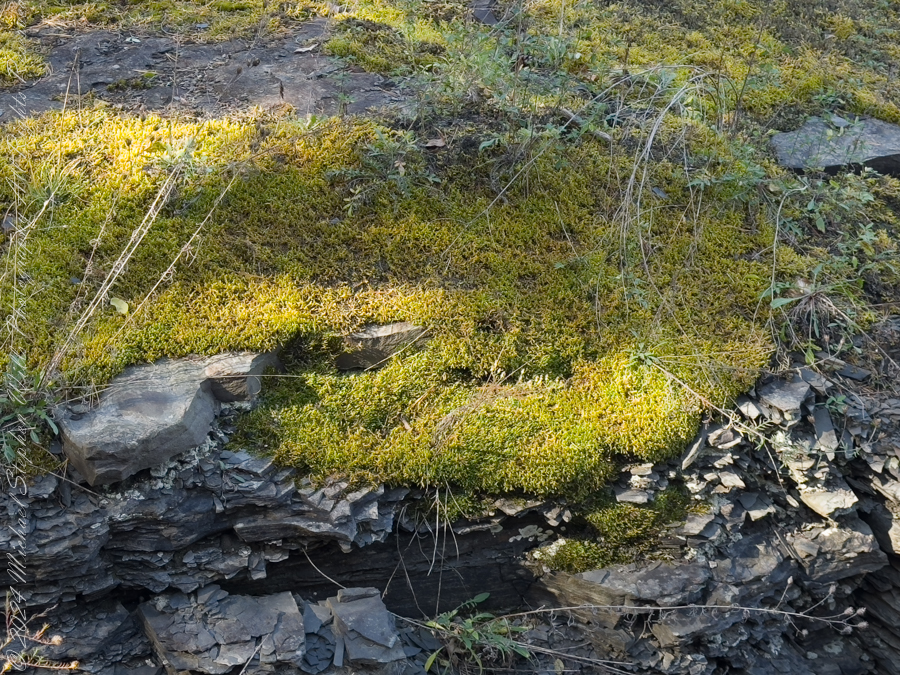
Those subtle chemical shifts are written onto the land. In some hollows, where water still mainly reflects its origin as rain, the environment becomes a bog—cold, acidic, nutrient-poor. Here, sphagnum moss knits a floating carpet, and only specialists such as leatherleaf and cranberries can endure. In other pockets, where groundwater welling up from below brings minerals, we find fens: lush, lime-touched wetlands offering niches for orchids, sedges, and the carnivorous pitcher plant. Marshes and swamps round out the spectrum, their standing water and wooded shade forming still more microhabitats.

In this small preserve, all these wetland types coexist side by side, threaded by water that often moves so slowly it appears not to move at all. The stillness is deceptive. A slight difference in elevation—barely the height of your boot—can determine whether water spreads and stagnates, seeps outward in a fan, or concentrates into a narrow, unseen channel. Hydrologists studying the area have shown that a water-table mound of only a few inches can redirect the underground flow and, over time, steer the evolution from open fen to peat-filled bog.

Human history here is entwined with that quiet power. The founders of the preserve, themselves from a dairy farming family, came to understand that the springs, seeps, and wetlands feeding Fall Creek were vulnerable. Gravel pits on nearby land had already bitten into the valley; another such excavation on this side would have severed the veins of water that sustain the fen and bog. Their years-long effort to protect the property culminated in a Nature Conservancy preserve whose very purpose is to safeguard water and the uncommon communities it supports.

The boardwalk under our feet is part of that story. Its recycled-plastic planks do not rot in constant dampness, and their smooth, slightly hollow sound reminds us with each step that we are guests in a place where soil never truly dries. At the edges of the walkway, tamarack and red maple lift their trunks from hummocks, their roots anchored in peat built grain by grain from centuries of water-logged plant remains. In the open patches, we can seek out pitcher plants, their flaring, water-filled leaves digesting unwary insects to make up for the nutrient-poor conditions.
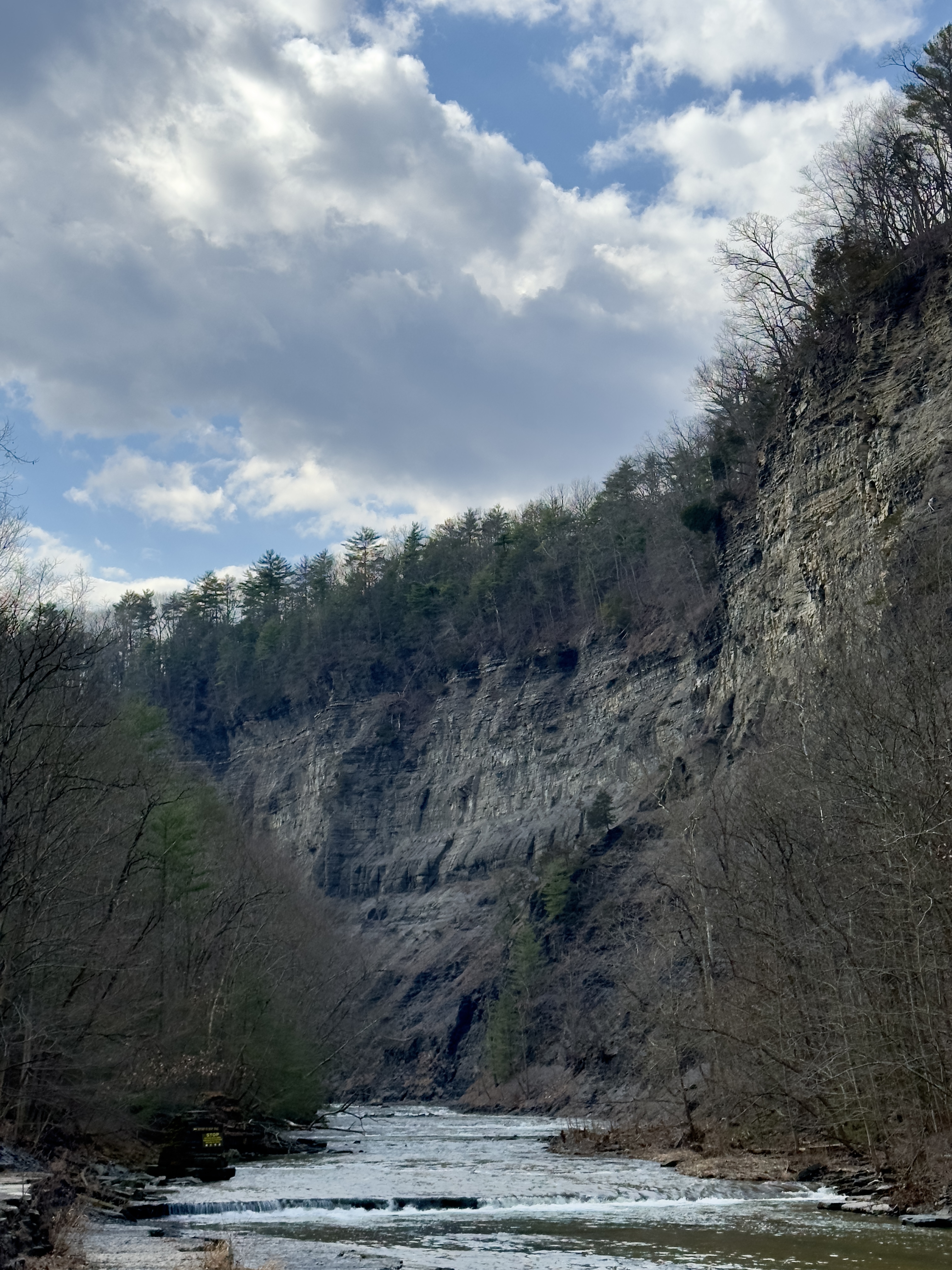
Everywhere, water moves almost invisibly. It rises as a cold trickle at the base of the esker, fans through the moss as a thin sheet, and gathers again in dark, tannin-stained channels. It rarely speaks aloud; only in spring flood or after hard rain does it murmur against roots or tap lightly at the plastic planks. Yet its influence is written in every texture and color—emerald moss, rusty sedge, the silvery bark of birch leaning over a pool.

To walk in Malloryville is to learn to read this subtle handwriting. We begin by noticing the obvious: the wetness, the boardwalk, the glimpses of standing water. By the end of the walk, we are tracing gradients—how the plants shift with elevation, how the ground feels underfoot, how the air cools or warms by a degree or two. We sense the long journey of water from sky to stone to peatland to creek, and onward to Cayuga Lake and the wider world beyond.

Water, flowing quietly, almost soundlessly, with powerful effect: Malloryville Preserve, that power is persistence. It is the power to carve a valley, to build a peatland one stem at a time, to sustain rare communities of plants and animals in a modest corner of New York. To honor such water is to move carefully, speak softly, and remember that our presence, like our boardwalk, should allow the flow beneath to continue its ancient work.

Enter your email to receive notification of future postings. I will not sell or share your email address.

Cornell Botanic Gardens’ Monkey Run: History, Geology, and Scenic Fall Creek

A contemplative walk along Monkey Run where Fall Creek writes the valley’s history—sycamores, bridges, and Devonian stone speaking across seasons in Cornell’s living classroom.

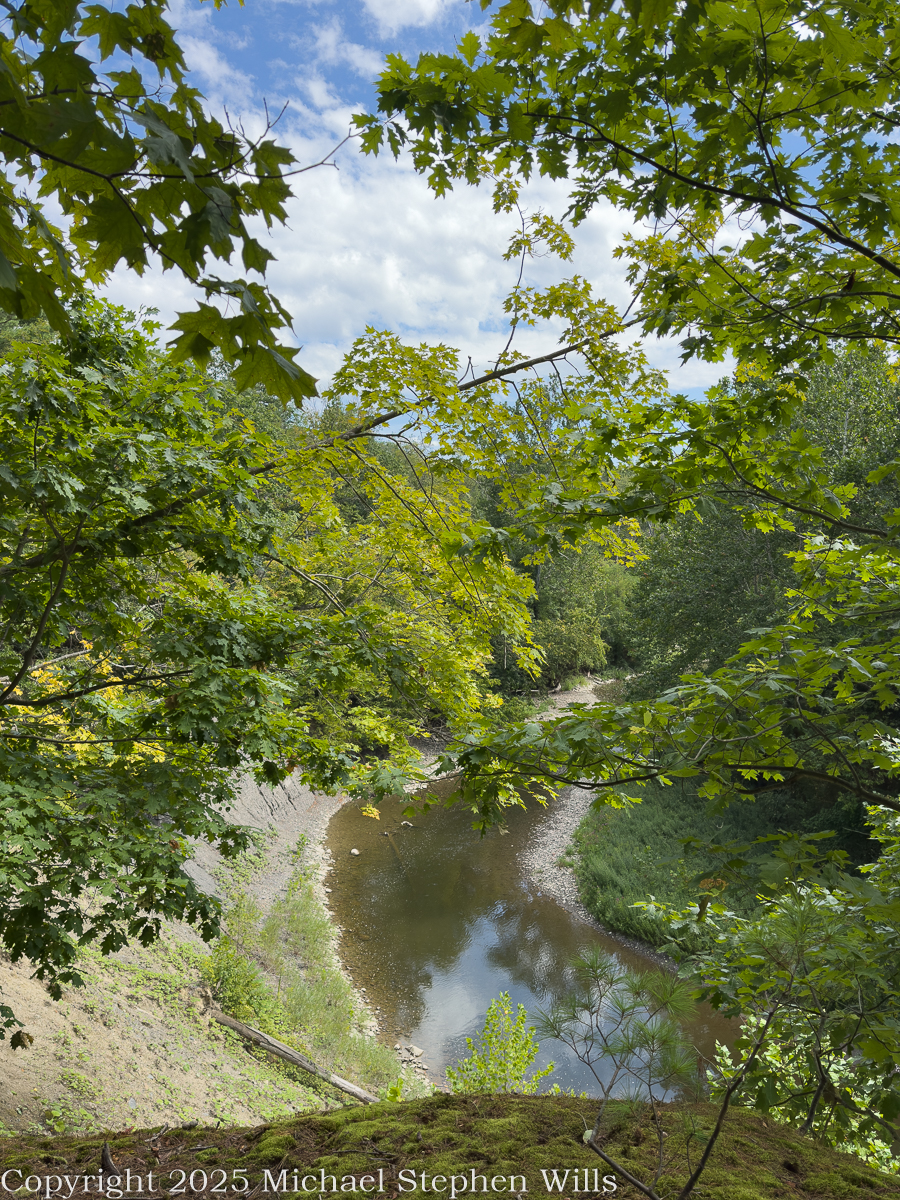
On a morning in late March, when the hills about Ithaca still hold the night’s frost in their shaded folds, I took the path called Monkey Run and went to see how Fall Creek spends its winter earnings. The air had the bright sting of thaw, a kind of vernal austerity that keeps a man honest in his steps. Along the high bank the sun spilled its coin onto the water, where it broke and flickered like a school of silver minnows. A rim of snow clung to the shale ledges, and the leaves of last year’s oaks—curled, fox-red, and faithful—whispered as if to keep the woods awake until spring fully claimed them.

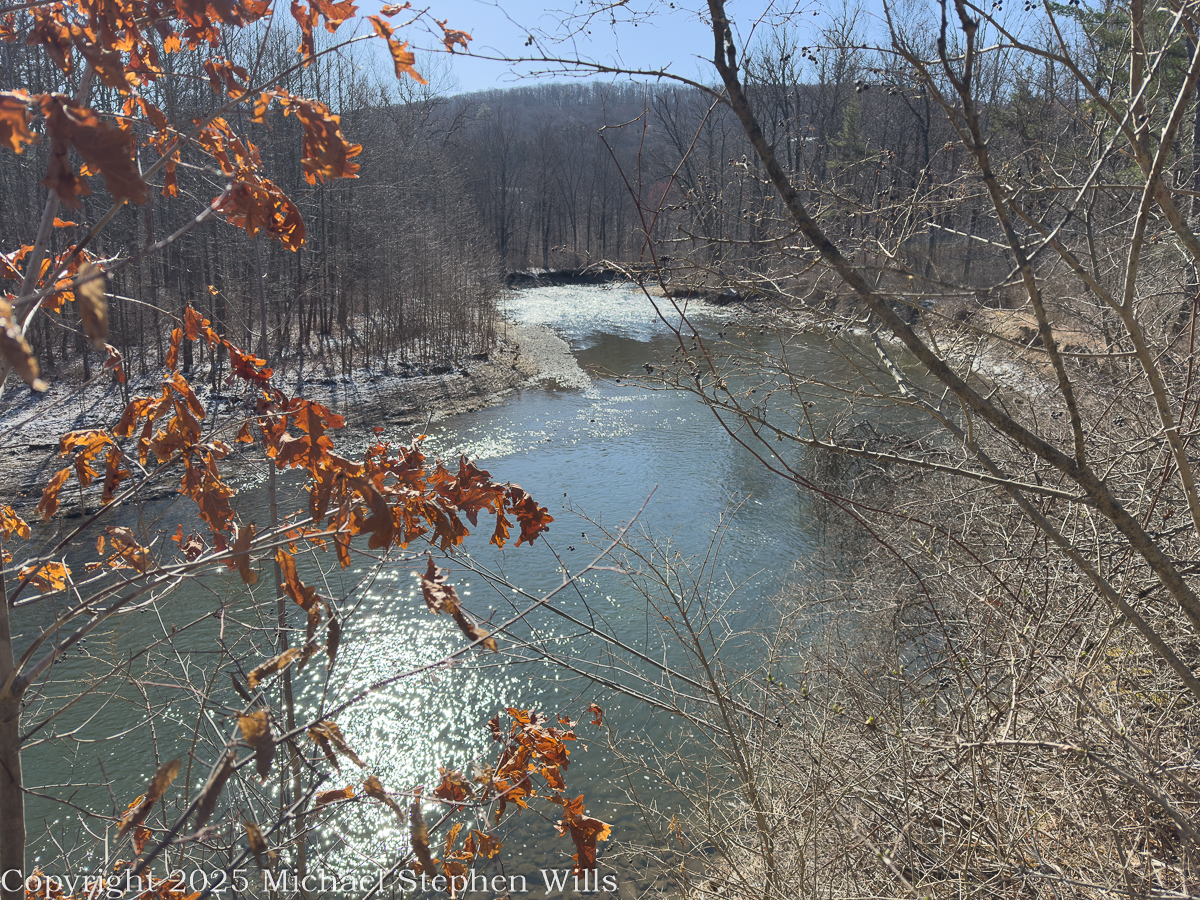
Sunlit bend of Fall Creek viewed from a high bank at Monkey Run in early spring.

Monkey Run is one of the outlying parcels tended by Cornell Botanic Gardens—once called the Plantations, and now, more fittingly, named for the living charge it keeps. These gardens do not end at beds and borders; they encompass the wilder rooms of the county, more than a thousand hectares of glens, pastures, and ravines where the university’s first and oldest teacher—nature herself—still holds class. Fall Creek is one of her principal lecturers. Rising beyond the high country of Cayuga Heights and slipping under stone and snow, it shoulders its way across the campus, idles a while in Beebe Lake, and turns turbines of memory at Triphammer Falls before shouldering on toward the lake that receives nearly everything here—Cayuga—long, deep, and glacial in its thinking.

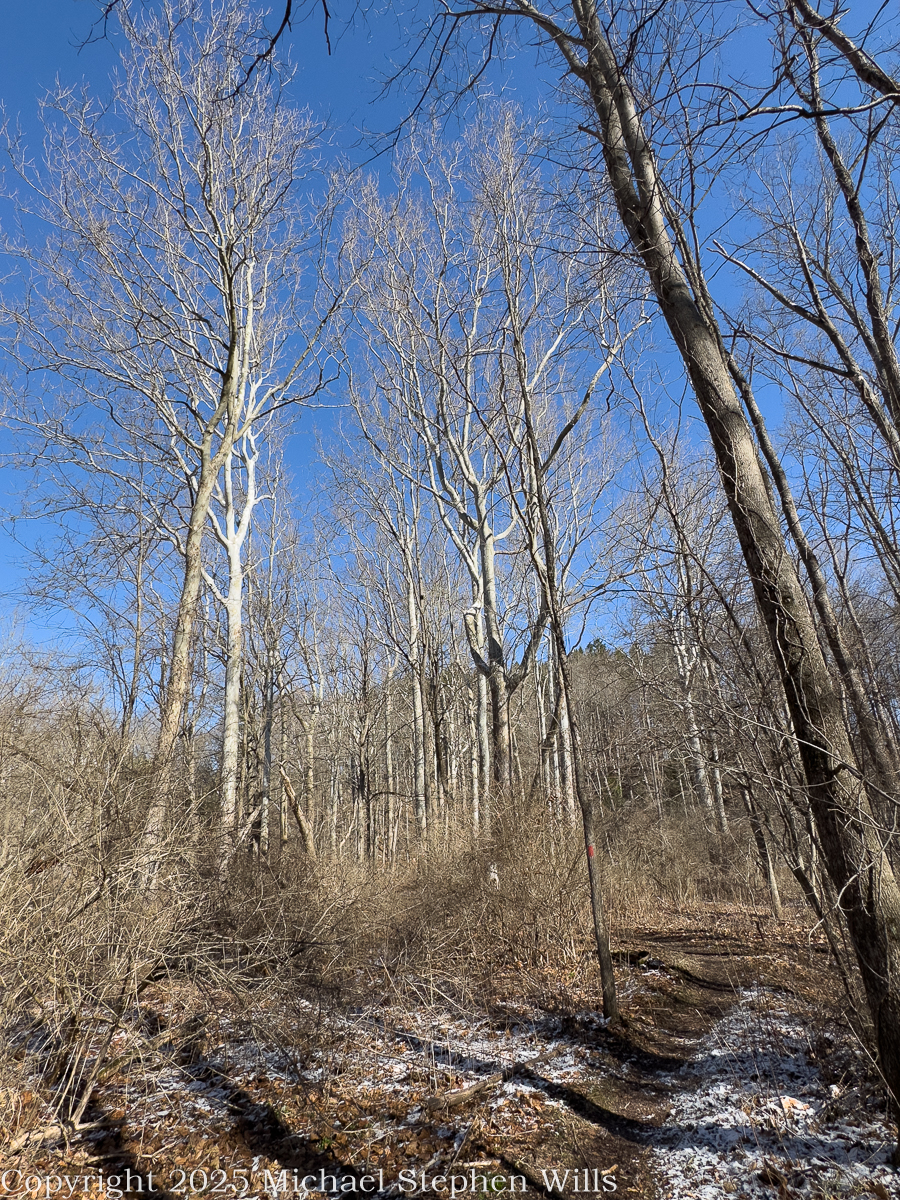
Tall white-barked sycamores leafless against a blue March sky at Monkey Run.

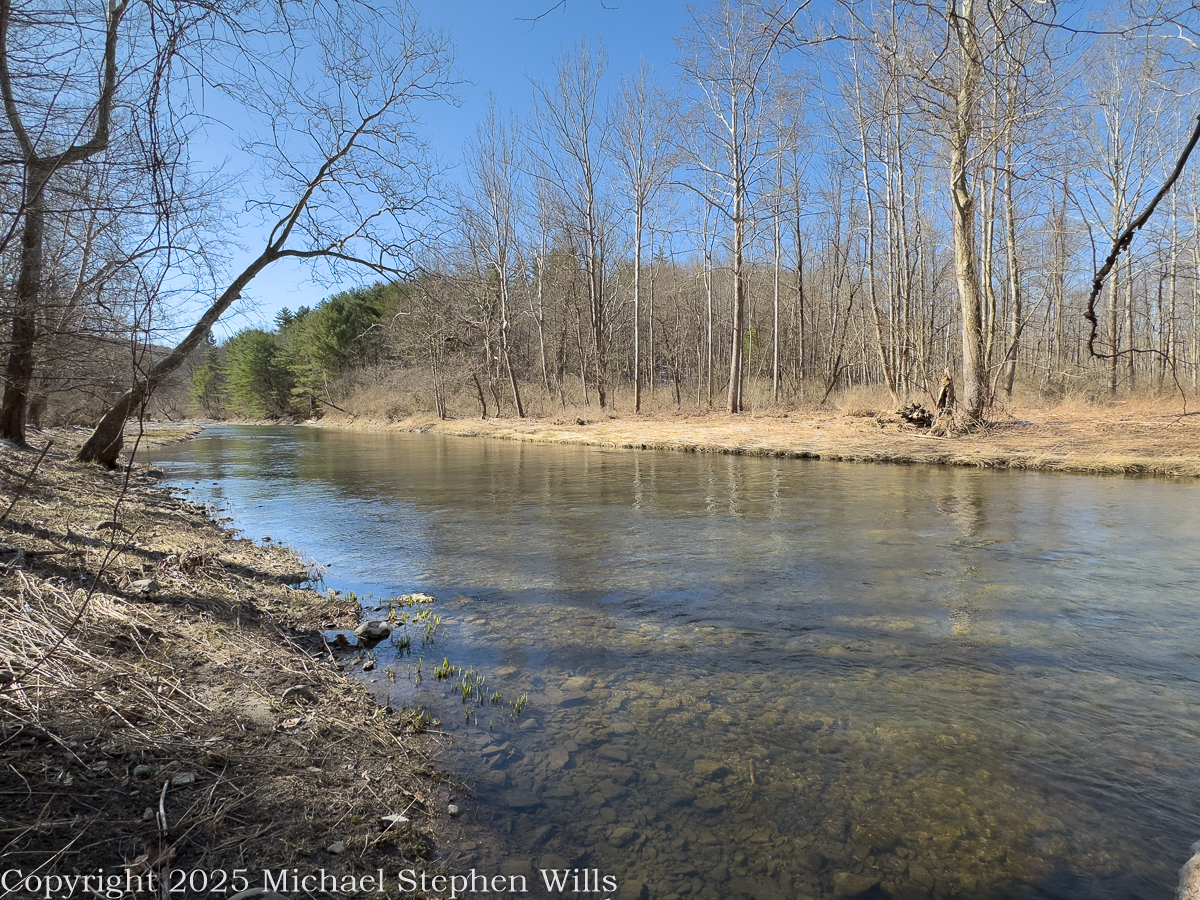
If you would learn a valley’s mind, walk a meander. The creek here composes with easy cursive, laying down a bar of gravel, nibbling at a bank of clay, then sweeping back to consider its work from the opposite shore. The geologist says the rock is Devonian, pages laid flat and damp with time, and the ice of ten thousand winters ago scoured them into the open. A creek is a patient mason, working without rest and never in anger. I admired these sycamores—their clean bones shining through the leafless canopy like the ribs of an old cathedral. Winter reveals their whiteness; summer grants them shade. A stand of white pines keeps a dark counsel in the background; on the muddy edge, green tongues of skunk cabbage push up, pledges made by the swamp to keep faith with the sun.

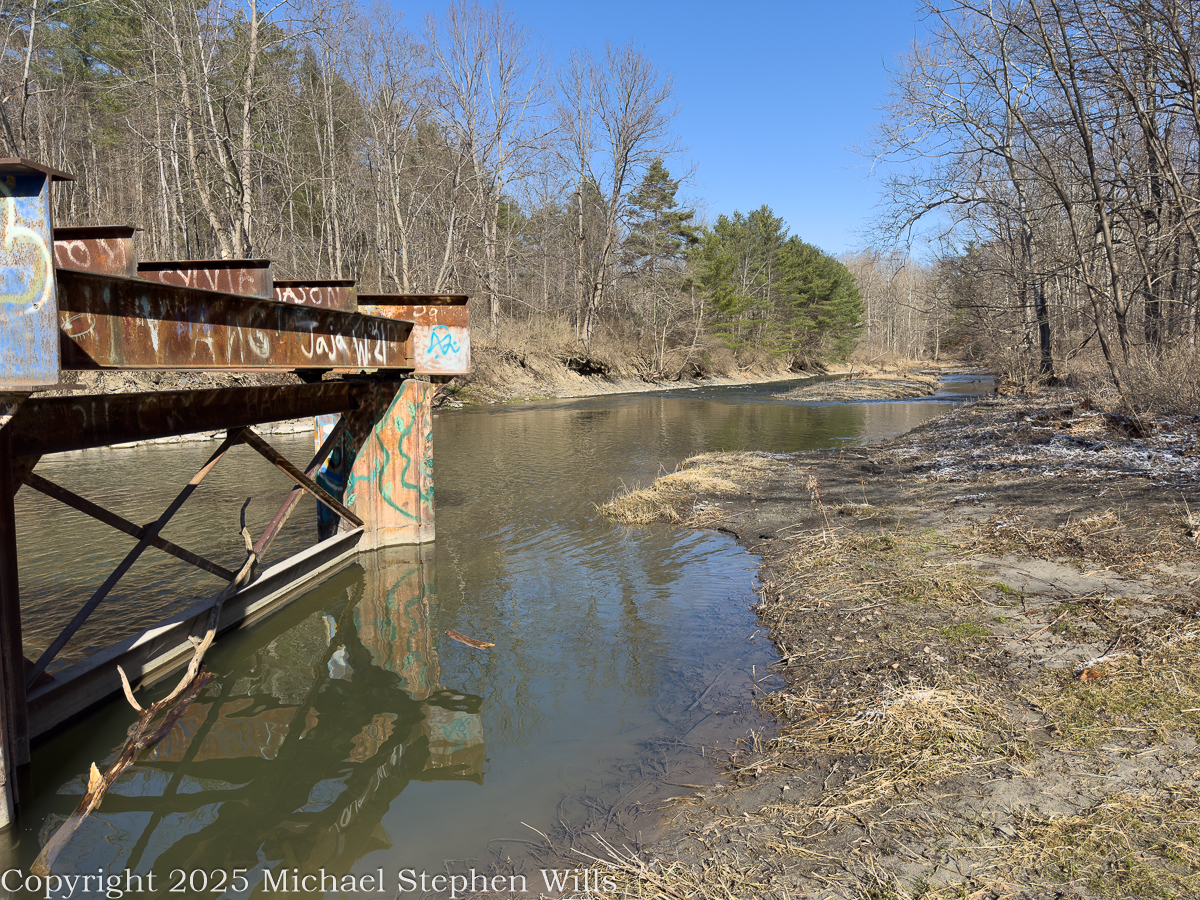
Rust-stained steel pier above calm water on Fall Creek along Monkey Run trail

I came down to the water near an old steel pier, a bridge remnant, hanging on each end without purpose. It wears graffiti the way a boulder wears lichen; human wishes, briefly rooted, coloring what they can. The river accepts it all, the pilings and the scribbles, the cast limb and the bottle’s glint, and continues its one unarguable gesture downstream. That is the old instruction of Fall Creek: use, refuse, endure. Before the university drew students from every quarter, the creek turned wheels and powered the small ambitions of a frontier town. Even the name Triphammer speaks of iron struck to purpose. Now the water powers something quieter: the studies of herons, the almanacs of kingfishers, the quick arithmetic of minnows over limestone.

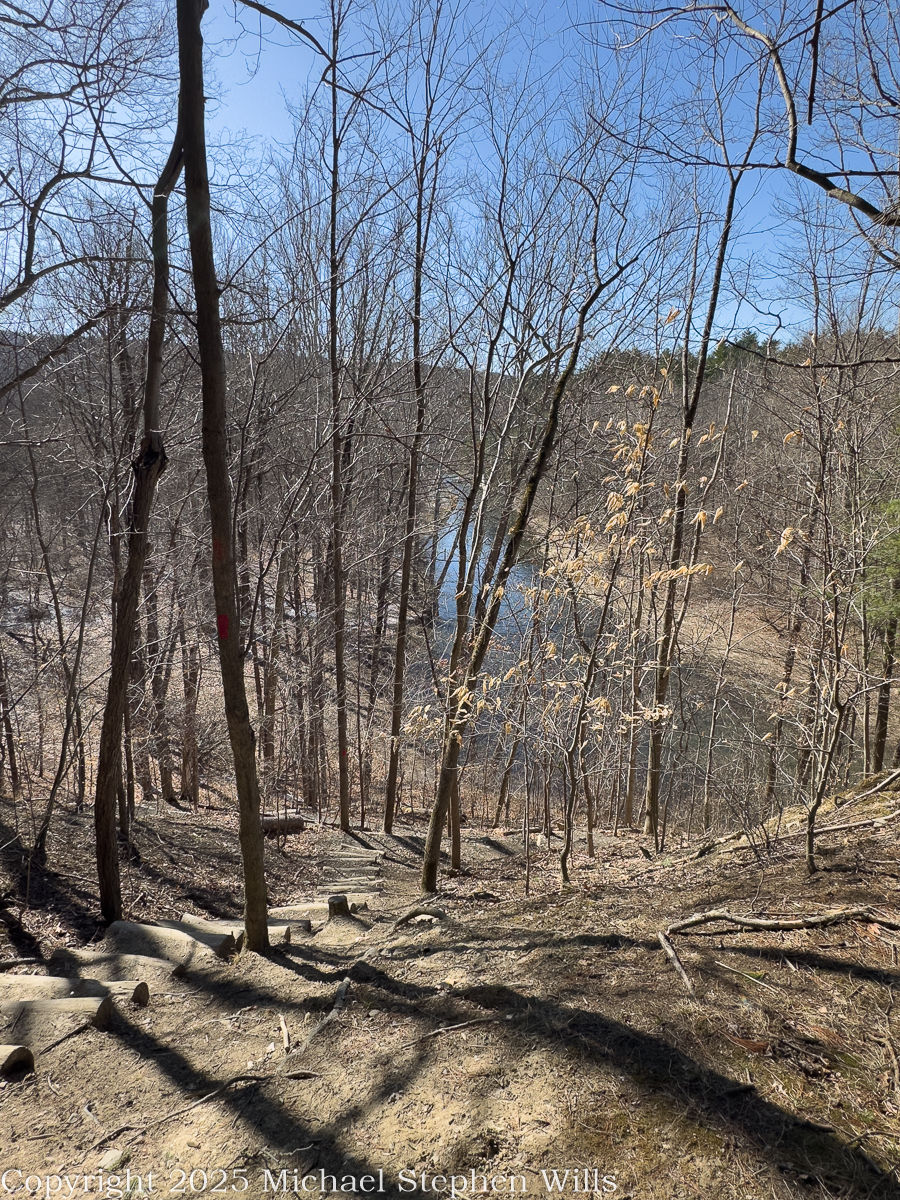
Looking back while climbing the steep bluff

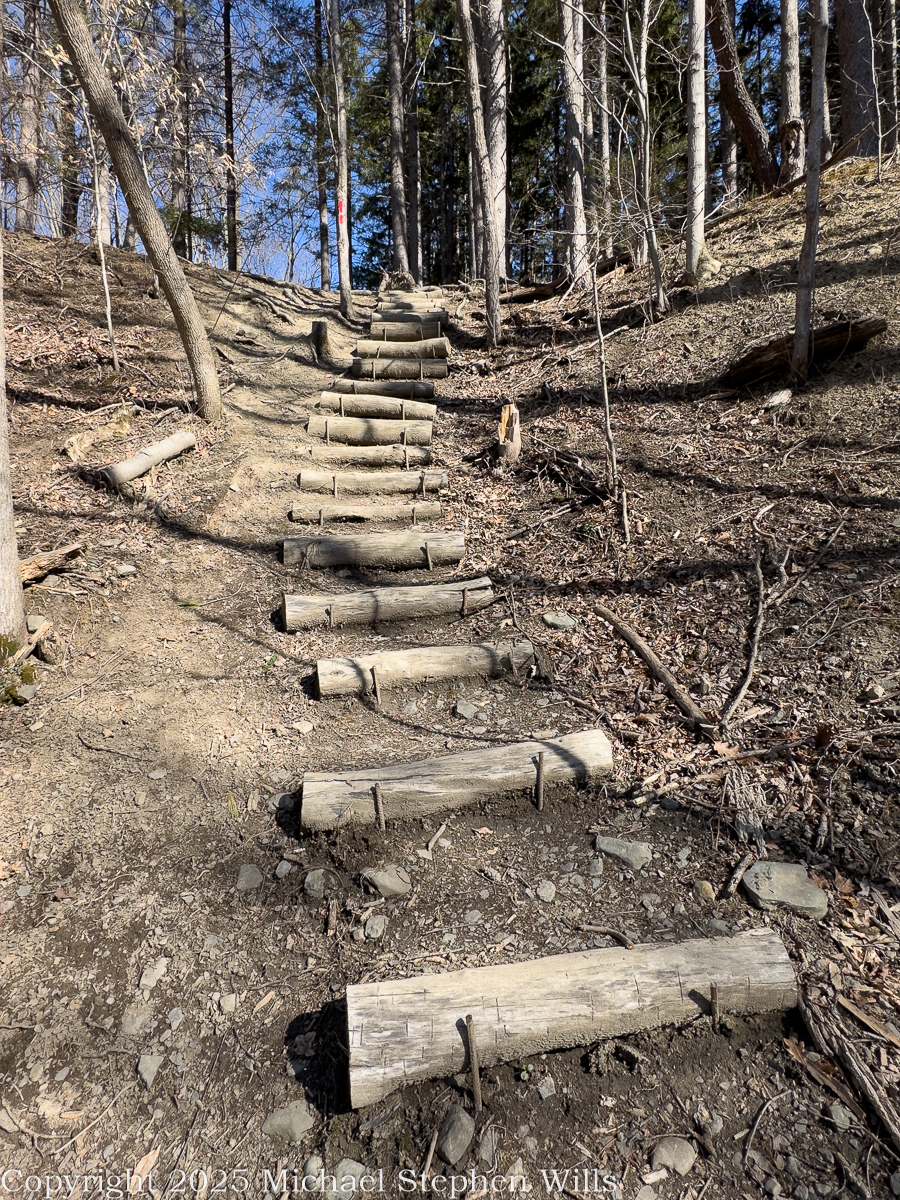
Steps cut from logs ascend the bluff, each tread pegged with iron, each rise a short confession of breath. I climbed to the ridge, paused halfway, and through the gray lace of March branches saw the creek shining at a bend far below. A man cannot help but measure his own life against such a course. The path goes up and down in obedient red blazes, but the water keeps its own counsel. Where the bank slumps the river shoulders through; where the bottom rises it lays down a mirror. In my youth I wanted the straight run, the short work. Now the curve pleases me. To go with the current and not be carried away—that is a lesson suitable to the grey in my beard.

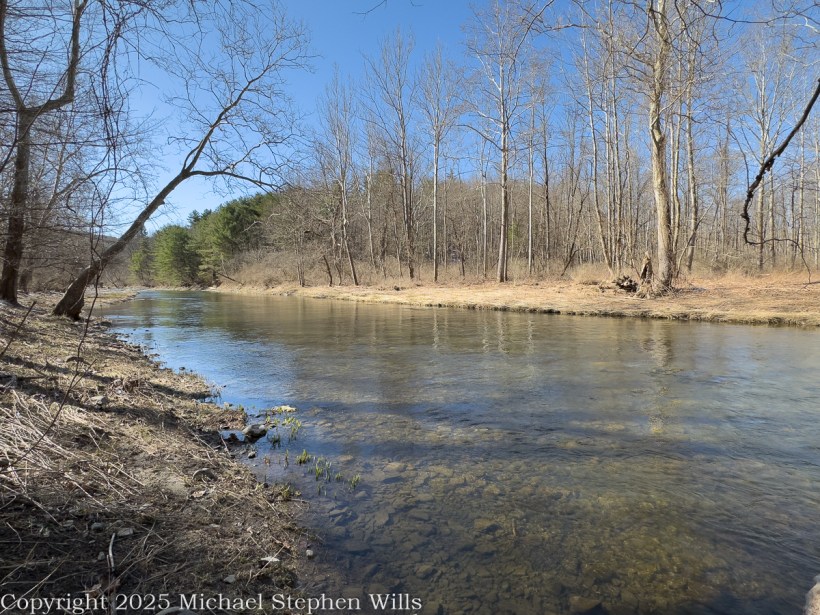
Clear, shallow run of Fall Creek with shale bottom and pine stand in distance
Bluff overlooking Fall Creek in summer

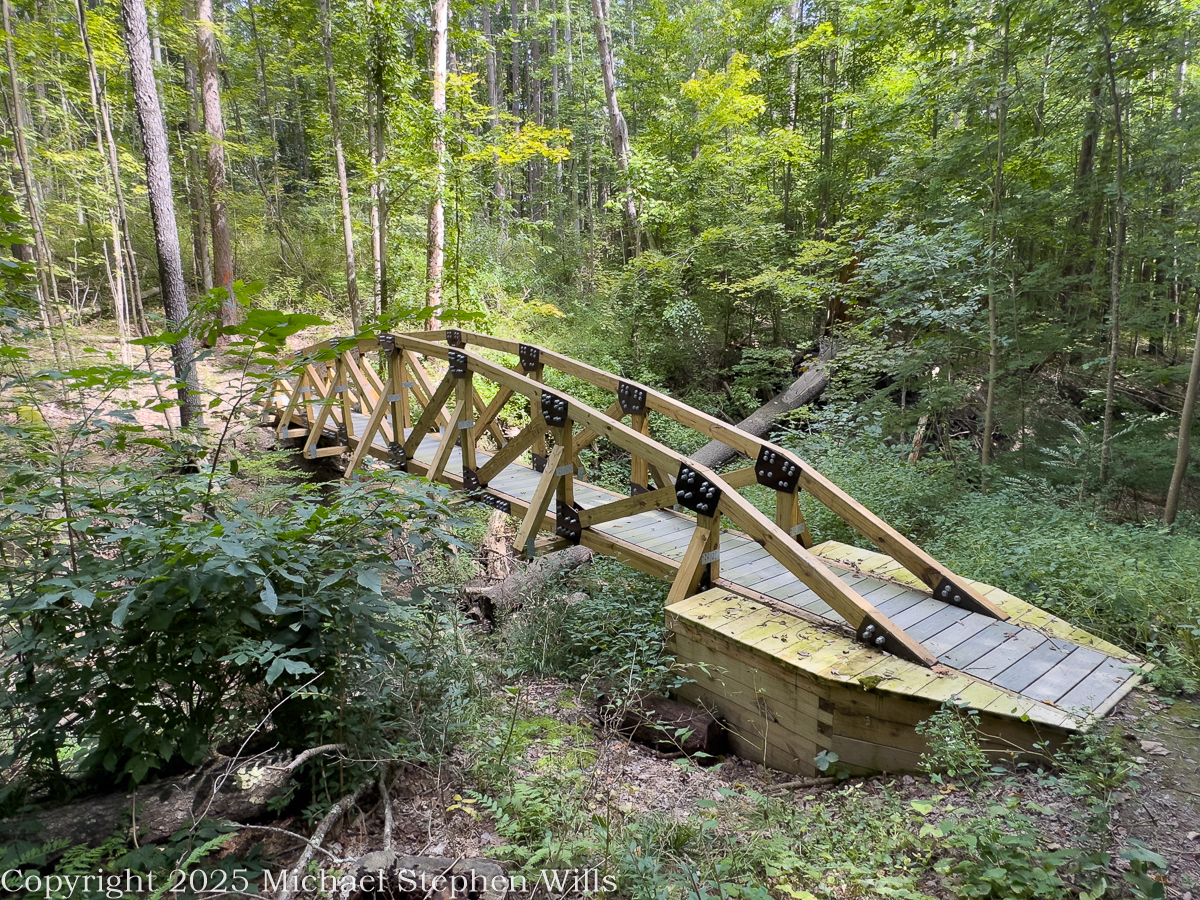
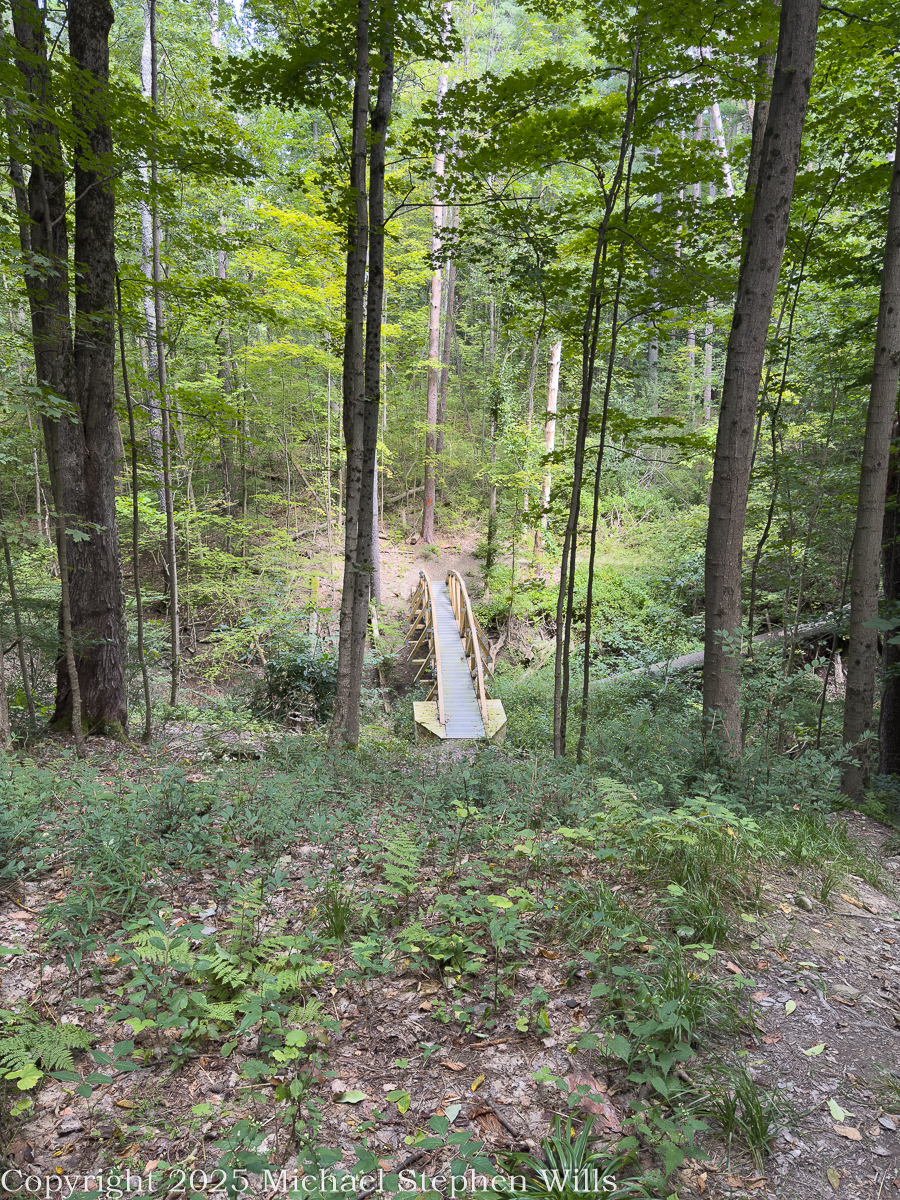
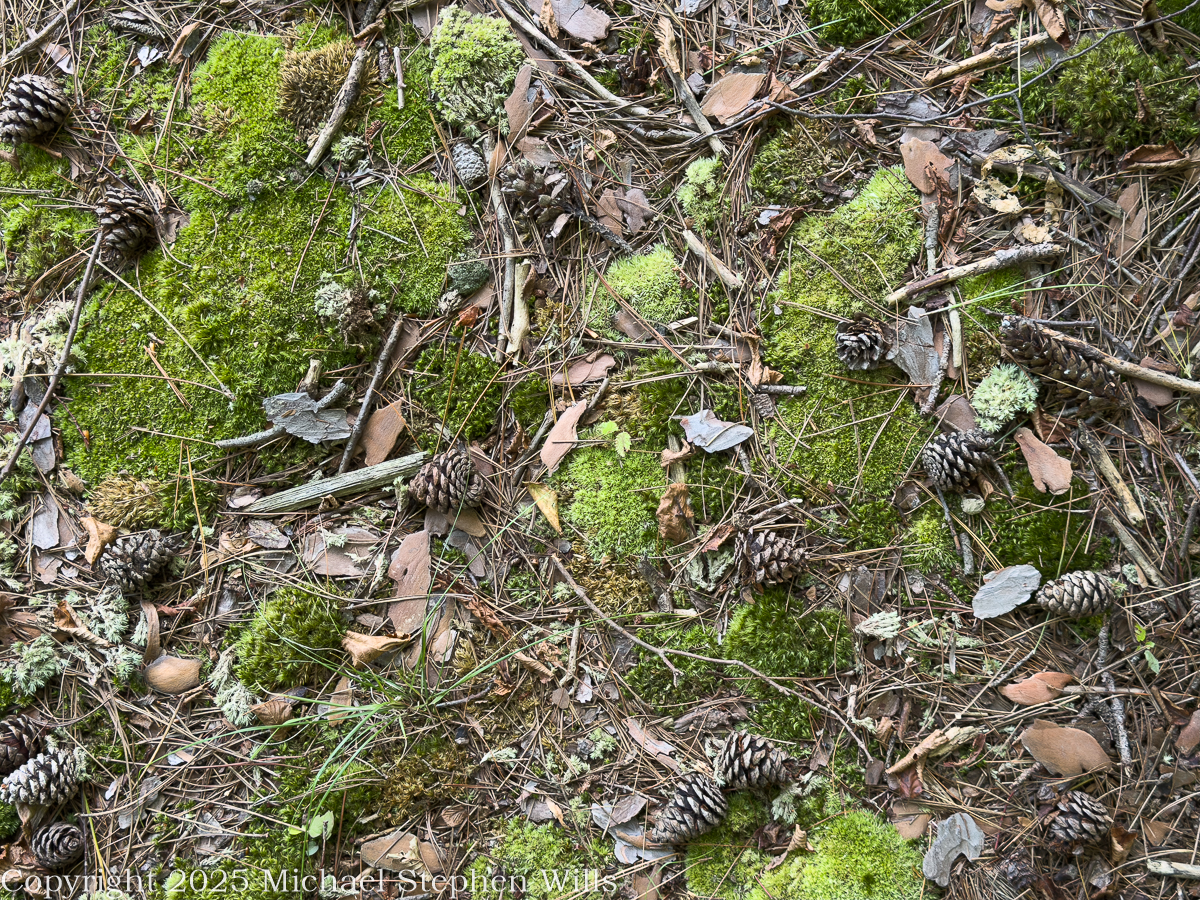
When I returned five months later, on August 23, the same path had forgotten the word austerity. The cathedral of sycamore was fully leafed, the white pillars now vanished behind a nave of shade. The pines perfumed the air without trying. A new footbridge—clean timber arching like a bent bow—spanned one of the wet flats. Its braces, black-bolted and handsome, looked as if they would hold the weight of an ox team or a file of schoolchildren. Such crossings are a kind of promise from the present to the future: we found a way through here; may you, too. Below, the floor was upholstered with moss, oak leaves, and a scatter of pinecones—the slow currency of the woods accumulating interest.

Arched wooden footbridge in summer forest on Cornell’s Monkey Run trail.

Summer makes a confidant of every plant. Ferns unrolled their scripture at the bridge abutment; jewelweed held its tiny lanterns along the seeps; a kingfisher rattled downstream, blue lightning with a bill. The creek, glassy over its shale pavement, showed every wrinkle of its stride. I waded a little, feeling with the sole what the eye could not—where the current took an extra thought around a stone, where it forgot itself in a warm eddy. Trout lingered in the dimmer reaches, quick as commas; a great blue heron lifted off with that surprising tidiness of wing, ungainly only in our imagination.

In all seasons the trail carries two histories: one written in rock and water, the other in the footfall of people. Cornell’s founders, Ezra and Andrew White, believed the university should place the hand near the thing studied; here that principle is plain. Botany students take their lectures in leaf and bark; geologists read the creek banks as if the pages might soon turn by themselves; children learn the oldest calculus—how long a stick will float before it catches in the weeds. The caretakers from the Botanic Gardens mark, mend, and interpret, but they do not overtalk. The woods speak enough.

Moss, grass and pinecones on an overlook of Fall Creek

As the afternoon eased toward evening, I climbed once more to the bluff. The light had gone honey-colored and the leaves of the maples, those careful accountants of September, were just beginning to weigh their green against gold. I looked down on the bend where I’d stood in March—cold, bright, expectant—and felt the year’s circle gently close. As John Burroughs wrote, “The power to see straight is the rarest of gifts… to be able to detach yourself and see the thing as it actually is, uncolored or unmodified by your own… prepossessions… that is to be an observer and to read the book of nature aright.” Monkey Run obliges that humility. The creek moves as it always has—glacially taught, mill-forged, campus-wise, and freedom-loving—and the trail, with its modest stairs and honest bridges, invites us to walk beside it, to match our breath to its turnings, and to leave, if we can, a lighter trace than we found.

References

Ways of Nature (1905), “Reading the Book of Nature,” pp. 275–276 (The Writings of John Burroughs, Riverside ed., vol. XIV, Houghton Mifflin)

Enter your email to receive notification of future postings. I will not sell or share your email address.

Carved by Time: Exploring the Virgin River and Cross-Bedded Sandstone in Zion’s Narrows

A quiet moment along the Virgin River reveals the artistry of nature—where water, stone, and time shape Zion’s majestic Narrows in subtle, surprising ways.

In Zion National Park, where towering sandstone cliffs rise from the desert floor, the Virgin River weaves a persistent and graceful thread through deep canyons carved over millennia. The river is the creative force behind Zion’s signature landscape, sculpting stone with a patient hand. Among its greatest achievements is the Narrows—a sinuous gorge where water and light perform a timeless duet. The two photographs shown here draw us into an intimate corner of that realm, where water flows past a rock face marked by both subtlety and drama.

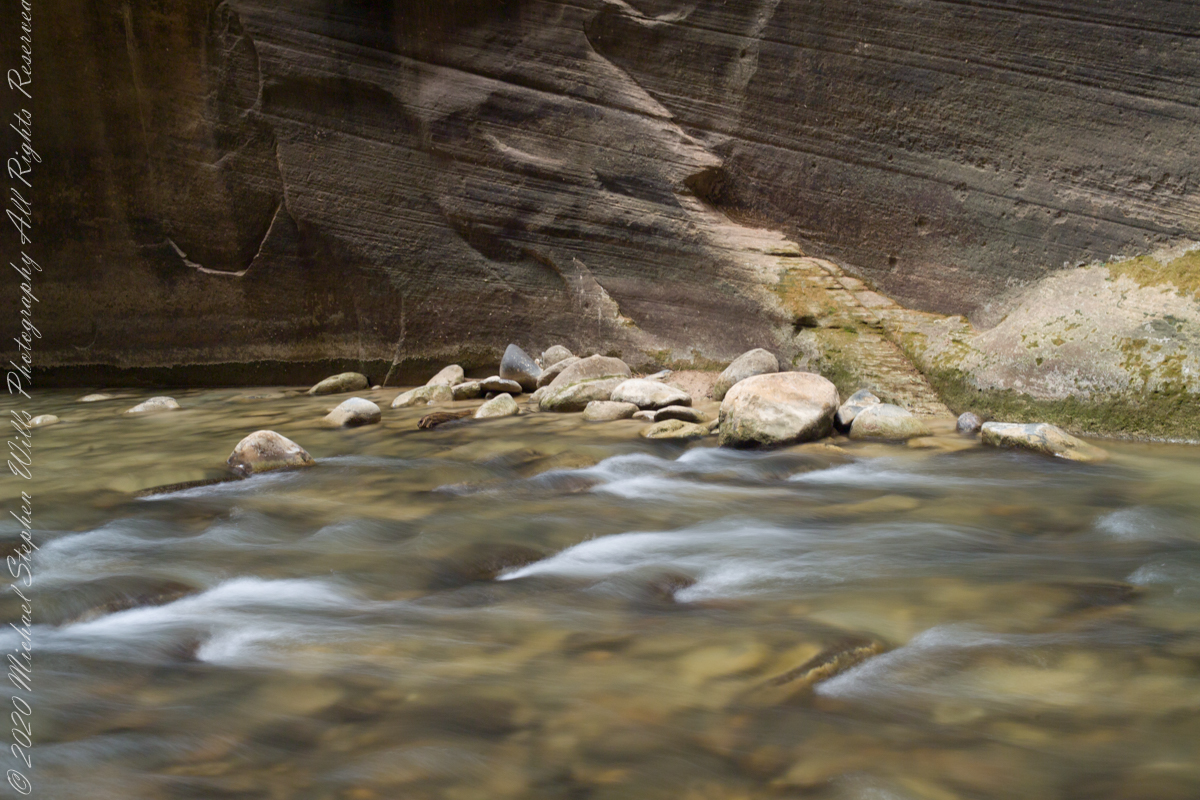
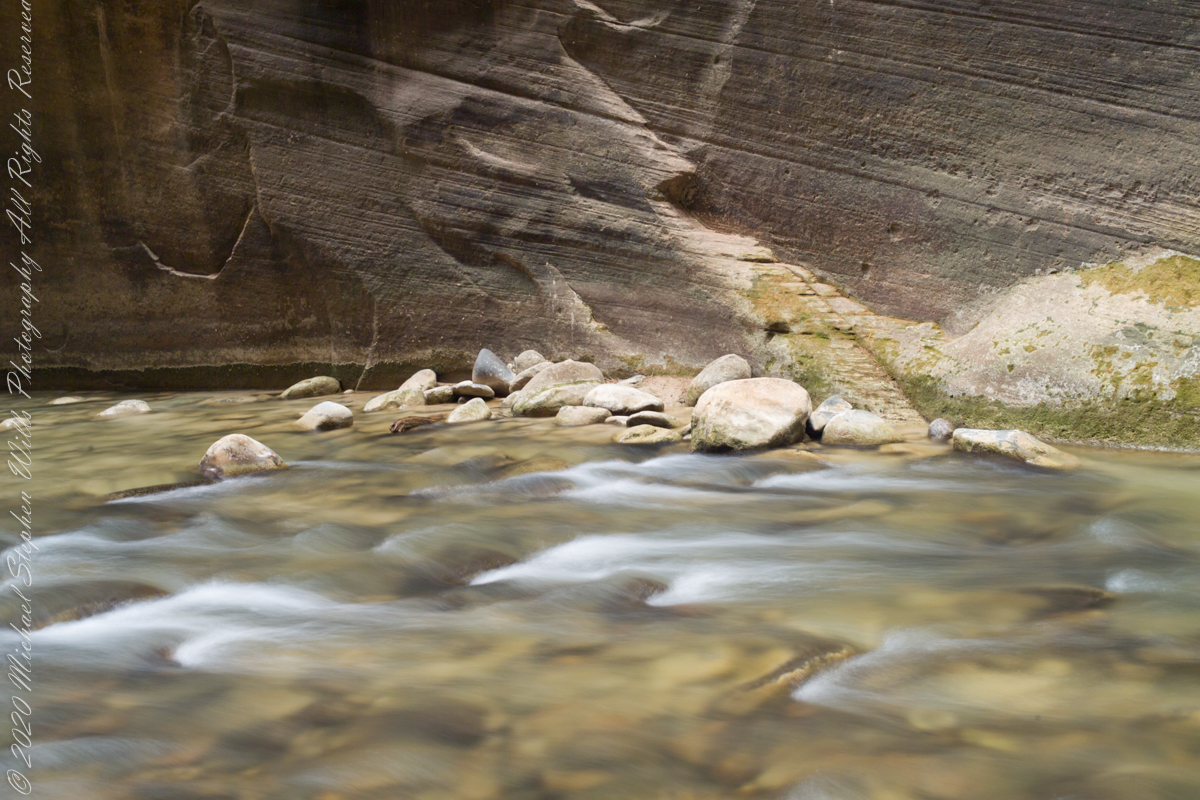
At first glance, what stands out is the unusual structure on the wall behind the river—a feature that at a distance could easily be mistaken for a man-made stairway. But closer observation reveals this to be a natural element, the result of erosion acting upon cross-bedded Navajo Sandstone. The texture and linearity of these formations are remnants of ancient sand dunes hardened into rock nearly 190 million years ago, during the Jurassic period. What looks like precision carving is, in fact, the legacy of sedimentation, lithification, and the scouring action of water over time.

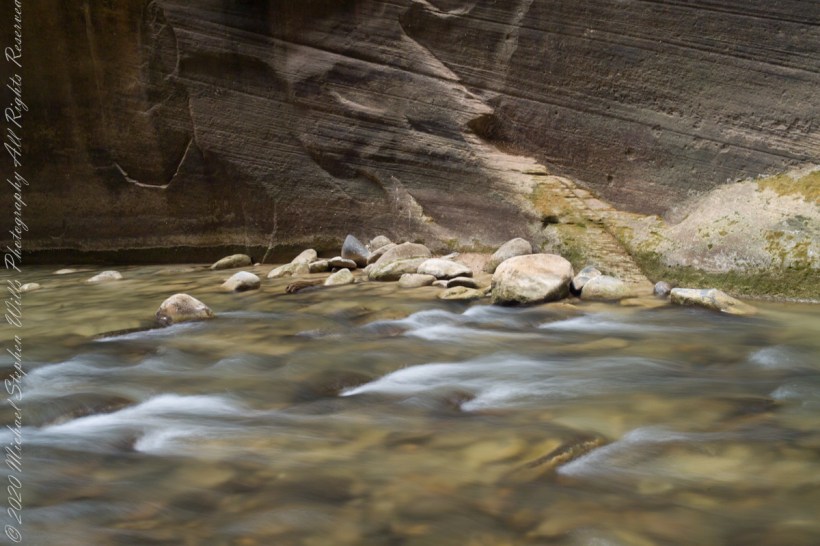
In the first photograph, the scene is bathed in soft, diffused light, lending a quiet tone to the flowing water and the weathered rock face. The surface of the Virgin River becomes a silky sheet, its motion captured with long exposure so that it seems to glide effortlessly past the cluster of smooth stones in the foreground. Here is a deep calm—the kind that can be heard in the hush of water over stone and felt in the breathless silence of a canyon morning.

Click each photo for a larger view

The second photograph, taken under brighter conditions, reveals the same scene with different character. The increase in light clarifies the water’s transparency, the greens of moss and lichen on the wall, and the golden tones of the sandstone. What you see is a pattern formed by layers of wind-blown sand, once part of vast dunes, now standing as a stone ledger of time. The river, its bed visible beneath the shallow flow, seems to read this text as it passes—century by century, pebble by pebble.

The Virgin River begins high in Southwestern Utah, at the Navajo Reservoir in the Dixie National Forest north of Zion National Park and travels over 160 miles to join the Colorado River, carving through layers of sedimentary rock as it descends. In the Narrows, the canyon walls rise up to a thousand feet while the corridor narrows to just 20–30 feet across in places. The intimacy of the Narrows contrasts with the vast openness elsewhere in Zion, enclosing the traveler in a world of water and stone, shadow and echo.

Walking the Narrows means walking in the river itself—an experience that engages body and spirit alike. The water is rarely still, and neither is the trail. Slippery rocks and ever-shifting current demand attention and balance. Yet, this very immersion invites a deeper kind of awareness. You are observing nature from within it, shaped by nature, and held by nature.

What the photos capture so eloquently is that Zion is a place where the work of nature can appear deliberate, even architectural. The illusion of stairways in the sandstone, carved not by hands but by wind, gravity, and time, is a reminder of how little separates the human sense of design from the forms nature produces. We recognize rhythm and repetition, elevation and flow, and are drawn to interpret meaning from these patterns.

But perhaps the meaning lies not in what we impose, but in what we receive. The Virgin River’s passage through this sculpted corridor teaches patience, resilience, and the beauty of gradual transformation. Its waters do not fight the rock; they yield, swirl, and persist—until the rock, by degrees, gives way. What results is a landscape both eternal and ever-changing.

Zion’s grandeur is easy to admire its many amazing overlooks, but its soul is found in quiet places like this—where sandstone walls, smoothed by water and time, speak not in shouts but in whispers. Here, beside a seeming stairway that leads nowhere and everywhere, we come face to face with the artistry of the Earth.

Enter your email to receive notification of future postings. I will not sell or share your email address.

Eternal Beauty: Landscapes that Bind Time

Beneath the burdened boughs, where birches bend,
And rivers rush through rocks that time has torn,
The shadowed cliffs, their crowns with pine trees pinned,
Stand sentinel, proud guardians of the morn.

Through chasms carved by countless, ceaseless years,
The water whispers tales of days gone by;
Its misty breath, a shroud for winter’s tears,
A silver veil beneath the leaden sky.

Each trickling stream sings sonnets to the stone,
And echoes dance through chambers cold and vast;
Where silence dwells, a realm of moss and bone,
As sunlight lingers, fleeting, yet steadfast.

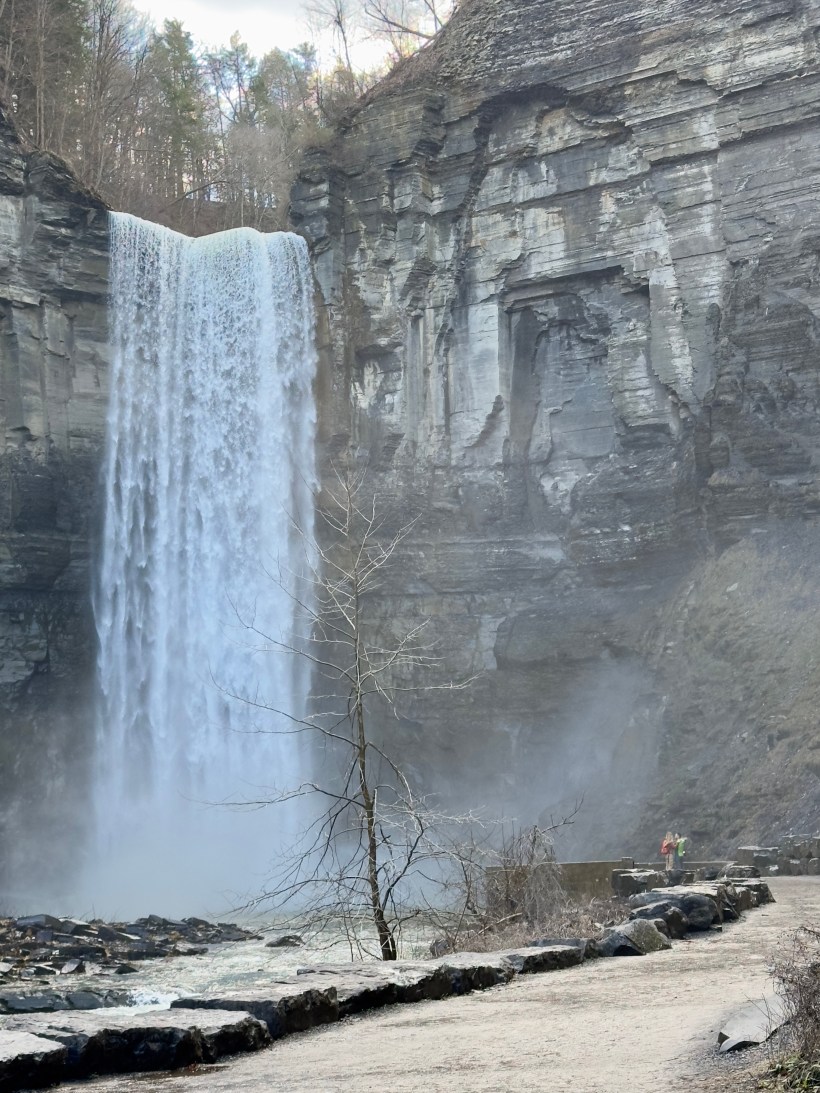
The waterfall, a weeping wall of light,
Cascades its crystal chords with thund’rous grace;
An argent arc, a marvel for the sight,
That draws all souls into its soft embrace.

The river curls, through curving cliffs confined,
Its molten silver sculpts the winter’s skin;
While gnarled roots from ancient oaks entwined
Grip granite walls where life dares to begin.

Upon the path, where earth and echoes meet,
The fragile frost dissolves with fleeting flame;
Beneath bare limbs, our footsteps firm and sweet,
Trace tales that timeless, towering stones proclaim.

The afternoon, aglow with golden hue,
Finds stillness stitched in shadows soft and deep;
For here, in late-day’s light and lucid view,
The earth exhales her secrets slow to sleep.

Enter your email to receive notification of future postings. I will not sell or share your email address.

The Autumn Tapestry of Cayuga Lake: A Journey on the Treman Park Lake Loop

Autumn’s Arrival Along Cayuga Lake

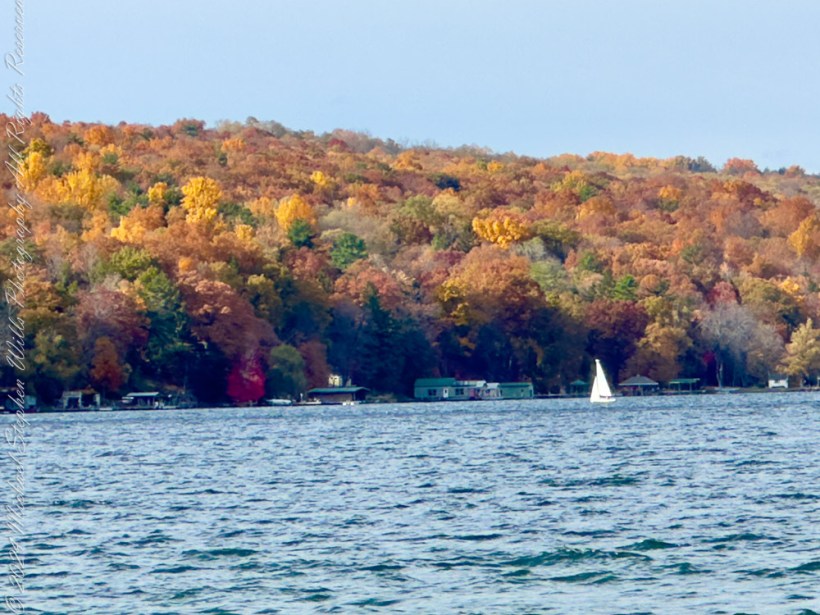
In Autumn 2024, the Treman Park Lake Loop of the Cayuga Waterfront Trail in Ithaca, New York, unfurled a vibrant display of seasonal transition. The natural landscape, adorned with fiery hues of reds, oranges, and yellows, reflected in the rippling waters of Cayuga Lake, creating a harmony of color and light. This is a scenic journey through stories of plant and animal life that call this place home—including the majestic Osprey (Pandion haliaetus) that nests along the shore.

The Osprey’s Watchtower

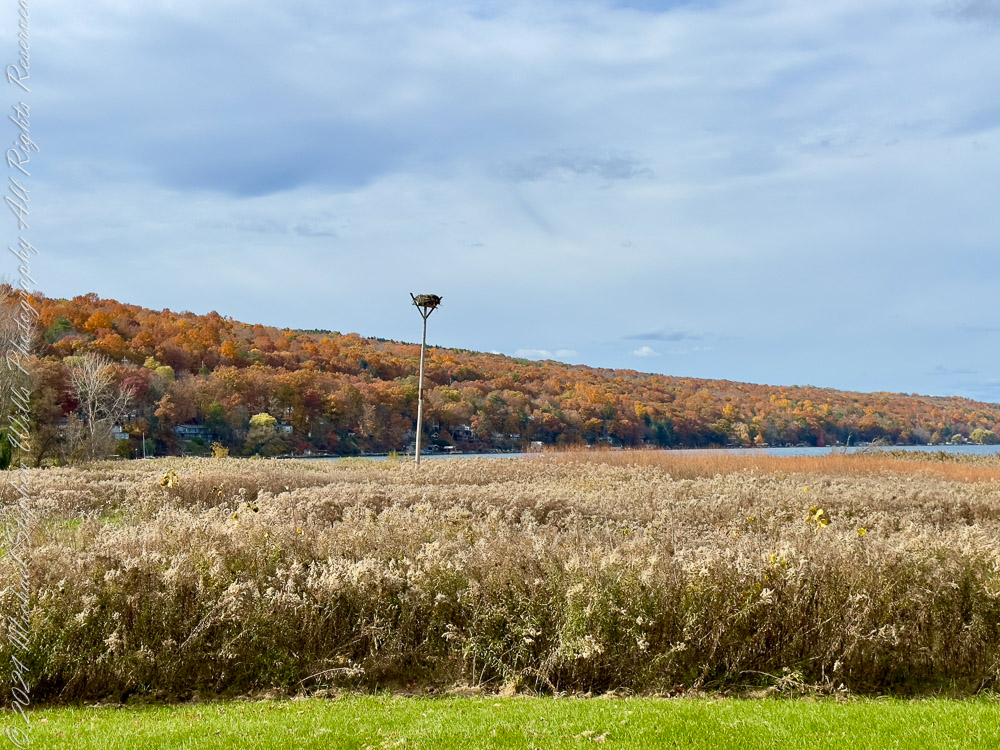
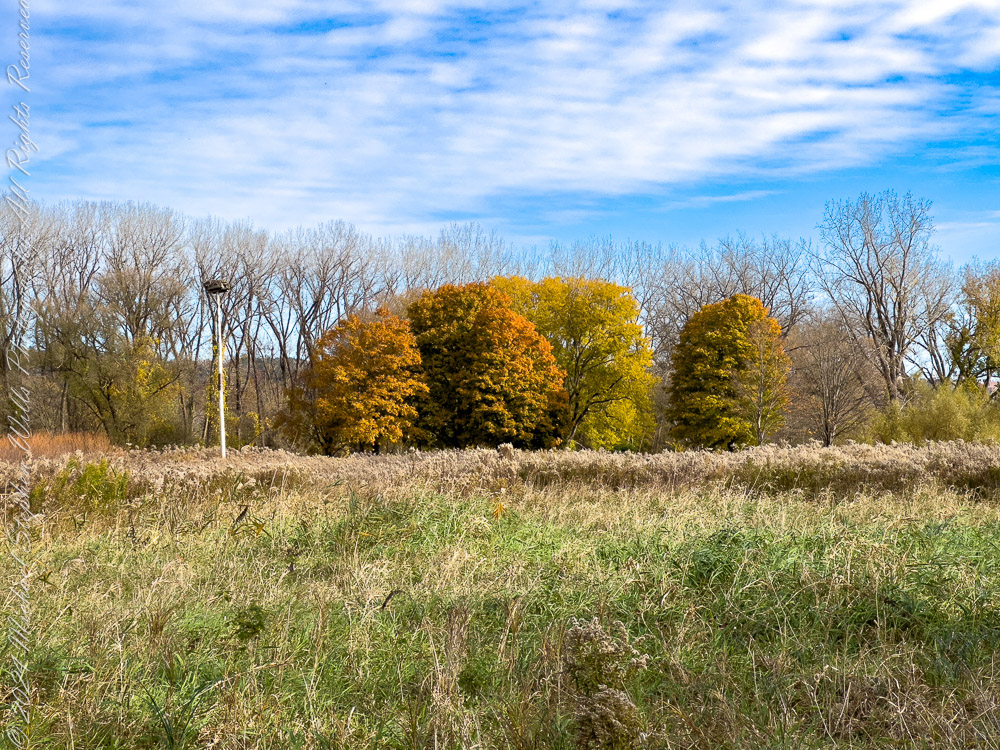
A sight to greet visitors is the solitary osprey nest perched high on a pole. Used by Osprey families during their breeding season, this nest stands as a testament to their remarkable recovery in the Finger Lakes region. Ospreys, once declining due to pesticide use, have rebounded significantly following conservation efforts.

With a wingspan of up to 6 feet, these raptors are expert fish hunters, often seen diving talons-first into the lake to snatch their prey. During autumn, as their young take flight, the nest remains an empty marker of the summer’s success—a reminder of the cyclical nature of life along the lake.

Did You Know? Ospreys are often referred to as “fish hawks” because fish make up 99% of their diet.

The Meadow and Its Golden Touch: Reedbeds and Goldenrod

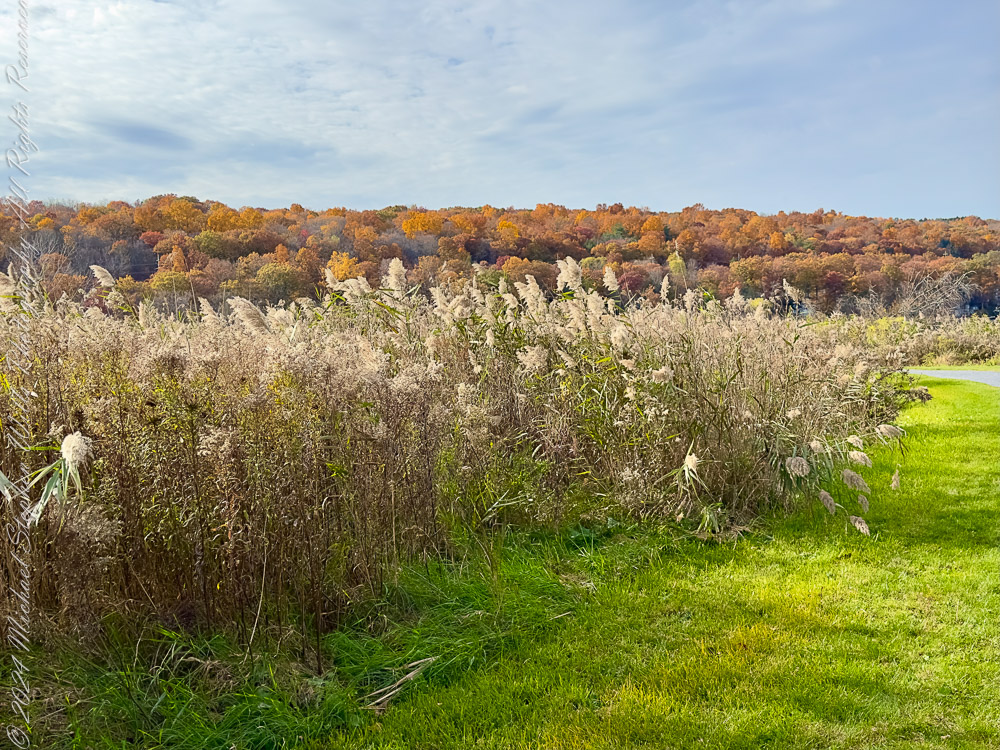
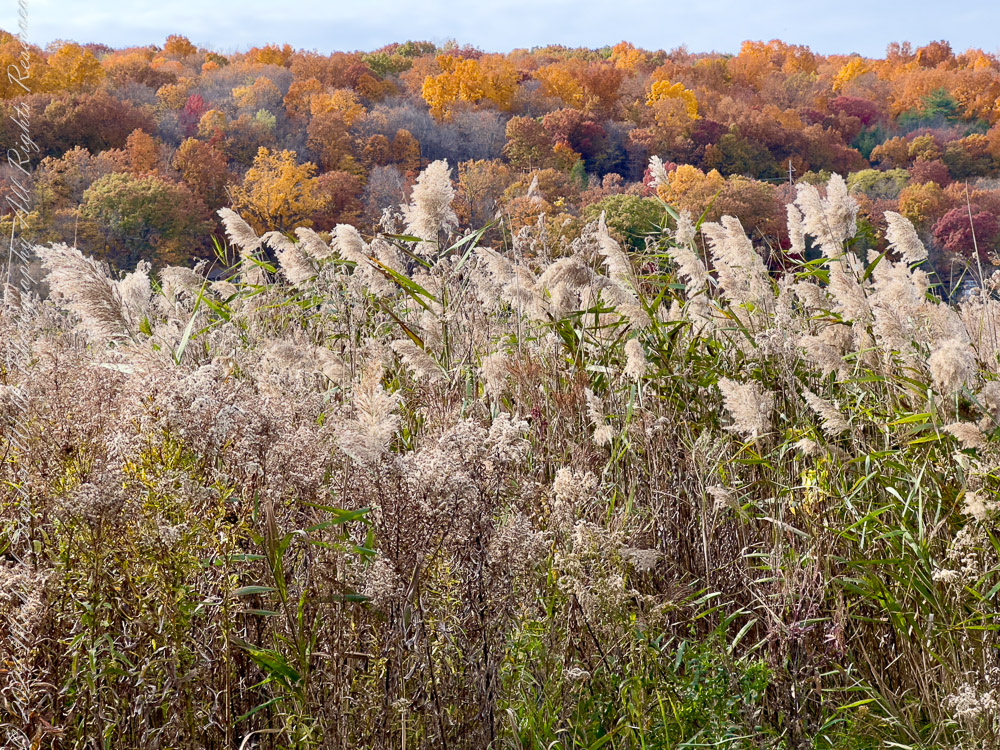
Surrounding the osprey pole, expansive meadows of grasses and reeds sway with the breeze. Among these are stands of Common Reed (Phragmites australis), a tall grass with feathery plumes that catch the sunlight. While Phragmites can sometimes be invasive, they provide crucial shelter and food for various species of birds and insects.

Intermixed with the reeds are patches of Goldenrod (Solidago spp.), whose bright yellow flowers are a signature of late summer and autumn in the Northeast. Goldenrods are critical for pollinators, offering nectar to bees, butterflies, and migrating insects like the Monarch butterfly (Danaus plexippus).

Ecological Note: Goldenrods are often mistakenly blamed for allergies; the real culprit is ragweed (Ambrosia artemisiifolia), which blooms at the same time but releases airborne pollen.

A Lake Alive with History and Beauty

The shimmering blue waters of Cayuga Lake form the centerpiece of this trail. The lake, stretching nearly 40 miles, is the longest of the Finger Lakes and steeped in geological and cultural history. Its name is derived from the Cayuga Nation, part of the Haudenosaunee Confederacy, who inhabited the region for centuries.
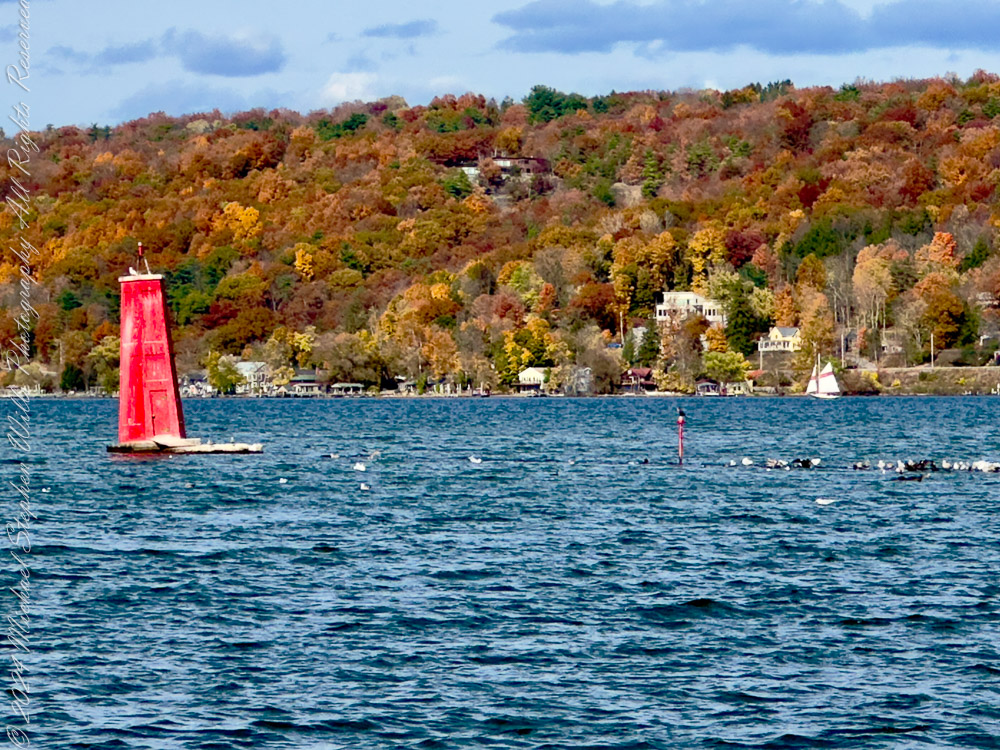
The striking red lighthouse in the water serves as a vivid counterpoint to the natural surroundings. Built to aid navigation, it now stands as a picturesque focal point for photographers and nature enthusiasts alike.

Cayuga Inlet Light Beacon

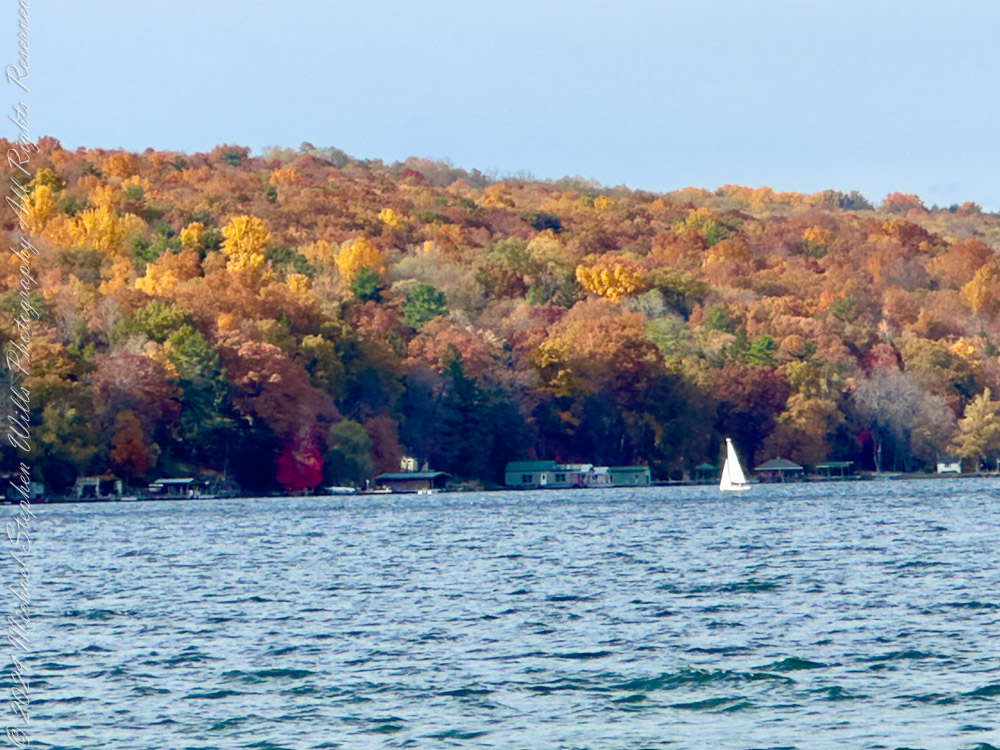
In the distance, a sailboat glides across the lake—a serene reminder of the recreational draw that Cayuga Lake holds year-round.

West shore with sailboat and lake houses

The Forest Fringe: A Kaleidoscope of Color

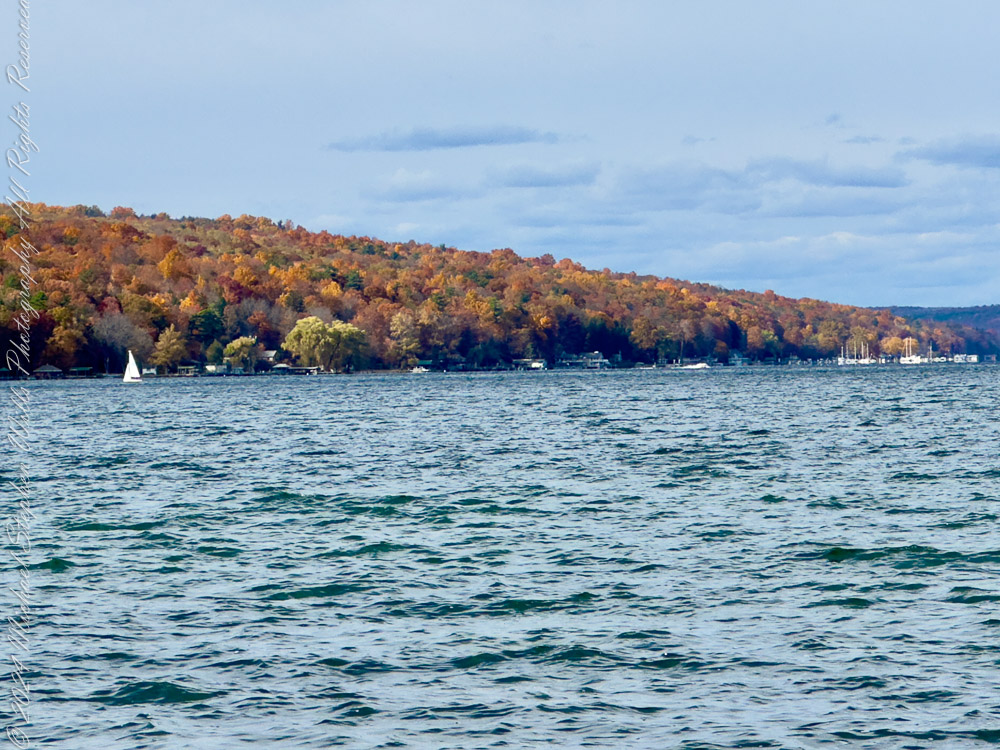
The forests that fringe the meadow and the lake present an explosion of autumn color. Trees such as Sugar Maple (Acer saccharum), Red Oak (Quercus rubra), and Black Cherry (Prunus serotina) dominate the canopy, their leaves transforming into brilliant oranges, scarlets, and deep burgundies. The Sugar Maple, in particular, is renowned for its vibrant golden-orange foliage, a hallmark of the northeastern fall.

The Ithaca Yacht Club lies south of Maplewood Point

Closer to the ground, the understory hums with the activity of migrating birds and foraging mammals. Squirrels can be seen gathering acorns, preparing for the winter months ahead, while chickadees flit among the branches, calling their cheerful “fee-bee” notes.

Historical Fact: The Finger Lakes were carved out by retreating glaciers over 10,000 years ago, leaving behind these deep, elongated lakes and fertile soil that supports rich biodiversity.

A Path Through Time and Nature

Walking the Treman Park Lake Loop is a sensory journey—the crispness of the autumn air, the rustling of reeds, and the rhythmic lapping of waves against the shore combine to evoke a timeless tranquility.

From the vibrant meadows to the osprey’s lofty perch and the quiet expanse of Cayuga Lake, this section of the Waterfront Trail encapsulates the beauty and diversity of the Finger Lakes ecosystem. Whether for quiet reflection or active exploration, it remains a treasured destination in every season.

Closing Thoughts

As autumn deepens, this landscape prepares for the dormancy of winter. Yet the stories it holds—from the osprey’s nest to the goldenrod’s bloom—remain alive, waiting to be rediscovered with each new season. The Treman Park Lake Loop is not just a trail; it is a canvas of life, change, and history painted by nature’s hand.

Reflection: To walk this trail is to connect with a land shaped by glaciers, nurtured by waters, and home to countless species that continue to thrive amid the ever-turning wheel of the seasons.

Enter your email to receive notification of future postings. I will not sell or share your email address.

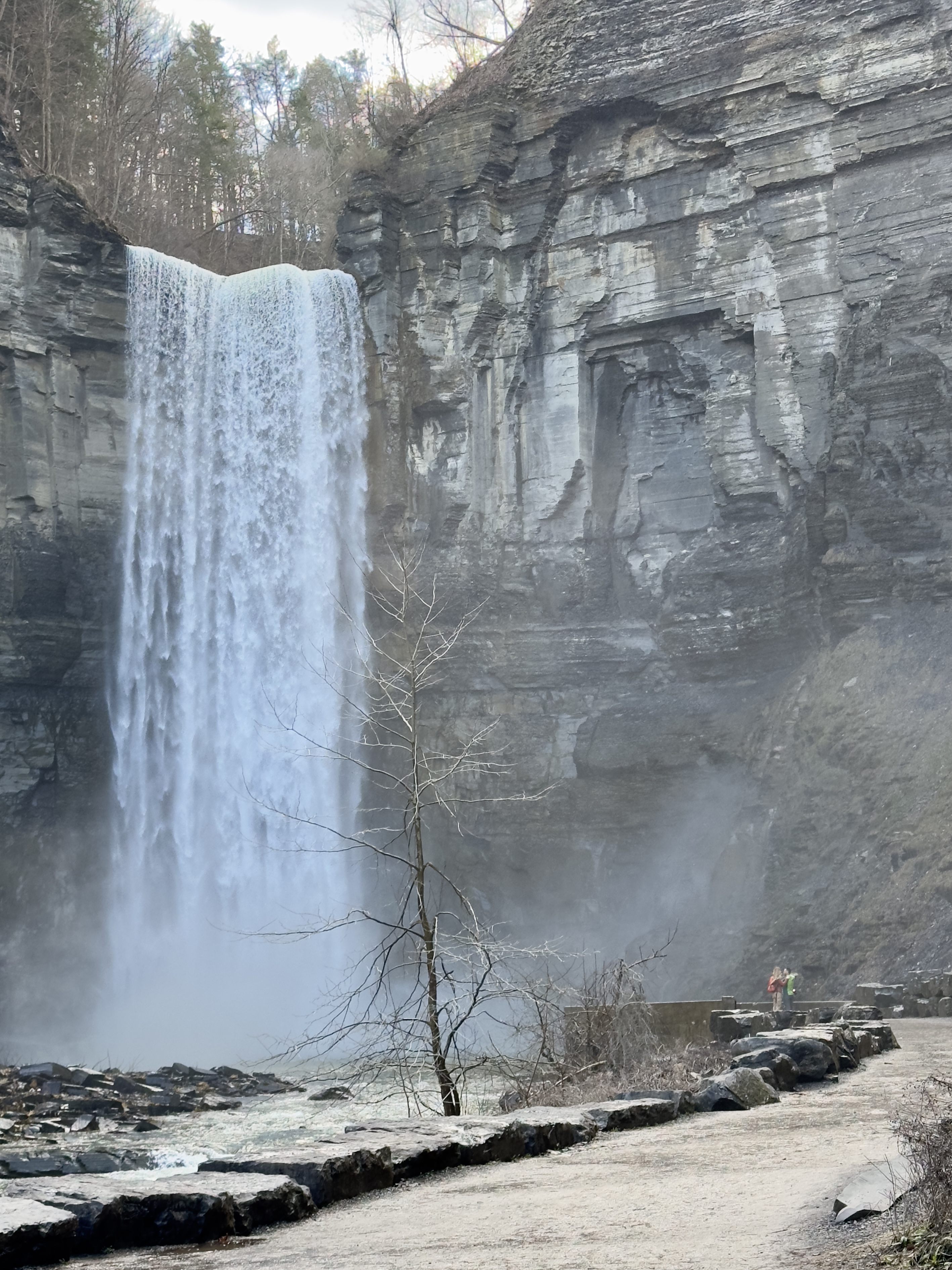
A Journey Through Autumn Colors at Taughannock Falls

Taughannock Falls State Park offers stunning autumn views, vibrant colors, and serene natural beauty.

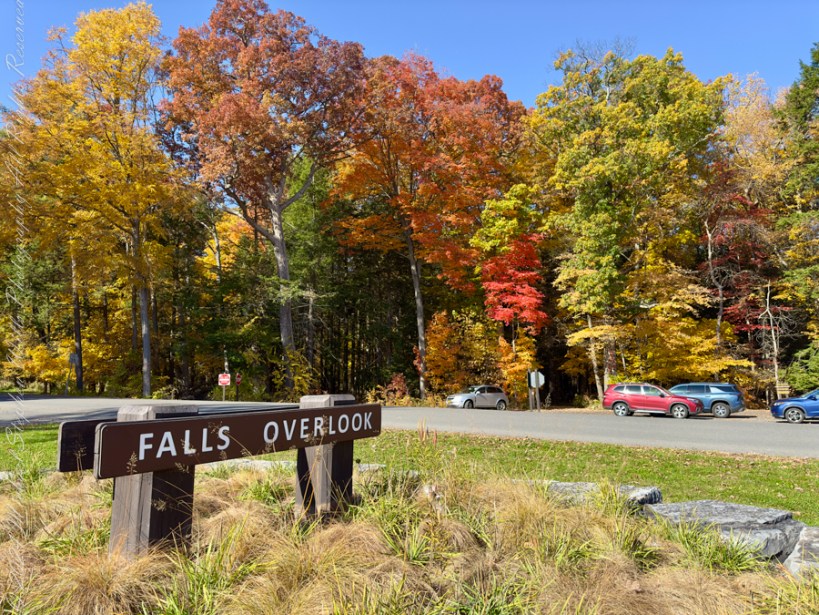
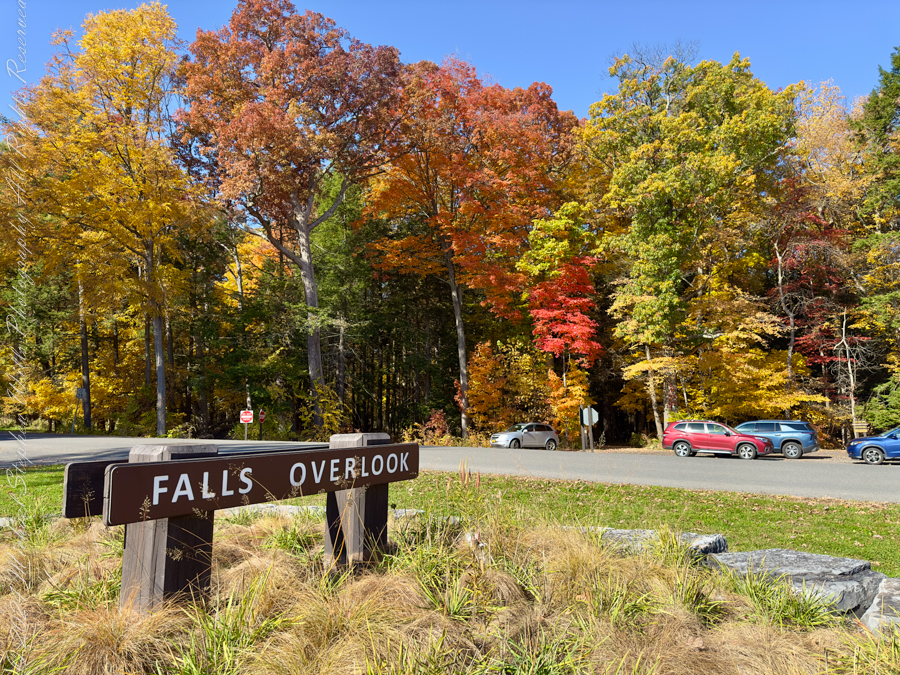
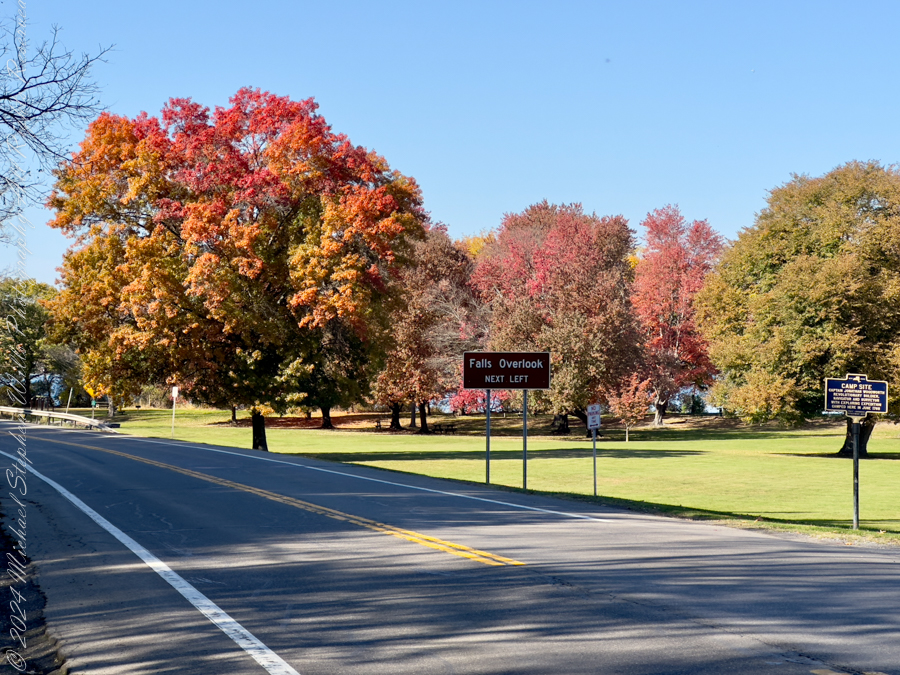
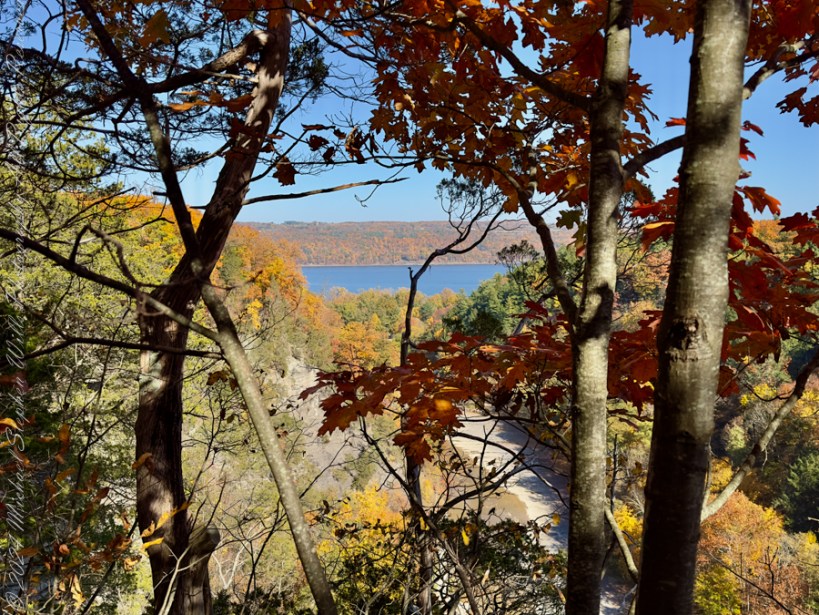
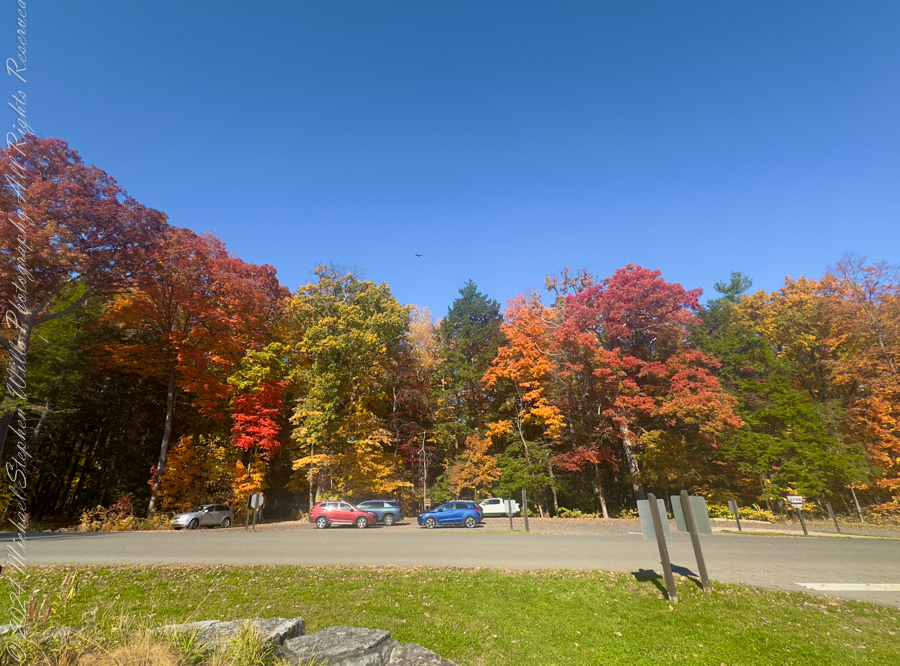
As I set foot on the Falls Overlook at Taughannock Falls State Park, I was greeted by a symphony of autumn colors in their full glory. The vibrant oranges, reds, and yellows of the trees framed the scene, setting the stage for a perfect fall day. I lingered, taking in the view of cars nestled among the foliage, their colors almost merging with the rich autumn hues surrounding them. The sign for the “Falls Overlook” hinted at the journey ahead.

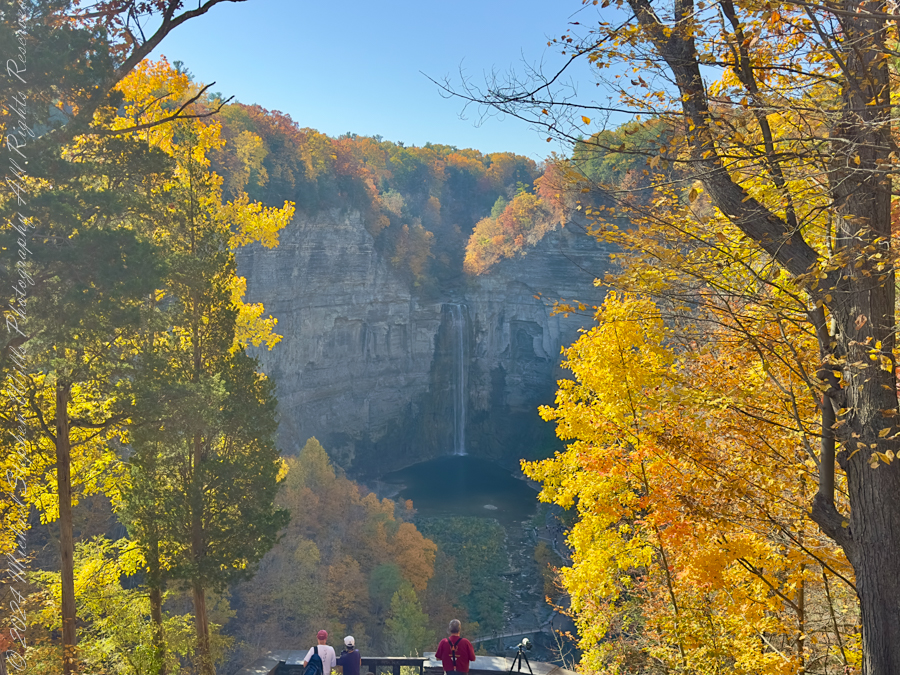
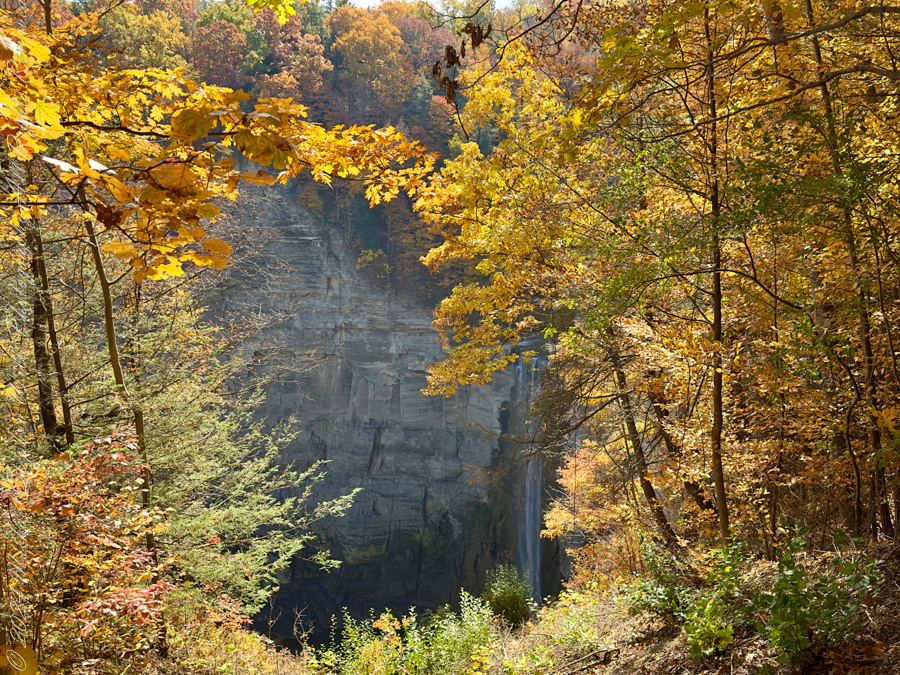
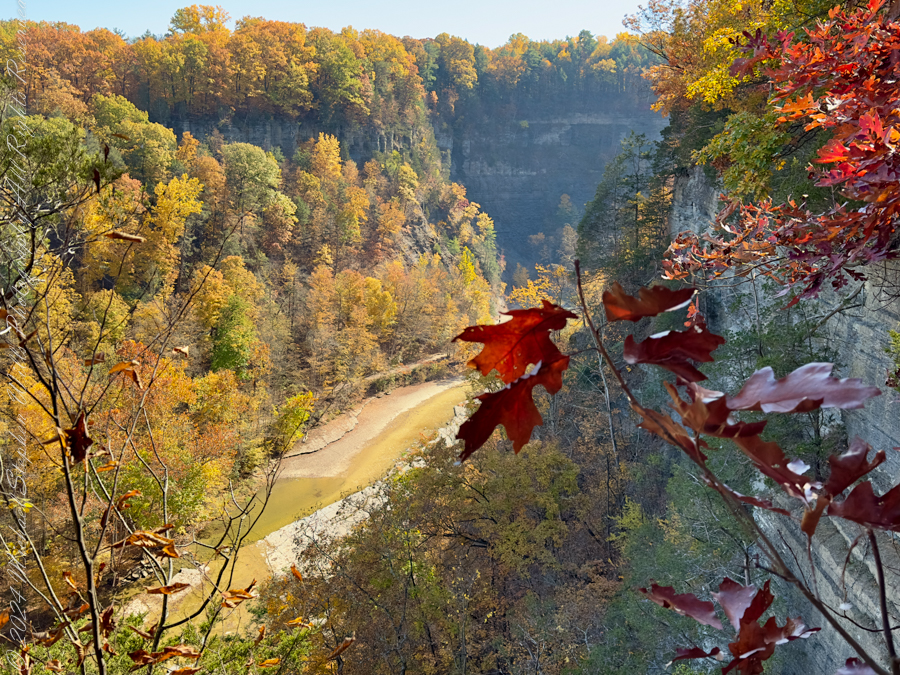
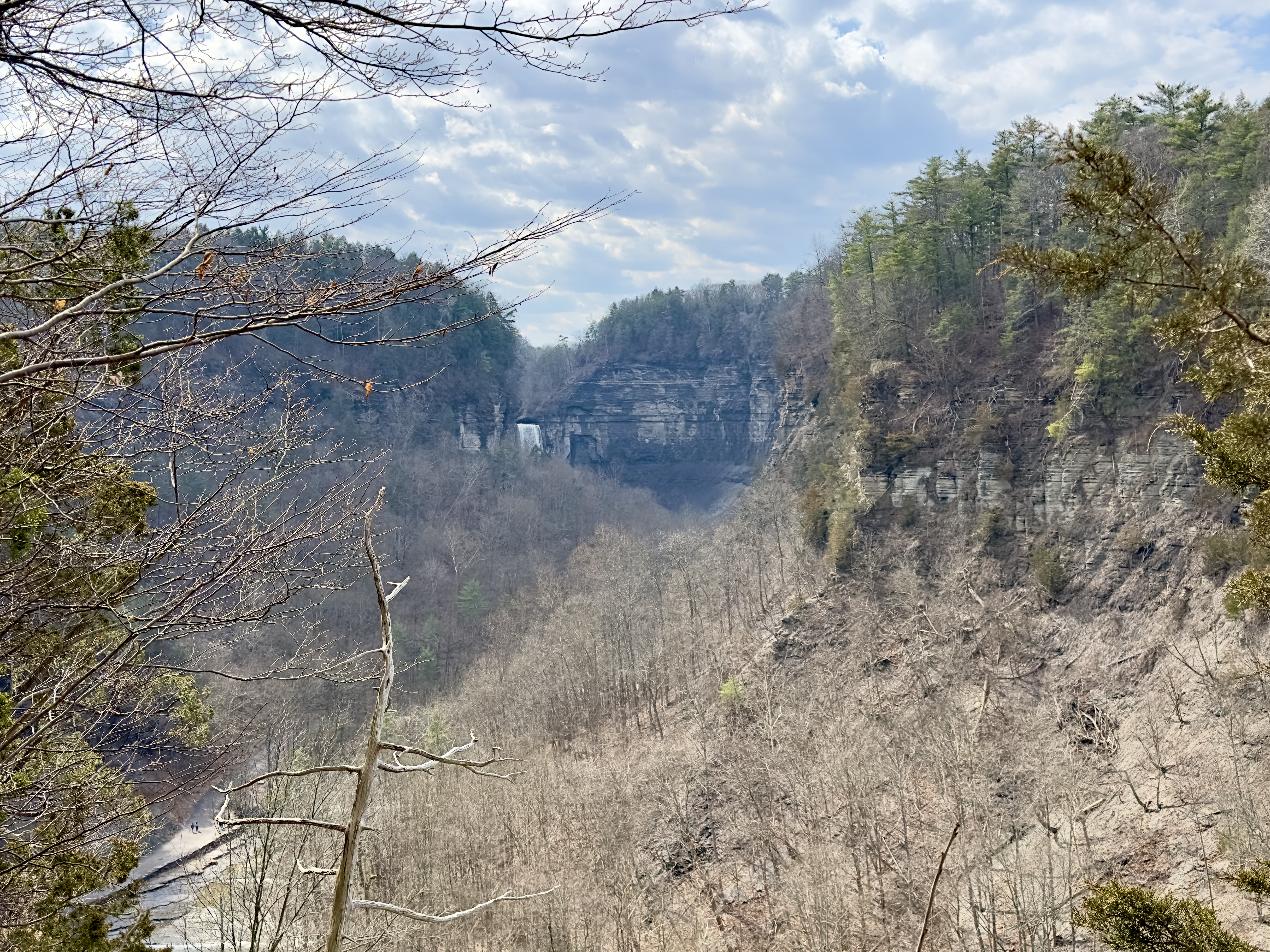
The overlook offered a breathtaking view, a gentle reminder of nature’s power as Taughannock Falls cascaded far below, framed by rugged cliffs and vibrant trees. Through gaps in the golden leaves, I could catch glimpses of the waterfall, a delicate white ribbon against the slate-gray rock. The sunlight filtered through the canopy, casting dappled shadows and illuminating leaves like stained glass, painting the landscape in a thousand shades.

I began my ascent up the North Rim Trail, where the path twisted beneath a tunnel of golden branches. The trail was carpeted with leaves, crunching underfoot with each step. The air was crisp, filled with the earthy scent of decaying leaves and moist earth. Sunlight poured through gaps in the canopy, lighting up patches of ferns and casting long shadows on the rocky path. Here and there, the yellow and brown hues gave way to a burst of crimson, the leaves vivid and almost glowing in the sunlight.

The trail led me along the cliff’s edge, where the river carved its path below. Pausing on the footbridge to the south rim, a former railroad, I looked out over the gorge, admiring the mosaic of colors stretching as far as the eye could see. In the distance, the sound of the falls drifted up to me, a soft, continuous roar that lent the forest an almost mystical air. It was hard not to feel a sense of awe at the raw beauty of the scene.

Eventually, I made my way down the South Rim Trail. There were ample distractions from the glorious foliage. A lone mushroom, golden and nestled in a bed of moss, caught my eye—a small reminder of the forest’s quiet life. I bent down to examine it, marveling at its delicate cap and the way it seemed to glow against the lush green moss. The trees here were denser, casting cool shadows that contrasted with the sun-drenched north side. The leaves here were thicker underfoot, their earthy scent more pronounced, grounding me in the moment.

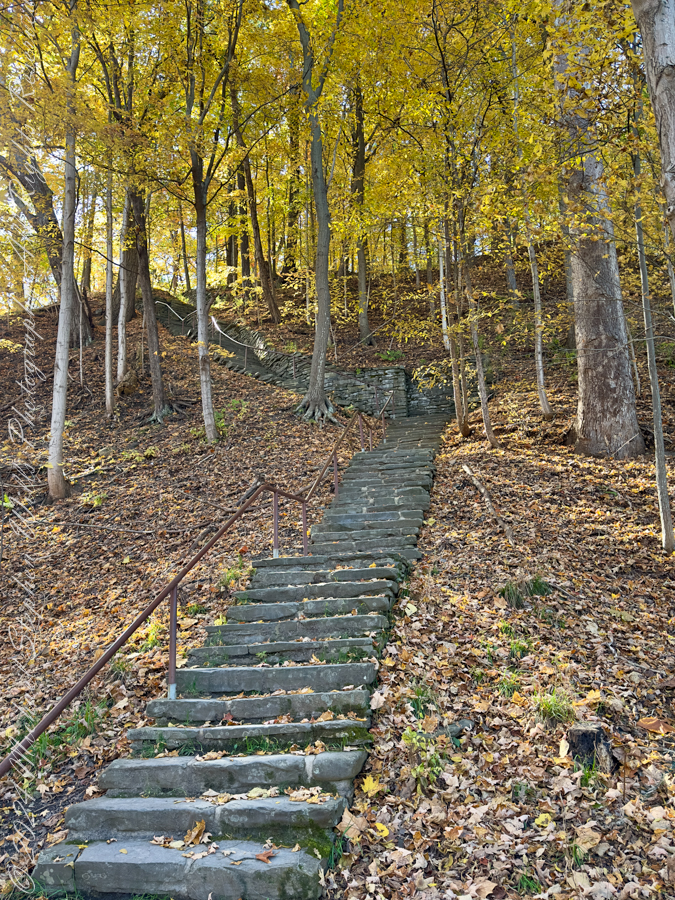
As I reached the lower section of the trail, I noticed an old stone staircase winding up through the trees to the north rim—a relic from another time, adding a touch of mystery to the path. Each step was worn smooth by countless feet, each one a reminder of the generations that had walked these trails before me. The stairs climbed through a cathedral of trees, each trunk tall and straight, as if standing guard over the trail.

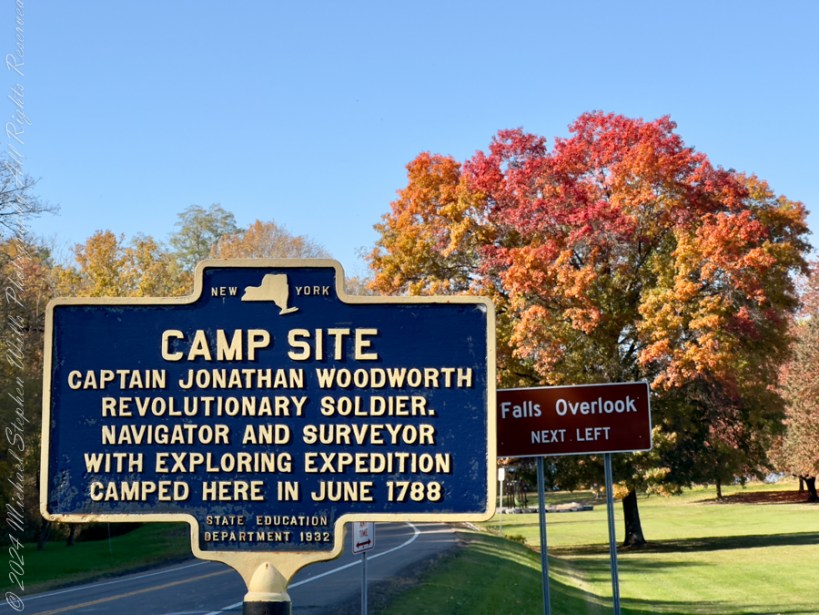
On my way around I passed by a historical marker, a blue and yellow sign commemorating the camp site of Captain Jonathan Woodworth, a Revolutionary soldier who camped here in June 1788. It was a reminder that these trails, this land, had been cherished long before my steps fell upon it.

After reaching the base of the South Rim Trail, I looped back up the North Rim. The trail now felt familiar, yet the changing light gave it a new character. The sun was lower, casting a golden glow across the tops of the trees.

As I returned to my starting point, the sun cast a soft, warm light across the landscape, bathing the park in an ethereal glow. With one last look over the falls and the vivid tapestry of trees, I felt a sense of gratitude. Taughannock Falls State Park in autumn is an experience, one that leaves an indelible mark, reminding us of the beauty and timelessness of the natural world.

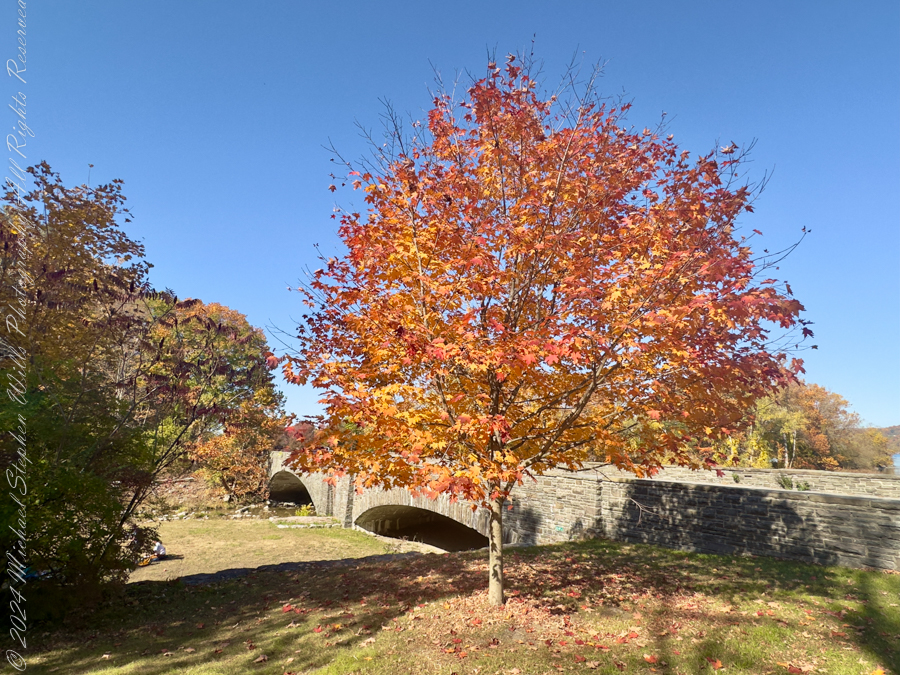
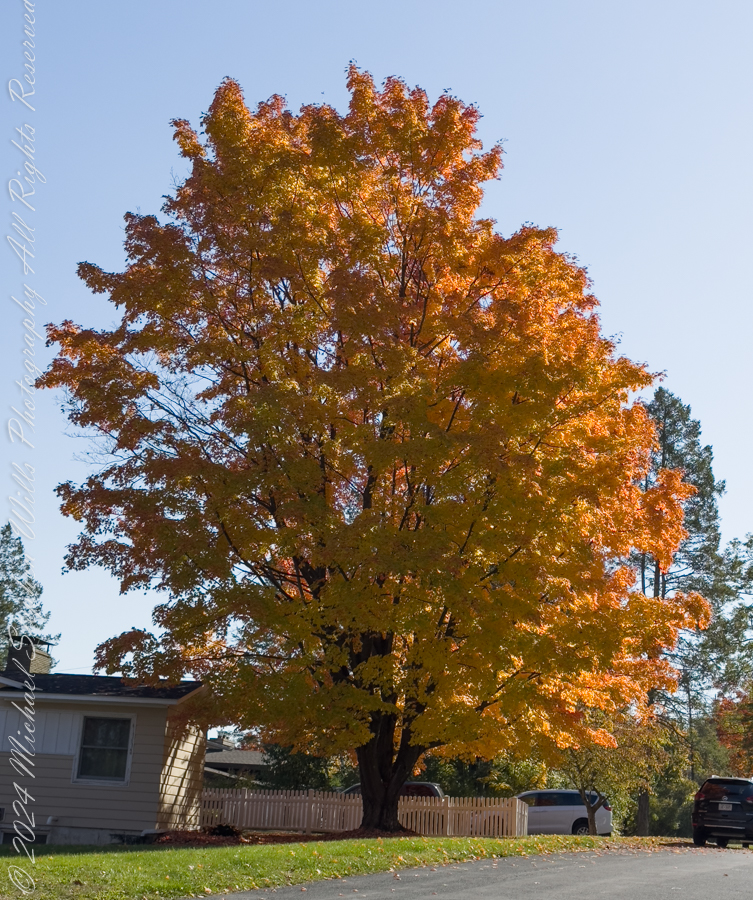
On the drive home I paused to admire a neighbor’s maple tree’s full autumn glory.

Enter your email to receive notification of future postings. I will not sell or share your email address.

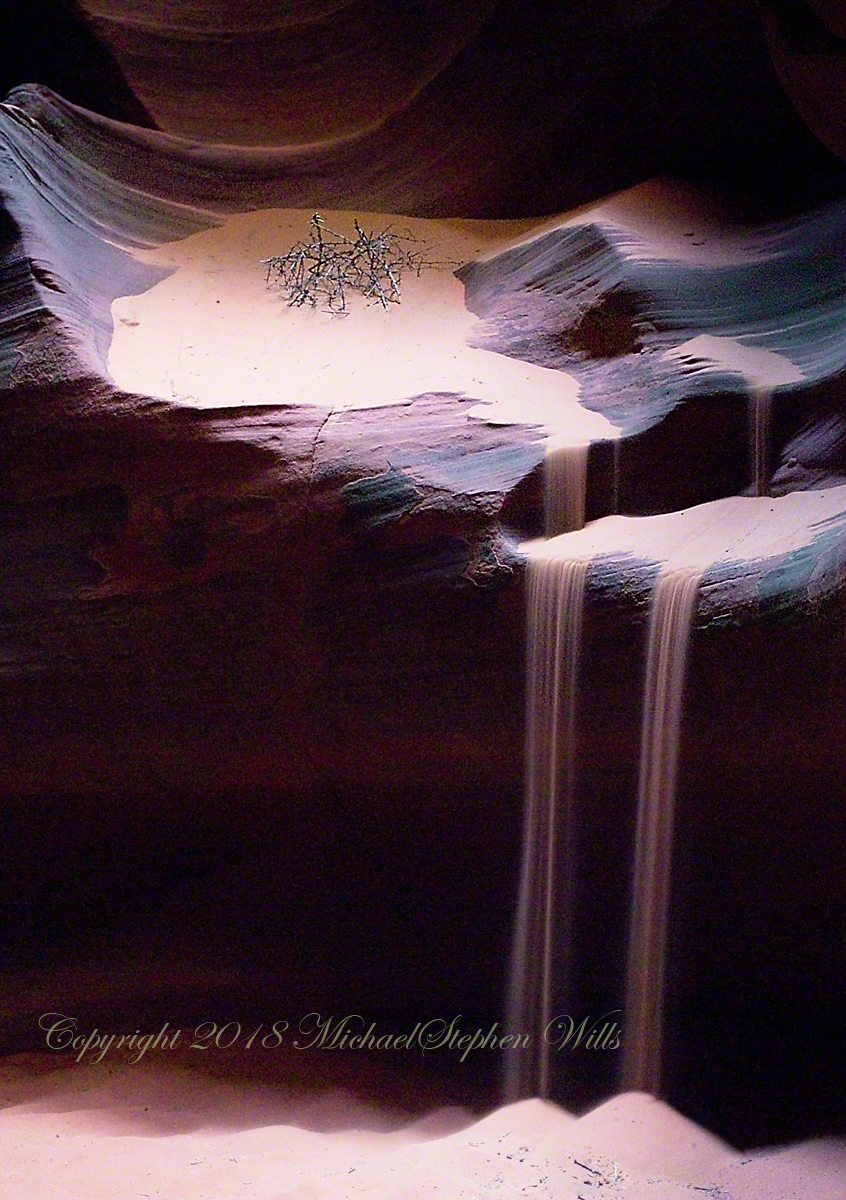
A Dance of Light and Sand in Antelope Canyon

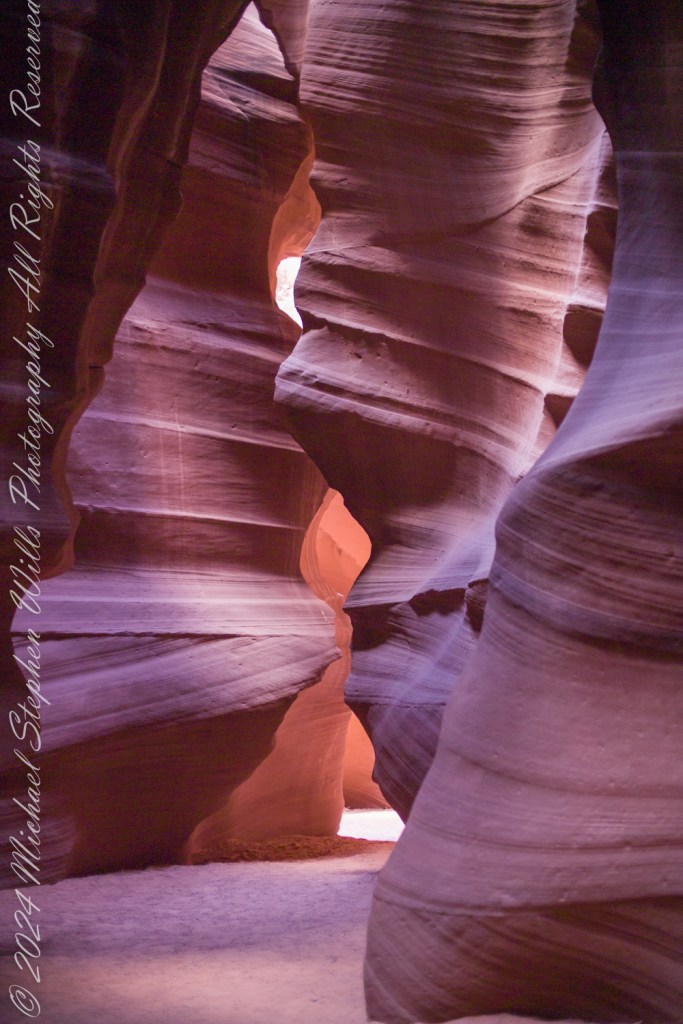
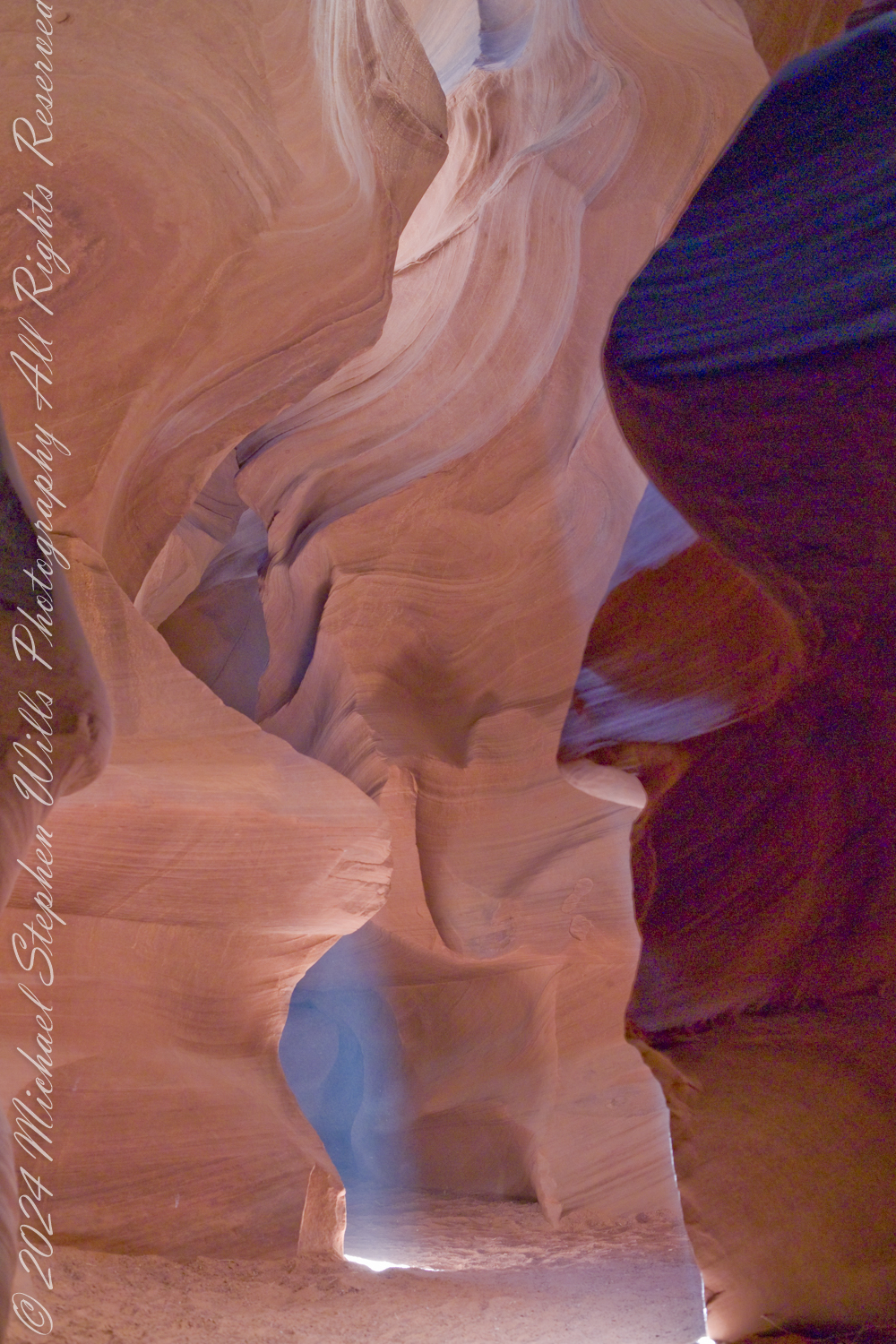
Antelope Canyon, a sacred space in the Navajo Nation, reveals the dance of light and sand within its ancient walls. The interplay of erosion and transformation highlights beauty in impermanence, emphasizing patience and reverence for nature’s ever-changing essence.

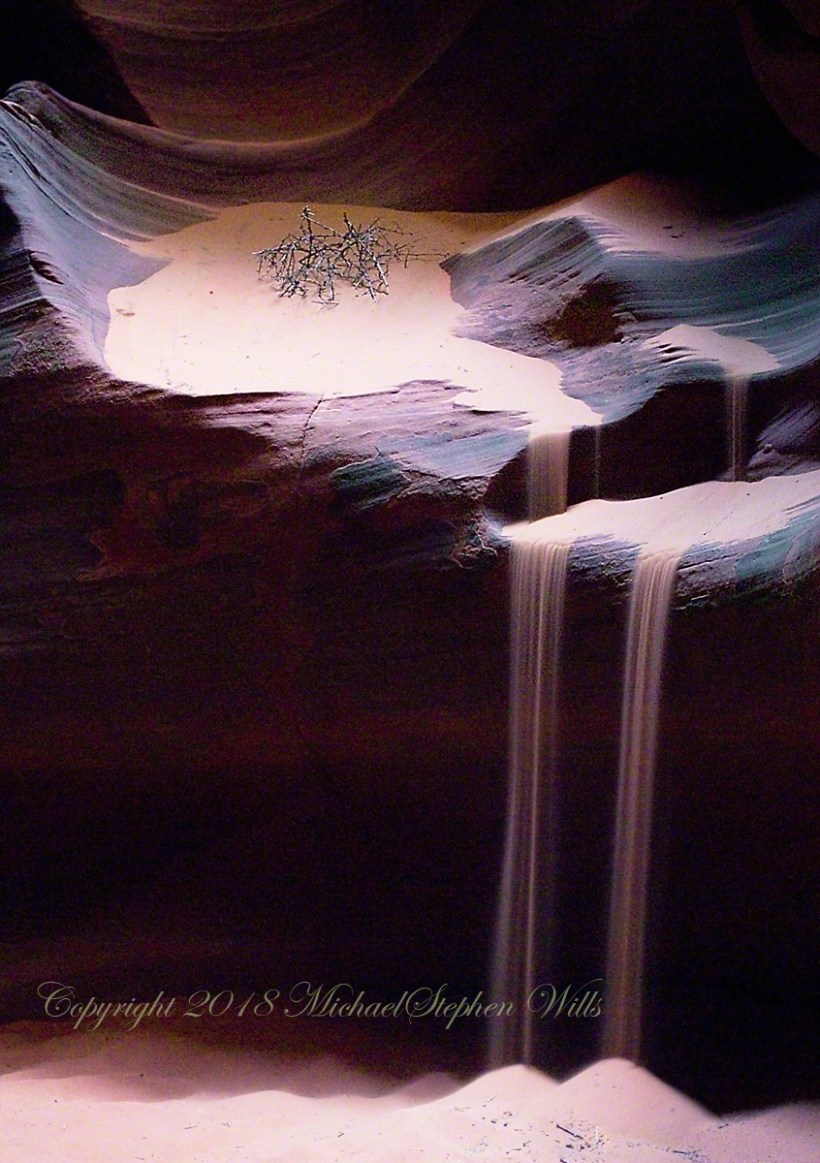
Enveloped by shadows and light in the stillness of Antelope Canyon the air carries silence—vast and ancient—interrupted only by the whispers of grains shifting under unseen currents. Here the red rock of the northwestern corner of the Navajo Nation was pulverized into sand by the action of wind, water, sun, and cold. The walls, carved by patient time, cradle the moment as if holding a sacred breath.

Antelope Canyon is in the Navajo Nation near Page, Coconino County, Arizona

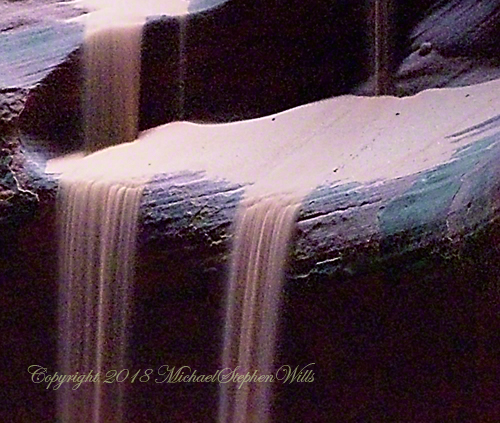
Antelope Canyon, timeless and transient, has summoned me to witness something unique—a dance between light and matter. The delicate, insistent sand flows like water from a carved bench, shaping the scene with quiet power. It tumbles as if alive, forming ephemeral cascades, revealing that erosion is not destruction but transformation. Each grain a story—a fragment of the ages, polished smooth by untold moments of pressure and release.

A Slot of Shadows and Light


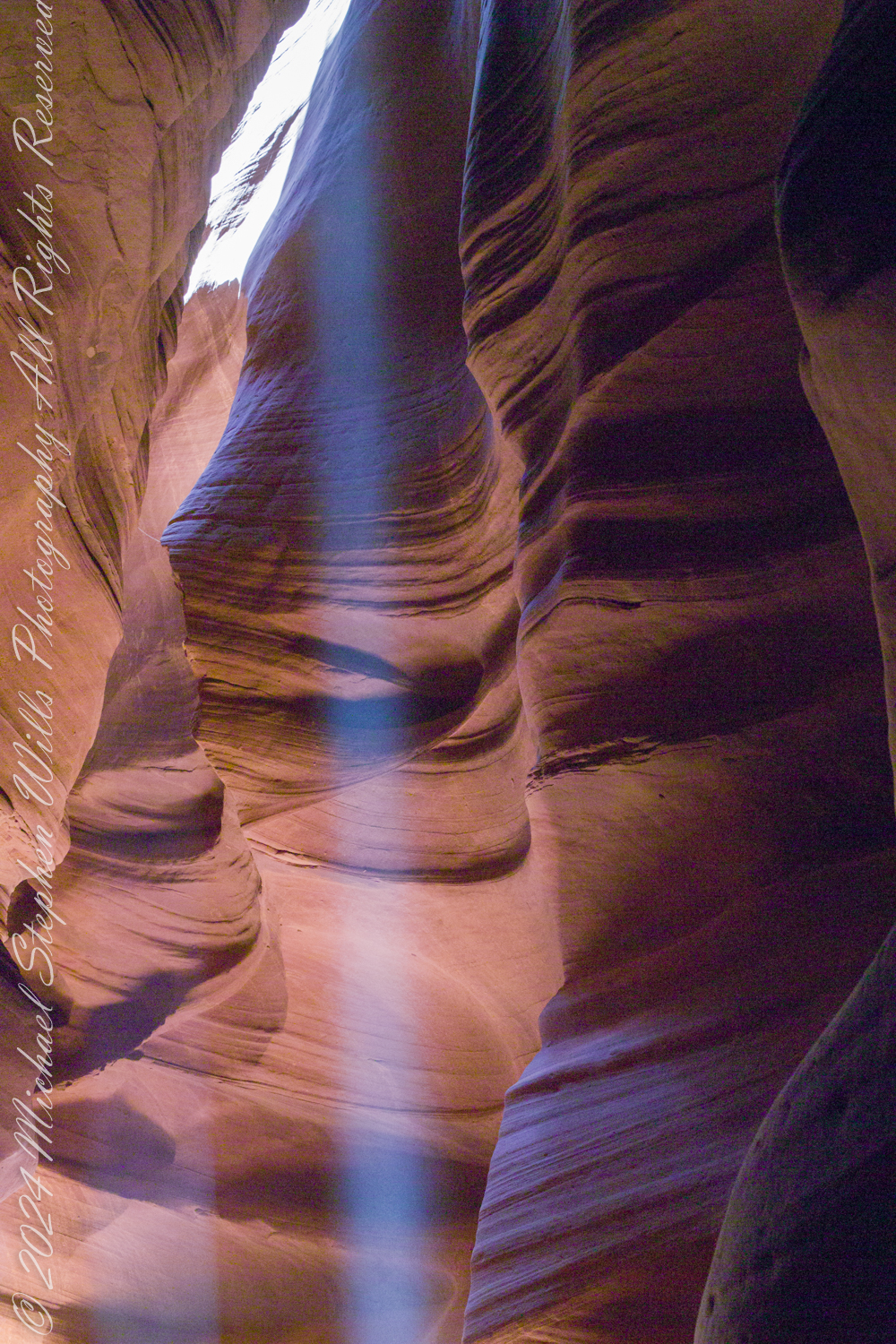
I wait in the dry darkness of upper Antelope Canyon for the perfect moment to capture the spirit of the place. Light penetrates the narrow slot above, a thin beam spilling through the crevice, drawn by something deep below. In this confined space, sunlight becomes an entity. It touches the red sand and animates the space, revealing stone textures and the fleeting movement of sand in freefall.

Antelope Canyon is in the Navajo Nation near Page, Coconino County, Arizona

The play between dark and light reminds me that beauty often lies in contrast. The polished walls that surround me were once jagged, raw stone. They have become smooth under nature’s relentless touch—proof that endurance shapes elegance. The canyon’s walls, though fixed in place, seem to sigh as the sand slips over them, embodying a paradox of permanence and impermanence.

An Elemental Meditation


I am a visitor as well as part of a conversation held in languages older than words—spoken by rock, sand, shadow, and light. I sense the ancient stories etched into the stone and carried within each grain that spills like an hourglass. Here, nothing is wasted; everything contributes to a continuous process of becoming. The sand, which once formed the walls, now shapes the canyon floor, each element recycling into the next chapter of this landscape’s life.

Antelope Canyon is in the Navajo Nation near Page, Coconino County, Arizona

The act of waiting for a right moment teaches me that patience is both passive and an active engagement with time. I am reminded that what I witness will never be exactly the same again. Even though the canyon may stand for millennia, each second contains a uniqueness. The sand cascading before my eyes will settle, be disturbed, and flow again—but never in quite the same way.

Capturing the Spirit of Place


I set the camera on a rented tripod, knowing photography is an imperfect attempt to hold onto what cannot be possessed. This place does not belong to me—it belongs to itself, shaped by forces far greater than any human hand. My role is not to own the scene but to honor it, to acknowledge its fleeting magnificence by framing a moment within the lens.

The shutter clicks, the cascade of sand becomes immortalized held in that instant. Yet I know that the photograph, while capturing the image, will not fully encompass the spirit of what I have experienced. This place is a meditation, a reminder that life itself flows in ways we cannot control. Like the red sand, we are carried by forces—sometimes gentle, sometimes fierce—shaping and reshaping us through time.

As I gaze at the sand, a quiet sense of reverence flows through me. This moment, like the grains tumbling in front of me, is already slipping into the past. But in its passing, it leaves behind something intangible yet enduring—a memory of beauty found not in permanence but in change.

Click this link for my Fine Art Photography gallery.

Click this link for another Arizona post, “A Dry Piece of Paradise.”

Enter your email to receive notification of future postings. I will not sell or share your email address.

Face-to-Face with Florida’s Ancient Predator

Discover the world of Florida’s ancient predators through the eyes of the formidable Smilodon fatalis. Step back in time to the Pleistocene epoch and explore the life, habits, and social bonds of the iconic sabertooth cat.

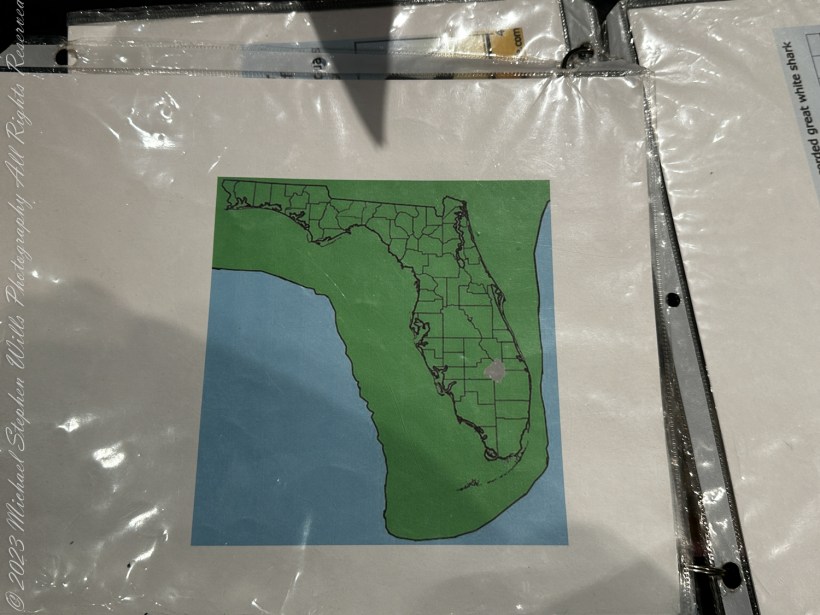
I examined an unusual map of Florida, the contours of its familiar modern shape overlaying a vast, green expanse. The state as we know it today is crisscrossed by highways and dotted with bustling cities, but this map transported me back in time to a very different era. During the Pleistocene epoch, Florida was a wilder, untamed land, teeming with life and dominated by creatures long extinct.

The representation of the land area of Florida state during Pleistocene epoch glaciation is the green shading with the current map of Florida within.

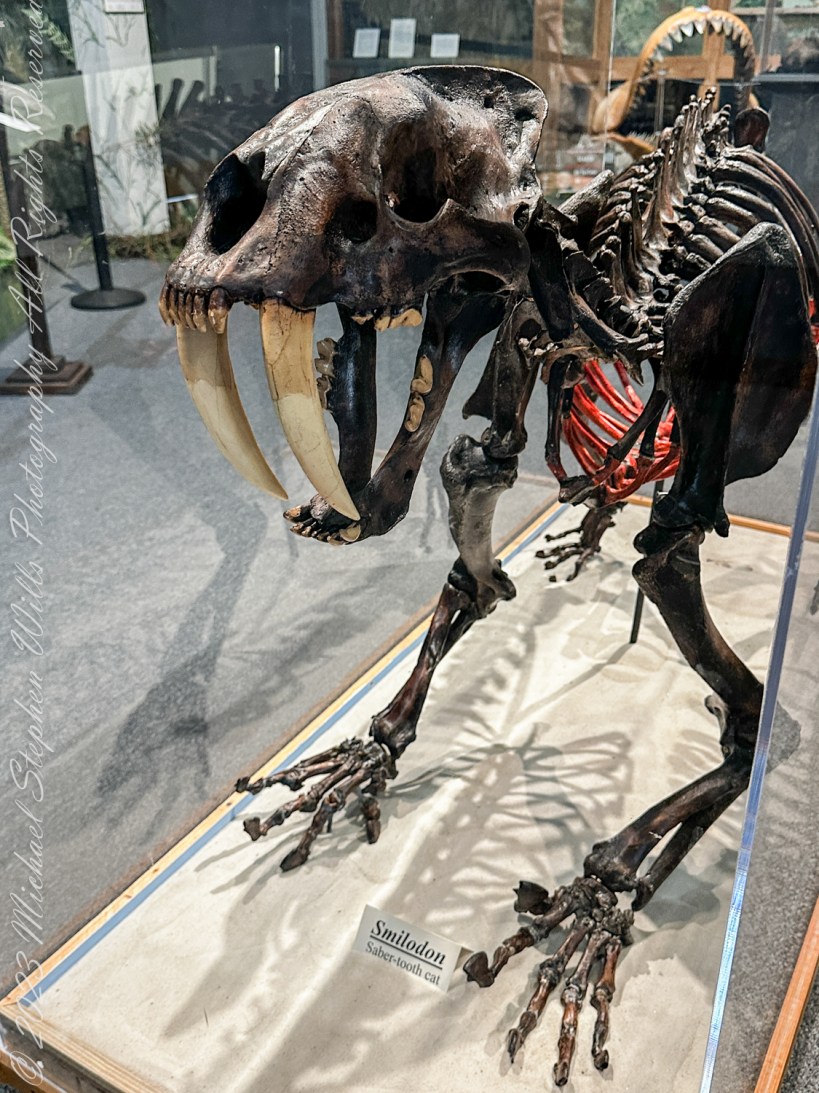
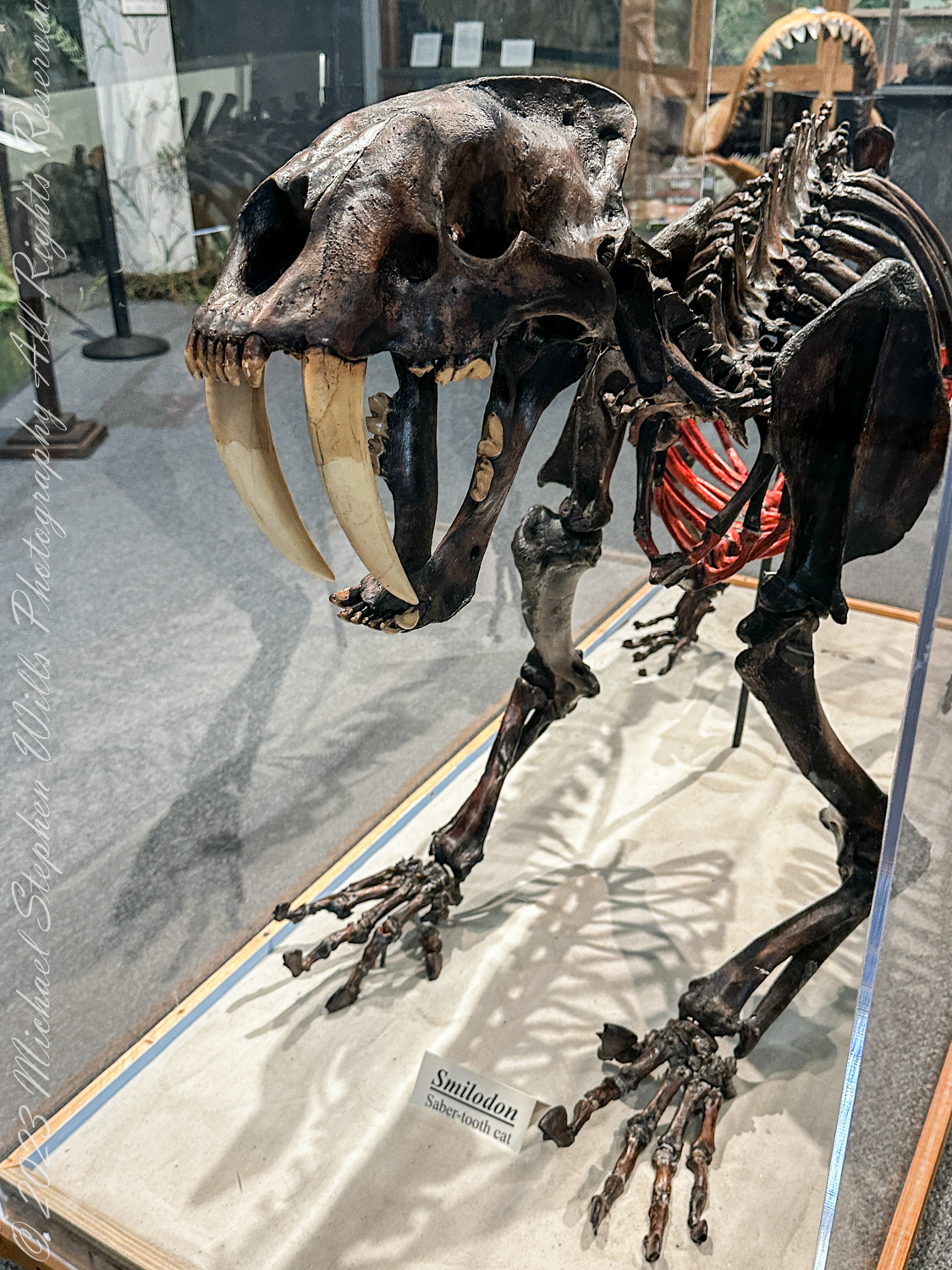
Exploring Brevard (county) Museum of History and Natural Science of Cocoa Florida, I moved to the next exhibit. The air hummed in my imagination with the whispers of an ancient world. A skeletal figure loomed within a glass case – the mighty Smilodon fatalis, the sabertooth cat. Its fearsome fangs curved downward, I imagined standing face-to-face with this apex predator, feeling both awe and a primal fear.

Florida, some 11,500 years ago, was a place of significant climatic shifts. The Pleistocene epoch was characterized by repeated glaciations; however, Florida itself remained unglaciated. The climate was cooler and drier than today, and sea levels were much lower, extending the coastline outward. This ancient Florida was a mosaic of grasslands, savannas, and woodlands. Giant sloths, mammoths, and mastodons roamed these lands, sharing the territory with the formidable Smilodon.

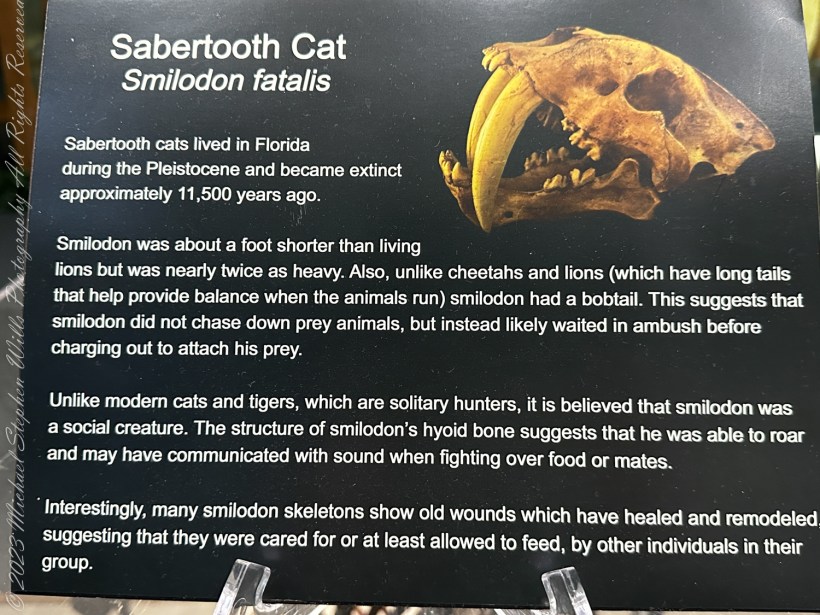
The attendant palque described Smilodon fatalis was about a foot shorter than modern lions but nearly twice as heavy. Its stocky build and powerful limbs suggested immense strength. Unlike the cheetahs and lions of today, Smilodon had a bobtail, indicating that it relied less on speed and more on ambush tactics. I could almost see it now: crouching low in the underbrush, muscles coiled, waiting for the perfect moment to spring upon its unsuspecting prey.

In the reconstructed display, the sabertooth cat’s lethal precision was evident. Its elongated canines were deadly tools designed to pierce and hold onto struggling prey. The lack of a long tail, which modern big cats use for balance during high-speed chases, suggested that Smilodon was an ambush predator. It would have hidden in the dense foliage, its mottled coat blending seamlessly with the shadows, until it launched a surprise attack.

Smilodon was not just a solitary hunter. Unlike modern cats and tigers, which often lead solitary lives, evidence suggests that Smilodon was a social creature. The plaque mentioned the structure of its hyoid bone, implying that it could roar, perhaps using vocalizations to communicate with other members of its group. I envisioned a family of Smilodon, working together to take down a mammoth or defend their territory from rivals. Their social bonds might have been strong, much like those of modern lions.

I was particularly struck by the evidence of healed wounds found on many Smilodon skeletons. These injuries had healed and remodeled over time, suggesting that these cats cared for each other. In a world where every day was a battle for survival, these acts of care and compassion spoke volumes about their social structure. Injured members were not left to fend for themselves but were likely allowed to feed off the kills of others and to be protected by their group until they recovered.

The exhibit painted a vivid picture of an ancient ecosystem. The Pleistocene flora of Florida was diverse, with vast grasslands interspersed with stands of pine and oak. The fauna was equally rich: herds of herbivores grazed the plains, while predators like Smilodon and dire wolves stalked them. This was a land of giants, where every creature had to be strong, fast, or cunning to survive.

As I stepped away from the exhibit, I felt a deep connection to this ancient world. The Smilodon fatalis was a predator and is a symbol of an era that shaped the natural history of our planet. Its bones told a story of survival, community, and the ever-changing dance of life and death.

In the quiet of the museum, surrounded by the echoes of the past, I was reminded of the fragility and resilience of life. The sabertooth cat, with its fearsome fangs and powerful build, was a testament to the incredible adaptability of life on Earth. Though it has long since vanished from our world, the spirit of Smilodon fatalis lives on in the bones it left behind and in the stories we tell about the ancient world it once ruled.

Copyright 2024 Michael Stephen Wills All Rights Reserved

Floral Anchors: Early Saxifrage’s Survival Dance in Treman Gorge

Step into the serene realms of Robert H Treman State Park, where the Early Saxifrage blossoms amidst ancient stones, embodying resilience and the timeless beauty of nature’s persistence against all odds.

Ambling along the rugged Gorge Trail within the serene expanse of Robert H Treman State Park, my gaze is caught by the delicate clusters of Early Saxifrage (Micranthes virginiensis), formerly known as Saxifraga virginiensis. Nestled in nooks and crannies along the limestone-rich corridors, this resilient plant, also colloquially known as “Virginia saxifrage” or “rockfoil,” presents a mesmerizing spectacle against the moss-draped backdrop of the gorge’s ancient stones.

Early Saxifrage thrives in these modest crevices, its roots gripping tightly to the scant soil amidst the rocks, drawing nourishment from the most unlikely of places. The plant’s small, white star-like flowers blossom in dense clusters, creating a soft contrast against the rugged gray of weathered stone. The base of the plant, typically hidden, burgeons with rosettes of spoon-shaped leaves, which persist through the winter, ready to embrace the spring with vigor.

This plant not only captures the eye but also whispers tales of medicinal lore. Historically, Early Saxifrage has been utilized in folk medicine, primarily valued for its supposed efficacy in dissolving kidney stones—a testament to its name, “saxifrage,” which means “stone-breaker.” Though modern usage does not commonly reflect these ancient practices, the plant’s presence here speaks to the deep-rooted herbal knowledge passed down through generations.

As I tread lightly over the worn paths that weave through the gorge, the sight of Early Saxifrage serves as a poignant reminder of the park’s ecological tapestry. This flora, modest yet striking, symbolizes the tenacity of life, blooming splendidly in the stark environment it calls home. It is a beacon of endurance and beauty, inviting us to pause and appreciate the quieter, often overlooked wonders of nature.

In this corner of the Finger Lakes, where water and stone sculpt the landscape, Early Saxifrage flourishes. It stands as a testament to the persistence of the wild, a delicate yet resilient inhabitant of this storied terrain, weaving its subtle magic into the fabric of the gorge. Here, among the whispers of streams and the echoes of stone, it finds its place, a fragile star in the vast, enduring sky of green.

Copyright 2024 Michael Stephen Wills All Rights Reserved

The Living Tapestry of Treman Gorge

Discover the enchanting world of Treman Gorge through its ancient ferns. Step into a living tapestry where nature’s resilience paints a story of survival and beauty. Dive deeper into this magical realm by reading our latest blog post.

Entering Treman Gorge


As I step into the lush expanse of Treman Gorge, I am enveloped by a verdant cathedral of nature. The gentle murmur of flowing water blends with the chorus of birds, creating a symphony that resonates deep within me. The air is fresh, filled with the earthy aroma of damp foliage, inviting me deeper into its serene embrace.

“The Gallery” entrance to Tremen Gorge from the upper park.

Among Ancient Rocks

The gorge is a geological marvel, sculpted from layers of Devonian shale and sandstone. These sedimentary rocks, formed over 400 million years ago, tower around me, formidable and steeped in history. The stratified patterns on their surfaces tell tales of ancient rivers and seas that once dominated this landscape, leaving behind sediments that would compact into the shale and sandstone seen today.
The Flourish of Life on Stone

Along the damp trails, vibrant mosses and ferns adorn the rock walls, thriving in the moist, shaded nooks. The mosses, lush and green, form thick carpets that breathe life into the stone. Among them, patches of Dicranum moss are notable for their robust, upright growth. Ferns, too, make their home here, with Polystichum acrostichoides, or Christmas fern, prevalent for its evergreen fronds that add year-round color to the grey stone backdrop.

Ephemeral Pools and Nature’s Adaptation

Small pools of water collected in the rock crevices create microhabitats buzzing with life, from aquatic insects to amphibians seeking refuge. These clear, cool pools mirror the verdant foliage and blue skies above, creating tranquil tableaus of the gorge’s hidden depths.

The Role of Ferns and Mosses in Human History

Ferns and mosses, beyond their beauty and ecological roles, have practical applications that have been recognized since ancient times. Ferns have been used in traditional medicines for their anti-inflammatory and pain-relieving properties. Certain species, like the bracken fern, were used by Native Americans for food, medicine, and even bedding during travel.

Mosses also hold significance in human history. Their excellent insulation properties made them a popular choice for lining chinking in log cabins or as a packing material to keep food fresh. In modern times, the absorptive properties of moss are harnessed in ecological projects such as biofiltration, to clean contaminants from water.
Native American Heritage in Treman Gorge

The history of Native Americans in areas like Treman Gorge is rich with culture and deep respect for the natural world. They utilized the gorge’s resources sustainably, understanding the intrinsic value of each plant and animal. For example, the gorge’s abundant moss and fern-covered landscapes provided not only material resources but also spiritual significance. These plants were often used in ceremonial practices, symbolizing life and fertility, and were integral in storytelling and oral traditions that passed vital knowledge through generations.

Enfield Creek in Treman Gorge

Reflections on Resilience and Beauty

With each step through Treman Gorge, I feel a deep connection to the past—each rock, moss patch, and fern frond speaks of endurance and adaptability. In the grand timeline of Earth, my presence is but a fleeting moment, yet it is intertwined with the eons of history embedded in this place.
Devil’s Kitchen Waterfall above Lucifer Falls

Treman Gorge, with its ancient rocks and thriving plant life, stands as a testament to the resilience and beauty of nature. It reminds us of the world’s perpetual motion, of life’s ability to adapt and thrive in the face of time’s relentless passage. Here, amidst the moss-covered rocks and fern-laden paths, I find a sense of peace and continuity, a connection to the Earth that is both humbling and uplifting.

Concluding Thoughts

As I leave Treman Gorge, the echo of the water and the rustle of leaves linger in my mind, a reminder of the timeless dance between nature and those who walk its paths. This place is a living library, holding the secrets of millennia, reminding us of our place in nature’s vast narrative and the enduring legacy of those who walked these paths before us.

Copyright 2024 Michael Stephen Wills All Rights Reserved