A Serene Walk in Glendalough: Nature and History Unite

Find here a serene visit to Glendalough, highlighting the ancient beauty of its landscape, monastic history, and the deep sense of peace felt among the gravestones.

We arrived in Glendalough on a bright spring morning, a gentle breeze carrying the scent of grass and distant water. Even before stepping out of the car, I sensed something ancient in the air, as though the centuries themselves lay waiting among the stones. The peaks of the Wicklow Mountains rose around me, their slopes draped in verdant forests that whispered of forgotten tales. In the distance, shimmering like a secret, the Upper Lake beckoned under the watchful hush of rugged hillsides. I took a deep breath and started my wander.
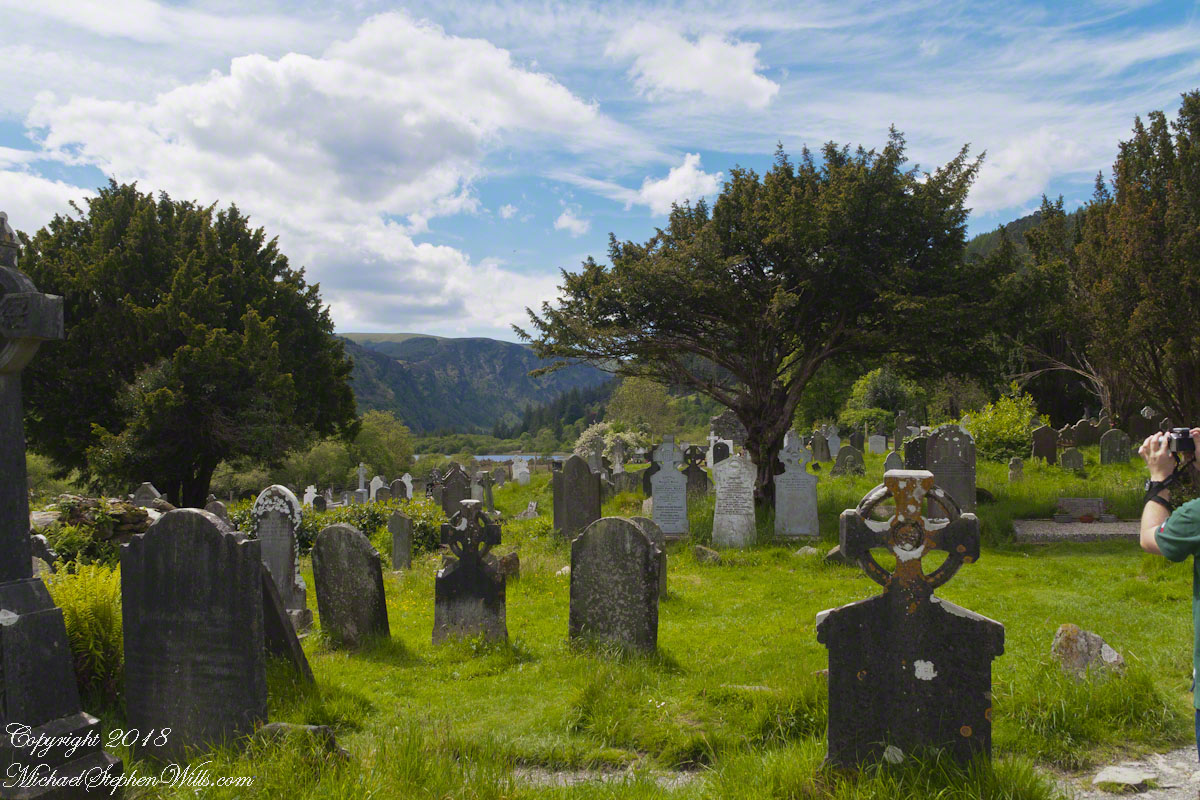
One of the lakes for which the valley is named, above the headstones in the mid-distance

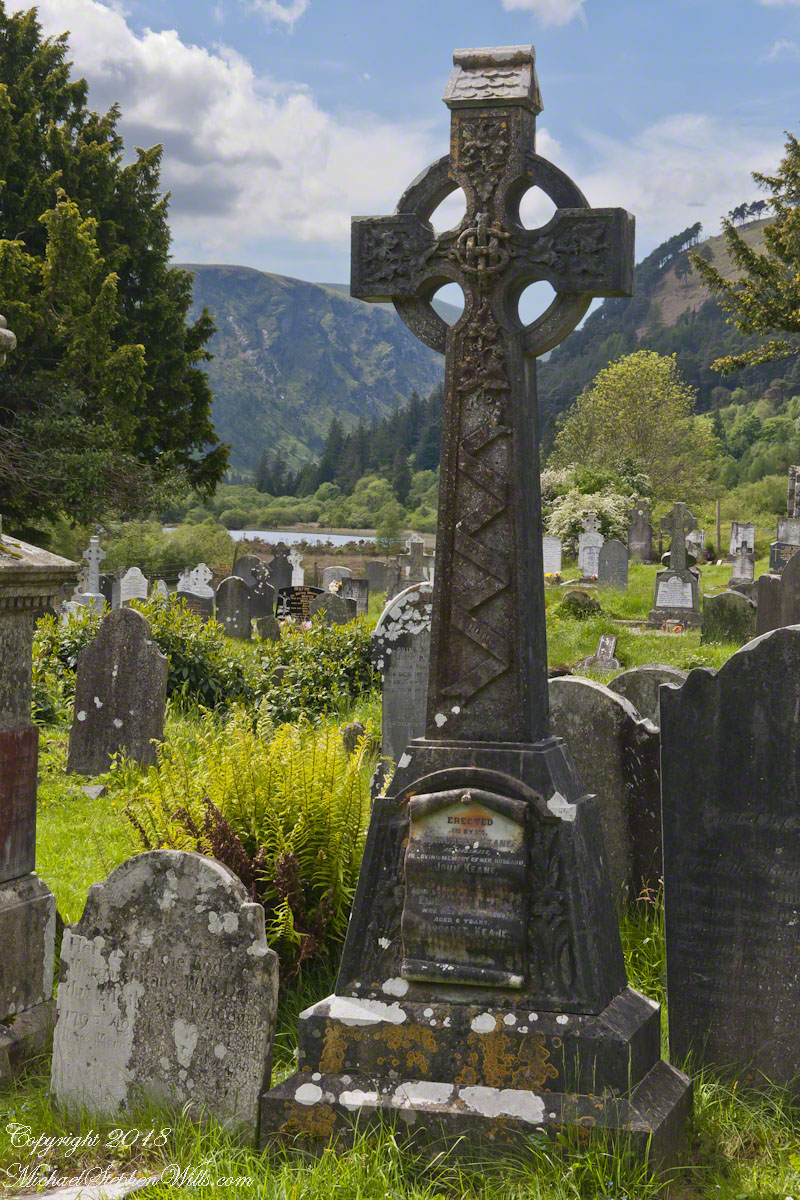
Walking through the monastic settlement, I felt enveloped by a hush both reverential and oddly comforting. The path led me to a cluster of gravestones leaning gently askew, each marked by Celtic crosses standing guard over the memory of those buried below. One cross, carved from sturdy stone, immediately drew my attention with its intricate knotwork etched deep into the surface. The front of it bore swirling designs reminiscent of interwoven vines—symbols of eternity, continuity, and faith. I found myself imagining centuries of pilgrims, each pausing here, hands gently resting on the weathered carvings, offering up their prayers and hopes.
Memorial from a mother to her 6 year old son and husband

A bit farther on, I came upon a small grouping of headstones bowed in silent unity. Ferns and moss carpeted the ground in bright greens, creating a natural tapestry that wove together life and memory. The slightly overgrown grass softened the entire landscape, allowing each stone to stand quietly yet firmly in the earth. From behind these markers, I caught my first glimpse of the shimmering lake, framed perfectly by the slopes of the valley. The water’s surface reflected the sky’s azure brilliance and accentuated the gentle hush that fell upon the graveyard like a comforting quilt.

As I paused to take a few photographs, I felt a hint of magic floating through the air—an indefinable sense that beyond what my eyes perceived, an age-old spirit thrived. The Celtic symbols on the headstones seemed alive, their swirling knots hinting at the cycle of life and death, the oneness of the world, and the bridging of earthly existence with the mystic realm. I found myself recalling old Irish legends: stories of saints who could converse with animals, of spirits dwelling in hidden glades, of holy wells that healed weary travelers. It felt as though those tales were all around me, wrapped in the tapestry of this timeless valley.

Looking out toward the remains of the stone church—its walls crumbled yet proud—my imagination conjured the chanting of monks, their voices echoing off the surrounding hills. The same forest that sheltered me now would have encircled them all those centuries ago, shifting from season to season. It was easy to picture them gathering by the lake’s edge, cups of cold, clear water cupped in their hands, or moving reverently among the graves of those who had come before them. Here, time seemed an illusion. The line between past and present faded as I stood among these enduring stones.

Winding paths of grass guided me to another section of the cemetery, where weathered inscriptions told the stories of families, lineages, and deep connections to the land. Some headstones were so old that the lettering had nearly eroded, but others still proudly bore legible names and dates. Names like Power, Byrne, and Keane were etched in memory, followed by poignant words of affection and devotion. The place felt both solemn and comforting at once—a harmonious interplay of remembrance, reverence, and the gentle pulse of nature.
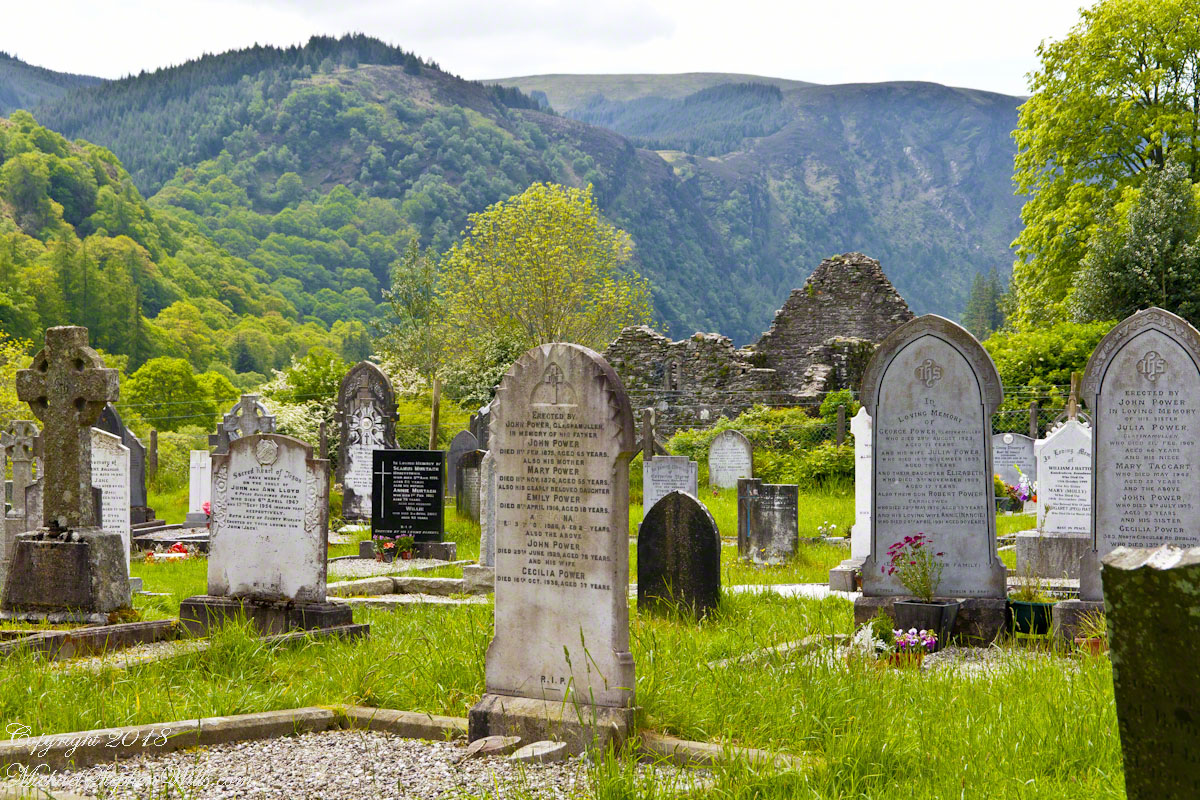
Valley walls are dramatic and steep

A sudden breeze rippled through the trees, setting the leaves to dance and carrying the lilt of birdsong across the valley. I turned to admire the view once more, and there, between towering yew trees, the lake glowed like a polished mirror. Soft clouds glided overhead in a pale blue sky. The entire scene seemed woven from a single, unbroken strand—mountain, forest, gravestone, lake, and sky merging in a spellbinding harmony. It was the kind of moment that invited awe, a moment in which to lose oneself and yet feel more fully found.

I left the cemetery with a deeper sense of peace than I had known in some time. The photographs I took may capture the beauty of Glendalough’s ancient crosses and serene landscape, but it’s the intangible hush of centuries and the gentle brush of magic that remain with me. With every step back toward the car, I felt the warmth of timelessness, and as the day’s golden light enveloped the stone monuments behind me, I carried away a tiny spark of the valley’s enchantment—a reminder that some places are truly touched by the divine.Look closely at the carved scroll at the foot of the cross.

For more background of this site, see my posting “The Cloigheach of Glendalough.”
Enter your email to receive notification of future postings. I will not sell or share your email address.

Nature’s Role in Recovery: October at Treman Park

Pam’s recovery from hip replacement unfolds in Upper Robert H. Treman State Park, intertwining personal resilience with nature’s healing beauty.

On a crisp October afternoon, October 3, 2024, Pam and I reveled in Upper Robert H. Treman State Park, a serene oasis nestled in Tompkins County. This visit was particularly special for us, a step in Pam’s recovery from her August hip replacement. I remember the sound of her hiking pole tapping the ground as we walked together, feeling grateful for her progress since surgery. The air was cool, and the leaves, turning gold and orange, whispered in the breeze, providing the perfect backdrop for our outing that day.

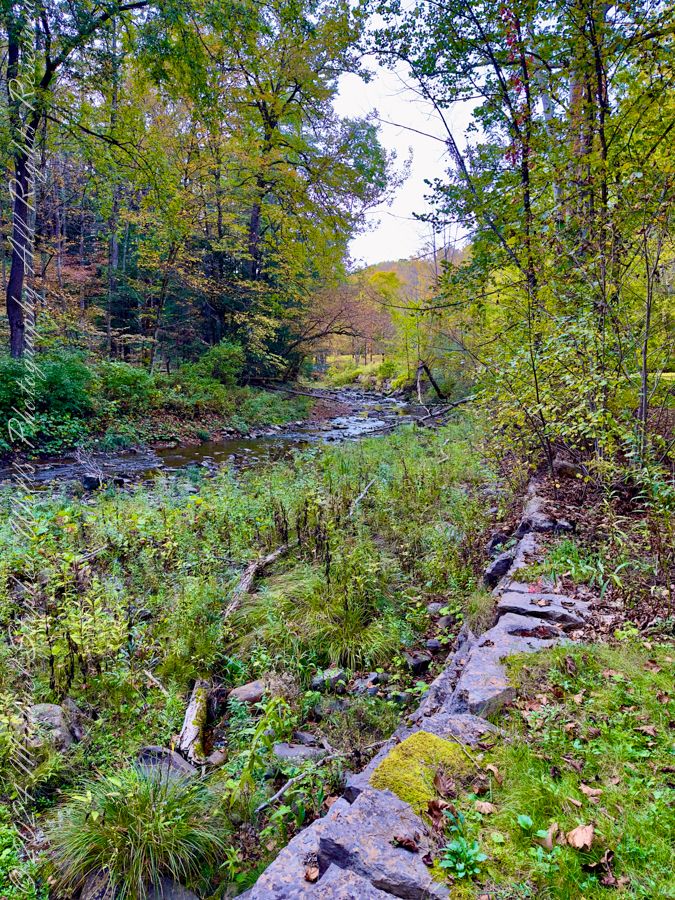
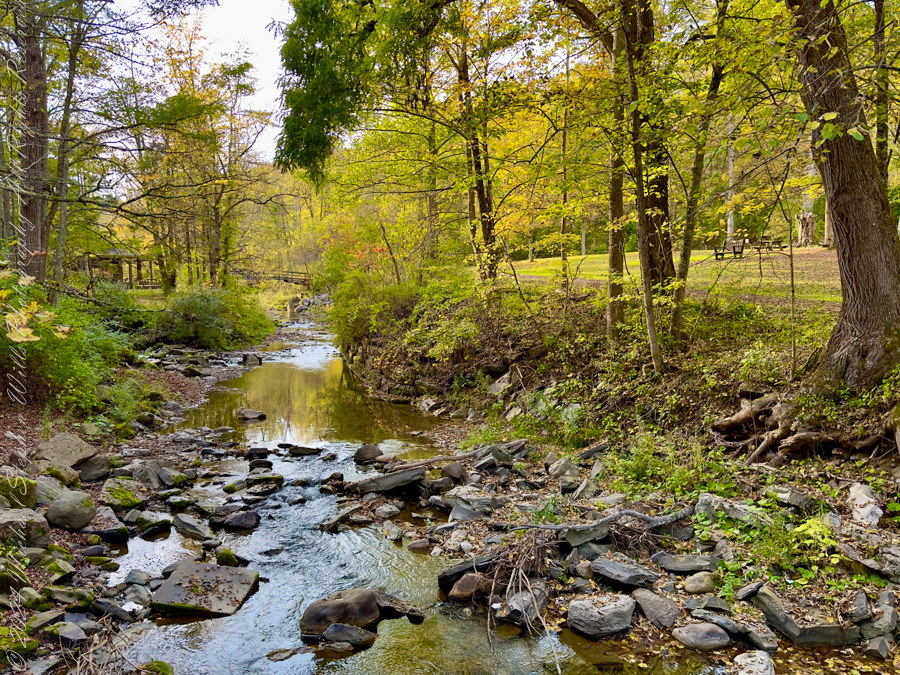
Our path followed the creek, the same creek that winds through the heart of the park, framed by layers of stone and lush vegetation. In one of the first photos I took that day, you can see the creek reflecting the soft autumn light, its bed dotted with rocks and fallen branches. The vibrant greens of the undergrowth juxtaposed with the golden leaves made the scene feel timeless, as though nature itself was participating in Pam’s recovery, offering healing in its quiet, enduring beauty.

The view upstream just before the creek enters The Gallery. Robert H. Treman State Park, Enfield, Tompkins County, Finger Lakes Region, New York State.

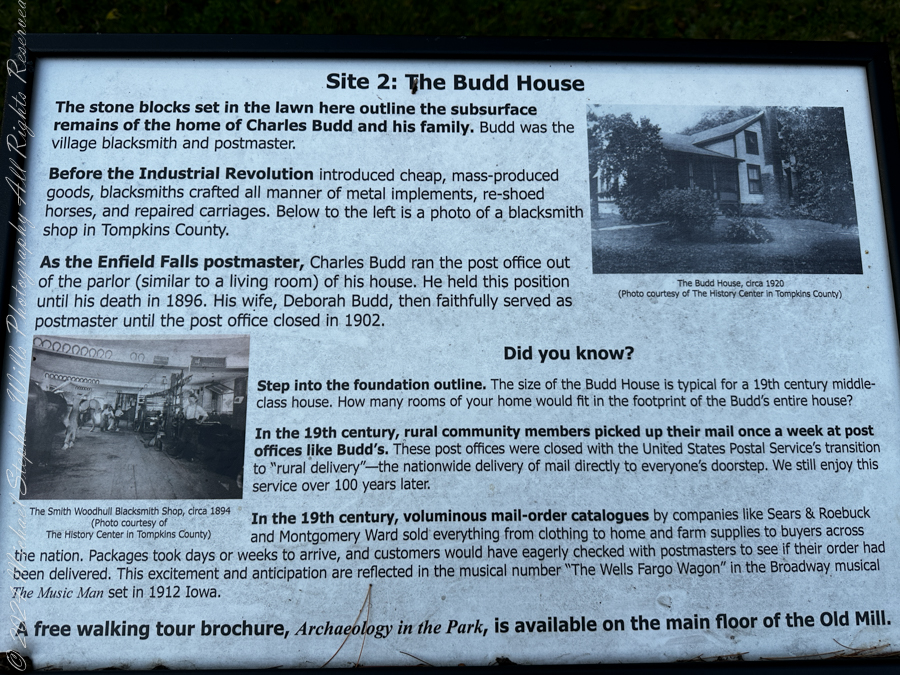
We paused to take in the quiet hum of life around us. There was a sense of history in the park that seemed to blend with our personal story. As we wandered deeper, we reached the foundation of the old Budd House, its stone blocks now barely a shadow of the past but still carrying echoes of life lived long ago. The placard described Charles Budd, a village blacksmith and postmaster, and his wife, Deborah, who continued to serve the community after his passing. Standing there, I reflected on how these stones, much like Pam’s journey, represented resilience and the passage of time.

Site 2: The Budd House The stone blocks set in the lawn here outline the subsurface remains of the home of Charles Budd and his family. Budd was the village blacksmith and postmaster. Before the Industrial Revolution introduced cheap, mass-produced goods, blacksmiths crafted all manner of metal implements, re-shoed horses, and repaired carriages. Below to the left is a photo of a blacksmith shop in Tompkins County. As the Enfield Falls postmaster, Charles Budd ran the post office out of the parlor (similar to a living room) of his house. He held this position until his death in 1896. His wife, Deborah Budd, then faithfully served as postmaster until the post office closed in 1902. Did you know? Step into the foundation outline. The size of the Budd House is typical for a 19th century middle-class house. How many rooms of your home would fit in the footprint of the Budd’s entire house? In the 19th century, rural community members picked up their mail once a week at post offices like Budd’s. These post offices were closed with the United States Postal Service’s transition to “rural delivery”—the nationwide delivery of mail directly to everyone’s doorstep. We still enjoy this service over 100 years later. In the 19th century, voluminous mail-order catalogues by companies like Sears & Roebuck and Montgomery Ward sold everything from clothing to home and farm supplies to buyers across the nation. Packages took days or weeks to arrive, and customers would have eagerly checked with postmasters to see if their order had been delivered. This excitement and anticipation are reflected in the musical number “The Wells Fargo Wagon” in the Broadway musical The Music Man set in 1912 Iowa. A free walking tour brochure, Archaeology in the Park, is available on the main floor of the Old Mill. Upper Treman. Robert H. Treman State Park, Enfield, Tompkins County, Finger Lakes Region, New York State.

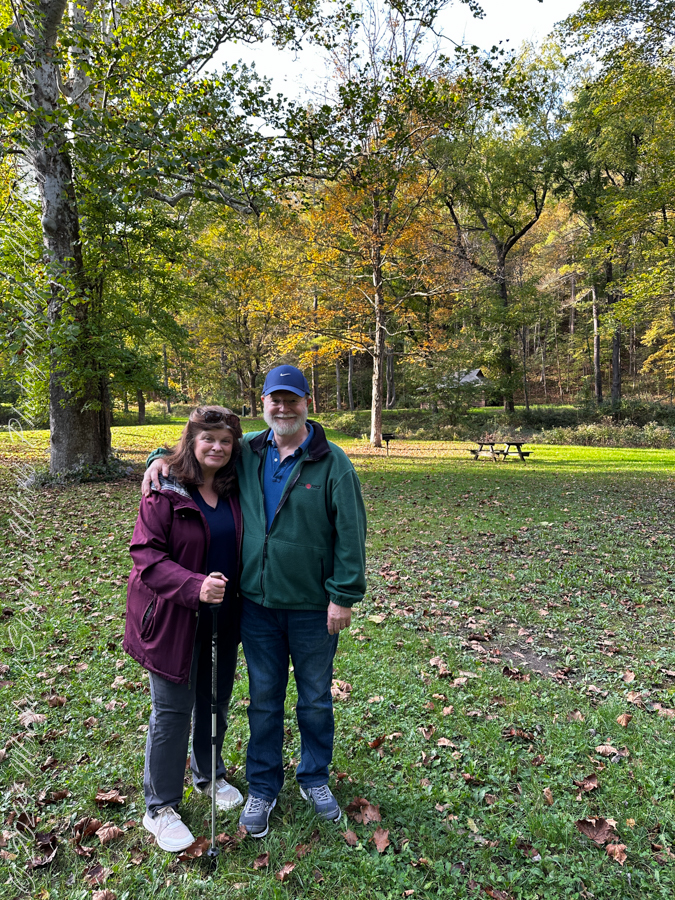
As we stood by the foundation, we met another couple. The woman shared her own story of recovery, a tale of resilience that resonated deeply with us. She had fallen and suffered a spinal injury, becoming paralyzed from the neck down, while traveling. Thanks to surgery and rehabilitation, she regained full mobility. There was a moment of understanding and connection between us. We offered to take a photo of them, and they returned the favor, capturing the two of us—Pam leaning lightly on her cane, smiling, surrounded by trees whose leaves were beginning to fall. That picture, one of my favorites from the day, symbolizes not just Pam’s strength but also the support and shared experiences that come with recovery.

We are taking a walk through upper Treman Park during Pam’s recovery from hip replacement. This was taken by a couple we met.

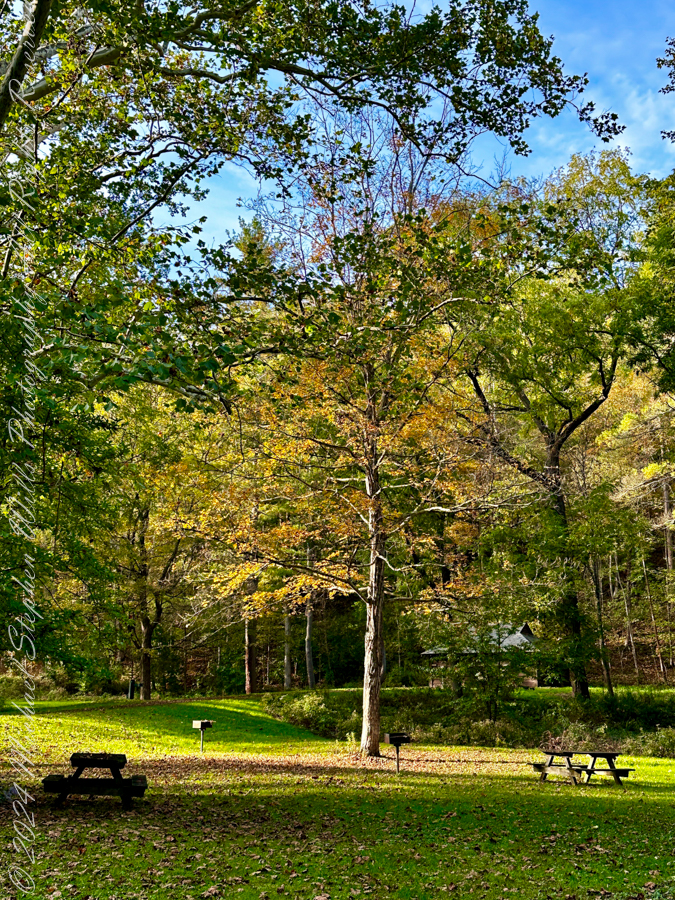
The park offered us a space for reflection and a sense of continuity. The trees, some towering over us with roots gripping the earth, had seen many seasons of change, and now they watched over us as we walked beneath them. In the clearing where picnic tables stood, we sat for a while, simply absorbing the moment. The afternoon light filtered through the branches, casting long shadows on the grass.

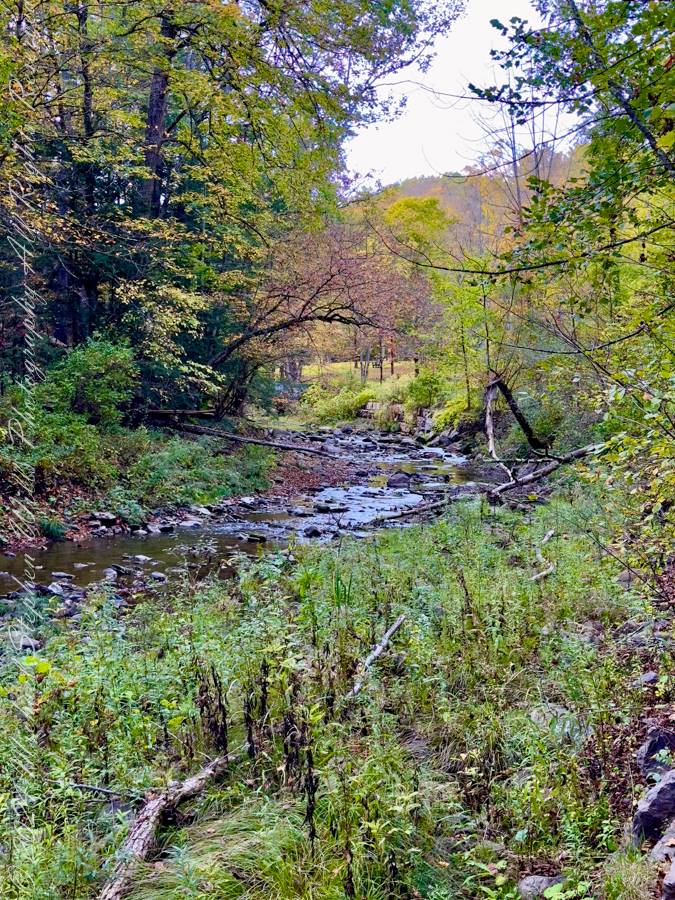
One of the final photos I took that day captures the creek from another angle. The water, calm and clear, reflects the yellow hues of the trees, while the rocks and roots along the bank seem frozen in time. It’s a peaceful image, one that reminds me of the quiet strength that Pam has shown throughout her recovery.

Here Fish Creek, a tributary of Enfield Creek joins the flow just below the pavilion of Upper Treman.

We left the park that day feeling both uplifted and grounded, the layers of history and personal resilience blending seamlessly into the natural landscape. Upper Robert H. Treman had become had become a part of Pam’s recovery story, a testament to the healing power of both nature and community.

Enter your email to receive notification of future postings. I will not sell or share your email address.

Exploring Ancient Wisdom in Today’s Healing Practices

As I waited during my wife’s physical therapy session, the connection between ancient healing traditions and modern medicine revealed a journey of resilience and hope.

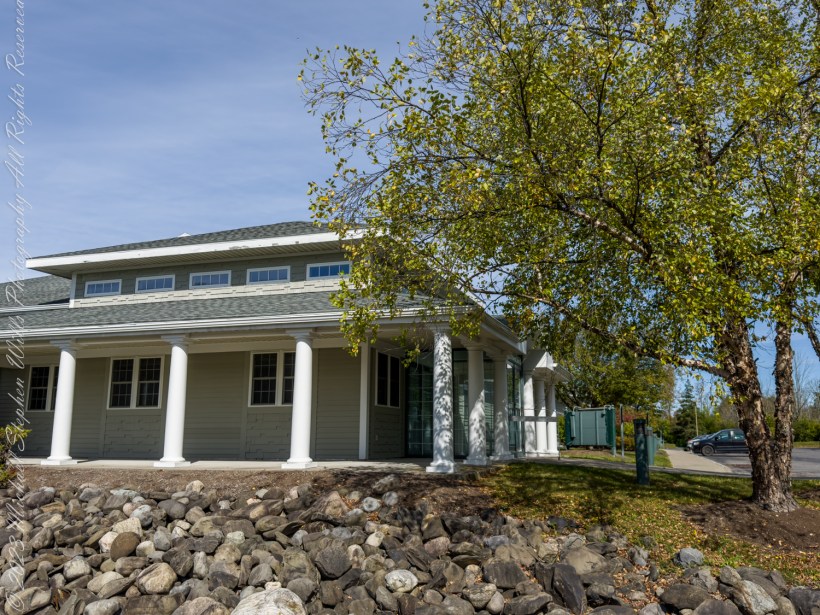
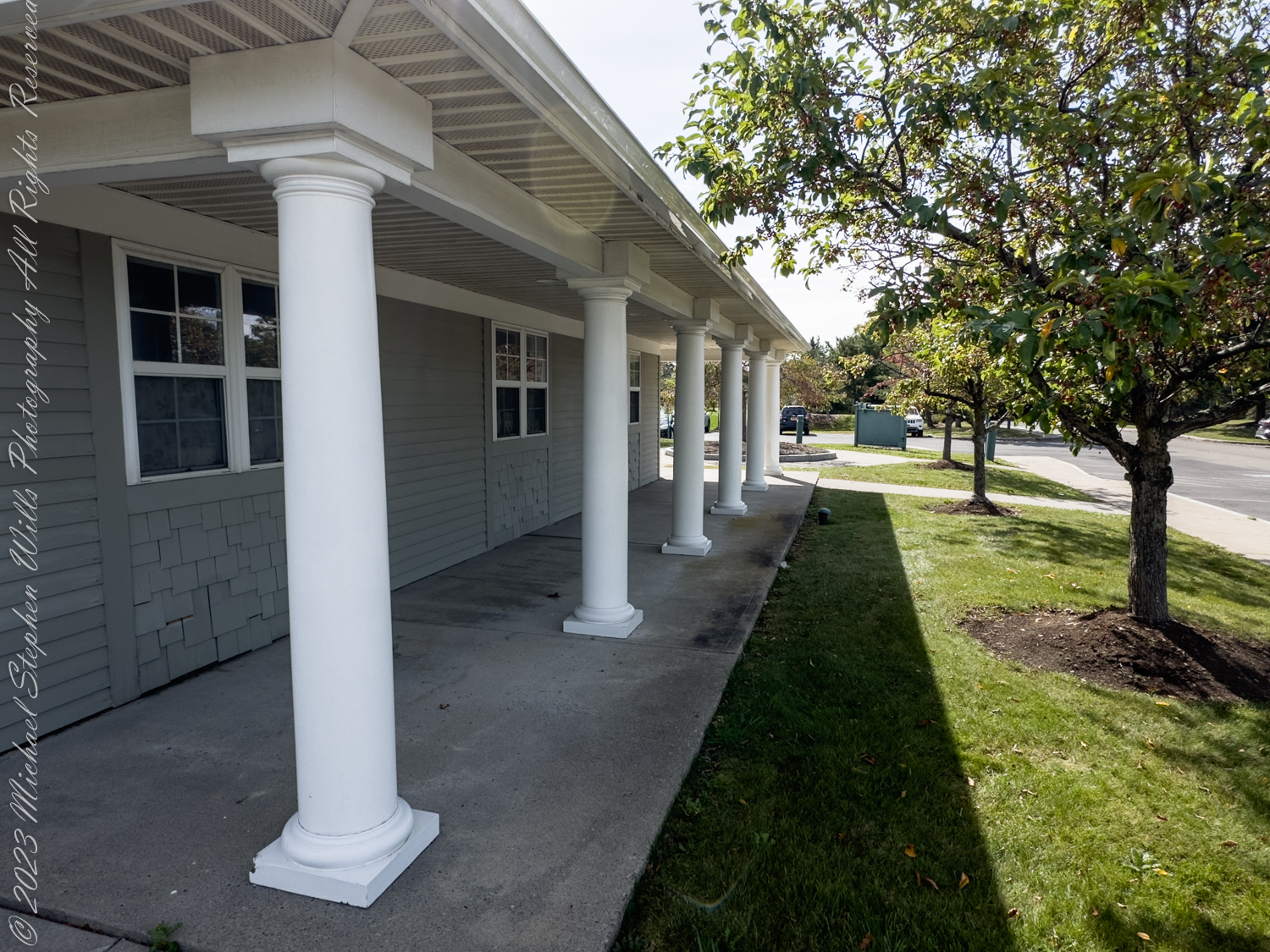
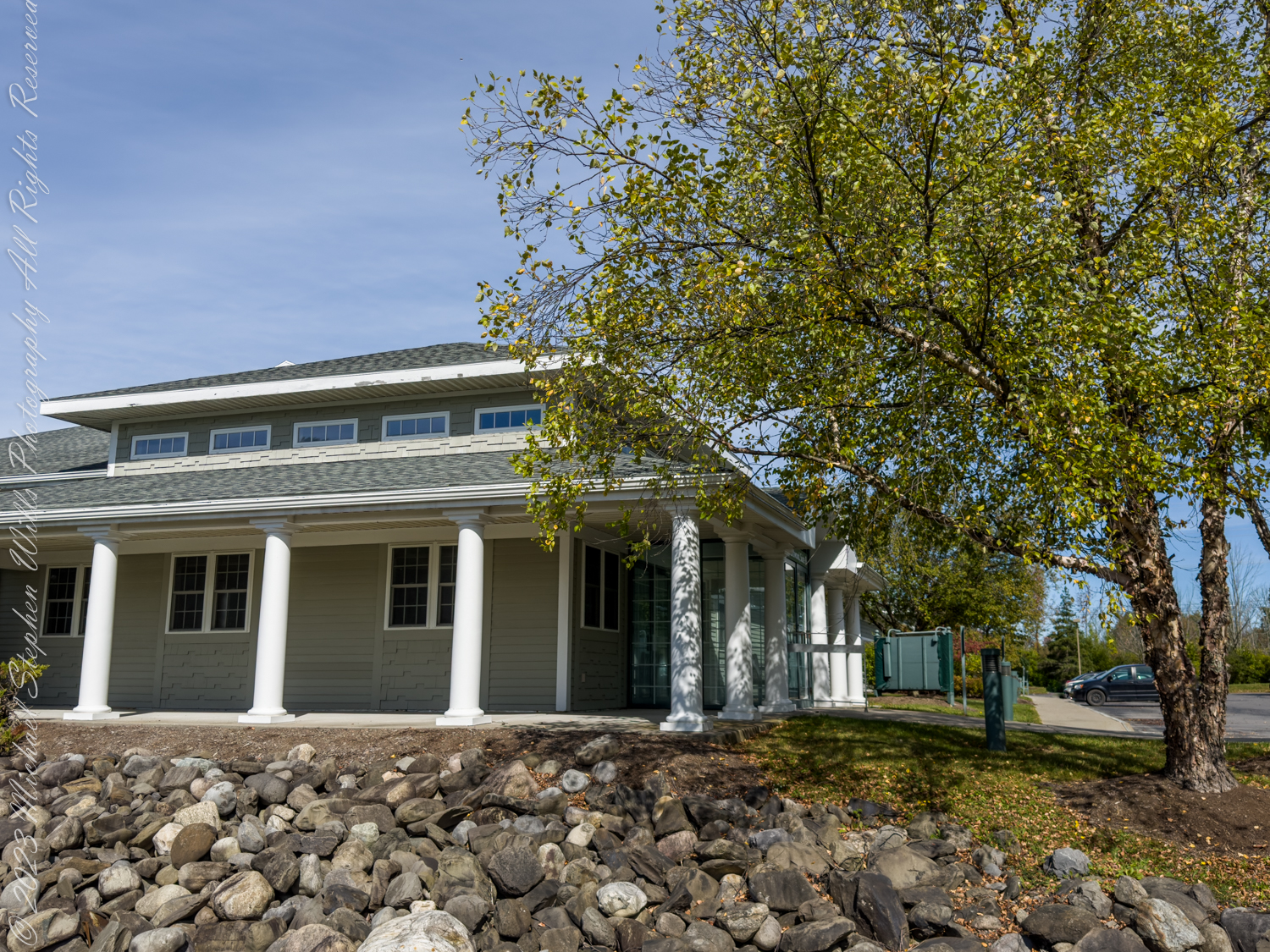
Standing in the cool autumn sunlight, I find myself pacing beneath the sturdy Doric columns of this medical campus in Northeast Ithaca, waiting as Pam undergoes another session of physical therapy. The simplicity of the columns strikes me—clean, white, and unadorned. They hold up the building with a kind of timeless grace, a quiet reflection of ancient design.

The architecture of the Medical Office Campus of northeast Ithaca is graced by doric columns arrayed in a row forming a portico colonnade. The original Greek Doric columns were fluted, and had no base, dropping straight into the platform on which the temple or other building stood. The capital was a simple circular form, with some mouldings, under a square cushion that is very wide in early versions, but later more restrained. Here the form of the capital is mirrored in the base. 20 Arrowwood Drive, Ithaca, Tompkins County, New York State

Doric columns are symbols of strength and stability. In this moment, they remind me of the quiet resilience I’ve seen in Pam throughout her recovery. Each column, solid and unwavering, reflects the foundational principles that underpin both architecture and the healing arts. Just as these columns have withstood the passage of centuries, modern medicine, too, stands tall on the legacy of ancient knowledge.

As I lean against one of these pillars, I think about the deep connections between ancient civilizations and the medicine we practice today. The origins of healing reach back to the Egyptians, who understood anatomy with remarkable precision. They would have been familiar with the use of medicinal plants. It’s remarkable to think that the surgeries performed back then, basic as they were, have evolved into the complex procedures of modern times, procedures like the one that replaced Pam’s hip with the efficiency of a machine through the care of skilled hands.

10 Brentwood Drive, Ithaca, Tompkins County, New York State

I look up at the sky, tracing the outline of the roof these columns support. The Greeks, with their reverence for observation, would have appreciated the rational design of this building. Hippocrates, the father of medicine, laid the groundwork for clinical observation, a method still used by the doctors caring for Pam. They probe, ask questions, and observe her movements, trying to decipher the hidden ailments within her body, much as the ancient physicians did centuries ago. It’s in this continuity that I find comfort—knowing that the doctors and physical therapists here are part of a long tradition, stretching back to Galen, who wrote about anatomy and physiology in ways that informed medical students for generations.

Modern medicine, like these columns, is a blend of the old and the new. Acupuncture, an ancient Chinese practice, is now commonly recommended for pain relief, a reminder that even today we rely on wisdom passed down through millennia. Pam’s therapists blend tradition with cutting-edge technology, using machines that track her progress and exercises that help her regain strength. Yet, at the heart of it, the human body heals the way it always has—with time, patience, and care.

As I walk the perimeter of the building, past patches of sunlight falling on the sidewalk, I’m struck by the parallels between the construction of this space and the body’s own repair. Both depend on a solid foundation. Roman innovations in public health, sanitation, and the idea of hospitals have shaped the spaces where we now seek healing. And here, in this modern medical facility, the connection to those roots feels tangible, much like the stones beneath my feet.

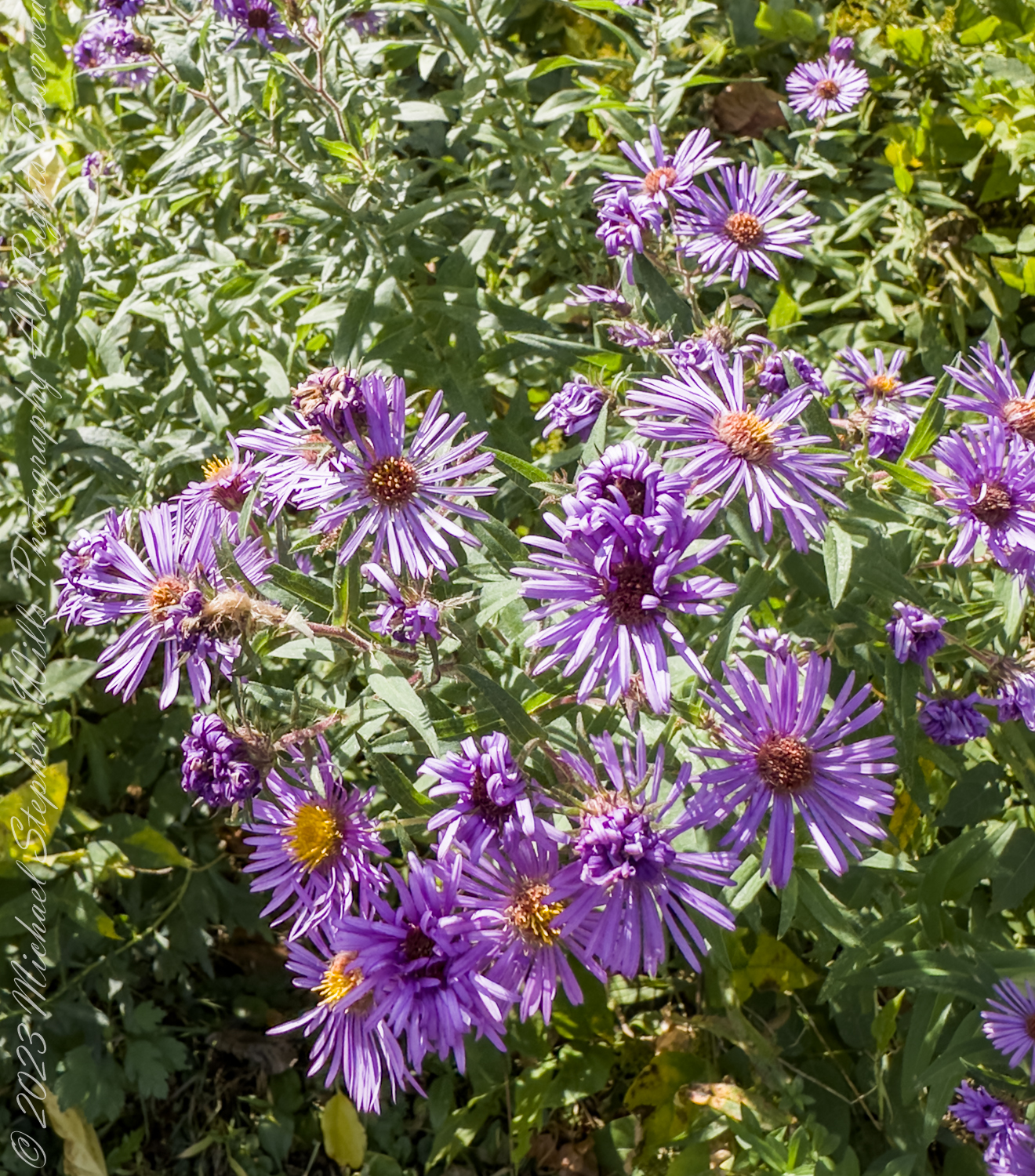
The name Aster comes from the Ancient Greek meaning “star”, referring to the shape of the flower head. ‘Aster’ species are used as food plants by the larvae of a number of Lepidoptera species. These asters grew wild on an otherwise landscaped medical campus. Found on an eaqrly autumn morning near 10 Brentwood Drive, Ithaca, Tompkins County, New York State

Asters, blooming nearby, sway gently in the breeze. They too are resilient, much like Pam. Their purple blossoms remind me of the hope that pervades our journey. The columns stand as sentinels of a kind of knowledge that is both ancient and ever-evolving—a blend of science, history, and faith in the power of the human spirit to endure.

Copyright 2024 Michael Stephen Wills All Rights Reserved

A Late Winter Walk Through Cornell University Campus

Explore a late winter walk through Cornell University’s scenic campus, discovering blooming snowdrops, historic landmarks, and the striking “Magna Dancer” sculpture. Uncover the beauty and heritage captured in each step of this serene journey.


On the late winter afternoon of March 1, 2024, I decided to take a long walk starting from Cascadilla Park Road, making my way up through the Cornell University campus, and ending at Fall Creek near the Mundy Wildflower Garden before returning to my starting point. The sun was shining brightly, casting long shadows, and the crisp air was filled with a hint of spring. Carrying an Apple IPhone 14 Pro Max smartphone, I set off to capture the beauty and essence of this serene day.

Starting Point: Cascadilla Park Road

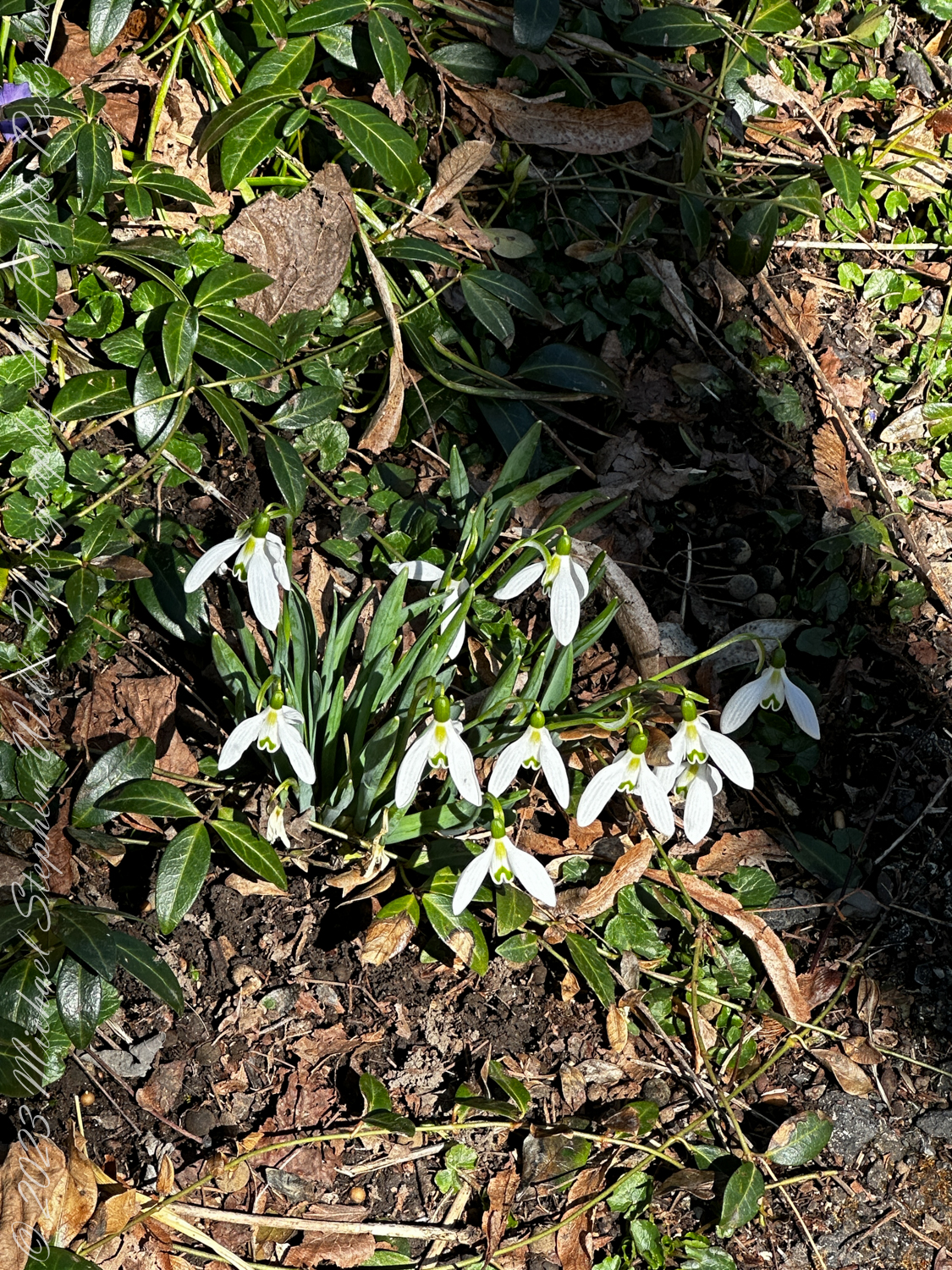
The walk began on Cascadilla Park Road, where I was greeted by a delightful patch of snowdrops (Galanthus nivalis) nestled among the glossy green leaves of periwinkle (Vinca minor). These delicate white flowers, blooming despite the chill, were a hopeful sign of the approaching spring. Their pristine petals contrasted beautifully with the dark, shiny leaves, creating a picturesque start to my journey.

These flowers were found in a garden on Cascadilla Park Road, Ithaca, March 1, 2024. Snowdrops (Galanthus nivalis) are among the first flowers to bloom in late winter and early spring, often pushing up through the snow. These plants are known for their nodding, white, bell-shaped flowers and are a common sight in gardens during this time of year. The glossy green leaves belong to a plant known as Periwinkle (Vinca minor). Periwinkle is a popular ground cover plant, often found in gardens due to its ability to spread quickly and form a dense mat of evergreen foliage. It typically has glossy, dark green leaves and produces small, blue or purple star-shaped flowers in the spring.

Climbing the Steps to Steps to Myron Taylor Hall

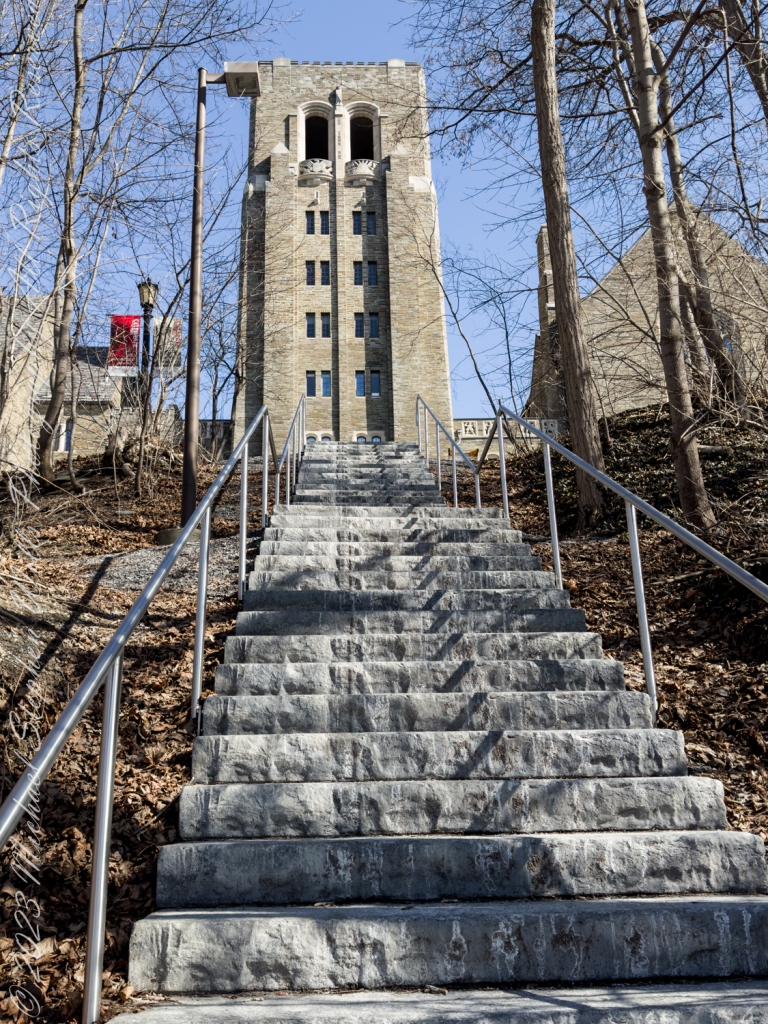
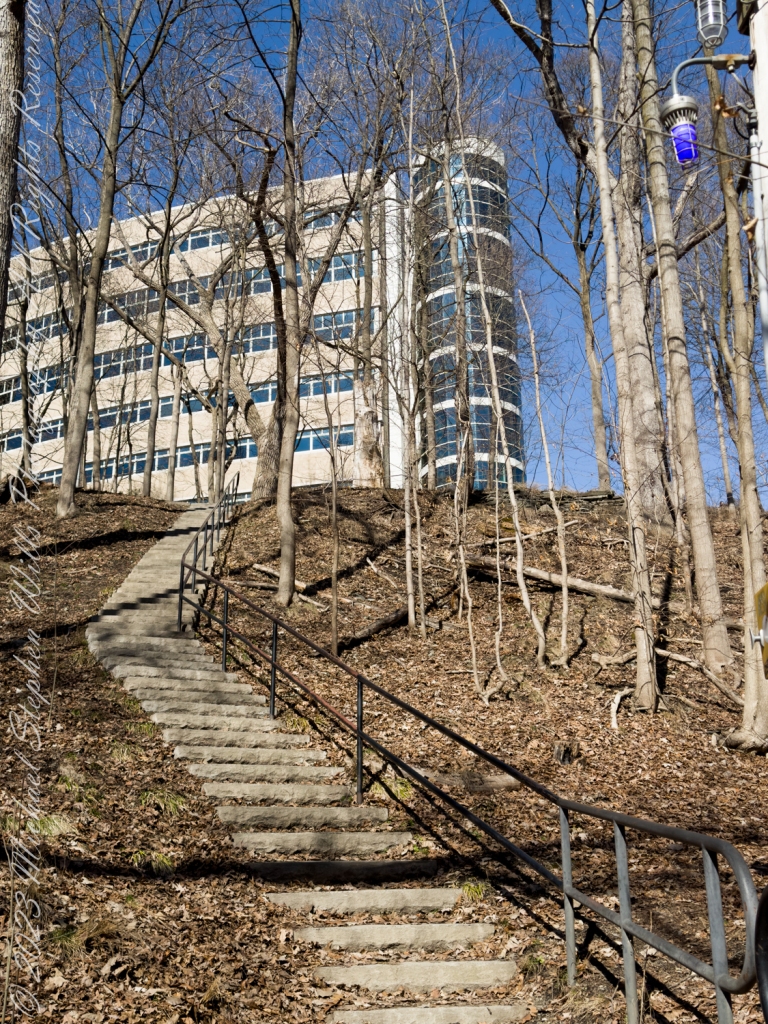
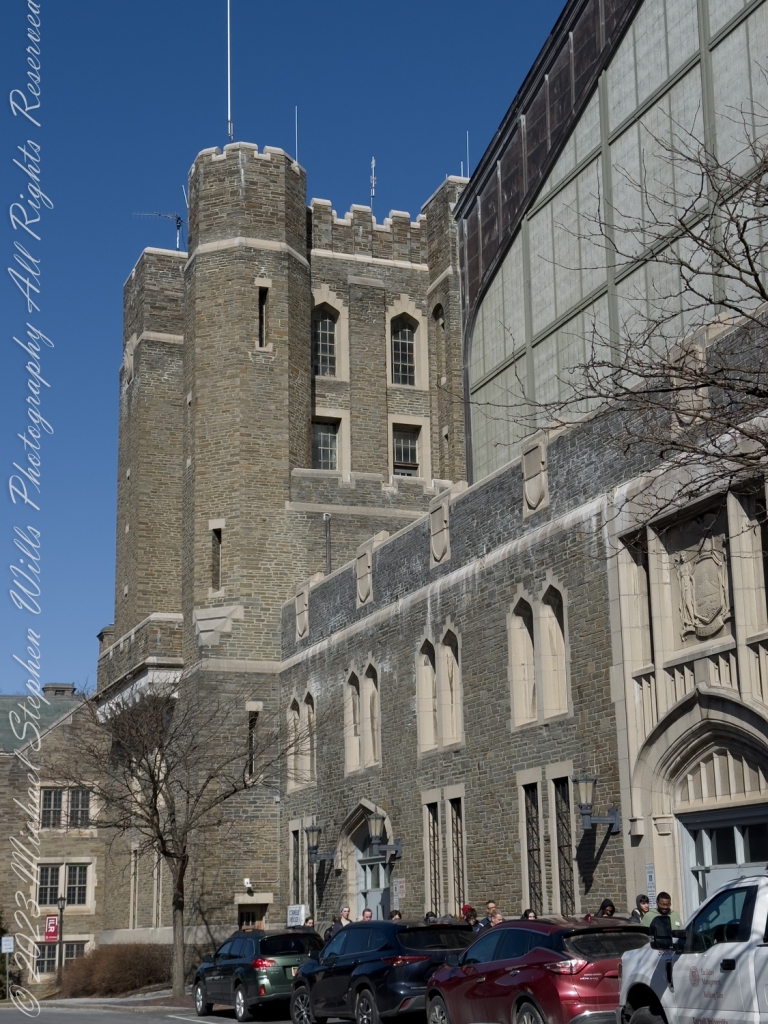
My path led me up flights of granite steps toward Myron Taylor Hall. As I climbed, I could feel the history and tradition of Cornell University enveloping me. The McGraw Tower bells chimed softly, adding a melodic backdrop to my ascent.

Steep steps leading from a parking lot off West Avenue to the Cornell Law School (Myron Taylor Hall).

Discovering “Magna Dancer”

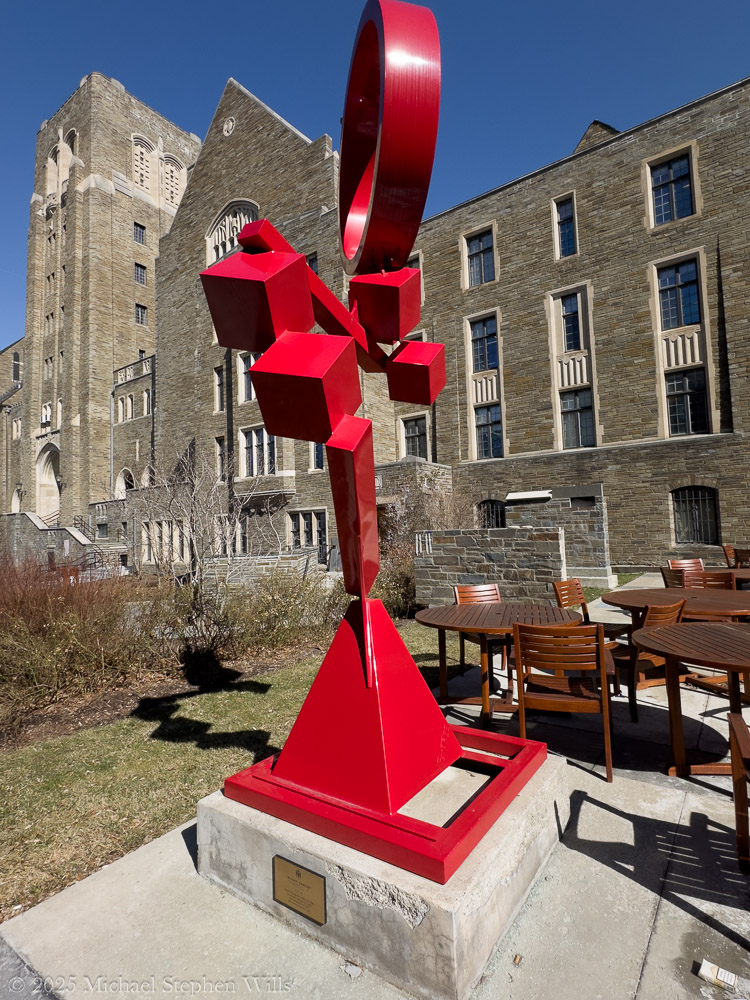
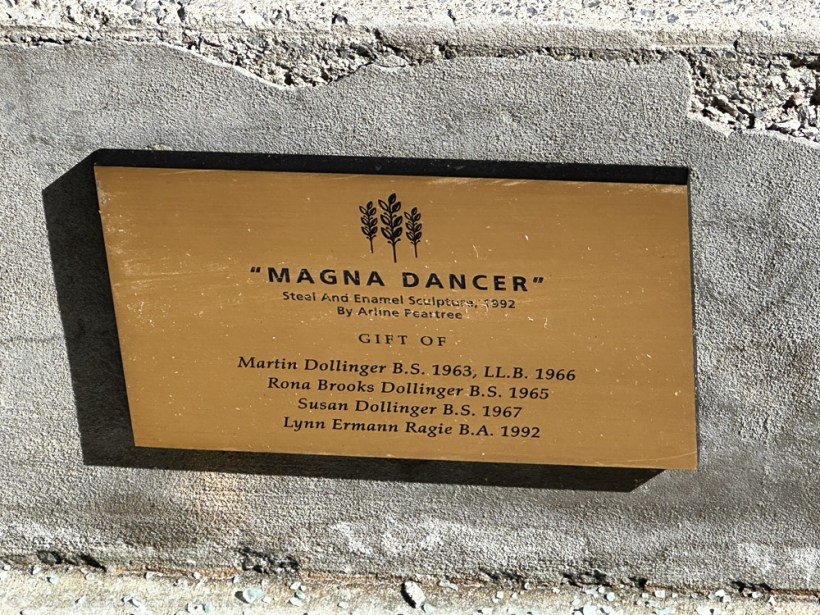
Reaching the top of the steps, I encountered, at the entrance to Hughes Hall museum, the striking “Magna Dancer” sculpture by Arline Peartree. Its bold red forms stood out vividly against the backdrop of the historic stone buildings. The plaque at the base provided a glimpse into its significance, commemorating the contributions of Cornell alumni. The sculpture’s dynamic lines and vibrant color injected a sense of modernity into the historic setting.

“Magna Dancer” steel and enamel sculpture, 1992 by Arline Peartree. Plaque on the sculpture plinth located outside Hughes Hall (behind Myron Taylor Hall – Cornell Law School), 241 Campus Road

Winter Buds and the Robinson Herb Garden

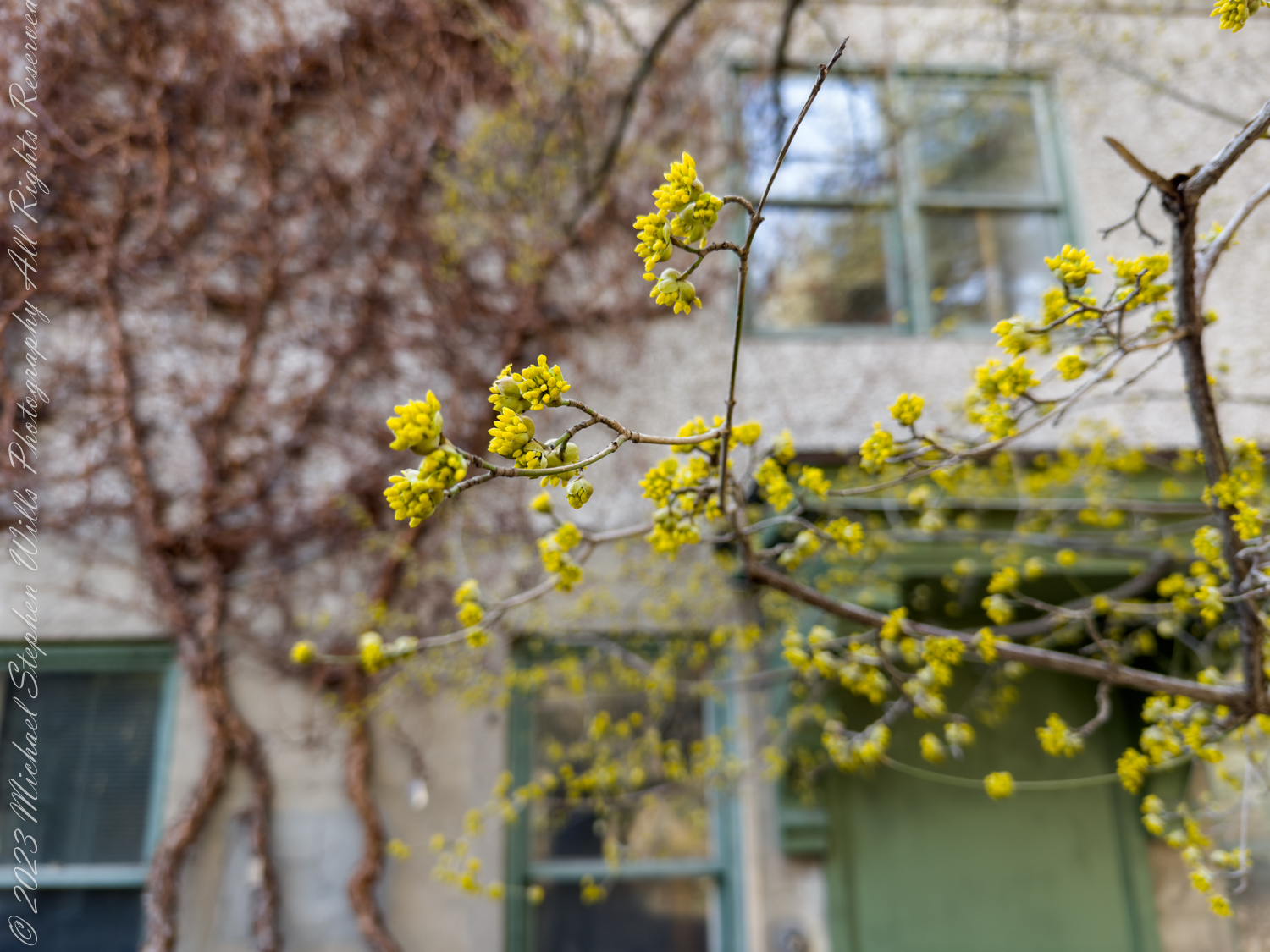
Here, I passed through the Robinson Herb Garden, where the late winter buds of a Cornelian Cherry Dogwood (Cornus mas) were beginning to unfurl. These bright yellow clusters heralded the arrival of spring, standing out against the bare branches and muted tones of the garden. It was a reminder of the cyclical nature of life and the resilience of the natural world.

The tree in the photograph with the yellow buds is a Cornelian Cherry Dogwood (Cornus mas). It is one of the first trees to bloom in late winter to early spring, producing clusters of small, bright yellow flowers before the leaves emerge. Cornelian Cherry Dogwood is often used in landscapes and gardens for its early bloom and attractive appearance. This tree grown in the Robinson Herb Garden, Cornell University

Mundy Wildflower Garden and Fall Creek

At Mundy Wildflower Garden, a hidden gem nestled beside Fall Creek, the landscape transformed into a tranquil haven, with the gentle sound of water flowing nearby. Though it was still early in the season, the promise of blooming wildflowers lingered in the air. The garden’s carefully maintained paths and rustic benches invited quiet contemplation.

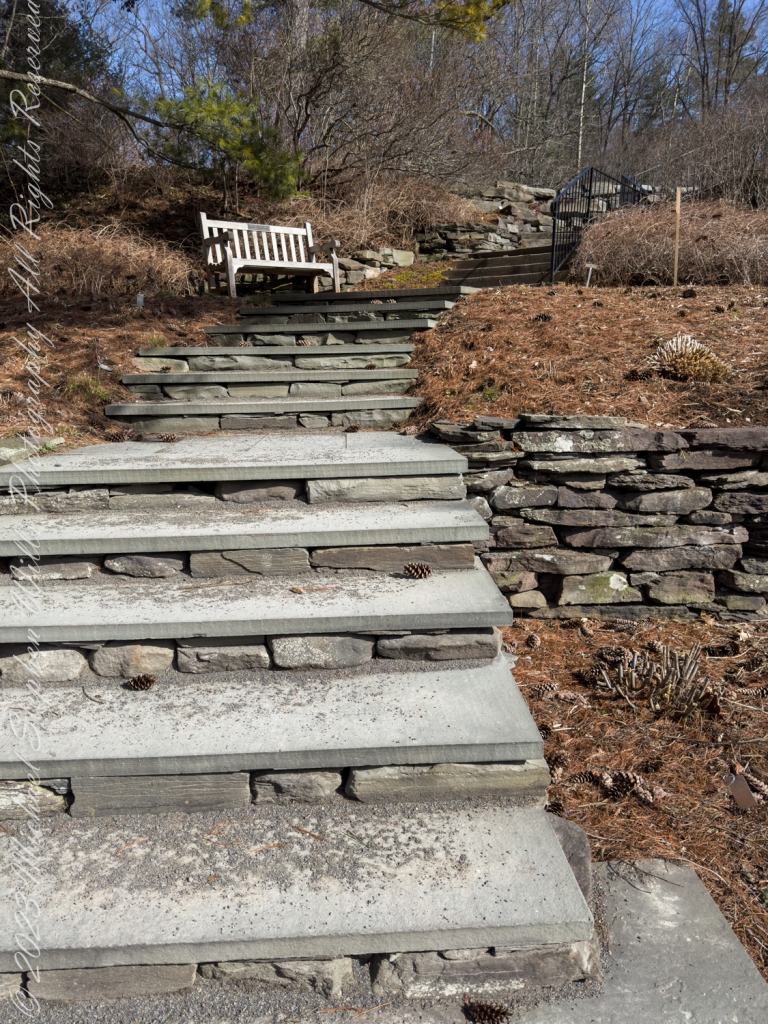
These steps lead from the Robison New York State Herb Garden to Judd Falls Road and the Mundy Wildflower Garden

Exploring the Common Ferns Display

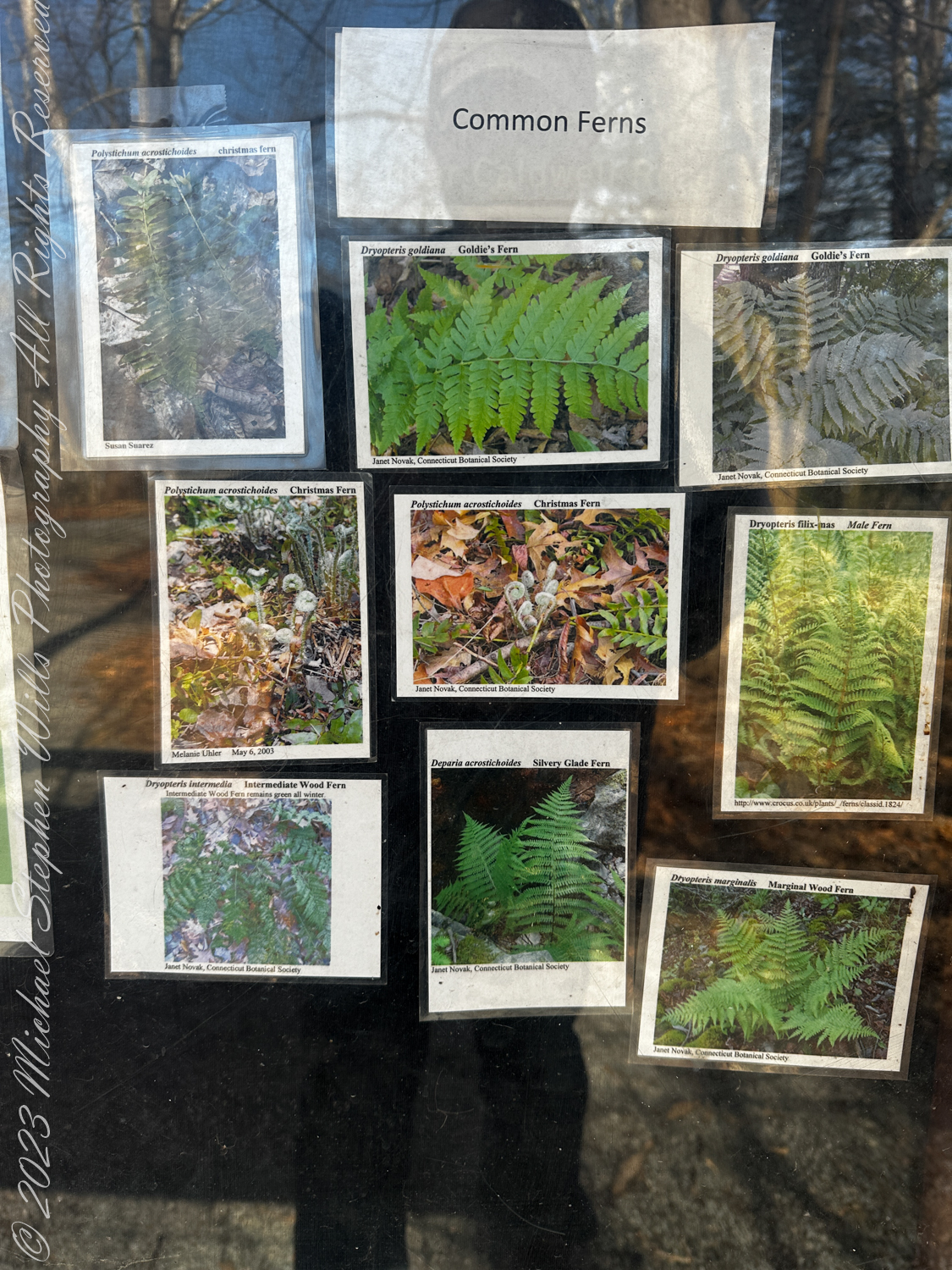
As I ventured further, I came across a display showcasing common ferns. The display included photographs and names of various ferns, such as the Christmas Fern (Polystichum acrostichoides) and Goldie’s Fern (Dryopteris goldiana). This educational exhibit was both informative and visually appealing, highlighting the diverse flora found on the campus.

Displayed on a display in the Mundy Wildflower Garden, part of Cornell (University) Botanical Gardens.

Observing the Weather Station

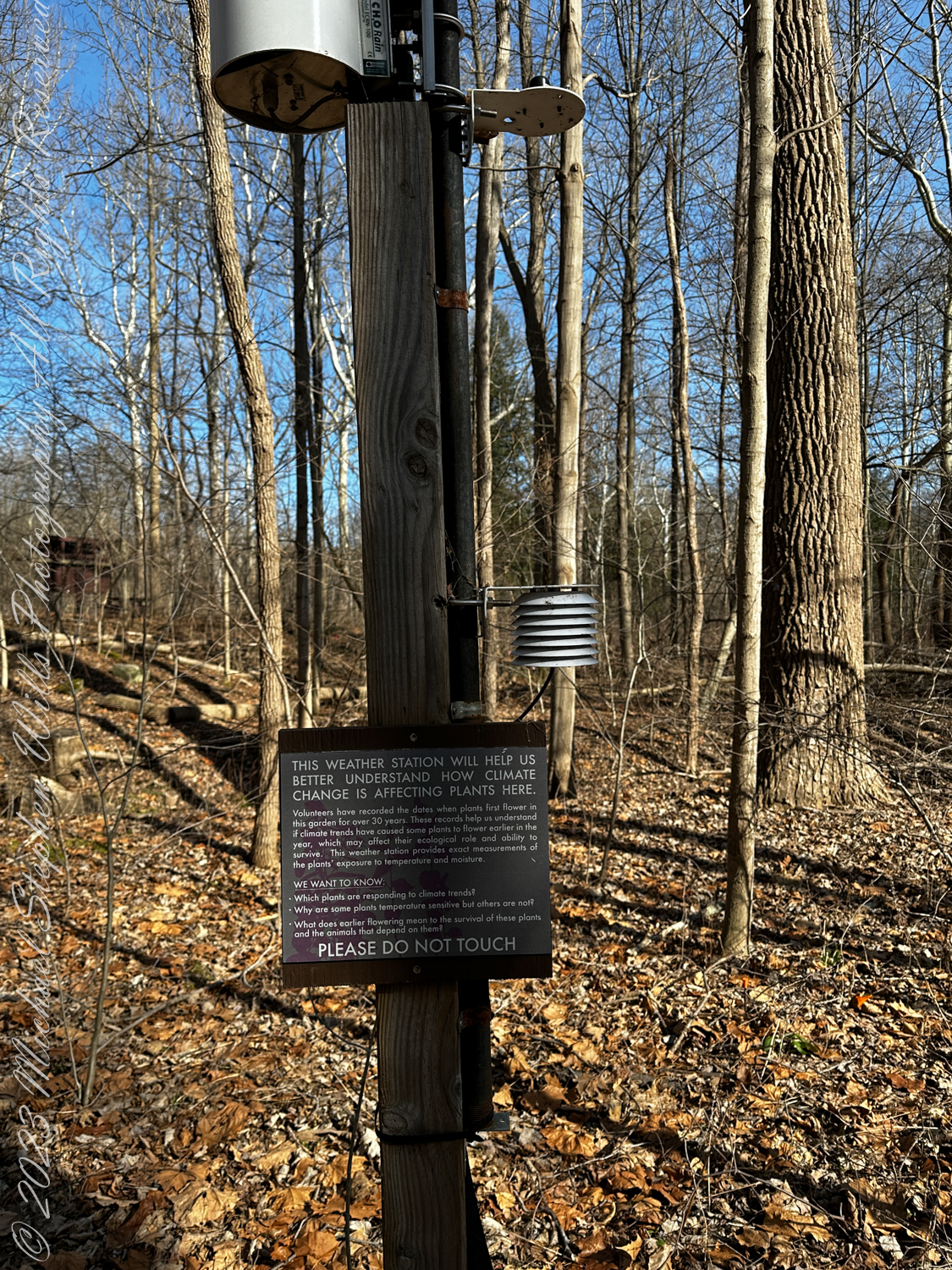
Nearby, a weather station stood tall, equipped with various sensors to monitor climate conditions. A sign explained its purpose: to help understand how climate change is affecting plants in the area. The data collected here would provide valuable insights into the phenological changes occurring within the garden.

Traversing the Slope to Olin Library

Returning, I made my way toward Olin Library. The path took me along a steep incline, “Lib Hill,” where I could see the stark branches of deciduous trees reaching toward the sky. The steps seemed to stretch endlessly upward, mirroring the journey of knowledge that students undertake within the library’s walls. The modern architecture of the library contrasted sharply with the surrounding natural landscape, symbolizing the intersection of nature and human achievement.

Approaching McGraw Tower

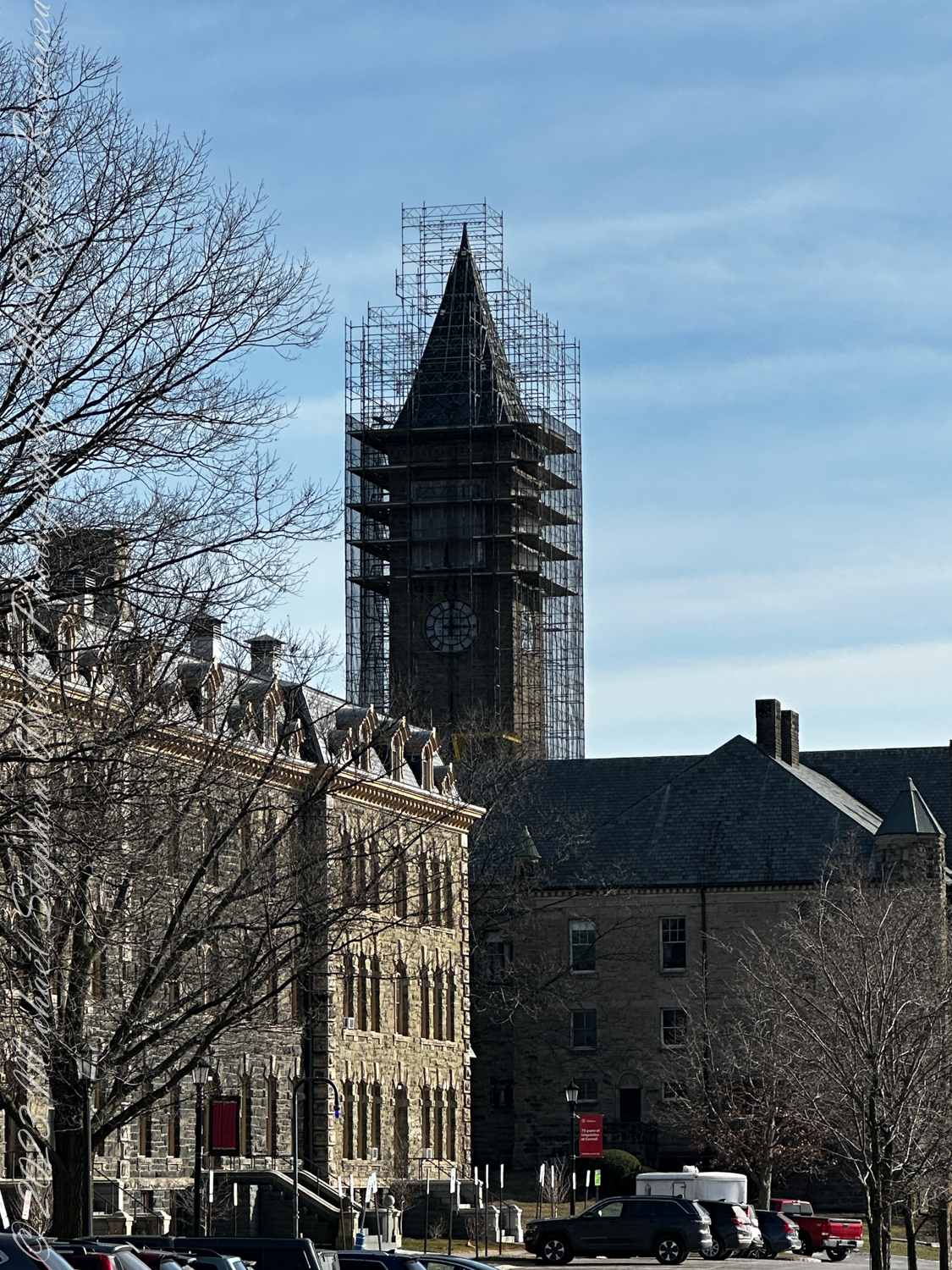
As I neared the heart of the campus, the McGraw Tower stood tall and prominent, albeit encased in scaffolding for restoration work. The historic building, with its distinctive clock face, was an emblem of Cornell’s rich heritage. Despite the scaffolding, the tower retained its majestic presence, a testament to the ongoing efforts to preserve its legacy.

This view is from Central Avenue. Morrill Hall is on the left. The tower is part of Uris Library. Cornell University, Ithaca, Tompkins County, New York State

Returning to Cascadilla Park Road

As descended the hill, following Cascadilla Creek, reflecting on the six mile journey, I felt a profound connection to the enduring beauty and resilience of both nature and human creativity. The walk had taken me through time and space, from historic landmarks to natural wonders, each step revealing a new facet of the Cornell University campus.

Reflecting on History

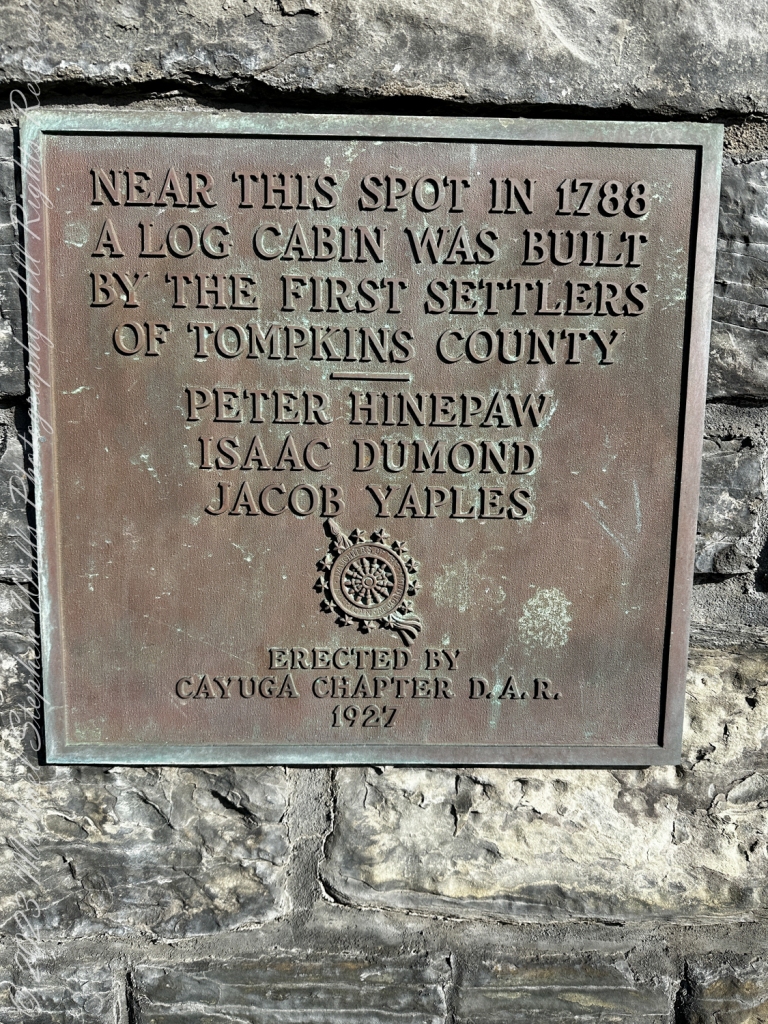
My walk took me past a plaque commemorating the site of the first settlers’ log cabin in Tompkins County, built in 1788. The plaque, erected by the Cayuga Chapter D.A.R. in 1927, was a poignant reminder of the area’s deep-rooted history and the pioneering spirit that shaped it.

This plaque on the corner of University Avenue and Cascadilla Park Road Road, “Near this spot in 1788 a log cabin was built by the first settlers of Tompkins County — Peter Hinepaw, Isaac Dumond, Jacob Yaples. Erected by Cayuga Chapter Daughters of the American Revolution 1927

This late winter walk, captured through my lens, was a celebration of the quiet splendor of the season and the enduring spirit of a place that thrives on discovery and growth.

Copyright 2024 Michael Stephen Wills All Rights Reserved

A Windy Winter’s Beach Morning

These videos capture a windy morning at Cocoa Beach, showcasing the American flag’s resilience and the beauty of nature.

The sun has barely risen over the horizon, casting a golden hue on the edges of the swaying palm trees. I’ve found my favorite spot on Cocoa Beach, where the sand meets the sea oats, and the Atlantic waves crash endlessly. It’s a windy winter’s morning, with the gusts howling, pulling at my shirt, tugging at the American flag standing tall amidst the dunes.

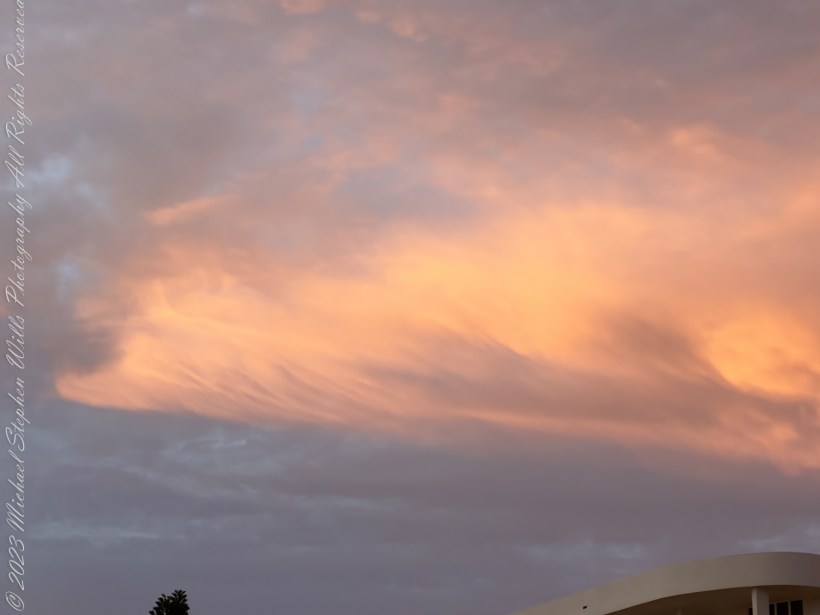
The early light of dawn illuminates clouds with a pink hue on a windy winter’s morning. Cocoa Beach, Brevard County, Florida. The Space Coast.

The flag is massive, its stars and stripes fluttering with conviction against the backdrop of an endless blue sky. Its red, white, and blue are a reminder of the freedom it represents. A symbol of history woven into every thread. In the wind, its fabric dances gracefully, in sync with the whispering leaves and the sea’s rhythm.

This particular flag has been around for years, steadfast on this patch of the Florida coast. The pole, firm and weathered, stands as a sentinel. It’s not just a symbol of patriotism but a beacon for those who wander these shores, a guiding point that has witnessed countless sunrises and sunsets, serving as a reminder of the ideals this country strives for.

Near the end of my video a squad of pelicans glides through, slicing the sky in a perfect formation. They using the wind to their advantage, and their synchronized flight is mesmerizing. Their journey is a testament to the beauty of nature’s choreography, moving with grace and purpose, guided by the same winds that ripple through the flag and carry them along the coast.

The wind is fierce today, blowing sand like fine snow across the beach. It stings my face as I watch the waves roar, driven by the same winds that make the flag soar. These are the south winds, warm and constant, flowing over the Atlantic. They pick up speed across the open waters before reaching the coast, shaping the dunes, bending the palm fronds, and reminding me of the unyielding force of nature.

The south wind is not just a whim of nature; it’s shaped by the currents that flow from the equator, by the rotation of the Earth, and by the heated lands further south. It’s nature’s breath, shifting sands and altering landscapes. This breeze carries with it a hint of salt, a whisper of the tropical climates from which it comes, and a false promise of more warmth on this winter morning.

There’s a certain serenity in being here, watching the elements play. The sea is restless, much like my thoughts. I can’t help but contemplate the forces that have shaped this land, from the explorers who first set foot here to the astronauts who launched themselves to the moon from just a few miles away. This place is steeped in history, and the flag embodies that.

As I look towards the flag again, its fabric shimmering under the sun’s rays, I think about all that it has seen. The gentle lapping of the waves reminds me of the constant change that’s part of life. The flag, though, is a steadfast sentinel, standing tall through it all, enduring the same winds and elements that buffeted it years ago. It speaks of resilience and hope, of standing tall no matter what comes your way.

I pull out my camera, capturing the flag as it flutters in the wind, its stripes rippling like waves on the sea. In a moment, I take a video, recording not just the flag but the beach around it, the sand swirling around my feet, creating transient patterns that the wind will soon erase. The video captures the essence of this place, where the wind and waves weave their own stories.

This morning, like so many before, the wind brings with it a sense of purpose. It whispers tales of the past and hints at the future, pushing me to continue exploring, to keep seeking, and to always remember what this place represents. The American flag, in its majestic flight, is more than fabric; it’s a reminder of the journey and the ideals that guide us, just like this wind pushing along the coast, unrelenting and full of promise.

Copyright 2024 Michael Stephen Wills All Rights Reserved

Saint Patrick’s Return to the Hill of Tara

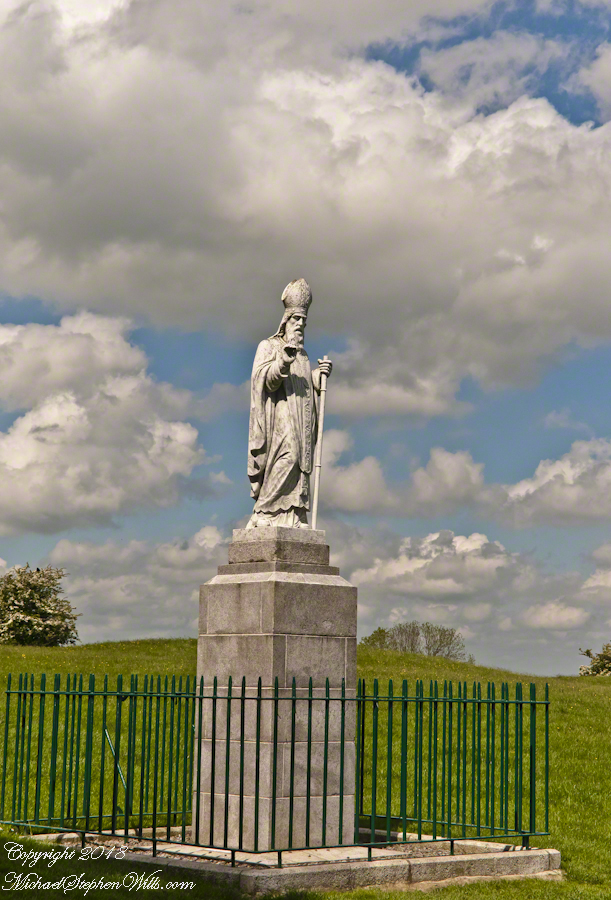
The year 2000 AD return of Saint Patrick to the Hill of Tara. Happy Saint Patrick’s Day

To continue my posting “Climb Hill of Tara” my first submission of three Hill of Tara photographs to Getty Istock had two of the photographs returned for revision.

A statue of Saint Patrick fittingly welcomes visitors to the Hill of Tara, County Meath, Ireland. This statue of cast concrete was an existing statue donated by the Sisters of Charity, moved from an existing installation to the Hill of Tara in the year 2000 AD. The creator is anonymous, the is no plaque or other attribution on or around the statue.

The original statue was erected on the summit of the Hill of Tara shortly after Catholic emancipation in 1829, commemorated the events of 433AD when St. Patrick lit a bonfire on the nearby hill of Slane on the eve of Easter Sunday.

Lighting such a fire was contrary to the pagan laws of the time which dictated that the first fire lit that night be in Tara. Observing St. Patrick’s bonfire from afar, the chief druid of the ancient Gaelic capital predicted that if the flame were not extinguished that night, Christianity would never be extinguished in Ireland.
The saint’s bonfire continued burning and the next morning, Easter Sunday, St. Patrick entered Tara to convert the king and his followers to Christianity.

For the fenced statue of Saint Patrick the revieweR wrote:

Please provide a full description for the work of art featured in this image. Include the artist, date of creation, location, etc. Works of art created by someone other than yourself must be free of copyright protection to be considered. If this work of art is indeed under copyright protection, a property release signed by the copyright holder will need to be provided.

Hmmmm….What I do while capturing a photograph of a statue is take photos of any plaque, sign, whatever to acquire the name of the creator, how it came to be there, community connections. There was nothing around the statue nor the very informative Office of Public Works placards at the entrance.  I was proud to submit the statue photograph, as it turned out so well, and hoped for the best.

Last week, I put in a query to Ireland’s Office of Public Works (OPW), the agency responsible for the Hill of Tara, and did not receive a response when, for other queries, they were helpful.  This Saturday and Monday mornings, several hours of internet research revealed this history.

The original statue was placed on Tara sometime after the 1829 Catholic emancipation.  It was molded concrete, created by Thomas Curry of Navan at his own expense to honor the connection of Saint Patrick to Tara.

The OPW removed Curry’s statue 1992 for repair of a century of wear.  During the removal the statue was damaged beyond repair and, afterwards, was further damaged by vandals who decapitated and used it for target practice.

Initially, the OWP decided not to replace Saint Patrick citing the “pagan” nature of the place. After an angry meeting of local people at the Skryne Parish Hall.  In this meeting the local Rathfeigh Historical Society formed the “Committee to Restore St. Patrick to Tara.”  In turn, pressure was put on Michael D. Higgins, Minister for Arts, Culture and the Gaeltacht (and the OPW). It was decided a new statue was to be created, based on a competition, and instead of it former place at the hill summit (called Rath na Rí), it was to be near the entrance, outside the Interpretative Center, to offer a Céad Míle Fáilte to visitors and be seen on departure.

The outcome was the competition winner was rejected by locals.  The winning entry, by sculptor Annette Hennessy, did not follow competition rules that specified the statue incorporate traditional features to include shamrocks, harp, miter, a crozier and, perhaps, fleeing snakes. Hennessy’s design was of a shaven headed teenage boy in a short (“mini-skirt”) kilt, a handbag-shaped bell in hand.  She agreed hers was “not a traditional style statue” saying it “acknowledges our Pagan Celtic history.”

The rejection included a statement from Dr. Leo Curran, chairman of the Rathfeigh Historical Society, “We agreed that most of the monuments in Tara are from the pre-Christian era, but St. Patrick should be at the uppermost layer, representing Christian tradition extinguishing paganism.”

By this time, a new government and minister were in place.  The decision was made to search Ireland to find a suitable, existing, replacement statue.  By 2000 the present statue, donated by the Sisters of Charity, was in place at the Hill of Tara entrance.

At the end of this post I provide the two references from my internet research and from which many facts and all the quotes were used here.  I concluded the statue author was anonymous without copyright protection and submitted a revised image description, attaching a copy of my research.

What happened to my IStock photograph of Saint Patrick on the Hill of Tara? Getty accepted my application, published the photo and it is one of my top downloads, and earners.

Please browse my reasonably priced stock photography.  License a photograph, download and use it for your website or blog.  Click this link to browse all my Getty IStock Photography offerings.

Or click this link or any photograph or this link to select a print with custom framing from my “Ireland” Fine Art Gallery.

References :
“Should St Patrick stand again on Tara?” Independent, Dublin, Ireland March 17, 1999.
“Statue of Saint Patrick”, Meath Roots web site. The page includes photograph of the Thomas Curry statue.

Copyright 2024 Michael Stephen Wills All Rights Reserved

On the Road to Killen

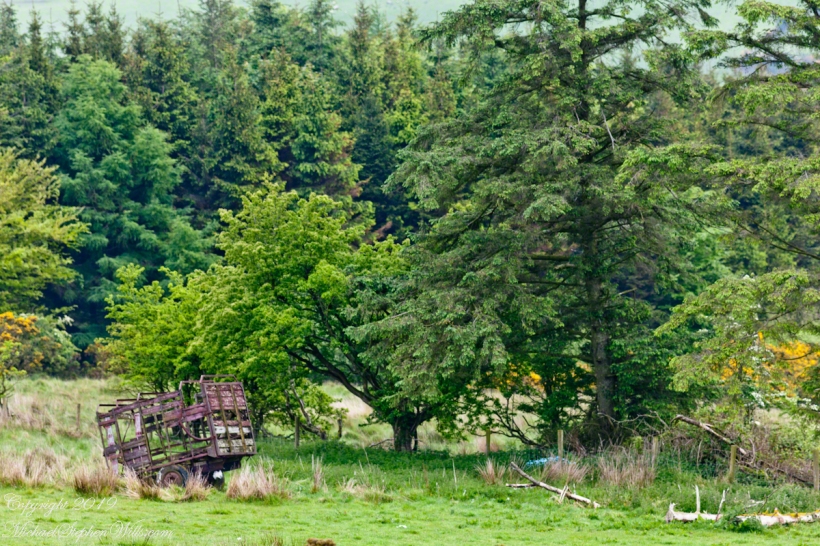
In the early dawn, I walked the path to Killen, drawn by the legacy of my mother’s Irish youth. An abandoned hay wagon stood, a relic amidst the whispers of history and myth. Join me in uncovering the roots that intertwine family and the enduring Irish land.

Continue reading “On the Road to Killen”

War Memorial with Sunbeams

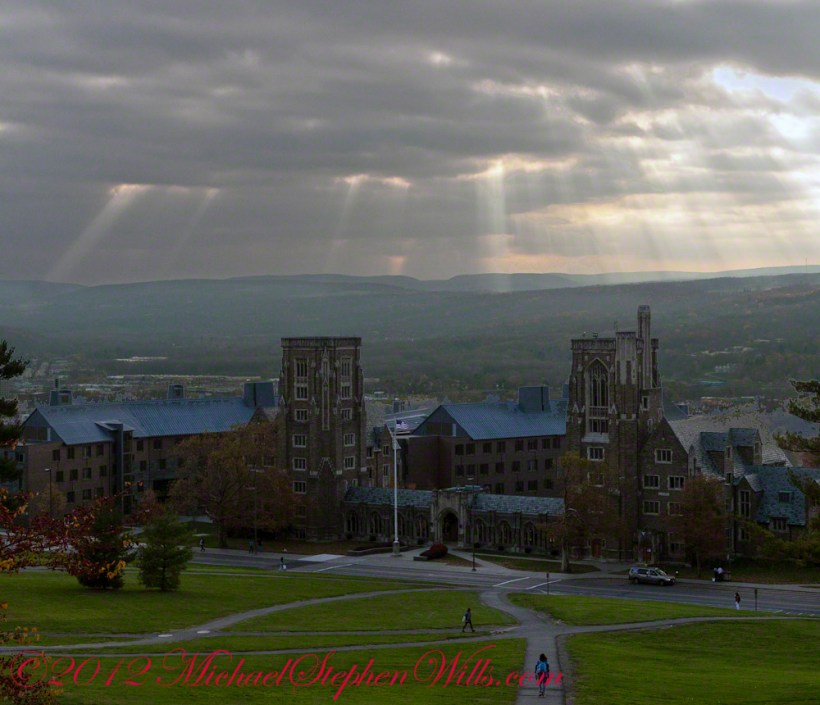
Come into my blog for the approach of hurricane Sandy and remembrance of Cornell University’s war casualties.

Continue reading “War Memorial with Sunbeams”

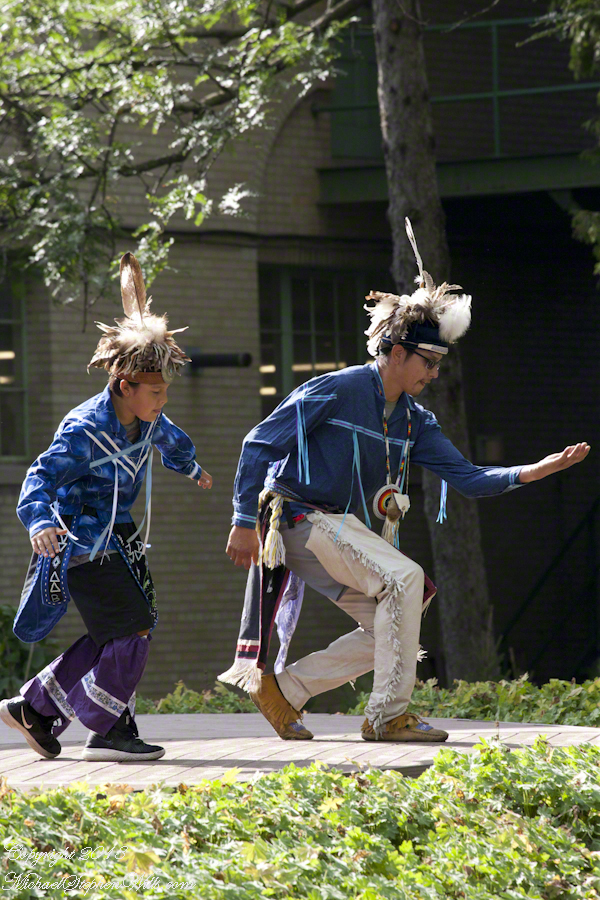
Native American Dance Demonstration

A native American village among the crowds

Continue reading “Native American Dance Demonstration”

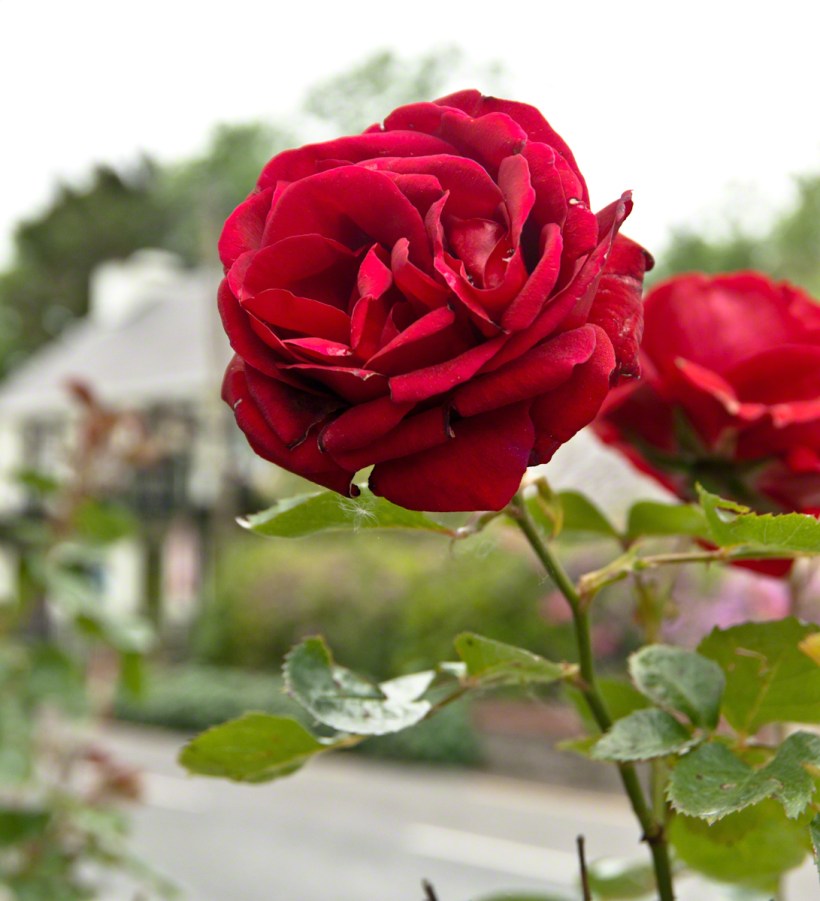
Rose of Castlemaine

Beauty and History on the Maine River

Continue reading “Rose of Castlemaine”