Exploring Malloryville Preserve: A Hidden Glacial Wetland Gem in New York’s Finger Lakes

Explore the O.D. von Engeln Preserve at Malloryville, a hidden Finger Lakes wetland where glacial eskers, kettles, and springs reveal the deep story of ice and water.

In the heart of upstate New York, the Finger Lakes region stretches out like a handprint left by the last great ice sheets—long, narrow lakes aligned north to south, their steep-sided valleys feeding into a lattice of creeks, waterfalls, and wetlands. It is a landscape defined by water and time: glaciers grinding south, then melting back north some 12,000 years ago, carving deep troughs, piling up ridges of gravel and sand, and leaving behind a terrain that is anything but simple.

The O.D. von Engeln Preserve at Malloryville, near the small village of Freeville, is one of the quiet places where that story is written most clearly on the land. It doesn’t shout like Taughannock Falls or Ithaca’s famous gorges. Instead, it whispers—through the curves of its hills, the softness of its ground, the unexpected appearance of a spring at the base of a gravel ridge. Here, in a relatively compact area, you can see how ice and water worked together to shape the Finger Lakes region we know today.

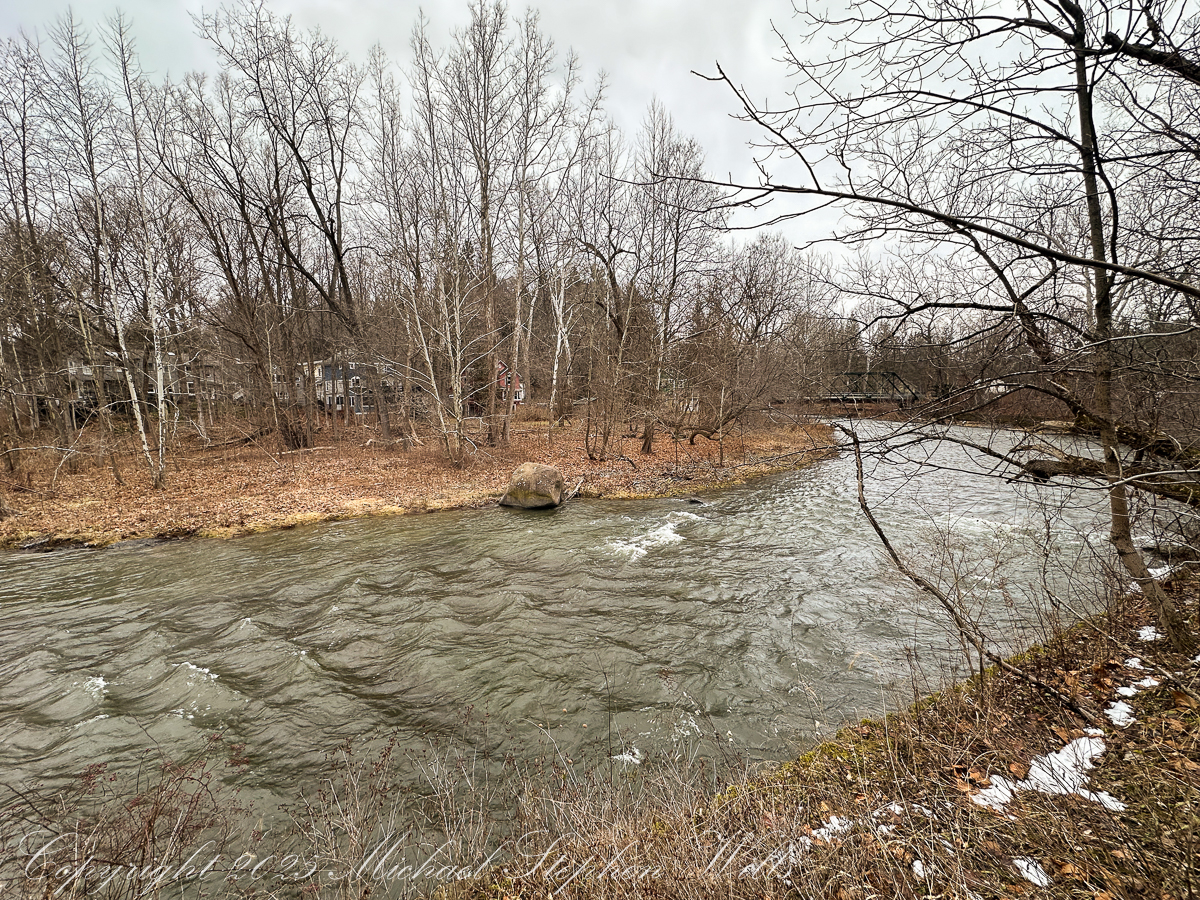
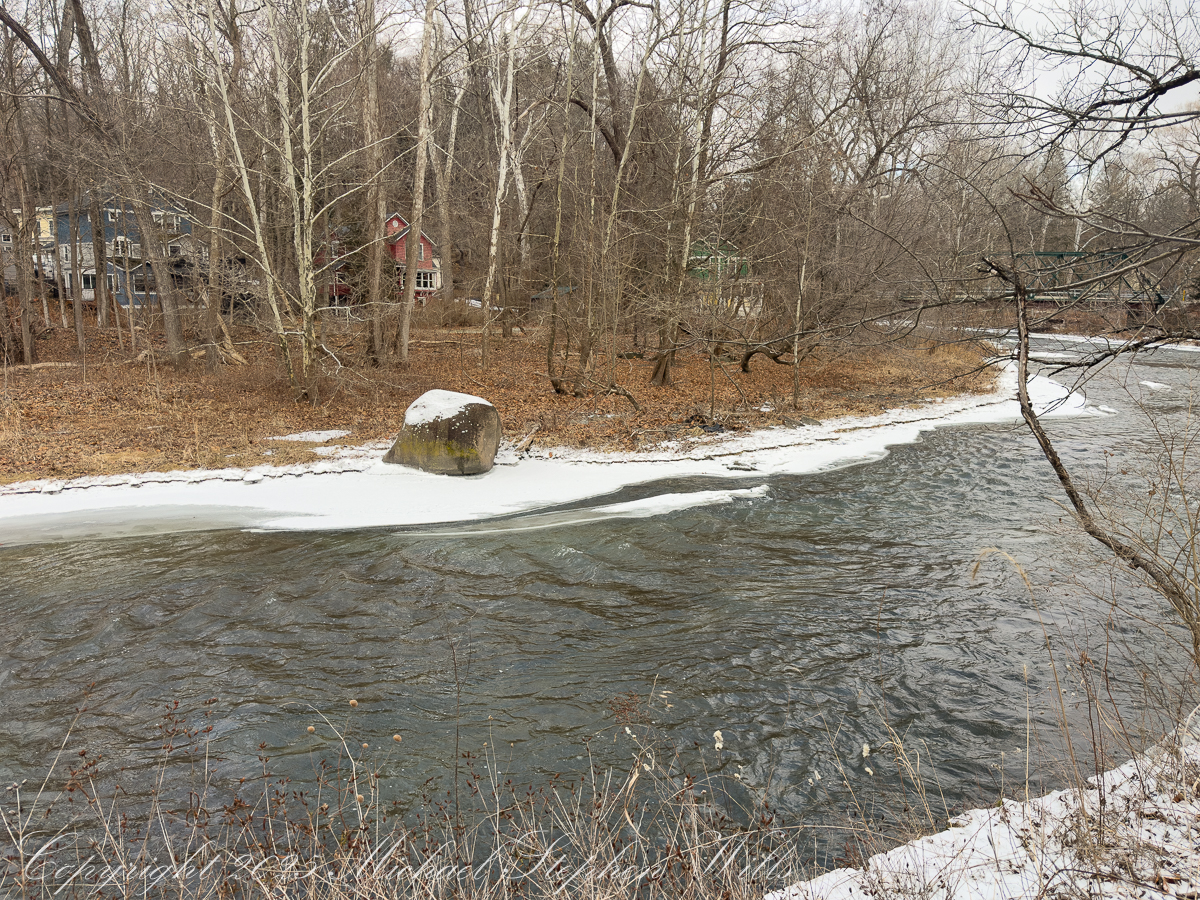
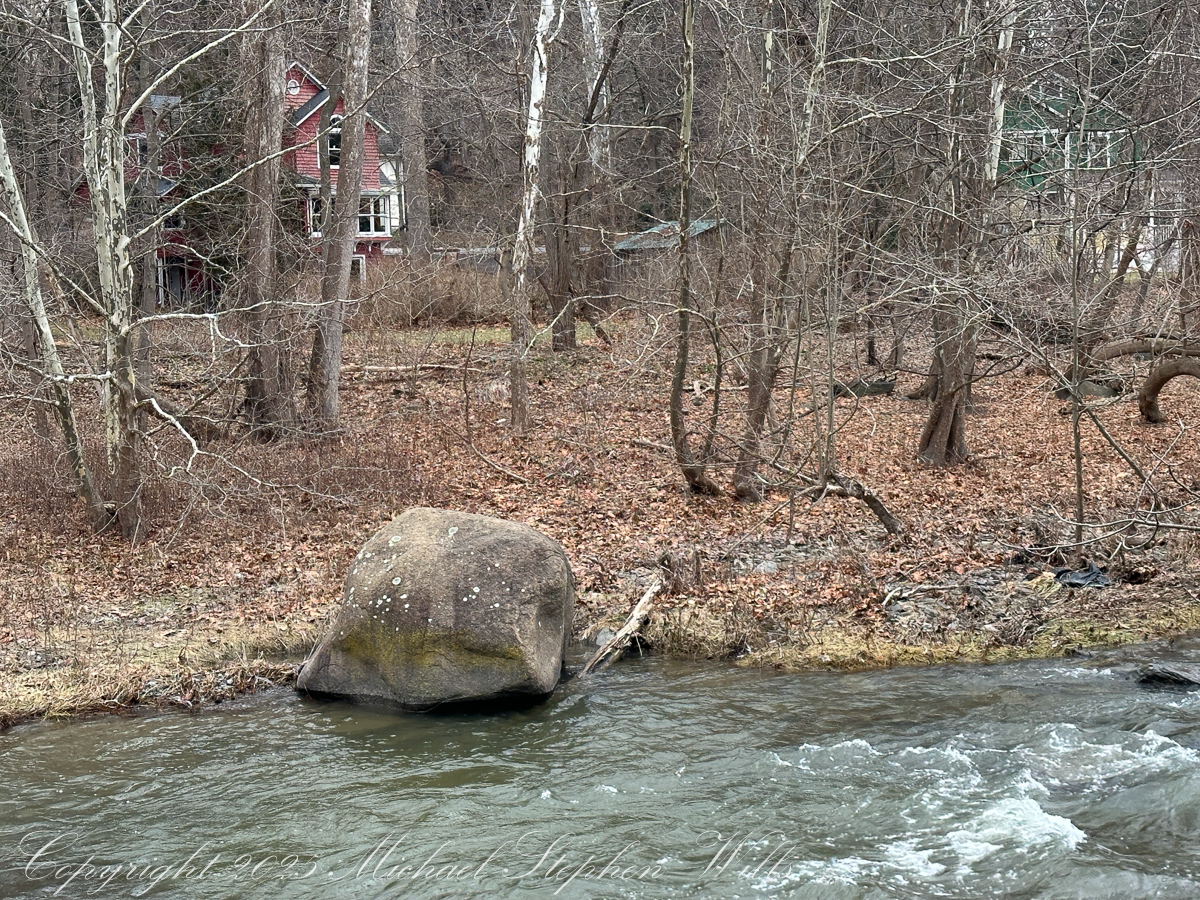
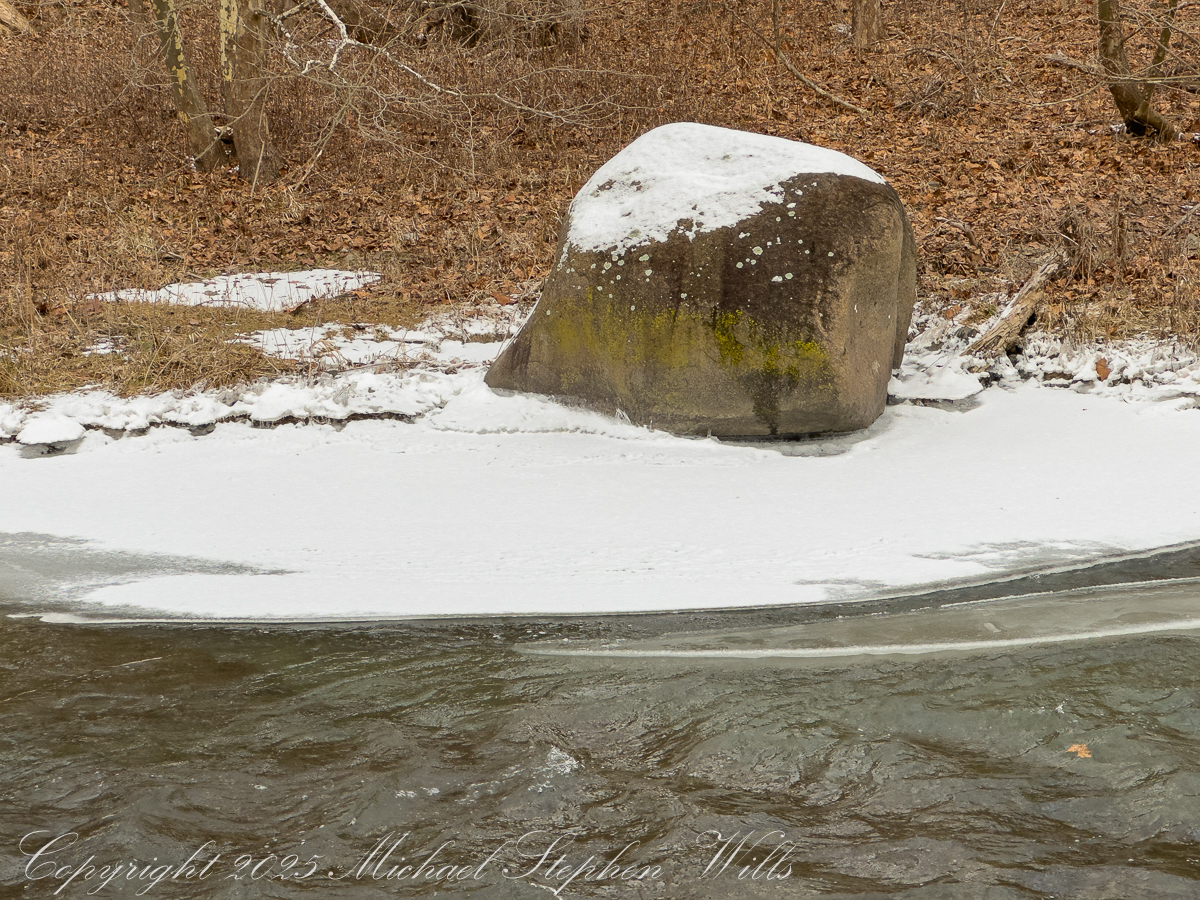
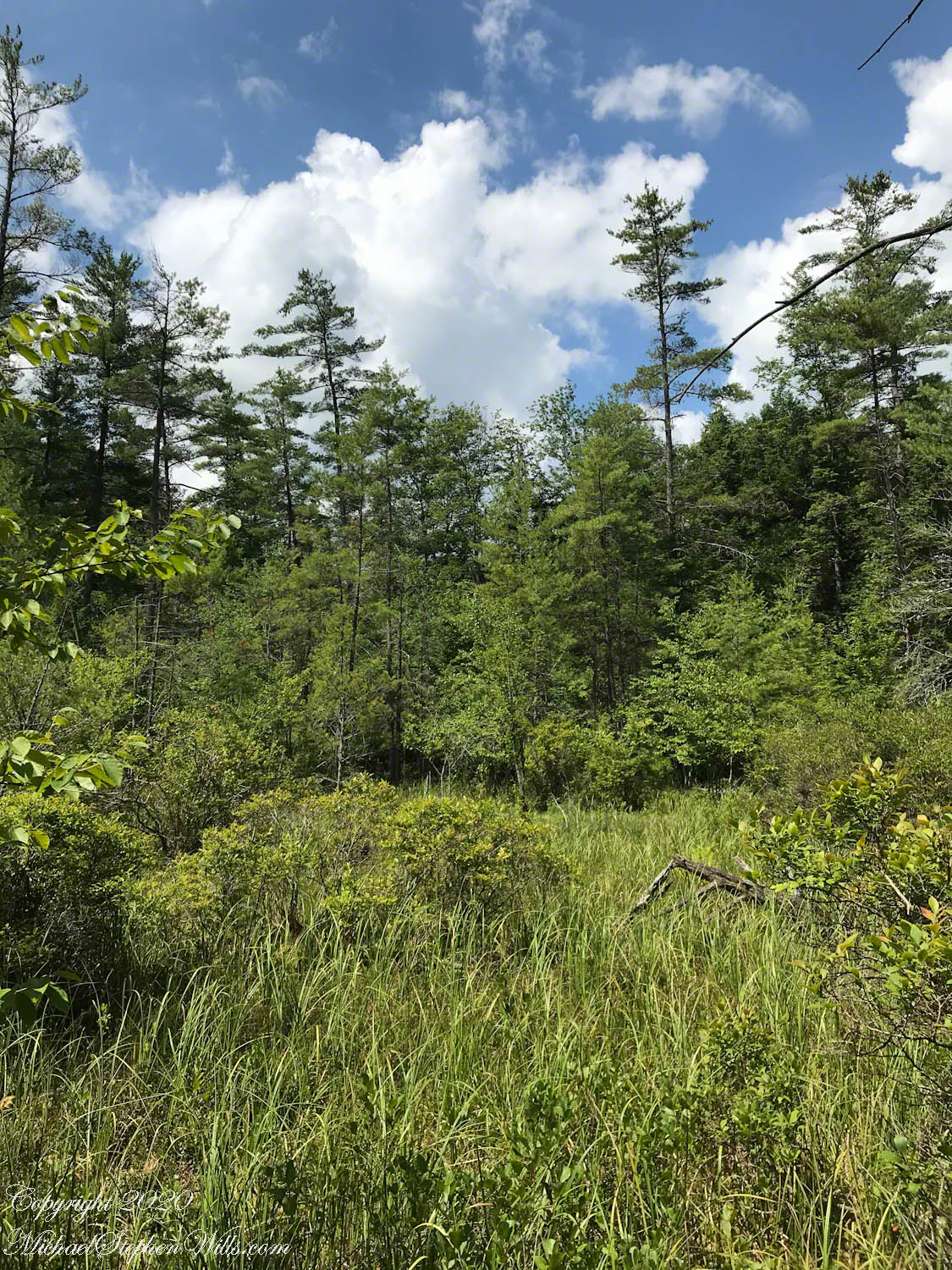
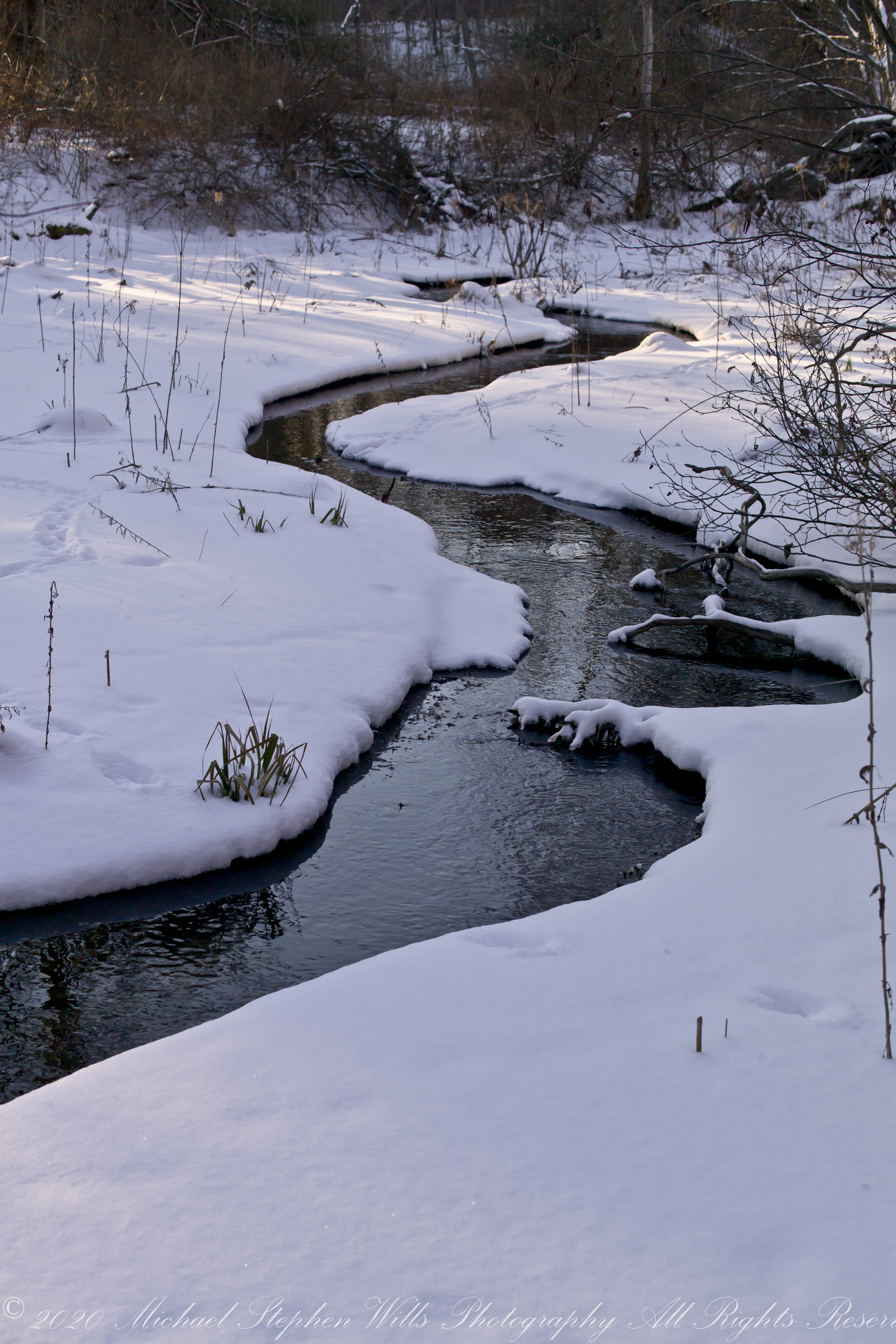
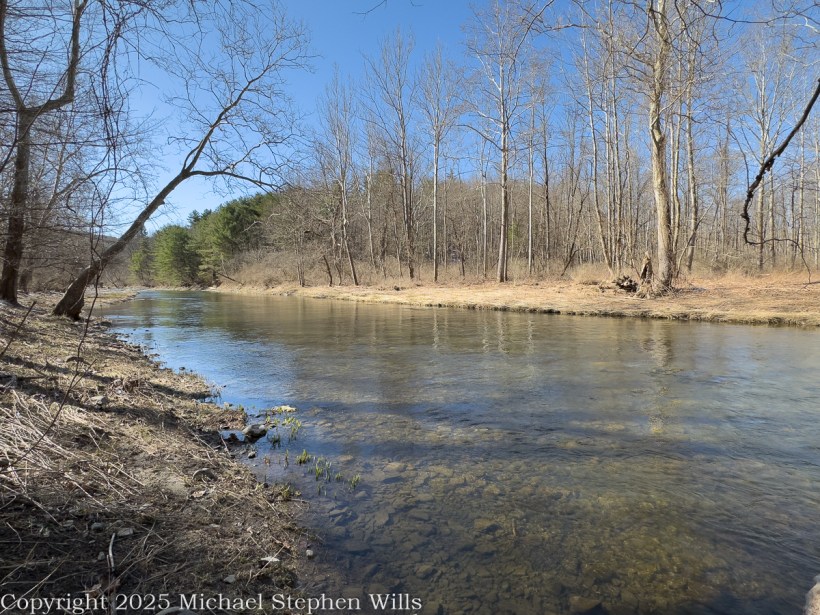
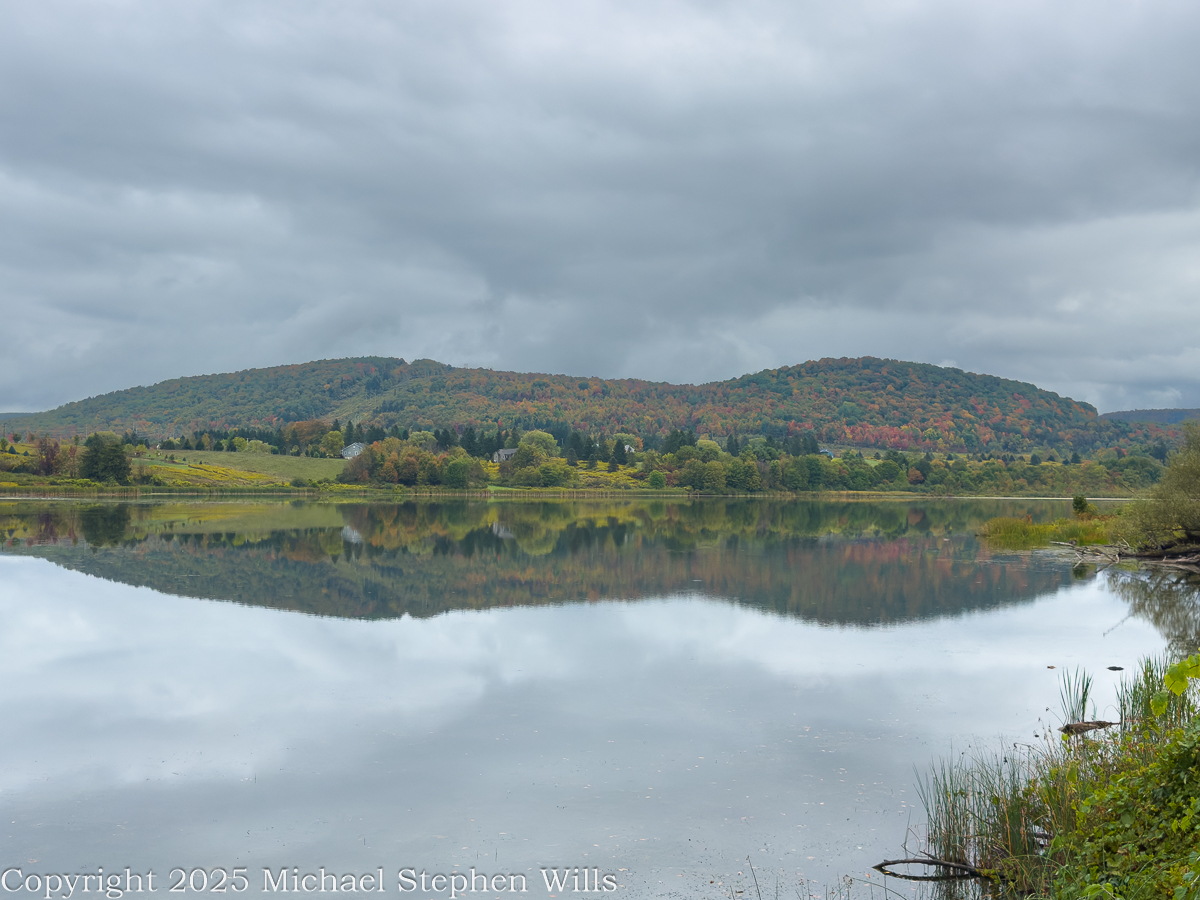
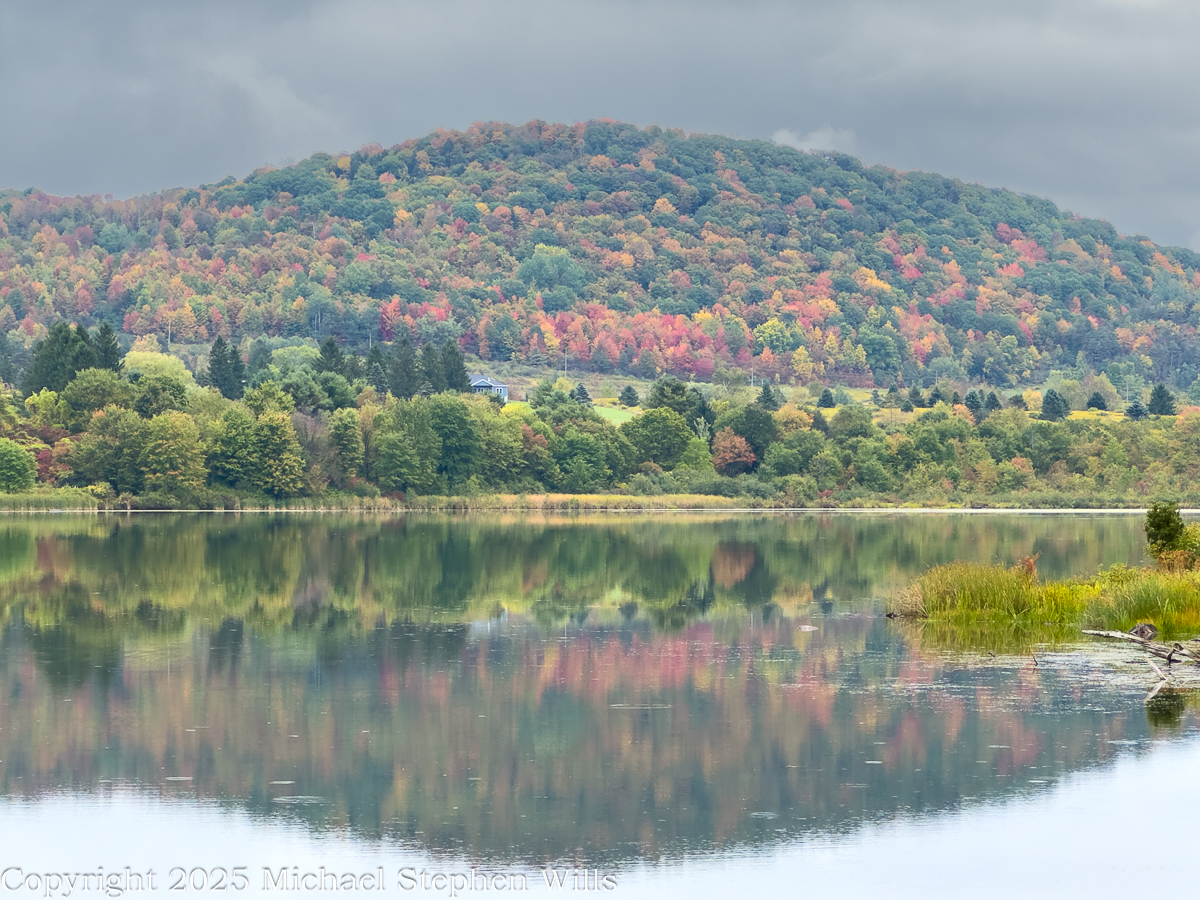
Overflow from a Kettle Pond threads through a meadow before feeding Fall Creek. The O.D.von Engeln Preserve at Malloryville.

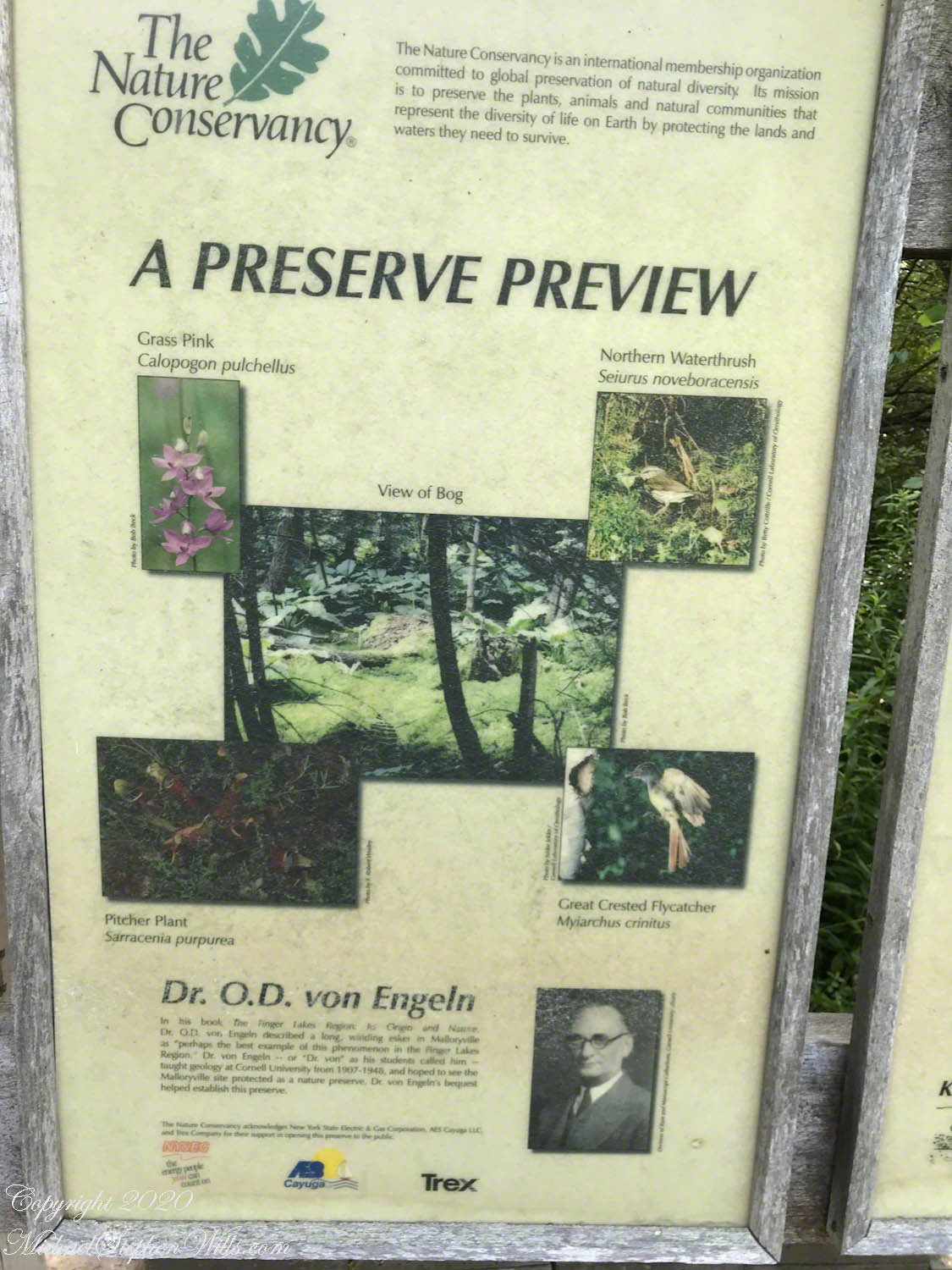
By the time the preserve officially opened in 1997, the name O.D. von Engeln was already familiar to anyone curious about local geology. His classic book on the Finger Lakes helped generations of readers understand that the scenery around them was not random, but the result of powerful, understandable processes. Reading von Engeln, the rolling hills and quiet valleys near Freeville become more than background—they become evidence: of buried ice, rushing meltwater, and the slow settling of sediments into the forms we walk on now.

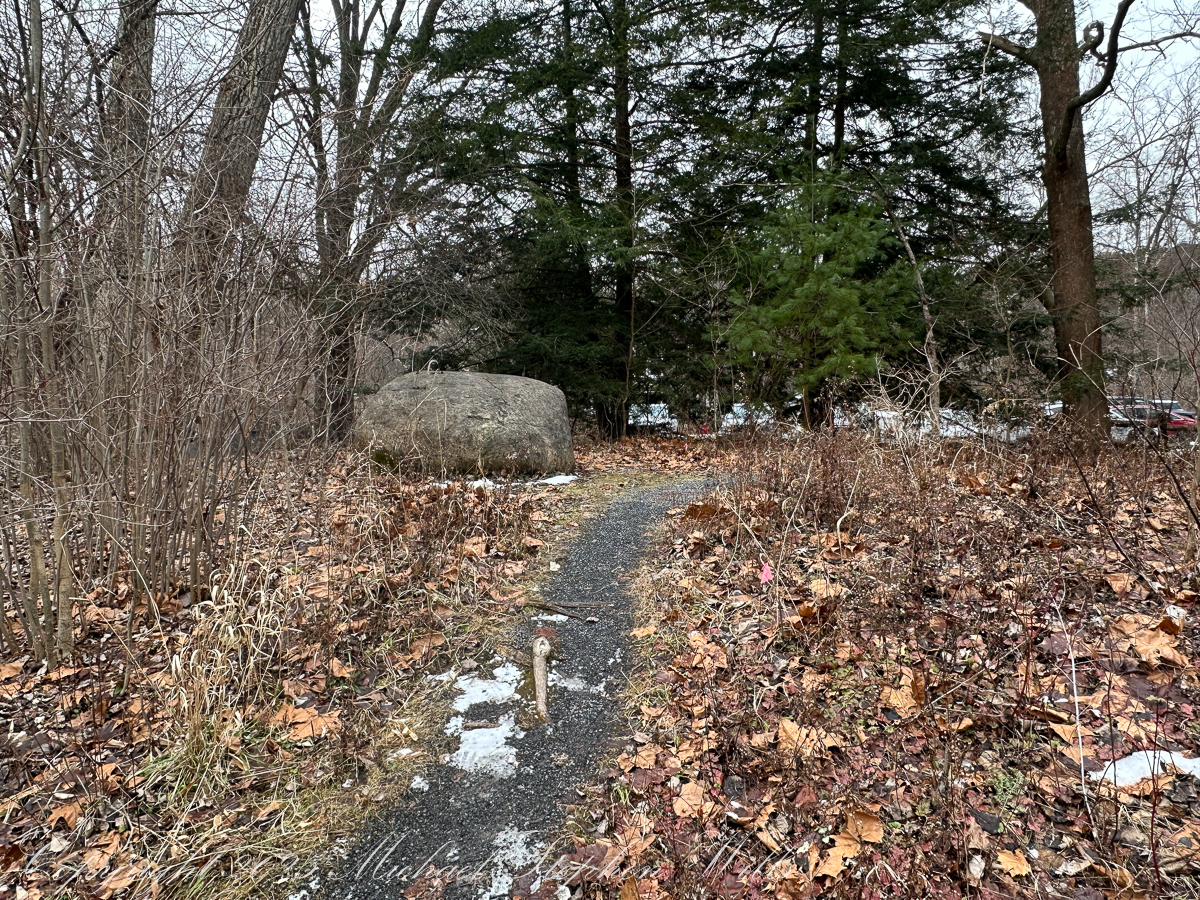
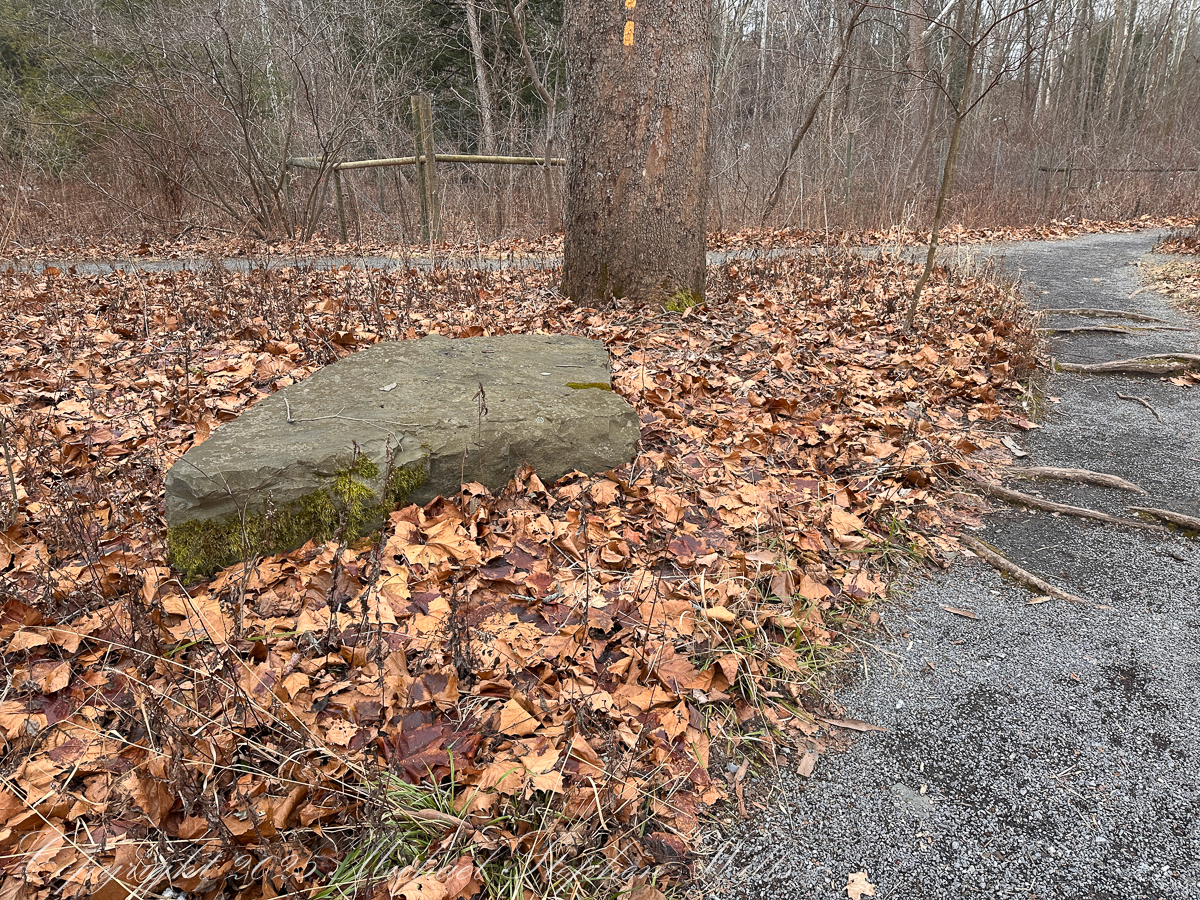
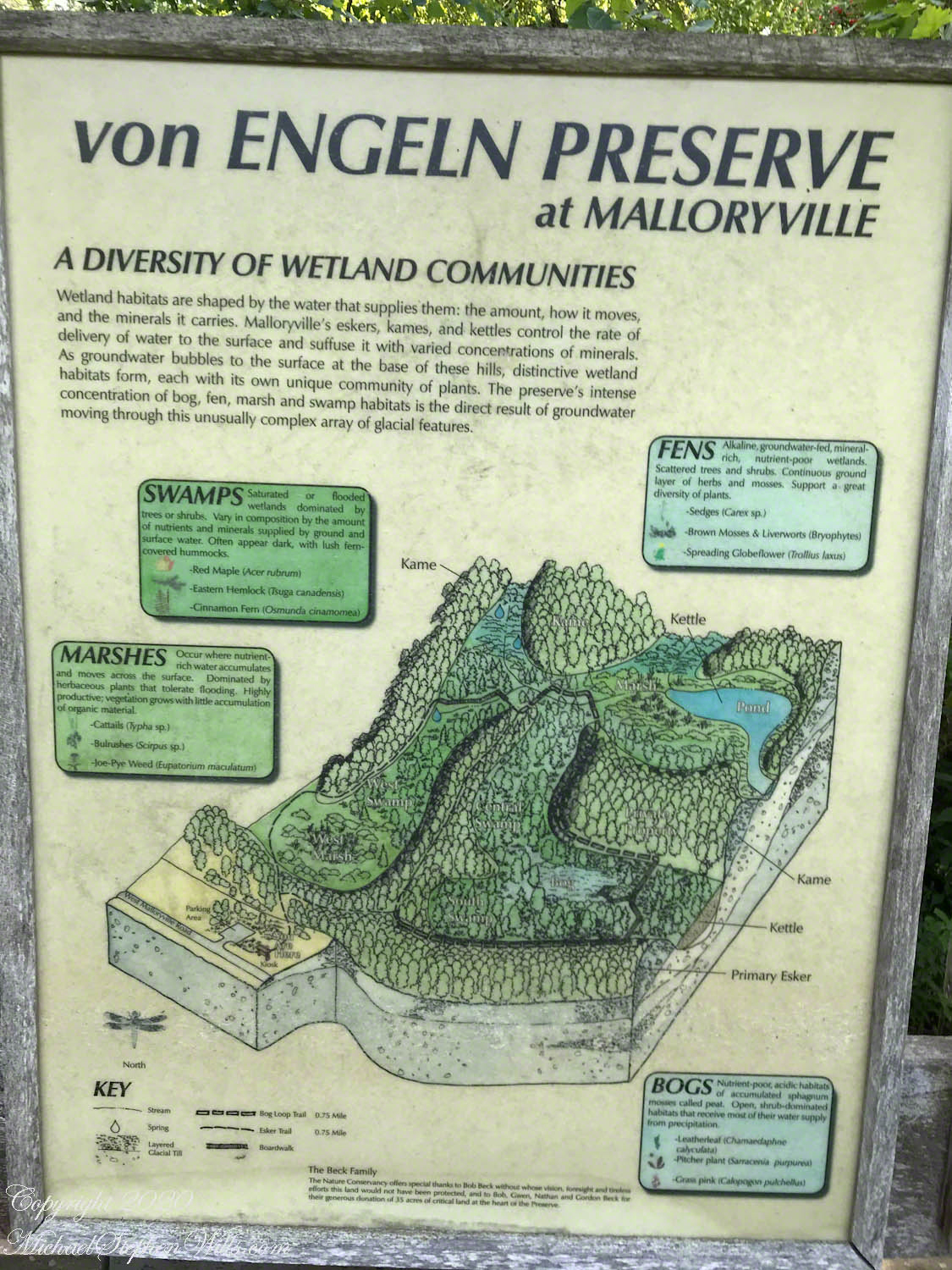
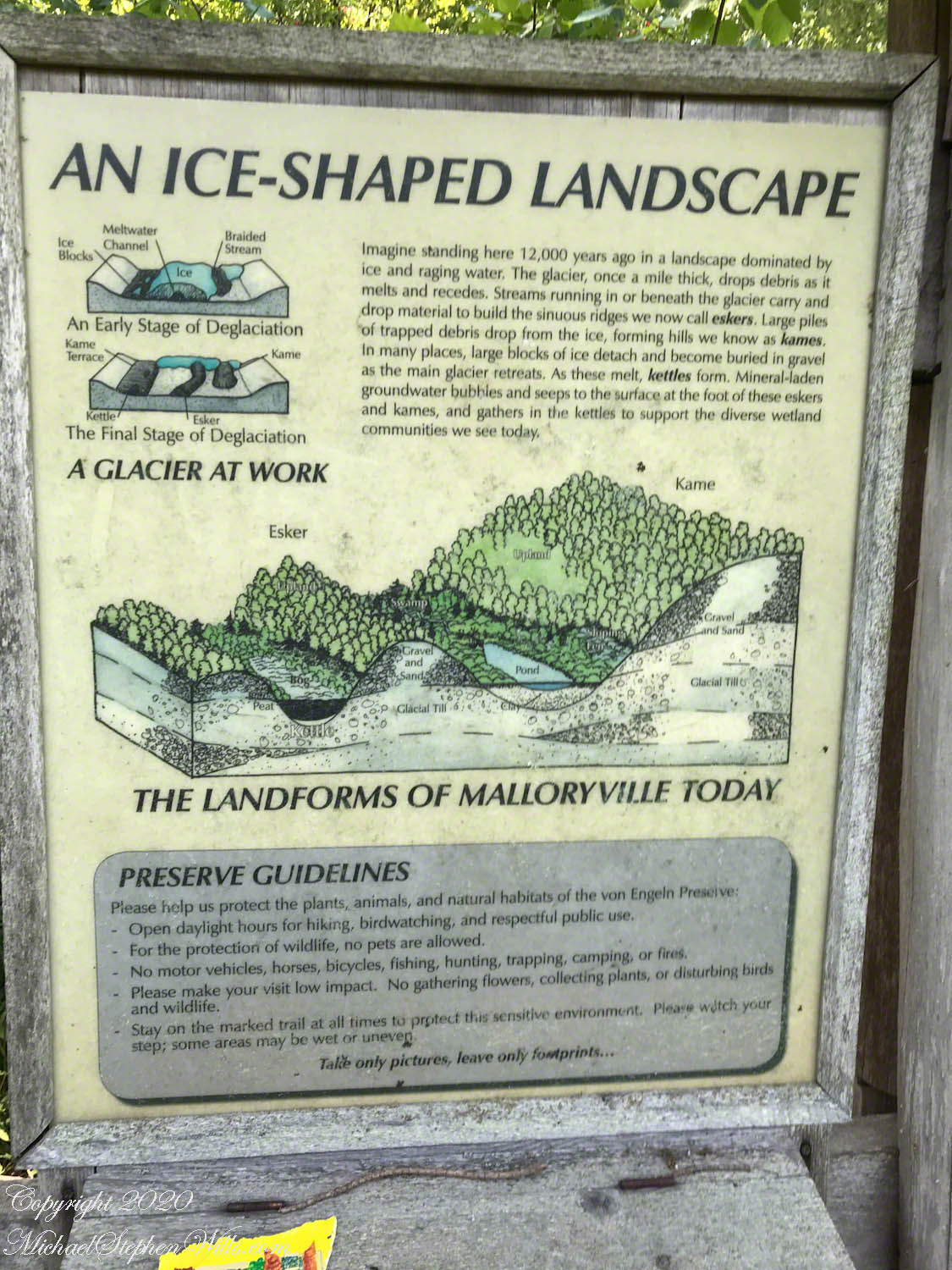
Malloryville is an outdoor classroom for that lesson. The preserve is built around a cluster of glacial landforms—eskers, kames, and kettles—that create a three-dimensional mosaic of ridges and hollows. Eskers, those long, winding gravel ridges left by rivers that once flowed inside the glacier, snake through the forest like frozen currents of stone. Kames—steep, irregular hills of sand and gravel—rise suddenly from the surrounding lowlands. Kettles, the depressions left behind when buried ice blocks melted away, now cradle wetlands and pools.

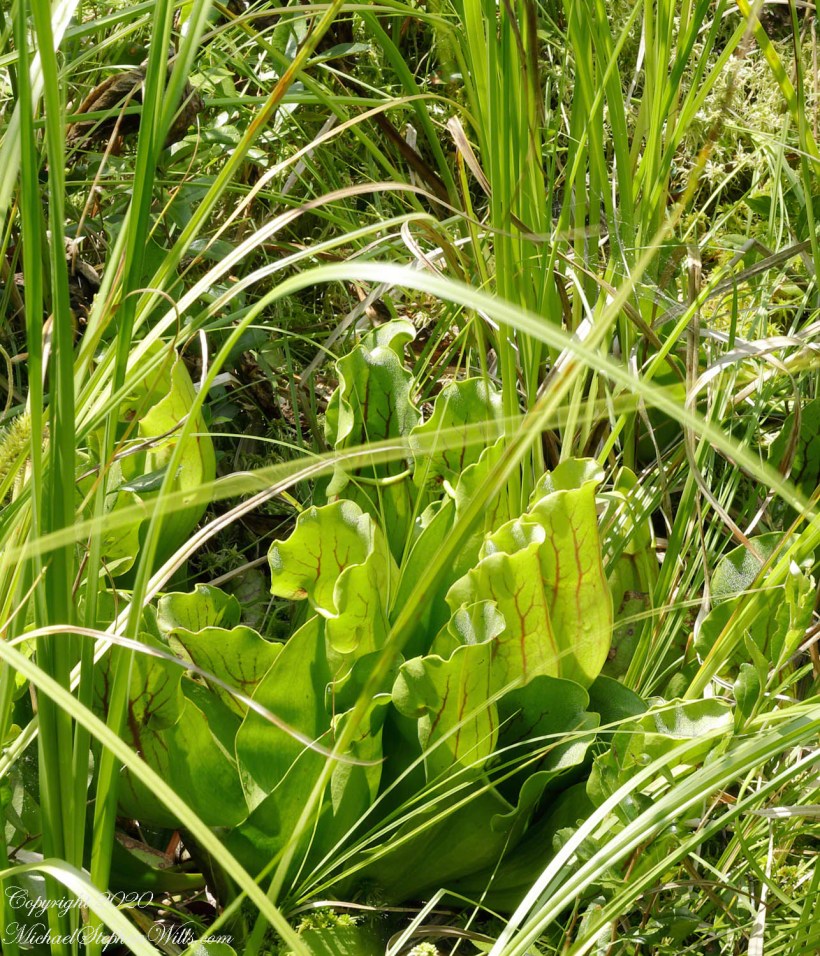
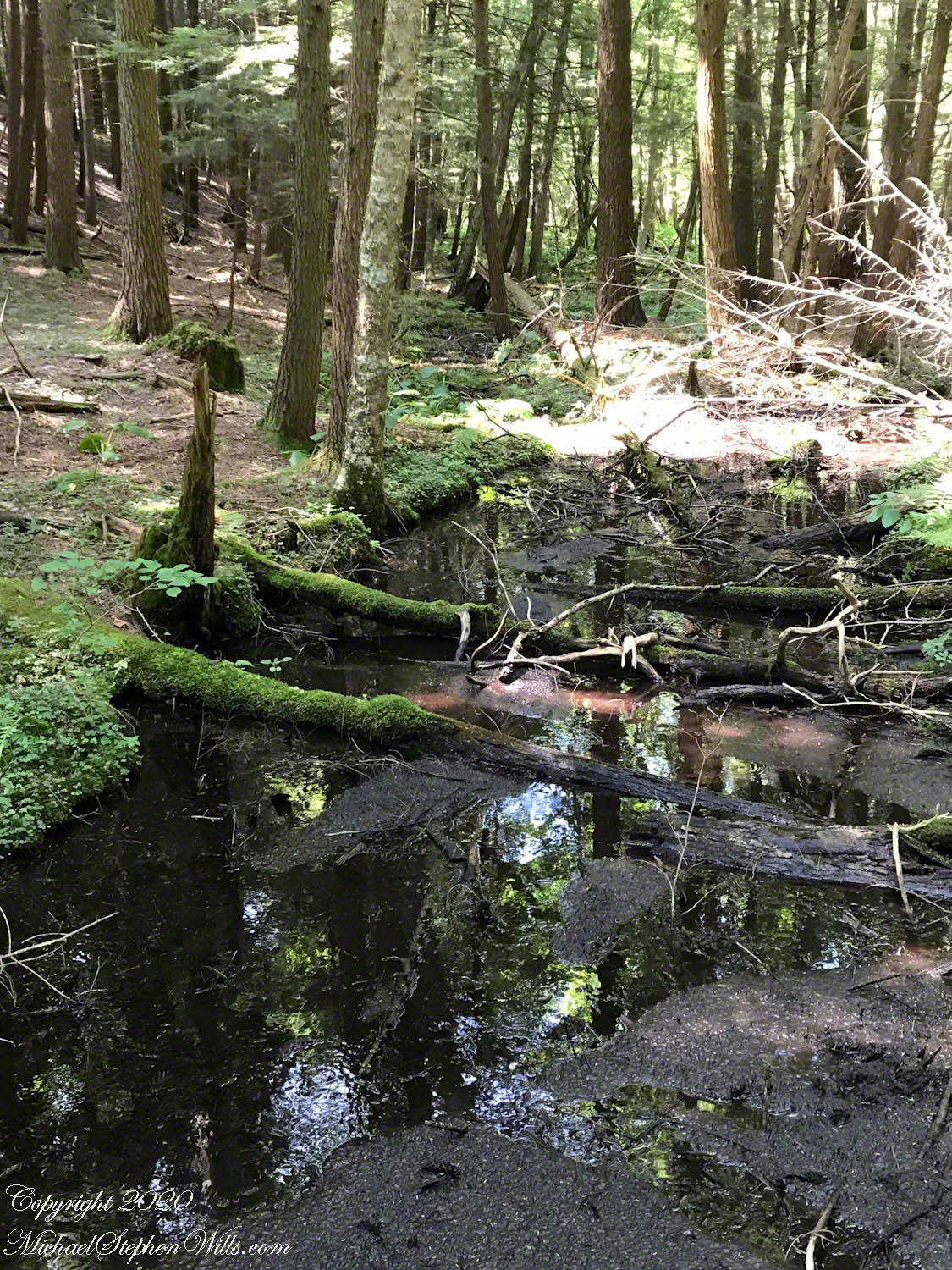
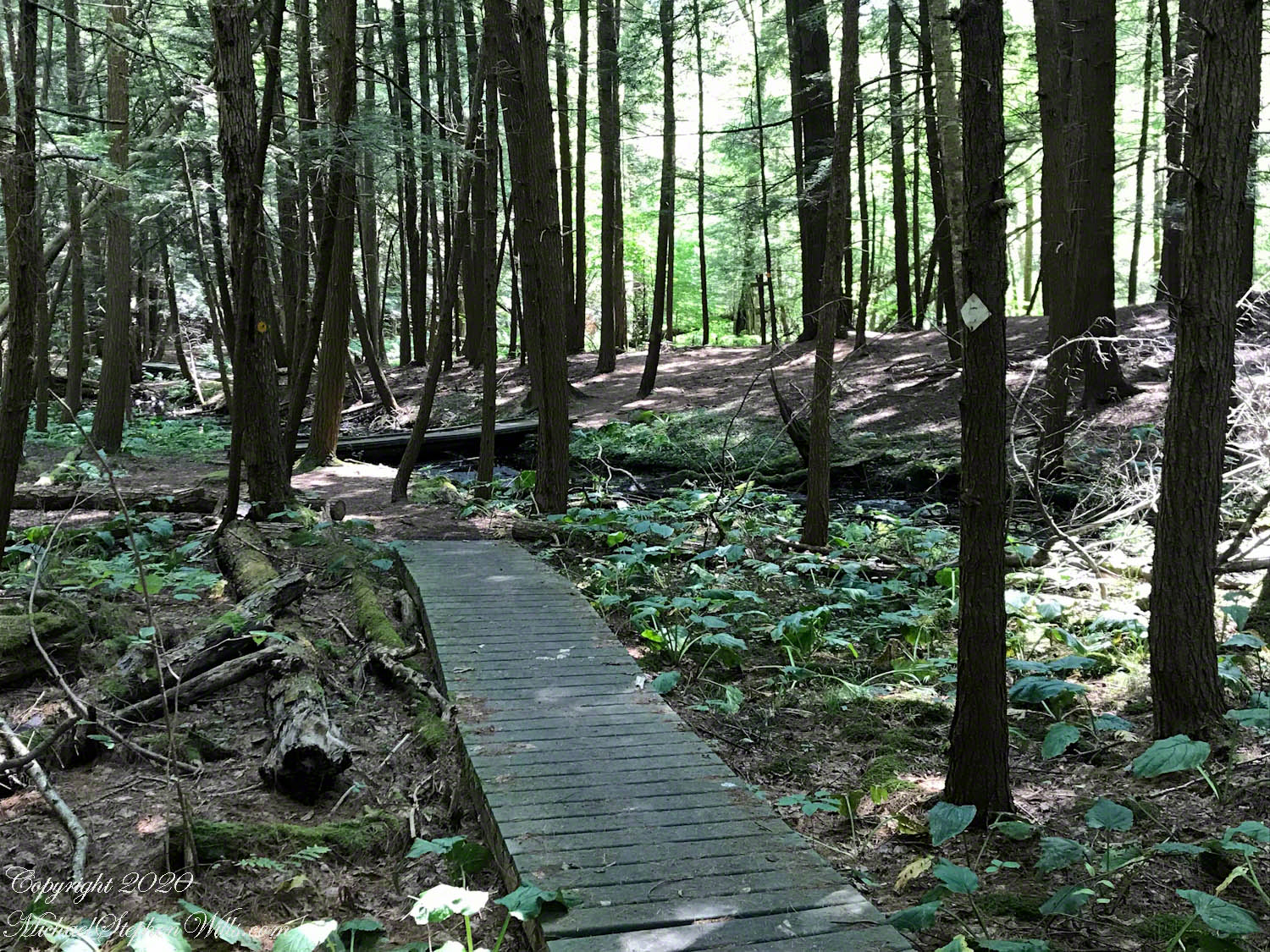
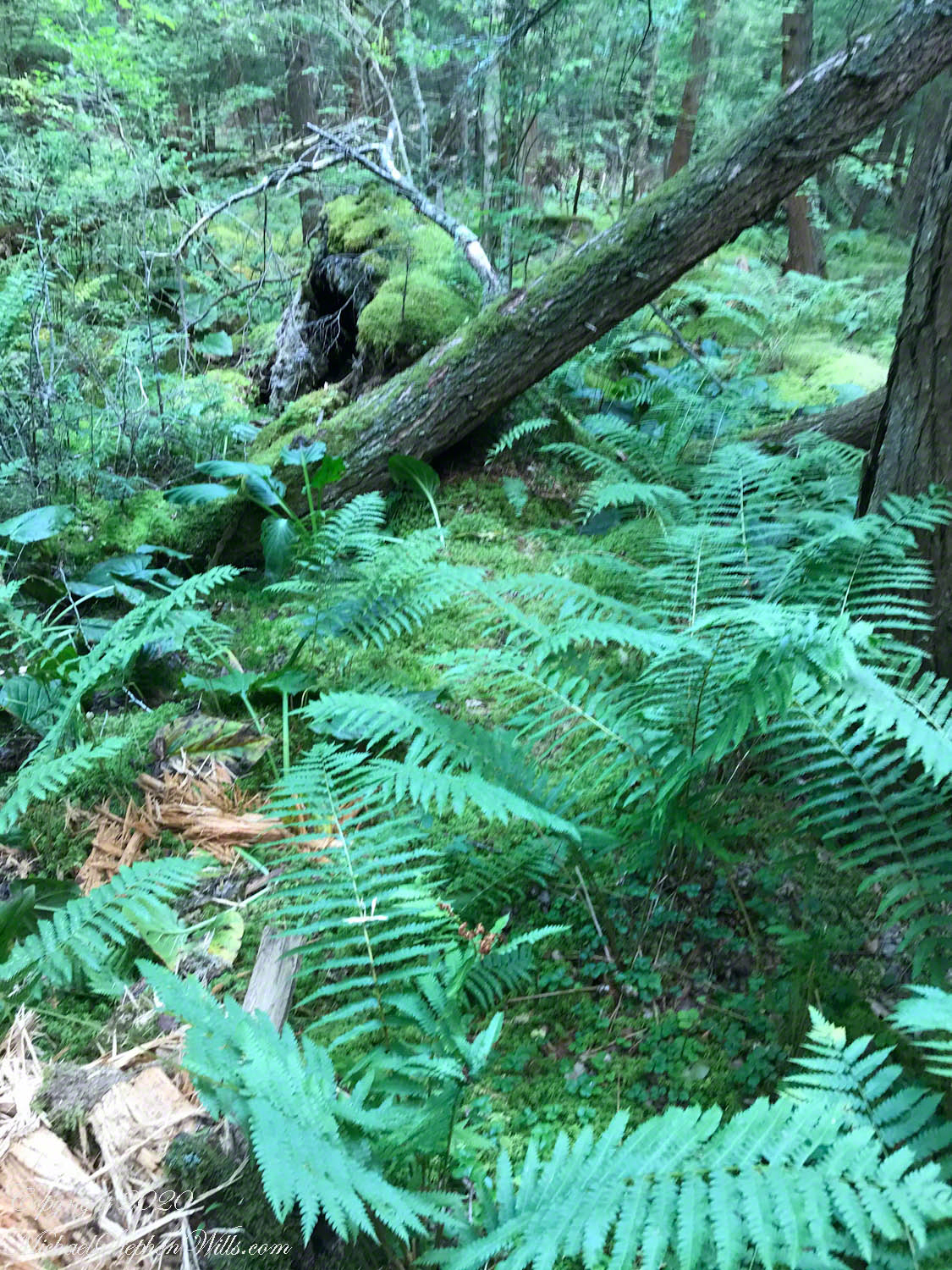
Beneath and between these features, groundwater is constantly on the move. It seeps through layers of sand and gravel, emerges as cold springs at the foot of slopes, and spreads out into swamps, fens, and marshes. In the Finger Lakes, water is always telling a story; at Malloryville, it’s simply easier to hear. Follow the trail and you move through a succession of wet worlds: a seep-fed fen with delicate mosses and sedges, a shrub swamp where skunk cabbage thrusts up in early spring, a cattail marsh that hums with birds and insects in summer.
For my family, the story of Malloryville began even before the preserve had a name. We lived nearby along Fall Creek, itself a thread in the larger fabric of the Cayuga Lake watershed. My son and I camped for the first time on top of an esker just beyond our front door, our tent perched on what I would later learn was the remnant of a stream that once tunneled through the base of a glacier. At the time, it was simply a magical narrow ridge in the woods. Only later, with von Engeln’s guidance and the preserve’s interpretive signs, did that ridge become a sentence in a much older, longer narrative.

That is one of the great gifts of the Finger Lakes: the chance to move from simple admiration—“this is beautiful”—to understanding—“this is how it came to be.” The steep slopes along Cayuga, Seneca, or Skaneateles; the drumlin fields near the north ends of the lakes; the hanging valleys and waterfalls; and the quiet wetlands of places like Malloryville are all chapters in the same glacial chronicle. Once you learn to read one place, you begin to read them all.

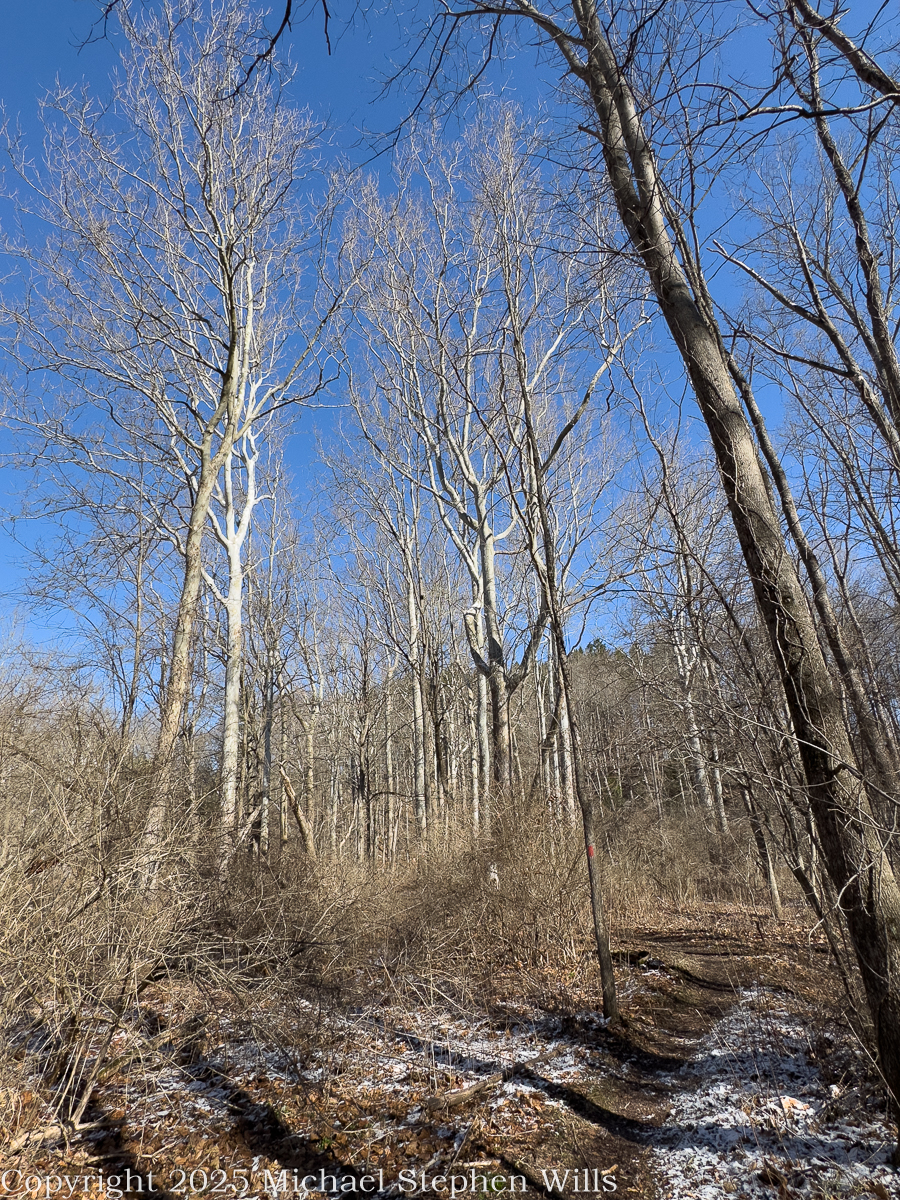
Walking into the O.D. von Engeln Preserve, you enter that story at a small, intimate scale. The parking area and trailhead give way quickly to a world where the ground feels different—sometimes firm and gravelly, sometimes soft and yielding underfoot. Wooden walkways and narrow paths thread through shady forest and open wetland. Each bend offers a subtle shift: a new plant community, a change in water clarity or flow, a small sign explaining what lies beneath your feet.

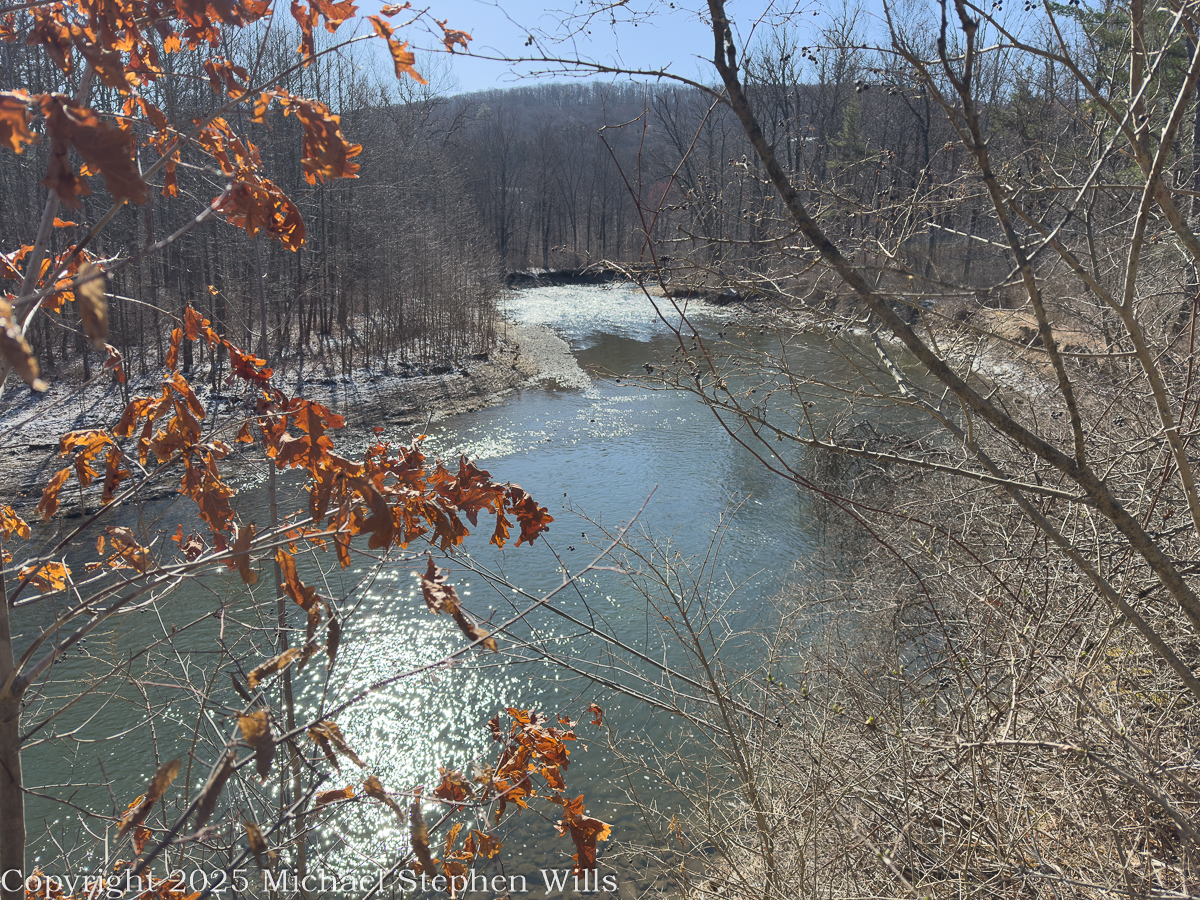
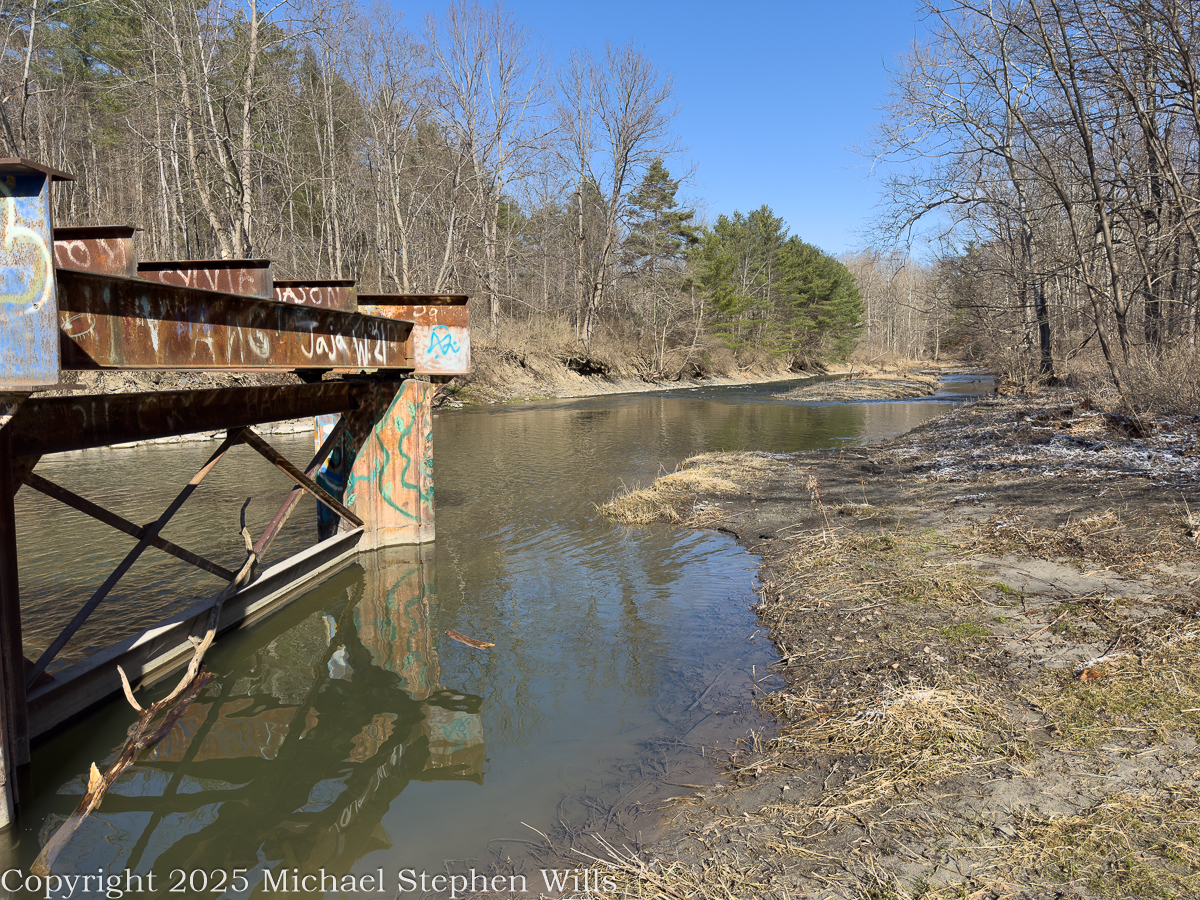
Fall Creek meanders through the esker fields of the Malloryville Preserve. Here is the view from an abandoned railroad bridge. The preserve is near Freeville in the Finger Lakes Region of New York State.

This is not grand scenery in the postcard sense; it is something quieter and deeper. Malloryville invites you to slow down and notice. To ask why a particular ridge is so narrow, why water emerges here but not there, why one hollow is filled with shrubs and another with moss and sedge. In learning those answers, you gain not only an appreciation for this modest preserve but also a richer understanding of the entire Finger Lakes region.

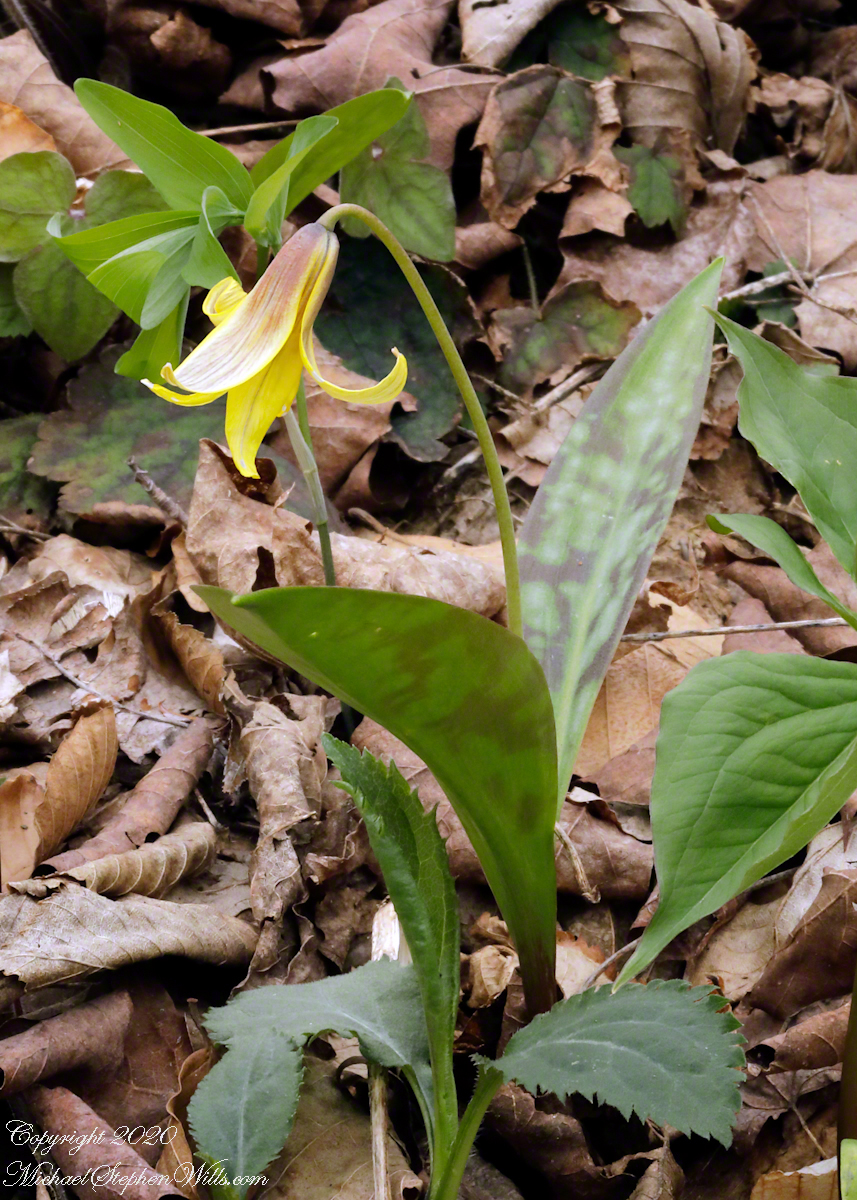
The Trout Lily (Erythronium americanum) is named for the mottled brown leaves resembling marking on trout.

In the end, the O.D. von Engeln Preserve at Malloryville is a lens—a way of seeing. Through it, the familiar landscapes of central New York—valleys, hills, streams, and lakes—come into sharper focus as the lasting work of ice and water. Stand on an esker, look across a kettle wetland, listen to the quiet trickle of a spring, and you are standing inside the very processes that shaped the Finger Lakes.

Enter your email to receive notification of future postings. I will not sell or share your email address.

Climbing Piestewa Peak: Multicultural Pilgrimage to a Phoenix Desert Dawn

In the cool predawn, strangers from every background climb a stone stairway above Phoenix, trading city lights for desert silence as sunrise spills gold across Piestewa Peak.

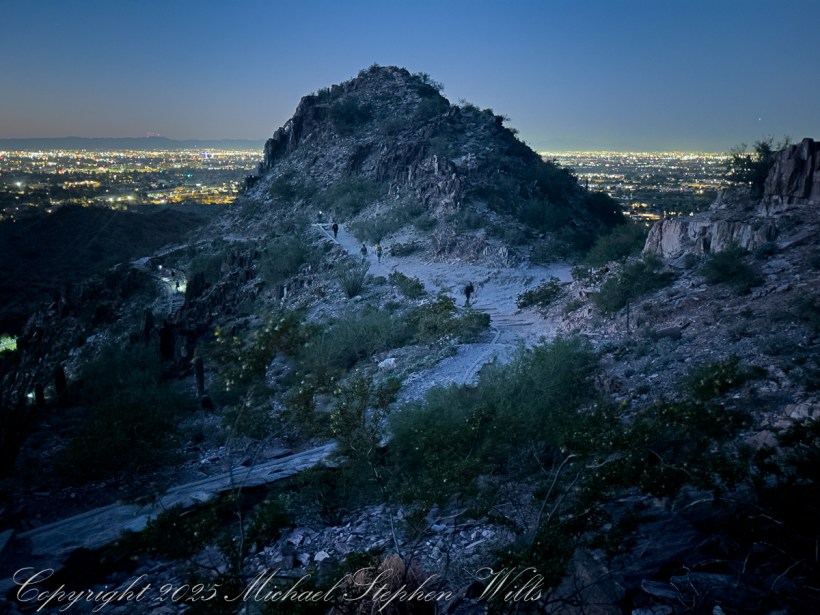
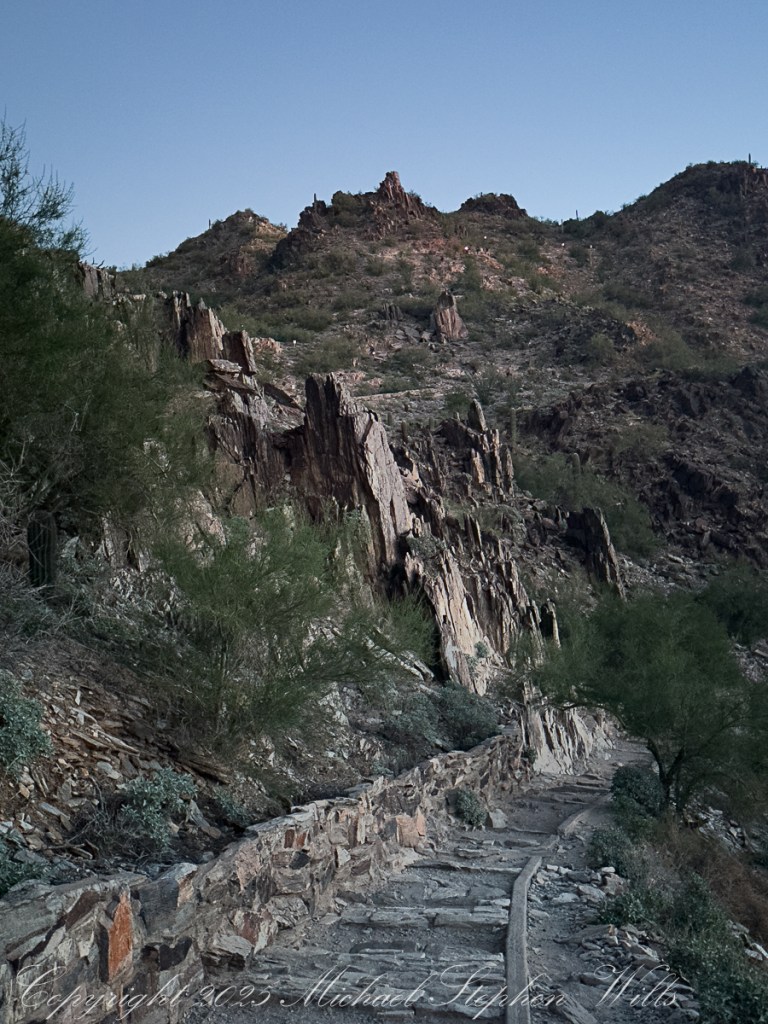
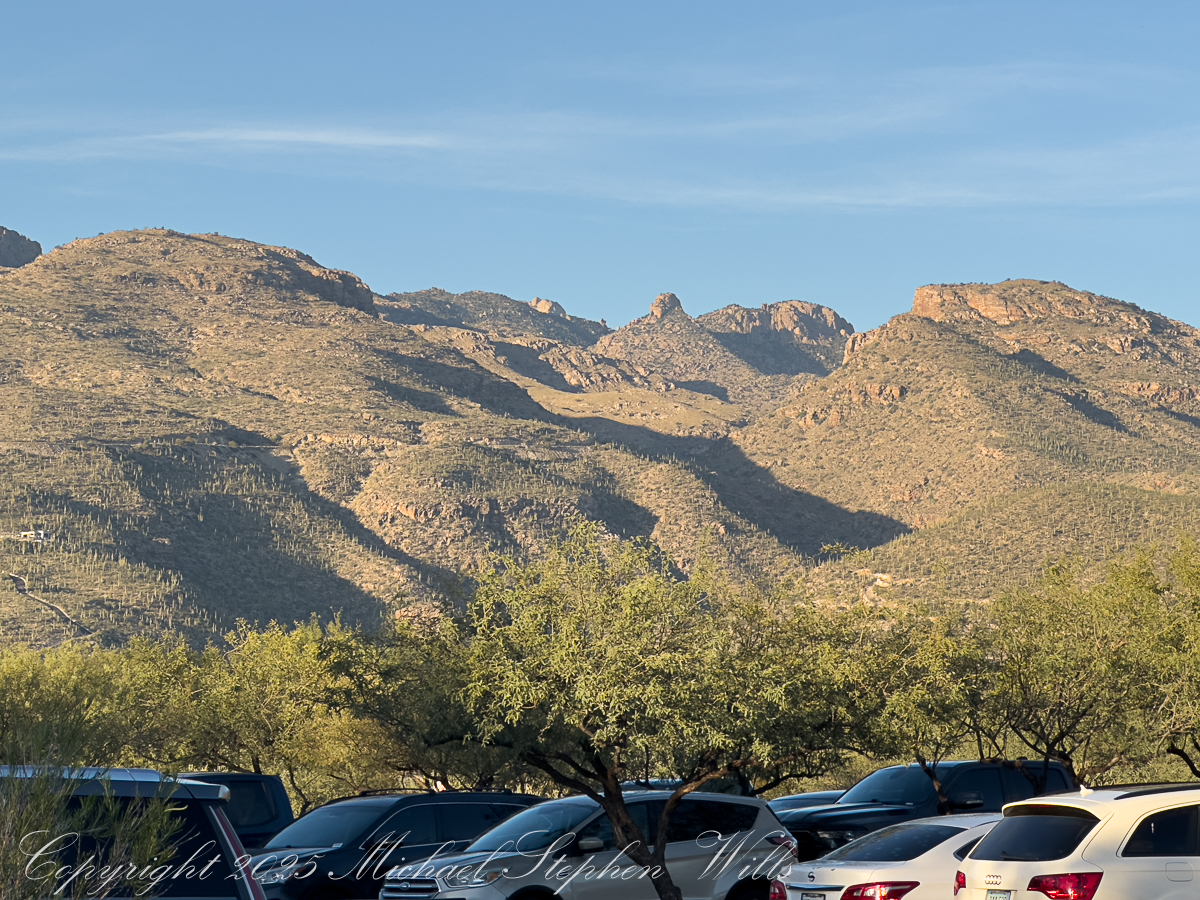
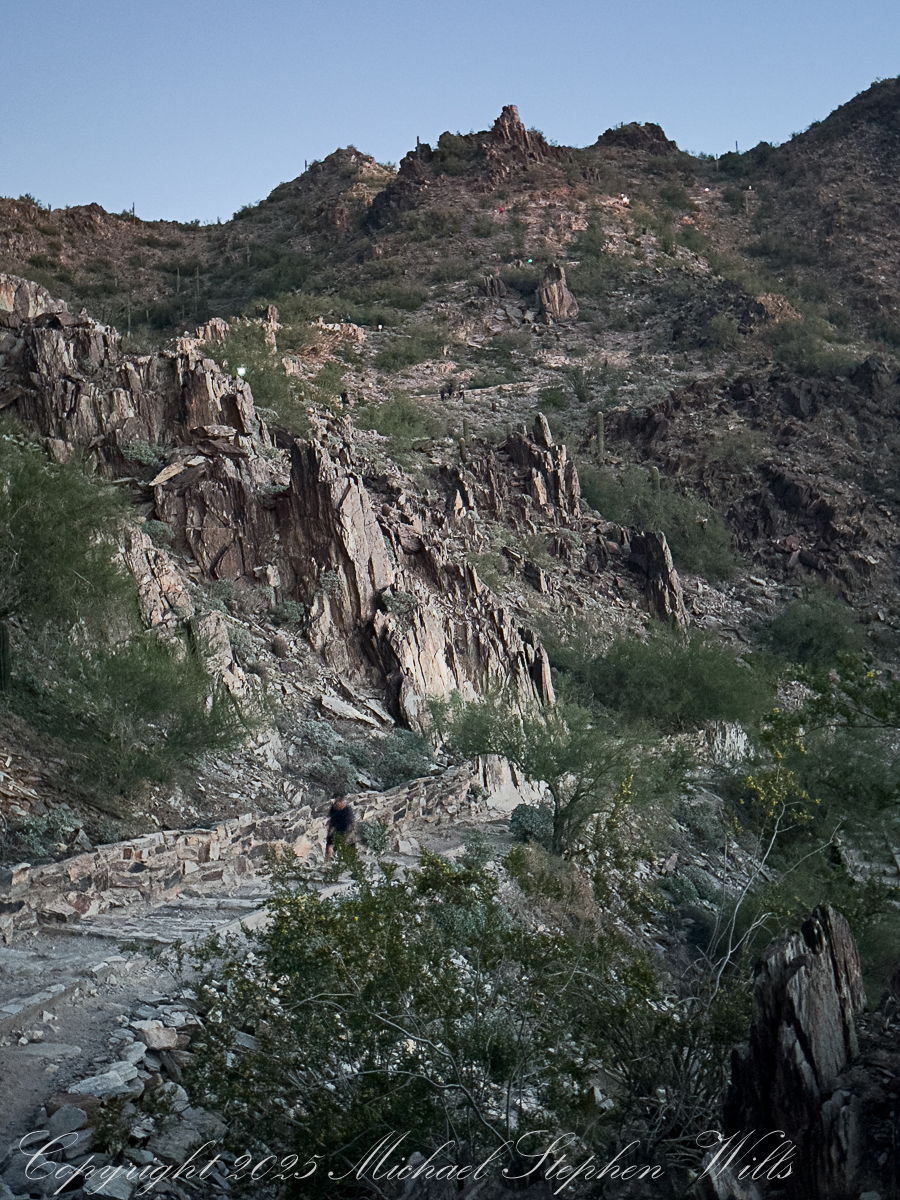
Arriving at 5 am there is a line of trucks and cars and Piestewa Peak parking almost full when I grab a spot in the predawn darkness. The desert air has that deep, merciful coolness it offers before sunrise, edged with the long-remembered scent of creosote. Car doors close with soft thuds, headlamps blink on, and a loose procession of strangers begins to funnel toward the trailhead like pilgrims, even now white and red headlamps sprinkle the upper slopes.

At first the climb exists only in a narrow cone of light, my lamp illuminates the scant gravel, uneven steps, and each scuff of boot or shoe sounds loud in the hush. Somewhere below, the city hums, but here the conversation is mostly breath and the occasional murmur of greeting as we fall into the rhythm of the climb.

My beam catches a young couple just ahead, their hands knotted together. They speak Spanish, laughing quietly as they miss a step and bump shoulders. Behind me an older man in a Veterans cap leans heavily on trekking poles, his companion—maybe daughter, maybe friend—matching her shorter stride to his with patient care. A group of women in bright leggings and braided hair moves past us in a burst of energy, their languages overlapping—English, maybe Vietnamese, something I cannot place—like the weaving of a rug. A man passes me, a drum on his back. Piestewa draws them all, before dawn, to this rib of stone in the center of the Phoenix basin.

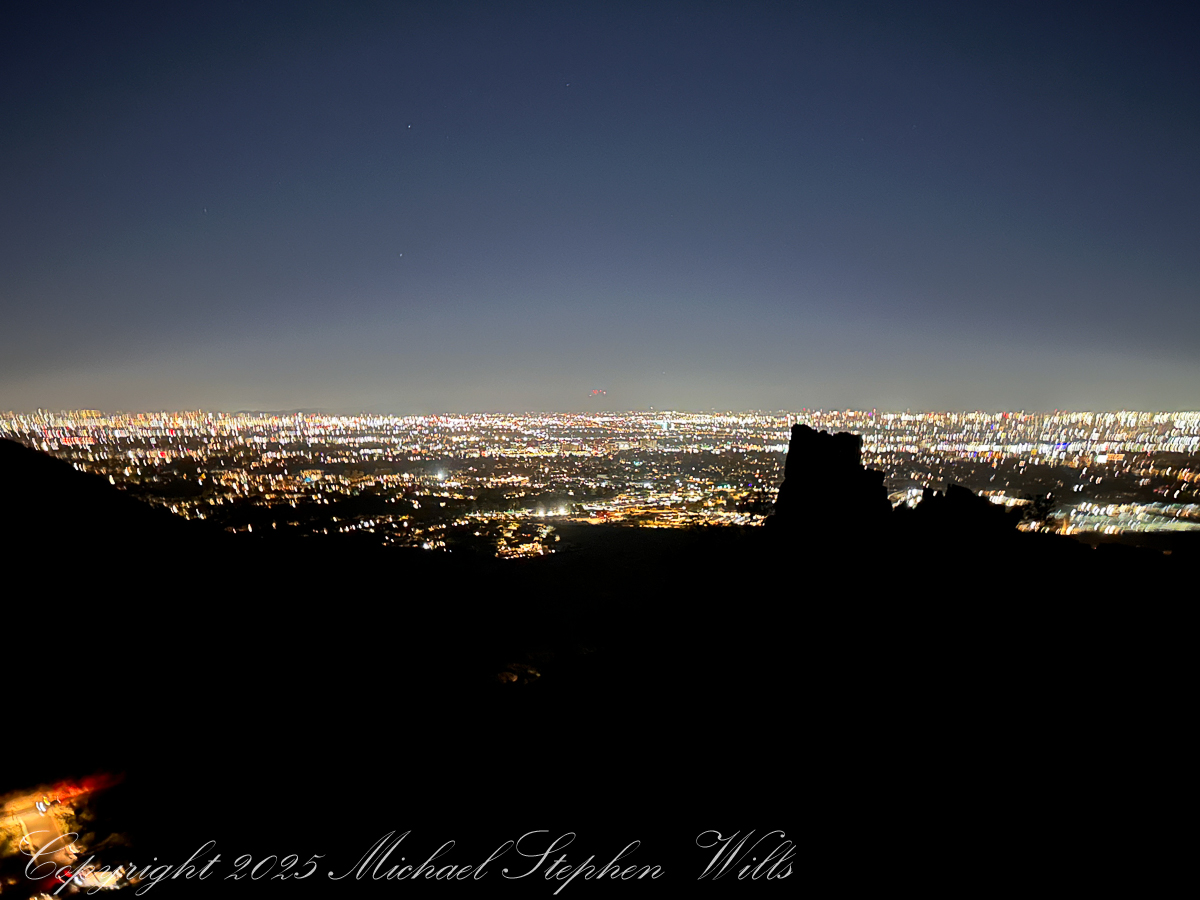
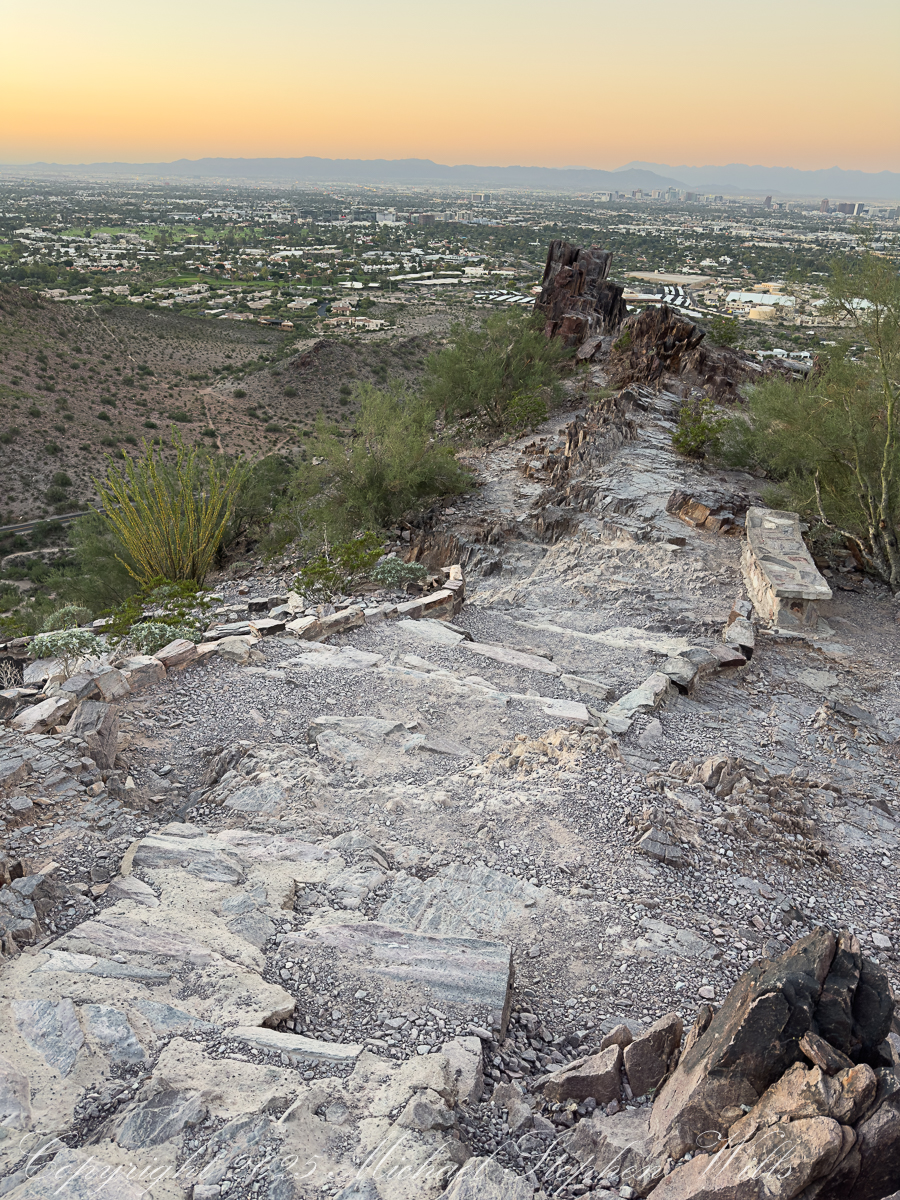
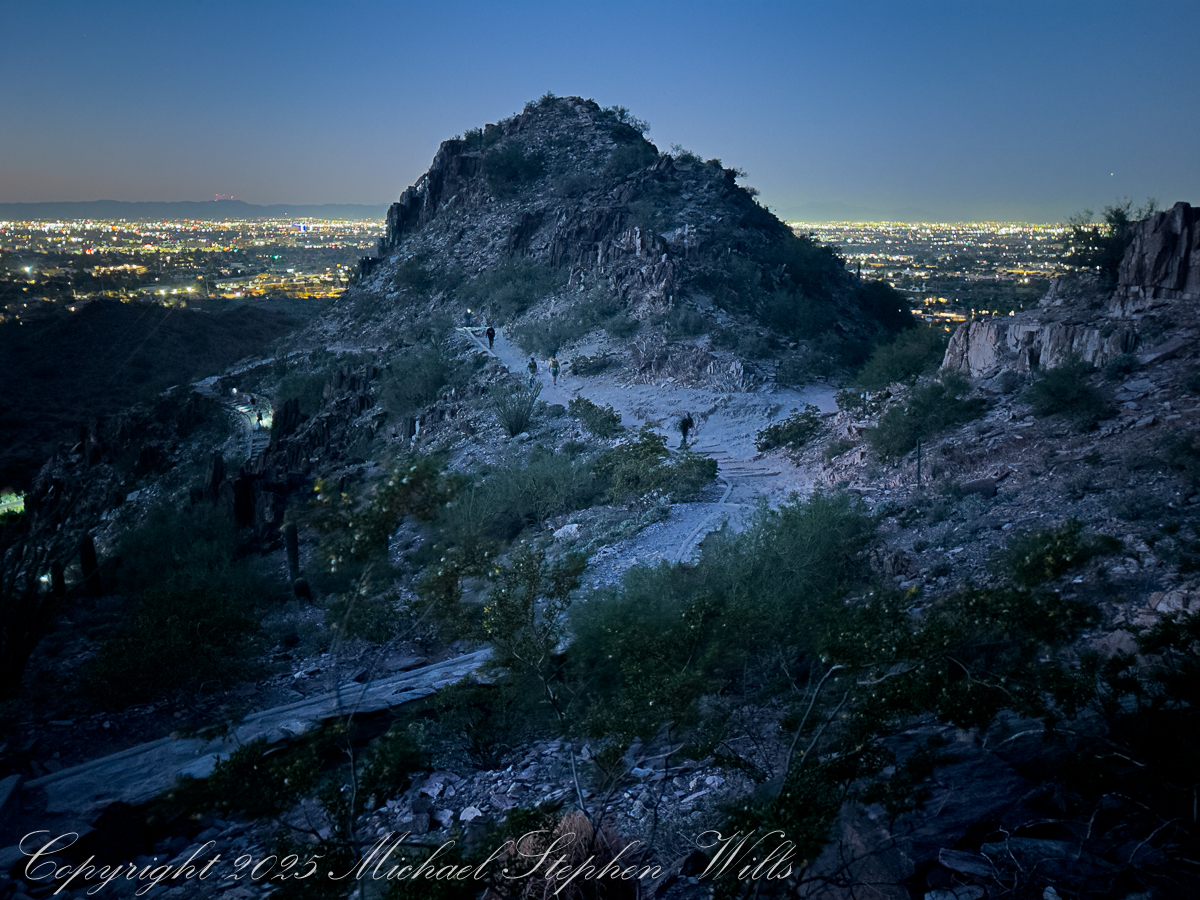
As I stop to rest myself and turn off my headlamp, ahead the trail tilts steeper the steps fade to rock, irregular and unforgiving: a stairway carved from ancient volcanic bones. With my dark adaptation, surfaces reflect star and city light, leading the eye down the ridge toward the dark quilt of neighborhoods below. Later, captured in the photograph, those steps will twist away like a stone dragon’s spine, the city waking beyond in soft pastels. Now they are simply work for legs and lungs.

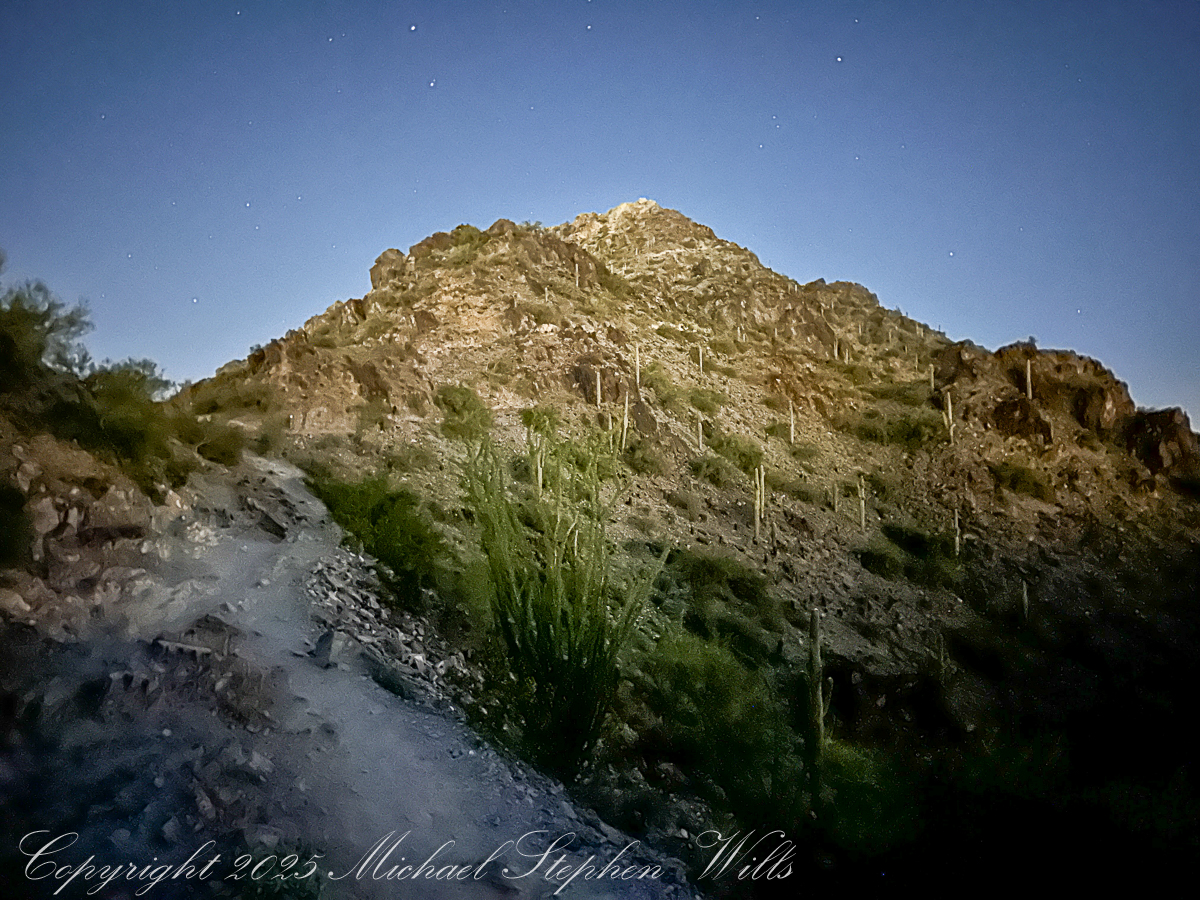
The desert plants materialize around us as shapes before they acquire color. Saguaros stand like sentinels along the slopes; their arms lifted in silhouette. Ocotillo rise as witchy bundles of sticks, each spine leafed out from October rains the leaves catching a little light. On a small plateau a family has paused; the father adjusts a tiny headlamp on his son, no more than six, who is insisting, with fierce determination, that he can carry his own water. “Almost there, campeón,” his father says, and the child straightens like a soldier.

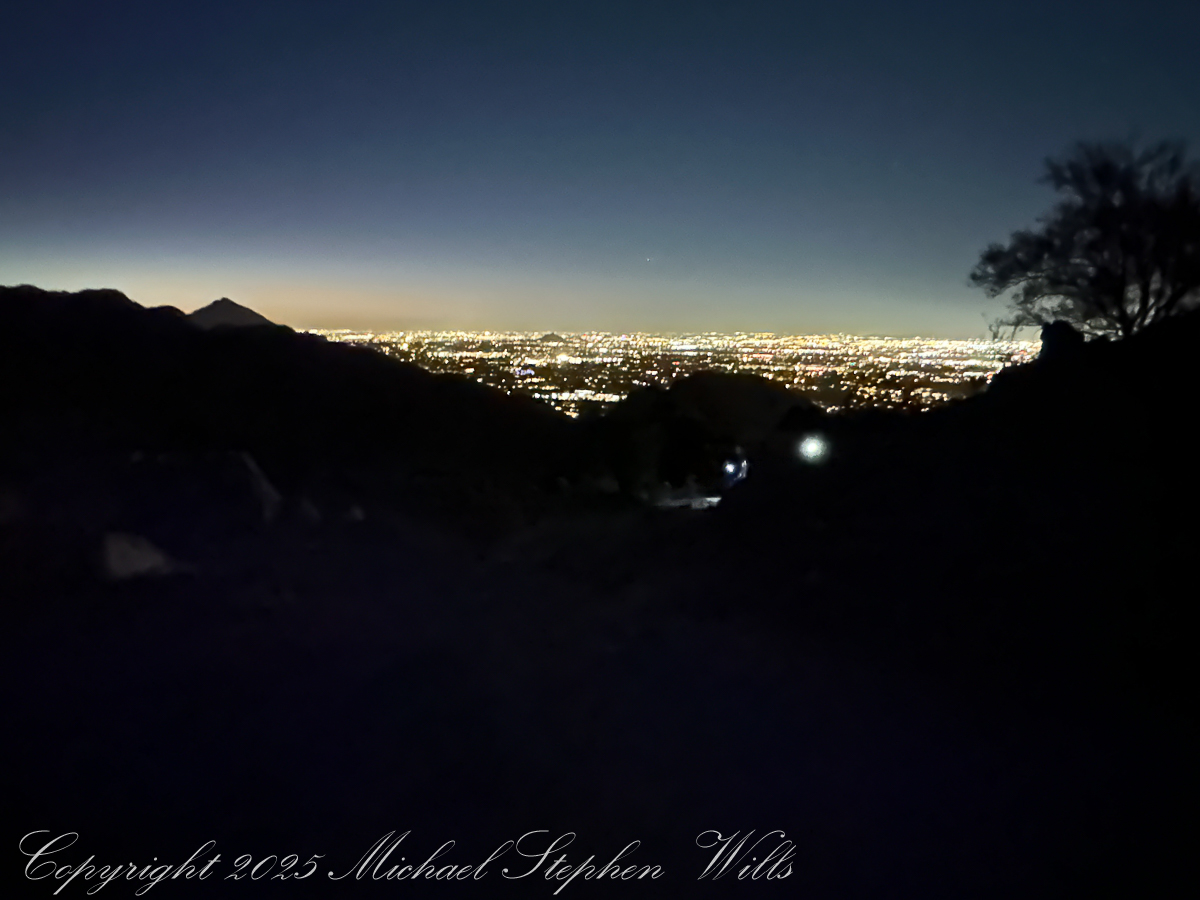
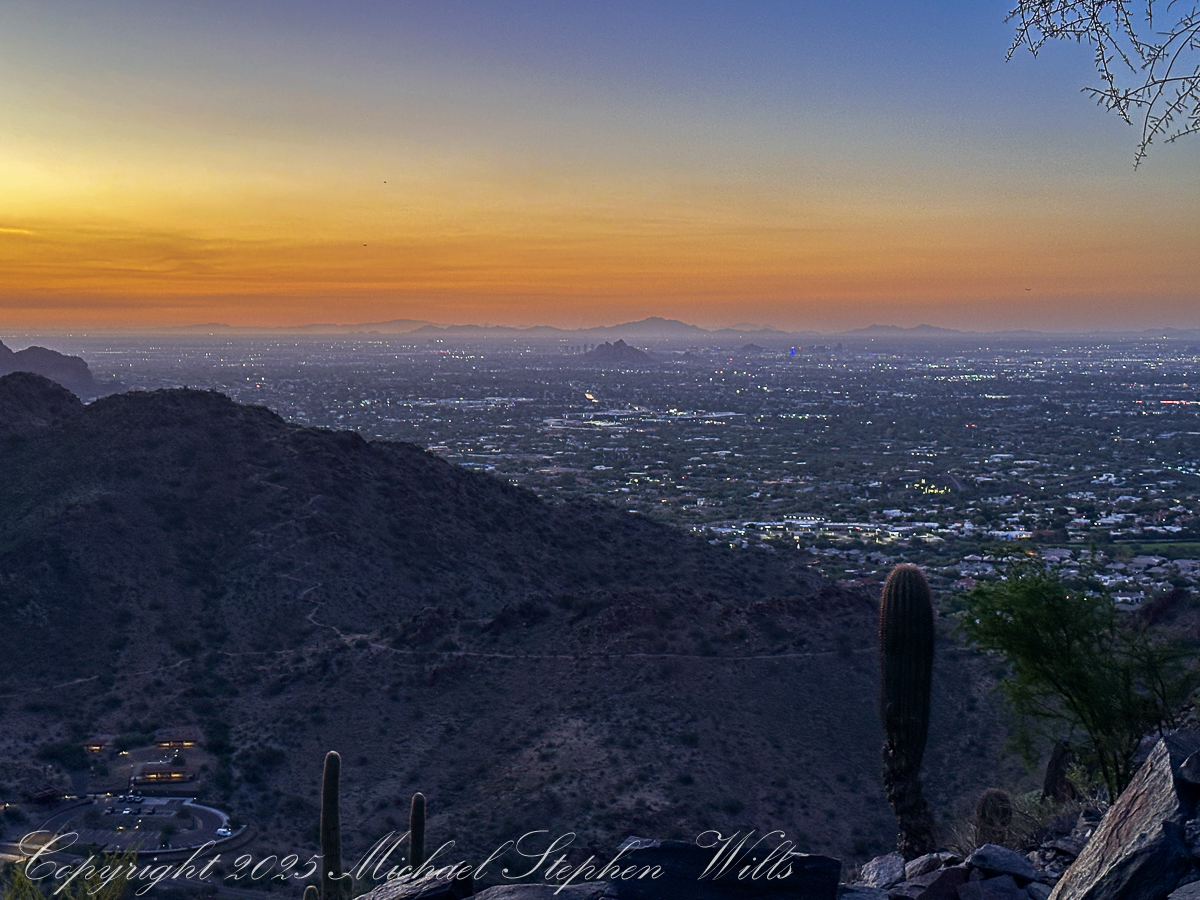
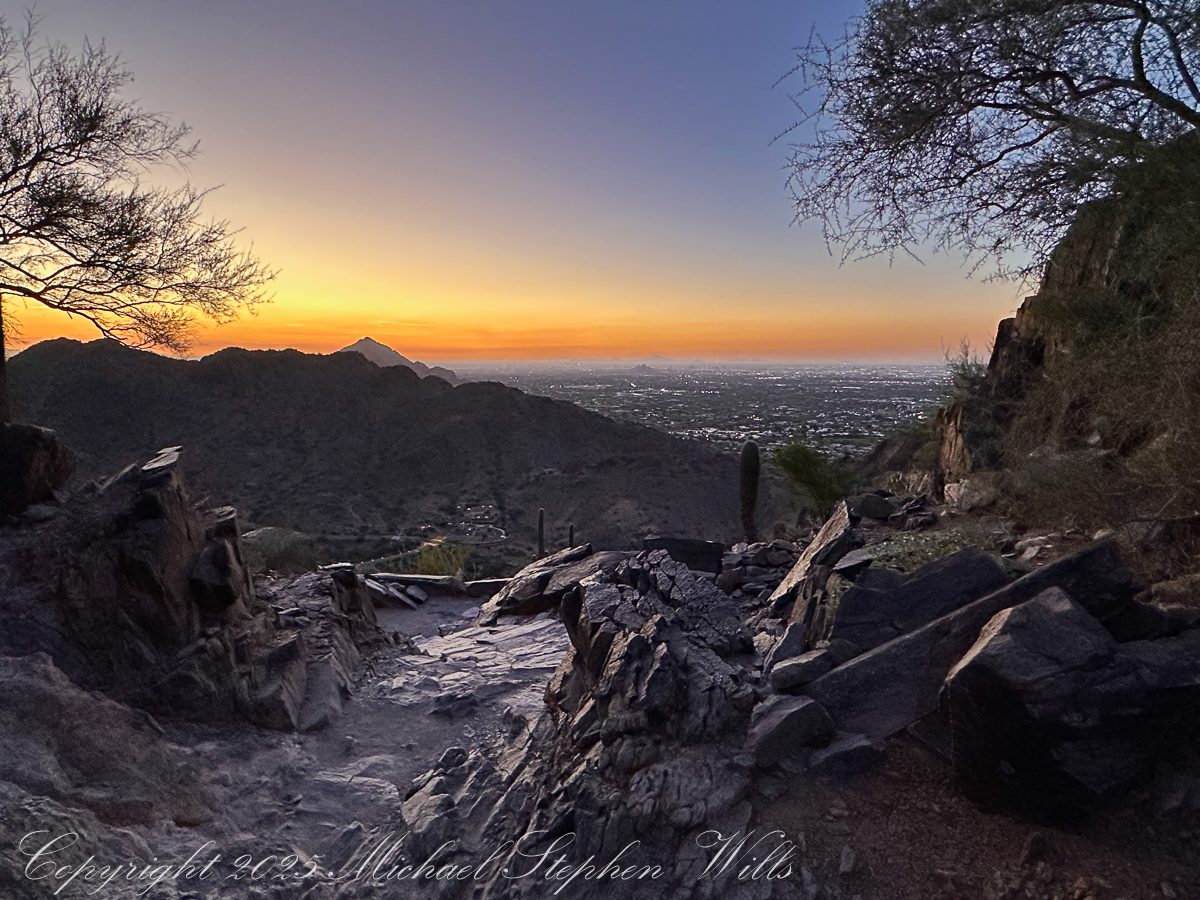
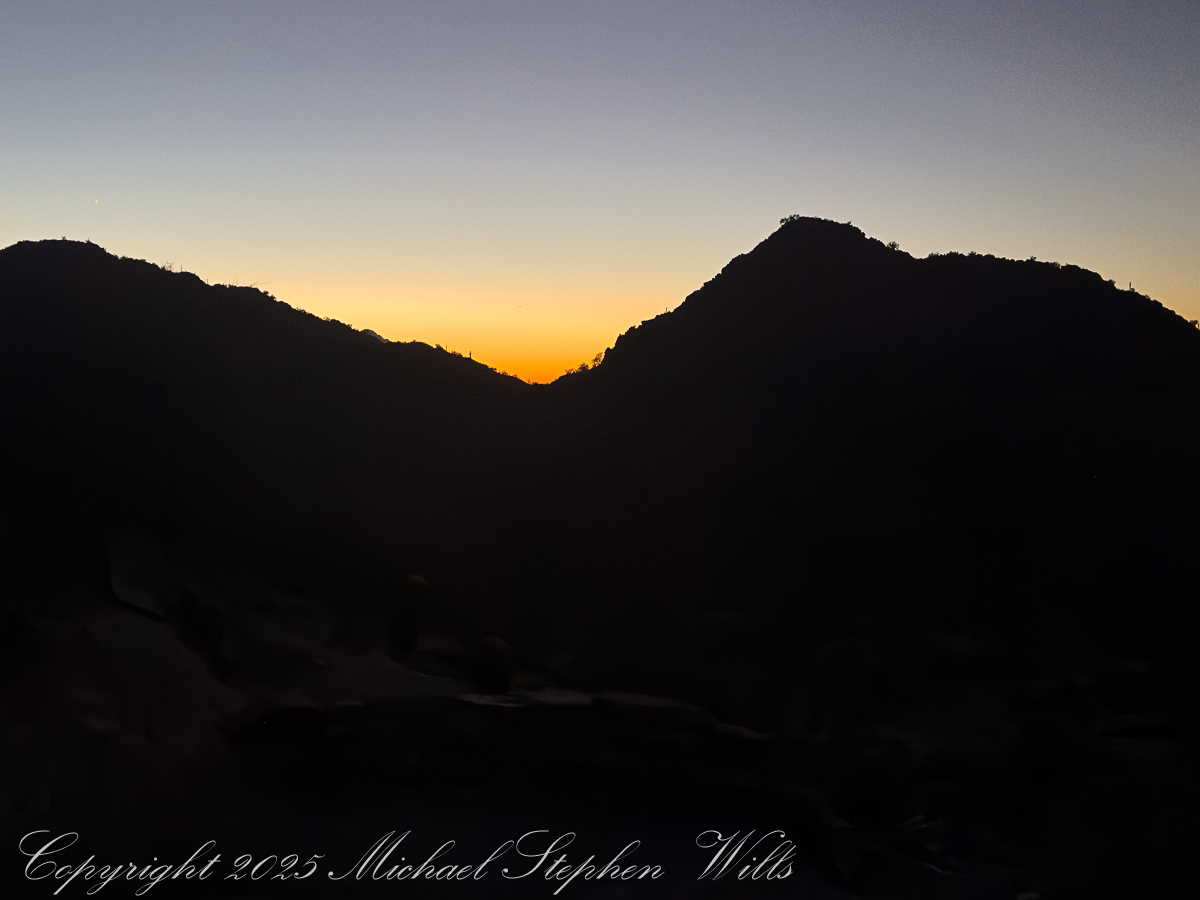
The dark begins to soften at the edges. Over the eastern horizon a thin band of orange appears, a delicate seam between night and day. In one direction, the city stretches out in a glittering net of streetlights, the squares of parking lots and subdivisions catching the last of the darkness. In the other, the mountains are still black cutouts, their profiles sharp as paper against a gradually brightening sky. One of my images will hold that moment: the jagged ridge of Piestewa in shadow, the valley below already spangled with light, a single towering saguaro rooted at the cliff’s edge like a punctuation mark.

November 2025 while visiting Pam’s family in Phoenix

Higher up, the trail narrows and the rock turns rougher. We fall into single file, strangers linked by a line of effort. A runner comes flying down, feet barely touching stone, breath steady and controlled. “On your left,” he calls, and we part for him like water. A woman with a hijab tucked neatly under her ball cap leans against the retaining wall, stretching a calf muscle, her friend counting in accented English: “Ten more seconds, you can do it.” Near one bend a hiker pauses to press a hand against the rock face, whispering a quiet prayer in a language I do not recognize. It is a small, intimate moment, gone almost before I register it.

The last push to the saddle is steep, the steps uneven, the sky now a cascade of colors—copper, rose, faint lavender melting into a high dome of blue. The silhouettes of distant ranges sharpen: the Estrellas?, the Superstitions?, low ridges whose names I do not know. On the horizon, the first thin line of sun breaks free, setting fire to the edges of clouds. In another photograph, framed by dark rock and desert trees, that sunrise becomes a golden portal at the end of a shadowed corridor of stone.

We reach a broad ledge just shy of the summit as the light finally spills over us. People are already gathered there: a trio of college students taking selfies, a pair of retirees sharing thermos coffee, a solitary man sitting cross-legged with eyes closed, face open to the warmth. The city below is suddenly transformed. The carpet of lights dims, replaced by the clear geometry of streets and rooftops, golf courses and parking lots, all laid out like a model at our feet. The mountains that hem the basin—once anonymous shapes—now reveal their ridges and ravines in sharp relief.

For a few minutes conversation dies away. Everyone seems to feel the same thing: that fragile instant when the sun clears the horizon and the desert shifts from silver-blue to gold. The rocks around us, sharp and broken in the photographs, glow honey-colored. Saguaros catch light on their spines, each thorn a tiny ember. Even the dusty air seems to shimmer.

Down below, a new wave of hikers starts up the trail, latecomers walking into full daylight. We, the predawn climbers, share a small, quiet complicity. We have seen the city from the backside of night, watched the day arrive from a perch of jagged stone. Piestewa Peak has turned us, for an hour or two, into a single, breathing organism: many hearts, one climb, all of us stitched together by the steep path and the slow unveiling of the sun.

Enter your email to receive notification of future postings. I will not sell or share your email address.

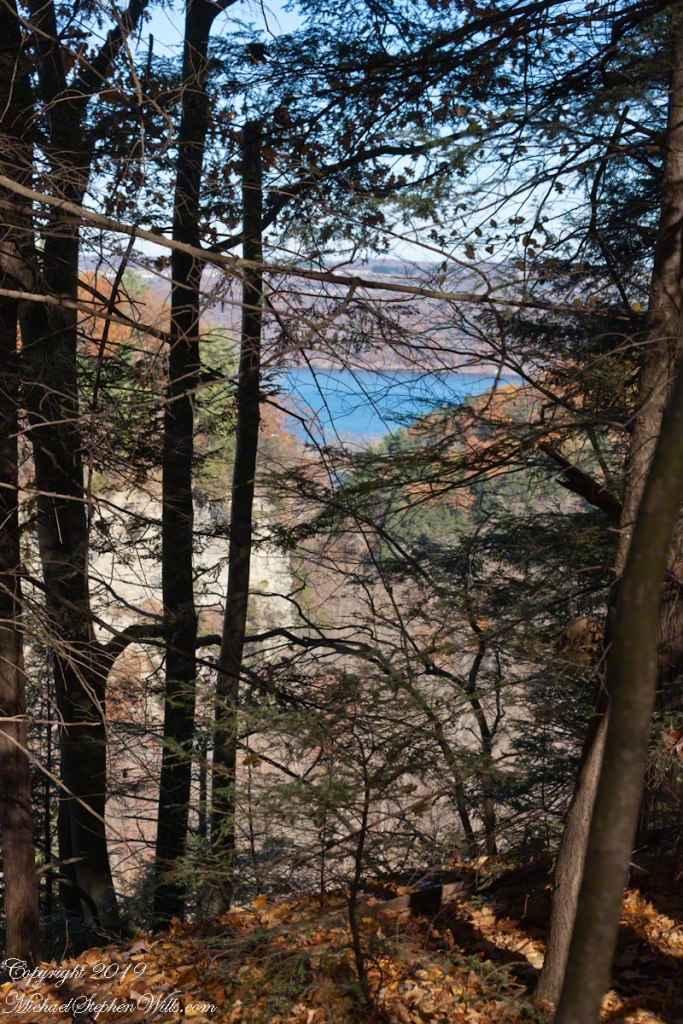
Distant Sapphire III

From a modest bench above Taughannock Gorge, Cayuga Lake shifts from distant glimmer to presence—a quiet invitation to pause, breathe, and follow the water down.

From the south rim of Taughannock Gorge, Cayuga Lake appears like a distant strip of sapphire, framed today by a soft veil of hemlock and oak. The overlook here is modest—a fence, a bit of open sky—but someone wisely added a comfortable bench, an invitation to pause between gorge and lake, rock and water.

I stood in front of that bench, resting the camera body on the fence, fingers braced against the wood to steady the shot. This is not the grand, sweeping vista of a postcard. Instead, it is a quieter, more human vantage point, the way a person actually encounters the lake after walking the rim: emerging from the trees, breath easing, eyes adjusting to the light on water.

From here, the trail descends toward Cayuga’s shore, each turn bringing you lower and closer, trading the lofty perspective for the intimate sounds of waves and stone. In Distant Sapphire I and II, the lake was a glimpse—caught between branches, distant beyond the gorge. Now, in this “Bench View,” the water feels nearer, almost within reach, as though the landscape itself is drawing you gently down.

Click photograph for a larger view. To do this from WordPress Reader, you need to first click the title of this post to open a new page.

I’ve gathered the three photographs—Glimpse of Cayuga Lake, Gorge View with Oak Leaves, and this Cayuga Lake Bench View—into a small gallery, a progression of approach. Each frame is a step closer: from suggestion, to invitation, to the quiet promise of the bench, waiting for whoever needs to sit and look a little longer.

A gallery of the three Cayuga Lake photographs for comparison.

Enter your email to receive notification of future postings. I will not sell or share your email address.

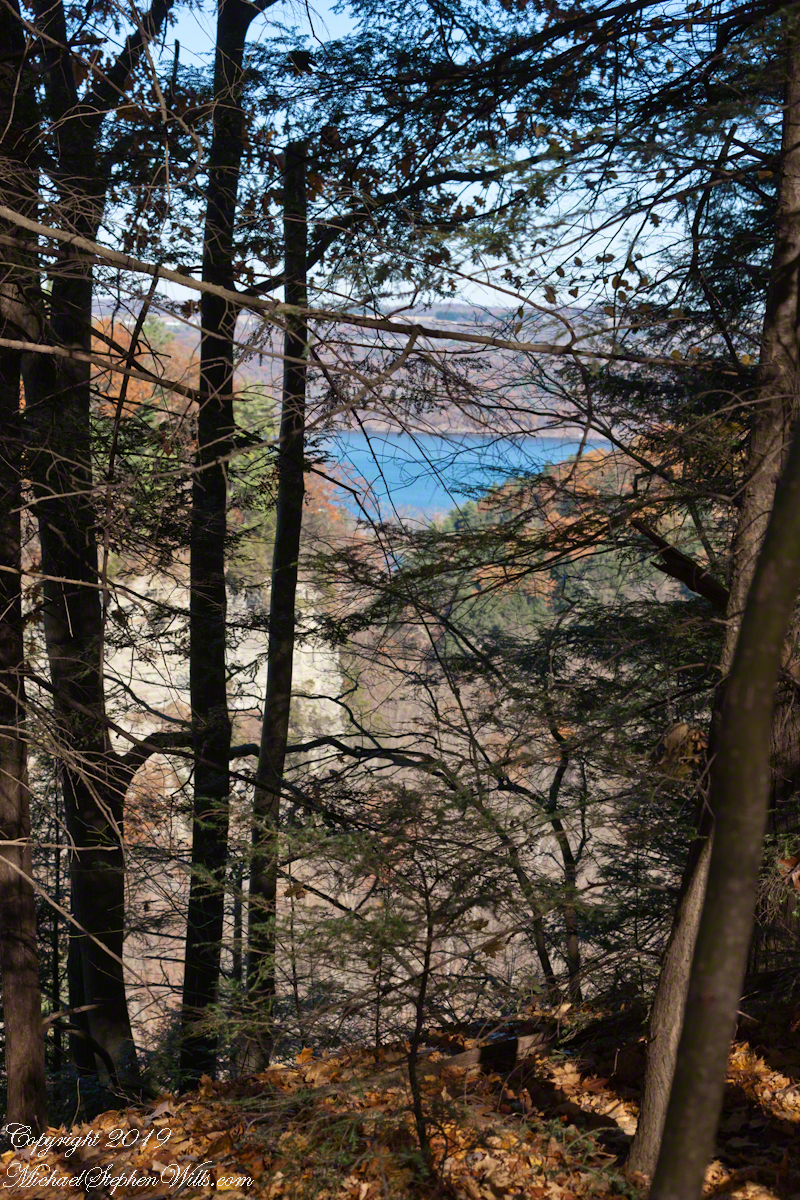
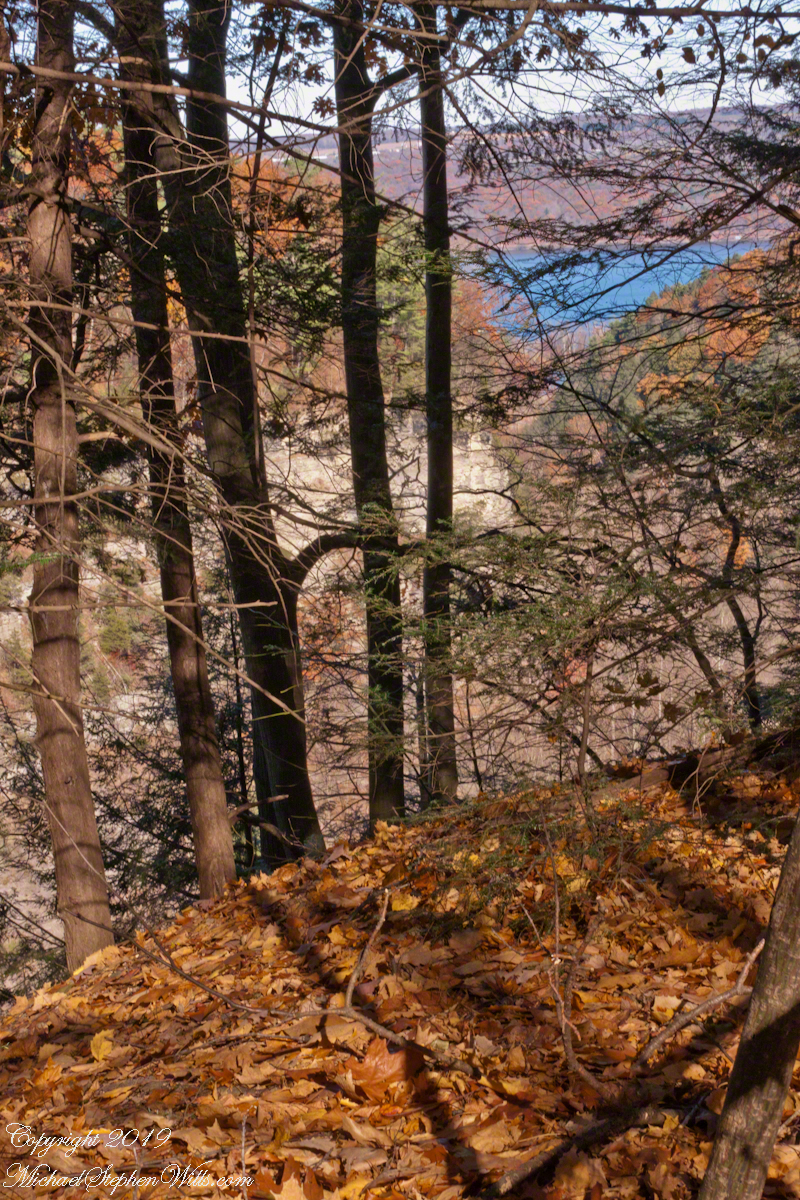
Distant Sapphire II

Cayuga waters reflect a blue November sky.

Cayuga Lake from the south rim of Taughannock Gorge, seen through a veil of hemlock with a carpet of fallen oak leaves, foreground. This is a companion to the previous post, both were handheld. For this the foreground was included to increase interest. For added stability, I rested the camera body on the fence bracketed with my fingers.

Click photograph for a larger view. To do this from WordPress Reader, you need to first click the title of this post to open a new page.

A gallery of the two photographs for comparison.

Enter your email to receive notification of future postings. I will not sell or share your email address.

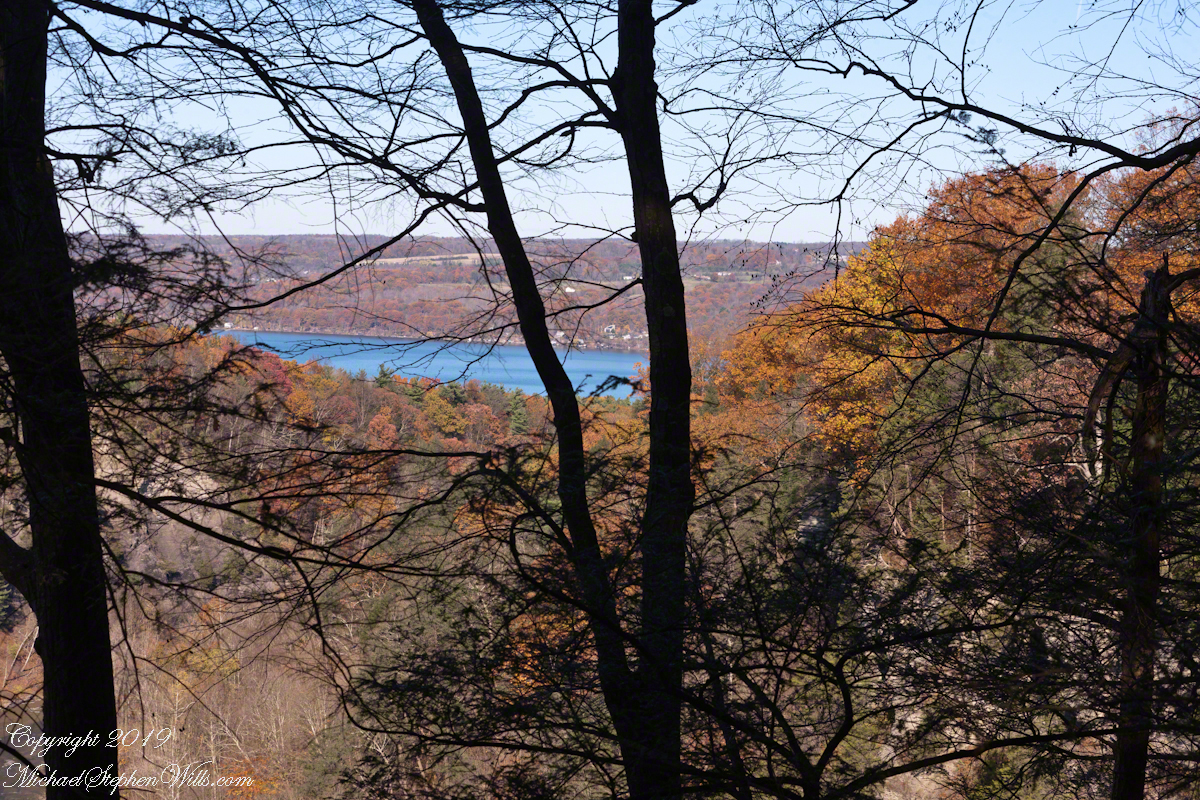
Distant Sapphire I

Cayuga waters reflect a blue November sky.

Cayuga waters reflect a blue November sky.

Click photograph for a larger view. To do this from WordPress Reader, you need to first click the title of this post to open a new page.

Photographs in Gallery

Enter your email to receive notification of future postings. I will not sell or share your email address.

Cornell Botanic Gardens’ Monkey Run: History, Geology, and Scenic Fall Creek

A contemplative walk along Monkey Run where Fall Creek writes the valley’s history—sycamores, bridges, and Devonian stone speaking across seasons in Cornell’s living classroom.

On a morning in late March, when the hills about Ithaca still hold the night’s frost in their shaded folds, I took the path called Monkey Run and went to see how Fall Creek spends its winter earnings. The air had the bright sting of thaw, a kind of vernal austerity that keeps a man honest in his steps. Along the high bank the sun spilled its coin onto the water, where it broke and flickered like a school of silver minnows. A rim of snow clung to the shale ledges, and the leaves of last year’s oaks—curled, fox-red, and faithful—whispered as if to keep the woods awake until spring fully claimed them.

Sunlit bend of Fall Creek viewed from a high bank at Monkey Run in early spring.

Monkey Run is one of the outlying parcels tended by Cornell Botanic Gardens—once called the Plantations, and now, more fittingly, named for the living charge it keeps. These gardens do not end at beds and borders; they encompass the wilder rooms of the county, more than a thousand hectares of glens, pastures, and ravines where the university’s first and oldest teacher—nature herself—still holds class. Fall Creek is one of her principal lecturers. Rising beyond the high country of Cayuga Heights and slipping under stone and snow, it shoulders its way across the campus, idles a while in Beebe Lake, and turns turbines of memory at Triphammer Falls before shouldering on toward the lake that receives nearly everything here—Cayuga—long, deep, and glacial in its thinking.

Tall white-barked sycamores leafless against a blue March sky at Monkey Run.

If you would learn a valley’s mind, walk a meander. The creek here composes with easy cursive, laying down a bar of gravel, nibbling at a bank of clay, then sweeping back to consider its work from the opposite shore. The geologist says the rock is Devonian, pages laid flat and damp with time, and the ice of ten thousand winters ago scoured them into the open. A creek is a patient mason, working without rest and never in anger. I admired these sycamores—their clean bones shining through the leafless canopy like the ribs of an old cathedral. Winter reveals their whiteness; summer grants them shade. A stand of white pines keeps a dark counsel in the background; on the muddy edge, green tongues of skunk cabbage push up, pledges made by the swamp to keep faith with the sun.

Rust-stained steel pier above calm water on Fall Creek along Monkey Run trail

I came down to the water near an old steel pier, a bridge remnant, hanging on each end without purpose. It wears graffiti the way a boulder wears lichen; human wishes, briefly rooted, coloring what they can. The river accepts it all, the pilings and the scribbles, the cast limb and the bottle’s glint, and continues its one unarguable gesture downstream. That is the old instruction of Fall Creek: use, refuse, endure. Before the university drew students from every quarter, the creek turned wheels and powered the small ambitions of a frontier town. Even the name Triphammer speaks of iron struck to purpose. Now the water powers something quieter: the studies of herons, the almanacs of kingfishers, the quick arithmetic of minnows over limestone.

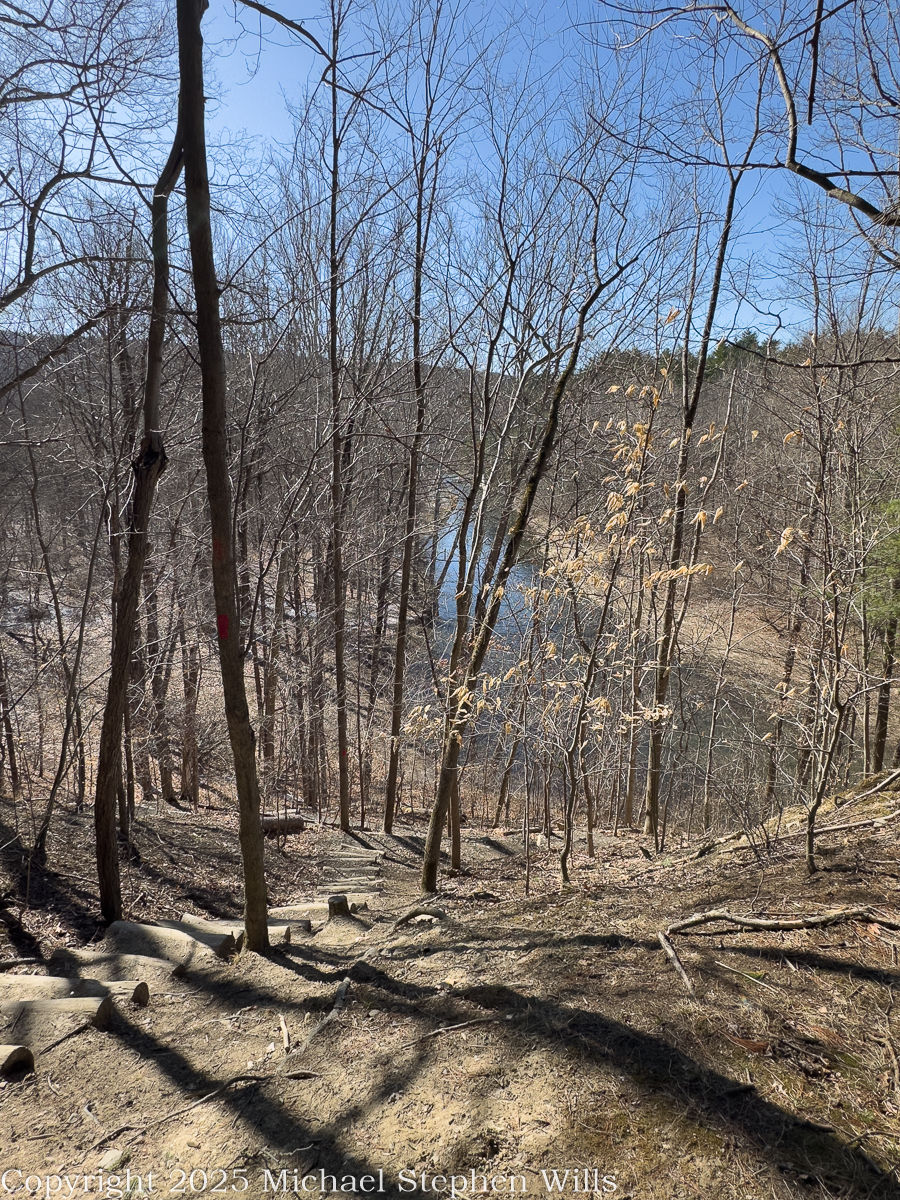
Looking back while climbing the steep bluff

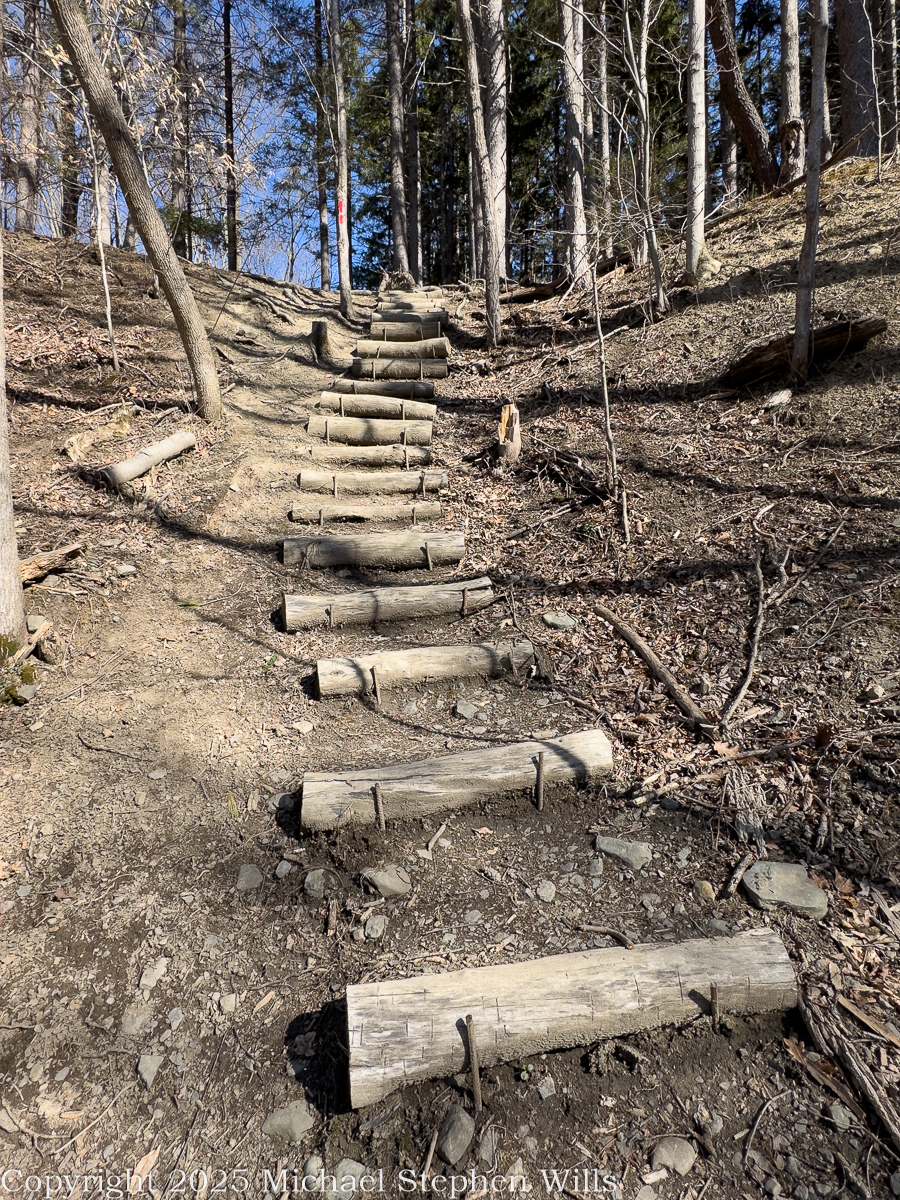
Steps cut from logs ascend the bluff, each tread pegged with iron, each rise a short confession of breath. I climbed to the ridge, paused halfway, and through the gray lace of March branches saw the creek shining at a bend far below. A man cannot help but measure his own life against such a course. The path goes up and down in obedient red blazes, but the water keeps its own counsel. Where the bank slumps the river shoulders through; where the bottom rises it lays down a mirror. In my youth I wanted the straight run, the short work. Now the curve pleases me. To go with the current and not be carried away—that is a lesson suitable to the grey in my beard.

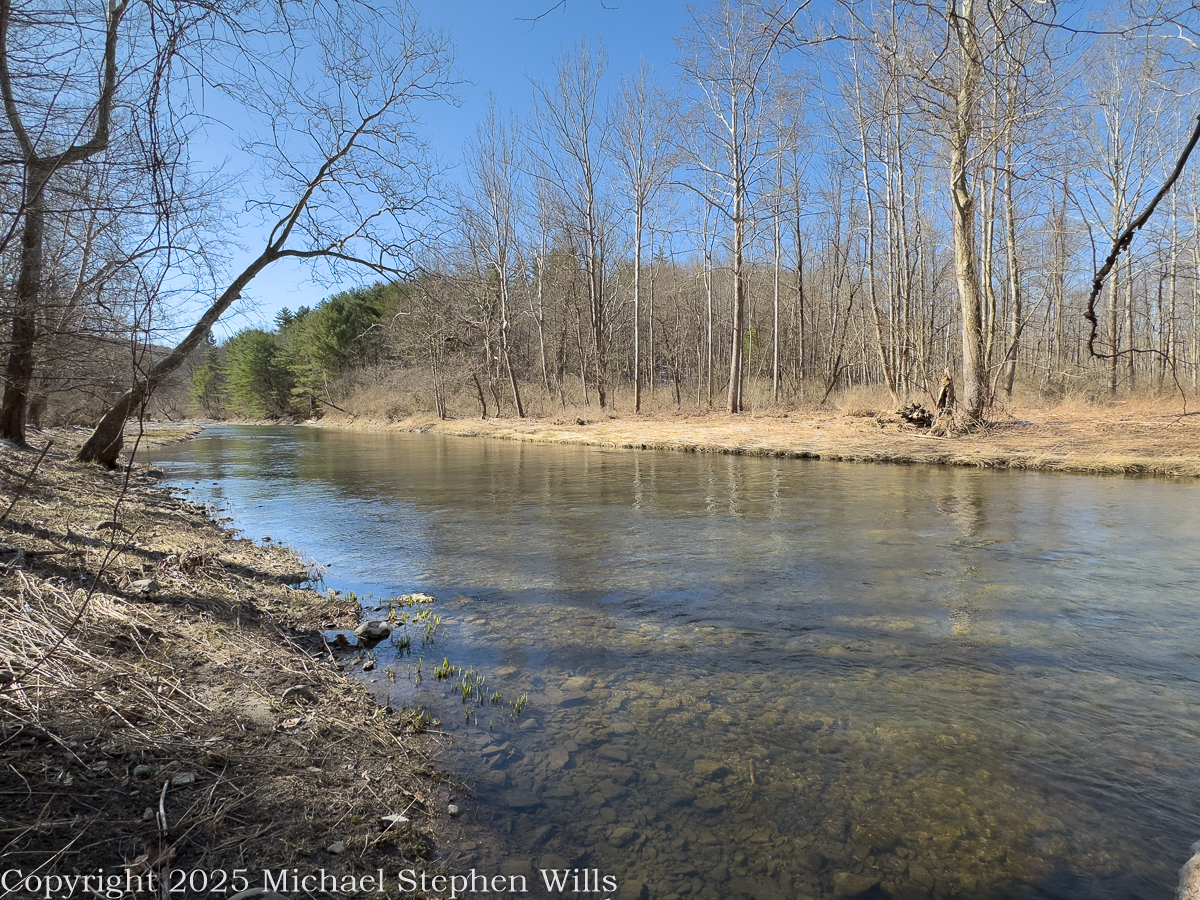
Clear, shallow run of Fall Creek with shale bottom and pine stand in distance
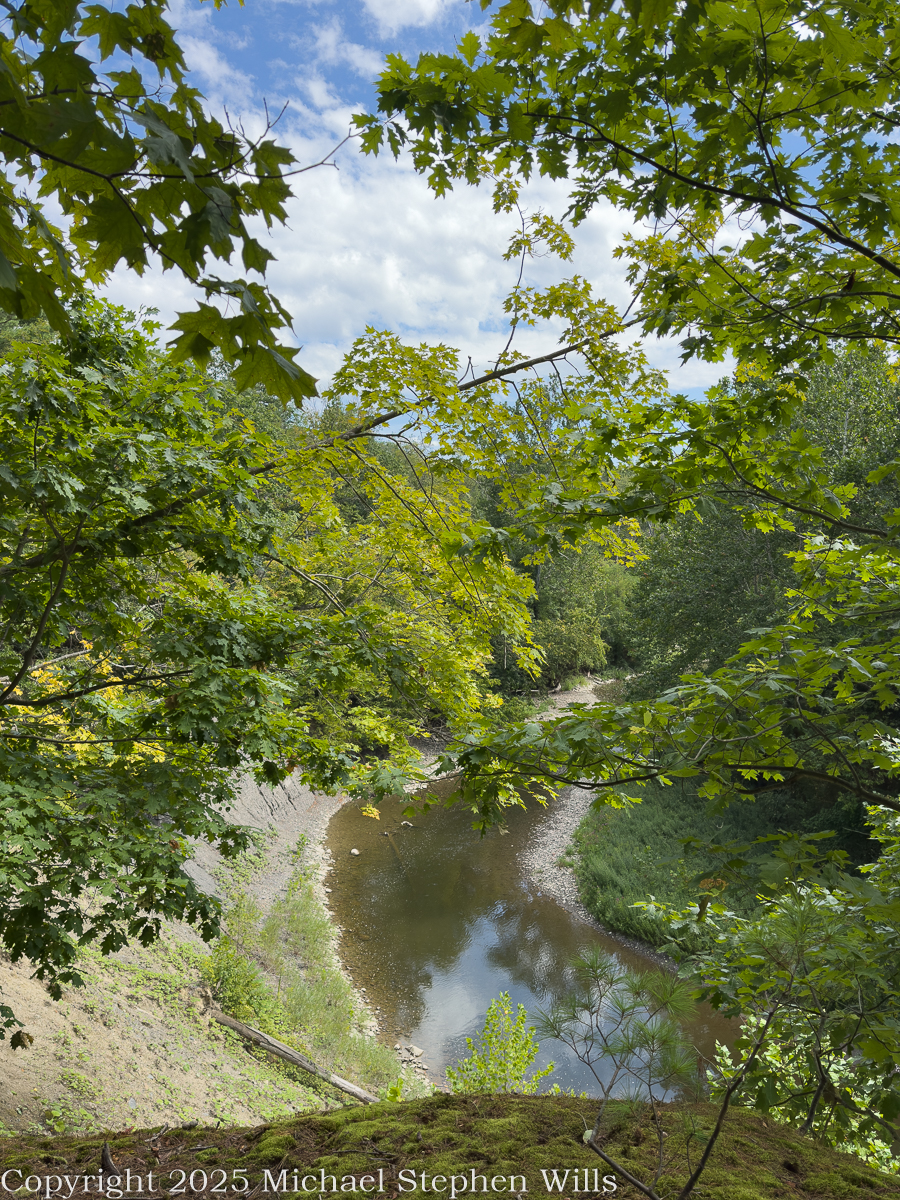
Bluff overlooking Fall Creek in summer

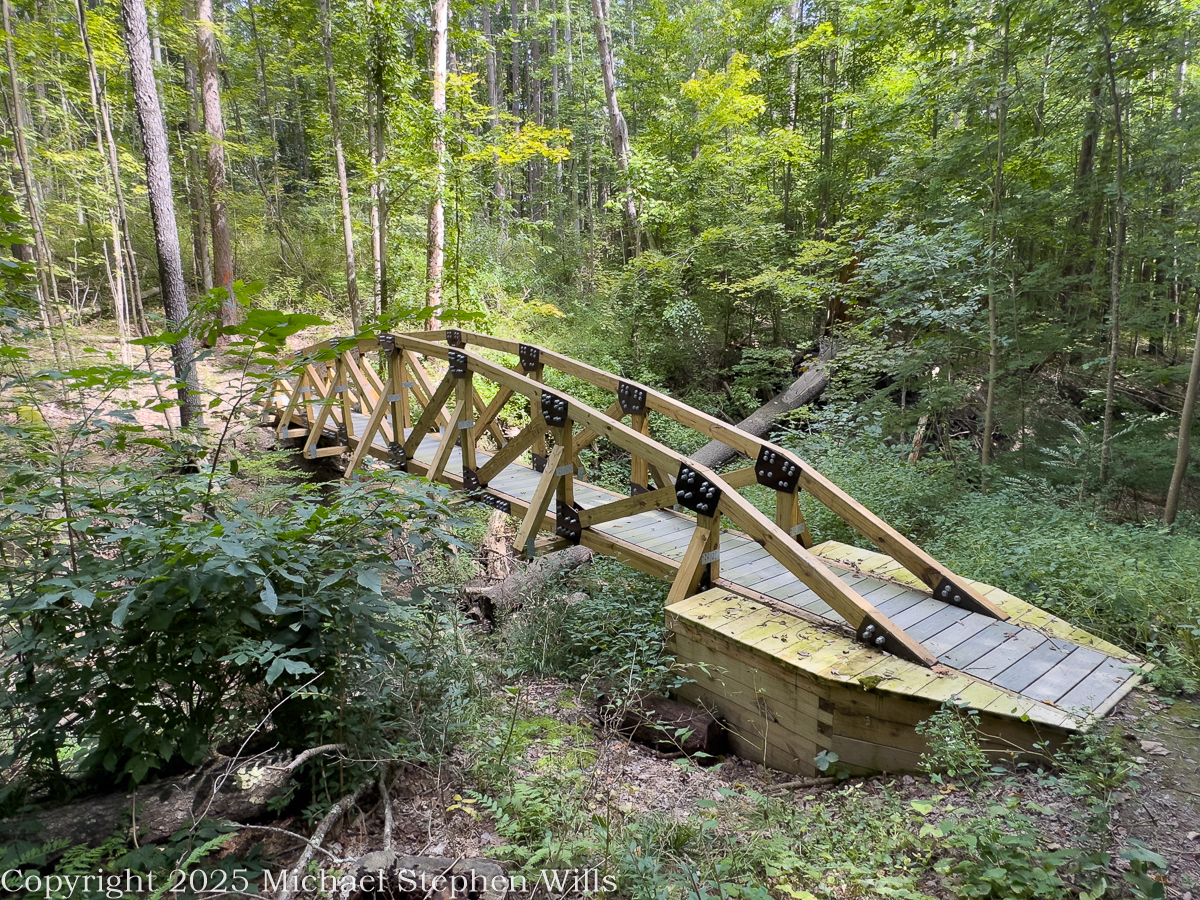
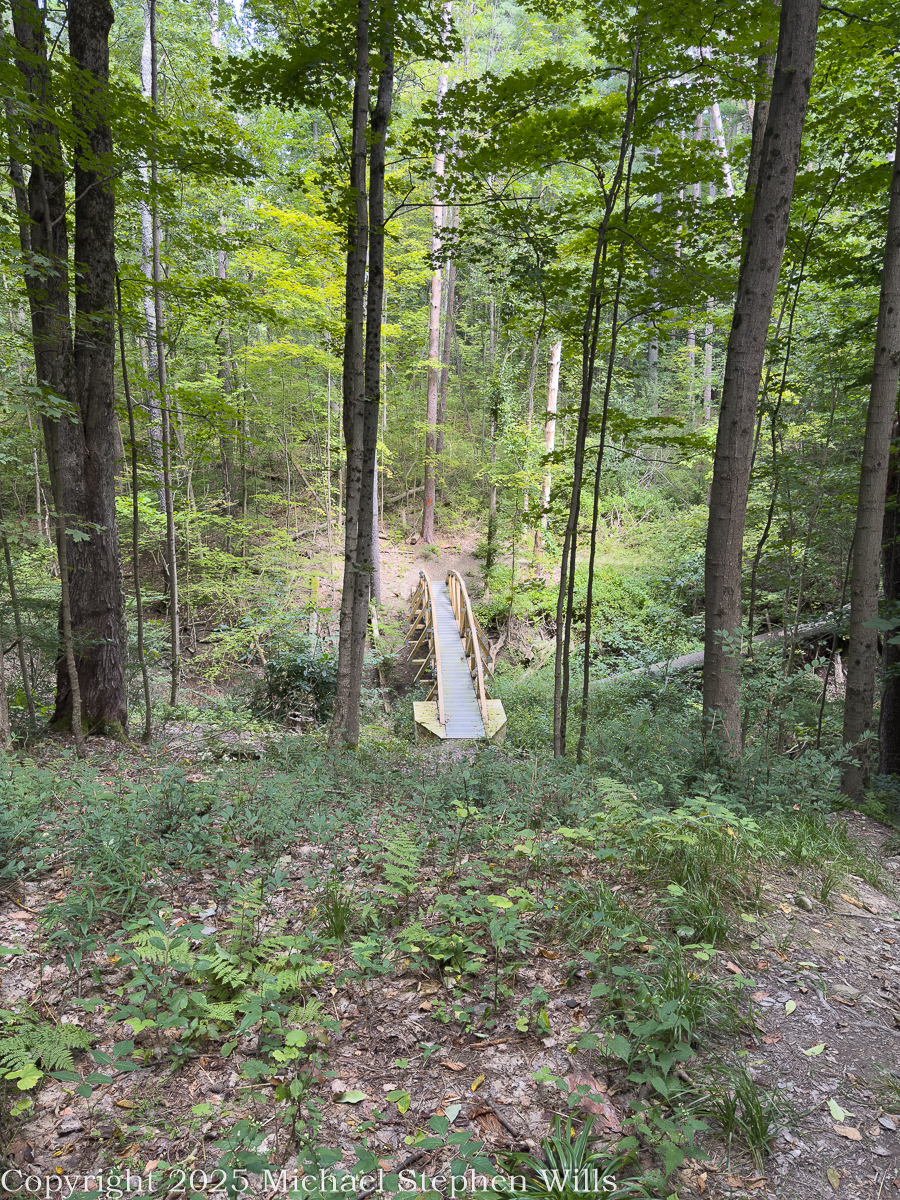
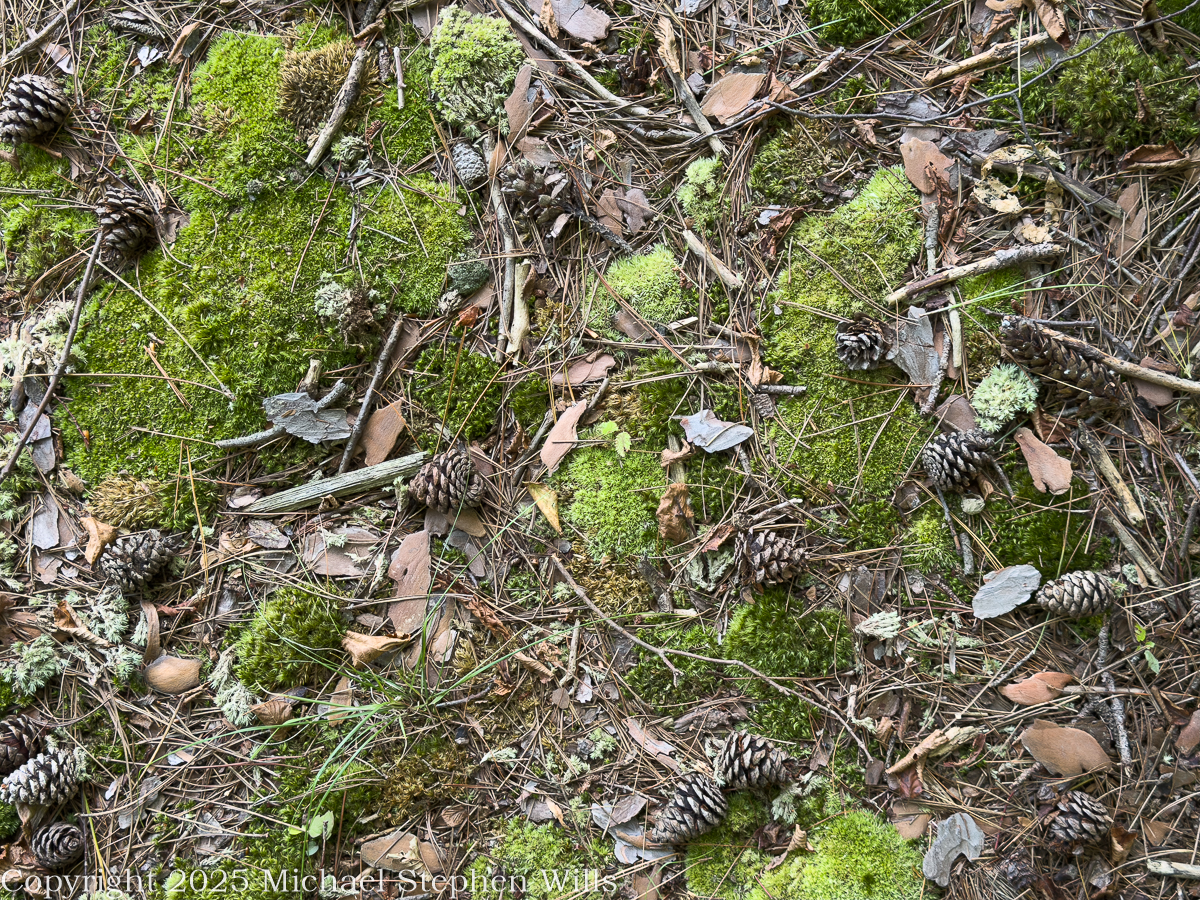
When I returned five months later, on August 23, the same path had forgotten the word austerity. The cathedral of sycamore was fully leafed, the white pillars now vanished behind a nave of shade. The pines perfumed the air without trying. A new footbridge—clean timber arching like a bent bow—spanned one of the wet flats. Its braces, black-bolted and handsome, looked as if they would hold the weight of an ox team or a file of schoolchildren. Such crossings are a kind of promise from the present to the future: we found a way through here; may you, too. Below, the floor was upholstered with moss, oak leaves, and a scatter of pinecones—the slow currency of the woods accumulating interest.

Arched wooden footbridge in summer forest on Cornell’s Monkey Run trail.

Summer makes a confidant of every plant. Ferns unrolled their scripture at the bridge abutment; jewelweed held its tiny lanterns along the seeps; a kingfisher rattled downstream, blue lightning with a bill. The creek, glassy over its shale pavement, showed every wrinkle of its stride. I waded a little, feeling with the sole what the eye could not—where the current took an extra thought around a stone, where it forgot itself in a warm eddy. Trout lingered in the dimmer reaches, quick as commas; a great blue heron lifted off with that surprising tidiness of wing, ungainly only in our imagination.

In all seasons the trail carries two histories: one written in rock and water, the other in the footfall of people. Cornell’s founders, Ezra and Andrew White, believed the university should place the hand near the thing studied; here that principle is plain. Botany students take their lectures in leaf and bark; geologists read the creek banks as if the pages might soon turn by themselves; children learn the oldest calculus—how long a stick will float before it catches in the weeds. The caretakers from the Botanic Gardens mark, mend, and interpret, but they do not overtalk. The woods speak enough.

Moss, grass and pinecones on an overlook of Fall Creek

As the afternoon eased toward evening, I climbed once more to the bluff. The light had gone honey-colored and the leaves of the maples, those careful accountants of September, were just beginning to weigh their green against gold. I looked down on the bend where I’d stood in March—cold, bright, expectant—and felt the year’s circle gently close. As John Burroughs wrote, “The power to see straight is the rarest of gifts… to be able to detach yourself and see the thing as it actually is, uncolored or unmodified by your own… prepossessions… that is to be an observer and to read the book of nature aright.” Monkey Run obliges that humility. The creek moves as it always has—glacially taught, mill-forged, campus-wise, and freedom-loving—and the trail, with its modest stairs and honest bridges, invites us to walk beside it, to match our breath to its turnings, and to leave, if we can, a lighter trace than we found.

References

Ways of Nature (1905), “Reading the Book of Nature,” pp. 275–276 (The Writings of John Burroughs, Riverside ed., vol. XIV, Houghton Mifflin)

Enter your email to receive notification of future postings. I will not sell or share your email address.

Glacial Echoes: Dryden Lake Park’s Mirror-Calm Morning in Upstate New York

Morning clouds hang over Dryden Lake as hills kindle first color; reflections hold breath while a lone walker reads the valley’s glacial and human-written past.

He came to the water before the people woke, the road a still ribbon of cold tar snaking beneath the low hills. Mattocks of cloud hung over the valley and the lake took in the sky like a mirror dropped yet not broken. The trees were beginning to color. A patient fire working from within the leaves. He parked where the grass ran down to the shore and stood a long while without moving. Birds made small sounds in the reeds. Somewhere a single truck labored up the grade and was gone. The surface held the hills with a steadiness the hills themselves could not keep. He thought how the quiet of a place can be the loudest thing it owns.

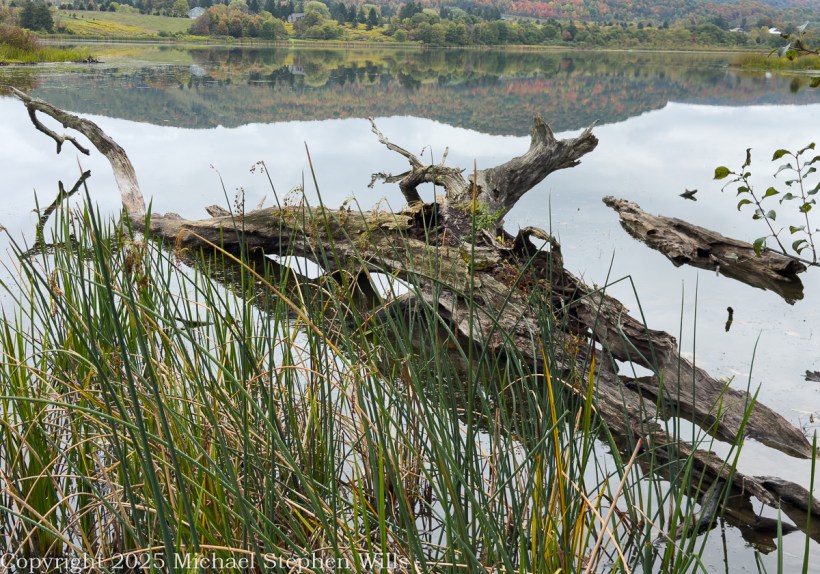
He went along the margin along the damp sedges where old drift lay silvered and light as bones. A drowned trunk angled from the shallows. The lake was old in the way of things made by ice and time. A kettle in the outwash of the last glacier, some men said, a bowl left when the buried ice eased away. He pictured the ice receding into the valley heads, the meltwaters choked with gravel, a hand larger than memory scribing the floor of this country. The earth never told it plain but the lay of it was witness enough. Across later centuries men cribbed a dam across the outlet and drew the water to a shape that pleased them and served their work.

A trail ran the length of the water on the old rail bed. The ties were long gone and the iron and cinders buried under years of leaf fall and gravel. He had walked it as a boy beside his father and now he walked it alone. Benches stood at half-mile intervals like waystations in a country of small pilgrimages. The signs told what once was here and what remains. They had renamed the path for a townman who argued it into being after the railroad had passed from the world and the right-of-way grew up with sumac and rumor. It was an easy trail and he carried nothing. His hands hung at his sides as if the day might place something in them when it was ready.

In another era the lake was a workshop. Men whipsawed timber in the wet air and fed small mills with the grove’s dark boards. Winter flowed over the flats, and they built icehouses and set the blocks within like blue stone, an industry that died when cold could be called from a switch. The hills have learned to forget the noise of it, though on certain mornings the fog takes a shape and you could believe rising from the ponded sawdust and the lading of sleds. He thought of the labor of those gone hands and of how work is a scripture every place keeps in its own tongue.

Before any of that, the ground here was a summer camp. People came with the season and went with it, laying their fires in the lee of the knoll and taking fish where the cattails thin. He could feel them in the open places, not as ghosts but as the first understanding the land ever had of itself. The words used for them now are museum words, yet the wind still crosses the water as it did and empties the same smell of iron and leaf into the lungs of whoever stands to breathe.

The town took its name from a poet long dead, a scholar’s choosing in the years after the war for independence when this tract of country was parceled out to soldiers of that same war. Virgil lay to the east as if they were shelving Latin across a map. The creek that bears that name threads the villages and finds Fall Creek at Freeville, and the combined waters go their own slow way toward Cayuga where the glacial hand scooped deeper yet. He said these names under his breath and they tasted of chalk and river stone.
A kingfisher rattled across the cove. The fish rose in rings that spread and vanished like time seen from above. Out on the water an old man pushed a skiff with an electric motor that hummed like a trapped bee, for the lake allows no gas engines now. The wildlife area ran around the shore in a ragged collar of field and wetland and alder, near two hundred acres under the state’s keeping, and the lake itself a little over a hundred. He watched the man aim for the lily line and thought how rules arise from the wish that a thing endure, though nothing does. Still we make the rules and we keep them as if the earth were listening.

Wind came down the slope with a smell of rain. He turned back and the hills lay again in the water, entire, and for a moment he could not tell which world had claim to the other. He thought of the rails pulled up and the mills gone to weeds and of the icehouses fallen into their own shadows and he thought of the people before all that and of the long winter pressing its thumb into the land and lifting it away. He thought of his father walking the rail bed beside him a lifetime ago and saying nothing. There are places where the past crowds close and will not be argued with. He stood until the first drops dimpled the surface and the reflection shattered and reformed. A train no longer runs here. The only sound was the soft percussion of rain on water and the slow turning of the earth beneath both. He put his hand to the damp trunk of a fallen tree and felt the grain and the coolness and the old patient labor of rot. Then he went up from the reeds, his pockets full of acorns, and out to the road where his truck waited and the day, austere and sufficient, came along with him.
References

Geological History and Glacial Formation of the Finger Lakes

Jim Schug Trail

The Dryden Lake area in the 19th century

Indian Campsite on west side of Dryden Lake

Dryden New York (wikipedia)

Dryden Lake (New York State DEC)

Geohydrology, Water Quality, and Simulation of Groundwater Flow in the Stratified-Drift Aquifer System in Virgil Creek and Dryden Lake Valleys, Town of Dryden, Tompkins County, New York

Enter your email to receive notification of future postings. I will not sell or share your email address.

Carved by Time: Exploring the Virgin River and Cross-Bedded Sandstone in Zion’s Narrows

A quiet moment along the Virgin River reveals the artistry of nature—where water, stone, and time shape Zion’s majestic Narrows in subtle, surprising ways.

In Zion National Park, where towering sandstone cliffs rise from the desert floor, the Virgin River weaves a persistent and graceful thread through deep canyons carved over millennia. The river is the creative force behind Zion’s signature landscape, sculpting stone with a patient hand. Among its greatest achievements is the Narrows—a sinuous gorge where water and light perform a timeless duet. The two photographs shown here draw us into an intimate corner of that realm, where water flows past a rock face marked by both subtlety and drama.

At first glance, what stands out is the unusual structure on the wall behind the river—a feature that at a distance could easily be mistaken for a man-made stairway. But closer observation reveals this to be a natural element, the result of erosion acting upon cross-bedded Navajo Sandstone. The texture and linearity of these formations are remnants of ancient sand dunes hardened into rock nearly 190 million years ago, during the Jurassic period. What looks like precision carving is, in fact, the legacy of sedimentation, lithification, and the scouring action of water over time.

In the first photograph, the scene is bathed in soft, diffused light, lending a quiet tone to the flowing water and the weathered rock face. The surface of the Virgin River becomes a silky sheet, its motion captured with long exposure so that it seems to glide effortlessly past the cluster of smooth stones in the foreground. Here is a deep calm—the kind that can be heard in the hush of water over stone and felt in the breathless silence of a canyon morning.

Click each photo for a larger view

The second photograph, taken under brighter conditions, reveals the same scene with different character. The increase in light clarifies the water’s transparency, the greens of moss and lichen on the wall, and the golden tones of the sandstone. What you see is a pattern formed by layers of wind-blown sand, once part of vast dunes, now standing as a stone ledger of time. The river, its bed visible beneath the shallow flow, seems to read this text as it passes—century by century, pebble by pebble.

The Virgin River begins high in Southwestern Utah, at the Navajo Reservoir in the Dixie National Forest north of Zion National Park and travels over 160 miles to join the Colorado River, carving through layers of sedimentary rock as it descends. In the Narrows, the canyon walls rise up to a thousand feet while the corridor narrows to just 20–30 feet across in places. The intimacy of the Narrows contrasts with the vast openness elsewhere in Zion, enclosing the traveler in a world of water and stone, shadow and echo.

Walking the Narrows means walking in the river itself—an experience that engages body and spirit alike. The water is rarely still, and neither is the trail. Slippery rocks and ever-shifting current demand attention and balance. Yet, this very immersion invites a deeper kind of awareness. You are observing nature from within it, shaped by nature, and held by nature.

What the photos capture so eloquently is that Zion is a place where the work of nature can appear deliberate, even architectural. The illusion of stairways in the sandstone, carved not by hands but by wind, gravity, and time, is a reminder of how little separates the human sense of design from the forms nature produces. We recognize rhythm and repetition, elevation and flow, and are drawn to interpret meaning from these patterns.

But perhaps the meaning lies not in what we impose, but in what we receive. The Virgin River’s passage through this sculpted corridor teaches patience, resilience, and the beauty of gradual transformation. Its waters do not fight the rock; they yield, swirl, and persist—until the rock, by degrees, gives way. What results is a landscape both eternal and ever-changing.

Zion’s grandeur is easy to admire its many amazing overlooks, but its soul is found in quiet places like this—where sandstone walls, smoothed by water and time, speak not in shouts but in whispers. Here, beside a seeming stairway that leads nowhere and everywhere, we come face to face with the artistry of the Earth.

Enter your email to receive notification of future postings. I will not sell or share your email address.

On The Edge of Time Above Taughannock Gorge

Perched above Taughannock Gorge, a moss-covered ledge and cascading falls reveal ancient stories—where Devonian seas once flowed and time’s layers whisper through stone and water.

The morning sun had only just breached the rim of the gorge, sending long slants of golden light across the forest floor. Walking the South Rim Trail of Taughannock Falls State Park, I came upon a quiet, unassuming spot—just a few paces off the path—where the forest seemed to pause in reverence. What greeted me was a small marvel of persistence and time.

There, rooted precariously atop a slab of brittle shale, was a tenacious shrub rising from a bed of moss, its spindly frame etched in sharp contrast to the soft, green sprawl beneath it. The moss had taken hold on a shelf of rock cantilevered over the gorge like a green tongue of earth defying gravity. Cracks traced the shale’s surface like veins, silent records of the forces that shaped this place—heat, ice, pressure, time. Together, the moss and the bush formed an improbable community, surviving against odds, bound together by the thin soil cradled in stone.

This ledge, suspended over the abyss, seemed less a part of the earth than a question it asked—how much life can cling to the edge before the edge itself gives way?

Beneath this living fragment, the gorge dropped away. Layers upon layers of shale revealed themselves, stacked like a collapsed library of time. Here, the Devonian Period lies exposed to wind and rain, and to those willing to pause and wonder. Each stratum holds the fossil whisper of ancient seas, where trilobites scuttled and coral reefs once stood. This gorge was not carved quickly. It was not born of a moment, but of many—countless raindrops, millennia of ice melt, the slow, sure work of water over stone.

From this natural balcony, I looked out and down to the gorge floor where the creek shaped the land with an artist’s patient hand. The falls, seen from above, no longer thundered—they danced. Spread like the folds of a fan, water curled over smooth stone in steps of white silk. From here, the cascade looked deliberate, choreographed—an elemental performance halfway between gravity and grace.

How many times had this water flowed, reshaped, receded? How often had it carved these grooves, smoothed those ridges, erased the footprints of what came before? Looking at the exposed rock, one could trace the signature of ancient glaciers, feel the memory of long-gone floods. It was humbling—this intersection of change and continuity.

Above it all, the trees stood still. Pine and oak, rooted well back from the edge, offered a kind of sentinel presence. Their shadows stretched long and angled, tracing the contours of both earth and memory. For a moment, I let go of all thought and simply listened—to the murmur of wind through leaves, the faint rush of water far below, and the silence that presses in when the land itself seems to be remembering.

This spot—so easily missed by a hurried hiker—offered a parable of resilience and impermanence. The moss did not grow with certainty, nor the shrub reach with confidence. They survived on the edge because they adapted. They made do with less. They took root where others could not. There was no security in that place, only presence. Only the now.

And isn’t that a lesson worth carrying?

We so often seek stability, firm ground, a clear path. Yet, some of the most beautiful things live just beyond comfort—on ledges, in cracks, in the margins of the known. To pause here was to acknowledge that life thrives not only in sheltered valleys but also at the edge of what seems possible.

As I stepped back onto the trail and continued along the South Rim, the image of that mossy outcrop stayed with me. I carried it in my thoughts like a talisman—proof that even on the brink, life finds a way. And that from above, the most chaotic falls can appear as ordered motion, as a flow toward something larger.

Later, when the sun climbed higher and the light lost its slant, I would look back on this moment not as a spectacular highlight but as something more intimate: a quiet encounter with nature’s subtle artistry, its layered truths, and its enduring invitation to look closely, feel deeply, and walk softly.

For here, above the gorge, at the edge of earth and time, even a whisper leaves a mark.

Enter your email to receive notification of future postings. I will not sell or share your email address.

Discovering Stillness in Nature’s Embrace

A bench beside a cedar, unchanged through time, stirred memory and gratitude—reminding me that some places wait quietly, holding space until we find them again.

A lingering memory hovers over this spot. The soft crunch of gravel beneath my boots, the filtered light through pine and oak, the scent of warm stone and moss—all of it felt at once familiar and distant, like a half-remembered tune that returns in full when you hear the first few notes. I hadn’t thought about the simple bench until I turned the bend this summer day on the South Rim Trail.

It was still there. The same humble bench nestled beside a cedar, its weathered frame now bearing the patina of years. The tree remained slightly bowed as if in silent conversation with the bench it had embraced.. The space between them, still and shaded, seemed to invite reflection without demanding it.

I sat down, letting the moment settle around me. In the gorge below, water moved quietly through sculpted shale, the same layered gray that once caught my attention through a camera lens long packed away. From this overlook, the view had scarcely changed: stone and water, green clinging to cliff, sky rolling in above it all. My photograph captures it now just as it might have then—perhaps from the same angle. The gorge unfolding in a graceful arc, with trees perched impossibly along the sheer face.

It struck me, not as a grand revelation but with quiet certainty, that very few places in life offer such stillness. So much shifts in the world—landscapes erode, trails are rerouted, lives move forward. Yet here I was again, sitting in the same spot, as though the intervening decades had folded in on themselves.

Back then, I had rested here out of curiosity, pausing to take in the view, enjoy a respite. Now, I sat with a deeper kind of stillness. The second photograph holds the space as I found it—quiet, dappled with shadow, edges softened by time. The fence beyond it remains, unchanged, a modest boundary between the trail and the deep gorge beyond.

I don’t remember what thoughts filled my mind that first time. But today, a kind of gentle gratitude rose instead. Gratitude for the bench, yes—but also for the path that led me here again, for the act of remembering, and for the rare gift of finding something familiar, something steady.

A final image frames just the bench, its surface worn smooth, its structure slightly leaning now. A single flower petal had fallen on the wood—a quiet grace note in the morning light. I stood and took that last photo as a way of holding the moment, though I knew no picture could fully capture what it meant to find something that had waited without fanfare.

As I turned and walked back along the rim, I felt lighter. Not because time had reversed or been conquered, but because it had been witnessed—and somehow, that was enough.

Enter your email to receive notification of future postings. I will not sell or share your email address.