A Whitewashed Memory on Inishmore

I reflect on traditional Aran cottages while journeying to Dún Aonghasa, emphasizing the beauty of simplicity and lasting memories.

It was the kind of overcast morning that seems to cradle the island in a blanket of mist, a gentle hush falling over the land as though even the Atlantic held its breath. Pam and I had arrived by ferry at Kilronan, the main settlement on Inishmore (Inis Mór), the largest of the Aran Islands nestled in Galway Bay. There, amid the bustle of arrivals and greetings, we found our driver—a wiry, weather-worn man with a soft brogue and kind eyes—and his horse trap, a simple two-wheeled carriage with room enough for three and the sounds of hooves to accompany our journey.

We set out up Cottage Road, the stone-paved track winding westward from the harbor. The sea fell away behind us as we climbed, a gray shimmer stretching to the hazy outline of Connemara’s mountains on the far side of the bay. Our destination was the dramatic cliffside ringfort of Dún Aonghasa, a place older than memory. But it was the unexpected moments in between—the ones not printed in guidebooks—that linger longest in the mind.

As we rounded a bend flanked by low stone walls, wildflowers blooming defiantly in the cracks, our driver pulled the reins gently and pointed with his crop.

“There,” he said, nodding ahead, “is a fine example of a traditional Aran cottage.”

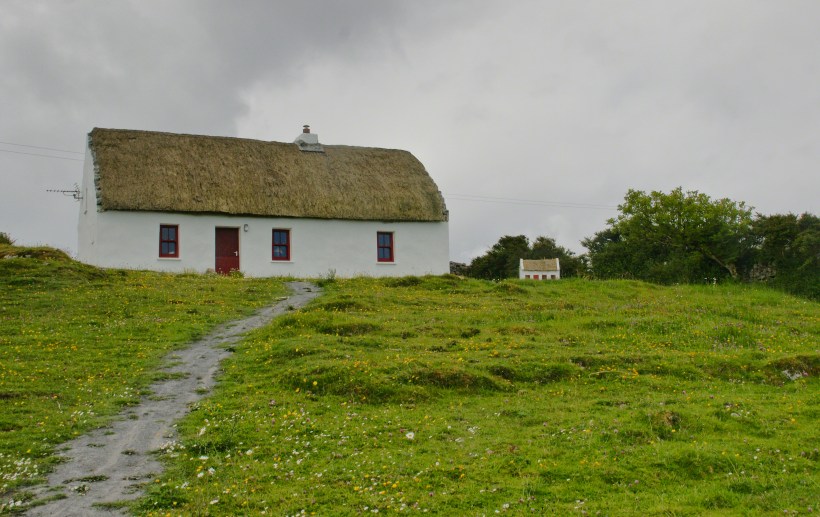
And there it was—a vision from another time. The thatched roof curved softly like a that blanket itself, straw golden against the brooding sky. The walls were whitewashed to a perfect matte sheen, gleaming in spite of the cloud cover. A crimson door and two window frames punctuated the front façade like punctuation in a poem. Just to its right, set further back on the hill, stood a tiny replica of the same cottage, identical in every feature. I blinked, half believing it was an illusion.

Click the link for my Getty IStock photography of the Aran Islands
This thatched cottage with matching child’s playhouse is on Cottage Road out of Kilronan Village on the Aran island, Inishmore, County Galway, Ireland.

We only stopped briefly—it was a private residence—but the sight of it left a kind of imprint. I turned in the trap seat to keep it in view as long as I could. The cottage was perfectly placed, facing Galway Bay with a commanding view. I imagined the light pouring across the line of mountains, catching the glint of sea and sky.

“There’s a name for that finish,” I said, recalling something I’d read, “whitewash, or lime paint.”

Our driver nodded. “That’s the old way. Made from slaked lime. We’d call it ‘whitening’ when I was a lad.”

Whitewash differs from paint in the most elemental of ways. It becomes part of the stone, absorbed into the very surface. Like a memory of bone. And yet, it requires care. Apply it to a wall not properly cleaned or moistened, and it flakes, pulls away like a broken promise. But done right, it lasts, breathes with the building.

Upon our return, researching “whitewash,” if found this photograph from the Yarloop railway workshops Yarloop, Western Australia. There, on a shelf, where three old boxes sat like relics: DURABLO, WESCO, and CALCIMO. All contained kalsomine—the powdered form of lime paint. CALCIMO promised to “beautify walls and ceilings” and was proudly marked “LIME PROOF.” There was something quietly heroic in that. Lime-proof, as though against time itself.
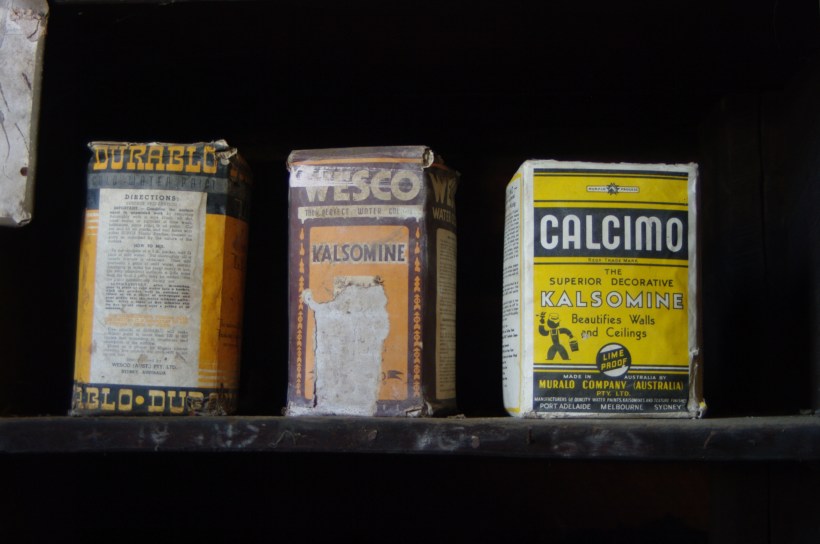
Yarloop railway workshops Yarloop, Western Australia Kalsomine, wall ceiling plaster powder. Source: Wikipedia article on White Wash. Author: https://commons.wikimedia.org/wiki/User:Gnangarra

Looking at the box of Calcimo, a product of the Murabo Company of Australia, I was struck by how far the tradition had traveled. From island cottages in the Atlantic to distant corners of the Southern Hemisphere, the language of whitewash—of simplicity and purity—had touched the world.

We returned by the same road, past that same cottage, the small one still keeping watch beside it like a child beside a parent. And I knew then that the islands hadn’t just given me sights—they had offered stories, silent ones written in thatch and stone, in lime and wind.

Sources for this post: search wikipedia for “White Wash”. White wash photo author: Wikipedia commons user Gnangarra

Click me for the first post of this series, “Horse Trap on Inishmore.”

Enter your email to receive notification of future postings. I will not sell or share your email address.

Church Ruin on Inishmore

Join me on a journey through Inishmore, Galway Bay on a horse-drawn carriage. We’ll see a ruined church, horse pasture, and iron age fort, Dun Aengus, with reflections on the word ‘riven.’

Continue reading “Church Ruin on Inishmore”

Farmhouse Ruin, Slievenaglogh

Two views

Continue reading “Farmhouse Ruin, Slievenaglogh”

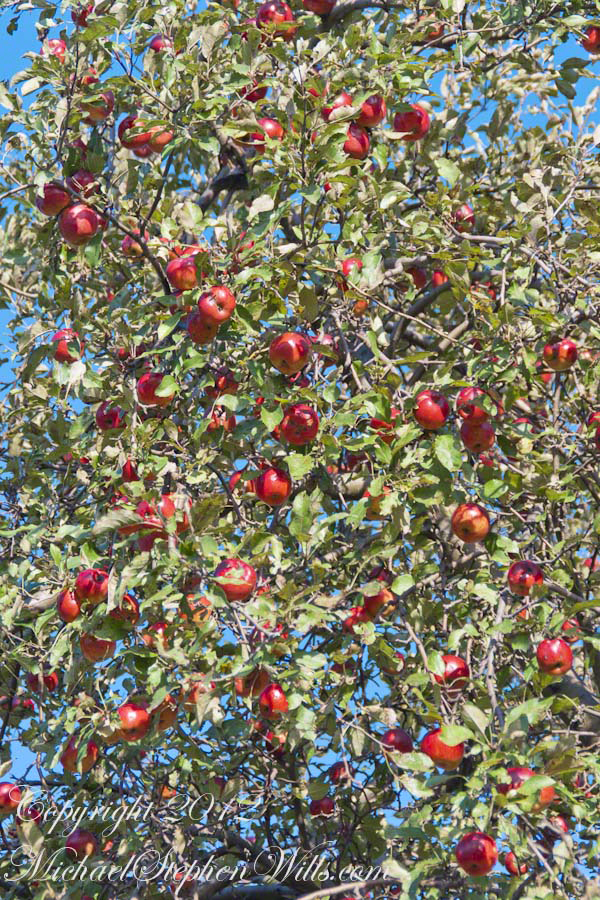
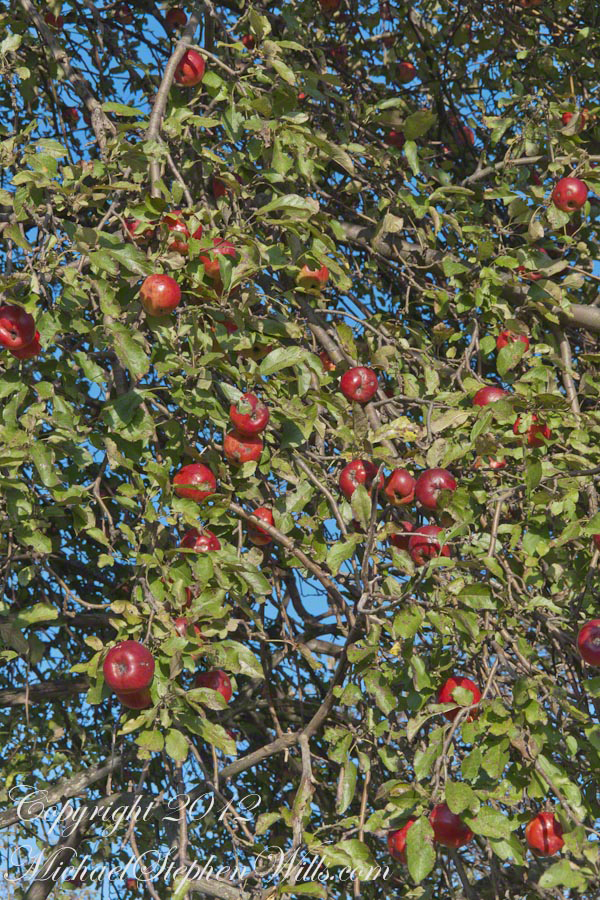
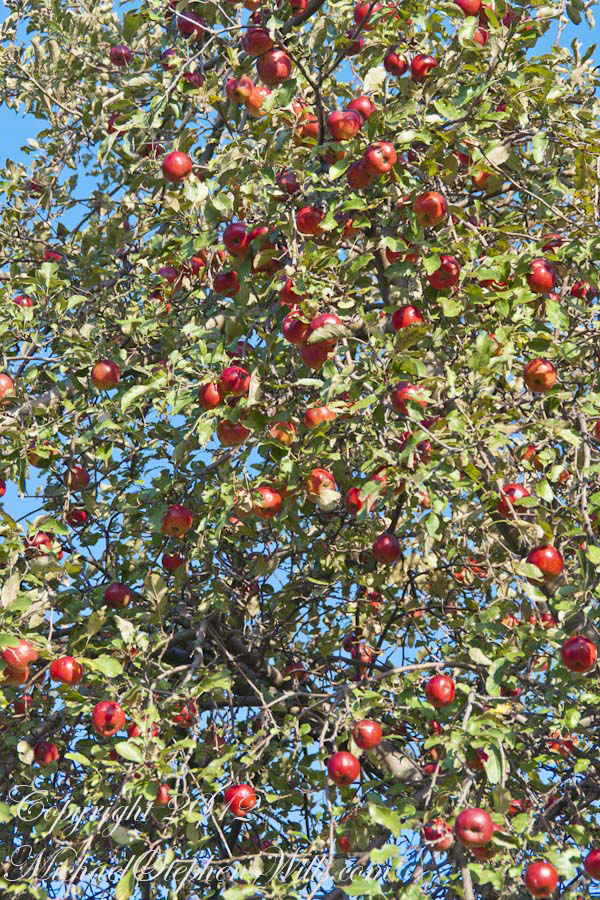
Apple Harvest Abstracts

Organic, abstract, ripe apples ready for harvest on Malloryville Road in the Finger Lakes

One late afternoon in early autumn, Pam and I strolled along Malloryville Road from our old home, discovering these ripe apples ready for harvest beside a barn.

Thank You for viewing.

Click any photograph for my OnLine Gallery, “Finger Lakes Memories.”

Copyright 2023 Michael Stephen Wills All Rights Reserved

Finding Circlestone

Ancient Ruins

The Searcher’s Tale

Click me for an Arizona Gallery of Fine Art prints by Michael Stephen Wills

I first learned about Circlestone from stories The Searcher told during my first backpack into the eastern Superstition Mountains, on the Tule trail, April 2005.  I described this in “Riding from Pine Creek to the Reavis Valley” where the Searcher described a stone circle, overgrown with Alligator Juniper, on the slopes of Mound Mountain.  He pointed south toward a peak and foothills that rose from the valley floor and said, “follow the fire trail east from the southern Reavis Ranch valley.”  There were strange happenings associated with Circlestone (as he called it) and he’d never taken the time to go there.  “There is a book full of stories.”  I eventually sought out Circlestone on the web and in books, but after I found it on my own using only the Searcher’s directions and advice from friends met on the way.

Sunset from Castle Dome

Backpacking with my sister

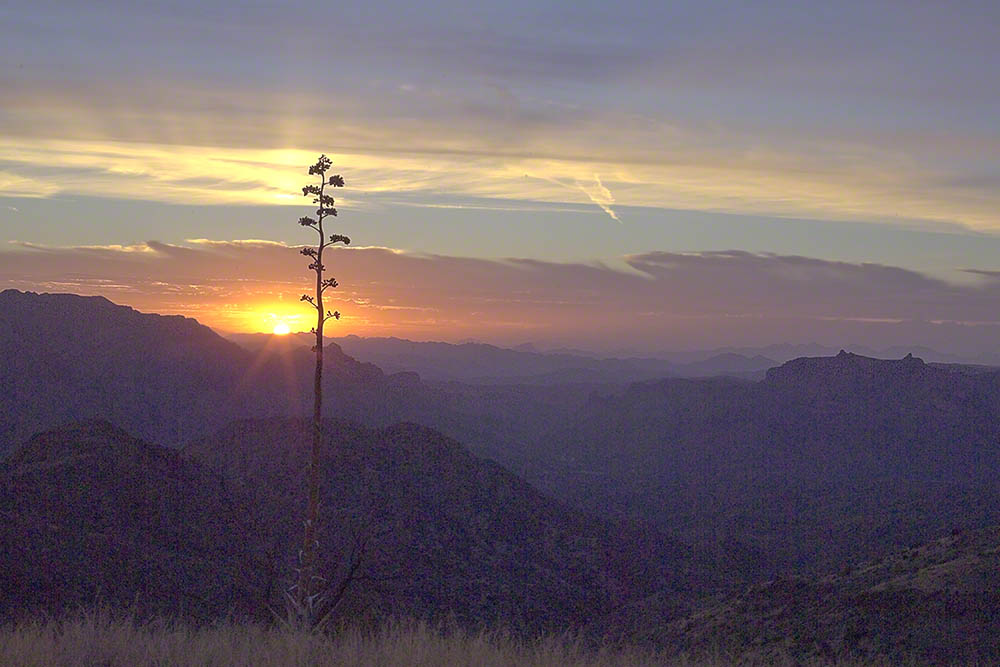
In 2006 I explored Circlestone twice along with my sister, Diane, who accompanied me.  First for nine days early March 2006 using the Reavis Ranch trail from the north and the second for five days in November 2006, coming us the same trail from the south.  Our first trip was Diane’s first “real” backpack adventure and we took it slow with a camp at Castle Dome where there are flat areas and exceptional views.  Above, is the sunset from our second night (I camped the first night next to the car…we took it very, very sloooowwww).

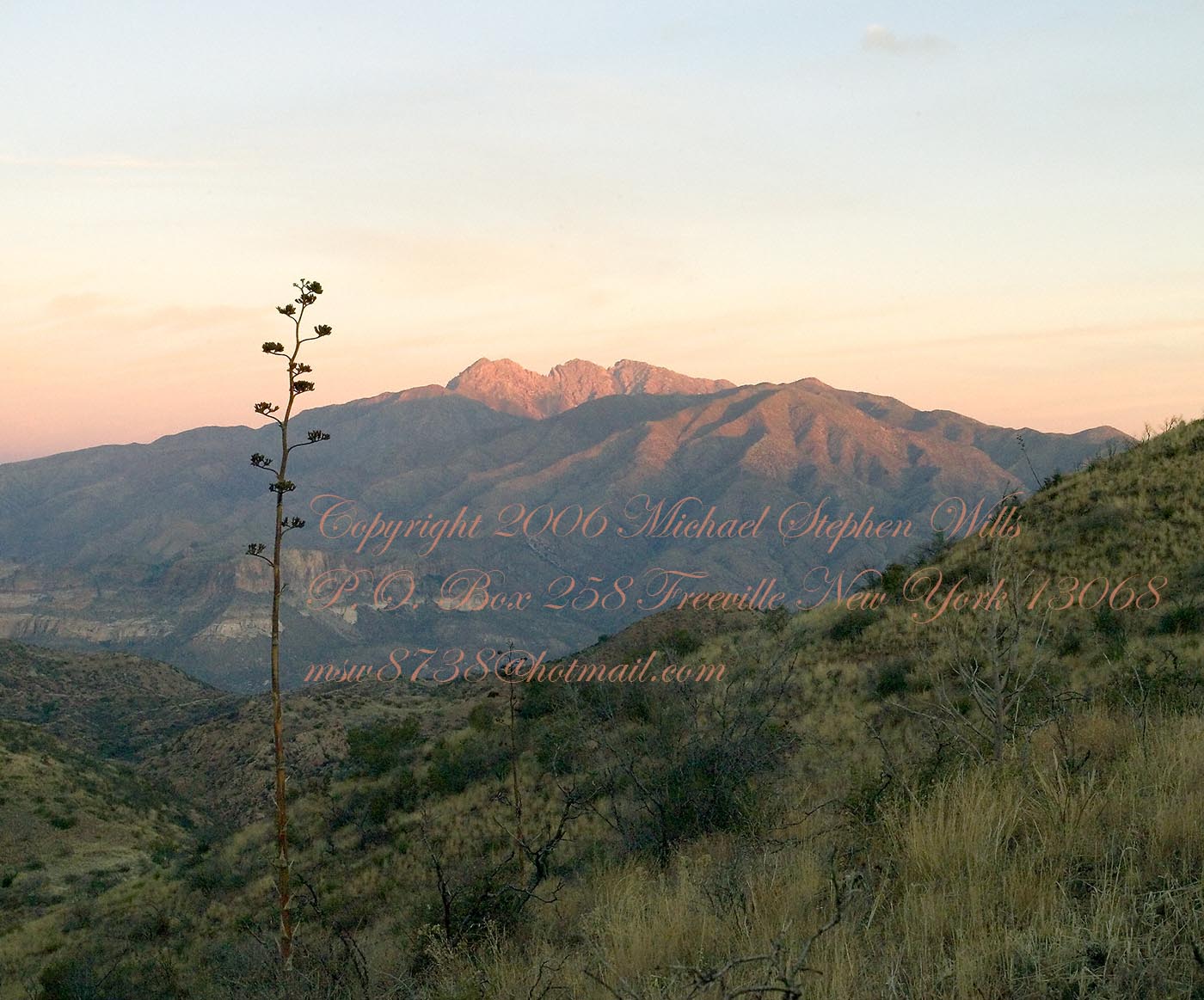
Four Peaks Sunrise

Castle Dome

Then, there was morning of our third day.  Here is the Four Peaks Wilderness in the first rays of dawn.  These are green, rolling foothills of grass, low shrubs and a few juniper.  If you know where to look, there’s an unmarked trail to Reavis Falls (the highest waterfall in Arizona).  I found the trail and visited the falls on a later trip.

Castle Dome Sunrise

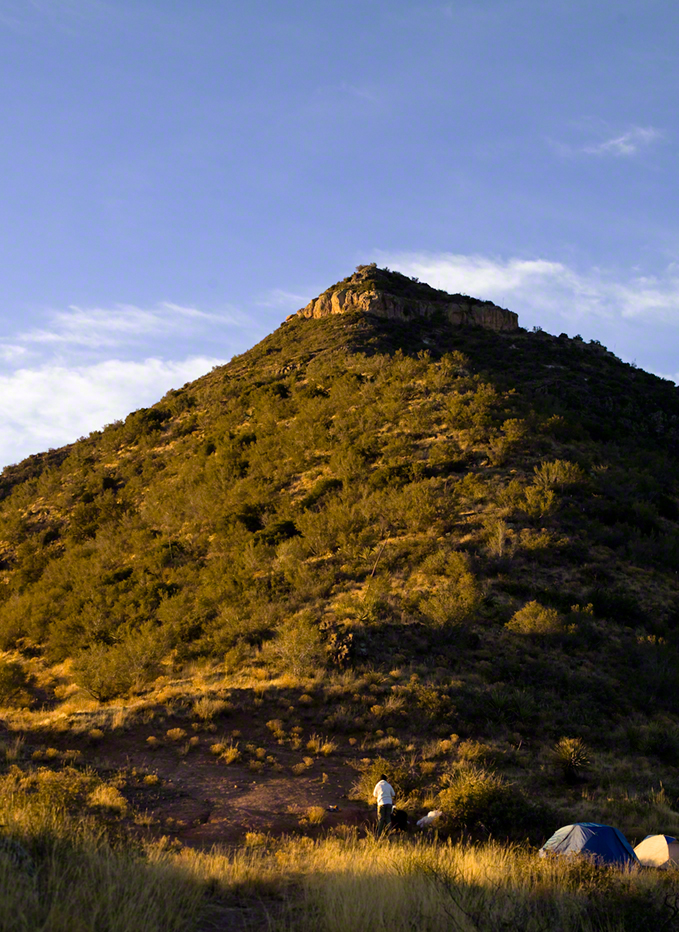
After enjoying the Four Peaks, you turn around and see Castle Dome in the morning light, as in this photograph.  Remember the same of the “dome”, because it is visible from the ultimate view from Circlestone.

Reavis Valley and White Mountain from the trail to Circlestone

The Trail to Circlestone

Our camp was in the Reavis Valley, one of the first sites along the creek coming from the north.  There were fantastic rock formations across the creek.  Not far from there, the land falls away into steepness and then Reavis Falls.   The Searcher told me about going that way, once.  There is no trail down to the falls overlook and deep canyon carved by the water.

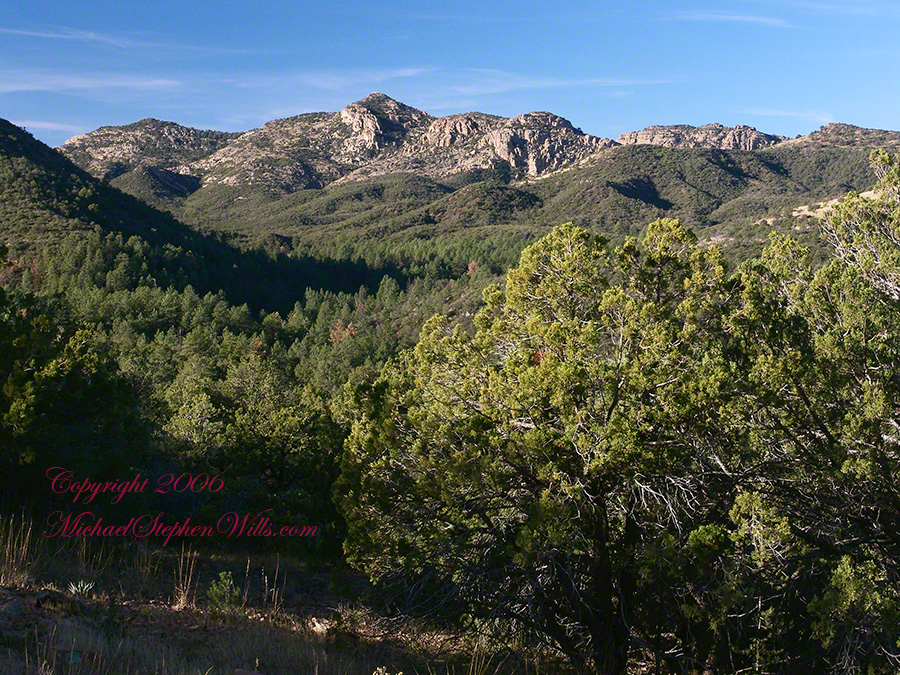
This photograph, above, is from a lovely forest of pinyon trees that grow along the trail to Circlestone (described by the Searcher as rising from the southern Reavis Valley).  You can see the valley, just to the right, and a longer and steeper valley that rises from it up to White Mountain.  That way is the southern legs of Reavis Trail.  I have a movie clip from this same spot of the pinyons moving in the breeze and may post it at a later time.

All of the trail to Circlestone is a climb.  You pass over “Whiskey Spring”, named for a still kept there in the 1800’s and over a steep defile gouged from the rock.  The trail is well marked and I am told that, sometimes, there is no cairn marking the trail to Circlestone.  If you are desperate to get there, look-up some excellent hiking directions available on the web.  I have even found the circle on GoogleEarth, since I know where to look.  If you like a challenge and the adventure,  go from the directions the Searcher gave me.

Four Peaks from Circlestone

From the fire line trail, the unmarked branch to Circlestone climbs steeply and follows a ridge through Alligator juniper, punctuated by stalks of century plant, to a broad way that rises to Circlestone as though to a monument overgrown by the same juniper.

My Circlestone Mystery

There was an unusual experience on our first trip, on this portion of the trail.  We were winding through the Juniper and, as it happened, Diane fell behind.  After awhile I missed her and waited and, after a minute, went back to look for her.  I found Diane sobbing uncontrollably, deep in grief over our father who passed away eleven years before.  We talked about it until she felt better.  She said it was as though a door opened and she could feel out father.  What makes this exceptional is Diane is not given to anything like this and I ascribe her deep grief to the nature of the site.  It is a mystery to this day.

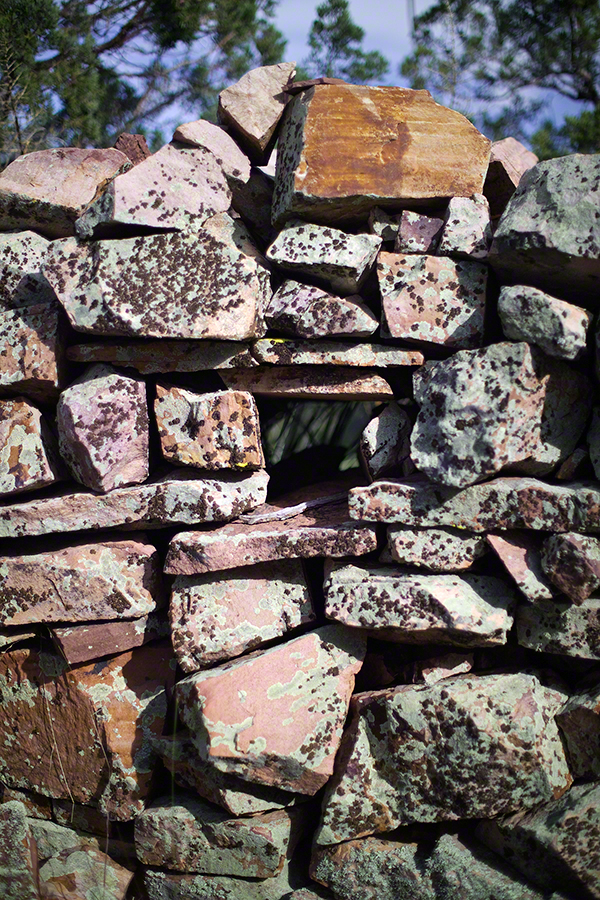
At Circlestone, that first trip, we explored and experienced the site.  You cannot see the entire wall at any point and need to wander through and over it, being careful not to disturb anything.  Here and there, in the outer wall, are openings like the one in this photograph.

Site-Hole in the Circlestone Wall

At Circlestone

I call it a site hole because, on your knees, it is possible to look through and see the distant view through the trees.  As you can see, the stones are a striking red color with green lichen growing thick.

On the second trip in November, knowing the way and having great weather, I brought my cameras to capture the exceptional views, one of which is above.  I’d dearly love to come back to camp just below the ruin and do some work in the evening and morning light.  For now, I can enjoy those views from Castle Dome.

Three Horsemen and Castle Dome

Can you see the dome in the middle distance.  I did a portrait of three horsemen who road up to Circlestone in November.  We came to know them pretty well, that afternoon and the following morning down in the valley.

Three Horsemen

I carted up a tripod, so you can see Diane and I in the same spot.

Mike and Diane at Circlestone
Copyright 2023 Michael Stephen Wills, All Rights Reserved

Slievenaglogh View, east, V

Looking east

This the fifth and final of a series of landscape photographs taken from this position.

Click photograph for a larger view. To do this from WordPress Reader, you need to first click the title of this post to open a new page.

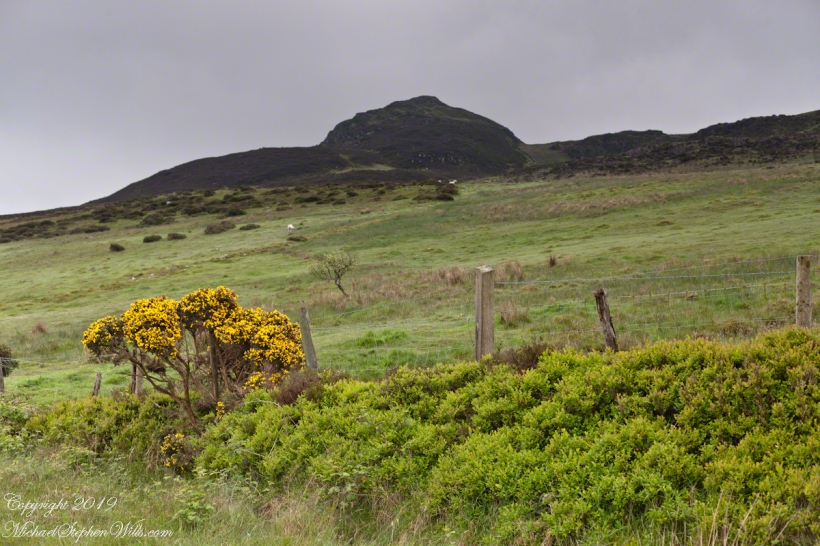
The peak is named, in the English language, Slievenaglogh. It is so strange as it’s not English, being instead a transliteration of the Irish name “Sliabh na gCloch.” This is “Rock Mountain” translated literally. Slievenaglogh is carried to the townland, a long thin swath of land being the peak and associated ridge-line.

The rocks up there are called “gabbro,” a type of magma slowly cooled under ground. Slievenaglog, Slieve Foy across the valley, and the Morne mountains all formed within volcano magma chamber(s) of the Paleocene, 66 million years ago, a time associated with extensive volcanism and the Cretaceous–Paleogene extinction event that gave rise to the current age.

Our younger cousin has been up there, optimistically we left it for a later trip.

Click for another interesting post and story from County Louth.

Here is a slide show of this landscape series.

A link with interesting reading on County Lo uth geology.

Copyright 2022 All Rights Reserved Michael Stephen Wills

Slievenaglogh View, northeast, IV

View of Slieve Foy

This the fourth of a series of landscape photographs taken from this position.

Click photograph for a larger view. To do this from WordPress Reader, you need to first click the title of this post to open a new page.

The distant ridge, Slieve Foy, is the site of a mythic battle from the epic “The Cattle Raid of Cooley” (Irish: Táin Bó Cúailnge).

Pam and I did a circuit of the island, returning to the home of my Mom’s first cousin. Our last full day on Ireland a cousin took us on the Tain Trail, over Maeve’s Gap of Slieve Foy and into Carlingford town.

Our route is partly visible to the right of the ridge, hidden in low clouds.

Click for another interesting post and story from the Cooley Peninsula.

Here is a slide show of this landscape series.

Copyright 2022 All Rights Reserved Michael Stephen Wills

Slievenaglogh View, northeast, II & III

Rural Scenery

These are the second and third of a series of landscape photographs taken from this position. See the previous post for the first.

Click photograph for a larger view. To do this from WordPress Reader, you need to first click the title of this post to open a new page.

I visited here early morning of the Monday Pam and I embarked on a trip around the island of Ireland.

Arrived the previous Saturday when, after some sites between Dublin airport and the Cooley Peninsula, we met my Mom’s first cousin who had invited us for a visit. We had a grand time meeting them.

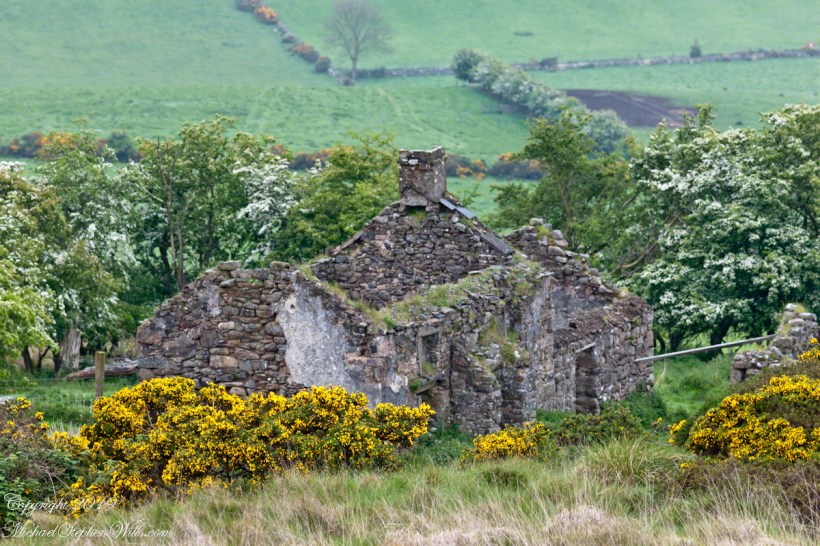
The ruin in this view is on the slopes of the peak. Some of these ruins are former homes with the replacement nearby. This appears to be an abandoned farm.

Click Me for the first post of this series.

Click me for the next post of this series.

Copyright 2022 All Rights Reserved Michael Stephen Wills

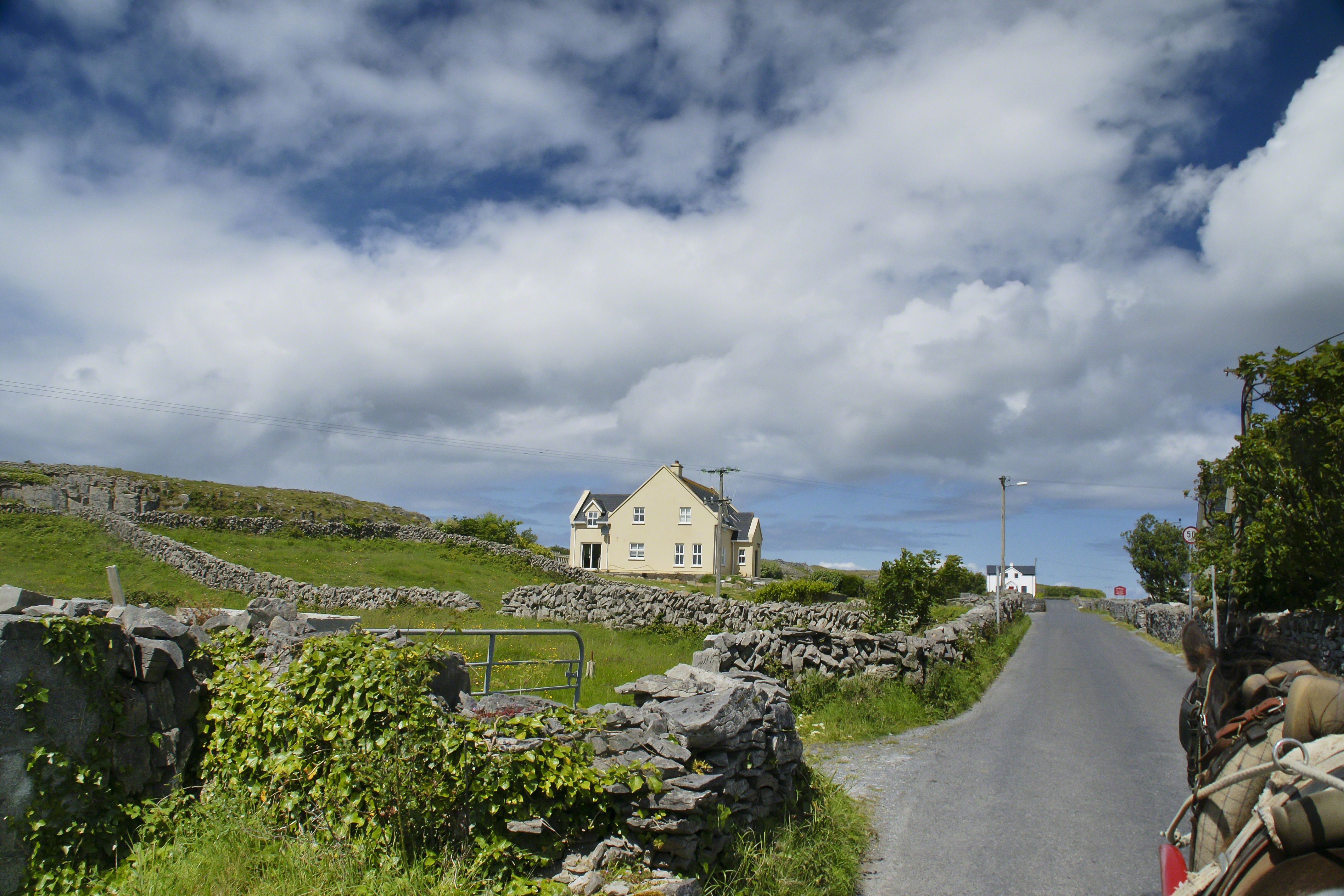
Headed Up Cottage Road, Inishmore

View from a horse trap on the Aran Islands, Galway Bay, Ireland

Enjoying travel on a horse trap, a type of carriage, on Inishmore (Inis Mór), the largest Aran Island in Galway Bay we headed up Cottage Road from Kilronan, the main island settlement.  It was there we embarked from the ferry, hired the driver, his horse drawn trap.  Our destination an iron age fort, Dun Aengus (Dún Aonghasa, the Irish language name) and the sights along the way. 

Headed up Cottage Road, I captured this view of dry stone walls and homes against the May sky over the shoulder of our horse.

Click the link for my Getty IStock photography of the Aran Islands
Headed up Cottage Road

Copyright 2019 All Rights Reserved Michael Stephen Wills

Copyright 2021 Michael Stephen Wills All Rights Reserved

50 vs 24 mm focal length

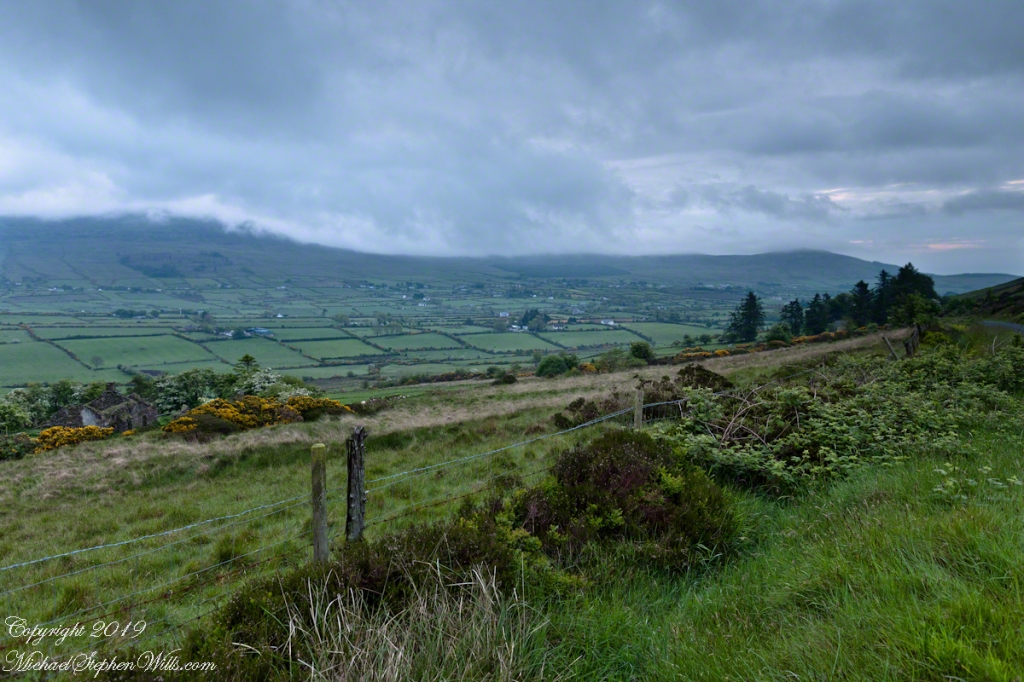
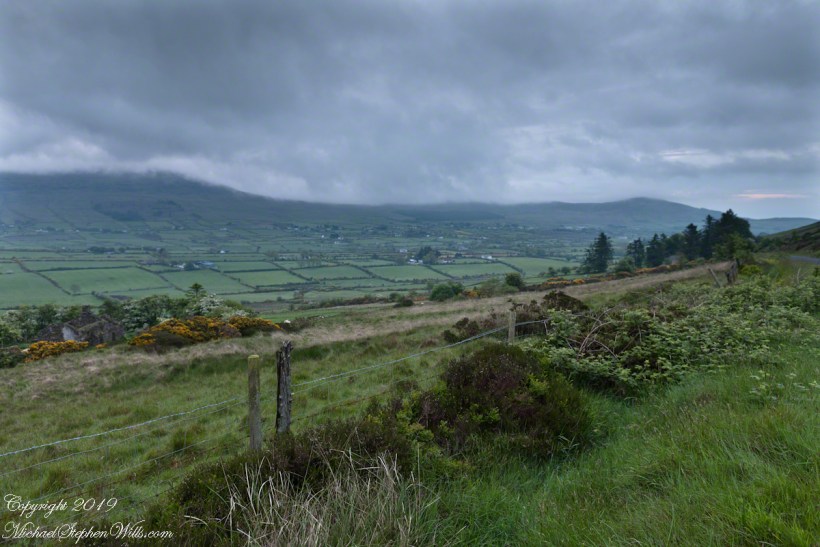
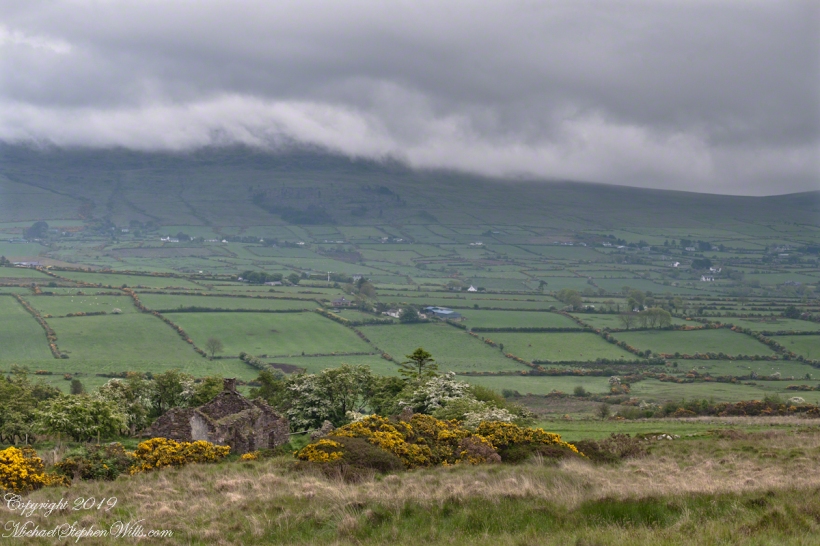
A Cooley Peninsula Valley on a May Morning

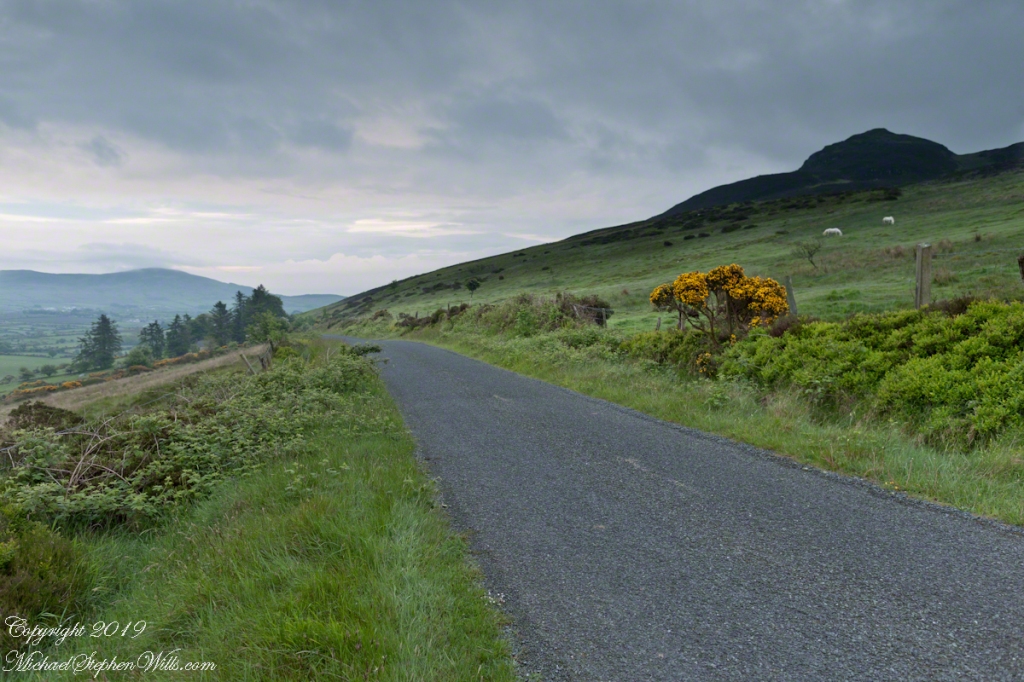
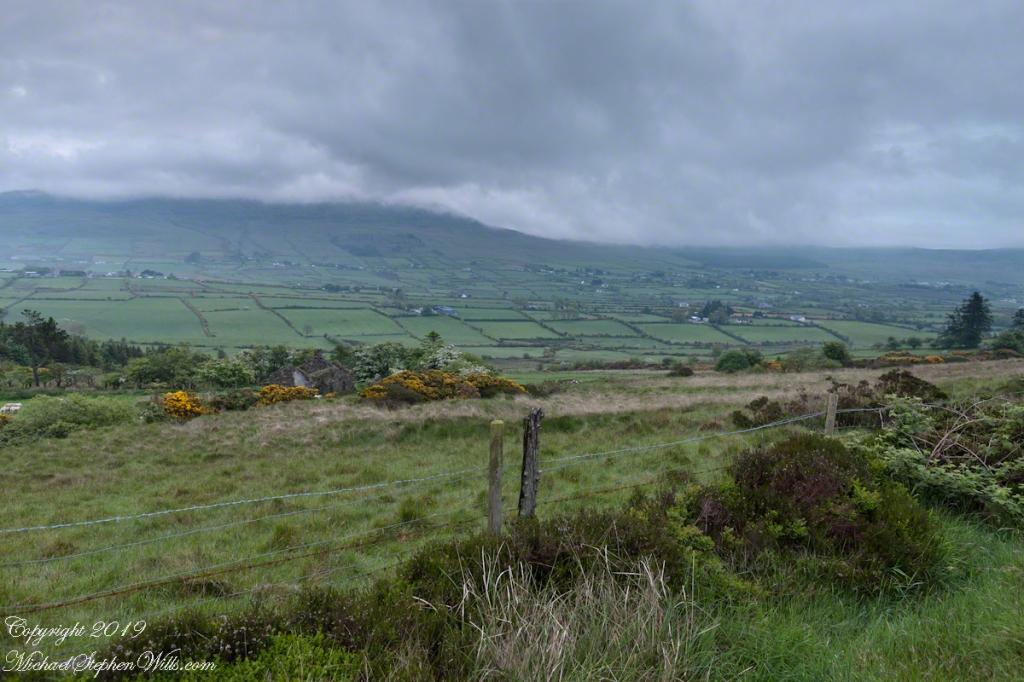
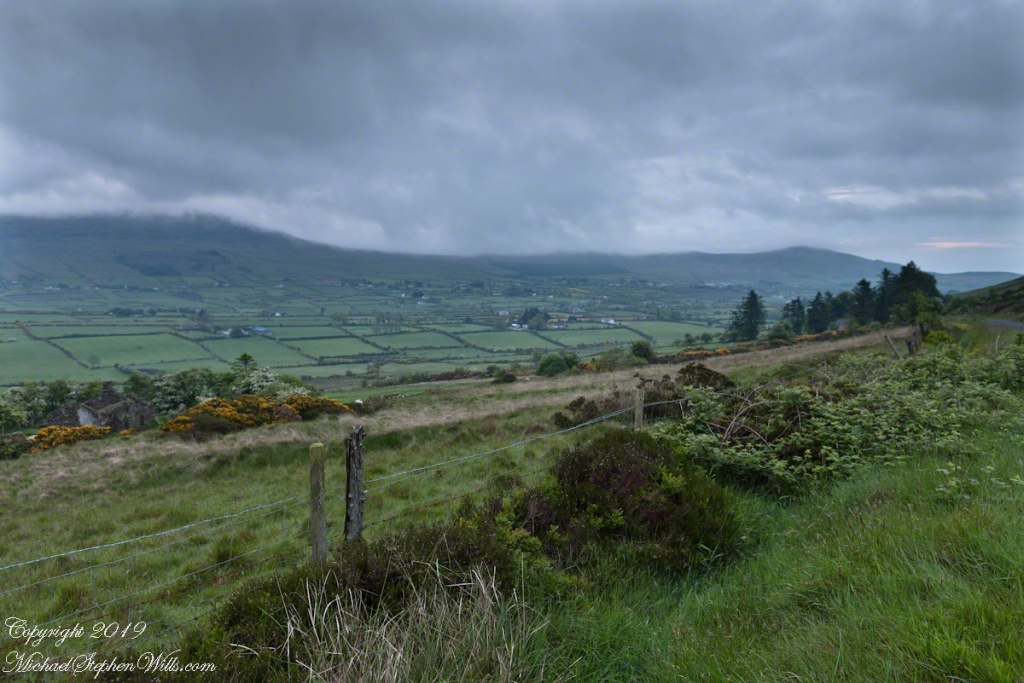
On the northeast slope of Slievenaglogh peak (Irish: Sliabh na gCloch) on the road from Mullaghattin Townland to Riverstown. This day I swapped lenses and took in the same general direction for each. This is the first and last of a series using the Canon EF 50mm f/1.4 USM lens and I pulled in the shots from the Canon 24mm f1.4 L II USM lens, published in previous posts.

Click photograph for a larger view. To do this from WordPress Reader, you need to first click the title of this post to open a new page.

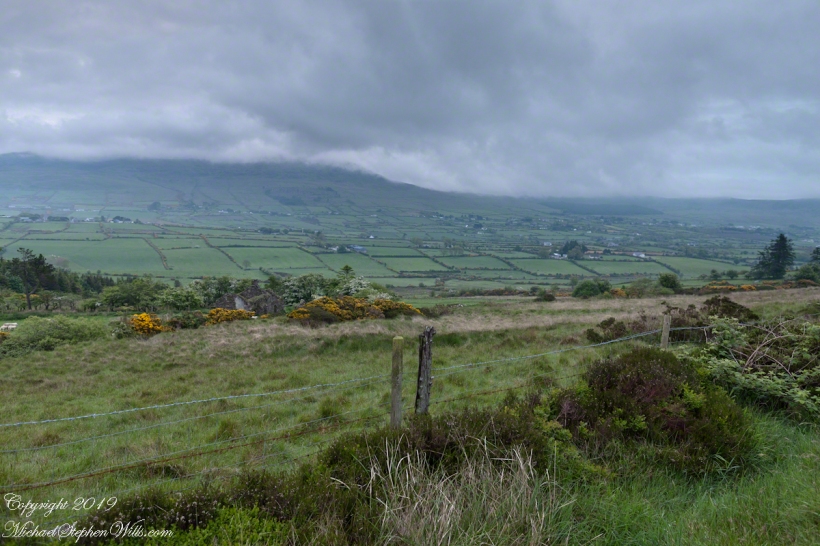
Here we look northeast from the Slievenaglogh Townland over the valley between Slievenaglogh and Slieve Foy peaks. Slieve Foy is the far ridge lost in clouds.

This is the first and last of a series using the Canon EF 50mm f/1.4 USM lens.

The view includes Little River, Castletown River, Ballycoly and Glenmore Townlands. Adjacent is a sheep pasture with a farm ruin behind the yellow flowered gorse (Whin bush, scientific name Ulex).

Early morning, late May 2014.

Here is a slideshow of the 50mm and 24mm images of this post.

Click for another interesting Ireland post and story

Copyright 2020 All Rights Reserved Michael Stephen Wills