From a modest bench above Taughannock Gorge, Cayuga Lake shifts from distant glimmer to presence—a quiet invitation to pause, breathe, and follow the water down.
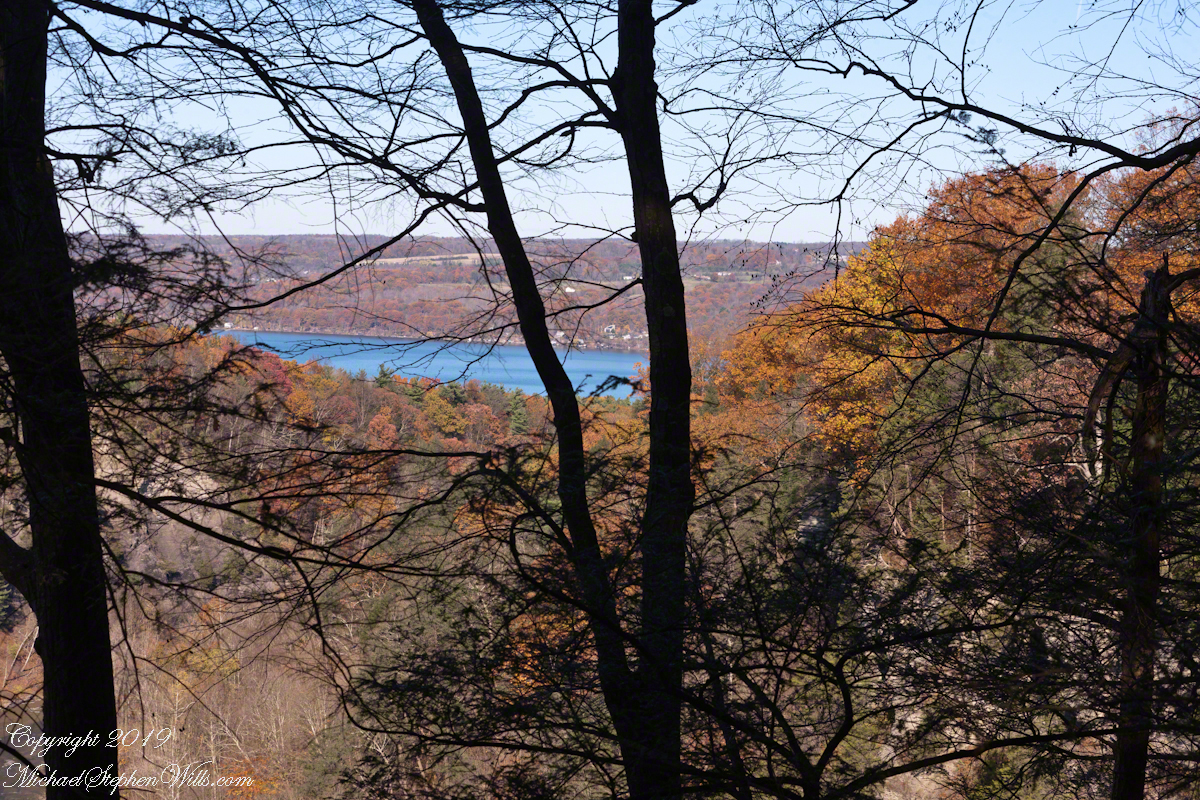
From the south rim of Taughannock Gorge, Cayuga Lake appears like a distant strip of sapphire, framed today by a soft veil of hemlock and oak. The overlook here is modest—a fence, a bit of open sky—but someone wisely added a comfortable bench, an invitation to pause between gorge and lake, rock and water.
I stood in front of that bench, resting the camera body on the fence, fingers braced against the wood to steady the shot. This is not the grand, sweeping vista of a postcard. Instead, it is a quieter, more human vantage point, the way a person actually encounters the lake after walking the rim: emerging from the trees, breath easing, eyes adjusting to the light on water.
From here, the trail descends toward Cayuga’s shore, each turn bringing you lower and closer, trading the lofty perspective for the intimate sounds of waves and stone. In Distant Sapphire I and II, the lake was a glimpse—caught between branches, distant beyond the gorge. Now, in this “Bench View,” the water feels nearer, almost within reach, as though the landscape itself is drawing you gently down.
Click photograph for a larger view. To do this from WordPress Reader, you need to first click the title of this post to open a new page.
Cayuga Lake Bench View
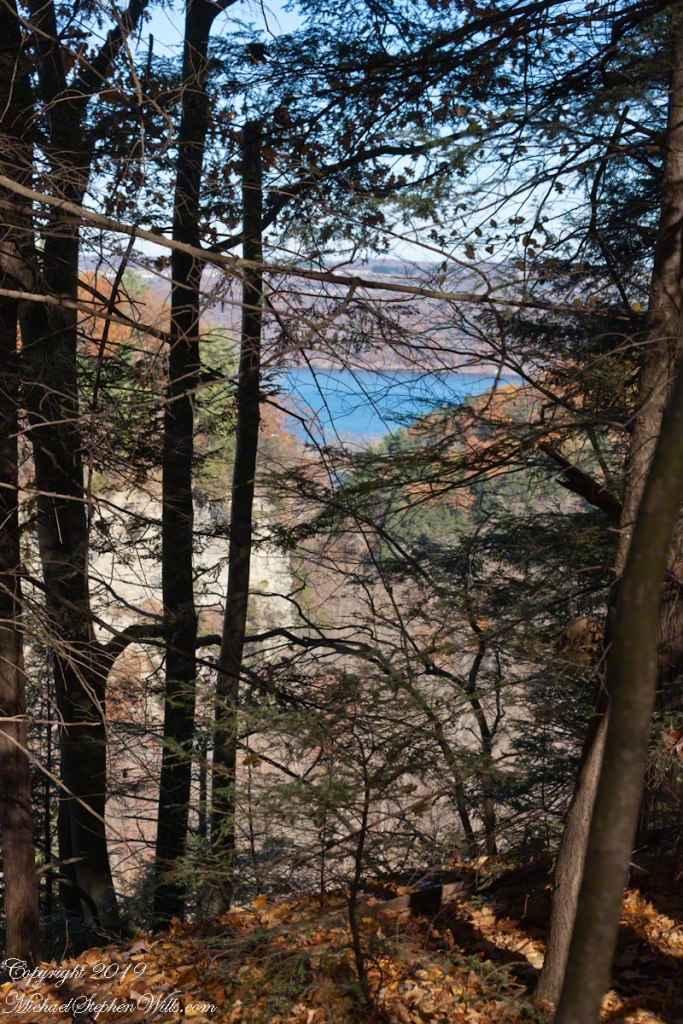
I’ve gathered the three photographs—Glimpse of Cayuga Lake, Gorge View with Oak Leaves, and this Cayuga Lake Bench View—into a small gallery, a progression of approach. Each frame is a step closer: from suggestion, to invitation, to the quiet promise of the bench, waiting for whoever needs to sit and look a little longer.
A gallery of the three Cayuga Lake photographs for comparison.
Glimpse of Cayuga LakeGorge View with Oak LeavesCayuga Lake Bench View
Enter your email to receive notification of future postings. I will not sell or share your email address.
Copyright 2025 All Rights Reserved Michael Stephen Wills
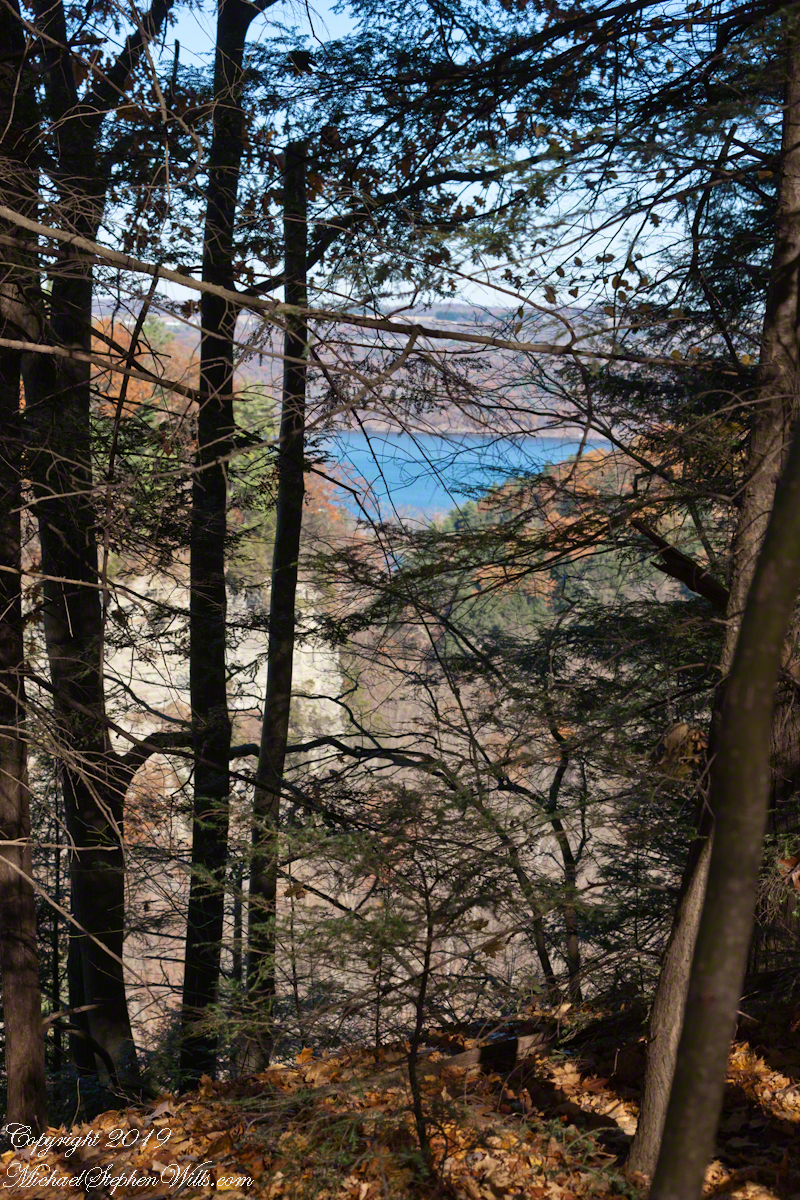
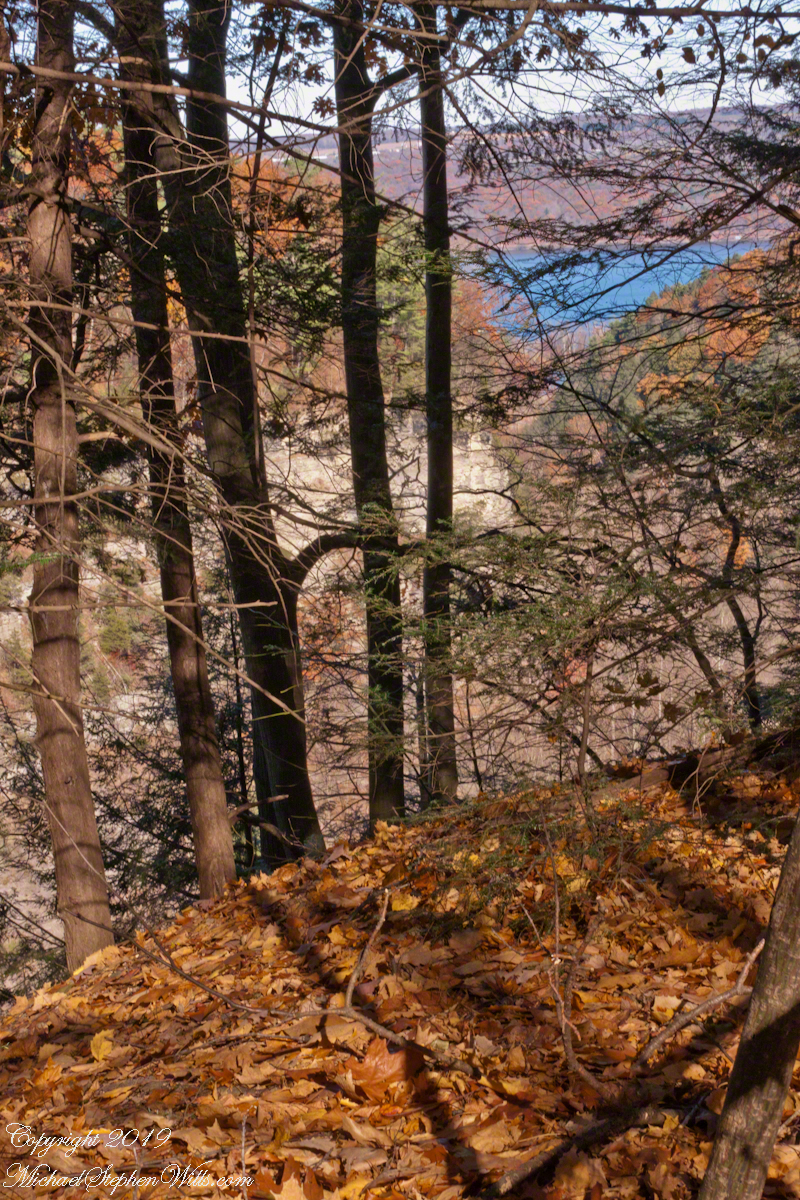
Cayuga Lake from the south rim of Taughannock Gorge, seen through a veil of hemlock with a carpet of fallen oak leaves, foreground. This is a companion to the previous post, both were handheld. For this the foreground was included to increase interest. For added stability, I rested the camera body on the fence bracketed with my fingers.
Click photograph for a larger view. To do this from WordPress Reader, you need to first click the title of this post to open a new page.
Gorge View with Oak Leaves
A gallery of the two photographs for comparison.
Glimpse of Cayuga LakeGorge View with Oak Leaves
Enter your email to receive notification of future postings. I will not sell or share your email address.
Copyright 2025 All Rights Reserved Michael Stephen Wills
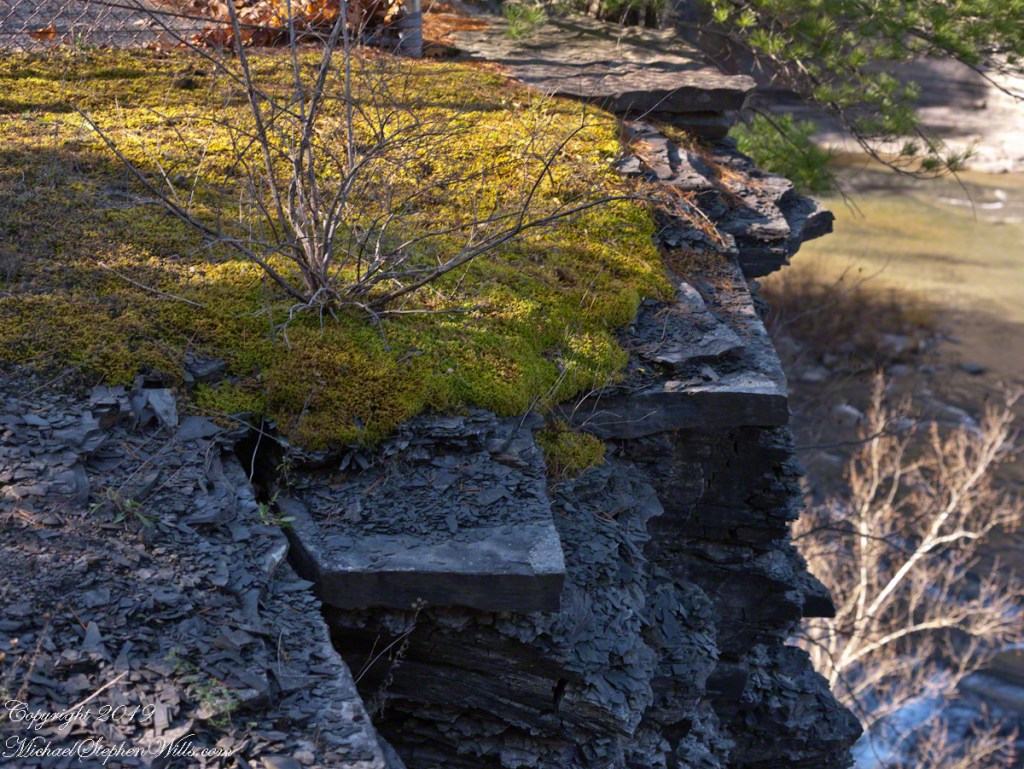
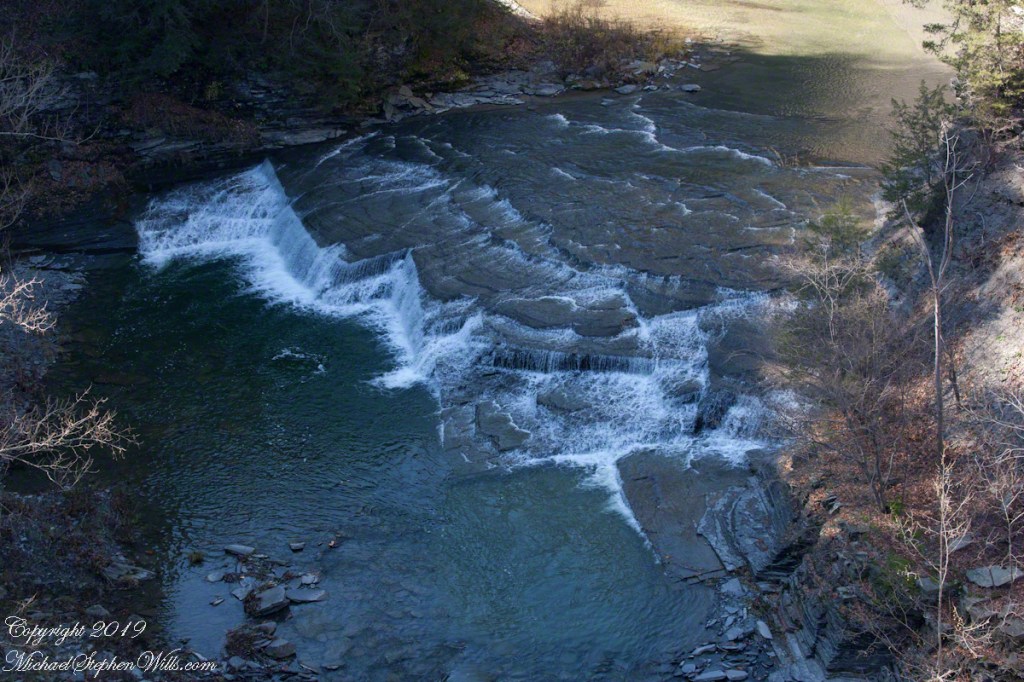
Perched above Taughannock Gorge, a moss-covered ledge and cascading falls reveal ancient stories—where Devonian seas once flowed and time’s layers whisper through stone and water.
The morning sun had only just breached the rim of the gorge, sending long slants of golden light across the forest floor. Walking the South Rim Trail of Taughannock Falls State Park, I came upon a quiet, unassuming spot—just a few paces off the path—where the forest seemed to pause in reverence. What greeted me was a small marvel of persistence and time.
There, rooted precariously atop a slab of brittle shale, was a tenacious shrub rising from a bed of moss, its spindly frame etched in sharp contrast to the soft, green sprawl beneath it. The moss had taken hold on a shelf of rock cantilevered over the gorge like a green tongue of earth defying gravity. Cracks traced the shale’s surface like veins, silent records of the forces that shaped this place—heat, ice, pressure, time. Together, the moss and the bush formed an improbable community, surviving against odds, bound together by the thin soil cradled in stone.
This ledge, suspended over the abyss, seemed less a part of the earth than a question it asked—how much life can cling to the edge before the edge itself gives way?
Beneath this living fragment, the gorge dropped away. Layers upon layers of shale revealed themselves, stacked like a collapsed library of time. Here, the Devonian Period lies exposed to wind and rain, and to those willing to pause and wonder. Each stratum holds the fossil whisper of ancient seas, where trilobites scuttled and coral reefs once stood. This gorge was not carved quickly. It was not born of a moment, but of many—countless raindrops, millennia of ice melt, the slow, sure work of water over stone.
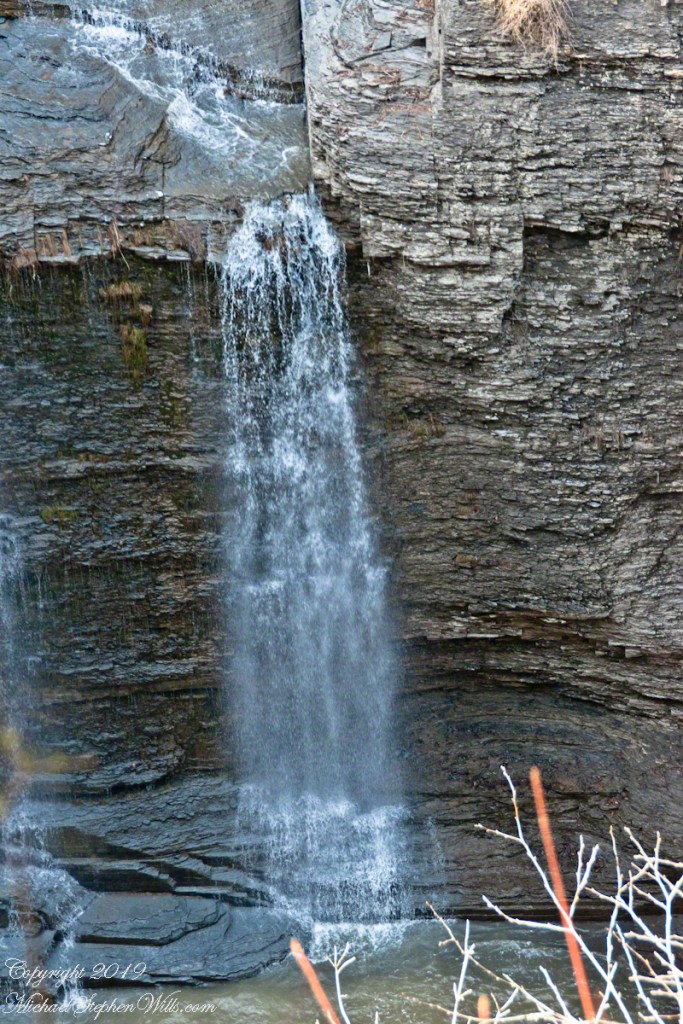
From this natural balcony, I looked out and down to the gorge floor where the creek shaped the land with an artist’s patient hand. The falls, seen from above, no longer thundered—they danced. Spread like the folds of a fan, water curled over smooth stone in steps of white silk. From here, the cascade looked deliberate, choreographed—an elemental performance halfway between gravity and grace.
How many times had this water flowed, reshaped, receded? How often had it carved these grooves, smoothed those ridges, erased the footprints of what came before? Looking at the exposed rock, one could trace the signature of ancient glaciers, feel the memory of long-gone floods. It was humbling—this intersection of change and continuity.
Above it all, the trees stood still. Pine and oak, rooted well back from the edge, offered a kind of sentinel presence. Their shadows stretched long and angled, tracing the contours of both earth and memory. For a moment, I let go of all thought and simply listened—to the murmur of wind through leaves, the faint rush of water far below, and the silence that presses in when the land itself seems to be remembering.
This spot—so easily missed by a hurried hiker—offered a parable of resilience and impermanence. The moss did not grow with certainty, nor the shrub reach with confidence. They survived on the edge because they adapted. They made do with less. They took root where others could not. There was no security in that place, only presence. Only the now.
And isn’t that a lesson worth carrying?
We so often seek stability, firm ground, a clear path. Yet, some of the most beautiful things live just beyond comfort—on ledges, in cracks, in the margins of the known. To pause here was to acknowledge that life thrives not only in sheltered valleys but also at the edge of what seems possible.
As I stepped back onto the trail and continued along the South Rim, the image of that mossy outcrop stayed with me. I carried it in my thoughts like a talisman—proof that even on the brink, life finds a way. And that from above, the most chaotic falls can appear as ordered motion, as a flow toward something larger.
Later, when the sun climbed higher and the light lost its slant, I would look back on this moment not as a spectacular highlight but as something more intimate: a quiet encounter with nature’s subtle artistry, its layered truths, and its enduring invitation to look closely, feel deeply, and walk softly.
For here, above the gorge, at the edge of earth and time, even a whisper leaves a mark.
Enter your email to receive notification of future postings. I will not sell or share your email address.
Copyright 2025 All Rights Reserved Michael Stephen Wills
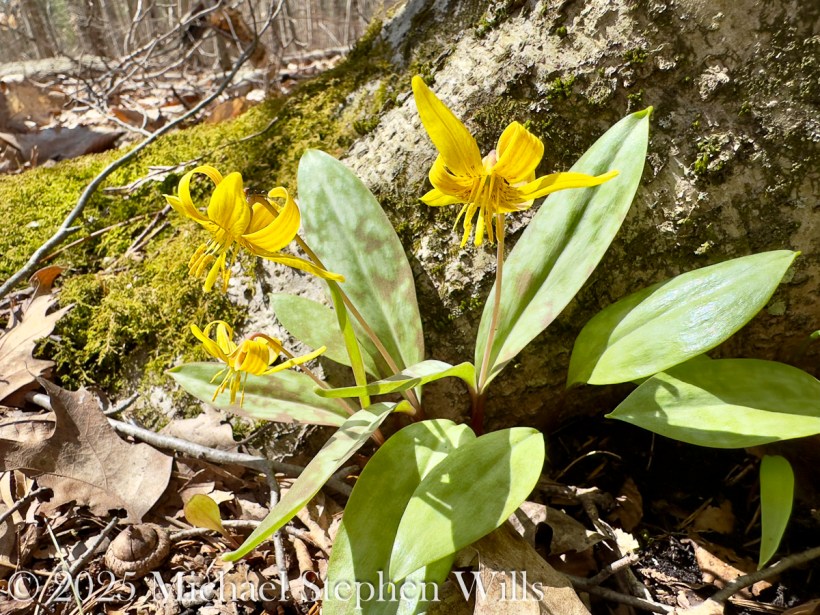
On April 22, 2025, a wanderer discovers a trout lily, representing nature’s cycles, patience, and the interconnectedness of life through blooming, pollination, and nutrient cycling.
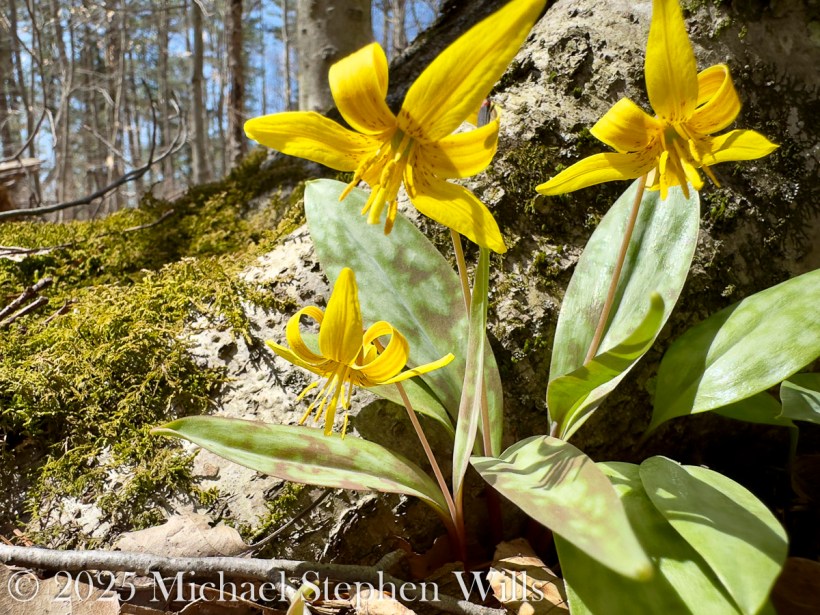
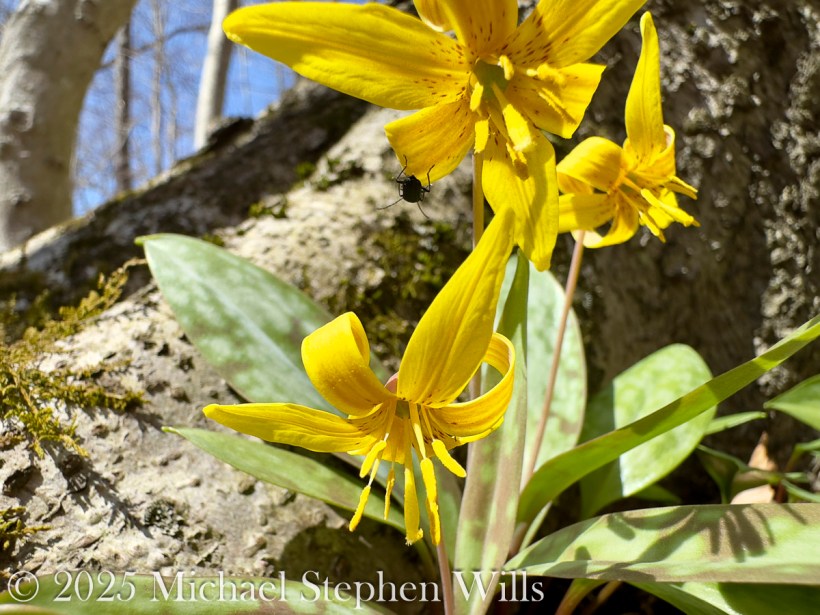
On the bright afternoon of April 22, 2025, I wander slowly through Sapsucker Woods, last year’s oak leaves soft underfoot and the smell of damp earth in the air. The trees stand bare, and somewhere a woodpecker drums as I search the ground for any sign of spring. A flash of gold catches my eye at the mossy base of a tree. Kneeling down, I find among the leaf litter a small wildflower glowing yellow. It is a trout lily – Erythronium americanum – a solitary, nodding bloom on a slender stem. Six delicate petals flare backward, golden with a few reddish freckles near the throat; long stamens dangle beneath. Two lance-shaped leaves hug the ground, green marbled with burgundy-brown. Their mottled pattern looks like a brook trout’s flank. This flower is known by many names: “trout lily” for its fish-like leaves, “dogtooth violet” for its pointed white bulb 1, and “adder’s tongue” for its tongue-shaped leaf tip.
Its formal name, Erythronium americanum, comes from the Greek for “red”2—odd for a yellow bloom until one remembers the purple dogtooth violets of Europe. Americanum simply marks it as native here. I soon realize these trout lilies are not alone – dozens of dappled leaves carpet the damp earth around me. Most show no blossom at all, only a single freckled leaf standing alone. Only the older plants with two leaves manage to lift a yellow flower. In fact, they often form extensive colonies on the forest floor. I’ve learned a trout lily may wait seven years to bloom its first time3. Seasons of patience pass unseen underground, and then one spring it earns the chance to unfurl a golden star. That slow, patient rhythm of growth fills me with wonder.
A tiny black bee—or maybe a fly—lands on the trout lily’s bloom, drawn by its promise of pollen. It disappears into the flower’s downturned bell, brushing against the dusting of pollen inside. In early spring, few other blossoms are open, so this little lily is a lifeline for hungry pollinators4. There is even a solitary “trout lily bee” that times its life to these flowers5. Flower and insect share an ancient pact: the lily feeds the visitor, and the visitor carries the lily’s pollen onward to another bloom.
Within a week, the trout lily’s golden star will wither. By the time the canopy closes overhead, the flower will have curled into a green seedpod that splits open by early summer, releasing its seeds6. Each seed carries a tiny parcel of food irresistible to ants7. Ants haul the seeds to their nest, eat the morsel, and abandon the seed in their tunnels—unwittingly planting the next generation. The name for this circular ecological dance is myrmecochory. Over time, the colony inches across the forest floor, guided by these tiny gardeners. During its short life above ground, this little lily helps the forest. Its roots soak up nutrients from the damp soil, keeping them from washing away in spring rains8. When the plant dies back, those nutrients return to the earth as the leaves decay, nourishing other life. In this way, a patch of trout lilies forms a quiet bridge between seasons—capturing nutrients in spring and returning them by summer’s end. I touch one cool leaf, feeling connected to this cycle.
I rise and take a final look at the little yellow lily. Its brief bloom reminds me that life’s most beautiful moments are fleeting yet return each year. This blossom will vanish in a few days, a blink of the season, but it will come back next spring as faithful as hope. In its patience and generosity, I sense kinship. Like the trout lily, we too have long periods of waiting and rare moments of blooming. We also rely on small kindnesses to help us thrive—like a friend in hard times or a community that carries our dreams to fertile ground. And we are part of a larger cycle, giving and receiving, leaving something of ourselves to nurture the future. As I continue down the trail, I carry the image of that humble flower with me—a gentle assurance that even the smallest life can leave a lasting impression, and that hope will always return with the spring.
Enter your email to receive notification of future postings. I will not sell or share your email address.
Copyright 2025 All Rights Reserved Michael Stephen Wills
Footnotes
wildadirondacks.org Trout lily’s common names: “Trout lily” refers to the trout-like mottling on its leaves, while “dogtooth violet” refers to the tooth-like shape of its underground bulb (despite not being a true violet). It is also sometimes called “adder’s tongue.” ↩
en.wikipedia.org The genus name Erythronium comes from the Greek erythros, meaning “red,” originally referring to the red-purple flowers of the European dogtooth violet (Erythronium dens-canis). The species name americanum denotes that it is native to America. ↩
peacevalleynaturecenter.org Trout lilies often grow in large colonies and most individuals in a colony are non-flowering. A plant typically needs about seven years of growth before it produces its first bloom. ↩
peacevalleynaturecenter.org Spring ephemeral wildflowers like the trout lily provide crucial early nectar and pollen for pollinators (bees, flies, butterflies) emerging in early spring. ↩
appalachianforestnha.org The trout lily miner bee (Andrena erythronii) is a solitary bee whose life cycle is closely tied to the trout lily; it forages primarily on trout lily flowers, making it a specialist pollinator of this species. ↩
wildadirondacks.org After pollination, trout lily flowers are replaced by seed capsules that ripen and split open to release the seeds in late spring. ↩
atozflowers.comErythronium americanum seeds have a small fleshy appendage called an elaiosome, which attracts ants. The ants carry the seeds to their nests, aiding in dispersal in exchange for the food reward, a mutualism known as myrmecochory. ↩
pubmed.ncbi.nlm.nih.gov By growing and taking up nutrients during the brief spring season, trout lily plants help retain important nutrients (like potassium and nitrogen) in the ecosystem. When the plants die back and decay, those nutrients return to the soil, contributing to the forest’s nutrient cycle. ↩
Discover the rich history and ecological significance of the American Basswood, a majestic tree that intertwines nature, culture, and human history. Uncover its beauty, versatility, and the fascinating pollinators that bring it to life.
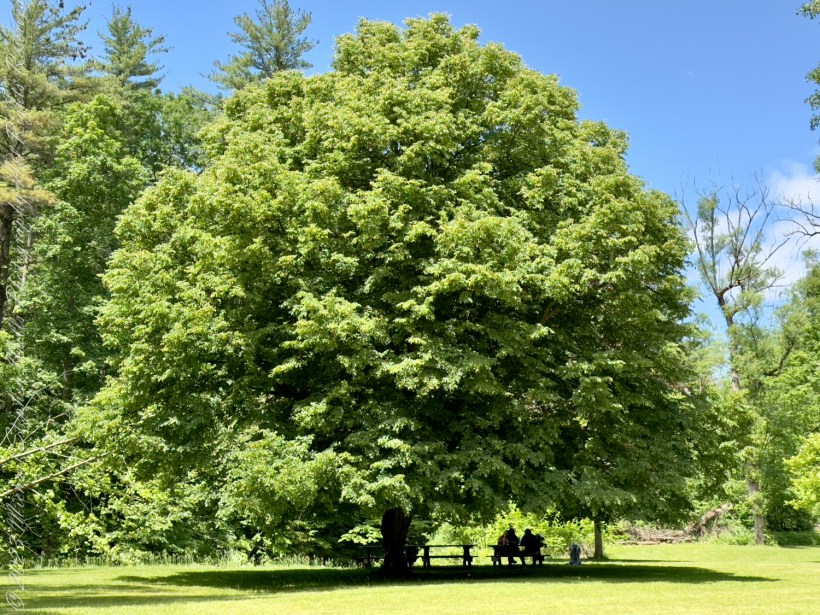
As I strolled through the sun-dappled glade, my eyes were drawn to a magnificent tree standing sentinel at the edge of the clearing. Its broad canopy spread like a green umbrella, casting a generous shade over the picnic bench below. Intrigued by its commanding presence, I approached, eager to unravel the secrets of this arboreal giant. Little did I know that this encounter would lead me on a journey through history, etymology, and the myriad uses of the American Basswood.
This photograph features the growth pattern for which the Basswood is known. Buttermilk Falls State Park, Ithaca, Tompkins County, New York State. The Finger Lakes Region.
The American Basswood, or Tilia americana, is a tree steeped in history and lore. Its name, “Basswood,” is derived from the word “bast,” referring to the inner bark of the tree, which is known for its fibrous and pliable nature. This etymology hints at the tree’s historical uses, which I would soon discover are as rich and varied as the foliage above me.
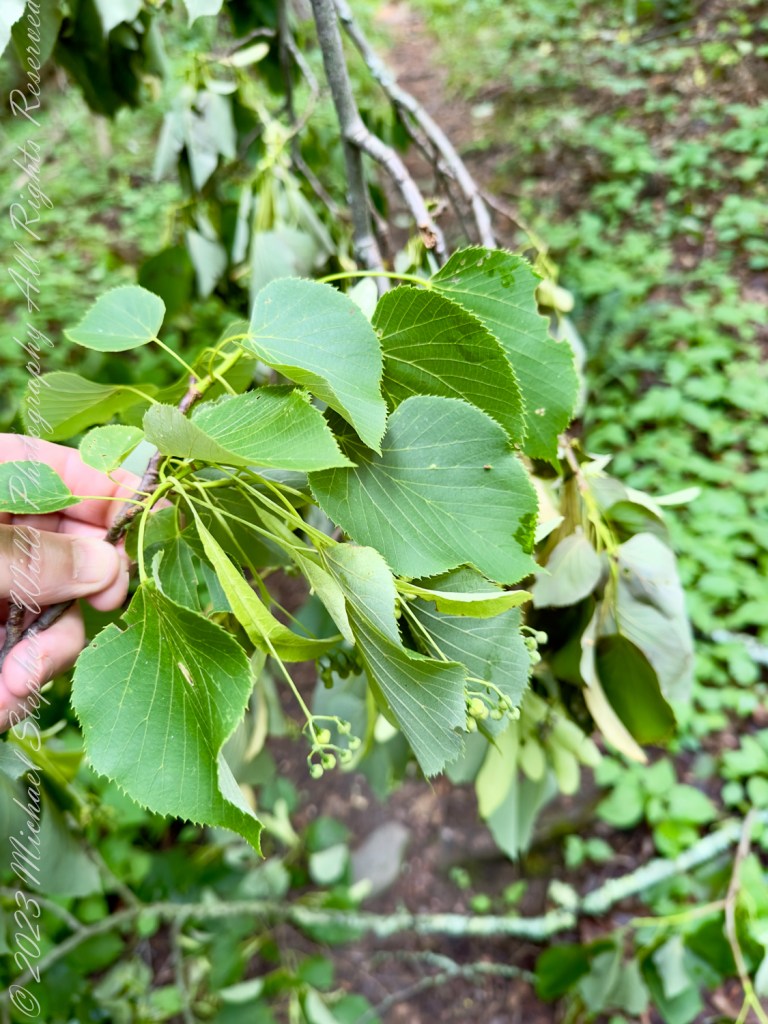
As I examined the leaves, I was struck by their heart-shaped form, a feature that has made the Basswood a symbol of love and romance in various cultures. The leaves were smooth and slightly serrated at the edges, with a deep green hue that seemed to capture the essence of summer. Hanging delicately from the branches were clusters of small, round buds, hinting at the tree’s flowering potential. These flowers, I would later learn, are not just beautiful but also aromatic, attracting bees and other pollinators with their sweet fragrance.
These are leaves from a branch broken by spring storms and fallen across the Finger Lakes Trail that follows the southern side of Treman Park above the South Rim Trail. Robert H. Treman New York State Park, Tompkins County, Ithaca. June 27, 2024
The history of the American Basswood in America is intertwined with the lives of indigenous peoples and early settlers. Native Americans valued the Basswood for its soft, easily worked wood and its inner bark, which they used to make ropes, mats, and other essential items. The tree’s wood, known for being lightweight and finely grained, was perfect for carving and crafting tools, utensils, and even ceremonial masks. This versatility made the Basswood an integral part of daily life and cultural practices.
With the arrival of European settlers, the uses of Basswood expanded. Settlers quickly recognized the tree’s potential, using its wood for a variety of applications. The soft, yet sturdy wood was ideal for making furniture, musical instruments, and even crates and boxes. Its workability and smooth finish made it a favorite among craftsmen and artisans. I imagined the hands of these early Americans, shaping and molding the wood, breathing life into their creations.
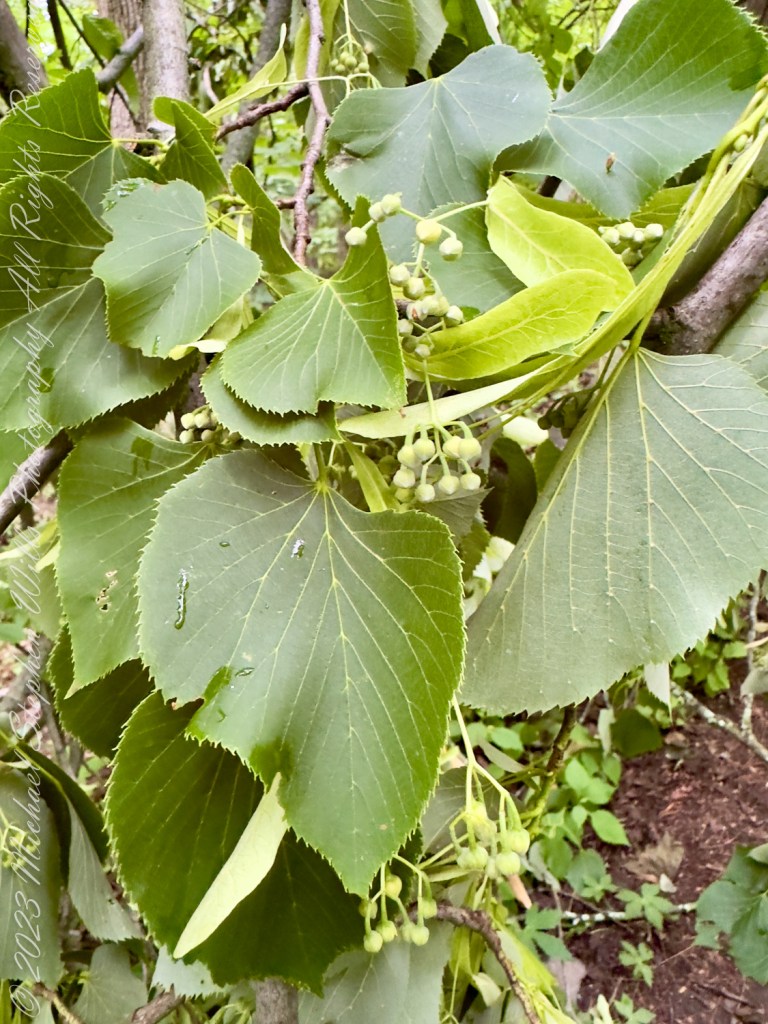
As I continued to explore the tree, I was drawn to the small, green fruits hanging from slender stems. These fruits, known as nutlets, are encased in a leafy bract that aids in their dispersal by wind. This ingenious natural design ensures the propagation of the species, allowing new generations of Basswoods to take root and flourish.
Curious about the tree’s name, I delved into its etymology and discovered an interesting linguistic journey. In England and Ireland, the Basswood is commonly referred to as the “Lime Tree.” This name does not relate to the citrus fruit tree but instead comes from the Old English word “Lind,” related to the German word “Linde.” Both terms historically referred to trees of the Tilia genus. Over time, “Lind” evolved into “Lime,” influenced by phonetic changes and regional dialects, solidifying the term “Lime Tree” for Tilia species in these regions. Despite sharing the same common name, the Tilia “Lime Tree” and the citrus “Lime Tree” belong to entirely different plant families.
The American Basswood’s significance extends beyond its practical uses. The tree has found a place in American culture and literature, often symbolizing strength, resilience, and longevity. Its towering presence and expansive canopy make it a popular choice for parks and public spaces, where it provides shade and beauty. I thought of the many people who must have sought refuge under its branches, finding solace and inspiration in its quiet strength.
In addition to its cultural and historical significance, the Basswood also plays a crucial ecological role. Its flowers are a vital source of nectar for bees, making it an essential component of local ecosystems. Beekeepers, in particular, value the Basswood for the high-quality honey produced from its nectar, known for its delicate flavor and aroma. The tree’s leaves and bark also provide habitat and food for various wildlife, contributing to the biodiversity of the area.
Pollination is a critical aspect of the American Basswood’s lifecycle, and a variety of insects are drawn to its fragrant, nectar-rich flowers. Honeybees (Apis mellifera) are among the most significant pollinators, their presence around the Basswood a testament to the tree’s importance in the ecosystem. These industrious bees not only gather nectar but also facilitate the pollination process, ensuring the production of seeds. Bumblebees (Bombus spp.) also play a crucial role, utilizing their unique buzz-pollination technique to effectively transfer pollen within the flowers.
These are leaves from a branch broken by spring storms and fallen across the Finger Lakes Trail that follows the southern side of Treman Park above the South Rim Trail. Robert H. Treman New York State Park, Tompkins County, Ithaca. June 27, 2024
Additionally, native bees such as sweat bees (Halictidae), mining bees (Andrenidae), and leafcutter bees (Megachilidae) are frequent visitors, drawn by the abundant nectar and pollen. Butterflies, while not as significant as bees, contribute to the pollination process, adding a touch of grace as they flutter from flower to flower. Moths, particularly those active in the evening, are another group of pollinators, their nocturnal activity complementing the daytime efforts of bees and butterflies. Hoverflies (Syrphidae), also known as flower flies, are attracted to the nectar and aid in the pollination, showcasing the diverse array of insects that rely on the Basswood.
Reflecting on my discovery, I realized the American Basswood is a living testament to the interconnectedness of nature and human history. Its presence in the landscape is a reminder of the many ways in which plants and trees shape our lives, providing resources, inspiration, and a connection to the natural world.
As I left the shade of the Basswood and continued my walk, I felt a deep sense of gratitude for the opportunity to learn and connect with this remarkable tree. Its story is a reminder of the importance of preserving and cherishing the natural world, ensuring that future generations can continue to discover and appreciate the wonders of the American Basswood.
Copyright 2024 Michael Stephen Wills All Rights Reserved
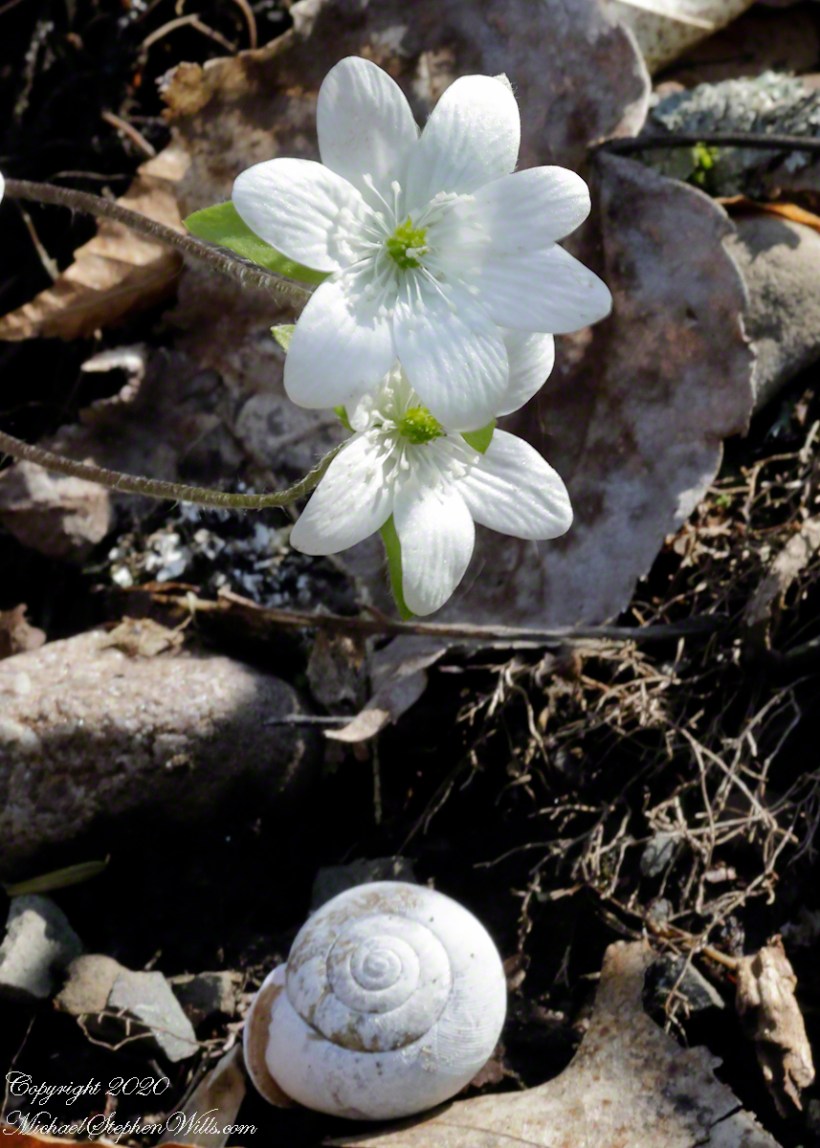
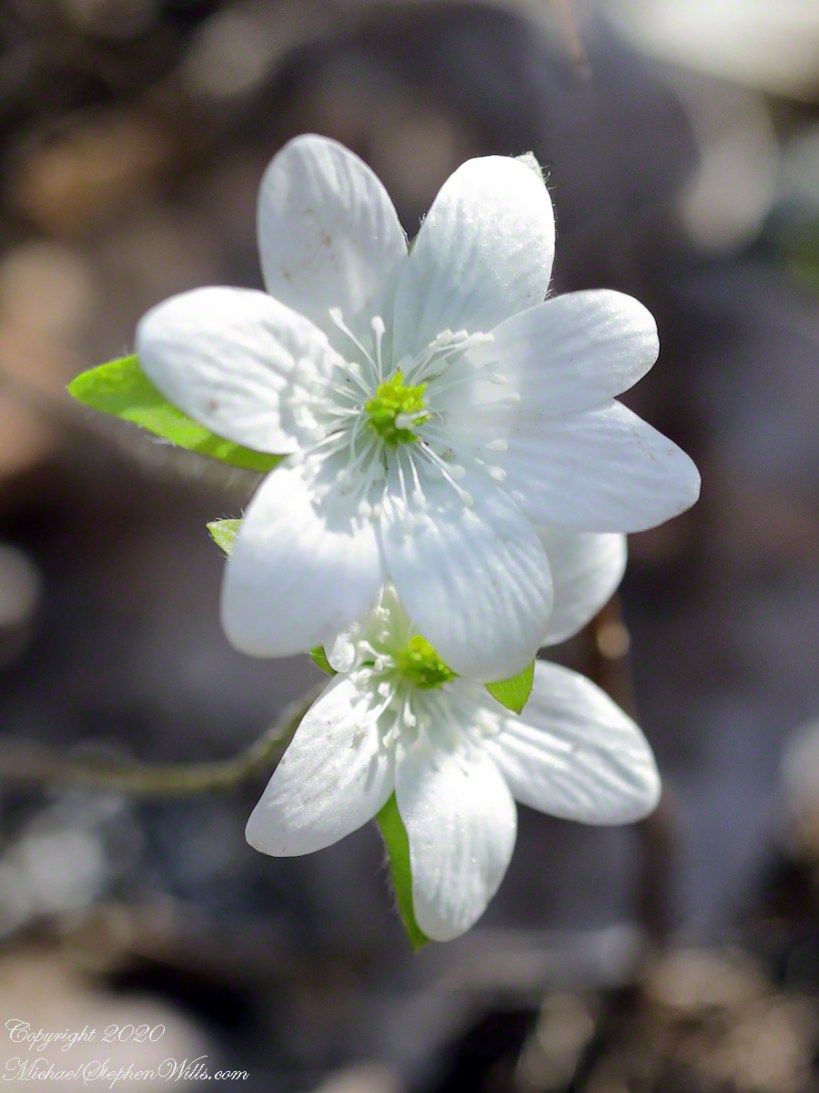
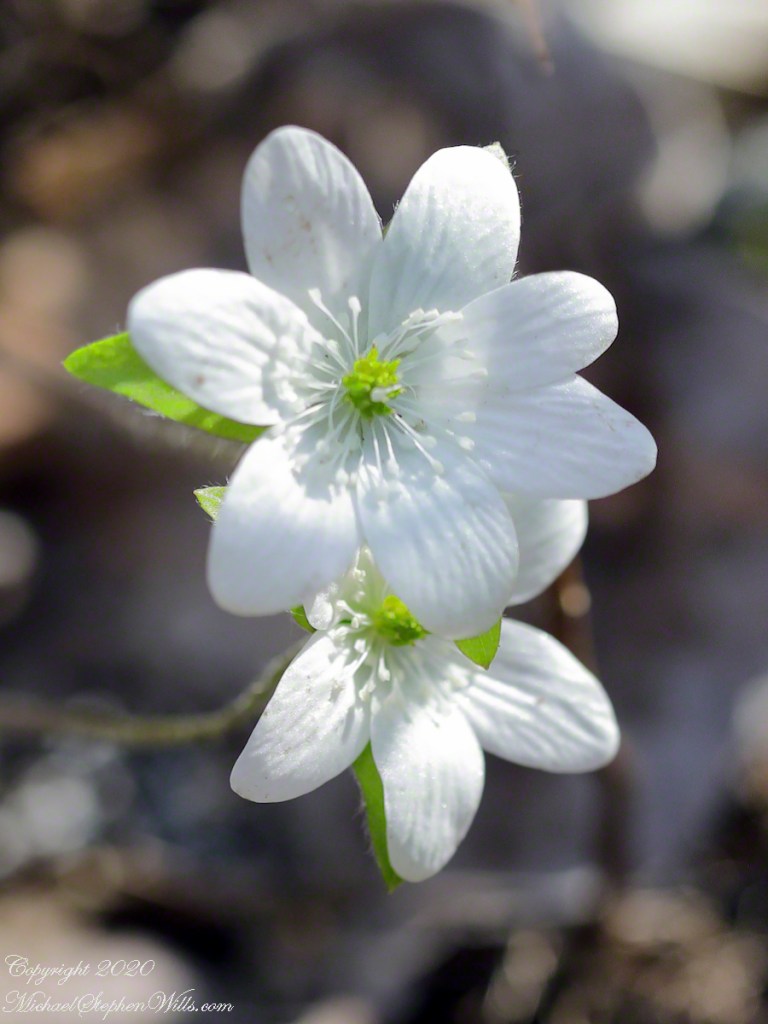
Hepatica blossoms are the focal point here. Two land snail shells rested fortuitously below, a white and dark brown. The white shell (Scientific Name: Neohelix albolabris) is seen here. In life, the shell aperture reflective lip gives the species name, from Latin root words “albo” (white) and “labris” (lip), and the popular name, “Whitelip.” Look closely to see a series of ridges, an identifying feature apparent in this specimen. There was a live specimen in our yard, just yesterday. Busy with chores, no camera at hand.
Click photograph for a larger view. To do this from WordPress Reader, you need to first click the title of this post to open a new page.
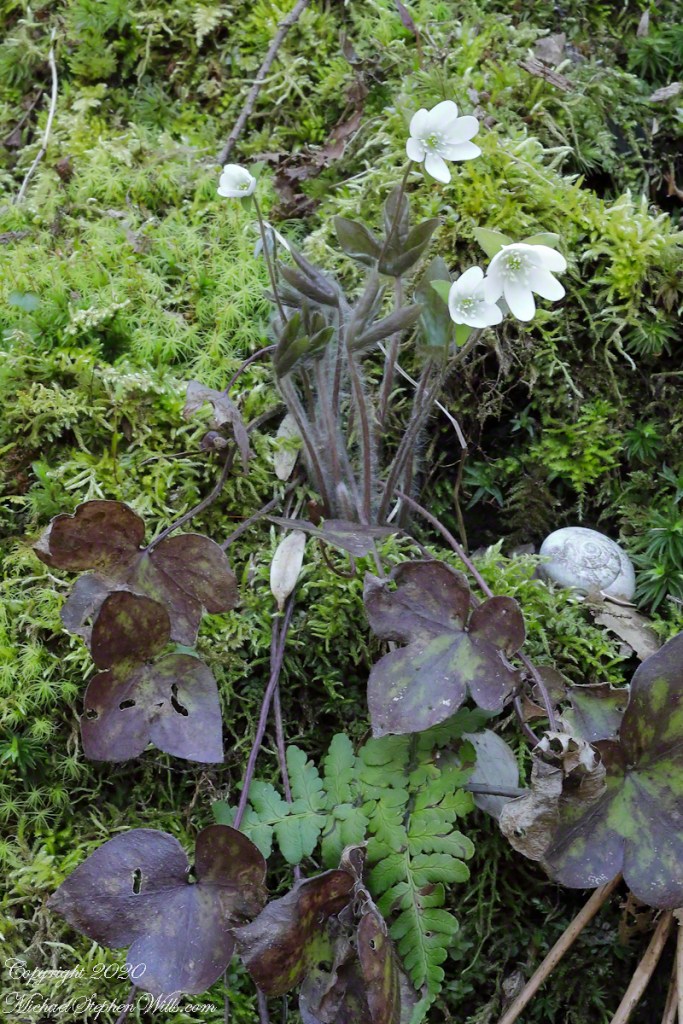
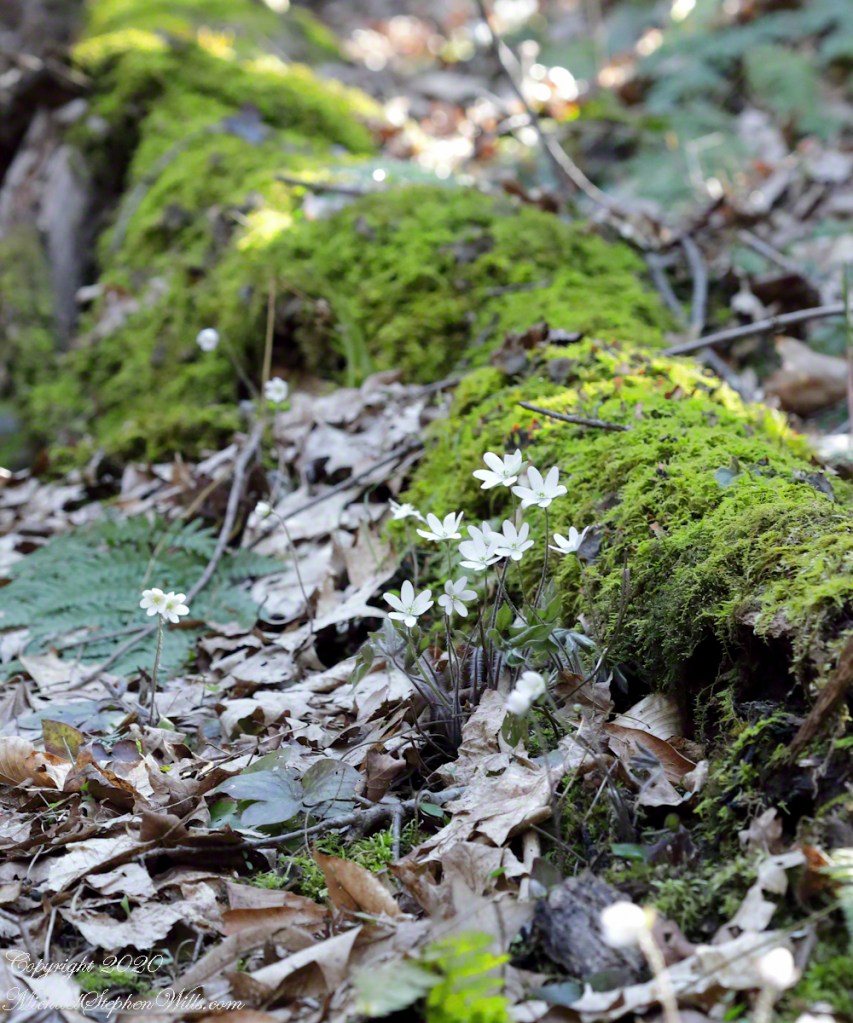
Seconds after taking this shot, at f/4, I changed the f-stop to 29 and captured these blossoms with the environment in focus (yesterday’s posting). At f/4 focus is a challenge and I was not happy with the detail of the foreground blossom.
Click photograph for a larger view. To do this from WordPress Reader, you need to first click the title of this post to open a new page.
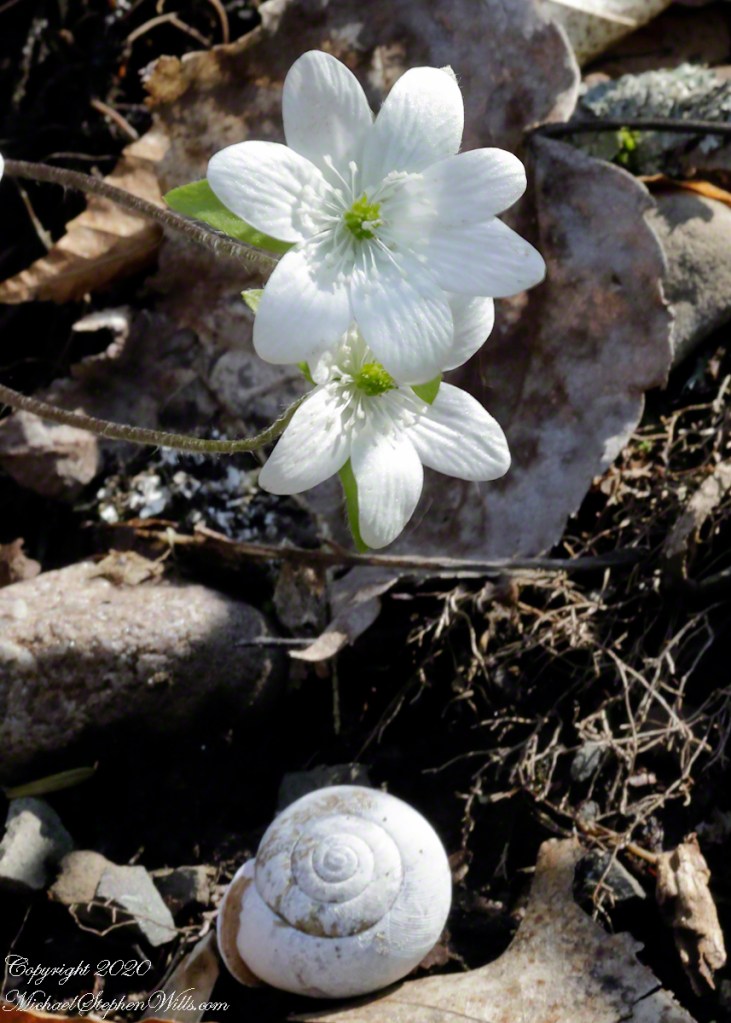
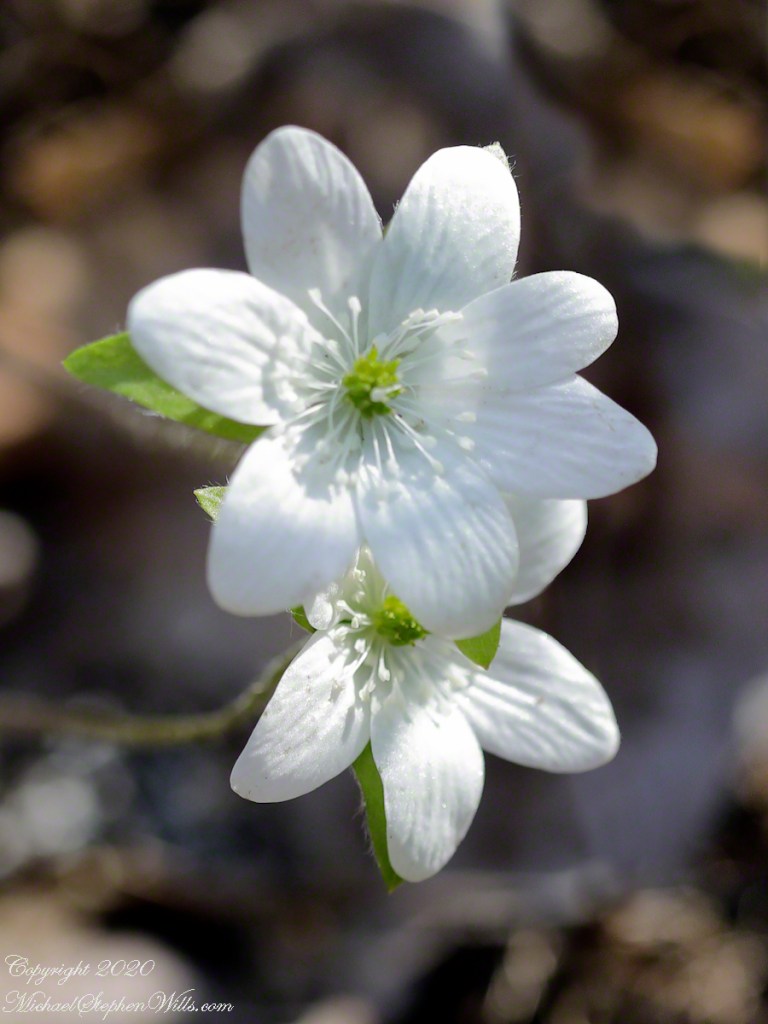
before dual pixel adjustmentafter dual pixel adjustmentDual Pixel Raw comparison
I am in the experimentation phase of learning the new camera, so in spite of the 100% file size increase I turned on the Dual Pixel Raw feature. The two photos are from the same file. My impression is the adjustment improved the foreground flower details. Is it my imagination?











 Michael Stephen Wills Photography