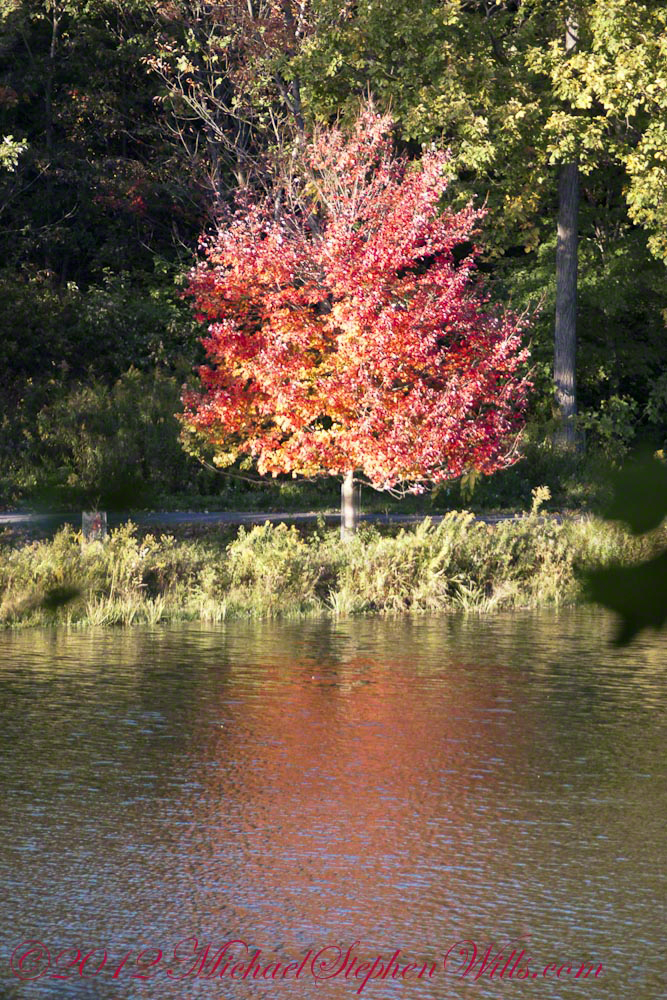
On a serene autumn afternoon by Beebe Lake, a solitary red maple stood out against the backdrop, showcasing its vibrant colors and resilience, symbolizing autumn’s fleeting beauty.
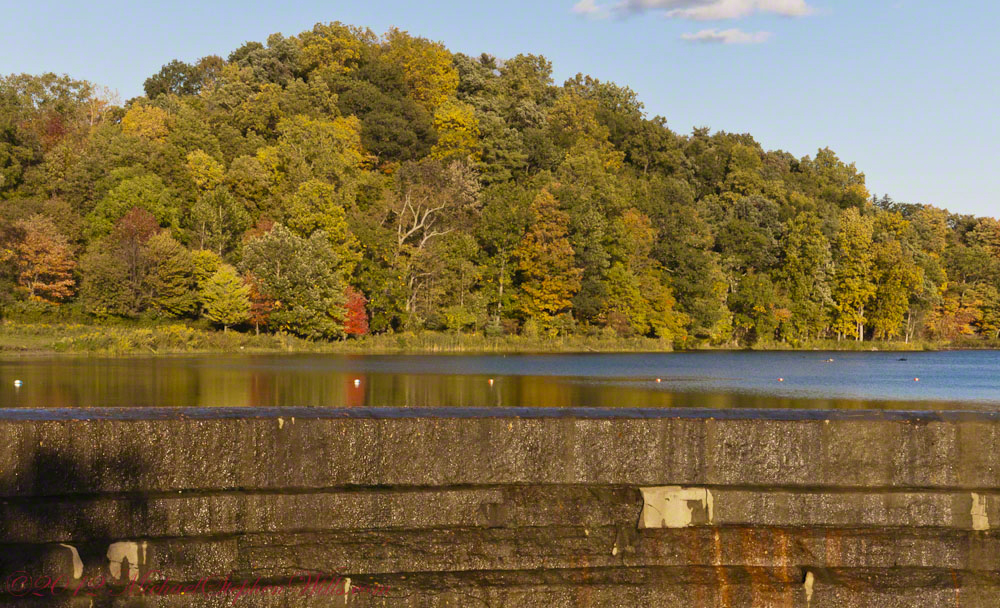
It was one of those serene autumn afternoons that linger in memory, the kind where the sky seems impossibly clear, the air crisp and gently scented with fallen leaves. I stood at the edge of Beebe Lake, my gaze first drawn to the textured concrete dam holding back the water, its weathered facade contrasting sharply with the soft reflections shimmering across the lake’s calm surface. Beyond, the wooded hillside rose gently, a tapestry woven with the warm hues of autumn—golds, greens, oranges, and reds mingling like brush strokes on a canvas.
An October Glory, turning before all others
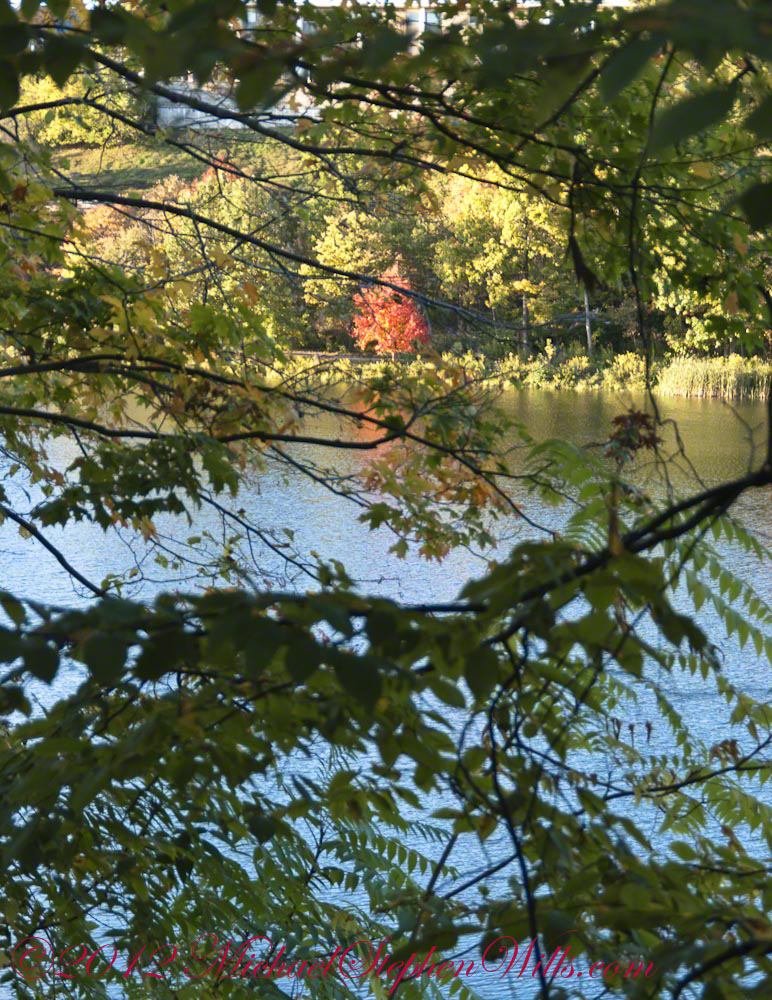
Yet amidst this collective beauty, one tree captured my attention, singular in its brilliance—a solitary red maple standing proudly on the lakeshore. Its leaves had turned a vivid crimson, blazing brightly as though defying the muted earth tones surrounding it. Even from a distance, framed and partially obscured by larger trees, its vibrant reflection cast a fiery echo on the water, rippling softly in the afternoon breeze.
The maple, Acer Rubrum, seemed perfectly at home here, thriving robustly at the water’s edge. I remembered reading how adaptable red maples are, able to flourish in conditions ranging from dry uplands to swampy shores. This spot, near the edge of the tranquil Beebe Lake, seemed to showcase its resilient character perfectly.
Up close, the maple’s glow was even more striking. Its leaves cascaded in fiery clusters, hues deepening from bright scarlet at the tips to a darker maroon closer to the branches. This dramatic gradient seemed symbolic of autumn itself—beautiful, fleeting, and subtly tinged with the melancholy reminder of winter’s approach.
The Red Maple (Acer Rubrum) to tolerant of diverse conditions, making it a perfect choice for this spot on the short of Beebe Lake.
A memory surfaced of early spring in the Finger Lakes region, a time when maples, including this red maple, generously share their sap. Though not traditionally tapped like its sweeter cousin, the sugar maple, this species’ sap can indeed be boiled down into syrup, a surprising sweetness hidden within its sturdy trunk. Standing in its shadow, imagining those early spring days, it seemed astonishing that the same tree could offer both the delicate sweetness of syrup and the fierce beauty now on display.
Curiously, the transformation of the tree appeared methodical yet whimsical—it changed colors from the top down, its upper branches already bare, exposing slender twigs pointing skyward. Like an artist carefully removing layers to reveal something deeper beneath, the maple unveiled its upper bare bones first, as though reminding observers of the quiet strength supporting its autumn splendor.
This Red Maple (Acer Rubrum) turns from the top down and has already bare for most top branches.
As I lingered, taking in this turning tree, joggers passed by along the path, their rhythmic footsteps a gentle percussion beneath the rustling leaves. Briefly, they glanced toward the vivid maple, perhaps drawn, like me, by its striking contrast to the surrounding foliage. It felt like we shared a secret admiration for this singular tree, recognizing in it a quiet assertion of individuality amidst conformity.
Eventually, I viewed the maple once more from afar, framed now by broader sweeps of branches and leaves, partially obscured but no less vivid. Through layers of leaves and dappled sunlight, it glowed like a distant flame, a beacon that seemed to encapsulate the entire mood of the season—warm yet cool, bright yet transient.
The Red Maple (Acer Rubrum) is the first to flower in spring and the first to turn in autumn.
Walking away, the image of that maple lingered, its reflection shimmering gently in the afternoon sun, a moment suspended between summer’s lush vitality and winter’s bare stillness. Beebe Lake had offered scenic beauty, a quiet meditation, a reflection mirrored not only on its tranquil surface but in the heart of an observer captivated by a single tree’s fleeting glory.
Enter your email to receive notification of future postings. I will not sell or share your email address.
Copyright 2025 All Rights Reserved Michael Stephen Wills
The Finger Lakes region, renowned for its natural beauty and changing seasons, put on a stunning performance on October 24, 2024. From the vibrant reds of a Japanese maple (Acer palmatum) to the golden hues of oak leaves (Quercus spp.), this photographic journey through our home captures the essence of autumn in upstate New York.
A Panoramic Tapestry
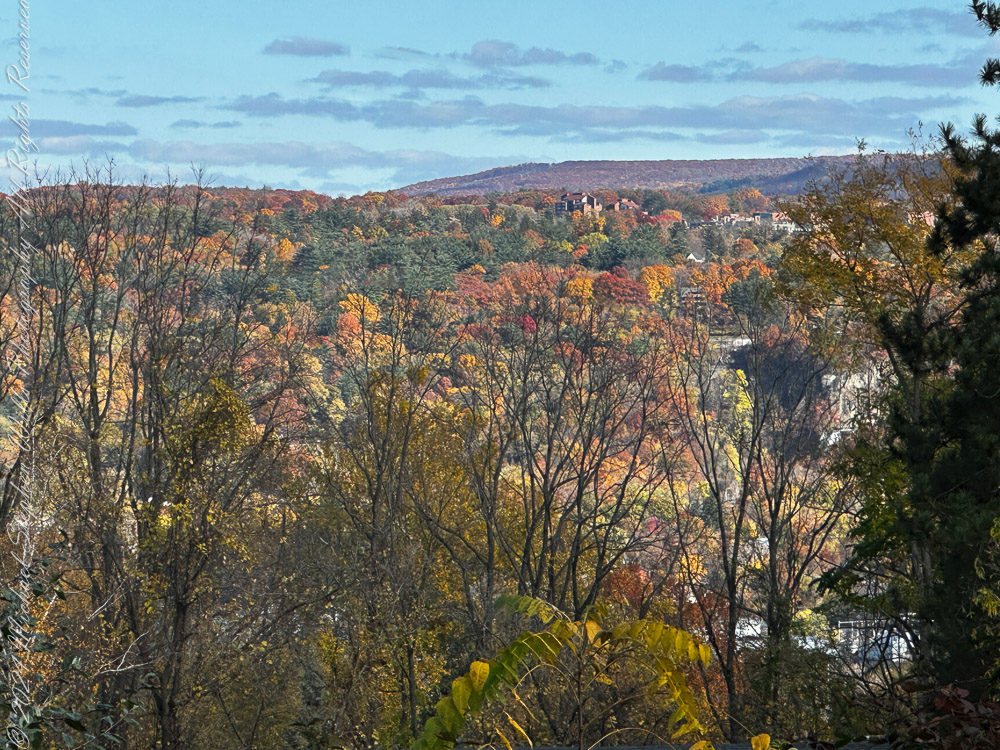
In the first photograph, the landscape unfolds like a watercolor painting. Hills dressed in fiery oranges and golds stretch across the horizon, with hints of evergreen pines (Pinus spp.) providing contrast. The sky, dotted with wispy clouds, serves as a serene backdrop, while the foreground frames the scene with bare tree limbs—a reminder that autumn is both a celebration of life and a prelude to winter’s dormancy. This image evokes a sense of timelessness, connecting us to the rolling hills that have witnessed countless seasons of change.
View from our porch across Ithaca to East Hill, Cornell University, Ithaca Falls on an October 2024 afternoon. Tompkins County, Finger Lakes Region, New York State
Japanese Maple: A Crimson Jewel
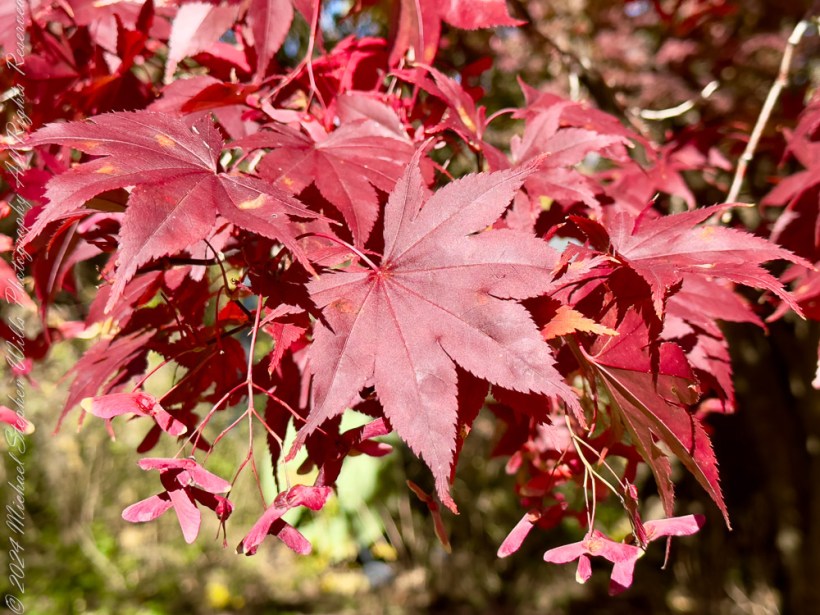
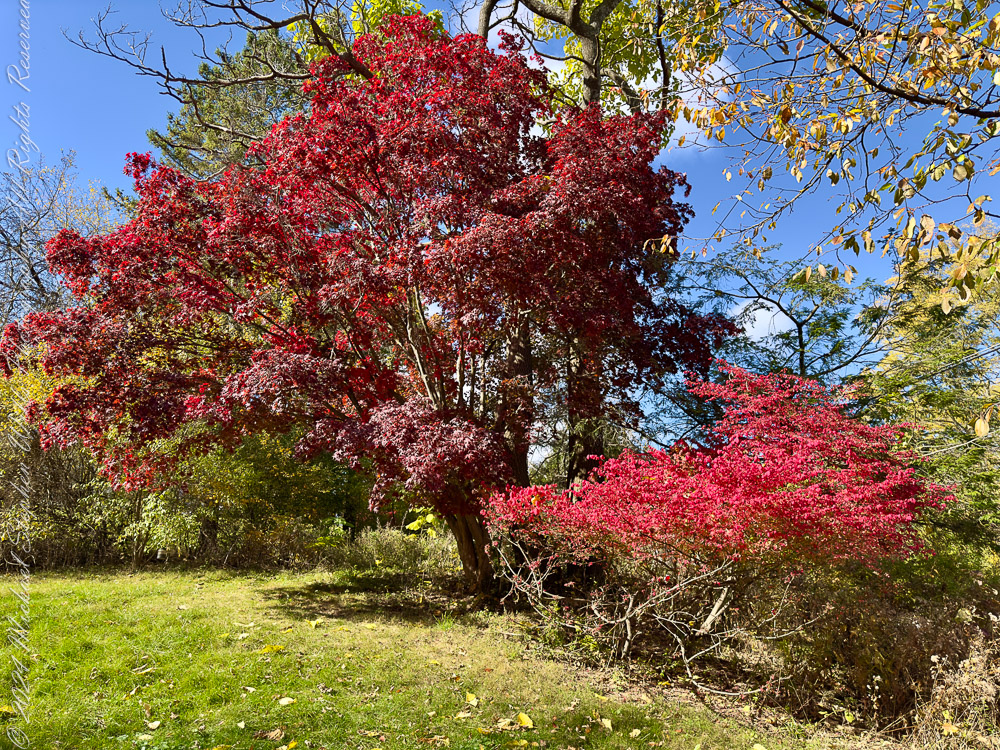
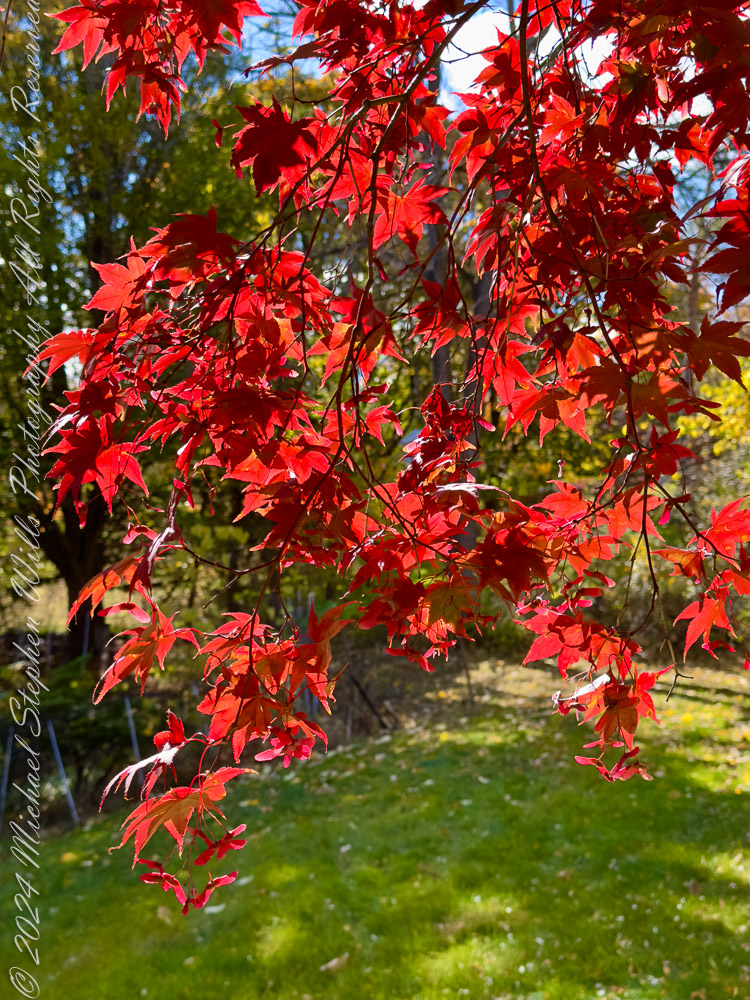
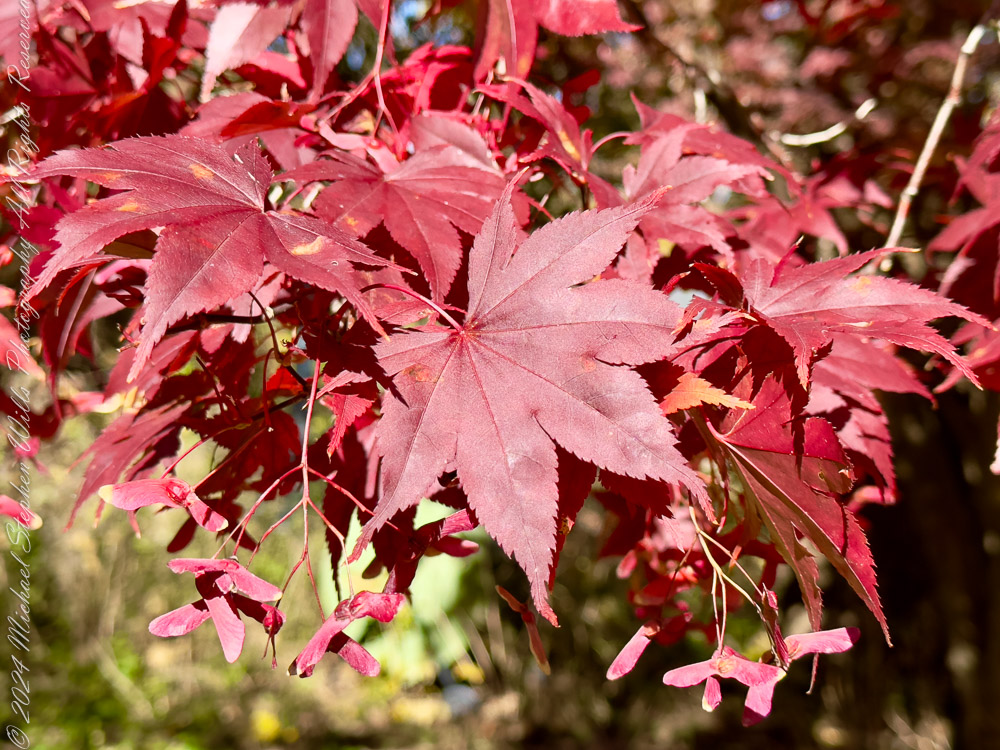
The next series of images focuses on the Japanese maple (Acer palmatum), a tree whose vibrant red foliage becomes a magnet for admiration in autumn. One close-up reveals delicate leaves, their intricate lobes illuminated by the afternoon sun. The interplay of light and shadow transforms each leaf into a tiny stained-glass window. Another photograph showcases the tree in its entirety, a commanding presence against the verdant lawn. It is a poignant reminder of nature’s artistry, where every branch and leaf contributes to the symphony of color.
Firebush and Japanese Maple in autumn colorsJapanese maple leaves and samara in autumn colors. From our yard October 2024Japanese maple leaves and samara in autumn colors. From our yard October 2024
Home Amid the Foliage
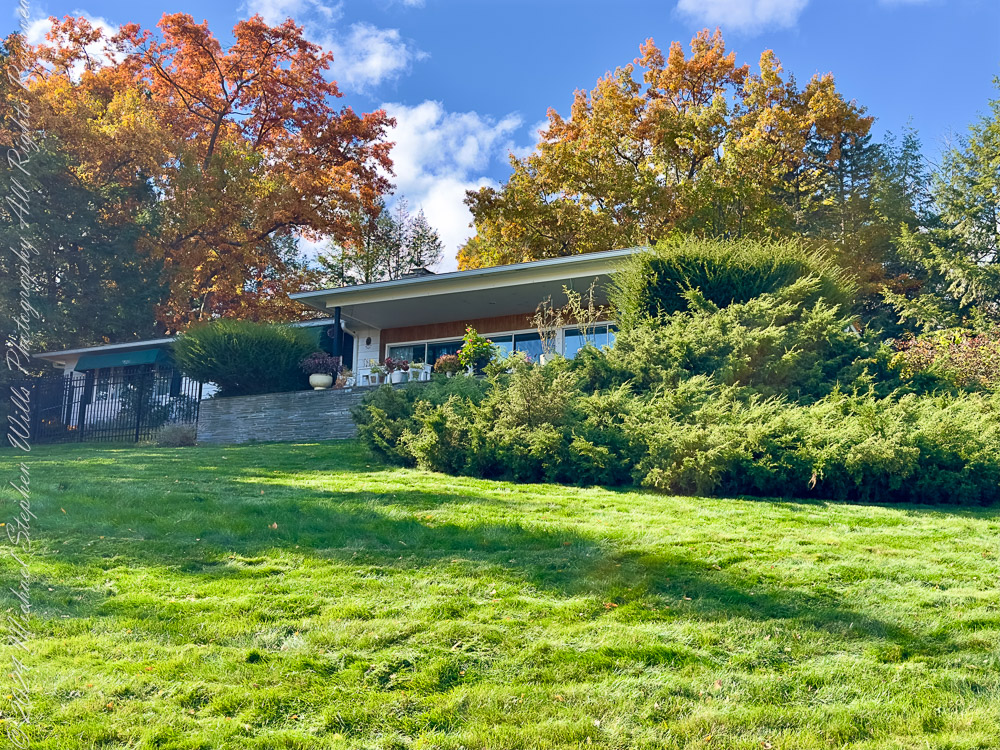
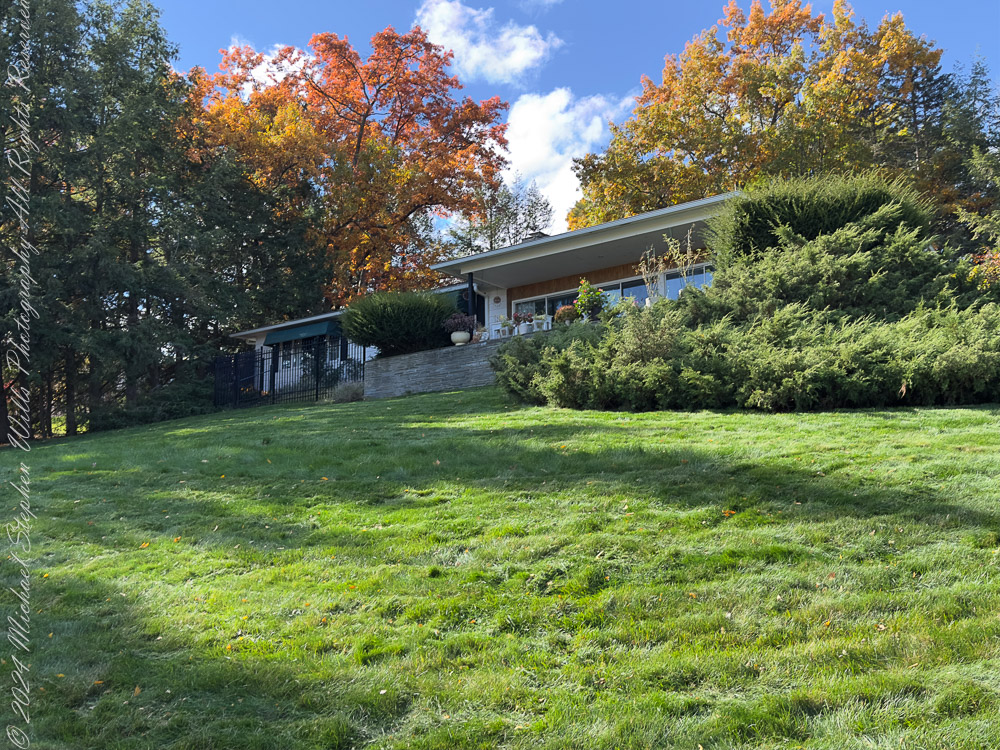
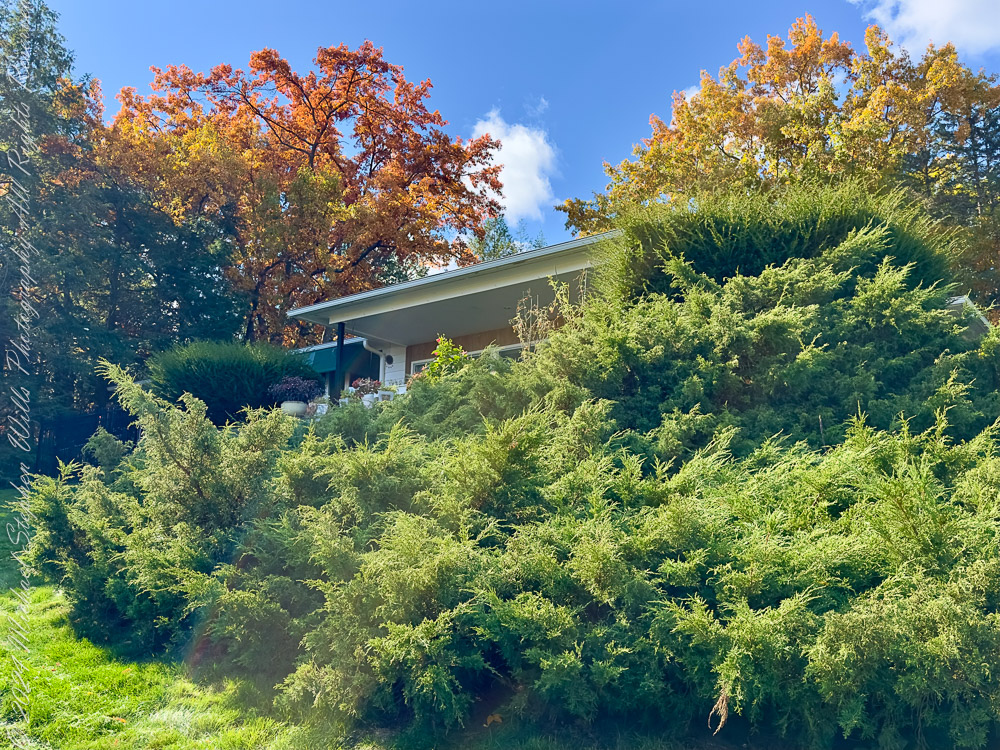
Nestled within this autumnal palette is our home, a mid-century structure that seems almost inseparable from its surroundings. The expansive lawn, a lush carpet of green, contrasts with the fiery colors of nearby oak (Quercus spp.) and maple trees (Acer spp.). In one angle, the house appears almost tucked away, sheltered by Eastern Hemlock (Tsuga canadensis) and junipers (Juniperus spp.) that add a sense of permanence to the scene. This juxtaposition of human habitation and natural splendor underscores how our lives are intertwined with the land we call home.
Our oak trees in autumn colors
Oak Leaves: A Study in Texture
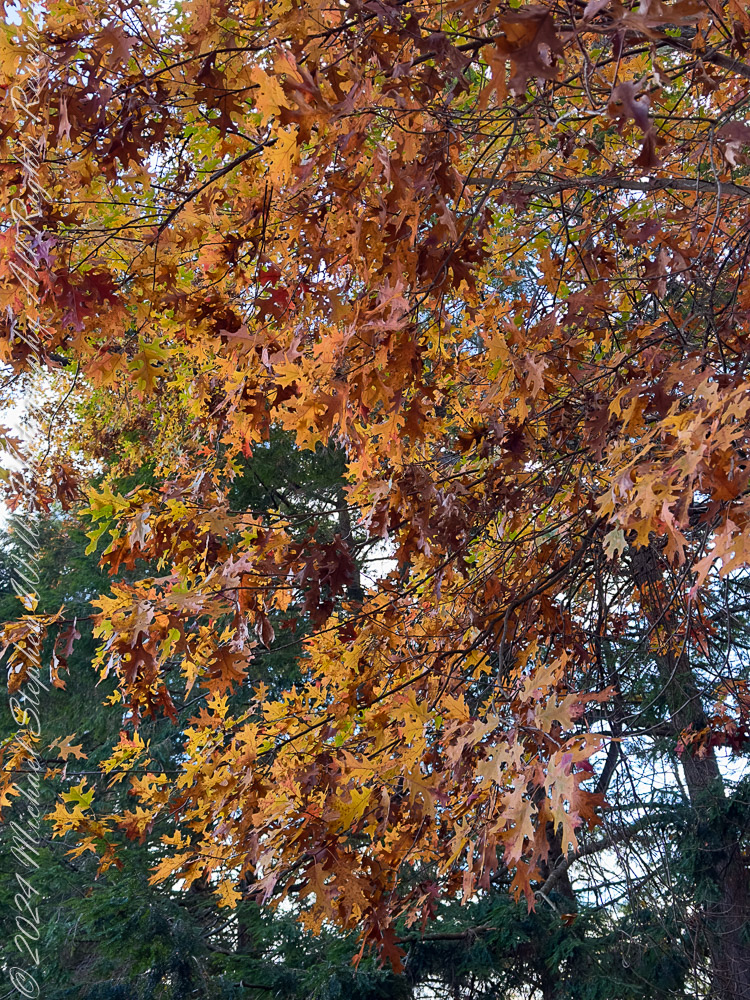
A close-up of oak leaves (Quercus spp.) showcases their rugged beauty, with jagged edges and deep veins that seem etched by time itself. Their colors—ranging from deep amber to burnished copper—are a testament to the richness of autumn’s palette. These leaves, clinging tenaciously to their branches, remind us of resilience and the fleeting beauty of the season.
Our oak tree in autumn colors. Helmock backdrop
Hydrangeas in Transition
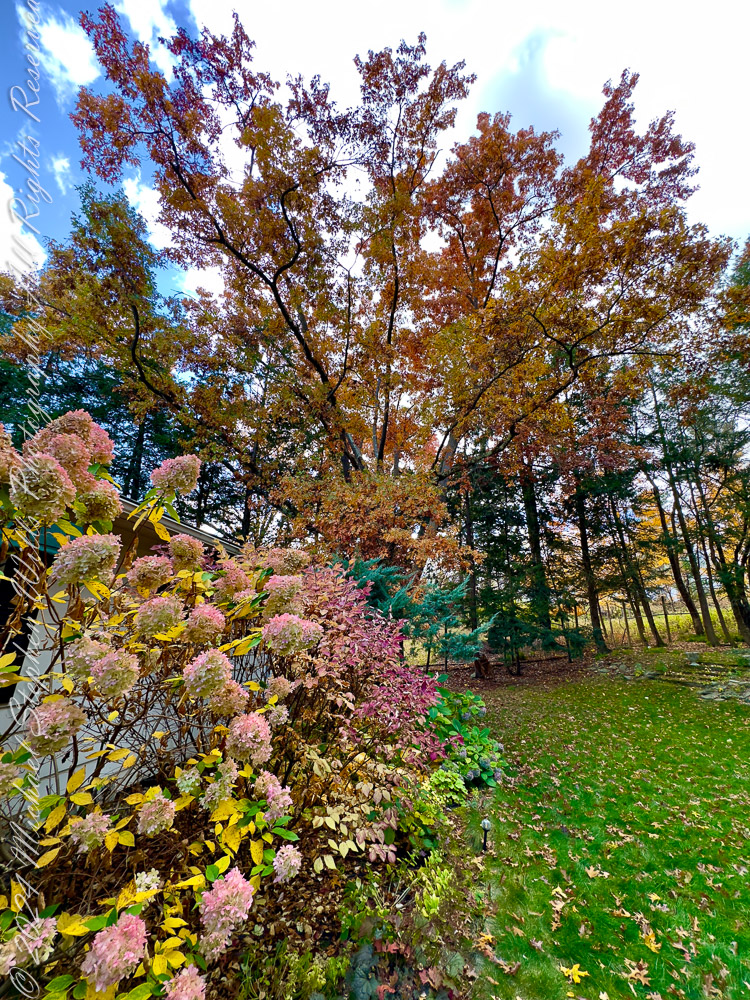
The hydrangea bushes (Hydrangea paniculata) by the house present a softer side of autumn. Their once-vivid blooms have faded to pastel pinks and creams, lending an air of nostalgia. These flowers, in their gentle decline, mirror the transition of the season, where vibrancy gives way to a quieter beauty. The hydrangea blooms seem to whisper the story of the summer past, offering a delicate contrast to the bolder hues of the surrounding trees.
Our oak tree in autumn colors. Pam’s hydrangia.
The Resilient Shrubs
Creeping Juniper (Juniperus horizontalis), here in the foreground, provides a grounding element in the composition, with a steadfast green the reminder of life persisting even as deciduous leaves fall. The dense shrubbery near the house creates a protective cocoon, framing the building with a sense of natural security. The dynamic interplay between these evergreens and the changing foliage of maples and oaks reflects the layered complexity of this landscape.
Reflections on an Afternoon
As I wandered through these scenes with camera in hand, I was struck by the interplay of light, color, and texture. Each photograph captures a fleeting moment, a slice of a season that, despite its predictability, never fails to surprise and inspire. Autumn in the Finger Lakes is a time of reflection, a reminder to pause and appreciate the world around us.
These images, taken on a single afternoon, tell a story of a landscape alive with color and character. From the steadfast junipers to the delicate hydrangea blooms, from the fiery maples to the enduring oaks, they invite us to celebrate not just the beauty of nature but also our place within it—a home nestled among trees that have stood for decades, witnessing the rhythms of the earth.
Enter your email to receive notification of future postings. I will not sell or share your email address.
Copyright 2024 All Rights Reserved Michael Stephen Wills
As I step into Cascadilla Gorge from the Linn Street entrance, I’m greeted by the soft rustling of leaves and the constant, soothing rush of water. The air this Halloween Day is warm, the autumn colors vibrant against the cool blue sky. I know Cascadilla Gorge is part of the Cornell Botanical Gardens, but the immediate beauty of this natural sanctuary makes it easy to forget I’m still within the city limits of Ithaca. The sounds of the gorge draw me in, as if whispering there’s more to see, more to explore. With a deep breath, I begin my journey up the trail, eager to discover what lies ahead.
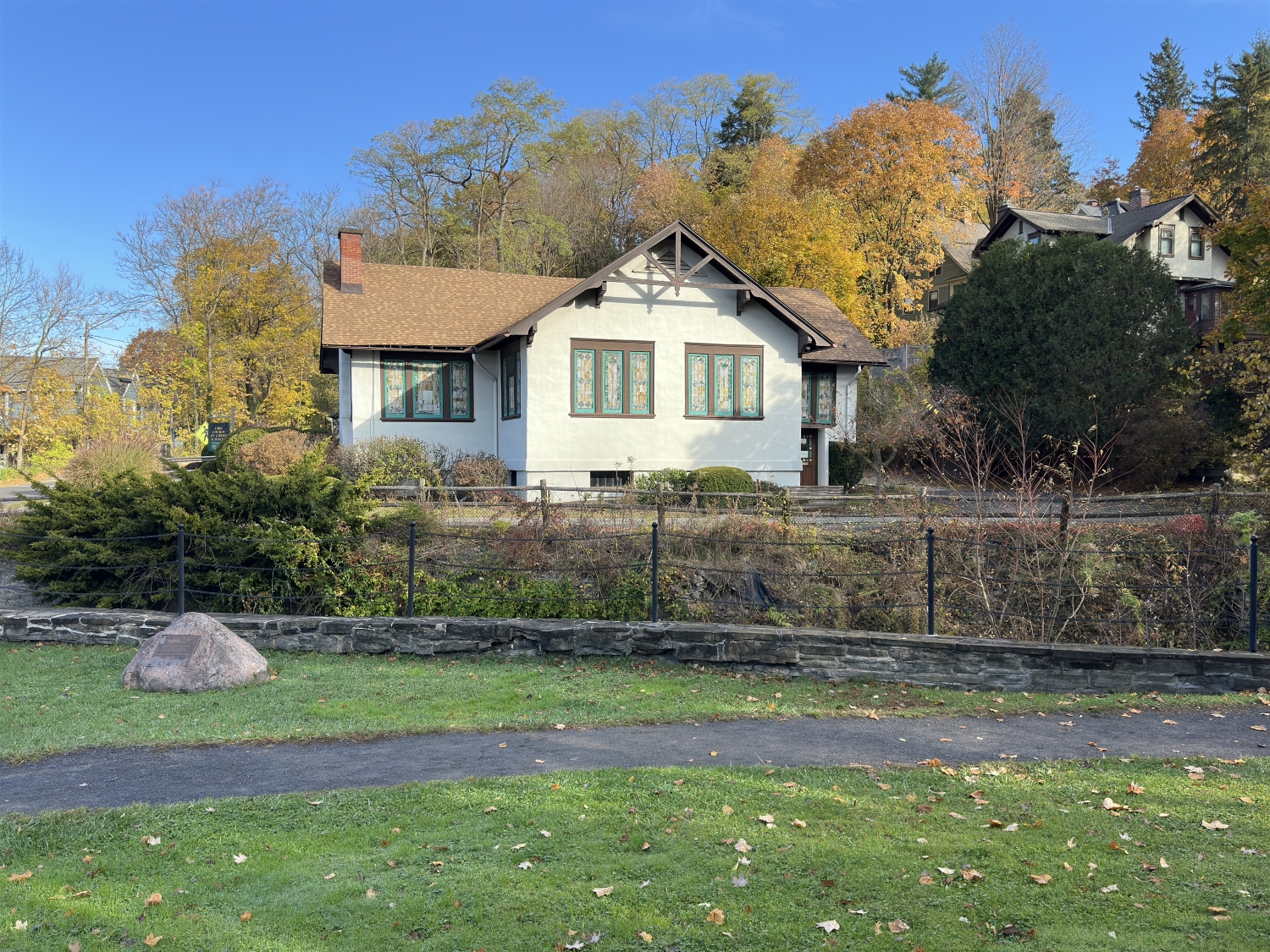
Just a short way in, I notice the First Church of Christ, Scientist perched on the corner of University Avenue and Cascadilla Park Road. The architecture of the church is both quaint and elegant, with its light-colored facade framed by dark trim and roof. Surrounded by foliage, it feels like the church belongs here, as much a part of the landscape as the trees and rocks. The sight of this historic building nestled so close to the gorge reminds me that this wild and ancient place is woven into the fabric of Ithaca’s community life.
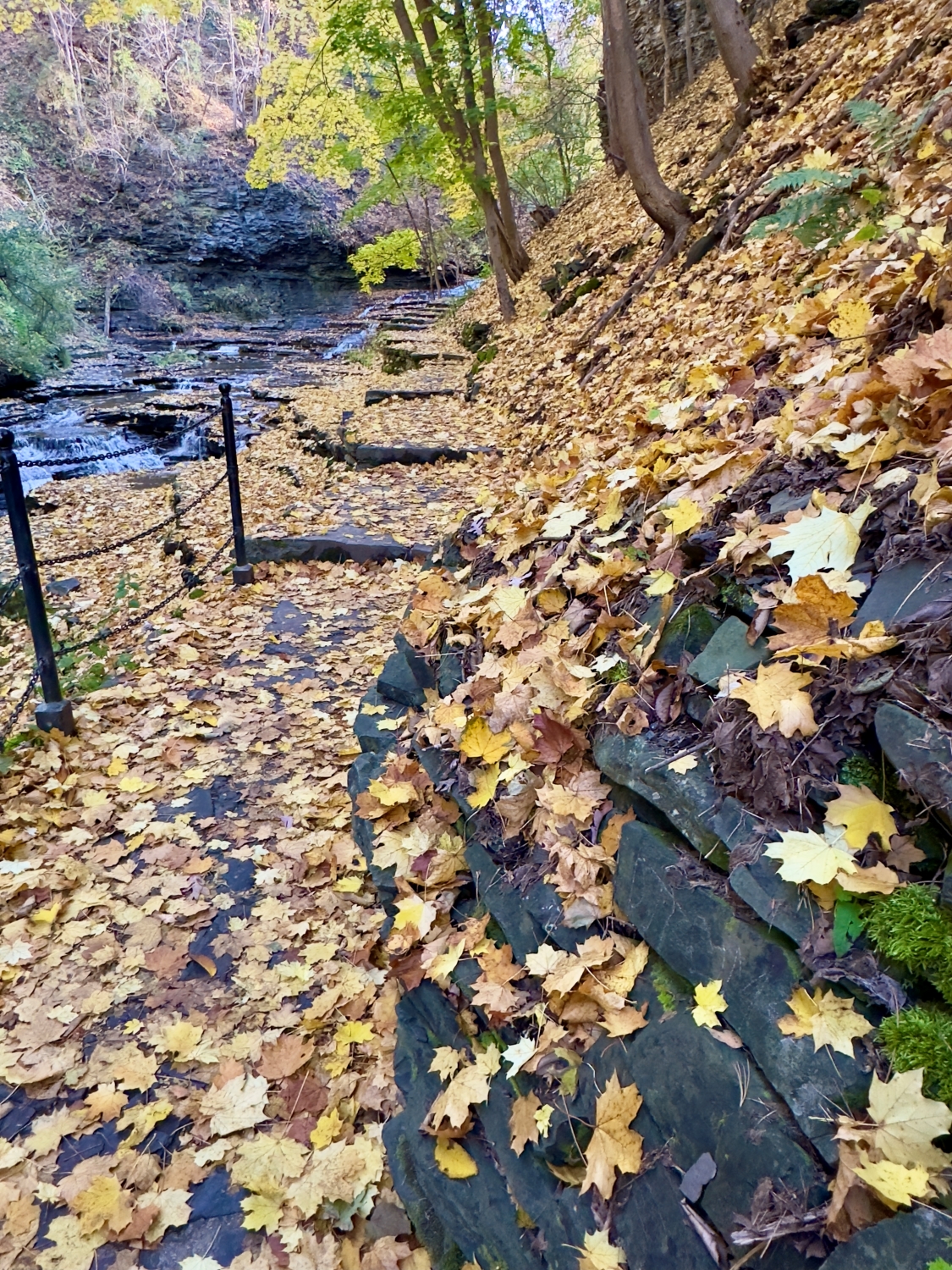
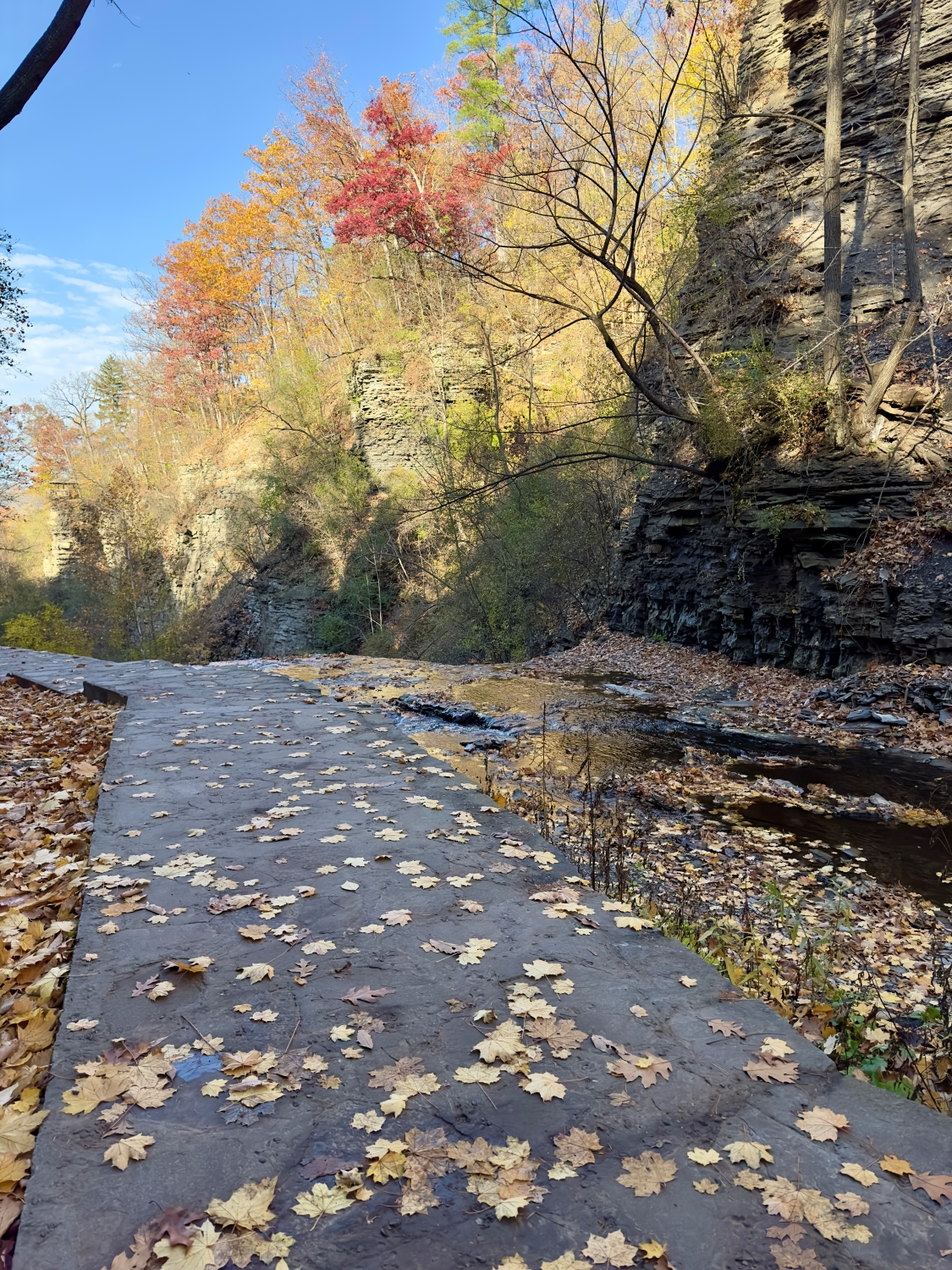
I move further along the trail, and the terrain begins to shift. Fallen leaves create a golden carpet along the path, their crisp shapes overlapping like nature’s confetti celebrating the season. Each step crunches underfoot, adding my own rhythm to the symphony of sounds. The trees overhead are a kaleidoscope of colors—deep golds, fiery oranges, and the occasional flash of red from Virginia Creeper vines (Parthenocissus quinquefolia). Together, the trees create a canopy that filters sunlight, casting dappled patterns on the gorge walls. It’s an ever-changing play of light and shadow, one moment bright and the next subdued, adding a layer of magic to the experience.
As I follow the trail upward, the gorge narrows, and I find myself surrounded by towering walls of rock. Here, layers of siltstone and shale formed more than 300 hundred million years ago are exposed, a testament to the forces of water and time that carved this place across mere millennia of recent geologic time. The rock formations are fascinating, with the water flowing over them in gentle cascades, finding every groove and crevice. There’s something humbling about standing in a place shaped by forces so much larger and older than myself. I pause, letting the rush of water and the stillness of stone fill my senses.
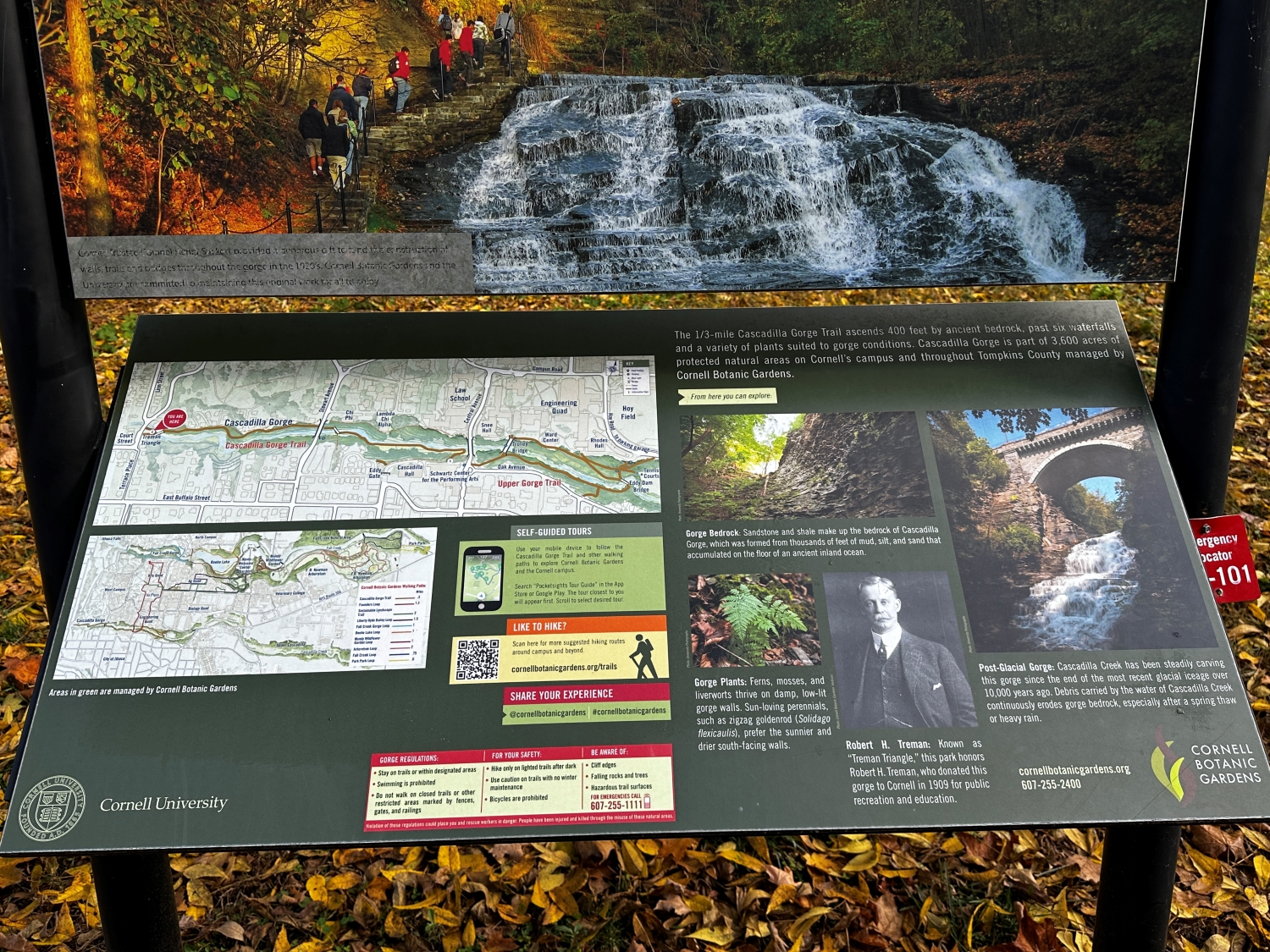
Along the way, I come across an interpretive sign provided by the Cornell Botanical Gardens. They tell the story of Cascadilla Gorge, how it was formed from the bedrock of sandstone and shale that eroded from mountains to the east, in the Devonian era when an ancient inland sea covered the region. The signs also introduce Robert H. Treman, a philanthropist who saw the beauty and educational value of the gorge. Thanks to him and the efforts of many, this natural wonder is preserved for all to experience. Knowing this adds depth to my walk; it’s a reminder that places like this exist not only by chance but because people cared enough to protect them.
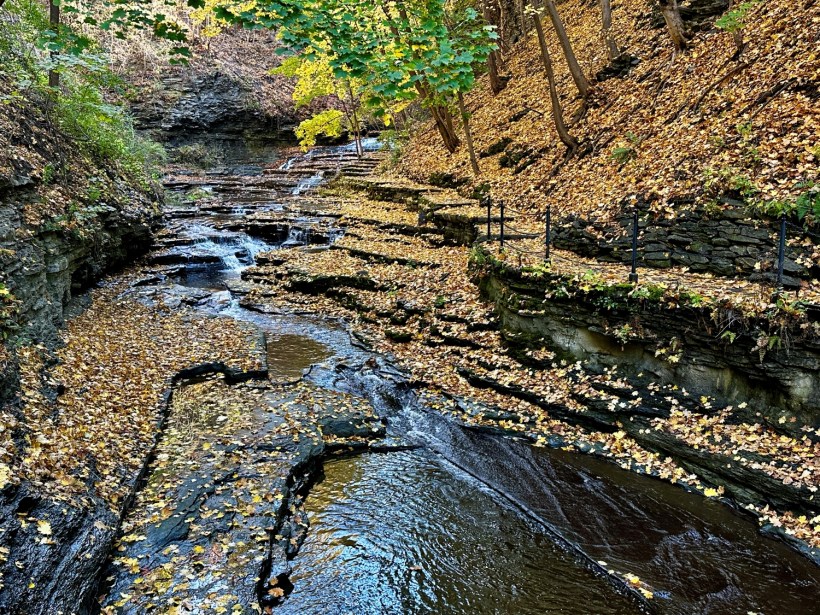
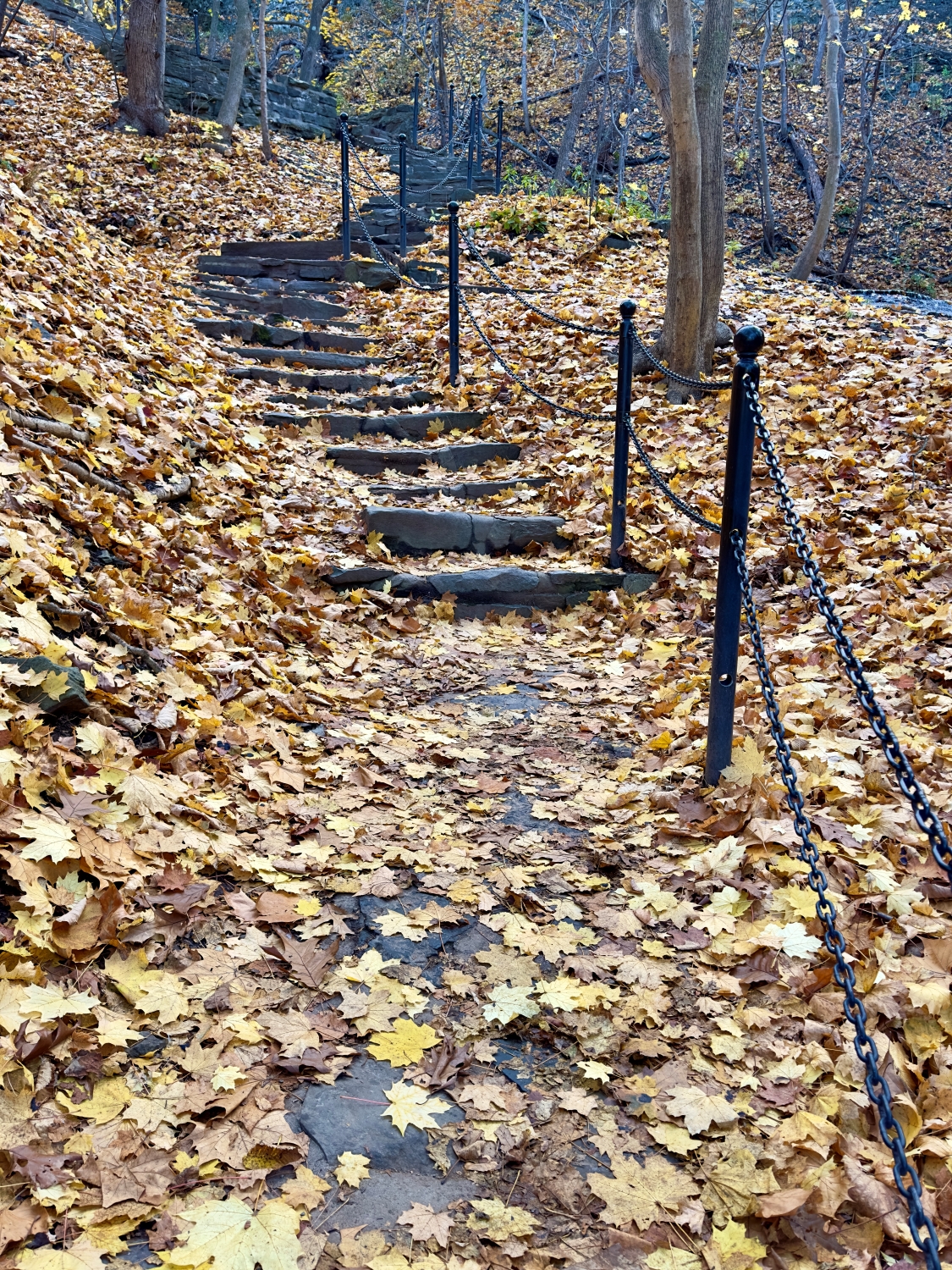
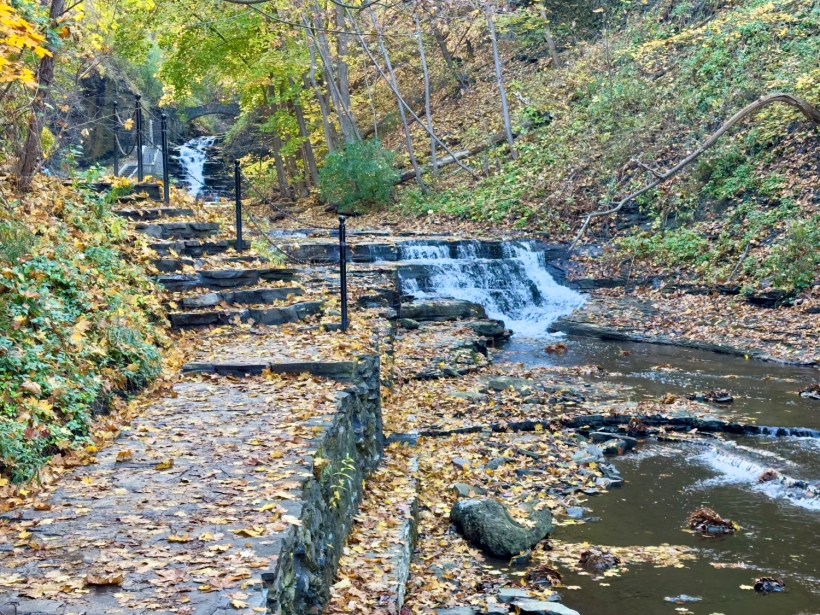
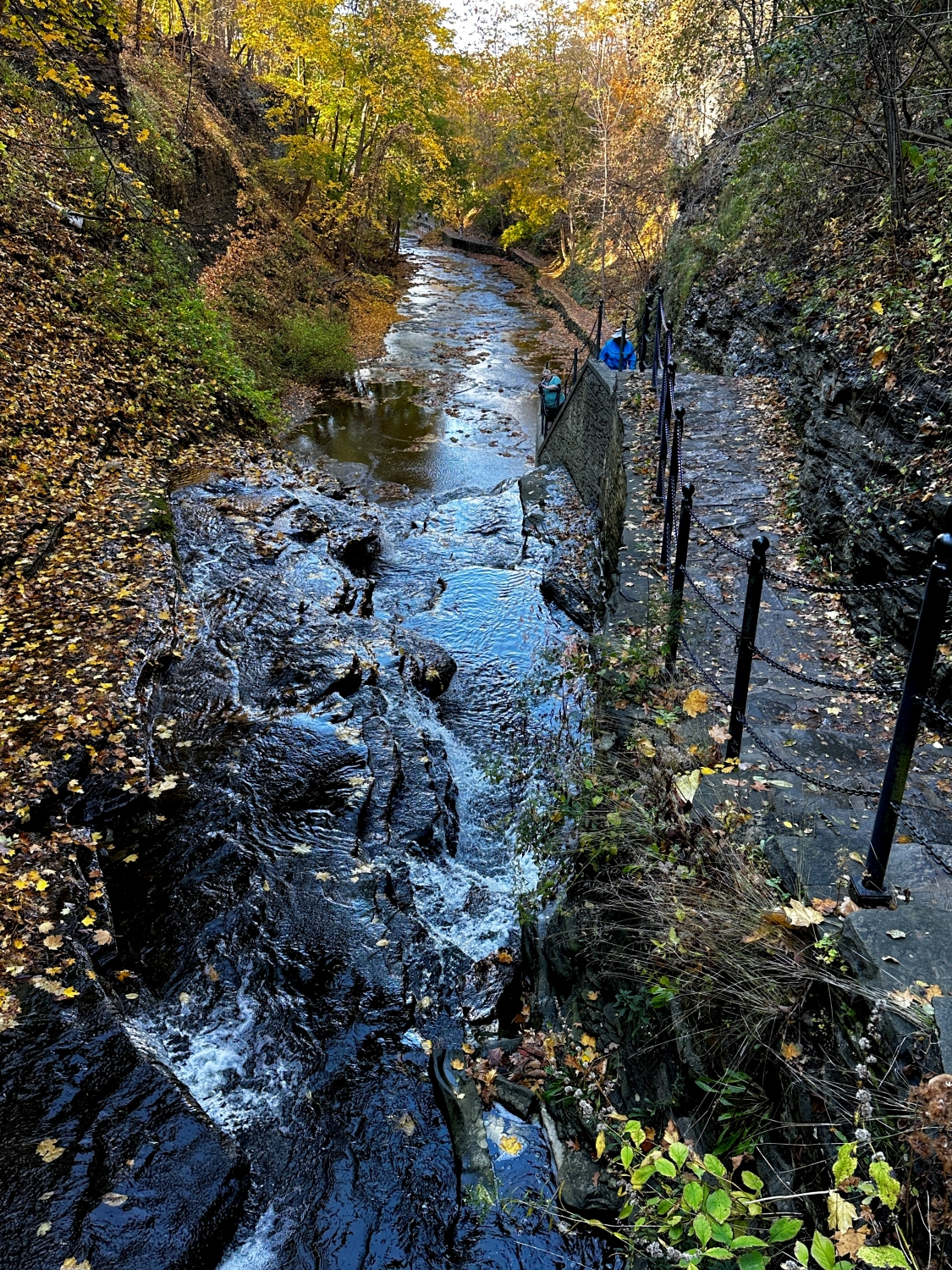
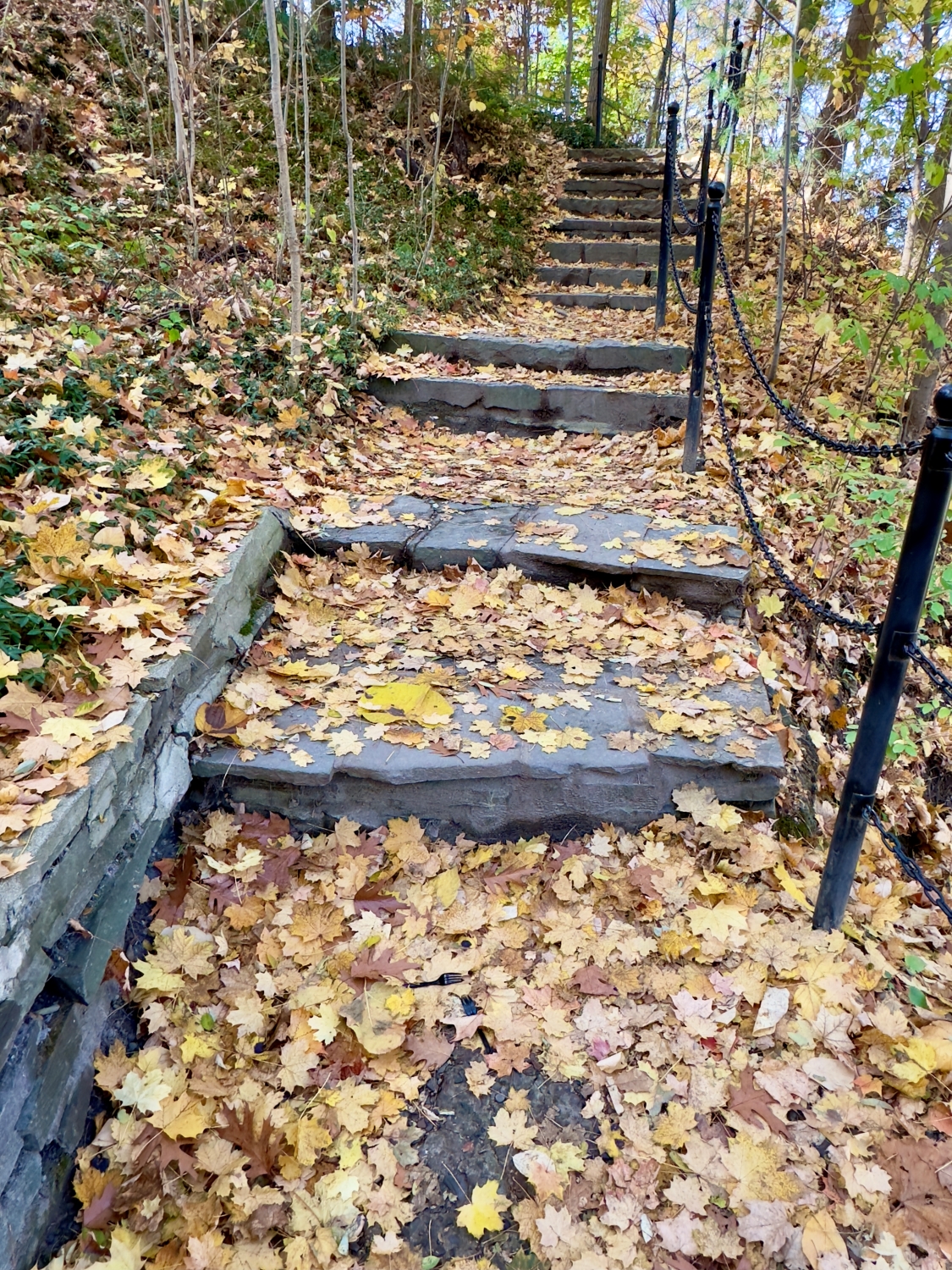
The sandstone staircases along the trail are a marvel in themselves. Some sections are steep, winding up the gorge in a series of steps that seem to have been placed with precision, blending seamlessly into the natural landscape. The steps are covered with leaves now, making each ascent feel a bit like climbing through a fairy-tale forest. The chains along the path provide a comforting grip, especially as I climb higher. I look back and see how far I’ve come, the creek below winding its way over rocks and around bends, each step a small journey of its own.
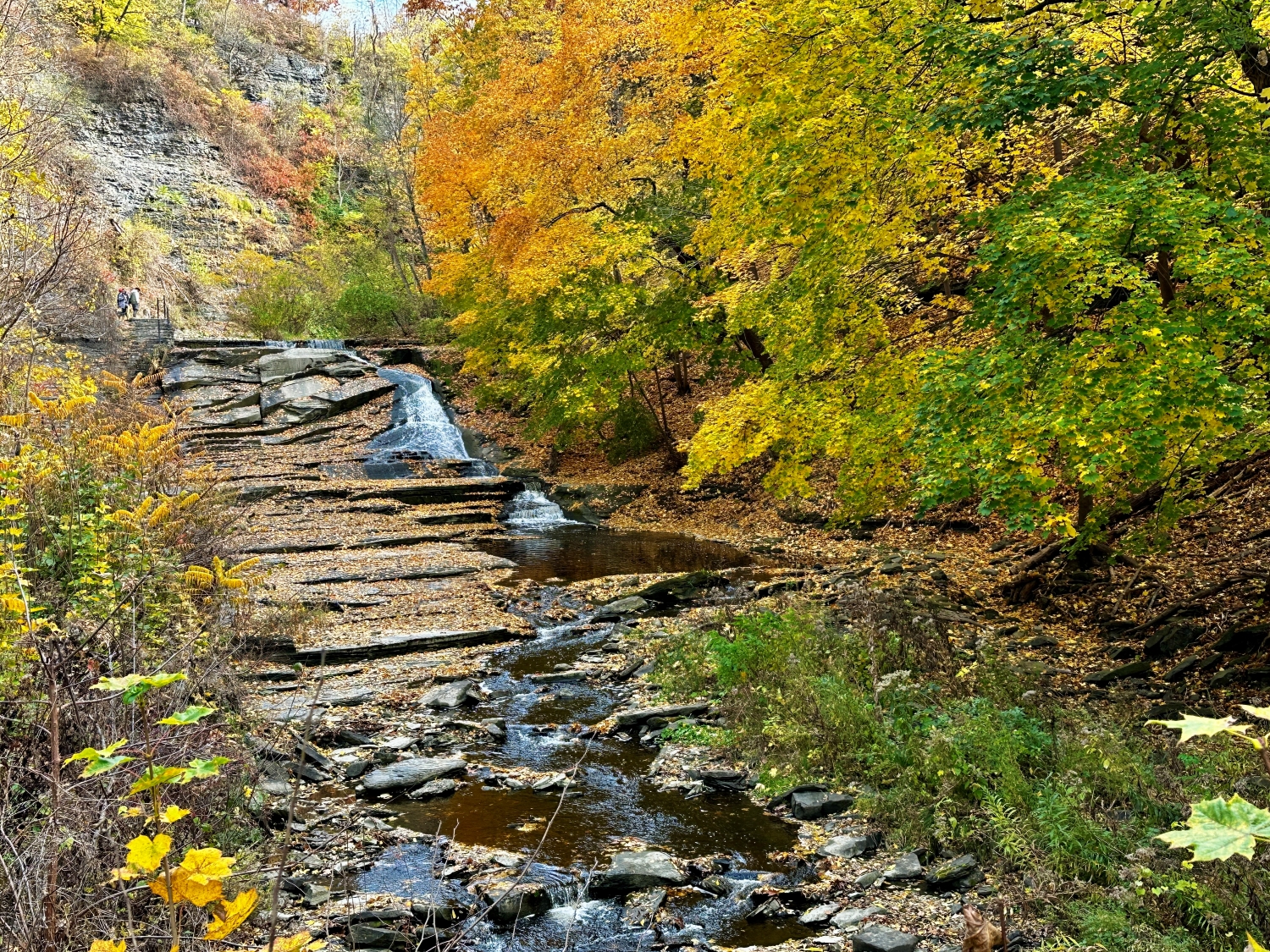
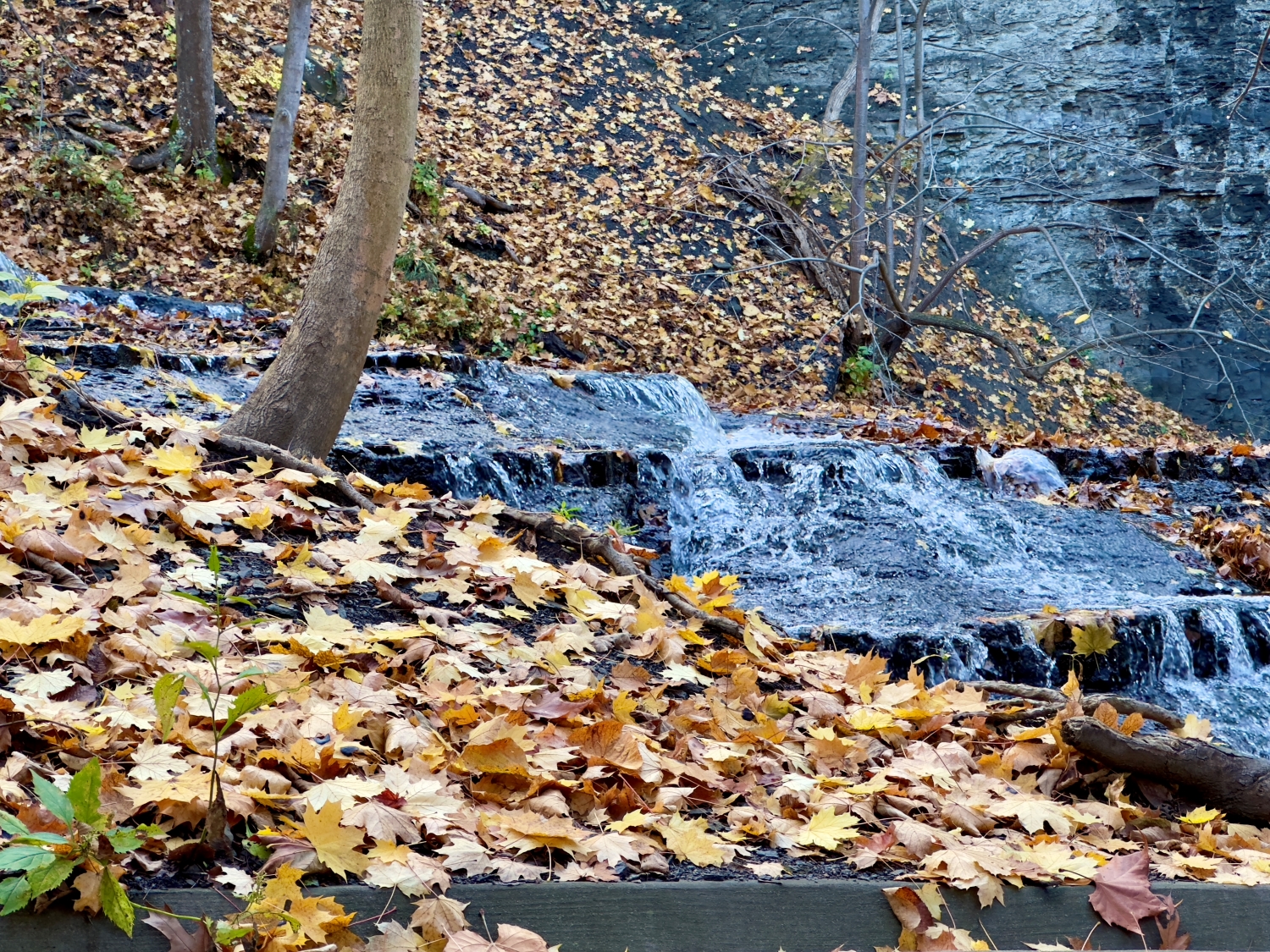
I pass several small waterfalls, each one unique in its character. Some are gentle trickles, while others pour over the rocks with more force, their sound reverberating off the gorge walls. I stop frequently, entranced by the way the water carves its path, eternally moving, adapting, wearing down even the hardest stone. Leaves float down from above, landing in the creek and swirling in miniature whirlpools before being carried downstream. It’s mesmerizing to watch nature at work in such a quiet, persistent way.
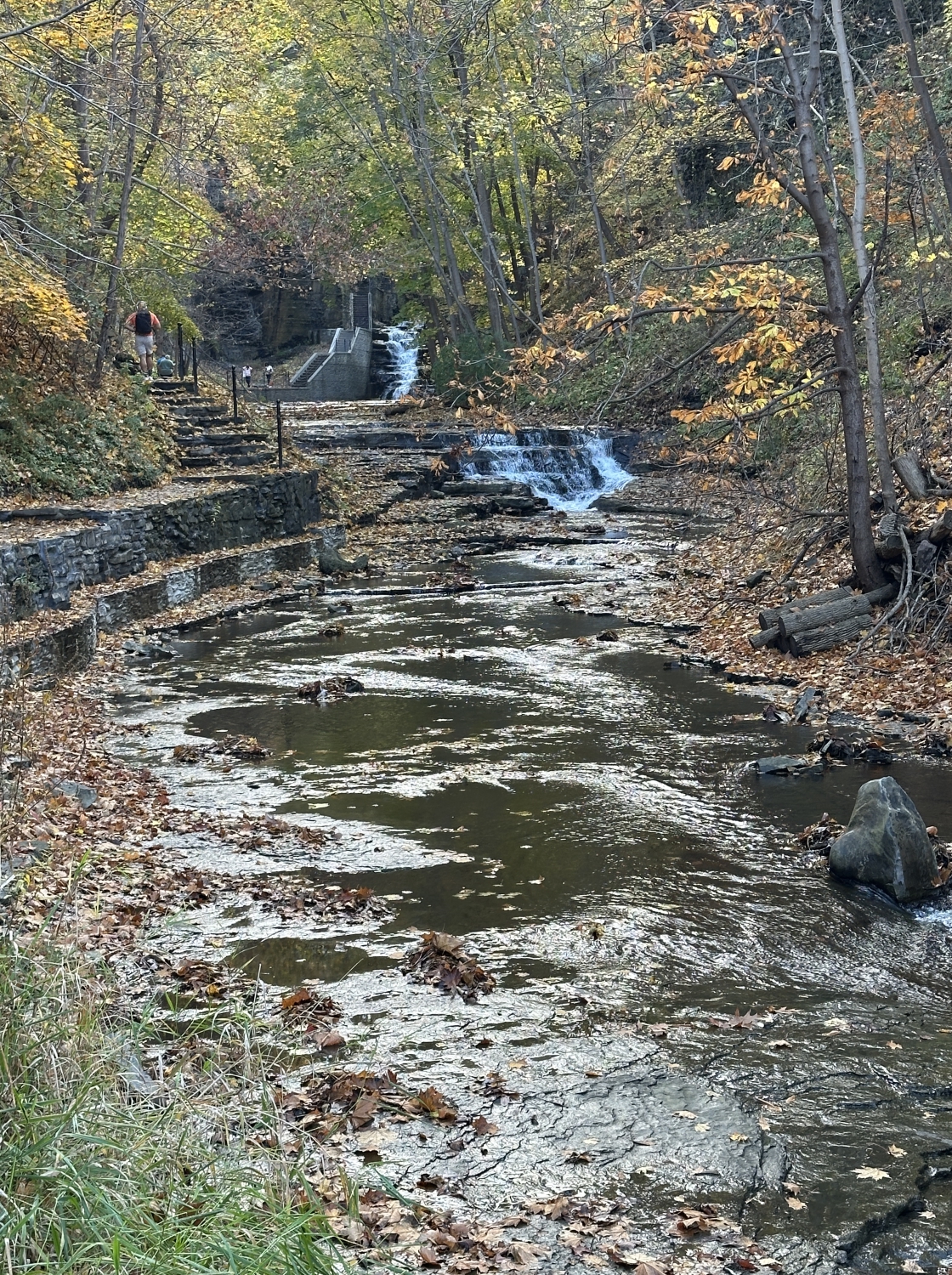
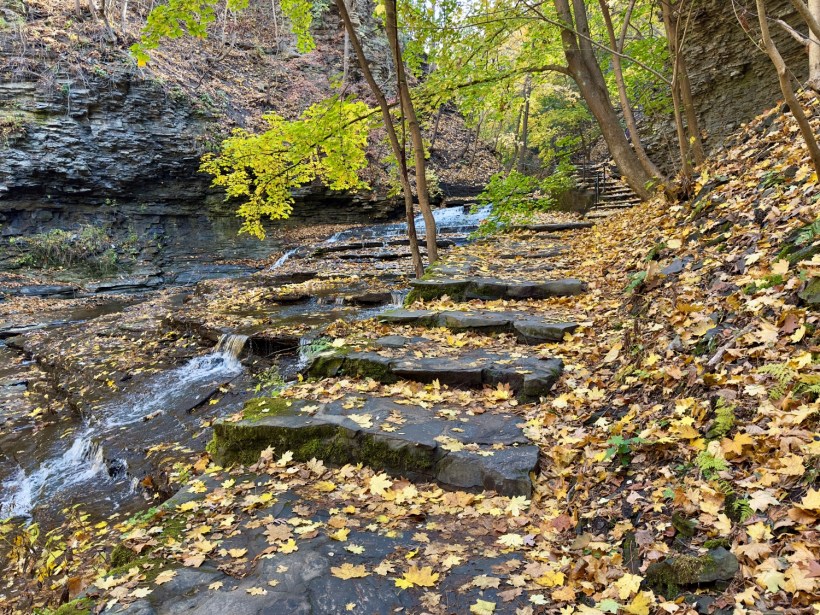
Further up the gorge, the views open up, and I can see the layers of rock descending in terraces, each level a little cascade of its own. I watch as the water flows across these steps, catching the light as it moves—a silvery ribbon winding through the golden autumn landscape. The tranquility of the scene is meditative. Around me, the trees stand as silent witnesses, their branches bare in places but still adorned with clusters of leaves clinging through the last days of fall.
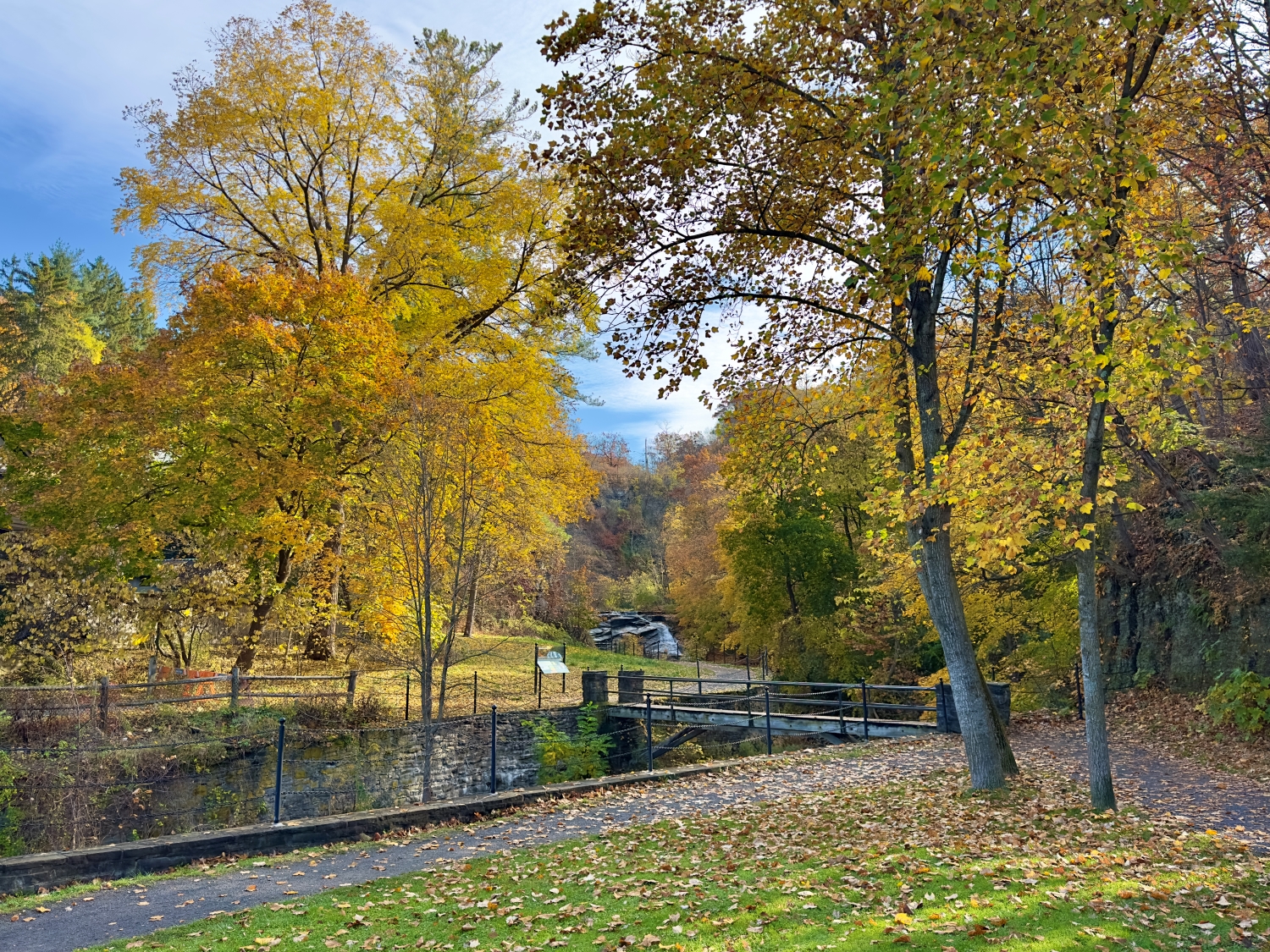
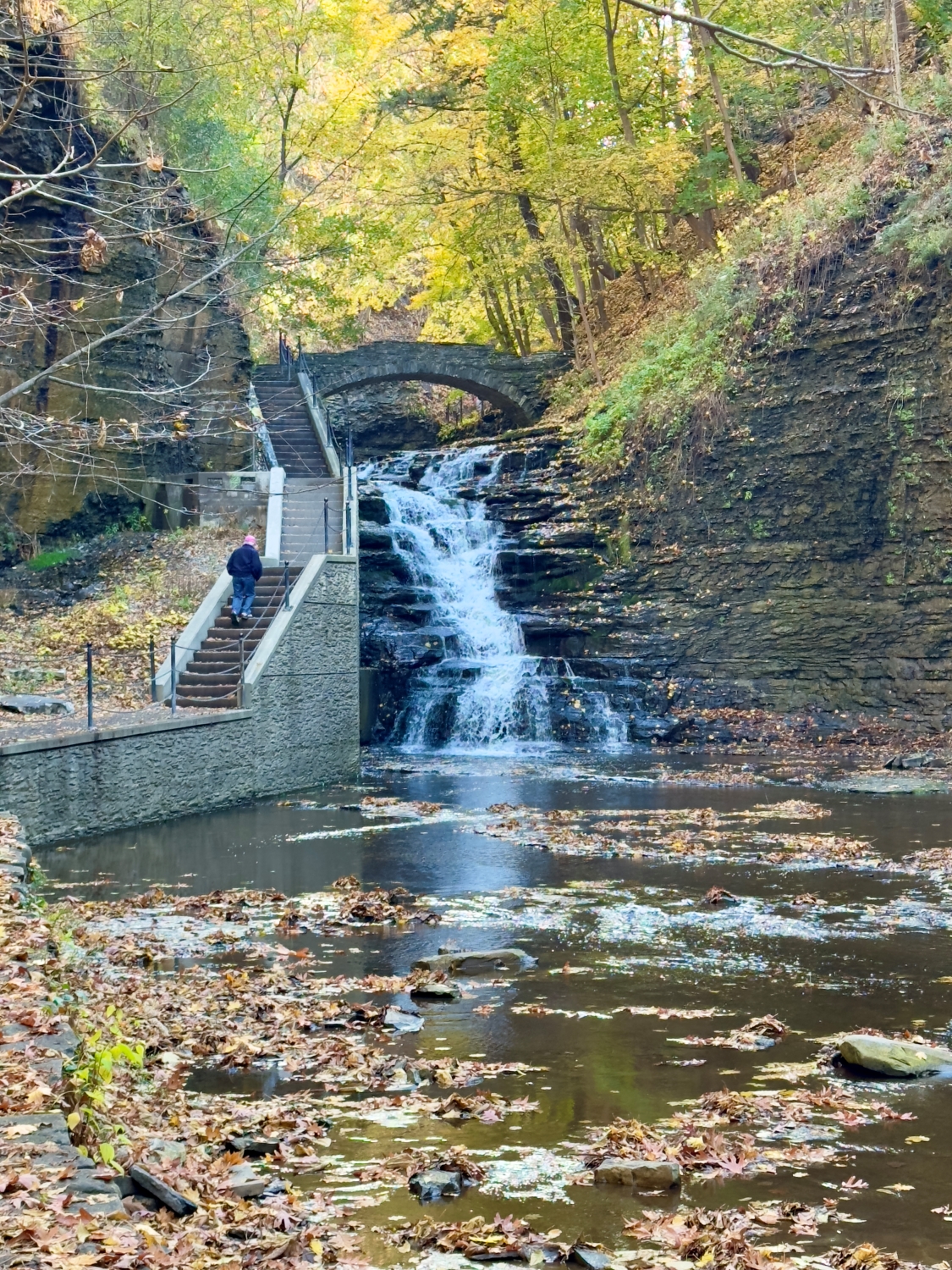
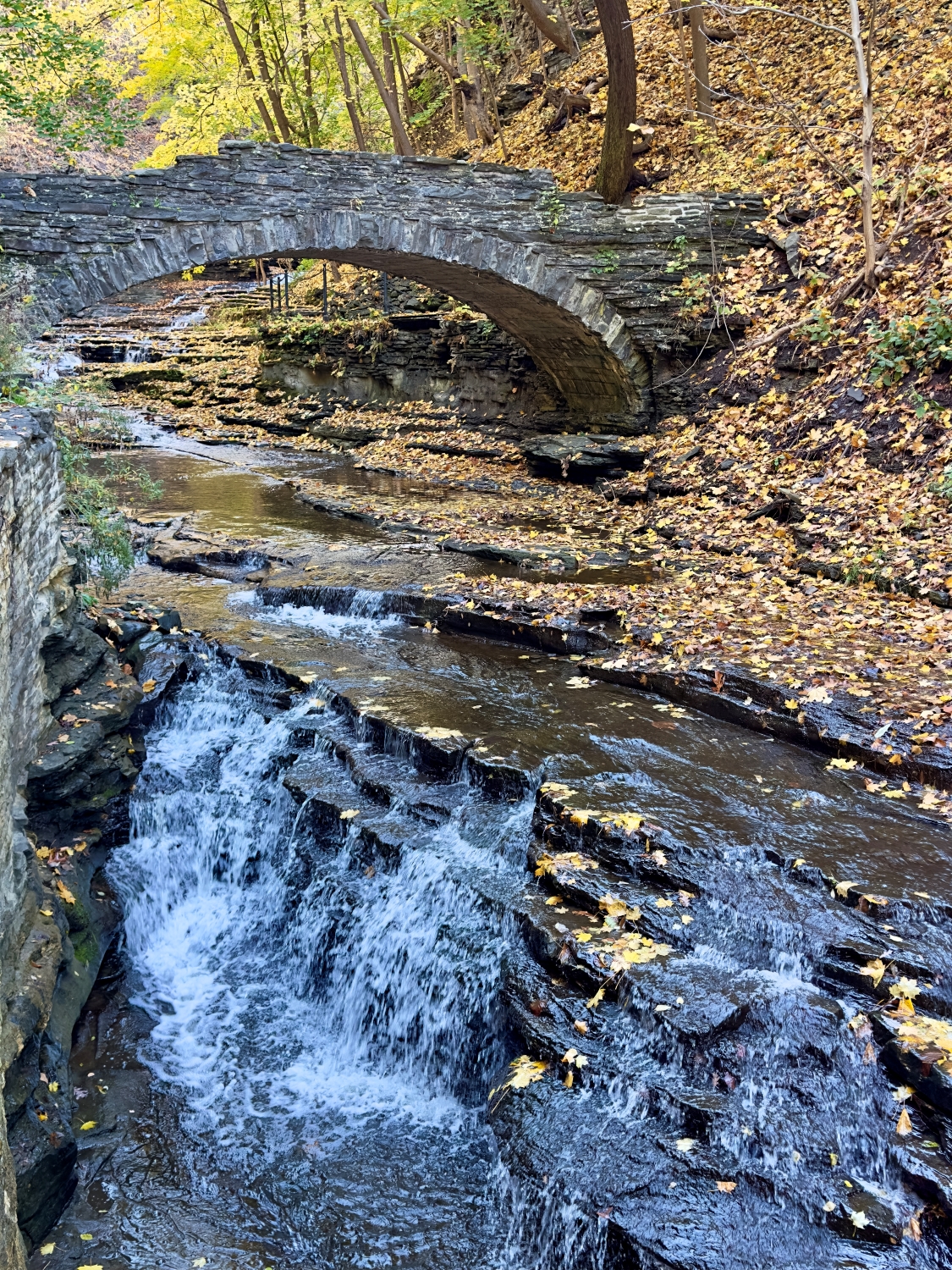
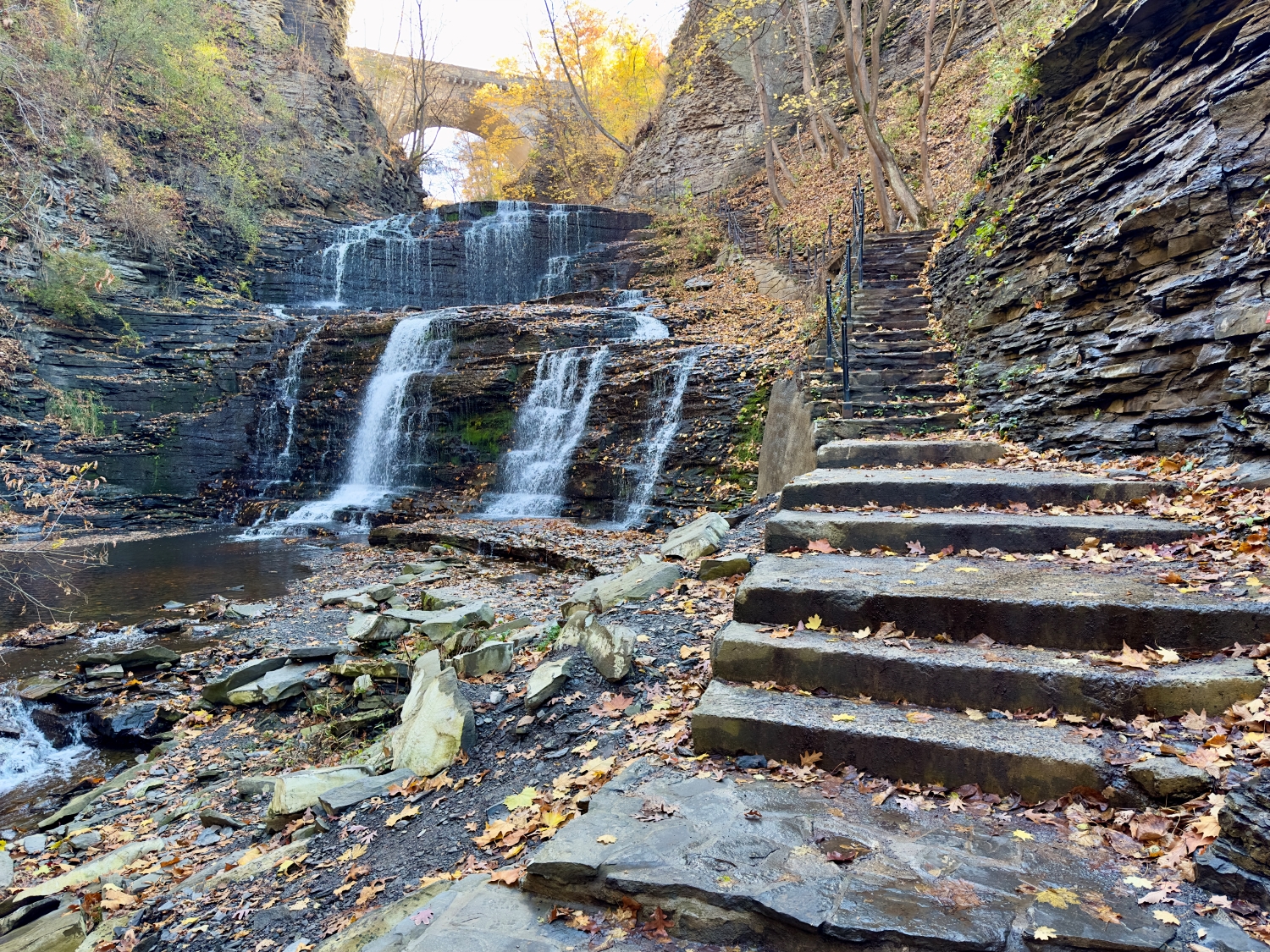
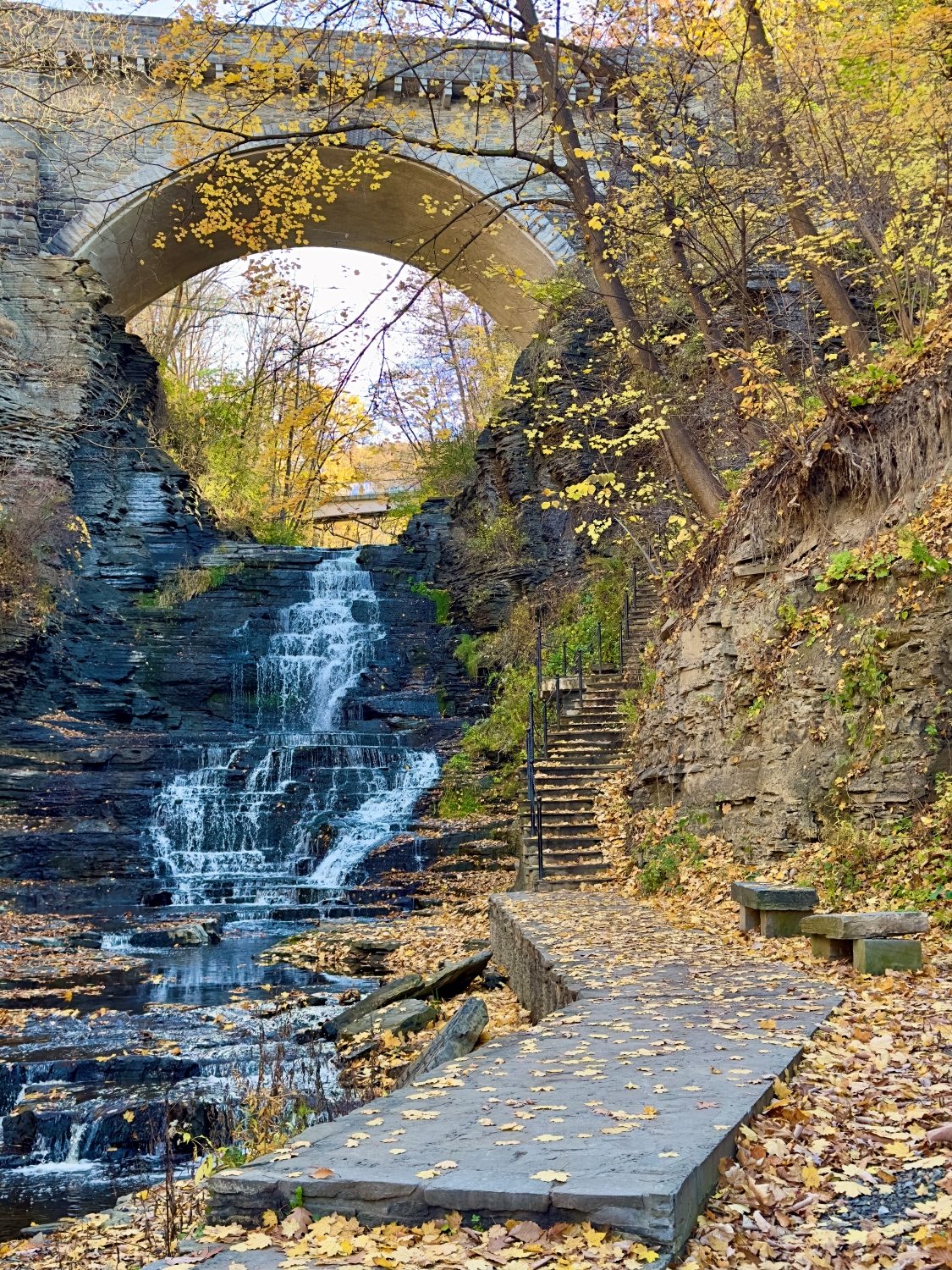
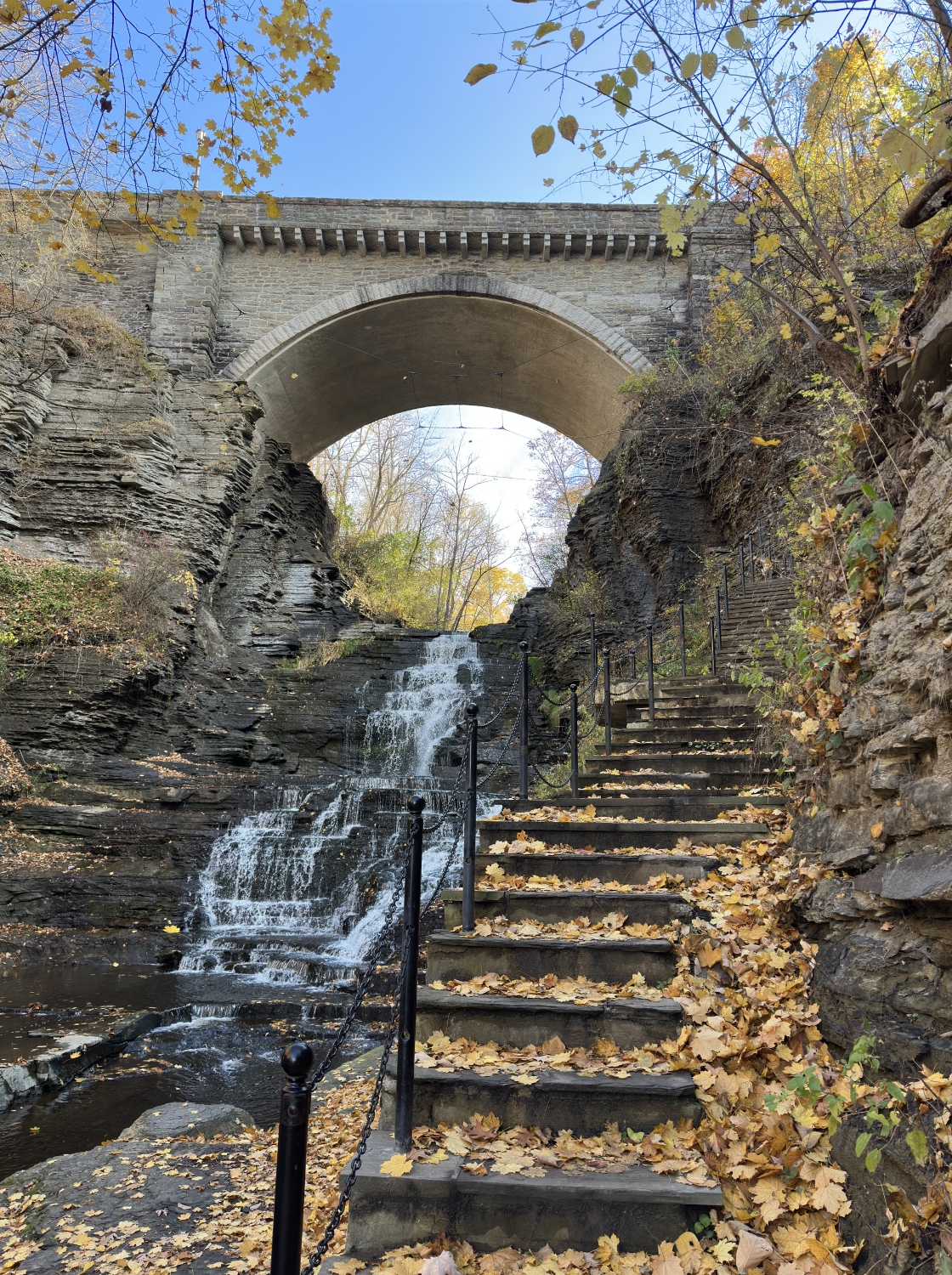
Finally, I reach one of the larger waterfalls, framed by a graceful stone arch bridge that crosses high above. The scene is something out of a painting. Water pours over the rocks, gathering in pools below before spilling onward. I pause on the bridge, looking down at the gorge below and the trail I’ve followed, grateful for the journey.
Along the way, artists are positioned along the path, each lost in the beauty of Cascadilla Gorge. They stand or sit in quiet reverie, brushes or pencils in hand, capturing the gorge’s unique character. Some focus on the play of light over the water’s surface, while others seem intent on the rugged details of the rock formations. Their presence adds a contemplative depth to the scene; it’s as if each artist has uncovered a hidden aspect of the gorge that I have overlooked in my journey upward.
I slow my pace to take it all in, appreciating how the artists interpret this natural wonder through their own eyes. Their canvases reveal layers of colors that shift as the sun filters through the leaves, casting vibrant golds and subtle greens on the cascading water. The scene feels almost collaborative—nature and human hand creating art together, each reflection of the gorge as unique as the individual capturing it. I’m tempted to pause beside them, to see how they choose to frame the towering walls, the stone bridge arching above the water, and the gentle curves of the creek as it meanders downstream. I can imagine each artist’s work holding a different piece of this place, like fragments of a memory.
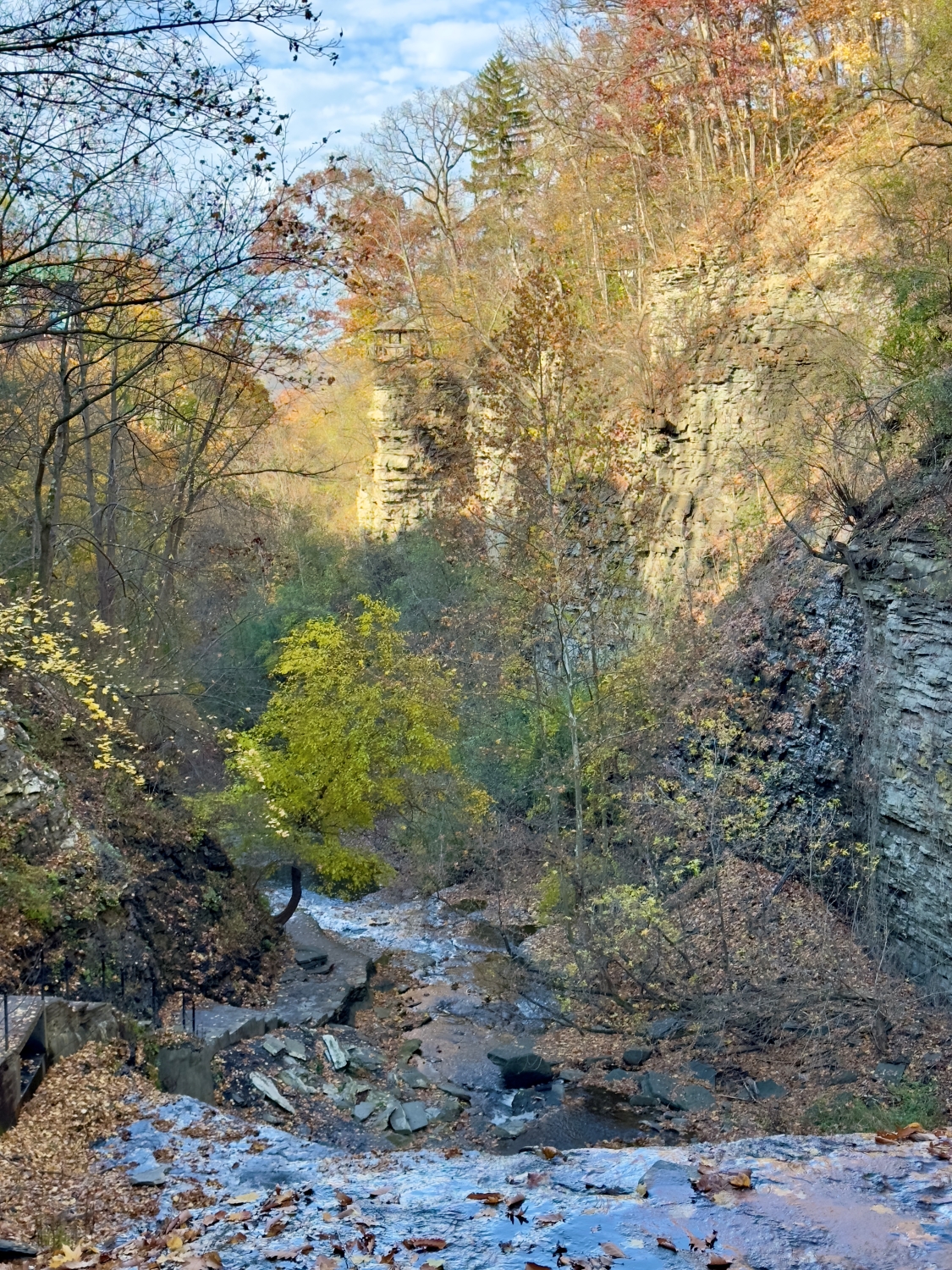
Bridge View looking up Cascadilla CreekBridge View looking back the way I came
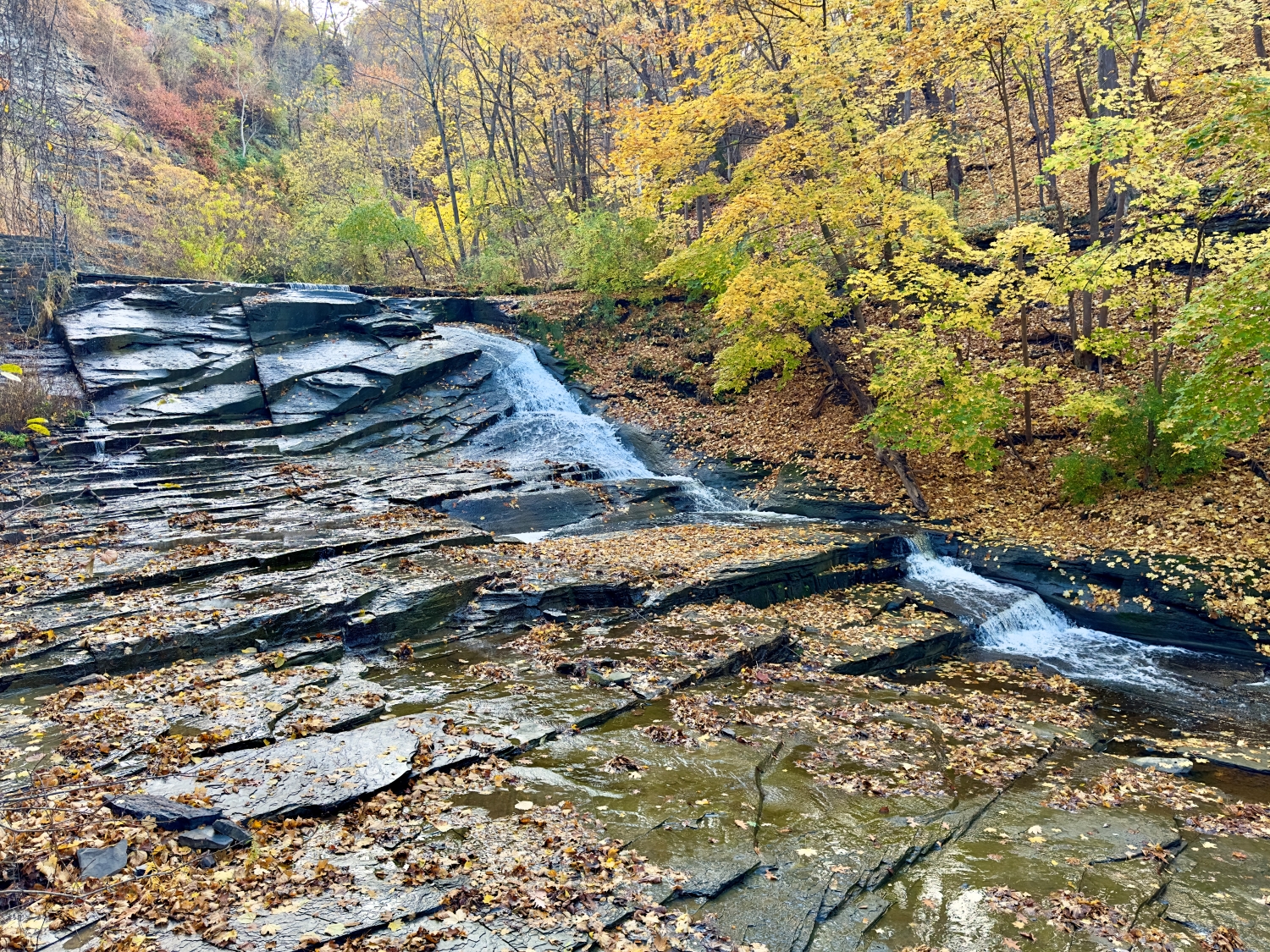
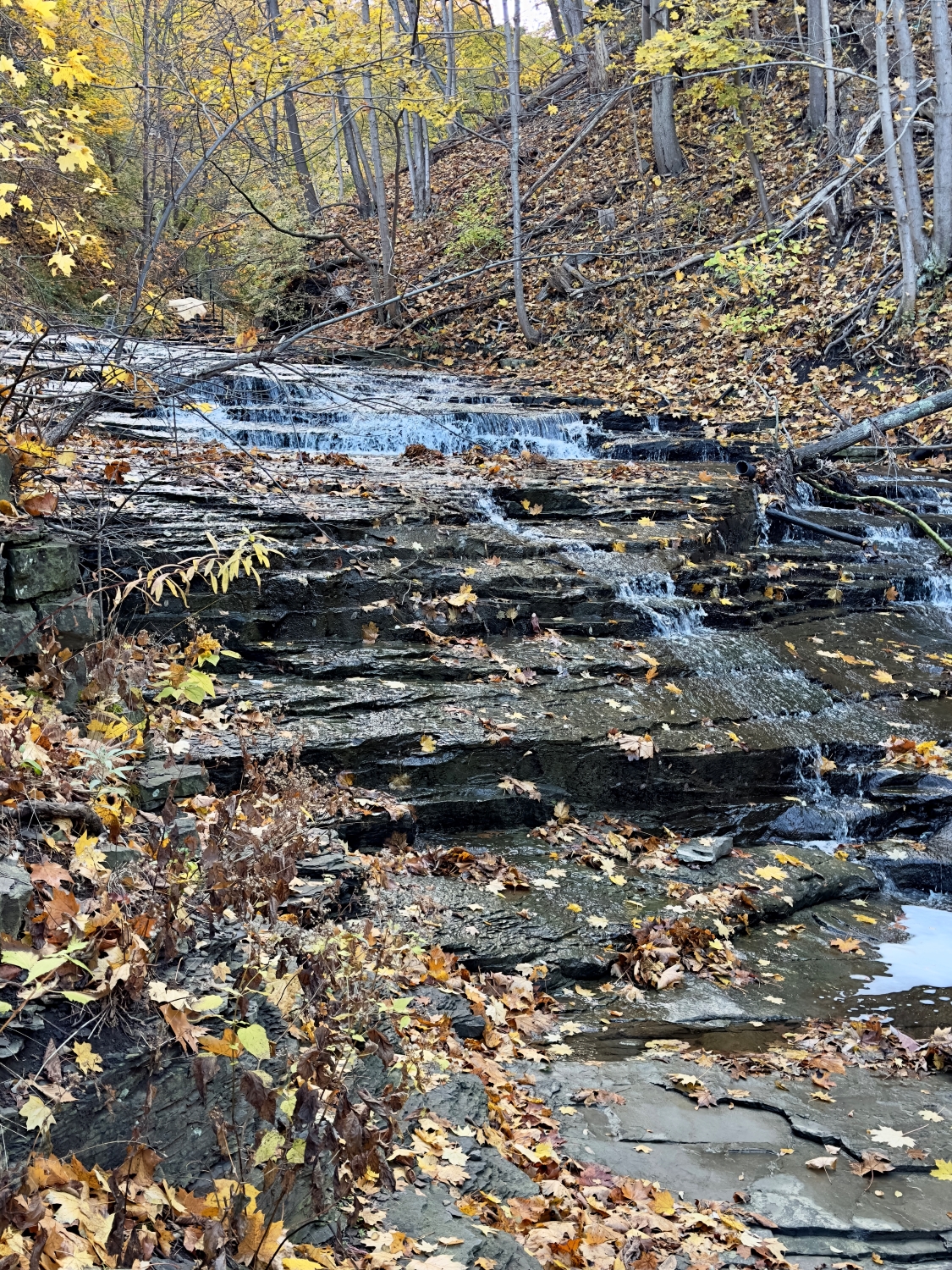
As I continue, the sound of rushing water grows louder, drawing me towards another cascade that tumbles in steps down the gorge. The rocks are layered in angular formations, giving the water a zigzagging path to follow. Leaves are scattered across the stones, their colors—yellows, browns, and the occasional splash of red—standing out against the dark, wet rock. There’s a timelessness here, a feeling that this scene has remained unchanged for centuries, save for the shifting leaves and the ever-present flow of the creek. The thought makes me feel like a small part of something much larger, a guest in an ancient place shaped by nature’s slow, steady hand.
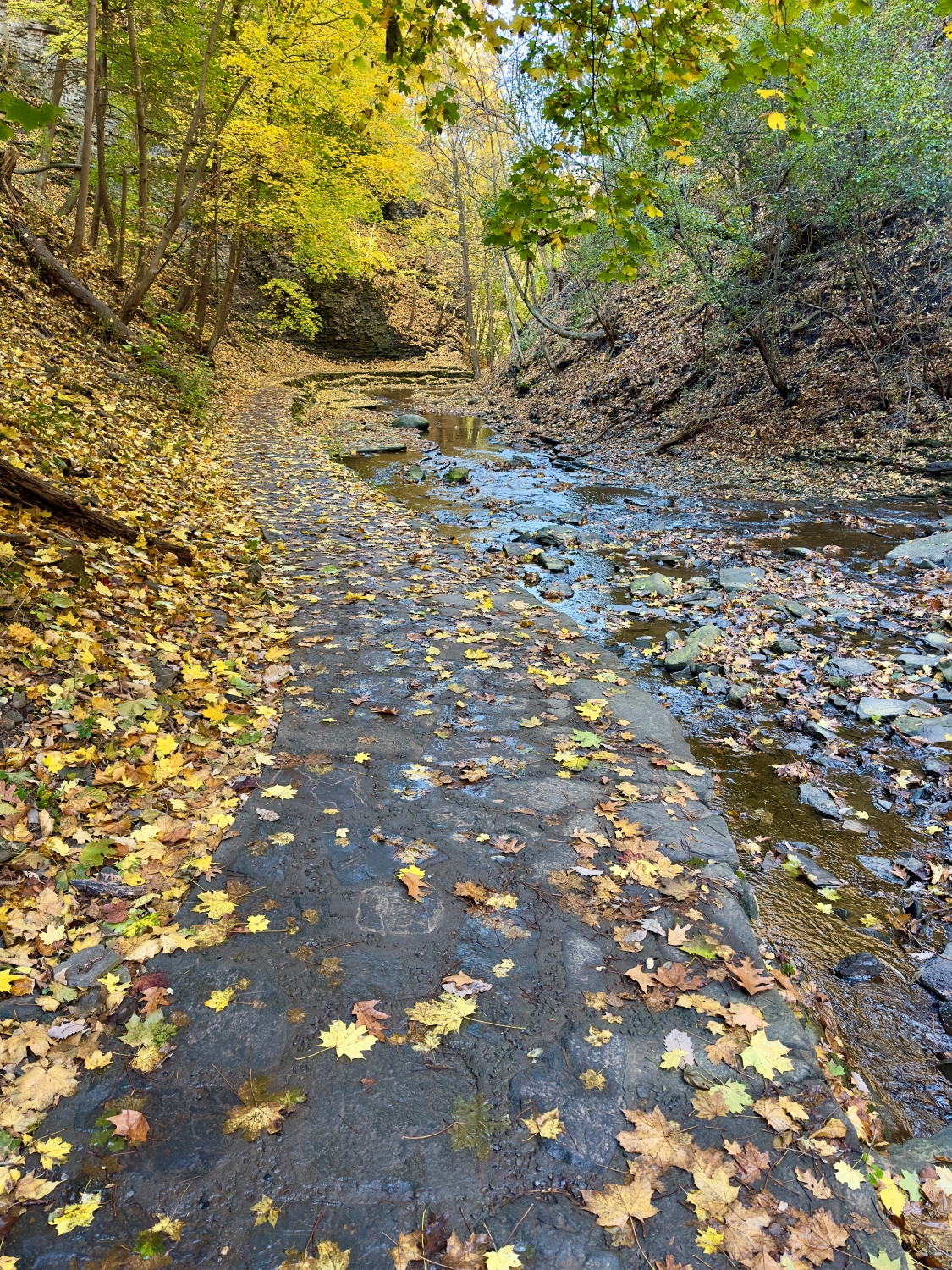
The path narrows again, following the edge of the creek where the water has worn smooth channels into the stone.
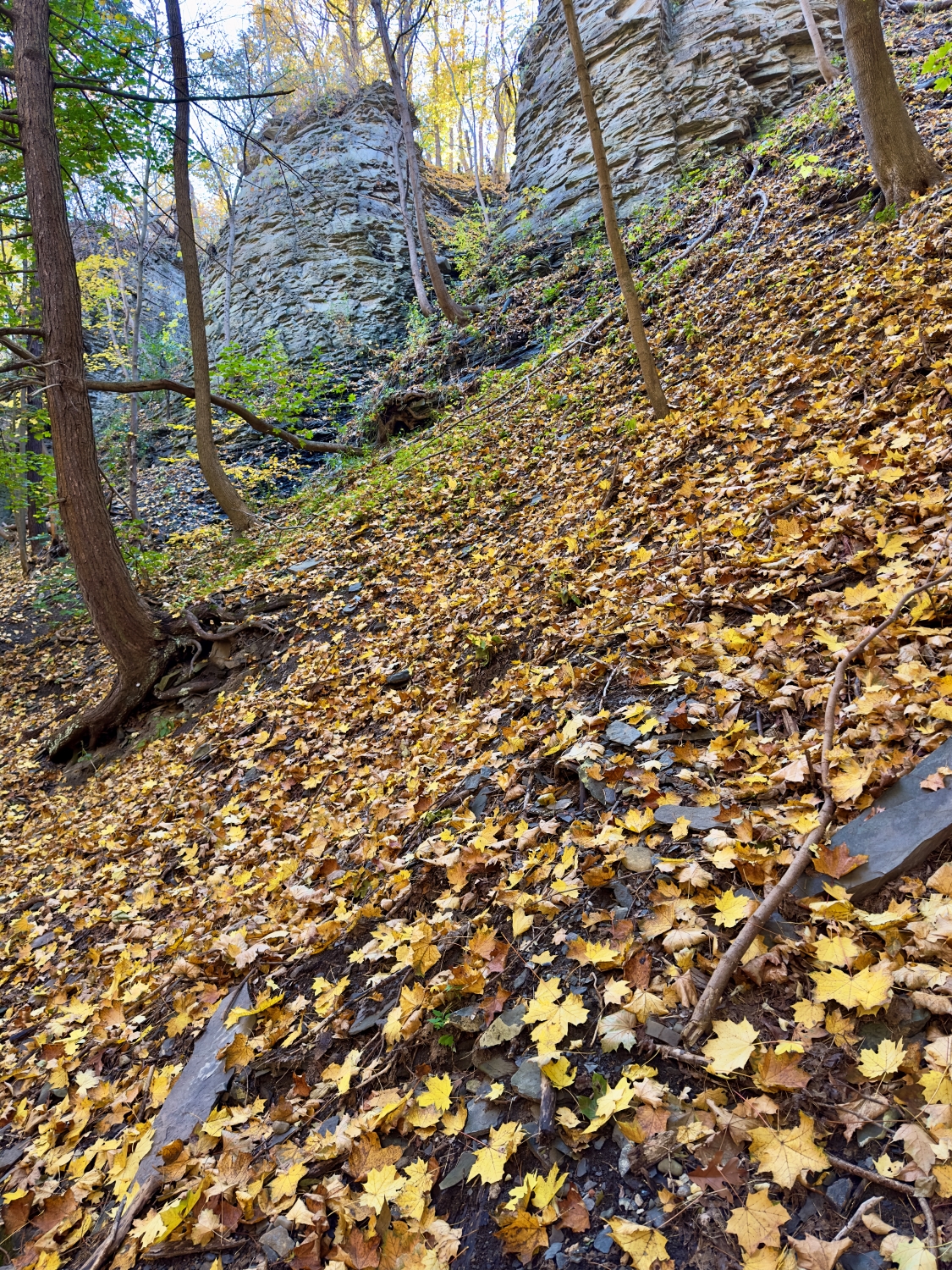
Moving forward, the trail climbs steeply, and I find myself surrounded by tall rock faces on either side. The walls are layered and weathered, a geological history book open to the forces that shaped this land. It’s humbling to see how this place puts everything into perspective, how it reminds us of our place in the natural world.
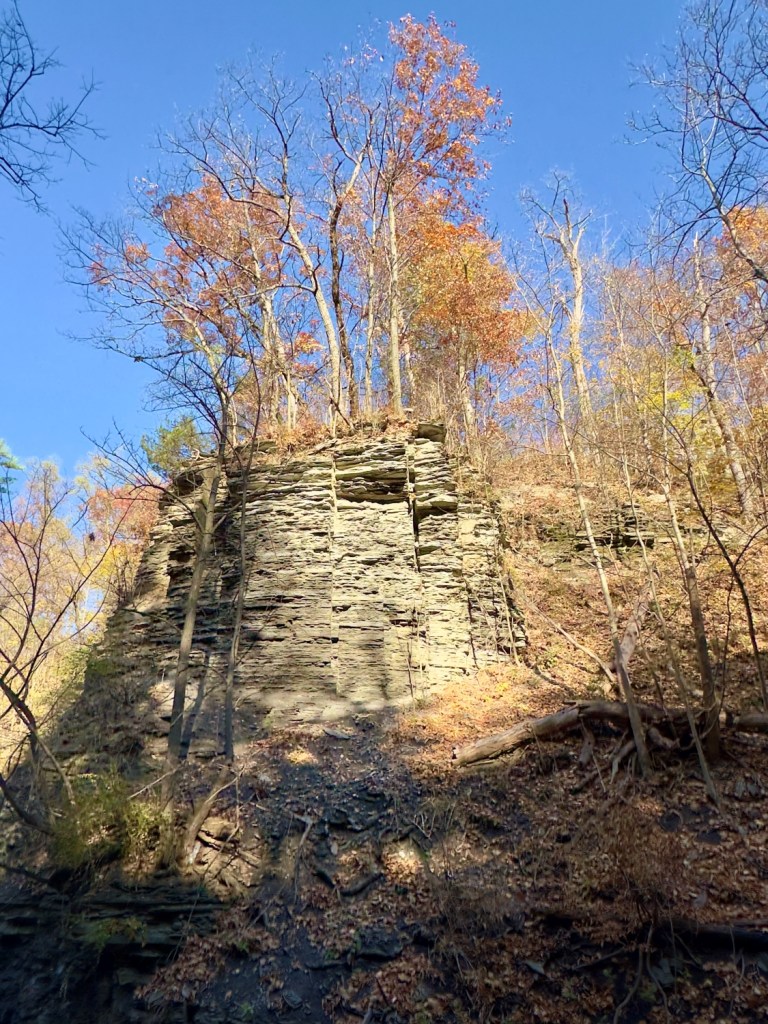
Columns of sedimentary rock
Ahead, the path becomes more rugged, the air feels cooler here, shaded by the gorge’s high walls, and the sounds of the city are long gone, replaced by the steady rhythm of water and the drift of leaves. The layers of ancient limestone that form these towering walls give shape to our landscape and ecosystem. As rainwater falls and seeps through the porous rock, the limestone raises the pH of the water, neutralizing its natural acidity. This subtle alchemy nurtures the flora and fauna, fostering a unique biome that thrives in the gorge. The artists fade from view as I move further into the solitude of the trail, but their presence lingers in my mind. Each turn of the path reveals another scene worthy of capturing, another moment that seems to call out for remembrance.
Looking back toward the way I came
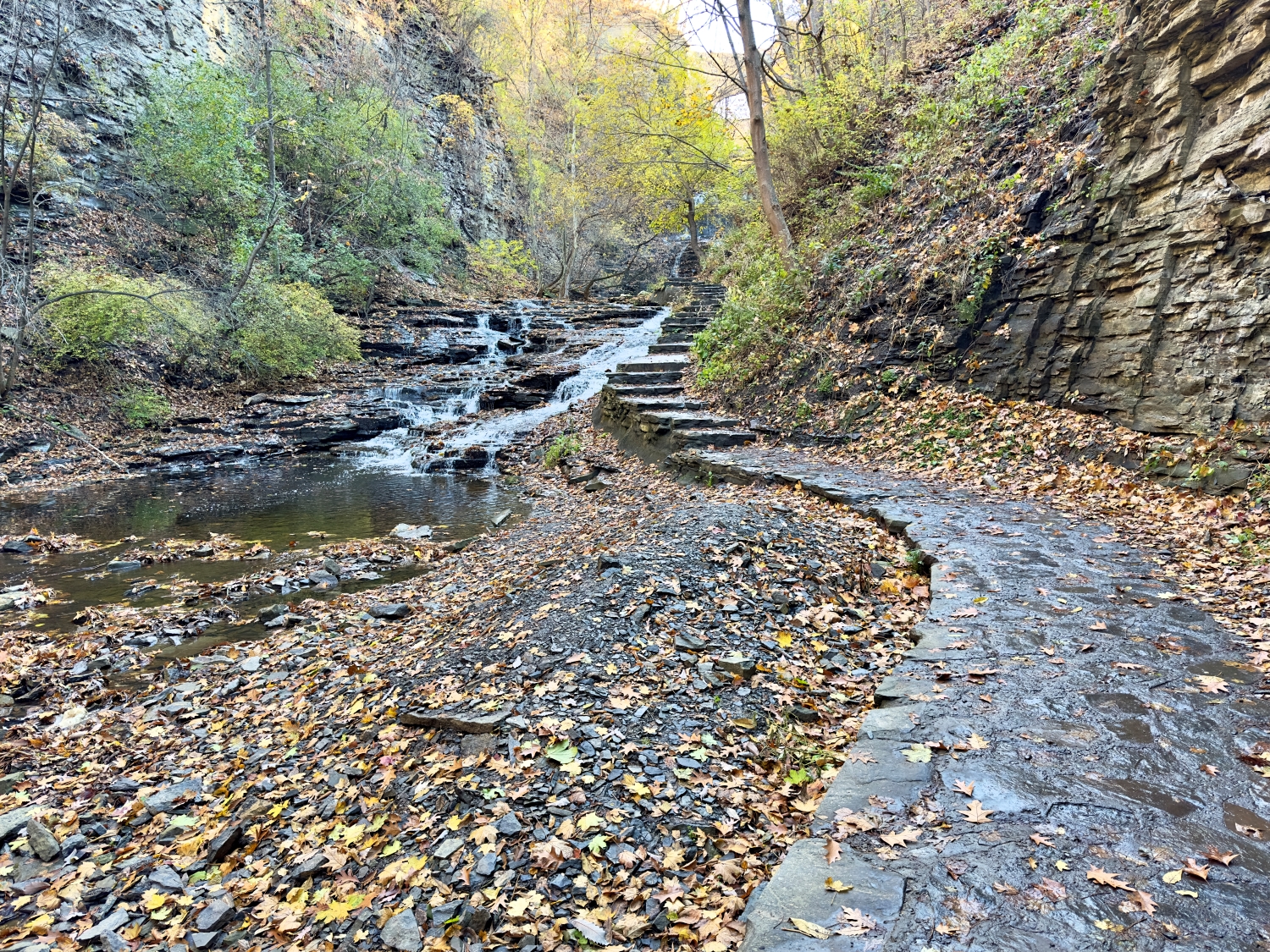
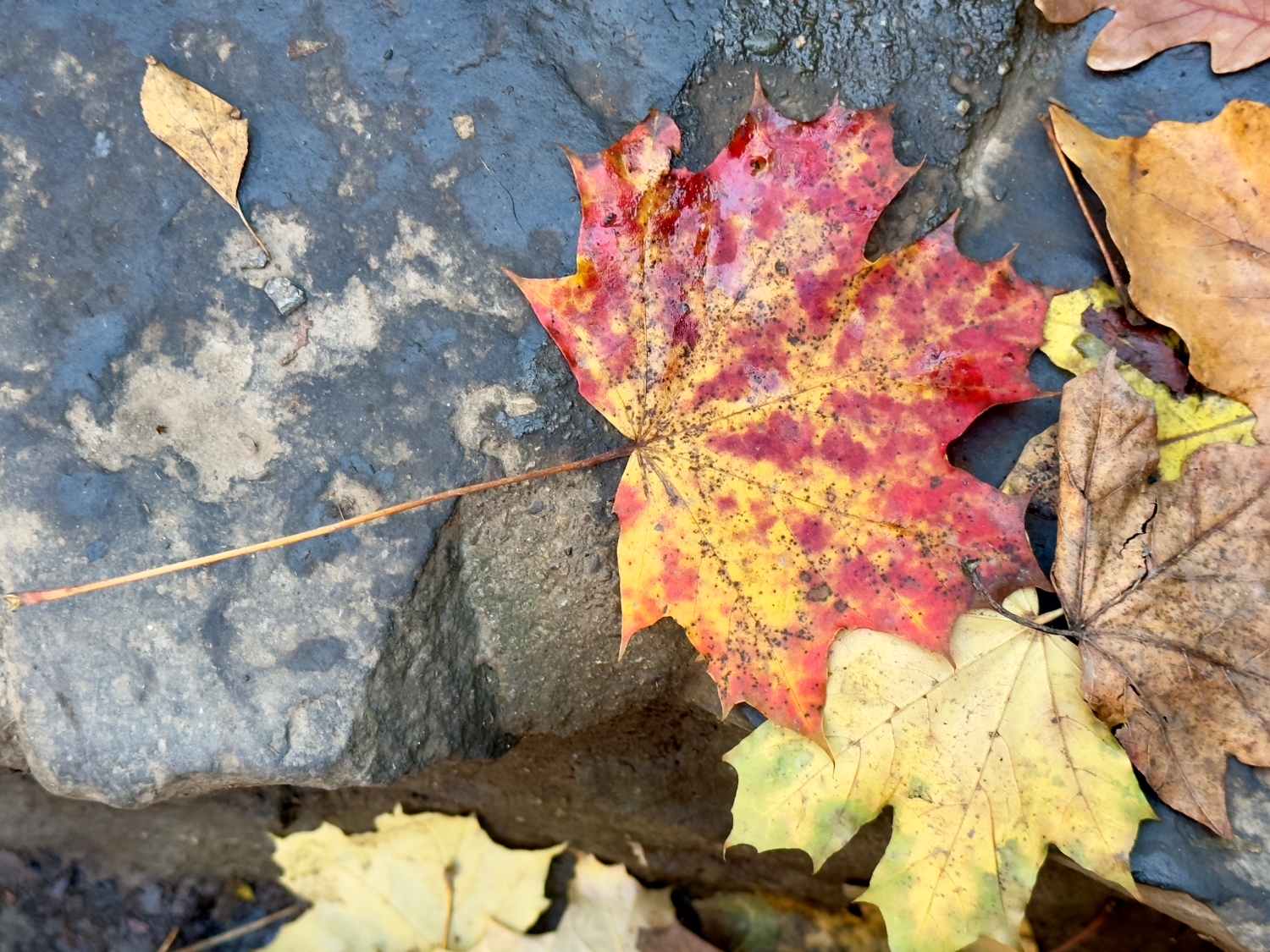
The trail steepens, and I press onward, the sound of the water intensifying as I near a grand waterfall framed by the impressive stone steps leading up to the College Avenue Stone Arch. Each step is littered with leaves, their colors vivid against the worn stone—golds, russets, and the occasional brilliant red, like embers scattered along my path. The waterfall beside me spills down in steady streams, each cascade creating rivulets that catch the light as they flow downward.
The gorge walls rise sharply on either side, embracing the path in rugged layers that tell stories of geological time. I feel as if I’m climbing a passage through history itself. These rocks, these trees, the very water carving its way through the stone—all have been here far longer than I can fathom, shaped by forces beyond my understanding. There’s a certain thrill in being among such enduring elements, a reminder of how small and fleeting we are in the face of nature’s grandeur.
Reaching the next tier of the trail, I pause to take in the sight of the massive stone arch spanning the gorge above. The bridge is a striking feature, its wide arch perfectly framing the sky and the last vibrant colors of autumn. It feels like a gateway, a fitting culmination to the journey. Standing beneath it, I’m struck by how well it harmonizes with the gorge, the careful craftsmanship of its stonework complementing the rough beauty of the surrounding cliffs.
The sunlight flows around the arch, illuminating the leaves that cling to the branches above, casting a warm glow over the scene. I feel a sense of reverence here, a quiet acknowledgment of both human artistry and the relentless beauty of nature.
I paused to capture this video of the moment.
Sights and Sounds of Autumn
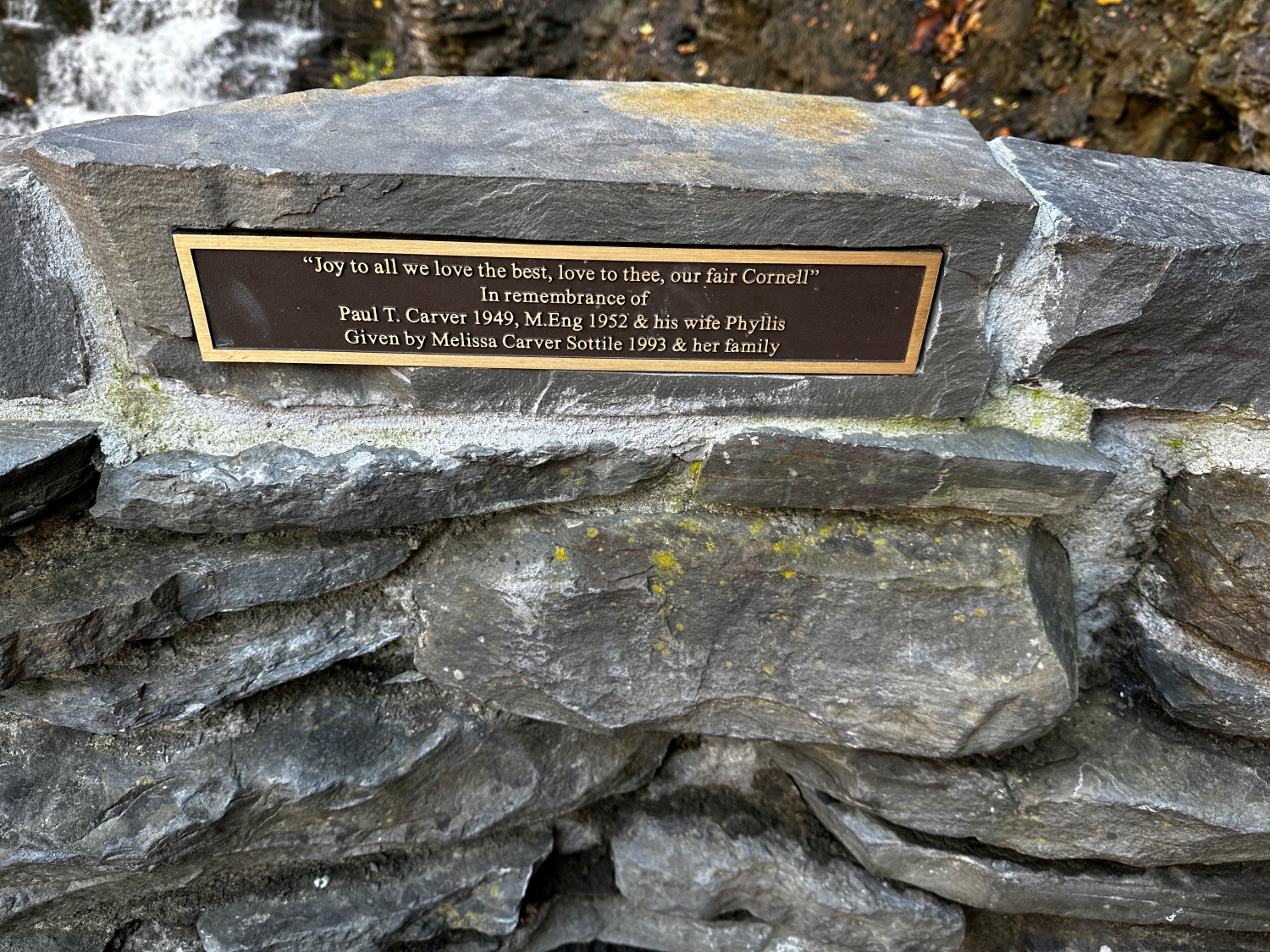
The final ascent is graced by a bench where a stone plaque catches my eye. It’s a tribute, etched with words that resonate in this place: “Joy to all we love the best, love to thee, our fair Cornell.” A gift from a family whose lives intertwined with Cornell, it serves as a reminder of the deep connections people have to this landscape, to the university, and to the memories rooted in these trails and gorges. I pause, reflecting on my own connection to this path, which has taken me through an ever-unfolding tapestry of nature and history.
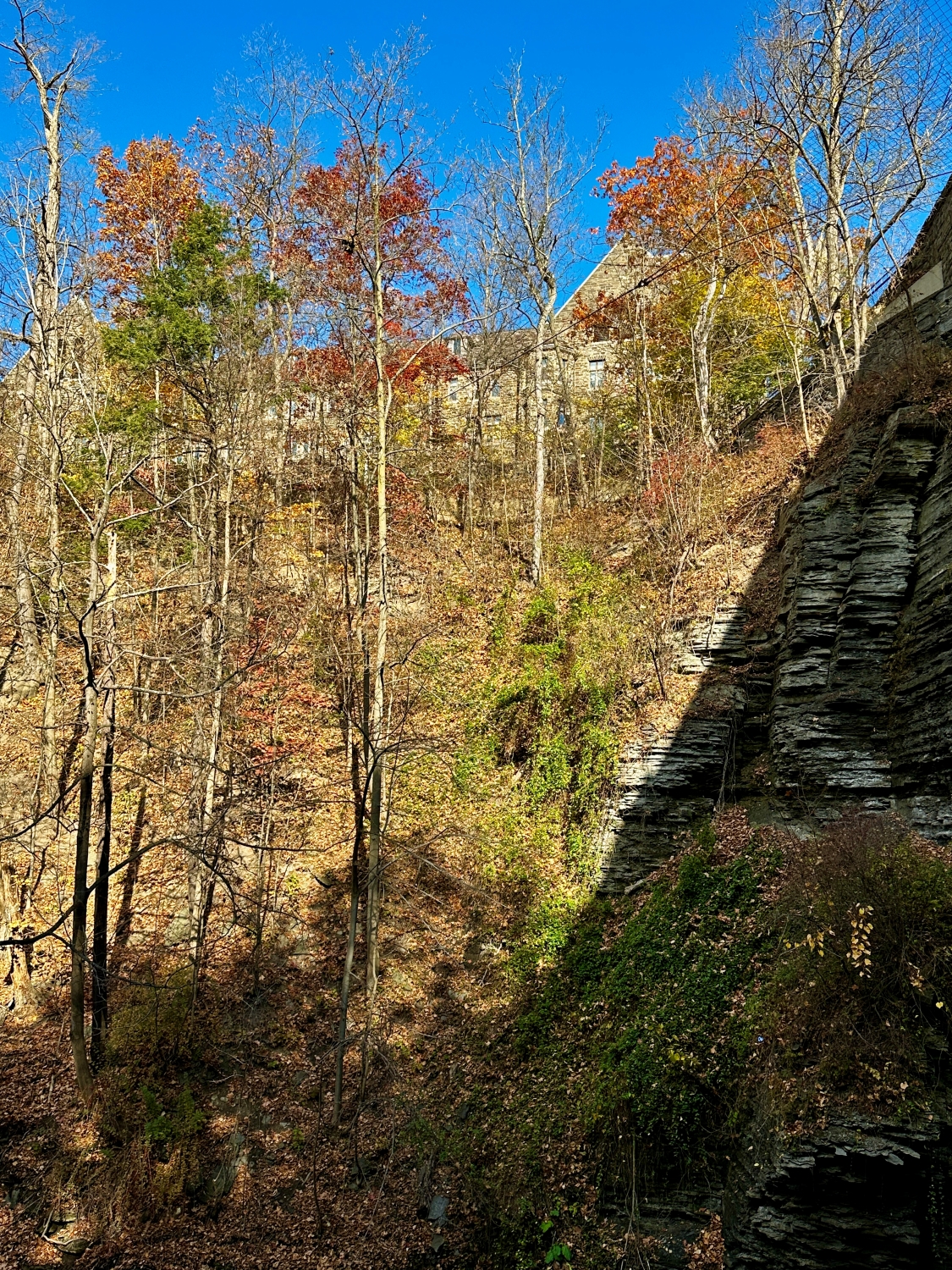
The last stretch of steps is leaf blanketed, their shapes and colors a beautiful final mosaic before I emerge from the shaded coolness of the gorge. The sun filters down through the thinning trees, illuminating the stone buildings of the Cornell campus that peek through the branches ahead. With each step, I feel the transition, moving from the curated wildness of Cascadilla Gorge and its trail to the structured beauty of the university grounds.
Myron Taylor Hall, Cornell Law School from the gorge.
As I reach the top, the Schwartz Center for the Performing Arts comes into view, its modern architecture a contrast to the ancient rocks I’ve left behind. Here, in this space where art, education, and nature converge, I take a last look back into the gorge and a journey, a gem in the heart of the Finger Lakes, a place that holds stories, both old and new, and invites every visitor to become a part of them.
Enter your email to receive notification of future postings. I will not sell or share your email address.
Copyright 2024 All Rights Reserved Michael Stephen Wills
A few days before Halloween, I found myself on the rim of Cascadilla Gorge, Ithaca’s autumnal crown jewel. The air had that crisp October quality, each breath carrying a hint of the colder days to come yet still tempered by the lingering warmth of early fall. A breeze carried a scent of damp earth and decaying leaves, a rich, organic aroma that signaled the turning of the seasons. The path beneath my feet was a tapestry of fallen leaves—russet, gold, and burnt orange—a natural carpet leading me through a world suspended between vibrancy and rest.
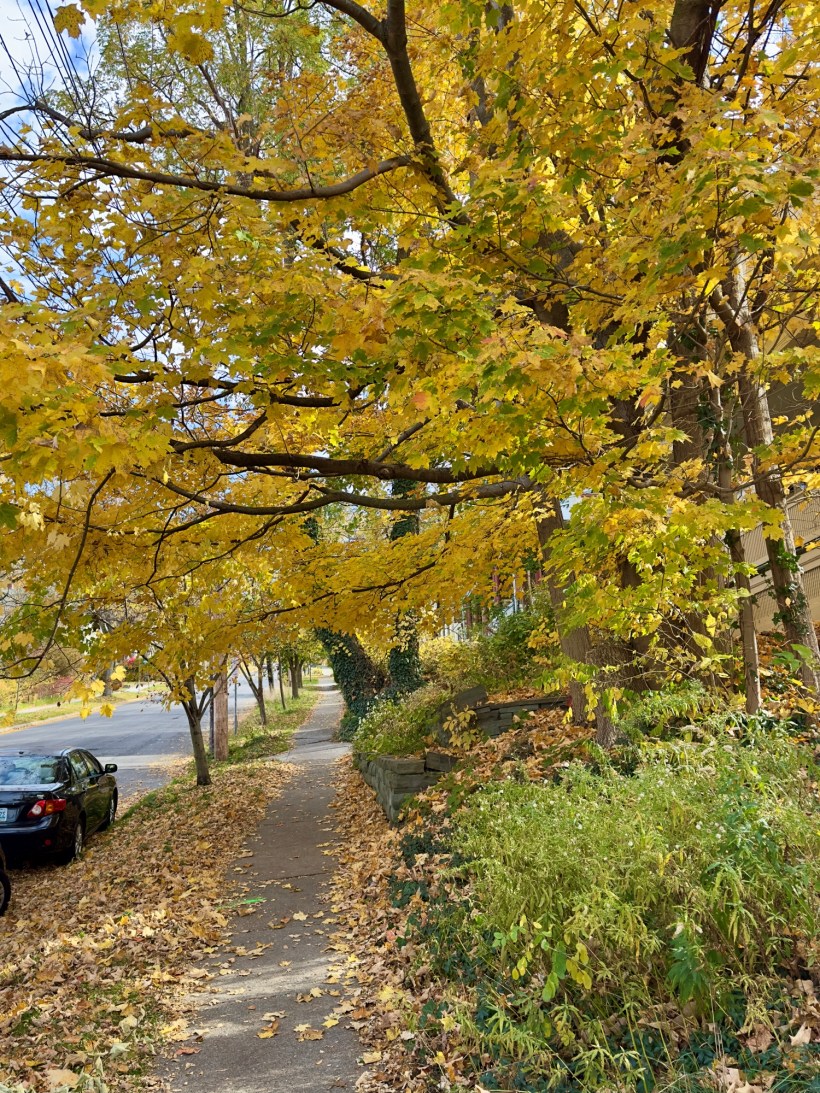
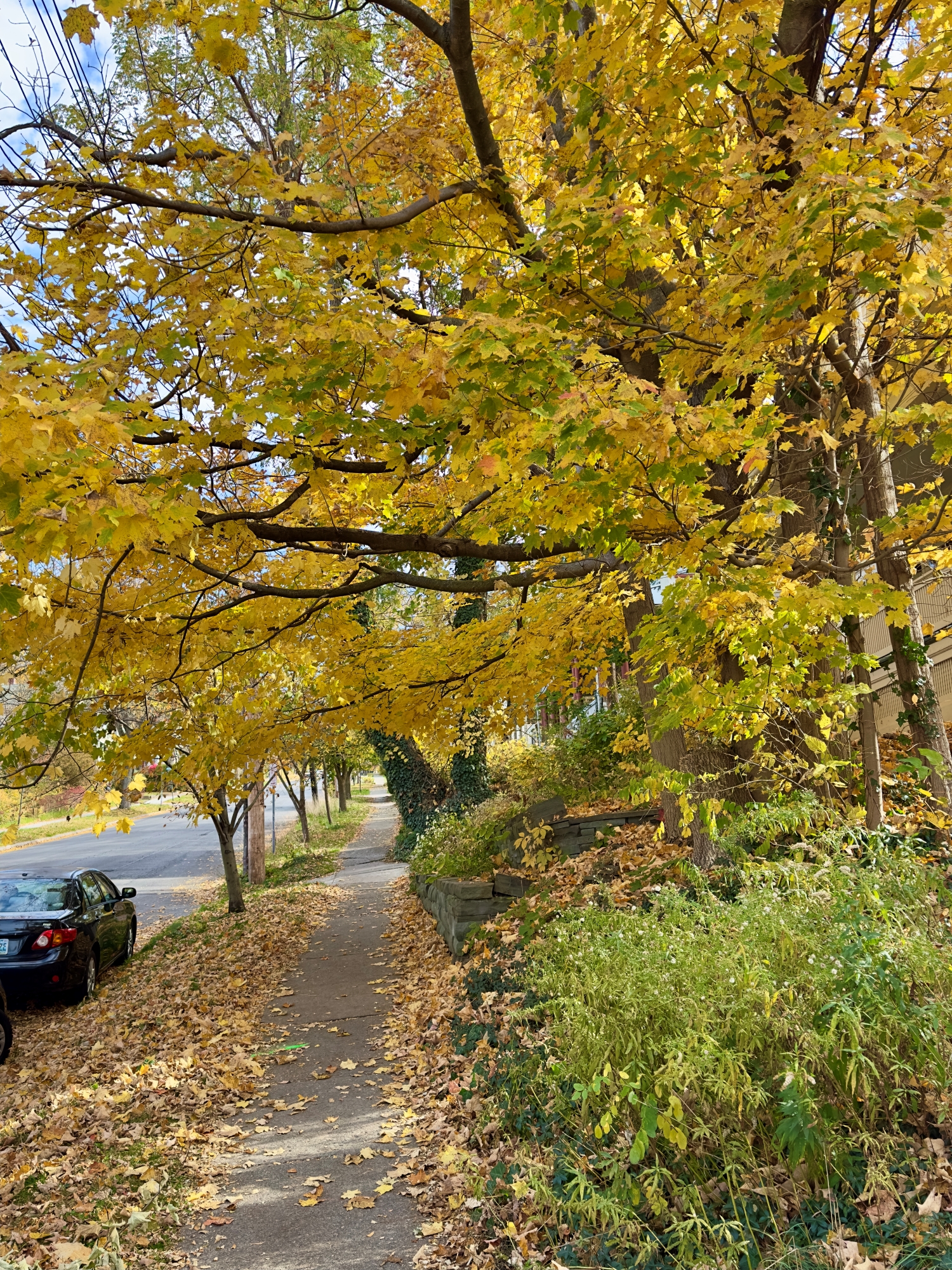
Golden Canopy over Buffalo Street Sidewalk
Continuing up Buffalo Street, I marveled at the trees, their branches thick with yellow and gold leaves, creating a canopy above. The leaves shivered with every gust, whispering the ancient secrets of the forest. The air was infused with the sweet, woody fragrance of maple and oak, mingling with the faint scent of chimney smoke from nearby houses. The sunlight filtered through, casting a dappled pattern on the sidewalk, a fleeting mosaic as the leaves danced in the wind. A sense of impermanence struck me; soon, these leaves would be gone, leaving bare branches silhouetted against a winter sky.
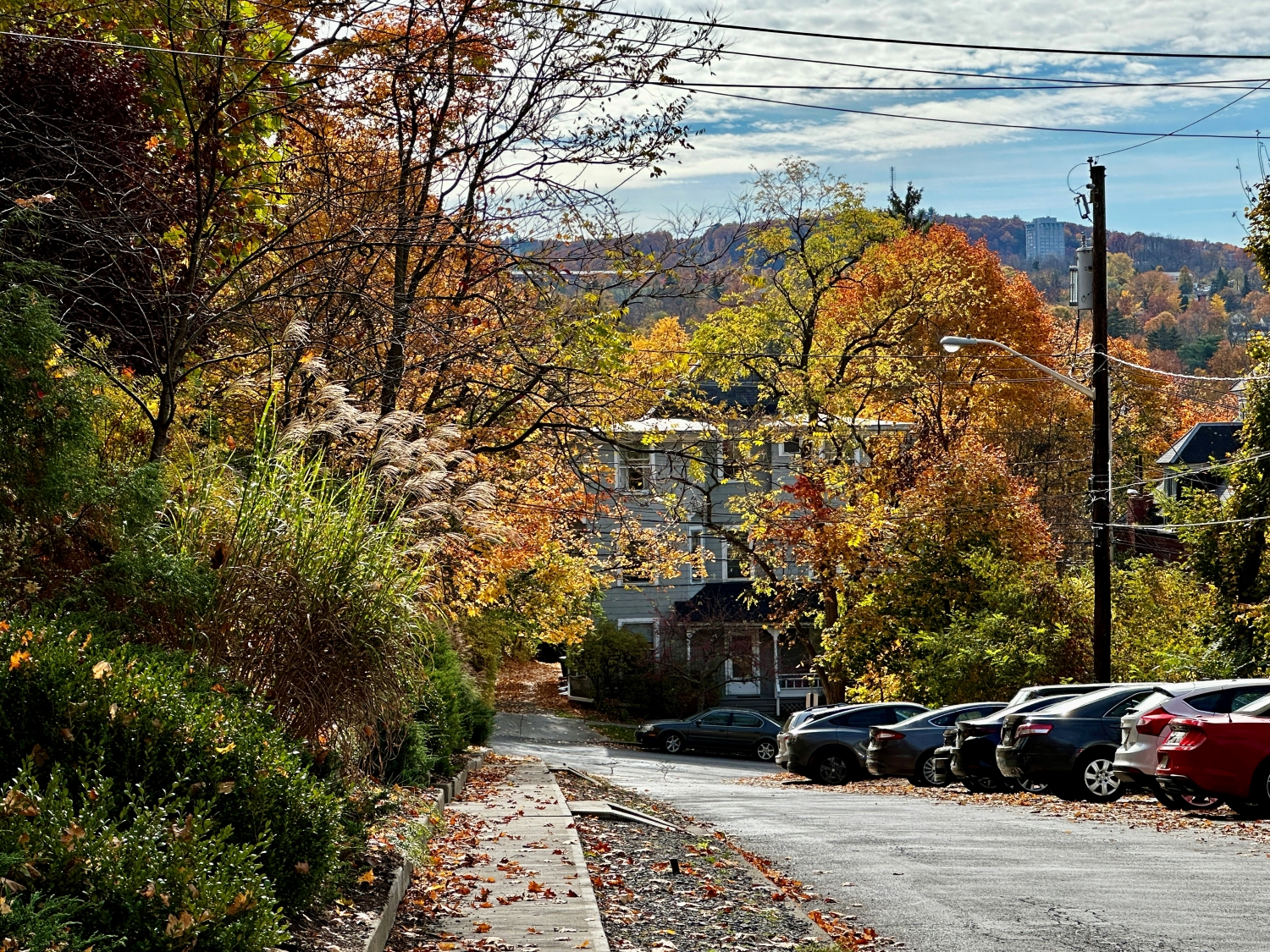
Scene from Dewitt Place toward South Hill and Ithaca College
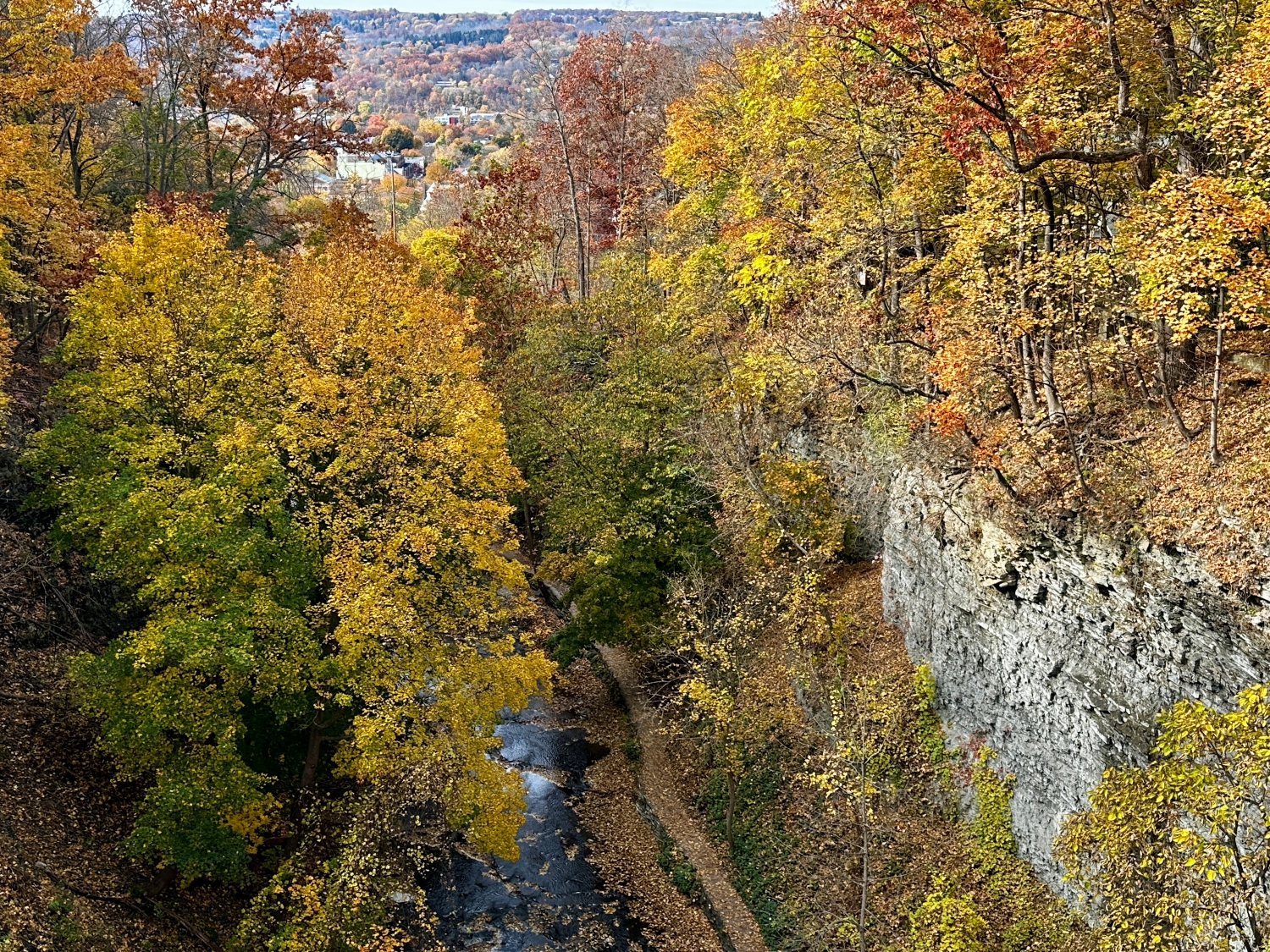
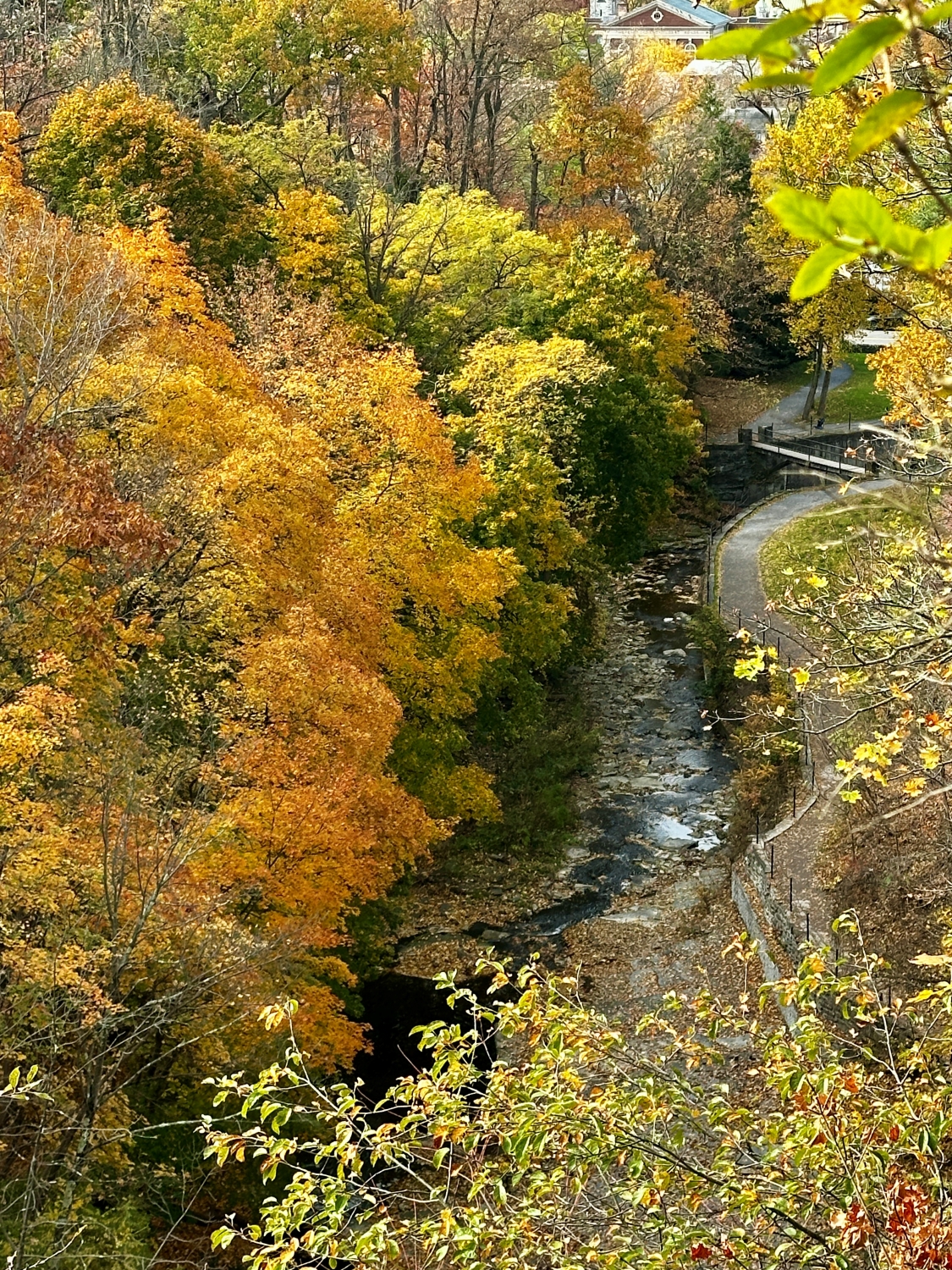
Crossing the Stewart Avenue bridge, the Cascadilla Gorge came into view, a steep wall of stratified rock layers standing guard over the gently flowing stream below. The contrast between stone and foliage was breathtaking—the hard, unyielding rock juxtaposed with the softness of leaves in full autumnal bloom. The earthy scent of wet stone mixed with the crisp aroma of the flowing water, creating a sensory tapestry unique to the gorge. The colors seemed to intensify against the gray and brown of the cliff, each leaf like a brushstroke on nature’s canvas, celebrating the season’s final flourish before surrendering to winter.
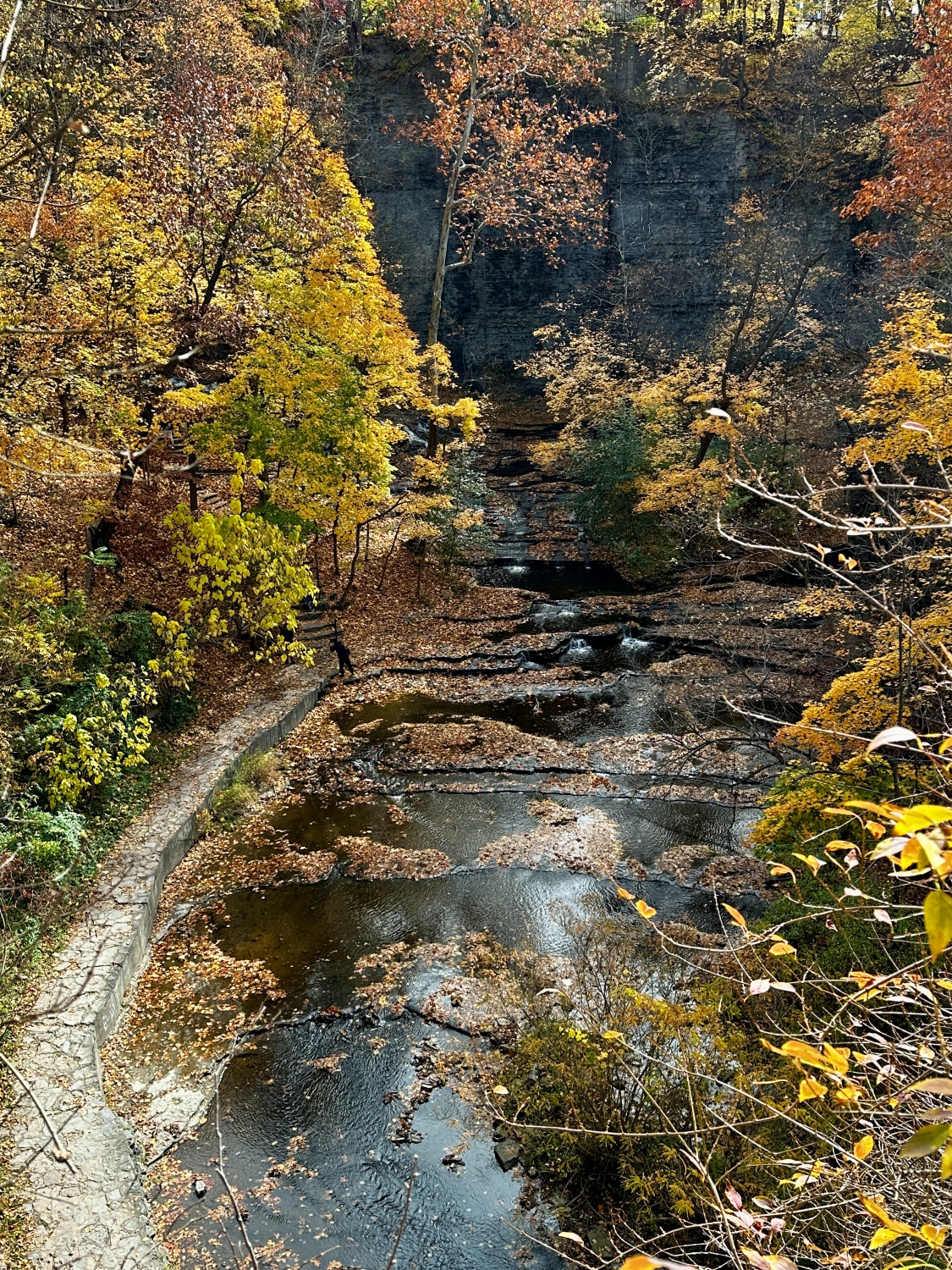
Below footpath along the gorge rim, the creek wound through, its banks littered with leaves that had completed their journey from branch to earth. They floated on the water’s surface, spinning gently in the current as though reluctant to leave this last dance. The sound of the water was a steady undercurrent, soothing and rhythmic, as it tumbled over stones and carved its way through the gorge. I paused to watch, entranced by the way water and rock, ephemeral and eternal, seemed to coexist in a kind of harmony.
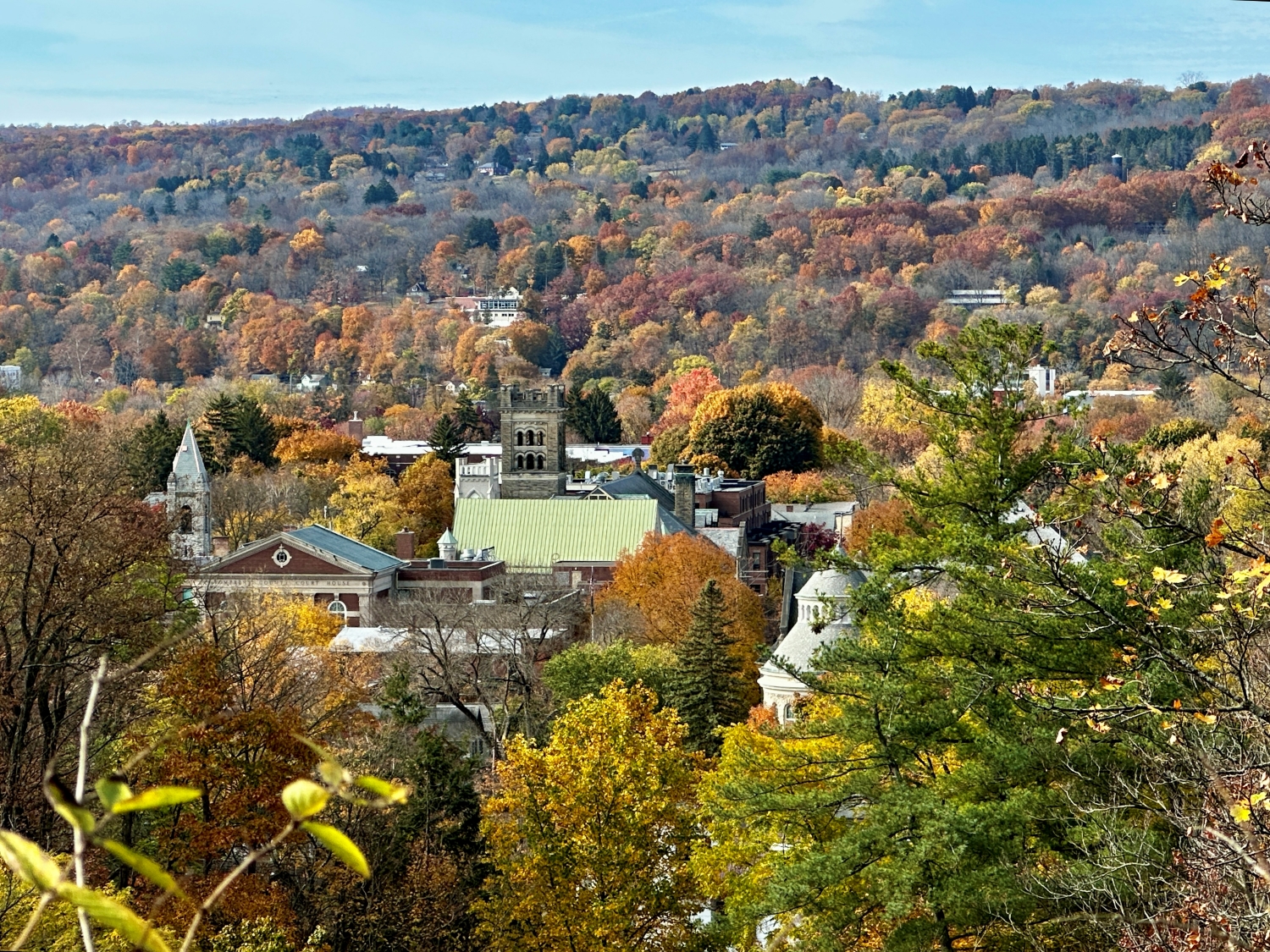
I stopped at a lookout point and surveyed the town sprawled out below, nestled amidst the fiery colors of the surrounding hills. The architecture of Ithaca’s buildings peeked through the trees, each roof and spire framed by the season’s palette. This was a town embraced by nature; its rhythm dictated as much by the seasons as by human hands. The sight stirred a sense of gratitude within me; here was a place that reminded you to slow down and observe, to notice the subtle shifts in light, in color, in the way a single gust of wind could change a landscape.
I continued along the rim, passing a small waterfall that spilled over the rocks with a quiet insistence. The water had carved smooth pathways in the stone, evidence of its long journey and persistent power. The sunlight hit the spray just right, casting a fleeting rainbow that shimmered and then disappeared as I moved. I felt a sense of companionship with the water—both of us moving forward, shaped by the paths we traverse, yet always adapting to whatever lay ahead.
The last part of the trail led me through a dense thicket of trees, their branches hanging low, forming a natural archway. The air was heavy with the musky scent of fallen leaves and the spicy aroma of pine needles underfoot. Here, the light was softer, muted by the thick canopy overhead. The quietness enveloped me, broken only by the occasional rustle of a squirrel in the leaves or the distant caw of a crow. It was the kind of silence that feels sacred, where each sound, no matter how small, becomes profound.
Entering Cascadilla Gorge from Linn Street
Emerging from the shaded path, I took one last look back at the gorge. The scene was both familiar and new—a blend of natural beauty and the nostalgia of seasons past. I felt a sense of peace, grounded by the cycles of the earth, by the ebb and flow of life around me. In this moment, on the brink of Halloween, the world felt both hauntingly beautiful and reassuringly steadfast, a reminder that even as the leaves fall and the days grow shorter, there is a promise of renewal in the quiet persistence of nature.
Enter your email to receive notification of future postings. I will not sell or share your email address.
Copyright 2024 All Rights Reserved Michael Stephen Wills
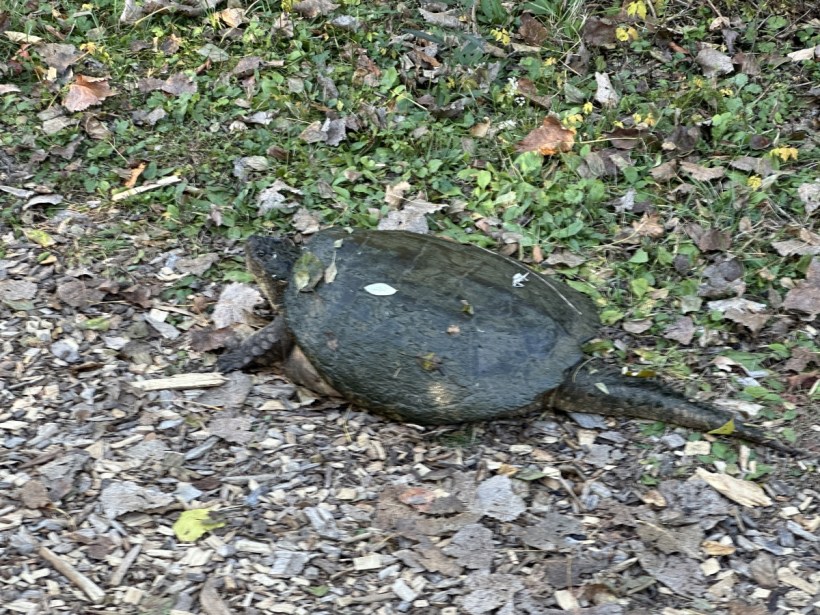
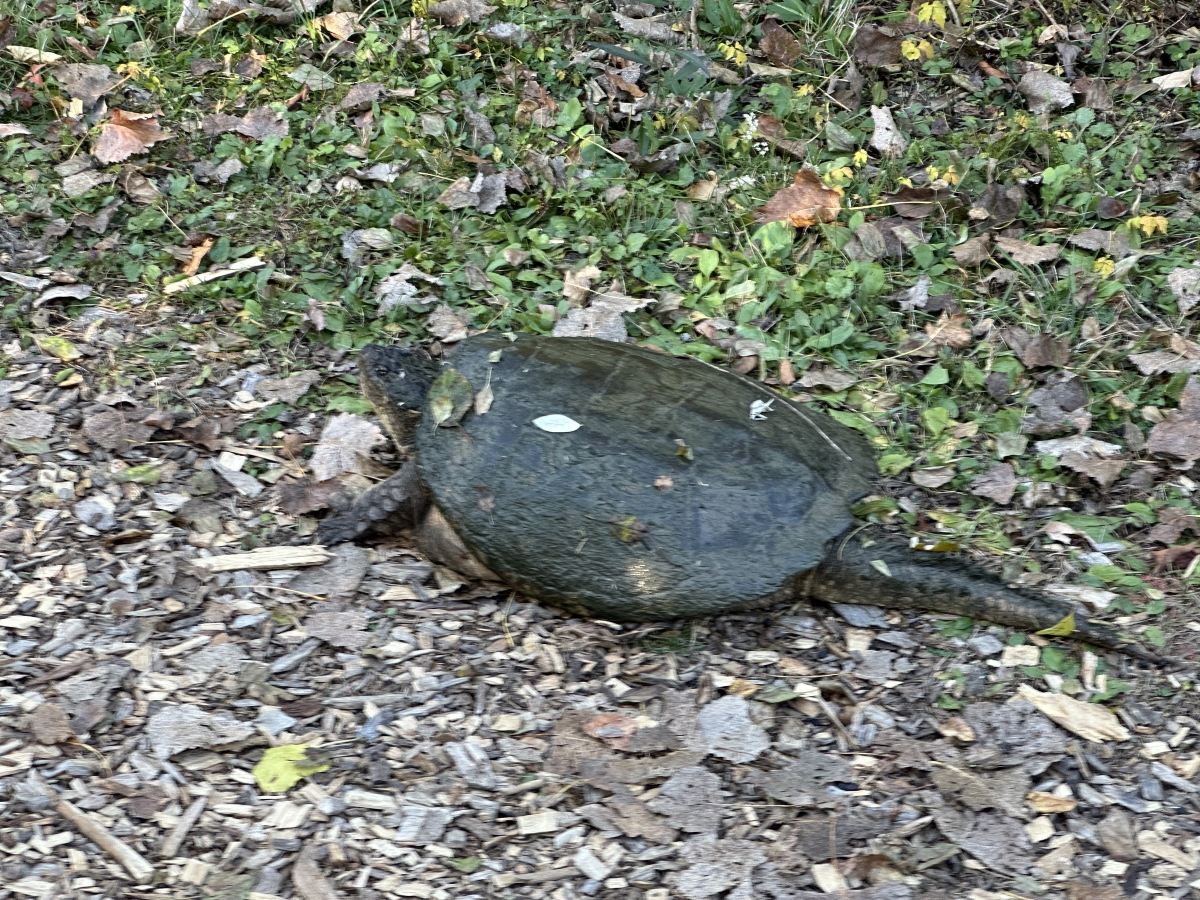
O ancient wanderer of Sapsucker Woods, armor-clad and quiet, you lumber forth, carved from the earth itself, sculpted from mud and pondweed dreams.
October’s afternoon light paints you with golden shadows, each leaf fallen, each branch broken a whispered testament to the slowness of your path, steady as a heartbeat unmoved by haste.
You bear the centuries in the lines of your shell, grooves and valleys where stories settle, tales of reeds and minnows, and the deep-rooted knowing that life is best met with patience, with pause.
O creature of edges and silence, you bridge water and wood, the line between stillness and stride. What weight you carry, not of burden, but of presence— a shell that holds the weight of stars, the bones of ancient rivers, and the soft clay of Sapsucker’s floor.
In your slow, silent passing, the trail bows to you. Leaves make way, and the earth beneath you settles a little deeper, reminded of the strength that moves without noise, the wisdom that crawls in the path of shadows.
Turtle, you who wear the world’s patience, I watch you disappear, an ambassador of ponds and pools, a silent architect of marsh and moss. May your journey be long, your pauses endless, and your shell a testament to the beauty of age, carved by time, blessed by the sun.
Enter your email to receive notification of future postings. I will not sell or share your email address.
Copyright 2025 All Rights Reserved Michael Stephen Wills
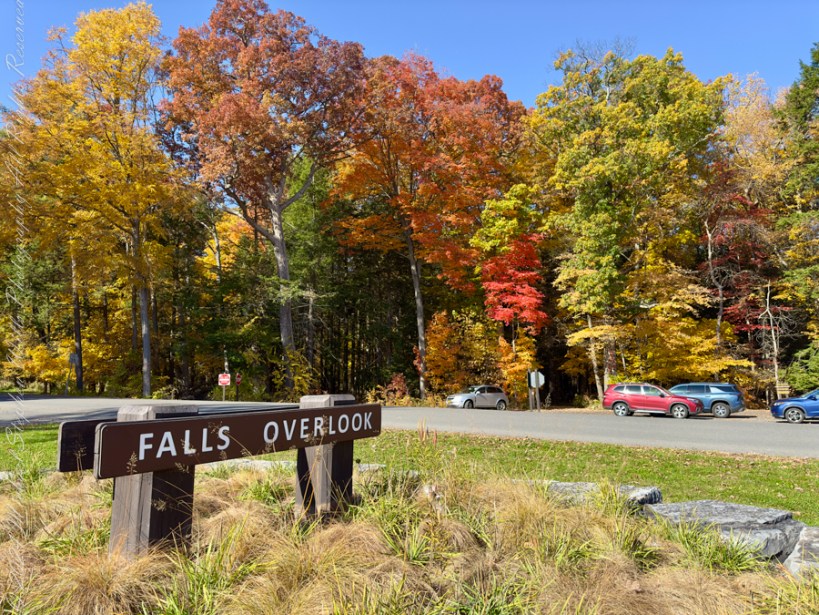
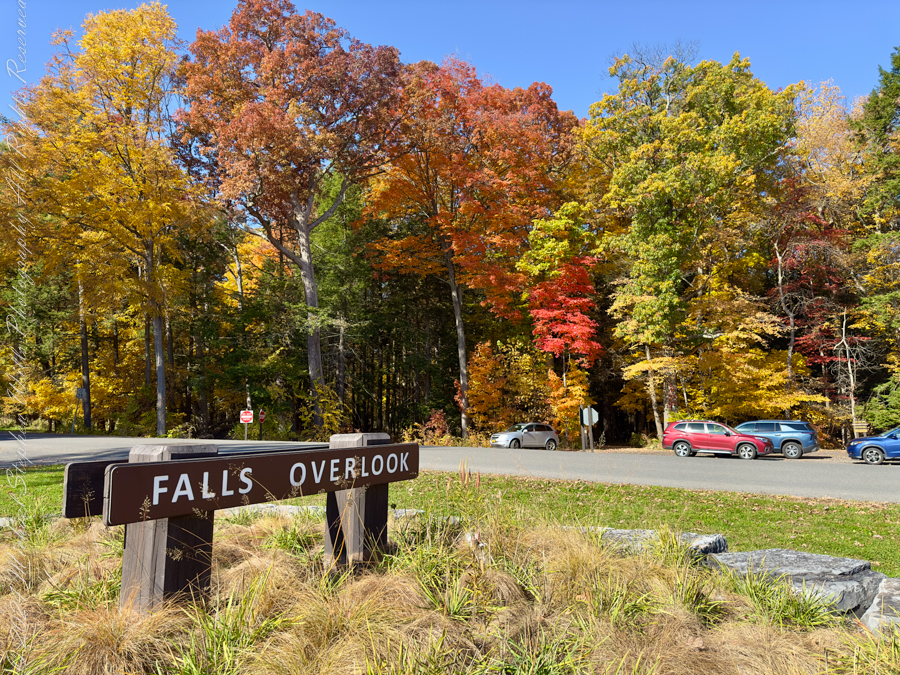
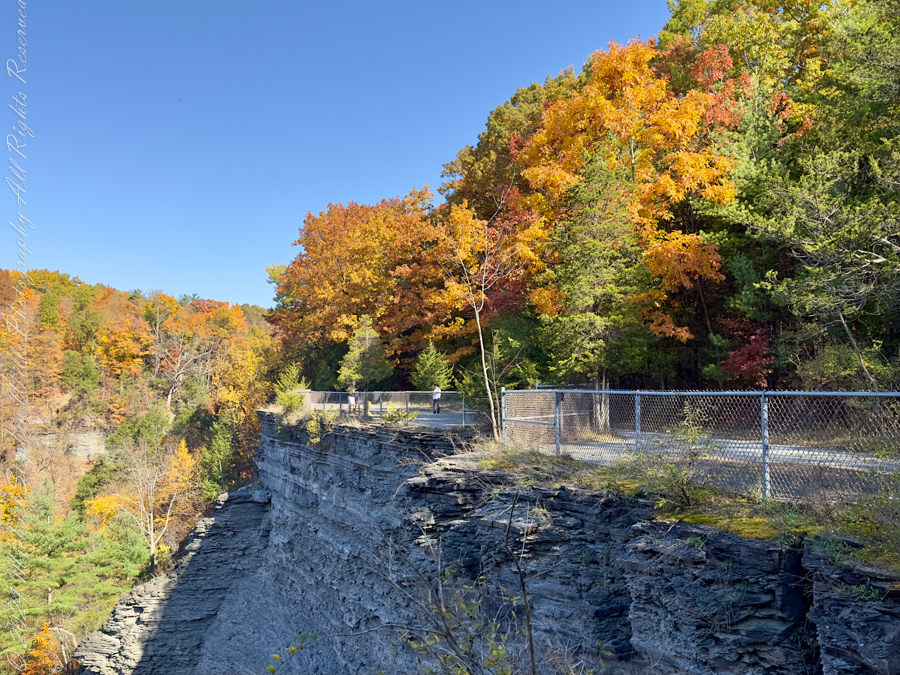
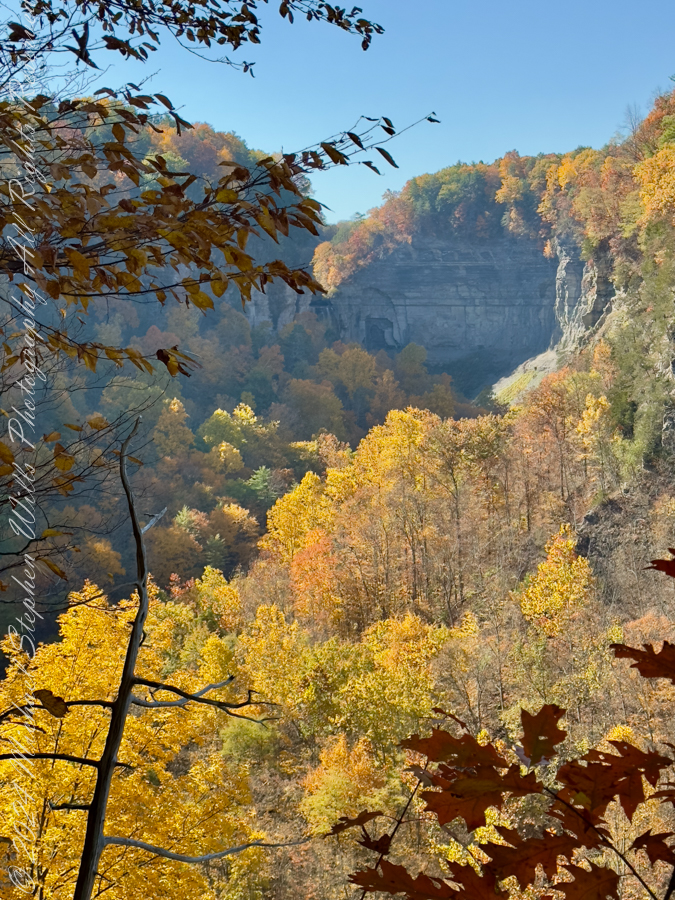
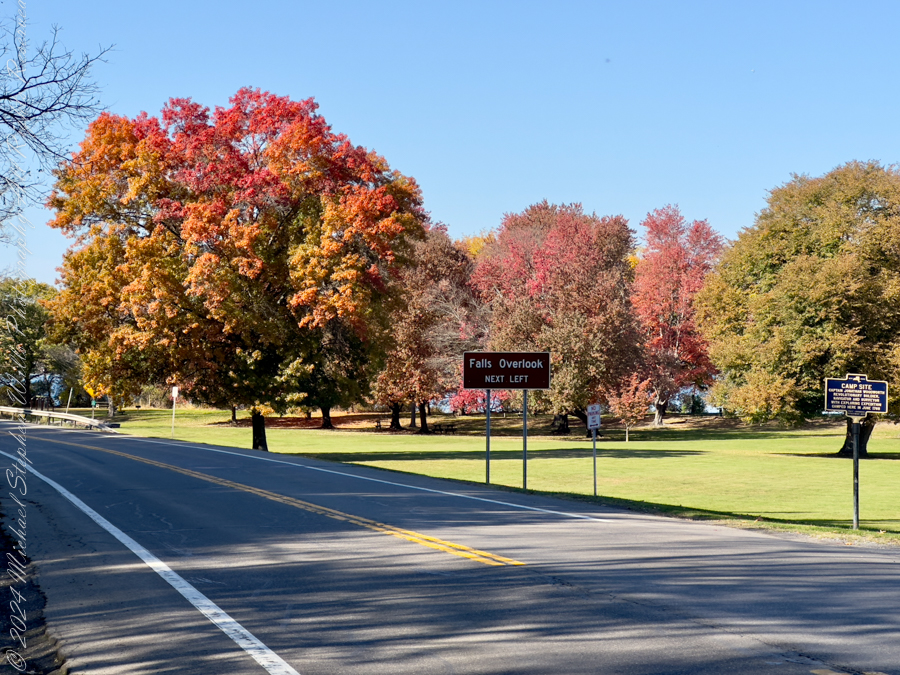
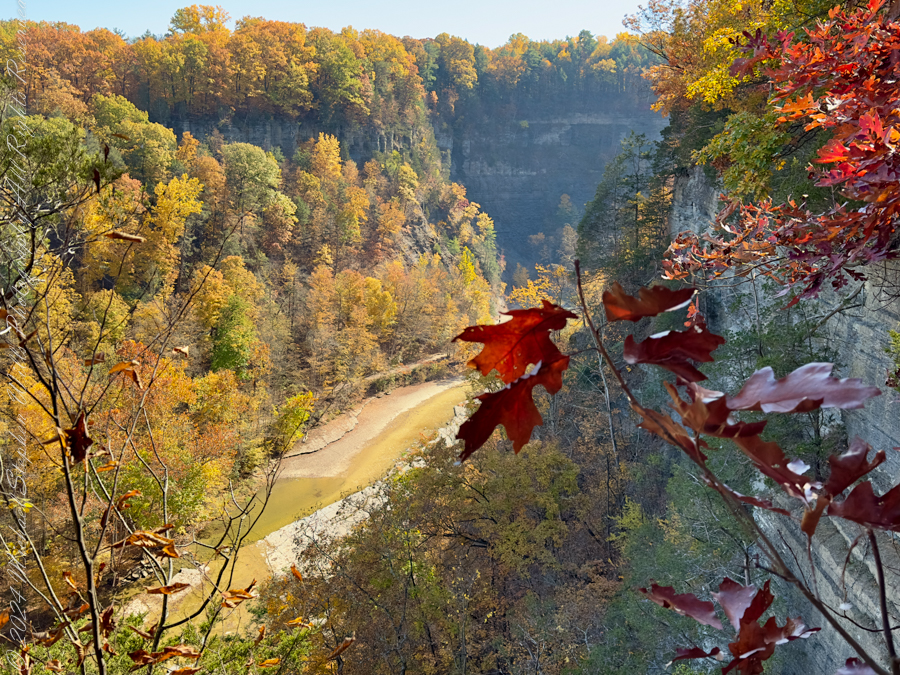
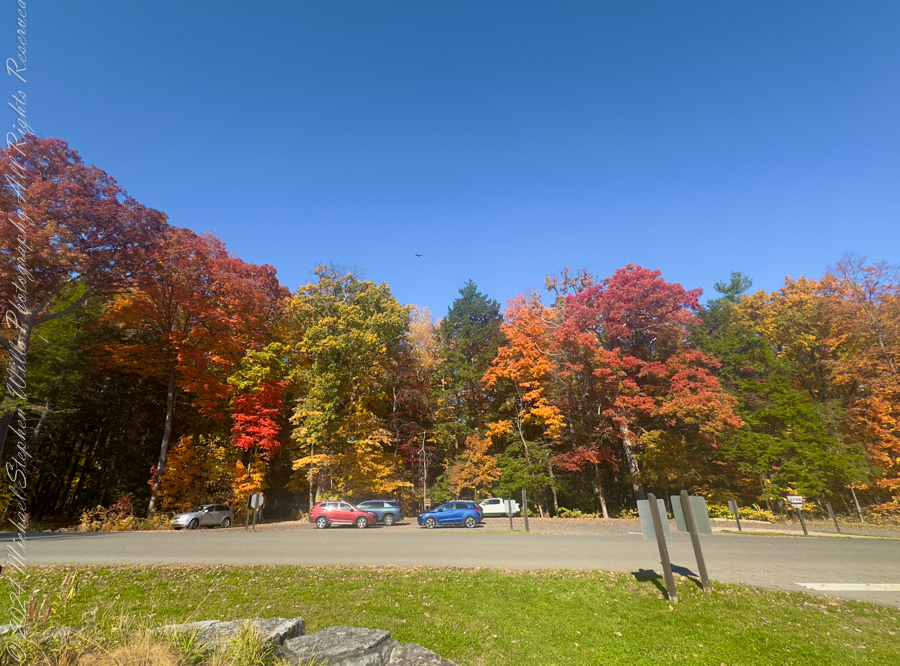
As I set foot on the Falls Overlook at Taughannock Falls State Park, I was greeted by a symphony of autumn colors in their full glory. The vibrant oranges, reds, and yellows of the trees framed the scene, setting the stage for a perfect fall day. I lingered, taking in the view of cars nestled among the foliage, their colors almost merging with the rich autumn hues surrounding them. The sign for the “Falls Overlook” hinted at the journey ahead.
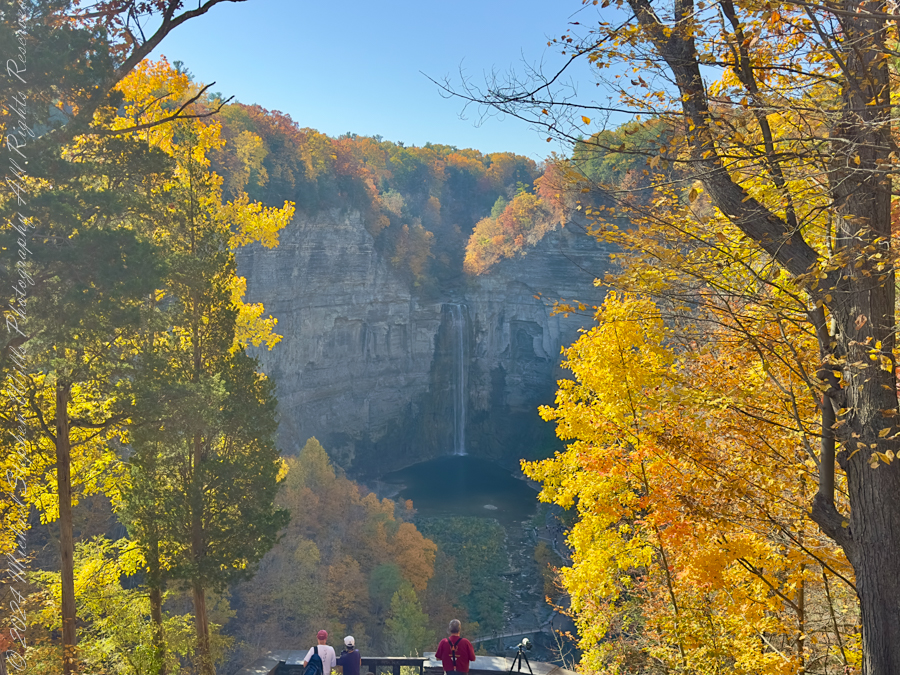
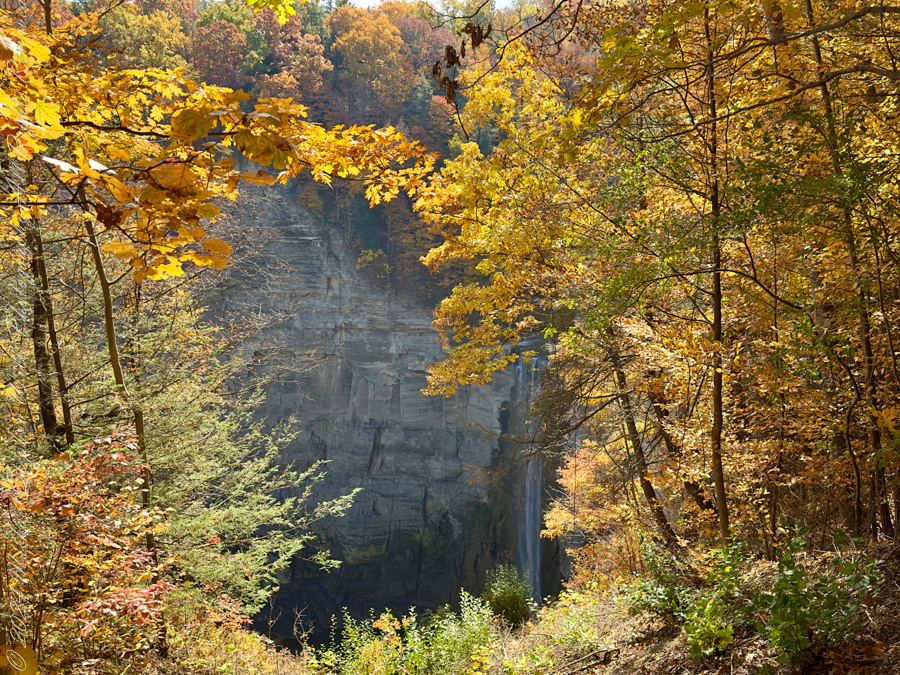
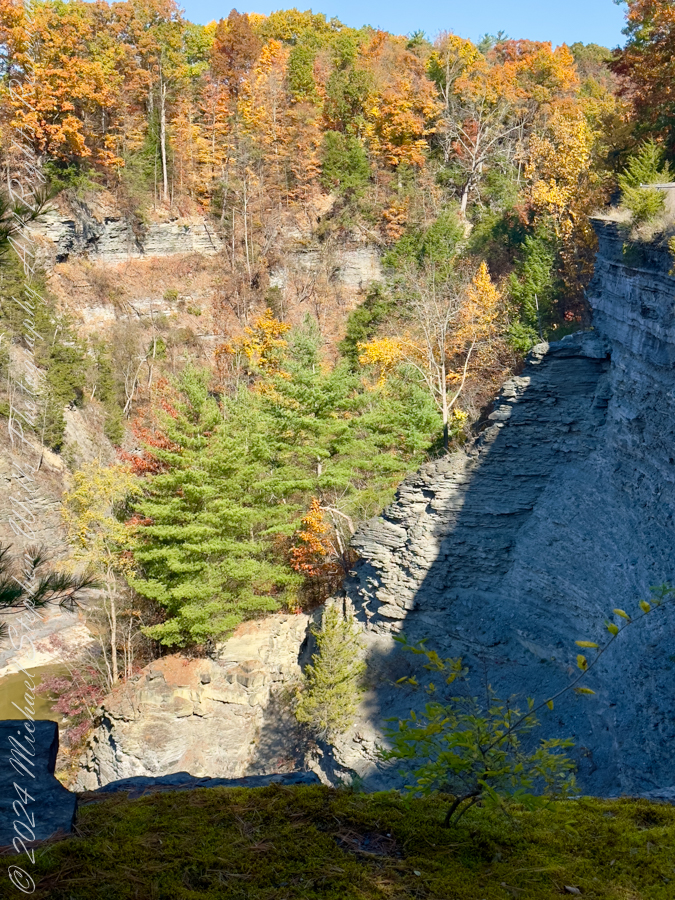
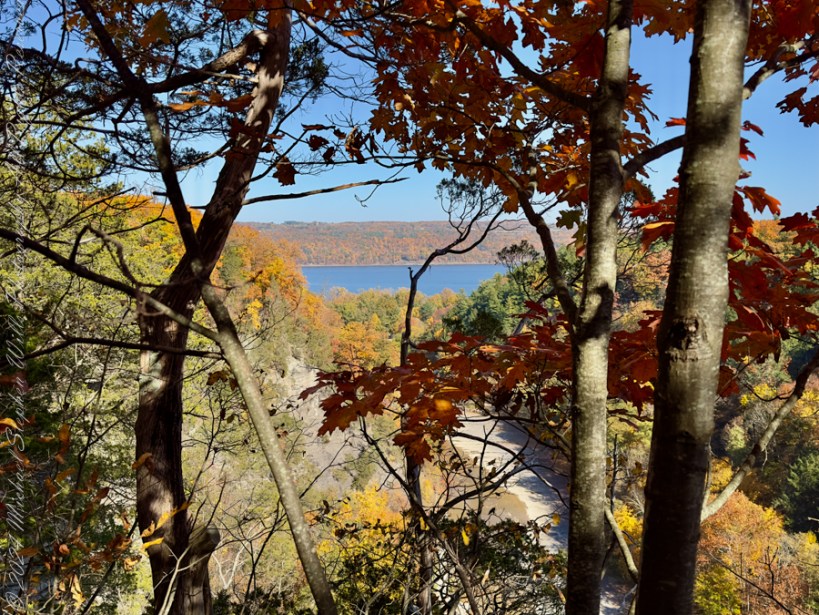
The overlook offered a breathtaking view, a gentle reminder of nature’s power as Taughannock Falls cascaded far below, framed by rugged cliffs and vibrant trees. Through gaps in the golden leaves, I could catch glimpses of the waterfall, a delicate white ribbon against the slate-gray rock. The sunlight filtered through the canopy, casting dappled shadows and illuminating leaves like stained glass, painting the landscape in a thousand shades.
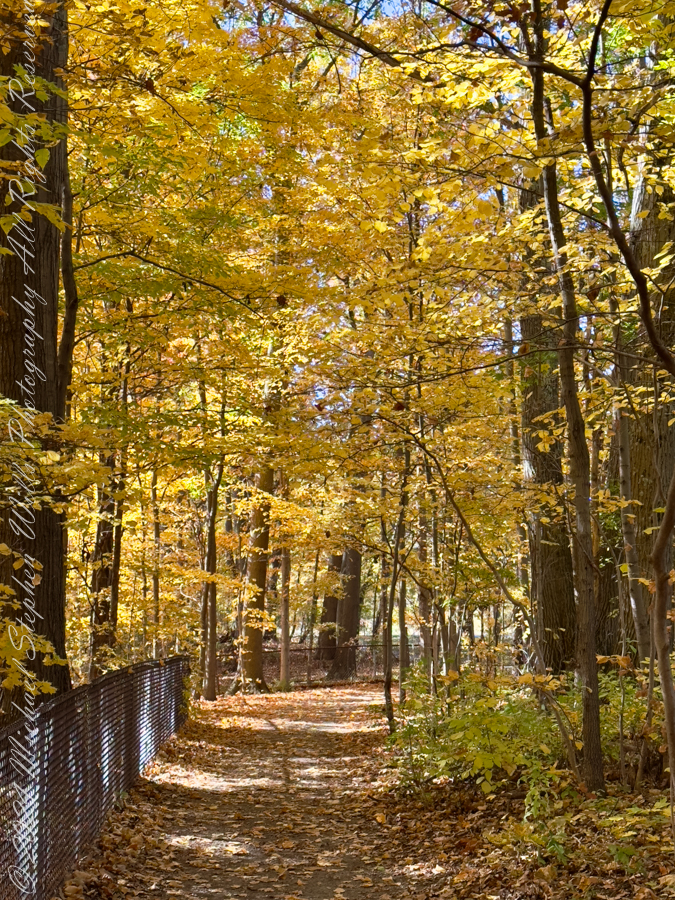
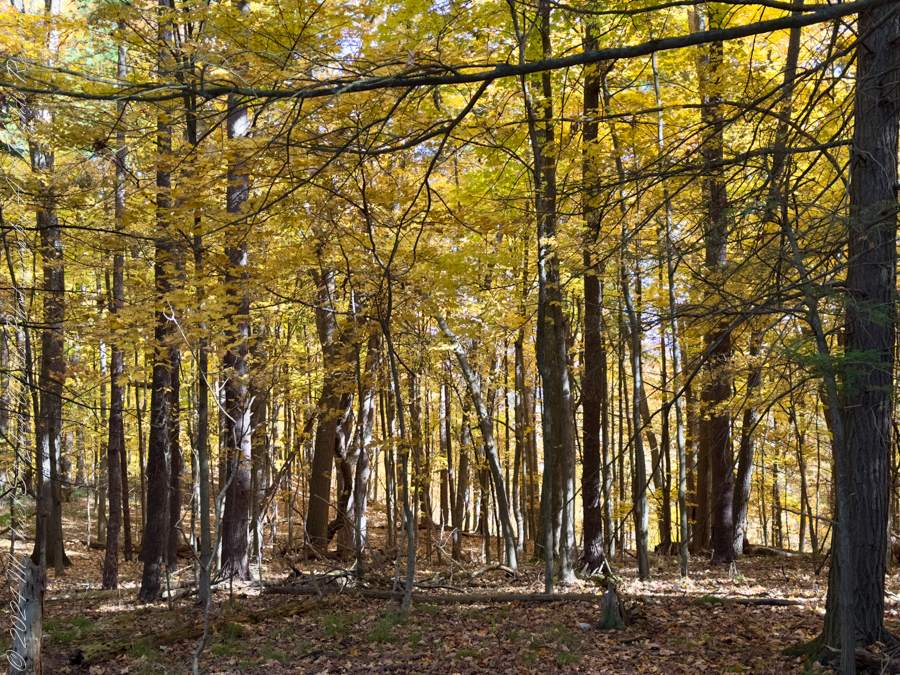
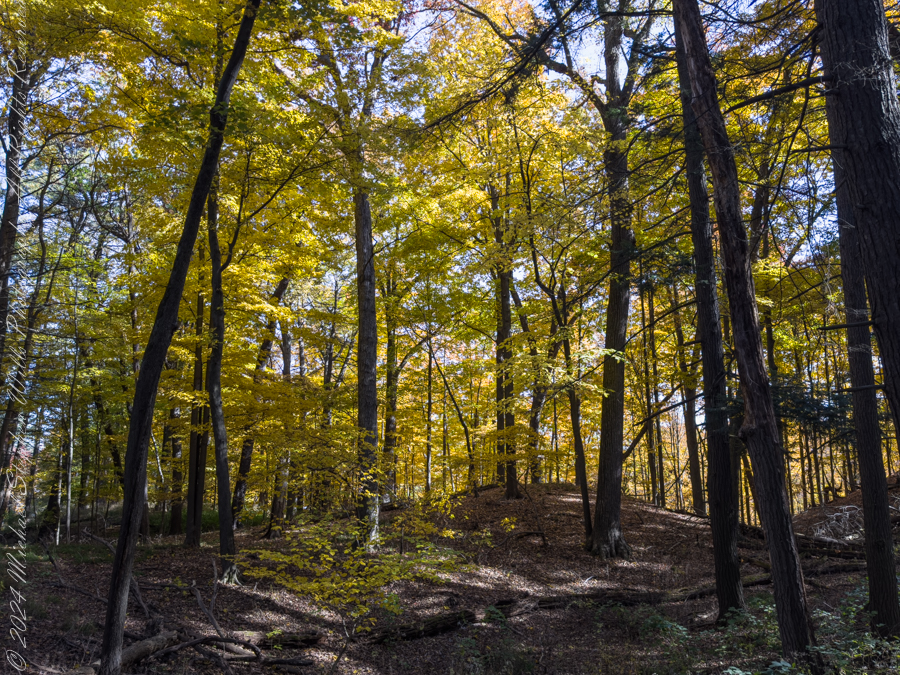
I began my ascent up the North Rim Trail, where the path twisted beneath a tunnel of golden branches. The trail was carpeted with leaves, crunching underfoot with each step. The air was crisp, filled with the earthy scent of decaying leaves and moist earth. Sunlight poured through gaps in the canopy, lighting up patches of ferns and casting long shadows on the rocky path. Here and there, the yellow and brown hues gave way to a burst of crimson, the leaves vivid and almost glowing in the sunlight.
The trail led me along the cliff’s edge, where the river carved its path below. Pausing on the footbridge to the south rim, a former railroad, I looked out over the gorge, admiring the mosaic of colors stretching as far as the eye could see. In the distance, the sound of the falls drifted up to me, a soft, continuous roar that lent the forest an almost mystical air. It was hard not to feel a sense of awe at the raw beauty of the scene.
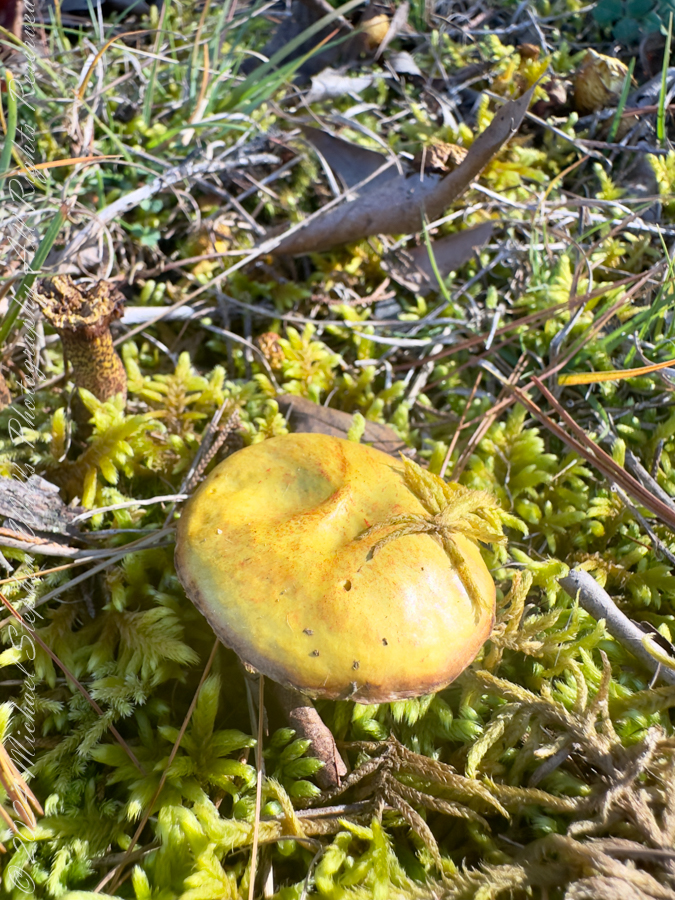
Eventually, I made my way down the South Rim Trail. There were ample distractions from the glorious foliage. A lone mushroom, golden and nestled in a bed of moss, caught my eye—a small reminder of the forest’s quiet life. I bent down to examine it, marveling at its delicate cap and the way it seemed to glow against the lush green moss. The trees here were denser, casting cool shadows that contrasted with the sun-drenched north side. The leaves here were thicker underfoot, their earthy scent more pronounced, grounding me in the moment.
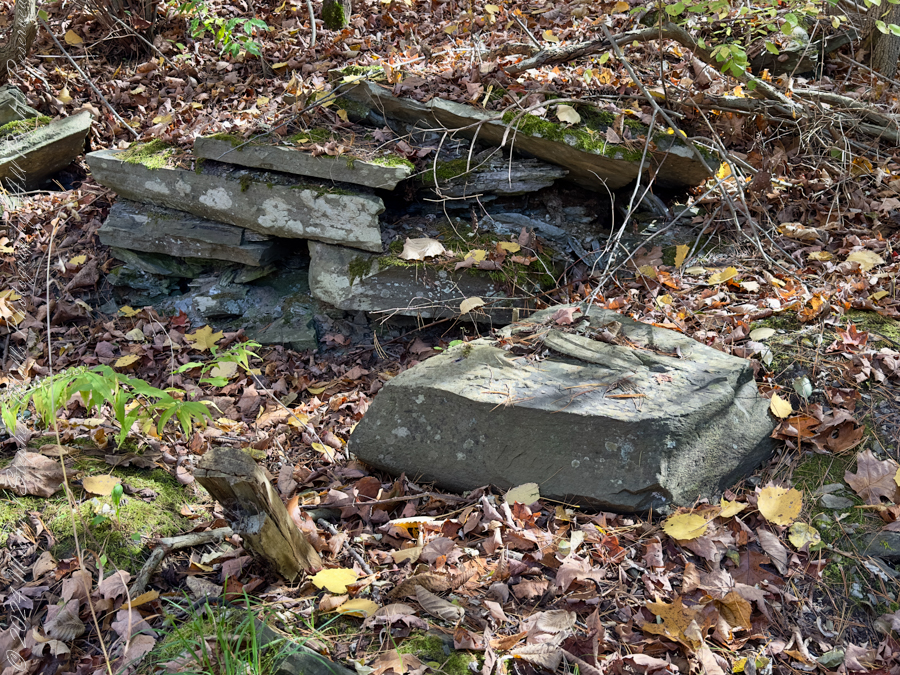
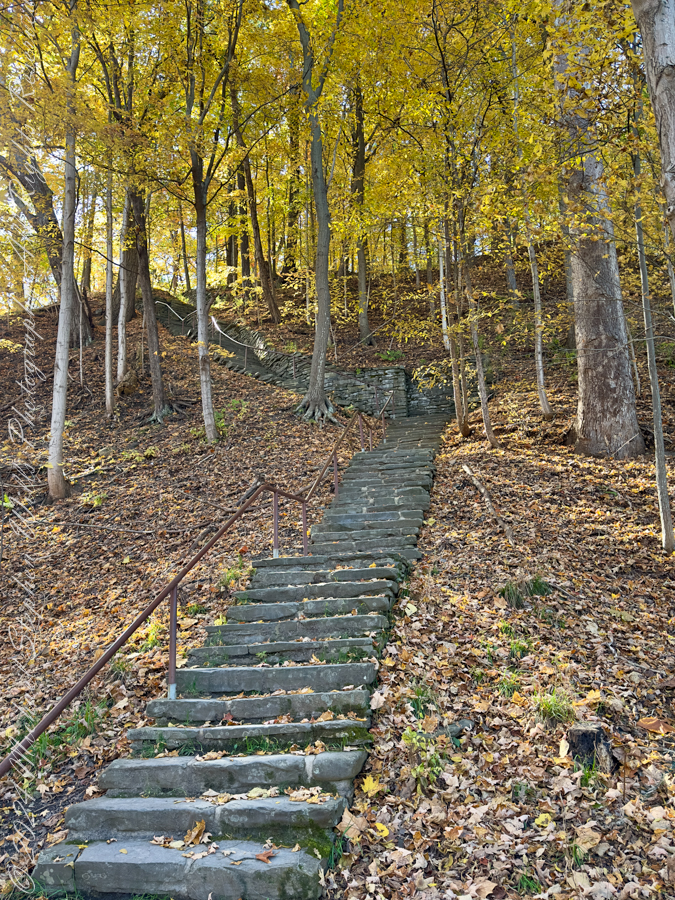
As I reached the lower section of the trail, I noticed an old stone staircase winding up through the trees to the north rim—a relic from another time, adding a touch of mystery to the path. Each step was worn smooth by countless feet, each one a reminder of the generations that had walked these trails before me. The stairs climbed through a cathedral of trees, each trunk tall and straight, as if standing guard over the trail.
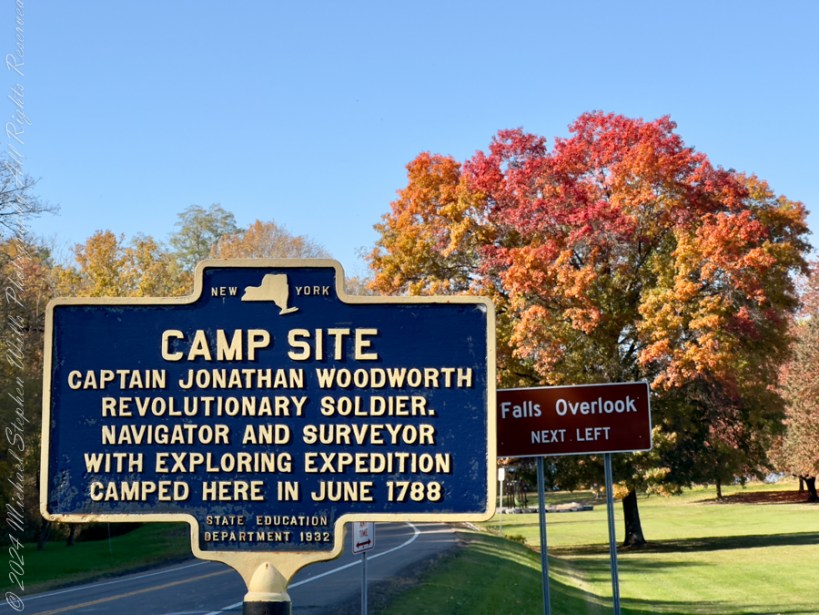
On my way around I passed by a historical marker, a blue and yellow sign commemorating the camp site of Captain Jonathan Woodworth, a Revolutionary soldier who camped here in June 1788. It was a reminder that these trails, this land, had been cherished long before my steps fell upon it.
After reaching the base of the South Rim Trail, I looped back up the North Rim. The trail now felt familiar, yet the changing light gave it a new character. The sun was lower, casting a golden glow across the tops of the trees.
As I returned to my starting point, the sun cast a soft, warm light across the landscape, bathing the park in an ethereal glow. With one last look over the falls and the vivid tapestry of trees, I felt a sense of gratitude. Taughannock Falls State Park in autumn is an experience, one that leaves an indelible mark, reminding us of the beauty and timelessness of the natural world.
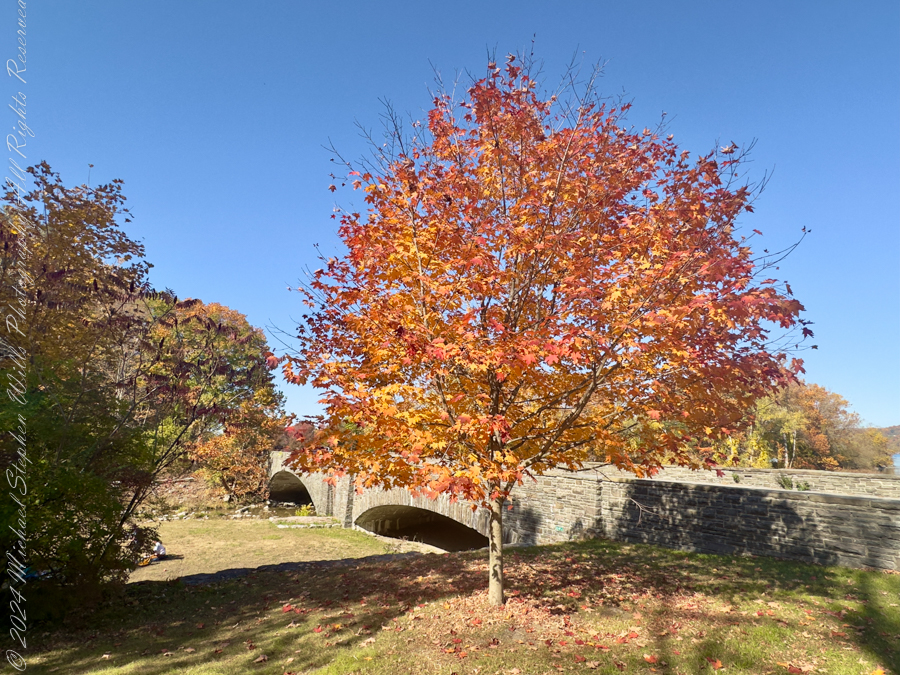
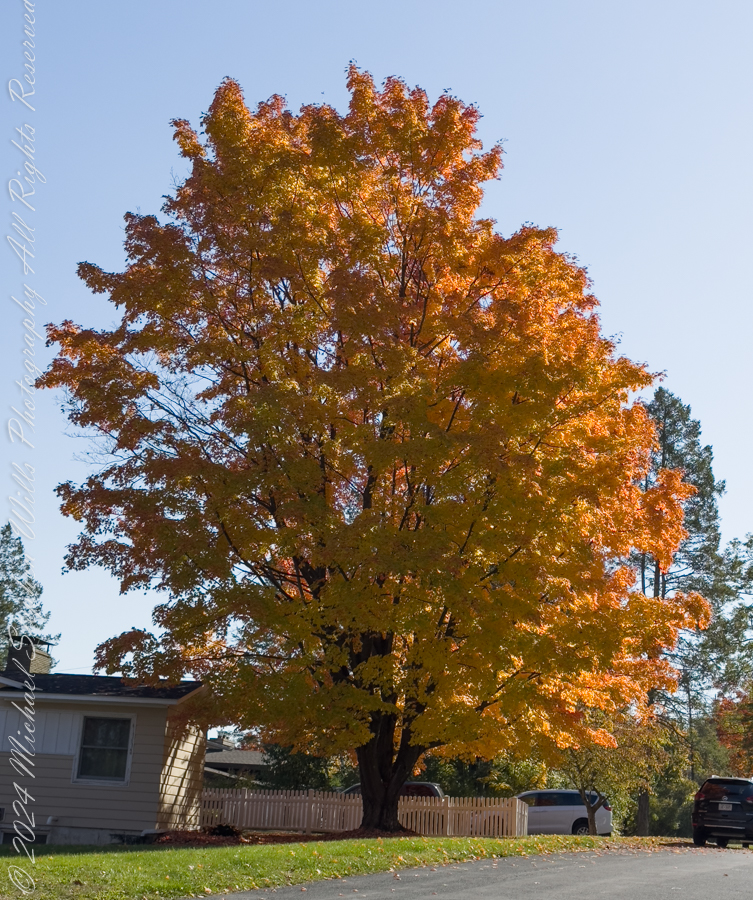
On the drive home I paused to admire a neighbor’s maple tree’s full autumn glory.
Enter your email to receive notification of future postings. I will not sell or share your email address.
Copyright 2024 All Rights Reserved Michael Stephen Wills
Contemplate the quiet sorrow of a summer without monarchs. Click on the photo to read the full story and reflect on this profound sense of loss on my blog.
This past summer, an absence visited our garden—a loss more profound than the quieting of wind. It was the virtual silence of an empty sky where monarch butterflies should have danced. Each day, we waited, hoping to catch a glimpse of those delicate wings, vibrant with orange and black, fluttering above the milkweed. But the familiar sight never came.
Monarch butterflies, those ethereal creatures that once graced our summers, seemed to have forgotten us.
Macro of the Monarch butterfly chrysalis. The black stalk attached to the silk pad is call a cremaster.
The photograph of the monarch chrysalis, a delicate gem hanging on a thread of life, speaks to the fragility of nature itself. Each chrysalis is a promise—a quiet, patient promise of transformation and renewal. Yet this summer, those promises vanished, leaving us to wonder where the monarchs had gone, what changes in the world pulled them away from our home in the Finger Lakes.
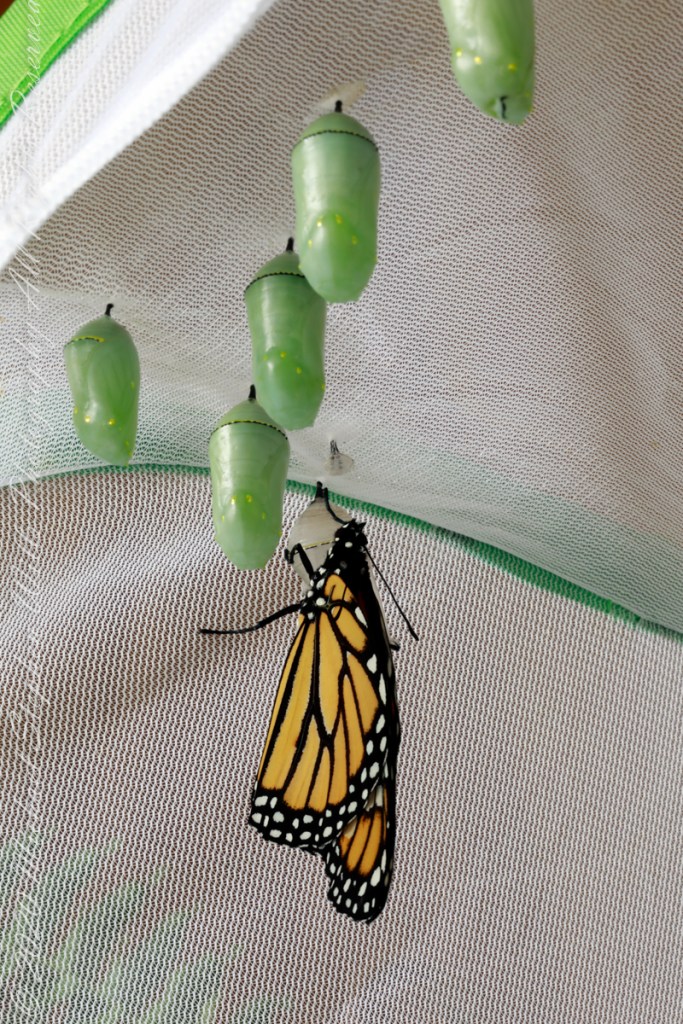
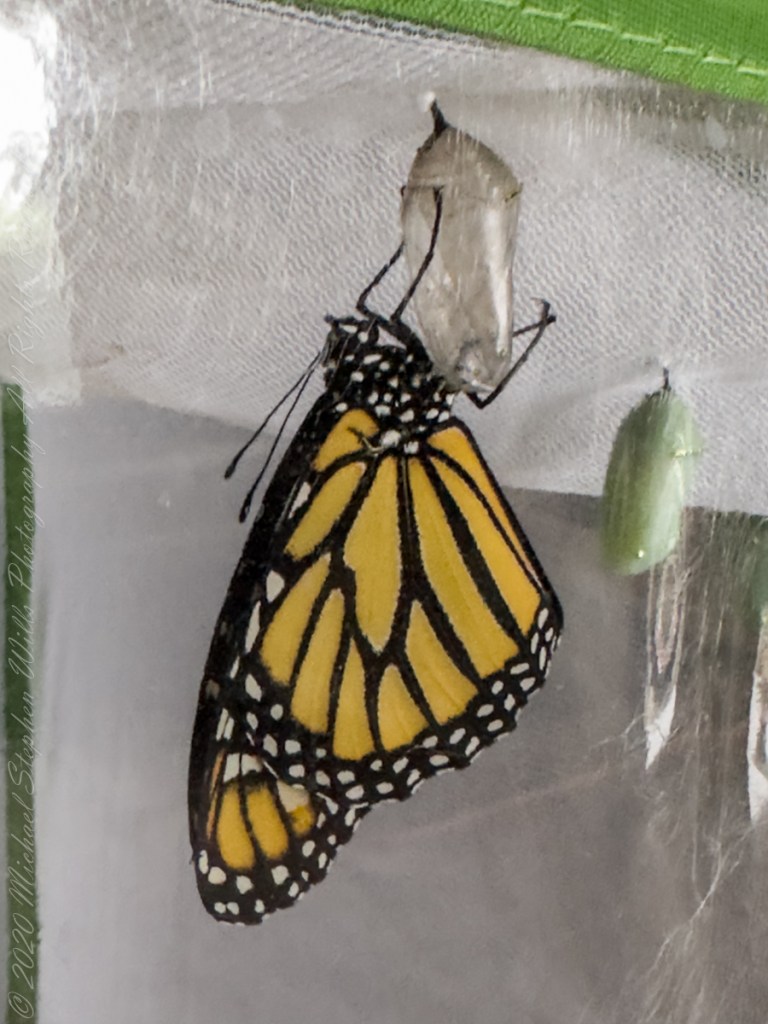
Our first monarch butterfly of 2023 just after emergence from the chrysalis and after wing expansion. This female will hang for several hours while the wings dry.
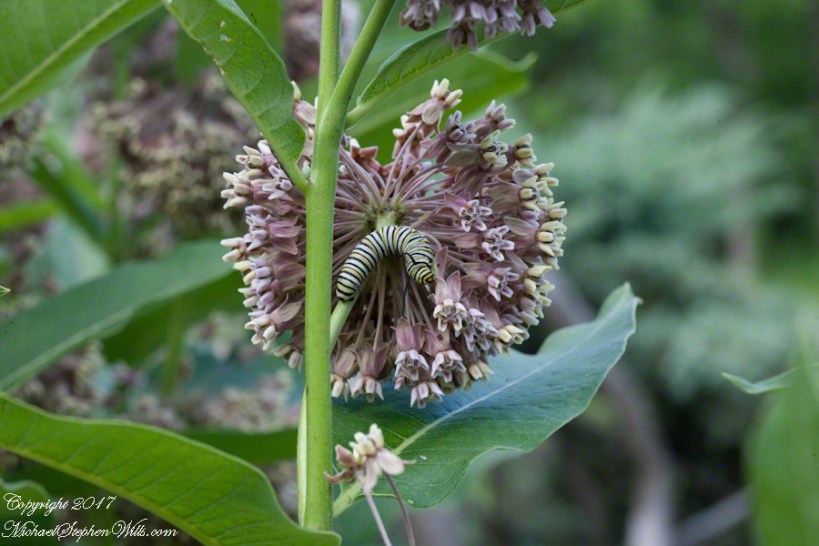
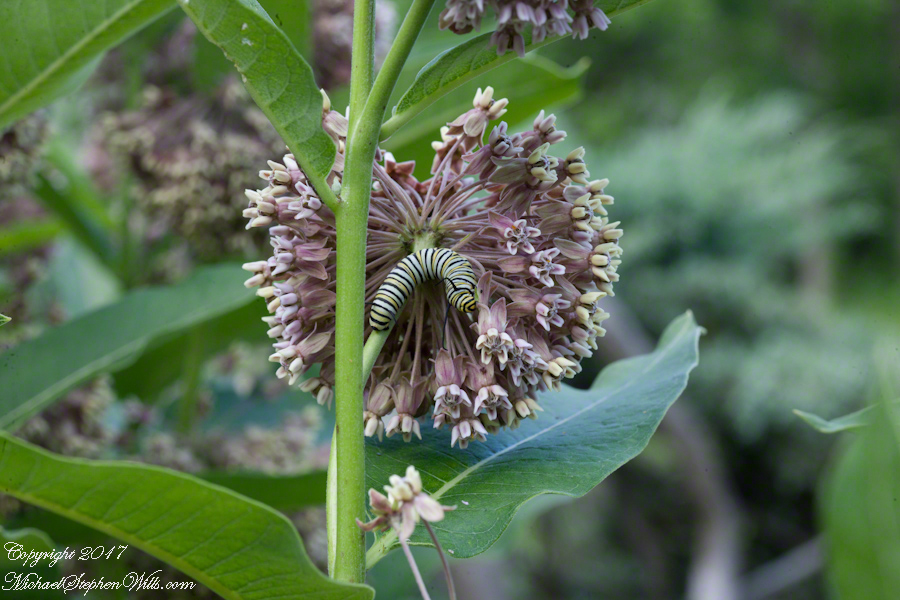
Another image from a time not so long ago, yet now seeming distant, shows a monarch caterpillar nestled among the milkweed blossoms. This was a time when our garden was alive with their presence, each caterpillar a testament to the cycle of life that once thrived here. The sight of them devouring the leaves was a sign of hope, a prelude to the transformation that would soon unfold. Now, that vibrant energy has vanished, leaving behind a quiet that speaks of loss and absence.
We are left to reflect on this silence, on the empty milkweed leaves and the air where monarchs once flew. The memories of summers past, when the monarchs filled our garden with their grace, are bittersweet now. They remind us of a time when the connection between the earth and its creatures was still intact, when the balance of nature had not yet been so precariously tipped.
In their absence, the monarchs leave behind a message—a reminder that their delicate beauty is not guaranteed, that the balance we once took for granted can be lost. The summer without monarchs urges us to look inward, to consider what must change, what must be protected, so that future summers may once again be filled with the fluttering of wings and the promise of life renewed.
The garden absence this year is a call to action, a plea from the earth itself to remember the delicate threads that connect us all. May we answer that call, so that this summer of loss will not reach into the future, but will be a pause, a moment of reflection before the return of the monarchs, and with them, the return of hope.
Request to my North American readers: leave comments exploring your experiences of Monarch butterflies the summer of 2024
Here are links to more Monarch photographs and videos.
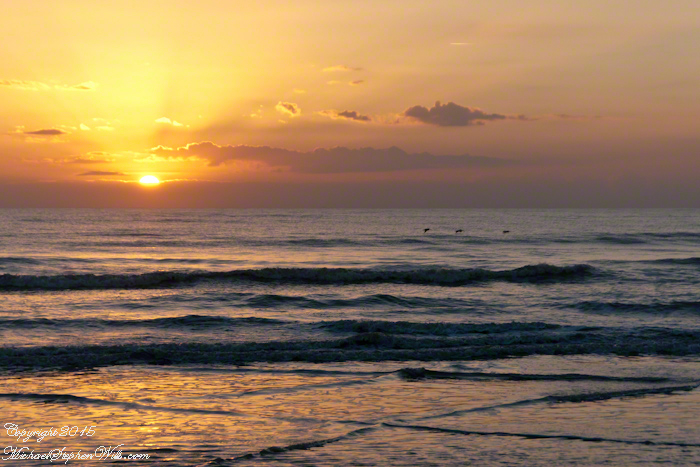
Experience the breathtaking sunrise at Cocoa Beach, where the sky and sea blend in a symphony of colors. Discover the tranquility and beauty that awaits as the day dawns on Florida’s stunning Space Coast.
Cocoa Beach, nestled in Brevard County, Florida, is renowned for its pristine sandy shores and the rhythmic lullaby of the Atlantic Ocean. It’s a place where the day often begins with an awe-inspiring sunrise. On the Space Coast, the first light of day is a daily masterpiece, a silent symphony of colors that paints the sky and reflects off the water.
As dawn approaches, the eastern horizon begins to glow with a soft, pre-dawn light. This quiet time, when the world is still asleep, offers a unique tranquility. The beach, usually bustling with surfers, sunbathers, and families, is calm and serene. The sand, cool underfoot, stretches out like a vast canvas, waiting for the sun to begin its artwork.
The first hues of sunrise start as a gentle blush, a hint of pink that softly caresses the sky. As the moments pass, this blush deepens into shades of orange and red, reminiscent of a painter’s palette. The ocean mirrors these colors, creating a breathtaking scene where sky and sea blend into one continuous expanse. It’s a moment that feels almost sacred, as if nature itself is preparing for a grand reveal.
The sun finally peeks above the horizon, a fiery orb that illuminates the world in golden light. This is the crescendo of the sunrise, a moment that seems to hold the breath of the world. The rays of light stretch out across the water, casting a shimmering path that invites the eyes to follow. It’s a path that feels both real and ethereal, leading not just across the sea, but into a day full of possibilities.
As the sun rises higher, the colors in the sky shift and change. The deep reds and oranges give way to softer yellows and then to the clear, bright light of morning. The ocean, too, transforms, taking on a deeper blue as the sunlight penetrates its depths. The waves, which had been gentle ripples in the pre-dawn light, now dance and sparkle, as if celebrating the arrival of the new day.
For those fortunate enough to witness it, a sunrise at Cocoa Beach engages all the senses. The cool breeze carries the fresh scent of saltwater, a reminder of the ocean’s vastness and power. The sound of the waves, steady and rhythmic, provides a soothing background score, while the occasional cry of a seabird adds a touch of the wild to the scene.
Click on a photo for a closer look.
There is a sense of community among the early risers who gather to watch the sunrise. Strangers often share nods and smiles, united by the shared experience of witnessing something so beautiful and ephemeral. It’s a reminder that, no matter our differences, moments of natural beauty can bring people together, fostering a sense of connection and shared humanity.
Cocoa Beach, known for its proximity to the Kennedy Space Center and its surf culture, offers much more than meets the eye. The sunrise is a daily reminder of the simple yet profound beauty of nature, a beauty that exists beyond the man-made attractions and the hustle and bustle of everyday life. It’s a call to pause, reflect, and appreciate the world around us.
In a place where rockets soar into the sky, touching the very edge of space, the sunrise at Cocoa Beach brings us back to Earth, grounding us in the timeless rhythm of the natural world. It’s a moment of peace and renewal, a gift from the universe to start the day with a heart full of wonder and gratitude.
So, whether you’re a local or a visitor, taking the time to watch the sunrise at Cocoa Beach is an experience not to be missed. It’s a chance to witness the world waking up, to feel a part of something larger than oneself, and to start the day with a renewed sense of awe and possibility.
Copyright 2024 Michael Stephen Wills All Rights Reserved
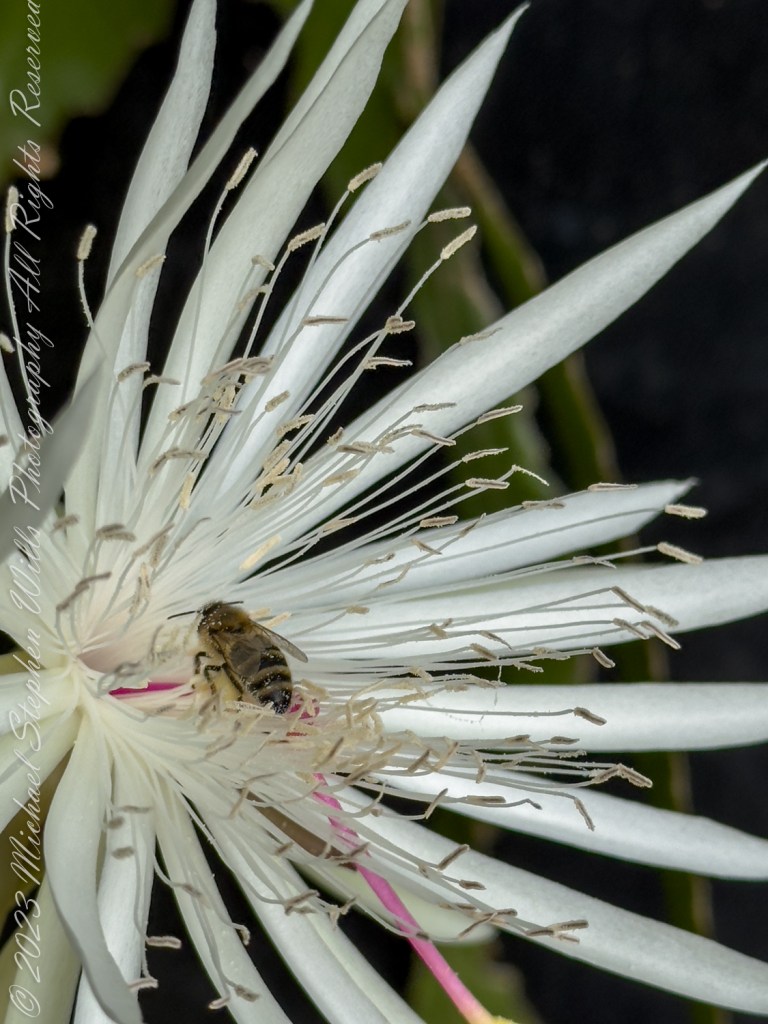
In the final bloom of the season, a honeybee’s delicate dance with the Queen of the Night captures the fleeting beauty of nature’s cycles. Discover the profound connection between flower, bee, and life’s rhythms.
The Epiphyllum oxypetalum, commonly known as the Queen of the Night, is a remarkable plant. Native to Central America, this epiphyte is known for its large, fragrant flowers that bloom only once a year and last just for a single night. The fleeting nature of its bloom makes it a symbol of transience and beauty in many cultures. For me, this flower is a quiet, intimate connection to the rhythms of nature that play out around our home in Ithaca, New York.
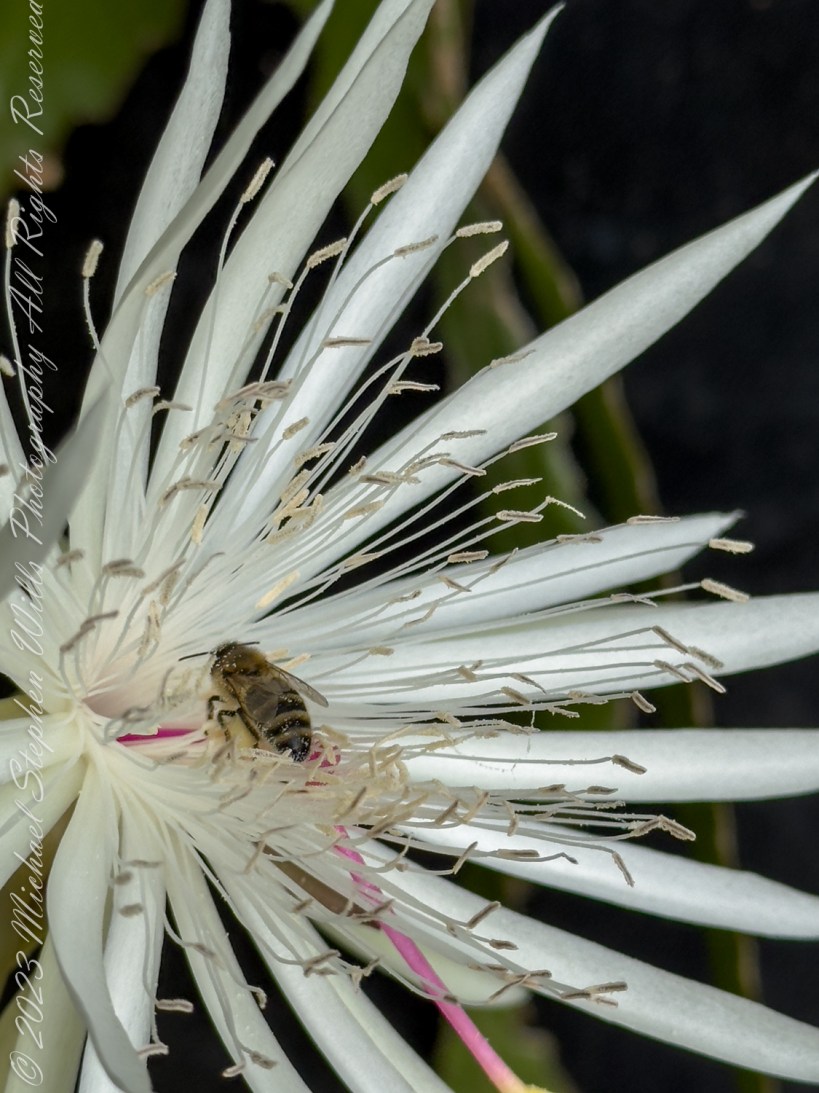
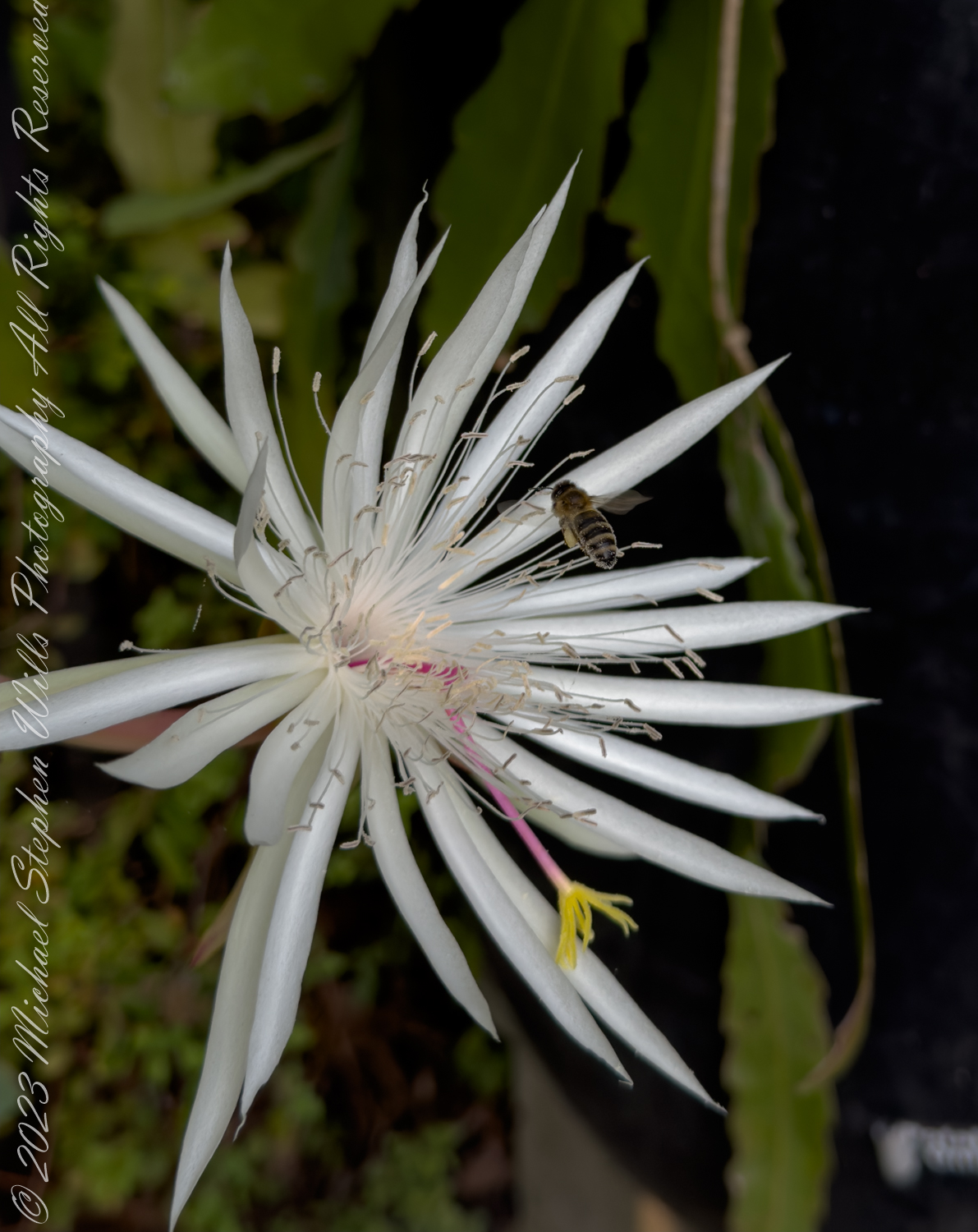
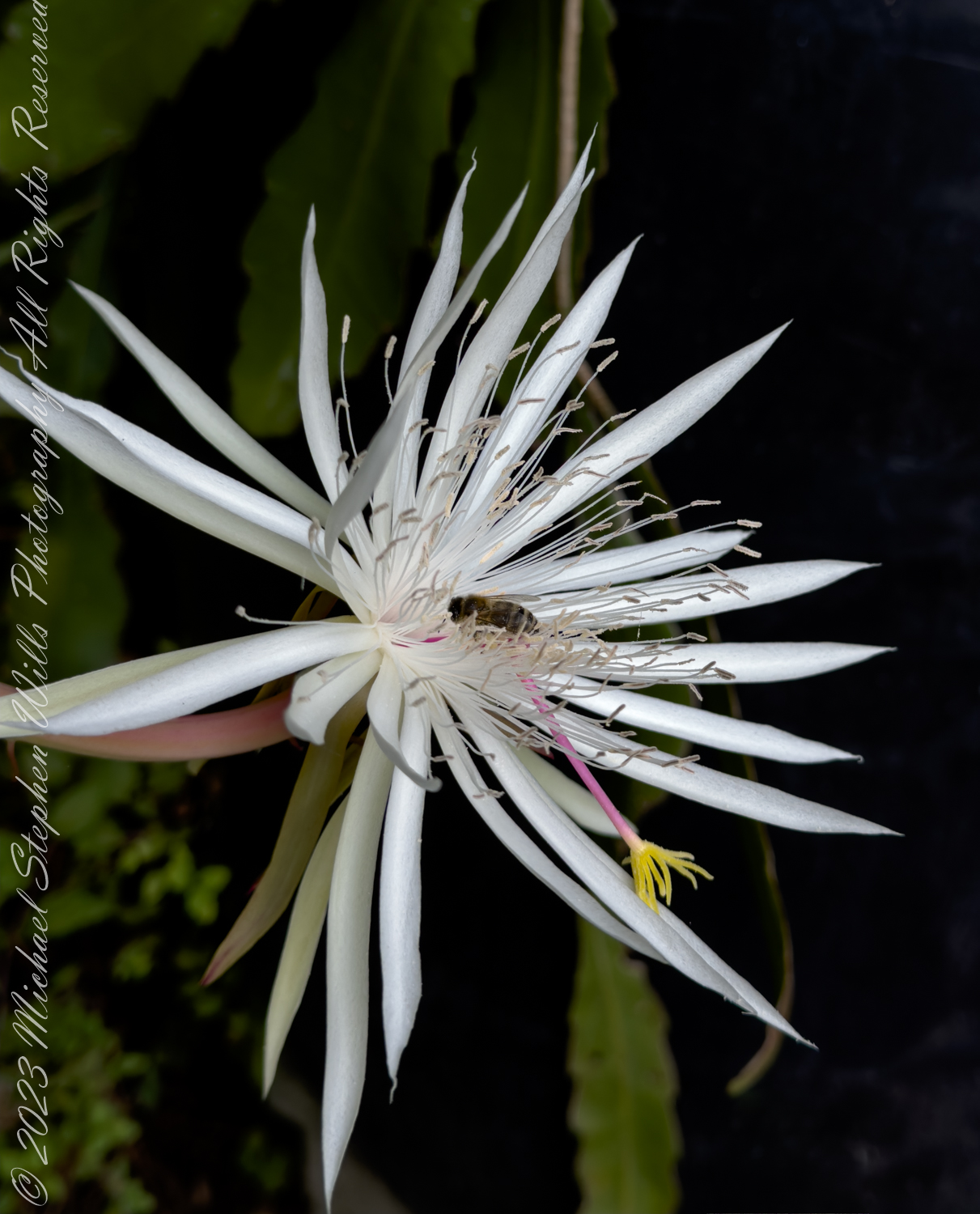
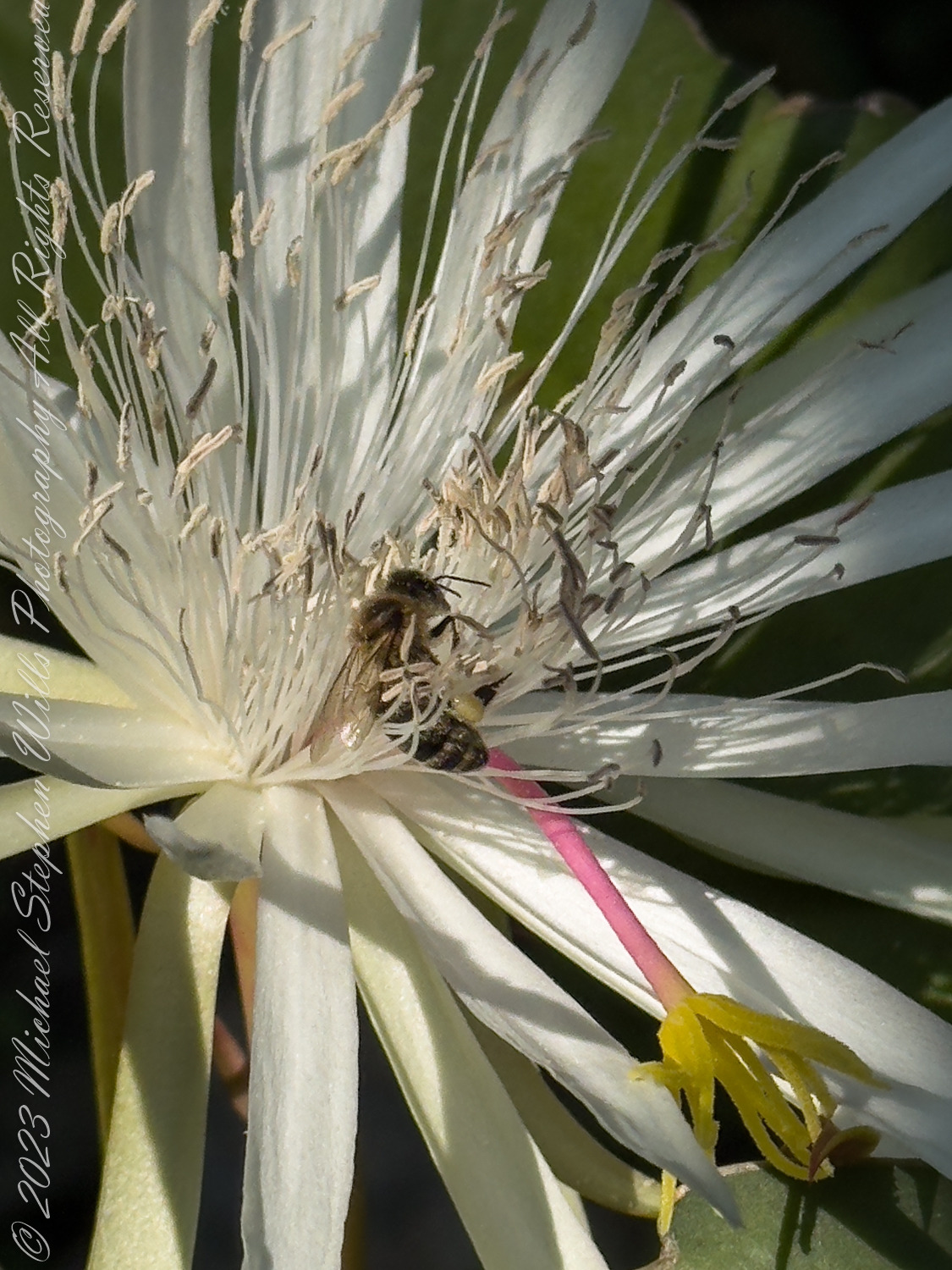
The images you see include the last flower of the season, a white starburst of delicate petals encasing a universe of intricate details. As the day progresses, the flower remains open, revealing the next chapter in its life cycle—the possibility of forming fruit. This potential is entirely dependent on pollination, a process that is both beautifully simple and astonishingly complex.
A honeybee, a tiny yet essential participant in the grand scheme of things, hovers and lands delicately on the flower. In the first image, the bee appears tentative, exploring the outer fringes of the flower’s central structures. Its wings are still, as if it has just touched down after a careful, deliberate approach. The stamens, like a thousand arms extended in welcome, offer their pollen. Each grain of pollen is a promise, a potential seed, carried with the hope of propagation. The bee is the flower’s messenger, moving from one bloom to another, ensuring the continuity of life.
As I observe the bee’s actions through these photographs, I can’t help but reflect on the importance of these small creatures. Their work often goes unnoticed, yet without them, our ecosystems would collapse. The honeybee, in particular, has been a focus of concern in recent years due to declining populations, largely attributed to human activities. But here, in my garden, this bee is simply going about its day, unaware of the broader implications of its existence. It is focused on the task at hand, a model of mindfulness in action.
In the second and third images, the bee has moved deeper into the flower, its body now dusted with pollen. It is fully engaged in its work, undeterred by the enormity of its task. The pink style of the flower contrasts sharply with the white petals and the yellow stamens, creating a vibrant tableau of life. The bee’s body is now part of this scene, its presence both functional and aesthetic. It is not just a visitor; it is an integral part of the flower’s story.
The fourth and fifth images capture the culmination of the bee’s efforts. Having gathered what it came for, the bee is ready to move on, its job done here. The flower, too, has fulfilled its role for the season. The energy it expended to produce this magnificent bloom will now be directed towards forming fruit, provided that the pollination process is successful. If it is, this single flower will give rise to a new generation of plants, continuing the cycle of life.
But there is another, more personal layer to this story. This is the last flower of the season. It carries with it the weight of finality, the knowledge that soon the plant will rest, conserving its energy for the next year’s bloom. As I contemplate this, I am reminded of the cycles that govern not just plant life, but all life. There is a time for blooming, a time for fruiting, and a time for rest. Each phase is essential, each one a preparation for the next.
A bonus view of the honeybee in action
In allowing this flower to form fruit, I am participating, in a small way, in this cycle. We are stewards of the natural world, responsible for nurturing and preserving the life forms that share our planet. The honeybee, the flower, and I are all connected in this intricate web of life, each playing our part in the unfolding drama of existence.
These photographs are a meditation on life, a reminder of the beauty and fragility of the world around us. They capture a moment in time, brief encounters between a flower and a bee, but they also speak to something larger, something timeless. The Epiphyllum oxypetalum may bloom for just one night, but its impact, like that of the honeybee, reverberates far beyond that brief window. And in that, there is a profound lesson for all of us.
Copyright 2024 Michael Stephen Wills All Rights Reserved
Join me on an early morning approach to Iquique, Chile, as we sail past the stark, mesmerizing Atacama Desert coastline. Experience the serene isolation and rugged beauty captured from the balcony of our cruise ship.
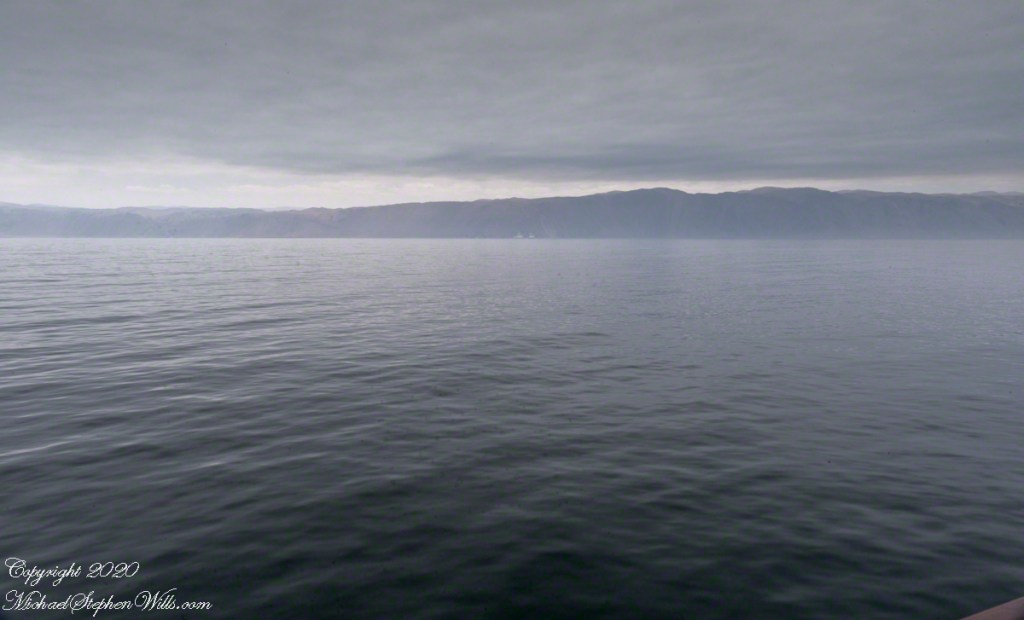
Standing on the balcony of our port side stateroom, the early morning light casts a subdued, almost ethereal glow over the vast expanse of the Pacific Ocean. The Oceania Regatta glides smoothly through the cold, dark waters, making its way toward Iquique, our first Chilean port of call. The sense of anticipation is palpable as we approach the coast of the Atacama Desert, a region renowned for being the driest place on Earth.
The view is both stark and mesmerizing. The coastline of the Atacama Desert rises sharply from the Pacific, a dramatic contrast to the vast, cold ocean that stretches out before us. The Humbolt current, a cold, nutrient-rich flow of water from southern Chile to northern Peru, swirls beneath the ship, adding a sense of dynamic movement to the scene. The chilly air, the muted colors of the sea and sky, and the barren, rugged landscape all combine to create an atmosphere of serene isolation.
In the distance, I imagine a dark point of land—the remnants of the abandoned town of Caleta Buena. Perched on a 750-foot escarpment, the town was once a bustling hub of nitrate mining, a vital industry that shaped the history of Iquique. The remains of piers jutting out into the ocean stand as silent witnesses to a bygone era, their weathered structures blending into the rugged coastline.
The sequence of photographs I’ve captured from this vantage point, working north to south, offers a panoramic view of this desolate yet captivating landscape. Using a 24 mm “wide angle” Canon lens mounted on a tripod, I’ve been able to frame the vastness of the ocean and the stark beauty of the Atacama coastline in a single, sweeping seascape.
Reflecting on our overnight journey from Matarani, Peru, I’m struck by the profound sense of isolation that accompanies travel along this desolate coast. During the 250-mile sail, the darkness was absolute, the inky blackness of the night broken only by the occasional glimmer of stars reflected in the ocean below. It was a journey through a void, a stark reminder of the sheer scale and remoteness of this part of the world.
As we draw closer to Iquique, the coastal mountains rise up, marking the transition from the Pacific to the arid plains of the Atacama Desert. The stark beauty of this landscape, with its rugged cliffs and barren expanses, is both humbling and awe-inspiring. It’s a reminder of the harsh conditions that have shaped this region, and of the resilience of the people who have carved out a living here over the centuries.
From the balcony of our stateroom, I feel a deep sense of connection to this place. The vastness of the ocean, the stark beauty of the desert coastline, and the rich history of the region all combine to create a profound sense of place. This is a land of extremes, a place where the forces of nature have sculpted a landscape of breathtaking beauty and unforgiving harshness.
As we approach Iquique, I feel a sense of gratitude for the opportunity to witness this unique corner of the world. The journey is a reminder of the incredible diversity and beauty of our planet, and of the importance of preserving these natural wonders for future generations. This approach to Iquique is a journey to a new port, a journey into the heart of one of the world’s most remarkable landscapes.
Copyright 2024 Michael Stephen Wills All Rights Reserved


















 Michael Stephen Wills Photography