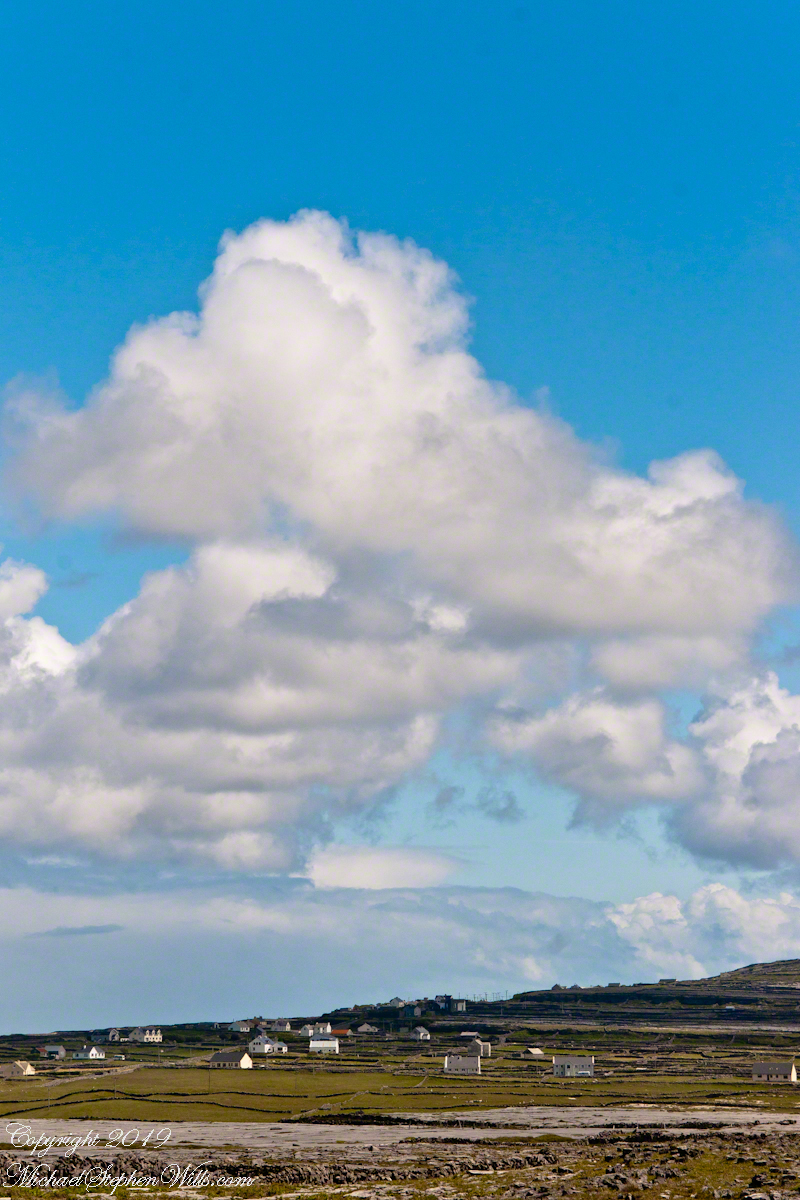
From the commanding location of Dún Aonghasa, looking northeast across Inishmore, the logic of the ancients becomes clear. No better vantage could be found—land unfurling like a hand toward Galway Bay, cottages nestled in green folds, clouds billowing above like sails caught mid-journey. A place of presence. A place of permanence.
Perched high on the cliff’s edge, the fort behind, the Atlantic at the back, the wind carried stories—unwritten, unspoken, but felt in the bones. Below, stone walls divided the island into patterns of memory. Fields outlined in rock, laid long ago by hands familiar with hardship and patience. The sea’s pulse echoed faintly in the distance, as steady and unfathomable as time itself.
No words were needed in that moment. Just the hush of sky and stone. Cottages, bleached bright by limewash—kalsomine, the old name still whispered by some—stood resilient against the elements, each one a witness to generations. Each one seemed to carry a personal reverence, a tenderness carved into the landscape.
Paths led gently inland, where wind slowed and voices from distant homes rose faintly through the open air. Along those paths, the rhythm of island life could be read in hoof prints, scattered wool, and the sharp, clean edges of hand-cut stone. There, among the hedges of limestone and wild grass, the living and the lost felt close.
The cloud cover shifted constantly. Shadows passed like thoughts across the land. Toward the shore, the sky opened wide. A silence filled the lungs, as bracing and deep as the Atlantic itself. Time seemed to slow, the mind slipping into the rhythm of the land.
Limestone pavement, rough beneath the boots, told its own tale of erosion and survival. That the earth here could sustain even the most modest farming seemed improbable. Yet here it was: a testament to stubborn hope and quiet ingenuity. In that quiet, ancient energy rose—something older than the fort, older than language. A pulse shared with the rock and wind.
The fort eventually came back into view—perched as if grown from the cliff itself, curved walls enclosing nothing but air and sky. I perceived no defensive bluster, only presence. And what a view it commanded. On days like this, the clouds formed towering cathedrals overhead, white and gold in the sun. Below, the cottages and fields seemed miniature, perfect, enduring.
The wind played echoes of prayer, lullaby, and laughter mingled with the call of seabirds. The thought came that nothing here was ever truly lost—only layered. Generation upon generation, each leaving some trace: a stone placed just so, a wall mended one final time, a cottage roof patched for another winter.
Here, even the air speaks. It moves gently but insistently, brushing the cheeks and stirring something ancient within the chest. Beneath it, the island breathes: not loudly, not urgently, but with the slow, deep rhythm of the tides.
As the sun dipped slightly westward, light changed across the fields, cottages glowing warm against darkening green. The wind softened. The clouds drifted, still massive but no longer looming. Time to return. A glance back offered one last communion with sky, stone, and silence.
Inishmore, on that day had been absorbed. Understood not with the mind, but with something quieter. Something that listens without need for words.
It was the kind of overcast morning that seems to cradle the island in a blanket of mist, a gentle hush falling over the land as though even the Atlantic held its breath. Pam and I had arrived by ferry at Kilronan, the main settlement on Inishmore (Inis Mór), the largest of the Aran Islands nestled in Galway Bay. There, amid the bustle of arrivals and greetings, we found our driver—a wiry, weather-worn man with a soft brogue and kind eyes—and his horse trap, a simple two-wheeled carriage with room enough for three and the sounds of hooves to accompany our journey.
We set out up Cottage Road, the stone-paved track winding westward from the harbor. The sea fell away behind us as we climbed, a gray shimmer stretching to the hazy outline of Connemara’s mountains on the far side of the bay. Our destination was the dramatic cliffside ringfort of Dún Aonghasa, a place older than memory. But it was the unexpected moments in between—the ones not printed in guidebooks—that linger longest in the mind.
As we rounded a bend flanked by low stone walls, wildflowers blooming defiantly in the cracks, our driver pulled the reins gently and pointed with his crop.
“There,” he said, nodding ahead, “is a fine example of a traditional Aran cottage.”
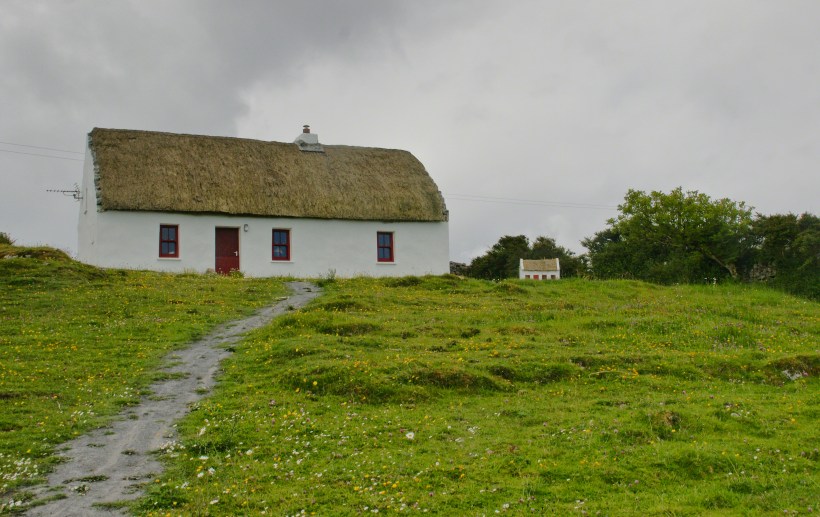
And there it was—a vision from another time. The thatched roof curved softly like a that blanket itself, straw golden against the brooding sky. The walls were whitewashed to a perfect matte sheen, gleaming in spite of the cloud cover. A crimson door and two window frames punctuated the front façade like punctuation in a poem. Just to its right, set further back on the hill, stood a tiny replica of the same cottage, identical in every feature. I blinked, half believing it was an illusion.
This thatched cottage with matching child’s playhouse is on Cottage Road out of Kilronan Village on the Aran island, Inishmore, County Galway, Ireland.
We only stopped briefly—it was a private residence—but the sight of it left a kind of imprint. I turned in the trap seat to keep it in view as long as I could. The cottage was perfectly placed, facing Galway Bay with a commanding view. I imagined the light pouring across the line of mountains, catching the glint of sea and sky.
“There’s a name for that finish,” I said, recalling something I’d read, “whitewash, or lime paint.”
Our driver nodded. “That’s the old way. Made from slaked lime. We’d call it ‘whitening’ when I was a lad.”
Whitewash differs from paint in the most elemental of ways. It becomes part of the stone, absorbed into the very surface. Like a memory of bone. And yet, it requires care. Apply it to a wall not properly cleaned or moistened, and it flakes, pulls away like a broken promise. But done right, it lasts, breathes with the building.
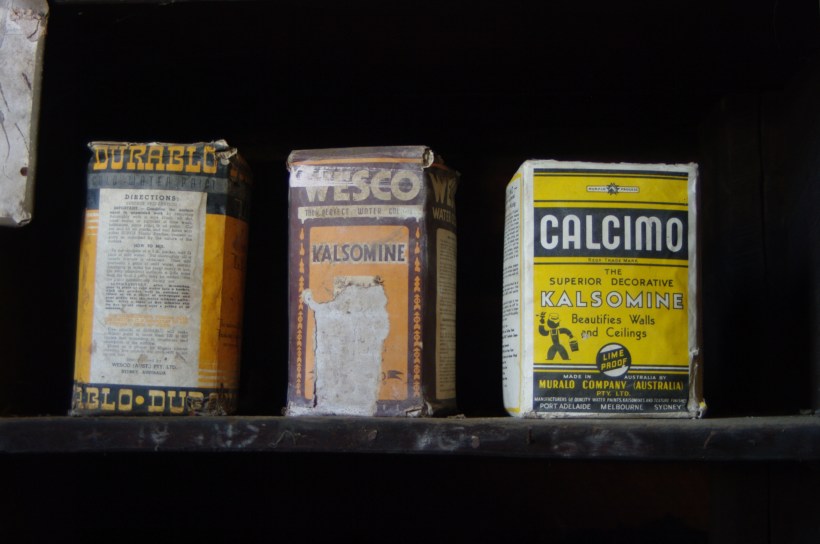
Upon our return, researching “whitewash,” if found this photograph from the Yarloop railway workshops Yarloop, Western Australia. There, on a shelf, where three old boxes sat like relics: DURABLO, WESCO, and CALCIMO. All contained kalsomine—the powdered form of lime paint. CALCIMO promised to “beautify walls and ceilings” and was proudly marked “LIME PROOF.” There was something quietly heroic in that. Lime-proof, as though against time itself.
Looking at the box of Calcimo, a product of the Murabo Company of Australia, I was struck by how far the tradition had traveled. From island cottages in the Atlantic to distant corners of the Southern Hemisphere, the language of whitewash—of simplicity and purity—had touched the world.
We returned by the same road, past that same cottage, the small one still keeping watch beside it like a child beside a parent. And I knew then that the islands hadn’t just given me sights—they had offered stories, silent ones written in thatch and stone, in lime and wind.
Sources for this post: search wikipedia for “White Wash”. White wash photo author: Wikipedia commons user Gnangarra
Monument Valley, or Tsé Biiʼ Ndzisgaii, embodies a profound connection between the Diné people and the land, contrasting imposed names with cultural significance and sacred narratives.
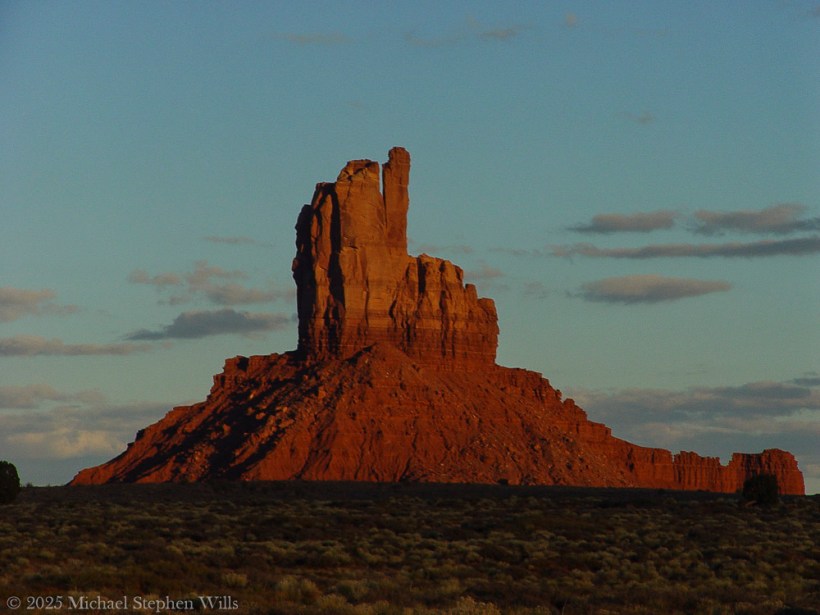
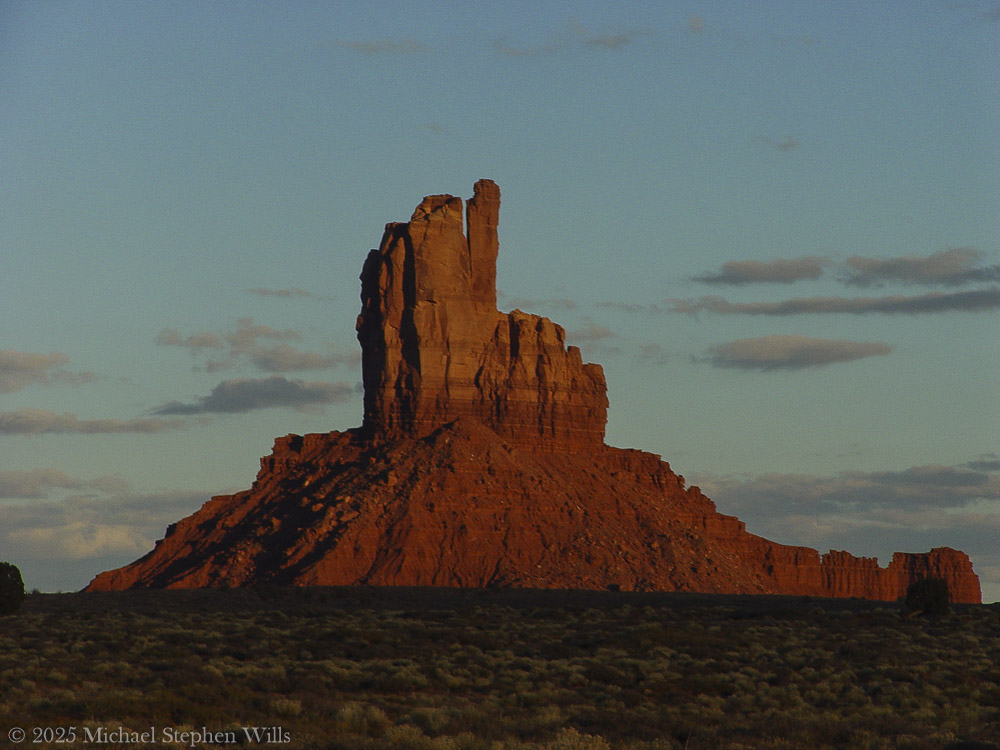
In the golden hush of this November sunset, Monument Valley stretches before us – an endless desert plain punctuated by towering red rock sentinels. The sky is vast and translucent blue, as a pale three-quarter moon rises silently above a solitary spire of sandstone. That spire is known on maps as Big Indian, a stone pillar glowing russet in the low sun. It stands apart from the mesas, its silhouette uncanny against the evening sky. In this serene moment, the land feels alive with presence. And the name “Big Indian” lingers in the air, raising quiet questions about what we call this place – and what it truly is.
From a distance, the spire does suggest a figure: tourists are told to squint, tilt their heads, and “see” the profile of a Native face gazing outward. One can imagine the first person to name it must’ve been a bored prospector, half-delirious from the heat after a lunch of canned beans, declaring: “I swear that rock looks like Uncle Joe in a feathered headdress.” And so the name stuck – a geological Rorschach test gone slightly colonial.
These whimsical titles – Totem Pole, Stagecoach, Big Indian – come not from the land, but from a long habit of outsiders labeling what they didn’t fully understand. “Big Indian” is particularly layered. The term “Indian” itself was born from Columbus’s navigational misfire, mistaking the Caribbean for Asia and its people for “Indios.” The Diné, the people who have lived here for centuries, never called themselves that. So this towering formation now bears the echo of a 15th-century directional blunder —like a name tag on the Sphinx that reads “Buckeye” because someone once thought Egypt was in Ohio. It’s a reminder: names given in haste can cling for centuries, even when they miss the mark entirely.
But beyond the names imposed by mapmakers, the spire simply is, in all its silent grandeur. In Diné lands, this valley has a different name: Tsé Biiʼ Ndzisgaii, often translated as Valley of the Rocks. In the Navajo tongue the name literally evokes “rock within white streaks around” – referring to the light bands of sediment that ring the red buttes. Those pale streaks wrap the spire like faded paint, remnants of ancient layers of earth. Here the Diné language whispers a description born of the land itself, unlike the English names that often project an outsider’s story. Tsé Biiʼ Ndzisgaii speaks to the truth of the place: stone and light, strata and shadow. As the sun lowers, you can actually see those whitish bands catching the last glow, encircling the butte like old memory. The Diné name honors what the eye sees – the layered geology – rather than imposing an unrelated label. This spire and its neighbors were not built by human hands, though their sheer stature can feel like architecture of the gods. Millions of years of natural artistry shaped Monument Valley.
Long before any person walked here, this land was a low basin collecting sediments. Layer upon layer of sand and silt hardened into rock, and a slow uplift in the earth heaved the basin into a plateau. Wind and water became patient sculptors over the last 50 million years, carving the plateau and peeling away the softer material. What remains today are the skeletal monuments of that erosion: buttes, mesas, and spires rising up to a thousand feet above the desert floor. Each is made of stratified stone – the broader bases of red shale and sandstone, and a cap of harder rock that resists the elements. Big Indian’s sturdy pedestal and slender crest tell this story of layered resilience. In the red-orange rock, oxides of iron tint the cliffs a deep rust, while streaks of black manganese oxide – “desert varnish” – trace down their sides like natural paint. Time and the elements have sculpted a masterpiece here.
Standing at its foot, one needs imagine the immeasurable ages of sun and storm that chiseled this lone tower from the earth. And yet, facts of geology alone fail to capture the spirit one feels in Tsé Biiʼ Ndzisgaii. The Diné know that spirit well – this valley is sacred to the Navajo Nation. To them, these colossal rocks are alive with meaning. The people have lived and wandered among these mesas for centuries, blessing the land with their stories and prayers.
In Navajo cosmology, the landscape itself is imbued with life and purpose. The buttes are often seen as ancestors, guardians, or holy figures watching over the People. For example, the famous twin buttes called the Mittens are said to be a pair of spiritual beings – one male, one female – forever facing each other across the valley, protecting and balancing the land. Another hulking mesa, Sentinel Mesa, is known as a “door post” of the valley, a guardian at the entrance, paired with another butte as the opposite door post. The valley, in the Diné way of seeing, resembles a great hogan, a home blessed by the gods: the mesas at its threshold are like the posts of a doorway, and a butte called The Hub is imagined as the central fire hearth of this immense home.
In this way, the Diné landscape is a living, storied environment. Even the spindly formations carry sacred narrative. Seven miles southeast from Big Indian stand slender pinnacles known to the Navajo as Yei Bi Chei, named for the masked spiritual dancers who emerge on the last night of a winter healing ceremony.
Each dawn, as the first light breaks over the mesas, it’s said the Navajo families come out of their hogans to greet the sun with prayers – their doorways always face the east to receive blessings of the day. In the same way, the great stone hogan of Monument Valley opens eastward, with its door-post buttes and its eternal fireplace. In Diné worldview, earth and sky are intertwined with their lives; they speak of Mother Earth from whom they emerged and to whom they owe care. Here in Monument Valley, it is possible to feel that harmony – the sense that every column of rock, every whispering juniper shrub, every beam of sunlight and moonrise is part of a whole living tapestry.
We watch as the moon climbs higher above the Big Indian spire, its silvery light softening the rock’s hard edges. This place has known many names and will outlast many more. The Paiute people who roamed here before called it “Valley Amid the Rocks” and wove myths of gods and giants into its features. Later came the labels of explorers and filmmakers: Monument Valley, a monumental canvas for Western legends. And of course, the simplistic tag Big Indian for this lone rock – a name that says more about those who coined it than about the land itself.
Names, in the end, are stories we tell about the world. The colonial names imposed here are like brief echoes across the ages, while the Diné stories run deep as the red earth. The Diné prefer to call themselves Diné – meaning “the People”– and they call this land by names that describe its true character. I imagine that to the People, this spire might be thought of not as an “Indian” at all, but perhaps as a sentinel or an old friend standing watch. Its Diné name, if it has one, would likely emerge from its form or its role in a story, spoken with reverence.
As dusk turns to twilight, an immense peace settles. The monolith before me is no longer just Big Indian on a map; it is an ancient entity shaped by time and honored by generations. In the silence, we can almost hear the land speaking in the old language – telling of how it was born from oceans and sand, how it saw the first people wander through, how it endures through centuries of memory. The rock shares with us a moment beyond names: just the whisper of wind, the glow of moon, and a feeling of connection and wonder. This is Monument Valley, Tsé Biiʼ Ndzisgaii, in all its truth. In this contemplative dusk, I bow to the tower of stone, misnamed yet never truly defined by that misnomer. It remains what it has always been – a creation of earth and spirit, a witness to history, a source of humble awe. Tuning to leave, I softly speak a word of thanks – Ahéheeʼ – grateful to have listened, if only briefly, to the sacred voice of the valley.
Bibliography
Encyclopædia Britannica – Tribal Nomenclature: American Indian, Native American, and First Nation britannica.com (origin of the term “Indian” as a colonial misnomer)
Navajo Nation Parks & Recreation – Monument Valley (Tsé Bii’ Ndzisgaii) navajonationparks.orgnavajonationparks.org (official site detailing Monument Valley’s geology and formation)
Robert S. McPherson – Monument Valley.Utah History Encyclopediauen.orguen.org (history, geology, and indigenous lore of Monument Valley)
Aztec Navajo County – Monument Valley PDF Guide aztecnm.comaztecnm.com (descriptions of formations, including Navajo perspectives on their meanings and names)
Navajo Word of the Day – Tsé Biiʼ Ndzisgaii navajowotd.com (explanation of the Navajo name for Monument Valley, meaning “white streaks in the rocks”)
Enter your email to receive notification of future postings. I will not sell or share your email address.
Copyright 2025 All Rights Reserved Michael Stephen Wills
Here is a journey to Brigham’s Tomb in Monument Valley, reflecting on the land’s timelessness, silent presence, and the profound connection between the observer and natural formations.
He did not come seeking answers, nor was he lost. The road had summoned him—as it had summoned others before him—and he followed its arc with the steadiness of one who does not hurry time. The sun was descending behind him, slow and inevitable, casting long golden blades across the plateau. That was how it wanted to be seen, and he did not interfere.
He had come this way before in dreams, further south where the great stone mittens reached into the sky. There, the land had risen in clarity, each formation distinct in its declaration. But now the evening had deepened, and the land changed its tongue. It spoke more slowly. With greater weight. And he listened.
The air was thin with silence. Even the wind moved differently here—more cautious, more reverent. And then the shapes came into view. Not suddenly, but as if they had always been there and were only now permitting themselves to be noticed.
Here stood Brigham’s Tomb.
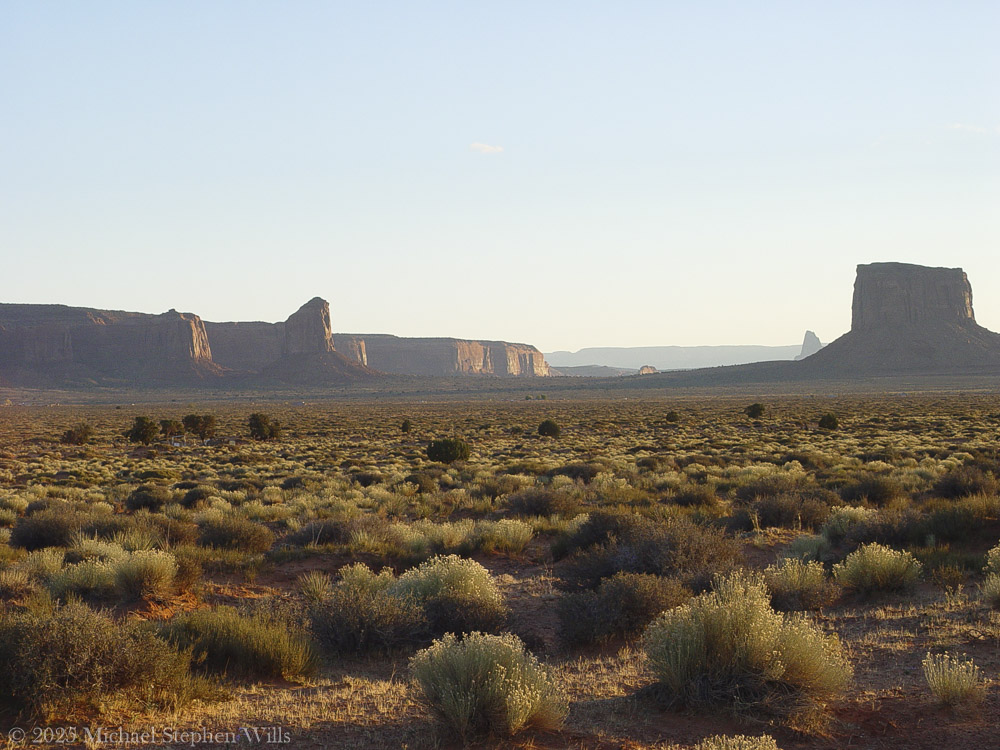
On the way to Monument Valley Tribal Park as the sunset for this view on Sullivan Road (Route 163). Navajo County, Arizona. Brigham’s Tomb. On the way to Monument Valley Tribal Park as the sunset for this view on Sullivan Road (Route 163). Navajo County, Arizona. Brighams Tomb is situated six miles (9.7 km) northeast of Oljato–Monument Valley, Utah, on Navajo Nation land. It is an iconic landform of Monument Valley and can be seen from Highway 163. Precipitation runoff from this landform’s slopes drains into the San Juan River drainage basin. Topographic relief is significant as the summit rises 1,000 feet (305 meters) above the surrounding terrain in 0.25 mile (0.4 km). The mountain’s name refers to Brigham Young, the first governor of the Utah Territory. This landform’s toponym was officially adopted/revised in 1988 by the United States Board on Geographic Names after having been officially named “Saddleback” from 1964 through 1987. Some older maps will still show the Saddleback name.
Geology
Brighams Tomb is composed of three principal strata. The bottom layer is slope-forming Organ Rock Shale, the next stratum is cliff-forming De Chelly Sandstone, and the upper layer is Moenkopi Formation capped by Shinarump Conglomerate. The rock ranges in age from Permian at the bottom to Late Triassic at the top. The buttes and mesas of Monument Valley are the result of the Organ Rock Shale being more easily eroded than the overlaying sandstone..
It rose alone, square and solemn, its flanks pressed by the last warmth of the day. The light traced every fracture, every line of sediment like the spine of something ancient and vast. It had no vanity. Its strength was in endurance, in the simplicity of mass. The world had spun uncounted times around this throne of stone, and still it stood—unmoved, unwitnessed except by sky and the slow-growing desert at its feet.
He paused there—not because he was uncertain, but because the monument required it. Some things must be received in silence.
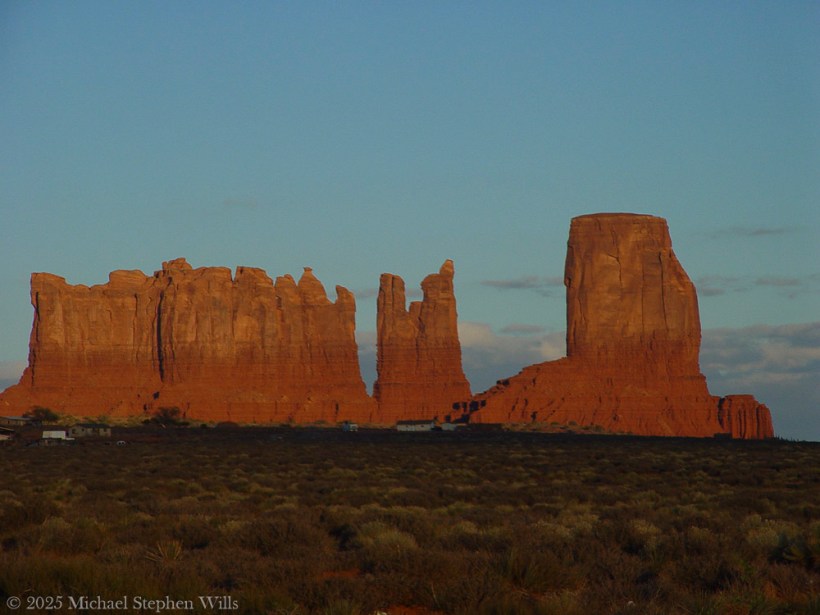
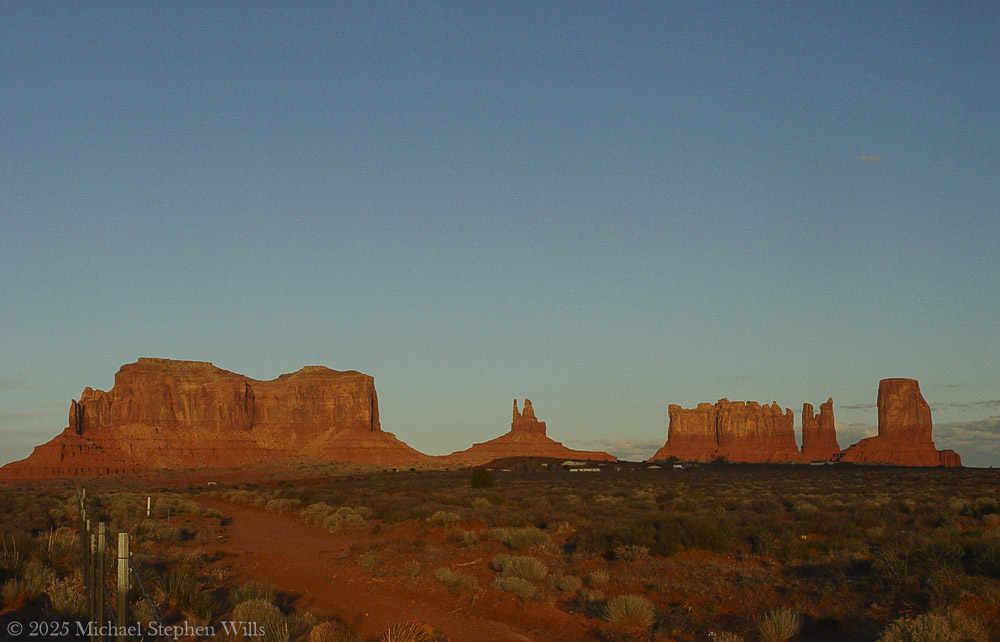
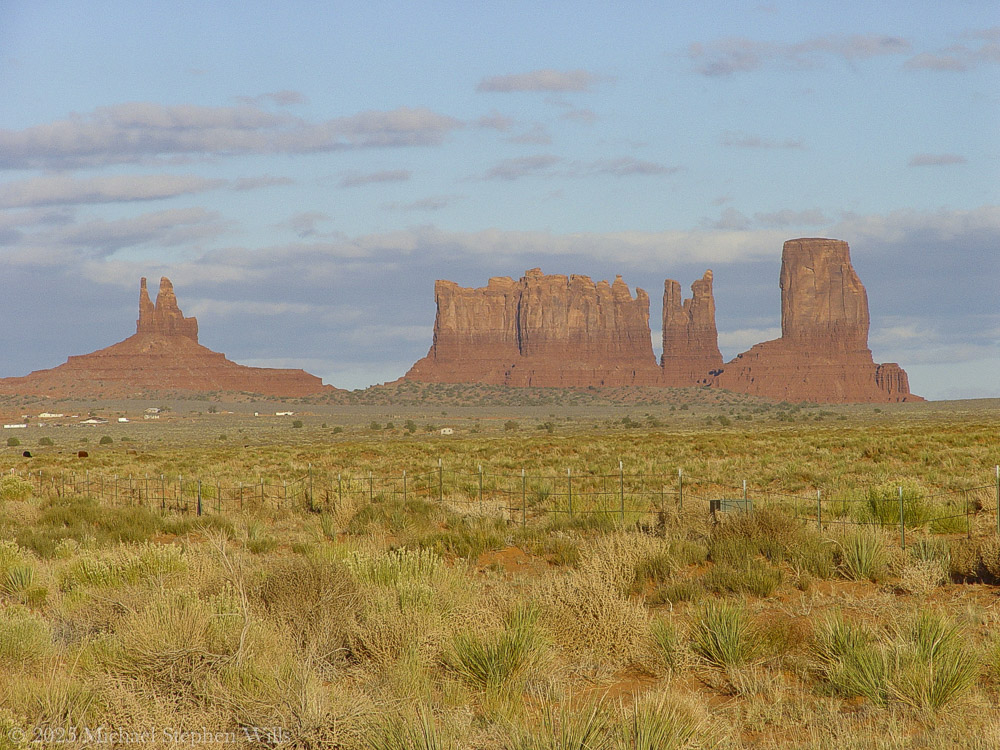
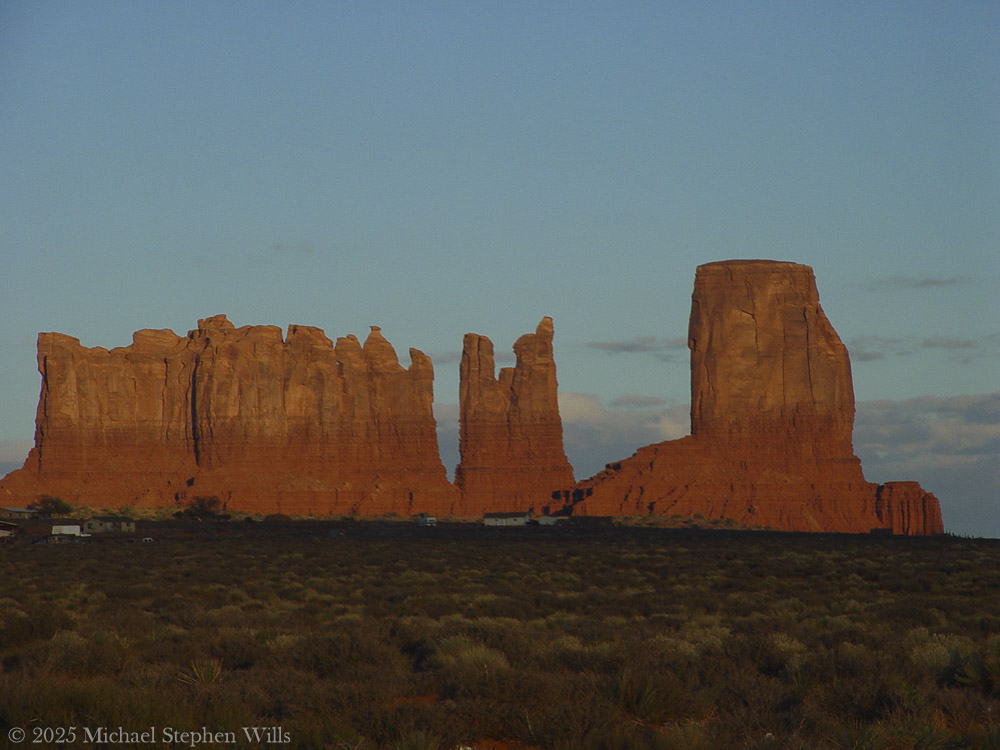
Their topographic relief is significant: Stagecoach rises 900 feet (274 meters) above the surrounding terrain in 0.35 mile (0.56 km), while King-on-his-Throne rises 565 feet (172 meters) in 0.2 mile (0.32 km). Each butte’s toponym has been officially adopted by the United States Board on Geographic Names—Stagecoach is named for its resemblance to a stagecoach, and King-on-his-Throne is said to resemble a monarch surveying his domain. Stagecoach’s first summit ascent was made in 1995 by John Middendorf, Carl Tobin, and Dan Langmade; King-on-his-Throne’s first was in 1967 by Fred Beckey, Marlene Dalluge, Joe Brown, and Don Liska.
To the southeast, past a stretch of ochre earth and sagebrush, rose two more forms. The King on His Throne, upright and proud, shaped as if he had emerged from the stone itself to bear witness. An artifact of erosion, also a sovereign presence—crowned in shadow and wind. There was no question of who he was. His seat was eternal, and no rider passed without first meeting his gaze.
Beside him stood The Stagecoach. Its resemblance to the name was almost too perfect, as if the form had stepped from the myth fully formed. But he knew better. It had not become a stagecoach. The coach had become it. The names were backwards, as names often are. The land had come first. All else was echo.
The giants stood together across the basin, their red-gold skin kindled in the last light. Their arrangement was no accident. One rose alone. Two more aside, bound by rhythm but not repetition. Together they formed a sequence—pause, proclamation, passage.
He walked the trail slowly, camera at his side but silent for a long while. There were things beyond framing. This was not a scene to be taken. It was a truth to be approached.
At the edge of the frame—a photograph not yet taken, but inevitable—the fence stretched taut across the scrub. Old wood. Rusted wire. Man’s line scratched against the land’s permanence. It held nothing. It said nothing. But it was there, and so he acknowledged it, as one acknowledges a child’s drawing pinned beside a mural.
Overhead, the sky was deepening into steel. But the earth still burned, even gently. The buttes and mesas were not dimmed by dusk. They only leaned inward, as if the heat of the day had carried them toward some great remembering.
He had seen many monuments in his life, but these were not monuments in the human sense. These were not built. They were born. They had no need for marble or inscription. Their gospel was in their silence, their liturgy the erosion of time itself.
He stood long, unmoving.
Not lost. Not searching. Just witnessing.
As the light slipped and the forms began to release their edges to shadow, he turned once—not away, but forward. The road still called. And the giants behind him did not diminish. They merely remained, as they always had, and always would.
Waiting.
Enter your email to receive notification of future postings. I will not sell or share your email address.
Copyright 2025 All Rights Reserved Michael Stephen Wills
A father and son journey to Eagle Mesa, experiencing its beauty and silence, reflecting on its history and significance within Navajo culture as the day fades.
They came north out of Chinle with the day already leaning west and the sun fallen low into the drag of horizon dust and the road ran flat and empty past rust hills and mesquite country until, turning into the sun at Mexican Water, after a long hour, at last they pulled into Kayenta where the streets lay quiet under the heavy sun and the windows of the store fronts cast their amber light out across the sand drifting across sidewalks and the wind stirred only faintly and then was still.
They left their bags in the room and turned north again without speaking. The son drove. A man, his father, sat quiet beside him and the sun slid low through the windshield and the sky was pale and cloudless and wide beyond reckoning.
The land began to rise and the road bent and climbed and fell again and then it came into view. Not slowly. Not like a curtain rising. It was simply there.
A shape in the far desert.
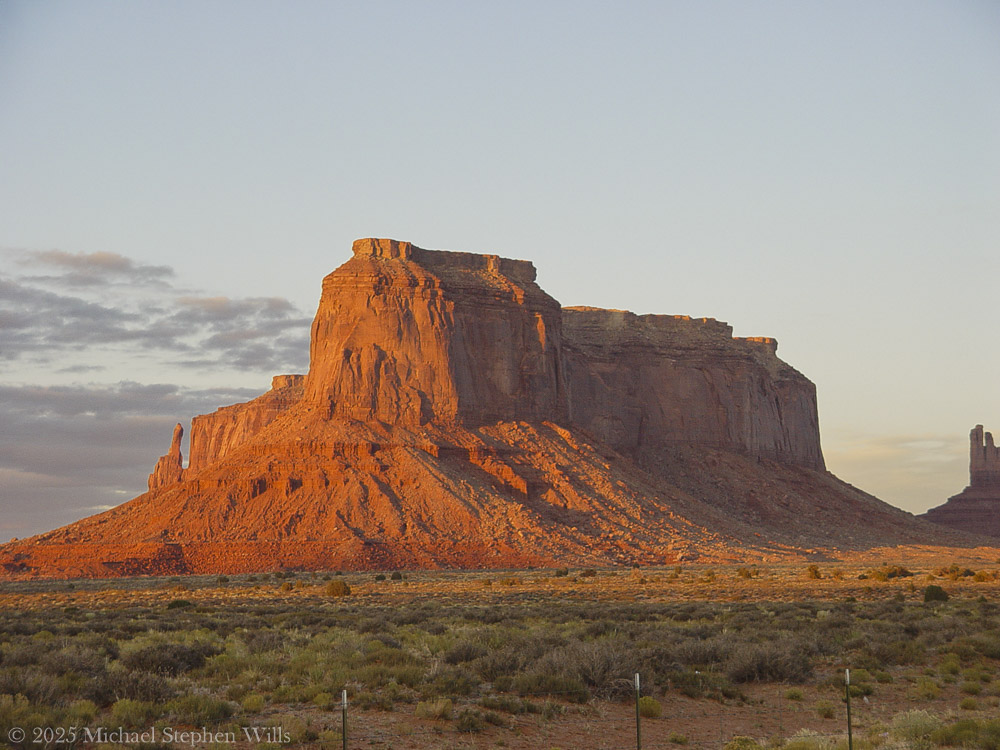
Like a ship that had grounded in a sea long vanished. A sheer mesa the color of blood and ochre and fire where the last of the day spilled westward and caught the rock face and made it burn.
He told the son to pull off. They stopped the car and got out and the sound of the engine fell away, the desert made no sound at all.
The man stood in the road and turned slowly. Eagle Mesa lay before him and the land stretched off in every direction and the fenceposts ran on into silence and the sky seemed to rest upon the buttes as if tired.
There were names for these places. Old names. Navajo names that spoke of eagles roosting and trees once there and water that came and went and did not come again. The mesa they called Wide Rock. The place where spirits go. He did not know the words but he knew the feeling.
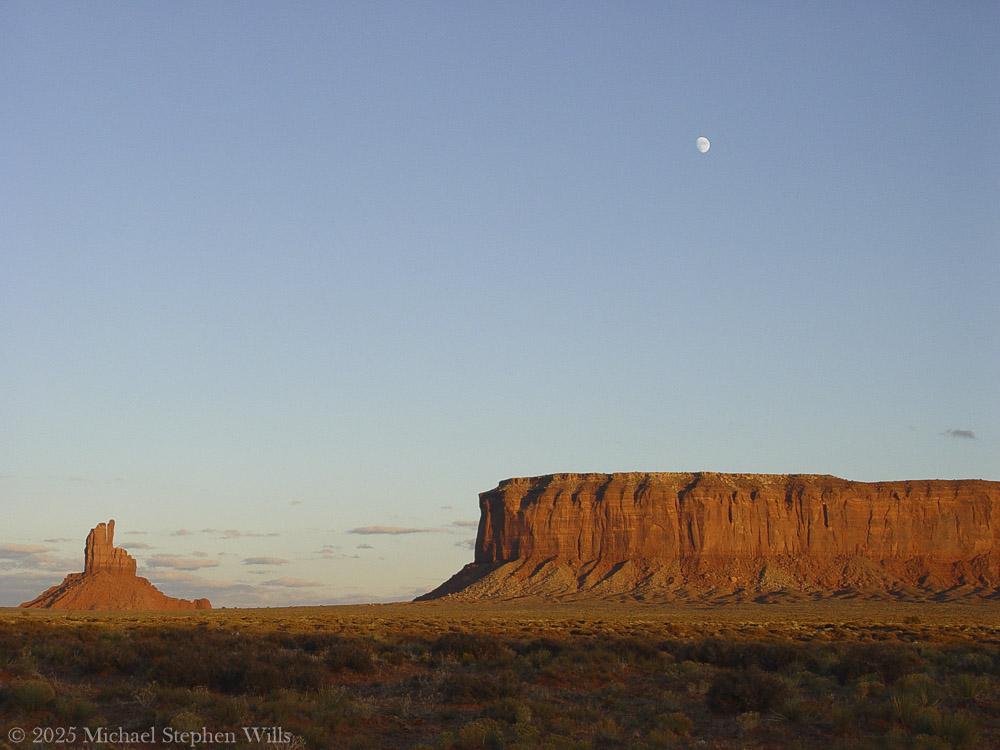
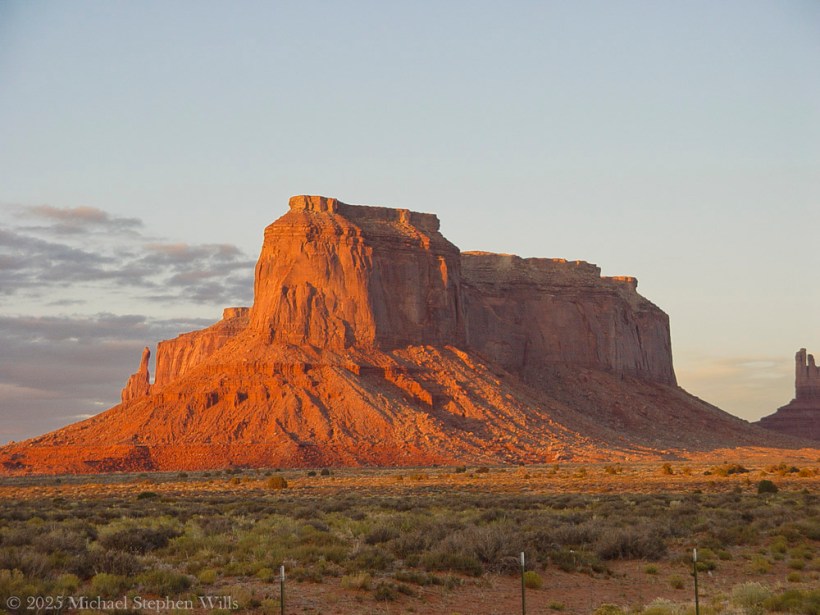
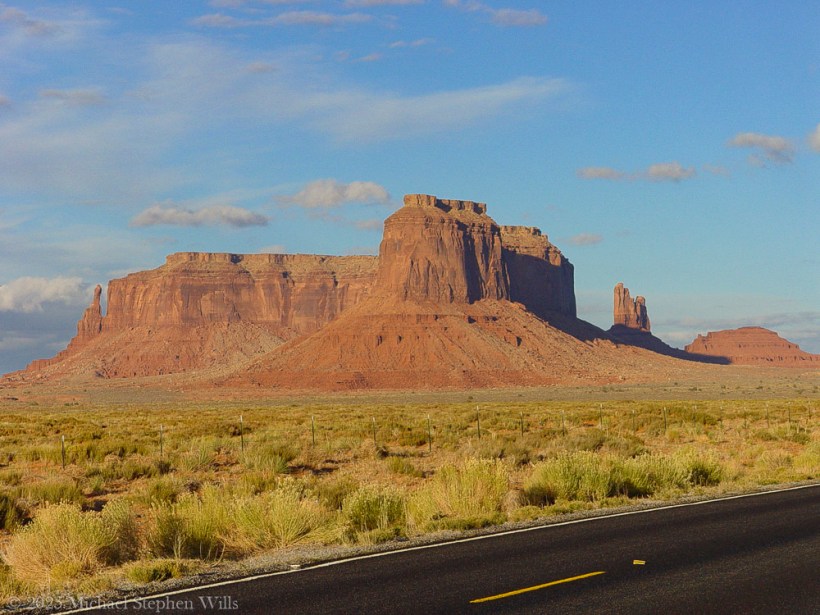
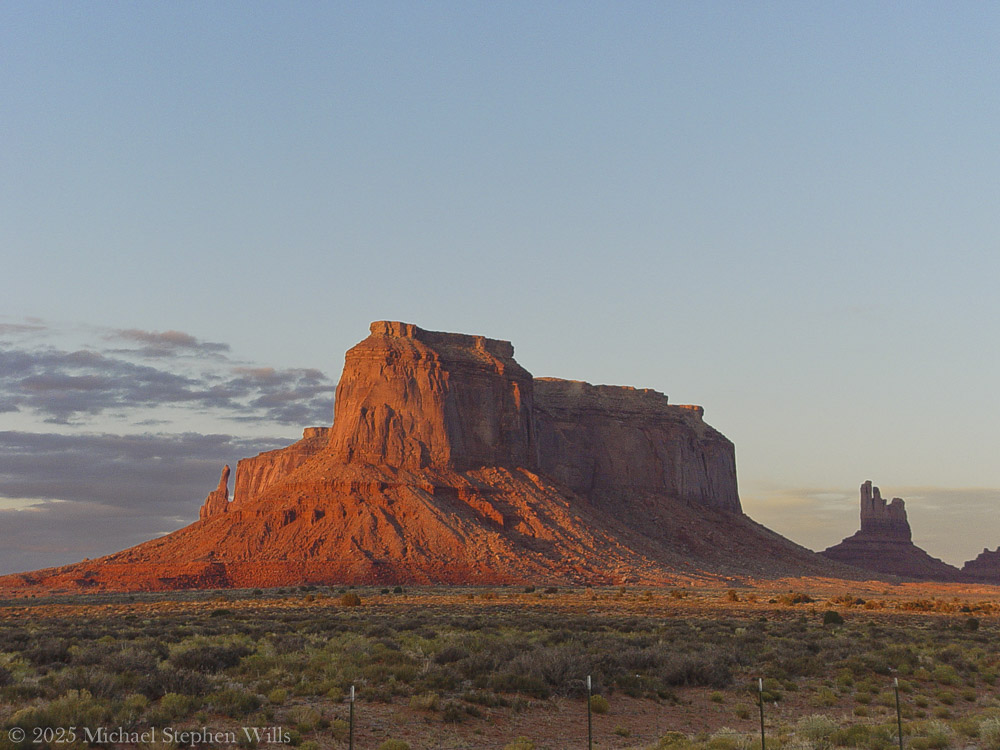
On the way to Monument Valley Tribal Park as the sunset for this view on Sullivan Road (Route 163). Navajo County, Arizona. Eagle Mesa is situated 4.5 miles (7.2 km) northeast of Oljato–Monument Valley, Utah, on Navajo Nation land. It is an iconic landform of Monument Valley and can be seen from Highway 163.Precipitation runoff from this mesa’s slopes drains to Mitchell Butte Wash and Train Rock Wash which are both part of the San Juan River drainage basin. Topographic relief is significant as the summit rises 1,100 feet (335 meters) above surrounding terrain in 0.6 mile (1 km). The nearest higher neighbor is Brighams Tomb, 2.05 miles (3.30 km) to the east. This landform’s toponym has been officially adopted by the United States Board on Geographic Names. Navajo names for the mesa are “Wide Rock”, “Where the Eagles Roost”, “Water Basket Sits”, and “Trees Hanging from Surrounding Belt” because there were once numerous trees here. In Navajo mythology, Eagle Mesa is a place where spirits of the deceased may go. Eagle Rock Spire is a 300-ft tower on the northern tip of the mesa which requires class 5.9 climbing skill to reach the summit.Navajo names for this spire which resembles a perched eagle include “Eagle Alongside Mesa”, “Big Finger is Pointed”, and Tsé Łichii Dahazkani (Elevated Red Rock Sitting Up). The first ascent of the spire was made on April 23, 1970, by Fred Beckey and Eric Bjornstad.
Geology
Eagle Mesa is a mesa composed of three principal strata. The bottom layer is Organ Rock Shale, the next stratum is cliff-forming De Chelly Sandstone, and the upper layer is Moenkopi Formation capped by Shinarump Conglomerate. The rock ranges in age from Permian at the bottom to Late Triassic at the top. The buttes and mesas of Monument Valley are the result of the Organ Rock Shale being more easily eroded than the overlaying sandstone.
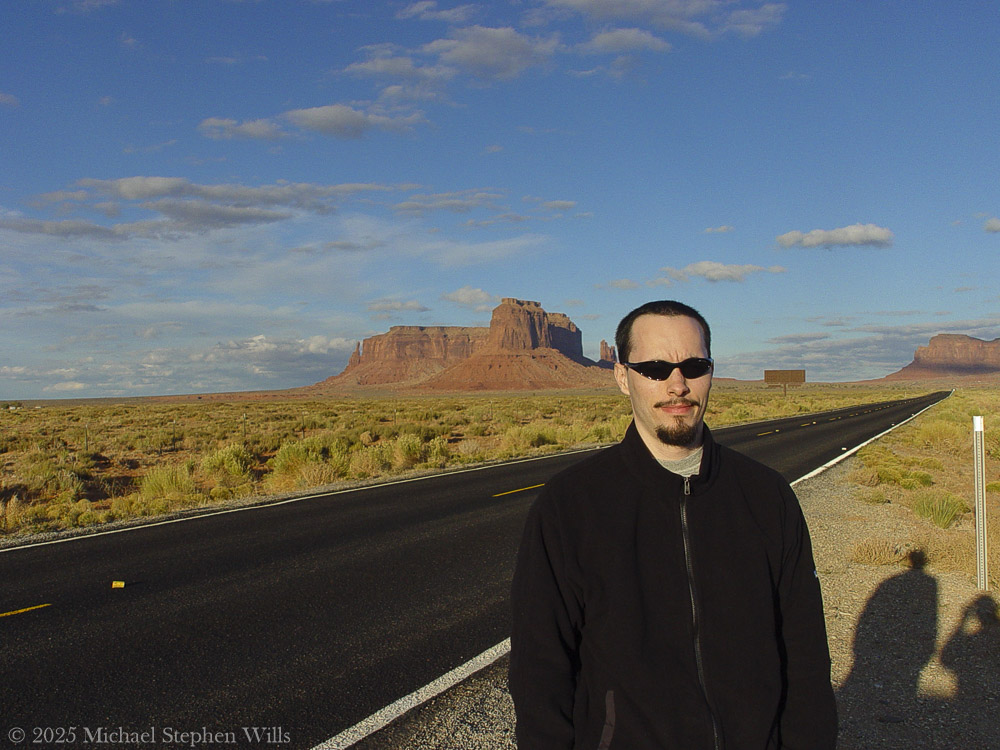
The son came and stood beside him and did not speak. The man lifted the camera and took a photograph and then another. The road behind them shimmered with the last heat of day. He took another picture his son, dressed in black, his arms at rest and the red mesa rising behind him and the shadows of their bodies cast long across the gravel and the shoulder of the road.
On the way to Monument Valley Tribal Park as the sunset for this view on Sullivan Road (Route 163). Behind Sean are the landforms Eagle Mesa and behind it Setting Hen, Bringham’s Tomb, to the right. Navajo County, Arizona
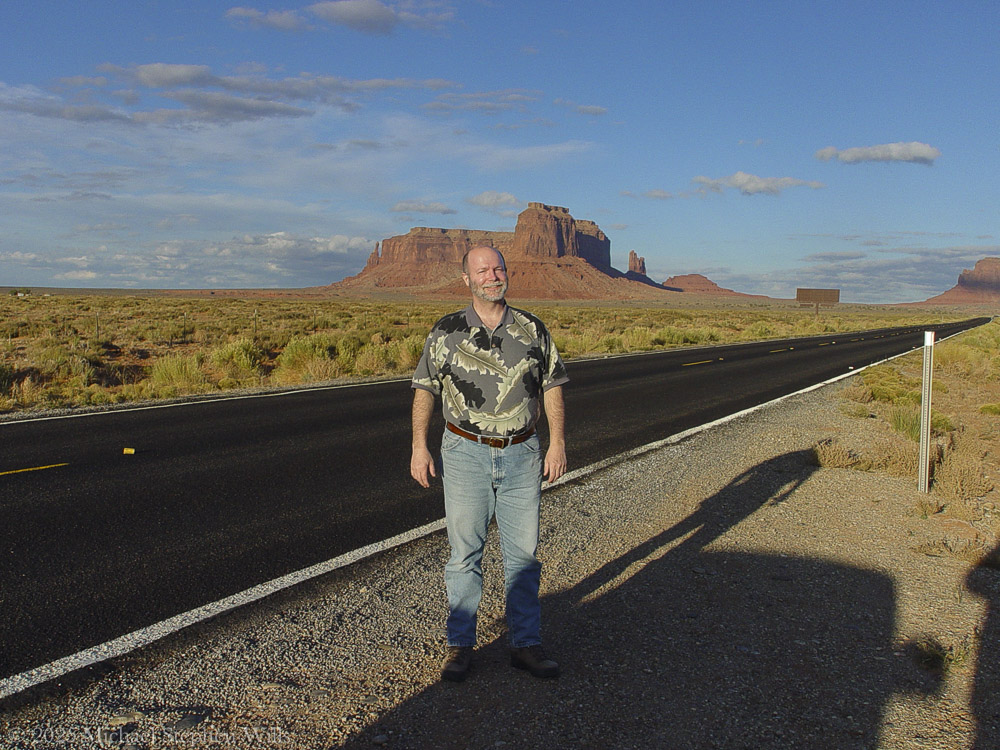
They took turns with the camera. The son caught him midstride and smiling lit by sunlight, the land stretching out all around. A man small in a world not made for men.
There was no sound but the click of the shutter and the dry whisper of wind among the sage.
On the way to Monument Valley Tribal Park as the sunset for this view on Sullivan Road (Route 163). Behind Mike are the landforms Eagle Mesa and behind it Setting Hen, Bringham’s Tomb to the right. Navajo County, Arizona
Later he would read that the rock was born of Organ Shale and De Chelly Sandstone and Moenkopi topped with Shinarump. He would know the spire they saw was first climbed by men named Beckey and Bjornstad and that it was called Tsé Łichii Dahazkani by those who’d named it before it ever had another name. He would know the mesa rose eleven hundred feet in less than a mile and that its runoff fed washes that fed rivers that fed nothing now.
But then he only stood and watched and knew it for what it was.
Not a monument to anything but time.
A stillness like prayer. A place that waits.
They lingered until the sun went and the sky turned iron blue and the shadows of the rock reached out across the valley floor and touched them where they stood. Then they climbed back in the car and drove south again and the road unwound behind them black and a single star above and the silence of the place held on inside them long after the valley was gone.
Enter your email to receive notification of future postings. I will not sell or share your email address.
Copyright 2025 All Rights Reserved Michael Stephen Wills
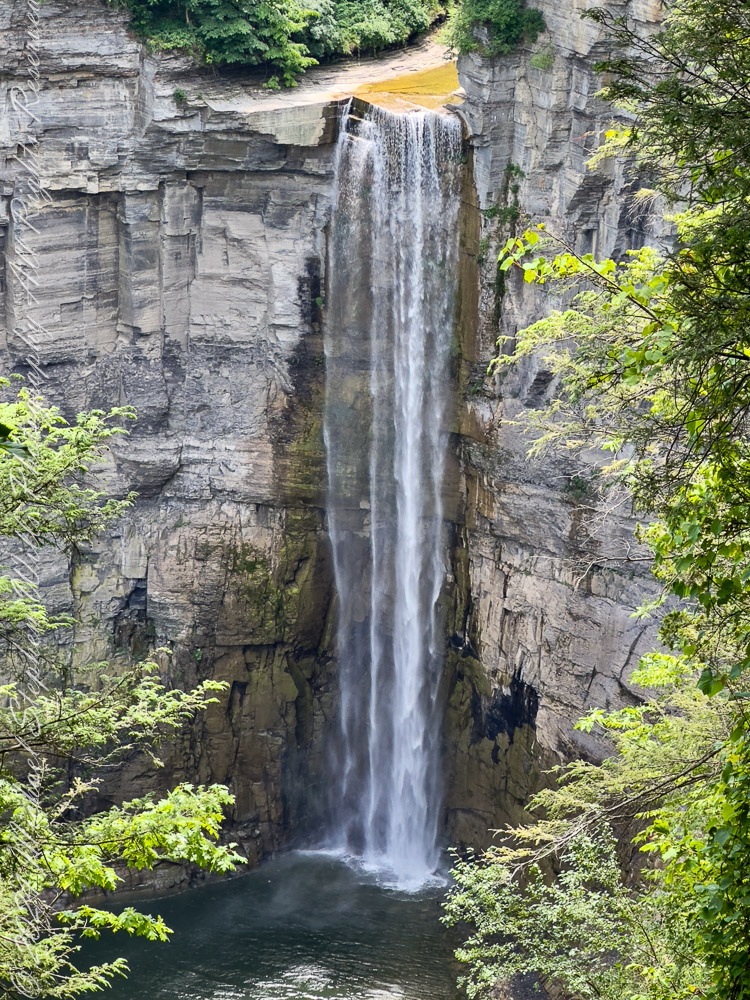
Taughannock Falls, a majestic 215-foot waterfall, showcases nature’s beauty and power, intertwining geological history with vibrant ecosystems in New York.
Introduction Nestled in the heart of the Finger Lakes region of New York, Taughannock Falls stands as a testament to the delicate balance of power and beauty in nature. This iconic waterfall plunges 215 feet—one of the tallest single-drop waterfalls east of the Rocky Mountains—into a gorge whose story is written in stone. The park surrounding this natural wonder offers a symphony of sights, from towering cliffs to lush greenery, inviting visitors to explore its ancient secrets and vibrant life.
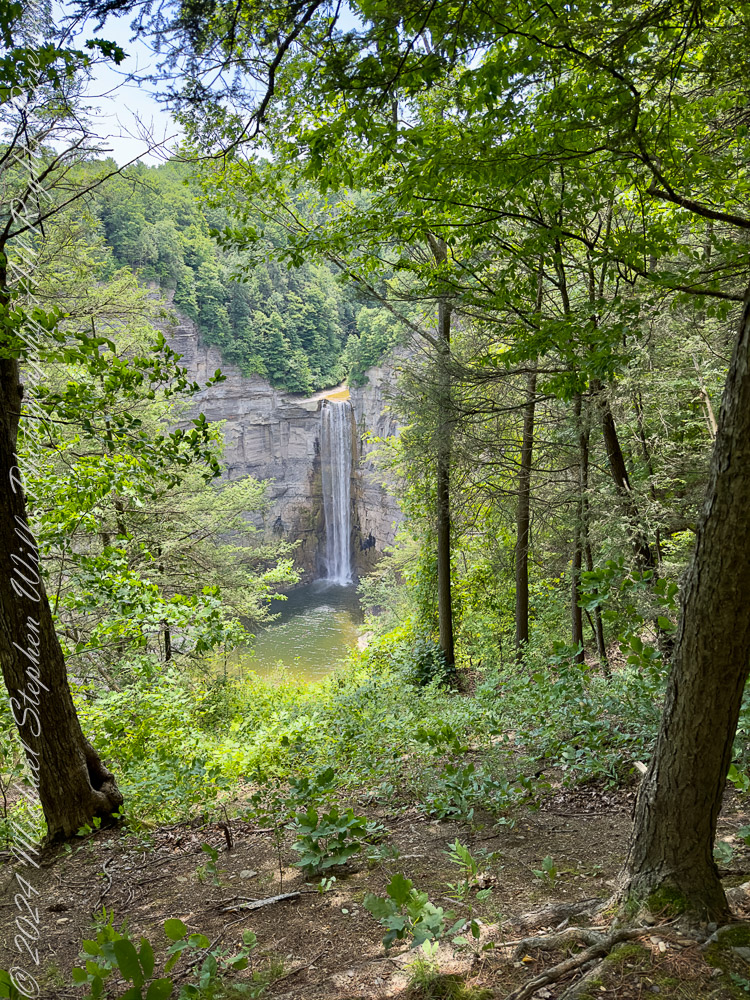
View of taughannock Falls from the South Rim Trail. Taughannock Falls New York State Park, Trumansburg, Tompkins County, Finger Lakes Region
A Story Written in Stone The rocks of Taughannock Falls tell a story that stretches back 380 million years to the Devonian Period, a time when the region was submerged beneath a shallow inland sea. Layer upon layer of shale, sandstone, and limestone formed as sediment settled to the ocean floor, preserving the fossils of marine life that once thrived here. These rocks have endured the passage of eons, but the gorge itself is a far more recent creation.
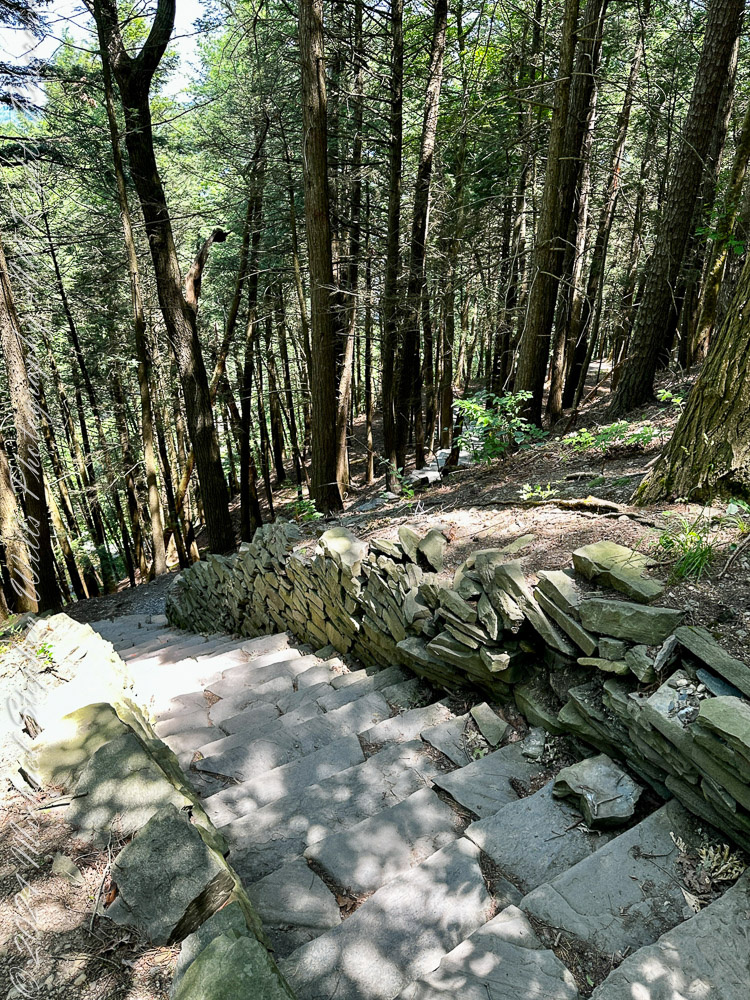
Limestone Steps on the South Rim Trail descend to the gorge floor.
It was the retreat of the mighty Laurentide Ice Sheet, approximately 10,000 years ago, that set the stage for Taughannock’s grandeur. As glaciers melted, torrents of water carved the U-shaped valleys that now cradle the Finger Lakes. Taughannock Creek, a tributary of Cayuga Lake, began its work, etching its path through ancient rock, sculpting the gorge we see today. In just 10,000 years—a fleeting moment in geological time—the relentless force of water carved its way 3/4 of a mile upstream, creating the awe-inspiring chasm and waterfall that continue to evolve even now.
Taughannock Creek carved this landscape over thousands of years.
The Gorge’s Living Tapestry Beyond its geological wonders, Taughannock Falls State Park bursts with life. Along the North and South Rim Trails, Eastern Hemlocks (Tsuga canadensis) stand tall, their evergreen branches weaving shadows that dance across stone stairways and forest floors. These silent sentinels are habitats for myriad creatures and protectors of the delicate ecosystem.
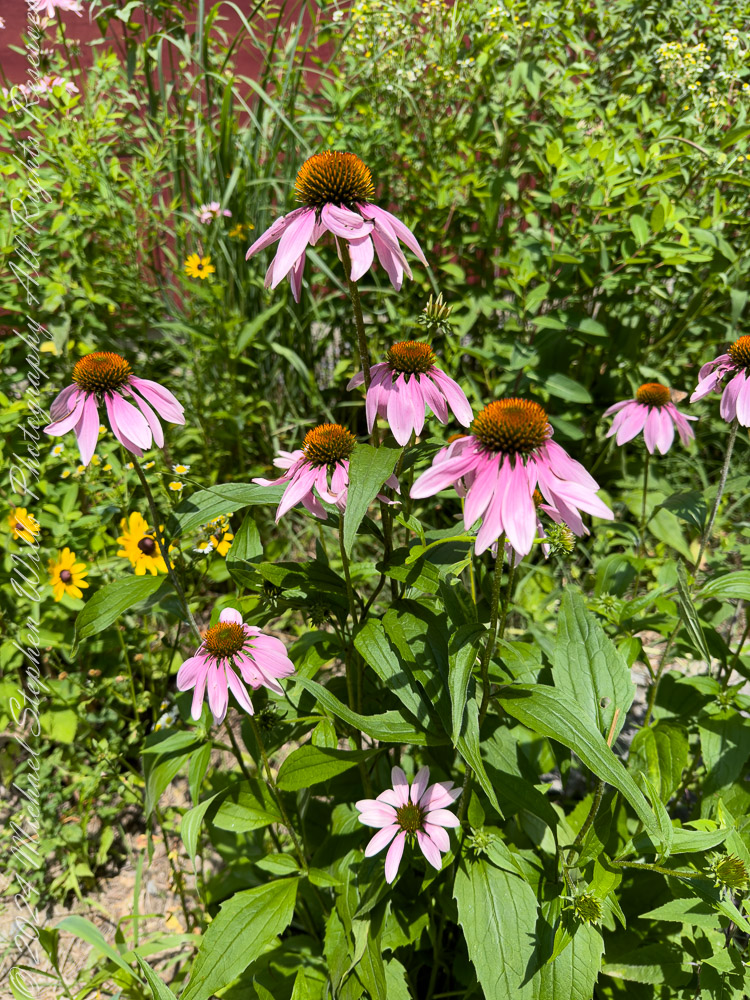
Wildflowers were planted by park staff at the Falls Overlook. The bright yellow of Black-eyed Susans (Rudbeckia hirta) and the vibrant purple of Coneflowers (Echinacea purpurea) attract bees and butterflies, their nectar fueling the intricate web of life that thrives here. Along the trail, on the forest floor, mosses and ferns cling to rocks, softening the edges of the gorge with their verdant touch.
Cone FlowersCone Flowers gone to seedFrom a walk around Taughannock Falls State Park “Rim Trails” October 22nd, 2024. Trumansburg, Tompkins County, Finger Lakes Region, New York State.
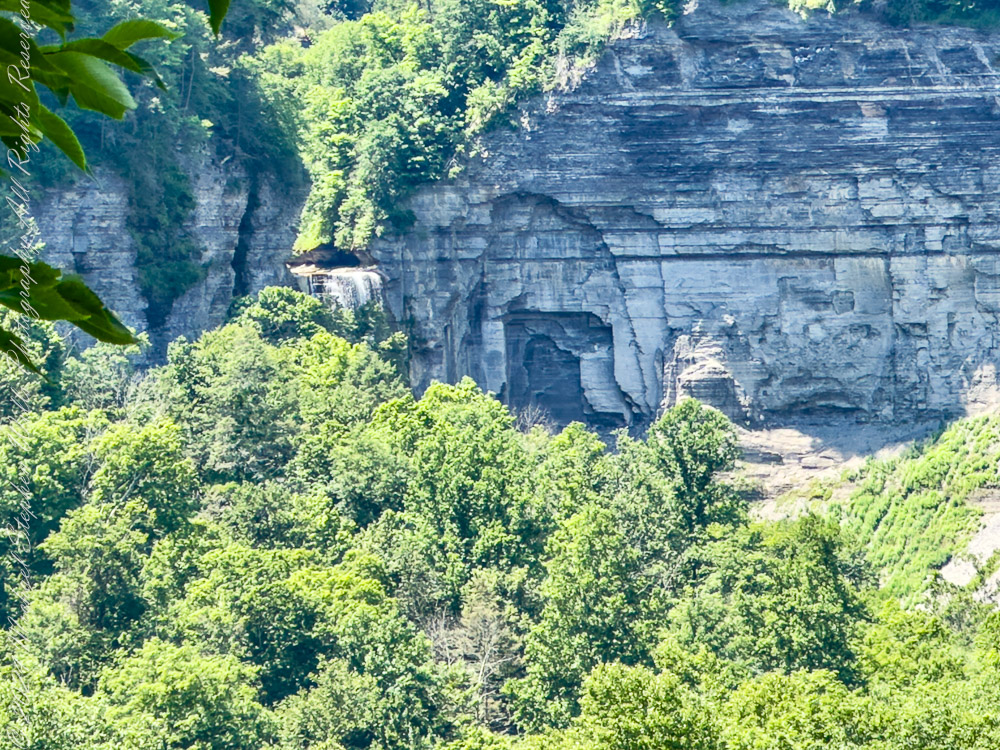
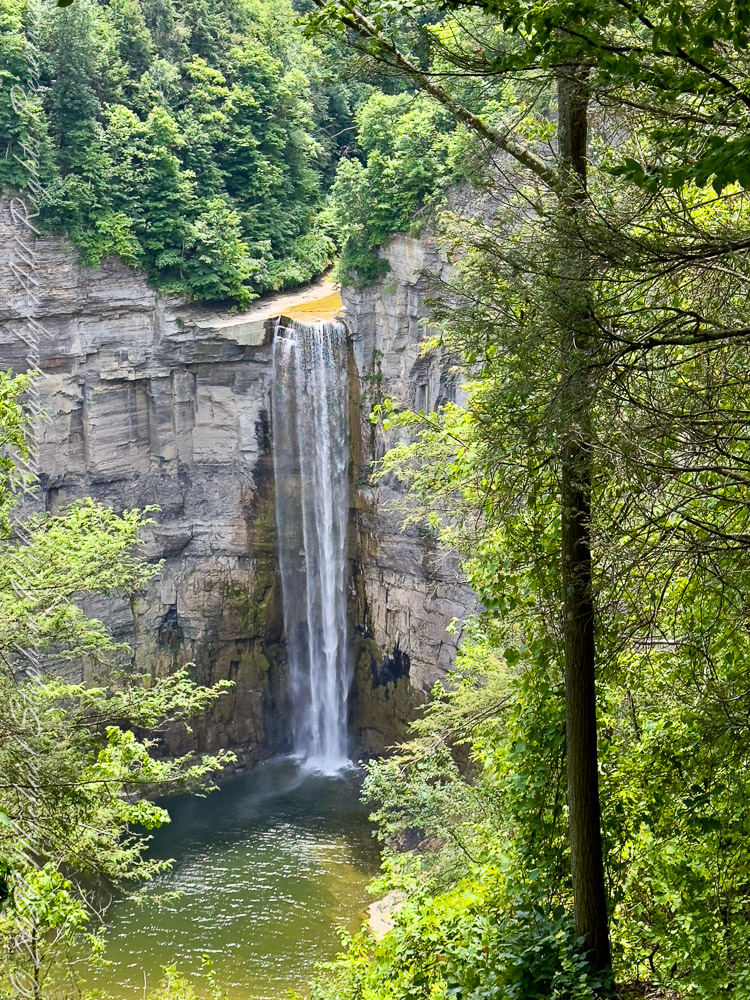
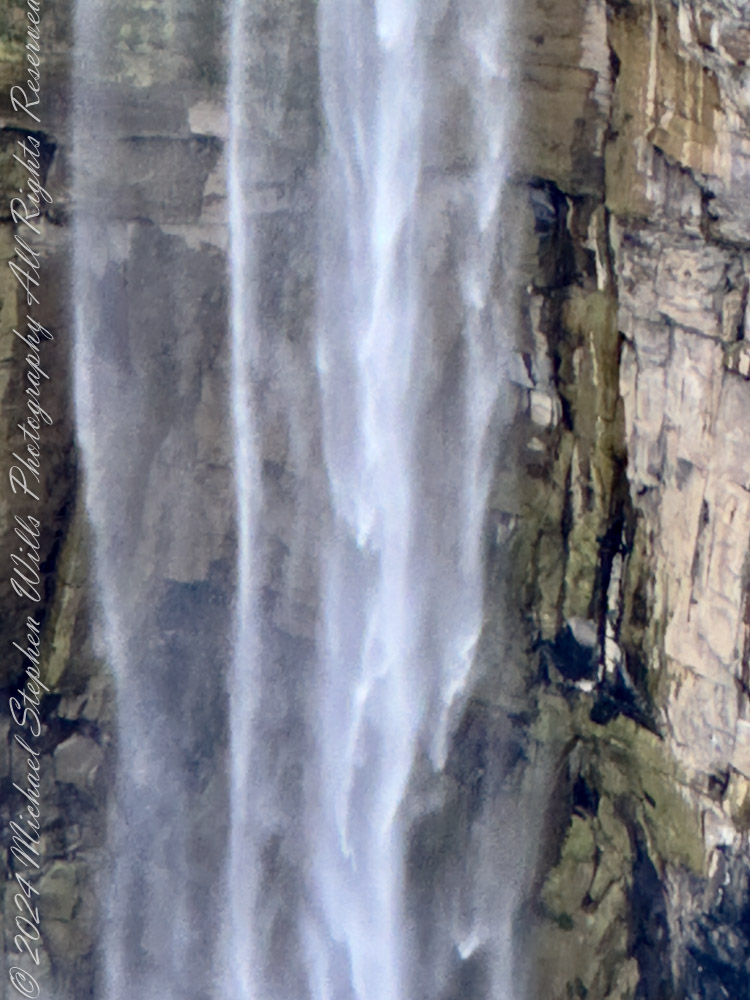
The Fall’s Eternal Dance At the heart of the park is the waterfall itself, its roar both a hymn and a whisper of time’s passage. The view from the North Rim Trail reveals the waterfall framed by steep cliffs, their striations like pages in a book written by water, wind, and time. The plunge pool below, shimmering in sunlight, seems almost sacred—a place where the forces of nature meet in harmony.
Viewed from the North Rim Trail on a summer morning. Taughannock Falls New York State Park, Trumansburg, Tompkins County, Finger Lakes Region
Even as we marvel at its beauty, the falls are a reminder of the earth’s constant transformation. Each drop of water that cascades down the cliff face carries away tiny fragments of rock, continuing the slow, deliberate work of reshaping the land. What we witness today is but one moment in an ongoing process—a fleeting glimpse of a masterpiece in progress.
A Place of Wonder To stand at the edge of Taughannock Falls is to feel both small and connected. The cliffs, formed over hundreds of millions of years, whisper of ancient seas and forgotten worlds. The gorge, carved in the blink of an eye by geological standards, speaks to the power of water and time. And the vibrant life that fills the park reminds us of nature’s resilience and beauty.
As the sun filters through the trees, illuminating the mist that rises from the falls, it’s easy to believe that this place holds magic. Perhaps it’s in the way the water sparkles like diamonds in the sunlight or the way the breeze carries the scent of pine and earth. Or maybe it’s in the knowledge that here, in this park, we are witnesses to a story billions of years in the making.
Conclusion Taughannock Falls State Park is a place of wonder where geology, ecology, and history converge. It invites us to reflect on the immense forces that shape our world and to cherish the fleeting beauty of each moment. Whether you come to marvel at the towering waterfall, walk among the hemlocks, or simply stand in awe of the gorge, Taughannock Falls leaves an indelible mark on the heart—a reminder of nature’s power, resilience, and enduring grace.
Enter your email to receive notification of future postings. I will not sell or share your email address.
Copyright 2024 All Rights Reserved Michael Stephen Wills
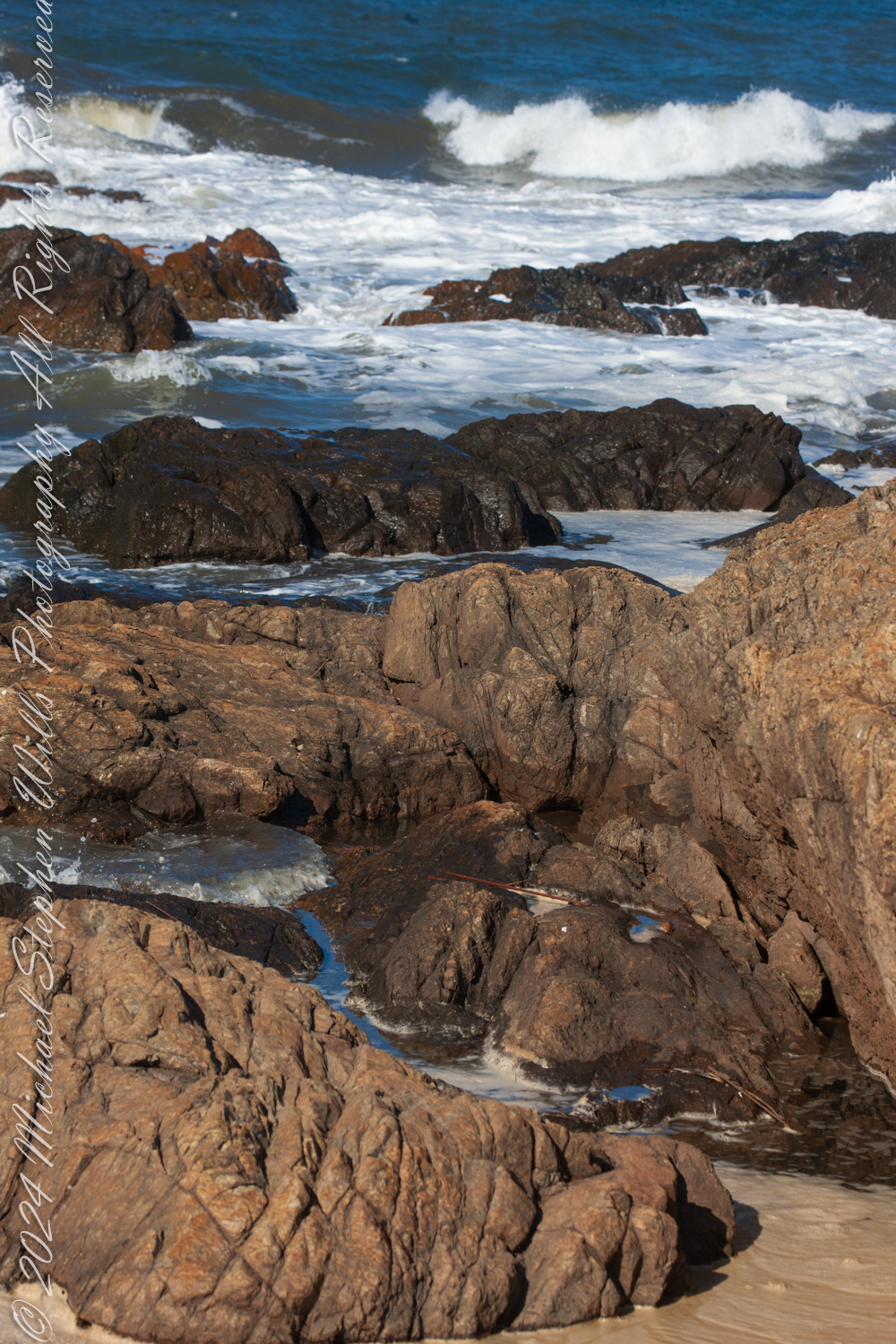
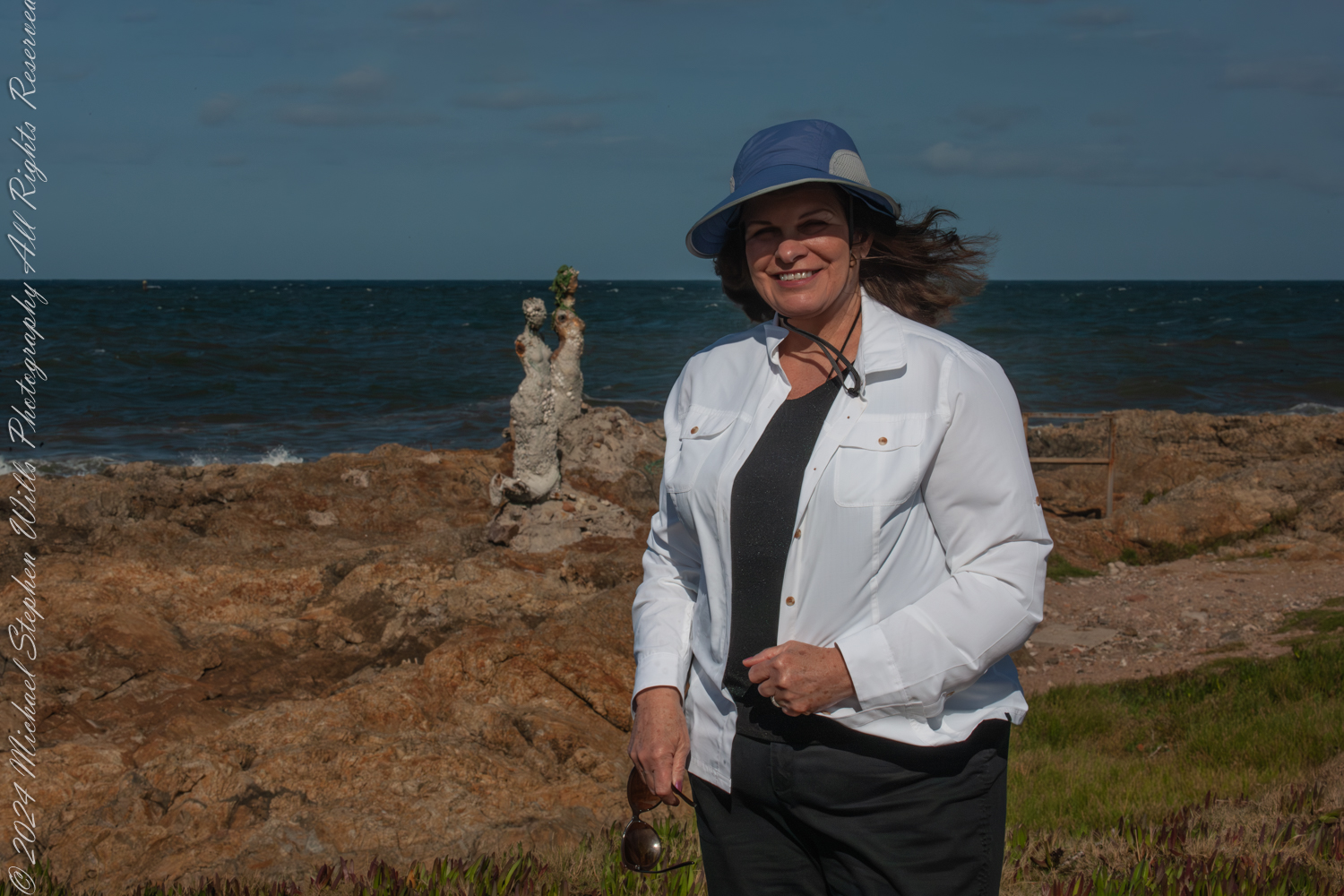
As I stood at the edge of Punta del Este, Uruguay, I marveled at the wild beauty of the place. We were at Punta de las Salinas, the very tip of the peninsula, the edge of where the Atlantic Ocean meets the Río de la Plata. This easternmost point of Uruguay, where time feels suspended as restless waves crash against rocky shores. A sea breeze carries a distinct salty tang.
This is at Great Britain Square, Punta de las Salinas of Punta del Este. We are at the tip of the peninsula, the easternmost point of Uruguay. Punta del Este, Departamento de Maldonado, Uruguay
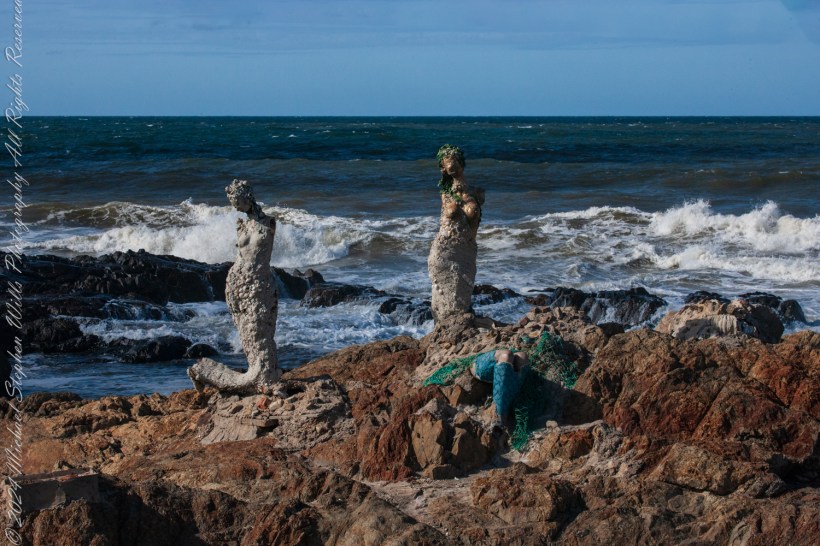
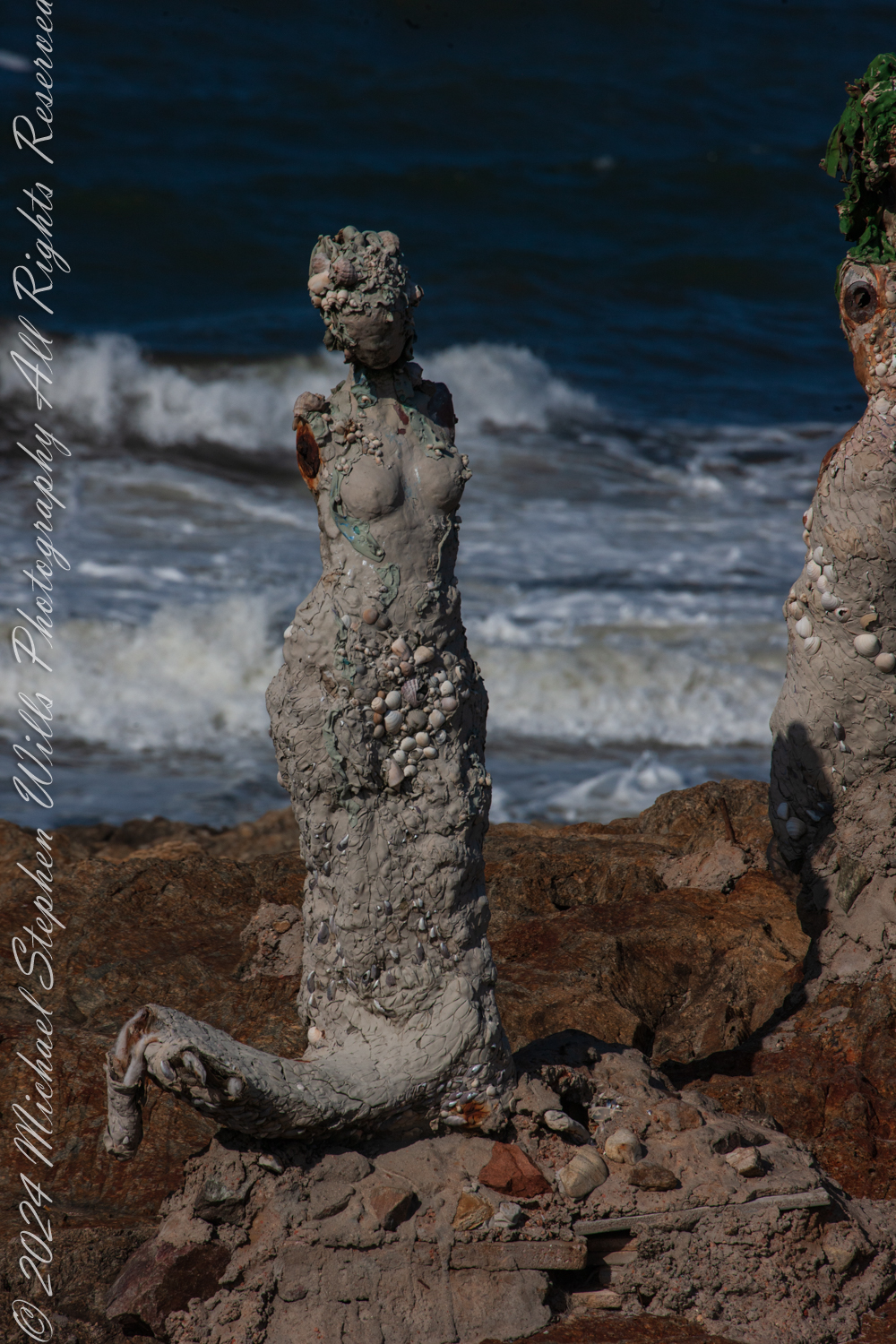
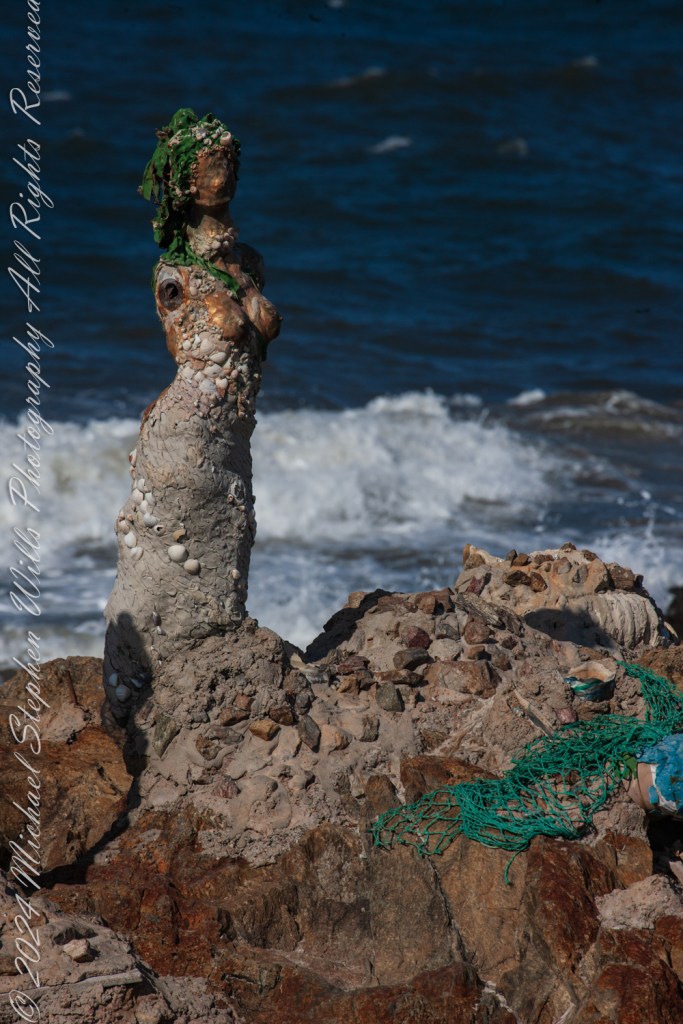
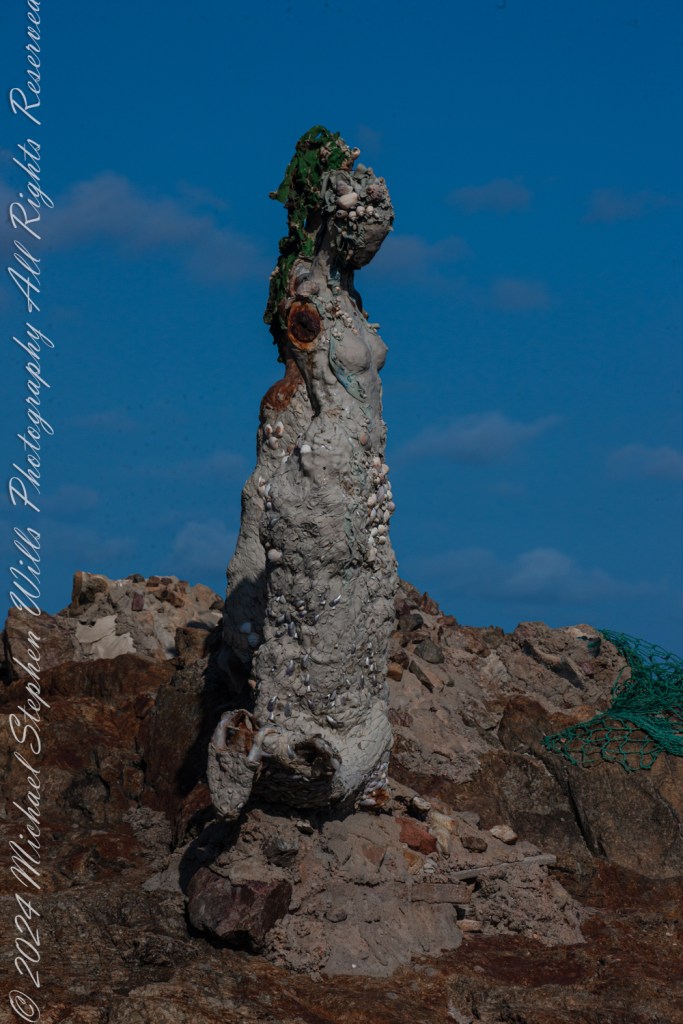
Pam, my wife, stood beside me, a bright smile on her face as the ocean wind tugged at her sunhat. Behind her, rising among the rocks, was an art installation that seemed to embody the spirit of the place “El Canto de las Sirenas” (The Song of the Mermaids). These sculptures by the artist Lily Perkins, their forms shaped and worn by the elements, appeared almost as though they were natural extensions of the rocky coastline. They gazed out to sea, their haunting beauty a poignant reminder of myth and humanity’s eternal connection with the ocean.
The sirens, crafted with an earthy texture and adorned with bits of marine debris, seemed to tell a story of resilience and adaptation. They stood stoically against the backdrop of the churning waves, their barnacle-like surfaces merging seamlessly with their rugged surroundings. I felt a strange connection to them, as if they were silent witnesses to the ever-changing dance of the sea and sky.
Pam during our 2016 South American tour. This is at Great Britain Square, Punta de las Salinas of Punta del Este. We are at the tip of the peninsula, the easternmost point of Uruguay. Over her shoulder is the art installation “El Canto de las Sirenas” (The Song of the Mermaids) (2012) by the artist Lily Perkins. Punta del Este, Departamento de Maldonado, Uruguay
The morning was perfect for photography. I adjusted my Canon camera, capturing the interplay of light and shadow across the jagged rocks, the turquoise waves, and the statues. The textures of the sirens came alive through the lens, each detail hinting at the passage of time and the endless conversations between water and stone. Pam posed in front of one of the sculptures, her presence adding a touch of humanity to the scene, as though she were part of this mythological tableau.
I took a moment to step back and absorb the scene. The coastline stretched out before me, rugged and raw, with the waves crashing in an eternal rhythm. The sirens belonged here, their forms shaped artist hands, then also by the elements. They merged into this unique place, much like the wind, the rocks, and the ocean.
As we walked along the rocky outcrop, the sound of the waves filled the air, drowning out any other noise. It was easy to lose oneself in the hypnotic patterns of the water, the spray catching the sunlight like tiny jewels. I found myself reflecting on the history of this place—Punta del Este, a meeting point of cultures and stories, a place where the natural world and human creativity converge.
Great Britain Square, where we started this journey, seemed an apt setting for such an installation. The name itself evokes a sense of exploration and connection across vast distances, much like the sirens that seem to call out across the waves. The symbolism was not lost on me as I thought about how we, too, were travelers, drawn to the edges of the earth by a desire to explore and understand.
Plaza Gran Bretana (Great Britain Square) is named for the World War II naval battle near here between the German battleship Graf Spee and the English ships Ajax, Achilles and Exeter. The plaza also has an anchor marking the boundary between Rio de la Plata and the Atlantic Ocean.
Pam and I lingered for a while longer, taking in the scenery and enjoying the peacefulness of the moment. The sculptures seemed almost alive, their forms shifting subtly as the light changed. They reminded me of the stories of sirens from ancient mythology—creatures that lured sailors to their doom with their enchanting voices. But here, they seemed more like guardians, watching over the waters and the land, their presence a testament to the enduring power of art and nature.
As the morning wore on, we made our way back, leaving the sirens behind to their eternal vigil. The experience stayed with me, though, a vivid memory of a place where myth and reality intertwine. Punta de las Salinas, with its rugged beauty and its mysterious sirens, had left an indelible mark on my heart.
Enter your email to receive notification of future postings. I will not sell or share your email address.
Copyright 2024 All Rights Reserved Michael Stephen Wills
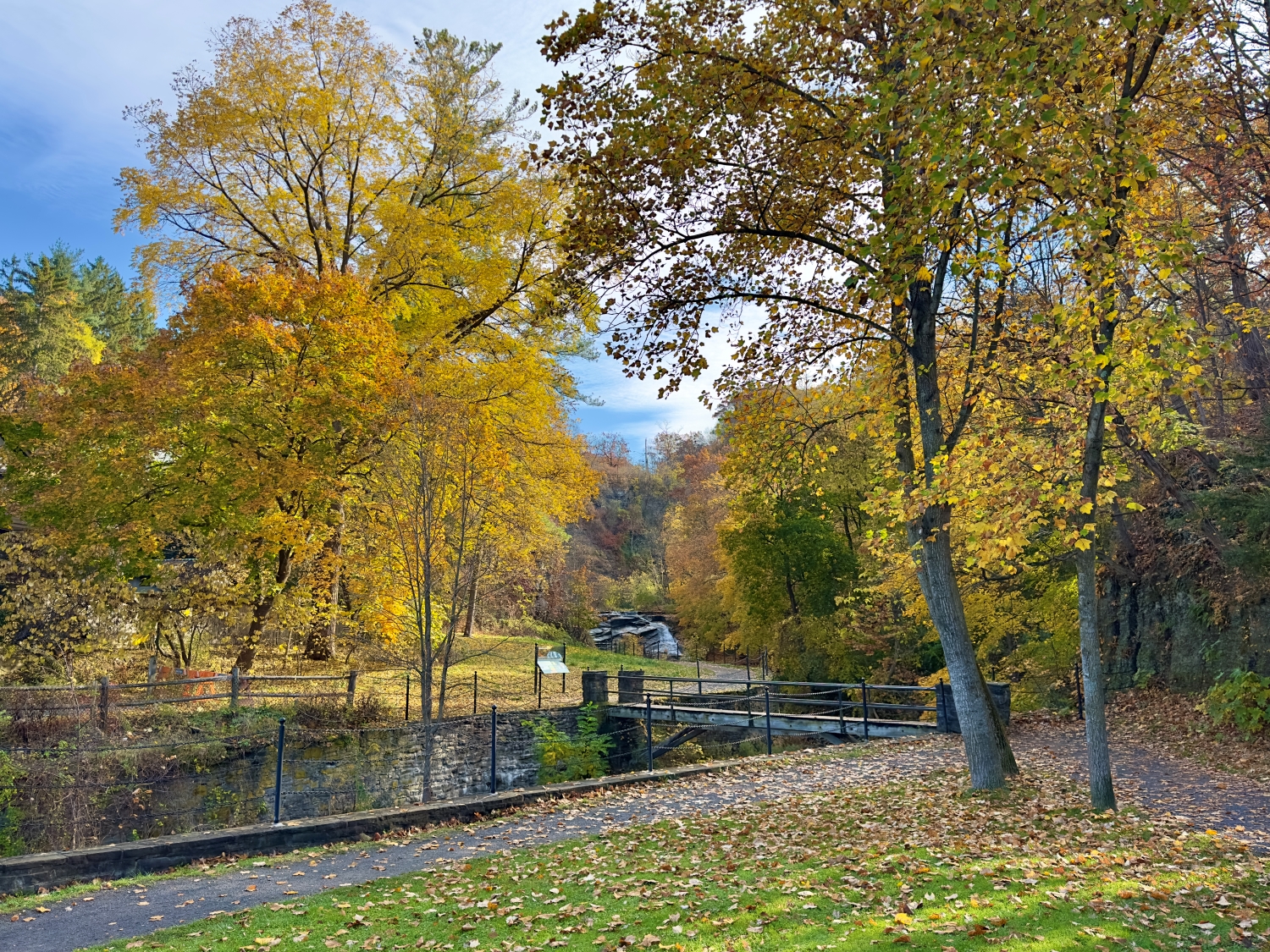
As I step into Cascadilla Gorge from the Linn Street entrance, I’m greeted by the soft rustling of leaves and the constant, soothing rush of water. The air this Halloween Day is warm, the autumn colors vibrant against the cool blue sky. I know Cascadilla Gorge is part of the Cornell Botanical Gardens, but the immediate beauty of this natural sanctuary makes it easy to forget I’m still within the city limits of Ithaca. The sounds of the gorge draw me in, as if whispering there’s more to see, more to explore. With a deep breath, I begin my journey up the trail, eager to discover what lies ahead.
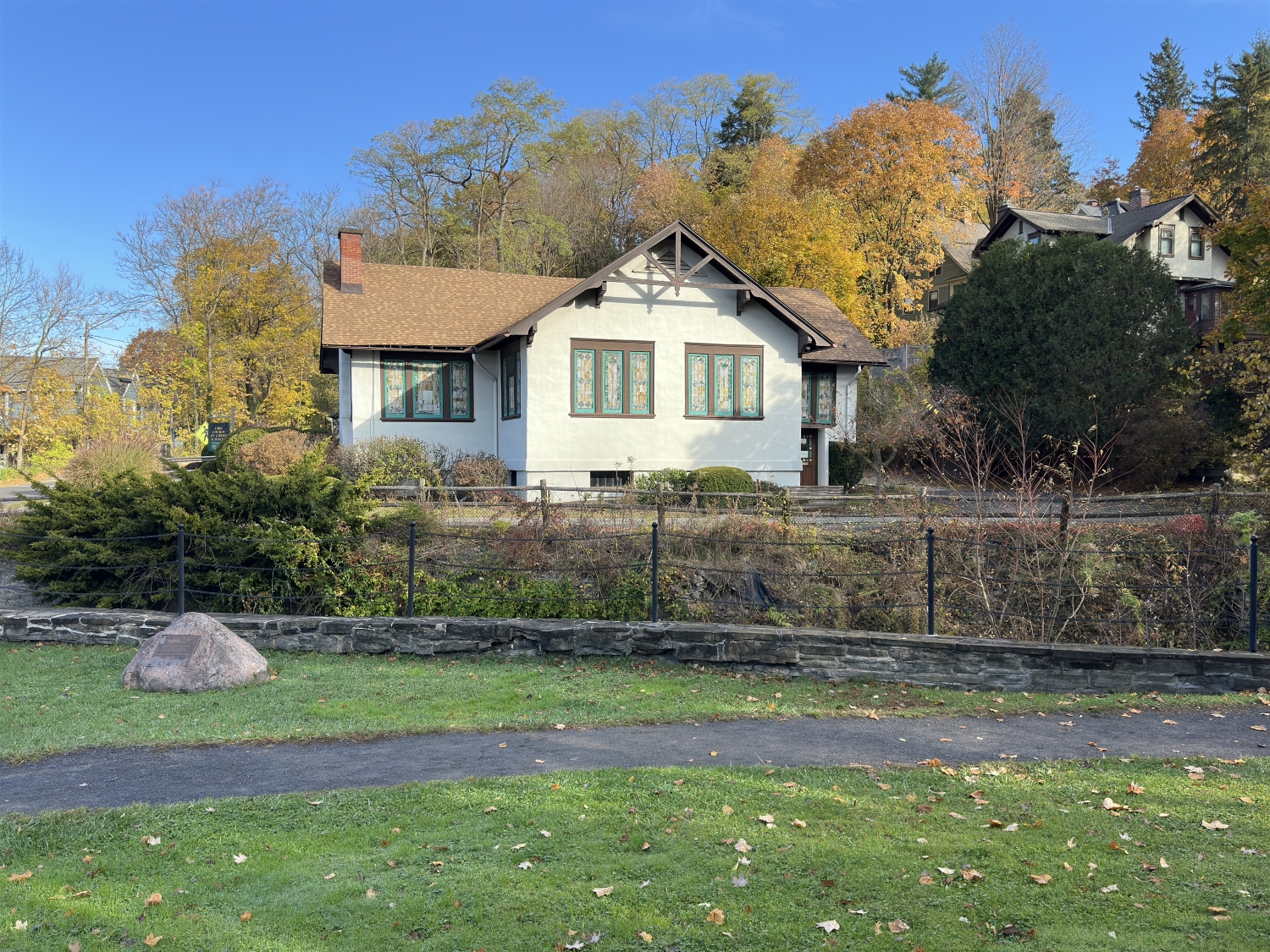
Just a short way in, I notice the First Church of Christ, Scientist perched on the corner of University Avenue and Cascadilla Park Road. The architecture of the church is both quaint and elegant, with its light-colored facade framed by dark trim and roof. Surrounded by foliage, it feels like the church belongs here, as much a part of the landscape as the trees and rocks. The sight of this historic building nestled so close to the gorge reminds me that this wild and ancient place is woven into the fabric of Ithaca’s community life.
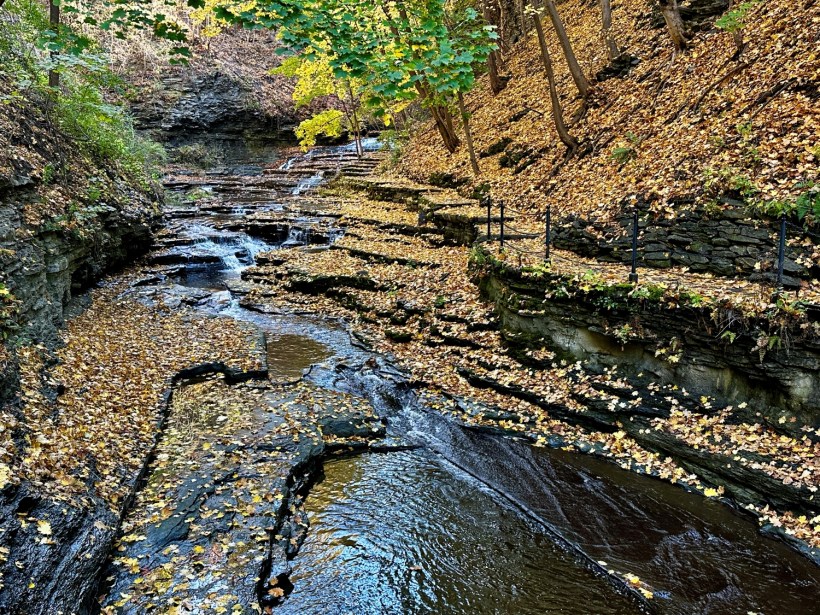
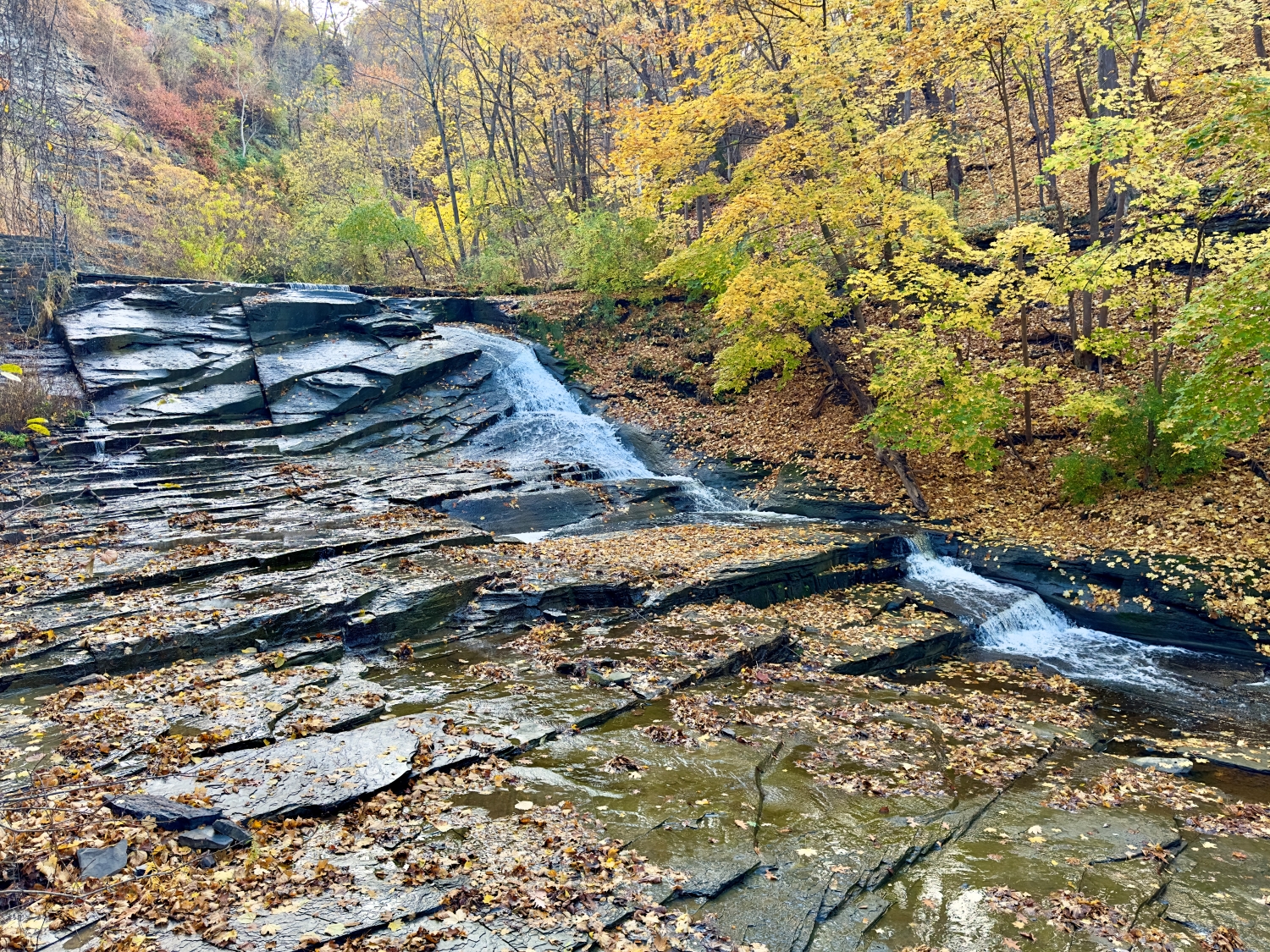
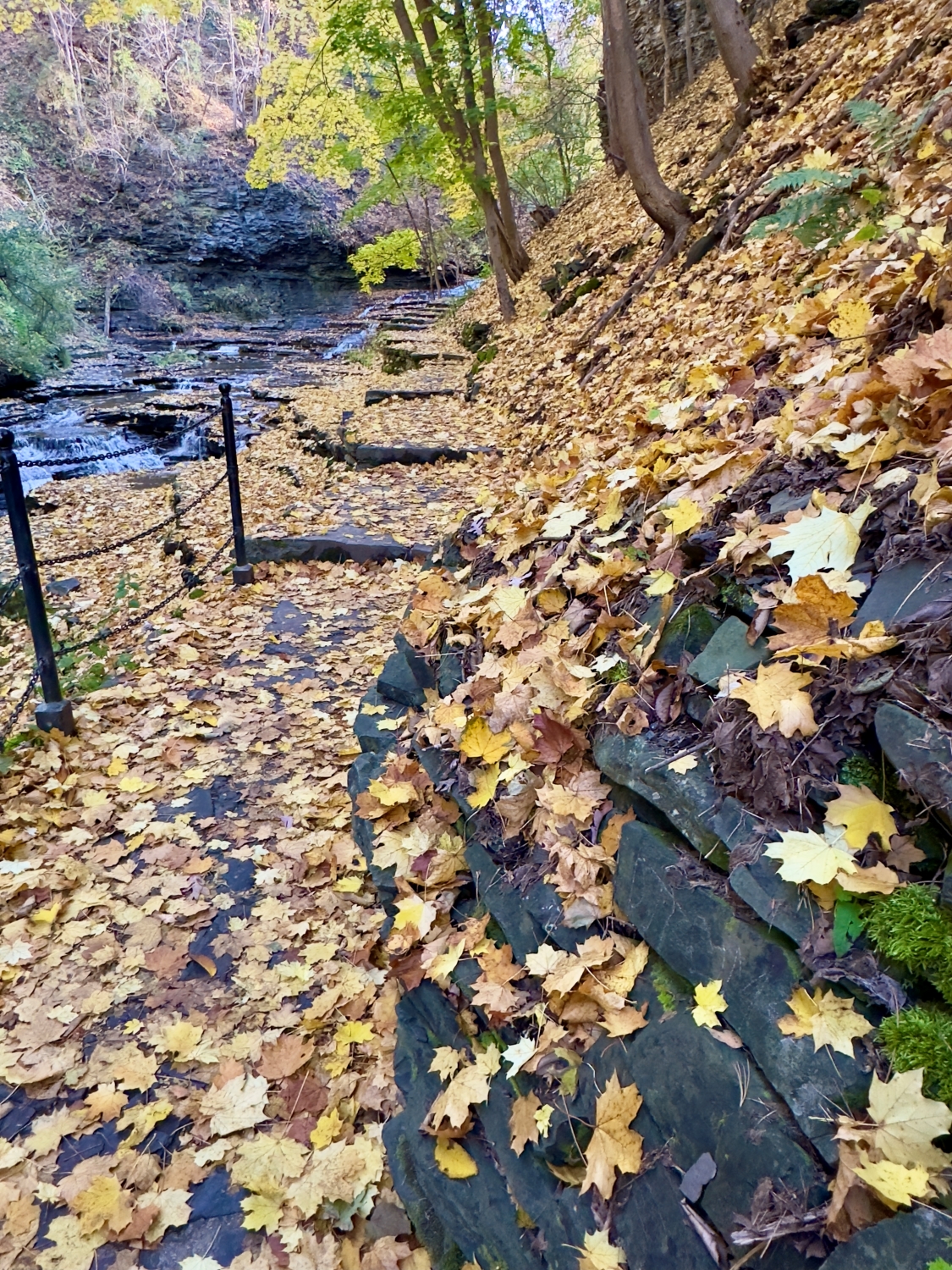
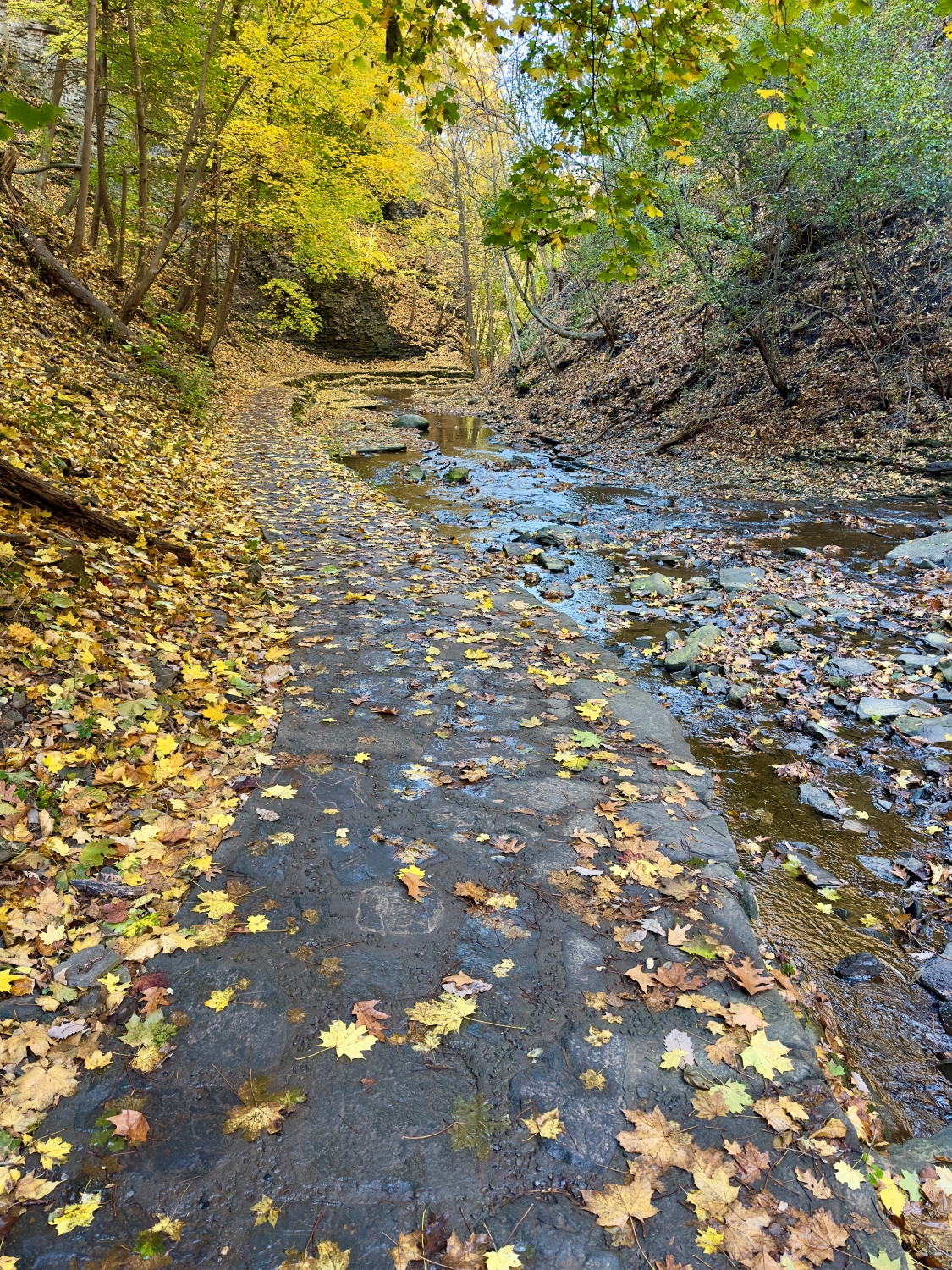
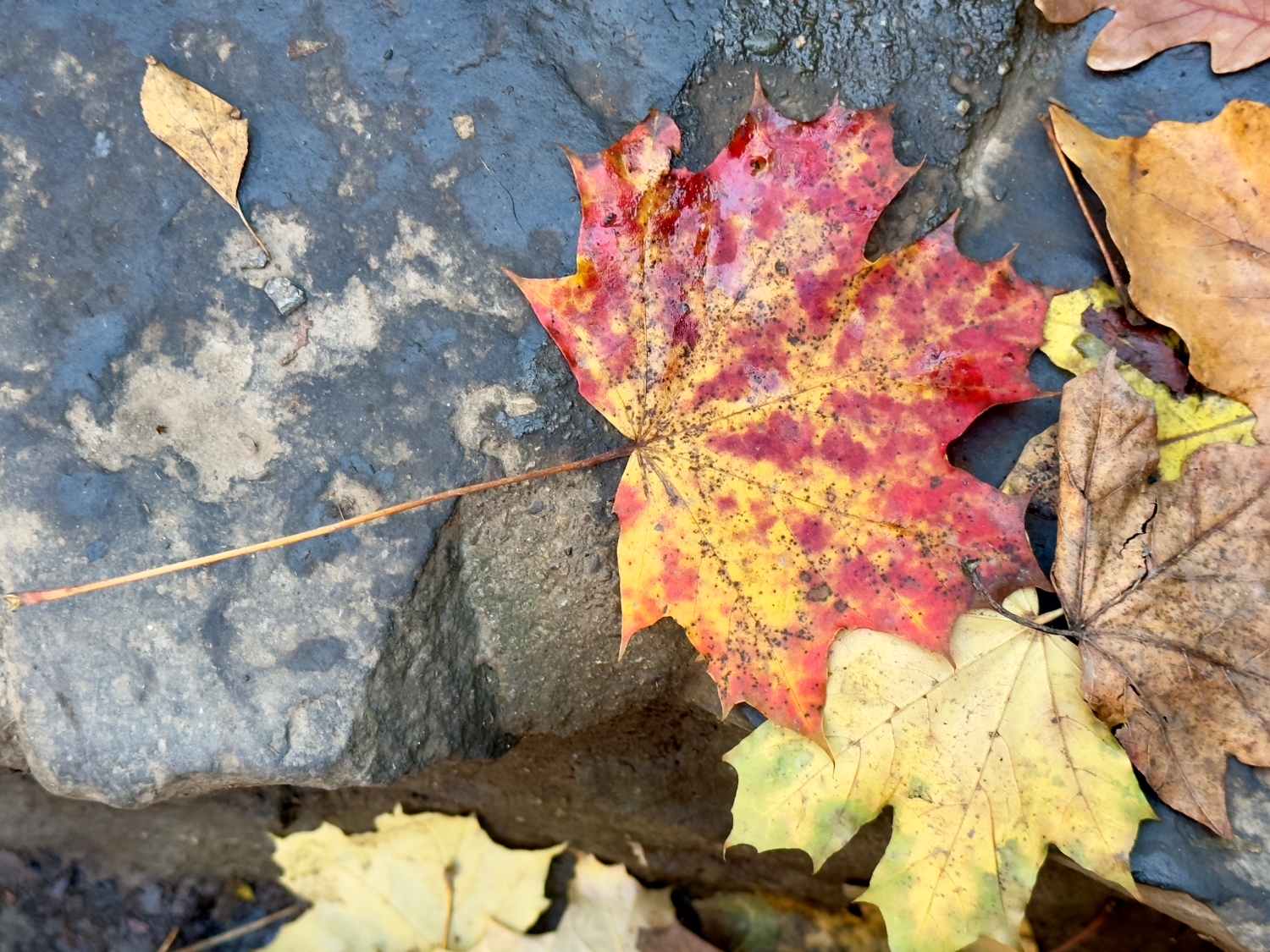
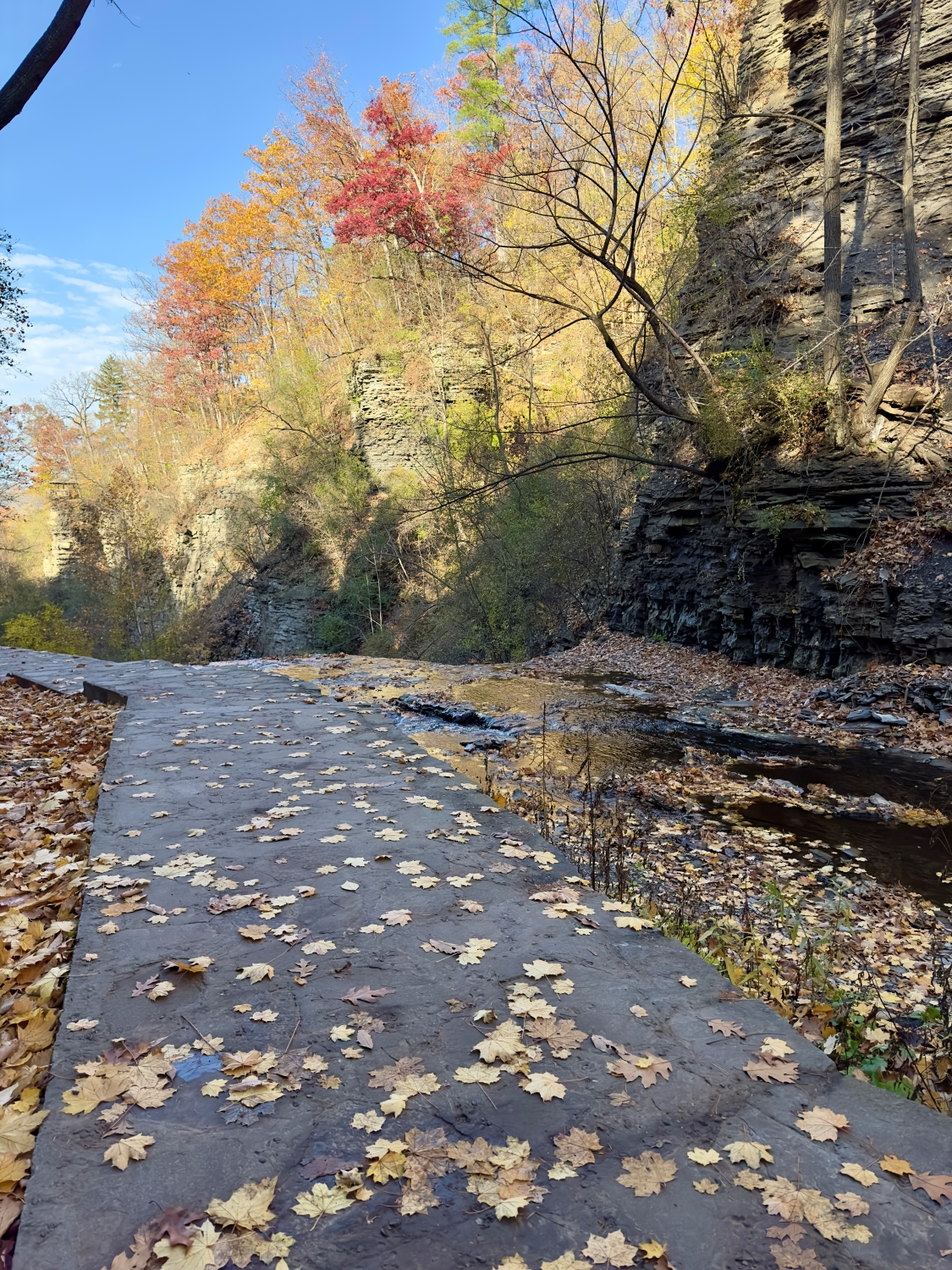
I move further along the trail, and the terrain begins to shift. Fallen leaves create a golden carpet along the path, their crisp shapes overlapping like nature’s confetti celebrating the season. Each step crunches underfoot, adding my own rhythm to the symphony of sounds. The trees overhead are a kaleidoscope of colors—deep golds, fiery oranges, and the occasional flash of red from Virginia Creeper vines (Parthenocissus quinquefolia). Together, the trees create a canopy that filters sunlight, casting dappled patterns on the gorge walls. It’s an ever-changing play of light and shadow, one moment bright and the next subdued, adding a layer of magic to the experience.
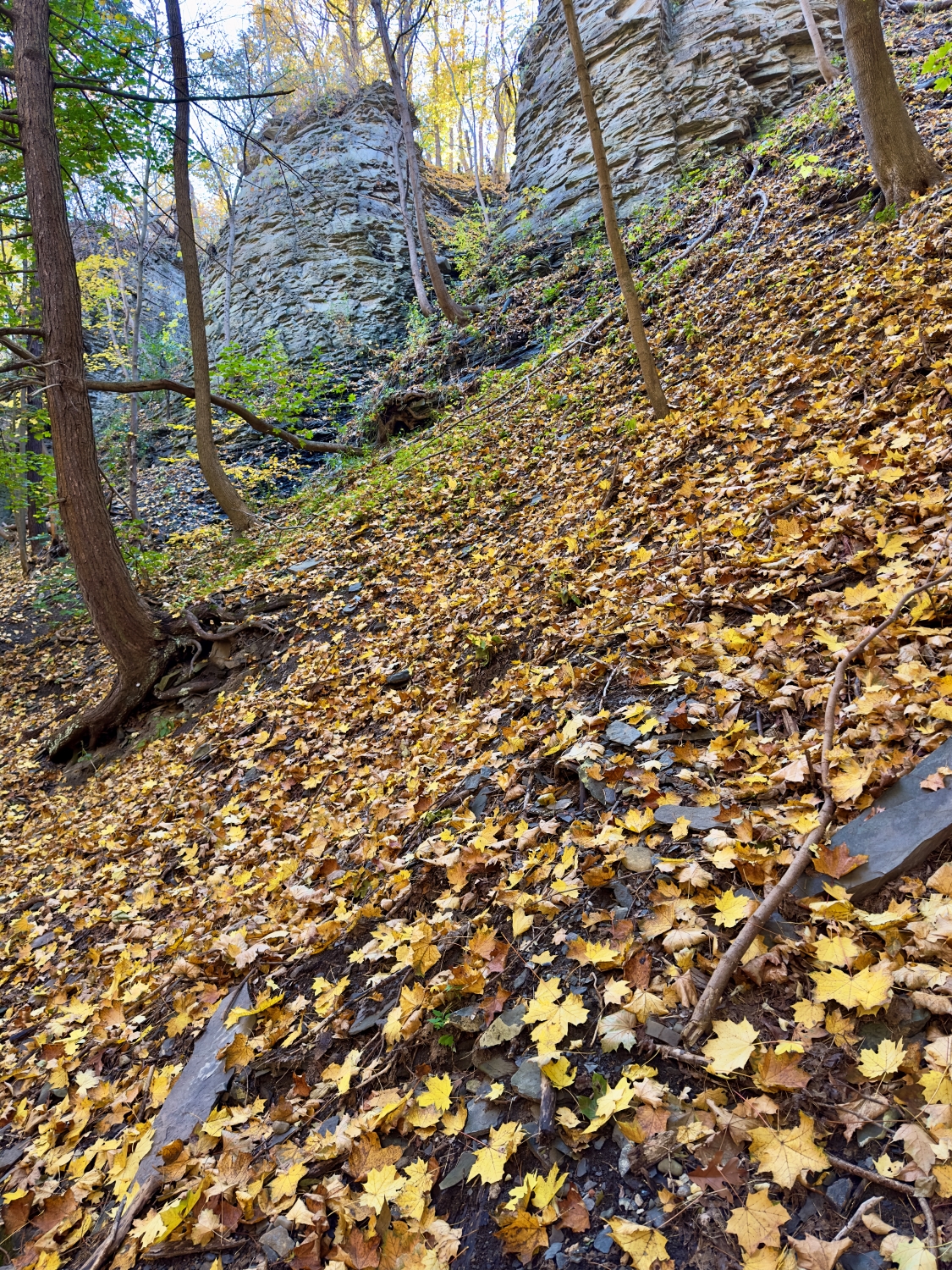
As I follow the trail upward, the gorge narrows, and I find myself surrounded by towering walls of rock. Here, layers of siltstone and shale formed more than 300 hundred million years ago are exposed, a testament to the forces of water and time that carved this place across mere millennia of recent geologic time. The rock formations are fascinating, with the water flowing over them in gentle cascades, finding every groove and crevice. There’s something humbling about standing in a place shaped by forces so much larger and older than myself. I pause, letting the rush of water and the stillness of stone fill my senses.
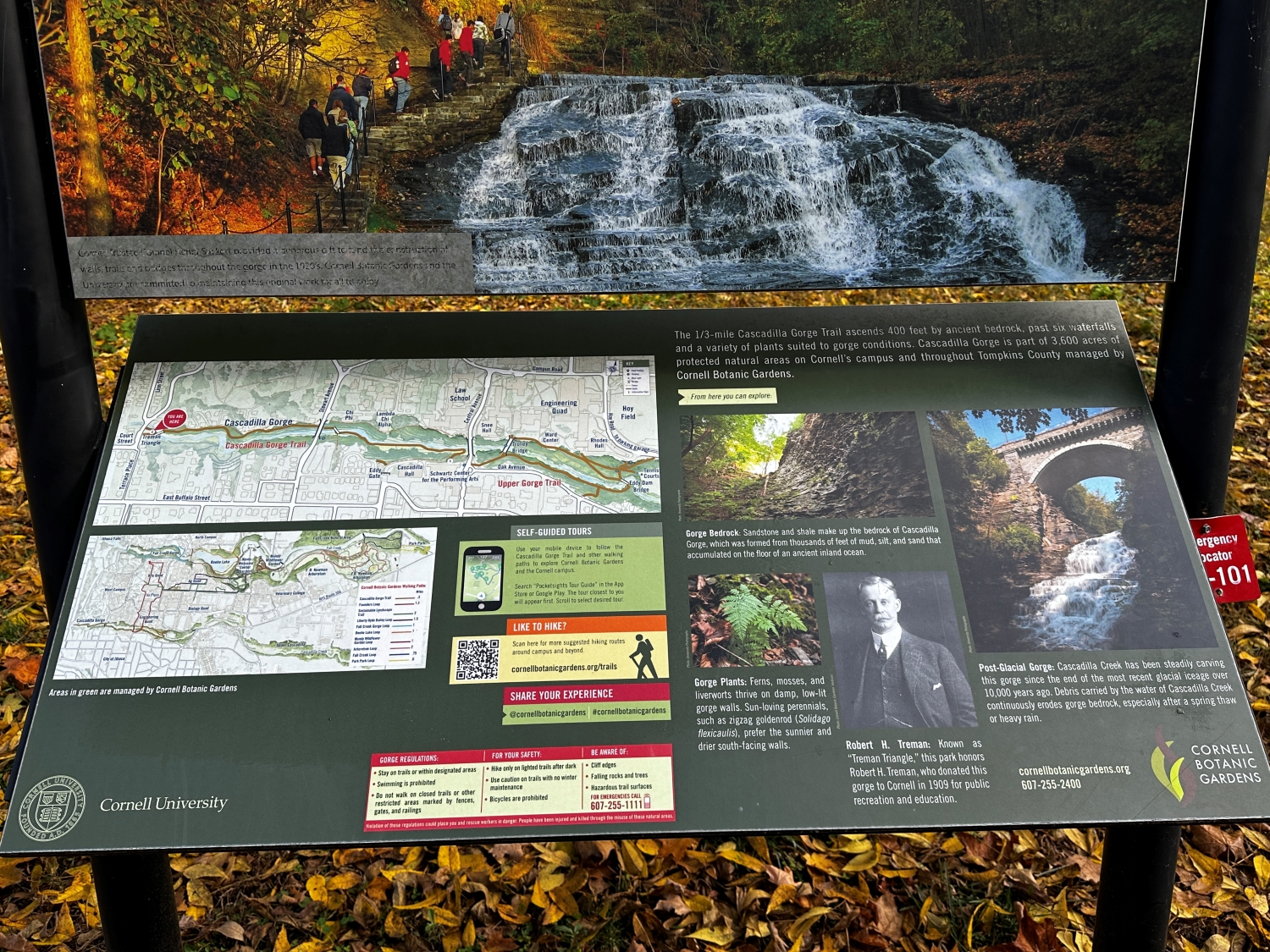
Along the way, I come across an interpretive sign provided by the Cornell Botanical Gardens. They tell the story of Cascadilla Gorge, how it was formed from the bedrock of sandstone and shale that eroded from mountains to the east, in the Devonian era when an ancient inland sea covered the region. The signs also introduce Robert H. Treman, a philanthropist who saw the beauty and educational value of the gorge. Thanks to him and the efforts of many, this natural wonder is preserved for all to experience. Knowing this adds depth to my walk; it’s a reminder that places like this exist not only by chance but because people cared enough to protect them.
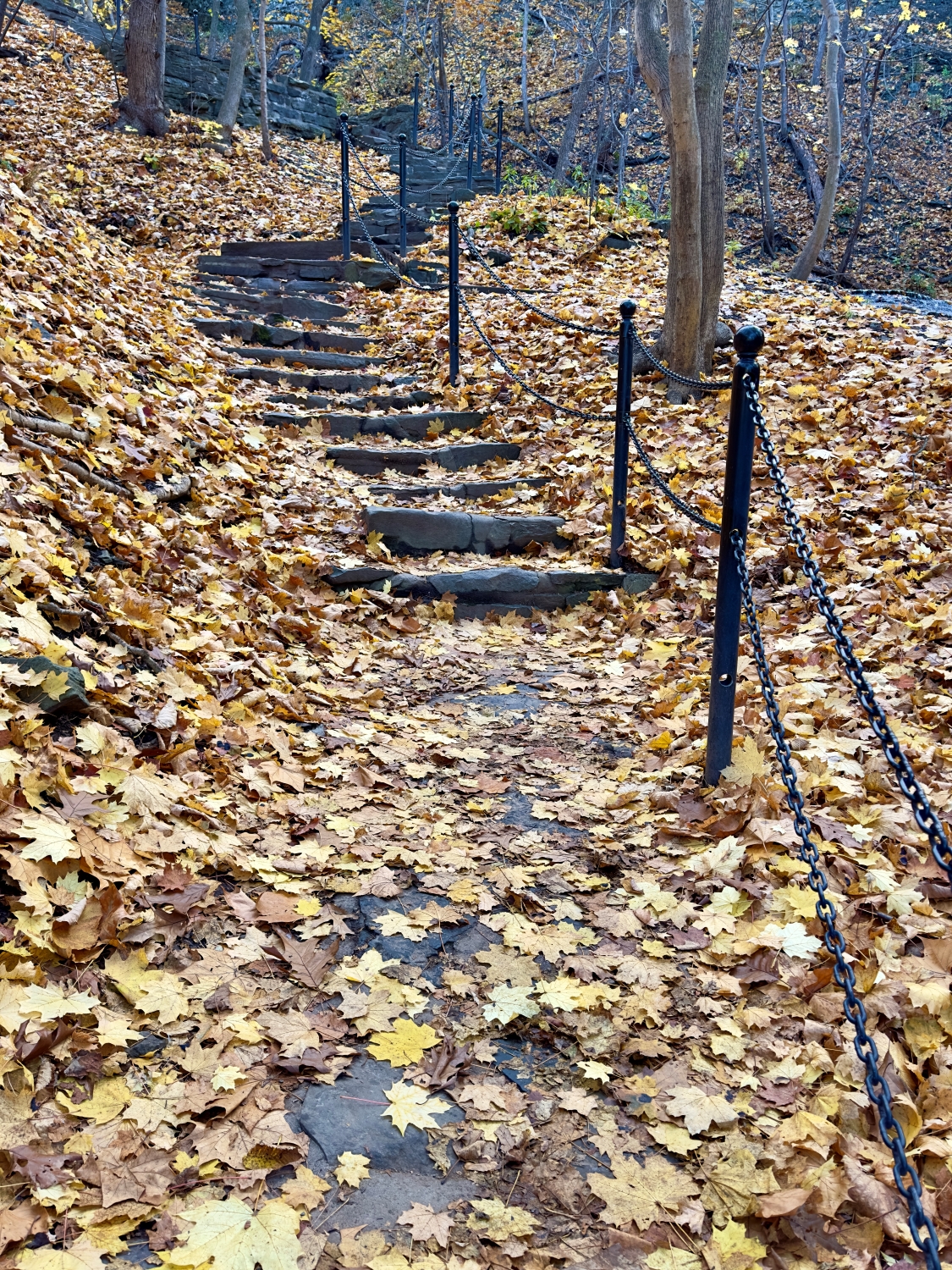
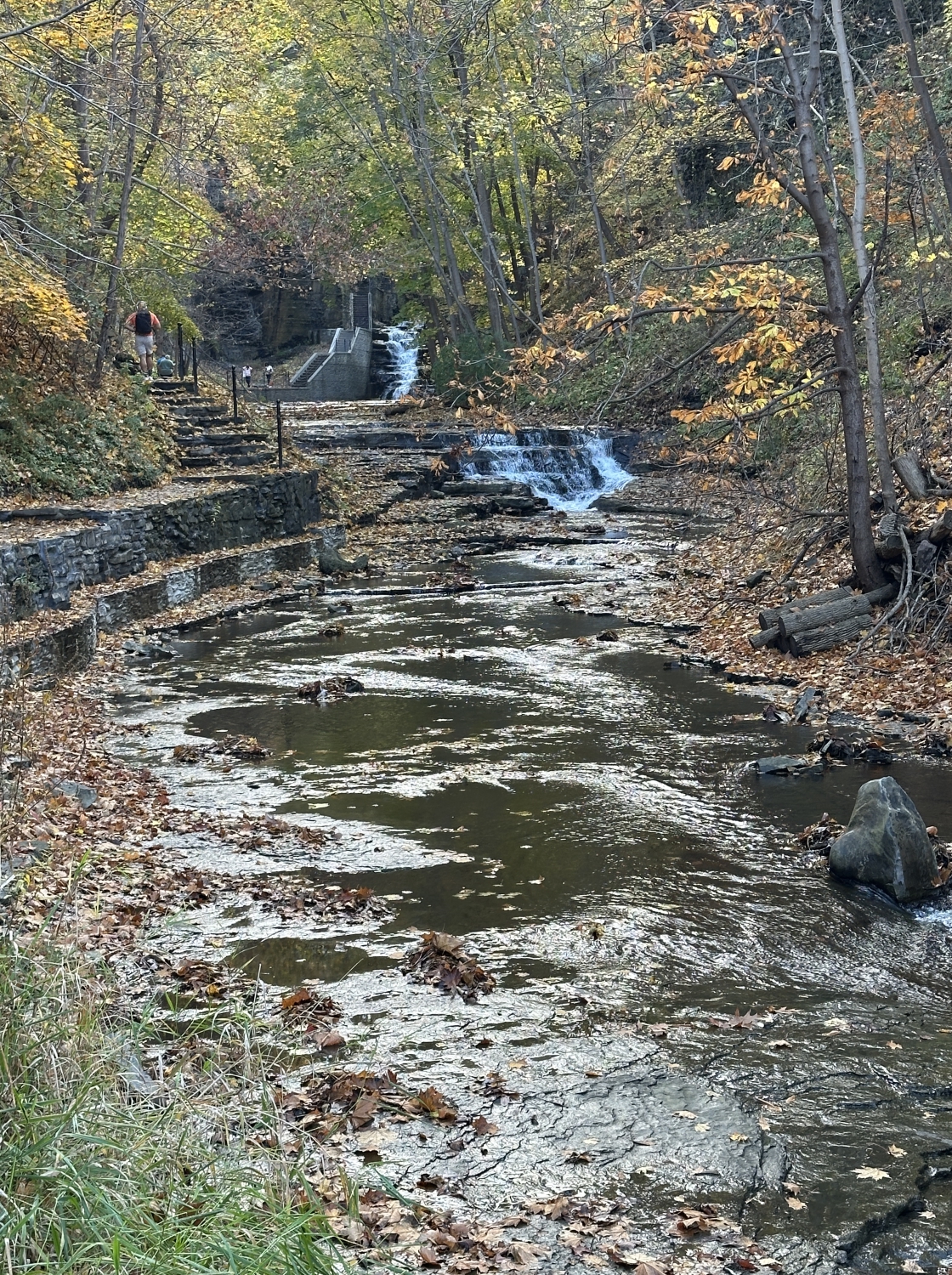
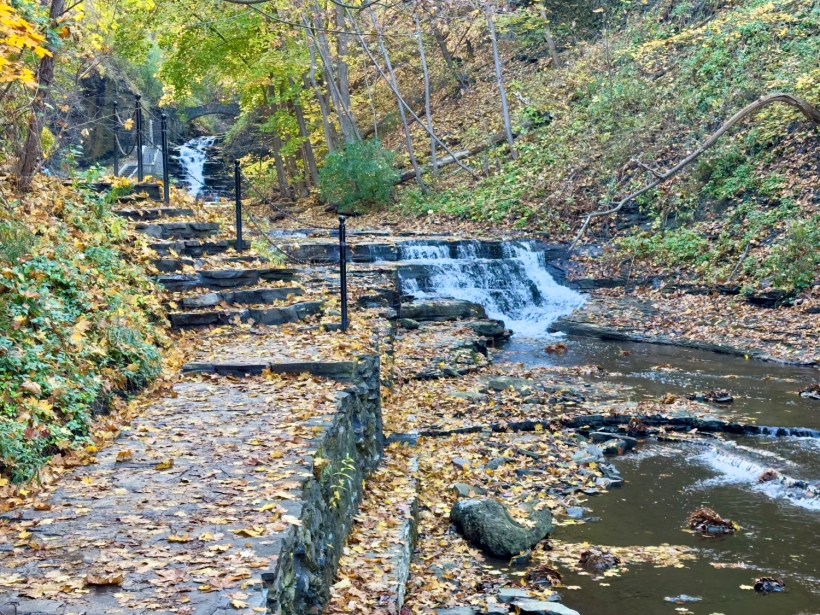
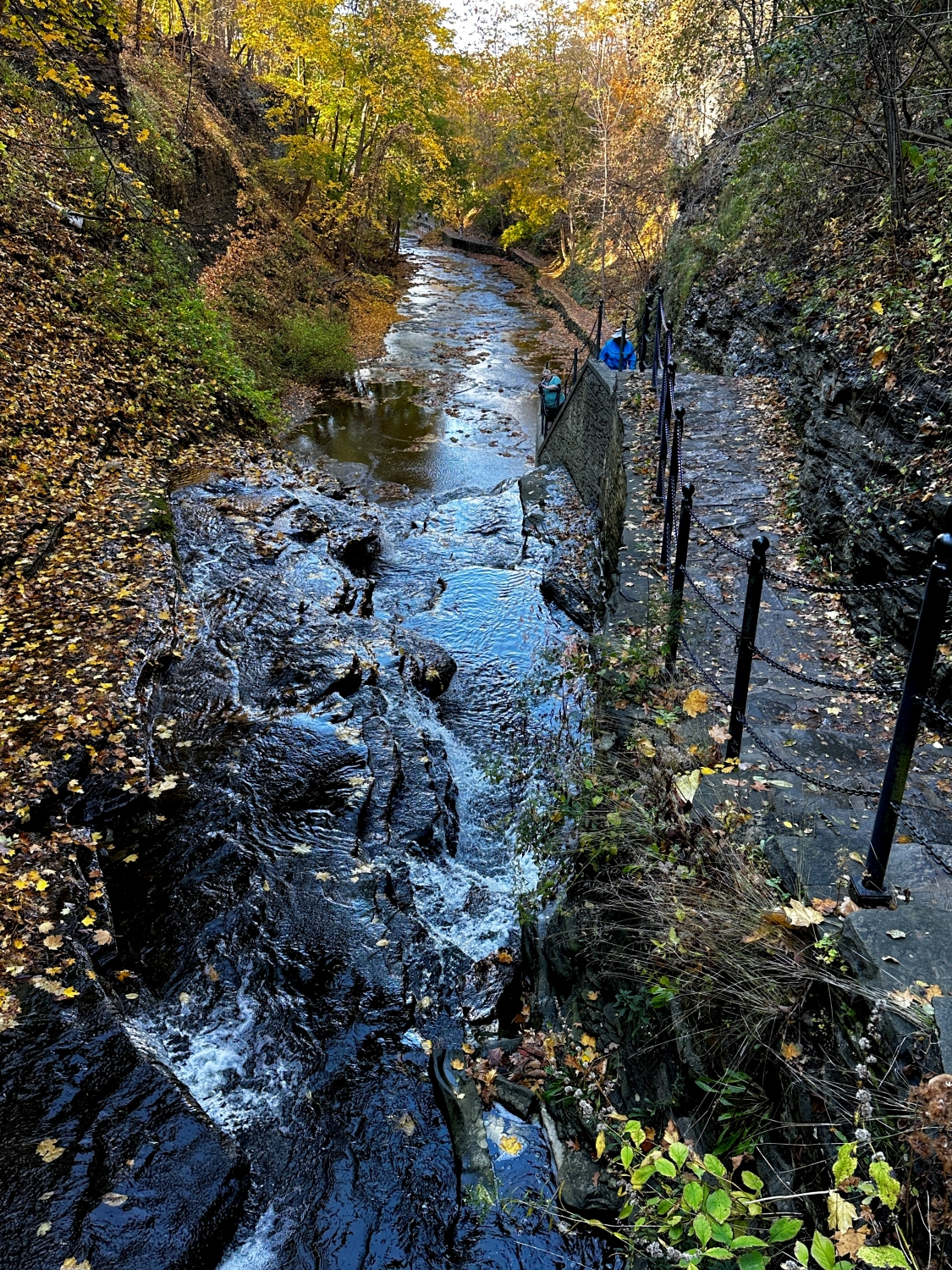
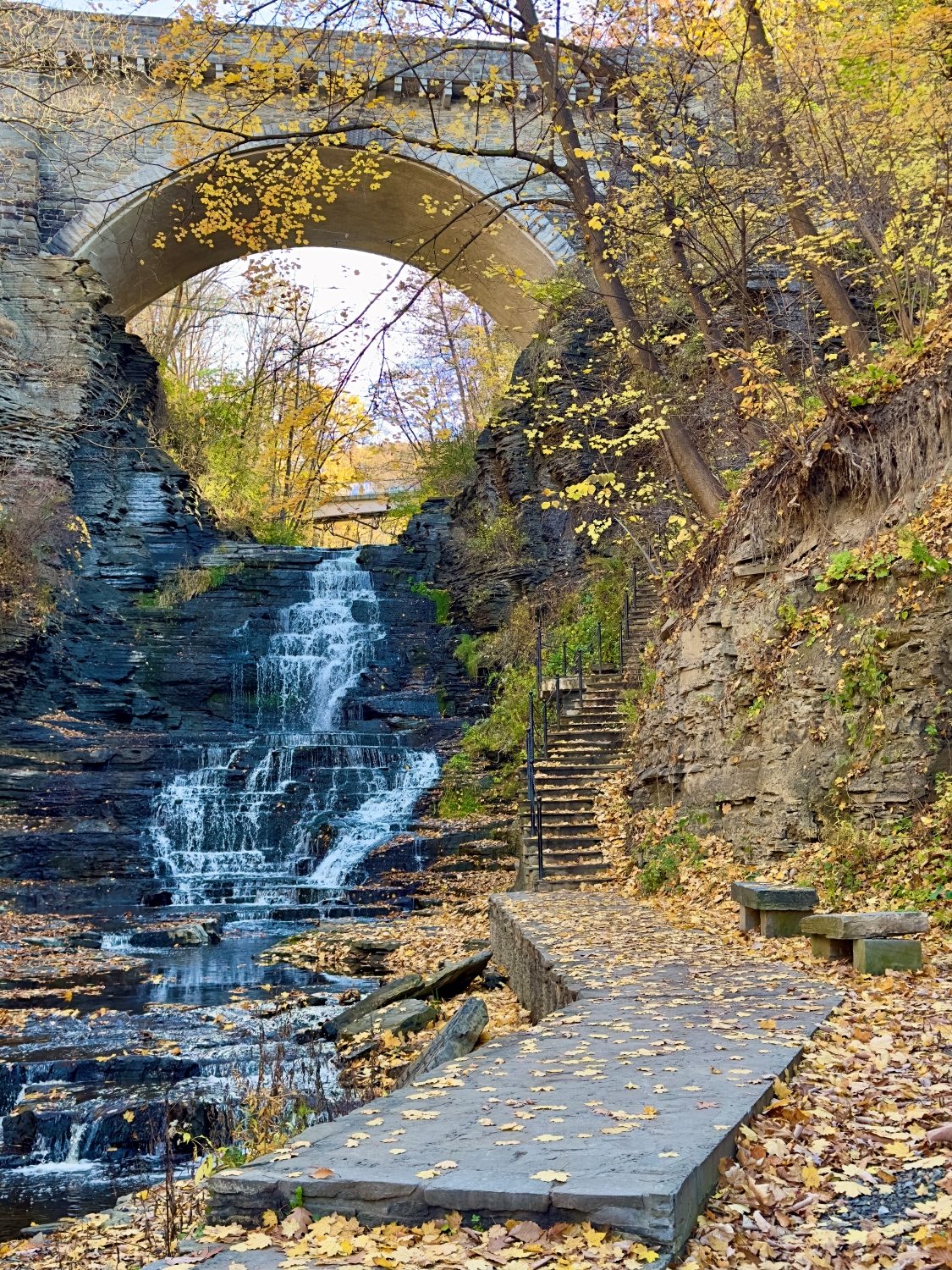
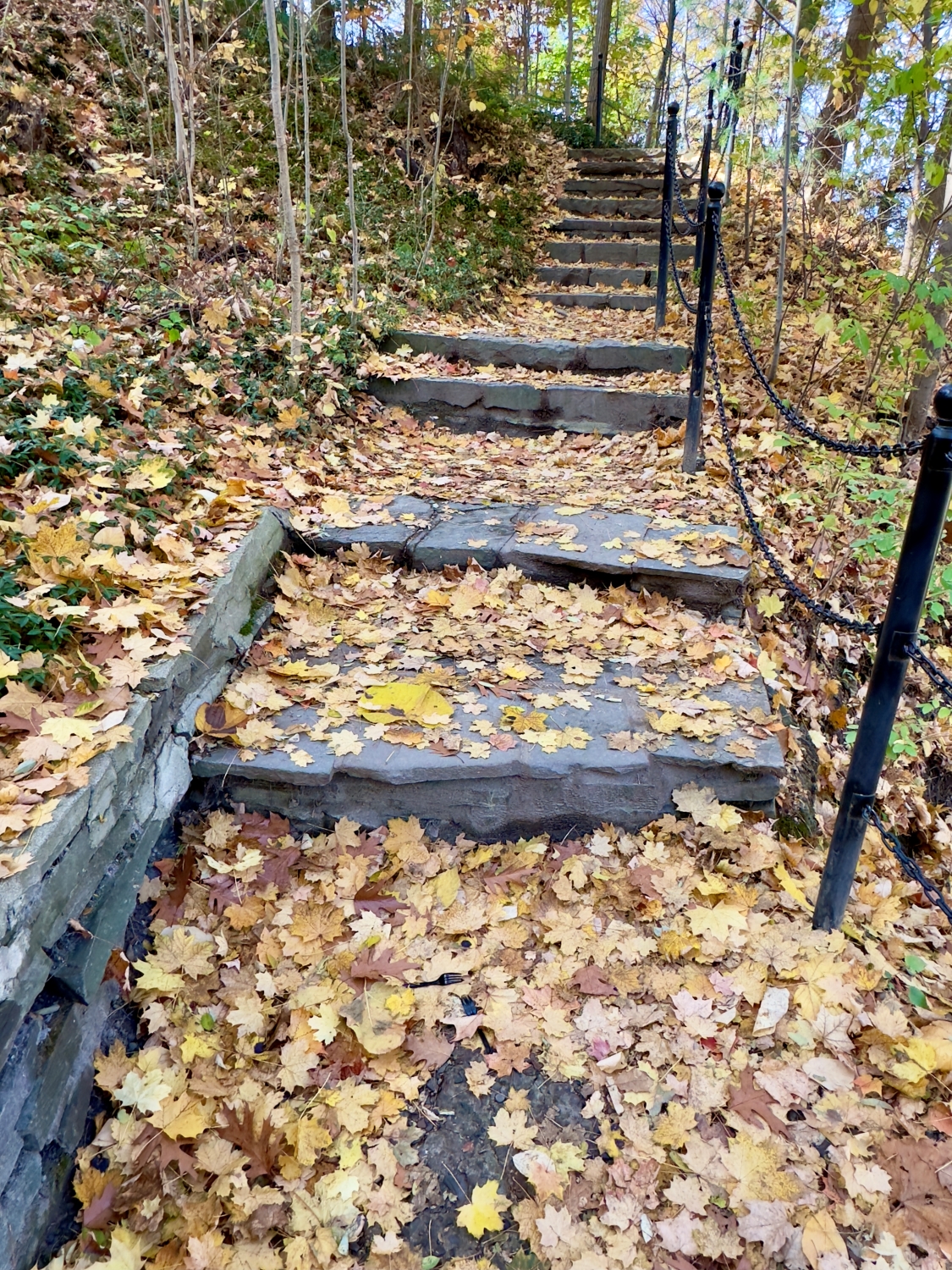
The sandstone staircases along the trail are a marvel in themselves. Some sections are steep, winding up the gorge in a series of steps that seem to have been placed with precision, blending seamlessly into the natural landscape. The steps are covered with leaves now, making each ascent feel a bit like climbing through a fairy-tale forest. The chains along the path provide a comforting grip, especially as I climb higher. I look back and see how far I’ve come, the creek below winding its way over rocks and around bends, each step a small journey of its own.
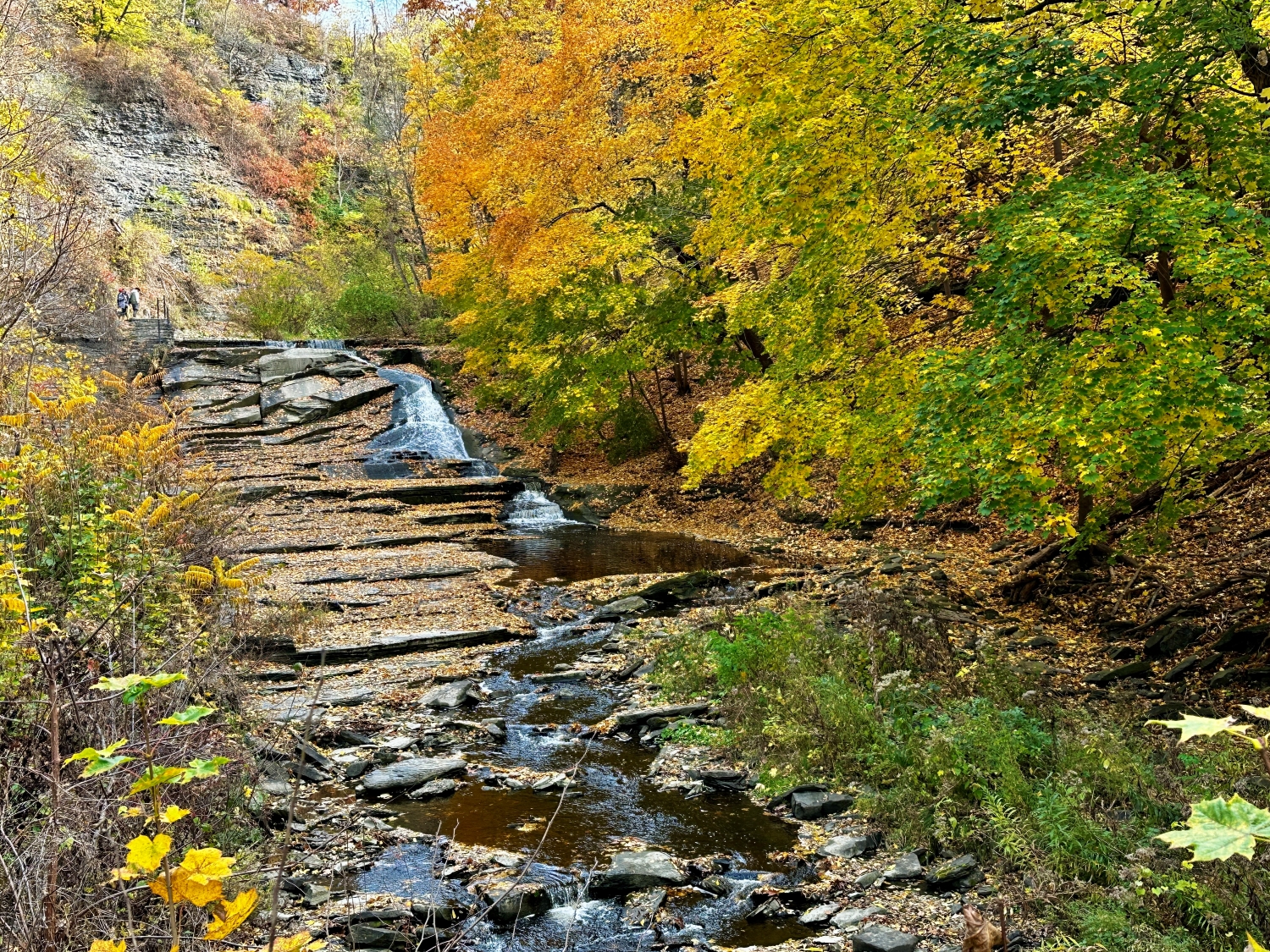
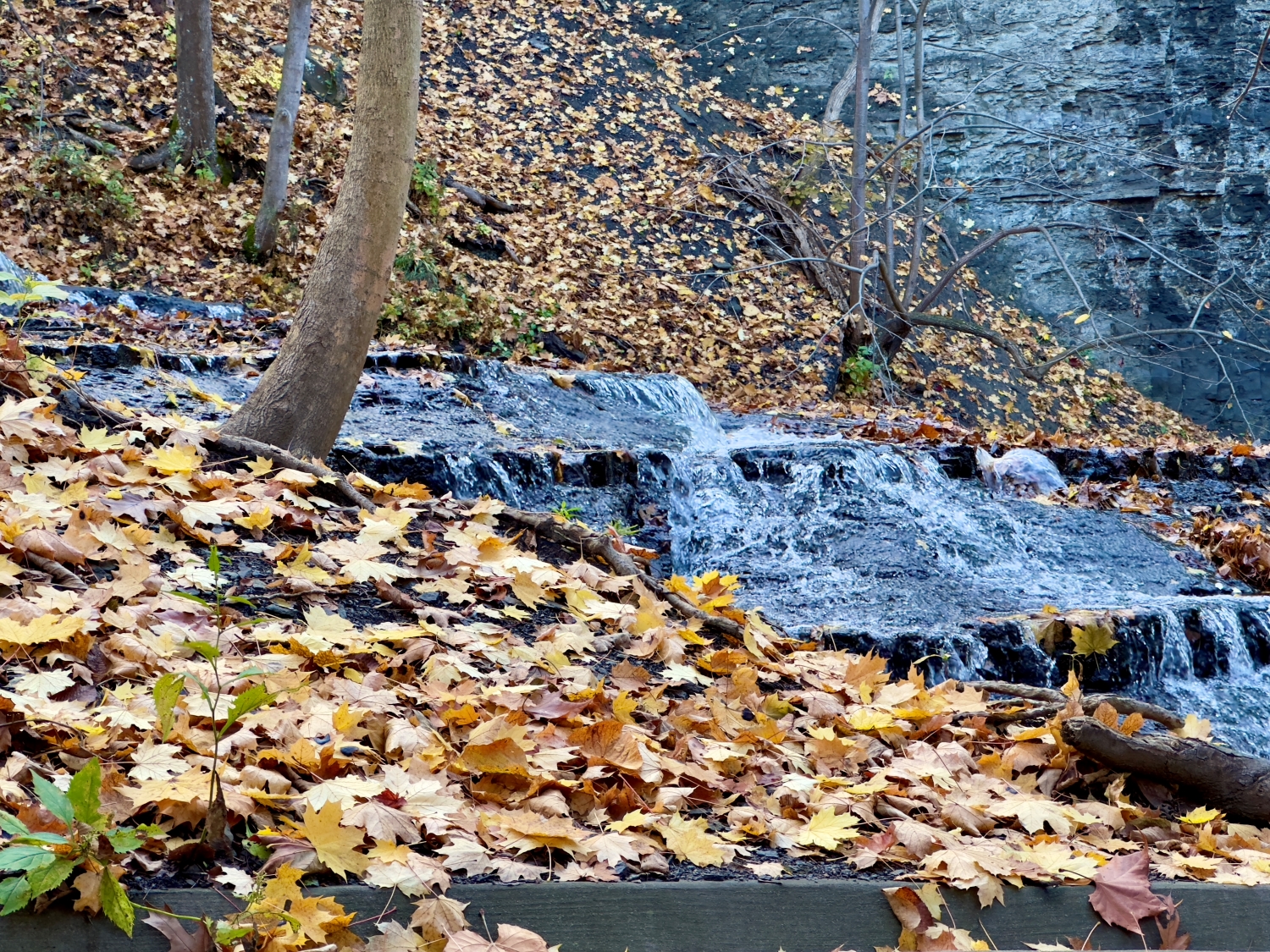
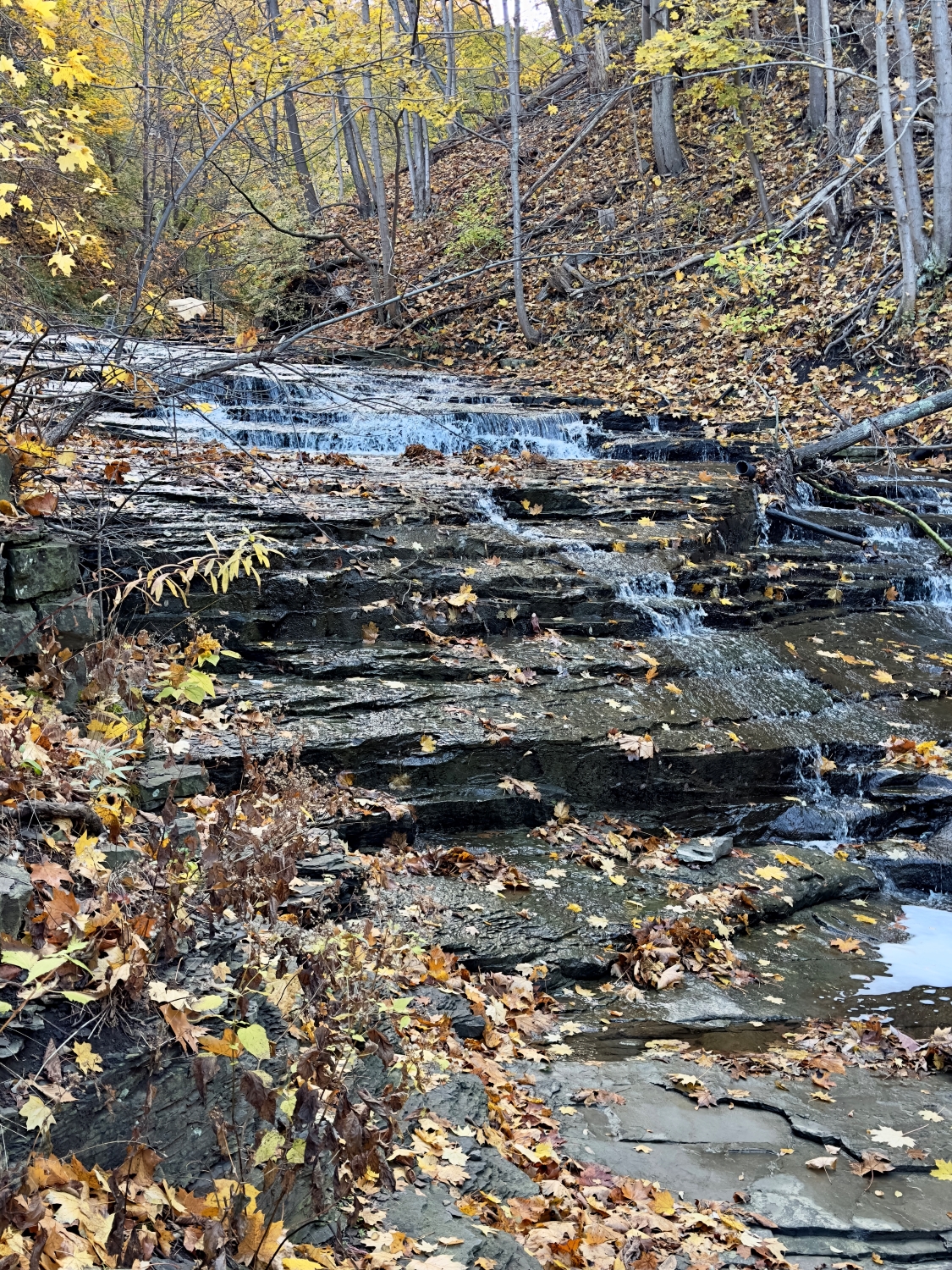
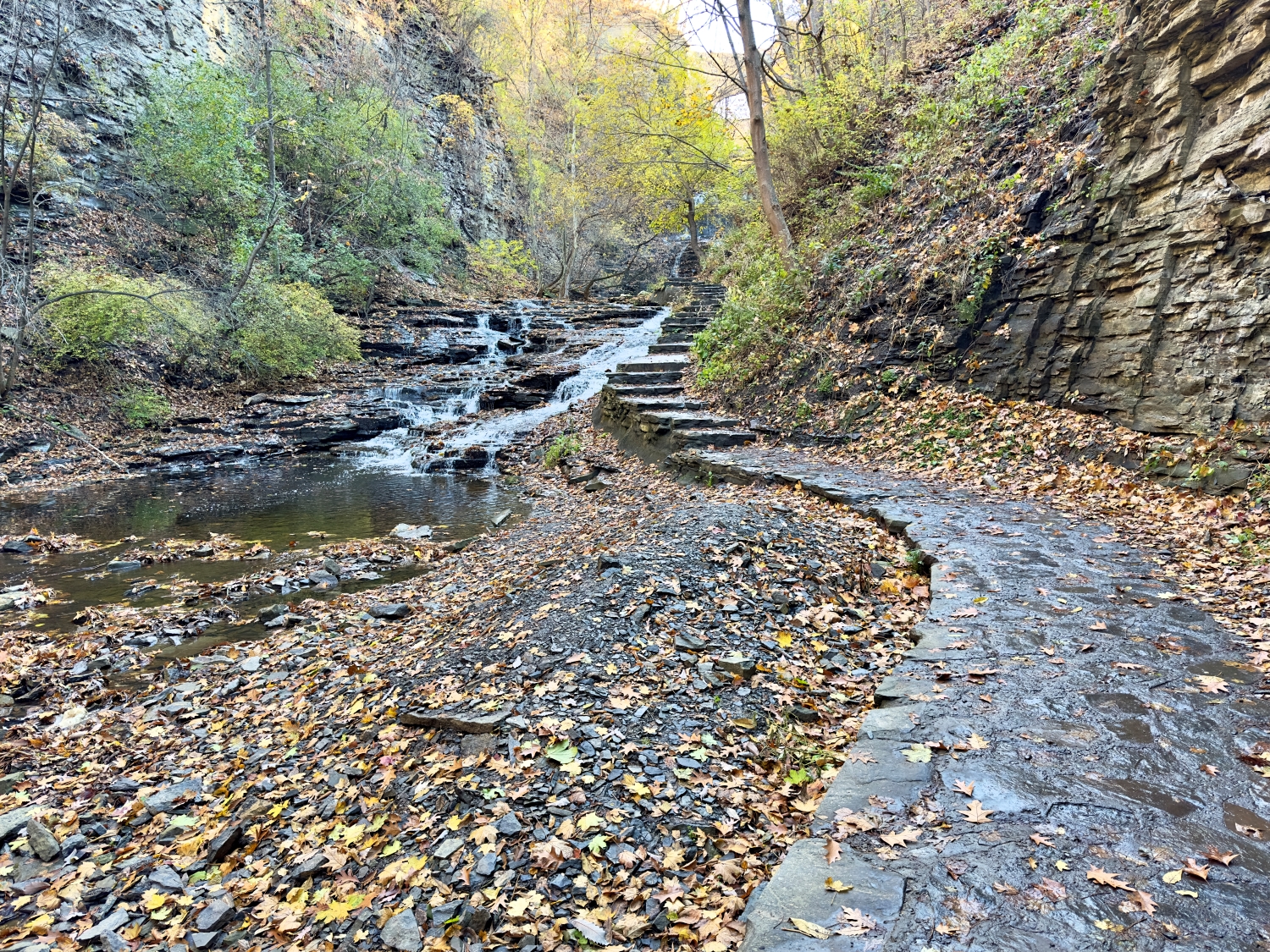
I pass several small waterfalls, each one unique in its character. Some are gentle trickles, while others pour over the rocks with more force, their sound reverberating off the gorge walls. I stop frequently, entranced by the way the water carves its path, eternally moving, adapting, wearing down even the hardest stone. Leaves float down from above, landing in the creek and swirling in miniature whirlpools before being carried downstream. It’s mesmerizing to watch nature at work in such a quiet, persistent way.
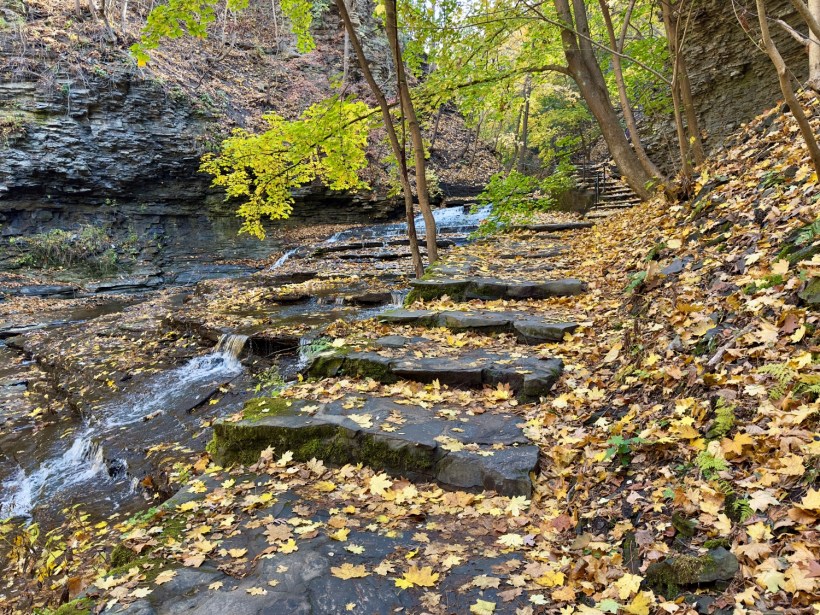
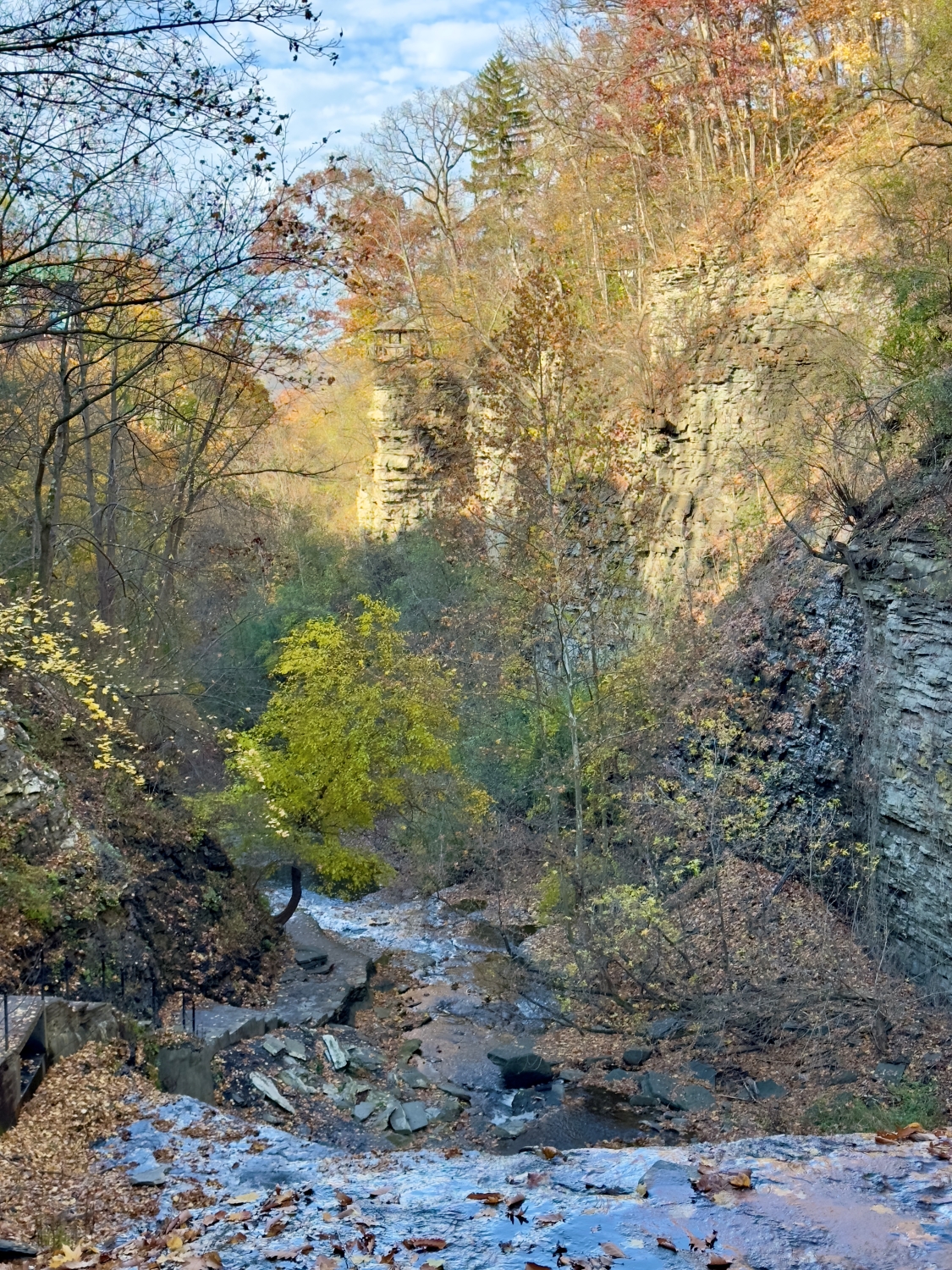
Further up the gorge, the views open up, and I can see the layers of rock descending in terraces, each level a little cascade of its own. I watch as the water flows across these steps, catching the light as it moves—a silvery ribbon winding through the golden autumn landscape. The tranquility of the scene is meditative. Around me, the trees stand as silent witnesses, their branches bare in places but still adorned with clusters of leaves clinging through the last days of fall.
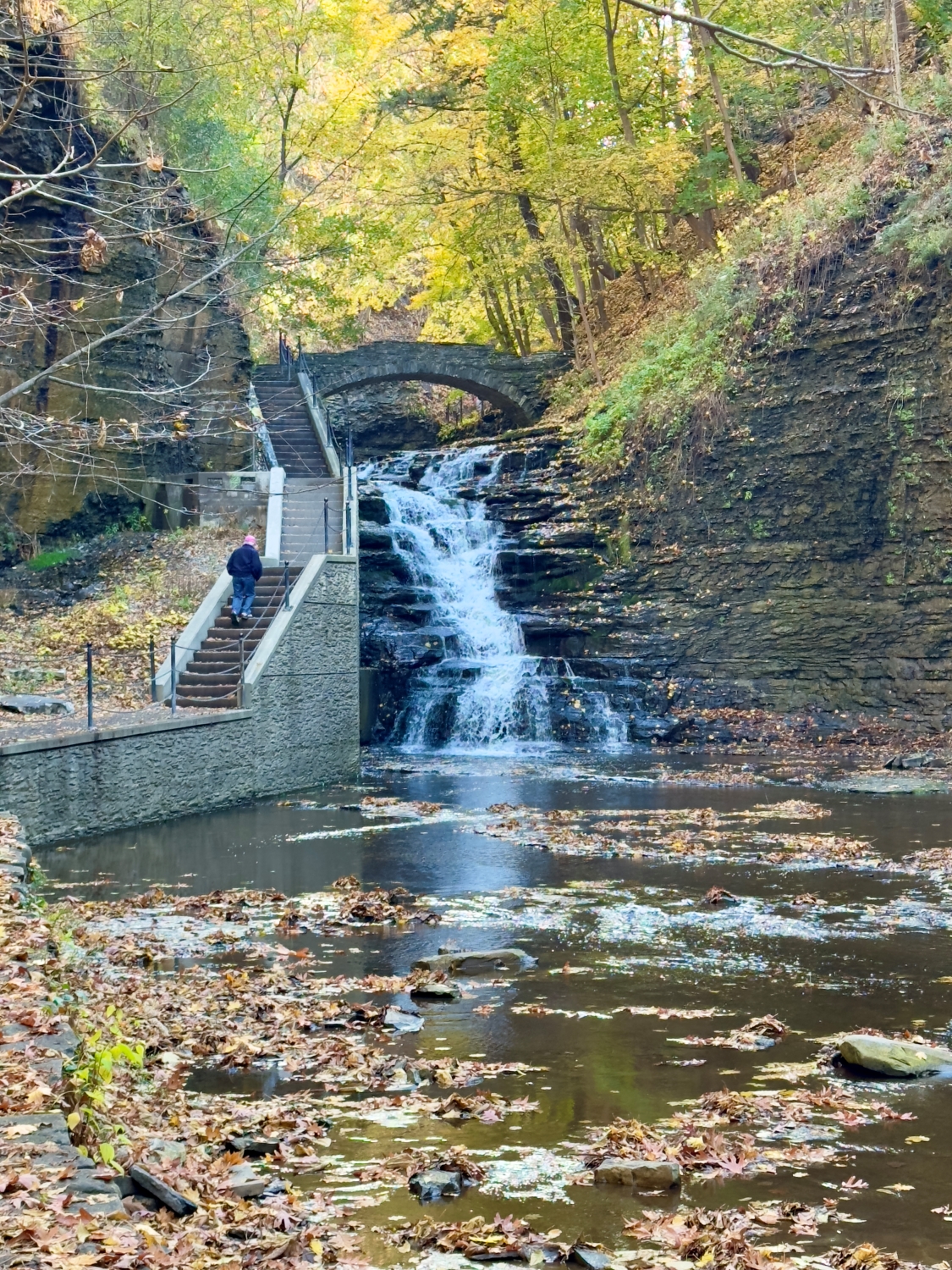
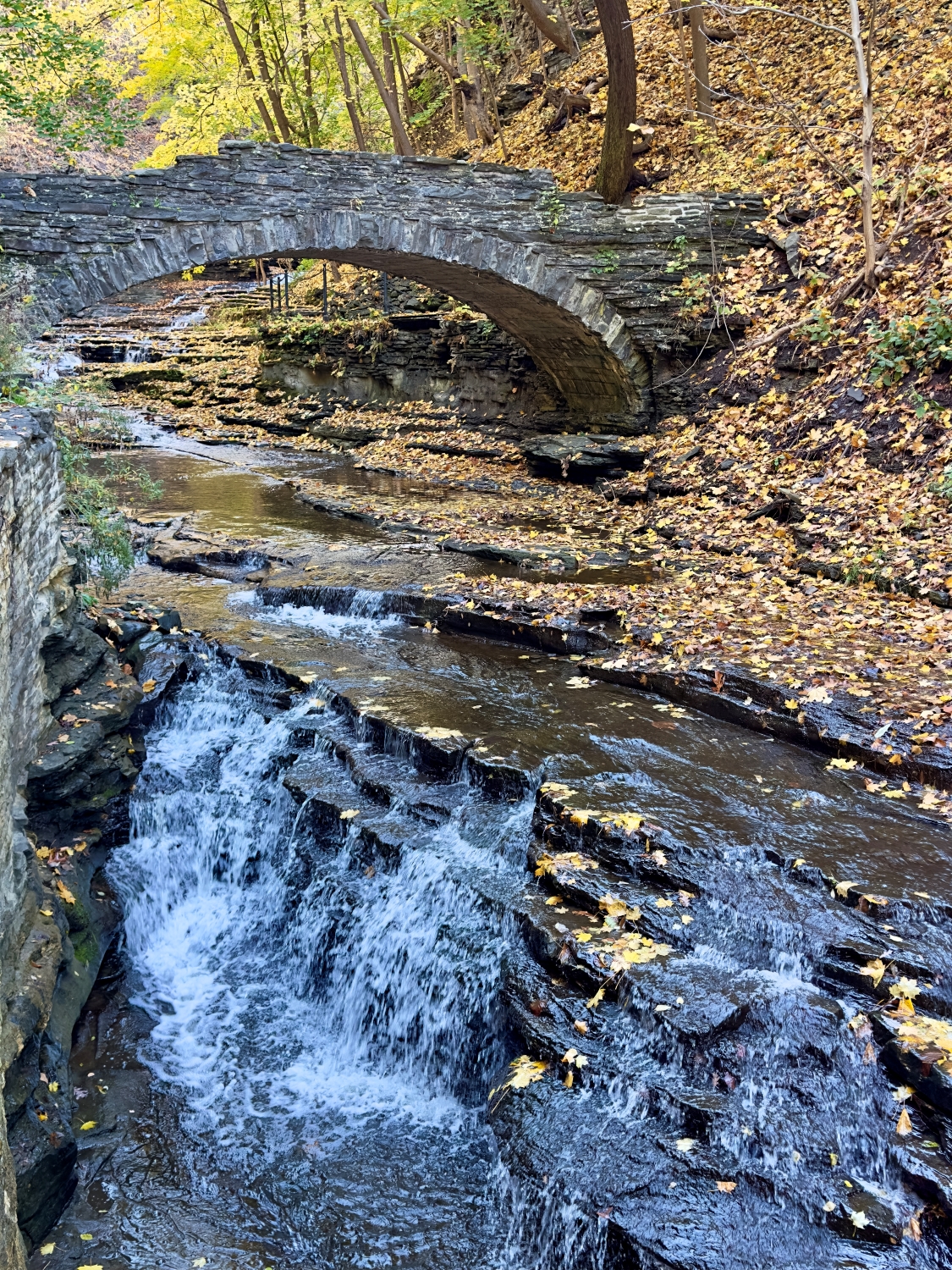
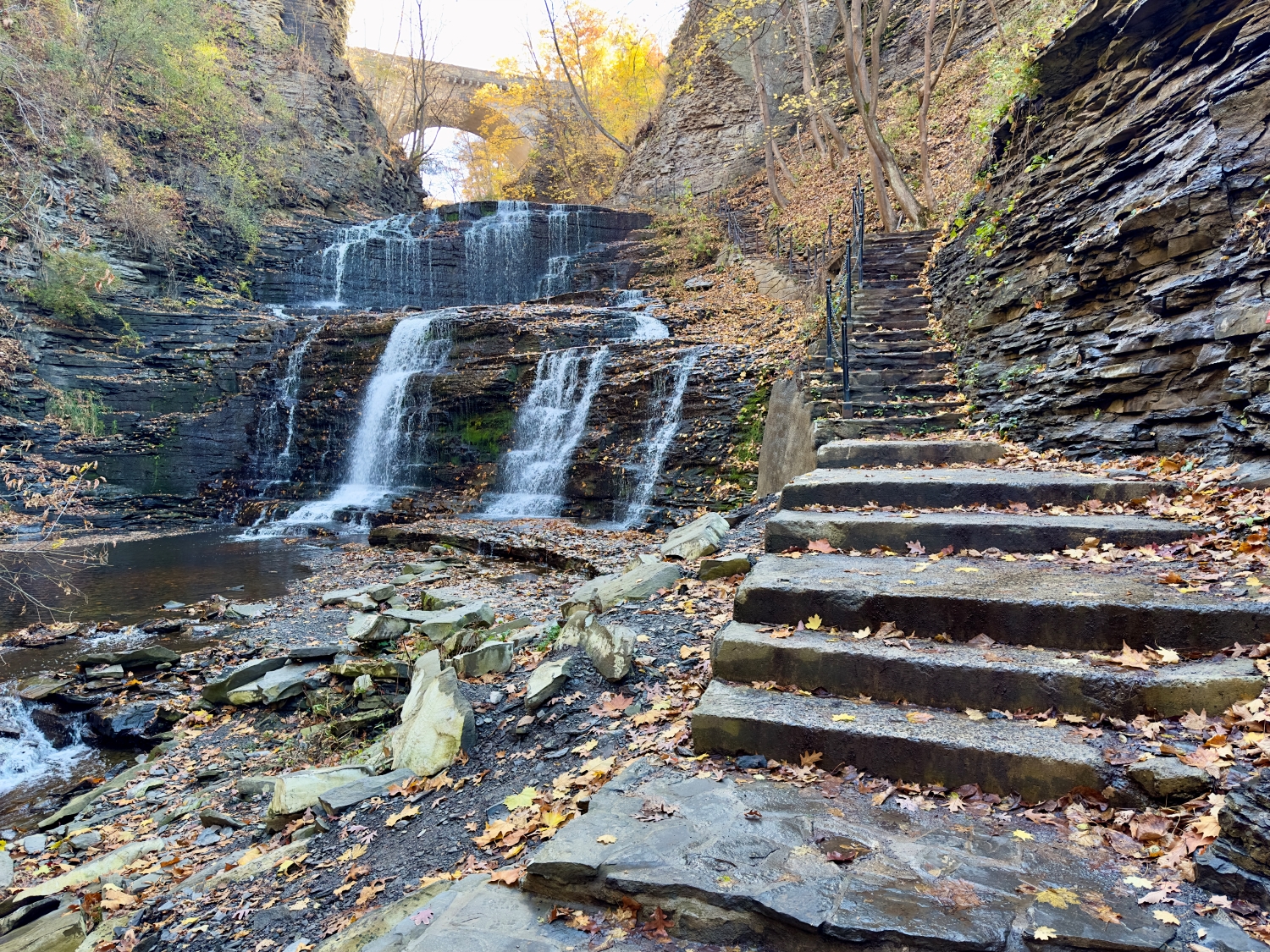
Finally, I reach one of the larger waterfalls, framed by a graceful stone arch bridge that crosses high above. The scene is something out of a painting. Water pours over the rocks, gathering in pools below before spilling onward. I pause on the bridge, looking down at the gorge below and the trail I’ve followed, grateful for the journey.
Along the way, artists are positioned along the path, each lost in the beauty of Cascadilla Gorge. They stand or sit in quiet reverie, brushes or pencils in hand, capturing the gorge’s unique character. Some focus on the play of light over the water’s surface, while others seem intent on the rugged details of the rock formations. Their presence adds a contemplative depth to the scene; it’s as if each artist has uncovered a hidden aspect of the gorge that I have overlooked in my journey upward.
I slow my pace to take it all in, appreciating how the artists interpret this natural wonder through their own eyes. Their canvases reveal layers of colors that shift as the sun filters through the leaves, casting vibrant golds and subtle greens on the cascading water. The scene feels almost collaborative—nature and human hand creating art together, each reflection of the gorge as unique as the individual capturing it. I’m tempted to pause beside them, to see how they choose to frame the towering walls, the stone bridge arching above the water, and the gentle curves of the creek as it meanders downstream. I can imagine each artist’s work holding a different piece of this place, like fragments of a memory.
Bridge View looking up Cascadilla CreekBridge View looking back the way I came
As I continue, the sound of rushing water grows louder, drawing me towards another cascade that tumbles in steps down the gorge. The rocks are layered in angular formations, giving the water a zigzagging path to follow. Leaves are scattered across the stones, their colors—yellows, browns, and the occasional splash of red—standing out against the dark, wet rock. There’s a timelessness here, a feeling that this scene has remained unchanged for centuries, save for the shifting leaves and the ever-present flow of the creek. The thought makes me feel like a small part of something much larger, a guest in an ancient place shaped by nature’s slow, steady hand.
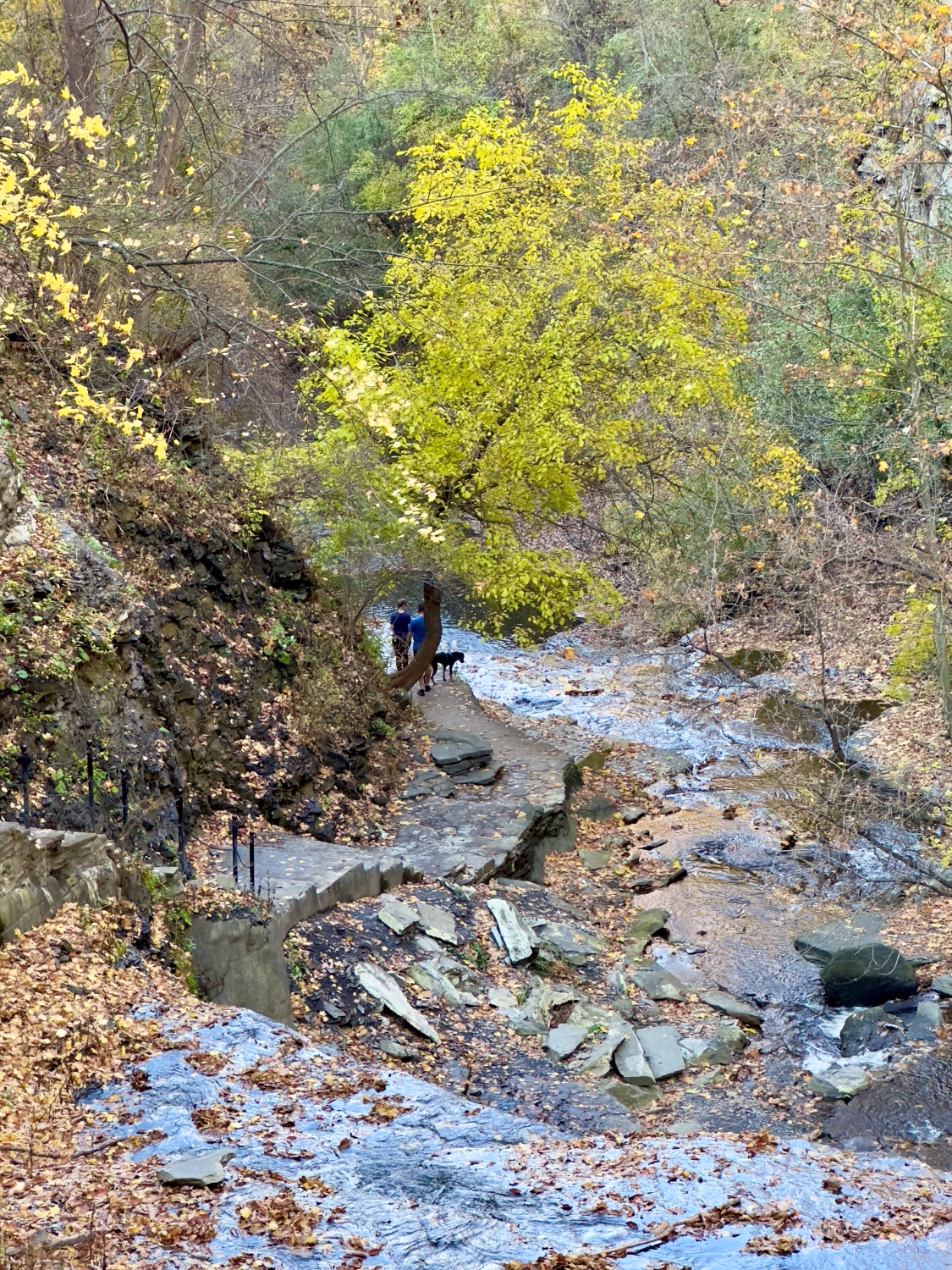
The path narrows again, following the edge of the creek where the water has worn smooth channels into the stone.
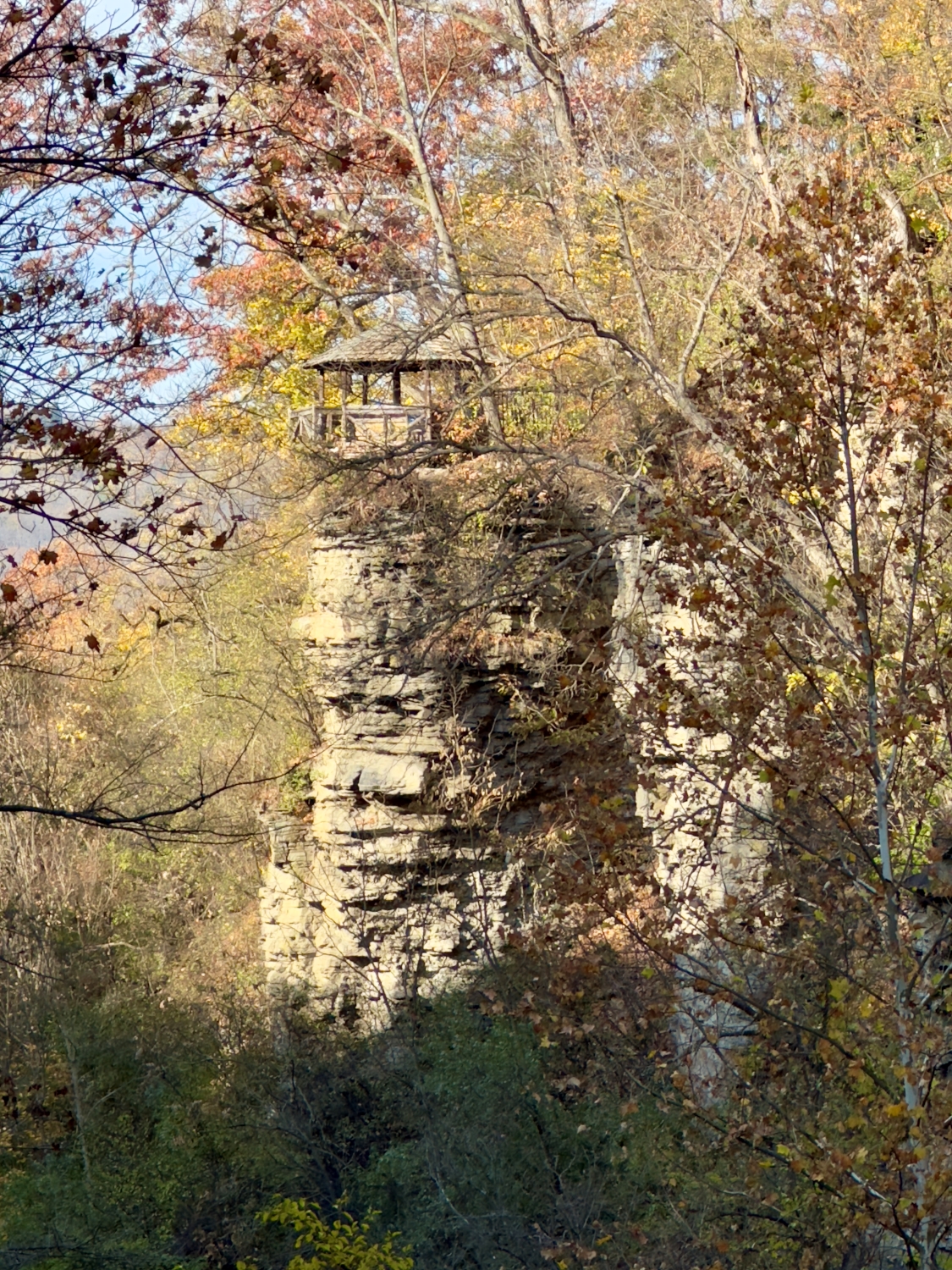
Moving forward, the trail climbs steeply, and I find myself surrounded by tall rock faces on either side. The walls are layered and weathered, a geological history book open to the forces that shaped this land. It’s humbling to see how this place puts everything into perspective, how it reminds us of our place in the natural world.
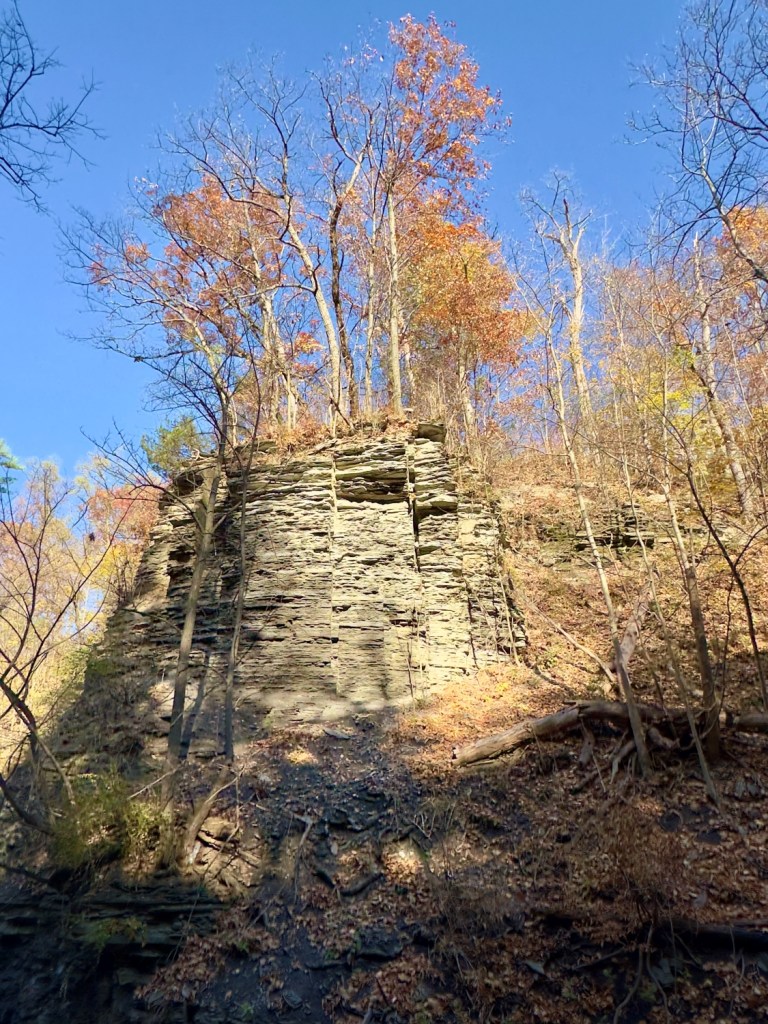
Columns of sedimentary rock
Ahead, the path becomes more rugged, the air feels cooler here, shaded by the gorge’s high walls, and the sounds of the city are long gone, replaced by the steady rhythm of water and the drift of leaves. The layers of ancient limestone that form these towering walls give shape to our landscape and ecosystem. As rainwater falls and seeps through the porous rock, the limestone raises the pH of the water, neutralizing its natural acidity. This subtle alchemy nurtures the flora and fauna, fostering a unique biome that thrives in the gorge. The artists fade from view as I move further into the solitude of the trail, but their presence lingers in my mind. Each turn of the path reveals another scene worthy of capturing, another moment that seems to call out for remembrance.
Looking back toward the way I came
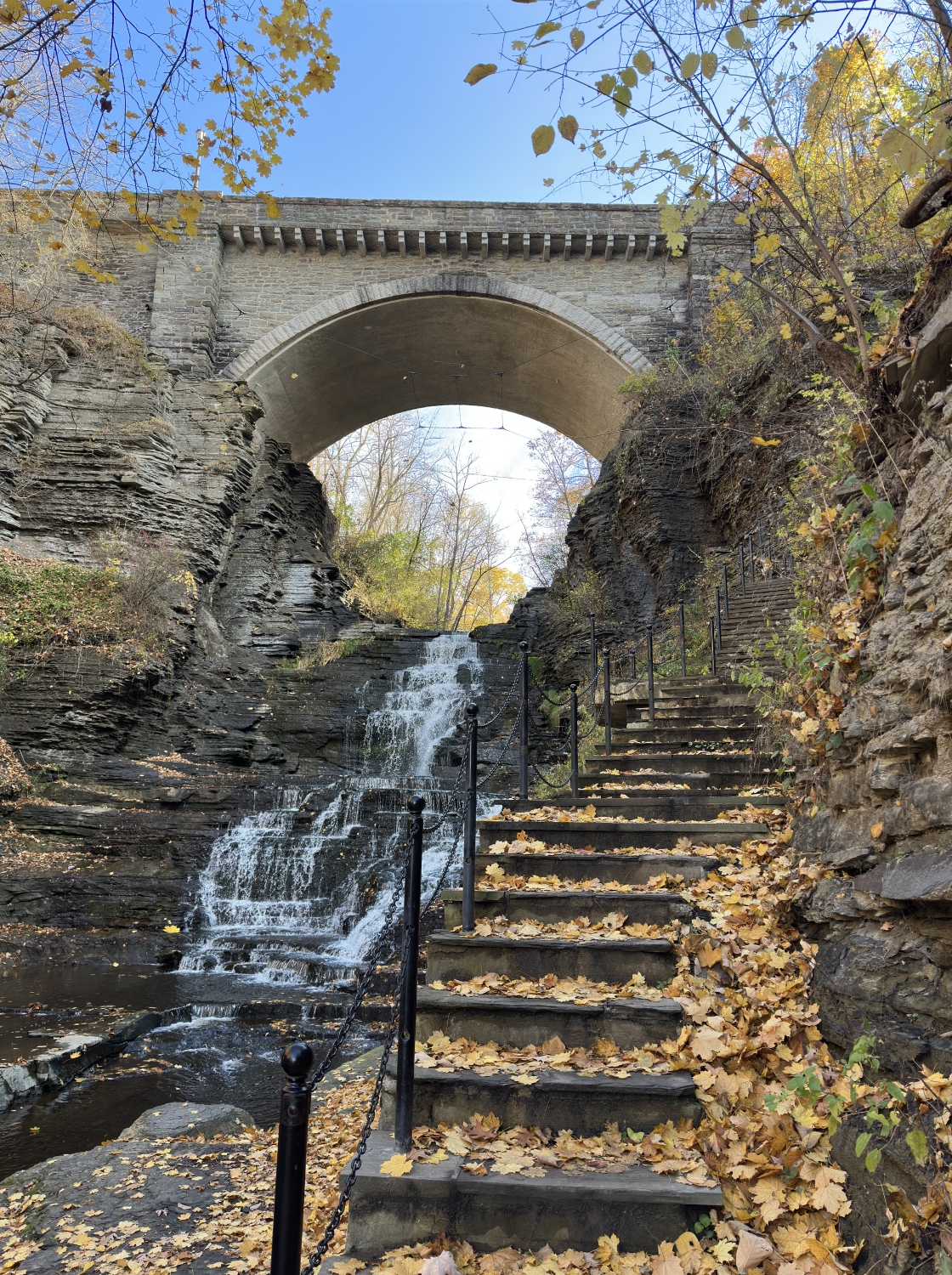
The trail steepens, and I press onward, the sound of the water intensifying as I near a grand waterfall framed by the impressive stone steps leading up to the College Avenue Stone Arch. Each step is littered with leaves, their colors vivid against the worn stone—golds, russets, and the occasional brilliant red, like embers scattered along my path. The waterfall beside me spills down in steady streams, each cascade creating rivulets that catch the light as they flow downward.
The gorge walls rise sharply on either side, embracing the path in rugged layers that tell stories of geological time. I feel as if I’m climbing a passage through history itself. These rocks, these trees, the very water carving its way through the stone—all have been here far longer than I can fathom, shaped by forces beyond my understanding. There’s a certain thrill in being among such enduring elements, a reminder of how small and fleeting we are in the face of nature’s grandeur.
Reaching the next tier of the trail, I pause to take in the sight of the massive stone arch spanning the gorge above. The bridge is a striking feature, its wide arch perfectly framing the sky and the last vibrant colors of autumn. It feels like a gateway, a fitting culmination to the journey. Standing beneath it, I’m struck by how well it harmonizes with the gorge, the careful craftsmanship of its stonework complementing the rough beauty of the surrounding cliffs.
The sunlight flows around the arch, illuminating the leaves that cling to the branches above, casting a warm glow over the scene. I feel a sense of reverence here, a quiet acknowledgment of both human artistry and the relentless beauty of nature.
I paused to capture this video of the moment.
Sights and Sounds of Autumn
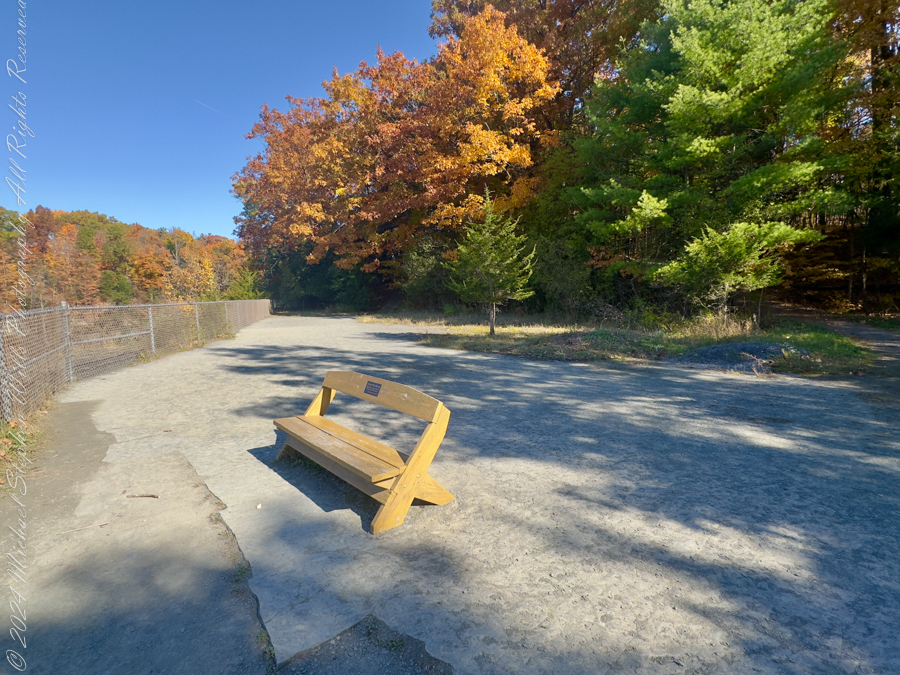
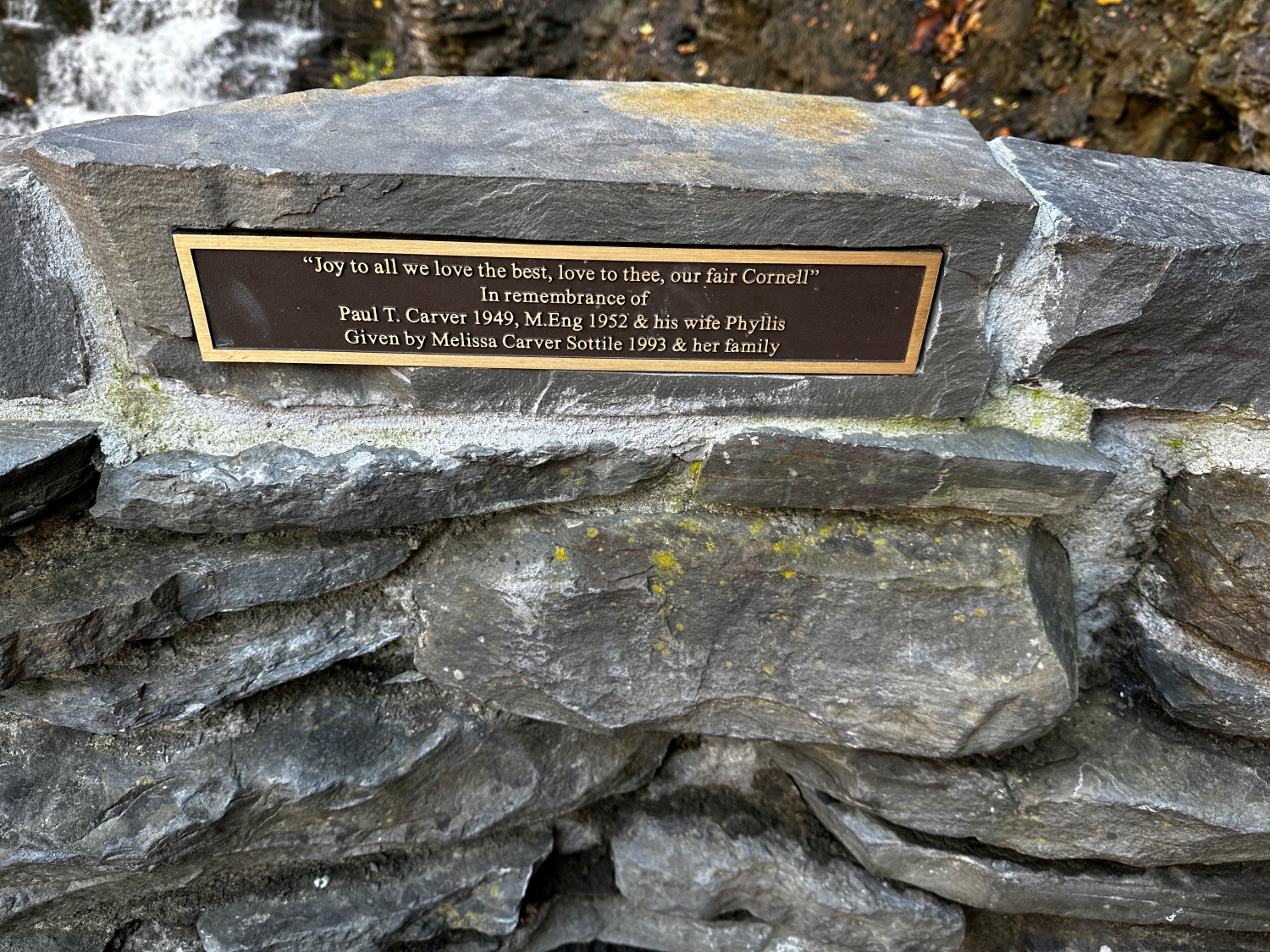
The final ascent is graced by a bench where a stone plaque catches my eye. It’s a tribute, etched with words that resonate in this place: “Joy to all we love the best, love to thee, our fair Cornell.” A gift from a family whose lives intertwined with Cornell, it serves as a reminder of the deep connections people have to this landscape, to the university, and to the memories rooted in these trails and gorges. I pause, reflecting on my own connection to this path, which has taken me through an ever-unfolding tapestry of nature and history.
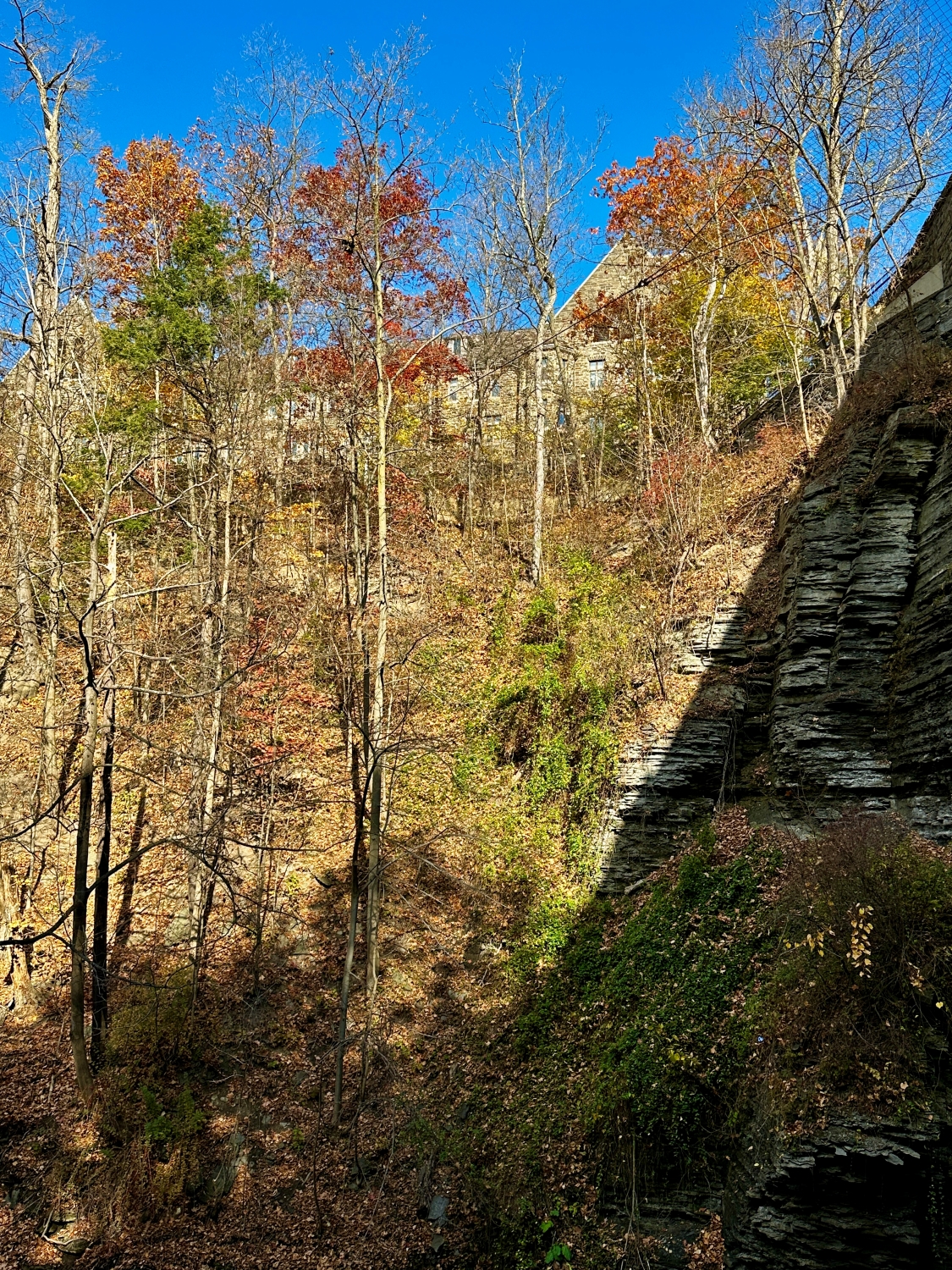
The last stretch of steps is leaf blanketed, their shapes and colors a beautiful final mosaic before I emerge from the shaded coolness of the gorge. The sun filters down through the thinning trees, illuminating the stone buildings of the Cornell campus that peek through the branches ahead. With each step, I feel the transition, moving from the curated wildness of Cascadilla Gorge and its trail to the structured beauty of the university grounds.
Myron Taylor Hall, Cornell Law School from the gorge.
As I reach the top, the Schwartz Center for the Performing Arts comes into view, its modern architecture a contrast to the ancient rocks I’ve left behind. Here, in this space where art, education, and nature converge, I take a last look back into the gorge and a journey, a gem in the heart of the Finger Lakes, a place that holds stories, both old and new, and invites every visitor to become a part of them.
Enter your email to receive notification of future postings. I will not sell or share your email address.
Copyright 2024 All Rights Reserved Michael Stephen Wills
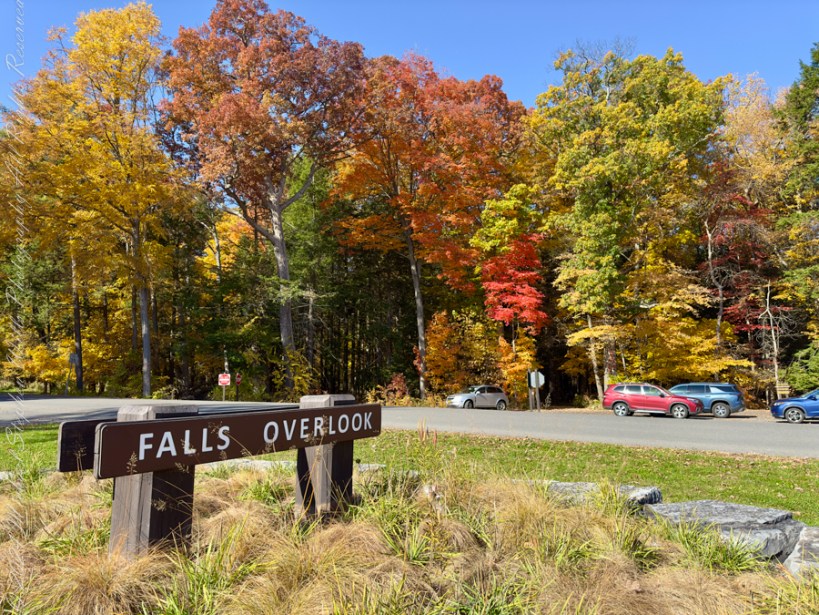
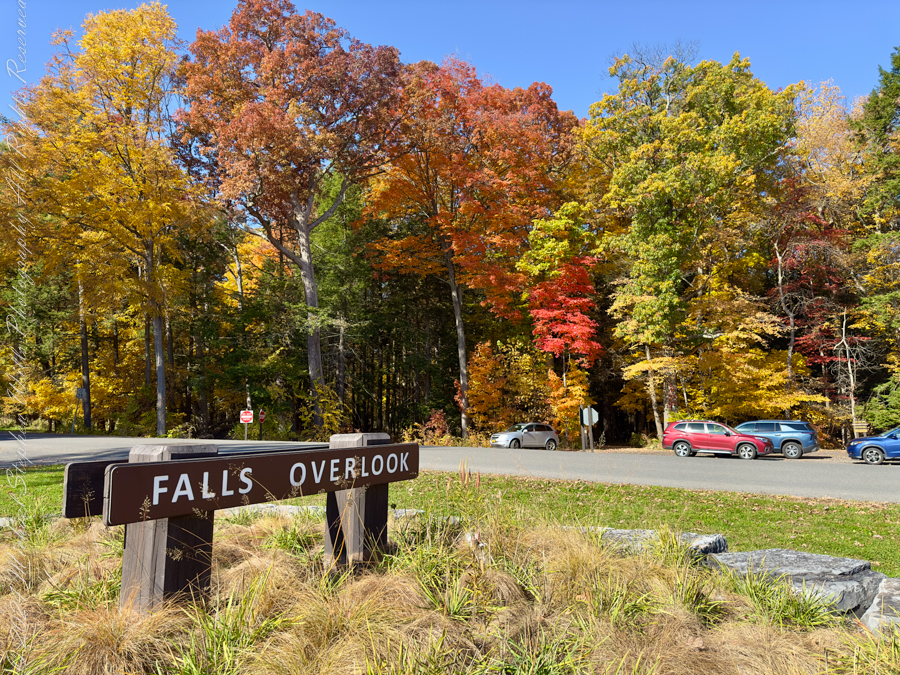
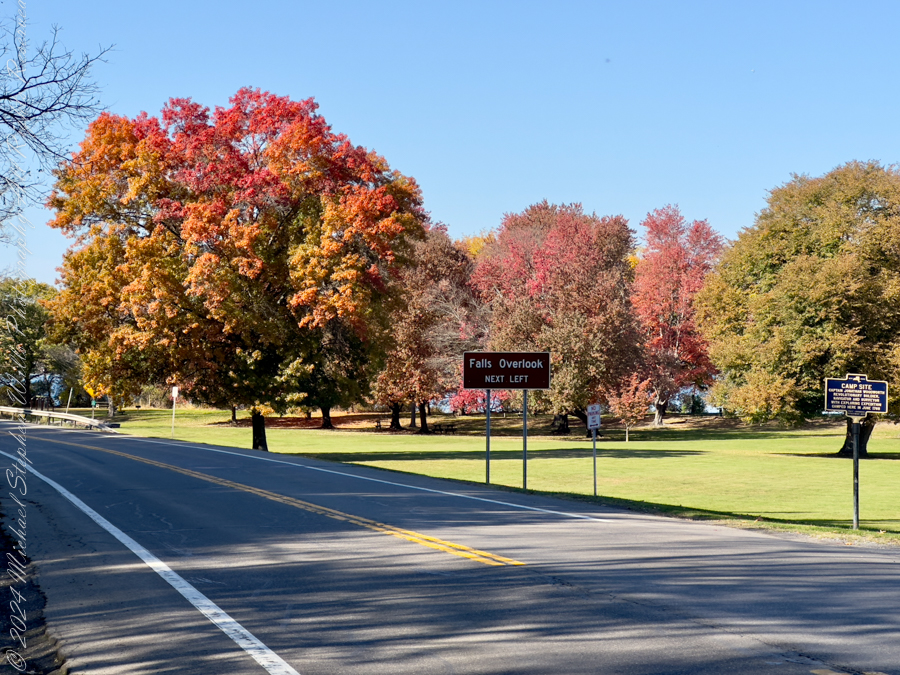
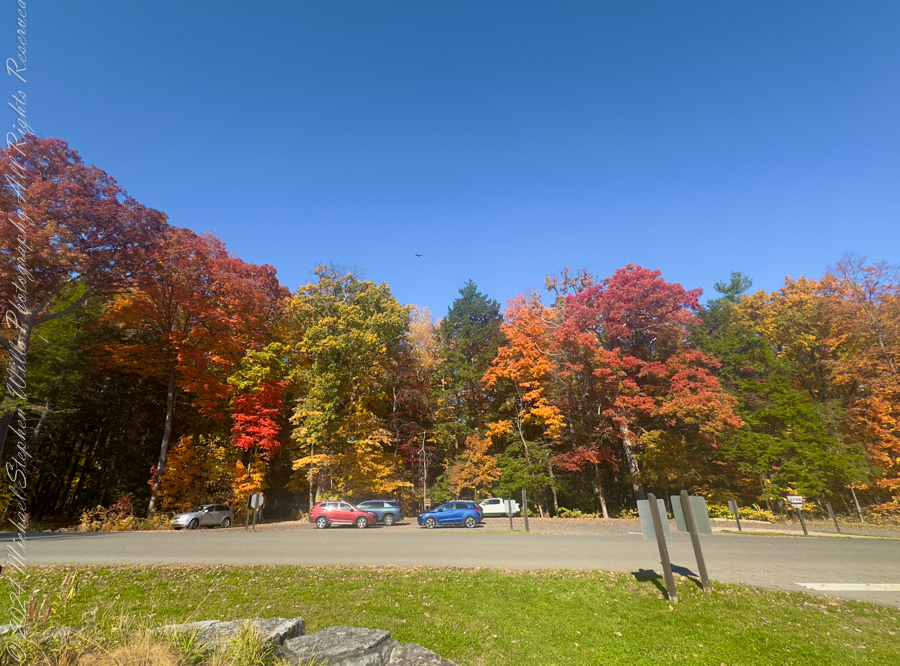
As I set foot on the Falls Overlook at Taughannock Falls State Park, I was greeted by a symphony of autumn colors in their full glory. The vibrant oranges, reds, and yellows of the trees framed the scene, setting the stage for a perfect fall day. I lingered, taking in the view of cars nestled among the foliage, their colors almost merging with the rich autumn hues surrounding them. The sign for the “Falls Overlook” hinted at the journey ahead.
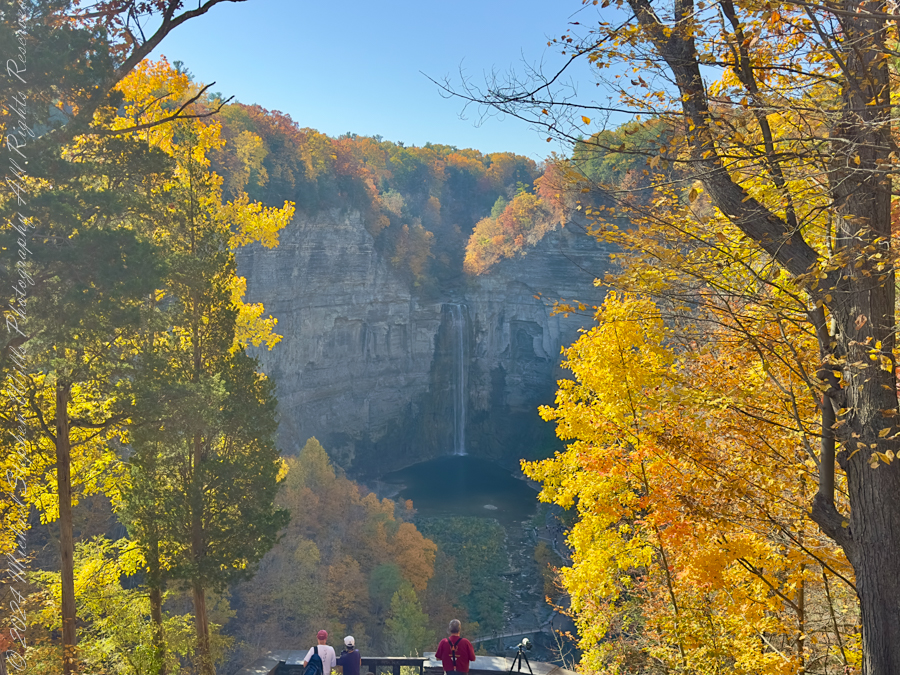
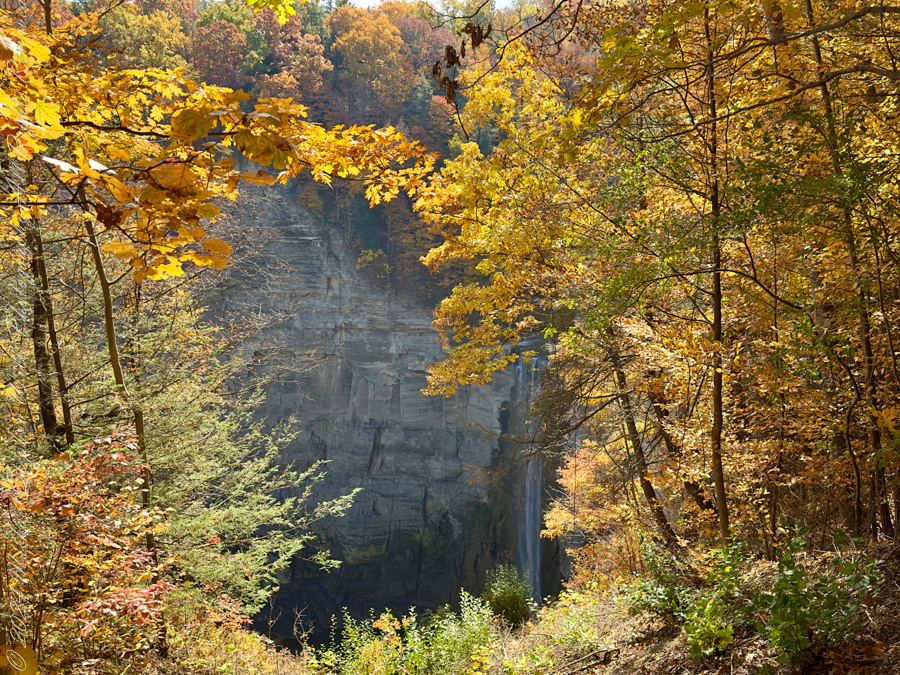
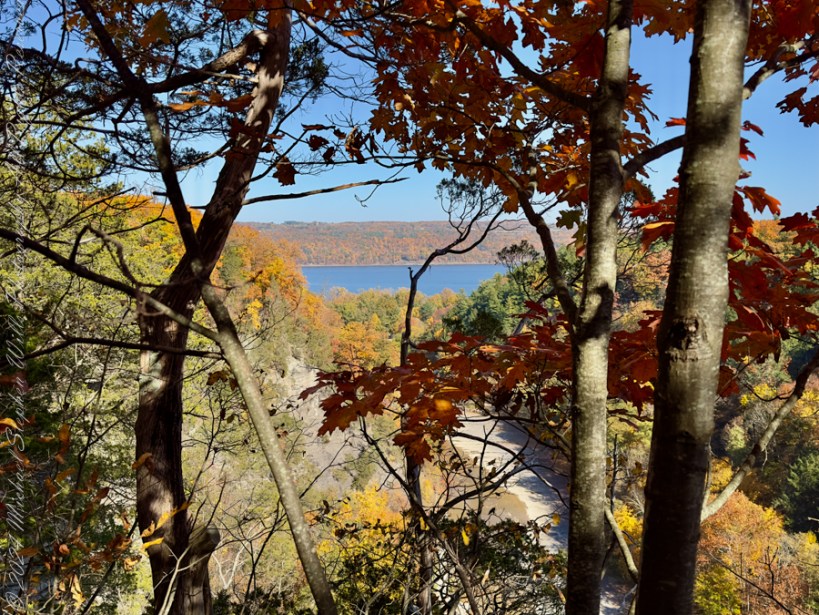
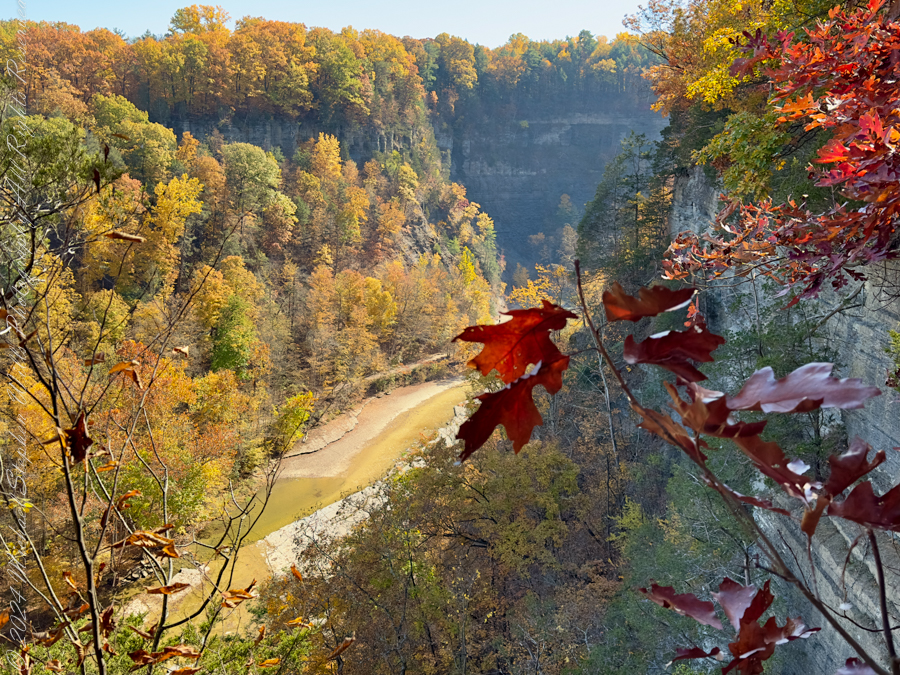
The overlook offered a breathtaking view, a gentle reminder of nature’s power as Taughannock Falls cascaded far below, framed by rugged cliffs and vibrant trees. Through gaps in the golden leaves, I could catch glimpses of the waterfall, a delicate white ribbon against the slate-gray rock. The sunlight filtered through the canopy, casting dappled shadows and illuminating leaves like stained glass, painting the landscape in a thousand shades.
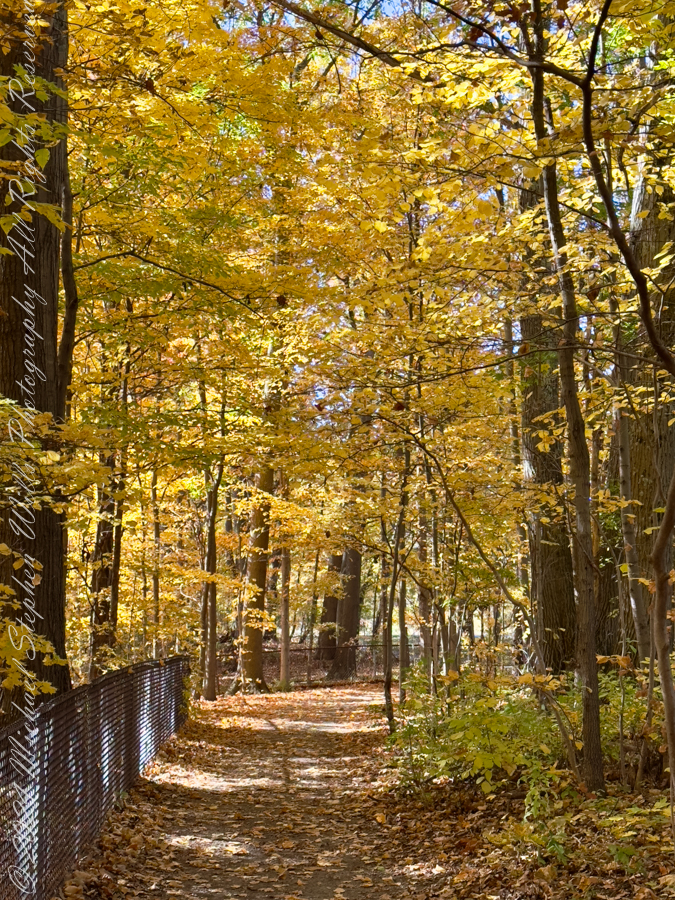
I began my ascent up the North Rim Trail, where the path twisted beneath a tunnel of golden branches. The trail was carpeted with leaves, crunching underfoot with each step. The air was crisp, filled with the earthy scent of decaying leaves and moist earth. Sunlight poured through gaps in the canopy, lighting up patches of ferns and casting long shadows on the rocky path. Here and there, the yellow and brown hues gave way to a burst of crimson, the leaves vivid and almost glowing in the sunlight.
The trail led me along the cliff’s edge, where the river carved its path below. Pausing on the footbridge to the south rim, a former railroad, I looked out over the gorge, admiring the mosaic of colors stretching as far as the eye could see. In the distance, the sound of the falls drifted up to me, a soft, continuous roar that lent the forest an almost mystical air. It was hard not to feel a sense of awe at the raw beauty of the scene.
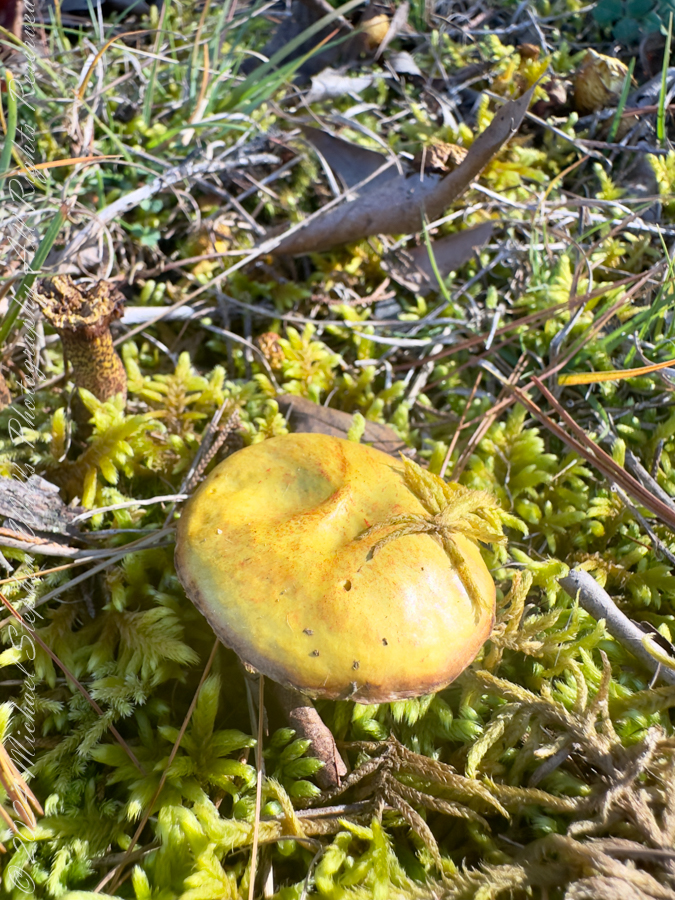
Eventually, I made my way down the South Rim Trail. There were ample distractions from the glorious foliage. A lone mushroom, golden and nestled in a bed of moss, caught my eye—a small reminder of the forest’s quiet life. I bent down to examine it, marveling at its delicate cap and the way it seemed to glow against the lush green moss. The trees here were denser, casting cool shadows that contrasted with the sun-drenched north side. The leaves here were thicker underfoot, their earthy scent more pronounced, grounding me in the moment.
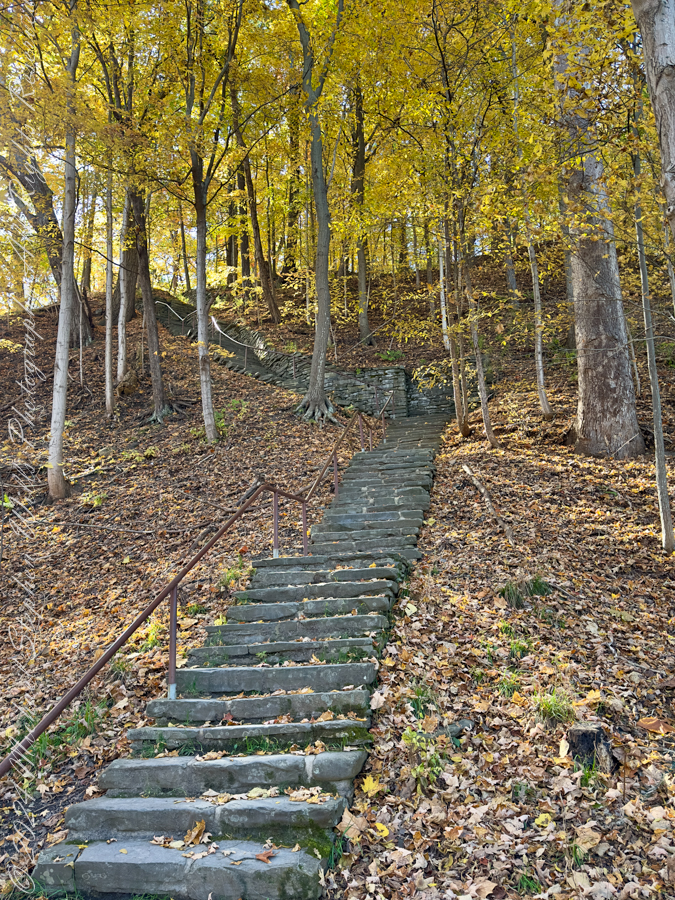
As I reached the lower section of the trail, I noticed an old stone staircase winding up through the trees to the north rim—a relic from another time, adding a touch of mystery to the path. Each step was worn smooth by countless feet, each one a reminder of the generations that had walked these trails before me. The stairs climbed through a cathedral of trees, each trunk tall and straight, as if standing guard over the trail.
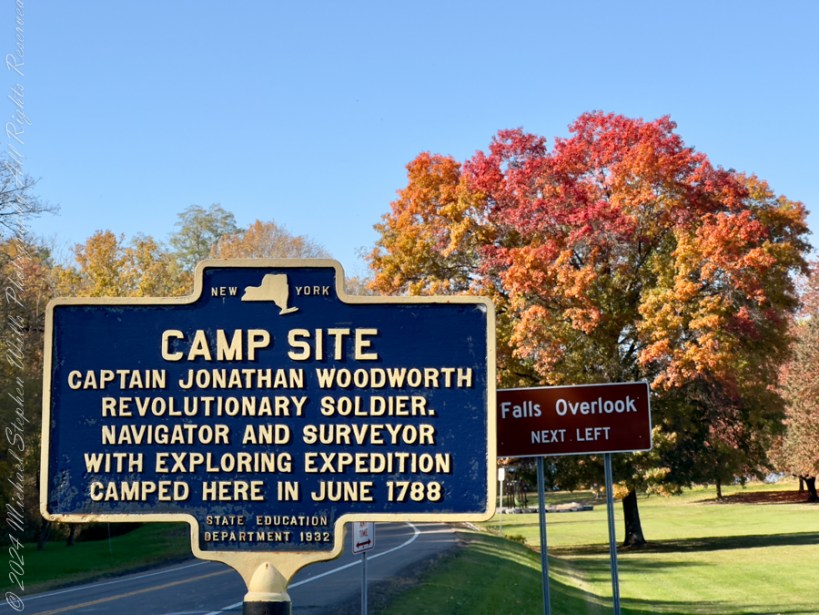
On my way around I passed by a historical marker, a blue and yellow sign commemorating the camp site of Captain Jonathan Woodworth, a Revolutionary soldier who camped here in June 1788. It was a reminder that these trails, this land, had been cherished long before my steps fell upon it.
After reaching the base of the South Rim Trail, I looped back up the North Rim. The trail now felt familiar, yet the changing light gave it a new character. The sun was lower, casting a golden glow across the tops of the trees.
As I returned to my starting point, the sun cast a soft, warm light across the landscape, bathing the park in an ethereal glow. With one last look over the falls and the vivid tapestry of trees, I felt a sense of gratitude. Taughannock Falls State Park in autumn is an experience, one that leaves an indelible mark, reminding us of the beauty and timelessness of the natural world.
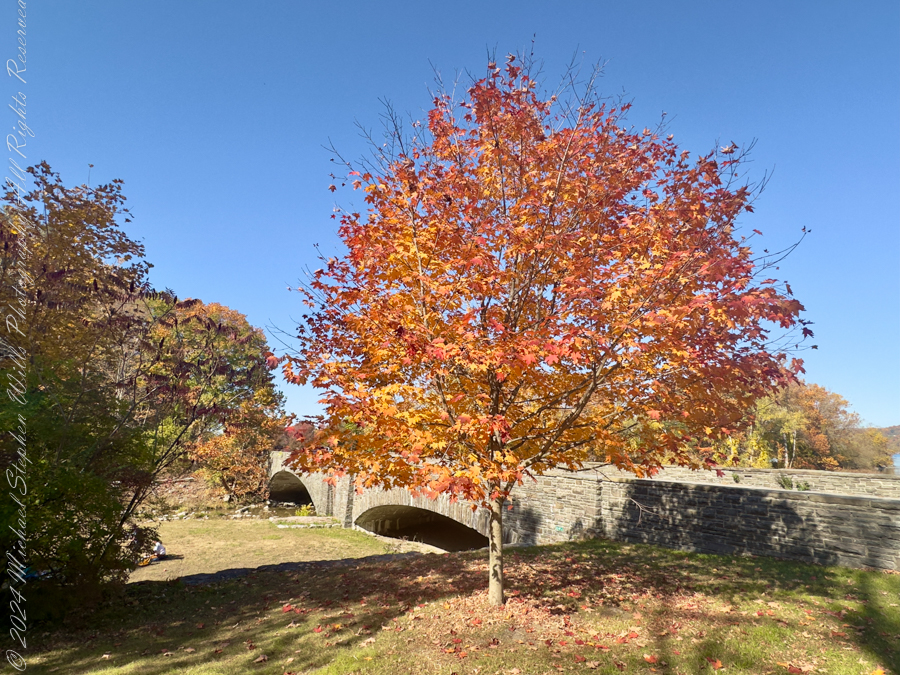
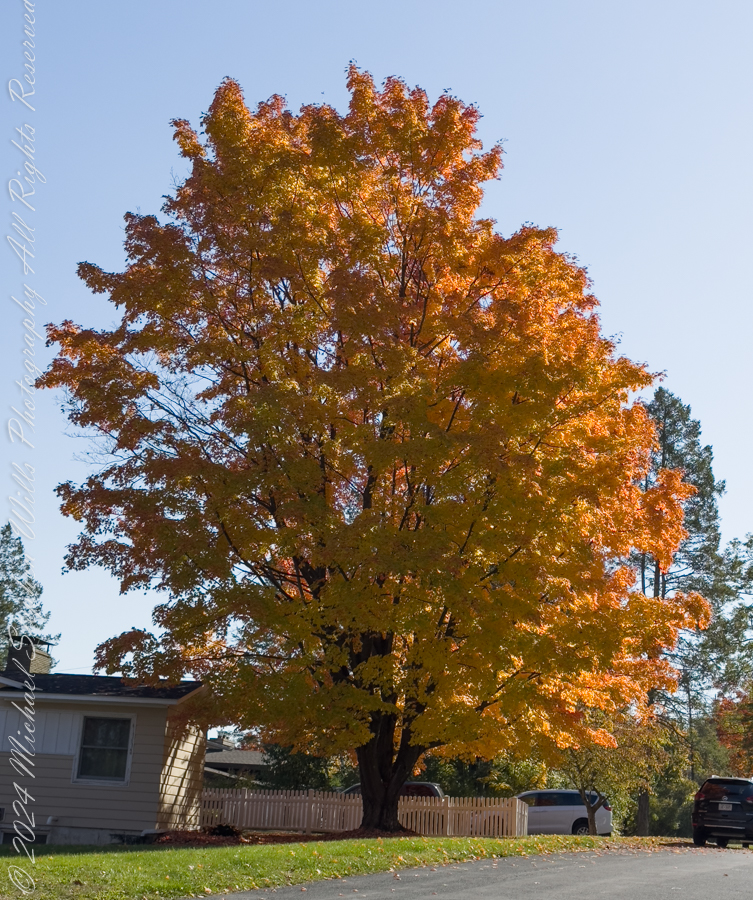
On the drive home I paused to admire a neighbor’s maple tree’s full autumn glory.
Enter your email to receive notification of future postings. I will not sell or share your email address.
Copyright 2024 All Rights Reserved Michael Stephen Wills
On a crisp October afternoon, October 3, 2024, Pam and I reveled in Upper Robert H. Treman State Park, a serene oasis nestled in Tompkins County. This visit was particularly special for us, a step in Pam’s recovery from her August hip replacement. I remember the sound of her hiking pole tapping the ground as we walked together, feeling grateful for her progress since surgery. The air was cool, and the leaves, turning gold and orange, whispered in the breeze, providing the perfect backdrop for our outing that day.
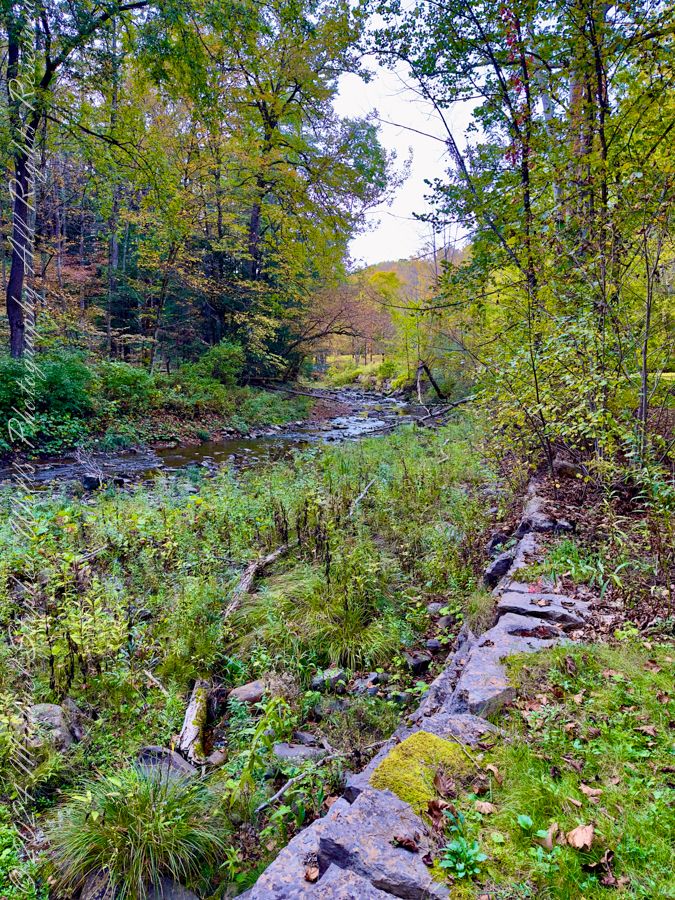
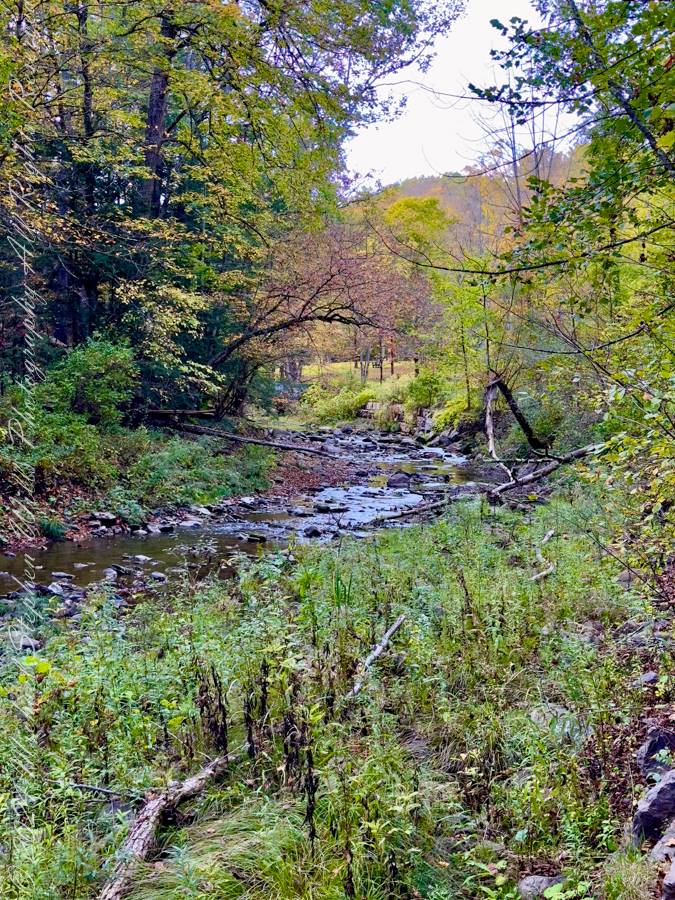
Our path followed the creek, the same creek that winds through the heart of the park, framed by layers of stone and lush vegetation. In one of the first photos I took that day, you can see the creek reflecting the soft autumn light, its bed dotted with rocks and fallen branches. The vibrant greens of the undergrowth juxtaposed with the golden leaves made the scene feel timeless, as though nature itself was participating in Pam’s recovery, offering healing in its quiet, enduring beauty.
The view upstream just before the creek enters The Gallery. Robert H. Treman State Park, Enfield, Tompkins County, Finger Lakes Region, New York State.
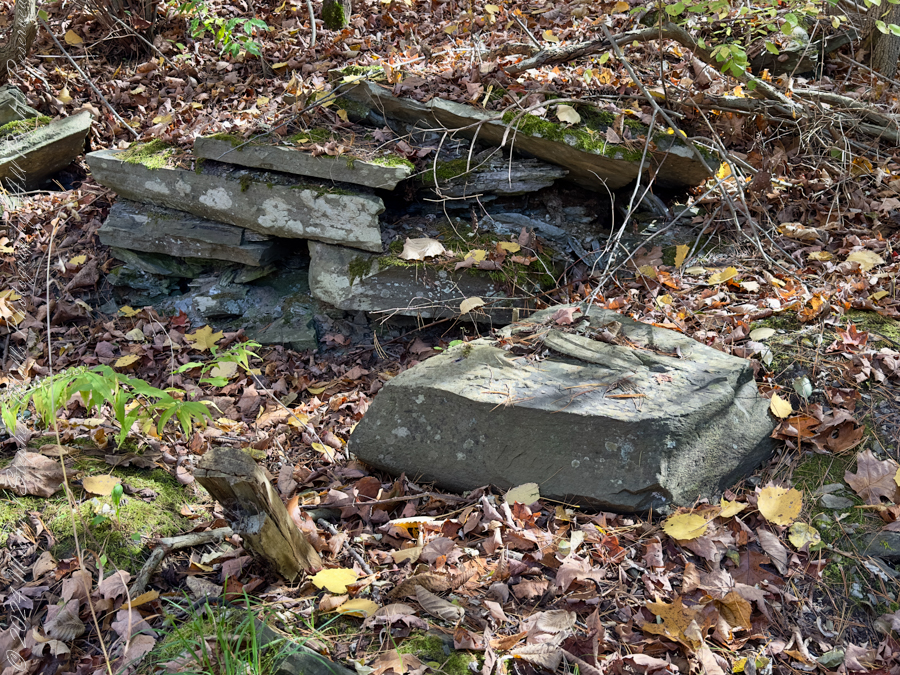
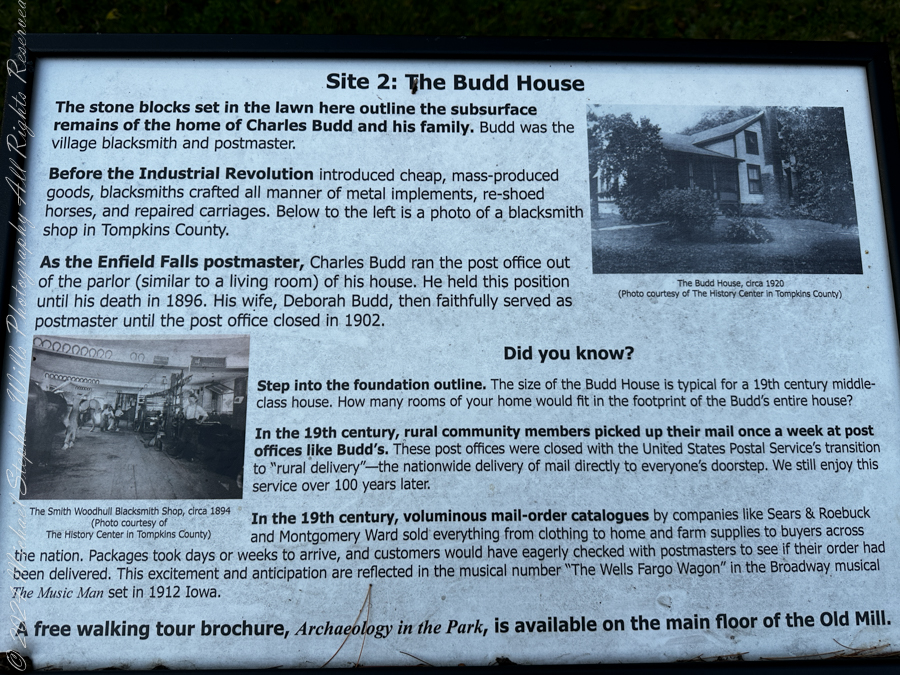
We paused to take in the quiet hum of life around us. There was a sense of history in the park that seemed to blend with our personal story. As we wandered deeper, we reached the foundation of the old Budd House, its stone blocks now barely a shadow of the past but still carrying echoes of life lived long ago. The placard described Charles Budd, a village blacksmith and postmaster, and his wife, Deborah, who continued to serve the community after his passing. Standing there, I reflected on how these stones, much like Pam’s journey, represented resilience and the passage of time.
Site 2: The Budd House
The stone blocks set in the lawn here outline the subsurface remains of the home of Charles Budd and his family. Budd was the village blacksmith and postmaster.
Before the Industrial Revolution introduced cheap, mass-produced goods, blacksmiths crafted all manner of metal implements, re-shoed horses, and repaired carriages. Below to the left is a photo of a blacksmith shop in Tompkins County.
As the Enfield Falls postmaster, Charles Budd ran the post office out of the parlor (similar to a living room) of his house. He held this position until his death in 1896. His wife, Deborah Budd, then faithfully served as postmaster until the post office closed in 1902.
Did you know?
Step into the foundation outline. The size of the Budd House is typical for a 19th century middle-class house. How many rooms of your home would fit in the footprint of the Budd’s entire house?
In the 19th century, rural community members picked up their mail once a week at post offices like Budd’s. These post offices were closed with the United States Postal Service’s transition to “rural delivery”—the nationwide delivery of mail directly to everyone’s doorstep. We still enjoy this service over 100 years later.
In the 19th century, voluminous mail-order catalogues by companies like Sears & Roebuck and Montgomery Ward sold everything from clothing to home and farm supplies to buyers across the nation. Packages took days or weeks to arrive, and customers would have eagerly checked with postmasters to see if their order had been delivered. This excitement and anticipation are reflected in the musical number “The Wells Fargo Wagon” in the Broadway musical The Music Man set in 1912 Iowa.
A free walking tour brochure, Archaeology in the Park, is available on the main floor of the Old Mill. Upper Treman. Robert H. Treman State Park, Enfield, Tompkins County, Finger Lakes Region, New York State.
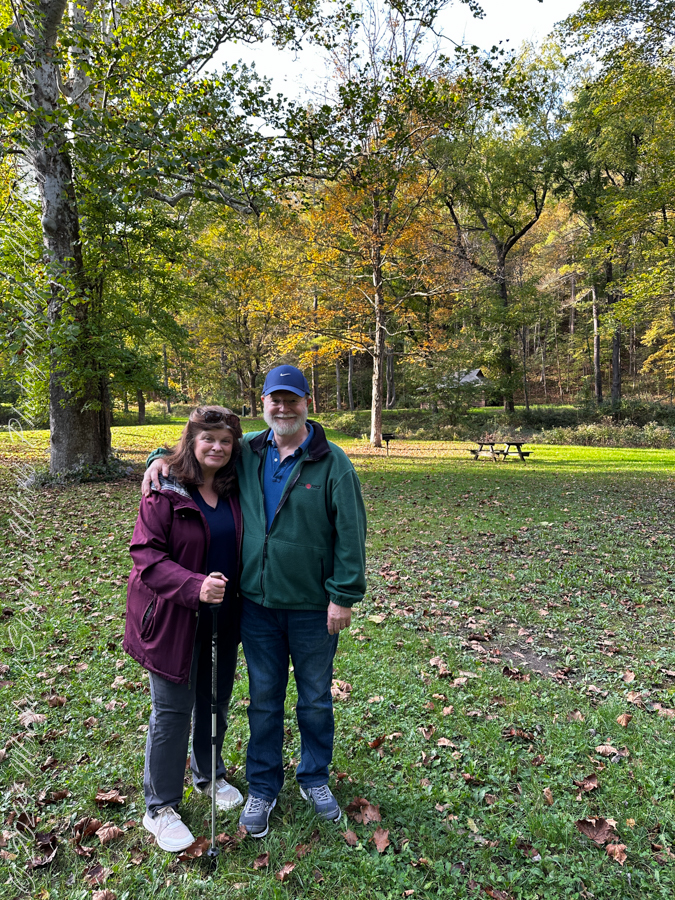
As we stood by the foundation, we met another couple. The woman shared her own story of recovery, a tale of resilience that resonated deeply with us. She had fallen and suffered a spinal injury, becoming paralyzed from the neck down, while traveling. Thanks to surgery and rehabilitation, she regained full mobility. There was a moment of understanding and connection between us. We offered to take a photo of them, and they returned the favor, capturing the two of us—Pam leaning lightly on her cane, smiling, surrounded by trees whose leaves were beginning to fall. That picture, one of my favorites from the day, symbolizes not just Pam’s strength but also the support and shared experiences that come with recovery.
We are taking a walk through upper Treman Park during Pam’s recovery from hip replacement. This was taken by a couple we met.
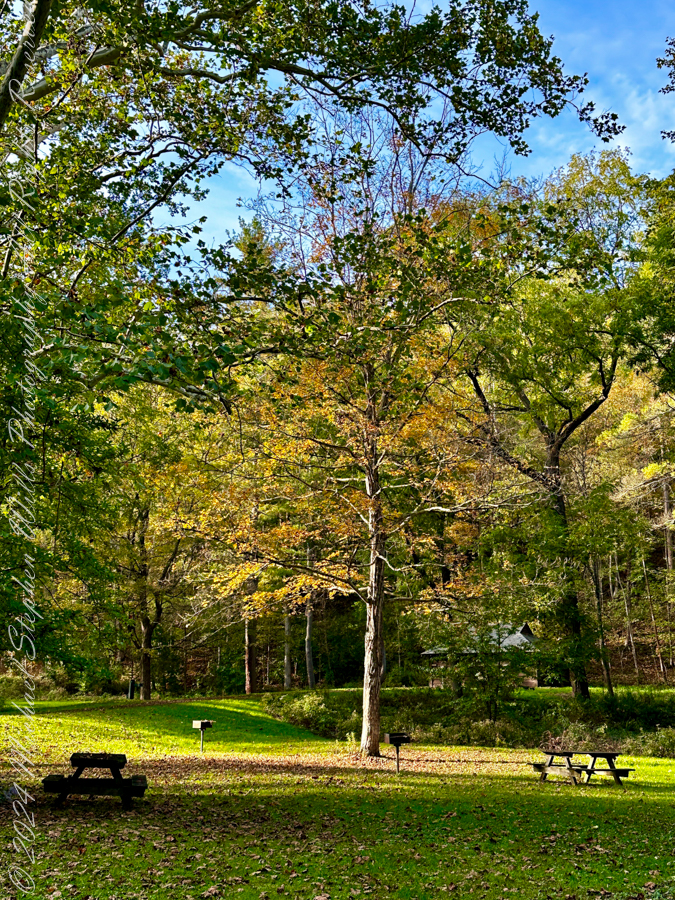
The park offered us a space for reflection and a sense of continuity. The trees, some towering over us with roots gripping the earth, had seen many seasons of change, and now they watched over us as we walked beneath them. In the clearing where picnic tables stood, we sat for a while, simply absorbing the moment. The afternoon light filtered through the branches, casting long shadows on the grass.
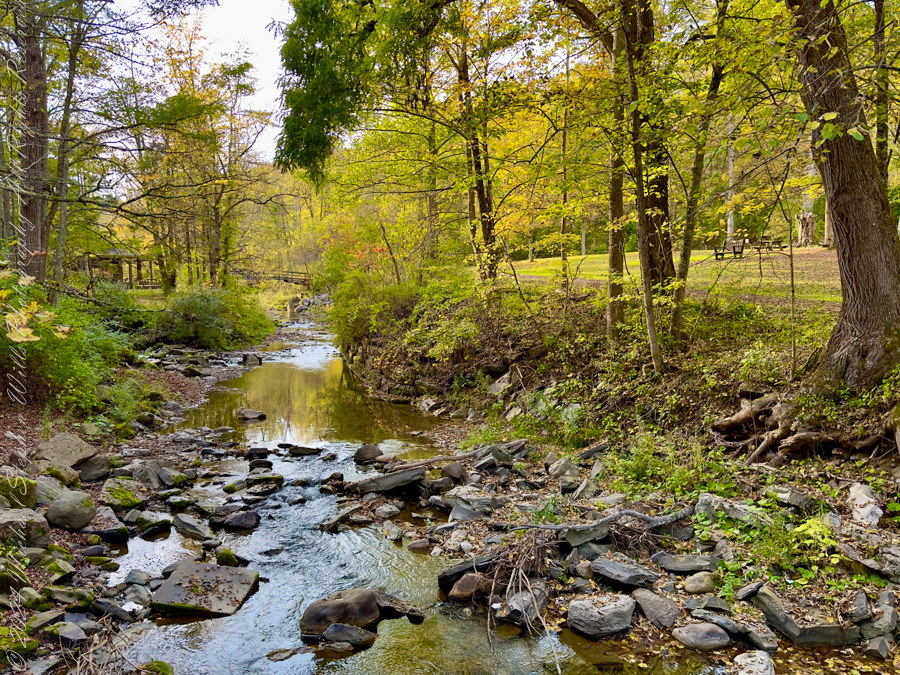
One of the final photos I took that day captures the creek from another angle. The water, calm and clear, reflects the yellow hues of the trees, while the rocks and roots along the bank seem frozen in time. It’s a peaceful image, one that reminds me of the quiet strength that Pam has shown throughout her recovery.
Here Fish Creek, a tributary of Enfield Creek joins the flow just below the pavilion of Upper Treman.
We left the park that day feeling both uplifted and grounded, the layers of history and personal resilience blending seamlessly into the natural landscape. Upper Robert H. Treman had become had become a part of Pam’s recovery story, a testament to the healing power of both nature and community.
Enter your email to receive notification of future postings. I will not sell or share your email address.
Copyright 2024 All Rights Reserved Michael Stephen Wills




 Michael Stephen Wills Photography