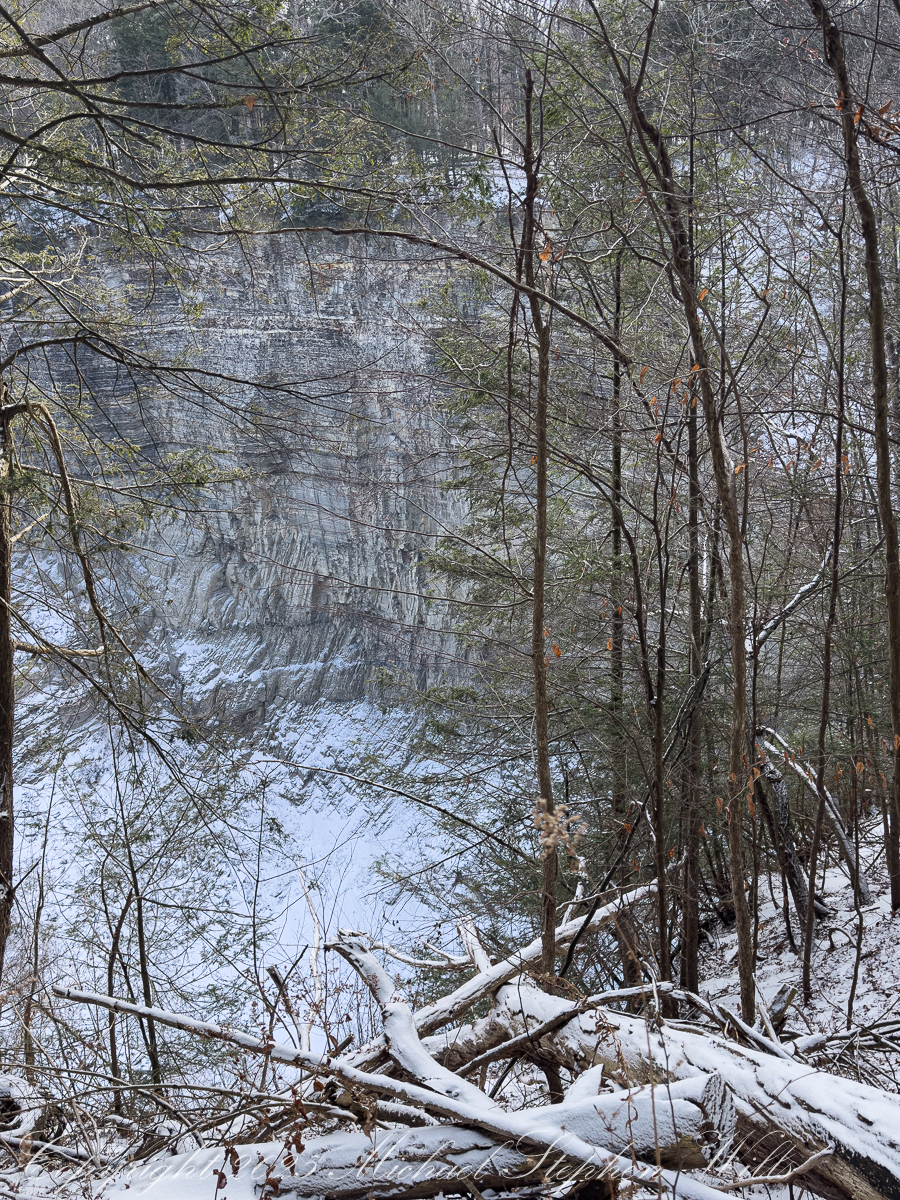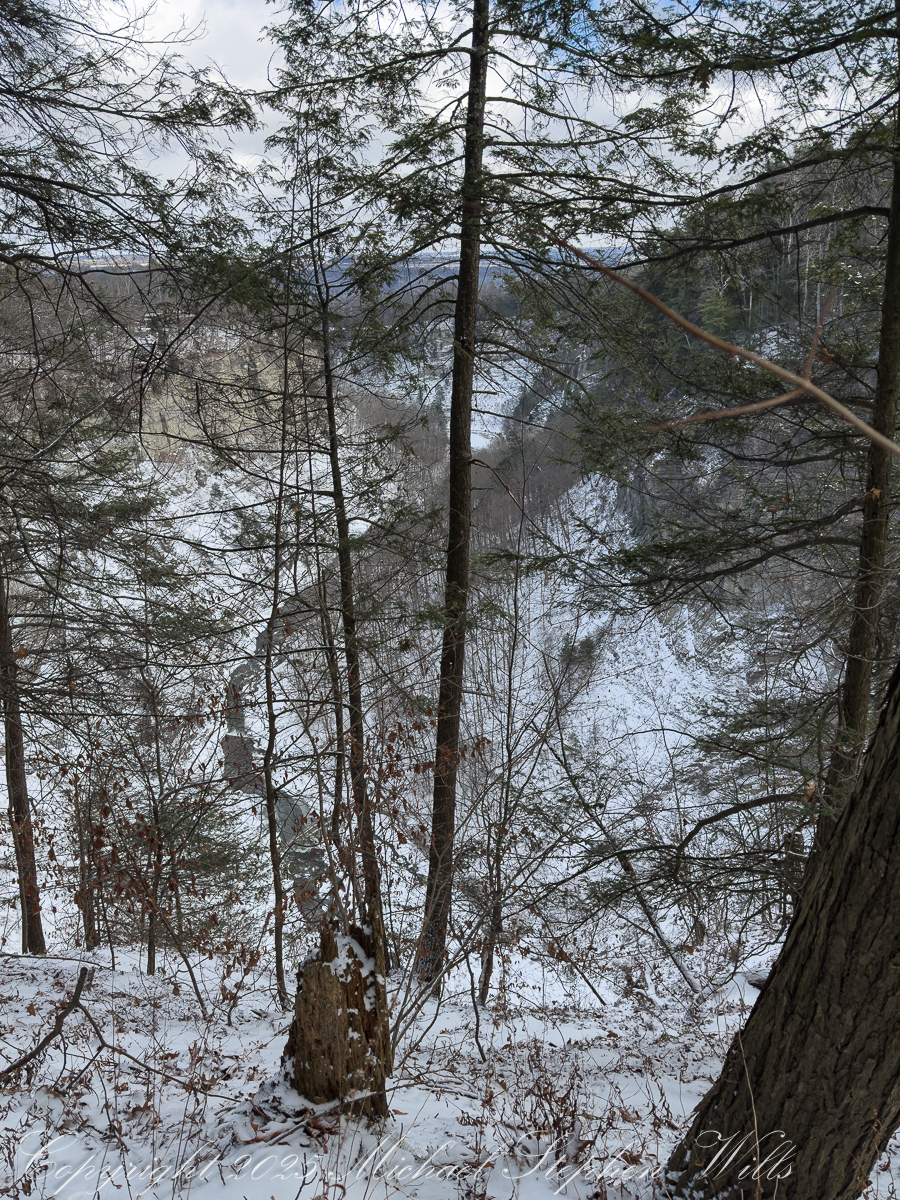
Fens, Bogs, and Flowing Water of Malloryville Preserve of Freeville, New York

Discover Malloryville Preserve in Freeville, New York—a hidden Finger Lakes wetland of fens, bogs, and flowing water where glacial history and rare plants meet.
Water defines the O.D. von Engeln Preserve at Malloryville long before we see or hear it. At first, it is only a dampness in the air, a coolness at ankle level, a dark sheen between sedge tussocks. In the space of a half-hour walk, we pass through fen, bog, marsh, and swamp, each distinct, yet bound together by the same slow, persistent flow.
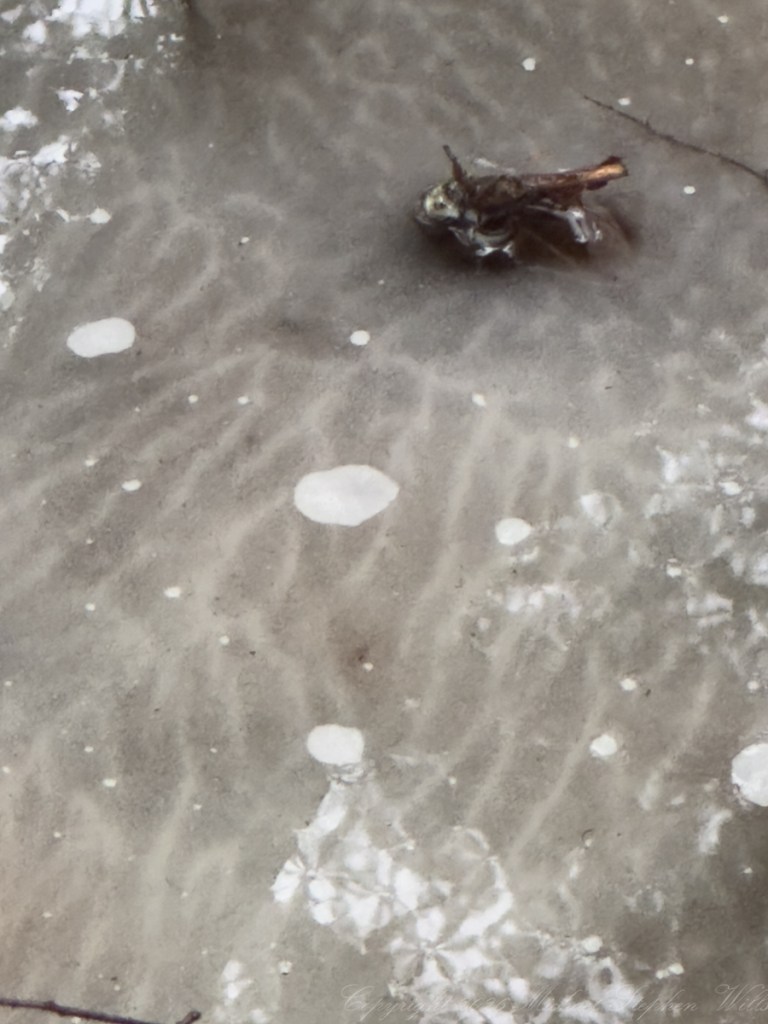
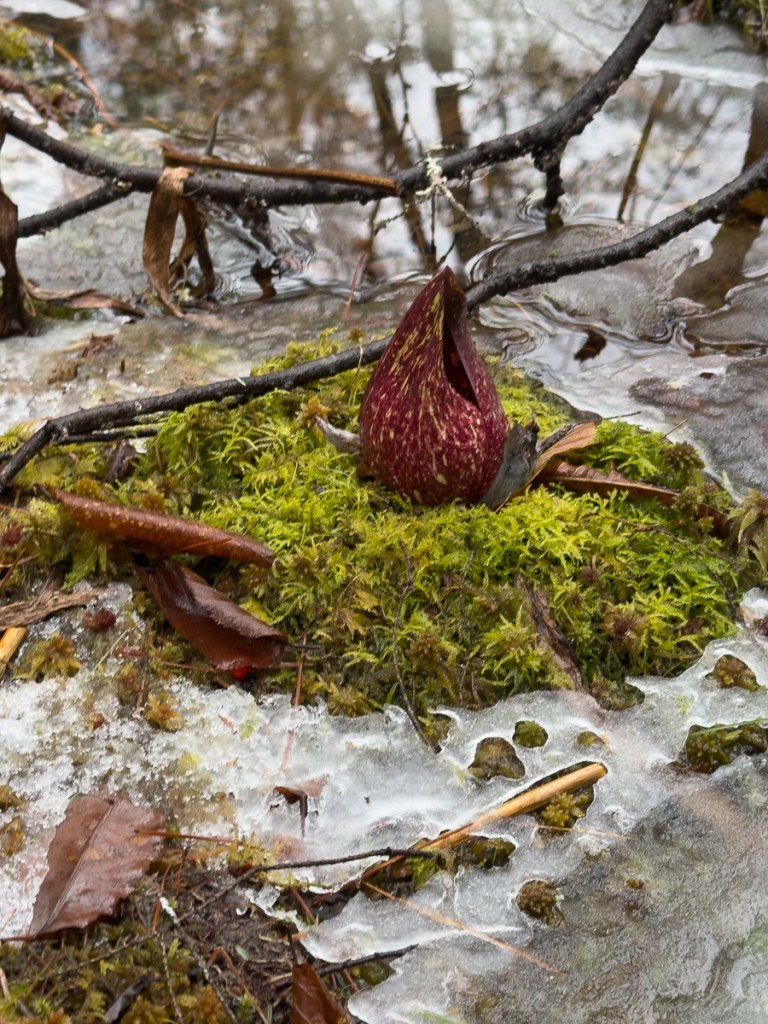
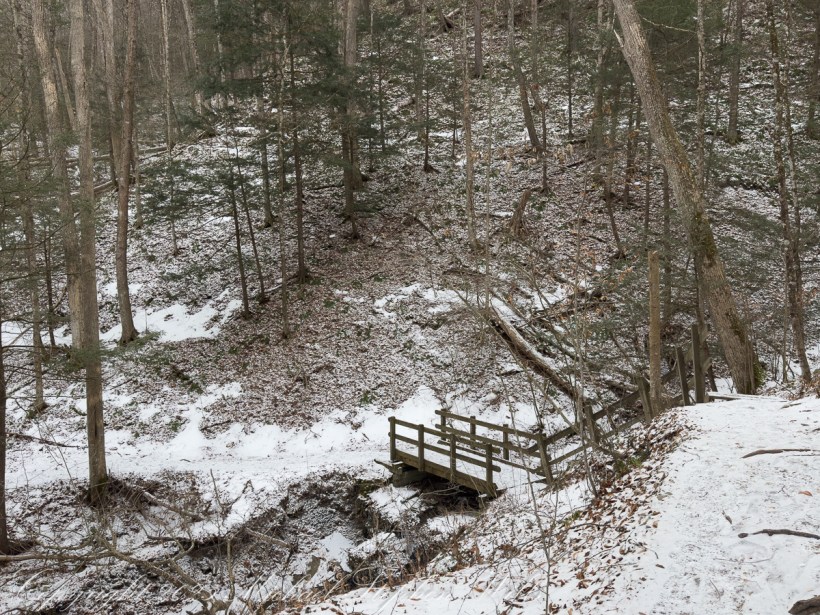
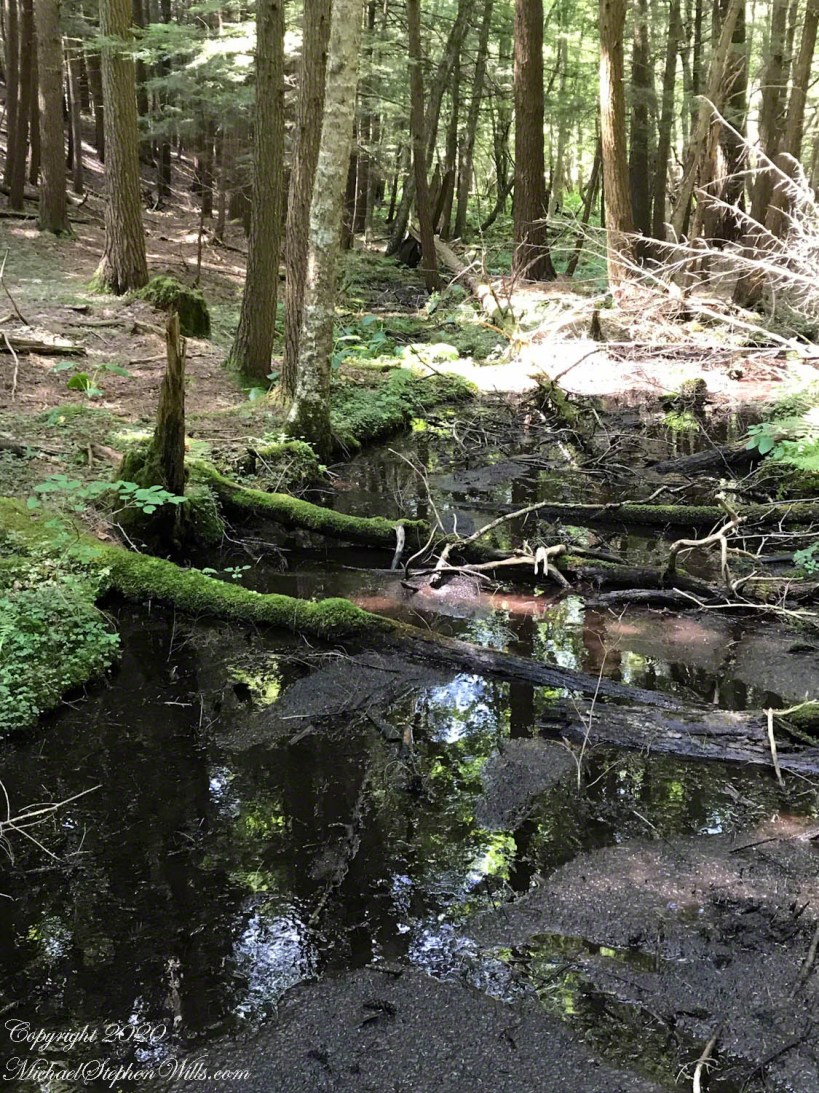
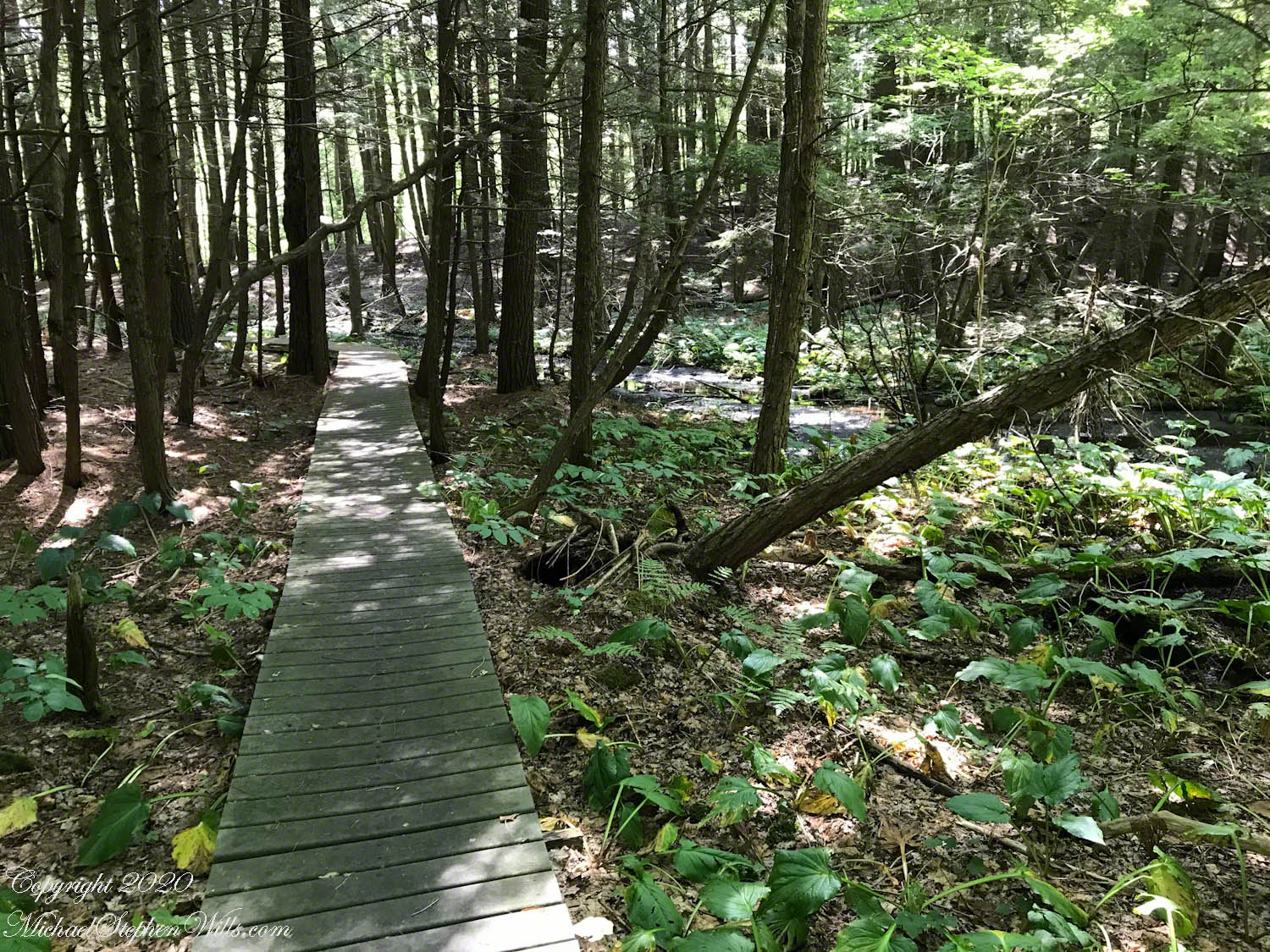
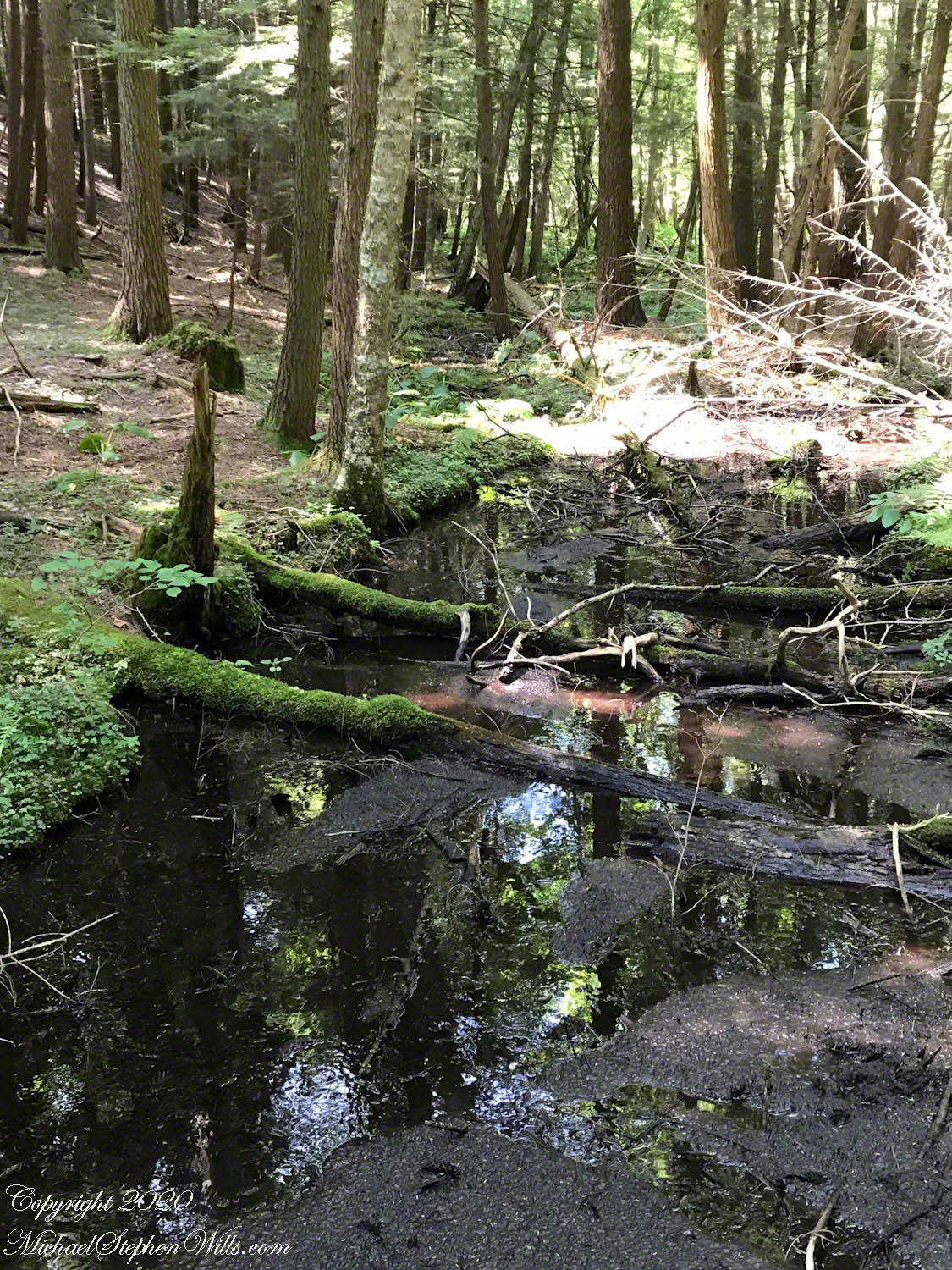
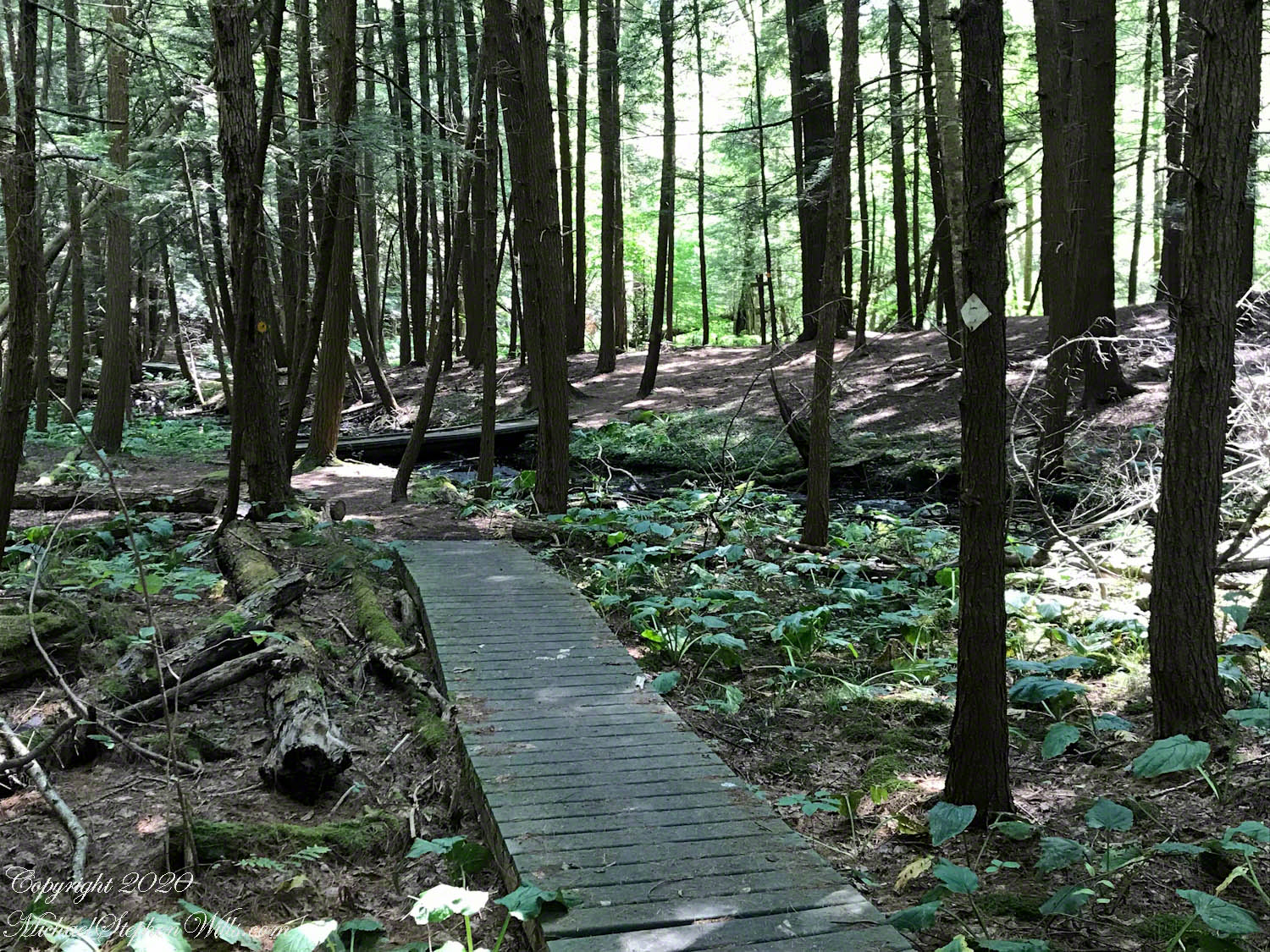
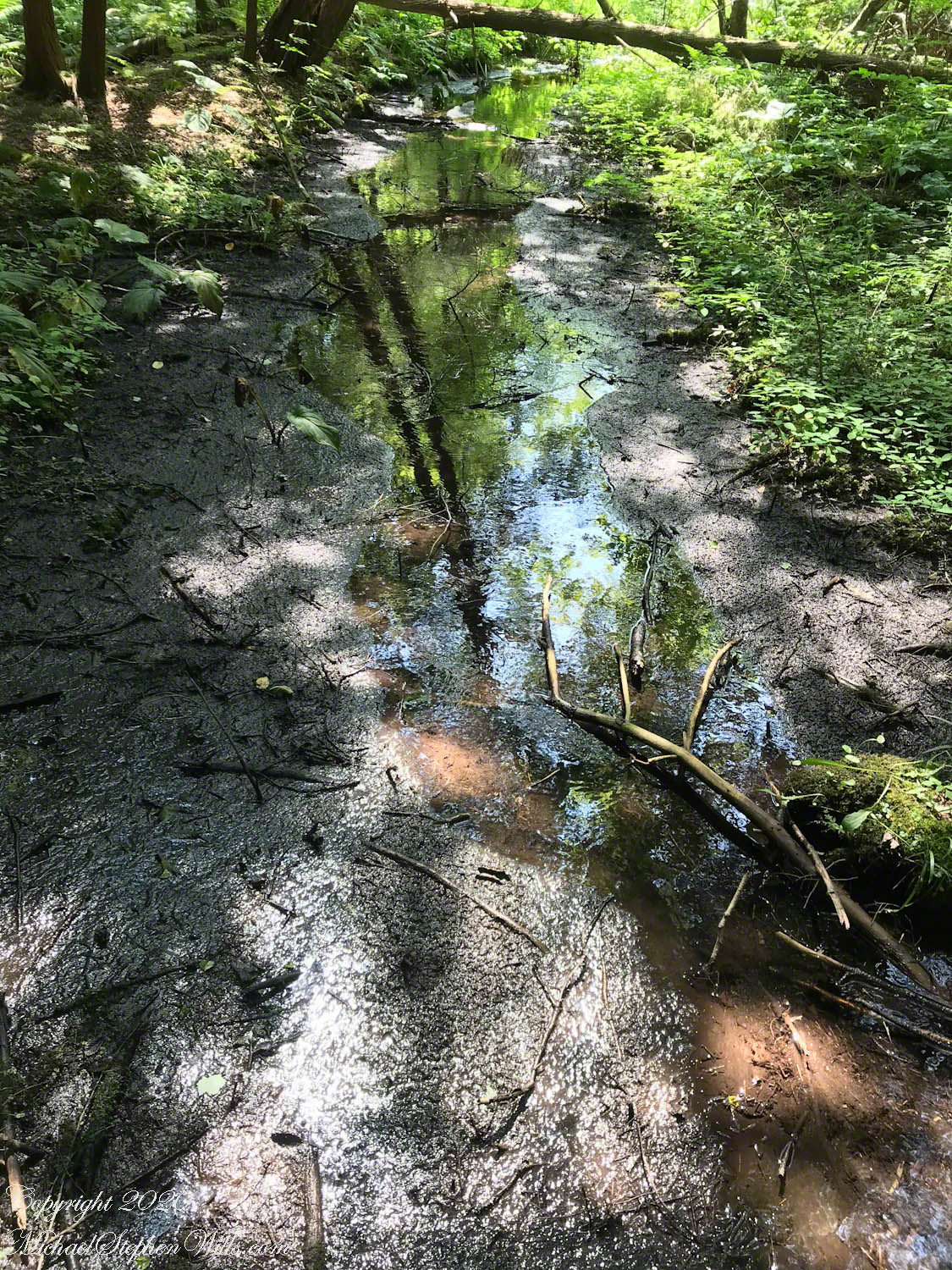
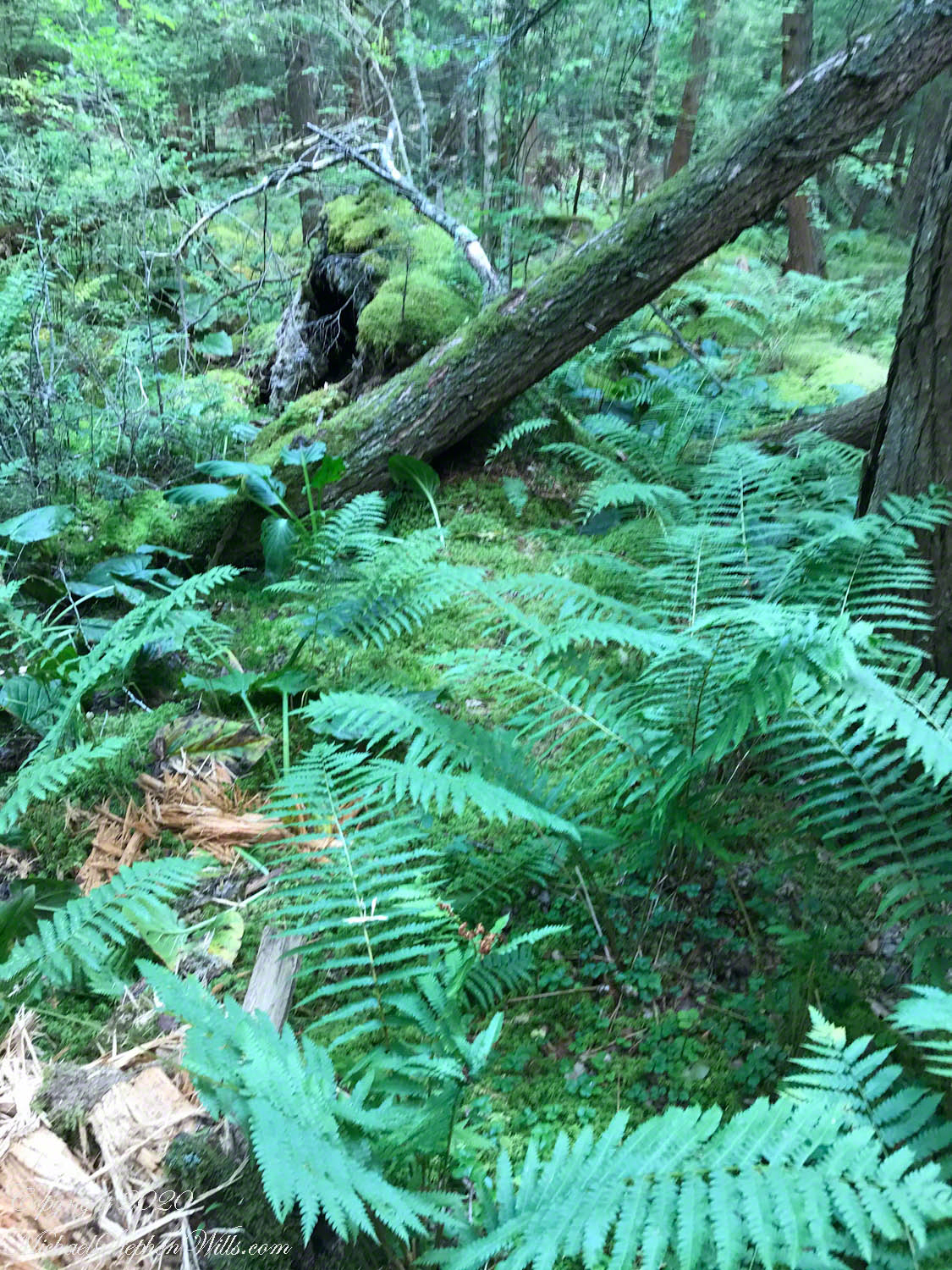
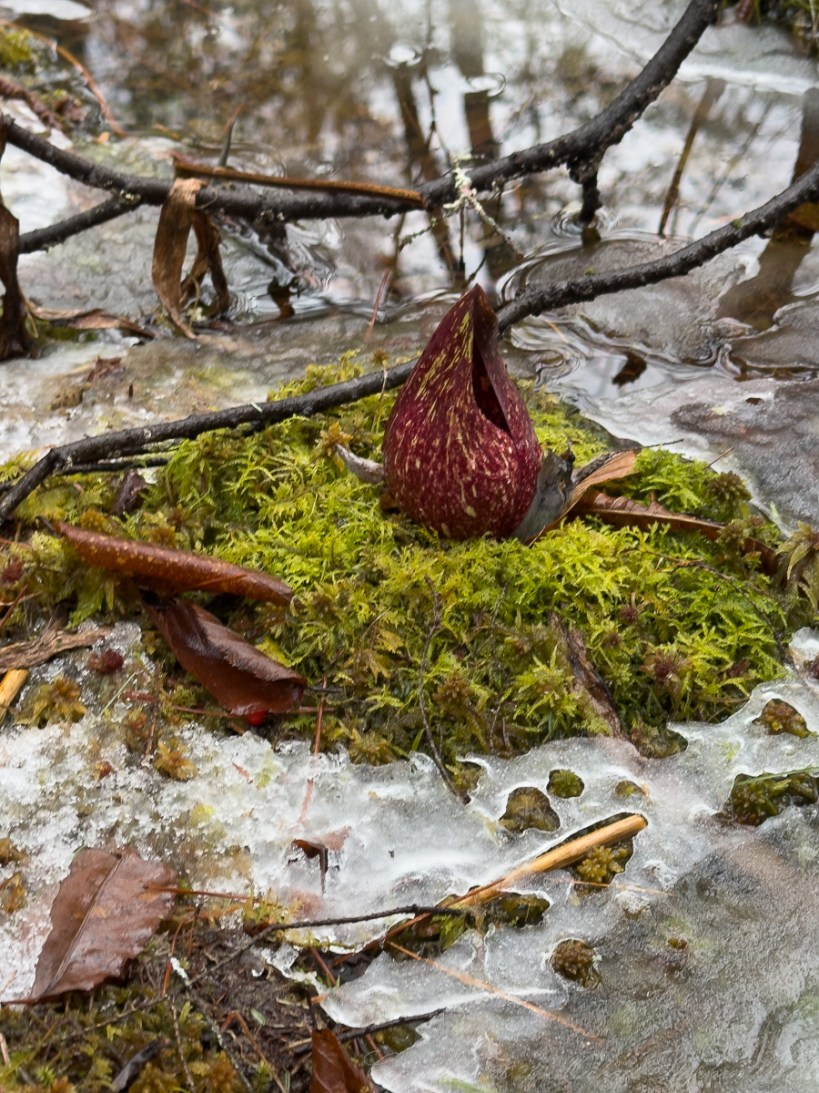
Here we are traversing a swamp, our steps buoyed along on planking made from recycled plastic. The boardwalk floats visually above pools the color of tea, edged with moss and skunk cabbage. It’s easy to imagine what this crossing would have been like before the planks were laid—boots sinking, knees splashed, delicate plants crushed. The modern walkway is a quiet compromise: we may enter this saturated world without trampling it, a human gesture that matches the preserve’s ethos of protection and restraint.

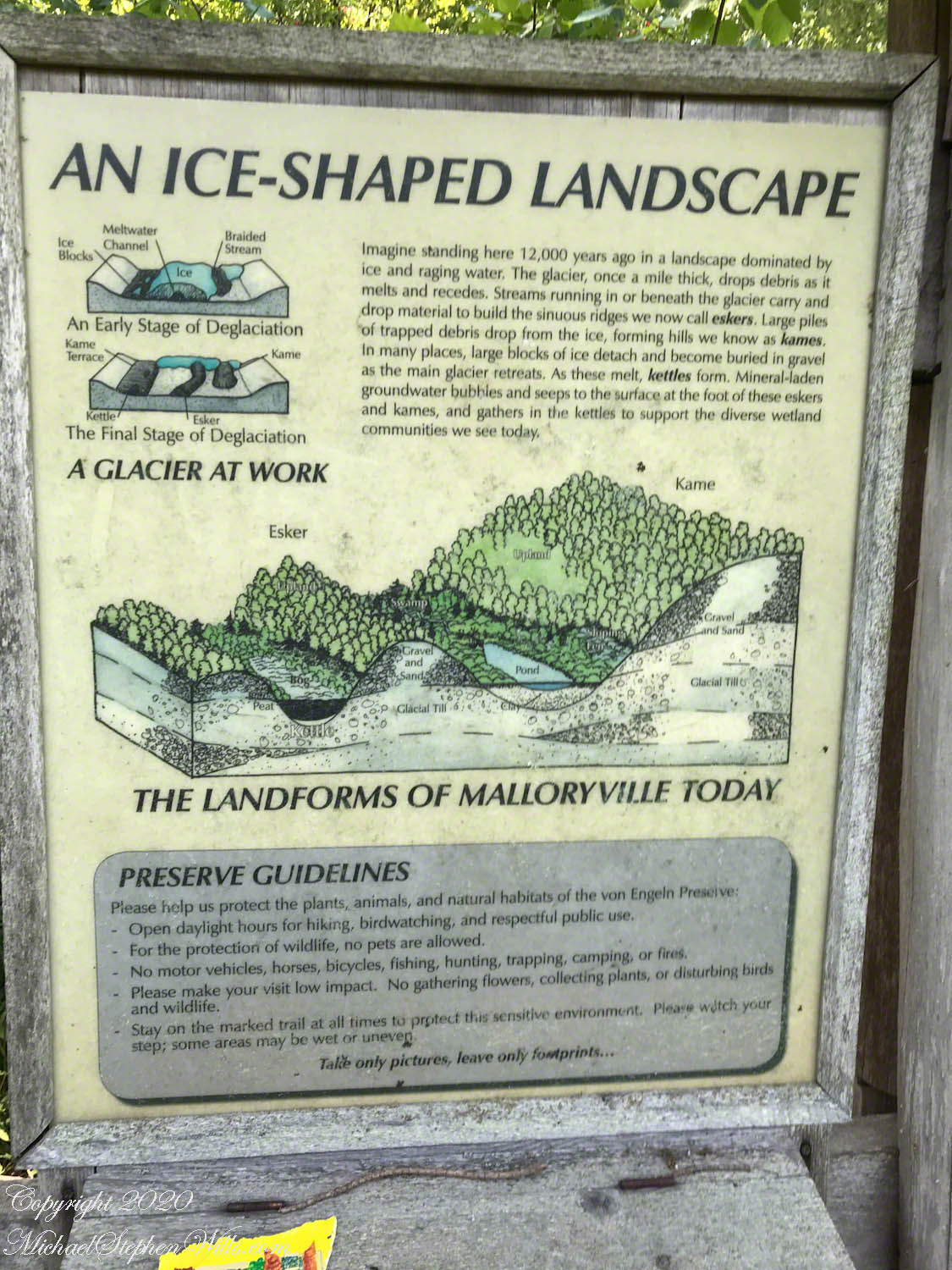
The Malloryville wetlands lie in a low pocket along Fall Creek, a landscape shaped by the last ice age. As the glacier that once covered this region melted, torrents of water tunneled through the ice, depositing braided ridges of sand and gravel known as eskers. Today, more than a mile of these ancient riverbeds winds through the preserve, narrow wooded spines rising above the surrounding wetlands. From an esker crest, the pattern of water reveals itself: dark channels of open flow, pale pools rimmed with sedge, patches of sphagnum floating like cushions, and, farther off, the straight silver of Fall Creek.

But the story of Malloryville’s water begins far from these pools. Rain falls on the uplands as cool, slightly acidic water. It sinks through glacial till—a jumble left by the ice—and begins a long, blind journey underground. As it moves, the water reacts with the minerals it encounters. Where it brushes limestone or other carbonate-rich layers, it is slowly neutralized and picks up dissolved calcium and magnesium. By the time it resurfaces in low spots, it may be transformed from sour, soft rain to mineral-rich groundwater.

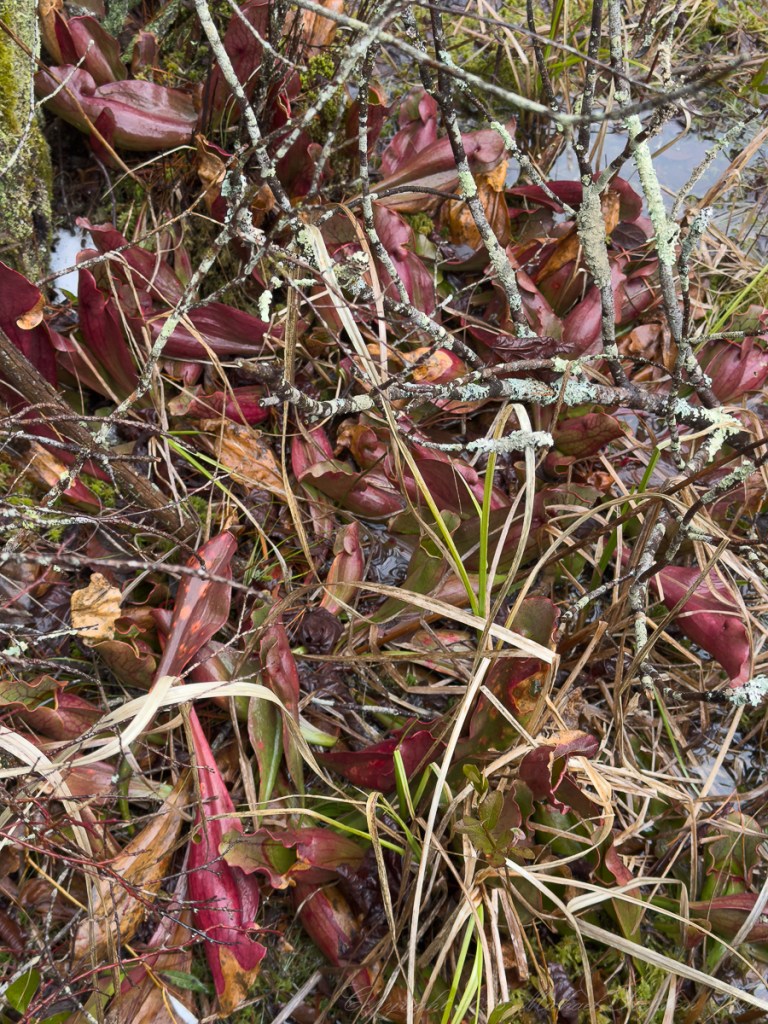
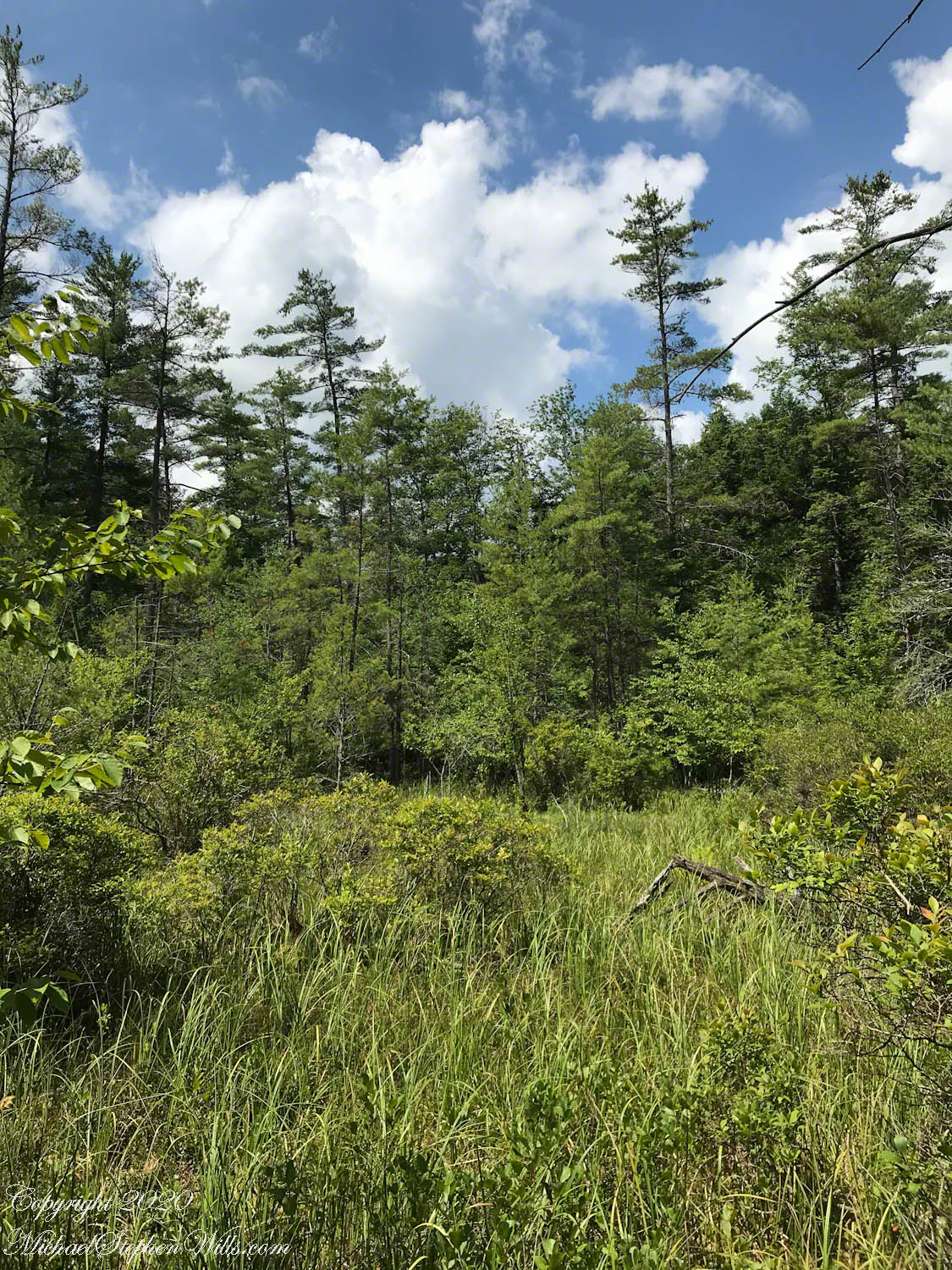
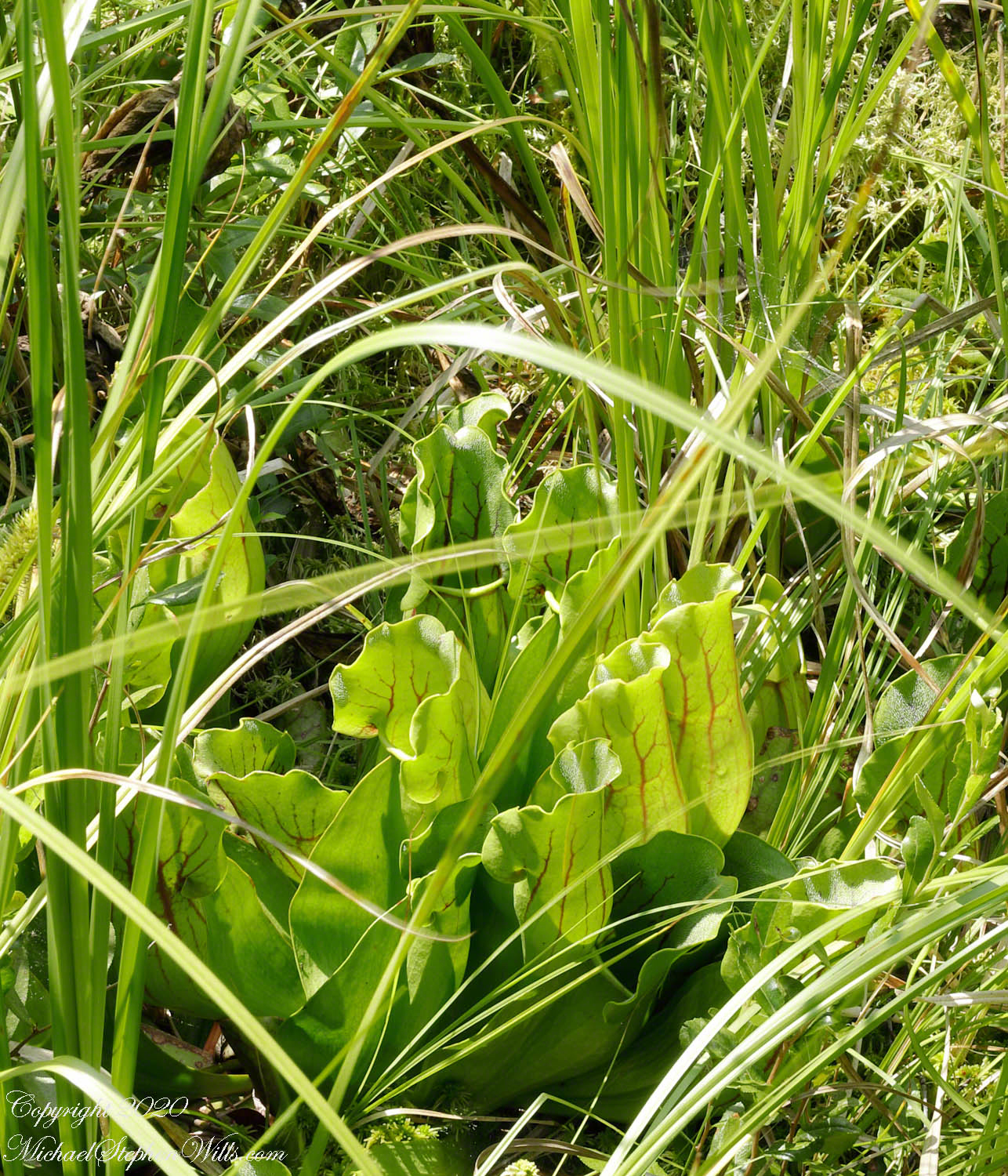
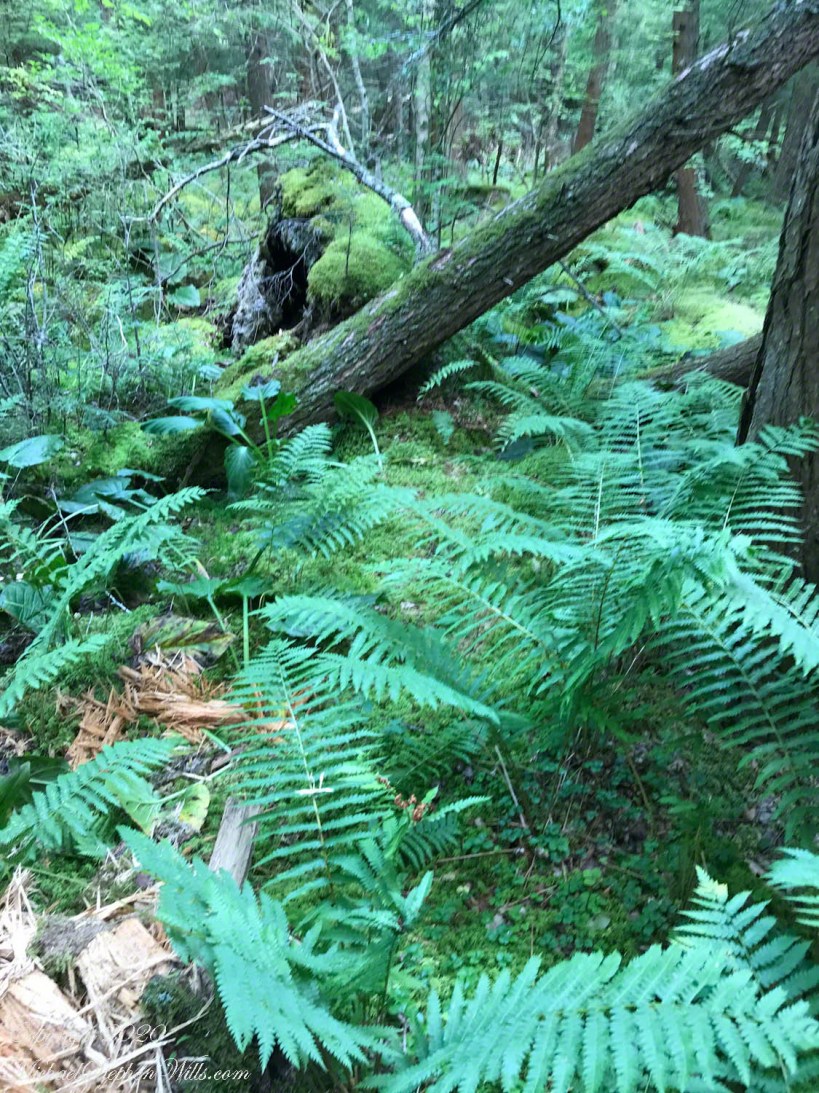
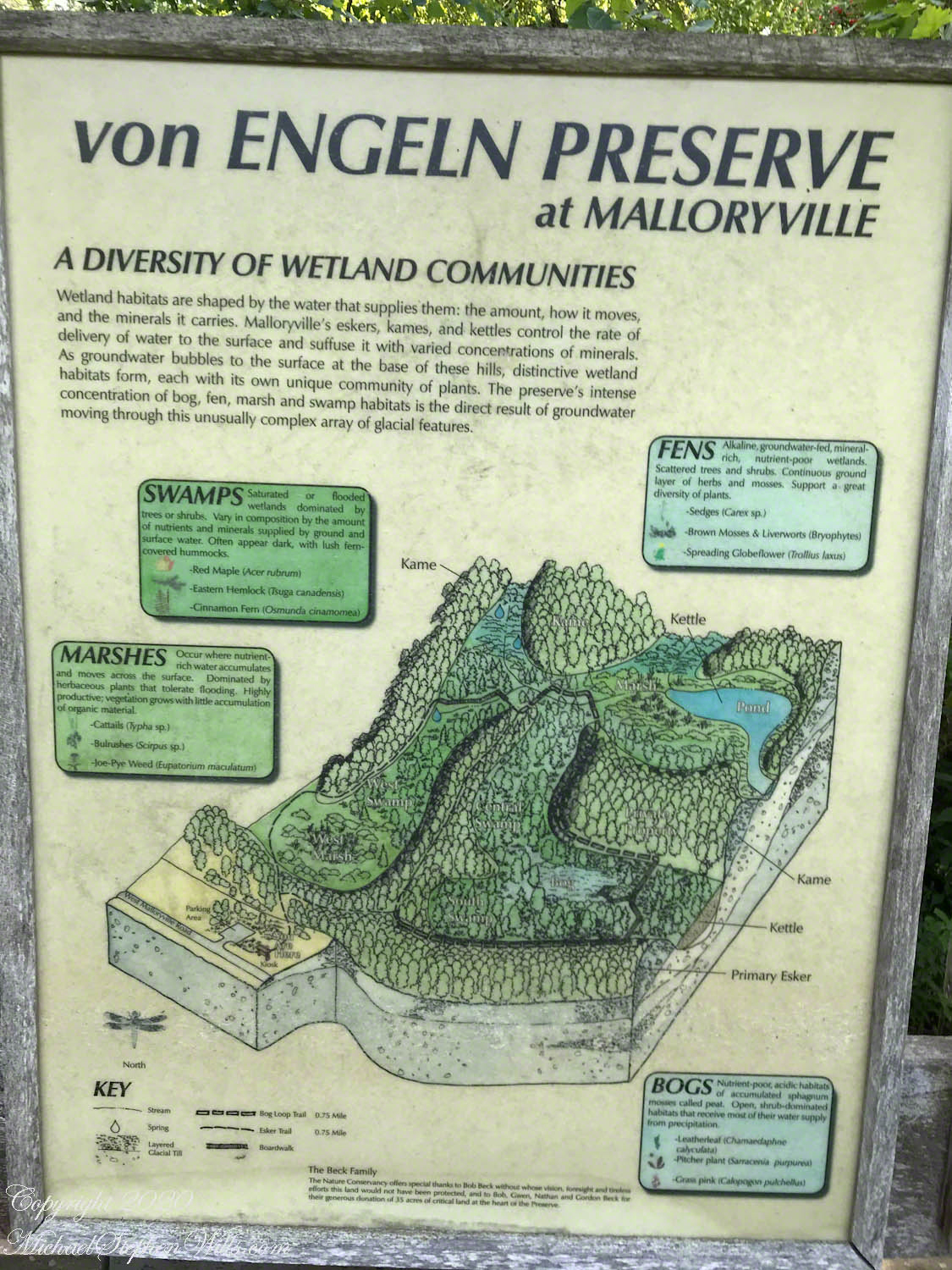
Those subtle chemical shifts are written onto the land. In some hollows, where water still mainly reflects its origin as rain, the environment becomes a bog—cold, acidic, nutrient-poor. Here, sphagnum moss knits a floating carpet, and only specialists such as leatherleaf and cranberries can endure. In other pockets, where groundwater welling up from below brings minerals, we find fens: lush, lime-touched wetlands offering niches for orchids, sedges, and the carnivorous pitcher plant. Marshes and swamps round out the spectrum, their standing water and wooded shade forming still more microhabitats.

In this small preserve, all these wetland types coexist side by side, threaded by water that often moves so slowly it appears not to move at all. The stillness is deceptive. A slight difference in elevation—barely the height of your boot—can determine whether water spreads and stagnates, seeps outward in a fan, or concentrates into a narrow, unseen channel. Hydrologists studying the area have shown that a water-table mound of only a few inches can redirect the underground flow and, over time, steer the evolution from open fen to peat-filled bog.

Human history here is entwined with that quiet power. The founders of the preserve, themselves from a dairy farming family, came to understand that the springs, seeps, and wetlands feeding Fall Creek were vulnerable. Gravel pits on nearby land had already bitten into the valley; another such excavation on this side would have severed the veins of water that sustain the fen and bog. Their years-long effort to protect the property culminated in a Nature Conservancy preserve whose very purpose is to safeguard water and the uncommon communities it supports.

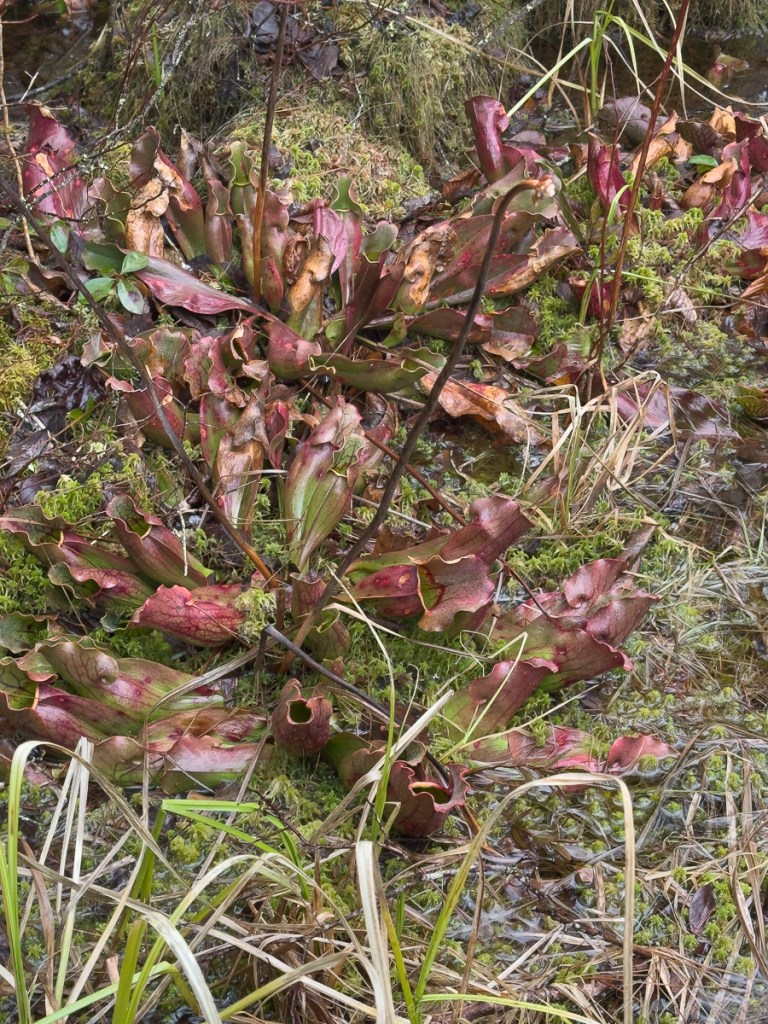
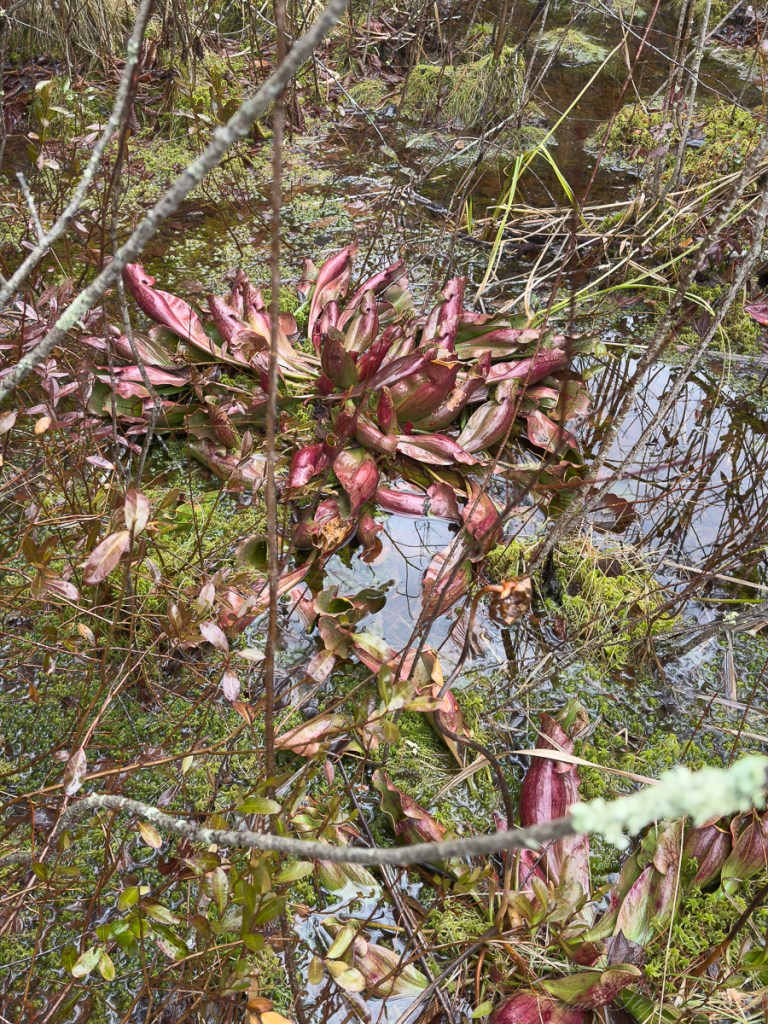
The boardwalk under our feet is part of that story. Its recycled-plastic planks do not rot in constant dampness, and their smooth, slightly hollow sound reminds us with each step that we are guests in a place where soil never truly dries. At the edges of the walkway, tamarack and red maple lift their trunks from hummocks, their roots anchored in peat built grain by grain from centuries of water-logged plant remains. In the open patches, we can seek out pitcher plants, their flaring, water-filled leaves digesting unwary insects to make up for the nutrient-poor conditions.

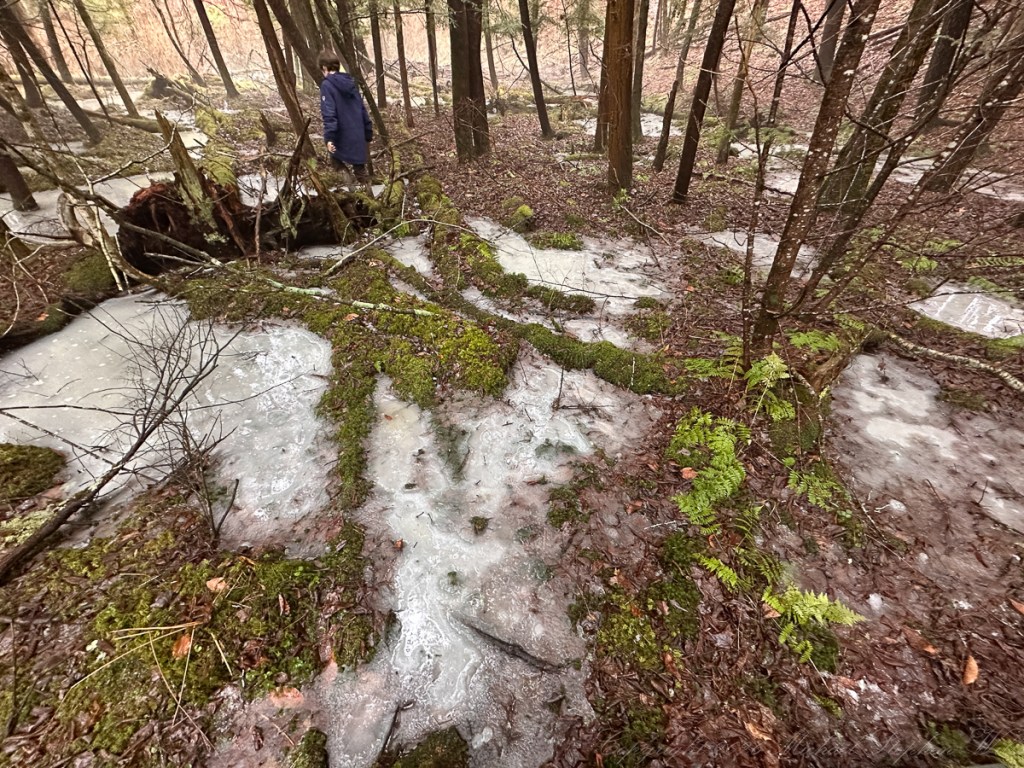
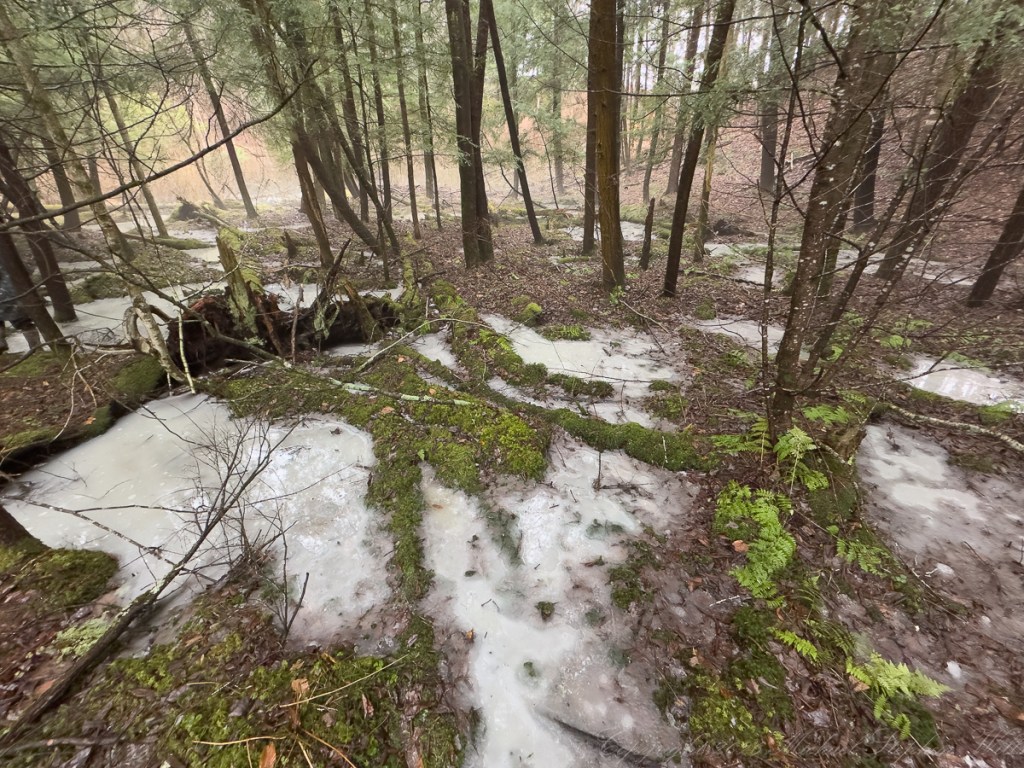
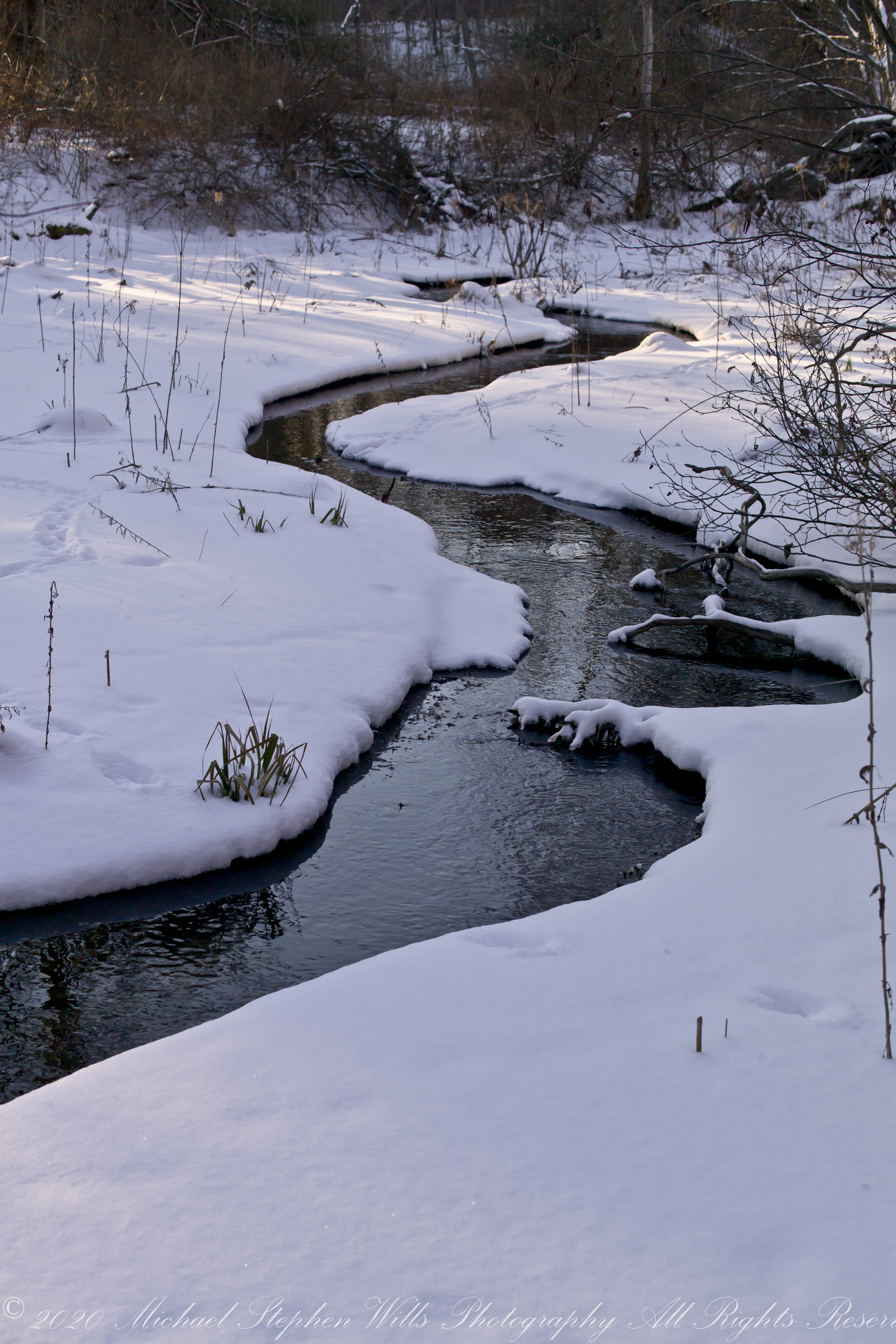
Everywhere, water moves almost invisibly. It rises as a cold trickle at the base of the esker, fans through the moss as a thin sheet, and gathers again in dark, tannin-stained channels. It rarely speaks aloud; only in spring flood or after hard rain does it murmur against roots or tap lightly at the plastic planks. Yet its influence is written in every texture and color—emerald moss, rusty sedge, the silvery bark of birch leaning over a pool.

To walk in Malloryville is to learn to read this subtle handwriting. We begin by noticing the obvious: the wetness, the boardwalk, the glimpses of standing water. By the end of the walk, we are tracing gradients—how the plants shift with elevation, how the ground feels underfoot, how the air cools or warms by a degree or two. We sense the long journey of water from sky to stone to peatland to creek, and onward to Cayuga Lake and the wider world beyond.

Water, flowing quietly, almost soundlessly, with powerful effect: Malloryville Preserve, that power is persistence. It is the power to carve a valley, to build a peatland one stem at a time, to sustain rare communities of plants and animals in a modest corner of New York. To honor such water is to move carefully, speak softly, and remember that our presence, like our boardwalk, should allow the flow beneath to continue its ancient work.

Enter your email to receive notification of future postings. I will not sell or share your email address.

Exploring Malloryville Preserve: A Hidden Glacial Wetland Gem in New York’s Finger Lakes

Explore the O.D. von Engeln Preserve at Malloryville, a hidden Finger Lakes wetland where glacial eskers, kettles, and springs reveal the deep story of ice and water.

In the heart of upstate New York, the Finger Lakes region stretches out like a handprint left by the last great ice sheets—long, narrow lakes aligned north to south, their steep-sided valleys feeding into a lattice of creeks, waterfalls, and wetlands. It is a landscape defined by water and time: glaciers grinding south, then melting back north some 12,000 years ago, carving deep troughs, piling up ridges of gravel and sand, and leaving behind a terrain that is anything but simple.

The O.D. von Engeln Preserve at Malloryville, near the small village of Freeville, is one of the quiet places where that story is written most clearly on the land. It doesn’t shout like Taughannock Falls or Ithaca’s famous gorges. Instead, it whispers—through the curves of its hills, the softness of its ground, the unexpected appearance of a spring at the base of a gravel ridge. Here, in a relatively compact area, you can see how ice and water worked together to shape the Finger Lakes region we know today.

Overflow from a Kettle Pond threads through a meadow before feeding Fall Creek. The O.D.von Engeln Preserve at Malloryville.

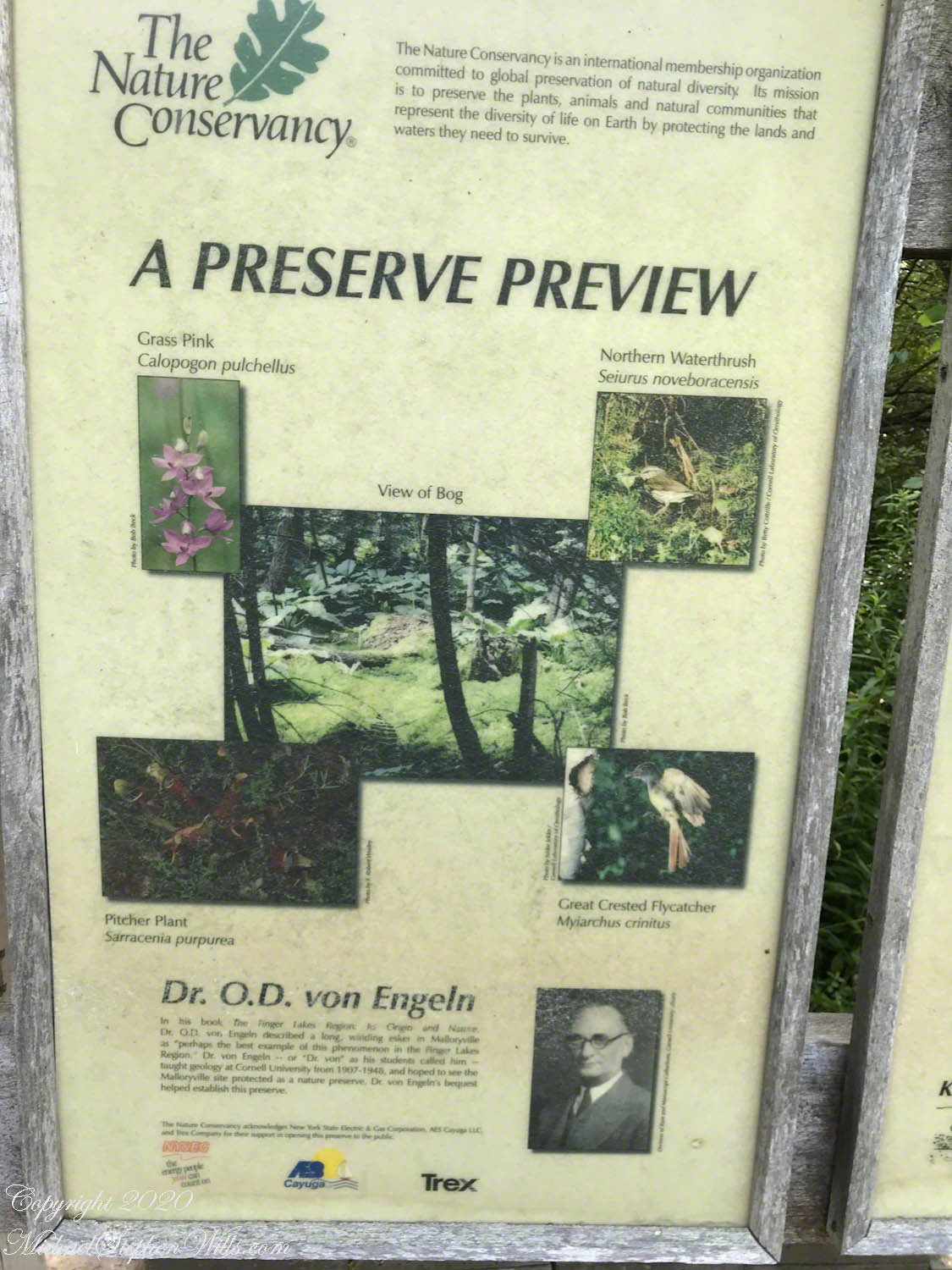
By the time the preserve officially opened in 1997, the name O.D. von Engeln was already familiar to anyone curious about local geology. His classic book on the Finger Lakes helped generations of readers understand that the scenery around them was not random, but the result of powerful, understandable processes. Reading von Engeln, the rolling hills and quiet valleys near Freeville become more than background—they become evidence: of buried ice, rushing meltwater, and the slow settling of sediments into the forms we walk on now.

Malloryville is an outdoor classroom for that lesson. The preserve is built around a cluster of glacial landforms—eskers, kames, and kettles—that create a three-dimensional mosaic of ridges and hollows. Eskers, those long, winding gravel ridges left by rivers that once flowed inside the glacier, snake through the forest like frozen currents of stone. Kames—steep, irregular hills of sand and gravel—rise suddenly from the surrounding lowlands. Kettles, the depressions left behind when buried ice blocks melted away, now cradle wetlands and pools.

Beneath and between these features, groundwater is constantly on the move. It seeps through layers of sand and gravel, emerges as cold springs at the foot of slopes, and spreads out into swamps, fens, and marshes. In the Finger Lakes, water is always telling a story; at Malloryville, it’s simply easier to hear. Follow the trail and you move through a succession of wet worlds: a seep-fed fen with delicate mosses and sedges, a shrub swamp where skunk cabbage thrusts up in early spring, a cattail marsh that hums with birds and insects in summer.

For my family, the story of Malloryville began even before the preserve had a name. We lived nearby along Fall Creek, itself a thread in the larger fabric of the Cayuga Lake watershed. My son and I camped for the first time on top of an esker just beyond our front door, our tent perched on what I would later learn was the remnant of a stream that once tunneled through the base of a glacier. At the time, it was simply a magical narrow ridge in the woods. Only later, with von Engeln’s guidance and the preserve’s interpretive signs, did that ridge become a sentence in a much older, longer narrative.

That is one of the great gifts of the Finger Lakes: the chance to move from simple admiration—“this is beautiful”—to understanding—“this is how it came to be.” The steep slopes along Cayuga, Seneca, or Skaneateles; the drumlin fields near the north ends of the lakes; the hanging valleys and waterfalls; and the quiet wetlands of places like Malloryville are all chapters in the same glacial chronicle. Once you learn to read one place, you begin to read them all.

Walking into the O.D. von Engeln Preserve, you enter that story at a small, intimate scale. The parking area and trailhead give way quickly to a world where the ground feels different—sometimes firm and gravelly, sometimes soft and yielding underfoot. Wooden walkways and narrow paths thread through shady forest and open wetland. Each bend offers a subtle shift: a new plant community, a change in water clarity or flow, a small sign explaining what lies beneath your feet.

Fall Creek meanders through the esker fields of the Malloryville Preserve. Here is the view from an abandoned railroad bridge. The preserve is near Freeville in the Finger Lakes Region of New York State.

This is not grand scenery in the postcard sense; it is something quieter and deeper. Malloryville invites you to slow down and notice. To ask why a particular ridge is so narrow, why water emerges here but not there, why one hollow is filled with shrubs and another with moss and sedge. In learning those answers, you gain not only an appreciation for this modest preserve but also a richer understanding of the entire Finger Lakes region.

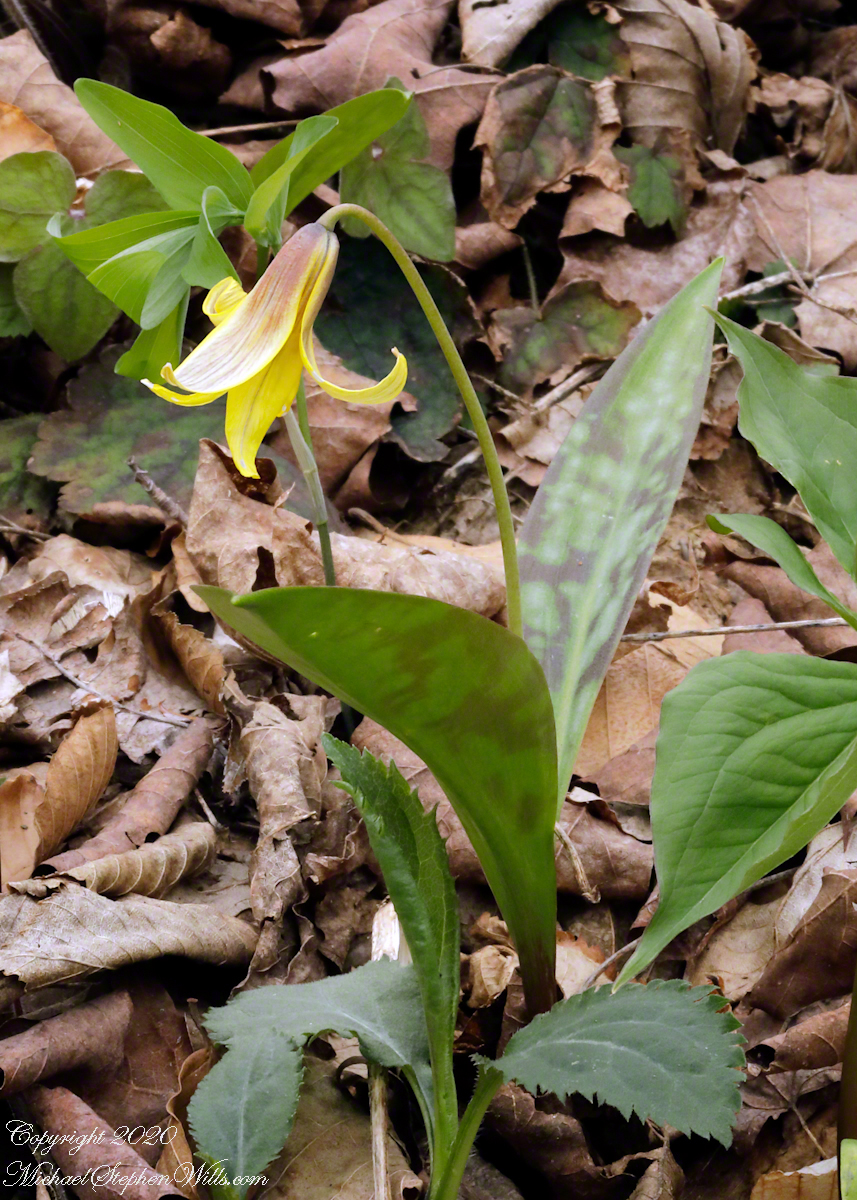
The Trout Lily (Erythronium americanum) is named for the mottled brown leaves resembling marking on trout.

In the end, the O.D. von Engeln Preserve at Malloryville is a lens—a way of seeing. Through it, the familiar landscapes of central New York—valleys, hills, streams, and lakes—come into sharper focus as the lasting work of ice and water. Stand on an esker, look across a kettle wetland, listen to the quiet trickle of a spring, and you are standing inside the very processes that shaped the Finger Lakes.

Enter your email to receive notification of future postings. I will not sell or share your email address.

Climbing Piestewa Peak: Multicultural Pilgrimage to a Phoenix Desert Dawn

In the cool predawn, strangers from every background climb a stone stairway above Phoenix, trading city lights for desert silence as sunrise spills gold across Piestewa Peak.

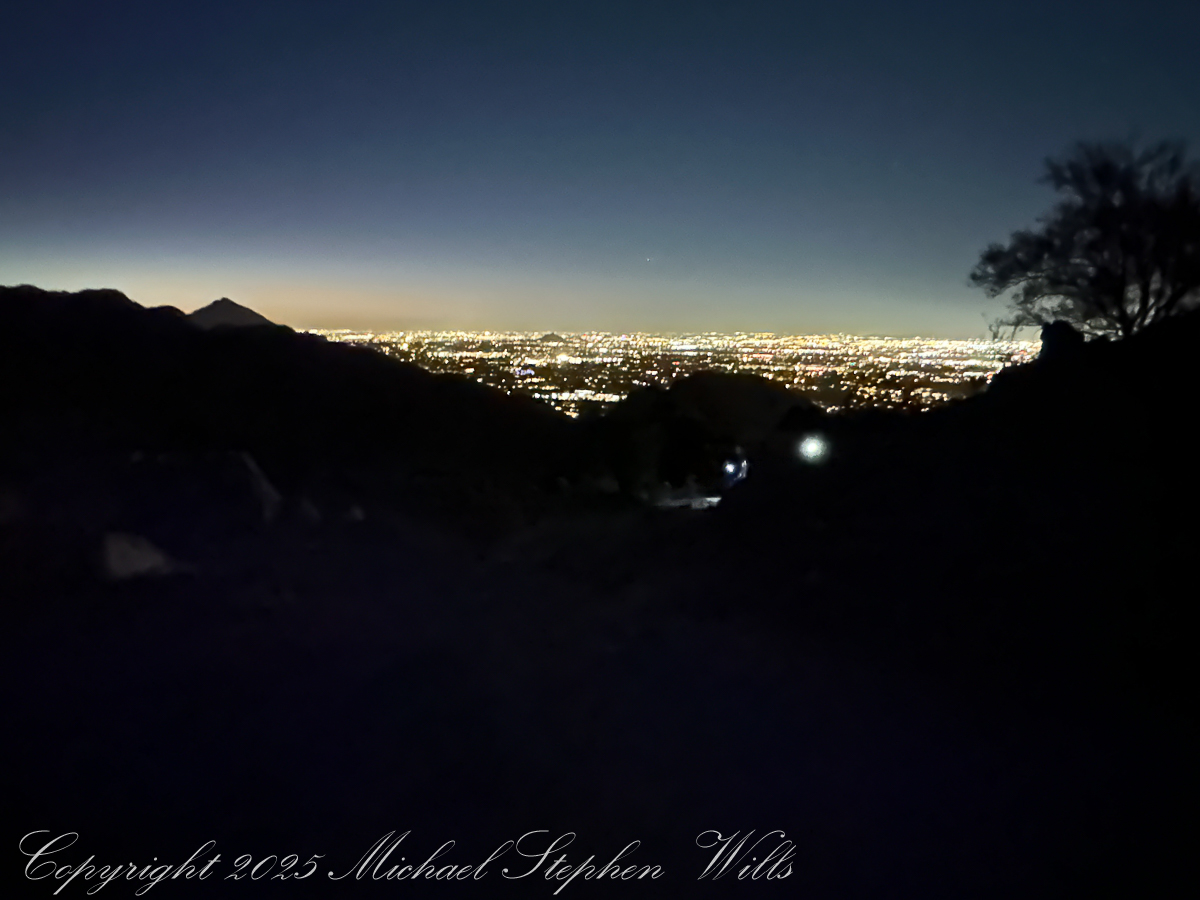
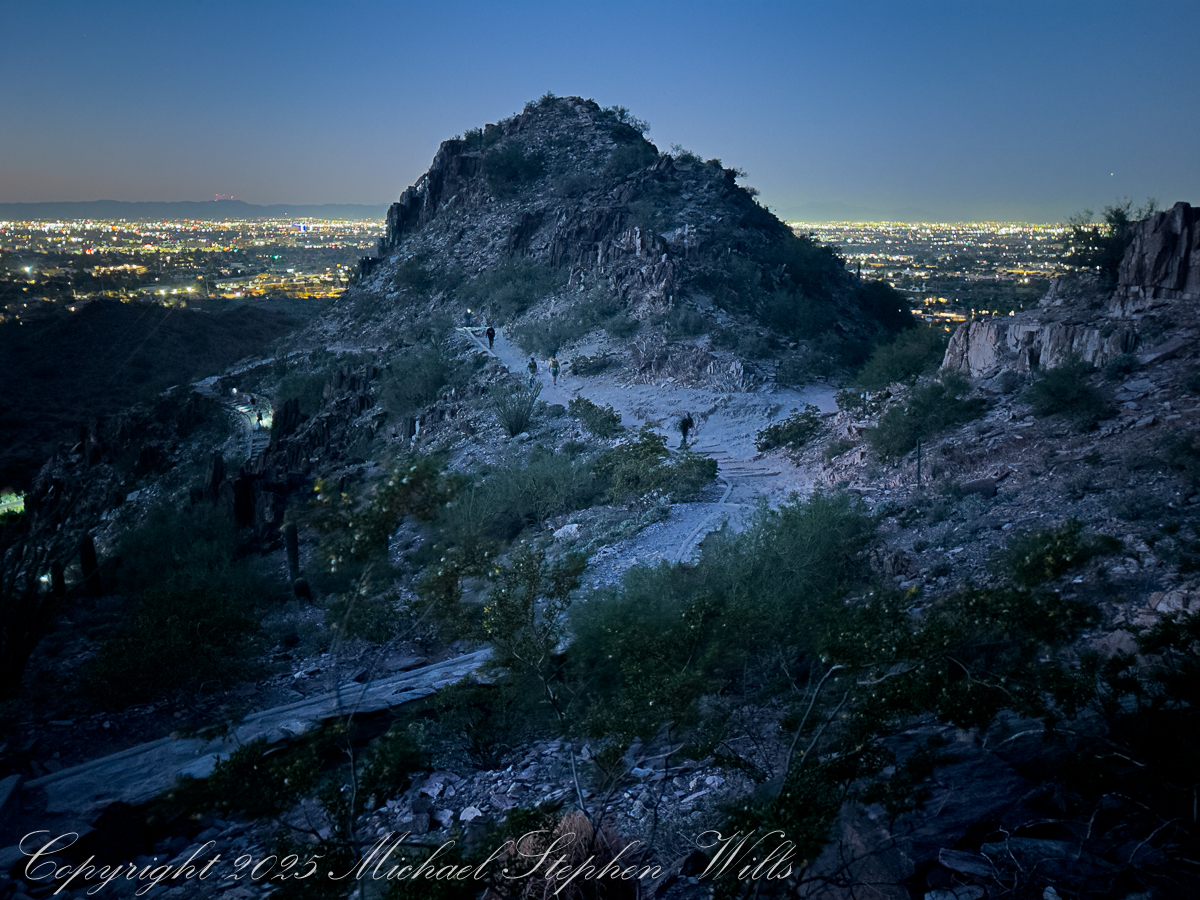
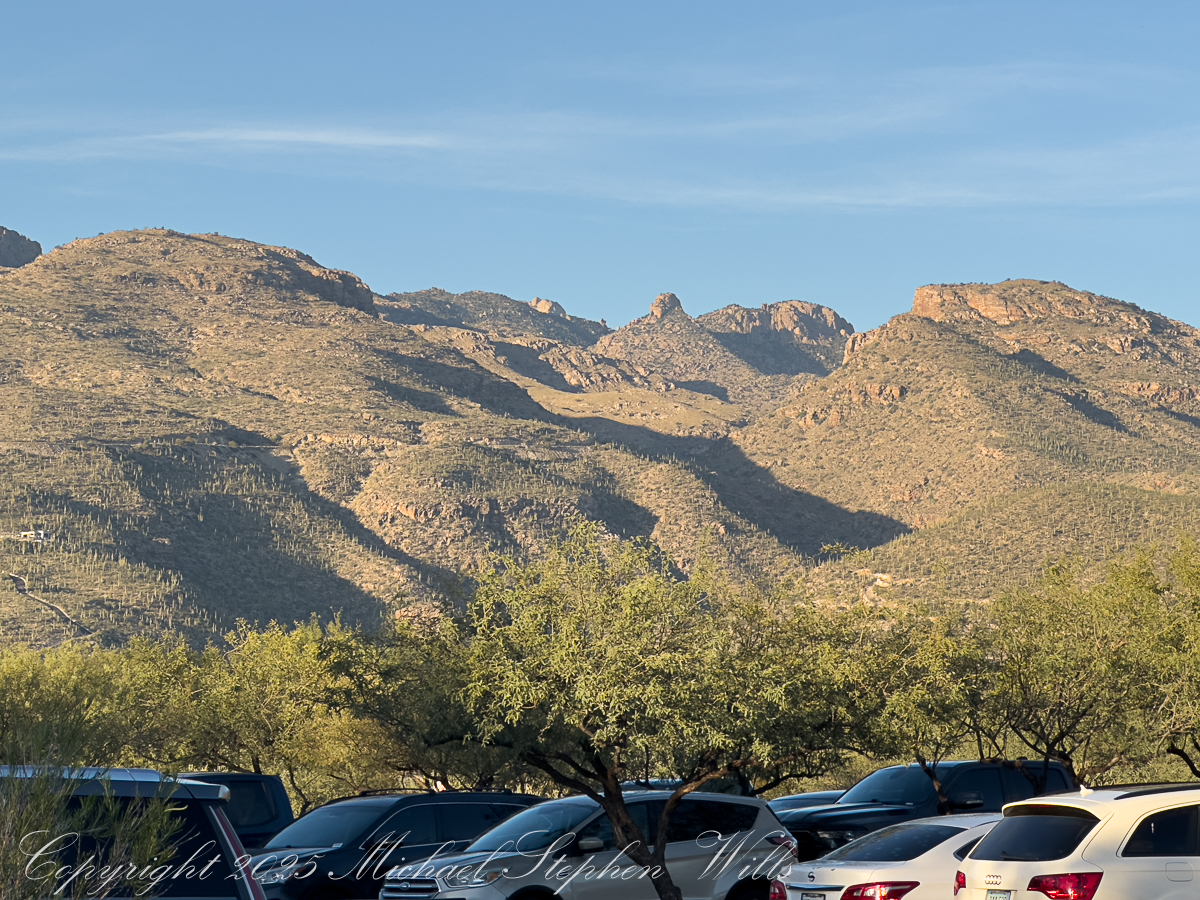
Arriving at 5 am there is a line of trucks and cars and Piestewa Peak parking almost full when I grab a spot in the predawn darkness. The desert air has that deep, merciful coolness it offers before sunrise, edged with the long-remembered scent of creosote. Car doors close with soft thuds, headlamps blink on, and a loose procession of strangers begins to funnel toward the trailhead like pilgrims, even now white and red headlamps sprinkle the upper slopes.

At first the climb exists only in a narrow cone of light, my lamp illuminates the scant gravel, uneven steps, and each scuff of boot or shoe sounds loud in the hush. Somewhere below, the city hums, but here the conversation is mostly breath and the occasional murmur of greeting as we fall into the rhythm of the climb.

My beam catches a young couple just ahead, their hands knotted together. They speak Spanish, laughing quietly as they miss a step and bump shoulders. Behind me an older man in a Veterans cap leans heavily on trekking poles, his companion—maybe daughter, maybe friend—matching her shorter stride to his with patient care. A group of women in bright leggings and braided hair moves past us in a burst of energy, their languages overlapping—English, maybe Vietnamese, something I cannot place—like the weaving of a rug. A man passes me, a drum on his back. Piestewa draws them all, before dawn, to this rib of stone in the center of the Phoenix basin.

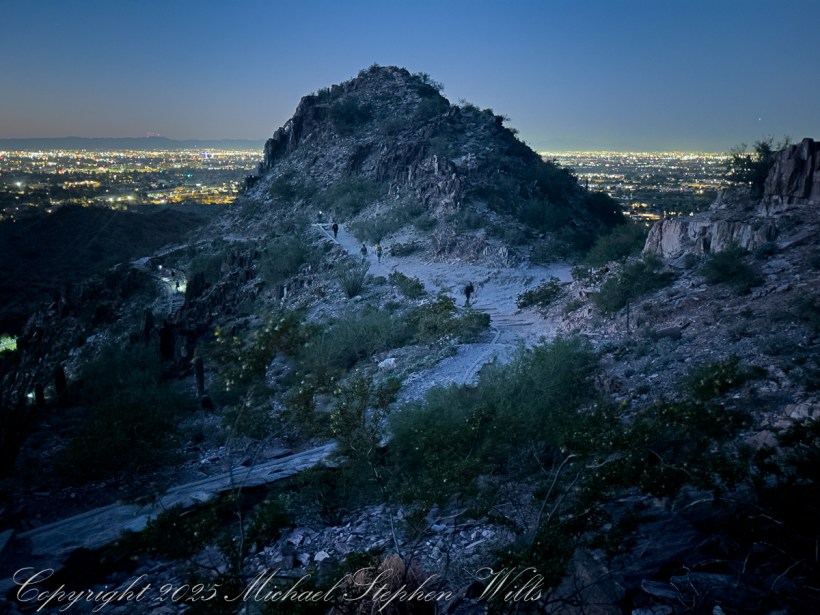
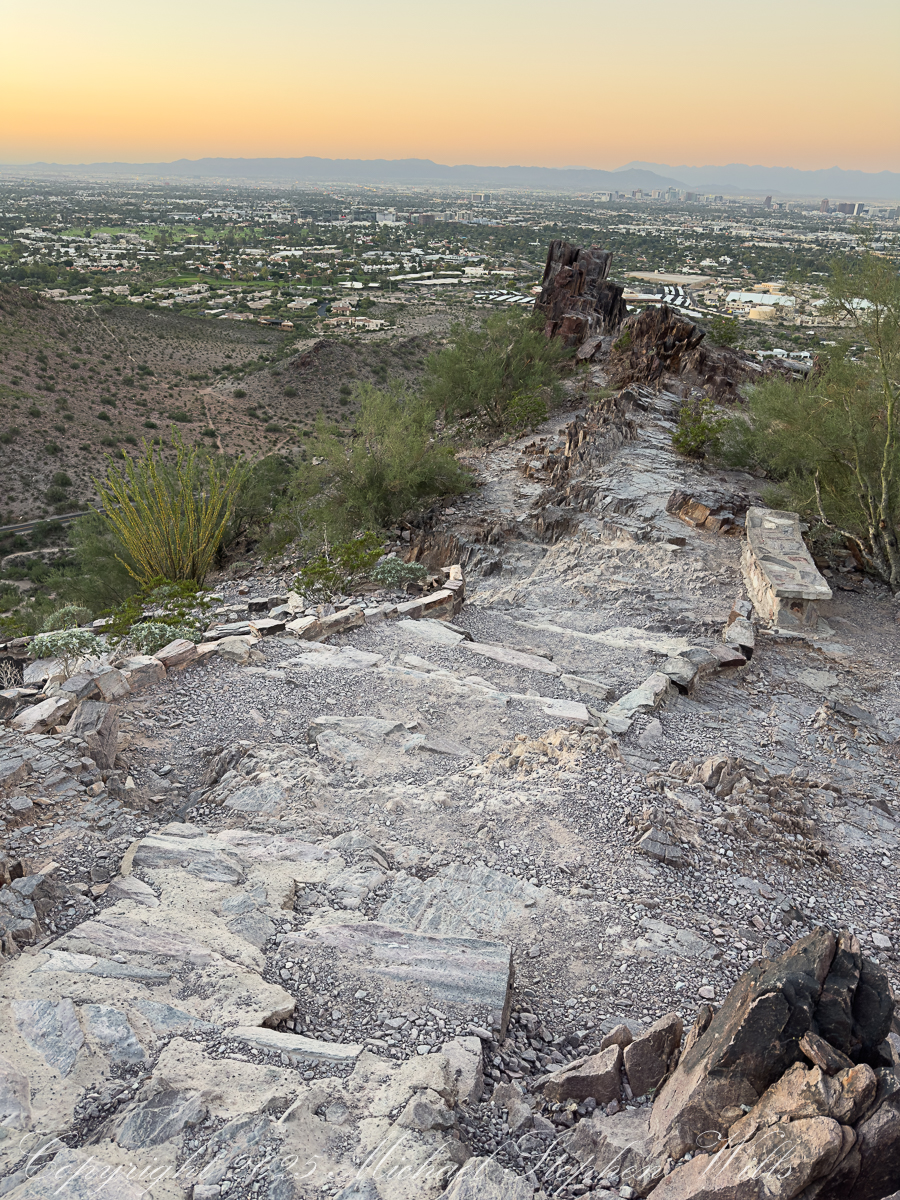
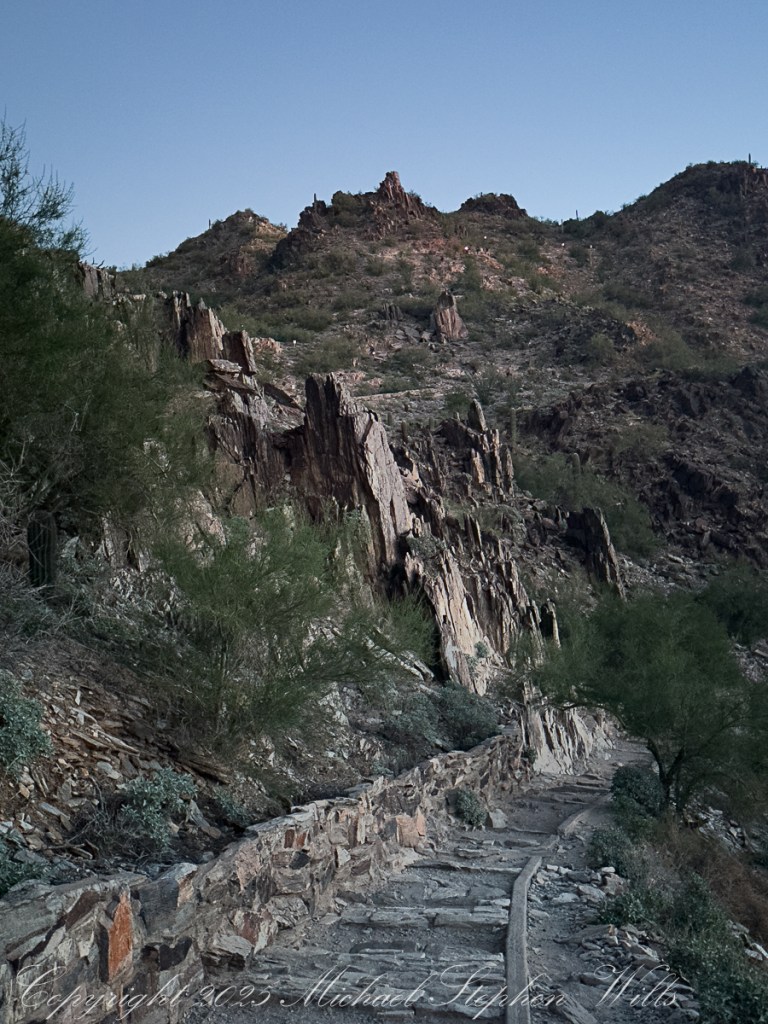
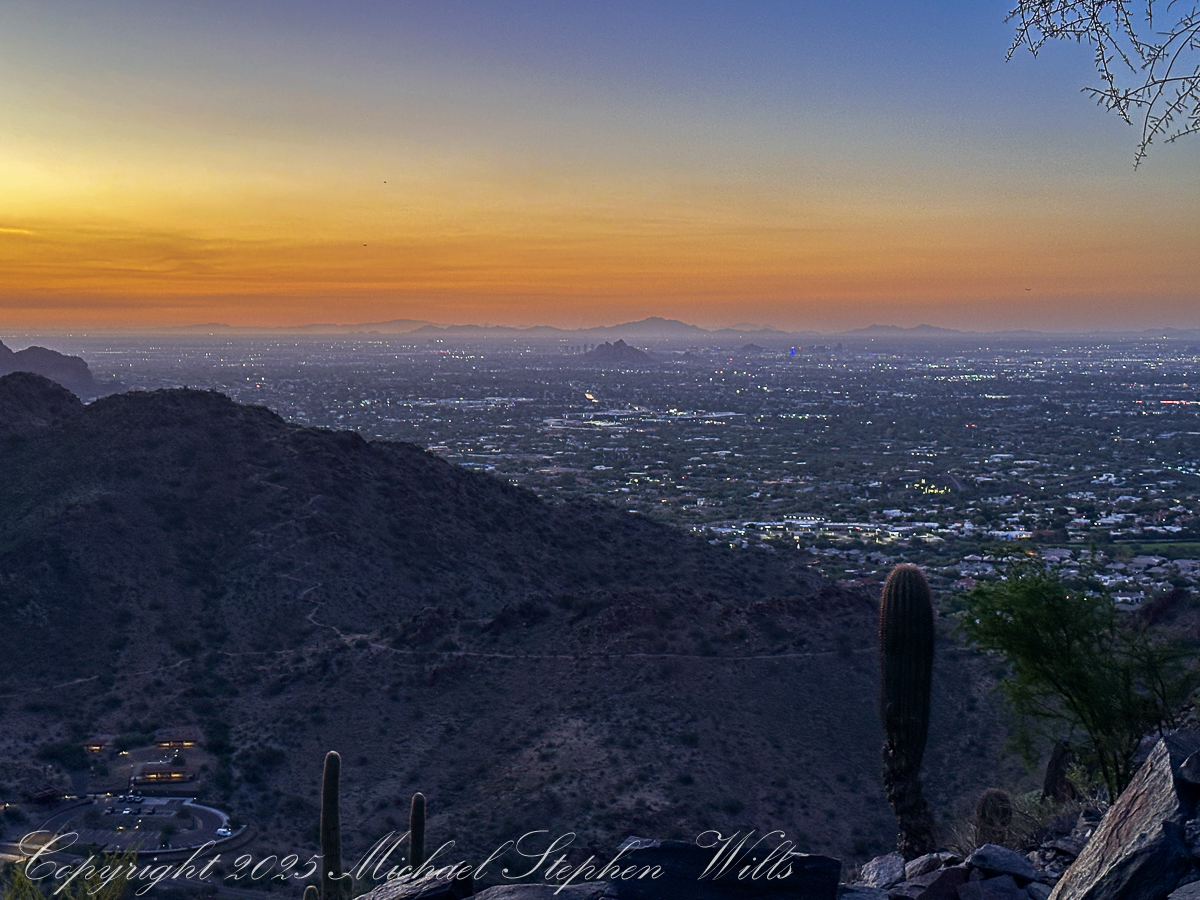
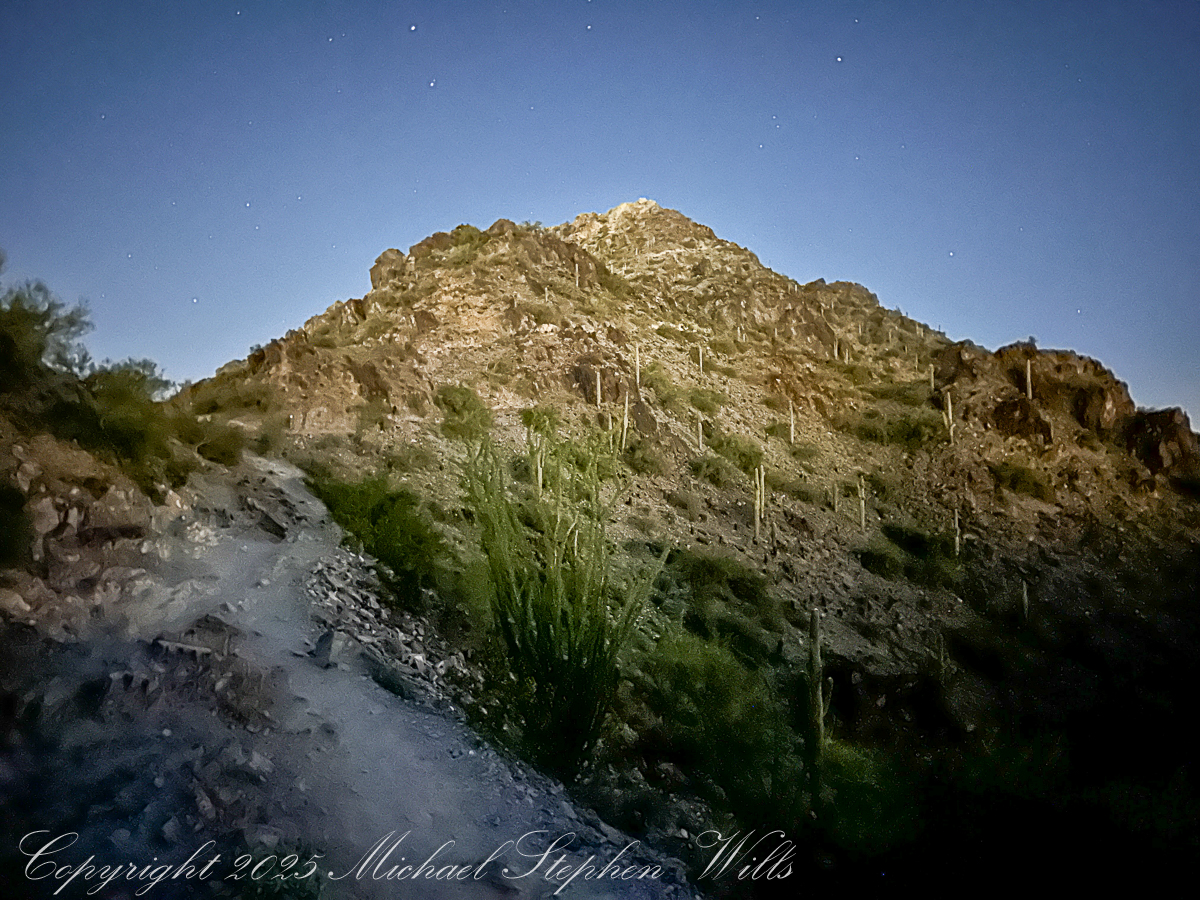
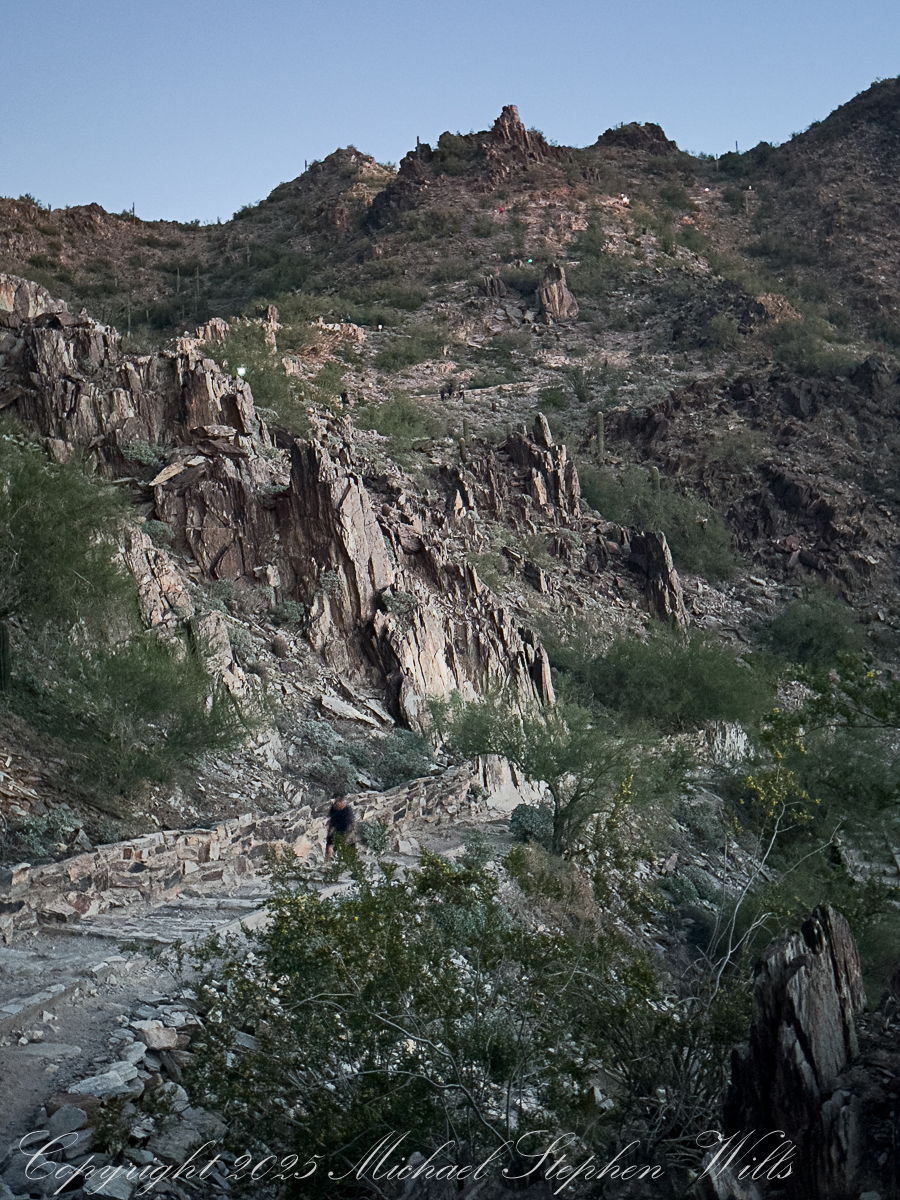
As I stop to rest myself and turn off my headlamp, ahead the trail tilts steeper the steps fade to rock, irregular and unforgiving: a stairway carved from ancient volcanic bones. With my dark adaptation, surfaces reflect star and city light, leading the eye down the ridge toward the dark quilt of neighborhoods below. Later, captured in the photograph, those steps will twist away like a stone dragon’s spine, the city waking beyond in soft pastels. Now they are simply work for legs and lungs.

The desert plants materialize around us as shapes before they acquire color. Saguaros stand like sentinels along the slopes; their arms lifted in silhouette. Ocotillo rise as witchy bundles of sticks, each spine leafed out from October rains the leaves catching a little light. On a small plateau a family has paused; the father adjusts a tiny headlamp on his son, no more than six, who is insisting, with fierce determination, that he can carry his own water. “Almost there, campeón,” his father says, and the child straightens like a soldier.

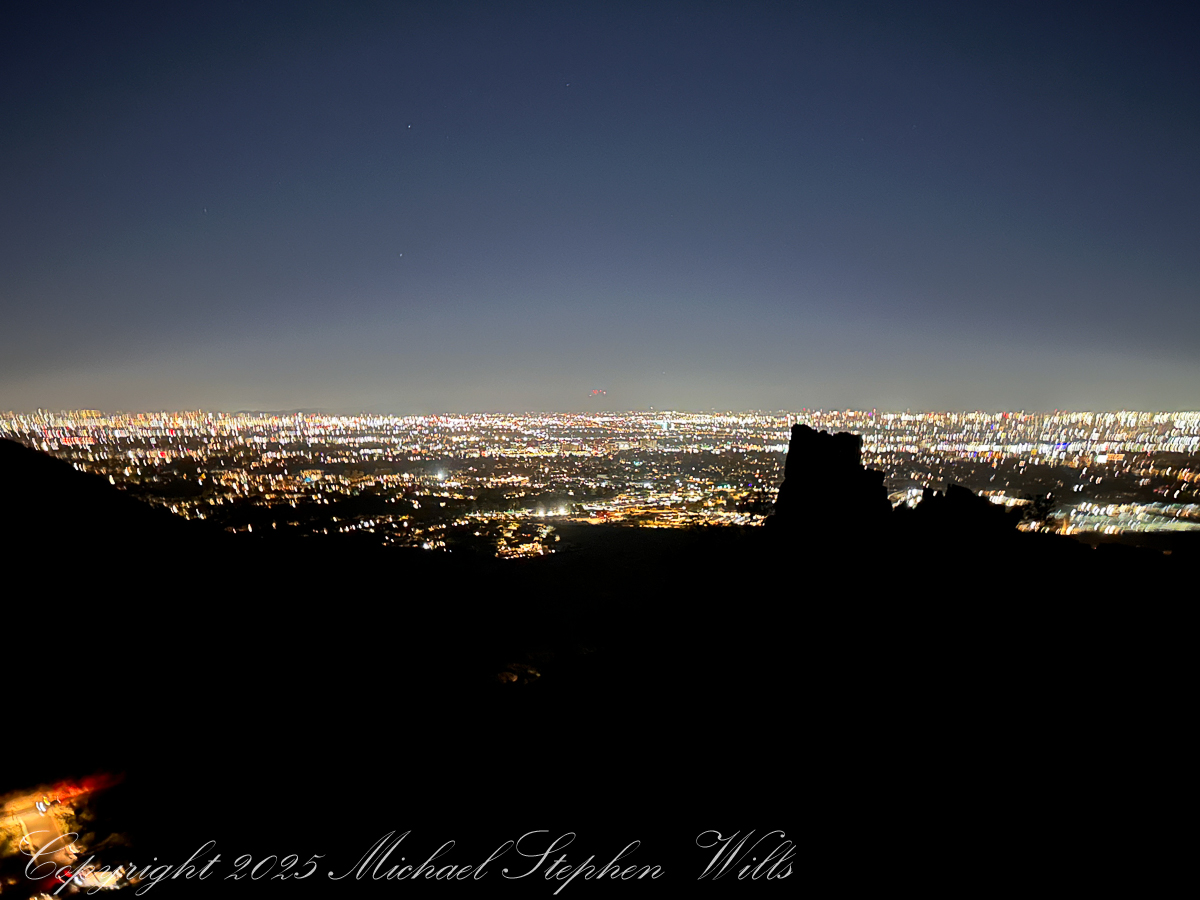
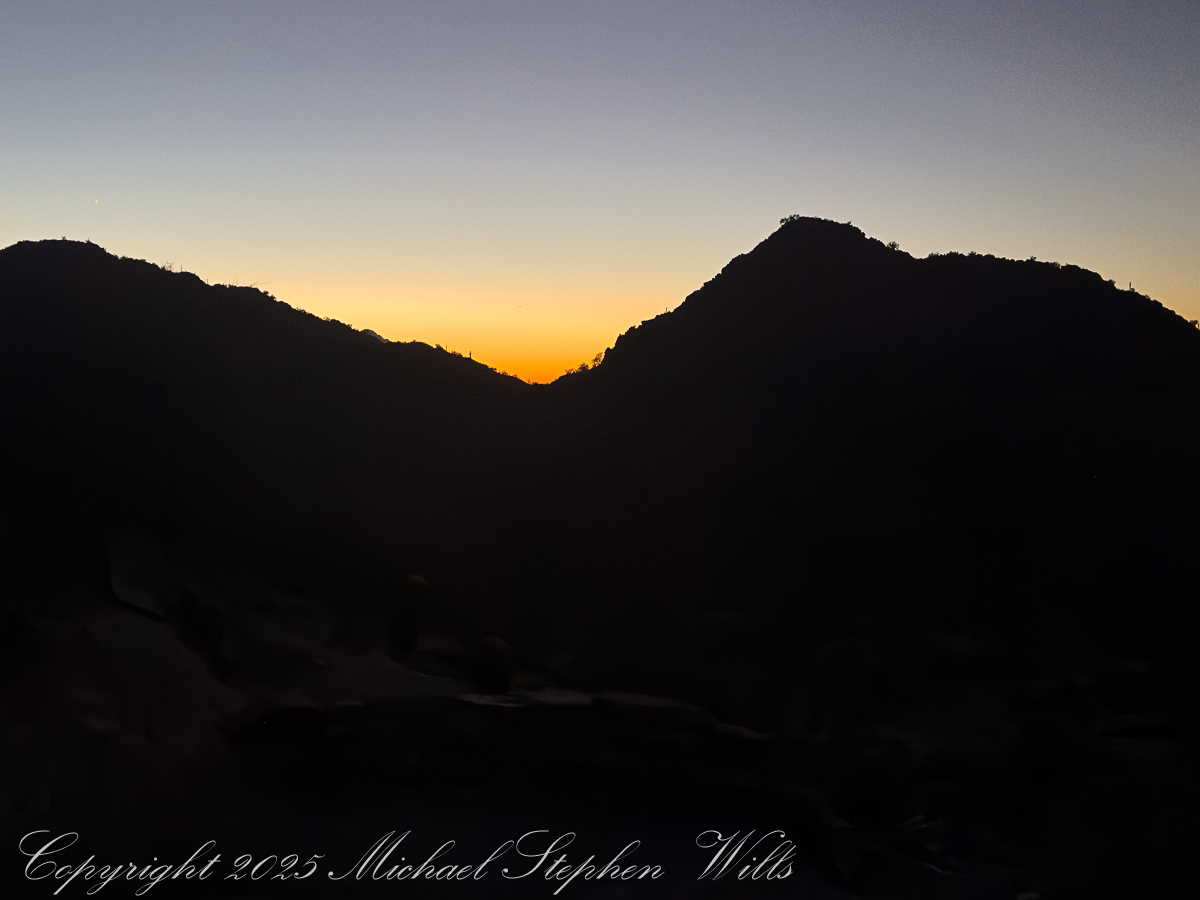
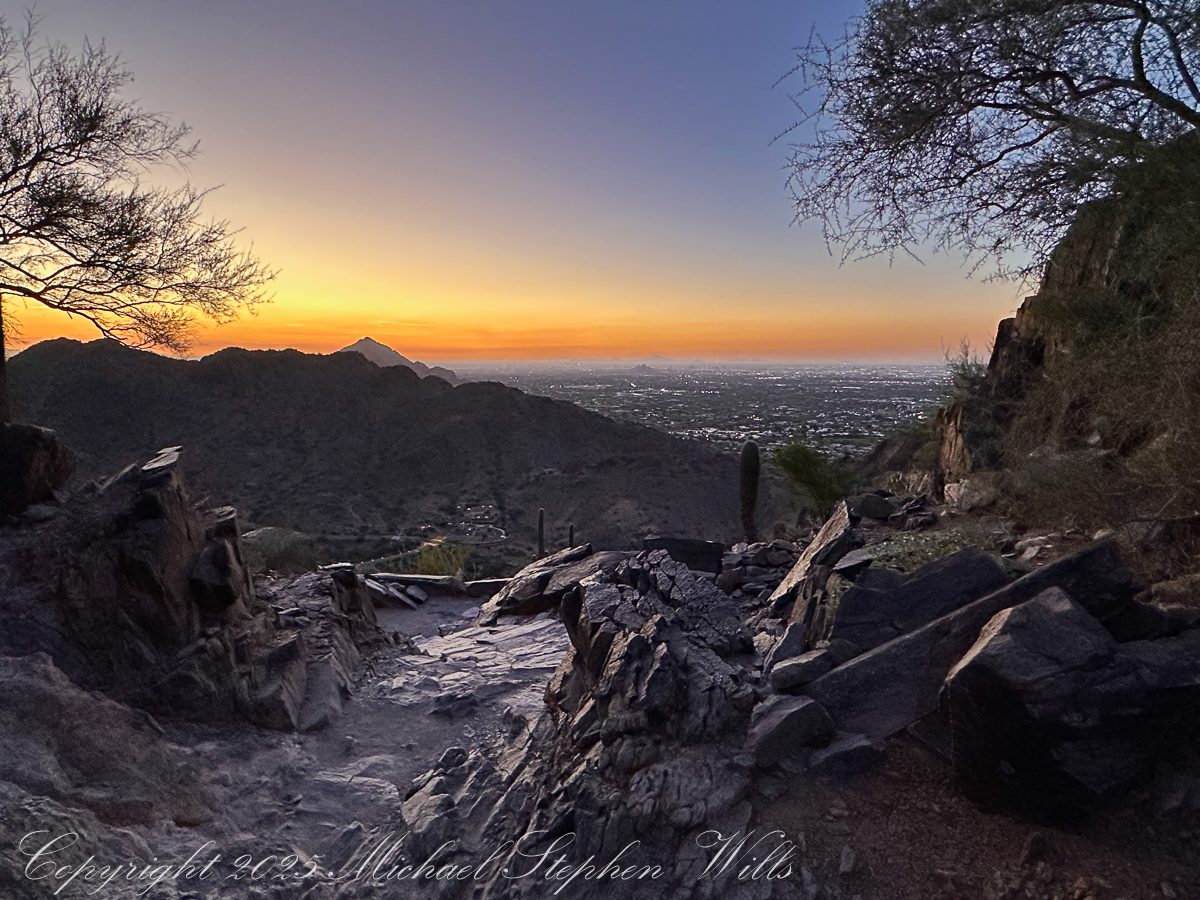
The dark begins to soften at the edges. Over the eastern horizon a thin band of orange appears, a delicate seam between night and day. In one direction, the city stretches out in a glittering net of streetlights, the squares of parking lots and subdivisions catching the last of the darkness. In the other, the mountains are still black cutouts, their profiles sharp as paper against a gradually brightening sky. One of my images will hold that moment: the jagged ridge of Piestewa in shadow, the valley below already spangled with light, a single towering saguaro rooted at the cliff’s edge like a punctuation mark.

November 2025 while visiting Pam’s family in Phoenix

Higher up, the trail narrows and the rock turns rougher. We fall into single file, strangers linked by a line of effort. A runner comes flying down, feet barely touching stone, breath steady and controlled. “On your left,” he calls, and we part for him like water. A woman with a hijab tucked neatly under her ball cap leans against the retaining wall, stretching a calf muscle, her friend counting in accented English: “Ten more seconds, you can do it.” Near one bend a hiker pauses to press a hand against the rock face, whispering a quiet prayer in a language I do not recognize. It is a small, intimate moment, gone almost before I register it.

The last push to the saddle is steep, the steps uneven, the sky now a cascade of colors—copper, rose, faint lavender melting into a high dome of blue. The silhouettes of distant ranges sharpen: the Estrellas?, the Superstitions?, low ridges whose names I do not know. On the horizon, the first thin line of sun breaks free, setting fire to the edges of clouds. In another photograph, framed by dark rock and desert trees, that sunrise becomes a golden portal at the end of a shadowed corridor of stone.

We reach a broad ledge just shy of the summit as the light finally spills over us. People are already gathered there: a trio of college students taking selfies, a pair of retirees sharing thermos coffee, a solitary man sitting cross-legged with eyes closed, face open to the warmth. The city below is suddenly transformed. The carpet of lights dims, replaced by the clear geometry of streets and rooftops, golf courses and parking lots, all laid out like a model at our feet. The mountains that hem the basin—once anonymous shapes—now reveal their ridges and ravines in sharp relief.

For a few minutes conversation dies away. Everyone seems to feel the same thing: that fragile instant when the sun clears the horizon and the desert shifts from silver-blue to gold. The rocks around us, sharp and broken in the photographs, glow honey-colored. Saguaros catch light on their spines, each thorn a tiny ember. Even the dusty air seems to shimmer.

Down below, a new wave of hikers starts up the trail, latecomers walking into full daylight. We, the predawn climbers, share a small, quiet complicity. We have seen the city from the backside of night, watched the day arrive from a perch of jagged stone. Piestewa Peak has turned us, for an hour or two, into a single, breathing organism: many hearts, one climb, all of us stitched together by the steep path and the slow unveiling of the sun.

Enter your email to receive notification of future postings. I will not sell or share your email address.

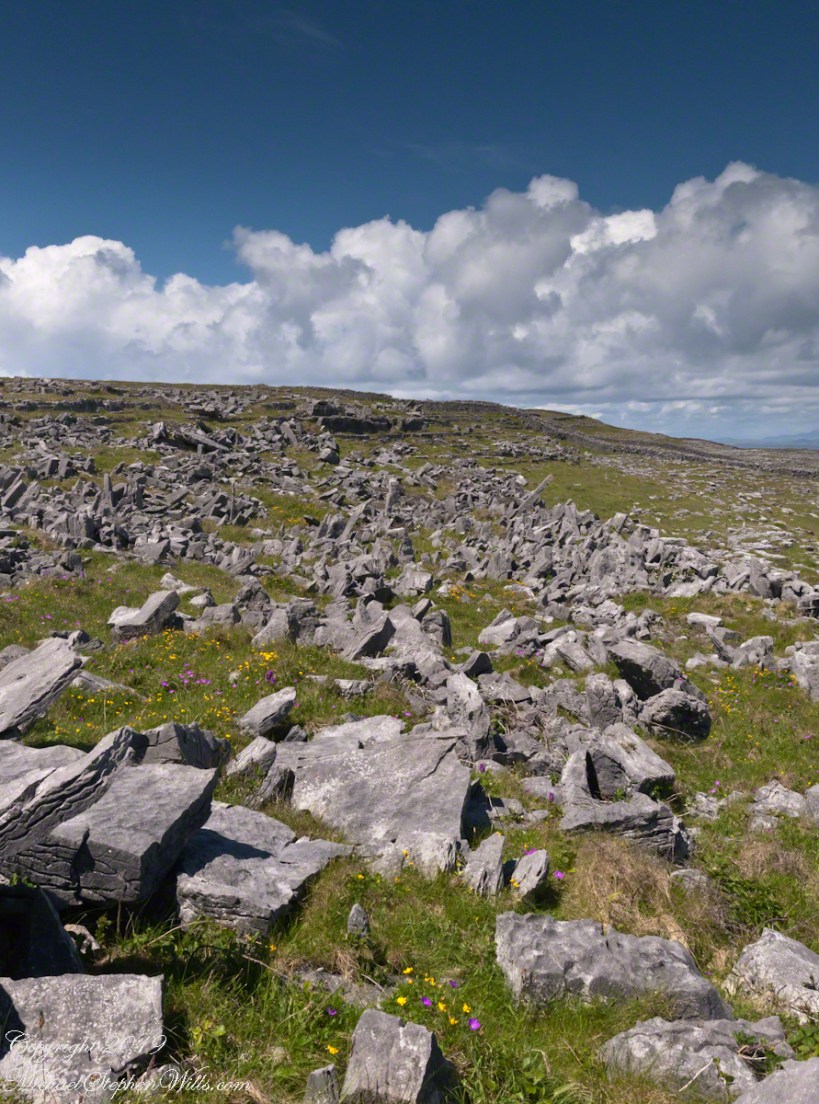
The Dún Aonghasa cheval de fries field

…this defensive structure evokes the enormous scale of the struggles around this place of defense. 

A span of 10,000 years spreads between now and the first possibility of settlement on the island of Eire, then swept clean to bare rock by the weight of ice.  Current scholarship of the Dún Aonghasa ruins, Inishmore, County Galway, the Irish Republic place a settlement within the inner of the four dry stone rings after 6,500 years (1,500 BC or 3,500 years ago).  By way of scale, the first settlement took about 30 times the duration of the U.S. Constitution ratification through 2025: the last state, Rhode Island, ratified the Constitution 1789.

By 700 BC, 2,700 years ago, a series of upright, closely placed stones, were erected between the second and third rings called a cheval de fries field (“Frisian horses” in English) today, this defensive structure evokes the enormous scale of the struggles around this place of defense.  

This is a portion of that field, I believe, taken as Pam and I approach the inner ring entrance, walking a wide path cleared of barriers.  Click the photograph for a larger image with caption.

Click the link for my Getty IStock photography of the Aran Islands
Click me for the first post of this series, “Horse Trap on Inishmore.”

References: search wikipedia for “Dún Aonghasa” and Google “cheval de fries definition” and “Dún Aonghasa.”

Enter your email to receive notification of future postings. I will not sell or share your email address.

“Great Blue Herons at Cocoa Beach: A Space Coast Morning on the Atlantic

Along the luminous seam of surf and sand, a heron reads the tide’s slow grammar, patience embodied, until water yields a silver secret and morning becomes ceremony.

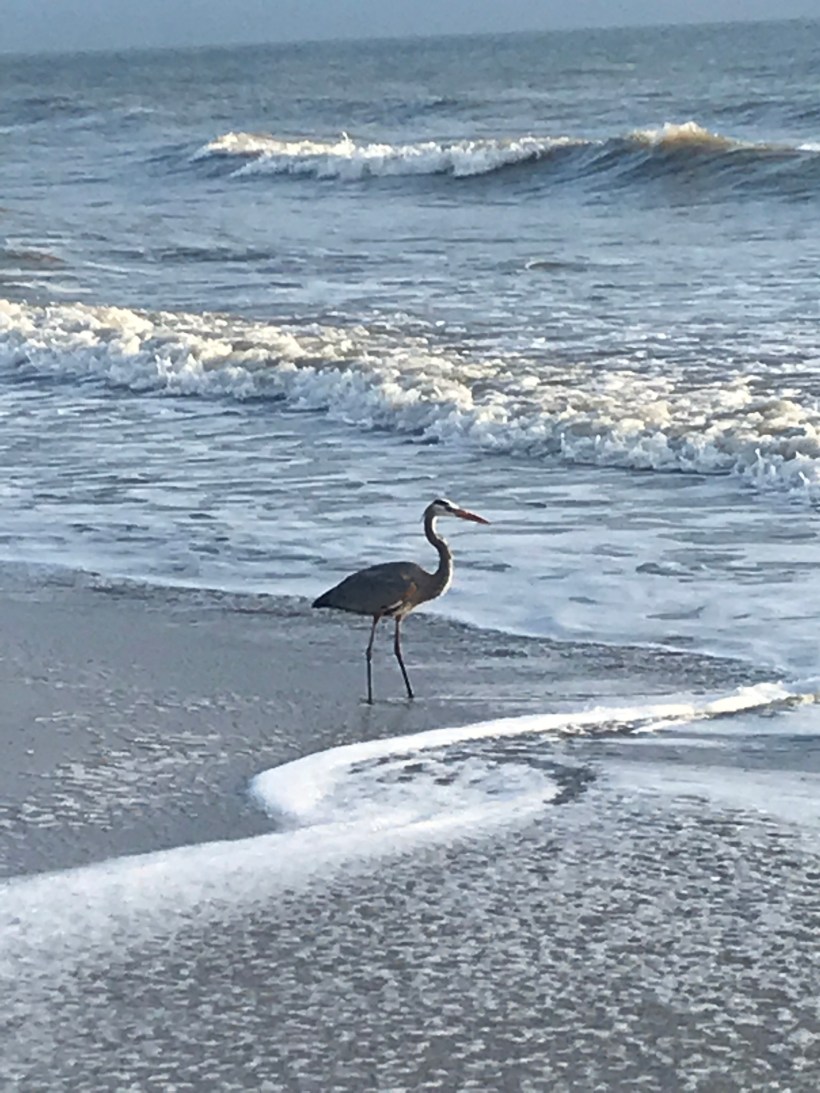
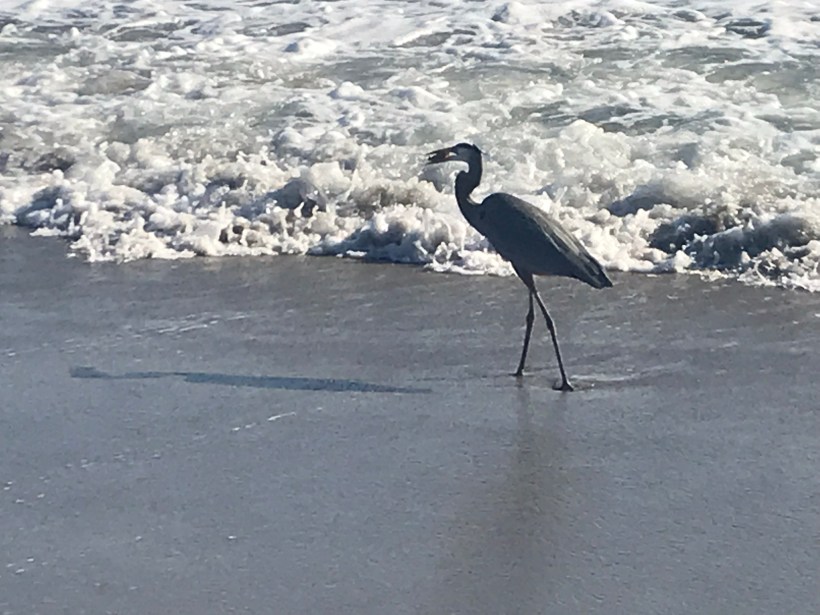
We walk the long seam where the Atlantic writes its restless script, and our beachcombing becomes a study in attention. The shore’s edge—where foam loosens shells from sand and the wind arranges salt on the tongue—draws other walkers too: grey herons, patient and arrow-straight, patrolling the surf line as if reading a language older than tides. They halt us without trying. We stand, quieted, while they work the boundary between water and land, between hunger and satisfaction.

I pack an iPhone sometimes for beachcombing as a lightweight alternative to SLRs. This post features iPhone photographs.

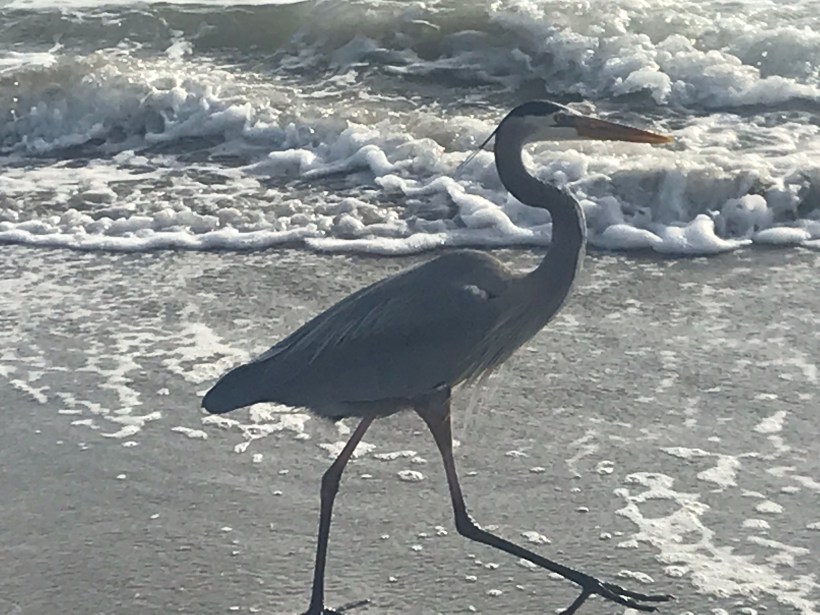
Along this narrow world of sand and surf, herons keep two distinct manners. Some linger near anglers, learning the thrift of handouts and the craft of appearing inevitable. Others refuse that bargain and hunt on their own, staking the wash with a slowness that is not delay but method. These independent operators move along the ocean’s margin: high enough to let the breakers fold ahead of them, low enough that their long legs stir the small lives hidden in the cross-hatching currents. To follow one with the eye is to adopt a different clock. Sandpipers skitter and dash; the heron lengthens time.

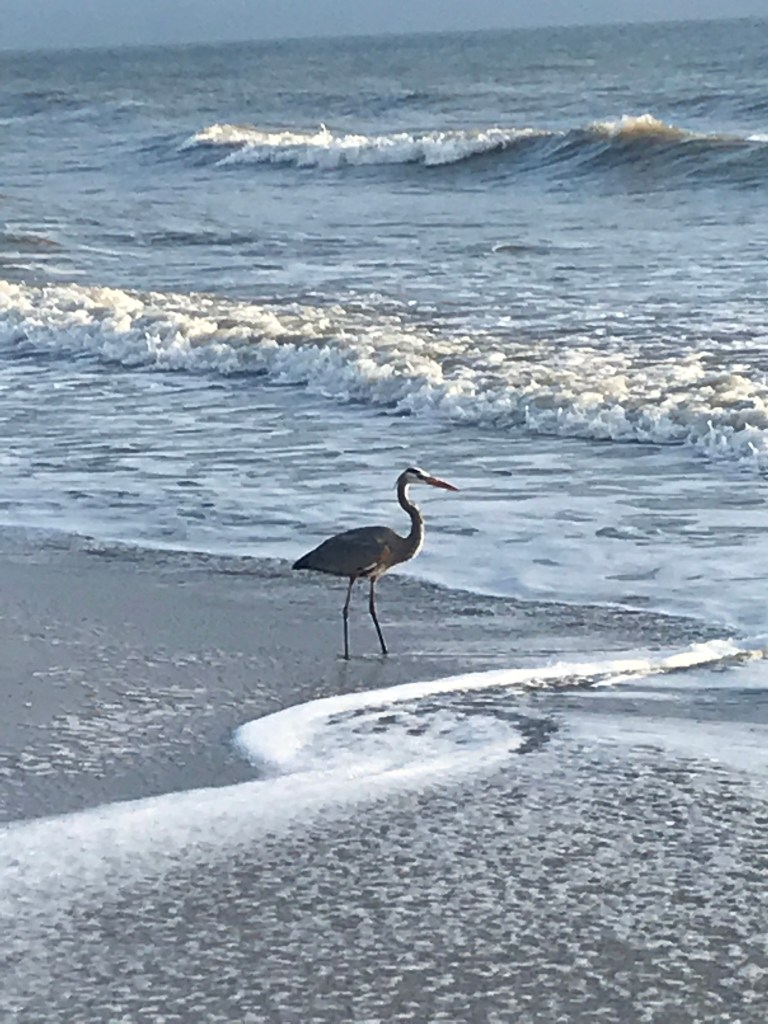
A perfect place to stalk the surf

At first the bird seems merely spellbound by light on water. Then a shift: a narrow cant of the head, the smallest realignment of the eye to the glare. The neck—serpentine and stored with intention—uncoils quick as a strike, and the bill cleaves the surface. The world either yields or it doesn’t. Often it doesn’t. When it does, the beak lifts an impossibly large, glinting fish, as if the ocean had lent out a secret.

Success!!

What follows is ceremony. The heron stands and calibrates, turning the silver length with almost invisible nods until head and prize agree. A sharp jerk aligns the fish with beak and gullet; the upper throat swells, accepting the whole, unchewed. Two more pulses and the catch is a memory traveling inward. It is an astonishment every time, not because we do not understand what is happening but because we do, and still it exceeds us.

We carry a smart phone on these morning circuits, a slim stand-in for heavier glass, enough to witness without intruding. Backlit by the early sun, the herons are cut from bronze and shadow, working the luminous edge while the day composes itself behind them. In the afternoons we meet fewer of the solitary hunters when the strand belongs more to the opportunists near the thinning knots of anglers. Why the shift, we cannot say. The ocean has its schedule; so, it seems, do its readers.

If we keep our distance, we are permitted to watch. Cross a line we don’t perceive and the bird will rise all at once, the long body unfolding, the voice a rasping scold torn from the throat of reed beds and marsh dawns; but, grant it enough space, and the heron returns us to the lesson it keeps teaching: that patience is a kind of movement; that the boundary of things is where change is clearest; that the most astonishing acts require the courage to do very little, very well, for a long time.

We come to linger where the waves erase our tracks, apprenticed to that slow grammar, trying to learn the tide’s careful verbs before the light turns and the day becomes something else—a different text, the same shore, the heron already a thin signature against the horizon.

Enter your email to receive notification of future postings. I will not sell or share your email address.

Stargazing Winter’s Crab: Watching the 2019 Total Lunar Eclipse Near Cancer’s Beehive Cluster

Join me as a full moon slips into Earth’s shadow, turning copper beside Cancer’s Beehive—science, illusion, and wonder entwined in a winter night.

Colored lights of our skies are lifelong triggers for the imagination. On any moonless, crystal night—far from the town-glow—three thousand or so stars and the wandering planets scatter across the dark. We read them instinctively, stitching patterns the way our ancestors did, turning a brilliant chaos into stories. Along the ecliptic, twelve of those patterns became the constellations, a starry calendar by which careful observers told the seasons. When Cancer, the Crab rides high, winter has the northern hemisphere in its grip

Click Photograph for my OnLine Galleries
Click photograph for my OnLine Galleries. Clicking the other photographs in this post will yield a larger image.

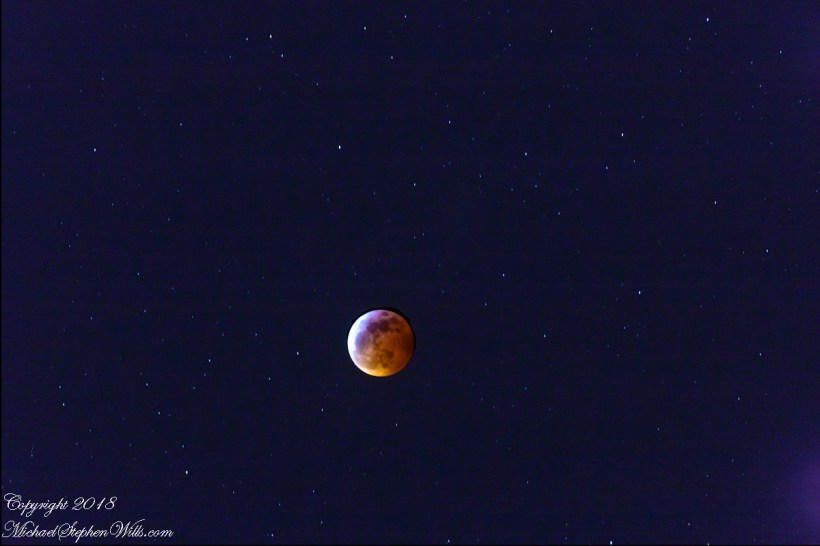
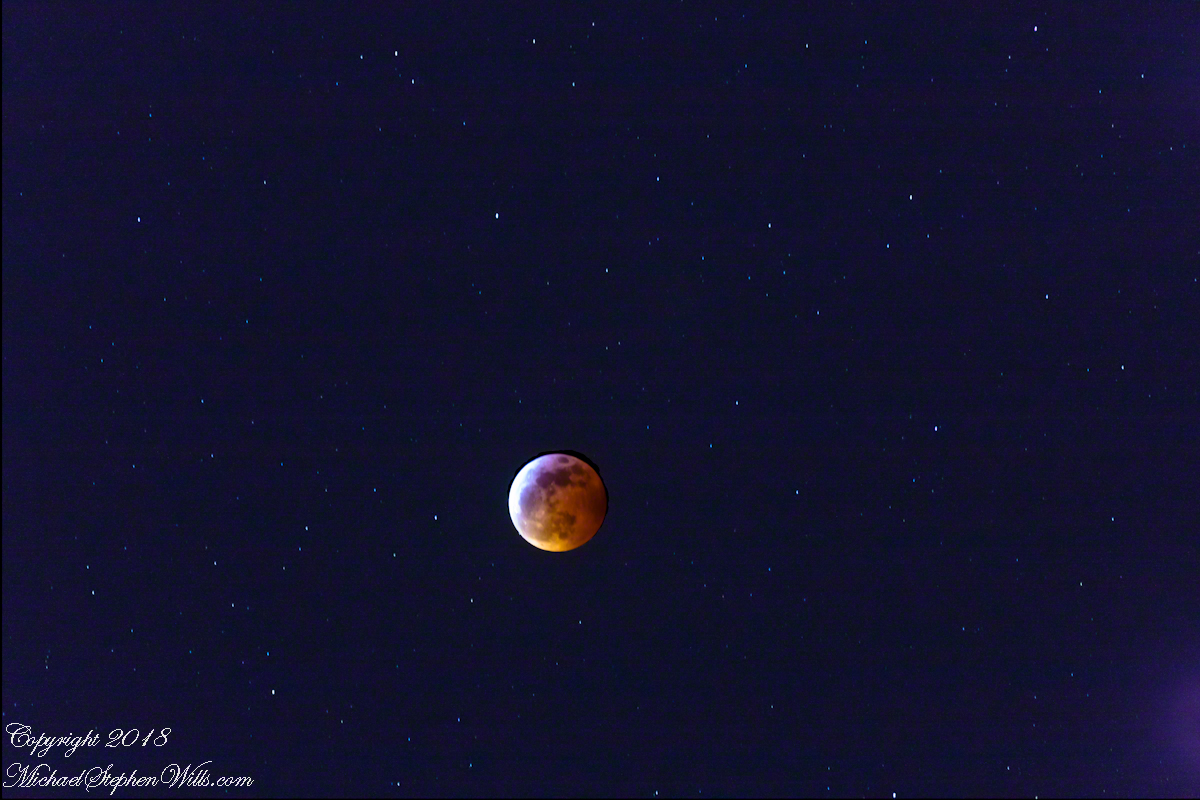
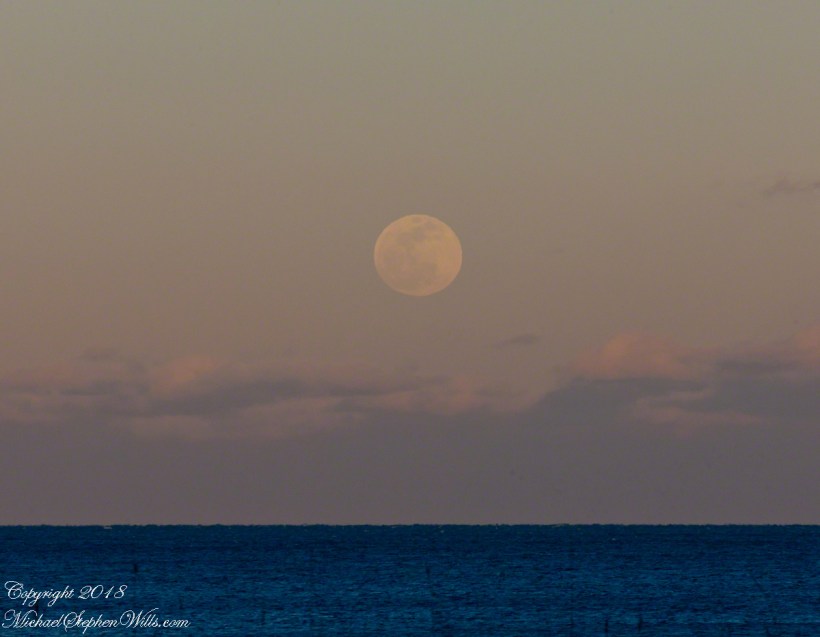
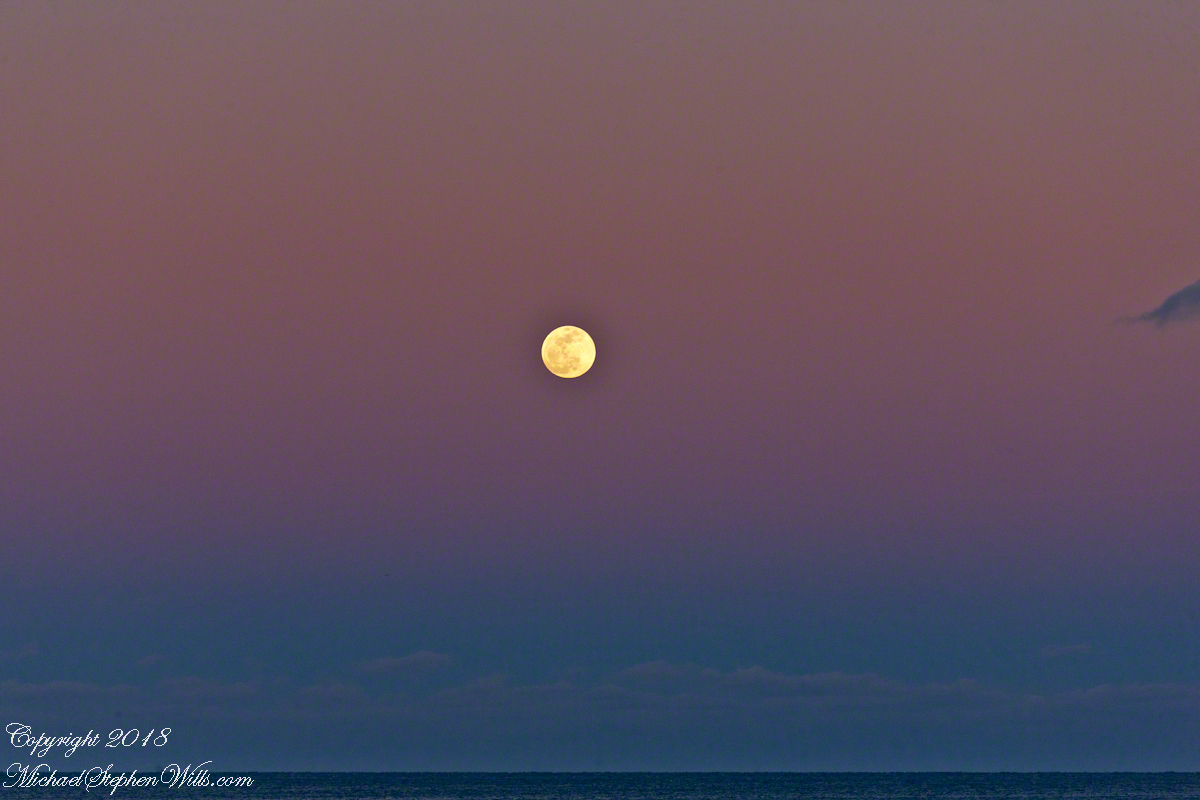
On the night of January 20–21, 2019, a full moon climbed from the horizon and slid into Earth’s shadow, transforming a familiar face into a copper coin. As it rose, that low-horizon “larger” moon—an illusion born of context—felt close enough to pocket. Hours later, the moon darkened to a dull copper color and appeared to float amid Cancer’s dim stars.

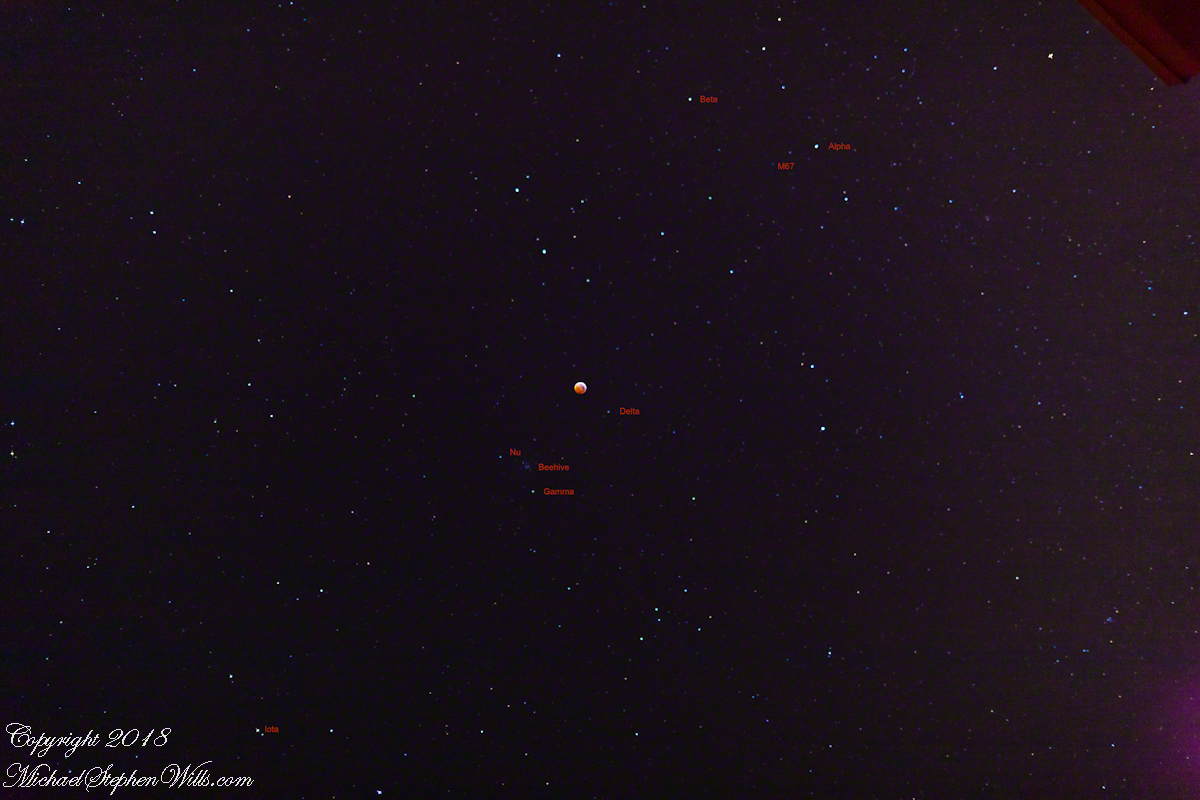
I set up a Canon DSLR on a tripod with a 24mm f/1.4 lens, pushed the ISO to 3200, and shortened the exposure to 1.3 seconds—a compromise between freezing star points and preserving the feel of the sky. The moon, of course, was overexposed in that wide frame; later, I overlaid a correctly exposed moon (from a telephoto shot later in the night) at its true apparent size to match the scene as the eye saw it. Is it the most “technical” astrophotograph of the eclipse? No. But it is faithful to the moment I witnessed and good enough to carry the story forward.

The Moon on the Crab’s back

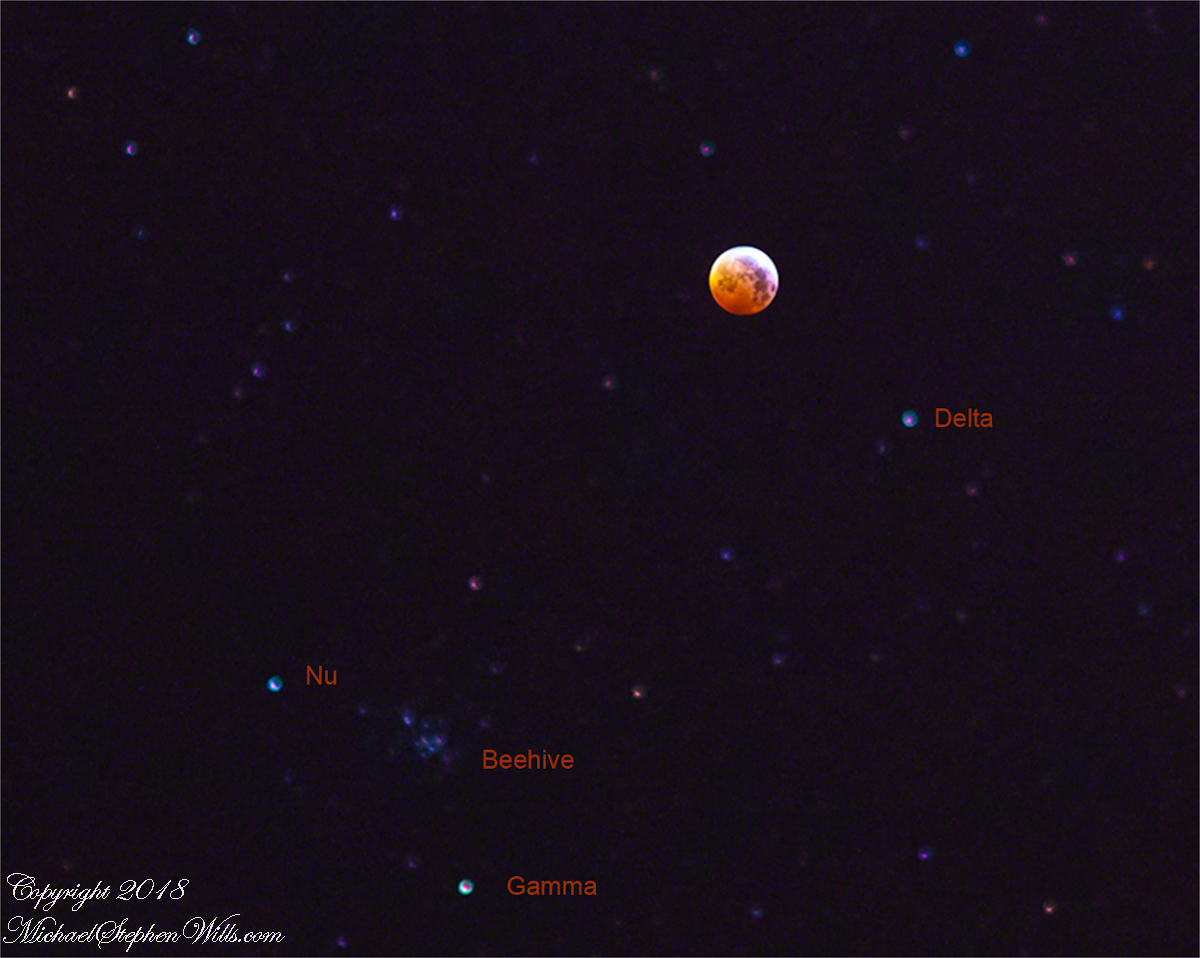
Cancer is never an easy connect-the-dots. Its stars are modest, more suggestion than signature. Look just to the side of the moon’s position that night and you come to Delta Cancri, the orange giant nicknamed the Southern Donkey. Draw a mental line down and slightly right to the faint pair Nu and Gamma Cancri—white stars that only masquerade as twins. They are not physically bound, merely near each other by line of sight: Nu about 390 light-years away, Gamma at 181. Scatter in Alpha and Beta off the Crab’s back and the outline becomes more plausible, the way a minimal sketch becomes a creature once the eye knows what to look for.

The Beehive

Between Nu and Gamma, edged closer to the moon, lies the real prize: the Beehive Cluster—also known as Praesepe or M44. Even with modest binoculars, Praesepe explodes into a field of delicate sparks, a thousand stars loosely wrapped into a hive. Galileo famously turned his early telescope on this cloud and teased forty separate points from the mist; modern optics reveal a populous neighborhood of stellar siblings in shades from ice-blue to ember-red. It is one of those sights that converts a casual sky-gazer into a repeat offender.

Click for more information about this view

Click photograph for a higher resolution version
Total Lunar Eclipse and Surrounding Sky with labels for primary element of the Cancer constellation

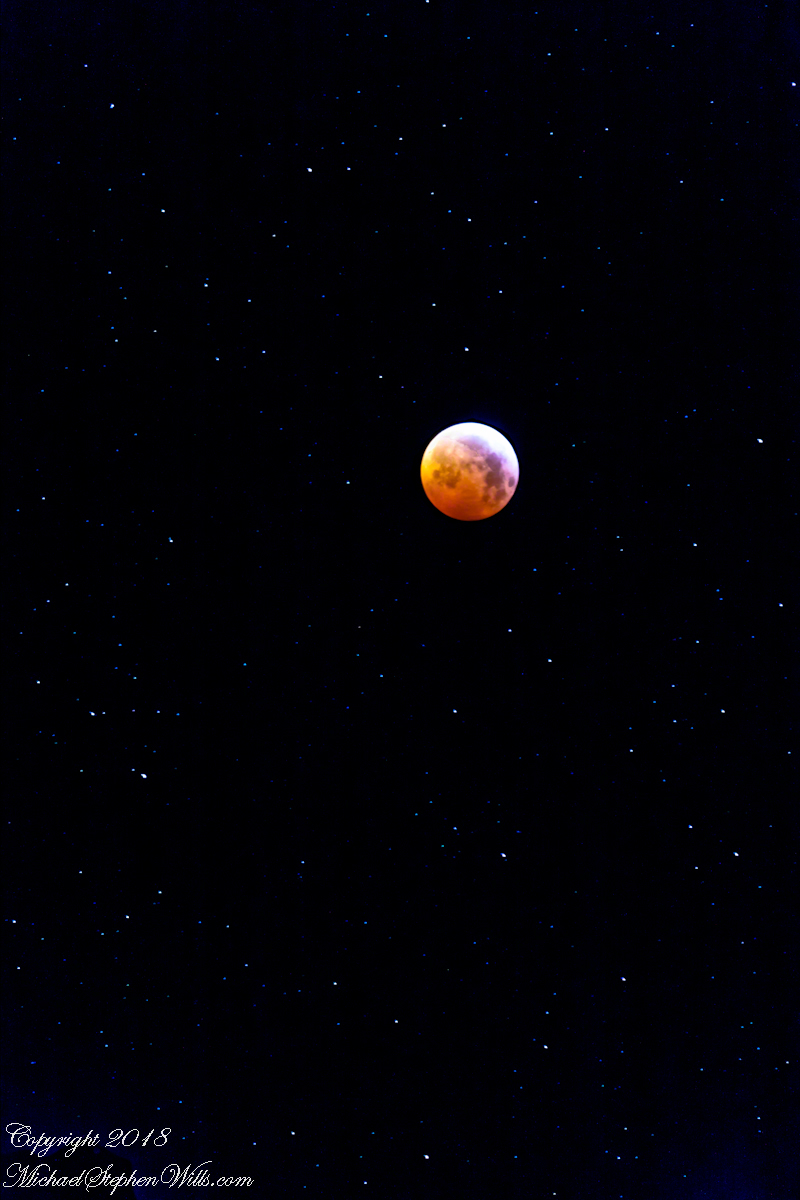
Later in the night I lifted the telephoto—70–300mm at 300mm, ISO 3200, 3.2 seconds—and let the moon fill more of the frame. At totality, the light thinned to a clay-jar red as Earth’s atmosphere bent sunlight around the planet and into its shadow. The effect is both simple and profound: every sunset on Earth happening at once, projected onto the moon’s face. Craters and maria softened into relief, and the globe stopped being a flat disk and became a round, ancient body again. Even without Delta, Gamma, Nu, and the Beehive in that tighter field, the sense of placement remained; I knew the Crab’s back was there in the dark, and that the moon had joined it—just for an hour—as a guest at the manger.

Click photograph for a higher resolution image
“Beehive” with Total Lunar Eclipse with labels for primary elements of Cancer Constellation

The Total Eclipse

What I love most about an eclipse is its pace. Nothing is impatient: the bite appears, the light drains, the color warms, and the world around you changes temperament. As the bright glare wanes, neighborhood sounds recalibrate—the hush between footfalls, the small click of a door, even the steadying breath you didn’t know you were holding. A total lunar eclipse is an astronomy lesson that behaves like a poem; it teaches by arranging time and light until awe and understanding meet.

Click photograph for larger image

And then, quietly, it returns what it borrowed. A thin wedge of white blooms at one edge, a rehearsal for dawn. Copper gives way to pearl, and the old moon looks new again, just higher and smaller against the deepening night. Cancer recedes into suggestion; Praesepe goes back to being a faint cloud to the unaided eye. The camera is packed away, the tripod shoulders its own shadow, and you keep the best exposure of the night where it can’t be corrupted: in memory.

Click photograph for larger image

If you have binoculars, mark Cancer on a winter chart and step outside when the sky is clear. Find Delta, sweep toward the dim pair of Nu and Gamma, and then rest your gaze on that hazy patch between them. Bring a friend into the circle and let the cluster resolve, star by star, into something alive with depth. It will not be the last time you look for it. And if you’re lucky enough, as we were that January, the moon will pass nearby, reminding you that even the most familiar companion can be made strange and beautiful by the turn of a shadow.

The sky is a storybook, yes—but also an instrument. Nights like this tune both.

Enter your email to receive notification of future postings. I will not sell or share your email address.

Blood Moon Reflections: Science, Illusion, and Shared Awe Under the Lunar Eclipse

We gather on the balcony as a total lunar eclipse turns the moon to copper—science, illusion, and shared wonder braid a night of luminous change.

Moonrise

On certain evenings we gather on our Cocoa Beach, Florida east-facing beach-side balcony simply to watch the day undo itself—sunset staining the western sky while, behind us, something quieter begins. On Sunday, January 20, 2019, the quiet had a name: a total lunar eclipse. I’d checked the online charts earlier—moonrise time, azimuth, the patient geometry of the heavens laid out in numbers—and set our chairs faced the anticipated spectacle.

Click photograph for my Online Gallery


The light went a little pewter, as it does when the sun slides offstage and the world inhales. Out on the water a cruise ship shouldered south, a floating city of windows that, under ordinary sunsets, catch fire pane by pane. I looked up too late for the blaze and felt that small pang one gets for the thing almost seen. Still, the ship kept gliding, a bright punctuation mark traveling our skyline.

Click photograph for my Online Gallery

Then the moon appeared—first as a bruise-colored coin pressed against a bank of cloud, then as itself, pale and whole, rising as if pulled on a cord. Photographs can play a trick here: place a ship under a full moon and, with the right lens, the vessel swells to improbable grandeur while the moon looks like a modest ornament. Our eyes know better. The ship is huge but near; the moon is unimaginably larger, only far. Distance humbles everything.

It’s a fine parlor truth that every lunar eclipse requires a full moon. There’s a steadiness in that—that the earth, playing the rare importance of middle child, can only cast its shadow when the moon has come fully into its own. The reverse, of course, is not guaranteed. Most full moons rise and go about their business, silvering roofs and quieting dogs, without ever tasting the earth’s shadow. Tonight would be different.

Click photograph for my Online Gallery

The Riddle of Size

Before the darkness advanced, the old riddle of size made its entrance. Low on the horizon, the moon seemed suddenly intimate, big enough to pocket the ship and still have room for the lighthouse. We call it an illusion, but the word hardly captures the tenderness of it: how the mind, seeing that round face near our familiar trees and eaves, feels the moon to be part of our belongings. Angular diameter stays stubbornly constant; affection does not. The experiment is easy enough—choose a pebble that covers the low moon at arm’s length, then try again when the moon is high. The same pebble hides it perfectly. What changes is not the moon, but the story our senses tell.

Click photograph for my Online Gallery

Clouds raveled and the disk lifted, gathering brightness. As the earth’s umbra slid across that worn, luminous stone, the color shifted from pearl to rust, then to the old red of clay amphorae. People love the names—Super, Wolf, Blood—as if the moon had stepped onto a carnival midway. I prefer the quieter facts: sun, earth, moon aligned; light refracted through air; the planet itself briefly confessed in velvet shadow. It felt less like spectacle than like a family resemblance revealed by candlelight.

Eclipse

Much later, around us, the little neighborhood chorus noticed. A conversation stalled mid-sentence; the unspooled hush you hear at a concert just before the bow draws its first note came and settled on the patio. Even the ocean seemed to restrain itself, waves taking smaller breaths. The cruise ship had long since slid behind the curvature of our seeing.

We kept watching. A lunar eclipse is an exercise in patience: everything happens slowly enough to be felt, quickly enough to refuse boredom. Shadows are honest about their edges. When the moon wore its deepest copper, I thought of ancient nights and imaginations unlit by anything but fire, how dependable cycles must have seemed like messages and how—standing there, spine pricked by a familiar old awe—I could not entirely disagree. It was not fear, but kinship: the sense that we are included in the machinery, not merely spectators.

Click photograph for my Online Gallery

When the light returned, it did so from one margin, like dawn rehearsed on a smaller stage. The coin brightened by degrees, and the old face we know reappeared—craters and mares soft as thumbprints. The illusion of size faded as the moon climbed, and the experiment with the pebble proved itself yet again. Even so, I felt the tug of that earlier enchantment, the way a child misses a dream just after waking. The mind keeps two ledgers: one for what is measured, one for what is felt. Tonight both were full.

Eventually we retired. Chairs nested. Doors clicked. In the kitchen, glasses chimed in the sink. But the moon kept on, white and durable, its borrowed light restored. Somewhere out there the ship’s passengers drifted to their cabins, stories in their pockets about the night the world itself cast a shadow, and how the ocean looked briefly like copper under a patient star.

Later, when I wrote down the times and the few facts I could trust to memory, I realized the real record was not the measurements but the company: our leaning back, the shared breath, the soft astonishment that comes when something vast moves at a human pace. The eclipse ended; the evening did not. That, too, felt like a kind of alignment—ours with one another, our small chairs with a very large sky.

Enter your email to receive notification of future postings. I will not sell or share your email address.

Exploring Sipapu Bridge: A Scenic Descent

Experience the thrill of descending into Utah’s White Canyon—slickrock trails, driftwood ladders, and stunning views await at Sipapu Bridge in Natural Bridges Monument.

The final descent into White Canyon to view Sipapu Bridge, Natural Bridges National Monument near Blanding, Utah

Final Step

Here is a photograph of the final stage of our descent into White Canyon. Here the trail traverseed a type of sandstone called “Slickrock.” For Pam and I the surface was like sandpaper and, for the right type of shoes, provides great traction.

That day I wore Lowe hiking boots with a harder sole and these could slip at times. I’d recommend a different shoe for the trail, but my boots come over the ankle and provide great support. Plus, the canyon bottom is sandy, so high boots prevent sand from falling into the shoe. A perfect choice for this trip is a high boot that provides support, with a softer sole on a hard and light shank (to protect you against sharp rocks).

What is Slickrock?

Slickrock was named by the first settlers and explorers who discovered their iron shod horses lost footing on the steep slopes of this sandstone.

This was another feature of Pam and my descent into White Canyon. The sandstone weathers in a way that produces steep slopes over which the trail must pass and the traveler navigate. I chose this image as a Fine Art print (part of a series featuring Natural Bridges National Monument) because this part of the trial is strange and beautiful.

The hard rock cliffs are resistant to wear and, in this climate, weather to provide rounded surfaces. The cliff face is scalloped and marked with desert varnish striations that “pop out” from the red rock. Then, there is the clear light and bright morning sky on a summer morning that promised thunderstorms.

Gratitude

Then, there are the personal memories of that iron railing drilled into the rock and that marvelous looking ladder created from driftwood found in the canyon.  That ladder is a work of art!!  The photograph does not reproduce the feeling Pam and I had at that point of the descent.  I needed to climb down the ladder backwards (facing out) and holding on .

We were both grateful to reach the sandy stream bed in White Canyon.

Enter your email to receive notification of future postings. I will not sell or share your email address.

Celebrating Community at Dryden Dairy Days Parade

Experience the joy of small-town tradition as three generations celebrate cows, community, and colorful floats at the 2025 Dryden Dairy Day Parade in upstate New York.

On a glorious Saturday morning—June 14, 2025—the small village of Dryden, New York, once again came alive with one of its most beloved traditions: the Dairy Day Parade. I had the joy of attending this year’s festivities with my daughter-in-law, Jennifer, and my two grandsons, Sam and Rory. We set up along Main Street, folding chair ready and anticipation high, surrounded by a growing crowd of families, neighbors, and out-of-town visitors drawn by the charm of this time-honored event.

Dryden Dairy Day, first held in 1980, has long celebrated the area’s agricultural roots—particularly the dairy farms that once dotted the Finger Lakes region in greater number. Though the rural landscape has changed, the community spirit endures, embodied each year in this cheerful, inclusive parade. And what a parade it was.

Sam and Rory, who started out quietly nestled together in a red camp chair, quickly leaned forward in excitement as the opening marchers passed. Veterans in pressed blue shirts and caps bore the flags solemnly, stepping to the rhythm of distant drumbeats. The boys gladly collected candy thrown to the crowd by the paraders.

Then came the color and music—floats festooned with balloons, hay bales, streamers, and, of course, cows. The Jerry Dell Farm float, labeled “LegenDAIRY Superheroes,” stole the show with its red metal rails, a large cutout Holstein suspended in mid-leap, and enthusiastic kids handing out “Got Milk?” flyers. The float’s theme—half play, half tribute—offered a nod to the hardworking farmers past and present who’ve kept local dairies running despite national challenges.

Behind them, children waved from trailers turned farmyard dioramas. In one, rabbits and baby chicks nestled on pastel blankets inside red and gray wagons, drawing audible “awws” from the crowd. Another float featured kids feeding baby goats from white pails, an irresistible scene that reminded us of the joys of hands-on farm life.

Marching groups followed, each bringing their own spark. A contingent from Tompkins Cortland Community College, all in matching green shirts, smiled and waved. Their banner and cheetah logo brought cheers from alumni in the crowd. Girl Scouts from Troop 427 of Golden Meadows brought peace signs, love hearts, and Girl Scout green to life as they passed, handing out candy and smiles with equal generosity.

We clapped for the “Wreaths Across America” semi-truck—a rolling tribute to fallen soldiers. Its stars-and-stripes exterior and the wreath-emblazoned motto “Remember. Honor. Teach.” was a solemn visual counterpoint to the general jubilation, grounding us in gratitude amid celebration.

One of the most magical sights for Sam and Rory came next: a medieval knight on horseback, gleaming in armor, carrying a long lance. This was no Renaissance Fair actor but a local reenactor embodying chivalry and pageantry for the kids. Rory, eyes wide, whispered, “Is that a real knight?” and I nodded with a smile. The horse, a proud palomino with flowing mane, trotted as regally as any steed from storybooks.

At one point, we found ourselves surrounded by people wearing cow-print headbands and passing out themed goodies—a detail that would feel odd anywhere else but felt perfectly at home here. Even the Girl Scouts managed to mix tradition with whimsy, some donning glittering horns and cow ears for the occasion.

I selectively captured photos, while Jen and the boys soaked in the sights and sounds: the distant whinny of ponies, the rustle of candy wrappers on the pavement. Parades like this are entertainment and intergenerational bridges, connecting the past with the present, the seasoned farmer with the wide-eyed child, and the local with the visitor.

As the parade wound down and the last float passed, we lingered a while longer. The boys were still buzzing with excitement, eager to share their favorite parts—“the knight!” said Rory, “the baby goats!” said Sam. For me, the most treasured moment was watching my grandsons engage so deeply with the richness of local heritage, waving to friends in the parade feeling part of something bigger than themselves.

Dryden Dairy Day reminds us that community is people lining the street on a Saturday morning. It’s floats handmade with care. It’s generations walking side by side—and sometimes sitting in the same chair—laughing, learning, and loving the place they call home.

Enter your email to receive notification of future postings. I will not sell or share your email address.

Exploring Sims-Jennings Preserve: A Nature Lover’s Delight

A walk through Sims-Jennings Preserve unveils ancient cliffs, vibrant bird calls, and the quiet wisdom of maples and waterfalls along Cayuga Lake’s forested edge.

I arrive early, the sun still climbing its slow arc, brushing the eastern sky in pastels as I step into the Sims-Jennings Preserve at Cayuga Cliffs. The trailhead, tucked neatly along NYS Route 34B, is a doorway into an ancient chapter of the Finger Lakes—one rich with the scent of moss, the hush of leaf-dappled silence, and the layered echoes of stone and birdsong.

The first thing that strikes me is the expanse of mowed meadow, rimmed with goldenrod and patches of milkweed. From here, the land rolled gently westward until it ends abruptly in cliffs that plummeted toward Cayuga Lake. A map at the entrance speaks of the Sherburne and Renwick Formations, shale and siltstone laid down when the land was covered in warm Devonian seas. The cliffs themselves stand like watchmen over time, protecting 4,000 feet of lakeshore from erosion, whispering tales older than mammals.

A side trail leads to this mowed meadow and Cayuga Lake overlook

On the meadow edge is this Carya ovata, or shagbark hickory, unmistakable from its elongated leaflets and distinctive bark that peeled in long, curled strips. The leaves shimmered in the breeze, their green etched with pale speckles of recent rain, as if nature herself had hand-painted them.

Shagbark Hickory on the edge of meadow.
Leaves of the Shagbark Hickory
Shagbark Hickory bark / trunk

I follow the yellow-blazed trail into a thicket where tall sugar maples—Acer saccharum—arched overhead. Their leaves caught the morning light, each palm-sized blade glowing like a shard of stained glass.


Throughout the preserve I find large holes like these in a pine tree snag, the work of a Pileated Woodpecker.

A sudden fluting note from the trees stops me in my tracks. “Ee-oh-lay,” the Wood Thrush sang, its call cascading through the forest like water over stone. Moments later, the rapid, accelerating trill of an Ovenbird joins in—a sound like “teacher-teacher-teacher” echoing from the understory. The forest is alive.

Watch on YouTube for the best experience.

I descend into the shade. A narrow stream runs over the flat gray ledges of the Ludlowville Formation, forming delicate waterfalls no taller than a man but intricate as lace. One fall, framed by a colonnade of black cherry and beech trees, poured over stone like a ribbon of silk. The water’s voice changed with each ledge—first a murmur, then a chuckle, then quiet confidence as it wound through the woods.

Here, a Scarlet Tanager flashes like flame through the canopy, its red feathers shocking against the sea of green. Above, the Eastern Wood-Pewee calles its own name from a high perch—“pee-a-wee”—a humble herald of summer. Lower down, a Tufted Titmouse flits from branch to branch, a gray blur with a whistle like curiosity incarnate.

Further along, a looping vine coils around a pair of trees like an ancient signature. Possibly a native bittersweet, its woody stem thick as a child’s arm. It reminds me of how all life here is entangled—flora, fauna, stone, and stream woven into one vast web.

I pause at the overlook, where the trail skirts the cliffs. From this height, the view opened to Cayuga Lake, vast and gleaming in the morning light. Across the water, the hills of the western shore softened into a watercolor horizon.

Crowbar Point on the west lake shore is visible, partially hidden by trees. Sims-Jennings Preserve at Cayuga Cliffs, Finger Lakes Land Trust on a May morning 2025, Lansing, Tompkins County, Finger Lakes Region

On the walk back, a robin sings its measured phrases from a nearby hawthorn, and I think how common birds often hold the deepest solace. The robin’s voice rises above the silence, not grand, not rare, but reassuring in its familiarity—like a good friend’s greeting.

A shale ledge, Renwick Formation (?)

I leave the preserve changed gently, like the soft indent of a footstep in moss. The Sims-Jennings Preserve at Cayuga Cliffs is a place that reminds you to listen. To the birds, to the trees, to your own breath. And in listening, you remember what it means to be wholly present in the world.

Enter your email to receive notification of future postings. I will not sell or share your email address.