Climbing Piestewa Peak: Multicultural Pilgrimage to a Phoenix Desert Dawn

In the cool predawn, strangers from every background climb a stone stairway above Phoenix, trading city lights for desert silence as sunrise spills gold across Piestewa Peak.

View post to subscribe to the site’s newsletter.

Arriving at 5 am there is a line of trucks and cars and Piestewa Peak parking almost full when I grab a spot in the predawn darkness. The desert air has that deep, merciful coolness it offers before sunrise, edged with the long-remembered scent of creosote. Car doors close with soft thuds, headlamps blink on, and a loose procession of strangers begins to funnel toward the trailhead like pilgrims, even now white and red headlamps sprinkle the upper slopes.
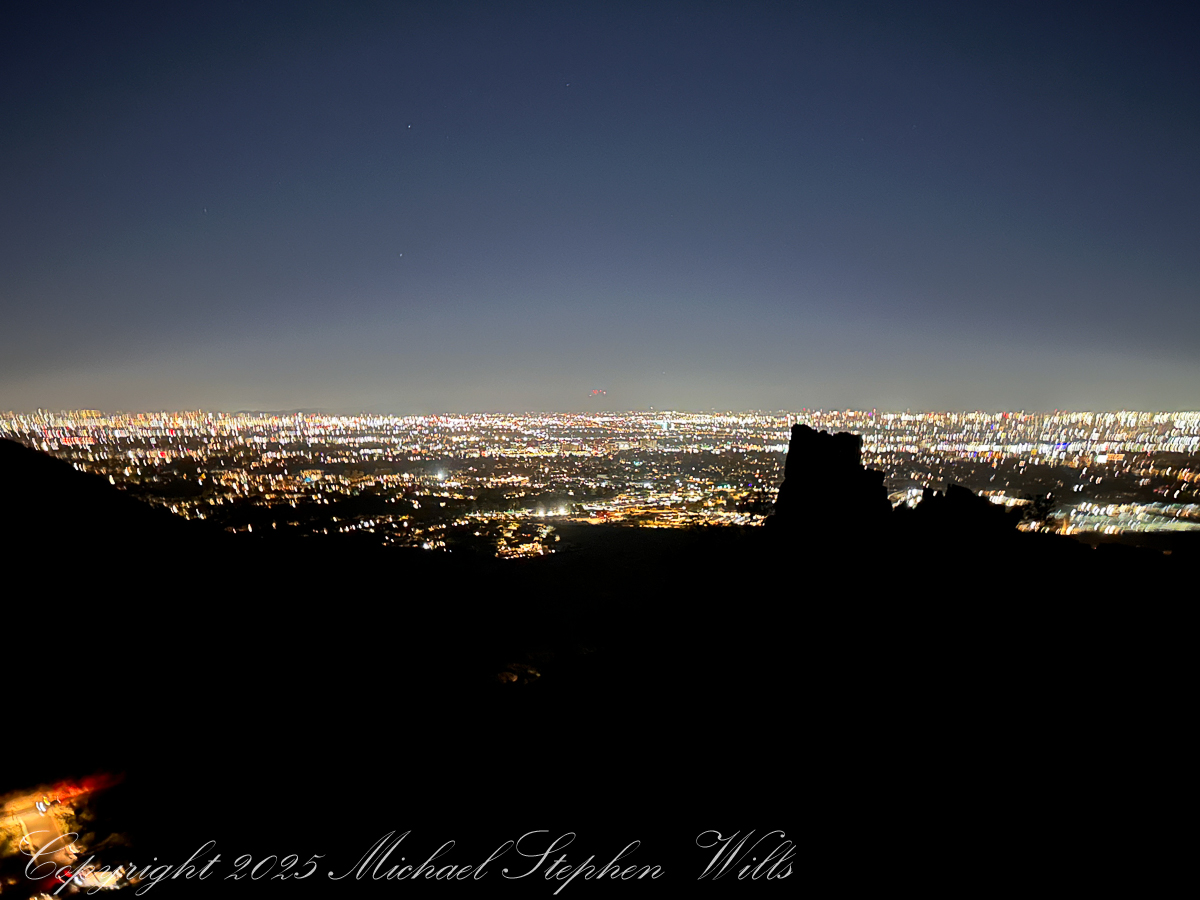
At first the climb exists only in a narrow cone of light, my lamp illuminates the scant gravel, uneven steps, and each scuff of boot or shoe sounds loud in the hush. Somewhere below, the city hums, but here the conversation is mostly breath and the occasional murmur of greeting as we fall into the rhythm of the climb.
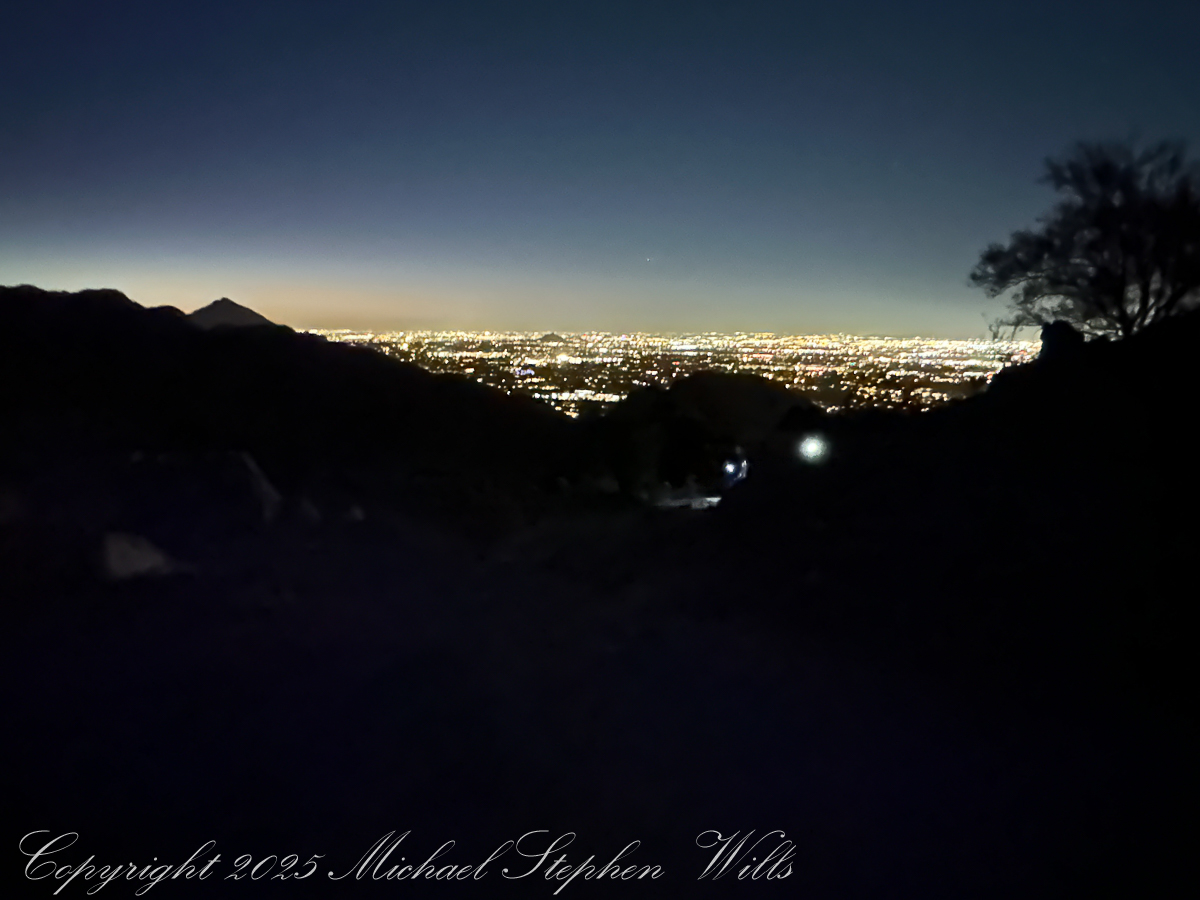
My beam catches a young couple just ahead, their hands knotted together. They speak Spanish, laughing quietly as they miss a step and bump shoulders. Behind me an older man in a Veterans cap leans heavily on trekking poles, his companion—maybe daughter, maybe friend—matching her shorter stride to his with patient care. A group of women in bright leggings and braided hair moves past us in a burst of energy, their languages overlapping—English, maybe Vietnamese, something I cannot place—like the weaving of a rug. A man passes me, a drum on his back. Piestewa draws them all, before dawn, to this rib of stone in the center of the Phoenix basin.
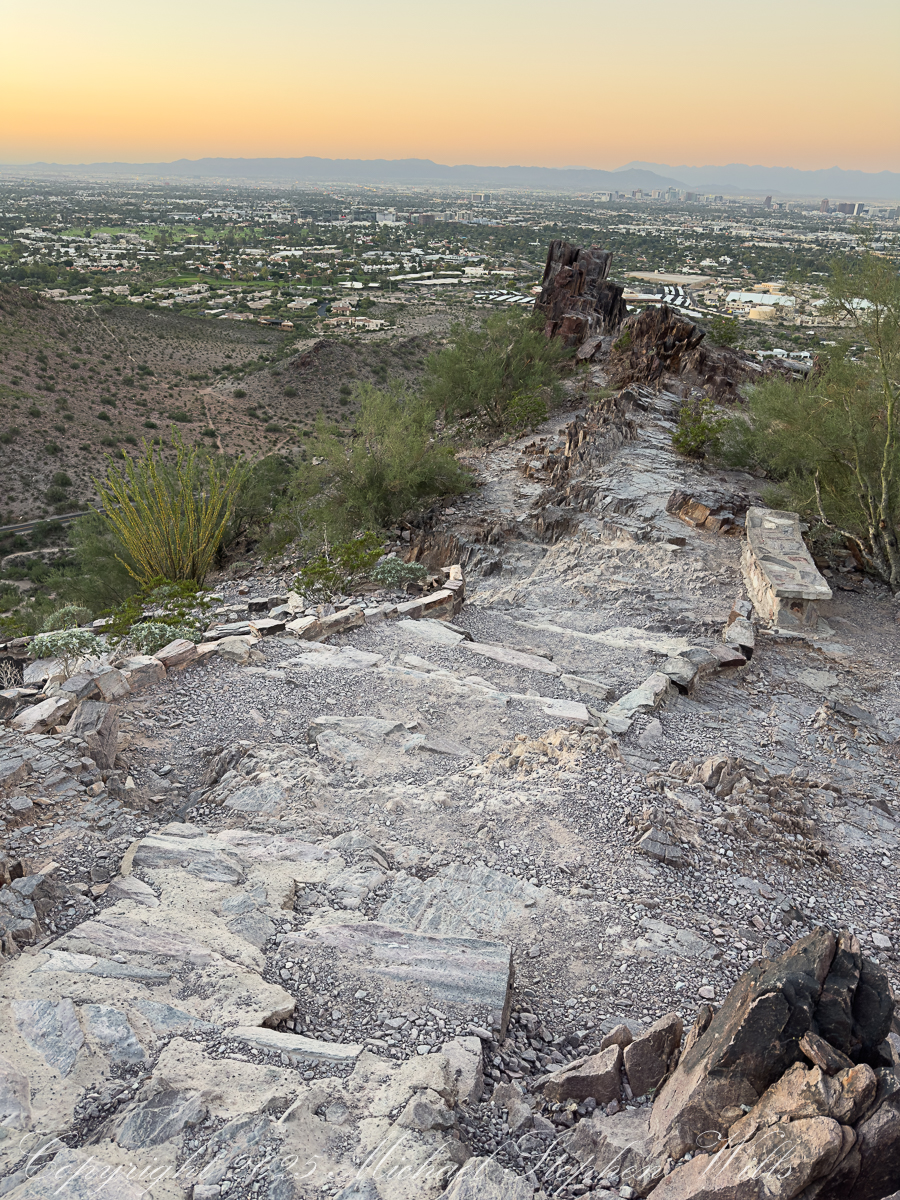
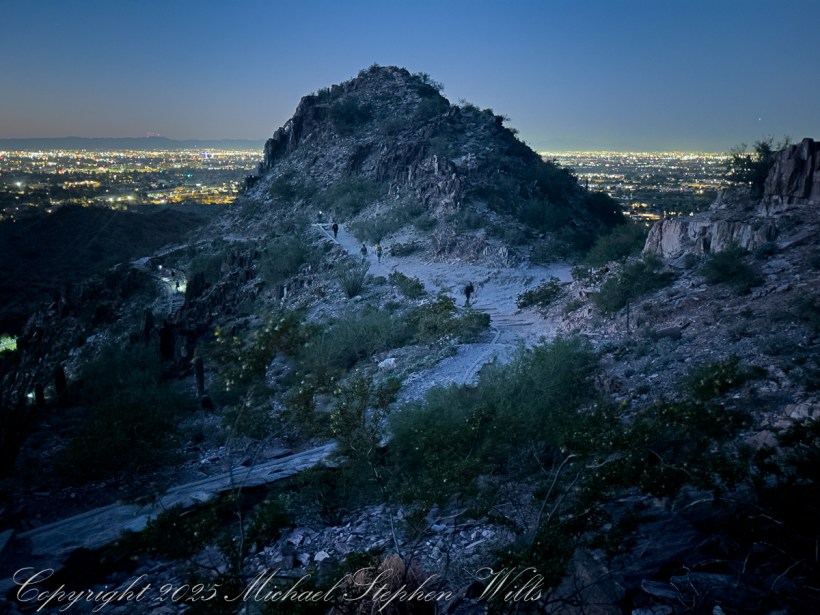
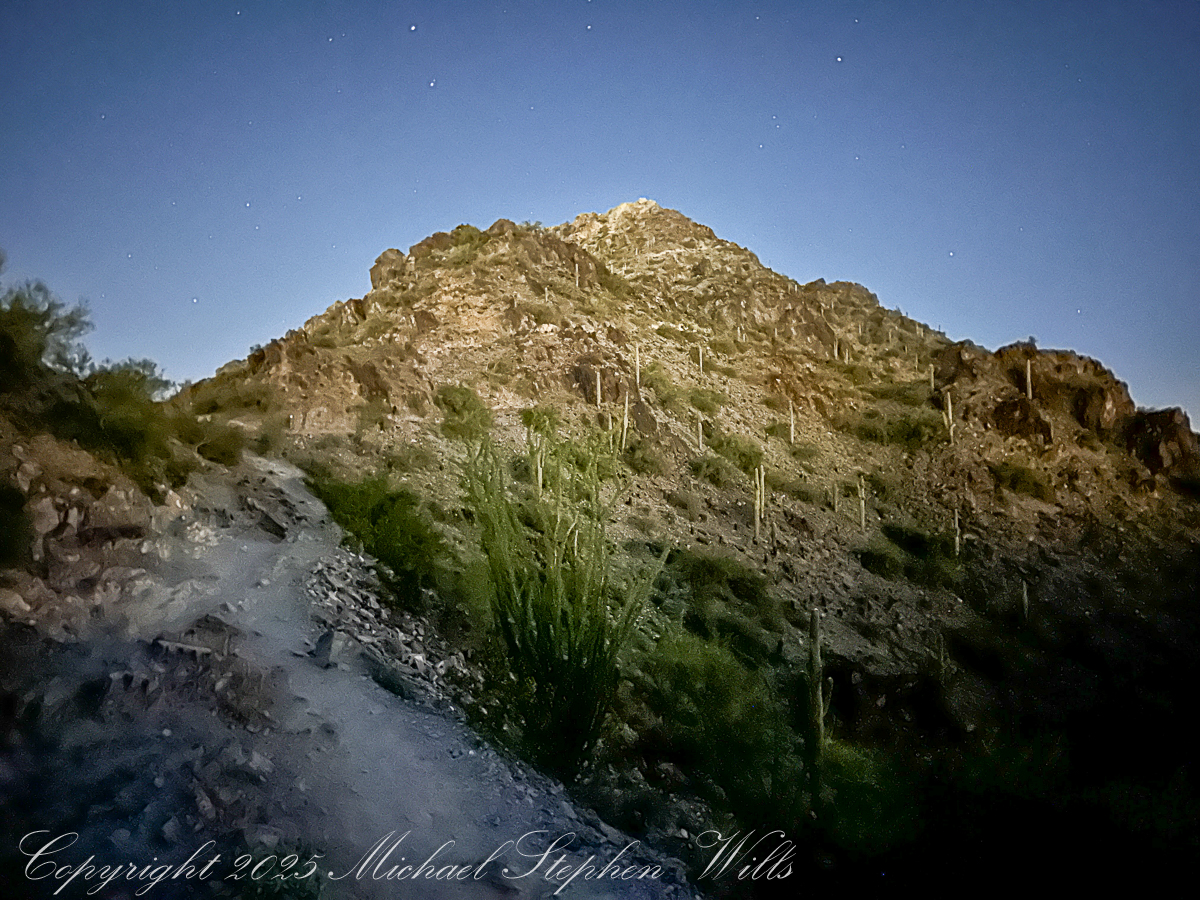
As I stop to rest myself and turn off my headlamp, ahead the trail tilts steeper the steps fade to rock, irregular and unforgiving: a stairway carved from ancient volcanic bones. With my dark adaptation, surfaces reflect star and city light, leading the eye down the ridge toward the dark quilt of neighborhoods below. Later, captured in the photograph, those steps will twist away like a stone dragon’s spine, the city waking beyond in soft pastels. Now they are simply work for legs and lungs.
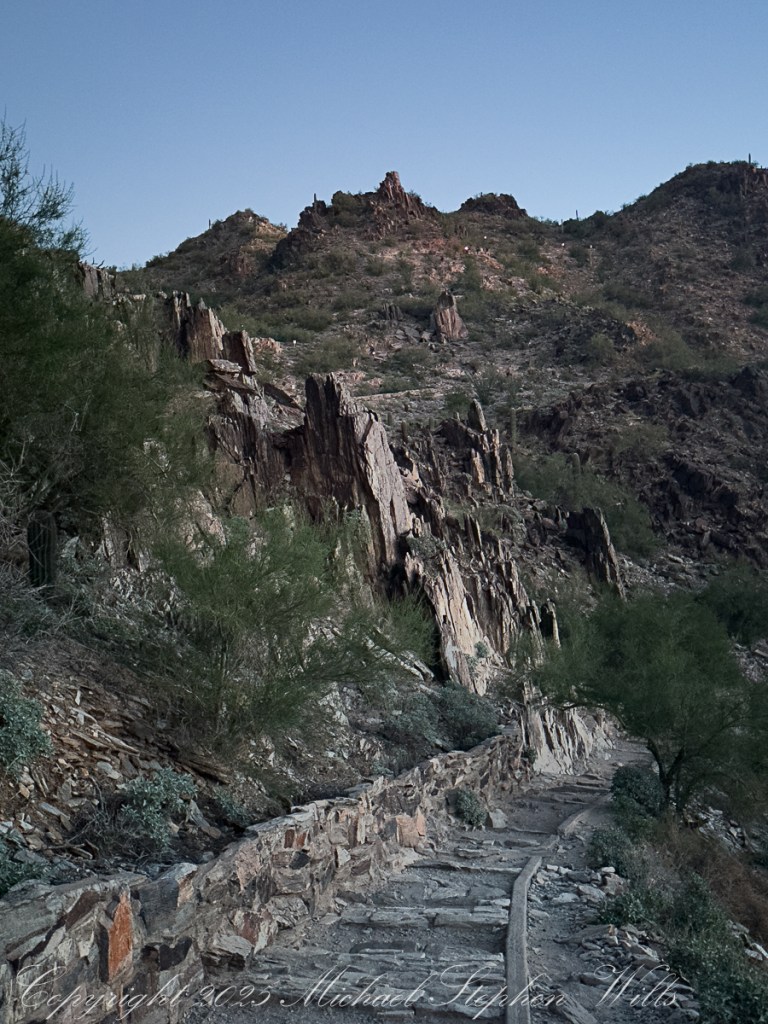
The desert plants materialize around us as shapes before they acquire color. Saguaros stand like sentinels along the slopes; their arms lifted in silhouette. Ocotillo rise as witchy bundles of sticks, each spine leafed out from October rains the leaves catching a little light. On a small plateau a family has paused; the father adjusts a tiny headlamp on his son, no more than six, who is insisting, with fierce determination, that he can carry his own water. “Almost there, campeón,” his father says, and the child straightens like a soldier.
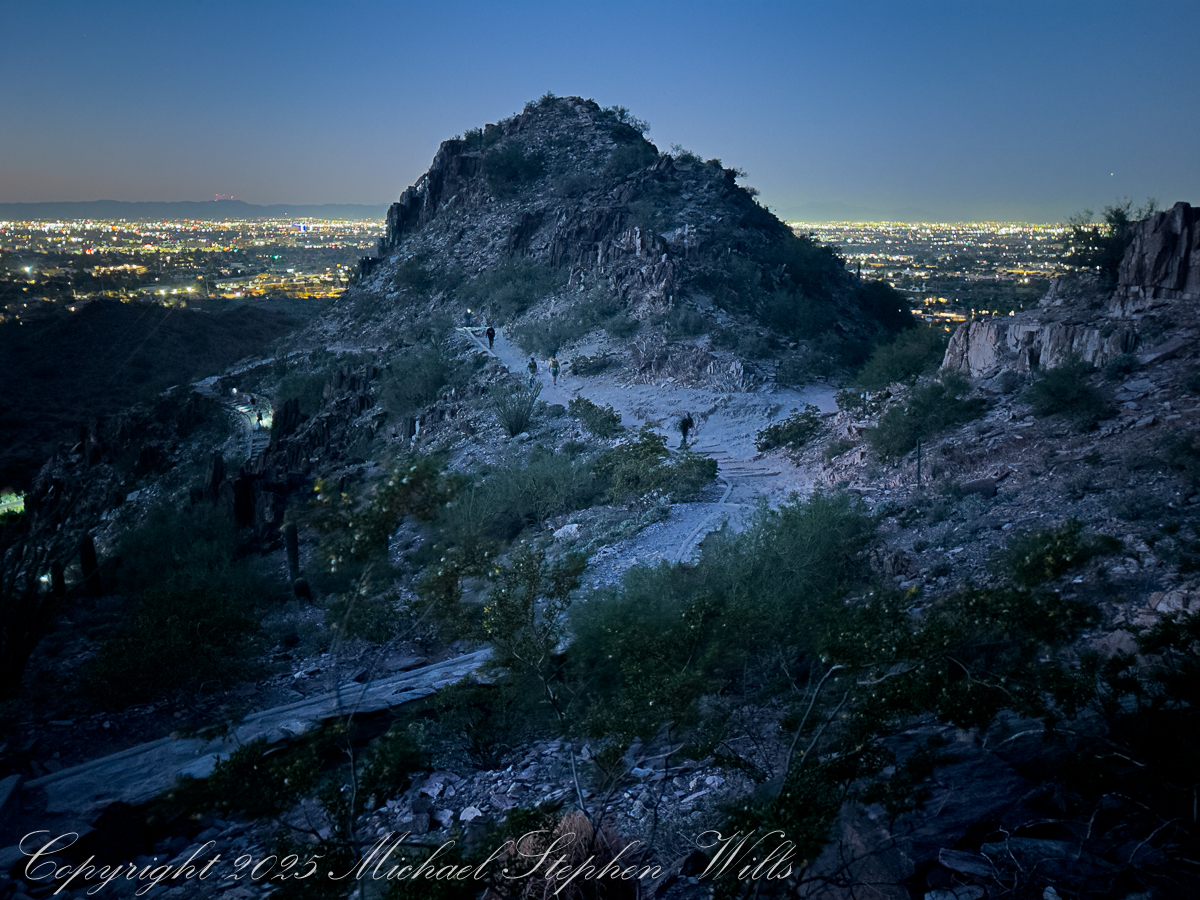
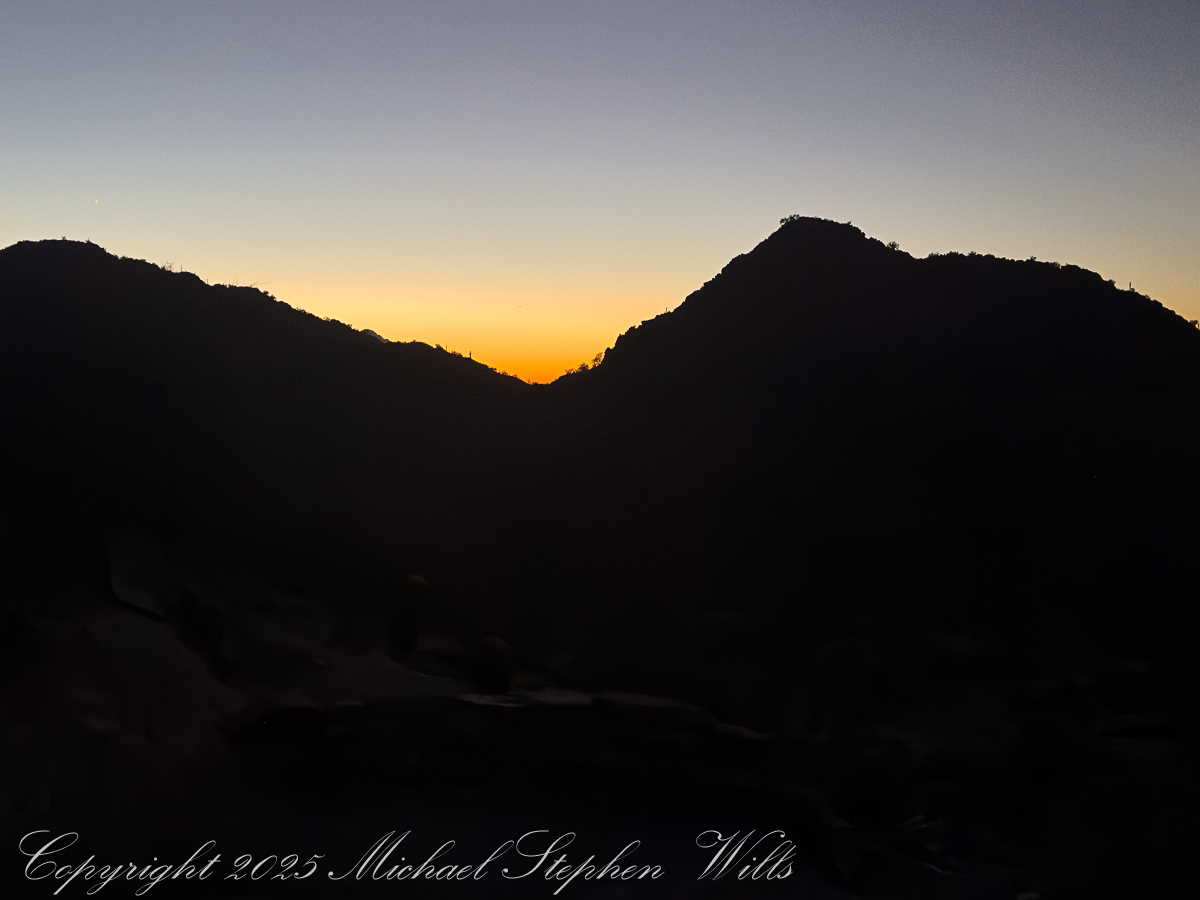
The dark begins to soften at the edges. Over the eastern horizon a thin band of orange appears, a delicate seam between night and day. In one direction, the city stretches out in a glittering net of streetlights, the squares of parking lots and subdivisions catching the last of the darkness. In the other, the mountains are still black cutouts, their profiles sharp as paper against a gradually brightening sky. One of my images will hold that moment: the jagged ridge of Piestewa in shadow, the valley below already spangled with light, a single towering saguaro rooted at the cliff’s edge like a punctuation mark.
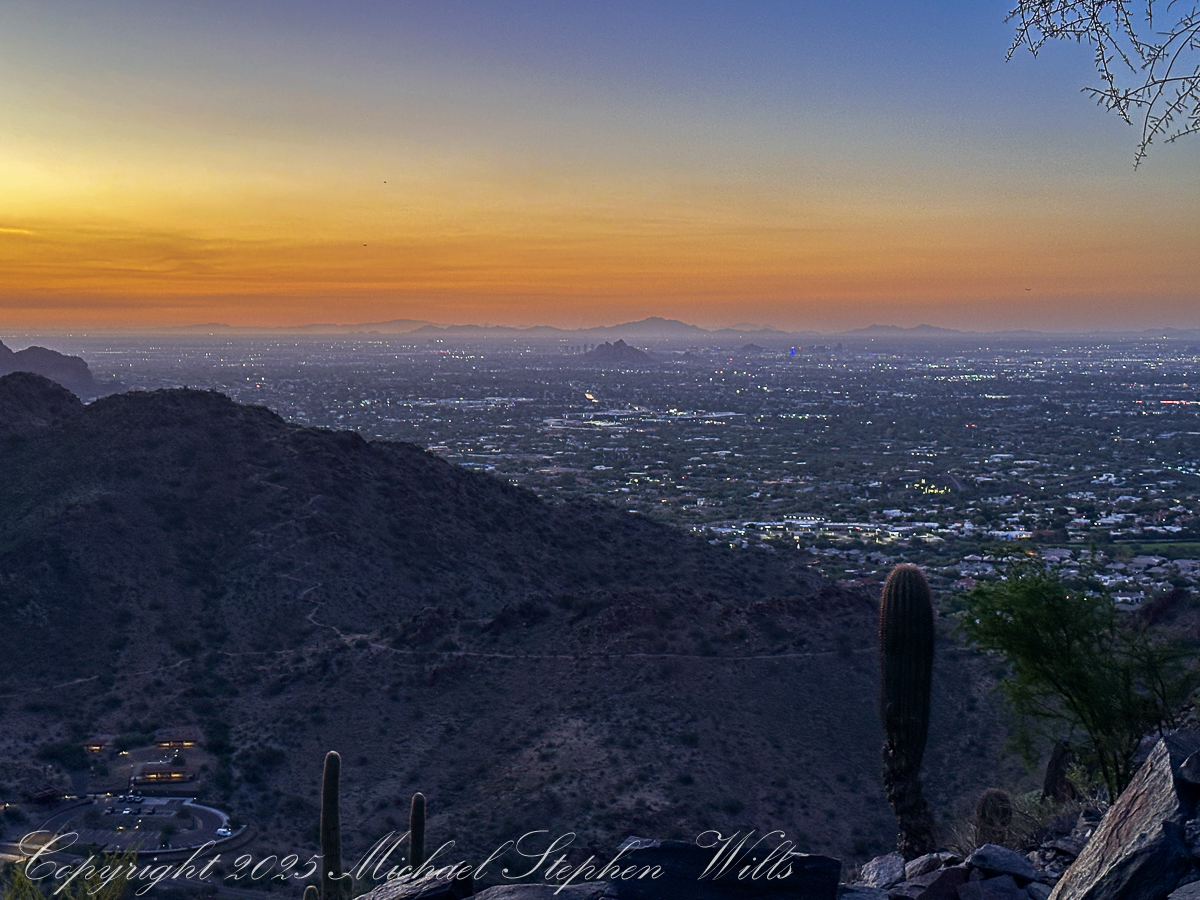
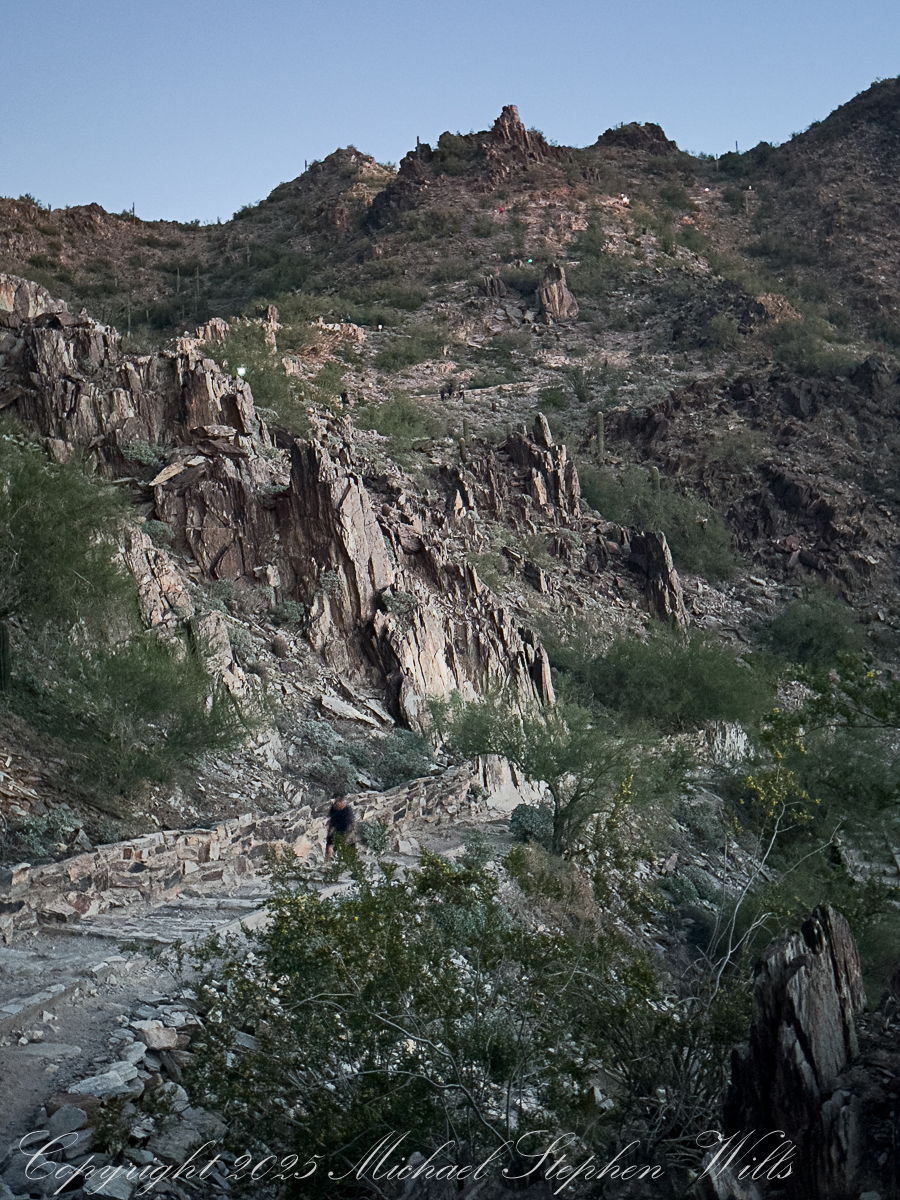
November 2025 while visiting Pam’s family in Phoenix

Higher up, the trail narrows and the rock turns rougher. We fall into single file, strangers linked by a line of effort. A runner comes flying down, feet barely touching stone, breath steady and controlled. “On your left,” he calls, and we part for him like water. A woman with a hijab tucked neatly under her ball cap leans against the retaining wall, stretching a calf muscle, her friend counting in accented English: “Ten more seconds, you can do it.” Near one bend a hiker pauses to press a hand against the rock face, whispering a quiet prayer in a language I do not recognize. It is a small, intimate moment, gone almost before I register it.
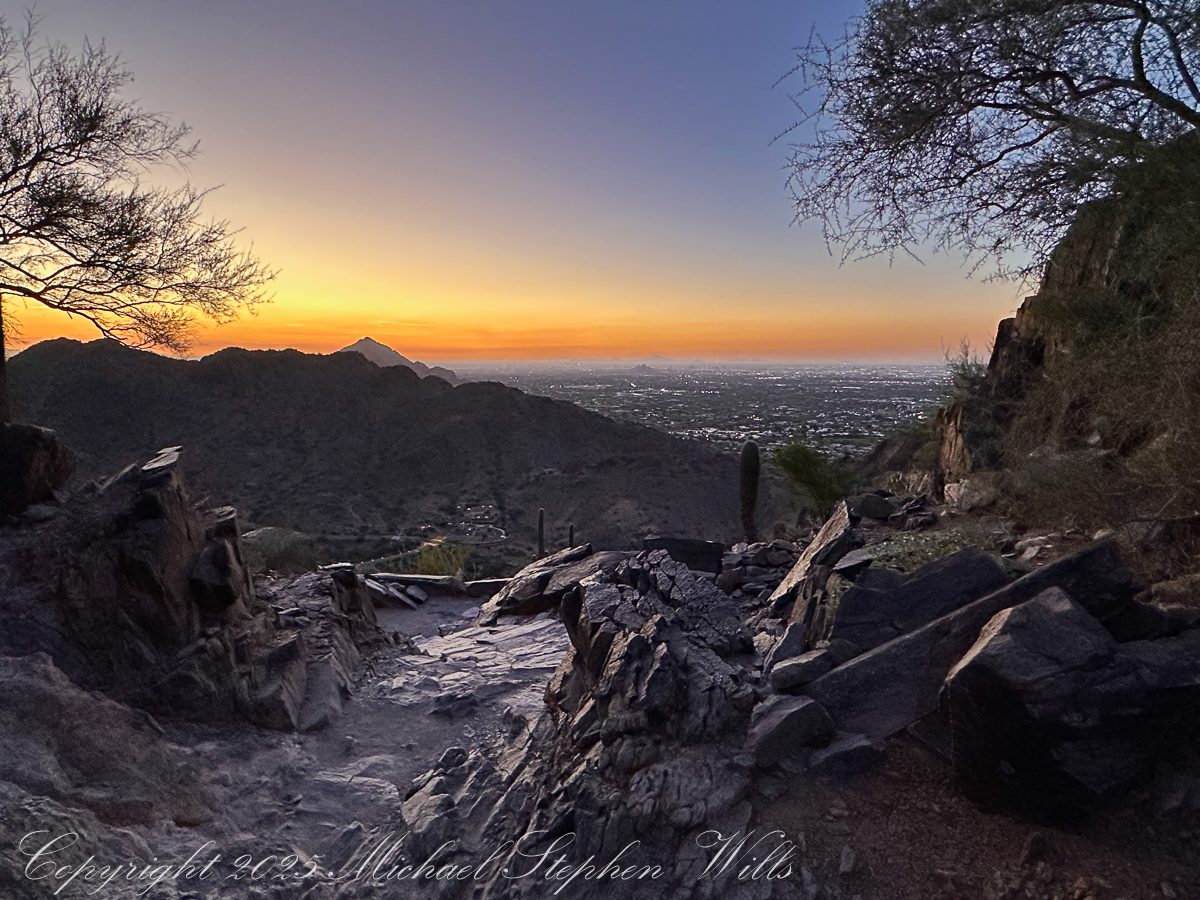
The last push to the saddle is steep, the steps uneven, the sky now a cascade of colors—copper, rose, faint lavender melting into a high dome of blue. The silhouettes of distant ranges sharpen: the Estrellas?, the Superstitions?, low ridges whose names I do not know. On the horizon, the first thin line of sun breaks free, setting fire to the edges of clouds. In another photograph, framed by dark rock and desert trees, that sunrise becomes a golden portal at the end of a shadowed corridor of stone.
We reach a broad ledge just shy of the summit as the light finally spills over us. People are already gathered there: a trio of college students taking selfies, a pair of retirees sharing thermos coffee, a solitary man sitting cross-legged with eyes closed, face open to the warmth. The city below is suddenly transformed. The carpet of lights dims, replaced by the clear geometry of streets and rooftops, golf courses and parking lots, all laid out like a model at our feet. The mountains that hem the basin—once anonymous shapes—now reveal their ridges and ravines in sharp relief.
For a few minutes conversation dies away. Everyone seems to feel the same thing: that fragile instant when the sun clears the horizon and the desert shifts from silver-blue to gold. The rocks around us, sharp and broken in the photographs, glow honey-colored. Saguaros catch light on their spines, each thorn a tiny ember. Even the dusty air seems to shimmer.
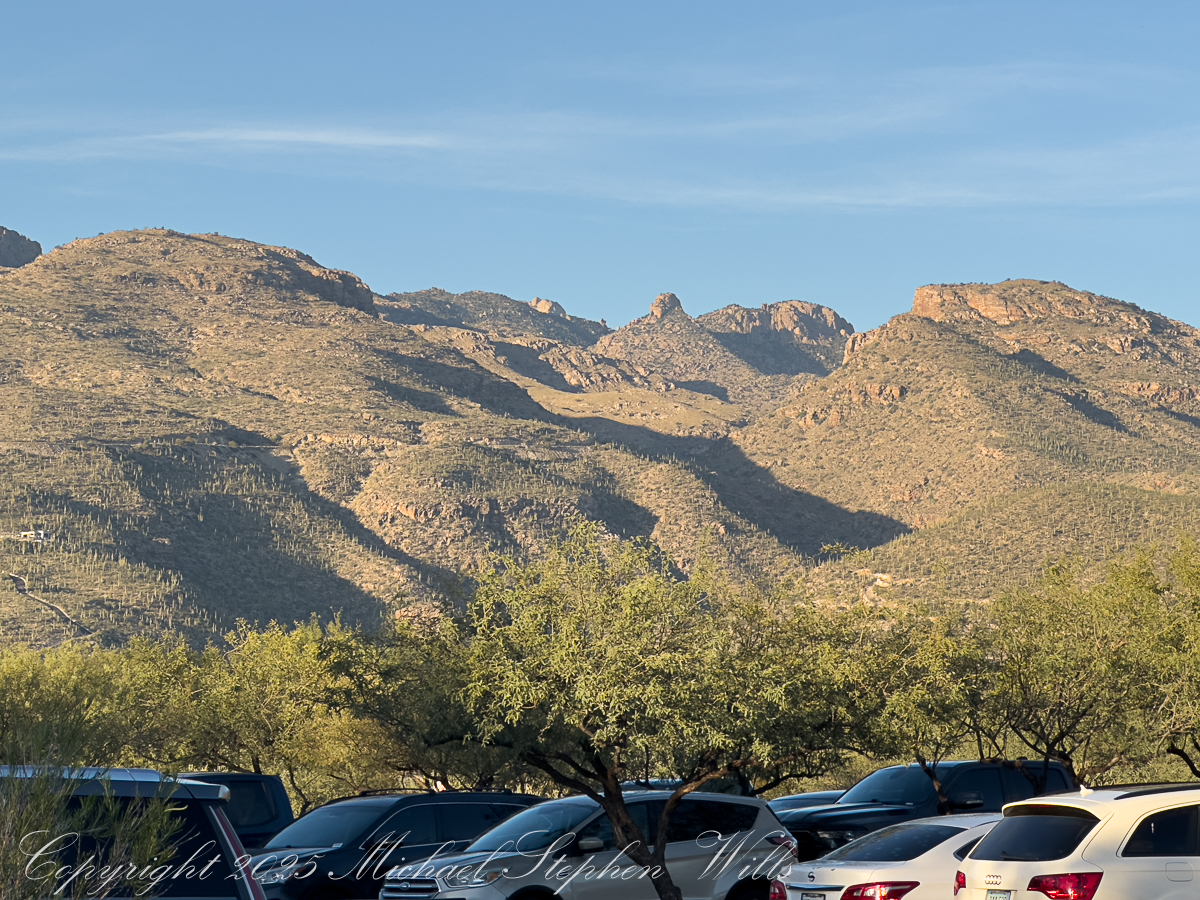
Down below, a new wave of hikers starts up the trail, latecomers walking into full daylight. We, the predawn climbers, share a small, quiet complicity. We have seen the city from the backside of night, watched the day arrive from a perch of jagged stone. Piestewa Peak has turned us, for an hour or two, into a single, breathing organism: many hearts, one climb, all of us stitched together by the steep path and the slow unveiling of the sun.
Enter your email to receive notification of future postings. I will not sell or share your email address.

The Dún Aonghasa cheval de fries field

…this defensive structure evokes the enormous scale of the struggles around this place of defense. 

View post to subscribe to the site’s newsletter.

A span of 10,000 years spreads between now and the first possibility of settlement on the island of Eire, then swept clean to bare rock by the weight of ice.  Current scholarship of the Dún Aonghasa ruins, Inishmore, County Galway, the Irish Republic place a settlement within the inner of the four dry stone rings after 6,500 years (1,500 BC or 3,500 years ago).  By way of scale, the first settlement took about 30 times the duration of the U.S. Constitution ratification through 2025: the last state, Rhode Island, ratified the Constitution 1789.

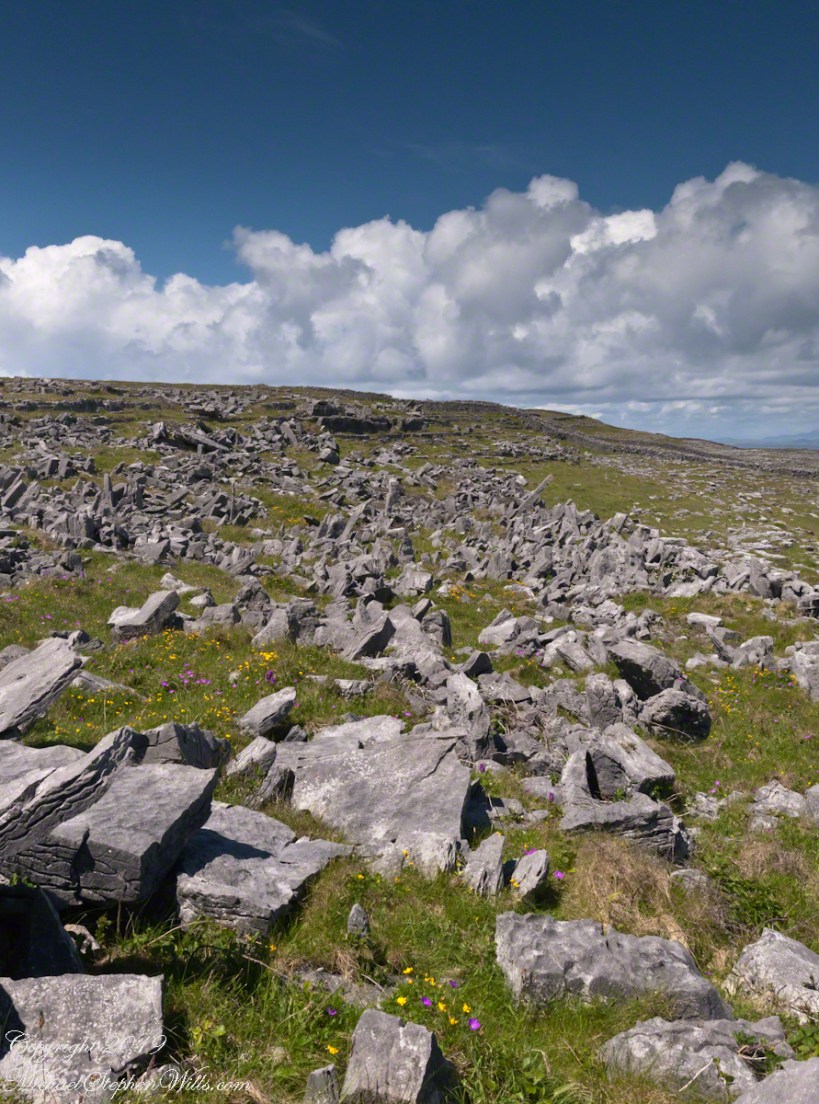
By 700 BC, 2,700 years ago, a series of upright, closely placed stones, were erected between the second and third rings called a cheval de fries field (“Frisian horses” in English) today, this defensive structure evokes the enormous scale of the struggles around this place of defense.  

This is a portion of that field, I believe, taken as Pam and I approach the inner ring entrance, walking a wide path cleared of barriers.  Click the photograph for a larger image with caption.

Click the link for my Getty IStock photography of the Aran Islands
Click me for the first post of this series, “Horse Trap on Inishmore.”

References: search wikipedia for “Dún Aonghasa” and Google “cheval de fries definition” and “Dún Aonghasa.”

Enter your email to receive notification of future postings. I will not sell or share your email address.

Cornell Botanic Gardens’ Monkey Run: History, Geology, and Scenic Fall Creek

A contemplative walk along Monkey Run where Fall Creek writes the valley’s history—sycamores, bridges, and Devonian stone speaking across seasons in Cornell’s living classroom.

View post to subscribe to the site’s newsletter.

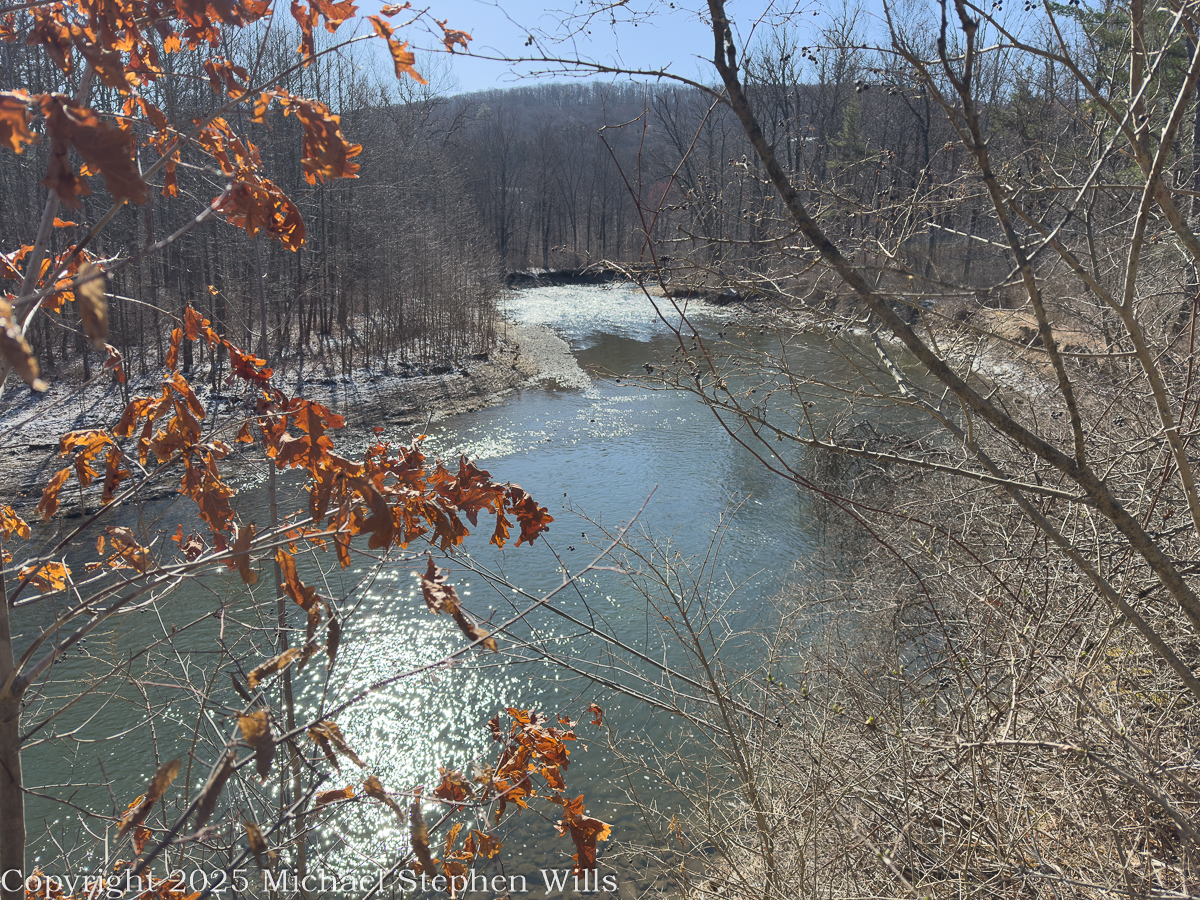
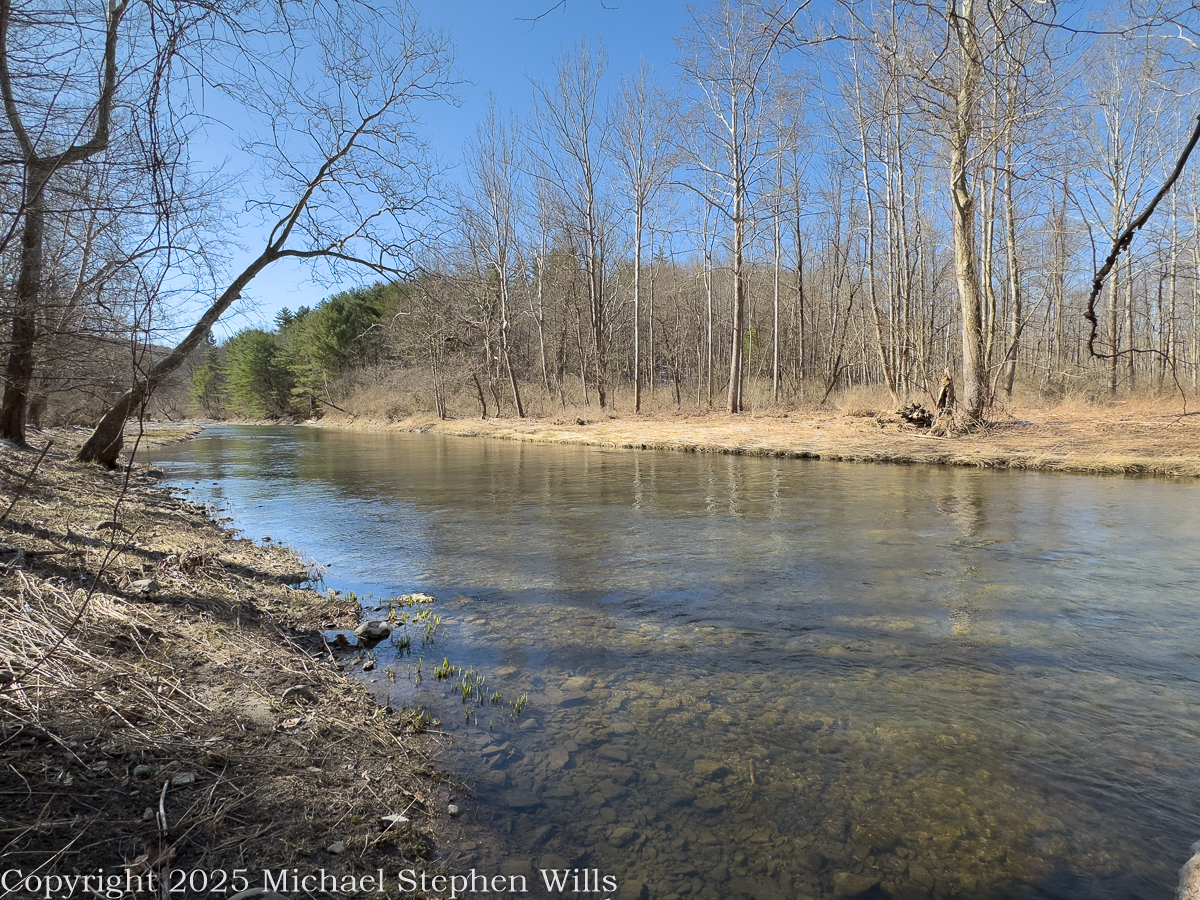
On a morning in late March, when the hills about Ithaca still hold the night’s frost in their shaded folds, I took the path called Monkey Run and went to see how Fall Creek spends its winter earnings. The air had the bright sting of thaw, a kind of vernal austerity that keeps a man honest in his steps. Along the high bank the sun spilled its coin onto the water, where it broke and flickered like a school of silver minnows. A rim of snow clung to the shale ledges, and the leaves of last year’s oaks—curled, fox-red, and faithful—whispered as if to keep the woods awake until spring fully claimed them.

Sunlit bend of Fall Creek viewed from a high bank at Monkey Run in early spring.

Monkey Run is one of the outlying parcels tended by Cornell Botanic Gardens—once called the Plantations, and now, more fittingly, named for the living charge it keeps. These gardens do not end at beds and borders; they encompass the wilder rooms of the county, more than a thousand hectares of glens, pastures, and ravines where the university’s first and oldest teacher—nature herself—still holds class. Fall Creek is one of her principal lecturers. Rising beyond the high country of Cayuga Heights and slipping under stone and snow, it shoulders its way across the campus, idles a while in Beebe Lake, and turns turbines of memory at Triphammer Falls before shouldering on toward the lake that receives nearly everything here—Cayuga—long, deep, and glacial in its thinking.

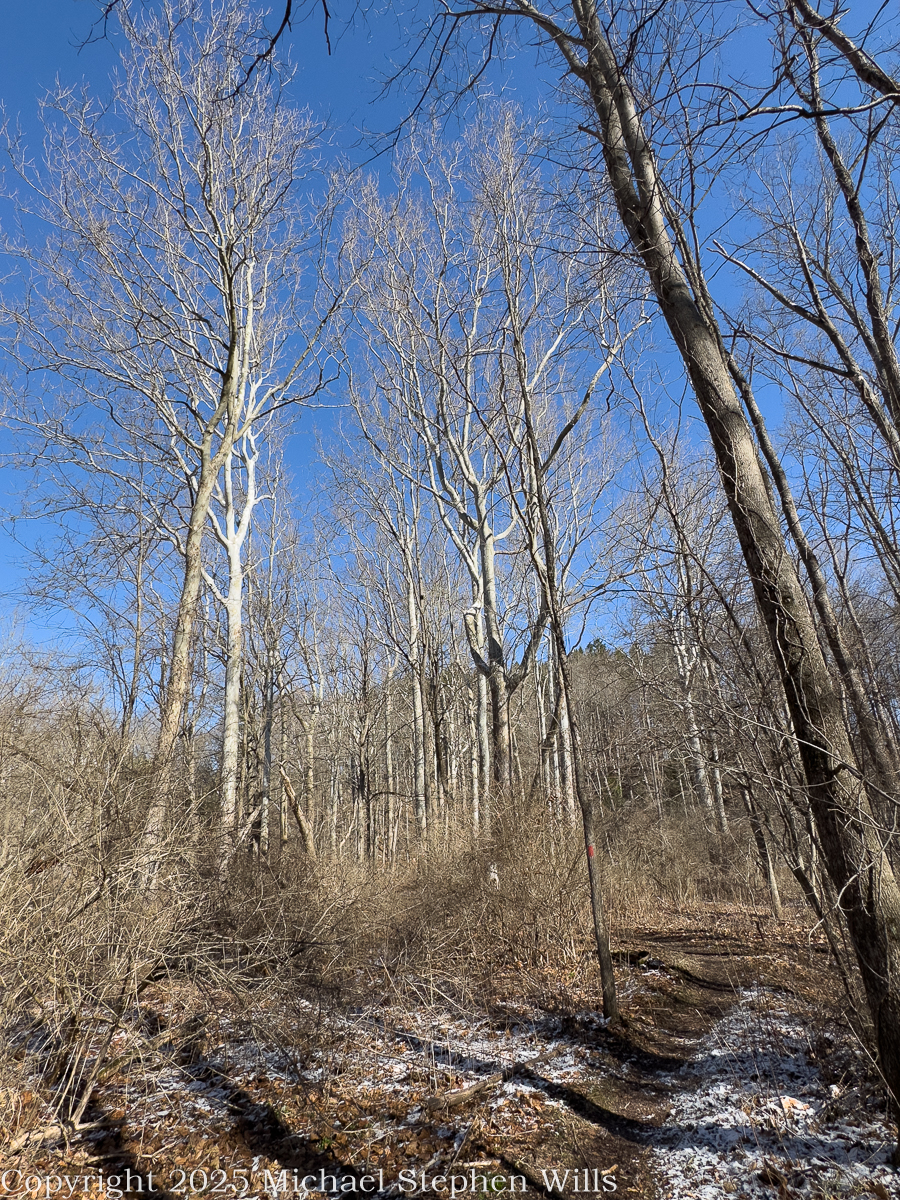
Tall white-barked sycamores leafless against a blue March sky at Monkey Run.

If you would learn a valley’s mind, walk a meander. The creek here composes with easy cursive, laying down a bar of gravel, nibbling at a bank of clay, then sweeping back to consider its work from the opposite shore. The geologist says the rock is Devonian, pages laid flat and damp with time, and the ice of ten thousand winters ago scoured them into the open. A creek is a patient mason, working without rest and never in anger. I admired these sycamores—their clean bones shining through the leafless canopy like the ribs of an old cathedral. Winter reveals their whiteness; summer grants them shade. A stand of white pines keeps a dark counsel in the background; on the muddy edge, green tongues of skunk cabbage push up, pledges made by the swamp to keep faith with the sun.
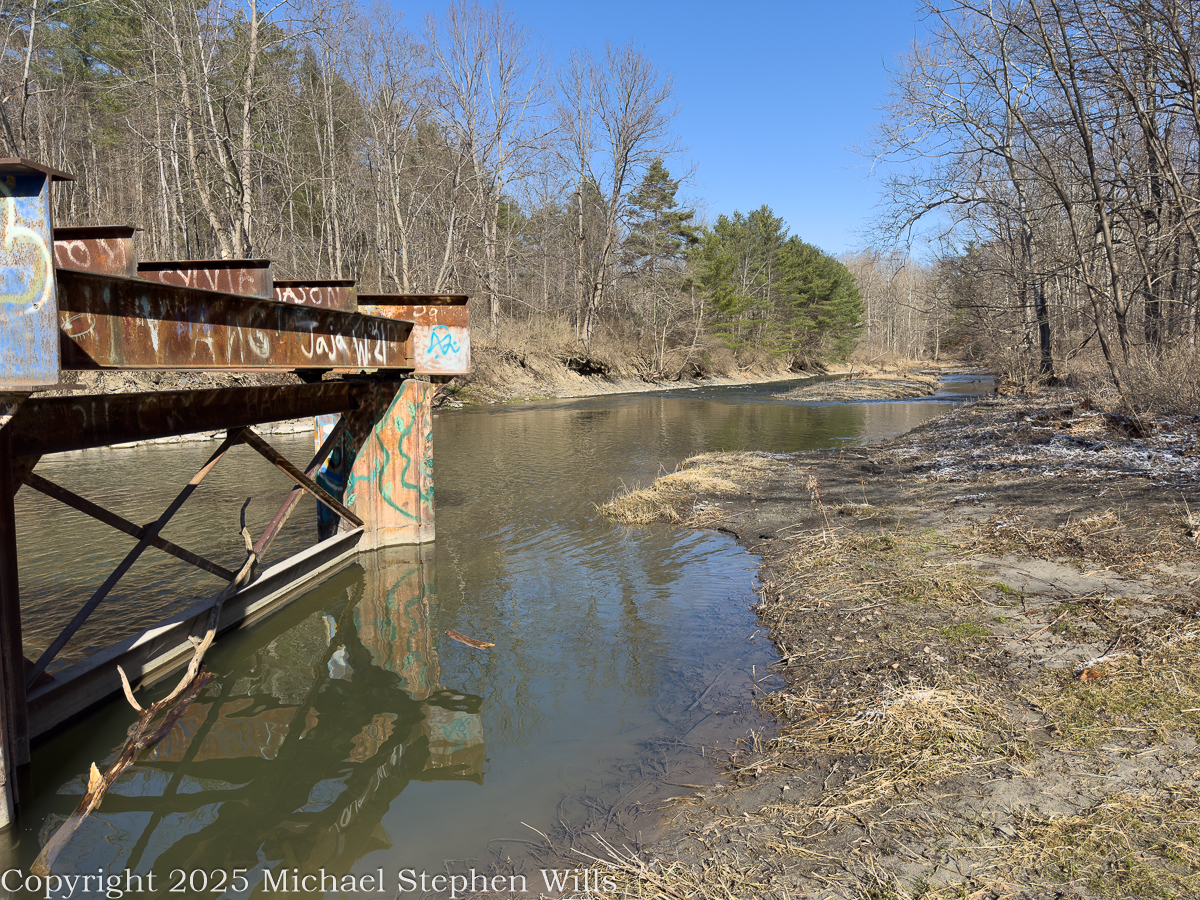
Rust-stained steel pier above calm water on Fall Creek along Monkey Run trail

I came down to the water near an old steel pier, a bridge remnant, hanging on each end without purpose. It wears graffiti the way a boulder wears lichen; human wishes, briefly rooted, coloring what they can. The river accepts it all, the pilings and the scribbles, the cast limb and the bottle’s glint, and continues its one unarguable gesture downstream. That is the old instruction of Fall Creek: use, refuse, endure. Before the university drew students from every quarter, the creek turned wheels and powered the small ambitions of a frontier town. Even the name Triphammer speaks of iron struck to purpose. Now the water powers something quieter: the studies of herons, the almanacs of kingfishers, the quick arithmetic of minnows over limestone.

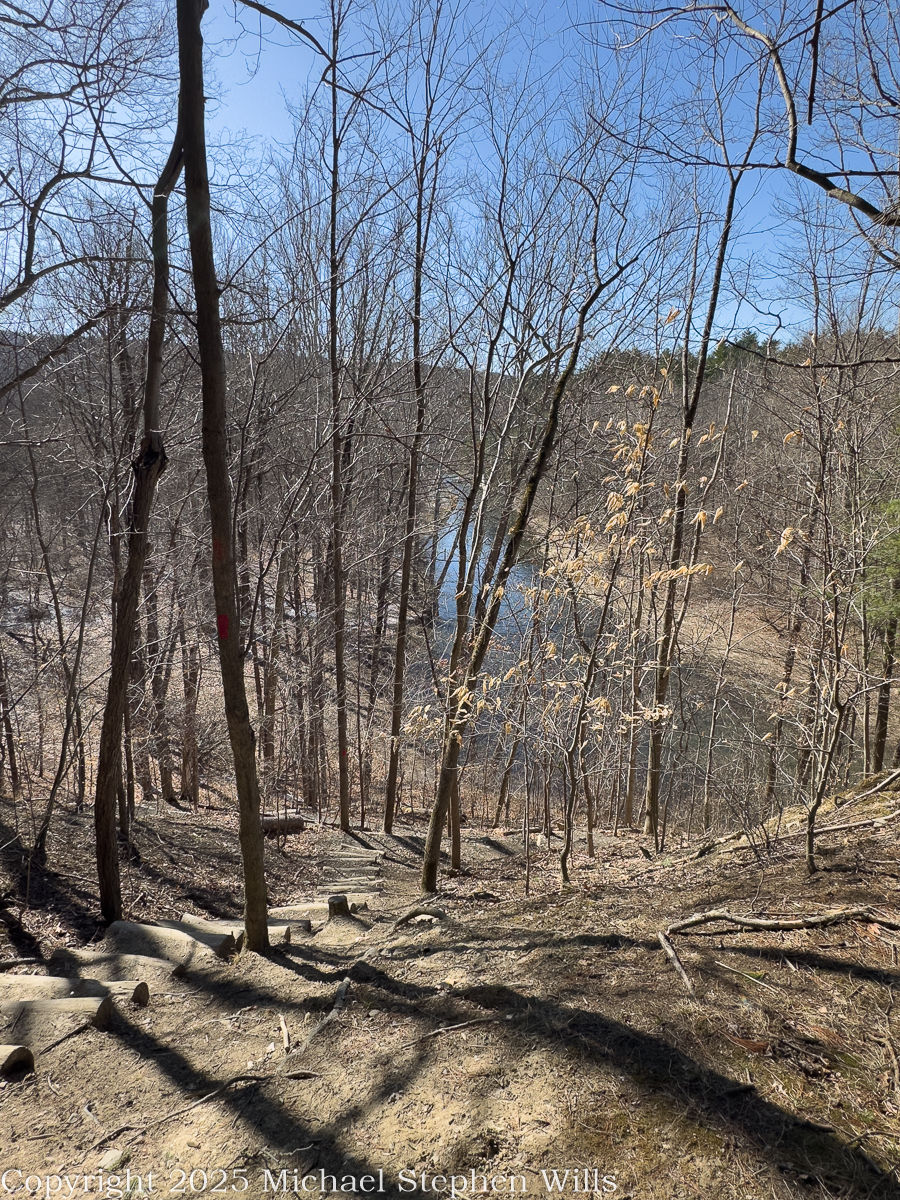
Looking back while climbing the steep bluff

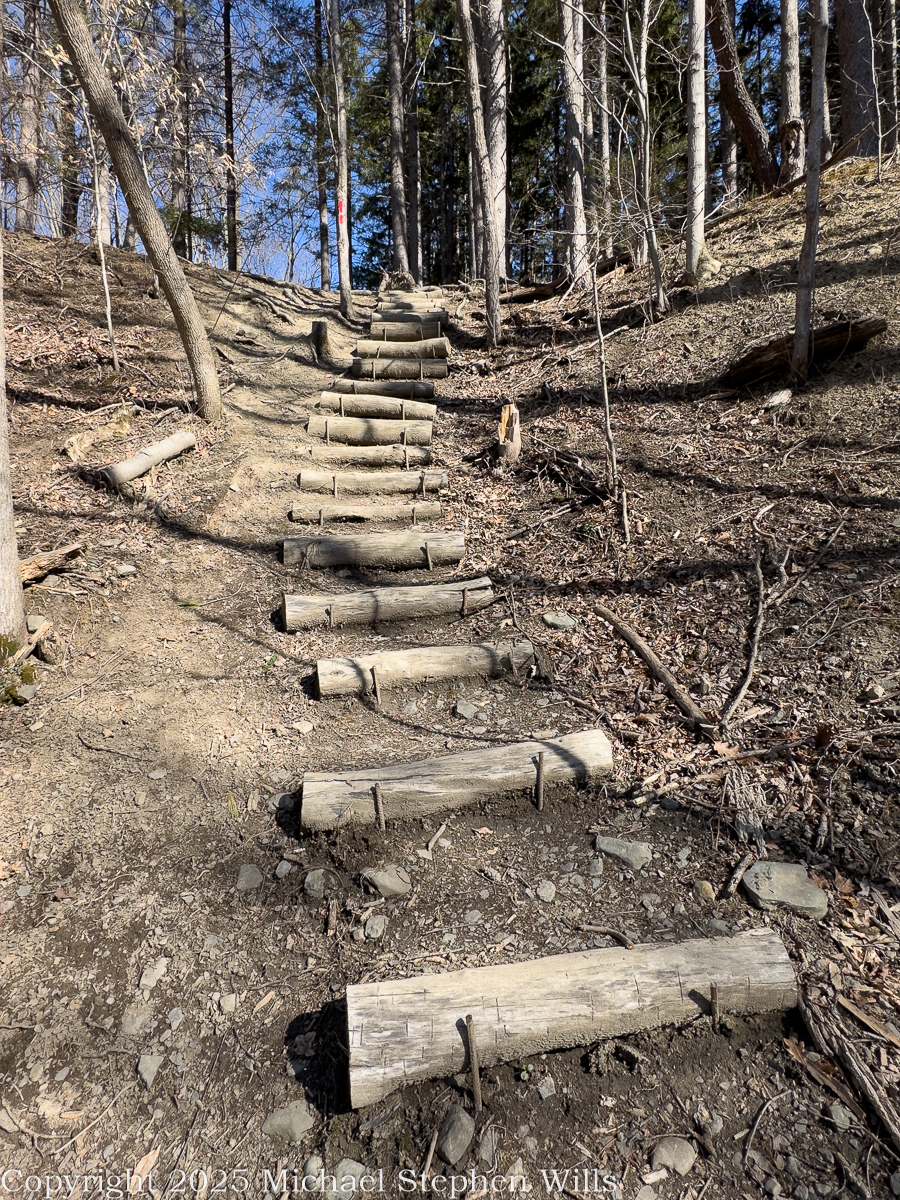
Steps cut from logs ascend the bluff, each tread pegged with iron, each rise a short confession of breath. I climbed to the ridge, paused halfway, and through the gray lace of March branches saw the creek shining at a bend far below. A man cannot help but measure his own life against such a course. The path goes up and down in obedient red blazes, but the water keeps its own counsel. Where the bank slumps the river shoulders through; where the bottom rises it lays down a mirror. In my youth I wanted the straight run, the short work. Now the curve pleases me. To go with the current and not be carried away—that is a lesson suitable to the grey in my beard.

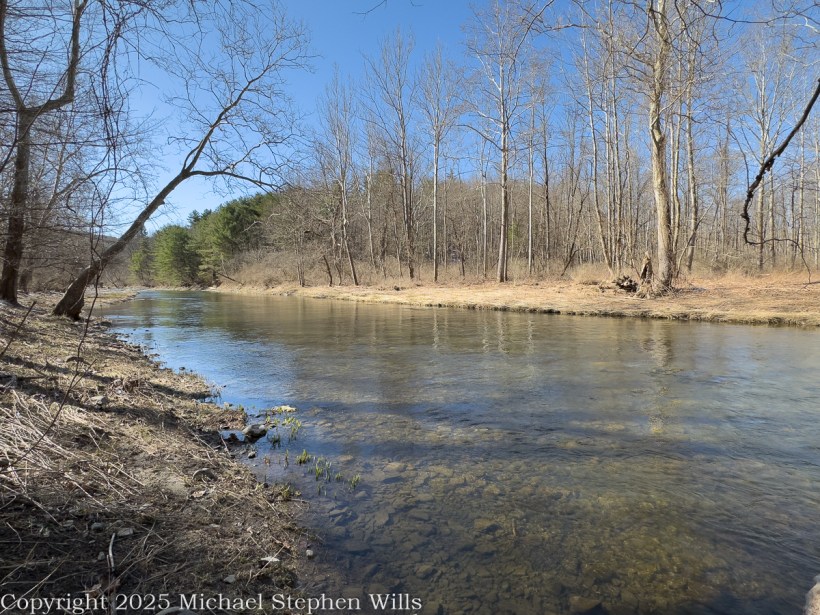
Clear, shallow run of Fall Creek with shale bottom and pine stand in distance
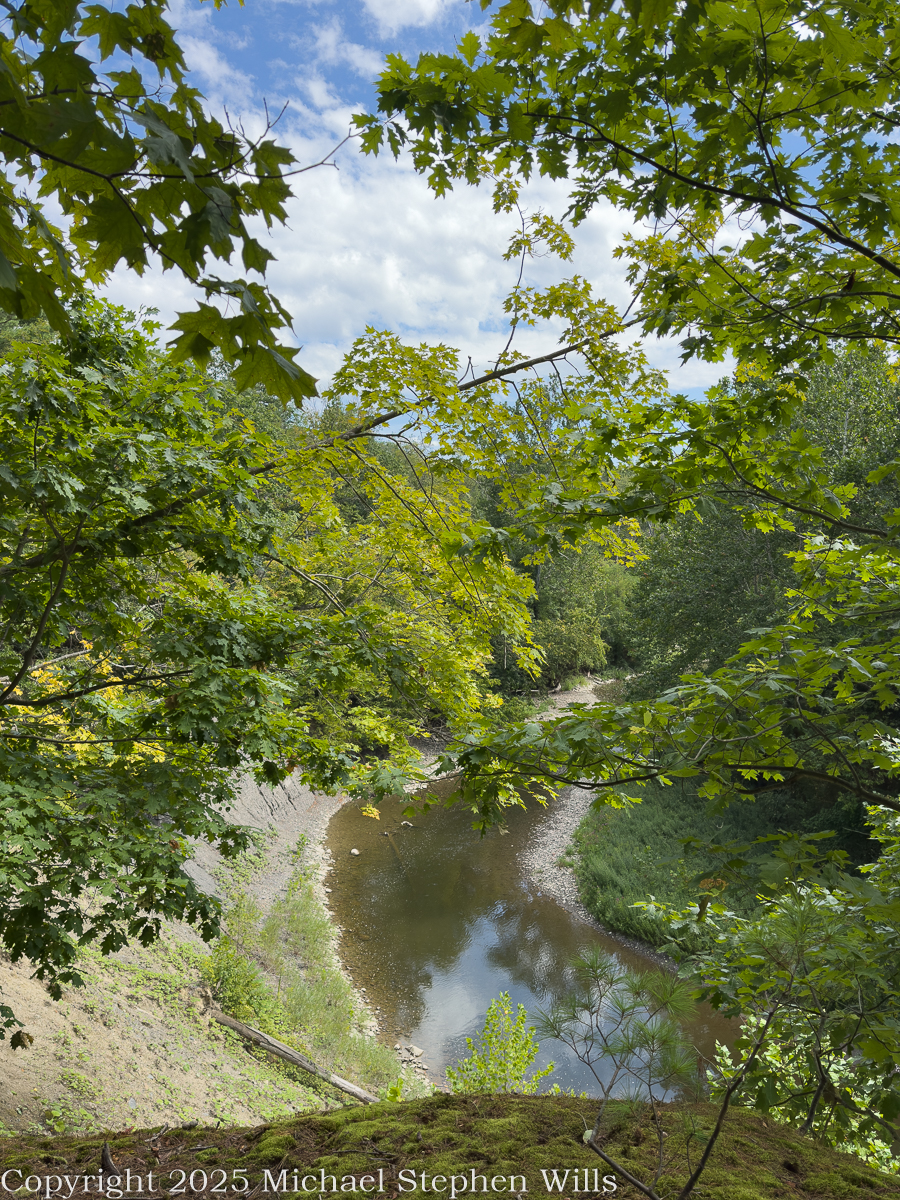
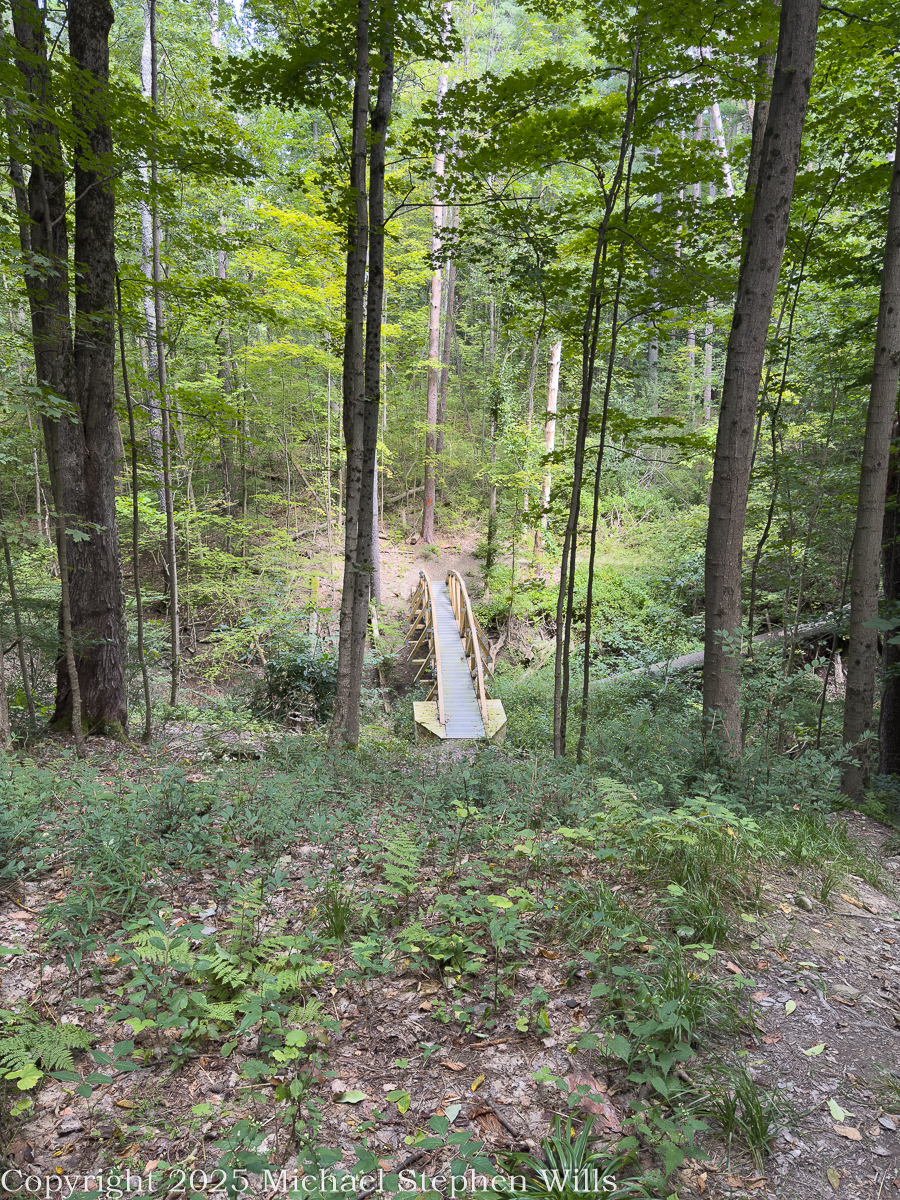
Bluff overlooking Fall Creek in summer

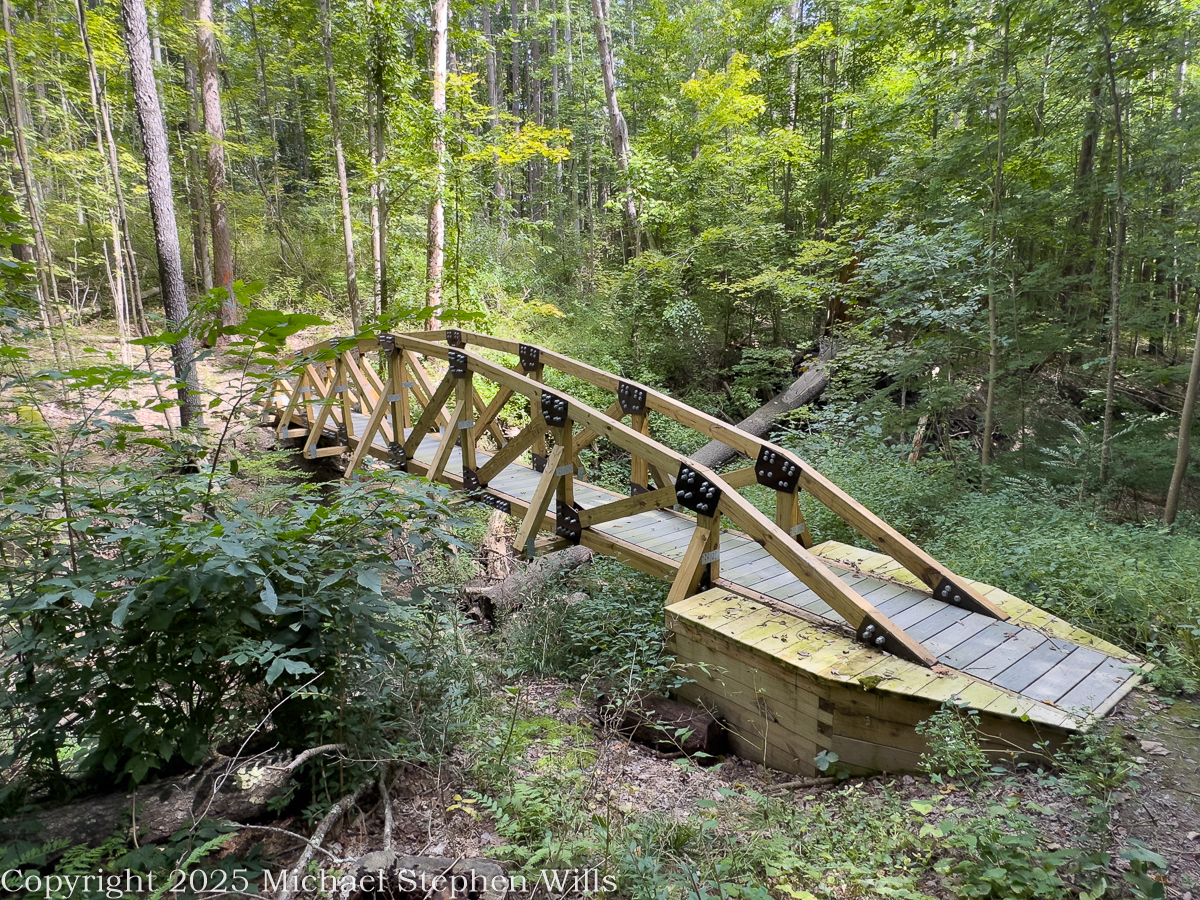
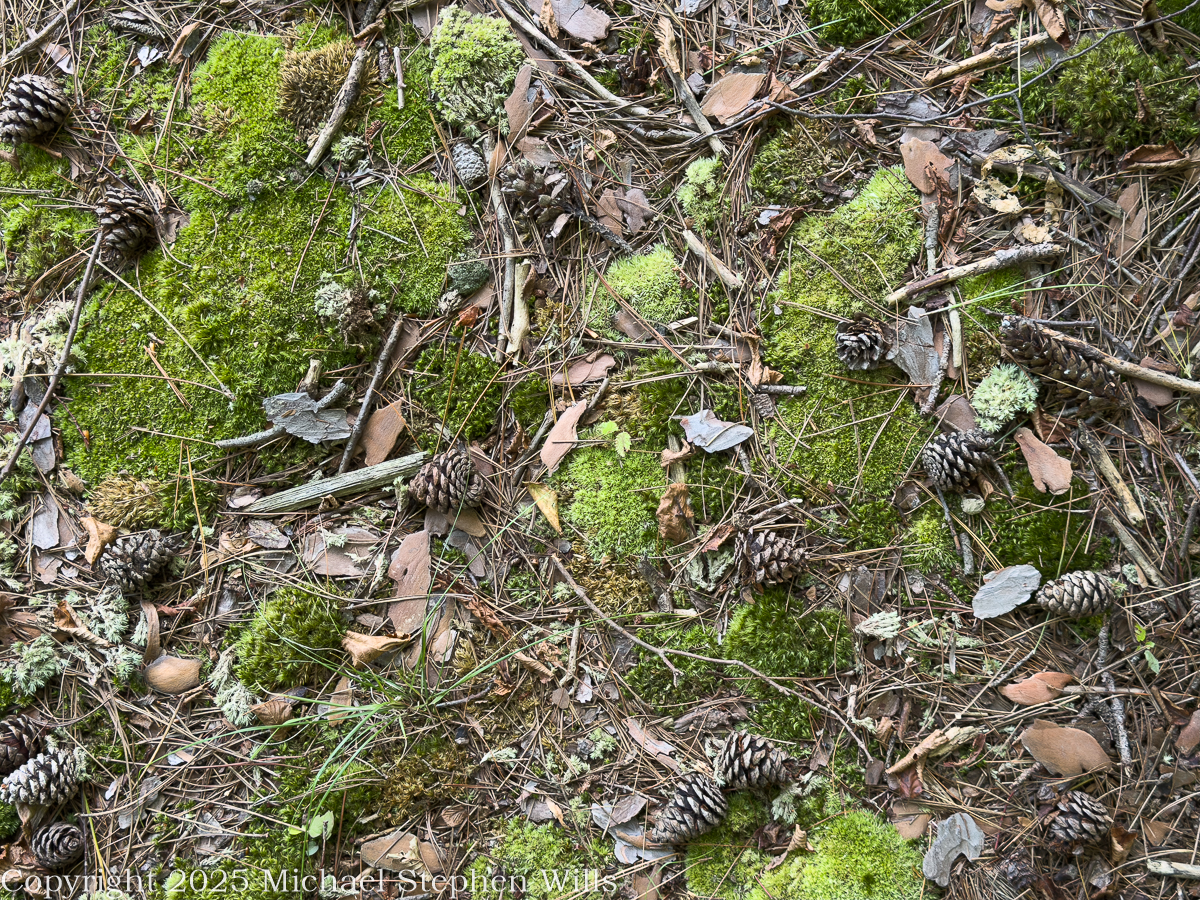
When I returned five months later, on August 23, the same path had forgotten the word austerity. The cathedral of sycamore was fully leafed, the white pillars now vanished behind a nave of shade. The pines perfumed the air without trying. A new footbridge—clean timber arching like a bent bow—spanned one of the wet flats. Its braces, black-bolted and handsome, looked as if they would hold the weight of an ox team or a file of schoolchildren. Such crossings are a kind of promise from the present to the future: we found a way through here; may you, too. Below, the floor was upholstered with moss, oak leaves, and a scatter of pinecones—the slow currency of the woods accumulating interest.

Arched wooden footbridge in summer forest on Cornell’s Monkey Run trail.

Summer makes a confidant of every plant. Ferns unrolled their scripture at the bridge abutment; jewelweed held its tiny lanterns along the seeps; a kingfisher rattled downstream, blue lightning with a bill. The creek, glassy over its shale pavement, showed every wrinkle of its stride. I waded a little, feeling with the sole what the eye could not—where the current took an extra thought around a stone, where it forgot itself in a warm eddy. Trout lingered in the dimmer reaches, quick as commas; a great blue heron lifted off with that surprising tidiness of wing, ungainly only in our imagination.

In all seasons the trail carries two histories: one written in rock and water, the other in the footfall of people. Cornell’s founders, Ezra and Andrew White, believed the university should place the hand near the thing studied; here that principle is plain. Botany students take their lectures in leaf and bark; geologists read the creek banks as if the pages might soon turn by themselves; children learn the oldest calculus—how long a stick will float before it catches in the weeds. The caretakers from the Botanic Gardens mark, mend, and interpret, but they do not overtalk. The woods speak enough.

Moss, grass and pinecones on an overlook of Fall Creek

As the afternoon eased toward evening, I climbed once more to the bluff. The light had gone honey-colored and the leaves of the maples, those careful accountants of September, were just beginning to weigh their green against gold. I looked down on the bend where I’d stood in March—cold, bright, expectant—and felt the year’s circle gently close. As John Burroughs wrote, “The power to see straight is the rarest of gifts… to be able to detach yourself and see the thing as it actually is, uncolored or unmodified by your own… prepossessions… that is to be an observer and to read the book of nature aright.” Monkey Run obliges that humility. The creek moves as it always has—glacially taught, mill-forged, campus-wise, and freedom-loving—and the trail, with its modest stairs and honest bridges, invites us to walk beside it, to match our breath to its turnings, and to leave, if we can, a lighter trace than we found.

References

Ways of Nature (1905), “Reading the Book of Nature,” pp. 275–276 (The Writings of John Burroughs, Riverside ed., vol. XIV, Houghton Mifflin)

Enter your email to receive notification of future postings. I will not sell or share your email address.

Glacial Echoes: Dryden Lake Park’s Mirror-Calm Morning in Upstate New York

Morning clouds hang over Dryden Lake as hills kindle first color; reflections hold breath while a lone walker reads the valley’s glacial and human-written past.

View post to subscribe to the site’s newsletter.

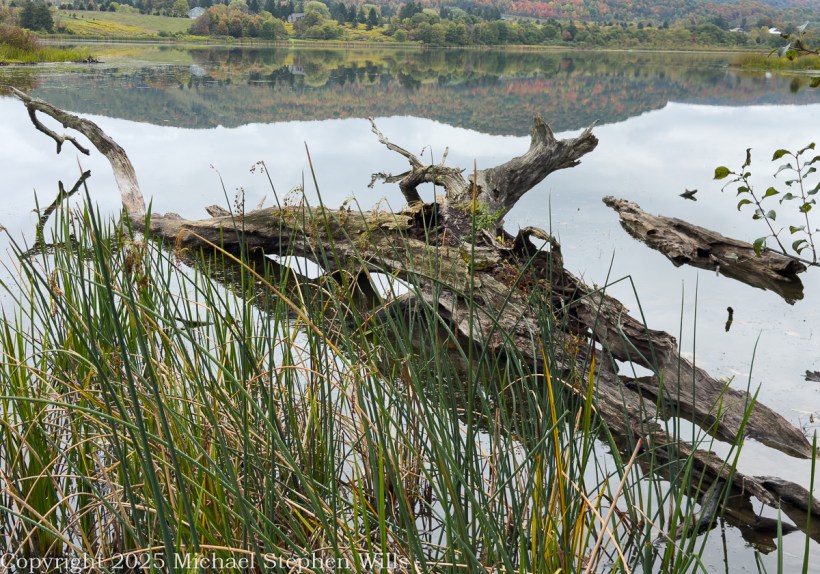
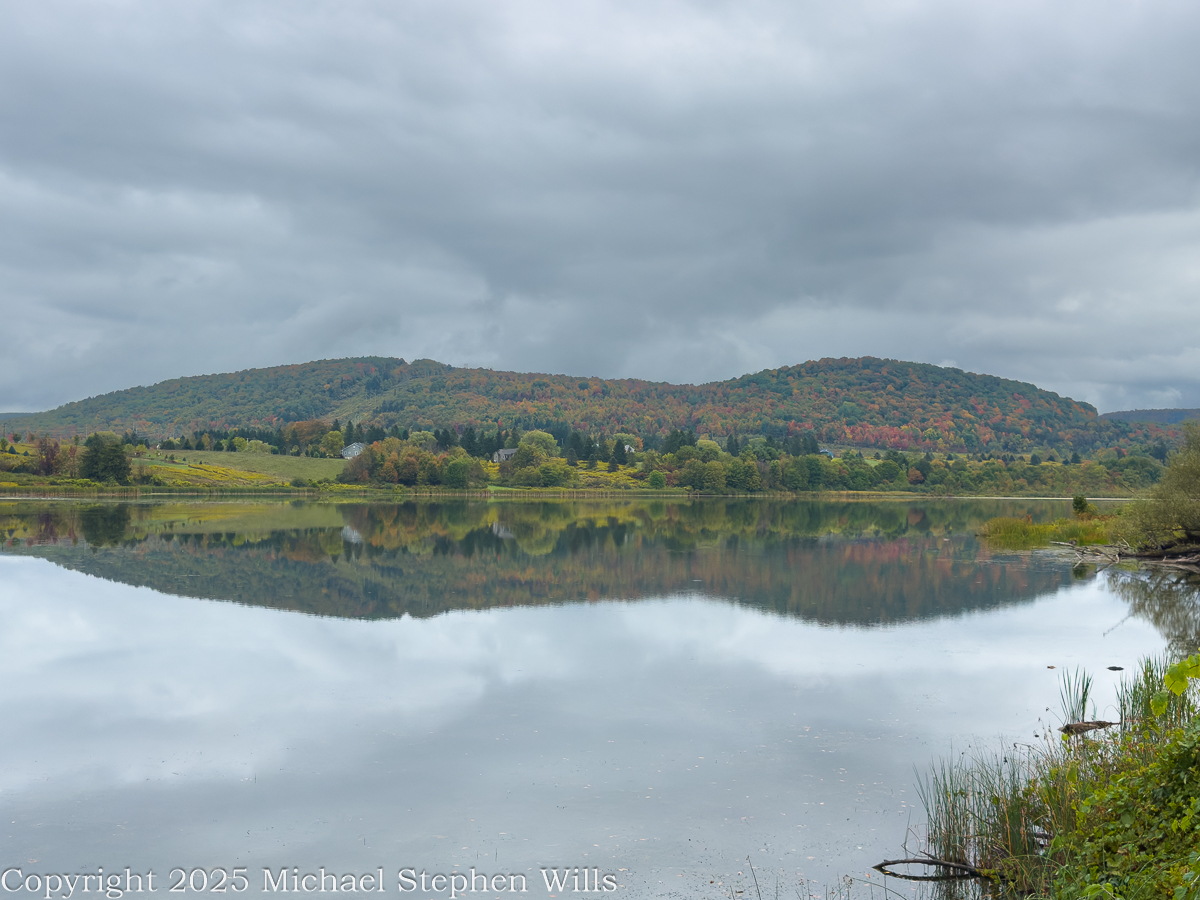
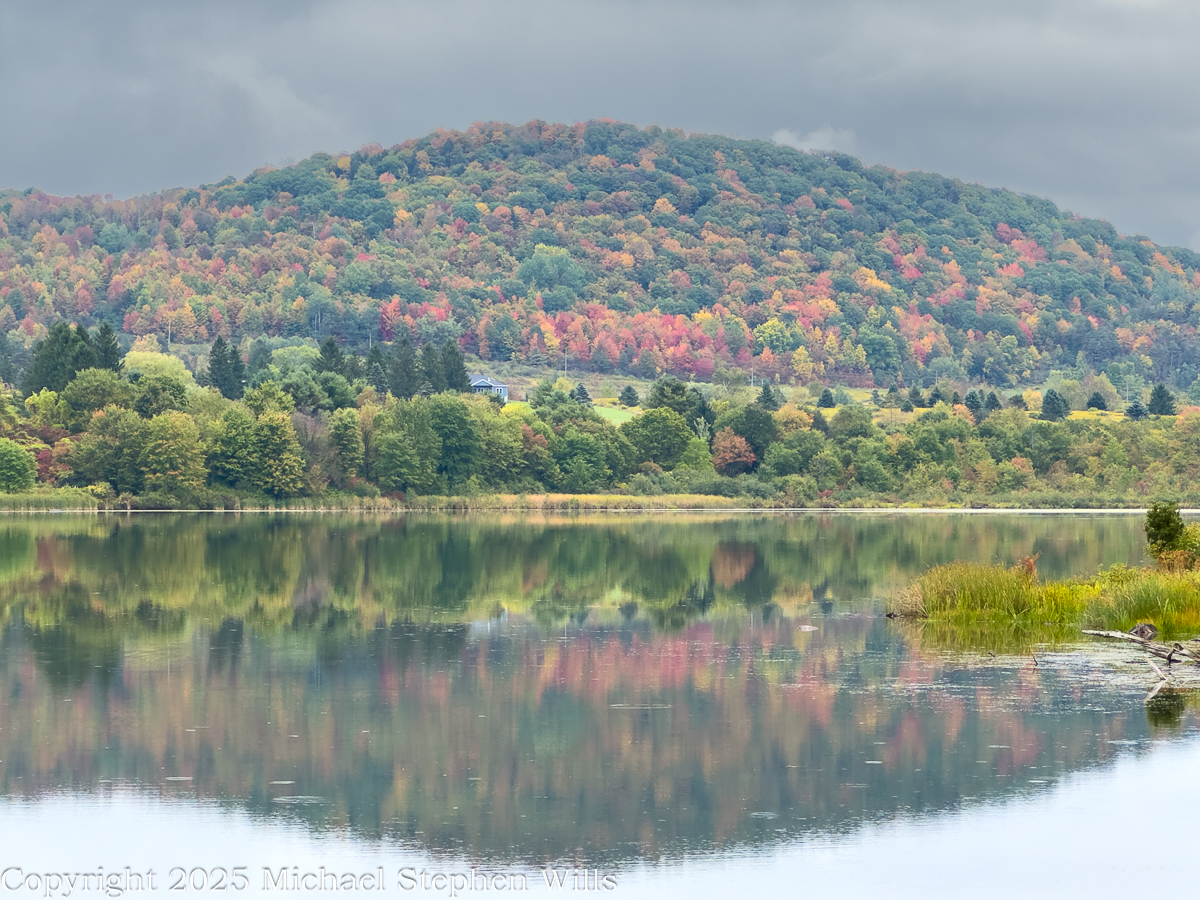
He came to the water before the people woke, the road a still ribbon of cold tar snaking beneath the low hills. Mattocks of cloud hung over the valley and the lake took in the sky like a mirror dropped yet not broken. The trees were beginning to color. A patient fire working from within the leaves. He parked where the grass ran down to the shore and stood a long while without moving. Birds made small sounds in the reeds. Somewhere a single truck labored up the grade and was gone. The surface held the hills with a steadiness the hills themselves could not keep. He thought how the quiet of a place can be the loudest thing it owns.

He went along the margin along the damp sedges where old drift lay silvered and light as bones. A drowned trunk angled from the shallows. The lake was old in the way of things made by ice and time. A kettle in the outwash of the last glacier, some men said, a bowl left when the buried ice eased away. He pictured the ice receding into the valley heads, the meltwaters choked with gravel, a hand larger than memory scribing the floor of this country. The earth never told it plain but the lay of it was witness enough. Across later centuries men cribbed a dam across the outlet and drew the water to a shape that pleased them and served their work.

A trail ran the length of the water on the old rail bed. The ties were long gone and the iron and cinders buried under years of leaf fall and gravel. He had walked it as a boy beside his father and now he walked it alone. Benches stood at half-mile intervals like waystations in a country of small pilgrimages. The signs told what once was here and what remains. They had renamed the path for a townman who argued it into being after the railroad had passed from the world and the right-of-way grew up with sumac and rumor. It was an easy trail and he carried nothing. His hands hung at his sides as if the day might place something in them when it was ready.

In another era the lake was a workshop. Men whipsawed timber in the wet air and fed small mills with the grove’s dark boards. Winter flowed over the flats, and they built icehouses and set the blocks within like blue stone, an industry that died when cold could be called from a switch. The hills have learned to forget the noise of it, though on certain mornings the fog takes a shape and you could believe rising from the ponded sawdust and the lading of sleds. He thought of the labor of those gone hands and of how work is a scripture every place keeps in its own tongue.

Before any of that, the ground here was a summer camp. People came with the season and went with it, laying their fires in the lee of the knoll and taking fish where the cattails thin. He could feel them in the open places, not as ghosts but as the first understanding the land ever had of itself. The words used for them now are museum words, yet the wind still crosses the water as it did and empties the same smell of iron and leaf into the lungs of whoever stands to breathe.

The town took its name from a poet long dead, a scholar’s choosing in the years after the war for independence when this tract of country was parceled out to soldiers of that same war. Virgil lay to the east as if they were shelving Latin across a map. The creek that bears that name threads the villages and finds Fall Creek at Freeville, and the combined waters go their own slow way toward Cayuga where the glacial hand scooped deeper yet. He said these names under his breath and they tasted of chalk and river stone.

A kingfisher rattled across the cove. The fish rose in rings that spread and vanished like time seen from above. Out on the water an old man pushed a skiff with an electric motor that hummed like a trapped bee, for the lake allows no gas engines now. The wildlife area ran around the shore in a ragged collar of field and wetland and alder, near two hundred acres under the state’s keeping, and the lake itself a little over a hundred. He watched the man aim for the lily line and thought how rules arise from the wish that a thing endure, though nothing does. Still we make the rules and we keep them as if the earth were listening.

Wind came down the slope with a smell of rain. He turned back and the hills lay again in the water, entire, and for a moment he could not tell which world had claim to the other. He thought of the rails pulled up and the mills gone to weeds and of the icehouses fallen into their own shadows and he thought of the people before all that and of the long winter pressing its thumb into the land and lifting it away. He thought of his father walking the rail bed beside him a lifetime ago and saying nothing. There are places where the past crowds close and will not be argued with. He stood until the first drops dimpled the surface and the reflection shattered and reformed. A train no longer runs here. The only sound was the soft percussion of rain on water and the slow turning of the earth beneath both. He put his hand to the damp trunk of a fallen tree and felt the grain and the coolness and the old patient labor of rot. Then he went up from the reeds, his pockets full of acorns, and out to the road where his truck waited and the day, austere and sufficient, came along with him.

References

Geological History and Glacial Formation of the Finger Lakes

Jim Schug Trail

The Dryden Lake area in the 19th century

Indian Campsite on west side of Dryden Lake

Dryden New York (wikipedia)

Dryden Lake (New York State DEC)

Geohydrology, Water Quality, and Simulation of Groundwater Flow in the Stratified-Drift Aquifer System in Virgil Creek and Dryden Lake Valleys, Town of Dryden, Tompkins County, New York

Enter your email to receive notification of future postings. I will not sell or share your email address.

Blood Moon Reflections: Science, Illusion, and Shared Awe Under the Lunar Eclipse

We gather on the balcony as a total lunar eclipse turns the moon to copper—science, illusion, and shared wonder braid a night of luminous change.

View post to subscribe to the site’s newsletter.

Moonrise

On certain evenings we gather on our Cocoa Beach, Florida east-facing beach-side balcony simply to watch the day undo itself—sunset staining the western sky while, behind us, something quieter begins. On Sunday, January 20, 2019, the quiet had a name: a total lunar eclipse. I’d checked the online charts earlier—moonrise time, azimuth, the patient geometry of the heavens laid out in numbers—and set our chairs faced the anticipated spectacle.

Click photograph for my Online Gallery


The light went a little pewter, as it does when the sun slides offstage and the world inhales. Out on the water a cruise ship shouldered south, a floating city of windows that, under ordinary sunsets, catch fire pane by pane. I looked up too late for the blaze and felt that small pang one gets for the thing almost seen. Still, the ship kept gliding, a bright punctuation mark traveling our skyline.

Click photograph for my Online Gallery

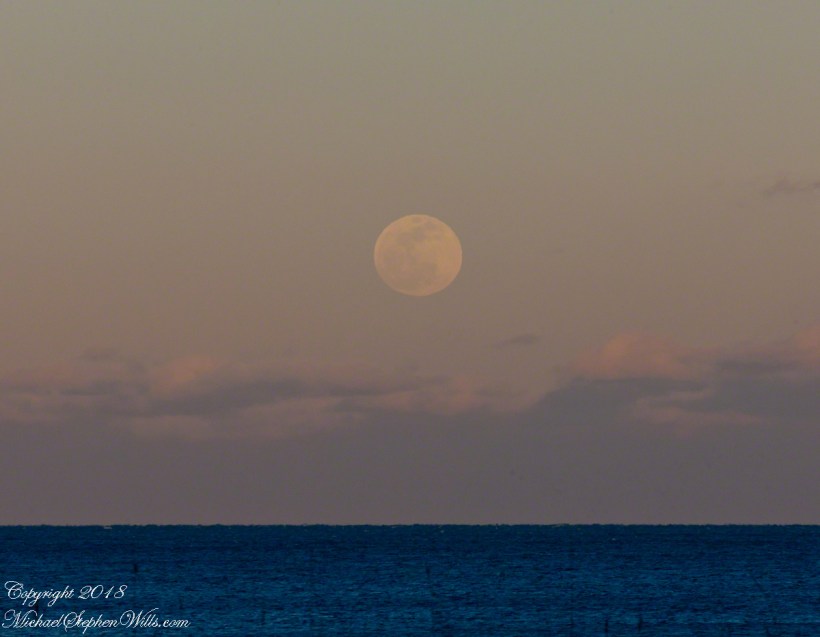
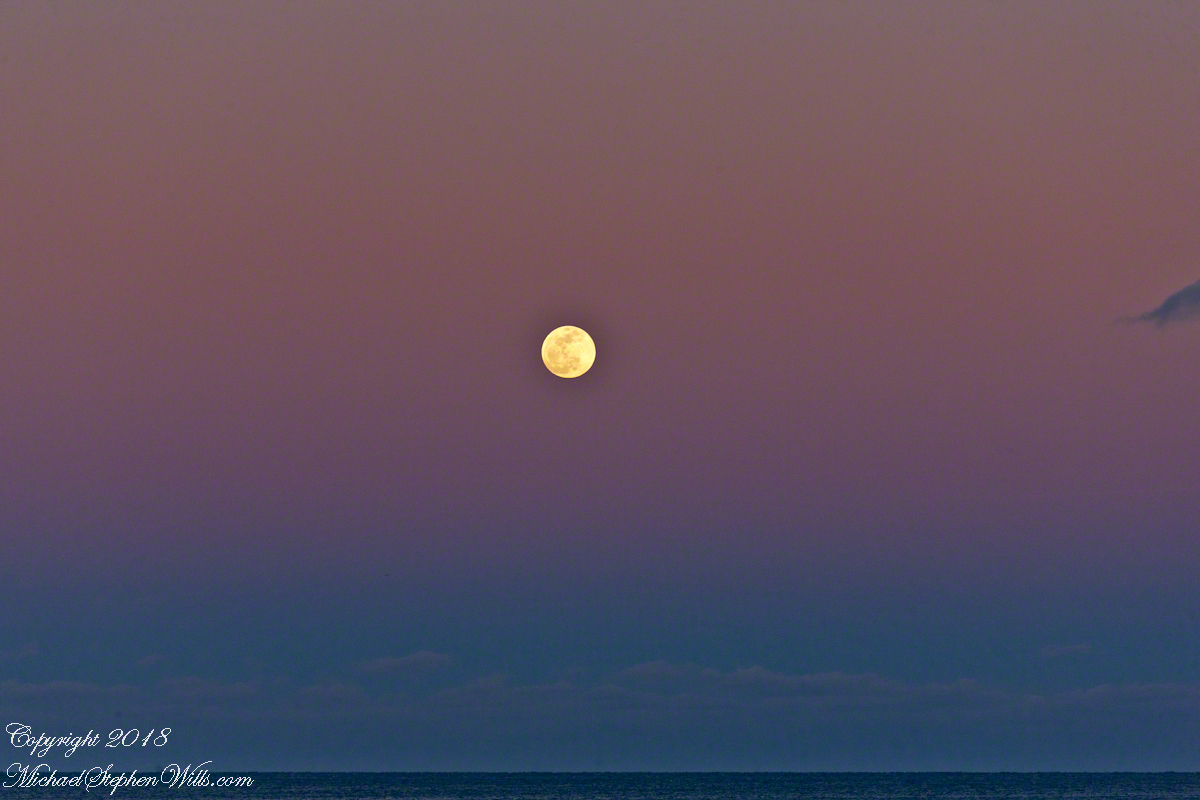
Then the moon appeared—first as a bruise-colored coin pressed against a bank of cloud, then as itself, pale and whole, rising as if pulled on a cord. Photographs can play a trick here: place a ship under a full moon and, with the right lens, the vessel swells to improbable grandeur while the moon looks like a modest ornament. Our eyes know better. The ship is huge but near; the moon is unimaginably larger, only far. Distance humbles everything.

It’s a fine parlor truth that every lunar eclipse requires a full moon. There’s a steadiness in that—that the earth, playing the rare importance of middle child, can only cast its shadow when the moon has come fully into its own. The reverse, of course, is not guaranteed. Most full moons rise and go about their business, silvering roofs and quieting dogs, without ever tasting the earth’s shadow. Tonight would be different.

Click photograph for my Online Gallery

The Riddle of Size

Before the darkness advanced, the old riddle of size made its entrance. Low on the horizon, the moon seemed suddenly intimate, big enough to pocket the ship and still have room for the lighthouse. We call it an illusion, but the word hardly captures the tenderness of it: how the mind, seeing that round face near our familiar trees and eaves, feels the moon to be part of our belongings. Angular diameter stays stubbornly constant; affection does not. The experiment is easy enough—choose a pebble that covers the low moon at arm’s length, then try again when the moon is high. The same pebble hides it perfectly. What changes is not the moon, but the story our senses tell.

Click photograph for my Online Gallery

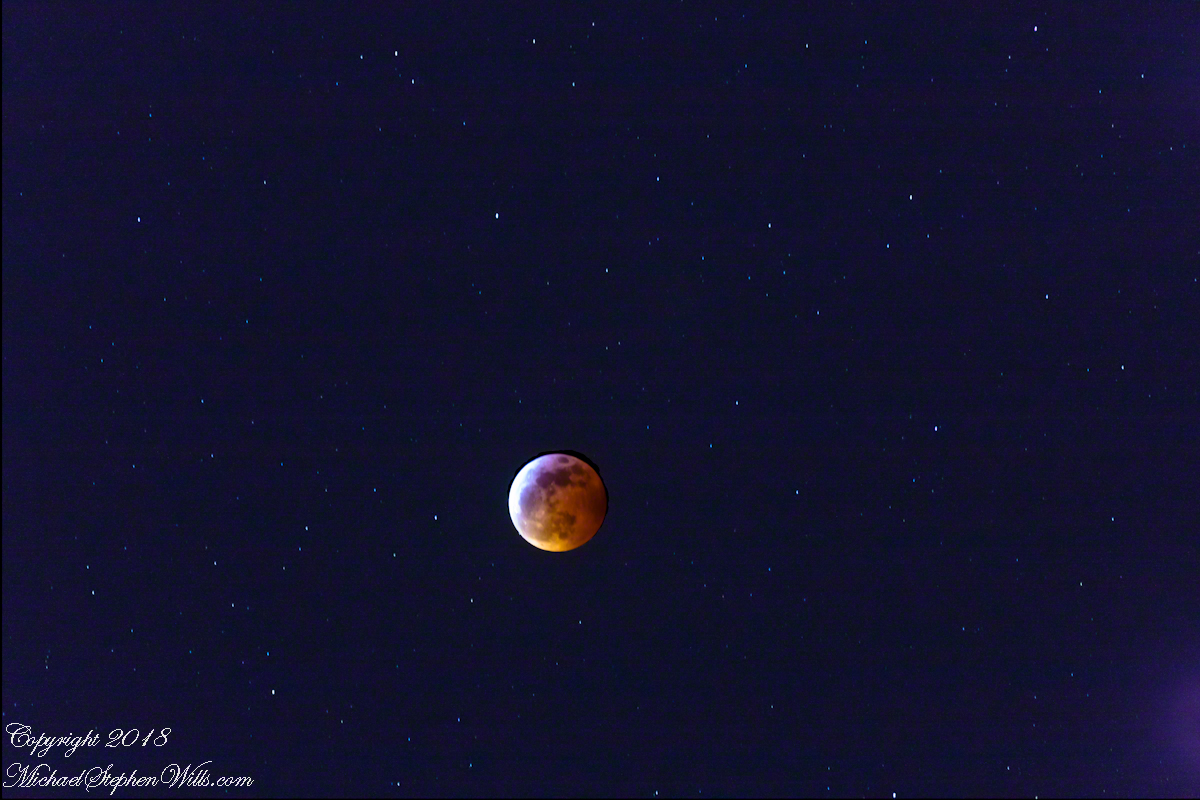
Clouds raveled and the disk lifted, gathering brightness. As the earth’s umbra slid across that worn, luminous stone, the color shifted from pearl to rust, then to the old red of clay amphorae. People love the names—Super, Wolf, Blood—as if the moon had stepped onto a carnival midway. I prefer the quieter facts: sun, earth, moon aligned; light refracted through air; the planet itself briefly confessed in velvet shadow. It felt less like spectacle than like a family resemblance revealed by candlelight.

Eclipse

Much later, around us, the little neighborhood chorus noticed. A conversation stalled mid-sentence; the unspooled hush you hear at a concert just before the bow draws its first note came and settled on the patio. Even the ocean seemed to restrain itself, waves taking smaller breaths. The cruise ship had long since slid behind the curvature of our seeing.

We kept watching. A lunar eclipse is an exercise in patience: everything happens slowly enough to be felt, quickly enough to refuse boredom. Shadows are honest about their edges. When the moon wore its deepest copper, I thought of ancient nights and imaginations unlit by anything but fire, how dependable cycles must have seemed like messages and how—standing there, spine pricked by a familiar old awe—I could not entirely disagree. It was not fear, but kinship: the sense that we are included in the machinery, not merely spectators.

Click photograph for my Online Gallery

When the light returned, it did so from one margin, like dawn rehearsed on a smaller stage. The coin brightened by degrees, and the old face we know reappeared—craters and mares soft as thumbprints. The illusion of size faded as the moon climbed, and the experiment with the pebble proved itself yet again. Even so, I felt the tug of that earlier enchantment, the way a child misses a dream just after waking. The mind keeps two ledgers: one for what is measured, one for what is felt. Tonight both were full.

Eventually we retired. Chairs nested. Doors clicked. In the kitchen, glasses chimed in the sink. But the moon kept on, white and durable, its borrowed light restored. Somewhere out there the ship’s passengers drifted to their cabins, stories in their pockets about the night the world itself cast a shadow, and how the ocean looked briefly like copper under a patient star.

Later, when I wrote down the times and the few facts I could trust to memory, I realized the real record was not the measurements but the company: our leaning back, the shared breath, the soft astonishment that comes when something vast moves at a human pace. The eclipse ended; the evening did not. That, too, felt like a kind of alignment—ours with one another, our small chairs with a very large sky.

Enter your email to receive notification of future postings. I will not sell or share your email address.

Buttonbush: The Secret Geometry of Wetlands

Discover the Buttonbush (Cephalanthus occidentalis), a wetland shrub of spherical blooms, sustaining pollinators, birds, and waterfowl while reminding us of life’s enduring cycles

View post to subscribe to the site’s newsletter.

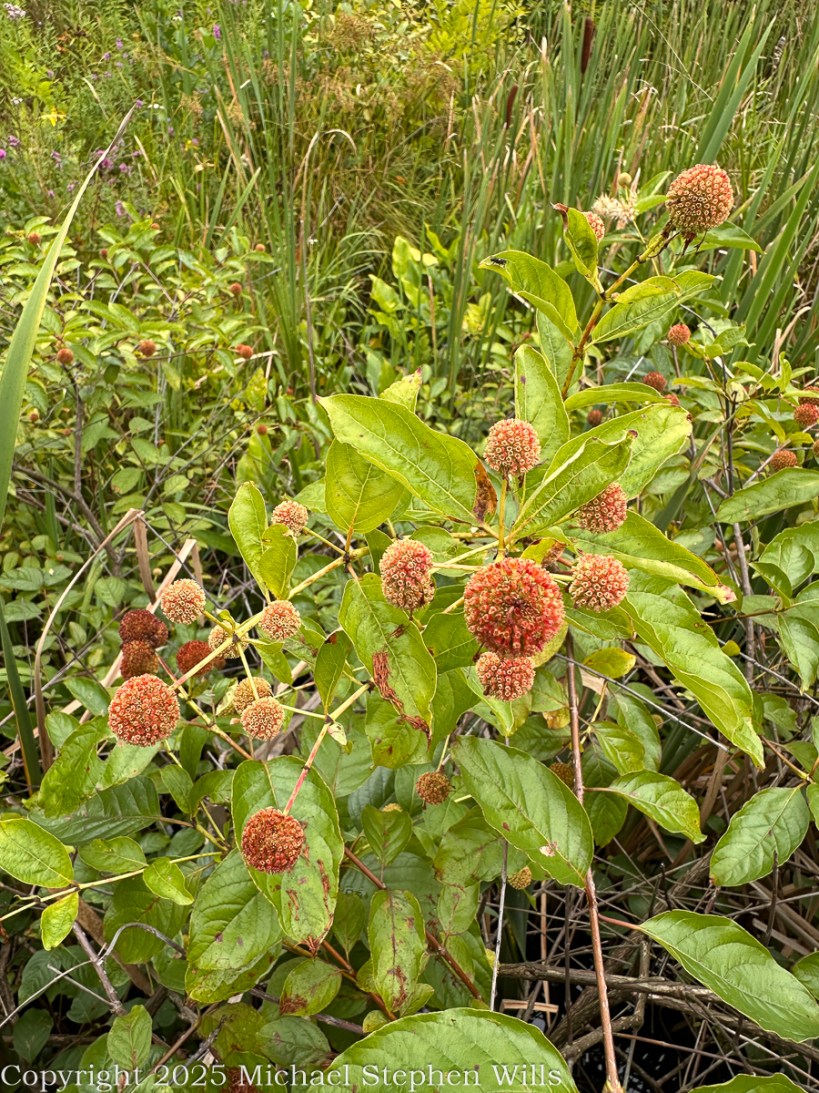
In the quiet wetlands of late summer, when cattails lift their brown torches above the reeds and dragonflies skim the still water, there is a shrub that speaks in spheres. Its language is not the pointed spear of grass or the broad fan of lily pads, but the perfect symmetry of globes—round, intricate, and startling in their precision. This is the Buttonbush, Cephalanthus occidentalis, a native of swamps, pond margins, and the soft, yielding soils where water shapes the land.

At first glance, its clusters might be mistaken for something fashioned by human hands: spiky balls arrayed along slender stems, each one a small planet bristling with tiny cells. Only in memory can we recall their summer incarnation, when each ball was a constellation of snowy blossoms, white tubular flowers extending like delicate pins from a spherical center. Bees and butterflies crowded them then, drunk on nectar, wings glinting in the sun. Hummingbirds darted in as though drawn by an unseen magnet, their beaks fitting perfectly into the narrow blossoms, a partnership written long ago in the shared script of evolution.
Buttonbush (Cephalanthus occidentalis) at Sapsucker Woods, Cornell Lab of Ornithology

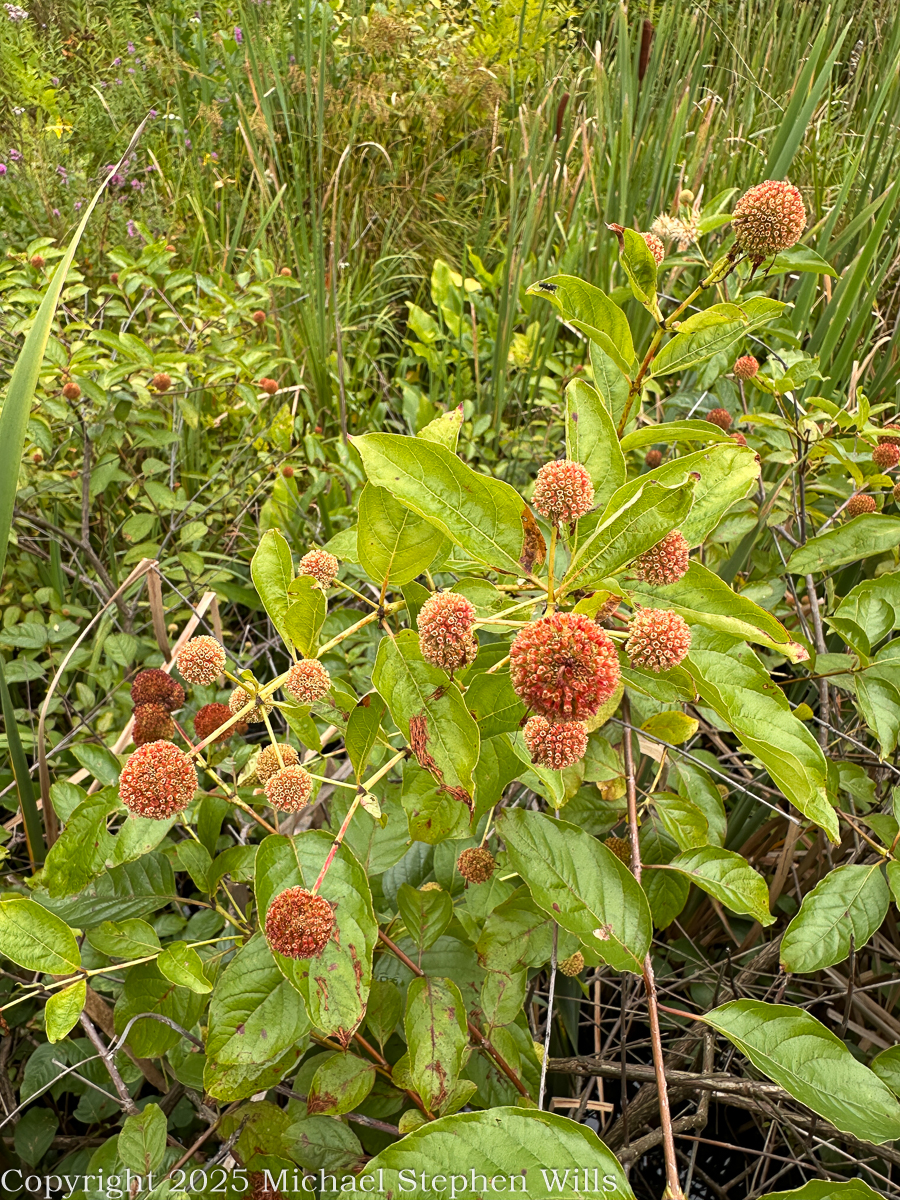
Now, in August’s waning light, those blossoms have folded back into seed, transforming into the russet orbs captured in the photograph. What was once nectar is now promise—food for ducks, shorebirds, and the small lives that depend on wetlands for sustenance. In the hands of buttonbush, time itself is circular. Flower becomes fruit, fruit becomes seed, seed becomes shrub, and the cycle spins quietly on, just as the spheres themselves suggest: complete, unbroken, eternal.
A Wetland Companion

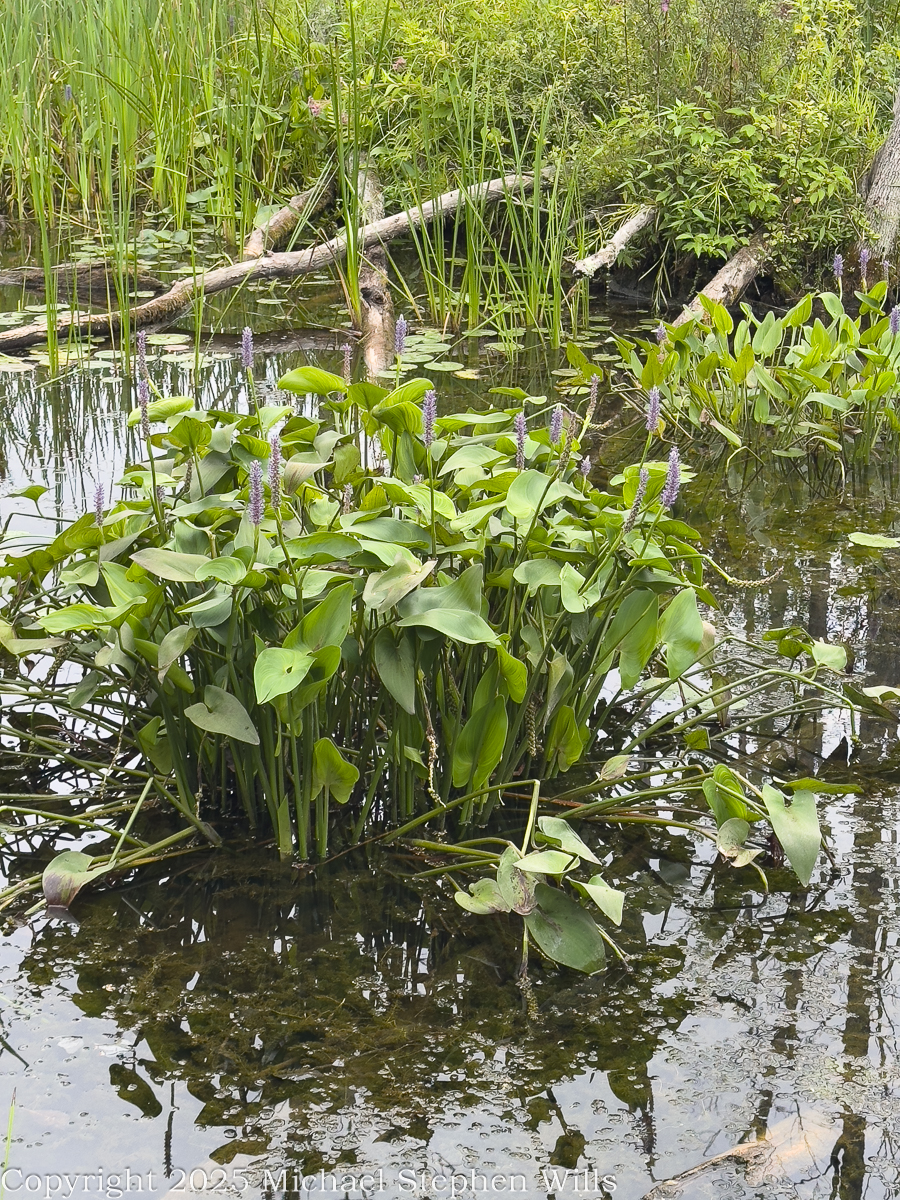
Buttonbush is rarely alone. It thrives where cattails whisper, where pickerelweed thrusts up spikes of purple bloom, where the air holds the scent of waterlogged earth. Its roots grip the muck at the edges of ponds and rivers, holding soil against the restless tug of currents. In doing so, it becomes part of the unseen architecture that holds wetlands together, slowing erosion, filtering water, providing shelter for fish in the shade of its stems.

Pickerelweed (Pontederia cordata) at Sapsucker Woods, Cornell Lab of Ornithology

This shrub, unassuming in stature, is an engineer of stability. It creates thickets where red-winged blackbirds perch, where frogs crouch in shade, where turtles bask on half-submerged branches. The wetlands of North America would be poorer without its presence, for it provides not just beauty but the scaffolding upon which entire communities of life depend.

The Human Thread

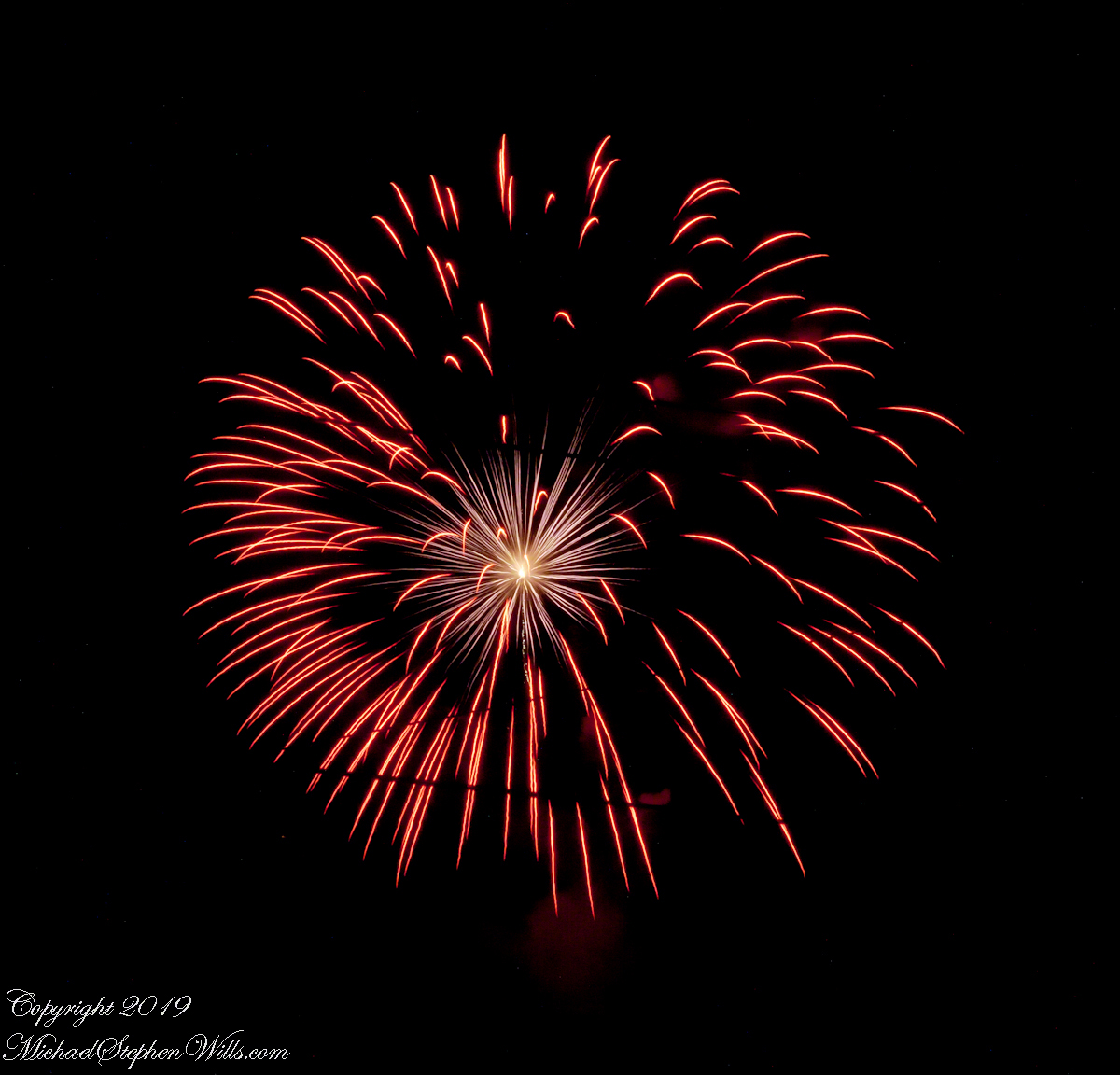
To the human eye, the buttonbush’s spherical blooms are so striking that they demand metaphor. Some have called them pincushions, others tiny planets, others fireworks arrested in mid-burst. Native American peoples, however, looked beyond metaphor to medicine. The bark and roots were used in remedies for ailments ranging from headaches to fevers, though with caution, for the plant holds mild toxicity when consumed raw. It is a reminder that many gifts of the natural world are edged with danger, and that wisdom lies in balance.

Today, gardeners and conservationists plant buttonbush intentionally. It is welcomed into rain gardens, where its thirst for moisture makes it a perfect ally for absorbing stormwater. It is used in wetland restoration projects, where its deep roots anchor new life. And it is cherished by those who walk the edges of ponds and discover in its round blossoms a geometry that feels both wild and deliberate, a gift of design from the living earth.

Fourth of July, 2019, Stewart Park

The Sphere as Symbol

Rachel Carson once wrote that in nature, “nothing exists alone.” The buttonbush embodies this truth with clarity. Its spheres are invitations, junctions where plant and pollinator meet, where flower and bird share a moment of mutual necessity. They are offerings to the eye as well, challenging us to see patterns where we might otherwise see only happenstance.

Standing before a buttonbush in bloom, one feels an almost childlike wonder: how could such symmetry arise unbidden from soil and sunlight? Yet this is the miracle of evolution, that order may spring from chance, that beauty may serve survival, that what pleases our senses also sustains life.

A Closing Reflection

In the wetlands, where water mirrors the sky, the buttonbush offers its own reflection of completeness. Its seed heads persist through autumn and winter, small orbs clinging even when leaves fall, reminders that the cycles of life turn steadily beneath the stillness.

To linger with buttonbush is to be reminded of nature’s quiet insistence on wholeness. It speaks in forms: round, repeating, enduring. To walk away from it is to carry a sense of connection, to know that in the pattern of its blooms we glimpse a truth both humble and profound—that life is not a line but a circle, and in every turning there is renewal.

For Further Reading

USDA NRCS. Plant Guide: Buttonbush (Cephalanthus occidentalis L.). United States Department of Agriculture, Natural Resources Conservation Service. Available online: https://plants.usda.gov
– Provides detailed information on identification, habitat, and ecological role.

Lady Bird Johnson Wildflower Center. Cephalanthus occidentalis (Common Buttonbush). Native Plant Information Network. Available online: https://www.wildflower.org/plants/result.php?id_plant=ceoc2
– Covers botanical features, bloom time, wildlife value, and landscape use.

Dirr, Michael A. Manual of Woody Landscape Plants: Their Identification, Ornamental Characteristics, Culture, Propagation and Uses. 6th Edition. Stipes Publishing, 2009.
– Authoritative horticultural reference on Buttonbush and other shrubs.

Peterson, Roger Tory, and Margaret McKenny. A Field Guide to Wildflowers: Northeastern and North-central North America. Houghton Mifflin, 1968.
– Classic field guide covering buttonbush’s wetland habitat.

Carson, Rachel. Silent Spring. Houghton Mifflin, 1962.
– Source of the quoted passage: “In nature nothing exists alone.” (Chapter 2, “The Obligation to Endure”).

Moerman, Daniel E. Native American Ethnobotany. Timber Press, 1998.
– Comprehensive reference documenting traditional medicinal uses of Buttonbush among Native American peoples.

Enter your email to receive notification of future postings. I will not sell or share your email address.

Historical Wonders of Ashford Castle and Its Natural Surroundings

At Ashford Castle, swans glide on the Cong River’s glassy waters, weaving together myth, history, and cinema in a timeless reflection of Ireland’s enduring spirit.

View post to subscribe to the site’s newsletter.

Headed south from Cong Village, past the venerable Cong Abbey then Saint Mary’s Church of Ireland, the road bends into the Ashford Castle estate. Time seems to shift here. The stonework of the abbey lingers in memory, only to give way to manicured parkland, ancient trees, and the shimmer of water. The road itself, aptly named Ashford Castle, carries the traveler to a place where history, nature, and imagination meet.

I do not recall passing a guard box on my first visit, though one now stands firmly on the roadside, manned and proper, as though the estate were never meant to be entered without ceremony. In truth, Ashford Castle has always carried the air of a threshold—between village and wild, past and present, myth and reality.

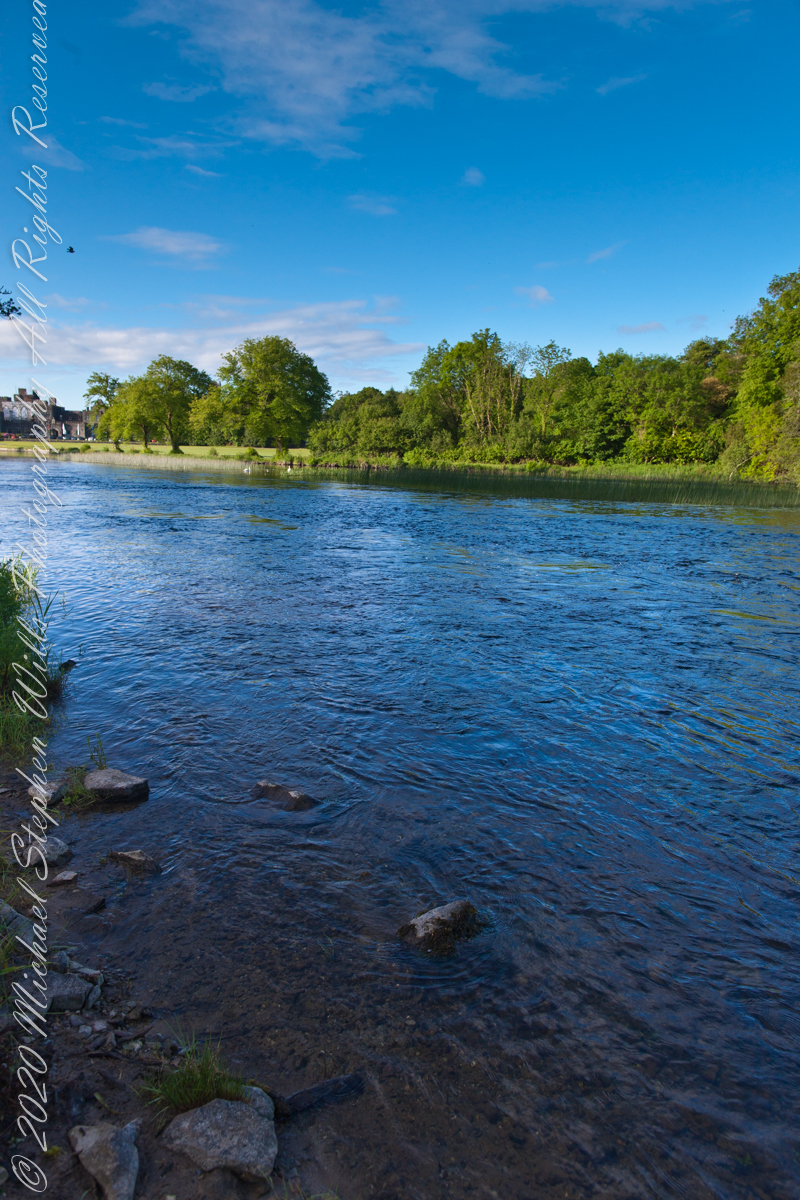
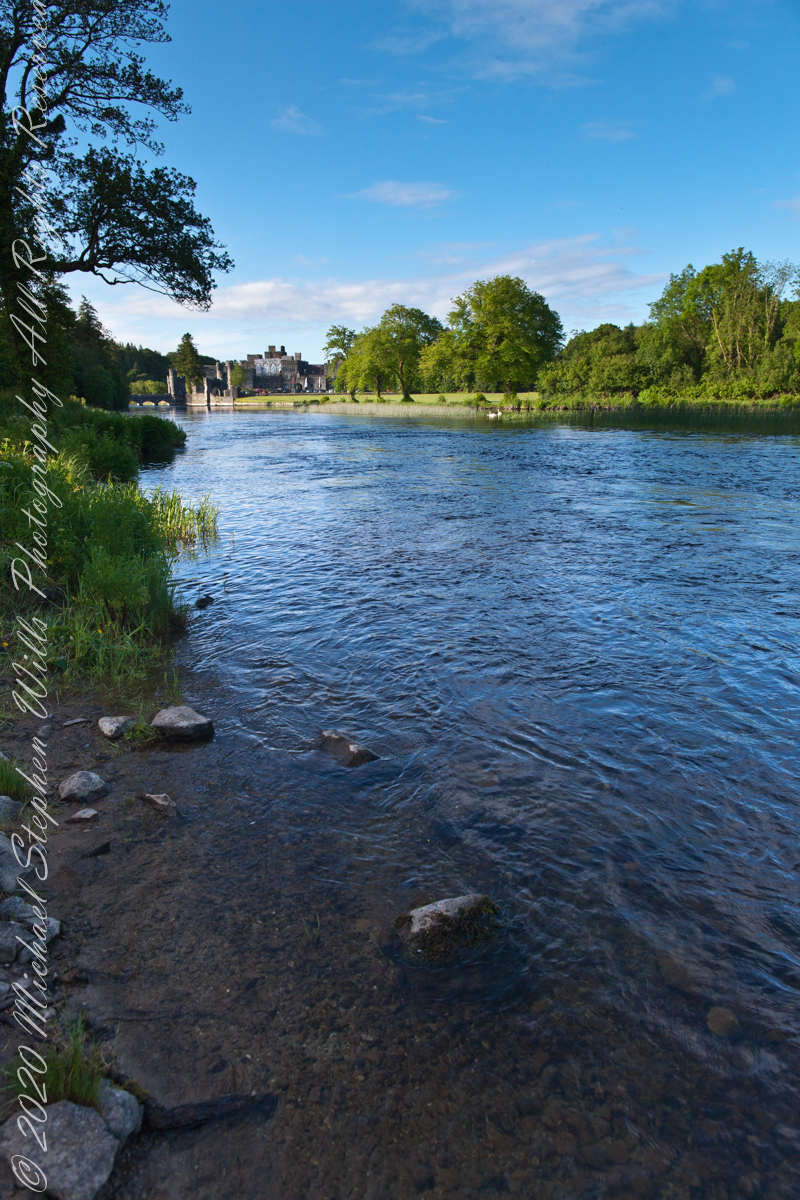
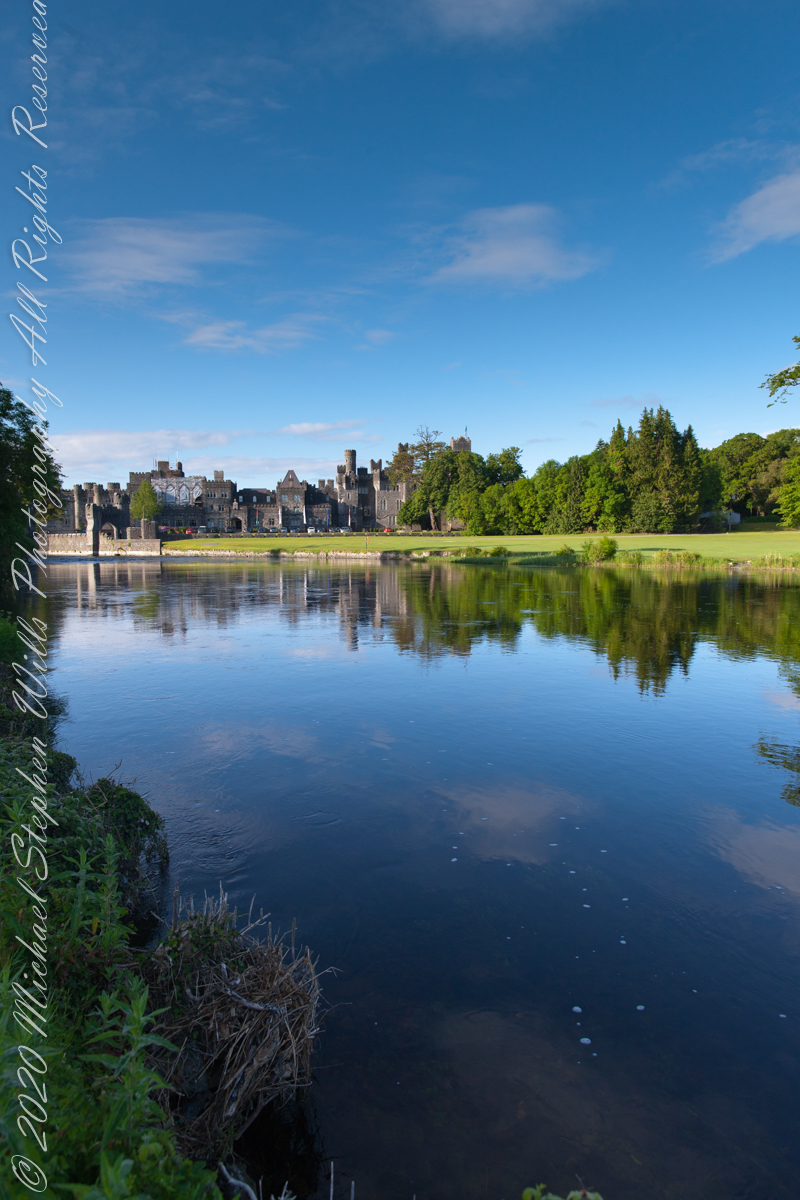
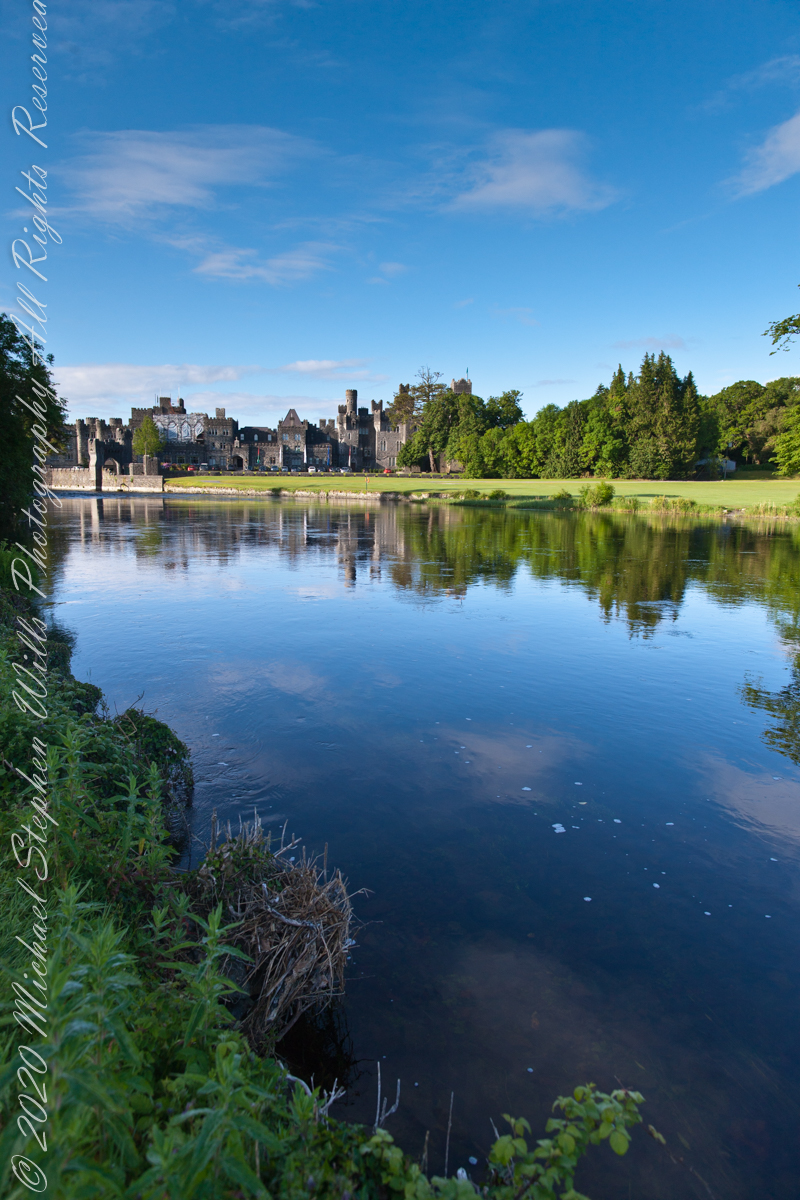
Soon the road brings one to the banks of the Cong River. Here the water widens, flowing calm and sure, and across it rises the battlemented silhouette of Ashford Castle itself. Its towers, turrets, and stony walls seem to grow from the riverbank like something inevitable, a fortress transformed into elegance. The castle’s mirrored reflection on the water doubles the grandeur, as though the real and imagined castle exist side by side.

It is no wonder filmmakers found inspiration here. Scenes from the classic 1952 film The Quiet Man—the tale of Sean Thornton, played by John Wayne, and the fiery Mary Kate Danaher, embodied by Maureen O’Hara—were shot on the far bank of this very river. To watch them walking by these waters is to see Ashford Castle woven into Hollywood’s Irish dreamscape, a backdrop both romantic and enduring.

Yet long before cinema, the river was already a stage. The Cong River is a natural marvel. It emerges from the same Carboniferous limestone that shapes the Burren of County Clare—an austere landscape of limestone pavements etched with fossils and caves, where rare alpine and Mediterranean plants thrive among ancient tombs. Through fissures in this ancient bedrock, the waters of Lough Mask find their way underground before rising again at Cong. This subterranean journey, through stone filters laid down some 350 million years ago, leaves the water clarified, luminous, and cold. By the time it slides past Ashford Castle, it has the purity of glass.

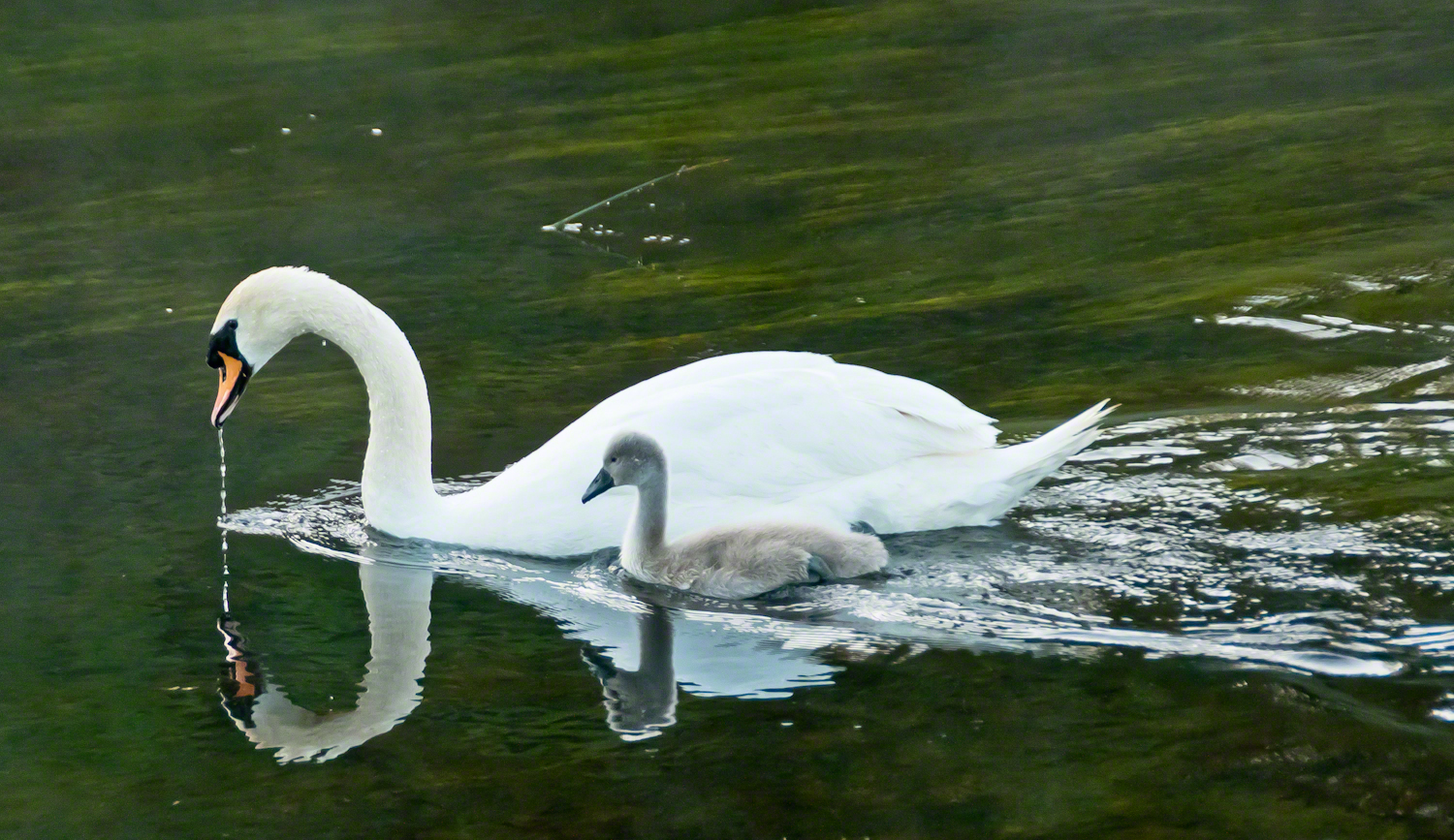
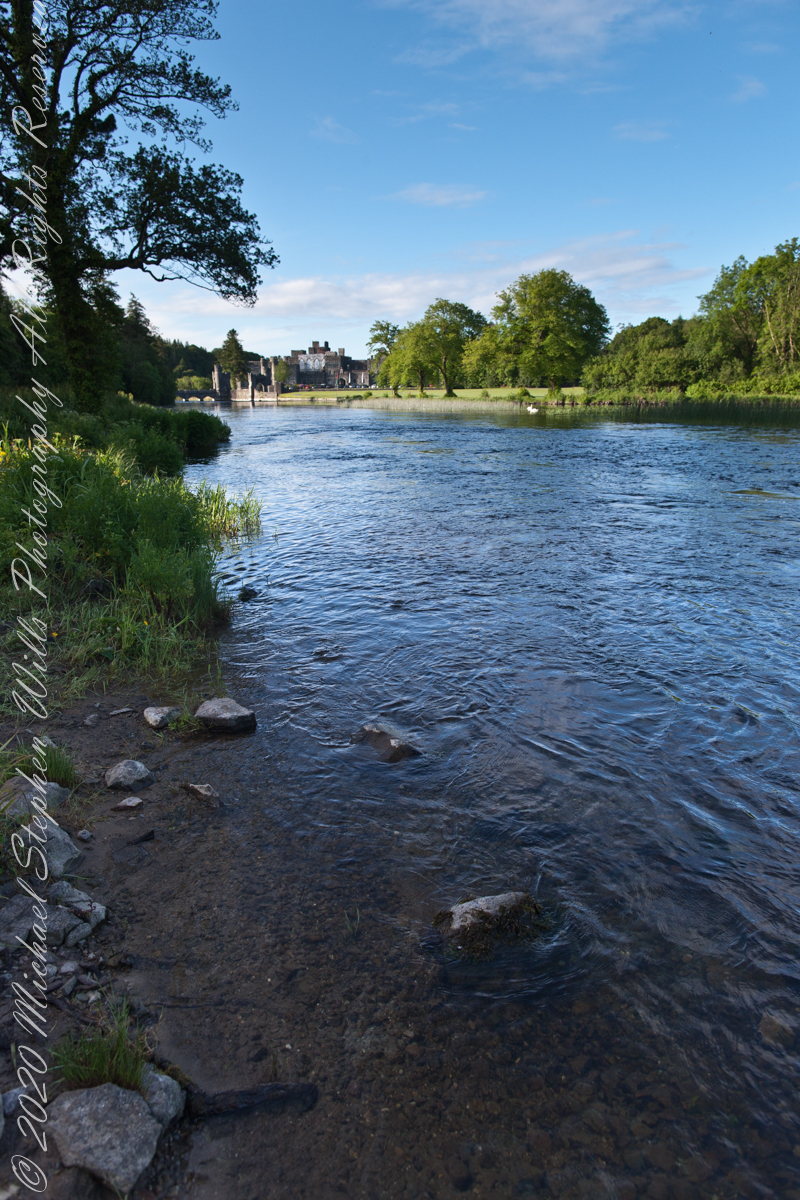
It is in this clarity while walking the opposite bank on a different morning I found a parent swan and its cygnet feeding. The adult glided, immaculate, its long neck bowed as drops of river fell from its beak. At its side, the cygnet paddled with earnest strokes, gray down still clinging, a fragile shadow of what it would one day become. Together they traced a quiet path across the water, ripples fanning behind them.

Few images so perfectly match their setting: a medieval castle, guardian of centuries, reflected in the same waters where these swans carried on their timeless rhythm of nurture and growth. It was as if the river itself composed the scene—a blending of stone, water, bird, and sky that belonged nowhere else but here.

The swan has long been a symbol in Irish lore. The Children of Lir, cursed to live as swans for nine hundred years, are among the most haunting figures of Celtic mythology. To see the white bird with its offspring before Ashford Castle was to glimpse that myth breathing still, alive on the Cong River.

Photographers know the difficulty of capturing water and stone without losing the life between them. On that morning, however, the river gave freely—its surface alternately smooth as glass and dappled with breeze. Stones at the water’s edge appeared like stepping-stones into history. Each frame revealed another face of the estate: the wide reach of the Cong, the castle framed by trees, the play of cloud shadows across the current.

The castle itself, though reshaped as a luxury retreat, still speaks of older times. Founded in the 13th century by the Anglo-Normans, Ashford passed through centuries of conquest and change before becoming, in the 19th century, a romantic Victorian pile. Today its battlements remain picturesque rather than defensive, but the sense of continuity—of lives unfolding along these banks—has not faded.

Standing there, camera in hand, I was struck by the layered meaning of this place. The Cong River flows from unseen caverns, purified by limestone older than memory. It nourishes swans, reeds, and trout alike. It reflects both a castle and a sky. Along its opposite bank, legends of cinema and Celtic lore alike find footing.

As the swan and cygnet drifted slowly downstream, I thought of them as part of the same enduring thread. Parent and child mirrored castle and village, past and future, permanence and change. The ripples they left widened until they touched both banks, an unbroken gesture across centuries.

Click this link to read another Ireland story “The Cloigtheach of Glendalough.”

Click this link to read another Ireland story “Killeany Bouy.”
Enter your email to receive notification of future postings. I will not sell or share your email address.

Exploring Sipapu Bridge: A Scenic Descent

Experience the thrill of descending into Utah’s White Canyon—slickrock trails, driftwood ladders, and stunning views await at Sipapu Bridge in Natural Bridges Monument.

View post to subscribe to the site’s newsletter.

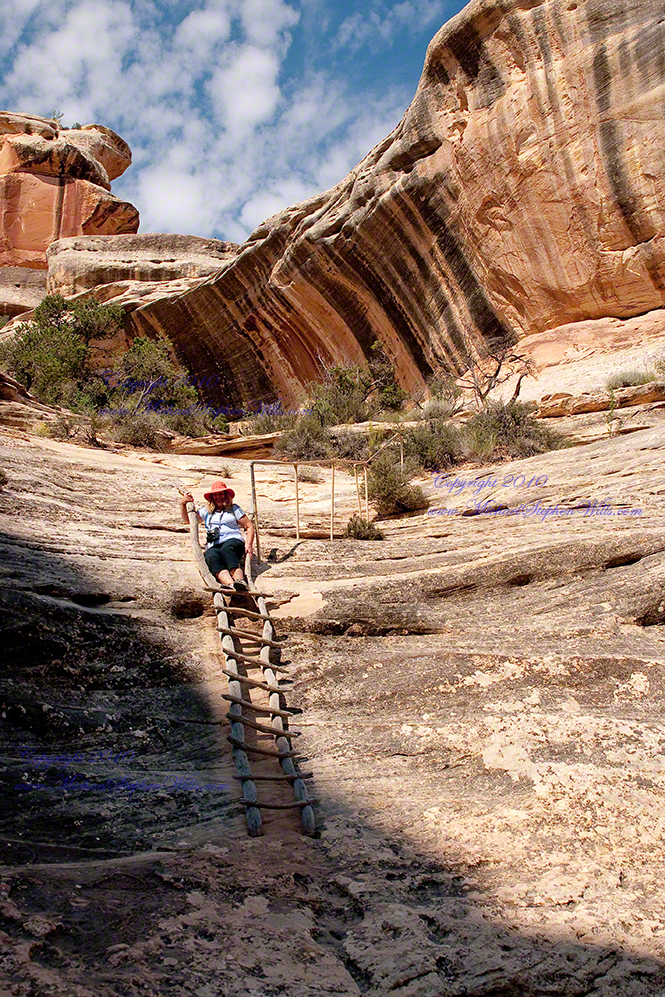
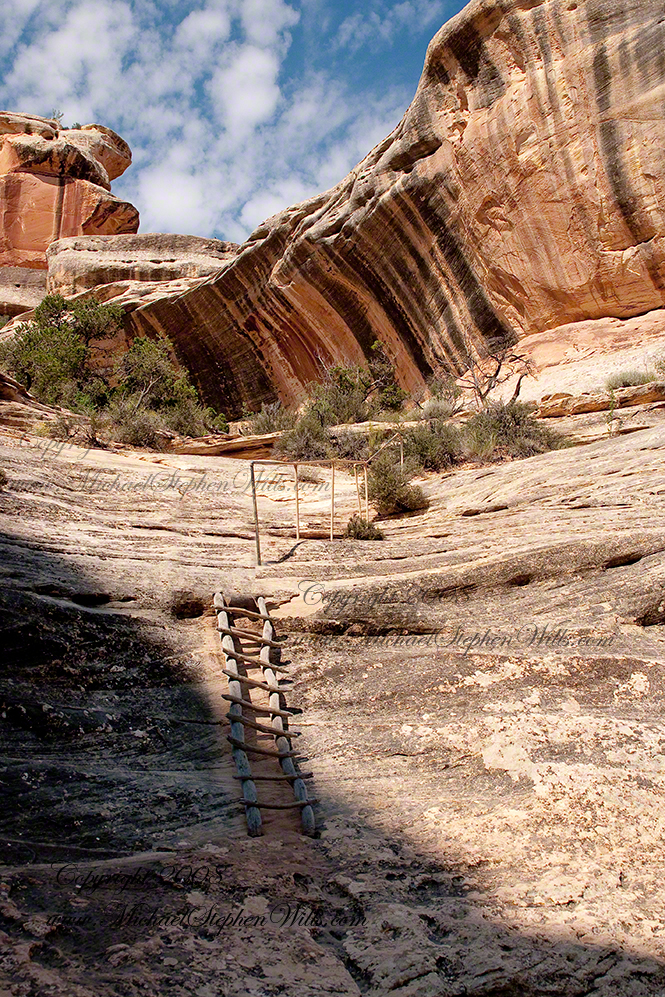
The final descent into White Canyon to view Sipapu Bridge, Natural Bridges National Monument near Blanding, Utah

Final Step

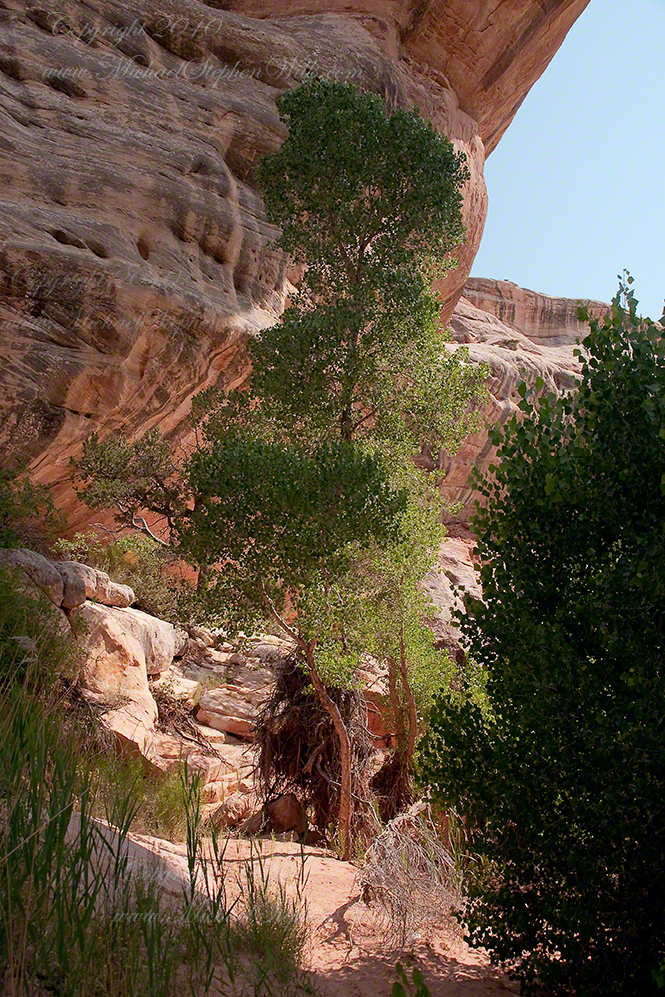
Here is a photograph of the final stage of our descent into White Canyon. Here the trail traverseed a type of sandstone called “Slickrock.” For Pam and I the surface was like sandpaper and, for the right type of shoes, provides great traction.

That day I wore Lowe hiking boots with a harder sole and these could slip at times. I’d recommend a different shoe for the trail, but my boots come over the ankle and provide great support. Plus, the canyon bottom is sandy, so high boots prevent sand from falling into the shoe. A perfect choice for this trip is a high boot that provides support, with a softer sole on a hard and light shank (to protect you against sharp rocks).

What is Slickrock?

Slickrock was named by the first settlers and explorers who discovered their iron shod horses lost footing on the steep slopes of this sandstone.

This was another feature of Pam and my descent into White Canyon. The sandstone weathers in a way that produces steep slopes over which the trail must pass and the traveler navigate. I chose this image as a Fine Art print (part of a series featuring Natural Bridges National Monument) because this part of the trial is strange and beautiful.

The hard rock cliffs are resistant to wear and, in this climate, weather to provide rounded surfaces. The cliff face is scalloped and marked with desert varnish striations that “pop out” from the red rock. Then, there is the clear light and bright morning sky on a summer morning that promised thunderstorms.

Gratitude

Then, there are the personal memories of that iron railing drilled into the rock and that marvelous looking ladder created from driftwood found in the canyon.  That ladder is a work of art!!  The photograph does not reproduce the feeling Pam and I had at that point of the descent.  I needed to climb down the ladder backwards (facing out) and holding on .

We were both grateful to reach the sandy stream bed in White Canyon.

Enter your email to receive notification of future postings. I will not sell or share your email address.

Celebrating Community at Dryden Dairy Days Parade

Experience the joy of small-town tradition as three generations celebrate cows, community, and colorful floats at the 2025 Dryden Dairy Day Parade in upstate New York.

View post to subscribe to the site’s newsletter.

On a glorious Saturday morning—June 14, 2025—the small village of Dryden, New York, once again came alive with one of its most beloved traditions: the Dairy Day Parade. I had the joy of attending this year’s festivities with my daughter-in-law, Jennifer, and my two grandsons, Sam and Rory. We set up along Main Street, folding chair ready and anticipation high, surrounded by a growing crowd of families, neighbors, and out-of-town visitors drawn by the charm of this time-honored event.

Dryden Dairy Day, first held in 1980, has long celebrated the area’s agricultural roots—particularly the dairy farms that once dotted the Finger Lakes region in greater number. Though the rural landscape has changed, the community spirit endures, embodied each year in this cheerful, inclusive parade. And what a parade it was.

Sam and Rory, who started out quietly nestled together in a red camp chair, quickly leaned forward in excitement as the opening marchers passed. Veterans in pressed blue shirts and caps bore the flags solemnly, stepping to the rhythm of distant drumbeats. The boys gladly collected candy thrown to the crowd by the paraders.

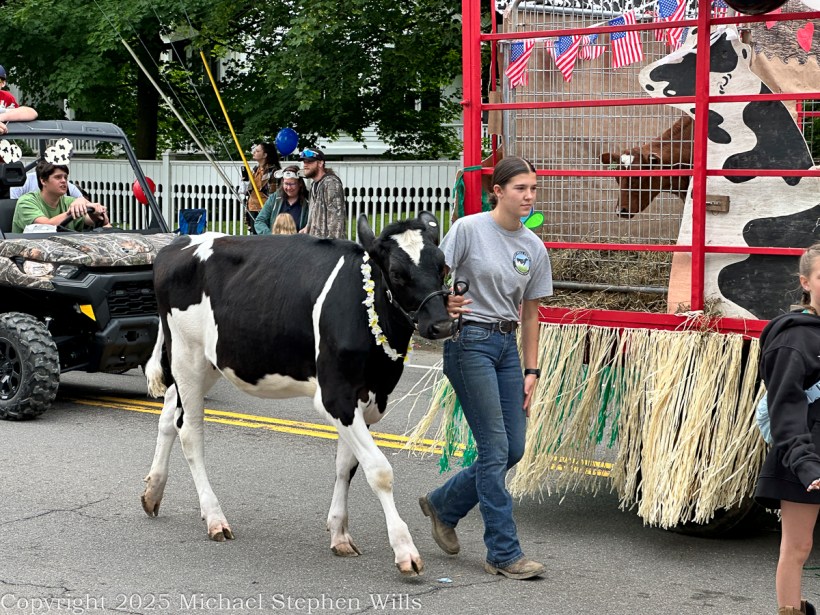
Then came the color and music—floats festooned with balloons, hay bales, streamers, and, of course, cows. The Jerry Dell Farm float, labeled “LegenDAIRY Superheroes,” stole the show with its red metal rails, a large cutout Holstein suspended in mid-leap, and enthusiastic kids handing out “Got Milk?” flyers. The float’s theme—half play, half tribute—offered a nod to the hardworking farmers past and present who’ve kept local dairies running despite national challenges.

Behind them, children waved from trailers turned farmyard dioramas. In one, rabbits and baby chicks nestled on pastel blankets inside red and gray wagons, drawing audible “awws” from the crowd. Another float featured kids feeding baby goats from white pails, an irresistible scene that reminded us of the joys of hands-on farm life.

Marching groups followed, each bringing their own spark. A contingent from Tompkins Cortland Community College, all in matching green shirts, smiled and waved. Their banner and cheetah logo brought cheers from alumni in the crowd. Girl Scouts from Troop 427 of Golden Meadows brought peace signs, love hearts, and Girl Scout green to life as they passed, handing out candy and smiles with equal generosity.

We clapped for the “Wreaths Across America” semi-truck—a rolling tribute to fallen soldiers. Its stars-and-stripes exterior and the wreath-emblazoned motto “Remember. Honor. Teach.” was a solemn visual counterpoint to the general jubilation, grounding us in gratitude amid celebration.

One of the most magical sights for Sam and Rory came next: a medieval knight on horseback, gleaming in armor, carrying a long lance. This was no Renaissance Fair actor but a local reenactor embodying chivalry and pageantry for the kids. Rory, eyes wide, whispered, “Is that a real knight?” and I nodded with a smile. The horse, a proud palomino with flowing mane, trotted as regally as any steed from storybooks.

At one point, we found ourselves surrounded by people wearing cow-print headbands and passing out themed goodies—a detail that would feel odd anywhere else but felt perfectly at home here. Even the Girl Scouts managed to mix tradition with whimsy, some donning glittering horns and cow ears for the occasion.

I selectively captured photos, while Jen and the boys soaked in the sights and sounds: the distant whinny of ponies, the rustle of candy wrappers on the pavement. Parades like this are entertainment and intergenerational bridges, connecting the past with the present, the seasoned farmer with the wide-eyed child, and the local with the visitor.

As the parade wound down and the last float passed, we lingered a while longer. The boys were still buzzing with excitement, eager to share their favorite parts—“the knight!” said Rory, “the baby goats!” said Sam. For me, the most treasured moment was watching my grandsons engage so deeply with the richness of local heritage, waving to friends in the parade feeling part of something bigger than themselves.

Dryden Dairy Day reminds us that community is people lining the street on a Saturday morning. It’s floats handmade with care. It’s generations walking side by side—and sometimes sitting in the same chair—laughing, learning, and loving the place they call home.

Enter your email to receive notification of future postings. I will not sell or share your email address.

On The Edge of Time Above Taughannock Gorge

Perched above Taughannock Gorge, a moss-covered ledge and cascading falls reveal ancient stories—where Devonian seas once flowed and time’s layers whisper through stone and water.

View post to subscribe to the site’s newsletter.

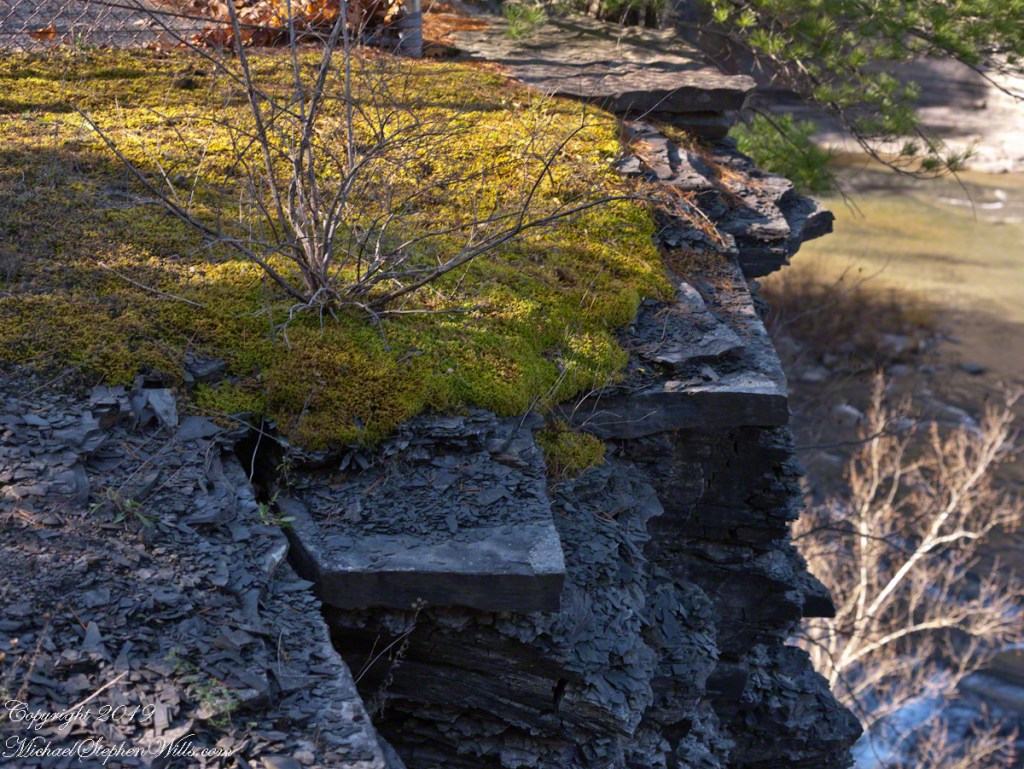
The morning sun had only just breached the rim of the gorge, sending long slants of golden light across the forest floor. Walking the South Rim Trail of Taughannock Falls State Park, I came upon a quiet, unassuming spot—just a few paces off the path—where the forest seemed to pause in reverence. What greeted me was a small marvel of persistence and time.

There, rooted precariously atop a slab of brittle shale, was a tenacious shrub rising from a bed of moss, its spindly frame etched in sharp contrast to the soft, green sprawl beneath it. The moss had taken hold on a shelf of rock cantilevered over the gorge like a green tongue of earth defying gravity. Cracks traced the shale’s surface like veins, silent records of the forces that shaped this place—heat, ice, pressure, time. Together, the moss and the bush formed an improbable community, surviving against odds, bound together by the thin soil cradled in stone.

This ledge, suspended over the abyss, seemed less a part of the earth than a question it asked—how much life can cling to the edge before the edge itself gives way?

Beneath this living fragment, the gorge dropped away. Layers upon layers of shale revealed themselves, stacked like a collapsed library of time. Here, the Devonian Period lies exposed to wind and rain, and to those willing to pause and wonder. Each stratum holds the fossil whisper of ancient seas, where trilobites scuttled and coral reefs once stood. This gorge was not carved quickly. It was not born of a moment, but of many—countless raindrops, millennia of ice melt, the slow, sure work of water over stone.

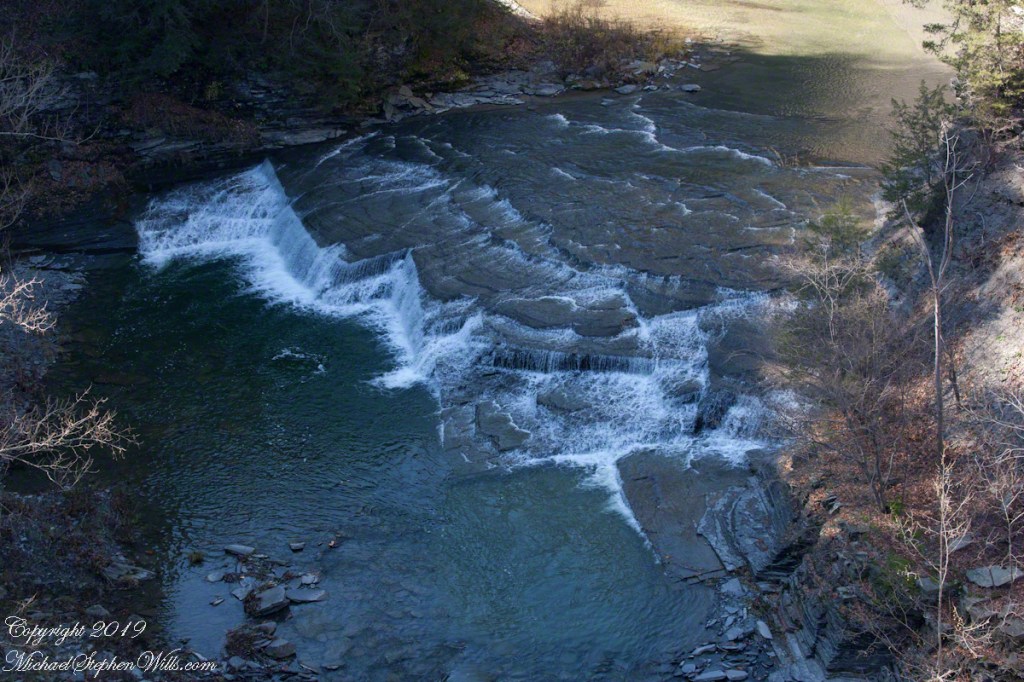
From this natural balcony, I looked out and down to the gorge floor where the creek shaped the land with an artist’s patient hand. The falls, seen from above, no longer thundered—they danced. Spread like the folds of a fan, water curled over smooth stone in steps of white silk. From here, the cascade looked deliberate, choreographed—an elemental performance halfway between gravity and grace.

How many times had this water flowed, reshaped, receded? How often had it carved these grooves, smoothed those ridges, erased the footprints of what came before? Looking at the exposed rock, one could trace the signature of ancient glaciers, feel the memory of long-gone floods. It was humbling—this intersection of change and continuity.

Above it all, the trees stood still. Pine and oak, rooted well back from the edge, offered a kind of sentinel presence. Their shadows stretched long and angled, tracing the contours of both earth and memory. For a moment, I let go of all thought and simply listened—to the murmur of wind through leaves, the faint rush of water far below, and the silence that presses in when the land itself seems to be remembering.

This spot—so easily missed by a hurried hiker—offered a parable of resilience and impermanence. The moss did not grow with certainty, nor the shrub reach with confidence. They survived on the edge because they adapted. They made do with less. They took root where others could not. There was no security in that place, only presence. Only the now.

And isn’t that a lesson worth carrying?

We so often seek stability, firm ground, a clear path. Yet, some of the most beautiful things live just beyond comfort—on ledges, in cracks, in the margins of the known. To pause here was to acknowledge that life thrives not only in sheltered valleys but also at the edge of what seems possible.

As I stepped back onto the trail and continued along the South Rim, the image of that mossy outcrop stayed with me. I carried it in my thoughts like a talisman—proof that even on the brink, life finds a way. And that from above, the most chaotic falls can appear as ordered motion, as a flow toward something larger.

Later, when the sun climbed higher and the light lost its slant, I would look back on this moment not as a spectacular highlight but as something more intimate: a quiet encounter with nature’s subtle artistry, its layered truths, and its enduring invitation to look closely, feel deeply, and walk softly.

For here, above the gorge, at the edge of earth and time, even a whisper leaves a mark.

Enter your email to receive notification of future postings. I will not sell or share your email address.