Winter distills Taughannock Gorge to stone, water, and silence, where careful footsteps along icy rim trails reveal deep connections between landscape, memory, and quiet joy.
Winter pares the world down to its essential lines, and nowhere is that more apparent than on the rim trails of Taughannock Falls State Park. On a Wednesday afternoon walk, a three-mile pilgrimage, the gorge revealed itself as a living corridor of connections—between water and stone, past and present, effort and joy. The season sharpened every sensation: the crunch and slip of ice underfoot, the hush of leafless woods, the long exhale of the falls echoing unseen below.
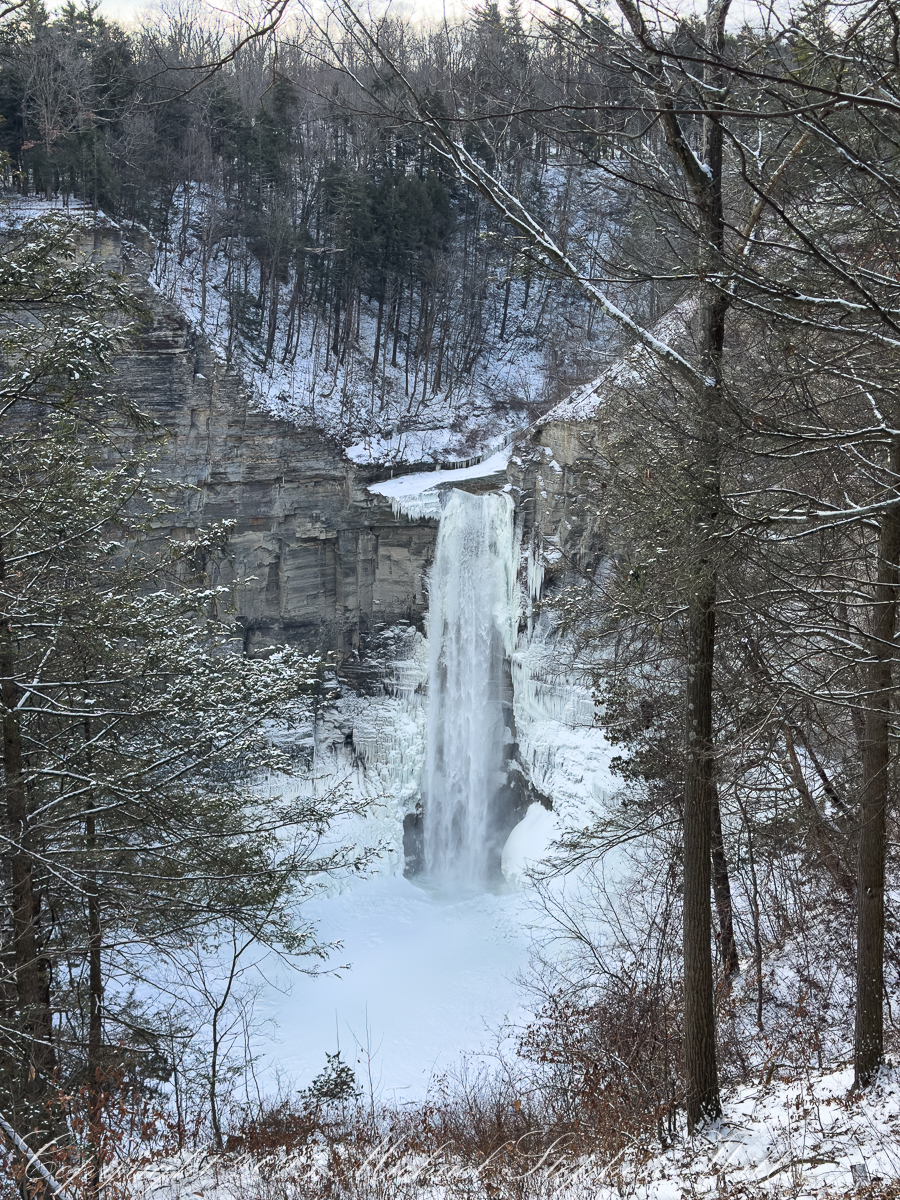
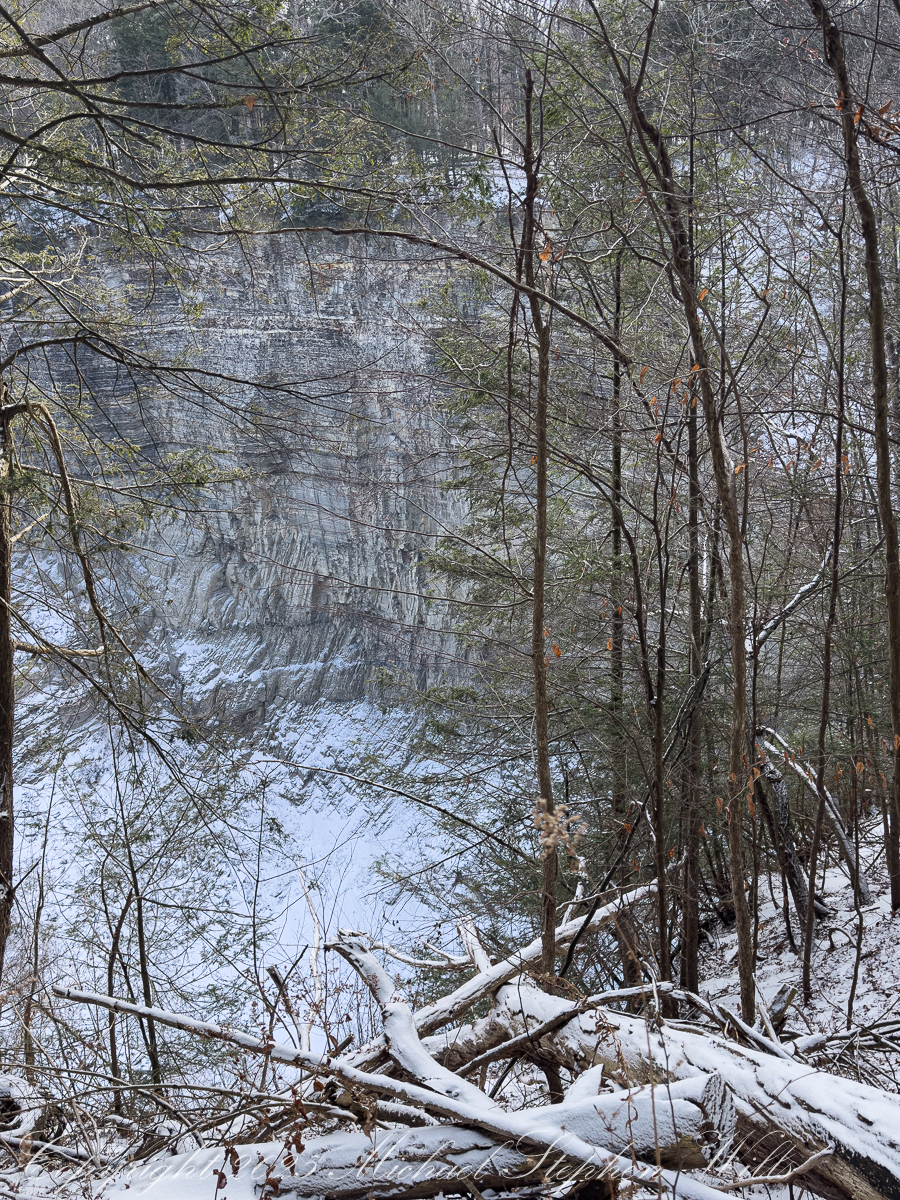
From the overlook, the gorge opens like a vast stone book, its pages written in shale and time. Taughannock Falls drops away in the distance, not so much seen as felt—its presence announced by scale and gravity. Even before stepping onto the trail, the walk establishes its rhythm: pause, look, breathe. Winter insists on this slower tempo. Ice dictates caution, and caution invites attention.
Heading along the Rim Trail my progress became deliberate. The path, glazed in places with solid ice, turned each step into a negotiation. Yet this was no impediment to pleasure. Slowness allowed for noticing the quiet labor of the park maintenance crew, whose careful clearing and repairs spoke of spring already anticipated. Their work stitched the present moment to the coming season, a reminder that parks, like stories, are maintained through this unseen devotion.
The gorge itself is a system of thresholds. A bridge crossing the creek marks the transition from North to South Rim, but it also frames one of the most dramatic views in the park. Standing above the chasm, one senses connection: water flowing beneath, trails diverging and rejoining, human passage layered lightly atop geological endurance. The gorge is a conversation between forces, ongoing and unresolved.
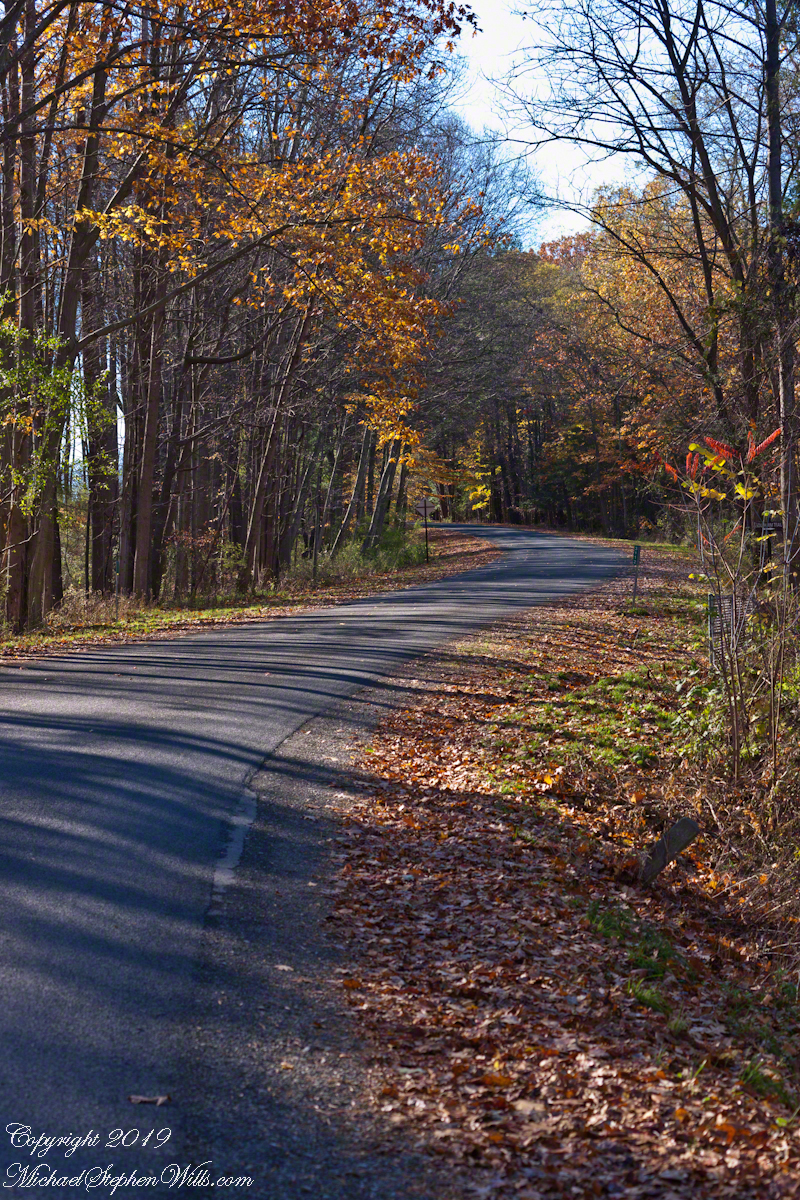
Gorge Road, early NovemberFrom the South Rim Trail. Taughannock Falls, New York State Park, Ulysees, Tompkins County, Finger Lakes Region.Click any photograph for a larger image
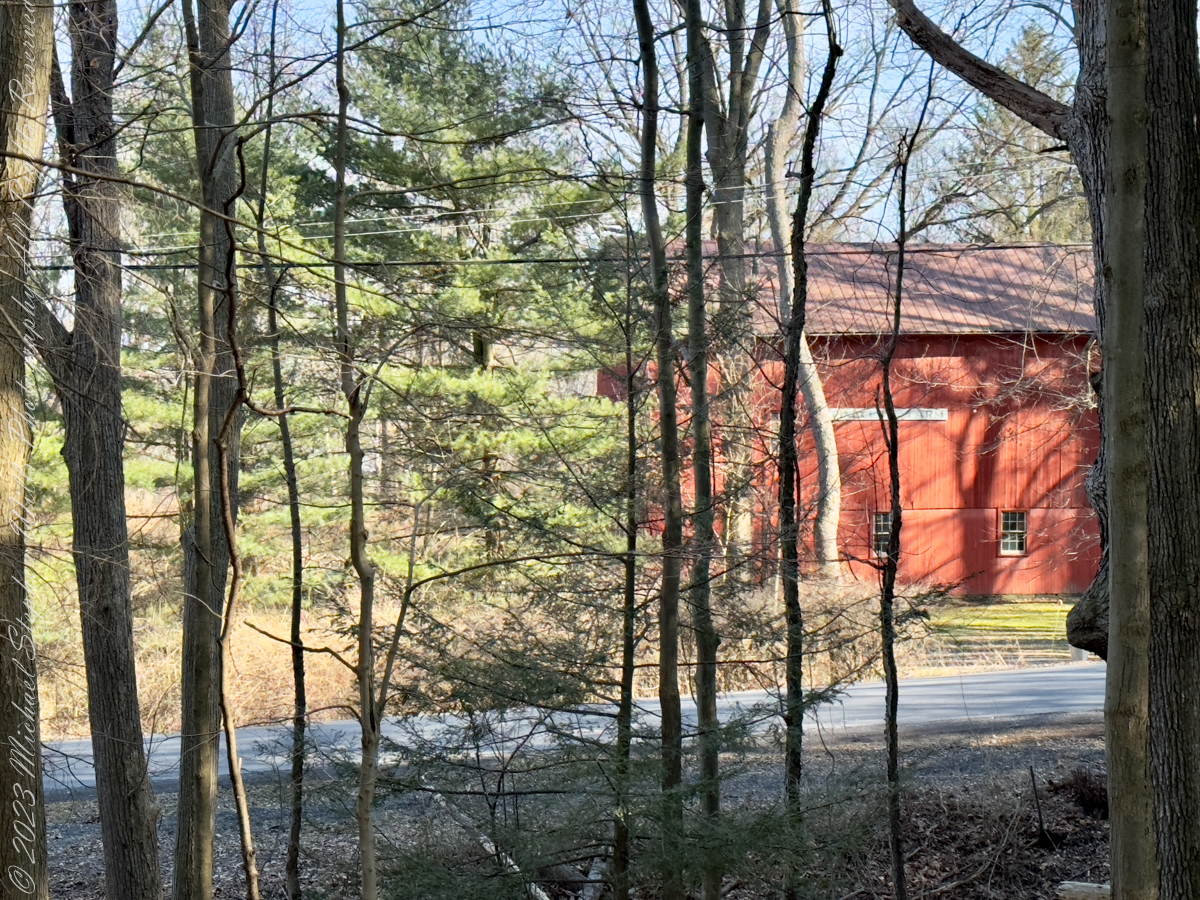
Ice eventually nudged my walk onto Gorge Road, which parallels the South Rim Trail like a quieter narrative strand. Here, the landscape shifts from wild drama to human memory. A curve in the road reveals a farmhouse, modest and fragile beside its outsized barn. In winter, the absence of leaves makes the scene stark and honest. The farmstead buildings do not ask for nostalgia; they simply stand, bearing witness to lives tethered to this steep land. The structures emerge gradually as I walk downhill, as if the land itself were choosing when to reveal them.
Overview of this small cemetery overlooking Cayuga Lake
A short detour leads to a small cemetery perched on a shelf above Cayuga Lake, near the Taughannock Farms Inn. In winter, cemeteries feel less like places of mourning and more like rooms of quiet conversation. Headstones rise from frozen ground, their inscriptions softened by time and distance. From this vantage point, lake and sky merge in pale bands, and the lives commemorated here feel gently folded into the larger story of the landscape. The dead, too, are part of the park’s web of connections.
Another detour brings the lower falls into view—a more intimate expression of the same water that plunges dramatically upstream. Here the sound is closer, the movement more conversational. It is easy to imagine this water traveling, moment by moment, linking ravine to lake, winter to spring, memory to presence.
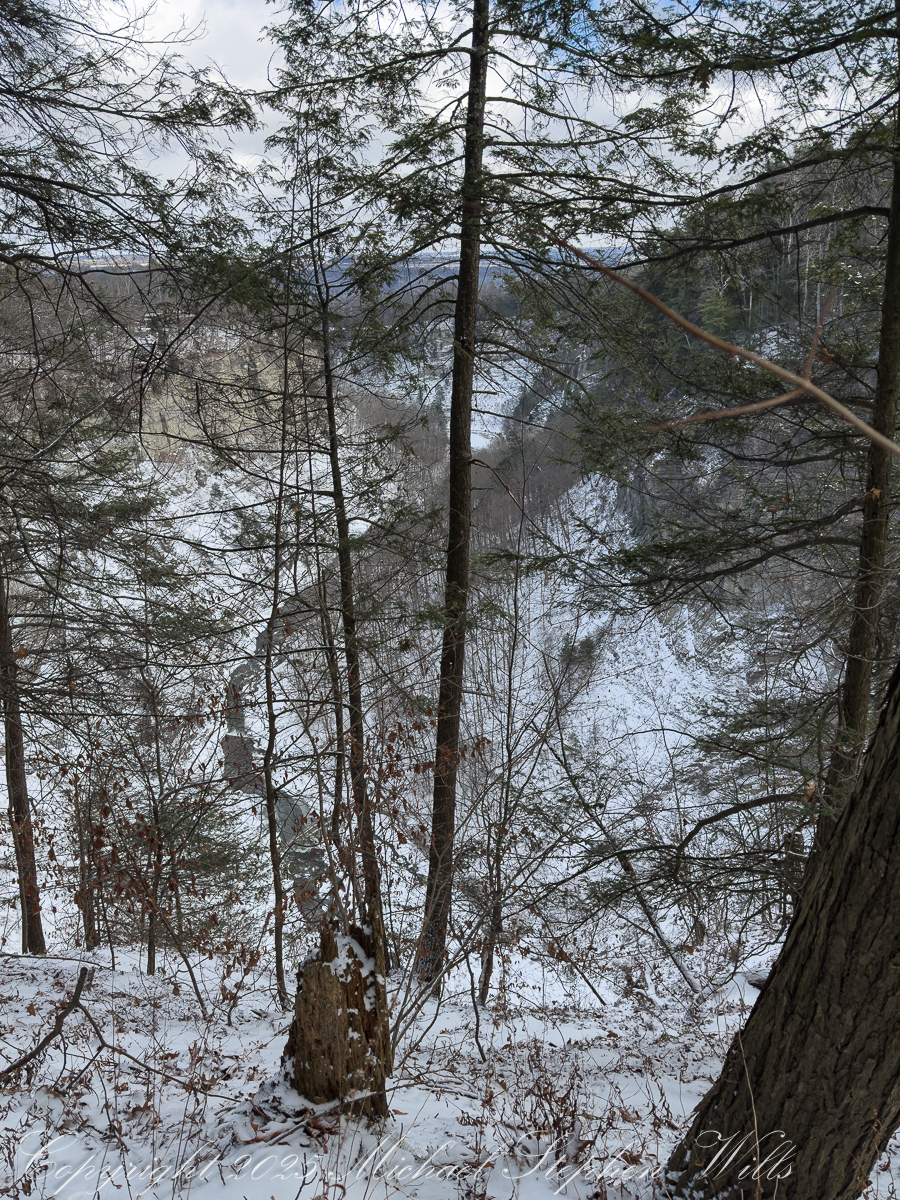
One of many Rim Trail overlooks. That is the Gorge Trail, below.
Rejoining the rim trail for the final climb north, the gorge offers repeated overlooks where the Gorge Trail can be seen threading below. These moments collapse distance: walker and walker, above and below, bound by the same route at different elevations. Over the course of roughly three miles and almost 600 feet of cumulative elevation change, effort becomes its own reward. Two hours pass not as measured time but as a sustained attentiveness, a gift winter offers to those willing to meet it on its terms.
Walking these trails in winter is about entering a conversation with the land—listening to ice, stone, water, and history speak in a quieter register. The joy lies in connection: trail to trail, gorge to road, past to present, and walker to place. In winter, Taughannock invites, gently and honestly, those who are willing to walk slowly enough to see.
A span of 10,000 years spreads between now and the first possibility of settlement on the island of Eire, then swept clean to bare rock by the weight of ice. Current scholarship of the Dún Aonghasa ruins, Inishmore, County Galway, the Irish Republic place a settlement within the inner of the four dry stone rings after 6,500 years (1,500 BC or 3,500 years ago). By way of scale, the first settlement took about 30 times the duration of the U.S. Constitution ratification through 2025: the last state, Rhode Island, ratified the Constitution 1789.
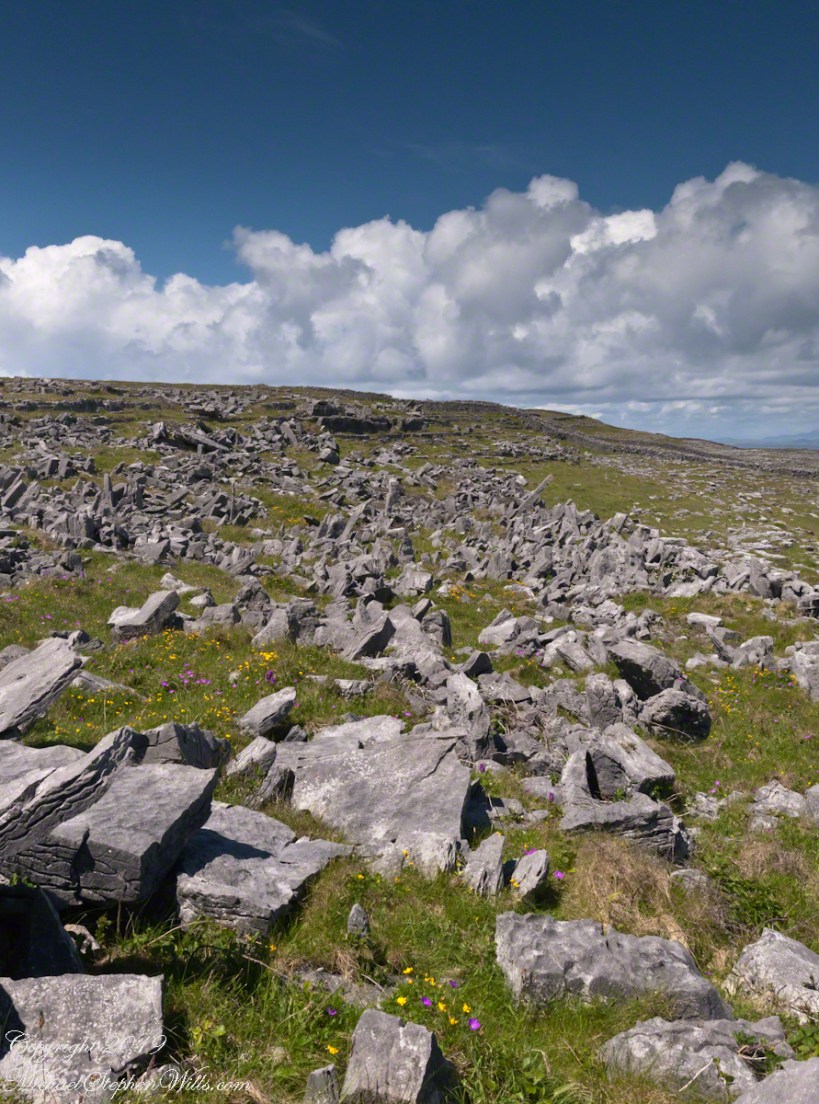
By 700 BC, 2,700 years ago, a series of upright, closely placed stones, were erected between the second and third rings called a cheval de fries field (“Frisian horses” in English) today, this defensive structure evokes the enormous scale of the struggles around this place of defense.
This is a portion of that field, I believe, taken as Pam and I approach the inner ring entrance, walking a wide path cleared of barriers. Click the photograph for a larger image with caption.
A contemplative walk along Monkey Run where Fall Creek writes the valley’s history—sycamores, bridges, and Devonian stone speaking across seasons in Cornell’s living classroom.
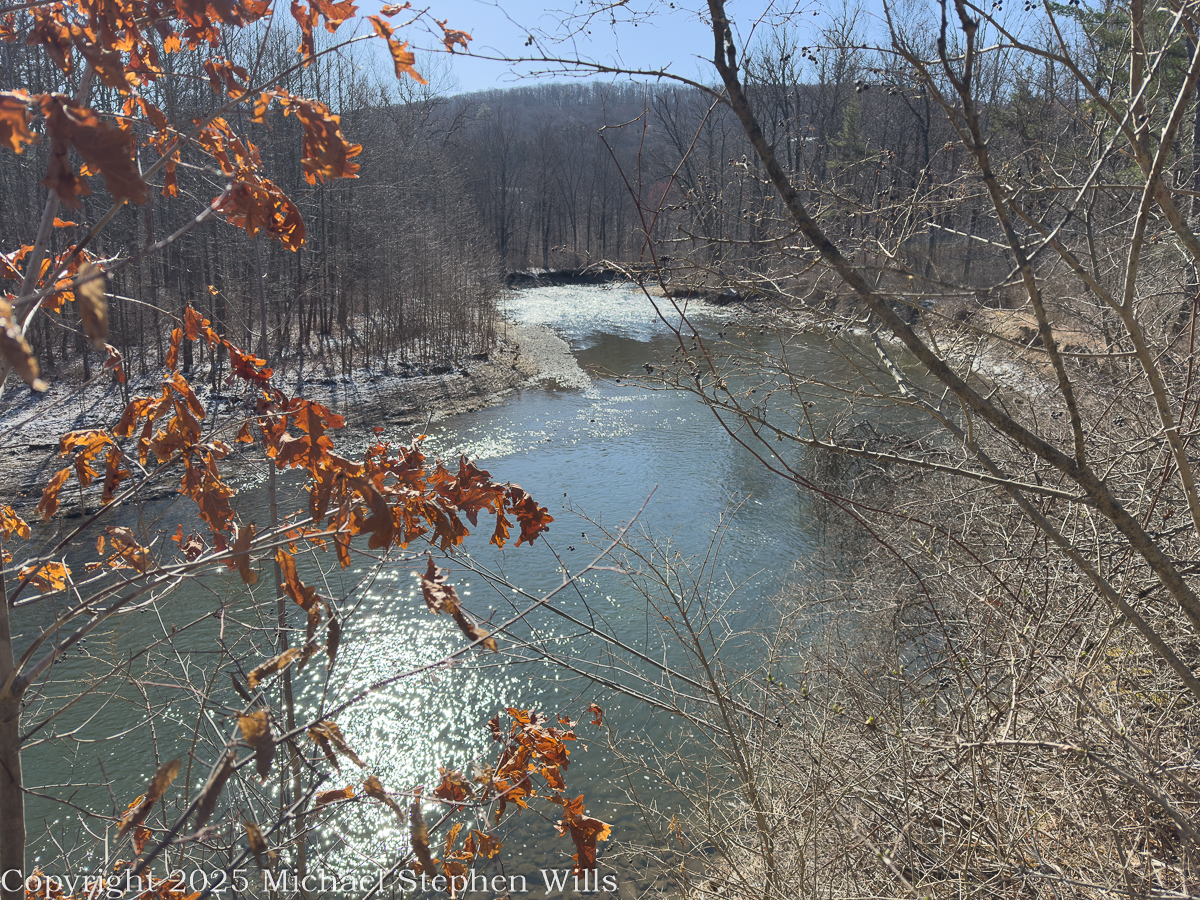
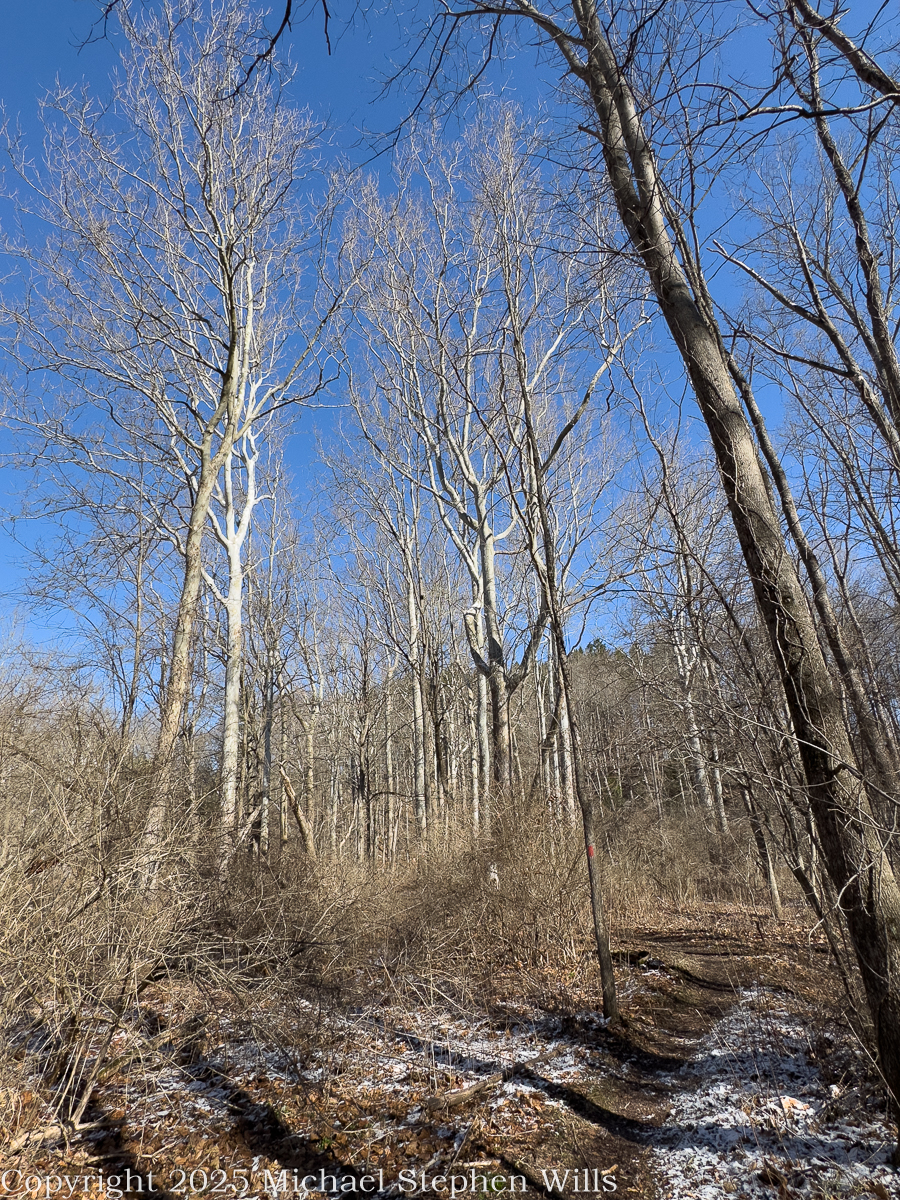
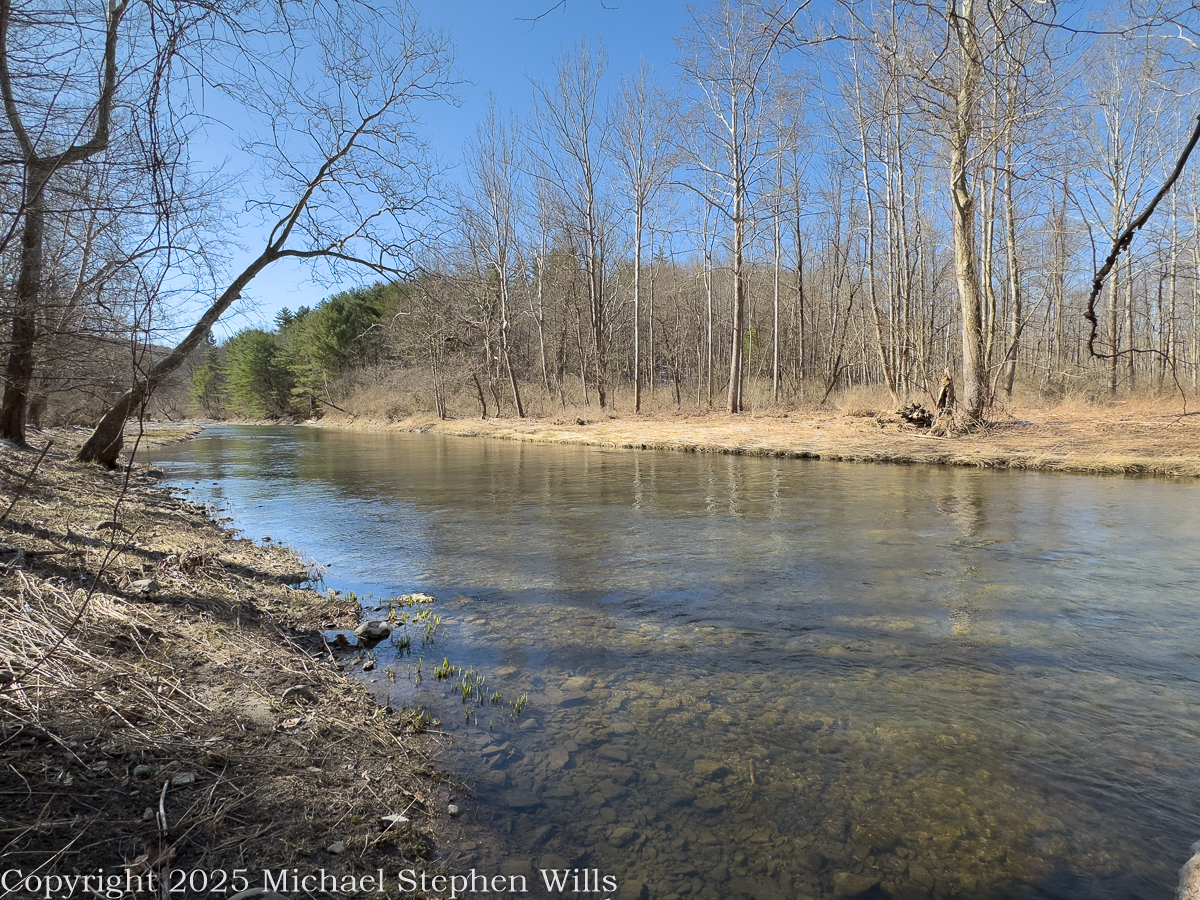
On a morning in late March, when the hills about Ithaca still hold the night’s frost in their shaded folds, I took the path called Monkey Run and went to see how Fall Creek spends its winter earnings. The air had the bright sting of thaw, a kind of vernal austerity that keeps a man honest in his steps. Along the high bank the sun spilled its coin onto the water, where it broke and flickered like a school of silver minnows. A rim of snow clung to the shale ledges, and the leaves of last year’s oaks—curled, fox-red, and faithful—whispered as if to keep the woods awake until spring fully claimed them.
Sunlit bend of Fall Creek viewed from a high bank at Monkey Run in early spring.
Monkey Run is one of the outlying parcels tended by Cornell Botanic Gardens—once called the Plantations, and now, more fittingly, named for the living charge it keeps. These gardens do not end at beds and borders; they encompass the wilder rooms of the county, more than a thousand hectares of glens, pastures, and ravines where the university’s first and oldest teacher—nature herself—still holds class. Fall Creek is one of her principal lecturers. Rising beyond the high country of Cayuga Heights and slipping under stone and snow, it shoulders its way across the campus, idles a while in Beebe Lake, and turns turbines of memory at Triphammer Falls before shouldering on toward the lake that receives nearly everything here—Cayuga—long, deep, and glacial in its thinking.
Tall white-barked sycamores leafless against a blue March sky at Monkey Run.
If you would learn a valley’s mind, walk a meander. The creek here composes with easy cursive, laying down a bar of gravel, nibbling at a bank of clay, then sweeping back to consider its work from the opposite shore. The geologist says the rock is Devonian, pages laid flat and damp with time, and the ice of ten thousand winters ago scoured them into the open. A creek is a patient mason, working without rest and never in anger. I admired these sycamores—their clean bones shining through the leafless canopy like the ribs of an old cathedral. Winter reveals their whiteness; summer grants them shade. A stand of white pines keeps a dark counsel in the background; on the muddy edge, green tongues of skunk cabbage push up, pledges made by the swamp to keep faith with the sun.
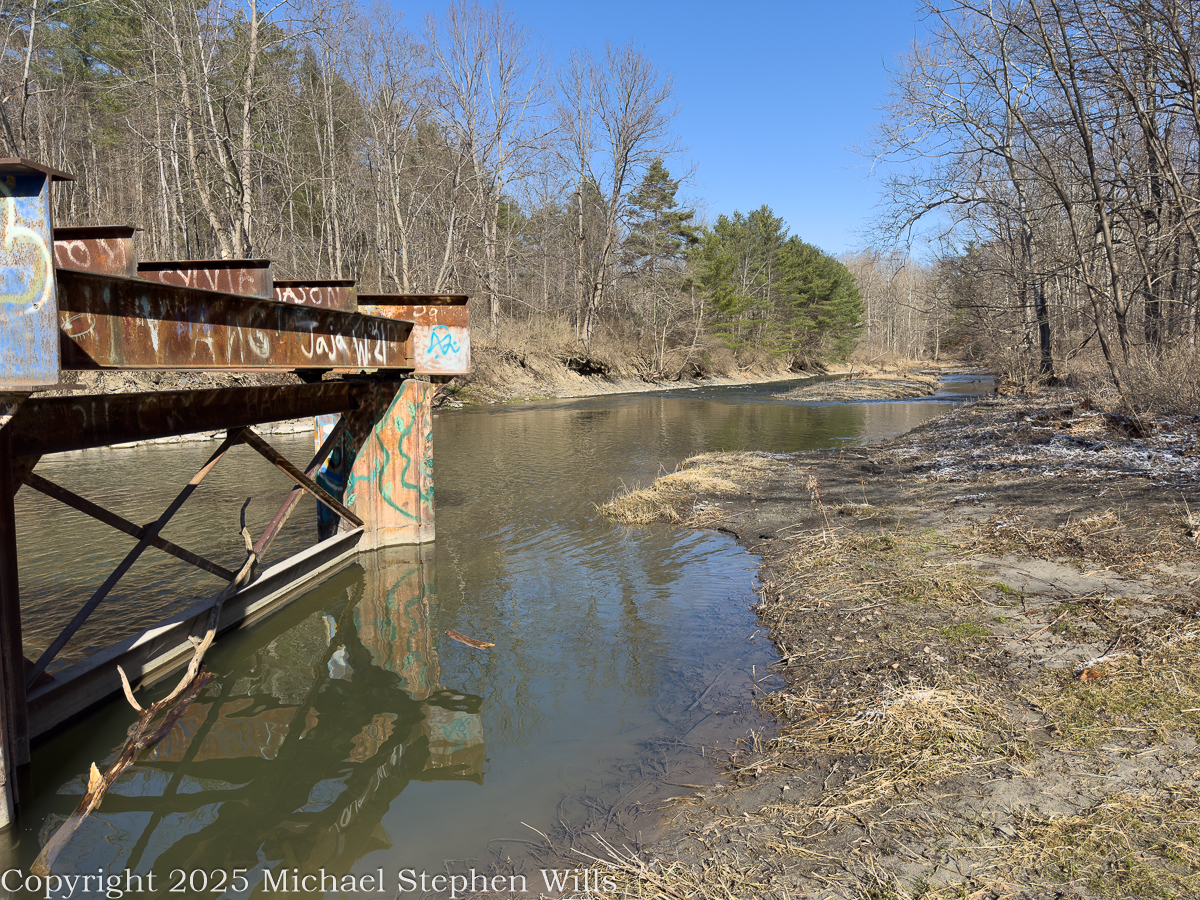
Rust-stained steel pier above calm water on Fall Creek along Monkey Run trail
I came down to the water near an old steel pier, a bridge remnant, hanging on each end without purpose. It wears graffiti the way a boulder wears lichen; human wishes, briefly rooted, coloring what they can. The river accepts it all, the pilings and the scribbles, the cast limb and the bottle’s glint, and continues its one unarguable gesture downstream. That is the old instruction of Fall Creek: use, refuse, endure. Before the university drew students from every quarter, the creek turned wheels and powered the small ambitions of a frontier town. Even the name Triphammer speaks of iron struck to purpose. Now the water powers something quieter: the studies of herons, the almanacs of kingfishers, the quick arithmetic of minnows over limestone.
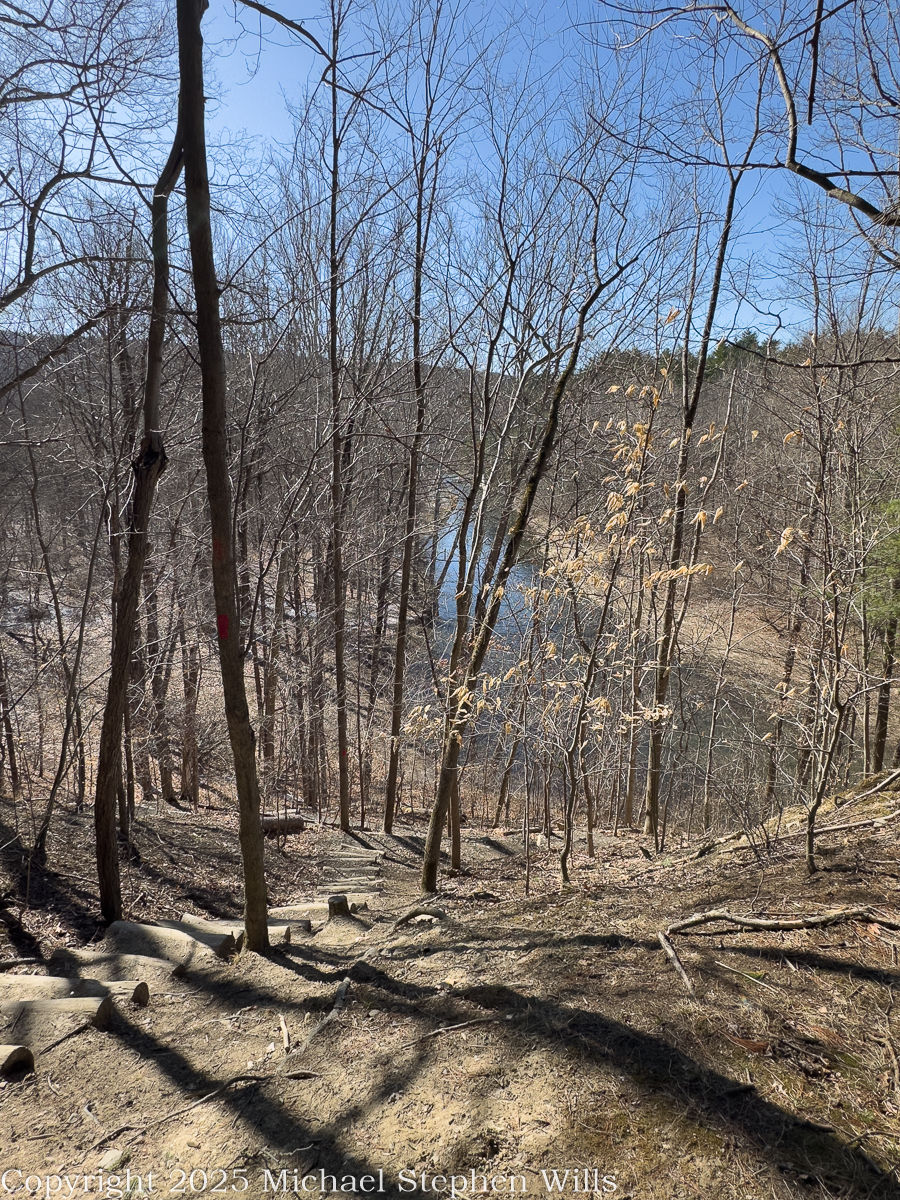
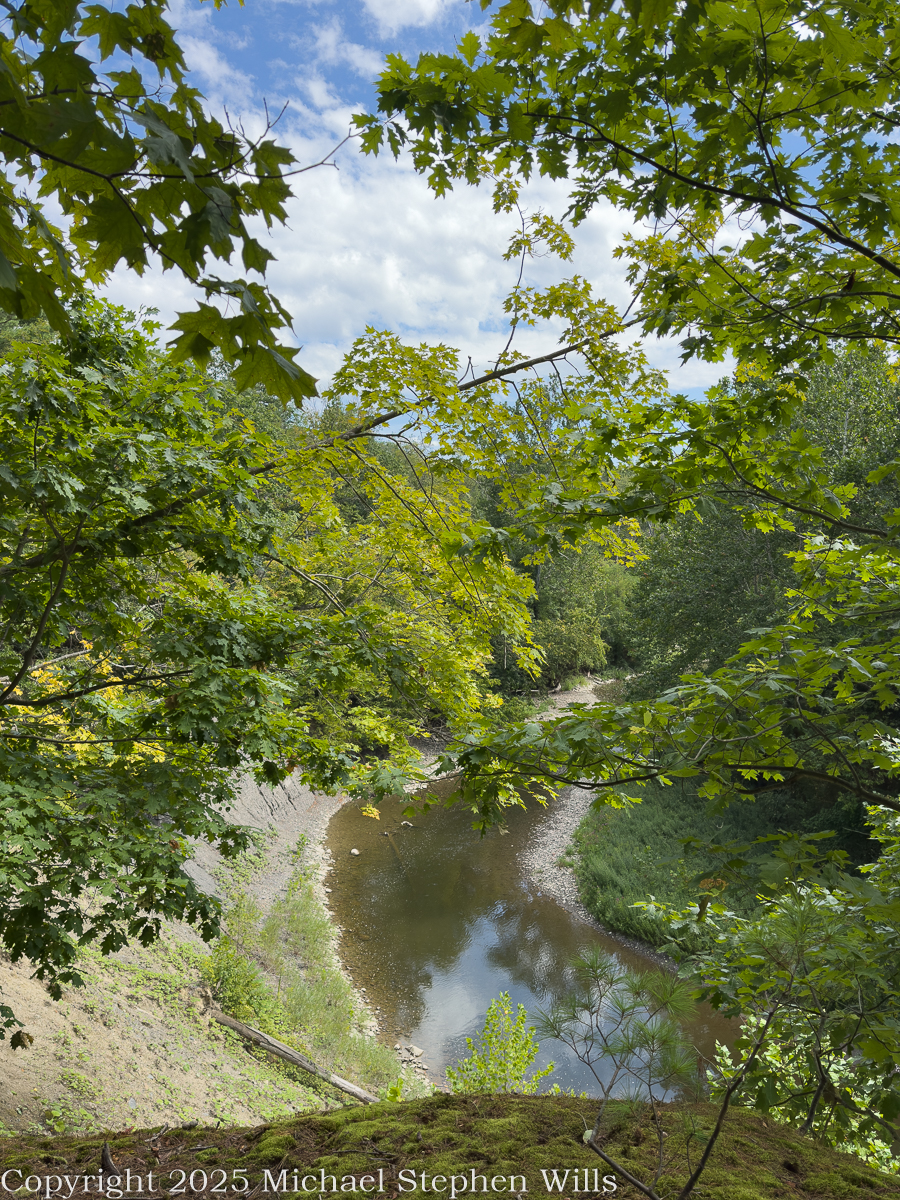
Looking back while climbing the steep bluff
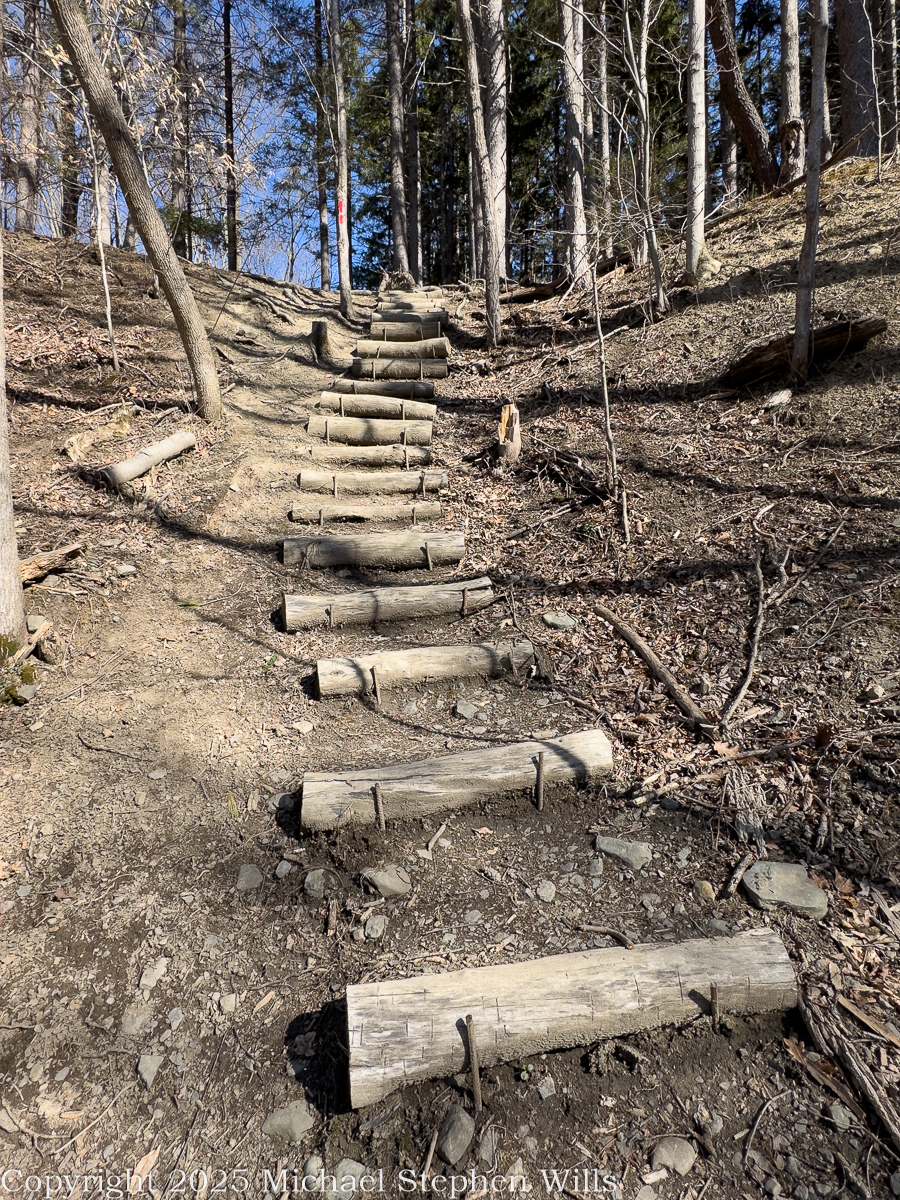
Steps cut from logs ascend the bluff, each tread pegged with iron, each rise a short confession of breath. I climbed to the ridge, paused halfway, and through the gray lace of March branches saw the creek shining at a bend far below. A man cannot help but measure his own life against such a course. The path goes up and down in obedient red blazes, but the water keeps its own counsel. Where the bank slumps the river shoulders through; where the bottom rises it lays down a mirror. In my youth I wanted the straight run, the short work. Now the curve pleases me. To go with the current and not be carried away—that is a lesson suitable to the grey in my beard.
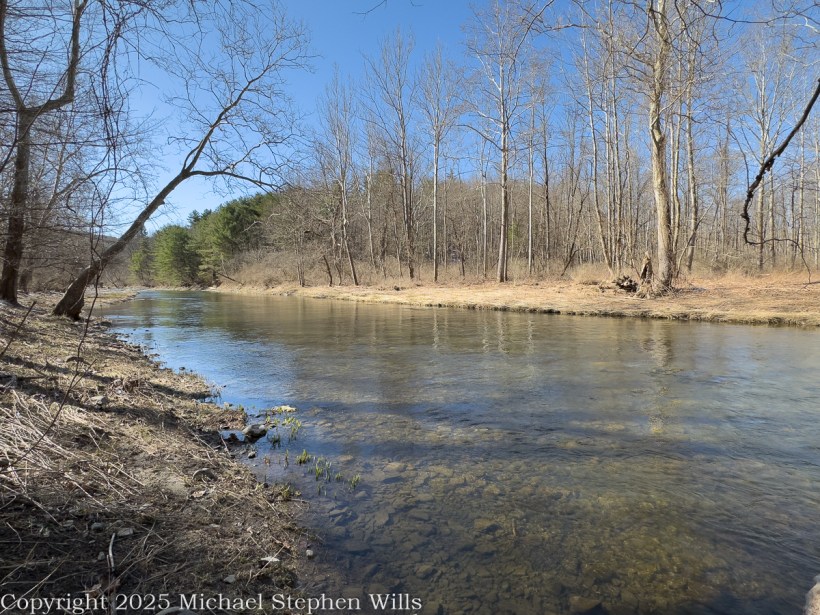
Clear, shallow run of Fall Creek with shale bottom and pine stand in distanceBluff overlooking Fall Creek in summer
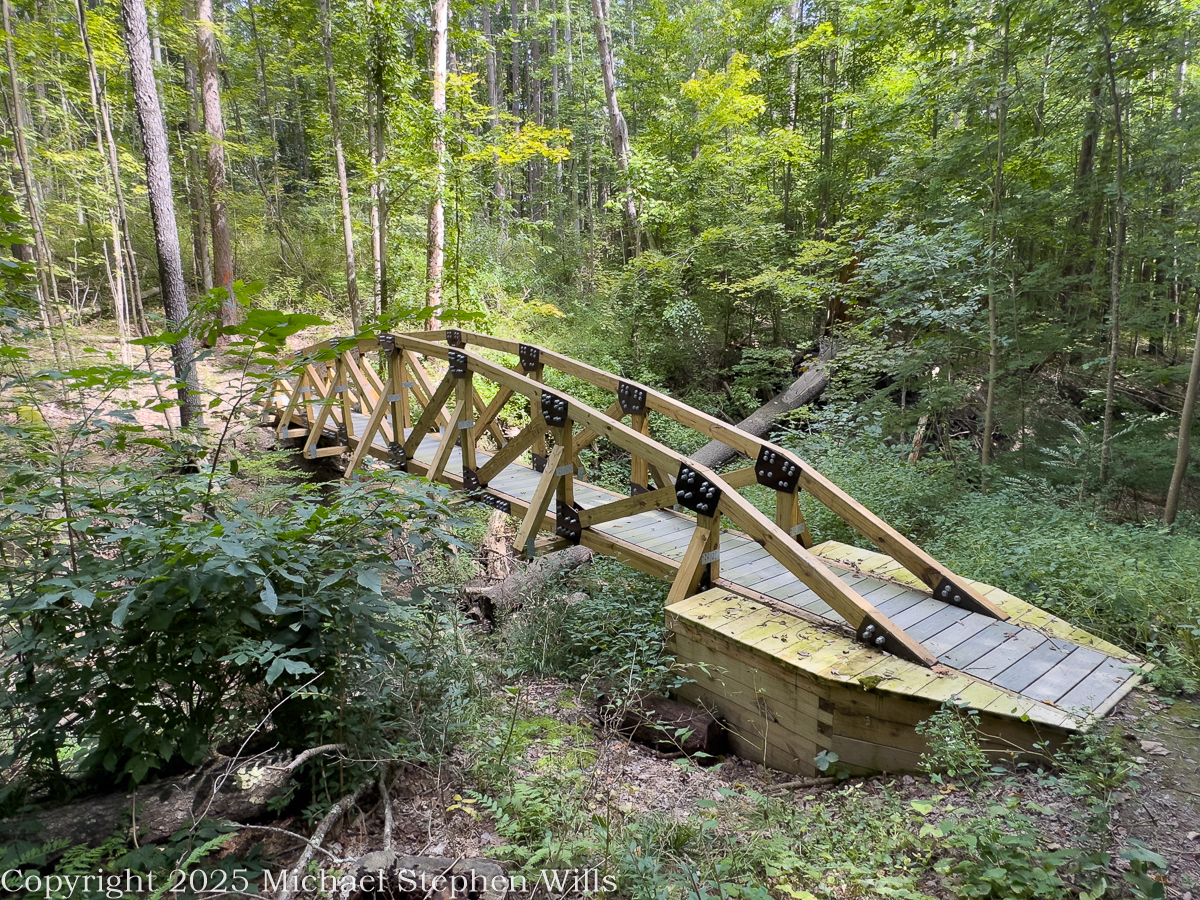
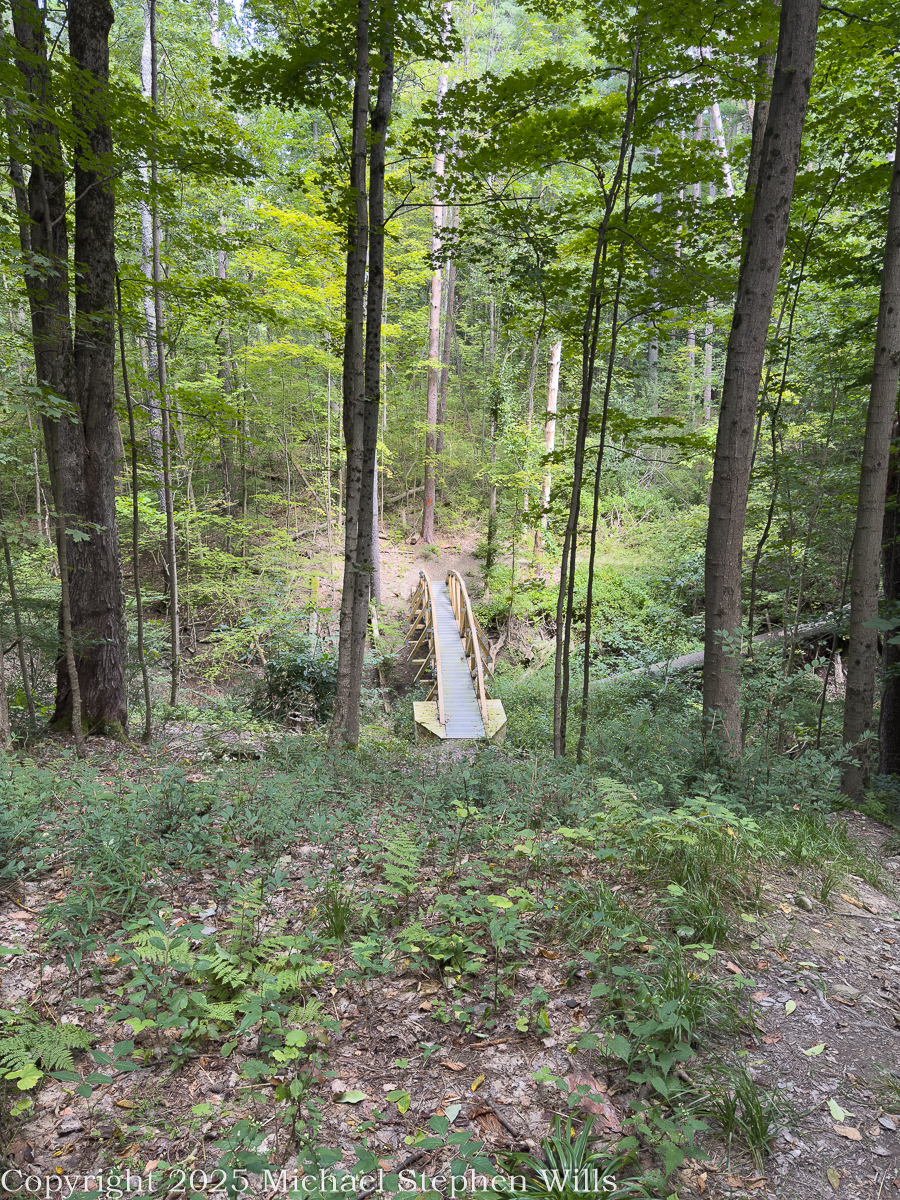
When I returned five months later, on August 23, the same path had forgotten the word austerity. The cathedral of sycamore was fully leafed, the white pillars now vanished behind a nave of shade. The pines perfumed the air without trying. A new footbridge—clean timber arching like a bent bow—spanned one of the wet flats. Its braces, black-bolted and handsome, looked as if they would hold the weight of an ox team or a file of schoolchildren. Such crossings are a kind of promise from the present to the future: we found a way through here; may you, too. Below, the floor was upholstered with moss, oak leaves, and a scatter of pinecones—the slow currency of the woods accumulating interest.
Arched wooden footbridge in summer forest on Cornell’s Monkey Run trail.
Summer makes a confidant of every plant. Ferns unrolled their scripture at the bridge abutment; jewelweed held its tiny lanterns along the seeps; a kingfisher rattled downstream, blue lightning with a bill. The creek, glassy over its shale pavement, showed every wrinkle of its stride. I waded a little, feeling with the sole what the eye could not—where the current took an extra thought around a stone, where it forgot itself in a warm eddy. Trout lingered in the dimmer reaches, quick as commas; a great blue heron lifted off with that surprising tidiness of wing, ungainly only in our imagination.
In all seasons the trail carries two histories: one written in rock and water, the other in the footfall of people. Cornell’s founders, Ezra and Andrew White, believed the university should place the hand near the thing studied; here that principle is plain. Botany students take their lectures in leaf and bark; geologists read the creek banks as if the pages might soon turn by themselves; children learn the oldest calculus—how long a stick will float before it catches in the weeds. The caretakers from the Botanic Gardens mark, mend, and interpret, but they do not overtalk. The woods speak enough.
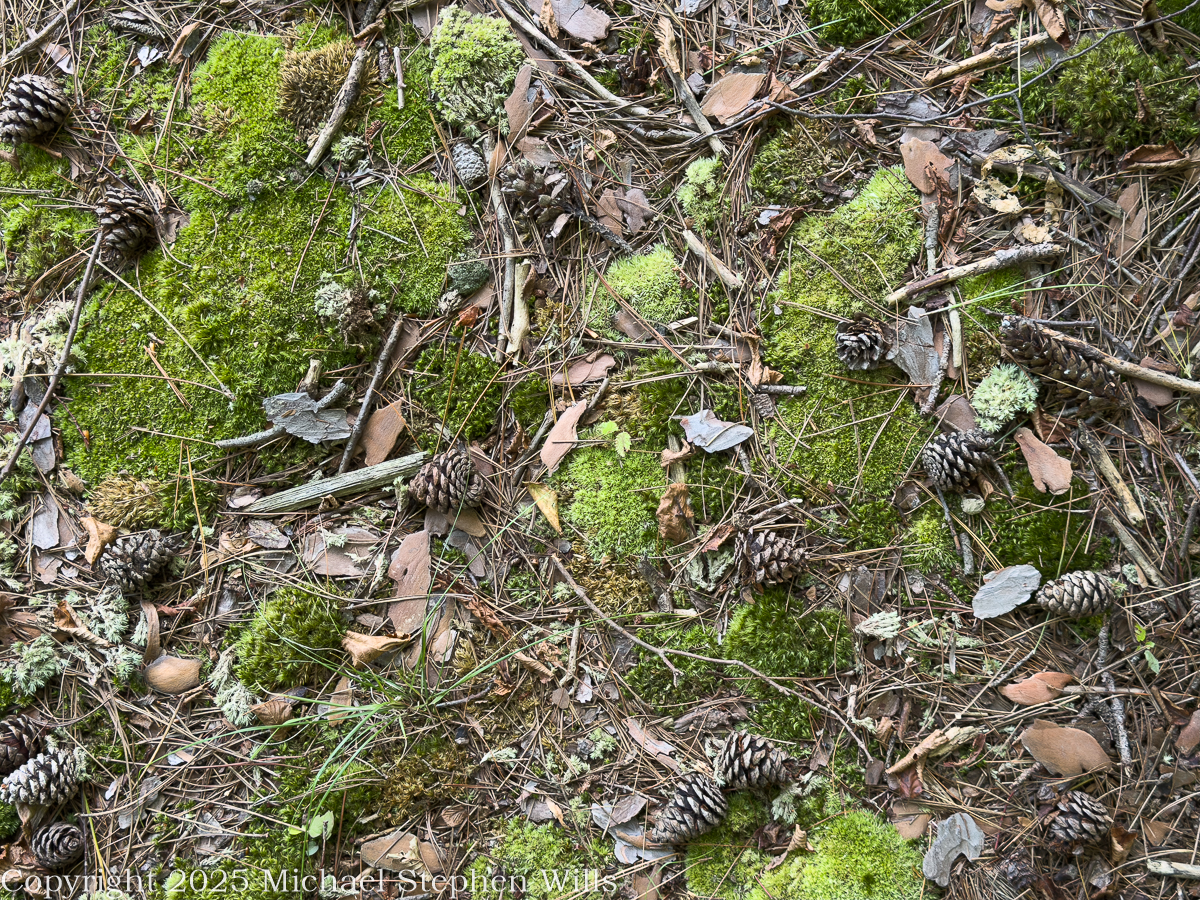
Moss, grass and pinecones on an overlook of Fall Creek
As the afternoon eased toward evening, I climbed once more to the bluff. The light had gone honey-colored and the leaves of the maples, those careful accountants of September, were just beginning to weigh their green against gold. I looked down on the bend where I’d stood in March—cold, bright, expectant—and felt the year’s circle gently close. As John Burroughs wrote, “The power to see straight is the rarest of gifts… to be able to detach yourself and see the thing as it actually is, uncolored or unmodified by your own… prepossessions… that is to be an observer and to read the book of nature aright.” Monkey Run obliges that humility. The creek moves as it always has—glacially taught, mill-forged, campus-wise, and freedom-loving—and the trail, with its modest stairs and honest bridges, invites us to walk beside it, to match our breath to its turnings, and to leave, if we can, a lighter trace than we found.
References
Ways of Nature (1905), “Reading the Book of Nature,” pp. 275–276 (The Writings of John Burroughs, Riverside ed., vol. XIV, Houghton Mifflin)
Enter your email to receive notification of future postings. I will not sell or share your email address.
Copyright 2025 All Rights Reserved Michael Stephen Wills
Morning clouds hang over Dryden Lake as hills kindle first color; reflections hold breath while a lone walker reads the valley’s glacial and human-written past.
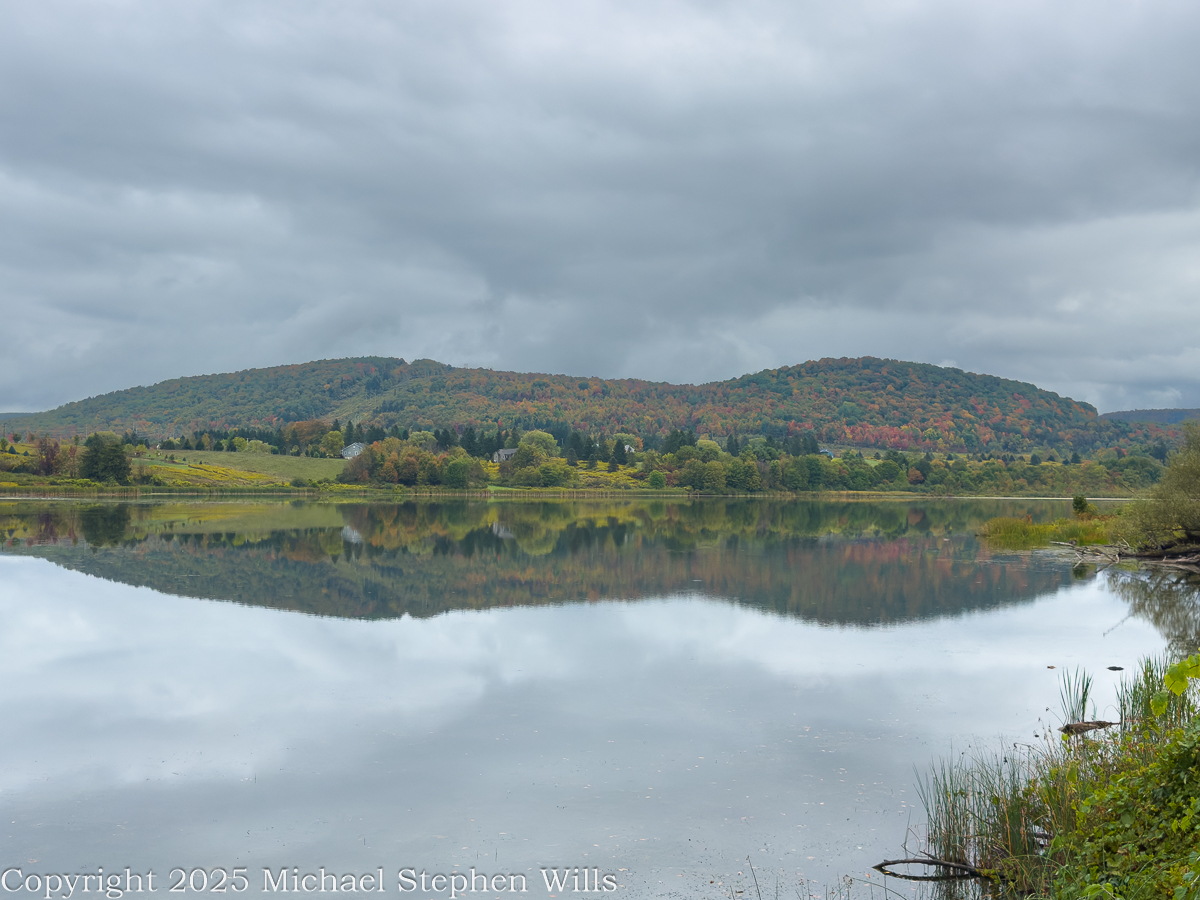
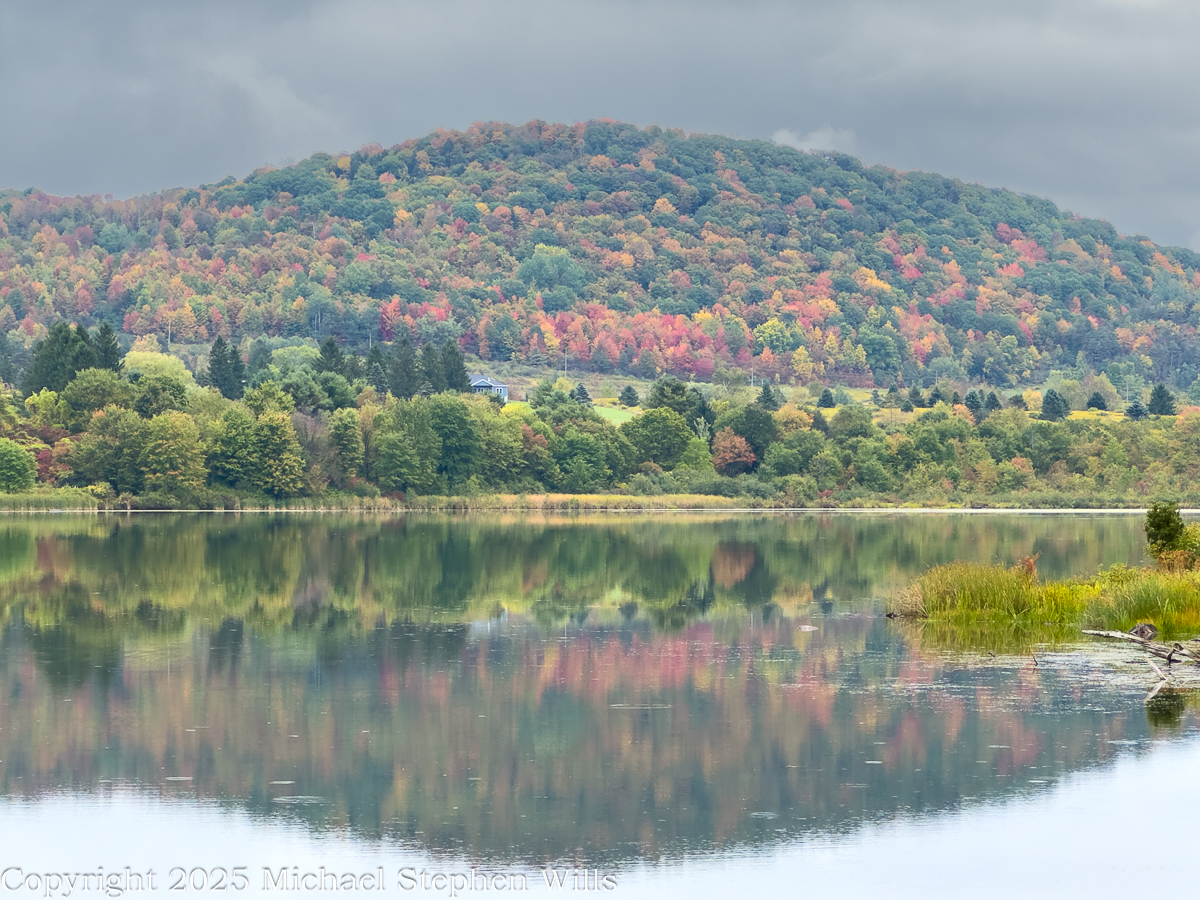
He came to the water before the people woke, the road a still ribbon of cold tar snaking beneath the low hills. Mattocks of cloud hung over the valley and the lake took in the sky like a mirror dropped yet not broken. The trees were beginning to color. A patient fire working from within the leaves. He parked where the grass ran down to the shore and stood a long while without moving. Birds made small sounds in the reeds. Somewhere a single truck labored up the grade and was gone. The surface held the hills with a steadiness the hills themselves could not keep. He thought how the quiet of a place can be the loudest thing it owns.
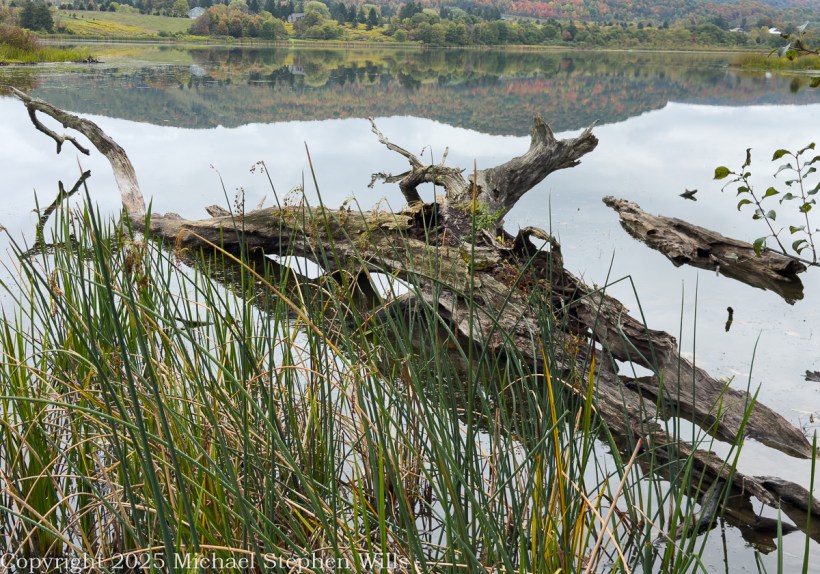
He went along the margin along the damp sedges where old drift lay silvered and light as bones. A drowned trunk angled from the shallows. The lake was old in the way of things made by ice and time. A kettle in the outwash of the last glacier, some men said, a bowl left when the buried ice eased away. He pictured the ice receding into the valley heads, the meltwaters choked with gravel, a hand larger than memory scribing the floor of this country. The earth never told it plain but the lay of it was witness enough. Across later centuries men cribbed a dam across the outlet and drew the water to a shape that pleased them and served their work.
A trail ran the length of the water on the old rail bed. The ties were long gone and the iron and cinders buried under years of leaf fall and gravel. He had walked it as a boy beside his father and now he walked it alone. Benches stood at half-mile intervals like waystations in a country of small pilgrimages. The signs told what once was here and what remains. They had renamed the path for a townman who argued it into being after the railroad had passed from the world and the right-of-way grew up with sumac and rumor. It was an easy trail and he carried nothing. His hands hung at his sides as if the day might place something in them when it was ready.
In another era the lake was a workshop. Men whipsawed timber in the wet air and fed small mills with the grove’s dark boards. Winter flowed over the flats, and they built icehouses and set the blocks within like blue stone, an industry that died when cold could be called from a switch. The hills have learned to forget the noise of it, though on certain mornings the fog takes a shape and you could believe rising from the ponded sawdust and the lading of sleds. He thought of the labor of those gone hands and of how work is a scripture every place keeps in its own tongue.
Before any of that, the ground here was a summer camp. People came with the season and went with it, laying their fires in the lee of the knoll and taking fish where the cattails thin. He could feel them in the open places, not as ghosts but as the first understanding the land ever had of itself. The words used for them now are museum words, yet the wind still crosses the water as it did and empties the same smell of iron and leaf into the lungs of whoever stands to breathe.
The town took its name from a poet long dead, a scholar’s choosing in the years after the war for independence when this tract of country was parceled out to soldiers of that same war. Virgil lay to the east as if they were shelving Latin across a map. The creek that bears that name threads the villages and finds Fall Creek at Freeville, and the combined waters go their own slow way toward Cayuga where the glacial hand scooped deeper yet. He said these names under his breath and they tasted of chalk and river stone.
A kingfisher rattled across the cove. The fish rose in rings that spread and vanished like time seen from above. Out on the water an old man pushed a skiff with an electric motor that hummed like a trapped bee, for the lake allows no gas engines now. The wildlife area ran around the shore in a ragged collar of field and wetland and alder, near two hundred acres under the state’s keeping, and the lake itself a little over a hundred. He watched the man aim for the lily line and thought how rules arise from the wish that a thing endure, though nothing does. Still we make the rules and we keep them as if the earth were listening.
Wind came down the slope with a smell of rain. He turned back and the hills lay again in the water, entire, and for a moment he could not tell which world had claim to the other. He thought of the rails pulled up and the mills gone to weeds and of the icehouses fallen into their own shadows and he thought of the people before all that and of the long winter pressing its thumb into the land and lifting it away. He thought of his father walking the rail bed beside him a lifetime ago and saying nothing. There are places where the past crowds close and will not be argued with. He stood until the first drops dimpled the surface and the reflection shattered and reformed. A train no longer runs here. The only sound was the soft percussion of rain on water and the slow turning of the earth beneath both. He put his hand to the damp trunk of a fallen tree and felt the grain and the coolness and the old patient labor of rot. Then he went up from the reeds, his pockets full of acorns, and out to the road where his truck waited and the day, austere and sufficient, came along with him.
Colored lights of our skies are lifelong triggers for the imagination. On any moonless, crystal night—far from the town-glow—three thousand or so stars and the wandering planets scatter across the dark. We read them instinctively, stitching patterns the way our ancestors did, turning a brilliant chaos into stories. Along the ecliptic, twelve of those patterns became the constellations, a starry calendar by which careful observers told the seasons. When Cancer, the Crab rides high, winter has the northern hemisphere in its grip
Click photograph for my OnLine Galleries. Clicking the other photographs in this post will yield a larger image.
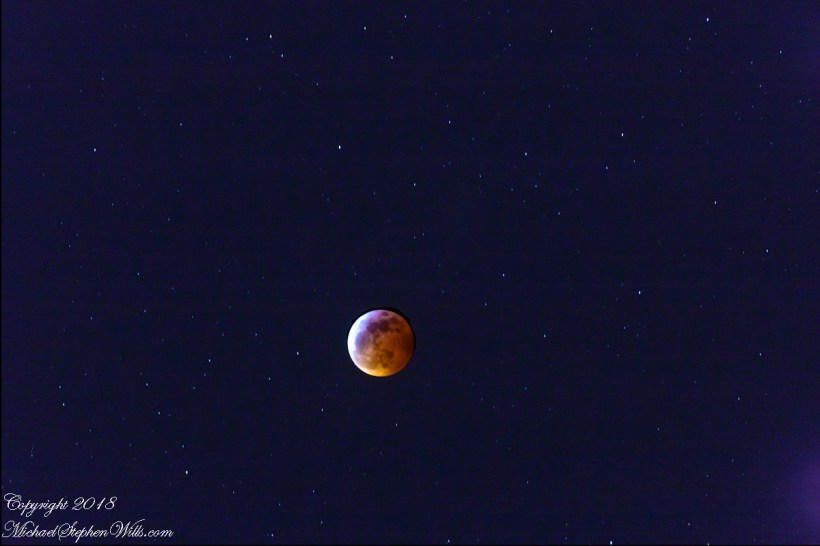
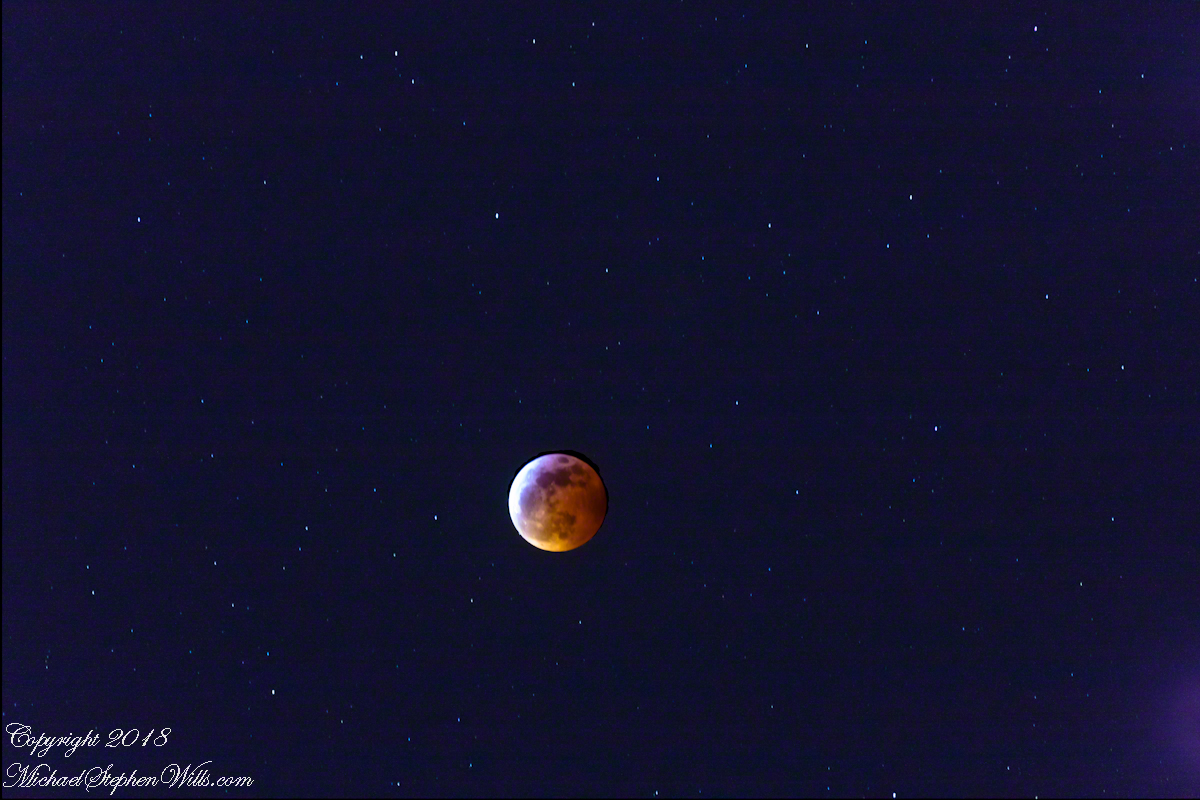
On the night of January 20–21, 2019, a full moon climbed from the horizon and slid into Earth’s shadow, transforming a familiar face into a copper coin. As it rose, that low-horizon “larger” moon—an illusion born of context—felt close enough to pocket. Hours later, the moon darkened to a dull copper color and appeared to float amid Cancer’s dim stars.
I set up a Canon DSLR on a tripod with a 24mm f/1.4 lens, pushed the ISO to 3200, and shortened the exposure to 1.3 seconds—a compromise between freezing star points and preserving the feel of the sky. The moon, of course, was overexposed in that wide frame; later, I overlaid a correctly exposed moon (from a telephoto shot later in the night) at its true apparent size to match the scene as the eye saw it. Is it the most “technical” astrophotograph of the eclipse? No. But it is faithful to the moment I witnessed and good enough to carry the story forward.
The Moon on the Crab’s back
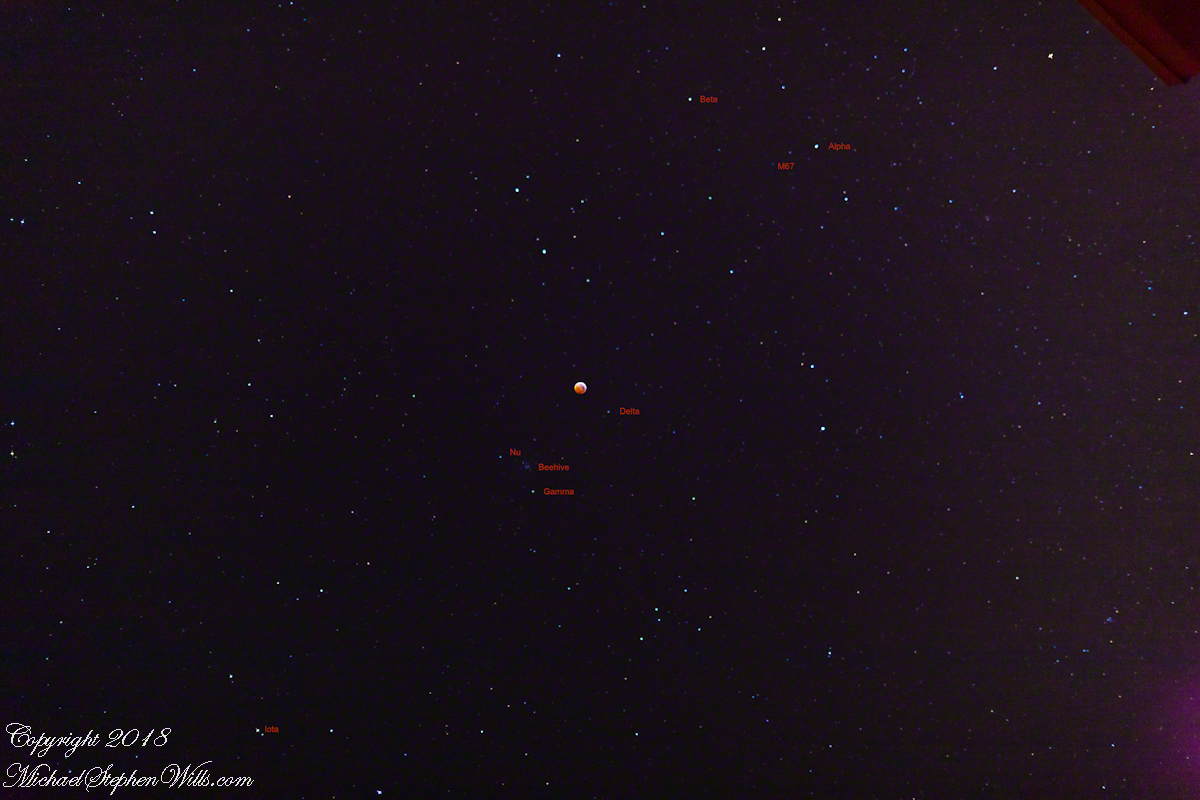
Cancer is never an easy connect-the-dots. Its stars are modest, more suggestion than signature. Look just to the side of the moon’s position that night and you come to Delta Cancri, the orange giant nicknamed the Southern Donkey. Draw a mental line down and slightly right to the faint pair Nu and Gamma Cancri—white stars that only masquerade as twins. They are not physically bound, merely near each other by line of sight: Nu about 390 light-years away, Gamma at 181. Scatter in Alpha and Beta off the Crab’s back and the outline becomes more plausible, the way a minimal sketch becomes a creature once the eye knows what to look for.
The Beehive
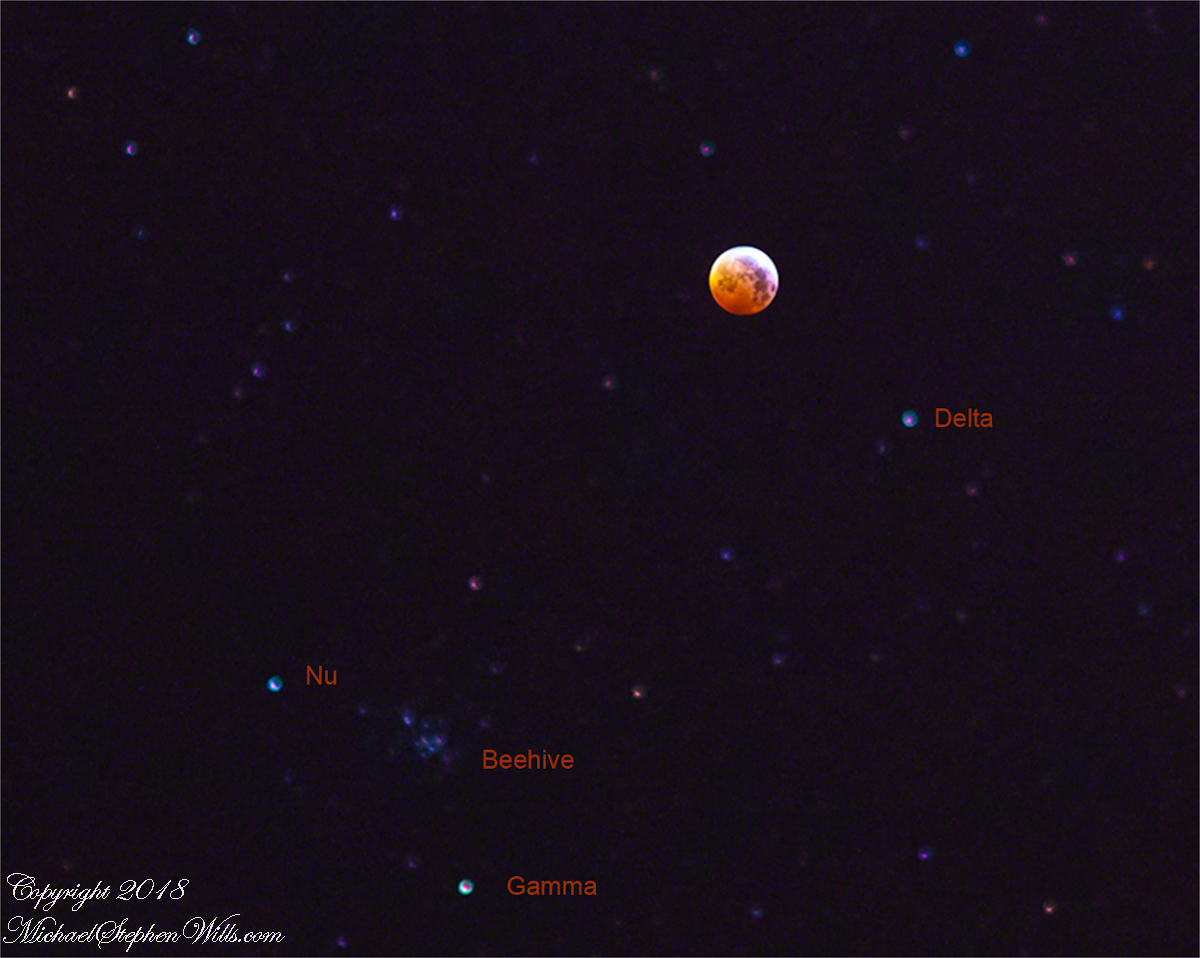
Between Nu and Gamma, edged closer to the moon, lies the real prize: the Beehive Cluster—also known as Praesepe or M44. Even with modest binoculars, Praesepe explodes into a field of delicate sparks, a thousand stars loosely wrapped into a hive. Galileo famously turned his early telescope on this cloud and teased forty separate points from the mist; modern optics reveal a populous neighborhood of stellar siblings in shades from ice-blue to ember-red. It is one of those sights that converts a casual sky-gazer into a repeat offender.
Total Lunar Eclipse and Surrounding Sky with labels for primary element of the Cancer constellation
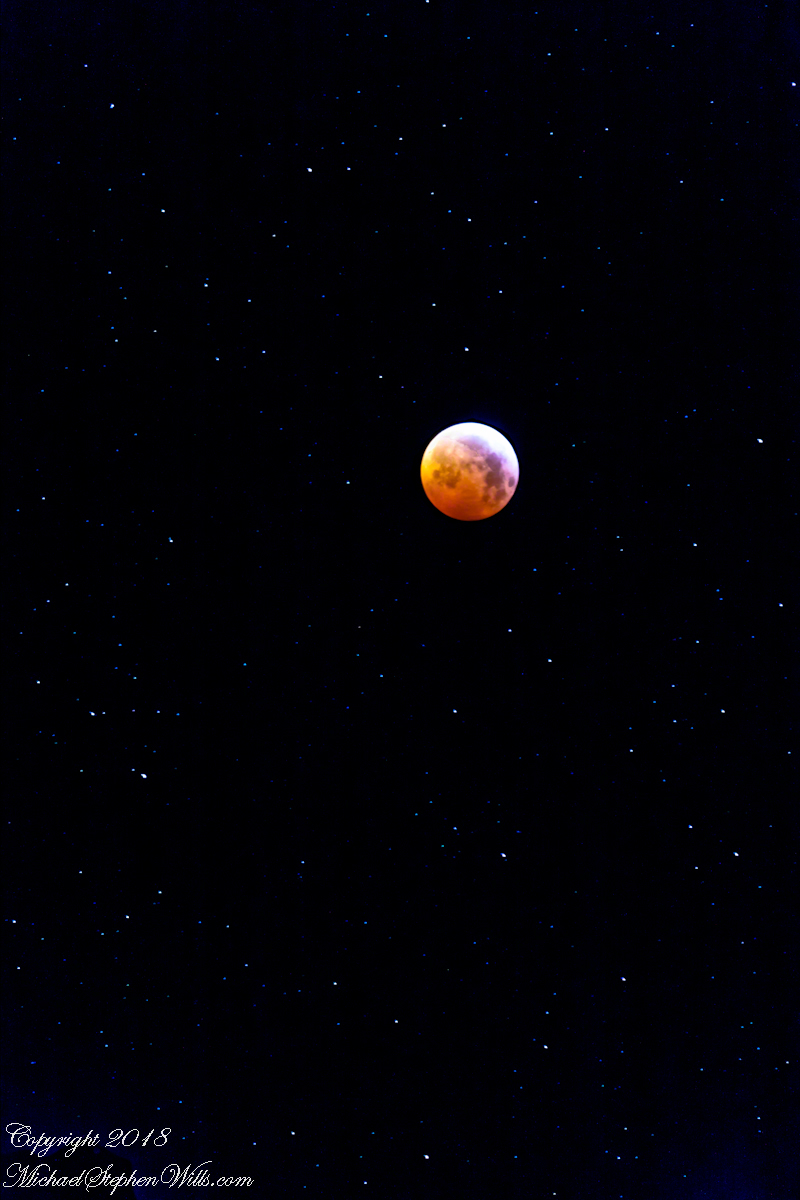
Later in the night I lifted the telephoto—70–300mm at 300mm, ISO 3200, 3.2 seconds—and let the moon fill more of the frame. At totality, the light thinned to a clay-jar red as Earth’s atmosphere bent sunlight around the planet and into its shadow. The effect is both simple and profound: every sunset on Earth happening at once, projected onto the moon’s face. Craters and maria softened into relief, and the globe stopped being a flat disk and became a round, ancient body again. Even without Delta, Gamma, Nu, and the Beehive in that tighter field, the sense of placement remained; I knew the Crab’s back was there in the dark, and that the moon had joined it—just for an hour—as a guest at the manger.
“Beehive” with Total Lunar Eclipse with labels for primary elements of Cancer Constellation
The Total Eclipse
What I love most about an eclipse is its pace. Nothing is impatient: the bite appears, the light drains, the color warms, and the world around you changes temperament. As the bright glare wanes, neighborhood sounds recalibrate—the hush between footfalls, the small click of a door, even the steadying breath you didn’t know you were holding. A total lunar eclipse is an astronomy lesson that behaves like a poem; it teaches by arranging time and light until awe and understanding meet.
And then, quietly, it returns what it borrowed. A thin wedge of white blooms at one edge, a rehearsal for dawn. Copper gives way to pearl, and the old moon looks new again, just higher and smaller against the deepening night. Cancer recedes into suggestion; Praesepe goes back to being a faint cloud to the unaided eye. The camera is packed away, the tripod shoulders its own shadow, and you keep the best exposure of the night where it can’t be corrupted: in memory.
If you have binoculars, mark Cancer on a winter chart and step outside when the sky is clear. Find Delta, sweep toward the dim pair of Nu and Gamma, and then rest your gaze on that hazy patch between them. Bring a friend into the circle and let the cluster resolve, star by star, into something alive with depth. It will not be the last time you look for it. And if you’re lucky enough, as we were that January, the moon will pass nearby, reminding you that even the most familiar companion can be made strange and beautiful by the turn of a shadow.
The sky is a storybook, yes—but also an instrument. Nights like this tune both.
Enter your email to receive notification of future postings. I will not sell or share your email address.
Copyright 2025 All Rights Reserved Michael Stephen Wills
At Ashford Castle, swans glide on the Cong River’s glassy waters, weaving together myth, history, and cinema in a timeless reflection of Ireland’s enduring spirit.
Headed south from Cong Village, past the venerable Cong Abbey then Saint Mary’s Church of Ireland, the road bends into the Ashford Castle estate. Time seems to shift here. The stonework of the abbey lingers in memory, only to give way to manicured parkland, ancient trees, and the shimmer of water. The road itself, aptly named Ashford Castle, carries the traveler to a place where history, nature, and imagination meet.
I do not recall passing a guard box on my first visit, though one now stands firmly on the roadside, manned and proper, as though the estate were never meant to be entered without ceremony. In truth, Ashford Castle has always carried the air of a threshold—between village and wild, past and present, myth and reality.
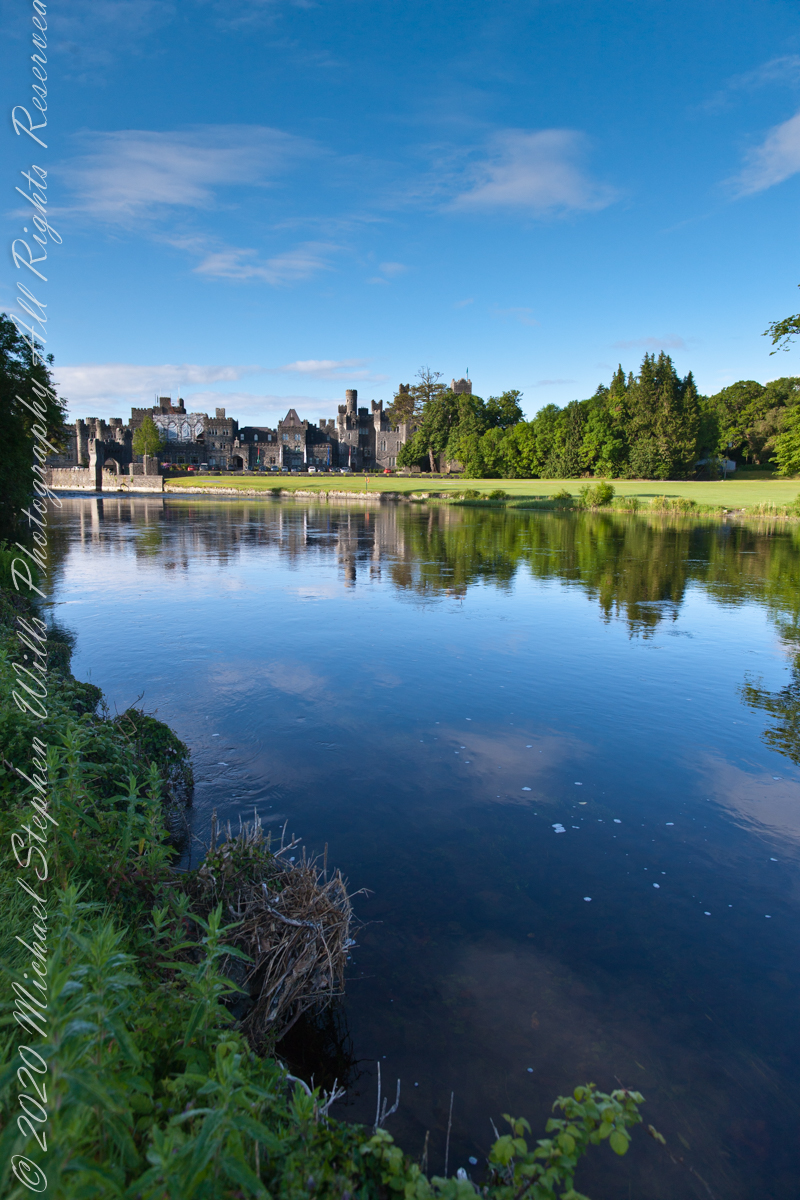
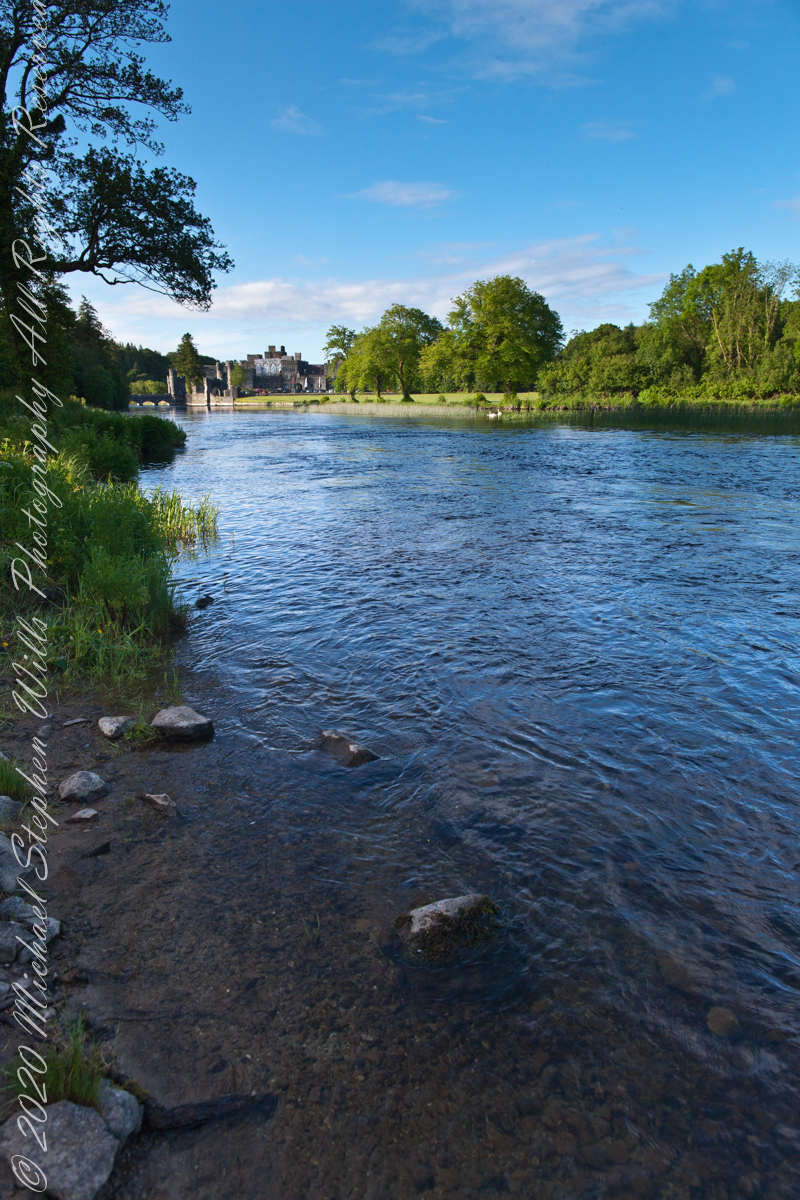
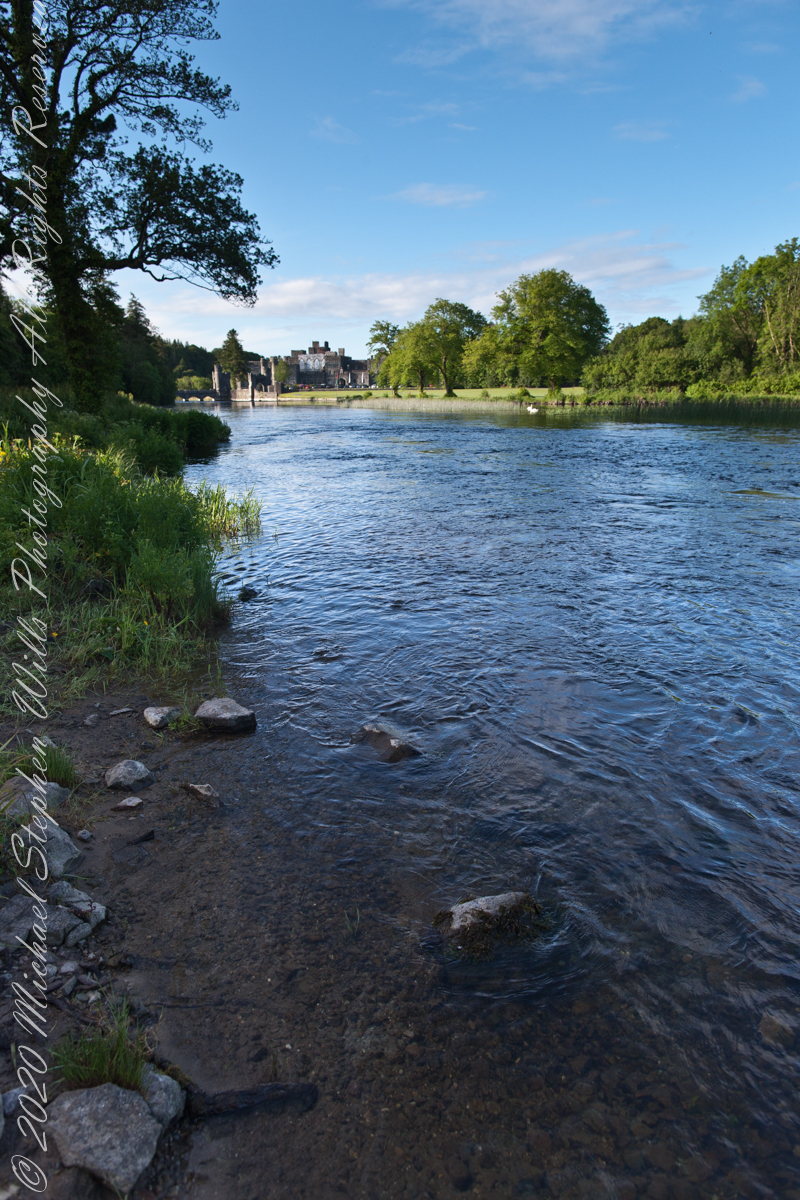
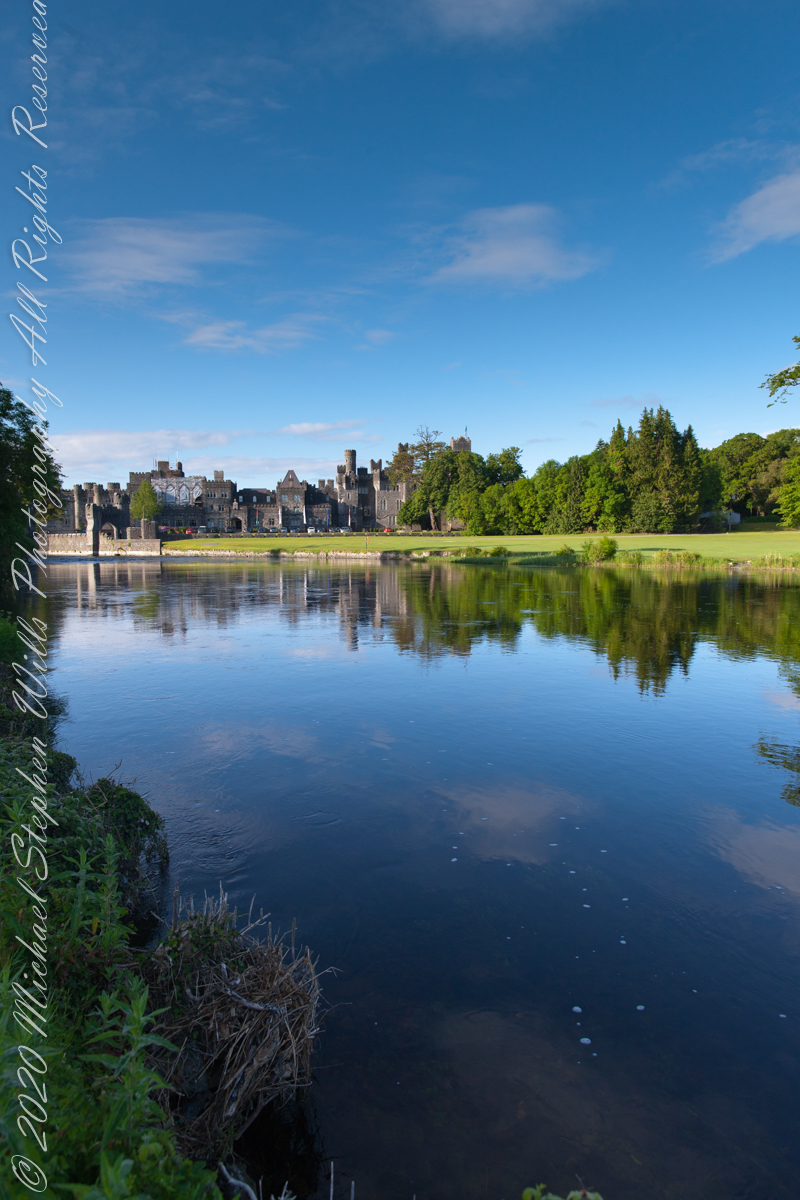
Soon the road brings one to the banks of the Cong River. Here the water widens, flowing calm and sure, and across it rises the battlemented silhouette of Ashford Castle itself. Its towers, turrets, and stony walls seem to grow from the riverbank like something inevitable, a fortress transformed into elegance. The castle’s mirrored reflection on the water doubles the grandeur, as though the real and imagined castle exist side by side.
It is no wonder filmmakers found inspiration here. Scenes from the classic 1952 film The Quiet Man—the tale of Sean Thornton, played by John Wayne, and the fiery Mary Kate Danaher, embodied by Maureen O’Hara—were shot on the far bank of this very river. To watch them walking by these waters is to see Ashford Castle woven into Hollywood’s Irish dreamscape, a backdrop both romantic and enduring.
Yet long before cinema, the river was already a stage. The Cong River is a natural marvel. It emerges from the same Carboniferous limestone that shapes the Burren of County Clare—an austere landscape of limestone pavements etched with fossils and caves, where rare alpine and Mediterranean plants thrive among ancient tombs. Through fissures in this ancient bedrock, the waters of Lough Mask find their way underground before rising again at Cong. This subterranean journey, through stone filters laid down some 350 million years ago, leaves the water clarified, luminous, and cold. By the time it slides past Ashford Castle, it has the purity of glass.
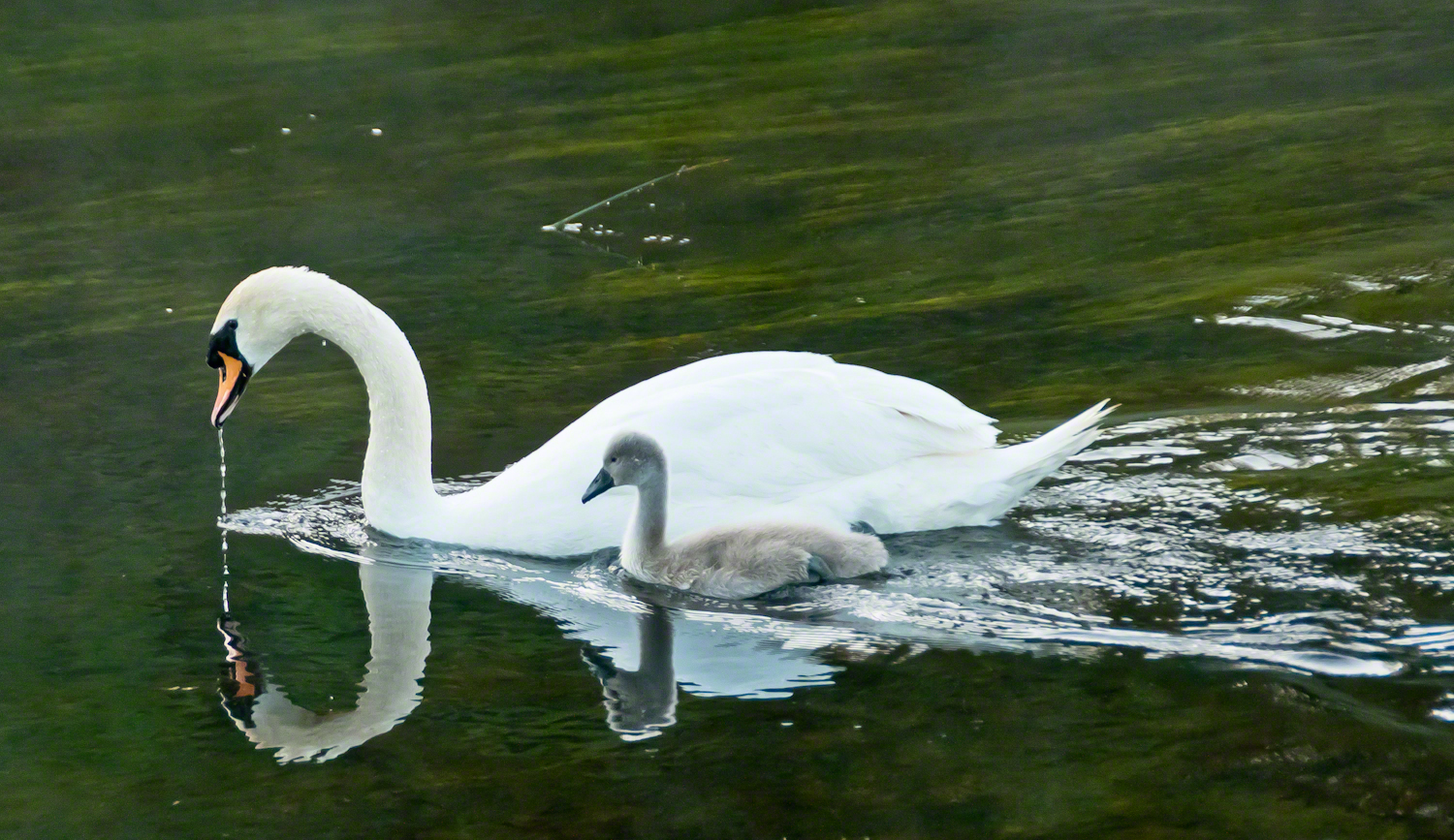
It is in this clarity while walking the opposite bank on a different morning I found a parent swan and its cygnet feeding. The adult glided, immaculate, its long neck bowed as drops of river fell from its beak. At its side, the cygnet paddled with earnest strokes, gray down still clinging, a fragile shadow of what it would one day become. Together they traced a quiet path across the water, ripples fanning behind them.
Few images so perfectly match their setting: a medieval castle, guardian of centuries, reflected in the same waters where these swans carried on their timeless rhythm of nurture and growth. It was as if the river itself composed the scene—a blending of stone, water, bird, and sky that belonged nowhere else but here.
The swan has long been a symbol in Irish lore. The Children of Lir, cursed to live as swans for nine hundred years, are among the most haunting figures of Celtic mythology. To see the white bird with its offspring before Ashford Castle was to glimpse that myth breathing still, alive on the Cong River.
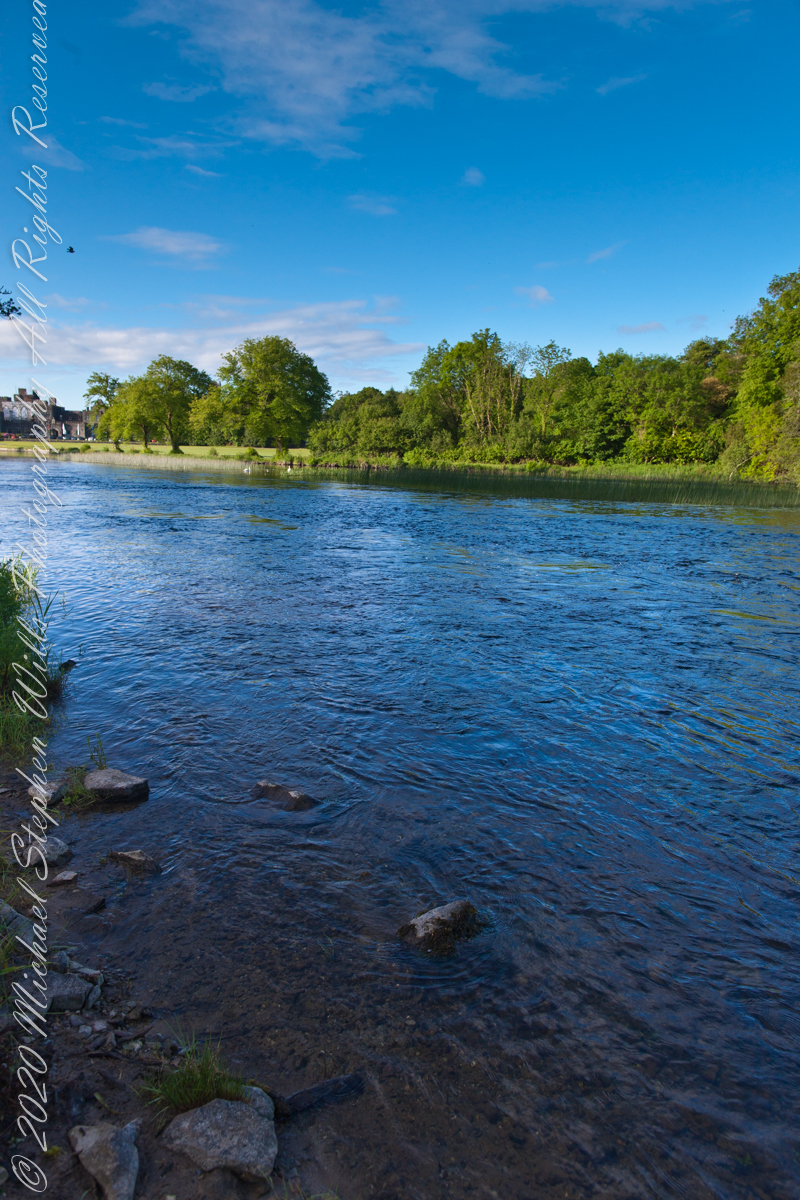
Photographers know the difficulty of capturing water and stone without losing the life between them. On that morning, however, the river gave freely—its surface alternately smooth as glass and dappled with breeze. Stones at the water’s edge appeared like stepping-stones into history. Each frame revealed another face of the estate: the wide reach of the Cong, the castle framed by trees, the play of cloud shadows across the current.
The castle itself, though reshaped as a luxury retreat, still speaks of older times. Founded in the 13th century by the Anglo-Normans, Ashford passed through centuries of conquest and change before becoming, in the 19th century, a romantic Victorian pile. Today its battlements remain picturesque rather than defensive, but the sense of continuity—of lives unfolding along these banks—has not faded.
Standing there, camera in hand, I was struck by the layered meaning of this place. The Cong River flows from unseen caverns, purified by limestone older than memory. It nourishes swans, reeds, and trout alike. It reflects both a castle and a sky. Along its opposite bank, legends of cinema and Celtic lore alike find footing.
As the swan and cygnet drifted slowly downstream, I thought of them as part of the same enduring thread. Parent and child mirrored castle and village, past and future, permanence and change. The ripples they left widened until they touched both banks, an unbroken gesture across centuries.
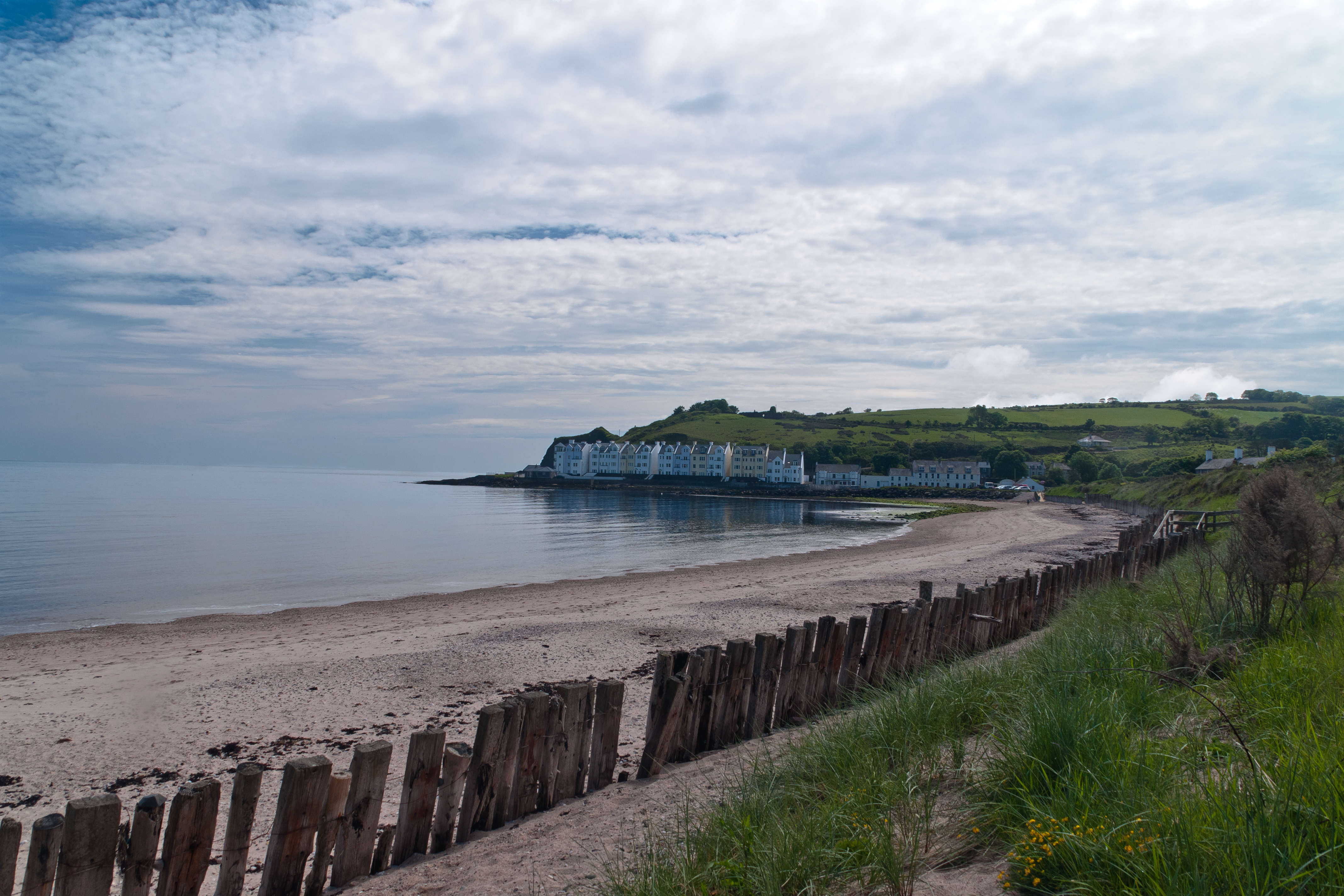
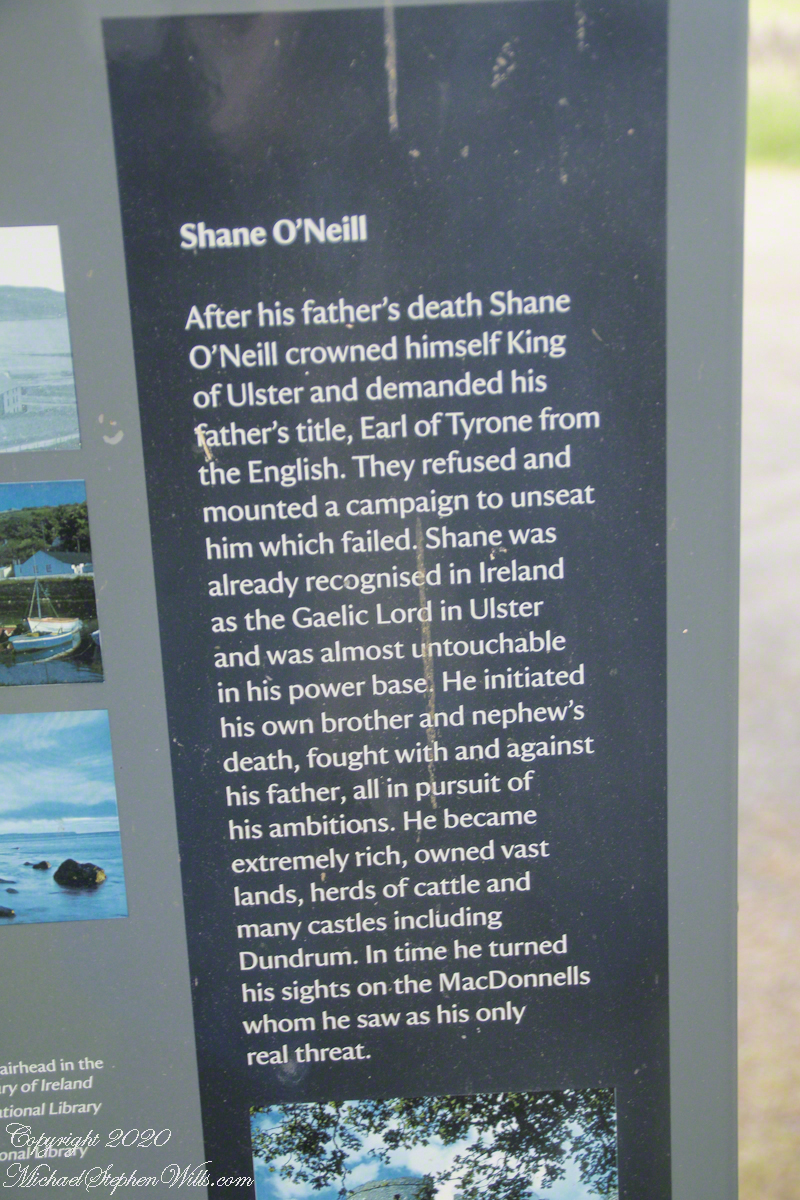
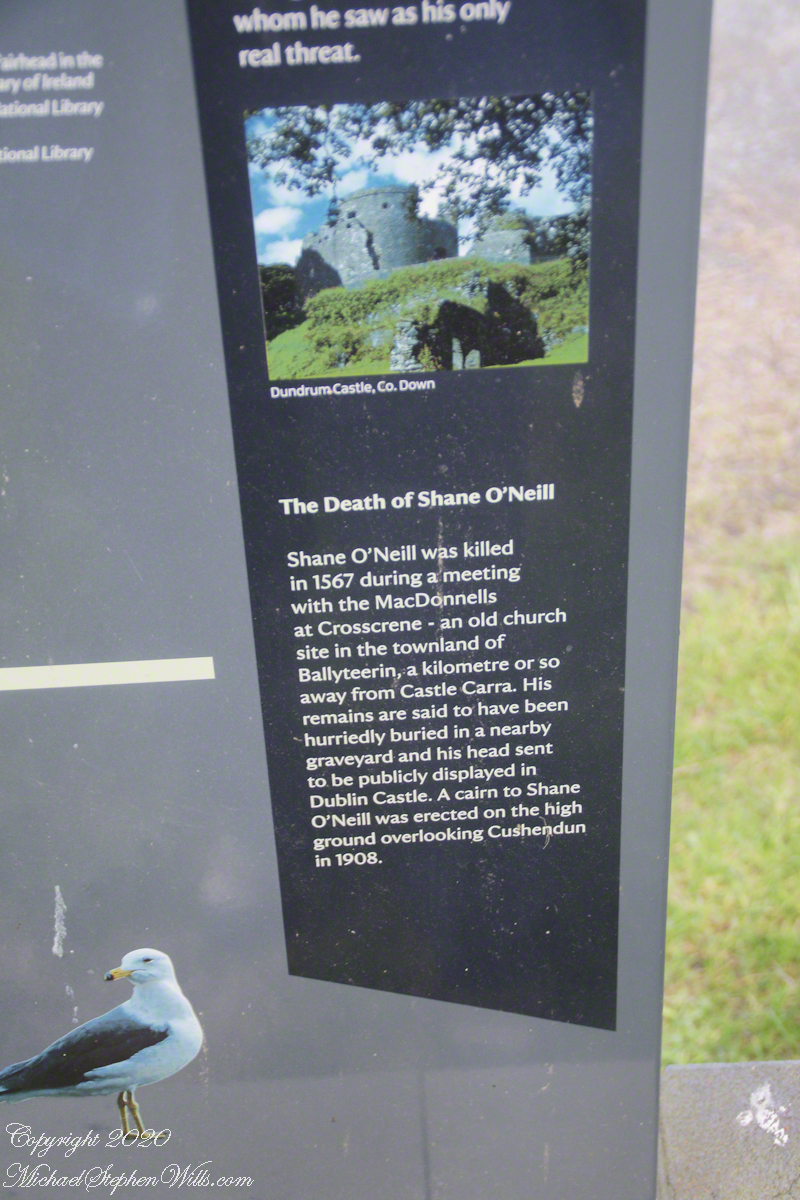
Cushendun (from Irish: Cois Abhann Doinne, meaning “foot of the River Dun”) is a small coastal village in County Antrim, Northern Ireland. It sits off the A2 coast road between Cushendall and Ballycastle.
It has a sheltered harbor and lies at the mouth of the River Dun and Glendun, one of the nine Glens of Antrim. The Mull of Kintyre in Scotland is only about 15 miles away across the North Channel and can be seen easily on clear days.
In the 2001 Census it had a population of 138 people. Cushendun is part of Causeway Coast and Glens district.
SONY DSC
Here are several of the information placards near the harbor explaining some local history.
.
Ballyteerin townland, where Shane O’Neill was killed, is on the road to Torr Head.
Reference: Wikipedia, “Cushendun.”
Enter your email to receive notification of future postings. I will not sell or share your email address.
Copyright 2025 All Rights Reserved Michael Stephen Wills
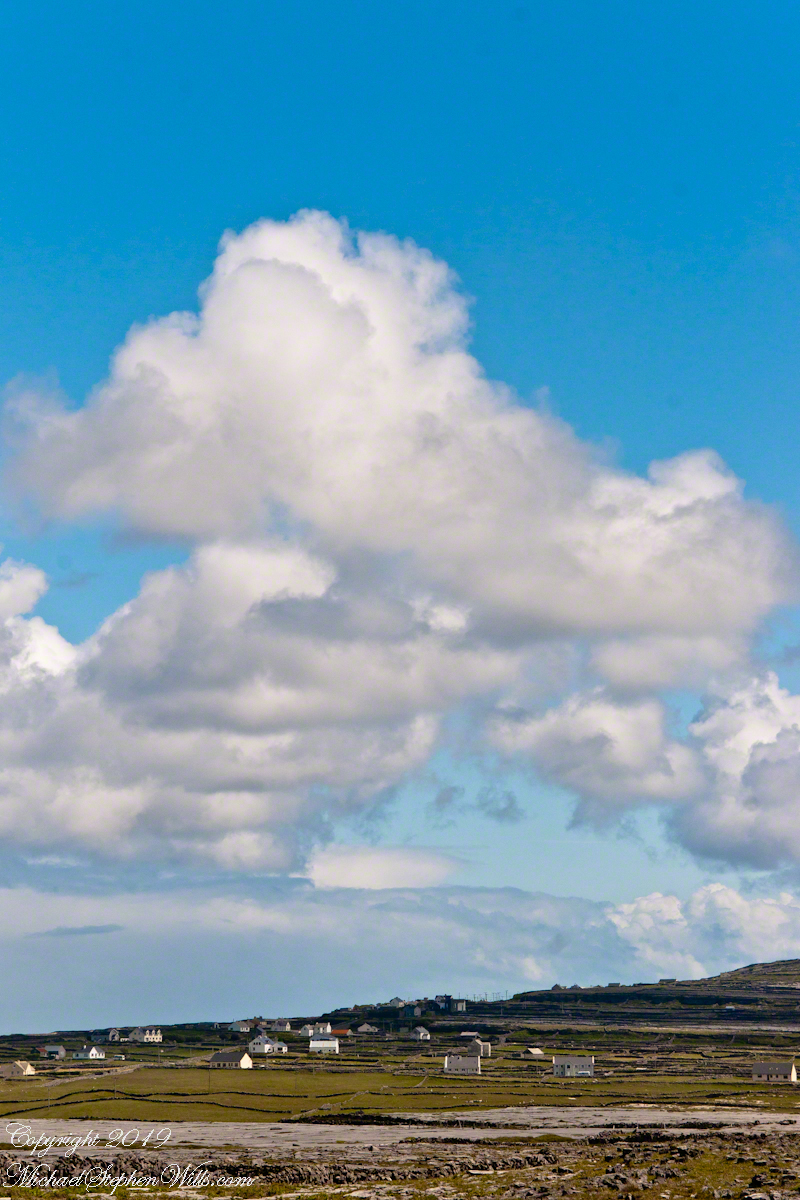
From the commanding location of Dún Aonghasa, looking northeast across Inishmore, the logic of the ancients becomes clear. No better vantage could be found—land unfurling like a hand toward Galway Bay, cottages nestled in green folds, clouds billowing above like sails caught mid-journey. A place of presence. A place of permanence.
Perched high on the cliff’s edge, the fort behind, the Atlantic at the back, the wind carried stories—unwritten, unspoken, but felt in the bones. Below, stone walls divided the island into patterns of memory. Fields outlined in rock, laid long ago by hands familiar with hardship and patience. The sea’s pulse echoed faintly in the distance, as steady and unfathomable as time itself.
No words were needed in that moment. Just the hush of sky and stone. Cottages, bleached bright by limewash—kalsomine, the old name still whispered by some—stood resilient against the elements, each one a witness to generations. Each one seemed to carry a personal reverence, a tenderness carved into the landscape.
Paths led gently inland, where wind slowed and voices from distant homes rose faintly through the open air. Along those paths, the rhythm of island life could be read in hoof prints, scattered wool, and the sharp, clean edges of hand-cut stone. There, among the hedges of limestone and wild grass, the living and the lost felt close.
The cloud cover shifted constantly. Shadows passed like thoughts across the land. Toward the shore, the sky opened wide. A silence filled the lungs, as bracing and deep as the Atlantic itself. Time seemed to slow, the mind slipping into the rhythm of the land.
Limestone pavement, rough beneath the boots, told its own tale of erosion and survival. That the earth here could sustain even the most modest farming seemed improbable. Yet here it was: a testament to stubborn hope and quiet ingenuity. In that quiet, ancient energy rose—something older than the fort, older than language. A pulse shared with the rock and wind.
The fort eventually came back into view—perched as if grown from the cliff itself, curved walls enclosing nothing but air and sky. I perceived no defensive bluster, only presence. And what a view it commanded. On days like this, the clouds formed towering cathedrals overhead, white and gold in the sun. Below, the cottages and fields seemed miniature, perfect, enduring.
The wind played echoes of prayer, lullaby, and laughter mingled with the call of seabirds. The thought came that nothing here was ever truly lost—only layered. Generation upon generation, each leaving some trace: a stone placed just so, a wall mended one final time, a cottage roof patched for another winter.
Here, even the air speaks. It moves gently but insistently, brushing the cheeks and stirring something ancient within the chest. Beneath it, the island breathes: not loudly, not urgently, but with the slow, deep rhythm of the tides.
As the sun dipped slightly westward, light changed across the fields, cottages glowing warm against darkening green. The wind softened. The clouds drifted, still massive but no longer looming. Time to return. A glance back offered one last communion with sky, stone, and silence.
Inishmore, on that day had been absorbed. Understood not with the mind, but with something quieter. Something that listens without need for words.
Monument Valley, or Tsé Biiʼ Ndzisgaii, embodies a profound connection between the Diné people and the land, contrasting imposed names with cultural significance and sacred narratives.
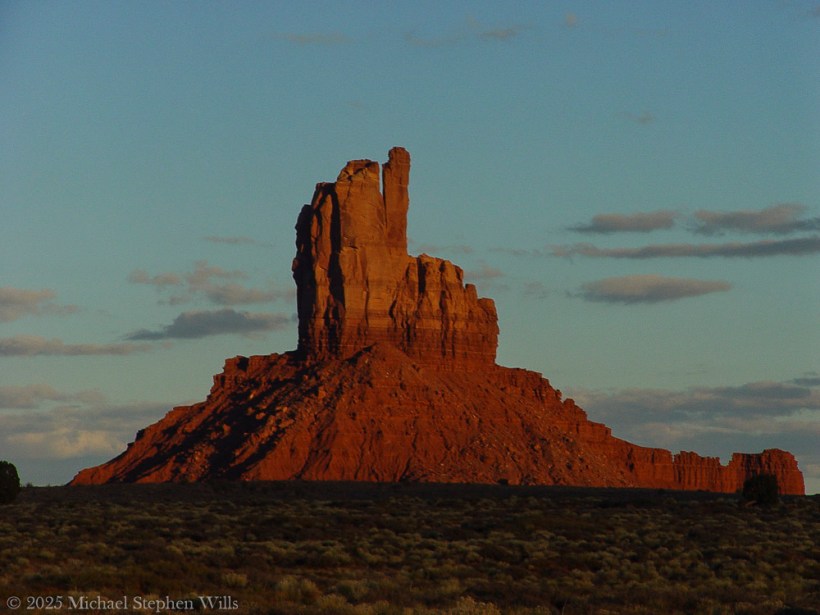
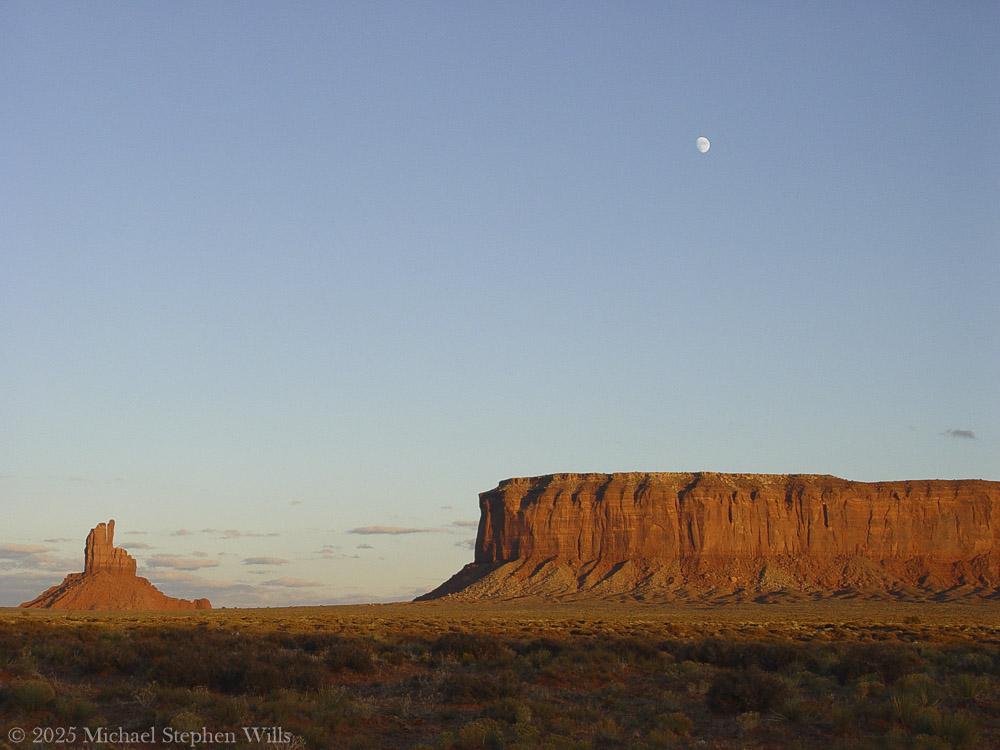
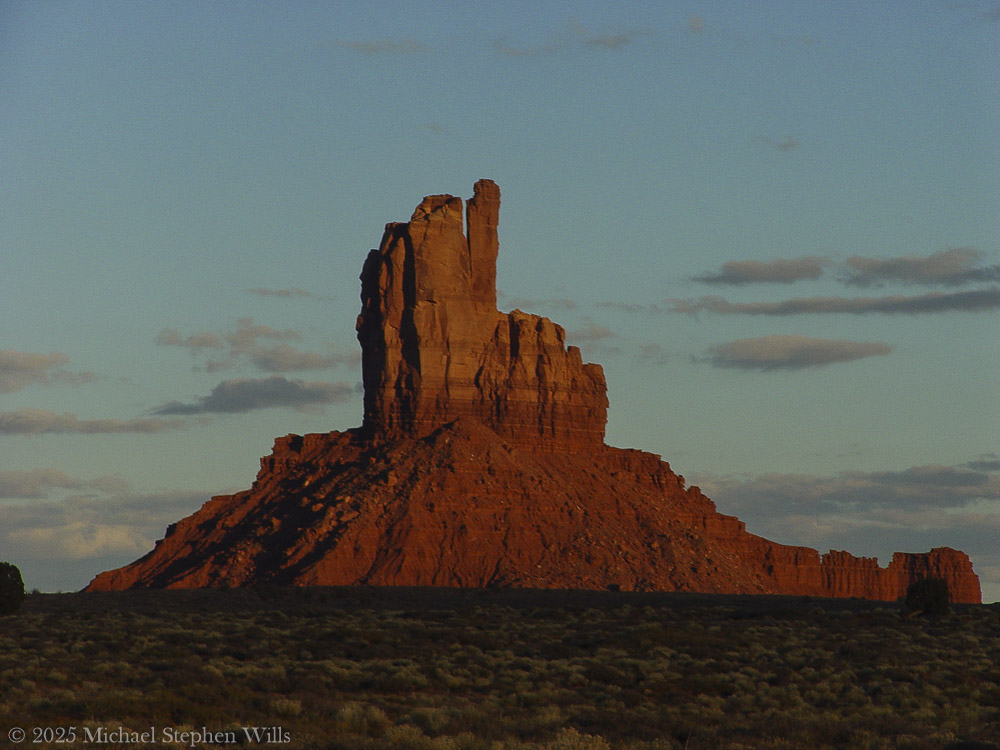
In the golden hush of this November sunset, Monument Valley stretches before us – an endless desert plain punctuated by towering red rock sentinels. The sky is vast and translucent blue, as a pale three-quarter moon rises silently above a solitary spire of sandstone. That spire is known on maps as Big Indian, a stone pillar glowing russet in the low sun. It stands apart from the mesas, its silhouette uncanny against the evening sky. In this serene moment, the land feels alive with presence. And the name “Big Indian” lingers in the air, raising quiet questions about what we call this place – and what it truly is.
From a distance, the spire does suggest a figure: tourists are told to squint, tilt their heads, and “see” the profile of a Native face gazing outward. One can imagine the first person to name it must’ve been a bored prospector, half-delirious from the heat after a lunch of canned beans, declaring: “I swear that rock looks like Uncle Joe in a feathered headdress.” And so the name stuck – a geological Rorschach test gone slightly colonial.
These whimsical titles – Totem Pole, Stagecoach, Big Indian – come not from the land, but from a long habit of outsiders labeling what they didn’t fully understand. “Big Indian” is particularly layered. The term “Indian” itself was born from Columbus’s navigational misfire, mistaking the Caribbean for Asia and its people for “Indios.” The Diné, the people who have lived here for centuries, never called themselves that. So this towering formation now bears the echo of a 15th-century directional blunder —like a name tag on the Sphinx that reads “Buckeye” because someone once thought Egypt was in Ohio. It’s a reminder: names given in haste can cling for centuries, even when they miss the mark entirely.
But beyond the names imposed by mapmakers, the spire simply is, in all its silent grandeur. In Diné lands, this valley has a different name: Tsé Biiʼ Ndzisgaii, often translated as Valley of the Rocks. In the Navajo tongue the name literally evokes “rock within white streaks around” – referring to the light bands of sediment that ring the red buttes. Those pale streaks wrap the spire like faded paint, remnants of ancient layers of earth. Here the Diné language whispers a description born of the land itself, unlike the English names that often project an outsider’s story. Tsé Biiʼ Ndzisgaii speaks to the truth of the place: stone and light, strata and shadow. As the sun lowers, you can actually see those whitish bands catching the last glow, encircling the butte like old memory. The Diné name honors what the eye sees – the layered geology – rather than imposing an unrelated label. This spire and its neighbors were not built by human hands, though their sheer stature can feel like architecture of the gods. Millions of years of natural artistry shaped Monument Valley.
Long before any person walked here, this land was a low basin collecting sediments. Layer upon layer of sand and silt hardened into rock, and a slow uplift in the earth heaved the basin into a plateau. Wind and water became patient sculptors over the last 50 million years, carving the plateau and peeling away the softer material. What remains today are the skeletal monuments of that erosion: buttes, mesas, and spires rising up to a thousand feet above the desert floor. Each is made of stratified stone – the broader bases of red shale and sandstone, and a cap of harder rock that resists the elements. Big Indian’s sturdy pedestal and slender crest tell this story of layered resilience. In the red-orange rock, oxides of iron tint the cliffs a deep rust, while streaks of black manganese oxide – “desert varnish” – trace down their sides like natural paint. Time and the elements have sculpted a masterpiece here.
Standing at its foot, one needs imagine the immeasurable ages of sun and storm that chiseled this lone tower from the earth. And yet, facts of geology alone fail to capture the spirit one feels in Tsé Biiʼ Ndzisgaii. The Diné know that spirit well – this valley is sacred to the Navajo Nation. To them, these colossal rocks are alive with meaning. The people have lived and wandered among these mesas for centuries, blessing the land with their stories and prayers.
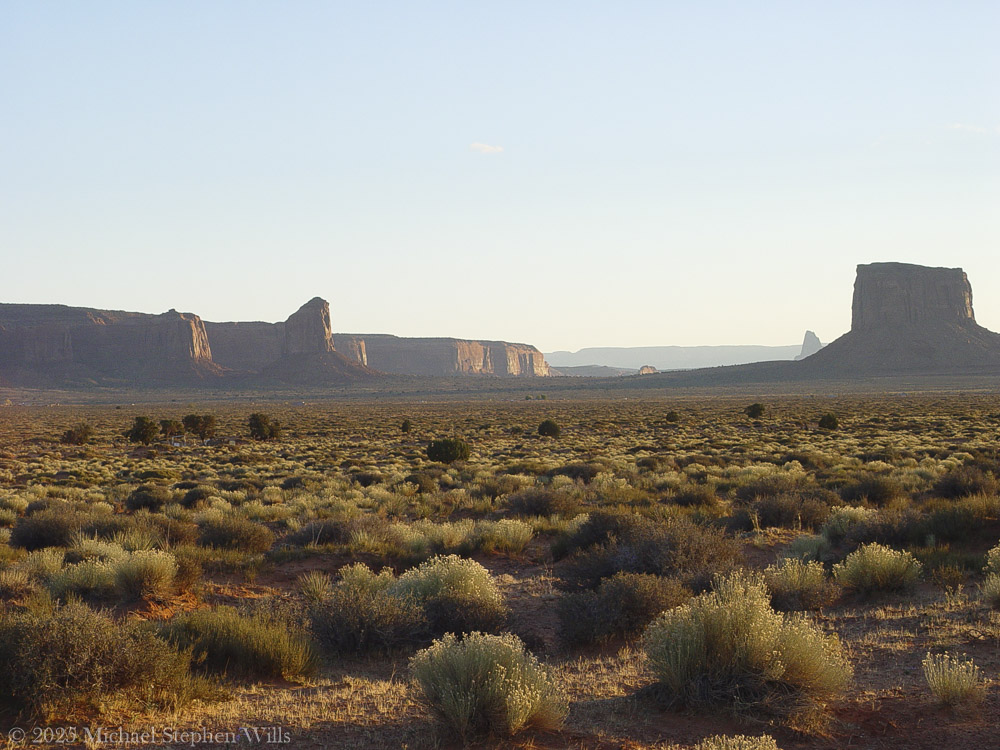
In Navajo cosmology, the landscape itself is imbued with life and purpose. The buttes are often seen as ancestors, guardians, or holy figures watching over the People. For example, the famous twin buttes called the Mittens are said to be a pair of spiritual beings – one male, one female – forever facing each other across the valley, protecting and balancing the land. Another hulking mesa, Sentinel Mesa, is known as a “door post” of the valley, a guardian at the entrance, paired with another butte as the opposite door post. The valley, in the Diné way of seeing, resembles a great hogan, a home blessed by the gods: the mesas at its threshold are like the posts of a doorway, and a butte called The Hub is imagined as the central fire hearth of this immense home.
In this way, the Diné landscape is a living, storied environment. Even the spindly formations carry sacred narrative. Seven miles southeast from Big Indian stand slender pinnacles known to the Navajo as Yei Bi Chei, named for the masked spiritual dancers who emerge on the last night of a winter healing ceremony.
Each dawn, as the first light breaks over the mesas, it’s said the Navajo families come out of their hogans to greet the sun with prayers – their doorways always face the east to receive blessings of the day. In the same way, the great stone hogan of Monument Valley opens eastward, with its door-post buttes and its eternal fireplace. In Diné worldview, earth and sky are intertwined with their lives; they speak of Mother Earth from whom they emerged and to whom they owe care. Here in Monument Valley, it is possible to feel that harmony – the sense that every column of rock, every whispering juniper shrub, every beam of sunlight and moonrise is part of a whole living tapestry.
We watch as the moon climbs higher above the Big Indian spire, its silvery light softening the rock’s hard edges. This place has known many names and will outlast many more. The Paiute people who roamed here before called it “Valley Amid the Rocks” and wove myths of gods and giants into its features. Later came the labels of explorers and filmmakers: Monument Valley, a monumental canvas for Western legends. And of course, the simplistic tag Big Indian for this lone rock – a name that says more about those who coined it than about the land itself.
Names, in the end, are stories we tell about the world. The colonial names imposed here are like brief echoes across the ages, while the Diné stories run deep as the red earth. The Diné prefer to call themselves Diné – meaning “the People”– and they call this land by names that describe its true character. I imagine that to the People, this spire might be thought of not as an “Indian” at all, but perhaps as a sentinel or an old friend standing watch. Its Diné name, if it has one, would likely emerge from its form or its role in a story, spoken with reverence.
As dusk turns to twilight, an immense peace settles. The monolith before me is no longer just Big Indian on a map; it is an ancient entity shaped by time and honored by generations. In the silence, we can almost hear the land speaking in the old language – telling of how it was born from oceans and sand, how it saw the first people wander through, how it endures through centuries of memory. The rock shares with us a moment beyond names: just the whisper of wind, the glow of moon, and a feeling of connection and wonder. This is Monument Valley, Tsé Biiʼ Ndzisgaii, in all its truth. In this contemplative dusk, I bow to the tower of stone, misnamed yet never truly defined by that misnomer. It remains what it has always been – a creation of earth and spirit, a witness to history, a source of humble awe. Tuning to leave, I softly speak a word of thanks – Ahéheeʼ – grateful to have listened, if only briefly, to the sacred voice of the valley.
Bibliography
Encyclopædia Britannica – Tribal Nomenclature: American Indian, Native American, and First Nation britannica.com (origin of the term “Indian” as a colonial misnomer)
Navajo Nation Parks & Recreation – Monument Valley (Tsé Bii’ Ndzisgaii) navajonationparks.orgnavajonationparks.org (official site detailing Monument Valley’s geology and formation)
Robert S. McPherson – Monument Valley.Utah History Encyclopediauen.orguen.org (history, geology, and indigenous lore of Monument Valley)
Aztec Navajo County – Monument Valley PDF Guide aztecnm.comaztecnm.com (descriptions of formations, including Navajo perspectives on their meanings and names)
Navajo Word of the Day – Tsé Biiʼ Ndzisgaii navajowotd.com (explanation of the Navajo name for Monument Valley, meaning “white streaks in the rocks”)
Enter your email to receive notification of future postings. I will not sell or share your email address.
Copyright 2025 All Rights Reserved Michael Stephen Wills
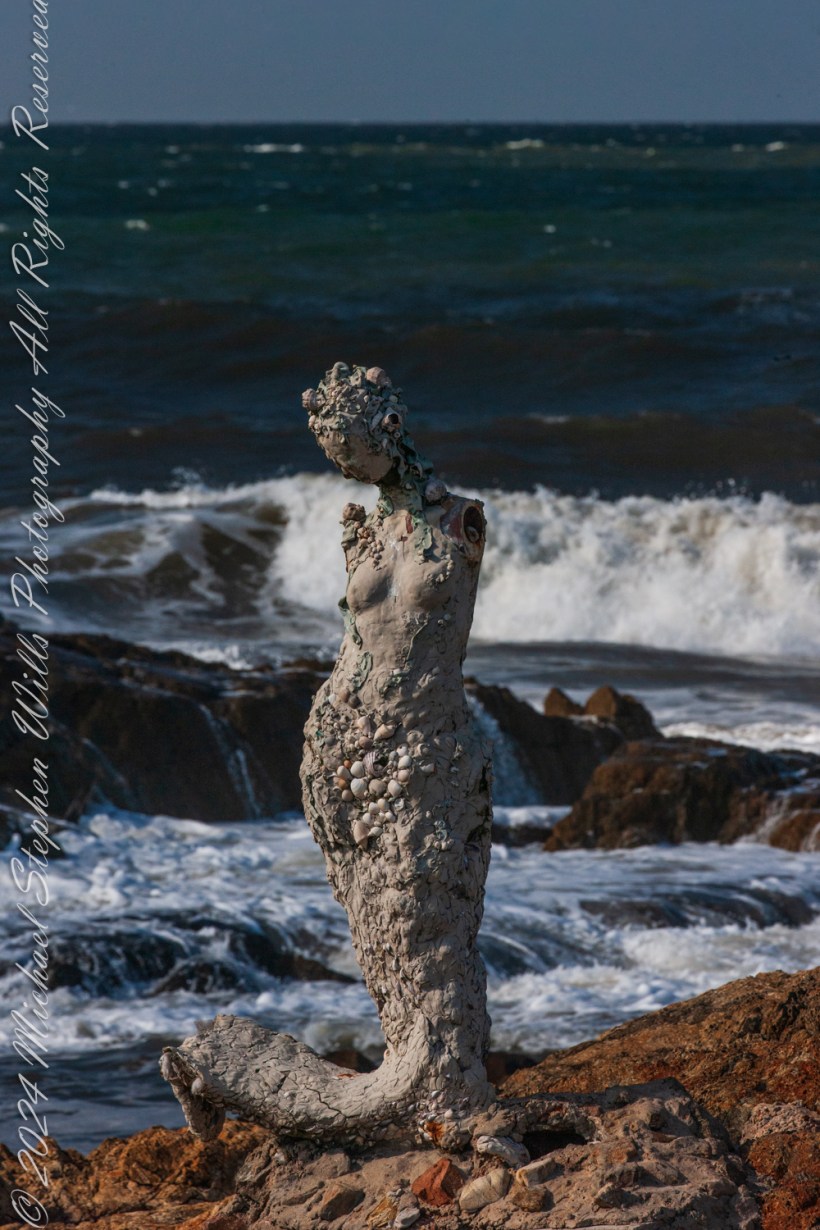
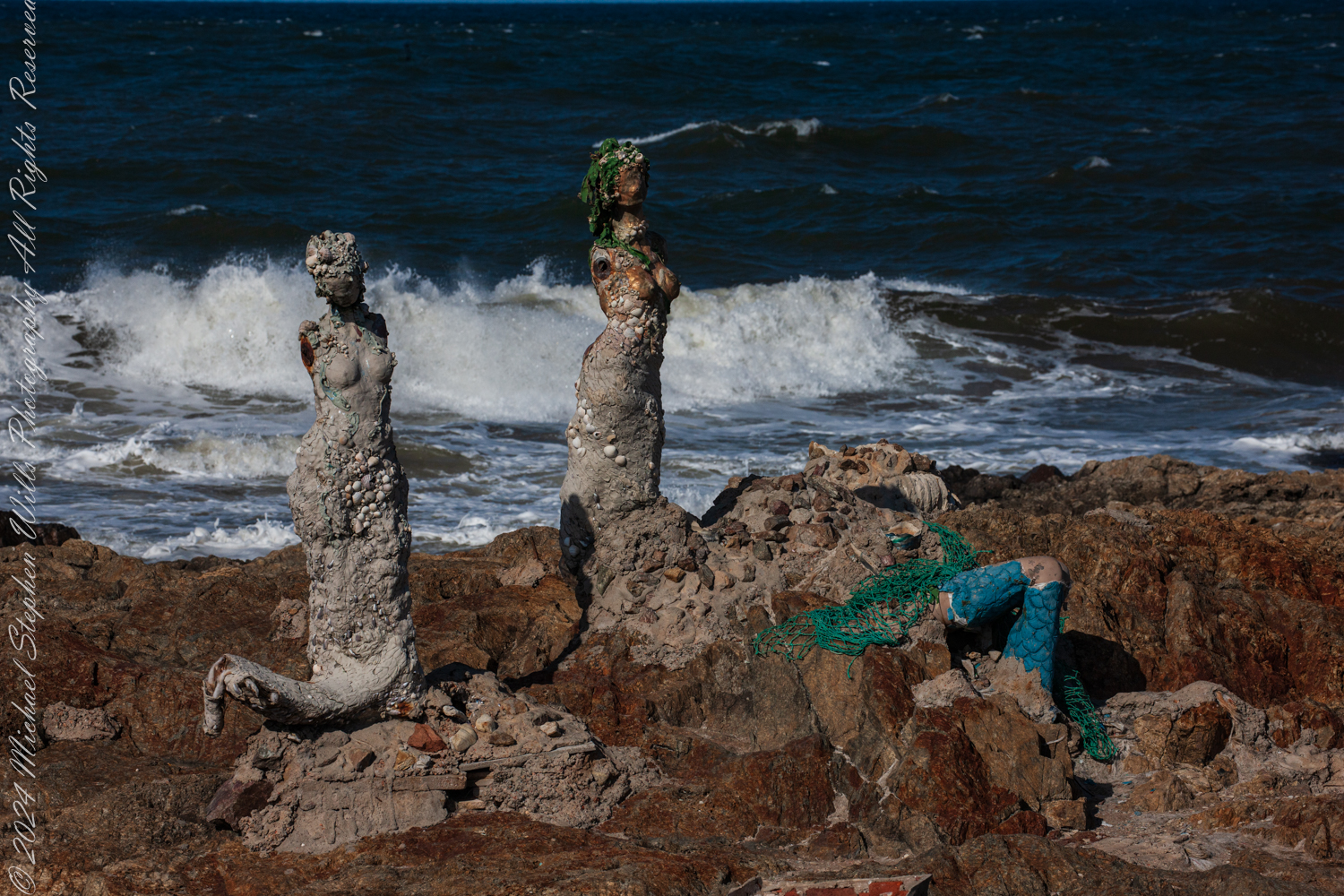
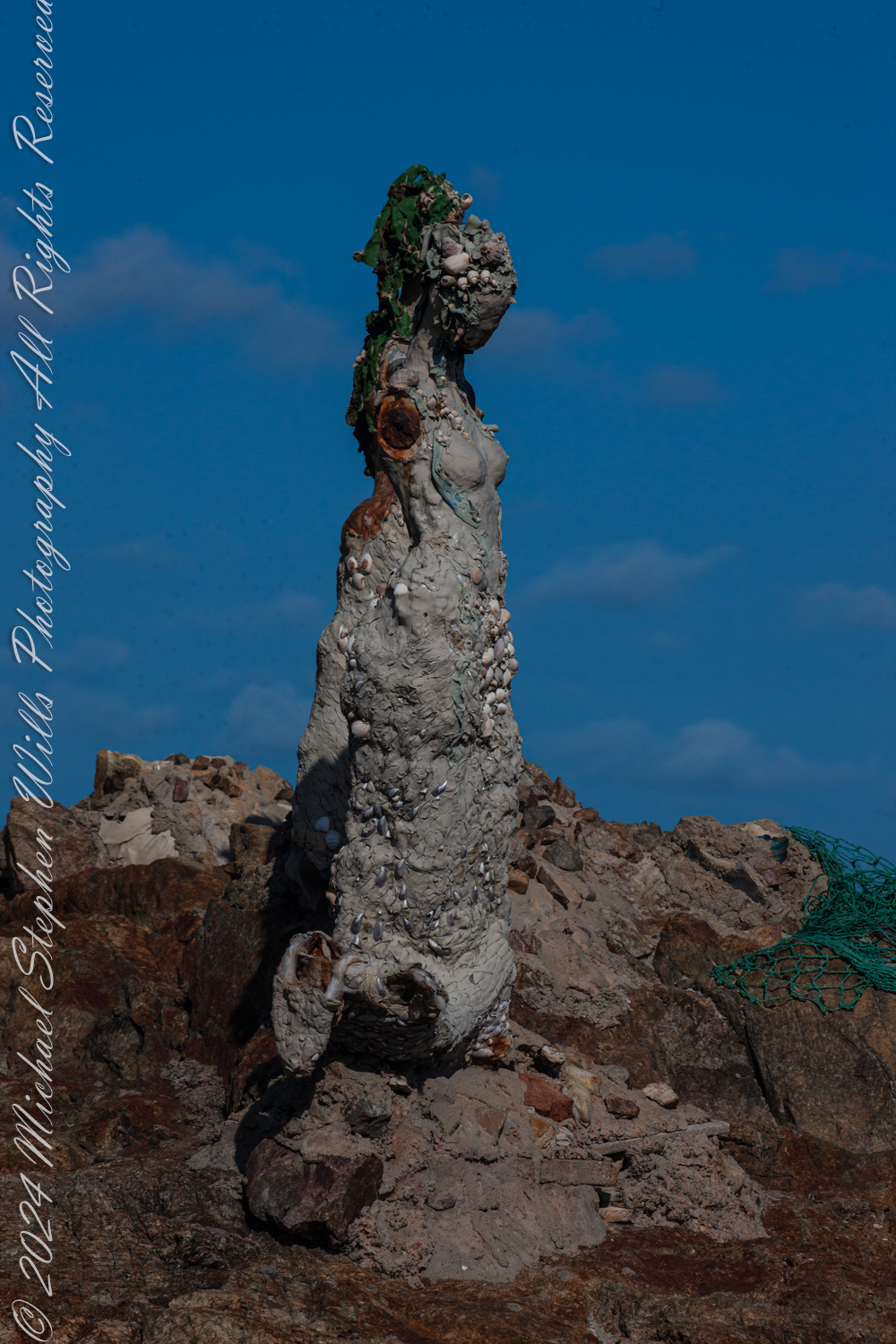
The wind carried the scent of the sea as we stood at Punta de las Salinas, the furthest tip of Punta del Este, Uruguay. This was a place of myth and mystery for us, where the Atlantic Ocean merged with the Río de la Plata, and where the rocks bore witness to the timeless interplay of water and stone. Here stood “El Canto de las Sirenas” (The Song of the Mermaids), an evocative art installation by Lily Perkins, first completed in 2012. The sculptures seemed perfectly at home here, their placement deeply intertwined with the mythology they evoked.
This is at Great Britain Square, Punta de las Salinas of Punta del Este. We are at the tip of the peninsula, the easternmost point of Uruguay. This is the art installation El Canto de las Sirenas” (The Song of the Mermaids) (2012) by the artist Lily Perkins. Punta del Este, Departamento de Maldonado, Uruguay
The sirens of ancient lore were said to dwell at perilous points where land met the untamed sea, luring sailors to their doom with haunting songs. These rocky outcrops, both a boundary and a threshold, have long held symbolic power as places where the natural world is at its most raw and elemental. Punta de las Salinas is such a place. Its jagged rocks and churning waves create an environment as beautiful as it is treacherous. It is easy to imagine mythical sirens choosing this very spot to weave their spellbinding melodies.
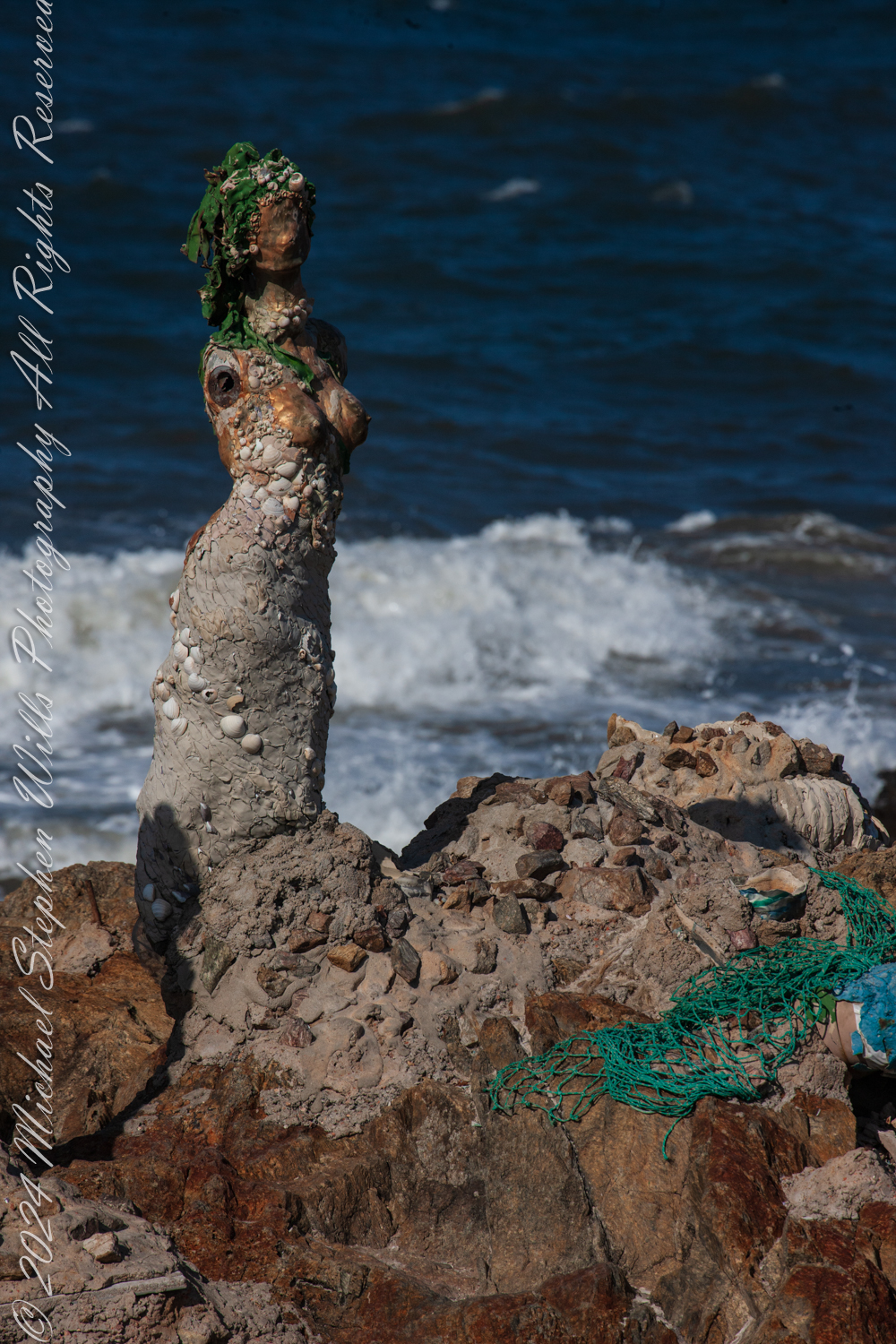
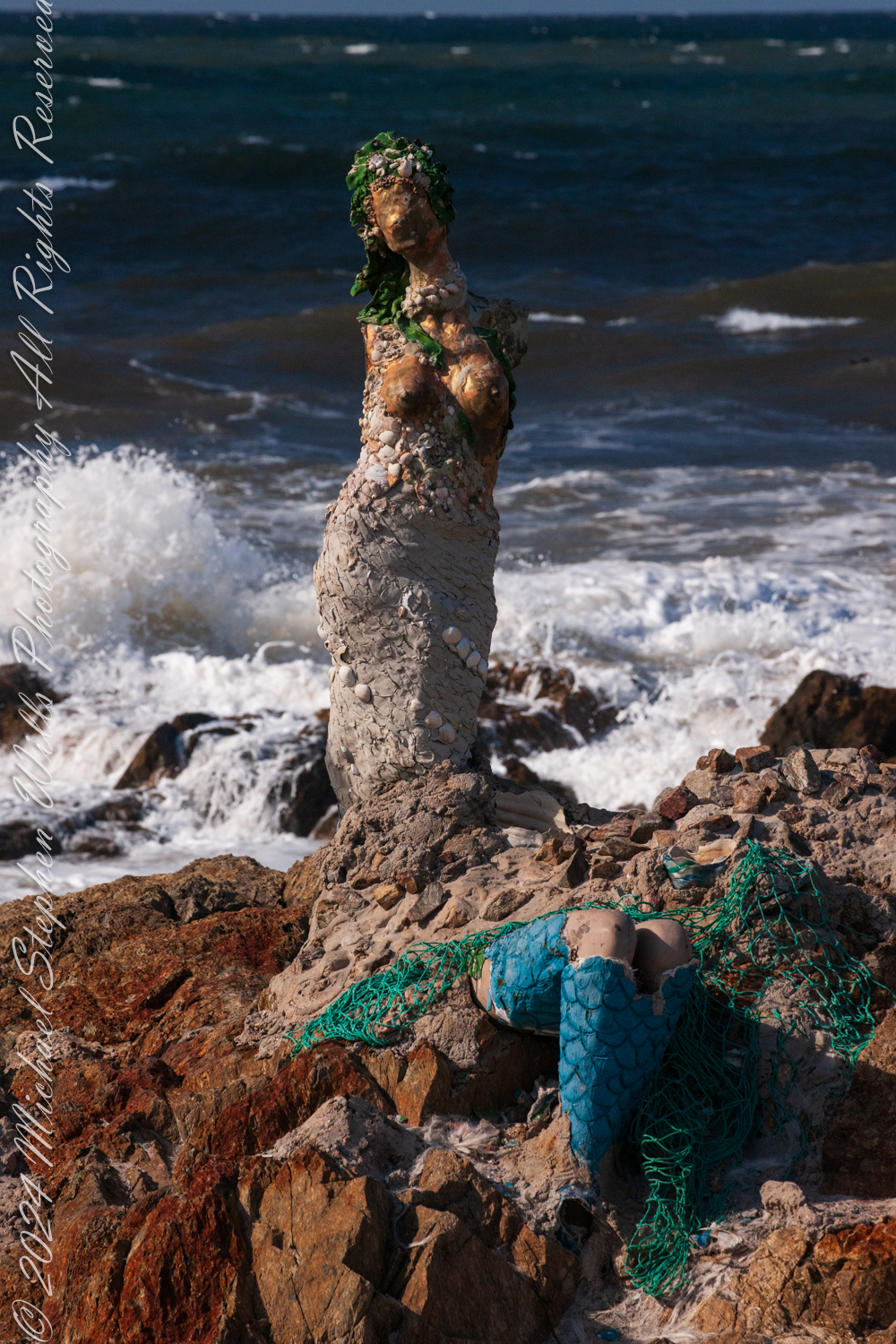
This is at Great Britain Square, Punta de las Salinas of Punta del Este. We are at the tip of the peninsula, the easternmost point of Uruguay. This is the art installation El Canto de las Sirenas” (The Song of the Mermaids) (2012) by the artist Lily Perkins. Punta del Este, Departamento de Maldonado, Uruguay
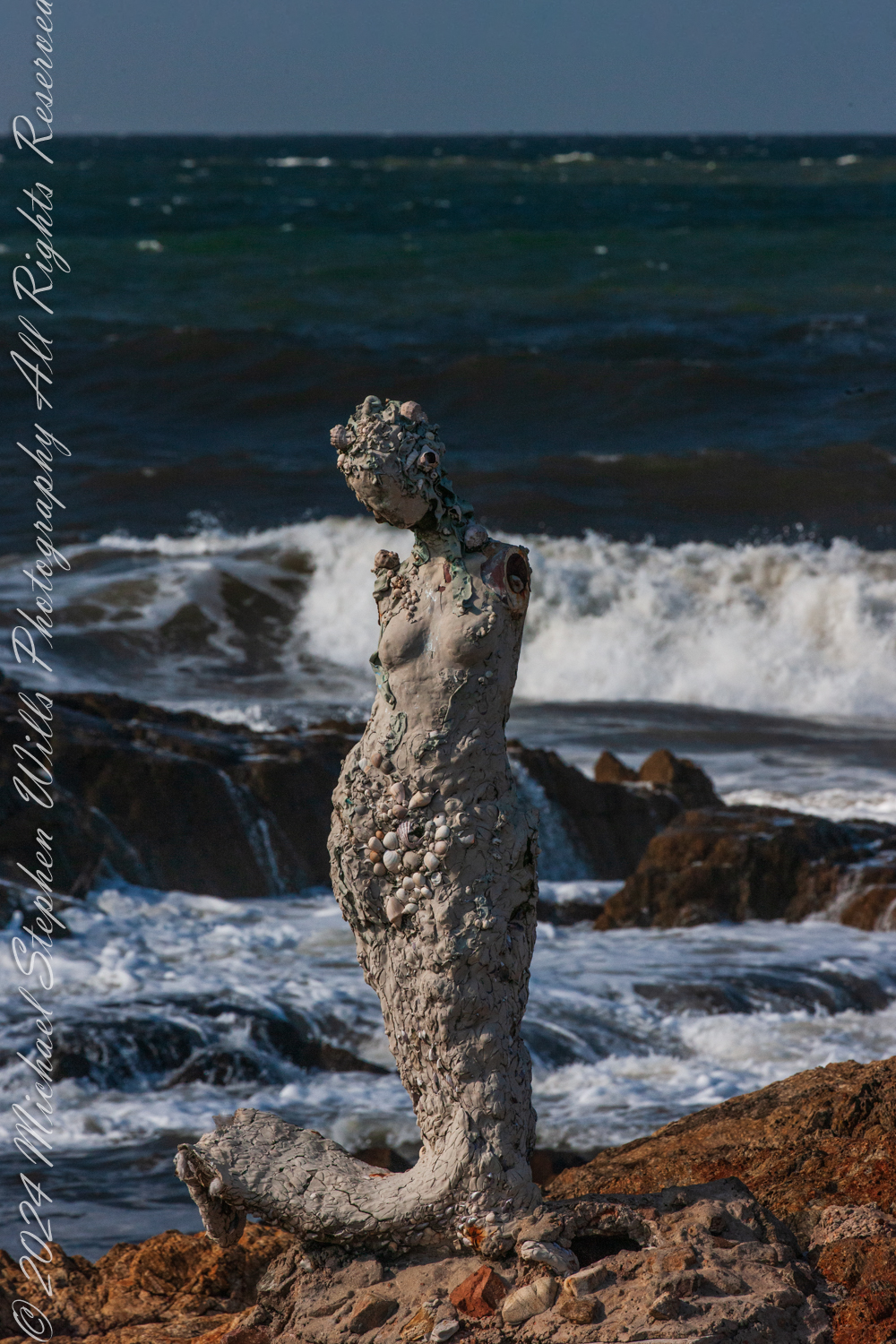
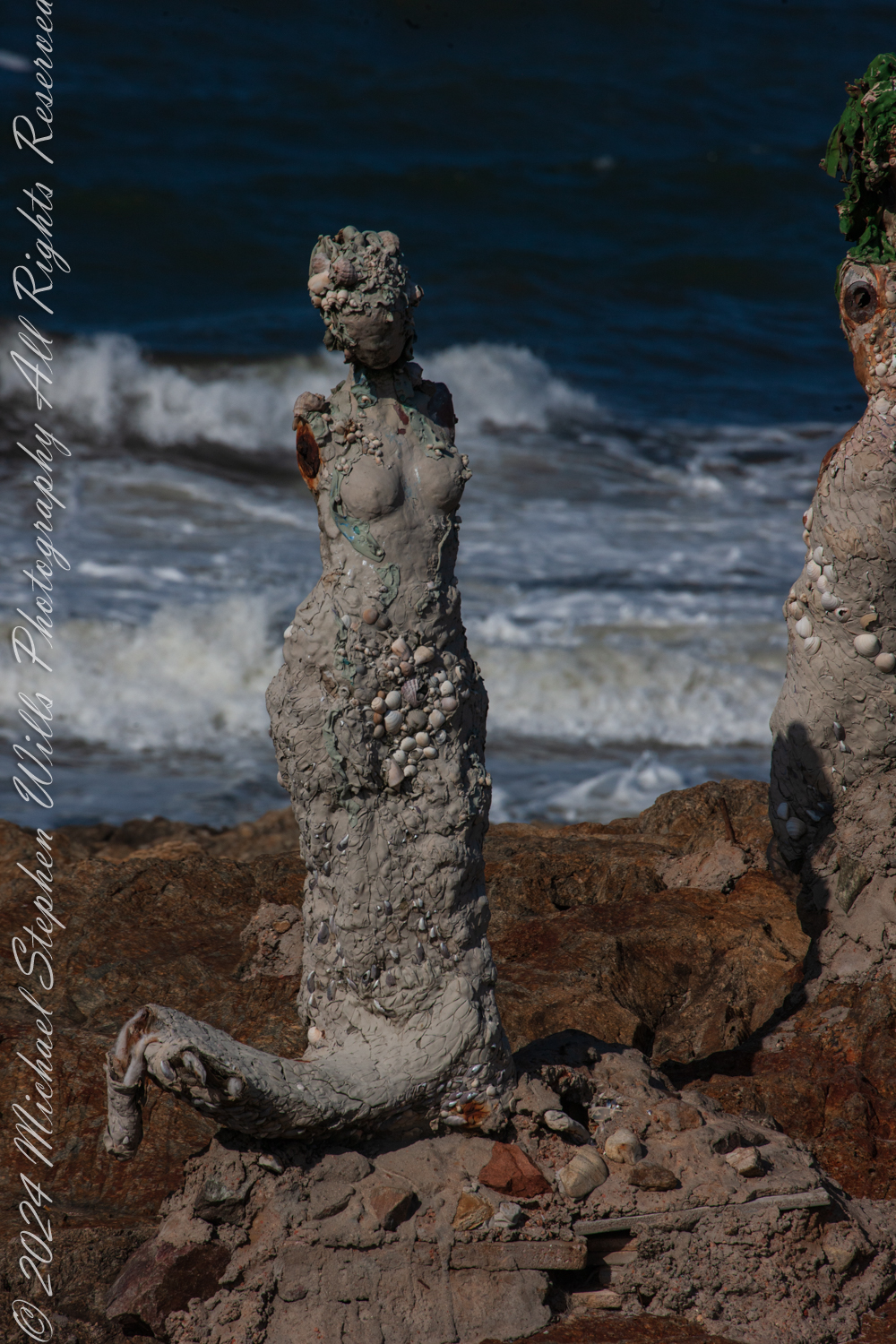
Lily Perkins’ installation captures this essence. The sculptures are not idealized depictions of mermaids; they are rugged and raw, encrusted with shells, stones, and marine debris. Their weathered forms mirror the harsh, untamed beauty of their surroundings. It is as if they have emerged from the ocean itself, born of the waves and the salt-laden air, to stand as sentinels at the edge of the world.
The central figure, with her face turned skyward, evokes the myth of the siren’s song—a melody so enchanting that it drove sailors to risk their lives against the rocks. Her posture suggests longing, perhaps for a connection beyond the horizon, or perhaps for the very mortals she is fated to ensnare. Nearby, a broken figure reclines against the rocks, her form partially encased in green netting and mosaic-like tiles. She seems more grounded, her siren’s call muted, as if weighed down by the realities of the modern world. The use of marine materials in her construction—a blend of natural and human-made debris—suggests an awareness of humanity’s impact on the seas.
The third figure, slightly apart, is the most enigmatic. Encrusted with barnacles and weathered by the elements, she seems lost in thought. Her gaze is directed not toward the sea but toward the land, as if contemplating her place at this meeting of worlds. In mythology, sirens were liminal creatures, existing between realms—the sea and the shore, the mortal and the divine. This figure embodies that in-between state, rooted in the rocks yet shaped by the sea.
The placement of these sculptures at Punta de las Salinas is no accident. This headland is the easternmost point of Uruguay, a natural boundary and a crossroads where two vast bodies of water meet. For centuries, sailors navigated these waters, their journeys fraught with danger. The rocks here are unforgiving, and the waves crash with relentless power. To stand at this point is to feel the raw energy of the ocean and to understand why myths of sirens arose in such places. The sirens symbolize both allure and peril, a reminder of the ocean’s capacity to inspire and to destroy.
As I walked among the sculptures, the mythology seemed to come alive. The sound of the waves crashing against the rocks could easily be imagined as the sirens’ song—a hypnotic rhythm that draws you in and holds you spellbound. The figures, though silent, seemed to hum with an energy that echoed the sea’s eternal motion.
I feld these sculptures were not merely placed at Punta de las Salinas; but had emerged from it, their forms shaped by the same forces that shaped the rocks beneath our feet. The shells and stones embedded in their surfaces tied them physically to the sea, while their mythical resonance tied them spiritually to the place.
The mythology of the sirens speaks to the duality of the sea—its beauty and its danger, its capacity to give and to take away. Standing at Punta de las Salinas, surrounded by Perkins’ sculptures, I felt that duality in a profound way. The ocean stretched endlessly before us, a vast, unknowable expanse, while behind us lay the solid ground of the peninsula—a place of safety, but also a place that ended here, at this edge.
Lily Perkins sculptures are restored…..
As we left, the figures seemed to watch us go, their silent song lingering in my mind. The sirens of Punta del Este are more than art; they are a dialogue between myth and reality, between the natural world and the human imagination. In their weathered beauty, they remind us of the stories the sea has always told, and of the enduring power of those who give those stories form.
Enter your email to receive notification of future postings. I will not sell or share your email address.
Copyright 2025 All Rights Reserved Michael Stephen Wills







 Michael Stephen Wills Photography